Urine Sodium Excretion in Children with Primary Hypertension: A Single-Center Retrospective Study


Abstract
1. Introduction
2. Materials and Methods
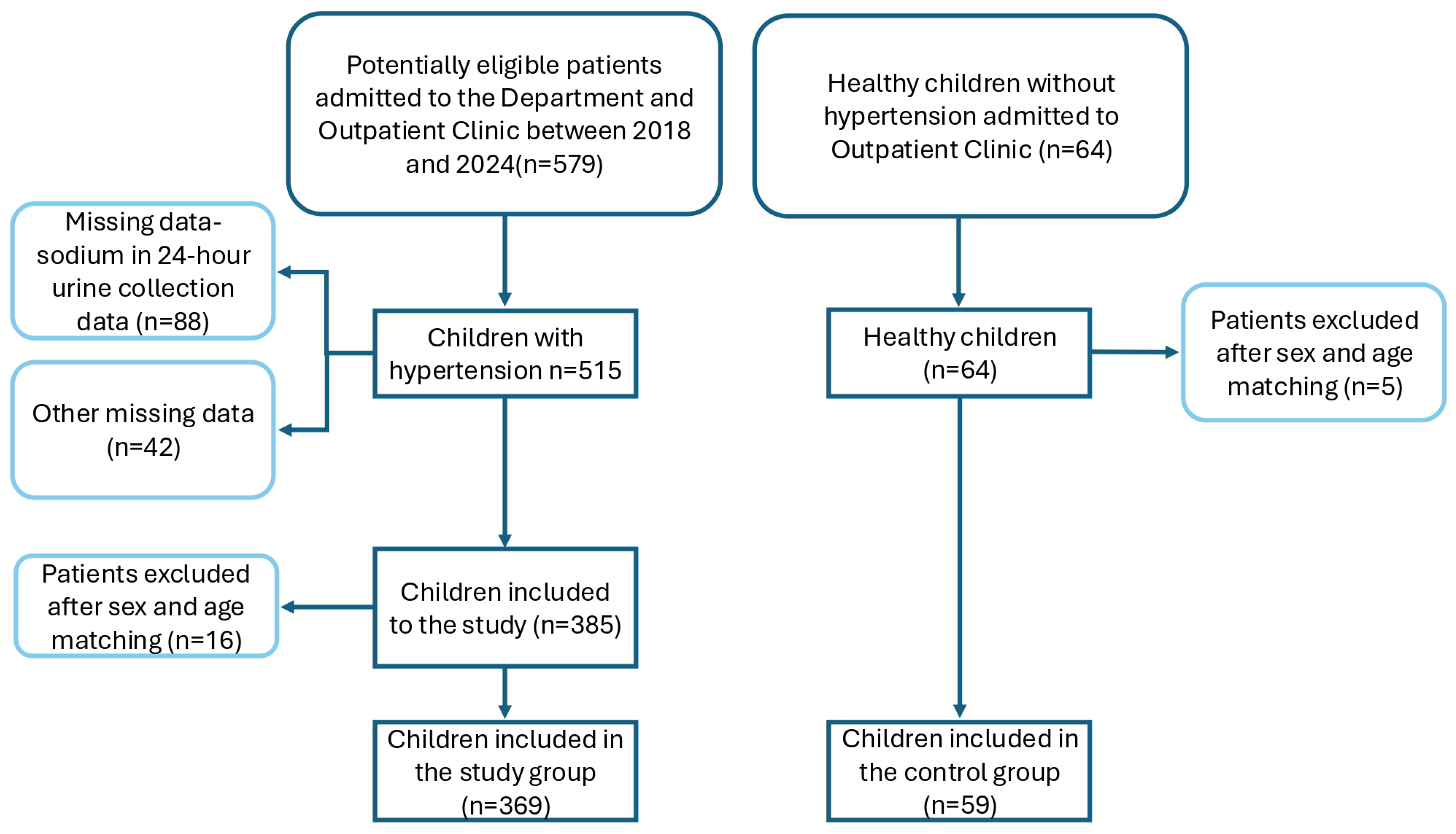
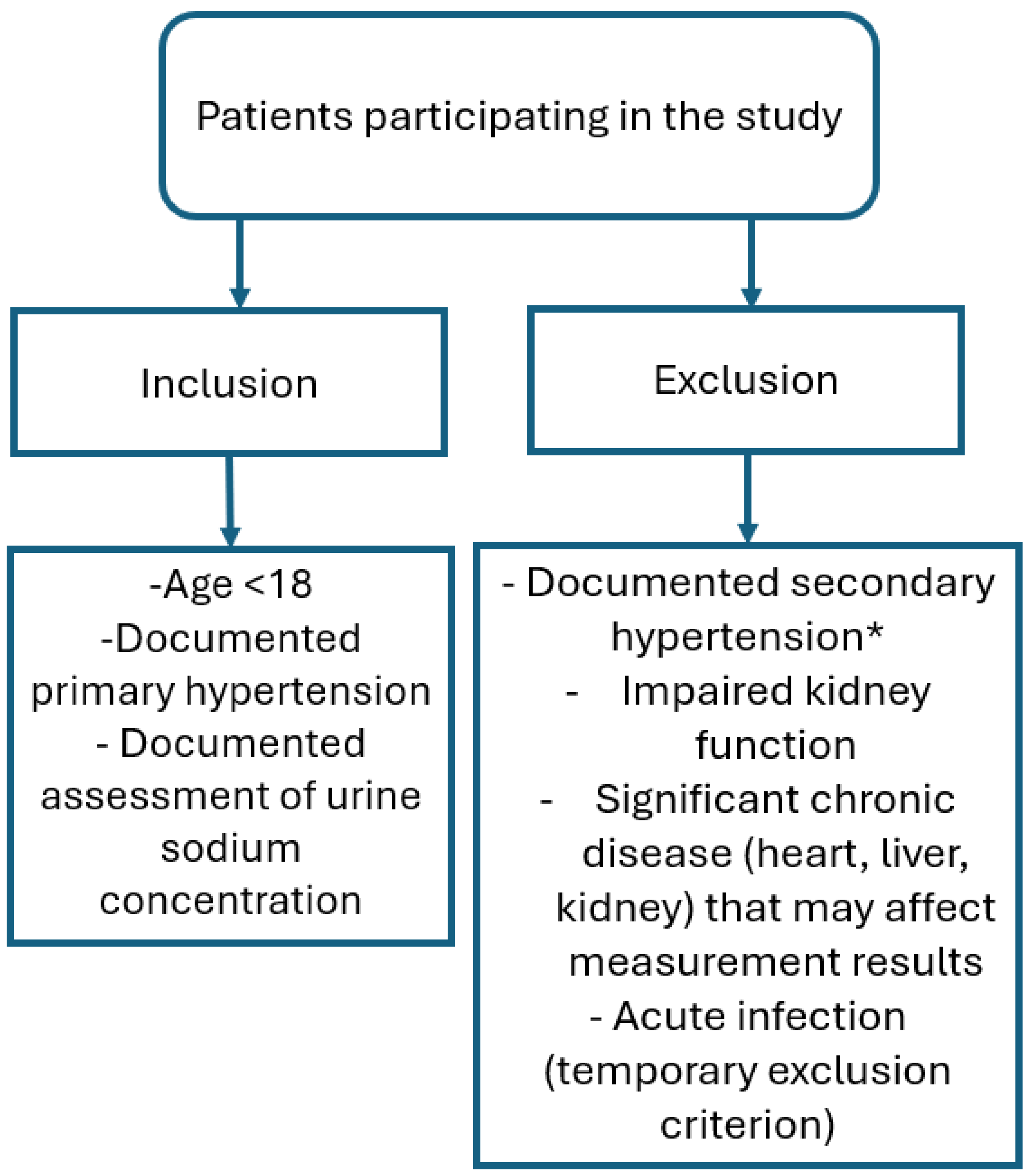
2.1. Study Design
2.2. Data Collection
2.3. Statistical Analysis
2.4. Ethical Considerations
3. Results
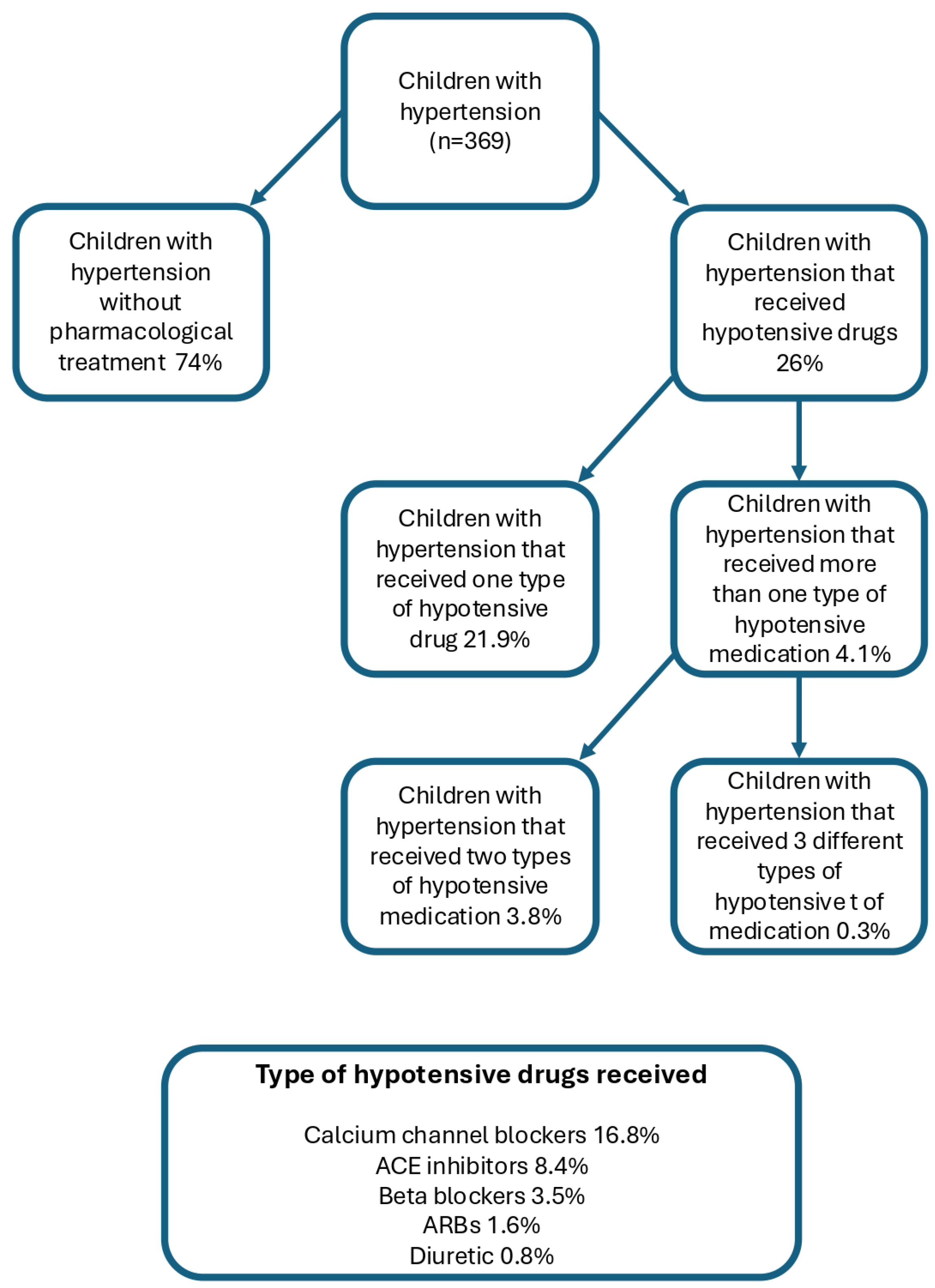
3.1. Clinical Characteristics of the Study Group
3.2. Correlation of Sodium to Creatinine Urine Excretion
3.3. Excessive Sodium Excretion Group
3.4. Age-Stratified Analysis
4. Discussion
Strengths and Limitations
5. Conclusions
Author Contributions
Funding
Institutional Review Board Statement
Informed Consent Statement
Data Availability Statement
Conflicts of Interest
References
- Lurbe, E.; Agabiti-Rosei, E.; Cruickshank, J.K.; Dominiczak, A.; Erdine, S.; Hirth, A.; Invitti, C.; Litwin, M.; Mancia, G.; Pall, D.; et al. 2016 European Society of Hypertension guidelines for the management of high blood pressure in children and adolescents. J. Hypertens. 2016, 34, 1887–1920. [Google Scholar] [CrossRef] [PubMed]
- Song, P.; Zhang, Y.; Yu, J.; Zha, M.; Zhu, Y.; Rahimi, K.; Rudan, I. Global Prevalence of Hypertension in Children: A Systematic Review and Meta-analysis. JAMA Pediatr. 2019, 173, 1154–1163. [Google Scholar] [CrossRef] [PubMed]
- Hisamatsu, T.; Kinuta, M. High blood pressure in childhood and adolescence. Hypertens. Res. 2024, 47, 203–205. [Google Scholar] [CrossRef]
- Sorof, J.; Daniels, S. Obesity hypertension in children: A problem of epidemic proportions. Hypertension 2002, 40, 441–447. [Google Scholar] [CrossRef] [PubMed]
- Bao, W.; Threefoot, S.A.; Srinivasan, S.R.; Berenson, G.S. Essential hypertension predicted by tracking of elevated blood pressure from childhood to adulthood: The Bogalusa Heart Study. Am. J. Hypertens. 1995, 8, 657–665. [Google Scholar] [CrossRef]
- Rust, P.; Ekmekcioglu, C. Impact of Salt Intake on the Pathogenesis and Treatment of Hypertension. Adv. Exp. Med. Biol. 2017, 956, 61–84. [Google Scholar]
- Gonzalez, S.A.; Forcada, P.; de Cavanagh, E.M.; Inserra, F.; Svane, J.C.; Obregon, S.; Castellaro, C.; Olano, D.; Hita, A.; Kotliar, C.V. Sodium intake is associated with parasympathetic tone and metabolic parameters in mild hypertension. Am. J. Hypertens. 2012, 25, 620–624. [Google Scholar] [CrossRef]
- Wilck, N.; Matus, M.G.; Kearney, S.M.; Olesen, S.W.; Forslund, K.; Bartolomaeus, H.; Haase, S.; Mähler, A.; Balogh, A.; Markó, L.; et al. Salt-responsive gut commensal modulates T(H)17 axis and disease. Nature 2017, 551, 585–589. [Google Scholar] [CrossRef]
- Wesseling, S.; Koeners, M.P.; Joles, J.A. Salt sensitivity of blood pressure: Developmental and sex-related effects. Am. J. Clin. Nutr. 2011, 94 (Suppl. S6), 1928S–1932S. [Google Scholar] [CrossRef]
- He, F.J.; MacGregor, G.A. Importance of salt in determining blood pressure in children: Meta-analysis of controlled trials. Hypertension 2006, 48, 861–869. [Google Scholar] [CrossRef]
- Leyvraz, M.; Chatelan, A.; da Costa, B.R.; Taffe, P.; Paradis, G.; Bovet, P.; Bochud, M.; Chiolero, A. Sodium intake and blood pressure in children and adolescents: A systematic review and meta-analysis of experimental and observational studies. Int. J. Epidemiol. 2018, 47, 1796–1810. [Google Scholar] [CrossRef]
- Rios-Leyvraz, M.; Bloetzer, C.; Chatelan, A.; Bochud, M.; Burnier, M.; Santschi, V.; Paradis, G.; Tabin, R.; Bovet, P.; Chiolero, A. Sodium intake and blood pressure in children with clinical conditions: A systematic review with meta-analysis. J. Clin. Hypertens. 2019, 21, 118–126. [Google Scholar] [CrossRef]
- Hofman, A.; Hazebroek, A.; Valkenburg, H.A. A randomized trial of sodium intake and blood pressure in newborn infants. JAMA 1983, 250, 370–373. [Google Scholar] [CrossRef]
- Li, Y.; Zhang, P.; He, F.J.; Luo, R.; Song, J.; Wang, C.; Chen, F.; Zhao, W.; Zhao, Y.; Chen, H.; et al. Persistent effect of salt reduction in schoolchildren and their families: 1-year follow-up after an application-based cluster randomized controlled trial. BMC Med. 2025, 23, 41. [Google Scholar] [CrossRef]
- Cooper, R.; Van Horn, L.; Liu, K.; Trevisan, M.; Nanas, S.; Ueshima, H.; Larbi, E.; Yu, C.S.; Sempos, C.; LeGrady, D.; et al. A randomized trial on the effect of decreased dietary sodium intake on blood pressure in adolescents. J. Hypertens. 1984, 2, 361–366. [Google Scholar] [CrossRef] [PubMed]
- Tykarski, A.; Filipiak, K.J.; Januszewicz, A.; Litwin, M.; Narkiewicz, K.; Prejbisz, A.; Ostalska-Nowicka, D.; Widecka, K.; Kostka-Jeziorny, K. Zasady postępowania w nadciśnieniu tętniczym—2019 rok. Nadciśnienie Tętnicze w Praktyce 2019, 5, 1–86. [Google Scholar]
- Kułaga, Z.; Litwin, M.; Grajda, A.; Kułaga, K.; Gurzkowska, B.; Góźdź, M.; Pan, H. Oscillometric blood pressure percentiles for Polish normal-weight school-aged children and adolescents. J. Hypertens. 2012, 30, 1942–1954. [Google Scholar] [CrossRef]
- de Onis, M.; Onyango, A.W.; Borghi, E.; Siyam, A.; Nishida, C.; Siekmann, J. Development of a WHO growth reference for school-aged children and adolescents. Bull. World Health Organ. 2007, 85, 660–667. [Google Scholar] [CrossRef] [PubMed]
- Stewart, J.; McCallin, T.; Martinez, J.; Chacko, S.; Yusuf, S. Hyperlipidemia. Pediatr. Rev. 2020, 41, 393–402. [Google Scholar] [CrossRef] [PubMed]
- Sawicka-Kamińska, A.; Bieroza, I. Kamica układu moczowego u dzieci. Nowa Pediatr. 2011, 15, 42–48. [Google Scholar]
- Flynn, J.T.; Daniels, S.R.; Hayman, L.L.; Maahs, D.M.; McCrindle, B.W.; Mitsnefes, M.; Zachariah, J.P.; Urbina, E.M. Update: Ambulatory blood pressure monitoring in children and adolescents: A scientific statement from the American Heart Association. Hypertension 2014, 63, 1116–1135. [Google Scholar] [CrossRef]
- Wühl, E.; Witte, K.; Soergel, M.; Mehls, O.; Schaefer, F. Distribution of 24-h ambulatory blood pressure in children: Normalized reference values and role of body dimensions. J. Hypertens. 2002, 20, 1995–2007. [Google Scholar] [CrossRef]
- Khoury, P.R.; Mitsnefes, M.; Daniels, S.R.; Kimball, T.R. Age-specific reference intervals for indexed left ventricular mass in children. J. Am. Soc. Echocardiogr. 2009, 22, 709–714. [Google Scholar] [CrossRef] [PubMed]
- Jędrusik, P.; Symonides, B.; Gaciong, Z. Estimation of 24-hour urinary sodium, potassium, and creatinine excretion in patients with hypertension: Can spot urine measurements replace 24-hour urine collection? Pol. Arch. Intern. Med. 2019, 129, 506–515. [Google Scholar] [PubMed]
- Mohammadifard, N.; Marateb, H.; Mansourian, M.; Khosravi, A.; Abdollahi, Z.; Campbell, N.R.; Webster, J.; Petersen, K.; Sarrafzadegan, N. Can methods based on spot urine samples be used to estimate average population 24 h sodium excretion? Results from the Isfahan Salt Study. Public Health Nutr. 2020, 23, 202–213. [Google Scholar] [CrossRef] [PubMed]
- Wan, E.R.; Cross, J.; Sofat, R.; Walsh, S.B. 24-Hour vs. Spot Urinary Sodium and Potassium Measurements in Adult Hypertensive Patients: A Cohort Validation Study. Am. J. Hypertens. 2019, 32, 983–991. [Google Scholar] [CrossRef]
- Duan, L.Q.; Li, Q.; Zhao, L.; Zhao, J.F.; Guo, M.; Shi, H.T.; Zhang, L.; Han, Q.H. The Correlation Between Urinary Sodium Excretion and Blood Pressure in Hospitalized Adult Patients with Hypertension. Adv. Ther. 2021, 38, 2302–2314. [Google Scholar] [CrossRef]
- van der Stouwe, J.G.; Carmeli, C.; Aeschbacher, S.; Schoen, T.; Krisai, P.; Wenger, G.; Ehret, G.; Ponte, B.; Pruijm, M.; Ackermann, D.; et al. Association of 24-Hour Blood Pressure with Urinary Sodium Excretion in Healthy Adults. Am. J. Hypertens. 2018, 31, 784–791. [Google Scholar] [CrossRef]
- Ma, Y.; He, F.J.; Sun, Q.; Yuan, C.; Kieneker, L.M.; Curhan, G.C.; MacGregor, G.A.; Bakker, S.J.L.; Campbell, N.R.C.; Wang, M.; et al. 24-Hour Urinary Sodium and Potassium Excretion and Cardiovascular Risk. N. Engl. J. Med. 2022, 386, 252–263. [Google Scholar] [CrossRef]
- Wang, Y.J.; Yeh, T.L.; Shih, M.C.; Tu, Y.K.; Chien, K.L. Dietary Sodium Intake and Risk of Cardiovascular Disease: A Systematic Review and Dose-Response Meta-Analysis. Nutrients 2020, 12, 2934. [Google Scholar] [CrossRef]
- Stolarz-Skrzypek, K.; Kuznetsova, T.; Thijs, L.; Tikhonoff, V.; Seidlerová, J.; Richart, T.; Jin, Y.; Olszanecka, A.; Malyutina, S.; Casiglia, E.; et al. Fatal and nonfatal outcomes, incidence of hypertension, and blood pressure changes in relation to urinary sodium excretion. JAMA 2011, 305, 1777–1785. [Google Scholar] [CrossRef]
- Soltysiak, J.; Skowronska, B.; Fichna, P.; Ostalska-Nowicka, D.; Stankiewicz, W.; Lewandowska-Stachowiak, M.; Lipkowska, K.; Zachwieja, J. Urinary angiotensinogen and urinary sodium are associated with blood pressure in normoalbuminuric children with diabetes. Pediatr. Nephrol. 2014, 29, 2373–2378. [Google Scholar] [CrossRef]
- Cooper, R.; Soltero, I.; Liu, K.; Berkson, D.; Levinson, S.; Stamler, J. The association between urinary sodium excretion and blood pressure in children. Circulation 1980, 62, 97–104. [Google Scholar] [CrossRef]
- Libuda, L.; Kersting, M.; Alexy, U. Consumption of dietary salt measured by urinary sodium excretion and its association with body weight status in healthy children and adolescents. Public Health Nutr. 2012, 15, 433–441. [Google Scholar] [CrossRef] [PubMed]
- Falhammar, H.; Skov, J.; Calissendorff, J.; Nathanson, D.; Lindh, J.D.; Mannheimer, B. Associations Between Antihypertensive Medications and Severe Hyponatremia: A Swedish Population-Based Case-Control Study. J. Clin. Endocrinol. Metab. 2020, 105, e3696–e3705. [Google Scholar] [CrossRef]
- Maldonado-Martín, A.; García-Matarín, L.; Gil-Extremera, B.; Avivar-Oyonarte, C.; García-Granados, M.E.; Gil-García, F.; Latorre-Hernández, J.; Miró-Gutiérrez, J.; Soria-Bonilla, A.; Vergara-Martín, J.; et al. Blood pressure and urinary excretion of electrolytes in Spanish schoolchildren. J. Hum. Hypertens. 2002, 16, 473–478. [Google Scholar] [CrossRef] [PubMed]
- Kos, M.; Nađ, T.; Stanojević, L.; Lukić, M.; Stupin, A.; Drenjančević, I.; Pušeljić, S.; Davidović Cvetko, E.; Mihaljević, Z.; Dumančić, D.; et al. Estimation of Salt Intake in Normotensive and Hypertensive Children: The Role of Body Weight. Nutrients 2023, 15, 736. [Google Scholar] [CrossRef]
- De Santo, N.G.; Dilorio, B.; Capasso, G.; Capodicasa, G.; Stamler, R.; Stamler, J.; Giordano, C. Population based data on age related excretion of creatinine sodium and potassium in children of Southern Italy--the Cimitile study. Int. J. Pediatr. Nephrol. 1987, 8, 35–40. [Google Scholar]
- Feig, D.I.; Johnson, R.J. Hyperuricemia in childhood primary hypertension. Hypertension 2003, 42, 247–252. [Google Scholar] [CrossRef]
- Jaques, D.A.; Ponte, B.; Olivier, V.; de Seigneux, S.; Feraille, E.; Burnier, M.; Pechere-Bertschi, A. Variability of 24-Hour Sodium Urinary Excretion in Young Healthy Males Based on Consecutive Urine Collections: Impact on Categorization of Salt Intake. J. Ren. Nutr. 2023, 33, 450–455. [Google Scholar] [CrossRef] [PubMed]
- Lerchl, K.; Rakova, N.; Dahlmann, A.; Rauh, M.; Goller, U.; Basner, M.; Dinges, D.F.; Beck, L.; Agureev, A.; Larina, I.; et al. Agreement between 24-hour salt ingestion and sodium excretion in a controlled environment. Hypertension 2015, 66, 850–857. [Google Scholar] [CrossRef]
- Leiba, A.; Vald, A.; Peleg, E.; Shamiss, A.; Grossman, E. Does dietary recall adequately assess sodium, potassium, and calcium intake in hypertensive patients? Nutrition 2005, 21, 462–466. [Google Scholar] [CrossRef]
- Zhang, J.; Guo, X.L.; Seo, D.C.; Xu, A.Q.; Xun, P.C.; Ma, J.X.; Shi, X.M.; Li, N.; Yan, L.X.; Li, Y.; et al. Inaccuracy of Self-reported Low Sodium Diet among Chinese: Findings from Baseline Survey for Shandong & Ministry of Health Action on Salt and Hypertension (SMASH) Project. Biomed. Environ. Sci. 2015, 28, 161–167. [Google Scholar] [PubMed]
- Welch, W.P.; Yang, W.; Taylor-Zapata, P.; Flynn, J.T. Antihypertensive drug use by children: Are the drugs labeled and indicated? J. Clin. Hypertens. 2012, 14, 388–395. [Google Scholar] [CrossRef] [PubMed]
- Misurac, J.; Nichols, K.R.; Wilson, A.C. Pharmacologic Management of Pediatric Hypertension. Pediatr. Drugs 2016, 18, 31–43. [Google Scholar] [CrossRef][Green Version]
- Tamargo, J.; Segura, J.; Ruilope, L.M. Diuretics in the treatment of hypertension. Part 2: Loop diuretics and potassium-sparing agents. Expert Opin. Pharmacother. 2014, 15, 605–621. [Google Scholar] [CrossRef] [PubMed]
- Luma, G.B.; Spiotta, R.T. Hypertension in children and adolescents. Am. Fam. Physician 2006, 73, 1558–1568. [Google Scholar]
- Weng, S.; Sprague, J.E.; Oh, J.; Riek, A.E.; Chin, K.; Garcia, M.; Bernal-Mizrachi, C. Vitamin D deficiency induces high blood pressure and accelerates atherosclerosis in mice. PLoS ONE 2013, 8, e54625. [Google Scholar] [CrossRef]
- Gimenez, V.M.M.; Sanz, R.L.; Maron, F.J.M.; Ferder, L.; Manucha, W. Vitamin D-RAAS Connection: An Integrative Standpoint into Cardiovascular and Neuroinflammatory Disorders. Curr. Protein Pept. Sci. 2020, 21, 948–954. [Google Scholar] [CrossRef]
- McMullan, C.J.; Borgi, L.; Curhan, G.C.; Fisher, N.; Forman, J.P. The effect of vitamin D on renin-angiotensin system activation and blood pressure: A randomized control trial. J. Hypertens. 2017, 35, 822–829. [Google Scholar] [CrossRef]
- Yaru, P.T.; Aliu, R.; Uniga, J.A.; Bashir, I. Gender variation in the prevalence of childhood hypertension. West. Afr. J. Med. 2023, 40 (Suppl. S1), S6. [Google Scholar]
- Kim, J.Y.; Cho, H.; Kim, J.H. Difference in the Prevalence of Elevated Blood Pressure and Hypertension by References in Korean Children and Adolescents. Front. Med. 2022, 9, 793771. [Google Scholar] [CrossRef]
- Dong, J.; Dong, H.; Yan, Y.; Cheng, H.; Zhao, X.; Mi, J. Prevalence of hypertension and hypertension phenotypes after three visits in Chinese urban children. J. Hypertens. 2022, 40, 1270–1277. [Google Scholar] [CrossRef]
- Bouhanick, B.; Sosner, P.; Brochard, K.; Mounier-Véhier, C.; Plu-Bureau, G.; Hascoet, S.; Ranchin, B.; Pietrement, C.; Martinerie, L.; Boivin, J.M.; et al. Hypertension in Children and Adolescents: A Position Statement from a Panel of Multidisciplinary Experts Coordinated by the French Society of Hypertension. Front. Pediatr. 2021, 9, 680803. [Google Scholar] [CrossRef] [PubMed]
- Halldorsson, T.I.; Gunnarsdottir, I.; Birgisdottir, B.E.; Gudnason, V.; Aspelund, T.; Thorsdottir, I. Childhood growth and adult hypertension in a population of high birth weight. Hypertension 2011, 58, 8–15. [Google Scholar] [CrossRef]
- Hickman, T.B.; Briefel, R.R.; Carroll, M.D.; Rifkind, B.M.; Cleeman, J.I.; Maurer, K.R.; Johnson, C.L. Distributions and trends of serum lipid levels among United States children and adolescents ages 4–19 years: Data from the Third National Health and Nutrition Examination Survey. Prev. Med. 1998, 27, 879–890. [Google Scholar] [CrossRef] [PubMed]
- Baran, R.; Baran, J.; Leszczak, J.; Bartosiewicz, A.; Wyszyńska, J. Lipid Profile, Obesity Indicators and Cardiometabolic Risk Factors in School-Aged Children and Adolescents: Sex-Specific Associations. J. Clin. Med. 2025, 14, 6677. [Google Scholar] [CrossRef] [PubMed]
- Ivanova, E.; Ruzgienė, D.; Ažukaitis, K.; Jankauskienė, A. Pharmacological Treatment of Arterial Hypertension in Children and Adolescents in Lithuania. Int. J. Environ. Res. Public Health 2022, 19, 13949. [Google Scholar] [CrossRef] [PubMed]



| Parameter | Study Group | Control Group | p |
|---|---|---|---|
| Number of patients (n) | 386 | 59 | |
| Age (years) | 14.47 ± 3.00 (13.25–16.57) | 15.29 ± 1.56 (13.76–16.56) | 0.701 |
| Boys/Girls | 258/128 (66.8%/33.2%) | 41/18 (69%/31%) | 0.698 |
| Height (cm) | 166.9 ± 16.89 (161.0–178.0) | 171.73 ± 10.52 (165.0–180.0) | 0.316 |
| Height Z-score | 0.66 ± 1.12 (0.008–1.416) | 0.57 ± 1.00 (−0.24–1.2) | 0.452 |
| Weight (kg) | 71.56 ± 22.47 (60.0–84.0) | 61.7 ± 11.50 (55.0–69.0) | <0.001 |
| Weight Z-score | 1.33 ± 1.10 (0.60–2.14) | 0.43 ± 0.84 (0.01–1.03) | <0.001 |
| BMI (kg) | 25.17 ± 6.20 (21.24–28.32) | 20.90 ± 3.40 (18.67–22.40) | <0.001 |
| BMI Z-score | 1.20 ± 1.10 (0.60–2.01) | 0.17 ± 1.10 (−0.42–0.83) | <0.001 |
| SBP (mmHg) | 135.8 ± 12.61 (127.0–145.0) | 118.81 ± 9.57 (113.0–126.0) | <0.001 |
| SBP Z- score | 1.96 ± 1.12 (1.35–2.71) | 0.25 ± 0.81 (−0.34–0.85) | <0.001 |
| DBP (mmHg) | 81.42 ± 10.02 (75.0–87.0) | 73.03 ± 6.26 (69.0–77.0) | <0.001 |
| Father AH (yes/no) | 38%/62% | 29%/71% | 0.193 |
| Mother AH (yes/no) | 20%/80% | 8%/92% | 0.032 |
| Duration of gestation (weeks) | 38.90 ± 2.00 (38.0–40.0) | 38.70 ± 1.95 (38.0–40.0) | 0.171 |
| Birth weight (g) | 3311.70 ± 583.31 (3040–3650) | 3324.48 ± 582.97 (3160–3650) | 0.352 |
| Serum creatinine(mg/dL) | 0.74 ± 0.18 (0.60–0.88) | 0.77 ± 0.14 (0.67–0.86) | 0.584 |
| Serum UA (mg/dL) | 5.56 1.50 ± (4.7–6.3) | 4.97 ± 0.87 (4.5–5.7) | <0.001 |
| Total cholesterol (mg/dL) | 86.55 ± 24.85 (68.0–101.2) | 83.57 ± 25.44 (67.0–95.0) | 0.349 |
| LDL cholesterol (mg/dL) | 86.55 ± 24.85 (68.0–101.2) | 83.57 ± 25.44 (67.0–95.0) | 0.349 |
| HDL cholesterol (mg/dL) | 51.63 ± 12.98 (43.0–59.0) | 57.62 ± 11.65 (49.0- 65.3) | <0.001 |
| Serum sodium (mmol/L) | 140.6 ± 2.71 (139.0–143.0) | 139.3 ± 2.1 (138.0–140.0) | <0.001 |
| Serum potassium (mmol/L) | 4.36 ± 0.46 (4.1–4.6) | 4.20 ± 0.68 (3.8–4.6) | 0.019 |
| Serum calcium (mg/dL) | 9.92 ± 0.4 (9.70–10.2) | 9.86 ± 0.34 (9.7–10.1) | 0.356 |
| LVM (g) | 130.77 ± 44.44 (98.27–156.93) | 122.22 ± 31.75 (103.10–144.10) | 0.110 |
| LVM Z-score | −0.42 ± 2.20 (−1.92- 0.85) | −2.34 ±1.02 (−2.60–−1.90) | <0.001 |
| SBP 24 h (mm Hg) | 127.23 ± 9.93 (120.0–134.0) | 116.5 ± 7.3 (110.0–123.0) | <0.001 |
| DBP 24 h (mm Hg) | 70.59 ± 7.15 (66.0–75.0) | 66.42 ± 5.44 (63.0–70.0) | <0.001 |
| HR 24 h (bpm) | 79.12 ± 10.53 (71.50- 87.0) | 77.02 ± 9.33 (71.0–83.0) | 0.350 |
| PP 24 h (mm Hg) | 55.46 ± 8.04 (51.0–62.0) | 49.54 ± 6.36 (45.0–54.0) | <0.001 |
| Dip sys (%) | 11.21 ± 6.06 (7.45–15.20) | 10.60 ± 5.22 (6.90–13.74) | 0.463 |
| Dip dia (%) | 16.06 ± 8.08 (11.20–20.70) | 17.78 ± 6.06 (13.51- 21.74) | 0.023 |
| 24 h urinary sodium (mmol/kg/24 h) | 2.23 ± 1.17 (1.45–2.87) | - | - |
| Na/creatinine (mmol/L/mg/dL) | 1.53 ± 9.65 (0.64–1.33) | 0.62 ± 0.34 (0.36–0.78) | <0.001 |
| K/creatinine (mmol/L/mg/dL) | 0.86 ± 6.49 (0.19–0.42) | 0.18 ± 0.07 (0.13–0.20) | <0.001 |
| Ca/creatinine (mg/mg) | 0.12 ± 0.13 (0.05–0.13) | 0.10 ± 0.06 (0.05–0.13) | 0.624 |
| UA/creatinine (mg/mg) | 0.74 ± 5.07 (0.30–0.48) | 0.34 ± 0.14 (0.25–0.40) | 0.005 |
| P/creatinine (mg/mg) | 0.94 ± 6.18 (0.45–0.72) | 0.81 ± 0.23 (0.65–0.90) | <0.001 |
| ACR (mg/g) | 27.22 ± 106.04 (3.61–11.32) | 8.13 ± 8.00 (3.58–9.10) | 0.263 |
| Analyzed Parameter | Na/Creat (mmol/mg) | |||
|---|---|---|---|---|
| Study Group | Control Group | |||
| R | p | R | p | |
| Age (years) | −0.261 | <0.001 | −0.251 | 0.056 |
| Height (cm) | −0.233 | <0.001 | −0.239 | 0.068 |
| Weight (kg) | −0.148 | <0.001 | −0.162 | 0.220 |
| SBP Z-score | 0.106 | 0.030 | 0.064 | 0.629 |
| Duration of symptoms before diagnosis (months) | 0.237 | <0.001 | - | - |
| UA (mg/dL) serum | −0.144 | <0.001 | −0.191 | 0.148 |
| K (mmol/L) serum | 0.171 | <0.001 | 0.074 | 0.578 |
| 25 OHD (ng/mL) | 0.157 | <0.001 | - | - |
| Z-score LVM | 0.338 | <0.001 | −0.221 | 0.093 |
| LVM (g) | −0.129 | 0.020 | 0.015 | 0.910 |
| MAP 24 H | −0.268 | <0.001 | −0.121 | 0.362 |
| K/Creat urine | 0.629 | <0.001 | 0.144 | 0.278 |
| Ca/Creat urine | 0.319 | <0.001 | 0.437 | <0.001 |
| UA/creat urine | 0.579 | <0.001 | 0.672 | 0.033 |
| ACR (mg/g) | 0.122 | 0.010 | −0.055 | 0.681 |
| Analyzed Parameter | UT Na mmol/kg/24 h | |
|---|---|---|
| Study Group | ||
| R | p | |
| Weight | −0.352 | <0.001 |
| Weight Z-score | −0.299 | <0.001 |
| BMI | −0.354 | <0.001 |
| SBP | −0.126 | 0.030 |
| DBP | −0.174 | <0.001 |
| DBP Z-score | −0.125 | 0.030 |
| Age (years) | −0.162 | <0.001 |
| UA (mg/dL) | −0.203 | <0.001 |
| Cholesterol (mg/dL) | 0.125 | 0.030 |
| Cholesterol HDL (mg/dL) | 0.177 | <0.001 |
| Triglycerides (mg/dL) | −0.125 | 0.030 |
| 25 OHD (pg/dL) | 0.151 | <0.001 |
| LVM (g) | −0.149 | 0.040 |
| K/Creat urine | 0.343 | <0.001 |
| UA/Creat urine | 0.175 | 0.020 |
| P/Creat urine | 0.210 | <0.001 |
| Parameter | Normal Sodium Urine Excretion n = 347 | Excessive Sodium Excretion n = 22 | p |
|---|---|---|---|
| Age (years) | 14.94 ± 2.28 (13.70–16.63) | 12.05 ± 3.28 (13.25–16.57) | <0.001 |
| Height (cm) | 169.43 ± 12.71 (163.0–178.5) | 154.40 ± 19.43 (137.5–170.0) | <0.001 |
| Height Z-score (cm) | 0.67 ± 1.16 (0.008–1.416) | 0.73 ± 0.86 (0.11–1.32) | 0.788 |
| Weight Z-score (kg) | 1.34 ± 1.06 | 1.02 ± 1.09 | 0.195 |
| (0.602–2.141) | (0.14–1.77) | ||
| BMI | 25.46 ± 5.95 (21.51–28.53) | 22.04 ± 6.07 (17.98–24.49) | 0.004 |
| BMI Z-score | 1.22 ± 1.07 (0.57–2.01) | 0.81 ± 1.18 (−0.294–1.68) | 0.111 |
| SBP | 136.86 ± 12.46 (128.0–145.0) | 132.21 ± 11.35 (120.0–139.0) | 0.114 |
| SBP Z-score | 2.04 ± 1.10 (1.36–2.83) | 1.97 ± 1.12 (1.34–2.5) | 0.801 |
| DBP | 81.92 ± 10.02 (76.0–88.0) | 79.37 ± 11.41 (72.0–86.0) | 0.286 |
| DBP Z-score | 2.31 ± 1.38 (1.47–3.1) | 2.14 ± 1.51 (1.342–2.95) | 0.602 |
| Duration of symptoms (months) before diagnosis | 15.92 ± 22.19 (3.0–19.0) | 14.39 ± 24.04 (3.0–8.0) | 0.778 |
| Hbd | 38.98 ± 1.69 (38.0–40.0) | 40.11 ± 1.27 (40.0–40.0) | 0.053 |
| Birth weight (g) | 3319.31 ± 617.29 (3000.0–3650.0) | 3414.44 ± 343.11 (3280.0–3650.0) | 0.649 |
| UA (mg/dL) | 5.62 ± 1.55 (22.3–51.4) | 5.09 ± 1.42 (19.70–54.90) | 0.165 |
| Cholesterol (mg/dL) | 155.05 ± 28.87 (134.0–175.0) | 161.79 ± 22.39 (151.0–181.0) | 0.320 |
| Cholesterol LDL (mg/dL) | 85.02 ± 24.76 (67.4–99.2) | 91.06 ± 21.43 (75.40–109.0) | 0.314 |
| Cholesterol HDL (mg/dL) | 50.63 ± 11.66 (43.0–58.0) | 57.90 ± 15.43 (41.0–72.0) | 0.046 |
| Triglyceride (mg/dL) | 96.49 ± 44.67 (64.0–119.0) | 69.16 ± 32.95 (47.0–86.0) | 0.001 |
| Potassium concentration plasma (mmol/L) | 4.37 ± 0.36 (59.0–127.0) | 4.57 ± 0.40 (4.30–4.70) | 0.041 |
| Sodium concentration plasma (mmol/L) | 140.89 ± 2.82 (139.0–143.0) | 140.42 ± 2.17 (139.0–142.0) | 0.480 |
| LVM (g) | 130.68 ± 42.51 (120.0–134.0) | 108.30 ± 42.10 (82.5–133.7) | 0.091 |
| Z-score LVM | 0.28 ± 2.00 (−1.20–1.25) | 0.12 ± 2.29 (−1.00–0.95) | 0.800 |
| SBP 24 h | 127.35 ± 10.02 (13.25–16.57) | 127.37 ± 8.76 (120.0–133.0) | 1.000 |
| DBP 24 h | 70.25 ± 7.12 (65.0–75.0) | 71.79 ± 7.47 (67.0–76.0) | 0.364 |
| HR 24 h | 78.31 ± 10.38 (71.0–87.0) | 82.79 ± 10.65 (72.0–90.0) | 0.070 |
| SBPL/24 h (%) | 38.51 ± 26.21 (17.0–55.0) | 51.95 ± 25.82 (35.0–71.0) | 0.031 |
| DBPL/24 h (%) | 19.92 ± 19.51 (6.0–28.0) | 26.42 ± 25.47 (9.0–37.0) | 0.170 |
| Dip sys | 10.97 ± 5.95 (7.4–14.9) | 13.72 ± 6.30 (7.5–18.7) | 0.054 |
| Dip dia | 15.80 ± 8.27 (11.2– 20.4) | 18.59 ± 8.93 (11.81–25.6) | 0.157 |
| P/Creat | 1.03 ± 7.24 (0.42–0.64) | 0.71 ± 0.30 (0.51–0.91) | 0.866 |
| ACR (mg/g) | 31.73 ± 120.81 (3.63–11.87) | 18.32 ± 27.24 (19.4–27.24) | 0.630 |
| Parameter | <12 Year Old | >12 Year Old | p |
|---|---|---|---|
| Age (years) | 10.19 ± 1.37 (9.43–11.34) | 15.58 ± 1.55 (14.53–16.79) | <0.001 |
| Sex (Boys/Girls) | 54%/46% | 69%/31% | 0.045 |
| Height (cm) | 147.5 ± 12.6 (9.4–11.3) | 172.5 ± 9.7 (166.5–180.0) | <0.001 |
| Height Z-score | 1.28 ± 1.26 (0.55–2.11) | 0.56 ± 1.07 (−0.08–1.31) | <0.001 |
| Weight (kg) | 51.2 ± 21.5 (33.0–66.1) | 76.99 ± 18.20 (63.7–86.4) | <0.001 |
| Weight Z-score | 1.38 ± 1.19 (0.55–2.38) | 1.34 ± 1.05 (0.62–2.08) | 0.600 |
| BMI | 22.83 ± 6.69 (17.69–27.74) | 25.86 ± 5.92 (21.82–28.45) | 0.003 |
| BMI Z-score | 1.09 ± 1.39 (0.41–2.04) | 1.24 ± 1.03 (0.57–1.96) | 0.849 |
| SBP | 127.04 ± 10.40 (118.50–133.00) | 137.99 ± 11.71 (130.00–146.00) | <0.001 |
| SBP Z-score | 1.80 ± 1.41 (1.16–2.48) | 2.03 ± 1.04 (1.38–2.73) | 0.154 |
| DBP | 78.83 ± 8.09 (74.00–83.00) | 82.21 ± 9.96 (76.00–88.00) | 0.007 |
| DBP Z-score | 2.17 ± 1.19 (1.37–2.90) | 2.30 ± 1.36 (1.49–3.10) | 0.320 |
| Duration of symptoms before diagnosis (months) | 12.95 ± 16.44 (3 −12) | 15.19 ± 21.86 (2–18) | 0.909 |
| Father AH (yes/no) | 40.5% | 37% | 0.666 |
| Mother AH (yes/no) | 17% | 20% | 0.571 |
| Hbd (weeks) | 38.7 ± 2.2 (37.0–40.0) | 38.9 ± 1.9 (38.0–40.0) | 0.652 |
| Birth weight (g) | 3259 ± 467 (2950–3570) | 3313 ± 611 (3040–3650) | 0.361 |
| Antihypertensive drugs | 26% | 27% | 0.916 |
| ACEi | 17% | 7% | 0.032 |
| UA (mg/dL) | 4.97 ± 1.56 (4.10–5.80) | 5.72 ± 1.46 (4.80–6.50) | <0.001 |
| Total cholesterol (mg/dL) | 167.9 ± 27.3 (148.0–184.0) | 155.1 ± 29.5 (134.0–176.0) | 0.005 |
| Cholesterol LDL (mg/dL) | 94.4 ±26.6 (79.2–110.0) | 85.1 ± 24.6 (66.4–99.0) | 0.030 |
| Cholesterol HDL (mg/dL) | 53.3 ±12.0 (45.0–59.0) | 51.0 ± 12.6 (42.0–58.0) | 0.235 |
| Triglyceride (mg/dL) | 101.7 ± 44.7 (64.0–137.0) | 94.7 ± 44.8 (62.0–118.0) | 0.241 |
| K blood (mmol/L) | 4.55 ± 0.51 (4.30–4.75) | 4.31 ± 0.42 (4.10–4.50) | 0.004 |
| Na blood (mg/dL) | 140.1 ± 2.9 (138.0–142.0) | 140.7 ± 2.7 (139.0–143.0) | 0.301 |
| 25-OH-D (pg/mL) | 25.6 ± 12.6 (18.5–30.0) | 24.1 ± 12.4 (16.4–29.2) | 0.198 |
| Z-score LVM | −0.59 ± 2.31 (−0.17–0.24) | −0.36 ± 2.19 (−1.84 ± 0.87) | 0.437 |
| LVM (g) | 89.18 ± 35.38 (63.21–110.76) | 139.07 ± 40.55 (108.79–158.82) | <0.001 |
| SBP 24 h | 122.6 ± 7.9 (117–127) | 128.3 ± 9.8 (122–135) | <0.001 |
| DBP 24 h | 70.1 ± 5.2 (67–73) | 70.6 ± 7.3 (65–75) | 0.891 |
| HR 24 h | 87.3 ± 8.1 (83–93) | 77.3 ± 9.9 (70–83) | <0.001 |
| MAP 24 h | 86.9 ± 7.1 (81–92) | 89.7 ± 8.6 (84–96) | 0.038 |
| MAP 24 h Z-score | 0.94 ± 1.10 (0.28–1.52) | 0.79 ± 1.46 (−0.14–1.62) | 0.318 |
| PP 24 h | 52.5 ± 6.1 (48.0–57.0) | 57.5 ± 8.0 (52.0–63.0) | <0.001 |
| SBPL/24 h (%) | 43.4 ± 26.4 (19.0–67.0) | 38.8 ± 26.4 (17.0–56.0) | 0.299 |
| DBPL/24 h (%) | 22.0 ± 19.6 (8.0–29.0) | 20.1 ± 20.1 (6.0–27.4) | 0.300 |
| Dip sys | 10.6 ± 4.5 (7.6–13.3) | 11.1 ± 6.3 (7.2–15.2) | 0.372 |
| Dip dia | 17.4 ± 6.1 (12.8–23.0) | 15.6 ± 8.3 (10.9–20.4) | 0.137 |
| Na/Creat (mmol/mg) | 1.59 ± 0.81 (1.01–2.15) | 0.92 ± 0.45 (0.60–1.20) | <0.001 |
| K/Creat (mmol/mg) | 0.48 ± 0.26 (0.26–0.68) | 0.31 ± 0.18 (0.18–0.38) | 0.005 |
| Ca/Creat (mg/mg) | 0.11 ± 0.10 (0.04–0.14) | 0.10 ± 0.06 (0.60–0.13) | 0.709 |
| UA/Creat (mg/mg) | 0.57 ± 0.19 (0.44–0.70) | 0.38 ± 0.31 (0.29–0.41) | <0.001 |
| P/Creat | 0.78 ± 0.38 (0.61–0.94) | 0.54 ± 0.19 (0.44–0.65) | <0.001 |
| ACR (mg/g) | 6.7 * ± 20.0 (5.1–22.5) | 5.3 * ± 38.5 (3.3–10.0) | 0.006 |
| Na mmol/kg/24 h | 2.95 ± 1.48 (1.79–3.93) | 2.04 ± 0.97 (1.40–2.65) | <0.001 |
Disclaimer/Publisher’s Note: The statements, opinions and data contained in all publications are solely those of the individual author(s) and contributor(s) and not of MDPI and/or the editor(s). MDPI and/or the editor(s) disclaim responsibility for any injury to people or property resulting from any ideas, methods, instructions or products referred to in the content. |
© 2025 by the authors. Licensee MDPI, Basel, Switzerland. This article is an open access article distributed under the terms and conditions of the Creative Commons Attribution (CC BY) license (https://creativecommons.org/licenses/by/4.0/).
Share and Cite
Sota, M.; Armuła, M.; Szyszka, M.; Skrzypczyk, P. Urine Sodium Excretion in Children with Primary Hypertension: A Single-Center Retrospective Study. J. Clin. Med. 2025, 14, 8643. https://doi.org/10.3390/jcm14248643
Sota M, Armuła M, Szyszka M, Skrzypczyk P. Urine Sodium Excretion in Children with Primary Hypertension: A Single-Center Retrospective Study. Journal of Clinical Medicine. 2025; 14(24):8643. https://doi.org/10.3390/jcm14248643
Chicago/Turabian StyleSota, Marcin, Marta Armuła, Michał Szyszka, and Piotr Skrzypczyk. 2025. "Urine Sodium Excretion in Children with Primary Hypertension: A Single-Center Retrospective Study" Journal of Clinical Medicine 14, no. 24: 8643. https://doi.org/10.3390/jcm14248643
APA StyleSota, M., Armuła, M., Szyszka, M., & Skrzypczyk, P. (2025). Urine Sodium Excretion in Children with Primary Hypertension: A Single-Center Retrospective Study. Journal of Clinical Medicine, 14(24), 8643. https://doi.org/10.3390/jcm14248643