Evaluating Techniques for Vertical Ridge Augmentation via Comparative Study of Clinical Outcomes: A Systematic Review




Abstract
1. Introduction
2. Materials and Methods
2.1. Eligibility Criteria
2.1.1. Types of Studies
2.1.2. Population
2.1.3. Intervention and Comparator
2.1.4. Outcomes Comprised
- ○
- Primary outcome: vertical bone gain (mm).
- ○
- Secondary outcomes: bone density/quality (histology, radiology, or clinical evaluation), complications (membrane/shell exposure, infection, graft loss, donor-site morbidity), patient-reported outcomes (pain, swelling, satisfaction), and implant survival (≥6 months post-loading).
2.1.5. Time Frame and Language
2.2. Information Sources and Search Strategy
- ○
- PubMed: (Guided Bone Regeneration OR GBR) OR (Shell Technique OR Bone Blocks OR Bone Onlays) AND (Vertical Ridge Augmentation)
- ○
- Scopus: TITLE-ABS-KEY (((guided AND bone AND regeneration OR gbr OR guided AND tissue AND regeneration) OR (shell AND technique OR bone AND blocks OR bone AND onlays OR bone AND transplantation) AND (vertical AND ridge AND augmentation OR alveolar AND ridge AND augmentation)))Filters: English language, publication years 2015–2025.
2.3. Study Selection and Data Collection
2.4. Data Items
2.5. Quality Assessment
2.6. Synthesis Methods
3. Results
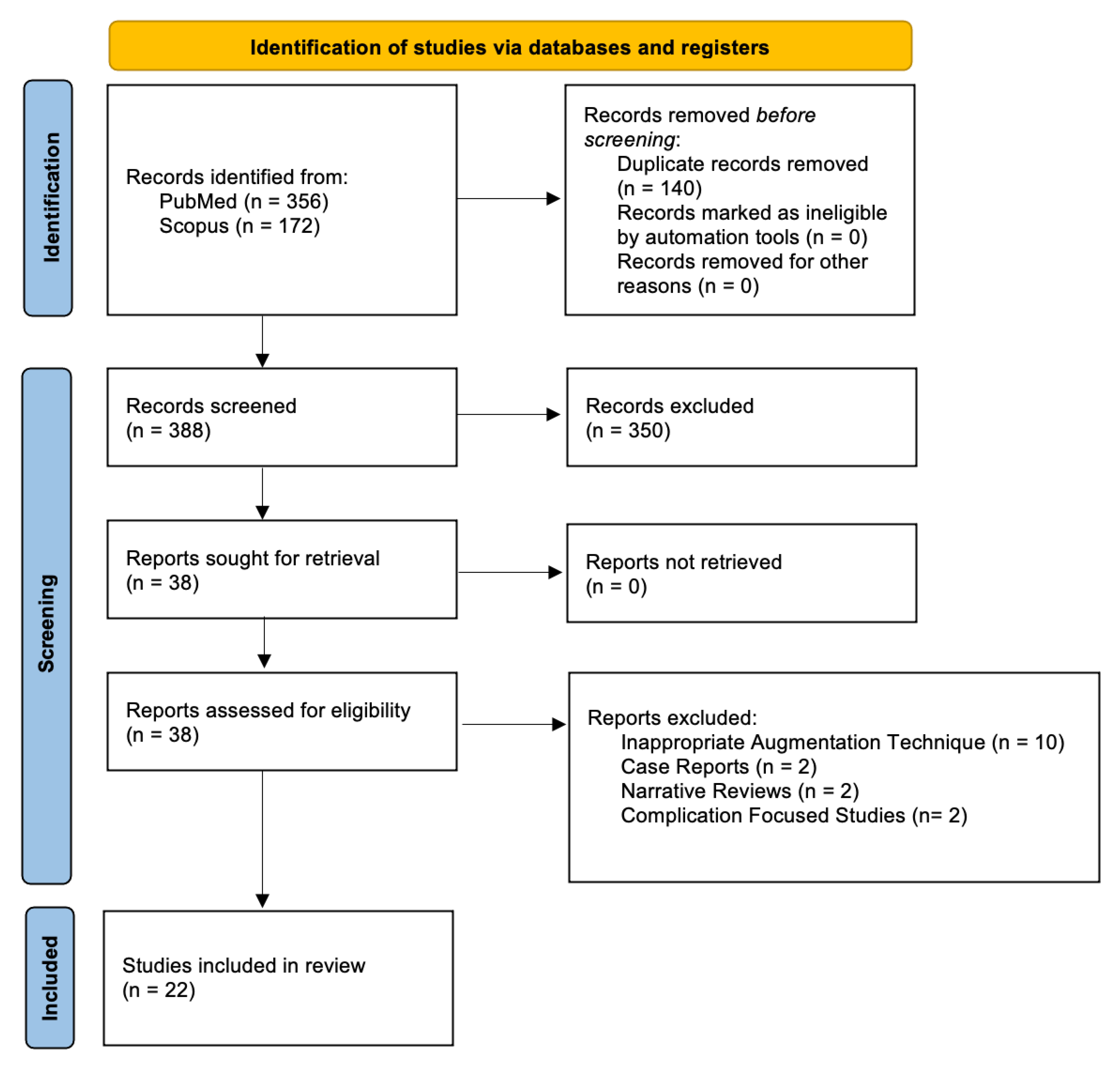
3.1. Data Collection
3.2. Description of the Studies
3.3. Study Characteristics
3.3.1. Results of Syntheses
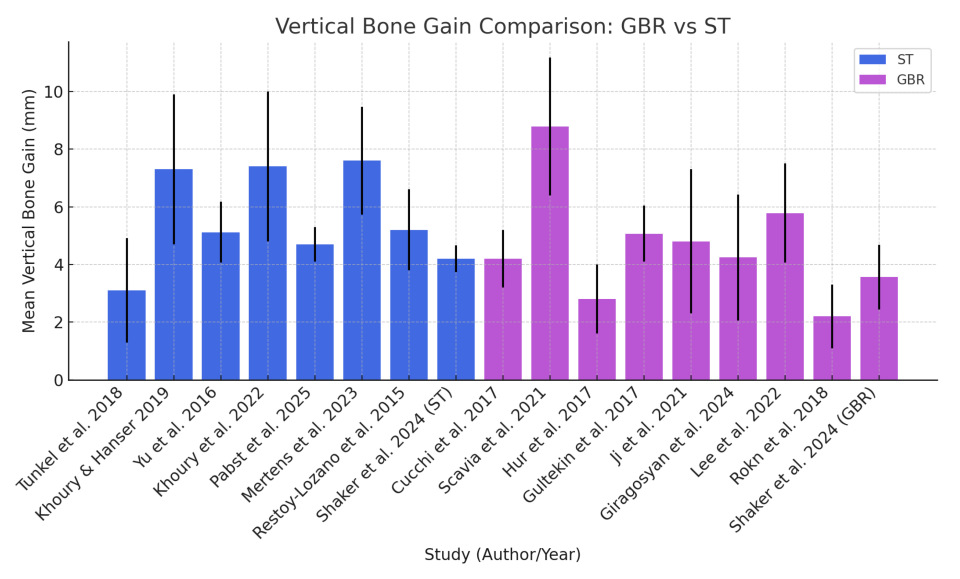
Vertical Bone Gain
Overall Comparison
Timing of Assessment
Direction of Effect
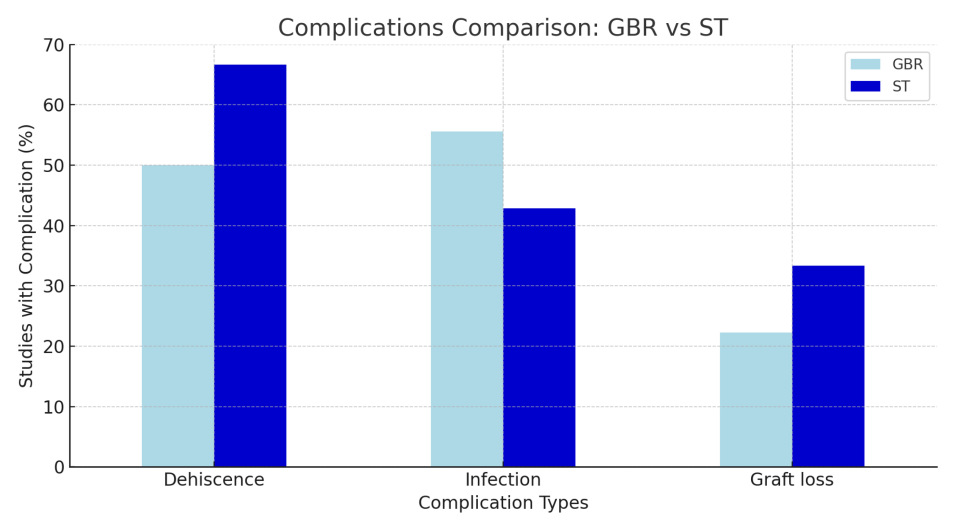
3.3.2. Complications
Shell Technique Complications
Non-Reporting/Not Classifiable for Early-Healing Severity
Timing and Patterns
3.3.3. Bone Density
ST
GBR
3.3.4. Patient-Reported Outcomes (PROMs)
3.3.5. Implant Survival
4. Discussion
4.1. Principal Findings and Clinical Positioning
4.2. Vertical Bone Gain and Maintenance over Time
4.3. Complications: Patterns and Clinical Nuance
4.3.1. Exposure/Dehiscence
4.3.2. Infection
4.3.3. Donor-Site Morbidity
4.4. Technique Considerations: Autogenous vs. Allogeneic Shell; Ti-PTFE vs. Collagen GBR
4.5. PROMs: A Critical Evidence Gap
4.6. Implant Survival as a Feasibility Indicator
4.7. Concept Note: Resorbable Collagen Membrane as a Soft-Tissue Stimulant
4.8. Practical Guidance: Choosing Between Shell and GBR
4.9. Future Directions
4.10. Clinical Implication
5. Conclusions
Supplementary Materials
Author Contributions
Funding
Data Availability Statement
Acknowledgments
Conflicts of Interest
Abbreviations
| GBR | Guided Bone Regeneration |
| ST | Shell Technique |
| VRA | Vertical ridge augmentation |
| VBG | Vertical bone gain |
| PROMs | Patient-Reported Outcome Measures |
| Ti-PTFE | Titanium-reinforced polytetrafluoroethylene |
| Ti-mesh | Titanium mesh |
| d-PTFE | Dense polytetrafluoroethylene |
| CBCT | Cone beam computed tomography |
| AUG | Autogenous bone graft |
| ALG | Allogeneic bone graft |
| BS | Bone substitute |
| ICG | Iliac crest graft |
| IBB | Intraoral autogenous bone block |
| ABBs | Allogeneic bone blocks |
| CAD/CAM | Computer-aided design/computer-aided manufacturing |
| SBB | Split bone block |
| MP-ePTFE | Microporous expanded polytetrafluoroethylene |
| PES | Pink esthetic score |
| CTG | Connective tissue graft |
References
- Rocchietta, I.; Fontana, F.; Simion, M. Clinical outcomes of vertical bone augmentation to enable dental implant placement: A systematic review. J. Clin. Periodontol. 2008, 35 (Suppl. S8), 203–215. [Google Scholar] [CrossRef] [Scilit] [PubMed]
- Urban, I.A. Techniques on vertical ridge augmentation: Indications and effectiveness. Periodontology 2000 2023, 93, 153–182. [Google Scholar] [CrossRef] [Scilit] [PubMed]
- Terheyden, H.; Meijer, G.J.; Raghoebar, G.M. Vertical bone augmentation and regular implants versus short implants in the vertically deficient posterior mandible: A systematic review and meta-analysis of randomized studies. Int. J. Oral Maxillofac. Surg. 2021, 50, 1249–1258. [Google Scholar] [CrossRef] [Scilit] [PubMed]
- Maló, P.; de Araújo Nobre, M.; Lopes, A.; Ferro, A.; Moss, S.M. The All-on-4 concept for full-arch rehabilitation of the edentulous maxillae: A longitudinal study with 5–13 years of follow-up. Clin. Implant Dent. Relat. Res. 2019, 21, 538–549. [Google Scholar] [CrossRef] [Scilit]
- Lee, C.T.; Huang, Y.W.; Zhu, L.; Weltman, R. Survival analysis of wide dental implants: A systematic review and meta-analysis. Clin. Oral Implants Res. 2016, 27, e1–e13. [Google Scholar] [CrossRef] [Scilit]
- Polido, W.D.; Machado-Fernandez, A.; Lin, W.-S.; Aghaloo, T. Indications for zygomatic implants: A systematic review. Int. J. Implant Dent. 2023, 9, 17. [Google Scholar] [CrossRef] [Scilit]
- Herce-López, J.; Pingarrón, M.d.C.; Tofé-Povedano, Á.; García-Arana, L.; Espino-Segura-Illa, M.; Sieira-Gil, R.; Rodado-Alonso, C.; Sánchez-Torres, A.; Figueiredo, R. Customized subperiosteal implants for the rehabilitation of atrophic jaws: A consensus report and literature review. Biomimetics 2024, 9, 61. [Google Scholar] [CrossRef] [Scilit] [PubMed]
- Anitua, E.; Eguia, A.; Staudigl, C.; Alkhraisat, M.H. Clinical performance of additively manufactured subperiosteal implants: A systematic review. Int. J. Implant Dent. 2024, 10, 4. [Google Scholar] [CrossRef] [Scilit]
- Aceves-Argemí, R.; España-Tatay, M.; España-Tatay, F.; España-Tatay, P. Titanium Meshes in Guided Bone Regeneration: A Systematic Review. Coatings 2021, 11, 316. [Google Scholar] [CrossRef] [Scilit]
- Nielsen, H.B.; Starch-Jensen, T. Lateral Ridge Augmentation in the Posterior Part of the Mandible with an Autogenous Bone Block Graft Harvested from the Ascending Mandibular Ramus: A 10-Year Retrospective Study. J. Stomatol. Oral Maxillofac. Surg. 2021, 122, 141–146. [Google Scholar] [CrossRef] [Scilit]
- Toledano-Serrabona, J.; Sánchez-Garcés, M.Á.; Sánchez-Torres, A.; Gay-Escoda, C. Alveolar distraction osteogenesis for dental implant treatments of the vertical bone atrophy: A systematic review. Med. Oral Patol. Oral Cir. Bucal 2019, 24, e70–e75. [Google Scholar] [CrossRef] [Scilit] [PubMed]
- Urban, I.A.; Montero, E.; Monje, A.; Sanz-Sánchez, I. Effectiveness of vertical ridge augmentation interventions: A systematic review and meta-analysis. J. Clin. Periodontol. 2019, 46 (Suppl. S21), 319–339. [Google Scholar] [CrossRef] [Scilit] [PubMed]
- Zhou, L.; Su, Y.; Wang, J.; Wang, X.; Liu, Q.; Wang, J. Effect of exposure rates with customized versus conventional titanium mesh on guided bone regeneration: Systematic review and meta-analysis. J. Oral Implantol. 2022, 48, 339–346. [Google Scholar] [CrossRef] [Scilit] [PubMed]
- Garcia, J.; Dodge, A.; Luepke, P.; Wang, H.L.; Kapila, Y.; Lin, G.H. Effect of membrane exposure on guided bone regeneration: A systematic review and meta-analysis. Clin. Oral Implants Res. 2018, 29, 328–338. [Google Scholar] [CrossRef] [Scilit]
- Schwarz, F.; Ramanauskaite, A.; Wetzel, W.; Mayer, S.; Obreja, K.; Parvini, P. Clinical Outcomes Following a Combined Vertical and Horizontal Bone Augmentation Procedure in the Posterior Mandible. Clin. Implant Dent. Relat. Res. 2024, 26, 112–121. [Google Scholar] [CrossRef] [Scilit]
- Tunkel, J.; Hoffmann, F.; Schmelcher, Y.; Kloss-Brandstätter, A.; Kämmerer, P.W. Allogeneic versus autogenous shell technique augmentation procedures: A prospective-observational clinical trial comparing surgical time and complication rates. Int. J. Implant Dent. 2023, 9, 52. [Google Scholar] [CrossRef] [Scilit]
- Sáez-Alcaide, L.M.; González-Gallego, B.; Fernando-Moreno, J.; Navarro, M.M.; Cobo-Vázquez, C.; Brinkmann, J.C.B.; Meniz-García, C. Complications associated with vertical bone augmentation techniques in implant dentistry: A systematic review of clinical studies published in the last ten years. J. Stomatol. Oral Maxillofac. Surg. 2023, 124, 101574. [Google Scholar] [CrossRef] [Scilit]
- Gotfredsen, K. Patient-reported outcomes for bone regenerative procedures. Periodontology 2000 2023, 93, 270–276. [Google Scholar] [CrossRef] [Scilit]
- Kofina, V.; Monfaredzadeh, M.; Rawal, S.Y.; Dentino, A.R.; Singh, M.; Tatakis, D.N. Patient-reported outcomes following guided bone regeneration: Correlation with clinical parameters. J. Dent. 2023, 136, 104605. [Google Scholar] [CrossRef] [Scilit]
- Page, M.J.; McKenzie, J.E.; Bossuyt, P.M.; Boutron, I.; Hoffmann, T.C.; Mulrow, C.D.; Shamseer, L.; Tetzlaff, J.M.; Akl, E.A.; Brennan, S.E.; et al. The PRISMA 2020 Statement: An Updated Guideline for Reporting Systematic Reviews. BMJ 2021, 372, n71. [Google Scholar] [CrossRef] [Scilit]
- Tunkel, J.; Würdinger, R.; de Stavola, L. Vertical 3D Bone Reconstruction with Simultaneous Implantation: A Case Series Report. Int. J. Periodontics Restor. Dent. 2018, 38, 413–421. [Google Scholar] [CrossRef] [Scilit] [PubMed]
- Khoury, F.; Hanser, T. Three-Dimensional Vertical Alveolar Ridge Augmentation in the Posterior Maxilla: A 10-Year Clinical Study. Int. J. Oral Maxillofac. Implants 2019, 34, 471–480. [Google Scholar] [CrossRef] [Scilit]
- Yu, H.; Chen, L.; Zhu, Y.; Qiu, L. Bilaminar Cortical Tenting Grafting Technique for Three-Dimensional Reconstruction of Severely Atrophic Alveolar Ridge: A Prospective Study. J. Craniomaxillofac. Surg. 2016, 44, 868–875. [Google Scholar] [CrossRef] [Scilit] [PubMed]
- Cucchi, A.; Vignudelli, E.; Napolitano, A.; Marchetti, C.; Corinaldesi, G. Evaluation of Complication Rates and Vertical Bone Gain after Guided Bone Regeneration with Non-Resorbable Membranes versus Titanium Meshes and Resorbable Membranes. Clin. Implant Dent. Relat. Res. 2017, 19, 821–832. [Google Scholar] [CrossRef] [Scilit] [PubMed]
- Khoury, F.; Hanser, T. Three-Dimensional Vertical Alveolar Crest Augmentation: 10-Year Clinical Outcome. Int. J. Oral Implantol. 2022, 15, 111–126. [Google Scholar]
- Pabst, A.; Alshihri, A.; Becker, P.; Wurdinger, R.; Tunkel, J.; Kämmerer, P.W. Vertical Bone Gain with the Allogeneic Shell Technique: Comparative Analysis of Surgical Approaches. J. Clin. Med. 2025, 14, 4284. [Google Scholar] [CrossRef] [Scilit]
- Tatli, U.; Cavana, A.; Tükel, H.C.; Benlidayi, M.E. Effects of Bone Augmentation on Implant Success and Survival: A Retrospective Analysis with 6-Year Mean Follow-Up. Clin. Implant Dent. Relat. Res. 2025, 27, e70021. [Google Scholar] [CrossRef] [Scilit]
- Kämmerer, P.W.; Tunkel, J.; Götz, W.; Würdinger, R.; Kloss, F.; Pabst, A. The Allogeneic Shell Technique for Alveolar Ridge Augmentation: A Multicenter Case Series. Int. J. Implant Dent. 2022, 8, 48. [Google Scholar] [CrossRef] [Scilit]
- Mounir, M.; El Morsy, O.A.; Amer, H.; Mounir, S.; Gibaly, A. Assessment of Bone Quality Using Buccal and Palatal Autogenous Cortical Shells Harvested from Two Donor Sites: A Randomized Clinical Trial. Oral Maxillofac. Surg. 2021, 25, 263–269. [Google Scholar] [CrossRef] [Scilit]
- Scavia, S.; Roncucci, R.; Bianco, E.; Mirabelli, L.; Bader, A.; Madonna, F. Vertical Bone Augmentation with GBR Pocket Technique: Surgical Procedure and Preliminary Results. J. Contemp. Dent. Pract. 2021, 22, 1370–1376. [Google Scholar] [CrossRef] [Scilit]
- Hur, Y.; Ogata, Y.; Kim, D.W.; Pham, C.M.; Yoon, T.H.; Ogata, H. Bone Resorption during Submerged Healing after Guided Bone Regeneration: A Prospective Case Series. Implant Dent. 2017, 26, 868–873. [Google Scholar] [CrossRef] [Scilit] [PubMed]
- Mertens, C.; Büsch, C.; Goldenbaum, K.; Hoffmann, J.; Steveling, H.G. Full Block or Split Block? Comparison of Two Different Autogenous Block Grafting Techniques for Alveolar Ridge Reconstruction. Clin. Implant Dent. Relat. Res. 2023, 25, 1149–1163. [Google Scholar] [CrossRef] [Scilit] [PubMed]
- Gultekin, B.A.; Cansiz, E.; Borahan, M.O. Clinical and Three-Dimensional Radiographic Evaluation of Autogenous Iliac Block Bone Grafting and Guided Bone Regeneration in Patients with Atrophic Maxilla. J. Oral Maxillofac. Surg. 2017, 75, 709–722. [Google Scholar] [CrossRef] [Scilit] [PubMed]
- Cucchi, A.; Bettini, S.; Ghensi, P.; Fiorino, A.; Corinaldesi, G. Vertical Ridge Augmentation with Ti-Reinforced Dense PTFE Membranes or Ti Meshes and Collagen Membranes: A Randomized Clinical Trial. Clin. Implant Dent. Relat. Res. 2023, 25, 352–369. [Google Scholar] [CrossRef] [Scilit]
- Ji, J.G.; Yu, J.A.; Choi, S.H.; Lee, D.W. Clinical, Radiographic, and Histomorphometric Evaluation of a Vertical Ridge Augmentation Procedure: Consecutive Case Series with 1-Year Follow-Up. Materials 2021, 14, 3828. [Google Scholar] [CrossRef] [Scilit]
- Giragosyan, K.; Chenchev, I.; Ivanova, V. Linear Bone Gain and Healing Complication Rate Following Ridge Augmentation with Titanium-Reinforced d-PTFE Membranes. Folia Med. 2024, 66, 505–514. [Google Scholar] [CrossRef] [Scilit]
- Lee, J.S.; Park, J.Y.; Chung, H.M.; Song, Y.W.; Strauss, F.J. Vertical Ridge Augmentation Feasibility Using Unfixed Collagen Membranes and Particulate Bone Substitutes: A Prospective Study. Clin. Implant Dent. Relat. Res. 2022, 24, 757–767. [Google Scholar] [CrossRef] [Scilit]
- Shaker, A.E.S.; Salem, A.S.; El-Farag, S.A.A.; Abdel-Rahman, F.H.; El-Keiy, M.M. Comparison of Khoury’s Bone Shell Technique vs Titanium-Reinforced d-PTFE Membranes: Randomized Clinical Trial. J. Contemp. Dent. Pract. 2024, 25, 518–526. [Google Scholar] [CrossRef] [Scilit]
- Cucchi, A.; Sartori, M.; Parrilli, A.; Aldini, N.N.; Vignudelli, E.; Corinaldesi, G. Histological and Histomorphometric Analysis of Bone Tissue after Guided Bone Regeneration with Non-Resorbable Membranes. Clin. Implant Dent. Relat. Res. 2019, 21, 1072–1079. [Google Scholar] [CrossRef] [Scilit]
- Rokn, A.R.; Monzavi, A.; Panjnoush, M.; Hashemi, H.M.; Kharazifard, M.J. Vertical Ridge Augmentation Using Resorbable Collagen Membranes: A Split-Mouth Clinical Trial. Clin. Implant Dent. Relat. Res. 2018, 20, 854–861. [Google Scholar] [CrossRef] [Scilit]
- Restoy-Lozano, A.; Domínguez-Mompell, J.L.; Infante-Cossio, P.; Lara-Chao, J.; Espín-Gálvez, F.; López-Pizarro, V. Reconstruction of Mandibular Vertical Defects for Dental Implants with Autogenous Bone Block Grafts Using a Tunnel Approach: Clinical Study of 50 Cases. Int. J. Oral Maxillofac. Surg. 2015, 44, 1416–1422. [Google Scholar] [CrossRef] [Scilit]
- Cucchi, A.; Vignudelli, E.; Franco, R.; Marchetti, C.; Corinaldesi, G. One-Year Peri-Implant Outcomes after Vertical Ridge Augmentation with Ti-Reinforced d-PTFE versus Ti Mesh with Collagen Membrane. Clin. Oral Implants Res. 2020, 31, 1150–1162. [Google Scholar] [CrossRef] [Scilit]
- Esposito, M.; Grusovin, M.G.; Felice, P.; Karatzopoulos, G.; Worthington, H.V.; Coulthard, P. Interventions for Replacing Missing Teeth: Horizontal and Vertical Bone Augmentation Techniques for Dental Implant Treatment. Cochrane Evid. 2009, 2009, CD003607. [Google Scholar] [CrossRef] [Scilit] [PubMed]
- Fontana, F.; Maschera, E.; Rocchietta, I.; Simion, M. Clinical Classification of Complications in Guided Bone Regeneration Procedures by Means of a Nonresorbable Membrane. Int. J. Periodontics Restor. Dent. 2011, 31, 265–273. [Google Scholar]
- Sanz-Sánchez, I.; Sanz-Martín, I.; Ortiz-Vigón, A.; Molina, A.; Sanz, M. Complications in bone-grafting procedures: Classification and management. Periodontology 2000 2022, 88, 86–102. [Google Scholar] [CrossRef] [Scilit]
- Barone, A.; Toti, P.; Menchini-Fabris, G.B.; Felice, P.; Marchionni, S.; Covani, U. Early volumetric changes after vertical augmentation of the atrophic posterior mandible with interpositional block graft versus onlay bone graft: A retrospective radiological study. J. Craniomaxillofac. Surg. 2017, 45, 1438–1447. [Google Scholar] [CrossRef] [Scilit]
- Pieroni, S.; Miceli, B.; Giboli, L.; Romano, L.; Azzi, L.; Farronato, D. Efficacy of the Sausage Technique in Rebuilding the Crestal Buccal Bone Thickness: A Retrospective Analysis. Dent. J. 2024, 12, 180. [Google Scholar] [CrossRef] [Scilit]
- Thoma, D.S.; Naenni, N.; Figuero, E.; Hämmerle, C.H.F.; Schwarz, F.; Jung, R.E.; Sanz-Sánchez, I. Effects of Soft Tissue Augmentation Procedures on Peri-Implant Health or Disease: A Systematic Review and Meta-Analysis. Clin. Oral Implants Res. 2018, 29 (Suppl. S15), 32–49. [Google Scholar] [CrossRef] [Scilit]
- Chrcanovic, B.R.; Kisch, J.; Albrektsson, T.; Wennerberg, A. Factors Influencing Early Dental Implant Failures. J. Dent. Res. 2016, 95, 995–1002. [Google Scholar] [CrossRef] [Scilit]
- Chrcanovic, B.R.; Albrektsson, T.; Wennerberg, A. Bone Quality and Quantity and Dental Implant Failure. Implant Dent. 2017, 26, 219–237. [Google Scholar] [CrossRef] [Scilit]
- Knöfler, W.; Barth, T.; Graul, R.; Krampe, D. Retrospective analysis of 10,000 implants from insertion up to 20 years—Analysis of implantations using augmentative procedures. Int. J. Implant Dent. 2016, 2, 25. [Google Scholar] [CrossRef] [Scilit]
- Papaspyridakos, P.; De Souza, A.; Vazouras, K.; Gholami, H.; Pagni, S.; Weber, H.P. Survival rates of short dental implants (≤6 mm) compared with implants longer than 6 mm in posterior jaw areas: A meta-analysis. Clin. Oral Implants Res. 2018, 29 (Suppl. S16), 8–20. [Google Scholar] [CrossRef] [Scilit]
- Maiorana, C.; Poli, P.P.; Deflorian, M.; Testori, T.; Mandelli, F.; Nagursky, H.; Vinci, R. Alveolar socket preservation with demineralised bovine bone mineral and a collagen matrix. J. Periodontal Implant Sci. 2017, 47, 194–210. [Google Scholar] [CrossRef] [Scilit]
- Yu, S.H.; Saleh, M.H.A.; Wang, H.L. Simultaneous or staged lateral ridge augmentation: A clinical guideline on the decision-making process. Periodontology 2000 2023, 93, 107–128. [Google Scholar] [CrossRef] [Scilit]



| Author (Year) | Country/Center | Study Design | Technique | n (Patients) | Mean Vertical Gain (mm) | Complication Rate (%) Major/Minor | Bone Density Reported | Implant Survival (%) | Follow-Up Period |
|---|---|---|---|---|---|---|---|---|---|
| Tunkel et al., 2018 [21] | Germany/Italy | Retrospective case series | ST | 10 | 3.1 | 0/0 | No | 100 | 1 year (post loading) |
| Khoury & Hanser 2019 [22] | Germany | Prospective clinical study | ST | 142 | 7.3 | 0/4.9 | No | 98.9 | 10 years |
| Yu et al., 2016 [23] | China | Prospective clinical study | ST | 21 | 5.12 | 0/4.8 | No | 100 | 6 years |
| Cucchi et al., 2017 [24] | Italy | Randomized clinical trial | GBR | 20 | 4.2 | 10/5 | No | 100 | 1 year (after loading) |
| Khoury et al., 2022 [25] | Germany | Prospective clinical cohort | ST | 117 | 7.4 | 0.9/1.7 | No | 98.2 | 10 years |
| Pabst et al., 2025 [26] | Germany, Austria, Saudi Arabia | Retrospective multicenter comparative cohort | ST | 10 | 4.7 | 0/10 | No | NR | 1 year |
| Tatli et al., 2025 [27] | Turkey | Retrospective comparative cohort | GBR | 127 | NR | NR/NR | No | 99.21 | 6 years |
| Kämmerer et al., 2022 [28] | Germany, Austria | Retrospective multicenter case series | ST | 372 | NR | 1.1/7 | Yes | 99.39 | 1–12 years |
| Mounir et al., 2021 [29] | Egypt | Randomized clinical trial | ST | 14 | NR | 0/14.3 | Yes | NR | 6 months |
| Scavia et al., 2021 [30] | Italy | Prospective case series | GBR | 28 | 8.78 | 0/10.7 | No | NR | 1 year |
| Hur et al., 2017 [31] | USA | Prospective case series | GBR | 16 | 2.8 | 0/25 | No | NR | NR |
| Mertens et al., 2023 [32] | Germany | Retrospective comparative cohort | ST | 55 | 7.6 | 0/12.7 | No | 100 | 1–7 years |
| Gultekin et al., 2017 [33] | Turkey | Retrospective cohort | GBR | 21 | 5.07 | 0/4.8 | No | 100 | 1.5–3 years |
| Cucchi et al., 2023 [34] | Italy | Randomized clinical trial | GBR | 15 | NR | NR/NR | No | 100 | 3 years |
| Ji et al., 2021 [35] | Korea | Prospective case series | GBR | 14 | 4.8 | NR/NR | Yes | 100 | 1 year |
| Giragosyan et al., 2024 [36] | Bulgaria | Randomized controlled trial | GBR | 20 | 4.24 | NR/NR | No | NR | 6 months |
| Lee et al., 2022 [37] | Korea | Retrospective cohort | GBR | 22 | 5.78 | 0/31.8 | Yes | 100 | 1–7 years |
| Shaker et al., 2024 [38] | Egypt | Randomized clinical trial | ST & GBR | 16 | 4.2 (ST); 3.56 (GBR) | 0.0/12.5 (ST) 0.0/0.0 (GBR) | No | 100% (both arms) | 6 months |
| Cucchi et al., 2019 [39] | Italy | Randomized clinical trial | GBR | 20 | NR | NR/NR | Yes | NR | 1 year |
| Rokn et al., 2018 [40] | Iran | Randomized controlled trial | GBR | 11 | 2.2 | 0/50 | No | 100 | 1 year |
| Restoy-Lozano et al., 2015 [41] | Spain | Prospective case series | ST | 43 | 5.2 | 4.7/NR | No | 100 | 1.5–4.5 years |
| Cucchi et al., 2020 [42] | Italy | Randomized controlled trial | GBR | 20 | NR | 10/5 | No | 100 | 1 year (post loading) |
Disclaimer/Publisher’s Note: The statements, opinions and data contained in all publications are solely those of the individual author(s) and contributor(s) and not of MDPI and/or the editor(s). MDPI and/or the editor(s) disclaim responsibility for any injury to people or property resulting from any ideas, methods, instructions or products referred to in the content. |
© 2025 by the authors. Licensee MDPI, Basel, Switzerland. This article is an open access article distributed under the terms and conditions of the Creative Commons Attribution (CC BY) license (https://creativecommons.org/licenses/by/4.0/).
Share and Cite
Frantzopoulos, I.; Băciuț, M.; Almășan, O.; Manea, A. Evaluating Techniques for Vertical Ridge Augmentation via Comparative Study of Clinical Outcomes: A Systematic Review. J. Clin. Med. 2025, 14, 8639. https://doi.org/10.3390/jcm14248639
Frantzopoulos I, Băciuț M, Almășan O, Manea A. Evaluating Techniques for Vertical Ridge Augmentation via Comparative Study of Clinical Outcomes: A Systematic Review. Journal of Clinical Medicine. 2025; 14(24):8639. https://doi.org/10.3390/jcm14248639
Chicago/Turabian StyleFrantzopoulos, Ioannis, Mihaela Băciuț, Oana Almășan, and Avram Manea. 2025. "Evaluating Techniques for Vertical Ridge Augmentation via Comparative Study of Clinical Outcomes: A Systematic Review" Journal of Clinical Medicine 14, no. 24: 8639. https://doi.org/10.3390/jcm14248639
APA StyleFrantzopoulos, I., Băciuț, M., Almășan, O., & Manea, A. (2025). Evaluating Techniques for Vertical Ridge Augmentation via Comparative Study of Clinical Outcomes: A Systematic Review. Journal of Clinical Medicine, 14(24), 8639. https://doi.org/10.3390/jcm14248639