Impact of Physical Rehabilitation on Endometriosis and Adenomyosis-Related Symptoms: A Systematic Review and Meta-Analysis

 ,
,  and
and 
Abstract
1. Introduction
2. Materials and Methods
2.1. Protocol and Registration
2.2. Search Strategy and Eligibility Criteria
2.3. Data Extraction, and Quality and Certainty of Evidence Assessment
2.4. Statistical Analysis
3. Results
3.1. Characteristics of Studies

3.2. Effectiveness of Rehabilitation in Women with Endometriosis/Adenomyosis

| Authors | Year of Publication | Disease | Country | Study Design | Sample Size | Disease Stage | Disease Diagnosis |
|---|---|---|---|---|---|---|---|
| Del Forno et al., 2021 [26] Del Forno et al., 2023 [41] | 2021 2023 | ENDO + ADENO | Italy | RCT | ENDO (16); ENDO + ADENO (18) | IV (DIE) | US |
| Farshi et al., 2020 [42] | 2020 | ENDO | Iran | RCT | 76 | n.r. | Laparoscopy |
| Zhao et al., 2012 [38] | 2012 | ENDO | China | RCT | 100 | n.r. | Laparoscopy/laparotomy |
| Napadow et al., 2012 [37] | 2012 | ENDO | USA | crossover RCT | 15 | n.r. | Based on symptoms |
| Mira et al., 2020 [27] | 2020 | ENDO | Brazil | RCT | 101 | IV (DIE) | US or MRI |
| Bergström et al., 2005 [39] | 2005 | ENDO | Sweden | RCT | 19 | n.r. | Laparoscopy |
| Carpenter et al., 1995 [40] | 1995 | ENDO | USA | RCT | 39 | II: 36%; III: 26%; IV: 31%; n.r.: 7% | Laparoscopy |
| Gonçalves et al., 2016 [28] | 2016 | ENDO | Brazil | RCT | 40 | n.r. | n.r. |
| Thabet et al., 2018 [34] | 2018 | ENDO | Saudi Arabia | RCT | 40 | Mild/moderate endometriosis | Laparoscopy |
| Bi et al., 2018 [29] | 2018 | ENDO | China | Retrospective study | 154 | I: 9.1%; II: 29.9%; III: 40.3%; IV: 20.8% | Laparoscopy |
| Lutfi et al., 2023 [30] | 2023 | ENDO | Australia | RCT | 22 | n.r. | n.r. |
| Artacho-Cordón et al., 2023 [36] Salinas-Asensio et al., 2025 [44] | 2023 2025 | ENDO | Spain | RCT | 31 | I–III: 29%; IV: 71% | US/MRI/Laparoscopy |
| Muñoz-Gómez et al., 2023 [31] | 2023 | ENDO | Spain | RCT | 41 | n.r. | n.r. |
| Carralero-Martínez et al., 2022 [32] | 2022 | ENDO + ADENO | Spain | RCT | 12 | n.r. | n.r. |
| Merlot et al., 2022 [43] | 2022 | ENDO + ADENO | Canada | RCT | ENDO (34); ENDO + ADENO (11) | Superf. peritoneum(22.2%); DIE(75.6%); Other(2.2%) | MRI |
| Mechsner et al., 2023 [33] | 2023 | ENDO | Germany | RCT | 36 | n.r. | Laparoscopy or based on symptoms |
| Rodríguez-Ruiz et al., 2023 [35] | 2024 | ENDO | Spain | RCT | 44 | n.r. | US/MRI/Laparoscopy |
| (a) electrophysical agent-based interventions | ||||||||
|---|---|---|---|---|---|---|---|---|
| Authors | Intervention | Outcome | ||||||
| CG | IG | Duration, Frequency | Measured Time Point | Dimension | Instrument | Effect | ||
| Napadow et al., 2012 [37] | RAVANS or NVAS (n = 15) | RAVANS and NVAS in counterbalanced sessions ≥1 week apart. | At mid-point (15 min), post-intervention and 15 min post-intervention | Pain | Temporal summation | Reduced in the RAVANS session (p = 0.050). | ||
| Cuff algometry | Reduced at all time points (p < 0.05), greater in RAVANS. | |||||||
| DNIC | No significant effects or interaction (p > 0.100). | |||||||
| VAS | No significant effects or interaction (p > 0.300). | |||||||
| Anxiety | VrAS | Lower at all time points in RAVANS (p < 0.010), not in NVAS. | ||||||
| Heart rate | ECG | No significant effects or interaction (p > 0.100). | ||||||
| LF-HRV, HF-HRV, LF/HF | ECG | No significant effects or interaction (p > 0.100). | ||||||
| Respiratory rate | ECG | No significant effects or interaction (p > 0.100). | ||||||
| Mira et al., 2020 [27] | Usual care (n = 48) | Usual care + TENS (n = 53) | Twice a day, 20 min per application, for 8 weeks. | Post-intervention | Pain | Chronic pelvic pain | VAS | ⊕ IG vs. CG (mean change: −2.55 vs. −0.27, p < 0.001). |
| Deep dyspareunia | DDS | No between-group differences. ⊕ IG more (Δ = −0.67, p < 0.001) vs. CG (Δ = −0.27, p = 0.016). | ||||||
| Dyschezia | DDS | No between-group differences. ⊕ IG more (Δ = −1.79, p < 0.001) vs. CG (Δ = −0.92, p = 0.022). | ||||||
| Dysuria | DDS | No between-groups differences. ⊕ IG (mean change: −0.56, p = 0.034). | ||||||
| Pain during spotting | DDS | No between-groups differences. | ||||||
| QoL | EHP-30 | ⊕ Greater in infertility in CG (Δ = −5.99 vs. −2.00, p = 0.047). ⊕ in both groups in some domains (greater in IG); ⊕ IG in additional domains. | ||||||
| Sexual function | FSFI | ⊕ IG vs. CG in desire, arousal, orgasm, satisfaction, lubrication, pain and total score; ⊕ CG in satisfaction. | ||||||
| Thabet et al., 2018 [34] | Sham HILT | Pulsed HILT | Three times per week for 8 weeks | Post-intervention | Pain | PPi graphic scale | ⊕ IG vs. CG (77.3% vs. 37.3%; p < 0.001) | |
| PR scale | ⊕ IG vs. CG (mean score: 3.25 vs. 1.80, p < 0.001) | |||||||
| QoL | EHP-5 | No baseline data. QoL significantly better in IG vs. CG (15.8 ± 3.7 vs. 16.3 ± 3.6; p < 0.001). | ||||||
| Bi et al., 2018 [29] | No intervention (n = 71) | NMES (n = 83) | 30 min/session, once daily, 3 sessions weekly, 10 weeks. | Mid- and post-intervention | Pain | NRS | No mid-intervention effect. Post-intervention: ⊕ IG vs. CG (Δ = −2.9 vs. −0.6, p = 0.020). | |
| ESSS | No mid-intervention effect. Post-intervention: ⊕ IG more than CG (Δ = −2.5 vs. −0.5, p = 0.040). | |||||||
| QoL | SF-36 | No mid-intervention changes. Post-intervention: IG improved more in PhCS (Δ = 8.7 vs. 0.9, p < 0.010) and MCS (Δ = 7.9 vs. 0.6, p < 0.010). | ||||||
| Adverse effects | Ad hoc questionnaire | Fewer adverse effects in IG vs. CG (1.4% vs. 9.6%, p = 0.040). | ||||||
| Carralero-Martínez et al., 2022 [32] | Sham group: Deactivated CRMRF + physiotherapy + pain education. | CRMRF group (n = 41): CRMRF + physiotherapy + pain education. | 10 sessions; once a week. | Mid- and post-intervention | Pain | VAS | ⊕ IG vs. CG post-intervention (mean change: −2.74 vs. −0.95, p = 0.002). | |
| QoL | SF-12 | ⊕ IG vs. CG post-intervention in physical domain (mean change: 4.70 vs. 1.33, p = 0.034) and physical functioning (mean change: 5.23 vs. 0.99, p = 0.037) | ||||||
| Mechsner et al., 2023 [33] | Sham group (n = 18) | Active tDCS group (n = 18) | 10 weekdays over 2 weeks; 20 min sessions with tDCS (active or sham). | Post-session, post-intervention and 5–12 days post-intervention | Pain | PPTs | Algometry | Post-intervention: ⊕ IG vs. CG in right lower abdomen (Δ = 1.9 vs. 0.1, p < 0.001). |
| Pain intensity | NRS | Post-intervention: ⊕ IG vs. CG (Δ = −1.9 vs. −0.7, p = 0.003). No follow-up effect. | ||||||
| CTRP | PCS | No between-groups differences. | ||||||
| Depression | BDI | No between-groups differences. | ||||||
| (b) therapeutic exercise-based interventions | ||||||||
| Authors | Intervention | Outcome | ||||||
| CG | IG | Duration, Frequency | Measured Time Point | Dimension | Instrument | Effect | ||
| Zhao et al., 2012 [38] | GnRH agonist therapy (n = 50) | GnRH agonist therapy + PMR training (n = 50) | 24 sessions, 40 min each, 2×/week over 12 weeks | Post-intervention | Anxiety | STAI | ⊕IG vs. CG for state (−16.4 vs. −6.7; p = 0.020) and trait anxiety (−11.6 vs. −3.4; p = 0.030) | |
| Depression | HADS | ⊕ IG vs. CG were observed (mean change: −2.6 vs. −0.3; p = 0.040) | ||||||
| QoL | SF-36 | Both groups improvement after intervention. | ||||||
| Bergström et al., 2005 [39] | Groserilin (G) (n = 11) | Groserilin (G) + Physical training (PT) (n = 8) | (G) 6 months. (PT) 5×/week (2 × 30 min, 3 × 60 min), 12 months. | 6 months and post-intervention | BMD | DEXA | Femoral neck: Reduced BMD in the CG vs. IG post-intervention (p = 0.029). Spine: No between-groups differences. | |
| Carpenter et al., 1995 [40] | Danazol * | Danazol + exercise * | 4 sessions/week, 40 min/session. | 24 weeks | Hormone levels (testosterone, SHBG and estradiol) | Molecular analysis | Testosterone lower in IG vs. CG (62.5 ± 10.2 vs. 111.9 ± 17.5, p = 0.020). No group differences in free testosterone, SHBG, or estradiol. | |
| Side effects | Ad hoc questionnaire | 3 discontinued in CG due to side effects; none in IG. More side effects reported in CG at 24 weeks. No statistical analysis. | ||||||
| Weight gain | Ad hoc questionnaire | No between-groups differences were observed. | ||||||
| Time to recurrence | Ad hoc questionnaire | IG: 16 months; CG: 11 months. No between-group analysis performed. | ||||||
| Gonçalves et al., 2016 [28] | Usual care (n = 12) | Hatha Yoga (n = 28) | 2×/week, 2 h/session for 8 weeks. | Post-intervention | QoL | EHP-30 | Post-intervention: ⊕ IG more than CG in work domain (Δ = −35.93 vs. −3.75, p = 0.027). Both groups improved overall. | |
| Pain | VAS | ⊕ IG vs. CG in average pain score. | ||||||
| Lutfi et al., 2023 [30] | Usual Care (n = 6) | TH exercise (n = 8) or VR exercise (n = 8) | TH: 1 h supervised session. VR: 1 h unsupervised session. | 2 days post-intervention | Acute pelvic pain | VAS | No between-groups differences. | |
| Artacho-Cordón et al., 2023 [36] Salinas-Asensio et al., 2025 [44] | Usual Care (n = 15) | Physio-EndEA group (n = 16) | 9-week program in two phases. Phase 1: 1 week, 1–2 sessions. Phase 2: twice-weekly 90 min sessions | Post-intervention and at 1yr | QoL | EHP-30 | ⊕ IG vs. CG in global status, pain, and emotional well-being post-intervention and at 1yr (all p < 0.050). | |
| Pain | PPTs | Algometry | Improvement in IG vs. CG post-intervention (significant in pelvic and lumbar points; trend in right infraumbilical and second metacarpal) and at 1yr (significant in left lumbar). | |||||
| Current pelvic pain | NRS | ⊕ Close-to-significant IG vs. CG post-intervention (−1.63 vs. −0.07; p = 0.060). No at 1yr. | ||||||
| Dysmenorrhea | NRS | ⊕ IG vs. CG post-intervention (−1.25 vs. −0.07, p < 0.050). | ||||||
| Dyspareunia | NRS | No between-groups effects at post-intervention nor 1yr. | ||||||
| Dyschezia | NRS | ⊕ Close-to-significant IG vs. CG post-intervention (−0.75 vs. 0.47; p = 0.060). No at 1yr. | ||||||
| Dysuria | NRS | No between-groups effects at post-intervention nor 1yr. | ||||||
| CTRP | PCS | ⊕ IG vs. CG post-intervention (−9.10 vs. −0.42; p < 0.050) and at 1yr (−6.57 vs. 1.40; p < 0.050). | ||||||
| Lumbopelvic strength | Flexors | Resistance test | ⊕ IG vs. CG post-intervention (23.67 vs. −3.96, p < 0.050) and 1yr (25.13 vs. 0.66, p < 0.050) | |||||
| Extensors | Resistance test | ⊕ IG vs. CG post-intervention (33.02 vs. 5.84, p < 0.050). No at 1yr. | ||||||
| Lumbopelvic stability | Sharmann test | ⊕ IG vs. CG post-intervention (1.56 vs. 0.13, p < 0.050). No at 1yr. | ||||||
| Muscle architecture | TrA, IOb, EOb and MF thickness, and MF width | US | ⊕ Close-to-significant IG vs. CG post-intervention for TrA thickness (0.05 vs. −0.01; p = 0.076) and significant for right lumbar MF width (0.38 vs. 0.12; p < 0.050). No for other muscles or at 1yr. | |||||
| Fatigue | PFS | ⊕ IG vs. CG in global score post-intervention (−1.89 vs. 0.18) and at 1yr (−0.81 vs. 0.31), with significant effects across all subscales (all p < 0.050). | ||||||
| Physical fitness | Cardiorespiratory fitness | 6MWT | ⊕ IG vs. CG post-intervention (46.31 vs. −13.23; p < 0.001) and at 1yr (47.23 vs. 14.08; p < 0.050). | |||||
| Strength | Back dynamometer | ⊕ IG vs. CG post-intervention (13.60 vs. −2.35; p = 0.088) and at 1yr (5.34 vs. −0.89; p < 0.050). | ||||||
| Hand dynamometer | No between-groups effects at post-intervention nor 1yr. | |||||||
| Lumbar flexibility | Schöber test | No between-groups effects at post-intervention nor 1yr. | ||||||
| Body balance | Flamingo test | No between-groups effects at post-intervention nor 1yr. | ||||||
| Sleep quality | PSQI | No between-groups effects at post-intervention nor 1yr. | ||||||
| Mental health | Anxiety | HADS | ⊕ IG vs. CG post-intervention (−3.62 vs. −0.08; p = 0.019) and at 1yr (−2.08 vs. 0.85; p < 0.050). | |||||
| Depression | HADS | ⊕ IG vs. CG post-intervention (−1.69 vs. 0.92; p < 0.001) and at 1yr (−0.85 vs. 0.08; p < 0.050). | ||||||
| Digestive complaints | GIQLI | ⊕ IG vs. CG post-intervention (−14.77 vs. −0.77; p = 0.002) and at 1yr (−11.15 vs. 1.46; p < 0.050). | ||||||
| Sexual function | FSFI | No between-groups effects at post-intervention nor 1yr. | ||||||
| (c) manual therapy-based interventions | ||||||||
| Authors | Intervention | Outcome | ||||||
| CG | IG | Duration, Frequency | Measured Time Point | Dimension | Instrument | Effect | ||
| Del Forno et al., 2021 [26] Del Forno et al., 2023 [41] | No intervention (n = 13) | PFP (n = 17) | 5 sessions (30 min each) on weeks 1, 3, 5, 8 and 11. | 4 months after randomization | LHAv change | US | ⊕ IG vs. CG (20.0% vs. −0.5%, p = 0.020) | |
| LHAr change | US | No between-groups differences. | ||||||
| LHAm change | US | No between-groups differences. | ||||||
| Pain | Superficial dyspareunia | NRS | ⊕ IG vs. CG (median change: −3 vs. 0, p < 0.010). | |||||
| Deep dyspareunia | NRS | ⊕ Borderline IG vs. CG (median change: −1 vs. 0, p = 0.070). | ||||||
| Dysmenorrhea | NRS | No between-groups differences. | ||||||
| Chronic pelvic pain | NRS | ⊕ IG vs. CG (median change: 0 vs. 0, p = 0.010) | ||||||
| Ovulatory pain | NRS | Borderline reduction in IG vs. CG (median change: 0 vs. 0, p = 0.070) | ||||||
| Dysuria | NRS | No between-groups differences. | ||||||
| Dyschezia | NRS | No between-groups differences. | ||||||
| Lower urinary tracts symptoms | BFLUTS | No between-groups differences. | ||||||
| Gastrointestinal complaints | KESS | No between-groups differences. | ||||||
| Sexual function | FSFI | No between-groups differences. | ||||||
| Muñoz-Gómez et al., 2023 [31] | Placebo (n = 20) | Manual Therapy group (n = 21) | The interventions lasted for 8 weeks, with one session for 30 min every 15 days. | Post-intervention (T1), 1-month (T2) and six-month (T3) follow-ups | Pain (pelvic pain) | VAS | ⊕ IG vs. CG at T1 (−1.67 vs. −0.05, p = 0.030) and T3 follow-up (−3.81 vs. −0.55, p < 0.001). | |
| Lumbar mobility | Schöber test (cm) | ⊕ IG vs. CG at T1 (3.43 vs. 0.04), T2 (0.46 vs. 0.13) and T3 (0.32 vs. −0.92) (p < 0.050). | ||||||
| QoL | EHP-30 | ⊕ IG vs. CG at T1 in pain domain (−26.51 vs. −15.37; p = 0.003). | ||||||
| SF-36 | ⊕ IG vs. CG at T1 in bodily pain (15.43 vs. 4.10; p = 0.030). | |||||||
| Depression | BDI | No between-groups differences. | ||||||
| Anxiety | STAI | No between-groups differences. | ||||||
| Patient perception of change | PGICS | No between-groups differences. | ||||||
| Rodríguez-Ruiz et al., 2023 [35] | No intervention (n = 21) | HAMMAM (n = 23) | 4 weeks; 3 sessions, 14-day intervals; 1.5 h/session | Post-intervention | Pain | Pelvic pain | NRS | No between-groups differences. |
| Dysmenorrhea | NRS | ⊕ IG vs. CG post-intervention (−1.27 vs. −0.29, p < 0.050). | ||||||
| Dyspareunia | NRS | ⊕ IG vs. CG post-intervention (−1.53 vs. −0.29, p < 0.050). | ||||||
| Dyschezia | NRS | No between-groups differences. | ||||||
| Dysuria | NRS | No between-groups differences. | ||||||
| Pain interference | BPI | No between-groups differences. | ||||||
| CTRP | PCS | No between-groups differences. | ||||||
| PPTs | Algometry | ⊕ IG vs. CG post-intervention at all pelvic points (0.39 vs. −0.06; p < 0.050). | ||||||
| Subjective well-being | EBS-20 | No between-groups differences. | ||||||
| QoL | EHP-30 | No between-groups differences. | ||||||
| Farshi et al., 2020 [42] | No intervention (n = 38) | Self-care counseling (n = 38) | 7 weekly sessions, 60–90 min each. | 1 month after intervention | Depression | BDI | No between-groups differences. | |
| Anxiety | STAI | ⊕ IG vs. CG for state (−9.7 vs. 3.9; p < 0.001) and trait anxiety (−7.9 vs. 3.9; p < 0.001). | ||||||
| QoL | SF-36 | ⊕ IG vs. CG for PhCS (3.9 vs. −4.3; p < 0.001) and MCS (3.8 vs. −2.8, p < 0.001). | ||||||
| Merlot et al., 2022 [43] | 2D-Sham group (n = 22) | VR-Endocare group (n = 23) | 1 session | 240min post-intervention | Pain | Pain intensity | NRS | ⊕ IG vs. CG at T15, T30 and T45. No between-groups effects at T60-T240. |
| Pain relief | 5-point scale | Improvement in IG vs. CG at all follow-ups points (p < 0.050). | ||||||
3.2.1. Effectiveness on Pain-Related Outcomes
3.2.2. Effectiveness on Quality of Life
3.2.3. Effectiveness on Mental Health Status
3.2.4. Effectiveness on Other Disease-Related Outcomes
3.2.5. Quality Assessment and Quantitative Analysis
4. Discussion
Study Limitations
5. Conclusions
Supplementary Materials
Author Contributions
Funding
Conflicts of Interest
Appendix A. Search Strategy
Appendix A.1. Medline
| Date | 23 July 2025 |
|---|---|
| Strategy | #1 AND #2 AND #3 |
| #1 | (((((((endometriosis[MeSH Terms]) OR (adenomyosis[MeSH Terms])) OR (endometriosis[Title/Abstract])) OR (endometrioses[Title/Abstract])) OR (endometrioma[Title/Abstract])) OR (adenomyosis[Title/Abstract])) OR (endometriomas[Title/Abstract])) |
| #2 | (((((((((((((((((((((((((((((((((((((((((((((((((((((((((((((((((((((((((((((((((((((((((((((((((((((((((((((((((((((((((((((((Myofunctional Therapy[MeSH Terms]) OR (occupational therapy[MeSH Terms])) OR (physical therapy modalities[MeSH Terms])) OR (resistance training[MeSH Terms])) OR (plyometric exercise[MeSH Terms])) OR (breathing exercises[MeSH Terms])) OR (Exercise[MeSH Terms])) OR (exercise movement techniques[MeSH Terms])) OR (yoga[MeSH Terms])) OR (muscle stretching exercises[MeSH Terms])) OR (motion therapy, continuous passive[MeSH Terms])) OR (Endurance training[MeSH Terms])) OR (exercise therapy[MeSH Terms])) OR (activities of daily living[MeSH Terms])) OR (rehabilitation[MeSH Terms])) OR (dance therapy[MeSH Terms])) OR (recreation therapy[MeSH Terms])) OR (tai ji[MeSH Terms])) OR (electric stimulation therapy[MeSH Terms])) OR (hydrotherapy[MeSH Terms])) OR (“Myofunctional Therapy”[Title/Abstract])) OR (“Myofunctional Therapies”[Title/Abstract])) OR (“Occupational Therapy”[Title/Abstract])) OR (“Occupational Therapies”[Title/Abstract])) OR (“Physical Therapy Modalities”[Title/Abstract])) OR (“Physical Therapy Modality”[Title/Abstract])) OR (“Physical Therapy”[Title/Abstract])) OR (Physiotherapy[Title/Abstract])) OR (Physiotherapies[Title/Abstract])) OR (“Physical Therapy Techniques”[Title/Abstract])) OR (“Physical Therapy Technique”[Title/Abstract])) OR (“Electric Stimulation Therapy”[Title/Abstract])) OR (“Therapeutic Electrical Stimulation”[Title/Abstract])) OR (“Therapeutic Electric Stimulation”[Title/Abstract])) OR (“Electrical Stimulation Therapy”[Title/Abstract])) OR (Electrotherapy[Title/Abstract])) OR (“laser”[Title/Abstract]) OR (“manual therapy”[Title/Abstract]) OR (“TENS”[Title/Abstract]) OR (“NMES”[Title/Abstract]) OR (“muscular relaxation training”[Title/Abstract]) OR (“physical training”[Title/Abstract]) OR (“massage”[Title/Abstract]) OR (“virtual reality”[Title/Abstract]) OR (“Resistance Training”[Title/Abstract])) OR (“Weight-Lifting Exercise Program”[Title/Abstract])) OR (“Weight Lifting Exercise Program”[Title/Abstract])) OR (“Weight-Lifting Exercise Programs”[Title/Abstract])) OR (“Weight-Bearing Strengthening Program”[Title/Abstract])) OR (“Strengthening Program”[Title/Abstract])) OR (“Strengthening Programs”[Title/Abstract])) OR (“Exercise Program”[Title/Abstract])) OR (“Exercise Programs”[Title/Abstract])) OR (“Weight Bearing Strengthening Program”[Title/Abstract])) OR (“Weight-Bearing Strengthening Programs”[Title/Abstract])) OR (“Weight-Bearing Exercise Program”[Title/Abstract])) OR (“Weight Bearing Exercise Program”[Title/Abstract])) OR (“Weight-Bearing Exercise Programs”[Title/Abstract])) OR (“Plyometric Exercise”[Title/Abstract])) OR (“Plyometric Exercises”[Title/Abstract])) OR (“Plyometric Drill”[Title/Abstract])) OR (“Plyometric Drills”[Title/Abstract])) OR (“Plyometric Training”[Title/Abstract])) OR (“Plyometric Trainings”[Title/Abstract])) OR (“Stretch-Shortening Exercise”[Title/Abstract])) OR (“Stretch Shortening Exercise”[Title/Abstract])) OR (“Stretch-Shortening Exercises”[Title/Abstract])) OR (“Stretch-Shortening Cycle Exercise”[Title/Abstract])) OR (“Stretch Shortening Cycle Exercise”[Title/Abstract])) OR (“Stretch-Shortening Cycle Exercises”[Title/Abstract])) OR (“Stretch-Shortening Drills”[Title/Abstract])) OR (“Breathing Exercises”[Title/Abstract])) OR (“Physical Activity”[Title/Abstract])) OR (“Physical Activities”[Title/Abstract])) OR (“Physical Exercise”[Title/Abstract])) OR (“Physical Exercises”[Title/Abstract])) OR (“Acute Exercise”[Title/Abstract])) OR (“Acute Exercises”[Title/Abstract])) OR (“Isometric Exercises”[Title/Abstract])) OR (“Isometric Exercise”[Title/Abstract])) OR (“Aerobic Exercise”[Title/Abstract])) OR (“Aerobic Exercises”[Title/Abstract])) OR (“Exercise Training”[Title/Abstract])) OR (“Exercise Trainings”[Title/Abstract])) OR (“Exercise Movement Techniques”[Title/Abstract])) OR (“Exercise Movement Technics”[Title/Abstract])) OR (“Pilates-Based Exercises”[Title/Abstract])) OR (“Pilates Based Exercises”[Title/Abstract])) OR (“Pilates Training”[Title/Abstract])) OR (yoga[Title/Abstract])) OR (“Muscle Stretching Exercises”[Title/Abstract])) OR (“Active Stretching”[Title/Abstract])) OR (“Muscle Stretching Exercise”[Title/Abstract])) OR (“Static Stretching”[Title/Abstract])) OR (“Static-Active Stretching”[Title/Abstract])) OR (“Static Active Stretching”[Title/Abstract])) OR (“Isometric Stretching”[Title/Abstract])) OR (“Dynamic Stretching”[Title/Abstract])) OR (“Proprioceptive Neuromuscular Facilitation”[Title/Abstract])) OR (“Neuromuscular Facilitation”[Title/Abstract])) OR (“Passive Stretching”[Title/Abstract])) OR (“Static-Passive Stretching”[Title/Abstract])) OR (“Static Passive Stretching”[Title/Abstract])) OR (“Continuous Passive Motion Therapy”[Title/Abstract])) OR (“CPM Therapy”[Title/Abstract])) OR (“CPM Therapies”[Title/Abstract])) OR (“Endurance Training”[Title/Abstract])) OR (“Exercise Therapy”[Title/Abstract])) OR (“Rehabilitation Exercise”[Title/Abstract])) OR (“Rehabilitation Exercises”[Title/Abstract])) OR (“Activities of Daily Living”[Title/Abstract])) OR (“Daily Living Activities”[Title/Abstract])) OR (“Daily Living Activity”[Title/Abstract])) OR (“Chronic Limitation of Activity”[Title/Abstract])) OR (“Dance Therapy”[Title/Abstract])) OR (“Dance Therapies”[Title/Abstract])) OR (“Recreation Therapy”[Title/Abstract])) OR (“Recreational Therapy”[Title/Abstract])) OR (“Recreational Therapies”[Title/Abstract])) OR (Rehabilitation[Title/Abstract])) OR (habilitation[Title/Abstract])) OR (ADL[Title/Abstract])) OR (“Remedial Exercise”[Title/Abstract])) OR (“Remedial Exercises”[Title/Abstract])) OR (“Ballistic Stretching”[Title/Abstract])) OR (“Proprioceptive Neuromuscular Facilitation Stretching”[Title/Abstract])) OR (“Exercise Programme”[Title/Abstract])) |
| #3 | ((((((((((((Randomized Controlled Trials as Topic[MeSH Terms])) OR (Clinical Studies as Topic[MeSH Terms])) OR (Controlled Clinical Trials as Topic[MeSH Terms])) OR (Controlled Clinical Trial[Publication Type])) OR (Randomized Controlled Trial[Publication Type])) OR (Clinical Trial[Publication Type])) OR (“Randomized Controlled Trial”[Title/Abstract])) OR (“Controlled Clinical Trial”[Title/Abstract])) OR (“randomized controlled clinical trial”[Title/Abstract])) OR (“randomised controlled clinical trial”[Title/Abstract])) OR (“randomised controlled trial”[Title/Abstract])) |
Appendix A.2. Web of Science
| Date | 23 July 2025 |
|---|---|
| Strategy | #1 AND #2 AND #3 |
| #1 | TS = (endometriosis OR adenomyosis OR endometrioses OR endometrioma OR endometriomas) |
| #2 | TS = (“Myofunctional Therapy” OR “Myofunctional Therapies” OR “Occupational Therapy” OR “Occupational Therapies” OR “Physical Therapy Modalities” OR “Physical Therapy Modality” OR “Physical Therapy” OR “physiotherapy” OR “physiotherapies” OR “Physical Therapy Techniques” OR “Physical Therapy Technique” OR “Electric Stimulation Therapy” OR “Therapeutic Electrical Stimulation” OR “Therapeutic Electric Stimulation” OR “Electrical Stimulation Therapy” OR “Electrotherapy” OR “Laser” OR “Manual Therapy” OR “TENS” OR “NMES” OR “Muscular Relaxation Training” OR “Physical Training” OR “Massage” OR “Virtual Reality” OR “Resistance Training” OR “Weight-Lifting Exercise Program” OR “Weight Lifting Exercise Program” OR “Weight-Lifting Exercise Programs” OR “Weight-Bearing Strengthening Program” OR “Strengthening Program” OR “Strengthening Programs” OR “Exercise Program” OR “Exercise Programs” OR “Weight Bearing Strengthening Program” OR “Weight-Bearing Strengthening Programs” OR “Weight-Bearing Exercise Program” OR “Weight Bearing Exercise Program” OR “Weight-Bearing Exercise Programs” OR “Plyometric Exercise” OR “Plyometric Exercises” OR “Plyometric Drill” OR “Plyometric Drills” OR “Plyometric Training” OR “Plyometric Trainings” OR “Stretch-Shortening Exercise” OR “Stretch Shortening Exercise” OR “Stretch-Shortening Exercises” OR “Stretch-Shortening Cycle Exercise” OR “Stretch Shortening Cycle Exercise” OR “Stretch-Shortening Cycle Exercises” OR “Stretch-Shortening Drills” OR “Breathing Exercises” OR “Physical Activity” OR “Physical Activities” OR “Physical Exercise” OR “Physical Exercises” OR “Acute Exercise” OR “Acute Exercises” OR “Isometric Exercises” OR “Isometric Exercise” OR “Aerobic Exercise” OR “Aerobic Exercises” OR “Exercise Training” OR “Exercise Trainings” OR “Exercise Movement Techniques” OR “Exercise Movement Technics” OR “Pilates-Based Exercises” OR “Pilates Based Exercises” OR “Pilates Training” OR “yoga” OR “Muscle Stretching Exercises” OR “Active Stretching” OR “Muscle Stretching Exercise” OR “Static Stretching” OR “Static-Active Stretching” OR “Static Active Stretching” OR “Isometric Stretching” OR “Dynamic Stretching” OR “Proprioceptive Neuromuscular Facilitation” OR “Neuromuscular Facilitation” OR “Passive Stretching” OR “Static-Passive Stretching” OR “Static Passive Stretching” OR “Continuous Passive Motion Therapy” OR “CPM Therapy” OR “CPM Therapies” OR “Endurance Training” OR “Exercise Therapy” OR “Rehabilitation Exercise” OR “Rehabilitation Exercises” OR “Activities of Daily Living” OR “Daily Living Activities” OR “Daily Living Activity” OR “Chronic Limitation of Activity” OR “Dance Therapy” OR “Dance Therapies” OR “Recreation Therapy” OR “Recreational Therapy” OR “Recreational Therapies” OR “rehabilitation” OR “habilitation” OR “ADL” OR “Remedial Exercise” OR “Remedial Exercises” OR “Ballistic Stretching” OR “Proprioceptive Neuromuscular Facilitation Stretching” OR “Exercise Programme”) |
| #3 | TS = (“Controlled Clinical Trial” OR “Randomized Controlled Trial” OR “Clinical Trial” OR “Randomized Controlled Trial” OR “Controlled Clinical Trial” OR “randomized controlled clinical trial” OR “randomised controlled clinical trial” OR “randomised controlled trial”) |
Appendix A.3. Scopus
| Date | 23 July 2025 |
|---|---|
| Strategy | #1 AND #2 AND #3 |
| #1 | ((TITLE-ABS-KEY (endometriosis) OR TITLE-ABS-KEY (adenomyosis) OR TITLE-ABS-KEY (endometrioses) OR TITLE-ABS-KEY (endometrioma) OR TITLE-ABS-KEY (endometriomas))) |
| #2 | ((TITLE-ABS-KEY (“Myofunctional Therapy”) OR TITLE-ABS-KEY (“Myofunctional Therapies”) OR TITLE-ABS-KEY (“Occupational Therapy”) OR TITLE-ABS-KEY (“Occupational Therapies”) OR TITLE-ABS-KEY (“Physical Therapy Modalities”) OR TITLE-ABS-KEY (“Physical Therapy Modality”) OR TITLE-ABS-KEY (“Physical Therapy”) OR TITLE-ABS-KEY (“physiotherapy”) OR TITLE-ABS-KEY (“physiotherapies”) OR TITLE-ABS-KEY (“Physical Therapy Techniques”) OR TITLE-ABS-KEY (“Physical Therapy Technique”) OR TITLE-ABS-KEY (“Electric Stimulation Therapy”) OR TITLE-ABS-KEY (“Therapeutic Electrical Stimulation”) OR TITLE-ABS-KEY (“Therapeutic Electric Stimulation”) OR TITLE-ABS-KEY (“Electrical Stimulation Therapy”) OR TITLE-ABS-KEY (“Electrotherapy”) OR TITLE-ABS-KEY (“Laser”) OR TITLE-ABS-KEY (“Manual Therapy”) OR TITLE-ABS-KEY (“TENS”) OR TITLE-ABS-KEY (“NMES”) OR TITLE-ABS-KEY (“Muscular Relaxation Training”) OR TITLE-ABS-KEY (“Physical Training”) OR TITLE-ABS-KEY (“Massage”) OR TITLE-ABS-KEY (“Virtual Reality”) OR TITLE-ABS-KEY (“Resistance Training”) OR TITLE-ABS-KEY (“Weight-Lifting Exercise Program”) OR TITLE-ABS-KEY (“Weight Lifting Exercise Program”) OR TITLE-ABS-KEY (“Weight-Lifting Exercise Programs”) OR TITLE-ABS-KEY (“Weight-Bearing Strengthening Program”) OR TITLE-ABS-KEY (“Strengthening Program”) OR TITLE-ABS-KEY (“Strengthening Programs”) OR TITLE-ABS-KEY (“Exercise Program”) OR TITLE-ABS-KEY (“Exercise Programs”) OR TITLE-ABS-KEY (“Weight Bearing Strengthening Program”) OR TITLE-ABS-KEY (“Weight-Bearing Strengthening Programs”) OR TITLE-ABS-KEY (“Weight-Bearing Exercise Program”) OR TITLE-ABS-KEY (“Weight Bearing Exercise Program”) OR TITLE-ABS-KEY (“Weight-Bearing Exercise Programs”) OR TITLE-ABS-KEY (“Plyometric Exercise”) OR TITLE-ABS-KEY (“Plyometric Exercises”) OR TITLE-ABS-KEY (“Plyometric Drill”) OR TITLE-ABS-KEY (“Plyometric Drills”) OR TITLE-ABS-KEY (“Plyometric Training”) OR TITLE-ABS-KEY (“Plyometric Trainings”) OR TITLE-ABS-KEY (“Stretch-Shortening Exercise”) OR TITLE-ABS-KEY (“Stretch Shortening Exercise”) OR TITLE-ABS-KEY (“Stretch-Shortening Exercises”) OR TITLE-ABS-KEY (“Stretch-Shortening Cycle Exercise”) OR TITLE-ABS-KEY (“Stretch Shortening Cycle Exercise”) OR TITLE-ABS-KEY (“Stretch-Shortening Cycle Exercises”) OR TITLE-ABS-KEY (“Stretch-Shortening Drills”) OR TITLE-ABS-KEY (“Breathing Exercises”) OR TITLE-ABS-KEY (“Physical Activity”) OR TITLE-ABS-KEY (“Physical Activities”) OR TITLE-ABS-KEY (“Physical Exercise”) OR TITLE-ABS-KEY (“Physical Exercises”) OR TITLE-ABS-KEY (“Acute Exercise”) OR TITLE-ABS-KEY (“Acute Exercises”) OR TITLE-ABS-KEY (“Isometric Exercises”) OR TITLE-ABS-KEY (“Isometric Exercise”) OR TITLE-ABS-KEY (“Aerobic Exercise”) OR TITLE-ABS-KEY (“Aerobic Exercises”) OR TITLE-ABS-KEY (“Exercise Training”) OR TITLE-ABS-KEY (“Exercise Trainings”) OR TITLE-ABS-KEY (“Exercise Movement Techniques”) OR TITLE-ABS-KEY (“Exercise Movement Technics”) OR TITLE-ABS-KEY (“Pilates-Based Exercises”) OR TITLE-ABS-KEY (“Pilates Based Exercises”) OR TITLE-ABS-KEY (“Pilates Training”) OR TITLE-ABS-KEY (“ yoga”) OR TITLE-ABS-KEY (“Muscle Stretching Exercises”) OR TITLE-ABS-KEY (“Active Stretching”) OR TITLE-ABS-KEY (“Muscle Stretching Exercise”) OR TITLE-ABS-KEY (“Static Stretching”) OR TITLE-ABS-KEY (“Static-Active Stretching”) OR TITLE-ABS-KEY (“Static Active Stretching”) OR TITLE-ABS-KEY (“Isometric Stretching”) OR TITLE-ABS-KEY (“Dynamic Stretching”) OR TITLE-ABS-KEY (“Proprioceptive Neuromuscular Facilitation”) OR TITLE-ABS-KEY (“Neuromuscular Facilitation”) OR TITLE-ABS-KEY (“Passive Stretching”) OR TITLE-ABS-KEY (“Static-Passive Stretching”) OR TITLE-ABS-KEY (“Static Passive Stretching”) OR TITLE-ABS-KEY (“Continuous Passive Motion Therapy”) OR TITLE-ABS-KEY (“CPM Therapy”) OR TITLE-ABS-KEY (“CPM Therapies”) OR TITLE-ABS-KEY (“Endurance Training”) OR TITLE-ABS-KEY (“Exercise Therapy”) OR TITLE-ABS-KEY (“Rehabilitation Exercise”) OR TITLE-ABS-KEY (“Rehabilitation Exercises”) OR TITLE-ABS-KEY (“Activities of Daily Living”) OR TITLE-ABS-KEY (“Daily Living Activities”) OR TITLE-ABS-KEY (“Daily Living Activity”) OR TITLE-ABS-KEY (“Chronic Limitation of Activity”) OR TITLE-ABS-KEY (“Dance Therapy”) OR TITLE-ABS-KEY (“Dance Therapies”) OR TITLE-ABS-KEY (“Recreation Therapy”) OR TITLE-ABS-KEY (“Recreational Therapy”) OR TITLE-ABS-KEY (“Recreational Therapies”) OR TITLE-ABS-KEY (“rehabilitation”) OR TITLE-ABS-KEY (“habilitation”) OR TITLE-ABS-KEY (“adl”) OR TITLE-ABS-KEY (“Remedial Exercise”) OR TITLE-ABS-KEY (“Remedial Exercises”) OR TITLE-ABS-KEY (“Ballistic Stretching”) OR TITLE-ABS-KEY (“Proprioceptive Neuromuscular Facilitation Stretching”) OR TITLE-ABS-KEY (“Exercise Programme”))) |
| #3 | ((TITLE-ABS-KEY (“Controlled Clinical Trial”) OR TITLE-ABS-KEY (“Randomized Controlled Trial”) OR TITLE-ABS-KEY (“Clinical Trial”) OR TITLE-ABS-KEY (“Randomized Controlled Trial”) OR TITLE-ABS-KEY (“Controlled Clinical Trial”) OR TITLE-ABS-KEY (“randomized controlled clinical trial”) OR TITLE-ABS-KEY (“randomised controlled clinical trial”) OR TITLE-ABS-KEY (“randomised controlled trial”))) |
References
- Taylor, H.S.; Kotlyar, A.M.; Flores, V.A. Endometriosis is a chronic systemic disease: Clinical challenges and novel innovations. Lancet 2021, 397, 839–852. [Google Scholar] [CrossRef]
- Vercellini, P.; Viganò, P.; Somigliana, E.; Fedele, L. Endometriosis: Pathogenesis and treatment. Nat. Rev. Endocrinol. 2014, 10, 261–275. [Google Scholar] [CrossRef] [PubMed]
- Zhai, J.; Vannuccini, S.; Petraglia, F.; Giudice, L.C. Adenomyosis: Mechanisms and Pathogenesis. Semin. Reprod. Med. 2020, 38, 129–143. [Google Scholar] [CrossRef] [PubMed]
- Ballard, K.D.; Seaman, H.E.; de Vries, C.S.; Wright, J.T. Can symptomatology help in the diagnosis of endometriosis? Findings from a national case-control study—Part 1. BJOG Int. J. Obstet. Gynaecol. 2008, 115, 1382–1391. [Google Scholar] [CrossRef] [PubMed]
- Eisenberg, V.H.; Weil, C.; Chodick, G.; Shalev, V. Epidemiology of endometriosis: A large population-based database study from a healthcare provider with 2 million members. BJOG Int. J. Obstet. Gynaecol. 2018, 125, 55–62. [Google Scholar] [CrossRef]
- Viganò, P.; Parazzini, F.; Somigliana, E.; Vercellini, P. Endometriosis: Epidemiology and aetiological factors. Best Pract. Res. Clin. Obstet. Gynaecol. 2004, 18, 177–200. [Google Scholar] [CrossRef]
- Buck Louis, G.M.; Hediger, M.L.; Peterson, C.M.; Croughan, M.; Sundaram, R.; Stanford, J.; Chen, Z.; Fujimoto, V.Y.; Varner, M.W.; Trumble, A.; et al. Incidence of endometriosis by study population and diagnostic method: The ENDO study. Fertil. Steril. 2011, 96, 360–365. [Google Scholar] [CrossRef]
- Pontis, A.; D’Alterio, M.N.; Pirarba, S.; de Angelis, C.; Tinelli, R.; Angioni, S. Adenomyosis: A systematic review of medical treatment. Gynecol. Endocrinol. Off. J. Int. Soc. Gynecol. Endocrinol. 2016, 32, 696–700. [Google Scholar] [CrossRef]
- Peric, H.; Fraser, I.S. The symptomatology of adenomyosis. Best Pract. Res. Clin. Obstet. Gynaecol. 2006, 20, 547–555. [Google Scholar] [CrossRef]
- Guo, S.W. The Pathogenesis of Adenomyosis vis-à-vis Endometriosis. J. Clin. Med. 2020, 9, 485. [Google Scholar] [CrossRef]
- Donnez, J.; Dolmans, M.-M.; Fellah, L. What if deep endometriotic nodules and uterine adenomyosis were actually two forms of the same disease? Fertil. Steril. 2019, 111, 454–456. [Google Scholar] [CrossRef] [PubMed]
- Orlov, S.; Jokubkiene, L. Prevalence of endometriosis and adenomyosis at transvaginal ultrasound examination in symptomatic women. Acta Obstet. Et Gynecol. Scand. 2022, 101, 524–531. [Google Scholar] [CrossRef] [PubMed]
- Barbanti, C.; Centini, G.; Lazzeri, L.; Habib, N.; Labanca, L.; Zupi, E.; Afors, K.; Starace, A.C. Adenomyosis and infertility: The role of the junctional zone. Gynecol. Endocrinol. Off. J. Int. Soc. Gynecol. Endocrinol. 2021, 37, 577–583. [Google Scholar] [CrossRef] [PubMed]
- Tanbo, T.; Fedorcsak, P. Endometriosis-associated infertility: Aspects of pathophysiological mechanisms and treatment options. Acta Obstet. Et Gynecol. Scand. 2017, 96, 659–667. [Google Scholar] [CrossRef]
- Alcalde, A.M.; Martínez-Zamora, M.; Gracia, M.; Ros, C.; Rius, M.; Nicolás, I.; Carmona, F. Impact of Adenomyosis on Women’s Psychological Health and Work Productivity: A Comparative Cross-Sectional Study. J. Women’s Health 2021, 30, 1653–1659. [Google Scholar] [CrossRef]
- Mundo-López, A.; Ocón-Hernández, O.; San-Sebastián, A.P.; Galiano-Castillo, N.; Rodríguez-Pérez, O.; Arroyo-Luque, M.S.; Arroyo-Morales, M.; Cantarero-Villanueva, I.; Fernández-Lao, C.; Artacho-Cordón, F. Contribution of Chronic Fatigue to Psychosocial Status and Quality of Life in Spanish Women Diagnosed with Endometriosis. Int. J. Environ. Res. Public Health 2020, 17, 3831. [Google Scholar] [CrossRef]
- Álvarez-Salvago, F.; Lara-Ramos, A.; Cantarero-Villanueva, I.; Mazheika, M.; Mundo-López, A.; Galiano-Castillo, N.; Fernández-Lao, C.; Arroyo-Morales, M.; Ocón-Hernández, O.; Artacho-Cordón, F. Chronic Fatigue, Physical Impairments and Quality of Life in Women with Endometriosis: A Case-Control Study. Int. J. Environ. Res. Public Health 2020, 17, 3610. [Google Scholar] [CrossRef]
- Lara-Ramos, A.; Álvarez-Salvago, F.; Fernández-Lao, C.; Galiano-Castillo, N.; Ocón-Hernández, O.; Mazheika, M.; Salinas-Asensio, M.M.; Mundo-López, A.; Arroyo-Morales, M.; Cantarero-Villanueva, I.; et al. Widespread Pain Hypersensitivity and Lumbopelvic Impairments in Women Diagnosed with Endometriosis. Pain Med. 2021, 22, 1970–1981. [Google Scholar] [CrossRef]
- Mundo-López, A.; Ocón-Hernández, O.; Lozano-Lozano, M.; San-Sebastián, A.; Fernández-Lao, C.; Galiano-Castillo, N.; Cantarero-Villanueva, I.; Arroyo-Morales, M.; Artacho-Cordón, F. Impact of symptom burden on work performance status in Spanish women diagnosed with endometriosis. Eur. J. Obstet. Gynecol. Reprod. Biol. 2021, 261, 92–97. [Google Scholar] [CrossRef]
- Nnoaham, K.E.; Hummelshoj, L.; Webster, P.; d’Hooghe, T.; de Cicco Nardone, F.; de Cicco Nardone, C.; Jenkinson, C.; Kennedy, S.H.; Zondervan, K.T. Impact of endometriosis on quality of life and work productivity: A multicenter study across ten countries. Fertil. Steril. 2011, 96, 366–373.e8. [Google Scholar] [CrossRef]
- Mehedintu, C.; Plotogea, M.N.; Ionescu, S.; Antonovici, M. Endometriosis still a challenge. J. Med. Life 2014, 7, 349–357. [Google Scholar]
- Till, S.R.; Wahl, H.N.; As-Sanie, S. The role of nonpharmacologic therapies in management of chronic pelvic pain: What to do when surgery fails. Curr. Opin. Obstet. Gynecol. 2017, 29, 231–239. [Google Scholar] [CrossRef] [PubMed]
- Liberati, A.; Altman, D.G.; Tetzlaff, J.; Mulrow, C.; Gøtzsche, P.C.; Ioannidis, J.P.; Clarke, M.; Devereaux, P.J.; Kleijnen, J.; Moher, D. The PRISMA statement for reporting systematic reviews and meta-analyses of studies that evaluate health care interventions: Explanation and elaboration. J. Clin. Epidemiol. 2009, 62, E1–E34. [Google Scholar] [CrossRef] [PubMed]
- Sterne, J.A.C.; Savović, J.; Page, M.J.; Elbers, R.G.; Blencowe, N.S.; Boutron, I.; Cates, C.J.; Cheng, H.Y.; Corbett, M.S.; Eldridge, S.M.; et al. RoB 2: A revised tool for assessing risk of bias in randomised trials. BMJ (Clin. Res. Ed.) 2019, 366, l4898. [Google Scholar] [CrossRef] [PubMed]
- Guyatt, G.H.; Oxman, A.D.; Vist, G.E.; Kunz, R.; Falck-Ytter, Y.; Alonso-Coello, P.; Schünemann, H.J. GRADE: An emerging consensus on rating quality of evidence and strength of recommendations. BMJ (Clin. Res. Ed.) 2008, 336, 924–926. [Google Scholar] [CrossRef]
- Del Forno, S.; Arena, A.; Pellizzone, V.; Lenzi, J.; Raimondo, D.; Cocchi, L.; Paradisi, R.; Youssef, A.; Casadio, P.; Seracchioli, R. Assessment of levator hiatal area using 3D/4D transperineal ultrasound in women with deep infiltrating endometriosis and superficial dyspareunia treated with pelvic floor muscle physiotherapy: Randomized controlled trial. Ultrasound Obstet. Gynecol. Off. J. Int. Soc. Ultrasound Obstet. Gynecol. 2021, 57, 726–732. [Google Scholar] [CrossRef]
- Mira, T.A.A.; Yela, D.A.; Podgaec, S.; Baracat, E.C.; Benetti-Pinto, C.L. Hormonal treatment isolated versus hormonal treatment associated with electrotherapy for pelvic pain control in deep endometriosis: Randomized clinical trial. Eur. J. Obstet. Gynecol. Reprod. Biol. 2020, 255, 134–141. [Google Scholar] [CrossRef]
- Gonçalves, A.V.; Barros, N.F.; Bahamondes, L. The Practice of Hatha Yoga for the Treatment of Pain Associated with Endometriosis. J. Altern. Complement. Med. 2017, 23, 45–52. [Google Scholar] [CrossRef]
- Bi, X.L.; Xie, C.X. Effect of neuromuscular electrical stimulation for endometriosis-associated pain: A retrospective study. Medicine 2018, 97, e11266. [Google Scholar] [CrossRef]
- Lutfi, M.; Dalleck, L.C.; Drummond, C.; Drummond, M.; Paparella, L.; Keith, C.E.; Kirton, M.; Falconer, L.; Gebremichael, L.; Phelan, C.; et al. A Single Session of a Digital Health Tool-Delivered Exercise Intervention May Provide Immediate Relief from Pelvic Pain in Women with Endometriosis: A Pilot Randomized Controlled Study. Int. J. Environ. Res. Public Health 2023, 20, 1665. [Google Scholar] [CrossRef]
- Muñoz-Gómez, E.; Alcaraz-Martínez, A.M.; Mollà-Casanova, S.; Sempere-Rubio, N.; Aguilar-Rodríguez, M.; Serra-Añó, P.; Inglés, M. Effectiveness of a Manual Therapy Protocol in Women with Pelvic Pain Due to Endometriosis: A Randomized Clinical Trial. J. Clin. Med. 2023, 12, 3310. [Google Scholar] [CrossRef]
- Carralero-Martínez, A.; Muñoz Pérez, M.A.; Kauffmann, S.; Blanco-Ratto, L.; Ramírez-García, I. Efficacy of capacitive resistive monopolar radiofrequency in the physiotherapeutic treatment of chronic pelvic pain syndrome: A randomized controlled trial. Neurourol. Urodyn. 2022, 41, 962–972. [Google Scholar] [CrossRef]
- Mechsner, S.; Grünert, J.; Wiese, J.J.; Vormbäumen, J.; Sehouli, J.; Siegmund, B.; Neeb, L.; Prüß, M.S. Transcranial direct current stimulation to reduce chronic pelvic pain in endometriosis: Phase II randomized controlled clinical trial. Pain Med. 2023, 24, 809–817. [Google Scholar] [CrossRef] [PubMed]
- Thabet, A.A.E.-M.; Alshehri, M.A. Effect of pulsed high-intensity laser therapy on pain, adhesions, and quality of life in women having endometriosis: A randomized controlled trial. Photomed. Laser Surg. 2018, 36, 363–369. [Google Scholar] [CrossRef] [PubMed]
- Rodríguez-Ruiz, Á.; Arcos-Azubel, C.; Ruiz-Pérez, M.; Peinado, F.M.; Mundo-López, A.; Lara-Ramos, A.; Salinas-Asensio, M.D.M.; Artacho-Cordón, F. The Benefits of an Integral HAMMAM Experience Combining Hydrotherapy and Swedish Massage on Pain, Subjective Well-Being and Quality of Life in Women with Endometriosis-Related Chronic Pelvic Pain: A Randomized Controlled Trial. Medicina 2024, 60, 1677. [Google Scholar] [CrossRef] [PubMed]
- Artacho-Cordón, F.; Salinas-Asensio, M.D.M.; Galiano-Castillo, N.; Ocón-Hernández, O.; Peinado, F.M.; Mundo-López, A.; Lozano-Lozano, M.; Álvarez-Salvago, F.; Arroyo-Morales, M.; Fernández-Lao, C.; et al. Effect of a Multimodal Supervised Therapeutic Exercise Program on Quality of Life, Pain, and Lumbopelvic Impairments in Women With Endometriosis Unresponsive to Conventional Therapy: A Randomized Controlled Trial. Arch. Phys. Med. Rehabil. 2023, 104, 1785–1795. [Google Scholar] [CrossRef]
- Napadow, V.; Edwards, R.R.; Cahalan, C.M.; Mensing, G.; Greenbaum, S.; Valovska, A.; Li, A.; Kim, J.; Maeda, Y.; Park, K.; et al. Evoked pain analgesia in chronic pelvic pain patients using respiratory-gated auricular vagal afferent nerve stimulation. Pain Med. 2012, 13, 777–789. [Google Scholar] [CrossRef]
- Zhao, L.; Wu, H.; Zhou, X.; Wang, Q.; Zhu, W.; Chen, J. Effects of progressive muscular relaxation training on anxiety, depression and quality of life of endometriosis patients under gonadotrophin-releasing hormone agonist therapy. Eur. J. Obstet. Gynecol. Reprod. Biol. 2012, 162, 211–215. [Google Scholar] [CrossRef]
- Bergström, I.; Freyschuss, B.; Jacobsson, H.; Landgren, B.M. The effect of physical training on bone mineral density in women with endometriosis treated with GnRH analogs: A pilot study. Acta Obstet. Et Gynecol. Scand. 2005, 84, 380–383. [Google Scholar] [CrossRef]
- Carpenter, S.E.; Tjaden, B.; Rock, J.A.; Kimball, A. The effect of regular exercise on women receiving danazol for treatment of endometriosis. Int. J. Gynaecol. Obstet. Off. Organ Int. Fed. Gynaecol. Obstet. 1995, 49, 299–304. [Google Scholar] [CrossRef]
- Del Forno, S.; Cocchi, L.; Arena, A.; Pellizzone, V.; Lenzi, J.; Raffone, A.; Borghese, G.; Paradisi, R.; Youssef, A.; Casadio, P.; et al. Effects of Pelvic Floor Muscle Physiotherapy on Urinary, Bowel, and Sexual Functions in Women with Deep Infiltrating Endometriosis: A Randomized Controlled Trial. Medicina 2023, 60, 67. [Google Scholar] [CrossRef]
- Farshi, N.; Hasanpour, S.; Mirghafourvand, M.; Esmaeilpour, K. Effect of self-care counselling on depression and anxiety in women with endometriosis: A randomized controlled trial. BMC Psychiatry 2020, 20, 391. [Google Scholar] [CrossRef]
- Merlot, B.; Dispersyn, G.; Husson, Z.; Chanavaz-Lacheray, I.; Dennis, T.; Greco-Vuilloud, J.; Fougère, M.; Potvin, S.; Cotty-Eslous, M.; Roman, H.; et al. Pain Reduction with an Immersive Digital Therapeutic Tool in Women Living with Endometriosis-Related Pelvic Pain: Randomized Controlled Trial. J. Med. Internet Res. 2022, 24, e39531. [Google Scholar] [CrossRef]
- Salinas-Asensio, M.D.M.; Álvarez-Salvago, F.; Mundo-López, A.; Ocón-Hernández, O.; Lozano-Lozano, M.; López-Garzón, M.; Postigo-Martín, P.; Arroyo-Morales, M.; Rodríguez-Ruiz, Á.; Fernández-Lao, C.; et al. Changes in fatigue, health-related fitness, sleep quality, mental health, gastrointestinal complaints and sexual function after a multimodal supervised therapeutic exercise program in women with endometriosis unresponsive to conventional therapy: A secondary analysis of a randomized controlled trial. Eur. J. Obstet. Gynecol. Reprod. Biol. 2025, 312, 114083. [Google Scholar] [CrossRef] [PubMed]
- Becker, C.M.; Gattrell, W.T.; Gude, K.; Singh, S.S. Reevaluating response and failure of medical treatment of endometriosis: A systematic review. Fertil. Steril. 2017, 108, 125–136. [Google Scholar] [CrossRef] [PubMed]
- McKnight, K.; Omotosho, O.; Jassim, S.; Cotter, A. Exercise and endometriosis-is there a promising future? A narrative review. Ir. J. Med. Sci. 2024, 193, 2375–2387. [Google Scholar] [CrossRef] [PubMed]
- Bittelbrunn, C.C.; de Fraga, R.; Martins, C.; Romano, R.; Massaneiro, T.; Mello, G.V.P.; Canciglieri, M. Pelvic floor physical therapy and mindfulness: Approaches for chronic pelvic pain in women-a systematic review and meta-analysis. Arch. Gynecol. Obstet. 2023, 307, 663–672. [Google Scholar] [CrossRef]
- Becker, C.M.; Bokor, A.; Heikinheimo, O.; Horne, A.; Jansen, F.; Kiesel, L.; King, K.; Kvaskoff, M.; Nap, A.; Petersen, K.; et al. ESHRE guideline: Endometriosis. Hum. Reprod. Open 2022, 2022, hoac009. [Google Scholar] [CrossRef]
- Donatti, L.; Malvezzi, H.; Azevedo, B.C.; Baracat, E.C.; Podgaec, S. Cognitive Behavioral Therapy in Endometriosis, Psychological Based Intervention: A Systematic Review. Rev. Bras. De Ginecol. E Obstet. Rev. Da Fed. Bras. Das Soc. De Ginecol. E Obstet. 2022, 44, 295–303. [Google Scholar] [CrossRef]
- Samami, E.; Shahhosseini, Z.; Khani, S.; Elyasi, F. Pain-focused psychological interventions in women with endometriosis: A systematic review. Neuropsychopharmacol. Rep. 2023, 43, 310–319. [Google Scholar] [CrossRef]
- Ramin-Wright, A.; Schwartz, A.S.K.; Geraedts, K.; Rauchfuss, M.; Wölfler, M.M.; Haeberlin, F.; von Orelli, S.; Eberhard, M.; Imthurn, B.; Imesch, P.; et al. Fatigue—A symptom in endometriosis. Hum. Reprod. 2018, 33, 1459–1465. [Google Scholar] [CrossRef]
- Lozano-Lozano, M.; Mundo-López, A.; San-Sebastian, A.P.; Galiano-Castillo, N.; Fernandez-Lao, C.; Cantarero-Villanueva, I.; Arroyo-Morales, M.; Ocón-Hernández, O.; Artacho-Cordón, F. Limitations in Activities of Daily Living Among Spanish Women Diagnosed with Endometriosis. Am. J. Occup. Ther. Off. Publ. Am. Occup. Ther. Assoc. 2021, 75, 7506205050. [Google Scholar] [CrossRef]
- Kaptchuk, T.J.; Hemond, C.C.; Miller, F.G. Placebos in chronic pain: Evidence, theory, ethics, and use in clinical practice. BMJ (Clin. Res. Ed.) 2020, 370, m1668. [Google Scholar] [CrossRef] [PubMed]
- Burgos-Mansilla, B.; Galiano-Castillo, N.; Lozano-Lozano, M.; Fernández-Lao, C.; Lopez-Garzon, M.; Arroyo-Morales, M. Effect of Physical Therapy Modalities on Quality of Life of Head and Neck Cancer Survivors: A Systematic Review with Meta-Analysis. J. Clin. Med. 2021, 10, 4696. [Google Scholar] [CrossRef]
- Kamper, S.J.; Apeldoorn, A.T.; Chiarotto, A.; Smeets, R.J.; Ostelo, R.W.; Guzman, J.; van Tulder, M.W. Multidisciplinary biopsychosocial rehabilitation for chronic low back pain: Cochrane systematic review and meta-analysis. BMJ (Clin. Res. Ed.) 2015, 350, h444. [Google Scholar] [CrossRef] [PubMed]
- Van Wesemael, S.; Bogaerts, K.; De Baets, L.; Goossens, N.; Vlemincx, E.; Amerijckx, C.; Sohail, S.; Matheve, T.; Janssens, L. The association between pain-related psychological variables and postural control in low back pain: A systematic review and meta-analysis. Gait Posture 2024, 107, 253–268. [Google Scholar] [CrossRef]
- Wang, Y.; Zhang, S.; Peng, P.; He, W.; Zhang, H.; Xu, H.; Liu, H. The effect of myofascial therapy on postpartum rectus abdominis separation, low back and leg pain, pelvic floor dysfunction: A systematic review and meta-analysis. Medicine 2023, 102, e35761. [Google Scholar] [CrossRef]
- Hong-Baik, I.; Úbeda-D’Ocasar, E.; Cimadevilla-Fernández-Pola, E.; Jiménez-Díaz-Benito, V.; Hervás-Pérez, J.P. The Effects of Non-Pharmacological Interventions in Fibromyalgia: A Systematic Review and Metanalysis of Predominants Outcomes. Biomedicines 2023, 11, 2367. [Google Scholar] [CrossRef]
- Fernández-Pérez, P.; Leirós-Rodríguez, R.; Marqués-Sánchez, M.P.; Martínez-Fernández, M.C.; de Carvalho, F.O.; Maciel, L.Y.S. Effectiveness of physical therapy interventions in women with dyspareunia: A systematic review and meta-analysis. BMC Women’s Health 2023, 23, 387. [Google Scholar] [CrossRef]
- Abril-Coello, R.; Correyero-León, M.; Ceballos-Laita, L.; Jiménez-Barrio, S. Benefits of physical therapy in improving quality of life and pain associated with endometriosis: A systematic review and meta-analysis. Int. J. Gynaecol. Obstet. Off. Organ Int. Fed. Gynaecol. Obstet. 2023, 162, 233–243. [Google Scholar] [CrossRef]
- Tennfjord, M.K.; Gabrielsen, R.; Tellum, T. Effect of physical activity and exercise on endometriosis-associated symptoms: A systematic review. BMC Women’s Health 2021, 21, 355. [Google Scholar] [CrossRef]


| Certainty Assessment | No. of Patients | Effect | Certainty | |||||||
|---|---|---|---|---|---|---|---|---|---|---|
| No. of Studies | Study Design | Risk of Bias | Inconsistency | Indirectness | Imprecision | Other Considerations | Intervention | Control | Absolute (95% CI) | |
| PAIN INTENSITY (assessed with: NRS/VAS; Scale from: 0 to 10 (worse)) | ||||||||||
| Pain intensity in women with endometriosis after rehabilitation treatment compared with placebo/usual care treatment | ||||||||||
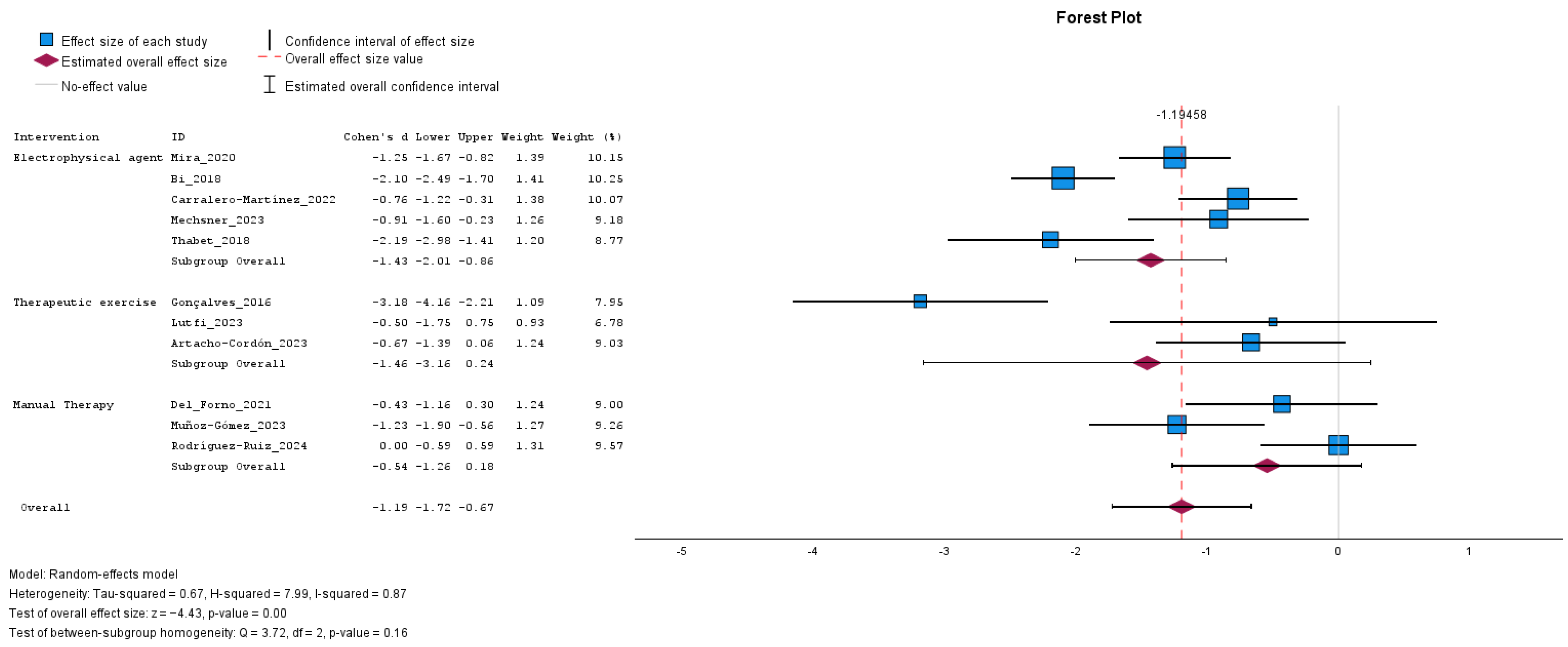
| 11 | Randomized trials | Serious a | Serious b | Not serious | Not serious | None | 325 | 284 | SMD 1.19 SD lower (1.72 lower to 0.67 lower) | ⨁⨁◯◯ Low a,b |
| Pain intensity in women with endometriosis after electrophysical agent treatment compared with placebo/usual care treatment | ||||||||||
| 5 | Randomized trials | Serious a | Not serious | Not serious | Not serious | None | 215 | 197 | SMD 1.43 SD lower (2.01 lower to 0.86 lower) | ⨁⨁⨁◯ Moderate a |
| Pain intensity in women with endometriosis after therapeutic exercise treatment compared with placebo/usual care treatment | ||||||||||
| 3 | Randomized trials | Serious a | Serious b | Not serious | Serious c | None | 51 | 31 | SMD 1.46 SD lower (3.16 lower to 0.24 higher) | ⨁◯◯◯ Very low a,b,c |
| Pain intensity in women with endometriosis after manual therapy treatment compared with placebo/usual care treatment | ||||||||||
| 3 | Randomized trials | Serious a | Serious b | Not serious | Not serious | None | 59 | 56 | SMD 0.54 SD lower (1.26 lower to 0.18 higher) | ⨁⨁◯◯ Low a,b |
| QUALITY OF LIFE (assessed with: EHP; Scale from: 0 to 100 (worse)) | ||||||||||
| Quality of life in women with endometriosis after rehabilitation treatment compared with placebo/usual care treatment | ||||||||||
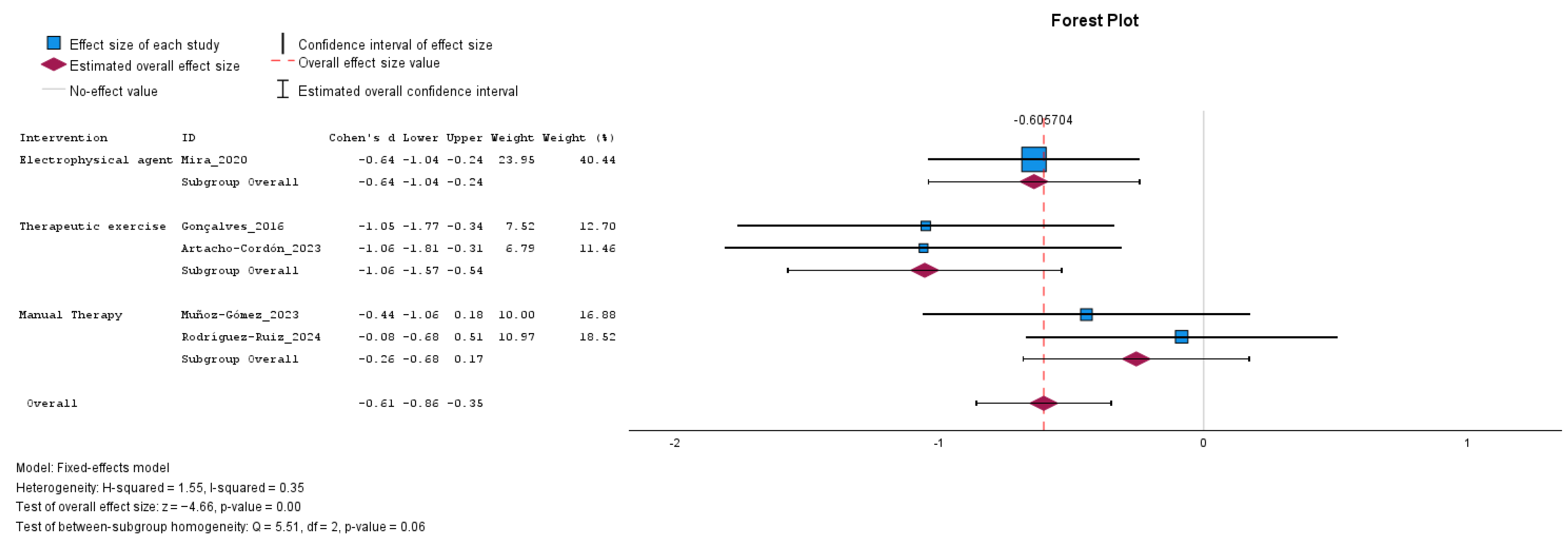
| 5 | Randomized trials | Serious a | Not serious | Not serious | Not serious | None | 139 | 118 | SMD 0.61 SD lower (0.94 lower to 0.29 lower) | ⨁⨁⨁◯ Moderate a |
| Quality of life in women with endometriosis after electrophysical agent treatment compared with placebo/usual care treatment | ||||||||||
| 1 | Randomized trials | Serious a | Serious b | Not serious | Not serious | None | 53 | 48 | SMD 0.64 SD lower (1.04 lower to 0.24 lower) | ⨁⨁◯◯ Low a,b |
| Quality of life in women with endometriosis after therapeutic exercise treatment compared with placebo/usual care treatment | ||||||||||
| 2 | Randomized trials | Serious a | Not serious | Not serious | Serious c | None | 44 | 27 | SMD 1.06 SD lower (1.57 lower to 0.54 lower) | ⨁⨁◯◯ Low a,c |
| Quality of life in women with endometriosis after manual therapy treatment compared with placebo/usual care treatment | ||||||||||
| 2 | Randomized trials | Serious a | Serious b | Not serious | Serious c | None | 42 | 43 | SMD 0.26 SD lower (0.68 lower to 0.17 higher) | ⨁◯◯◯ Very low a,b,c |
Disclaimer/Publisher’s Note: The statements, opinions and data contained in all publications are solely those of the individual author(s) and contributor(s) and not of MDPI and/or the editor(s). MDPI and/or the editor(s) disclaim responsibility for any injury to people or property resulting from any ideas, methods, instructions or products referred to in the content. |
© 2025 by the authors. Licensee MDPI, Basel, Switzerland. This article is an open access article distributed under the terms and conditions of the Creative Commons Attribution (CC BY) license (https://creativecommons.org/licenses/by/4.0/).
Share and Cite
Rodríguez-Ruiz, Á.; Sierra-Artal, B.; Lozano-Lozano, M.; Artacho-Cordón, F. Impact of Physical Rehabilitation on Endometriosis and Adenomyosis-Related Symptoms: A Systematic Review and Meta-Analysis. J. Clin. Med. 2025, 14, 8284. https://doi.org/10.3390/jcm14238284
Rodríguez-Ruiz Á, Sierra-Artal B, Lozano-Lozano M, Artacho-Cordón F. Impact of Physical Rehabilitation on Endometriosis and Adenomyosis-Related Symptoms: A Systematic Review and Meta-Analysis. Journal of Clinical Medicine. 2025; 14(23):8284. https://doi.org/10.3390/jcm14238284
Chicago/Turabian StyleRodríguez-Ruiz, Ángel, Beatriz Sierra-Artal, Mario Lozano-Lozano, and Francisco Artacho-Cordón. 2025. "Impact of Physical Rehabilitation on Endometriosis and Adenomyosis-Related Symptoms: A Systematic Review and Meta-Analysis" Journal of Clinical Medicine 14, no. 23: 8284. https://doi.org/10.3390/jcm14238284
APA StyleRodríguez-Ruiz, Á., Sierra-Artal, B., Lozano-Lozano, M., & Artacho-Cordón, F. (2025). Impact of Physical Rehabilitation on Endometriosis and Adenomyosis-Related Symptoms: A Systematic Review and Meta-Analysis. Journal of Clinical Medicine, 14(23), 8284. https://doi.org/10.3390/jcm14238284