Comparative Efficacy of Negative Pressure Wound Therapy and Conventional Treatments in the Management of Diabetic Foot Ulcers: A Systematic Review and Meta-Analysis

 ,
,  ,
,  ,
,  and
and 
Abstract
1. Introduction
2. Materials and Methods
2.1. Information Sources
2.2. Search Strategy
2.3. Selection Criteria
2.4. Study Selection and Data Extraction
2.5. Tool Used for Risk of Bias Assessment
2.6. Statistical Analysis
3. Results
3.1. Characteristics of the Included Studies
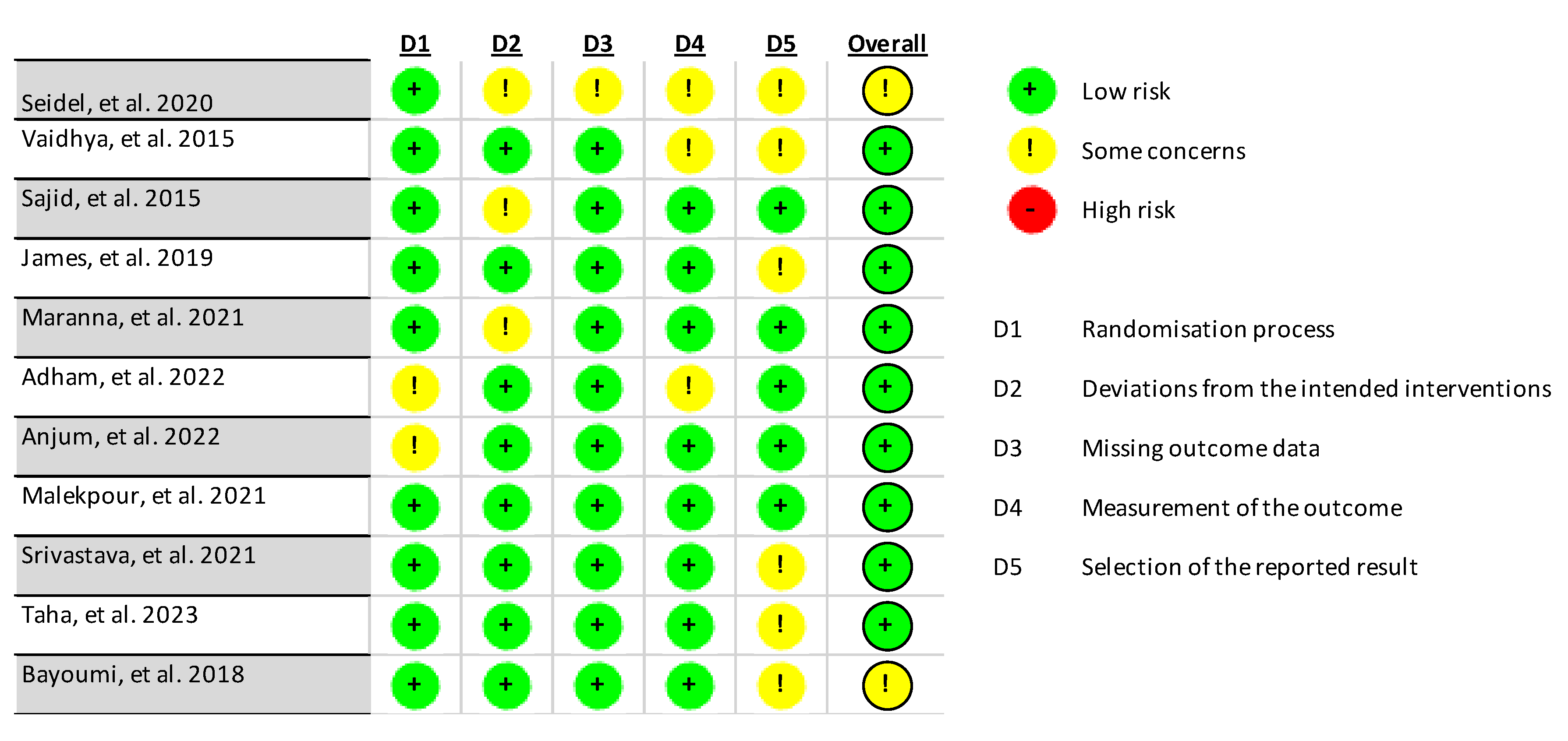
3.2. Risk of Bias Assessment
3.3. Healing Rate
3.4. Time to Achieve 100% Granulation Tissue Formation
3.5. Reduction in Pressure Ulcer Size
3.6. Adverse Effects
3.7. Amputation Rate
3.8. Hospital Stay
4. Discussion
5. Conclusions
Supplementary Materials
Author Contributions
Funding
Institutional Review Board Statement
Informed Consent Statement
Data Availability Statement
Acknowledgments
Conflicts of Interest
References
- Asociación Española de Enfermería Vascular y Heridas. Guía de Práctica Clínica: Consenso Sobre Úlceras Vasculares y Pie Diabético; AEEVH: Madrid, Spain, 2017; Volume 3.
- Stable García, Y. Cicatrización de Heridas en la Diabetes Mellitus. Arch. Med. 2023, 19, 1581. [Google Scholar]
- Mekala, K.C.; Bertoni, A.G. Epidemiology of diabetes mellitus. In Transplantation, Bioengineering, and Regeneration of the Endocrine Pancreas; Elsevier: Amsterdam, The Netherlands, 2020; pp. 49–58. [Google Scholar]
- Reardon, R.; Simring, D.; Kim, B.; Mortensen, J.; Williams, D.; Leslie, A. The diabetic foot ulcer. Aust. J. Gen. Pract. 2020, 49, 250–255. [Google Scholar] [CrossRef]
- Deng, J.; Yang, M.; Zhang, X.; Zhang, H. Efficacy and safety of autologous platelet-rich plasma for diabetic foot ulcer healing: A systematic review and meta-analysis of randomized controlled trials. J. Orthop. Surg. Res. 2023, 18, 370. [Google Scholar] [CrossRef]
- Dowsett, C.; Hampton, J.; Myers, D.; Styche, T. Use of PICOTM to improve clinical and economic outcomes in hard-to-heal wounds. Prod. Technol. 2017, 8, 52–58. [Google Scholar]
- Gupta, S.; Ichioka, S. Optimal use of negative pressure wound therapy in treating pressure ulcers. Int. Wound J. 2012, 9, 8–162012. [Google Scholar] [CrossRef]
- Gea-Caballero, V.; Castro-Sánchez, E.; Júarez-Vela, R.; Díaz-Herrera, M.Á.; de Miguel-Montoya, I.; tínez-Riera, J.R. Elementos esenciales de los entornos profesionales enfermeros en Atención Primaria y su influencia en la calidad del cuidado. Enferm. Clin. 2018, 28, 27–35. [Google Scholar] [CrossRef]
- Pancorbo-Hidalgo, P.L. Los avances de la investigación enfermera sobre heridas: Logros, oportunidades y retos. Enferm. Clin. 2021, 31, 67–70. [Google Scholar] [CrossRef] [PubMed]
- Miguélez-Chamorro, A.; Casado-Mora, M.I.; Company-Sancho, M.C.; Balboa-Blanco, E.; Font-Oliver, M.A.; Román-Medina Isabel, I. Enfermería de Práctica Avanzada y gestión de casos: Elementos imprescindibles en el nuevo modelo de atención a la cronicidad compleja en España. Enferm. Clin. 2019, 29, 99–106. [Google Scholar] [CrossRef]
- Everett, E.; Mathioudakis, N. Update on management of diabetic foot ulcers. Ann. N. Y. Acad. Sci. 2018, 1411, 153–165. [Google Scholar] [CrossRef] [PubMed]
- Brandão, M.G.S.A.; Ximenes, M.A.M.; Sousa DFde Veras, V.S.; Barros, L.M.; Rabeh, S.A.N.; Costa, I.G.; de Araújo, T.M. Photodynamic therapy for infected foot ulcers in people with diabetes mellitus: A systematic review. Sao Paulo Med. J. 2023, 141, e2022476. [Google Scholar] [CrossRef]
- Kirsner, R.; Dove, C.; Reyzelman, A.; Vayser, D.; Jaimes, H. A prospective, randomized, controlled clinical trial on the efficacy of a single-use negative pressure wound therapy system, compared to traditional negative pressure wound therapy in the treatment of chronic ulcers of the lower extremities. Wound Repair Regen. 2019, 27, 519–529. [Google Scholar] [CrossRef]
- Kim, J.H.; Lee, D.H. Negative pressure wound therapy vs. conventional management in open tibia fractures: Systematic review and meta-analysis. Injury 2019, 50, 1764–1772. [Google Scholar] [CrossRef]
- Song, Y.P.; Wang, L.; Yuan, B.F.; Shen, H.W.; Du, L.; Cai, J.Y.; Chen, H. Negative-pressure wound therapy for III/IV pressure injuries: A meta-analysis. Wound Repair Regen. 2021, 29, 20–33. [Google Scholar] [CrossRef] [PubMed]
- Maitret-Velázquez, R.M.; Bizueto-Rosas, H.; Daniel Gómez-Calvo, C.; Alonso Pérez-González, H.; Carla Isabel Moreno-Ramírez, D.; Ismael Hernández-Vázquez, J. Uso de la terapia de presión negativa para manejo de heridas complejas. Rev. Mex. Angiol. 2018, 46, 9–18. [Google Scholar]
- Ousey, K.J.; Milne, J. Exploring portable negative pressure wound therapy devices in the community. Br. J. Community Nurs. 2014, 19, 14–20. [Google Scholar] [CrossRef] [PubMed][Green Version]
- Llamas Fernández, S. Actualización de los Resultados de la Terapia de Presión Negativa: Revisión Sistemática. NURE Investig. 2023, 20, 1–12. [Google Scholar] [CrossRef]
- Lin, D.Z.; Kao, Y.C.; Chen, C.; Wang, H.J.; Chiu, W.K. Negative pressure wound therapy for burn patients: A meta-analysis and systematic review. Int. Wound J. 2021, 18, 112–123. [Google Scholar] [CrossRef]
- Chiang, N.; Rodda, O.A.; Sleigh, J.; Vasudevan, T. Effects of topical negative pressure therapy on tissue oxygenation and wound healing in vascular foot wounds. J. Vasc. Surg. 2017, 66, 564–571. [Google Scholar] [CrossRef] [PubMed]
- Chen, L.; Zhang, S.; Da, J.; Wu, W.; Ma, F.; Tang, C.; Li, G.; Zhong, D.; Liao, B. A systematic review and meta-analysis of efficacy and safety of negative pressure wound therapy in the treatment of diabetic foot ulcer. Ann. Palliat. Med. 2021, 10, 10830–10839. [Google Scholar] [CrossRef]
- Zhang, J.; Hu, Z.C.; Chen, D.; Guo, D.; Zhu, J.Y.; Tang, B. Effectiveness and Safety of Negative-Pressure Wound Therapy for Diabetic Foot Ulcers. Plast. Reconstr. Surg. 2014, 134, 141–151. [Google Scholar] [CrossRef]
- Sanjiwani, N.P.G.R.; Murti, I.P.K. A meta-analysis: The utilization of negative pressure wound therapy in diabetic foot ulcers. J. Rekonstr. Estet. 2023, 8, 106–116. [Google Scholar] [CrossRef]
- Liu, S.; He, C.Z.; Cai, Y.T.; Xing, Q.P.; Guo, Y.Z.; Chen, Z.L.; Su, J.L.; Yang, L.P. Evaluation of negative-pressure wound therapy for patients with diabetic foot ulcers: Systematic review and meta-analysis. Ther. Clin. Risk Manag. 2017, 13, 533–544. [Google Scholar] [CrossRef]
- Moher, D.; Liberati, A.; Tetzlaff, J.; Altman, D.G. Preferred Reporting Items for Systematic Reviews and Meta-Analyses: The PRISMA Statement. PLoS Med. 2009, 6, e1000097. [Google Scholar] [CrossRef]
- Higgins, J.P.; Savovic, J.; Page, M.J.; Sterne, J.A. Revised Cochrane risk-of-bias tool for randomized trials (RoB 2). In Cochrane Handbook for Systematic Reviews of Interventions; Wiley: Hoboken, NJ, USA, 2019; pp. 1–72. [Google Scholar]
- Centro Cochrane Iberoamericano traductores. Manual Cochrane de Revisiones Sistemáticas de Intervenciones; Versión 5.1.0; The Cochrane Collaboration: Barcelona, Spain, 2012. [Google Scholar]
- Taha, A.G.; Sayed, A.I.; Ahmed, O.M. Role of negative pressure wound therapy in the management of surgically treated diabetic foot infections: A randomized controlled trial. Egypt. J. Surg. 2023, 41, 976–982. [Google Scholar]
- Srivastava, V.; Meena, R.; Pratap, A.; Verma, A.; Ansari, M.; Mishra, S. Effect of negative pressure wound therapy on wound thermometry in diabetic foot ulcers. J. Fam. Med. Prim. Care 2022, 11, 7001. [Google Scholar] [CrossRef] [PubMed]
- Maranna, H.; Lal, P.; Mishra, A.; Bains, L.; Sawant, G.; Bhatia, R.; Ku, P.; Beg, M.Y. Negative pressure wound therapy in grade 1 and 2 diabetic foot ulcers: A randomized controlled study. Diabetes Metab. Syndr. Clin. Res. Rev. 2021, 15, 365–371. [Google Scholar] [CrossRef] [PubMed]
- Vaidhya, N.; Panchal, A.; Anchalia, M.M. A New Cost-effective Method of NPWT in Diabetic Foot Wound. Indian J. Surg. 2015, 77 (Suppl. S2), 525–529. [Google Scholar] [CrossRef]
- Anjum, W.; Ali, S.Z.; Mumtaz, M.; Imran, M.; Siddique, H.; Zia, H. Comparison of Vacuum Assisted Closure (VAC) Therapy Versus Conventional Dressing in the Management of Diabetic Foot Ulcer. Pak. J. Med. Health Sci. 2022, 16, 1163–1165. [Google Scholar] [CrossRef]
- Seidel, D.; Storck, M.; Lawall, H.; Wozniak, G.; Mauckner, P.; Hochlenert, D.; Wetzel-Roth, W.; Sondern, K.; Hahn, M.; Rothenaicher, G.; et al. Negative pressure wound therapy compared with standard moist wound care on diabetic foot ulcers in real-life clinical practice: Results of the German DiaFu-RCT. BMJ Open 2020, 10, e026345. [Google Scholar] [CrossRef]
- Malekpour Alamdari, N.; Mehraneroodi, B.; Gholizadeh, B.; Zeinalpour, A.; Safe, P.; Besharat, S. The efficacy of negative pressure wound therapy compared with conventional dressing in treating infected diabetic foot ulcers: A randomized controlled trial. Int. J. Diabetes Dev. Ctries 2021, 41, 664–668. [Google Scholar] [CrossRef]
- James, S.D.; Sureshku, S.; Elamurugan, T.; Debasis, N.; Vijayaku, C.; Palanivel, C. Comparison of vacuum-assisted closure therapy and conventional dressing on wound healing in patients with diabetic foot ulcer: A randomized controlled trial. Niger. J. Surg. 2019, 25, 14. [Google Scholar] [CrossRef]
- Adham, A.H.M.; Talaat, A.A.; Hana, I.N.; Abdelmoaty, K.F. The value of negative pressure wound therapy in comparison with the conventional dressing on the postoperative wound healing in diabetic foot patients. Egypt. J. Surg. 2022, 2022, 354–361. [Google Scholar]
- Bayoumi, A.; Al-Sayed, A.; Al-Mallah, A. Negative Pressure Wound Therapy Versus Conventional Dressing in Treatment of Diabetic Foot Wound. Egypt J. Hosp. Med. 2018, 72, 4054–4059. [Google Scholar]
- Sajid, M.T.; Mustafa, Q.A.; Shaheen, N.; Hussain, S.M.; Shukr, I.; Ahmed, M. Comparison of Negative Pressure Wound Therapy Using Vacuum-Assisted Closure with Advanced Moist Wound Therapy in the Treatment of Diabetic Foot Ulcers. J. Coll. Physicians Surg. Pak. 2015, 25, 789–793. [Google Scholar] [PubMed]
- Huang, C.; Leavitt, T.; Bayer, L.R.; Orgill, D.P. Effect of negative pressure wound therapy on wound healing. Curr. Probl. Surg. 2014, 51, 301–331. [Google Scholar] [CrossRef]
- Argenta, L.C.; Morykwas, M.J. Vacuum-assisted closure: A new method for wound control and treatment: Clinical experience. Ann. Plast Surg. 1997, 38, 563–576; discussion 577. [Google Scholar] [CrossRef] [PubMed]
- Vas, P.; Rayman, G.; Dhatariya, K.; Driver, V.; Hartemann, A.; Londahl, M.; Piaggesi, A.; Apelqvist, J.; Attinger, C.; Game, F. Effectiveness of interventions to enhance healing of chronic foot ulcers in diabetes: A systematic review. Diabetes Metab. Res. Rev. 2020, 36 (Suppl. S1), e3284. [Google Scholar] [CrossRef]
- Singh, B.; Sharma, D. Comparison of Negative Pressure Wound Therapy v/s Conventional Dressings in the Management of Chronic Diabetic Foot Ulcers in a Tertiary Care Hospital in North India. Int. J. Sci. Res. 2017, 6, 948–953. [Google Scholar]
- Braakenburg, A.; Obdeijn, M.C.; Feitz, R.; van Rooij, I.A.L.M.; van Griethuysen, A.J.; Klinkenbijl, J.H.G. The Clinical Efficacy and Cost Effectiveness of the Vacuum-Assisted Closure Technique in the Management of Acute and Chronic Wounds: A Randomized Controlled Trial. Plast. Reconstr. Surg. 2006, 118, 390–397. [Google Scholar] [CrossRef]
- Blume, P.A.; Walters, J.; Payne, W.; Ayala, J.; Lantis, J. Comparison of Negative Pressure Wound Therapy Using Vacuum-Assisted Closure With Advanced Moist Wound Therapy in the Treatment of Diabetic Foot Ulcers A multicenter randomized controlled trial. Diabetes Care 2008, 31, 631–636. [Google Scholar] [CrossRef]
- Eginton, M.T.; Brown, K.R.; Seabrook, G.R.; Towne, J.B.; Cambria, R.A. A prospective randomized evaluation of negative-pressure wound dressings for diabetic foot wounds. Ann. Vasc. Surg. 2003, 17, 645–649. [Google Scholar] [CrossRef]
- Peinemann, F.; Sauerland, S. Negative-pressure wound therapy: Systematic review of randomized controlled trials. Dtsch. Arztebl. Int. 2011, 108, 381–389. [Google Scholar]
- Lone, A.M.; Zaroo, M.I.; Laway, B.A.; Pala, N.A.; Bashir, S.A.; Rasool, A. Vacuum-assisted closure versus conventional dressings in the management of diabetic foot ulcers: A prospective case–control study. Diabet Foot Ankle 2014, 5, 23345. [Google Scholar] [CrossRef]
- Mouës, C.M.; van den Bemd, G.J.C.M.; Meerding, W.J.; Hovius, S.E.R. An economic evaluation of the use of TNP on full-thickness wounds. J. Wound Care 2005, 14, 224–227. [Google Scholar] [CrossRef]
- Lorenzo Hernández, M.P.; Hernández Cano, R.M. Uso inadecuado de la presión negativa en terapias tópicas en heridas con dehiscencias: Efectividad de la cura en ambiente húmedo en dehiscencia de herida quirúrgica tras uso de apósito Pico. Ene 2014, 8, 8. [Google Scholar] [CrossRef]
- Dorafshar, A.H.; Franczyk, M.; Gottlieb, L.J.; Wroblewski, K.E.; Lohman, R.F. A prospective randomized trial comparing subatmospheric wound therapy with a sealed gauze dressing and the standard vacuum-assisted closure device. Ann. Plast. Surg. 2012, 69, 79–84. [Google Scholar] [CrossRef]
- Bechert, K.; Abraham, S.E. Pain management and wound Care. J. Am. Col. Certif. Wound Spec. 2009, 1, 65–71. [Google Scholar] [CrossRef]
- Serena, T.; Yaakov, R.; Aslam, S.; Aslam, R. Preventing, minimizing, and managing pain in patients with chronic wounds: Challenges and solutions. Chronic Wound Care Manag. Res. 2016, 3, 85–90. [Google Scholar] [CrossRef]
- Barbara Goyo, N.; Miriamgeluis Lanzotti, S.; Aracelys Torrealba, A.; De Felice Libero, G. Aplicación de la terapia de presión negativa en el manejo de pacientes con heridas complejas. J. Negat. No Posit. Results 2020, 5, 1490–1503. [Google Scholar]
- Chang, H.; Maldonado, T.S.; Rockman, C.B.; Cayne, N.S.; Berland, T.L.; Barfield, M.E.; Jacobowitz, G.R.; Sadek, M. Closed incision negative pressure wound therapy decrease wound complications in major lower extremity amputations. J. Vasc. Surg. 2021, 73, 1041–1047. [Google Scholar] [CrossRef] [PubMed]
- Liu, Z.; Dumville, J.C.; Hinchliffe, R.J.; Cullum, N.; Game, F.; Stubbs, N.; Peinemann, F. Negative pressure wound therapy for treating foot wounds in people with diabetes mellitus. Cochrane Database Syst. Rev. 2018, 10, CD010318. [Google Scholar] [CrossRef] [PubMed]
- Armstrong, D.G.; Lavery, L.A.; Diabetic Foot Study Consortium. Negative pressure wound therapy after partial diabetic foot amputation: A multicentre, randomised controlled trial. Lancet 2005, 366, 1704–1710. [Google Scholar] [CrossRef]
- Rai, S.; Mahendru, V.; Richaria, A.; Musa, O.; Rizvi, A.H. Comparative study of efficacy of negative pressure wound therapy versus conventional dressing in open wounds. Natl. J. Med. Allied Sci. 2019, 8, 50. [Google Scholar]
- Johari, H.; Kazemzadeh, G.; Modaghegh, M.H.; Ravari, H.; Sangaki, A.; Shahrodi, M. Comparision of vacuum-asisted closure and moist wound dressing in the treatment of diabetic foot ulcers. J. Cutan. Aesthet. Surg. 2013, 6, 17. [Google Scholar] [CrossRef]
- Jeffcoate, W.J.; Harding, K.G. Diabetic foot ulcers. Lancet 2003, 361, 1545–1551. [Google Scholar] [CrossRef]
- Dsouza, C.; Rouchelle; Chirag; Diaz, E.; Rao, S. A randomized controlled trial comparing low cost vacuum assisted dressings and conventional dressing methods in the management of diabetic foot ulcers. Int. Surg. J. 2017, 4, 3858. [Google Scholar] [CrossRef][Green Version]
- Ibáñez Rodríguez, B.; Maestre Bernat, L.; Moya tínez, D.; Bodro imont, M.; Hernández Carceny, C. ¿Es posible la terapia de presión negativa en hospitalización a domicilio?: Caso clínico. Gerokomos 2021, 32, 136–139. [Google Scholar] [CrossRef]
- Apelqvist, J.; Armstrong, D.G.; Lavery, L.A.; Boulton, A.J.M. Resource utilization and economic costs of care based on a randomized trial of vacuum-assisted closure therapy in the treatment of diabetic foot wounds. Am. J. Surg. 2008, 195, 782–788. [Google Scholar] [CrossRef]
- Petrou, S.; Parker, B.; Masters, J.; Achten, J.; Bruce, J.; Lamb, S.E.; Parsons, N.; Costa, M.L.; Collaborators, W.T. Cost-effectiveness of negative-pressure wound therapy in adults with severe open fractures of the lower limb: Evidence from the WOLLF randomized controlled trial. Bone Jt. J. 2019, 101-B, 1392–1401. [Google Scholar] [CrossRef]
- Älgå, A.; Löfgren, J.; Haweizy, R.; Bashaireh, K.; Wong, S.; Forsberg, B.C.; von Schreeb, J.; Malmstedt, J. Cost analysis of negative-pressure wound therapy versus standard treatment of acute conflict-related extremity wounds within a randomized controlled trial. World J. Emerg. Surg. 2022, 17, 9. [Google Scholar] [CrossRef]
- Foglia, E.; Ferrario, L.; Garagiola, E.; Signoriello, G.; Pellino, G.; Croce, D.; Canonico, S. Economic and organizational sustainability of a negative-pressure portable device for the prevention of surgical-site complications. Clin. Outcomes Res. 2017, 9, 343–351. [Google Scholar] [CrossRef]
- Campos, D.; Perez, V.; Merkel, M.; Palka-Santini, M. Potential Budget Impact of Negative Pressure Wound Therapy (NPWT) Versus Conventional Wound Treatment in Diabetic Foot Ulcers (DFU), Surgical and Trauma for Selected Countries in Latin America. Value Health 2022, 25, S169. [Google Scholar] [CrossRef]
- Law, A.L.; Krebs, B.; Karnik, B.; Griffin, L. Comparison of Healthcare Costs Associated With Patients Receiving Traditional Negative Pressure Wound Therapies in the Post-Acute Setting. Cureus 2020, 12, 11790. [Google Scholar] [CrossRef] [PubMed]
- Page, M.J.; McKenzie, J.E.; Bossuyt, P.M.; Boutron, I.; Hoffmann, T.C.; Mulrow, C.D.; Shamseer, L.; Tetzlaff, J.M.; Akl, E.A.; Brennan, S.E.; et al. The PRISMA 2020 statement: An updated guideline for reporting systematic reviews. BMJ 2021, 372, n71. [Google Scholar] [CrossRef] [PubMed]










| DATABASE | SEARCH STRATEGY |
|---|---|
| PUBMED | (“Negative-Pressure Wound Therapy”[Mesh]) AND “Diabetic Foot”[Mesh] Filters: Clinical Trial |
| SCOPUS | (TITLE-ABS-KEY (“vacuum-assisted closure”) OR TITLE-ABS-KEY (“negative-pressure wound therapy”) AND TITLE-ABS-KEY (“diabetic foot ulcer”) OR TITLE-ABS-KEY (“diabetic foot”) ANDTITLE-ABS-KEY (“clinical trial”)) AND (LIMIT-TO (DOCTYPE, “ar”)) |
| CINAHL | TI (negative pressure wound therapy OR npwt OR acuum assisted closure OR wound vac OR vac therapy) AND TI (diabetic foot ulcer OR diabetic foot sore OR diabetic foot OR diabetic foot wound) |
| COCHRANE LIBRARY | “negative pressure wound therapy” in Title Abstract Keyword OR “vacuum assisted closure system” in Title Abstract Keyword OR “VAC therapy” in Title Abstract Keyword AND “diabetic foot ulcer” in Title Abstract Keyword OR “diabetic foot syndrome” in Title Abstract Keyword—in Trials |
| What is the Efficacy of NPWT Treatment in DFUs? | |||
|---|---|---|---|
| Population (P) | Intervention (I) | Comparison (C) | Outcomes (O) |
| Adult patients with DM. | Use of negative pressure therapy. | Conventional treatment based on standard dressings (saline, moist, alginates, and silver sulfadiazine ointments). | Efficacy of negative pressure therapy measured by the reduction in DFU size, healing time, decrease in adverse effects, amputation rate, complete healing rate, and shorter hospital stay. |
| Inclusion Criteria | Exclusion Criteria |
|---|---|
|
|
| Authors and Country | Participants | Intervention | Control Group | Results | Conclusions | Risk of Bias |
|---|---|---|---|---|---|---|
| Taha et al., [28] (2023) Egypt | -N: 80 IG: 40; CG: 40 IG Age: 53.2 ± 8.0 CG Age: 56.9 ± 5.6 | Both groups underwent surgical debridement of all infected and necrotic tissues. The IG was treated with NPWT. This therapy was changed every 72 h. The intervention lasted 8 weeks. | Conventional dressings changed every 24 h. |
| NPWT has been shown to be effective and safe for DFUs as it reduces wound size, promotes faster granulation tissue formation, and leads to quicker cessation of drainage without increasing pain or bleeding compared to conventional dressings. | Low risk |
| Srivastava et al., [29] (2022) India | -N: 55 IG: 23; CG: 32 IG Age: 37.32 ± 6.84 CG Age: 36.74 ± 7.22 | The IG was treated with NPWT. Dressings were changed every 7 days over the 21-day intervention period. | Conventional dressings changed daily. |
| NPWT appears superior to conventional dressings, providing a higher quality of life due to earlier granulation tissue formation, faster size reduction, less discomfort, no daily dressing changes, less or no pain, and higher dressing cost but lower overall cost. | Low risk |
| Maranna et al., [30] (2021) India | -N: 55 IG: 22; CG: 23 IG Age: 50.23 ± 10.52 CG Age: 49.0 ± 10.14 | All patients underwent initial complete debridement. The IG received NPWT with polyurethane foam. Foam was changed every 72 h. Wound measurements were taken on days 1 and 14. The intervention lasted 14 days. | Conventional saline dressings changed every 24 h with saline wash before reapplying the dressing. |
| NPWT led to earlier reduction in DFU size, greater granulation tissue formation, shorter hospital stays, and complete wound healing compared to conventional dressings. | Low risk |
| Vaidhya et al., [31] (2015) India | -N: 60 IG: 30; CG: 30 IG Age: 56.5 CG Age: 57.3 | The IG received NPWT. Dressings were changed every 48–72 h. Patients in both groups were examined daily over the 8-day intervention period. | Conventional dressings were applied twice daily. |
| The healing rate of DFUs was faster in the IG than in the CG. NPWT is more cost-effective for these patients. | Low risk |
| Anjum et al., [32] (2022) Pakistan | -N: 40 IG: 20; CG: 20 IG Age: 42.95 ± 9.29 CG Age: 46.30 ± 9.33 | The IG received NPWT for 72 h. The intervention lasted 2 weeks. | Conventional saline dressings changed daily. |
| VAC is more successful in achieving granulation tissue in DFUs compared to conventional dressings. | Low risk |
| Seidel et al., [33] (2020) Germany | -N: 345 IG: 171; CG: 174 IG Age: 67.8 ± 11.9 CG Age: 67.6 ± 12.3 | The IG received NPWT. Both groups were evaluated at weeks 1, 3, 5, 12, and 16. The intervention lasted 16 weeks. | Conventional moist dressings. |
| NPWT was not superior to conventional moist dressings in DFUs. Overall, the wound closure rate was low. | Some concerns |
| Malekpour et al., [34] (2021) Iran | -N: 60 IG: 30; CG: 30 IG Age: 70.31 ± 5.92 CG Age: 71.80 ± 6.32 | The IG received NPWT changed every 48 h. Data were recorded twice weekly for 3 months. All patients were followed until complete DFU closure. | Conventional dressings changed twice daily. |
| Better efficacy was observed in treating infected DFUs with NPWT, leading to higher healing rates, size reduction, shorter posttreatment disability duration, and fewer major and minor amputations. However, no differences were observed between the treatments in terms of complications. | Low risk |
| James et al., [35] (2019) India | -N: 54 IG: 27; CG: 27 IG Age: 55.9 CG Age: 52.9 | All patients underwent debridement. DFU area was assessed at the beginning and end of the study over 3 weeks. The IG received continuous NPWT, with dressings changed every 48 h. | Conventional saline dressings changed daily and evaluated every 48 h. |
| NPWT significantly reduces the time to complete healing, granulation tissue formation, and more rapidly decreases DFU area compared to conventional dressings. | Low risk |
| Adham et al., [36] (2022) Egypt | -N: 40 IG: 20; CG: 20 IG and CG Age: N/A | Patients first underwent surgical debridement or minor amputations before treatment. The IG received continuous NPWT. Outcomes were measured at weeks 2, 4, 6, 8, and 10. The intervention lasted 10 weeks. | Conventional saline gauze dressings. |
| The time to complete wound healing was significantly better in the NPWT VAC group compared to conventional dressings. | Low risk |
| Bayoumi A, et al. [37] (2018) Egypt | -N: 50 IG: 25; CG: 25 IG and CG Age: >60 years | All wounds were debrided. The IG was treated with NPWT. The intervention lasted 3 weeks. | Conventional moist dressings. |
| VAC is more effective than conventional dressings in treating DFUs in diabetic patients. Hospitals should consider this therapy as an essential modality in the treatment of these wounds. | Some concerns |
| Sajid et al., [38] (2015) Pakistan | -N: 278 IG: 139; CG: 139 IG Age: 56.8 ± 11.3 CG Age: 55.9 ± 10.9 | The IG received intermittent NPWT at −125 mmHg, changed every 48–72 h. Both groups were evaluated weekly for 2 weeks. | Conventional moist dressings changed daily. |
| NPWT was more effective than conventional dressings in managing DFUs. | Low risk |
| Authors | Mode | Pressure Measurements (mmHg) | Interface Layer or Foam | Treatment During the Intervention and/or Graft |
|---|---|---|---|---|
| Taha et al., [28] (2023) | Intermittent (5 min on, 2 min off) | −125 mmHg |
| N/A |
| Srivastava et al., [29] (2022) India | Intermittent or continuous | For 6 days, an evacuation tube embedded in foam was linked to vacuum at a negative pressure of −125 mmHg. Depending on the wound type, the wall suction pump could be configured to provide different levels of negative pressure (100–250 mmHg) |
| N/A |
| Maranna et al., [30] (2021) India | Continuous | −125 mmHg |
| Vacuum-assisted closure VAC® therapy (KCI, San Antonio, TX, USA). |
| Vaidhya et al., [31] (2015) India | Intermittent (30 min on and 30 min off) | −80 to −150 mmHg |
| Kinetic Concepts Incorporated (KCI) VAC® modified |
| Anjum et al., [32] (2022) Pakistan | Continuous | −80 to −125 mmHg |
| VAC |
| Seidel et al., [33] (2020) Germany | Intermittent and continuous | N/A |
| Kinetic Concepts Incorporated (KCI) and Smith & Nephew (S&N) |
| Malekpour et al., [34] (2021) Iran | Intermittent (5 min on, 2 min off) | −75 to–100 mmHg |
| VAC (FAPSCO, Tehran, Iran) |
| James et al., [35] (2019) India | Continuous | −125 mmHg |
| VAC |
| Adham et al., [36] (2022) Egypt | Continuous | −125 mmHg |
| VAC |
| Bayoumi et al., [37] (2018) Egypt | N/A | N/A |
| VAC |
| Sajid et al., [38] (2015) Pakistan | Intermittent | −125 mmHg |
| VAC |
Disclaimer/Publisher’s Note: The statements, opinions and data contained in all publications are solely those of the individual author(s) and contributor(s) and not of MDPI and/or the editor(s). MDPI and/or the editor(s) disclaim responsibility for any injury to people or property resulting from any ideas, methods, instructions or products referred to in the content. |
© 2025 by the authors. Licensee MDPI, Basel, Switzerland. This article is an open access article distributed under the terms and conditions of the Creative Commons Attribution (CC BY) license (https://creativecommons.org/licenses/by/4.0/).
Share and Cite
Villalba-Aguilar, C.; Laredo-Aguilera, J.A.; Villalba-Aguilar, L.; Castillo-Hermoso, M.I.; López-Fernández-Roldán, Á.; Carmona-Torres, J.M. Comparative Efficacy of Negative Pressure Wound Therapy and Conventional Treatments in the Management of Diabetic Foot Ulcers: A Systematic Review and Meta-Analysis. J. Clin. Med. 2025, 14, 8051. https://doi.org/10.3390/jcm14228051
Villalba-Aguilar C, Laredo-Aguilera JA, Villalba-Aguilar L, Castillo-Hermoso MI, López-Fernández-Roldán Á, Carmona-Torres JM. Comparative Efficacy of Negative Pressure Wound Therapy and Conventional Treatments in the Management of Diabetic Foot Ulcers: A Systematic Review and Meta-Analysis. Journal of Clinical Medicine. 2025; 14(22):8051. https://doi.org/10.3390/jcm14228051
Chicago/Turabian StyleVillalba-Aguilar, Celia, José Alberto Laredo-Aguilera, Lucía Villalba-Aguilar, Matilde Isabel Castillo-Hermoso, Ángel López-Fernández-Roldán, and Juan Manuel Carmona-Torres. 2025. "Comparative Efficacy of Negative Pressure Wound Therapy and Conventional Treatments in the Management of Diabetic Foot Ulcers: A Systematic Review and Meta-Analysis" Journal of Clinical Medicine 14, no. 22: 8051. https://doi.org/10.3390/jcm14228051
APA StyleVillalba-Aguilar, C., Laredo-Aguilera, J. A., Villalba-Aguilar, L., Castillo-Hermoso, M. I., López-Fernández-Roldán, Á., & Carmona-Torres, J. M. (2025). Comparative Efficacy of Negative Pressure Wound Therapy and Conventional Treatments in the Management of Diabetic Foot Ulcers: A Systematic Review and Meta-Analysis. Journal of Clinical Medicine, 14(22), 8051. https://doi.org/10.3390/jcm14228051