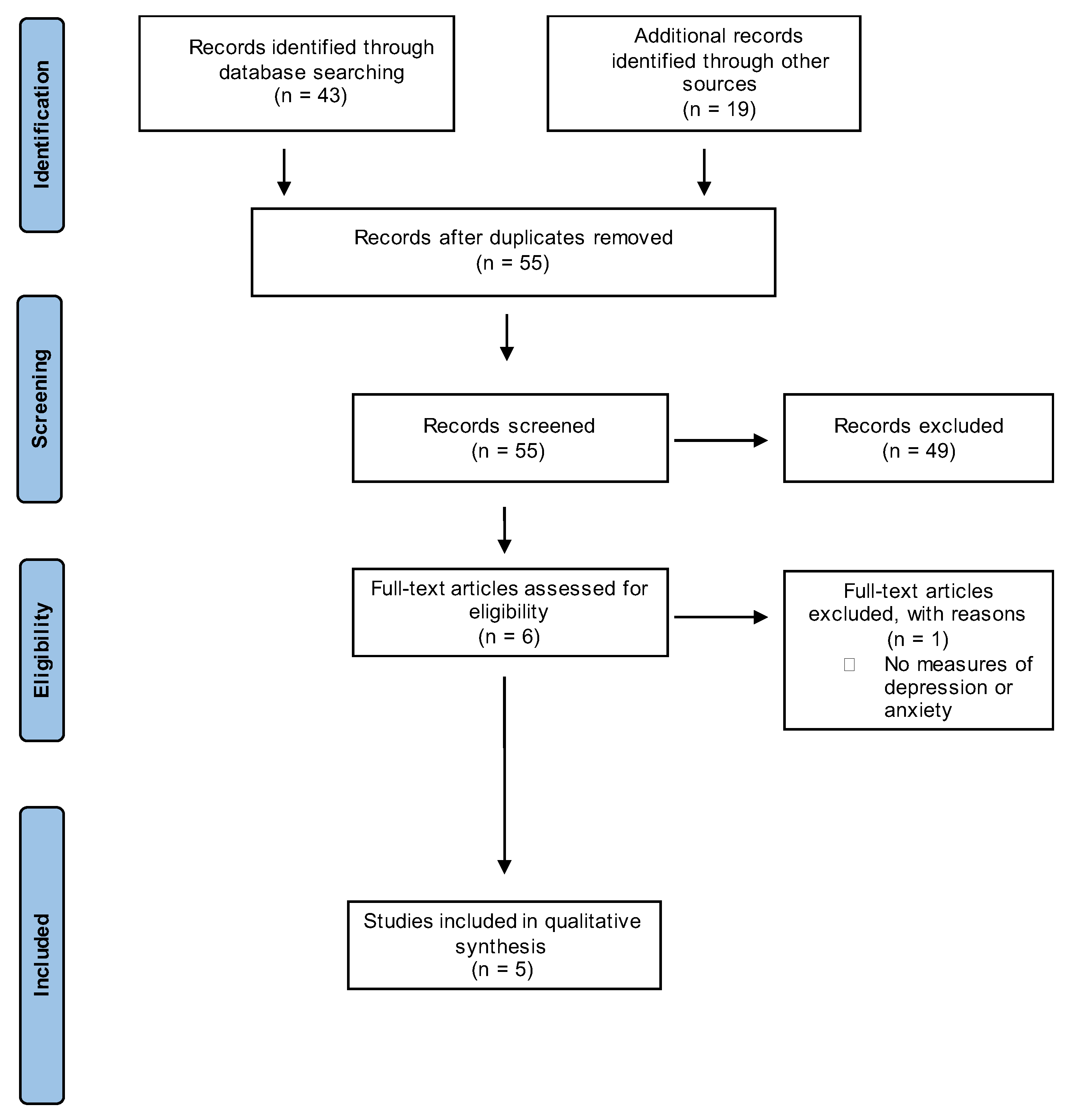
Lack of Gender-Disaggregated Data for the Psychological Impact of ACL Injury on Adolescents
 , , ,
, , ,
Abstract
1. Introduction
2. Materials and Methods
2.1. Search Strategy
2.2. Inclusion and Exclusion Criteria
3. Results

| Lead Author (Year) | Quality Assessment Score (Quality Assessment Tool) |
|---|---|
| Tripp et al., 2003 [25] | 5 *: Selection 3, Comparability 0, Outcome 2 (NOS) |
| Baranoff et al., 2015 [26] | 5 *: Selection 2, Comparability 1, Outcome 2 (NOS) |
| Mainwaring et al., 2010 [27] | 6 *: Selection 4, Comparability 0, Outcome 2 (NOS) |
| Kiani et al., 2023 [28] | 6 *: Selection 4, Comparability 0, Outcome 2 (NOS) |
| Maddison et al., 2006 [29] | 3/5 (Jadad scale) |
3.1. Depression
| Lead Author (Year) | Population | Age of Participants | Gender Split | Baseline Measurement | Follow Up Time | Outcome Variable | Findings at Baseline, Type of Patient, Outcome Values: Mean ± SD | Findings at Follow-Up | Gender Regression or Disaggregation | Age Regression or Disaggregation |
|---|---|---|---|---|---|---|---|---|---|---|
| Tripp et al., 2003 [25] | 30 patients (20 adults, 10 adolescent) | Adolescent: 16–18, Adult: 20–53 | Adolescent: 5 female/5 male Adult: 4 female/6 male | 1 day post-operatively | NA | BDI | Adults: 7 ± 6.4 Adolescents: 10 ± 4.3 No significant difference between adolescent/adult groups for anxiety or depressive symptoms | NA | No | Yes |
| Baranoff et al., 2015 [26] | 44 patients | Mean 27, SD 9.4 | 17 female/27 male | Within 14 days post-operatively | 6 months post-operative | DASS 21 | Baseline: 8.6 (7.4) No correlation of age/ gender with depressive symptoms. | 6 months: 11 (11.6) | Regression | Regression |
| Mainwaring et al., 2010 [27] | 51 participants (16 concussion, 7 ACL injury, 28 uninjured) | Mean 21.2, SD 2.94, range 17.5–37 | 30 female/21 male | Pre-injury (start of sporting season) | 1 month (29 days) post-injury | POMS | ACL: 0.71 ± 0.95 Concussion: 1.31 ± 2.55 Control: 1.54 ± 3.13 No significant difference between groups at baseline | First post injury check: ACL: 5.00 ± 4.40 Concussion: 3.75 ± 4.55 Control: 1.54 ± 2.41 ACL group significantly different to control (p = 0.005) Significant main effect of time post-injury on depressive symptoms in ACL injury group | No | No |
| Kiani et al., 2023 [28] | 413 patients | Median 15, IQR 13–16 | 223 female/ 190 male | 5–54 days post-injury | 9.1–12.6 months post-injury | PROMIS | No significant correlation of depressive symptoms with socioeconomic disadvantage at baseline | Depressive symptoms correlated with socioeconomic disadvantage at multiple post-operative time points | No | No |
3.2. Anxiety
| Lead Author (Year) | Population | Age of Participants | Gender Split | Baseline Measurement | Follow Up Time | Outcome Variable | Findings at Baseline, Type of Patient, and Outcome Values: Mean ± SD | Findings at Follow-Up | Gender Regression or Disaggregation | Age Regression or Disaggregation |
|---|---|---|---|---|---|---|---|---|---|---|
| Tripp et al., 2003 [25] | 30 patients (20 adults, 10 adolescent) | Adolescent: 16–18, Adult: 20–53) | Adolescent: 5 female/5 male. Adult: 4 female/6 male | 24 hrs post-operatively | NA | STAI-S | Adults: 33.80 ± 8.78 Adolescents: 44.40 ± 12.43. No significant difference between groups for anxiety symptoms | NA | No | Yes |
| Maddison et al., 2006 [29] | 58 patients. (30 modelling group, 28 control group) | 15 to 53 | 32% female, 68% male | First assessment | Pre-operative assessment | STAI-S | Intervention: 36.93 ± 8.85 Control: 34.25 ± 7.80 No significant difference between groups | Intervention: 38.17 ± 10.19 Control: 37.52 ± 6.52 No significant difference between groups General increase in anxiety symptoms from baseline to pre-operative assessment in both groups | No | No |
| Kiani et al., 2023 [28] | 413 patients | Median 15, IQR 13–16 | 54% female/ 46% male | 5–54 days post-injury | 9.1–12.6 months post-injury | PROMIS | No significant correlation of anxiety symptoms with socioeconomic disadvantage at baseline | Anxiety symptoms correlated with socioeconomic disadvantage at multiple post-operative time points | No | No |
3.3. Summary
4. Discussion
5. Conclusions
Author Contributions
Funding
Conflicts of Interest
Abbreviations
| BDI | Beck Depression Inventory |
| DASS 21 | Depression Anxiety Stress Scales—21 items |
| POMS | Profile of Mood States |
| PROMIS | Patient-Reported Outcomes Measurement Information System |
| STAI-S | State-Trait Anxiety Inventory-State version |
| NOS | Newcastle–Ottawa Score |
References
- Evans, J.; Mabrouk, A.; Nielson, J.L. Anterior Cruciate Ligament Knee Injury. In StatPearls; StatPearls Publishing: Treasure Island, FL, USA, 2023. [Google Scholar]
- Sanders, T.L.; Maradit Kremers, H.; Bryan, A.J.; Larson, D.R.; Dahm, D.L.; Levy, B.A.; Stuart, M.J.; Krych, A.J. Incidence of Anterior Cruciate Ligament Tears and Reconstruction: A 21-Year Population-Based Study. Am. J. Sports Med. 2016, 44, 1502–1507. [Google Scholar]
- Weitz, F.K.; Sillanpää, P.J.; Mattila, V.M. The incidence of paediatric ACL injury is increasing in Finland. Knee Surg. Sports Traumatol. Arthrosc. 2020, 28, 363–368. [Google Scholar]
- Peat, G.; Bergknut, C.; Frobell, R.; Jöud, A.; Englund, M. Population-wide incidence estimates for soft tissue knee injuries presenting to healthcare in southern Sweden: Data from the Skåne Healthcare Register. Arthritis Res. Ther. 2014, 16, R162. [Google Scholar]
- Davies, L.; Cook, J.; Leal, J.; Areia, C.M.; Shirkey, B.; Jackson, W.; Campbell, H.; Fletcher, H.; Carr, A.; Barker, K.; et al. Comparison of the clinical and cost effectiveness of two management strategies (rehabilitation versus surgical reconstruction) for non-acute anterior cruciate ligament (ACL) injury: Study protocol for the ACL SNNAP randomised controlled trial. Trials 2020, 21, 405. [Google Scholar]
- Abram, S.G.F.; Price, A.J.; Judge, A.; Beard, D.J. Anterior cruciate ligament (ACL) reconstruction and meniscal repair rates have both increased in the past 20 years in England: Hospital statistics from 1997 to 2017. Br. J. Sports Med. 2020, 54, 286–291. [Google Scholar] [PubMed]
- Luc, B.; Gribble, P.A.; Pietrosimone, B.G. Osteoarthritis prevalence following anterior cruciate ligament reconstruction: A systematic review and numbers-needed-to-treat analysis. J. Athl. Train. 2014, 49, 806–819. [Google Scholar] [PubMed]
- Hesmerg, M.K.; Oostenbroek, M.H.W.; van der List, J.P. Lever sign test shows high diagnostic accuracy for anterior cruciate ligament injuries: A systematic review and meta-analysis of 3299 observations. Knee 2024, 47, 81–91. [Google Scholar] [PubMed]
- Bucher, C.; Lamy, D.; Debaty, G.; Pailhé, R.; Saragaglia, D. Validity of the lever sign test for the clinical diagnosis of anterior cruciate ligament tears: Assessments in ski resorts. Orthop. Traumatol. Surg. Res. 2022, 108, 103254. [Google Scholar]
- Dávid, T.; Kinga, N.; Zsófia, C.; Kitti, R.; Attila, S.; Marcell, V. Dynamic point of care ultrasound is effective in the early diagnosis of anterior cruciate ligament injuries in children and adolescents. Injury 2024, 55 (Suppl. S3), 111729. [Google Scholar]
- Balazs, G.C.; Greditzer, H.G., 4th; Wang, D.; Marom, N.; Potter, H.G.; Marx, R.G.; Rodeo, S.A.; Williams, R.J., 3rd. Ramp Lesions of the Medial Meniscus in Patients Undergoing Primary and Revision ACL Reconstruction: Prevalence and Risk Factors. Orthop. J. Sports. Med. 2019, 7, 2325967119843509. [Google Scholar]
- National Health Service England. Mental Health of Children and Young People in England 2023—Wave 4 Follow Up to the 2017 Survey: Data Tables 2023. Available online: https://digital.nhs.uk/data-and-information/publications/statistical/mental-health-of-children-and-young-people-in-england/2023-wave-4-follow-up/data-sets (accessed on 12 April 2024).
- Sareen, J.; Erickson, J.; Medved, M.I.; Asmundson, G.J.G.; Enns, M.W.; Stein, M.; Leslie, W.; Doupe, M.; Logsetty, S. Risk factors for post-injury mental health problems. Depress. Anxiety 2013, 30, 321–327. [Google Scholar] [PubMed]
- Gianfredi, V.; Blandi, L.; Cacitti, S.; Minelli, M.; Signorelli, C.; Amerio, A.; Amerio, A. Depression and Objectively Measured Physical Activity: A Systematic Review and Meta-Analysis. Int. J. Environ. Res. Public Health 2020, 17, 3738. [Google Scholar]
- Steptoe, A.; Butler, N. Sports participation and emotional wellbeing in adolescents. Lancet 1996, 347, 1789–1792. [Google Scholar]
- Hoffmann, M.D.; Barnes, J.D.; Tremblay, M.S.; Guerrero, M.D.; Romer, D. Associations between organized sport participation and mental health difficulties: Data from over 11,000 US children and adolescents. PLoS ONE 2022, 17, e0268583. [Google Scholar]
- Snyder, A.R.; Martinez, J.C.; Bay, R.C.; Parsons, J.T.; Sauers, E.L.; McLeod, T.C.V. Health-related quality of life differs between adolescent athletes and adolescent nonathletes. J. Sport Rehabil. 2010, 19, 237–248. [Google Scholar]
- Senorski, E.H.; Samuelsson, K.; Thomeé, C.; Beischer, S.; Karlsson, J.; Thomeé, R. Return to knee-strenuous sport after anterior cruciate ligament reconstruction: A report from a rehabilitation outcome registry of patient characteristics. Knee Surg. Sports Traumatol. Arthrosc. 2017, 25, 1364–1374. [Google Scholar]
- Nwachukwu, B.U.; Adjei, J.; Rauck, R.C.; Chahla, J.; Okoroha, K.R.; Verma, N.N.; Allen, A.A.; Williams, R.J. How Much Do Psychological Factors Affect Lack of Return to Play After Anterior Cruciate Ligament Reconstruction? A Systematic Review. Orthop. J. Sports Med. 2019, 7, 2325967119845313. [Google Scholar] [PubMed]
- Beischer, S.; Senorski, E.H.; Thomeé, C.; Samuelsson, K.; Thomeé, R. How Is Psychological Outcome Related to Knee Function and Return to Sport Among Adolescent Athletes After Anterior Cruciate Ligament Reconstruction? Am. J. Sports Med. 2019, 47, 1567–1575. [Google Scholar]
- Piussi, R.; Berghdal, T.; Sundemo, D.; Grassi, A.; Zaffagnini, S.; Sansone, M.; Samuelsson, K.; Senorski, E.H. Self-Reported Symptoms of Depression and Anxiety After ACL Injury: A Systematic Review. Orthop. J. Sports Med. 2022, 10, 23259671211066493. [Google Scholar]
- Marconcin, P.; Silva, A.L.; Flôres, F.; Nunes, A.; Lourenço, J.F.; Peralta, M.; Minghelli, B. Association between Musculoskeletal Injuries and Depressive Symptoms among Athletes: A Systematic Review. Int. J. Environ. Res. Public Health 2023, 20, 6130. [Google Scholar]
- London, D.A.; Stepan, J.G.; Boyer, M.I.; Calfee, R.P. The impact of depression and pain catastrophization on initial presentation and treatment outcomes for atraumatic hand conditions. J. Bone Jt. Surg. 2014, 96, 806–814. [Google Scholar]
- Wells, G.A.; Shea, B.; O’Connell, D.; Peterson, J.; Welch, V.; Losos, M.; Tugwell, P. The Newcastle-Ottawa Scale (NOS) for Assessing the Quality of Nonrandomised Studies in Meta-Analyses; Ottawa Hospital Research Institute: Ottawa, ON, Canada, 2011; Available online: http://www.ohri.ca/programs/clinical_epidemiology/oxford.asp (accessed on 16 June 2025).
- Tripp, D.A.; Stanish, W.D.; Reardon, G.; Coady, C.; Sullivan, M.J.L. Comparing Postoperative Pain Experiences of the Adolescent and Adult Athlete After Anterior Cruciate Ligament Surgery. J. Athl. Train. 2003, 38, 154–157. [Google Scholar] [PubMed]
- Baranoff, J.; Hanrahan, S.J.; Connor, J.P. The roles of acceptance and catastrophizing in rehabilitation following anterior cruciate ligament reconstruction. J. Sci. Med. Sport. 2015, 18, 250–254. [Google Scholar]
- Mainwaring, L.M.; Hutchison, M.; Bisschop, S.M.; Comper, P.; Richards, D.W. Emotional response to sport concussion compared to ACL injury. Brain Inj. 2010, 24, 589–597. [Google Scholar]
- Kiani, S.N.; England, P.; Gornitzky, A.L.; Renjilian, C.B.; Williams, B.A.; Ganley, T.J. Disparate Impact: How Does Social Deprivation Affect Patient-reported Outcomes After ACL Reconstruction in Children and Adolescents? J. Pediatr. Orthop. 2023, 43, 543–548. [Google Scholar] [PubMed]
- Maddison, R.; Prapavessis, H.; Clatworthy, M. Modeling and rehabilitation following anterior cruciate ligament reconstruction. Ann. Behav. Med. 2006, 31, 89–98. [Google Scholar]
- Jadad, A.R.; Moore, R.A.; Carroll, D.; Jenkinson, C.; Reynolds, D.J.; Gavaghan, D.J.; McQuay, H.J. Assessing the quality of reports of randomized clinical trials: Is blinding necessary? Control Clin. Trials. 1996, 17, 1–12. [Google Scholar]
- Bruning, A.H.; Heller, H.M.; Kieviet, N.; Bakker, P.C.; de Groot, C.J.; Dolman, K.M.; Honig, A. Antidepressants during pregnancy and postpartum hemorrhage: A systematic review. Eur. J. Obstet. Gynecol. Reprod. Biol. 2015, 189, 38–47. [Google Scholar]
- De Cassai, A.; Boscolo, A.; Zarantonello, F.; Pettenuzzo, T.; Sella, N.; Geraldini, F.; Munari, M.; Navalesi, P. Enhancing study quality assessment: An in-depth review of risk of bias tools for meta-analysis—A comprehensive guide for anesthesiologists. J. Anesth. Analg. Crit. Care 2023, 3, 44. [Google Scholar]
- Li, X.; Jin, W.; Han, L.; Chen, X.; Li, L. Comparison and application of depression screening tools for adolescents: Scale selection and clinical practice. Child Adolesc. Psychiatry Ment. Health 2025, 19, 53. [Google Scholar]
- Szabó, M. The short version of the Depression Anxiety Stress Scales (DASS-21): Factor structure in a young adolescent sample. J. Adolesc. 2010, 33, 1–8. [Google Scholar]
- Terry, P.C.; Lane, A.M.; Lane, H.J.; Keohane, L. Development and validation of a mood measure for adolescents. J. Sports Sci. 1999, 17, 861–872. [Google Scholar] [PubMed]
- Reeve, B.B.; McFatrich, M.; Mack, J.W.; Pinheiro, L.C.; Jacobs, S.S.; Baker, J.N.; Withycombe, J.S.; Lin, L.; Mann, C.M.; Villabroza, K.R.; et al. Expanding construct validity of established and new PROMIS Pediatric measures for children and adolescents receiving cancer treatment. Pediatr. Blood Cancer 2020, 67, e28160. [Google Scholar]
- Sullivan, M.J.L.; Bishop, S.R.; Pivik, J. The Pain Catastrophizing Scale: Development and validation. Psychol. Assess. 1995, 7, 524–532. [Google Scholar]
- Garrido, S.J.; Azpilicueta, A.E.E.; Morán, V.E.; Cupani, M. Psychometric Properties of the State-Trait Anxiety Inventory-Trait (STAI-T) in Argentinian Adolescents. Psychol. Thought 2022, 15, 148–167. [Google Scholar]
- Weber, A.M.; Gupta, R.; Abdalla, S.; Cislaghi, B.; Meausoone, V.; Darmstadt, G.L. Gender-related data missingness, imbalance and bias in global health surveys. BMJ Global Health 2021, 6, e007405. [Google Scholar] [PubMed]
- Newman, T.H.; Parry, M.G.; Zakeri, R.; Pegna, V.; Nagle, A.; Bhatti, F.; Vig, S.; Green, J.S.A. Gender diversity in UK surgical specialties: A national observational study. BMJ Open 2022, 12, e055516. [Google Scholar] [PubMed]
- Malik-Tabassum, K.; Lamb, J.N.; Seewoonarain, S.; Ahmed, M.; Normahani, P.; Pandit, H.; Aderinto, J.; Rogers, B. Women in trauma and orthopaedics: Are we losing them at the first hurdle? Ann. R. Coll. Surg. Engl. 2023, 105, 653–663. [Google Scholar] [PubMed]
- Rogers, D.L.; Tanaka, M.J.; Cosgarea, A.J.; Ginsburg, R.D.; Dreher, G.M. How Mental Health Affects Injury Risk and Outcomes in Athletes. Sports Health 2024, 16, 222–229. [Google Scholar]
- Emery, C.A. Risk factors for injury in child and adolescent sport: A systematic review of the literature. Clin. J. Sport Med. 2003, 13, 256–268. [Google Scholar]
- Truong, L.K.; Mosewich, A.D.; Holt, C.J.; Le, C.Y.; Miciak, M.; Whittaker, J.L. Psychological, social and contextual factors across recovery stages following a sport-related knee injury: A scoping review. Br. J. Sports Med. 2020, 54, 1149–1156. [Google Scholar]
- McGuine, T.A.; Winterstein, A.; Carr, K.; Hetzel, S.; Scott, J.B. Changes in self-reported knee function and health-related quality of life after knee injury in female athletes. Clin. J. Sport Med. 2012, 22, 334–340. [Google Scholar] [PubMed]
- Zwolski, C.M.; Paterno, M.V.; Rethorn, T.J.; Thomas, S.M.; Quatman-Yates, C.C.; Schmitt, L.C. Physical, psychological, and environmental shifts experienced during the young athlete journey after ACL reconstruction. Phys. Ther. Sport 2024, 70, 44–52. [Google Scholar]
- Mancino, F.; Gabr, A.; Plastow, R.; Haddad, F.S. Anterior cruciate ligament injuries in female athletes. Bone Jt. J. 2023, 105, 1033–1037. [Google Scholar]
- Parsons, J.L.; Coen, S.E.; Bekker, S. Anterior cruciate ligament injury: Towards a gendered environmental approach. Br. J. Sports Med. 2021, 55, 984–990. [Google Scholar] [PubMed]
- Pascoe, M.; Pankowiak, A.; Woessner, M.; Brockett, C.L.; Hanlon, C.; Spaaij, R.; Robertson, S.; McLachlan, F.; Parker, A. Gender-specific psychosocial stressors influencing mental health among women elite and semielite athletes: A narrative review. Br. J. Sports Med. 2022, 56, 1381–1387. [Google Scholar] [PubMed]
- van Niekerk, M.; Matzkin, E.; Christino, M.A. Psychological Aspects of Return to Sport for the Female Athlete. Arthrosc. Sports Med. Rehabil. 2023, 5, 100738. [Google Scholar]
- Walton, C.C.; Rice, S.; Gao, C.X.; Butterworth, M.; Clements, M.; Purcell, R. Gender differences in mental health symptoms and risk factors in Australian elite athletes. BMJ Open Sport Exerc. Med. 2021, 7, e000984. [Google Scholar]
- Haraldsdottir, K.; Watson, A.M. Psychosocial Impacts of Sports-related Injuries in Adolescent Athletes. Curr. Sports Med. Rep. 2021, 20, 104–108. [Google Scholar]
- Boykin, R.E.; McFeely, E.D.; Shearer, D.; Frank, J.S.; Harrod, C.C.; Nasreddine, A.Y.; Kocher, M.S. Correlation between the Child Health Questionnaire and the International Knee Documentation Committee score in pediatric and adolescent patients with an anterior cruciate ligament tear. J. Pediatr. Orthop. 2013, 33, 216–220. [Google Scholar]
- Manuel, J.C.; Shilt, J.S.; Curl, W.W.; A Smith, J.; Durant, R.H.; Lester, L.; Sinal, S.H. Coping with sports injuries: An examination of the adolescent athlete. J. Adolesc. Health 2002, 31, 391–393. [Google Scholar]
- McGuine, T.A.; Winterstein, A.P.; Carr, K.; Hetzel, S. Changes in Health-Related Quality of Life and Knee Function After Knee Injury in Young Female Athletes. Orthop. J. Sports Med. 2014, 2, 2325967114530988. [Google Scholar] [PubMed]
- National Institute for Health and Care Excellence. Depression in Children and Young People: Identification and Management (NG134); NICE: London, UK, 2020. [Google Scholar]
- Thabrew, H.; Stasiak, K.; Bavin, L.; Frampton, C.; Merry, S. Validation of the Mood and Feelings Questionnaire (MFQ) and Short Mood and Feelings Questionnaire (SMFQ) in New Zealand help-seeking adolescents. Int. J. Methods Psychiatr. Res. 2018, 27, e1610. [Google Scholar] [PubMed]
- Hsu, C.-J.; Meierbachtol, A.; George, S.Z.; Chmielewski, T.L. Fear of Reinjury in Athletes. Sports Health 2017, 9, 162–167. [Google Scholar]
- Ardern, C.L.; E Webster, K.; Taylor, N.F.; A Feller, J. Return to sport following anterior cruciate ligament reconstruction surgery: A systematic review and meta-analysis of the state of play. Br. J. Sports Med. 2011, 45, 596–606. [Google Scholar]
- Ardern, C.L.; Hooper, N.; O’HAlloran, P.; E Webster, K.; Kvist, J. A Psychological Support Intervention to Help Injured Athletes “Get Back in the Game”: Design and Development Study. JMIR Form. Res. 2022, 6, e28851. [Google Scholar]
- Williams, T.; Evans, L.; Robertson, A.; Hardy, L.; Roy, S.; Lewis, D.; Glendinning, F. The Role of Optimism and Psychosocial Factors in Athletes Recovery From ACL Injury: A Longitudinal Study. Front. Sports Act. Living 2020, 2, 116. [Google Scholar]
- Xu, Y.; Cai, H.M.; Yang, W.T.; Li, W.P.; Song, B.; Jiang, C.; Zhang, Z.Z.; Chen, Z.; Li, Y.H.; Zhang, H.Z. Effect of personality traits on rehabilitation effect after anterior cruciate ligament reconstruction: An observational study. Ann. Phys. Rehabil. Med. 2022, 65, 101570. [Google Scholar] [PubMed]
- Weisberg, Y.J.; Deyoung, C.G.; Hirsh, J.B. Gender Differences in Personality across the Ten Aspects of the Big Five. Front. Psychol. 2011, 2, 178. [Google Scholar]
- Chapman, B.P.; Duberstein, P.R.; Sörensen, S.; Lyness, J.M. Gender Differences in Five Factor Model Personality Traits in an Elderly Cohort: Extension of Robust and Surprising Findings to an Older Generation. Pers. Individ. Dif. 2007, 43, 1594–1603. [Google Scholar]
- Isaji, Y.; Uchino, S.; Inada, R.; Saito, H. Effectiveness of psychological intervention following anterior cruciate ligament reconstruction: A systematic review and meta-analysis. Phys. Ther. Sport 2024, 69, 40–50. [Google Scholar] [PubMed]

Disclaimer/Publisher’s Note: The statements, opinions and data contained in all publications are solely those of the individual author(s) and contributor(s) and not of MDPI and/or the editor(s). MDPI and/or the editor(s) disclaim responsibility for any injury to people or property resulting from any ideas, methods, instructions or products referred to in the content. |
© 2025 by the authors. Licensee MDPI, Basel, Switzerland. This article is an open access article distributed under the terms and conditions of the Creative Commons Attribution (CC BY) license (https://creativecommons.org/licenses/by/4.0/).
Share and Cite
Holdroyd, D.; Gompels, B.; Epanomeritakis, I.; Macmillan, A.; Castagno, S.; Johnson, H.; McDonnell, S. Lack of Gender-Disaggregated Data for the Psychological Impact of ACL Injury on Adolescents. J. Clin. Med. 2025, 14, 4885. https://doi.org/10.3390/jcm14144885
Holdroyd D, Gompels B, Epanomeritakis I, Macmillan A, Castagno S, Johnson H, McDonnell S. Lack of Gender-Disaggregated Data for the Psychological Impact of ACL Injury on Adolescents. Journal of Clinical Medicine. 2025; 14(14):4885. https://doi.org/10.3390/jcm14144885
Chicago/Turabian StyleHoldroyd, David, Benjamin Gompels, Ilias Epanomeritakis, Alexandra Macmillan, Simone Castagno, Hans Johnson, and Stephen McDonnell. 2025. "Lack of Gender-Disaggregated Data for the Psychological Impact of ACL Injury on Adolescents" Journal of Clinical Medicine 14, no. 14: 4885. https://doi.org/10.3390/jcm14144885
APA StyleHoldroyd, D., Gompels, B., Epanomeritakis, I., Macmillan, A., Castagno, S., Johnson, H., & McDonnell, S. (2025). Lack of Gender-Disaggregated Data for the Psychological Impact of ACL Injury on Adolescents. Journal of Clinical Medicine, 14(14), 4885. https://doi.org/10.3390/jcm14144885