

Stability in Reading Improvement After Home-Based Multi-Componential Training for Children with Developmental Dyslexia

 , and
, and
Abstract
1. Introduction
Purpose of the Present Study
2. Materials and Methods
2.1. Sample
2.2. Design
2.3. Neuropsychological Assessment
- Single-word/pseudo-word reading from DDE-2: Batteria per la Valutazione della Dislessia e Disortografia Evolutiva-2 [61]. The task assesses speed and accuracy (number of errors) in reading single-word lists (4 lists of 24 words) and single pseudo-word lists (3 lists of 16 pseudo-words) and provides grade norms from the second grade of primary school to the last grade of middle school. Reliability was >0.70 for speed (both single words and pseudo-words) and >0.55 for accuracy (both single words and pseudo-words); concurrent validity was above >0.70 [61]. Standardized z-scores were used in the analyses.
- Text reading from Prove di rapidità e correttezza nella lettura del gruppo MT [62]. The task assesses reading skills (speed and accuracy, number of errors) for meaningful texts. Texts increase in complexity with grade level, and norms are provided for each text. Test–retest reliability was >0.80 and >0.70 for speed and accuracy, respectively [62]. Standardized z-scores were used in the analyses.
- Text reading comprehension from Prove di rapidità e correttezza nella lettura del gruppo MT [62]. The task assesses written reading comprehension for meaningful texts with multiple choice questions (number of correct answers). Texts increase in complexity with grade level, and norms are provided for each text. Test’s norms provided a 4-level categorical performance score and not a continuous one (e.g., z-score). In order to assess impact in the academic domain, the final score was re-coded as a dichotomous variable according to the individual performance, i.e., below-grade-expected score versus at-grade level, because the aim was to assess whether there was a clinically relevant effect after the RT-2 training (shifting from a deficit to acceptable comprehension for grade). Test–retest reliability was >0.50 [62].
2.4. Plan of Analyses
3. Results
3.1. Preliminary Analyses—Reading Improvement After RT-2 Training
3.2. AIM 1—Stability in Reading Improvement After RT-2 Training
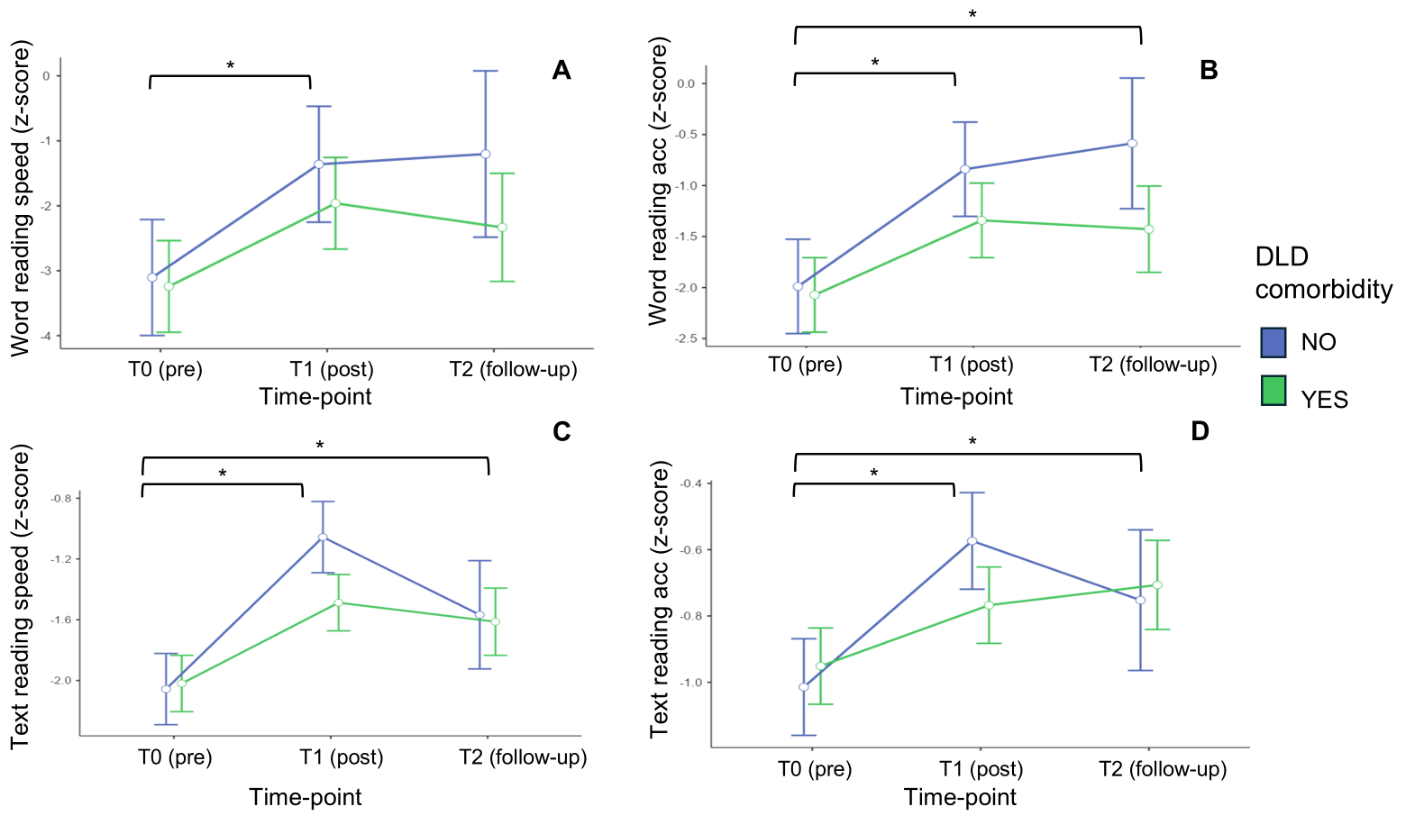
3.3. AIM 1.1—Stability in Reading Improvement After RT-2 Training and DLD Comorbidity
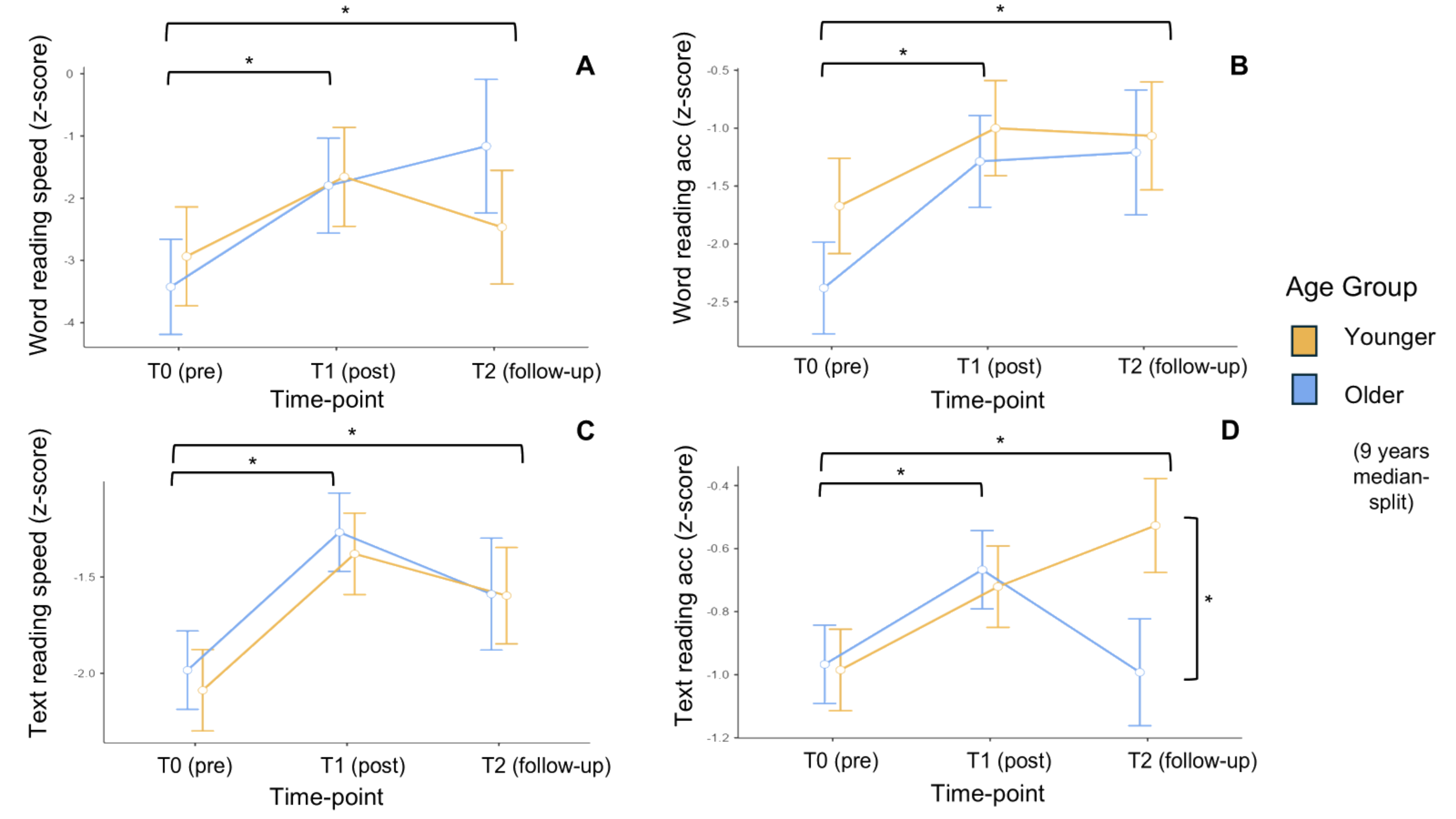
3.4. AIM 1.2—Stability in Reading Improvement After RT-2 Training and Age-Related Differences
3.5. AIM 2—Educational Impact
4. Discussion
5. Conclusions
Supplementary Materials
Author Contributions
Funding
Institutional Review Board Statement
Informed Consent Statement
Data Availability Statement
Acknowledgments
Conflicts of Interest
References
- Bailey, S.K.; Aboud, K.S.; Nguyen, T.Q.; Cutting, L.E. Applying a network framework to the neurobiology of reading and dyslexia. J. Neurodev. Disord. 2018, 10, 37. [Google Scholar] [CrossRef]
- American Psychological Association. Diagnostic and Statistical Manual of Mental Disorders, 5th ed.; American Psychiatric Association: Washington, DC, USA, 2013. [Google Scholar]
- Livingston, E.M.; Siegel, L.S.; Ribary, U. Developmental dyslexia: Emotional impact and consequences. Aust. J. Learn. Diffic. 2018, 23, 107–135. [Google Scholar] [CrossRef]
- Olofsson, Å.; Taube, K.; Ahl, A. Academic Achievement of University Students with Dyslexia. Dyslexia 2015, 21, 338–349. [Google Scholar] [CrossRef]
- WHO Global Observatory for eHealth. Telemedicine: Opportunities and developments in Member States: Report on the Second Global Survey on eHealth; WHO: Geneva, Switzerland, 2010; pp. 93p. Available online: https://iris.who.int/handle/10665/44497 (accessed on 1 March 2026).
- Strehle, E.M.; Shabde, N. One hundred years of telemedicine: Does this new technology have a place in paediatrics? Arch. Dis. Child. 2006, 91, 956–959. [Google Scholar] [CrossRef]
- Matamala-Gomez, M.; Maisto, M.; Montana, J.I.; Mavrodiev, P.A.; Baglio, F.; Rossetto, F.; Mantovani, F.; Riva, G.; Realdon, O. The Role of Engagement in Teleneurorehabilitation: A Systematic Review. Front. Neurol. 2020, 11, 354. [Google Scholar] [CrossRef] [PubMed]
- Ganapathy, K. Telerehabilitation: An Overview. Telehealth Med. Today 2021, 6. [Google Scholar] [CrossRef]
- Sarti, D.; De Salvatore, M.; Pagliano, E.; Granocchio, E.; Traficante, D.; Lombardi, E. Telerehabilitation and Wellbeing Experience in Children with Special Needs during the COVID-19 Pandemic. Children 2021, 8, 988. [Google Scholar] [CrossRef]
- Capodieci, A.; Graziani, D.; Scali, V.; Giaccherini, S.; Luccherino, L.; Pecini, C. Telerehabilitation Pathways in Specific Learning Disorders: Improving Reading and Writing. Brain Sci. 2023, 13, 479. [Google Scholar] [CrossRef]
- Furlong, L.M.; Serry, T.A. An exploratory study of speech-language pathologists’ clinical practice in the literacy domain: Comparing onsite practices with telepractice services during COVID-19. Int. J. Speech-Lang. Pathol. 2023, 25, 206–218. [Google Scholar] [CrossRef] [PubMed]
- Pecini, C.; Spoglianti, S.; Bonetti, S.; Di Lieto, M.C.; Guaran, F.; Martinelli, A.; Gasperini, F.; Cristofani, P.; Casalini, C.; Mazzotti, S.; et al. Training RAN or reading? A telerehabilitation study on developmental dyslexia. Dyslexia 2019, 25, 318–331. [Google Scholar] [CrossRef] [PubMed]
- Arnold, E.M.; Goldston, D.B.; Walsh, A.K.; Reboussin, B.A.; Daniel, S.S.; Hickman, E.; Wood, F.B. Severity of Emotional and Behavioral Problems Among Poor and Typical Readers. J. Abnorm. Child Psychol. 2005, 33, 205–217. [Google Scholar] [CrossRef]
- Maughan, B.; Rowe, R.; Loeber, R.; Stouthamer-Loeber, M. Reading Problems and Depressed Mood. J. Abnorm. Child Psychol. 2003, 31, 219–229. [Google Scholar] [CrossRef] [PubMed]
- Pecini, C.; Spoglianti, S.; Michetti, S.; Bonetti, S.; Di Lieto, M.C.; Gasperini, F.; Cristofani, P.; Bozza, M.; Brizzolara, D.; Casalini, C.; et al. Telerehabilitation in developmental dyslexia: Methods of implementation and expected results. Minerva Pediatr. 2018, 70, 529–538. [Google Scholar] [CrossRef] [PubMed]
- González, G.F.; Žarić, G.; Tijms, J.; Bonte, M.; Blomert, L.; van der Molen, M.W. A Randomized Controlled Trial on The Beneficial Effects of Training Letter-Speech Sound Integration on Reading Fluency in Children with Dyslexia. PLoS ONE 2015, 10, e0143914. [Google Scholar] [CrossRef]
- McArthur, G.; Castles, A.; Kohnen, S.; Larsen, L.; Jones, K.; Anandakumar, T.; Banales, E. Sight Word and Phonics Training in Children with Dyslexia. J. Learn. Disabil. 2015, 48, 391–407. [Google Scholar] [CrossRef] [PubMed]
- Pfost, M.; Blatter, K.; Artelt, C.; Stanat, P.; Schneider, W. Effects of training phonological awareness on children’s reading skills. J. Appl. Dev. Psychol. 2019, 65, 101067. [Google Scholar] [CrossRef]
- Bonacina, S.; Cancer, A.; Lanzi, P.L.; Lorusso, M.L.; Antonietti, A. Improving reading skills in students with dyslexia: The efficacy of a sublexical training with rhythmic background. Front. Psychol. 2015, 6, 1510. [Google Scholar] [CrossRef]
- Cancer, A.; Antonietti, A. Music-based and auditory-based interventions for reading difficulties: A literature review. Heliyon 2022, 8, e09293. [Google Scholar] [CrossRef]
- Flaugnacco, E.; Lopez, L.; Terribili, C.; Montico, M.; Zoia, S.; Schön, D. Music Training Increases Phonological Awareness and Reading Skills in Developmental Dyslexia: A Randomized Control Trial. PLoS ONE 2015, 10, e0138715. [Google Scholar] [CrossRef]
- Hallam, S. Can a rhythmic intervention support reading development in poor readers? Psychol. Music 2019, 47, 722–735. [Google Scholar] [CrossRef]
- Vander Stappen, C.; Dricot, L.; Van Reybroeck, M. RAN training in dyslexia: Behavioral and brain correlates. Neuropsychologia 2020, 146, 107566. [Google Scholar] [CrossRef] [PubMed]
- Lotfi, S.; Rostami, R.; Shokoohi-Yekta, M.; Ward, R.T.; Motamed-Yeganeh, N.; Mathew, A.S.; Lee, H.-J. Effects of computerized cognitive training for children with dyslexia: An ERP study. J. Neurolinguist. 2020, 55, 100904. [Google Scholar] [CrossRef]
- Luo, Y.; Wang, J.; Wu, H.; Zhu, D.; Zhang, Y. Working-memory training improves developmental dyslexia in Chinese children. Neural Regen. Res. 2013, 8, 452–460. [Google Scholar] [CrossRef]
- Yang, J.; Peng, J.; Zhang, D.; Zheng, L.; Mo, L. Specific effects of working memory training on the reading skills of Chinese children with developmental dyslexia. PLoS ONE 2017, 12, e0186114. [Google Scholar] [CrossRef] [PubMed]
- Bertoni, S.; Franceschini, S.; Puccio, G.; Mancarella, M.; Gori, S.; Facoetti, A. Action Video Games Enhance Attentional Control and Phonological Decoding in Children with Developmental Dyslexia. Brain Sci. 2021, 11, 171. [Google Scholar] [CrossRef]
- Peters, J.L.; Crewther, S.G.; Murphy, M.J.; Bavin, E.L. Action video game training improves text reading accuracy, rate and comprehension in children with dyslexia: A randomized controlled trial. Sci. Rep. 2021, 11, 18584. [Google Scholar] [CrossRef] [PubMed]
- Piazzalunga, C.; Dui, L.G.; Fontolan, S.; Franceschini, S.; Bortolozzo, M.; Termine, C.; Ferrante, S. Evaluating the Efficacy of a Serious Game in Enhancing Word Reading Speed. Eur. Conf. Games Based Learn. 2023, 17, 523–530. [Google Scholar] [CrossRef]
- Bucci, M. Visual training could be useful for improving reading capabilities in dyslexia. Appl. Neuropsychol. Child 2019, 10, 199–208. [Google Scholar] [CrossRef]
- Conte, G.; Quadrana, L.; Zotti, L.; Di Garbo, A.; Oliveri, M. Prismatic adaptation coupled with cognitive training as novel treatment for developmental dyslexia: A randomized controlled trial. Sci. Rep. 2024, 14, 7148. [Google Scholar] [CrossRef]
- Lorusso, M.L.; Facoetti, A.; Bakker, D.J. Neuropsychological Treatment of Dyslexia: Does Type of Treatment Matter? J. Learn. Disabil. 2011, 44, 136–149. [Google Scholar] [CrossRef]
- Lorusso, M.L.; Facoetti, A.; Paganoni, P.; Pezzani, M.; Molteni, M. Effects of visual hemisphere-specific stimulation versus reading-focused training in dyslexic children. Neuropsychol. Rehabil. 2006, 16, 194–212. [Google Scholar] [CrossRef] [PubMed]
- Tressoldi, P.E.; Vio, C.; Iozzino, R. Efficacy of an Intervention to Improve Fluency in Children with Developmental Dyslexia in a Regular Orthography. J. Learn. Disabil. 2007, 40, 203–209. [Google Scholar] [CrossRef]
- Pasqualotto, A.; Venuti, P. A Multifactorial Model of Dyslexia: Evidence from Executive Functions and Phonological–based Treatments. Learn. Disabil. Res. Pract. 2020, 35, 150–164. [Google Scholar] [CrossRef]
- Lorusso, M.L.; Borasio, F.; Molteni, M. Remote Neuropsychological Intervention for Developmental Dyslexia with the Tachidino Platform: No Reduction in Effectiveness for Older Nor for More Severely Impaired Children. Children 2022, 9, 71. [Google Scholar] [CrossRef]
- Lorusso, M.L.; Borasio, F.; Molteni, M. The challenge of remote treatment in neuropsychological intervention for reading and spelling in dyslexia: A prospective observational cohort study. Dyslexia 2024, 30, e1758. [Google Scholar] [CrossRef] [PubMed]
- Available online: https://www.anastasis.it/ridinet/ (accessed on 1 March 2026).
- Graziani, D.; Capodieci, A.; Casalini, C.; Giaccherini, S.; Scali, V.; Luccherino, L.; Pecini, C. Training rapid automatized naming in children with developmental Dyslexia. Child Neuropsychol. 2024, 31, 519–545. [Google Scholar] [CrossRef]
- Tucci, R.; Savoia, V.; Bertolo, L.; Vio, C.; Tressoldi, P. Efficacy and efficiency outcomes of a training to ameliorate developmental dyslexia using the online software Reading Trainer®. BPA Appl. Psychol. Bull. 2015, 64, 53–60. [Google Scholar]
- Ridinet. Available online: http://info.ridinet.it/reading-trainer (accessed on 1 March 2026).
- Di Filippo, G.; de Luca, M.; Judica, A.; Spinelli, D.; Zoccolotti, P. Lexicality and Stimulus Length Effects in Italian Dyslexics: Role of the Overadditivity Effect. Child Neuropsychol. 2006, 12, 141–149. [Google Scholar] [CrossRef]
- Spinelli, D.; De Luca, M.; Di Filippo, G.; Mancini, M.; Martelli, M.; Zoccolotti, P. Length Effect in Word Naming in Reading: Role of Reading Experience and Reading Deficit in Italian Readers. Dev. Neuropsychol. 2005, 27, 217–235. [Google Scholar] [CrossRef]
- Franceschini, S.; Gori, S.; Ruffino, M.; Pedrolli, K.; Facoetti, A. A Causal Link between Visual Spatial Attention and Reading Acquisition. Curr. Biol. 2012, 22, 814–819. [Google Scholar] [CrossRef] [PubMed]
- Zorzi, M.; Barbiero, C.; Facoetti, A.; Lonciari, I.; Carrozzi, M.; Montico, M.; Bravar, L.; George, F.; Pech-Georgel, C.; Ziegler, J.C. Extra-large letter spacing improves reading in dyslexia. Proc. Natl. Acad. Sci. USA 2012, 109, 11455–11459. [Google Scholar] [CrossRef]
- Angelelli, P.; Marinelli, C.V.; Iaia, M.; Putzolu, A.; Gasperini, F.; Brizzolara, D.; Chilosi, A.M. Spelling Impairments in Italian Dyslexic Children with and without a History of Early Language Delay. Are There Any Differences? Front. Psychol. 2016, 7, 527. [Google Scholar] [CrossRef]
- Bishop, D.V.; Adams, C.A. Prospective study of the relationship between specific language impairment, phonological disorders and reading retardation. J. Child Psychol. Psychiatry 1990, 31, 1027–1050. [Google Scholar] [CrossRef] [PubMed]
- Brizzolara, D.; Chilosi, A.; Cipriani, P.; Di Filippo, G.; Gasperini, F.; Mazzotti, S.; Pecini, C.; Zoccolotti, P. Do phonologic and rapid automatized naming deficits differentially affect dyslexic children with and without a history of language delay? A study of Italian dyslexic children. Cogn. Behav. Neurol. 2006, 19, 141–149. [Google Scholar] [CrossRef]
- Chilosi, A.M.; Brizzolara, D.; Lami, L.; Pizzoli, C.; Gasperini, F.; Pecini, C.; Cipriani, P.; Zoccolotti, P. Reading and spelling disabilities in children with and without a history of early language delay: A neuropsychological and linguistic study. Child Neuropsychol. 2009, 15, 582–604. [Google Scholar] [CrossRef] [PubMed]
- Sices, L.; Taylor, H.G.; Freebairn, L.; Hansen, A.; Lewis, B. Relationship between speech-sound disorders and early literacy skills in preschool-age children: Impact of comorbid language impairment. J. Dev. Behav. Pediatr. 2007, 28, 438–447. [Google Scholar] [CrossRef]
- Snowling, M.J.; Lervåg, A.; Nash, H.M.; Hulme, C. Longitudinal relationships between speech perception, phonological skills and reading in children at high-risk of dyslexia. Dev. Sci. 2019, 22, e12723. [Google Scholar] [CrossRef]
- Snowling, M.J.; Melby-Lervåg, M. Oral language deficits in familial dyslexia: A meta-analysis and review. Psychol. Bull. 2016, 142, 498–545. [Google Scholar] [CrossRef] [PubMed]
- Torppa, M.; Lyytinen, P.; Erskine, J.; Eklund, K.; Lyytinen, H. Language development, literacy skills, and predictive connections to reading in Finnish children with and without familial risk for dyslexia. J. Learn. Disabil. 2010, 43, 308–321. [Google Scholar] [CrossRef]
- van Weerdenburg, M.; Verhoeven, L.; Bosman, A.; van Balkom, H. Predicting word decoding and word spelling development in children with Specific Language Impairment. J. Commun. Disord. 2011, 44, 392–411. [Google Scholar] [CrossRef]
- Bishop, D.V.M.; Snowling, M.J. Developmental dyslexia and specific language impairment: Same or different? Psychol. Bull. 2004, 130, 858–886. [Google Scholar] [CrossRef]
- Andreou, G.; Sepeti, P. Reading ability in children with comorbid developmental dyslexia and developmental language disorder: A systematic review: Reading in Children with DD and DLD. Ann. Dyslexia 2026. [Google Scholar] [CrossRef] [PubMed]
- Peterson, L.; Pennington, B.F. Developmental Dyslexia. Annu. Rev. Clin. Psychol. 2015, 11, 283–307. [Google Scholar] [CrossRef] [PubMed]
- Duff, D.M.; Hendricks, A.E.; Fitton, L.; Adlof, S.M. Reading and Math Achievement in Children with Dyslexia, Developmental Language Disorder, or Typical Development: Achievement Gaps Persist from Second Through Fourth Grades. J. Learn. Disabil. 2022, 56, 371–391. [Google Scholar] [CrossRef]
- Chall, J.S. Stages of Reading Development; McGraw-Hill: New York, NY, USA, 1983. [Google Scholar]
- Wechsler, D. Wechsler Intelligence Scale for Children, Fourth Edition [Dataset]; APA PsycTests: Washington, DC, USA, 2012. [Google Scholar] [CrossRef]
- Sartori, G.; Job, R.; Tressoldi, P. DDE-2, Batteria per la Valutazione della Dislessia e della Disortografia Evolutiva-2. 2007. Available online: https://www.research.unipd.it/handle/11577/167982 (accessed on 1 March 2026).
- Cornoldi, C.; Carretti, B. Prove MT Avanzate-3-Clinica: La Valutazione delle Abilità di Lettura, Comprensione, Scrittura e Matematica per il Biennio della Scuola Secondaria di II Grado; Giunti Edu: Florence, Italy, 2016. [Google Scholar]
- Faul, F.; Erdfelder, E.; Lang, A.-G.; Buchner, A. G*Power 3: A flexible statistical power analysis program for the social, behavioral, and biomedical sciences. Behav. Res. Methods 2007, 39, 175–191. [Google Scholar] [CrossRef]
- The jamovi Project. Jamovi, version 2.6. Computer Software. The jamovi Project: Sydney, Australia, 2025. Available online: https://www.jamovi.org (accessed on 1 March 2026).
- Tressoldi, P.E.; Brembati, F.; Donini, R.; Iozzino, R.; Vio, C. Treatment of Dyslexia in a Regular Orthography: Efficacy and Efficiency (Cost-Effectiveness) Comparison Between Home vs Clinic-Based Treatments. Eur. J. Psychol. 2012, 8, 375–390. [Google Scholar] [CrossRef]
- Bavelier, D.; Green, C.S.; Seidenberg, M.S. Cognitive development: Gaming your way out of dyslexia? Curr. Biol. 2013, 23, R282–R283. [Google Scholar] [CrossRef]
- Klingberg, T.; Fernell, E.; Olesen, P.J.; Johnson, M.; Gustafsson, P.; Dahlström, K.; Gillberg, C.G.; Forssberg, H.; Westerberg, H. Computerized training of working memory in children with ADHD—a randomized, controlled trial. J. Am. Acad. Child Adolesc. Psychiatry 2005, 44, 177–186. [Google Scholar] [CrossRef]
- Wexler, J.; Vaughn, S.; Edmonds, M.; Reutebuch, C.K. A synthesis of fluency interventions for secondary struggling readers. Read. Writ. 2008, 21, 317–347. [Google Scholar] [CrossRef]
- Ziegler, J.C.; Goswami, U. Reading acquisition, developmental dyslexia, and skilled reading across languages: A psycholinguistic grain size theory. Psychol. Bull. 2005, 131, 3–29. [Google Scholar] [CrossRef]
- Aro, M.; Wimmer, H. Learning to read: English in comparison to six more regular orthographies. Appl. Psycholinguist. 2003, 24, 621–635. [Google Scholar] [CrossRef]
- Thomson, J.M.; Leong, V.; Goswami, U. Auditory processing interventions and developmental dyslexia: A comparison of phonemic and rhythmic approaches. Read. Writ. 2013, 26, 139–161. [Google Scholar] [CrossRef]
- Mascheretti, S.; Aubé, S.; Paradis, H.; Feng, B.; Brendgen, M.; Vitaro, F.; Ouellet-Morin, I.; Séguin, J.R.; Tremblay, R.E.; Boivin, M.; et al. Predictive validity of early child biological, language, family and rearing environment characteristics on developmental trajectories of reading from ages 6 to 12 years. Learn. Individ. Differ. 2026, 126, 102863. [Google Scholar] [CrossRef]
- Newport, E.; Bavelier, D.; Neville, H. Critical Thinking about Critical Periods: Perspectives on a Critical Period for Language Acquisition; MIT Press: Cambridge, MA, USA, 2002; pp. 481–502. [Google Scholar] [CrossRef]
- Eden, G.F.; Jones, K.M.; Cappell, K.; Gareau, L.; Wood, F.B.; Zeffiro, T.A.; Dietz, N.A.E.; Agnew, J.A.; Flowers, D.L. Neural changes following remediation in adult developmental dyslexia. Neuron 2004, 44, 411–422. [Google Scholar] [CrossRef]
- Nukari, J.M.; Poutiainen, E.T.; Arkkila, E.P.; Haapanen, M.-L.; Lipsanen, J.O.; Laasonen, M.R. Both Individual and Group-Based Neuropsychological Interventions of Dyslexia Improve Processing Speed in Young Adults: A Randomized Controlled Study. J. Learn. Disabil. 2020, 53, 213–227. [Google Scholar] [CrossRef]
- Tressoldi, P.E.; Lorusso, M.L.; Brenbati, F.; Donini, R. Fluency remediation in dyslexic children: Does age make a difference? Dyslexia 2008, 14, 142–152. [Google Scholar] [CrossRef] [PubMed]
- Bishop, D.V.M.; McDonald, D.; Bird, S.; Hayiou-Thomas, M.E. Children who read words accurately despite language impairment: Who are they and how do they do it? Child Dev. 2009, 80, 593–605. [Google Scholar] [CrossRef] [PubMed]
- Catts, H.W.; Adlof, S.M.; Hogan, S.M.; Weismer, S.E. Are specific language impairment and dyslexia distinct disorders? J. Speech Lang. Hear. Res. 2005, 48, 1378–1396. [Google Scholar] [CrossRef]
- McArthur, G.M.; Hogben, J.H.; Edwards, V.T.; Heath, S.M.; Mengler, E.D. On the “specifics” of specific reading disability and specific language impairment. J. Child Psychol. Psychiatry 2000, 41, 869–874. [Google Scholar] [CrossRef]
- Wang, L.-C. Effects of Phonological Training on the Reading and Reading-Related Abilities of Hong Kong Children with Dyslexia. Front. Psychol. 2017, 8, 1904. [Google Scholar] [CrossRef]
- Mascheretti, S.; Luoni, C.; Franceschini, S.; Capelli, E.; Farinotti, L.; Borgatti, R.; Lecce, S.; Termine, C. Development and predictors of reading skills in a 5-year Italian longitudinal study. Infant Child Dev. 2024, 33, e2542. [Google Scholar] [CrossRef]
- Zoccolotti, P.; De Luca, M.; Di Filippo, G.; Judica, A.; Martelli, M. Reading development in an orthographically regular language: Effects of length, frequency, lexicality and global processing ability. Read. Writ. 2009, 22, 1053–1079. [Google Scholar] [CrossRef]
- Seymour, P.H.K.; Aro, M.; Erskine, J.M. COST Action A8 Network. Foundation literacy acquisition in European orthographies. Br. J. Psychol. 2003, 94, 143–174. [Google Scholar] [CrossRef]
- Orsolini, M.; Fanari, R.; Tosi, V.; De Nigris, B.; Carrieri, R. From phonological recoding to lexical reading: A longitudinal study on reading development in Italian. Lang. Cogn. Process. 2006, 21, 576–607. [Google Scholar] [CrossRef]
- Perfetti, C.A. Verbal coding efficiency, conceptually guided reading, and reading failure. Bull. Orton Soc. 1980, 30, 197–208. [Google Scholar] [CrossRef]
- Wolf, M.; Katzir-Cohen, T. Reading fluency and its intervention. Sci. Stud. Read. 2001, 5, 211–239. [Google Scholar] [CrossRef]
- Meneghetti, C.; Carretti, B.; De Beni, R. Components of reading comprehension and scholastic achievement. Learn. Individ. Differ. 2006, 16, 291–301. [Google Scholar] [CrossRef]
- Miller, D. Reading with Meaning: Teaching Comprehension in the Primary Grades, 2nd ed.; Routledge: London, UK, 2012. [Google Scholar] [CrossRef]
- Chavez, M.S.; Honesto, L.D. Reading Comprehension in Relation to Academic Performance: Basis for Enhancement Program. Psychol. Educ. A Multidiscip. J. 2025, 33, 816–823. [Google Scholar] [CrossRef]



| N | Missing | Mean | SD | Minimum | Maximum | |
|---|---|---|---|---|---|---|
| Maternal education (years) | 52 | 0 | 12.29 | 2.91 | 8 | 18 |
| Paternal education (years) | 52 | 0 | 11.52 | 2.92 | 8 | 18 |
| Global IQ | 52 | 0 | 98.58 | 11.3 | 72 | 122 |
| Verbal IQ | 52 | 0 | 105.06 | 13.65 | 68 | 137 |
| Performance IQ | 52 | 0 | 104.83 | 12.02 | 83 | 132 |
| Single-word reading speed—pre (z-score) | 52 | 0 | −3.19 | 4.1 | −23.97 | 0.53 |
| Single-word reading accuracy—pre (z-score) | 52 | 0 | −2.04 | 2.24 | −10.60 | 1 |
| Single pseudo-word reading speed—pre (z-score) | 51 * | 1 | −1.62 | 2.33 | −11.79 | 1.2 |
| Single pseudo-word reading accuracy—pre (z-score) | 51 * | 1 | −1.59 | 1.87 | −6.33 | 1 |
| Text reading speed—pre (z-score) | 52 | 0 | −2.03 | 1.06 | −7.40 | −0.22 |
| Text reading accuracy—pre (z-score) | 52 | 0 | −0.97 | 0.59 | −1.65 | 0.67 |
Disclaimer/Publisher’s Note: The statements, opinions and data contained in all publications are solely those of the individual author(s) and contributor(s) and not of MDPI and/or the editor(s). MDPI and/or the editor(s) disclaim responsibility for any injury to people or property resulting from any ideas, methods, instructions or products referred to in the content. |
© 2026 by the authors. Licensee MDPI, Basel, Switzerland. This article is an open access article distributed under the terms and conditions of the Creative Commons Attribution (CC BY) license.
Share and Cite
Capelli, E.; Mascheretti, S.; Rosso, E.; Bernasconi, P.; Borgatti, R.; Lecce, S.; Piccolini, A.; Cardinali, S.; Termine, C.; Farinotti, L. Stability in Reading Improvement After Home-Based Multi-Componential Training for Children with Developmental Dyslexia. Brain Sci. 2026, 16, 636. https://doi.org/10.3390/brainsci16060636
Capelli E, Mascheretti S, Rosso E, Bernasconi P, Borgatti R, Lecce S, Piccolini A, Cardinali S, Termine C, Farinotti L. Stability in Reading Improvement After Home-Based Multi-Componential Training for Children with Developmental Dyslexia. Brain Sciences. 2026; 16(6):636. https://doi.org/10.3390/brainsci16060636
Chicago/Turabian StyleCapelli, Elena, Sara Mascheretti, Enrica Rosso, Patrizia Bernasconi, Renato Borgatti, Serena Lecce, Alessandra Piccolini, Simonetta Cardinali, Cristiano Termine, and Laura Farinotti. 2026. "Stability in Reading Improvement After Home-Based Multi-Componential Training for Children with Developmental Dyslexia" Brain Sciences 16, no. 6: 636. https://doi.org/10.3390/brainsci16060636
APA StyleCapelli, E., Mascheretti, S., Rosso, E., Bernasconi, P., Borgatti, R., Lecce, S., Piccolini, A., Cardinali, S., Termine, C., & Farinotti, L. (2026). Stability in Reading Improvement After Home-Based Multi-Componential Training for Children with Developmental Dyslexia. Brain Sciences, 16(6), 636. https://doi.org/10.3390/brainsci16060636