What Lies Behind Diagnostic Labels? High Intra-Individual Variability Is the True Cognitive Signature of University Students with Specific Learning Disorders



Highlights
- University students with Specific Learning Disorders consistently show higher reasoning abilities compared to cognitive efficiency, with working memory emerging as a persistent core weakness. However, there is marked individual variability that undermines a unitary deficit model.
- Latent Profile Analysis identified two distinct cognitive subgroups (“High” and “Low” profiles) that do not align strictly with traditional diagnostic labels, showing that intra-individual discrepancies exist across all diagnostic categories.
- Traditional categorical labels have limited explanatory power in adulthood due to high cognitive heterogeneity, suggesting that a “one size fits all” approach is particularly inadequate when transitioning out of childhood.
- Clinical and educational support should shift from label-based interventions toward dimensional, profile-based models that address the specific cognitive strengths and vulnerabilities of each student.
Abstract
1. Introduction
1.1. Adults with SLD: The University Population
1.2. Intellectual Profiles of Adults with SLD
1.3. Complexity and Comorbidity in SLD
1.4. The Present Study
2. Materials and Methods
2.1. Participants
2.2. Procedure
2.3. Instrument
2.4. Analysis
3. Results
3.1. Linear Mixed-Effect Model
3.2. Latent Profile Analysis
4. Discussion
4.1. General Cognitive Patterns in University Students with SLD
4.2. Differences Across Diagnostic Subgroupse
4.3. Intra-Individual Variability and Cognitive Discrepancies
4.4. Latent Cognitive Profiles and Their Relation to Diagnostic Categories
4.5. Implications for Adult SLD and Higher-Education Contexts
5. Conclusions
Supplementary Materials
Author Contributions
Funding
Institutional Review Board Statement
Informed Consent Statement
Data Availability Statement
Acknowledgments
Conflicts of Interest
Abbreviations
| SLD | Specific Learning Disorder |
| DSM-5 | Diagnostic and Statistical Manual of Mental Disorders, 5th Edition |
| ICD-11 | International Classification of Diseases, 11th Revision |
| ICD-10 | International Classification of Diseases, 10th Revision |
| WAIS-IV | Wechsler Adult Intelligence Scale, Fourth Edition |
| WISC-IV | Wechsler Intelligence Scale for Children, Fourth Edition |
| GAI | General Ability Index |
| CPI | Cognitive Proficiency Index |
| VCI | Verbal Comprehension Index |
| PRI | Perceptual Reasoning Index |
| WMI | Working Memory Index |
| PSI | Processing Speed Index |
| FSIQ | Full-Scale IQ |
| RD | Predominant Reading Disorder |
| AD | Predominant Arithmetic Disorder |
| MD | Mixed Learning Disorder |
| LMM | Linear Mixed-Effects Model |
| LPA | Latent Profile Analysis |
References
- American Psychiatric Association. Diagnostic and Statistical Manual of Mental Disorders; American Psychiatric Association: Washington, DC, USA, 2013. [Google Scholar]
- Arnett, A.B.; Pennington, B.F.; Peterson, R.L.; Willcutt, E.G.; DeFries, J.C.; Olson, R.K. Explaining the Sex Difference in Dyslexia. J. Child Psychol. Psychiatry 2017, 58, 719–727. [Google Scholar] [CrossRef] [PubMed]
- Moll, K.; Kunze, S.; Neuhoff, N.; Bruder, J.; Schulte-Körne, G. Specific Learning Disorder: Prevalence and Gender Differences. PLoS ONE 2014, 9, e103537. [Google Scholar] [CrossRef]
- Landerl, K.; Moll, K. Comorbidity of Learning Disorders: Prevalence and Familial Transmission. J. Child Psychol. Psychiatry 2010, 51, 287–294. [Google Scholar] [CrossRef]
- Krafnick, A.J.; Evans, T.M. Neurobiological Sex Differences in Developmental Dyslexia. Front. Psychol. 2019, 9, 2669. [Google Scholar] [CrossRef]
- Aro, T.; Eklund, K.; Eloranta, A.-K.; Närhi, V.; Korhonen, E.; Ahonen, T. Associations Between Childhood Learning Disabilities and Adult-Age Mental Health Problems, Lack of Education, and Unemployment. J. Learn. Disabil. 2019, 52, 71–83. [Google Scholar] [CrossRef]
- Gerber, P.J. The Impact of Learning Disabilities on Adulthood: A Review of the Evidenced-Based Literature for Research and Practice in Adult Education. J. Learn. Disabil. 2012, 45, 31–46. [Google Scholar] [CrossRef]
- Sharfi, K.; Rosenblum, S.; Meyer, S. Relationships between Executive Functions and Sensory Patterns among Adults with Specific Learning Disabilities as Reflected in Their Daily Functioning. PLoS ONE 2022, 17, e0266385. [Google Scholar] [CrossRef] [PubMed]
- Bonuomo, M.; Marini, M.; Vegni, N.; Melogno, S.; Torregiani, G.; Livi, S.; Di Filippo, G. Analysis of Psychological and Social Functioning in Undergraduate Students with a Specific Learning Disorder (SLD). Brain Sci. 2023, 13, 1020. [Google Scholar] [CrossRef] [PubMed]
- Iaia, M.; Vizzi, F.; Carlino, M.D.; Turi, M.; Marinelli, C.V.; Angelelli, P. Specific Learning Disabilities and Associated Emotional-Motivational Profiles: A Study in Italian University Students. Front. Psychol. 2024, 15, 1365980. [Google Scholar] [CrossRef]
- Maddocks, D.L.S. Cognitive and Achievement Characteristics of Students from a National Sample Identified as Potentially Twice Exceptional (Gifted with a Learning Disability). Gift. Child Q. 2020, 64, 3–18. [Google Scholar] [CrossRef]
- Romano, S.; Esposito, D.; Aricò, M.; Arigliani, E.; Cavalli, G.; Vigliante, M.; Penge, R.; Sogos, C.; Pisani, F.; Romani, M. Giftedness and Twice-Exceptionality in Children Suspected of ADHD or Specific Learning Disorders: A Retrospective Study. Sci 2024, 6, 23. [Google Scholar] [CrossRef]
- Fletcher, J.M.; Grigorenko, E.L. Neuropsychology of Learning Disabilities: The Past and the Future. J. Int. Neuropsychol. Soc. 2017, 23, 930–940. [Google Scholar] [CrossRef]
- Schelke, M.W.; Shapiro, S.D.; Hackett, K.; Chen, J.; Simchon-Steinhof, S.; Ganzer, C.A.; Isaacson, R.S.; Tamboer, P.; Vliet, E.V.; Assuras, S.; et al. Diagnosis of Developmental Learning and Attention Disorders in Adults: A Review of Clinical Modalities. Neurol. Psychiatry Brain Res. 2017, 23, 27–35. [Google Scholar] [CrossRef]
- Carroll, C. A Review of the Approaches Investigating the Post-16 Transition of Young Adults with Learning Difficulties. Int. J. Incl. Educ. 2015, 19, 347–364. [Google Scholar] [CrossRef]
- Pizzigallo, E.; Cornoldi, C.; Buono, S.; Città, S.; Viola, F.; Toffalini, E. The Intellectual Profile of Adults with Specific Learning Disabilities. J. Intell. 2023, 11, 223. [Google Scholar] [CrossRef]
- Reis, A.; Araújo, S.; Morais, I.S.; Faísca, L. Reading and Reading-Related Skills in Adults with Dyslexia from Different Orthographic Systems: A Review and Meta-Analysis. Ann. Dyslexia 2020, 70, 339–368. [Google Scholar] [CrossRef] [PubMed]
- Giofrè, D.; Cornoldi, C. The Structure of Intelligence in Children with Specific Learning Disabilities Is Different as Compared to Typically Development Children. Intelligence 2015, 52, 36–43. [Google Scholar] [CrossRef]
- Mazzocco, M.M.M.; Räsänen, P. Contributions of Longitudinal Studies to Evolving Definitions and Knowledge of Developmental Dyscalculia. Trends Neurosci. Educ. 2013, 2, 65–73. [Google Scholar] [CrossRef]
- Bonti, E.; Giannoglou, S.; Georgitsi, M.; Sofologi, M.; Porfyri, G.-N.; Mousioni, A.; Konsta, A.; Tatsiopoulou, P.; Kamari, A.; Vavetsi, S.; et al. Clinical Profiles and Socio-Demographic Characteristics of Adults with Specific Learning Disorder in Northern Greece. Brain Sci. 2021, 11, 602. [Google Scholar] [CrossRef]
- Gerber, P.J.; Price, L.A. Acceptable Loss and Potential Gain: Self-Disclosure and Adults with Learning Disabilities. Thalamus 2006, 24, 49–55. [Google Scholar]
- Sparks, R.L.; Lovett, B.J. College Students with Learning Disability Diagnoses: Who Are They and How Do They Perform? J. Learn. Disabil. 2009, 42, 494–510. [Google Scholar] [CrossRef]
- Zeng, W.; Ju, S.; Hord, C. A Literature Review of Academic Interventions for College Students with Learning Disabilities. Learn. Disabil. Q. 2018, 41, 159–169. [Google Scholar] [CrossRef]
- Pellegrino, G.; Casali, N.; Meneghetti, C.; Tinti, C.; Anna, M.R.; Sini, B.; Passolunghi, M.C.; Valenti, A.; Montesano, L.; Carretti, B. Universal and Specific Services for University Students with Specific Learning Disabilities: The Relation to Study Approach, Academic Achievement, and Satisfaction. Learn. Disabil. Res. Pract. 2023, 38, 274–284. [Google Scholar] [CrossRef]
- Faísca, L.; Reis, A.; Araújo, S. Cognitive Subtyping of University Students with Dyslexia in a Semi-Transparent Orthography: What Can Weaknesses and Strengths Tell Us about Compensation? J. Cult. Cogn. Sci. 2023, 7, 121–136. [Google Scholar] [CrossRef]
- Colé, P.; Duncan, L.G.; Cavalli, E. Compensatory Mechanisms in University Students with Dyslexia. In Dyslexia in Adulthood; Routledge: Oxfordshire, UK, 2026. [Google Scholar]
- Cavalli, E.; Duncan, L.G.; Elbro, C.; El Ahmadi, A.; Colé, P. Phonemic—Morphemic Dissociation in University Students with Dyslexia: An Index of Reading Compensation? Ann. Dyslexia 2017, 67, 63–84. [Google Scholar] [CrossRef]
- Livingston, L.A.; Happé, F. Conceptualising Compensation in Neurodevelopmental Disorders: Reflections from Autism Spectrum Disorder. Neurosci. Biobehav. Rev. 2017, 80, 729–742. [Google Scholar] [CrossRef]
- Weis, R.; Speridakos, E.C.; Ludwig, K. Community College Students with Learning Disabilities. J. Learn. Disabil. 2014, 47, 556–568. [Google Scholar] [CrossRef] [PubMed]
- Borgonovi, E.; Comellini, F.A.; Ferrucci, F.; Mason, L.; Migliaccio, G.; Scaletta, A.; Tanucci, G. Gli Studenti Con Disabilità e DSA Nelle Università Italiane. Una Risorsa Da Valorizzare; ANVUR: Rome, Italy, 2022. [Google Scholar]
- Ministero Dell’istruzione e del Merito. I Principali Dati Relativiagli Alunni Con DSA (Aa.Ss. 2021/2022–2022/2023); Direzionegenerale per L’innovazione Digitale, la Semplificazione e la Statistica—Ufficio di Statistica: Rome, Italy, 2024.
- Toffalini, E.; Giofrè, D.; Cornoldi, C. Strengths and Weaknesses in the Intellectual Profile of Different Subtypes of Specific Learning Disorder. Clin. Psychol. Sci. 2017, 5, 402–409. [Google Scholar] [CrossRef]
- D’Elia, D.; Carpinelli, L.; Savarese, G. Exploratory and Descriptive Comparison Using the WAIS-IV and LSC-SUA of the Cognitive Profile of Italian University Students with Reading Comprehension Disorder (RCD) vs. Decoding Difficulties—Dyslexia. Youth 2023, 3, 351–361. [Google Scholar] [CrossRef]
- Iaia, M.; Vizzi, F.; Carlino, M.D.; Marinelli, C.V.; Angelelli, P.; Turi, M. WAIS-IV Cognitive Profiles in Italian University Students with Dyslexia. J. Intell. 2025, 13, 100. [Google Scholar] [CrossRef]
- Beidas, H.; Khateb, A.; Breznitz, Z. The Cognitive Profile of Adult Dyslexics and Its Relation to Their Reading Abilities. Read. Writ. 2013, 26, 1487–1515. [Google Scholar] [CrossRef]
- Callens, M.; Tops, W.; Brysbaert, M. Cognitive Profile of Students Who Enter Higher Education with an Indication of Dyslexia. PLoS ONE 2012, 7, e38081. [Google Scholar] [CrossRef]
- Vizzi, F.; Iaia, M.; Carlino, M.D.; Marinelli, C.V.; Turi, M.; Angelelli, P. The Enduring Challenge of Literacy Issues in Adulthood: Investigating Spelling Deficits among Dyslexic Italian University Students. Brain Sci. 2024, 14, 712. [Google Scholar] [CrossRef] [PubMed]
- Kaufmann, L.; Aster, M.v.; Göbel, S.M.; Marksteiner, J.; Klein, E. Developmental Dyscalculia in Adults. Lern. Lernstörungen 2020, 9, 126–137. [Google Scholar] [CrossRef]
- Grigorenko, E.L.; Compton, D.L.; Fuchs, L.S.; Wagner, R.K.; Willcutt, E.G.; Fletcher, J.M. Understanding, Educating, and Supporting Children with Specific Learning Disabilities: 50 Years of Science and Practice. Am. Psychol. 2020, 75, 37–51. [Google Scholar] [CrossRef] [PubMed]
- Moll, K.; Luca, M.D.; Landerl, K.; Banfi, C.; Zoccolotti, P. Editorial: Interpreting the Comorbidity of Learning Disorders. Front. Hum. Neurosci. 2021, 15, 811101. [Google Scholar] [CrossRef] [PubMed]
- Morosini, G.; Cuder, A.; Bortolotti, E.; Bologna, V.; Lonciari, I.; Passolunghi, M.C.; Brumat, R.; Iannice, C.; Babuder, M.K.; Pellizzoni, S. University Students with Specific Learning Disabilities: Insights from Instrumental, Neuro-Psychological and Study-Related Profiles. Br. J. Spec. Educ. 2025, 52, 310–321. [Google Scholar] [CrossRef]
- McCue, M.; Goldstein, G.; Shelly, C.; Katz, L. Cognitive Profiles of Some Subtypes of Learning Disabled Adults. Arch. Clin. Neuropsychol. 1986, 1, 13–23. [Google Scholar] [CrossRef]
- Sparks, R.L.; Lovett, B.J. Objective Criteria for Classification of Postsecondary Students as Learning Disabled: Effects on Prevalence Rates and Group Characteristics. J. Learn. Disabil. 2009, 42, 230–239. [Google Scholar] [CrossRef]
- Istituto Superiore di Sanità (ISS). Linee Guida Sulla Gestione Dei Disturbi Specifici Dell’Apprendimento (DSA); Istituto Superiore di Sanità (ISS): Rome, Italy, 2022. [Google Scholar]
- World Health Organization (WHO) (Ed.) International Classification of Diseases, Eleventh Revision (ICD-11); World Health Organization (WHO): Geneva, Switzerland, 2019.
- World Health Organization (WHO) (Ed.) International Classification of Diseases, Tenth Revision (ICD-10); World Health Organization (WHO): Geneva, Switzerland, 1992; ISBN 978-92-4-154422-1.
- Astle, D.E.; Bathelt, J.; Holmes, J. Remapping the Cognitive and Neural Profiles of Children Who Struggle at School. Dev. Sci. 2019, 22, e12747. [Google Scholar] [CrossRef]
- Pulina, F.; Lanfranchi, S.; Henry, L.; Vianello, R. Intellectual Profile in School-Aged Children with Borderline Intellectual Functioning. Res. Dev. Disabil. 2019, 95, 103498. [Google Scholar] [CrossRef] [PubMed]
- Vianello, R.; Cornoldi, C.; Buono, S.; Termine, C.; Bartoli, B. Riflessioni sul Funzionamento Intellettivo Limite o Borderline: Proposta per una Discussione. Interventi di Serafino Buono, Cristiano Termine e Beatrice Bartoli. Psicol. Clin. Dello Svilupp. 2017, 21, 257–276. [Google Scholar] [CrossRef]
- Orsini, A.; Pezzuti, L. WAIS-IV. Contributo Alla Taratura Italiana [WAIS-IV Italian Edition]; Giunti O.S.: Firenze, Italy, 2013. [Google Scholar]
- Orsini, A.; Pezzuti, L.; Picone, L. WISC-IV. Contributo Alla Taratura Italiana [WISC-IV Italian Edition]; Giunti O.S: Firenze, Italy, 2012. [Google Scholar]
- Weiss, L.G.; Schwartz, D.M.; Prifitera, A.; Courville, T.; Saklofske, D.H. Advanced Clinical Interpretation of WISC-IV Index Scores. In WISC-IV Advanced Clinical Interpretation; Elsevier: Amsterdam, The Netherlands, 2006; pp. 139–179. ISBN 978-0-12-088763-7. [Google Scholar]
- Poletti, M. WISC-IV Intellectual Profiles in Italian Children with Specific Learning Disorder and Related Impairments in Reading, Written Expression, and Mathematics. J. Learn. Disabil. 2016, 49, 320–335. [Google Scholar] [CrossRef]
- Saklofske, D.H.; Weiss, L.G.; Raiford, S.E.; Prifitera, A. Advanced Interpretive Issues with the WISC-IV Full-Scale IQ and General Ability Index Scores. In WISC-IV Advanced Clinical Interpretation; Elsevier: Amsterdam, The Netherlands, 2006; pp. 99–138. ISBN 978-0-12-088763-7. [Google Scholar]
- Saklofske, D.H.; Prifitera, A.; Weiss, L.G.; Rolfhus, E.; Zhu, J. Clinical Interpretation of the WISC-IV FSIQ and GAI. In WISC-IV Clinical Use and Interpretation; Elsevier: Amsterdam, The Netherlands, 2005; pp. 33–69. ISBN 978-0-12-564931-5. [Google Scholar]
- Rosenberg, J.; Beymer, P.; Anderson, D.; van Lissa, C.; Schmidt, J. tidyLPA: An R Package to Easily Carry Out Latent Profile Analysis (LPA) Using Open-Source or Commercial Software. J. Open Source Softw. 2018, 3, 978. [Google Scholar] [CrossRef]
- Akogul, S.; Erisoglu, M. An Approach for Determining the Number of Clusters in a Model-Based Cluster Analysis. Entropy 2017, 19, 452. [Google Scholar] [CrossRef]
- Watkins, M.W.; Canivez, G.L. Are There Cognitive Profiles Unique to Students with Learning Disabilities? A Latent Profile Analysis of Wechsler Intelligence Scale for Children–Fourth Edition Scores. Sch. Psychol. Rev. 2022, 51, 634–646. [Google Scholar] [CrossRef]
- Matteucci, M.C.; Soncini, A. Self-Efficacy and Psychological Well-Being in a Sample of Italian University Students with and without Specific Learning Disorder. Res. Dev. Disabil. 2021, 110, 103858. [Google Scholar] [CrossRef] [PubMed]
- Scorza, M.; Gontkovsky, S.T.; Puddu, M.; Ciaramidaro, A.; Termine, C.; Simeoni, L.; Mauro, M.; Benassi, E. Cognitive Profile Discrepancies among Typical University Students and Those with Dyslexia and Mixed-Type Learning Disorder. J. Clin. Med. 2023, 12, 7113. [Google Scholar] [CrossRef]
- Moll, K.; Göbel, S.M.; Gooch, D.; Landerl, K.; Snowling, M.J. Cognitive Risk Factors for Specific Learning Disorder: Processing Speed, Temporal Processing, and Working Memory. J. Learn. Disabil. 2016, 49, 272–281. [Google Scholar] [CrossRef]
- Rastgar-Farajzadeh, L.; Nazari, M.A.; Kucian, K.; Hekmati, I.; Ghadiri, T.; Ebrahimi-Kalan, A. Working Memory Deficits in Specific Learning Disabilities: A Comprehensive Review of Cognitive Profiles and Neural Mechanisms. Psychol. Rep. 2026, 332941261423106, 23. [Google Scholar] [CrossRef] [PubMed]
- Valdois, S. The Visual-attention Span Deficit in Developmental Dyslexia: Review of Evidence for a Visual-attention-based Deficit. Dyslexia 2022, 28, 397–415. [Google Scholar] [CrossRef]
- Vialatte, A.; Chabanat, E.; Witko, A.; Pisella, L. Validation of a Screening Test Based on Symbols Visual Search to Detect Visuo-Attentionnal Reading Difficulties. Res. Dev. Disabil. 2025, 156, 104897. [Google Scholar] [CrossRef]
- Liebel, S.W.; Nelson, J.M. Auditory and Visual Working Memory Functioning in College Students with Attention-Deficit/Hyperactivity Disorder and/or Learning Disabilities. Arch. Clin. Neuropsychol. 2017, 32, 980–991. [Google Scholar] [CrossRef]
- Pieters, S.; Desoete, A.; Roeyers, H.; Vanderswalmen, R.; Van Waelvelde, H. Behind Mathematical Learning Disabilities: What about Visual Perception and Motor Skills? Learn. Individ. Differ. 2012, 22, 498–504. [Google Scholar] [CrossRef]
- Szucs, D.; Devine, A.; Soltesz, F.; Nobes, A.; Gabriel, F. Developmental Dyscalculia Is Related to Visuo-Spatial Memory and Inhibition Impairment. Cortex 2013, 49, 2674–2688. [Google Scholar] [CrossRef]
- Hatcher, J.; Snowling, M.J.; Griffiths, Y.M. Cognitive Assessment of Dyslexic Students in Higher Education. Br. J. Educ. Psychol. 2002, 72, 119–133. [Google Scholar] [CrossRef]
- Kaufmann, L.; Mazzocco, M.M.; Dowker, A.; Aster, M.v.; Göbel, S.M.; Grabner, R.H.; Henik, A.; Jordan, N.C.; Karmiloff-Smith, A.D.; Kucian, K.; et al. Dyscalculia from a Developmental and Differential Perspective. Front. Psychol. 2013, 4, 516. [Google Scholar] [CrossRef]
- Dowker, A. Developmental Dyscalculia in Relation to Individual Differences in Mathematical Abilities. Children 2024, 11, 623. [Google Scholar] [CrossRef]
- Mishra, A.; Khan, A. Domain-General and Domain-Specific Cognitive Correlates of Developmental Dyscalculia: A Systematic Review of the Last Two Decades’ Literature. Child Neuropsychol. 2023, 29, 1179–1229. [Google Scholar] [CrossRef] [PubMed]
- Bartelet, D.; Ansari, D.; Vaessen, A.; Blomert, L. Cognitive Subtypes of Mathematics Learning Difficulties in Primary Education. Res. Dev. Disabil. 2014, 35, 657–670. [Google Scholar] [CrossRef] [PubMed]
- Cornoldi, C.; Giofrè, D.; Toffalini, E. Cognitive Characteristics of Intellectually Gifted Children with a Diagnosis of ADHD. Intelligence 2023, 97, 101736. [Google Scholar] [CrossRef]
- Sini, B.; Re, A.M.; De Vita, F.; Cavaglià, R.; Molinengo, G.; Tinti, C. The Efficacy of a Metacognitive Study Method for Undergraduate Students with SLDs. Dyslexia 2025, 31, e70018. [Google Scholar] [CrossRef] [PubMed]


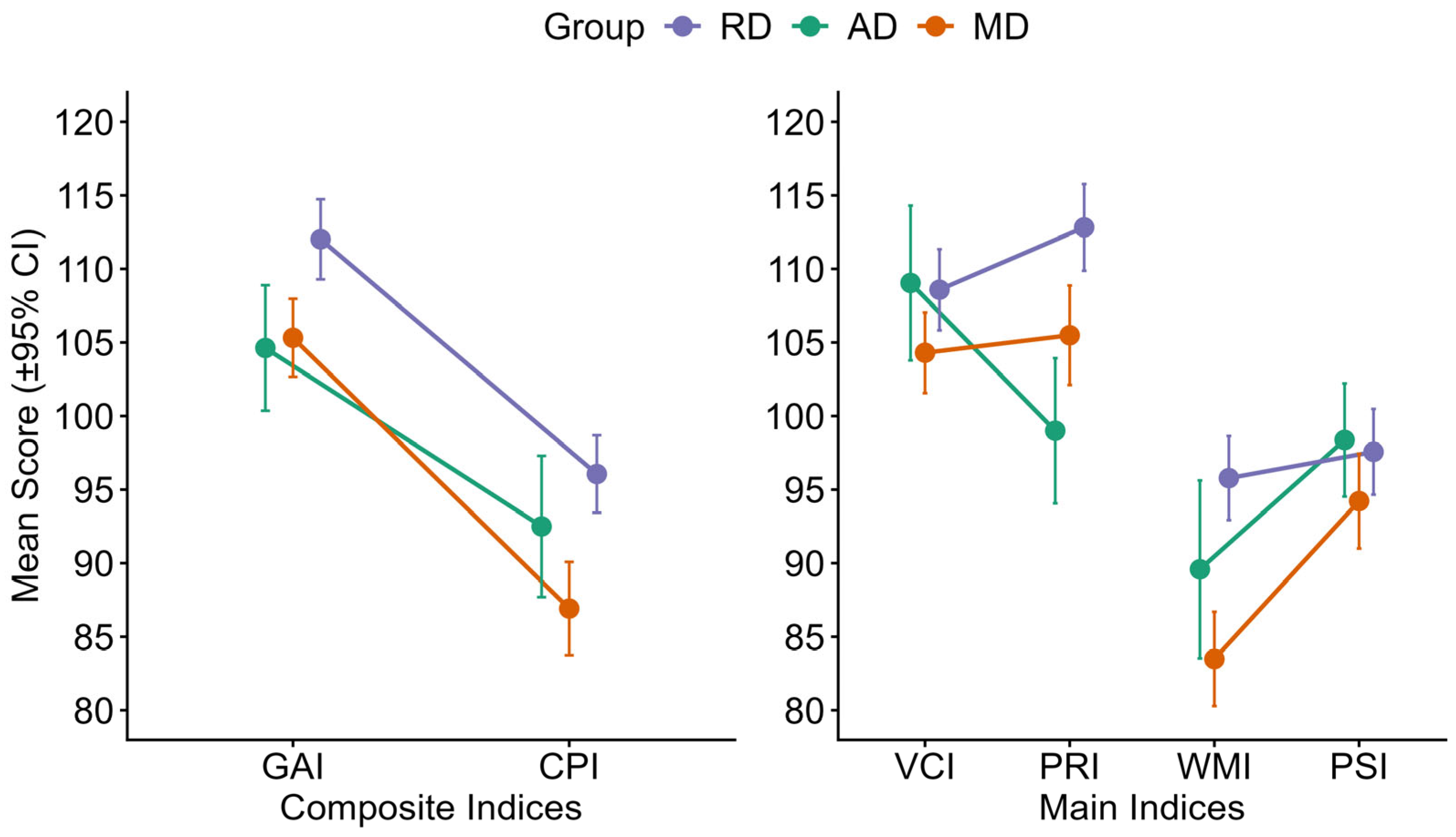
| Total (n = 166) | RD (n = 79) | AD (n = 24) | MD (n = 63) | ||
|---|---|---|---|---|---|
| M ± SD (Range) | M ± SD (Range) | M ± SD (Range) | M ± SD (Range) | p-Value | |
| Age, years | 17.36 ± 2.04 (13–25) | 17.7 ± 2.05 (13–24) | 17.0 ± 2.22 (13–21) | 17.2 ± 1.98 (13–25) | 0.322 |
| Gender (M/F) | 59/107 | 43/36 | 1/23 | 15/48 | <0.001 |
| GAI | 108.4 ± 11.97 (85–145) | 112.01 ± 12.36 (85–145) | 104.62 ± 10.66 (85–124) | 105.32 ± 10.72 (85–133) | |
| CPI | 92.08 ± 12.92 (57–132) | 96.06 ± 11.93 (66–132) | 92.5 ± 12 (66–115) | 86.92 ± 12.82 (57–115) | |
| VCI | 107.02 ± 12.2 (80–144) | 108.58 ± 12.5 (86–144) | 109.04 ± 13.15 (80–129) | 104.3 ± 11.1 (82–129) | |
| PRI | 108.04 ± 14.19 (77–139) | 112.82 ± 13.38 (81–139) | 99 ± 12.33 (79–121) | 105.49 ± 13.67 (77–132) | |
| WMI | 90.22 ± 14.37 (57–126) | 95.78 ± 12.95 (66–126) | 89.58 ± 15.11 (63–120) | 83.49 ± 12.99 (57–117) | |
| PSI | 96.42 ± 12.75 (65–139) | 97.57 ± 13.21 (65–139) | 98.38 ± 9.61 (75–114) | 94.22 ± 13.06 (65–128) |
| Subsample (n = 123) | RD (n = 57) | AD (n = 15) | MD (n = 51) | |
|---|---|---|---|---|
| WAIS-IV Indices | M ± SD (Range) | M ± SD (Range) | M ± SD (Range) | M ± SD (Range) |
| VCI | 106.6 ± 11.41 (82–141) | 107.86 ± 11.42 (90–141) | 108.73 ± 12.09 (90–129) | 104.57 ± 11.09 (82–129) |
| PRI | 106.76 ± 14.11 (77–139) | 112.05 ± 12.97 (81–139) | 95.27 ± 12.3 (79–121) | 104.22 ± 13.29 (77–131) |
| WMI | 90.83 ± 14.87 (57–126) | 97.89 ± 13.13 (66–126) | 87.13 ± 16.03 (63–120) | 84.02 ± 12.88 (57–117) |
| PSI | 96.79 ± 12.04 (67–139) | 98.21 ± 12.59 (67–139) | 98.6 ± 9.75 (75–114) | 94.67 ± 11.9 (72–128) |
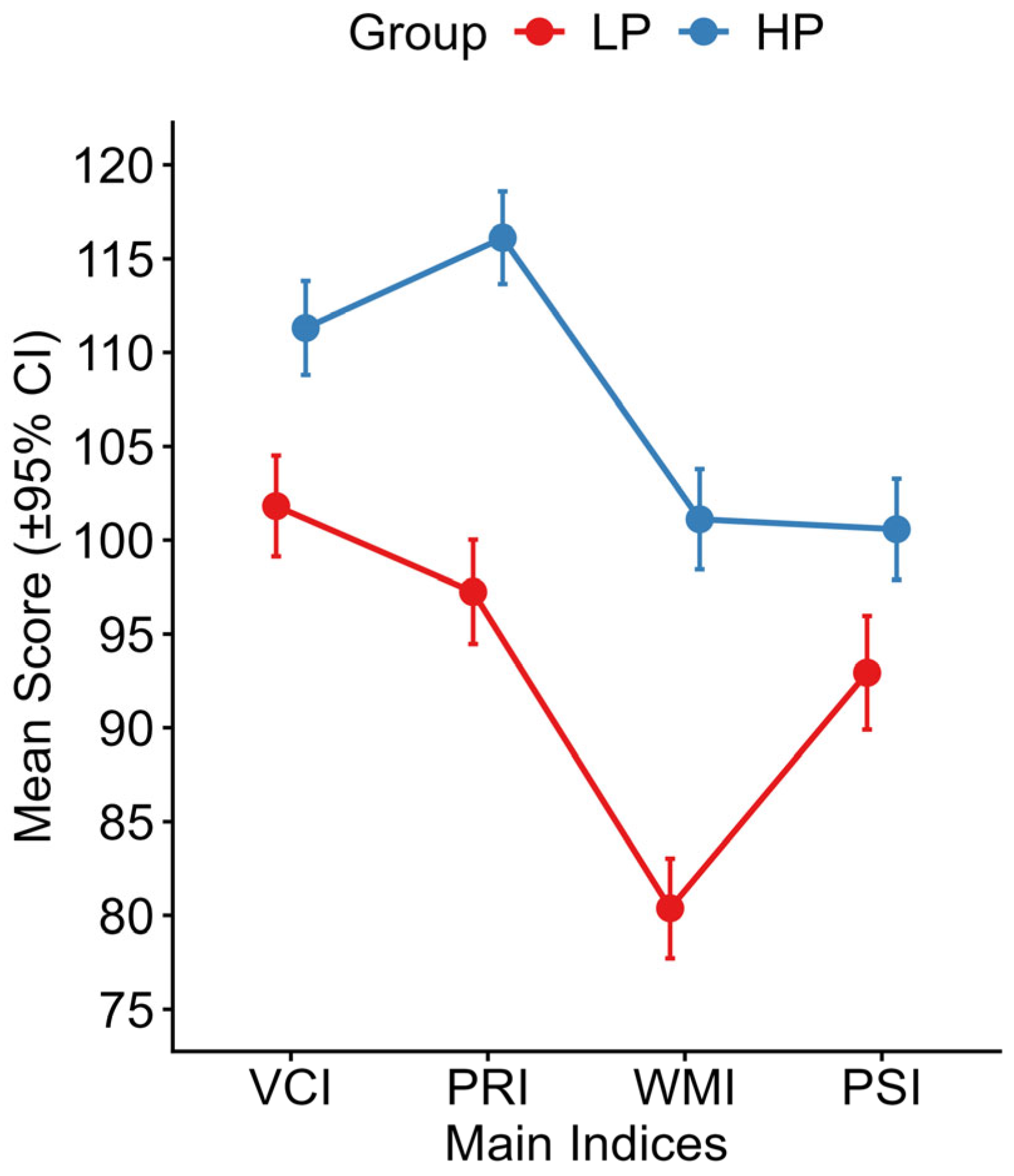
| LP (n = 61) | HP (n = 62) | |||
|---|---|---|---|---|
| WAIS-IV Indices | M ± SD | M ± SD | p-Value | Effect Size |
| VCI | 101.82 (10.73) | 111.31 (10.08) | <0.001 a | −0.91 b |
| PRI | 97.25 (11.07) | 116.11 (9.91) | <0.001 a | −1.80 b |
| WMI | 80.38 (10.56) | 101.11 (10.75) | <0.001 a | −1.95 b |
| PSI | 92.93 (12.07) | 100.58 (10.81) | 0.001 c | 0.29 d |
| p-Value | <0.001 e | <0.001 g | ||
| Effect size | 0.34 f | 0.34 h |
Disclaimer/Publisher’s Note: The statements, opinions and data contained in all publications are solely those of the individual author(s) and contributor(s) and not of MDPI and/or the editor(s). MDPI and/or the editor(s) disclaim responsibility for any injury to people or property resulting from any ideas, methods, instructions or products referred to in the content. |
© 2026 by the authors. Licensee MDPI, Basel, Switzerland. This article is an open access article distributed under the terms and conditions of the Creative Commons Attribution (CC BY) license.
Share and Cite
Zonca, S.; Bizzaro, M.L.; Girelli, L. What Lies Behind Diagnostic Labels? High Intra-Individual Variability Is the True Cognitive Signature of University Students with Specific Learning Disorders. Brain Sci. 2026, 16, 404. https://doi.org/10.3390/brainsci16040404
Zonca S, Bizzaro ML, Girelli L. What Lies Behind Diagnostic Labels? High Intra-Individual Variability Is the True Cognitive Signature of University Students with Specific Learning Disorders. Brain Sciences. 2026; 16(4):404. https://doi.org/10.3390/brainsci16040404
Chicago/Turabian StyleZonca, Sara, Marzia Lucia Bizzaro, and Luisa Girelli. 2026. "What Lies Behind Diagnostic Labels? High Intra-Individual Variability Is the True Cognitive Signature of University Students with Specific Learning Disorders" Brain Sciences 16, no. 4: 404. https://doi.org/10.3390/brainsci16040404
APA StyleZonca, S., Bizzaro, M. L., & Girelli, L. (2026). What Lies Behind Diagnostic Labels? High Intra-Individual Variability Is the True Cognitive Signature of University Students with Specific Learning Disorders. Brain Sciences, 16(4), 404. https://doi.org/10.3390/brainsci16040404