Review

Neurological Manifestations of Hemolytic Uremic Syndrome: A Comprehensive Review
1
Faculty of Medicine, University of Belgrade, 11000 Belgrade, Serbia
2
Chicago College of Osteopathic Medicine, Midwestern University, Downers Grove, IL 60515, USA
3
Department of Internal Medicine, Ziauddin Medical College, Karachi 75500, Pakistan
4
Neurology Clinic, University Clinical Centre of Serbia, Dr Subotica Starijeg Str. 6, 11000 Belgrade, Serbia
5
Faculty of Medicine, University of Novi Sad, 21000 Novi Sad, Serbia
6
Izola General Hospital, 6310 Izola, Slovenia
7
Clinic of Nephrology, University Clinical Centre of Serbia, Pasterova Str. 2, 11000 Belgrade, Serbia
8
6th Medical Department of Internal Medicine with Nephrology & Dialysis, Clinic Ottakring, 1160 Vienna, Austria
9
Centre for Mental Health Protection, University Clinical Centre Niš, Bulevar Dr. Zorana Đinđića Str. 48, 18000 Niš, Serbia
*
Authors to whom correspondence should be addressed.
These authors contributed equally to this work.
Brain Sci. 2025, 15(7), 717; https://doi.org/10.3390/brainsci15070717

Submission received: 11 June 2025 / Revised: 28 June 2025 / Accepted: 30 June 2025 / Published: 4 July 2025
(This article belongs to the Special Issue New Advances in Neuroimmunology and Neuroinflammation)

Abstract

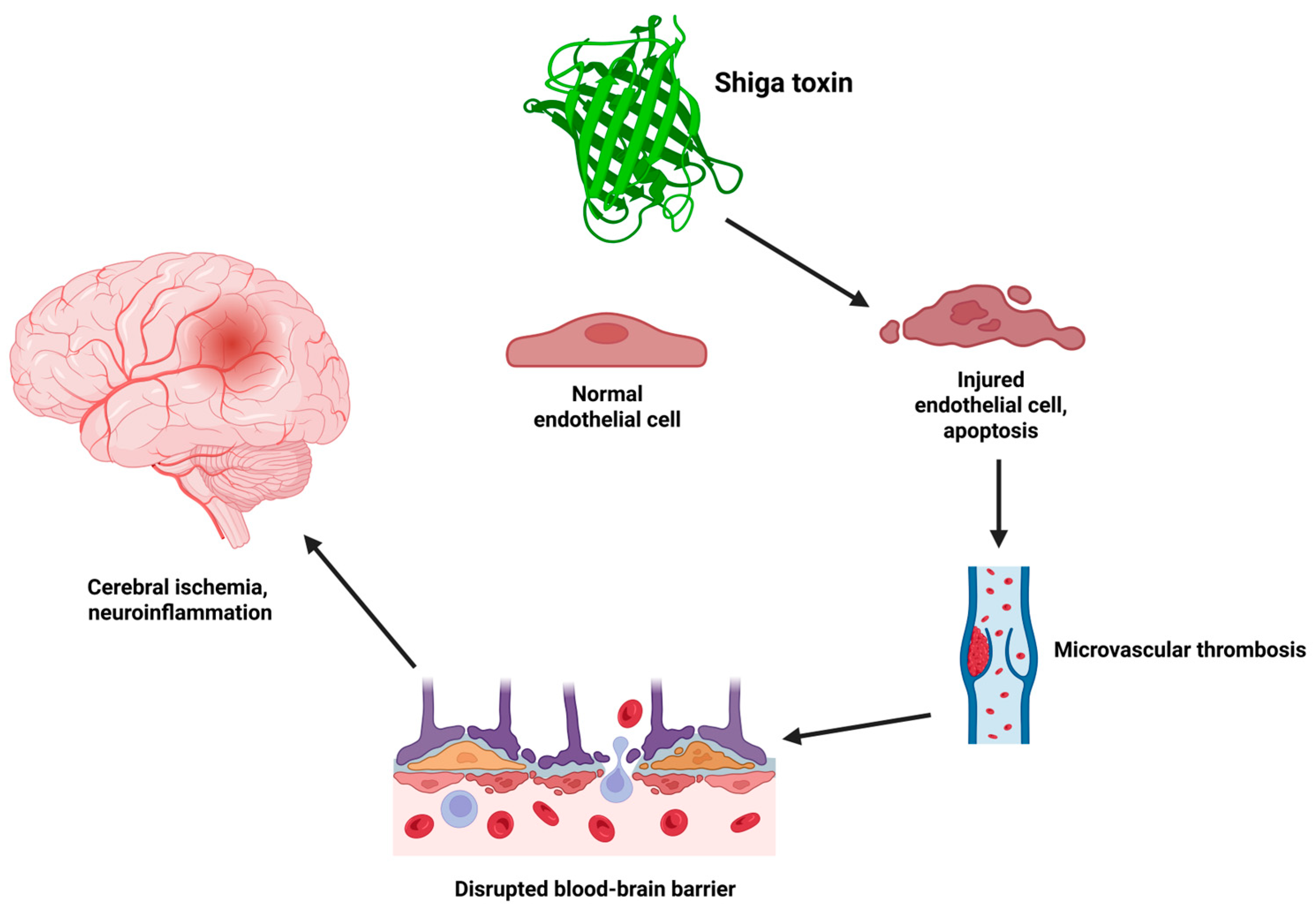
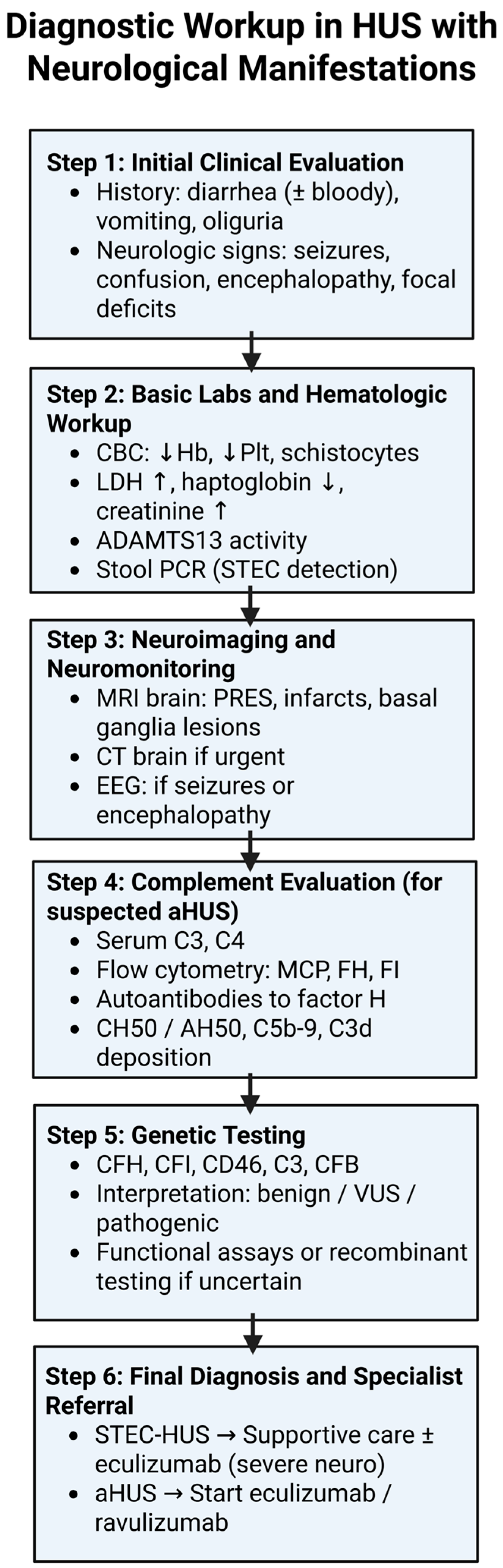
Hemolytic uremic syndrome (HUS), a thrombotic microangiopathy primarily affecting the kidneys, can also involve the central nervous system (CNS), often leading to significant morbidity and mortality. Neurologic manifestations are among the most severe extra-renal complications, particularly in children and during outbreaks of Shiga toxin-producing Escherichia coli (STEC)-associated HUS (typical (tHUS)). This review explores the clinical spectrum, pathophysiology, diagnostic workup, and age-specific outcomes of neurologic involvement in both typical (tHUS) and atypical (aHUS). Neurologic complications occur in up to 11% of pediatric and over 40% of adult STEC-HUS cases in outbreak settings. Presentations include seizures, encephalopathy, focal deficits, movement disorders, and posterior reversible encephalopathy syndrome (PRES). Magnetic resonance imaging (MRI) commonly reveals basal ganglia or parieto-occipital lesions, though subtle or delayed findings may occur. Laboratory workup typically confirms microangiopathic hemolytic anemia (MAHA), thrombocytopenia, and kidney damage, with additional markers of inflammation or metabolic dysregulation. Eculizumab is the first-line treatment for aHUS with CNS involvement, while its utility in STEC-HUS remains uncertain. Although many children recover fully, those with early CNS involvement are at greater risk of developing epilepsy, cognitive delays, or fine motor deficits. Adults may experience lingering neurocognitive symptoms despite apparent clinical recovery. Differences in presentation and imaging findings between age groups emphasize the need for tailored diagnostic and therapeutic strategies. Comprehensive neurorehabilitation and long-term follow-up are crucial for identifying residual deficits. Continued research into predictive biomarkers, neuroprotective interventions, and standardized treatment protocols is needed for improving outcomes in HUS patients with neurological complications.
Keywords: hemolytic uremic syndrome; atypical HUS; STEC-HUS; pediatric neurology; nephrology; thrombotic microangiopathy; neuroimaging; biomarkers hemolytic uremic syndrome; atypical HUS; STEC-HUS; pediatric neurology; nephrology; thrombotic microangiopathy; neuroimaging; biomarkers