Improved Visible Light-Based Indoor Positioning System Using Machine Learning Classification and Regression


Abstract
1. Introduction
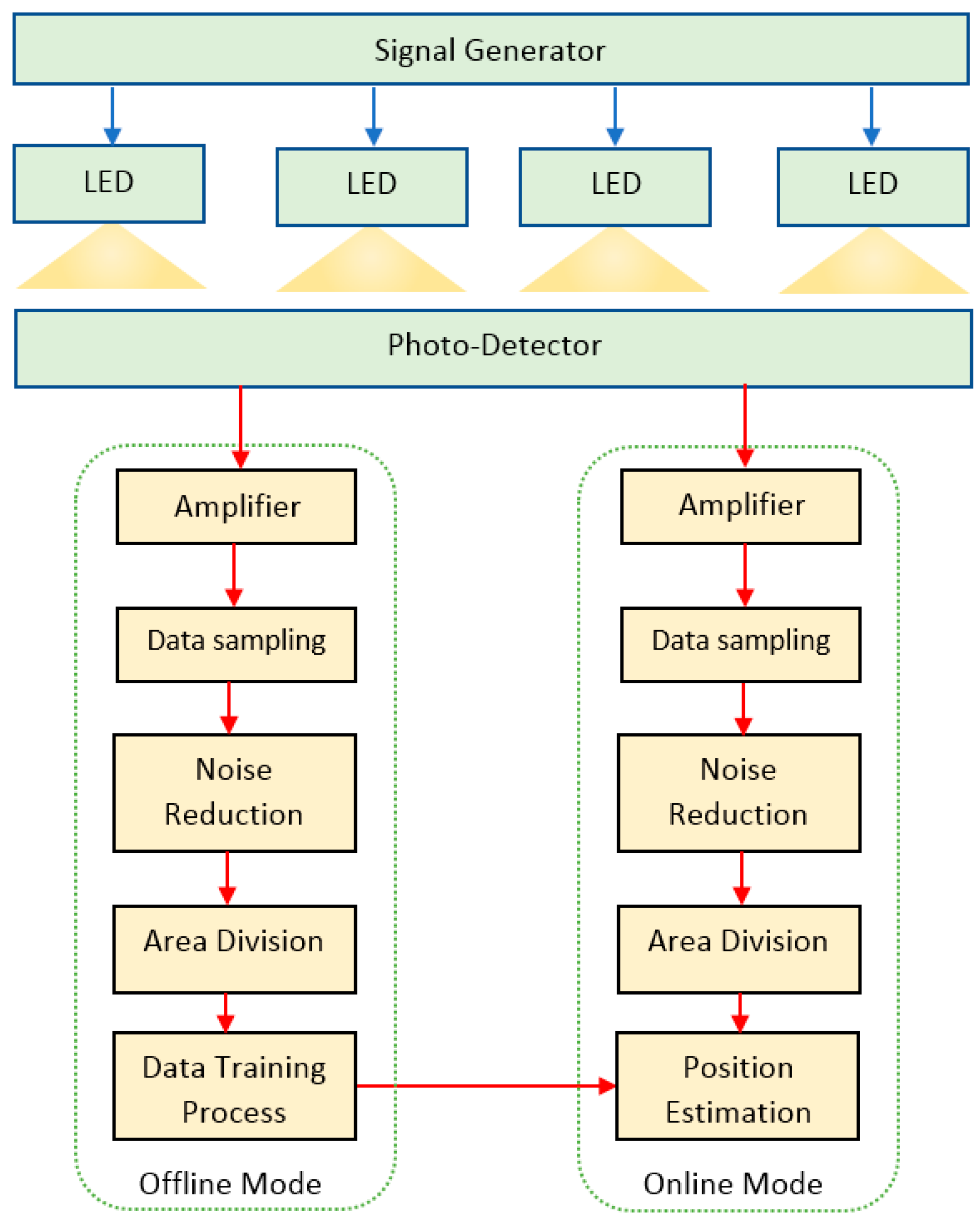
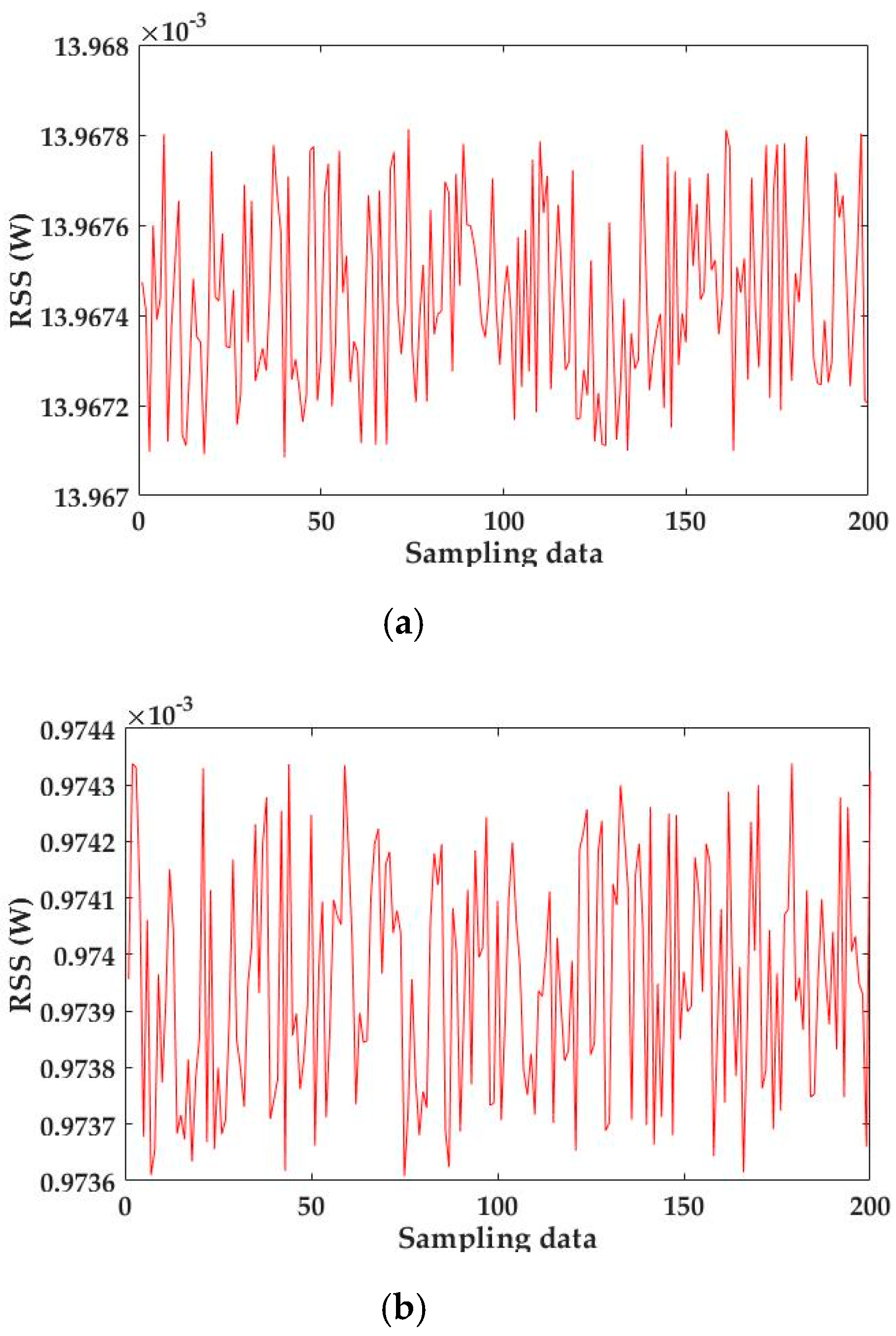
- We first performed noise reduction by using outlier and average filtering. These processes include noise filtering and elimination of low-intensity reflected signals. This type of signal pre-processing improves the accuracy of the later position estimation process.
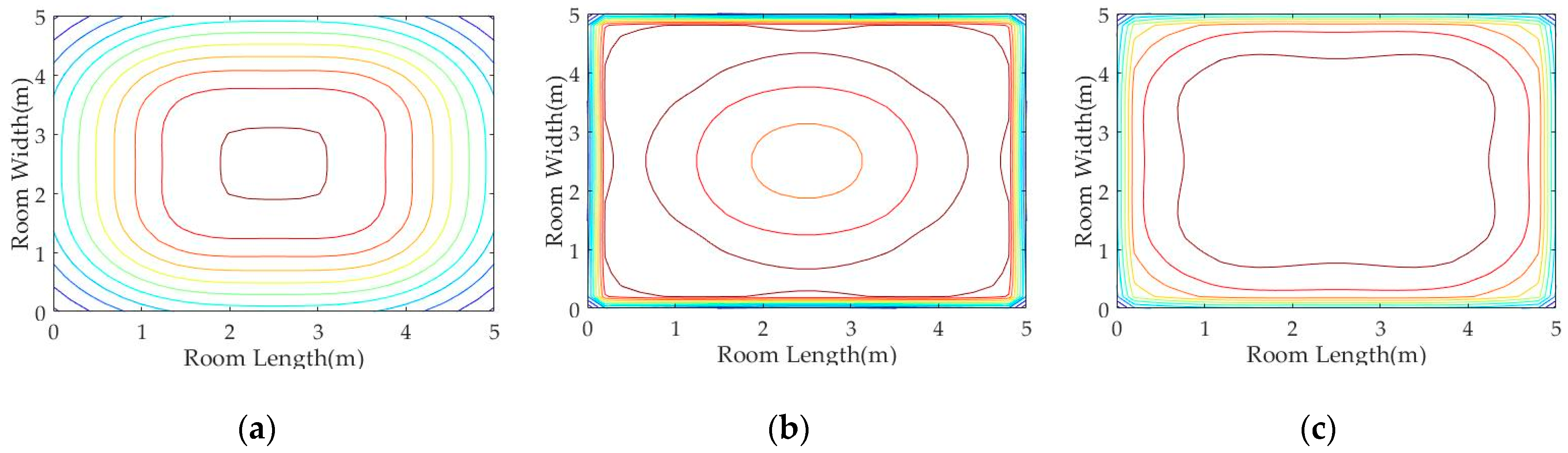
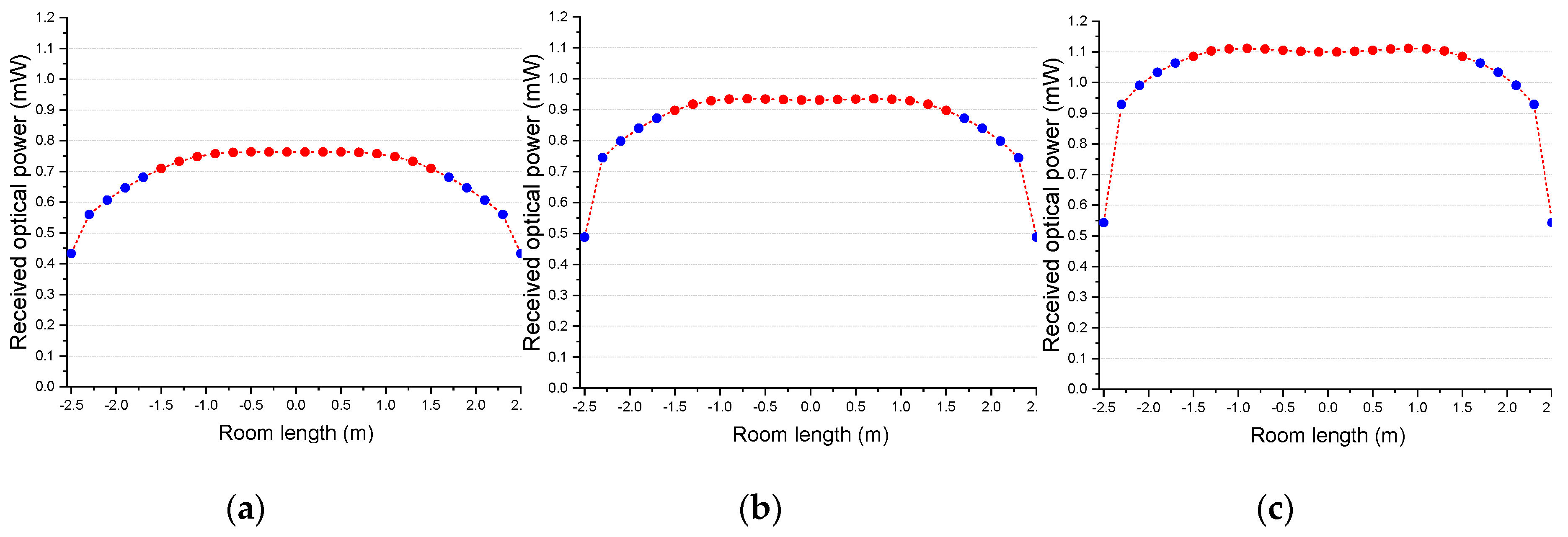
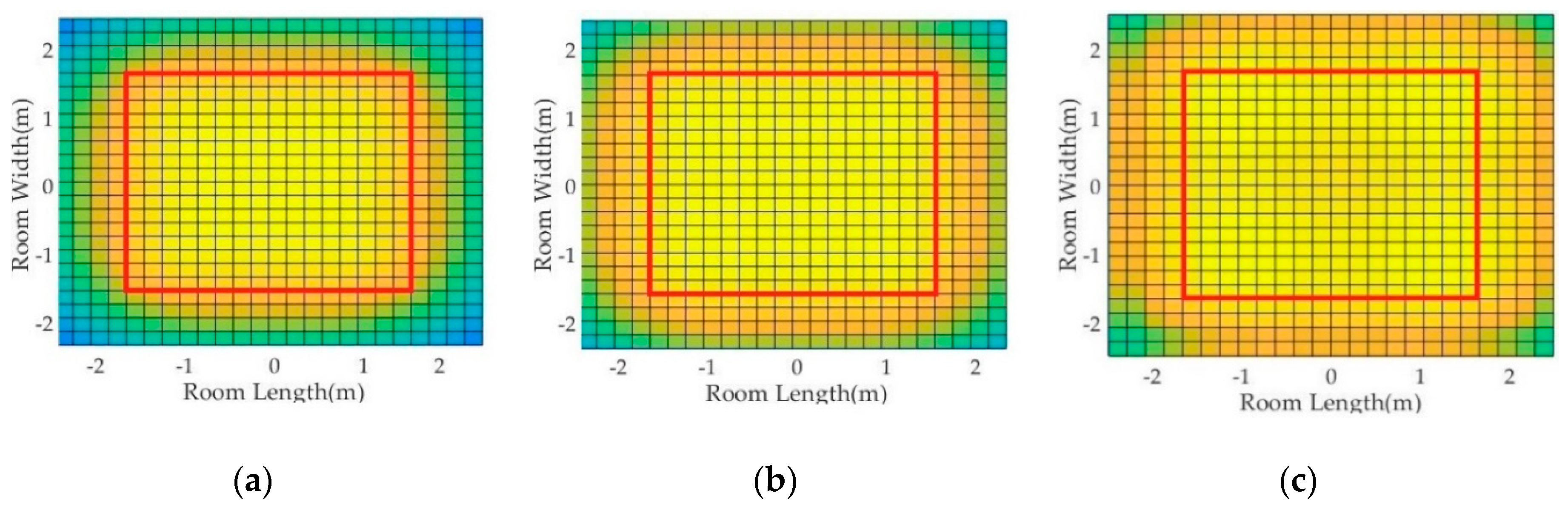
- Then these data were classified using the classification function of ML algorithms. Data points were assigned to one of two areas: the center area or the edge area. The area division was based on the correlation between the actual location of the receiver on the floor and the RSS from four groups of LED lights suspended from the ceiling. Data division by region is a unique idea that not only significantly reduces total execution time but also contributes to the improvement in positioning accuracy, due to the signal integrity within each individual area.
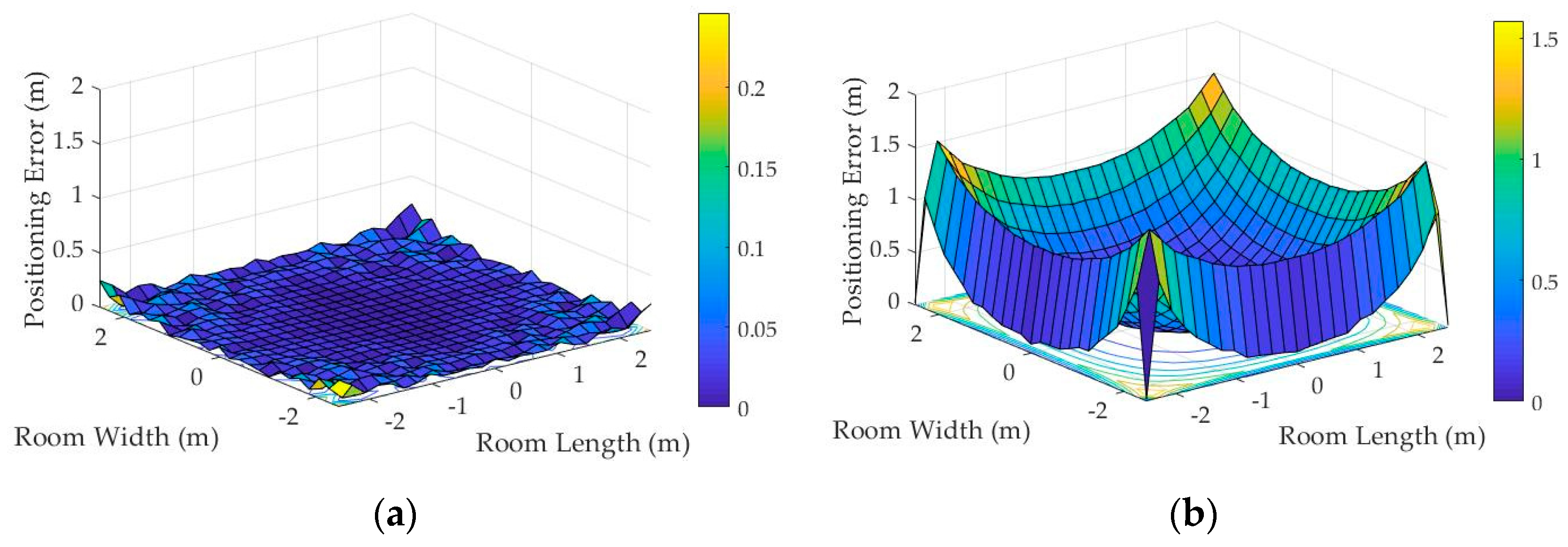
- After noise reduction and area division, the regression function of the ML algorithms was used to predict the location of the receiver. The results show that the proposed solution greatly improved the execution time and positioning accuracy, despite being influenced by many adverse factors, including noises and reflected waves.
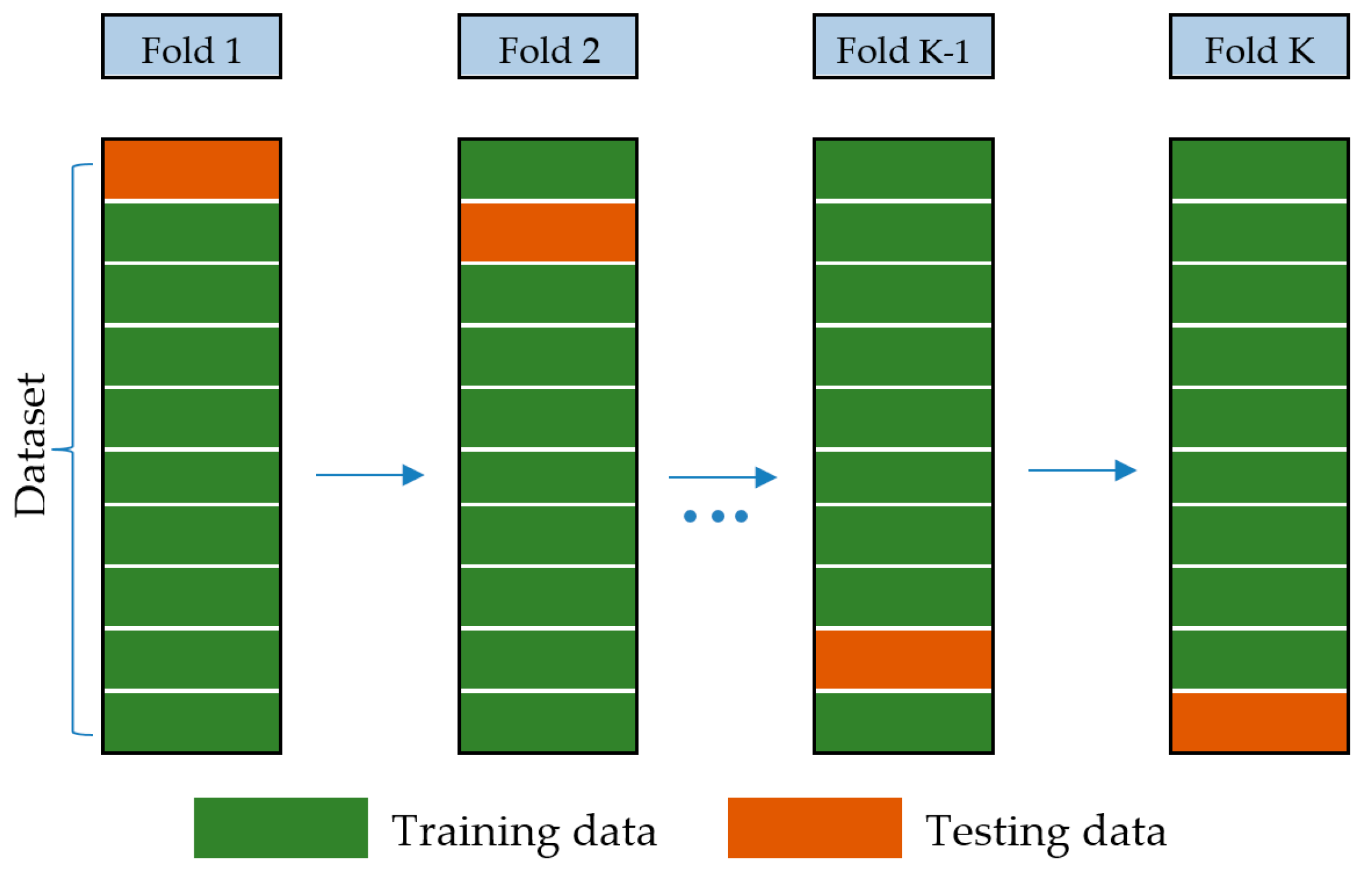
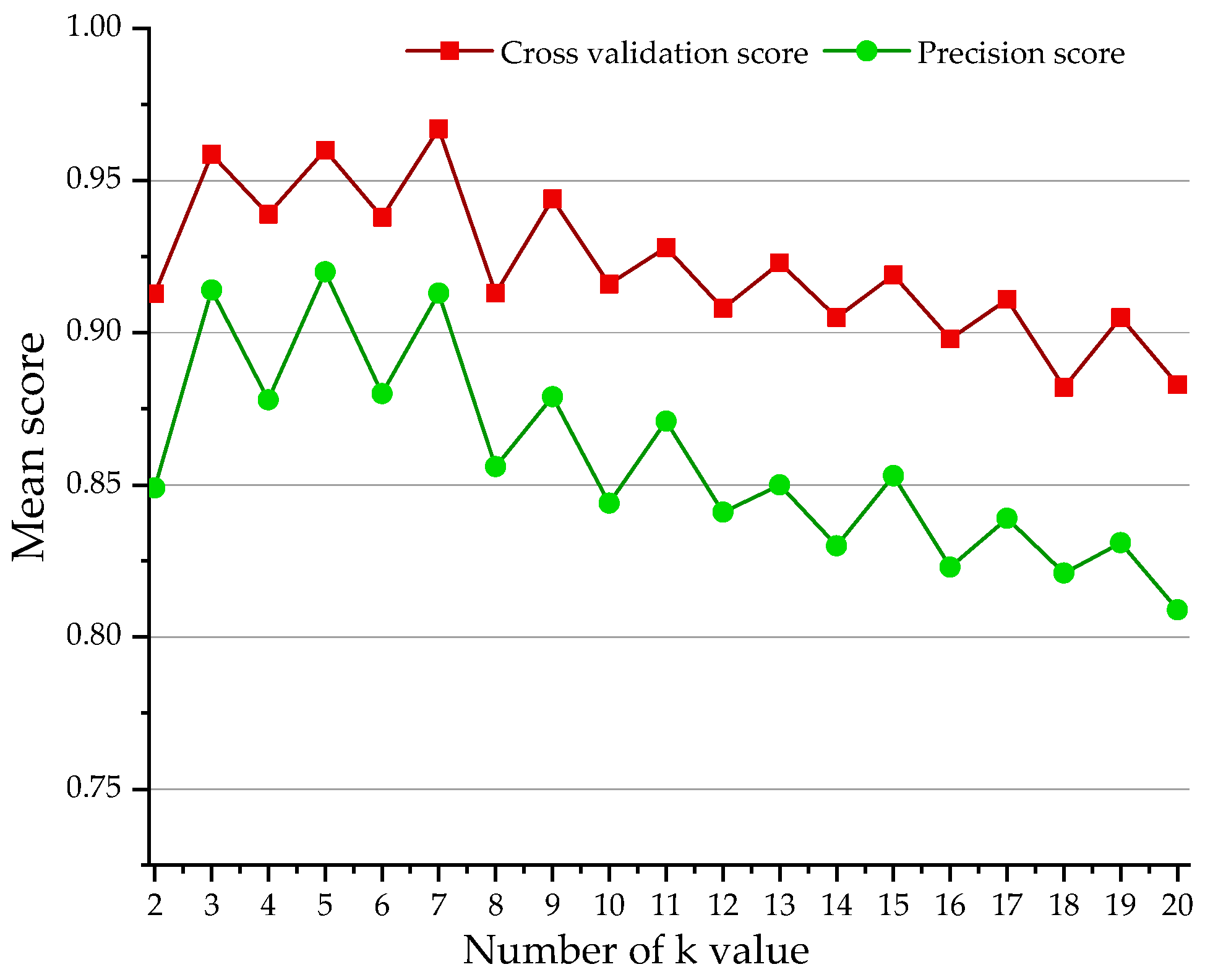
- To evaluate the effectiveness of each ML algorithm, we compared their accuracy in both in the classification process and the regression process after the Cross-Validation (CV) technique was employed to verify the reliability of the algorithm and avoid overfitting. The comparison of positioning accuracy and computational time for all the methods provides a basis for selecting the optimal algorithm for future research.
2. Proposed System
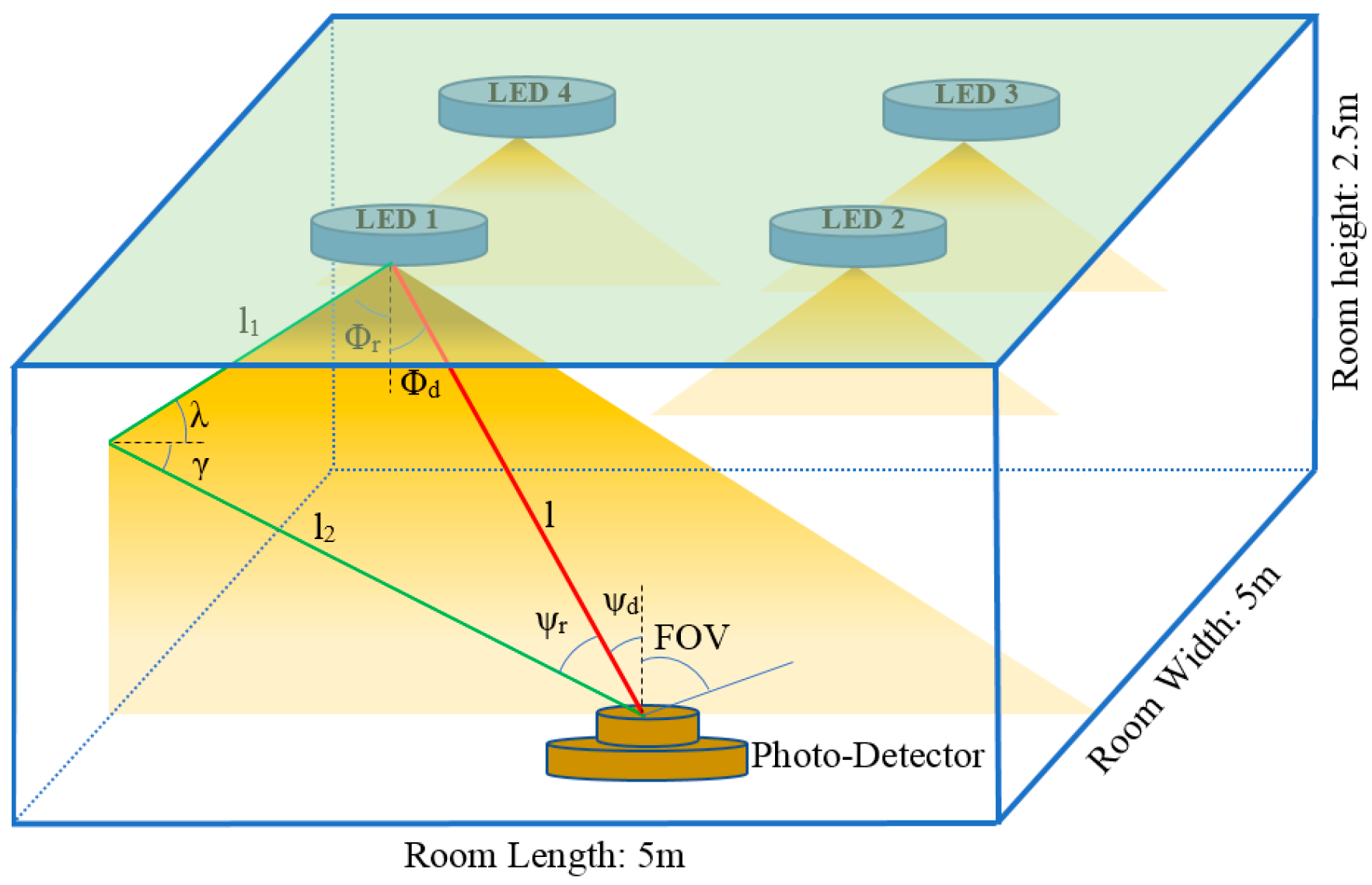
2.1. Simulation Configuration
2.2. Simulation Configuration VLC Channel and Signal-To-Noise Ratio (SNR) Analysis
3. Proposed Solution
3.1. Low-Intensity Reflected Signal Elimination and Noise Reduction
3.2. Area Division with MLC
3.3. Location Prediction with MLR
4. Tuning Parameters and Results Assessment
4.1. Algorithms Performance Assessment via K-Fold CV
4.2. Parameter Optimization and Accuracy Assessment
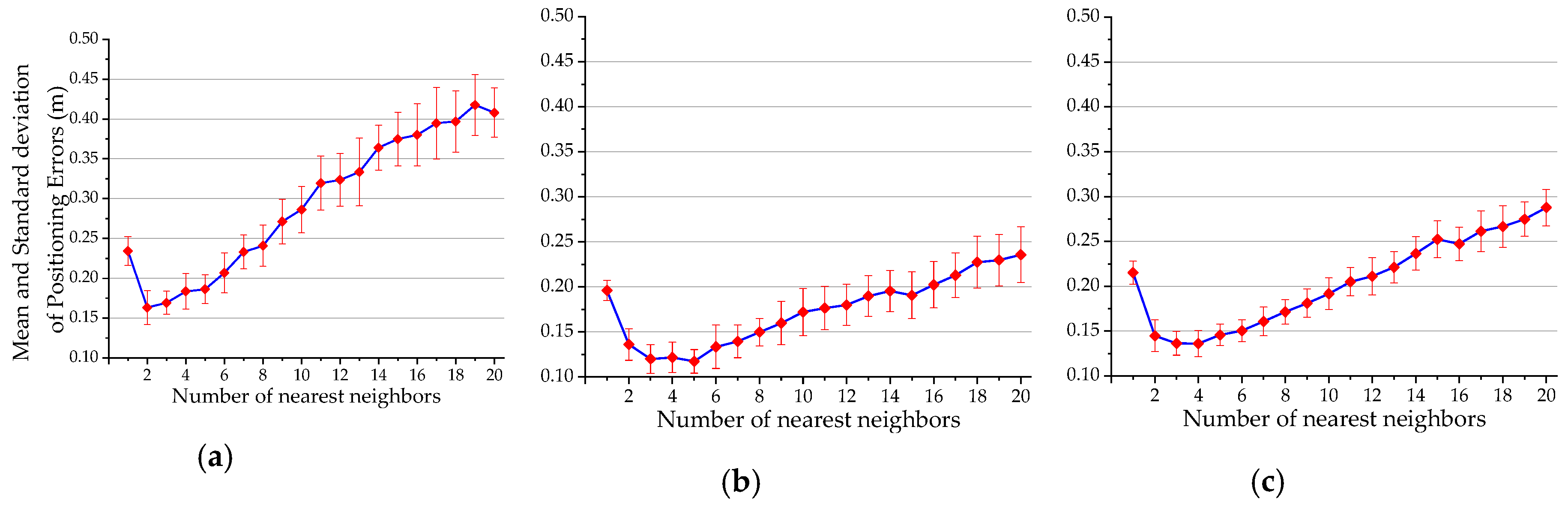
4.2.1. The kNN Algorithm
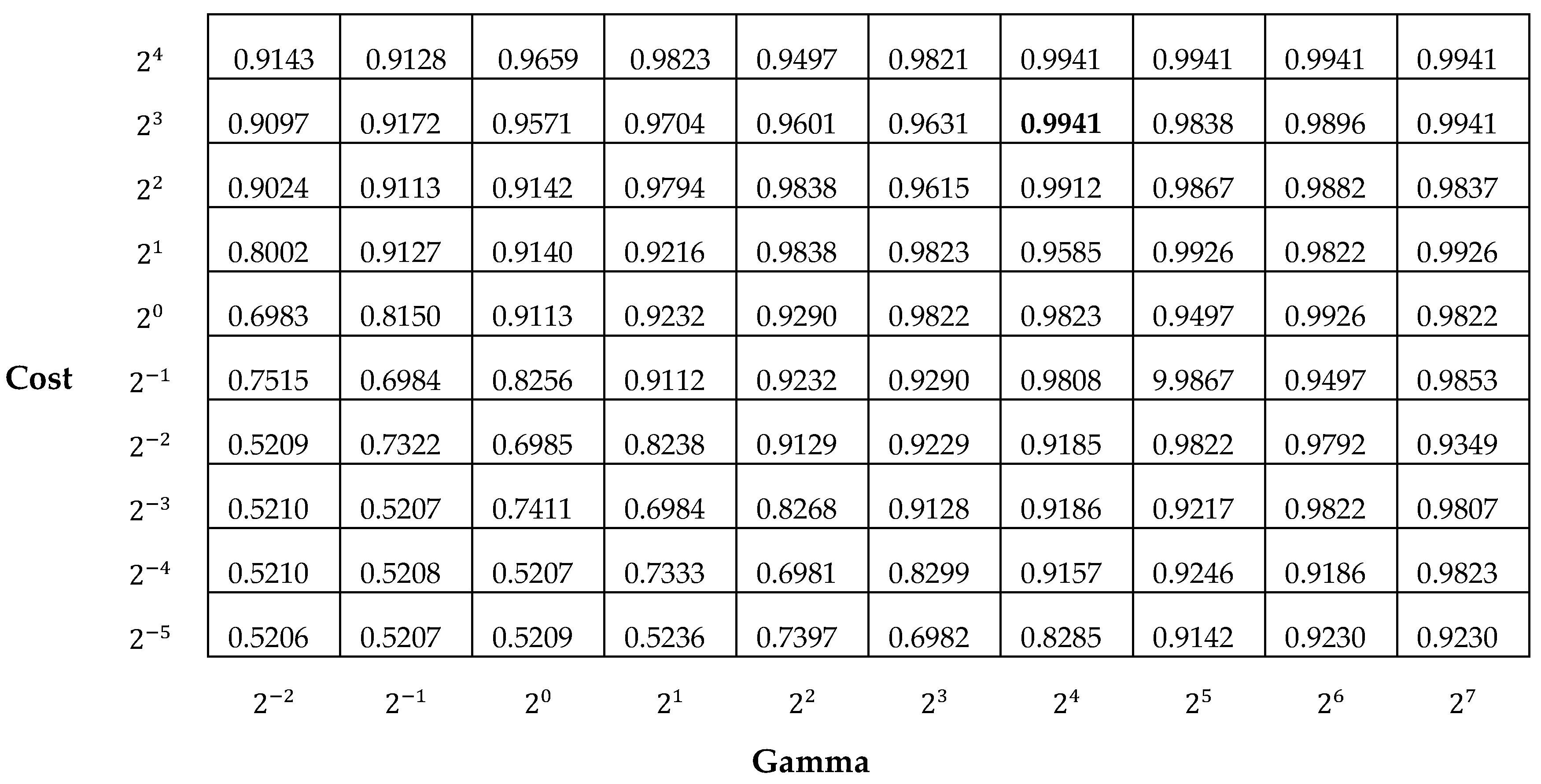
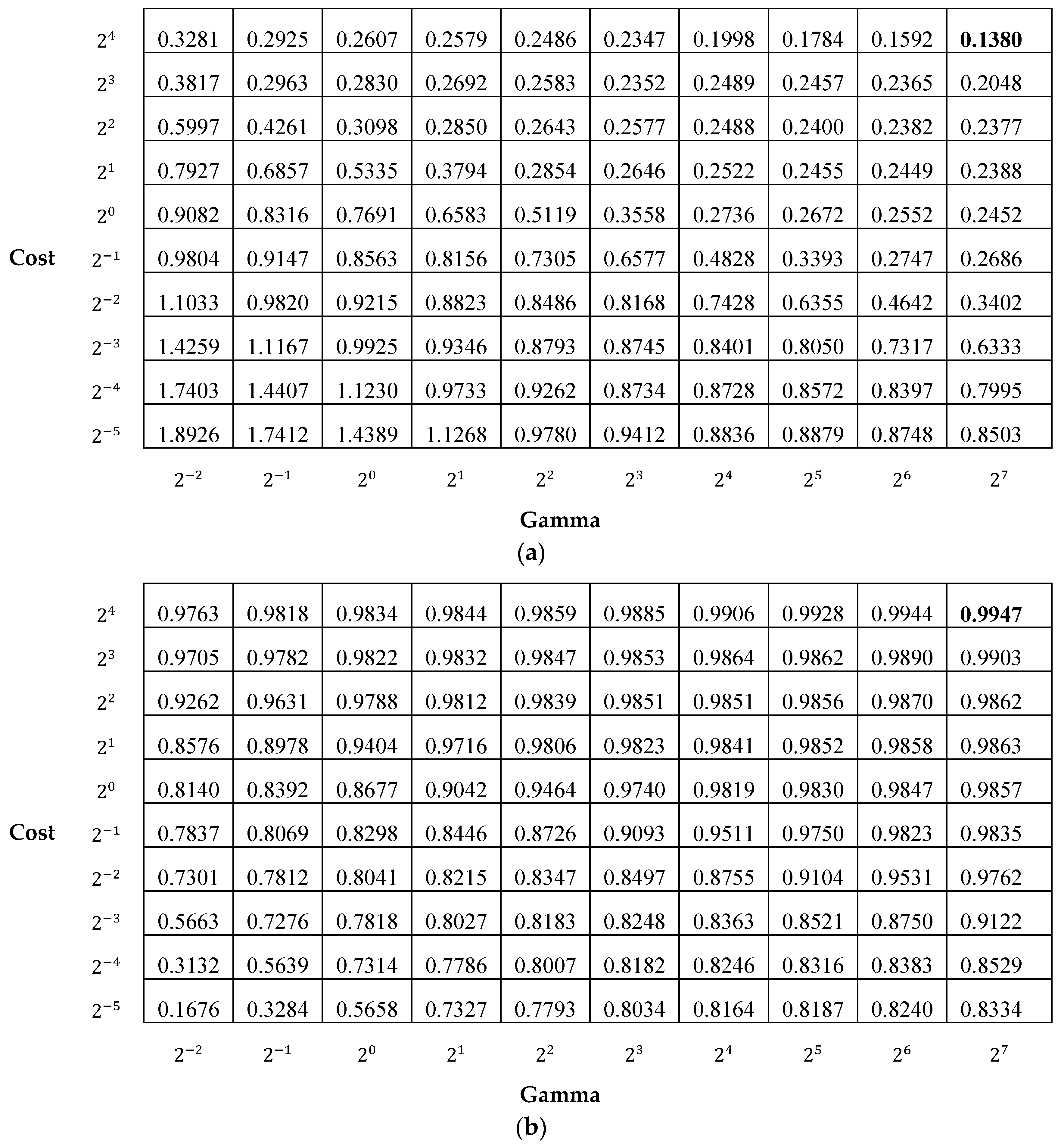
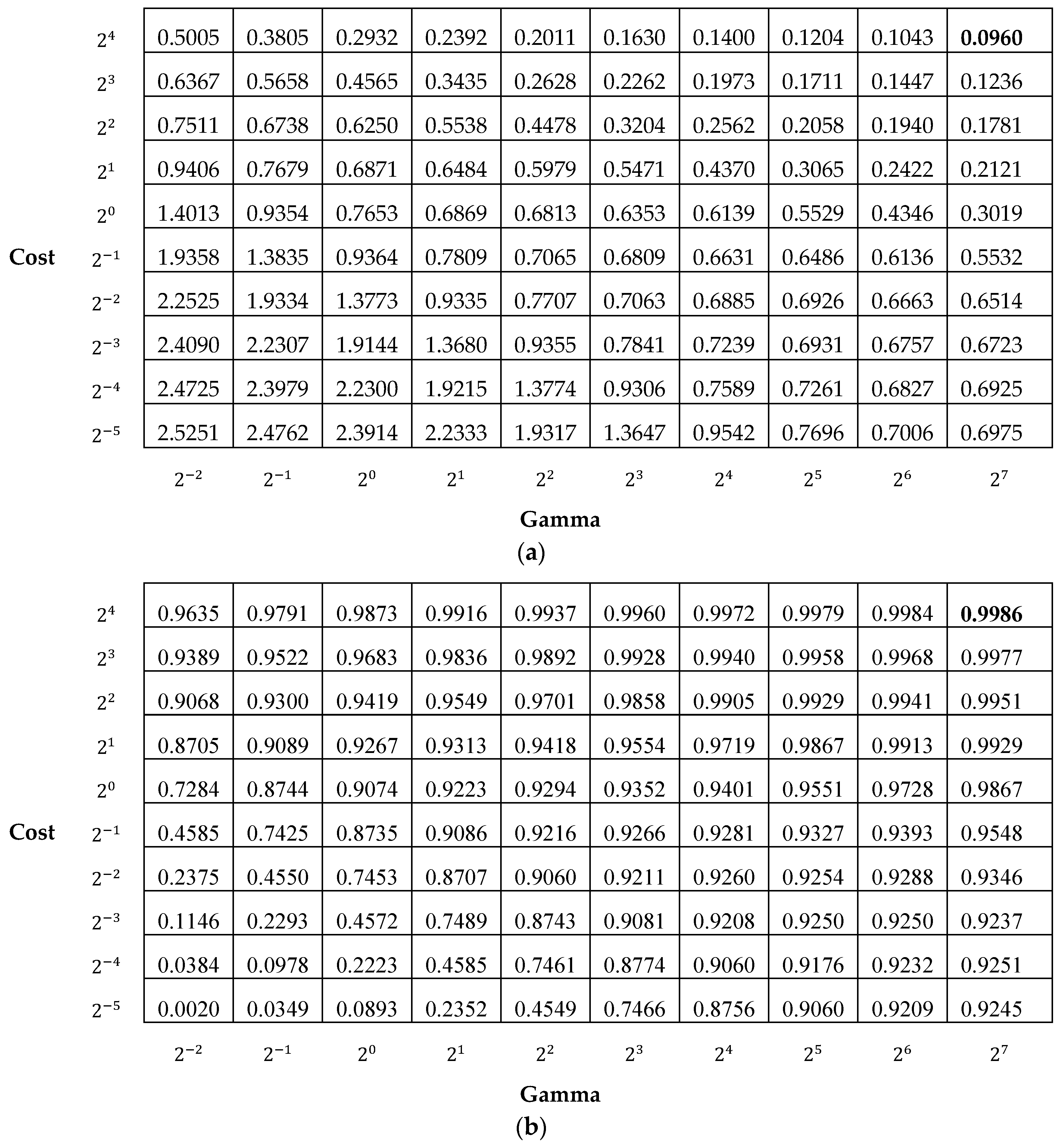
4.2.2. The SVM Algorithm
4.2.3. The DT Algorithm
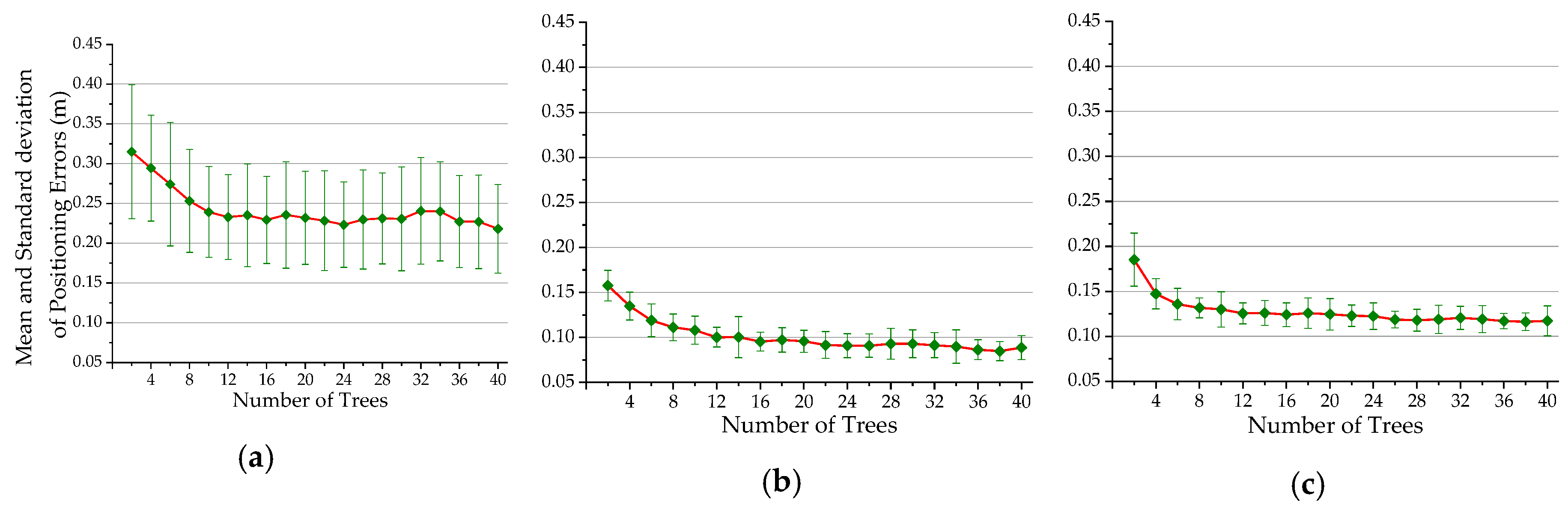
4.2.4. The RF Algorithm
5. Simulation and Results
5.1. Computational Time Comparison
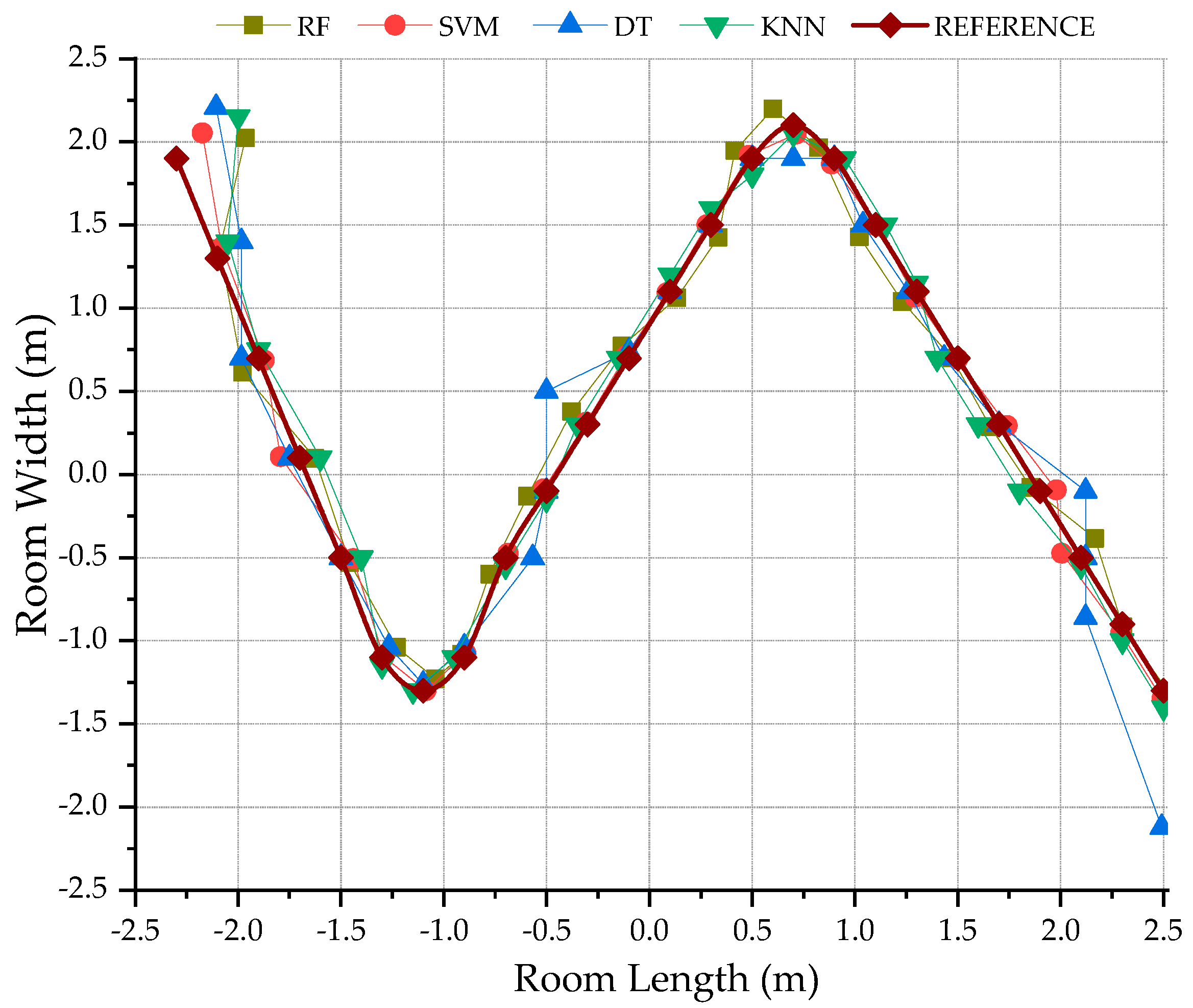
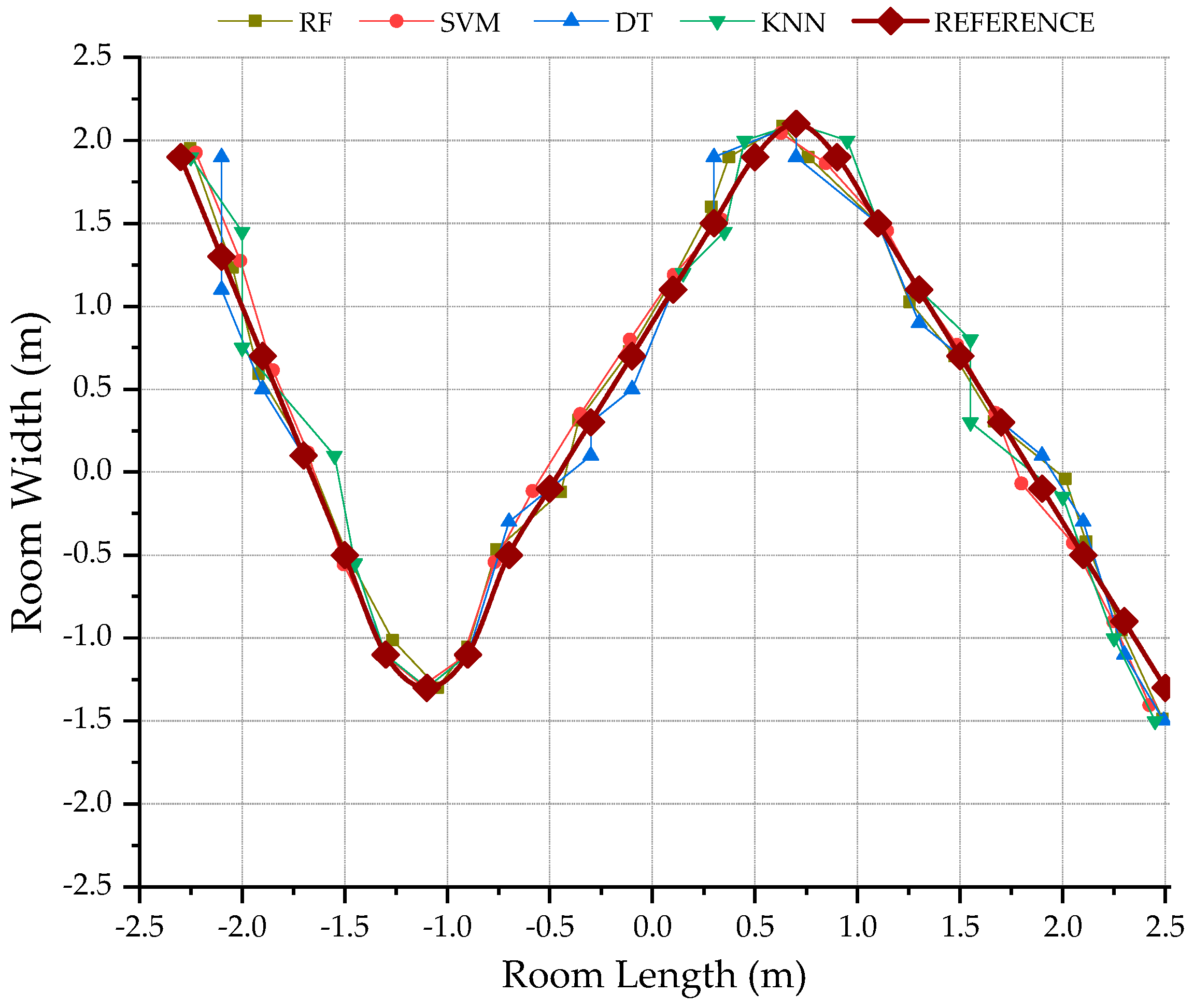
5.2. Positioning Accuracy Assessment
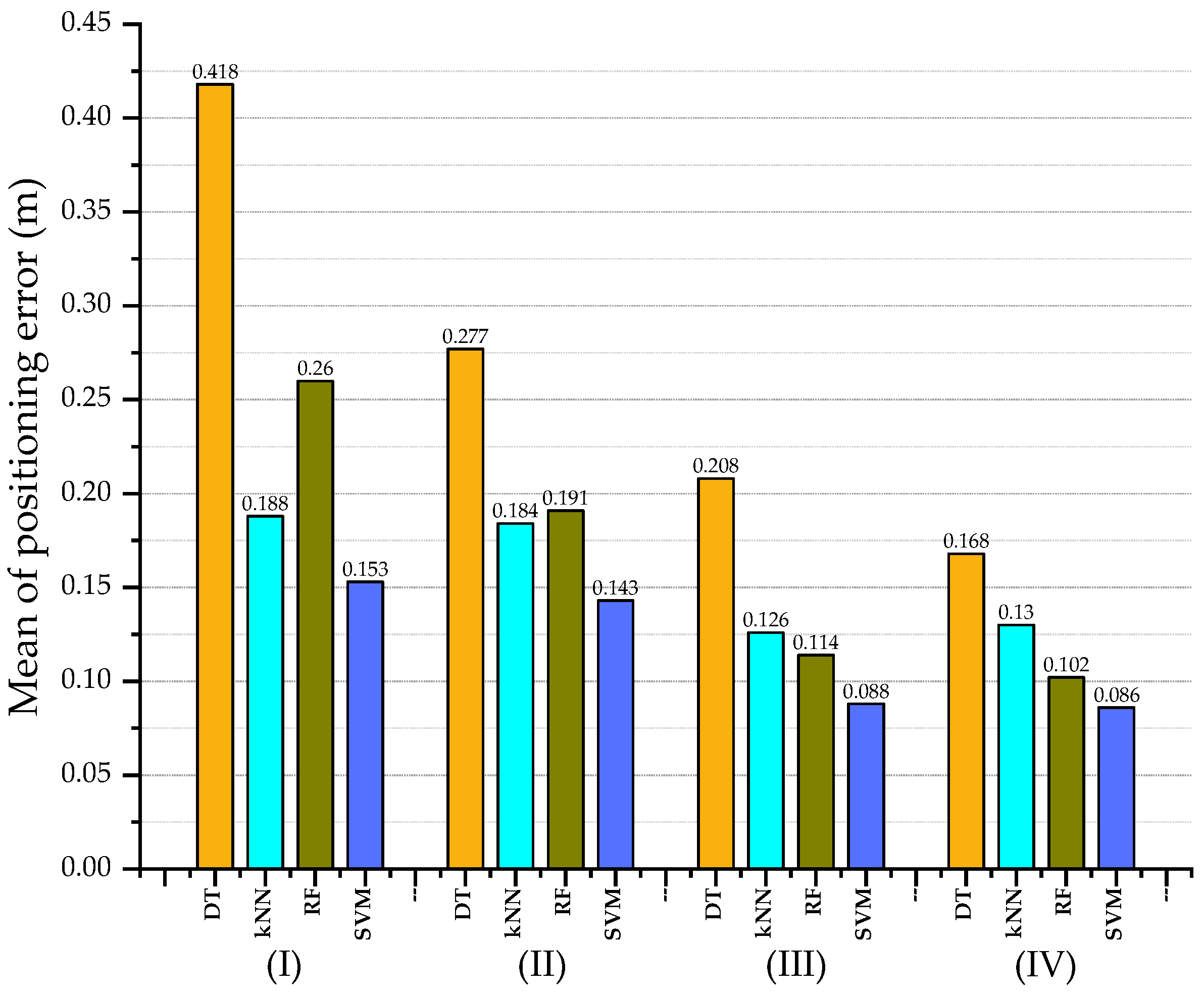
- (I): Without noise reduction and without area division
- (II): Without noise reduction and with area division
- (III): With noise reduction and without area division
- (IV): With noise reduction and with area division
6. Conclusions
Author Contributions
Acknowledgments
Conflicts of Interest
References
- Armstrong, J.; Sekercioglu, Y.A.; Neild, A. Visible light positioning: A roadmap for international standardization. IEEE Commun. Mag. 2013, 51, 68–73. [Google Scholar] [CrossRef] [Scilit]
- Rajagopal, S.; Roberts, R.D.; Lim, S. IEEE 802.15.7 visible light communication: Modulation schemes and dimming support. IEEE Commun. Mag. 2012, 50, 72–82. [Google Scholar] [CrossRef] [Scilit]
- IEEE Draft Standard for Local and Metropolitan Area Networks—Part 15.7: Short-Range Optical Wireless Communications; IEEE P802.15.7/D3; Institute of Electrical and Electronics Engineers (IEEE): Englewood, CO, USA, 1 January 2018; pp. 1–412.
- Keskin, M.F.; Sezer, A.D.; Gezici, S. Localization via Visible Light Systems. Proc. IEEE 2018, 106, 1063–1088. [Google Scholar] [CrossRef] [Scilit]
- Indoor Positioning: Perfect Light, Precise Location. Available online: http://www.lighting.philips.com/main/systems/lighting-systems/indoor-positioning (accessed on 3 February 2019).
- Qiu, K.; Zhang, F.; Liu, M. Let the Light Guide Us: VLC-Based Localization. IEEE Robot. Autom. Mag. 2016, 23, 174–183. [Google Scholar] [CrossRef] [Scilit]
- Murai, R.; Sakai, T.; Kawano, H.; Matsukawa, Y.; Kitano, Y.; Honda, Y.; Campbell, K.C. A novel visible light communication system for enhanced control of autonomous delivery robots in a hospital. In Proceedings of the 2012 IEEE/SICE International Symposium on System Integration (SII), Fukuoka, Japan, 16–18 December 2012; pp. 510–516. [Google Scholar] [CrossRef] [Scilit]
- Zhuang, Y.; Hua, L.; Qi, L.; Yang, J.; Cao, P.; Cao, Y.; Wu, Y.; Thompson, J.; Haas, H. A Survey of Positioning Systems Using Visible LED Lights. IEEE Commun. Surv. Tutor 2018, 20, 1963–1988. [Google Scholar] [CrossRef] [Scilit]
- Do, T.-H.; Yoo, M. An in-Depth Survey of Visible Light Communication Based Positioning Systems. Sensors 2016, 16, 678. [Google Scholar] [CrossRef] [Scilit]
- Yang, C.; Shao, H. WiFi-based indoor positioning. IEEE Commun. Mag. 2015, 53, 150–157. [Google Scholar] [CrossRef] [Scilit]
- Akram, B.A.; Akbar, A.H.; Shafiq, O. HybLoc: Hybrid Indoor Wi-Fi Localization Using Soft Clustering-Based Random Decision Forest Ensembles. IEEE Access 2018, 6, 38251–38272. [Google Scholar] [CrossRef] [Scilit]
- Li, Z.; Braun, T.; Zhao, X.; Zhao, Z.; Hu, F.; Liang, H. A Narrow-Band Indoor Positioning System by Fusing Time and Received Signal Strength via Ensemble Learning. IEEE Access 2018, 6, 9936–9950. [Google Scholar] [CrossRef] [Scilit]
- Faragher, R.; Harle, R. Location Fingerprinting with Bluetooth Low Energy Beacons. IEEE J. Sel. Areas Commun. 2015, 33, 2418–2428. [Google Scholar] [CrossRef] [Scilit]
- Zou, H.; Wang, H.; Xie, L.; Jia, Q. An RFID indoor positioning system by using weighted path loss and extreme learning machine. In Proceedings of the 2013 IEEE 1st International Conference on Cyber-Physical Systems, Networks, and Applications (CPSNA), Taipei, Taiwan, 19–20 August 2013; pp. 66–71. [Google Scholar] [CrossRef] [Scilit]
- Lin, B.; Ghassemlooy, Z.; Lin, C.; Tang, X.; Li, Y.; Zhang, S. An Indoor Visible Light Positioning System Based on Optical Camera Communications. IEEE Photonics Technol. Lett. 2017, 29, 579–582. [Google Scholar] [CrossRef] [Scilit]
- Lei, Q.; Zhang, H.; Sun, H.; Tang, L. Fingerprint-Based Device-Free Localization in Changing Environments Using Enhanced Channel Selection and Logistic Regression. IEEE Access 2018, 6, 2569–2577. [Google Scholar] [CrossRef] [Scilit]
- Zhang, J.; Xiao, W.; Zhang, S.; Huang, S. Device-Free Localization via an Extreme Learning Machine with Parameterized Geometrical Feature Extraction. Sensors 2017, 17, 879. [Google Scholar] [CrossRef] [Scilit] [PubMed]
- Guo, X.; Shao, S.; Ansari, N.; Khreishah, A. Indoor Localization Using Visible Light via Fusion of Multiple Classifiers. IEEE Photonics J. 2017, 9, 1–16. [Google Scholar] [CrossRef] [Scilit]
- Yuan, T.; Xu, Y.; Wang, Y.; Han, P.; Chen, J. A Tilt Receiver Correction Method for Visible Light Positioning Using Machine Learning Method. IEEE Photonics J. 2018, 10, 1–12. [Google Scholar] [CrossRef] [Scilit]
- Xie, C.; Guan, W.; Wu, Y.; Fang, L.; Cai, Y. The LED-ID Detection and Recognition Method Based on Visible Light Positioning Using Proximity Method. IEEE Photonics J. 2018, 10, 1–16. [Google Scholar] [CrossRef] [Scilit]
- Tran, H.Q.; Ha, C. Fingerprint-Based Indoor Positioning System Using Visible Light Communication—A Novel Method for Multipath Reflections. Electronics 2019, 8, 63. [Google Scholar] [CrossRef] [Scilit]
- Komine, T.; Nakagawa, M. Fundamental analysis for visible-light communication system using LED lights. IEEE Trans. Consum. Electron. 2004, 50, 100–107. [Google Scholar] [CrossRef] [Scilit]
- Gfeller, F.R.; Bapst, U. Wireless in-house data commin detaiunication via diffuse infrared radiation. Proc. IEEE 1979, 67, 1474–1486. [Google Scholar] [CrossRef] [Scilit]
- Sadowski, S.; Spachos, P. RSSI-Based Indoor Localization with the Internet of Things. IEEE Access 2018, 6, 30149–30161. [Google Scholar] [CrossRef] [Scilit]
- Ghassemlooy, Z.; Popoola, W.; Rajbhandari, S. Optical Wireless Communications, System and Channel Modeling with MATLAB; CRC Press: Boca Raton, FL, USA, 2012; ISBN 9781439851883. [Google Scholar]
- Mohammed, N.; Elkarim, M. Exploring the effect of diffuse reflection on indoor localization systems based on RSSI-VLC. Opt. Express 2015, 23, 20297–20313. Available online: https://www.osapublishing.org/oe/abstract.cfm?uri=oe-23-16-20297 (accessed on 22 February 2019). [CrossRef] [Scilit] [PubMed]
- Lu, X.; Zou, H.; Zhou, H.; Xie, L.; Huang, G. Robust Extreme Learning Machine With its Application to Indoor Positioning. IEEE Trans. Cybern. 2016, 46, 194–205. [Google Scholar] [CrossRef] [Scilit] [PubMed]
- Gu, W.; Aminikashani, M.; Deng, P.; Kavehrad, M. Impact of Multipath Reflections on the Performance of Indoor Visible Light Positioning Systems. J. Lightw. Technol. 2016, 34, 2578–2587. [Google Scholar] [CrossRef] [Scilit]
- Boucouvalas, A.C. Indoor ambient light noise and its effect on wireless optical links. IEE Proc. J. Optoelectron. 1996, 143, 334–338. [Google Scholar] [CrossRef] [Scilit]
- Downey, A.B. Think DSP—Digital Signal Processing in Python; O’Reilly: Sebastopol, CA, USA, 2016; ISBN 978-1-491-93845-4. [Google Scholar]
- Tagare, P. Signal averaging. In Biomedical Digital Signal Processing; Tompkins, W.J., Ed.; Prentice-Hall, Inc.: Upper Saddle River, NJ, USA, 1993; pp. 184–192. [Google Scholar]
- Alin, C.; Barthélemy, C.; Luc, C.; Valentin, P.; Mihai, D. Evaluation of the noise effects on visible light communications using Manchester and Miller coding. In Proceedings of the 2014 International Conference on Development and Application Systems (DAS), Suceava, Romania, 15–17 May 2014; pp. 85–89. [Google Scholar]
- Pedregosa, F.; Varoquaux, G.; Gramfort, A.; Michel, V.; Thirion, B.; Grisel, O.; Blondel, M.; Prettenhofer, P.; Weiss, R.; Vanderplas, J.; et al. Scikit-learn: Machine Learning in Python. J. Mach. Learn. Res. 2011, 12, 2825–2830. [Google Scholar]
- Friedman, J.; Hastie, T.; Tibshirani, R. The Elements of Statistical Learning. In Data Mining, Inference and Prediction; Springer: New York, NY, USA, 2008; ISBN 978-0387848570. [Google Scholar]
- Ben-Hur, A.; Weston, J. A User’s Guide to Support Vector Machines. Data Mining Techniques for the Life Sciences; Springer: New York, NY, USA, 2010; pp. 223–239. [Google Scholar] [CrossRef] [Scilit]
- James, G.; Witten, D.; Hastie, T.; Tibshirani, R. An Introduction to Statistical Learning with Application in R; Springer: New York, NY, USA, 2014; ISBN 978-1461471370. [Google Scholar]
- Bramer, M. Avoiding Overfitting of Decision Trees. In Principles of Data Mining. Undergraduate Topics in Computer Science; Springer: London, UK, 2013. [Google Scholar] [CrossRef] [Scilit]
- Breiman, L. Random Forests. Mach. Learn. 2001, 45, 5. [Google Scholar] [CrossRef] [Scilit]




| Object | Parameter | Value |
|---|---|---|
| Simulation space | Room dimension (Length × Width × Height) | 5 m × 5 m × 2.5 m |
| Reflective rate | 0.8 | |
| Optical transmitter | LED power | 25 W |
| Number of LED bulbs | 4 | |
| LED bandwidth | 3 MHz | |
| Data rate | 2 Mbps | |
| LED position (x, y, z) (m) | LED 1 (−1.25, −1.25, 2.5) LED 2 (1.25, −1.25, 2.5) LED 3 (1.25, 1.25, 2.5) LED 4 (−1.25, 1.25, 2.5) | |
| Half power semi-angle | 70° | |
| Optical receiver | PD active area | 1 cm2 |
| Field-of-view | 70° | |
| Sensitivity | −30 dBm | |
| Gain of optical filter | 1 | |
| Refractive index of optical concentrator | 1.5 | |
| PD responsivity | 0.54 A/W |
| Algorithm (Optimized Parameter) | Classification | Regression | ||
|---|---|---|---|---|
| Whole Floor | Center Area | Edge Area | ||
| kNN (k) | 5 | 3 | 3 | 3 |
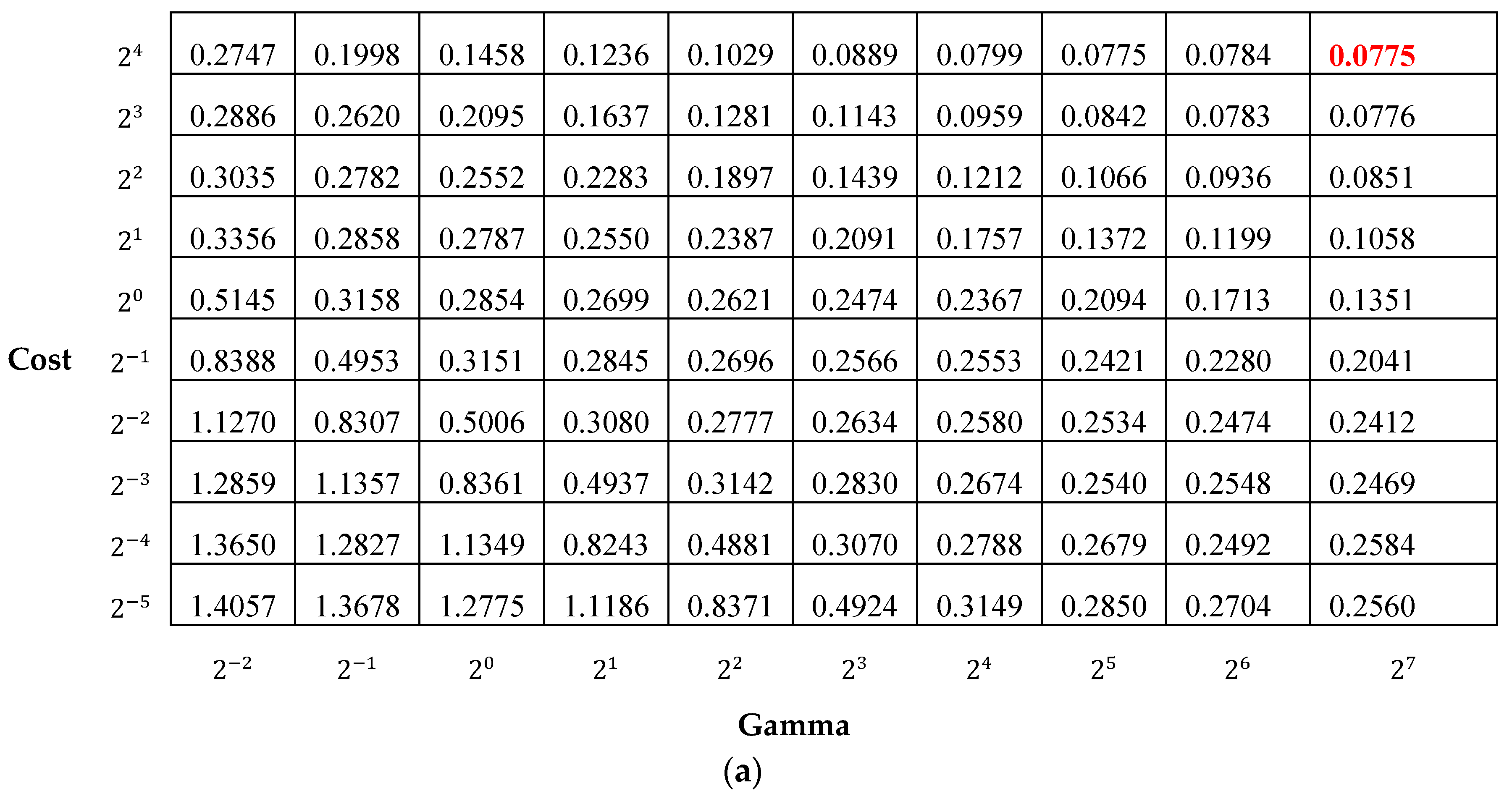
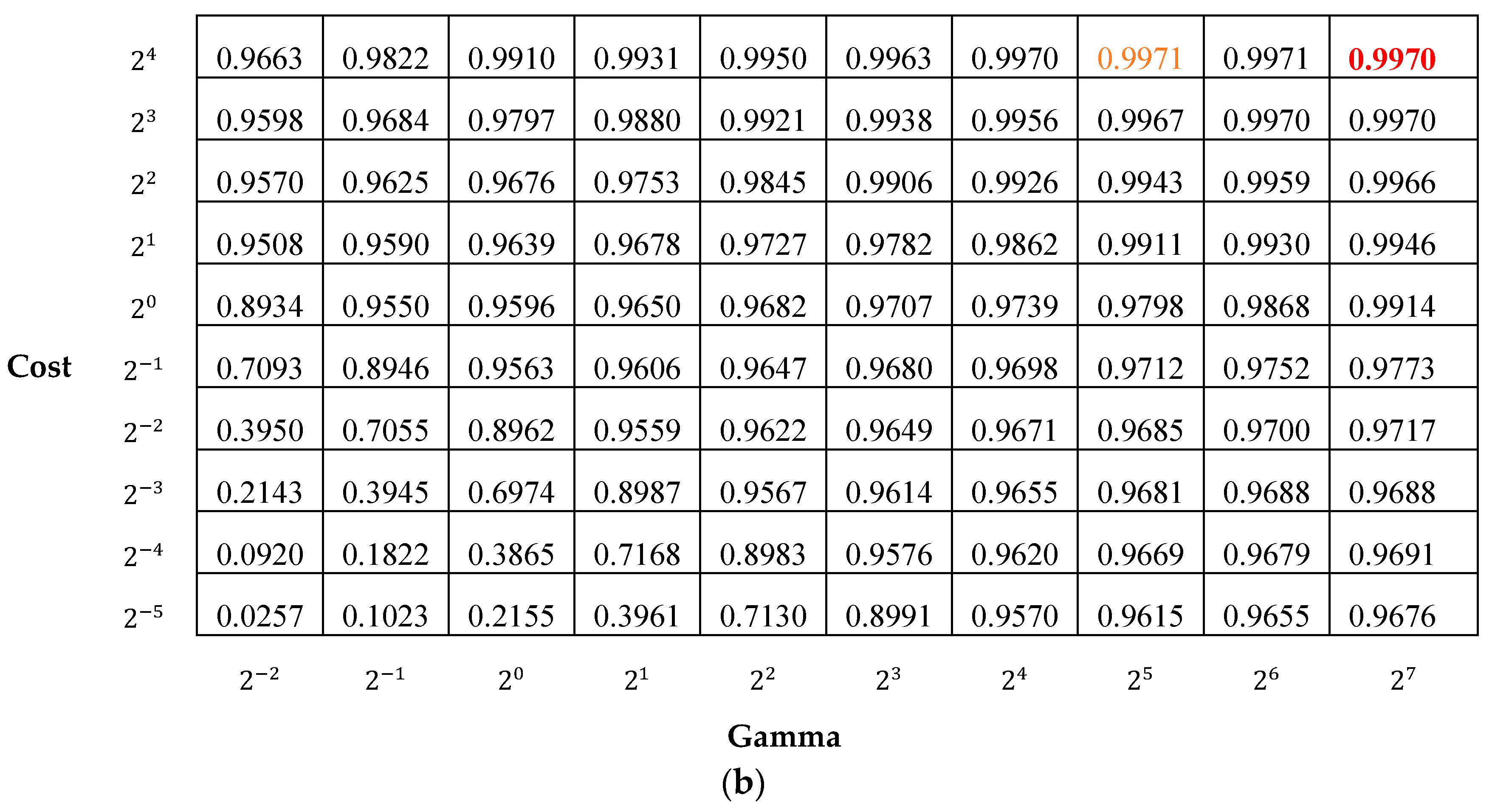
| SVM (Gamma and C) | 16 and 8 | 128 and 16 | 128 and 16 | 128 and 16 |
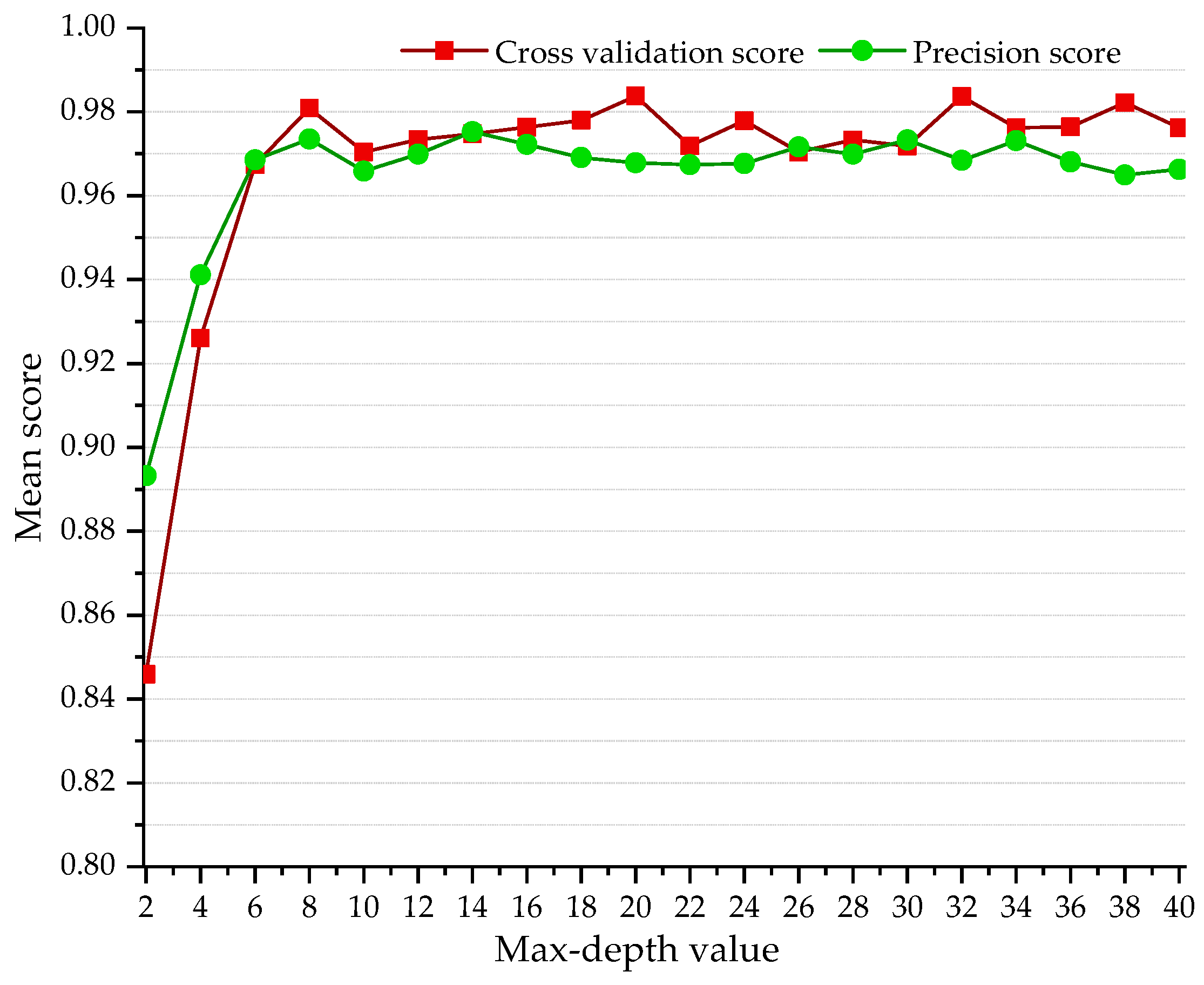
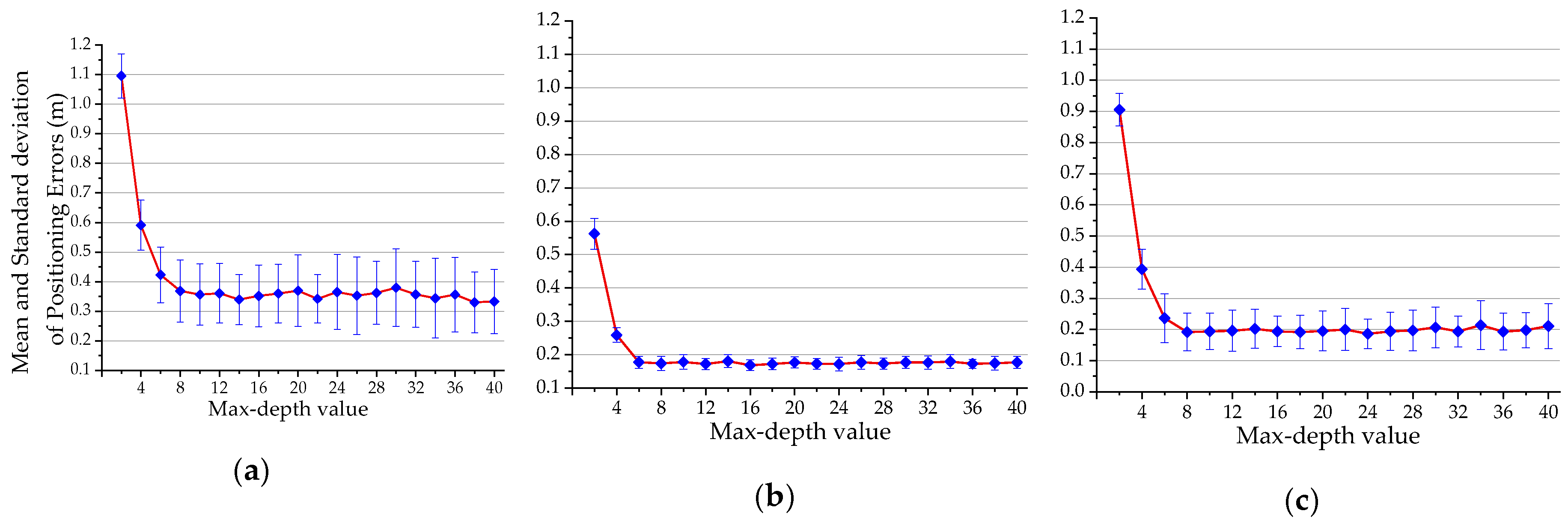
| DT (Max-depth) | 8 | 8 | 6 | 8 |
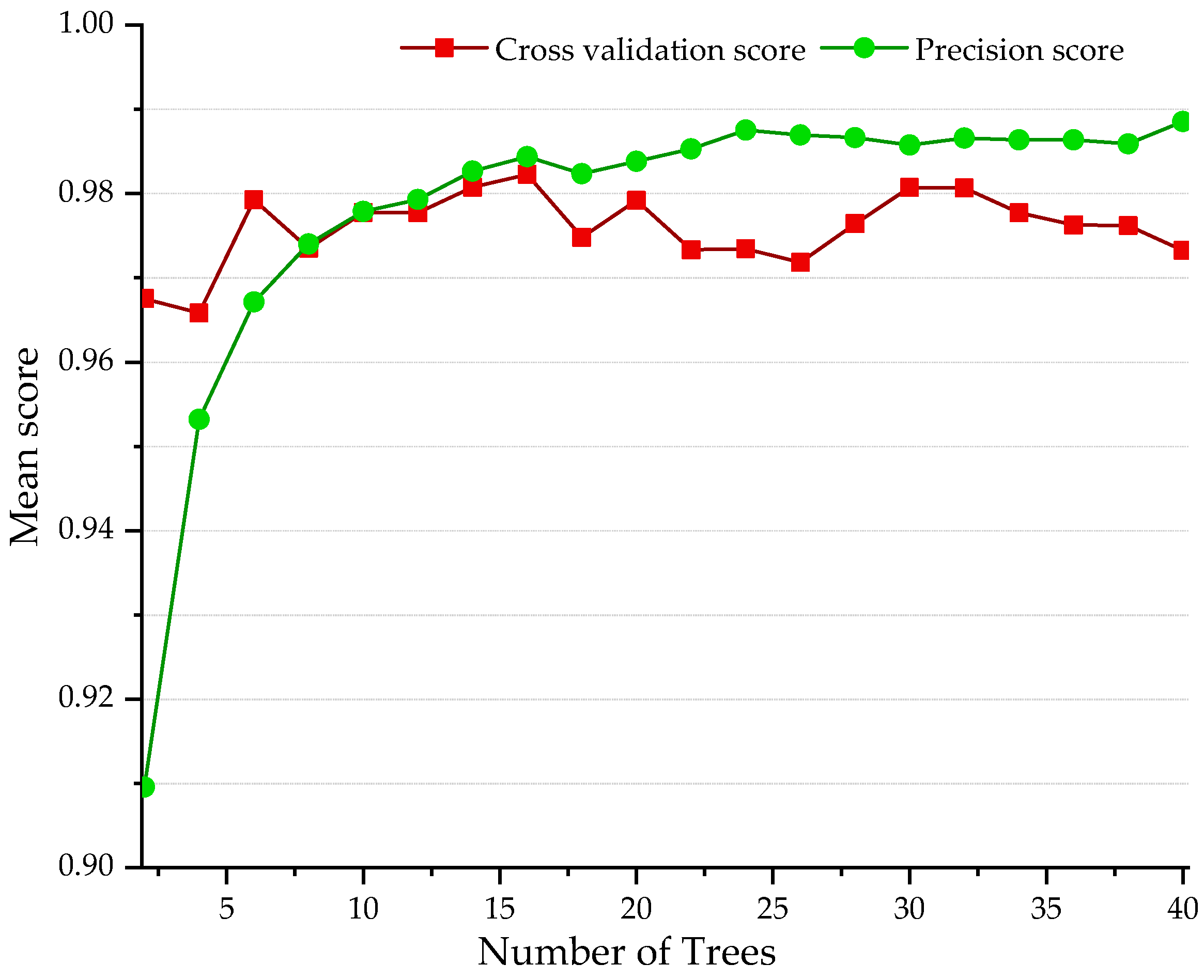
| RF (Tree) | 16 | 12 | 16 | 12 |
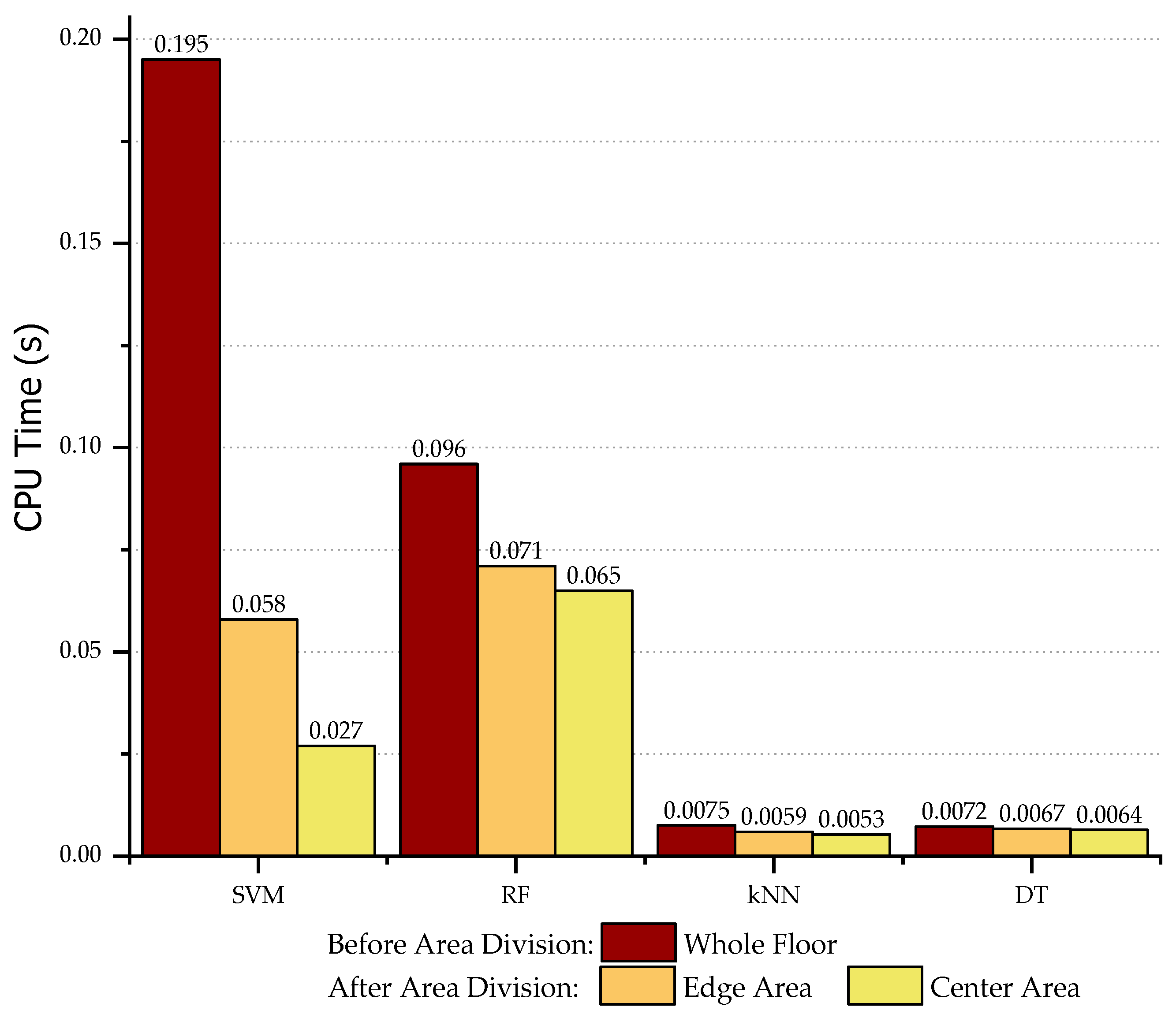
| Algorithms | Position of Data | Area Division Time | Location Prediction Time | TOTAL TIME |
|---|---|---|---|---|
| SVM | Whole floor | No classification | 195.00 | 195.00 |
| Center Area | 6.90 | 20.00 | 26.90 | |
| Edge Area | 6.90 | 51.00 | 57.90 | |
| RF | Whole floor | No classification | 96.00 | 96.00 |
| Center Area | 11.00 | 54.00 | 65.00 | |
| Edge Area | 11.00 | 60.00 | 71.00 | |
| kNN | Whole floor | No classification | 7.50 | 7.50 |
| Center Area | 0.59 | 4.70 | 5.29 | |
| Edge Area | 0.59 | 5.30 | 5.89 | |
| DT | Whole floor | No classification | 7.19 | 7.19 |
| Center Area | 1.10 | 5.31 | 6.41 | |
| Edge Area | 1.10 | 5.63 | 6.73 |
| Position of Data | SVM | RF | kNN | DT |
|---|---|---|---|---|
| Center | 86.21 | 32.29 | 29.47 | 10.85 |
| Edge | 70.31 | 26.04 | 21.47 | 6.40 |
| Average | 78.26 | 29.17 | 25.47 | 9.63 |
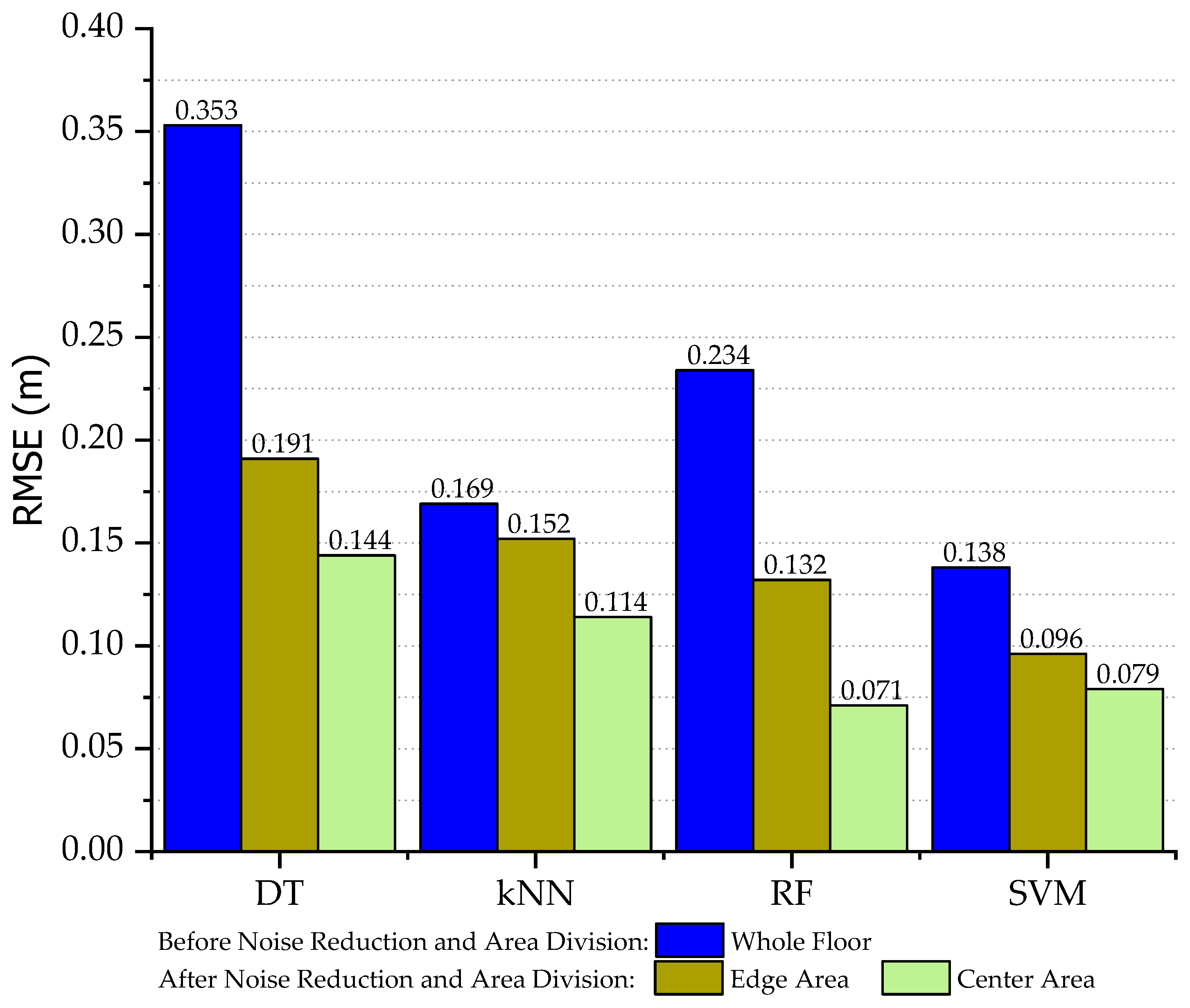
| Position of Data | DT | kNN | RF | SVM |
|---|---|---|---|---|
| Center | 59.21 | 32.54 | 46.18 | 42.75 |
| Edge | 45.89 | 10.06 | 28.90 | 30.43 |
| Average | 52.55 | 21.30 | 37.54 | 36.59 |
© 2019 by the authors. Licensee MDPI, Basel, Switzerland. This article is an open access article distributed under the terms and conditions of the Creative Commons Attribution (CC BY) license (http://creativecommons.org/licenses/by/4.0/).
Share and Cite
Tran, H.Q.; Ha, C. Improved Visible Light-Based Indoor Positioning System Using Machine Learning Classification and Regression. Appl. Sci. 2019, 9, 1048. https://doi.org/10.3390/app9061048
Tran HQ, Ha C. Improved Visible Light-Based Indoor Positioning System Using Machine Learning Classification and Regression. Applied Sciences. 2019; 9(6):1048. https://doi.org/10.3390/app9061048
Chicago/Turabian StyleTran, Huy Q., and Cheolkeun Ha. 2019. "Improved Visible Light-Based Indoor Positioning System Using Machine Learning Classification and Regression" Applied Sciences 9, no. 6: 1048. https://doi.org/10.3390/app9061048
APA StyleTran, H. Q., & Ha, C. (2019). Improved Visible Light-Based Indoor Positioning System Using Machine Learning Classification and Regression. Applied Sciences, 9(6), 1048. https://doi.org/10.3390/app9061048