You are currently viewing a new version of our website. To view the old version click .
Applied Sciences
  • Article
  • Open Access

18 November 2018

C-RAN Traffic Aggregation on Latency-Controlled Ethernet Links


,
,
,
and
1
Department of Electrical, Electronic, and Information Engineering (DEI), University of Bologna, 40136 Bologna, Italy
2
Transpacket AS, 0275 Oslo, Norway
*
Author to whom correspondence should be addressed.
This article belongs to the Special Issue Optical Communications and Networking Solutions for the Support of C-RAN in 5G Environments

Abstract

Centralized/Cloud Radio Access Networks (C-RAN) are deployed in converged fixed-mobile networks to exploit the flexibility coming from joint application of Network Function Virtualization (NFV) and Software Defined Networking (SDN). In this context, optical links connecting C-RAN nodes, possibly based on the Ethernet standards, may carry traffic with different requirements in terms of latency and throughput. This paper considers the problem of traffic aggregation on C-RAN optical Ethernet links with latency control for fronthaul traffic and throughput capability for backhaul traffic. Integrated hybrid network technique is applied to show how time transparency can be enforced for Ethernet encapsulated Common Public Radio Interface (CPRI) traffic while allowing statistical multiplexing of backhaul traffic. Simulation results show the effectiveness of segmentation of backhaul traffic to allow exploitation of the available bandwidth even with high capacity CPRI options.

1. Introduction

Centralized/Cloud Radio Access Network (C-RAN) is a promising technique enhancing mobile network performance and flexibility [1]. Improving survivability and power saving are the two main key designs in this architecture [2]. C-RAN is based on the splitting of functionalities which are possibly remotized for the purpose of centralization of the higher layer baseband processing related to multiple Remote Radio Heads (RRHs), by the introduction of the fronthaul network segment [3]. In addition, this approach takes significant advantage of Network Function Virtualization (NFV) and Software Defined Networking (SDN) control and management to add flexibility and adaptability to 5G transport networks [4] and to allow migration of functionalities over the nodes of C-RAN for optimization purposes.
In recent proposals [1], the highly demanding traffic, generated by the above functional splits, is carried together with packet-based backhaul (BH) traffic over a common optical infrastructure on different wavelength channels of the same fiber links [5]. This solution can be designed to meet the latency requirements of fronthaul (FH) traffic but may limit the system scalability and lead to low resource utilization with consequently high deployment costs. Hence, techniques for improving the optical channel utilization while meeting the strict performance requirements of FH traffic are needed and investigated in this paper. Ethernet-based links can be adopted to implement FH and standardization bodies are recently very active on the definition of the requirements to support FH traffic on this widely deployed interfaces. Delay requirements are identified as quite challenging, the Ethernet not being originally designed for delay-sensitive applications, such as fronthauling [6].
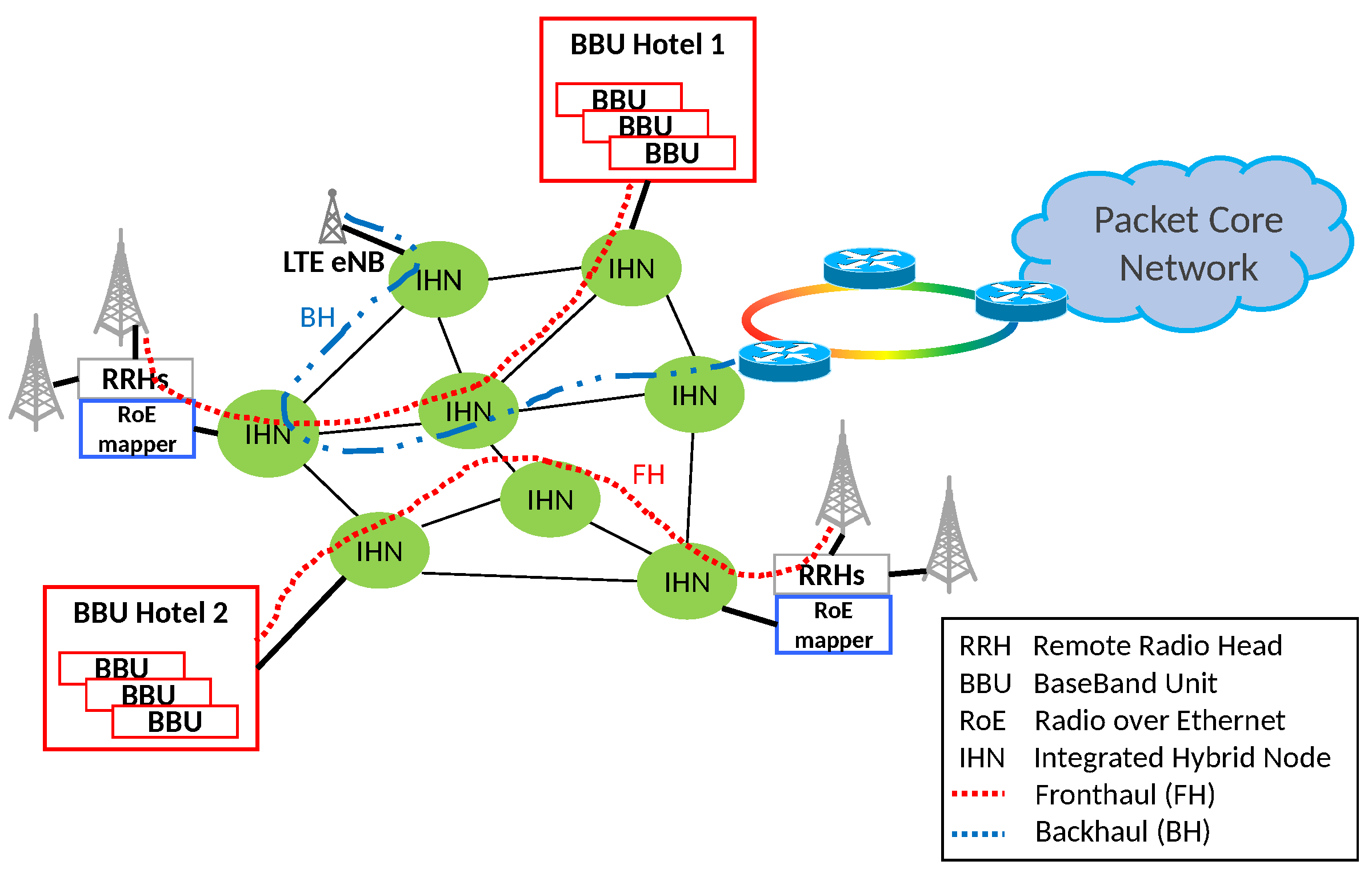
In this work, an integrated hybrid architecture, previously presented in [7], is reviewed and extended with pre-emption to be applied to the C-RAN optical transport network. An integrated Ethernet-based interface, where FH and BH traffic are multiplexed to achieve high utilization of the wavelength resources, is proposed and evaluated to meet the delay requirement of FH traffic, while offering throughput capability to BH traffic. A converged fronthaul/backhaul scenario, as depicted in Figure 1, is considered for evaluating the additional BH throughput that can be obtained as a consequence of the application of the mechanism to wavelength channels. In Figure 1, a sample C-RAN topology is shown where Integrated Hybrid Nodes (IHNs) are interconnected by optical links, possibly forming a mesh or other topologies. IHNs are assumed to be equipped with Ethernet interfaces, which ensure high backward compatibility and low cost. RRH are connected to IHNs which host baseband unit (BBU) functionalities. The set of BBUs available in an IHN form the BBU Hotel. These functionalities can be virtualized in a C-RAN and moved throughout the network to optimize the access service. The management of migration of virtual BBU functionalities is performed by the SDN control/management plane, not shown in the figure. As a consequence of different possible locations for BBU Hotels in IHNs, FH and BH traffic can be present on each link of the C-RAN. FH traffic is assumed according to the Common Public Radio Interface (CPRI) standard as encapsulated in Ethernet frames. The traffic characteristics of the CPRI traffic as generated by the different standardization options are taken into account and managed by a suitably extended integrated hybrid mechanism. As a consequence of the deterministic behavior of the encapsulated CPRI traffic, the benefits of introducing a segmentation policy on the BH traffic is also considered. Segmentation is the act of carving up BH traffic into smaller pieces so they can be inserted into the possible FH traffic gaps.
Figure 1. Converged fronthaul/backhaul scenario.
The paper is organized as follows: in Section 2, research in this context is described. In Section 3.1, the application of the integrated hybrid concept in C-RAN is described. Section 3.2 describes how to insert BH traffic in the FH stream while preserving time transparency. In Section 4, evaluation of the proposed architecture is presented. Section 4.1 highlights the achievements while conclusions and open aspects are drawn in Section 5.

3. Traffic Aggregation

The exponential increase in mobile users and enormous bandwidth requirement by mobile applications emphasize the need for introducing a solution to increase the throughput. Traffic aggregation is one of the well-established concepts in the networking context and, in this section, the aggregation technique and how C-RAN can benefit from it will be explained in detail.

3.1. Integrated Hybrid Optical Network in C-RAN

Figure 1 shows a sample network topology implementing the C-RAN. The BBU serving a RRH can be activated in different hotels for resource optimization, service continuity or energy efficiency, thus possibly requiring dynamic association between RRHs and BBUs. This dynamic association is thought to be managed by a suitable SDN control/management plane. Moreover, traditional base stations (e.g., LTE eNB) may also be present in the same area, requiring connection to the core network. As a consequence, both FH and BH traffic need to be transferred on each optical network segment. A solution to deploy such a scenario can be to assign dedicated wavelength channels to each kind of traffic, either FH or BH, so that FH links can be designed to meet strict delay requirements and BH traffic is statistically multiplexed on separated channels. FH delay requirement comes from the 3 milliseconds budget for round trip time in Hybrid Automatic Repeat Request (HARQ). This budget includes the RRH and BBU processing, which leaves only 100–200 microseconds for fronthaul one-way propagation delay. In addition, CPRI has one-way jitter requirement of few nanoseconds.
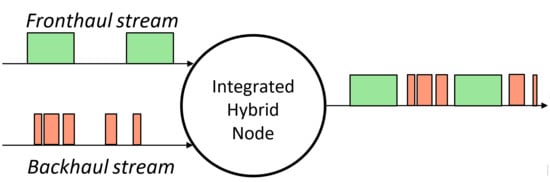
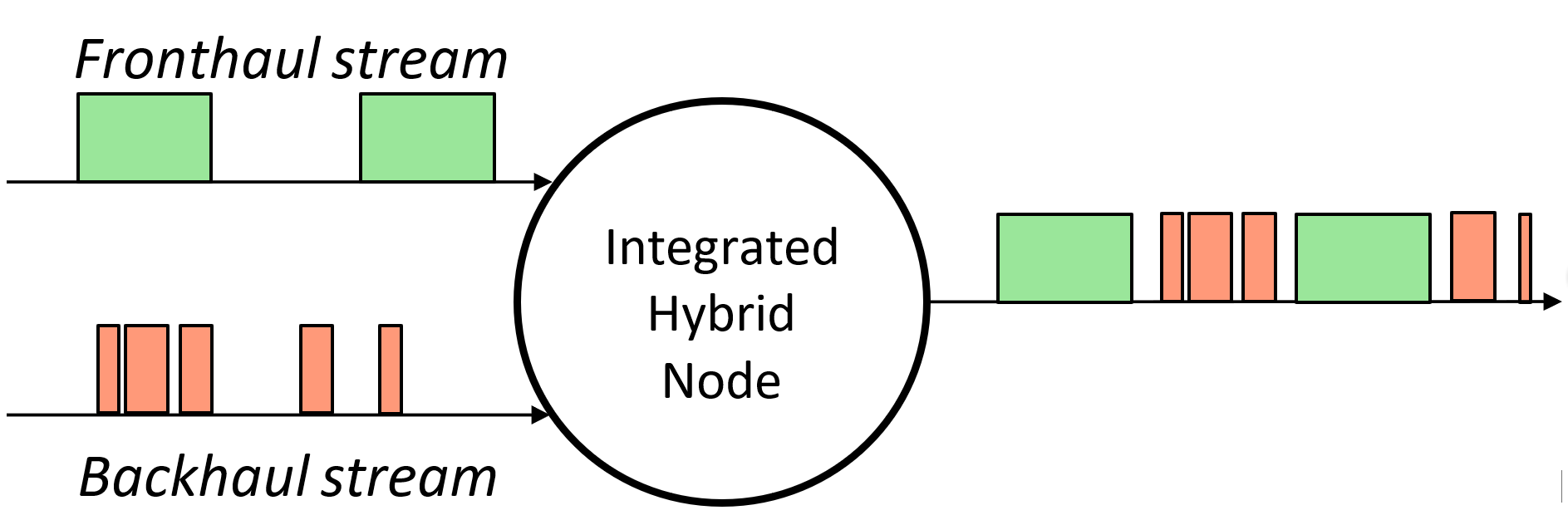
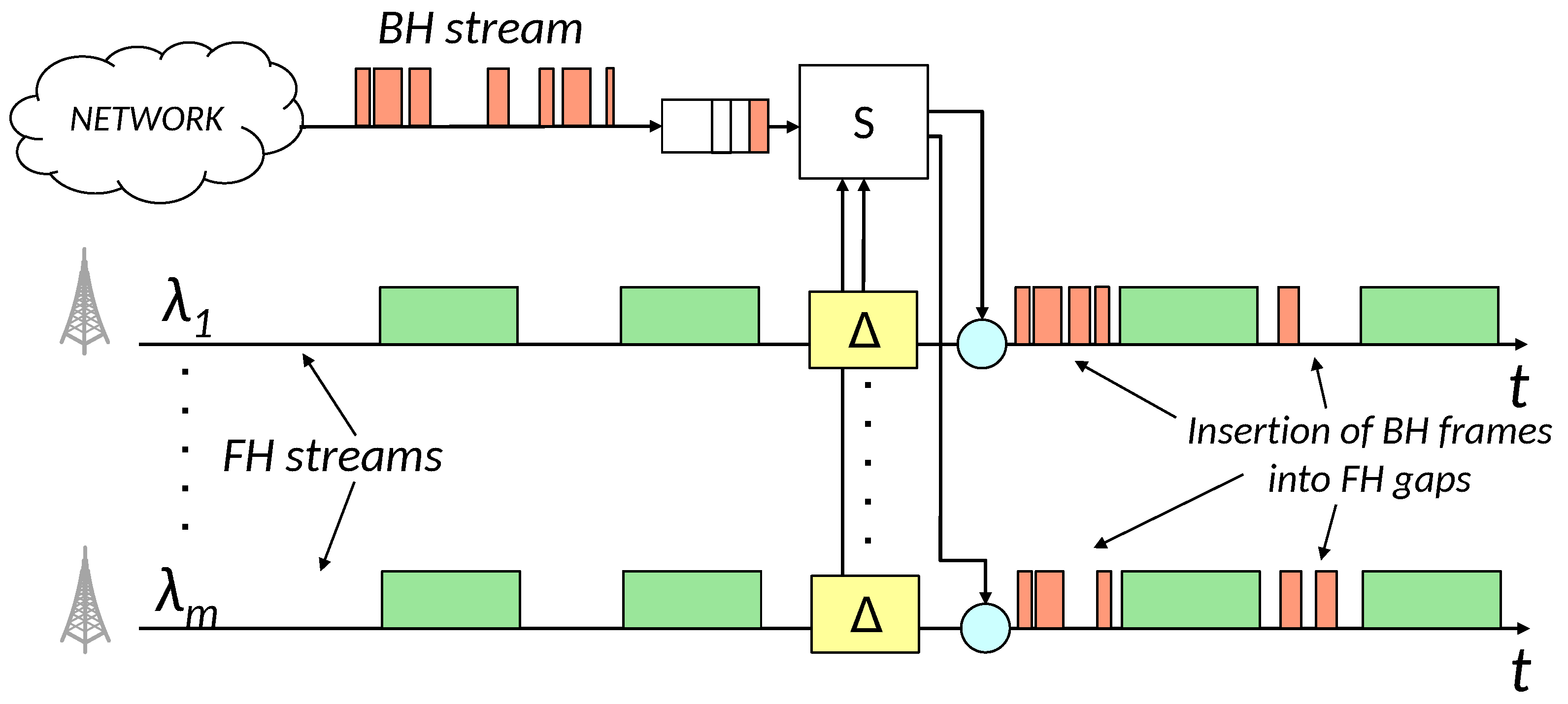
The integrated hybrid multiplexing scheme IHON was firstly proposed to implement statistical multiplexing of the GST (Guaranteed Service Traffic) and SM (Statistical Multiplexed) in Ethernet packet-based nodes [7]. In IHON, a small fixed delay ( Δ ) is added to guaranteed traffic (GST) so that statistically multiplexed (SM) traffic can be inserted in GST gaps, with minimum delay and zero PDV (Figure 2), as it was experimentally proved in [18]. With the aim to minimize the delay of GST traffic, IHON can be extended to allow GST traffic pre-emption on SM traffic and the effectiveness of this mechanism was analyzed in [20].
Figure 2. Integrated Hybrid Node (IHN) multiplexing scheme.
Here, the integrated hybrid concept with pre-emption is applied to a network segment of a C-RAN where FH traffic, i.e., CPRI flow encapsulated in Ethernet frames [27], is identified as GST, with zero PDV, while BH traffic deals with pre-emption as SM traffic. During the transmission of a FH frame, incoming BH packets are stored in a buffer until an output channel is free. A scheduler (represented by the block S in Figure 2) senses the input channels to detect FH frames and is in charge of deciding when to start and interrupt the transmission of BH packets on the output channels. IHON eliminates PDV of the FH traffic because the fixed delay Δ enables a time-window which gives sufficient time for processing and decision of BH packet preemption. This goes beyond, e.g., the IEEE 802.1Qbu pre-emption [28] recommended in the IEEE 802.1CM standard [29] for FH, where FH packets may experience PDV corresponding to the service time of 155 Bytes anyway.

3.2. Mapping of CPRI Traffic in IHON

CPRIoE (Common Public Radio Interface over Ethernet) traffic characterization has been analyzed in [27,30]. A list of parameters used in this study is reported in Table 1, while an example of the IHN output line is provided in Figure 3. RRHs generate CPRI flows at different rates ( R C P R I ) set by the standard [21]. Each flow is composed of CPRI basic frames with fixed duration T C P R I = 260 ns, equal for all CPRI options. A certain number of CPRI basic frames ( N F ) are encapsulated in an Ethernet frame forming the CPRIoE payload of length:
L F = N F * R C P R I * T C P R I .
Table 1. List of parameters used to describe CPRI over Ethernet (CPRIoE) and hybrid nodes.
Figure 3. CPRI over Ethernet (CPRIoE) parameters applied to hybrid node.
CPRIoE frames are then sent by RRHs towards IHON switches, where they are delayed by Δ . In addition, conventional BH traffic reaches the switches, loading the output channels with parameter ρ B . In order to avoid collision between different frames on the output line, a guard time T g u a r d is applied during which the transmission of any data is not permitted. IHON switches have m output channels, each characterized by a rate R W , and accommodates CPRIoE frames of duration:
T G = L H + L F R W ,
where L H is the header of CPRIoE frames assumed to be 44 Bytes [27].
Depending on N F and R C P R I , the gap duration T G A P is selected according to:
T G A P = L F R C P R I - T G .
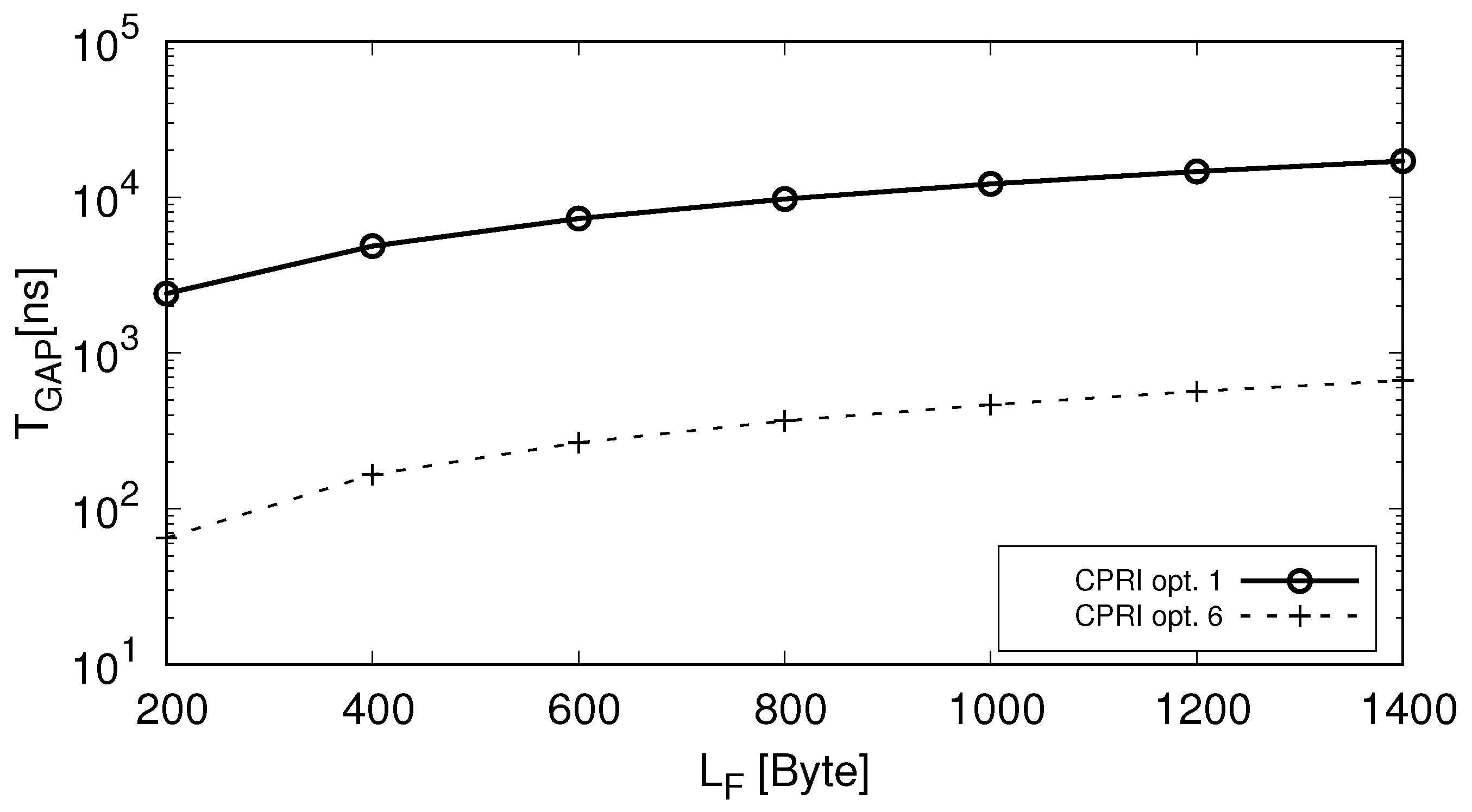
By looking at Formula (3), it is possible to notice that, depending on R C P R I , different values for T G A P can be obtained for the same length of CPRIoE packets L F . An example of T G A P using CPRI opt. 1 and 6 for a line rate of R W = 10 Gbps is depicted in Figure 4.
Figure 4. T G A P as a function of different values of payload length L F for CPRI opt. 1 and 6 on a 10 Gbps line.
This time gap is used in the hybrid multiplexing scheme in order to aggregate BH traffic on the same transport channel. To this end, two different policies are considered here:
  • A BH packet is transmitted when a gap is available and it is possibly pre-empted upon arrival of a new GST burst, in case BH packet duration is longer than the gap itself. In case of pre-emption, the BH packet is lost. This policy is indicated as P policy, with insertion of an entire packet into the by-pass GST flow.
  • A BH packet waits for a gap and, in case the BH packet is longer than the gap, it splits into segments that are transmitted by as many gaps as needed. This avoids the need of pre-emption but introduces some overhead to manage segmentation and additional functionalities. This policy is indicated as S policy, where packets are divided into N S segments of suitable size for their insertion into the GST flow.

4. Numerical Results

To evaluate the benefits introduced by the proposed mechanism, an event-driven simulator in C++ language has been developed. One RRH generates a CPRI flow according to two different options with rates R C P R I = 614 . 4 Mbps (option 1) and 6.144 Gbps (option 6). The IHON fixed delay Δ = 99.2 ns is assumed, which corresponds to the smallest segment (124 Byte) that can be preempted [29]. A time guard of 10 ns between frames is applied. A single output channel ( m = 1 ) with rate R W = 10 Gbps is considered. The number of CPRI basic frames in a guaranteed burst N F is varied over the intervals [ 1 , 70 ] and [ 1 , 7 ] , for CPRI option 1 and 6, respectively [27], so that the payload length L F varies accordingly. A set of simulations varying the average BH packet length L B is obtained with a load ρ B such that a BH packet is always ready for transmission on the output channel. The length of BH frames is considered to be exponentially distributed with parameter L B .
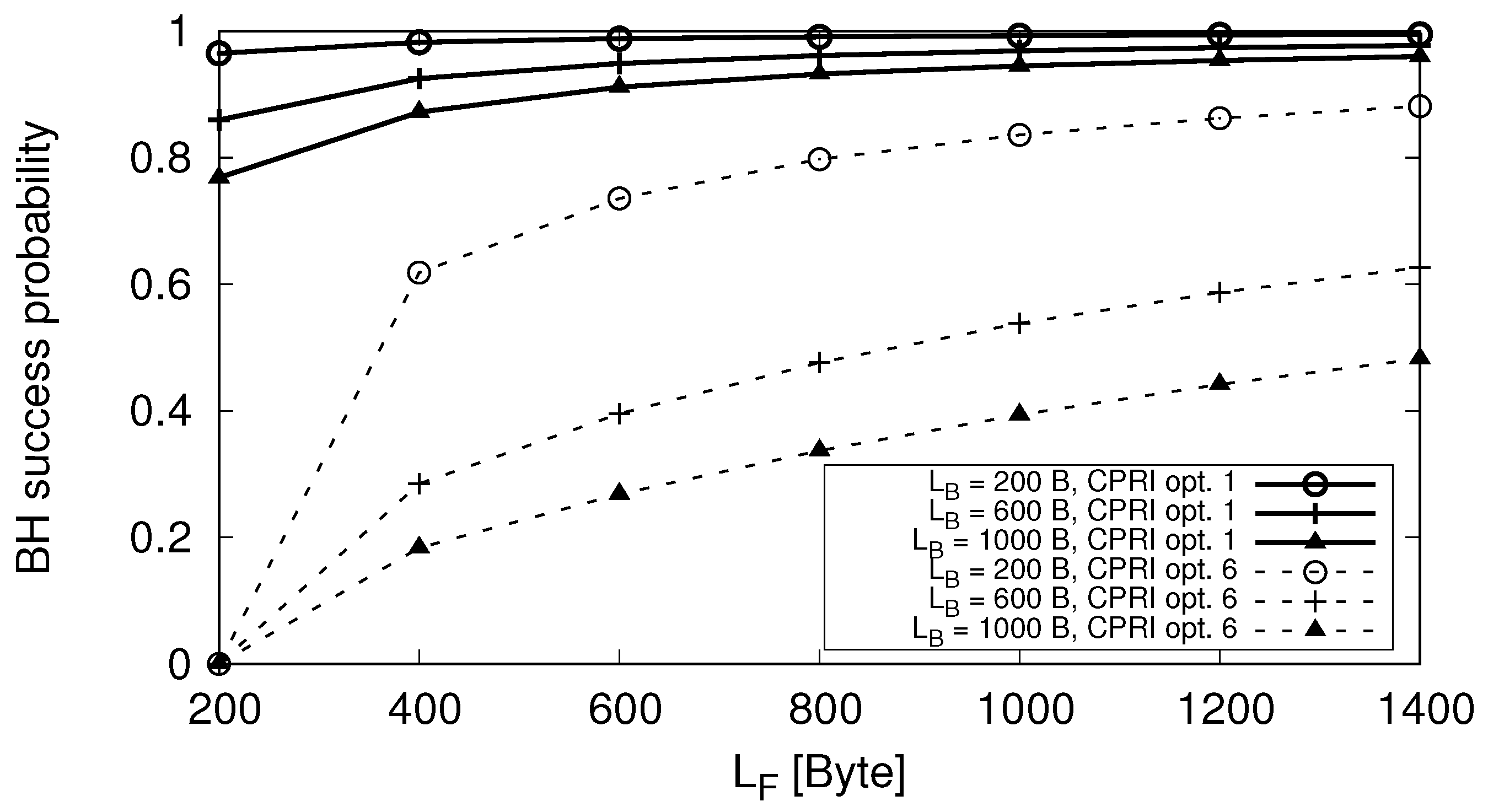
Figure 5 shows the success probability of the BH traffic, defined as the ratio between the packets not interrupted and the total packets in service, as a function of L F , for both CPRI options, varying L B . In both cases, the success probability increases with L F , due to the resulting larger T g a p . Option 6 shows lower performance than option 1 due to the smaller size of the gap, especially when L F is low, thus suggesting to use larger N F in this case. However, increasing N F increases the encapsulation delay, which may impact the maximum reach of the FH connection.
Figure 5. Backhaul (BH) success probability as a function of payload length L F for different BH packet length L B using CPRI opt. 1 and 6 without segmentation.
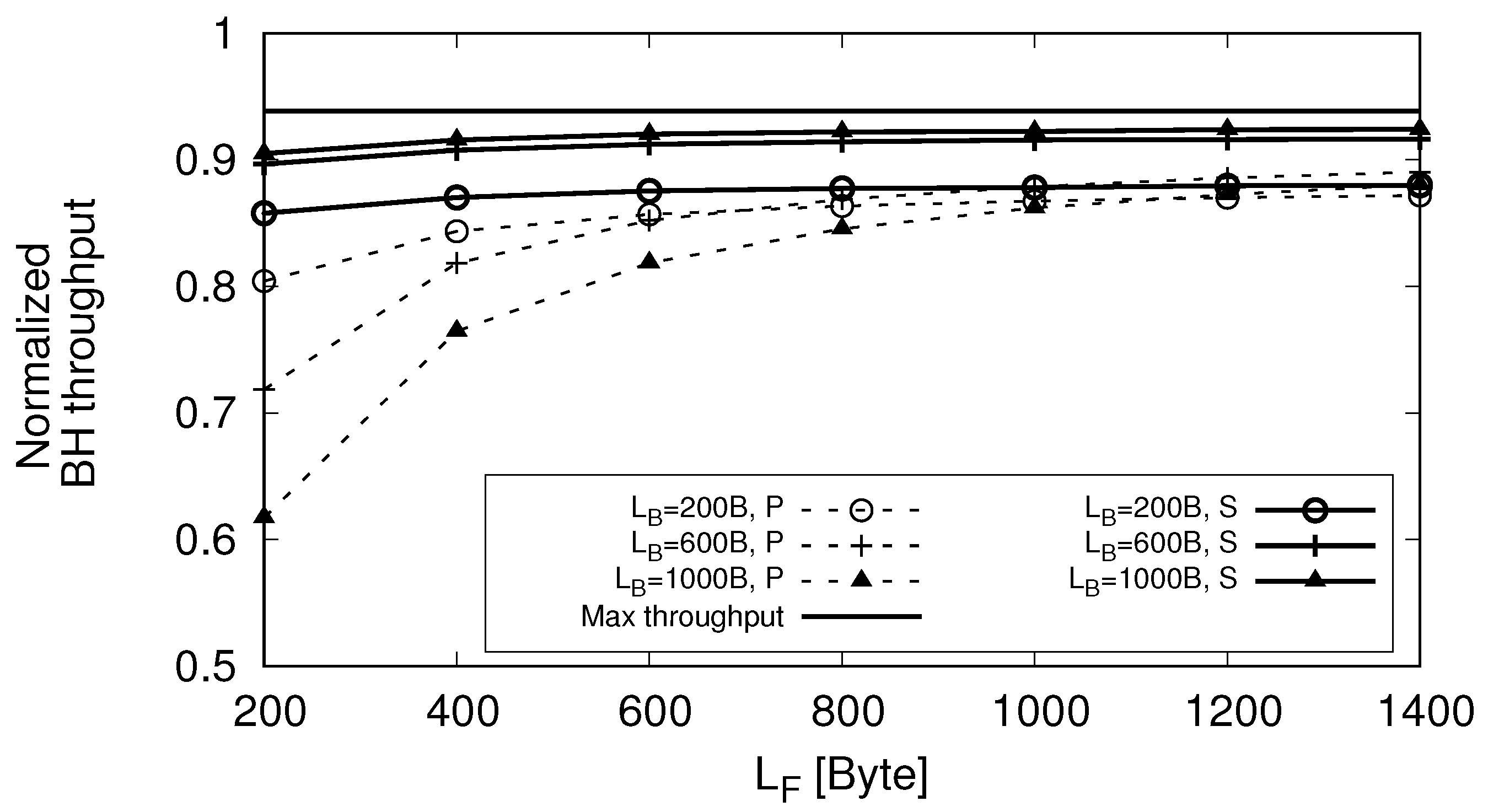
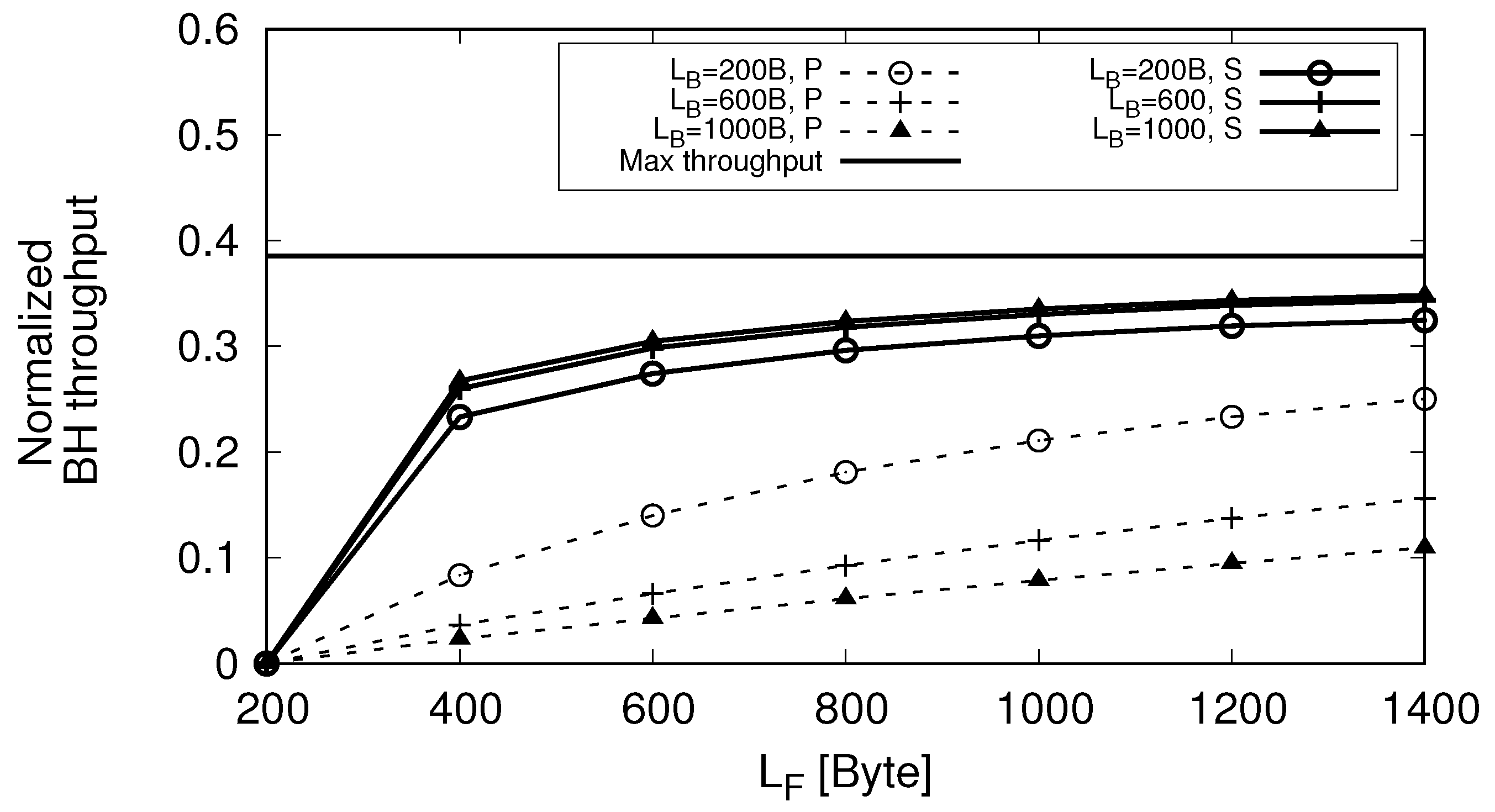
Figure 6 reports the BH throughput, normalized to the output line rate (10 Gbps), as a function of L F for option 1 varying L B . The figure also reports the maximum normalized capacity left by FH traffic. The value of throughput in the case of the P policy reaches 8.9 Gbps only for high values of L F with quite a limited influence of L B . The S policy, instead, is able to better exploit the available capacity for any value of L F , except for the influence of the transmission guard times inserted. The same evaluation obtained for option 6 in Figure 7 shows a remarkable effect of the shorter gaps in the FH flow, which also prevents the F policy to fully exploit the available capacity for low values of L F , due to the high numbers of segments needed and related inserted transmission guard time.
Figure 6. Backhaul (BH) throughput, normalized to the output link capacity, as a function of payload length L F for different BH packet length L B using CPRI opt. 1. Solid lines for the case with segmentation (S), dashed lines for the no-segmentation case (P). Maximum normalized capacity by fronthaul (FH) is shown by a solid line.
Figure 7. Backhaul (BH) throughput, normalized to the output link capacity, as a function of payload length L F for different BH packet length L B using CPRI opt. 6. Solid lines for the case with segmentation (S), dashed lines for the no-segmentation case (P). Maximum normalized capacity by fronthaul (FH) is shown by a solid line.
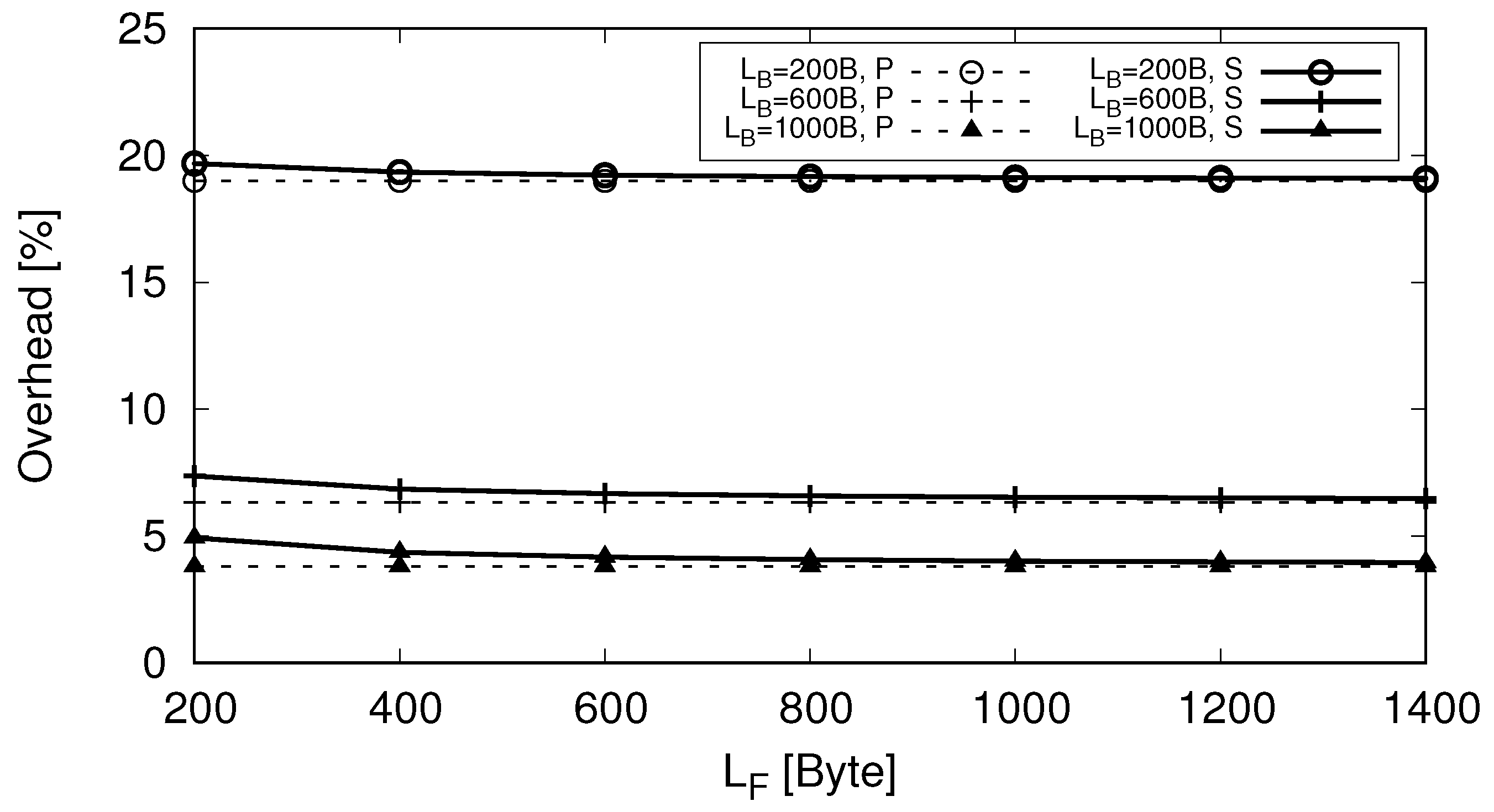
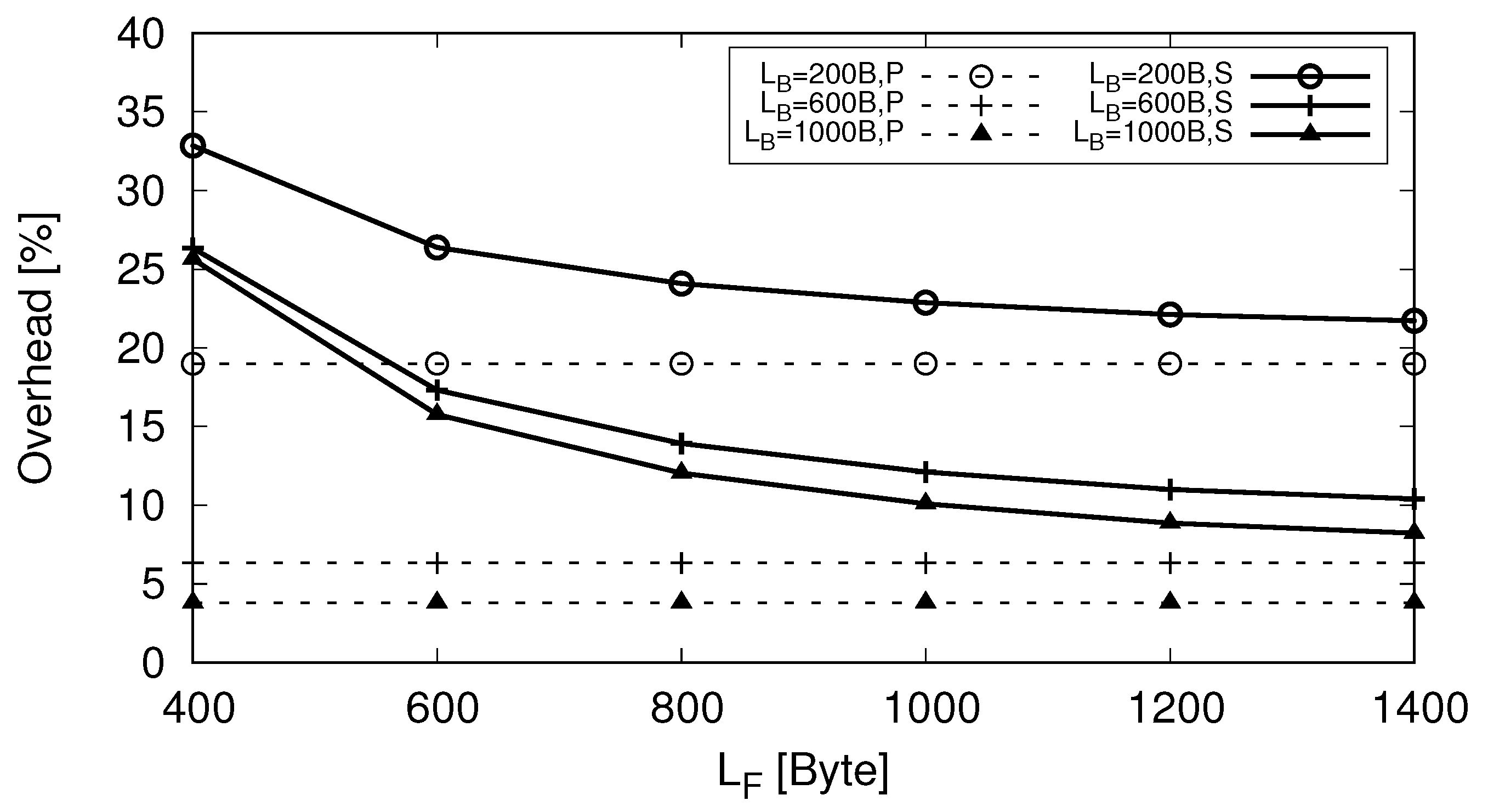
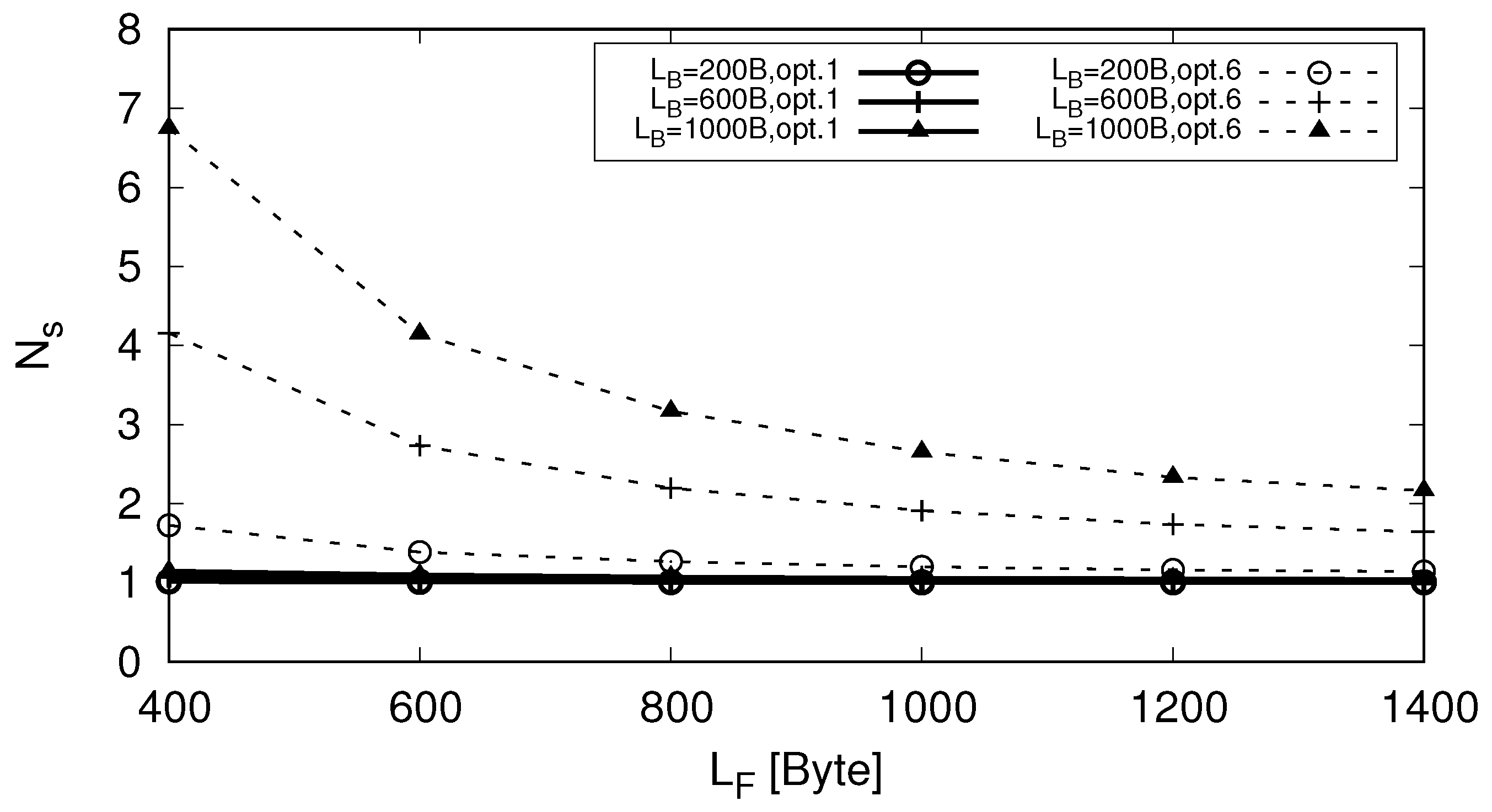
Figure 8 reports the overhead introduced by the P and S policies calculated as the ratio of the number of bytes for Ethernet headers and the the total number of bytes transmitted as BH traffic for option 1. The same evaluation is presented in Figure 9 for option 6. The effect of the S policy is more evident with option 6 where, due to the smaller gaps in the FH flow, multiple segments are typically required to transmit each BH packet. In any case, the additional overhead is quite limited when increasing L F . It is interesting to analyze the average number of segments to transmit a BH packet in option 1 and option 6, as shown in Figure 10 for the S policy. Option 1 allows transmission of a packet as a single segment in most cases for any L F . In option 6, instead, reasonable values of L F seem to be not less than 1000 bytes which give an average number of segments less than 3 for any L B , with a resulting overhead around 10%, which is reasonable as well. However, working with high L F increases the encapsulation delay, which in the worst case is 18.3 μ s for CPRI option 1 and 1.83 μ s for CPRI option 6.
Figure 8. Overhead for backhaul (BH) packets as a function of payload length L F for different BH packet length L B using CPRI opt. 1. Solid lines for the case with segmentation (S), dashed lines for the no-segmentation case (P).
Figure 9. Overhead for backhaul (BH) packets as a function of payload length L F for different BH packet length L B using CPRI opt. 6. Solid lines for the case with segmentation (S), dashed lines for the no-segmentation case (P).
Figure 10. Average number of segments ( N S ) required to send a backhaul (BH) packet as a function of payload length L F for different BH packet length L B using CPRI opt. 1 and 6.

4.1. Evaluation Achievements

The results obtained have shown that the IHON mechanism can support FH and BH traffic multiplexing on the same wavelength channel while guaranteeing time transaparency for FH. BH packet transmission probability increases with the payload length L F of the CPRI frame but results are quite limited with option 6 if no segmentation is applied. Further comparisons show, instead, that the throughput, normalized to line rate, can reach almost the full residual capacity utilization with segmentation, at the cost of some additional overhead, especially for option 6, which requires more segments to fill the smaller gaps.

5. Conclusions

In this paper, the feasibility of the integrated hybrid network concept with pre-emption has been applied to C-RAN. FH traffic with time transparency, generated according to a CPRI standard, has been aggregated with pre-emptable BH traffic within the same optical Ethernet channel. Performance evaluations have been presented for different CPRI options, related to the amount of BH traffic which takes advantage of unused FH capacity. Scheduling BH packets transmission is first performed when gaps in the FH traffic are of suitable size as provided by the IHON mechanism. With this assumption, remarkable BH throughput is shown especially for CPRI option 1. CPRI option 6, instead, limits BH throughput because of the smaller packet gaps in the FH traffic that makes the fitting of the BH traffic sometimes even not possible. For this reason, segmentation of backhaul packets has been introduced and analyzed, showing a remarkable improvement in BH throughput performance. The mechanism has been shown to enhance the basic performance of an Ethernet switch by guaranteed time-transparent aggregation of fronthaul traffic with efficient transfer of backhaul traffic. The introduction of such equipment in the 5G transport network will allow compatibility with the widely deployed Ethernet standard while enhancing significantly the scalability and the flexibility of the C-RAN optical infrastructure. This research can be further developed to include the introduction of delay bounded mechanisms to better adapt BH traffic to the unused bandwidth in the FH flow.

Author Contributions

C.R. has supervised and written the paper. F.T. has developed the simulator in C++ and obtained results and contributed to paper writing. B.M.K. has contributed to writing the paper, plotting figures and discussing results. R.V. and S.B. have reviewed the paper.

Funding

This research was partially funded by 5G-PICTURE supported by the European Horizon 2020 initiative.

Conflicts of Interest

The authors declare no conflict of interest.

References

  1. Checko, A.; Christiansen, H.L.; Yan, Y.; Scolari, L.; Kardaras, G.; Berger, M.S.; Dittmann, L. Cloud RAN for mobile networks—A technology overview. COMST IEEE Commun. Surv. Tutor. 2015, 17, 405–426. [Google Scholar] [CrossRef]
  2. Wong, E.; Grigoreva, G.; Wosinska, L.; Mas Machuca, C. Enhancing the survivability and power savings of 5G transport networks based on DWDM rings. JOCN IEEE/OSA J. Opt. Commun. Netw. 2017, 9, D74–D85. [Google Scholar] [CrossRef]
  3. Pizzinat, A.; Philippe, C.; Fabienne, S.; Thierno, D. Things you should know about fronthaul. JLT J. Lightw. Technol. 2015, 33, 1077–1083. [Google Scholar] [CrossRef]
  4. Rostami, A.; Ohlen, P.; Wang, K.; Ghebretensae, Z.; Skubic, B.; Santos, M.; Vidal, A. Orchestration of RAN and transport networks for 5G: An SDN approach. MCOM IEEE Commun. Mag. 2017, 55, 64–70. [Google Scholar] [CrossRef]
  5. Zhang, S.; Xia, M.; Dahlfort, S. Fiber routing, wavelength assignment and multiplexing for DWDM-centric converged metro/aggregation networks. In Proceedings of the 39th European Conference and Exhibition on Optical Communication (ECOC), London, UK, 22–26 September 2013. [Google Scholar]
  6. Bjomstad, S.; Chen, D.; Veisllari, R. Handling Delay in 5G Ethernet Mobile Fronthaul Networks. In Proceedings of the European Conference on Networks and Communications (EuCNC), Ljubljana, Slovenia, 23 August 2018. [Google Scholar]
  7. Bjornstad, S.; Hjelme, D.R.; Stol, N. A packet-switched hybrid optical network with service guarantees. JSAC IEEE J. Sel. Areas Commun. 2006, 24, 97–107. [Google Scholar] [CrossRef]
  8. Checko, A.; Avramova, A.P.; Berger, M.S.; Christiansen, H.L. Evaluating C-RAN fronthaul functional splits in terms of network level energy and cost savings. JCN J. Commun. Netw. 2016, 18, 162–172. [Google Scholar] [CrossRef]
  9. Musumeci, F.; Bellanzon, C.; Carapellese, N.; Tornatore, M.; Pattavina, A.; Gosselin, S. Optimal BBU placement for 5G C-RAN deployment over WDM aggregation networks. JLT IEEE/OSA J. Lightw. Technol. 2016, 34, 1963–1970. [Google Scholar] [CrossRef]
  10. Fiorani, M.; Rostami, A.; Wosinska, L.; Monti, P. Transport Abstraction Models for an SDN-Controlled Centralized RAN. LCOMM IEEE Commun. Lett. 2015, 19, 1406–1409. [Google Scholar] [CrossRef]
  11. Chih-Lin, I.; Li, H.; Korhonen, J.; Huang, J.; Han, L. RAN Revolution with NGFI (xHaul) for 5G. JLT J. Lightw. Technol. 2018, 36, 541–550. [Google Scholar] [CrossRef]
  12. Pfeiffer, T. Next generation mobile fronthaul and midhaul architectures. JOCN J. Opt. Commun. Netw. 2015, 7, B38–B45. [Google Scholar] [CrossRef]
  13. Wollschlaeger, M.; Sauter, T.; Jasperneite, J. The future of industrial communication: Automation networks in the era of the internet of things and industry 4.0. IEEE Ind. Electron. Mag. 2017, 11, 17–27. [Google Scholar] [CrossRef]
  14. Bedi, G.; Venayagamoorthy, G.K.; Singh, R.; Brooks, R.R.; Wang, K.C. Review of Internet of Things (IoT) in Electric Power and Energy Systems. IEEE Internet Things J. 2018, 5, 847–870. [Google Scholar] [CrossRef]
  15. Eramo, V.; Listanti, M.; Lavacca, F.G.; Iovanna, P. Dimensioning Models of Optical WDM Rings in Xhaul Access Architectures for the Transport of Ethernet/CPRI Traffic. Appl. Sci. 2018, 8, 612. [Google Scholar] [CrossRef]
  16. Miyamoto, K.; Kuwano, S.; Shimizu, T.; Terada, J.; Otaka, A. Performance evaluation of Ethernet-based mobile fronthaul and wireless CoMP in split-PHY processing. JOCN IEEE/OSA J. Opt. Commun. Netw. 2017, 9, A46–A54. [Google Scholar] [CrossRef]
  17. Assimakopoulos, P.; Al-Hares, M.K.; Gomes, N.J. Switched Ethernet fronthaul architecture for cloud-radio access network. JOCN IEEE/OSA J. Opt. Commun. Netw. 2016, 8, B135–B146. [Google Scholar] [CrossRef]
  18. Veisllari, R.; Bjornstad, S.; Braute, J.P.; Bozorgebrahimi, K.; Raffaelli, C. Field-trial demonstration of cost efficient sub-wavelength service through integrated packet/circuit hybrid network. JOCN J. Opt. Commun. Netw. 2015, 7, A379–A387. [Google Scholar] [CrossRef]
  19. Veisllari, R.; Bjornstad, S.; Braute, J. Experimental Demonstration of 100 Gb/s Optical Packet Network for Mobile Fronthaul with Load-independent Ultra-low Latency. In Proceedings of the European Conference on Optical Communication (ECOC), Gothenburg, Sweden, 17–21 September 2017. [Google Scholar]
  20. Cerroni, W.; Raffaelli, C. Analytical model of quality of service scheduling for optical aggregation in data centers. Photonic Netw. Commun. 2014, 28, 264–275. [Google Scholar] [CrossRef]
  21. CPRI & eCPRI Group. CPRI Specification V7.0; Common Public Radio Interface (CPRI): Interface Specification. Available online: http://www.cpri.info/ (accessed on 16 November 2018).
  22. 3GPP Working Group 3. Study on new radio access technology: Radio access architecture and interfaces, Release 14; Technical Report 38.801. Available online: https://portal.3gpp.org/desktopmodules/Specifications/SpecificationDetails.aspx?specificationId=3056 (accessed on 16 November 2018).
  23. Valcarenghi, L.; Kondepu, K.; Castoldi, P. Analytical and experimental evaluation of CPRI over Ethernet dynamic rate reconfiguration. In Proceedings of the International Conference on Communications (ICC), Kuala Lumpur, Malaysia, 22–27 May 2016. [Google Scholar]
  24. Assimakopoulos, P.; Zou, J.; Habel, K.; Elbers, J.P.; Jungnickel, V.; Gomes, N.J. Converged Evolved Ethernet Fronthaul for the 5G Era. JSAC IEEE J. Sel. Areas Commun. 2018. [Google Scholar] [CrossRef]
  25. Veisllari, R.; Bjornstad, S.; Braute, J.P. Experimental Demonstration of 100 Gb/s Optical Network Transport and Aggregation for Ethernet Fronthaul with Low and Bounded Delay. In Proceedings of the Optical Fiber Communications Conference and Exposition (OFC), San Diego, CA, USA, 11–15 March 2018. [Google Scholar]
  26. Tonini, F.; Raffaelli, C.; Khorsandi, B.M.; Bjornstad, S.; Veisllari, R. Converged Fronthaul/Backhaul based on Integrated Hybrid Optical Networks. In Proceedings of the Asia Communications and Photonics Conference (ACP), Hangzhou, China, 26–29 October 2018. [Google Scholar]
  27. Chitimalla, D.; Kondepu, K.; Valcarenghi, L.; Tornatore, M.; Mukherjee, B. 5G fronthaul-latency and jitter studies of CPRI over Ethernet. JOCN IEEE/OSA J. Opt. Commun. Netw. 2017, 9, 172–182. [Google Scholar] [CrossRef]
  28. IEEE Standard 802.1Qbu, Frame Preemption. Available online: http://www.ieee802.org/1/pages/ 802.1bu.html (accessed on 16 November 2018).
  29. IEEE Standard P802.1CM, Time-Sensitive Networking for Fronthaul. Available online: http://www. ieee802.org/1/pages/802.1cm.html (accessed on 16 November 2018).
  30. Valcarenghi, L.; Kondepu, K.; Castoldi, P. Time-versus size-based CPRI in ethernet encapsulation for next generation reconfigurable fronthaul. JOCN IEEE/OSA J. Opt. Commun. Netw. 2017, 9, D64–D73. [Google Scholar] [CrossRef]
Article Metrics

Citations

Article Access Statistics

Multiple requests from the same IP address are counted as one view.