1. Introduction
Rapid urbanization and the increasing demand for efficient land use have led to the rapid expansion of underground infrastructures, including subway stations, underground commercial complexes, and multi-level transportation hubs. These underground spaces accommodate a large number of occupants within confined and complex environments, often characterized by limited exits, long evacuation paths, and intricate vertical connections. When disasters such as fires, flooding, structural damage, or crowd crush incidents occur in these environments, evacuation becomes significantly more challenging compared to aboveground structures due to restricted visibility, reduced ventilation, and constrained movement capacity. Historical incidents in underground transportation systems have repeatedly demonstrated that such conditions can lead to severe casualties and large-scale disruptions. Consequently, accurately predicting evacuation performance and establishing effective evacuation strategies in underground spaces have become critical research topics in disaster risk management. In particular, evacuation models have been widely developed to evaluate evacuation time, congestion, and route efficiency under various hazard scenarios. However, evacuation performance is not solely determined by the physical layout or path length; it is also strongly influenced by how evacuation guidance is provided and how occupants respond to that guidance. In real-world situations, evacuation is typically controlled through centralized systems, announcements, and operator decisions, and errors in these processes—such as incorrect route guidance, delayed evacuation instructions, or misjudgment of hazard conditions—can significantly deteriorate evacuation efficiency. Therefore, human error in evacuation guidance systems should be recognized as a critical factor affecting evacuation performance in underground infrastructures.
Previous studies have extensively investigated evacuation modeling and route optimization in underground and confined spaces. Dijkstra [
1] proposed a graph-based shortest path algorithm that guarantees optimal solutions, while Hart et al. [
2] introduced the A* algorithm to improve computational efficiency by incorporating heuristic functions. Building upon these foundational approaches, various studies have applied pathfinding algorithms to evacuation problems and demonstrated their effectiveness in complex environments. For example, Pillac et al. [
3] developed a conflict-based path generation heuristic for large-scale evacuation planning, and Bi and Gelenbe [
4] reviewed evacuation algorithms for confined spaces, highlighting the importance of system-level optimization. In addition, Lim et al. [
5] proposed a network flow-based evacuation model integrating shortest path and maximum flow concepts, while Shahabi and Wilson [
6] addressed scalable evacuation routing under dynamic conditions. Numerous studies have further extended evacuation modeling to account for congestion, behavioral dynamics, and real-time environmental changes [
7,
8,
9,
10], demonstrating that evacuation performance is significantly influenced by both network characteristics and dynamic interactions among evacuees. In particular, Choi et al. [
11] developed a real-time crowd density simulation system to prevent crush incidents, and Tong and Bode [
12] analyzed evacuation strategies for vulnerable pedestrians under varying conditions. More recently, Haam et al. [
13] evaluated the effectiveness of additional evacuation routes in deep underground stations considering congestion effects, and Kim et al. [
14] compared Dijkstra and A* algorithms under static and dynamic conditions, reporting that algorithm performance may vary significantly when real-time congestion and hazard propagation are considered. In addition to algorithmic and structural approaches, several studies have emphasized the importance of human factors in evacuation. Senanayake et al. [
15] reviewed agent-based evacuation models and highlighted the role of behavioral dynamics, while Lopez-Carmona and Paricio Garcia [
16] proposed an adaptive guidance system that dynamically adjusts evacuation routes based on real-time conditions. Furthermore, Liu et al. [
17] developed a behavior-driven evacuation framework incorporating perception and decision-making processes, and Sun et al. [
18] analyzed collective evacuation behavior considering leadership and cooperation. These studies collectively indicate that evacuation performance is influenced not only by optimal pathfinding but also by human behavior and decision-making processes, particularly in complex underground environments. In addition, human error in evacuation can arise from incorrect perception, delayed decision-making, and misinterpretation of information, which significantly affect evacuation performance. Previous studies have investigated human decision-making processes and behavioral responses under emergency conditions. For example, Kuligowski [
19] analyzed human behavior and decision-making during building evacuations, while Lovreglio et al. [
20] proposed a model describing the decision-making process under emergency conditions. However, these studies primarily focus on general behavioral modeling rather than explicitly quantifying the impact of human error in evacuation guidance systems.
Despite these advancements, most existing studies have primarily focused on optimizing evacuation routes, modeling hazard propagation, or incorporating crowd dynamics, while relatively limited attention has been given to the direct impact of human error in evacuation guidance systems. In particular, the effects of incorrect route guidance, delayed decision-making, or miscommunication by operators have not been sufficiently quantified within evacuation models. Therefore, this study aims to evaluate the impact of human error on evacuation performance in underground stations by integrating human-error scenarios into a node–link-based evacuation model. Two representative pathfinding algorithms, Dijkstra and A*, are applied to determine evacuation routes, and various human error conditions, such as incorrect exit guidance and delayed evacuation instructions, are incorporated into the simulation. By comparing evacuation performance under normal and error conditions, this study seeks to quantify the extent to which human error affects evacuation time and congestion patterns, thereby providing insights into the development of more reliable and robust evacuation guidance systems for underground infrastructures.
2. Model Configuration and Analysis Conditions
2.1. Pathfinding Algorithm
In this study, two representative pathfinding algorithms, Dijkstra’s algorithm and the A* algorithm, were applied to evaluate evacuation route performance in an underground station environment. Pathfinding algorithms are generally classified into two categories: uninformed search methods, which do not use heuristic information, and informed search methods, which utilize heuristic functions to guide the search process. The two algorithms adopted in this study represent these contrasting approaches.
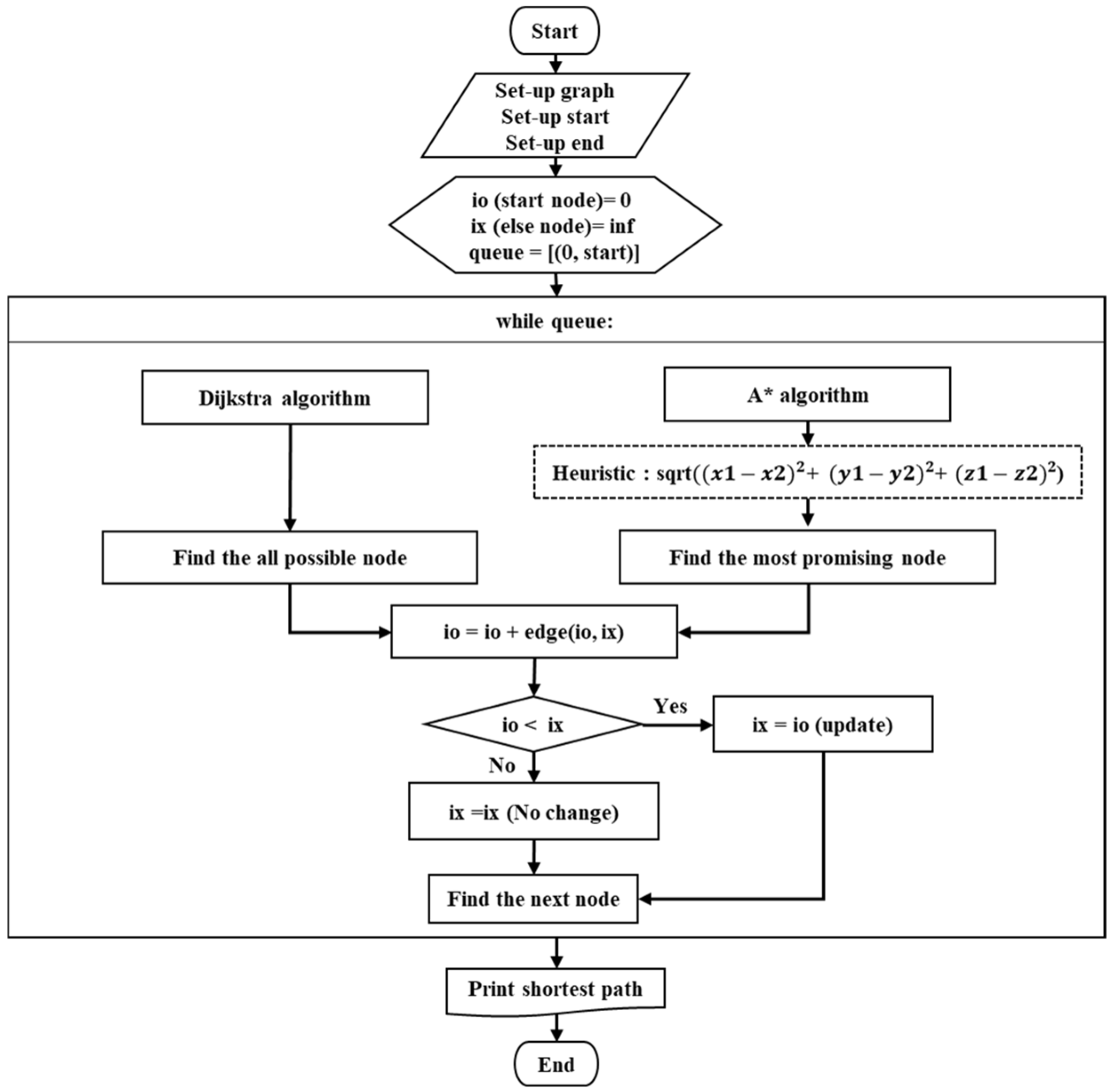
Dijkstra’s algorithm belongs to the uninformed search category and determines the shortest path by systematically exploring all possible routes from the origin node to the destination node. Because it evaluates all potential paths based on cumulative cost, it guarantees the optimal solution in terms of shortest distance or minimum travel time. However, this exhaustive search process requires visiting a large number of nodes, resulting in high computational cost, particularly in large-scale networks such as multi-level underground stations. The execution process of Dijkstra’s algorithm is illustrated in
Figure 1.
In contrast, the A* algorithm is an informed search method that improves computational efficiency by incorporating a heuristic function into the search process. The algorithm evaluates each node using the following cost function:
where
g(
n) represents the actual cost from the start node to the current node, and
h(
n) denotes the estimated cost from the current node to the destination. In this study, the Euclidean distance was adopted as the heuristic function to estimate the remaining travel cost within the three-dimensional underground network.
When the heuristic function satisfies admissibility and consistency conditions, the A* algorithm can guarantee the optimal solution, yielding results identical to those of Dijkstra’s algorithm under static conditions. However, in dynamic environments where edge weights vary over time due to factors such as crowd congestion and hazard propagation, the optimality of the current path cannot be guaranteed for future states. As a result, the performance of the two algorithms may differ depending on temporal changes in the system.
To investigate the influence of algorithmic structure on evacuation performance, both Dijkstra’s algorithm and the A* algorithm were applied to the same underground station network in this study. By comparing their results under both static and dynamic conditions, the applicability and limitations of each algorithm in evacuation scenarios were systematically evaluated.
2.2. Evacuation Simulation Model
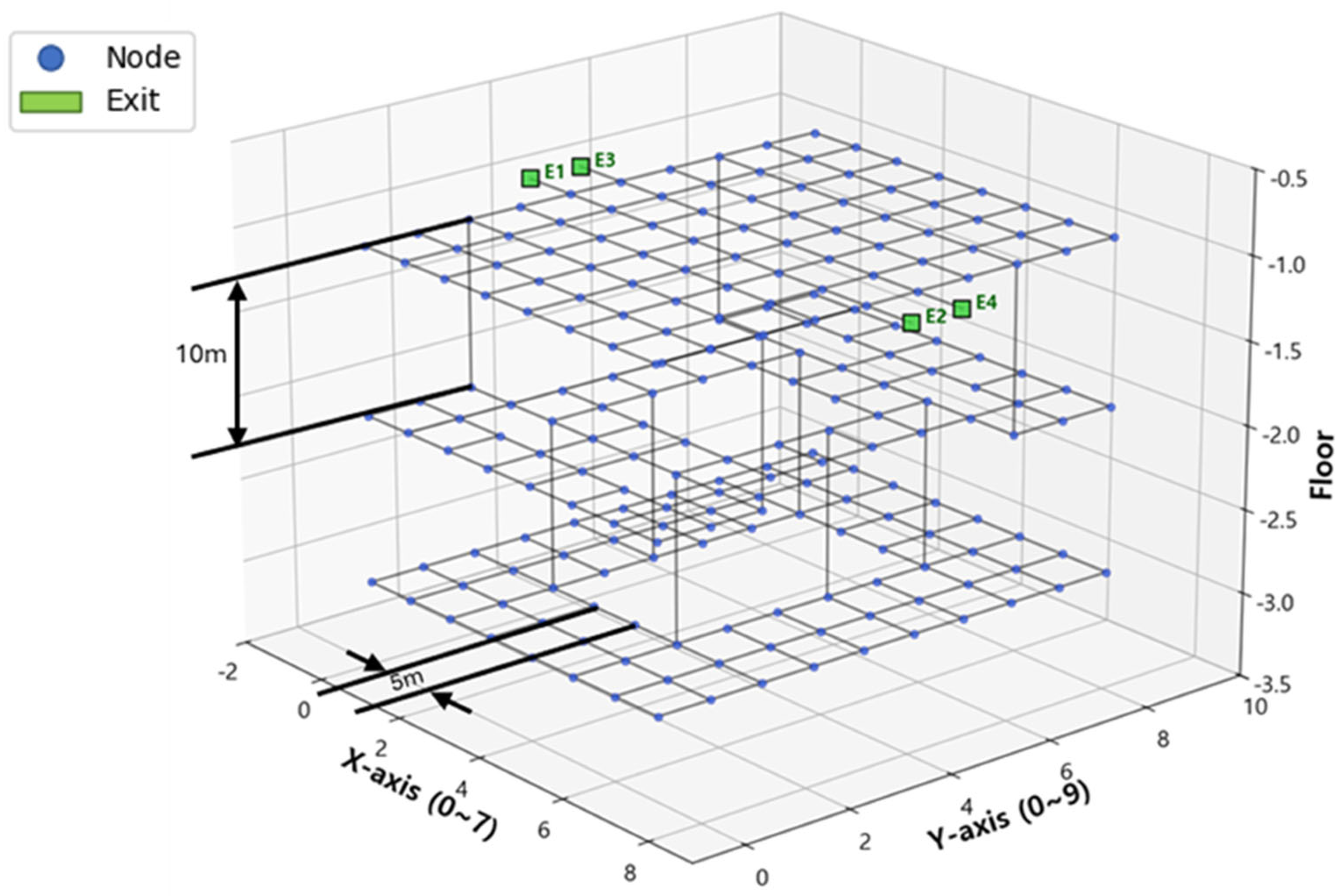
In this study, a virtual underground station was modeled using a node–link network to simulate evacuation behavior under disaster conditions. The station was designed to represent a typical medium-scale subway station commonly found in South Korea, consisting of three underground levels (B1–B3). The evacuation simulation was focused on the lowest level (B3), where passengers are typically concentrated on the platform.
The spatial configuration of the station was simplified into a graph structure composed of nodes and links, where nodes represent passenger locations and links represent movement paths between nodes. Four exits were assumed at the ground level, representing a typical four-directional intersection layout. Vertical connectivity between floors was established through stairways, with six staircases connecting B3 to B2 and four staircases connecting B2 to B1.
The horizontal distance between adjacent nodes was set to 5 m, reflecting typical spacing in platform and concourse areas, while the vertical distance between floors was set to 10 m to represent inter-floor connections. This configuration allows the model to capture both horizontal and vertical movement characteristics within the underground structure.
Based on these assumptions, the entire underground station was discretized into a node–link network, enabling the application of graph-based pathfinding algorithms. The resulting layout of the underground station model is illustrated in
Figure 2.
In evacuation simulations, pedestrian-related parameters such as occupant distribution, population size, and walking speed play a critical role in determining evacuation performance. In this study, pedestrian movement characteristics were defined based on design guidelines provided by the Ministry of Land, Infrastructure and Transport (MOLIT).
The walking speeds were set to 60 m/min for horizontal movement (e.g., platforms, concourses, and corridors) and 15 m/min for vertical movement (e.g., stairs and stationary escalators), reflecting typical evacuation conditions in underground stations. These values were applied uniformly to all evacuees to ensure consistency in the simulation.
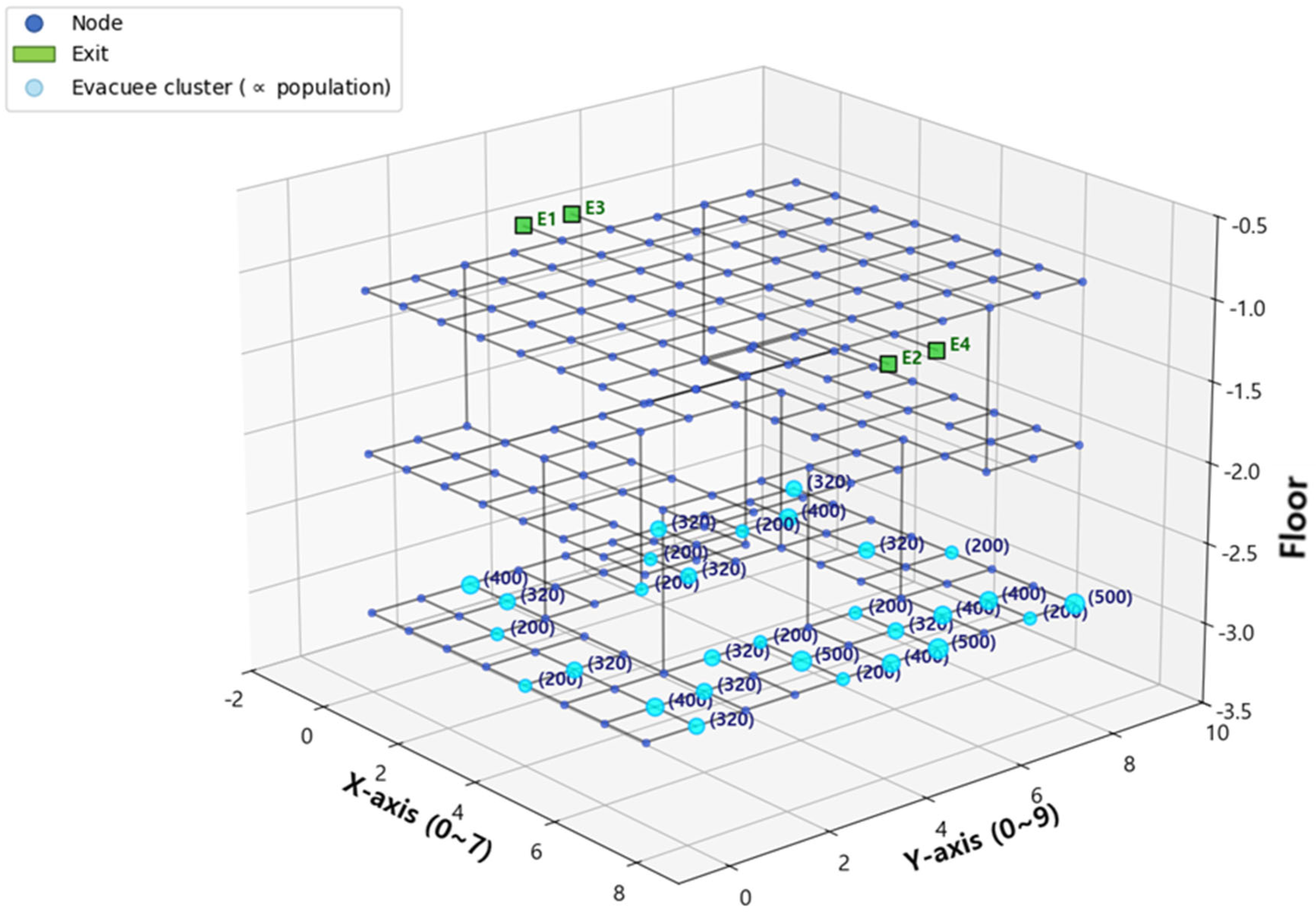
All evacuees were initially distributed on the B3 level, where passenger density is typically highest due to train boarding and alighting activities. To represent a highly congested and conservative evacuation scenario, it was assumed that passengers waiting on the platform and those disembarking from trains were simultaneously present. Under this assumption, a dense crowd condition was intentionally created to facilitate congestion formation during evacuation.
The number of occupants assigned to each node ranged from approximately 200 to 500 individuals, and a total of 9100 evacuees were distributed across 29 nodes. The spatial distribution of evacuees was configured to reflect concentrated crowd conditions rather than uniform dispersion. It should be noted that the initial distribution of evacuees does not affect the comparative performance between pathfinding algorithms, as identical conditions were applied to all simulation cases. The initial distribution of evacuees within the underground station model is illustrated in
Figure 3.
In this study, pedestrian movement was modeled using a node–link-based discrete flow approach, in which evacuees move between nodes along predefined links within the network. Each evacuee is assumed to travel from one node to another by selecting a path determined by the pathfinding algorithm, and the travel time between nodes is calculated based on the link length and the assigned walking speed. The movement of evacuees is governed by a simplified flow-based mechanism rather than a continuous microscopic model. Specifically, the total number of evacuees assigned to each node moves through connected links over time, and the flow between nodes is updated at each simulation step. This approach allows the model to efficiently represent large-scale evacuation behavior without explicitly simulating individual interactions. To account for pedestrian flow composition, evacuees are initially distributed across multiple nodes with varying population sizes, representing heterogeneous crowd conditions. As evacuation progresses, the distribution of evacuees dynamically evolves depending on route selection, congestion effects, and local capacity constraints. When the number of evacuees at a node exceeds its capacity, movement speed is reduced according to predefined congestion conditions, which in turn affects the flow rate between nodes. This modeling approach captures the essential characteristics of pedestrian movement, including path-based routing, flow accumulation, and congestion-induced delay, while maintaining computational efficiency for large-scale evacuation scenarios.
2.3. Crowd Congestion Condition
During evacuation, crowd congestion significantly affects movement efficiency by reducing walking speed and causing bottlenecks. In underground stations, where large numbers of evacuees are concentrated within limited spaces, congestion is one of the primary factors that increases total evacuation time. Therefore, it is essential to incorporate congestion effects into the evacuation model to realistically simulate pedestrian behavior under emergency conditions.
In this study, congestion was modeled by applying a reduction factor to the travel speed when the number of evacuees within a node exceeded a predefined threshold. Specifically, when the number of occupants concentrated in a given node surpassed its capacity, additional weight was assigned to the corresponding links, effectively reducing the movement speed of evacuees passing through that node.
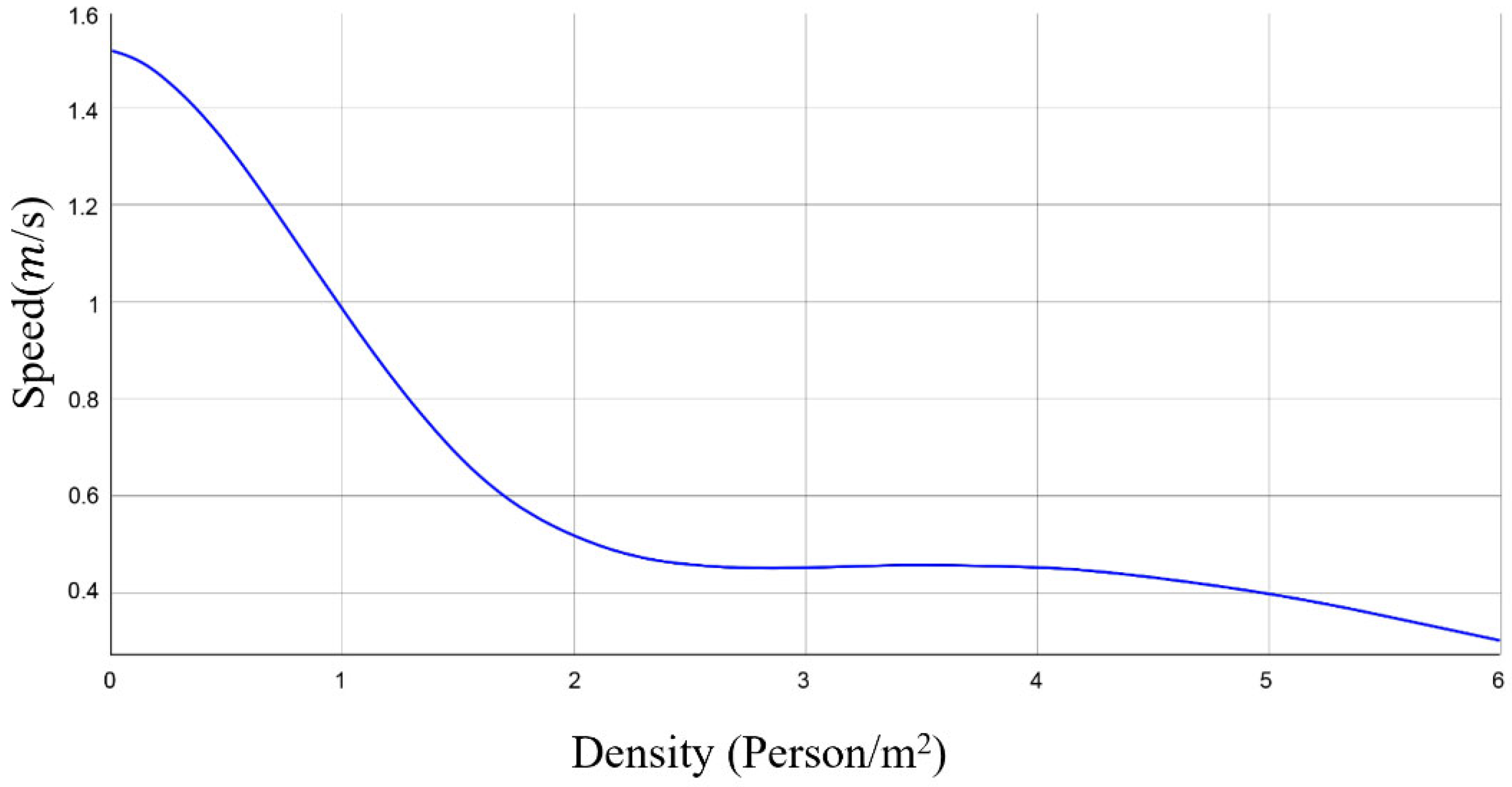
The relationship between crowd density and walking speed was defined based on the study by Zhou et al. (2020) [
21], which quantitatively analyzed evacuation behavior using video data and established a correlation between pedestrian density and movement speed. According to this relationship, walking speed decreases nonlinearly as density increases, with significant reductions observed under high-density conditions.
To implement this relationship in the simulation, threshold values for congestion were determined based on the evacuation capacity of passageways. The maximum capacity of each node was calculated using the product of passage width and evacuation capacity per unit width. The evacuation capacity values were adopted from the design guidelines of the Ministry of Land, Infrastructure and Transport (MOLIT) [
22], where 80 persons/m·min was used for horizontal movement and 60 persons/m·min for vertical movement.
The minimum widths of passageways were assumed to be 8 m for horizontal paths and 6 m for vertical paths, following the same design guidelines. Based on these assumptions, the threshold population for congestion was calculated, and walking speed reduction factors were applied when the number of occupants exceeded these thresholds.
Specifically, for horizontal movement, when the number of evacuees exceeded the calculated capacity, the travel speed was reduced by factors of 2, 2.5, and 3 as the density increased. Similarly, for vertical movement, speed reduction factors of 2, 2.5, and 3 were applied based on increasing levels of congestion. These reduction factors were incorporated into the simulation by modifying the weights of the links, thereby reflecting the delay caused by crowd congestion.
The relationship between pedestrian density and walking speed, as well as the corresponding reduction factors applied in this study, are summarized in
Figure 4 and
Table 1 and
Table 2.
2.4. Disaster Modeling
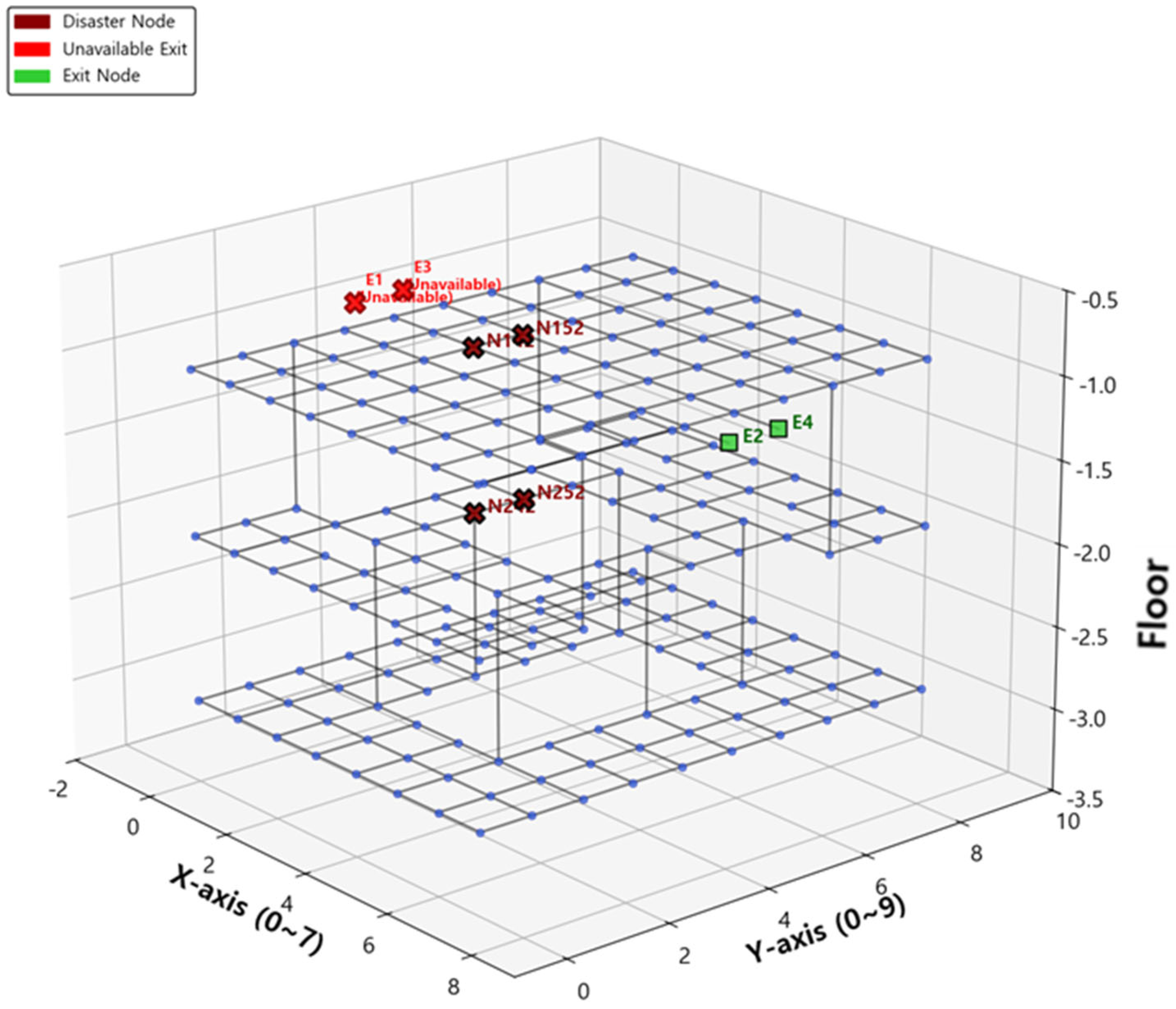
To simulate evacuation under emergency conditions, disaster scenarios were incorporated into the evacuation model by modifying the movement conditions of specific nodes and links. In this study, disaster effects were represented by reducing movement speed and restricting the availability of certain exits.
First, nodes where disasters occurred were defined as disaster nodes, and the movement speed at these nodes was significantly reduced to represent hazardous conditions such as structural damage. Specifically, the travel speed at disaster nodes was reduced to one-tenth of the normal condition, reflecting severe movement restrictions caused by reduced visibility, high temperature, or physical obstacles.
A total of four disaster nodes were assigned within the underground station network. In addition to local effects at disaster nodes, global evacuation conditions were also modified by restricting the availability of certain exits. Among the four exits, two exits (E1 and E3) were assumed to be unavailable due to disaster conditions, such as blockage or safety concerns, thereby forcing evacuees to reroute toward alternative exits.
These disaster conditions were incorporated into the simulation by increasing the weights of links connected to disaster nodes and removing inaccessible exits from the available pathfinding options. This approach allows the model to reflect both localized hazard effects and global evacuation constraints within the network.
The spatial configuration of disaster nodes and unavailable exits is illustrated in
Figure 5.
2.5. Human Error Scenarios
To evaluate the impact of human error on evacuation performance, three different evacuation scenarios were defined in this study. These scenarios represent realistic situations in which evacuation guidance may be correctly or incorrectly delivered during a disaster.
The first scenario represents the normal condition, where evacuation guidance is provided accurately. In this case, evacuees are correctly informed that two exits (E1 and E3) are unavailable due to the disaster, and they select optimal evacuation routes based on valid information.
The second and third scenarios assumed human error conditions. The human error scenarios considered in this study were selected to represent typical types of errors that may occur in evacuation guidance systems during emergency situations. In practical evacuation environments, human error is commonly associated with incorrect information delivery and delayed decision-making, both of which can significantly affect evacuation performance. Previous studies have reported that evacuees often experience delays in response due to perception and decision-making processes, as well as incorrect route choices caused by incomplete or inaccurate information [
19,
20]. Based on this consideration, two representative error types were defined: (1) misguidance due to incorrect information regarding exit availability, and (2) delayed evacuation caused by late delivery or recognition of evacuation instructions. These scenarios were intentionally simplified to isolate and evaluate the individual impact of each error type on evacuation performance. The parameter values used in each scenario were determined based on reasonable and conservative assumptions reflecting typical emergency conditions. In the delayed evacuation scenario, a delay of 2 min was applied to represent realistic delays in emergency communication or human response time. In addition, the affected region was limited to a subset of nodes to simulate localized communication failure or partial information loss. For the misguidance scenario, incorrect exit availability was assumed to reflect situations in which evacuation guidance systems provide inaccurate or outdated information. Although the scenario parameters were not calibrated from a single empirical dataset, they were established based on representative emergency-response conditions reported in previous evacuation studies and were used here to provide a comparative assessment of the relative effects of different human error types.
The second scenario represents a misguidance condition caused by human error. In this case, although two exits are actually unavailable, evacuees are incorrectly informed that all exits are accessible. As a result, some evacuees attempt to move toward blocked exits, leading to inefficient route selection and increased evacuation time.
The third scenario represents a delayed response condition. In this case, evacuees located within a specific region (defined as nodes with y-coordinates ranging from 0 to 4) do not receive evacuation instructions immediately and begin evacuation with a delay of 2 min. This delay simulates situations where evacuation announcements are not delivered promptly or where occupants fail to recognize the urgency of the situation. The three human error scenarios considered in this study are summarized in
Table 3.
By comparing these three scenarios, the model allows for a quantitative evaluation of how different types of human error—incorrect information and delayed response—affect evacuation time and congestion patterns. This approach enables the analysis of human error as an independent variable within the evacuation simulation framework, which has been rarely addressed in previous studies.
3. Analysis Results
The evacuation performance and computational efficiency for each scenario and algorithm are summarized in
Table 4. Under the normal condition (Case 1), the maximum evacuation time was 375 s for Dijkstra’s algorithm and 383 s for the A* algorithm, indicating that both algorithms provide similar evacuation performance under static conditions. However, a significant difference was observed in the number of explored nodes, where Dijkstra’s algorithm explored approximately 77,025 nodes, while the A* algorithm explored only 21,245 nodes. This result indicates that the A* algorithm is substantially more efficient in terms of computational cost due to its heuristic-based search strategy.
In the misguidance scenario (Case 2), the maximum evacuation time increased to 441 s for both algorithms. This increase can be attributed to evacuees attempting to move toward exits that were actually unavailable, resulting in inefficient route selection and additional congestion. The computational difference between the two algorithms became more pronounced under this condition, with Dijkstra’s algorithm exploring approximately 158,768 nodes compared to 44,828 nodes for the A* algorithm. This suggests that as the complexity of the evacuation scenario increases, the efficiency advantage of the A* algorithm becomes more significant.
In the delayed evacuation scenario (Case 3), the maximum evacuation time further increased to 517 s for Dijkstra’s algorithm and 534 s for the A* algorithm, representing the worst evacuation performance among all scenarios. This result indicates that delayed evacuation has a more severe impact on overall performance than incorrect guidance. The delay in evacuation initiation caused a concentration of evacuees in specific regions, leading to intensified congestion and prolonged evacuation time. Notably, in this case, Dijkstra’s algorithm resulted in a shorter evacuation time than the A* algorithm, suggesting that algorithm performance may vary depending on dynamic conditions such as congestion evolution.
The optimal evacuation time and the last evacuated group for each scenario are summarized in
Table 5. Under the normal condition, group N397 was identified as the last evacuated group. In contrast, group N387 and group N304 were the last evacuated groups in the misguidance and delayed scenarios, respectively. These results indicate that the location of bottlenecks and the groups experiencing the most severe delays vary depending on the type of human error. In particular, the delayed scenario led to a shift in the critical evacuation group due to the interaction between delayed evacuees and existing congestion.
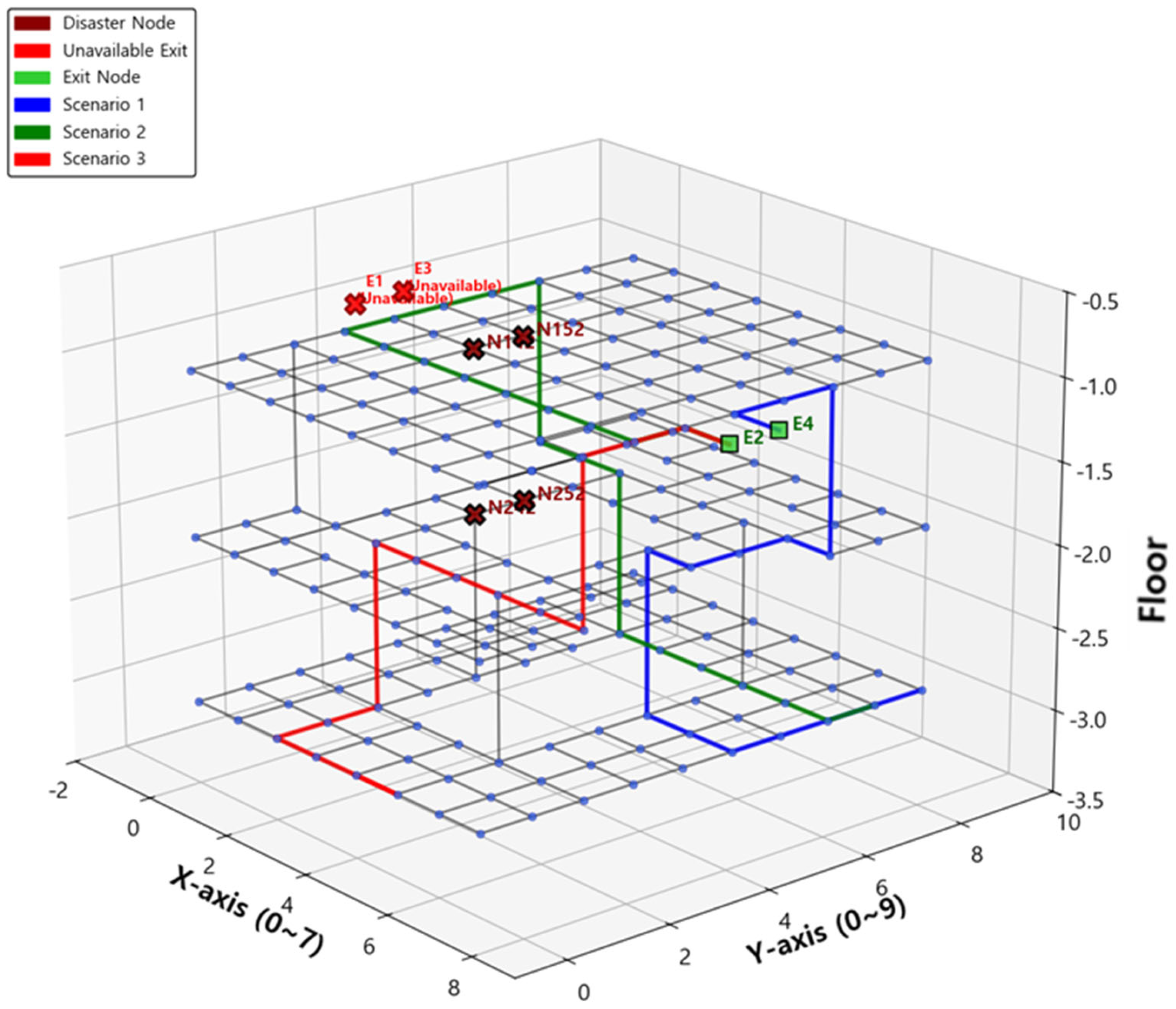
The evacuation paths of the last evacuated group are illustrated in
Figure 6. To provide a more comprehensive evaluation, the path characteristics of evacuees were further examined. Under the normal condition, evacuation routes were relatively well distributed and followed near-optimal paths toward available exits. In contrast, in the misguidance scenario, evacuees initially selected inefficient routes toward unavailable exits and were subsequently forced to reroute resulting in longer and less efficient travel paths and more complex path patterns. This rerouting behavior indicates that incorrect information can significantly distort path selection and reduce overall evacuation efficiency. Furthermore, the spatial distribution of evacuees was significantly affected by human error. In the misguidance scenario, evacuees were temporarily concentrated along paths leading to blocked exits, causing localized congestion. In the delayed evacuation scenario, late-starting evacuees encountered already congested regions, leading to further accumulation of occupants in specific nodes. These results demonstrate that human error not only increases evacuation time but also alters the spatial distribution of evacuees, intensifying congestion in critical areas of the network. These patterns can be interpreted as typical bottleneck formation processes in crowd dynamics, where inefficient route selection and delayed inflow of evacuees lead to flow accumulation at specific nodes. In particular, delayed evacuation intensifies congestion due to the interaction between late-arriving evacuees and already saturated flow, resulting in more severe bottleneck effects.
Overall, the results demonstrate that human error has a significant impact on evacuation performance. Both incorrect guidance and delayed evacuation lead to noticeable increases in total evacuation time and cause congestion to become more concentrated within specific regions of the network. In particular, delayed evacuation results in the most severe degradation of performance, as late-starting evacuees interact with already congested flows, intensifying bottleneck effects. These findings indicate that evacuation efficiency is not determined solely by optimal path selection but is highly sensitive to the accuracy and timing of evacuation guidance. Therefore, ensuring reliable and timely evacuation instructions is essential for improving evacuation performance in underground environments. From a practical perspective, these findings suggest the need for real-time adaptive evacuation guidance systems that can dynamically update routing information based on changing conditions. In addition, ensuring redundancy in communication systems is critical to prevent delays or misinterpretation of evacuation instructions. The integration of smart technologies, such as IoT-based monitoring and real-time data processing, can further enhance the reliability and responsiveness of evacuation guidance systems in underground environments.
4. Discussion
The results of this study highlight the critical role of human error in evacuation performance within underground station environments. While previous studies have primarily focused on optimizing evacuation routes and improving computational efficiency, the findings of this study demonstrate that even when optimal pathfinding algorithms are applied, evacuation performance can be significantly degraded by errors in guidance and response timing. Unlike many previous studies that primarily focus on optimizing evacuation routes or modeling general crowd behavior, this study explicitly quantifies the impact of human error in evacuation guidance systems. This distinction highlights that even when optimal routing strategies are applied, evacuation performance can be significantly degraded by incorrect information and delayed response, which have not been sufficiently addressed in prior research.
In particular, the misguidance scenario showed that incorrect information regarding exit availability leads to inefficient route selection and increased congestion. This suggests that the reliability of evacuation information is as important as the physical configuration of the evacuation network. Even if an optimal route exists, it cannot be effectively utilized when evacuees are guided toward incorrect destinations. This finding is consistent with previous research emphasizing the importance of guidance systems and information accuracy in evacuation modeling.
The delayed evacuation scenario had an even greater impact on evacuation performance, indicating that the timing of evacuation initiation is a crucial factor. The interaction between delayed evacuees and already moving crowds resulted in intensified congestion and prolonged evacuation time. This phenomenon demonstrates that evacuation is a highly dynamic process in which initial conditions and temporal factors can significantly influence overall outcomes. Unlike static path optimization, real-world evacuation involves time-dependent interactions among evacuees, making it necessary to consider both spatial and temporal aspects in evacuation modeling.
From an algorithmic perspective, the results show that while the A* algorithm is more efficient in terms of computational cost, its advantage does not necessarily translate into better evacuation performance under all conditions. In dynamic scenarios, such as those involving delayed evacuation, Dijkstra’s algorithm occasionally produced shorter evacuation times. This indicates that heuristic-based methods may not always guarantee optimal performance when network conditions change over time, particularly in highly congested environments. This suggests that although A* is computationally efficient, its heuristic-based search strategy may be less adaptable under dynamic congestion conditions, where rapidly changing network states can reduce the effectiveness of predefined heuristic guidance.
Overall, this study extends existing evacuation research by explicitly incorporating human error as an independent variable within the simulation framework. The results suggest that improving evacuation performance requires not only efficient pathfinding algorithms but also robust and reliable evacuation guidance systems. In particular, minimizing information errors and ensuring timely communication are essential for reducing evacuation time and preventing congestion. In addition, human error affects not only overall evacuation time but also path characteristics and spatial distribution of evacuees, leading to inefficient routing and localized congestion within the network.
Compared to general-purpose simulation platforms such as AnyLogic, which typically employ detailed agent-based modeling approaches, the framework used in this study adopts a simplified node–link-based structure that enables efficient large-scale simulation and clear interpretation of results. While agent-based models can capture complex individual behaviors and interactions, they often require extensive parameter calibration and high computational cost. In contrast, the proposed framework focuses on representing evacuation processes through aggregated flow dynamics and path-based routing, allowing for direct control and isolation of key variables such as human error. This simplified structure makes it particularly suitable for systematically evaluating the relative impact of specific factors, such as misguidance and delayed evacuation, without the influence of excessive model complexity. Therefore, the proposed approach provides a complementary perspective to existing simulation tools by offering a computationally efficient and analytically transparent framework for assessing the effects of human error on evacuation performance. This is particularly advantageous in the present study, where the primary objective is not to reproduce detailed individual behavior but to isolate the comparative effects of guidance-related human error scenarios under consistent network conditions.
It should be noted that the results of this study are based on deterministic simulation scenarios, and variability or uncertainty associated with different parameter settings was not explicitly considered. Future studies should incorporate sensitivity analyses and stochastic variations to further evaluate the robustness of evacuation performance under diverse conditions. In addition, the model is based on a simplified node–link representation with uniform walking speeds and does not explicitly account for individual behavioral variability or real-world validation, which may limit the generalizability of the results.
5. Conclusions
This study quantitatively evaluated the impact of human error on evacuation performance in underground stations by integrating human error scenarios into a node–link-based evacuation model. Two representative path-finding algorithms, Dijkstra and A*, were applied to simulate evacuation under normal and error conditions.
The results clearly demonstrate that human error is a critical factor influencing evacuation performance. Both misguidance and delayed evacuation significantly increased total evacuation time, with delayed evacuation showing the most severe impact. Specifically, delayed response led to intensified congestion due to the interaction between late-starting evacuees and existing crowd flows, resulting in the longest evacuation time among all scenarios. In addition, human error altered congestion patterns and shifted the location of critical bottlenecks, indicating that evacuation dynamics are highly sensitive to guidance, accuracy and timing.
From an algorithmic perspective, while the A* algorithm exhibited superior computational efficiency in terms of explored nodes, both algorithms produced similar evacuation performance under normal conditions. However, under dynamic conditions involving human error, their relative performance varied, suggesting that heuristic-based approaches may not always provide consistent advantages in time-dependent evacuation scenarios.
Overall, the findings indicate that evacuation performance is not determined solely by optimal pathfinding, but is highly dependent on the reliability and timeliness of evacuation guidance. Therefore, improving the accuracy of information delivery and minimizing delays in evacuation instructions are essential for enhancing safety in underground environments.
This study contributes to the existing body of evacuation research by explicitly incorporating human error as an independent variable within a quantitative simulation framework, which has been relatively underexplored in previous studies. Future research should focus on integrating more realistic human behavior models, real-time adaptive guidance systems, and multi-hazard scenarios to further improve the applicability of evacuation simulations.