Resilient Multi-Agent State Estimation for Smart City Traffic: A Systems Engineering Approach to Emission Mitigation


Abstract
1. Introduction
2. Related Work
- Traditional traffic lights operate reactively based on localized queue lengths, inherently suffering from a myopic control perspective. In contrast, global awareness allows isolated intersections to anticipate incoming traffic flows originating from distant nodes. This predictive capability forms the foundation for proactive operations research interventions, enabling system-wide dynamic scheduling and optimal resource allocation to minimize average waiting times across the network.
- In the paradigm of Connected and Autonomous Vehicles (CAVs), relying on centralized cloud architectures for routing introduces significant round-trip latency and unnecessary energy overhead. By utilizing IoT-enabled edge nodes equipped with complete global states, CAVs can seamlessly query the nearest smart intersection via Vehicle-to-Infrastructure (V2I) communication to acquire instantaneous, network-wide route densities. This edge-level query capability directly facilitates real-time dynamic eco-routing and sustainable network flow optimization [23], thereby bypassing the need for energy-intensive cloud processing.
- Conventional Supervisory Control and Data Acquisition (SCADA) based traffic management centers are highly susceptible to communication bottlenecks, natural disasters, or cyber-attacks (e.g., DDoS). The proposed swarm-intelligence topology ensures high resilience; if a central server or a specific regional node collapses, the remaining healthy nodes continue to collaboratively monitor the global state with uncompromised accuracy.
- Continuously transmitting raw vehicle trajectories, GPS coordinates, or license plate data to a central cloud poses severe privacy risks and consumes massive bandwidth. The H-MASE protocol operates by exchanging abstracted mathematical consensus variables between adjacent physical neighbors, which inherently protects user privacy and effectively mitigates the telecommunication overhead.
- For next-generation urban logistics, including Mobility as a Service (MaaS) and crowd-shipping platforms, continuous and reliable traffic data is a prerequisite. The resilient, high-fidelity state vector provided by H-MASE serves as a robust data foundation for these smart city applications, ensuring that sustainable fleet routing and dynamic dispatching operations remain uninterrupted even during severe IoT infrastructure degradations.
- Decentralized Cyber-Physical Architecture: We propose the H-MASE protocol, a novel hybrid framework combining Physical Sensor Agents (PSAs) and Virtual Logic Agents (VLAs). While PSAs process stochastic measurements, VLAs act as fault-immune topological relays. This localized, hop-by-hop distributed topology ensures that the communication graph remains firmly connected, effectively eliminating the single-point-of-failure vulnerability inherent in conventional centralized systems.
- Autonomous Fault Isolation with High Reliability: We introduce a robust, localized switching logic that instantaneously detects and isolates severe structural sensor faults. As mathematically proven and empirically validated, this mechanism is designed to theoretically avoid false alarms under bounded nominal conditions.
- Theoretical Resilience and Input-to-State Stability (ISS) Guarantees: The paper provides mathematical proofs establishing ISS. We demonstrate that as long as the surviving ensemble of healthy PSAs maintains structural observability, the fault-immune VLAs preserve network-wide consensus, preventing global error divergence even after the autonomous isolation of compromised nodes.
- Foundation for Network-Wide Optimization: From an operations research perspective, the proposed framework supplies resilient, real-time route density estimates. These high-fidelity states serve as a reliable foundational input for dynamic resource allocation, stochastic queue management and traffic signal optimization problems in smart cities.
3. Problem Formulation and System Modeling
3.1. Physical Graph Topology and Incidence Structures
3.2. Physical Flow Dynamics and Boundary Conditions
3.3. Path-Based State-Space Characterization
3.4. Augmented Measurement Model
3.5. State Evolution and Drift Model
4. The H-MASE Protocol
4.1. Cyber-Physical Topology and Agent Classification
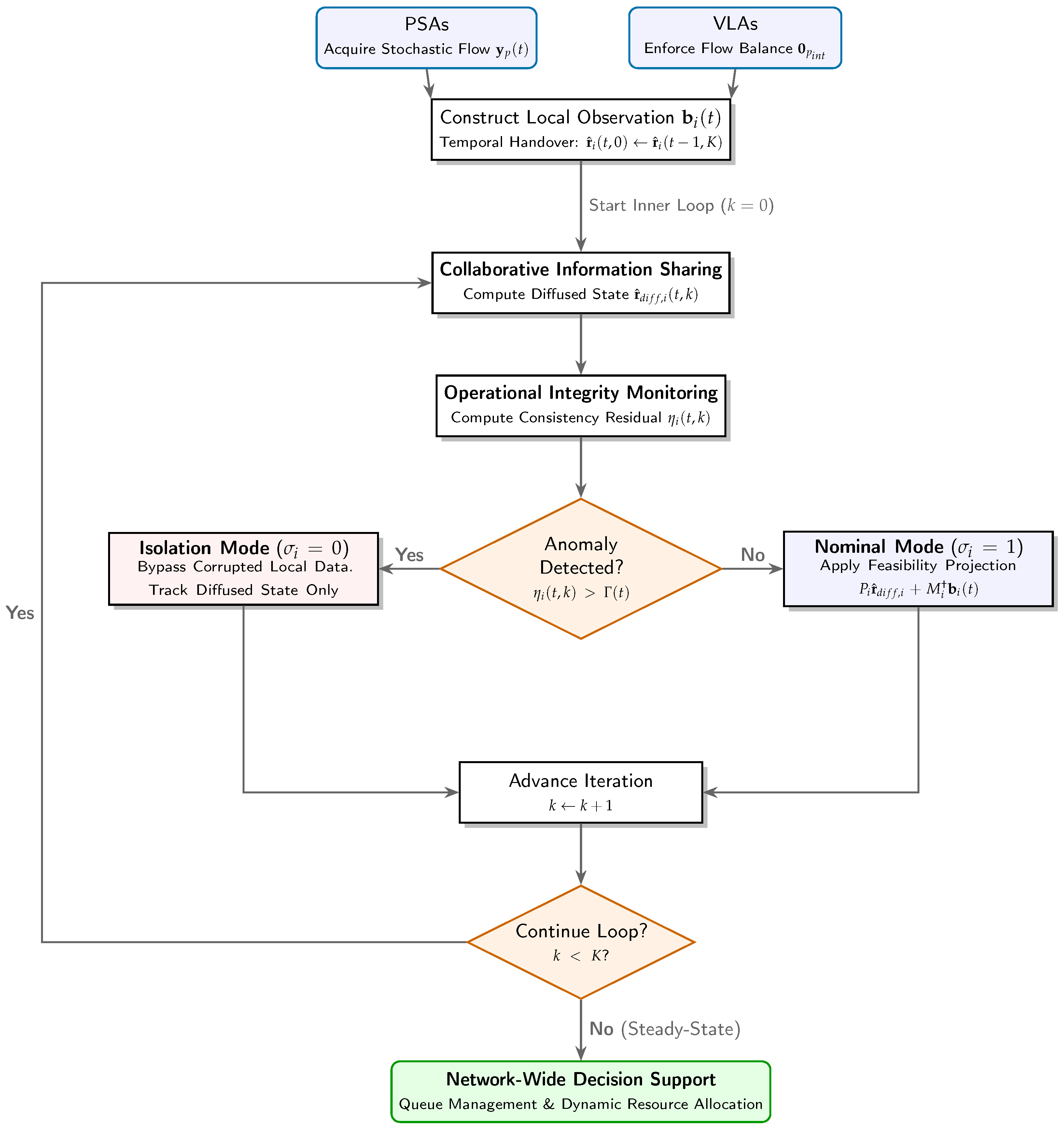
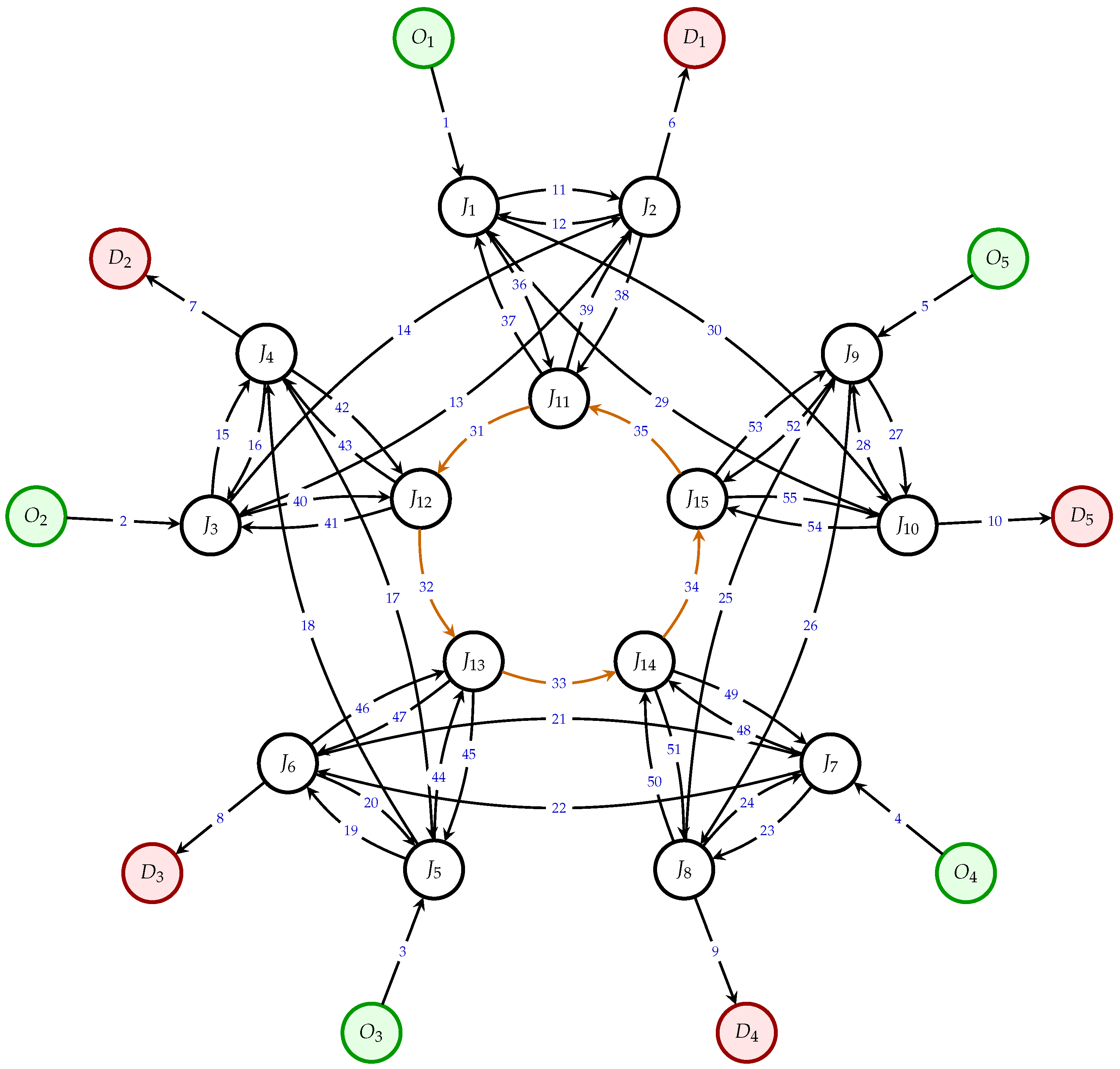
- PSAs: Each PSA is collocated with the physical link detectors to process the local scalar stochastic measurement .
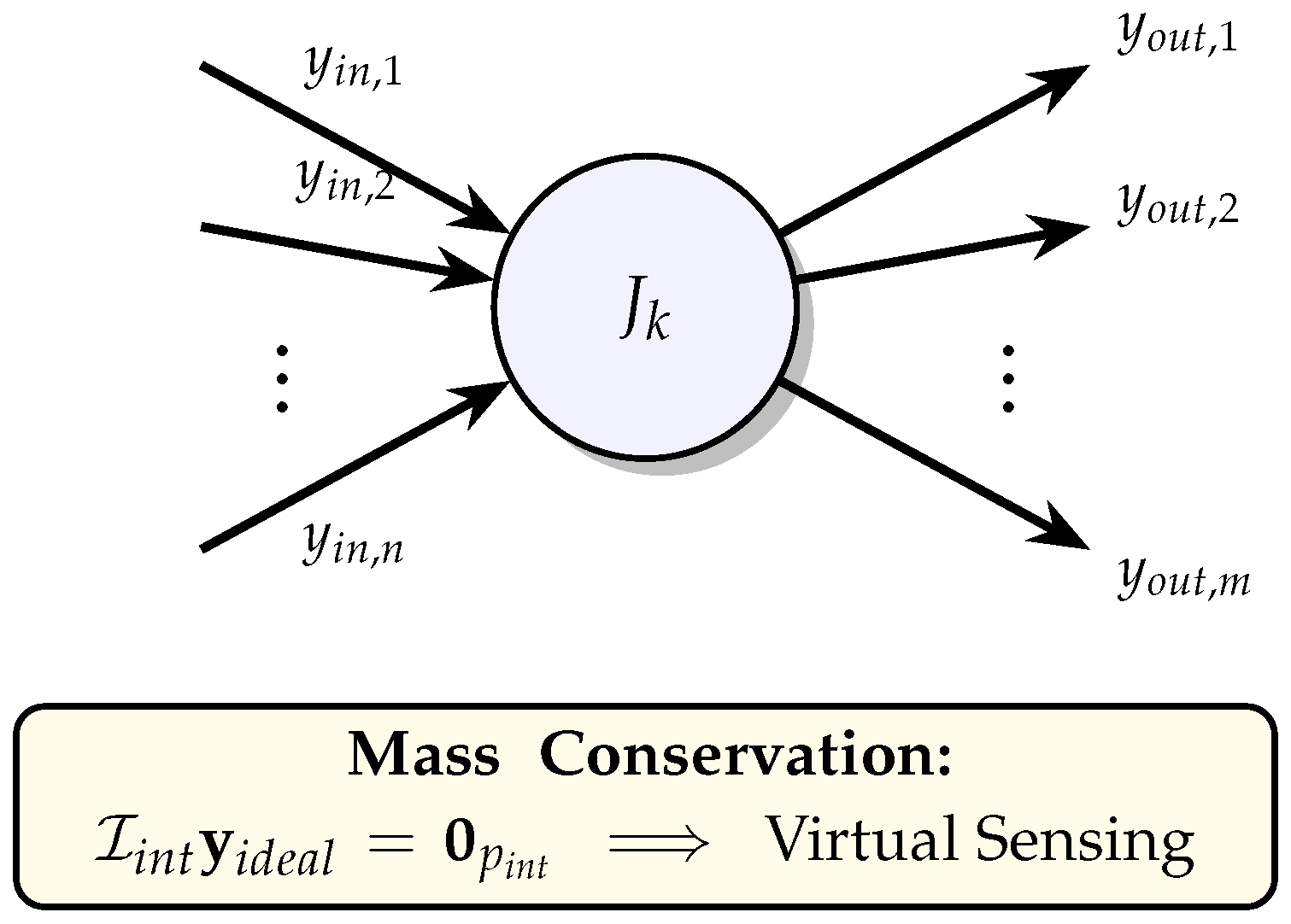
- VLAs: Residing at the internal junctions, each VLA mathematically embodies the tautological nodal-balance equations (). While mathematically represented merely as augmented linear equality constraints with zero sensing rows (), their cyber-physical function is profound. They do not restrict the state space; rather, from a systems reliability engineering perspective, they act as fault-immune topological relays. They ensure that even under catastrophic physical sensor degradation, the distributed decision-support architecture maintains its topological connectivity and computational consensus, thereby preventing the ecological disruptions associated with network-wide information fragmentation. In real-world implementations, VLAs are lightweight software routines running directly on the IoT edge computing units (e.g., smart intersection controllers). While they do not process raw physical measurements, their inclusion is structurally vital. During severe multi-sensor failures, isolated PSAs drop their corrupted constraints but rely on the topological bridges maintained by the VLAs to prevent the fragmentation of the cyber-communication graph, thereby ensuring that global consensus is computationally sustained.
4.2. Local Projection Operators and Singularity Handling
4.3. Distributed State Update and Time-Scale Separation
4.4. Resilient Estimation and Fault Isolation
4.5. Algorithmic Realization
| Algorithm 1 H-MASE Decentralized Estimation Protocol. |
|
5. Convergence and Resilience Analysis
5.1. Convergence Analysis Under Nominal Conditions
- Step 1:
- Recursive Unrolling of the Inner Loop
- Step 2:
- Macroscopic Time-Scale Handover
- Step 3:
- Triangle Inequality and Norm Decompositions
- Step 4:
- Spectral Bounding and ISS Formulation
5.2. Resilience Analysis and Fault Tolerance
5.2.1. Fault Characterization and Detection Sensitivity
5.2.2. Stability of the Resilient Switched Dynamics
- Step 1:
- Switched Dynamics and Time-Invariant Unrolling
- Step 2:
- Preservation of Global Feasibility and Spectral Contraction
- Step 3:
- Resilient Spectral Bounding and Final ISS Formulation
6. Numerical Results and Emission Mitigation Analysis
6.1. Simulation Environment and Cyber-Physical Topology
6.2. Distributed Tracking Performance in Nominal Operation
6.3. Resilient Fault Isolation and Comparative ISS Validation
6.4. Ecological Impact and Emission Mitigation
7. Conclusions
Funding
Data Availability Statement
Conflicts of Interest
Abbreviations
| ALPR | Automatic License Plate Recognition |
| CAV | Connected and Autonomous Vehicle |
| DDoS | Distributed Denial of Service |
| DGD | Distributed Gradient Descent |
| GHG | Greenhouse Gas |
| GPS | Global Positioning System |
| H-MASE | Hybrid Multi-Agent State Estimation |
| IoT | Internet of Things |
| ISS | Input-to-State Stability |
| ITS | Intelligent Transportation Systems |
| MaaS | Mobility as a Service |
| MAPE | Mean Absolute Percentage Error |
| MOVES | Motor Vehicle Emission Simulator |
| O-D | Origin-Destination |
| OR | Operations Research |
| PeMS | Performance Measurement System |
| PSA | Physical Sensor Agent |
| RMSE | Root Mean Square Error |
| SCADA | Supervisory Control and Data Acquisition |
| SUMO | Simulation of Urban MObility |
| TSE | Traffic State Estimation |
| VLA | Virtual Logic Agent |
| V2I | Vehicle-to-Infrastructure |
References
- Rasheed, F.; Yau, K.L.A.; Noor, R.M.; Wu, C.; Low, Y.C. Deep Reinforcement Learning for Traffic Signal Control: A Review. IEEE Access 2020, 8, 208016–208044. [Google Scholar] [CrossRef]
- Kolat, M.; Kővári, B.; Bécsi, T.; Aradi, S. Multi-Agent Reinforcement Learning for Traffic Signal Control: A Cooperative Approach. Sustainability 2023, 15, 3479. [Google Scholar] [CrossRef]
- Damadam, S.; Zourbakhsh, M.; Javidan, R.; Faroughi, A. An Intelligent IoT Based Traffic Light Management System: Deep Reinforcement Learning. Smart Cities 2022, 5, 1293–1311. [Google Scholar] [CrossRef]
- Zhang, X.; Han, Y. Multi-Agent Reinforcement Learning for Traffic State Estimation on Highways Using Fundamental Diagram and LWR Theory. Appl. Sci. 2026, 16, 1219. [Google Scholar] [CrossRef]
- Karthick Raghunath, K.M.; Rohith Bhat, C.; Vinoth Kumar, V.; Athiyoor Kannan, V.; Mahesh, T.R.; Manikandan, K.; Krishnamoorthy, N. Redefining Urban Traffic Dynamics With TCN-FL Driven Traffic Prediction and Control Strategies. IEEE Access 2024, 12, 115386–115399. [Google Scholar] [CrossRef]
- Liu, B.; Ding, Z. A distributed deep reinforcement learning method for traffic light control. Neurocomputing 2022, 490, 390–399. [Google Scholar] [CrossRef]
- Zambrano-Martinez, J.; Calafate, C.; Soler, D.; Cano, J.C.; Manzoni, P. Modeling and Characterization of Traffic Flows in Urban Environments. Sensors 2018, 18, 2020. [Google Scholar] [CrossRef]
- Mądziel, M.; Campisi, T. Investigation of Vehicular Pollutant Emissions at 4-Arm Intersections for the Improvement of Integrated Actions in the Sustainable Urban Mobility Plans (SUMPs). Sustainability 2023, 15, 1860. [Google Scholar] [CrossRef]
- Liang, X.; Song, H.; Wu, G.; Guo, Y.; Zhang, S. Complex Traffic Flow Model for Analysis and Optimization of Fuel Consumption and Emissions at Large Roundabouts. Sustainability 2024, 16, 9464. [Google Scholar] [CrossRef]
- Emek, S.; Ildırar, G.; Gürbüzer, Y. Application of Long Short-Term Memory and XGBoost Model for Carbon Emission Reduction: Sustainable Travel Route Planning. Sustainability 2025, 17, 10802. [Google Scholar] [CrossRef]
- Cao, Q.; Li, J.; Trucco, P. Sustainability-Oriented Urban Traffic System Optimization Through a Hierarchical Multi-Agent Deep Reinforcement Learning Framework. Sustainability 2026, 18, 1606. [Google Scholar] [CrossRef]
- Jin, J.; Ma, X. Hierarchical multi-agent control of traffic lights based on collective learning. Eng. Appl. Artif. Intell. 2018, 68, 236–248. [Google Scholar] [CrossRef]
- Shen, H.; Zhao, H.; Zhang, Z.; Yang, X.; Song, Y.; Liu, X. Network-Wide Traffic Signal Control Based on MARL with Hierarchical Nash-Stackelberg Game Model. IEEE Access 2023, 11, 145085–145100. [Google Scholar] [CrossRef]
- Yang, S. Hierarchical graph multi-agent reinforcement learning for traffic signal control. Inf. Sci. 2023, 634, 55–72. [Google Scholar] [CrossRef]
- Zhu, R.; Li, L.; Wu, S.; Lv, P.; Li, Y.; Xu, M. Multi-agent broad reinforcement learning for intelligent traffic light control. Inf. Sci. 2023, 619, 509–525. [Google Scholar] [CrossRef]
- Englezou, Y.; Timotheou, S.; Panayiotou, C. Estimating the origin-destination matrix using link count observations and traffic flow dynamics. In Proceedings of the 2022 IEEE 25th International Conference on Intelligent Transportation Systems (ITSC), Macau, China, 8–12 October 2022; pp. 3213–3218. [Google Scholar] [CrossRef]
- Dey, S.; Winter, S.; Tomko, M. Origin–Destination Flow Estimation from Link Count Data Only. Sensors 2020, 20, 5226. [Google Scholar] [CrossRef] [PubMed]
- Wei, G.; Gundlegård, D.; Rydergren, C. Consistent origin-destination and link flow estimation based on data-driven network assignment. Transp. Res. Procedia 2025, 86, 668–675. [Google Scholar] [CrossRef]
- Vahidi, M.; Shafahi, Y. Time-dependent estimation of origin–destination matrices using partial path data and link counts. Transportation 2023, 52, 55–92. [Google Scholar] [CrossRef]
- Pourhassan, K.; Lim, T.; Payne, S.; Somenahalli, S. A heuristic approach to time-dependent origin-destination traffic demand estimation for the development of large-scale dynamic traffic assignment models. Transp. Eng. 2025, 20, 100328. [Google Scholar] [CrossRef]
- Peng, X.; Li, L.; Lo, H.K.; Huang, W. A physics-constrained deep learning approach for dynamic origin-destination estimation using link counts. Transp. A Transp. Sci. 2026. [Google Scholar] [CrossRef]
- Etemadnia, H.; Abdelghany, K. A distributed origin–destination demand estimation approach for real-time traffic network management. Transp. Plan. Technol. 2011, 34, 217–230. [Google Scholar] [CrossRef]
- Iryo, T. Properties of dynamic user equilibrium solution: Existence, uniqueness, stability, and robust solution methodology. Transp. B Transp. Dyn. 2013, 1, 52–67. [Google Scholar] [CrossRef]
- Wu, T.; Zhou, P.; Liu, K.; Yuan, Y.; Wang, X.; Huang, H.; Wu, D.O. Multi-Agent Deep Reinforcement Learning for Urban Traffic Light Control in Vehicular Networks. IEEE Trans. Veh. Technol. 2020, 69, 8243–8256. [Google Scholar] [CrossRef]
- Vishnoi, S.C.; Nugroho, S.A.; Taha, A.F.; Claudel, C.G. Traffic State Estimation for Connected Vehicles Using the Second-Order Aw-Rascle-Zhang Traffic Model. IEEE Trans. Intell. Transp. Syst. 2024, 25, 16719–16733. [Google Scholar] [CrossRef]
- Mou, S.; Liu, J.; Morse, A.S. A Distributed Algorithm for Solving a Linear Algebraic Equation. IEEE Trans. Autom. Control 2015, 60, 2863–2878. [Google Scholar] [CrossRef]
- Webster, F.V. Traffic Signal Settings; Technical Report Road Research Technique Paper No. 39; Road Research Laboratory: London, UK, 1958. [Google Scholar]
- Boyd, S. Distributed Optimization and Statistical Learning via the Alternating Direction Method of Multipliers. Found. Trends Mach. Learn. 2010, 3, 1–122. [Google Scholar] [CrossRef]
- Olfati-Saber, R. Distributed Kalman filtering for sensor networks. In Proceedings of the 2007 46th IEEE Conference on Decision and Control, New Orleans, LA, USA, 12–14 December 2007; pp. 5492–5498. [Google Scholar] [CrossRef]
- Horn, R.A.; Johnson, C.R. Matrix Analysis; Cambridge University Press: Cambridge, UK, 1990. [Google Scholar]
- Jiang, Z.P.; Wang, Y. Input-to-state stability for discrete-time nonlinear systems. Automatica 2001, 37, 857–869. [Google Scholar] [CrossRef]





| Symbol | Dimension/Space | Description |
|---|---|---|
| Sets, Graphs, and Indices | ||
| Graph | Physical traffic network and cyber-communication graph | |
| Set () | Sets of physical nodes and directed physical links (edges) | |
| Set () | Subset of internal signalized junctions (zero-sum nodes) | |
| Set () | Set of dominant acyclic routes, with as its j-th element | |
| Set () | Sets of autonomous agents and digital communication links | |
| Set | Inclusive communication neighborhood of agent i | |
| Set | Subsets of healthy and structurally compromised (faulty) agents | |
| Subspace (⊆) | Network-wide consensus eigenspace | |
| Agent/route index, inner iteration (k), and macroscopic step (t) | ||
| Scalars and System Parameters | ||
| , | Macroscopic sampling period and total inner consensus iterations | |
| Saturation capacity, utilization ratio, and average delay for link | ||
| True ideal flow and estimated arrival flow for link | ||
| True dynamic vehicle volume utilizing route | ||
| Physical stochastic measurement and augmented local constraint | ||
| Corrupted observation and structural fault magnitude at agent i | ||
| Metropolis-Hastings communication weight between agents i and j | ||
| Local consistency residual (discrepancy) of agent i | ||
| Binary | Autonomous anomaly isolation switch (1 for nominal, 0 for isolated) | |
| Dynamic fault detection threshold and its exponential decay rate | ||
| Supreme bounds for measurement noise and macroscopic state drift | ||
| Effective exponential decay rates for nominal and resilient topologies | ||
| Theoretical ultimate ISS bounds for nominal and resilient optimality gaps | ||
| Vectors | ||
| True macroscopic route-flow vector and its stochastic demand drift | ||
| Agent i’s local route-flow estimate and its topological diffused state | ||
| Agent i’s local estimation error and local diffused error | ||
| Noise-free ideal link flows and physical stochastic observations | ||
| Physical measurement noise and augmented global hybrid noise | ||
| Global augmented observation and global catastrophic fault vector | ||
| Concatenated global estimation optimality gap (error) | ||
| Kronecker-extended global macroscopic state drift | ||
| Global complex eigenvector and its local projection component | ||
| Various | Vector of ones, general zero vector, and n-dimensional zero vector | |
| Matrices and Operators | ||
| Full directed incidence matrix and internal reduced incidence matrix | ||
| Physical routing matrix and tautological virtual sensing matrix | ||
| M | Global augmented observation matrix | |
| Local sensing row of agent i and its Moore-Penrose pseudoinverse | ||
| W | Doubly-stochastic communication topology weight matrix | |
| Local orthogonal projection, resilient switched operator, and identity | ||
| Global block-diagonal pseudoinverse operators (nominal and resilient) | ||
| Kronecker-extended weight matrix and global projection operators | ||
| Global state-transition operators for nominal and switched topologies | ||
| Functions | Least-squares cost function, spectral radius, and null space operators | |
| Symbol | Parameter Description | Value |
|---|---|---|
| Network Topology & Graph Parameters | ||
| N | Total number of agents (55 PSAs + 15 VLAs) | 70 |
| n | Number of dominant logical routes | 25 |
| m | Number of directed physical links (edges) | 55 |
| Algorithm & Temporal Parameters | ||
| Total macroscopic simulation time steps | 150 | |
| K | Microscopic consensus iterations (inner loop) | 80 |
| Initial traffic flow densities (vehicles/step) | ∈[20, 40] | |
| Disturbances & Fault Injection Settings | ||
| Maximum physical sensor noise bound | 2.0 | |
| Maximum route flow drift (random walk) | 1.0 | |
| Steady-state fault resilience threshold | 5.0 | |
| Transient initialization tolerance | 200.0 | |
| Threshold exponential decay rate | 0.15 | |
| Time step of structural fault injection | 80 | |
| f | Magnitude of the structural fault bias | 80.0 |
| Route ID | Origin | Intermediate Junctions | Destination |
|---|---|---|---|
| Performance Metric | Conventional DGD [26] | Proposed H-MASE |
|---|---|---|
| Total Idling Delay (vehicle-hours) | ||
| Total CO2 Emissions (kg) | ||
| Net CO2 Reduction | 0.77% (20.17 kg saved per incident window) | |
Disclaimer/Publisher’s Note: The statements, opinions and data contained in all publications are solely those of the individual author(s) and contributor(s) and not of MDPI and/or the editor(s). MDPI and/or the editor(s) disclaim responsibility for any injury to people or property resulting from any ideas, methods, instructions or products referred to in the content. |
© 2026 by the author. Licensee MDPI, Basel, Switzerland. This article is an open access article distributed under the terms and conditions of the Creative Commons Attribution (CC BY) license.
Share and Cite
Cihan, A. Resilient Multi-Agent State Estimation for Smart City Traffic: A Systems Engineering Approach to Emission Mitigation. Appl. Sci. 2026, 16, 3972. https://doi.org/10.3390/app16083972
Cihan A. Resilient Multi-Agent State Estimation for Smart City Traffic: A Systems Engineering Approach to Emission Mitigation. Applied Sciences. 2026; 16(8):3972. https://doi.org/10.3390/app16083972
Chicago/Turabian StyleCihan, Ahmet. 2026. "Resilient Multi-Agent State Estimation for Smart City Traffic: A Systems Engineering Approach to Emission Mitigation" Applied Sciences 16, no. 8: 3972. https://doi.org/10.3390/app16083972
APA StyleCihan, A. (2026). Resilient Multi-Agent State Estimation for Smart City Traffic: A Systems Engineering Approach to Emission Mitigation. Applied Sciences, 16(8), 3972. https://doi.org/10.3390/app16083972