Article

Physicochemical Properties, Antioxidant Activity, and Sorption Behavior of Bulgarian Quince Powder (Cydonia oblonga Mill.)


1
Department of Mechanical and Instrument Engineering, Faculty of Mechanical and Instrument Engineering, Technical University of Sofia, Branch Plovdiv, Tsanko Duistabanov Street 25, 4000 Plovdiv, Bulgaria
2
Department of Process Engineering, University of Food Technologies, Maritza Boulevard 26, 4002 Plovdiv, Bulgaria
3
Department of Food Technology, Institute of Food Preservation and Quality, Agricultural Academy, Vasil Aprilov Boulevard 154, 4003 Plovdiv, Bulgaria
4
Department of Analytical and Physical Chemistry, University of Food Technologies, Maritza Boulevard 26, 4002 Plovdiv, Bulgaria
*
Author to whom correspondence should be addressed.
Appl. Sci. 2026, 16(8), 3723; https://doi.org/10.3390/app16083723
Submission received: 11 March 2026 / Revised: 3 April 2026 / Accepted: 8 April 2026 / Published: 10 April 2026
(This article belongs to the Special Issue Development and Research of Novel Food Products)

Abstract

(1) Background: Exploring regional foods can help consumers expand their options for consuming diverse food products in various forms. This could enhance human health in local populations. (2) Methods: The present study evaluated the physicochemical composition of quince powder using standard analytical methods. Color parameters were determined using a PCE-CSM colorimeter equipped with a xenon lamp; the antioxidant activity via DPPH, ABTS, FRAP, and CUPRAC methods; the sorption capacity (at 10 °C, 25 °C, 40 °C and aw from 0.1 to 0.9) through the static gravimetric method; and monolayer moisture content (MMC) with the BET model. The isotherms were fitted via modified Chung–Pfost, Halsey, Henderson and Oswin models. (3) Results: The approximate physico-chemical composition of laboratory-produced quince powder (dried at 45 °C for 10 h) was: proteins—1.27 g, carbohydrates—75.80 g, fats—0.49 g, fibers—21.50 g, ash—2.31 g, and nutritional value—355.65 kcal. The color analysis indicated limited non-enzymatic browning. Antioxidant activity was confirmed by all four methods. The three-parametric Halsey model is recommended to describe the representative S-shaped isotherms from type II. The MMC for the adsorption process ranged from 14.41% d.b. to 7.09% d.b., and for the desorption process, it ranged from 13.11% d.b. to 7.80% d.b.; (4) Conclusions: This study presents a quince powder as a convenient form for both storage and consumption, emphasizing its value as a rich source of bioactive compounds and its suitability for home production and regular inclusion in a healthy daily diet.

1. Introduction

Health benefits are frequently linked to the consumption of traditional regional foods consistent with cultural origin. However, dietary diversity is equally important. The “eat the rainbow” guideline encourages varied plant intake, and recent research recommends exceeding 25 fruit and vegetable types per week to sustain microbiome diversity [1,2].
Quince (Cydonia oblonga Mill.), a member of the Rosaceae family, is an ancient fruit species cultivated in Western Asia and widely distributed throughout Europe, South America and Oceania [3,4]. The fruit is characterized by its intense aroma, firm texture and pronounced astringency, primarily attributed to its phenolic composition and tannin content. Compared to apples and pears, quince exhibits a distinct compositional profile, including high levels of structural polysaccharides and bioactive phytochemicals [5,6].
Quince pulp and peel are recognized as sources of dietary fiber, pectin, vitamin C and phenolic compounds such as hydroxycinnamic acids and flavonols, which contribute to antioxidant activity [7,8]. Several studies have reported the antimicrobial and antioxidant properties of quince extracts; however, the majority of investigations focus on fresh fruit or liquid extracts rather than dehydrated powdered forms [9,10].
Fruit powders represent a technologically advantageous format due to their extended shelf life, ease of incorporation into composite food systems and concentration of functional compounds. Nevertheless, their stability is strongly influenced by moisture sorption behavior, water activity and storage temperature, which determine physicochemical stability, caking tendency and degradation of bioactive constituents [11,12].
Despite the documented phytochemical and nutritional potential of quince, studies integrating proximate composition, instrumental color parameters, multi-assay antioxidant evaluation, and temperature-dependent sorption behavior of quince powder remain scarce. In particular, limited information is available on adsorption–desorption isotherms and monolayer moisture content of quince powder produced from Bulgarian raw material, which restricts the rational design of storage conditions and packaging strategies [12].
Therefore, the aim of the present study was to evaluate the physicochemical composition, antioxidant activity, CIE Lab* color characteristics, and sorption properties of quince powder at 10, 25, and 40 °C, including model fitting and monolayer moisture determination using the BET approach. The novelty of this work lies in the combined characterization of nutritional, antioxidant, color, and sorption properties of Bulgarian quince powder within a single experimental framework, providing baseline data for its technological application and storage stability assessment [12].

2. Materials and Methods

2.1. Material

Quince (Cydonia oblonga Mill.), sourced locally from the village of Smilets near Pazardzhik city, Bulgaria, underwent a meticulous preparation process. The procedure involved washing, peeling, and drying the fruits. These fruits were sliced into small pieces, approximately 3.0 mm to 5.0 mm in thickness, with the removal of seeds. The freshly sliced quince was then arranged in a single layer on a SilverCrest SDA 350 A2 food dehydrator (dryer) machine, Lidl Distribution, made in China, and subjected to a 10 h drying period at 45 °C, or until the moisture content fell within the range of 9% to 13%, ensuring complete dryness and brittleness. Following the drying phase, the quince slices were finely milled using a NutriBullet NB907R 900 W blender, made in China, into a powdered form. This entire preparation process took place at the Technical University of Sofia, Branch Plovdiv, Bulgaria, and the samples were stored in bags of co-extruded barrier foil at room temperature, ranging from 18 °C to 22 °C.
The product in this study, quince, was intentionally selected in powdered form due to its ease of subsequent use by consumers as an additive that may provide multiple health benefits. As described above, its preparation method is simple and accessible under home conditions.

2.2. Methods

2.2.1. Approximate Physico-Chemical Composition

The analysis of quince powder involved the assessment of moisture, protein, fat, ash, and dietary fiber content in accordance with established food analysis methods [13]. Specifically, protein content was determined by multiplying the quantified nitrogen using the conversion factor 6.25 (AOAC 920.152). The fat, obtained through Soxhlet, was determined gravimetrically after solvent removal (AOAC 920.85). Ash content was acquired by burning at approximately 550 °C (AOAC 940.26), and dietary fiber was obtained through the enzyme-gravimetric method (AOAC 985.29). Carbohydrates were calculated as the residual fraction. Results are expressed as g/100 g dry weight (dw). The nutritional energy value (kcal/100 g fw and dw) was computed using the following conversion factors: 9 kcal/g for fat, 4 kcal/g for protein and carbohydrates, and 2 kcal/g for fiber.

2.2.2. Color Characteristics

Color measurements were conducted employing a colorimeter (model PCE-CSM, Germany) with a viewing angle of 0° and a pulsed xenon lamp as the light source. The instrument provides readings in terms of color coordinates, where L* represents whiteness to darkness, a* denotes redness to greenness, and b* signifies yellowness to blueness. Instrument calibration was executed using a standard white plate, and samples were positioned on a Petri dish for each measurement.
The hue angle (H°) and chromaticity (C) were calculated using the following equations [Equations (1) and (2)]:
H ° = 360 + t a n 1 b a , w h e r e   b < 0
C = a 2 + b 2

2.2.3. Antioxidant Activity

The antioxidant activity of quince powder, assessed through DPPH (1,1-diphenyl-2-picrylhydrazyl radical), ABTS (2,2′-azino-bis(3-ethylbenzothiazoline-6-sulfonic acid)), FRAP (Ferric Reducing Antioxidant Power Assay), and CUPRAC (CUPric Reducing Antioxidant Capacity) assays, was determined through a two-step triple extraction. Approximately 1 g of the sample was mixed with 10 mL of 70% ethanol and placed in a water bath at 80 °C. Additionally, using an ultrasonic bath, ultrasonic extraction was carried out at a temperature of 50 °C, repeated three times in 20 min intervals. After the extraction process, the sample was centrifuged at 6000 rpm for 15 min. The supernatant was transferred to a new tube, and another 10 mL of ethanol was added to the precipitate for the second extraction. After the third extraction, the supernatants were mixed and stored in a refrigerator. The protocol for the methods adhered to the description comprehensively detailed in two articles by Ivanov et al. (2014) and Bogoeva et al. (2017) [14,15].

2.2.4. Sorption Characteristics

The characteristics of sorption of Bulgarian quince powder (equilibrium moisture content and monolayer moisture content) were evaluated following the specification of the static gravimetric method (at 10 °C, 25 °C and 40 °C, with water activity ranging from 0.1 to 0.9), and the detailed procedure is described in the article by Bogoeva, 2020 [16]. For the analysis, the sample underwent preparation by placing a portion in a desiccator over distilled water for desorption, while another portion was placed in a desiccator over CaCl2 for adsorption. Following 20 days of hydration of one part and dehydration of the other part, the resulting powder was transferred to aluminum weighing plates and measured (1.0000 g ± 0.0050 g) using the analytical balance. Hygrostats, consisting of borosilicate glass jars with acrylic plastic lids featuring silicone rings, were prepared for use with saturated salt solutions derived from LiCl, CH3COOK, MgCl2, K2CO3, MgNO3, NaBr, NaCl, and KCl, creating conditions for water activity (aw) ranging from 0.1 to 0.9. Thymol crystals were introduced into each hygrostat with water activity exceeding 0.5 to prevent microbiological growth. The weighed samples were then placed in the prepared jars and positioned in three distinct thermostats set to 10 °C, 25 °C, and 40 °C. These samples remained under these conditions until they reached equilibrium moisture content, typically after around one month [12,16].
Several mathematical models are available for predicting the equilibrium moisture content. To analyze the obtained equilibrium sorption data, four modified three-parametrical models, namely Oswin [Equation (3)], Henderson [Equation (4)], Ching–Pfost [Equation (5)], and Halsey [Equation (6)], were chosen.
M = ( A + B t ) a w 1 a w C
1 a w = exp A t + B M C
a w = exp A t + B exp C M
a w = exp exp A + B t M C
The equations [Equations (3)–(6)] involve parameters such as moisture content (M in % d.b.), water activity (aw in decimal), and coefficients A, B, and C, with temperature (t in °C) playing a role. The fitting of these modified models was executed using the computer program StatSoft’s STATISTICA 12 (a program for nonlinear least squares regression (procedure “Nonlinear estimation”). Evaluation, estimation, and comparison of the models were performed based on three criteria: mean relative error (P%) [Equation (7)], standard error of moisture (SEM) [Equation (8)], and randomness of residuals [Equation (9)], according to the equations used in Durakova, 2020 [17].
P = 100 N M i M ^ i M i
S E M = M i M ^ i 2 d f  
e i = M i M ^ i
The monolayer moisture content represents the maximum amount of moisture that the powder can retain on its surface at given temperatures (10 °C, 25 °C, and 40 °C) and relative air humidity ranging from 11% to 87%. The powder remains dry when the moisture content is below the monolayer level, but it can become sticky, clump together, or spoil when it exceeds this level. Calculation of the monolayer moisture content involves the linearization of the Brunauer–Emmett–Teller equation [Equation (10)], where parameters include monolayer moisture content (M in % d.b.), water activity (aw in decimal), and the coefficient C [11,12,16,17].
M = M e C a w ( 1 a w ) ( 1 a w + C a w )
All analyses were conducted in at least triplicate, followed by statistical evaluation, using the program STATISTICA 12. All experimental data were expressed as the mean ± standard deviation of at least three independent measurements. Nonlinear regression analysis was performed using the least squares method. The goodness-of-fit of the models was evaluated based on mean relative error (P%), standard error of estimate (SEM), and coefficient of correlation (R2). Statistical significance was considered at p < 0.05.

3. Results and Discussions

3.1. Approximate Phisico-Chemical Composition

The proximate composition of quince powder provides essential information regarding its nutritional value, technological functionality and potential application as a functional food ingredient. Due to these valuable properties, the nutritional and chemical composition of quince powder has been analyzed.
Table 1 presents the nutritional composition of quince powder, detailing moisture, fat, protein, ash, dietary fiber, carbohydrates, and energy value. Quince powder primarily consists of carbohydrates (75.80 g/100 g) and is notably high in dietary fiber (21.50 g/100 g). Dietary fiber comprises various carbohydrates that resist hydrolysis or absorption in the human small intestine, contributing to health benefits, especially for gastrointestinal function [18].
In accordance with European regulations, a food product can claim to be a “source of fiber” if it contains at least 3 g/100 g and “high in fiber” if it contains 6 g/100 g or more [19]. Quince fruit powder, meeting these criteria, can be labeled as “high in fiber.” From a technological perspective, the high fiber fraction may influence water binding capacity, viscosity development and structural behavior in composite food matrices, particularly in cereal-based systems. Additionally, the contents of ash (total minerals), protein, and fat are present in smaller amounts, measuring 2.31 g/100 g, 1.27 g/100 g, and 0.49 g/100 g, respectively. The energy value of quince powder is 355.65 kcal. The ash content reflects the total mineral fraction and is consistent with previously reported values for quince-derived products, indicating preservation of inorganic constituents during low-temperature drying. The relatively low protein and lipid content suggest a low susceptibility to lipid oxidation and protein denaturation phenomena during storage, which may contribute to improved oxidative stability of the powder. The caloric value is primarily driven by carbohydrate concentration following moisture removal, positioning quince powder as an energy-dense ingredient suitable for incorporation into functional snack formulations [1,2,18,19].

3.2. Color Characteristics

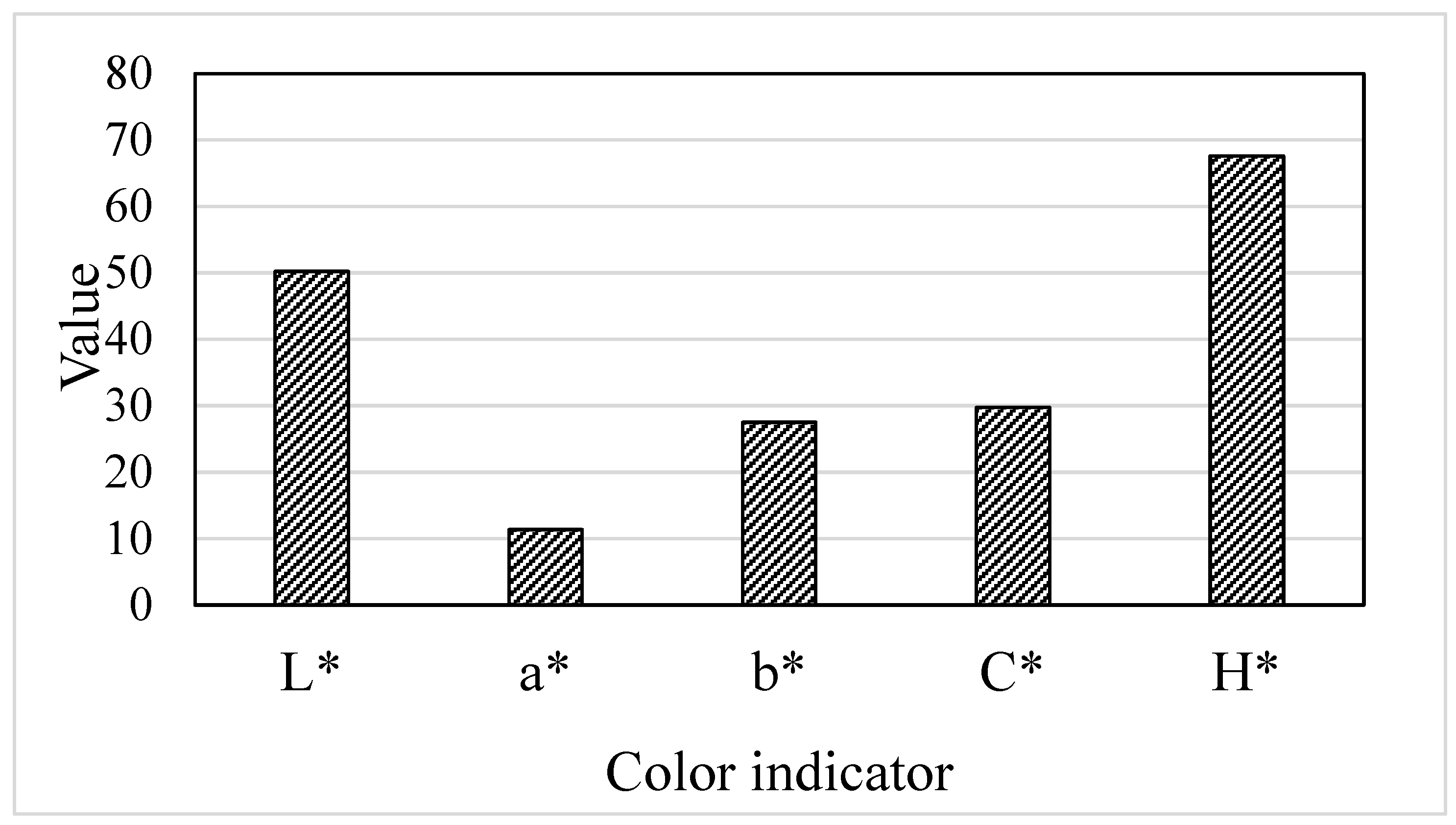
Color parameters (CIE Lab*) are widely used to assess the visual quality, degree of browning and processing impact in dehydrated fruit powders. The instrumental color analysis revealed that quince powder exhibits relatively light characteristics, with a high color brightness value, L* = 50.21 (Figure 1). The L* value indicates moderate lightness, which suggests limited non-enzymatic browning during low-temperature drying (45 °C). Compared to high-temperature drying methods, convective dehydration at mild conditions likely contributed to the preservation of the natural yellow pigmentation of the fruit matrix [20].
Additionally, recorded parameter values a* (red color coordinate) and b* (yellow color coordinate) for quince powder were a* = 11.35 and b* = 27.51. The positive a* and b* values indicate the predominance of red-yellow tones, consistent with the presence of carotenoid pigments and phenolic compounds naturally occurring in quince. The relatively high b* value confirms the retention of yellow chromaticity after drying. The b* parameter indicates that quince powder particles lean toward the yellow color coordinate. The shade angle (H*) reflects the characteristic color of the powder, where a hue angle of 0°, 90°, 180°, and 270° represents red, yellow, green, and blue colors, respectively [21]. Quince particles, in this case, exhibited values from the yellow coordinate (67.59 ± 0.38). A hue angle of approximately 68° corresponds to a yellow-orange region of the chromatic space, indicating minimal pigment degradation. This finding supports the hypothesis that drying at 45 °C preserved the characteristic color profile of the fresh fruit. Furthermore, the color saturation (C*) of quince powder (29.76 ± 0.53) serves as a measure of color purity. The relatively high chroma value reflects vivid coloration and suggests limited oxidative browning reactions. Since color degradation in fruit powders is often associated with Maillard reactions and phenolic oxidation, the observed chromatic stability may indicate controlled moisture removal and limited thermal damage.
Since color changes in fruit powders are frequently associated with phenolic oxidation, a potential relationship between color parameters and antioxidant activity may be hypothesized and warrants further investigation [20,21].

3.3. Antioxidant Activity of Quince Powder

The antioxidant potential of quince powder is primarily associated with its phenolic composition, including hydroxycinnamic acids, flavonols and tannin derivatives re-ported in previous studies. Quince is considered a health-promoting fruit due to its high polyphenol content and associated antioxidant properties [22,23,24,25]. Quince (Cydonia oblonga Mill.) is recognized for its high content of polyphenols, flavonoids, organic acids, and dietary fibers, which have been linked to antioxidant, anti-inflammatory, and cardioprotective effects [22,23,24]. Over recent decades, studies have evolved from basic compositional analyses to advanced profiling techniques such as UPLC-MS/MS and metabolomics, revealing diverse phenolic compounds including chlorogenic acid, quercetin derivatives, and proanthocyanidins [25,26,27].
In the present study four different methods were used and antioxidant activity of quince powder was detected in all of them. Results are presented in Table 2 as mM Trolox equivalent per gram extract and mM Trolox equivalent per gram dry weight.
The differences observed between antioxidant assays can be attributed to their distinct reaction mechanisms. DPPH and ABTS are based on radical scavenging activity, while FRAP and CUPRAC reflect reducing power. The higher values obtained by the DPPH method suggest a strong capacity of quince powder extracts to donate hydrogen atoms and neutralize free radicals, which is consistent with the presence of phenolic compounds such as hydroxycinnamic acids and flavonoids [14,15].
The higher result is obtained via the DPPH method (65.09 ± 6.80 mMTE/g extract, 45.57 ± 4.76 mMTE/g dry weight). In addition, quince powder was obtained by drying in a food dehydrator, which according to some authors leads to an increase in the content of phenolic compounds and improved antioxidant activity compared to fresh fruit [15,26,27]. Moreover, Çınar et al. (2024) [28] state that quince powder is a valuable functional ingredient in probiotic formulations due to its high content of dietary fiber, pectin and phenolic compounds. These components may exert a prebiotic-like effect by supporting the growth and survival of probiotic bacteria, particularly Bifidobacterium spp., while simultaneously enhancing antioxidant activity. Previous studies have shown that yogurt fortified with quince powder exhibited improved probiotic viability and increased total phenolic content during storage [28]. Therefore, quince powder can contribute both to microbial stability and to the overall functional quality of probiotic foods.
Specifically, because quince fruit has higher levels of phenolic components and a larger antioxidant capacity than apple or pear, using it as an antioxidant source can be beneficial in nutraceuticals and open up new uses for quince fruit. This is the reason why there is growing attention driven by the need for natural antioxidants to mitigate oxidative stress-related diseases and to develop functional foods [29,30]. Moreover, the increasing interest is in the processed forms of quince fruit such as powders and extracts, underscoring its practical significance in food and pharmaceutical industries [31]. The powdering method makes it simple to incorporate quince fruit into new food recipes as a nutritional supplement.
While quince demonstrates significant antioxidant potential, it is important to consider the variability in antioxidant activity due to factors such as extraction methods, solvent types, and the specific part of the plant used. Antioxidant activity correlated strongly with total phenolic content and specific phenolic compounds, supporting the role of these bioactives in radical scavenging and reducing power [27,32,33]. Additionally, while the antioxidant activity of quince is well-documented, its effectiveness compared to other known antioxidants like Trolox may vary, as some studies suggest a lower antioxidant potential in comparison [34]. This highlights the need for further research to fully understand the comparative efficacy of quince as an antioxidant source. The obtained results support the potential application of quince powder as a functional ingredient in food systems requiring natural antioxidant sources.

3.4. Sorption Characteristics

3.4.1. Equilibrium Moisture Content

To delve into the sorption characteristics of the laboratory-produced powder derived from the edible part of Bulgarian quince, the investigation initiated with the determination of the initial moisture content, which was identified as 10.14%. Subsequently, the powdered product underwent a controlled cycle of hydration and dehydration conditions over a span of 10 days. Distilled water was employed for the hydration phase, while CaCl2 was utilized for the dehydration phase.
During the absorption process, meticulous adjustments were made to dehydrate the product, ultimately achieving a moisture content level of 5.52%. In contrast, the desorption process involved a careful hydration regimen, resulting in the attainment of a moisture content level of 26.68%. This specific step is crucial in the overall process as it facilitates the determination of values representing the sorption capacity of the powder.
The outcomes of these processes, elucidating the equilibrium moisture content values, have been meticulously recorded and are presented in detail in Table 3 and Table 4. These tables serve as comprehensive repositories of the data obtained during the hydration and dehydration cycles, providing valuable insights into the sorption characteristics of the laboratory-produced powder from the edible part of the Bulgarian quince.
In both processes, a behavior typical of a significant number of food products is evident: as the temperature rises, while maintaining a constant water activity, there is a notable decrease in the equilibrium moisture content [12,16,17,33,34,35,36,37]. This phenomenon is in line with the well-established principle observed in the field. According to Mrad et al. (2012) [11], polymers mainly control water binding under low aw, which may lead to reduced equilibrium moisture content as temperature increases. In contrast, at higher aw, soluble compounds such as sugars take up more water, and the negative temperature impact becomes less significant because increased temperature enhances their solubility. Water activity is a more meaningful parameter than total moisture content when evaluating water’s involvement in chemical reactions. Increasing aw enhances solubility and promotes reaction rates up to the point of complete dissolution. Beyond this level, additional moisture causes dilution, which may decrease reactivity. As a result, reaction intensity typically rises to an optimum at intermediate aw values and then declines [11]. The sorption isotherm defines this relationship between aw and equilibrium moisture content [11,12,16,37].
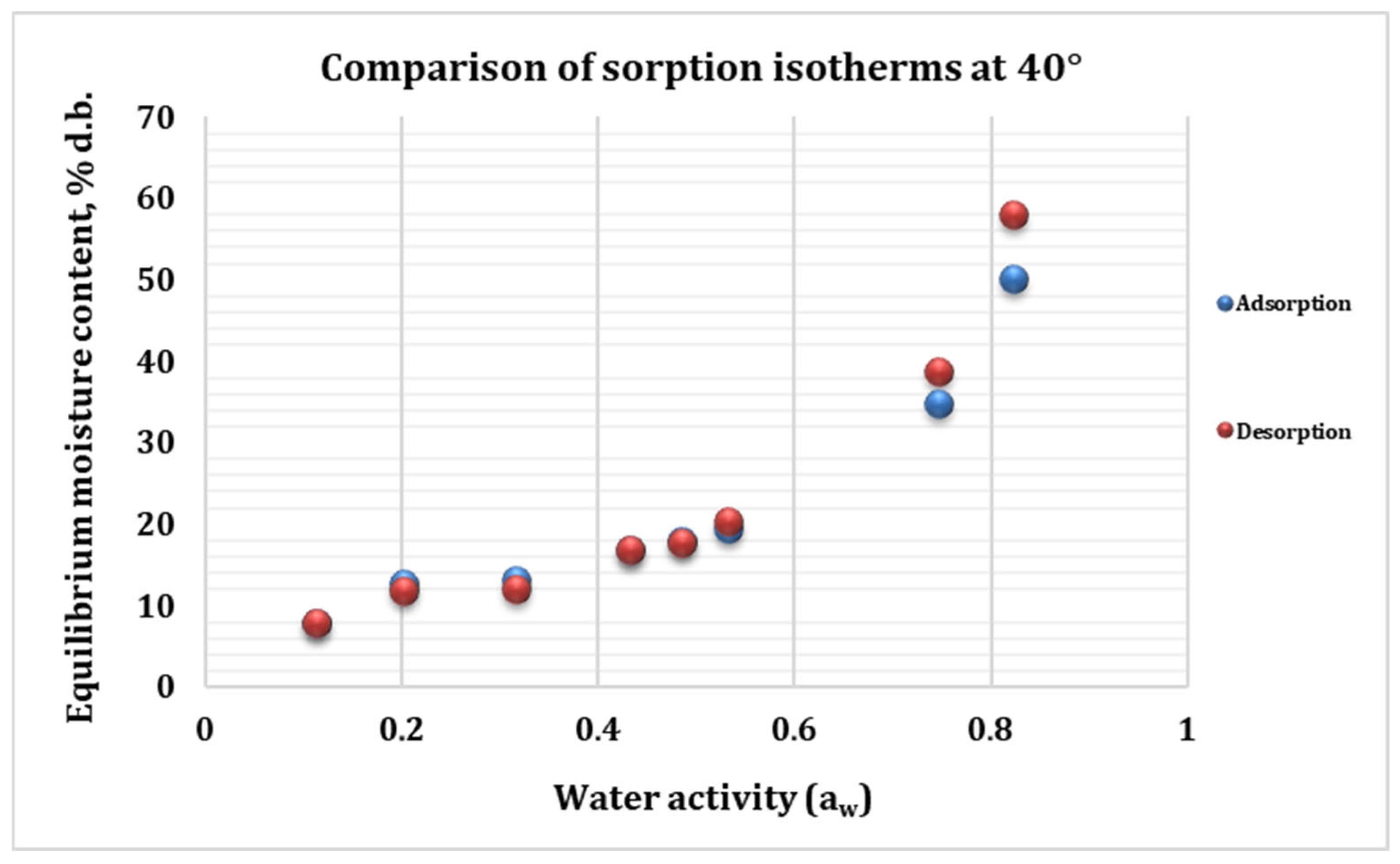
To visually depict and compare the sorption characteristics, Figure 2 has been included, showcasing the sorption isotherms under experimental conditions at a temperature of 40 °C. The graphical representation distinctly highlights that the isotherms conform to the characteristics of type II, as per the classification outlined by Brunauer et al. in 1940 [38]. This classification system provides insights into the interaction between moisture content and water activity, further aiding in the understanding of the sorption behavior observed in the laboratory-produced powder from the edible part of the Bulgarian quince. The experimental isotherms reveal sigmoidal-shaped curves. A similar pattern is observed in most high-carbohydrate food products, where adsorption capacity remains low at lower relative humidity levels. However, once aw exceeds 0.532, a sharp increase in adsorption occurs.

3.4.2. Modified Three-Parametrical Models

The derived coefficients (A, B, C) for the three-parameter models, namely Oswin, Halsey, Henderson, and Chung–Pfost, are meticulously calculated and outlined in Table 5 for the adsorption process and Table 6 for the desorption process. These coefficients play a crucial role in these models, providing insights into the specific characteristics of the sorption behavior observed during both processes.
Table 5 offers a comprehensive presentation of the calculated coefficients and is complemented by additional parameters such as the mean relative error (P%) and the standard deviation (SEM). These metrics contribute to a more thorough evaluation of the accuracy and reliability of the models employed during the adsorption process.
Similarly, Table 6 provides a detailed breakdown of the coefficients A, B, and C for the selected three-parameter models, offering a comparative analysis with additional insights into mean relative error (P%) and standard deviation (SEM) for the desorption process. This comprehensive data presentation serves as a valuable reference point for further analysis and interpretation of the sorption characteristics of the laboratory-produced powder from the edible part of the Bulgarian quince.
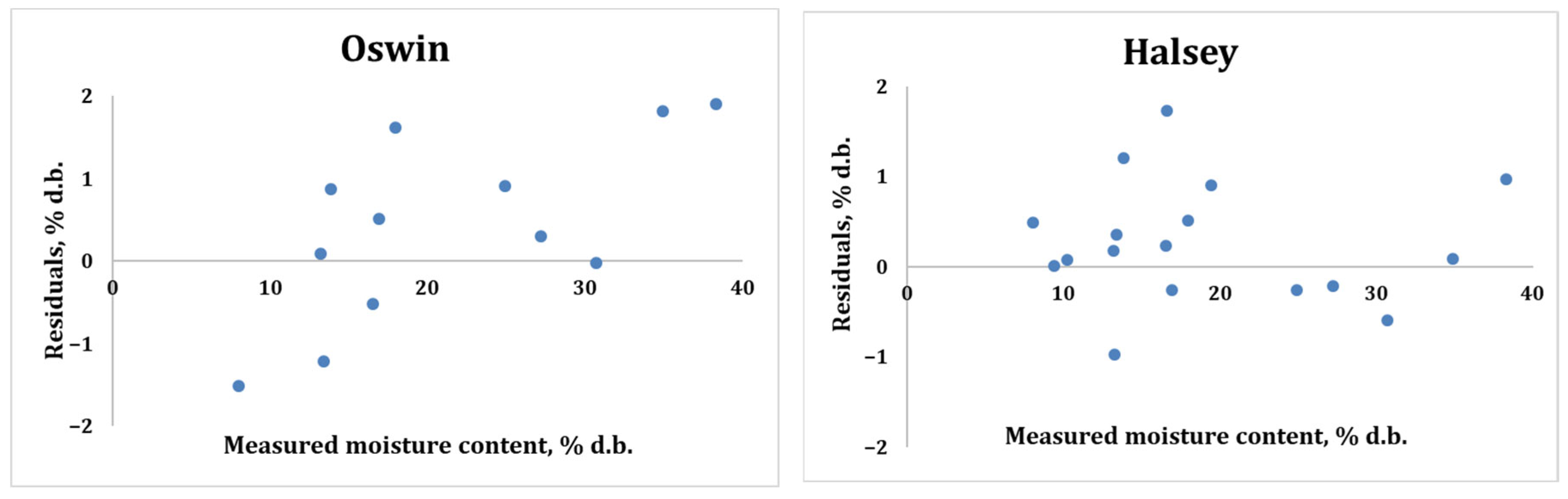
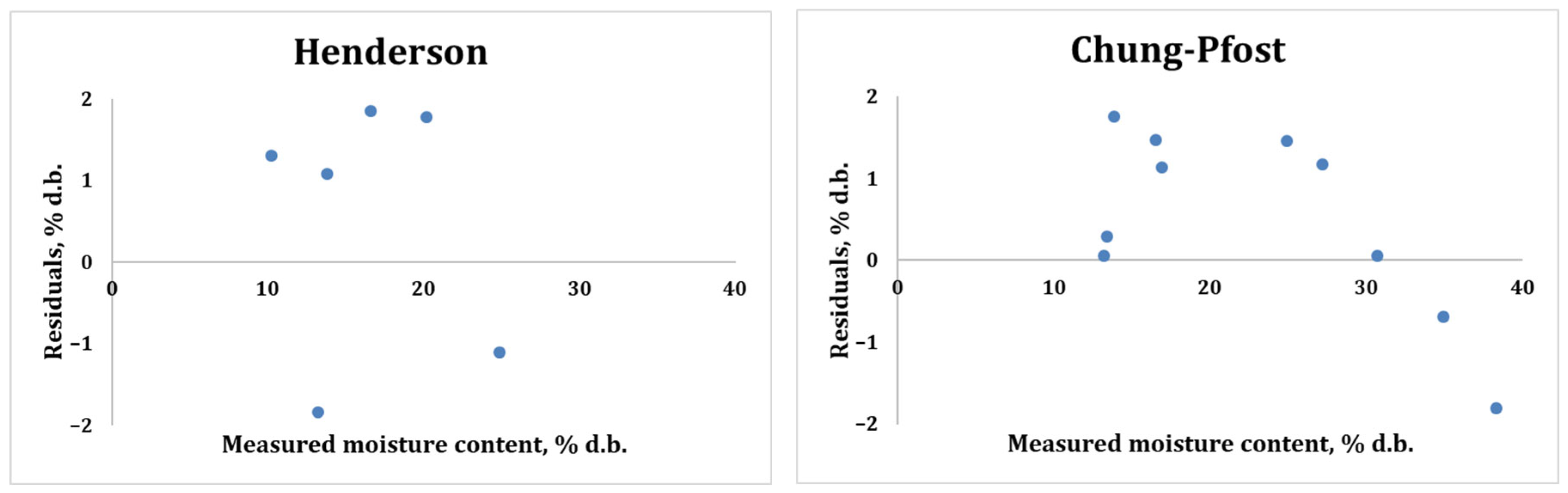
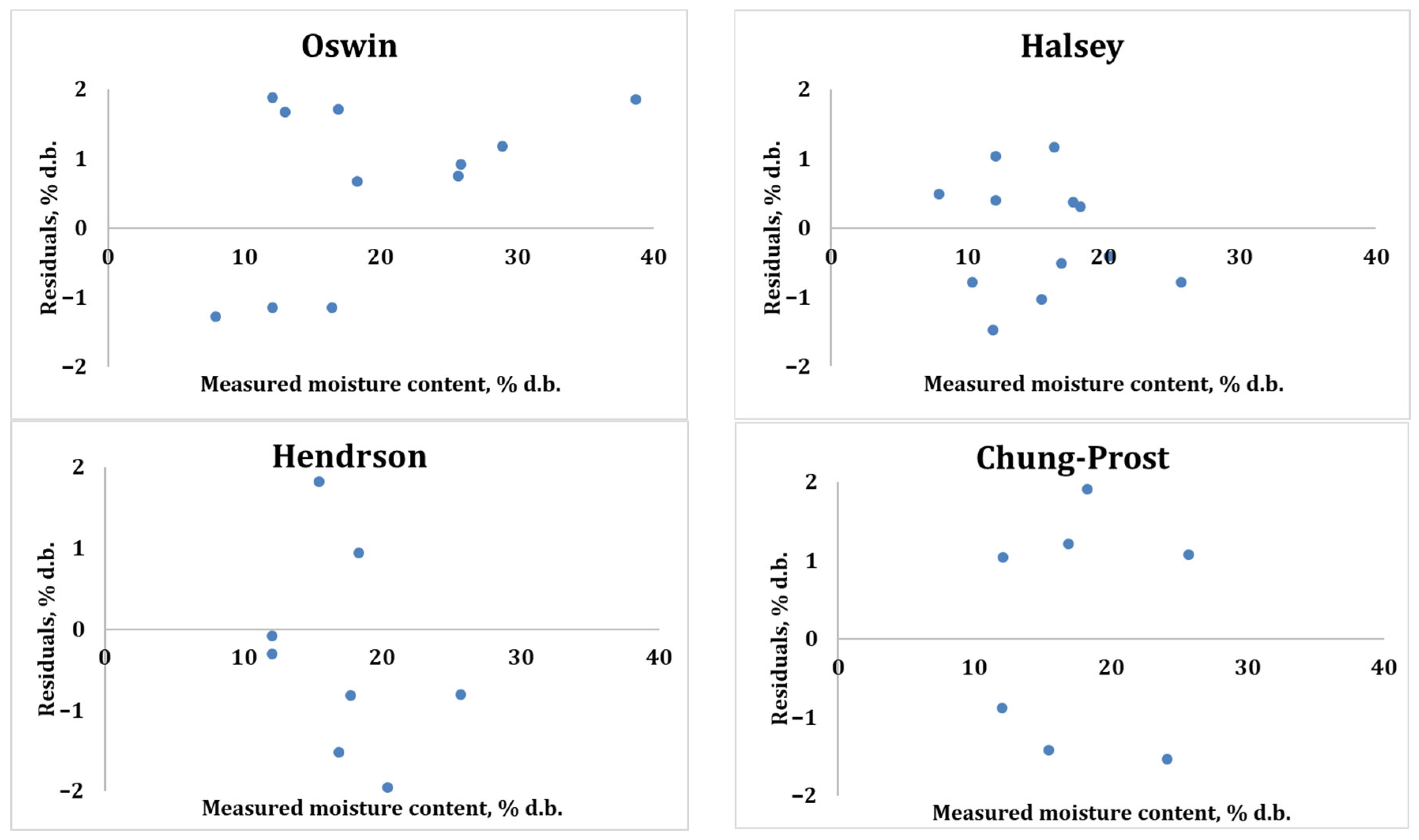
Figure 3 and Figure 4 depict a graphical representation of the residual distribution obtained from the calculations of the coefficients of the modified models used in the experiment.
Upon thorough examination of the tabular data and graphical dependencies, a discernible pattern emerges, indicating that the modified Halsey model consistently produces the lowest values for both mean relative error (P) and standard deviation (SEM) across both the adsorption and desorption processes. This noteworthy finding underscores the model’s superior performance in accurately describing the sorption isotherms of the laboratory-produced powder from the edible part of the Bulgarian quince.
The robustness of the modified Halsey model is further emphasized by its ability to exhibit a random and even distribution of residues in both processes. This characteristic suggests that the model captures the sorption behavior with a high degree of precision, avoiding systematic biases and errors.
Given these compelling observations, it is strongly recommended to leverage the modified Halsey model as the preferred choice for characterizing the sorption isotherms of powder derived from Bulgarian quince. This model not only demonstrates exceptional accuracy in representing the observed data but also showcases consistent and reliable performance, making it a valuable tool for further research and analysis in the realm of sorption characteristics of quince-derived products.
It should be noted that the use of three-parameter models may increase the risk of overfitting, particularly when the number of experimental data points is limited. However, the consistency of residual distribution and agreement between statistical indicators support the reliability of the selected model [16,17,35,36,37].
The observed decrease in equilibrium moisture content with increasing temperature at constant water activity can be explained by the weakening of hydrogen bonds between water molecules and the hydrophilic sites of the food matrix. As temperature increases, the kinetic energy of water molecules rises, reducing their binding affinity and resulting in lower moisture retention. This behavior is strongly influenced by the composition of quince powder, which is rich in carbohydrates and dietary fibers. These components provide numerous polar sites for water binding at low water activity, while at higher water activity levels, capillary condensation and dissolution of soluble sugars become dominant mechanisms [11,16,17,35,36,37].

3.4.3. Monolayer Moisture Content

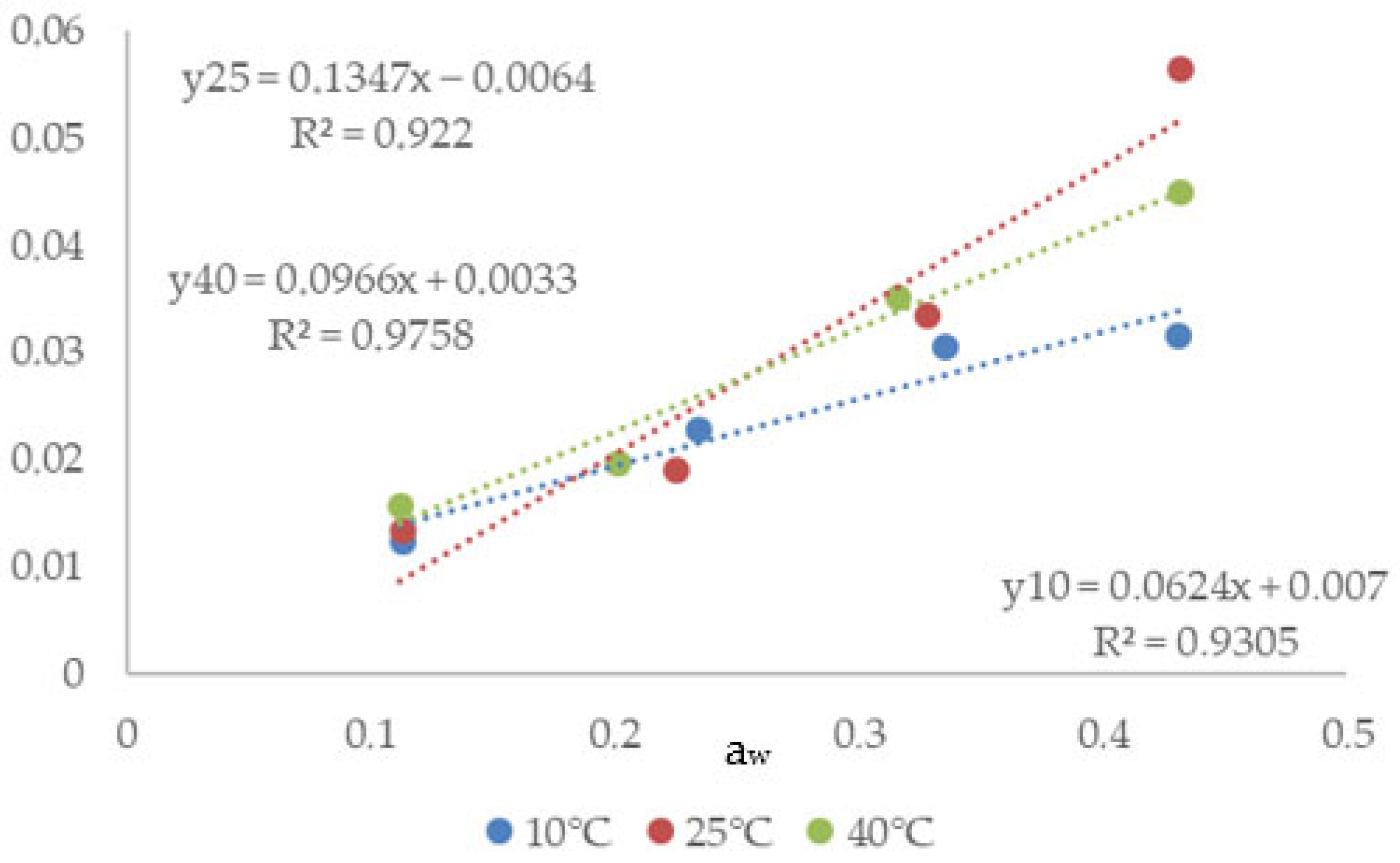
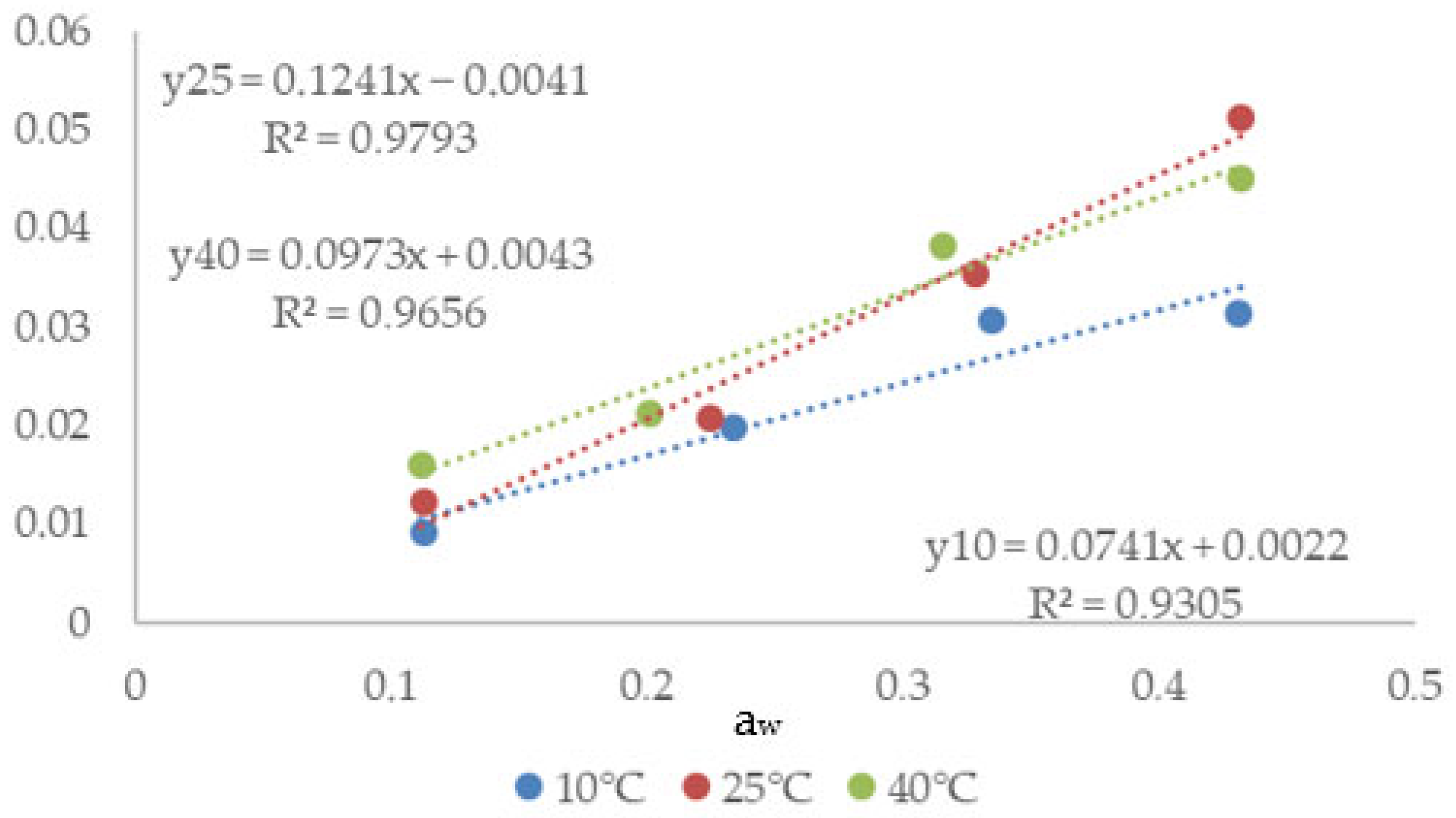
Through the strategic application of linearization techniques, as illustrated in Figure 5 and Figure 6, the Brunauer–Emmett–Teller equation was adeptly utilized to calculate the monolayer moisture content (MMC) [16,17,38,39]. This analytical process involved utilizing experimental data specifically for water activity (aw) values less than 0.5. The powdered product sourced from the edible part of the Bulgarian quince served as the subject of this meticulous examination, with the outcomes of this analysis being succinctly presented in Table 7.
The process of linearization, as depicted in Figure 5 and Figure 6, adds a layer of precision to the calculation of the monolayer moisture content. This technique allows for a more nuanced understanding of how the moisture content of the quince-derived product behaves at lower water activity levels, providing valuable insights into its unique sorption characteristics.
The data encapsulated in Table 7 becomes an invaluable reference point, offering a comprehensive overview of the monolayer moisture content specifically tailored to the conditions of the powdered product from the edible portion of the Bulgarian quince. This analysis enhances our understanding of the product’s behavior at low water activity levels, contributing to the broader exploration of its sorption dynamics [39].
It should be noted that the BET model is the most accurate within a limited range of water activity (aw < 0.5) and may introduce deviations at higher temperatures or in complex food systems rich in sugars. Therefore, the observed MMC values should be interpreted with caution.
The outcomes of the analysis underscore the significant impact of temperature on the monolayer moisture content (MMC) values in the powder derived from the edible part of Bulgarian quince. The observed variations provide valuable insights into how temperature influences the sorption characteristics of the quince-derived product.
At a temperature of 10 °C, the MMC values were 14.41% d.b. for the adsorption process and 13.11% d.b. for desorption. The estimated monolayer moisture content was higher, suggesting a shift in the moisture level associated with maximum sorption-site coverage. As the temperature increased to 25 °C, a noticeable decline in MMC values was evident, with readings settling at 7.09% d.b. for adsorption and 7.80% d.b. for desorption. This temperature shift resulted in moderated sorption behavior compared to the lower temperature range.
Interestingly, the MMC values experienced a subsequent rise at a temperature of 40 °C, reaching 10.01% d.b. for adsorption and 9.84% d.b. for desorption. This indicates reinvigorated sorption behavior at higher temperatures, showcasing the dynamic influence that temperature exerts on the moisture content behavior of the quince-derived powder. These nuanced findings highlight the intricate relationship between temperature and sorption characteristics, offering a detailed perspective on how varying temperature levels impact the monolayer moisture content of the powdered product from the edible part of the Bulgarian quince [11,12,36,37,38,39].
The non-monotonic variation in monolayer moisture content (MMC) with temperature may be attributed to structural and physicochemical transitions within the food matrix. At lower temperatures (10 °C), stronger water–solid interactions lead to higher estimated MMC values. At an intermediate temperature (25 °C), reduced binding strength results in lower monolayer values. The subsequent increase at 40 °C may be associated with increased molecular mobility, partial structural rearrangements, or limitations of the BET model when applied at higher temperatures.
Based on the present study, future work will focus on developing and optimizing a technical concept for the simplified domestic production of quince powder. Further research will explore its application in innovative food products and establish standardized methods for processing and storage. From a technological perspective, the determined sorption characteristics and monolayer moisture content provide essential information for optimizing storage conditions, packaging design, and shelf-life stability of quince powder. Maintaining moisture content close to the monolayer level may help minimize caking, microbial growth, and degradation of bioactive compounds. These findings are particularly relevant for the development of powdered functional food ingredients with improved storage stability.

4. Conclusions

The present study provides a comprehensive characterization of Bulgarian quince powder, integrating physicochemical composition, antioxidant activity, and temperature-dependent sorption behavior within a unified analytical framework. The results demonstrate that quince powder is a carbohydrate- and dietary fiber-rich ingredient (75.80 g carbohydrates and 21.50 g fiber per 100 g dry weight), with low lipid content (0.49 g) and moderate protein levels (1.27 g), contributing to an energy value of 355.65 kcal. Mild drying conditions (45 °C for 10 h) effectively limited non-enzymatic browning and preserved bioactive compounds, as confirmed by consistent antioxidant activity across DPPH, ABTS, FRAP, and CUPRAC assays.
Sorption analysis revealed type II isotherms typical of high-carbohydrate food systems, with the modified Halsey model providing the best fit to experimental data. Equilibrium moisture content decreased with increasing temperature under constant water activity, reflecting reduced water–matrix interactions. The monolayer moisture content (MMC), determined using the BET model (aw < 0.5), exhibited a non-monotonic temperature dependence (10 °C > 25 °C < 40 °C), which may be attributed to structural transitions within the matrix and model limitations at higher temperatures. These findings indicate that the physicochemical composition of quince powder plays a more significant role than temperature in governing water-binding behavior.
The novelty of this study lies in the combined evaluation of composition, antioxidant capacity, color characteristics, and temperature-dependent sorption properties of quince powder from Bulgarian raw material, including adsorption–desorption isotherms and monolayer moisture determination, which are insufficiently reported in the literature.
From a technological perspective, the results provide essential data for optimizing storage conditions, packaging design, and shelf-life stability. Further research is needed to characterize individual phenolic compounds and to evaluate the performance of quince powder in real food systems.

Author Contributions

Conceptualization, methodology, software, validation, formal analysis, investigation, resources, data curation, writing—original draft preparation, writing—review and editing, visualization, supervision, project administration, funding acquisition—A.B., A.D., Z.G. and H.K. All authors have read and agreed to the published version of the manuscript.

Funding

This study was carried out with financial support from the European Regional Development Fund within the Operational Programme “Bulgarian national recovery and resilience plan”, procedure for direct provision of grants “Establishing of a network of research higher education institutions in Bulgaria”, and under Project BG-RRP-2.004-0005 “Improving the research capacity and quality to achieve international recognition and resilience of TU-Sofia (IDEAS)”.

Institutional Review Board Statement

Not applicable.

Informed Consent Statement

Not applicable.

Data Availability Statement

The data presented in this study are available on request from the corresponding author.

Acknowledgments

This study was carried out with financial support from the European Regional Development Fund within the Operational Programme “Bulgarian national recovery and resilience plan”, procedure for direct provision of grants “Establishing of a network of research higher education institutions in Bulgaria”, and under Project BG-RRP-2.004-0005 “Improving the research capacity and quality to achieve international recognition and resilience of TU-Sofia (IDEAS)”.

Conflicts of Interest

The authors declare no conflict of interest.

References

  1. Minich, D.M. A review of the science of colorful, plant-based food and practical strategies for “eating the rainbow”. J. Nutr. Metab. 2019, 2019, 2125070. [Google Scholar] [CrossRef]
  2. Blumfield, M.; Mayr, H.; De Vlieger, N.; Abbott, K.; Starck, C.; Fayet-Moore, F.; Marshall, S. Should We ‘Eat a Rainbow’? An Umbrella Review of the Health Effects of Colorful Bioactive Pigments in Fruits and Vegetables. Molecules 2022, 27, 4061. [Google Scholar] [CrossRef]
  3. Abdollahi, H. A review on history, domestication and germplasm collections of quince (Cydonia oblonga Mill.) in the world. Genet. Resour. Crop Evol. 2019, 66, 1041–1058. [Google Scholar] [CrossRef]
  4. Rather, G.A.; Bhat, M.Y.; Sana, S.S.; Ali, A.; Gul, M.Z.; Nanda, A.; Hassan, M. Quince. In Antioxidants in Fruits: Properties and Health Benefits; Springer: Berlin/Heidelberg, Germany, 2020; pp. 397–416. [Google Scholar] [CrossRef]
  5. Hegedűs, A.; Papp, N.; Stefanovits-Bányai, É. Review of nutritional value and putative health-effects of quince (Cydonia oblonga Mill.) fruit. Int. J. Hortic. Sci. 2013, 19, 29–32. [Google Scholar] [CrossRef]
  6. Hussain, S.Z.; Naseer, B.; Qadri, T.; Fatima, T.; Bhat, T.A. Quince (Cydonia oblonga)—Morphology, Taxonomy, Composition and Health Benefits. In Fruits Grown in Highland Regions of the Himalayas: Nutritional and Health Benefits; Springer International Publishing: Cham, Switzerland, 2021; pp. 49–62. [Google Scholar] [CrossRef]
  7. Stojanović, B.T.; Mitić, S.S.; Stojanović, G.S.; Mitić, M.N.; Kostić, D.A.; Paunović, D.Ɖ.; Arsić, B.B.; Pavlović, A.N. Phenolic profiles and metal ions analyses of pulp and peel of fruits and seeds of quince (Cydonia oblonga Mill.). Food Chem. 2017, 232, 466–475. [Google Scholar] [CrossRef] [PubMed]
  8. Essafi-Benkhadir, K.; Refai, A.; Riahi, I.; Fattouch, S.; Karoui, H.; Essafi, M. Quince (Cydonia oblonga Miller) peel polyphenols modulate LPS-induced inflammation in human THP-1-derived macrophages through NF-κB, p38MAPK and Akt inhibition. Biochem. Biophys. Res. Commun. 2012, 418, 180–185. [Google Scholar] [CrossRef] [PubMed]
  9. Owfi, R.E. Natural Products and Botanical Medicines of Iran; CRC Press: Boca Raton, FL, USA, 2020. [Google Scholar]
  10. Razna, K. Cyanogenic glycosides-their role and potential in plant food resources. J. Microbiol. Biotechnol. Food Sci. 2021, 11, e4771. [Google Scholar] [CrossRef]
  11. Mrad, N.D.; Bonazzi, C.; Boudhrioua, N.; Kechaou, N.; Courtois, F. Moisture sorption isotherms, thermodynamic properties, and glass transition of pears and apples. Dry. Technol. 2012, 30, 1397–1406. [Google Scholar] [CrossRef]
  12. Barbosa-Cánovas, G.V.; Fontana, A.J., Jr.; Schmidt, S.J.; Labuza, T.P. Water Activity in Foods. Fundamentals and Applications; John Wiley & Sons, Inc.: Chicago, IL, USA; Institute of Food Technologists: Chicago, IL, USA, 2020. [Google Scholar]
  13. AOAC International. Official Methods of Analysis of the Association of Analytical Chemists International; Official Methods: Gaithersburg, MD, USA, 2005. [Google Scholar]
  14. Ivanov, I.; Vrancheva, R.; Marchev, A.; Petkova, N.; Aneva, I.; Denev, P.; Georgiev, V.; Pavlov, A. Antioxidant activities and phenolic compounds in Bulgarian Fumaria species. Int. J. Curr. Microbiol. Appl. Sci. 2014, 3, 296–306. [Google Scholar]
  15. Bogoeva, A.L.; Durakova, A.G.; Pavlov, A.I.; Yanakieva, V.B.; Vrancheva, R.Z.; Bozadzhiev, B.V.; Choroleeva, K.B. Antioxidant activity and storage regime of defatted grape seeds flour. Wine Stud. 2017, 6, 1–4. [Google Scholar] [CrossRef]
  16. Bogoeva, A. Sorption characteristics of flour mixtures enriched with grape seeds flour of Bulgarian and French raw materials. J. Cent. Eur. Agric. 2020, 21, 609–617. [Google Scholar] [CrossRef]
  17. Durakova, A. Sorption Characteristics of Bulgarian Penny Buns (Boletus Edulis). E3S Web Conf. 2020, 180, 03008. [Google Scholar] [CrossRef]
  18. Abboud, K.Y.; da Luz, B.B.; Dallazen, J.L.; de Paula Werner, M.F.; Cazarin, C.B.B.; Junior, M.R.M.; Iacomini, M.; Cordeiro, L.M. Gastroprotective effect of soluble dietary fibres from yellow passion fruit (Passiflora edulis f. flavicarpa) peel against ethanol-induced ulcer in rats. J. Funct. Foods 2019, 54, 552–558. [Google Scholar] [CrossRef]
  19. European Parliament; Council of the European Union. Regulation (EC) No 1924/2006 of the European Parliament and of the Council of 20 December 2006 on nutrition and health claims made on foods. Off. J. Eur. Union 2006, 304, 18–63. [Google Scholar]
  20. Murugesan, R.; Orsat, V. Spray drying of elderberry (Sambucus nigra L.) juice to maintain its phenolic content. Dry. Technol. 2011, 29, 1729–1740. [Google Scholar] [CrossRef]
  21. Santhalakshmy, S.; Bosco, S.J.D.; Francis, S.; Sabeena, M. Effect of inlet temperature on physicochemical properties of spray-dried jamun fruit juice powder. Powder Technol. 2015, 274, 37–43. [Google Scholar] [CrossRef]
  22. Kostecka-Gugała, A. Quinces (Cydonia oblonga, Chaenomeles sp., and Pseudocydonia sinensis) as medicinal fruits of the rosaceae family: Current state of knowledge on properties and use. Antioxidants 2024, 13, 71. [Google Scholar] [CrossRef]
  23. Wojdyło, A.; Oszmiański, J.; Bielicki, P. Polyphenolic composition, antioxidant activity, and polyphenol oxidase (ppo) activity of quince (Cydonia oblonga miller) varieties. J. Agric. Food Chem. 2013, 61, 2762–2772. [Google Scholar] [CrossRef]
  24. Zhang, L.; Rocchetti, G.; Zengin, G.; Ak, G.; Saber, F.R.; Montesano, D.; Lucini, L. The uhplc-qtof-ms phenolic profiling and activity of Cydonia oblonga mill. Reveal. A Promis. Nutraceutical potential. Foods 2021, 10, 1230. [Google Scholar] [CrossRef]
  25. Herrera-Rocha, K.M.; Rocha-Guzmán, N.E.; Gallegos-Infante, J.; González-Laredo, R.F.; Larrosa-Pérez, M.; Moreno-Jiménez, M.R. Phenolic acids and flavonoids in acetonic extract from quince (Cydonia oblonga mill.): Nutraceuticals with antioxidant and anti-inflammatory potential. Molecules 2022, 27, 2462. [Google Scholar] [CrossRef]
  26. Khan, N.; Maihemuti, N.; Nuer, M.; Abudurousuli, K.; Simayi, J.; Talihati, Z.; Han, M.; Hailati, S.; Zhou, W.; Wumaier, A. Analysis of major polyphenolic compounds of Cydonia oblonga miller (quince) fruit extract by uplc-ms/ms and its effect on adipo-genesis in 3t3-l1 cells. Separations 2022, 9, 167. [Google Scholar] [CrossRef]
  27. Sut, S.; Dall’Acqua, S.; Poloniato, G.; Maggi, F.; Malagoli, M. Preliminary evaluation of quince (Cydonia oblonga mill.) fruit as extraction source of antioxidant phytoconstituents for nutraceutical and functional food applications. J. Sci. Food Agric. 2019, 99, 1046–1054. [Google Scholar] [CrossRef]
  28. Çınar, Ş.B.; Ünal, G.; Koç, G.Ç.; Dirim, S.N.; Akalın, A.S. Quince Powder Increases Antioxidant Activity and Probiotic Survival in Yoghurt. Food Technol. Biotechnol. 2024, 62, 415–424. [Google Scholar] [CrossRef]
  29. Chi, B.; Liang, X.; Wang, L.; Bian, Y.; Zhang, M.; Tang, Z.; Wang, D.; Tian, Z. Component characterization, in vitro activities and molecular mechanism of Cydonia oblonga mill. Against diabetic. Pharmaceuticals 2022, 15, 1566. [Google Scholar] [CrossRef]
  30. Berkoz, M. Antioxidant and anti-lipoxygenase activities of Cydonia oblonga. Med. Sci. Int. Med. J. 2020, 9, 251–254. [Google Scholar] [CrossRef]
  31. Göksel, Z. Comparison of physicochemical and bioactive contents of 36 different quince cultivars and genotypes. Genet. Resour. Crop Evol. 2024, 71, 4499–4518. [Google Scholar] [CrossRef]
  32. Silva, B.M.; Andrade, P.B.; Valentão, P.; Ferreres, F.; Seabra, R.M.; Ferreira, M.A. Quince (Cydonia oblonga miller) fruit (pulp, peel, and seed) and jam: Antioxidant activity. J. Agric. Food Chem. 2004, 52, 4705–4712. [Google Scholar] [CrossRef]
  33. Baroni, M.V.; Baroni, M.V.; Gastaminza, J.; Gastaminza, J.; Podio, N.S.; Podio, N.S.; Lingua, M.S.; Wunderlin, D.A.; Wunderlin, D.A.; Rovasio, J.L.; et al. Changes in the antioxidant properties of quince fruit (Cydonia oblonga miller) during jam production at industrial scale. J. Food Qual. 2018, 2018, 1460758. [Google Scholar] [CrossRef]
  34. Gülçın, İ.; Dikici, E.; Altın, S.; Alp, C.; Işık, M.; Köksal, E. Determination of secondary metabolites of Cydonia oblonga (Quince) by LC-MS/MS method together with evaluation of its antioxidant and cholinergic potentials. J. Chem. Metrol. 2024, 2, 146–164. [Google Scholar] [CrossRef]
  35. Kapsalis, J.G. Influences of hysteresis and temperature on moisture sorption isotherms. In Water Activity; Routledge: Oxfordshire, UK, 2017; pp. 173–213. [Google Scholar]
  36. Bell, L.N. Moisture effects on food’s chemical stability. In Water Activity in Foods: Fundamentals and Applications; John Wiley & Sons: Hoboken, NJ, USA, 2020; pp. 227–253. [Google Scholar] [CrossRef]
  37. Labuza, T.P.; Altunakar, B. Water activity prediction and moisture sorption isotherms. In Water Activity in Foods: Fundamentals and Applications; John Wiley & Sons: Hoboken, NJ, USA, 2020; pp. 161–205. [Google Scholar] [CrossRef]
  38. Brunauer, S.; Deming, L.S.; Deming, W.E.; Teller, E. On a theory of the van der Waals adsorption of gases. J. Am. Chem. Soc. 1940, 62, 1723–1732. [Google Scholar] [CrossRef]
  39. Brunauer, S.; Emmett, P.H.; Teller, E. Adsorption of gases in multimolecular layers. J. Am. Chem. Soc. 1938, 60, 309–319. [Google Scholar] [CrossRef]
Figure 1. Color indicators of quince powder.
Applsci 16 03723 g001
Figure 2. Comparison of isotherms at 40 °C and water activity from 0.11 to 0.87.
Applsci 16 03723 g002
Figure 3. Residual distribution for processes of adsorption.
Applsci 16 03723 g003aApplsci 16 03723 g003b
Figure 4. Residual distribution for processes of desorption.
Applsci 16 03723 g004
Figure 5. BET model linearization for adsorption process.
Applsci 16 03723 g005
Figure 6. BET model linearization for desorption process.
Applsci 16 03723 g006
Table 1. Approximate physico-chemical composition and nutritional values of quince powder.
ParametersResults,
g/100 g Dry Weight
Carbohydrates75.80 ± 0.28
Ash content2.31 ± 0.13
Fiber21.50 ± 1.84
Protein1.27 ± 0.10
Lipids0.49 ± 0.12
Nutritional values355.65 ± 1.07
Table 2. Antioxidant activity of the quince powder.
MethodmMTE/g ExtractmMTE/g Dry Weight
DPPH65.09 ± 6.8045.57 ± 4.76
ABTS8.35 ± 0.075.84 ± 0.05
FRAP4.54 ± 0.333.18 ± 0.23
CUPRAC7.94 ± 1.015.56 ± 0.71
Table 3. Equilibrium moisture content (M), % dry basis for adsorption at three temperatures t (°C) and water activity aw.
Sel 10 °C 25 °C 40 °C
awM *sd **awM *sd **awM *sd **
LiCl0.11310.250.330.1139.370.250.1128.000.08
CH3COOK0.23413.370.300.22513.220.240.20112.770.17
MgCl20.33516.530.320.32813.820.140.31613.160.05
K2CO30.43124.000.060.43216.610.200.43216.910.06
MgNO30.57427.190.110.52920.170.280.48417.930.22
NaBr0.62230.700.150.57624.870.280.53219.450.16
NaCl0.75740.540.080.75338.290.330.74734.890.13
KCl0.86866.380.170.84357.160.150.82350.150.17
* Mean value of triple replications; ** standard deviation; *** results are presented as % dry basis, not % wet basis.
Table 4. Equilibrium moisture content (M), % dry basis for desorption at three temperatures t (°C) and water activity aw.
Sel 10 °C 25 °C 40 °C
awM *sd **awM *sd **awM *sd **
LiCl0.11313.760.090.11310.340.220.1127.900.09
CH3COOK0.23415.430.450.22512.050.270.20111.890.29
MgCl20.33516.400.480.32813.020.130.31612.090.20
K2CO30.43124.110.440.43218.290.080.43216.880.37
MgNO30.57425.911.090.52919.850.210.48417.740.11
NaBr0.62228.920.130.57625.700.240.53220.390.21
NaCl0.75741.460.710.75341.280.350.74738.680.88
KCl0.86866.491.390.84359.250.750.82358.061.08
* Mean value of triple replications; ** standard deviation; *** results are presented as % dry basis, not % wet basis.
Table 5. Coefficients of modified models (A, B, C), the mean relative error (P%), the standard error of moisture content (SEM) and correlation coefficient (R) for adsorption.
ModelABCPSEMR
Oswin24.3597−0.10280.549511.132.390.99
Halsey4.19682−0.00911.42465.792.030.99
Henderson0.000172.69881.648626.039.300.89
Chung–Pfost356.5220.065590.33817.896.190.97
Table 6. Coefficients of modified models (A, B, C), the mean relative error (P%) and the standard error of moisture content (SEM) and correlation coefficient (R) for desorption.
ModelABCPSEMR
Oswin22.8885−0.02820.574414.664.270.98
Halsey4.31774−0.01221.43299.893.090.98
Henderson0.000149.23951.615921.999.710.92
Chung-Pfost318.6990.063779.83321.297.290.96
Table 7. Monolayer moisture content expressed in % dry basis and calculated thought BET model.
t (°C)Adsorption *Desorption *
1014.41% d.b. 13.11% d.b.
257.09% d.b.7.80% d.b.
4010.01% d.b.9.84% d.b.
* Results are presented as % dry basis, not % wet basis.
Disclaimer/Publisher’s Note: The statements, opinions and data contained in all publications are solely those of the individual author(s) and contributor(s) and not of MDPI and/or the editor(s). MDPI and/or the editor(s) disclaim responsibility for any injury to people or property resulting from any ideas, methods, instructions or products referred to in the content.