Article

Submerged Agitated Cultures of Edible Ascomycetes and Basidiomycetes Grown on Carbon-Rich Waste Streams: Mycelial Mass Production and Volatile Compound Analysis


by
Dimitris Sarris
1,2,
Konstantinos Gkatzionis
3,
Antonios Philippoussis
1,†,
Athanasios Mallouchos
4,
Danai Ioanna Koukoumaki
2,3 and
Panagiota Diamantopoulou
1,*
1
Laboratory of Edible Fungi, Institute of Technology of Agricultural Products, Hellenic Agricultural Organization—Dimitra, Sof. Venizelou 1, 14123 Lykovrissi, Greece
2
Laboratory of Physico-Chemical and Biotechnological Valorization of Food By-Products, Department of Food Science & Nutrition, School of Environment, University of the Aegean, Leoforos Dimokratias 66, 81400 Myrina, Lemnos, Greece
3
Laboratory of Consumer and Sensory Perception of Food & Drinks, Department of Food Science and Nutrition, University of the Aegean, Metropolite Ioakeim 2, 81400 Myrina, Lemnos, Greece
4
Laboratory of Food Chemistry and Analysis, Department of Food Science and Human Nutrition, Agricultural University of Athens, Iera Odos 75, 11855 Athens, Greece
*
Author to whom correspondence should be addressed.
Dedicated to his memory.
Appl. Sci. 2026, 16(3), 1615; https://doi.org/10.3390/app16031615
Submission received: 11 December 2025 / Revised: 24 January 2026 / Accepted: 1 February 2026 / Published: 5 February 2026

Abstract

The present study explores the treatment and valorization of carbon-rich, low-cost waste streams—sugar beet molasses, expired rice, and wheat cereal hydrolysates—as substrates for submerged shake-flask cultures of edible ascomycetes (Morchella elata AMRL 63, Tuber aestivum AMRL 364) and basidiomycetes (Lentinula edodes AMRL 126, Agaricus bisporus AMRL 209) within a circular bioeconomy framework. Cultures were conducted under different C/N ratios (20 and 50) with or without the addition of olive oil or its emulsion. Among the tested species, the ascomycetes M. elata AMRL 63 and T. aestivum AMRL 364 outperformed the basidiomycetes in biomass production and substrate utilization. Supplementation with olive oil or its emulsion enhanced mycelial growth and lipid accumulation, while a higher C/N ratio (50) favored exopolysaccharide (EPS) synthesis. Lipid profiles were dominated by oleic (Δ9C18:1) and linoleic (Δ9,12C18:2) acids, with greater unsaturation observed in C/N = 20 cultures. Volatile analysis revealed species-specific aroma signatures, including characteristic truffle and morel compounds. The results underscore the feasibility of using waste streams for sustainable mushroom cultivation.

1. Introduction

From agricultural production to consumption, waste streams are generated alongside all steps of the food industry sectors and sub-sectors. Within the framework of the circular economy and bioeconomy, such streams could be considered as economically and environmentally viable substrates for mushroom cultivation, offering a profitable way to valorize crop residues while reducing agricultural waste. Their use supports circular bioeconomy practices by contributing to food production, soil amendment, and industrial applications [1,2]. The simultaneous treatment and valorization of agro-industrial waste streams to produce diversified bio-based end-products could lead to a revolutionary sustainability model [3,4,5]. Out-of-date flour-rich waste streams, such as various confectionery products and food for infants, contain significant quantities of starch and protein and, therefore, could be considered as valuable renewable bioprocess feedstocks [6,7]. Molasses is derived as a by-product from sugar processing facilities, posing a serious environmental threat. It possesses a high organic load and a dark brown color, mainly due to melanoidin content [8]. Molasses could be used as a potential substrate to produce biomass and cellular metabolites [6,9,10].
Unique dietary and functional properties, such as taste, aroma, high protein and carbohydrate content, low fat and dietary fiber content, as well as medicinal and therapeutic (antitumor and immuno-logical) activity, are included in fresh or processed edible fungi [11,12,13,14,15,16,17,18,19]. Mycelial mass (being rich in various bioactive compounds) produced by submerged cultures may present similar properties [6,9,20,21,22]. Unlike static cultures, shake-flask agitation enhances oxygen transfer, mixing, and shear forces, which interact with substrate composition to modulate fungal metabolism in ways not captured by static cultivations [13,14]. The food market is currently based on the time-consuming and labor-intensive farm cultivation process, which offers commercial mushroom products. An alternative and quicker process to produce high-quality fungal mass, like Morchella and Tuber mycelia produced from submerged cultures, could be considered as an attractive industrial potential [23]. Such industrial/market needs, simultaneous with a positive environmental impact, can be met by using agro-industrial renewable feedstock as substrates. The literature presents several agro-industrial waste streams (olive mill wastewaters, molasses, carbon-/flour-rich products, bio-diesel-derived glycerol, whey, etc.) used as substrate for mycelial mass and metabolites production [6,9,20,24,25,26].
Regarding liquid cultures, the formation of bioactive compounds, as well as mycelial growth and substrate utilization, are being strongly regulated by the C/N ratio and proportions of other medium components [6,9,20,26,27,28,29]. Although several studies have been conducted on liquid cultures with lignocellulosic wastes as substrates, there is a notable lack of detailed information regarding changes in the physicochemical properties of fermentation media during liquid culture for many mushroom species. Specifically, metabolic functions involved in the cultivation process, differences in fungal strains due to their microbiome, and the key role of enzymes remain under-investigated. Also, new substances should continually be tested in substrate synthesis to achieve optimization of productivity and important metabolite production in view of large-scale application. The addition of olive oil or its emulsion is uncommon in waste-based fungal cultures, yet polysaccharide production and protection under oxidative stress have been previously mentioned [26], introducing a novel aspect to substrate optimization strategies.
The present study aimed to valorize carbon-rich, low-cost waste streams as substrates for submerged shake-flask cultures of edible and medicinal ascomycetes and basidiomycetes within circular bioprocesses. Mycelial biomass, exopolysaccharides, and lipids of high nutritional and medicinal value were monitored under C/N ratios of 20 and 50. Cultures supplemented with extra virgin olive oil or its emulsion (C/N = 20) were also evaluated for potential enhancement of fungal growth, biomass production, and stress resistance. To the authors’ knowledge, few studies have explored the growth of Agaricus, Lentinula, Morchella, and Tuber species on beet molasses or flour-rich hydrolysates in liquid cultures.

2. Materials and Methods

2.1. Fungal Strains, Substrates, and Culture Conditions

The ascomycete strains Morchella elata AMRL 63 and Tuber aestivum AMRL 364 and the basidiomycete strains Lentinula edodes AMRL 126 and Agaricus bisporus AMRL 209 were kindly provided by Athens Mushroom Research Laboratory (AMRL) (ITAP, ELGO-Dimitra, Athens, Greece) and maintained in potato dextrose agar at 2.0 °C.
Sugar beet molasses (M), expired-shelf-date rice cereal hydrolysates (RCH), and wheat cereal hydrolysates (WCH) were used as waste stream liquid substrates for the growth of fungal strains. Beet molasses consisted of total sugars (TS) of 473 ± 5 g/L expressed as glucose equivalent and density of 1.38 g/mL, which were provided by the “Hellenic Industry of Sugar S.A.” (Orestiada, Greece). Beet molasses was stored at T = 4.0 ± 0.5 °C. Commercial rice cereal (RC) and commercial wheat cereal (WC) (Jotis S.A., Athens, Greece) comprised, according to manufacturers, 86.1% (w/w) carbohydrates and 1.3% sugars (density 1.06 g/mL) and 77.3% carbohydrates and 45.8% sugars (including 17.2% sucrose; density 1.05 g/mL), respectively.
RCH and WCH were produced by enzymatic hydrolysis using commercial glucoamylase in Duran bottles containing RC and WC, as previously reported in Sarris et al. [6]. Hydrolysis process optimization preceded, as described in Tsakona et al. [7], whereas fed-batch hydrolysis (98–350 g/L) with staged enzyme addition (glucoamylase 0.24–0.97 U/mL, protease 4.03–16.13 U/mL) enhanced starch-to-glucose conversion at concentrations above 205 g/L. Almost complete conversion of starch to glucose was achieved approximately 8 h after the initiation of the process. The aforementioned waste streams, serving as carbon sources, were mixed with appropriate amounts of nitrogen sources—yeast extract (11.0% w/w nitrogen and 10.0% w/w carbon; Serva, Heidelberg, Germany) and peptone (11.0% w/w nitrogen and 35.0% w/w carbon; Fluka, Seelze, Germany)—and water to obtain substrates with C/N of 20 and 50. The initial total substrate concentration (TS0) of the culture media with C/N = 20 (TS0 = 30 g/L) (the most common for mushroom cultivation; Refs. [29,30] was (in g/L): molasses 66, RCH 27, and WCH 25. The initial total substrate concentration (TS0) of the culture media with C/N = 50 (TS0 = 80 g/L) was (in g/L) molasses: 89; RCH: 72; and WCH: 65. Finally, submerged cultures of C/N = 20, including 1% v/v extra virgin olive oil and 2% v/v emulsion of extra virgin olive oil, were performed. A Jenway 3310 (Stone, Staffordshire, United Kingdom pH meter was used to measure pH values, which were regulated to 6.2 ± 0.2.
Liquid agitated cultures were performed in 100 mL Erlenmeyer flasks containing 30 ± 1 mL of growth medium. Flasks were autoclaved for 20 min at 121 ± 0.5 °C, allowed to cool, and inoculated with 9 mm agar plugs. A 5–10-day-aged growing colony (depending on the fungus [31]) was used to produce the plugs. Cultures were incubated at 26.0 ± 0.2 °C under shaking conditions of 180 ± 5 rpm in an orbital shaker incubator (ZHICHENG ZHWY 211B, Shanghai, China). Sampling was conducted at 11 days, regarding M. elata AMRL 63 and T. aestivum AMRL 364, and at 30 days, regarding L. edodes AMRL 126 and A. bisporus AMRL 209 strains.
Experiments using the same strains in submerged static cultures of C/N = 20 and 50 under identical conditions have been performed in Sarris et al. [6].

2.2. Analyses

Biomass was recovered by vacuum filtration (Whatman No.2) and subsequently washed twice and dried at 65 ± 2 °C to constant weight. The concentration was determined gravimetrically and expressed as dry weight (DW) (X, g/L).
Residual total sugars (TS, g/L) of the M and WCH substrates were determined according to Roukas [32] and expressed as glucose equivalents according to DNS method [33].
Concentration of exopolysaccharides (EPS, g/L) in the filtrated media was determined by mixing the filtrates with four volumes of 95% (v/v) ethanol (Merck, Darmstadt, Germany) and maintained at 4.0 ± 0.5 °C for 12 h to precipitate crude polysaccharides, followed by centrifugation (9000 rpm, 20 min, 4.0 ± 0.5 °C; Micro 22R, Hettich, Tuttlingen, Germany). The sediment was collected and dried at 60 ± 2 °C to remove residual ethanol. The EPS concentration was determined by a phenol–sulfuric acid assay [34] and expressed as glucose equivalent [35].
Total lipids (L, g/L) were determined using modified “Folch” method (chloroform/methanol 2:1 (v/v)). Briefly, mycelial debris was removed by filtration (No 2 Whatman filters, Buckinghamshire, England), and solvents were evaporated using a rotary evaporator (R-144, Büchi Labortechnik, Flawil, Switzerland) prior to gravimetric lipid quantification [36]. Fatty acid methyl esters (FAMEs) were analyzed by GC- FID (Fisons 8060, Rhone-Poulenc Rorer, Collegeville, PA, USA) equipped with a CP-WAX 52 CB capillary column (Agilent Technologies, Santa Clara, CA, USA), as described by Fakas et al. [37].

2.3. Determination of Volatile Compounds by Headspace SPME-GC/MS

Wet mycelial biomass (0.1 g) was placed in 4 mL headspace vial (Supelco, Bellefonte, PA, USA), sealed with PTFE-lined septa, and equilibrated for 10 min at 36 °C. Volatile compounds were extracted by headspace SPME using a DVB/CAR/PDMS fiber (2 cm) (Supelco, Bellefonte, PA, USA) for 30 min under identical conditions and thermally desorbed in the GC injection port at 240 °C (split 1:10) for 10 min (GCMS-QP2010 Ultra, Shimadzu Corporation, Kyoto, Japan). The fiber was subsequently conditioned at 250 °C for 5 min. Separation was achieved on a DB-WAX capillary column (30 m × 0.25 mm, 0.25 μm) with He as carrier gas (constant linear velocity 36 cm/s). The oven temperature was programmed from 40 °C (5 min) to 150 °C at 4 °C/min, then to 250 °C at 30 °C/min (5 min hold). MS analysis was performed in EI mode (70 eV; m/z 40–650), with source and interface temperatures set at 230 and 240 °C, respectively. Compound identification was carried out using AMDIS and NIST MS Search libraries, and normalized peak areas were used for statistical analysis. Identification and semi-quantification (normalized peak areas, %) were performed using GC-MS Solution (ver. 4.30; Shimadzu), AMDIS (ver. 2.72; NIST), and NIST MS Search (ver. 2.2; NIST) software. Compound identification was based on comparison of (i) retention indices (RI), calculated relative to a C8–C24 n-alkane series and compared with those of authentic standards and reference data from the NIST14 library, and (ii) mass spectral data with spectra of authentic compounds, when available, and those reported in the NIST14 library. The reliability of identification (RID) was classified into three levels: A, agreement of both RI and mass spectrum with those of an authentic standard; B, agreement of RI (ΔRI < 20) and mass spectral similarity match > 900; and C, partial agreement, defined as either ΔRI < 20 or mass spectral similarity match > 800. Besides wet mycelial mass produced in present study, volatile compound analysis also includes samples of biomass produced in static flask cultures (C/N = 20) of a previous study [6]. The strains and substrates used, as well as the culture conditions, are identical. For biomass (X, g/L), total substrate consumed (TS, %), total cellular lipid (L, g/L), and exopolysaccharide (EPS, g/L) determinations (presented in Table 1 and Table 2), each data point represents the mean of five independent biological replicates, corresponding to five individual flasks per experimental condition. For fatty acid composition analysis of total cellular lipids, each data point represents the mean of two independent measurements obtained from three flasks per experimental condition. The relationship between the samples and their volatiles (variables) detected with SPME GC–MS analysis was evaluated by principal component analysis (PCA).
Prior to the multivariate analysis, the dataset was evaluated by one-way ANOVA at a significance level of α = 0.05. Statistically significant differences among treatments were identified using Tukey’s HSD and Fisher’s LSD post hoc tests (95% confidence level). Only the variables showing significant differences were included in the subsequent PCA analysis. PCA was performed on the Pearson correlation matrix. All data were standardized (1/standard deviation) prior to analysis. All data analyses were performed using XLSTAT for Microsoft Excel (Addinsoft, Paris, France).

3. Results and Discussion

3.1. Mycelial Mass Production and Substrate Consumption

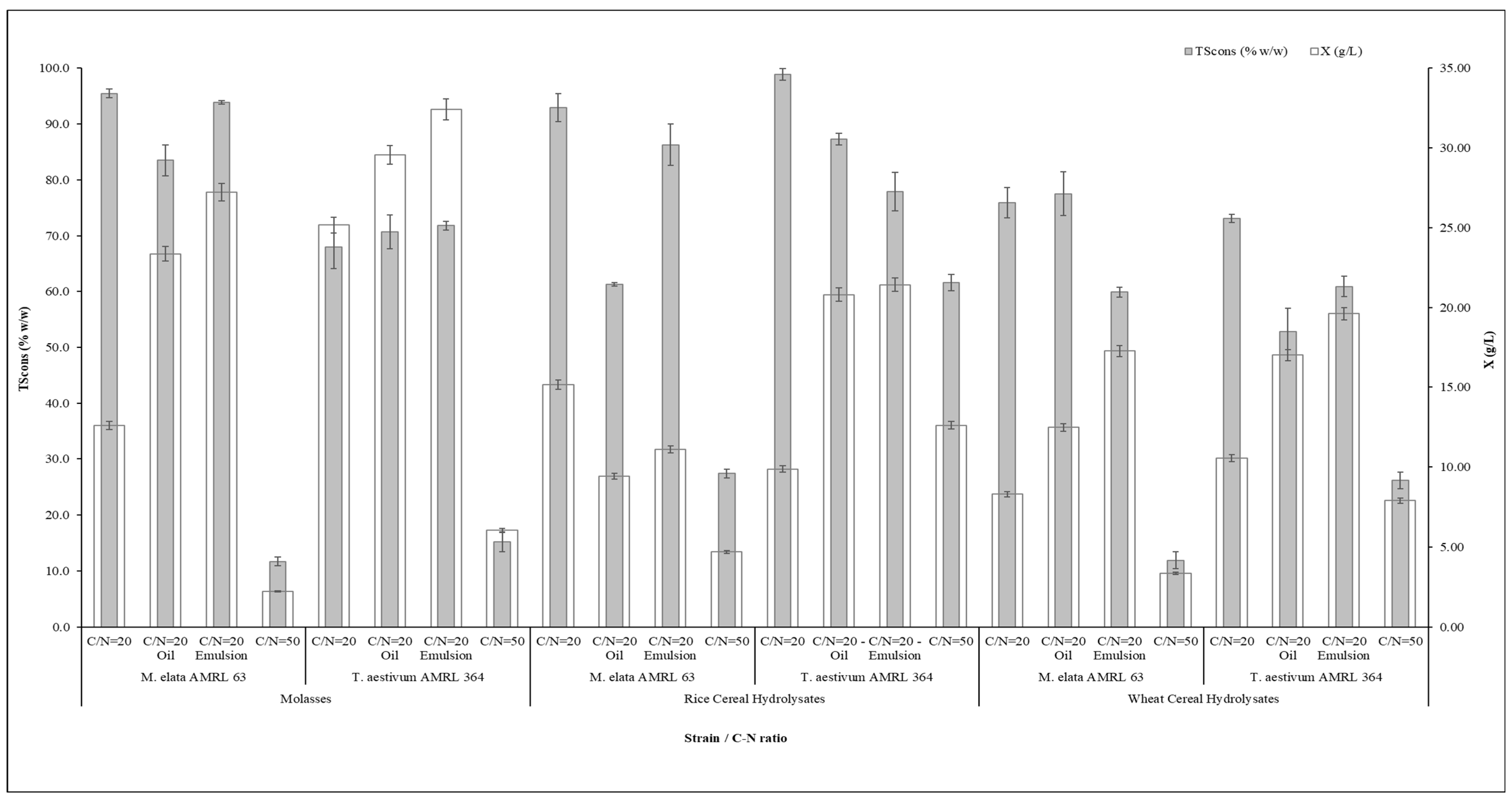
As a general remark, it could be noted that the ascomycete strains M. elata AMRL 63 and T. aestivum AMRL 64 presented significantly higher growth and substrate consumption (Table 1, Figure 1) in all C/N = 20 trials, regardless of any other condition, compared to the basidiomycete strains L. edodes AMRL 126 and A. bisporus AMRL 209 (Table 2). In fact, in many cases, L. edodes AMRL 126 and A. bisporus AMRL 209 did not manage to grow at all when carbon-rich waste streams were used as growth media (Table 2). In T. aestivum AMRL 64 experiments where molasses was added into the culture media and C/N = 20 and olive oil emulsion was applied, the overall maximum biomass value in this study was noted (Xmax = 32.42 g/L) (Table 1). Most of these values are higher than those reported for mushroom strains cultivated in synthetic media with glucose as the main carbon source [9,20,29], including Morchella strains, indicating that agricultural waste constitutes a nutrient-rich substrate.
Concerning agitated fermentations where C/N = 20 was applied (no oil addition), fungal mass production, EPS synthesis, and total substrate assimilation seem to all be strain- and culture media-dependent. L. edodes strain AMRL 126 did not present any growth when molasses and WCH were used as substrates. On the contrary, in RCH cultures, maximum biomass reached the value of 4.69 g/L, including moderate total substrate consumption (~60.0%). Likewise, A. bisporus strain AMRL 209 presented no growth when molasses and RCH were applied to the media, while in WCH cultures, maximum mycelial mass was 4.68 g/L (TScons ~80.0%) (Table 2). When M. elata strain AMRL 63 was used, maximum biomass values fluctuated from 8.31 to 15.16 g/L, accompanied by substrate consumption from ~76.0 to ~96.0%, depending on the waste stream added into the media. Maximum EPS values presented were 0.51 g/L to 1.90 g/L (Table 1, Figure 1). In the case of T. aestivum strain 364, maximum fungal mass values noted were 9.87–25.17 g/L with a substrate assimilation of ~68.0–99.0%. The maximum EPS production presented was 0.74–1.20 g/L (Table 1, Figure 1), with values lower corresponding to the literature (EPS 2–4 g/L for Morchella spp. in molasses) [9]. Surprisingly enough, in trials where RCH was added, even if almost all substrate was consumed, the maximum fungal mass value noted (Xmax = 9.87 g/L) was the lowest compared to respective values of molasses and WCH fermentations.
When olive oil and olive oil emulsion were applied in the media, both mycelial mass (except for M. elata AMRL 63 and L. edodes AMRL 126 when grown in RCH cultures) and EPS (except for M. elata AMRL 63 when grown in RCH cultures) synthesis were significantly enhanced in almost all experiments compared to respective fermentations with no oil addition. This physiological change enhances membrane permeability, nutrient uptake, and overall mycelial growth. T. aestivum 364 reached maximum fungal mass values of 17.01–32.42 g/L (EPSmax = 1.24–2.20 g/L), M. elata AMRL 63 reached Xmax = 9.41–27.23 g/L (EPSmax = 0.69–1.54 g/L), L. edodes AMRL 126 reached Xmax = 2.06–2.53 g/L (EPSmax = 0.15–3.26 g/L), and A. bisporus AMRL 209 reached Xmax = 6.44–6.72 g/L (Table 1 and Table 2, Figure 1). Higher biomass values were noted in the case of olive oil emulsion addition, followed by olive oil addition (Table 1 and Table 2, Figure 1). On the other hand, besides enhanced biomass production, substrate assimilation (apart from T. aestivum AMRL 64 grown on molasses) seemed to be significantly inhibited compared to respective experiments with no oil addition. The literature shows that the addition of vegetable oils, fatty acids, and surfactants into the media promotes the production of mycelial mass and fungal metabolites [38,39,40,41,42]. However, it should be noted that the extent of stimulation or suppression in metabolite secretion is determined by the length of the carbon chain and the extent of fatty acid unsaturation of such [43,44]. The fatty acid composition of membranes is directly related to their permeability. Increased membrane permeability of an A. camphorata strain has been enhanced when its C18:1 and C18:2 content was increased [45]. It has been proposed that oils or fatty acids operate a stimulatory effect mechanism, as they modify membrane composition and increase permeability or directly affect enzyme synthesis that is involved in polysaccharide accumulation [40,43,44,46,47]. Likewise, this partial interplay of lipids in the membrane may facilitate medium nutrient uptake, thus stimulating mycelial growth and macromolecular secretion [43,48]. In addition, sunflower and corn oil (5%, w/w) promoted biomass production of P. ostreatus and P. eryngii in solid-state fermentations with wheat and barley and oats straw as substrates [49].
In all experiments, mycelial mass production and substrate assimilation were significantly reduced when C/N = 50 was applied compared to the trials with C/N = 20 (except for T. aestivum strain AMRL 64 when cultivated in RCH) (Table 1 and Table 2, Figure 1). The results are in full accordance with Sarris et al. [6], where the same strains cultivated in liquid static fermentations under identical culture conditions, and with Diamantis et al. [20], where P. pulmonarius cultivated on olive mill wastewater did not consume the excess glucose of the medium. When other higher fungi such as M. rotunda, M. vulgaris, M. conica, Pleurotus spp., P. pulmonarius, Ganoderma spp., F. velutipes, V. volvacea, and C. comatus [50,51,52] were cultivated on submerged cultures with increased concentration of sugars, no effect on biomass production or substrate consumption could be concluded. However, in the studies of Diamantopoulou et al. [26], Dedousi et al. [9], and Diamantis et al. [20], the increase in carbon sources resulted in important biomass production. It could be thus deduced that the process is both strain- and culture mode-dependent, apart from the cases of selective inhibition due to unfavorable osmotic pressure. On the other hand, concerning EPS production (the overall maximum EPS value noted in this study was 4.19 g/L when T. aestivum AMRL 64 was grown on molasses under C/N = 50), significantly higher values were noted when C/N = 50 was applied. These findings comply with some reports indicating that higher C/N ratio (by means of supplying higher concentrations of carbon source in the media) enhances biomass and/or EPS production, as in the case of a G. applanatum strain cultivated in an increasing concentration of glucose [53] and in the case of M. rotunda, M. vulgaris, and M. conica strains cultivated (under both static and agitated conditions) on an increasing concentration of molasses [9]. Nevertheless, as EPS production is related to the carbon source concentration, if changing only the nitrogen source (and subsequently the C/N ratio), no differences will be noted [51]. Generally, high C/N ratios can limit nitrogen availability, which restricts biomass accumulation in fungi. Under these conditions, excess carbon is redirected toward the production of extracellular polysaccharides (EPS). As a result, it is possible to observe reduced biomass alongside increased EPS production, a phenomenon previously reported [54]. This metabolic trade-off reflects a common fungal strategy to balance growth and secondary metabolite synthesis under nutrient-limited conditions. Moreover, besides culture conditions (C/N ratio, substrate, strain), EPS synthesis may also be affected by fermentation time [55]. In Sarris et al. [6], M. vulgaris and M. elata strains presented EPSmax synthesis 8 days after inoculation, reduced to 14 days, regardless of the substrate used. On the contrary, when T. aestivum strain AMRL 64 was used, EPS values were higher 11 days after inoculation compared to the 8th day.
Comparing the results of the agitated cultures of the present study with the results of the subsequent static cultures (identical fermentation conditions regarding substrate and strains used) of Sarris et al. [6] when both C/N = 20 and 50 applied, it could be concluded that maximum mycelial mass production and total substrate consumption are both strain- and substrate-dependent (Table 1 and Table 2, Figure 1). For instance, in the case of M. elata strain AMRL 63, L. edodes strain AMRL 126, and A. bisporus strain AMRL 209, maximum biomass production was enhanced by agitation (to a lesser or greater extent based on the substrate used), whereas in the case of T. aestivum strain AMRL 364, mycelial mass values were extremely reduced under agitation when cultivated on RCH and WCH media regardless of the C/N ratio applied. Concerning EPS synthesis, it seems that in almost all trials where C/N = 20 was applied (except for the case when M. elata strain AMRL 63 was cultivated on RCH media), shaking did not favor the process, whereas in the case of C/N = 50, higher EPS values were reported when agitation was applied compared to static cultures (apart from M. elata strain AMRL 63 and L. edodes strain AMRL 126 grown on molasses media). The above-mentioned findings are in contrast with the general perception that shaking and therefore aeration favors mycelial growth in submerged cultures [29,56,57] and with the results reported in some studies. Specifically, in most experiments, agitation enhanced biomass production but did not significantly affect EPS synthesis when M. rotunda, M. vulgaris, and M. conica strains were cultivated on sucrose, and this was also true for molasses [9] when a M. elata strain was grown on glucose-based media [29], and when a M. esculenta strain was cultivated on glucose submerged cultures [29]. Generally, agitation speed plays a critical role in shake-flask fungal cultures by ensuring homogeneous nutrient distribution, enhancing mass and heat transfer, and improving oxygen availability through increased dissolved oxygen levels. At the same time, agitation imposes mechanical stress that influences mycelial morphology and metabolic activity, making its optimization essential for balancing growth, physiological performance, and metabolite production [58]. The significantly enhanced biomass production and substrate assimilation observed for T. aestivum AMRL 64 and M. elata AMRL 63 under C/N = 20 conditions, particularly when carbon-rich agro-industrial waste streams and lipid supplementation were applied, highlight their strong potential for industrial-scale bioprocesses. The ability of these ascomycetes to efficiently convert low-cost agricultural by-products into high fungal biomass and extracellular polysaccharides supports their suitability for applications in the food, nutraceutical, and pharmaceutical sectors. Moreover, the high biomass yields achieved, especially for T. aestivum in molasses-based media supplemented with olive oil emulsion, indicate that submerged cultivation of these species could serve as a sustainable alternative to wild harvesting, reducing production costs while enabling process standardization and scalability.

3.2. Mycelial Lipid Synthesis

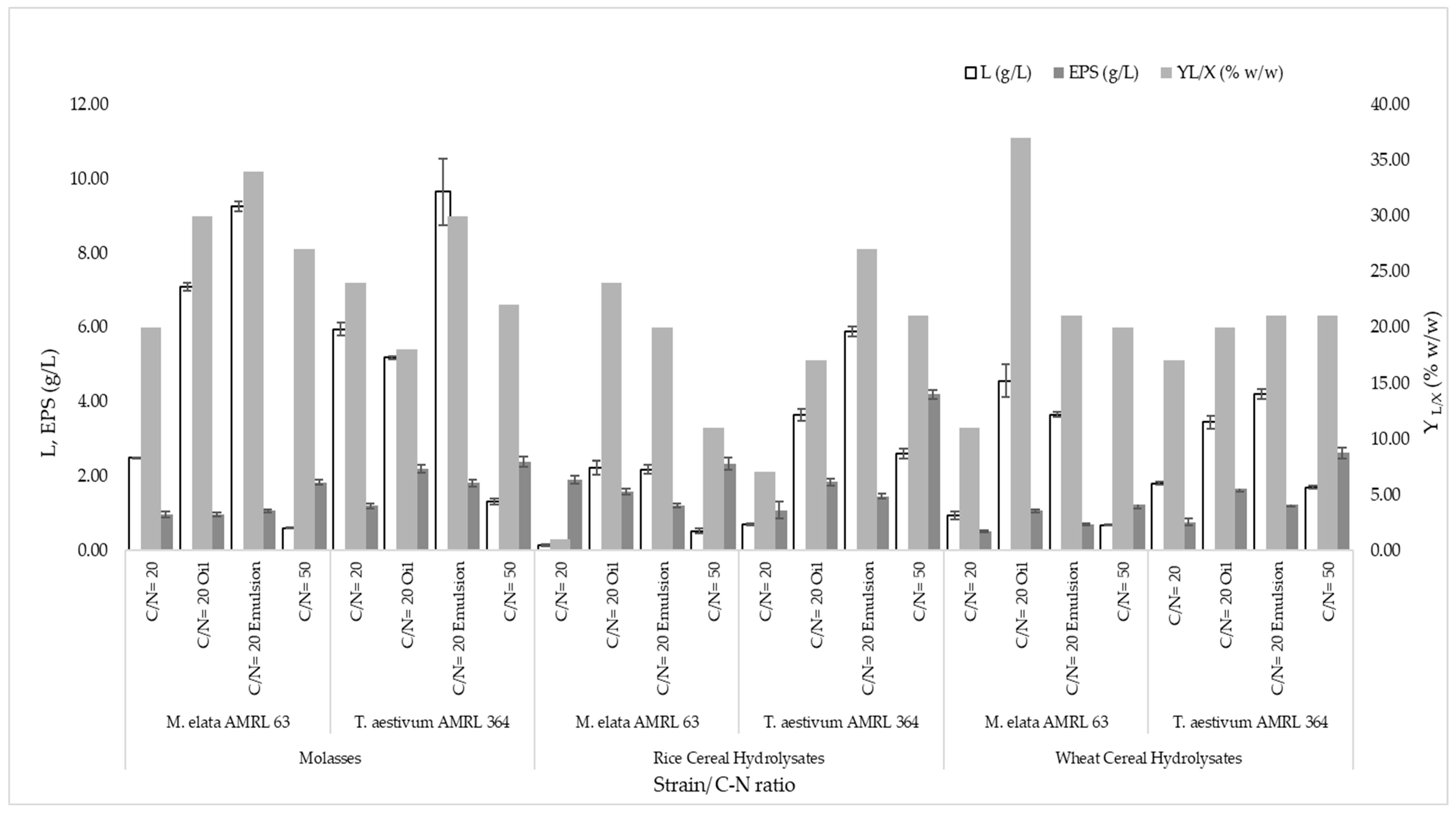
Consistent with the literature, the results of this study (Table 1 and Table 2; Figure 1) indicate that lipogenesis, expressed as maximum lipid concentration (Lmax, g/L) and total lipids in dry weight (YL/X, % w/w), depends on both strain and substrate [6,20,23,29,59]. In most trials, Lmax was higher in cultures with C/N = 20 (including 20-O and 20-E) than in those with C/N = 50, regardless of the strain or substrate, except for L. edodes AMRL 126. Conversely, YL/X was generally greater in fermentations with C/N = 50 compared to the respective C/N = 20 trials. Similarly, Sarris et al. [6] reported that under static cultivation with the same strains and substrates, absolute lipid production was lower at C/N = 50, but YL/X values were higher, likely due to reduced biomass formation.
Specifically, concerning M. elata strain AMRL 63, the most suitable medium for lipid production was molasses, followed by WCH and RCH. The maximum lipid absolute value noted was 9.25 g/L (YL/X = 34.0%, w/w) in C/N = 20-E molasses fermentations. The addition, in the media, of either olive oil or olive oil emulsion significantly enhanced lipid accumulation, regardless of the substrate used, compared to straight C/N = 20 cultures (Table 1; Figure 1). Comparing C/N = 20-agitated culture results of the present study (molasses: Lmax = 2.48 g/L, YL/X = 20.0%, w/w; RCH: Lmax = 0.13 g/L, YL/X = 1.0%, w/w; WCH: Lmax = 0.94 g/L, YL/X = 11.0%, w/w) with the respective C/N = 20-static ones (molasses: Lmax = 1.93 g/L, YL/X = 20.0%, w/w; RCH: Lmax = 0.44 g/L, YL/X = 12.0%, w/w; WCH: Lmax = 1.48 g/L, YL/X = 21.0%, w/w) reported in Sarris et al. [6], it could be concluded that agitation enhanced lipogenesis only in the case of molasses addition in the cultures.
L. edodes strain AMRL 126 presented low lipid quantities when molasses and RCH were added to the cultures (Lmax = 0.16–1.39 g/L, YL/X = 3.0–31.0%, w/w), whereas in the case of WCH fermentations, growth and subsequent lipogenesis occurred only when C/N = 50 was applied. A. bisporus AMRL strain 209 produced some amount of lipids (Lmax = 0.41–0.97 g/L, YL/X = 10.0–14.0%, w/w) only when WCH was applied (Table 2).
Regarding cultures of T. aestivum strain AMRL 364, the most suitable medium for lipid production was molasses, followed by RCH and WCH. The addition of either olive oil or olive oil emulsion significantly enhanced lipid accumulation in almost all cases, regardless of the substrate used, compared to C/N = 20 cultures with no oil added (Table 1; Figure 1). Comparing C/N = 20-agitated culture results of the present study (molasses: Lmax = 5.95 g/L, YL/X = 24.0%, w/w; RCH: Lmax = 0.70 g/L, YL/X = 7.0%, w/w; WCH: Lmax = 1.80 g/L, YL/X = 17.0%, w/w) with the respective C/N = 20-static ones (molasses: Lmax = 5.86 g/L, YL/X = 23.0%, w/w; RCH: Lmax = 2.0 g/L, YL/X = 8.0%, w/w; WCH: Lmax = 2.88 g/L, YL/X = 13.0%, w/w) reported in Sarris et al. [6], it could be concluded that lipogenesis presented better performance in static cultures in RCH and WCH fermentations.
The overall maximum lipid accumulation was 9.65 g/L (YL/X = 30.0%, w/w) noted in cultures of T. aestivum containing molasses when C/N = 20-E was applied. Likewise, in Sarris et al. [6], the respective values were 5.86 g/L and YL/X = 23.2%, w/w. In comparison, it seems that both agitation and olive oil (emulsion) addition enhance lipogenesis under the same culture conditions. Besides Sarris et al. [6], other studies present relatively high quantities of lipid produced by mycelia of higher fungi (such as M. elata, M. esculenta, A. auricula, F. velutipes, and L. edodes) when cultivated in static submerged cultures [29,30]. The fungal total lipid content varies from 0.6 to 18.4%, w/w, on DW [60,61,62], and lipids are considered as the building blocks of membranes and cell walls, as well as some of the extracellular compounds [61,62]. Enhanced lipid accumulation performance is necessarily achieved by applying a high C/N molar ratio (nitrogen limitation). Onset of biosynthesis and accumulation of storage lipid could also be performed even for non-oleaginous microbial strains, when media with a high excess of carbon are employed [63,64,65]. In the case of higher fungi, an increment in the C/N ratio from 20 to 60 resulted in increasing quantities of total lipid of V. volvacea [26]. On the other hand, like most cultures in the present study, in Sarris et al. [6], in almost all cases (except for T. aestivum AMRL 364 grown on RCH and WCH media and L. edodes AMRL 126 grown on WCH), total lipid accumulation in absolute values was significantly reduced in trials where C/N = 50 was applied. It could be assumed that fungal lipogenesis was mainly negatively affected when C/N = 50 was applied and that it was a strain- and substrate-dependent process.

3.3. Lipid Analysis

Fatty acid (FA) composition of mycelial lipids of M. elata AMRL 63 and T. aestivum AMRL 364, when cultured under shaking on molasses, RCH, and WCH when C/N = 20-O, C/N = 20-E, and C/N = 50 were applied, was analyzed (Table 3).
The principal FAs detected in all cases were C16 and C18 aliphatic chains. The predominant FA for both strains under any culture condition was oleic acid (Δ9C18:1) except for the M. elata strain when C/N = 50 was applied, indicating the positive effect of olive oil addition in the culture media on oleic acid increase. In that case, Δ9C18:1 and linoleic acid (Δ9,12C18:2) were equally distributed when molasses and RCH were used as substrates. Moreover, in the same case, palmitic (C16:0) and stearic acid (C18:0) were detected in significant quantities (Table 3).
Concerning the T. aestivum strain, besides Δ9C18:1 being the predominant FA (~62.0–66.0%, w/w), C16:0 and Δ9,12C18:2 were found in significant quantities (~14.0–16.0%, w/w), whereas C18:0 was detected in low concentrations (<5.0% w/w), in both oil and emulsion addition cultures, regardless of the substrate used. The primary components of olive oil, such as oleic acid (C18:1), palmitic acid (C16:0), and linoleic acid (C18:2), are absorbed by the mycelium and become major constituents of the fungal biomass’ lipid profile. Only in the case of molasses cultures, C/N = 20-O, Δ9,12C18:2 presented the highest value among all trials (~25.0% w/w) against the Δ9C18:1 formation. Surprisingly enough, in both C/N = 20-O and C/N = 20-E cultures, α-linolenic acid (Δ9,12,15C18:3) was detected in concentrations ranging from ~3.0 to ~5.0%, w/w, regardless of the substrate used. On the other hand, in the C/N = 50 culture, Δ9,12,15C18:3 was detected at low amounts (~1.0%, w/w). Comparing overall C/N = 20 trials with fermentations where C/N = 50 applied, Δ9C18:1 presented lower values, which was in favor of mainly C16:0 and Δ9,12C18:2 and, to a lesser extent, in favor of C18:0. When comparing the UI values of mycelial mass lipid, regarding both C/N = 20 cultures, maxima of UI values were recorded in the order of M > RCH > WCH. On the other hand, on C/N = 50 trials such values found in the opposite order of WCH > RCH > M. Overall, as UI values were higher in both fermentations where C/N = 20 applied than C/N = 50, it could be deduced that T. aestivum, seemed to synthesize more unsaturated lipids in the former case, regardless the substrate used. In Sarris et al. [6], static C/N = 20 and C/N = 50 trials using the same strain, the same substrates, and under the same culture conditions were studied. Comparing lipid profiles of both static (C/N = 20 and C/N = 50) cultures with the respective agitated cultures (C/N = 20-O, C/N = 20-E and C/N = 50) of the present study, it could be deduced that UI values were lower in agitated cultures when RCH and WCH were added in cultures, whereas such values were higher in agitated trials when molasses was used as a substrate. On the other hand, regarding the comparison of static and agitated cultures, when C/N = 50 was applied, the UI values noted were higher in the case of agitated fermentations, regardless of the substrate used.
Regarding the M. elata strain, regardless the substrate used, in both oil and emulsion addition cultures (C/N = 20), C16:0 and Δ9,12C18:2 were found in traceable quantities (~9.0–13.0%, w/w), whereas C18:0 was detected in low concentrations (<4.0%, w/w), besides Δ9C18:1 being the predominant FA (~70.0–75.0%, w/w). On the contrary, when C/N = 50 was applied, regardless of the substrate used, Δ9C18:1 and Δ9,12C18:2 presented almost equal values (~25.0–35.0%, w/w). Moreover, in C/N = 50 cultures, the C16:0 (16.0–29.0%, w/w) and C18:0 (13.0–14.0%, w/w) formation was noted to be higher compared to C/N = 20-O and C/N = 20-E trials, regardless of the substrate used. Concerning UI values of fungal lipids, in both C/N = 20 cultures, maxima of UI values were recorded in the order of M > WCH > RCH, whereas in C/N = 20-E cultures, it was in the order of M > WCH > RCH. On the other hand, in C/N = 50 trials, such values are found in the opposite order of RCH > M > WCH. As UI values were higher in both fermentations where C/N = 20 applied than C/N = 50 (except in the case of RCH cultures), it could be deduced that more unsaturated lipids seemed to be synthesized by M. elata in the former case. Comparing the results of the present study with the ones reported in Sarris et al. [6], fungal lipids of both static (C/N = 20 and C/N = 50) cultures seemed to present higher UI values in all cases compared to the respective agitated trials of the present study, apart from the fermentations where WCH was used as a substrate when C/N = 20 applied.
Fermentation time and other culture conditions of fungi cultures affect the FA composition of lipid produced [66,67], and the addition of olive oil to mushroom liquid cultures significantly changes their fatty acid profiles, while the unsaturated content dominates over the saturated [65]. For example, it was reported that the addition of olive mill wastewater and glucose increased the concentration of unsaturated FAs of P. pulmonarius [20], agitation promoted unsaturation of lipids [29], whereas various basidiomycetes and ascomycetes present Δ9,12C18:2 as the predominant FA within their lipid content [20,59,68,69]. Distinct FA composition is also reported where high amounts of C18:0 and Δ9C18:1 and low amounts of Δ9,12C18:2 are noted for M. esculenta [30] or (as in the present study) where Δ9C18:1 is the major FA [6,68,69]. These observations highlight the interplay between culture conditions, substrate composition, and agitation in lipid metabolism. At the same time, scaling up submerged fungal cultures introduces additional challenges. Cerrone and O’Connor [70] review how filamentous fungi are sensitive to shear stress from agitation, which affects mycelial morphology (pelletization) and productivity, and discuss the advantages and limitations of different reactor types for scale-up. Together, these findings emphasize that both biochemical (FA composition) and engineering (agitation, oxygenation, reactor design) factors must be carefully balanced to optimize lipid yield and composition in industrial fungal fermentations.

3.4. Fungal Volatile Compound Analysis

The analysis of samples by SPME GC–MS allowed the detection of several volatile compounds per fungal strain, specifically sixty-eight (68) for T. aestivum AMRL 364, ninety (90) for M. elata AMRL 63, forty-seven (47) for L. edodes AMRL 126, and thirty-four (34) for A. bisporus AMRL 209. The compounds detected in the models belonged to different chemical classes, including ketones, esters, alcohols, acids, aldehydes, alkenes, alkanes, and some that were unidentified.
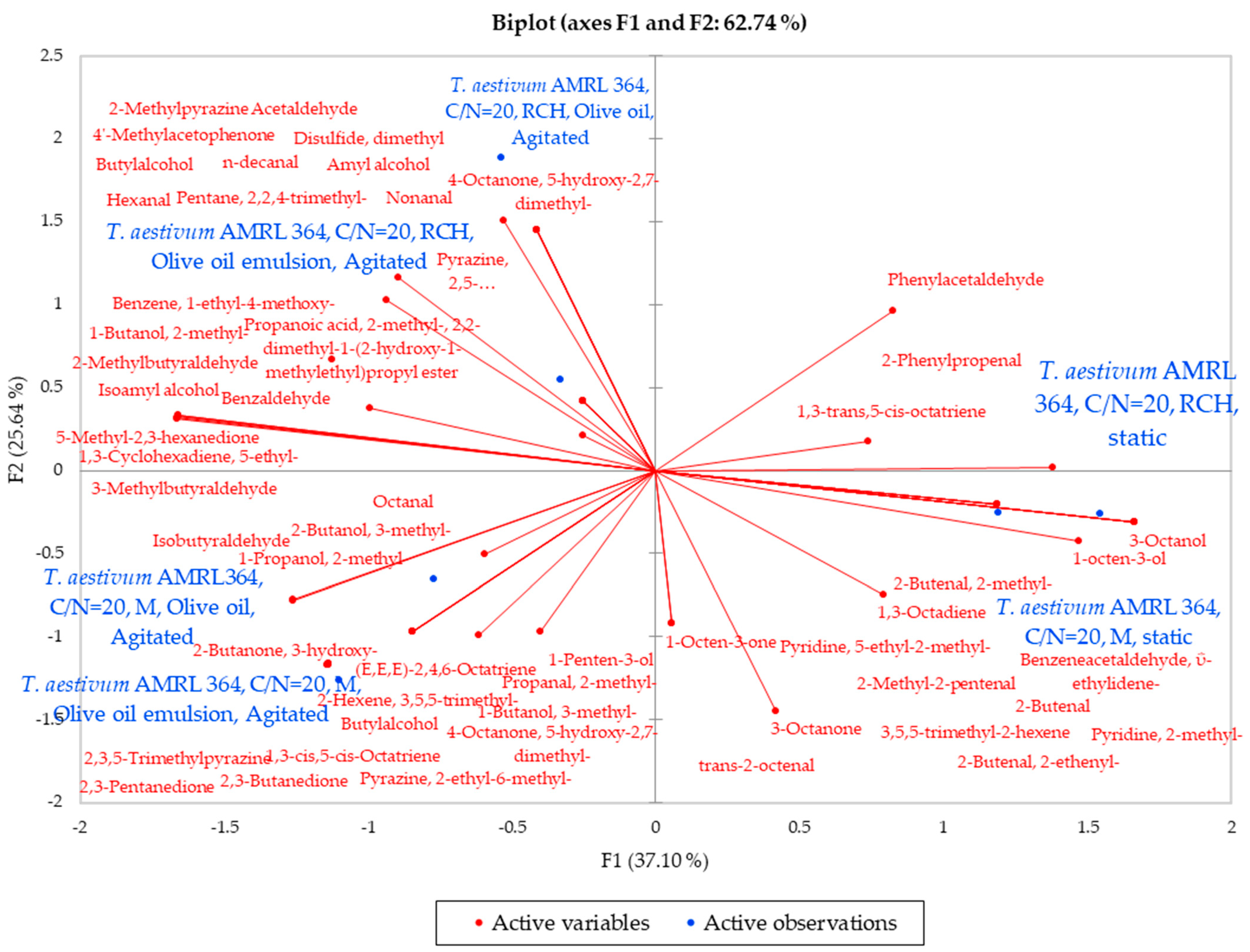
Species T. aestivum AMRL 364 and M. elata AMRL 63 presented more complex and richer aroma profiles using agitated substrates compared to A. bisporus. Thus, PCA was employed to compare their aroma profiles between agitated and static cultivation. Agitated samples inoculated with T. aestivum AMRL 364, separated along principal component 1 from statical samples (Figure 2), and tended towards production of compounds which are important contributors to the aroma of natural T. aestivum AMRL 364, including 2,3-butanedione and dimethyl disulfide (DMDS) [71]. These compounds are key contributors to the characteristic sulfur-based aroma of highly valued truffle species. Tuber aestivum exhibits a milder yet well-defined aroma, offering favorable sensory quality at a more moderate cost, which contributes to its widespread distribution and culinary use across Mediterranean regions. Truffles possess diverse metabolic and nutritional components that support their classification as adaptogens and functional foods. Their potential to produce health-promoting bioactive compounds may attract pharmaceutical investment, while advances in cultivation methods could enhance their affordability, as their natural scarcity and the difficulty associated with locating them currently contribute to their high market value [72].
Although agitated conditions may lead to lower aroma diversity and potential loss of volatiles [73], they enhance oxygen availability in the medium. Oxygen influences enzyme activity in aroma biosynthetic pathways (e.g., alcohol oxidases, esterases). Aerobic conditions favor some alcohol and acid formation; low O2 often enhances ester production (fruity aromas) [74,75].
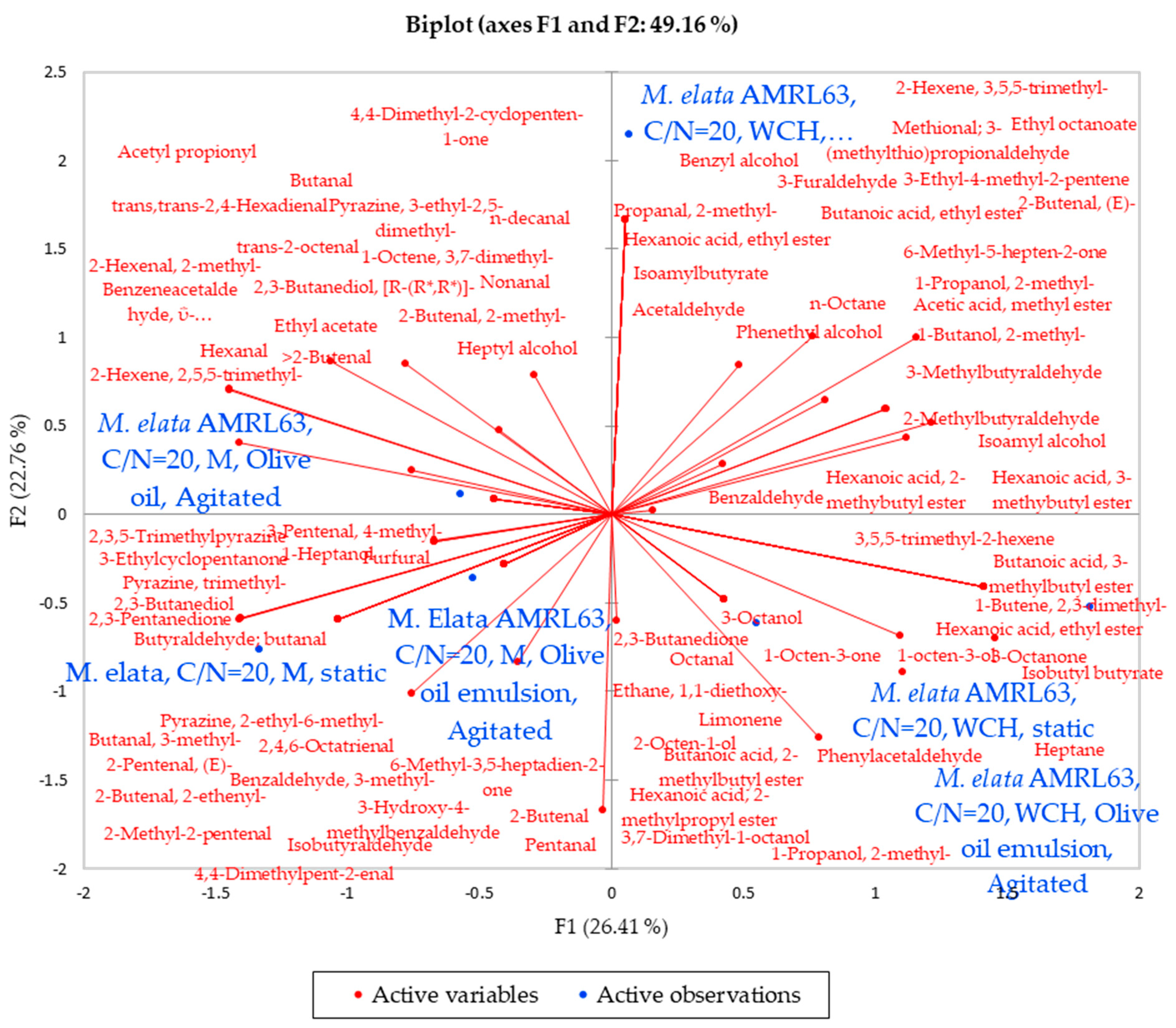
In contrast, samples inoculated with M. elata AMRL 63, separated along principal component 1 based on the substrate, M and WCH. The separations of samples based on M as substrate was strongly driven by the production of alkyl aldehyde compounds, which are known to be abundant in M. elata aroma profiles [76]. Although PC1 (Figure 3) accounted for only 26.41% of the total variance, this trend is consistent with observations in other morel species, where lipid-derived C8 compounds, such as 1-octen-3-ol, 3-octanol, 1-octen-3-one, and 3-octanone, strongly influence mushroom aroma due to their low odor thresholds. Comparative metabolite profiling in M. sextelata and M. importuna has demonstrated that differences in lipid, carbohydrate, amino acid, alcohol, and ketone-related metabolites directly affect odor and taste. Similarly, the substrate-dependent production of alkyl aldehydes in M. elata likely contributes to species-specific aroma characteristics, highlighting the importance of substrate composition in modulating the volatile metabolome and sensory quality of cultivated morels [77].

4. Conclusions

The cultivation of edible fungi on low-cost substrates represents an efficient strategy to produce high-value bioactive components within a biorefinery framework. Both fungal species (Τ. aestivum and M. elata) exhibited pronounced growth performance, underscoring their biotechnological relevance. T. aestivum 364 achieved high biomass concentrations (17.01–32.42 g/L), whereas M. elata AMRL 63 reached biomass levels of 9.41–27.23 g/L, depending on substrate composition. Enhancement of lipid content and degree of lipid unsaturation, along with the correlation of fungal aroma profiles with their growth substrates, provides valuable insights for food industry applications and the development of innovative products, as lipid yields reached up to 34.0% (w/w) in M. elata AMRL 63 and 30.0% (w/w) in T. aestivum 364 when cultivated on molasses under optimized C/N conditions. Molasses emerged as a highly efficient substrate for edible fungi, achieving over 95% utilization, highlighting its potential for valorization within biorefinery frameworks. To fully confirm its economic and environmental feasibility, comprehensive evaluations of energy input, water consumption, and life cycle boundaries are essential, providing a basis for sustainable large-scale production.

Author Contributions

Conceptualization, A.P. and P.D.; methodology, P.D., D.S., A.M. and K.G.; formal analysis, D.S., P.D. and A.M.; investigation, D.S.; data curation, D.S., P.D., K.G., D.I.K. and A.M.; writing—original draft preparation, D.S., K.G., P.D., D.I.K. and A.M.; writing—review and editing, D.S. and P.D.; visualization, D.S. and P.D.; supervision, P.D. and A.P.; project administration, D.S.; funding acquisition, D.S. All authors have read and agreed to the published version of the manuscript.

Funding

This research project was funded under the action “Research & Technology Development Innovation projects (AgroETAK)”, MIS 453350, in the framework of the operational program “Human Resources Development”. It was co-funded by the European Social Fund and by National Resources through the National Strategic Reference Framework 2007–2013 (NSRF 2007–2013), coordinated by the Hellenic Agricultural Organization—Dimitra.

Institutional Review Board Statement

Not applicable.

Informed Consent Statement

Not applicable.

Data Availability Statement

The raw data supporting the conclusions of this article will be made available by the authors on request.

Conflicts of Interest

The authors declare no conflicts of interest.

References

  1. Ogbu, C.C.; Okey, S.N. Agro-Industrial Waste Management: The Circular and Bioeconomic Perspective. In Agricultural Waste—New Insights, 1st ed.; Ahmad, F., Sultan, M., Eds.; IntechOpen: London, UK, 2023; pp. 1–214. [Google Scholar]
  2. Branduardi, P.; Porro, D. n-butanol: Challenges and solutions for shifting natural metabolic pathways into a viable microbial production. FEMS Microbiol. Lett. 2016, 363, fnw070. [Google Scholar] [CrossRef]
  3. Hidalgo, D.; Garrote, L.; Infante, F.; Martín-Marroquín, J.M.; Pérez-Zapatero, E.; Corona, F. Targeted Acidogenic Fermentation of Waste Streams for the Selective Production of Volatile Fatty Acids as Bioplastic Precursors. Appl. Sci. 2025, 15, 5923. [Google Scholar] [CrossRef]
  4. Lee, J.Y.; Lee, S.E.; Lee, D.W. Current status and future prospects of biological routes to bio-based products using raw materials, wastes, and residues as renewable resources. Crit. Rev. Environ. Sci. Technol. 2022, 52, 2453–2509. [Google Scholar] [CrossRef]
  5. Carrillo-Nieves, D.; Saldarriaga-Hernandez, S.; Gutiérrez-Soto, G.; Rostro-Alanis, M.; Hernández-Luna, C.; Alvarez, A.J.; Parra-Saldívar, R. Biotransformation of agro-industrial waste to produce lignocellulolytic enzymes and bioethanol with a zero waste. Biomass Convers. Biorefin. 2022, 12, 253–264. [Google Scholar] [CrossRef]
  6. Sarris, D.; Philippoussis, A.; Mallouchos, A.; Diamantopoulou, P. Valorization of low-cost, carbon-rich substrates by edible ascomycetes and basidiomycetes grown on liquid cultures. FEMS Microb. Let. 2020, 367, fnaa168. [Google Scholar] [CrossRef]
  7. Tsakona, S.; Kopsahelis, N.; Chatzifragkou, A.; Papanikolaou, S.; Kookos, I.K.; Koutinas, A.A. Formulation of fermentation media from flour-rich waste streams for microbial lipid production by Lipomyces starkeyi. J. Biotechnol. 2014, 189, 36–45. [Google Scholar] [CrossRef]
  8. Satyawali, Y.; Balakrishnan, M. Wastewater treatment in molasses-based alcohol distilleries for COD and color removal: A review. J. Environ. Manag. 2008, 86, 481–497. [Google Scholar] [CrossRef]
  9. Dedousi, M.; Fourtaka, K.; Melanouri, E.-M.; Argyropoulos, D.; Psallida, C.; Diamantis, I.; Papanikolaou, S.; Diamantopoulou, P. Detoxification of molasses and production of mycelial mass and valuable metabolites by Morchella species. Appl. Sci. 2021, 11, 9481. [Google Scholar] [CrossRef]
  10. Kucharska, E.; Zagorska-Dziok, M.; Bilewicz, P.; Kowalczyk, S.; Pełech, R. Use of Syzygium aromaticum L. Fermented plant extract to enhance antioxidant potential: Fermentation kinetics. Appl. Sci. 2024, 14, 4900. [Google Scholar] [CrossRef]
  11. Perveen, I.; Bukhari, B.; Sarwar, A.; Aziz, T.; Koser, N.; Younis, H.; Skoufos, I. Applications and efficacy of traditional to emerging trends in lacto-fermentation and submerged cultivation of edible mushrooms. Biomass Convers. Biorefin. 2024, 14, 29283–29302. [Google Scholar] [CrossRef]
  12. Vasilakis, G.; Gamraoui, A.; Karayannis, D.; Giannakis, N.; Chatti, A.; Politis, I.; Diamantopoulou, P.; Papanikolaou, S. Mycelial mass, microbial lipids and γ-linolenic acid (GLA) by Cunninghamella elegans cultivated on agro-industrial residues. Resour. Chem. Mater. 2025, 4, 100082. [Google Scholar] [CrossRef]
  13. Dulay, R.M.R.; Ray, K.; Hou, C.T. Optimization of liquid culture conditions of Philippine wild edible mushrooms as potential source of bioactive lipids. Biocatal. Agric. Biotechnol. 2015, 4, 409–415. [Google Scholar] [CrossRef]
  14. Nair, R.B.; Lennartsson, P.R.; Taherzadeh, M.J. Mycelial pellet formation by edible ascomycete filamentous fungi, Neurospora intermedia. Amb Express 2016, 6, 31. [Google Scholar] [CrossRef]
  15. Usman, M.; Murtaza, G.; Ditta, A. Nutritional, medicinal, and cosmetic value of bioactive compounds in button mushroom (Agaricus bisporus): A review. Appl. Sci. 2021, 11, 5943. [Google Scholar] [CrossRef]
  16. Yang, C.; Zhou, X.; Meng, Q.; Wang, M.; Zhang, Y.; Fu, S. Secondary metabolites and antiradical activity of liquid fermentation of Morchella sp. isolated from Southwest China. Molecules 2019, 24, 1706. [Google Scholar] [CrossRef] [PubMed]
  17. Liu, C.; Sun, Y.; Mao, Q.; Guo, X.; Li, P.; Liu, Y.; Xu, N. Characteristics and antitumor activity of Morchella esculenta polysaccharide extracted by pulsed electric field. Int. J. Mol. Sci. 2016, 17, 986. [Google Scholar] [CrossRef]
  18. Barros, L.; Cruz, T.; Baptista, P.; Estevinho, L.M.; Ferreira, I.C. Wild and commercial mushrooms as source of nutrients and nutraceuticals. Food Chem. Toxicol. 2008, 46, 2742–2747. [Google Scholar] [CrossRef] [PubMed]
  19. Wasser, S. Medicinal mushrooms as a source of antitumor and immunomodulating polysaccharides. Appl. Microbiol. Biotechnol. 2002, 60, 258–274. [Google Scholar] [CrossRef]
  20. Hamza, A.; Shankar, M.P.; Chowdary, U.S.; Ghanekar, S.; Sahoo, S.; Krishnaiah, C.V.; Kumar, D.S. Submerged production of mycelium biomass and bioactive compounds from P. ostreatus in a controlled fermentation medium. Food Humanit. 2024, 2, 100302. [Google Scholar] [CrossRef]
  21. Carvajal, A.E.S.; Koehnlein, E.A.; Soares, A.A.; Eler, G.J.; Nakashima, A.T.; Bracht, A.; Peralta, R.M. Bioactives of fruiting bodies and submerged culture mycelia of Agaricus brasiliensis (A. blazei) and their antioxidant properties. LWT-Food Sci. Technol. 2012, 46, 493–499. [Google Scholar] [CrossRef]
  22. Tang, Y.-J.; Zhu, L.-W.; Li, H.-M.; Li, D.-S. Submerged Culture of Mushrooms in Bioreactors-Challenges, Current State-of-the-Art, and Future Prospects. Food Technol. Biotechnol. 2007, 45, 221–229. [Google Scholar]
  23. Fazenda, M.L.; Seviour, R.; McNeil, B.; Harvey, L.M. Submerged culture fermentation of “higher fungi”: The macrofungi. In Advances in Applied Microbiology; Laksin, A.I., Sariaslani, S., Gadd, G.M., Eds.; Elsevier Inc.: Amsterdam, The Netherlands, 2008; Volume 63, pp. 33–103. [Google Scholar]
  24. Gang, J.; Fang, Y.; Wang, Z.; Liu, Y. Fermentation optimization and antioxidant activities of mycelia polysaccharides from Morchella esculenta using soybean residues. Afr. J. Biotechnol. 2013, 12, 1239–1249. [Google Scholar]
  25. Mukhopadhyay, R.; Guha, A.K. A comprehensive analysis of the nutritional quality of edible mushroom Pleurotus sajor-caju grown in deproteinized whey medium. LWT-Food Sci. Technol. 2015, 61, 339–345. [Google Scholar] [CrossRef]
  26. Hsieh, C.; Liu, C.J.; Tseng, M.H.; Lo, C.T.; Yang, Y.C. Effect of olive oil on the production of mycelial biomass and polysaccharides of Grifola frondosa under high oxygen concentration aeration. Enzym. Microb. Technol. 2006, 39, 434–439. [Google Scholar] [CrossRef]
  27. Park, J.-P.; Kim, S.; Hwang, H.; Yun, J.-W. Optimization of submerged culture conditions for the mycelial growth and exo-biopolymer production by Cordyceps militaris. Lett. Appl. Microbiol. 2001, 33, 76–81. [Google Scholar] [CrossRef]
  28. Mao, X.-B.; Eksriwong, T.; Chauvatcharin, S.; Zhong, J.-J. Optimization of carbon source and carbon/nitrogen ratio for cordycepin production by submerged cultivation of medicinal mushroom Cordyceps militaris. Process Biochem. 2005, 40, 1667–1672. [Google Scholar] [CrossRef]
  29. Diamantopoulou, P.; Papanikolaou, S.; Katsarou, E.; Komaitis, M.; Aggelis, G.; Philippoussis, A. Mushroom polysaccharides and lipids synthesized in liquid agitated and static cultures. Part II: Study of Volvariella volvacea. Appl. Biochem. Biotechnol. 2012, 167, 1890–1906. [Google Scholar] [CrossRef]
  30. Kim, S.B.; Kim, S.H.; Lee, K.R.; Shim, J.O.; Lee, M.W.; Shim, M.J.; Lee, U.Y.; Lee, T.S. The Optimal Culture Conditions for the Mycelial Growth of Oudemansiella radicata. Mycobiology 2005, 33, 230–234. [Google Scholar] [CrossRef]
  31. Kim, S.; Hwang, H.; Park, J.; Cho, Y.; Song, C.; Yun, J. Mycelial growth and exo-biopolymer production by submerged culture of various edible mushrooms under different media. Lett. Appl. Microbiol. 2002, 34, 56–61. [Google Scholar] [CrossRef]
  32. Roukas, T. Ethanol production from non-sterilized beet molasses by free and immobilized Saccharomyces cerevisiae cells using fed-batch culture. J. Food Eng. 1996, 27, 87–96. [Google Scholar] [CrossRef]
  33. Miller, G.L. Use of dinitrosalicylic acid reagent for determination of reducing sugar. Anal. Chem. 1959, 31, 426–428. [Google Scholar] [CrossRef]
  34. Dubois, M.; Gilles, K.A.; Hamilton, J.K.; Rebers, P.A.; Smith, F. Colorimetric method for determination of sugars and related substances. Anal. Chem. 1956, 28, 350–356. [Google Scholar] [CrossRef]
  35. Hsieh, C.; Hsu, T.-H.; Yang, F.-C. Production of polysaccharides of Ganoderma lucidum (CCRC36021) by reusing thin stillage. Process Biochem. 2005, 40, 909–916. [Google Scholar] [CrossRef]
  36. Chatzifragkou, A.; Makri, A.; Belka, A.; Bellou, S.; Mavrou, M.; Mastoridou, M.; Mystrioti, P.; Onjaro, G.; Aggelis, G.; Papanikolaou, S. Biotechnological conversions of biodiesel derived waste glycerol by yeast and fungal species. Energy 2011, 36, 1097–1108. [Google Scholar] [CrossRef]
  37. Fakas, S.; Papanikolaou, S.; Galiotou-Panayotou, M.; Komaitis, M.; Aggelis, G. Lipids of Cunninghamella echinulata with emphasis to γ-linolenic acid distribution among lipid classes. Appl. Microbiol. Biotechnol. 2006, 73, 676–683. [Google Scholar] [CrossRef] [PubMed]
  38. Jia, S.; Chen, G.; Kahar, P.; Okabe, M. Effect of soybean oil on oxygen transfer in the production of tetracycline with an airlift bioreactor. J. Biosci. Bioeng. 1999, 87, 825–827. [Google Scholar] [CrossRef]
  39. Hu, C.; Zou, Y.; Zhao, W. Effect of soybean oil on the production of mycelial biomass and pleuromutilin in the shake-flask culture of Pleurotus mutilis. World J. Microbiol. Biotechnol. 2009, 25, 1705–1711. [Google Scholar] [CrossRef]
  40. Huang, H.-C.; Chen, C.-I.; Hung, C.-N.; Liu, Y.-C. Experimental analysis of the oil addition effect on mycelia and polysaccharide productions in Ganoderma lucidum submerged culture. Bioprocess Biosyst. Eng. 2009, 32, 217–224. [Google Scholar] [CrossRef]
  41. Schisler, L.C.; Volkoff, O. The effect of safflower oil on mycelial growth of Boletaceae in submerged liquid cultures. Mycologia 1977, 69, 118–125. [Google Scholar] [CrossRef]
  42. Fukushima, Y.; Itoh, H.; Fukase, T.; Motai, H. Stimulation of protease production by Aspergillus oryzae with oils in continuous culture. Appl. Microbiol. Biotechnol. 1991, 34, 586–590. [Google Scholar] [CrossRef]
  43. Park, J.-P.; Kim, S.-W.; Hwang, H.-J.; Cho, Y.-J.; Yun, J.-W. Stimulatory effect of plant oils and fatty acids on the exo-biopolymer production in Cordyceps militaris. Enzym. Microb. Technol. 2002, 31, 250–255. [Google Scholar] [CrossRef]
  44. Yang, F.-C.; Ke, Y.-F.; Kuo, S.-S. Effect of fatty acids on the mycelial growth and polysaccharide formation by Ganoderma lucidum in shake flask cultures. Enzym. Microb. Technol. 2000, 27, 295–301. [Google Scholar] [CrossRef]
  45. Liu, X.-F.; Xia, Y.-J.; Lai, P.F.-H.; Zhang, Y.; Yi, Z.-W.; Xie, C.-L.; Hong, Y.-Q.; Ai, L.-Z. An increase in cell membrane permeability in the in situ extractive fermentation improves the production of antroquinonol from Antrodia camphorata S-29. J. Ind. Microbiol. Biotechnol. 2020, 47, 197–207. [Google Scholar] [CrossRef]
  46. Yang, F.-C.; Ma, T.-W.; Lee, Y.-H. Reuse of citrus peel to enhance the formation of bioactive metabolite-triterpenoid in solid-state fermentation of A. cinnamomea. Biochem. Eng. J. 2013, 78, 59–66. [Google Scholar] [CrossRef]
  47. Stasinopoulos, S.; Seviour, R. Stimulation of exopolysaccharide production in the fungus Acremonium persicinum with fatty acids. Biotechnol. Bioeng. 1990, 36, 778–782. [Google Scholar] [CrossRef]
  48. Zhang, B.-B.; Cheung, P.C. A mechanistic study of the enhancing effect of Tween 80 on the mycelial growth and exopolysaccharide production by Pleurotus tuber-regium. Bioresour. Technol. 2011, 102, 8323–8326. [Google Scholar] [CrossRef]
  49. Dedousi, M.; Melanouri, E.-M.; Diamantopoulou, P. Carposome productivity of Pleurotus ostreatus and Pleurotus eryngii growing on agro-industrial residues enriched with nitrogen, calcium salts and oils. Carbon Resour. Convers. 2023, 6, 150–165. [Google Scholar] [CrossRef]
  50. Fang, Q.H.; Zhong, J.J. Two-stage culture process for improved production of ganoderic acid by liquid fermentation of higher fungus Ganoderma lucidum. Biotechnol. Prog. 2002, 18, 51–54. [Google Scholar] [CrossRef] [PubMed]
  51. Kim, H.M.; Paik, S.-Y.; Ra, K.S.; Koo, K.B.; Yun, J.W.; Choi, J.W. Enhanced production of exopolysaccharides by fed-batch culture of Ganoderma resinaceum DG-6556. J. Microbiol. 2006, 44, 233–242. [Google Scholar]
  52. Zhongyang, D.; Wangfei, W.; Feng, W.; Qiong, W.; Kechang, Z. Polysaccharides production by submerged fermentation of Coprinus comatus and their inhibitory effects on non-enzymatic glycosylation. J. Med. Plants Res. 2012, 6, 1375–1381. [Google Scholar] [CrossRef]
  53. Lee, W.Y.; Park, Y.; Ahn, J.K.; Ka, K.H.; Park, S.Y. Factors influencing the production of endopolysaccharide and exopolysaccharide from Ganoderma applanatum. Enzym. Microb. Technol. 2007, 40, 249–254. [Google Scholar] [CrossRef]
  54. Chen, C.C.; Nargotra, P.; Kuo, C.H.; Liu, Y.C. High-molecular-weight exopolysaccharides production from Tuber borchii cultivated by submerged fermentation. Int. J. Mol. Sci. 2023, 24, 4875. [Google Scholar] [CrossRef]
  55. Osińska-Jaroszuk, M.; Jarosz-Wilkołazka, A.; Jaroszuk-Ściseł, J.; Szałapata, K.; Nowak, A.; Jaszek, M.; Ozimek, E.; Majewska, M. Extracellular polysaccharides from Ascomycota and Basidiomycota: Production conditions, biochemical characteristics, and biological properties. World J. Microbiol. Biotechnol. 2015, 31, 1823–1844. [Google Scholar] [CrossRef]
  56. Lee, B.C.; Bae, J.T.; Pyo, H.B.; Choe, T.B.; Kim, S.W.; Hwang, H.J.; Yun, J.W. Submerged culture conditions for the production of mycelial biomass and exopolysaccharides by the edible Basidiomycete Grifola frondosa. Enzym. Microb. Technol. 2004, 35, 369–376. [Google Scholar] [CrossRef]
  57. Xu, C.-P.; Yun, J.W. Influence of aeration on the production and the quality of the exopolysaccharides from Paecilomyces tenuipes C240 in a stirred-tank fermenter. Enzym. Microb. Technol. 2004, 35, 33–39. [Google Scholar] [CrossRef]
  58. Umar, A.; Abid, I.; Elshikh, M.S.; Dufossé, L.; Abdel-Azeem, A.M.; Ali, I. Agitation role (Dissolved Oxygen) in production of laccase from newly identified Ganoderma multistipitatum sp. nov. and its effect on mycelium morphology. BMC Microbiol. 2023, 23, 280. [Google Scholar] [CrossRef]
  59. Nair, N.; Song, C.; Jiang, J.; Vine, J.; Tattum, B.; Cho, K. Lipid profile of Pleurotus sajor caju. Ann. Appl. Biol. 1989, 114, 167–176. [Google Scholar] [CrossRef]
  60. Chang, S.-T.; Miles, P.G. Mushrooms: Cultivation, Nutritional Value, Medicinal Effect, and Environmental Impact; Taylor & Francis: Boca Raton, FL, USA, 2004; p. 480. [Google Scholar]
  61. Sancholle, M.; Lösel, D. Lipids in fungal biotechnology. In Genetics and Biotechnology; Springer: Berlin/Heidelberg, Germany, 1995; pp. 339–367. [Google Scholar]
  62. Hiroi, M.; Tsuyuki, H. Comparison of fatty acid composition in fruit body and spore of mushrooms [edible fungi]. Bull. Coll. Agric. Vet. Med.-Nihon Univ. 1988, 45, 104–109. [Google Scholar]
  63. Papanikolaou, S.; Aggelis, G. Lipids of oleaginous yeasts. Part I: Biochemistry of single cell oil production. Eur. J. Lipid Sci. Technol. 2011, 113, 1031–1051. [Google Scholar] [CrossRef]
  64. Silva, J.D.M.E.; Martins, L.H.D.S.; Moreira, D.K.T.; Silva, L.D.P.; Barbosa, P.D.P.M.; Komesu, A.; Oliveira, J.A.R.D. Microbial lipid based biorefinery concepts: A review of status and prospects. Foods 2023, 12, 2074. [Google Scholar] [CrossRef] [PubMed]
  65. Papanikolaou, S.; Aggelis, G. Lipids of oleaginous yeasts. Part II: Technology and potential applications. Eur. J. Lipid Sci. Technol. 2011, 113, 1052–1073. [Google Scholar] [CrossRef]
  66. Wild, R.; Patil, S.; Popović, M.; Zappi, M.; Dufreche, S.; Bajpai, R. Lipidi iz kvasca Lipomyces starkeyi. Food Technol. Biotechnol. 2010, 48, 329–335. [Google Scholar]
  67. Stahl, P.D.; Klug, M.J. Characterization and differentiation of filamentous fungi based on fatty acid composition. Appl. Environ. Microbiol. 1996, 62, 4136–4146. [Google Scholar] [CrossRef]
  68. Pedneault, K.; Angers, P.; Gosselin, A.; Tweddell, R.J. Fatty acid profiles of polar and neutral lipids of ten species of higher basidiomycetes indigenous to eastern Canada. Mycol. Res. 2008, 112, 1428–1434. [Google Scholar] [CrossRef]
  69. Dimou, D.M.; Georgala, A.; Komaitis, M.; Aggelis, G. Mycelial fatty acid composition of Pleurotus spp. and its application in the intrageneric differentiation. Mycol. Res. 2002, 106, 925–929. [Google Scholar] [CrossRef]
  70. Cerrone, F.; O’Connor, K.E. Cultivation of filamentous fungi in airlift bioreactors: Advantages and disadvantages. Appl. Microbiol. Biotechnol. 2025, 109, 41. [Google Scholar] [CrossRef]
  71. Culleré, L.; Ferreira, V.; Chevret, B.; Venturini, M.E.; Sánchez-Gimeno, A.C.; Blanco, D. Characterisation of aroma active compounds in black truffles (Tuber melanosporum) and summer truffles (Tuber aestivum) by gas chromatography–olfactometry. Food Chem. 2010, 122, 300–306. [Google Scholar] [CrossRef]
  72. Allen, K.; Bennett, J.W. Tour of Truffles: Aromas, Aphrodisiacs, Adaptogens, and More. Mycobiology 2021, 49, 201–212. [Google Scholar] [CrossRef]
  73. Bakratsas, G.; Polydera, A.; Katapodis, P.; Stamatis, H. Recent trends in submerged cultivation of mushrooms and their application as a source of nutraceuticals and food additives. Futur. Foods 2021, 4, 100086. [Google Scholar] [CrossRef]
  74. Prusova, B.; Humaj, J.; Sochor, J.; Baron, M. Formation, Losses, Preservation and Recovery of Aroma Compounds in the Winemaking Process. Fermentation 2022, 8, 93. [Google Scholar] [CrossRef]
  75. Varela, C.; Torrea, D.; Schmidt, S.A.; Ancin-Azpilicueta, C.; Henschke, E.P. Effect of oxygen and lipid supplementation on the volatile composition of chemically defined medium and Chardonnay wine fermented with Saccharomyces cerevisiae. Food Chem. 2012, 135, 2863–2871. [Google Scholar] [CrossRef] [PubMed]
  76. Zipora, T.; Segula, M. True morels (Morchella)—Nutritional and phytochemical composition, health benefits and flavor: A review. Crit. Rev. Food Sci. Nutr. 2018, 58, 1888–1901. [Google Scholar]
  77. Zhang, Y.; Li, X.; Zhao, Z.; E, H.; Fan, T.; Dong, H.; He, X.; Zhao, X.; Tang, L.; Zhou, C. Comprehensive investigation on non-volatile and volatile flavor compounds in the Morchella sextelata and Morchella importuna by UPLC-MS/MS and GC× GC-TOF-MS. Food Chem. X 2023, 20, 100961. [Google Scholar] [CrossRef] [PubMed]
Figure 1. Biomass (X, g/L) produced and total sugars consumed (TScons,%); total cellular lipid (L, g/L), total lipid in DW (YL/X, % w/w), and exopolysaccharides (EPS, g/L) produced (B) by examined ascomycetes grown in different agricultural wastes and C/N molar ratios. Culture conditions are described in Table 1. Each data point represents the mean of five independent measurements (five flasks per experiment).
Applsci 16 01615 g001aApplsci 16 01615 g001b
Figure 2. Principal component analysis of aroma compounds of T. aestivum AMRL 364 cultivated in RCH, olive oil, and olive oil emulsion mixtures under static and agitated conditions.
Applsci 16 01615 g002
Figure 3. Principal component analysis of aroma compounds of M. elata AMRL 63 cultivated in WCH, M, olive oil, and olive oil emulsion mixtures under static and agitated conditions.
Applsci 16 01615 g003
Table 1. Experimental data of ascomycete M. elata strain AMRL 63 and T. aestivum strain AMRL 64 cultivated in molasses, rice cereal, and wheat cereal media in shake-flask liquid cultures of C/N molar ratios 20 and 50.
StrainM.elata AMRL 63 T. aestivum AMRL 364
DayC/N = 20C/N = 20-OC/N = 20-EC/N = 50C/N = 20C/N = 20-OC/N = 20-EC/N = 50
SubstrateMolasses (M)
X12.60 ± 0.1323.37 ± 0.2827.23 ± 0.232.22 ± 0.0825.17 ± 0.8329.56 ± 0.4832.42 ± 0.116.05 ± 0.09
%TScons95.5 ± 0.883.5 ± 2.893.9 ± 0.311.7 ± 0.868.0 ± 3.970.7 ± 3.071.8 ± 0.815.2 ± 1.8
L2.48 ± 0.027.08 ± 0.119.25 ± 0.140.60 ± 0.015.95 ± 0.175.18 ± 0.049.65 ± 0.91.31 ± 0.09
YL/X20.030.034.027.024.018.030.022.0
EPS0.96 ± 0.080.97 ± 0.051.06 ± 0.051.83 ± 0.061.20 ± 0.072.20 ± 0.111.81 ± 0.102.38 ± 0.14
SubstrateRice Cereal Hydrolysates (RCH)
X15.16 ± 0.219.41 ± 0.1711.10 ± 0.144.69 ± 0.229.87 ± 0.8820.81 ± 0.4421.43 ± 0.8712.62 ± 0.11
%TScons92.9 ± 2.561.3 ± 0.386.3 ± 3.7027.4 ± 0.898.9 ± 1.087.3 ± 1.077.9 ± 3.461.6 ± 1.5
L0.13 ± 0.032.22 ± 0.202.18 ± 0.120.52 ± 0.070.70 ± 0.033.64 ± 0.165.88 ± 0.142.60 ± 0.13
YL/X1.024.020.011.07.017.027.021.0
EPS1.90 ± 0.101.57 ± 0.081.20 ± 0.062.33 ± 0.151.08 ± 0.231.84 ± 0.091.45 ± 0.074.19 ± 0.12
SubstrateWheat Cereal Hydrolysates (WCH)
X8.31 ± 0.6412.48 ± 0.0517.27 ± 0.213.35 ± 0.0810.55 ± 0.3417.01 ± 0.5519.61 ± 0.127.91 ± 0.16
%TScons75.9 ± 2.777.5 ± 3.959.9 ± 0.911.9 ± 1.573.1 ± 0,7052.8 ± 4.2060.9 ± 1.8026.2 ± 1.5
L0.94 ± 0.114.56 ± 0.443.65 ± 0.070.68 ± 0.021.80 ± 0.043.44 ± 0.184.20 ± 0.131.69 ± 0.04
YL/X11.037.021.020.017.020.021.021.0
EPS0.51 ± 0.021.06 ± 0.050.69 ± 0.031.23 ± 0.110.74 ± 0.081.67 ± 0.081.24 ± 0.062.63 ± 0.16
Total biomass (X, g/L), total substrate consumed (TS, %), total cellular lipid (L, g/L), total lipid in DW (YL/X, % w/w), and exopolysaccharide (EPS, g/L) concentrations on day 11 of fermentation. Culture conditions: 180 ± 5 rpm, TS = 30 g/L, pH = 6.2 ± 0.2, and T = 26 ± 0.2 °C. C/N = molar ratio; O = olive oil; E = olive oil emulsion. Each data point represents the mean of five independent measurements (five flasks per experiment).
Table 2. Metabolic data of basidiomycete L. edodes strain AMRL 126 and A. bisporus strain AMRL 209 grown in molasses, rice cereal, and wheat cereal media in shake-flask liquid cultures of C/N molar ratios 20 and 50.
StrainL. edodes AMRL 126A. bisporus AMRL 209
DayC/N = 20C/N = 20-OC/N = 20-EC/N = 50C/N = 20C/N = 20-OC/N = 20-EC/N = 50
SubstrateMolasses (M)
Xtr.2.53 ± 0.072.14 ± 0.062.65 ± 0.07tr.tr.tr.tr.
%TSconstr.11.2 ± 0.915.9 ± 1.76.1 ± 0.3tr.tr.tr.tr.
Ltr.0.20 ± 0.010.20 ± 0.010.81 ± 0.01tr.tr.tr.tr.
YL/Xtr.8.09.031.0tr.tr.tr.tr.
EPStr.3.26 ± 0.081.00 ± 0.050.45 ± 0.02tr.tr.tr.tr.
SubstrateRice Cereal Hydrolysates (RCH)
X4.69 ± 0.102.06 ± 0.022.31 ± 0.070.96 ± 0.01tr.tr.tr.tr.
%TScons59.9 ± 1.2022.4 ± 0.0120.6 ± 1.22.4 ± 0.1tr.tr.tr.tr.
L0.16 ± 0.040.49 ± 0.010.44 ± 0.030.19 ± 0.01tr.tr.tr.tr.
YL/X3.024.019.020.0tr.tr.tr.tr.
EPS0.29 ± 0.012.37 ± 0.120.15 ± 0.010.00tr.tr.tr.tr.
SubstrateWheat Cereal Hydrolysates (WCH)
Xtr.tr.tr.6.49 ± 0.274.68 ± 0.026.44 ± 0.046.72 ± 0.074.23 ± 0.17
%TSconstr.tr.tr.3.2 ± 0.380.4 ± 4.614.5 ± 4.413.6 ± 1.12.2 ± 0.1
Ltr.tr.tr.1.37 ± 0.010.45 ± 0.030.86 ± 0.020.97 ± 0.040.41 ± 0.01
YL/Xtr.tr.tr.21.010.013.014.010.0
EPStr.tr.tr.1.72 ± 0.090.65 ± 0.040.82 ± 0.040.11 ± 0.010.52 ± 0.11
Total biomass (X, g/L), total substrate consumed (TS, %), total cellular lipid (L, g/L), total lipid in DW (YL/X, % w/w), and exopolysaccharide (EPS, g/L) concentrations on day 30 of fermentation. tr.: traces. Culture conditions are described in Table 1.
Table 3. Fatty acid composition in the total cellular lipid (%, w/w) of examined ascomycetes, grown on agricultural wastes in shake-flask liquid cultures of C/N molar ratios 20 and 50.
StrainC/NConditionSubstrateC16:0Δ9C16:1C18:0Δ9C18:1Δ9,12C18:2Δ9,12,15C18:3U.I.
T. aestivum AMRL 36420Olive oilM15.5tr.2.949.925.04.81.153
RCH14.2tr.3.362.116.42.91.042
WCH15.1tr.3.562.814.82.61.009
Olive oil emulsionM14.21.12.962.515.53.41.048
RCH14.2tr.3.064.714.12.71.019
WCH14.9tr.3.365.612.72.80.993
50No additionsM21.5tr.8.747.019.11.20.897
RCH21.1tr.9.542.423.8tr.0.932
WCH20.21.48.049.519.91.10.938
M. elata AMRL 6320Olive oilM11.4tr.tr.75.410.9tr.1.003
RCH11.7tr.3.074.09.4tr.0.959
WCH13.3tr.3.569.012.4tr.0.966
Olive oil emulsionM12.1tr.3.570.711.6tr.0.966
RCH13.7tr.3.769.711.0tr.0.943
WCH15.0tr.3.364.914.8tr.0.974
50No additionsM23.1tr.13.831.531.6tr.0.946
RCH16.3tr.13.735.035.0tr.1.051
WCH28.8tr.13.225.632.4tr.0.904
Culture conditions are described in Table 1. M = molasses; RCH = rice cereal hydrolysates; WCH = wheat cereal hydrolysates. U.I. = [% monoene + 2 (%diene) + 3 (%triene)]/100. tr.: traces. Each data point represents the mean of two independent measurements (three flasks per experiment).
Disclaimer/Publisher’s Note: The statements, opinions and data contained in all publications are solely those of the individual author(s) and contributor(s) and not of MDPI and/or the editor(s). MDPI and/or the editor(s) disclaim responsibility for any injury to people or property resulting from any ideas, methods, instructions or products referred to in the content.