Evaluating the Energy Efficiency of Intermodal Trains



Abstract
1. Introduction
2. Literature Review
2.1. Transport Electrification
2.2. Optimal Loading for an Intermodal Train
2.3. Methods for Estimating Energy Consumption in Rail Freight Transport
- Track parameters, such as curve radius, rail pad type (e.g., hard rubber, steel, and soft rubber), track form (e.g., continuously welded or jointed), ballast, and gradient.
- Mechanical and physical parameters, including wheel radius, gear ratio, traction system efficiency, train length and frontal area, and wagon type.
- Operational conditions, such as speed, acceleration, load, and the rotational inertia of moving parts.
- External factors, including wind and climate, which may affect the slip ratio as well as other track- and vehicle-related elements.
- The presence of multiple train fronts, which increase total aerodynamic drag.
- Driver behaviour and driving style.
3. Materials and Methods
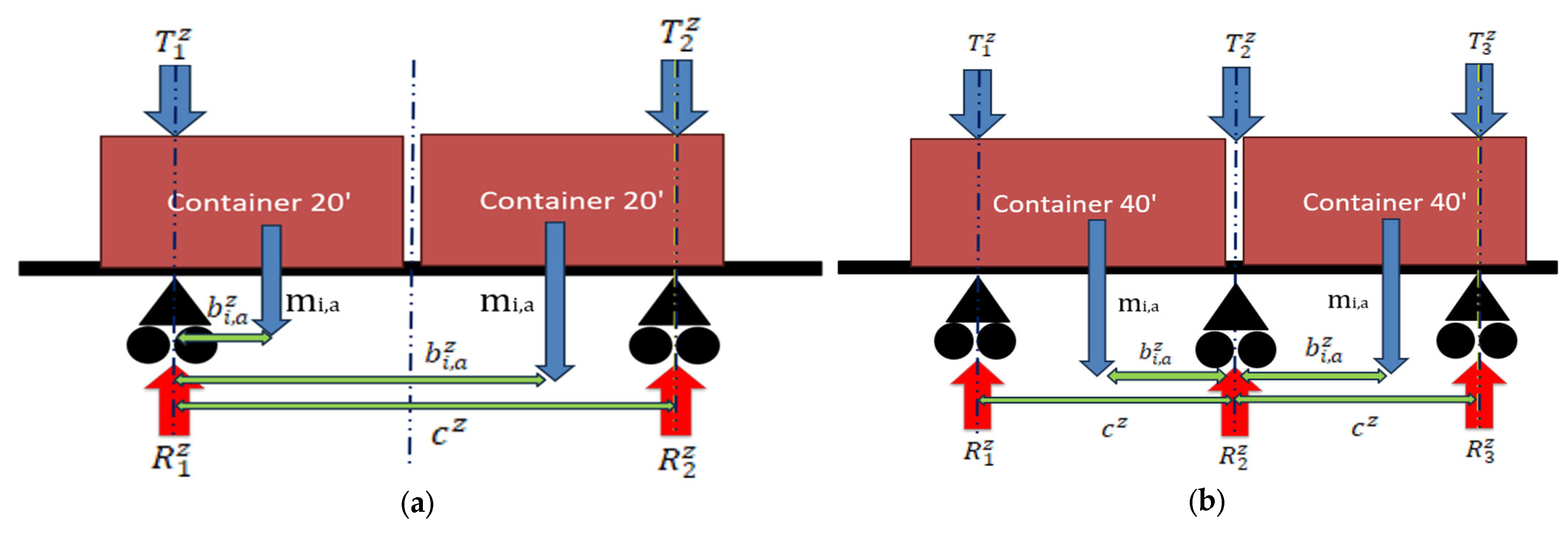
- (a)
- The equation for the vertical force equilibrium acting on the wagon between gravitational forces and track reaction forces:
- (b)
- The bending moment distribution equations for the wagon:
- (a)
- The equation for the vertical force equilibrium acting on the wagon, i.e., gravitational forces and track reaction forces:
- (b)
- The bending moment distribution equations for the wagon:
- The operator may aim to minimise the total tare mass of all wagons (as infrastructure managers usually charge higher access fees for heavier trains) . This objective can be formulated as the minimisation of the total wagon mass, expressed as the sum of the products of the number of wagons of type and the tare weight of a wagon of type .
- The operator may select wagons for the consist so as to maximise their total payload capacity expressed in tonnes , since a greater carried volume increases transport revenue. This objective can be formulated as the maximisation of the sum of the products of the number of wagons of type and the payload capacity of a wagon of type .
- The operator may select wagons for the consist so as to maximise their total capacity or the total number of slots expressed in TEU ), as the more TEUs are transported, the greater the revenue that can be gained. This objective can be formulated as the maximisation of the total wagon capacity, expressed as the sum of the products of the number of wagons of type and the capacity of a wagon of type .
- The operator may seek an optimal solution that simultaneously accounts for all the above objective functions.
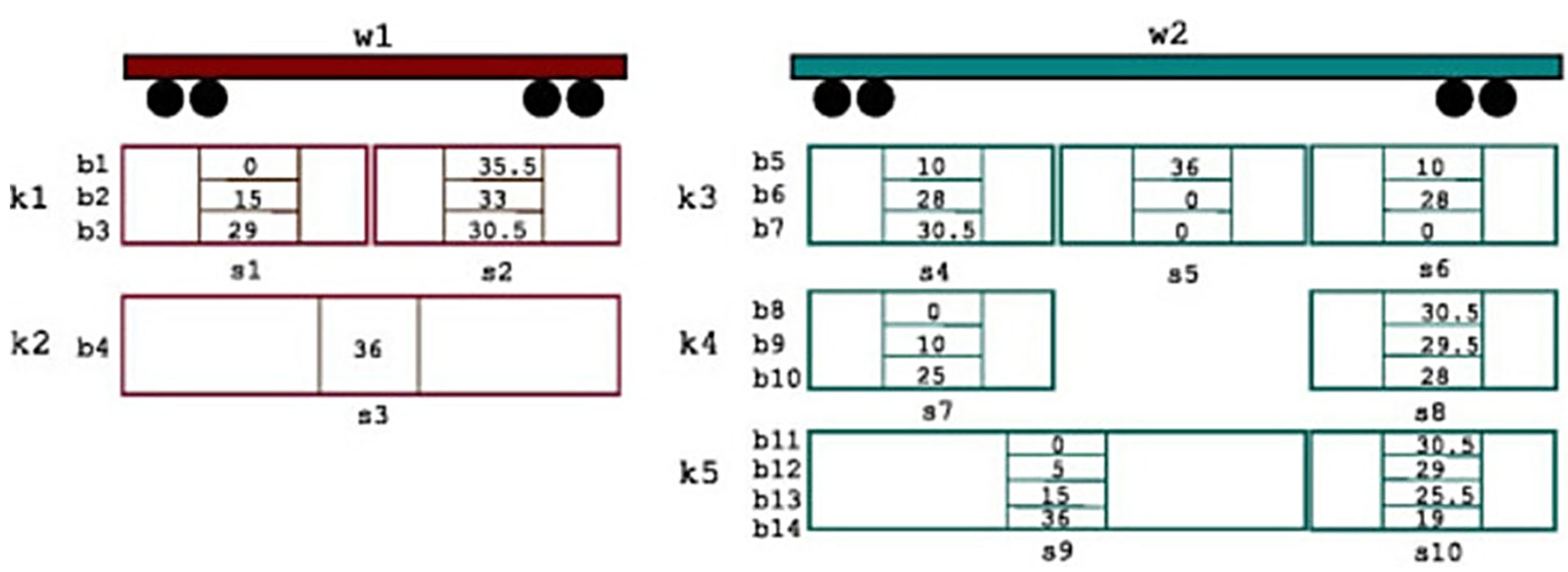
- (a)
- Maximise the utilisation of the loading space within the wagon consist (same equation as (2)).
- (b)
- Transport the largest possible gross cargo mass (same equation as (1)) or transport the largest possible net cargo mass :
- (c)
- Minimising empty slots () within the wagon consist.
- Per gross train t-km
- Per net cargo t-km
4. Results
4.1. Algorithm Implementation, Calculations, and Results
4.2. Sensitivity Analysis
5. Discussion
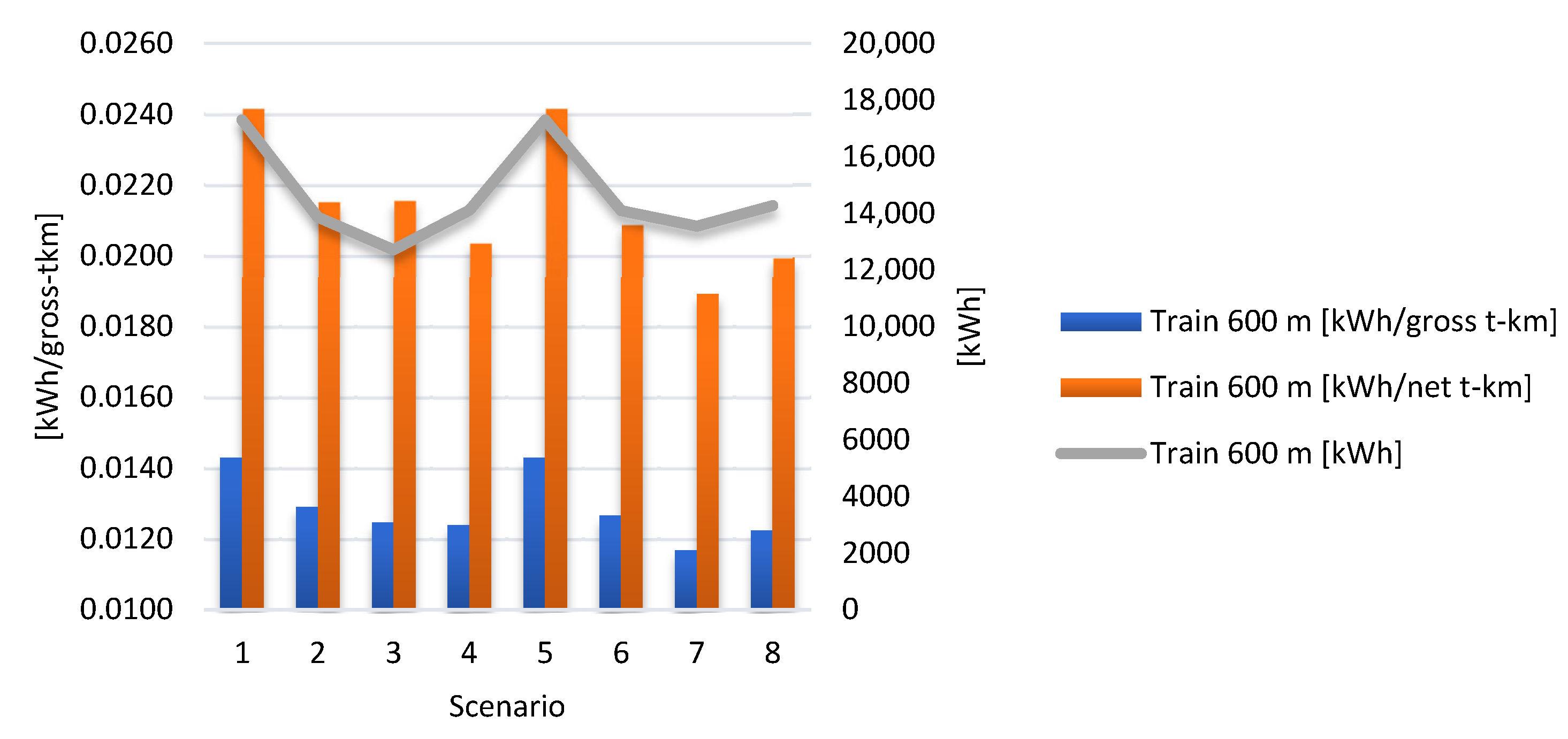
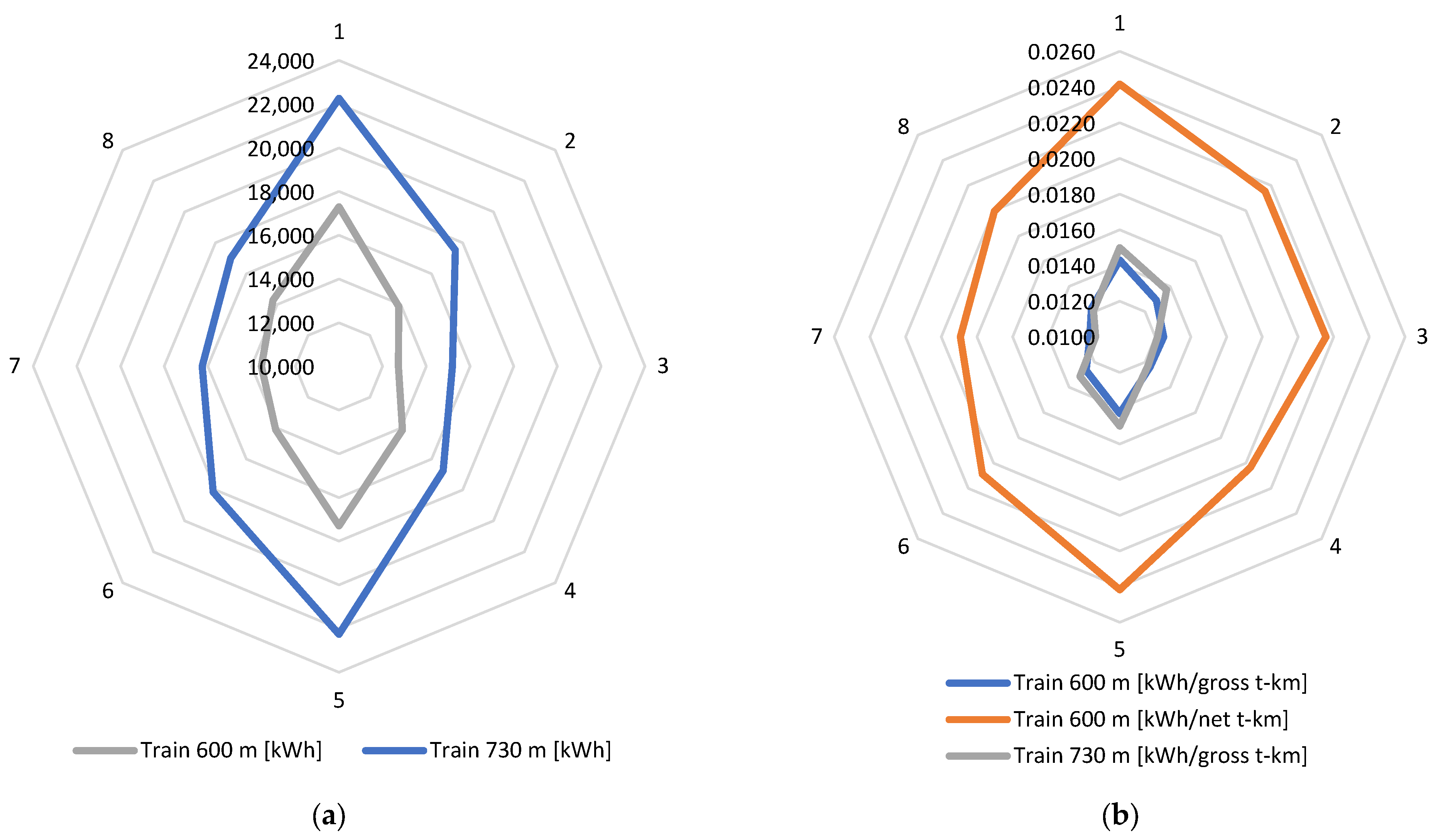
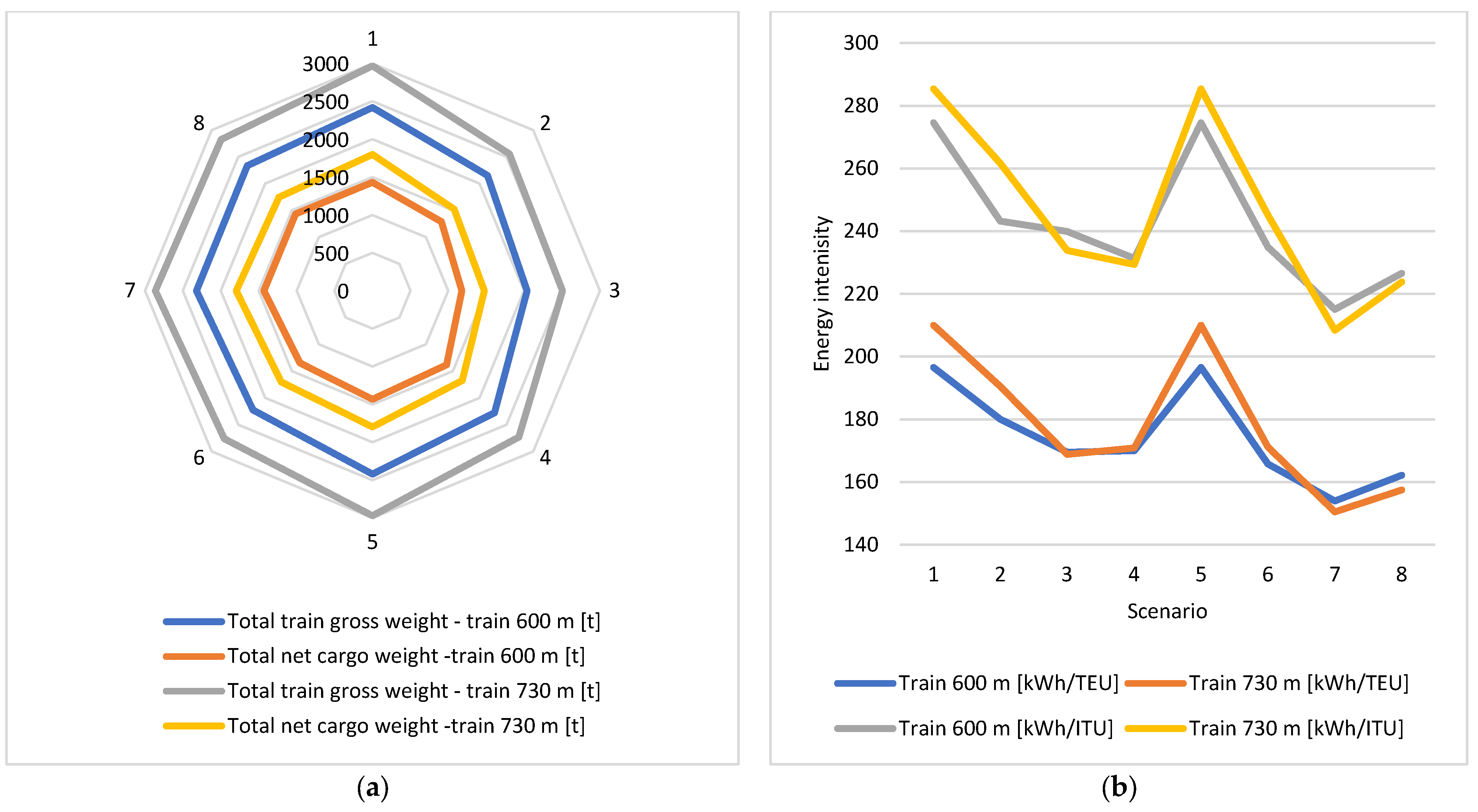
- Energy consumption across all analysed scenarios ranged from 0.012 to 0.017 kWh/gross tkm and from 0.018 to 0.025 kWh/net tkm. Comparable values for energy consumption expressed in kWh/gross tkm have been reported in [61,63,64,65]. In [63,66], energy consumption for intermodal trains is reported at 0.0212 kWh per gross tonne-kilometre. For bulk trains, it is estimated at the same level, while for other train types it ranges from 0.0189 to 0.0327 kWh per gross tonne-kilometre, with higher values corresponding to speeds exceeding 130 km/h. The EcoTransIT [67] project provides estimates of energy use for freight trains based on total train weight. According to these findings, a train weighing 500 tonnes consumes about 0.024 kWh per gross tonne-kilometre, while a 1000-tonne train consumes approximately 0.017 kWh per gross tonne-kilometre and a 1500-tonne train requires around 0.014 kWh per gross tonne-kilometre. Bäckström [68] analysed data from an intermodal transport operator and estimated energy consumption at 5.84 kWh per train-kilometre, with an additional 0.0147 kWh per gross tonne-kilometre. In [64], figures illustrate specific energy consumption as a function of train gross mass. For trains below 500 tonnes, consumption exceeds 0.04 kWh/tkm. For trains of 1000 tonnes, it is approximately 0.02 kWh/tkm, consistent with [59], while for trains exceeding 2000 tonnes it is slightly above 0.01 kWh/tkm. Slightly higher values are reported in [61], where for 500-tonne trains specific energy consumption is estimated at 0.043–0.064 kWh/tkm, for 1000-tonne trains at 0.028–0.042 kWh/tkm, and for 2000-tonne trains at 0.018–0.027 kWh/tkm. Significantly higher values are reported in studies such as [69,70]. In [69], energy consumption for freight trains operating on an electrified network is estimated at 0.8–1.8 kWh/tkm. Another study [70] reports typical values in the range of 0.04–0.05 kWh/tkm, while noting that, depending on operating conditions, consumption may decrease to as low as 0.01–0.03 kWh/tkm.
- Energy consumption values reported in the literature inevitably differ. This variation arises from differences in freight train operating parameters. The main factors include gross train mass, number of wagon axles, distance travelled, average speed, number of stops, rolling and aerodynamic resistance coefficients, the locomotive’s frontal area, and track gradient.
- The validation of this study was also carried out using an empirical approach. For this purpose, data for 2024 were collected on the annual electricity consumption of all freight trains operating across the entire Polish railway network, as well as on transport performance. Energy consumption was expressed in MWh, while transport performance was measured in million tonne-kilometres. From the total transport performance, the share performed by diesel traction was excluded so that the analysis covered only operations carried out by electric vehicles. The total electricity consumption was then related to the adjusted transport performance. As a result of these calculations, the average energy consumption across the entire network in 2024 was estimated at 0.02503 kWh per net tonne-kilometre. This value corresponds to the upper bound of the results obtained in the present case study, thereby confirming their reliability. Additionally, analogous analyses were conducted for different types of bulk freight trains. In these cases, the average energy consumption values were also similar to those calculated for intermodal trains. The observed consistency indicates that the values presented in this study are representative and can be reliably used in further research and publications, both for bulk freight and intermodal transport. It is important to distinguish between energy consumption per gross train t-km and per net t-km. In many publications, the notion of unit energy consumption is not clearly defined. As noted earlier, the use of fixed energy consumption values introduces error, as demonstrated by the results of this case study. These values can vary substantially depending on the input parameters. To ensure comparability, it is therefore advisable to report the full set of train parameters for the case under consideration.
- Although 40-foot wagons have favourable loading characteristics, allowing very high cargo mass without exceeding permissible bogie-axle loads, their operation is associated with relatively high energy use when launching an intermodal service. This is due to their having the greatest total tare mass among all wagon types. In addition, the higher number of bogie axles increases rolling resistance at the wheel–rail interface, which further raises energy consumption. Extending the train consist from 600 to 730 m does not reduce unit energy use; on the contrary, it increases it. In homogeneous consists of 40-foot wagons, the number of empty slots is practically negligible, as the four axles are positioned relatively close together, preventing axle overloading and enabling full utilisation of loading positions. Such consists can also carry the largest net cargo mass. However, the operational advantage of this wagon type diminishes relative to 60- and 80-foot wagons when the permissible axle load increases from 20 to 22.5 t.
- Wagon consists composed of 60-foot wagons ranked second in terms of energy consumption (kWh/net tkm). In this case, energy use was driven primarily by the relatively low utilisation of available loading space, as the locomotive’s energy over a given route was distributed across a smaller cargo mass. The use of 60-foot wagons is disadvantageous from a space-utilisation perspective: at 20 t/axle, it is not possible to load three heavy 20-foot containers or one heavy 40-foot container together with a 20-foot container. This limitation becomes more pronounced when there is an insufficient number of ITUs of both types in the yard. For example, loading 30 sixty-foot wagons requires at least 30 forty-foot and 30 twenty-foot containers; otherwise, empty slots are likely to occur. It was also observed that 60-foot wagons are suitable when heavy 20-foot containers must be transported but 40-foot wagons are unavailable. The payload utilisation rate, measured in tonnes, ranged from approximately 75% to 77%. Furthermore, 60-foot wagons become a more attractive option once the permissible axle load increases from 20 to 22.5 t.
- Train consists composed of 80-foot wagons exhibited some of the lowest energy-use levels, expressed in kWh/net tkm, kWh/gross tkm, kWh/TEU, and kWh/ITU. When consist length increased from 600 to 730 m, unit energy consumption continued to decline, unlike in trains composed of 60- and 40-foot wagons, although the differences were marginal. This may be attributed to slightly lower aerodynamic drag resulting from a smaller number of wagons, as fewer 80-foot wagons are required to form a train. However, the simulation showed that when a large number of heavy 20-foot containers are present in the yard and trains operate on lines limited to 20 t/axle, a significant number of empty slots occur in the consist. When the permissible axle load increases to 22.5 t/axle, the loading performance of 80-foot wagons improves considerably.
- Using mixed consists appears particularly effective when heavy 20-foot containers must be transported but an insufficient number of 40-foot wagons are available. In such cases, the heaviest 40-foot containers are first loaded onto 80-foot wagons, the heaviest 20-foot containers are placed on 40-foot wagons, and the lightest 20- and 40-foot containers are allocated to 60-foot platforms. Simulation studies confirm these findings: mixed consists exhibit some of the lowest energy consumption levels, along with optimal utilisation of loading slots and payload capacity (in tonnes) under 20 t/axle scenarios. Combining different wagon types can therefore increase train utilisation and improve the energy efficiency of transport operations.
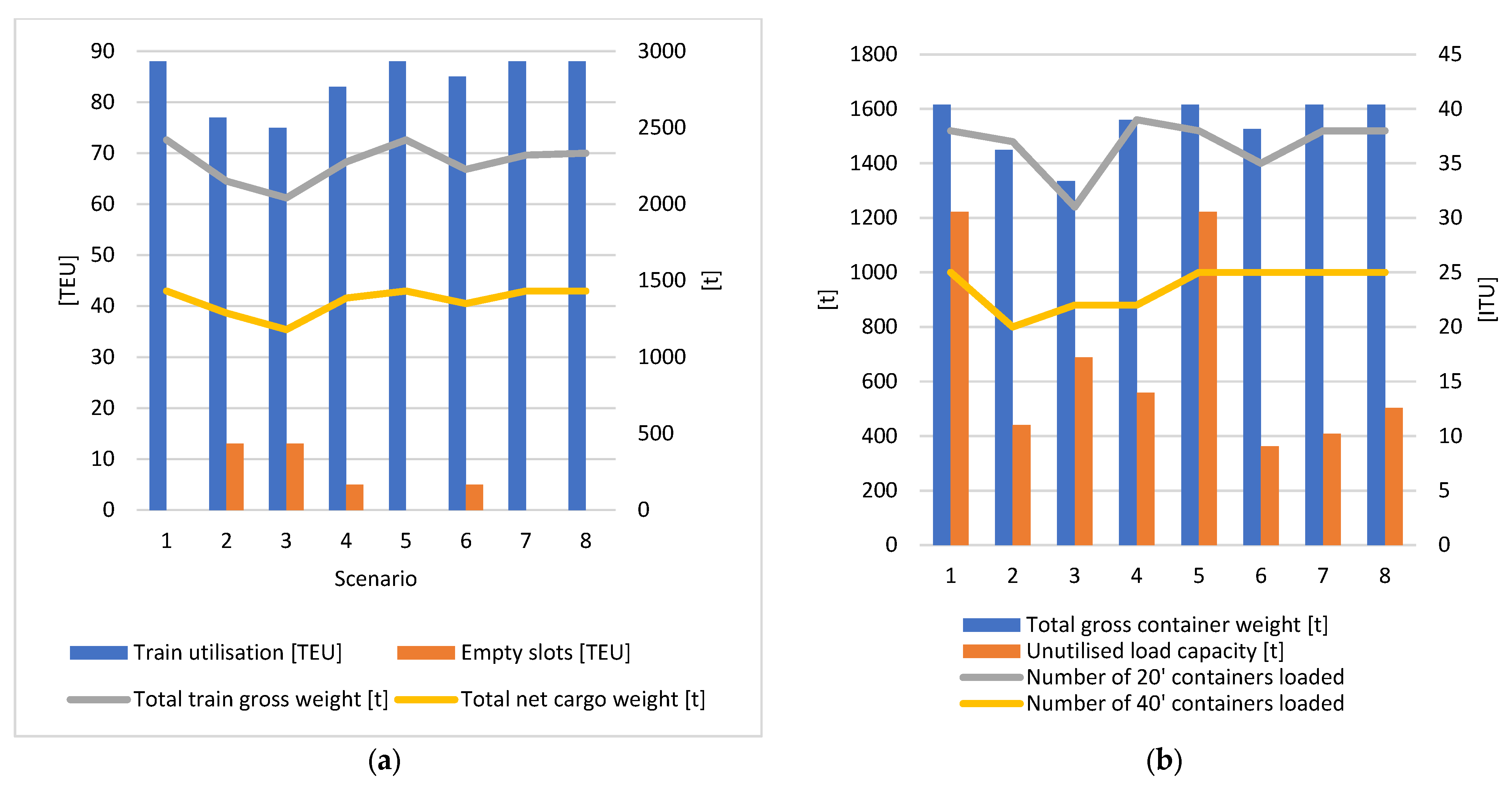
- Operating 730-metre trains makes it possible to transport a significantly higher number of TEUs and ITUs. Consequently, such consists carry proportionally more cargo than 600-metre wagon consists. However, energy consumption does not consistently decrease across all scenarios; in most cases, the results are comparable to those obtained for the 600-metre configurations.
- Increasing the permissible axle load from 20 to 22.5 t has a notably positive effect on train utilisation and energy efficiency. Across all key performance indicators, improvements of approximately 5–15% were observed.
- It is not possible to unequivocally determine which wagon type is the most economically efficient in operation, as this depends on the parameters of the railway line on which the trains operate. From the perspective of energy consumption, 80-foot wagons perform best; however, at an axle-load limit of 20 t/axle, they may result in a large number of unused slots, in contrast to 40-foot wagons.
- The model is not suitable for estimating the energy use of refrigerated containers powered by onboard batteries or generator sets. In such cases, it would need to be extended with additional parameters, for example, differentiated rates for this type of intermodal transport unit, which is more expensive to move. A similar limitation applies to RO-RO intermodal transport: carrying semi-trailers, swap bodies, and road sets is significantly more energy-intensive than transporting containers and requires different wagon types, which may themselves consume energy.
- In many regions—particularly the United States and Canada—double-stack trains are operated. For such trains, aerodynamic resistance coefficients must be adjusted to reflect the altered geometry and drag characteristics.
- The model is limited to intermodal rail transport using electric locomotives. Many railway lines worldwide are not electrified. Its applicability to bulk rail transport is also limited; in such cases, the algorithm would require additional components and parameters.
- The energy consumption model does not account for energy recuperation, that is, the recovery of braking energy.
6. Conclusions
Author Contributions
Funding
Institutional Review Board Statement
Informed Consent Statement
Data Availability Statement
Conflicts of Interest
Abbreviations
| EU | European Union |
| ITU | Intermodal Transport Unit |
| TEU | Twenty-foot Equivalent Unit |
| TEN-T | Trans-European Transport Network |
| AGTC | European Agreement on Important International Combined Transport Lines and Related Installations |
| RO-RO | Roll-on/roll-off system |
| TLPP | Train Load Planning Problem |
| MEET | Methodologies for Estimating Emissions from Transport |
| ARTEMIS | Assessment and Reliability of Transport Emission Models and Inventory Systems |
| ETW | EcoTransIT World |
| kWh/tkm | kWh/tonne-kilometre |
| Wagon type | |
| Diagnostic variable denoting the tare weight of a wagon of type z, in tones | |
| Diagnostic variable denoting the payload capacity of a wagon of type z, in tones | |
| Diagnostic variable denoting the capacity of a wagon of type z, in TEU | |
| Diagnostic variable denoting the length of a wagon of type z, in metres | |
| Railway line class | |
| Container type | |
| Container size of type in TEU | |
| Gross mass of a container of type in tones | |
| Wagon consist length, in metres | |
| Loading scenario number | |
| Number of containers | |
| Gross mass of the train in the scenario, in tones | |
| Gross mass of cargo in the scenario, in tones | |
| Locomotive mass, in tones | |
| Mass of wagons in the scenario, in tones | |
| Net mass of cargo in the scenario, in tones | |
| Loading priority expressed as the number of days until loading | |
| Gross mass of the container of type a, in tones | |
| Load on the bogie of a wagon of type z | |
| Permissible axle load in railway line class in tones per axle | |
| Portion of the tare mass of a wagon of type z, in tones | |
| Axle spacing in a wagon of type z, in metres | |
| Distance of the centre of gravity of the container of type a from the support centre () of a wagon of type z, in meters | |
| Total wagon payload capacity, in tonnes | |
| Total wagon capacity, in TEU | |
| Number of wagons of type z | |
| Maximum number of wagons of type z | |
| Set of loading scenarios | |
| A binary decision variable equal to 1 if container is assigned to wagon and 0 otherwise (this variable determines whether the mass of the container is included in the load of wagon ) | |
| Utilisation of the loading space within the wagon consist in the scenario | |
| Tare mass of the container of type a selected for loading, in tones | |
| Number of empty slots in the train consist in the scenario, in TEU | |
| Total energy consumption of the intermodal train in the scenario, calculated by the method, in kWh | |
| Locomotive motor efficiency | |
| Energy required to overcome running resistance in the scenario, in kWh | |
| Power of auxiliary devices in the scenario, in kW | |
| Power required to overcome aerodynamic resistance in the scenario, in kW | |
| Power required to overcome rolling resistance in the scenario, in kW | |
| Power required to overcome gradient resistance in the scenario, in kW | |
| Distance travelled by the train, in kilometres | |
| Average train speed in the scenario, in km/h | |
| Number of train stops per 100 km | |
| Energy required for train acceleration, in kWh | |
| Energy use per gross train tone-kilometre of cargo, in kWh/gross-tkm | |
| Energy use per net cargo tone-kilometre of cargo, in kWh/net-tkm | |
| Energy use per TEU, in kWh/TEU | |
| Energy use per ITU, in kWh/ITU |
Appendix A

| Cont.No. | Cont. Type | Cont. Weight | Priority | Cont.No. | Cont. Type | Cont. Weight | Priority |
| 1 | 1 | 25.6 | 1 | 42 | 1 | 27.5 | 3 |
| 2 | 1 | 29.2 | 1 | 43 | 1 | 28.5 | 3 |
| 3 | 1 | 22.3 | 1 | 44 | 1 | 23.0 | 3 |
| 4 | 1 | 22.5 | 1 | 45 | 1 | 23.1 | 3 |
| 5 | 1 | 25.3 | 1 | 46 | 1 | 28.2 | 3 |
| 6 | 1 | 26.4 | 1 | 47 | 1 | 23.7 | 3 |
| 7 | 1 | 29.9 | 1 | 48 | 1 | 22.3 | 3 |
| 8 | 1 | 22.0 | 1 | 49 | 1 | 29.9 | 3 |
| 9 | 1 | 24.0 | 1 | 50 | 1 | 29.6 | 3 |
| 10 | 1 | 22.7 | 1 | 51 | 1 | 25.1 | 3 |
| 11 | 2 | 24.6 | 1 | 52 | 1 | 25.9 | 3 |
| 12 | 2 | 24.4 | 1 | 53 | 1 | 25.5 | 3 |
| 13 | 2 | 24.9 | 1 | 54 | 1 | 24.2 | 3 |
| 14 | 2 | 29.0 | 1 | 55 | 1 | 28.9 | 3 |
| 15 | 2 | 23.3 | 1 | 56 | 2 | 26.4 | 3 |
| 16 | 2 | 28.1 | 1 | 57 | 2 | 24.3 | 3 |
| 17 | 2 | 24.3 | 1 | 58 | 2 | 29.2 | 3 |
| 18 | 2 | 29.4 | 1 | 59 | 2 | 27.5 | 3 |
| 19 | 2 | 24.8 | 1 | 60 | 2 | 22.9 | 3 |
| 20 | 1 | 24.7 | 2 | 61 | 2 | 29.8 | 3 |
| 21 | 1 | 26.0 | 2 | 62 | 2 | 27.6 | 3 |
| 22 | 1 | 29.0 | 2 | 63 | 2 | 23.5 | 3 |
| 23 | 1 | 23.6 | 2 | 64 | 1 | 29.7 | 4 |
| 24 | 1 | 28.5 | 2 | 65 | 1 | 27.6 | 4 |
| 25 | 1 | 26.7 | 2 | 66 | 1 | 26.9 | 4 |
| 26 | 1 | 27.2 | 2 | 67 | 1 | 25.2 | 4 |
| 27 | 1 | 22.7 | 2 | 68 | 1 | 25.5 | 4 |
| 28 | 1 | 23.7 | 2 | 69 | 1 | 23.4 | 4 |
| 29 | 1 | 29.6 | 2 | 70 | 1 | 25.6 | 4 |
| 30 | 1 | 26.0 | 2 | 71 | 1 | 28.6 | 4 |
| 31 | 1 | 25.5 | 2 | 72 | 1 | 26.1 | 4 |
| 32 | 1 | 25.7 | 2 | 73 | 1 | 28.4 | 4 |
| 33 | 1 | 23.1 | 2 | 74 | 1 | 28.2 | 4 |
| 34 | 2 | 24.1 | 2 | 75 | 1 | 29.1 | 4 |
| 35 | 2 | 23.3 | 2 | 76 | 2 | 25.3 | 4 |
| 36 | 2 | 23.6 | 2 | 77 | 2 | 27.0 | 4 |
| 37 | 2 | 29.6 | 2 | 78 | 2 | 28.9 | 4 |
| 38 | 2 | 22.7 | 2 | 79 | 2 | 29.0 | 4 |
| 39 | 2 | 23.7 | 2 | 80 | 2 | 28.2 | 4 |
| 40 | 2 | 22.9 | 2 | 81 | 2 | 28.0 | 4 |
| 41 | 2 | 24.2 | 2 | 82 | 2 | 29.9 | 4 |
| ScenarioNo. | Max. Lengths of Wagon Consists [m] | Permissible Axle Load [t/axle] | Type of Wagon Fleet | Empty Wagon Set Weight [t] | Max. Capacity [t] | Max. Capacity [TEU] | Wagon Set Length [m] |
| 1 | 600 | 20 | 44 × 40′ | 704 | 2838 | 88 | 599.72 |
| 2 | 600 | 20 | 30 × 60′ | 600 | 1890 | 90 | 589.2 |
| 3 | 600 | 20 | 22 × 80′ | 605 | 2024 | 88 | 596.2 |
| 4 | 600 | 20 | 7 × 40′ + 6 × 60′ + 14 × 80′ | 617 | 2117 | 88 | 592.65 |
| 5 | 600 | 22.5 | 44 × 40′ | 704 | 2838 | 88 | 599.72 |
| 6 | 600 | 22.5 | 30 × 60′ | 600 | 1890 | 90 | 589.2 |
| 7 | 600 | 22.5 | 22 × 80′ | 605 | 2024 | 88 | 596.2 |
| 8 | 600 | 22.5 | 7 × 40′ + 6 × 60′ + 14 × 80′ | 617 | 2117 | 88 | 592.65 |
| 1′ | 730 | 20 | 53 × 40′ | 848 | 3419 | 106 | 722.39 |
| 2′ | 730 | 20 | 37 × 60′ | 740 | 2331 | 111 | 726.68 |
| 3′ | 730 | 20 | 27 × 80′ | 743 | 2484 | 108 | 731.7 |
| 4′ | 730 | 20 | 7 × 40′ + 14 × 60′ + 13 × 80′ | 749.5 | 2529 | 108 | 722.7 |
| 5′ | 730 | 22.5 | 53 × 40′ | 848 | 3418 | 106 | 722.4 |
| 6′ | 730 | 22.5 | 37 × 60′ | 740 | 2331 | 111 | 726.7 |
| 7′ | 730 | 22.5 | 27 × 80′ | 743 | 2484 | 108 | 731.7 |
| 8′ | 730 | 22.5 | 7 × 40′ + 14 × 60′ + 13 × 80′ | 749.5 | 2529 | 108 | 722.7 |
| ScenarioNo. | Total Gross Container Weight [t] | Unutilised Load Capacity [t] | Number of 20′ Containers Loaded | Number of 40′ Containers Loaded | Sum ofITUs | Load Capacity Utilisation Rate [%] | ScenarioNo. | Total Train Gross Weight [t] | Total Net Cargo Weight [t] |
| 1 | 1615 | 1223 | 38 | 25 | 63 | 57% | 1 | 2419 | 1432 |
| 2 | 1449 | 441 | 37 | 20 | 57 | 77% | 2 | 2149 | 1288 |
| 3 | 1335 | 689 | 31 | 22 | 53 | 66% | 3 | 2040 | 1179 |
| 4 | 1560 | 558 | 39 | 22 | 61 | 74% | 4 | 2277 | 1386 |
| 5 | 1615 | 1223 | 38 | 25 | 63 | 57% | 5 | 2419 | 1432 |
| 6 | 1527 | 363 | 35 | 25 | 60 | 81% | 6 | 2227 | 1350 |
| 7 | 1615 | 409 | 38 | 25 | 63 | 80% | 7 | 2320 | 1432 |
| 8 | 1615 | 502 | 38 | 25 | 63 | 76% | 8 | 2332 | 1432 |
| 1′ | 2021 | 1398 | 50 | 28 | 78 | 59% | 1′ | 2969 | 1799 |
| 2′ | 1715 | 616 | 42 | 25 | 67 | 74% | 2′ | 2555 | 1523 |
| 3′ | 1664 | 820 | 40 | 25 | 65 | 67% | 3′ | 2507 | 1476 |
| 4′ | 1882 | 647 | 48 | 25 | 73 | 74% | 4′ | 2732 | 1677 |
| 5′ | 2021 | 1398 | 50 | 28 | 78 | 59% | 5′ | 2969 | 1799 |
| 6′ | 1922 | 409 | 42 | 32 | 74 | 82% | 6′ | 2762 | 1701 |
| 7′ | 2021 | 463 | 48 | 30 | 78 | 81% | 7′ | 2864 | 1795 |
| 8′ | 1970 | 559 | 44 | 32 | 76 | 78% | 8′ | 2820 | 1745 |
References
- Jacyna, M.; Pyza, D.; Jachimowski, R. Transport Intermodalny—Projektowanie Terminali Intermodalnych; PWN: Warszawa, Poland, 2017. [Google Scholar]
- Brzeziński, M. Method of Locating Intermodal Terminals for the Sustainable Development of Poland. Ph.D. Thesis, Division of Traffic Control and Transport Infrastructure, Warsaw University of Technology, Warsaw, Poland, 2024. [Google Scholar]
- Archutowska, J. (Ed.) White Book on Railway Development, 2nd Updated ed.; Available online: https://www.cpk.pl/en/the-white-book-on-railway-development (accessed on 1 August 2025).
- Regulation (EU) 2024/1679 of the European Parliament and of the Council of 13 June 2024 on Union Guidelines for the Development of the Trans-European Transport Network, Amending Regulations (EU) 2021/1153 and (EU) No 913/2010 and Repealing Regulation (EU) No 1315/2013. Available online: https://publications.europa.eu/resource/cellar/cc3395a5-3516-11ef-b441-01aa75ed71a1.0006.03/DOC_1 (accessed on 1 September 2025).
- Kowalski, S. Obtaining EU Funding for the Development of Intermodal Transport in Poland. Logist. Transp. 2013, 20, 21–28. [Google Scholar]
- UIC 2024 Report on Combined Transport in Europe. Available online: https://uic.org/IMG/pdf/uic_uirr_report_2024-2.pdf (accessed on 1 September 2025).
- Brzeziński, M.; Pyza, D. A Refined Model for Carbon Footprint Estimation in Electric Railway Transport. Energies 2023, 16, 6567. [Google Scholar] [CrossRef] [Scilit]
- Bulakh, M. Evaluation and Reduction of Energy Consumption of Railway Train Movement on a Straight Track Section with Reduced Freight Wagon Mass. Energies 2025, 18, 280. [Google Scholar] [CrossRef] [Scilit]
- Qi, T.; Mei, M. Analysis on Energy Efficiency and Rapidity of High-Speed Train Operation. In Proceedings of the 2022 3rd Asia-Pacific Conference on Image Processing, Electronics and Computers; ACM: Dalian, China, 2022; pp. 643–651. [Google Scholar]
- Janić, M. Estimation of Direct Energy Consumption and CO2 Emission by High Speed Rail, Transrapid Maglev and Hyperloop Passenger Transport Systems. Int. J. Sustain. Transp. 2021, 15, 696–717. [Google Scholar] [CrossRef] [Scilit]
- Nehring, K.; Kiszkowiak, Ł. Improving Aerodynamic Performance of Intermodal Trains through Optimisation of Loading Plans. Arch. Transp. 2025, 76, 137–159. [Google Scholar] [CrossRef] [Scilit]
- Heinold, A. Comparing Emission Estimation Models for Rail Freight Transportation. Transp. Res. Part D Transp. Environ. 2020, 86, 102468. [Google Scholar] [CrossRef] [Scilit]
- Yuan, M.; Thellufsen, J.Z.; Lund, H.; Liang, Y. The Electrification of Transportation in Energy Transition. Energy 2021, 236, 121564. [Google Scholar] [CrossRef] [Scilit]
- Jarnut, M.; Kaniewski, J.; Buciakowski, M. Energy Storage Systems for Fluctuating Energy Sources and Fluctuating Loads—Analysis of Selected Cases. Energies 2025, 18, 4792. [Google Scholar] [CrossRef] [Scilit]
- Serrano-Arévalo, T.I.; Ochoa-Barragán, R.; Ramírez-Márquez, C.; El-Halwagi, M.; Abdel Jabbar, N.; Ponce-Ortega, J.M. Energy Storage: From Fundamental Principles to Industrial Applications. Processes 2025, 13, 1853. [Google Scholar] [CrossRef] [Scilit]
- Khan, Z.A.; Ullah, A.; Ul Haq, I.; Hamdy, M.; Maria Mauro, G.; Muhammad, K.; Hijji, M.; Baik, S.W. Efficient Short-Term Electricity Load Forecasting for Effective Energy Management. Sustain. Energy Technol. Assess. 2022, 53, 102337. [Google Scholar] [CrossRef] [Scilit]
- Kuzior, A.; Staszek, M. Energy Management in the Railway Industry: A Case Study of Rail Freight Carrier in Poland. Energies 2021, 14, 6875. [Google Scholar] [CrossRef] [Scilit]
- Melnyk, O.; Onishchenko, O.; Onyshchenko, S.; Golikov, V.; Sapiha, V.; Shcherbina, O.; Andrievska, V. Study of Environmental Efficiency of Ship Operation in Terms of Freight Transportation Effectiveness Provision. TransNav Int. J. Mar. Navig. Saf. Sea Transp. 2022, 16, 723–729. [Google Scholar] [CrossRef] [Scilit]
- Zhang, D.; Zhou, F.-R.; Tang, Y.-Y.; Tao, Z.-Y.; Peng, Q.-Y. Optimization of the Loading Plan for a Railway Wagon from the Perspectives of Running Safety and Energy Conservation. Energy 2023, 280, 128229. [Google Scholar] [CrossRef] [Scilit]
- IEA World Energy Outlook. 2025. Available online: https://iea.blob.core.windows.net/assets/1438d3a5-65ca-4a8a-9a41-48b14f2ca7ea/WorldEnergyOutlook2025.pdf (accessed on 1 December 2025).
- IEA. Electricity 2025 Analysis and Forecast to 2027; IEA: Paris, France, 2025. [Google Scholar]
- DNV. Energy Transition Outlook: A Global and Regional Energy Forecast to 2060; DNV: Høvik, Norway, 2025. [Google Scholar]
- IRENA. World Energy Transitions Outlook 2024: 1.5 °C Pathway; IRENA: Abu Dhabi, United Arab Emirates, 2024. [Google Scholar]
- GSR Global Status Report 2025: A Comprehensive Annual Overview of the State of Renewable Energy. Available online: https://www.ren21.net/gsr-2025/ (accessed on 3 December 2025).
- Pulido-Sánchez, D.; Capellán-Pérez, I.; Castro, C.d.; Frechoso, F. Material and Energy Requirements of Transport Electrification. Energy Environ. Sci. 2022, 15, 4872–4910. [Google Scholar] [CrossRef] [Scilit]
- BP Energy Outlook. Available online: https://www.bp.com/content/dam/bp/business-sites/en/global/corporate/pdfs/energy-economics/energy-outlook/bp-energy-outlook-2025.pdf (accessed on 12 February 2026).
- Raźniewska, M.; Wronka, A. Transport Fleet Electrification Development Conditions—Perspective of Transport, Shipping, and Logistics Industry in Poland. Energies 2024, 17, 4288. [Google Scholar] [CrossRef] [Scilit]
- UIC Activity Report 2019. Available online: https://uic.org/IMG/pdf/uic_activity_report_2019.pdf (accessed on 15 January 2026).
- UIC Activity Report 2024. Available online: https://uic.org/IMG/pdf/uic_activity_report_2024.pdf (accessed on 30 January 2026).
- EY European Economic Outlook What Will the Tariffs Bring? Available online: https://www.ey.com/content/dam/ey-unified-site/ey-com/en-pl/insights/economic-analysis-team/documents/ey-european-economic_outlook-may25.pdf (accessed on 13 February 2026).
- Ćwil, M.; Bartnik, W.; Jarzębowski, S. Railway Vehicle Energy Efficiency as a Key Factor in Creating Sustainable Transportation Systems. Energies 2021, 14, 5211. [Google Scholar] [CrossRef] [Scilit]
- Gołębiowski, P.; Jacyna, M.; Stańczak, A. The Assessment of Energy Efficiency versus Planning of Rail Freight Traffic: A Case Study on the Example of Poland. Energies 2021, 14, 5629. [Google Scholar] [CrossRef] [Scilit]
- Kostrzewski, A.; Nader, M.; Kostrzewski, M. Racjonalizacja Rozłożenia Wybranych Jednostek Transportu Intermodalnego Na Długości Ładunkowej Pociągu. Pr. Nauk. Politech. Warsz. 2018, 120, 201–208. [Google Scholar]
- Kłodawski, M.; Nehring, K.; Jachimowski, R.; Lipińska, J. The Impact of the Intermodal Terminal Operation Strategy on Container Train Loading Duration. Transp. Probl. 2024, 19, 163–176. [Google Scholar] [CrossRef] [Scilit]
- Siri, S.; Palmiere, A.; Ambrosino, D. Multi-Objective Optimization Methods for Train Load Planning in Seaport Container Terminals. IEEE Trans. Autom. Sci. Eng. 2024, 21, 3216–3228. [Google Scholar] [CrossRef] [Scilit]
- Nehring, K.; Kłodawski, M.; Jachimowski, R.; Klimek, P.; Vasek, R. Simulation Analysis of the Impact of Container Wagon Pin Configuration on the Train Loading Time in the Intermodal Terminal. Arch. Transp. 2021, 60, 155–169. [Google Scholar] [CrossRef] [Scilit]
- Mantovani, S.; Morganti, G.; Umang, N.; Crainic, T.G.; Frejinger, E.; Larsen, E. The Load Planning Problem for Double-Stack Intermodal Trains. Eur. J. Oper. Res. 2018, 267, 107–119. [Google Scholar] [CrossRef] [Scilit]
- Foti, L.; Maratea, M.; Sacone, S.; Siri, S. Solving Train Load Planning Problems with Boolean Optimization. In Proceedings of the 19th RCRA International Workshop on Experimental Evaluation of Algorithms for Solving Problems with Combinatorial Explosion, Rome, Italy, 14–16 June 2012. [Google Scholar]
- Ambrosino, D.; Caballini, C. New Solution Approaches for the Train Load Planning Problem. EURO J. Transp. Logist. 2019, 8, 299–325. [Google Scholar] [CrossRef] [Scilit]
- Corry, P.; Kozan, E. Optimised Loading Patterns for Intermodal Trains. Spectr. 2007, 30, 721–750. [Google Scholar] [CrossRef] [Scilit]
- Bruns, F.; Goerigk, M.; Knust, S.; Schöbel, A. Robust Load Planning of Trains in Intermodal Transportation. Spectr. 2014, 36, 631–668. [Google Scholar] [CrossRef] [Scilit]
- Anghinolfi, D.; Paolucci, M. A General Purpose Lagrangian Heuristic Applied to the Train Loading Problem. Procedia—Soc. Behav. Sci. 2014, 108, 37–46. [Google Scholar] [CrossRef] [Scilit]
- Wymiary i Ładowność 20-Stopowych i 40-Stopowych Kontenerów Standardowych|DSV. Available online: https://www.dsv.com/pl-pl/nasze-rozwiazania/rodzaje-transportu/fracht-morski/wymiary-kontenerow-morskich/kontener-standardowy (accessed on 29 August 2025).
- Wardrop, A. MTRAIN User’s Manual; Version 89A; State Rail: New South Wales, Australia, 1989. [Google Scholar]
- Lee, C.K.; Sun, C.H. A Simulation Study on Energy Saving Effect of Train Operation. Transp. Plan. J. 2001, 30, 237–252. [Google Scholar] [CrossRef]
- Jong, J.-C. Models for Estimating Energy Consumption of Electric Trains. J. East. Asia Soc. Transp. Stud. 2005, 5, 278–291. [Google Scholar] [CrossRef]
- Parajuli, A. Modelling Road and Rail Freight Energy Consumption: A Comparative Study. Master’s Thesis, Queensland University of Technology, Brisbane, Australia, 2005. [Google Scholar]
- Lukaszewicz, P. Energy Consumption and Running Time for Trains: Modelling of Running Resistance and Driver Behaviour Based on Full Scale Testing; Royal Institute of Technology, Department of Vehicle Engineering: Stockholm, Sweden, 2001. [Google Scholar]
- Huo, X.-S.; Liu, T.-H.; Chen, Z.-W.; Li, W.-H.; Niu, J.-Q.; Gao, H.-R. Aerodynamic Characteristics of Double-Connected Train Groups Composed of Different Kinds of High-Speed Trains under Crosswinds: A Comparison Study. Alex. Eng. J. 2023, 64, 465–481. [Google Scholar] [CrossRef] [Scilit]
- Hickman, J.; Hassel, D.; Joumard, R.; Samaras, Z.; Sorenson, S. Methodology for Calculating Transport Emissions and Energy Consumption; Transport Research Laboratory: Washington, DC, USA, 1999. [Google Scholar]
- Lindgreen, E.B.G.; Sorenson, S.C. Simulation of Energy Consumption and Emissions from Rail Traffic; Department of Mechanical Engineering, Technical University of Denmark: Lyngby, Denmark, 2005. [Google Scholar]
- EcoTransIT. World Initiative Ecological Transport Information Tool for Worldwide Transports; EcoTransIT Word: Hannover, Germany, 2019. [Google Scholar]
- Kirschstein, T.; Meisel, F. GHG-Emission Models for Assessing the Eco-Friendliness of Road and Rail Freight Transports. Transp. Res. Part B Methodol. 2015, 73, 13–33. [Google Scholar] [CrossRef] [Scilit]
- Heinold, A.; Meisel, F. Emission Limits and Emission Allocation Schemes in Intermodal Freight Transportation. Transp. Res. Part E Logist. Transp. Rev. 2020, 141, 101963. [Google Scholar] [CrossRef] [Scilit]
- Heinold, A.; Meisel, F. Emission Rates of Intermodal Rail/Road and Road-Only Transportation in Europe: A Comprehensive Simulation Study. Transp. Res. Part Transp. Environ. 2018, 65, 421–437. [Google Scholar] [CrossRef] [Scilit]
- Favre, A. Rail Statistics on Energy Consumption and Emissions. Available online: https://unece.org/sites/default/files/2024-05/Rail%20statistics%20on%20energy%20consumption%20and%20emissions%20-%20UIC.pdf (accessed on 2 September 2025).
- Vleugel, J.M.; Bal, F. Climate Change and Resilient Rail Freight Transport. In Proceedings of the Sustainable Development and Planning, Online, 17 August 2022; pp. 79–88. [Google Scholar]
- Calculating GHG Emissions for Freight Forwarding and Logistics Services in Accordance with EN 16258—Terms, Methods, Examples. Available online: https://www.clecat.org/media/CLECAT_Guide_on_Calculating_GHG_emissions_for_freight_forwarding_and_logistics_services.pdf (accessed on 2 September 2025).
- Gallas, D.; Michalak, P.; Cichy, R. Analysis of Benefits and Drawbacks of Using Hybrid Drive Special Purpose Vehicles. Pojazdy Szyn. 2025, 1–2, 3–8. [Google Scholar] [CrossRef] [Scilit]
- PKP Cargo. Available online: https://www.pkpcargo.com/wp-content/uploads/2023/10/pkpcargo_katalogwagonow_3008_19.pdf (accessed on 1 March 2026).
- W 2021 Dalszy Wzrost Przewozów Intermodalnych w Polsce. Available online: https://utk.gov.pl/pl/aktualnosci/18679,W-2021-dalszy-wzrost-przewozow-intermodalnych-w-Polsce.html (accessed on 30 August 2025).
- Rozporządzenie Ministra Infrastruktury 1 z Dnia 31 Grudnia 2002 r. w Sprawie Warunków Technicznych Pojazdów Oraz Zakresu Ich Niezbędnego Wyposażenia. Available online: https://isap.sejm.gov.pl/isap.nsf/DocDetails.xsp?id=wdu20030320262 (accessed on 10 March 2026).
- Flodén, J. Rail Freight Costs—Some Basic Cost Estimates for Intermodal Transport; University of Gothenburg: Gothenburg, Sweden, 2011. [Google Scholar]
- Topsector Logistiek Insight into the Energy Consumption, CO2 Emissions and NOx Emissions of Rail Freight Transport. Available online: https://topsectorlogistiek.nl/wp-content/uploads/2018/04/20180318-Emissions-of-railtransport-Topsector-Logistics.pdf (accessed on 2 September 2025).
- Combined Transport Directive: Sustainable Means Combining Freight Transport Modes. Railway PRO 2024. Available online: https://www.railwaypro.com/wp/combined-transport-directive-sustainable-means-combining-freight-transport-modes/ (accessed on 10 March 2026).
- Trafikvert Swedish Transport AdministrationAnnual Report 2010. Available online: https://www.scribd.com/document/816447765/Trafikverket-Annual-Report-2010 (accessed on 22 March 2026).
- EcoTransIT: Ecological Transport Information Tool. Environmental Methodology and Data. Available online: https://www.hupac.com/downdoc.php?id_doc=185&lng=1&masterid=g1_5&rif=36170 (accessed on 1 September 2025).
- Bäckström, S.; Bohlin, M.; Franzen, U.; Jonsson, P. Miljökalkyler För Intermodala Transportkedjor Detaljerad Beräkningsmetodik Och Relevanta Schablonvärden; Rapp. Nr 20096; WSP Analys & Strategi, SIR-C Swedish Intermodal Transport Research Centre: Gothenburg, Swededn, 2009. [Google Scholar]
- García-Álvarez, A.; Pérez-Martínez, P.J.; González-Franco, I. Energy Consumption and Carbon Dioxide Emissions in Rail and Road Freight Transport in Spain: A Case Study of Car Carriers and Bulk Petrochemicals. J. Intell. Transp. Syst. 2013, 17, 233–244. [Google Scholar] [CrossRef] [Scilit]
- Gurrì, S.; Bocchieri, M.; Galasso, D.; Operti, V.; Dalla Chiara, B. Analisi Della Velocità di un Elettrotreno Merci a Potenza Distribuita su Linee ad Alta Velocità.|EBSCOhost. Available online: https://openurl.ebsco.com/contentitem/doi:10.57597%2FIF.05.2023.ART.1?sid=ebsco:plink:crawler&id=ebsco:doi:10.57597%2FIF.05.2023.ART.1 (accessed on 31 August 2025).





| Method | ||||
|---|---|---|---|---|
| MEET | ARTEMIS | ETW | Mesoscopic | |
| Parameters | First approach: Constants determined based on empirical observations average velocity travelled distance the maximal train payload . Second approach: constants determined based on empirical observations number of stops maximal velocity of the route gravitation trip altitude difference (); travelled distance the maximal train payload . | Number of stops maximal velocity of the route gross train weight mass of locomotive ; average velocity gravitation trip altitude difference (); travelled distance air density locomotive front surface; number of stops per 100 km ; aerodynamic and rolling resistance factors of locomotives and wagons ; surface rolling resistance factors ; number of axles in wagons of the ( number of the wagons ( train’s acceleration the efficiency of the locomotive | Parameter related to the trip altitude difference , train gross mass (, train space utilisation rate ;wagons of the payload ; wagons of the max. payload ; empty travelled distance ; loaded travelled distance the efficiency of the locomotive | Number of stops maximal velocity of the route ( the maximal train payload mass of locomotive ; average velocity gravitation trip altitude difference (); travelled distance air density locomotive front surface; number of stops per 100 km ; aerodynamic and rolling resistance factors of locomotives and wagons ; surface rolling resistance factors ; number of axles in wagons of the number of the wagons ( the efficiency of the locomotive |
| Type of Wagon | |||
|---|---|---|---|
| Diagnostic variable | |||
| Tare weight of the wagon ) | 16 | 20 | 27.5 |
| Payload capacity ) | 64.5 | 63 | 92 |
| Loading capacity ) | 2 | 3 | 4 |
| Total length () | 13.63 | 19.64 | 27.1 |
| Parameter | Unit | Value | ||
|---|---|---|---|---|
| Locomotive weight | t | 100 | ||
| Trip’s altitude difference | m | 150 | ||
| Locomotive efficiency | % | 90 | ||
| Air density | kg/m3 | 1.225 | ||
| Locomotive front surface | m2 | 12.3 | ||
| Gravitation | m/s2 | 9.81 | ||
| Coefficients | - | 1.1/0.22/0.004/0.0006/0.0005/0.0006 | ||
| Power of auxiliary devices | kW | 100 | ||
| Distance | km | 500 | ||
| Number of stops per 100 km | - | 2 | ||
| Average velocity | km/h | 80 | ||
| Number of wagon axles | - | |||
| 4 | 4 | 6 | ||
| Parameter | Value [m] |
|---|---|
| Axle spacing in the -type wagon | 8.0/14.2/10.58 |
| Portion of the wagon’s tare weight (symmetric) ( | 8.0/10.0 |
| Portion of the wagon’s tare weight (asymmetric) ( | 8.8, 9.9 *, 8.9 |
| Distance of the centre of gravity of the container of type from the support point of the z-type wagon | |
| Configuration—40-foot wagon: | |
| 2 × 20-foot | 0.934/7.066 |
| 1 × 40-foot | 4.0 |
| Configuration—60-foot wagon: | |
| 3 × 20-foot | 0.976/7.1/13.224 |
| 1 × 40-foot + 1 × 20-foot | 0.985/10.166 |
| Configuration—80-foot wagon: | |
| 4 × 20-foot (wagon symmetry condition) | 3.535/9.635 |
| 2 × 20-foot + 1 × 40-foot (wagon symmetry condition) | 3.535/9.635/6.564 |
| 2 × 40-foot (wagon symmetry condition) | 6.564 |
Disclaimer/Publisher’s Note: The statements, opinions and data contained in all publications are solely those of the individual author(s) and contributor(s) and not of MDPI and/or the editor(s). MDPI and/or the editor(s) disclaim responsibility for any injury to people or property resulting from any ideas, methods, instructions or products referred to in the content. |
© 2026 by the authors. Licensee MDPI, Basel, Switzerland. This article is an open access article distributed under the terms and conditions of the Creative Commons Attribution (CC BY) license.
Share and Cite
Brzeziński, M.; Pyza, D.; Archutowska, J. Evaluating the Energy Efficiency of Intermodal Trains. Appl. Sci. 2026, 16, 3567. https://doi.org/10.3390/app16073567
Brzeziński M, Pyza D, Archutowska J. Evaluating the Energy Efficiency of Intermodal Trains. Applied Sciences. 2026; 16(7):3567. https://doi.org/10.3390/app16073567
Chicago/Turabian StyleBrzeziński, Mariusz, Dariusz Pyza, and Joanna Archutowska. 2026. "Evaluating the Energy Efficiency of Intermodal Trains" Applied Sciences 16, no. 7: 3567. https://doi.org/10.3390/app16073567
APA StyleBrzeziński, M., Pyza, D., & Archutowska, J. (2026). Evaluating the Energy Efficiency of Intermodal Trains. Applied Sciences, 16(7), 3567. https://doi.org/10.3390/app16073567