Cavitation Monitoring in Rotating Hydraulic Machines Using Machine Learning—A Review


Abstract
1. Introduction
2. Review Methodology
2.1. Review Design and Research Questions
How are ML and DL methods used for measurement-based cavitation monitoring in rotating hydraulic machinery?
- RQ1—Machinery and contexts: What types of rotating hydraulic machinery are analyzed, at what scales and in which environments?
- RQ2—Sensing and data acquisition: What sensors, operating regimes and labeling strategies are used to capture and annotate cavitation data?
- RQ3—Data preparation: What preprocessing steps, feature extraction methods and signal representations are used as inputs to ML/DL models?
- RQ4—Monitoring objectives and model architectures: What cavitation monitoring objectives are addressed and what ML/DL models are employed?
- RQ5—Performance and efficacy: How accurately and reliably can ML/DL methods detect and quantify cavitation in rotating hydraulic machines?
- RQ6—Challenges and gaps: What challenges, limitations and research gaps are identified in ML/DL-based cavitation monitoring?
2.2. Databases and Search Strategy
2.3. Application of PRISMA-ScR Guidance
2.3.1. Identification Phase
2.3.2. Screening Phase
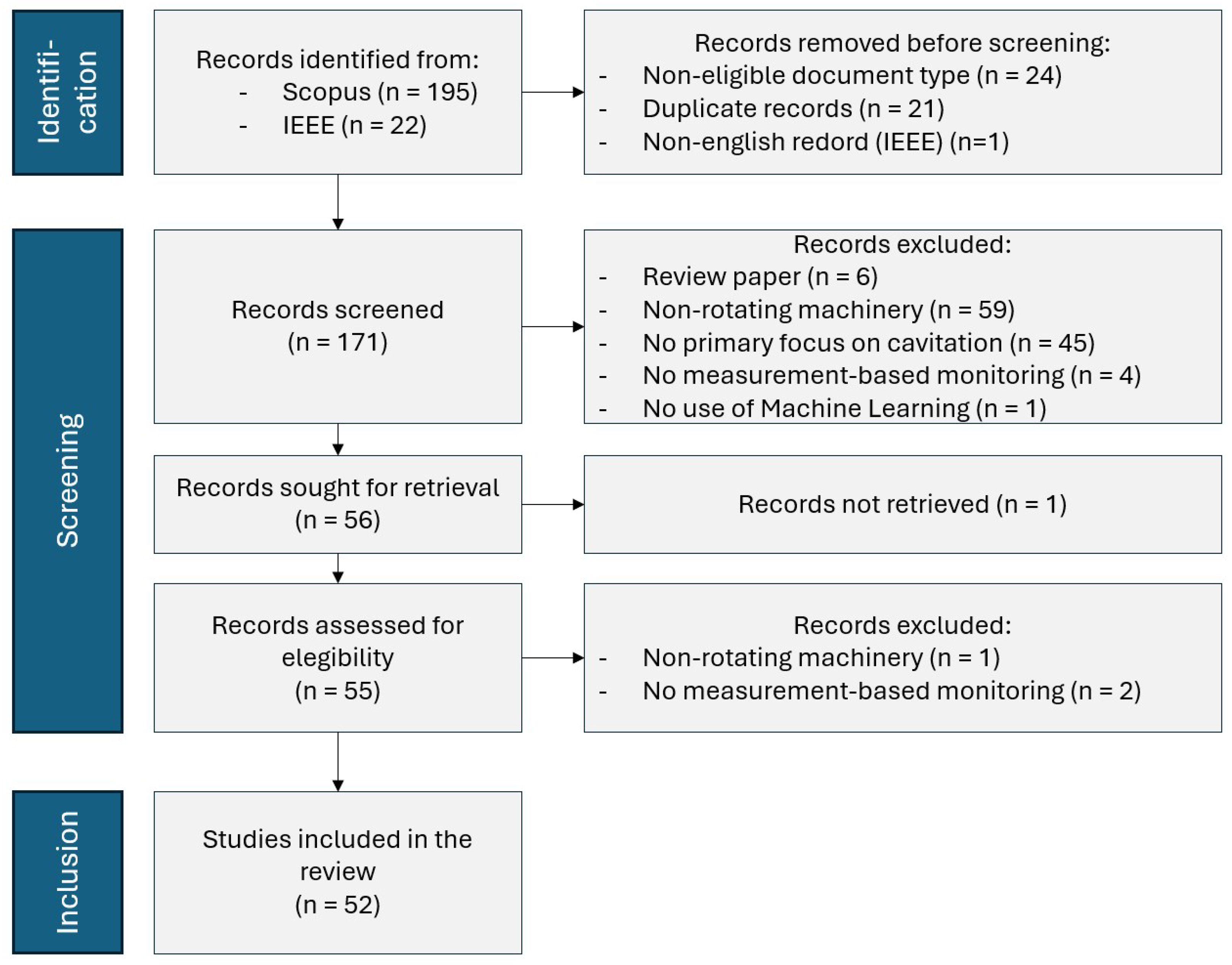
- Population: The population is delimited to enclosed rotating hydraulic machines such as centrifugal pumps, hydraulic turbines, pump-as-turbines and axial piston pumps, rather than hydraulic systems in general. Stationary components (e.g., valves, hydrofoils, venturi tubes), open-water propulsors and non-machinery applications are excluded due to their distinct cavitation mechanisms, which diverge from the rotor–stator interactions characteristic of rotating machinery. This scoping ensures methodological coherence in synthesizing monitoring approaches targeting shared flow physics and sensor signatures.
- Concept: Cavitation was defined as the primary phenomenon of interest and only studies explicitly applying ML or DL for its detection or quantification were included. Studies on multi-fault diagnosis where cavitation was secondary, general condition monitoring, design optimization, classical signal processing without ML/DL and purely CFD-based simulations without experimental validation were excluded, as they do not assess ML/DL performance under real operating conditions.
- Context: The context are laboratory and field studies reported in peer-reviewed English journal articles and conference papers (1996–2025). Review papers were excluded to prioritize primary studies demonstrating concrete ML/DL applications.
2.3.3. Full-Text Eligibility and Inclusion
3. Key Findings
3.1. Study Selection and Characteristics
3.2. Machinery and Application Contexts
3.2.1. Machinery Types
3.2.2. Single- vs. Multi-Machine Datasets
3.2.3. Monitoring Environment
3.3. Data Acquisition
3.3.1. Sensing and Signals
3.3.2. Sensor Placement
3.3.3. Sensor Count
3.3.4. Operating Regimes
3.3.5. Labeling Strategies
3.4. Data Preparation
3.4.1. Data Preprocessing
3.4.2. Signal Analysis Domains and Transformation Methodologies
3.4.3. Feature Extraction Strategies
3.4.4. Signal Representation
3.5. ML-Based Monitoring Approaches
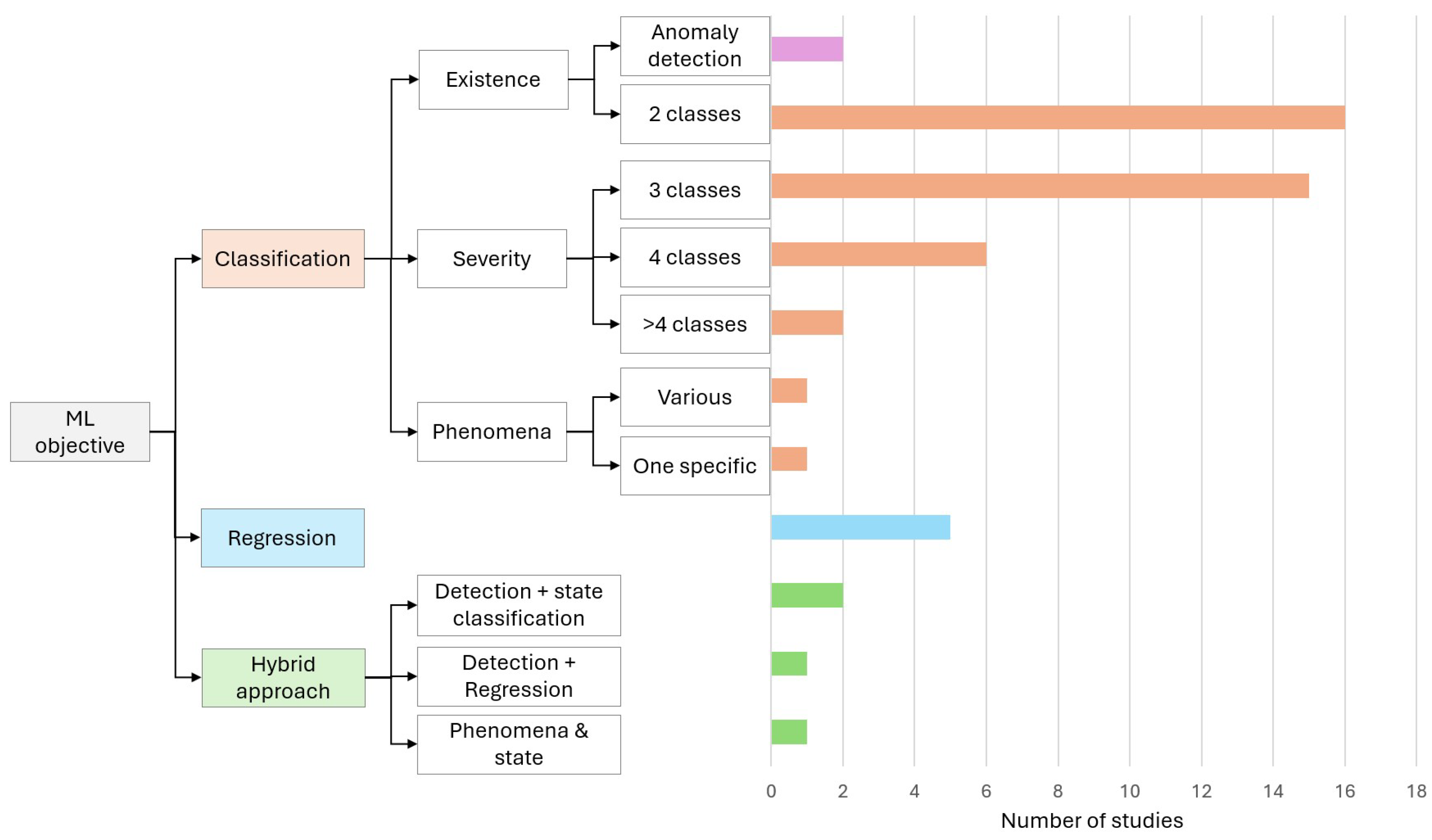
3.5.1. Monitoring Objective
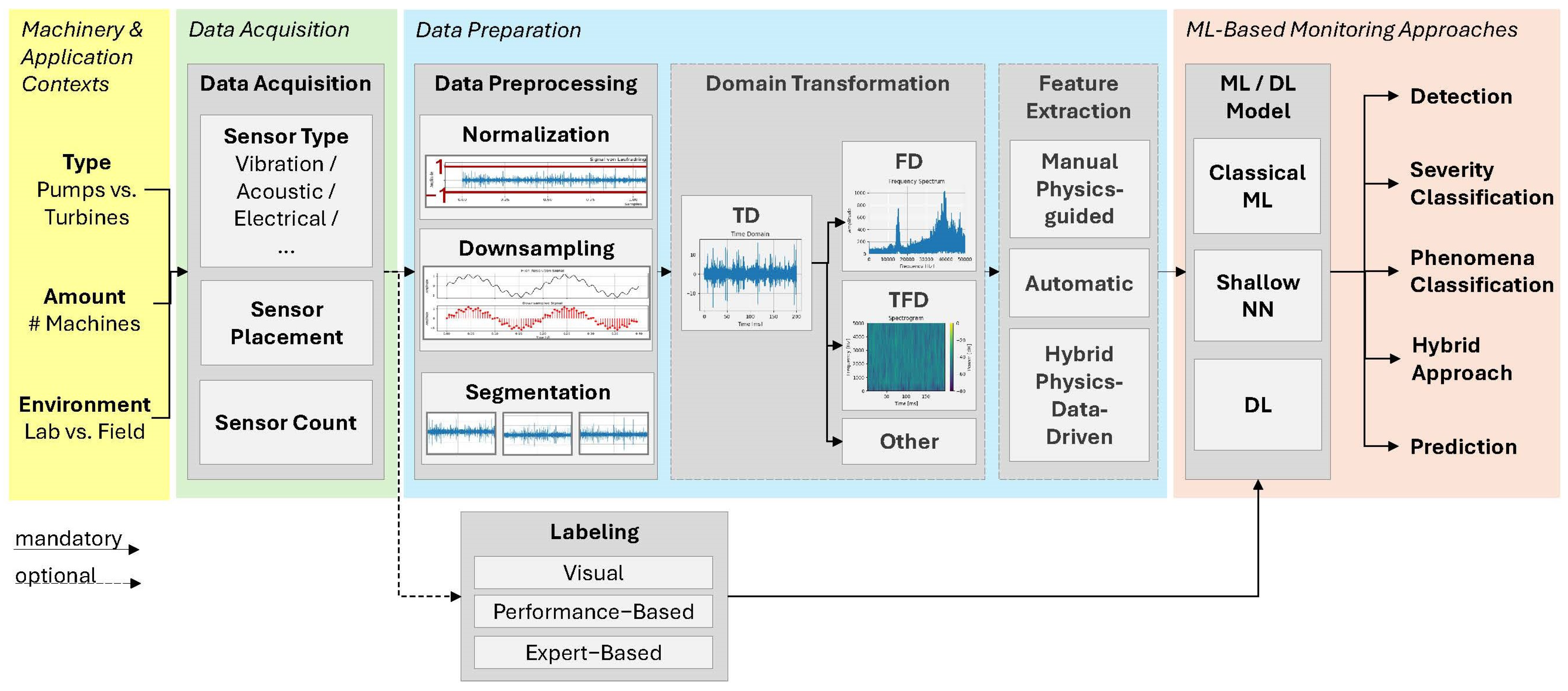
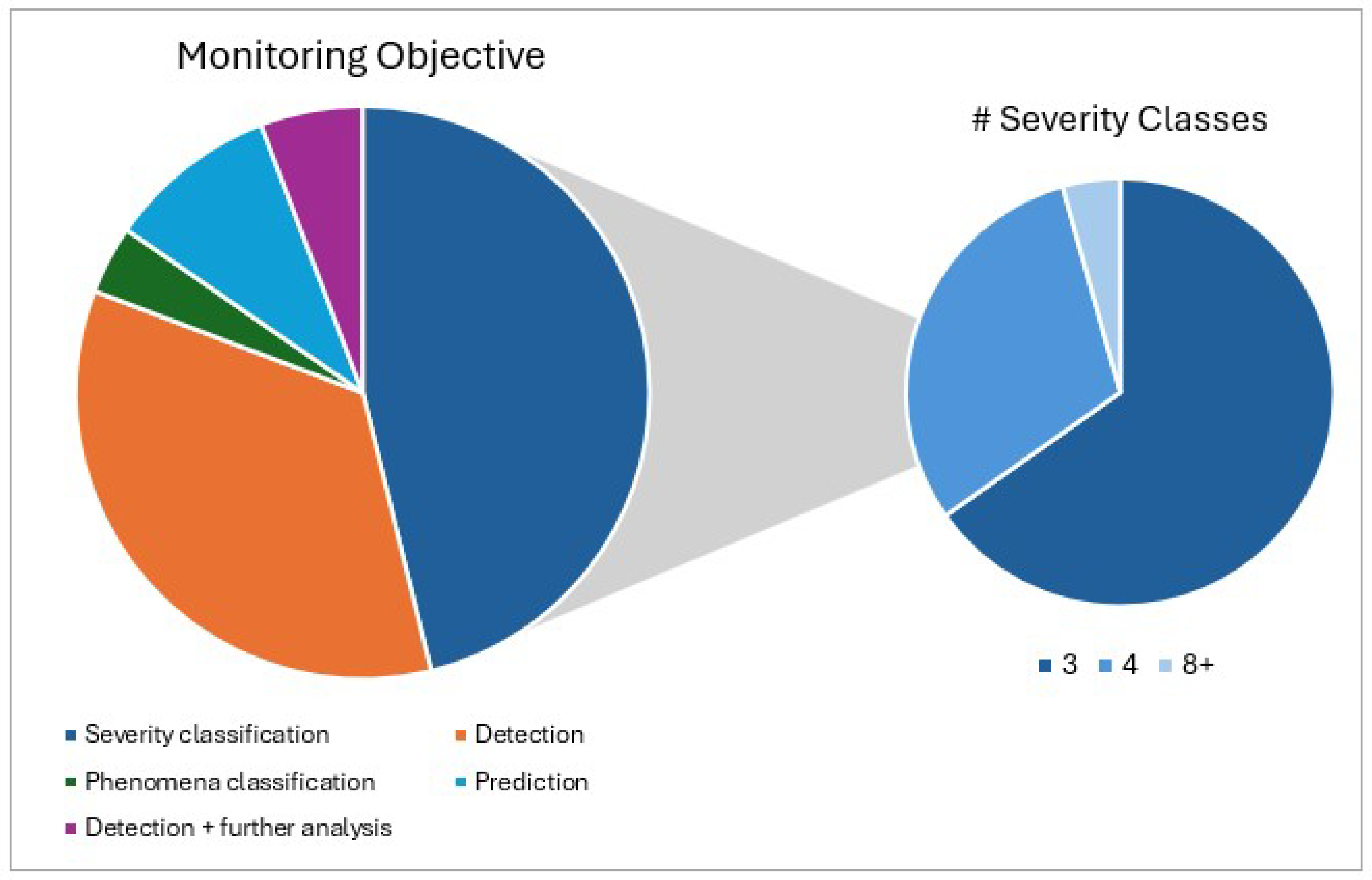
- Detection: A substantial share of studies (e.g., [11,32,33,35,62]) formulates cavitation monitoring as a binary classification task, where models decide whether cavitation is present or not. These two-class detectors are attractive for real-time protection and alarm systems, as they are simple to train, require fewer labeled regimes and can generalize reasonably well across operating points when trained on representative normal and cavitating data. Their main limitation is the lack of information on cavitation severity or mechanism, requiring additional logic for maintenance prioritization and efficiency assessment.Anomaly detection represents a special case of binary detection: models are trained only on normal operating data and flag deviations as potential cavitation or surge events [28,41]. This unsupervised approach can detect unforeseen or rare cavitation patterns without explicit labeling, though it does not distinguish between different types or intensities of cavitation.
- Severity classification: The multi-class setting is the dominant objective overall and mostly used for severity classification, where models distinguish several discrete regimes. The majority of the multi-class studies considers 3–4 classes—mostly distinguished in “no cavitation”, “incipient cavitation”, “severe or fully developed cavitation” (e.g., [5,8,52]), some also including “moderate cavitation” as a fourth class (e.g., [6,7,25]). These discretizations, however, prove inherently limited: states just below/above boundaries are often more similar than distant intra-class points, blurring decision margins. Two works therefore define finer grids with up to 10 classes (operating states) [4,51] to track gradual cavitation evolution and support operating-point optimization rather than simple fault/no-fault decisions. Furthermore, classification depends on thresholds, as Won et al. [48] showed (NN accuracy dropping from 100% at thr = 0.05 to 87.5% at thr = 0.01 Euclidean distance).
- Phenomena classification: Most studies treat cavitation in a binary way or categorically (none/mild/severe), rarely linking types to sensor signatures. However, each type has unique acoustic/vibration characteristics—directly influencing ML feature design—e.g., sheet cavitation (slight pulsation); cloud cavitation (strong oscillations, pulsating behavior); interblade vortex (high broadband noise); traveling bubble (high-frequency pulses) and vortex (low-frequency pulses) [10]. Only a small subset of studies employs phenomenon-level classification. Gruber et al. [9] distinguish normal operation from cavitation types (four classes: pure water, draft-tube swirl, interblade vortex, leading-edge cavitation), while Favrel et al. [42] focus on one specific phenomenon, classifying three surge types.
- Prediction: A third category addresses prediction, treating cavitation intensity as continuous by regressing e.g., void fraction [53], damage area or hydraulic metrics [47]. Hočevar et al. achieve R2 = 0.82–0.98 predicting Francis turbine void fraction from pressure fluctuations using a radial basis neural network (RBNN) [53]. Stephen et al. [47] predict total head, NPSH, efficiency and noise in a low-specific-speed centrifugal pump using random forest and extreme gradient boosting on inputs like flow rate, speed, torque, suction head and delivery head, achieving correlation coefficients near 1 for hydraulic metrics (except noise). Yu and Cheng [27] regress cavitation coefficient in axial flow pumps from VMD-decomposed pressure signals using a SWO-BiLSTM. Zhao et al. [36] forecast pressure fluctuations in high-head field pump-turbines using VMD-DBO-GRU-Attention (50-min ahead). Orhan et al. [61] regress NPSH3% cavitation threshold, noise and vibration in radial pumps via ANN/DTR (R2 = 0.86).
- Hybrid approach (detection + further analysis): Some hybrid formulations combine the above named objectives, for example, first using a binary classificator to decide whether cavitation is present and then applying a separate multi-class severity model [34,56] or the cavitation amount [40], thereby balancing detection robustness with richer diagnostic information.
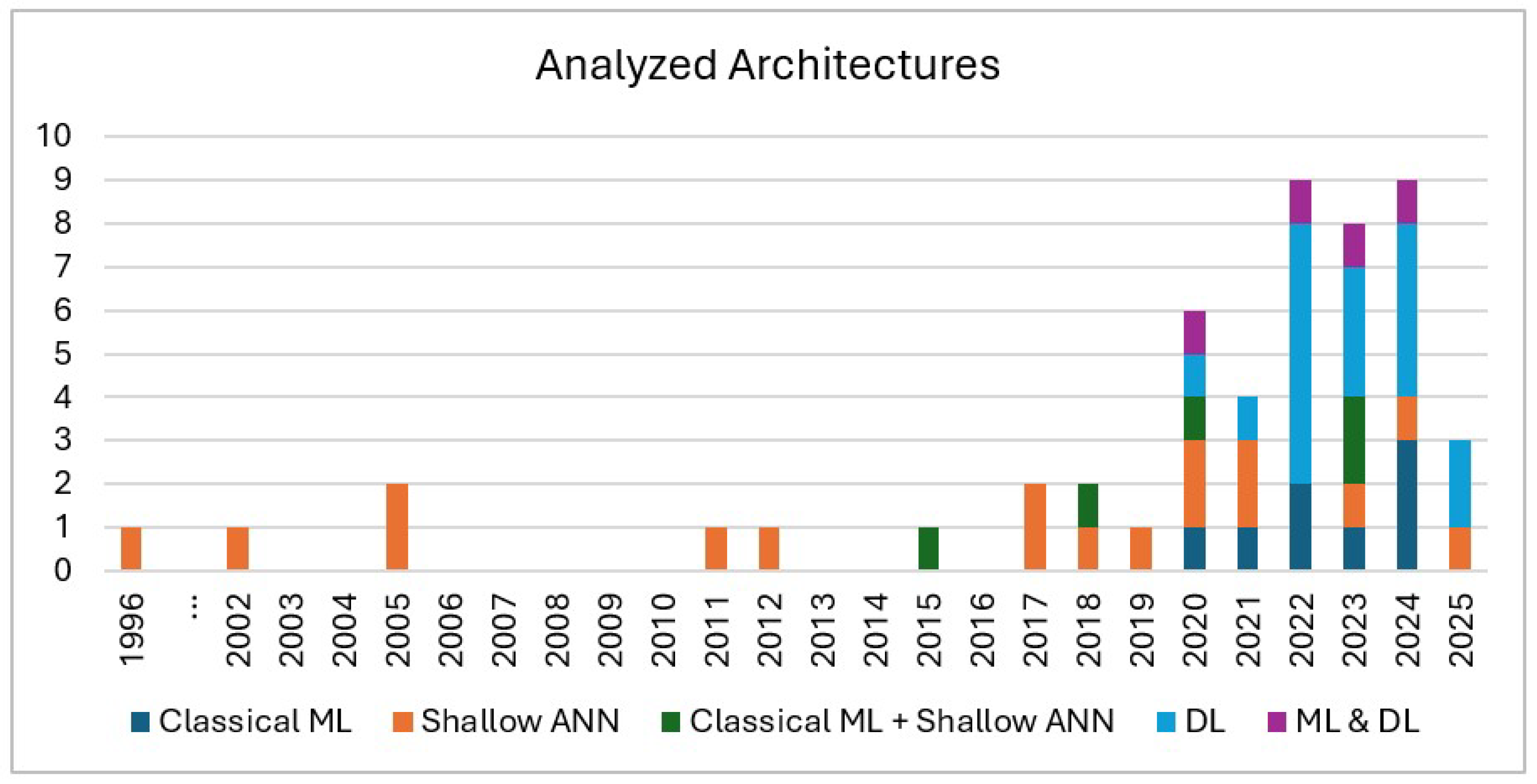
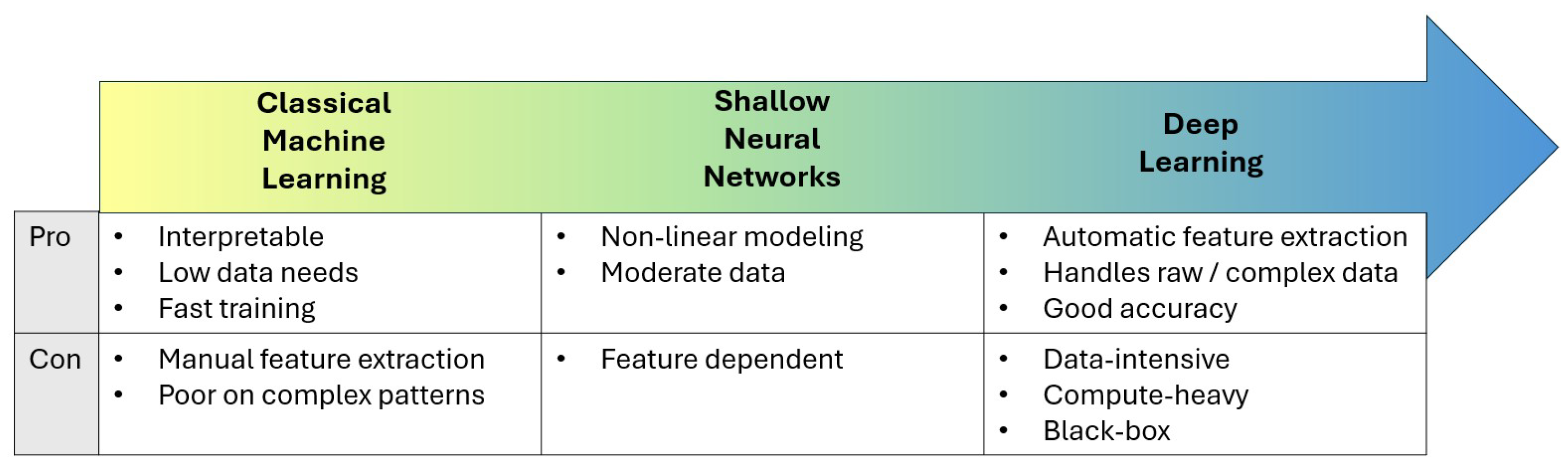
3.5.2. ML Architectures
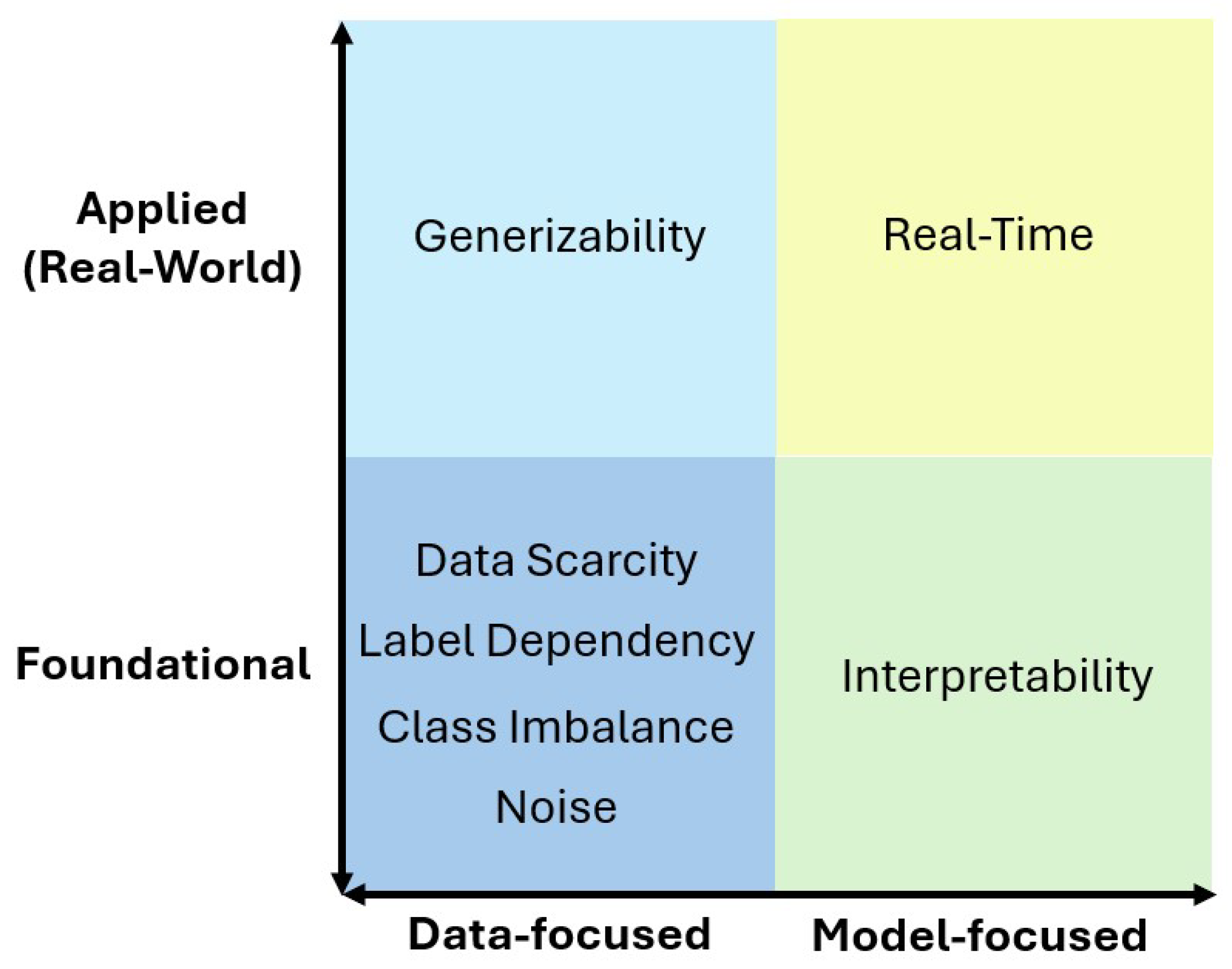
3.6. Main Challenges
3.6.1. Data Scarcity
3.6.2. Label Dependency
3.6.3. Class Imbalance
3.6.4. Noise
- Sensor selection and data acquisition (early-stage mitigation): Nasiri et al. [54] apply anti-aliasing low-pass filters to prevent spectral distortion. Karagiovanidi et al. [51] trim the first and last seconds of recorded signals helps remove operator-induced artifacts and Look et al. [33] use ultrasonic sensors to reduce sensitivity to low-frequency mechanical noise.
- Filtering and signal decomposition (interference suppression): Gaisser et al. [11] and Powar et al. [35] use bandpass filtering. He et al. [37] prefer re-emphasis FIR high-pass filters to enhance high-frequency components. Further approaches include FFT-based filtering [13], EMD [7,55] and VMD for suppressing interference signals [25,27,36,57]. Gruber et al. [9] apply outlier rejection strategies.
- Data-driven denoising (learning-based approaches): Implicit denoising is achieved using specific models. Kang et al. [34] and Song et al. [58] use sparse and denoising autoencoders, respectively. Additional techniques include SVD- and wavelet-based denoising [35,43], time–amplitude–time–frequency (TATF) methods [8] and DPCA-based demodulation [16].
3.6.5. Generalizability
3.6.6. Real-Time Capability
3.6.7. Interpretability
- Applying feature selection: Feature selection like mRMR (minimum redundancy maximum relevance) [34] picks the most useful signal traits while cutting repeats. For classical models like SVMs, simple features—e.g., energy or standard deviation [40]—link predictions to physical signals. Component selection in decomposition pipelines keeps inputs interpretable and physics-grounded [24,55,58]. Feature-importance rankings and sensitivity analysis tie predictions to physical variables [14,15,35], explaining what drives diagnosis and ensuring physical meaning.
- Using inherently interpretable models: DTs [9,12] and neuro-fuzzy systems [60] offer transparent rules. Fu el al. [32] propose interpretable linear fusion of health indices (e.g., RMS and kurtosis) with positive/negative weights justified theoretically (positive for increasing HIs, negative for decreasing), applied to turbine cavitation acoustics for status identification.
- Visualizing model and data structures: Clustering and low-dimensional embeddings reveal separability between operating regimes [38], while parameter-space visualizations relate decision boundaries to operating conditions [42]. Grad-CAM and t-SNE highlight which time–frequency regions or features drive predictions [6,25]. These tools help indicate model focus, but highlighted regions are not automatically causal and may shift with preprocessing or dataset composition.
- Integrating uncertainty into explanations: Ensembles producing predictive probabilities and uncertainty allow operators to handle ambiguous cases safely, such as near incipient cavitation [11]. This supports staged alarms, requests for additional evidence and safer operational decisions when model predictions are uncertain.
4. Discussion
Further Research Directions
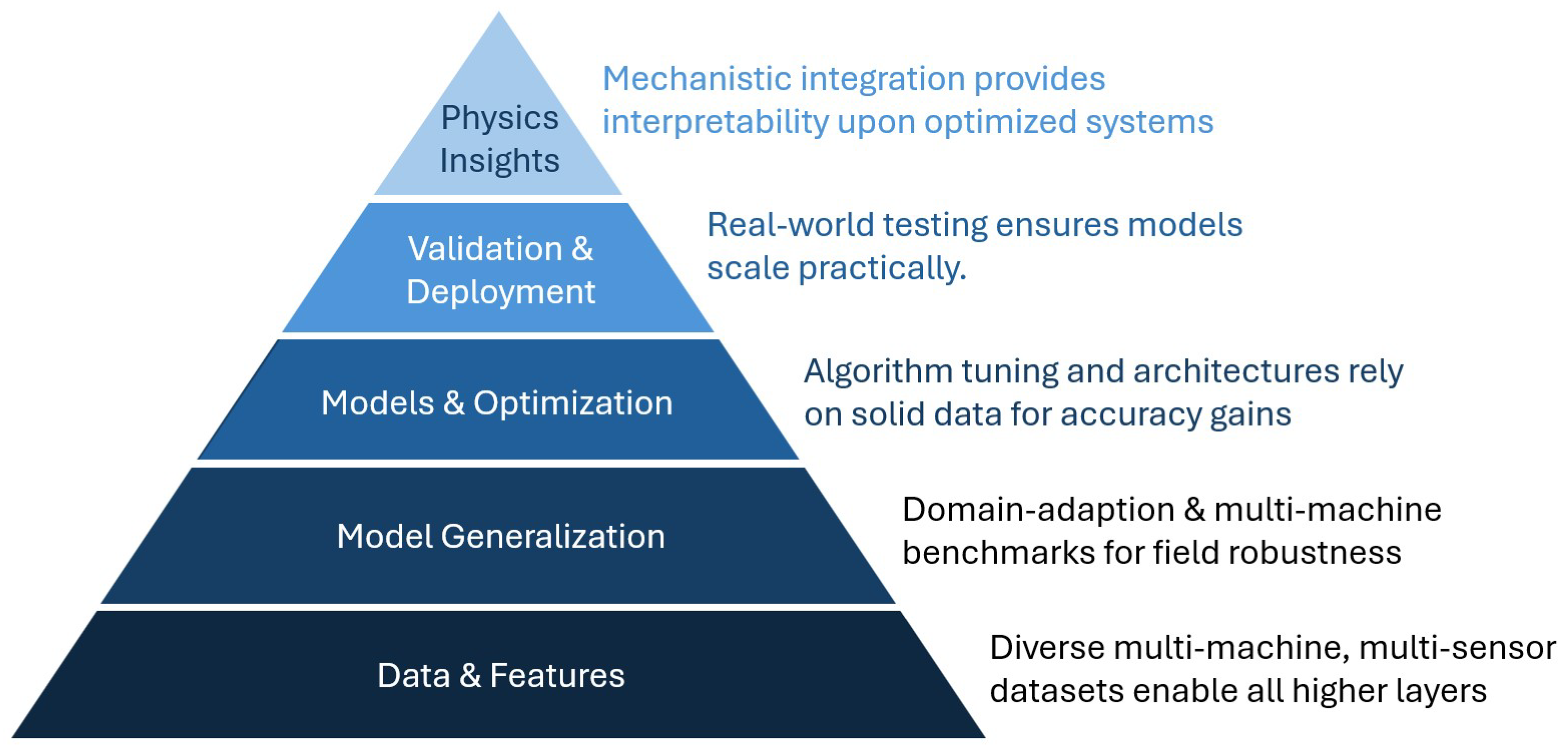
- Data and Feature Strategies
- -
- -
- Standardize cavitation labels for unified benchmarks, resolving inconsistencies that hinder ML comparisons.
- -
- Model Generalization
- -
- Data level: Develop multi-machine, multi-condition benchmark datasets (e.g., lab-to-field, pump-to-turbine) with standardized labeling to enable transferable training and fair comparison.
- -
- -
- Evaluation level: Establish standardized cross-machine and cross-condition validation protocols to reliably assess generalization performance beyond single setups.
- Model and Algorithm Optimization
- -
- -
- -
- -
- Real-World Validation and Deployment
- -
- -
- -
- -
- Quantify prediction confidence via multi-prototype and cross-condition benchmarking to ensure AI reliability in real-world operation.
- Physics and Mechanistic Insights
- -
- -
- Characterize cavitation types via their sensor signatures to guide feature selection and enable type-specific ML detection.
- -
- Refine detection for specific fault types and operational scenarios [28].
- -
- Integrate physics-informed modeling approaches to enhance interpretability and guide ML feature selection [27].
- -
- Develop ML models linking cavitation intensity to erosion prediction and RUL estimation, addressing the complex nonlinear damage relationship.
5. Conclusions
- Data and Feature Strategies: Expand multi-machine, multi-condition datasets with standardized labels and integrate complementary sensor modalities for richer feature representations.
- Model Generalization: Develop domain-adaptive, transfer learning and meta-learning approaches; implement standardized cross-machine and cross-condition evaluation protocols to ensure robust generalization.
- Model and Algorithm Optimization: Explore hybrid and physics-informed architectures, automated ML workflows and architectures resilient to low-SNR, transient and noisy data.
- Real-World Validation and Deployment: Conduct field validation under operational conditions, integrate edge-ready monitoring systems and handle incomplete or corrupted signals to ensure practical reliability.
- Physics and Mechanistic Insights: Link ML predictions to cavitation intensity, erosion risk and RUL; integrate physics-informed multi-sensor fusion to improve interpretability and support predictive maintenance.
Author Contributions
Funding
Institutional Review Board Statement
Informed Consent Statement
Data Availability Statement
Acknowledgments
Conflicts of Interest
List of Abbreviations
| AE | Acoustic Emission |
| CNN | Convolutional Neural Network |
| CWT | Continuous Wavelet Transform |
| CFD | Computational Fluid Dynamics |
| DL | Deep Learning |
| DT | Decision Tree |
| DWT | Discrete Wavelet Transform |
| EMD | Empirical Mode Decomposition |
| FD | Frequency Domain |
| FFT | Fast Fourier Transform |
| GRU | Gated Recurrent Unit |
| IMF | Intrinsic Mode Function |
| IoT | Internet of Things |
| JBI | Joanna Briggs Institute |
| kNN | k-Nearest Neighbors |
| LSTM | Long Short-Term Memory |
| MEMS | Micro-Electro-Mechanical Systems |
| ML | Machine Learning |
| NPSH | Net Positive Suction Head |
| PAT | Pump-as-Turbine |
| PCA | Principal Component Analysis |
| PRISMA-ScR | Preferred Reporting Items for Systematic Reviews and Meta-Analyses extension for Scoping Reviews |
| RBF | Radial Basis Function |
| RBNN | Radial Basis Neural Network |
| RF | Random Forest |
| RMS | Root Mean Square |
| SNR | Signal-to-Noise Ratio |
| SSAE | Stacked Sparse Autoencoder |
| STFT | Short-Time Fourier Transform |
| SVM | Support Vector Machine |
| TATF | Time-Average Time–Frequency |
| TD | Time Domain |
| TFD | Time–Frequency Domain |
| VMD | Variational Mode Decomposition |
| WPD | Wavelet Packet Decomposition |
Appendix A

| Citation | Year | Machine | Data | # Mach. | Signals | # Sens. | Sampling Rate | Location | Domain(s) | Input Representation | Input Type |
|---|---|---|---|---|---|---|---|---|---|---|---|
| [29] | 1996 | Large swashplate pump | Lab | 1 | Pressure, temperature, flow | 1,1,1,1,1 | - | Inlet/outlet | TD | Raw sensor readings | numerical |
| [30] | 2002 | Generic hydraulic pump | Lab | 1 | Current, voltage | 3 | - | Integrated in motor drive electronics | TD | 4D feature vector (containing past & present current & voltage values) | numerical |
| [53] | 2005 | Turbine (Francis) | Lab | 1 | Pressure | 1 | 15 kHz | Draft tube wall | TD | Time-delayed pressure vector | numerical |
| [48] | 2005 | Pump | Lab | 1 | Current | 1 | 500 Hz | Power supply line | TD | Feature vector (9 features) | numerical |
| [54] | 2011 | Centrifugal pump | Lab | 1 | Vibration | 3 | 10 kHz | Front plate of pump casing, back plate, casing | TD, FD | Feature vector (statistical features from TD & FD) | numerical |
| [9] | 2015 | Turbine (Francis) | Lab | 1 | Acoustic (airborne, ultrasonic) | - | 500 kHz bzw. 1MHz | Draft tube | TD, FD, Correlation domain | Feature vector (statistical features from the 3 domains) | numerical |
| [55] | 2017 | Centrifugal pump | Lab | 1 | Vibration | 1 | 16 kHz | Pump delivery side | TD | Feature vector (90 features—15 Statistical features extracted from first 6 IMFs) | numerical |
| [52] | 2017 | Centrifugal pump | Lab | 1 | Vibration | 1 | 20 kHz | Delivery side of pump casing | TD | Feature vector (20 statistical features—5 from each of the first four IMFs) | numerical |
| [33] | 2018 | Turbine | - | 5 | Acoustic (ultrasonic) | - | Various—max 2 MHz | - | TFD | Spectrograms | image |
| [28] | 2018 | Gear pump | Lab | 1 | Vibration | 1 | 102.4 kHz | Pump casing near suction chamber | TD | Raw vibration signal | numerical |
| [44] | 2019 | Centrifugal pump | Lab | 1 | Acoustic (hydrophone) | 1 | 10.24 kHz | - | TFD | Feature vector (principal components post WPD) | numerical |
| [24] | 2020 | Canned motor pump | Lab | 1 | Vibration | 8 | 25 kHz | Bearing, left/right side of pump body, suction flange, discharge flange | TFD | Spectrogram | image |
| [49] | 2020 | Centrifugal pump | Lab | 1 | Vibration | 1 | - | - | Spatial domain | Vibration singnal images | image |
| [63] | 2020 | Centrifugal pump | Lab | 1 | Acoustic | - | - | - | FD | Feature vector (FD voltage amplitudes) | numerical |
| [39] | 2020 | Centrifugal pump | Lab | 3 | Pressure, flow rate, speed, current | - | - | - | TD | Feature vector (scalar features speed, pressure, current, flow rate etc.) | numerical |
| [50] | 2020 | Centrifugal pump | Lab | 1 | Acoustic (airborne, audible) | - | 44.1 kHz | Near pump housing | FD | Feature vector (9 frequency features) | numerical |
| [34] | 2020 | Turbine | Lab | 1 | Acoustic (waterborne, audible) | 1 | - | Draft tube | FD, TD | Raw time series | numerical |
| [56] | 2021 | Centrifugal pump | Lab | 1 | Vibration | 1 | 16 kHz | Pump cover | FD | Bispectrum images | image |
| [5] | 2021 | Centrifugal pump | Lab | 1 | Vibration | 5 | 5.12 Hz | Outlet flange, pump body, inlet flange, pump foot, pump cover | TFD | Feature vector of statistical eigenvalues (RMS, STD, Mean, Energy…) | numerical |
| [60] | 2021 | Centrifugal pump | Lab | 1 | Noise, pressure, flow, depth | 1,1,1,1 | 1 Hz | - | TD | Feature vector (submergence, flow, power, pressure, noise) | numerical |
| [59] | 2021 | Centrifugal pump | Lab | 1 | Vibration, motor current | - | - | - | TD, FD, TFD | Feature vector (26 features extracted → then 3 selected by AIN) | numerical |
| [31] | 2022 | Turbine (Kaplan) | Lab | 1 | Acoustic (waterborne, audible & ultrasonic) | 1 | 40.96 kHz | In water body | TD | Feature vector (high-level features) | numerical |
| [38] | 2022 | Turbine (Francis) | Lab & Field | 2 | Acoustic (airborne, audible) | 1 | 40 kHz | - | FD | Feature vector (frequency power content) | numerical |
| [11] | 2023 | Turbine (Kaplan, Francis, Pump-Turbine) | Lab & Field | 11 | Acoustic (structureborne, ultrasonic) | - | 1–2 MHz | Models: upstream and downstream of the impeller; Prototypes: head cover, inner head cover or draft tube | TFD | Spectrogram | image |
| [4] | 2023 | Centrifugal pump | Lab | 1 | Vibration | 8 | 25.6 kHz | - | TD | Raw multi-channel vibration signal | numerical |
| [6] | 2023 | Axial piston pump | Lab | 1 | Vibration | 1 | 10.24 kHz | Pump end cover | TFD | Spectrogram images | image |
| [14] | 2023 | Centrifugal pump | Field | 4 | Power, Speed | - | - | - | TD | Feature vectors (best time–domain features extracted using tsfresh) | numerical |
| [51] | 2023 | Centrifugal pump | Lab | 1 | Vibration & Acoustic (airborne, audible) | 1,1 | Vibration 500 Hz, Sound 44.1 kHz | Pump casing | FD, TFD | Classical ML Models: Feature vector (frequency), CNN: Spectrogram | numerical, image |
| [26] | 2023 | Mixed-Flow pump | Lab | 1 | Vibration | 3 | 2048 Hz | Impeller chamber | FD | Frequency features (input as FFT spectrum) | image |
| [57] | 2023 | Centrifugal pump | Lab | 1 | Pressure | 2 | 24 kHz | Casing (horizontal direction) | FD | Feature vector (10 FD features) | numerical |
| [37] | 2023 | not specified | Field | - | Vibration | - | 30 kHz | - | TFD | Spectrograms | image |
| [13] | 2024 | Turbine (Francis) | Lab | 1 | Vibration, pressure | - | - | - | FD | Feature vector (operating conditions + spectral features) | numerical |
| [58] | 2024 | Centrifugal pump | Lab | 1 | Vibration | 1 | - | Pump body | TD, FD, TFD | Feature vector (of 36 indicators (12 from each of X, Y, Z signals)) | numerical |
| [43] | 2024 | Centrifugal pump | Lab | 1 | Vibration, motor current | 4,1 | Vibration 10 kHz, current 1 kHz | Inlet, outlet, pump casing axial, pump casing radial | Vibration: TD Current: TD, FD | Feature vector (35 current & 5 vibration features) | numerical values |
| [15] | 2024 | Centrifugal pump | Field | 4 | Fluid level, pump power, pump speed, pressure, temperature, vibration | - | - | - | TD | Feature vectors | numerical |
| [61] | 2024 | Centrifugal pump | Lab | 1 | Vibration, noise, flow, pressure | - | - | Vibration on housing | TD | Feature vectors (flow rate, head) | numerical |
| [47] | 2024 | Centrifugal pump | Lab | 1 | Flow rate, speed, torque, suction head, delivery head, noise | - | - | Suction pressure at inlet, delivery pressure at outlet, waterborne noise in impeller channel | TD (noise), hydraulic parameters | Feature vector (5 variables: flow rate, speed, torque, suction head, delivery head) | numerical |
| [40] | 2024 | Centrifugal pump | Lab | 7 | Vibration | 1 | 48 kHz | Top of the pump | FD | Feature vector (153 statistical frequency features) | numerical |
| [62] | 2024 | Turbine (Francis) | Lab | - | Acoustic (waterborne, audible) | - | 40.96 kHz | Taper pipe | TD (Decomposed signal components) | IMFs from SSA-VMD (10 modes) | numerical |
| [46] | 2024 | Centrifugal pump | Lab | 1 | Vibration, noise, pressure, torque | - | 102.4 kHz | depending on sensor | TD, FD, TFD | Frequency spectrum vector (1D-CNN), Eigenmatrix (image-like, 2D-CNN) | numerical, image |
| [32] | 2024 | Turbine | Field | 1 | Acoustic (waterborne, ultrasonic) | 1 | 2 MHz | - | TD, FD | Feature vector (7 statistical features from TD, FD) | numerical |
| [25] | 2025 | Canned motor pump | Lab | 1 | Vibration | 3 | 8 kHz | On the pump along x-, y- and z-axes | TD, FD | Feature vector (Sample Entropy values from VMD IMF) | numerical |
| [8] | 2025 | Axial piston pump | Lab | 1 | Vibration, pressure | 1,1 | 1024 Hz | Pump housing | TD, FD | Feature vector (12 features: 4 basic time–domain, 4 high-order time–domain, 2 frequency–domain, 2 nonlinear) | numerical |
| [16] | 2025 | Centrifugal pump | Lab | 1 | Vibration | 1 | 10.24 kHz | Rear of the pump | FD | Demodulated spectrum | image |
| [7] | 2025 | Axial piston pump | Lab | 1 | Pressure, flow | 2,1 | 10 kHz | On the pipeline | TD | 2 TD vectors (IMF1, remaining IMFs + residue) | numerical |
| [45] | 2025 | Centrifugal pump | Lab | 1 | Acoustic (airborne, audible) | 2 | 40 kHz | - | TFD | Scalogram | image |
| [42] | 2025 | Turbine (Francis) | Field | 1 | Pressure, shaft lateral displacement, active power | 2,- | Every 15 min | Pressure sensors in spiral casing & draft tube cone, shaft lateral displacement at turbine bearings | TD, FD | Feature vector (27 features (3 operating parameters, 20 spectral, 4 temporal)) | numerical |
| [41] | 2025 | Centrifugal pump | Field | 1 | Current, voltage | - | 8 kHz | - | FD | Feature vector of fault frequencies from PSD | numerical |
| [35] | 2025 | Turbine | Lab & Field | 1 | Vibration | 1 | 3.2 kHz | Turbine casing | TD, FD, TFD | Feature vector (18 features from TD, FD, TFD) | numerical |
| [36] | 2025 | Pump-turbine | Field | 1 | Pressure | 3 | - | Runner-guide vane, runner-top/bottom cover | TD | Feature (time sequence) matrix | numerical |
| [27] | 2026 | Axial flow pump | Lab | 1 | Pressure | 4 | - | Impeller inlet, guide vane inlet, guide vane outlet, outlet elbow | TD (original signals), FD (IMF), time series (entropy) | Feature matrix (4 × 4 matrix) | numerical |
| [12] | 2026 | Pump-as-Turbine | Lab | 1 | Vibration | 3 | 12.8 kHz | Non-drive end NDE bearing housing, outlet flange | TD, FD | Feature vector (39 features (from vibration & operating conditions) identified, top 18 used) conditions | numerical |
| Citation | Year | Classes | Learning | Paradigm | Main Models | Comparison Models | Results | Novelty |
|---|---|---|---|---|---|---|---|---|
| [29] | 1996 | 2: Cavitation/no cavitation | s | Shallow NN | ANN (1 layer) | FLD (statistical method) | ANNs outperform FLD (corr. 0.71), capturing nonlinear effects for reliable on-line monitoring | ANN compared to linear method (FLD) |
| [48] | 2005 | 2: Cavitation/no cavitation | s | Shallow NN | ANN | - | NN achieved 100% (thr = 0.05) and 87.5% (thr = 0.01) accuracy | Use of wavelet (DWT) features from motor current signals, threshold comparison |
| [28] | 2018 | 2: Normal/abnormal operation | u | Shallow ANN | NLAR on the use of ANN | - | NLAR uses 130 dB RMS threshold (129–165 dB across 1000–5000 RPM) to detect cavitation (RMS up to 225 m/s2) from no-cavitation (<50 m/s2, < 4 m/s2), enabling real-time intensity identification without FFT | Application of NonLinear AutoRegressive (NLAR) models |
| [33] | 2018 | 2: Cavitation/no cavitation | s | DL | AC-GAN | regular CNN | Using AC-GAN training on acoustic spectrograms from five hydraulic turbines, the paper achieves up to 98.1 ± 1.2% binary validation accuracy for cavitation detection (I-divergence variant), outperforming conventional CNN at 94.2 ± 2.0% (early stopping) and 80.1 ± 2.5% (full training) | Application of AC-GAN with explicit focus on robustness across sensor positions and turbine types; Novel use of I-divergence diversity term to prevent generator collapse while maintaining realistic synthetic acoustic spectrogram generation |
| [39] | 2020 | 2: Cavitation/no cavitation | s | Classical ML | SVM, kNN | - | SVM outperforms KNN for larger datasets (e.g., 99% vs. 98.7% accuracy at 300 samples, faster training at 6.25 s vs. 11.94 s), while KNN is better for small datasets | Comparative study of SVM and KNN |
| [50] | 2020 | 2: Cavitation/no cavitation | s | Shallow ANN | Resilient Backpropagation ANN | - | Best validation accuracy 82.50%, mean validation accuracy 81.00% | Simple correlation-based feature selection from audio FFT for ANN cavitation classifier |
| [63] | 2020 | 2: Cavitation/no cavitation | s | Shallow ANN | ANN | - | Non-cavitation voltages 0.5–0.79 V, cavitation 0.8–0.99 V detected | IIoT sound-based remote cavitation prediction |
| [60] | 2021 | 2: Cavitation/no cavitation | s | Shallow ANN | ANFIS | - | ANFIS achieved near-perfect fit (APE = 0.08% (training), 0.34% (testing)) | Use of noise data in cavitation detection and ANFIS for vortex cavitation prediction |
| [59] | 2021 | 2: Cavitation/no cavitation | s | Classical ML | AIN | SVM, K-means, Fuzzy C-means, Multilayer Perceptron, PCA | AIN achieved lower error rates on test data compared to PCA | Use of an immune-inspired algorithm for feature selection and classification, mimicking human immune adaptability for early cavitation detection |
| [11] | 2023 | 2: Cavitation/no cavitation | s | DL | ResNet with domain-adversarial training (DAT); ensemble of eight CNNs | - | The trained CNN transfers precisely to five prototypes, achieving 50–92% balanced accuracies (mean 70%), up to 100% precision and 16–89% recalls across 10 sensors on 2927 test samples at 0.8 threshold | Advanced pre-processing pipeline and domain-alignment training to handle domain shifts for generalization across machines |
| [14] | 2023 | 2: Cavitation/no cavitation | semi | Classical ML | LightGBM (Gradient boosting), Random forest, Support vector classifier | - | Semi-supervised approach successfully labeled 88% previously unlabelled data, identifying 20 validated abnormal events. LightGBM achieves best results | Semi-supervised workflow combining automatic time-series feature engineering and expert validation to expand event labels |
| [37] | 2023 | 2: Cavitation/no cavitation | s | DL (Transformer) | SGST (STFT + GAN + Swin Transformer) | MFCC + GAN + Swin-T, STFT + Swin-T, STFT + GAN + 2D CNN, STFT + GAN + ViT | SGST (training 100%, best validation) outperforms other models (validation 62.4–97.2%) | Integration of STFT, GAN-based data augmentation (improvement of data amount & diversity) and Swin Transformer (self-attention mechanism and multi-scale feature fusion ability) |
| [13] | 2024 | 2: Cavitation/no cavitation | s | Shallow ANN | MLP, RBF | - | MLP: 88.5–100%; RBF: 87.1–95.3%. MLP superior generalization, RBF faster training | Comparison of MLP and RBF for cavitation detection in Francis turbines |
| [15] | 2024 | 2: Cavitation/no cavitation | semi, s | Classical ML | LightGBM (gradient-boosting), random forest, support vector classifiers | - | Semi-supervised models identified and validated 20 target events. Forecasting models using pump data outperformed plant-wide data (MCC 0.490 vs. 0.255), indicating local drivers. Bayesian AB testing showed 22% higher likelihood with 4 pumps vs. 3 | End-to-end application of semi-supervised ML and feature-based time-series feature engineering in above-ground geothermal operations |
| [62] | 2024 | 2: Cavitation/no cavitation | s | DL | SSA-VMD-MSCNN | CNN, WPD-MSCNN, SVM | SSA-VMD-MSCNN (100% accuracy) demonstrates superior diagnostic capabilities compared to traditional CNN (91.35%), WPD-MSCNN (93.78%) and SVM | Integration of an SSA-optimized VMD layer into a hierarchical CNN |
| [32] | 2024 | 2 classes: 2 different inspection severities | s (offline), u (online) | Classical ML & Shallow ANN | Logistic regression | - | Superior separation with fewer features; positive HIs (e.g., RMS 0.76 weight) best | Physical interpretation of +/− HI weights (monotonicity proof); online/offline for scarce faults |
| [35] | 2025 | 2: Cavitation/no cavitation | s | Classical ML | Decision Trees + Gradient Boosting (Hybrid ensemble) | SVM, RF | 94.2% accuracy, reliably vortex cavitation detection under different operating conditions using vibration features between 20–1000 Hz | Real-time, hybrid ML system with wavelet-based multi-domain feature extraction for vortex cavitation |
| [41] | 2025 | 2: Normal/abnormal operation | u | Classical ML | SPBN (trained on healthy data) | - | Effective early detection in real-time, variable-speed industrial setting | NILM (Non-Intrusive Load Monitoring) for cavitation in pumps under variable speeds, ISC + normalized PSD + SPBN on edge computing |
| Citation | Year | Classes | Learning | Paradigm | Main Models | Comparison Models | Results | Novelty |
|---|---|---|---|---|---|---|---|---|
| [30] | 2002 | 3: low, medium, high cavitation | s | Shallow ANN | 3 ordered neural networks | - | Networks correctly identified cavitation mode corresponding to lowest health index in tests | Application of ordered neural networks for real-time pump cavitation detection integrated within OSA-CBM architecture |
| [54] | 2011 | 3: normal/developed/fully developed cavitation | s | Shallow ANN | MLP (2 hidden layers) | - | NN predictions match experiments zero-error with 3 sensors (radial/back/front); radial optimal for 1-sensor, radial + back for 2-sensor cavitation detection | Systematic study of optimal sensor number and placement; Combination of feature extraction with neural networks |
| [52] | 2017 | 3: No/limited/developed cavitation | s | Shallow ANN | GRNN | - | EMD-based features achieved 98.33% accuracy distinguishing three cavitation severity classes, outperforming baseline raw features (81.67%) by 16.66% | Comparative analysis of three decomposition methods on cavitation task; First application of EEMD to cavitation detection |
| [55] | 2017 | 3: no, limited, developed | s | Shallow ANN | GRNN | MLP, RBF | Hybrid Bees feature selection shrinks 90 features to <4, boosting GRNN (97.5–100%), MLP and RBF to 100% cavitation classification accuracy | Introduction of hybrid feature selection combining filter (inter–intra class distance) and wrapper (GRNN accuracy + feature count) with Bees Algorithm optimization |
| [44] | 2019 | 3: non/incipient/serious cavitation | s | Shallow ANN | WPD-PCA-RBF | - | Comprehensive identification rate: 98.2%; non-cavitation: 100%, incipient: 83.3%, serious: 97.9% based on test data | Combination of WPD for frequency-division features, PCA reduction, RBF for multi-status detection from flow-borne noise |
| [24] | 2020 | 3: Normal/incipient/severe cavitation | s | DL | TATF + DCNN | ResNet, AlexNet, VGG, SqueezeNet, DenseNet | TATF + DCNN achieves up to 99.1% classification accuracy for cavitation states, superior to STFT/WT | Adaptive TATF carrier extraction (instead of STFT, WT) |
| [49] | 2020 | 3: Normal/incipient/severe cavitation | s | ML & Shallow NN | Hu’s Moments + kNN | GNB, SVM Linear, SVM Polynomial, SVM RBF, RF, MLP, kNN | Hu’s Moments + kNN tops at 99.67% ± 1.00% accuracy (17 ms inference), GLCM + RF at 99.00% ± 1.53% (fastest 3.33 ms extraction) | IoT spatial-domain classification |
| [5] | 2021 | 3: Non/incipient/serious classification | s | Shallow ANN | RBF (with PCA) | - | Multi-point vibration fusion achieves up to 100% cavitation recognition accuracy (>90% under moderate noise), significantly outperforming single points | Multi-point, multi-resolution analysis using WPD for feature extraction, PCA reduction, RBF classification |
| [31] | 2022 | 3: No/Incipient/supercavitation | (u), s | Combi ML + DL | SSAE-RF (w. optimal parameter) | SVM, SSAE-RF (w. non-optimal parameter) | SSAE-RF mean accuracy ≈ 76.8% (condition 1) and 75.0% (condition 2) | Integration of SSAE-RF with parameter optimization |
| [57] | 2023 | 3: Non/incipient/severe classification | s | DL | ILBA-Elman | BA-Elman, PSO-Elman | ILBA-Elman achieves 96.67% accuracy on test set, outperforming BA-Elman and PSO-Elman in accuracy and computation time | Improved Lévy flight bat algorithm (ILBA) for optimizing Elman neural network weights and thresholds |
| [26] | 2023 | 3: Normal/minor/severe cavitation | s | DL | FFT-LSTM-dropout, CNN-dropout | SAE, SAE-dropout, LSTM-dropout, FFT-LSTM-dropout, CNN-dropout, FFT-CNN-dropout, FFT-CNN-MLP | CNN excels for cavitation diagnosis in mixed-flow pumps; frequency domain (FFT) boosts accuracy up to 87.2% accuracy | Application and evaluation of ML methods (especially CNN) for cavitation fault diagnosis in a mixed-flow pump |
| [6] | 2023 | 4: Healthy, mild, medium, severe | s | DL | CNN (Modified LeNet-5) with Grad-CAM | - | Grad-CAM enhanced CNN achieved up to 78% higher accuracy at low SNR for cavitation recognition | Use of CNN-Grad-CAM for noisy environments |
| [4] | 2023 | 8 classes (from 12 states—from non-cavitating to severe) | s | DL | Adaptive NN (compact 1D CNN) | Coarse tree, fine Gaussian SVM, quadratic SVM, cubic SVM, statistical-feature based ANNs | Two-stage ANN with 8 states: >95% accuracy real-time, fast training/speed, superior to shallow methods | Combination of vibration signal-based adaptive neural network with high-speed photography for early-stage cavitation diagnosis |
| [51] | 2023 | 10 classes (operating states) | s | ML & DL | DT, kNN, SVM, CNN | - | KNN/SVM 100%, CNN 97.45%, DT 90%. Vibration data enables >90% accuracy, outperforming sound data ( 30–50%) | Low-cost smartphone sensors for real-life irrigation cavitation detection |
| [58] | 2024 | 3: No/incipient/severe cavitation | s | DL (Autoencoder) | RIME-SDAE | Standard SDAE | RIME-SDAE achieved >98% average accuracy for cavitation state identification, improving upon unoptimized SDAE performance | Use of RIME optimization algorithm to automatically tune SDAE parameters |
| [43] | 2024 | 3: No/incipient/severe cavitation | s | Shallow ANN & ML | BPNN, SVM | - | Combined current and pump casing axial BPNN: 97.3% overall accuracy; Single current: 73.9%, single casing axial vibration: 89.3% | Feature-level multi-source information fusion of current and vibration signals |
| [46] | 2024 | 4 classes: no, inception, strong, severe | s | DL | MCGN (1D-CNN + 2D-CNN + ConvGRU) | SVM, CNN, Autoencoder | MCGN: >98% accuracy on 4/5 signals; outperforms STFT-Autoencoder (+4.03% acc, 20× faster, −87% loss) | Multi-dimensional feature fusion (STFT-PCA, 1D/2D CNN, ConvGRU) |
| [25] | 2024 | 4: Healthy/slight/moderate/severe cavitation | s | DL (Conv) | VMD-SE-DCNN-CBAM | SVM, Decision tree, ANN, SAE, DCNN, VGG, DCNN-SeNet | VMD-SE-DCNN-CBAM achieves 99.66% accuracy in recognizing four cavitation states, outperforming comparative methods | VMD-SE for IMF extraction and DCNN with CBAM for canned motor pump cavitation recognition |
| [8] | 2025 | 3: Non/slight/severe cavitation | s | ML & DL | XGBoost (classification), CNN (augmentation) | BP, LSTM (vs. CNN) | Physics-informed CNN augmentation yields vibration signals with R2 > 0.99 in frequency domain, boosting XGBoost cavitation detection to 98.95% mean accuracy | Physics-informed CNN data augmentation framework integrating cavitation physics for parameter optimization |
| [45] | 2025 | 4: no/incipient/obvious/serious cavitation | semi | DL | MAAN | ResNet50, DAN, JAN, DSAN, DCORAL, DANN, HSFT, ablated variants | MAAN achieves recognition accuracy exceeding 93% across diverse working conditions, surpassing comparison methods | RCAFE with MSG-HAM for feature extraction and MADAM for multi-adversarial distribution alignment |
| [16] | 2025 | 4: Non/incipient/strong/severe cavitation | s | DL | DEN | RS-EfficientNet, FFT-EfficientNet, DPCA-AE, RS-AE, FFT-AE | DEN model achieved 89.44% accuracy in identifying four cavitation states, outperforming baselines by up to 25.28% | Cavitation state identification method based on signal demodulation (DPCA) and EfficientNet (DEN) |
| [7] | 2025 | 4: Normal/mild/medium/severe | s | DL | DPAM-CORAL | DANN, DDC, JAN, CORAL | DPAM-CORAL achieves 98.0% average accuracy in recognizing 4 cavitation intensities, outperforming pressure-based and other transfer learning methods | TSMOC for flow rate from pressures; DPAM-CORAL for cavitation feature extraction via dual-path attention |
| [12] | 2026 | 3: no/incipient/full cavitation | s | ML & ANN | DT, ANN, SVM | - | ANN achieved highest accuracy (99.86%) while DT provided interpretability (99.66%), forming effective hybrid for cavitation diagnosis in PAT | Hybrid framework integrating DT for interpretability and ANN for high accuracy cavitation state predictions |
| Citation | Year | Monitoring Goal | Classes | Learning | Paradigm | Main Models | Comparison Models | Results | Novelty |
|---|---|---|---|---|---|---|---|---|---|
| [9] | 2015 | Phenomenon classification | 4: pure water, draft tube swirl, interblade vortex cavitation, leading edge cavitation | s | Classical ML & ANN | MLP, DT | - | MLP 100% accuracy (train/validate), DT 98% (validate); DT offers best interpretability | Use of ultrasonic signal statistics and correlation-based features for cavitation detection |
| [42] | 2025 | Specific phenomenon: Cavitation surge existence and regime types | 4 classes: stable, surge type 1, surge type 2, surge type 3 | s & u | Shallow ANN & Classical ML | MLP, UMAP + DBSCAN | - | MLP classification accuracy = 0.96 on test data | Combination of expert-based clustering and ML classification to identify multiple cavitation surge regimes and predict their onset using prototype monitoring data |
| Citation | Year | Monitoring Goal | Classes | Learning | Paradigm | Main Models | Comparison Models | Results | Novelty |
|---|---|---|---|---|---|---|---|---|---|
| [27] | 2026 | Regression (continuous coefficient identification) | None | s | DL | VMD-SWO-BiLSTM | BiLSTM baseline | VMD-SWO-BiLSTM outperforms BiLSTM across inputs and validation methods. Model validated on 8 experimental samples with errors < 5% | Quantitative continuous cavitation coefficient identification using VMD features, SWO-optimized BiLSTM. Simulations for training, experimental data for testing |
| [61] | 2024 | Prediction of NPSH, noise, vibration | None | s | Classical ML & Shallow ANN | ANN, SVM, DTR | - | ANN performed best overall | Using ML to predict cavitation indicators (NPSH, noise, vibration) inversely from operational parameters, bypassing direct 3% NPSH measurement challenges in radial pumps |
| [47] | 2024 | Prediction hydraulic parameters (head, NPSH, efficiency, noise) | None | s | Classical ML | Linear Regression, SVM, Random Forest, Extreme Gradient Boosting (XGB) | - | RF and XGB demonstrated superior performance compared to linear regression and SVM. High accuracy for hydraulic params; noise harder to predict exactly | Cavitation prediction based on head/NPSH/efficiency/noise from hydraulic inputs alone |
| [53] | 2005 | Prediction of void fraction (intensity of cavitation vortex) | None | s | Shallow ANN | RBNN | - | RBNN predicts void fraction from single-point pressure with [0.82–0.98] regression coefficients across 20 points, accurately capturing quasi-periodic/fluctuating dynamics matching measured spectra | Use of RBNN to predict high-dimensional void fraction from low-dimensional single-point pressure time-delayed vector in draft tube |
| [36] | 2025 | Prediction of pressure fluctuation values | None | s | DL | VMD-DBO-GRU-Attention | GRU, GRU-Att., VMD-PSO/WOA-GRU-A | VMD-DBO-GRU-Attention excels (R2 = 0.9832–0.9851, RMSE = 0.17–0.22) vs. baselines, enabling 50-min cavitation forecasts | VMD-DBO-GRU-Attention integrates VMD, DBO-optimized GRU and attention |
| Citation | Year | Monitoring Goal | Classes | Learning | Paradigm | Main Models | Comparison Models | Results | Novelty |
|---|---|---|---|---|---|---|---|---|---|
| [38] | 2022 | Phenomena & state classification | Lab: 2 classes, field: 4 classes (no/light cavitation/interblade vortex cavitation/cavitation) | s | Classical ML | kNN (lab), GMM (field) | - | Lab static tests (binary): 100% accuracy; Lab dynamic tests: >95% accuracy; Powerplant tests (4 classes): high qualitative accuracy with >90% classification reliability | Non-intrusive cavitation detection using airborne acoustic emissions and ML classification validated in real hydro turbines |
| [56] | 2021 | Detection & state/severity classification | 2: Cavitation/no cavitation | s | DL | AlexNet, GoogleNet (both pretrained via transfer learning) | - | AlexNet hit 100% test accuracy for binary cavitation detection and 98.9% for cavitation severity (3 classes), beating GoogleNet’s 95.1% | Use of bispectrum images of vibration signals & using pretrained CNNs via transfer learning for cavitation detection and severity classification |
| [34] | 2020 | Detection + state/severity classification | 2 + 3 classes: Cavitation/no cavitation + Non-/incipient-/super-cavitation | s | Combi ML + DL | SSA–mRMR–RF | SVM, LR, SRC | SSA-mRMR-RF reaches 93.18% (2-class) to 96.05% (3-class) cavitation accuracy with FFT features, outperforming SVM (+3.85%), LR (+2.44%), SRC (+20.30%) | Combining stacked sparse autoencoder feature learning with mRMR selection and Random Forest classifier for cavitation noise spectra |
| [40] | 2024 | Detection + Regression (cavitation amount) | Detection (2 classes) + regression | s | Classical ML, DL | SVM (linear kernel), CNN | different Kernels for SVM | SVM & CNN achieve 91% acc; SVM efficient for classification, CNN generalizes across pumps for regression. Tested SVM options included FFT vs. stats features (90th percentile, energy, std dev), 0–100 subdivisions (best: 50 parts, 91.76% acc), window sizes 256–262k samples (best: 4096 samples, 91.76% acc) | Rigorous target-hardware testing of SVM and CNN models, demonstrating practical embedded AI deployment beyond offline analysis |
References
- Avellan, F. Introduction to cavitation in hydraulic machinery. In Proceedings of the 6th International Conference on Hydraulic Machinery and Hydrodynamics, Perth, WA, Australia, 24–26 November 2004; pp. 11–22. [Google Scholar]
- Kumar, P.; Saini, R. Study of cavitation in hydro turbines—A review. Renew. Sustain. Energy Rev. 2010, 14, 374–383. [Google Scholar] [CrossRef] [Scilit]
- Binama, M.; Muhirwa, A.; Bisengimana, E. Cavitation Effects in Centrifugal Pumps—A Review. Int. J. Eng. Res. Appl. (IJERA) 2016, 6, 52–63. [Google Scholar]
- Tong, Z.; Liu, H.; Cao, X.E.; Westerdahld, D.; Jin, X. Cavitation diagnosis for water distribution pumps: An early-stage approach combing vibration signal-based neural network with high-speed photography. Sustain. Energy Technol. Assess. 2023, 55, 102919. [Google Scholar] [CrossRef] [Scilit]
- Dong, L.; Zhu, J.; Wu, K.; Dai, C.; Liu, H.; Zhang, L.; Guo, J.; Lin, H. Cavitation Status Recognition Method of Centrifugal Pump Based on Multi-Pointand Multi-Resolution Analysis. J. Appl. Fluid Mech. 2021, 14, 315–329. [Google Scholar] [CrossRef] [Scilit]
- Chao, Q.; Wei, X.; Tao, J.; Liu, C.; Wang, Y. Cavitation recognition of axial piston pumps in noisy environment based on Grad-CAM visualization technique. CAAI Trans. Intell. Technol. 2023, 8, 206–218. [Google Scholar] [CrossRef] [Scilit]
- Wang, R.; Xu, Y.; Mu, W.; Chen, Y.; Jiao, Z. Cavitation intensity recognition for axial piston pump based on transient flow rate measurement and improved transfer learning method. Mech. Syst. Signal Process. 2025, 232, 112667. [Google Scholar] [CrossRef] [Scilit]
- Yin, F.; Ma, Z.; Zhang, Y.; Ma, Z.; Nie, S.; Ji, H. Cavitation detection for water hydraulic axial piston pump based on physics-informed CNN data augmentation and XGBoost. Mech. Syst. Signal Process. 2025, 241, 113512. [Google Scholar] [CrossRef] [Scilit]
- Gruber, P.; Farhat, M.; Odermatt, P.; Etterlin, M.; Lerch, T.; Frei, M. The detection of cavitation in hydraulic machines by use of ultrasonic signal analysis. Int. J. Fluid Mach. Syst. 2015, 8, 264–273. [Google Scholar] [CrossRef] [Scilit]
- Escaler, X.; Egusquiza, E.; Farhat, M.; Avellan, F.; Coussirat, M. Detection of cavitation in hydraulic turbines. Mech. Syst. Signal Process. 2006, 20, 983–1007. [Google Scholar] [CrossRef] [Scilit]
- Gaisser, L.; Kirschner, O.; Riedelbauch, S. Cavitation detection in hydraulic machinery by analyzing acoustic emissions under strong domain shifts using neural networks. Phys. Fluids 2023, 35, 027128. [Google Scholar] [CrossRef] [Scilit]
- Stephen, C.; Basu, B.; McNabola, A. Evaluation of supervised machine learning techniques for cavitation detection and diagnosis in a pump-as-turbine system. Expert Syst. Appl. 2026, 296, 129167. [Google Scholar] [CrossRef] [Scilit]
- de Souza, J.C.S.; Júnior, O.H.; Filho, G.L.T.; Carpinteiro, O.A.S.; Biancardine Júnior, H.S.D.; Dos Santos, I.F.S. Application of machine learning models in predictive maintenance of Francis hydraulic turbines. Rev. Bras. Recur. Hidr. 2024, 3–14. [Google Scholar] [CrossRef] [Scilit]
- Abrasaldo, P.M.B.; Zarrouk, S.J.; Kempa-Liehr, A.W.; Mudie, A.; Cen, J.; Siega, C. Detecting Abnormal Events in Geothermal Power Plant Time-Series Data Using a Semi-Supervised Machine Learning Approach. Trans.-Geotherm. Resour. Counc. 2023, 47, 2281–2298. [Google Scholar]
- Michael B. Abrasaldo, P.; Zarrouk, S.J.; Mudie, A.; Cen, J.; Siega, C.; Kempa-Liehr, A.W. Detection of abnormal operation in geothermal binary plant feed pumps using time-series analytics. Expert Syst. Appl. 2024, 247, 123305. [Google Scholar] [CrossRef] [Scilit]
- Song, Y.; Zhang, T.; Liu, Q.; Ge, B.; Liu, J.; Zhang, L. Cavitation Identification Method of Centrifugal Pumps Based on Signal Demodulation and EfficientNet. Arab. J. Sci. Eng. 2025, 50, 8779–8793. [Google Scholar] [CrossRef] [Scilit]
- Luo, X.W.; Ji, B.; Tsujimoto, Y. A review of cavitation in hydraulic machinery. J. Hydrodyn. Ser. B 2016, 28, 335–358. [Google Scholar] [CrossRef] [Scilit]
- Lei, Y.; Yang, B.; Jiang, X.; Jia, F.; Li, N.; Nandi, A.K. Applications of machine learning to machine fault diagnosis: A review and roadmap. Mech. Syst. Signal Process. 2020, 138, 106587. [Google Scholar] [CrossRef] [Scilit]
- Matania, O.; Dattner, I.; Bortman, J.; Kenett, R.S.; Parmet, Y. A systematic literature review of deep learning for vibration-based fault diagnosis of critical rotating machinery: Limitations and challenges. J. Sound Vib. 2024, 590, 118562. [Google Scholar] [CrossRef] [Scilit]
- Sha, Y.; Liu, N.; Liu, H.; Tao, J.; Niu, Z.; Huang, G.; Yao, Y.; Liang, J.; Qian, M.; Stoecker, H.; et al. A Review of Machine Learning for Cavitation Intensity Recognition in Complex Industrial Systems. arXiv 2025, arXiv:2511.15497. [Google Scholar] [CrossRef] [Scilit]
- Tricco, A.C.; Lillie, E.; Zarin, W.; O’Brien, K.K.; Colquhoun, H.; Levac, D.; Moher, D.; Peters, M.D.J.; Horsley, T.; Weeks, L.; et al. PRISMA Extension for Scoping Reviews (PRISMA-ScR): Checklist and Explanation. Ann. Intern. Med. 2018, 169, 467–473. [Google Scholar] [CrossRef] [Scilit] [PubMed]
- Peters, M.D.J.; Godfrey, C.; McInerney, P.; Munn, Z.; Tricco, A.C.; Khalil, H. Scoping Reviews. In JBI Manual for Evidence Synthesis; Aromataris, E., Lockwood, C., Porritt, K., Pilla, B., Jordan, Z., Eds.; JBI: Adelaide, Australia, 2024. [Google Scholar] [CrossRef] [Scilit]
- Page, M.J.; McKenzie, J.E.; Bossuyt, P.M.; Boutron, I.; Hoffmann, T.C.; Mulrow, C.D.; Shamseer, L.; Tetzlaff, J.M.; Akl, E.A.; Brennan, S.E.; et al. The PRISMA 2020 statement: An updated guideline for reporting systematic reviews. BMJ 2021, 372, n71. [Google Scholar] [CrossRef] [Scilit] [PubMed]
- Wu, K.; Xing, Y.; Chu, N.; Wu, P.; Cao, L.; Wu, D. A carrier wave extraction method for cavitation characterization based on time synchronous average and time-frequency analysis. J. Sound Vib. 2020, 489, 115682. [Google Scholar] [CrossRef] [Scilit]
- Li, X.; Wu, G.; Wu, P. VMD-SE-DCNN-CBAM: An Intelligent Cavitation Recognition Method for Canned Motor Pump. IEEE Trans. Instrum. Meas. 2025, 74, 1–13. [Google Scholar] [CrossRef] [Scilit]
- Tan, Y.; Wu, G.; Qiu, Y.; Fan, H.; Wan, J. Fault diagnosis of a mixed-flow pump under cavitation condition based on deep learning techniques. Front. Energy Res. 2023, 10, 1109214. [Google Scholar] [CrossRef] [Scilit]
- Yu, L.; Cheng, L. Cavitation Coefficient Identification Model for an Axial Flow Pump Based on Pressure Signal Feature Extraction and Spider Wasp Optimization Algorithm. J. Mar. Sci. Eng. 2026, 14, 18. [Google Scholar] [CrossRef] [Scilit]
- Siano, D.; Panza, M. Diagnostic method by using vibration analysis for pump fault detection. Energy Procedia 2018, 148, 10–17. [Google Scholar] [CrossRef] [Scilit]
- Steele, J.P.H.; Archuleta, M.; Hooley, T. Detecting cavitation in hydraulic pumps using artificial neural networks. Intell. Eng. Syst. Through Artif. Neural Netw. 1996, 6, 909–914. [Google Scholar]
- Lavretsky, E.; Chidambaram, B. Health monitoring of an electro-hydraulic system using ordered neural networks. In Proceedings of the 2002 International Joint Conference on Neural Networks, Honolulu, HI, USA, 12–17 May 2002; IJCNN’02 (Cat. No. 02CH37290); IEEE: Piscataway, NJ, USA, 2002; Volume 3, pp. 2893–2898. [Google Scholar] [CrossRef] [Scilit]
- Kang, Z.; Liu, Z. Analysis of Optimal Parameters for Discriminating Cavitation Types by SSAE-RF. J. Phys. Conf. Ser. 2022, 2242, 012025. [Google Scholar] [CrossRef] [Scilit]
- Fu, Y.; Chen, Y.; Wang, D.; Peng, Z. Interpretable fusion methodology of health indices with an application to industrial turbine cavitation condition monitoring. Philos. Trans. R. Soc. A Math. Phys. Eng. Sci. 2024, 382, 20220402. [Google Scholar] [CrossRef] [Scilit] [PubMed]
- Look, A.; Kirschner, O.; Riedelbauch, S. Building robust classifiers with generative adversarial networks for detecting cavitation in hydraulic turbines. In Proceedings of the ICPRAM 2018—the 7th International Conference on Pattern Recognition Applications and Methods, Madeira, Portugal, 16–18 January 2018; pp. 456–462. [Google Scholar] [CrossRef] [Scilit]
- Kang, Z.; Feng, C.; Wan, X.; Liu, Z.; Chen, L. Stacked sparse autoencoder in cavitation noise signal data classification of hydro turbine based on power spectrum. J. Low Freq. Noise Vib. Act. Control 2020, 39, 233–245. [Google Scholar] [CrossRef] [Scilit]
- Powar, S.K.; Cohen, S.; Ratnaparkhi, S.; Satpute, N. Vortex to Cavitation: Enhancing Turbine Safety and Efficiency. In Proceedings of the 2025 International Conference on Applications of Machine Intelligence and Data Analytics (ICAMIDA), Aurangabad, India, 21–22 August 2025; pp. 1–6. [Google Scholar] [CrossRef] [Scilit]
- Zhao, Y.; Yan, S.; Li, Z.; Chen, F.; Zhao, Q.; He, L.; Wu, H.; Bai, Y.; Yang, X. Optimizing cavitation fault forecasting in pump-turbine systems through gated recurrent units. Phys. Fluids 2025, 37, 037124. [Google Scholar] [CrossRef] [Scilit]
- He, J.; Hao, J.; Cao, Z. SGST: A Novel Approach Based on Machine Learning for Cavitation Fault Diagnosis. In Proceedings of the IECON 2023—The 49th Annual Conference of the IEEE Industrial Electronics Society, Singapore, 16–19 October 2023; pp. 1–7. [Google Scholar] [CrossRef] [Scilit]
- Amini, A.; Pacot, O.; Voide, D.; Hasmatuchi, V.; Roduit, P.; Munch-Alligne, C. Development of a Novel Cavitation Monitoring System for Hydro Turbines Based on Machine Learning Algorithms. IOP Conf. Ser. Earth Environ. Sci. 2022, 1079, 012015. [Google Scholar] [CrossRef] [Scilit]
- Dutta, N.; Subramaniam, U.; Sanjeevikumar, P.; Bharadwaj, S.C.; Leonowicz, Z.; Holm-Nielsen, J.B. Comparative Study of Cavitation Problem Detection in Pumping System Using SVM and K-Nearest Neighbour Method. In Proceedings of the 2020 IEEE International Conference on Environment and Electrical Engineering and 2020 IEEE Industrial and Commercial Power Systems Europe (EEEIC/I&CPS Europe), Madrid, Spain, 9–12 June 2020; pp. 1–6. [Google Scholar] [CrossRef] [Scilit]
- Hasanpour, M.A.; Engholm, R.; Fafoutis, X. Pump Cavitation Detection with Machine Learning: A Comparative Study of SVM and Deep Learning. In Proceedings of the 2024 IEEE Annual Congress on Artificial Intelligence of Things (AIoT), Melbourne, Australia, 24–26 July 2024; pp. 219–225. [Google Scholar] [CrossRef] [Scilit]
- Cruz-Rangel, D.; Perurena-Landache, N.; De-La-Fuente-Azpeitia, N.; Ocampo-Martinez, C.; Diaz-Rozo, J. Online Current Signature Analysis Approach for Cavitation Assessment in Hydraulic Pumps. IFAC-PapersOnLine 2025, 59, 49–54. [Google Scholar] [CrossRef] [Scilit]
- Favrel, A.; Kahwati, G.; Dollon, Q. Identification of full-load cavitation surge onset in hydropower units through the clustering of monitoring data. IOP Conf. Ser. Earth Environ. Sci. 2025, 1483, 012005. [Google Scholar] [CrossRef] [Scilit]
- Song, M.; Zhi, Y.; An, M.; Xu, W.; Li, G.; Wang, X. Centrifugal Pump Cavitation Fault Diagnosis Based on Feature-Level Multi-Source Information Fusion. Processes 2024, 12, 196. [Google Scholar] [CrossRef] [Scilit]
- Dong, L.; Wu, K.; Zhu, J.C.; Dai, C.; Zhang, L.X.; Guo, J.N. Cavitation Detection in Centrifugal Pump Based on Interior Flow-Borne Noise Using WPD-PCA-RBF. Shock Vib. 2019, 2019, 8768043. [Google Scholar] [CrossRef] [Scilit]
- Sun, B.; Zhang, Z.; Dong, P.; Zeng, Y.; Wang, L.; Yang, S.; Wu, K.; Wu, D. Cavitation state recognition of centrifugal pumps across various working conditions by Multi-Adversarial Attention Network. Mech. Syst. Signal Process. 2025, 239, 113336. [Google Scholar] [CrossRef] [Scilit]
- Zhang, T.; Song, Y.; Liu, Q.; Ge, Y.; Zhang, L.; Liu, J. Cavitation state recognition method of centrifugal pump based on multi-dimensional feature fusion and convolutional gate recurrent unit. Phys. Fluids 2024, 36, 105149. [Google Scholar] [CrossRef] [Scilit]
- Stephen, C.; Guguloth, V.; Sivasailam, K.; Gu, Y.; Parmar, R.; Banerjee, C. Prediction of cavitation using machine learning techniques on centrifugal pump. J. Phys. Conf. Ser. 2024, 2854, 012014. [Google Scholar] [CrossRef] [Scilit]
- Won, I.H.; Gao, R.; Tsoukalas, L.H.; Eryurek, E.; Kavaklioglu, K. Incipient cavitation detection methodology using current sensor based on a neural wavelet approach. In Proceedings of the American Nuclear Society—International Congress on Advances in Nuclear Power Plants 2005, ICAPP’05, Seoul, Republic of Korea, 15–19 May 2005; Volume 6, pp. 3243–3249. [Google Scholar]
- Hu, Q.; Ohata, E.F.; Silva, F.H.; Ramalho, G.L.; Han, T.; Rebouças Filho, P.P. A new online approach for classification of pumps vibration patterns based on intelligent IoT system. Meas. J. Int. Meas. Confed. 2020, 151, 107138. [Google Scholar] [CrossRef] [Scilit]
- Arendra, A.; Akhmad, S.; Winarso, K.; Herianto. Investigating pump cavitation based on audio sound signature recognition using artificial neural network. J. Phys. Conf. Ser. 2020, 1569, 032044. [Google Scholar] [CrossRef] [Scilit]
- Karagiovanidis, M.; Pantazi, X.E.; Papamichail, D.; Fragos, V. Early Detection of Cavitation in Centrifugal Pumps Using Low-Cost Vibration and Sound Sensors. Agriculture 2023, 13, 1544. [Google Scholar] [CrossRef] [Scilit]
- Hajnayeb, A.; Azizi, R.; Ghanbarzadeh, A.; Changizian, M. Vibration-based cavitation detection in centrifugal pumps. Diagnostyka 2017, 18, 77–83. [Google Scholar]
- Hočevar, M.; Širok, B.; Blagojevič, B. Prediction of cavitation vortex dynamics in the draft tube of a francis turbine using radial basis neural networks. Neural Comput. Appl. 2005, 14, 229–234. [Google Scholar] [CrossRef] [Scilit]
- Nasiri, M.; Mahjoob, M.; Vahid-Alizadeh, H. Vibration signature analysis for detecting cavitation in centrifugal pumps using neural networks. In Proceedings of the 2011 IEEE International Conference on Mechatronics, Istanbul, Turkey, 13–15 April 2011; pp. 632–635. [Google Scholar] [CrossRef] [Scilit]
- Azizi, R.; Attaran, B.; Hajnayeb, A.; Ghanbarzadeh, A.; Changizian, M. Improving accuracy of cavitation severity detection in centrifugal pumps using a hybrid feature selection technique. Meas. J. Int. Meas. Confed. 2017, 108, 9–17. [Google Scholar] [CrossRef] [Scilit]
- Hajnayeb, A. Cavitation Analysis in Centrifugal Pumps Based on Vibration Bispectrum and Transfer Learning. Shock Vib. 2021, 2021, 6988949. [Google Scholar] [CrossRef] [Scilit]
- Lang, T.; Ni, C.; Chen, K.; Xu, E.; Yin, J.; Shen, X.; Wu, X.; Zhang, D. Recognition of cavitation characteristics in non-clogging pumps based on the improved Lévy flight bat algorithm. Front. Energy Res. 2023, 11, 1335227. [Google Scholar] [CrossRef] [Scilit]
- Song, H.; Sun, H.; Chen, N. Cavitation fault diagnosis of centrifugal pump based on RIME-SDAE. Vibroeng. Procedia 2024, 54, 46–52. [Google Scholar] [CrossRef] [Scilit]
- Matloobi, S.M.; Riahi, M. Identification of cavitation in centrifugal pump by artificial immune network. Proc. Inst. Mech. Eng. Part E J. Process Mech. Eng. 2021, 235, 2271–2280. [Google Scholar] [CrossRef] [Scilit]
- Durdu, A.; Çeltek, S.A.; Orhan, N. Detection of Vortex Cavitation with The Method Adaptive Neural Fuzzy Networks in the Deep Well Pumps. J. Tekirdag Agric. Fac. 2021, 18, 613–624. [Google Scholar] [CrossRef] [Scilit]
- Nuri, O.; Mehmet, K.; Hasan, K.; Murat, E. Machine Learning-Based Prediction of NPSH, Noise, and Vibration Levels in Radial Pumps Under Cavitation Conditions. J. Tekirdag Agric. Fac. 2024, 21, 533–546. [Google Scholar] [CrossRef] [Scilit]
- Li, F.; Wang, C.; Liu, Z.; Huang, Y.; Wang, T. Sparrow search algorithm-optimized variational mode decomposition-based multiscale convolutional network for cavitation diagnosis of hydro turbines. Ocean Eng. 2024, 312, 119055. [Google Scholar] [CrossRef] [Scilit]
- Adeodu, A.; Daniyan, I.; Omitola, O.; Ejimuda, C.; Agbor, E.; Akinola, O. An adaptive Industrial Internet of things (IIOts) based technology for prediction and control of cavitation in centrifugal pumps. Procedia CIRP 2020, 91, 927–934. [Google Scholar] [CrossRef] [Scilit]




Disclaimer/Publisher’s Note: The statements, opinions and data contained in all publications are solely those of the individual author(s) and contributor(s) and not of MDPI and/or the editor(s). MDPI and/or the editor(s) disclaim responsibility for any injury to people or property resulting from any ideas, methods, instructions or products referred to in the content. |
© 2026 by the authors. Licensee MDPI, Basel, Switzerland. This article is an open access article distributed under the terms and conditions of the Creative Commons Attribution (CC BY) license.
Share and Cite
Sanchez, E.; Busboom, A. Cavitation Monitoring in Rotating Hydraulic Machines Using Machine Learning—A Review. Appl. Sci. 2026, 16, 3566. https://doi.org/10.3390/app16073566
Sanchez E, Busboom A. Cavitation Monitoring in Rotating Hydraulic Machines Using Machine Learning—A Review. Applied Sciences. 2026; 16(7):3566. https://doi.org/10.3390/app16073566
Chicago/Turabian StyleSanchez, Elisa, and Axel Busboom. 2026. "Cavitation Monitoring in Rotating Hydraulic Machines Using Machine Learning—A Review" Applied Sciences 16, no. 7: 3566. https://doi.org/10.3390/app16073566
APA StyleSanchez, E., & Busboom, A. (2026). Cavitation Monitoring in Rotating Hydraulic Machines Using Machine Learning—A Review. Applied Sciences, 16(7), 3566. https://doi.org/10.3390/app16073566