Article

A Method for Filling Blank Stripes in Electrical Imaging Based on the Fusion of Arbitrary Kernel Convolution and Generative Adversarial Networks

1
National Engineering Laboratory for Exploration and Development of Low-Permeability Oil & Gas Fields, Xi’an 710018, China
2
Exploration and Development Research Institute, PetroChina Changqing Oilfield Company, Xi’an 710018, China
3
School of Geophysics and Petroleum Resources, Yangtze University, Wuhan 430100, China
*
Author to whom correspondence should be addressed.
Appl. Sci. 2026, 16(7), 3267; https://doi.org/10.3390/app16073267
Submission received: 4 February 2026 / Revised: 19 March 2026 / Accepted: 23 March 2026 / Published: 27 March 2026
(This article belongs to the Special Issue Applied Geophysical Imaging and Data Processing, 2nd Edition)

Abstract

Electrical imaging logging images play a crucial role in petroleum exploration; however, in practical applications, blank strips frequently appear due to instrument malfunctions or data transmission failures, severely compromising geological interpretation and hydrocarbon evaluation. Existing image inpainting methods have limited adaptability to blank strips at different depth scales and exhibit blurred high-resolution geological textures. To address these issues, this paper proposes a blank strip filling method that integrates Arbitrary Kernel Convolution (AKConv) with the Aggregated Contextual-Transformations Generative Adversarial Network (AOT-GAN). Specifically, the adaptive sampling mechanism of AKConv is incorporated into the generator network of AOT-GAN, enabling the model—to effectively capture long-range contextual information and adaptively handle blank strips of varying scales and shapes through multi-scale feature fusion. Experimental results on real oilfield datasets demonstrate that the proposed method achieves significant improvements in PSNR, SSIM, and MAE, exhibiting superior structural preservation and texture sharpness—especially in restoring deep and large-scale blank strips. Furthermore, visual comparisons confirm the method’s superior performance in recovering key geological features, such as bedding continuity and fracture structures, thus providing an effective approach for electrical imaging logging image restoration.

1. Introduction

Electrical imaging logging technology generates high-resolution borehole wall images by measuring the resistivity distribution of formations surrounding the borehole, providing a critical basis for geological interpretation and hydrocarbon evaluation [1,2,3]. However, in practical applications, blank strips (i.e., missing regions) frequently appear in electrical imaging logging images due to instrument malfunctions, data transmission interruptions, or irregular borehole wall conditions, severely affecting subsequent geological interpretation and hydrocarbon assessment [4,5]. Depending on the logging tool used, these blank strips typically manifest as vertical or inclined straight lines, curves, or irregular shapes, with widths ranging from a few to dozens of pixels. Moreover, they exhibit significant variability across different vertical depth scales, posing major challenges to geological interpretation. Consequently, repairing these blank strips in electrical imaging logs is of great practical importance.
In recent years, researchers have explored various methods to address the blank strip issue [6,7]. Traditional repair approaches mainly include interpolation algorithms and multipoint geostatistical methods. For instance, Hurley et al. [8] proposed a multipoint statistics-based method, employing the Filtersim algorithm to directly utilize a single-pass electrical imaging log as a training image for conditional simulation, thereby generating geologically plausible full-borehole images. Peng et al. [9] developed an image restoration technique based on iterative inverse-distance-weighted interpolation combined with lateral mean smoothing, effectively mitigating blank bands caused by insufficient borehole coverage and eliminating the stair-step artifacts commonly observed with conventional methods. Luo et al. [10] approached the problem from a texture perspective, improving the Criminisi algorithm by incorporating gradient variables suited to specific lithological characteristics and optimizing the confidence mechanism to enhance log image inpainting. Xia et al. [11] proposed an inverse-distance iterative interpolation method integrating fracture morphology and distribution information; by incorporating fracture geometry and spatial distribution as modeling parameters, their method dynamically adjusts the weighting coefficients of reference points to solve the blank strip problem. Although these methods can partially reconstruct missing information within blank strips, their restoration quality is heavily dependent on the original data, often leading—especially during large-area inpainting—to blurred bedding boundaries, incoherent textures, and structural distortions. This significantly diminishes the heterogeneity features inherent in FMI (Formation MicroImager) images and fails to preserve the continuity and integrity of geological structures.
Data-driven and intelligent methods have been widely applied by researchers worldwide to data processing and analysis in complex industrial scenarios, demonstrating significant value in tasks such as process monitoring, reliability assessment, and logging parameter prediction [12,13,14]. Meanwhile, deep learning, with its powerful feature extraction and contextual reasoning capabilities, has brought revolutionary advances to high-resolution image restoration in the logging industry [15,16,17]. Consequently, researchers have increasingly applied deep learning techniques to address the blank-strip problem. For example, Lin et al. [18] proposed a dual-stream network method based on wavelet–spatial channel co-optimization, integrating structural and textural streams to jointly preserve fracture topological continuity and texture clarity in electrical imaging log restoration. Kang et al. [19] introduced a GAN-based blank strip filling method for fractured electrical imaging logs, leveraging 3D finite-element simulation to generate resistivity image samples containing fractures and optimizing network parameters, effectively handling blank strips of varying scales. Sun et al. [20] presented an improved U-Net architecture based on a multi-scale GAN, incorporating dual global–local discriminators, dilated convolutions for multi-scale context capture, and residual network structures to fill blank regions. Du et al. [21] proposed an attention-constrained deep generative network for blank strip inpainting, enhancing contextual awareness via channel and spatial attention mechanisms and replacing standard convolutions with deformable convolutions to better capture image contour details. Wang et al. [22] developed an efficient restoration and enhancement method for electrical imaging logs, effectively addressing blank strip issues under extreme environmental conditions. Su et al. [23] introduced a Fourier convolution–based restoration method for electrical imaging logs, exploiting the advantages of Fourier transform in the frequency domain to tackle blank strips in monopole electrical imaging logs caused by insufficient borehole coverage.
Nevertheless, existing deep learning–based methods still face key technical bottlenecks in electrical imaging log restoration: (1) the fixed receptive fields of standard convolutions struggles to adapt to blank strips of varying widths, resulting in inconsistent restoration performance, for example, between narrow strips in shallow intervals and wide strips in deeper zones; and (2) the rigid sampling mechanism of conventional convolutions fails to align with the strong vertical continuity inherent in electrical imaging data, often causing discontinuous bedding structures and blurred edges.
To overcome these limitations, this paper proposes a novel blank strip filling method for electrical imaging logs by integrating Arbitrary Kernel Convolution (AKConv) [24] with the Aggregated Contextual-Transformations Generative Adversarial Network (AOT-GAN) [25]. The main contributions are as follows: (1) We introduce AKConv’s adaptive sampling mechanism into the generator network of AOT-GAN. By dynamically adjusting the sampling positions and shapes of convolutional kernels, our approach effectively resolves the scale-adaptation issue caused by the fixed receptive field of standard convolutions, enabling robust handling of blank strips with diverse widths. (2) The original AOT-GAN design employs a discriminator that predicts a downsampled mask (with boundaries smoothed via Gaussian filtering), focusing the network exclusively on fine-grained synthesis within missing regions. Meanwhile, AKConv enables direction-adaptive sampling through an offset predictor. By combining these two complementary mechanisms, the proposed method effectively reduces common large-area inpainting artifacts, including blurred bedding boundaries, texture incoherence, and structural distortion, thereby improving geological continuity and structural fidelity.

2. Methodology

2.1. Data Acquisition and Preprocessing

The electrical imaging logging data used in this study were collected from actual logging operations in the Y oilfield, located in the South China Sea. After undergoing standard imaging processing and rigorous quality screening, a total of 1950 electrical imaging images were obtained. To improve the rigor of model development and performance evaluation, the dataset was divided into a training set, a validation set, and a test set at a ratio of 8:1:1, corresponding to 1560, 195, and 195 images, respectively. Considering the strong correlation among adjacent samples in electrical imaging logs, the dataset was not partitioned in a purely random image-wise manner. Instead, a grouped splitting strategy was adopted based on continuous depth intervals from the same logging section, ensuring that adjacent and highly correlated samples were assigned to the same subset and thereby reducing the risk of data leakage. The training set was used for parameter optimization, the validation set was used for training monitoring and checkpoint selection, and the test set was reserved exclusively for final performance evaluation. In addition, the test set was selected from intervals exhibiting rich geological features to ensure the representativeness and robustness of the final evaluation results.
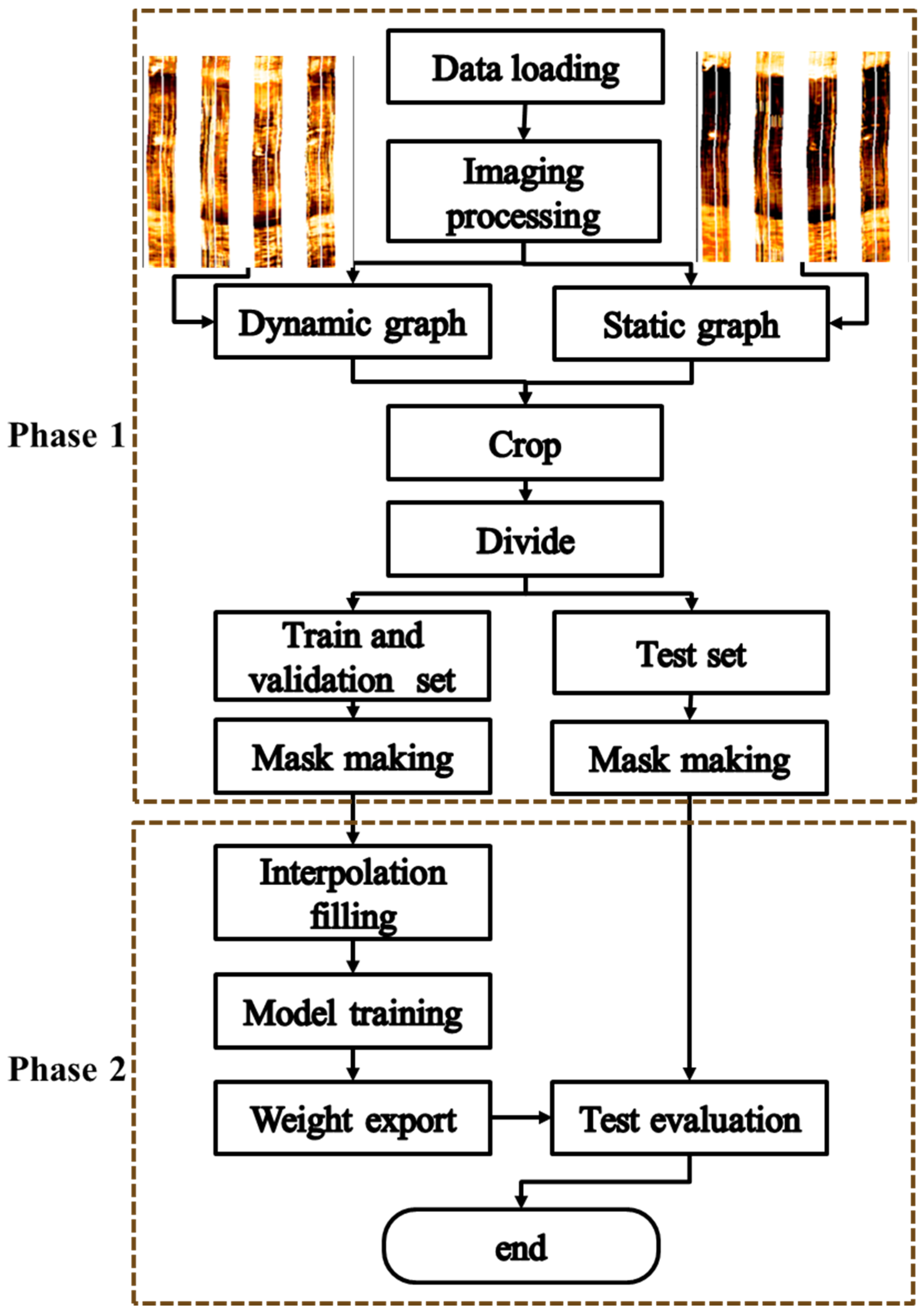
Considering the specific requirements of electrical imaging logging image restoration, this study designed a dedicated data preprocessing workflow tailored for the AKConv–AOT-GAN fusion model, as shown in Figure 1. This workflow consists of two key stages:
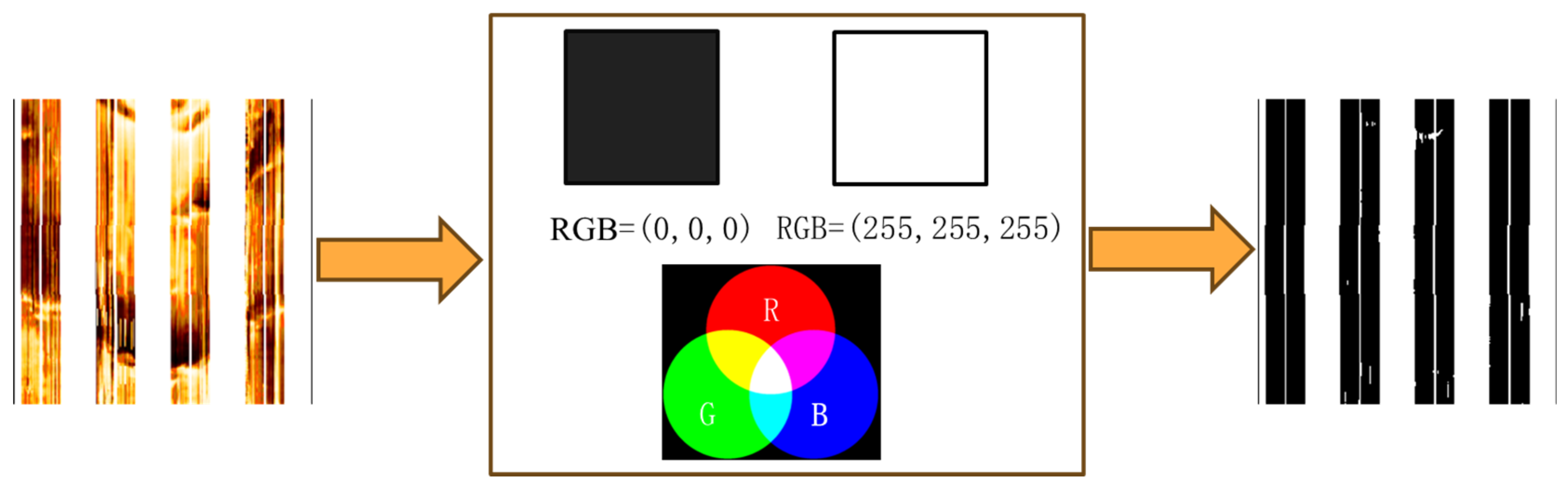
The first stage involves raw data imaging processing and cropping, followed by mask generation. Masks are created based on the RGB values of the image in the range of 0–255. In the RGB color system, each color channel is represented by an integer value between 0 and 255 [26]. Different colors arise from the combination of the three channel values—for instance, RGB = (255, 255, 255) yields white, while RGB = (0, 0, 0) yields black. The mask generation process is illustrated in Figure 2.
The second stage addresses the requirement of supervised deep learning. Because fully intact ground-truth images are generally unavailable in real electrical imaging logging data, traditional interpolation methods were employed only as an auxiliary preprocessing step to preliminarily fill the missing regions and construct approximately complete reference images for supervised training. This step is not intended for final restoration; rather, it provides approximate paired supervision for network training under the practical constraint that fully intact field ground-truth images are unavailable. The final restoration results are not determined by interpolation alone, because the model is jointly constrained by reconstruction, perceptual, style, and adversarial losses, while the soft mask-guided discriminator focuses the adversarial supervision on the missing regions.

2.2. Model Architecture Design of This Study

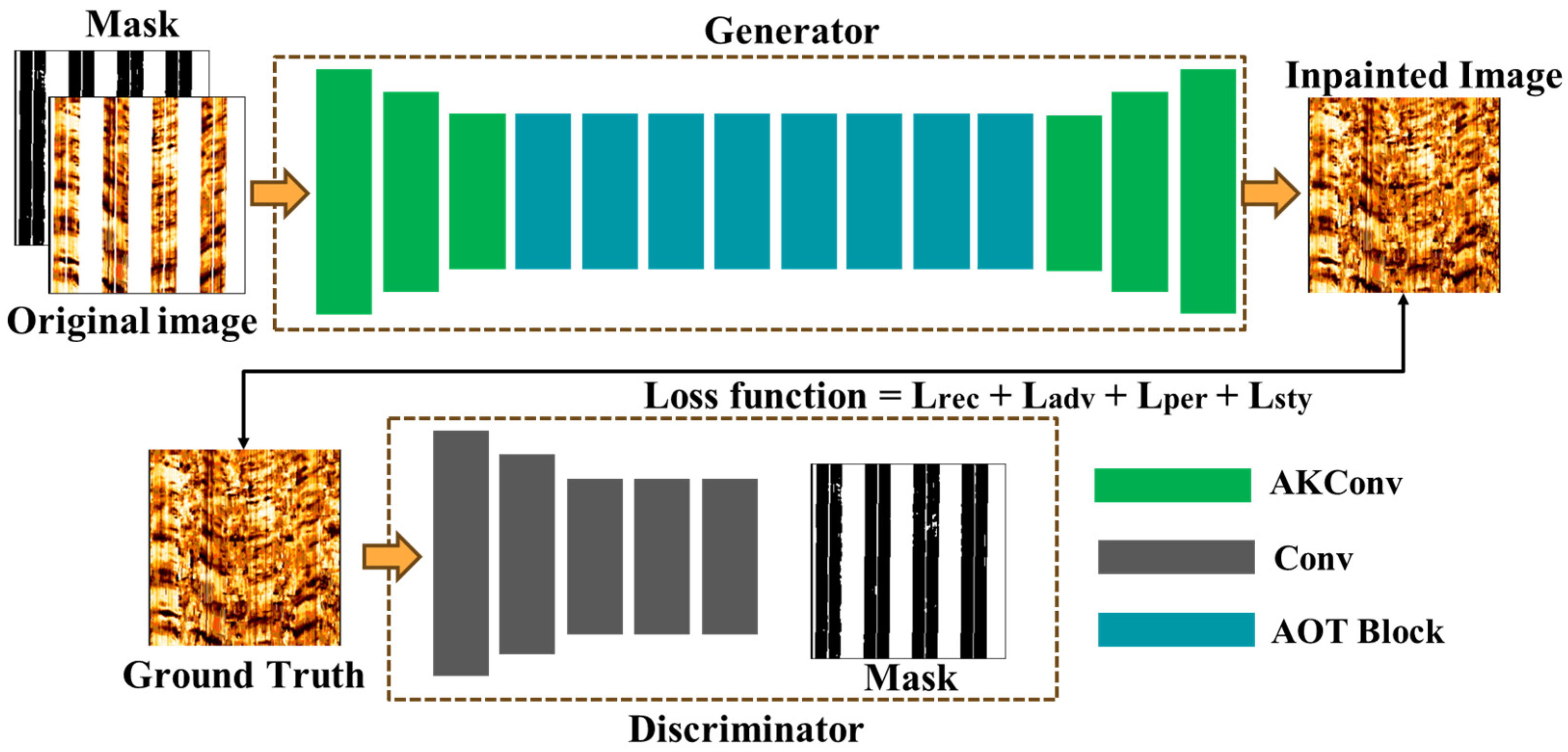
The proposed method for blank-strip restoration in electrical imaging, based on the fusion of Arbitrary Kernel Convolution (AKConv) and Generative Adversarial Networks (GANs), is trained within the overall framework as shown in Figure 3. The generator takes a damaged image containing blank strips as input and produces a complete and realistic restored image, whereas the discriminator is trained to distinguish between a real intact image and a restored image generated by the generator. The novelty of the proposed model lies in the task-specific designs of both the generator and discriminator, which enable it to better address the restoration of large-scale missing regions.

2.2.1. Generator

The generator of the proposed model adopts the classic encoder–decoder architecture, a structure widely used in image-to-image processing task and proven highly effective for image inpainting.
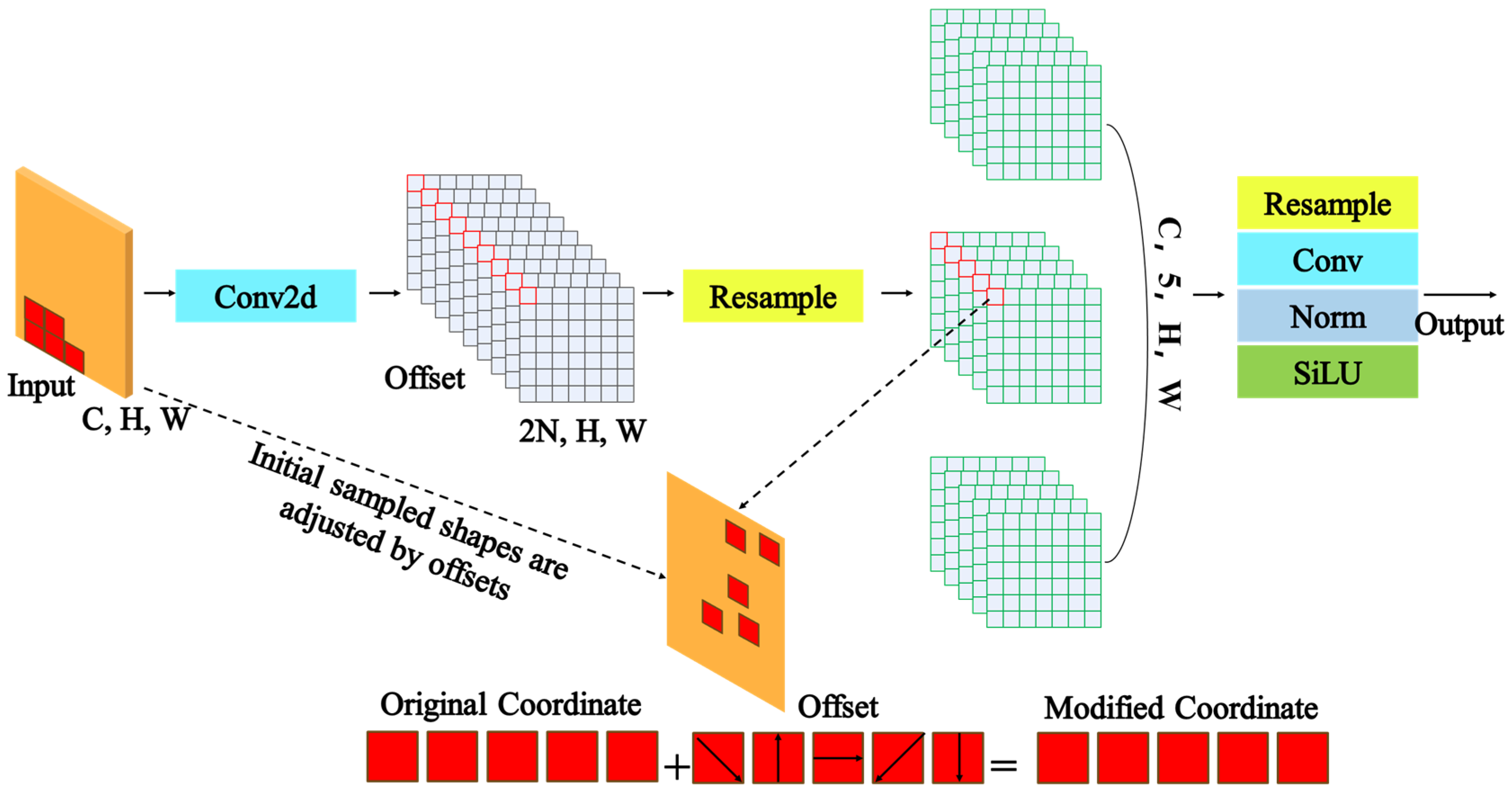
The core innovation of this study lies in incorporating AKConv’s adaptive sampling mechanism into the AOT-GAN framework. Specifically, the integration strategy is as follows: selected standard convolutional layers in the generator, particularly those in the encoder part near the input end, are replaced with AKConv modules. The purpose is to enable the network, at the early feature extraction stage, to adaptively adjust its sampling pattern according to the content of the input image—thereby better capturing the unique, directional geological structures (e.g., bedding planes and fractures) in electrical imaging data. The schematic structure of AKConv is shown in Figure 4: it assigns initial sampling coordinates to a convolution kernel of arbitrary size and adjusts the sampling shape via learnable offsets. Compared with the original fixed sampling shape, AKConv reshapes the sampling pattern at each position through re-sampling.
Mathematically, let P0 denote the current output position, Pn the predefined initial sampling coordinate of the n -th sampling point, and ∆Pn the corresponding learnable offset. Then, the AKConv output at position P0 is given by
y ( p 0 ) = n = 1 N w n X ( p 0 + p n + Δ p n )
where N is the number of sampling points and Wn is the corresponding convolution weight. The offsets ∆Pn are predicted from the input features, and bilinear interpolation is used when the deformed sampling locations are non-integer. During end-to-end training, both the convolution weights and the offset-prediction parameters are jointly optimized through backpropagation.
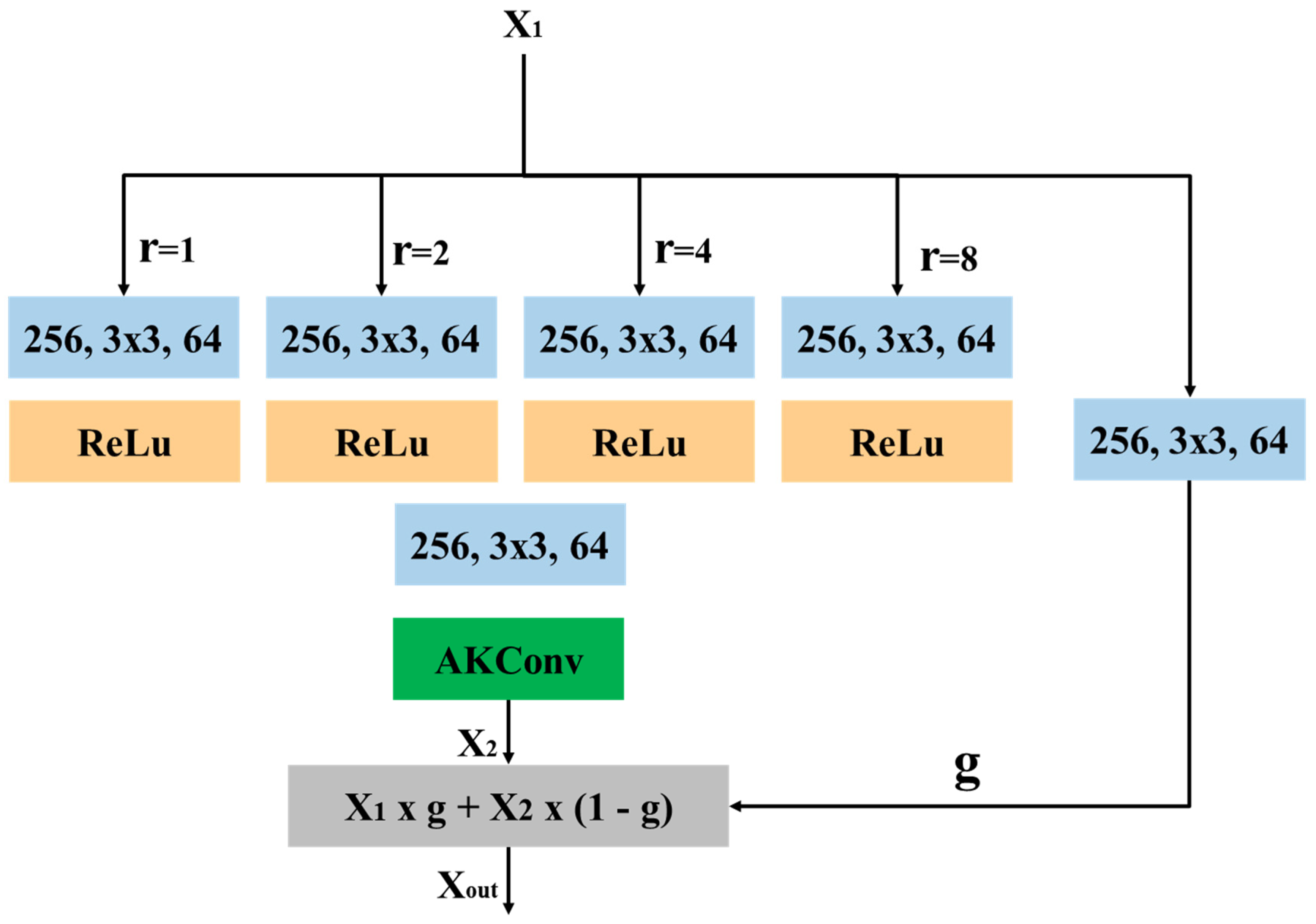
In the decoder part of the generator—especially within the AOT module—we also integrate AKConv. The AOT module itself aggregates contextual information through parallel multi-scale branches. Replacing the standard convolutions within these branches with AKConv endows the contextual capture process of each branch with adaptability. For example, when capturing long-range context, AKConv can guide sampling points to extend along the orientation of geological structures, thereby avoiding crossing structural boundaries and ensuring that the aggregated information remains relevant and effective. This integration strategy is not a simple module stacking, but rather a synergistic combination of AKConv’s “deformable” capability and AOT’s “aggregation” capability—enabling the generator to both “see far” (aggregate long-range context) and “see accurately” (adaptively sample effective information). The structure of the AOT module after introducing AKConv is illustrated in Figure 5.
Thus, through the above design, when repairing a blank strip intersecting inclined bedding, the network can learn—via AKConv—to arrange sampling points along the bedding direction, even if these sampling points belong to a dilated convolution with a large dilation rate. This “adaptive context aggregation” allows the model to more effectively leverage distant yet structurally relevant information for the missing region, thereby exhibiting stronger structural preservation and texture coherence when restoring complex geological features (e.g., intersecting fractures, heterogeneous bedding), ultimately generating inpainted results that better conform to geological principles.

2.2.2. Discriminator

The discriminator in the proposed model directly adopts the Soft Mask-Guided PatchGAN structure introduced in AOT-GAN. This discriminator is a PatchGAN-based discriminator that partitions the input image—whether a real, complete image or a generated, inpainted image—into multiple small image patches and independently judges the authenticity of each patch. Compared to a discriminator that makes a single global judgment on the entire image, this design provides richer gradient information, thereby encouraging the generator to produce finer details. Its core innovation lies in the incorporation of a soft mask as guidance. During training, the discriminator receives not only the image but also a corresponding soft mask. This mask assigns high values to missing regions and low values to known regions, guiding the discriminator to focus its attention on evaluating the restoration quality specifically within the missing areas.
The discriminator’s task is formulated as a mask prediction task rather than a simple binary classification task. Specifically, the discriminator outputs a single-channel feature map with the same spatial dimensions as the input image, where the value at each pixel represents the probability that the corresponding location belongs to the “inpainting region.” The training objective is to have the discriminator output an all-zero mask for real, complete images (since no region needs restoration), while for generated inpainted images, the output mask should closely match the input soft mask. Through this mechanism, the generator’s optimization goal becomes “deceiving” the discriminator—i.e., making it indistinguishable between restored and real regions—so that the discriminator also outputs a near-zero mask for inpainted images. This ingenious design ensures that the adversarial loss acts directly on the missing regions, compelling the generator to synthesize content within these regions that is highly consistent with, and realistic relative to, the surrounding context—thereby significantly enhancing restoration quality.

2.2.3. Loss Function

In this blank strip filling task for electrical imaging logging, this study achieves high-quality image restoration through the coordinated optimization of generator loss and discriminator loss. This design follows the core idea of the classical adversarial network framework, while introducing a multi-dimensional loss function to enhance the semantic consistency and visual realism of the restoration results, thereby providing a theoretical foundation for image restoration in complex scenarios. The generator loss consists of four key components:
Reconstruction Loss: The L1 norm is used to quantify the pixel-level absolute error between the original image x and the restored result G(x⊙(1 − m), m), defined as:
L rec = x G ( x ( 1 m ) , m ) 1
where m is the binary mask (with value 1 indicating damaged regions), and G denotes the generator network. This loss ensures high similarity between the restored region and the original image at the low-level feature level.
Perceptual Loss: Based on a pre-trained VGG-19 network, a multi-layer feature perception mechanism is constructed, expressed as:
L per = i f i ( x ) f i ( z ) 1 N i
where fi(·) represents the feature map from the i-th layer of VGG-19, and Ni is the number of elements in the feature map. By simulating the hierarchical perception characteristics of the human visual system, this loss effectively enhances the global structural coherence of the restored content.
Style Loss: Further utilizing the Gram matrix to capture deep semantic structural information, its formula is:
L sty = E i f i ( x ) T f i ( x ) f i ( z ) T f i ( z ) 1
By calculating the difference in feature covariance matrices between the real image and the restored image, this loss strengthens the preservation of texture details.
Adversarial Loss: A mask-weighted mean squared error is adopted to optimize the generator’s adversarial objective, expressed as:
L adv G = E z p z ( D ( z ) 1 ) 2 m
where D denotes the discriminator. This design dynamically allocates mask weights, focusing adversarial training on damaged regions to improve local realism.
Meanwhile, the discriminator loss is designed as a dual-constraint form based on the improved PatchGAN architecture:
Loss adv D = E z ~ p z ( D ( z ) σ ( 1 m ) ) 2 + E x ~ p data ( D ( x ) 1 ) 2
where σ is a composite function of downsampling and Gaussian filtering. This function dynamically adjusts the mask scaling factor so that the discriminator output for real images approaches 1 and the output for restored regions within damaged areas approaches 0, thereby significantly enhancing the model’s ability to distinguish local details and global structures and ensuring the discriminator can effectively guide the generator’s optimization.
This dual-loss-function architecture, through the coherent integration of reconstruction, perceptual, style, and adversarial losses, not only ensures pixel-level precision but also maintains high-level semantic consistency. The synergistic effect of these multi-dimensional losses equips the model with robust optimization capability in complex scenarios, providing a robust theoretical support and practical framework for image restoration tasks.

3. Experimental Results and Discussion

3.1. Experimental Setup

As shown in Table 1, all experiments were conducted on a Windows server equipped with an NVIDIA GeForce RTX 3050 GPU (16 GB VRAM). The deep learning framework employed was PyTorch 2.0.1, with CUDA version 12.3. Other dependencies included Python 3.11.3, NumPy, OpenCV, etc. Model training utilized the Adam optimizer, with the initial learning rate for both the generator and discriminator set to 0.0002, and a cosine annealing strategy applied for learning rate decay during training. The batch size was set to 4. The model was trained for a total of 300 epochs. During training, the validation set was used to monitor model convergence and select the best-performing checkpoint. The test set was used only for the final quantitative and qualitative evaluation and was not involved in model tuning. In addition, the dataset partition was performed in a grouped manner based on continuous depth intervals from the same logging section rather than by purely random image-wise splitting, so as to avoid leakage among highly correlated adjacent samples.
Under the above hardware configuration, the total training time for the proposed model was approximately 3 h for 300 epochs, and the average inference time was approximately 1.32 s per test image on the same GPU.

3.2. Evaluation Metrics

To objectively and comprehensively evaluate the restoration performance of the proposed method, we adopted three widely used objective evaluation metrics in the image inpainting field: Peak Signal-to-Noise Ratio (PSNR) [27], Structural Similarity Index (SSIM) [28], and Mean Absolute Error (MAE) [29].
Peak Signal-to-Noise Ratio (PSNR) is a commonly used metric for assessing image quality, quantifying fidelity by computing the Mean Squared Error (MSE) between the restored image and the original (ground-truth) image. A higher PSNR value indicates smaller differences between the restored and original images, implying better image quality. Its formula is:
PSNR = 10 log 10 MAX 2 MSE
where MAX is the maximum possible pixel value (typically 255 for 8-bit images), and MSE is the mean squared error between the restored and original images.
Structural Similarity Index (SSIM) is an image quality assessment metric that better corresponds to human visual perception. It considers not only luminance and contrast but also structural information. SSIM ranges from −1 to 1; values closer to 1 indicate higher structural similarity and better visual quality. Compared to PSNR, SSIM more effectively reflects structural preservation, making it particularly important for evaluating the restoration fidelity of geological structures. Its formula is:
SSIM ( I gt , I rec ) = ( 2 μ I gt μ I rec + C 1 ) ( 2 σ I gt I rec + C 2 ) μ I gt 2 + μ I rec 2 + C 1 σ I gt 2 + σ I rec 2 + C 2
where Igt and Irec denote the ground-truth and restored images, respectively; u and σ represent image mean and standard deviation; σ I g t , I r e c is the covariance between the two images; and C1, C2 are small stabilizing constants.
Mean Absolute Error (MAE) is another pixel-level difference metric, computed as the average of absolute pixel-wise differences between the restored and original images. A lower MAE value indicates smaller pixel-level discrepancies. Compared to MSE, MAE is less sensitive to outliers and provides a more robust measure of overall pixel deviation. Its formula is:
MAE = 1 H × W i = 1 H j = 1 W I gt ( i , j ) I rec ( i , j )
where H and W denote the image height and width, respectively.

3.3. Experimental Analysis

To validate the effectiveness of the proposed AKConv–GAN fusion strategy, we first conducted controlled comparative experiments between the original AOT-GAN model and our improved model under the same adversarial backbone. After training, the best-performing checkpoint of each model was selected according to validation performance and then used to restore blank strips in the test images, on which the evaluation metrics were computed. Table 2 summarizes the average results of the key metrics. As shown, removing the AKConv module (Model 1) leads to a significant performance degradation across all metrics. This demonstrates that the adaptive sampling mechanism of AKConv is critical for enhancing model performance in electrical imaging restoration tasks: it effectively overcomes the inherent limitations of standard convolutions, enabling finer feature learning and substantially improving the model’s robustness.
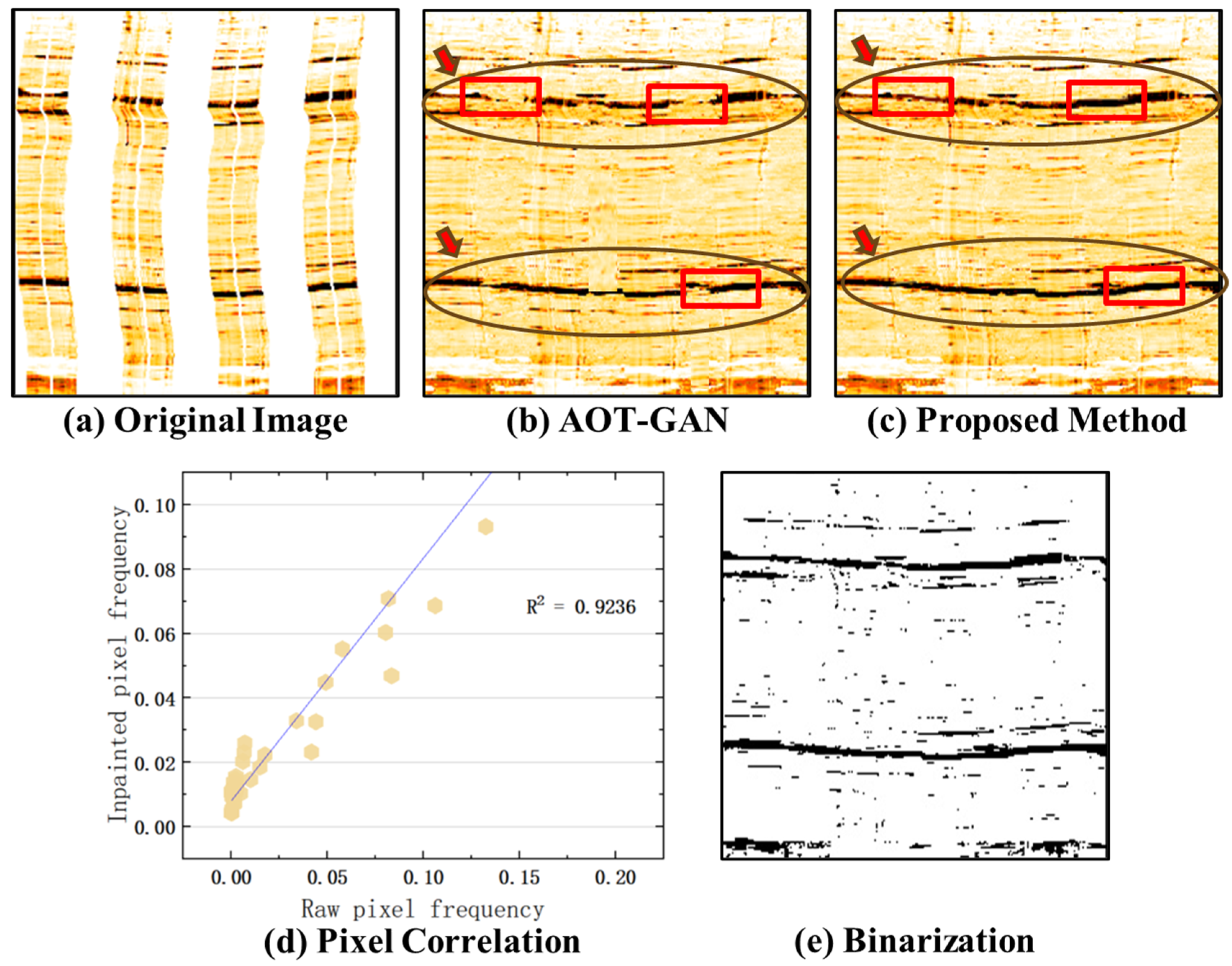
Figure 6 presents the restoration results for scenes with relatively uniform backgrounds. It is evident that our proposed model (Figure 6b,c) significantly improves restoration quality: not only does it effectively fill the blank strips, but it also successfully restores the continuity of fractures. The pixel–frequency correlation between the restored and original regions reaches as high as 0.923 (Figure 6d). To further validate the continuity of fractures and textures, we performed a binarization analysis on the results (Figure 6e), which clearly demonstrates the structural integrity after restoration.
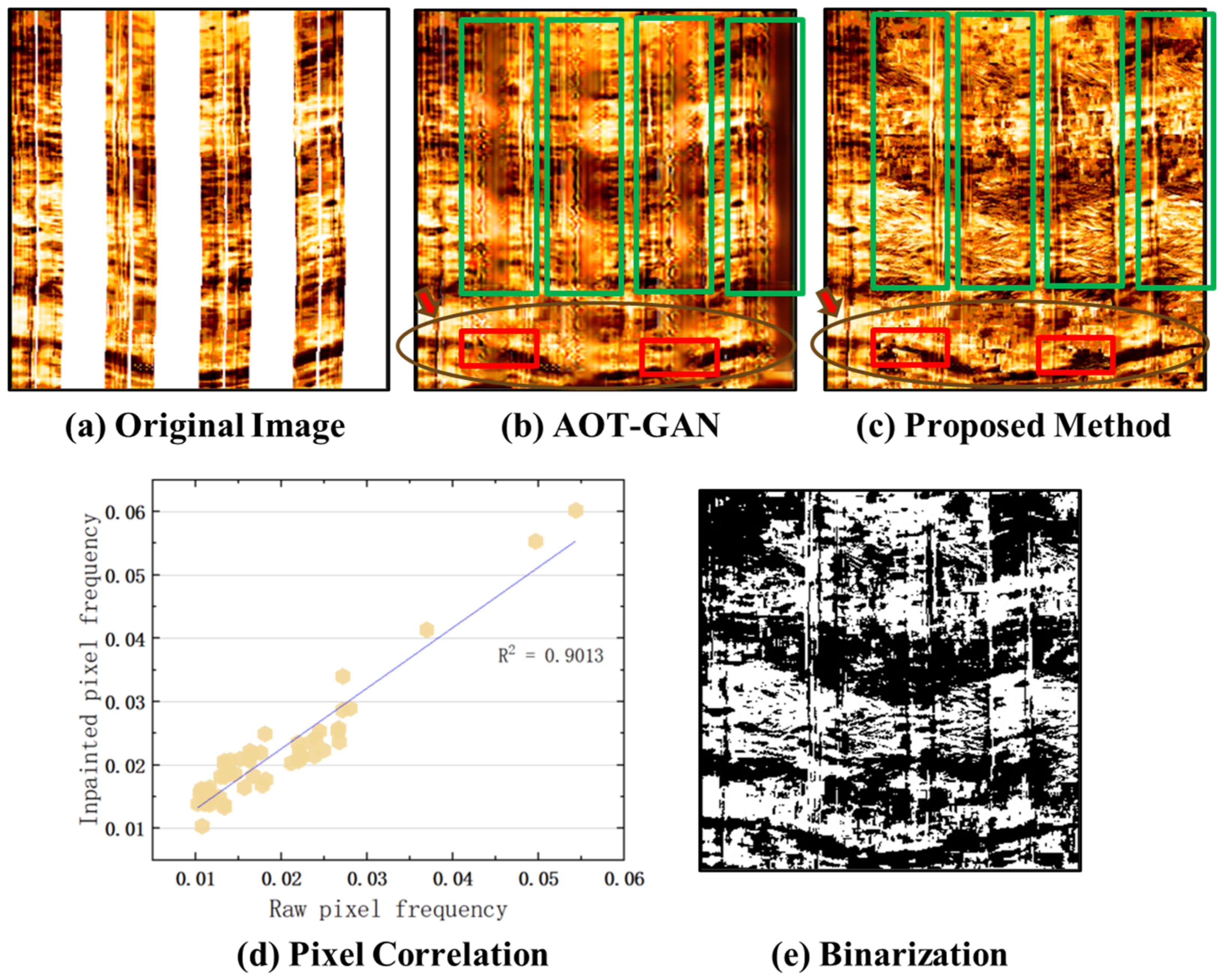
Figure 7 analyzes restoration performance in complex multi-bedding background structures. The original model (Figure 7b) exhibits texture blurring and bedding discontinuity during restoration, whereas our proposed model (Figure 7c) effectively overcomes these shortcomings, generating clear and coherent bedding structures. The pixel–frequency correlation between the restored and original regions reaches 0.9013 (Figure 7d), and the binarized results (Figure 7e) further confirm the model’s precise reconstruction capability for complex fracture and bedding structures. These results once again verify the core role of the AKConv module in enhancing the model’s robustness and restoration quality.

3.4. Engineering Validation

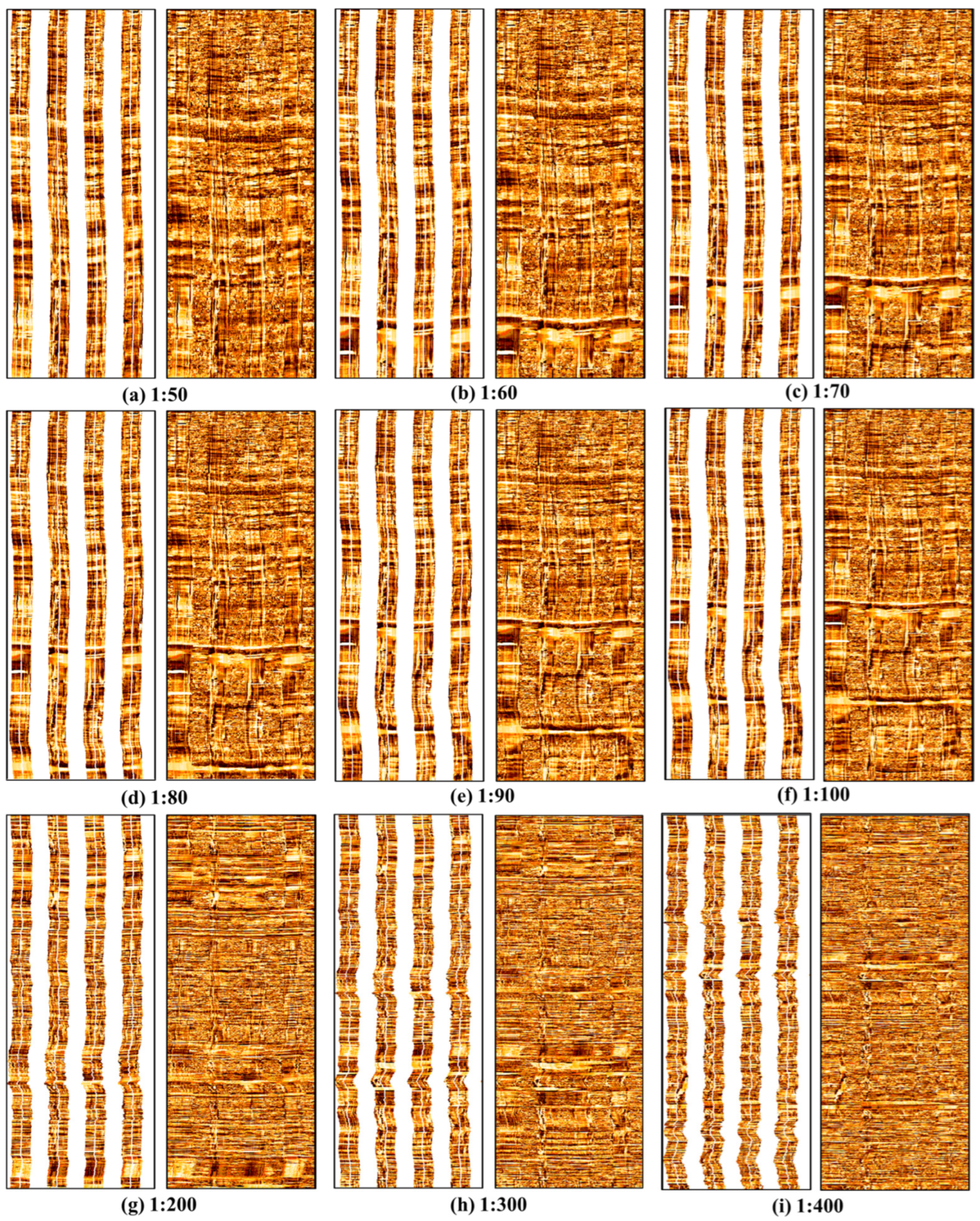
To further validate the practical engineering value of the proposed method, we applied it to the processing of electrical imaging logging data from key evaluation wells across various borehole intervals. In these intervals, multiple wide blank strips exist, severely hindering the assessment of fracture development in reservoirs. We selected imaging data at different depth scales—specifically 1:50, 1:60, 1:70, 1:80, 1:90, 1:100, 1:200, 1:300, and 1:400—and Figure 8a–i present a comparison of the electrical imaging logs before and after restoration using our method. To provide a lightweight quantitative supplement for the engineering validation, we further computed the pixel–frequency continuity correlation between the restored blank-strip regions and their adjacent valid image regions at each depth scale. The corresponding results are summarized in Table 3. For each case, pixel–frequency continuity correlation was calculated between the restored blank-strip boundary region and the corresponding adjacent valid image region on both sides. The left-boundary and right-boundary correlations were computed separately, and their average was defined as the mean correlation, which was used to characterize the overall continuity between the restored blank-strip region and the adjacent valid image regions at that depth scale.
As shown in Figure 8 and Table 3, the proposed method maintains favorable pixel–frequency continuity correlation with the adjacent valid regions across all selected depth scales. The mean continuity correlation values range from 0.865 to 0.911, with an overall average of 0.888, indicating that the restored results preserve local textural consistency and cross-boundary structural continuity under practical engineering conditions. Although the correlation gradually decreases as the depth scale increases, the decline remains limited, with a total reduction of only 0.046 from 1:50 to 1:400. In addition, the left-boundary and right-boundary correlations remain highly consistent, with overall averages of 0.891 and 0.885, respectively, suggesting stable and balanced restoration performance on both sides of the blank-strip regions. Together with the visual comparisons, these findings provide preliminary engineering-oriented evidence supporting the cross-scale practical applicability of the proposed method.

4. Conclusions

This study proposes a blank-strip restoration method for electrical imaging logging images by integrating Arbitrary Kernel Convolution (AKConv) with the Aggregated Contextual-Transformations Generative Adversarial Network (AOT-GAN). By incorporating AKConv’s adaptive sampling mechanism into the generator of AOT-GAN, the proposed model alleviates the limitations of standard convolutions in handling blank strips of varying widths and morphologies, while improving the preservation of directional geological structures. At the same time, AOT-GAN provides multi-scale contextual aggregation for restoring large missing regions, enabling the model to better balance structural continuity and texture quality.
Experimental results on real electrical imaging logging data show that the proposed method improves both quantitative performance and visual restoration quality compared with the original AOT-GAN baseline. In addition, the visual analysis and multi-scale engineering validation indicate that the proposed method maintains good restoration capability across different depth scales, while preserving important geological features such as bedding continuity and fracture structures. These results suggest that the proposed framework provides an effective solution for electrical imaging logging image restoration under practical field conditions.
Nevertheless, the present study mainly focuses on the restoration of electrical imaging logs themselves, whereas geological interpretation is a comprehensive process that typically requires the integration of multiple logging curves (e.g., acoustic, density, and neutron logs) together with geological information. Future work will therefore explore multi-source geological information fusion, with the aim of extending the proposed method into a multimodal restoration framework to further improve the geological plausibility and interpretation value of the restored results.

Author Contributions

Conceptualization: R.A. and D.L.; Methodology: G.L. and S.F.; Formal Analysis & Investigation: G.C. and K.M.; Writing—Original Draft Preparation: T.Z. and G.L.; Writing—Review & Editing: L.T. and B.Z.; Funding Acquisition: S.F.; Resources: L.T.; Supervision: B.Z. All authors have read and agreed to the published version of the manuscript.

Funding

This study was financially supported by the Open Foundation of the National Engineering Laboratory for Exploration and Development of Low-Permeability Oil & Gas Fields (NO. KFKT2024-31).

Data Availability Statement

The data presented in this study are available on request from the corresponding author. The data are not publicly available due to requirements surrounding data confidentiality.

Acknowledgments

The authors extend their sincere thanks to the anonymous reviewers for their insightful comments and to the editors for their guidance and support throughout the publication process.

Conflicts of Interest

Authors R.A., D.L., G.C., K.M., T.Z. and L.T. were employed by the company PetroChina Changqing Oilfield Company. The remaining authors declare that the research was conducted in the absence of any commercial or financial relationships that could be construed as a potential conflict of interest.

References

  1. Gao, J.; Jiang, L.; Liu, Y.; Chen, Y. Review and analysis on the development and applications of electrical imaging logging in oil-based mud. J. Appl. Geophys. 2019, 171, 103872. [Google Scholar] [CrossRef] [Scilit]
  2. Zhou, F.; Oraby, M.; Luft, J.; Guevara, M.O.; Keogh, S.; Lai, W. Coal seam gas reservoir characterisation based on high-resolution image logs from vertical and horizontal wells: A case study. Int. J. Coal Geol. 2022, 262, 104110. [Google Scholar] [CrossRef] [Scilit]
  3. Baoping, L.U.; Weining, N.I. The key technologies of high precision imaging logging while drilling. Pet. Drill. Tech. 2019, 47, 148–155. [Google Scholar]
  4. Li, C.; Zhou, C.; Huang, S. Restoration of Distorted Images from FMI Imaging Logging and Its Geological Applications. J. Oil Gas Technol. 2007, 29, 88–91. [Google Scholar]
  5. Sun, J.; Zhao, J.; Lai, F.; Chen, H. Methods to Fill in the Gaps Between Pads of Electrical Logging Images. Well Logging Technol. 2011, 35, 532–537. [Google Scholar]
  6. Assous, S.; Elkington, P. Shearlets and sparse representation for microresistivity borehole image inpainting. Geophysics 2018, 83, D17–D25. [Google Scholar] [CrossRef] [Scilit]
  7. Zhang, X.; Zhang, M.; Xiao, X.; Luo, L.; Yang, Y.; Cul, W. Image inpainting for fullbore electrical imaging logging in complex formations. Geophys. Prospect. Pet. 2018, 57, 148–153. [Google Scholar]
  8. Hurley, N.F.; Zhang, T. Method to generate full-bore images using borehole images and multipoint statistics. SPE Reserv. Eval. Eng. 2011, 14, 204–214. [Google Scholar] [CrossRef] [Scilit]
  9. Peng, P. Image Inpainting on Iterative Interpolation for Fullbore Electrical Imaging Logging. China’s Manganese Ind. 2018, 36, 182–186. [Google Scholar]
  10. Luo, X.; Yan, J.; Wang, M.; Zhong, G.; Wang, J.; Huang, Y. Optimization and Application of Borehole Wall Restoration Method of FMI Logging Image. Well Logging Technol. 2021, 45, 386–393. [Google Scholar]
  11. Xia, W.; Han, Y.; Guo, Q.; Guan, W.; Yang, Y.; Chen, X. A filling method of blank strip for electrical logging images based on morphological information of fractures. Oil Geophys. Prospect. 2024, 59, 533–542. [Google Scholar]
  12. Yang, H.; Chong, Z.; Xiong, L.; Xiong, W.; Lin, G.; Huang, K.; Zhang, W. Research on prediction method of well logging reservoir parameters based on Multi-TransFKAN model. Sci. Rep. 2025, 15, 18057. [Google Scholar] [CrossRef] [Scilit] [PubMed]
  13. Yao, Z.; Zhu, Q. A Two-Stage Wiener Process-Based Method for Bearing Remaining Useful Life Prediction Considering Measurement Uncertainty. Meas. Sci. Technol. 2026, 37, 066203. [Google Scholar] [CrossRef] [Scilit]
  14. Zheng, J.; Zhuo, Y.; Jiang, X.; Zeng, L.; Ge, Z. Advances in Bayesian networks for industrial process analytics: Bridging data and mechanisms. Expert Syst. Appl. 2025, 271, 126670. [Google Scholar] [CrossRef] [Scilit]
  15. Yang, J.; Ruhaiyem, N.I.R. Review of deep learning-based image inpainting techniques. IEEE Access 2024, 12, 138441–138482. [Google Scholar] [CrossRef] [Scilit]
  16. Elharrouss, O.; Damseh, R.; Belkacem, A.N.; Badidi, E.; Lakas, A. Transformer-based image and video inpainting: Current challenges and future directions. Artif. Intell. Rev. 2025, 58, 124. [Google Scholar] [CrossRef] [Scilit]
  17. Chen, Y.; Xia, R.; Yang, K.; Zou, K. Dual degradation image inpainting method via adaptive feature fusion and U-net network. Appl. Soft Comput. 2025, 174, 113010. [Google Scholar] [CrossRef] [Scilit]
  18. Lin, G.; Fang, S.; Li, M.; Wu, H.; Xue, C.; Zhang, Z. Application of a Dual-Stream Network Collaboratively Based on Wavelet and Spatial-Channel Convolution in the Inpainting of Blank Strips in Marine Electrical Imaging Logging Images: A Case Study in the South China Sea. J. Mar. Sci. Eng. 2025, 13, 997. [Google Scholar] [CrossRef] [Scilit]
  19. Kang, Z.; Wu, C.; Yang, G.; Wu, D.; Wang, R.; Yang, X.; Gan, W. Application of a generative adversarial network algorithm to filling blank strips of fractures in formation microresistivity imaging images. Coal Geol. Explor. 2025, 53, 197–207. [Google Scholar]
  20. Sun, Q.; Su, N.; Gong, F.; Du, Q. Blank strip filling for logging electrical imaging based on multiscale generative adversarial network. Processes 2023, 11, 1709. [Google Scholar] [CrossRef] [Scilit]
  21. Du, C.; Xing, O.; Zhang, J.; Wang, J.; Liu, B.; Wang, Y. Blank strips filling for electrical logging images based on attention-constrained deep generative network. Prog. Geophys. 2022, 37, 1548–1558. [Google Scholar]
  22. Wang, J.; Hou, Z.; Zhang, Z.; Wang, M.; Cheng, H. Combined Deep-Fill and Histogram Equalization Algorithm for Full-Borehole Electrical Logging Image Restoration. Processes 2024, 12, 1568. [Google Scholar] [CrossRef] [Scilit]
  23. Su, Q.; Qiao, D.; Ren, Y.; Feng, Z.; Lin, S.; Huang, R. Inpainting of blank strips in imaging logging images based on Fourier convolution. J. Beijing Univ. Aeronaut. Astronaut. 2025, 52, 362–370. [Google Scholar]
  24. Zhang, X.; Song, Y.; Song, T.; Yang, D.; Ye, Y.; Zhou, J. AKConv: Convolutional kernel with arbitrary sampled shapes and arbitrary number of parameters. arXiv 2023, arXiv:2311.11587. [Google Scholar] [CrossRef] [Scilit]
  25. Zeng, Y.; Fu, J.; Chao, H.; Guo, B. Aggregated contextual transformations for high-resolution image inpainting. IEEE Trans. Vis. Comput. Graph. 2022, 29, 3266–3280. [Google Scholar] [CrossRef] [Scilit]
  26. Imaizumi, S.; Kiya, H. A block-permutation-based encryption scheme with independent processing of RGB components. IEICE Trans. Inf. Syst. 2018, 101, 3150–3157. [Google Scholar] [CrossRef] [Scilit]
  27. Besag, J.; York, J.; Mollié, A. Bayesian image restoration, with two applications in spatial statistics. Ann. Inst. Stat. Math. 1991, 43, 1–20. [Google Scholar] [CrossRef] [Scilit]
  28. Wang, Z.; Bovik, A.C.; Sheikh, H.R.; Simoncelli, E.P. Image quality assessment: From error visibility to structural similarity. IEEE Trans. Image Process. 2004, 13, 600–612. [Google Scholar] [CrossRef] [Scilit] [PubMed]
  29. De Myttenaere, A.; Golden, B.; Le Grand, B.; Rossi, F. Mean absolute percentage error for regression models. Neurocomputing 2016, 192, 38–48. [Google Scholar] [CrossRef] [Scilit]
Figure 1. Data processing workflow.
Applsci 16 03267 g001
Figure 2. Principle of mask generation.
Applsci 16 03267 g002
Figure 3. Overall training framework of the fusion of Arbitrary Kernel Convolution and Generative Adversarial Networks.
Applsci 16 03267 g003
Figure 4. Schematic diagram of the AKConv convolution structure.
Applsci 16 03267 g004
Figure 5. Schematic diagram of the AOT module structure with AKConv integrated.
Applsci 16 03267 g005
Figure 6. Analysis of restoration results in relatively uniform background scenarios. (a) Original image; (b) Restoration result using the original AOT-GAN; (c) Restoration result using our proposed model; (d) Pixel–frequency correlation; (e) Binarized analysis result. Representative local differences are highlighted by red annotation boxes.
Applsci 16 03267 g006
Figure 7. Analysis of restoration results in complex multi-bedding background structures. (a) Original image; (b) Restoration result using the original AOT-GAN; (c) Restoration result using our proposed model; (d) Pixel–frequency correlation; (e) Binarized analysis result. Representative local differences are highlighted by red and green annotation boxes.
Applsci 16 03267 g007
Figure 8. Restoration results of imaging logs at different scales.
Applsci 16 03267 g008
Table 1. Experimental Setup.
CategoryItemValue
Experimental EnvironmentOperating SystemWindows 11 64-bit
Python3.11.3
PyTorch2.0.1
CUDA12.3
VRAM16 GB
GPUNVIDIA GeForce RTX 3050 GPU
Training ParametersLearning Rate0.0002
Batch Size4
Training Epochs300
Total training timeapproximately 3 h
Average inference time per image1.32 s/image
Table 2. Average results of evaluation metrics.
ModelAKConvPSNR (Avg) ↑SSIM (Avg) ↑MAE (Avg) ↓
1 15.810.6117.01
218.790.7610.98
Table 3. Pixel–frequency continuity correlation across multiple depth scales.
ScaleLeft BoundaryRight BoundaryMean
1:500.9140.9070.911
1:600.9060.8990.903
1:700.9010.8940.898
1:800.8960.8910.894
1:900.8920.8870.890
1:1000.8890.8840.887
1:2000.8810.8760.879
1:3000.8740.8690.872
1:4000.8680.8620.865
Mean0.8910.8850.888
Disclaimer/Publisher’s Note: The statements, opinions and data contained in all publications are solely those of the individual author(s) and contributor(s) and not of MDPI and/or the editor(s). MDPI and/or the editor(s) disclaim responsibility for any injury to people or property resulting from any ideas, methods, instructions or products referred to in the content.