A CDE-Centered Quality Gate Framework to Operationalize ISO 19650 Governance in Hybrid Railway Depots




Featured Application
Abstract
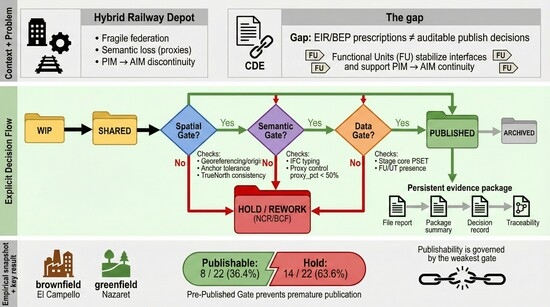
1. Introduction
1.1. Problem Statement: Hybrid Railway Assets and PIM → AIM Continuity
1.2. Research Gap: From Documentary Prescriptions to Governed Evidence in the CDE
1.3. Contributions
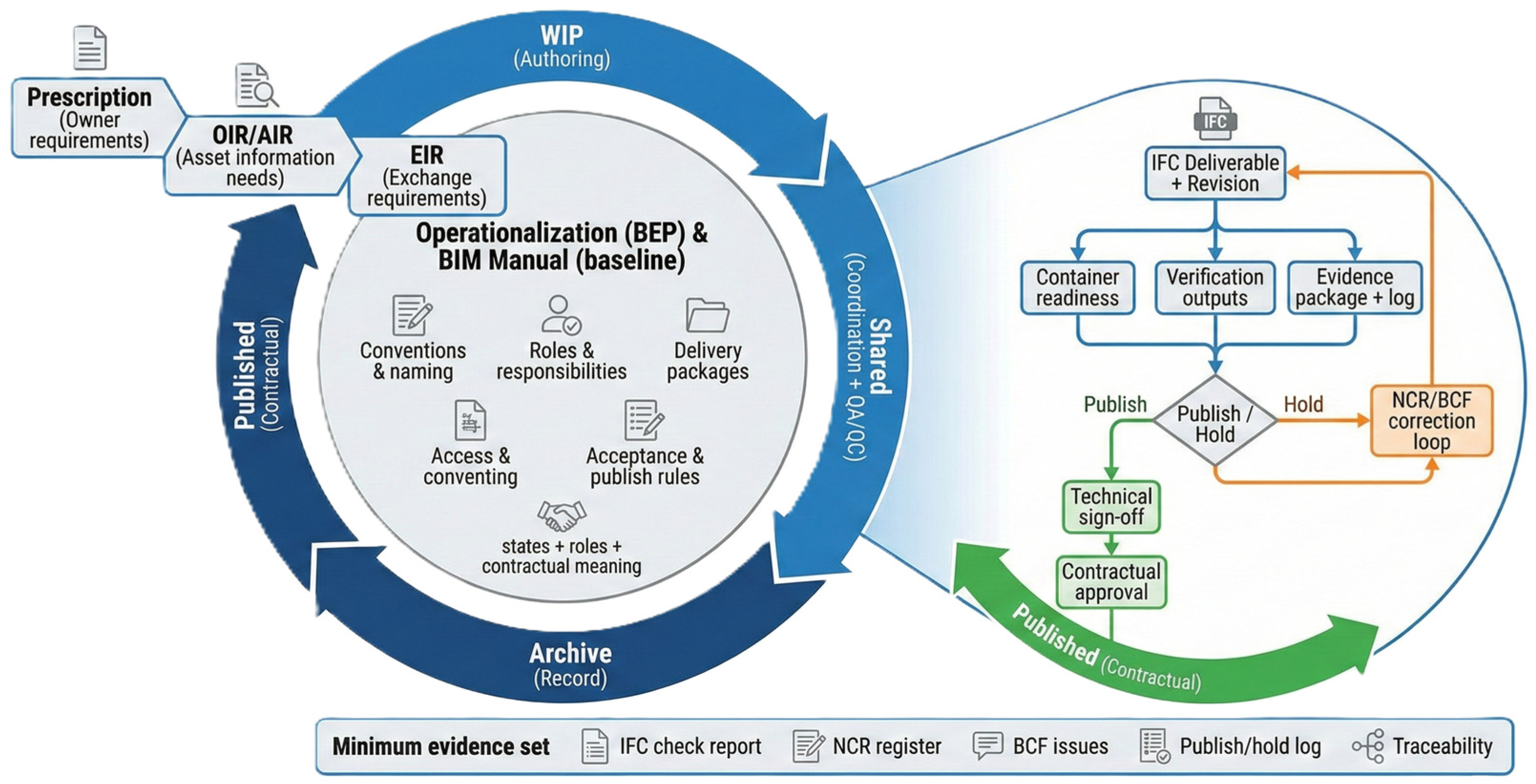
- An ISO 19650-ready, BEP-aligned governance model for hybrid railway assets, defining the roles, CDE states, and artifacts required to make Published a defensible technical–contractual outcome supported by auditable evidence stored in the CDE, explicitly connecting EIR/BEP prescriptions to artifacts and decisions.
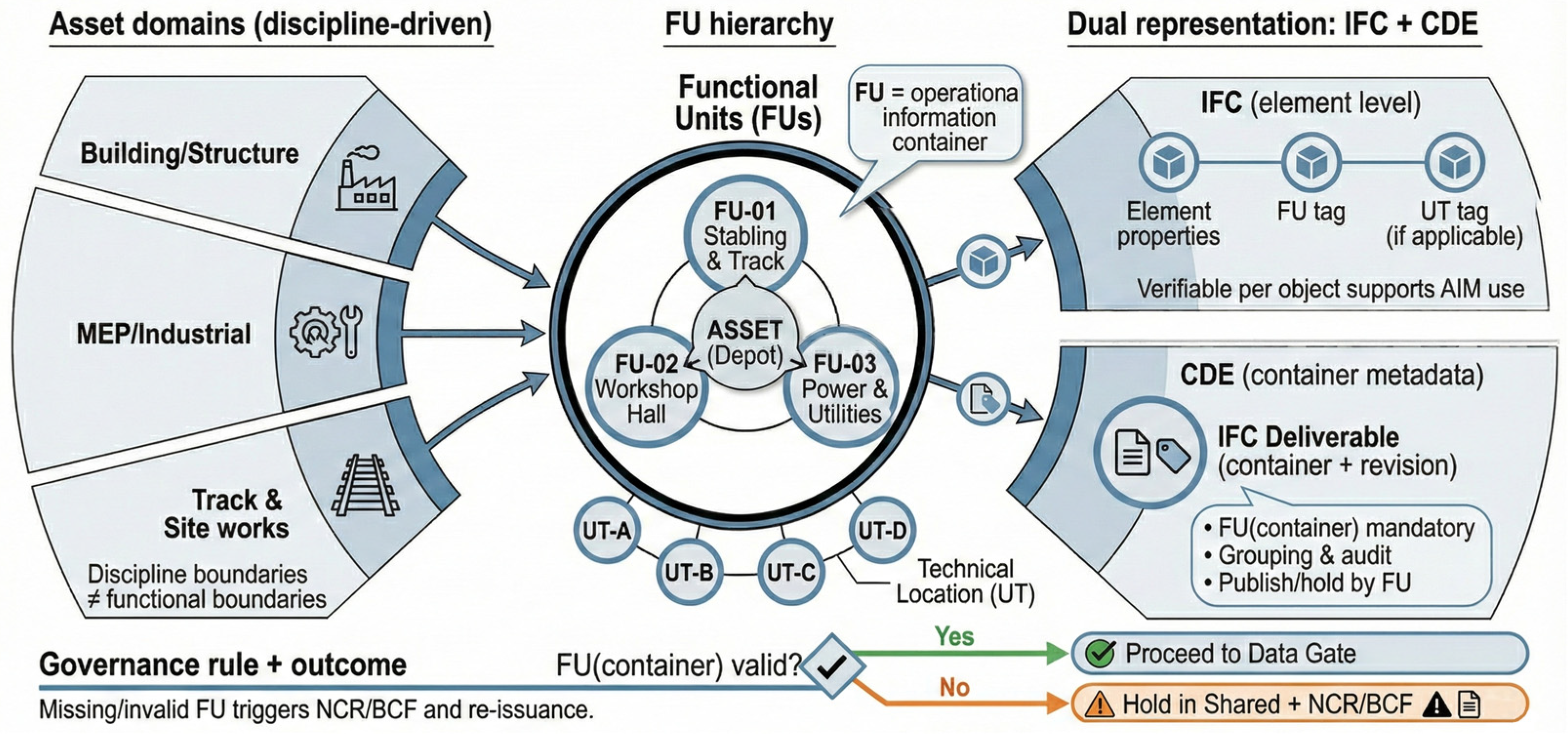
- An operations-oriented asset structuring layer based on Functional Units (FUs), stabilizing interfaces in hybrid assets (where disciplinary and operational boundaries do not coincide) and providing methodological support for PIM → AIM continuity.
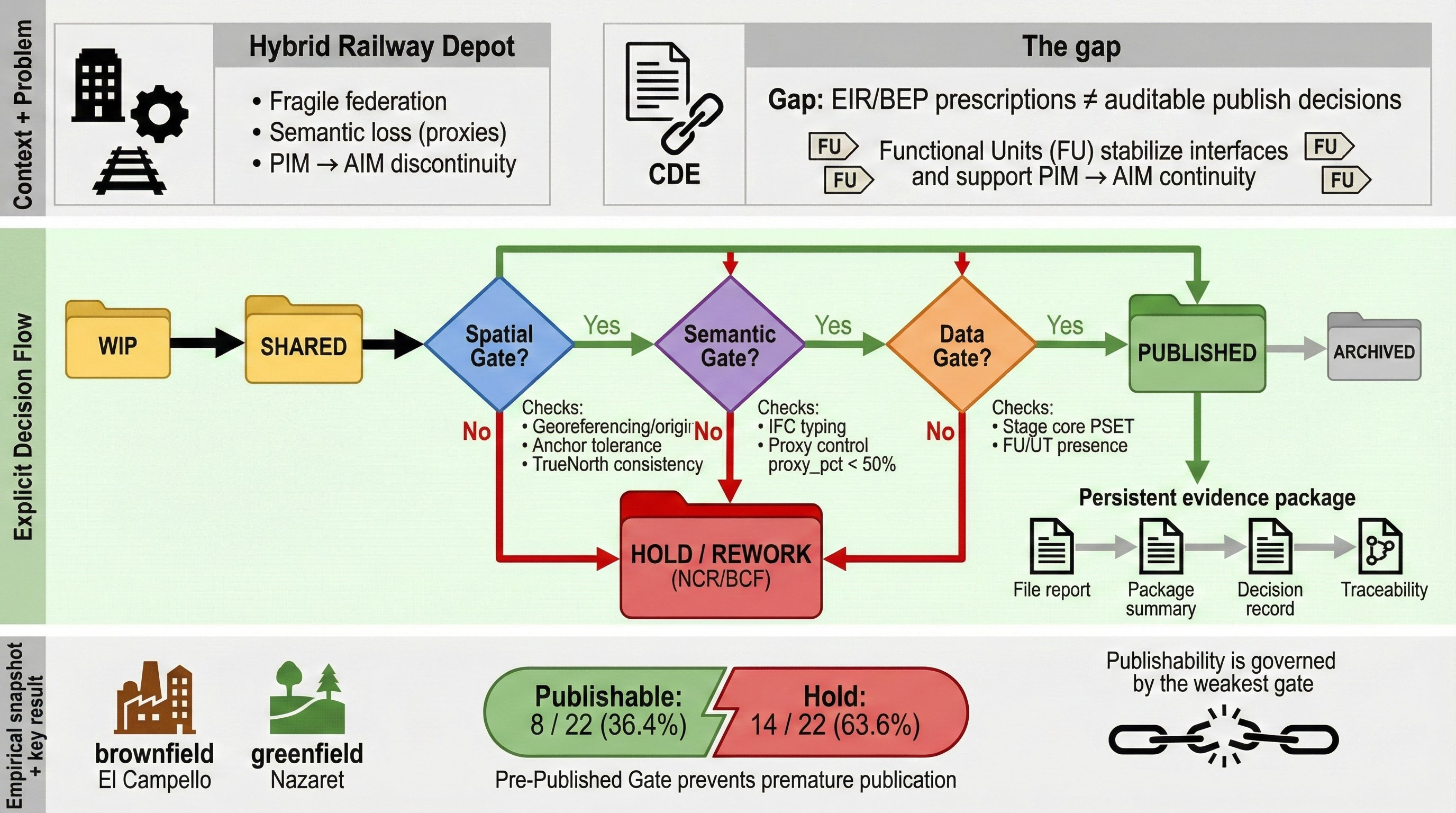
- A pre-Published Quality Gate formulated as a governance checkpoint (rather than KPI-only reporting), separating three non-substitutable risks (spatial, semantic, and data) so that control remains actionable and responsibility-assignable.
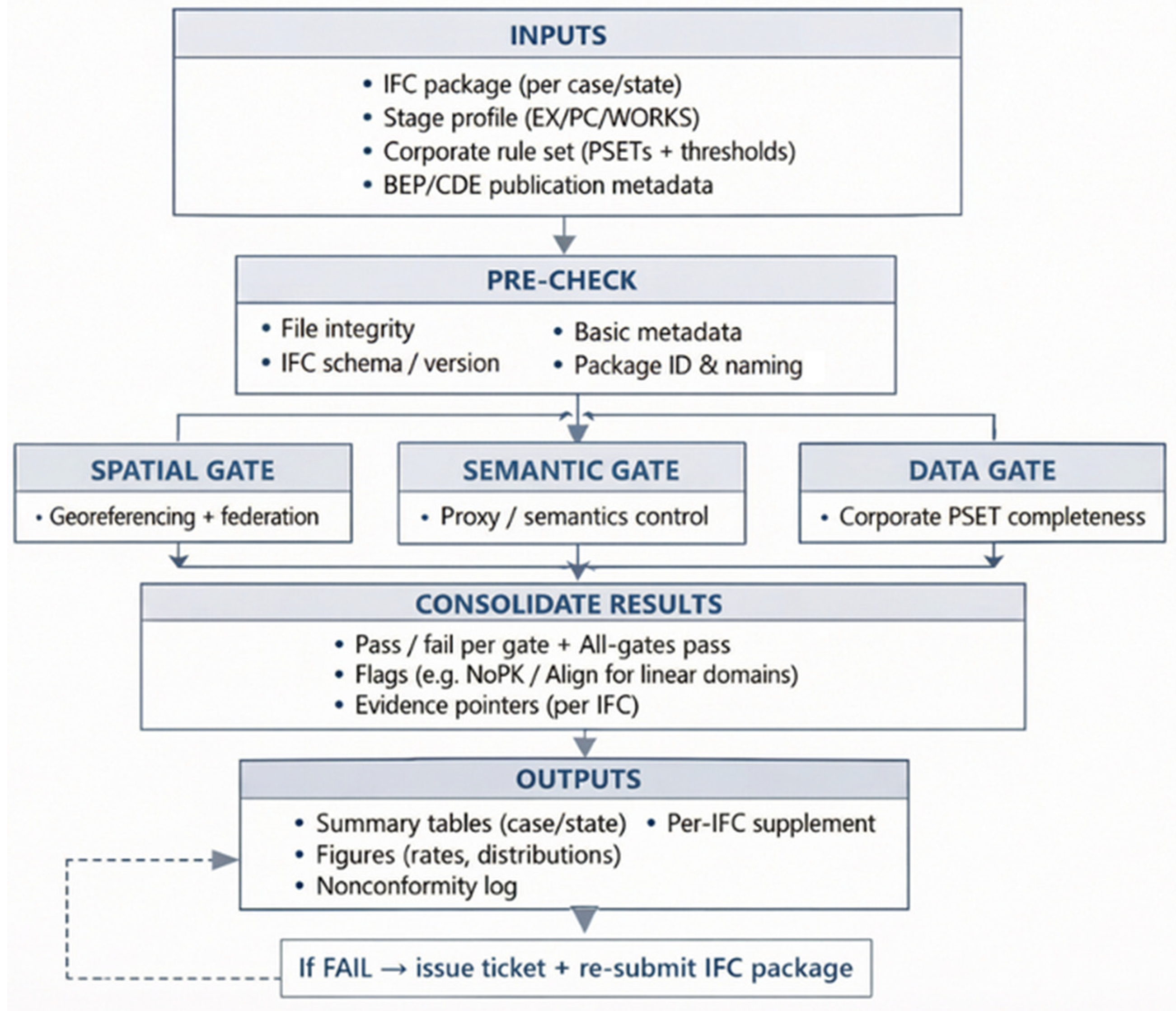
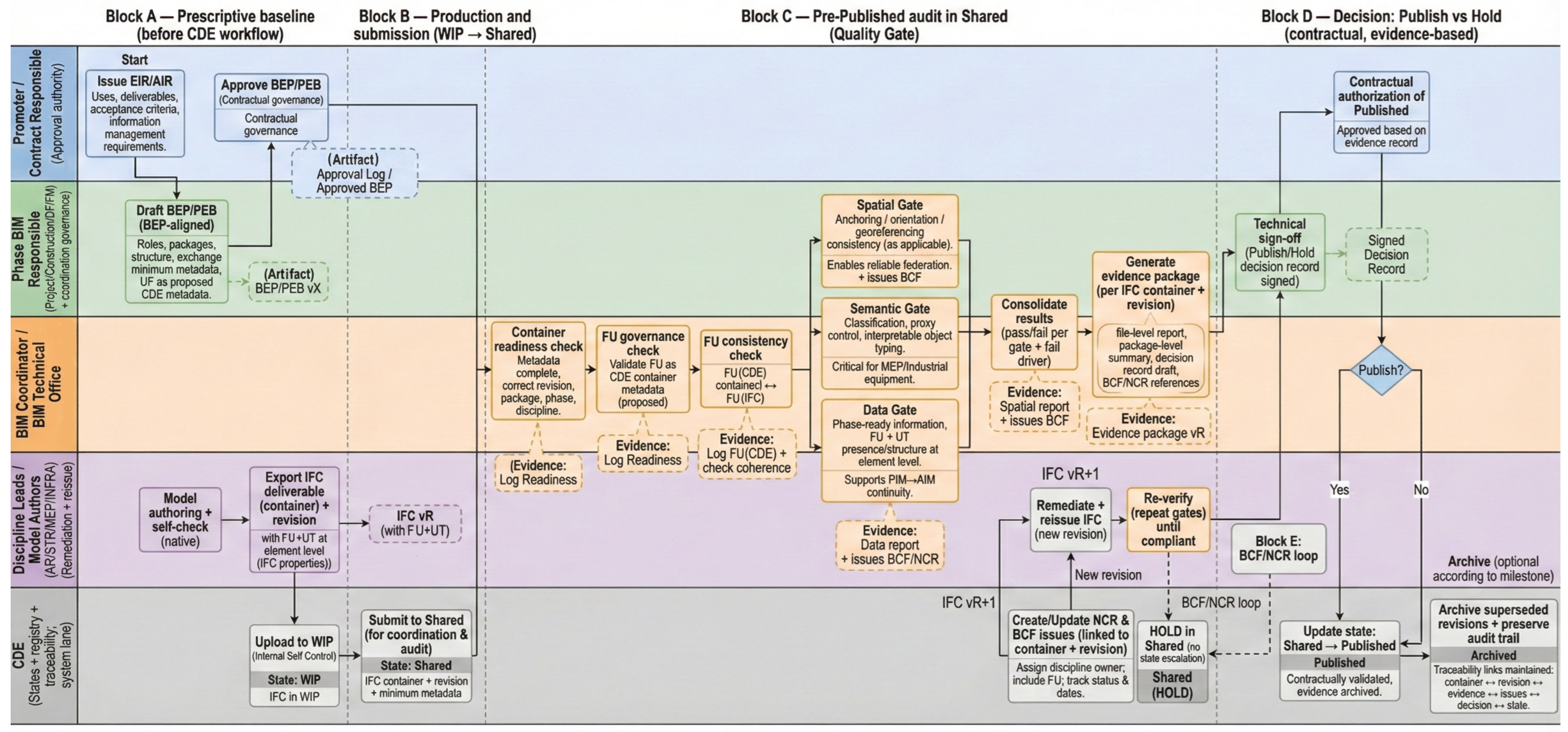
- A reproducible and auditable workflow (inputs → checks → outputs → publish/hold) mapped to roles within the CDE, enabling each decision to be justified through evidence linked to deliverables and revisions.
- A longitudinal crosswalk preserving comparability when corporate prescriptive frameworks evolve, preventing BEP/manual changes from breaking decision histories in multi-stage programs and long-lived assets.
- RQ1: How can an ISO 19650 CDE workflow be operationalized so that the Shared → Published transition becomes a traceable publish/hold decision at IFC deliverable level?
- RQ2: How can an operations-oriented asset structuring layer (Functional Units) be used to stabilize interfaces in hybrid railway depots and support PIM → AIM continuity?
- RQ3: How can a pre-Published Quality Gate be specified as an auditable procedure (inputs → checks → outputs → decision) generating persistent evidence and enabling longitudinal comparability across evolving prescriptions?
1.4. Paper Structure
2. Literature Review and Theoretical Background
2.1. ISO 19650: States, the CDE, and Information Governance
2.2. IFC Deliverables as Contractual Evidence
2.3. Hybrid–Asset Interfaces as a Driver for Control
2.4. Positioning of the Proposed Framework Relative to Prior Methodologies
3. Materials and Methods
3.1. Research Design
3.2. From EIR to BEP to the CDE: From Prescription to Artifacts
3.3. Functional Units (FUs) as an Asset-Structuring Layer for PIM → AIM Continuity
3.4. Quality Gate Definition: Non-Substitutable Dimensions and Governed Publish/Hold
- Spatial block (Spatial Gate). This block checks anchoring coherence and spatial consistency required for multidisciplinary federation. Its purpose is to prevent reference, orientation, or location inconsistencies from invalidating coordination and generating systemic errors when models are combined. In hybrid railway assets, this control is critical at building-track/site-work interfaces (e.g., aligning facility enclosures and access geometry with linear packages, maintaining consistent referencing between external site layout and industrial halls, and ensuring cross-discipline anchoring when combining building models with alignments and site works).
- Semantic block (Semantic Gate). This block evaluates interpretability through entity classification and adequacy of object typing. Its aim is to reduce ambiguity and prevent meaning loss when models are reused outside the authoring environment, particularly in MEP/industrial domains where typing is critical. In workshops and depots, this directly affects industrial equipment and systems (e.g., maintenance machinery, lifts/cranes, industrial ventilation, fire protection, and fluid networks), where degradation into generic/proxy entities breaks traceability and undermines reuse for coordination and operations.
- Data block (Data Gate). This block verifies the presence and adequacy of stage-required information to sustain PIM → AIM continuity. Its purpose is to ensure deliverables do not merely “represent geometry” but contain the minimum information required for owner-defined downstream uses. In hybrid railway assets, this includes operations-oriented functional identification (Functional Units) and baseline maintenance attributes (e.g., asset/equipment identification, functional location, FU membership, and minimum O&M data per stage), reducing reliance on post-handover data reconstruction.
3.5. Reproducible Procedure: Inputs → Checks → Outputs → Publish
- Inputs. IFC deliverables and their context (discipline, package, and phase/state metadata), together with the functional assignment required for PIM → AIM continuity. In the baseline situation, such assignment typically resides in IFC properties (FU/Technical Location at element level). The proposed framework extends this assignment into the CDE by incorporating FU as container metadata, making it a governance key for traceability, aggregation, and publish/hold decision-making by functional scope.For the procedure to be reproducible and auditable, each IFC deliverable must be ingested into the CDE with a minimum set of mandatory metadata enabling unambiguous contextualization. These metadata do not replace file naming conventions or owner internal codes; rather, they provide a stable traceability layer across tools and packages. The recommended minimum includes a unique deliverable identifier (reproducible ID), discipline (e.g., architecture/structure/MEP/infrastructure), delivery phase or milestone (design, construction, as-built), CDE container state (WIP/Shared/Published, per ISO 19650), revision (code and date), author and responsible organization, contractual package/scope, and Functional Unit (FU) assignment as CDE container metadata (in addition to FU presence in IFC at element level) as the operational PIM → AIM link. Where the CDE lacks an internal container identifier, the unique deliverable identifier can be derived from corporate file naming plus revision code and strengthened through a persisted hash stored in the evidence log. This keeps IFC → evidence → NCR/BCF → decision traceability unequivocal without platform dependencies. Recording export software and version (and, where relevant, the export preset/configuration) is also recommended to support root-cause analysis when exchange inconsistencies are detected.This minimum metadata set ensures container-level traceability, associates evidence with a specific deliverable version, and makes the publish/hold decision defensible under audit. In hybrid assets, the discipline–phase–FU combination is particularly valuable to avoid frequent ambiguities where disciplinary segmentation does not match functional scope and where AIM continuity requires preserving the link between deliveries and operational structure.
- Checks. Execution of the three-block Quality Gate (spatial, semantic, and data), generating evidence linked to the evaluated file.
- Outputs. Persistent CDE artifacts (file-level report, package-level summary, and traceability records enabling justification of the decision).
- Publish decision. An operational decision to publish/hold prior to federation, aligned with ISO 19650 state meaning.
- Ingest the IFC container into the CDE in Shared, registering minimum metadata and revision.
- Container validation (basic integrity; consistency between metadata–package–discipline–phase–FU).
- Execute the Spatial Gate on the IFC and its references (anchoring/orientation/georeferencing, as applicable).
- Execute the Semantic Gate (typing, proxy/generic entity usage, and semantic consistency for reuse).
- Execute the Data Gate (presence/adequacy of stage-required information; FU and minimum PIM → AIM data).
- Consolidate block-level outcomes (pass/fail) and determine dominant nonconformity driver(s).
- Generate file-level reports and update the package-level summary.
- Open and link issues where applicable (BCF/NCR), associating each issue with container, revision, and failing block.
- Create a publish/hold decision record for the container/revision with explicit references to evidence and responsible roles.
- Update state: If hold, the deliverable remains in Shared with open NCR/BCF until correction and re-issuance; if publish, authorize transition to Published according to the defined governance.
- Anchor and georeferencing: Extract a reference point per file and verify that georeferencing/origin information is present and consistent; compute anchor_dist_m to the package reference and evaluate anchor_pass against the discipline tolerance τ(disc).
- TrueNorth coherence: Convert IfcGeometricRepresentationContext. TrueNorth to degrees and flag outliers within each Case × State package using a robust deviation rule (MAD-based), yielding tn_outlier for the Spatial Gate.
- Geometry scale classification (scale_class): Classify whether geometry is in a federation-ready regime (e.g., projected meters) versus extreme regimes (e.g., millimeter/large-scale) that prevent reliable federation.
- Proxy ratio (proxy_pct): Compute the proportion of generic entities (IfcBuildingElementProxy/IfcProxy) among physical elements; semantic_pass = 1 if proxy_pct < 50%.
3.6. FGV BIM Manual and the EIR → BEP → CDE Flow
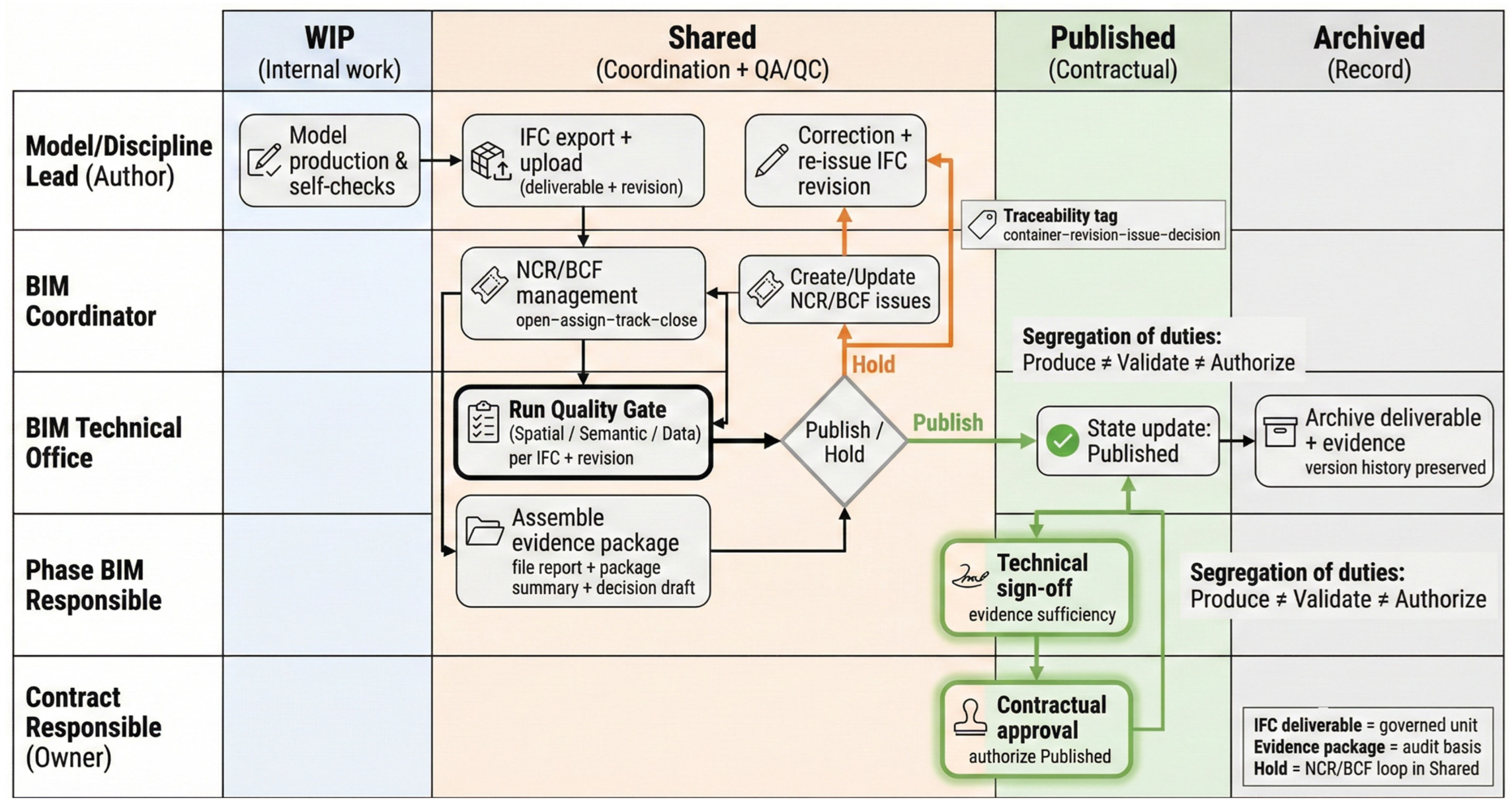
- Quality Gate execution (pre-Published): BIM Coordinator and/or BIM Technical Office, running the three blocks (spatial/semantic/data) and consolidating evidence.
- Phase technical sign-off: The phase BIM Responsible (design/construction/works supervision/FM, as applicable), validating correction and evidence sufficiency for the phase scope.
- Contractual authorization of Published: The Contract Responsible (FGV), approving Published after phase BIM sign-off, formalizing the contractual nature of the state.
3.7. CDE-Aligned Role Governance, Segregation of Duties, and an Auditable NCR/BCF Loop
4. Methodological Core: Longitudinal Crosswalk for Comparability
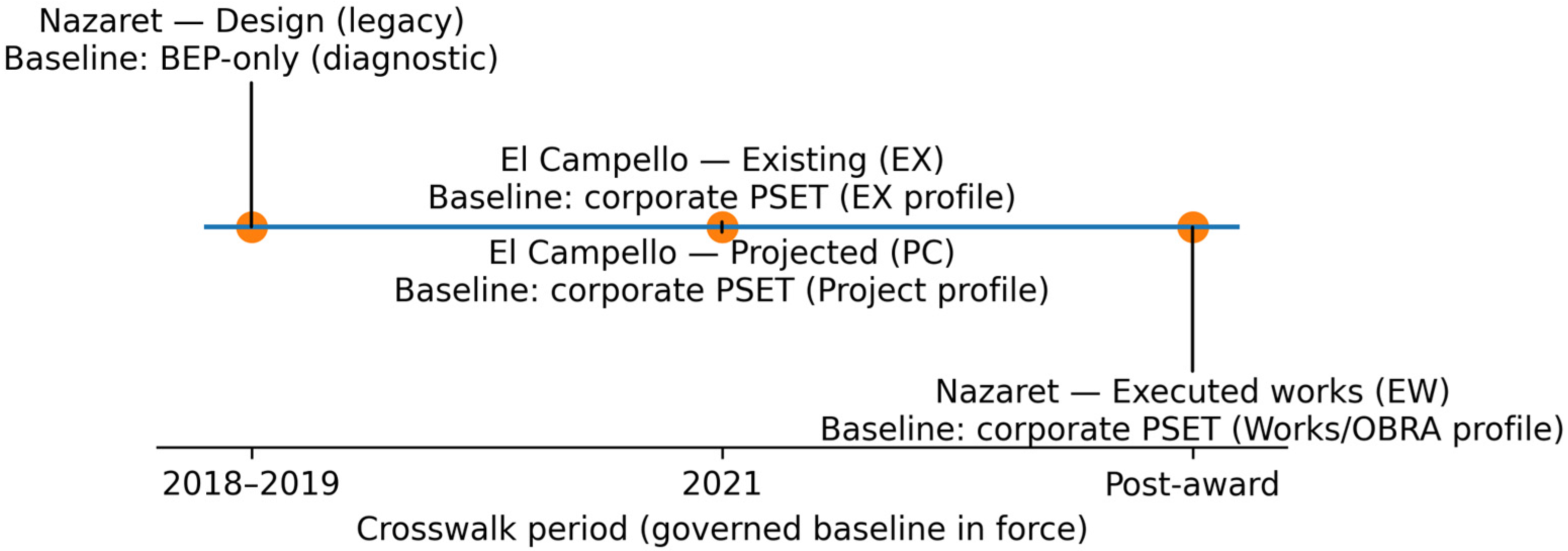
4.1. The 2018–2021 Crosswalk
4.2. Implications for Multi-Stage Deliveries and Continuity Towards FM
5. Results
6. Discussion
6.1. Why the Gate Must Be Placed Before Published
6.2. Why the Functional Unit (FU) Is Key to Sustaining PIM → AIM Continuity
6.3. What Risks Each Gate Covers
- Spatial risk (Spatial Gate). Interoperability and BIM-GIS/GeoBIM research consistently identifies georeferencing, reference alignment, and anchoring/orientation consistency as enabling conditions for reliable federation and downstream use: transformations, alternative representations (e.g., clipping), and tool-dependent handling of IFC geometry can introduce divergences that become systemic when models are federated or integrated with territorial systems [30,32,35]. Practice-oriented analyses of IFC further show that spatial consistency is not guaranteed by IFC exchange alone, particularly when heterogeneous contexts and scales must be reconciled across disciplines [19]. In hybrid railway assets—where linear packages (track, electrification, and urbanization) coexist with building-like domains—this risk is amplified; unstable referencing contaminates subsequent checks, undermines comparability across revisions, and makes federation intrinsically fragile. The Spatial Gate is therefore defined as a precondition for publishability (Section 3.4), preventing publication of information that is not federable due to reference inconsistency; evidence is generated per file and consolidated into the publish/hold decision (Section 3.5; Table 6).
- Semantic risk (Semantic Gate). State-of-the-art model checking and automated compliance checking increasingly leverage ontologies, semantic web approaches, and knowledge-based methods—often including knowledge graphs—because meaning cannot be inferred from geometry alone [15,16,18,28]. However, these approaches critically depend on robust IFC semantics in practice—consistent classification, stable entity typing, and the avoidance of semantic degradation into generic/proxy entities—which can undermine interpretability and reusability across tools and disciplines [19,29]. The Semantic Gate addresses the risk of meaning degradation during exchange; extensive use of proxies hinders interdisciplinary coordination, reduces reuse, and compromises downstream processes, particularly in linear/railway domains. The framework treats such degradation not as a minor technical detail but as a governance risk, requiring discipline-aware rules and nonconformity management within the QA/QC circuit prior to publication (Section 3.7; Figure 6).
- Data risk (Data Gate). BIM-FM research consistently shows that major handover friction stems from information quality and from misalignment between owner requirements and what is actually delivered, often resulting in incomplete or non-reusable handovers [10,33,36]. In response, more formal and machine-readable approaches have emerged to specify and validate information requirements—such as LOIN-based definitions and IDS-style requirements—supporting more automatable checking of delivered data [25,34]. However, these mechanisms do not replace governance; their effectiveness depends on being embedded in an ISO 19650 workflow with explicit accountability, CDE states, and persistent evidence per container/revision.The Data Gate therefore covers the risk that a deliverable may be geometrically correct yet insufficient for stage purposes and for continuity towards AIM/FM. The framework separates this dimension explicitly to avoid misleading diagnoses (“the model is wrong”) and to allocate NCRs to the appropriate loop (production, coordination, or validation), preserving traceability and corrective efficiency (Figure 5). This separation is reinforced through stage-specific profiles and longitudinal comparability via the crosswalk (Section 4; Table 8).
6.4. Transferability and International Adoption: A Practical Guide
- An ISO 19650-operational CDE workflow (states and metadata) with the ability to link evidence (reports, issues, and traces) to each container/deliverable.
- Actionable EIR/BEP provisions defining IFC deliverables as auditable units and establishing what “publish” means beyond uploading files, aligned with the EIR → BEP → CDE flow (Section 3.6).
- Asset structuring via a stable unit (e.g., Functional Units) connecting deliverables to operational scope and supporting PIM → AIM continuity (Section 3.7).
- Stage profiles (even minimal) enabling a meaningful Data Gate without unrealistic checklists; when available, this can progressively be supported by IDS-like approaches to formalize information requirements.
6.5. Threats to Validity
- Construct validity: Proxy usage (proxy_pct) is used as a conservative proxy for semantic degradation; however, it is influenced by authoring and exporter practices. Results should therefore be interpreted within the toolchain context.
- Internal validity: Deliverables belong to different phases and contracts; the longitudinal crosswalk is used to avoid biased comparisons across non-equivalent baselines. Nevertheless, uncontrolled confounders (team practices, BEP maturity, and contractual constraints) can affect outcomes.
- External validity: The empirical corpus is limited (N = 22 IFC deliverables from two depot cases); results demonstrate executability and governance feasibility, while generalization to other asset types or programs requires replication.
- Conclusion validity: Thresholds are operational boundaries; a ±10% sensitivity analysis indicates stable ranking and bottleneck identification (Appendix C), but borderline files may shift when parameters are tuned.
- Benefit measurement: Governance benefit is evidenced here as prevention of premature publication (14/22 files held under the gate) and as improved traceability (deliverable-linked evidence and NCR/BCF loop). Quantifying downstream impacts (e.g., rework reduction, schedule or cost) requires longitudinal project tracking beyond the scope of this article.
6.6. Limitations and Future Work
7. Conclusions
Author Contributions
Funding
Institutional Review Board Statement
Informed Consent Statement
Data Availability Statement
Acknowledgments
Conflicts of Interest
Abbreviations
| AIM | Asset Information Model |
| AIR | Asset Information Requirements |
| AIMP | Asset Information Management Plan |
| BCF | BIM Collaboration Format |
| BEP | BIM Execution Plan |
| BIM | Building Information Modeling |
| BS | British Standard |
| BSI | British Standard Institution |
| CDE | Common Data Environment |
| DF | Works Supervision |
| EIR | Employer’s Information Requirements |
| EW | Executed Works (asset state) |
| EX | Existing (asset state) |
| FGV | Ferrocarrils de la Generalitat Valenciana (Spain) |
| FM | Facility Management |
| FU | Functional Unit |
| GeoBIM | Geospatial BIM (BIM-GIS integration) |
| GIS | Geographic Information System |
| ID | Identifier |
| IDS | Information Delivery Specification |
| IFC | Industry Foundation Classes |
| ISO | International Organization for Standardization |
| KPI | Key Performance Indicator |
| LOIN | Level of Information Need |
| MAD | Median Absolute Deviation |
| MEP | Mechanical, Electrical and Plumbing |
| MVD | Model View Definition |
| NCR | Nonconformity Report |
| O&M | Operations and Maintenance |
| OIR | Organizational Information Requirements |
| PC | Projected (asset state) |
| PIM | Project Information Model |
| PSET | Property Set |
| QA/QC | Quality Assurance/Quality Control |
| RACI | Responsible, Accountable, Consulted, Informed |
| SAP | Systems, Applications and Products in Data Processing |
| UT | Technical Location (UBICACION TECNICA; corporate term) |
| WIP | Work In Progress |
Appendix A. File-Level Quality Gate Outputs

| Case | El Campello (L3) | |||||||||||
|---|---|---|---|---|---|---|---|---|---|---|---|---|
| State | Existing (EX) | |||||||||||
| Disc. | IFC File | Proxy_Pct (%) | Overall_I | di (m) | τ(Disc) (m) | TN Outlier (0/1) | Spatial_Pass (0/1) | Semantic_Pass (0/1) | Data_Pass (0/1) | All_Gates_Pass (0/1) | Decision | Fail Driver |
| EST | 19-117-L3_UTE_EX_F-Y-T005_MOD_EST.ifc | 10.87 | 0.50 | 0 | 5 | 0 | 1 | 1 | 1 | 1 | ACCEPT (Publish) | None (Pass) |
| GEN | 19-117-L3_UTE_EX_F-Y-T004_MOD_GEN.ifc | 60.55 | 0.45 | 0 | 20 | 0 | 1 | 0 | 1 | 0 | REJECT (Hold) | Semantic |
| GEN | 19-117-L3_UTE_EX_F-Y-T007_MOD_GEN.ifc | 86.3 | 0.44 | 0 | 20 | 0 | 1 | 0 | 1 | 0 | REJECT (Hold) | Semantic |
| VIA | 19-117-L3_UTE_EX_GEN_MOD_VIA.ifc | 100 | 0.31 | 4,319,766.28 | 20 | 0 | 0 | 0 | 0 | 0 | REJECT (Hold) | Mixed (Spatial + Semantic + Data) |
| State | Projected (PC) | |||||||||||
| DRE | 19-117-L3_UTE_PC_GEN_MOD_DRE.ifc | 15.46 | 0.61 | 0 | 20 | 0 | 1 | 1 | 1 | 1 | ACCEPT (Publish) | None (Pass) |
| EST | 19-117-L3_UTE_PC_GEN_MOD_EST.ifc | 4.04 | 0.65 | 0 | 5 | 0 | 1 | 1 | 1 | 1 | ACCEPT (Publish) | None (Pass) |
| GAL | 19-117-L3_UTE_PC_GEN_MOD_GAL.ifc | 100 | 0.25 | 4,319,766.28 | 5 | 0 | 0 | 0 | 0 | 0 | REJECT (Hold) | Mixed (Spatial + Semantic + Data) |
| ICO | 19-117-L3_UTE_PC_GEN_MOD_ICO.ifc | 72.41 | 0.63 | 0 | 5 | 0 | 1 | 0 | 1 | 0 | REJECT (Hold) | Semantic |
| IEL | 19-117-L3_UTE_PC_GEN_MOD_IEL.ifc | 50 | 0.61 | 0 | 5 | 0 | 1 | 0 | 1 | 0 | REJECT (Hold) | Semantic |
| IFS | 19-117-L3_UTE_PC_GEN_MOD_IFS.ifc | 19.84 | 0.57 | 0 | 5 | 0 | 1 | 1 | 0 | 0 | REJECT (Hold) | Data |
| ISC | 19-117-L3_UTE_PC_GEN_MOD_ISC.ifc | 31.8 | 0.60 | 0 | 5 | 0 | 1 | 1 | 1 | 1 | ACCEPT (Publish) | None (Pass) |
| OCE | 19-117-L3_UTE_PC_GEN_MOD_OCE_V01.ifc | 100 | 0 | 0 | 20 | 0 | 1 | 0 | 0 | 0 | REJECT (Hold) | Mixed (Semantic + Data) |
| VIA | 19-117-L3_UTE_PC_GEN_MOD_VIA.ifc | 100 | 0.63 | 4,319,766.28 | 20 | 0 | 0 | 0 | 1 | 0 | REJECT (Hold) | Mixed (Spatial + Semantic) |
| State | Executed Works | |||||||||||
| ARQ-URB-DRE | 19-112_TYP_COPL_F-Z-D005_MOD_ARQ-URB-DRE_VRR.ifc | 0.4 | 0.52 | 0 | 20 | 0 | 1 | 1 | 1 | 1 | ACCEPT (Publish) | None (Pass) |
| EST | 19-112_TYP_COPL_F-Z-D005_MOD_EST_VRR.ifc | 1.21 | 0.57 | 0 | 5 | 0 | 1 | 1 | 1 | 1 | ACCEPT (Publish) | None (Pass) |
| EST-PASARELA | 19-112_TYP_COPL_F-Z-D005_MOD_EST-PASARELA_VRR.ifc | 0 | 0.48 | 4,426,136,945.98 | 5 | 0 | 0 | 1 | 0 | 0 | REJECT (Hold) | Mixed (Spatial + Data) |
| ICO | 19-112_TYP_COPL_F-Z-D005_MOD_ICO_VRR.ifc | 7.46 | 0.53 | 0 | 5 | 0 | 0 | 1 | 0 | 0 | REJECT (Hold) | Mixed (Spatial + Data) |
| IEF-IEN-IEL | 19-112_TYP_COPL_F-Z-D005_MOD_IEF-IEN-IEL_VRR.ifc | 8.85 | 0.58 | 0 | 5 | 0 | 1 | 1 | 1 | 1 | ACCEPT (Publish) | None (Pass) |
| IFS-IME | 19-112_TYP_COPL_F-Z-D005_MOD_IFS-IME_VRR.ifc | 3.05 | 0.52 | 0 | 5 | 0 | 0 | 1 | 1 | 0 | REJECT (Hold) | Spatial |
| ISC | 19-112_TYP_COPL_F-Z-D005_MOD_ISC_VRR.ifc | 15.66 | 0.58 | 0 | 5 | 0 | 1 | 1 | 1 | 1 | ACCEPT (Publish) | None (Pass) |
| URB | 19-112_TYP_COPL_F-Z-D005_MOD_URB_V01.ifc | 100 | 0.68 | 4,430,725.06 | 20 | 0 | 0 | 0 | 1 | 0 | REJECT (Hold) | Mixed (Spatial + Semantic) |
| VIA | 19-112_TYP_COPL_F-Z-D005_MOD_VIA_V01.ifc | 100 | 0.69 | 4,430,725.06 | 20 | 0 | 0 | 0 | 1 | 0 | REJECT (Hold) | Mixed (Spatial + Semantic) |
| Case | El Campello (L3) | ||||||||||||
|---|---|---|---|---|---|---|---|---|---|---|---|---|---|
| State | Existing (EX) | ||||||||||||
| Disc. | IFC File | Schema | Scale | Origin Flag | GeoRef Pass (0/1) | Anchor Pass (0/1) | Anchor Dist (m) | Tol τ(Disc) (m) | TN Present (0/1) | TN Angle (Deg) | TN Dev (Deg) | TN Outlier (0/1) | Spatial_Pass (0/1) |
| GEN | 19-117-L3_UTE_EX_F-Y-T004_MOD_GEN.ifc | IFC2X3 | projected_m | projected_and_latlon | 1 | 1 | 0 | 20 | 1 | 0 | 0 | 0 | 1 |
| EST | 19-117-L3_UTE_EX_F-Y-T005_MOD_EST.ifc | IFC2X3 | projected_m | projected_and_latlon | 1 | 1 | 0 | 5 | 1 | 0 | 0 | 0 | 1 |
| GEN | 19-117-L3_UTE_EX_F-Y-T007_MOD_GEN.ifc | IFC2X3 | projected_m | projected_and_latlon | 1 | 1 | 0 | 20 | 1 | 0 | 0 | 0 | 1 |
| VIA | 19-117-L3_UTE_EX_GEN_MOD_VIA.ifc | IFC2X3 | projected_m | projected_geom_no_latlon | 0 | 0 | 4,319,766.28 | 20 | 0 | 0 | 0 | ||
| State | Projected (PC) | ||||||||||||
| DRE | 19-117-L3_UTE_PC_GEN_MOD_DRE.ifc | IFC2X3 | projected_m | projected_and_latlon | 1 | 1 | 0 | 20 | 1 | 0 | 0 | 0 | 1 |
| EST | 19-117-L3_UTE_PC_GEN_MOD_EST.ifc | IFC2X3 | projected_m | projected_and_latlon | 1 | 1 | 0 | 5 | 1 | 0 | 0 | 0 | 1 |
| GAL | 19-117-L3_UTE_PC_GEN_MOD_GAL.ifc | IFC2X3 | projected_m | projected_geom_no_latlon | 0 | 0 | 4,319,766.28 | 5 | 0 | 0 | 0 | ||
| ICO | 19-117-L3_UTE_PC_GEN_MOD_ICO.ifc | IFC2X3 | projected_m | projected_and_latlon | 1 | 1 | 0 | 5 | 1 | 0 | 0 | 0 | 1 |
| IEL | 19-117-L3_UTE_PC_GEN_MOD_IEL.ifc | IFC2X3 | projected_m | projected_and_latlon | 1 | 1 | 0 | 5 | 1 | 0 | 0 | 0 | 1 |
| IFS | 19-117-L3_UTE_PC_GEN_MOD_IFS.ifc | IFC2X3 | projected_m | projected_and_latlon | 1 | 1 | 0 | 5 | 1 | 0 | 0 | 0 | 1 |
| ISC | 19-117-L3_UTE_PC_GEN_MOD_ISC.ifc | IFC2X3 | projected_m | projected_and_latlon | 1 | 1 | 0 | 5 | 1 | 0 | 0 | 0 | 1 |
| OCE | 19-117-L3_UTE_PC_GEN_MOD_OCE_V01.ifc | IFC2X3 | projected_m | projected_and_latlon | 1 | 1 | 0 | 20 | 1 | 0 | 0 | 0 | 1 |
| VIA | 19-117-L3_UTE_PC_GEN_MOD_VIA.ifc | IFC2X3 | projected_m | projected_geom_no_latlon | 0 | 0 | 4,319,766.28 | 20 | 0 | 0 | 0 | ||
| Case | Nazaret (L10) | ||||||||||||
| State | Executed Works | ||||||||||||
| IEF-IEN-IEL | 19-112_TYP_COPL_F-Z-D005_MOD_IEF-IEN-IEL_VRR.ifc | IFC2X3 | projected_m | projected_and_latlon | 1 | 1 | 0 | 5 | 1 | 0 | 0 | 0 | 1 |
| IFS-IME | 19-112_TYP_COPL_F-Z-D005_MOD_IFS-IME_VRR.ifc | IFC2X3 | local | local_no_latlon | 0 | 1 | 0 | 5 | 1 | 0 | 0 | 0 | 0 |
| ISC | 19-112_TYP_COPL_F-Z-D005_MOD_ISC_VRR.ifc | IFC2X3 | local | latlon_but_local_geom | 1 | 1 | 0 | 5 | 1 | 0 | 0 | 0 | 1 |
| URB | 19-112_TYP_COPL_F-Z-D005_MOD_URB_V01.ifc | IFC2X3 | projected_m | projected_geom_no_latlon | 0 | 0 | 4,430,725.06 | 20 | 0 | 0 | 0 | ||
| VIA | 19-112_TYP_COPL_F-Z-D005_MOD_VIA_V01.ifc | IFC2X3 | projected_m | projected_geom_no_latlon | 0 | 0 | 4,430,725.06 | 20 | 0 | 0 | 0 | ||
| ARQ-URB-DRE | 19-112_TYP_COPL_F-Z-D005_MOD_ARQ-URB-DRE_VRR.ifc | IFC2X3 | projected_m | projected_and_latlon | 1 | 1 | 0 | 20 | 1 | 0 | 0 | 0 | 1 |
| EST | 19-112_TYP_COPL_F-Z-D005_MOD_EST_VRR.ifc | IFC2X3 | projected_m | projected_and_latlon | 1 | 1 | 0 | 5 | 1 | 0 | 0 | 0 | 1 |
| EST-PASARELA | 19-112_TYP_COPL_F-Z-D005_MOD_EST-PASARELA_VRR.ifc | IFC2X3 | projected_mm_or_large | projected_and_latlon | 1 | 0 | 4,426,136,945.979 | 5 | 1 | 0 | 0 | 0 | 0 |
| ICO | 19-112_TYP_COPL_F-Z-D005_MOD_ICO_VRR.ifc | IFC2X3 | local | local_no_latlon | 0 | 1 | 0 | 5 | 1 | 0 | 0 | 0 | 0 |
| Case | El Campello (L3) | ||||||||||
|---|---|---|---|---|---|---|---|---|---|---|---|
| State | Existing (EX) | ||||||||||
| Disc. | IFC File | Proxy_Pct (%) | Semantic_Pass (0/1) | Quadrant | Risk Class | Overall_I | Data_Core_Pass (0/1) | Data_Handover_Pass (0/1) | Data_Gate_Pass (0/1) | NoPK/Align (0/1) | All_Gates_Pass (0/1) |
| GEN | 19-117-L3_UTE_EX_F-Y-T004_MOD_GEN.ifc | 60.55 | 0 | Q2 High proxy/Low completeness (double risk) | DoubleRisk | 0.45 | 1 | 1 | 0 | 0 | |
| EST | 19-117-L3_UTE_EX_F-Y-T005_MOD_EST.ifc | 10.87 | 1 | Q4 Low proxy/Low completeness (needs improvement) | LowComp | 0.50 | 1 | 1 | 0 | 1 | |
| GEN | 19-117-L3_UTE_EX_F-Y-T007_MOD_GEN.ifc | 86.30 | 0 | Q2 High proxy/Low completeness (double risk) | DoubleRisk | 0.44 | 1 | 1 | 0 | 0 | |
| VIA | 19-117-L3_UTE_EX_GEN_MOD_VIA.ifc | 100 | 0 | Q2 High proxy/Low completeness (double risk) | DoubleRisk + NoPK/Align | 0.31 | 0 | 0 | 1 | 0 | |
| State | Projected (PC) | ||||||||||
| DRE | 19-117-L3_UTE_PC_GEN_MOD_DRE.ifc | 15.46 | 1 | Q4 Low proxy/Low completeness (needs improvement) | LowComp | 0.61 | 1 | 1 | 0 | 1 | |
| EST | 19-117-L3_UTE_PC_GEN_MOD_EST.ifc | 4.04 | 1 | Q4 Low proxy/Low completeness (needs improvement) | LowComp | 0.64 | 1 | 1 | 0 | 1 | |
| GAL | 19-117-L3_UTE_PC_GEN_MOD_GAL.ifc | 100 | 0 | Q2 High proxy/Low completeness (double risk) | DoubleRisk | 0.25 | 0 | 0 | 0 | 0 | |
| ICO | 19-117-L3_UTE_PC_GEN_MOD_ICO.ifc | 72.41 | 0 | Q2 High proxy/Low completeness (double risk) | DoubleRisk | 0.63 | 1 | 1 | 0 | 0 | |
| IEL | 19-117-L3_UTE_PC_GEN_MOD_IEL.ifc | 50 | 0 | Q2 High proxy/Low completeness (double risk) | DoubleRisk | 0.61 | 1 | 1 | 0 | 0 | |
| IFS | 19-117-L3_UTE_PC_GEN_MOD_IFS.ifc | 19.84 | 1 | Q4 Low proxy/Low completeness (needs improvement) | LowComp | 0.57 | 0 | 0 | 0 | 0 | |
| ISC | 19-117-L3_UTE_PC_GEN_MOD_ISC.ifc | 31.80 | 1 | Q4 Low proxy/Low completeness (needs improvement) | LowComp | 0.60 | 1 | 1 | 0 | 1 | |
| OCE | 19-117-L3_UTE_PC_GEN_MOD_OCE_V01.ifc | 100 | 0 | Q2 High proxy/Low completeness (double risk) | DoubleRisk | 0.00 | 0 | 0 | 0 | 0 | |
| VIA | 19-117-L3_UTE_PC_GEN_MOD_VIA.ifc | 100 | 0 | Q2 High proxy/Low completeness (double risk) | DoubleRisk | 0.63 | 1 | 1 | 0 | 0 | |
| State | Executed Works | ||||||||||
| IEF-IEN-IEL | 19-112_TYP_COPL_F-Z-D005_MOD_IEF-IEN-IEL_VRR.ifc | 8.85 | 1 | Q4 Low proxy/Low completeness (needs improvement) | LowComp | 0.58 | 1 | False | 1 | 0 | 1 |
| IFS-IME | 19-112_TYP_COPL_F-Z-D005_MOD_IFS-IME_VRR.ifc | 3.05 | 1 | Q4 Low proxy/Low completeness (needs improvement) | LowComp | 0.52 | 1 | False | 1 | 0 | 0 |
| ISC | 19-112_TYP_COPL_F-Z-D005_MOD_ISC_VRR.ifc | 15.66 | 1 | Q4 Low proxy/Low completeness (needs improvement) | LowComp | 0.58 | 1 | False | 1 | 0 | 1 |
| URB | 19-112_TYP_COPL_F-Z-D005_MOD_URB_V01.ifc | 100 | 0 | Q2 High proxy/Low completeness (double risk) | DoubleRisk | 0.68 | 1 | False | 1 | 0 | 0 |
| VIA | 19-112_TYP_COPL_F-Z-D005_MOD_VIA_V01.ifc | 100 | 0 | Q2 High proxy/Low completeness (double risk) | DoubleRisk | 0.69 | 1 | False | 1 | 0 | 0 |
| ARQ-URB-DRE | 19-112_TYP_COPL_F-Z-D005_MOD_ARQ-URB-DRE_VRR.ifc | 0.40 | 1 | Q4 Low proxy/Low completeness (needs improvement) | LowComp | 0.52 | 1 | False | 1 | 0 | 1 |
| EST | 19-112_TYP_COPL_F-Z-D005_MOD_EST_VRR.ifc | 1.21 | 1 | Q4 Low proxy/Low completeness (needs improvement) | LowComp | 0.57 | 1 | False | 1 | 0 | 1 |
| EST-PASARELA | 19-112_TYP_COPL_F-Z-D005_MOD_EST-PASARELA_VRR.ifc | 0 | 1 | Q4 Low proxy/Low completeness (needs improvement) | LowComp | 0.48 | 0 | False | 0 | 0 | 0 |
| ICO | 19-112_TYP_COPL_F-Z-D005_MOD_ICO_VRR.ifc | 7.45 | 1 | Q4 Low proxy/Low completeness (needs improvement) | LowComp | 0.53 | 0 | False | 0 | 0 | 0 |
| Case | State | Disc. | IFC File | 01_IDENT | 02_MED | 03_PROY | 05_OBRA | 07_ASBUILT | 08_SAP | 09_MANT |
|---|---|---|---|---|---|---|---|---|---|---|
| El Campello (L3) | Existing (EX) | GEN | 19-117-L3_UTE_EX_F-Y-T004_MOD_GEN.ifc | 1 | 0 | 0 | 0 | 0 | 0 | 0 |
| El Campello (L3) | Existing (EX) | EST | 19-117-L3_UTE_EX_F-Y-T005_MOD_EST.ifc | 1 | 0 | 0 | 0 | 0 | 0 | 0 |
| El Campello (L3) | Existing (EX) | GEN | 19-117-L3_UTE_EX_F-Y-T007_MOD_GEN.ifc | 1 | 0 | 0 | 0 | 0 | 0 | 0 |
| El Campello (L3) | Existing (EX) | VIA | 19-117-L3_UTE_EX_GEN_MOD_VIA.ifc | 0 | 0 | 0 | 0 | 0 | 0 | 0 |
| El Campello (L3) | Projected (PC) | DRE | 19-117-L3_UTE_PC_GEN_MOD_DRE.ifc | 1 | 1 | 1 | 0 | 0 | 0 | 0 |
| El Campello (L3) | Projected (PC) | EST | 19-117-L3_UTE_PC_GEN_MOD_EST.ifc | 1 | 1 | 1 | 0 | 0 | 0 | 0 |
| El Campello (L3) | Projected (PC) | GAL | 19-117-L3_UTE_PC_GEN_MOD_GAL.ifc | 1 | 0 | 0 | 0 | 0 | 0 | 0 |
| El Campello (L3) | Projected (PC) | ICO | 19-117-L3_UTE_PC_GEN_MOD_ICO.ifc | 1 | 1 | 1 | 0 | 0 | 0 | 0 |
| El Campello (L3) | Projected (PC) | IEL | 19-117-L3_UTE_PC_GEN_MOD_IEL.ifc | 1 | 1 | 1 | 0 | 0 | 0 | 0 |
| El Campello (L3) | Projected (PC) | IFS | 19-117-L3_UTE_PC_GEN_MOD_IFS.ifc | 1 | 0 | 1 | 0 | 0 | 0 | 0 |
| El Campello (L3) | Projected (PC) | ISC | 19-117-L3_UTE_PC_GEN_MOD_ISC.ifc | 1 | 1 | 1 | 0 | 0 | 0 | 0 |
| El Campello (L3) | Projected (PC) | OCE | 19-117-L3_UTE_PC_GEN_MOD_OCE_V01.ifc | 0 | 0 | 0 | 0 | 0 | 0 | 0 |
| El Campello (L3) | Projected (PC) | VIA | 19-117-L3_UTE_PC_GEN_MOD_VIA.ifc | 1 | 1 | 1 | 0 | 0 | 0 | 0 |
| Nazaret (L10) | Executed Works | IEF-IEN-IEL | 19-112_TYP_COPL_F-Z-D005_MOD_IEF-IEN-IEL_VRR.ifc | 1 | 1 | 1 | 1 | 0 | 0 | 0 |
| Nazaret (L10) | Executed Works | IFS-IME | 19-112_TYP_COPL_F-Z-D005_MOD_IFS-IME_VRR.ifc | 1 | 1 | 1 | 1 | 0 | 0 | 0 |
| Nazaret (L10) | Executed Works | ISC | 19-112_TYP_COPL_F-Z-D005_MOD_ISC_VRR.ifc | 1 | 1 | 1 | 1 | 0 | 0 | 0 |
| Nazaret (L10) | Executed Works | URB | 19-112_TYP_COPL_F-Z-D005_MOD_URB_V01.ifc | 1 | 1 | 1 | 1 | 1 | 0 | 0 |
| Nazaret (L10) | Executed Works | VIA | 19-112_TYP_COPL_F-Z-D005_MOD_VIA_V01.ifc | 1 | 1 | 1 | 1 | 1 | 0 | 0 |
| Nazaret (L10) | Executed Works | ARQ-URB-DRE | 19-112_TYP_COPL_F-Z-D005_MOD_ARQ-URB-DRE_VRR.ifc | 1 | 1 | 1 | 1 | 0 | 0 | 0 |
| Nazaret (L10) | Executed Works | EST | 19-112_TYP_COPL_F-Z-D005_MOD_EST_VRR.ifc | 1 | 1 | 1 | 1 | 0 | 0 | 0 |
| Nazaret (L10) | Executed Works | EST-PASARELA | 19-112_TYP_COPL_F-Z-D005_MOD_EST-PASARELA_VRR.ifc | 0 | 1 | 1 | 0 | 0 | 0 | 0 |
| Nazaret (L10) | Executed Works | ICO | 19-112_TYP_COPL_F-Z-D005_MOD_ICO_VRR.ifc | 0 | 1 | 1 | 1 | 0 | 0 | 0 |
Appendix B. Tool-Independent Computable Definitions and Diagnostic Breakdowns
Tool-Independent Per-File Gate Execution (Step-by-Step)
- Parse the IFC file to extract schema, metadata (Case × State, discipline), and geometric context.
- Compute Spatial Gate inputs: georeferencing/origin flags, file reference point (anchor), anchor distance to the package reference, TrueNorth angle and deviation, and geometry scale class.
- Compute Semantic Gate input: proxy_pct as the proportion of generic entities (IfcBuildingElementProxy/IfcProxy) among physical elements.
- Compute Data Gate input: verify presence of stage-specific core PSET groups (data_core_pass); compute overall_I as a continuous completeness KPI for monitoring (not used as a binary gate in this dataset).
- Evaluate spatial_pass, semantic_pass, data_pass and all_gates_pass (=spatial ∧ semantic ∧ data), and apply the discipline-aware NoPK/Align rule where applicable.
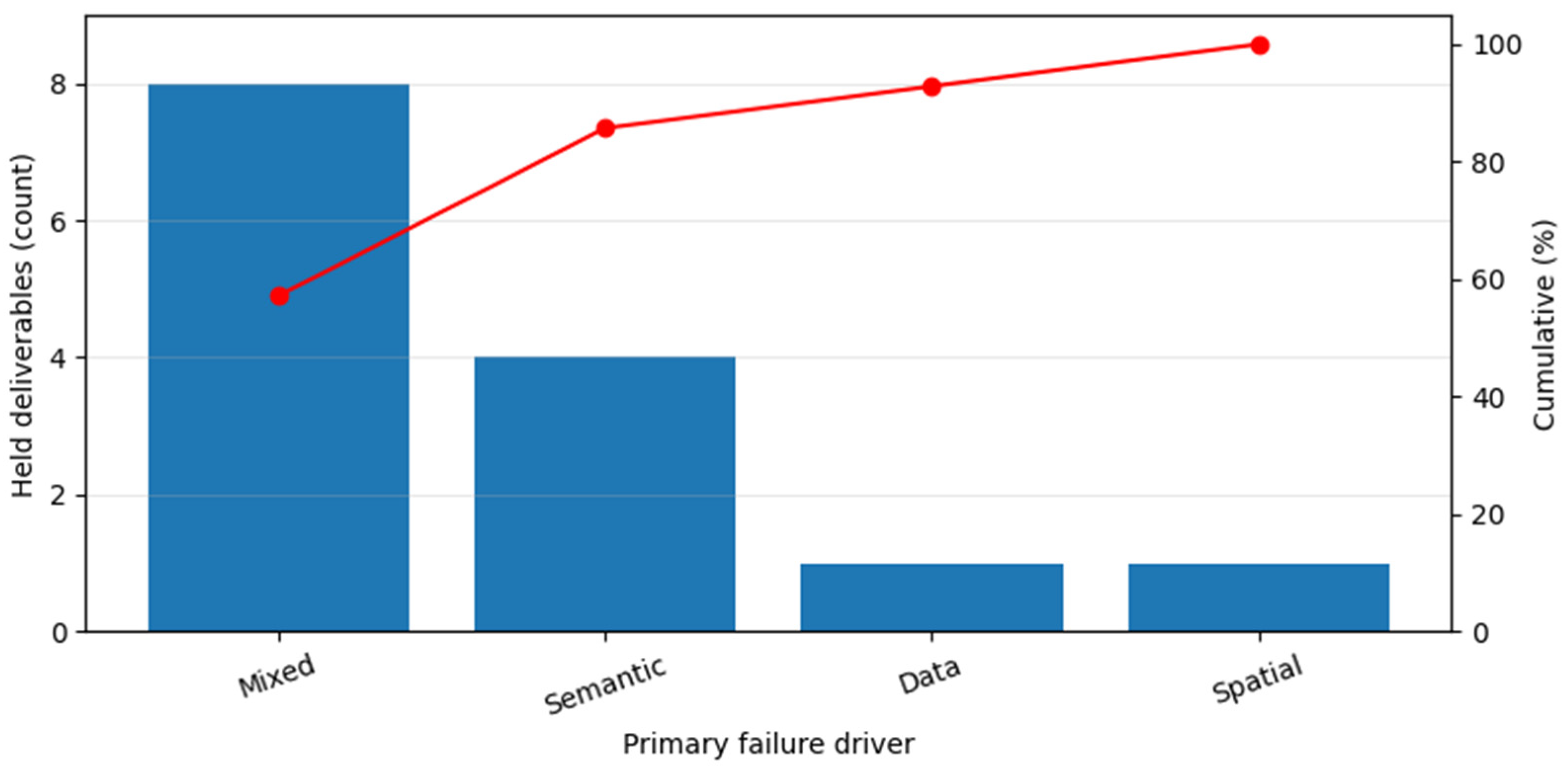
- Persist evidence in the CDE (file report, publish/hold decision record, and NCR/BCF traceability) and classify the primary failure driver (spatial/semantic/data/mixed).
| Output Field(s) | Computable Definition (Tool-Independent) | Used as | Where Reported |
|---|---|---|---|
| georef_pass, origin_flag | Georeferencing/origin presence and plausibility derived from IFC geometric context and site location (projected coordinates and/or lat/lon), excluding default/local placeholders. | Spatial Gate precondition | Appendix A (Table A2) |
| anchor_dist_m, tol_m, anchor_pass | Compute file reference point (anchor) and distance to package reference; anchor_pass = 1 if anchor_dist_m ≤ τ(disc), with τ(disc) = 5 m (building/MEP) or 20 m (linear/urban). | Spatial Gate (anchoring coherence) | Appendix A (Table A2) |
| true_north_angle_deg, tn_dev_deg, tn_outlier | Convert IfcGeometricRepresentationContext. TrueNorth to degrees; compute deviation to Case × State package median and flag robust outliers (MAD-based). | Spatial Gate (orientation coherence) | Appendix A (Table A2) |
| scale_class | Classify geometry scale regime for federation readiness (e.g., projected_m, local, projected_mm_or_large). | Spatial Gate (federation feasibility) | Appendix A (Table A2) |
| spatial_gate_pass | spatial_gate_pass = georef_pass ∧ anchor_pass ∧ ¬tn_outlier ∧ (scale_class ≠ projected_mm_or_large). | Spatial Gate binary outcome | Table 9; Appendix A (Table A2) |
| proxy_pct, semantic_gate_pass | proxy_pct = proxy_n/elements_n, where proxy_n counts generic entities (IfcBuildingElementProxy/IfcProxy) among physical elements; semantic_gate_pass = 1 if proxy_pct < 50%. | Semantic Gate (IFC semantic robustness) | Table 9; Appendix A (Table A3) |
| data_core_pass, data_gate_pass | Binary compliance with the stage-specific core PSET profile (data_gate_pass = data_core_pass), based on corporate group flags and required presence thresholds. | Data Gate binary outcome (publish/hold input) | Table 9; Appendix A (Table A3 and Table A4) |
| overall_I | Continuous completeness KPI (0–1) computed from required information fields; used for monitoring/diagnosis, not as a hard gate threshold in this dataset. | Data KPI (continuous) | Appendix A (Table A3) |
| quality_gate_pass, fail_driver | quality_gate_pass = spatial_gate_pass ∧ semantic_gate_pass ∧ data_gate_pass ∧ ¬NoPK/Align; fail_driver is classified from the set of failing blocks (spatial/semantic/data/mixed). | Publishability (All Gates Pass) and diagnosis | Table 9; Figure 7; Appendix A (Table A1) |
| Discipline Code | N (IFC) | Hold (Count) | Published (Count) | Hold (%) |
|---|---|---|---|---|
| VIA | 3 | 3 | 0 | 100 |
| GEN | 2 | 2 | 0 | 100 |
| ICO | 2 | 2 | 0 | 100 |
| EST-PASARELA | 1 | 1 | 0 | 100 |
| GAL | 1 | 1 | 0 | 100 |
| IEL | 1 | 1 | 0 | 100 |
| IFS | 1 | 1 | 0 | 100 |
| IFS-IME | 1 | 1 | 0 | 100 |
| OCE | 1 | 1 | 0 | 100 |
| URB | 1 | 1 | 0 | 100 |
| EST | 3 | 0 | 3 | 0.0 |
| ISC | 2 | 0 | 2 | 0.0 |
| ARQ-URB-DRE | 1 | 0 | 1 | 0.0 |
| DRE | 1 | 0 | 1 | 0.0 |
| IEF-IEN-IEL | 1 | 0 | 1 | 0.0 |
| Spatial Component | Fail Condition | Fail Count (N = 22) | Fail Count Among Hold (N = 14) | Interpretation |
|---|---|---|---|---|
| Georeferencing/origin | georef_pass = 0 | 7 | 7 | Absence or invalid georeferencing/origin information |
| Anchor distance | anchor_pass = 0 (anchor_dist_m > τ(disc)) | 6 | 6 | Misalignment to package reference beyond tolerance |
| TrueNorth coherence | tn_outlier = 1 | 0 | 0 | No outliers in this corpus |
| Extreme scale regime | scale_class = projected_mm_or_large | 1 | 1 | Geometry scale prevents federation |
| Case × State | Data | Mixed | Semantic | Spatial |
|---|---|---|---|---|
| El Campello (L3)—Existing (EX) | 0 | 1 | 2 | 0 |
| El Campello (L3)—Projected (PC) | 1 | 3 | 2 | 0 |
| Nazaret (L10)—Executed Works | 0 | 4 | 0 | 1 |
Appendix C. Threshold Robustness and ±10% Sensitivity Analysis
| Parameter | Baseline | −10% | +10% |
|---|---|---|---|
| Semantic threshold (proxy_pct < θ) | θ = 50% | θ = 45% | θ = 55% |
| Anchor tolerance (building/MEP) | τ = 5.0 m | τ = 4.5 m | τ = 5.5 m |
| Anchor tolerance (linear/urban) | τ = 20.0 m | τ = 18.0 m | τ = 22.0 m |
| Data KPI diagnostic threshold (overall_I ≥ θ_I) | θ_I = 0.80 | θ_I = 0.72 | θ_I = 0.88 |
| Case × State | Baseline | Sem θ = 45% | Sem θ = 55% | Tol −10% | Tol +10% |
|---|---|---|---|---|---|
| El Campello (L3)—Existing (EX) | 25.0 | 25.0 | 25.0 | 25.0 | 25.0 |
| El Campello (L3)—Projected (PC) | 33.3 | 33.3 | 44.4 | 33.3 | 33.3 |
| Nazaret (L10)—Executed Works | 44.4 | 44.4 | 44.4 | 44.4 | 44.4 |
Appendix D. Longitudinal Crosswalk Artifact CW-1 (Timeline + Baseline Table)

| Period | Case × State | Applicable Evaluation Baseline | Included in Corporate Compliance |
|---|---|---|---|
| 2018–2019 | Nazaret—Design (legacy) | BEP-only baseline (pre-corporate PSET; diagnostic) | No (diagnostic context) |
| 2021 | El Campello—Existing (EX) | Corporate PSET profile: Existing Infrastructure Models (EX) | Yes |
| 2021 | El Campello—Projected (PC) | Corporate PSET profile: Design/Project (PC) | Yes |
| Post-award | Nazaret—Executed Works (EW) | Corporate PSET profile: Works/OBRA (as-built/SAP/MANT where present) | Yes |
References
- Cavka, H.; Staub-French, S.; Poirier, E. Levels of BIM compliance for model handover. J. Inf. Technol. Constr. (ITcon) 2018, 23, 243–258. [Google Scholar]
- ISO 19650-1:2018; Organization and Digitization of Information About Buildings and Civil Engineering Works, Including Building Information Modelling (BIM)-Information Management Using Building Information Modelling-Part 1: Concepts and Principles. BSI Standards Limited: London, UK, 2018.
- UK BIM Framework. Information Management According to BS EN ISO 19650-Guidance Part 2: Processes for Project Delivery, 4th ed.; UK BIM Framework: London, UK, 2020. [Google Scholar]
- Godager, B.; Mohn, K.; Merschbrock, C.; Klakegg, O.; Huang, L. Towards an improved framework for enterprise BIM: The role of ISO 19650. J. Inf. Technol. Constr. (ITcon) 2022, 27, 1075–1103. [Google Scholar] [CrossRef] [Scilit]
- UK BIM Framework. Information Management According to BS EN ISO 19650-Guidance Part C: Facilitating the Common Data Environment (Workflow and Technical Solutions), 1st ed.; UK BIM Framework: London, UK, 2020. [Google Scholar]
- Abanda, F.; Balu, B.; Adukpo, S.; Akintola, A. Decoding ISO 19650 Through Process Modelling for Information Management and Stakeholder Communication in BIM. Buildings 2025, 15, 431. [Google Scholar] [CrossRef] [Scilit]
- ISO 19650-2:2018; Organization and Digitization of Information About Buildings and Civil Engineering Works, Including Building Information Modelling (BIM)-Information Management Using Building Information Modelling Part 2: Delivery Phase of the Assets. BSI Standards Limited: London, UK, 2018.
- ISO 19650-3:2020; Organization and Digitization of Information About Buildings and Civil Engineering Works, Including Building Information Modelling (BIM)-Information Management Using Building Information Modeling-Part 3: Operational Phase of Assets. BSI Standards Limited: London, UK, 2020.
- Ashworth, S.; Dillinger, M.; Körkemeyer, K. BIM guidance to optimize the operational phase: Defining information requirements based on ISO 19650. Facilities 2023, 41, 337–356. [Google Scholar] [CrossRef] [Scilit]
- Pärn, E.A.; Edwards, D.J.; Sing, M.C.P. The building information modelling trajectory in facilities management: A review. Autom. Constr. 2017, 75, 45–55. [Google Scholar] [CrossRef] [Scilit]
- Kiviniemi, A.; Codinhoto, R. Challenges in the implementation of BIM for FM-Case Manchester Town Hall Complex. In Computing in Civil and Building Engineering (2014); Engineers, A.S., Ed.; ASCE Press: Reston, VA, USA, 2014; pp. 665–672. [Google Scholar] [CrossRef] [Scilit]
- Leygonie, R.; Motamedi, A.; Iordanova, I. Development of quality improvement procedures and tools for facility management BIM. Dev. Built Environ. 2022, 11, 100075. [Google Scholar] [CrossRef] [Scilit]
- Eastman, C.; Lee, J.; Jeong, Y.; Lee, J. Automatic rule-based checking of building designs. Autom. Constr. 2009, 18, 1011–1033. [Google Scholar] [CrossRef] [Scilit]
- Greenwood, D.; Lockley, S.; Malsane, S.; Matthew, J. Automated compliance checking using building information models. In Proceedings of the Cobra 2010—Construction, Building and Real Estate Research Conference of the Royal Institution of Chartered Surveyors, Paris, France, 2–3 September 2010; pp. 266–274. [Google Scholar]
- Pauwels, P.; van den Bersselaar, E.; Verhelst, L. Validation of technical requirements for a BIM model using semantic web technologies. Adv. Eng. Inform. 2024, 60, 102426. [Google Scholar] [CrossRef] [Scilit]
- Jia, L.; Chen, M.; Chen, C.; Jin, Y. A semantic web and IFC-based framework for automated BIM compliance checking. Buildings 2025, 15, 2633. [Google Scholar] [CrossRef] [Scilit]
- Peng, J.; Liu, X. Automated code compliance checking research based on BIM and knowledge graph. Sci. Rep. 2023, 13, 7065. [Google Scholar] [CrossRef] [Scilit]
- Ma, Z.; Zhu, H.; Xiang, X.; Turk, Ž.; Klinc, R. Automatic compliance checking of BIM models against quality standards based on ontology technology. Autom. Constr. 2024, 166, 105656. [Google Scholar] [CrossRef] [Scilit]
- Noardo, F.; Arroyo Ohori, K.; Krijnen, T.; Stoter, J. An inspection of IFC models from practice. Appl. Sci. 2021, 11, 2232. [Google Scholar] [CrossRef] [Scilit]
- Andrich, W.; Daniotti, B.; Pavan, A.; Mirarchi, C. Check and validation of building information models in detailed design phase: A check flow to pave the way for BIM based renovation and construction processes. Buildings 2022, 12, 154. [Google Scholar] [CrossRef] [Scilit]
- Noardo, F.; Wu, T.; Arroyo Ohori, K.; Krijnen, T.; Stoter, J. IFC models for semi-automating common planning checks for building permits. Autom. Constr. 2022, 134, 104097. [Google Scholar] [CrossRef] [Scilit]
- buildingSMART International. What Do Facility Managers Need from BIM? (Industry Insight); buildingSMART International: Hertfordshire, UK, 2022; Available online: https://www.buildingsmart.org/wp-content/uploads/2022/05/Industry-Insight_What-do-Facility-Managers-Need-from-BIM.pdf (accessed on 19 January 2026).
- buildingSMART International. Information Delivery Specification (IDS) (Version 1.0); buildingSMART International: Hertfordshire, UK, 2024; Available online: https://www.buildingsmart.org/standards/bsi-standards/information-delivery-specification-ids/ (accessed on 19 January 2026).
- ISO 16739-1:2024; Industry Foundation Classes (IFC) for Data Sharing in the Construction and Facility Management Industries. International Organization for Standardization: Geneva, Switzerland, 2014.
- Akbas, E.; Bolpagni, M.; Borrmann, A.; Boeykens, S.; Mellenthin Filardo, M.; Liu, L.; Beetz, J. A holistic approach to information requirements: Integration of level of information need and information delivery specification. J. Inf. Technol. Constr. (ITcon) 2025, 30, 731–744. [Google Scholar] [CrossRef] [Scilit]
- Martínez-Soler, I.; Pastor-Villanueva, J.; Pérez-García, A.; Mateu-Gozálvez, D.; Loza-Remón, R.; García-Cerezo, J.A. IDS for the Verification of Project Information Requirements: A Case Study at Ferrocarrils de la Generalitat Valenciana. In Proceedings of EUBIM 2025-BIM International Conference/14th BIM Users Meeting, Valencia, Spain, 21–24 May 2025; Fuentes Giner, B., Oliver Faubel, I., Eds.; Editorial Universitat Politècnica de València: Valencia, Spain, 2025; pp. 271–280. [Google Scholar] [CrossRef] [Scilit]
- Ciribini, A.; Ventura, S.; Bolpagni, M. Informative content validation is the key to success in a BIM-based project. Territ. Ital. 2015, 2, 9–29. [Google Scholar] [CrossRef] [Scilit]
- Lee, Y. Rules and validation processes for interoperable BIM data exchange standards. J. Comput. Des. Eng. 2021, 8, 97–114. [Google Scholar] [CrossRef] [Scilit]
- Gerbino, S.; Cieri, L.; Rainieri, C.; Fabbrocino, G. On BIM interoperability via the IFC standard: An assessment from the structural engineering and design viewpoint. Appl. Sci. 2021, 11, 11430. [Google Scholar] [CrossRef] [Scilit]
- Noardo, F.; Harrie, L.; Arroyo Ohori, K.; Biljecki, F.; Ellul, C.; Krijnen, T.; Eriksson, H.; Guler, D.; Hintz, D.; Jadidi, M.A.; et al. Tools for BIM-GIS Integration (IFC Georeferencing and Conversions): Results from the GeoBIM Benchmark 2019. ISPRS Int. J. Geo-Inf. 2020, 9, 502. [Google Scholar] [CrossRef] [Scilit]
- Liu, X.; Wang, X.; Wright, G.; Cheng, J.; Li, X.; Liu, R. A state-of-the-art review on the integration of Building Information Modeling (BIM) and Geographic Information System (GIS). ISPRS Int. J. Geo-Inf. 2017, 6, 53. [Google Scholar] [CrossRef] [Scilit]
- Zhu, J.; Wang, X.; Chen, M.; Wu, P.; Kim, M. Integration of BIM and GIS: IFC geometry transformation to shapefile using enhanced open-source approach. Autom. Constr. 2019, 106, 102859. [Google Scholar] [CrossRef] [Scilit]
- Tsay, G.; Lin, Y.; Yuen, C. BIM for FM: Understanding information quality issues in terms of compliance with owner’s building information modeling requirements. Front. Built Environ. 2023, 9, 1117066. [Google Scholar] [CrossRef] [Scilit]
- Kładź, M.; Borkowski, A.S. IDS Standard and bSDD Service as Tools for Automating Information Exchange and Verification in Projects Implemented in the BIM Methodology. Buildings 2025, 15, 378. [Google Scholar] [CrossRef] [Scilit]
- Zhu, J.; Wu, P.; Chen, M.; Kim, M.; Wang, X.; Fang, T. Automatically processing IFC clipping representation for BIM and GIS integration at the process level. Appl. Sci. 2020, 10, 2009. [Google Scholar] [CrossRef] [Scilit]
- Otranto, R.B.; Junior, G.M.; Pellanda, P.C. BIM-FM integration through openBIM: Solutions for interoperability towards efficient operations. J. Inf. Technol. Constr. (ITcon) 2025, 30, 298–318. [Google Scholar] [CrossRef] [Scilit]


| Term/Concept | Definition (as Used in This Paper) | Operational Implication in the CDE Workflow |
|---|---|---|
| Hybrid railway asset (depot/workshop) | A facility where building/structure, MEP–industrial systems, and linear railway packages coexist and must be federated; coordination is driven by high-risk interfaces and multi-domain interoperability. | Requires interface-driven control; spatial, semantic, and data risks must be handled explicitly before publication. |
| CDE states (ISO 19650) | Controlled information states used to express maturity and permitted use: Work in Progress (WIP), Shared, Published, and Archived. | State transitions (especially Shared → Published) are treated as governed events supported by evidence and role-based authorization. |
| Publish/hold decision | A deliverable-level decision taken prior to the Shared → Published transition. “Publish” authorizes the IFC as fit for federation and contractual use; “hold” keeps it in Shared pending correction. | Transforms publication from an administrative action into an auditable act linked to a specific file revision and responsible roles. |
| Evidence package | Minimal persistent artifact set per deliverable/revision that justifies the publish/hold decision: file-level report, package summary, decision record, and NCR/BCF traceability. | Enables auditability (what was published/held, when, by whom, and based on which checks and issue closures). |
| Pre-Published Quality Gate | A governed checkpoint executed in Shared that evaluates three non-substitutable dimensions: spatial, semantic, and data. | All three blocks must pass to authorize publication; failures trigger NCR/BCF issues and re-issuance of a new revision. |
| Functional Unit (FU) | Operations-oriented breakdown unit used to structure hybrid assets and sustain PIM → AIM continuity; represented both at IFC element level and as CDE container metadata. | Stabilizes interface scope and enables traceable publication control and aggregation by functional scope across phases and revisions. |
| Approach Family (Representative) | Typical Focus and Outputs | Limitations for ISO 19650 Publish/Hold Governance | How the Proposed Framework Addresses the Gap |
|---|---|---|---|
| Rule-based model checking/automated compliance checking [13,14,18,20] | Executable rules applied to models/IFC; outputs as issue lists or technical reports. | Verification often treated as a technical activity detached from CDE states; decision responsibility and persistent evidence requirements are under-specified. | Embeds verification as a pre-Published Quality Gate within the CDE, producing a persistent evidence package and an auditable publish/hold decision with explicit roles. |
| Ontology/semantic web and knowledge-based compliance checking [15,16,17] | Formal requirement semantics and reasoning (queries, rule engines) to support interpretable checking. | Highly dependent on robust IFC semantics; governance integration (state meaning, accountability, correction closure) is frequently not operationalized. | Treats semantic robustness as a non-substitutable gate block; links fails to NCR/BCF closure and to governed state transitions without requiring full ontology adoption for every rule. |
| IDS/LOIN-based information requirement specification and validation [23,25,34] (incl. FGV IDS experience [26]) | Machine-readable information requirements over IFC; automated validation of attribute presence/values. | Adoption constraints (applicability strategies, tool variability) and lack of a standard decision/evidence layer to translate checks into contractual publication control. | Uses IDS where applicable but frames it as an artifact within an ISO 19650 decision circuit; results are persisted and translated into a publish/hold decision and a longitudinally comparable baseline (crosswalk). |
| IFC interoperability and GeoBIM benchmark studies [19,29,30] | Assessment of exchange robustness and georeferencing/read–write behavior across tools; diagnostic metrics. | Typically, diagnostic/benchmark-oriented rather than tied to governed deliverable publication events and responsibilities in a project CDE. | Operationalizes georeferencing, anchoring and tolerance checks as a Spatial Gate applied per deliverable/revision before Published, with evidence stored per container. |
| BIM–FM handover frameworks and information-quality criteria [10,11,12,33,36] | Definition of operational information needs and quality criteria; handover matrices and guidelines. | Frequently documentary; lacks an executable, auditable mechanism to enforce requirements during design/construction and to preserve decision history. | Implements stage-specific Data Gate profiles plus Functional Units (FU) to stabilize asset structuring and support PIM → AIM continuity through governed publication. |
| ISO 19650 guidance on CDE workflows and state-based governance [3,5,6] | State logic (WIP/Shared/Published/Archive), naming, responsibilities and information management processes. | Does not prescribe concrete, computable multi-dimensional Quality Gates nor a minimal evidence package at deliverable level. | Operationalizes Shared → Published as a governed event supported by computable gates, a minimal evidence package, and traceable roles/approvals stored in the CDE. |
| Case | State | N (IFC) | Discipline/Package Codes (Count) | Selection Unit and Extraction Point |
|---|---|---|---|---|
| El Campello (L3) | Existing (EX) | 4 | GEN (2), EST (1), VIA (1) | One IFC file per deliverable and revision; extracted from CDE Shared as the candidate revision for Shared → Published. |
| El Campello (L3) | Projected (PC) | 9 | DRE, EST, GAL, ICO, IEL, IFS, ISC, OCE, VIA (1 each) | One IFC file per deliverable and revision; extracted from CDE Shared as the candidate revision for Shared → Published. |
| Nazaret (L10) | Executed Works (EW) | 9 | ARQ-URB-DRE, EST, EST-PASARELA, ICO, IEF-IEN-IEL, IFS-IME, ISC, URB, VIA (1 each) | One IFC file per deliverable and revision; extracted from CDE Shared as the candidate revision for Shared → Published. |
| Requirement (EIR/AIR/BEP) | Operational Artifact (What Is Executed) | Evidence Persisted in the CDE | Accountable Role(s) (Implementation Context) | Affected CDE State/Transition | |
|---|---|---|---|---|---|
| 1 | EIR/BEP: Delivery rules, roles, acceptance, and publication governance | Approved BEP + gate RACI + evidence package definition | Versioned BEP + approval record | Phase BIM Responsible (sign-off) + Contract Responsible (owner approval) | Establishes conditions for Shared → Published |
| 2 | EIR/BEP: Container requirements (naming, minimum metadata, revision) | “Container readiness” checklist (discipline, phase, package, revision, author/organization) | Container validation log + reference in decision record | BIM Technical Office/BIM Coordinator (execution) | Shared → hold if noncompliant |
| 3 | Proposed contribution: FU as CDE container metadata (governance by functional structure) | Mandatory FU (container) rule + format/validity checks | FU (container) validation log + BCF/NCR issues if missing/invalid | BIM Technical Office/BIM Coordinator (execution) + Phase BIM Responsible (sign-off) | Shared → hold if FU (container) missing/invalid |
| 4 | AIR/BEP: FU/UT coherence in IFC to sustain PIM → AIM | FU (container) → FU (IFC elements) coherence rule + UT element-level verification (where applicable) | Data-check report (FU/UT) + element/scope-traceable BCF issues | BIM Technical Office/BIM Coordinator (execution) + Model/Discipline Lead (correction) | Shared → hold until corrected |
| 5 | BEP/EIR: Spatial coherence for federation (anchoring/orientation/georeferencing, as applicable) | Spatial Gate (interdisciplinary spatial coherence and linear-package alignment) | Spatial report per IFC + BCF issues | BIM Technical Office/BIM Coordinator (execution) + Model/Discipline Lead (correction) | Shared → Published (hold if failed) |
| 6 | BEP/EIR: Minimum semantics and interpretability (typing, proxies, classification) | Semantic Gate (typing, proxy control; IDS where applicable) | Semantic report per IFC + BCF/NCR issues | BIM Technical Office/BIM Coordinator (execution) + Model/Discipline Lead (correction) | Shared → Published (hold if failed) |
| 7 | Protocol/BEP: Issue and nonconformity management | NCR/BCF workflow (open–assign–close–re-verify) with container-revision traceability | BCF tracker + NCR log with status, owners, and dates | BIM Coordinator (management) + Discipline Leads (resolution) | Remains in Shared until closure |
| 8 | EIR: Acceptance criteria and contractual decision | Consolidation of results (spatial/semantic/data) + decision record creation | Publish/hold decision record + fail driver + evidence package references | Phase BIM Responsible (sign-off) + Contract Responsible (owner approval) | Authorizes Published or enforces hold |
| 9 | Minimum evidence per deliverable (auditability) | Evidence package assembly per container/revision | {File report, package summary, decision record, BCF/NCR references} persisted in CDE | BIM Technical Office (assembly) + Phase BIM Responsible (validation) | Precondition for Published |
| 10 | Multi-phase delivery (design–construction–supervision–FM): Longitudinal continuity and auditability | Re-issuance and re-verification rule: Each new revision repeats the procedure and preserves history | Longitudinal audit trail of decisions and evidence by phase/revision | Corresponding Phase BIM Responsible | Shared → Published per contractual milestone |
| Rule/Gate Block | Indicator | Threshold/Decision Criterion | Calculation Method (Tool-Independent) | Decision Reached |
|---|---|---|---|---|
| Semantic Gate (typing) | proxy_pct | proxy_pct < 50% | Compute the proportion of generic/proxy entities (IfcBuildingElementProxy/IfcProxy) among physical elements in the IFC deliverable. | semantic_pass = 1 else 0 |
| Spatial Gate (georeferencing) | georef_pass | Georeferencing/origin information present and consistent | Check presence/consistency of origin and georeferencing fields needed for federation (e.g., IfcSite/representation context metadata). | georef_pass = 1 else 0 |
| Spatial Gate (anchoring) | anchor_dist_m | anchor_dist_m ≤ τ(disc), with τ = 5 m (building/MEP) and τ = 20 m (linear/urbanization) | Compute Euclidean distance between the file reference point and the package reference a_ref for the Case × State package. | anchor_pass = 1 else 0 |
| Spatial Gate (orientation) | TrueNorth_outlier | No outlier within the Case × State package | Extract TrueNorth orientation and flag robust outliers within the package (orientation must be coherent across federated deliverables). | tn_pass = 1 else 0 |
| Spatial Gate (scale) | scale_ok | Not in an extreme geometry scale regime that prevents federation | Classify geometry scale regime (e.g., unit/extent anomalies) and flag deliverables that cannot be reliably federated. | scale_ok = 1 else 0 |
| Spatial Gate (composite) | spatial_pass | spatial_pass = georef_pass ∧ anchor_pass ∧ tn_pass ∧ scale_ok | Boolean aggregation of the spatial sub-conditions above. | spatial_pass = 1 else 0 |
| Data Gate (core attributes) | data_core_pass | Stage-specific core PSET profile satisfied | Evaluate presence/validity of the required property set (PSET) groups for the delivery state under the corporate rule set. | data_pass = 1 else 0 |
| Discipline-aware additional rule | NoPK/Align | Applied where relevant: pass if required linear referencing/alignment metadata are present | For linear/track-related deliverables, flag files lacking the package-specific stationing/chainage (PK) and/or alignment reference required for coordination. | If NoPK/Align = 1 → hold |
| Quality Gate decision (pre-Published) | all_gates_pass | all_gates_pass = spatial_pass ∧ semantic_pass ∧ data_pass (and NoPK/Align where applicable) | Boolean aggregation of gate outcomes (non-substitutable dimensions). overall_I is reported as a diagnostic KPI but not used as a hard threshold. | If all_gates_pass = 1 → publish; else → hold |
| Element | Minimum Field | Purpose Within the Framework (Traceability/Continuity/Audit) |
|---|---|---|
| Deliverable metadata (CDE) | Unique deliverable identifier (container ID) | Unambiguous linkage of evidence and decision to a specific IFC deliverable. |
| Deliverable metadata (CDE) | Discipline | Contextualize rules, responsibilities, and verification by technical scope. |
| Deliverable metadata (CDE) | Phase/milestone (design, construction, as-built) | Align the deliverable with stage purpose and BEP requirements. |
| Deliverable metadata (CDE) | Container state (WIP/Shared/Published, per ISO 19650) | Govern state transitions and preserve the technical–contractual meaning of Published. |
| Deliverable metadata (CDE) | Revision (code) and date | Ensure reproducibility: evidence is tied to a specific deliverable version. |
| Deliverable metadata (CDE) | Author (person/role) and responsible organization | Assign accountability and support decision auditing. |
| Deliverable metadata (CDE) | Package/contractual scope | Enable aggregation and control by delivery packages. |
| Deliverable metadata (CDE)—proposed contribution | Functional Unit (FU) of the container | Elevate functional structuring to a governance key: enable FU-based aggregation, auditing, and publish/hold decisions; link to FU declared at IFC element level to support PIM → AIM continuity. |
| Recommended metadata | Export software and version (and preset/configuration, if applicable) | Support root-cause analysis for exchange/interoperability issues. |
| Recommended metadata | File integrity fingerprint (e.g., hash) | Unambiguously identify the audited IFC version when the CDE does not provide an internal container ID. |
| IFC data (element level) | Functional Unit (FU) of the element | Support AIM continuity: ensure operational meaning is encoded in IFC and verifiable per object; enable consistency checks FU (CDE container) → FU (IFC elements). |
| IFC data (element level) | Technical Location (UT) (corporate naming) | Link objects to the maintenance/operational breakdown structure; support O&M use and handover auditing; complements FU for operational interpretation. |
| Evidence (gate output) | File-level report | Auditable record of verification results and findings linked to the IFC (per block: spatial/semantic/data). |
| Evidence (gate output) | Package-level summary | Support coordination decisions and follow-up by discipline/phase/FU. |
| Evidence (gate output) | publish/hold decision record | Turn checking into a governance act and justify the Shared → Published or hold transition for the container/revision. |
| Nonconformities (CDE) | NCR/BCF issue log: issue ID; deliverable + revision; discipline/FU; description; responsible; status; dates | Close the correction loop in Shared without breaking traceability; enable assignment, closure, re-issuance, and audit of corrective actions. |
| Traceability (CDE) | Persistent links: IFC → file report → package summary → NCR/BCF → decision record → state | Retrospective reconstruction: what was published, when, by whom, with which evidence, and which issues were resolved. |
| Evidence package (CDE) | {file report, package summary, decision record, NCR/BCF references) per container/revision | Define the minimum persistent artifact set supporting contractual audit and PIM → AIM continuity; objective basis for publish/hold. |
| Activity (Gate/CDE) | Model/ Discipline Author (Lead) | Phase BIM Responsible (Design/Construction/Works Supervision/FM) | BIM Coordinator/ BIM Technical Office | Works Supervision/ Engineer of Record (If Applicable) | Contract Responsible (Owner) |
|---|---|---|---|---|---|
| 1. Model production/update in WIP (native) | R | A | C | C | I |
| 2. IFC export and upload to Shared (deliverable + revision) | R | A | C | C | I |
| 3. Quality Gate execution in Shared (spatial/semantic/data) | C | C | R | C | I |
| 4. Evidence package generation (reports + decision draft) | C | C | R | I | I |
| 5. NCR/BCF issue creation and assignment (if HOLD) | C | A | R | C | I |
| 6. NCR closure verification and gate re-run | C | A | R | C | I |
| 7. Technical sign-off for publication | I | A/R | C | C | I |
| 8. Contractual authorization Shared → Published | I | C | I | C | A/R |
| 9. Archiving and preservation of revisions (Archived) | I | A | R | I | C |
| Period | Case/State | Promoter Info Standard | Evaluation Basis | Included in Corporate Compliance (Yes/No) |
|---|---|---|---|---|
| 2018–2019 | Nazaret—Design (legacy) | Pre-corporate PSET (no FGV PSET enforced) | BEP requirements (discipline/structure); no corporate PSET compliance scoring | No (reported as temporal crosswalk) |
| 2021 | El Campello—Existing (EX) | FGV corporate PSET available (EX profile) | PSET for “Existing Infrastructure Models” | Yes |
| 2021 | El Campello—Projected (PC) | FGV corporate PSET available (Project profile) | PSET for “Design/Project” | Yes |
| Post-award | Nazaret—Executed Works (EW) | FGV corporate PSET available (Works profile) | PSET for ‘OBRA’ incl. OBRA/As-built/SAP/MANT where present | Yes |
| Case | State | N (IFC) | Spatial Gate Pass (%) | Semantic Gate Pass (%) | Data Gate (Core PSET) Pass (%) | All Gates Pass (%) | NoPK/Align Rate (%) |
|---|---|---|---|---|---|---|---|
| El Campello | Existing (EX) | 4 | 75.0 | 25.0 | 75.0 | 25.0 | 25.0 |
| El Campello | Projected (PC) | 9 | 77.8 | 44.4 | 66.7 | 33.3 | 0.0 |
| Nazaret | Executed Works (EW) | 9 | 44.4 | 77.8 | 77.8 | 44.4 | 0.0 |
| Decision Logic (Hypothetical) | Publishable (Count) | Publishable (%) | Definition (For Illustration) |
|---|---|---|---|
| Data-only | 16 | 72.7 | Publish if data_pass = 1; ignores spatial and semantic blocks. |
| Spatial-only | 14 | 63.6 | Publish if spatial_pass = 1; ignores semantic and data blocks. |
| Semantic-only | 12 | 54.5 | Publish if semantic_pass = 1; ignores spatial and data blocks. |
| All Gates Pass (proposed criterion) | 8 | 36.4 | Publish only if spatial_pass = 1 AND semantic_pass = 1 AND data_pass = 1 (and, where applicable, NoPK/Align). |
Disclaimer/Publisher’s Note: The statements, opinions and data contained in all publications are solely those of the individual author(s) and contributor(s) and not of MDPI and/or the editor(s). MDPI and/or the editor(s) disclaim responsibility for any injury to people or property resulting from any ideas, methods, instructions or products referred to in the content. |
© 2026 by the authors. Licensee MDPI, Basel, Switzerland. This article is an open access article distributed under the terms and conditions of the Creative Commons Attribution (CC BY) license.
Share and Cite
García, J.A.; Toledo, I.; Aragonés, L.; Bañón, L. A CDE-Centered Quality Gate Framework to Operationalize ISO 19650 Governance in Hybrid Railway Depots. Appl. Sci. 2026, 16, 2562. https://doi.org/10.3390/app16052562
García JA, Toledo I, Aragonés L, Bañón L. A CDE-Centered Quality Gate Framework to Operationalize ISO 19650 Governance in Hybrid Railway Depots. Applied Sciences. 2026; 16(5):2562. https://doi.org/10.3390/app16052562
Chicago/Turabian StyleGarcía, Juan A., Ignacio Toledo, Luis Aragonés, and Luis Bañón. 2026. "A CDE-Centered Quality Gate Framework to Operationalize ISO 19650 Governance in Hybrid Railway Depots" Applied Sciences 16, no. 5: 2562. https://doi.org/10.3390/app16052562
APA StyleGarcía, J. A., Toledo, I., Aragonés, L., & Bañón, L. (2026). A CDE-Centered Quality Gate Framework to Operationalize ISO 19650 Governance in Hybrid Railway Depots. Applied Sciences, 16(5), 2562. https://doi.org/10.3390/app16052562