Article

Real-Time Inertia Estimation and Adaptive-Model-Predictive-Control-Based Virtual Inertia Support for Frequency Control in Low-Inertia Systems


Department of Electrical Engineering, Faculty of Electrical and Electronics Engineering, Istanbul Technical University, 34469 Istanbul, Türkiye
Appl. Sci. 2026, 16(4), 2161; https://doi.org/10.3390/app16042161
Submission received: 22 January 2026 / Revised: 20 February 2026 / Accepted: 21 February 2026 / Published: 23 February 2026

Abstract

This study presents adaptive virtual inertia strategy supported by a model-predictive-control (MPC)-based real-time inertia estimation method. The proposed approach aims to mitigate frequency stability problems caused by low inertia in isolated power systems with high penetration of photovoltaics. The system inertia is estimated using frequency measurements obtained from phasor measurement unit. Based on the obtained real-time inertia information, the PI gains ( K p and K i ) in load frequency control unit and virtual inertia gain ( K v i ) are updated simultaneously via MPC-based adaptive mechanism. In the first scenario, it was shown that under 10% PV penetration, the system inertia decreased from 5.00 s to 4.54 s, and the system became more sensitive to load changes. The proposed adaptive battery energy storage system support shows that a load change of 0.1 p.u. results in a response of 0.079 p.u. in 0.17 s. The adaptive BESS response raises frequency nadir from 49.6892 Hz to 49.9635 Hz, improving maximum frequency deviation by 88.25%. In the second scenario, it was observed that method maintained its stability even when the system inertia dropped to 3.33 s in 10–50% PV penetration range. This study presents integrated and innovative frequency control strategy for modern isolated power systems.

1. Introduction

The integration of renewable energy sources into electric power systems is rapidly increasing globally. The environmentally friendly and sustainable nature of these sources is the primary motivation for their preference in line with decarbonization goals. However, the high level penetration of renewable energy sources into the system presents critical challenges in terms of grid stability due to their low system inertia and variable generation characteristics [1,2].
These challenges become more pronounced as traditional synchronous power plants are replaced by non-synchronous generation sources, such as photovoltaic systems and wind turbines [3,4]. This leads to a decrease in the total equivalent inertia of the system, making the grid more sensitive and vulnerable to frequency changes [5].
Power systems with low inertia exhibit a high sensitivity to disruptive effects such as load changes or failures; this narrows the stable operating limits of the system and seriously threatens frequency stability [6].
In [7], a low-inertia structure was created by integrating solar power plant (PV) and wind turbine (WT) units into a power system containing a thermal power plant with an ANFIS-based controller, and then a battery energy storage system (BESS) was added to this system. In addition, the effects of low and high penetration levels of solar and wind power on frequency control were investigated on an IEEE 39-bus test system consisting of four area. In [8], the frequency response of a two-area test system with a thermal power plant in each area was analyzed by integrating a PV in the first area and a WT plant in the second area. In [9], an optimization-based frequency control approach was proposed for low-inertia power systems with high penetration of renewable energy sources.
In such a situation, integrating energy storage systems with fast dynamic response to support sources with variable generation characteristics into the grid stands out as a critical solution to increase system stability and improve frequency dynamics.
In [10], the effects on both frequency and voltage control were investigated by integrating a PV system, a wind turbine, and a BESS into an IEEE 9-bus test system. In [11], it was shown that adding a BESS to the system under low-inertia conditions reduced the rate of change of frequency (RoCoF) value and improved the frequency response. In [12], PV and WT sources were added to a power system with distributed generators, and a superconducting magnetic energy storage system (SMES) was used as the storage unit. It was shown that the system containing SMES supported by a PID controller offered a better frequency response. In [13], it was shown that integrating BESS and SMES into a multi-area power system reduced RoCoF and improved the frequency response. Similarly, it was reported that adding a supercapacitor (SC) to a low-inertia grid resulted in a significant improvement in frequency response in [14].
In addition, virtual inertia support provided through energy storage systems artificially increases the equivalent inertia level of the system [15]. In this way, the frequency response of low-inertia power systems to sudden load changes is improved and their dynamic stability is strengthened [16].
In [17], virtual inertial support was provided by integrating a BESS into a power system consisting of WT, PV and thermal power plants. In [18], a hybrid energy storage structure was added to a low-inertial power system, and it was shown that the frequency response of the system was significantly improved thanks to virtual inertial support.
However, the inclusion of renewable energy sources into the system and the dynamic changes in penetration rates necessitate the consideration of power systems with a dynamic approach instead of classical static models [19]. In this context, the accurate and precise estimation of the equivalent inertia value, one of the fundamental parameters determining the instantaneous frequency response of the system, under changing operating conditions is a critical requirement [20,21,22].
This study aims to estimate the dynamic inertia of a power system with integrated PV generation in real time using an extended-Kalman-filter (EKF)-based approach. In this process, system frequency is measured at a high sampling rate through phasor measurement units (PMUs). The EKF algorithm suppresses measurement noise in the PMU data and estimates the instantaneous inertia of the system, and this dynamic information is transferred to a model predictive control (MPC) framework. Based on the updated system model, the MPC generates an optimal solution and adaptively updates the controller parameters ( K p and K i ) at each sampling step.
Furthermore, within the scope of virtual inertia support provided by the integrated BESS, the virtual inertia gain coefficient ( K v i ) is also dynamically optimized within the MPC–EKF structure. This integrated framework significantly enhances the frequency response of the system, which is otherwise vulnerable under low-inertia operating conditions.
The main contributions of this study to the literature are as follows:
  • A comprehensive dynamic modeling framework is developed for an isolated microgrid suffering from low inertia due to high penetration of photovoltaic generation.
  • The dynamic equivalent inertia of the system is estimated in real time using an EKF method based on PMU measurements.
  • An adaptive virtual inertia strategy is proposed in which, instead of using a fixed gain, the virtual inertia gain ( K v i ) is determined in real time by the EKF according to the instantaneous inertia requirements of the system through the BESS.
  • An adaptive control structure is introduced in which the conventional PI controller parameters ( K p and K i ) are updated by the MPC at each sampling instant based on the dynamic information provided by the EKF.
  • The superiority of the proposed MPC–EKF hybrid framework in minimizing frequency deviations and the RoCoF under sudden load disturbances is demonstrated while explicitly considering physical system constraints such as BESS capacity and generation limits.
The remainder of this paper is organized as follows. Section 2 presents the modeling of the isolated power system and formulates the problem. Section 3 describes the proposed estimation and control methodology. Section 4 reports the simulation studies and discusses the obtained results. Finally, Section 5 concludes the paper and summarizes the main findings.

2. Isolated Power System Modeling and Problem Definition

This section details the dynamic modeling process of the test model for the isolated power system that forms the basis of the study, as well as the low-inertia problem encountered in such systems. The high-level integration of inverter-based resources, such as solar energy, leads to a reduction in the system’s equivalent inertia [23]. This condition has critical and adverse effects on the system’s frequency response to disturbances [24].
In addition, the theoretical framework of virtual inertia support required to enhance the dynamic resilience of the system is presented. In this context, the architectural structure and main components of the test system are first examined.

2.1. Test Model

The isolated power system analyzed in this study consists of a conventional non-reheat thermal generation unit, a PV system and a battery energy storage system (BESS) as a virtual inertia support. The overall configuration of the system is presented in Figure 1.
According to Figure 1, the thermal power generation unit is modeled as consisting of a governor and turbine dynamics. Load disturbances are modeled as step load perturbation (SLP) to simulate the disturbing effects in the system. For example, the frequency dynamics and transient response of the system were analyzed under a load increase of 0.1 p.u. applied at t = 2 s.
The most critical focus of this study is the inertial mechanism that changes with the integration of PV systems into the grid. A significant portion of existing studies in the literature assumes that the total equivalent inertia constant H remains constant, even when different generation sources are incorporated into the system. However, in a real power system, every change in the generation mix causes the total equivalent inertia to vary instantaneously. Ignoring this fact leads to the design of control systems that are effectively blind, being detached from the actual physical conditions of the system. Therefore, the real-time estimation of the total equivalent inertia is a critical requirement for ensuring the system’s dynamic security.
Under low-inertia conditions, BESS units with fast dynamic response are incorporated to maintain the system’s frequency stability against sudden load variations. In the proposed configuration, the BESS not only performs energy balancing but also enhances the frequency nadir and improves the system’s dynamic robustness through the virtual inertia support it provides.

2.2. Low and Dynamic Inertia

In modern power systems, the equivalent inertia of the system ( H s y s ) is a dynamic parameter that varies depending on the generation units with different inertia values in the system [25,26].
The fundamental expression known in the literature as the swing equation, which determines the frequency stability of the system, is given in Equation (1):
P m P D = d 0 ,   5 J ω g 2 d t = J ω g d ω g d t    
where P m represents the change in mechanical power, P D represents the load disturbance, J represents the moment of inertia (kg·m2) and ω g represents the angular velocity (rad/s). According to this equation, when the power balance between generation and consumption in the system is disrupted, the rotor speed changes. Thus, frequency deviations occur in the system.
The system’s initial response to these changes is the “inertial response” and the system’s inertial constant (H) is defined as follows:
H = J ω g 2 2 S s y s
where H represents the inertia value in seconds (s) and S s y s represents the base power value of the system. The inertia value of the system acts as a buffer against disturbing effects, absorbing or slowing down frequency variations. However, the inertia value of the system changes with the integration of different generation units, especially renewable energy sources. According to Figure 1, the isolated power system consists of three different generation units: a non-reheating thermal generation unit, a PV, and BESS-based virtual inertia and loads. In the proposed isolated power system, the net power change ( P n e t ), along with the dynamic contributions of the different units included in the system, can be formulated as follows:
P n e t = P m + P P V ± P V I P D  
where P P V represents the output power change of the PV system and P V I represents the virtual inertial support provided through the BESS. Depending on the operating mode of the battery (discharge/charge), this support injects or draws power from the system, and the sign changes accordingly.
In an isolated power system, the equivalent inertia value of the system changes with the different generation sources integrated into the system. In a low-inertia power system, the rate of frequency change increases [27,28]. Thus, more oscillatory responses are given that are more vulnerable to load changes. The relationship between the inertia value of the system and the rate of frequency change (RoCoF) is defined below:
2 H S s y s f . d f d t = P m P L  
where df/dt represents RoCoF, which indicates the rate of frequency change of the system. In this study, system frequency f and RoCoF are obtained from the PMU measurements and the inertia constant H is estimated indirectly by exploiting the swing-equation relationship in Equation (4). Specifically, H is modeled as an unknown state parameter within the EKF framework and is recursively updated online using the PMU-based frequency measurements.
In an isolated power system, the total equivalent inertia value is calculated using the following equation:
H e q = i = 1 n S D G i S s y s × H D G i
where H e q is the equivalent inertia of the system. S D G i and H D G i are the power and inertia values of the ith generation unit, respectively. S s y s is the base power value of the system, and n is the total number of generation units in the system.
According to Equation (5), the constant of inertia ( H D G i ) of each new unit integrated into the system directly changes the total equivalent inertia ( H e q ) of the system. Specifically, high penetration of PV systems without rotating mass ( H P V = 0   s ) into the power system causes the system to be in a low-inertia situation. This situation can make the grid more vulnerable to load changes. Thus, it can lead to the unnecessary tripping of protection relays. Thus, virtual inertia support is needed to maintain frequency stability in low-inertia systems. Furthermore, real-time estimation of the system’s dynamic inertia value has become essential.

2.3. Virtual Inertia

In low-inertia isolated power systems, virtual inertia support is applied to improve the system’s frequency response. In this study, BESS-based virtual inertia support was preferred due to its fast dynamic response capability.
The additional power support provided to the system via virtual inertia support is defined below:
τ V I d P V I ( t ) d t + P V I t = K V I t ·   d f ( t ) d t
where P V I represents the power change provided by the virtual inertia support, and K V I t represents the virtual inertia gain. Unlike traditional approaches, this parameter is updated in real-time and adaptively based on EKF-based inertia estimation. τ V I is the time constant of the first-order virtual inertia dynamics and models the response limitation of the converter/control loop (not a pure time delay).
In this study, the time delay of a BEDS unit with a lithium-ion battery was accepted as 200 ms, which is consistent with the literature and a realistic value. A saturation block has been added to the control structure of the BEDS unit to protect its hardware capacity and operational safety. In this context, the power supply provided by the virtual inertia unit is limited to a range of ±0.2 p.u. This value indicates that reserve power of approximately 20% of the system’s base power is allocated to virtual inertia. This limitation prevents battery overload and deep discharge, while guaranteeing stable operation of the control system within physical limits.

3. Proposed Control and Estimation Methodology

The real-time inertia value of the system was estimated using an extended Kalman filter method. The controller ( K p and K i ) and virtual inertia ( K v i ) gain parameters are updated with an adaptive control structure based on these estimation results.

3.1. Real-Time Inertia Estimation with EKF

In the first stage, the frequency measurement data set is collected from the PMU device. The measurement data obtained from the PMU device are described below [29]:
z m e a s , k = h x k + v k
where z m e a s , k represents the measurement data collected from the PMU device at time k. x k is the state vector of the system, consisting of the frequency change and inertia value. h x k represents the nonlinear relationship between the state vector and the measurement data. v k represents the noise in the measurement. PMU measurement data is obtained by adding some noise to the raw frequency measurement data, and the equation is expressed below:
v k N 0 , R ,   R = σ 2 = 0.001
According to Equation (8), the measurement noise covariance is assumed to be 0.001 and added to the raw measurement. This noise value represents the measurement tolerance of the PMU device or electromagnetic interference.
The state vector of the system is defined below:
x k = f k H e q , k
The discrete-time model of the system is created as follows:
f k = f k 1 + f 0 2 H e q , k 1 · ( P m , k 1 + P P V , k 1 ± P V I , k 1 P L , k 1 D f k 1 ) · t
where the sampling time t is assumed to be 0.01 s and the expression ( P m , k 1 + P P V , k 1 ± P V I , k 1 P L , k 1 D f k 1 ) represents the net power, i.e., the accelerating power, and will be denoted as P a c c , k 1 in the subsequent equations.
H e q , k = H e q , k 1 + w H , k 1  
Thus, Equation (9) can be rewritten as follows:
x k = f k H e q , k = f k 1 + f 0 t 2 H ^ k . P a c c , k 1 H e q , k 1 + w k 1    
The equation can be translated into a Jacobian matrix as follows:
A k = f x x ^ k = 1 D t 2 H ^ k f 0 t P a c c , k 2 H ^ k 2 0 1  
The nonlinear dynamic structure of the system has been linearized at each operating point using the Jacobian matrix A k given in Equation (13). In this way, the model has been made suitable for the parameter estimation process of the Kalman filter.
The extended Kalman filter based on the Jacobian matrix consists of two main stages: the time update (prediction) and the measurement update (correction). The time-update (prediction) stage is expressed in Equations (14) and (15) below.
x ^ k = f x ^ k 1 , u k 1
P k = A k P k 1 A k T + Q  
The prior error covariance P k obtained in the estimation phase is used as the basic input in calculating the Kalman gain K k in Equation (16). This gain determines the weighting balance between the PMU measurement noise level R and the reliability of the model. The measurement update (correction) phase is expressed in Equations (16) and (17) below.
K k = P k H o b s T ( H o b s P k H o b s T + R ) 1
x ^ k = x ^ k + K k z m e a s , k H o b s x ^ k  
The H o b s observation matrix in Equation (16) assumes that the PMU device measures only the frequency deviation information in the system. Accordingly, the expanded form of the matrix is expressed as H o b s = 1   0 .
In this study, the prediction is performed using the state vector, whose expanded form is given below.
x ^ k = x ^ 1 , k x ^ 2 , k = ^ f k H ^ k  
Here, the frequency variation is filtered and noise-removed using a prediction vector. Additionally, the real-time inertia value of the system is estimated.
^ f k = ^ f k + K 1 , k z m e a s , k ^ f k  
H ^ e s t = H ^ k = H ^ k 1 + K 2 , k       z m e a s , k   ^ f k 1 +     f 0 t P a c c , k 1 2 H ^ k 1  
Equation (20) shows that the equivalent inertia estimate H ^ e s t , which cannot be measured directly in the system, is updated every t = 0.01 s depending on the frequency innovation error. The selected t is sufficiently small relative to the system time constants ( T g , T t and τ V I ) to capture abrupt load changes. The time-dependent inertia estimation obtained in this way forms the basic input for the adaptive control strategy presented in the next section.

3.2. Inertia-Aware Model Predictive Control

Model predictive control (MPC) is a method that predicts the future behavior of a system using a model representing the current system and calculates an optimal control signal accordingly [30,31]. In this study, the internal model of MPC is continuously updated with the real-time inertia estimation ( H ^ e s t ) obtained from the EKF. With this approach, the system gains a dynamic control capability in cases where inertia changes over time.
MPC uses the following discrete-time state–space model at each sampling step:
x k + 1 = A d H ^ e s t x k + B d H ^ e s t u k
where the A d and B d matrices depend on the inertia estimate obtained from Equation (20). u k is the control signal generated by the MPC to correct the imbalance between production and consumption in the system (virtual inertia support). The state–space matrices of the system are updated by being re-linearized at each step depending on the inertia estimate of the physical model:
A d = 1 D t 2 H ^ e s t
B d = f 0 t 2 H ^ e s t
Thus, MPC modifies the control signal by predicting that the RoCoF will increase under low-inertial conditions. The MPC method minimizes the following objective function ( J ) to minimize frequency deviation.
J = i = 1 N p Q · f ^ ( k + i | k ) 2 + i = 0 N c 1 R · u ( k + i | k ) 2          
where N p is the prediction horizon and N c is the control horizon. The weighting matrices Q and R ensure a balance between frequency stability and energy cost.
In this study, N p is assumed to be 20, so that the MPC predicts the state of the system 0.2 s later at each step, given a sampling time of 0.01 s. N c must be adjusted such that N c N p . However, in this study, since a decision must be made for the next step at each stage, the value of N c is accepted as 2. The weighting coefficients Q and R determine the trade-off between frequency regulation performance and control effort. Increasing Q leads to faster frequency containment at the expense of larger control actions, whereas increasing R results in smoother control signals with slower recovery. In this study, the coefficients were selected based on maintaining acceptable frequency deviation, respecting the actuator/BESS power constraint ∣ P V I ∣ ≤ 0.2 p.u., and minimizing overshoot and settling time. Accordingly, Q = 0.5 and R = 0.1 were chosen to achieve a balanced dynamic response.
Based on the instantaneous inertia estimate provided by Equation (20), it is observed that the B d coefficient in Equation (23) automatically increases as the inertia decreases. This increase raises the weight of the error term in Equation (24) in the cost function, allowing the MPC algorithm to update the control signal u k faster and more effectively.

3.3. Adaptive Control Structure

In conventional control structures, the gain parameters K p and K i of the PI controller, as well as the gain parameter K v i of the virtual inertia support, are typically tuned offline and kept constant during operation. However, in isolated microgrids, the penetration level of renewable energy sources varies over time, leading to changes in the system’s equivalent inertia. As the equivalent inertia decreases, the system becomes more vulnerable to disturbances. Therefore, by exploiting the inertia estimates provided by the EKF layer, the controller gain parameters should be made adaptive and updated online.
A change rate that enables this adaptive behavior of the controllers is defined below:
h r a t i o k = H n o m H ^ e s t ( k )    
where H n o m is the baseline inertia value of the system at the design stage. H ^ e s t ( k ) is the current inertia value estimated by the EKF at time k. If the physical inertia in the system decreases, the h r a t i o value becomes greater than 1, signaling that the controller needs to operate more aggressively. The gains of the PI controller and the virtual inertia (VI) support, which regulate the system frequency response, are updated in real time by weighting them with the h r a t i o coefficient. This adaptive mechanism aims to eliminate the steady-state frequency error and improve the settling time. Accordingly, the PI controller gains are updated as follows:
K p k = K p , n o m · h r a t i o k
K i k = K i , n o m · h r a t i o k
In order to balance the power drawn from the BESS unit and improve the frequency nadir, the K v i gain is updated as follows:
K v i k = K V I , n o m · h r a t i o k
Thus, thanks to the H ^ e s t information from the EKF and the h r a t i o coefficient calculated based on this information, the gain parameters of the controllers are adaptively updated to match the changes in inertia in the system.
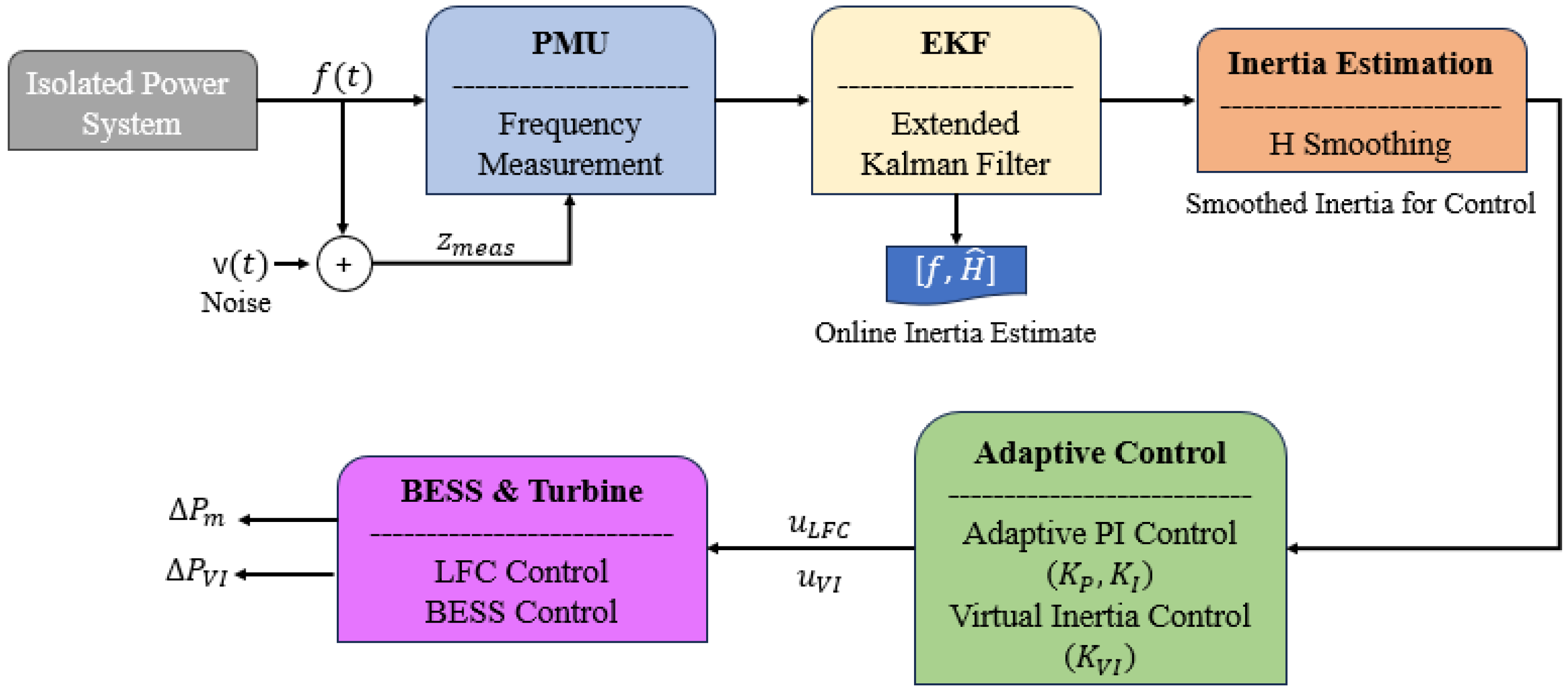
The MPC algorithm uses the estimated inertia value to update the matrices ( A d and B d ) in its internal model, while the adaptive structure presented in Section 3.3 proactively scales the classical controller gains using the same estimation information ( h r a t i o ). Thus, the system provides a double layer of protection against low-inertia conditions through both model-based optimization and dynamic gain updates.
The hierarchical architecture and inter-unit interactions of the proposed inertia-sensitive adaptive control strategy are illustrated in Figure 2.

4. Simulation Results

In this section, the performance of the proposed EKF-based dynamic inertia estimation and adaptive control strategy is tested on a diesel generator-based isolated power system. As the penetration of PV systems increases in isolated power systems, the overall physical inertia decreases, rendering the frequency response more sensitive to load variations and pushing the system closer to its stability limits. The performance analysis of the proposed algorithm is carried out using MATLAB R2025a/Simulink. All simulations are executed on a computer equipped with an Intel® Core™ i7-12700H processor (2.30 GHz base frequency) and 64 GB RAM.
A comprehensive simulation scenario was devised to investigate the dynamic behavior of the system. Initially, a 0.1 p.u. step load perturbation (SLP) was applied at t = 2   s while only the diesel generator was in operation, and the base-case frequency response was observed. To alter the inertia characteristics of the system, the PV unit was activated at t = 20   s . Subsequently, a second 0.1 p.u. load perturbation was introduced at t = 25   s to evaluate the system response under reduced inertia conditions.
Within this variable-structure framework, an EKF is employed to track the physical inertia of the system in real time. To emulate realistic field conditions, Gaussian noise is superimposed on the frequency measurements obtained from the PMU. Using these noisy measurements, the EKF estimates the instantaneous inertia and transmits it to the control layer. Based on these estimates, both the PI controller gains ( K p   a n d   K i ) for load frequency control and the virtual inertia gain ( K v i ) provided by the BESS are adaptively updated in accordance with the system dynamics. As a result, frequency deviations and RoCoF are effectively mitigated, particularly under low-inertia conditions, thereby enhancing overall system stability.
The main simulation and control parameters adopted in this study are listed in Table 1 for completeness and reproducibility.
The simulation scenarios considered in this study, including the generation configurations, load disturbance events and PV penetration levels, are summarized in Table 2.

4.1. 10% PV Penetration

In this scenario, a 10% PV penetration was added to the test system, which initially had only the diesel generator in operation, at t = 20   s . With the PV integration, the total physical inertia of the system decreased from 5.00 s to 4.54 s. The simulation studies are summarized below:
  • t = 2   s : A step load change (SLP) of 0.1 p.u was applied when only the DG unit was present in the system. At this stage, the physical inertia of the system was 5.00 s.
  • t = 20   s : PV penetration of 10% was added to the system, reducing the total inertia to 4.54 s.
  • t = 25   s : In the new system configuration with reduced inertia, a second 0.1 p.u. SLP was applied to monitor the system’s response under low-inertia conditions.
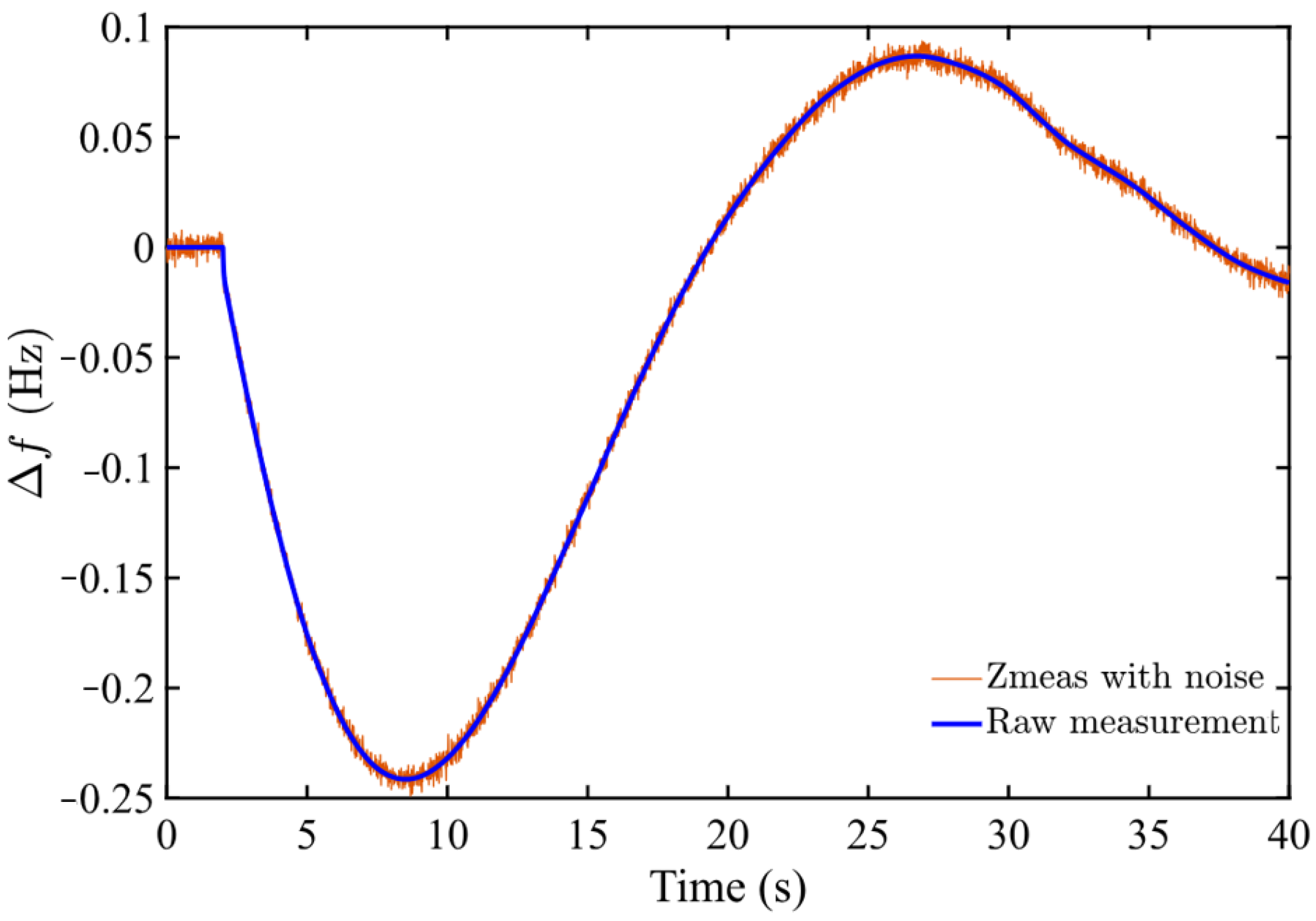
The reduced physical inertia made the system’s frequency response to load changes more sensitive and reduced the stability margin. To mitigate these negative effects, BESS-based virtual inertial control (VIC) was integrated into the system. The EKF method was used to estimate the dynamic inertia in the system. EKF estimates the instantaneous inertia value ( H ^ ) by cleaning noisy frequency data from the PMU device with a high sampling rate. Figure 3 presents the noisy measurement data ( Z m e a s ) collected from the PMU.
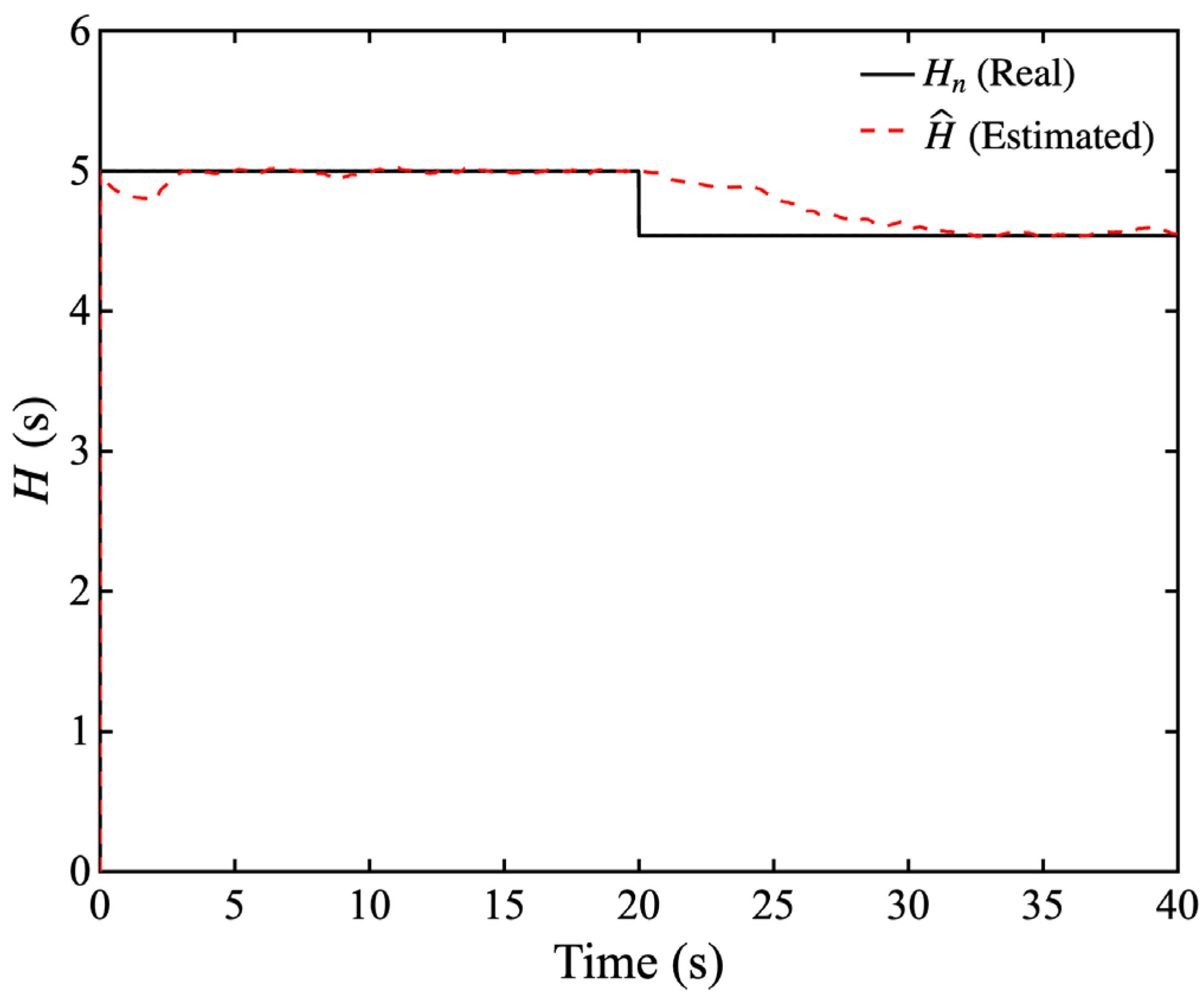
The EKF utilizes the PMU measurement data shown in Figure 3 to filter out measurement noise and estimate the system inertia. As illustrated in Figure 4, the EKF successfully captures variations in the system’s dynamic structure and provides real-time estimates of the inertia value H ^ .
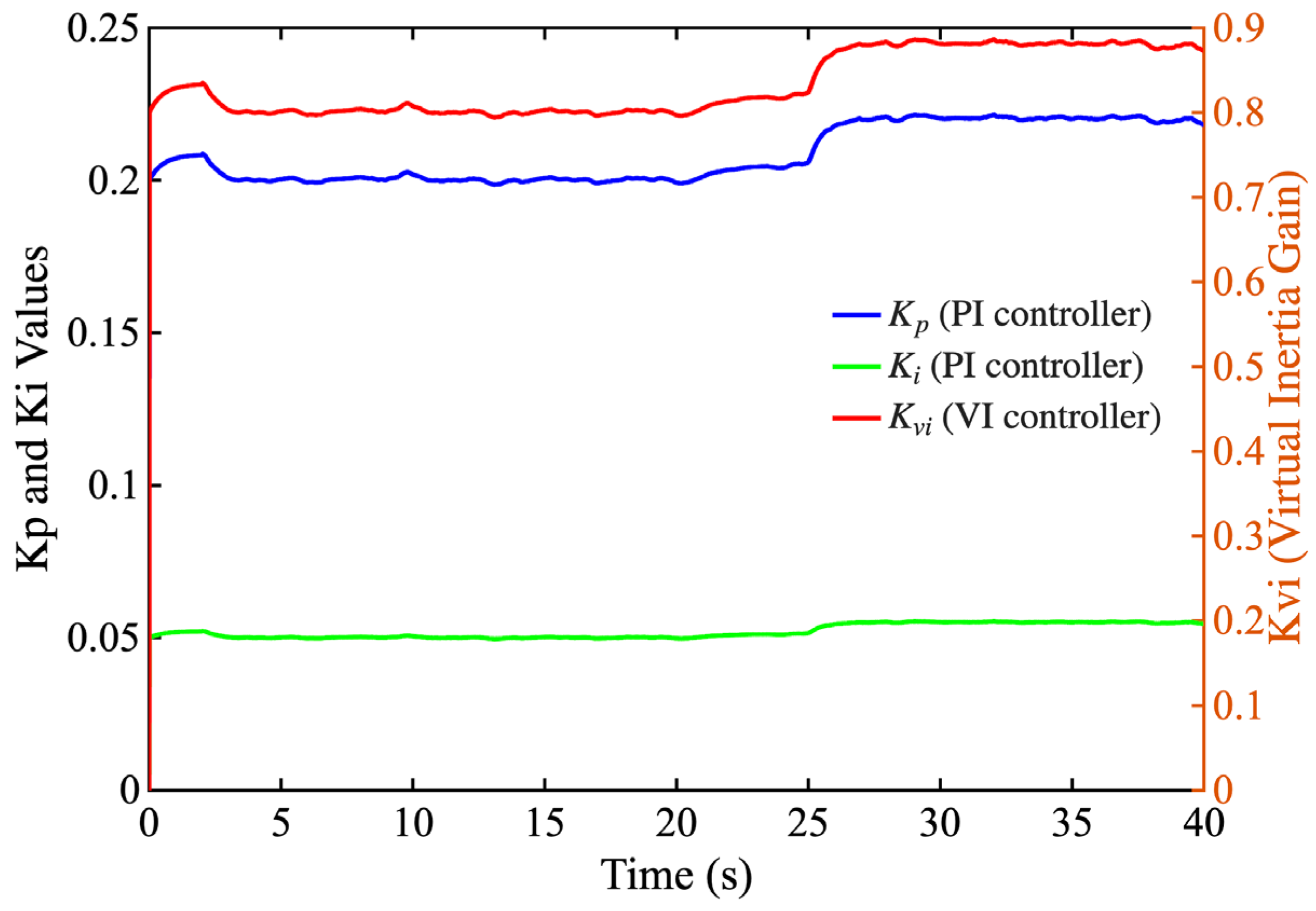
According to Figure 4, the EKF method used for dynamically structured models can successfully and accurately estimate the true inertia value. Following the inertia estimation, the PI controller gains ( K p   a n d   K i ) providing load-frequency control and the VI controller gain ( K v i ) providing virtual inertia support are adaptively updated according to this estimated value to improve the system’s dynamic response capability. The parameter changes performed by the adaptive controller to adapt to the load changes at t = 2   s and t = 25   s are shown in Figure 5.
According to Figure 5, the controller structures used in the system adaptively change to maintain a stable frequency response. Although no major changes were observed in the controller parameters, rapid adaptation to load changes is evident. The final values reached by the controllers at the end of the simulation are approximately K p = 0.2205 ,     K i = 0.0551 and K v i = 0.8820 .
To improve the frequency response, BESS-based virtual inertia support is implemented in the system. Virtual inertia support is critical, especially in systems with high PV penetration, when the system operates under low-inertia conditions. Otherwise, frequency protection relays may be activated in rare frequency events caused by load disturbances, leading to system protection.
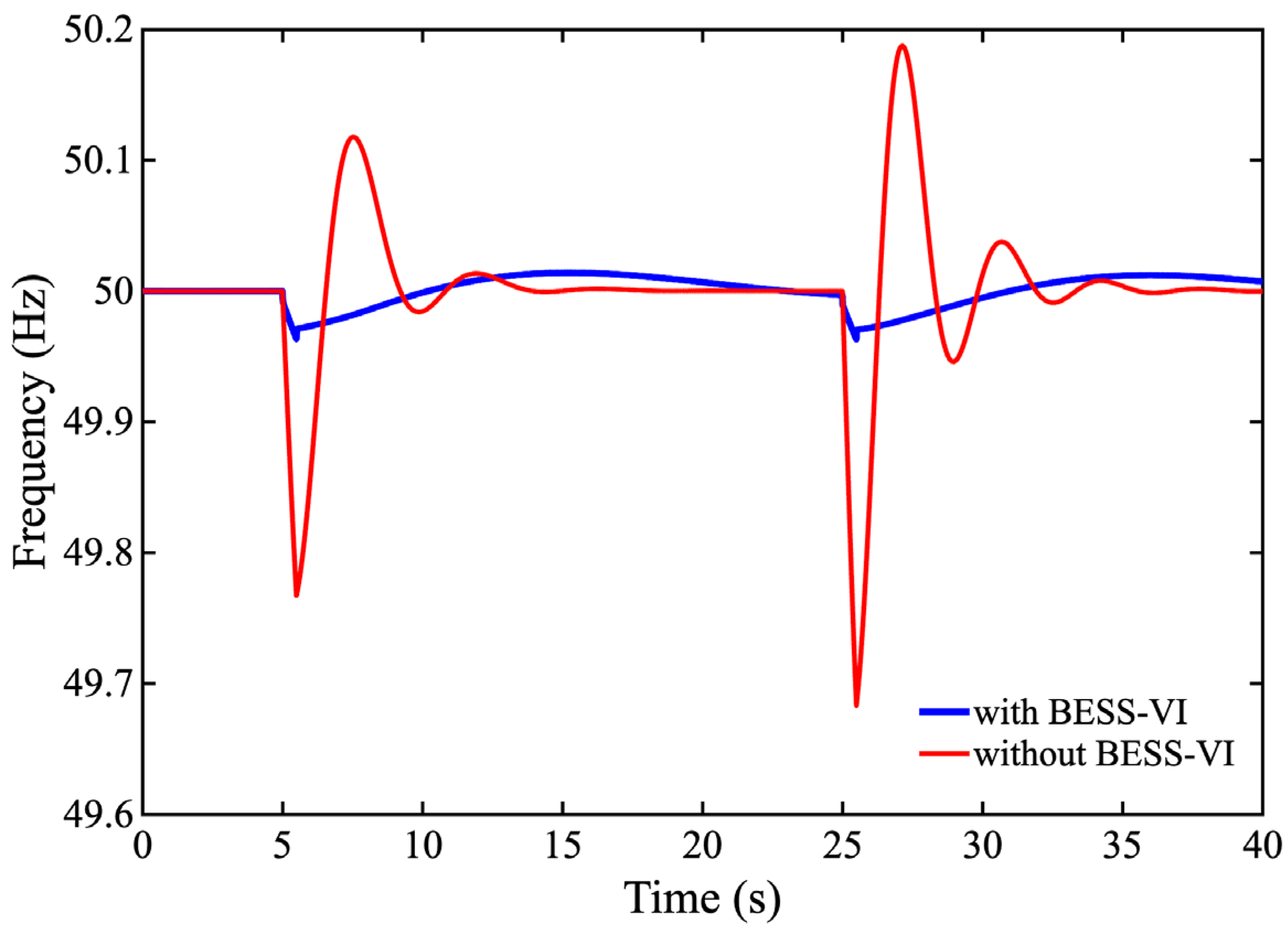
The frequency response of the system with and without BESS-based virtual inertia support is presented comparatively in Figure 6.
Figure 6 shows the frequency response of the SLP system under load variation, which is a disturbing effect on the system. At t = 2   s , it is observed that the frequency nadir point drops to approximately 49.7725 Hz when virtual inertia support is not available in the system. Specifically, with the addition of 10% PV penetration at t = 20   s , the inertia value of the system decreases from 5.00 s to 4.54 s, causing the system to respond more fragilely to load disturbances. Under these conditions, it is observed that the frequency nadir point drops to approximately 49.6892 Hz in the SLP state at t = 25   s . These results indicate that the system reaches more risky operating regions in terms of frequency stability under high PV penetration conditions.
In comparison, the system demonstrates a more robust frequency response when dynamic inertia estimation and BESS-based virtual inertia support are active. In the initial load change scenario, the frequency rarefaction point is 49.9634 Hz, while in the load change scenario where the inertia value decreases, the frequency rarefaction point remains at 49.9635 Hz, demonstrating that the system provides stable and robust control performance. Figure 7 shows the SLP condition for load change and the change in output power of the diesel generator.
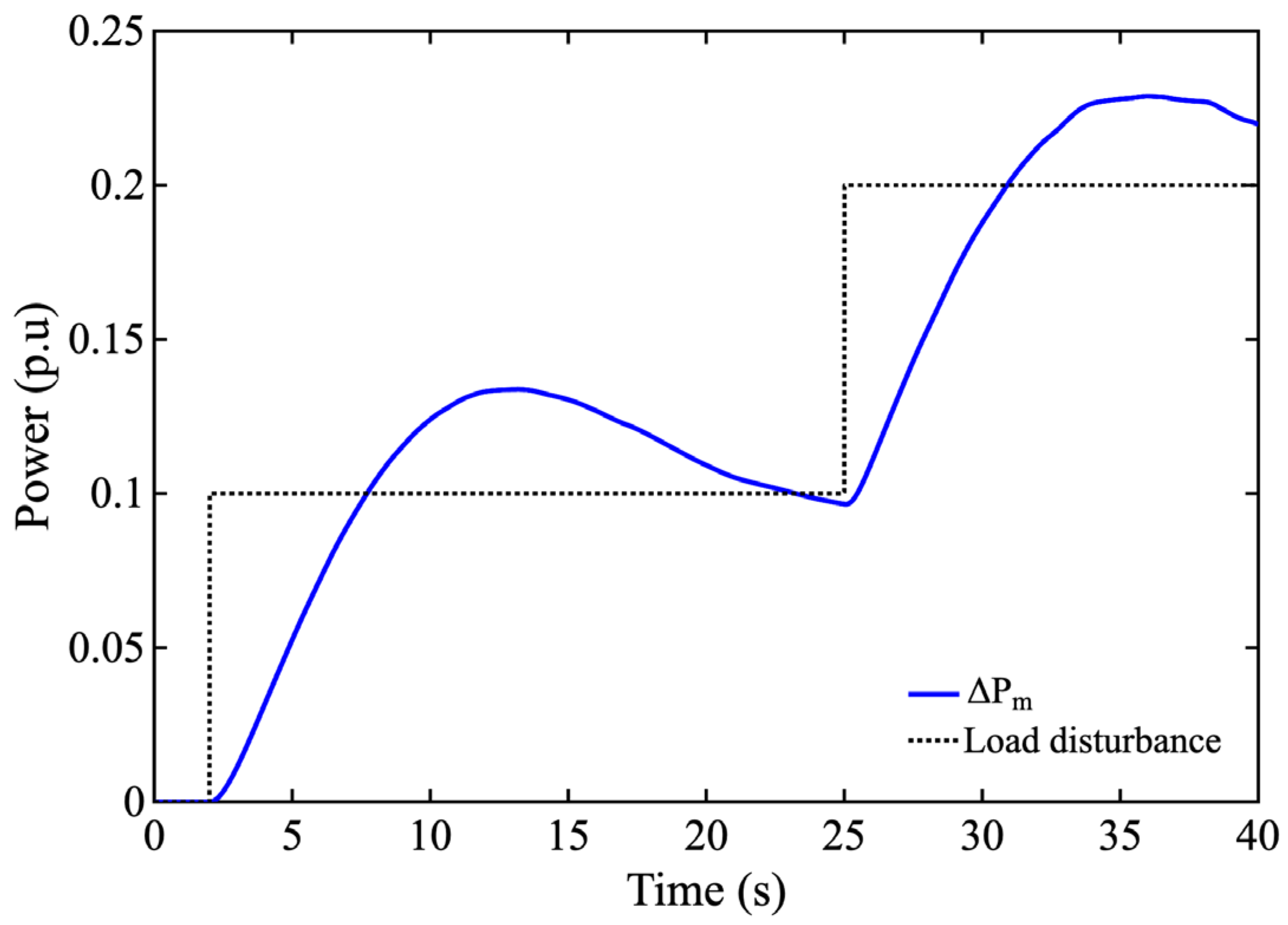
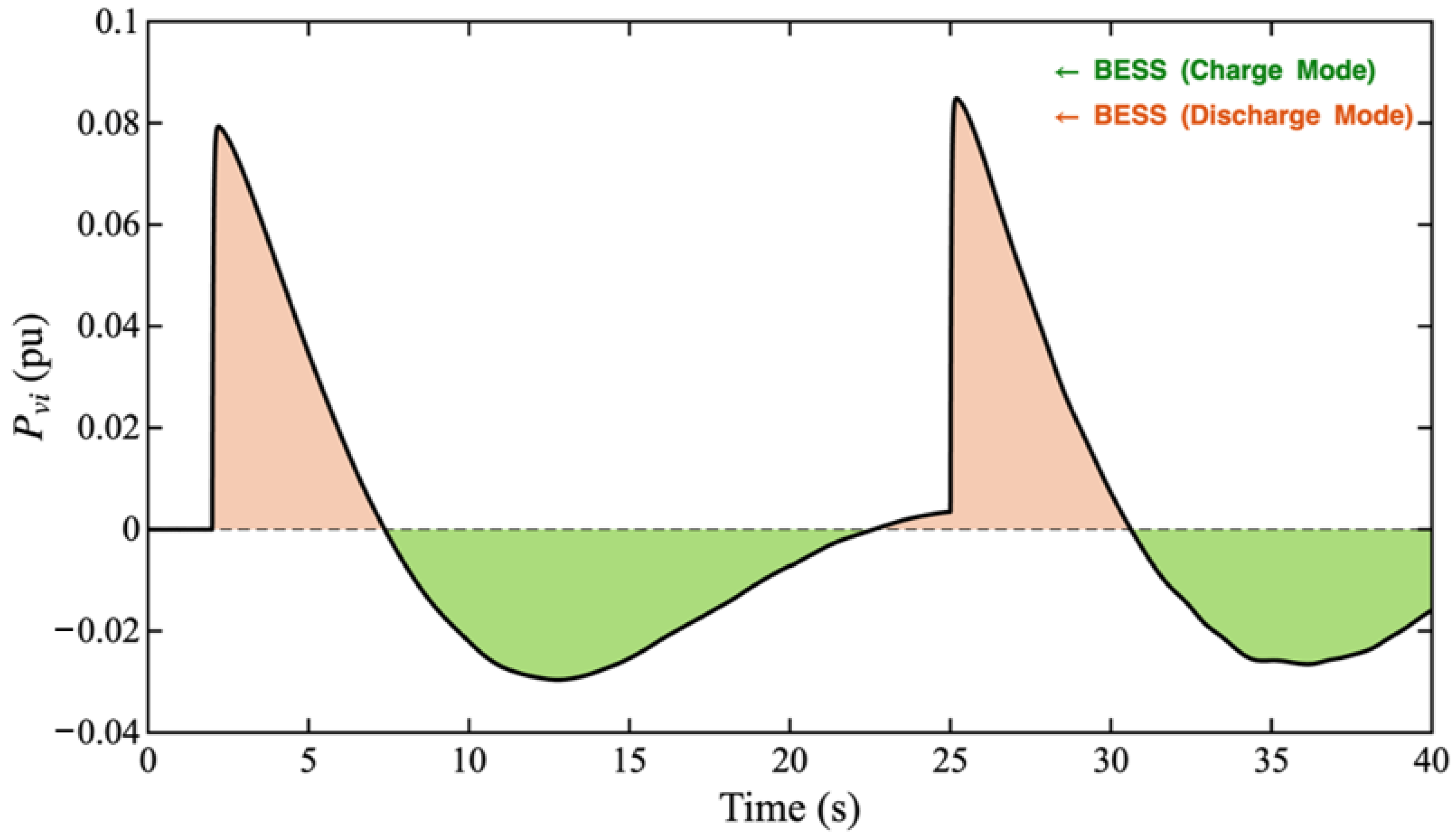
According to Figure 7, an increase in the output power of the diesel generator occurs with the application of 0.1 p.u. of SLP at t = 2   s . The time taken for the output power to reach 0.1332 p.u. was measured as 10.63 s. Similarly, as a result of the application of 0.1 p.u. of SLP at t = 25   s , the output power of the diesel generator increases again, and in this case, it takes approximately 10.66 s for the output power to reach 0.2292 p.u. At this point, the output power response of BESSs, which can respond faster to SLPs, is presented in Figure 8.
According to Figure 8, BESS-based virtual inertia support provides 0.079 p.u. of power support within 0.17 s in the first SLP state. As can be seen, BESS’s ability to provide power support very quickly significantly contributes to maintaining frequency stability by creating additional resistance to load disturbances under low-inertia conditions. While power is supplied to the BESS in the orange regions, in the green regions, BESS switches to storage mode and smoothly and gradually replenishes its energy. Similarly, in the second SLP state, BESS quickly activates and supports the system’s frequency response by providing 0.084 p.u. of power support within 0.12 s.
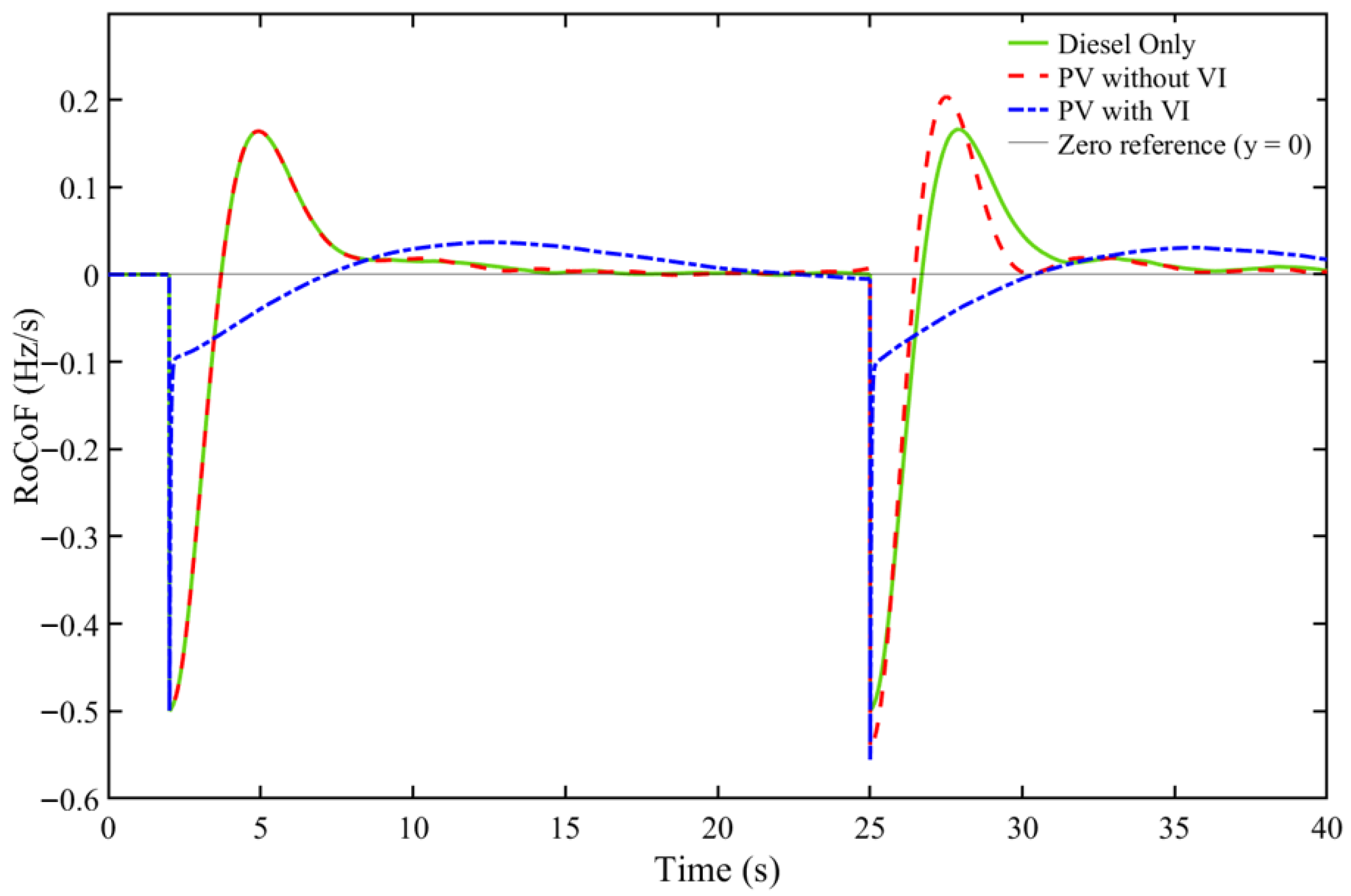
In order to further illustrate the impact of reduced inertia and the effectiveness of the proposed virtual inertia control, the RoCoF (df/dt) responses for the considered scenarios are presented in Figure 9.
As shown in Figure 9, at t = 2   s , the load disturbance occurs under diesel-only operation; therefore, the RoCoF peaks of the diesel-only and PV-without-VI cases coincide. In contrast, when the proposed VI control is active, the RoCoF peak is significantly reduced to 0.0368 Hz/s, indicating smoother transient behavior.
After PV integration at t = 20   s , the effective system inertia decreases. Consequently, during the second load disturbance at t = 25   s , the RoCoF peak increases to 0.2031 Hz/s in the PV-without-VI case, compared to 0.1677 Hz/s in the diesel-only case, demonstrating the higher frequency sensitivity caused by reduced inertia.
However, when the proposed VI controller is enabled, the RoCoF peak is dramatically reduced to 0.0307 Hz/s, effectively mitigating the adverse effects of inertia reduction and providing a substantially smoother frequency response.

4.2. System Response Under Different PV Penetration Rates

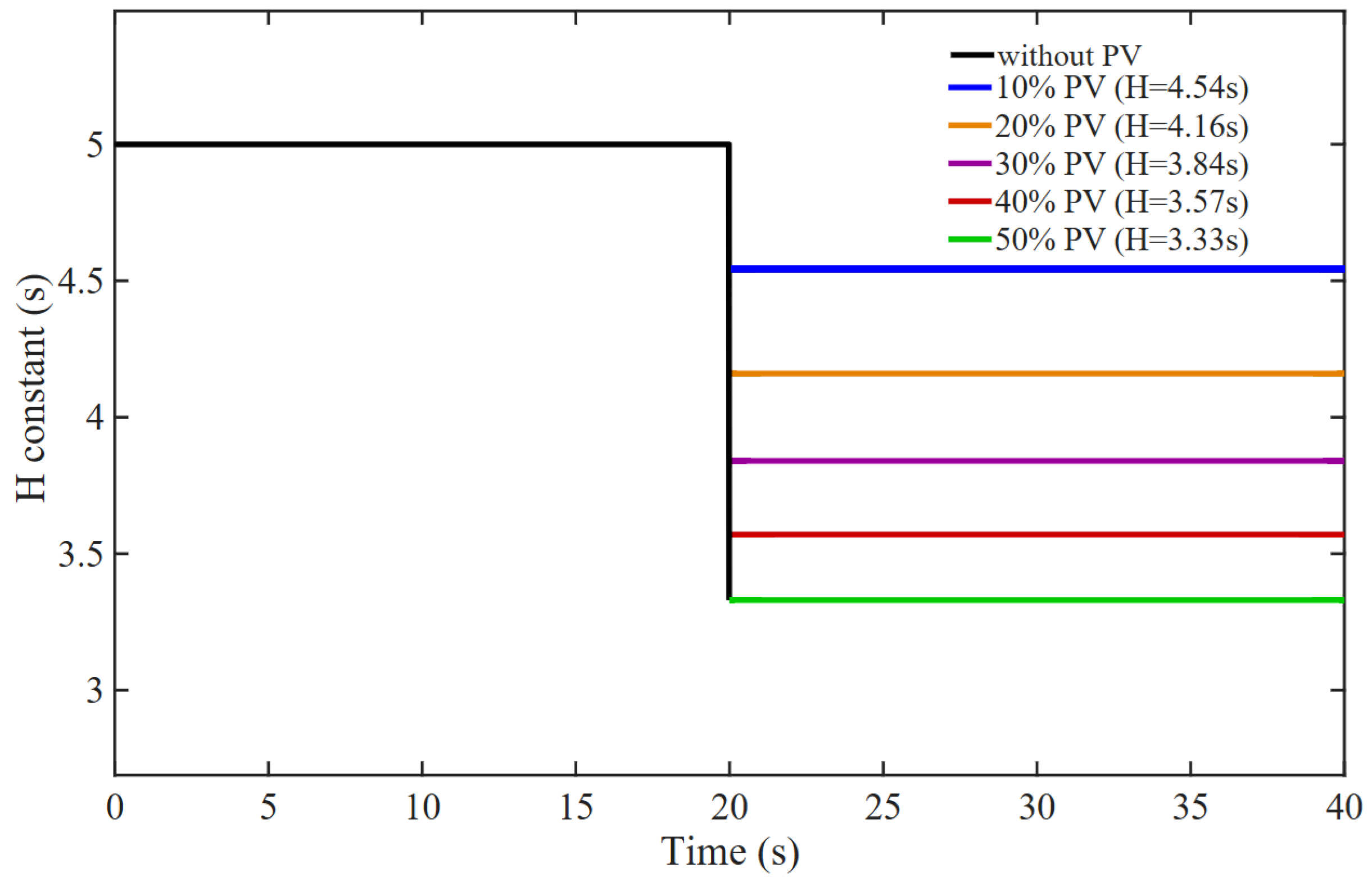
In this scenario, the dynamic response of the system was analyzed by incorporating different PV penetration rates (10%, 20%, 30%, 40%, and 50%) into the test system at time t = 20   s . It was observed that as the installed power of the PV system increased, the total equivalent constant of inertia ( H r e a l ) of the system decreased in a non-linear manner. Numerical data regarding these changes are presented in Table 3.
During the initial stage of the simulation (0–20 s), only the diesel generator is in operation, and the total system inertia is = 5.00 s. At t = 20   s , PV systems with different penetration rates, as listed in Table 3, are integrated into the system. This integration leads to stepwise changes in the overall system inertia, which are illustrated in Figure 10. Accordingly, it illustrates how the system inertia varies in response to different PV capacities introduced at t = 20   s .
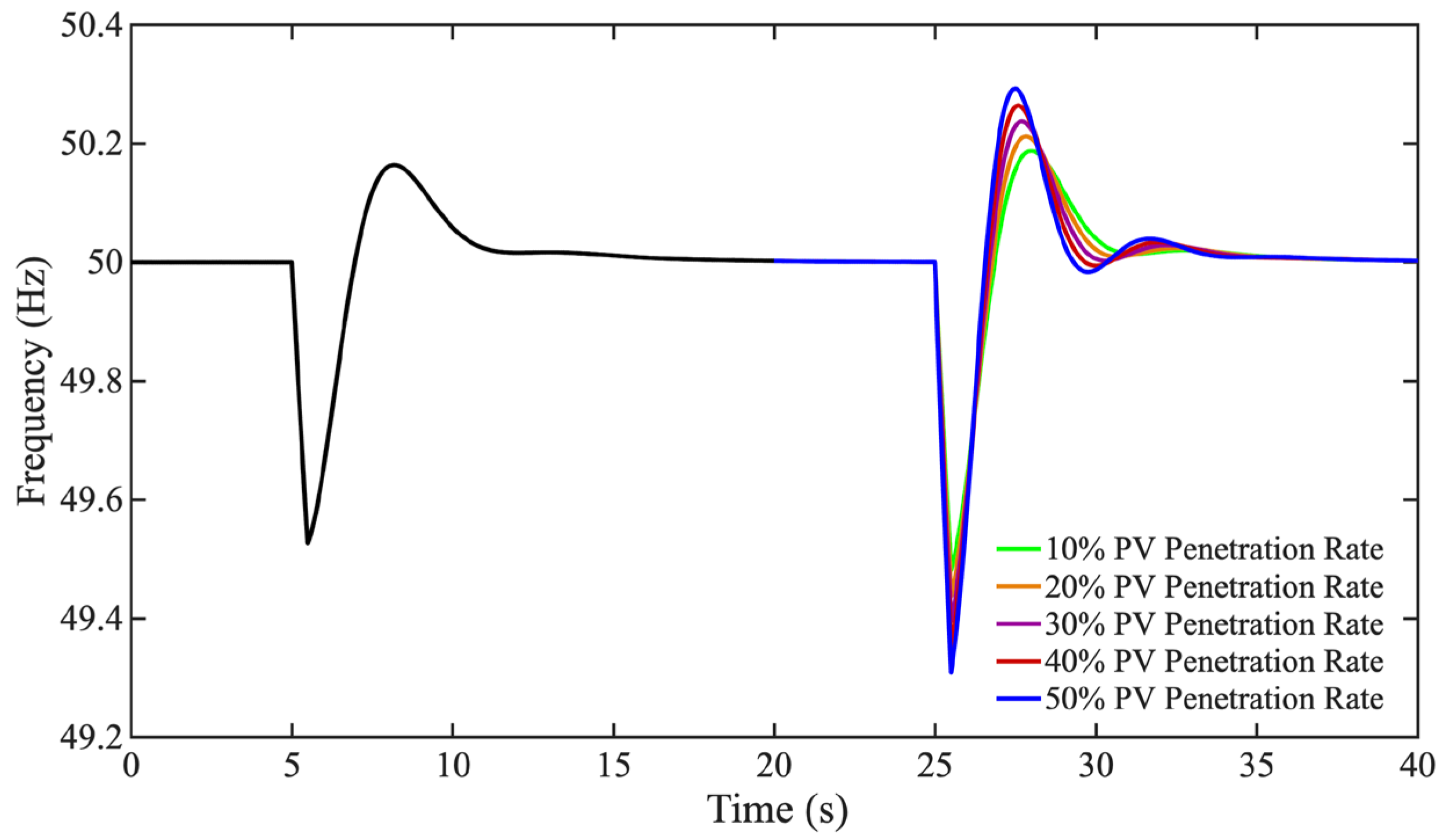
As can be seen from Figure 10, the total inertial velocity decreases as the added PV power to the system increases. If this variable inertial value is not taken into account in the control strategy and the initial constant value (H = 5.00 s) is maintained, the response produced by the controller will be erroneous or insufficient. This situation is a factor that directly threatens frequency stability, especially in high penetration systems. The frequency response of the system to a 0.1 p.u. load change at t = 25   s under different penetration rates is given comparatively in Figure 11.
Figure 11 shows that when the penetration rate is increased from 10% to 50%, the frequency nadir points deepen significantly. At 10% penetration (green curve), the lowest overshoot ( M + ) and undershoot ( M ) values are obtained, while at 50% penetration (blue curve), the frequency oscillations reach their highest level.
These results clearly demonstrate that the impact of the rate at which renewable energy sources are integrated into the grid on system inertia should not be ignored, and that the proposed adaptive virtual inertia support is critically important in high penetration situations.
In order to provide a clearer quantitative comparison of the frequency responses shown in Figure 11, the numerical performance indices corresponding to different PV penetration rates are summarized in Table 4.
Since PV integration is introduced at t = 20   s , the frequency response after the second load disturbance at t = 25   s is evaluated. The first load disturbance does not reflect the impact of varying PV penetration levels; therefore, only the second disturbance is considered for comparative analysis.
According to Table 4, increasing the PV penetration level reduces the equivalent system inertia, resulting in a more sensitive frequency response. As the PV penetration increases from 10% to 50%, the overshoot rises from 50.1875 Hz to 50.2921 Hz (an increase of 0.21%), while the undershoot decreases from 49.4822 Hz to 49.3094 Hz (a decrease of 0.35%).
Consequently, the peak-to-peak frequency deviation increases significantly from 0.7053 Hz (10% PV) to 0.9827 Hz (50% PV), corresponding to an increase of 39.33%. These results quantitatively confirm that higher PV penetration leads to reduced inertia and increased frequency vulnerability under load disturbances.

5. Conclusions

This study demonstrates that in isolated power systems with high penetration rates of renewable energy sources, system inertia is a dynamic parameter, and the effects of this variability on frequency stability cannot be managed with traditional fixed controller approaches. The analyses showed that when 10% PV system integration increased, the physical inertia value dropped from 5.00 s to 4.54 s, while at 50% penetration, this value decreased to 3.33 s, making the system approximately 33% more vulnerable to load changes. To monitor this variable structure in real time, the proposed EKF-based prediction mechanism accurately estimated inertia changes despite noisy PMU data, and the resulting data was successfully transferred to an MPC-based adaptive controller structure. The controller parameters, updated based on the instantaneous inertia information from the EKF, reached K p = 0.2205 ,     K i = 0.0551 and K V I = 0.8820 at the end of the simulation, ensuring the system fully adapted to its new operating point. The importance of VIC, especially in low-inertia situations, was confirmed by numerical data; the nadir frequency, which drops to 49.6892 Hz without virtual inertia support, was maintained at 49.9635 Hz with the proposed adaptive BESS support, resulting in an 88.25% improvement in maximum frequency deviation. The BESS unit’s ability to provide 0.079 p.u. of power support in a critical time of 0.17 s prevented the frequency from reaching dangerous limit values and significantly shortened the settling time. In conclusion, this study confirms that combining instantaneous inertia estimation with adaptive control and battery-based virtual inertia support offers a powerful and reliable framework for maintaining frequency stability in isolated power systems. The results indicate that this coordinated approach significantly improves system robustness, particularly under low-inertia conditions. Future work will focus on evaluating the proposed adaptive architecture under cyber-attack scenarios and extending the framework to interconnected multi-microgrid environments.

Funding

This research received no external funding.

Institutional Review Board Statement

Not applicable.

Informed Consent Statement

Not applicable.

Data Availability Statement

The data presented in this study are available on request from the corresponding author.

Conflicts of Interest

The author declares no conflicts of interest.

References

  1. Yusuf, S.S.; Kunya, A.B.; Abubakar, A.S.; Salisu, S. Review of load frequency control in modern power systems: A state-of-the-art review and future trends. Electr. Eng. 2025, 107, 5823–5848. [Google Scholar] [CrossRef]
  2. Shikuma, R.; Fujimoto, Y.; Orihara, D.; Kikusato, H.; Taoka, H.; Hayashi, Y. Impact of virtual synchronous generators on frequency-constrained unit commitment: A neural network-assisted framework for assessing rate of change of frequency. IEEE Access 2025, 13, 117716–117731. [Google Scholar] [CrossRef]
  3. Smahi, A.; Makhloufi, S. The power grid inertia with high renewable energy sources integration: A comprehensive review. J. Eng. 2025, 2025, 7975311. [Google Scholar] [CrossRef]
  4. Shahzad, M.I.; Gulzar, M.M.; Habib, S.; Shafiullah, M.; Shahzad, A.; Khalid, M. Advanced frequency stabilization framework for multi-area renewable energy grids with EV aggregator support: A multi-stage control perspective. Sustain. Comput. Inform. Syst. 2025, 46, 101120. [Google Scholar] [CrossRef]
  5. Mishra, S.; Sahu, P.R.; Prusty, R.C.; Panda, S.; Ustun, T.S.; Onen, A. Application of enhanced self-adaptive virtual inertia control for efficient frequency control of renewable energy-based microgrid system integrated with electric vehicles. IEEE Access 2025, 13, 43520–43531. [Google Scholar] [CrossRef]
  6. Chen, T.; Ren, J.; Liu, Y.; Xu, Y.; Zhao, M.; Yuan, J. A coordinated inertia support strategy for wind–PV–thermal storage systems considering system inertia demand. Energies 2025, 18, 6468. [Google Scholar] [CrossRef]
  7. Roy, T.K.; Oo, A.M.T. Virtual inertia and damping-based cascaded control approach for enhancing load frequency control in low-inertia multi-area power systems. J. Eng. 2025, 2025, e70054. [Google Scholar] [CrossRef]
  8. Zaid, S.A.; Bakeer, A.; Magdy, G.; Albalawi, H.; Kassem, A.M.; El-Shimy, M.E.; Manqarah, B. A new intelligent fractional-order load frequency control for interconnected modern power systems with virtual inertia control. Fractal Fract. 2023, 7, 62. [Google Scholar] [CrossRef]
  9. Gumede, S.; Behara, K.; Sharma, G. Analytical and optimisation-based strategies for load frequency control in renewable-rich power systems. Energies 2025, 18, 6295. [Google Scholar] [CrossRef]
  10. Tan, P.; Xiong, L.; Huang, S.; Li, A.; Zhou, Y.; Li, P.; Niu, T. Robust control of frequency and voltage of power grid in remote areas with WT–PV–BESS penetration—A Markov jump system approach. Electr. Power Syst. Res. 2025, 245, 111609. [Google Scholar] [CrossRef]
  11. Hasan, A.K.; Haque, M.H.; Aziz, S.M. Enhancing frequency response characteristics of low inertia power systems using battery energy storage. IEEE Access 2024, 12, 116861–116874. [Google Scholar] [CrossRef]
  12. Rajamand, S. Load frequency control and dynamic response improvement using energy storage and modeling of uncertainty in renewable distributed generators. J. Energy Storage 2021, 37, 102467. [Google Scholar] [CrossRef]
  13. Shazon, M.N.H.; Ahmed, H.M.; Deeba, S.R.; Hossain, E. Exploring the utilization of energy storage systems for frequency response adequacy of a low inertia power grid. IEEE Access 2021, 9, 129933–129950. [Google Scholar] [CrossRef]
  14. Sarojini, R.K.; Palanisamy, K.; De Tuglie, E. A fuzzy logic-based emulated inertia control to a supercapacitor system to improve inertia in a low inertia grid with renewables. Energies 2022, 15, 1333. [Google Scholar] [CrossRef]
  15. Assogna, R.; Ciabattoni, L.; Comodi, G. PSO-based supervisory adaptive controller for BESS-VSG frequency regulation under high PV penetration. Energies 2025, 18, 5401. [Google Scholar] [CrossRef]
  16. Akinwola, A.B.; Alkuhayli, A. Walrus optimization-based adaptive virtual inertia control for frequency regulation in islanded microgrids. Electronics 2025, 14, 3980. [Google Scholar] [CrossRef]
  17. Abouyehia, M.; Egea-Àlvarez, A.; Ahmed, K.H. Evaluating inertia estimation methods in low-inertia power systems: A comprehensive review with analytic hierarchy process-based ranking. Renew. Sustain. Energy Rev. 2025, 217, 115794. [Google Scholar] [CrossRef]
  18. Inga Espinoza, C.H.; Palma, M.T. A coordinated neuro-fuzzy control system for hybrid energy storage integration: Virtual inertia and frequency support in low-inertia power systems. Energies 2025, 18, 4728. [Google Scholar] [CrossRef]
  19. Golpira, H.; Francois, B.; Marinescu, B.; Bevrani, H. Estimation of aggregated inertia constant and load damping: A PMU-based analytical approach. Electr. Power Syst. Res. 2024, 234, 110736. [Google Scholar] [CrossRef]
  20. Hu, P.; Li, Y.; Yu, Y.; Blaabjerg, F. Inertia estimation of renewable-energy-dominated power system. Renew. Sustain. Energy Rev. 2023, 183, 113481. [Google Scholar] [CrossRef]
  21. Rios-Penaloza, J.D.; Prevedi, A.; Napolitano, F.; Tossani, F.; Borghetti, A.; Prodanovic, M. A two-stage online inertia estimation: Identification of primary frequency control parameters and regression-based inertia tracking. Sustain. Energy Grids Netw. 2024, 40, 101561. [Google Scholar] [CrossRef]
  22. Nouti, D.; Ponci, F.; Monti, A. Heterogeneous inertia estimation for power systems with high penetration of converter-interfaced generation. Energies 2021, 14, 5047. [Google Scholar] [CrossRef]
  23. Alam, M.S.; Al-Ismail, F.S.; Abido, M.A. PV/wind-integrated low-inertia system frequency control: PSO-optimized fractional-order PI-based SMES approach. Sustainability 2021, 13, 7622. [Google Scholar] [CrossRef]
  24. Zhou, J.; Guo, Y.; Yang, L.; Shi, J.; Zhang, Y.; Li, Y.; Sun, H. A review on frequency management for low-inertia power systems: From inertia and fast frequency response perspectives. Electr. Power Syst. Res. 2024, 228, 110095. [Google Scholar] [CrossRef]
  25. Su, Y.; Li, H.; Cui, Y.; You, S.; Ma, Y.; Wang, J.; Liu, Y. An adaptive PV frequency control strategy based on real-time inertia estimation. IEEE Trans. Smart Grid 2020, 12, 2355–2364. [Google Scholar] [CrossRef]
  26. Saleem, M.I.; Saha, S.; Roy, T.K.; Ghosh, S.K. Assessment and management of frequency stability in low inertia renewable energy rich power grids. IET Gener. Transm. Distrib. 2024, 18, 1372–1390. [Google Scholar] [CrossRef]
  27. Panagi, S.; Aristidou, P. Sizing of fast frequency response reserves for improving frequency security in low-inertia power systems. Sustain. Energy Grids Netw. 2025, 42, 101699. [Google Scholar] [CrossRef]
  28. Zheng, C.; Dragičević, T.; Blaabjerg, F. Model predictive control-based virtual inertia emulator for an islanded alternating current microgrid. IEEE Trans. Ind. Electron. 2020, 68, 7167–7177. [Google Scholar] [CrossRef]
  29. Andic, C.; Ozturk, A.; Turkay, B. Power system state estimation using a robust crow search algorithm based on PMUs with limited number of channels. Electr. Power Syst. Res. 2023, 217, 109126. [Google Scholar] [CrossRef]
  30. Das, A.; Sengupta, A. Model predictive control for resilient frequency management in power systems. Electr. Eng. 2024, 106, 6131–6157. [Google Scholar] [CrossRef]
  31. Yan, S.; Yin, X.; Zheng, Y. Efficient distributed MPC using Kautz functions for load frequency control in multi-area power systems with communication delays. IEEE Trans. Sustain. Energy 2025, 16, 2374–2385. [Google Scholar] [CrossRef]
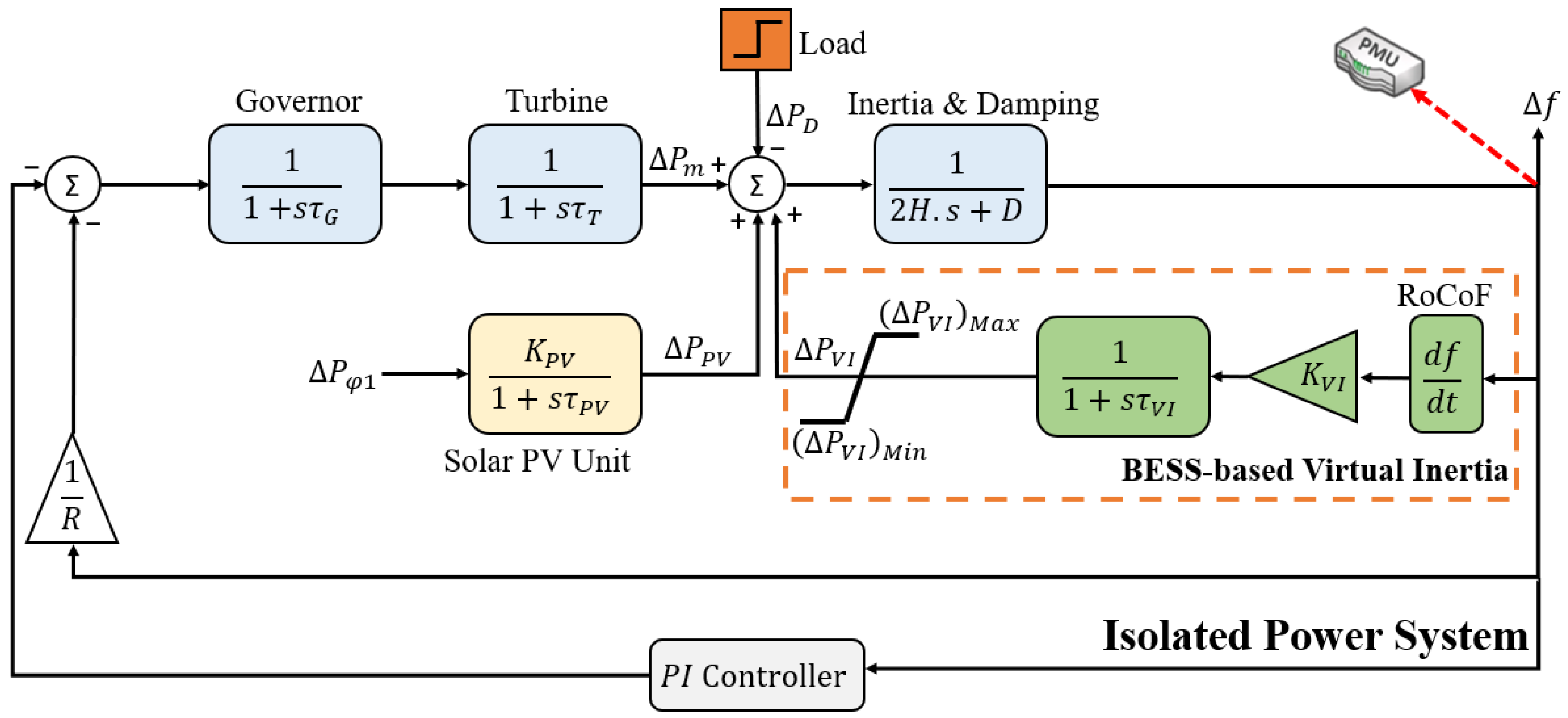
Figure 1. The isolated power system model.
Applsci 16 02161 g001
Figure 2. Proposed estimation-based adaptive virtual inertial control architecture.
Applsci 16 02161 g002
Figure 3. Frequency measurements collected from the PMU device.
Applsci 16 02161 g003
Figure 4. The system’s dynamic inertia estimation and actual values.
Applsci 16 02161 g004
Figure 5. Adaptive gain values of the control parameters.
Applsci 16 02161 g005
Figure 6. The effect of a BESS-based virtual inertia controller on frequency response.
Applsci 16 02161 g006
Figure 7. DG output power under SLP condition.
Applsci 16 02161 g007
Figure 8. BESS-based virtual inertia support (charge and discharge mode).
Applsci 16 02161 g008
Figure 9. RoCoF responses for the two load disturbance events under different inertia and control configurations.
Applsci 16 02161 g009
Figure 10. The inertia value of a PV system at different penetration rates.
Applsci 16 02161 g010
Figure 11. Frequency response of a system with different PV penetration rates.
Applsci 16 02161 g011
Table 1. Summary of system, control and estimation parameters used in simulations.
Components Parameters SymbolValueUnit
System
Base
Parameters
Base frequency f 0 50.00Hz
Simulation time step t 0.01s
Total Simulation TimeT40.00s
Diesel
Generator
Parameter
Governor time constant T g 0.20s
Turbine time constant T t 0.50s
Generator power limit P m ,   l i m i t ± 0.40 p.u.
Inertia constantH5.00s
Damping coefficientD1.00p.u.
PV UnitActivation time t P V 20.00s
BESS/
Virtual
Inertia
Washout filter time constant τ V I 0.20s
BESS Power limit P V I ,   l i m i t ± 0.20 p.u.
Nominal VI gain K V I ,   i n i t l a l 0.80-
LFC
Parameters
Nominal proportional gain K P ,   i n i t l a l 0.20-
Nominal integral gain K I ,   i n i t l a l 0.05-
EKF smoothing factor a h 0.02-
Extended
Kalman
Filter
Parameters
Frequency state Q 11 1 × 10 8 H z 2
Inertia state Q 22 1 × 10 3 s 2
Measurement noise covarianceR 1 × 10 5 H z 2
Initial state estimate X ^ 0 0 ; 4 ,   8 T [Hz; s]
Frequency uncertainty covariance P 11 , 0 1 × 10 4 H z 2
Inertia uncertainty covariance P 22 , 0 2.00 s 2
Model
Predictive Control
Parameters
Prediction horizon N p 20.00steps (0.2 s)
Control horizon N c 2.00steps
Frequency deviation weight Q M P C 0.50-
Control effort weight R M P C 0.10-
Q/R ratio-5:10-
Table 2. Simulation scenario conditions.
ScenariosGeneration Units Load   Disturbances   ( P L )PV Penetration
1.aDG + PV 0.1 p.u ( t = 2   s , 25   s ) 10% ( t = 20   s )
1.bDG + PV + BESS 0.1 p.u ( t = 2   s , 25   s ) 10% ( t = 20   s )
2DG + PV + BESS 0.1 p.u ( t = 2   s , 25   s ) 10–50% 10% ( t = 20   s )
Table 3. Variation of system inertia with different PV penetration rates.
CaseOutput Power (kW) H r e a l ( s )
DGPV
Without PV10005.00
10% PV100104.54
20% PV100204.16
30% PV100303.84
40% PV10040 3.57
50% PV10050 3.33
Table 4. Numerical comparison of frequency response under different PV penetration rates after the load disturbance at t = 25 s.
PV PenetrationInertia (s) Overshoot   ( M + , H z ) Undershoot   ( M , H z )Peak-to-Peak (Hz)
10% PV4.5450.187549.48220.7053
20% PV4.1650.212149.44020.7719
30% PV3.8450.237749.39450.8432
40% PV3.5750.264149.35230.9118
50% PV3.3350.292149.30940.9827
Disclaimer/Publisher’s Note: The statements, opinions and data contained in all publications are solely those of the individual author(s) and contributor(s) and not of MDPI and/or the editor(s). MDPI and/or the editor(s) disclaim responsibility for any injury to people or property resulting from any ideas, methods, instructions or products referred to in the content.