Article

Multi-Level Evaluation of Earthquake Emergency Preparedness in Xiong’an New Area Using the Entropy Weight Method

1
China Earthquake Network Center, Beijing 100045, China
2
Institute of Geology, China Earthquake Administration, Beijing 100029, China
3
Twenty First Century Aerospace Technology Co., Ltd., Beijing 100096, China
*
Author to whom correspondence should be addressed.
Appl. Sci. 2026, 16(5), 2162; https://doi.org/10.3390/app16052162
Submission received: 31 December 2025 / Revised: 6 February 2026 / Accepted: 10 February 2026 / Published: 24 February 2026
(This article belongs to the Special Issue Recent Developments in Preventing and Managing Disasters)

Abstract

Earthquake emergency preparedness plays a vital role in strengthening disaster prevention and mitigation capacity, as well as societal resilience. This study focuses on the Xiong’an New Area, a rapidly developing national demonstration zone in China. An evaluation index system for earthquake emergency preparedness was established, and the entropy weight method was applied to objectively determine indicator weights. By integrating field questionnaire data with statistical analysis, preparedness was quantitatively assessed across three administrative levels: township, county, and city. The results reveal pronounced heterogeneity in earthquake emergency preparedness capacity, with township-level performance varying considerably, county-level performance being relatively higher yet still requiring improvement, and the New Area demonstrating strong overall capacity, particularly in emergency organization and coordination mechanisms. However, limited risk awareness and insufficient self-protection capability among grassroots residents remain key constraints on overall preparedness. This research enhances the understanding of earthquake preparedness and provides valuable insights for strengthening disaster prevention, emergency management, and public safety governance in rapidly urbanizing regions.

1. Introduction

Earthquake emergency preparedness denotes the capacity to perform essential disaster mitigation and response functions in anticipation of damaging earthquakes. This capacity is reflected in the adequacy and effectiveness of organizational structures, emergency planning, command and coordination mechanisms, resource and material support systems, professional response teams, and training and exercises programs [1,2,3]. Such a system-oriented understanding of preparedness is consistent with previous studies emphasizing the integration of organizational, technical, and operational components to enhance resilience and emergency response effectiveness [4]. In recent decades, extensive efforts have been devoted to earthquake forecasting based on various precursors, and different forecasting approaches have been developed to explore their potential relationships with earthquake occurrence [5]. However, despite continuous advances, earthquake forecasting remains subject to considerable uncertainty, which limits its effectiveness in supporting emergency response decision-making. Under such circumstances, enhancing earthquake emergency preparedness through systematic assessment at the local level is widely recognized as a critical complementary approach to reducing earthquake disaster risk.
As a national strategic new area undergoing rapid development, the Xiong’an New Area is entering a critical stage of construction. The concentration of population, resources, and strategic functions amplifies the importance of earthquake disaster prevention and emergency preparedness. Conducting a systematic assessment of earthquake emergency preparedness during this pivotal period of accelerated infrastructure and public service development is therefore of urgent practical significance. Such an assessment is vital for mitigating potential losses from future strong earthquakes and for ensuring the high-quality and secure development of the New Area, while also offering demonstrative value for broader application.
Extensive research on earthquake emergency preparedness has been conducted by scholars both in China and abroad. International studies in this field began relatively early and adopt diverse perspectives, encompassing emergency management organizational structures, the development of emergency plans, the construction of emergency response systems, and the promotion of a “whole-of-society” participation approach. These investigations further extend to practical applications, including resilience-oriented emergency management strategies and disaster-preparedness community programs [6]. In earthquake-prone countries such as the United States and Japan, emergency management technologies are closely integrated with broader social governance systems, forming a mature framework for earthquake preparedness and disaster mitigation. The United States adopts “capability” as the core framework of its emergency management system and has successively issued the Federal Response Plan (FRP, 1992) and the National Response Plan (NRP, 2004), thereby establishing a comprehensive and systematic emergency planning framework [7,8,9]. Meanwhile, the United States has continuously strengthened its science- and technology-supported disaster-reduction capacity through the National Earthquake Hazards Reduction Program (NEHRP), and the Federal Earthquake Risk Management Standard Reporting Period further clarifies interagency coordination mechanisms and technical pathways, providing institutional support for national-level earthquake risk prevention and control [10]. In contrast, Japan established an early and comprehensive legal framework for earthquake prevention and disaster reduction, integrating government agencies, enterprises, and the public in emergency education and preparedness drills, with rescue teams operating under clearly defined professional responsibilities and well-developed evacuation facilities, thus providing valuable institutional and practical lessons for other countries [11,12].
In China, research on earthquake emergency preparedness is closely aligned with the national strategy for disaster prevention and mitigation. As this strategy continues to advance, the government has released a series of policy documents that clarify overarching disaster-reduction objectives and delineate the responsibilities of administrative units at all levels, thereby providing an institutional basis for strengthening earthquake emergency preparedness [13]. The National Comprehensive Disaster Prevention and Mitigation Plan further establishes systematic requirements for managing multiple types of disaster risks, while China’s 14th Five-Year Plan for the National Emergency Management System underscores the importance of multi-level, cross-departmental coordination mechanisms [14].
Within this context, scholars have undertaken extensive research on earthquake emergency preparedness, focusing on the development of evaluation indicator systems, analyses of emergency response mechanisms, formulation of management strategies, and the construction of assessment models [15,16,17]. Methods for assessing emergency preparedness are diverse, including casualty- and economic-loss-based disaster models, the Analytic Hierarchy Process (AHP), the entropy weight method, fuzzy comprehensive evaluation, and weighted summation [18,19,20,21]. These approaches are commonly applied across multiple spatial scales, including cities, counties, and communities, to quantify regional earthquake preparedness and provide methodological support and practical insights for evidence-based assessment of disaster-reduction capacity. Researchers have also sought to develop comprehensive evaluation index systems encompassing infrastructure conditions, human, material, and financial resources, specialized capabilities and experience, and environmental context, thereby revealing the spatial distribution patterns of regional emergency preparedness, as reflected in disaster resilience indicator frameworks such as those proposed by Cutter et al. [22,23]. The incorporation of socioeconomic and environmental characteristics at the city and county levels has been used to refine indicator weights and enhance the ability to distinguish regional differences in emergency preparedness [24,25]. Historical earthquake records and scenario-based simulations have also been employed to derive disaster coefficients, providing a quantitative basis for evaluating preparedness levels [26,27]. The earthquake preparedness index constructed from survey data is used to assess readiness at the individual level, thereby further extending the scope of the evaluation [28]. Moreover, emergency response practices from major earthquakes—such as the Wenchuan, Yushu, and Jiuzhaigou events—offer essential empirical evidence for method validation and model optimization, thereby promoting the continual refinement and broader application of preparedness evaluation systems [29,30,31].
Although substantial progress has been made in constructing indicator systems and methodological frameworks, integrated multi-level assessments remain limited. Existing studies predominantly focus on a single administrative tier or specific spatial scale, leaving a gap in comprehensive evaluations encompassing township, county, and municipal units [21,32,33]. Particularly during the initial stages of newly established national-level new areas, assessments of disaster prevention and mitigation needs have not received sufficient attention, and existing experience has yet to yield widely applicable quantitative evaluation methods or policy guidance, resulting in a relative deficiency in both earthquake emergency preparedness assessment and its translation into policy.
In light of the above, this study focuses on Xiong’an New Area and constructs a systematic framework for evaluating earthquake emergency preparedness. By integrating indicator system design, field questionnaire surveys, and weighted indicator analysis, the framework enables quantitative assessment and systematic analysis of multi-level earthquake emergency preparedness across townships, counties, and the Xiong’an New Area as a whole. The results not only provide theoretical support and decision-making guidance for disaster prevention, mitigation, and public safety governance in Xiong’an New Area, but also offer practical insights for the development of emergency preparedness in other emerging cities and functional zones.
This paper is organized into six sections. Following the Introduction, Section 2 describes the construction of the earthquake emergency preparedness assessment indicator system. Section 3 presents the Materials and Methods, including the survey design and data collection, data processing and standardization procedures, and the determination of indicator weights using the entropy weight method. Section 4 reports the Results and Analysis, presenting the basic characteristics of the Xiong’an New Area and the assessment outcomes at the township, county, and regional levels. Section 5 discusses the applicability and limitations of the proposed approach. Finally, Section 6 summarizes the main conclusions and provides relevant recommendations.

2. Construction of Evaluation Index System

Earthquake emergency preparedness is a fundamental component for improving the efficiency of earthquake disaster response and is critical for enabling rapid and effective actions. However, due to the sudden, destructive, and uncertain nature of earthquakes, emergency preparedness encompasses multiple dimensions, making its evaluation inherently complex and systematic [17]. To comprehensively and scientifically assess regional earthquake emergency preparedness, it is necessary to develop a structured evaluation indicator system that integrates regional characteristics and practical needs, thereby quantifying the contributions of different elements or dimensions to overall preparedness.
In developing the evaluation indicator system for earthquake emergency preparedness, this study upholds the principles of scientific rigor, systematicity, representativeness, and operability. These principles ensure that the indicators not only cover the core components of emergency preparedness but also accurately reflect the region’s actual preparedness capacity. To enhance scientific validity and practical applicability, the study systematically reviewed and incorporated existing standards such as the Guideline of earthquake emergency for community (GB/T 31079-2014) [34], the Technical specification for disaster coping capacity assessment at grassroots level (GB/T 43981-2024) [35], and the Technical specification for earthquake disaster risk assessment and zoning (DB51/T 3223-2024) [36]. Meanwhile, the indicator system was refined to align with the emergency management needs, governance characteristics, and development stage of the Xiong’an New Area, ensuring compliance with national standards while remaining closely tailored to regional realities.
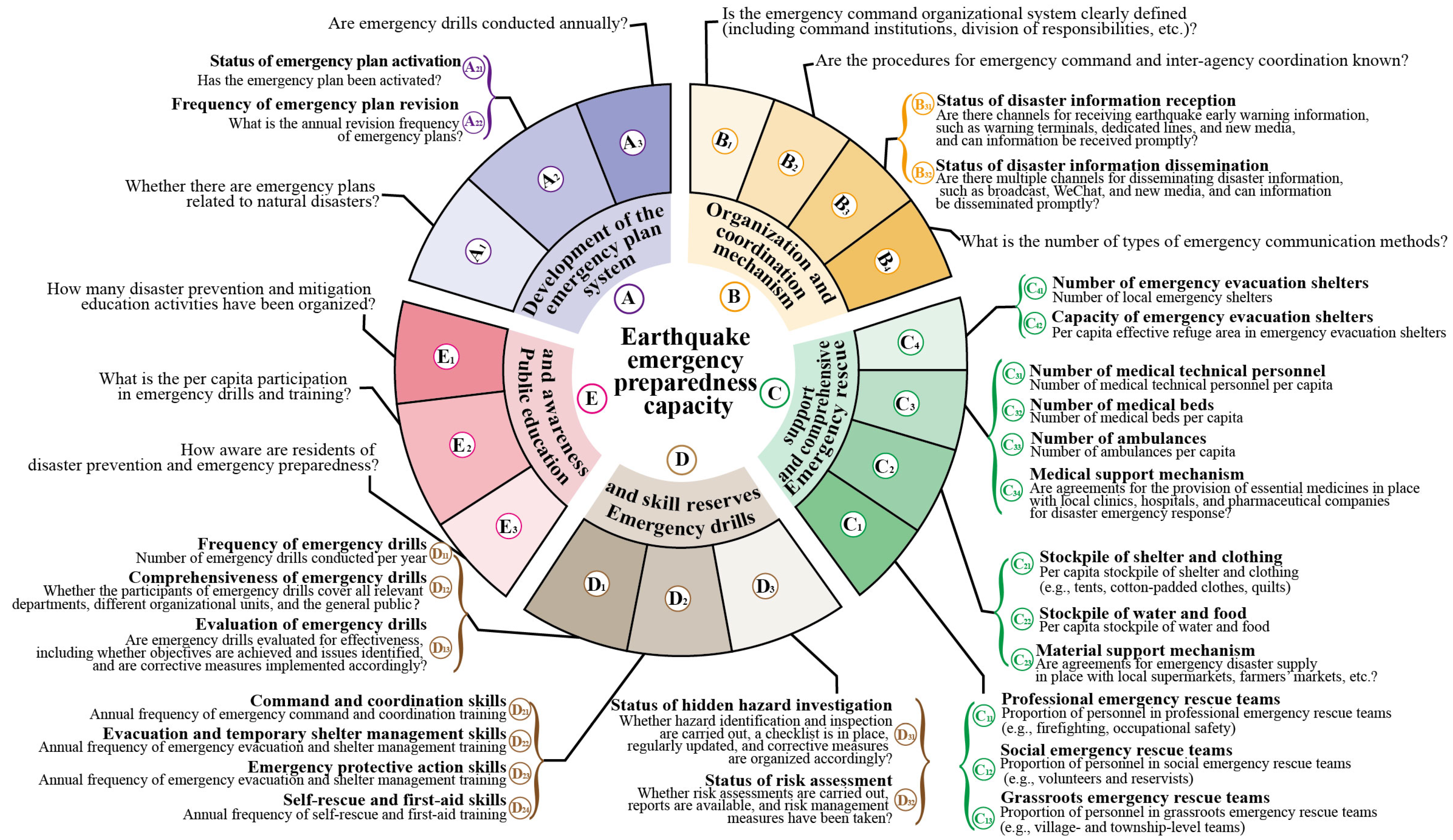
Based on the above principles and standards, this study constructs an earthquake emergency preparedness assessment system covering the full process of disaster reduction, preparedness, and emergency response. The system comprises five primary indicators: Development of the emergency plan system (A), Organizational and coordination mechanisms (B), Emergency rescue and comprehensive support (C), Emergency drills and skill reserves (D), and Public education and awareness (E). These are further detailed into 17 secondary and 25 tertiary indicators, forming a clear hierarchical structure with strong operational applicability. The overall framework is shown in Figure 1.

3. Materials and Methods

3.1. Survey Design and Data Collection

Based on the established indicator system for evaluating earthquake emergency preparedness, this study employed structured questionnaires integrating qualitative and quantitative approaches to conduct a multi-level questionnaire survey in the Xiong’an New Area at both county and township administrative levels, followed by a comprehensive municipal-level analysis for the region as a whole. The survey design explicitly considered the spatial structure and internal heterogeneity of the study area and incorporated relevant background information provided by local emergency management authorities.
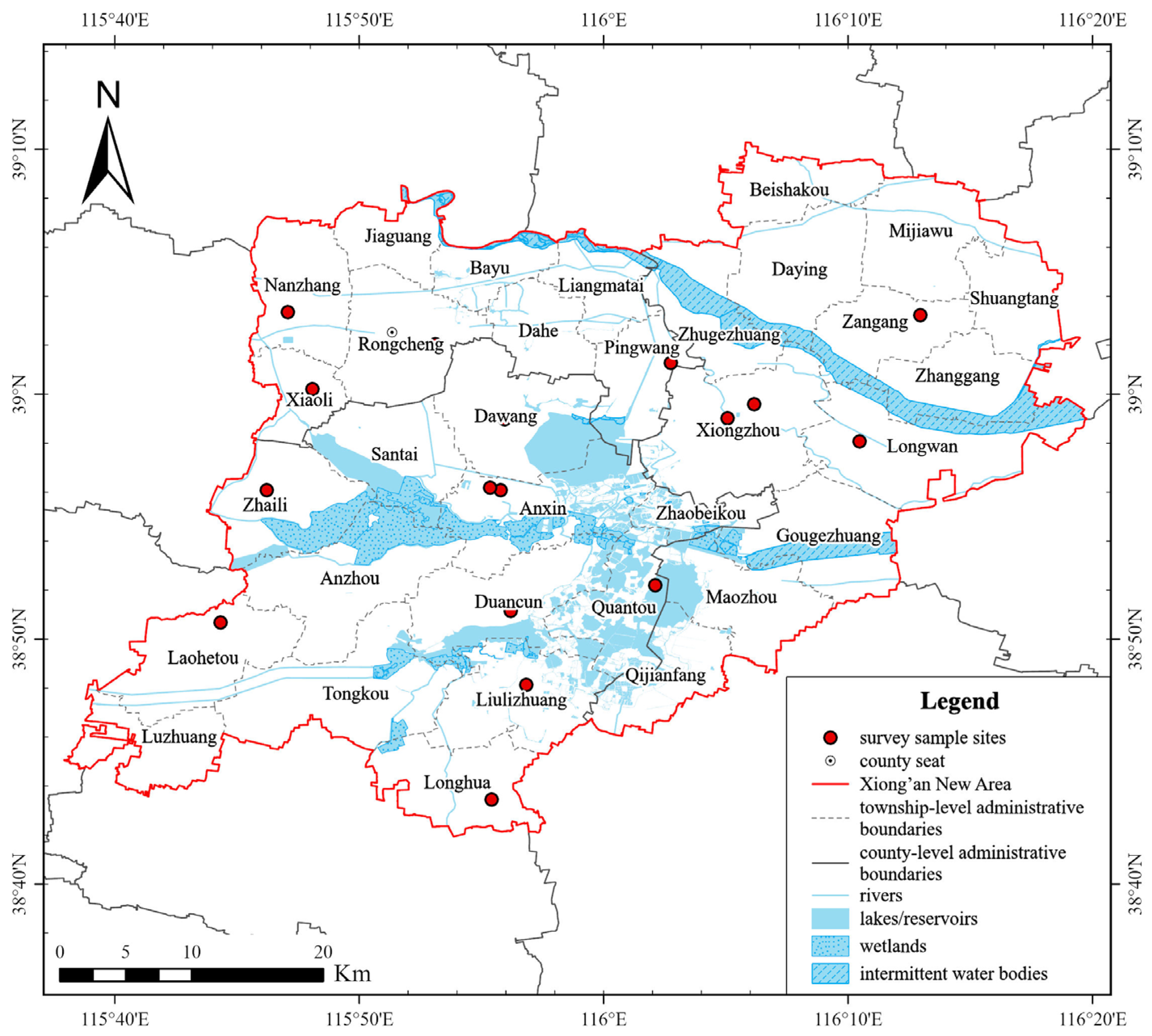
Accordingly, three counties—Rongcheng, Anxin, and Xiongxian—were selected, and a total of 14 subordinate townships were investigated, including three townships in Rongcheng County, eight in Anxin County, and three in Xiongxian County. Township selection followed a random sampling strategy that accounted for geographic location, population size, and socioeconomic characteristics. Within each county, townships were randomly selected, and the number of sampled townships was proportional to the total number of townships in each administrative unit, thereby avoiding convenience sampling and improving representativeness.
In each selected county and township, one questionnaire was completed by key informants involved in emergency management and disaster preparedness, including township-level officials and relevant staff members. All distributed questionnaires were successfully returned and deemed valid, resulting in a response rate of 100%. Consequently, all collected data were included in the final analysis, ensuring data completeness and consistency across administrative levels.
Table 1 provides detailed information on the three surveyed counties, including the surveyed townships, respondent category, sample size, survey period, and inclusion criteria. The sample size represents the total number of questionnaires collected at both the county and township levels. The spatial distribution of the survey sites is shown in Figure 2. All statistical analyses were performed using SPSS 27.0 and Microsoft Excel 2021. Spatial analysis and map visualization were conducted using ArcGIS 10.8.

3.2. Data Processing and Standardization

Based on the earthquake emergency preparedness assessment system and field survey results, the evaluation indicators were categorized into three types: Type A (binary qualitative), Type B (multi-class qualitative), and Type C (continuous quantitative).
  • Type A indicators represent binary “yes/no” characteristics, such as whether an emergency plan has been established or whether emergency drills have been conducted. These indicators were directly converted into numerical scores using a binary scoring rule: “yes” = 9 and “no” = 1.
  • Type B indicators reflect qualitative differences based on questionnaire responses. The questionnaire itself adopted a five-level Likert-type scale, and responses were quantified using graded scores of “excellent” (9), “good” (7), “average” (5), “poor” (3), and “very poor” (1).
  • Type C indicators describe objective quantitative characteristics, such as the number of emergency shelters, emergency personnel, and stockpiled resources. For each indicator, a satisfaction ratio was calculated as the ratio of actual value to required value. The resulting ratios were then classified into five grades using the natural breaks (Jenks) method, corresponding to scores of 9, 7, 5, 3, and 1, respectively.
To ensure comparability among different types, all indicators were standardized using the same five-grade scoring system. The complete scoring rubric for all indicator types—including binary conversion rules for Type A indicators, questionnaire score mapping for Type B indicators, and quantitative grading procedures for Type C indicators—is provided in Appendix A Table A1, ensuring transparency and reproducibility of the assessment results.

3.3. Entropy Weight Method for Determining Indicator Weights

In this study, the entropy weight method was employed to determine the weight coefficients of the evaluation indicators. The entropy weight method is a mathematically objective weighting procedure that assigns weights based on the degree of information differentiation among indicators, and it has been widely used in multi-attribute decision-making to derive attribute weights [37,38]. It should be noted that the entropy weight method in this study is applied to expert-provided evaluation data rather than purely observational data. A total of 11 experts were invited to participate in the indicator evaluation process. All invited experts have extensive professional experience in earthquake emergency management, including researchers from seismic research institutions, practitioners from emergency management agencies, and technical staff involved in earthquake response and risk assessment.
The experts assessed each evaluation indicator using a five-point rating scale, and the entropy weight method was subsequently applied to these expert ratings to derive the corresponding indicator weights. Therefore, the resulting weights can be regarded as objective given expert ratings, which helps reduce individual subjectivity through a standardized mathematical procedure while preserving domain-specific expert knowledge. This diverse expert composition ensures the reliability and practical relevance of the indicator weighting results.
The calculation process and formulas are as follows:
(1)
Normalize the indicator rating data to eliminate dimensional differences:
Y i j = X i j min ( X i ) max ( X i ) min ( X i )
where Yij represents the normalized score assigned by expert j to indicator i; Xij denotes the original score; and max(Xi) and min(Xi) are the maximum and minimum scores, respectively, given by all experts for indicator i.
(2)
Calculate the proportion of each expert’s rating for each indicator, reflecting the degree of variation:
p i j = Y i j i = 1 n Y i j , i = 1 , 2 , 3 , , n ; j = 1 , 2 , 3 , , m
where pij represents the proportion of the score assigned by expert j to indicator i.
(3)
Define the information entropy of each indicator:
E i = ln ( n ) 1 i = 1 n p i j ln p i j , 0 E i 1
where Ei denotes the information entropy of indicator i; when pij = 0, the corresponding entropy value is set to Ei = 0.
(4)
Compute the weight of each evaluation indicator based on its information entropy:
w i = 1 E i k i = 1 k E i , i = 1 , 2 , 3 , , k ; a n d   i = 1 k w i = 1
where wi represents the entropy weight of indicator i, and k denotes the total number of indicators.
Finally, the comprehensive assessment of earthquake emergency preparedness is obtained by calculating the weighted sum of all indicator scores, that is:
S c o r e i n d e x = i = 1 k S c o r e i n d e x ( i ) × w i
where Scoreindex represents the actual score of indicator i in the survey questionnaire. The comprehensive scores are divided into five levels—“good”, “relatively good”, “moderate”, “poor”, and “very poor”,—corresponding to 9, 7, 5, 3, and 1 points, respectively, which quantify the performance of each indicator.

3.4. Weight Coefficients of the Evaluation Indicators

Based on the established evaluation index system for earthquake emergency preparedness, the expert scores on each indicator provided by specialists in earthquake emergency management were incorporated and then applied to Formulas (1)–(4) to calculate the corresponding indicator weights. The final weighting results of the evaluation index system are presented in Table 2.

4. Results and Analysis

4.1. Overview of the Xiong’an New Area

Xiong’an New Area, the 19th state-level new area established in China, is located in central Hebei Province at the core of the Beijing–Tianjin–Hebei metropolitan region and covers approximately 1770 km2. The area comprises Rongcheng County, Anxin County, and Xiongxian County, within which Rongcheng County administers five towns and three townships, Anxin County administers nine towns and four townships, and Xiongxian County administers eight towns and four townships.
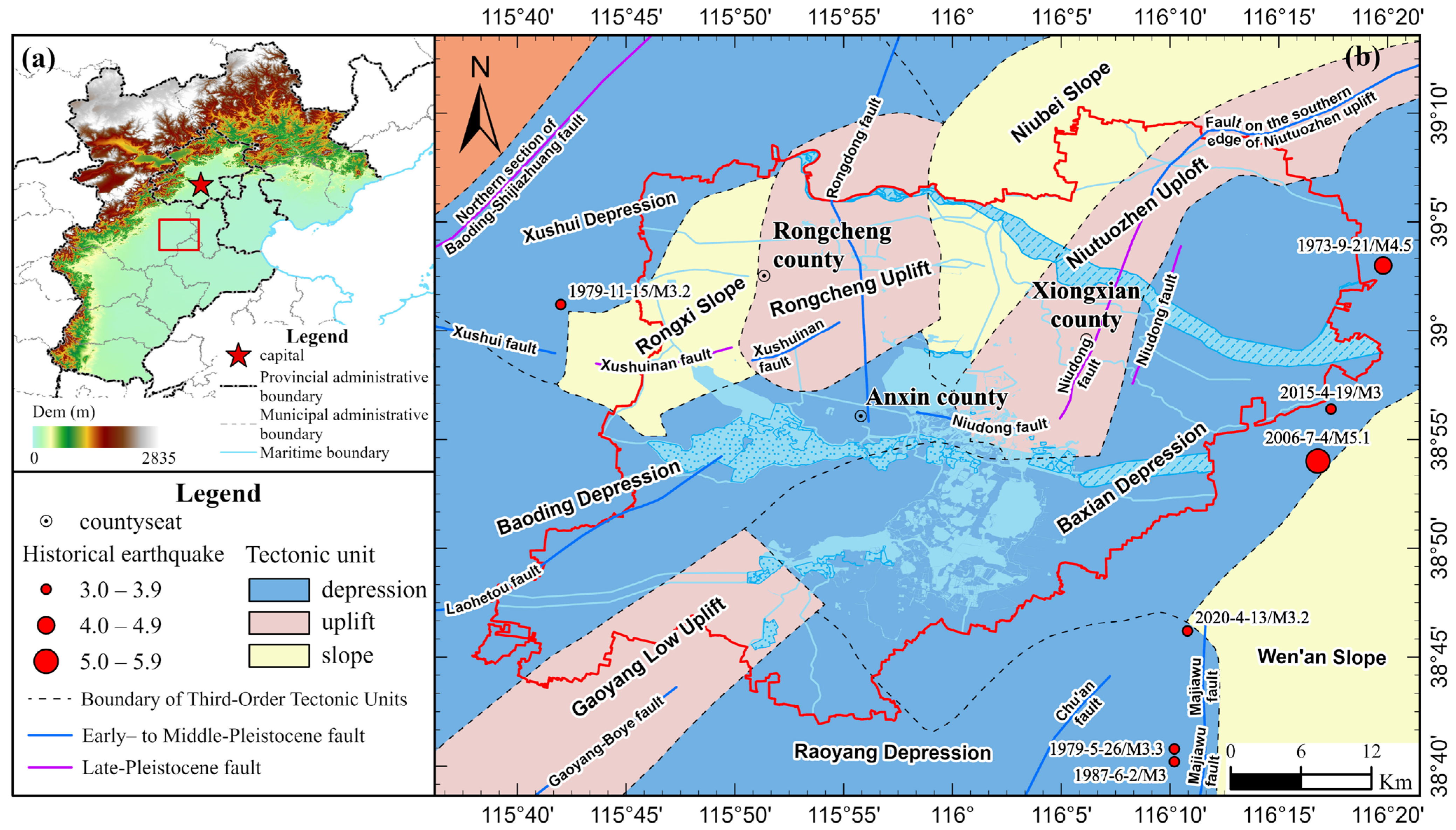
Xiong’an New Area lies within the central segment of the active tectonic zone of the North China Seismic Belt, where regional seismicity is relatively high, as evidenced by several destructive historical earthquakes in the surrounding region, including the 1679 Sanhe–Pinggu Mw 8.0 event, the 1966 Xingtai Mw 6.8 event, and the 1976 Tangshan Mw 7.8 event [39,40,41]. The subsurface strata of the study area are mainly composed of Quaternary Holocene deposits, and the regional tectonic framework includes the Rongcheng uplift, the southern part of the Niutuozhen uplift, the southern Niubei slope, and the Baiyangdian–Dahezhen Sag, forming a characteristic tectonic pattern of “two uplifts flanking one sag”, with Late Pleistocene active faults, such as the Niudong fault zone and the southern Xushui fault zone, developed within the region, indicating evident tectonic activity and a seismic risk that cannot be neglected [42,43] (Figure 3). The topography is characterized by an alluvial plain with flat terrain and relatively homogeneous geological and soil conditions, providing favorable settings for infrastructure development.
As the construction of Xiong’an New Area progresses, both population size and urbanization level continue to increase. The permanent resident population has reached approximately 1.4 million, accompanied by a rising population density and the rapid development of diverse urban functions, including administrative services, scientific research and innovation, and comprehensive public services. Meanwhile, large-scale construction of residential buildings, public facilities, transportation networks, and other critical infrastructures has significantly increased regional exposure and vulnerability to earthquake hazards. Under this context of rapid urbanization and increasing exposure, systematically evaluating earthquake emergency preparedness capacity is essential for identifying potential weaknesses, optimizing resource allocation, and enhancing coordinated emergency response capabilities. Although the continuous improvement of infrastructure and public service systems has strengthened the overall foundation for earthquake emergency management, substantial differences persist among counties and townships in terms of emergency resource allocation, public service capacity, community governance, and the level of informatization. This spatial heterogeneity highlight the necessity of conducting multi-level and regionally differentiated assessments to better support targeted earthquake emergency preparedness and risk reduction strategies.

4.2. Township-Level Earthquake Emergency Preparedness Evaluation

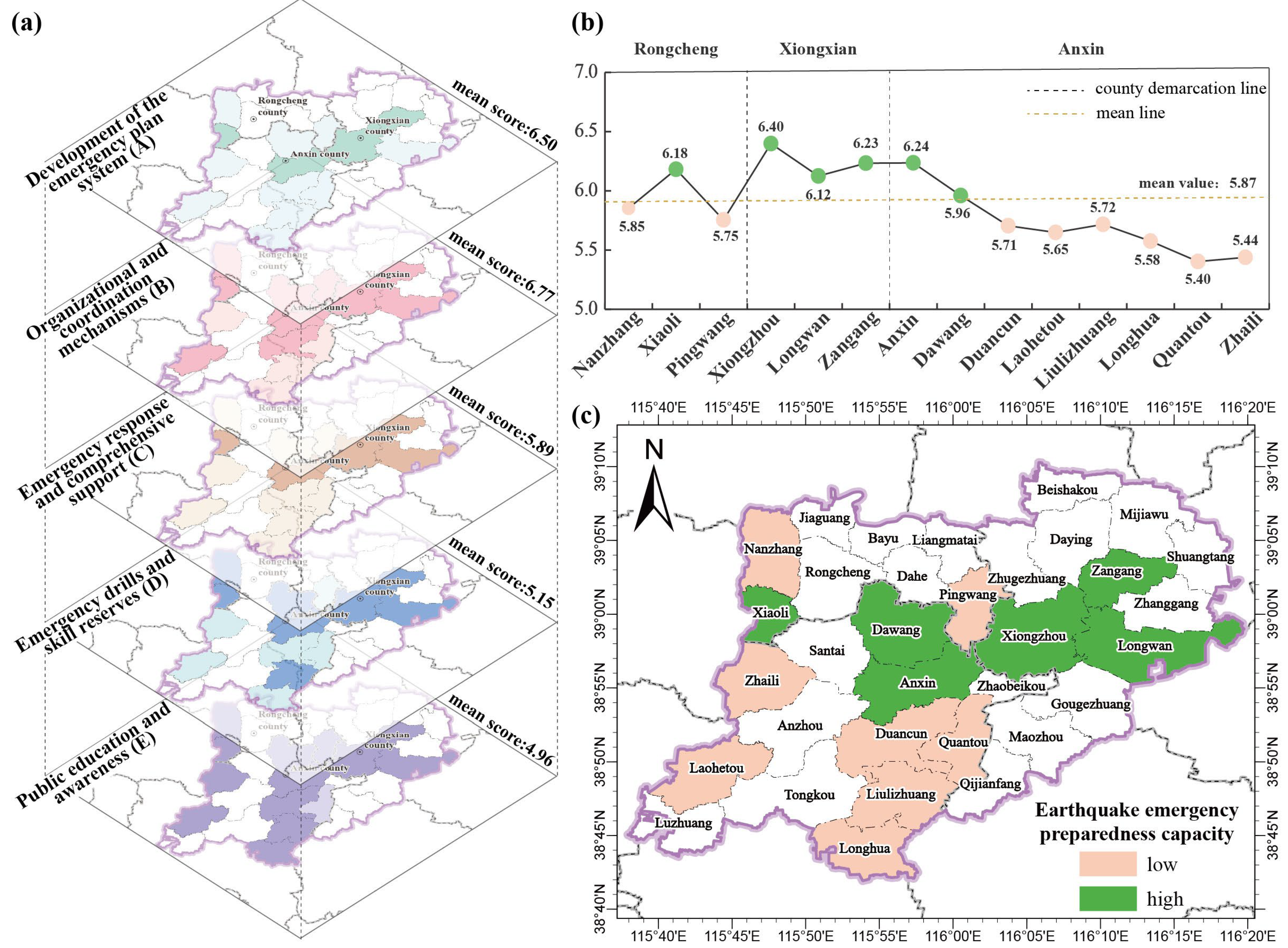
Based on the survey of earthquake emergency preparedness at the township level in the Xiong’an New Area, a comprehensive assessment was conducted for 14 townships using the indicator evaluation model established in Equation (5) and the indicator weights listed in Table 1 (Figure 4). The composite scores were classified into five levels—good, relatively good, moderate, poor, and very poor—corresponding to scores of 9, 7, 5, 3, and 1, respectively.
At the primary indicator level, the mean scores for the development of the emergency plan system, organizational and coordination mechanisms, emergency rescue and comprehensive support, emergency drills and skill reserves, and public education and awareness were 6.50, 6.77, 5.89, 5.15, and 4.96, respectively. As shown in Figure 4a, organizational and coordination mechanisms exhibited the highest overall performance, although several townships remained below the mean. The development of the emergency plan system showed clear spatial heterogeneity, with only a limited number of townships exceeding the average level. Scores for emergency rescue and comprehensive support generally ranged from “moderate” to “relatively good”, whereas emergency drills and skill reserves, together with public education and awareness, consistently exhibited lower scores. Notably, public education and awareness showed the lowest mean value among all indicators, despite limited spatial variation, indicating a common weakness at the township level. In general, townships such as Xiaoli, Anxin, Xiongzhou, and Zangang performed above the mean across most indicators, whereas others displayed mixed performance, with strengths in specific indicators insufficient to fully offset deficiencies in others.
The integrated assessment of all indicators indicates that earthquake emergency preparedness across the townships generally ranges from moderate to relatively good. Among them, Xiongzhou Town achieved the highest composite score (6.40), whereas Quantou Township recorded the lowest score (5.40) (Figure 4b). The mean composite score for all townships is 5.87. Using this value as a threshold, township-level earthquake emergency preparedness was further classified into two categories, namely high and low. Xiaoli, Anxin, Dawang, Xiongzhou, Longwan, and Zangang towns scored above the average, demonstrating relatively higher levels of earthquake emergency preparedness (Figure 4c). The assessment further reveals discernible spatial differences in earthquake emergency preparedness among townships in the Xiong’an New Area. Nevertheless, preparedness levels remain moderately high overall, reflecting a relatively balanced yet still differentiated pattern at the township scale.
It should be noted that formal statistical testing, such as spatial autocorrelation or clustering analysis, was not applied due to the limited number of spatial units (14 townships), which constrains the statistical robustness of such methods. Accordingly, the findings are interpreted based on comparative and descriptive spatial analysis to highlight relative differences among townships and across primary indicators.
In future research, as more fine-scale data become available or as the study area is expanded to include additional administrative units, quantitative spatial statistical techniques and significance testing can be incorporated to further validate the observed spatial patterns and enhance the analytical depth of earthquake emergency preparedness assessments.

4.3. County-Level Earthquake Emergency Preparedness Evaluation

County-level earthquake emergency preparedness reflects both the institutional capacity of county governments in organization, coordination, and resource allocation and the preparedness conditions at the township level. In terms of core preparedness components, county and township levels exhibit a high degree of consistency in task objectives, basic requirements, and capacity structures, both focusing on key aspects such as the development of emergency planning systems, the improvement of command and coordination mechanisms, the stockpiling of emergency resources, the implementation of drills and training, and the promotion of public education on earthquake disaster prevention and mitigation. Based on this consistency and comparability, a unified evaluation indicator system was applied at both county and township levels to ensure methodological consistency and result comparability, and to establish a bottom-up framework for integrating emergency preparedness capacity. Based on field survey data, preparedness scores were calculated separately for county authorities and subordinate townships and then integrated using a weighted averaging approach with equal weights assigned to county authorities and subordinate townships to derive county-level composite scores.
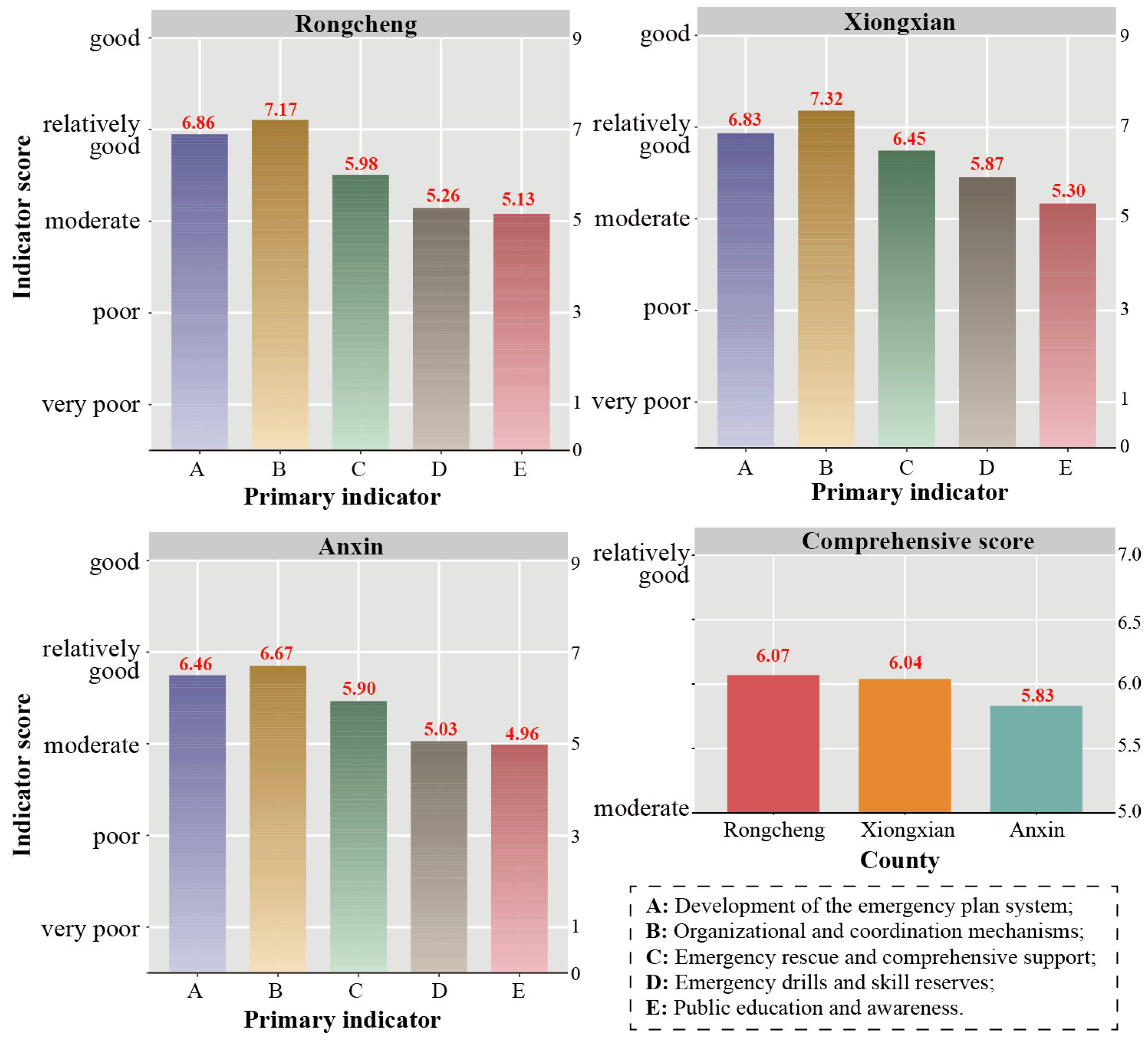
The three counties in the Xiong’an New Area—Rongcheng, Xiongxian, and Anxin—exhibit overall earthquake emergency preparedness levels ranging from “moderate” to “relatively good” (Figure 5), with county-level scores exceeding those of townships. In emergency planning systems, county-level preparedness approaches the relatively good level, with Rongcheng scoring highest, reflecting well-established mechanisms for plan formulation and updating. Organizational and coordination mechanisms range from relatively good to good in Xiongxian and Rongcheng, whereas Anxin scored below relatively good, indicating weaker coordination capacity. Emergency rescue and material reserves generally range from moderate to relatively good, with Xiongxian scoring 6.45 and Anxin 5.90, slightly above moderate.
Emergency drills and skill reserves were comparatively weak across all counties, particularly in Anxin, reflecting limited drills and skill retention. Public education and awareness represented the lowest-performing dimension, with consistently low scores across counties; notably, Anxin failed to reach the moderate level. This pattern indicates insufficient public risk awareness, limited individual knowledge of earthquake hazards, and an inadequate understanding of basic personal safety and self-protection measures. In this context, strengthening individual-level preparedness—such as self-protection awareness and appropriate response actions—remains a critical complement to institutional planning efforts. Moreover, the integration of earthquake early warning systems, as a modern safety technology has the potential to further enhance public awareness and individual response capacity by providing timely alerts that support rapid protective actions when combined with effective public education and training programs.
Overall, county-level preparedness in the Xiong’an New Area remains at a developing stage, with institutional planning providing a foundation, while notable gaps persist in coordination, resource allocation, operational drills, and public education.

4.4. Overall Earthquake Emergency Preparedness in Xiong’an New Area

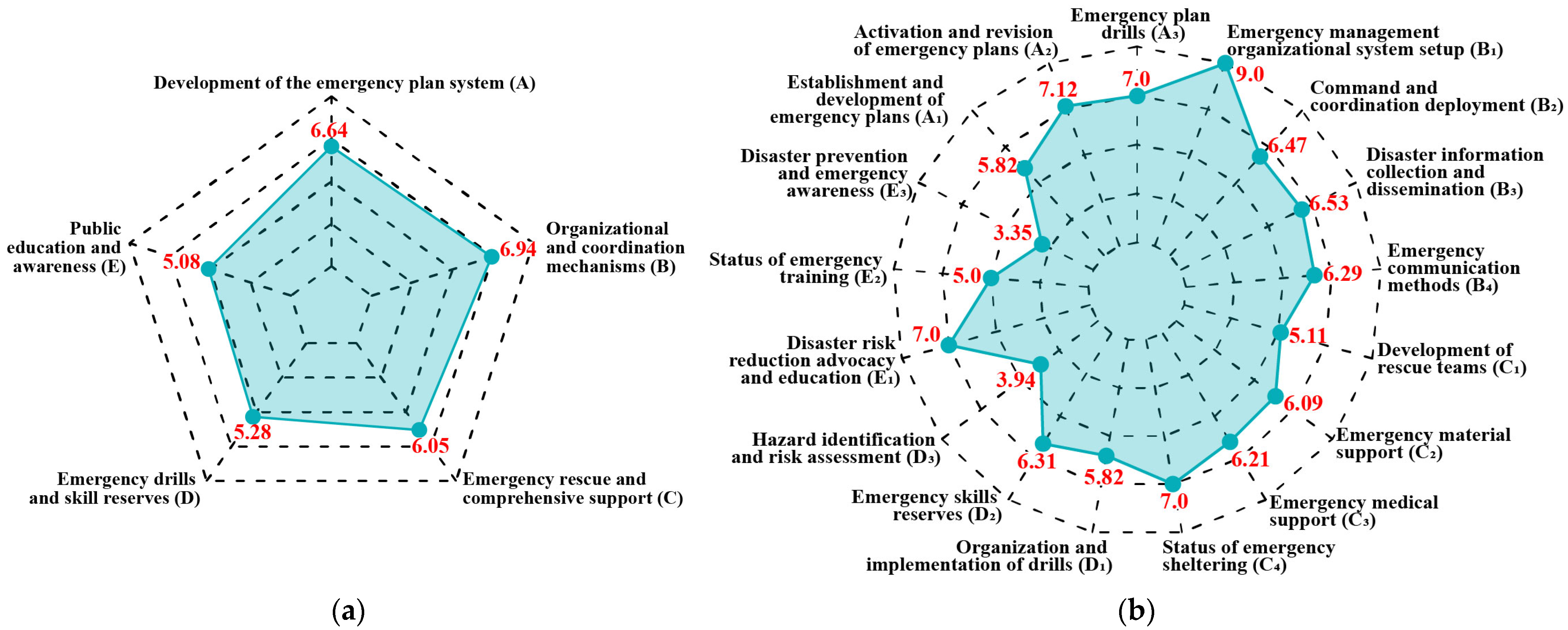
The aggregated assessment of the three counties yields a composite earthquake emergency preparedness capacity score of 6.02 for the Xiong’an New Area, corresponding to an overall level between “moderate” and “relatively good”. The comparative performance across different indicator dimensions of earthquake emergency preparedness is illustrated using radar charts (Figure 6).
Among the five primary indicators (Figure 6a), organizational and coordination mechanisms achieved the highest score (6.94), approaching the “relatively good” level, indicating relatively mature earthquake emergency command procedures and coordination frameworks. In contrast, public education and awareness scored the lowest (5.08), remaining close to the “moderate” level and representing the primary limiting factor for further improvement in overall preparedness capacity. Further analysis of the secondary indicators (Figure 6b) reveals that disaster prevention and emergency awareness scored only 3.35, corresponding to a “poor” level and substantially constraining the performance of the public education and awareness dimension. This finding reflects generally insufficient disaster risk perception, limited emergency evacuation awareness, and weak self-protection capabilities among residents. Moreover, the primary indicator emergency drills and skill reserves obtained a score of 5.28, which was lower than those for development of the emergency plan system, organizational and coordination mechanisms, and emergency rescue and comprehensive support. This disparity suggests deficiencies in practical capacity, including inadequate hazard identification and risk assessment (3.94), limited implementation of risk management measures, insufficient drill diversity, and the absence of systematic evaluation and feedback mechanisms. Despite these deficiencies, several indicators performed relatively well. Emergency management organizational system setup, activation and revision of emergency plans, status of emergency plan drills, status of emergency training, emergency shelter arrangements, and publicity and education activities all reached the “relatively good” level, indicating that the Xiong’an New Area has established a comparatively sound institutional foundation and achieved effective implementation in several key operational components of earthquake emergency preparedness.
Taken together, the assessment reveals a structurally uneven pattern of earthquake emergency preparedness in the Xiong’an New Area, characterized by higher scores in institutional and organizational indicators and lower performance in indicators related to public participation and practical response capacity. This contrast underscores the limited effectiveness of existing institutional arrangements in translating formal preparedness frameworks into enhanced grassroots-level readiness.

5. Discussion

5.1. Evaluation Indicators and Methodological Considerations of Earthquake Emergency Preparedness

This study establishes a hierarchical assessment index system for earthquake emergency preparedness consisting of 5 primary, 17 secondary, and 25 tertiary indicators, and applies it consistently across township, county, and regional (Xiong’an New Area) levels. Unlike previous studies that often focus on a single administrative scale or use fragmented indicator systems, the unified indicator system and weighting scheme enable robust multi-level evaluation and cross-scale comparison, systematically tracing preparedness disparities from grassroots units to higher administrative levels [44,45].
By integrating quantitative and qualitative indicators within a standardized scoring system and combining the entropy weight method with field-based questionnaire surveys, the framework balances objective weighting with contextual information reflecting local implementation and public engagement. This mixed-methods approach has been shown to be effective for capturing both institutional capacity and community-level preparedness in earthquake risk management [46,47]. When applied to other countries with different administrative systems or disaster management policies, the framework can be adapted by restructuring the hierarchical assessment levels and recalibrating indicator composition and weights to align with local governance arrangements. Administrative units used in this study may be replaced by functionally equivalent levels defined within national or subnational emergency management systems, while preserving the core logic of multi-level preparedness assessment and cross-scale comparison [3,48]. Indicator selection and weighting can be further adjusted to reflect country-specific legal frameworks, institutional responsibilities, and policy priorities, as demonstrated in comparative disaster preparedness studies across different governance contexts [49].
Nevertheless, the results remain sensitive to data quality and respondent cognition, particularly at the township level. The additive structure of the composite index does not explicitly account for dynamic interactions among preparedness components, and the assessment represents a static snapshot that does not capture temporal evolution or scenario-specific variations. Despite these limitations, the proposed framework offers a transparent, replicable, and scalable approach for multi-level preparedness assessment. Future research could extend this approach by incorporating longitudinal data, scenario-based simulations, and dynamic modeling to capture temporal changes and cross-level interactions. Integrating emerging big data sources may further enhance the assessment of public risk perception and behavioral responses.

5.2. Policy Implications for Earthquake Emergency Preparedness

The multi-level assessment indicates that earthquake emergency preparedness in the Xiong’an New Area ranges from “moderate” to “relatively good”, reflecting relatively sound institutional structures but weaker grassroots capacity, a pattern consistent with findings in other regions [23,50]. At the township level, preparedness is generally low, particularly in public awareness, emergency drills, and skill reserves, representing a critical bottleneck for community resilience. Public awareness can be enhanced through the use of big data, as post-disaster communication within appropriate time windows has been shown to effectively stimulate risk perception and awareness [51]. County-level preparedness is comparatively higher, supported by more established emergency planning systems and drill implementation, although gaps remain in rescue personnel development and training. At the regional level, emergency planning and command coordination perform well, but overall preparedness is constrained by limitations at the grassroots level, underscoring the importance of integrating bottom-up and top-down approaches in disaster management [52].
These findings highlight the need for differentiated, scale-specific strategies. At the township level, efforts should prioritize risk communication, public education, and localized drills, consistent with evidence that community engagement improves disaster response effectiveness [53]. At the county level, strategies should focus on strengthening professional teams, material reserves, and cross-level coordination mechanisms. At the regional level, institutional and planning advantages can be leveraged to establish robust cross-regional command and coordination networks.
The proposed framework is applicable to other regions with multi-tier administrative structures and uneven preparedness levels. With appropriate adaptation of indicator content to local hazard characteristics and governance contexts, the method can support comparative assessments and evidence-based policy design in other earthquake-prone and rapidly urbanizing areas. More broadly, enhancing earthquake preparedness requires a systematic, multi-level approach that emphasizes effective local implementation, community engagement, and cross-sectoral coordination to improve operational performance and long-term resilience [54,55,56].

6. Conclusions

The comprehensive assessment indicates that earthquake preparedness in the Xiong’an New Area generally ranges from a moderate to a relatively good level, while pronounced hierarchical disparities persist. A distinct “top-heavy, bottom-weak” structural pattern is evident, with preparedness capacity declining markedly from the New Area and county levels to the township level. At the township level, insufficient public risk awareness, limited emergency drills, and inadequate practical skill reserves constitute the primary constraints on improving regional resilience. At the county level, emergency planning and organizational as well as coordination mechanisms are in place, whereas emergency rescue and comprehensive support capacities remain insufficient. At the New Area level, emergency planning and command-and-coordination mechanisms are comparatively mature; however, deficiencies at the grassroots level continue to constrain overall preparedness performance.
These results indicate that improving earthquake preparedness in the Xiong’an New Area requires differentiated, tier-specific strategies that prioritize strengthening township-level preparedness, enhancing professional response and support capacities, and promoting more balanced capacity development across administrative levels through institutional integration and coordinated governance.
Several limitations of this study should be acknowledged. Indicator weights were derived using an entropy-weight method combined with expert scoring, and both the weighting scheme and assessment outcomes are influenced by the surveyed respondents and expert judgment. The composite preparedness index relies on weighted aggregation and does not explicitly represent potential interaction effects among preparedness indicators. The assessment is based on survey data and provides a static characterization of preparedness capacity. The proposed evaluation indicator system is applicable to the Xiong’an New Area; its application to other countries or regions requires context-specific adjustment of administrative levels, indicator composition, and weighting schemes to reflect local hazard conditions, governance structures, and disaster management policies. Future research may address these limitations by incorporating longitudinal data, modeling interactions among indicators, and developing context-specific adaptations of the evaluation framework.

Author Contributions

Conceptualization, Y.Z. and L.D.; methodology, H.L.; investigation, Y.C.; data curation, K.W.; writing—original draft preparation, Y.Z.; writing—review and editing, H.L. and L.D.; visualization, Y.C. and Y.D. All authors have read and agreed to the published version of the manuscript.

Funding

This research was funded by the National Nonprofit Fundamental Research Grant of China, Institute of Geology, China Earthquake Administration (IGCEA2106); the Spark Program for Earthquake Science and Technology (XH25044B); the National Natural Science Foundation of China (42207532); the Youth Science Foundation of the China Earthquake Networks Center (QNJJ-202404); and the Key Earthquake Emergency Response Tasks of the China Earthquake Administration (CEAEDEM20250222).

Institutional Review Board Statement

Not applicable.

Informed Consent Statement

Not applicable.

Data Availability Statement

The data presented in this study are available on reasonable request from the corresponding author.

Acknowledgments

The authors gratefully acknowledge the Emergency Management Bureau of the Xiong’an New Area for their valuable support during the field investigation and data collection stages of this study. Their assistance in facilitating surveys and providing practical insights greatly contributed to the successful completion of the research.

Conflicts of Interest

Author Lijun Deng was employed by the company Twenty First Century Aerospace Technology Co., Ltd. The remaining authors declare that the research was conducted in the absence of any commercial or financial relationships that could be construed as a potential conflict of interest.

Appendix A

Table A1 summarizes the scoring rules and conversion methods for all indicators used in the earthquake emergency preparedness assessment, including indicator classification, raw data form, scoring criteria, and corresponding numerical values.
Table A1. Scoring rubric for Type A, Type B, and Type C indicators.
Indicator TypeIndicator DescriptionIndicators 1Original Data/Response FormScoring CriteriaAssigned Score
Type A (Binary qualitative)Presence/absence of preparedness measures (e.g., emergency plan, emergency drills)A1
A21
A3
B1
B2
B31
B32
C23
C34
D13
D31
D32
Yes/NoYes9
No1
Type B (Multi-class qualitative)Perceived effectiveness, adequacy, or management level (questionnaire-based)B4
D12
E3
Five-level questionnaire responseExcellent9
Good7
Average5
Poor3
Very poor1
Type C (Continuous quantitative)Resource-based indicators (e.g., number of shelters, emergency personnel, stockpiled materials)A22
C11
C12
C13
C21
C22
C31
C32
C33
C41
C42
D11
D21D22
D23
D24
E1
E2
Ratio of actual value to required valueNatural breaks (highest class)9
Natural breaks (high)7
Natural breaks (medium)5
Natural breaks (low)3
Natural breaks (lowest class)1
1 A1: Establishment and development of emergency plans; A21: Status of emergency plan activation; A3: Emergency plan drills; B1: Emergency management organizational system; B2: Command and coordination deployment; B31: Status of disaster information reception; B32: Status of disaster information dissemination; C23: Material support mechanism; C34: Medical support mechanism; D13: Evaluation of emergency drills; D31: Status of hidden hazard investigation; D32: Status of risk assessment; B4: Emergency communication methods; D12: Comprehensiveness of emergency drills; E3: Disaster prevention and emergency awareness; A22: Frequency of emergency plan revision; C11: Professional emergency rescue teams; C12: Social emergency rescue teams; C13: Grassroots emergency rescue teams; C21: Stockpile of shelter and clothing; C22: Stockpile of water and food; C31: Number of medical technical personnel; C32: Number of medical beds; C33: Number of ambulances; C41: Number of emergency shelters; C42: Capacity of emergency evacuation shelters; D11: Frequency of emergency drills; D21: Command and coordination skills; D22: Evacuation and temporary shelter management skills; D23: Emergency protective action skills; D24: Self-rescue and first-aid skills; E1: Disaster risk reduction advocacy and education; E2: Status of emergency training.

References

  1. Davis, C.; Keilis-Borok, V.; Molchan, G.; Shebalin, P.; Lahr, P.; Plumb, C. Earthquake Prediction and Disaster Preparedness: Interactive Analysis. Nat. Hazards Rev. 2010, 11, 173–184. [Google Scholar] [CrossRef]
  2. Latupeirisa, V.P.S.; Pujianto. Level of Earthquake Disaster Preparedness and Its Integrity in Natural Science Learning: A Literature Review. J. Phys. Conf. Ser. 2020, 1440, 012093. [Google Scholar] [CrossRef]
  3. Ma, Z.; Guo, S.; Deng, X.; Xu, D. Community Resilience and Resident’s Disaster Preparedness: Evidence from China’s Earthquake-Stricken Areas. Nat. Hazards 2021, 108, 567–591. [Google Scholar] [CrossRef]
  4. Zucca, M.; Franchi, A.; Crespi, P.; Longarini, N.; Ronca, P. The New Foundation System for the Transept Reconstruction of the Basilica Di Collemaggio. In Proceedings of the 10th International Masonry Conference, Milan, Italy, 9–11 July 2018. [Google Scholar]
  5. Semlali, B.-E.B.; Molina, C.; Librado, M.C.; Park, H.; Camps, A.; Semlali, B.-E.B.; Molina, C.; Librado, M.C.; Park, H.; Camps, A. Potential Earthquake Proxies from Remote Sensing Data. In Climate Change and Risk Management—Strategies, Analysis, and Adaptation; IntechOpen: London, UK, 2024; ISBN 978-0-85466-559-4. [Google Scholar]
  6. Ruggiero, A.; Piotrowicz, W.D.; John, L. Enhancing Societal Resilience through the Whole-of-Society Approach to Crisis Preparedness: Complex Adaptive Systems Perspective—The Case of Finland. Int. J. Disaster Risk Reduct. 2024, 114, 104944. [Google Scholar] [CrossRef]
  7. Roth, P.B.; Gaffney, J.K. The Federal Response Plan and Disaster Medical Assistance Teams in Domestic Disasters. Emerg. Med. Clin. 1996, 14, 371–382. [Google Scholar] [CrossRef] [PubMed]
  8. Kapucu, N. Examining the National Response Plan in Response to a Catastrophic Disaster: Hurricane Katrina in 2005. Int. J. Mass Emergencies Disasters 2006, 24, 271–299. [Google Scholar] [CrossRef]
  9. Perry, R.W.; Lindell, M.K. Preparedness for Emergency Response: Guidelines for the Emergency Planning Process. Disasters 2003, 27, 336–350. [Google Scholar] [CrossRef] [PubMed]
  10. Harris, J.; McCabe, S. ICSSC Biennial Progress Report for 2022: Report on Progress Towards Implementation of Executive Order 13717: Establishing a Federal Earthquake Risk Management Standard—Reporting Period: February 2, 2020 to February 1, 2022; NIST: Gaithersburg, MD, USA, 2023; p. 10. [Google Scholar]
  11. Ghalehteimouri, K.J. Evaluate the Capacity of Japanese Spatial Planning System for Hazards Integration Realities and (f)Acts: A Pre-Post the Great East Japan Earthquake in Fukushima, 2011. Saf. Extrem. Environ. 2024, 6, 201–218. [Google Scholar] [CrossRef]
  12. Daimon, H.; Miyamae, R.; Wang, W. Navigating Theories of Actions on Disaster Prevention: A Systematic Review on Disaster Research in Japan. Nat. Hazards Rev. 2023, 24, 03123002. [Google Scholar] [CrossRef]
  13. Zou, M.; Yuan, Y. China’s Comprehensive Disaster Reduction. Int. J. Disaster Risk Sci. 2010, 1, 24–32. [Google Scholar] [CrossRef]
  14. Qizhen, C.; Ping, Z.; Xian, Z.; Jiayan, L.I.U.; Li, J.I.A. Establishment of an innovative system of natural disaster prevention and mitigation in China. Hydrogeol. Eng. Geol. 2020, 47, 1–4. [Google Scholar] [CrossRef]
  15. Ren, P.; Xu, Z.; Gu, J. Assessments of the Effectiveness of an Earthquake Emergency Plan Implementation with Hesitant Analytic Hierarchy Process. Int. J. Inf. Technol. Decis. Mak. 2016, 15, 1367–1389. [Google Scholar] [CrossRef]
  16. Chen, G.; Li, T.; Fei, L. A Decision-Making Model for the Assessment of Emergency Response Capacity in China. Mathematics 2025, 13, 1772. [Google Scholar] [CrossRef]
  17. Wang, Y.; Zhang, Y.; Zhang, J.; Li, M.; Ma, M.; Li, J. Multidimensional Evaluation of Seismic Emergency Capabilities in Chinese Cities: The Case of Changchun. Sci. Rep. 2024, 14, 30898. [Google Scholar] [CrossRef] [PubMed]
  18. Zhai, L.; Lee, J.E. Analyzing the Disaster Preparedness Capability of Local Government Using AHP: Zhengzhou 7.20 Rainstorm Disaster. Int. J. Environ. Res. Public Health 2023, 20, 952. [Google Scholar] [CrossRef] [PubMed]
  19. Mir, S.; Shah, S.A.; Bhat, M.S. Evaluation of Disaster Preparedness in Educational Infrastructure of Remote Geographies Using Analytical Hierarchy Process. Int. J. Disaster Risk Reduct. 2024, 108, 104514. [Google Scholar] [CrossRef]
  20. Wang, K.; Feng, Y.; Yang, H.; Deng, J.; Li, Q. Evaluation of Community Emergency Management Capability Based on SWOT Analysis—A Case Study. Sustainability 2023, 15, 12770. [Google Scholar] [CrossRef]
  21. Chen, J.; Li, W.; Chen, W.; Zhang, S. Assessment of Earthquake Prevention and Disaster Reduction Capability of County-Level Administrative Units in Gansu Province. J. Risk Anal. Crisis Response 2017, 7, 214–224. [Google Scholar] [CrossRef]
  22. Cutter, S.L.; Burton, C.G.; Emrich, C.T. Disaster Resilience Indicators for Benchmarking Baseline Conditions. J. Homel. Secur. Emerg. Manag. 2010, 7, 1–22. [Google Scholar] [CrossRef]
  23. Hajilo, M.; Talkhab, A.; Pennington-Gray, L. Spatial Analysis of Earthquake-Prone Rural Areas and Residents’ Preparedness. Nat. Hazards 2024, 120, 4101–4130. [Google Scholar] [CrossRef]
  24. Liu, S.; Li, Z.; Wang, F.; Zhou, S. Research on Evaluation of Emergency Management Capability of Major Emergencies Based on Fuzzy Network Analysis. In Proceedings of the 2025 International Conference on Big Data and Informatization Education, Suzhou, China, 21–23 February 2025; Association for Computing Machinery: New York, NY, USA, 2025; pp. 335–340. [Google Scholar]
  25. Papathoma-Köhle, M.; Cristofari, G.; Wenk, M.; Fuchs, S. The Importance of Indicator Weights for Vulnerability Indices and Implications for Decision Making in Disaster Management. Int. J. Disaster Risk Reduct. 2019, 36, 101103. [Google Scholar] [CrossRef]
  26. Battarra, M.; Balcik, B.; Xu, H. Disaster Preparedness Using Risk-Assessment Methods from Earthquake Engineering. Eur. J. Oper. Res. 2018, 269, 423–435. [Google Scholar] [CrossRef]
  27. Zhang, F.; Xie, L.; Fan, L. Study on Evaluation of Cities’ Ability Reducing Earthquake Disasters. Acta Seismol. Sin. 2004, 17, 349–361. [Google Scholar] [CrossRef]
  28. Kolathayar, S.; Anupa, S.A.; Prakash, E.L. Development of Earthquake Readiness Index Tool to Assess Individual Earthquake Preparedness Level. In Urbanization Challenges in Emerging Economies: Resilience and Sustainability of Infrastructure; ASCE: Reston, VA, USA, 2018; pp. 149–155. [Google Scholar] [CrossRef]
  29. Hu, X.; Naim, K.; Jia, S.; Zhengwei, Z. Disaster Policy and Emergency Management Reforms in China: From Wenchuan Earthquake to Jiuzhaigou Earthquake. Int. J. Disaster Risk Reduct. 2021, 52, 101964. [Google Scholar] [CrossRef]
  30. Liu, J.; Fan, Y.; Shi, P. Response to a High-Altitude Earthquake: The Yushu Earthquake Example. Int. J. Disaster Risk Sci. 2011, 2, 43–53. [Google Scholar] [CrossRef]
  31. Shi, P.; Liu, L.; Wang, J.; Xu, W.; Fang, W.; Wang, M. Experience, Lessons and Recommendation of China’s Response to the Wenchuan Earthquake Disaster. In Integrated Risk Governance: Science Plan and Case Studies of Large-Scale Disasters; Shi, P., Jaeger, C., Ye, Q., Eds.; Springer: Berlin/Heidelberg, Germany, 2013; pp. 71–88. ISBN 978-3-642-31641-8. [Google Scholar]
  32. Shannon, C. Understanding Community-Level Disaster and Emergency Response Preparedness. Disaster Med. Public Health Prep. 2015, 9, 239–244. [Google Scholar] [CrossRef]
  33. Wu, G.; Han, Z.; Xu, W.; Gong, Y. Mapping Individuals’ Earthquake Preparedness in China. Nat. Hazards Earth Syst. Sci. 2018, 18, 1315–1325. [Google Scholar] [CrossRef]
  34. GB/T 31079-2014; Guideline of Earthquake Emergency for Community. Ministry of Emergency Management of the People’s Republic of China: Beijing, China, 2014.
  35. GB/T 43981-2024; Technical Specification for Disaster Coping Capacity Assessment at Grassroots Level. Ministry of Emergency Management of the People‘s Republic of China: Beijing, China, 2024.
  36. DB51/T 3223-2024; Technical Specification for Earthquake Disaster Risk Assessment and Zoning. Sichuan Provincial Earthquake Administration: Chengdu, China, 2024; 36.
  37. Wu, R.M.X.; Zhang, Z.; Yan, W.; Fan, J.; Gou, J.; Liu, B.; Gide, E.; Soar, J.; Shen, B.; Fazal-e-Hasan, S.; et al. A Comparative Analysis of the Principal Component Analysis and Entropy Weight Methods to Establish the Indexing Measurement. PLoS ONE 2022, 17, e0262261. [Google Scholar] [CrossRef]
  38. Pena, J.; Nápoles, G.; Salgueiro, Y. Implicit and Hybrid Methods for Attribute Weighting in Multi-Attribute Decision-Making: A Review Study. Artif. Intell. Rev. 2021, 54, 3817–3847. [Google Scholar] [CrossRef]
  39. Liu, Y.; Zhuang, J.; Jiang, C. Background Seismicity before and after the 1976 Ms 7.8 Tangshan Earthquake: Is Its Aftershock Sequence Still Continuing? Seismol. Res. Lett. 2021, 92, 877–885. [Google Scholar] [CrossRef]
  40. Wang, X.; Feng, X.; Xu, X.; Diao, G.; Wan, Y.; Wang, L.; Ma, G. Fault Plane Parameters of Sanhe-Pinggu M8 Earthquake in 1679 Determined Using Present-Day Small Earthquakes. Earthq. Sci. 2014, 27, 607–614. [Google Scholar] [CrossRef]
  41. Yang, B.; Qin, S.; Xue, L.; Wu, X.; Zhang, K. Seismic hazard assessment in the Xiongan New Area. Chin. J. Geophys. 2017, 60, 4644–4654. [Google Scholar] [CrossRef]
  42. He, D.; Shan, S.; Zhang, Y.; Lu, Q.; Zhang, R.; Cui, Y. Three-Dimensional Geological Structure of Xiong’an New Area: Constraints from Reflection Seismic Data. Chin. Sci. Earth Sci. 2018, 48, 1207–1222. [Google Scholar] [CrossRef]
  43. Wang, J.; Liu, C.; Chen, Z.; Zhang, Z.; Zhang, F.; Zhang, S. Geochemical Characterization and Implications of Soil Gas and Geothermal Fluids in the Fault Zone of Xiongan New Area. Appl. Geochem. 2024, 161, 105886. [Google Scholar] [CrossRef]
  44. Song, J.; Huang, B.; Li, R.; Pandey, R. Construction of the Scale-Specific Resilience Index to Facilitate Multiscale Decision Making in Disaster Management: A Case Study of the 2015 Nepal Earthquake. Soc. Indic. Res. 2020, 148, 189–223. [Google Scholar] [CrossRef]
  45. Cutter, S.L.; Barnes, L.; Berry, M.; Burton, C.; Evans, E.; Tate, E.; Webb, J. A Place-Based Model for Understanding Community Resilience to Natural Disasters. Glob. Environ. Change 2008, 18, 598–606. [Google Scholar] [CrossRef]
  46. Hussain, M.; Ullah, K.; Tayyab, M.; Ullah, S.; Shah, A.A.; Zhang, J.; Tong, Z.; Liu, X.; Rahman, Z.U. Data-Driven Multi-Hazard Susceptibility and Community Perceptions Assessment Using a Mixed-Methods Approach. J. Environ. Manag. 2025, 388, 126009. [Google Scholar] [CrossRef]
  47. Paton, D. Disaster Preparedness: A Social-cognitive Perspective. Disaster Prev. Manag. Int. J. 2003, 12, 210–216. [Google Scholar] [CrossRef]
  48. Lin, B.C.; Lee, C.H. Constructing an Adaptability Evaluation Framework for Community-Based Disaster Management Using an Earthquake Event. Int. J. Disaster Risk Reduct. 2023, 93, 103774. [Google Scholar] [CrossRef]
  49. Castañeda, J.V.; Bronfman, N.C.; Cisternas, P.C.; Repetto, P.B. Understanding the Culture of Natural Disaster Preparedness: Exploring the Effect of Experience and Sociodemographic Predictors. Nat. Hazards 2020, 103, 1881–1904. [Google Scholar] [CrossRef]
  50. Xu, J.; Takahashi, M. Urban Marginalization and the Declining Capacity for Disaster Risks in Contemporary China. Soc. Sci. 2021, 10, 424. [Google Scholar] [CrossRef]
  51. Gizzi, F.T.; Kam, J.; Porrini, D. Time Windows of Opportunities to Fight Earthquake Under-Insurance: Evidence from Google Trends. Humanit. Soc. Sci. Commun. 2020, 7, 61. [Google Scholar] [CrossRef]
  52. Thaler, T.; Seebauer, S. Bottom-up Citizen Initiatives in Natural Hazard Management: Why They Appear and What They Can Do? Environ. Sci. Policy 2019, 94, 101–111. [Google Scholar] [CrossRef]
  53. Ryan, B.; Johnston, K.A.; Taylor, M.; McAndrew, R. Community Engagement for Disaster Preparedness: A Systematic Literature Review. Int. J. Disaster Risk Reduct. 2020, 49, 101655. [Google Scholar] [CrossRef]
  54. Shaffril, H.A.M.; Samah, A.A.; Kamarudin, S. Speaking of the Devil: A Systematic Literature Review on Community Preparedness for Earthquakes. Nat. Hazards 2021, 108, 2393–2419. [Google Scholar] [CrossRef]
  55. Mokobombang, W. Disaster Management in Earthquake-Prone Countries: Lessons from the Public Administration Systems of Japan and the Philippines. Int. J. Soc. Sci. Humanit. 2025, 2, 150–165. [Google Scholar] [CrossRef]
  56. Cavallo, A. Integrating Disaster Preparedness and Resilience: A Complex Approach Using System of Systems. Aust. J. Emerg. Manag. 2014, 29, 46–51. [Google Scholar]
Figure 1. Framework of the evaluation indicator system for earthquake emergency preparedness capacity. Note: A1: Establishment and development of emergency plans; A2: Activation and revision of emergency plans; A3: Emergency plan drills; B1: Emergency management organizational system; B2: Command and coordination deployment; B3: Disaster information collection and dissemination; B4: Emergency communication methods; C1: Development of rescue teams; C2: Emergency material support; C3: Emergency medical support; C4: Status of emergency sheltering; D1: Organization and implementation of drills; D2: Emergency skills reserves; D3: Hazard identification and risk assessment; E1: Disaster risk reduction advocacy and education; E2: Status of emergency training; E3: Disaster prevention and emergency awareness.
Applsci 16 02162 g001
Figure 2. Spatial distribution of survey sample sites for earthquake emergency preparedness capacity.
Applsci 16 02162 g002
Figure 3. Overview of the Xiong’an New Are. (a) Location of the Xiong’an New Area within the Beijing–Tianjin–Hebei region; (b) tectonic map of the Xiong’an New Area.
Applsci 16 02162 g003
Figure 4. Assessment results of township-level earthquake emergency preparedness. (a) Spatial distribution of primary indicator scores for earthquake emergency preparedness; (b) overall scores of earthquake emergency preparedness capacity at the township level; (c) spatial pattern of composite scores for township-level earthquake emergency preparedness.
Applsci 16 02162 g004
Figure 5. County-level earthquake emergency preparedness scores.
Applsci 16 02162 g005
Figure 6. Radar plot of earthquake emergency preparedness indicator scores in the Xiong’an New Area. (a) Primary indicator scores; (b) secondary indicator scores.
Applsci 16 02162 g006
Table 1. Sampling design and survey implementation.
CountyTownshipRespondent CategorySample Size (N)Response Rate (%)Survey PeriodInclusion Criteria
RongchengNanzhang; Xiaoli; PingwangEmergency management officials/staff410014 July 2025County- or township-level personnel engaged in earthquake emergency preparedness and disaster management
AnxinAnxin; Dawang; Duancun; Laohetou; Liulizhuang; Longhua; Quantou; Zhaili;Emergency management officials/staff910015–17 July 2025Same as above
XiaongxianXiongzhou; Longwan; ZangangEmergency management officials/staff4 s10018 July 2025Same as above
Table 2. Evaluation index system for earthquake emergency preparedness and indicator weight coefficients.
Primary IndicatorWeight
Coefficient
Secondary IndicatorWeight
Coefficient
Tertiary IndicatorWeight
Coefficient
Development of the emergency plan system (A)0.18Establishment and development of emergency plans (A1)0.35- 1-
Activation and revision of emergency plans (A2)0.41Status of emergency plan activation (A21)0.67
Frequency of emergency plan revision (A22)0.33
Emergency plan drills (A3)0.24--
Organizational and coordination mechanisms (B)0.20Emergency management organizational system (B1)0.31--
Command and coordination deployment (B2)0.30--
Disaster information collection and dissemination (B3)0.23Status of disaster information reception (B31)0.50
Status of disaster information dissemination (B32)0.50
Emergency communication methods (B4)0.16--
Emergency rescue and comprehensive support (C)0.25Development of rescue teams (C1)0.30Professional emergency rescue teams (C11)0.37
Social emergency rescue teams (C12)0.24
Grassroots emergency rescue teams (C13)0.39
Emergency material support (C2)0.26Stockpile of shelter and clothing (C21)0.35
Stockpile of water and food (C22)0.35
Material support mechanism (C23)0.30
Emergency medical support (C3)0.19Number of medical technical personnel (C31)0.38
Number of medical beds (C32)0.16
Number of ambulances (C33)0.15
Medical support mechanism (C34)0.31
Status of emergency sheltering (C4)0.25Number of emergency shelters (C41)0.50
Capacity of emergency evacuation shelters (C42)0.50
Emergency drills and skill reserves (D)0.23Organization and implementation of drills (D1)0.31Frequency of emergency drills (D11)0.32
Comprehensiveness of emergency drills (D12)0.33
Evaluation of emergency drills (D13)0.35
Emergency skills reserves (D2)0.32Command and coordination skills (D21)0.29
Evacuation and temporary shelter management skills (D22)0.27
Emergency protective action skills (D23)0.24
Self-rescue and first-aid skills (D24)0.20
Hazard identification and risk assessment (D3)0.37Status of hidden hazard investigation (D31)0.50
Status of risk assessment (D32)0.50
Public education and awareness (E)0.14Disaster risk reduction advocacy and education (E1)0.32--
Status of emergency training (E2)0.34--
Disaster prevention and emergency awareness (E3)0.34--
1 “-” indicates an empty cell.
Disclaimer/Publisher’s Note: The statements, opinions and data contained in all publications are solely those of the individual author(s) and contributor(s) and not of MDPI and/or the editor(s). MDPI and/or the editor(s) disclaim responsibility for any injury to people or property resulting from any ideas, methods, instructions or products referred to in the content.