Article

A New Insight into Ancient Wheat Pasta: Physicochemical, Technological and Cooking Quality of Triticum dicoccum (Emmer)


by
İzzet Özhamamcı
Department of Food Engineering, Faculty of Engineering, Ardahan University, Ardahan 75000, Türkiye
Appl. Sci. 2026, 16(4), 2138; https://doi.org/10.3390/app16042138
Submission received: 26 December 2025 / Revised: 6 February 2026 / Accepted: 8 February 2026 / Published: 22 February 2026
(This article belongs to the Section Food Science and Technology)

Abstract

Emmer (Triticum turgidum ssp. dicoccum) is attracting renewed interest as a nutrient-dense ancient wheat for sustainable cereal foods; however, product-level evidence for region-specific landraces remains limited. This study characterizes pasta produced exclusively from 100% Triticum dicoccum semolina cultivated in Ardahan (Türkiye) by integrating proximate composition, cooking performance, and instrumental texture (TPA). The emmer pasta contained 12.70% protein, 4.93% total dietary fiber, and 1.68% ash, with an energy value of 366.25 kcal/100 g. Cooking tests revealed 10.86% cooking loss, 219.98% water absorption, and 101.62% volume increase, indicating limited cooking tolerance consistent with a weaker starch–protein matrix. In comparison with conventional T. durum pasta, cooked emmer pasta exhibited comparable hardness, gumminess, and chewiness, but higher adhesiveness and springiness alongside lower resilience and cohesiveness. These results highlight Ardahan-grown T. dicoccum as a nutritionally valuable pasta raw material, albeit with technological constraints (particularly cooking loss) that warrant further optimization for industrial use.

1. Introduction

The global demand for local foods has been steadily increasing. Consumers often perceive “local food” as high-quality, associating it with attributes such as freshness, taste, safety, animal welfare, and environmental impact [1]. In line with this perception according to The Lancet Commissions, one of the key strategies for transitioning from the current food production system to a more sustainable one is the promotion of locally grown and consumed agricultural products [2]. Simultaneously, the consumption of unhealthy, high-calorie, and heavily processed foods has been increasing globally [3]. As a consequence, these negative dietary trends have further emphasized the need for sustainable food systems that support healthy diets. Public authorities and policy-makers are therefore increasingly focused on identifying viable solutions. Within this framework, these global trends have made the sustainable production of grains, which hold a particularly important place among staple food crops, even more critical.
Cereals and cereal-derived foods form the foundation of human nutrition worldwide and play a central role in sustainable agriculture. However, contemporary pasta production relies predominantly on high-yielding durum wheat cultivars optimized for industrial processing, often at the expense of genetic diversity and environmental adaptability. In contrast, traditional wheat landraces and ancient wheat species, though largely displaced from modern production systems, offer greater resilience to marginal growing conditions and renewed potential for sustainable cereal-based foods [4]. For all these reasons, ancient wheat varieties with high genetic diversity, low input costs, and resistance to environmental stresses have gained renewed interest.
Ancient wheat species represent the genetic predecessors of modern cultivars and are characterized by high genetic diversity, adaptability to marginal environments, and resistance to biotic and abiotic stresses, albeit with lower yield potential [5,6,7,8]. Although these species were largely displaced by modern wheats due to processing efficiency and market demands, renewed interest has emerged in recent years, driven by increasing awareness of environmental sustainability, dietary quality, and the health-promoting properties of whole grains. In particular, ancient wheats are recognized for their relatively high contents of protein, dietary fiber, minerals, and bioactive compounds, making them attractive raw materials for nutritionally enhanced cereal products cultivated under low-input agricultural systems due to increasing concerns about chronic health issues such as cardiovascular disease, obesity, diabetes and gastrointestinal disorders [8,9,10,11]. Among these ancient wheat species, T. dicoccum (emmer), locally known as “Kavılca” in Türkiye, represents a particularly promising raw material. This tetraploid wheat has not undergone intensive technological breeding and is still cultivated in limited quantities in the Ardahan region, characterized by harsh climatic conditions [9]. Moreover, emmer wheat is distinguished by its high contents of protein (8.7–19%), dietary fiber, resistant starch, minerals, carotenoids, and antioxidants, alongside a relatively low gluten index, which limits its suitability for leavened bakery products but enhances its potential for alternative cereal-based foods [12,13,14,15,16,17,18,19].
Pasta is a complex polymeric matrix primarily composed of starch and protein. Its most basic formulation consists of semolina and water, the latter of which plasticizes wheat proteins, allowing extrusion. During drying, the product transitions from a rubbery to a glassy state, stabilizing its structure. Protein denaturation and the formation of disulfide bonds between glutenin and gliadin result in a strengthened protein network [20,21]. Consequently, high-quality pasta is characterized by an insoluble gluten matrix that entraps gelatinized starch granules, thereby minimizing leaching of nutrients into cooking water and maintaining textural integrity [22]. Therefore, the structure of the gluten matrix is the key factor determining the performance of alternative wheat varieties in pasta production. Gelatinization of starch and coagulation of proteins during cooking contribute to the pasta’s typical texture [21]. Conversely, if the gluten network is weak, starch granules gelatinize prematurely, leading to surface stickiness and reduced structural quality [23].
Processing conditions, particularly drying temperature and extrusion parameters affect pasta’s rheological and nutritional characteristics. Specifically, a robust protein matrix formed during high temperature drying may restrict enzymatic access to starch, thereby slowing its digestion [24,25]. As a result, T. dicoccum pasta may exhibit hypoglycemic potential due to its slower starch digestibility compared to T. durum pasta [26,27]. Therefore, the evaluation of traditional varieties such as T. dicoccum in pasta production is important from both nutritional and technological perspectives.
Recent studies have highlighted the nutritional and sensory potential of ancient wheat species, including emmer, in cereal-based foods. However, existing research has largely addressed compositional and sensory attributes separately, while studies on ancient wheat pasta often rely on blends with durum wheat or evaluate a limited set of quality parameters. Consequently, comprehensive product-level investigations integrating physicochemical composition, cooking behavior, and instrumental texture profile analysis of pasta produced exclusively from Triticum dicoccum remain scarce [18]. Moreover, although promising technological and sensory properties have been reported for pasta made from ancient or old wheat varieties, the specific technological limitations of emmer pasta particularly those related to cooking loss and texture are still insufficiently characterized in relation to its nutritional advantages [28].
In this context, the present study aims to produce fusilli pasta exclusively from Triticum dicoccum semolina cultivated in Ardahan, Türkiye, and to provide an integrated evaluation of its physicochemical composition, cooking quality, and textural properties, performance. By directly linking compositional features with instrumental outcomes, this work seeks to clarify both the nutritional potential and the technological constraints of emmer-based pasta, thereby supporting a more realistic assessment of its applicability in sustainable and value-added cereal product development.

2. Materials and Methods

2.1. Materials

The Triticum dicoccum wheat semolina used in this study was sourced from the local market in Ardahan/Türkiye. The chemical composition of the semolina is as follows: 10.92% protein, 1.80% fat, 10.80% moisture, and 0.93% ash. In addition, Iodized sea salt and potable water used in pasta production were purchased from the center of Ardahan market in Türkiye. No additives or enriching agents were used in the production process. Prior to processing, all raw materials were stored at controlled room temperature.

2.2. Pasta Production

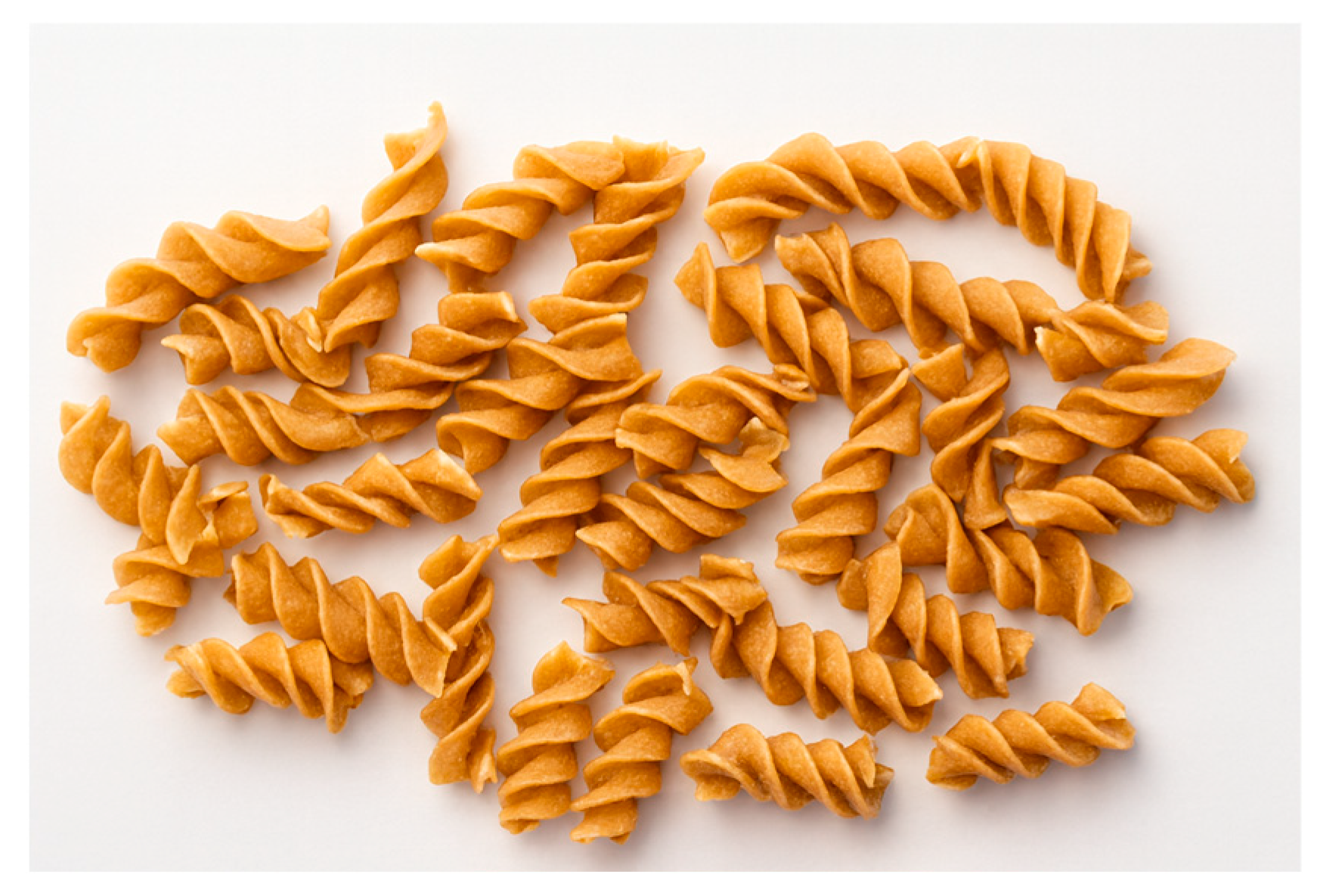
Spiral-shaped pasta was produced at room temperature without vacuum using a P50 model pasta extruder (Imperia & Monferrina S.p.A., Turin, Italy) equipped with a fusilli die (Figure 1). A total of 3.5 kg of T. dicoccum wheat semolina was weighed and placed in the mixing chamber. The mixture was then stirred for 2 min to ensure proper homogenization and aeration. Subsequently, while stirring for another 2 min, 1500 mL of drinking water was slowly added. Stirring was continued for another 2 min to achieve the desired dough consistency, bringing the total stirring time to 6 min. The stirred dough was transferred to the compression/extrusion chamber, where it was conveyed to the forming unit by a spiral screw. The dough was extruded into fusilli shape at a working temperature of approximately 35–45 °C and placed in drying trays.
Thereafter, the drying process was carried out under controlled conditions at a temperature of 50–65 °C for 9 h with an air velocity of 0.6 m/s using a La Monferrina EC100/NG, Epta Cooling (Istanbul, Türkiye) cabinet dryer. Relative humidity was maintained at 80% (rh) during drying and reduced to 62% (rh) during the post-drying cooling phase. After drying, the pasta samples were stored in airtight polyethylene containers at room temperature until analysis.

2.3. Raw Pasta Proximate Composition

Basic physicochemical analyses of raw pasta (fusilli) samples (crude protein, crude fat, ash, carbohydrate, and moisture content) were conducted in accordance with AOAC methods [29]. Total dietary fiber analysis was performed using a modified version of the method developed by Asp et al. [30]. All analyzes in the study were repeated three times.
For moisture analysis, samples were placed in pre-dried drying containers and dried in forced-air convection oven (FN 400P, Nüve, Ankara, Türkiye) at 105 °C for 2 h, then placed in a desiccator, cooled, and weighed. They were then dried again at 105 °C for 30 min, placed in a desiccator, cooled, and weighed. Since there was no difference between the two weighings, indicating that a constant weight had been reached, the moisture content was calculated from the stabilized value.
Moisture   Content   % MC = W initial W final W initial   ×   100
Ash content was determined using the dry ashing gravimetric method (based on AOAC 942.05). Prior to analysis, clean porcelain crucibles were preheated in a muffle furnace at 550 ± 5 °C for 30 min to remove any residual moisture or organic contaminants. The crucibles were cooled in a desiccator to room temperature and weighed to constant mass (Wtare) using an analytical balance (±0.1 mg). Subsequently, 2 g of the homogenized sample was accurately weighed into the preheated crucible (Winitial). Ashing was conducted in a muffle furnace at 550 ± 5 °C until a stable residue was obtained. After cooling in a desiccator, crucibles were reweighed (Wfinal).
%   A s h = W f i n a l W t a r e W i n i t i a l W t a r e × 100
Crude protein content was determined using the Kjeldahl method according to AOAC 979.09 procedure. The analysis consisted of three main steps: digestion, distillation, and titration.
In the acid digestion step, approximately 2.0 g of the homogenized sample was placed in a Kjeldahl flask containing 10–20 mL of concentrated sulfuric acid (H2SO4), and then a catalyst mixture of copper sulfate (CuSO4) and potassium sulfate (K2SO4) was added to accelerate oxidation and raise the boiling point. The mixture was heated at 350–400 °C until the solution became clear, indicating complete decomposition of the organic matter. After cooling, the digest was diluted with distilled water.
In the distillation step, an excess of sodium hydroxide (NaOH) was added to separate ammonia (NH3) from ammonium sulfate. The released ammonia was distilled and absorbed onto a boric acid (H3BO3) solution containing a mixed indicator (bromocresol green-methyl red), forming an ammonium-borate complex.
In the final titration step, the captured ammonia was titrated with a standard acid solution (HCl) until the endpoint color was reached. Nitrogen content was calculated using the following equation: Nitrogen content was calculated and multiplied by the factor 5.70 (AOAC 979.09).
%Crude Protein = %N × Fprotein
Lipid content was analyzed gravimetrically (AOAC 920.85) using the continuous Soxhlet extraction technique, employing hexane as the non-polar solvent. After the extraction period, the solvent was removed by rotary evaporation, and the remaining residue was accurately weighed as crude fat (%w/w).
%   Crude   Fat = W final W tare W sample   × 100
The total dietary fiber (TDF) contents of emmer wheat pasta samples were determined using the Total Dietary Fiber Determination Kit (K-TDFR-200A; Megazyme International Ireland Ltd., Bray, Ireland) using the enzymatic-gravimetric method developed by Asp et al. [30]. This procedure also complies with the guidelines of AOAC Official Method 991.43.
For analysis, approximately 1 g of finely ground (<1 mm, dry weight basis) pasta sample was subjected to sequential enzymatic digestion to remove digestible macronutrients. The sample was first incubated with heat-stable α-amylase (pH 6.0, 100 °C, 30 min) to hydrolyze gelatinized starch. After cooling, protease (pH 7.5, 60 °C, 30 min) was added to degrade the proteins, followed by amyloglucosidase (pH 4.5, 60 °C, 30 min) to hydrolyze the remaining starch fragments to glucose. Following enzymatic hydrolysis, 95% ethanol (four times the sample volume) was added to the digest to precipitate the soluble fiber components. The mixture was allowed to stand at room temperature for 60 min before being filtered through pre-weighed crucibles under vacuum. The residue, containing both soluble and insoluble fiber fractions, was washed sequentially with 78%, 95%, and 99% ethanol, followed by acetone, and then dried to constant weight at 105 °C.
Protein and ash corrections were applied to the dried residue. Protein content in the residue was determined using the Kjeldahl method (AOAC 979.09) and converted to nitrogen using a factor of 5.70, while ash was determined by incineration at 525 °C for 5 h. Total dietary fiber was calculated using the following equation:
%   TDF = [ ( W 2 W 1 )     ( P + A ) ] W sample   ×   100
where W2 is the weight of the dried residue and crucible, W1 is the weight of the empty crucible, P and A are the weights of protein and ash in the residue, and W1 is the weight of the test portion (dry basis).
The total carbohydrate content was determined by the difference method according to the AOAC proximate analysis guidelines [29]. In this indirect approach, carbohydrate content was calculated by subtracting the measured proximate components (moisture, crude protein, total fat, ash, and total dietary fiber) from 100% of the sample composition on a dry weight basis, as shown below:
%Total Carbohydrate = 100 − (% Moisture + % Crude Protein + % Crude Fat + % Ash + % Dietary Fiber)

2.4. Cooking Quality Tests

Optimum cooking time was evaluated according to the method of Dürr and Neukom [31]. To this end, a 25 g pasta sample was cooked in 250 mL of boiling deionized water in a 400 mL beaker, with intermittent stirring. The optimum cooking time was determined by compressing a pasta strand between two glass plates at 30 s intervals until the white core of ungelatinized starch disappeared. The optimum cooking time (al dente point) was found to be 6.5 min. This determination was performed in triplicate.
Volume increase and water absorption were assessed according to Köksel et al. [32]. For volume increase, 5 g of raw pasta was placed in a 50 mL graduated cylinder with 20 mL of water, and the initial volume was recorded. The pasta was then cooked, drained, and the volume increase was then expressed as a percentage according to the displacement of water within the cylinder. Similarly, all measurements were conducted in triplicate.
For water absorption, 2 g of raw pasta was cooked in 50 mL boiling water for 6.5 (al dente point) minutes. After draining and blotting with filter paper for 1 min, the final weight was recorded, and the percentage weight increase was calculated. This analysis was carried out in triplicate.
Cooking loss was determined after the pasta was removed at the end of the optimum cooking time, and the remaining cooking water was collected. To this end, after cooking, the pasta samples were drained, and the cooking water was carefully collected. The recovered cooking water was then transferred into previously weighed drying vessels and evaporated at 105 °C until a constant mass was obtained. The quantity of soluble solids released into the cooking water was subsequently expressed as a percentage of the initial dry weight of the pasta [33]. Cooking loss measurements were performed in triplicate.

2.5. Color Analysis

Color intensity of raw pasta (fusilli) samples was measured according to CIE (Commission Internationale de l’Éclairage) criteria using a Minolta colorimeter (CR-200, Minolta Co., Osaka, Japan). L* indicates lightness (0 = black, 100 = white), a* indicates red/green (+a* = red, −a* = green), and b* indicates yellow/blue (+b* = yellow, −b* = blue). Ten pasta pieces were placed flush on a flat surface to ensure consistent reflectance readings. Each color parameter was measured in triplicate. In addition, chroma (C*) and hue angle (h°) were calculated from the a* and b* coordinates according to the equations
C* = √(a*2 + b*2) and h° = arctan(b*/a*),
respectively, where chroma represents color saturation and hue angle indicates the dominant color tone. Furthermore, total color difference (ΔE*) values were calculated to express the overall color variation between emmer pasta samples and durum wheat pasta values reported in the literature, using the equation:
ΔE* = √[(ΔL*)2 + (Δa*)2 + (Δb*)2]
Since multiple literature values were available for durum wheat pasta, the mean of the reported values was used as the reference for ΔE* calculations. This approach was adopted to enable a standardized comparison while acknowledging that the reference values originate from independent studies.

2.6. Texture Analysis

Textural analyses were conducted on both raw and cooked pasta (fusilli) using a CT3 Texture Analyzer (Brookfield Engineering, Middleboro, MA, USA). Initially, fracturability of raw pasta was evaluated using a three-point bending test as described by Sözer [34], with the following parameters: pre-test speed = 1 mm/s, test speed = 1 mm/s, post-test speed = 1 mm/s, test distance = 30 mm, trigger force = 0.20 N and support span 30 mm. In this analysis, 10 replicate measurements were performed. Fracture force (N) values are reported as mean ± standard deviation. In addition to fracturability measurements, selected texture profile analysis (TPA) parameters were also recorded for raw pasta samples to characterize their structural integrity prior to cooking. Although TPA parameters such as cohesiveness and springiness are typically reported for cooked products, their evaluation in raw pasta provides complementary information on the mechanical behavior of the dried pasta matrix, which is relevant for handling, packaging, and resistance to breakage during processing and transportation.
For Texture Profile Analysis (TPA) of cooked pasta, samples cooked to optimum cooking time (6.5 min) under the same conditions described above. As with the fracturability analyses, this analysis also involved 10 repeated measures. A strip of pasta was placed on the test plate and analyzed using a TA25/100 probe with the following settings: pre-test speed = 1 mm/s, test speed = 1 mm/s, post-test speed = 1 mm/s, trigger force = 0.20 N and 50% strain. Hardness, adhesiveness, resilience, cohesiveness, springiness, gumminess and chewiness values were extracted from the force-time curves.

3. Results and Discussion

3.1. Physicochemical Properties of Pasta Sample

The moisture content of pasta samples produced from Triticum dicoccum wheat semolina grown in the Ardahan province was determined as 7.14 ± 0.06% (Table 1). This relatively low value suggests that the drying regime applied during production facilitated rapid moisture migration, likely due to the combined effect of drying temperature and relative humidity [35]. Furthermore, according to the literature, there is an inverse relationship between protein content and water retention capacity [36]. In this context, excessive moisture increases water activity, which accelerates chemical reactions and microbial spoilage. Additionally, high moisture levels can activate lipoxygenase, causing discoloration of the product [37]. Cankurtaran [37] reported a moisture content of 5.81 ± 0.95% in rusk extrudates formulated with T. dicoccum and einkorn flours. Köten and Ünsa [36] found the average moisture content of 10.39% in durum wheat pasta. Carcea et al. [38] reported moisture contents of 10.6 g/100 g in durum wheat pasta and 9.9 g/100 g in whole grain T. dicoccum pasta. Taken together, these findings indicate that pasta produced from T. dicoccum semolina generally exhibits lower moisture levels than conventional durum wheat pasta. However, comparisons with literature data on durum wheat pasta provide contextual insight but are less robust than direct, controlled evaluations and are therefore acknowledged as a limitation of the present study.
The protein content of the T. dicoccum pasta samples was found to be 12.7 ± 0.01% (Table 1). This result could be related to lower protein denaturation during low-temperature drying and extrusion during pasta making. In this respect, this value primarily reflects the intrinsic protein composition of the raw material and is consistent with the protein levels typically reported for emmer-based pasta products. Since protein content in this study was determined using the Kjeldahl method, which quantifies total nitrogen, the measured value represents overall protein quantity rather than protein functionality or structural properties. Although the semolina used in this study has a relatively low protein content (10.92%), evidence in the literature suggests that pasta protein content and nutritional profile can differ from raw semolina due to time, moisture content, processing conditions, and component interactions. For example, Carpentieri et al. [39] noted that pasta processing steps are not parallel to raw material protein; the final protein content of pasta may differ from semolina due to proteins forming a denser protein-starch network during processing or changes in water-binding capacity. Furthermore, Petitot et al. [24] stated that the moisture content of the final dry pasta during processing and the reorganization of proteins into connective tissue during cooking and drying stages can cause the measured protein content to appear higher than that of semolina. Despite this, ancient wheat varieties such as emmer have low gluten index (30–36), they typically exhibit poor gluten quality, making them unsuitable for leavened dough fermentation processes [40]. In line with this, there is a known inverse relationship between crude protein and gluten quality. In a study by Köten and Ünsa [36], protein content in pasta from 15 different commercial durum wheat samples ranged between 9.53% and 11.73%. Simonato et al. [27] reported protein content of 12.67% in pasta made from T. dicoccum semolina. According to the Turkish Food Codex, plain and enriched pasta must contain at least 10.5% protein, while whole wheat pasta must contain at least 11.0% [41]. Gazza et al. [42] found a protein content of 13.3% in pasta made from einkorn varieties. Similarly, Carcea et al. [38] reported protein contents of 11.5 g/100 g and 13.8 g/100 g in durum wheat and whole grain T. dicoccum pastas, respectively. Overall, these values indicate that pasta produced using T. dicoccum meets and even exceeds protein content expectations, while being consistent with commonly reported protein levels for ancient wheat products. Zweifel et al. [21] found no statistically significant difference in protein denaturation levels when pasta was dried at 55 °C for 10 h. However, increasing the temperature reduced glutenin and gliadin solubility. This finding supports the suitability of the 50 °C drying temperature used in our study in terms of preserving protein solubility.
The carbohydrate content of the pasta samples was found to be 71.29 ± 0.95% (Table 1). Carcea et al. [38] reported 72.5 g/100 g in durum pasta and 65.1 g/100 g in whole grain T. dicoccum pasta. The carbohydrate content observed in the present study is consistent with the predominance of starch in semolina-based products and may also reflect the partial removal of bran fractions during semolina milling. In emmer-based products, variations in carbohydrate content have been associated not only with milling degree but also with differences in starch structure and non-starch polysaccharide composition, which can influence both nutritional value and cooking behavior.
The fat content was determined as 2.28 ± 0.35% (Table 1). In comparison, Carcea et al. [38] reported fat contents of 1.2 g/100 g in durum pasta and 3.5 g/100 g in T. dicoccum whole grain pasta. Therefore, the value found here indicates that the fat content of pasta produced with emmer is similar to or higher than that of pasta made from durum wheat. The intermediate fat content detected in the present emmer pasta may be attributed to the inherent lipid-rich nature of ancient wheat varieties, particularly the presence of germ-associated lipids, while still reflecting the use of refined semolina rather than whole grain flour. Lipid components in pasta are known to interact with amylose during cooking, forming amylose–lipid complexes that can affect starch gelatinization, cooking loss, and textural properties. Therefore, the observed fat level may contribute not only to the nutritional profile of emmer pasta but also to its technological behavior during cooking.
The ash content of T. dicoccum pasta was found to be 1.67 ± 0.05% (Table 1). Simonato et al. [27] reported 0.73% ash in pasta made from T. dicoccum semolina. Köten and Ünsa [36] found values ranging from 0.69% to 1.18% in pasta made from T. durum wheat, while Gazza et al. [42] reported 0.708% for einkorn-based pasta. In another study, increasing additions of bran-rich wheat germ to pasta formulations resulted in increased ash content [43]. The relatively high ash content observed in this study may be attributed to T. dicoccum wheat’s naturally rich mineral composition and dietary fiber content. Due to the high consumption of emmer wheat in a variety of food products all over the world, emmer is considered an important source of minerals [44]. The mineral composition of ten emmer and ten spelt accessions was compared with that of two common wheat and three durum wheat cultivars grown under identical field conditions in Southern Italy, revealing higher levels of Li, Mg, P, Se, and Zn in emmer and spelt [45]. Suryawansh et al., [46] emmer (Triticum dicoccum) semolina-containing instant dessert (Halwa) mix report that incorporation of emmer semolina can increase levels of essential minerals such as iron (Fe), zinc (Zn), copper (Cu), manganese (Mn), and sodium (Na) compared with control formulations. In another study, Cankurtaran [37] reported that crackers produced from emmer flour exhibited higher contents of minerals, including Ca, Fe, Mg, K, and Zn.
The dietary fiber content of the pasta samples was found to be 4.93 ± 0.09% (Table 1). Roumia et al. [18] emphasized that T. dicoccum wheat is a rich source of dietary fiber, which is associated with lowering cholesterol, mitigating type II diabetes, and improving mineral absorption. Among various ancient and modern wheat varieties, T. dicoccum and spelt were shown to have the highest dietary fiber content. In agreement, Bashir [47] reported fiber levels between 4.04% and 4.30% in pasta made with defatted soy and chickpea flours. Güvendi [48] found dietary fiber contents of 5.64% in control samples and up to 7.28% in noodles enriched with dehulled barley flour.
The dietary fiber level observed in this study corresponds to the dietary fiber source of the EFSA recommended daily intake for an average adult (>3 g/100 g dietary fiber source, >6 g/100 g high dietary fiber content) [49], indicating that T. dicoccum-based pasta can be considered a fiber-rich product. Gazza et al. [42] reported 3.6% dietary fiber in einkorn pasta approximately three times higher than in typical durum wheat pasta. Carcea et al. [38] reported fiber contents of 3 g/100 g in durum pasta and 6.5 g/100 g in T. dicoccum pasta. Fares et al. [50] analyzed 13 emmer wheat variants and found average soluble fiber of 1.55% and insoluble fiber of 2.73% in the uncooked samples. Considering these comparisons, it can be said that emmer pasta is a significant alternative in terms of nutritional value and also makes a substantial contribution to dietary fiber intake. In this context, previous research has shown that polysaccharide-rich systems can substantially modify microstructural organization and water-binding behavior, thereby affecting mechanical stability and textural performance of cereal-based products [51]. This supports the observed textural behavior of emmer pasta, where higher dietary fiber content may interfere with starch–protein interactions.
The energy value of the pasta samples was calculated as 366.25 kcal/100 g (Table 1). In a study by Carcea et al. [38], the energy values of durum and T. dicoccum pasta were reported as 353 and 347 kcal/100 g, respectively.
Although formal correlation analysis was not performed, the observed trends suggest potential relationships between cooking quality parameters and textural properties, which should be systematically investigated in future studies.
Table 1. Physicochemical properties of emmer pasta and reported ranges for durum wheat pasta from the literature.
ParameterEmmer PastaT. durum PastaReferences
Moisture (% w.b.)7.14 ± 0.069.1 ± 0.12–11.82 ± 0.08[4,36,52,53,54,55,56,57]
Protein (% d.b.)12.70 ± 0.0110.51 ± 0.31–15.92 ± 1.75[4,36,53,54,55,56,57]
Carbohydrate (% d.b.)71.29 ± 0.9564.48 ± 0.62–84.73 ± 1.63[4,57,58,59,60]
Fat (% d.b.)2.28 ± 0.351.20 ± 0.01–2.40 ± 0.38[4,54,55,57,59]
Ash (% d.b.)1.68 ± 0.050.60 ± 0.02–2.73 ± 0.49[4,36,52,53,54,55,56,61,62]
Dietary Fiber (% d.b.)4.93 ± 0.091.60 ± 0.00–3.8 ± 0.1[55,57,60,61]
Energy (kcal/100 g)366.25 ± 4.94356.80 ± 3.0–390.55 ± 2.33[57,59,63]
Presented values are means ± standard deviation; w.b.: wet basis, d.b.: dry basis. Values for T. durum pasta are taken from previous studies and are provided for contextual comparison only; no statistical tests were performed across studies.

Color Properties

Color is widely recognized as one of the most critical quality attributes, significantly influencing product appearance and consumer preference. Durum wheat, the most commonly used raw material in pasta production, is known for its bright yellow color due to the presence of carotenoid pigments. In contrast, emmer wheat is characterized by a reddish-brown hue [8]. The color parameters (L*, a*, b*) of raw and cooked emmer pasta samples are presented in Table 2.
The color parameters of raw T. dicoccum pasta were found to be L* = 33.31 ± 1.04, a* = 2.80 ± 0.42, and b* = 15.08 ± 0.89 (Table 2), whereas the color values of cooked samples were determined as L* = 27.62 ± 1.68, a* = 1.51 ± 0.22, and b* = 10.72 ± 0.82 (Table 2). When, compared with uncooked pasta samples, a decrease in the L* value in cooked samples indicates a decrease in lightness and an increase in darkness, a decrease in the a* value indicates a decrease in redness, and a decrease in the b* value indicates a decrease in the yellowness of the samples. Nevertheless, compared to pasta samples made with durum wheat, both cooked and uncooked samples show that dicoccum pasta is darker, more reddish, and less yellow. To better interpret color differences beyond individual a* and b* values, chroma (C*) and hue angle (h°) were calculated. The C* values indicated moderate color saturation in emmer pasta, with higher values observed in uncooked samples compared to cooked ones, suggesting partial pigment dilution and matrix reorganization during cooking. Hue angle values ranged between approximately 79–82°, confirming the predominance of yellow hues characteristic of cereal-based products and consistent with the presence of carotenoid pigments naturally occurring in emmer wheat. The overall color variation, expressed as ΔE*, was high for both uncooked (ΔE*: 46.6) and cooked (ΔE*: 42.0) emmer pasta when compared with literature mean values for durum wheat pasta. According to established perceptual thresholds, ΔE* values greater than 3 are considered visually perceptible; therefore, the observed values indicate pronounced and clearly distinguishable color differences. Taken together, these results demonstrate that emmer-based pasta exhibits a distinct visual profile compared with conventional durum wheat pasta, supporting the relevance of derived color parameters for assessing product differentiation and consumer-perceived quality. In a study conducted by Yilmaz [8] on T. dicoccum bulgur, the L* value was found to be lower than that of durum bulgur, indicating a darker appearance. Moreover, the a* value was higher, suggesting a redder tone, while the b* value, an indicator of yellowness was comparable to that of durum bulgur in most cases. Yılmaz suggested that higher or similar b* values in some samples might be attributed to shorter drying and cooking times, which can help preserve the yellow color.
Ertaş [66] reported average L*, a*, and b* values of 58.04, 1.48, and 25.84, respectively, for industrial durum bulgur samples, and 69.32, 1.72, and 20.43 for homemade samples. Cankurtaran [37], who investigated the nutritional and functional properties of extrudates made from T. dicoccum and einkorn flours, found that samples made with T. dicoccum had a darker and redder appearance compared to those made with einkorn flour. This was attributed to einkorn’s lower susceptibility to thermal degradation during processing.
The enhanced darkness, redness, and reduced yellowness observed in T. dicoccum pasta can be attributed to the intrinsic pigment profile of T. dicoccum wheat, which is naturally reddish-brown in color [8]. Additionally, Pınarlı et al. [43] suggested that the darker and redder hues in ancient wheat flours could be associated with non-enzymatic browning reactions such as maillard reactions and caramelization. Similar color trends have been reported in various products made from T. dicoccum flour, including bulgur [8], cookies [67], and noodles [68]. Likewise, Brandolini et al. [69] using einkorn wheat (Triticum monococcum), pasta produced from einkorn was found to have lower L* values (darker), higher a* values (redder), and lower b* values (less yellow) than pasta made from durum wheat.
Taken together, these findings indicate that pasta made from T. dicoccum semolina is generally darker, redder, and less yellow than its durum wheat counterpart. However, it should be noted that color changes in this direction can be advantageous in food applications where emmer is used, with darker colors being more popular among consumers in some cases.

3.2. Cooking Quality Parameters

The cooking quality of pasta is influenced by various physicochemical processes, including progressive hydration, protein polymerization, starch gelatinization, and the interactions among biopolymers [23]. In this study, pasta samples were cooked until they reached their optimal cooking time, defined as the point at which the starchy structure of the pasta is no longer visible and the starch is fully gelatinized. Preliminary trials determined the optimal cooking time for the T. dicoccum pasta samples to be 6.5 min.
In a study conducted by Rakhesh et al. [70], where dietary fibers were incorporated into durum wheat-based pasta formulations, the optimal cooking time for pasta made solely from durum wheat (without added fiber) was reported as 13.5 to 14 min. The addition of dietary fiber was found to reduce the optimal cooking time, and the extent of reduction was directly proportional to the amount of added fiber. Dietary fiber may alter the starch–protein matrix by facilitating faster water penetration into the pasta core, thereby accelerating starch gelatinization and ultimately reducing the optimal cooking time. However, while dietary fiber can promote water diffusion, it may simultaneously restrict starch swelling by physically interfering with starch granule expansion and by competing for available water. This dual effect can lead to faster hydration but limited starch swelling, ultimately influencing cooking behavior and textural development. Considering this, the higher dietary fiber content of the T. dicoccum pasta sample, compared to that of conventional durum wheat pasta, may account for the shorter optimal cooking time observed in this study. Table 3 summarizes the cooking quality parameters of emmer pasta alongside literature-reported values for durum wheat pasta. A comprehensive interpretation of these findings is discussed in detail below.
Cooking loss is one of the most critical quality parameters in the evaluation of pasta. It refers to the amount of dry matter, primarily starch, that leaches from the pasta into the cooking water and represents the difference in measurable characteristics between uncooked and cooked pasta. It is widely used as an indicator of cooking performance and reflects the integrity of the starch–protein matrix during thermal processing [73]. A high-quality pasta product is expected to maintain its structural integrity during cooking, retain its shape without deformation, and preserve its fresh-like appearance. To achieve these attributes, the amount of solids leaching into the cooking water must be kept at a minimum. The cooking loss of T. dicoccum pasta was found to be 10.86 ± 0.14% (Table 3). This relatively high level of cooking loss implies that the starch present in the protein matrix has leached excessively into the water, indicating poor cooking tolerance and a potential for stickiness in the final product [57]. This cooking loss rate may be associated with the relatively high fiber content of emmer pasta, which may interfere with the formation of a cohesive protein–starch network during extrusion. Rousta et al. [74] reported that similar disruption of the cohesive network formed by proteins and starches negatively impacts the cooking tolerance of pasta, resulting in the release of excessive amounts of soluble solids during the cooking process.
According to the Turkish Food Codex Pasta Communique, the maximum allowable cooking loss for plain pasta is 10% on a dry matter basis. A cooking loss below 6% is considered excellent, 6–8% is considered good, and a value above 8% indicates poor quality [41]. In the present study, the cooking loss was found to be 10.86 ± 0.14%, exceeding the acceptable threshold for high quality pasta. Although the nutritional profile is favorable, the observed cooking loss (10.86%) exceeds the maximum limit (10%) specified in the Turkish Food Codex for plain pasta, indicating that the current formulation and processing conditions are not yet optimal for industrial-scale production. From an industrial perspective, this limitation highlights the need for targeted strategies to reduce cooking loss in emmer pasta, such as blending with high-gluten durum wheat, incorporating hydrocolloids, or optimizing drying conditions. These represent testable approaches to enhance technological performance while preserving nutritional quality.
Numerous studies have shown that pasta made from Triticum durum generally exhibits lower cooking losses than pasta made from T. dicoccum, which may be attributed to the weaker gluten structure which limiting the solubility of amylose in emmer wheat. Recent studies have demonstrated that the effectiveness of thermal and non-thermal processing, as well as the structural integrity of food products, is strongly influenced by the physicochemical composition of the food matrix, including pH, ionic environment, and macromolecular constituents [75]. Such matrix-dependent effects may partly explain the elevated cooking loss observed in emmer-based pasta. In a study, Köten and Atli [61] found that supplementing durum wheat semolina with barley flour led to the formation of a weak gluten matrix, potentially causing an increase in cooking loss. Similarly, higher cooking losses were reported in studies involving the enrichment of pasta with full-fat soy flour [76], white lupin protein [77], buckwheat bran [78,79], and transglutaminase-fortified whole grain formulations [80]. Köten and Ünsa [36] analyzed pasta samples made from T. durum wheat semolina from 15 different commercial brands and reported cooking losses ranging from 7.63% to 10.60%, with an average of 8.86%. Mercatante et al. [81] found that whole grain Saragolla spaghetti had a higher cooking loss (7.05 g/100 g) compared to semolina-based spaghetti (6.20 g/100 g), attributing the difference to the higher fiber content in the former, which may facilitate leaching of gelatinized starch during cooking.
Another factor that may contribute to elevated cooking loss is the drying temperature. Drying at temperatures above 60 °C can cause denaturation of gluten-associated proteins, thereby compromising the structural integrity of the matrix and hindering starch retention during cooking [82]. In another study, it was reported that low drying temperatures (60 °C) combined with high relative humidity (85%) prolonged the transition from rubbery to glassy consistency in noodles, which resulted in a non-optimal kinetic regime, internal stress cracks, and a low final cooking quality [83]. Gazza et al. [42] also reported higher cooking losses in pasta made from einkorn wheat compared to durum wheat pasta. Foschia et al. [84] indicated that a weak protein–gluten network could account for higher cooking losses in pasta enriched with dietary fibers. Furthermore, Rakhesh et al. [70] observed that the inclusion of dietary fiber in pasta formulations led to an increase in cooking loss, with the extent of loss rising proportionally to the amount of fiber added. They hypothesized that dietary fibers promote greater water absorption and swelling during cooking, which in turn increases the release of solid components into the cooking water.
The water absorption value of the pasta sample was determined as 219.98 ± 4.42% (Table 3). During cooking, cooking loss facilitates the transfer of solids from pasta into the cooking water. This process is evaluated through water absorption, defined as the mass ratio of water retained to solids in cooked pasta. Due to the unrestricted availability of water during cooking, fiber-rich pasta which tends to disrupt the starch–protein matrix reaches its equilibrium water absorption level faster than modern T. durum-based pasta. Consequently, starch granules in fiber-rich formulations absorb less water at the optimal cooking point, resulting in lower swelling indices. Therefore, high fiber content is generally associated with reduced starch swelling capacity [59]. The observed decrease in water absorption may, however, be attributed to the difficulty in breaking the hydrogen bonds within starch molecules at lower gelatinization temperatures, which consequently promotes the formation of hydration and protein gels that restrict water uptake. Sobota and Zarzycki [85] and Torres et al. [86] stated that high values in water absorption may be due to fiber content, proteins (polar amino acids), gluten quality and the strength of the protein network. In a study by Köten and Ünsa [36] on 15 different commercial pasta samples made from T. durum wheat flour, water absorption values ranged between 234.32% and 358.84%, with an average of 263.04%. The authors attributed the lower values within this wide range to higher protein contents, suggesting that a strong protein matrix may limit water penetration into starch granules during cooking. Importantly, protein quantity alone does not dictate pasta cooking quality; protein quality is also a significant factor.
Thermal processing can denature protein molecules, exposing internal functional groups and increasing surface hydrophobicity [82]. This increase in hydrophobicity may explain the lower water absorption values observed in the current pasta samples. Similarly, Pınarlı et al. [43] reported that pasta enriched with wheat germ exhibited lower water absorption compared to control samples. Consistent findings were observed in studies where pasta was supplemented with Mexican bean flour [87], pea and faba bean flour [25], and chickpea flour [88], all of which resulted in reduced water absorption. Gazza et al. [42] also found that pasta made from einkorn wheat exhibited lower water absorption than durum wheat pasta. This was attributed to the higher fiber content of einkorn, which absorbs less water compared to starch. These findings support the hypothesis that dietary fiber interferes with starch hydration by forming a physical barrier or by competing for water, ultimately reducing the water absorption capacity of the pasta. Although dietary fiber can enhance water penetration into the pasta matrix, it may concurrently limit starch swelling due to physical hindrance and competition for water, resulting in reduced starch expansion despite increased hydration.
The volume increase of the pasta sample was determined to be 101.62 ± 0.99% (Table 3). In a study conducted by Köten and Atli [61], where whole barley flour was added to spaghetti, the volume increase value of the control sample made only from durum semolina was reported to be 317.23 ± 23.47%. For a pasta product to be considered of high quality in terms of volume expansion, it is generally expected to absorb at least twice its weight in water during cooking and swell to approximately one and a half to two times its original volume [52]. The higher volume increase observed in the current study may be attributed to the structural properties of emmer wheat, particularly its interaction with water and the formation of a looser protein matrix compared to modern T. durum pasta, allowing for greater expansion.
These findings suggest that pasta produced from emmer wheat, despite its ancient grain status, can exhibit favorable swelling characteristics, potentially enhancing textural attributes and consumer acceptability.

3.3. Textural Characteristics

3.3.1. Uncooked Pasta Texture

It should be noted that the TPA parameter obtained for raw pasta is not intended to reflect eating quality but rather to describe the structural cohesion and elastic response of the dried pasta matrix prior to hydration. These properties are closely associated with the strength of the starch–protein network formed during extrusion and drying, and they may influence the subsequent textural behavior of pasta after cooking.
The fracturability value of the uncooked T. dicoccum pasta was found to be 19.35 ± 6.98 (Table 4). The lower fracturability compared to durum wheat pasta may be attributed to the structural modifications in the protein network and the presence of higher dietary fiber content, as well as the lower moisture content. Also due to its macromolecular structure, starch plays a key role in pasta texture, which has a low gluten index. Emmer wheat contains 62.01–62.63% starch, compared to 73.43% in durum wheat [88]. This high starch content may be one reason for the fracturability result. Tiefenbacher et al. [89] highlighted that the incorporation of dietary fiber can decrease product fracturability. Similarly, De Marco et al. [90] observed a reduction in fracturability values when spirulina was added to wheat pasta at increasing levels. Itusaca-Maldonado et al. [91] also reported lower fracturability in quinoa-enriched pasta, attributing this to proteolytic effects altering the protein matrix. In a study by Cankurtaran [37], it was found that crackers produced with varying ratios of T. dicoccum flour did not exhibit statistically significant differences in fracturability compared to those made with modern wheat flour.

3.3.2. Cooked Pasta Texture

Assessing both uncooked and cooked pasta texture allowed a more comprehensive evaluation of how the initial structural properties of dried emmer pasta translate into textural performance after cooking.
Hardness refers to the maximum force recorded during the first compression cycle. The hardness value of the cooked T. dicoccum pasta was determined as 3.89 ± 0.21 N (Table 4). This relatively low hardness may be associated with the intrinsically weaker gluten quality reported for T. dicoccum wheat, together with its high dietary fiber content. However, direct gluten quality parameters were not determined in the present study. Previous studies have shown that the hardness of cooked pasta can be associated with gluten-related characteristics; however, multiple compositional and structural factors may jointly influence this parameter. In the present study, gluten quality was inferred from cooking and textural behavior rather than directly measured. Notably, the hardness increase observed in T. dicoccum pasta was less than that reported for durum pasta. This could be associated with the volume expansion during cooking: while durum pasta showed approximately 200% expansion in previous studies, T. dicoccum pasta exhibited only 101.62% volume increase. Additionally, the dietary fiber in the semolina may compete with starch for water, contributing to the higher hardness. It can also be proposed that the drying temperature substantially accelerated starch retrogradation, fostering the formation of a compact and cohesive starch gel network. This structural reinforcement may have contributed to the higher hardness values detected in the pasta. Similarly, Meng et al. [83] demonstrated that elevating the drying temperature to 70 °C while lowering the relative humidity from 85% to 75% resulted in a pronounced increase in the hardness of buckwheat noodles. Another potential explanation involves the interaction of lipids with starch [77]. In line with this, Gazza et al. [42] for einkorn pasta, Taddei et al. [92] for boiled brown rice pasta, and Marti et al. [93] for pasta produced by both conventional and modern methods, all reported higher hardness values, which they attributed to increased levels of resistant starch. Niu et al. [94] found the hardness of control durum pasta to be 1635.1 ± 16.3 g. Sözer [34] emphasized that adding salt (2.5% and 5%) to cooking water improved the textural firmness of pasta compared to samples cooked in deionized water. Belcar et al. [95] found that bread made from emmer flour had a hardness value of 11.01 N, compared to 2.30 N for bread made from conventional bread wheat flour.
Adhesiveness, defined as the force required to detach the probe from the pasta surface, was measured as 0.63 ± 0.60 mJ (Table 4). This attribute is directly influenced by starch gelatinization and the leaching of amylose during cooking [34]. Compared with literature on durum wheat pasta, the value reported here is either consistent or relatively higher, possibly due to increased amylose leaching and surface amylopectin accumulation due to cooking loss. Dexter et al. [96] indicated that amylopectin-rich surfaces in pasta contribute to increased adhesiveness. In studies where, various dietary fibers were added to durum pasta, a weak positive correlation was found between swelling and adhesiveness, which was attributed to the formation of soluble fiber layers enhancing water absorption and stickiness [77]. Therefore, the high adhesiveness observed in T. dicoccum pasta may be related to its elevated fiber content. Sözer [34] also noted that salt in cooking water improves adhesiveness-related texture in pasta. Belcar et al. [95] reported adhesiveness values of 0.02 mJ for durum bread and 0.00 mJ for emmer-based bread.
Resilience, reflecting the pasta’s ability to recover its original shape, was found to be 0.26 ± 0.01 (Table 4). Compared to durum pasta, the cooked T. dicoccum pasta exhibited higher hardness but lower resilience, which is an expected inverse relationship. Niu et al. [94] reported a resilience value of 0.951 ± 0.010 for control durum pasta. Similarly, Hayıt et al. [52] and Köten and Atli [61] found resilience values of 0.88 ± 0.00 and 0.94 ± 0.01, respectively, in pasta made from durum wheat semolina. These findings confirm the lower resilience of T. dicoccum pasta compared to conventional durum samples.
The cohesiveness value for T. dicoccum pasta was 0.58 ± 0.06 (Table 4). In comparison, Niu et al. [94] reported a cohesiveness value of 0.496 ± 0.005 for control durum pasta. Belcar et al. [95] found values of 0.612 and 0.62 for durum and emmer-based bread, respectively, indicating comparable cohesiveness with ancient grains.
Springiness, the ability of pasta to return to its original shape after deformation, was recorded as 3.92 ± 0.50 mm (Table 4) for cooked T. dicoccum pasta. This high springiness may be linked to the drying parameters. The drying temperature applied during the process may have facilitated the development of a better-structured starch gel matrix by increasing the degree of starch retrogradation, which could be responsible for the observed increase in the elasticity of the pasta. In line with this approach, Meng et al. [83] observed that increasing the drying temperature from 60 °C to 70 °C and decreasing the relative humidity from 85% to 65% significantly increased the elasticity of buckwheat noodles. Another factor that may influence springiness is protein denaturation. Bankole et al. [97], in their study on wheat fonio noodles, reported that a lower degree of protein denaturation was associated with enhanced springiness. Niu et al. [94] reported springiness values of 0.210 ± 0.004 for control durum pasta. Belcar et al. [95] found values of 0.89 for durum and 0.92 for emmer flour bread, indicating springiness of emmer-based products.
The gumminess of T. dicoccum pasta was measured as 2.26 ± 0.31 N. Belcar et al. [95] found gumminess values of 1.39 N and 6.85 N (Table 4) for durum and emmer flour bread, respectively, suggesting a moderate gumminess level in T. dicoccum pasta among grain types. The chewiness value for T. dicoccum pasta found 8.93 ± 2.16 mJ (Table 4). Chewiness, a function of hardness, adhesiveness, and springiness, is closely associated with the elastic resistance of the protein matrix. Since starch leaching during cooking can compromise structure, chewiness typically decreases post-cooking. The high cooking loss observed in this study implies greater starch solubilization, which may explain the relatively low chewiness of T. dicoccum pasta. Belcar et al. [95] found chewiness values of 1.25 for durum and 6.31 for emmer flour bread, confirming a broader range of textural diversity among grain types.
Table 4. Textural properties of cooked and uncooked emmer pasta, with literature reported values for durum wheat pasta.
Texture ParameterStatusEmmer PastaT. durum PastaReferences
Hardness (N)Uncooked68.10 ± 7.64
Cooked3.89 ± 0.213.04 ± 0.02–11.82 ± 1.14[52,92,93]
Adhesiveness (mJ)Uncooked0.13 ± 0.10
Cooked0.63 ± 0.60−0.11 ± 0.01–−0.65 ± 0.03[52,61,71,98]
ResilienceUncooked0.03 ± 0.03
Cooked0.26 ± 0.010.88 ± 0.00–0.94 ± 0.01[52,61]
CohesivenessUncooked0.02 ± 0.01
Cooked0.58 ± 0.060.62 ± 0.02–0.79 ± 0.64[52,98,99]
Springiness (mm)Uncooked0.12 ± 0.07
Cooked3.92 ± 0.500.76 ± 0.54–1.05 ± 0.02[52,98,99]
Gumminess (N)Uncooked0.91 ± 0.82
Cooked2.26 ± 0.312.21 ± 0.42–7.21 ± 0.65[52,98,99]
Chewiness (mJ)Uncooked0.10 ± 0.08
Cooked8.93 ± 2.166.56 ± 0.55–12.76 ± 2.88[52,98,99]
Fracturability (mm)Uncooked19.35 ± 6.9828.79 ± 1.13–31.24[3,56,61]
Cooked0.21 ± 0.08
Presented values are means ± standard deviation.

4. Conclusions

This study provides a comprehensive characterization of pasta produced exclusively from Triticum dicoccum (emmer) wheat grown in the Ardahan region and highlights the technological opportunities and constraints associated with its use in pasta manufacturing. The resulting product exhibited a nutritionally dense composition, particularly with respect to dietary fiber and mineral content, reflecting the intrinsic compositional advantages of emmer wheat. Despite these nutritional strengths, several technological limitations were identified. The pasta exhibited elevated cooking loss and reduced resilience compared to conventional durum-based pasta, which are consistent with limitations in the starch–protein matrix formation commonly reported for emmer wheat. In this context, future studies incorporating direct gluten quality measurements would further strengthen the interpretation of these finding. Nevertheless, the product displayed acceptable hardness, moderate adhesiveness, and high springiness, suggesting that specific textural attributes can still be favorable when processing parameters are judiciously controlled.
Taken together, the results position T. dicoccum as a promising heritage grain for functional pasta development within sustainable food systems, particularly in markets seeking nutritionally enhanced or minimally processed alternatives to modern wheat products. However, improvements in formulation and processing are required before emmer pasta can achieve technological performance comparable to durum pasta. Strategies such as protein fortification, controlled enzymatic modifications, or tailored drying regimes may enhance matrix cohesiveness and reduce cooking loss without compromising the grain’s nutritional advantages.
Although this study compared pasta produced from emmer semolina with average value reported in the literature for pasta produced from durum semolina, future research should integrate advanced structural analyses, rheological profiling, in vitro starch digestibility assessments, sensory evaluation and controlled comparisons with durum pasta produced under the same processing conditions.

Funding

This research did not receive any specific grant from funding agencies in the public, commercial, or not-for-profit sectors.

Institutional Review Board Statement

Not applicable.

Informed Consent Statement

Not applicable.

Data Availability Statement

The original contributions presented in the study are included in the article.

Acknowledgments

During the preparation of this work the author used ChatGPT (GPT-4o, OpenAI, San Francisco, CA, USA) in order to “Graphical Abstract”. After using this tool, the author reviewed and edited the content as needed and takes full responsibility for the content of the published article.

Conflicts of Interest

The author declares no conflicts of interest.

References

  1. Jensen, J.D.; Christensen, T.; Denver, S.; Ditlevsen, K.; Lassen, J.; Teuber, R. Heterogeneity in consumers’ perceptions and demand for local (organic) food products. Food Qual. Prefer. 2018, 73, 255–265. [Google Scholar] [CrossRef]
  2. Willett, W.; Rockström, J.; Loken, B.; Springmann, M.; Lang, T.; Vermeulen, S.; Garnett, T.; Tilman, D.; DeClerck, F.; Wood, A.; et al. Food in the Anthropocene: The EAT–Lancet Commission on healthy diets from sustainable food systems. Lancet 2019, 393, 447–492. [Google Scholar] [CrossRef]
  3. Springmann, M.; Godfray, H.C.J.; Rayner, M.; Scarborough, P. Analysis and valuation of the health and climate change cobenefits of dietary change. Proc. Natl. Acad. Sci. USA 2016, 113, 4146–4151. [Google Scholar] [CrossRef]
  4. Rita, A.; Valentina, M.; Vincenzo, G. Durum wheat grain and pasta from locally-grown crops: A case-study on Saragolla (Triticum turgidum ssp. turanicum) and Senatore Cappelli (Triticum turgidum ssp. durum) wheats. Emir. J. Food Agric. 2020, 32, 47–54. [Google Scholar] [CrossRef]
  5. Serpen, A.; Gökmen, V.; Karagöz, A.; Köksel, H. Phytochemical Quantification and Total Antioxidant Capacities of Emmer (Triticum dicoccon Schrank) and Einkorn (Triticum monococcum L.) Wheat Landraces. J. Agric. Food Chem. 2008, 56, 7285–7292. [Google Scholar] [CrossRef] [PubMed]
  6. Giambanelli, E.; Ferioli, F.; D’Antuono, L.F. Retention of alkylresorcinols, antioxidant activity and fatty acids following traditional hulled wheat processing. J. Cereal Sci. 2017, 79, 98–105. [Google Scholar] [CrossRef]
  7. Hlisnikovský, L.; Hejcman, M.; Kunzová, E.; Menšík, L. The effect of soil-climate conditions on yielding parameters, chemical composition and baking quality of ancient wheat species Triticum monococcum L., Triticum dicoccum Schrank and Triticum spelt L. in comparison with modern Triticum aestivum L. Arch. Agron. Soil. Sci. 2018, 65, 152–163. [Google Scholar] [CrossRef]
  8. Yilmaz, V.A. Effects of several production methods on technological, textural and sensorial properties of emmer (Triticum turgidum ssp. dicoccum) bulgur. Food Sci. Technol. 2020, 57, 3874–3883. [Google Scholar] [CrossRef]
  9. Aydar, E.F.; Demircan, E.; Mertdinç, Z.; Kahraman, T.; Yaman, H.; Salantur, A.; Çetiner, B.; Özçelik, B. A comparison study of ancient and modern wheat: Characterization and sensory analysis of an ancient Anatolian wheat Triticum dicoccum (Kavilca) grown in Kars, Türkiye. Prepr. Res. Sq. 2023. [Google Scholar] [CrossRef]
  10. Giuliani, A.; Karagöz, A.; Zencirci, N. Emmer (Triticum dicoccon) Production and Market Potential in Marginal Mountainous Areas of Türkiye. Mt. Res. Dev. 2009, 29, 220–229. [Google Scholar] [CrossRef]
  11. Altındal, D.; Akgün, İ. Bitki Genetik Kaynakları ve Tahıllardaki Durumu. Adnan Menderes Univ. Ziraat Fak. Derg. 2015, 12, 147–153. [Google Scholar]
  12. Blanco, A.; Giorgi, B.; Perrino, P.; Simeone, R. Genetic resources and breeding for improved quality in durum wheat. Agric. Ric. 1990, 12, 41–58. [Google Scholar]
  13. Abdel-Aal, E.-S.M.; Rabalski, I. Bioactive Compounds and their Antioxidant Capacity in Selected Primitive and Modern Wheat Species. Open Agric. J. 2008, 2, 7–14. [Google Scholar] [CrossRef]
  14. Arzani, A.; Ashraf, M. Cultivated Ancient Wheats (Triticum spp.): A Potential Source of Health-Beneficial Food Products. Compr. Rev. Food Sci. Food Saf. 2017, 16, 477–488. [Google Scholar] [CrossRef]
  15. Benincasa, P.; Galieni, A.; Manetta, A.C.; Pace, R.; Guiducci, M.; Pisante, M.; Stagnari, F. Phenolic compounds in grains, sprouts and wheatgrass of hulled and non-hulled wheat species. J. Sci. Food Agric. 2014, 95, 1795–1803. [Google Scholar] [CrossRef]
  16. Dhanavath, S.; Prasada Rao, U.J.S. Nutritional and Nutraceutical Properties of Triticum dicoccum Wheat and Its Health Benefits: An Overview. J. Food Sci. 2017, 82, 2243–2250. [Google Scholar] [CrossRef]
  17. Yilmaz, V.A.; Brandolini, A.; Hidalgo, A. Phenolic acids and antioxidant activity of wild, feral and domesticated diploid wheats. J. Cereal Sci. 2015, 64, 168–175. [Google Scholar] [CrossRef]
  18. Roumia, H.; Kókai, Z.; Mihály-Langó, B.; Csobod, É.C.; Benedek, C. Ancient Wheats—A Nutritional and Sensory Analysis Review. Foods 2023, 12, 2411. [Google Scholar] [CrossRef]
  19. Curna, V.; Lacko-Bartosova, M. Chemical Composition and Nutritional Value of Emmer Wheat (Triticum dicoccon Schrank): A Review. J. Cent. Eur. Agric. 2017, 18, 117–134. [Google Scholar] [CrossRef]
  20. Weegels, P.; Hamer, R. Temperature-İnduced Changes of Wheat Products; American Association of Cereal Chemists: St. Paul, MN, USA, 1998; p. 95. Available online: https://repository.tno.nl/islandora/object/uuid%3A4c641ca5-50bc-485c-93c9-ab86bb1d64c9 (accessed on 28 November 2025).
  21. Zweifel, C.; Handschin, S.; Escher, F.; Conde-Petit, B. Influence of High-Temperature drying on structural and textural properties of durum wheat pasta. Cereal Chem. 2003, 80, 159–167. [Google Scholar] [CrossRef]
  22. Fuad, T.; Prabhasankar, P. Influences of India’s local wheat varieties and additives on quality of pasta. Food Bioprocess Technol. 2011, 5, 1743–1755. [Google Scholar] [CrossRef]
  23. Alessandra, M.; Ambrogina, P.M.; Seetharaman, K. Textural Attributes of Wheat and Gluten Free Pasta. In Food Texture Design and Optimization; Dar, Y.L., Light, J.M., Eds.; John Wiley & Sons: Hoboken, NJ, USA, 2014. [Google Scholar]
  24. Petitot, M.; Barron, C.; Morel, M.-H.; Micard, V. Impact of legume flour addition on pasta structure: Consequences on its in vitro starch digestibility. Food Biophys. 2010, 5, 284–299. [Google Scholar] [CrossRef]
  25. Mohan, B.H.; Malleshi, N.G. Characteristics of native and enzymatically hydrolyzed common wheat (Triticum aestivum) and dicoccum wheat (Triticum dicoccum) starches. Eur. Food Res. Technol. 2006, 223, 355–361. [Google Scholar] [CrossRef]
  26. De Zorzi, M.; Curioni, A.; Simonato, B.; Giannattasio, M.; Pasini, G. Effect of pasta drying temperature on gastrointestinal digestibility and allergenicity of durum wheat proteins. Food Chem. 2007, 104, 353–363. [Google Scholar] [CrossRef]
  27. Simonato, B.; Curioni, A.; Pasini, G. Digestibility of pasta made with three wheat types: A preliminary study. Food Chem. 2014, 174, 219–225. [Google Scholar] [CrossRef]
  28. Parenti, O.; Carini, E.; Cattaneo, C.; Dall’Asta, M.; Laureati, M.; Scazzina, F.; Fascioli, D.; Chiavaro, E. Preserving Triticum biodiversity: High technological, nutritional, and sensory quality of whole wheat pasta from ancient, old, and evolutionary wheat varieties. LWT 2025, 228, 118065. [Google Scholar] [CrossRef]
  29. Association of Official Analytical Chemists. AOAC Official Methods of Analysis, 21st ed.; American Association of Official Analytical Chemists: Washington, DC, USA, 2019. [Google Scholar]
  30. Asp, N.G.; Johansson, C.G.; Hallmer, H.; Siljestroem, M. Rapid enzymic assay of insoluble and soluble dietary fiber. J. Agric. Food Chem. 1983, 31, 476–482. [Google Scholar] [CrossRef]
  31. Dürr, P.; Neukom, H. Konsistenzmessungen an gekochten Teigwaren mit dem Instrongerät. Lebensm. Wiss. Technol. 1973, 6, 23–25. [Google Scholar]
  32. Köksel, H.; Sivri, D.; Özboy, Ö.; Baflman, A.; Karacan, H.D. Grain Laboratory Handbook, 47th ed.; Hacettepe University, Faculty of Engineering Publication: Ankara, Türkiye, 2000. [Google Scholar]
  33. Gelencsér, T.; Gál, V.; Hódsági, M.; Salgó, A. Evaluation of quality and digestibility characteristics of resistant Starch-Enriched pasta. Food Bioprocess Technol. 2007, 1, 171–179. [Google Scholar] [CrossRef]
  34. Sözer, N. Dirençli Nişasta Katkılı Spagettinin Reolojik Özellikleri. Ph.D. Dissertation, Gaziantep Üniversitesi Fen Bilimleri Enstitüsü Gıda Mühendisliği Anabilim Dalı, Gaziantep, Türkiye, 2006. [Google Scholar]
  35. Köksel, H.; Atlı, A.; Özkaya, H. Bazı durum buğday çeşitlerinde yetiştirme yerinin elektroforetik özellikler ve makarna pişme kalitesi üzerine etkileri. Doğa Turk. J. Agric. For. 1992, 16, 593–605. [Google Scholar]
  36. Köten, M.; Ünsa, S. Türkiye’de üretilen makarnaların bazı kimyasal bileşimlerinin ve pişme kalitelerinin belirlenmesi. Gıda 2014, 39, 33–40. Available online: https://dergipark.org.tr/tr/pub/gida/issue/6960/92813 (accessed on 6 February 2026).
  37. Cankurtaran, T. Use of ancient wheat (Einkorn and emmer) to improve the nutritional and functional properties of gevreks. Iğdır Univ. J. Sci. Technol. 2022, 12, 1539–1549. [Google Scholar] [CrossRef]
  38. Carcea, M.; Narducci, V.; Turfani, V.; Giannini, V. Polyphenols in Raw and Cooked Cereals/Pseudocereals/Legume pasta and Couscous. Foods 2017, 6, 80. [Google Scholar] [CrossRef]
  39. Carpentieri, S.; Larrea-Wachtendorff, D.; Ferrari, G. Influence of Semolina Characteristics and Pasta-making Process on the Physicochemical, Structural, and Sensorial Properties of Commercial Durum Wheat Spaghetti. Front. Food Sci. Technol. 2024, 4, 1416654. [Google Scholar] [CrossRef]
  40. Konvalina, P.; Moudry, J.; Moudry, J., Jr. Baking quality and protein composition of emmer wheat landraces. In Proceedings of the Research for Rural Development—14th International Scientific Conference, Jelgava, Latvia, 21–23 May 2008; Available online: https://llufb.llu.lv/conference/Research-for-Rural-Development/2008/Pages_341-346.pdf (accessed on 28 November 2025).
  41. Republic of Türkiye Ministry of Agriculture and Forestry General Directorateof Food and Control. Turkish Food Codex Pasta Regulation. 8 April 2022; Ankara. Available online: https://www.tarimorman.gov.tr/GKGM/Sayfalar/Detay.aspx?TermStoreId=368e785b-af33-487d-a98d-c11d5495130b&TermSetId=c9118bad-41d2-40a8-9352-d3c5d954b355&TermId=23f6df2f-b835-4924-8e6c-97fc71cb8bee&UrlSuffix=460/Mevzuat (accessed on 1 December 2025).
  42. Gazza, L.; Galassi, E.; Nocente, F.; Natale, C.; Taddei, F. Cooking Quality and Chemical and Technological Characteristics of Wholegrain Einkorn Pasta Obtained from Micronized Flour. Foods 2022, 11, 2905. [Google Scholar] [CrossRef]
  43. Pınarlı, İ.; İbanoğlu, Ş.; Öner, M.D. Effect of storage on the selected properties of macaroni enriched with wheat germ. J. Food Eng. 2003, 64, 249–256. [Google Scholar] [CrossRef]
  44. Hussain, A.; Larsson, H.; Kuktaite, R.; Johansson, E. Mineral composition of organically grown wheat genotypes: Contribution to daily minerals intake. Int. J. Environ. Res. Public Health 2010, 7, 3442–3456. [Google Scholar] [CrossRef]
  45. Piergiovanni, A.R.; Rizzi, R.; Pannacciulli, E.; Della Gatta, C. Mineral composition in hulled wheat grains: A comparison between emmer (Triticum dicoccon Schrank) and spelt (T. spelta L.) accessions. Int. J. Food Sci. Nutr. 1997, 48, 381–386. [Google Scholar] [CrossRef]
  46. Suryawanshi, H.; Sadawarte, S.; Kshirsagar, R.; Gadhe, K.; Lande, V. Effect of emmer wheat (Triticum dicoccum) semolina on nutritional composition, sensory attributes and textural characteristics of instant dessert (Halwa) mix. Int. J. Adv. Biochem. Res. 2024, 8, 114–121. [Google Scholar] [CrossRef]
  47. Bashir, K. Physio-Chemical and sensory characteristics of pasta fortified with chickpea flour and defatted soy flour. J. Environ. Sci. Toxicol. Food Technol. 2012, 1, 34–39. [Google Scholar] [CrossRef]
  48. Güvendi, Ö. Besinsel lif ve Antioksidanca Zengin Tahıllardan Geleneksel Yöntem ile Erişte Üretimi. Master’s Thesis, Abant İzzet Baysal University Institute of Science, Department of Food Engineering, Bolu, Türkiye, 2011. 160 s. [Google Scholar]
  49. Official Journal of the European Union. REGULATION (EC) No 1924/2006 of the European Parliament and of the Council of 20 December 2006 on Nutrition and Health Claims Made on Foods. Off. J. Eur. Union 2006, L404, 9–25. [Google Scholar]
  50. Fares, C.; Codianni, P.; Nigro, F.; Platani, C.; Scazzina, F.; Pellegrini, N. Processing and cooking effects on chemical, nutritional and functional properties of pasta obtained from selected emmer genotypes. J. Sci. Food Agric. 2008, 88, 2435–2444. [Google Scholar] [CrossRef]
  51. Gong, H.; Tan, X.; Hou, J.; Gong, Z.; Qin, X.; Nie, J.; Zhu, H.; Zhong, S. Separation, purification, structure characterization, and immune activity of a polysaccharide from Alocasia cucullata obtained by freeze-thaw treatment. Int. J. Biol. Macromol. 2024, 282, 137232. [Google Scholar] [CrossRef]
  52. Hayit, F.; Acun, S.; Gül, H. Ticari olarak satışta olan glütensiz makarnaların bazı fiziksel, kimyasal ve tekstürel kalitelerinin belirlenmesi. Osman. Korkut Ata Univ. J. Sci. Eng. 2023, 6, 700–719. [Google Scholar] [CrossRef]
  53. Doğan, S.N.; Yılmaz, İ. Physicochemical and sensory properties of vegetarian pasta produced with pea (Pisum sativum) protein powder. Harran Tarım Gıda Bilim. Derg. 2024, 28, 267–279. [Google Scholar] [CrossRef]
  54. Witczak, T.; Gałkowska, D. Sorption and thermal characteristics of ancient grain pasta of various compositions. LWT 2020, 137, 110433. [Google Scholar] [CrossRef]
  55. Cervini, M.; Gabrielli, M.; Spigno, G.; Giuberti, G. Characterization of Durum-Wheat Pasta Containing Resistant Starch from Debranched Waxy Rice Starch. Foods 2023, 12, 327. [Google Scholar] [CrossRef]
  56. Acun, S.; Gül, H. Türkiye piyasasında satışa sunulan spagetti makarnaların bazı kalite özellikleri. Karadeniz Fen Bilimleri Derg. 2023, 13, 531–546. [Google Scholar] [CrossRef]
  57. Sobota, A.; Rzedzicki, Z.; Zarzycki, P.; Kuzawińska, E. Application of common wheat bran for the industrial production of high-fibre pasta. J. Food Sci. Technol. 2014, 50, 111–119. [Google Scholar] [CrossRef]
  58. Cole, M.E. Prediction and measurement of pasta quality. J. Food Sci. Technol. 1991, 26, 133–151. [Google Scholar] [CrossRef]
  59. Padalino, L.; Mastromatteo, M.; Lecce, L.; Spinelli, S.; Contò, F.; Del Nobile, M.A. Effect of durum wheat cultivars on physico-chemical and sensory properties of spaghetti. J. Sci. Food Agric. 2013, 94, 2196–2204. [Google Scholar] [CrossRef]
  60. Gull, A.; Prasad, K.; Kumar, P. Nutritional, antioxidant, microstructural and pasting properties of functional pasta. J. Saudi Soc. Agric. Sci. 2016, 17, 147–153. [Google Scholar] [CrossRef]
  61. Köten, M.; Atli, A. Tam Arpa Unu İle Zenginleştirilmiş Spagetti Makarnanın Besinsel, Tekstürel Ve Pişme Özelliklerinin Belirlenmesi. Gıda 2020, 46, 53–68. [Google Scholar] [CrossRef]
  62. Duda, A.; Adamczak, J.; Chełmińska, P.; Juszkiewicz, J.; Kowalczewski, P. Quality and Nutritional/Textural Properties of Durum Wheat Pasta Enriched with Cricket Powder. Foods 2019, 8, 46. [Google Scholar] [CrossRef] [PubMed]
  63. Cuomo, F.; Cinquanta, C.; Trivisonno, M.C.; Falasca, L.; Greco, M.M.; Messia, M.C.; Marconi, E. Durum wheat milling by-products for the production of pasta with high nutritional and cooking quality. LWT 2024, 205, 116504. [Google Scholar] [CrossRef]
  64. Teterycz, D.; Sobota, A.; Kozłowicz, K.; Zarzycki, P. Substitution of semolina durum with common wheat flour in egg and eggless pasta. Acta Sci. Pol. Technol. Aliment. 2019, 18, 439–451. [Google Scholar] [CrossRef]
  65. Shreenithee, C.R.; Prabhasankar, P. Effect of different shapes on the quality, microstructure, sensory and nutritional characteristics of yellow pea flour incorporated pasta. J. Food Meas. Charact. 2013, 7, 166–176. [Google Scholar] [CrossRef]
  66. Ertaş, N. A comparision of industrial and homemade bulgur in Türkiye in terms of physical, chemical and nutritional properties. Chem. Ind. Chem. Eng. 2016, 23, 341–348. [Google Scholar] [CrossRef]
  67. Nakov, G.; Brandolini, A.; Ivanova, N.; Dimov, I.; Stamatovska, V. The effect of einkorn (Triticum monococcum L.) whole meal flour addition on physico-chemical characteristics, biological active compounds and in vitro starch digestion of cookies. J. Cereal Sci. 2018, 83, 116–122. [Google Scholar] [CrossRef]
  68. Cankurtaran Kömürcü, T. Investigation of the Functional Properties of Some Germinated Ancient Wheat and Their Use in Noodle and Bread Production. Ph.D. Dissertation, Necmettin Erbakan University, Konya, Türkiye, 2021. [Google Scholar]
  69. Brandolini, A.; Lucisano, M.; Mariotti, M.; Hidalgo, A. A study on the quality of einkorn (Triticum monococcum L. ssp. monococcum) pasta. J. Cereal Sci. 2018, 82, 57–64. [Google Scholar] [CrossRef]
  70. Rakhesh, N.; Fellows, C.M.; Sissons, M. Evaluation of the technological and sensory properties of durum wheat spaghetti enriched with different dietary fibres. J. Sci. Food Agric. 2014, 95, 2–11. [Google Scholar] [CrossRef] [PubMed]
  71. Tolve, R.; Pasini, G.; Vignale, F.; Favati, F.; Simonato, B. Effect of grape pomace addition on the technological, sensory, and nutritional properties of durum wheat pasta. Foods 2020, 9, 354. [Google Scholar] [CrossRef]
  72. De Jesus Junqueira, J.R.; De Lima, F.A., Jr.; Fernandes, G.S.; Paes, M.C.D.; Pereira, J. Proximate Composition and Technological Characteristics of Dry Pasta Incorporated with Micronized Corn Pericarp. Rev. Caatinga 2017, 30, 496–502. [Google Scholar] [CrossRef]
  73. Bruneel, C.; Pareyt, B.; Brijs, K.; Delcour, J.A. The impact of the protein network on the pasting and cooking properties of dry pasta products. Food Chem. 2009, 120, 371–378. [Google Scholar] [CrossRef]
  74. Rousta, L.K.; Yazdi, A.P.G.; Khorasani, S.; Tavakoli, M.; Ahmadi, Z.; Amini, M. Optimization of novel multigrain pasta and evaluation of physicochemical properties: Using D-optimal mixture design. Food Sci. Nutr. 2021, 9, 5546–5556. [Google Scholar] [CrossRef] [PubMed]
  75. Xue, L.; Yang, N.; Xu, X.; Jin, Y.; Cao, X.; Zhang, H. Inactivation of Geobacillus stearothermophilus spores by induced electric field in different food mediums. Food Microbiol. 2025, 132, 104832. [Google Scholar] [CrossRef]
  76. Nasehi, B.; Mortazavi, S.A.; Razavi, S.M.A.; Mahallati, M.N.; Karim, R. Optimization of the extrusion conditions and formulation of spaghetti enriched with full-fat soy flour based on the cooking and color quality. Int. J. Food Sci. Nutr. 2009, 60, 205–214. [Google Scholar] [CrossRef]
  77. Doxastakis, G.; Papageorgiou, M.; Mandalou, D.; Irakli, M.; Papalamprou, E.; D’Agostina, A.; Resta, D.; Boschin, G.; Arnoldi, A. Technological properties and non-enzymatic browning of white lupin protein enriched spaghetti. Food Chem. 2006, 101, 57–64. [Google Scholar] [CrossRef]
  78. Manthey, F.A.; Hall, C.A. Effect of processing and cooking on the content of minerals and protein in pasta containing buckwheat bran flour. J. Sci. Food Agric. 2007, 87, 2026–2033. [Google Scholar] [CrossRef]
  79. Manthey, F.A.; Yalla, S.R.; Dick, T.J.; Badaruddin, M. Extrusion properties and cooking quality of spaghetti containing buckwheat bran flour. Cereal Chem. 2004, 81, 232–236. [Google Scholar] [CrossRef]
  80. Basman, A.; Koksel, H.; Atli, A. Effects of increasing levels of transglutaminase on cooking quality of bran supplemented spaghetti. Eur. Food Res. Technol. 2006, 223, 547–551. [Google Scholar] [CrossRef]
  81. Mercatante, D.; Santoni, M.; Nissen, L.; Didos, S.; Salvatori, G.; D’Ambrosio, G.J.; Farneti, A.; Chiarello, E.; Casciano, F.; Picone, G.; et al. Nutritional, Chemical, and Functional Properties of Wholegrain Einkorn Pasta Through Cooking and Digestion: A Comparative Study with Wholegrain Durum Wheat Pasta. Foods 2025, 14, 370. [Google Scholar] [CrossRef] [PubMed]
  82. Mefleh, M.; Conte, P.; Fadda, C.; Giunta, F.; Piga, A.; Hassoun, G.; Motzo, R. From ancient to old and modern durum wheat varieties: Interaction among cultivar traits, management, and technological quality. J. Sci. Food Agric. 2018, 99, 2059–2067. [Google Scholar] [CrossRef]
  83. Meng, L.; Sun, X.; Zhang, Y.; Tang, X. Effects of high temperature and high relative humidity drying on moisture distribution, starch microstructure and cooking characteristics of extruded whole buckwheat noodles. J. Future Foods 2023, 4, 159–166. [Google Scholar] [CrossRef]
  84. Foschia, M.; Peressini, D.; Sensidoni, A.; Brennan, M.A.; Brennan, C.S. How combinations of dietary fibres can affect physicochemical characteristics of pasta. LWT 2014, 61, 41–46. [Google Scholar] [CrossRef]
  85. Sobota, A.; Zarzycki, P. Effect of pasta cooking time on the content and fractional composition of dietary fiber. J. Food Qual. 2013, 36, 127–132. [Google Scholar] [CrossRef]
  86. Torres, O.L.; Lema, M.; Galeano, Y.V. Effect of Using Quinoa Flour (Chenopodium quinoa Willd.) on the Physicochemical Characteristics of an Extruded Pasta. Int. J. Food Sci. 2021, 2021, 8813354. [Google Scholar] [CrossRef]
  87. Gallegos-Infante, J.A.; Rocha-Guzman, N.E.; Gonzalez-Laredo, R.F.; Ochoa-Martínez, L.A.; Corzo, N.; Bello-Perez, L.A.; Medina-Torres, L.; Peralta-Alvarez, L.E. Quality of spaghetti pasta containing Mexican common bean flour (Phaseolus vulgaris L.). Food Chem. 2009, 119, 1544–1549. [Google Scholar] [CrossRef]
  88. Valsalan, A.; Hucl, P.; Malalgoda, M. Evaluating the breadmaking potential of wholemeal flours from einkorn, emmer, and spelt grown in the Canadian prairies. Cereal Chem. 2025, 102, 506–519. [Google Scholar] [CrossRef]
  89. Tiefenbacher, K.F. After-Bake technology of crisp wafers and of soft waffles. In Wafer and Waffle; Academic Press: Cambridge, MA, USA, 2017; pp. 539–586. [Google Scholar] [CrossRef]
  90. De Marco, E.R.; Steffolani, M.E.; Martínez, C.S.; León, A.E. Effects of spirulina biomass on the technological and nutritional quality of bread wheat pasta. LWT 2014, 58, 102–108. [Google Scholar] [CrossRef]
  91. Itusaca-Maldonado, Y.M.; Apaza-Humerez, C.R.; Pumacahua-Ramos, A.; Pinto, E.M. Technological and textural properties of gluten-free quinoa-based pasta (Chenopodium quinoa Wild). Heliyon 2024, 10, e28363. [Google Scholar] [CrossRef]
  92. Taddei, F.; Galassi, E.; Nocente, F.; Gazza, L. Innovative Milling Processes to Improve the Technological and Nutritional Quality of Parboiled Brown Rice Pasta from Contrasting Amylose Content Cultivars. Foods 2021, 10, 1316. [Google Scholar] [CrossRef] [PubMed]
  93. Marti, A.; Seetharaman, K.; Pagani, M.A. Rice-based pasta: A comparison between conventional pasta-making and extrusion-cooking. J. Cereal Sci. 2010, 52, 404–409. [Google Scholar] [CrossRef]
  94. Niu, M.; Hou, G.G.; Kindelspire, J.; Krishnan, P.; Zhao, S. Microstructural, textural, and sensory properties of whole-wheat noodle modified by enzymes and emulsifiers. Food Chem. 2016, 223, 16–24. [Google Scholar] [CrossRef] [PubMed]
  95. Belcar, J.; Sobczyk, A.; Sekutowski, T.R.; Stankowski, S.; Gorzelany, J. Evaluation of Flours from Ancient Varieties of Wheat (Einkorn, Emmer, Spelt) used in Production of Bread. Acta Univ. Cibiniensis Ser. E Food Technol. 2021, 25, 53–66. [Google Scholar] [CrossRef]
  96. Dexter, J.E.; Matsuo, R.R.; Macgregor, A.W. Relationship of instrumental assessment of spaghetti cooking quality to the type and the amount of material rinsed from cooked spaghetti. J. Cereal Sci. 1985, 3, 39–53. [Google Scholar] [CrossRef]
  97. Bankole, H.F.; Ijabo, O.J.; Irtwange, S.V.; Sanusi, M.S. Effect of flour ratio, extrusion temperature, and drying temperature on the textural, cooking and thermal properties of wheat-fonio noodles. Acta Period. Technol. 2025, 56, 93–106. [Google Scholar] [CrossRef]
  98. Catzeddu, P.; Fois, S.; Tolu, V.; Sanna, M.; Braca, A.; Vitangeli, I.; Anedda, R.; Roggio, T. Quality Evaluation of Fresh Pasta Fortified with Sourdough Containing Wheat Germ and Wholemeal Semolina. Foods 2023, 12, 2641. [Google Scholar] [CrossRef]
  99. El-Sohaimy, S.A.; Brennan, M.; Darwish, A.M.G.; Brennan, C. Physicochemical, texture and sensorial evaluation of pasta enriched with chickpea flour and protein isolate. Ann. Agric. Sci. 2020, 65, 28–34. [Google Scholar] [CrossRef]
Figure 1. Uncooked Emmer Pasta (Fusilli).
Applsci 16 02138 g001
Table 2. Instrumental color parameters of uncooked and cooked emmer pasta and reported ranges for durum wheat pasta from the literature.
Color ParameterStatusEmmer PastaT. durum PastaReferences
L*Uncooked33.31 ± 1.0465.51 ± 0.01–78.82 ± 0.14[55,57,64,65]
Cooked27.62 ± 1.6850.98 ± 0.51–71.8 ± 1.48[52,55,57,65]
a*Uncooked2.80 ± 0.42−3.67 ± 0.03–4.18 ± 0.03[55,57,64,65]
Cooked1.51 ± 0.220.87 ± 0.03–9.23 ± 0.41[52,55,61,65]
b*Uncooked15.08 ± 0.8922.04 ± 0.03–57.5 ± 1.15[55,57,65]
Cooked10.72 ± 0.8216.45 ± 0.22–53.4 ± 0.11[52,55,61,65]
Presented values are means ± standard deviation.
Table 3. Cooking quality parameters of emmer pasta and literature reported values for durum wheat pasta.
ParameterEmmer PastaT. durum PastaReferences
CL (% d.b.)10.86 ± 0.145.5 ± 0.23–9.51 ± 0.37[36,52,55,61,71]
WA (%)219.98 ± 4.42146.49 ± 11.65–263.04 ± 12.93[36,52,53,55,61]
VI (%)101.62 ± 0.9924.29 ± 1.08–317.23 ± 23.47[36,52,53,61,72]
CL: Cooking loss, WA: Water absorption, VI: Volume increase. Presented values are means ± standard deviation. All cooking parameters were determined at the optimum cooking time (6.5 min). d.b.: dry basis.
Disclaimer/Publisher’s Note: The statements, opinions and data contained in all publications are solely those of the individual author(s) and contributor(s) and not of MDPI and/or the editor(s). MDPI and/or the editor(s) disclaim responsibility for any injury to people or property resulting from any ideas, methods, instructions or products referred to in the content.