Article

Flow-Integrated Efficiency Assessment of Shared Bicycles and Its Influencing Factors: A Case Study of Beijing


1
Key Laboratory of Transport Industry of Urban Public Transport Intelligent Technologies, China Academy of Transportation Sciences, Beijing 100029, China
2
Faculty of Geographical Science, Beijing Normal University, Beijing 100875, China
*
Author to whom correspondence should be addressed.
Appl. Sci. 2026, 16(4), 2137; https://doi.org/10.3390/app16042137
Submission received: 20 January 2026 / Revised: 13 February 2026 / Accepted: 14 February 2026 / Published: 22 February 2026
(This article belongs to the Section Earth Sciences)

Abstract

As dockless bike-sharing systems rapidly expanded, this study aims to develop a flow-integrated framework for assessing bicycle usage efficiency, which addresses a critical gap in conventional static indicators. Existing studies rely primarily on big data to evaluate location-specific efficiency using Time-to-Booking (ToB). However, ToB ignores network flow effects while bicycles departing from the same location may reach destinations with vastly different ToB values. To overcome this, we propose a flow-integrated ToB (FwToB) index that incorporates the idle time at both the trip origin and destination. Applying this index to central Beijing reveals significant spatial heterogeneity while maintaining the original core-periphery pattern, indicating that most bicycles flow to areas with similar efficiency. Geographically weighted regression further shows that factors like population density, healthcare, shopping facilities, and distance to metro stations influence efficiency with substantial spatial non-stationarity. These findings advance the understanding of bike-sharing efficiency and offer insights for operators and urban planners.

1. Introduction

Bike sharing is an environmentally friendly and active transportation mode that has attracted considerable attention and experienced rapid global expansion [1,2]. Among its various forms, dockless bike-sharing (DBS) systems are noted for their convenience, allowing users to pick up and return bicycles at any suitable location within the service area [3]. Many Chinese cities have deployed DBS to meet short-distance mobility needs and bridge the first-and-last-mile gap in public transit networks, given its flexibility, convenience, and low-carbon benefits [4,5,6,7]. Consequently, DBS has become especially prevalent in densely populated urban areas across China [8].
With the widespread adoption of bike-sharing systems, research on this topic has expanded considerably. Existing literature has extensively examined various dimensions, including ridership patterns [9], demand forecasting [10], integration with public transit [11], and spatiotemporal usage characteristics [12]. However, improving usage efficiency remains a critical operational challenge, especially in contexts such as China, where most bike-sharing systems are run by private enterprises and commercial viability depends on sustainable operation. Prior research has employed several indicators to assess usage efficiency, such as usage frequency or trip duration and Time-to-Booking (ToB). However, research focusing specifically on efficiency is still limited. Compared to metrics like usage frequency or trip duration, ToB is less influenced by user behavior as it refers to the idle duration of a bicycle between consecutive rentals at a given location [13]. Although a small number of studies have adopted ToB to assess operational efficiency and have explored its distribution and explanatory factors [14], such indicators are largely designed from a local, static perspective. Therefore, further investigation into the spatiotemporal patterns of usage efficiency from a network-flow perspective is needed to address operational challenges.
This study aims to explore the spatial distribution of bike-sharing usage efficiency and its influencing factors, taking Beijing as an empirical case. A flow-integrated index that incorporates waiting times at both trip origins and destinations will be developed. The Time-to-Booking (ToB) metric will be used as a base indicator as it serves as a direct indicator of operational efficiency and is easy to understand. To examine the effects of built-environment and demographic factors, this study applies geographically weighted regression (GWR), which is increasingly employed in spatially sensitive transportation studies to account for local heterogeneity.
The remainder of this paper is structured as follows. Section 2 reviews the literature on bike-sharing usage efficiency and its influencing factors. Section 3 introduces the study area and data sources and outlines the methodological approach. Section 4 presents the results, analyzing the spatial distribution of usage efficiency and its relationship with various determinants. Finally, Section 5 provides a discussion of the findings, summarizes the key conclusions, and offers practical recommendations for management and planning.

2. Literature Review

2.1. Determinants of Bike-Sharing Usage and Efficiency

Existing research on bike sharing has largely focused on usage patterns and their determinants. Studies have examined spatial and temporal usage characteristics, revealing daily dynamics and typical trip distance-duration distributions [15]. External shocks such as the COVID-19 pandemic have also been shown to reshape usage patterns, affecting trip volume and duration [16]. In terms of influencing factors, researchers have employed diverse approaches to explain variations in usage efficiency and mobility patterns. For example, Shen et al. [17] applied spatial autoregressive models to analyze the impacts of fleet size, infrastructure, and weather, while Zheng et al. [18] highlighted the role of traffic conditions and site type. Overall, bike-sharing usage exhibits considerable spatial-temporal complexity, with built environment factors often demonstrating nonlinear effects, threshold behaviors, and context-dependent operational ranges [19].
Subsequent studies have explored more granular usage patterns, particularly their distribution over time and space. For instance, Gao et al. [20] identified spatial variations in the distance decay of dockless bike-sharing trips across Shanghai. Xu et al. [21] integrated dockless bike-sharing data with POI information to uncover daily activity patterns in Beijing, noting that cycling peaks align with subway schedules and that modal transfer is a primary trip purpose. Cheng et al. [22] compared station-based and dockless systems, finding that station-based usage is mainly demand-driven, whereas dockless usage is more sensitive to efficiency considerations. Other work has focused on specific behavioral scenarios, such as improper parking [23] or the operational dynamics of bike-to-bus and bike-to-metro integration [24]. The latter topic has attracted particular attention: studies have examined how bike-sharing extends metro catchment areas [25], how the built environment affects bike-metro connectivity [11,26], and how transfer distances vary spatially [27]. Wu et al. [28] further refined measures of cycling accessibility around metro stations by accounting for competition between cycling and walking in short-range transfers.

2.2. Methodological Approaches

Methodologically, advances in information technology have enabled more refined and visual analytics in bike-sharing research. Geographic Information Systems (GIS) have been widely used to incorporate spatial attributes, while increasingly advanced modeling techniques address the complexity of these systems. Examples include geographically weighted regression combined with machine learning algorithms to capture spatially varying relationships [29], explainable AI for demand prediction [30], and a range of statistical models—from discrete choice and OLS to GWR, SGWR, and generalized additive mixture models—that account for spatial heterogeneity and improve analytical accuracy.

2.3. Efficiency Metrics

Compared with station-based systems, dockless bike-sharing offers greater flexibility but also introduces issues on usage imbalances and inefficiencies [31,32], prompting extensive research on efficiency evaluation and rebalancing strategies [33,34,35,36]. The existing literature has developed various metrics for evaluating bike-sharing efficiency. Compared to basic measures such as usage frequency or ride duration, time-based indicators like Time-to-Booking (ToB), defined as the idle duration between consecutive trips of a bicycle, offer a more direct reflection of operational intensity and local supply–demand dynamics [13,14]. Other time-sensitive metrics have also been proposed, and their influencing factors have been examined. For example, Fu et al. [37] extended the analytical framework by incorporating ride duration into a survival model to identify usage heterogeneity, while Shi et al. [38] introduced the non-operating rate (NOR), defined as the ratio of idle-to-usage time, to quantify system-level idleness in electric bike-sharing.
While ToB effectively captures waiting time before reuse, existing studies have focused on idle duration at trip origins, without accounting for the complete trip flow and the potentially different waiting times at destinations. This static and location-specific approach overlooks the network-wide effects of bicycle flows, creating a conceptual and methodological gap in assessing system efficiency from an integrated flow perspective. To address this, this study develops a flow-integrated ToB (FwToB) index that incorporates idle times at both origin and destination, offering a more systemic measure of usage efficiency and supporting better-informed rebalancing strategies. Specifically, this study addresses two research questions: (1) How does the spatial distribution of the proposed FwToB differ from that of the conventional origin-based ToB? (2) To what extent do built environment factors influence FwToB, and how do these effects exhibit spatial non-stationarity?

3. Study Area and Datasets

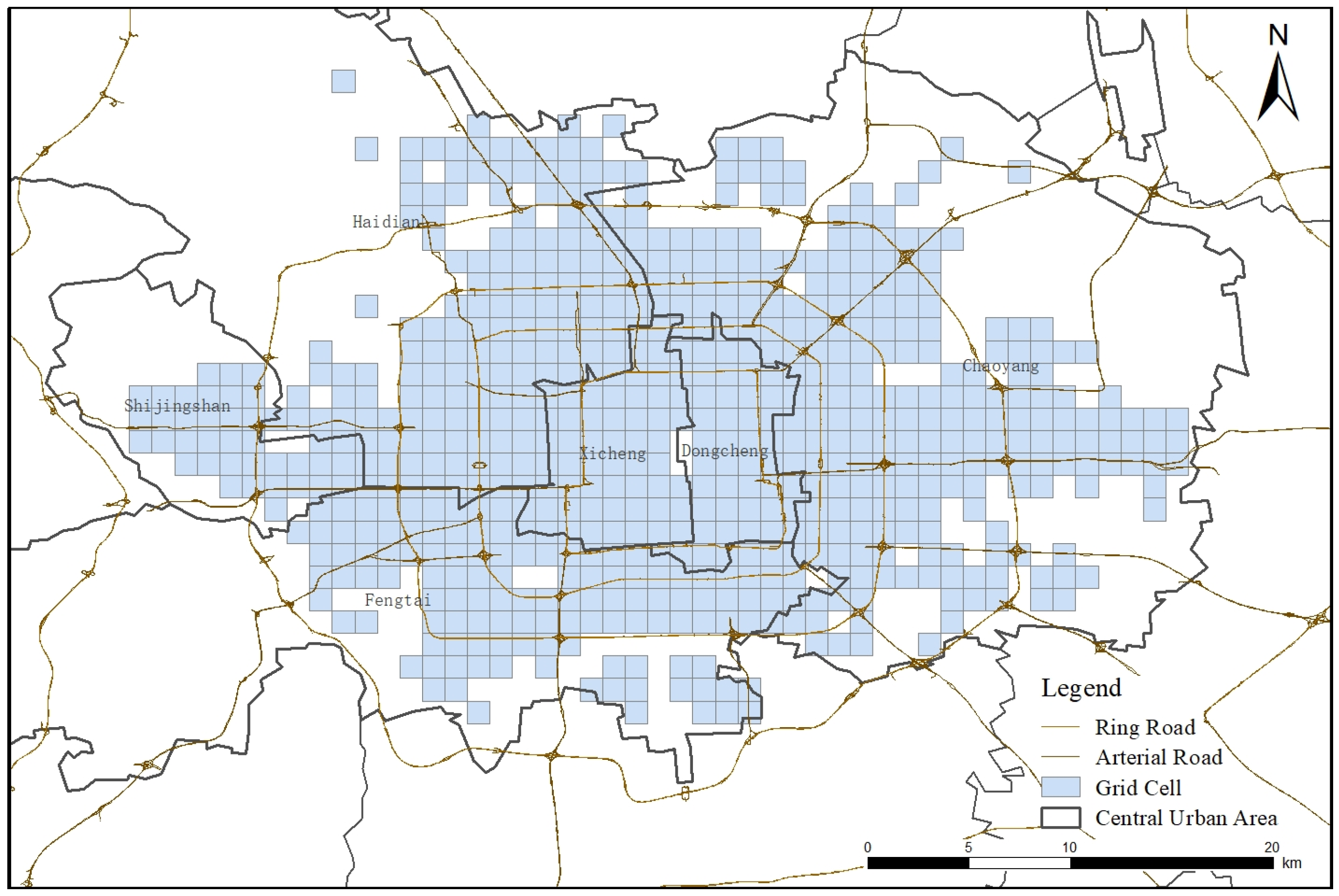
As China’s national capital and a megacity, Beijing has seen extensive adoption of bike-sharing. This study focuses on its central urban area—a densely populated and well-connected region encompassing six districts (Dongcheng, Xicheng, Chaoyang, Haidian, Fengtai, and Shijingshan) and covering approximately 1378 km2. For analytical purposes, the area was divided into a grid with a spatial resolution of 0.01° (about 1 km2; see Figure 1), a scale commonly employed in urban mobility studies to balance spatial detail and analytical tractability [13].
This study utilizes large-scale trip data provided by Meituan Bike (formerly Mobike Beijing). The Beijing dataset has 103,583,313 trip records across 338,446 bicycles over a one-week period from 1 July to 7 July 2022. Each trip record includes the bicycle ID, district, county, start and end timestamps, and the corresponding latitude and longitude coordinates. Representative examples of the data are presented in Table 1. A preliminary analysis of the bike-sharing dataset was conducted to inform preprocessing parameters and procedures. The results showed that the vast majority of trips (95.95%) covered distances of 0–5 km, and 88.19% lasted 0–20 min, which aligns with previous findings indicating that bike sharing primarily serves short-distance travel. To remove erroneous records resulting from GPS anomalies or improper user operations, trips with distances shorter than 100 m or longer than 30 km, and durations shorter than 2 min or exceeding 120 min were excluded [22,39]. Furthermore, weekdays were selected for analysis to capture routine usage patterns and minimize fluctuations due to holidays or special events.
Demographic, road network, and Point of Interest (POI) data were integrated to comprehensively analyze factors influencing bike-sharing usage efficiency. Population distribution data were sourced from LandScan, which provides raster-based estimates of population density at the grid level. Road network data were obtained from OpenStreetMap (OSM) to capture the urban transportation structure, including road types, lengths, and intersection density—key factors affecting mobility and accessibility. POI data were acquired from Amap (Gaode Maps API), with each record containing the name, address, category, and geographic coordinates. The dataset covers 14 major categories, such as Dining, Science & Education, and Shopping; the detailed classification and distribution are summarized in Table 2. To quantify land-use diversity, a POI Mixing Entropy index was constructed. Given the functional similarity among urban activities, the original 14 POI categories were reclassified into five functional zones: Residential (Business & Residential), Public Services (Medical, Life Services, Science & Education), Transport, Work (Companies), and Commercial Services (Dining, Shopping, Leisure, Sports, Hotels, Finance). The POI Mixing Entropy (H) was then calculated using the Shannon Entropy formula:
H = i = 1 n P i l o g 2 ( P i )
where n represents the number of functional types (n = 5), and P i denotes the proportion of the i-th POI type within the grid cell. Higher H values indicate a more balanced functional mix.

4. Method

4.1. Measuring Bike-Sharing Usage Efficiency

Bike-sharing usage efficiency in each analytical unit was quantified using the average Time-to-Booking (ToB) indicator. Time-to-Booking (ToB) is defined as the idle duration between consecutive rentals of the same bicycle [40]. Following its definition, continuous trip sequences for each bicycle were constructed by grouping trips by bicycle ID and sorting them by departure timestamp. To exclude distortions from non-user activities such as operator repositioning and data gaps, relocation distance was considered: only trips with an origin within 50 m of the previous trip’s destination were retained [13]. ToB for each trip was calculated as:
T o B = E T p r e v i o u s S T c u r r e n t
where S T c u r r e n t refers to the departure time of a particular trip and E T p r e v i o u s refers to the end time of the same bicycle’s previous trip. Generally, lower ToB implies higher usage efficiency.
However, the conventional ToB metric has a key limitation: it evaluates efficiency only at the trip origin, without accounting for subsequent bicycle flows. For instance, an area may exhibit a low ToB (high local efficiency), but if bicycles rented there flow into areas with substantially higher ToB and remain idle, overall system efficiency is compromised.
To address this limitation, we propose a Flow-Weighted Time-to-Booking (FwToB) metric. It incorporates not only the idle time before a rental but also the usage efficiency expected at the destination. The formula is defined as:
F w T o B = T o B o + T o B d
where T o B o is the idle time before trip i, T o B d is the average ToB at the destination zone of trip i. The Flow-weighted Time-to-Booking (FwToB) metric extends the ToB indicator by incorporating the efficiency context at the trip destination. It is calculated as the sum of the idle time before the trip at the origin and the average idle time a bicycle is expected to experience at its destination. This additive formulation captures the total idle time associated with a complete trip leg within the network flow. A lower FwToB indicates that a bicycle not only starts its journey from an efficient location but also ends in an area where it is likely to be quickly re-rented, thereby representing higher efficiency from an integrated, flow-based system perspective. By accounting for both ends of a trip, FwToB reflects a more comprehensive performance and offers a more robust foundation for rebalancing strategies.

4.2. Exploring Influences on Usage Efficiency

To investigate the factors influencing shared-bicycle usage efficiency, this study applies two statistical modeling approaches: Ordinary Least Squares (OLS) regression and Geographically Weighted Regression (GWR). The selection of explanatory variables is guided by the previous study of Li et al. (2020) [13] and the established “5Ds” built environment framework (Density, Diversity, Design, Destination Accessibility, Distance to transit), which provides a theoretical basis for analyzing travel behavior [41]. The OLS model provides a global assessment of variable relationships, while the GWR framework accounts for potential spatial non-stationarity—where the strength or direction of relationships may vary across geographic space. By comparing and integrating results from both methods, key explanatory variables can be robustly identified and their spatial variability systematically evaluated.
Ordinary Least Squares regression estimates parameters by minimizing the sum of squared residuals. Its core assumption is that each independent variable exerts a uniform effect on the dependent variable throughout the study area, offering a generalized, global analytical perspective. The OLS model is expressed as:
y j = β 0 + j = 1 p β i x i j + ε j
where p represents the number of explanatory variables, y j denotes the dependent variable, β i is the regression coefficient for variable i (spatially constant), β 0 is the intercept, and ε j denotes the random error term.
This study further employs Geographically Weighted Regression (GWR) to address spatial non-stationarity, given that the effects of environmental variables often exhibit substantial heterogeneity across geographic space. In contrast to global regression models, GWR allows regression coefficients to vary locally by calibrating a distinct model at each observation location. This approach captures how the relationships between variables may differ from one place to another [42]. By incorporating spatial weighting based on geographic proximity, the method ensures that nearby observations exert a stronger influence on local parameter estimates, thereby more accurately reflecting context-specific patterns in the data. The GWR model is expressed as:
y j = β 0 ( u j , v j ) + i = 1 p β i ( u j , v j ) x i j + ε j
where p represents the number of explanatory variables, x i j denotes the value of the i-th explanatory variable at location j, y j denotes the dependent variable, ( u j , v j ) represents the coordinates of location j, β 0 is the location-specific intercept, β i ( u j , v j ) is the location-specific regression coefficient for variable i, and ε j is the random error term.
In contrast to the OLS model, the GWR model enables an examination of whether and how the effects of various factors on bike-sharing usage efficiency vary across geographic space, as well as how such spatial heterogeneity is distributed [42,43]. The optimal bandwidth for the GWR estimation was determined by minimizing the corrected Akaike Information Criterion (AICc) with an adaptive bisquare kernel function. By analyzing the GWR results, we can not only identify statistically significant influencing factors but also discern how the magnitude and direction of their effects differ across regions, thereby supporting more targeted recommendations for regional planning and management. It should be noted, however, that GWR results describe spatially varying statistical associations rather than causal relationships.
To investigate how built environment and demographic characteristics influence bike-sharing usage efficiency, explanatory variables were selected following the 5D built environment framework—density, diversity, design, destination accessibility, and distance to transit [41]. Based on this framework and while controlling for covariance, 12 variables were retained for analysis. The improved usage efficiency index serves as the dependent variable. All selected explanatory variables are summarized in Table 3. The potential influence of factors such as traffic conditions is acknowledged. However, these were not included due to data constraints, and their examination is suggested for future work.
Data standardization is essential in regression analysis, enabling faster convergence, more stable results, and more reliable coefficients [44]. Variables of different magnitudes and units were standardized using the following formula:
Y i j = X i j X m i n X m a x X m i n
where Y i j and X i j represent the standardized and original values of variable i at location j, respectively, and X m a x and X m i n represent the maximum and minimum values of variable i across all locations.

5. Results

5.1. Usage Efficiency

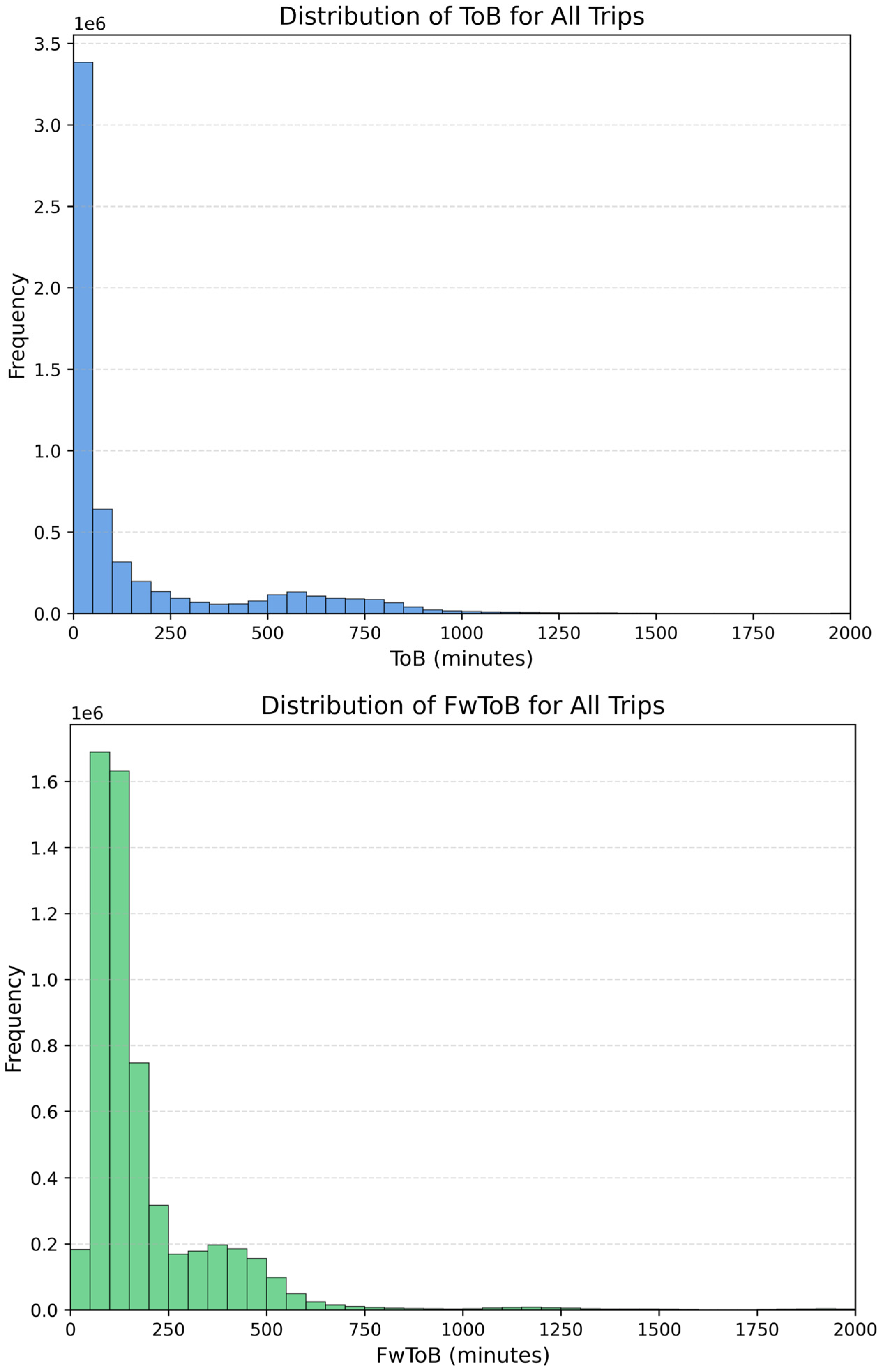
Based on the usage and idle records derived from shared-bicycle trajectory data, this study calculated the vehicle waiting time for each trip, thereby obtaining the distribution of ToB across all orders, as illustrated in Figure 2. The distribution exhibits a pronounced long-tailed characteristic, with a substantial discrepancy between the mean and the median values. The mean ToB for all orders is 201.18 min, whereas the median is only 33.25 min. The mean value, reflecting the expected utilization rate of shared bicycles within each grid, offers operators more actionable insights for operational benefits compared to the median. Compared with the highly skewed ToB distribution concentrated in the 0–50 min range, FwToB exhibits lower frequency in the 0–25 min interval and is mainly concentrated in the 50–150 min range. This shift results from incorporating destination-side idle time, which moderates the extreme short-term parking records observed in the origin-based ToB.
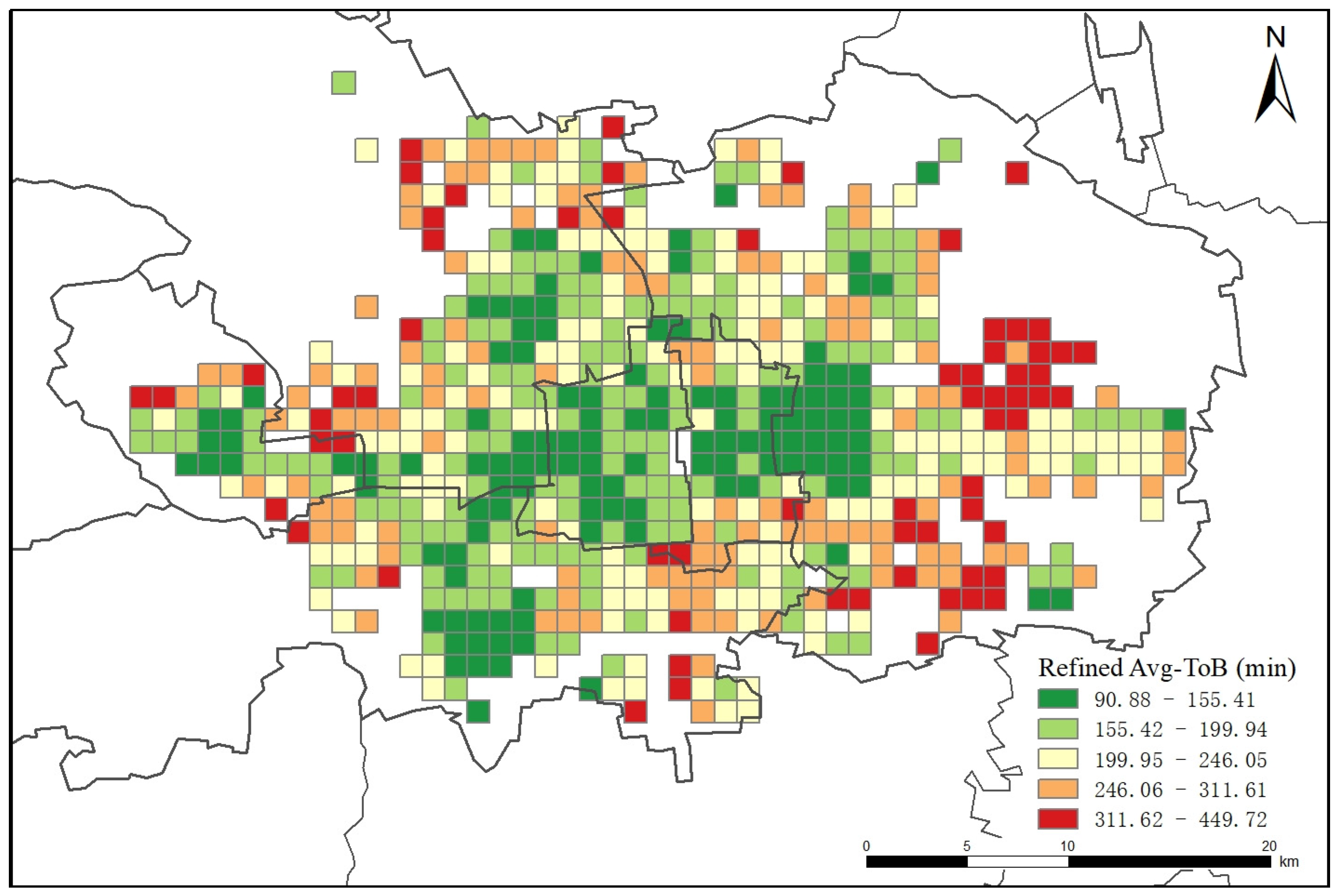
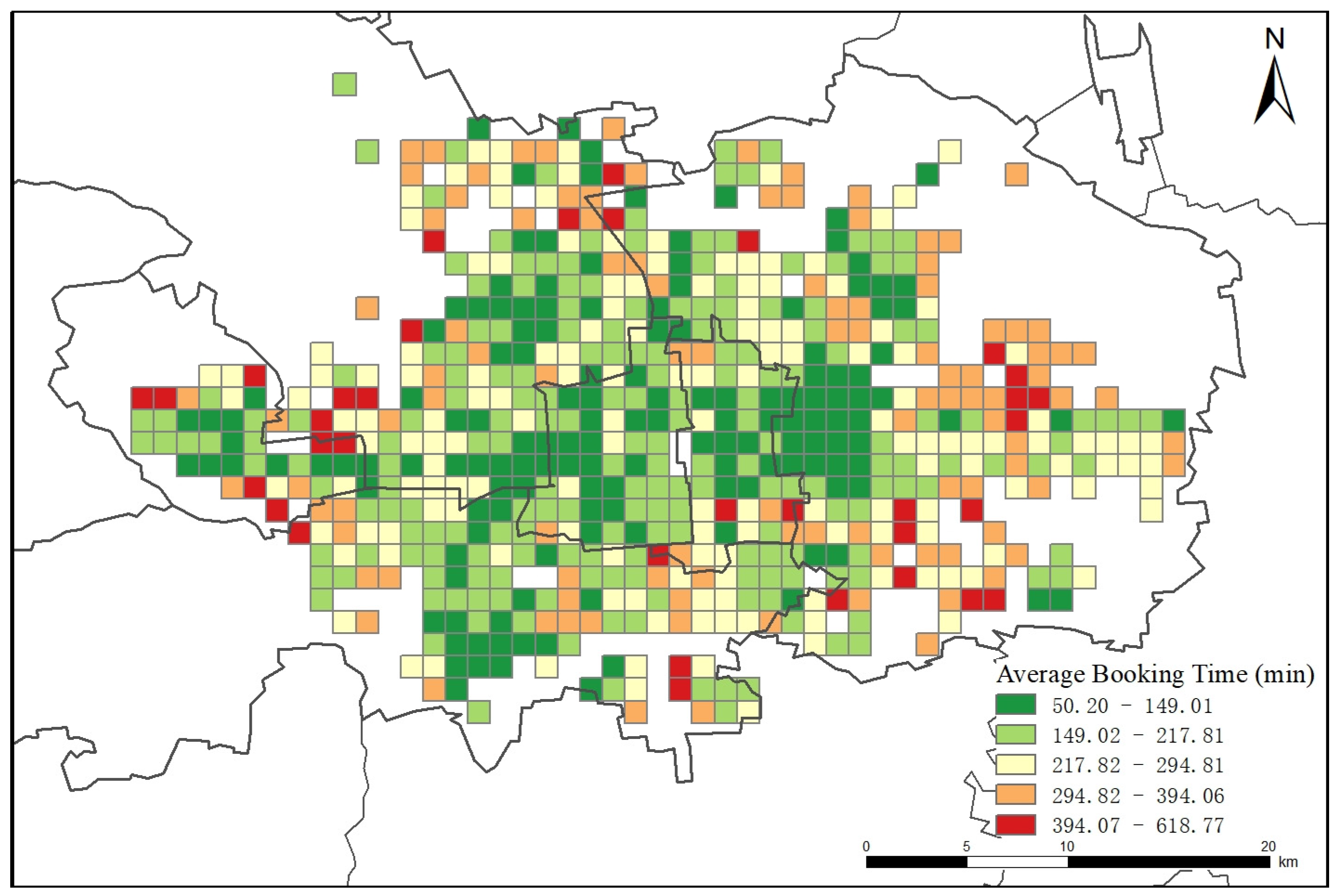
Based on the ToB values of individual trips, this study calculated the average ToB for all bicycle orders within each grid cell. This indicator reflects the average parking duration of bicycles before their next rental in a given area and serves as a key measure of usage efficiency. Figure 3 presents the spatial distribution of bike-sharing usage efficiency derived from this index. Usage efficiency exhibits significant spatial heterogeneity across the study area. Descriptive statistics reveal a considerable range, with a maximum value of 619 min, a minimum of 50 min, a mean of 224 min, and a standard deviation of 96 min. This wide variation underscores that bike-sharing usage is strongly influenced by localized geographic contexts. Spatially, a clear core-periphery pattern emerges, that is, usage efficiency is generally higher in the city center and lower in outlying zones. Specifically, higher efficiency is observed within the belt between the East 2nd Ring Road and the East 4th Ring Road, the corridor from the West 2nd Ring Road to the West 3rd Ring Road, as well as in parts of the southwest, west, northwest, and northeast. In contrast, scattered grids in the urban periphery, particularly outside the 4th Ring Road, show lower efficiency, indicating areas where bicycles remain idle for extended periods.
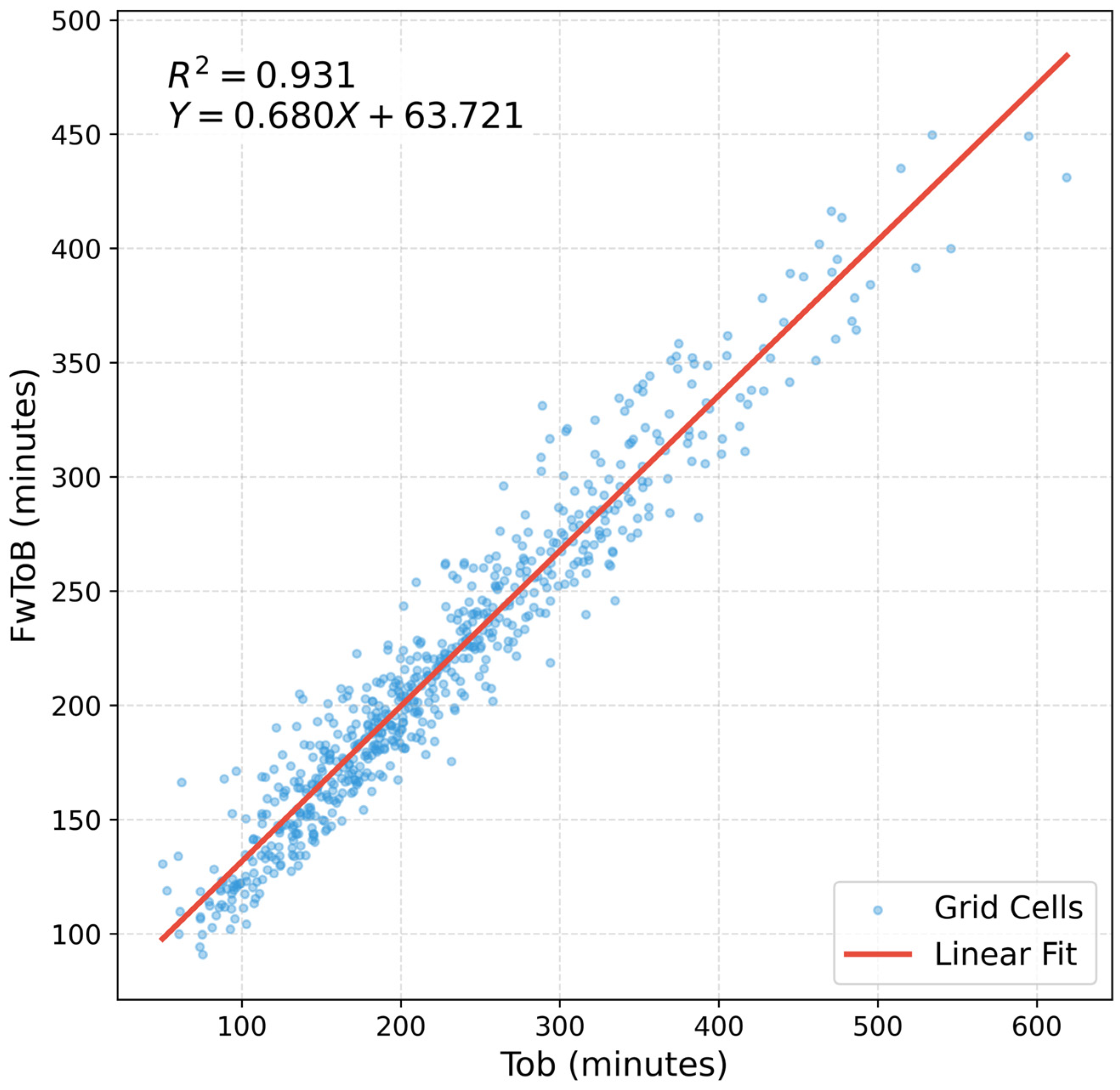
Figure 4 shows the distribution of FwToB at the scale of grid cells. The spatial pattern observed in Figure 4 is similar to that of the original ToB in Figure 3, both exhibiting higher usage efficiency in the city center and lower efficiency in peripheral areas. The mean value of FwToB at the scale of the grid cell is about 216.25 min, with a standard deviation of 67.60 min. Figure 5 presents a comparison between the two measures for each grid, further confirming the consistency in their spatial patterns. Figure 5 presents a scatter plot comparing the two efficiency metrics at the grid level, with the x-axis representing the value of ToB and the y-axis representing the value of FwToB. A linear regression fitted to the data yields the equation FwToB = 0.680 × ToB + 63.721 (R2 = 0.931), indicating a strong positive correlation. This high degree of similarity in both spatial pattern and numerical values indicates that most bicycles flow to areas with efficiency levels similar to their origins, which is also related to the prevalence of round-trip patterns in user behavior.

5.2. Influencing Factors

Based on the ordinary least squares (OLS) regression results, the effects of each independent variable on bike-sharing usage efficiency were analyzed for central Beijing. The model’s adjusted R2 is 0.317, indicating that it explains approximately 31.7% of usage efficiency variation. Several variables show statistical significance, revealing the specific associations between various factors and usage efficiency.
Univariate spatial autocorrelation of the improved ToB was measured using GeoDa. Moran’s I was 0.585 (z-score = 21.7056, p = 0.001), confirming significant spatial autocorrelation in the variable. Since spatial autocorrelation violates the assumption of independent observations in OLS regression and the model inadequately accounts for spatial heterogeneity, geographically weighted regression (GWR) was applied to further explore spatial differentiation in bike-sharing usage efficiency and the spatially varying influence mechanisms of independent variables.
Table 4 compares the performance of the OLS and GWR models and presents the regression coefficients. The GWR model’s R2 and adjusted R2 are 0.511 and 0.444, respectively, substantially higher than those of the OLS model (0.330 and 0.317). The GWR model’s AICc is 1553, decreased from the OLS model (AICc = 1613), and the residual sum of squares is reduced from 433.459 to 261.229, indicating superior explanatory power and model fit. Residual distributions all fall within ±2.5, indicating small differences between predicted and actual values across the study area. Descriptive statistics for GWR coefficients show spatial trends in sign and magnitude for different variables. For example, population density exhibits a relatively large standard deviation (0.193), with coefficients ranging from −0.669 to 0.259, indicating that its association with usage efficiency varies substantially in both magnitude and direction across regions. Transport facilities show consistently negative effects across all locations (range: −0.571 to −0.003), suggesting that higher transport facility counts are associated with improved bike-sharing efficiency. Distance to nearest metro station shows predominantly positive effects (range: −0.115 to 0.410), indicating that greater distances are generally associated with lower usage efficiency, though spatial variation exists.
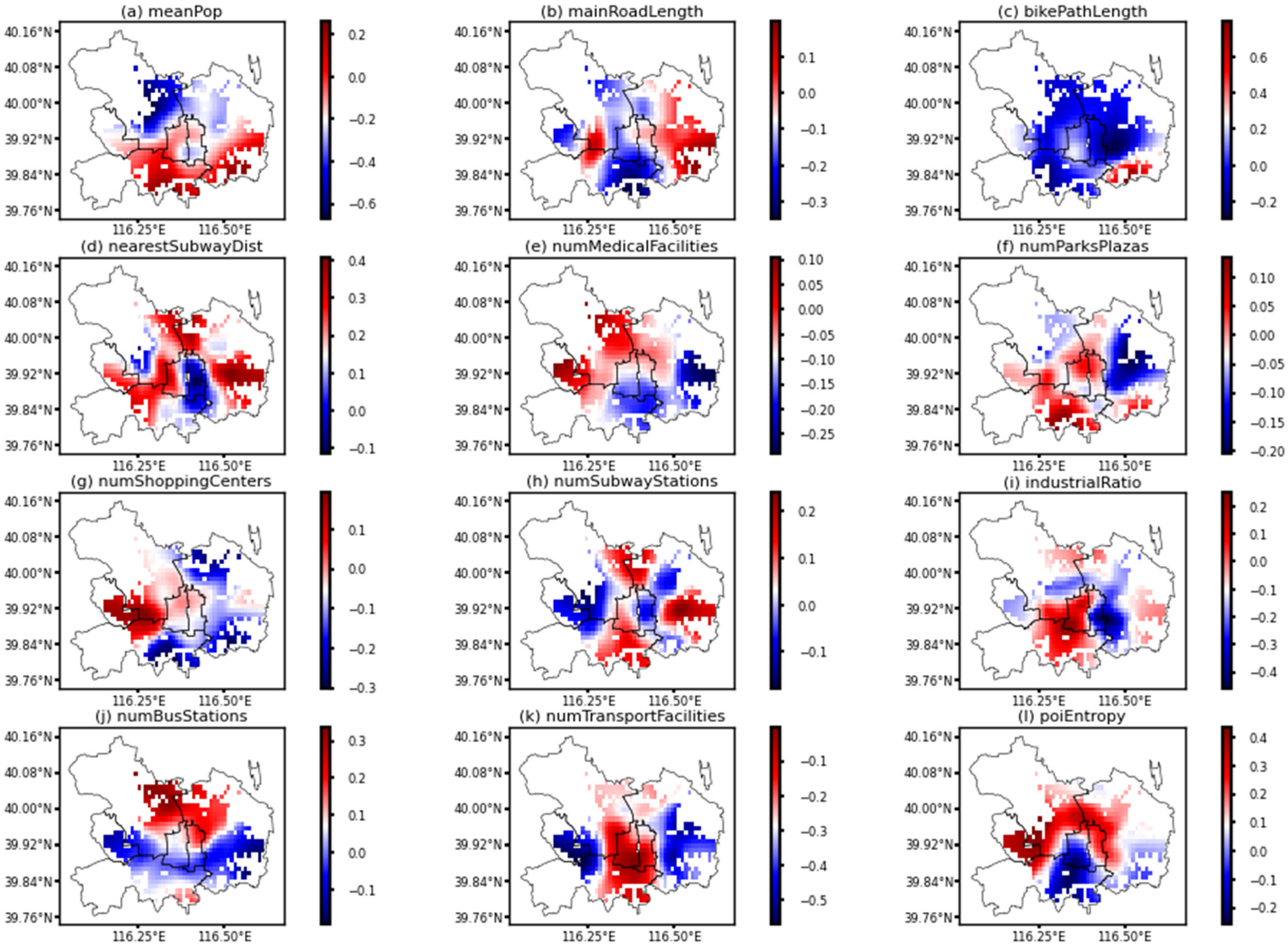
The spatial distribution of estimated coefficients for all variables was plotted using Python, as shown in Figure 6. A negative coefficient indicates that the ToB value decreases as the variable increases, signifying an improvement in operational efficiency. Figure 6 shows that population density exhibits negative associations in most areas, especially in the northwest, while positive associations appear in portions of the southwest and southeast. Therefore, higher population density is associated with more efficient bike-sharing usage in most areas, particularly in relatively densely populated zones.
For road network design variables, main road length shows positive associations in the eastern and western study area but negative associations in the central and southern portions, where road network connectivity is better, suggesting that in areas with better connectivity, greater main road length is associated with improved usage efficiency, possibly related to enhanced traffic flow and regional accessibility. Bike lane length exhibits negative associations in most regions, indicating that greater bike lane length is generally associated with higher usage efficiency.
Variables representing the diversity dimension include industrial facility proportion and POI mixing entropy. Industrial facility proportion shows positive impacts in the southwest and negative impacts in the southeast, possibly related to industrial zone types and characteristics. For POI mixing entropy, a negative coefficient indicates that higher land-use diversity is associated with reduced ToB values (i.e., improved efficiency), while a positive coefficient suggests the opposite. The spatial pattern shows that in areas with negative coefficients, greater functional mix is associated with higher bike-sharing efficiency, whereas in areas with positive coefficients, increased diversity is associated with lower efficiency, possibly indicating that beyond a certain threshold or in specific urban contexts, excessive land-use mixing may disperse demand and reduce utilization intensity.
Regarding facility accessibility, variables including counts of healthcare facilities, parks and squares, shopping centers, and transportation facilities across areas were analyzed. Table 4 shows that average coefficient values are negative, indicating that overall, higher counts of these facilities are associated with improved usage efficiency. At the grid scale, elevated healthcare facility counts are associated with lower usage efficiency in northern and western portions; parks and squares in the southwest are associated with longer average bicycle idle time; and higher shopping center counts are associated with lower usage efficiency in the west. Higher transportation facility counts are associated with lower usage efficiency in central and southern portions, possibly reflecting relationships between facility density, local congestion, and bike-sharing accessibility.
For distance to transit variables, three indicators were selected: bus stop count, metro station count, and distance to nearest metro station. The average coefficients of these variables are positive. A longer distance to the nearest metro station is associated with lower usage efficiency in most areas, suggesting that areas around metro stations are associated with higher efficiency for bike-sharing operations. However, in some areas within the East 2nd Ring Road, closer proximity to metro stations is associated with lower usage efficiency, possibly reflecting dense bicycle distribution and prolonged idling patterns in these areas. Except in a few areas, higher bus stop counts are associated with lower bike-sharing usage efficiency. Metro station count associations show spatial non-stationarity, with higher station counts associated with lower usage efficiency in eastern, northern, and southern portions. These patterns may reflect that dense station distribution may increase the tendency to choose public transit over bike sharing and provide alternatives to walking to the nearest station rather than using bikes. Additionally, pedestrian flow peaks around metro stations may lead to rapid bicycle usage and clustering in short periods, followed by prolonged parking around stations, which affects operational efficiency on a daily scale.

6. Discussion

This study introduces a flow-based perspective to systematically evaluate the usage efficiency of dockless bike-sharing systems. A similar emphasis on flow perspective has been highlighted by Shi et al. (2024) [38], who examined the effects of inflows and outflows on e-bike sharing efficiency in Kunming, underscoring the relevance of accounting for spatial-temporal flows in micromobility performance assessments.
The results reveal pronounced spatial heterogeneity in usage efficiency, underscoring the need for context-specific approaches when assessing system performance. The application of Geographically Weighted Regression (GWR) further demonstrates that the relationships between built-environment factors and bike-sharing efficiency are spatially non-stationary. Variables such as population density, transport facility availability, and distance to metro stations exhibit varying effect sizes—and occasionally opposite directions—across different locations. This spatial differentiation underscores the limitations of “one-size-fits-all” planning or operational strategies and highlights the importance of context-sensitive approaches in managing bike-sharing systems.
Consistent with Li et al. (2020) [13] in Shanghai, our study finds that population density and metro proximity are associated with higher usage efficiency in Beijing. However, using the flow-integrated FwToB metric, we observe spatially varying effects for land-use mix, bus stops, and commercial facilities, whereas Li et al. reported more uniform or non-significant relationships for these variables based on origin-based ToB. These discrepancies may be attributed to both the use of a flow-weighted efficiency metric and the finer spatial resolution adopted in this study.
These findings can offer some insights for bike-sharing operators and urban planners. Efficiency assessment should integrate destination-side conditions, as measured by the FwToB index, to better guide rebalancing efforts and prevent bicycle accumulation in low-efficiency areas. Infrastructure planning should reflect spatial differentiation. Policy implications drawn from the empirical analysis may include prioritizing parking management around metro stations in core urban zones, and enhancing bus–bike integration and targeted incentives in peripheral areas to stimulate demand. Meanwhile, the spatially varying GWR coefficients can be used as a decision-support and evaluation tool: they help prioritize where interventions are likely to be most effective and allow pre-/post-policy assessment by comparing changes in the spatial distribution of FwToB and key coefficients after pilot implementations. Furthermore, promoting mixed land use and improving street-level walkability and cyclability can help create neighborhoods that support consistent bike-sharing usage, contributing to a more resilient and efficient system overall.

7. Conclusions

This study introduced a flow-weighted Time-to-Booking (FwToB) index that incorporates both origin and destination idle times to evaluate dockless bike-sharing usage efficiency in central Beijing. Compared to the conventional origin-based ToB metric, the FwToB provides a more systemic measure that better captures the impact of bicycle flows on operational efficiency, offering both a refined tool for performance assessment and rebalancing and, via GWR, spatially differentiated evidence that complements static origin-based analyses.
Analysis using the FwToB index reveals a distinct core-periphery pattern in usage efficiency across the study area. Efficiency is consistently higher in the central urban districts—particularly within commercial hubs, major attractions, and neighborhoods with concentrated activity—while lower efficiency characterizes peripheral areas, especially those located beyond the 4th Ring Road.
The application of Geographically Weighted Regression (GWR) demonstrates significant spatial non-stationarity in the relationships between built environment factors and usage efficiency. While factors such as higher population density, greater numbers of healthcare and shopping facilities, and increased transport infrastructure are positively associated with higher efficiency, and greater distance to metro stations is negatively associated with it, the strength and even direction of these effects vary substantially across different locations within the city.
Several limitations should be acknowledged. First, the data were collected in July 2022 when COVID-19-related restrictions could still influence travel behavior. The resulting usage patterns and efficiency metrics may therefore not fully reflect bike-sharing operations under typical, non-pandemic conditions. Second, the explanatory variables employed in the analysis involve certain simplifications. For instance, land-use diversity was proxied using POI-based mixing entropy, which may not fully capture the functional complexity or intensity of land use. Third, although the geographically weighted regression (GWR) model accounts for spatial heterogeneity, it does not incorporate several other potentially relevant factors—such as real-time operational interventions or weather conditions—which could further explain variations in usage efficiency. In addition, the relationships identified between built-environment factors and usage efficiency should be interpreted with caution.
Future research could address these issues by incorporating longitudinal data to examine temporal dynamics and by conducting multi-scale analyses to test the robustness of the identified relationships. Integrating additional operational or environmental variables may also help provide a more comprehensive understanding of bike-sharing efficiency.

Author Contributions

Conceptualization, Z.Y. and T.D.; methodology, T.D.; software, Y.L. and S.Q.; validation, T.D., Y.L. and S.Q.; formal analysis, Y.L.; resources, Z.Y.; data curation, Y.L.; writing—original draft preparation, Y.L.; writing—review and editing, T.D.; visualization, Y.L.; supervision, T.D.; project administration, Z.Y.; funding acquisition, Z.Y. All authors have read and agreed to the published version of the manuscript.

Funding

Open Research Fund of the Key Laboratory of Transport Industry of Urban Public Transport Intelligent Technologies, China Academy of Transportation Sciences, Ministry of Transport (2025-APTS-01).

Data Availability Statement

The data presented in this study are available on request from the corresponding author due to privacy concerns.

Conflicts of Interest

The authors declare no conflict of interest.

References

  1. Otero, I.; Nieuwenhuijsen, M.J.; Rojas-Rueda, D. Health Impacts of Bike Sharing Systems in Europe. Environ. Int. 2018, 115, 387–394. [Google Scholar] [CrossRef] [PubMed]
  2. Zhang, Y.; Mi, Z. Environmental Benefits of Bike Sharing: A Big Data-Based Analysis. Appl. Energy 2018, 220, 296–301. [Google Scholar] [CrossRef]
  3. Mooney, S.J.; Hosford, K.; Howe, B.; Yan, A.; Winters, M.; Bassok, A.; Hirsch, J.A. Freedom from the Station: Spatial Equity in Access to Dockless Bike Share. J. Transp. Geogr. 2019, 74, 91–96. [Google Scholar] [CrossRef]
  4. Xu, C.; Ji, J.; Liu, P. The Station-Free Sharing Bike Demand Forecasting with a Deep Learning Approach and Large-Scale Datasets. Transp. Res. Part C Emerg. Technol. 2018, 95, 47–60. [Google Scholar] [CrossRef]
  5. Chen, Z.; Van Lierop, D.; Ettema, D. Dockless Bike-Sharing Systems: What Are the Implications? Transp. Rev. 2020, 40, 333–353. [Google Scholar] [CrossRef]
  6. Ma, Y.; Rong, K.; Mangalagiu, D.; Thornton, T.F.; Zhu, D. Co-Evolution between Urban Sustainability and Business Ecosystem Innovation: Evidence from the Sharing Mobility Sector in Shanghai. J. Clean. Prod. 2018, 188, 942–953. [Google Scholar] [CrossRef]
  7. Tao, J.; Zhou, Z. Evaluation of Potential Contribution of Dockless Bike-Sharing Service to Sustainable and Efficient Urban Mobility in China. Sustain. Prod. Consum. 2021, 27, 921–932. [Google Scholar] [CrossRef]
  8. Zhang, L.; Zhang, J.; Duan, Z.; Bryde, D. Sustainable Bike-Sharing Systems: Characteristics and Commonalities across Cases in Urban China. J. Clean. Prod. 2015, 97, 124–133. [Google Scholar] [CrossRef]
  9. Rixey, R.A. Station-Level Forecasting of Bike Sharing Ridership: Station Network Effects in Three U.S. Systems. Transp. Res. Rec. 2013, 2387, 46–55. [Google Scholar] [CrossRef]
  10. El-Assi, W.; Salah Mahmoud, M.; Nurul Habib, K. Effects of Built Environment and Weather on Bike Sharing Demand: A Station Level Analysis of Commercial Bike Sharing in Toronto. Transportation 2017, 44, 589–613. [Google Scholar] [CrossRef]
  11. Guo, Y.; He, S.Y. Built Environment Effects on the Integration of Dockless Bike-Sharing and the Metro. Transp. Res. Part Transp. Environ. 2020, 83, 102335. [Google Scholar] [CrossRef]
  12. Barbour, N.; Zhang, Y.; Mannering, F. A Statistical Analysis of Bike Sharing Usage and Its Potential as an Auto-Trip Substitute. J. Transp. Health 2019, 12, 253–262. [Google Scholar] [CrossRef]
  13. Li, A.; Zhao, P.; Huang, Y.; Gao, K.; Axhausen, K.W. An Empirical Analysis of Dockless Bike-Sharing Utilization and Its Explanatory Factors: Case Study from Shanghai, China. J. Transp. Geogr. 2020, 88, 102828. [Google Scholar] [CrossRef]
  14. Zhao, P.; Li, A.; Pilesjö, P.; Mansourian, A. A Machine Learning Based Approach for Predicting Usage Efficiency of Shared E-Scooters Using Vehicle Availability Data. AGILE GIScience Ser. 2022, 3, 20. [Google Scholar] [CrossRef]
  15. Du, Y.; Deng, F.; Liao, F. A Model Framework for Discovering the Spatio-Temporal Usage Patterns of Public Free-Floating Bike-Sharing System. Transp. Res. Part C Emerg. Technol. 2019, 103, 39–55. [Google Scholar] [CrossRef]
  16. Jiao, J.; Lee, H.K.; Choi, S.J. Impacts of COVID-19 on Bike-Sharing Usages in Seoul, South Korea. Cities 2022, 130, 103849. [Google Scholar] [CrossRef]
  17. Shen, Y.; Zhang, X.; Zhao, J. Understanding the Usage of Dockless Bike Sharing in Singapore. Int. J. Sustain. Transp. 2018, 12, 686–700. [Google Scholar] [CrossRef]
  18. Zheng, L.; Meng, F.; Ding, T.; Yang, Q.; Xie, Z.; Jiang, Z. The Effect of Traffic Status on Dockless Bicycle-Sharing: Evidence from Shanghai, China. J. Clean. Prod. 2022, 381, 135207. [Google Scholar] [CrossRef]
  19. Chen, E.; Ye, Z. Identifying the Nonlinear Relationship between Free-Floating Bike Sharing Usage and Built Environment. J. Clean. Prod. 2021, 280, 124281. [Google Scholar] [CrossRef]
  20. Gao, K.; Yang, Y.; Li, A.; Qu, X. Spatial Heterogeneity in Distance Decay of Using Bike Sharing: An Empirical Large-Scale Analysis in Shanghai. Transp. Res. Part Transp. Environ. 2021, 94, 102814. [Google Scholar] [CrossRef]
  21. Xu, X.; Wang, J.; Poslad, S.; Rui, X.; Zhang, G.; Fan, Y. Exploring Intra-Urban Human Mobility and Daily Activity Patterns from the Lens of Dockless Bike-Sharing: A Case Study of Beijing, China. Int. J. Appl. Earth Obs. Geoinf. 2023, 122, 103442. [Google Scholar] [CrossRef]
  22. Chen, W.; Chen, X.; Cheng, L.; Chen, J.; Tao, S. Locating New Docked Bike Sharing Stations Considering Demand Suitability and Spatial Accessibility. Travel Behav. Soc. 2024, 34, 100675. [Google Scholar] [CrossRef]
  23. Wang, Y.; Li, J.; Su, D.; Zhou, H. Spatial-Temporal Heterogeneity and Built Environment Nonlinearity in Inconsiderate Parking of Dockless Bike-Sharing. Transp. Res. Part Policy Pract. 2023, 175, 103789. [Google Scholar] [CrossRef]
  24. Zhou, X.; Dong, Q.; Huang, Z.; Yin, G.; Zhou, G.; Liu, Y. The Spatially Varying Effects of Built Environment Characteristics on the Integrated Usage of Dockless Bike-Sharing and Public Transport. Sustain. Cities Soc. 2023, 89, 104348. [Google Scholar] [CrossRef]
  25. Lin, D.; Zhang, Y.; Zhu, R.; Meng, L. The Analysis of Catchment Areas of Metro Stations Using Trajectory Data Generated by Dockless Shared Bikes. Sustain. Cities Soc. 2019, 49, 101598. [Google Scholar] [CrossRef]
  26. Guo, Y.; Yang, L.; Lu, Y.; Zhao, R. Dockless Bike-Sharing as a Feeder Mode of Metro Commute? The Role of the Feeder-Related Built Environment: Analytical Framework and Empirical Evidence. Sustain. Cities Soc. 2021, 65, 102594. [Google Scholar] [CrossRef]
  27. Li, W.; Chen, S.; Dong, J.; Wu, J. Exploring the Spatial Variations of Transfer Distances between Dockless Bike-Sharing Systems and Metros. J. Transp. Geogr. 2021, 92, 103032. [Google Scholar] [CrossRef]
  28. Wu, X.; Lu, Y.; Lin, Y.; Yang, Y. Measuring the Destination Accessibility of Cycling Transfer Trips in Metro Station Areas: A Big Data Approach. Int. J. Environ. Res. Public. Health 2019, 16, 2641. [Google Scholar] [CrossRef]
  29. Schimohr, K.; Doebler, P.; Scheiner, J. Prediction of Bike-sharing Trip Counts: Comparing Parametric Spatial Regression Models to a Geographically Weighted XGBoost Algorithm. Geogr. Anal. 2023, 55, 651–684. [Google Scholar] [CrossRef]
  30. Ngeni, F.; Kutela, B.; Chengula, T.J.; Ruseruka, C.; Musau, H.; Novat, N.; Indah, D.A.; Kasomi, S. Prediction of Bike-Sharing Station Demand Using Explainable Artificial Intelligence. Mach. Learn. Appl. 2024, 17, 100582. [Google Scholar] [CrossRef]
  31. Pan, L.; Cai, Q.; Fang, Z.; Tang, P.; Huang, L. A Deep Reinforcement Learning Framework for Rebalancing Dockless Bike Sharing Systems. In Proceedings of the AAAI Conference on Artificial Intelligence, Honolulu, HI, USA, 27 January–1 February 2019; Volume 33, pp. 1393–1400. [Google Scholar]
  32. Gu, Z.; Zhu, Y.; Zhang, Y.; Zhou, W.; Chen, Y. Heuristic Bike Optimization Algorithm to Improve Usage Efficiency of the Station-Free Bike Sharing System in Shenzhen, China. ISPRS Int. J. Geo-Inf. 2019, 8, 239. [Google Scholar] [CrossRef]
  33. Faghih-Imani, A.; Hampshire, R.; Marla, L.; Eluru, N. An Empirical Analysis of Bike Sharing Usage and Rebalancing: Evidence from Barcelona and Seville. Transp. Res. Part Policy Pract. 2017, 97, 177–191. [Google Scholar] [CrossRef]
  34. Hua, M.; Chen, X.; Zheng, S.; Cheng, L.; Chen, J. Estimating the Parking Demand of Free-Floating Bike Sharing: A Journey-Data-Based Study of Nanjing, China. J. Clean. Prod. 2020, 244, 118764. [Google Scholar] [CrossRef]
  35. Wang, J.; Wang, Y. A Two-Stage Incentive Mechanism for Rebalancing Free-Floating Bike Sharing Systems: Considering User Preference. Transp. Res. Part F Traffic Psychol. Behav. 2021, 82, 54–69. [Google Scholar] [CrossRef]
  36. Wei, Z.; Ma, H.; Li, Y. A Multiscale Approach for Free-Float Bike-Sharing Electronic Fence Location Planning: A Case Study of Shenzhen City. J. Adv. Transp. 2024, 2024, 1783038. [Google Scholar] [CrossRef]
  37. Fu, C.; Yen, B.T.; Yeh, C.-J. The Analysis of the Shared Bike Usage Pattern: Application of Survival Model to Taiwan YouBike. Asian Transp. Stud. 2024, 10, 100125. [Google Scholar] [CrossRef]
  38. Shi, Z.; Wang, J.; Liu, K.; Liu, Y.; He, M. Exploring the Usage Efficiency of Electric Bike-Sharing from a Spatial–Temporal Perspective. Transp. Res. Part Transp. Environ. 2024, 129, 104139. [Google Scholar] [CrossRef]
  39. Cheng, L.; Huang, J.; Jin, T.; Chen, W.; Li, A.; Witlox, F. Comparison of Station-Based and Free-Floating Bikeshare Systems as Feeder Modes to the Metro. J. Transp. Geogr. 2023, 107, 103545. [Google Scholar] [CrossRef]
  40. Guidon, S.; Becker, H.; Axhausen, K. Avoiding Stranded Bicycles in Free-Floating Bicycle-Sharing Systems: Using Survival Analysis to Derive Operational Rules for Rebalancing. In 2019 IEEE Intelligent Transportation Systems Conference (ITSC), Auckland, New Zealand, 27–30 October 2019; IEEE: Piscataway, NJ, USA, 2019; pp. 1703–1708. [Google Scholar]
  41. Ewing, R.; Cervero, R. Travel and the Built Environment: A Meta-Analysis. J. Am. Plan. Assoc. 2010, 76, 265–294. [Google Scholar] [CrossRef]
  42. Brunsdon, C.; Fotheringham, A.S.; Charlton, M.E. Geographically Weighted Regression: A Method for Exploring Spatial Nonstationarity. Geogr. Anal. 1996, 28, 281–298. [Google Scholar] [CrossRef]
  43. Zhao, P.; Xu, Y.; Liu, X.; Kwan, M.-P. Space-Time Dynamics of Cab Drivers’ Stay Behaviors and Their Relationships with Built Environment Characteristics. Cities 2020, 101, 102689. [Google Scholar] [CrossRef]
  44. Oshan, T.M.; Li, Z.; Kang, W.; Wolf, L.J.; Fotheringham, A.S. Mgwr: A Python Implementation of Multiscale Geographically Weighted Regression for Investigating Process Spatial Heterogeneity and Scale. ISPRS Int. J. Geo-Inf. 2019, 8, 269. [Google Scholar] [CrossRef]
Figure 1. Study area.
Applsci 16 02137 g001
Figure 2. Frequency distribution of ToB and FwToB across all valid trip records.
Applsci 16 02137 g002
Figure 3. Spatial distribution of grid-level mean Time-to-Booking (ToB).
Applsci 16 02137 g003
Figure 4. Spatial distribution of grid-level mean Flow-weighted Time-to-Booking (FwToB).
Applsci 16 02137 g004
Figure 5. Scatter plot of ToB and FwToB at the grid level.
Applsci 16 02137 g005
Figure 6. Spatial patterns of local coefficients estimated by geographically weighted regression (GWR).
Applsci 16 02137 g006
Table 1. Data samples of shared bicycle trips.
DistrictBike IDStart DateStart TimeStart Lon.Start Lat.End DateEnd TimeEnd Lon.End Lat.
Haidian86419582022022-07-0407:46:58116.34539.967332022-07-0407:53:51116.36139.96711
Fengtai86504070562022-07-0212:35:11116.292239.808142022-07-0212:39:13116.285839.80281
Chaoyang86517823422022-07-0310:28:37116.4639.876332022-07-0310:35:07116.446139.87773
Table 2. Classification and proportion of Point-of-Interest (POI) categories.
CategoryCountRatio (%)
Transport Facilities69,57010.24
Leisure & Entertainment13,6092.00
Companies75,57411.12
Medical Care24,5633.62
Business & Residential30,4404.48
Tourist Attractions10,2861.51
Automotive Services22,8983.37
Life Services97,16314.3
Science, Education & Culture43,5246.41
Shopping & Consumption149,22521.96
Sports & Fitness12,7321.87
Hotel & Accommodation17,7132.61
Financial Institutions12,1951.79
Dining & Food99,92114.71
Table 3. Descriptive statistics and definitions of explanatory variables.
CategoryVariableMeaning (Description)UnitMeanStd.
densitymeanPopPopulation Densityperson9734.815011.77
diversitypoiEntropyPOI Mixing Entropy-1.900.23
industrialRatioRatio of Industrial POIs%0.110.07
designmainRoadLengthLength of Trunk Roadsm2259.181701.80
bikePathLengthLength of Bike Lanesm610.871041.92
destination
accessibility
numMedicalFacilitiesNo. of Medical Facilitiescount8.579.03
numParksPlazasNo. of Parks and Plazascount1.081.24
numShoppingCentersNo. of Shopping Centerscount0.320.79
numTransportFacilitiesNo. of Transport Facilitiescount58.8238.36
distance to
transit
numBusStationsNo. of Bus Stopscount4.192.66
numSubwayStationsNo. of Metro Stationscount0.400.55
nearestSubwayDistDistance to Nearest Metro Stationm763.48476.07
Table 4. The results of the OLS and GWR Model.
VariableOLS ModelGWR Model
Coef.t-ValueMeanStd.MinMedianMax
(Constant)−0.000−0.000−0.0080.274−0.4860.0140.760
Population Density−0.180 **−4.509−0.1660.193−0.669−0.1740.259
POI Mixing Entropy0.0601.4630.1190.165−0.2600.1250.435
Ratio of Industrial POIs−0.062−1.600−0.0840.130−0.461−0.0820.252
Length of Trunk Roads−0.078 *−2.102−0.0810.111−0.346−0.0910.196
Length of Bike Lanes−0.074 *−2.1410.0130.163−0.293−0.0220.794
No. of Medical Facilities−0.094 *−2.324−0.0870.083−0.290−0.0790.106
No. of Parks and Plazas−0.028−0.849−0.0320.067−0.206−0.0260.136
No. of Shopping Centers−0.089 *−2.345−0.0600.113−0.303−0.0590.194
No. of Transport Facilities−0.234 **−5.157−0.2860.143−0.571−0.273−0.003
No. of Bus Stops0.0451.1250.0630.124−0.1950.0400.337
No. of Metro Stations0.084 *1.9920.0390.092−0.1790.0390.242
Distance to Nearest Metro Station0.254 **5.9220.1950.111−0.1150.1970.410
Model Performance
Adjusted R20.317 0.444
AICc1613 1553
Residual Sum of Squares433.459 261.229
** and * denote significance at the 0.05 and 0.1 levels, respectively.
Disclaimer/Publisher’s Note: The statements, opinions and data contained in all publications are solely those of the individual author(s) and contributor(s) and not of MDPI and/or the editor(s). MDPI and/or the editor(s) disclaim responsibility for any injury to people or property resulting from any ideas, methods, instructions or products referred to in the content.