Article

Implementation of Leaking Quantum Walks on a Photonic Processor

1
Agency for New Technologies, Energy and Sustainable Economic Development (ENEA)—Nuclear Department, Via E. Fermi 45, 00100 Frascati, Italy
2
QuiX Quantum B.V., 7521 AN Enschede, The Netherlands
3
Institute for Nuclear Physics (INFN) Sezione Roma Tre, Via della Vasca Navale, 84, 00146 Rome, Italy
*
Author to whom correspondence should be addressed.
Appl. Sci. 2026, 16(4), 1976; https://doi.org/10.3390/app16041976
Submission received: 30 January 2026 / Revised: 12 February 2026 / Accepted: 13 February 2026 / Published: 17 February 2026
(This article belongs to the Special Issue Quantum Communication and Quantum Information)

Abstract

Quantum walks (QWs) represent pillars of quantum dynamics and information processing. They provide a powerful framework for simulating quantum transport, designing search algorithms, and enabling universal quantum computation. Several physical platforms have been employed for their implementation, such as trapped atoms and ions, nuclear magnetic resonance systems, and photonic quantum architectures either in bulk optics or waveguide structures and fiber loop networks. Here we focus on the most promising and versatile approach, which is photonic integrated circuits. In this work, we review how the employment of this versatile experimental platform has allowed exploring several phenomena related to QW-based protocols, such as evolution in the presence of different kinds of noise. In this landscape, to the best of our knowledge, few examples report on the introduction of absorbing centers and their effects on the coherence of the dynamics. Here we present and discuss the results related to the absorbing boundaries in QWs, obtained through theoretical simulations and experiments conducted with the universal photonic quantum processors realized by QuiX Quantum. We analyze how localized absorption along one lattice edge affects the walker dynamics, depending on both the leakage probability and the initial injection site. Our results suggest that the presence of controlled losses modifies interference patterns and coherence without fully destroying quantum features and providing an effective resource for engineering on-chip QWs and simulating open quantum systems.

1. Introduction

Quantum walks (QWs) have emerged as a versatile framework in quantum information science, providing both a fundamental model of coherent quantum dynamics and a practical resource for information processing tasks [1,2,3,4].Owing to their intrinsically quantum features—such as superposition, interference, and entanglement—QWs exhibit dynamics that differ markedly from classical random walks, enabling algorithmic speedups in search and graph-based problems [5,6,7]. Beyond quantum algorithms, QWs constitute a powerful platform for quantum simulation, allowing controlled investigations of transport, disorder-induced localization, and topological phases in complex networks [8,9,10]. QWs have been implemented in various platforms [11], ranging from cold atoms [12,13,14] to superconducting devices [15] and photonic set-ups [16,17,18]. Optical implementations of QWs have enabled the investigation of genuinely multi-particle effects, including the role of particle statistics in quantum diffusion [18] as well as non-trivial three-photon interference phenomena [19]. Moreover, QWs provide a versatile testbed for studying the impact of noise on quantum coherence; controlled disorder has been introduced to observe Anderson localization in the presence of static noise [20,21,22], while QWs on multidimensional lattices have been experimentally realized using both fiber loop architectures [23] and femtosecond-laser-written waveguide circuits [24]. Among the various experimental platforms, integrated photonic circuits stand out as particularly promising, offering high phase stability, intrinsic resilience to noise and decoherence, and clear prospects for scalability [25]. Integrated photonic devices for QWs have also proven ideal for the implementation of boson sampling protocols [26,27,28,29,30,31], providing an exemplary study of how quantum supremacy can be achieved [32,33,34].
In real photonic quantum systems, particle losses are unavoidable due to the non-ideal efficiencies of the network components and measurements apparatuses, often representing a major limitation for scaling up quantum applications. Nonetheless, the inclusion of absorbing sites within a QW remains a scenario that has received relatively little attention and has not yet been fully explored. In this regard, a limited number of numerical studies [35,36,37,38,39] and a few experimental implementations [40,41] have been reported, showing how some recursive behavior is observed in the presence of specific absorbing sites. However, many aspects of this problem remain largely unexplored, even though the introduction of controlled losses appears to be a promising approach for probing the dynamics of open quantum systems.
In this work, we address this gap by presenting both numerical simulations and experimental results for a QW in the presence of an absorbing boundary. Previous experimental studies on absorbing or lossy boundaries in QWs have mainly considered either fully absorbing sites (sinks) or fixed loss mechanisms, typically acting as global features of the dynamics and not allowing for selective control over different internal modes of the walker. In contrast, thanks to a programmable photonic processor, the present work focuses on the implementation of a tunable, partially absorbing boundary that can be engineered as an active element of the walker dynamics. This allows exploring different leakage regimes and analyzing the distinct effective boundary conditions experienced by different injection modes. In addition, experimental data from previous works have been reported over a limited number of steps [10], typically less than the maximum number accessible in our experiments performed on the universal photonic quantum processors provided by QuiX Quantum. Specifically, we investigate a walk on a finite lattice featuring a partially absorbing (leaking) boundary of tunable strength and a fully reflective boundary. We observe that the absorbing boundary significantly alters the walker’s evolution, with the magnitude of this effect increasing with the absorption strength.
The employed finite system represents an effective minimal model for mimicking energy transport in complex networks, such as those found in biological systems [42,43]. Here, an interesting example is represented by the well-known Fenna–Matthews–Olson (FMO) complex of green sulfur bacteria, which is characterized by seven sites and essentially acts as a molecular wire, transferring excitation energy while showing long-lived quantum coherence [44]. Indeed, the FMO complex has been proposed as a dedicated computational device [44], as excitons are able to explore many states simultaneously and efficiently select the correct answer. Our study expands what has been already demonstrated employing the QW approach to introduce further complexity in this dynamics. To be precise, we introduce possible effects due to sites coupling with the environment, resulting in energy absorption and decoherence. On the other hand, with this manuscript, we explore a field with multiple possible applications, as controllable decoherence permits photonic implementations of quantum computational methods that take advantage of decoherence [45,46,47]. In this context, the optimization of suitable transport processes—whether coherent or noise-assisted—may require the engineering of dedicated quantum systems.

2. Materials and Methods

2.1. Theoretical Background and Simulations

In this work, we investigated the effects of mode-dependent particle losses within a noise-free discrete-time quantum walk (DTQW) [3] involving single photons. To this end, we considered a QW evolving over N temporal steps, where homogeneous losses were introduced in a selected propagation mode located at the edge of the lattice. Our numerical approach is based on a coined DTQW model, where the time evolution of the photonic walker is described as the result of two operations: a coin toss C ^ followed by a conditional displacement S ^ . Accordingly, the dynamics is governed by the evolution operator U ^ = S ^ ( C ^ I ^ ) , acting on the composite Hilbert space H = H C H S . Here, H S denotes the position subspace, spanned by orthonormal site states | x along a finite one-dimensional lattice, while H C is the internal two-dimensional coin subspace, spanned by { | L , | R } , encoding the left or right direction of propagation for the next hop. The generic state of the system can thus be written as
| Ψ = x Z ( α L , x | L + α R , x | R ) | x
where | α L , x | 2 and | α R , x | 2 represent the probabilities for the walker at site x to move at the following step to the left or to the right, respectively, with the normalization condition for the coin state | α L , x | 2 + | α R , x | 2 = 1 , x . The conditional displacement is realized by the shift operator:
S ^ = x | L L | | x 1 x | + | R R | | x + 1 x |
which displaces the walker in a superposition of the position basis states according to its internal coin state. As a result, the state of the system at each time step depends recursively on the previous step, i.e., | Ψ ( n ) = U ^ | Ψ ( n 1 ) , yielding after n steps the coherent evolution | Ψ ( n ) = U ^ n | Ψ ( 0 ) , where | Ψ ( 0 ) denotes the initial state of the walker. Throughout this work, we adopted the Hadamard coin operator C ^ = 1 2 1 1 1 1 , which mimics a fair coin toss.
Experimentally, such a coined DTQW can be realized on photonic platforms by injecting photons through a cascade of directional couplers acting as balanced beam splitters (BSs), arranged in a lattice of elementary cells forming Mach–Zehnder interferometers (MZIs). Each BS simultaneously implements both the coin and shift operators, since it splits the photon into left and right propagation paths and shifts them accordingly. In this scheme, each BS output represents a point in the space-time evolution of the QW; at a given step, the walker is described by the state | x , n , where x labels the position of the walker along the line corresponding to the spatial mode and n denotes the discrete time ( 0 n N , n N ). In this configuration, 2 M ( M N ) defines the number of lattice sites available at each time step, while M is the maximum number of MZI units per step. Thus the variable x takes discrete values given by x m a x + ( m 1 ) , where x m a x = M 0.5 and m is an integer index labeling the injection site, with m ( 0 , 2 M ] .
Building upon our previous results on confined QWs [48], we extended the analysis by introducing an additional key aspect beyond spatial confinement induced by lattice edges, namely the presence of a leaking boundary. We impose asymmetric boundary conditions; one edge of the lattice enforces hard confinement, while the opposite edge acts as a homogeneous leaking boundary. In the former case, the walker is completely reflected at the edge and redirected back into the interior whenever a step would take it outside the lattice. In the latter case, reflection at the boundary is only partial, resulting in a finite probability for the wavefunction to leak out of the lattice, thereby introducing controlled, mode-dependent particle losses.
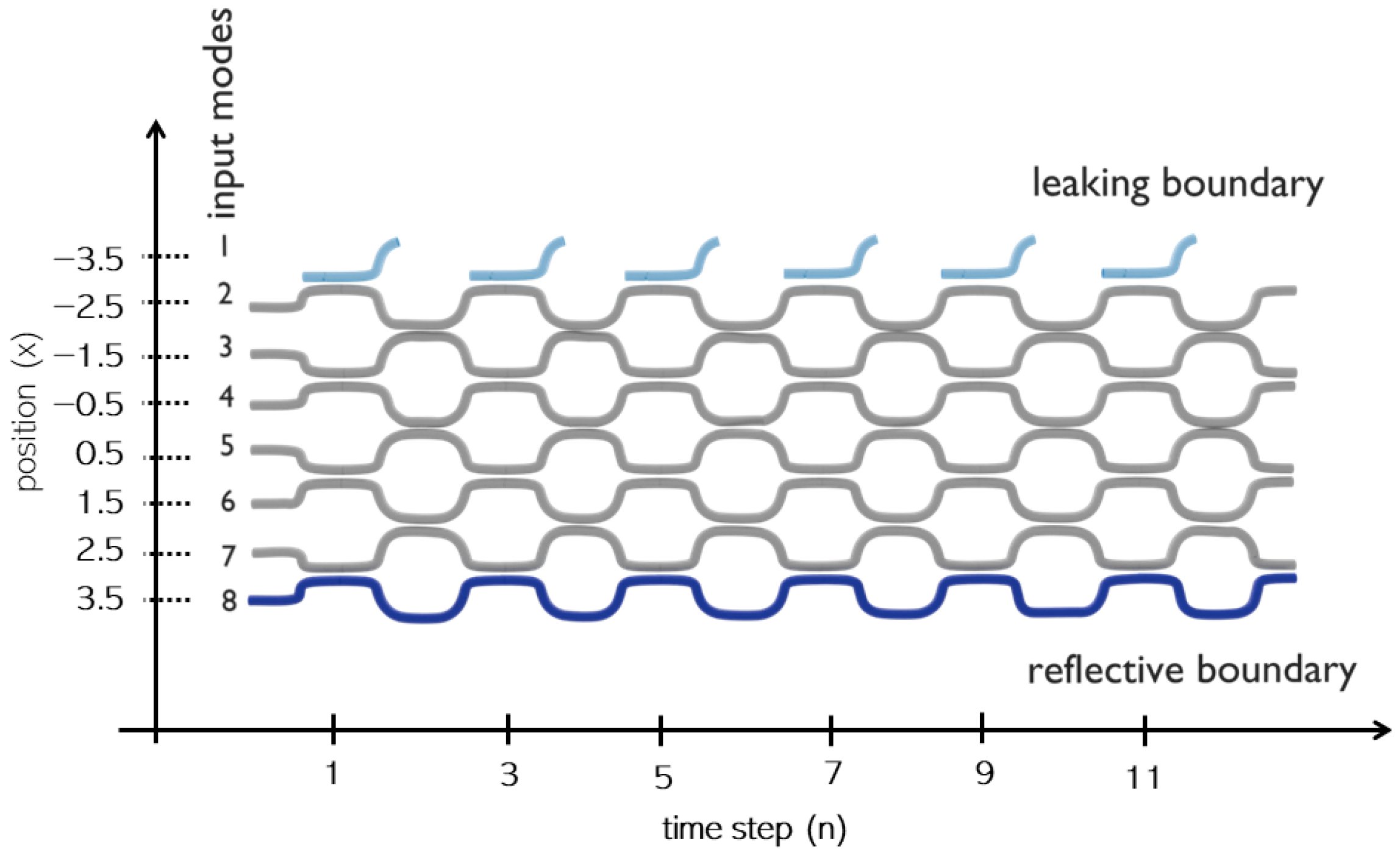
Basically, this corresponds to defining, within the total Hilbert space H , a 2 M -dimensional Hilbert subspace where the effective QW dynamics takes place. This naturally induces a decomposition of the total Hilbert space H = H 2 M H , where H comprises all the external modes. When leakage occurs, the walker is transferred from H 2 M to H and is no longer involved in the subsequent dynamics (Figure 1).
In order to model numerically the boundary conditions described above, we constructed a 2 M × 2 M block diagonal matrix M B S , whose diagonal blocks are represented by the BS transformation
1 r 2 r r 1 r 2
at each time step, with 0 < r 2 < 1 . For the internal sites m not corresponding to modes at the edges ( 2 m 2 M 1 ), each block given by Equation (3) consisted of a 2 × 2 balanced BS transformation with transmissivity r 2 = 1 / 2 in order to implement the Hadamard coin. At the lattice edges, the balanced BS was replaced by an unbalanced transformation with transmissivity r 2 0.5 . Here, the transmissivity of the BSs at the leaking boundary is assumed to be the leakage parameter, as it quantifies, at each step, the probability amplitude transferred to the external modes not included in the 2 M -mode Hilbert subspace when the walker reaches the lossy edge. The fraction of probability amplitude removed from the H 2 M subspace is irreversibly lost; it never enters the confined walk dynamics again, never interferes with the surviving wavefunction, and is not measured at the output. In particular, a BS at the edge with r 2 = 0 models a perfectly reflective boundary (lossless edge), whereas r 2 < 0.5 and r 2 > 0.5 model low- and high-leakage scenarios, respectively. At each time step, the block matrix structure accounted for the alternate pattern of an even and an odd number of BSs over subsequent time steps. Here, M B S represents the transformation associated with the effective evolution operator at the nth time step. The definition of such an operator requires a proper description of the absorbing barrier [35], which was implemented by introducing the projector operator Π m = c = L , R | c , m c , m | . This projector acts by removing the wavefunction at the site corresponding to the leaking edge, which in our case is m = 1 (see Figure 1). The effective evolution operator at the nth step is then defined as
T ^ ( n ) = ( I ^ Π ^ m ) U ^ ( n ) .
This ensures that when the wavefunction reaches the edge mode m = 1 , it is projected out of H 2 M and cannot re-enter, thus mimicking an absorbing boundary condition. Therefore, the complete evolution of the QW after n steps was obtained as the ordered product | Ψ ( n ) = T ^ ( n ) T ^ ( n 1 ) T ^ ( 2 ) T ^ ( 1 ) . Although U ^ is a unitary transformation acting on the full Hilbert space H , the non-unitarity of the dynamics resides in the effective evolution operator T ^ that accounts for probability loss at the absorbing boundary.
In a QW, the spatial probability profile of the walker after multiple time steps reflects nontrivial interference effects arising from the coherent superposition of the many possible propagation paths. To capture this behavior, we computed the output single-particle probability distributions across all spatial modes p ( x ; n ) = | x | Ψ ( x , n ) | 2 , which represents the probability of finding the particle at position x after n steps, irrespective of its internal coin state. Since in the presence of a leaking boundary, the dynamics is intrinsically non-unitary, the total probability is no longer conserved throughout the time evolution. Therefore, the probability distributions reported here refer to the population that remained confined within the lattice at each time step. We analyzed the propagation of single walkers injected at different initial positions, both close to and far from the leaking boundary, in order to assess the role of the distance from the leaking edge for different leaking probabilities. As quantitative indicators for characterizing the walker dynamics, we computed the time evolution of the mean position x and its variance σ n 2 ( x ) at each step n, defined as
x = i = 1 2 M p i x i σ n 2 ( x ) = x 2 x 2 = i = 1 2 M p i x i 2 i = 1 2 M p i x i 2
where x i denotes the output position and p i is the corresponding probability.

2.2. Experimental Set-Up

The model described above was experimentally realized in a photonic platform, where single walkers were implemented by an attenuated coherent light beam. The lattice with asymmetric boundaries was realized using a reconfigurable photonic processor (QuiX Quantum Alquor20, Enschede, The Netherlands) featuring 20 input and output ports [49,50]. The processor was a fully programmable multiport interferometer capable of implementing arbitrary linear optical transformations over a space whose dimensionality was set by the number of available modes. The interferometer was constructed as a mesh of 190 MZI interferometers, each functioning as a tunable beam splitter [51], thereby enabling independent control of the amplitudes and phases of the output signals. The photonic chip was fabricated using stoichiometric silicon nitride ( Si 3 N 4 ) waveguides based on TripleX technology and was mounted on a water-cooled Peltier element to ensure thermal stability. Optical coupling to and from the chip was provided via FC/PC fiber connectors. The processor exhibited an insertion loss of ( 3.65 ± 1.30 ) dB . Its performance was characterized by an average amplitude fidelity of F = ( 98.8 ± 0.3 ) , evaluated over 100 Haar random unitary matrices at a wavelength of 942 nm . The fidelity was defined as F = 1 d T r ( | U t h · U e x p | ) , where | U | denotes the element-wise absolute value and d = 20 is the number of ports [52]. The fully packaged chip was mounted on a sub-mount to ensure mechanical stability and electrically interfaced with a printed circuit board (PCB). Control of the device was provided through a Python 3.11-based software interface, which allowed the user to specify the target transformation and accordingly program the phase shifts applied to the MZIs.
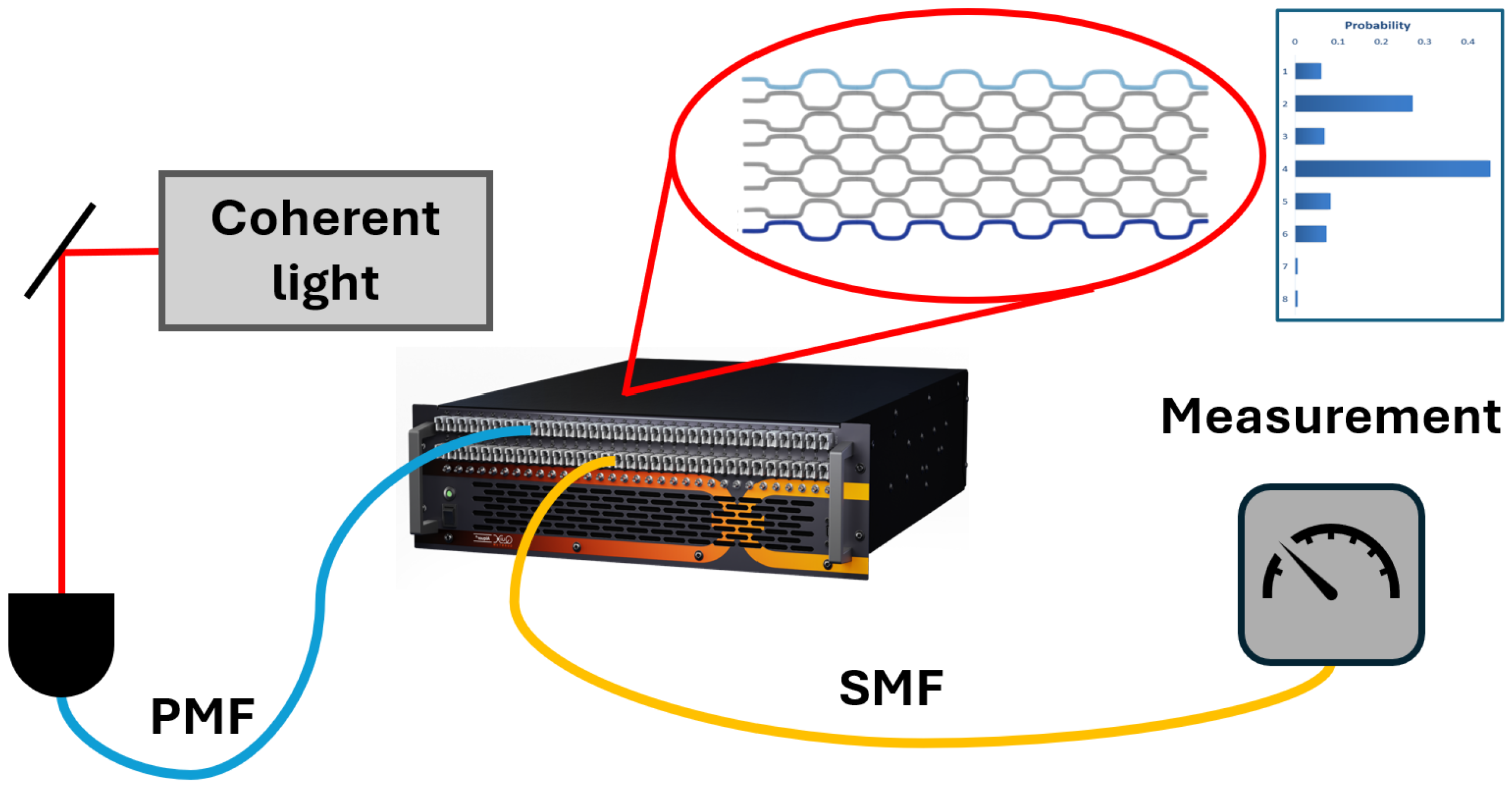
A schematic of the experimental set-up is shown in Figure 2. Attenuated coherent light at a wavelength of λ = 942 nm was injected into the selected input mode of the photonic processor via a polarization-maintaining fiber. The processor was programmed to implement the unitary transformation corresponding to the quantum walk with asymmetric boundaries under investigation. The dimensionality of the multimode interferometer enabled the realization of quantum walks of up to N = 20 steps; in the transverse direction, 2 M = 8 input and output ports were employed. As the processor implemented only unitary transformations, we exploited the 12 unused modes of the Alquor20 to remove the light leaking from the confined walk and thereby emulate the action of the projectors Π m . Specifically, we implemented a sequence of BS matrices with transmissivity r 2 = 1 that coupled the remaining 12 modes pairwise. This configuration ensured that the light exiting from the leaking mode (mode 1 in our labeling) was diverted out of the walk lattice and did not re-enter it prior to the measurement stage.
The selected input mode was initially populated by injecting approximately 10 μ W of optical power through a polarization-maintaining fiber. For each n-step QW, with 4 n 20 , the appropriate unitary operator was applied, and the output intensities were measured across all eight output channels. Detection was performed using photodiodes coupled via single-mode fibers, allowing reconstruction of the output probability distributions. To account for variations in transmission among the output fibers, a calibration procedure was carried out by applying the identity operation on the processor and measuring the output power at each port. Using the measurement from a fixed output as reference, we calculated the correction factors in transmission for each port and used it to rescale the measured output power of the leaking walk. After this correction, the measured intensity distributions were normalized to unity. Uncertainty in the output power measurements was dominated by laser fluctuations, which were monitored and evaluated to be 5 % of the measured signal. Uncertainties in all the experimental results were estimated while considering this signal uncertainty and propagating it according to standard error propagation procedures.
Background losses due to propagation and imperfections in interferometric elements contribute to an approximately uniform attenuation across the lattice. Conversely, the boundary-induced losses, controlled by the programmed boundary transmissivity, are spatially localized and affect modes differently depending on their distance from the leaking edge. Moreover, control measurements were performed in the absence of boundary-induced leakage, providing reference lossless dynamics. This allowed us to assess that the observed confinement and attenuation were primarily governed by the engineered boundary losses, whose effects could be distinguished from background losses acting mainly as a uniform offset.

3. Results

3.1. Simulations

In order to ensure that boundary effects significantly affected the dynamics, we considered a DTQW on a number of sites that were small compared with the characteristic diffusion scale of the walker. Specifically, we simulated a QW on a lattice of 2 M = 8 sites over up to N = 100 discrete time steps, thereby assessing the long-time behavior. The choice of 2 M = 8 sites was also guided by the need to allow direct comparison between the simulation results and experimental data. The results presented here are supported by experimental validation only in the first 20 steps, as described in Section 3.2.
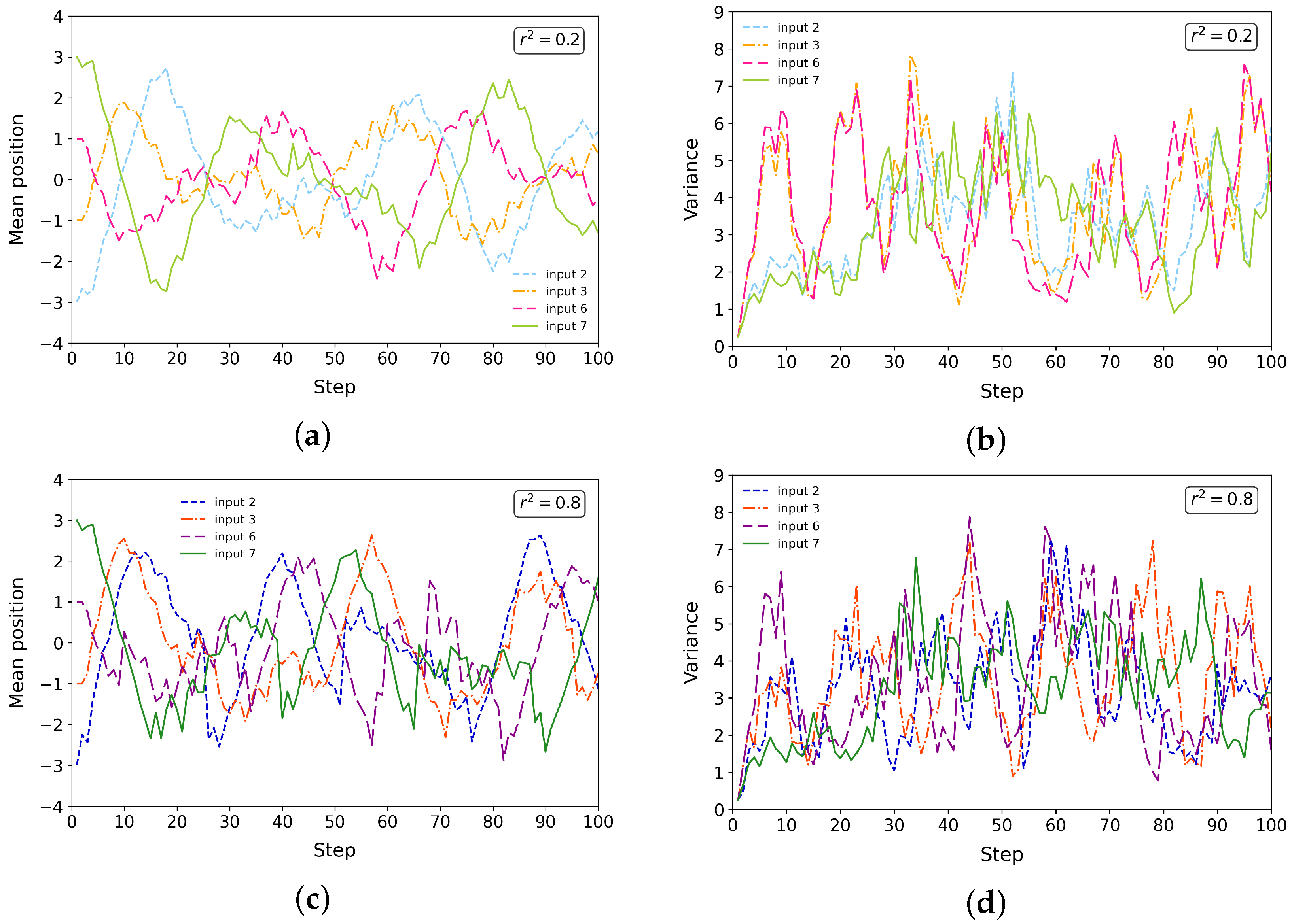
We considered four distinct cases depending on the position of the site at which the walker was injected into the lattice: positions close to the leaking boundary (input waveguides 2 and 3, corresponding to the initial states | 2.5 , 0 and | 1.5 , 0 , respectively) and positions close to the reflective boundary (input waveguides 6 and 7, corresponding to the initial states | 1.5 , 0 and | 2.5 , 0 , respectively). In our simulations, we adopted r 2 = 0.2 for the low-leakage regime and r 2 = 0.8 for the high-leakage case, with r 2 being the transmissivity of the BSs at the lossy edge. In the present model, particle losses at the leaking boundary were assumed to be homogeneous and time-independent, i.e., the leakage probability was the same at each time step. In Figure 3, the walker’s mean position and its variance, evaluated over 100 steps, were compared for different input positions and for both the low-loss and high-loss regimes.
Due to the confinement, the walker propagation across the lattice followed oscillatory patterns, resulting from a sequence of total or partial reflections at the edges of the accessible region. This behavior was captured by the time evolution of both the mean position and its variance. In the low-loss regime ( r 2 = 0.2 ), the dynamics appeared to be only weakly affected by the presence of the leaking boundary, and as shown in Figure 3a, the mean position depended on the injection site; when the walker entered the lattice from sites closer to one of the boundaries (input sites 2 and 7 (cyan dashed and green solid lines, respectively)), it propagated toward the opposite edge, whereas for more internal injection sites (3 and 6, orange dash-dotted and long-dashed pink lines, respectively), the mean position exhibited oscillations of smaller amplitudes around the origin of the position axis. Nevertheless, the symmetry associated with the spatial coordinates of the input sites was largely preserved; the opposite injection sites (sites 2 and 7 or 3 and 6) shared essentially the same temporal evolution but with opposite phases. Likewise, the time evolution of the variance in the walker’s mean position exhibited an oscillatory behavior (Figure 3b). For each pair of symmetric input sites, the variance followed the same qualitative temporal evolution, indicating that the spreading and partial refocusing of the wavefunction were similarly affected by the lattice boundaries when the leaking probability was low. In particular, when the walker was injected close to either the leaking or reflecting edge (cyan dashed and green solid lines, respectively), the initial spreading remained limited, and the variance stayed below three for approximately the first 25 steps before gradually increasing at longer times while preserving fluctuations of large amplitudes and high frequencies. On the other hand, for the more internal injection sites, the variance displayed pronounced oscillations for the earliest steps, corresponding to alternative phases of spreading and relocalization of the wavefunction, occurring with a characteristic period of about 15 steps (orange dash-dotted and long-dashed pink lines, respectively).
By contrast, in the high-loss regime ( r 2 = 0.8 ), the dynamics of both the mean position and its variance, although still retaining oscillatory features, departed from the regularities and phase relations identified in the low-loss case (Figure 3c,d). In particular, the symmetric injection sites no longer displayed identical dynamics, and both the amplitude and frequency of the oscillations were modified, indicating a stronger impact of losses on the walker propagation. To further clarify the role of increasing losses on the system dynamics, it is helpful to compare the time evolution of the walker’s mean position and variance for different leaking probabilities and injection sites.
The full set of long-time numerical results is presented in Appendix A.1. However, these long-time features were not experimentally accessible with the photonic processor available in the present work and should therefore be interpreted as predictions based on our numerical model. As expected, the strongest sensitivity to losses was observed for input site 2, which was closest to the leaking boundary (Figure A1a,b). As long as the losses remained weak ( r 2 = 0.2 , cyan solid line), the dynamics closely followed that of the lossless case ( r 2 = 0 , gray dotted line), with few differences limited to their relative amplitudes up to approximately 40–50 steps. However, when the losses became strong ( r 2 = 0.8 , blue dashed line), deviations already appeared at early times, with a faster propagation of the mean position (for r 2 = 0.2 , the mean position reached the first oscillation peak within the first 18 steps, whereas for r 2 = 0.8 , it required only 12 steps to reach the first maximum mean displacement) and an enhanced spreading of the wavefunction, as evidenced by the larger variance. For injection sites progressively farther from the leaking boundary (input sites 3, 6, and 7), the impact of losses on the walker’s dynamics appeared to be reduced (Figure A1c–h). In these configurations, the mean position and variance exhibited similar trends across different leaking regimes for a large number of time steps, with only minor differences in amplitude and phase. This indicates that when the walker is injected sufficiently far from the lossy edge, the dynamics remain largely governed by coherent propagation within the lattice. In the following, we focus in particular on the initial 20 time steps, for which a direct comparison with experimental observations was feasible.

3.2. Measurements

We experimentally implemented a quantum walk on a finite lattice featuring asymmetric boundary conditions—one reflective edge and one lossy (leaking) edge—using a universal photonic processor. The lattice was realized by employing 8 of the available 20 photonic modes. A leaking boundary was implemented at mode 1, while mode 8 acted as a perfectly reflecting boundary.
The quantum walker was injected at different initial modes within the lattice, either near the leaking boundary (waveguides 2 and 3) or near the reflecting boundary (waveguides 6 and 7). Two distinct leakage regimes were explored by tuning the reflection parameter to r 2 = 0.2 for weak leaking and r 2 = 0.8 for strong leaking. For each configuration, the walker was allowed to evolve for a number of steps ranging from 4 to 20. This means that the walker had sufficient time to propagate across the entire eight-mode lattice and reach the leaking edge at least once before the final step. Such a condition ensured that the output distributions genuinely probed the effect of leakage on the dynamics. At each step, we measured the spatial probability distribution of the surviving wavefunction within the lattice and calculated the total variation distance (TVD) between the measured distribution and the simulated ones, defined as
TVD = max x p x sim p x exp ,
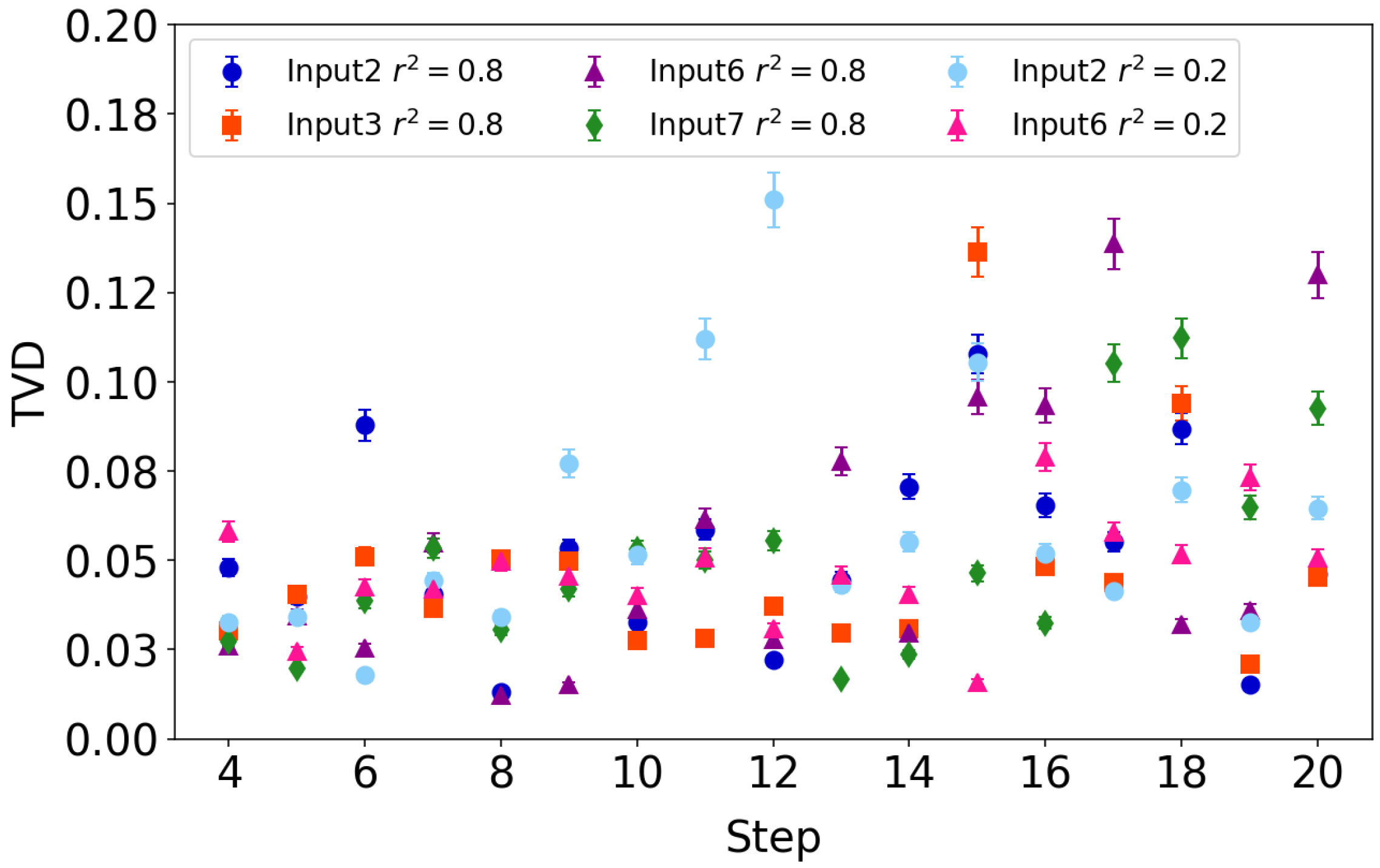
which returned the maximum absolute difference over position x between the simulated ( p x sim ) and experimental ( p x exp ) output probabilities. The TVD for leaking walks from different input modes and different leaking probabilities are reported in Figure 4. Here, we can observe that deviations in the experimental data from the simulated ones were generally quite small, thus confirming good agreement between the expected and experimental behavior of the processor. From these distributions, the mean position x and the variance σ n 2 ( x ) of the walker were calculated according to Equation (4).
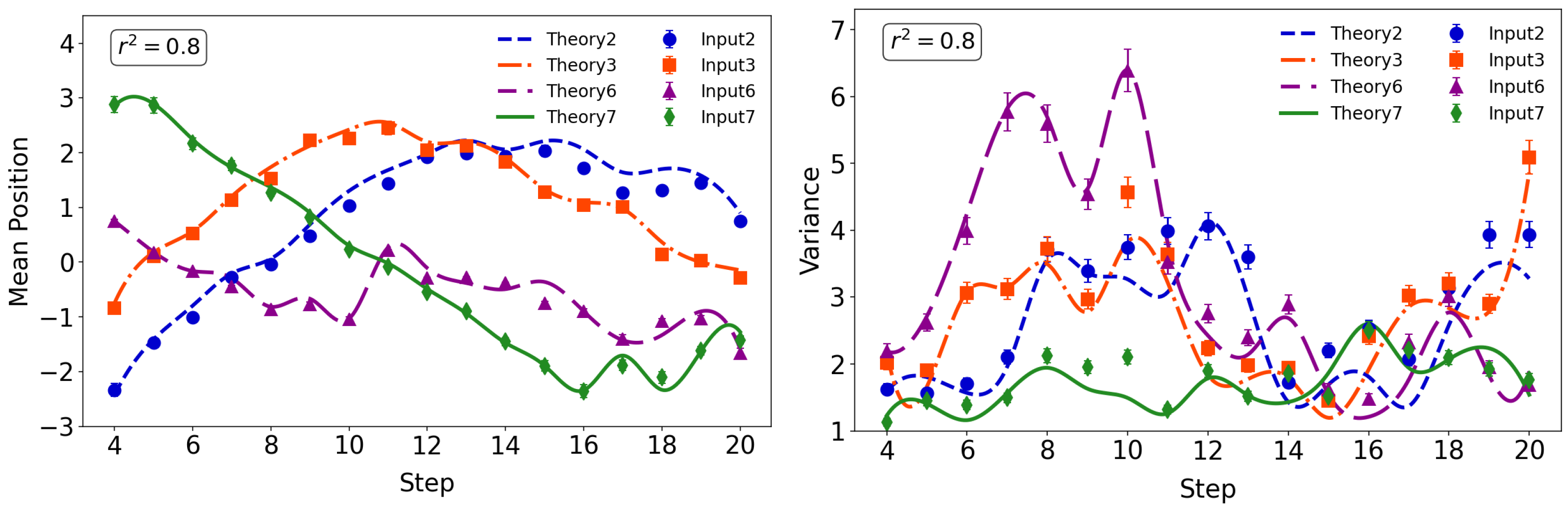
The mean position and variance for the strong leakage regime are shown in Figure 5. We observed good agreement between the experimental data (symbols) and the numerically simulated behavior (lines). The mean position revealed a net propagation of the walker across the lattice from its initial location toward the opposite boundary. When the walker was initialized near the leaking edge (input 2), it rapidly propagated toward the reflecting boundary, reaching an average displacement of approximately four lattice sites from the initial position after 15 steps (blue circles in Figure 5, left panel). By contrast, when the walker was injected near the reflecting boundary (input 7), its propagation was initially slower; nevertheless, it attained a larger overall displacement, exceeding six lattice sites and reaching the position farthest from the initial mode after 16 steps (green diamonds). The variance in the position revealed distinct spreading behaviors depending on the input site and the measurements (symbols), showing good agreement with the simulated curves (lines). However, when the walker was injected close to the reflecting boundary, the wavefunction exhibited limited spreading, as evidenced by the nearly flat variance curve for input 7 (green diamonds in Figure 5, right panel). For more central input sites, the wavefunction initially spread and subsequently relocalized (input 6, violet triangles), and in some cases, it spread again (orange squares). When the input position was close to the leaking boundary, the wavefunction still displayed spreading and relocalization dynamics; however, the amplitude of the spreading was reduced (blue circles).
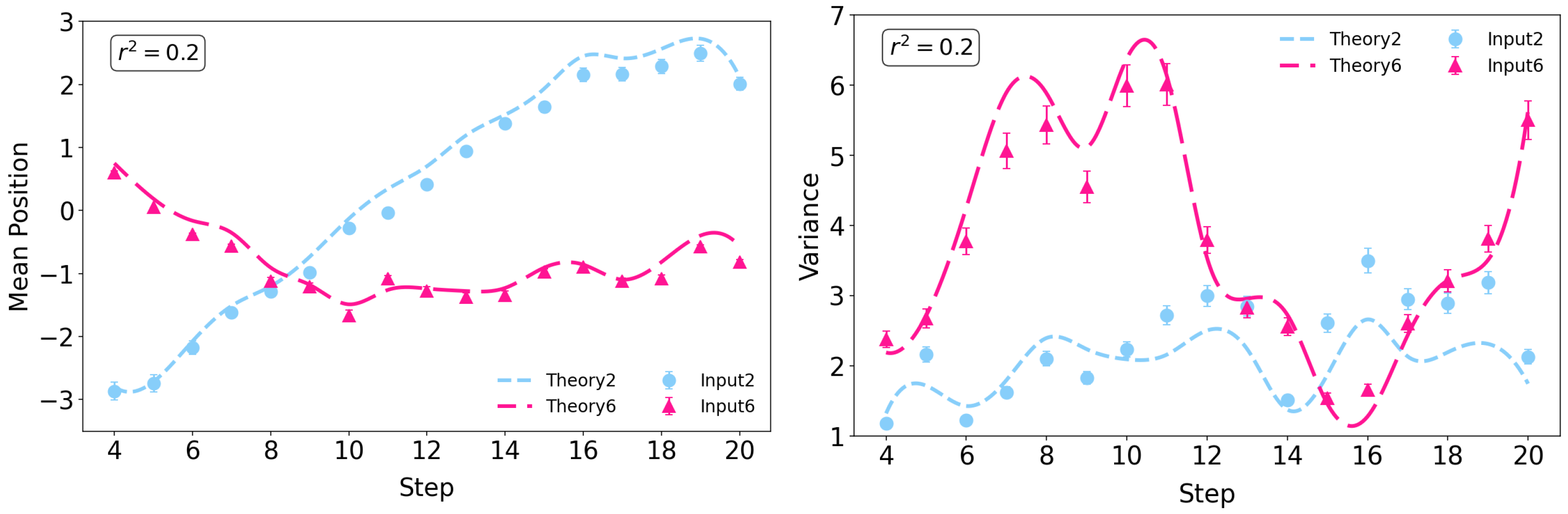
We also measured the same quantities (mean position of the walker and its variance) in the case of a weak leaking boundary by setting the parameters of our photonic processor such that the transmissivity of the beam splitters at the boundary was r 2 = 0.2 . We measured the output probability distribution of the walker when injected in waveguides 2 and 6 close to the leaking and reflecting boundaries, respectively. The results are reported in Figure 6. Here we can observe good agreement between the experimental (symbols) and simulated (lines) data. It is interesting to note that if the walker’s initial position was close to the absorbing boundary, then it moved toward the other edge more slowly than in the case of strong leaking, reaching the farthest position of its walk at step 19 (cyan circles in Figure 6, left panel). However, its displacement was larger, reaching a value close to Δ x = 6 (compared with Δ x 4 in the previous configuration). For the initial position corresponding to waveguide 6, the walker’s mean position oscillated with a small displacement of about Δ x = 3 (pink triangles). When looking at the variance in the mean position, a similar behavior to the configuration of strong leaking was observed. If the initial position was close to the reflecting boundary, then the wavefunction spread and relocalized, leading to oscillating behavior of the variance (pink triangles in Figure 6, right panel), while limited spreading almost without oscillations was observed if the walker entered the lattice close to the leaking boundary (cyan circles).
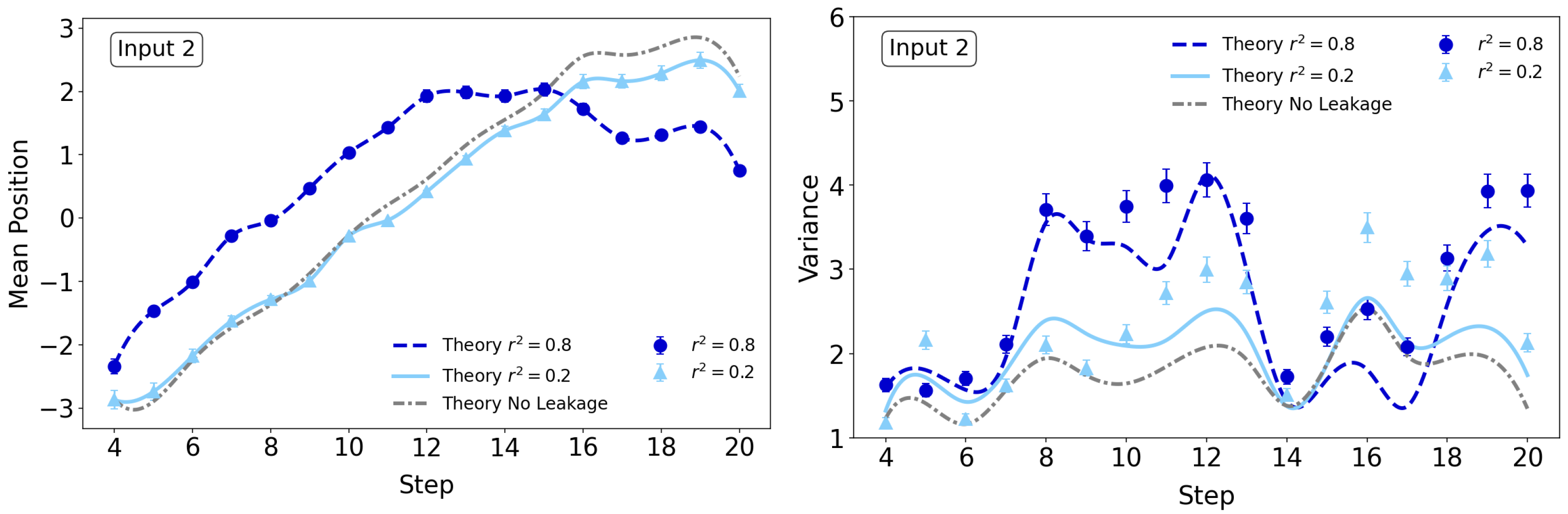
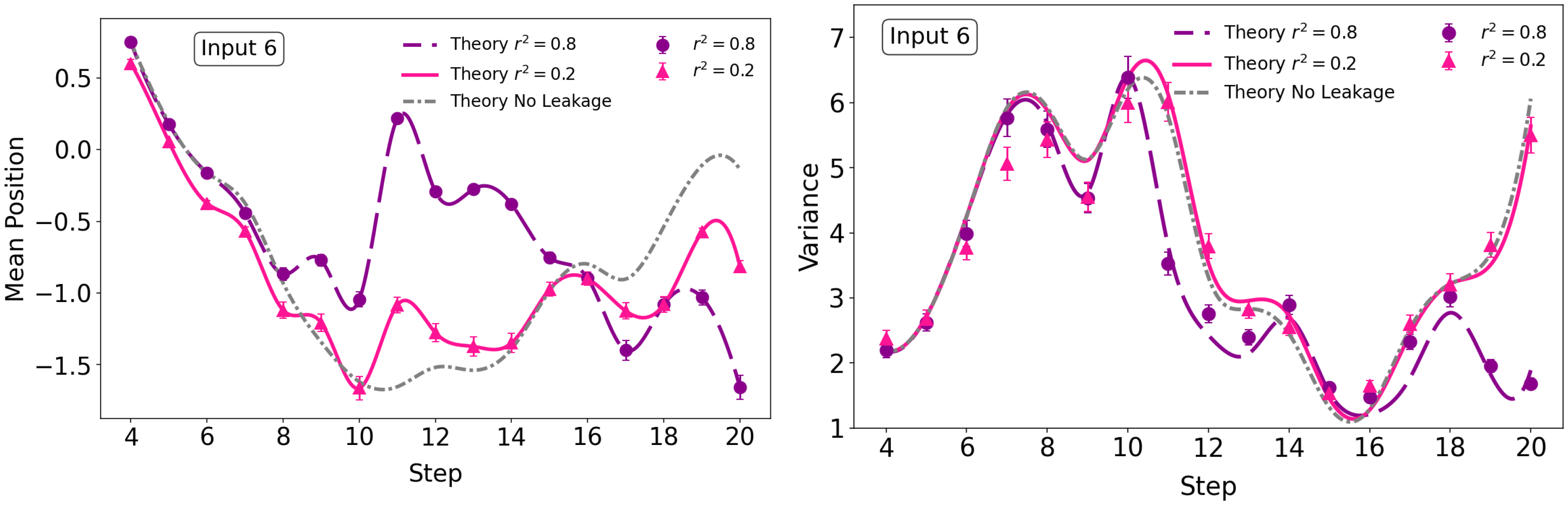
As a final comparison, we analyzed the mean position of and variance in the walker wavefunction for two different input sites, namely waveguides 2 and 6, in two different configurations of leakage probability. These behaviors were compared with numerical simulations of a quantum walk on a lattice without leakage, corresponding to fully reflective boundary conditions at both edges. The results are shown in Figure 7 and Figure 8 for inputs 2 and 6, respectively. As predicted by the simulations discussed in the previous section, when the input site was close to the leaking edge, the weak leakage regime (cyan triangles and solid line in Figure 7, left panel) closely reproduced the behavior observed in the absence of leakage (gray dash-dotted line). In contrast, at higher leakage probabilities (blue dots and dashed blue line), the dynamics differed significantly; the walker propagated more rapidly and reached its maximum displacement at approximately step 13, although this displacement was reduced with respect to the other two cases ( Δ x 5 compared with Δ x 6 ). This behavior was also reflected in the variance (Figure 7, right panel), where the strong leakage regime exhibited oscillations with a larger amplitude (blue circles and dashed line) than those observed in the no leakage or weak leakage cases (gray dash-dotted line and cyan triangles with solid line, respectively).
Overall, when the walker was initialized near the leaking boundary, both the mean position and the variance were enhanced in the strong leakage regime compared with the weak leakage and no leakage scenarios, as shown in Figure 7.
When the input site was far from the leaking boundary, a markedly different behavior was observed (Figure 8). During the first eight steps of the walk, the dynamics were nearly identical across all three regimes. Subsequently, in the strong leakage case (violet circles and dashed line), the mean position exhibited oscillations with a higher frequency compared with the other two regimes, whose behavior remained almost unchanged (Figure 8, left panel). By contrast, the variance displayed rather similar dynamics for all three regimes up to 18 steps (Figure 8, right panel), with only a slightly faster relocalization observed in the strong leakage case between steps 8 and 13.

4. Discussion

The numerical results reveal that the DTQW dynamics was affected by boundary-induced losses in a position-dependent and nontrivial manner. While the presence of confinement leads to oscillatory propagation of the walker, the degree to which coherence and interference are preserved depends on both the leaking probability and the distance of the injection site from the lossy boundary.
In the weak leaking regime, the dynamics closely resembled that of an ideal, lossless QW. The symmetry between opposite injection sites was preserved in both the mean position and the variance, indicating that the partial leakage did not substantially disrupt long-range interference effects. The oscillatory behavior of the variance, characterized by alternating spreading and shrinking of the wavefunction, further confirms that the dynamics remained mainly coherent. In this regime, losses resulted in only a moderate attenuation of the amplitudes without qualitatively altering the structure of the walk.
As the leaking probability increased, deviations became progressively more pronounced. In the high-loss regime, the spoiling of the symmetry between opposite injection sites, together with changes in oscillation frequencies and amplitudes, suggests the onset of decoherence mechanisms induced by the strong openness of the system and increased coupling to the environment.
The comparison between different leaking regimes for injection mode 2, which was closest to the lossy boundary, highlights the strongest impact of these effects. While weak losses left the dynamics largely unchanged with respect to the lossless case, strong leakage led to faster propagation of the mean position as well as enhanced spreading of the wavefunction. Additional features of the long-time dynamics, including the emergence of time windows characterized by enhanced or reduced variance and flattening of the mean displacement, are discussed in Appendix A.2. Dynamical differences between the two limiting scenarios, i.e., absence of losses and a fully absorbing boundary, were particularly pronounced for the injection site closest to the leaking edge, confirming the key role played by boundary proximity in shaping both the early and long-time dynamics. A detailed comparison between the lossless and fully absorbing boundary conditions is also reported in Appendix A.2.
For injection modes farther from the leaking boundary, losses played a less significant role. The strong similarities between the dynamics observed in the weak and high-loss regimes suggest that the wavefunction reached the leaking boundary only with reduced probability and at later times. Hence, the overall evolution of both the mean position and the variance remained largely governed by coherent propagation. Remarkably, even the total loss regime could preserve dynamics closely resembling that of the ideal QW when the injection site was sufficiently distant from the leaking boundary, as pointed out by the comparison between the dotted and dashed curves in Figure A1c–f.
Overall, these findings were validated by experimental measurements performed on the photonic processor for the first 20 steps, which showed good agreement with the simulated mean position and variance across different input sites and leakage regimes (Figure 5, Figure 6, Figure 7 and Figure 8). Importantly, the experiments allowed a closer inspection for N 20 , highlighting subtle differences in the early time propagation that were less visible in the long-time simulations. Moreover, the good agreement between the experiment and simulations supports the reliability of the numerical model, which provides the basis for exploration of the longer-time regime.
The case of input site 7 deserves particular attention. Acting as a fully reflective barrier toward the interior of the lattice and being maximally distant from the leaking boundary, it would be expected to show the weakest sensitivity to losses. This was confirmed but only at early times; up to about 15 steps, both the mean position and the variance were nearly identical for all loss regimes, indicating that the wavefunction had not yet reached the opposite leaking edge (Figure A1g,h). At longer times, however, a qualitative difference emerged. Weak losses led to a pronounced flattening of the mean position and a drift toward positions closer to the leaking side, whereas stronger losses preserved oscillatory trends. A detailed analysis of the long-time behavior corresponding to this injection site can be found in Appendix A.2.
Taken together, the results discussed above indicate that losses in this system introduced a non-Hermitian leakage of the probability amplitude across the output modes but did not necessarily induce a significant decoherence effect. From a numerical perspective, the resulting long-time dynamics exhibited a strong robustness in the presence of losses, especially in the low-leakage regime; the overall structure and the main qualitative features of the evolution patterns were only weakly affected by the introduction of a leaking boundary. This behavior stands in sharp contrast to scenarios in which dynamic noise is added to the system, where the wavefunction spreading and its propagation velocity can undergo substantial modifications [48]. Conversely, when the leaking probability becomes high, stronger coupling to the environment leads to a breakdown of dynamical regularities and phase relations still preserved at low losses, thereby mimicking some features typically associated with decoherence.
Finally, it is worth noting that in both the numerical model and its experimental implementation, we assumed a constant probability for a photon reaching the leaking boundary to escape the lattice at each time step. This choice allowed us to isolate the effect of spatially localized losses, avoiding superimposing contributions from their time dependence. If the loss coefficients (i.e., the BS transmissivity at the boundary) were step-dependent, then different propagation paths would be unevenly weighted, likely resulting in partial suppression of the interference effects and potentially introducing temporal memory in the interference pattern. From an experimental perspective, assuming the leakage probability to be independent of the specific time step at which the walker reaches the boundary corresponds to an idealized scenario which was expected to be more controllable and suitable for a first investigation of the role played by a localized partially absorbing boundary. A more general and systematic study of the effects of time-dependent or randomly fluctuating losses, which would model more complex and realistic scenarios, is left for future works.

5. Conclusions

A confined quantum walk with absorbing boundaries was investigated in detail. The experimental investigation was performed for the first 20 steps of the dynamics. The longer-time features discussed here, being supported by numerical simulations, represent predicted results resting on the adopted theoretical model, whose direct experimental validation requires further advances in photonic processor technology. Within this framework, our results demonstrate that boundary leakage does not merely suppress QW dynamics but can qualitatively reshape it in certain ways, depending on both the loss strength and the injection geometry. From the experimental perspective, our findings show that recently developed commercial integrated photonic platforms provide a suitable architecture for the simulation of open quantum systems, enabling the introduction of controlled interactions between the quantum system and its environment with the consequent achievement of different levels of decoherence. The universal photonic quantum processor employed in the experiments enabled implementation of the desired Hamiltonians with controllable losses, demonstrating that leaking boundaries can be exploited as effective control parameters for engineered on-chip QWs. This, in turn, allows for tuning the coherence, interference, and transport properties in integrated photonic platforms. The proposed approach offers a versatile framework that can be extended to a wide range of open quantum systems, paving the way to the realistic use of these quantum simulators to study non-trivial dynamics. Based on this work and the possible benefits arising from the exploitation of controllable decoherence, the capabilities of quantum computational methods based on decoherence enhancement could be pushed far beyond their current operational boundaries.

Author Contributions

Conceptualization, E.S., L.S. and A.C.; methodology, all; software, E.S., L.S., J.P., J.B., A.G. and A.C.; formal analysis, E.S. and L.S.; investigation, E.S., A.C. and L.S.; resources, all; data curation, E.S. and L.S.; writing—original draft preparation, E.S. and L.S.; writing—review and editing, all; visualization, E.S. and L.S.; supervision, A.C.; project administration, L.S.; funding acquisition, A.C. All authors have read and agreed to the published version of the manuscript.

Funding

This research was funded by QuantERA II Programme supported by the EU H2020 research and innovation Programme under GA No 101017733 (Qucaboose Project–Call Quantera 2023), with funding from Italian organization PNRR MUR project PE0000023-NQSTI (Spoke 6, CUP: H43C22000870001).

Institutional Review Board Statement

Not applicable.

Informed Consent Statement

Not applicable.

Data Availability Statement

The datasets used and analyzed during the current study are available from the corresponding author on reasonable request.

Acknowledgments

The authors acknowledge Caterina Taballione from QuiX Quantum and Marco Barbieri and Ilaria Gianani from Roma Tre University for their fruitful and constructive conversations.

Conflicts of Interest

The authors declare no conflicts of interest.

Appendix A

Appendix A.1. Long-Time Numerical Simulations

This appendix provides an extended analysis of the numerical simulations for the DTQW on a finite lattice in the presence of a leaking boundary, focusing on the long-time dynamics up to 100 time steps. In particular, we report on those dynamical features that were only briefly mentioned in Section 3.1, with the aim of supporting and clarifying our physical interpretation. These results complement the main text by providing a detailed comparison between different leakage regimes and injection sites.
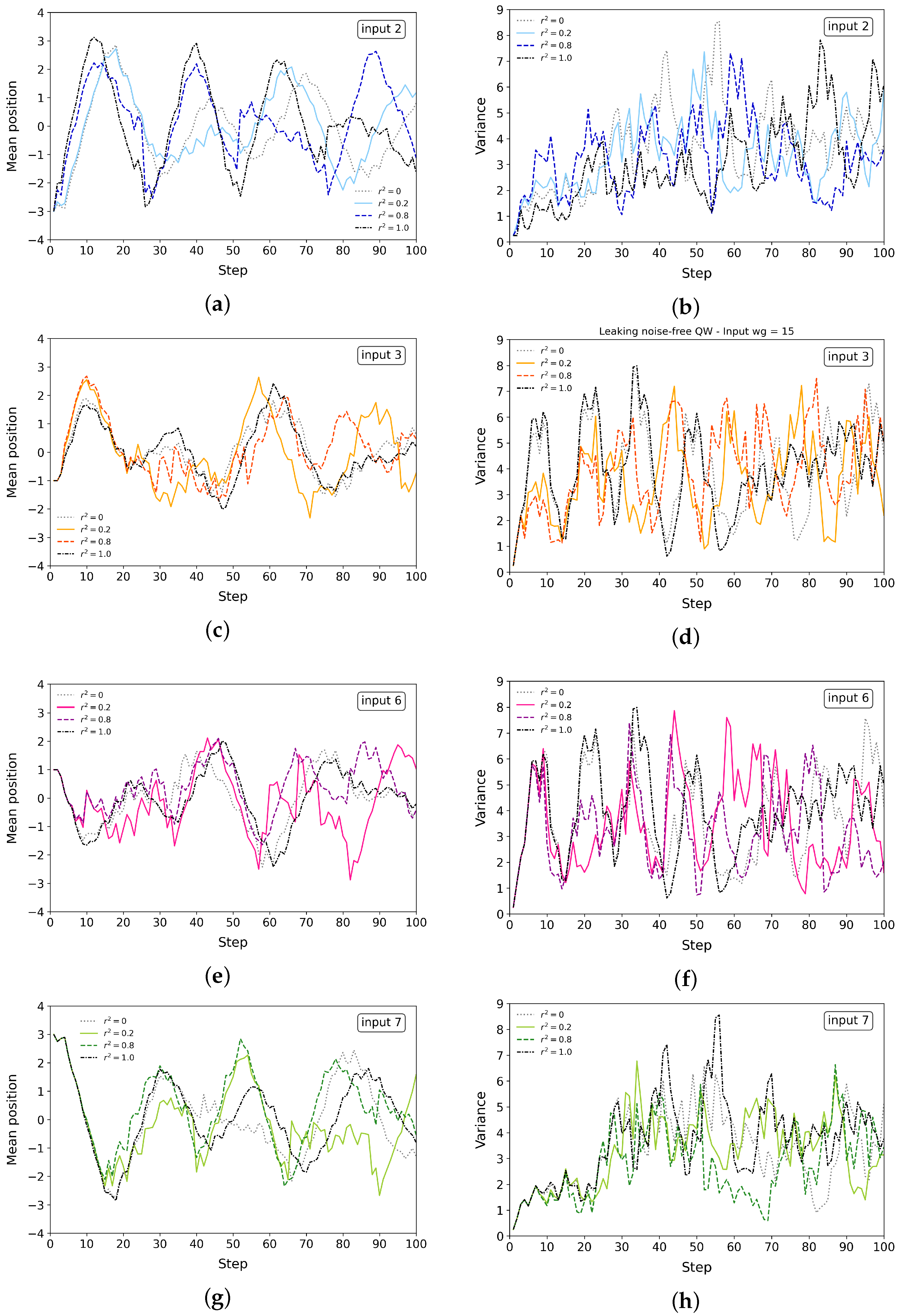
As reported in Section 3.1, the effects of losses strongly depend on the position of the injection site as well as on the leakage strength. Figure A1 therefore summarizes the time evolution of the walker’s mean position and variance over 100 steps for different injection sites and for the two representative leakage probabilities, namely r 2 = 0.2 (weak leakage) and r 2 = 0.8 (strong leakage). For reference, the lossless case ( r 2 = 0 ) and the fully absorbing boundary ( r 2 = 1.0 ) are also shown.
We first focus on the injection site closest to the leaking boundary (input 2, shown in Figure A1a,b), which in the main text was identified as the configuration most sensitive to losses. In the weak leakage regime (cyan solid line), the dynamics closely resembled those of the lossless case (gray dotted line) over several tens of steps, with only moderate differences in amplitude. By contrast, strong leakage (blue dashed line) already induced significant deviations at early times, including faster propagation of the mean position and enhanced spreading of the wavefunction, as evidenced by the increased variance. For the injection sites progressively farther from the leaking boundary (input sites 3, 6, and 7, shown in Figure A1c,d, e,f, g,h, respectively), the impact of losses was progressively reduced. In these configurations, both the mean position and the variance exhibited similar temporal trends across different leakage regimes over a large number of steps, indicating that the walker dynamics remained largely governed by coherent propagation within the lattice.
To further clarify the role of the leaking regimes discussed above, it is instructive to analyze the two limiting cases of fully reflective (transmissivity r 2 = 0 ) and fully absorbing (transmissivity r 2 = 1.0 ) boundaries on input 2, represented in Figure A1 as gray dotted and black dashed-dotted lines, respectively. These limiting cases provide useful benchmarks for interpreting the intermediate leakage regimes discussed in the main text.
Figure A1. Simulated mean position (left column) and variance in the mean position (right column) as a function of the number of steps. Comparison between the low- (transmissivity r 2 = 0.2 , colored solid lines) and high-leaking (transmissivity r 2 = 0.8 , colored dashed lines) regimes for the four selected input modes: input 2 (a,b), input 3 (c,d), input 6 (e,f), and input 7 (g,h). Here, input 2 and input 7 correspond to the nearest and farthest injection sites from the leaking boundary, respectively. For reference, the lossless (transmissivity r 2 = 0 ) and total loss (transmissivity r 2 = 1.0 ) cases are shown with gray dotted and black dash-dotted lines, respectively.
Applsci 16 01976 g0a1

Appendix A.2. Extended Discussion on Long-Time Dynamics

We provide here a more detailed interpretation of the long-time dynamical features briefly discussed in Section 4.
Let us start our discussion from injection site 2. Interestingly, if the walker was initialized as closed to the leaking boundary, then time windows emerged in which the mean position exhibited a less steep trend and stayed close to the center of the lattice, while the variance reached large values (e.g., between time steps 55 and 75, where the blue dashed curve in Figure A1a seems to lack a peak, while the blue dashed curve in Figure A1b displays its highest peak where the cyan solid line has a drop). This observation indicates that, whereas the absence of losses or their weak presence would lead to photon localization or bunching, strong leakage can suppress localization effects, inducing a broader distribution of the probability amplitude across the waveguides while keeping the average position close to zero. Injection site 2, due to its proximity to the leaking edge, resulted in the most pronounced dynamical differences between the two limiting scenarios, namely the absence of losses (transmissivity r 2 = 0 ) and the presence of a fully absorbing boundary (transmissivity r 2 = 1.0 ), with a leaking probability equal to one. The lossless case is the ideal QW, where no photons escape the system. The walker’s mean position exhibited the widest oscillations (gray dotted line in Figure A1a), indicating that the wavefunction was reflected between the lattice edges. In such a configuration, interference preserves a high degree of coherence [48]. This remark is reinforced by the variance (gray dotted line in Figure A1b), which displayed sharp peaks, reaching values above eight. This implies that photons do not merely diffuse but rather interfere, giving rise to pronounced interference lobes in the probability distribution. The sudden drops in variance point to transient refocusing events, in which the wavefunction becomes more localized before spreading again. By contrast, in the total loss regime (black dash-dotted line), the variance remained low for an extended time window (up to about the first 55 steps), indicating that most walkers were lost before contributing significantly to the spatial spreading. The appearance of a sharp peak in the variance at later times (beyond approximately 75 steps) can be attributed to the residual fraction of the surviving wavefunction reaching the lattice edges, which resulted in an increase in the computed variance, even though the overall signal intensity was strongly reduced.
For the injection site maximally distant from the leaking boundary, i.e., input site 7, a counterintuitive behavior emerged at long times. Although far from the absorbing edge, leakage would be expected to have minimal influence over long times. Weak losses caused a flattening of the mean position (between steps 65 and 90), as displayed by the green solid line in Figure A1g, while stronger losses (green dashed line) preserved the oscillatory pattern. This effect can be ascribed to the fact that weak losses do not strongly suppress wavefunctions reaching the leaking edge, as the probability of ejecting the walker is small. The dominant effect in the dynamics is that of the wavefunction reflected into the lattice. This process breaks the interference symmetry and induces an effective directional bias. The corresponding variance dynamics supports this interpretation (Figure A1h). After an initial localization phase common to all regimes during the fist 20–25 steps, spreading occurred with aa reduced amplitude and broader peaks compared with those observed for more internal injection sites. Moreover, at longer times, the variance in the high-leakage case (green dashed line) presented a marked drop near the 50th time step, revealing a transient relocalization of the wavefunction that was absent when losses were weaker (green solid line). This behavior mirrors that observed for injection site 2, albeit with inverted roles between low- and high-loss cases, and underscores the nontrivial interplay between the distance from the leaking boundary and loss-induced interference effects.

References

  1. Aharonov, Y.; Davidovich, L.; Zagury, N. Quantum random walks. Phys. Rev. A 1993, 48, 1687–1690. [Google Scholar] [CrossRef]
  2. Kempe, J. Quantum random walks: An introductory overview. Contemp. Phys. 2003, 44, 307–327. [Google Scholar] [CrossRef]
  3. Venegas-Andraca, S.E. Quantum walks: A comprehensive review. Quantum Inf. Process. 2012, 11, 1015–1106. [Google Scholar] [CrossRef]
  4. Kadian, K.; Garhwal, S.; Kumar, A. Quantum walk and its application domains: A systematic review. Comput. Sci. Rev. 2021, 41, 100419. [Google Scholar] [CrossRef]
  5. Childs, A.M. Universal Computation by Quantum Walk. Phys. Rev. Lett. 2009, 102, 180501. [Google Scholar] [CrossRef]
  6. Ambainis, A. Quantum walks and their algorithmic applications. Int. J. Quantum Inf. 2003, 01, 507–518. [Google Scholar] [CrossRef]
  7. Shenvi, N.; Kempe, J.; Whaley, K.B. Quantum random-walk search algorithm. Phys. Rev. A 2003, 67, 052307. [Google Scholar] [CrossRef]
  8. Aspuru-Guzik, A.; Walther, P. Photonic quantum simulators. Nat. Phys. 2012, 8, 285–291. [Google Scholar] [CrossRef]
  9. Kitagawa, T.; Rudner, M.S.; Berg, E.; Demler, E. Exploring topological phases with quantum walks. Phys. Rev. A 2010, 82, 033429. [Google Scholar] [CrossRef]
  10. Broome, M.A.; Fedrizzi, A.; Lanyon, B.P.; Kassal, I.; Aspuru-Guzik, A.; White, A.G. Discrete Single-Photon Quantum Walks with Tunable Decoherence. Phys. Rev. Lett. 2010, 104, 153602. [Google Scholar] [CrossRef]
  11. Wang, J.; Manouchehri, K. Physical Implementation of Quantum Walks; Springer: Berlin/Heidelberg, Germany, 2013; Volume 10. [Google Scholar]
  12. Dadras, S.; Gresch, A.; Groiseau, C.; Wimberger, S.; Summy, G.S. Quantum Walk in Momentum Space with a Bose-Einstein Condensate. Phys. Rev. Lett. 2018, 121, 070402. [Google Scholar] [CrossRef] [PubMed]
  13. Dadras, S.; Gresch, A.; Groiseau, C.; Wimberger, S.; Summy, G.S. Experimental realization of a momentum-space quantum walk. Phys. Rev. A 2019, 99, 043617. [Google Scholar] [CrossRef]
  14. Clark, J.H.; Groiseau, C.; Shaw, Z.N.; Dadras, S.; Binegar, C.; Wimberger, S.; Summy, G.S.; Liu, Y. Quantum to classical walk transitions tuned by spontaneous emissions. Phys. Rev. Res. 2021, 3, 043062. [Google Scholar] [CrossRef]
  15. Gong, M.; Wang, S.; Zha, C.; Chen, M.C.; Huang, H.L.; Wu, Y.; Zhu, Q.; Zhao, Y.; Li, S.; Guo, S.; et al. Quantum walks on a programmable two-dimensional 62-qubit superconducting processor. Science 2021, 372, 948–952. [Google Scholar] [CrossRef]
  16. Peruzzo, A.; Lobino, M.; Matthews, J.C.F.; Matsuda, N.; Politi, A.; Poulios, K.; Zhou, X.Q.; Lahini, Y.; Ismail, N.; Wörhoff, K.; et al. Quantum Walks of Correlated Photons. Science 2010, 329, 1500–1503. [Google Scholar] [CrossRef]
  17. Schreiber, A.; Cassemiro, K.N.; Potoček, V.; Gábris, A.; Mosley, P.J.; Andersson, E.; Jex, I.; Silberhorn, C. Photons Walking the Line: A Quantum Walk with Adjustable Coin Operations. Phys. Rev. Lett. 2010, 104, 050502. [Google Scholar] [CrossRef]
  18. Sansoni, L.; Sciarrino, F.; Vallone, G.; Mataloni, P.; Crespi, A.; Ramponi, R.; Osellame, R. Two-Particle Bosonic-Fermionic Quantum Walk via Integrated Photonics. Phys. Rev. Lett. 2012, 108, 010502. [Google Scholar] [CrossRef] [PubMed]
  19. Zhou, W.H.; Wang, X.W.; Ren, R.J.; Fu, Y.X.; Chang, Y.J.; Xu, X.Y.; Tang, H.; Jin, X.M. Multi-particle quantum walks on 3D integrated photonic chip. Light. Sci. Appl. 2024, 13, 296. [Google Scholar] [CrossRef] [PubMed]
  20. Crespi, A.; Osellame, R.; Ramponi, R.; Giovannetti, V.; Fazio, R.; Sansoni, L.; De Nicola, F.; Sciarrino, F.; Mataloni, P. Anderson localization of entangled photons in an integrated quantum walk. Nat. Photonics 2013, 7, 322–328. [Google Scholar] [CrossRef]
  21. De Nicola, F.; Sansoni, L.; Crespi, A.; Ramponi, R.; Osellame, R.; Giovannetti, V.; Fazio, R.; Mataloni, P.; Sciarrino, F. Quantum simulation of bosonic-fermionic noninteracting particles in disordered systems via a quantum walk. Phys. Rev. A 2014, 89, 032322. [Google Scholar] [CrossRef]
  22. Schreiber, A.; Cassemiro, K.N.; Potoček, V.; Gábris, A.; Jex, I.; Silberhorn, C. Decoherence and Disorder in Quantum Walks: From Ballistic Spread to Localization. Phys. Rev. Lett. 2011, 106, 180403. [Google Scholar] [CrossRef]
  23. Schreiber, A.; Gábris, A.; Rohde, P.P.; Laiho, K.; Štefaňák, M.; Potoček, V.; Hamilton, C.; Jex, I.; Silberhorn, C. A 2D Quantum Walk Simulation of Two-Particle Dynamics. Science 2012, 336, 55–58. [Google Scholar] [CrossRef] [PubMed]
  24. Tang, H.; Lin, X.F.; Feng, Z.; Chen, J.Y.; Gao, J.; Sun, K.; Wang, C.Y.; Lai, P.C.; Xu, X.Y.; Wang, Y.; et al. Experimental two-dimensional quantum walk on a photonic chip. Sci. Adv. 2018, 4, eaat3174. [Google Scholar] [CrossRef]
  25. Wang, J.; Sciarrino, F.; Laing, A.; Thompson, M.G. Integrated photonic quantum technologies. Nat. Photonics 2019, 14, 273–284. [Google Scholar] [CrossRef]
  26. Tillmann, M.; Dakić, B.; Heilmann, R.; Nolte, S.; Szameit, A.; Walther, P. Experimental boson sampling. Nat. Photonics 2013, 7, 540–544. [Google Scholar] [CrossRef]
  27. Crespi, A.; Osellame, R.; Ramponi, R.; Brod, D.J.; Galvão, E.F.; Spagnolo, N.; Vitelli, C.; Maiorino, E.; Mataloni, P.; Sciarrino, F. Integrated multimode interferometers with arbitrary designs for photonic boson sampling. Nat. Photonics 2013, 7, 545–549. [Google Scholar] [CrossRef]
  28. Spagnolo, N.; Vitelli, C.; Bentivegna, M.; Brod, D.J.; Crespi, A.; Flamini, F.; Giacomini, S.; Milani, G.; Ramponi, R.; Mataloni, P.; et al. Experimental validation of photonic boson sampling. Nat. Photonics 2014, 8, 615–620. [Google Scholar] [CrossRef]
  29. Zhong, H.S.; Peng, L.C.; Li, Y.; Hu, Y.; Li, W.; Qin, J.; Wu, D.; Zhang, W.; Li, H.; Zhang, L.; et al. Experimental Gaussian Boson sampling. Sci. Bull. 2019, 64, 511–515. [Google Scholar] [CrossRef]
  30. Hoch, F.; Piacentini, S.; Giordani, T.; Tian, Z.N.; Iuliano, M.; Esposito, C.; Camillini, A.; Carvacho, G.; Ceccarelli, F.; Spagnolo, N.; et al. Reconfigurable continuously-coupled 3D photonic circuit for Boson Sampling experiments. npj Quantum Inf. 2022, 8, 55. [Google Scholar] [CrossRef]
  31. Anguita, M.C.; Roelink, T.; Marzban, S.; Briels, W.; Filippi, C.; Renema, J. Experimental demonstration of boson sampling as a hardware accelerator for monte carlo integration. arXiv 2025, arXiv:2509.25404. [Google Scholar] [CrossRef]
  32. Aaronson, S.; Arkhipov, A. The computational complexity of linear optics. In Proceedings of the Forty-Third Annual ACM Symposium on Theory of Computing; STOC’11; ACM: New York, NY, USA, 2011; pp. 333–342. [Google Scholar] [CrossRef]
  33. Lund, A.P.; Bremner, M.J.; Ralph, T.C. Quantum sampling problems, BosonSampling and quantum supremacy. npj Quantum Inf. 2017, 3, 15. [Google Scholar] [CrossRef]
  34. Hamilton, C.S.; Kruse, R.; Sansoni, L.; Barkhofen, S.; Silberhorn, C.; Jex, I. Gaussian Boson Sampling. Phys. Rev. Lett. 2017, 119, 170501. [Google Scholar] [CrossRef]
  35. Bach, E.; Coppersmith, S.; Goldschen, M.P.; Joynt, R.; Watrous, J. One-dimensional quantum walks with absorbing boundaries. J. Comput. Syst. Sci. 2004, 69, 562–592. [Google Scholar] [CrossRef]
  36. Stefanák, M.; Jex, I.; Kiss, T. Recurrence and pólya number of quantum walks. Phys. Rev. Lett. 2008, 100, 020501. [Google Scholar] [CrossRef]
  37. Wang, K.; Wu, N.; Kuklinski, P.; Xu, P.; Hu, H.; Song, F. Grover walks on a line with absorbing boundaries. Quantum Inf. Process. 2016, 15, 3573–3597. [Google Scholar] [CrossRef]
  38. Kuklinski, P. Conditional probability distributions of finite absorbing quantum walks. Phys. Rev. A 2020, 101, 032309. [Google Scholar] [CrossRef]
  39. Ammara, A.; Potoček, V.; Štefaňák, M.; Pepe, F.V. Quantum Walk on a Line with Absorbing Boundaries. arXiv 2025, arXiv:2508.13318. [Google Scholar] [CrossRef]
  40. Nitsche, T.; Barkhofen, S.; Kruse, R.; Sansoni, L.; Štefaňák, M.; Gábris, A.; Potoček, V.; Kiss, T.; Jex, I.; Silberhorn, C. Probing measurement-induced effects in quantum walks via recurrence. Sci. Adv. 2018, 4, eaar6444. [Google Scholar] [CrossRef]
  41. Pegoraro, F.; Held, P.; Barkhofen, S.; Brecht, B.; Silberhorn, C. Dynamic conditioning of two particle discrete-time quantum walks. Phys. Scr. 2023, 98, 034005. [Google Scholar] [CrossRef]
  42. Biggerstaff, D.N.; Heilmann, R.; Zecevik, A.A.; Gräfe, M.; Broome, M.A.; Fedrizzi, A.; Nolte, S.; Szameit, A.; White, A.G.; Kassal, I. Enhancing coherent transport in a photonic network using controllable decoherence. Nat. Comm. 2016, 7, 11282. [Google Scholar] [CrossRef]
  43. Mohseni, M.; Rebentrost, P.; Lloyd, S.; Aspuru-Guzik, A. Environment-assisted quantum walks in photosynthetic energy transfer. J. Chem. Phys. 2008, 129, 174106. [Google Scholar] [CrossRef]
  44. Engel, G.S.; Calhoun, T.R.; Read, E.L.; Ahn, T.K.; Mančal, T.; Cheng, Y.C.; Blankenship, R.E.; Fleming, G.R. Evidence for wavelike energy transfer through quantum coherence in photosynthetic systems. Nature 2007, 446, 782–786. [Google Scholar] [CrossRef]
  45. Kendon, V.; Tregenna, B. Decoherence can be useful in quantum walks. Phys. Rev. A 2003, 67, 042315. [Google Scholar] [CrossRef]
  46. Kendon, V. Decoherence in quantum walks—A review. Math. Struct. Comput. Sci. 2007, 17, 1169–1220. [Google Scholar] [CrossRef]
  47. Verstraete, F.; Wolf, M.M.; Ignacio Cirac, J. Quantum computation and quantum-state engineering driven by dissipation. Nat. Phys. 2009, 5, 633–636. [Google Scholar] [CrossRef]
  48. Sansoni, L.; Stefanutti, E.; Benedetti, C.; Gianani, I.; Taballione, C.; Toor, A.; Herrera, L.; Pistilli, M.; Santoro, S.; Barbieri, M.; et al. Noisy dynamics of confined quantum walks on a chip. arXiv 2025, arXiv:2511.19125. [Google Scholar] [CrossRef]
  49. Taballione, C.; van der Meer, R.; Snijders, H.J.; Hooijschuur, P.; Epping, J.P.; de Goede, M.; Kassenberg, B.; Venderbosch, P.; Toebes, C.; van den Vlekkert, H.; et al. A universal fully reconfigurable 12-mode quantum photonic processor. Mater. Quantum Technol. 2021, 1, 035002. [Google Scholar] [CrossRef]
  50. Taballione, C.; Anguita, M.C.; de Goede, M.; Venderbosch, P.; Kassenberg, B.; Snijders, H.; Kannan, N.; Vleeshouwers, W.L.; Smith, D.; Epping, J.P.; et al. 20-Mode Universal Quantum Photonic Processor. Quantum 2023, 7, 1071. [Google Scholar] [CrossRef]
  51. Clements, W.R.; Humphreys, P.C.; Metcalf, B.J.; Kolthammer, W.S.; Walmsley, I.A. Optimal design for universal multiport interferometers. Optica 2016, 3, 1460–1465. [Google Scholar] [CrossRef]
  52. Wang, X.; Sun, Z.; Wang, Z.D. Operator fidelity susceptibility: An indicator of quantum criticality. Phys. Rev. A 2009, 79, 012105. [Google Scholar] [CrossRef]
Figure 1. Scheme of the confined leaking QW with 2 M = 8 modes, implemented as a cascade of MZ interferometers representing the Hilbert subspace H 2 M . The external modes in the H subspace are not displayed. The pale blue waveguide at the upper edge of the lattice (input mode 1, corresponding to the position x = 3.5 ) represents the leaking boundary, where photons are lost (indicated by broken links, which would be coupled to the H subspace). The coupling between this waveguide and mode 2 is given by the parameter r 2 . The dark blue waveguide at the bottom edge (input mode 8, corresponding to x = 3.5 along the position axis) depicts a hard confinement boundary, where photons are totally reflected back into the lattice. The internal gray waveguides (input modes 2–7) implement Hadamard coin operation with a balanced BS. Light is injected from one of the input modes as described in the text.
Applsci 16 01976 g001
Figure 2. Scheme of the experimental set-up. Attenuated coherent light plays the role of the walker, which is injected into the tunable photonic processor via a polarization-maintaining fiber (PMF). The processor implements the leaking QW as unitary, and the output is sent to the measurement stage through single-mode fibers (SMFs). The measurement apparatus consists of a photodiode used to retrieve the probability distributions (blue inset) across the output modes. Thanks to a computer-driven reconfigurability of the processor, we implemented various leaking configurations.
Applsci 16 01976 g002
Figure 3. Simulated mean position (left column, panels (a,c)) and variance in the mean position (right column, panels (b,d)) as a function of the number of steps. Comparison between the four selected input modes for leaking probability r 2 = 0.2 (panels (a,b)) and r 2 = 0.8 (panels (c,d)), corresponding to low- and high-leakage regimes, respectively.
Applsci 16 01976 g003
Figure 4. Total variation distance between the experimental and simulated output distributions, as defined by Equation (5). In the strong leaking regime, blue circles, orange squares, purple triangles, and green diamonds correspond to walks with inputs from modes 2, 3, 6, and 7, respectively. In the weak leaking regime, cyan circles correspond to a walker injected from input 2, while pink triangles correspond to input 6.
Applsci 16 01976 g004
Figure 5. Mean position (left) and variance in the mean position (right) as a function of the number of steps in the case of a leaking probability r 2 = 0.8 , corresponding to a strongly leaking boundary for different initial sites of the walk, namely site 2, corresponding to position x = 2.5 (blue circles), site 3 ( x = 1.5 , orange squares), site 6 ( x = 1.5 , violet triangles), and site 7 ( x = 2.5 , green diamonds). Symbols correspond to experimental data, and lines correspond to theoretical behaviors.
Applsci 16 01976 g005
Figure 6. Mean position (left) and variance in the mean position (right) as a function of the number of steps in the case of a leaking probability r 2 = 0.2 , corresponding to a weakly leaking boundary for different initial sites of the walk, namely site 2, corresponding to position x = 2.5 (cyan circles) and site 6 ( x = 1.5 , pink triangles). Symbols correspond to experimental data, and lines correspond to theoretical behaviors.
Applsci 16 01976 g006
Figure 7. Mean position (left) and variance in the mean position (right) as a function of the number of steps for a walker injected in mode 2. Blue circles correspond to strong leaking (transmissivity r 2 = 0.8 ), while cyan triangles correspond to weak leaking ( r 2 = 0.2 ). Symbols correspond to experimental data, and lines correspond to simulations. Gray dash-dotted lines show behavior in the absence of leaking.
Applsci 16 01976 g007
Figure 8. Mean position (left) and variance in the mean position (right) as a function of the number of steps for a walker injected in site 6. Violet circles correspond to strong leaking (transmissivity r 2 = 0.8 ), while pink triangles correspond to weak leaking ( r 2 = 0.2 ). Symbols correspond to experimental data, while lines correspond to simulations. Gray dash-dotted lines show behavior in the absence of leaking.
Applsci 16 01976 g008
Disclaimer/Publisher’s Note: The statements, opinions and data contained in all publications are solely those of the individual author(s) and contributor(s) and not of MDPI and/or the editor(s). MDPI and/or the editor(s) disclaim responsibility for any injury to people or property resulting from any ideas, methods, instructions or products referred to in the content.