Article

Risk Modeling and Robust Resource Allocation in Complex Aviation Networks: A Wasserstein Distributionally Robust Optimization Approach

School of Reliability and Systems Engineering, Beihang University, Beijing 100191, China
*
Author to whom correspondence should be addressed.
These authors contributed equally to this work.
Appl. Sci. 2026, 16(4), 1959; https://doi.org/10.3390/app16041959
Submission received: 9 January 2026 / Revised: 8 February 2026 / Accepted: 13 February 2026 / Published: 16 February 2026
(This article belongs to the Special Issue Risk Models, Analysis, and Assessment of Complex Systems)

Abstract

Aircraft routing networks are complex systems vulnerable to cascading delays triggered by weather disruptions and airspace constraints. This paper proposes a Distributionally Robust Aircraft Routing (DRAR) model for systemic risk assessment. Conventional robust or stochastic optimization methods often rely on specific assumptions about delay distributions (e.g., fixed probability distributions or scenario sets). However, due to the suddenness and multi-source nature of flight delays, their true distribution is difficult to accurately characterize, limiting the effectiveness of these methods in real-world uncertain conditions. By constructing a Wasserstein-metric ambiguity set, the proposed model captures distributional uncertainty without assuming fixed probabilities, thereby handling delay risks more robustly. The study incorporated chance constraints to bound extreme delay probabilities and reformulated the model as a tractable mixed-integer program. Experiments on real airline data demonstrate that DRAR outperforms traditional benchmarks, reducing propagation delays by 4–6%, volatility by 7–9%, and extreme delay risks by up to 15.7%. Thus, the model provides a practical tool for aviation decision-makers: airlines can leverage it to optimize aircraft scheduling and routing, systematically mitigate delay propagation risk, control the probability of extreme delays, and consequently reduce indirect operational costs arising from crew overtime and airport scheduling conflicts, thereby enhancing overall resource efficiency and operational resilience. These results validate DRAR as an effective tool for controlling tail risks and ensuring sustainable operations in uncertain aviation environments.

1. Introduction

The aviation transportation system is one of the most representative complex systems in modern society. Comprising thousands of flights, airports, aircraft, and crew members, this system forms a highly interconnected and dynamically evolving complex network, where elements are coupled through time window constraints, spatial connections, and resource sharing mechanisms. In this complex system, a perturbation at any single node can propagate downstream through the network structure, triggering cascading failures at the system level [1].
The global aviation industry has been on a path of steady recovery following the unprecedented, planet-scale disruption caused by the COVID-19 pandemic [2,3]. According to a joint report released in 2025 by Airports Council International (ACI) and the International Civil Aviation Organization (ICAO), global passenger traffic reached 9.5 billion in 2024, representing 104% of the 2019 level [4]. However, flight operations continue to face disturbances from a complex array of uncertainties, and persistently high flight delay rates remain a critical operational challenge. Data from the U.S. Bureau of Transportation Statistics (BTS) shows that the flight delay rate was 18.88% in 2019, rising to 20.28% in 2024. Persistently high delay rates not only drive up operational costs for airlines but also severely impair passenger travel experience, becoming a core risk issue that urgently needs to be addressed in airline operations.
Examined from a complex system perspective, the risk management of flight delays faces unique challenges. On one hand, delays exhibit significant propagation characteristics: since each aircraft typically operates multiple consecutive flight legs, a primary delay on a single leg may propagate downstream along the route chain, forming what is known as propagated delay [5,6,7]. This cascading amplification effect can transform local perturbations into systemic risk events. Research indicates that as primary delays increase from 0–2 h to 0–8 h, airline profits may decrease to one-third of their original value [8]. On the other hand, the high-density operations and tight resource constraints of the aviation network further exacerbate the systemic transmission of risks, making effective risk assessment and risk mitigation strategies key to guaranteeing operational efficiency and sustainable development.
Although improvements in air traffic management and investments in aviation infrastructure are expected to significantly reduce flight delays, from the perspective of airlines, effective scheduling strategies remain a crucial means of mitigation [9]. In both aviation operational practice and academic research, airline scheduling is typically decomposed into four sequential stages: flight scheduling, fleet assignment, aircraft routing, and crew scheduling. This study focuses on aircraft routing, a core component of the scheduling process, which aims to determine a feasible sequence of flight legs for each aircraft based on the outcomes of flight scheduling and fleet assignment. The aircraft routing problem can be viewed as a sophisticated variant of the classic Vehicle Routing Problem (VRP) and its parent problem, the Traveling Salesman Problem (TSP), which have been extensively studied and applied across diverse logistics and scheduling domains [10]. In airline operations, there are generally two aircraft routing approaches to address uncertainties caused by primary delays: reactive approaches and proactive approaches [11]. Reactive approaches primarily focus on schedule recovery, aiming to restore the flight timetable to normal by rescheduling flights and reallocating aircraft at the lowest possible cost after disruptions occur [12,13,14,15,16]. In contrast, proactive approaches take potential disruptions into account during the planning phase, aiming to construct schedules that are inherently more resilient to disturbances [17]. Although reactive approaches offer greater flexibility, they tend to be more computationally complex and incur higher implementation costs [18]. Therefore, this study focuses on the proactive approach, aiming to construct robust routing schemes capable of effectively resisting delay risks, thereby enhancing the system’s ability to withstand primary delays caused by unexpected disruptions, which is of great significance for reducing operational risks in complex aviation systems.
The root cause of flight delays lies in the impact of various unforeseen factors during the execution of flight missions, including adverse weather, air traffic control, crew delays, and congestion at maintenance stations [19]. These factors may prevent an aircraft from departing according to the scheduled timetable, resulting in a primary delay. The uncertainty of primary delays leads to the inability of existing research to adequately characterize them in risk modeling. To this end, this study introduces the distributionally robust optimization (DRO) framework to characterize the distributional uncertainty of primary delays. As an advanced risk modeling tool, the core idea of DRO is not to assume that delays follow a specific distribution, but to construct an ambiguity set containing all possible probability distributions based on the Wasserstein distance, and to make optimized decisions against the worst-case distribution within this set. The main contributions of this paper are summarized as follows:
(1)
A delay risk modeling framework for complex aviation systems: This paper places the aircraft routing problem under the perspective of risk management in complex systems. By comprehensively considering the cascading amplification effect of delays and the chance constraint of long delays, a unified risk modeling framework is established. This framework can simultaneously control total propagated delay at the system level and extreme delay risks at the individual flight level.
(2)
A risk quantification method based on Wasserstein ambiguity sets: This paper employs data-driven ambiguity sets based on the Wasserstein distance to characterize the distributional uncertainty of primary delays, avoiding specific assumptions about delay distributions. By constructing an ambiguity set containing all potential distributions close to the empirical distribution, this method can effectively address risks brought by the suddenness and multi-source nature of delay events.
(3)
Scalable risk assessment and risk mitigation strategies: This paper equivalently transforms the DRO model into a mixed-integer programming (MIP) problem, ensuring the model can be efficiently solved by commercial solvers. Extensive numerical experiments validate the superior performance of the proposed method in delay control and robustness, demonstrating its scalability and practical value in real-world large-scale routing applications.
To guide the reader through the technical development of this work, the remainder of this paper is structured as follows. Section 2 reviews existing literature on uncertainty characterization in aviation operations, critically analyzing the limitations of current methods and situating our distributionally robust approach within the research landscape. Section 3 formally defines the aircraft routing problem and introduces our risk-aware modeling framework, detailing the mathematical formulation of delay propagation and chance constraints. This section is crucial for establishing the foundational optimization model that subsequent sections will analyze and solve. Section 4 presents the core methodological contribution: the data-driven solution methodology. It explains the construction of the Wasserstein ambiguity set and provides the tractable reformulation of the distributionally robust model into a mixed-integer program, which is essential for practical computation. Section 5 validates the proposed model through extensive numerical experiments on real-world airline data, comparing its performance against traditional benchmarks across multiple operational scenarios. Finally, Section 6 concludes the paper by summarizing the key findings, discussing managerial implications for airline operations, and outlining promising directions for future research.

2. Literature Review: From Uncertainty Characterization to Systemic Risk Modeling

Since primary delays are the direct cause of delay propagation, enhancing the resilience of airline operational plans to disturbances in primary delays is a critical issue. Simply absorbing delays by adding buffers overlooks the inherent uncertainty of primary delays. Therefore, it is essential to explicitly consider the uncertainty of primary delays in operational planning. In existing studies, researchers commonly characterize primary delays using probabilistic modeling or uncertainty sets.
Modeling primary delays using theoretical probability distributions is one of the most widely adopted approaches in constructing robust planning models. Dunbar et al. [20] developed an iterative integrated method to minimize propagated delays across aircraft routing and crew pairing. Building on this, they incorporated stochastic delay information through additional delay scenarios and proposed an integrated optimization model for aircraft scheduling, crew pairing, and flight timetabling, which improved the overall robustness of the solution. In their simulation experiments, primary delays were sampled from an exponential distribution. References [4,7] formulated robust optimization models for the integrated planning of aircraft routing and flight timetabling, as well as aircraft routing and crew scheduling, where primary delays were characterized using the Beta distribution. In addition to exponential and Beta distributions, log-Laplace and truncated normal distributions have also been utilized. Reference [21] used the log-Laplace distribution to model the non-cruise time distribution and proposed an aircraft assignment model aiming to minimize operational costs. Aircraft maintenance is a major source of primary delays; He et al. [22] modeled maintenance task durations using a truncated log-normal distribution. Similarly, Reference [23] used a truncated normal distribution to characterize delay durations.
Beyond using theoretical distributions, it is also feasible to assign probabilities to delay scenarios based on contextual features. To address the limitations of using predefined theoretical distributions, data-driven approaches based on empirical data have been employed. Reference [24] used historical operational data to derive probability distributions of independent arrival delays. Reference [25] employed kernel density estimation to fit the probability distribution of actual flight time slots. Following a similar approach, Reference [3] proposed a multivariate kernel density estimation method to estimate probability distributions under given weather conditions.
While probabilistic methods focus on distribution fitting, another stream of research constructs robust aircraft routing schemes through setting buffer zones or using robust optimization approaches. By setting and optimally allocating buffers, delays can be absorbed as much as possible to prevent delay propagation. Reference [4] aimed to minimize the expected total propagated delay of selected flight sequences. Building on this, Reference [26] proposed a robust turn-around time reduction approach to enhance the effectiveness of buffer mechanisms. Similarly, Reference [27] optimized aircraft routing by adjusting cruise speeds, akin to buffer allocation strategies.
However, these studies often overlook the inherent uncertainty of flight delays. Stochastic optimization enhances robustness by incorporating a wide range of delay scenarios into the model. An alternative approach is robust optimization, which aims to produce feasible and effective planning solutions even under worst-case conditions. In this framework, primary delays are represented using uncertainty sets. Reference [14] addressed a route planning problem by partitioning delays into different time intervals and constructing uncertainty sets from historical data. Reference [28] also employed uncertainty sets to capture the randomness of segment delays, developing an exact solution method to minimize expected total propagated delay. Reference [29] proposed three types of uncertainty sets—representing frequent cases, excluding outliers, and including outliers—to develop a Superior Robust aircraft routing approach. This uncertainty set-based robust optimization approach is also widely applied in broader transportation networks; for instance, Reference [30] employed box-type uncertainty sets to manage demand fluctuations in railway transport organization.
Data-driven approaches also show promise for safety monitoring in aviation systems. For example, Zhou et al. developed a deep learning-based anomaly detection framework for UAVs, utilizing wavelet decomposition and a stacked denoising autoencoder to robustly extract features from noisy flight data [31]. This underscores the value of data-driven representation learning for managing uncertainty in aviation operations, aligning with the objective of our distributionally robust optimization model to mitigate risks under data imperfections.
Despite significant progress, the aforementioned approaches exhibit notable limitations when addressing the dual characteristics of flight delays—abruptness and multi-source nature—revealing distinct research gaps:
  • Inadequate Characterization of Delay Distribution Uncertainty: Stochastic optimization methods rely on assumptions of specific probability distributions, which struggle to capture the complex delay patterns arising from multi-source disruptions in real operations. While traditional robust optimization handles bounded disturbances, its static or empirically bounded uncertainty sets fail to reflect dynamic changes in the probability structure (e.g., variance fluctuations or tail risk evolution), often leading to excessive conservatism or infeasibility under extreme scenarios.
  • Lack of Systematic Modeling for Distributional Ambiguity: Existing studies do not incorporate the fundamental uncertainty of the “true distribution being unknown” into a unified framework. Whether employing historically fitted stochastic programming or worst-case-focused robust optimization, they fail to statistically quantify the potential deviation between the empirical distribution and the underlying true distribution. Consequently, their reliability diminishes when confronted with novel or atypical risks (e.g., extreme weather, systemic operational disruptions).
  • Partial Focus in Risk Control Objectives: Most research prioritizes expected delay minimization or satisfaction of deterministic constraints, lacking distributionally robust control over the probability of extreme delays. This limits their ability to provide provable guarantees for tail risks in uncertain environments.
To bridge these gaps, this paper proposes a Wasserstein-metric-based Distributionally Robust Optimization (DRO) framework. The core contributions aimed at addressing the identified limitations are:
Constructing a data-driven Wasserstein ambiguity set to characterize the distributional uncertainty of primary delays without presuming a specific distributional form, thereby enhancing robustness against abrupt and multi-source disturbances.
Integrating system-level propagated delay control with individual flight chance constraints on extreme delays, enabling multi-layered distributionally robust risk management.
Reformulating the model into a tractable Mixed-Integer Programming (MIP) problem, providing a scheduling tool that combines theoretical rigor with computational feasibility for large-scale aviation networks.

3. Problem Definition and Risk Modeling Framework

In the context of a predetermined number of aircraft and a predefined flight schedule, this paper proposes a distributionally robust flight path planning model. The objective of this model is to generate more disturbance-resistant flight paths for each aircraft, thereby effectively addressing the issue of sudden flight delays. The model takes into account two key factors. Firstly, it considers the probability of delays occurring in flight segments that are likely to be prolonged. Secondly, it considers the cumulative duration caused by delays propagating along the flight path. Both of these factors significantly impact an airline’s operational costs.
This section employs the theoretical framework of distributionally robust optimization to model the aircraft routing planning problem. The paper’s methodology is outlined as follows: firstly, methods for modeling and measuring delay uncertainty are introduced; secondly, a routing optimization model is constructed under conditions of unknown distributions, thereby enhancing the overall robustness of aircraft routing plans when faced with uncertain initial delays.
Building upon the complex system perspective established in the Introduction, this section reformulates the aircraft routing problem as a risk-aware resource allocation strategy within a highly interconnected network. This risk-aware resource allocation perspective aligns with complex decision-making challenges in other networked systems. Similar to the aircraft routing problem defined here, maintenance scheduling for distributed wind farms is also formulated as a multi-team route optimization problem with spatial-temporal constraints and cost objectives [32], underscoring the universality of modeling interconnected operational networks under uncertainty. This study defined the aviation operation as a spatio-temporal coupled system where flight legs serve as network nodes and aircraft function as limited resources circulating within the network.
In this complex system, the challenge lies not only in covering all flight tasks but in managing the intertwined variables of time, space, and resource availability under uncertainty. Primary delays act as stochastic perturbations input into specific nodes, which can trigger cascading failures through the network structure defined by aircraft rotations. Consequently, the optimization goal shifts from merely minimizing costs to enhancing system efficiency while establishing a robust defense against the propagation of systemic risks.
The methodological framework is outlined as follows: First, the study modeled the uncertainty dynamics of primary delays and their propagation mechanism; Second, the study constructed a distributionally robust optimization model to balance operational efficiency with system resilience.

3.1. Uncertainty Characterization and Propagation Dynamics

In the context of aviation, flight delays can be categorized into two distinct types: primary delays and propagated delays. These delays are characterized by their suddenness and multi-source nature, arising from various unpredictable factors.
To accurately model the uncertainty characteristics of independent delays, this study utilized actual operational data from a Chinese airline in April 2018, collecting flight scheduling and delay information for 50 aircrafts. The data comprised key information, including scheduled and actual takeoff and landing times, and flight paths. Given that actual flight delay observations may contain both independent and propagation components, it is necessary to mechanically decompose the data to isolate the delay impacts caused by flight connections, retaining only the sudden disturbances inherent to the flight segment itself. Additionally, the model assumes all aircraft undergo overnight maintenance. This operational practice is supported by the dataset, which reveals a consistent multi-hour gap in aircraft scheduling during the early morning hours, coinciding with the typical maintenance windows.
As discussed in Section 1, primary delays serve as the source of input uncertainty for the entire aviation system. Characterized by suddenness and a multi-source nature, these delays are independent of the network structure but act as triggers for subsequent disruptions. To isolate the primary delay inherent to each flight segment from the observed total delay, the study adopt the delay propagation decomposition framework following Reference [6]. To elaborate, contemplate a sequence of successive flight segments undertaken by an aircraft. The preceding segment of segment i is designated as j, with a planned connection buffer time of s j i and a total delay of D j . By the propagation priority absorption principle (i.e., propagated delays are absorbed within the buffer time as much as possible), the independent delay d of segment i can be defined by Equation (1):
d i = d i ¯ d i ¯   ( D j     s j i )   i f   D j     s j i o t h e r w i s e ,
In this expression, the symbol d i ¯ denotes the total observed delay for segment i, and the symbol D j denotes the total delay for the preceding flight j. This expression reflects the principle of propagation-priority absorption.
In light of the sudden and multi-source characteristics of independent delays, this paper refrains from making specific assumptions about the probability distribution of delay random variables. Instead, it describes the possible range of delay values by constructing an uncertainty set. This uncertainty set is based on sample statistical characteristics, defining the upper and lower bounds of the delay variable to reflect its fluctuations and uncertainty within a reasonable range. This approach circumvents the occurrence of model bias, which can be attributed to inaccurate distribution assumptions, thereby enhancing the model’s overall robustness.
The following description provides a detailed representation of the uncertainty set for independent delays:
U { d R m + d i μ ^ i + Γ σ ^ i , i I } ,
The construction of this uncertainty set U is based on the fundamental assumption that the magnitude of real-world sudden delay disturbances is bounded. This bounding is not intended to capture those exceptionally extreme tail events with negligible probabilities (e.g., multi-day delays caused by rare natural disasters) but rather to accurately describe the most common and probable range of delay fluctuations encountered by airlines in daily operations. This ensures that the derived robust solution possesses both the stability to handle daily disruptions and the practicality for real-world operation.
Specifically, the core parameters, namely the mean μ i and standard deviation σ i of the primary delay for each flight leg i , are estimated directly from the empirical distribution of historical operational data. I is defined as the set of all flight segments and Γ is employed as the control parameter for adjusting the robustness level, controlling the conservatism of the uncertainty set. Within the context of uncertainty, delineated by the parameters U , each set of delay disturbances, designated as d, is regarded as a distinct disturbance scenario.
The calculation of total flight delay D is based on the propagation delay accumulation rule that has been widely adopted in existing research [4,6]. This rule treats total flight delay as a function of segment sudden delays and iteratively reflects the absorption effect of buffer time on propagation delays. The flight path commences at the initial node (o) and continues through a succession of segments, ultimately terminating at the final node (t). For the initial segment, designated by i = 1, the total delay is calculated by Equation (3):
D 1 = d 1   ,   d 1 U ,
Subsequently, the total delay for each flight segment, designated by j = 2, 3, …, N, can be calculated by Equation (4):
D j = d j + max { D j 1 s j 1 , j , 0 }   ,   d j U ,

3.2. Resource Allocation Model Formulation

To reasonably address the operational risks caused by uncertainty in flight delays during flight schedule, this paper constructs a multi-objective optimization model that comprehensively considers two aspects of delay management objectives:
Mitigate the chain amplification effect, it is imperative to exercise control over the total expected delay caused by delay propagation in the route, thereby averting the correlation between flight segments.
Conversely, the probability of long delays occurring in any flight segments should be constrained to enhance the local stability of route operations.
Before the modeling stage, the relevant sets, parameters, and decision variables are defined as Table 1 follows:
The objective of this model is to minimize the expected flight propagation delay time and the probability of long delays occurring. The objective function is given in Equation (5):
D R A R min P P   sup E P i I D i d i + w α ,
The symbol D i denotes the total delay time of flight, and α represents the tolerance probability of long flight delays (e.g., those which exceed the threshold T m a x ) in the system. The first term of the equation is used to measure the overall delay propagation intensity of the system, while the second term characterizes the risk penalty for long delays. The parameter w is used to adjust the weights of the two terms.
To achieve the aforementioned optimization objectives, it is necessary to satisfy the following scheduling constraints in a simultaneous manner.
The objective function (5) embodies a trade-off between system efficiency and operational robustness:
The first term minimizes the worst case expected total delay. This represents the goal of maximizing resource utilization efficiency by reducing the non-productive time absorbed by the network.
The second term imposes a penalty on the probability of extreme delays (chance constraint). This serves as a risk mitigation mechanism, preventing local perturbations from evolving into system-wide breakdowns (i.e., long delays exceeding T m a x ).
The weighting parameter w allows decision-makers to balance their preference between aggressive efficiency pursuit and conservative risk aversion.
  • Flight coverage constraints:
v V j I s x i j v = 1 ,   i I ,
v V j I o x j i v = 1   ,   i I ,
Each flight I must and can only be scheduled for execution by one aircraft. Summarize all aircraft and possible subsequent flights to ensure that each flight is uniquely covered. In addition, each flight must have a preceding flight. If there is no preceding flight, assume that it departs from virtual node(o).
2.
Aircraft origin and destination constraints:
j I t x o j v = 1   ,   v V ,
j I o x j t v = 1   ,   v V ,
The initial constraint stipulates the sole flight segment that is to be departing from the virtual starting point (o); the subsequent constraint delineates that the flight is required to conclude at the virtual endpoint (t).
3.
Flow balance constraint:
j I t x i j v = j I o x j i v   ,   i I , v V ,
The constraint is instrumental in ensuring that the mission chain of each aircraft maintains flow balance at any intermediate flight node i. Each arrival at node i (from flight j to i) must be accompanied by a departure from node i (from i to flight j or virtual destination t ).
4.
Scheduling feasibility and airport consistency constraints:
x i j v s i j 0   , i , j I , v V ,
v V x j i v a A D E P j a A R R i a   , i , j I ,
The primary constraint is designed to guarantee that the scheduling connection between the preceding flight i and the subsequent flight j is characterized by an adequate buffer interval s i j in terms of time. In the mathematical formulation, s i j is defined as the planned time gap between the arrival of flight i and the departure of the subsequent flight j assigned to the same aircraft. While the variable s i j can mathematically take a negative value—which would imply that flight j is scheduled to depart before flight i arrives (e.g., arrival at 8:30 but subsequent departure at 8:00)—such a schedule is physically infeasible in real operations.
The second constraint guarantees spatial connection consistency. Specifically, if there exists an airport a A such that A R R j a = 1 and D E P j a = 1 , then the scheduling variable x j i v should be 1; otherwise, the connection is not permitted.
Constraints (10)–(12) mathematically represent the tight coupling mechanism of the aviation network. Any violation of these constraints under uncertainty triggers the ripple effect mentioned in the Introduction.
5.
Risk of prolonged delays Chance constraints
Prolonged delays in flights have been shown to have a detrimental effect on airlines, passengers, and the operational efficiency of airports. For airlines, delays may result in a few issues, including flight cancelations and crew scheduling disruptions, which can lead to direct economic losses. Passengers may encounter considerable deterioration in their travel experience because of missed connections or unsuccessful transfers. At the level of the airport, large-scale delays can result in flight backlogs, disrupt operational rhythms, and impact overall operational efficiency and safety.
In order to mitigate the risks, the model design incorporates a chance constraint mechanism with a view to limiting the probability of prolonged delays. Specifically, let P denote the uncertain set of independent flight delay distributions, encompassing all possible probability distribution scenarios. The constraint is formulated as shown in Equation (13):
inf P P P { D j T m a x     j I } 1 α ,
This expression necessitates the condition that, for all possible delay distributions P P , the probability that the total delay D j of each flight j I on the route does not exceed the specified threshold T m a x , and that this probability remains no less than 1 α under the most unfavorable distribution. In this model, α is employed to denote the tolerable default probability, which is regarded as an optimization variable in the model solution. This is done so that there is an equilibrium between scheduling flexibility and system robustness.
6.
Definition of flight delay
To characterize the delay propagation relationship between flights in the system, the model introduces the following delay propagation recursive formula:
D j = m a x D i x i j v s i j , 0 + d j   , i , j I , v V , d j U ,
In this context, D j represents the independent sudden disturbance affecting flight j, whose value is derived from the uncertainty set U , used to characterize the delay impact caused by multi-source disturbances. In this context, the D j is no longer considered a single deterministic value; rather, it is understood as a set of functions that operate under all possible disturbances in the disturbance set U, manifesting as an interval of delay values with infinite possibilities.
This modeling approach integrates the ambiguity of primary delays with the delay coupling effects caused by scheduling continuity. This enables the model to quantify the uncertainty of primary delays and track their dynamic amplification path within the task chain. The introduction of this propagation mechanism has been shown to significantly enhance the robustness of scheduling schemes under uncertain disturbance scenarios, thus laying the foundation for subsequent opportunity-constrained and distributionally robust optimization.

4. Data-Driven Solution Methodology

The proposed DRAR model is computationally challenging in its current form. The model includes a distributionally robust worst-case expectation objective function and joint distributionally robust chance constraints, as well as recursive maximum relationships in the delay propagation process, resulting in a highly nonlinear and nonconvex optimization problem that is difficult to solve directly.
To address these challenges, this paper will introduce reasonable equivalent transformation strategies in subsequent sections, aiming to transform the original model into a convex optimization problem or an easily solvable form, thereby ensuring the convergence and computational efficiency of the algorithm and enhancing the practical application value of the model.

4.1. Construction of Wasserstein Ambiguity Sets for Risk Quantification

Before the reformulation of the objective function and chance constraints, it is first necessary to clarify the method employed in this paper to construct the ambiguity set for the delay distribution. In light of the sudden and multi-source nature of flight delays, coupled with the inherent challenges in accurately determining the actual delay distribution, this paper proposes a data-driven ambiguity set based on the Wasserstein distance. This approach circumvents the necessity to specify a particular probability distribution assumption for the delay random variable. Consequently, this methodology enhances the model’s robustness and applicability.
Specifically, there are N primary delay observation samples d ^ i i = 1 N from historical flight routes, with each sample being an m-dimensional delay vector representing the observed delays of all flights, the empirical distribution is defined by Equation (15):
P N = 1 N i = 1 N δ d ^ i ,
where δ d ^ i is Dirac distribution with the observation point d ^ i as its center of mass.
To methodically evaluate the disparities between the potential true distribution and the empirical distribution, it is necessary to establish a set of probability distributions such that the distance from the empirical distribution is no greater than a specified threshold θ , that is to say, a ambiguity set. The definition of this set is contingent upon the Wasserstein distance d W , , which quantifies the distance between two probability distributions on an uncertainty set Ξ R m , as defined in Equation (16):
d W P , P N = inf Π P Ξ × Ξ E d , d ^ Π | | d d ^ | | ,
where Π denotes the set of joint distributions with marginal distributions P and P N , respectively, and d ~ P , d ^ ~ P N are random variables. The Wasserstein distance can be interpreted as a cost of transportation, i.e., the minimum expected cost required to transfer one distribution to another.
Considering the points, the present paper proposes the following definition for data-driven Wasserstein ambiguity sets:
F θ = P P Ξ | d W P , P N θ ,
where θ > 0 denotes the radius of the ambiguity set, the extent to which the considered probability distribution deviates from the empirical distribution. Consequently, that a larger radius corresponds to more lenient assumptions and more conservative robust optimization results, effectively addressing a broader range of uncertainty.
Furthermore, to prevent the appearance of unreasonable extreme values outside the actual delay range within the ambiguity set, this paper combines polyhedral uncertainty sets to restrict the range of values for delay variables. This ensures the model’s feasibility and practical relevance.

4.2. Tractable Reformulation for Efficient Solving

To enhance the computability of the model in actual solutions, this paper reconstructs the uncertain parts of the original model, especially the chance constraints related to total flight delays. Enhance the computability of the model in actual solutions.

4.2.1. The Modeling of Flight Delays Is Achieved Through the Utilization of Affine Decision Rules

In the model, flight delay propagation is modeled using constraint (10). Even though this formula accurately expresses the propagation logic of delays, its form is challenging to incorporate into a distributionally robust optimization framework. Furthermore, it is not conducive to efficient solutions using commercial optimizers due to the inclusion of non-convex functions.
To enhance the solubility and robustness of the model, this paper employs the affine decision rule (ADR) to model the total flight delay, expressing it as a linear combination of burst delay vectors:
D j = p j + q j T d   , j I ,
where p j R denotes the baseline delay, q j R I is the sensitivity coefficient vector of flight j to the delays of other flights, and d R I is the primary delay vector of all flights. In order to circumvent unwarranted propagation pathways, in the event that the estimated time of departure for flight j is prior to the estimated time of arrival for flight i, the value of q i j = 0 is designated as zero.
Accordingly, under the affine approximation, the original delay propagation constraint can be replaced by the following set of linear constraints:
From Equation (14), it can be inferred that when x i j v = 1 and D i x i j v s j 0 , Equation (19) holds.
D j D i + d j s i j   ,   d j U ,
Substituting into the affine transformation of Equation (18) and incorporating the big-M constraints to ensure Equation (19) remains valid, Equation (20) is derived, where e j represents a column of the identity matrix. This transformation is performed to extract the term d , as shown in Equation (21).
p j + q j T d p i + q i T d + e j T d s i j M 1 x i j v ,
e j T d = 0 , , 0,1 , 0 , , 0 d 1 d n = d j ,
After simplification:
p j + q j T d p i q i T d + s i j e j T d M x i j v 1 ,     i , j I , v V , d U ,
p j + q j T d e j T d 0   ,   j I , d U ,

4.2.2. Model Reconstruction and Linearization Expression

To facilitate comprehension, this paper presents the uncertainty in a concise format: U : = d R + m | Q d h , where Q R m × m , h R m . Constraint (5) can be reformulated using LP-duality as:
According to Theorem 4.2 in Reference [33], for the loss function l ( ξ ) = m a x k K l k ( ξ ) , the worst-case expectation problem:
s u p Q B ε ( P N ) E Q [ l ( ξ ) ]   ,
is equivalent to the following convex optimization problem:
i n f γ , s i , z i k , ν i k   γ ε + 1 N i = 1 N s i ,
s . t .
[ l k ] * ( z i k ν i k ) + σ ( ν i k ) z i k , ξ ^ i s i   ,   i N , k K ,
z i k γ   , i N , k K ,
Next, each component of the main constraints in Equation (26) will be derived and replaced based on the content of this paper, starting with the modified loss function:
l ( d ) = j I p j + j I ( q j e j ) , d ,
Analysis of the conjugate function [ l ] * ( z ) :
[ l ] * ( z ) = s u p d { z , d + j I p j + j I ( q j e j ) , d } ,                     = j I p j + s u p d { z + j I ( q j e j ) , d } ,
Substituting l d :
[ l ] * ( z ) = s u p d { z , d + j I p j + j I q j , d } ,
If any component of the vector z + j I ( q j e j ) is non-zero, it causes the original expression to approach + or .
Hence, z + j I ( q j e j ) = 0 .
Therefore, in the expression [ l ] * z n ν n , the term z corresponds to z n ν n , which must satisfy the following condition for the conjugate function to be finite:
z n ν n = j I ( q j e j ) ,
That is, the main constraint in Equation (26):
[ l ] * ( z n ν n ) = j I p j   + if   z n ν n = j I ( q j e j ) otherwise ,
The dual of the support function (strong duality holds):
σ ( ν n ) = i n f λ n 0 { λ n , h : Q T λ n = ν n } ,
When the optimality condition is satisfied, Q T λ n = ν n , thus: σ ( ν n ) = λ n , h ,
Substituting z n :
z n = j I q j e j + ν n = j I q j e j + Q T λ n ,
Therefore:
z n , d ^ n = j I q j e j + Q T λ n , d ^ n                                             = j I q j e j , d ^ n + Q T λ n , d ^ n                                         = j I q j e j , d ^ n + λ n , Q d ^ n ,
Based on the results from Equations (32), (34) and (35), the main constraint (26) can be transformed into Equation (36).
Rearranging:
j I q j e j , d ^ n + λ n , h λ n , Q d ^ n + j I p j s n ,
Applying the dual norm to transform constraint (27) yields:
Q T λ n j I q j e j γ ,
Meanwhile, by adding a penalty term C α to the original objective,
min p , q , γ , s , λ , α θ γ + 1 N n = 1 N s n + C α ,  
s . t .
j q j e j λ n T Q d ^ n + j p j + λ n T h s n   , n N ,
| j I q j e j λ n T Q | γ   , n N ,
where C, as the penalty coefficient, represents the unit penalty cost incurred by long flight delays in the formulation.   denotes the f o r m , and γ , λ R N × m are dual variables. Detailed proof can be found in Reference [33].
Consider the following distributionally robust chance-constrained optimization problem:
m i n x   c T x ,
s . t .
i n f P F ( θ ) P [ ξ S ( x ) ] 1 ε ,
x X ,
The chance-constrained optimization problem is equivalent to the following deterministic optimization problem:
min s , t , x   c T x ,
s . t .
ε N t e T s θ N ,
dist ( ξ ^ i , S ¯ ( x ) ) t s i   , i [ N ] ,
s 0 , x X ,
According to Lemma A.1 in Reference [34], for a linear unsafe set, the sample-to-unsafe-set distance is given by:
dist ( d ^ n , S ¯ ( x ) ) = ( T m a x p j q j T d ^ n ) + q j ,
where
Original distance constraint:
dist ( d ^ n , S ¯ ) t s n ,
Substitute the distance formula and multiply both sides by q j :
( T m a x p j q j T d ^ n ) + q j ( t s n ) ,
Variable Substitution
To maintain the standard form of the constraint, scaled variables can be defined as:
t ~ = q j t , s ~ n = q j s n Since the positive part function is used in Equation (48), the Big-M method is introduced here. Combined with the variable scaling, Equation (50) can be derived to modify constraints (52) and (53).
The original distributionally robust chance constraint can be replaced by the following constraint set equivalently:
ε N t e s θ N q j   , n N ,
T max p j + q j d ^ n + M y n t s n   , n N , j I ,
M 1 y n t s n   , n N ,
where y n 0,1 indicates whether the nth sample violates the chance constraint, s n and t are the introduced slack variables, d ^ n p indicates the sudden delay data under the nth perturbation sample, and q j indicates the maximum norm of the coefficient vector. The relevant derivation process can be found in Reference [34].
In the scheduling model of this paper, the delay propagation constraints (i.e., Formulas (15) and (16)) involve uncertain disturbances, thus constituting a typical semi-infinite constraint form. Such constraints are challenging to address directly by commercial optimizers since they must be held pointwise for all U . This necessitates equivalent restructuring to obtain a finite-dimensional form with a closed-form analytical expression.
To this end, the present paper draws on the research findings of Wang Yuwei et al. on distributionally robust optimization models under the Wasserstein distance [35]. This study posits the hypothesis that in circumstances where the constraint function is linear concerning the uncertain variable and the uncertain set U is a compact polytope, the maximum violation of the constraint or the maximum value of the objective function must occur at the extreme points of U . This is referred to as the worst-case scenario.
In consideration of the theoretical results, this paper proposes a transformation of the validity conditions of delay propagation constraints on semi-infinite uncertain sets into set constraints that hold exclusively at the finite extreme points d ^ e x t U of U . These extreme points are to be specifically reconstructed by Equations (54)–(57):
p j + q j d p ¯ p i q i d p ¯ + S l a c k i j e j T d p ¯ M x i j v 1   , i , j I , v V ,
p j + q j d p _ p i q i d p _ + S l a c k i j e j T d p _ M x i j v 1   , i , j I , v V ,
p j + q j d p ¯ 0   , j I ,
p j + q j d p _ 0   , j I ,
Following the structural transformation, the proposed distributionally robust optimization model is reformulated into a mixed integer quadratically constrained programming (MIQCP) model, which can be directly solved using existing commercial solvers (e.g., Gurobi, CPLEX). However, due to the inherent complexity of quadratic constraints and the combinatorial explosion issue caused by integer variables, MIQCP problems still face challenges such as high computational difficulty, slow convergence speed, and significant computational resource consumption in practice.
To further enhance the computational efficiency of the model, this paper employs a binary search strategy for optimizing the violation probability threshold α. The core principle is as follows: treat α as an optimization variable whose optimal value is known to lie within a certain interval. The binary search iteratively narrows down this interval to approximate the optimal solution, while in each iteration, α is temporarily fixed as a constant.
This operation yields a crucial benefit: once α is fixed, all quadratic constraint terms in the original MIQCP model are reduced to constant. Consequently, these quadratic constraints degenerate into purely linear constraints, and the entire model is thereby transformed from a computationally complex MIQCP into a more efficient and well-established Mixed-Integer Linear Programming (MILP) model.

4.3. Computational Complexity Analysis

To provide insight into the computational tractability of the reformulated DRAR model, the study presents a complex analysis in terms of decision variables and constraints. Let m =   I denote the number of flight legs, K =   V the number of aircraft, N   the number of historical delay samples, and P   the number of extreme points in the polyhedral uncertainty set U .
Decision Variables: The reformulated model contains the following variables:
Binary variables: The routing decision variables x i j v contribute O ( m 2 K ) binary variables. Additionally, the indicator variables y n for the chance constraint reformulation add O ( N ) binary variables. Thus, the total number of binary variables is O ( m 2 K + N ) .
Continuous variables: The affine decision rule parameters ( p j , q j ) require O ( m + m 2 ) = O ( m 2 ) continuous variables. The dual variables λ n associated with the Wasserstein reformulation contribute O ( N m ) variables, while the slack variables s n and auxiliary variables add O ( N ) terms. In total, the number of continuous variables is O ( m 2 + N m ) .
Constraints: The constraint count is dominated by:
Routing feasibility constraints (coverage, flow balance, airport consistency): O ( m 2 K )
DRO objective reformulation constraints (Equations (39) and (40)): O ( N )
Chance constraint reformulation (Equations (51)–(53)): O ( N m )
Delay propagation constraints at extreme points (Equations (54)–(57)): O ( m 2 K P )
The total number of constraints is therefore O ( m 2 K P + N m ) .
Scalability Implications: The complexity analysis reveals that the model scales are polynomial with respect to the number of flights, aircraft, and samples. The most computationally demanding components are the delay propagation constraints, which grow quadratically with the number of flights and linearly with the number of extreme points. However, since the uncertainty set U is a box constraint defined by mean and standard deviation bounds, the number of extreme points P = 2 m could theoretically grow exponentially. In practice, this is mitigated by the observation that only a small subset of extreme points is active at optimality, and constraint generation techniques can be employed if necessary. Furthermore, the binary search strategy for optimizing α effectively reduces the MIQCP to a sequence of MILP problems, significantly improving computational tractability. Table 2 summarizes the complexity of the reformulated model.

5. Numerical Experiments and Risk Assessment Analysis

To provide a comprehensive evaluation of the performance of the Wasserstein distance-based distributionally robust optimization (DRAR) model proposed in this paper, comparative experiments were designed with the classic robust optimization (RO) model and the scenario-based stochastic programming (SP) model. To ensure the fairness and comparability of the experimental results, all experiments were conducted within the same software and hardware environment.
The experimental platform was established on a server running CentOS Linux 7 (Core), with kernel version 3.10.0-1160.119.1.el7.x86_64. The server was equipped with two Intel(R) Xeon(R) Gold 5218 CPUs operating at 2.30 GHz, providing a total of 64 logical cores. The experimental program was developed in Python 3.7 and executed via the terminal environment, using relevant libraries and packages for numerical computation and optimization. The experimental program was developed using Python 3.9.18 and was executed in the PyCharm 2021.3.3 integrated development environment. To regulate the duration of the solution, the maximum permissible time for all models was restricted to 2000 s.
The present study selected three typical flight scheduling examples, covering different scales, aircraft numbers, and flight densities, to simulate diverse application scenarios in actual aviation scheduling.
  • Sparse-High-Risk Scenario: Sparse Flights with High Delay Risk
This case involves 39 flights and 13 aircraft, characterized by wide time intervals between flights and relatively flexible scheduling conditions. Despite the loose schedule, historical data indicates a high delay rate. This scenario is designed to test the robustness and flexibility of the model under conditions of significant operational disturbances and relatively sufficient resources.
  • Dense-Resource-Limited Scenario: Dense Flights with Tight Resource Constraints
This scenario includes 43 flights and 10 aircraft, where flights depart and arrive within close time windows, leading to intense competition for aircraft and higher potential for scheduling conflicts. It is used to evaluate the model’s efficiency in handling high-density schedules and its capability to mitigate delays under tight resource and timing constraints.
  • Large-Scale Integrated Scheduling Scenario: Large-Scale Complex Scheduling
This large-scale case comprises 104 flights and 29 aircraft, involving complex aircraft routing and tightly coupled spatiotemporal constraints. It serves to assess the model’s scalability, computational efficiency, and applicability in realistic, high-complexity operational environments.
As described in Table 3, the three test cases are accompanied by exhaustive information.
To ensure fairness in comparing different models, the minimum turnaround time (TRT) for aircraft was set at a uniform level of 35 min. Canceled flights were not taken into consideration. Furthermore, to prevent models from neglecting severe delays on individual flights while pursuing overall delay minimization, random planning, and robust optimization models have also been introduced, incorporating a penalty mechanism for flights with prolonged delays that aligns with the objective function of the DRAR model.

5.1. Data Description and Uncertainty Scenario Generation

This study utilized the flight time and flight delay data (involving 50 aircraft) of a Chinese airline in April 2018. From this dataset, a subset of flights was selected, and 30 delay scenarios were constructed for each flight as training data. If the number of historical scenarios was insufficient, synthetic scenarios were generated based on the empirical mean and variance of the observed delays. An optimization model was then constructed using this training dataset.
To evaluate the model’s performance under realistic operational variability, the study simulated a series of out-of-sample delay scenarios, with the number of scenarios increasing from 500 to 2000 in increments of 500. Each scenario set represents possible realizations of uncertain flight delays that may occur in actual operations.
The uncertain delays were generated based on a truncated normal distribution, where the mean μ ^ f and standard deviation σ ^ f for each flight f M were estimated from historical operational data. Specifically, the delay realizations d R + m were sampled from the following uncertainty set.
Here, Γ is a user-defined risk parameter that controls the conservativeness of the uncertainty set. This formulation ensures that the simulated delays remain within a bounded, statistically plausible range, while capturing both moderate and extreme delay conditions. By using truncated normal distributions, it can effectively prevent unrealistically large values while maintaining the essential statistical characteristics of historical delay patterns.
Definition 1.
Number of Over-Threshold Flights.
To evaluate the system’s robustness under uncertain delays, the study defined N o v e r as the total number of flights whose total delay exceeds a predefined threshold T m a x across all simulated delay scenarios. This metric captures how frequently individual flights experience excessive delay.
N over = s = 1 S f F I D f s > T m a x S N ,
where:
  • S is the total number of simulated scenarios,
  • F is the set of all flights, N is the number of flights,
  • D f ( s ) is the total delay of flight f in scenario s,
  • 𝕀( · ) is the indicator function, equal to 1 if the condition is satisfied and 0 otherwise,
  • T m a x is the maximum allowable delay threshold (e.g., 90 min).
This indicator reflects the frequency and extent of severe delays at the flight level, providing a more granular evaluation of system performance under uncertainty.

5.2. Performance Evaluation on Delay-Prone and Resource-Constrained Scenarios

In order to evaluate the effectiveness of the proposed distributionally robust optimization (DRAR) model under distinct scheduling scenarios, experiments were conducted on two representative cases: Sparse-High-Risk Scenario and Dense-Resource-Limited Scenario.
The model’s performance was evaluated using the following metrics:
  • Number of Over-Threshold Flights ( N o v e r ): The measurement of flights that exceed a predetermined delay threshold (90 min) within each delay scenario, reflecting the model’s capability to control excessive delays.
  • Total Propagation Delay: The propagation of delay across connected flights serves as an indicator of the extent to which delays can cascade.
  • Variance of Propagation Delay: The variability of propagation delay across multiple delay scenarios has been shown to serve as an indicator of scheduling stability.
  • Maximum delay: The delay threshold was not exceeded by 95% of the maximum delays observed, thus measuring the system’s robustness against extreme delay events.
  • As this study primarily focuses on a proactive approach aimed at constructing robust and high-quality routing schemes, the solution time is not the primary performance indicator.
The metrics under discussion provide a comprehensive framework for performance comparison between the proposed DRAR model and baseline approaches under varying operational conditions.

5.2.1. Comparison of Propagation Delays Under Different Parameter Settings

This section systematically evaluates the performance of the proposed Distributionally Robust Adaptive Robustness (DRAR) model in the flight scheduling problem. The study compared the average total propagated delay and its standard deviation across the DRAR model, the traditional Robust Optimization (RO) model, and the Scenario-based Stochastic Programming (SP) model under typical parameter settings.
Experimental Design: The experiment adjusts the uncertainty set size using multiple robustness parameters (Γ ranging from 2.0 to 4.0). For the DRAR model, different Wasserstein ambiguity set radii (θ = 0.001, 0.003, 0.005, 0.007, 0.009, 0.01) were tested. For simplicity, Table 2 and Table 3 only present results corresponding to the best Wasserstein radius (i.e., the radius yielding the minimum average propagated delay) for each robustness parameter Γ ∈ [2.0, 4.0].
Evaluation Metrics: For four different delay scenario scales (500, 1000, 1500, and 2000 scenarios), the average total propagated delay and its standard deviation are reported for each model. By contrasting the volatility of the SP model and the conservatism of the RO model, this analysis aims to demonstrate the advantages of the DRAR model in effectively controlling flight delay propagation and enhancing scheduling stability.
Table 4 presents the performance comparison of the three models under sparse scenarios prone to delays. This scenario is characterized by larger flight intervals but a high historical delay rate, posing a significant challenge to model robustness.
Outstanding Performance of the DRAR Model:
Under its optimal configuration (Γ = 3.6, θ = 0.001), the DRAR model performs excellently across all sample sizes:
Average Delay Control: The average delay remains stable within the range of 449.5–454.8 min. This represents a reduction of approximately 6.41% compared to the RO model’s optimal configuration (Γ = 3.4, average delay 485.9 min) and about 4.25% compared to the SP model (average delay 475.0 min).
Stability Improvement: The standard deviation is controlled between 205.2 and 208.9 min, which is 3.4% lower than RO and 9.1% lower than SP (which had a standard deviation as high as 225.8 min).
Scalability Verification: As the number of scenarios increases from 500 to 2000, the performance metrics of the DRAR model show minimal fluctuation, demonstrating its superior scalability.
Parameter Sensitivity and Robustness Analysis: Notably, several parameter combinations in Table 2 yield identical optimal solutions. For instance, DRAR configurations like (2.0, 0.005), (2.2, 0.005), and (2.4, 0.007) all produce the same result (average delay ~454.8 min). This phenomenon can be explained by the illustrative nature of the case study and the existence of certain correlations between flight routes, leading to a relatively limited solution space. Consequently, the model may converge to the same global optimum under different parameter settings. This indicates the presence of a stable optimal scheduling solution in this scenario, exhibiting strong robustness to parameter variations.
In contrast, the RO model also shows repeated results (average delay 476.3 min) within the Γ range of 3.2 to 4.0, but its performance is significantly inferior to DRAR. This suggests that the traditional RO method might get trapped in local optima or suffer from solution quality degradation due to excessive conservatism.
Limitations of the SP Model: Although the SP model’s average delay (471.1 min) is close to DRAR in some instances, its standard deviation is significantly higher at 224.2 min. This indicates high sensitivity to scenario sampling, leading to substantial performance variations across different delay realizations and a lack of systemic stability guarantees.
Table 5 presents the performance comparison under a resource-constrained scenario. This scenario features high flight density and tight time windows, placing higher demands on computational efficiency and real-time response capability.
Stable Superiority of the DRAR Model:
Under its optimal configuration ( Γ = 3.6 , θ = 0.001 ), DRAR demonstrates more pronounced advantages:
Average Delay: Remains stable between 461.9 and 462.9 min, representing a 2.63% reduction compared to RO (Γ = 3.4, 475.0 min) and a 5.12% reduction compared to SP (487.5 min).
Standard Deviation: Maintained between 165.0 and 165.4 min, which is 4.2% lower than RO and 7.0% lower than SP (179.2 min).
Scale Robustness: Performance metrics remain virtually unchanged as the sample size increases from 500 to 2000, demonstrating strong scalability and scheduling stability.
Deeper Insights from Comparative Analysis:
Scenario Adaptability: Comparing the two scenarios reveals that DRAR’s relative advantage over SP is greater in the resource-constrained scenario (5.12% reduction) than in the sparse scenario (4.25% reduction). This suggests that the value of distributionally robust optimization becomes more prominent when system resources are tight and scheduling flexibility is limited.
Parameter Synergy: Table 3 shows more noticeable performance variations among different DRAR (Γ, θ) combinations. Configuration (2.8, 0.007) with an average delay of 466.3 min is significantly better than configuration (3.4, 0.009) with 547.5 min. This underscores the need for synergistic optimization of the Wasserstein radius θ and the uncertainty set size Γ, as merely increasing conservatism can be counterproductive.
Quantifying Stability Value: A 9.1% reduction in standard deviation in high-uncertainty environments signifies a substantial improvement in delay predictability, which holds significant practical value for airlines in resource allocation and passenger service quality assurance.
The Conservatism Dilemma of the RO Model:
The performance of the RO model in the resource-constrained scenario exposes its inherent limitation: although average delays are similar (475–478 min) within the Γ range of 2.2 to 3.4, it consistently fails to match DRAR’s performance. This occurs because traditional RO only considers the worst-case scenario, ignoring probability distribution information, which can lead to overly conservative scheduling solutions when resources are constrained.
Through systematic comparison across two distinct scenarios, the DRAR model demonstrates the following core advantages:
Universal Robustness: It outperforms the baseline models under different operational environments (high-risk vs. resource-constrained), validating the method’s broad applicability.
Parameter Robustness: Convergence to identical optimal solutions across multiple parameter combinations indicates low sensitivity to parameter selection, reducing tuning difficulty in practical applications.
Performance-Stability Balance: It not only reduces the average delay (4–6%) but also significantly lowers the standard deviation (7–9%), providing airlines with more reliable scheduling solutions.
Scalability Assurance: Performance metrics fluctuate by less than 2% when the sample size quadruples, proving the model’s suitability for large-scale practical operations.
These results robustly demonstrate that the Wasserstein metric-based distributionally robust optimization possesses both theoretical value and practical significance in flight path planning, offering an effective tool for managing airline operations under complex, uncertain environments.

5.2.2. Comparison of Over-Threshold Flights and Maximum Propagation Delay

This section evaluates the performance of the three models under different test scenarios using out-of-sample data generated based on a truncated normal distribution. The parameter settings for the out-of-sample data remain consistent with the previous section to ensure data consistency and validity. In both Scenario 1 and Scenario 2, the RO and DRAR models utilize the optimal parameter configurations identified in the previous section to ensure a fair comparison, while the SP model serves as a benchmark for comparative analysis. The experiment focuses on the number of flights exceeding a specified delay threshold and the maximum delay, aiming to assess each model’s capability in controlling delay propagation and its robustness when applied to out-of-sample data.
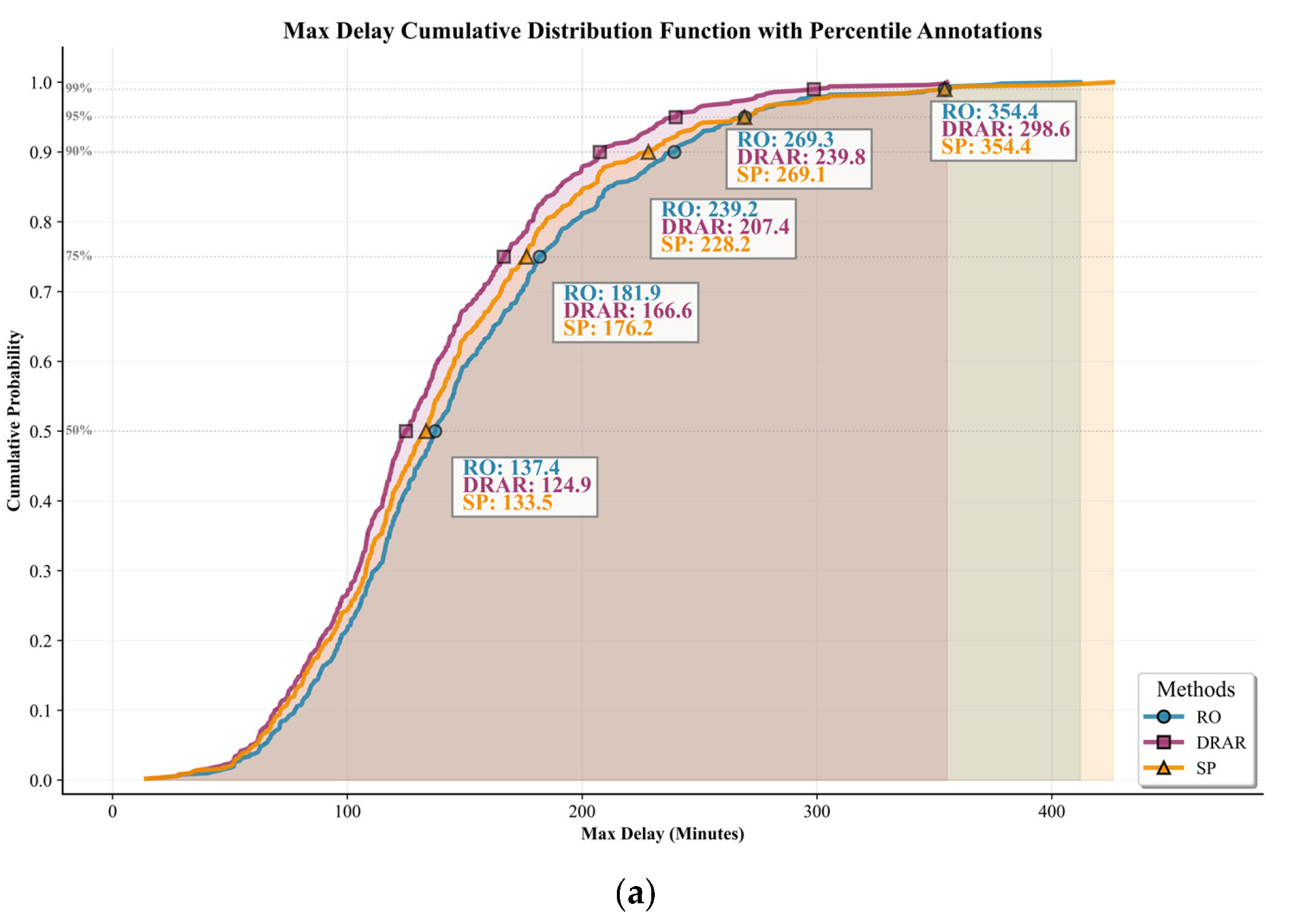
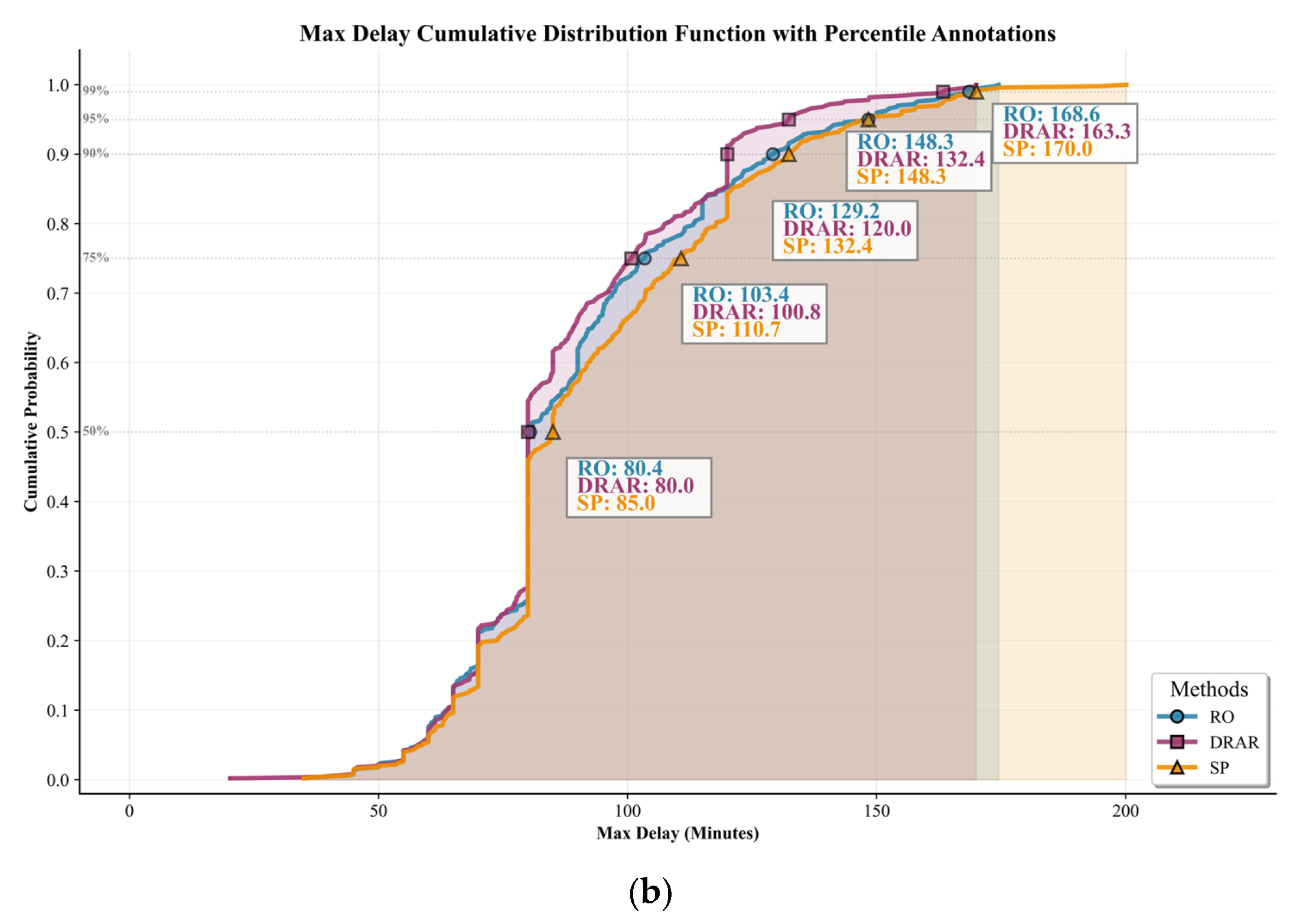
Figure 1 comprehensively presents the maximum delay performance of the different models across both scenarios, including key percentile statistics (50th, 75th, 90th, 95th, 99th) and Cumulative Distribution Function curves. This figure reveals the significant advantages of the DRAR model over the RO and SP models from multiple perspectives.
Across both scenarios, the DRAR model outperforms the RO and SP models at all percentiles, demonstrating its powerful capability for delay control:
Superior Tail Risk Control at High Percentiles:
90th Percentile: In Scenario 1, DRAR recorded 207.4 min, which is 31.8 min lower than RO (a 13.3% reduction). In Scenario 2, it was 120.0 min, 9.2 min lower than RO (a 7.1% reduction).
95th Percentile: In Scenario 1, DRAR was 239.8 min, 29.5 min lower than RO (a 10.9% reduction). In Scenario 2, it was 132.4 min, 15.9 min lower than RO (a 10.7% reduction).
99th Percentile (Extreme Scenarios): In Scenario 1, DRAR was 298.6 min, significantly lower than the 354.4 min for both RO and SP, representing a substantial 15.7% reduction. In Scenario 2, it was 163.3 min, outperforming both RO (168.6 min) and SP (170.0 min).
These results indicate that DRAR’s robustness advantage in extreme conditions is more pronounced in the high-risk scenario (15.7% reduction in Scenario 1 vs. notable improvement in Scenario 2), which aligns with the characteristic of greater delay volatility in sparse, high-risk environments.
Key Insights from Cumulative Distribution Functions
Observing from the perspective of the CDF curves, both scenarios reveal similar patterns:
Consistent Superiority of DRAR: Across the entire delay range, the DRAR curve consistently lies above the RO and SP curves. This indicates that for any given delay threshold, DRAR achieves a higher cumulative probability of on-time completion, making it closer to an ideal scheduling strategy.
Steep Ascending Characteristic in Key Intervals: Within the 150–250 min interval in Scenario 1 and the 90–135 min interval in Scenario 2, the DRAR CDF curve exhibits a steep, concentrated upward trend. This shows that the delays for the majority of flights are tightly controlled within a relatively narrow range.
This “concentration” characteristic demonstrates DRAR’s ability to ensure a more stable delay distribution, corroborating the earlier finding of a 7–9% reduction in standard deviation.
Systemic Disadvantages of the SP Model: In contrast, the CDF curves of the SP model in both scenarios are flatter and shifted rightward. This reflects its inherent limitations: high sensitivity to scenario sampling and greater variability under high-delay conditions.
Cross-Scenario Comprehensive Comparison and Methodological Implications
Through the systematic comparison of the two scenarios, the following deep insights can be drawn:
Validation of Universal Robustness: DRAR outperforms the benchmark models across different operational environments (high-risk vs. resource-constrained) and different percentile levels (50th–99th), demonstrating the effectiveness of the Wasserstein metric in capturing delay uncertainty.
Tail Risk Management Capability: The improvement of DRAR at the 99th percentile (15.7% and more stable performance) is particularly significant. This holds important value for airlines in mitigating reputational risk and ensuring service quality. While traditional RO considers the worst case, its lack of probabilistic information prevents it from effectively distinguishing tail events of varying severity.
Quantitative Evidence for Stability: The “steepness” of the CDF curve provides an intuitive quantitative indicator of stability. The steep characteristic of the DRAR curve in key intervals signifies a more concentrated delay distribution, corroborating the earlier result of a 7–9% reduction in standard deviation and proving the reliability of the scheduling solution from different angles.
Scenario Adaptation Mechanism: Comparing the two scenarios reveals that DRAR’s advantages manifest differently depending on the environment—primarily as compression of extreme delays (298.6 vs. 354.4 min) in the sparse scenario, and more as stable control in the median range in the resource-constrained scenario. This indicates that ambiguity set-driven distributionally robust optimization can adaptively adjust its robustness strategy according to different operational characteristics.
Root Cause of SP Model Failure: The flattening and rightward shift in the SP curve reveal the fundamental limitation of methods based on fixed scenarios—model performance degrades rapidly when the true distribution deviates from the training scenarios. In contrast, DRAR, by covering a family of potential distributions via the Wasserstein ball, provides more robust performance guarantees.
Practical Implications and Decision Support
From the perspective of aviation operations practice, these results offer the following guidance:
Layered Risk Management: Improvements up to the 95th percentile (10.9%) safeguard routine operations, while improvements at the 99th percentile (15.7%) provide a safety net against extreme events, supporting differentiated risk management strategies for airlines.
Service Level Agreement (SLA) Design: The steep CDF characteristic enables airlines to set delay service promises with greater confidence. For example, under the DRAR solution, it might be reasonable to promise that 90% of flights will not be delayed by more than 210 min.
Cost-Robustness Trade-off: The varying magnitude of improvement across different percentiles provides schedulers with a quantitative basis for the cost-robustness trade-off, supporting flexible adjustment of model parameters based on business priorities.
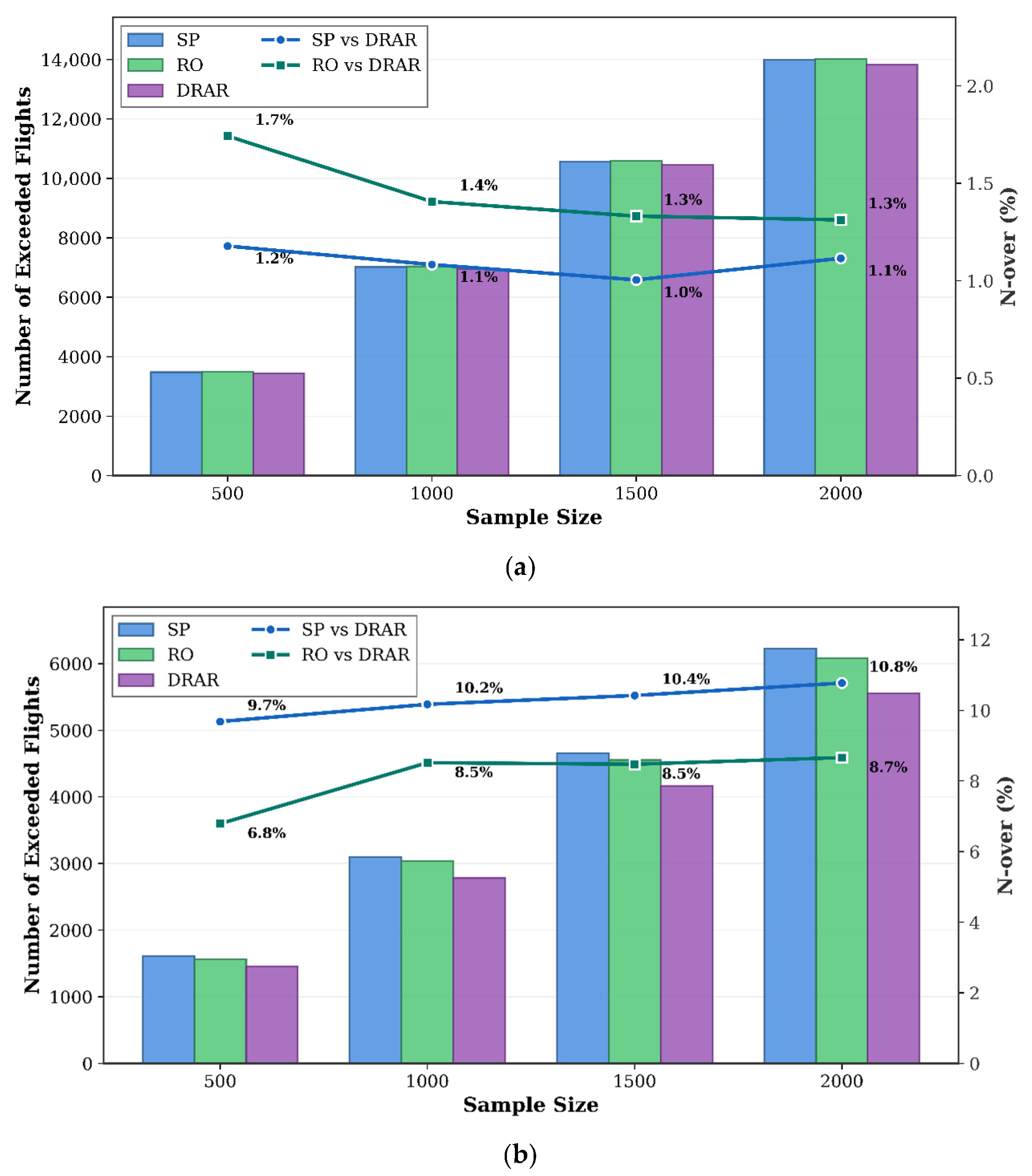
Figure 2 compares the number of over-threshold flights ( N o v e r ) for the SP, RO, and DRAR models under (a) the Delay-Prone Sparse Scenario and (b) the Resource-Constrained Scenario.
Bar Charts (Left Y-axis): Display the absolute total number of flights exceeding the 90 min threshold for each model across different sample sizes.
Line Charts (Right Y-axis): Represent the relative percentage improvement of the DRAR model over SP (blue dashed line) and RO (green solid line) on the N o v e r metric, quantifying the performance gain.
Analysis:
In (a) the Delay-Prone Sparse Scenario, the system operates in a congested and disruption-prone environment where most flight delays approach or exceed the threshold. Under this intense delay stress:
The absolute numbers (bar charts) of over-threshold flights are high for all three methods, with minimal absolute differences between them. This is because the system is consistently operating at its performance limit, making significant reductions difficult for any model.
Despite the small absolute gap, the relative improvement (line charts) shows that DRAR consistently maintains a modest but stable performance advantage of 1.3% to 1.7% over the RO model (green line). This indicates that even in extreme conditions with limited scheduling flexibility, the DRAR model provides a higher robust performance floor and is more effective at controlling worst-case outcomes.
In contrast, (b) the Resource-Constrained Scenario represents a more regular and stable operational context with dispersed flight delays and less systemic disruption. In this setting:
The absolute numbers (bar charts) show a clear advantage for DRAR (purple bar), which is consistently lower than both RO (green) and SP (blue).
The relative improvement (line charts) highlights the significant superiority of the DRAR model. Compared to RO (green line), DRAR achieves a substantial 6.8% to 8.7% improvement on the N o v e r metric. This strongly demonstrates that DRAR not only mitigates tail risk but also far exceeds traditional RO and SP methods in enhancing schedule reliability under more typical operating conditions.

5.2.3. Model Performance Under Log-Normal and Gamma Delay Distributions

To test the model’s generalization capabilities, this section evaluates its performance under two non-symmetric distributions commonly used to model delay times: Log-Normal and Gamma.
Important Note: Table 6 and Table 7 display the relative percentage improvement (%) of the DRAR model compared to the benchmark models (RO and SP). For each metric, the study first identified the better-performing model between RO and SP to serve as the benchmark. The table then shows DRAR’s percentage improvement relative to that benchmark.
For the DRAR model, set the param Γ = 3.6 , θ = 0.001 .
For the RO model, the threshold was selected as Γ = 3.4 .
This presentation quantifies the net advantage or trade-off of the DRAR model against the two conventional methods, directly addressing the confusion over “negative” standard deviations or counts.
The data in Table 4 and Table 5 clearly show that the DRAR model demonstrates superiority in the vast majority of test cases.
Overall Advantage: Under both scenarios and distributions, DRAR achieves positive improvements (positive %) in the core metrics of “Avg. Delay,” “Std. Delay,” and “Max_Delay ” in most cases. This is especially pronounced in the “Resource-Constrained Scenario” (bottom half of Table 4), whereas uncertainty increases (e.g., parameters (4, 1) and (5, 1)), DRAR achieves significant improvements in average delay, as high as 9.92% and 12.95%.
Stability Enhancement: In the Resource-Constrained Scenario under the Gamma distribution (Table 5), DRAR achieves substantial 5% to 10% improvements in “Std. Delay,” demonstrating its powerful ability to suppress delay volatility and enhance system stability.
Trade-offs (Negative Value Analysis): In a few instances, negative values appear (e.g., −2.29% for Std. Delay in Table 4, row (3, 3), or −0.46% for N o v e r   in Table 5, row (4, 1). This indicates that the DRAR model, in optimizing overall robustness, may strategically sacrifice a minor metric to achieve a superior outcome in more critical objectives like “Avg. Delay” or “Max_Delay ”. For example, DRAR might accept a fractional increase in flights just over the threshold (a slight negative N o v e r improvement) in order to drastically reduce the risk of a catastrophic “Max_Delay” (where improvement is often highest).
In summary, the DRAR model’s solution demonstrates strong generalization and robustness across different delay distributions, significantly outperforming traditional RO and SP methods, especially in controlling average delays and delay volatility.

5.3. Scalability Analysis in Large-Scale Aviation Networks

To validate the effectiveness and scalability of the proposed DRAR model on complex problems approaching real-world operational scale, this section utilizes a large-scale integrated scheduling scenario comprising 104 flights and 29 aircraft. This scenario is designed to assess whether the model’s solution quality and robustness remain stable as the number of flights, aircraft resources, and spatiotemporal constraints increase significantly.
The DRAR model parameters were set to Γ = 3.5 and θ = 0.005 , while the RO model parameter was Γ = 3.4 .
Analysis:
The performance metrics in Table 8 clearly demonstrate that the performance advantages of the DRAR model are not diminished by the increased problem scale; rather, they are further validated.
Sustained Leadership in Average Performance and Stability: In the large-scale scenario, the DRAR model performs best in both core metrics: “Average Delay” (Avg. delay) and “Delay Standard Deviation” (Std. delay). Compared to the RO model, DRAR reduces the average delay by 6.8% and delay fluctuation (standard deviation) by 4.6%; it also delivers superior results compared to the SP model. This proves that the DRAR solution can maintain high efficiency and stability even within complex networks.
Overwhelming Advantage in Extreme Risk Control: The most notable performance is observed in the “Maximum Delay” (Max_delay) metric. As the complexity of the flight network increases sharply, so does the potential for catastrophic delay propagation chains. The DRAR model demonstrates a powerful capability to avoid extreme risks, achieving a maximum delay of only 83.11 min. In contrast, the maximum delay for the RO model is as high as 158.66 min, and the SP model reaches 96.25 min. DRAR substantially reduces this critical metric by 47.6% and 13.7% compared to RO and SP, respectively.
Conclusion: The test results in Section 5.3 strongly demonstrate the scalability of the DRAR model. As the scale and complexity of the scheduling problem increase, DRAR not only maintains its advantage in average performance but also exhibits a capability—which becomes increasingly critical and prominent—in controlling systemic tail risks and preventing extreme delay events. This holds significant practical value for airlines pursuing operational robustness.

6. Conclusions and Managerial Implications

This study addresses the critical challenge of flight delays in the aviation industry, with a particular focus on primary delays caused by disruptions such as weather disturbances, airspace restrictions, and ground support issues. These delays are characterized by their suddenness and multi-source nature, presenting unique challenges for optimization and scheduling models. To tackle these challenges, this study proposed a distributionally robust optimization (DRAR) model based on the Wasserstein metric to effectively capture the uncertainty associated with primary delays. The model accounts for the impact of both prolonged delay scenarios and total propagated delays on airline operating costs. To quantify the probability of prolonged delays, the study introduced chance constraints derived from the Wasserstein metric, while propagated delays are modeled as expectations. The problem is then reformulated as a mixed-integer programming (MIP) problem that can be efficiently solved using commercial solvers.
Experimental results demonstrate that the DRAR model significantly improves delay management, outperforming conventional models in both delay-prone sparse scenarios and resource-constrained scenarios. The findings indicate that the DRAR approach provides a robust and reliable solution for aircraft routing, enhancing operational efficiency in practical applications. Furthermore, DRAR continues to exhibit strong performance even in large-scale scenarios, demonstrating its scalability and robustness in more complex, real-world operational environments. Two recent operational crises in the aviation industry provide empirical evidence:
On 24 December 2021, affected by COVID-19, a total of 2325 flights were canceled globally in a single day, with United Airlines alone canceling 185 flights (10% of its capacity). In January 2024, continuous heavy snow severely reduced the operational capacity of Zhengzhou Xinzheng International Airport, leading to 129 flight cancelations in one day, an average delay of 175 min, and over 8000 passengers stranded.
These two incidents highlight the limitations of traditional methods in dealing with novel, multi-source coupled risks that exceed historical experience: the scenario sets relied upon by Stochastic Programming (SP) may fail to include such extreme situations, while static Robust Optimization (RO) struggles to adapt quickly to fundamental changes in risk patterns.
In contrast, the DRAR model captures distributional uncertainty through a Wasserstein ambiguity set, with its core advantage being that it does not require assuming a fixed historical distribution. When faced with dramatic shifts in delay patterns caused by new drivers such as pandemics or extreme weather, decision-makers do not need to reconfigure the core logic of the model or the uncertainty set. This enables airlines to potentially avoid or mitigate large-scale cancelations, prolonged delays, and passenger strandings—as seen in the cases above—resulting from slow responses.
Thus, the DRAR model offers a solution that achieves a better balance between robustness, agility, and ease of implementation. It not only helps reduce direct losses from flight cancelations and extreme delays (compensation, idle costs) through better tail-risk control, but also lowers the decision-making burden of real-time adjustments and saves on the development and maintenance costs of customized algorithms. This allows airlines to build a more resilient and cost-effective risk defense system in an increasingly volatile operational environment.
Despite these achievements, several inherent limitations remain: the model employs a static planning approach based on predetermined flight schedules, lacking real-time responsiveness during operations; the construction of the Wasserstein ambiguity set relies entirely on historical operational data, which may inadequately characterize rare extreme events such as pandemics or once-in-a-century weather phenomena; while the model captures delay propagation along individual aircraft routes, it does not fully account for spatial correlations among different flights, such as systemic risks where multiple flights at the same airport experience simultaneous delays due to common causes (e.g., thunderstorms or air traffic control restrictions). Furthermore, the exact MILP reformulation, which employs Big-M methods for linearization, may face computational scaling challenges for extremely large-scale or real-time applications.
To address these limitations, future research will develop a dynamic rolling horizon optimization framework based on Model Predictive Control (MPC). This framework will periodically (e.g., every 30 min) re-solve the DRAR model during operations, optimizing only flight routes within a forward-looking time window (e.g., 2–4 h ahead) while incorporating the latest delay observations, weather forecasts, and aircraft status information to dynamically adjust ambiguity set parameters. This rolling optimization approach will integrate proactive planning with reactive adjustments, maintaining near-global optimality while significantly enhancing real-time responsiveness. Key technical challenges include solving the updated model within tight time constraints (5–10 min) to support real-time decision-making and developing online methods to update delay distribution estimates reflecting current operational conditions. Parallel efforts will explore advanced algorithms, such as decomposition methods or strengthened formulations, to enhance computational tractability for the core DRAR model.

Author Contributions

Conceptualization, Y.C., W.C. and S.Z.; formal analysis, J.W. (Jingxiao Wen) and Y.C.; methodology, J.W. (Jingxiao Wen) and Y.C.; software, Y.C. and J.W. (Jiankai Wang); supervision, S.Z. and W.C.; visialization, J.W. (Jingxiao Wen); data curation, J.W. (Jiankai Wang); writing—original draft preparation, J.W. (Jingxiao Wen) and Y.C.; writing—review and editing, J.W. (Jingxiao Wen). All authors have read and agreed to the published version of the manuscript.

Funding

This research was funded by the National Natural Science Foundation of China (Grant No. 72371013) and the Fundamental Research Funds for the Central Universities (YWF-23-L-933). The study was also sponsored by the Graduate Student Education & Development Foundation of Beihang University (Grant No. JGXY2025048C).

Institutional Review Board Statement

Not applicable.

Informed Consent Statement

Not applicable.

Data Availability Statement

The data presented in this study are available on request from the corresponding author.

Acknowledgments

The study was also sponsored by the Teaching Reform Project of Beihang University.

Conflicts of Interest

The corresponding author Shenghan ZHOU serves as the Guest Editor of the Special Issue “Risk Models, Analysis, and Assessment of Complex Systems” in the journal. For the submission of this manuscript to the Special Issue, the author has fully recused from all editorial decision-making processes related to this manuscript, including but not limited to: not participating in the selection of reviewers for this manuscript, not intervening in the discussion of review comments, and not influencing the final acceptance decision. All editorial work regarding this manuscript (such as reviewer invitation, review process supervision, and final decision-making) will be independently undertaken by the co-Guest Editor of the Special Issue or the Editor-in-Chief of the journal to ensure the impartiality and objectivity of the peer review process. Additionally, the authors declare no other known conflicts of interest with respect to the research, authorship, and/or publication of this article.

References

  1. Marla, L.; Vaaben, B.; Barnhart, C. Integrated Disruption Management and Flight Planning to Trade Off Delays and Fuel Burn. Transp. Sci. 2017, 51, 88–111. [Google Scholar] [CrossRef]
  2. Suau-Sanchez, P.; Voltes-Dorta, A.; Cugueró-Escofet, N. An early assessment of the impact of COVID-19 on air transport: Just another crisis or the end of aviation as we know it? J. Transp. Geogr. 2020, 86, 102749. [Google Scholar] [CrossRef]
  3. Birolini, S.; Jacquillat, A.; Cattaneo, M.; Antunes, A.P. Airline Network Planning: Mixed-integer non-convex optimization with demand–supply interactions. Transp. Res. Part B Methodol. 2021, 154, 100–124. [Google Scholar] [CrossRef]
  4. Ben Ahmed, M.; Ghroubi, W.; Haouari, M.; Sherali, H.D. A hybrid optimization-simulation approach for robust weekly aircraft routing and retiming. Transp. Res. Part C Emerg. Technol. 2017, 84, 1–20. [Google Scholar] [CrossRef]
  5. Dunbar, M.; Froyland, G.; Wu, C.-L. Robust Airline Schedule Planning: Minimizing Propagated Delay in an Integrated Routing and Crewing Framework. Transp. Sci. 2012, 46, 204–216. [Google Scholar] [CrossRef]
  6. Erdem, F.; Bilgiç, T. Airline delay propagation: Estimation and modeling in daily operations. J. Air Transp. Manag. 2024, 115, 102548. [Google Scholar] [CrossRef]
  7. Lan, S.; Clarke, J.-P.; Barnhart, C. Planning for Robust Airline Operations: Optimizing Aircraft Routings and Flight Departure Times to Minimize Passenger Disruptions. Transp. Sci. 2006, 40, 15–28. [Google Scholar] [CrossRef]
  8. Kafle, N.; Zou, B. Modeling flight delay propagation: A new analytical-econometric approach. Transp. Res. Part B Methodol. 2016, 93, 520–542. [Google Scholar] [CrossRef]
  9. Wei, M.; Yang, S.; Wu, W.; Sun, B. A Multi-Objective Fuzzy Optimization Model For Multi-Type Aircraft Flight Scheduling Problem. Transport 2024, 39, 313–322. [Google Scholar] [CrossRef]
  10. Bock, S.; Bomsdorf, S.; Boysen, N.; Schneider, M. A survey on the Traveling Salesman Problem and its variants in a warehousing context. Eur. J. Oper. Res. 2025, 322, 1–14. [Google Scholar] [CrossRef]
  11. Ma, H.-L.; Sun, Y.; Chung, S.-H.; Chan, H.K. Tackling uncertainties in aircraft maintenance routing: A review of emerging technologies. Transp. Res. Part E Logist. Transp. Rev. 2022, 164, 102805. [Google Scholar] [CrossRef]
  12. Evler, J.; Lindner, M.; Fricke, H.; Schultz, M. Integration of turnaround and aircraft recovery to mitigate delay propagation in airline networks. Comput. Oper. Res. 2022, 138, 105602. [Google Scholar] [CrossRef]
  13. Hu, Y.; Liao, H.; Zhang, S.; Song, Y. Multiple objective solution approaches for aircraft rerouting under the disruption of multi-aircraft. Expert Syst. Appl. 2017, 83, 283–299. [Google Scholar] [CrossRef]
  14. Lee, J.; Marla, L.; Jacquillat, A. Dynamic Disruption Management in Airline Networks Under Airport Operating Uncertainty. Transp. Sci. 2020, 54, 973–997. [Google Scholar] [CrossRef]
  15. Şi̇mşek, D.; Aktürk, M.S. Resilient airline scheduling to minimize delay risks. Transp. Res. Part C Emerg. Technol. 2022, 141, 103734. [Google Scholar] [CrossRef]
  16. Zang, H.; Zhu, J.; Zhu, Q.; Gao, Q. A proactive aircraft recovery approach based on airport spatiotemporal network supply and demand coordination. Comput. Oper. Res. 2024, 165, 106599. [Google Scholar] [CrossRef]
  17. Liang, Z.; Feng, Y.; Zhang, X.; Wu, T.; Chaovalitwongse, W.A. Robust weekly aircraft maintenance routing problem and the extension to the tail assignment problem. Transp. Res. Part B Methodol. 2015, 78, 238–259. [Google Scholar] [CrossRef]
  18. Marla, L.; Vaze, V.; Barnhart, C. Robust optimization: Lessons learned from aircraft routing. Comput. Oper. Res. 2018, 98, 165–184. [Google Scholar] [CrossRef]
  19. Chen, S.; Du, W.; Liu, R.; Cao, X. Finding spatial and temporal features of delay propagation via multi-layer networks. Phys. A Stat. Mech. Its Appl. 2023, 614, 128526. [Google Scholar] [CrossRef]
  20. Dunbar, M.; Froyland, G.; Wu, C.-L. An integrated scenario-based approach for robust aircraft routing, crew pairing and re-timing. Comput. Oper. Res. 2014, 45, 68–86. [Google Scholar] [CrossRef]
  21. Şafak, Ö.; Gürel, S.; Aktürk, M.S. Integrated aircraft-path assignment and robust schedule design with cruise speed control. Comput. Oper. Res. 2017, 84, 127–145. [Google Scholar] [CrossRef]
  22. He, Y.; Ma, H.-L.; Park, W.-Y.; Liu, S.Q.; Chung, S.-H. Maximizing robustness of aircraft routing with heterogeneous maintenance tasks. Transp. Res. Part E Logist. Transp. Rev. 2023, 177, 103237. [Google Scholar] [CrossRef]
  23. Zhang, Q.; Chan, F.T.S.; Fu, X.; Fang, Z. Improved Ant Colony Optimization for the Operational Aircraft Maintenance Routing Problem with Cruise Speed Control. J. Adv. Transp. 2023, 2023, 8390619. [Google Scholar] [CrossRef]
  24. Xu, Y.; Wandelt, S.; Sun, X. Airline integrated robust scheduling with a variable neighborhood search based heuristic. Transp. Res. Part B Methodol. 2021, 149, 181–203. [Google Scholar] [CrossRef]
  25. Zeng, W.; Ren, Y.; Wei, W.; Yang, Z. A data-driven flight schedule optimization model considering the uncertainty of operational displacement. Comput. Oper. Res. 2021, 133, 105328. [Google Scholar] [CrossRef]
  26. Eltoukhy, A.E.E.; Wang, Z.X.; Chan, F.T.S.; Chung, S.H.; Ma, H.-L.; Wang, X.P. Robust Aircraft Maintenance Routing Problem Using a Turn-Around Time Reduction Approach. IEEE Trans. Syst. Man Cybern. Syst. 2020, 50, 4919–4932. [Google Scholar] [CrossRef]
  27. Zhang, Q.; Chung, S.-H.; Ma, H.-L.; Sun, X. Robust aircraft maintenance routing with Heterogeneous aircraft maintenance tasks. Transp. Res. Part C Emerg. Technol. 2024, 160, 104518. [Google Scholar] [CrossRef]
  28. Yan, C.; Kung, J. Robust Aircraft Routing. Transp. Sci. 2018, 52, 118–133. [Google Scholar] [CrossRef]
  29. Akincilar, A.; Güner, E. A new tool for robust aircraft routing: Superior Robust Aircraft Routing (sup-RAR). J. Air Transp. Manag. 2025, 124, 10. [Google Scholar] [CrossRef]
  30. Zheng, C.; Shen, Y.; Ma, J.; Gui, L.; Zhang, C. Robust Optimization of Transport Organization for China Railway Express. Appl. Sci. 2023, 14, 137. [Google Scholar] [CrossRef]
  31. Zhou, S.; He, Z.; Chen, X.; Chang, W. An Anomaly Detection Method for UAV Based on Wavelet Decomposition and Stacked Denoising Autoencoder. Aerospace 2024, 11, 393. [Google Scholar] [CrossRef]
  32. Fan, D.; Liu, M.; Shao, Y.; Yang, L.; Liu, Y.; Zhang, Y.; Ren, Y.; Wang, Z. Domain-Specific Large Language Model for Maintenance Decision-Making on Wind Farms by Labeled-Data-Supervised Fine-Tuning. Eng. Technol. J. 2025, in press. [Google Scholar] [CrossRef]
  33. Mohajerin Esfahani, P.; Kuhn, D. Data-driven distributionally robust optimization using the Wasserstein metric: Performance guarantees and tractable reformulations. Math. Program. 2018, 171, 115–166. [Google Scholar] [CrossRef]
  34. Chen, Z.; Kuhn, D.; Wiesemann, W. Technical Note—Data-Driven Chance Constrained Programs over Wasserstein Balls. Oper. Res. 2024, 72, 410–424. [Google Scholar] [CrossRef]
  35. Wang, Y.; Yang, Y.; Tang, L.; Sun, W.; Li, B. A Wasserstein based two-stage distributionally robust optimization model for optimal operation of CCHP micro-grid under uncertainties. Int. J. Electr. Power Energy Syst. 2020, 119, 105941. [Google Scholar] [CrossRef]
Figure 1. Cumulative Distribution of Maximum Delays under Two Operational Scenarios. (a) Delay-Prone Sparse Scenario. (b) Resource-Constrained Scenario.
Applsci 16 01959 g001aApplsci 16 01959 g001b
Figure 2. Over-Threshold Rate Comparison under Two Operational Scenarios. (a) Delay-Prone Sparse Scenario. (b) Resource-Constrained Scenario.
Applsci 16 01959 g002
Table 1. Parameters and terminology definitions.
Parameters and TermMeaning
Sets
i I Set of flight legs
v V Set of aircraft
P Set of probability
Ξ Support set of delays
A Set of airports
Indicator Parameters
A R R i a 1 if flight i arrives at airport a, 0 otherwise.
D E P i a 1 if flight i departs from airport a, 0 otherwise.
Parameters
MA very large number
D i Total delay for flight i (minutes)
d i Sudden delay for flight i (minutes)
s i j Buffer time between successive flights i, j (minutes)
{o,t}Virtual initial node and terminal node of the aircraft
T m a x Maximum tolerable delay threshold (minutes)
w Weight parameter in objective
ΓRobustness parameter
θWasserstein ambiguity radius
NNumber of historical samples
Decision Variables
x i j v 1 when flights i, j are covered by aircraft v, 0
α Maximum violation probability
Term
DRAR (Distributionally Robust Aircraft Routing)The aircraft path planning model based on distributed robust optimization is used to formulate a robust aircraft scheduling plan in an environment with uncertain delays.
Wasserstein distanceA metric quantifying the distance between two probability distributions, used to construct data-driven ambiguity sets.
Primary delayThe initial, independent delay of a flight caused by external factors like weather or air traffic control.
Propagated delayDelay incurred by a flight due to insufficient recovery from a previous flight’s delay within its rotation.
Table 2. Complexity Summary of the Reformulated DRAR Model.
ComponentCountOrder
Binary variablesRouting + Chance indicators O ( m 2 K + N )
Continuous variablesADR parameters + Dual variables O ( m 2 + N m )
Routing constraintsCoverage, flow, consistency O ( m 2 K )
DRO reformulation constraintsObjective linearization O ( N )
Chance constraintsSample-based reformulation O ( N m )
Propagation constraintsExtreme point enumeration O ( m 2 K P )
Table 3. Characteristics of Scenario.
Test CaseNumber of FlightsNumber of AircraftFlight DensityDelays ≥ 80 min
Sparse-High-Risk 3913Sparse4.87%
Dense-Resource-Limited 4310Dense3.41%
Large-Scale Integrated Scheduling10429Mixed3.90%
Table 4. Performance Metrics under Delay-Prone Sparse Scenario.
ApproachCase_500Case_1000Case_1500Case_2000
Avg.
Delay
(min)
Std.
Delay
(min)
Avg.
Delay
(min)
Std.
Delay
(min)
Avg.
Delay
(min)
Std.
Delay
(min)
Avg.
Delay
(min)
Std.
Delay
(min)
SP471.1224.2473.8219.8475.0225.8475.0225.2
RO(2)517.7256.2514.5242.8516.9256.4516.9255.7
DRAR(2, 0.005)449.5205.2455.1206.5455.8208.9454.8207.8
RO(2.2)517.7256.2514.5242.8516.9256.4516.9255.7
DRAR(2.2, 0.005)449.5205.2455.1206.5455.8208.9454.8207.8
RO(2.4)484.2212.3486.5208.1487.8213.7485.9212.5
DRAR(2.4, 0.007)449.5205.2455.1206.5455.8208.9454.8207.8
RO(2.6)476.3210.9478.8207.0479.9212.3478.1211.1
DRAR(2.6, 0.003)449.5205.2455.1206.5455.8208.9454.8207.8
RO(2.8)476.3210.9478.8207.0479.9212.3478.1211.1
DRAR(2.8, 0.003)463.8209.8474.5211.8474.2214.4473.0211.4
RO(3)484.2212.3486.5208.1487.8213.7485.9212.5
DRAR(3, 0.005)457.6210.1462.7210.8463.0213.1462.5213.4
RO(3.2)476.3210.9478.8207.0479.9212.3478.1211.1
DRAR(3.2, 0.003)463.8209.8474.5211.8474.2214.4473.0211.4
RO(3.4)476.3210.9478.8207.0479.9212.3478.1211.1
DRAR(3.4, 0.005)449.5205.2455.1206.5455.8208.9454.8207.8
RO(3.6)476.3210.9478.8207.0479.9212.3478.1211.1
DRAR(3.6, 0.001)449.5205.2455.1206.5455.8208.9454.8207.8
RO(3.8)476.3210.9478.8207.0479.9212.3478.1211.1
DRAR(3.8, 0.003)449.5205.2455.1206.5455.8208.9454.8207.8
RO(4)476.3210.9478.8207.0479.9212.3478.1211.1
DRAR(4, 0.007)449.5205.2455.1206.5455.8208.9454.8207.8
Table 5. Performance Metrics under Resource-Constrained Scenario.
ApproachCase_500Case_1000Case_1500Case_2000
Avg. Delay
(min)
Std.
Delay
(min)
Avg.
Delay
(min)
Std.
Delay
(min)
Avg.
Delay
(min)
Std.
Delay
(min)
Avg.
Delay
(min)
Std.
Delay
(min)
SP487.5179.2485.6178.2485.0176.4483.9177.4
RO(2)516.5190.0518.3194.1518.8192.4520.3192.5
DRAR(2, 0.009)493.0181.8490.7179.5490.0177.2489.0178.4
RO(2.2)478.6176.4476.8174.5476.3172.6475.4174.1
DRAR(2.2, 0.01)489.5176.7487.9174.5487.0172.0486.0173.1
RO(2.4)478.2176.2476.6174.4475.9172.6475.0174.0
DRAR(2.4, 0.01)473.6178.4472.3175.5472.2173.7471.3174.4
RO(2.6)478.5176.3476.8174.5476.2172.6475.4174.0
DRAR(2.6, 0.009)488.4177.2486.5174.5485.6171.8484.7172.8
RO(2.8)479.8176.3478.0174.9477.7173.0476.8174.3
DRAR(2.8, 0.007)466.3173.8466.0172.4465.8171.5464.9172.1
RO(3)479.9176.4478.1174.9477.8173.0476.8174.3
DRAR(3, 0.007)489.2179.0487.3178.0486.6176.3485.5177.3
RO(3.2)479.9176.4478.1174.9477.8173.0476.8174.3
DRAR(3.2, 0.01)489.5176.7487.9174.5487.0172.0486.0173.1
RO(3.4)478.2176.1476.5174.4475.9172.6475.0174.0
DRAR(3.4, 0.009)547.5193.5542.6195.62542.5193.3541.6192.6
RO(3.6)485.8178.9484.0177.7483.1176.1482.0177.0
DRAR(3.6, 0.001)462.5166.7463.0166.1462.9165.0461.9165.4
RO(3.8)487.1178.9485.3178.1484.6176.4483.4177.3
DRAR(3.8, 0.009)493.4183.8490.7180.9489.8178.3488.9179.4
RO(4)493.5177.3491.3175.6490.8173.6490.1174.9
DRAR(4, 0.007)466.0173.7465.7172.3465.5171.5464.5172.0
Table 6. Relative Improvement of DRAR under Log-Normal Distribution.
Mean and Std.Avg. DelayStd. DelayNoverMax_Delay
Delay-Prone Sparse Scenario
(2, 1)1.50%−1.06%0.17%2.70%
(3, 1)1.39%−0.12%0.37%4.03%
(3, 2)0.82%−1.10%0.25%1.57%
(3, 3)0.22%−2.29%0.11%−0.16%
(4, 1)0.78%0.58%−0.09%4.69%
(5, 1)0.23%1.37%−0.45%5.11%
Resource-Constrained Scenario
(2, 1)1.64%2.57%1.43%−1.08%
(3, 1)2.47%6.69%0.84%1.50%
(3, 2)1.81%3.45%1.31%−0.37%
(3, 3)1.40%1.86%2.84%−1.05%
(4, 1)3.44%9.92%1.89%4.27%
(5, 1)4.48%12.95%1.11%7.49%
Table 7. Relative Improvement of DRAR under Gamma Distribution.
Mean and Std.Avg. DelayStd. DelayNoverMax_Delay
Delay-Prone Sparse Scenario
(2, 1)3.42%3.11%0.17%8.94%
(3, 1)2.08%3.56%−0.30%5.83%
(3, 2)4.15%2.62%0.60%8.00%
(3.5, 1)1.81%4.89%−0.28%6.3%
(3.5, 2)3.19%5.51%0.37%5.0%
(4, 1)0.51%1.09%−0.46%4.76%
(5, 1)1.01%1.69%−0.24%6.17%
Resource-Constrained Scenario
(2, 1)1.18%0.83%2.32%0.35%
(3, 1)2.47%5.03%2.48%1.42%
(3, 2)0.07%0.44%2.02%−1.03%
(3.5, 1)2.87%8.05%3.26%4.35%
(3.5, 2)0.27%1.68%−0.47%−0.56%
(4, 1)3.07%6.60%2.95%4.21%
(5, 1)4.05%10.11%1.08%5.32%
Table 8. Performance Metrics Comparison in Large-Scale Scenario.
Avg. DelayStd. DelayNoverMax_Delay
DRAR539.6164.23.29%83.11
RO579.1172.14.33%158.66
SP548.5178.43.50%96.25
Disclaimer/Publisher’s Note: The statements, opinions and data contained in all publications are solely those of the individual author(s) and contributor(s) and not of MDPI and/or the editor(s). MDPI and/or the editor(s) disclaim responsibility for any injury to people or property resulting from any ideas, methods, instructions or products referred to in the content.