1. Introduction
Equipment-intensive maintenance organizations depend on effective spare parts management (SPM) for planning, monitoring, and controlling spare parts supporting maintenance activities [
1]. Ineffective SPM results in spare part unavailability, leading to revenue losses and unproductive downtime [
2]. To reach effective SPM, classification approaches are needed to support forecasting and inventory policies allocation [
3,
4,
5].
Several issues challenge organizations in managing spare parts portfolios with strategic inventory control. Some of these issues concern increasing portfolio size and complexity and excessive information volumes in decision-making [
2,
6,
7,
8]. Management of large portfolios requires grouping spare parts and differentiated inventory policies, supported by robust classification approaches [
1]. However, effective classification depends on the availability of criteria, leaving existing classification methodologies only partially applicable for the full spare parts portfolios. While empirical data in maintenance organizations are fragmented, existing methodologies primarily focus on predefined criteria and threshold-based allocations of operational visible demand and inventory parts into narrow, predefined classes. Main contributors to this data unavailability are part demands remaining intermittent and erratic [
9,
10], while obsolescence rates reach around 23% annually [
6].
Although different classification methodologies effectively classify certain portfolio segments, existing methodologies often apply the same principles across all parts, assuming homogeneous data and part characteristics. Despite numerous existing and advanced classification methodologies, organizations continue to rely on simple methods such as fundamental single-criterion ABC classifications or stockpiling [
7,
11,
12]. The literature review reveals a gap showing that existing classification methodologies may exclude, under-prioritize, or misclassify in cases of low history, zero demand, and non-stock parts. Furthermore, they lack the ability to consider all maintainable asset-relevant spare parts, as they are either focused on operationally visible spare parts or limited by specific criteria or dataset completeness requirements. While conventional classification focuses on grouping spare parts into classes to be demand forecasted and inventory policy allocation, a need exists for differentiated decision-making to consider all relevant spare parts despite diverse characteristics and data unavailability.
This paper proposes a holistic spare parts portfolio classification methodology that defines the portfolio using empirical CMMS data and classifies spare parts into 16 scenario classes based on their presence and absence across the four dimensions of equipment bill-of-materials (BOMs), historical maintenance, physical inventory, and inventory policies. The methodology is designed to focus on scoping and structuring the decision-making process across the spare parts portfolio rather than inventory policy prescription or optimization. The classification enables scenario class-based decision-making strategy development, allocation of decision-making capacity, direction of support methodologies matching data availability, and continuous inventory policy compliance and BOM obsolescence monitoring. The following research questions guided this study:
How can spare parts portfolios be defined in a maintenance organization using empirical data?
How can a full spare parts portfolio be classified to facilitate differentiated decision-making strategy allocation?
How can classification be utilized as a strategic tool for ongoing spare parts portfolio control and compliance assessment?
The paper proceeds by first describing the research methodology, then a literature review of existing spare parts classification methodologies, followed by introducing the proposed classification methodology and a case study revealing its interventional effects in practice. Lastly, a discussion and conclusion are drawn upon this.
2. Research Methodology
This study adopts the design science research (DSR) methodology to approach the research questions, as it supports developing and validating the usefulness of an artifact for solving real-world problems [
13,
14]. In this study, the proposed holistic spare parts portfolio classification methodology is the studied artifact, integrating empirical data to support decision-making, guide decision-making strategies, and direct existing supportive classification methodologies.
A literature review investigates existing spare parts management (SPM) and classification literature to examine how existing methodologies include, exclude, and prioritize spare parts. Thus, revealing their capabilities for classifying all maintainable assets—relevant spare parts—while understanding the advantages, limitations, advancements, and purpose of classification in SPM. Web of Science and Scopus were the primary sources for the literature searches.
The proposed methodology was evaluated through a case study in an equipment-intensive offshore oil and gas company on a scope of 32,521 spare parts. The organization needed a systematic approach to distribute limited expert decision-making capacity and apply supportive classification methodologies for inventory policy decision-making. The case company historically relies on stockpiling, periodic disparate inventory clean-ups, expert decision-making, and simple support techniques such as decision trees, rules of thumb, and fundamental single-criterion classification. The company experienced continuous stock level increases and lost its overview of the variety of spare parts.
Existing classification methodologies were not found to adequately support the needed scope classification. Instead, a mix of multiple decision-making strategies focusing on the expert decision-making capacity and the existing supportive means was needed to review the defined spare parts scope. Thus, a methodology was needed for developing and allocating decision-making strategies and directing supportive means across the different spare parts portfolio segments.
The proposed methodology was applied, iterated, and tested using company data with high variability. Data concerning the company’s maintenance processes, spare parts consumption, inventory control, and SPM practices were derived from internal documents, semi-structured interviews, and the computerized maintenance management system (CMMS). Four primary CMMS data sources were used to model the proposed methodology, including equipment BOM records, historical maintenance records, inventory records, and spare parts master data with current inventory policies. The CMMS data were extracted to include a 12-year operational time span.
The proposed methodology was validated through workshops, semi-structured interviews, and meetings with industry experts from the maintenance planning, logistics, and procurement departments.
4. A Holistic Spare Parts Portfolio Classification Methodology
Increasing spare part portfolio size and complexity continues to challenge maintenance organizations. While robust classification is crucial for managing these large portfolios, companies continue to rely on simple fundamental classification methodologies and stockpiling, which are not considered best practice [
1,
7,
10,
11,
12,
23]. Despite numerous methodological advancements, the literature review demonstrates a gap showing that these methodologies lack inclusion of all maintainable asset-relevant spare parts, consequently excluding, misclassifying, or under-prioritizing operationally invisible cases of low or fragmented history, non-stock, and zero-demand spare parts due to data scarcity. While existing methodologies may effectively classify segments of spare parts, they need to be directed toward the appropriate portfolio segments to add value.
To address the identified gap, a holistic spare parts portfolio classification methodology has been developed using the design science research approach and empirical SPM CMMS data through explorative research. To establish the methodology, first, the range of spare parts existing in the organization is captured, constituting a fact-based documentation of the full spare parts portfolio. Then, the full range of possible portfolio state scenario classes are defined as archetype classes. These archetype classes are then allocated across the dimensions of part stocking and part application. Lastly, the derivative effects of the spare parts position in the archetype classes and portfolio segments are described, followed by a highlight of how these classes may enable potential decision-making strategy assignments and compliance assessments.
4.1. Spare Parts Portfolio Scope Definition
A spare parts portfolio in maintenance organizations encompasses the complete set of parts applicable for asset maintenance. A spare part may be defined in accordance with DS/EN 13306 (2017) [
63] as the object intended for the replacement of an item to ensure that the original item’s functionality is maintained. From this definition, several sub-definitions of spare part types have been introduced in the literature, such as generic, specific, consumable, and strategic spare parts [
4]. Teixeira et al. [
8] refers to these as maintenance materials, which aligns with Scarf et al. [
64] stating that facilitation of maintenance is the reason for the existence of spare parts inventories. In this study, spare parts are referred to as all items either utilized in maintenance or with the potential of being utilized in maintenance.
Spare parts portfolios are, in classification literature, often perceived as the resulting classified spare parts with policies matching different spare part characteristics. What defines a spare part to be part of the portfolio is not limited to its physical nature and presence in stock or at the supplier, but also its function in maintenance and the potential usage in maintenance of assets. Maintenance organizations hold empirical data on these spare part dimensions in the CMMS.
Several studies present spare parts as related to historical maintenance demand and consumption information [
2]. The full range of this data defines the full range of actual spare parts usage through the asset history. Stip and Van Houtum [
21] present that equipment is installed with bill of material (BOM) lists of components that may be usable in future equipment maintenance. The total collection of these lists adds to having a full range of spare parts applicable to the maintainable asset. Studies also mention the existence of inventory records of parts held to facilitate maintenance [
64], as well as inventory policy allocations resulting in spare parts to be held physically in stock [
8].
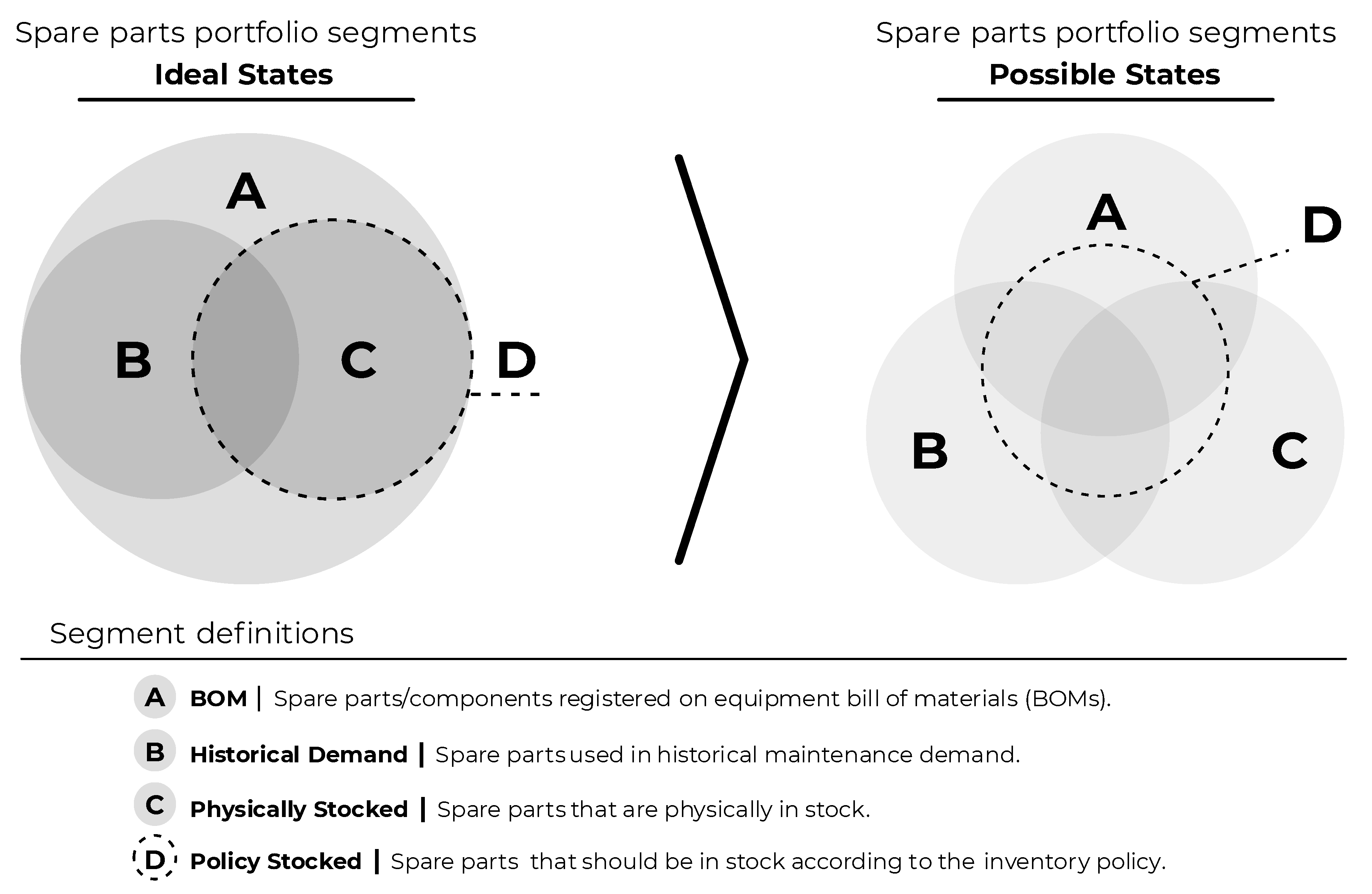
By investigating empirical data from the company CMMS on these dimensions, the spare parts included to constitute a full spare parts portfolio are found within the portfolio segments presented in
Figure 1.
The portfolio segments presented in the figure are (A) parts registered on equipment bills of materials (BOMs), (B) parts mentioned in historical maintenance records, (C) physically stocked parts, and (D) parts designated to be stocked by the inventory policy.
The ideal state of the portfolio is where all spare parts with a potential usage application in the maintainable asset are registered on BOMs, as reflected in the left part of the figure. As a result, segment A sets the boundaries for the range of potential spare parts in the organization based on the maintainable asset. Some of these spare parts may not exist in historical maintenance, while others in segment B do. Some spare parts are physically stocked, while others are related to historical maintenance. Lastly, parts with an inventory policy for stock keeping of the part are also physically stocked. The ideal portfolio state sets an example of what maintenance organizations strive to reach through effective SPM practices. However, due to the dynamic nature of SPM, the portfolio state constantly changes, and the ideal portfolio state is highly difficult to reach in practice.
The right part of the figure presents a generalization of the portfolio segment states, which enables capturing the full range of spare parts across all possible portfolio state scenarios. These scenarios are detailed in the following section, where they reflect both the absence and presence of data for each scenario to reveal data availability and guide decision-making and allocation of supportive means when assessing the entire spare part portfolio.
4.2. The 16 Possible Spare Part Portfolio Classification Scenarios
The generalized portfolio segment model reflects the extended range of segment overlaps in a Venn diagram. While the segments reflect the presence of spare parts in segments, their absence is also valuable. For a spare part to be part of the portfolio, it must exist in at least one of the segments. The existence in one segment and the absence in another position the spare part in the portfolio.
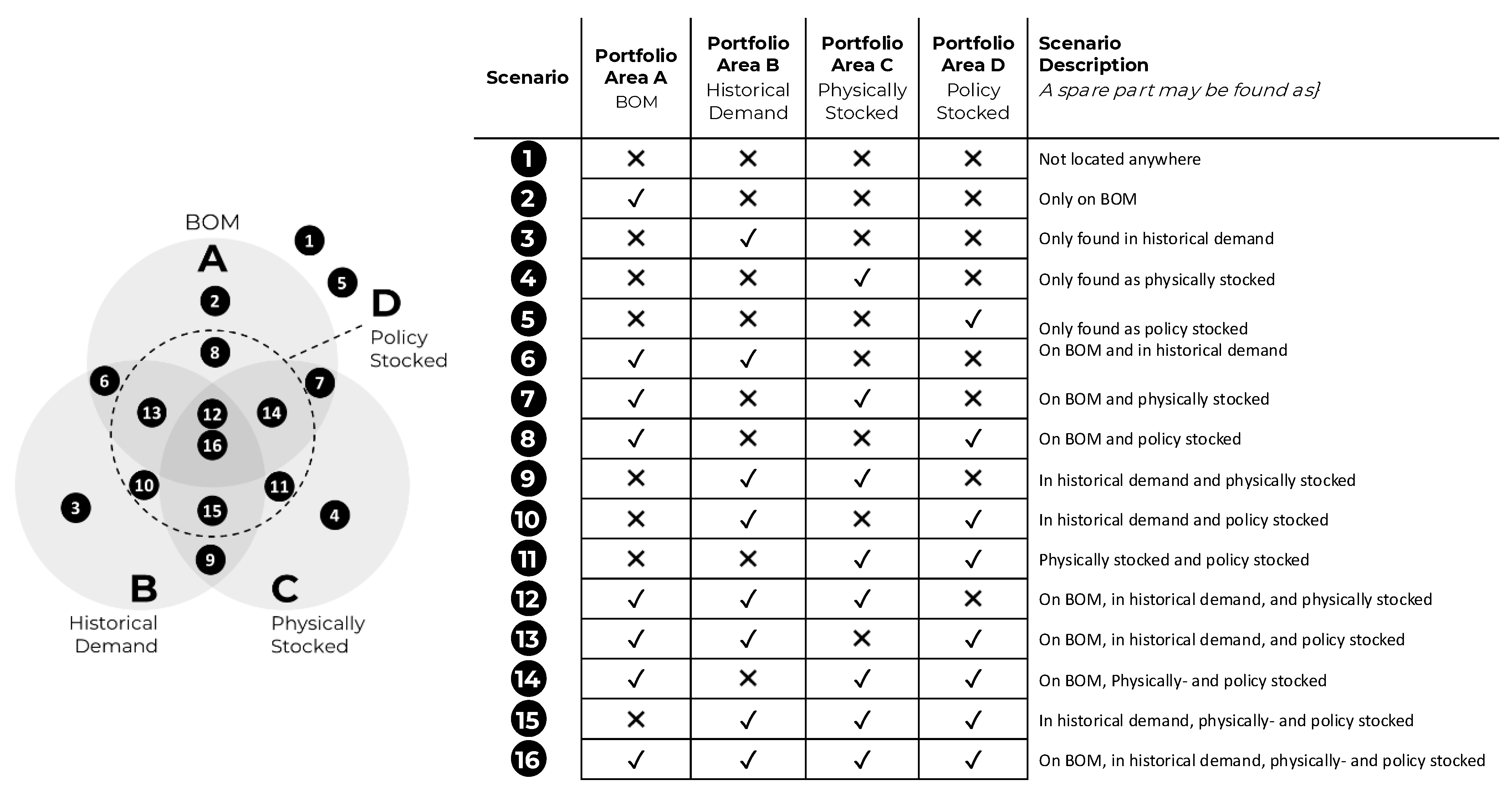
Figure 2 presents the derived 16 different scenario classes of possible spare parts positions across the spare parts portfolio segments.
The figure locates the scenarios in the Venn diagram and describes them through the four binary empirical dimensions previously defined as segments A to D. Each spare part in a maintenance organization should fit within one of the 16 defined scenario classes to reflect its presence or absence in the portfolio. Thereby, the 16 positioning scenarios function as portfolio state scenario class archetypes.
Scenario 1 represents spare parts with no factual presence, deeming them excluded from the portfolio. The single-segment scenario classes 2 to 5 include parts exclusively found on equipment BOMs (2), in historical demand (3), physically present in stock (4), and with a policy requiring stocking (5), respectively.
The two-segment scenario classes 6 to 11 include parts found on equipment BOMs and in historical demand (6), on equipment BOMs and physically present in stock (7), on equipment BOMs and with a policy requiring stocking (8), in historical demand and physically present in stock (9), in historical demand and with a policy requiring stocking (10), and physically present in stock and with a policy requiring stocking (11), respectively.
The three-segment scenario classes 12 to 15 include parts found on equipment BOMs, in historical demand, and physically present in stock (12), on equipment BOMs, in historical demand, and with a policy requiring stocking (13), on equipment BOMs, physically present in stock, and with a policy requiring stocking (14), and lastly in historical demand, physically present in stock, and with a policy requiring stocking (15), respectively. Scenario class 16 represents the presence of a spare part in all portfolio segments at once.
The first scenario class is the only one defining spare parts to be excluded from the portfolio, while the 15 other scenario classes reflect the spare parts to be considered present in the portfolio. The scenario classes 2 to 15 reflect a partial portfolio segment fulfillment for all identified spare parts, while spare parts found in scenario class 16 reflect full portfolio segment coverage. The portfolio segment coverage should be perceived as a defining factor for what information is available for the individual spare parts and whether the spare parts are currently part of the managed inventory program. The classification scenarios are built upon both the presence and absence of empirical data on each spare part mentioned in the organization CMMS. Thus, the position of the spare parts in each of the scenario classes remains a binary question, resulting in a Boolean-based approach.
4.3. From Classification Scenarios to Decision-Making Strategies
The defined range of scenario classes positioning spare parts across the identified portfolio segments reveals the presence or absence of a spare part in relation to physical stock records, inventory policy records, historical maintenance demand records, and equipment BOM lists.
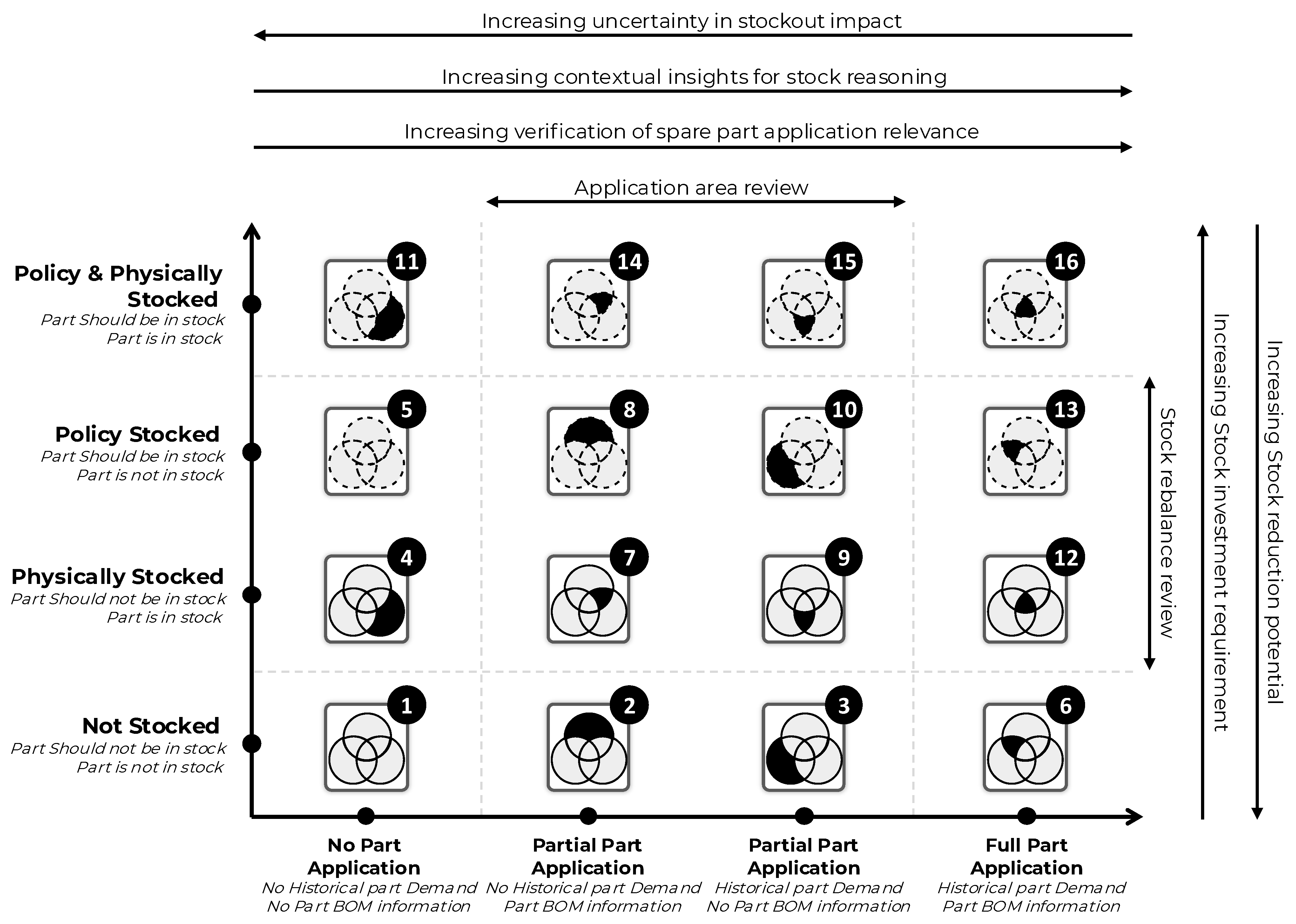
To assess the portfolio segment coverage of the scenario-classified spare parts, the part stocking and part application dimensions are applied to range scenario classes and assess their segment fulfillments. Part stocking combines the two segments of physical stocking and policy stocking, while part application combines the two segments of parts in equipment BOMs and parts in historical maintenance. The two dimensions are ranged in the order of no part presence, partial part presence, and full part presence in each of the segments. By ranging the identified 16 scenario classes across the two dimensions, the holistic spare parts portfolio classification methodology for decision-making strategy assignment is presented in
Figure 3.
The figure shows each of the 16 scenario classes ranged across the part application dimension in the x-axis and the part stocking dimension in the y-axis. The part application ranges from no part application, partial part application with no demand history but BOM information, partial part application with demand history but no BOM information, to full part application with both demand history and BOM information. The part stocking dimension ranges from not stocked, physically stocked but not policy stocked, policy stocked but not physically stocked, and fully policy and physically stocked.
For the partial part applications, the lack of historical demand with the presence of BOM information reflects a lower part application level than the opposite. This is reasoned by the principle that a part application area is not applicably verified before it has been historically proven. Whereas a BOM spare part without any maintenance history only reflects the intended application.
For the partial part stocking areas of the part stocking dimension, the physical stock segment is ranged lower than policy stocking. This is reasoned by the principle that policy stocking remains a strategic choice reflecting the future part stocking, while unjustified physical stock is perceived as redundant stock or shadow stock.
Figure 3 reveals six derivative effects in relation to navigating the portfolio segments and combining the scenario classes to enable decision-making strategizing. Moving horizontally from full part application to no part application increases stockout impact uncertainty, as the data volume for maintainable asset and part relation decreases. The opposite direction increases the contextualization of the part application, which enhances fact-based decision-making and applicability relevance verification of spare parts. When moving vertically between the policy stocking and physically stocking dimension areas, a stock rebalancing need is revealed when physically stocked parts are not policy-designated stock, and vice versa. Moving spare parts vertically from non-stock toward full policy and physically stocking increases associated stock investments, while the opposite direction increases the stock reduction impact but also the supplier reliability.
Decision-making for the corner scenario classes hold the most potential financial and risk impacts and either the most or least data availability for decision support. The middle classes highlight the inventory policy and physical inventory compliance, as well as the historical demand and BOM part alignment.
Selecting the adequate decision-making strategy and supportive classification methodology for inventory policy allocation on specific portfolio segments may be based on both a clear decision-making purpose and the availability of data to support the working principle of the supportive means. The proposed methodology presented in
Figure 3 may serve as a guiding basis to develop and assign decision-making strategies with appropriate supportive means, considering data availability and portfolio segment requirements.
The developed holistic spare parts portfolio classification methodology is considered an extension of the systematic SPM approaches by Cavalieri et al. [
4] and Bacchetti and Saccani [
3], adding a broad portfolio classification prior to applying existing classification methodologies to expand spare parts inclusion and direct existing methodologies toward appropriate portfolio segments covering need data support. Furthermore, it adds a continuous portfolio assessment approach for policy evaluation. The holistic principle of the proposed methodology is to direct and diversify decision-making capacity and existing supportive classification methodologies toward segments of the portfolio rather than applying a single approach and methodology to the entire spare parts portfolio or portfolio scope.
5. Case Study
This case study examines the practical application of the proposed holistic spare parts portfolio classification methodology and its interventional effects on an explicitly selected pilot case study scope of 32,521 spare parts in a case company review project. The initial as-is approach represents current practices, and it is compared to the post-interventional effects of introducing the proposed methodology.
The company is a major oil and gas operator with more than 50 active North Sea assets containing hundreds of thousands of interconnected maintainable equipment. The company operates a complex logistics setup involving their own internal warehouses, an onshore-offshore supply chain, and collaboration with external vendors and warehouses within a mixed contract-based and open-market supplier network.
Maintenance and spare parts management (SPM) operations are controlled and documented in a major vendor-based computerized maintenance management system (CMMS), while analyses and reporting are typically produced as static and disparate spreadsheets or business intelligence (BI) reports. Because operational process data are scattered across multiple sources, decision-making is mostly based on expert judgment and simple techniques such as fundamental single-criterion classification, decision trees, and rule-of-thumb approaches.
Several organizational challenges motivated the company to execute a major spare parts revision, including historically high inventory levels, low spare part coverage across equipment, increasing cost pressure, and low part availability at maintenance execution.
A company-wide reengineering initiative launched a large spare parts revision project to increase inventory reliability for equipment while reducing excess inventory by reviewing inventory policies. The maintenance department was responsible for ensuring that all critical spare parts were adequately evaluated.
The company initiated the project using an initial as-is approach described in the following section. However, this approach was deemed insufficient and misaligned with project objectives. Thus, a reformed approach was applied using the proposed holistic spare parts portfolio classification methodology as an intervention to reclassify the parts and to form objective, aligned decision-making strategies.
The following sections present first the initial as-is review approach, then the intervention reformed approach using the proposed methodology for strategy definition and allocation. Lastly, a comparison of the two approaches highlights the impact of the proposed methodology.
5.1. Initial AS-IS Spare Parts Review Approach
The project was initiated using two external maintenance-oriented spare parts specialists appointed as project leads. They structured the review of the 32,521 spare parts by grouping them according to equipment BOMs, producing a vital group of 18,394 spare parts and a non-vital group of 14,127 spare parts. The vital group was reviewed through system and equipment strategy workshops with the internal maintenance planners that are equipment specialists. The non-vital group was distributed across the maintenance planners as spreadsheets for individual review.
For both groups, decisions were supported by a simple deductive decision tree and fundamental single-criterion classification methodologies. The main classifications applied were a mix of equipment grouping, a VIS (Vital, Important, Secondary) variant of the VED (Vital, Essential, Desirable) methodology, and a variation in the FSN (Fast, Slow, Non-moving) methodology. The FSN variant, FASD (Fast-, Active-, Slow-moving, and Dead), classified parts moved within six months as fast, between six months and two years as active, between two and five years as slow, and between five and eight years as dead.
A general policy grouping was defined to include capital and security parts with low or no movement, medium-cost parts with fluctuating consumption, and low-cost and low-technicality parts with regular consumption. This loose movement-, cost-, and technicality-based grouping worked as a fourth classification attempt relying solely on linguistic terms for the spare part characteristics.
Further, data such as commonality across BOMs, five-year cumulative preventive maintenance (PM) and corrective maintenance (CM) part unit consumption, stock level, unit value, and lead time were available. However, data practices were found to be challenged by information fragmentation and high data-gathering requirements. Many CMMS searches were required for each part by the decision-makers to verify data availability, to ensure the support methods validity, and to ensure an adequate decision-making approach.
Many disparate spreadsheets containing static CMMS data, analytical techniques, classification results, and decisions were scattered between decision-makers, causing data, decision, and classification obsolescence and subjectivity. The long data-gathering time was the most dominant reason for the slow decision-making progress, as each of the 32,521 spare parts required additional information for decision-making.
The rationale was that the equipment experts were the most adequate decision-makers and that the deductive decision tree supported by known classifications would be sufficient. However, the decision-makers faced enormous spare part volumes with various parts outside their technical specialization, leading to slow and inconsistent decision-making. Further, the collective set of utilized classification techniques produced various part views and under-prioritized or misclassified parts due to differences in criteria coverage and part characteristics. As an example, 12,696 parts deemed non-vital were found vital, while 1343 vital parts were found non-vital. Unit value and lead time uncertainty affected 13,605 and 26,441 spare parts, respectively, due to limited data history.
Only 9% of the scope was completed, involving 7865 decisions requiring 1 full-time equivalent (FTE) and resulting in a 1.7% stock value increase. Linear projection indicated full scope completion would require 11.53 FTEs and lead to a 17.6% stock value increase.
The initial as-is approach suffered from low decision-making efficiency, slow progress, non-transparent decision-making, and increasing capital investments. Decision-making capacity did not suffice for the scope size, which led the case company to adopt a new reformed approach using the proposed methodology.
5.2. The Holistic Spare Parts Classification Methodology Intervention
The case company paused the project and applied the holistic classification methodology to redistribute the spare parts into new classes. The parts were quickly distributed across the 16 scenario classes presented in
Figure 3. Decision-making strategies were developed to address each class segment aligned with the project objective and available decision-making capacity. The objective was unchanged, and the decision-making capacity remained to rely on maintenance planners as expert decision-makers.
The project managers expected that all spare parts needed either manual expert review or quality assurance of assigned inventory policies by an internal maintenance decision-maker with experience in maintenance operations. As decision trees and rule-based approaches were already integrated and acceptable, they were expected to be applied if they could provide value. Thus, the decision-making strategies were developed incorporating rule-based approaches, fast-track batch decisions with quality assurance, and expert reviews supported by fundamental classification techniques already integrated in the company, but only where data were available.
To operationalize the proposed methodology, several CMMS data sources were applied, including historical maintenance records, equipment BOM records, inventory records, and spare parts master data with current inventory policies. A five-year operational time span was defined by the company as the cut-off for part demand relevance, but data extracted enabled special case investigation considering a 12-year operational time span.
The spare parts were classified using the Boolean-based approach of the proposed methodology where the absence and presence of spare parts in each of the four data sources contributed to class allocation. As presented in
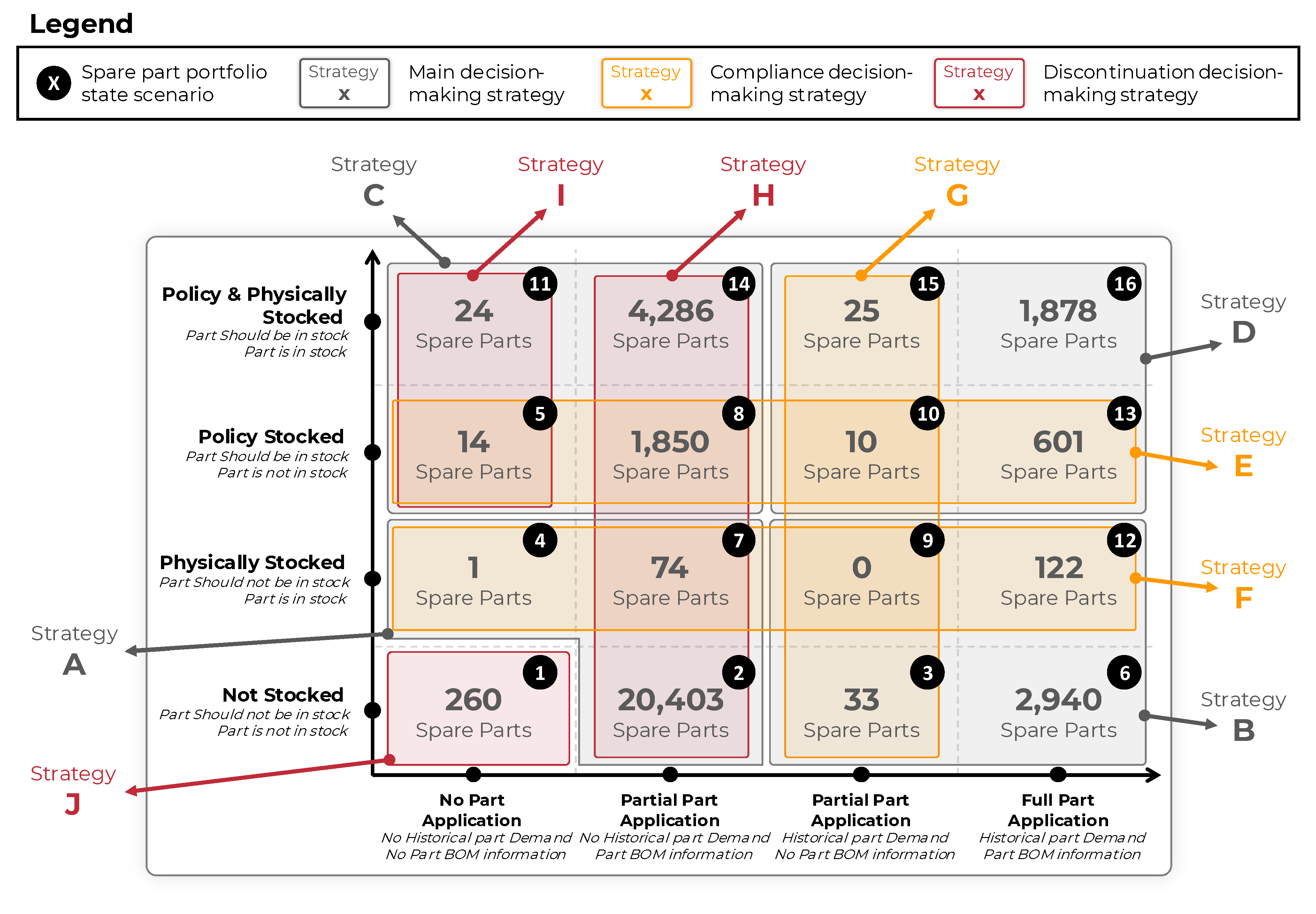
Figure 4, the full 32,521 spare parts scope was classified across the 16 scenario classes and then clustered into four main decision-making strategies (A–D), three compliance strategies (E–G), and three discontinuation strategies (H–J).
The figure presents the distribution of all 32,521 spare parts across the 16 portfolio state scenario classes along the part stocking dimension (
y-axis) and part application dimension (
x-axis) described in
Section 4. All classes hold spare parts except scenario class nine, which consists of non-stock policy parts physically in stock with a demand history but no BOM information. The classification distributed the spare parts across the 16 scenario classes, with the specific portion assigned to each class shown in the figure: 260 spare parts in class 1, 20,403 in class 2, 33 in class 3, one in class 4, 14 in class 5, 2940 in class 6, 74 in class 7, 1850 in class 8, zero in class 9, 10 in class 10, 24 in class 11, 122 in class 12, 601 in class 13, 4286 in class 14, 25 in class 15, and 1878 in class 16.
Further, the figure illustrates the decision-making strategy A-J allocation, which guided full-scope decision-making and the resulting project completion. The figure content and the strategies are further detailed in the following three subsections.
5.2.1. Main Decision-Making Strategy A–D
Strategy A was a low-context, fast-track, rule-based batch review strategy covering 20,478 non-stock spare parts with no application or only a BOM application basis. The decision-making required a single designated decision-maker reviewing whether a just-in-time non-stock policy was sufficient, verified through a BOM criticality check and a special cases screening of the 12-year operational time span. Parts flagged for uncertainty were transferred to expert decision-makers.
Strategy B was a high-context, fast-track batch review of 3095 non-stock parts with partial or full part application, including either only historical part demand or both BOM and historical part demand information. A single designated decision-maker screened the parts using maintenance demand, FSN classification, and demand-based criticality. Lead time was considered to ensure compliance with the historical demand response time requirements.
Strategy C was a low-context expert review of 6174 policy-stocked parts with no or partial part application through BOM information. Obsolete and insurance parts were hidden within these classes. While no maintenance history was available, decisions relied on BOM information and expert decision-makers with equipment experience. Special cases of repairable parts were identified through vendor movements, while part commonality across equipment BOMs indicated broader relevance. Each spare part was to be reviewed by equipment expert decision-makers considering commonality, applicability, special cases of repairability, obsolescence, and critical cases within the 12-year period.
Strategy D was a high-context, expert review of 2514 policy-stocked spare parts with partial or full part application, including either historical part demand or both BOM and historical part demand. Each spare part was to be reviewed by equipment expert decision-makers considering the same aspects as in strategy C but guided by demand history, demand-based criticality classification, and assessment of lead time compliance with historical demand response time requirements.
While these decision-making strategies do not prescribe inventory policies, their value lies in clarifying the decision basis and guiding what information to consider in parts comparisons and the decision-making process. Essentially, while the classification relies on four data dimensions to scope the decision-making, the decision-making process extends beyond scenario class structures and movement-based criteria to include technical factors such as safety criticality, reparability, technical obsolescence, and part commonality across equipment. These factors were not part of the classification but were a part of the expert decision-making. As it was required that decisions remain expert-based, the objective of the classification and strategies was to guide and scope the decision-making rather than prescribe class-specific outputs.
While strategies C and D required manual expert decision-making, the number of such requirements was drastically reduced by adopting a strategy-based approach enabled by the proposed holistic spare parts portfolio classification methodology. This increased the decision-making objective and process transparency for each class of spare parts, while it clarified the availability of supportive means.
5.2.2. Compliance Decision-Making Strategy E–G
The main decision-making strategies (A–D) constituted as the main project progress and completion contributors. In addition, three compliance strategies were derived from the proposed methodology. These closely align with the policy test and validation step highlighted by Cavalieri et al. [
4] and the performance assessment step mentioned by Bacchetti et al. [
3], both referring to the systematic SPM approach.
The strategies holistically evaluate the spare parts portfolio for excess inventory unjustified by current inventory policies, inventory policy incompliance for where spare parts should be physically in stock but are absent, and maintenance part demand lacking BOM relation, which indicates potential BOM obsolescence or missing equipment part link.
Strategy E was an inventory policy compliance review for identifying spare parts that, according to the current inventory policy, should be in stock but are absent. A total of 2475 were flagged to be stocked unless their inventory policies changed.
Strategy F was an excess stock review for identifying spare parts physically in stock without an inventory policy justification. A total of 197 spare parts were identified to be removed unless their inventory policies changed to require stocking.
Strategy G was a historical maintenance demand-based equipment BOM review. A total of 68 spare parts were identified for potential BOM obsolescence, as the spare parts had been historically demanded for maintenance on equipment where these parts did not occur on the BOM.
These strategies focused on ensuring alignment of inventory policies and inventory, as well as equipment BOM parts and demand parts, when updating CMMS with decisions. Furthermore, they provided an approach for the case company to perform ongoing simple inventory policy compliance control and monitoring, and demand-based BOM assessment for targeted spare parts scopes.
5.2.3. Discontinuation Decision-Making Strategy H–J
The final strategies targeted spare parts with increased discontinuation potential.
Strategy H was a future application relevance review focusing on spare parts listed on equipment BOMs but never used in historical maintenance. Their demand absence indicates limited operational relevance, potential insurance part purpose, or BOM obsolescence. These could be batch reviewed considering preventive maintenance (PM) strategies, late-life asset strategies, and equipment or system discontinuations.
Strategy I was a stock obsolescence and insurance part review, examining spare parts with no part application lacking both equipment BOM and historical maintenance demand yet policy designated as stock and in some cases physically in stock, which indicates insurance part stocking. Cases where spare parts are not physically stocked may indicate legacy initiatives, data obsolescence, and project stock leftovers. Expert decision-makers were needed to identify any critical future maintenance applications despite the absence of information.
Strategy J reviewed non-stock spare parts without any part application. These spare parts were to be discontinued, as decision-making capacity should not be wasted on spare parts that are either not application-relevant or indicated from previous inventory policy decisions to be stock-relevant.
These strategies are not claimed to be the only possible combination of the scenario classes and approaches. They represent archetype strategy configurations addressing the relevant scenario classes that match the available decision-making capacity and objective. Therefore, the strategies may need to be adjusted to fit the situation in other companies.
However, the proposed holistic spare parts portfolio classification methodology was proven highly effective for scoping and developing decision-making strategies across portfolio segments, enhancing comparability and decision support in each segment by only focusing on supportive means and data usage where they bring value.
5.3. Intervention Results and Outcomes
The methodology was applied first using a simple tabular format and later integrated into the business intelligence (BI) project reports. This integration facilitates dynamic portfolio compliance and control assessment, serving as an automated governance model. It incorporates operational CMMS data, which was initially updated weekly but is scalable to real-time updates. Automating the classification logic enables highlighting spare parts that deviate in the compliance scenario classes (strategies E to G). The Boolean principle of the methodology requires no advanced computational capacity, accommodating practitioner preferences for simple and easy-to-apply methodologies [
7]. The implementation of strategies A-J was performed by allocating the specific spare part portions defined by the strategies to the designated decision-makers. The scenario class was highlighted for the decision-maker in the application for each spare part. The decision-makers were introduced to the review process and strategic approach through an introductory session prior to decision-making. Strategies A–D were implemented by allocating portions of spare parts to individual decision-makers, with a highlight of the intended review approach. Strategies E-J were implemented by highlighting specific focus points for the decision-maker during both the decision-making process and the post-decision quality assessment.
The proposed methodology intervention transformed the review project from a slow-progressing, non-transparent, and investment-heavy decision-making approach into a highly efficient, low-resource-requiring, transparent decision-making, and capital-freeing project approach and completion.
Table 1 summarizes the operational and financial impacts of moving from the initial as-is approach to the reformed post-intervention approach.
While the initial as-is approach required 1 FTE for a 9% scope completion, the reformed post-intervention approach required 1.08 FTEs to reach full scope completion. Assuming linear progression, full scope completion using the initial approach would have required 11.53 FTEs, equivalent to 20,481 h. From this, the reformed approach yielded 91% FTE improvements and saved a potential of 18,564 h of expert decision-making workload. While the initial approach required experts involved for all parts, the reformed approach removed 67% of the parts from the expert decision-making workload, achieving a ninefold decision throughput with fewer FTE resources.
The initial as-is approach resulted in a 1.7% scope stock value increase from the 9% scope completion, suggesting a 17.6% scope stock value increase assuming linear progression. In contrast, the intervention-reform approach yielded a 33.6% scope stock value reduction. The operational and financial improvements shown in the table result from the combined effect of the scenario-based portfolio structuring and the related transformation of the decision-making process.
Nine decision-making strategies were defined applying the proposed methodology, including four main strategies enabling fast-tracked, rule-based batch reviews and targeted expert decision-maker reviews. Three compliance-oriented strategies for continuous inventory policy compliance control and monitoring and demand-based BOM alignment. And lastly, three strategies specialized for potential spare parts discontinuations.
Prior to the intervention, decision-making was highly part-centric and equipment BOM-focused, requiring all spare parts to be reviewed sequentially. Post intervention, the decision-making became increasingly application-oriented, integrating equipment data from both historical maintenance demand and equipment BOMs. Furthermore, the decision-support means became class-based applications rather than general one-size-fits-all techniques. The absence of data became meaningful information provision rather than limitations. The methodology also guided company integrated support classification techniques toward portfolio segments where they would be valid, thereby reducing the chances of spare parts under-prioritization or misclassification from these methodologies.
Overall, the intervention shifted the focus from asking what offshore systems or equipment required stocking of spare parts to when a spare part is critical to stock, how to prioritize expert decision-making capacity, and that knowing the decision objective and support boundaries enhances decision-making transparency.
6. Discussion and Conclusions
Equipment-intensive maintenance organizations face challenges of growing and increasingly complex spare parts portfolios and excessive information volumes to consider in SPM decision-making practices [
2,
6,
7,
8]. Grouping and allocation of diverse inventory policies are needed using robust classification approaches [
1]. Despite the many existing classification methodologies in the literature, organizations still rely on stockpiling [
11] and simple fundamental single-criterion methodologies [
7,
10,
12] embedded in ERP systems [
5]. While research has advanced toward multi-criteria methods and advanced analytics, they remain limited by criteria specialization, a few narrow static classes, and data completeness requirements. They are often focused on optimizing predefined criteria, thresholds, weightings, or allocation of operationally visible spare parts to generic inventory policies or predefined classes. As a result, their methodological applicability remains limited due to data scarcity in maintenance organizations [
7] and the inconsistencies between practice and research and across studies for defining these criteria [
2,
16,
25].
The literature review revealed a gap showing existing classification methodologies lack the inclusion of all maintainable asset-relevant spare parts. Their focus on operationally visible spare parts, predefined or fixed classification objectives, and criteria and data completeness dependencies limits their ability to properly classify when lacking empirical data. Consequently, non-stock, zero-demand, or low- or fragmented-history spare parts may be under-prioritized, excluded, or misclassified.
To approach this gap, this study proposes a holistic spare parts classification methodology that expands the classification scope beyond operational visible spare parts. It classifies spare parts based on their absence and presence across inventory records, inventory policy records, historical maintenance demand records, and equipment BOM lists. Rather than replacing existing classification techniques, the methodology introduces a holistic pre-classification layer that classifies the portfolio into 16 classes, enabling targeted decision-making strategies to be developed and assigned to apply more effective use of existing data, decision-making capacity, and decision-support means. Instead of prescribing inventory policies or performing optimizations, the proposed methodology focuses on scoping and structuring decision-making across the entire spare parts portfolio. This extends the systematic SPM approaches by Cavalieri et al. [
4] and Bacchetti and Saccani [
3] by supporting early and broad portfolio classification and subsequent late inventory policy compliance control and monitoring, offering continuous portfolio assessment.
Comparing the proposed methodology with the advanced analytical methods reviewed, such as the MCDM, fuzzy logic, and machine learning methods, highlights a difference in operational parts visibility, focus, and data requirements. While advanced methods often focus on optimization and inventory policy prescription, the proposed methodology is intended as a pre-classification for scoping decision-making. This includes that decision-making strategies for applying these advanced methods may be developed from this pre-classification. In contrast to advanced methods that may exclude spare parts due to data scarcity, the proposed methodology explicitly classifies operationally invisible spare parts based on data absence. Thus, the methodology can be viewed as a scoping layer that captures the spare parts that advanced methods may exclude or misclassify.
The proposed methodology was tested as an intervention in a large-scale inventory policy review of 32,521 spare parts. Decision-making strategies A-J were developed, transforming the project from a non-transparent decision-making approach resulting in stock value increase and low decision-making efficiency into a fully completed project with transparent decision-making, increased decision-making efficiency, and a drastic stock value reduction. These results demonstrate the combined effect of the scenario-based portfolio structuring and the related decision-making process transformation.
6.1. Implication for Research
Systematic SPM often relies on classification to support demand forecasting, inventory policy allocation, and evaluation [
3,
4]. This study advances the field by providing a holistic spare parts portfolio classification methodology applied prior to existing classification methodologies, enabling differentiated decision-making strategies and avoiding a one-size-fits-all classification methodology approach. It focuses on decision-making capacity and the supportive means, such as classification and forecasting, toward specific segments of the portfolio. While advanced classification methods like the ANN-based approach presented by Partovi and Anandarajan [
59] excel at optimizing parameters and classes from historical data for well-established classifications such as ABC, such methods are not directly comparable to the proposed classification methodology. This is because they focus primarily on parameter optimization, operational visible spare parts and have limited practical implementation. In contrast, the proposed classification methodology provides a pre-classification layer that structures and scopes decision-making, allowing those advanced methods and their applicability to be defined and further refined based on the presence or absence of data.
The methodology improves the consideration of portfolio diversity and inclusion of operationally invisible low or fragmented history, zero demand, and non-stock spare part corner cases, which existing classification methodologies are found limited in doing.
Its industrial relevance was demonstrated through a large pilot case study of 32.521 spare parts subject to inventory policy renewal. The full scope was classified using four CMMS data sources across equipment BOM lists, inventory records, spare parts master data containing current inventory policies, and 12 years of maintenance records.
6.2. Implication for Practice
Practitioners often prefer and rely on simple and easy-to-use single-criterion classification methodologies [
7,
10,
12]. The proposed methodology accommodates this requirement by classifying spare parts portfolios across 16 portfolio state scenario classes using simple Boolean logic in spreadsheets or simple business intelligence (BI) software to model four CMMS data sources. These 16 scenario classes and Boolean logic are seen as transferable to other industry contexts regardless of BI software version because they require archetype operational information and a presence-absence check of this data. Conversely, the developed decision-making strategies are case-specific, and other organizations may need to adjust them or develop new strategies based on their specific risk profiles, decision-making capabilities, and data availability.
A key improvement from the case study was the ability to redirect decision-making capacity toward the most critical spare parts while removing excessive decision-making workload from expert decision-makers. It furthered the use and trust in already integrated classification methodologies in the case company by guiding their respective use cases suitable for their supportive function and working principle.
The case study demonstrates a high practical value of the methodology for practitioners focusing on large-scale spare part reviews, inventory audits, and re-evaluation of specific portfolio segments by enabling more efficient, transparent, and financially beneficial decision-making through class-based decision-making strategy assignments.
6.3. Limitations and Future Research
The proposed methodology was validated through a pilot case study of 32,521 spare parts viewed as a critical portfolio representation. It was selected as many expert decision-makers were able to validate the effectiveness of the proposed methodology and to establish needed governance prior to further portfolio application. However, the strategies applied depended on expert decision-making capacity and their competencies. Future research should explore decision-making automation, integration of more of the existing advanced classification methodologies, and application across diverse maintenance industries and larger spare parts portfolios. Although the case study centers on the capital-intensive, high-criticality context of offshore oil and gas, the main challenges of data scarcity and demand characteristics are considered dominant in the maintenance sector across equipment-intensive industries, including manufacturing and aviation. The proposed classification methodology addresses data scarcity by classifying entire spare parts portfolios, including operationally invisible spare parts, using basic maintenance data instead of industry-specific attributes. However, the decision-making strategies derived from the classification will vary depending on industry specifics.
While the availability of CMMS data is essential for the methodology to be applicable, data quality directly affects the classification results. As a holistic classification methodology, the Boolean principle addresses low data quality and missing data by treating the absence of data as valuable information rather than a limitation. Having low-quality data and data scarcity may shift a spare part’s position across the scenario classes, but the core principle of the methodology is to include spare parts despite their operational visibility. Moreover, this study addresses data fragmentation by focusing on four key CMMS data dimensions that are already centralized. However, challenges still exist with data decentralization and varying data sources, which call for future research to explore how decentralized data can be integrated into the centralized system to expand data availability in portfolio classification.
Four methodology-derived strategies were highly case-specific. The project objective was fixed by management requirements for expert decision-making capacity usage, thereby introducing subjectivity to the final decisions. Therefore, future research should examine how decision-making strategies may differ between organizations.
The methodology offers a classification basis for decision-making strategies development and assignment of supportive classification methods toward portfolio segments based on data availability and spare parts characteristics targets. The proposed methodology is not designed to optimize inventory parameters or replace forecasting and part-level prioritization methods. Its main purpose is to act as a holistic pre-classification layer that scopes and structures decision-making across the entire spare parts portfolio. Testing the methodology in combination with existing advanced classification techniques in future research may further its ability to direct such methods effectively and improve spare parts inclusion.




 ,
,