Article

UMAP and K-Means++ Based Degradation Condition Identification for Switch Machines

1
The Key Laboratory of Road and Traffic Engineering, Ministry of Education, Tongji University, Shanghai 201804, China
2
Shanghai Key Laboratory of Rail Infrastructure Durability and System Safety, Shanghai 201804, China
*
Author to whom correspondence should be addressed.
Appl. Sci. 2026, 16(5), 2261; https://doi.org/10.3390/app16052261
Submission received: 29 January 2026 / Revised: 18 February 2026 / Accepted: 24 February 2026 / Published: 26 February 2026
(This article belongs to the Special Issue Risk Models, Analysis, and Assessment of Complex Systems)

Abstract

To address the challenges of feature extraction and degradation state identification for railway turnout switch machine power signals over the full life cycle, this paper proposes a multi-dimensional feature-fusion-based degradation state identification method for S700K turnout switch machines. Multi-domain features are first extracted from degradation power signals in the time domain, frequency domain, and time-frequency domain. Subsequently, a Uniform Manifold Approximation and Projection (UMAP)-based feature fusion strategy is employed to construct low-dimensional feature representations that effectively characterize the evolution of the equipment’s operating state, and corresponding degradation performance indicators are established. Based on the fused features, the K-means++ clustering algorithm is applied to divide the performance degradation process of the switch machine into different stages. The clustering results are comprehensively evaluated using the silhouette coefficient, Calinski–Harabasz (CH) index, and Davies–Bouldin (DB) index, and are compared with those obtained by the fuzzy C-means algorithm and the conventional K-means algorithm. Experimental results demonstrate that the proposed method achieves superior clustering quality and stability in degradation stage partitioning, enabling refined identification of degradation states and providing reliable theoretical support and technical foundations for condition monitoring and maintenance decision-making in intelligent railway turnout operation and maintenance systems.

1. Introduction

Turnout machines are critical components of railway signaling systems, responsible for key functions such as turnout switching, locking, and position indication. Their operational reliability directly affects train running safety and transportation efficiency. Owing to long-term deployment in complex outdoor environments, turnout machines are continuously subjected to repetitive mechanical motion, temperature and humidity fluctuations, dust erosion, and other external stresses. Consequently, internal mechanical and electrical components are prone to loosening, wear, and aging, leading to progressive performance degradation and a persistently high failure rate [1,2,3]. At present, the condition management of turnout machines in railway operation and maintenance systems mainly relies on a combination of scheduled preventive maintenance and corrective maintenance after failures occur. This approach heavily depends on the experience of on-site personnel and lacks the capability to accurately reflect the actual health condition of equipment. As a result, it may cause either under-maintenance, posing potential safety risks, or over-maintenance, leading to unnecessary resource consumption. Therefore, investigating degradation state identification methods for turnout machines is of great significance for enabling predictive maintenance, improving intelligent operation and maintenance levels, optimizing maintenance strategies, and reducing life-cycle costs.
To overcome the limitations of traditional maintenance strategies, data-driven approaches for equipment degradation state identification and remaining useful life prediction have become a major research focus in the field of intelligent railway operation and maintenance. Considerable progress has been made in this area. Fu et al. employed the analytic hierarchy process combined with expert systems to determine the weights of health impact factors and adopted a fuzzy comprehensive evaluation method to assess the health condition of turnout machines [4]. Atamuradov et al. constructed health indicators using adaptive data fusion algorithms, segmented health states through time-series partitioning, and applied a support vector machine classifier for fault detection, enabling the estimation of remaining useful life once a fault state was identified [5]. Gao et al. extracted variance, kurtosis, and other statistical features from non-fault power data, and used a self-organizing feature map neural network for clustering, followed by a backpropagation neural network to identify degradation states of turnout equipment [6]. Wu et al. decomposed power curves using wavelet packet analysis and applied the Gustafson–Kessel clustering algorithm to divide degradation states [7]. Zhang et al. proposed a degradation state identification method combining complete ensemble empirical mode decomposition with adaptive noise and kernel fuzzy C-means clustering [8]. Zhang et al. utilized a deep belief network for feature extraction and determined degradation states using a continuous hidden semi-Markov model [9]. Wang et al. extracted multi-domain features and employed kernel principal component analysis for dimensionality reduction, followed by continuous hidden Markov models and optimized support vector machines for degradation assessment [10]. In addition, Zhang et al. adopted kernel principal component analysis combined with K-medoids clustering to divide degradation stages [11].
Although the above studies have laid a solid foundation for turnout machine degradation state identification, further exploration is still needed in two key aspects. First, in terms of feature construction, most existing studies focus on single-domain or limited-domain features, such as time-domain, frequency-domain, or time–frequency-domain characteristics. In time–frequency analysis, empirical mode decomposition (EMD) and its variants have been widely applied; however, they inevitably suffer from issues such as mode mixing. As an adaptive signal processing technique, variational mode decomposition (VMD) formulates the signal decomposition problem within a variational optimization framework, effectively alleviating mode mixing and enhancing the accuracy of time–frequency representations [12]. Nevertheless, features derived from a single domain are insufficient to fully characterize complex degradation evolution processes, while the direct use of high-dimensional multi-domain features often leads to the “curse of dimensionality”. Therefore, developing effective multi-source feature fusion mechanisms to construct compact yet informative low-dimensional representations has become a critical challenge in this research field. Moreover, in degradation state partitioning, many existing methods rely on empirically defined thresholds or manually selected model parameters, highlighting the urgent need for more objective and data-driven state division strategies. In addition to the above limitations, it is necessary to clarify the advantages of the proposed method over the representative approaches in [4,5,6,7,8,9,10,11]. Most existing studies rely on single-domain features, empirically designed health indicators, or supervised learning models that require labeled fault states. These approaches may suffer from feature redundancy, sensitivity to parameter selection, and limited applicability in real-world maintenance scenarios where degradation labels are scarce. By contrast, the proposed framework integrates multi-domain feature extraction with UMAP-based nonlinear dimensionality reduction and K-means++ clustering, enabling more effective representation of the intrinsic degradation evolution. The fused low-dimensional feature space preserves both local and global structural characteristics of the degradation process, resulting in clearer stage boundaries and improved inter-cluster separability. Compared with conventional clustering approaches and direct clustering on high-dimensional features, the proposed UMAP + K-means++ framework produces more compact clusters, clearer decision boundaries between adjacent degradation stages, and more stable clustering performance. These results indicate that the proposed method provides a more reliable and interpretable degradation-stage identification strategy for railway switch machines.
To address the above challenges, the purpose of this study is to develop an effective and objective degradation state identification framework for railway turnout machines using a data-driven and unsupervised learning strategy. Specifically, this work aims to construct a comprehensive multi-domain feature representation by integrating time-domain, frequency-domain, and VMD-based time–frequency features, and to establish a nonlinear dimensionality reduction and clustering scheme based on UMAP and K-means++ for revealing intrinsic performance degradation evolution patterns under normal operating conditions.
The main objectives of this study are threefold:
(1)
to construct a compact and informative low-dimensional feature representation capable of characterizing the degradation evolution of turnout machines through multi-domain feature fusion and UMAP embedding;
(2)
to achieve objective and fine-grained degradation state partitioning using K-means++ clustering without relying on predefined degradation or fault labels;
(3)
to improve the separability, stability, and interpretability of degradation states compared with conventional clustering and single-domain feature-based approaches.
By fully exploiting routine operational power data, the proposed framework reduces reliance on empirical thresholds and manual experience, providing a reliable basis for intelligent condition assessment and predictive maintenance of railway turnout machines. Although validated on S700K turnout machines, the proposed method is data-driven and model-independent, and therefore has the potential to be extended to other types of railway switch machines with similar operational characteristics. The methodological background related to switch machine operating characteristics, UMAP dimensionality reduction, and K-means++ clustering is further summarized in Section 2 to support the proposed framework.

2. Background and Related Methods

This section provides the technical background of the proposed method, including the operating characteristics of the S700K switch machine and the principles of UMAP and K-means++ clustering. The main literature review and research motivation have been presented in the Introduction to avoid redundancy.

2.1. Normal Operating State of Point Machines

The S700K-type point machine, widely applied in high-speed railways, serves as a core component of turnout conversion systems. Within the Centralized Signaling Monitoring (CSM) system, operational data such as power, current, and voltage of the point machine during turnout actuation are collected to enable real-time monitoring of turnout conditions. Field experience indicates that the output power of the S700K point machine exhibits a positive correlation with its thrust force. The power variation curve demonstrates a clear correspondence with the mechanical stress during turnout conversion, effectively reflecting the actual operational status of the turnout. Therefore, this study focuses on analyzing the power data of the point machine during its actuation process.
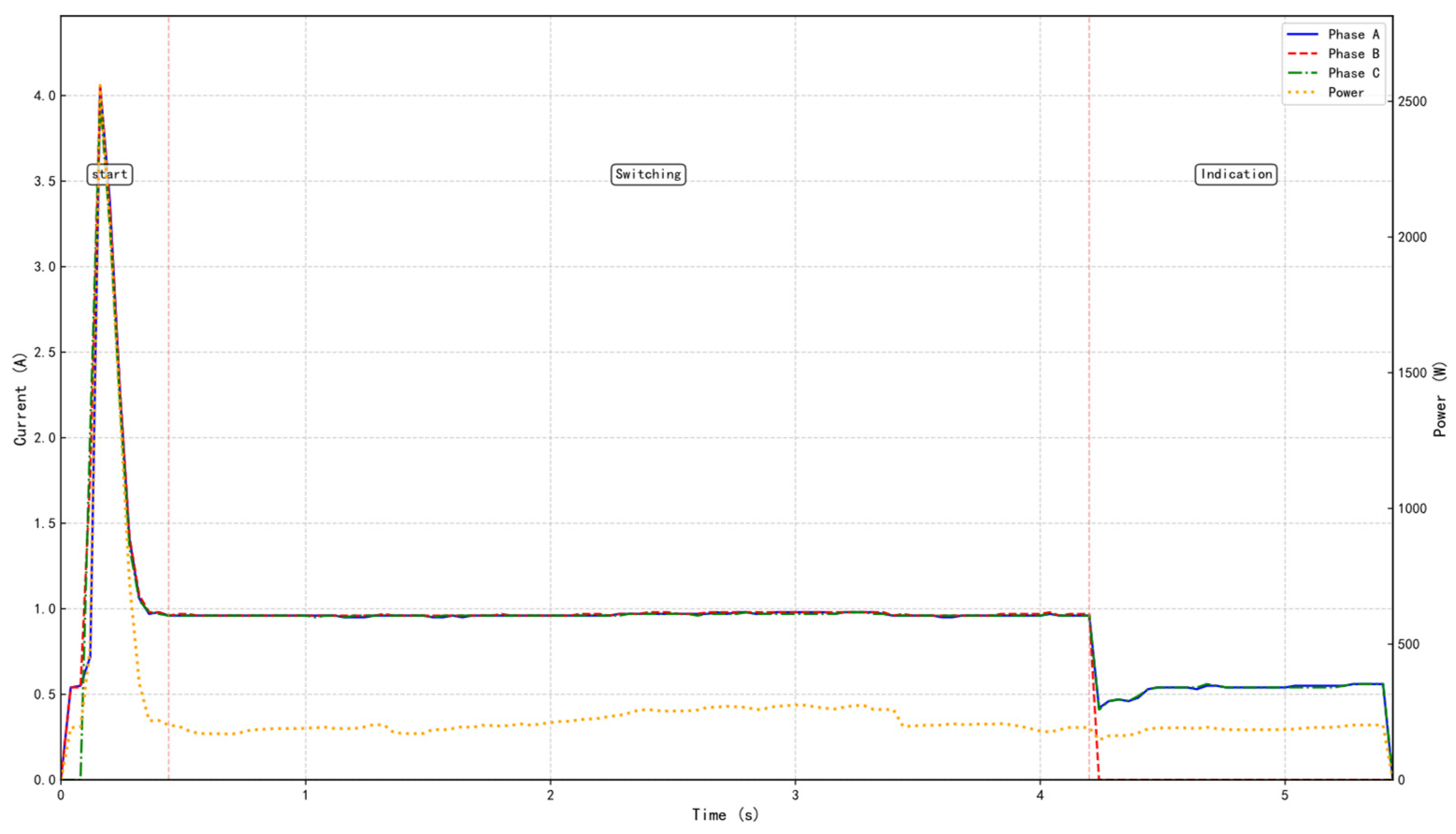
Under normal operating conditions, the power and current variation curves of the S700K point machine can be divided into three distinct phases: the starting phase, the conversion phase, and the indication phase. Specifically, the starting phase requires overcoming significant resistance to unlock the turnout. The conversion phase primarily involves the movement of the switch rail and the locking of the turnout. Finally, the indication phase utilizes a low-power indication circuit to display the conversion result (as shown in Figure 1) [13].
In this study, although the monitoring system is capable of recording power, current, and voltage signals, only the switching power signal is used for subsequent analysis. Each data sample is defined as the power time series of a complete switching cycle of the switch machine.
During each switching operation, the power signal is sampled at a time interval of 0.04 s, resulting in 137 sampling points per cycle. Accordingly, the initial dataset can be represented as a collection of one-dimensional time-series vectors, where each vector corresponds to a single switching process. These power curves constitute the fundamental statistical samples used for feature extraction, dimensionality reduction, and clustering-based degradation state identification.

2.2. Principle of Uniform Manifold Approximation and Projection (UMAP)

Uniform Manifold Approximation and Projection (UMAP) is a nonlinear dimensionality reduction technique grounded in manifold learning theory [14]. Its objective is to project high-dimensional data into a low-dimensional space while preserving the intrinsic local geometric structure and global topological characteristics of the data. UMAP achieves this by constructing a fuzzy topological representation in the high-dimensional space and learning a corresponding embedding in the low-dimensional space that best matches this structure, thereby enabling effective feature fusion and visualization.
Let the high-dimensional feature set be defined as X = { x i D i = 1 , 2 , , N } , where x i denotes the multi-dimensional feature vector of the i-th sample. In the high-dimensional space, the k-nearest neighbor set N k ( i ) is first identified for each sample x i . To alleviate the influence of non-uniform data density on neighborhood modeling, a local connectivity parameter ρ i is introduced, which is typically defined as the distance from x i to its nearest neighbor.
Based on this, the conditional membership strength between sample x i and its neighbor x j is defined as
p j | i = exp max ( 0 , d ( x i , x j ) ρ i ) σ i
where d ( , ) denotes the distance metric in the high-dimensional space, and σ i is a local scaling parameter. In UMAP, σ i is determined via a binary search procedure such that the neighborhood connectivity strength of each sample satisfies a predefined constraint, ensuring a consistent local topological scale across different samples.
To obtain a symmetric high-dimensional similarity measure, UMAP applies a fuzzy set union operation to the conditional memberships, yielding
p i j = p j | i + p i | j p j | i p i | j
This formulation results in a fuzzy weighted adjacency structure that characterizes both local and global topological relationships among data samples.
In the low-dimensional space, the corresponding embedding is defined as Y = { y i d d D } , and the similarity between samples y i and y j is modeled by
q i j = 1 1 + a y i y j 2 b
In the low-dimensional space, the similarity between embedded points is modeled using a differentiable curve controlled by parameters a and b . These two variables are predefined according to the standard UMAP formulation to shape the distance–similarity function and are not optimized during training; therefore, they are treated as hyperparameters.
The optimization objective of UMAP is to minimize the cross-entropy loss between the high-dimensional similarity distribution p i j and the low-dimensional similarity distribution q i j , expressed as
L = ( i , j ) E p i j log q i j + ( 1 p i j ) log ( 1 q i j )
where E   denotes the set of edges defined by the k-nearest neighbor relationships. This loss function simultaneously reinforces attractive forces between similar samples and introduces repulsive forces between dissimilar samples, thereby preserving the topological consistency of the original data. In practice, stochastic gradient descent is employed for optimization, and negative sampling is used to approximate the repulsive term for non-neighboring samples, significantly improving computational efficiency.
Through the above procedure, UMAP effectively fuses multi-domain high-dimensional features into a compact low-dimensional representation while retaining critical degradation evolution characteristics. This provides a discriminative and low-redundancy feature input for subsequent degradation state clustering and performance evaluation.

2.3. Improved K-Means Clustering Algorithm (K-Means++)

K-means++ is an improved version of the K-means clustering algorithm that enhances clustering stability by adopting a probabilistic initialization strategy for cluster centers [15]. The algorithm aims to minimize the within-cluster sum of squared distances:
J = j = 1 k x i C j x i μ j 2
where C j denotes the j-th cluster and μ j is its centroid. Compared with conventional K-means, K-means++ provides more stable clustering results and reduces sensitivity to initial center selection.
In this work, K-means++ is applied to the low-dimensional feature space obtained from UMAP to identify degradation stages of switch machines. The optimal number of clusters is determined experimentally using clustering evaluation metrics described in Section 2.4 and validated in Section 4.

2.4. Clustering Performance Evaluation

To quantitatively evaluate clustering compactness and separability, three widely used internal validation indices are adopted: the Silhouette coefficient [16], the Calinski–Harabasz (CH) index, and the Davies–Bouldin (DB) index [17].
(1) Silhouette Coefficient
For a sample x i , the silhouette coefficient is defined as
S i = b i a i max ( a i , b i )
where a i denotes the average distance between x i and other samples within the same cluster, and b i represents the minimum average distance between x i and samples in other clusters. The overall silhouette score is obtained by averaging all samples. A larger value indicates better clustering performance.
(2) Calinski–Harabasz (CH) Index
For a clustering result with k clusters and n samples, the CH index is defined as
C H ( k ) = S S B / ( k 1 ) S S W / ( n k )
where the between-cluster sum of squares and within-cluster sum of squares are given by
S S B = j = 1 k n j c j c 2
S S W = j = 1 k x C j x c j 2
where C j denotes the j-th cluster, c j is its centroid, c is the global mean of all samples, and n j is the number of samples in cluster C j . Larger CH values indicate better clustering quality.
(3) Davies–Bouldin (DB) Index
The DB index is defined as
D B = 1 k i = 1 k max j i σ i + σ j d i j
where σ i denotes the average intra-cluster distance of cluster i , and d i j is the distance between the centroids of clusters i and j . A smaller DB value indicates better clustering performance.
Based on these criteria, the optimal cluster number is selected and used for subsequent degradation-state identification in Section 4.

3. Degradation State Identification Based on Multi-Feature Fusion

This section presents the proposed degradation state identification framework for railway switch machines. It includes multi-domain feature extraction, UMAP-based feature fusion, and K-means++ clustering-based state partitioning. Experimental parameter determination and validation results are provided in Section 4.

3.1. Time-Domain Features

Time-domain features characterize the overall statistical distribution and local impulsive behavior of a signal from the perspectives of statistical properties and amplitude variations. Indicators such as the root mean square, peak factor, skewness, and kurtosis factor are highly sensitive to early degradation and fault evolution of mechanical equipment [18].
In this study, a set of representative time-domain features is extracted from the original power signal, and their mathematical definitions are summarized in Table 1. Let the discrete signal be denoted as x i i = 1,2 , , N . The corresponding time-domain features are defined as follows:

3.2. Frequency-Domain Features

To extract frequency-domain features, the time-domain signal is transformed into the frequency domain via the Fourier transform, which reveals its inherent periodicity and frequency composition. Studies indicate that changes in operating conditions lead to significant variations in the spectral structure of power signals, primarily reflected by shifts in energy distribution along the frequency axis. Therefore, frequency-domain features derived from the power spectrum provide informative indicators for condition monitoring and degradation diagnosis.
Let f j denote the frequency of the j-th spectral component, X j its corresponding power spectral amplitude, and N the total number of frequency bins. Then, the corresponding formulas are given in Table 2.
These frequency-domain features characterize spectral energy distribution and effectively capture variations in the operating state.

3.3. Time–Frequency Domain Features

The power signal of the switch machine exhibits pronounced non-stationary and nonlinear characteristics during its operation. A single time-domain or frequency-domain analysis method is insufficient to comprehensively characterize the dynamic evolution of the signal. Therefore, time–frequency feature extraction methods are adopted to more effectively describe the signal characteristics in the joint time–frequency domain [19].
Compared with Empirical Mode Decomposition (EMD), Variational Mode Decomposition (VMD) demonstrates significant advantages in suppressing mode mixing and improving decomposition stability, and is thus more suitable for the analysis of complex non-stationary signals [20].
VMD decomposes the original signal into several intrinsic mode components with limited bandwidth by solving a variational optimization problem, thereby enabling accurate extraction of time–frequency features at different scales. Let the original signal be denoted as f ( t ) , which is decomposed into k intrinsic mode functions u k t . The corresponding variational model is formulated as follows:
min { u k } , { ω k } k = 1 K t δ ( t ) + j π t u k ( t ) e j ω k t 2 2
s . t .   k = 1 K u k ( t ) = f ( t )
where denotes the convolution operator. The term ( δ ( t ) + j π t ) u k ( t ) corresponds to the Hilbert transform applied to the k-th mode component to construct its analytic signal. The objective function measures the bandwidth of each mode by computing the temporal gradient of the demodulated signal. ω k denotes the center angular frequency of the k-th mode component.
To strictly handle the reconstruction constraint, a penalty factor α and a Lagrange multiplier λ ( t ) are introduced to construct the augmented Lagrangian function. The optimization problem is then solved iteratively using the Alternating Direction Method of Multipliers (ADMM). When the convergence criterion given in Equation (13) is satisfied, the algorithm terminates and outputs k intrinsic mode functions (IMFs) with mutually separated frequency bands:
k = 1 K u k n + 1 u k n 2 2 u k n 2 2 < ε
The number of decomposition modes k has a significant influence on the decomposition performance. If k is too small, important frequency components cannot be sufficiently separated; if k is too large, redundant modes may appear. Therefore, an appropriate value of k needs to be determined through experimental analysis considering frequency separation and decomposition stability. The detailed parameter determination procedure and corresponding results are presented in Section 4.

3.4. Multi-Domain Feature Fusion Using UMAP

The incorporation of multi-source features, including time-domain, frequency-domain, and time–frequency characteristics, inevitably increases the dimensionality of the feature space. Although such multi-domain information can provide a more comprehensive description of switch machine degradation, direct use of high-dimensional features may introduce redundancy and increase computational burden, thereby adversely affecting clustering stability and identification performance. Effective fusion and dimensionality reduction of multi-domain features are therefore essential for constructing compact and discriminative representations of degradation states.
To address this issue, Uniform Manifold Approximation and Projection (UMAP) is adopted to perform nonlinear dimensionality reduction and feature fusion. UMAP is a manifold learning method based on graph embedding optimization, which preserves both local neighborhood relationships and global topological structures of high-dimensional data in a low-dimensional space. This property enables the exploration of intrinsic correlations among heterogeneous features and facilitates the extraction of more discriminative representations for subsequent clustering analysis [21].
In this study, time-domain features, frequency-domain features, and VMD-based sample entropy time–frequency features are jointly input into the UMAP model to generate a fused low-dimensional feature vector that comprehensively characterizes the performance degradation evolution of the switch machine. The effectiveness of the fused representation is further validated through clustering experiments presented in Section 4.

3.5. Degradation State Identification Framework

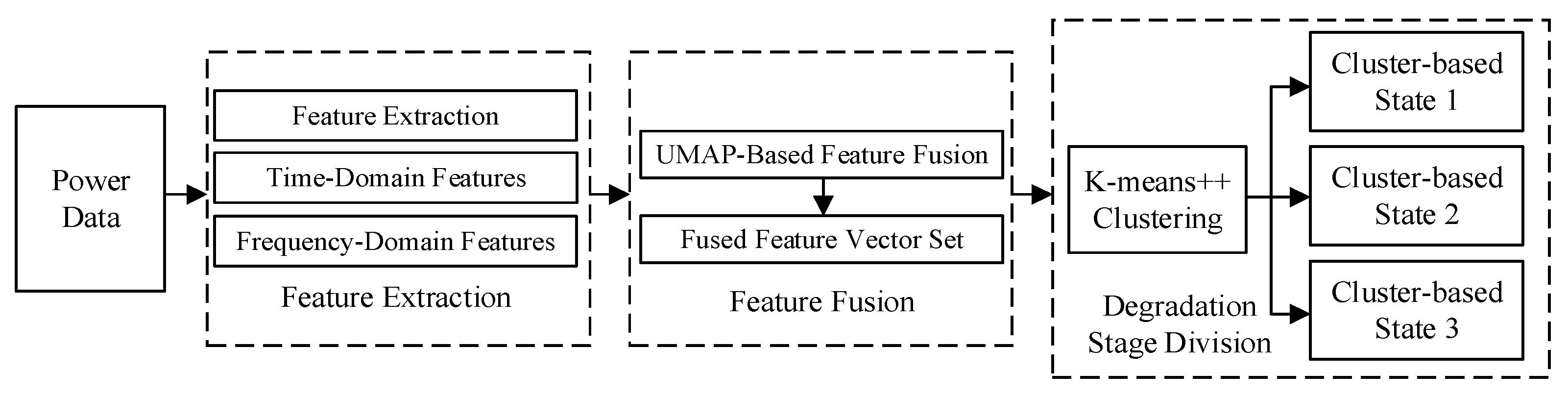
In this study, power data collected from S700K switch machines are used to model and identify performance degradation states. The overall technical framework is illustrated in Figure 2. First, multi-domain features, including time-domain, frequency-domain, and VMD-based time–frequency features, are extracted from the switch machine power signals. Subsequently, the UMAP algorithm is employed to fuse the multi-source features, yielding a low-dimensional composite feature representation that captures the evolutionary characteristics of performance degradation. Finally, the K-means++ clustering algorithm is applied to the low-dimensional feature set to achieve stage-wise partitioning and identification of switch machine degradation states.

4. Experimental Validation

This section evaluates the effectiveness of the proposed method using real power data collected from S700K switch machines. It includes parameter determination, feature analysis, clustering evaluation, and comparative experiments.

4.1. Dataset Description

A total of 1000 switching power curves from S700K railway switch machines were used as experimental data. The signals were collected at several railway stations in Guangzhou, China, between 2016 and 2018 during routine turnout operations. Although all samples were recorded under normal operating conditions, they reflect varying levels of performance degradation accumulated during long-term service and thus provide representative data for degradation state analysis.
Each power curve corresponds to a complete switching cycle of the switch machine. The sampling interval was 0.04 s, yielding 137 sampling points per signal (equivalent sampling frequency: 25 Hz). All measurements were obtained under consistent operating conditions with standard power supply and normal mechanical load to ensure data comparability.
Before feature extraction, all signals were normalized to mitigate operational variations. The processed dataset was then used for multi-domain feature construction, UMAP-based feature fusion and dimensionality reduction, and K-means++ clustering to identify degradation states. The clustering procedure was fully unsupervised, and no fault labels were introduced. The resulting degradation stages were subsequently interpreted according to engineering knowledge of switch machine performance evolution.

4.2. Multi-Domain Feature Extraction and UMAP-Based Feature Fusion

The number of decomposition modes k in VMD is determined through experimental analysis. Different candidate values of k are tested, and the center frequencies of modal components are analyzed to evaluate frequency separation and decomposition stability.
As shown in Table 3, when k = 7, adjacent modes exhibit clear frequency separation with minimal overlap, and the main frequency components of the original signal are effectively preserved. Therefore, k = 7 is selected for subsequent analysis.

4.3. Sample Entropy Feature Analysis

Based on the IMF components obtained from VMD, sample entropy values are calculated to quantify the nonlinear complexity of each mode. Representative entropy values for different samples are summarized in Table 4.
The entropy values show noticeable variation across samples, indicating that the constructed time–frequency features effectively reflect the dynamic evolution of the switch machine power signal.

4.4. UMAP Feature Fusion Results

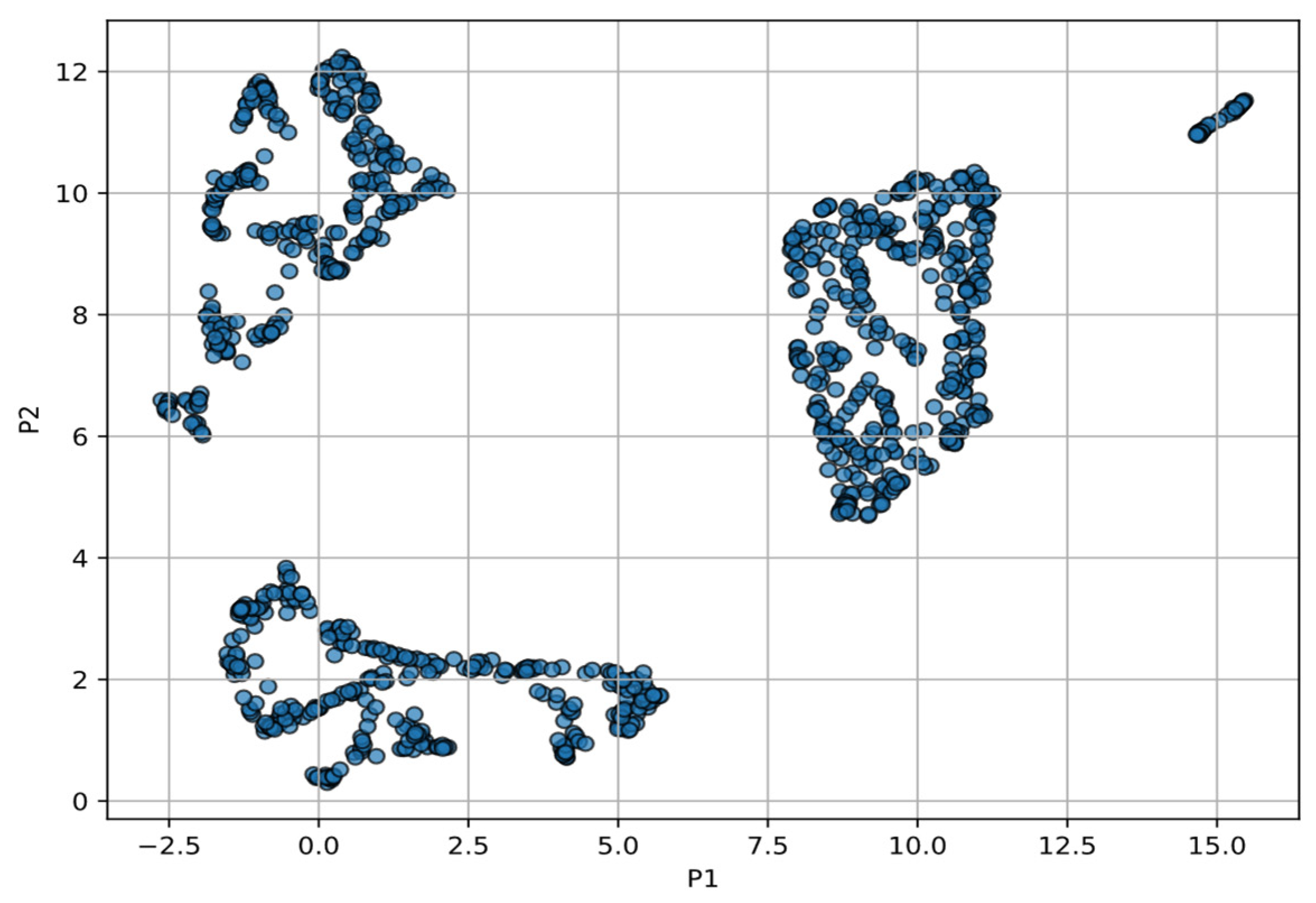
Time-domain, frequency-domain, and VMD-based time–frequency features are jointly input into the UMAP algorithm for dimensionality reduction. After embedding, a two-dimensional feature space is obtained.
Figure 3 illustrates the distribution of samples in the embedded space. Samples corresponding to different degradation states exhibit clear structural separation, providing a reliable basis for clustering-based state identification.

4.5. Determination of Optimal Cluster Number

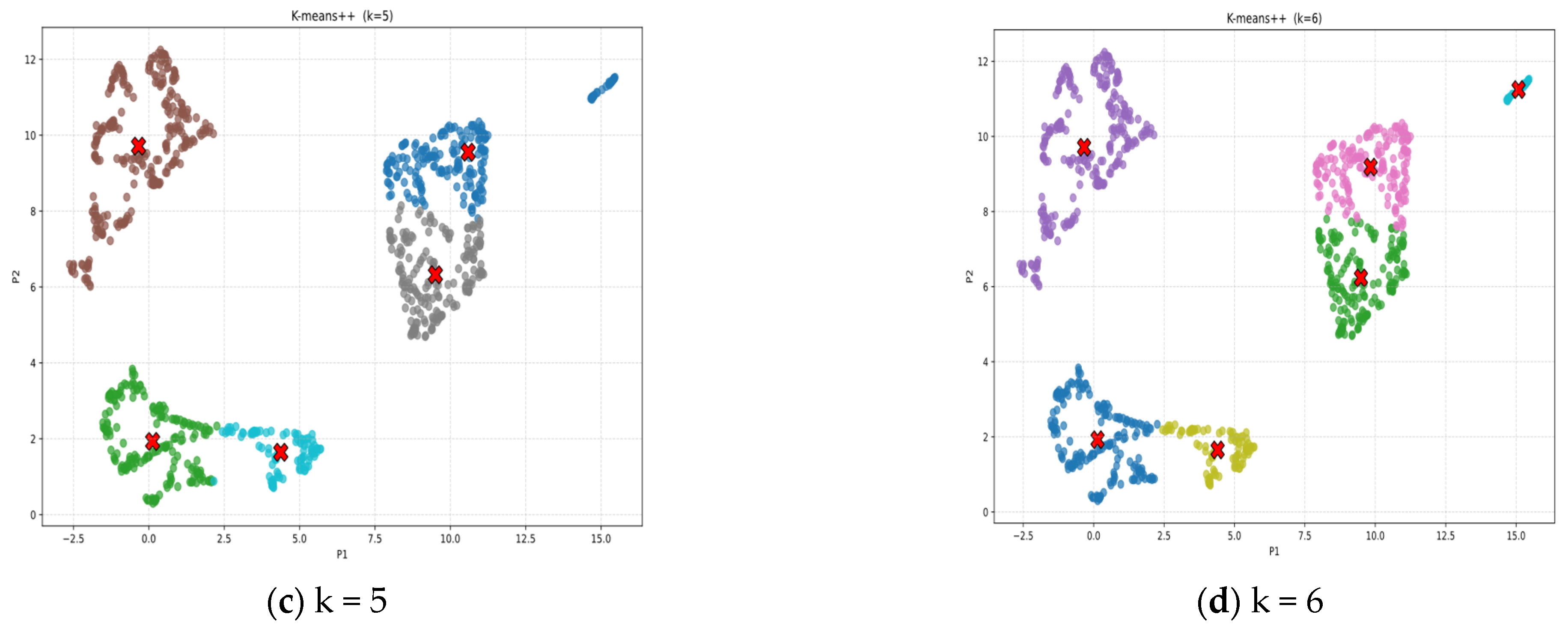
In the analysis of switch machine power data, the K-means++ clustering algorithm is employed to partition the performance degradation states of the switch machine. The analyzed data cover the complete evolution process of power-related characteristics as the switch machine transitions from normal operating conditions toward degraded performance states. Previous studies and maintenance practice indicate that the degradation process of switch machines can typically be divided into several sequential stages. Based on this observation, the UMAP-fused low-dimensional feature set is used as the input for unsupervised clustering analysis in this study. Under identical feature conditions, clustering is performed with the number of clusters set to k = 3–6 for comparative evaluation.
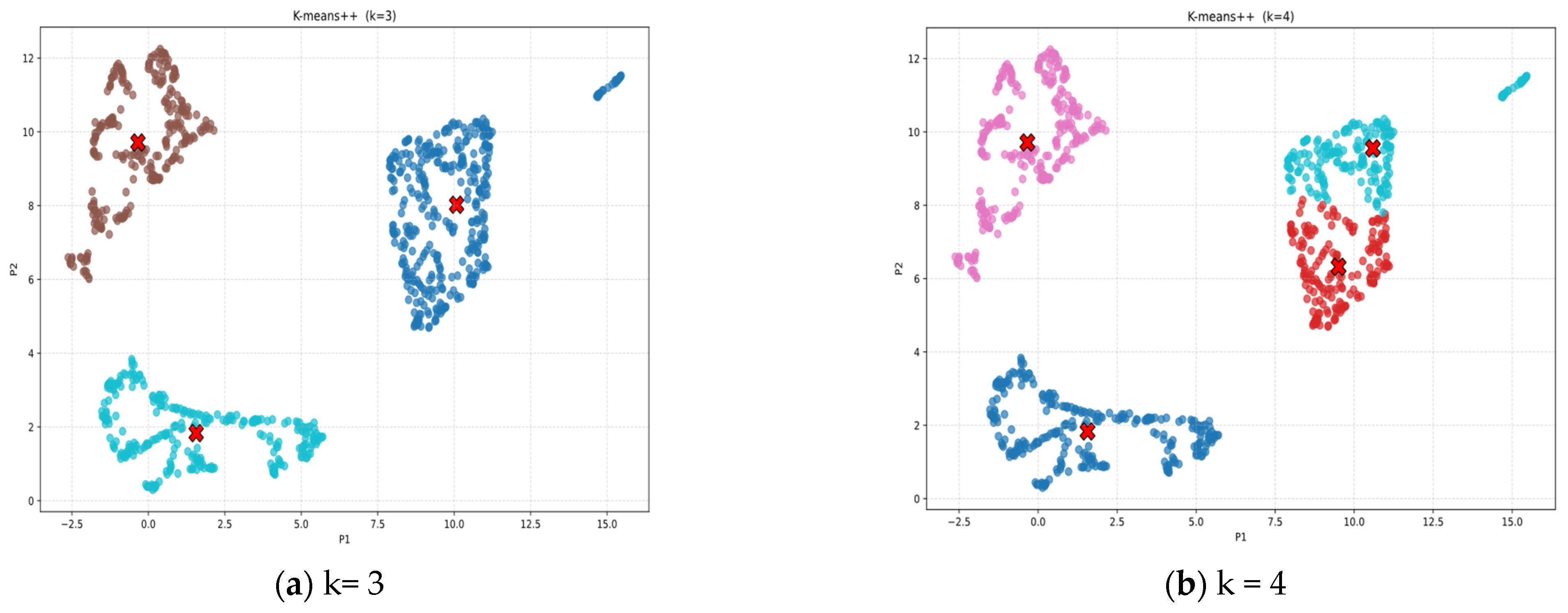
Figure 4 illustrates the visualization results of K-means++ clustering under different numbers of clusters. The subfigures correspond to k = 3, 4, 5, and 6, respectively, and the red cross symbols denote the cluster centers. As the number of clusters increases, the partitioning of samples becomes more refined; however, excessive subdivision may lead to over-segmentation of transitional degradation states without providing additional physically meaningful degradation stages. In particular, although the distribution in the embedded space under k = 4 may visually suggest additional separable groups, some of these clusters primarily subdivide intermediate degradation states rather than representing distinct degradation phases.
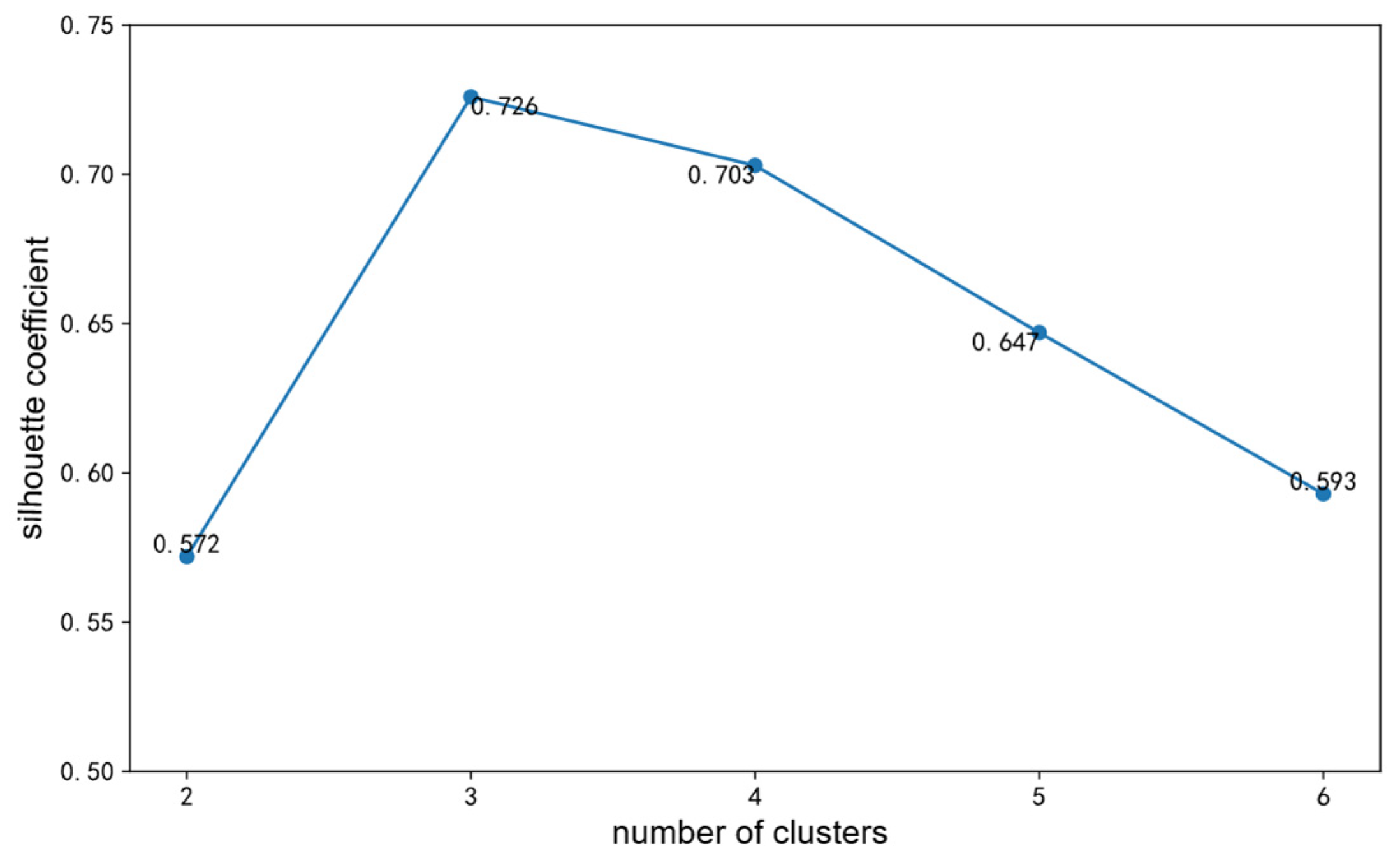
To quantitatively evaluate clustering performance under different cluster numbers, the silhouette coefficient is adopted as the evaluation metric, as it comprehensively reflects intra-cluster compactness and inter-cluster separation. Figure 5 presents the silhouette coefficient results for different values of k. It can be observed that when k = 3 the silhouette coefficient reaches its maximum value of 0.726, indicating a higher degree of separability among different degradation states while maintaining strong similarity within the same state. Therefore, k = 3 is selected as the optimal number of clusters for partitioning the performance degradation states of the switch machine. The obtained clusters are subsequently interpreted as degradation stages through feature trend analysis and engineering knowledge, rather than being predefined labels. As shown in Figure 4, the three clusters correspond to three consecutive degradation stages: the upper-left cluster (brown) represents Degradation State 1, the lower-left cluster (light blue) represents Degradation State 2, and the upper-right cluster (dark blue) represents Degradation State 3.
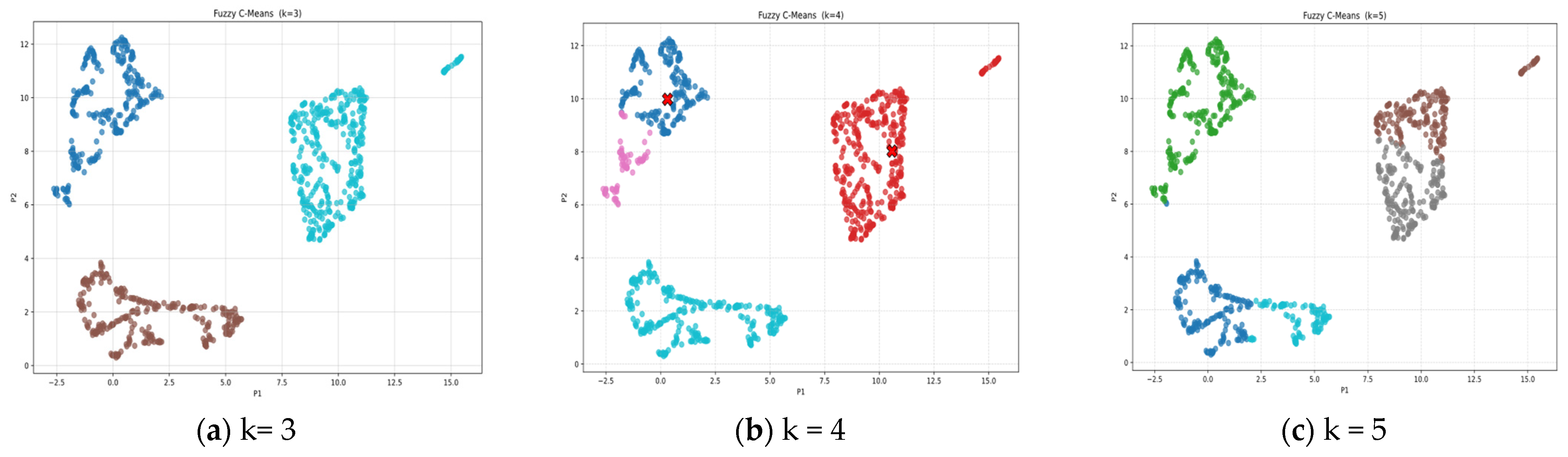
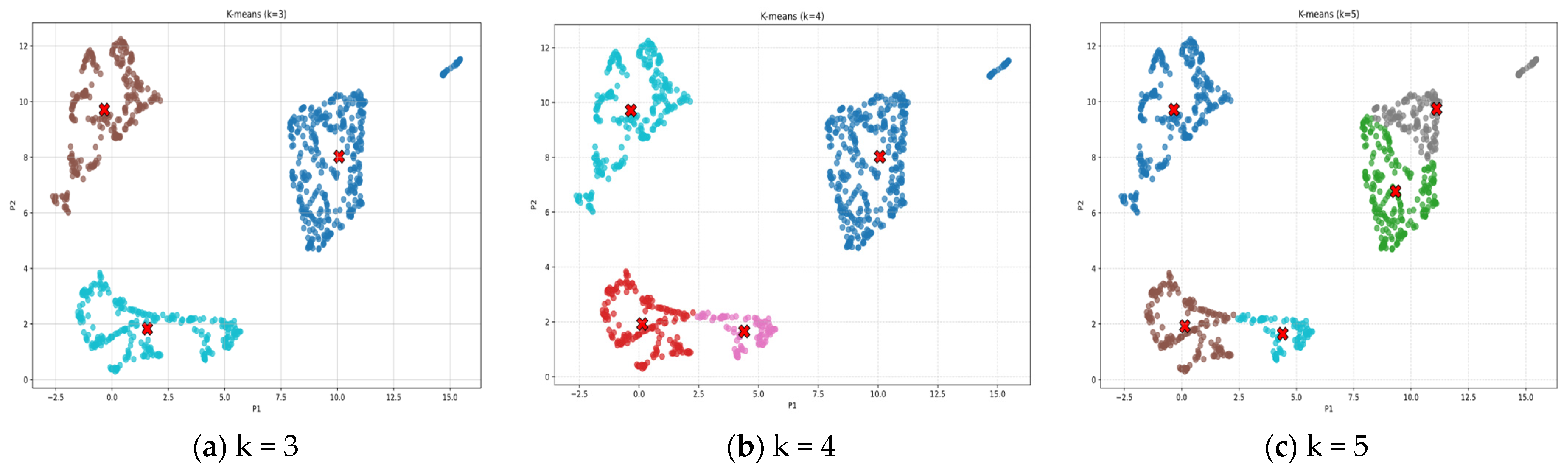
To effectively identify the performance degradation states of switch machines, this study conducts a comparative analysis between the proposed K-means++ clustering algorithm and two widely used clustering methods, namely fuzzy C-means (FCM) and K-means, based on the fused low-dimensional feature set. These clustering algorithms have been extensively adopted in degradation state identification studies and thus provide a representative basis for performance comparison. To ensure the fairness of the comparison, all clustering algorithms are evaluated under identical feature inputs and the same number of clusters.
The visualization results of the clustering analysis are presented in Figure 6 and Figure 7, where Figure 6 illustrates the clustering results obtained using the FCM algorithm and Figure 7 shows the results produced by the K-means algorithm. In both cases, the number of clusters is set to k = 3. To quantitatively assess the clustering performance, three evaluation metrics are employed: the silhouette coefficient, the Calinski–Harabasz (CH) index, and the Davies–Bouldin (DB) index. The corresponding quantitative evaluation results are summarized in Table 5.
As indicated in Table 5, when the number of clusters is k = 3, the K-means++ algorithm achieves the best overall performance across all three evaluation metrics. Specifically, the silhouette coefficient reaches 0.726, the CH index attains the highest value, and the DB index achieves the lowest value, demonstrating that the K-means++ algorithm provides superior intra-cluster compactness and inter-cluster separability under this condition. These results verify the effectiveness and reliability of the proposed degradation state identification method.
Based on the observed degradation evolution patterns and the distribution characteristics revealed by the clustering results, and in conjunction with practical engineering experience, the performance degradation process of the switch machine is categorized into three stages: the normal operation stage, the moderate degradation stage, and the severe degradation stage. The characteristic descriptions of power curves and corresponding maintenance recommendations for each degradation stage are detailed in Table 6, providing practical guidance for switch machine condition monitoring and maintenance decision-making.
After determining the optimal number of clusters (k = 3), the clusters are interpreted as degradation stages through post hoc analysis, since the clustering is fully unsupervised. The three clusters exhibit a clear sequential distribution in the UMAP space and show progressively increased waveform fluctuation, entropy, and feature deviation, corresponding to healthy, moderate, and severe degradation states. These patterns are consistent with typical S700K switch-machine degradation behaviors reported in practice and literature. Therefore, the clusters are mapped to three consecutive degradation stages, as summarized in Table 6. Although larger k values may produce finer partitions, the silhouette, CH, and DB indices all indicate that k = 3 provides the best balance between compactness, separability, and engineering interpretability for maintenance-oriented stage identification.
It should be noted that, under certain parameter settings (e.g., k = 4), more than three visually separable groups may appear in the embedded feature space. However, the objective of this study is not to maximize geometric separability in the low-dimensional space, but to identify physically meaningful degradation stages that are consistent with the actual performance evolution of switch machines.
The internal clustering validation indices—including the silhouette coefficient, Calinski–Harabasz (CH) index, and Davies–Bouldin (DB) index—consistently indicate that k = 3 provides the best overall balance between intra-cluster compactness and inter-cluster separability. Moreover, in practical railway maintenance scenarios, switch-machine performance degradation typically evolves through three consecutive stages: healthy, moderate degradation, and severe degradation. The clustering results obtained with k = 3 exhibit a clear sequential distribution in the embedded space and show good correspondence with these practical degradation stages.
Although larger values of k may produce finer partitions, they mainly subdivide transitional states rather than revealing additional physically meaningful degradation modes. Density-based clustering methods (e.g., DBSCAN or HDBSCAN) may capture local density variations within transitional regions and could be explored in future work for fine-grained analysis. Nevertheless, for stage-oriented degradation identification aimed at maintenance decision support, the K-means++ model with k = 3 provides a more stable, interpretable, and practically meaningful partition of the degradation process.

4.6. Comparative Experimental Analysis

(1) Comparison of Different Dimensionality Reduction Methods
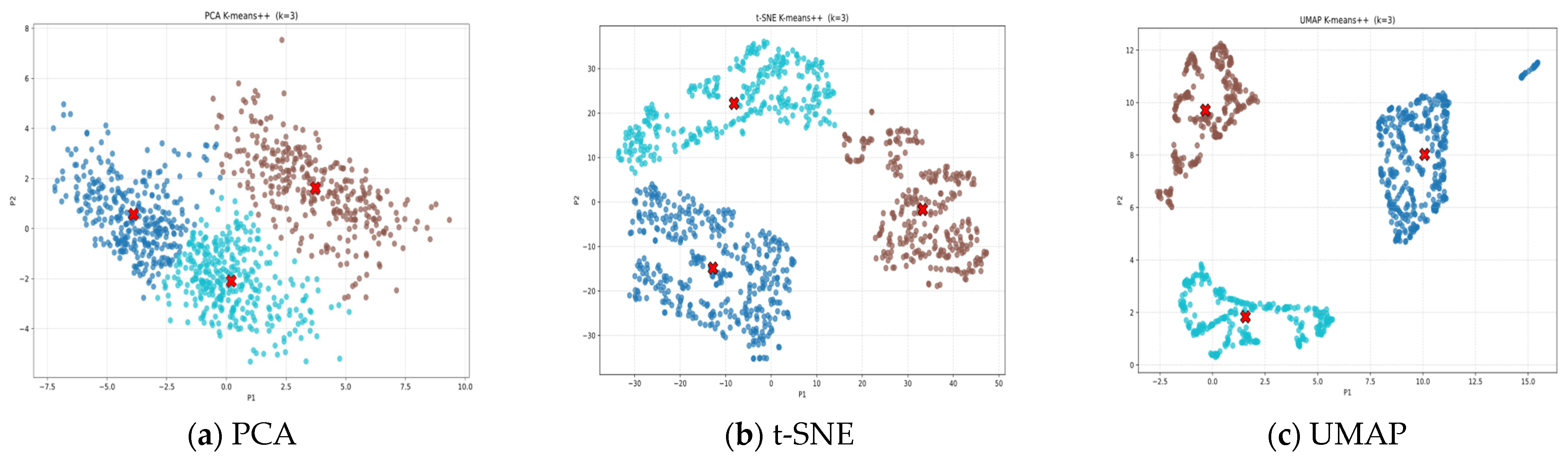
To evaluate the performance of different dimensionality reduction methods in the multi-source feature fusion scenario of switch machine power signals, three representative techniques—Principal Component Analysis (PCA), t-distributed Stochastic Neighbor Embedding (t-SNE), and Uniform Manifold Approximation and Projection (UMAP)—are comparatively investigated. The focus is placed on assessing their dimensionality reduction effectiveness under multi-source power feature fusion, using both clustering visualization results and quantitative evaluation metrics.
Under identical clustering conditions, the K-means++ algorithm with the same number of clusters is applied to the low-dimensional features obtained by each dimensionality reduction method. The clustering visualization results corresponding to PCA, t-SNE, and UMAP are presented in Figure 8, while the quantitative evaluation results are summarized in Table 7.
As shown in Table 7, the UMAP-based features achieve a silhouette coefficient of 0.726, which is higher than those obtained using PCA and t-SNE under the same experimental conditions. This indicates that UMAP provides more discriminative low-dimensional representations in the considered feature fusion scenario and exhibits superior cluster separability.
(2) Comparison of Different Feature Combinations
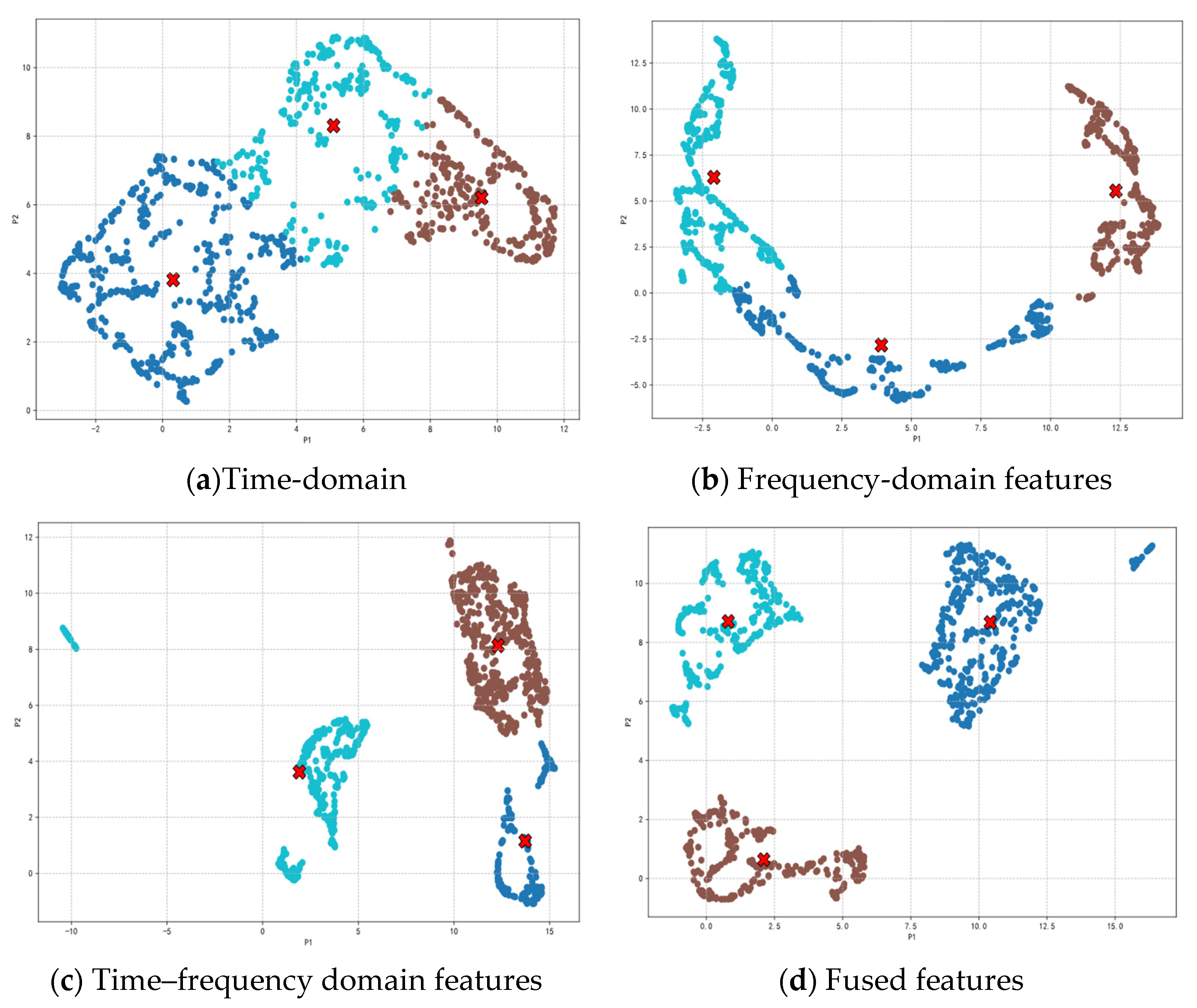
To further verify the effectiveness of the proposed feature fusion strategy, clustering performance under different feature combinations is evaluated within the same UMAP + K-means++ framework. The visualization results of clustering outcomes for different feature sets are shown in Figure 9, and the corresponding quantitative evaluation results are reported in Table 8.
As indicated in Table 8, the fused feature set achieves a silhouette coefficient of 0.726, which is notably higher than those obtained using single time-domain features, frequency-domain features, and time–frequency feature combinations. These results demonstrate that multi-domain feature fusion enables a more comprehensive characterization of the performance degradation evolution of switch machines and significantly enhances the discriminative capability of degradation state clustering.
Overall, the comparative experimental results confirm that the proposed feature fusion method effectively improves the stability and reliability of clustering-based degradation state identification, providing robust data support for switch machine condition monitoring and maintenance decision-making.

4.7. Degradation State Identification

A total of 1000 switch machine power samples are used to construct the modeling dataset, while approximately 200 power curves corresponding to normal operating conditions are extracted from the CSM system as reference samples. Based on the previously obtained UMAP-based feature fusion results and K-means++ clustering model, the Euclidean distances between test samples and each cluster center are calculated. The degradation state of each test sample is then identified using a minimum-distance (nearest cluster center) decision criterion. Table 9 presents representative distance calculation results for test samples. Each column corresponds to the distance between a sample and the cluster centers representing the three degradation stages (Stage I: healthy, Stage II: moderate degradation, and Stage III: severe degradation). The identification result is determined by the minimum-distance criterion.
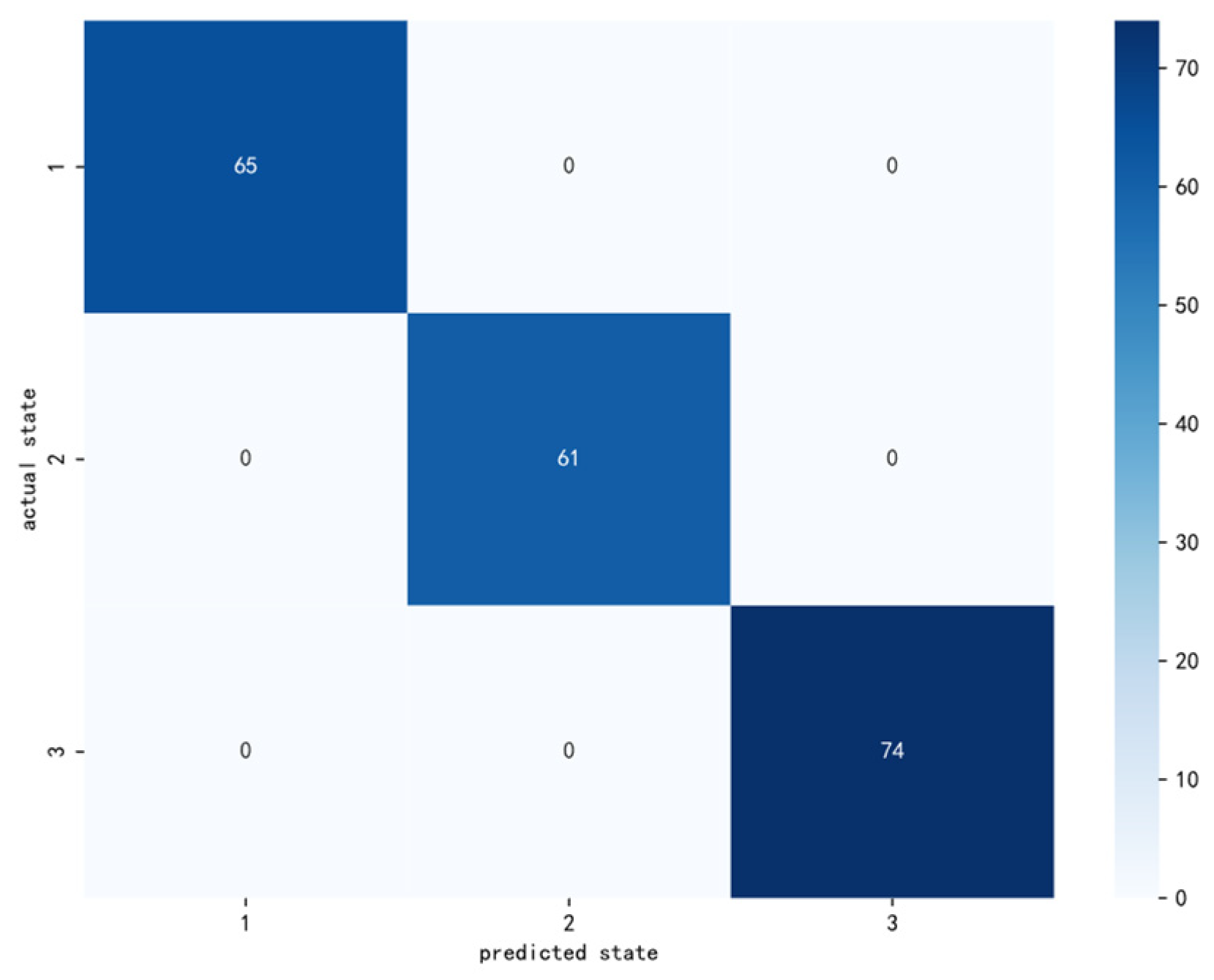
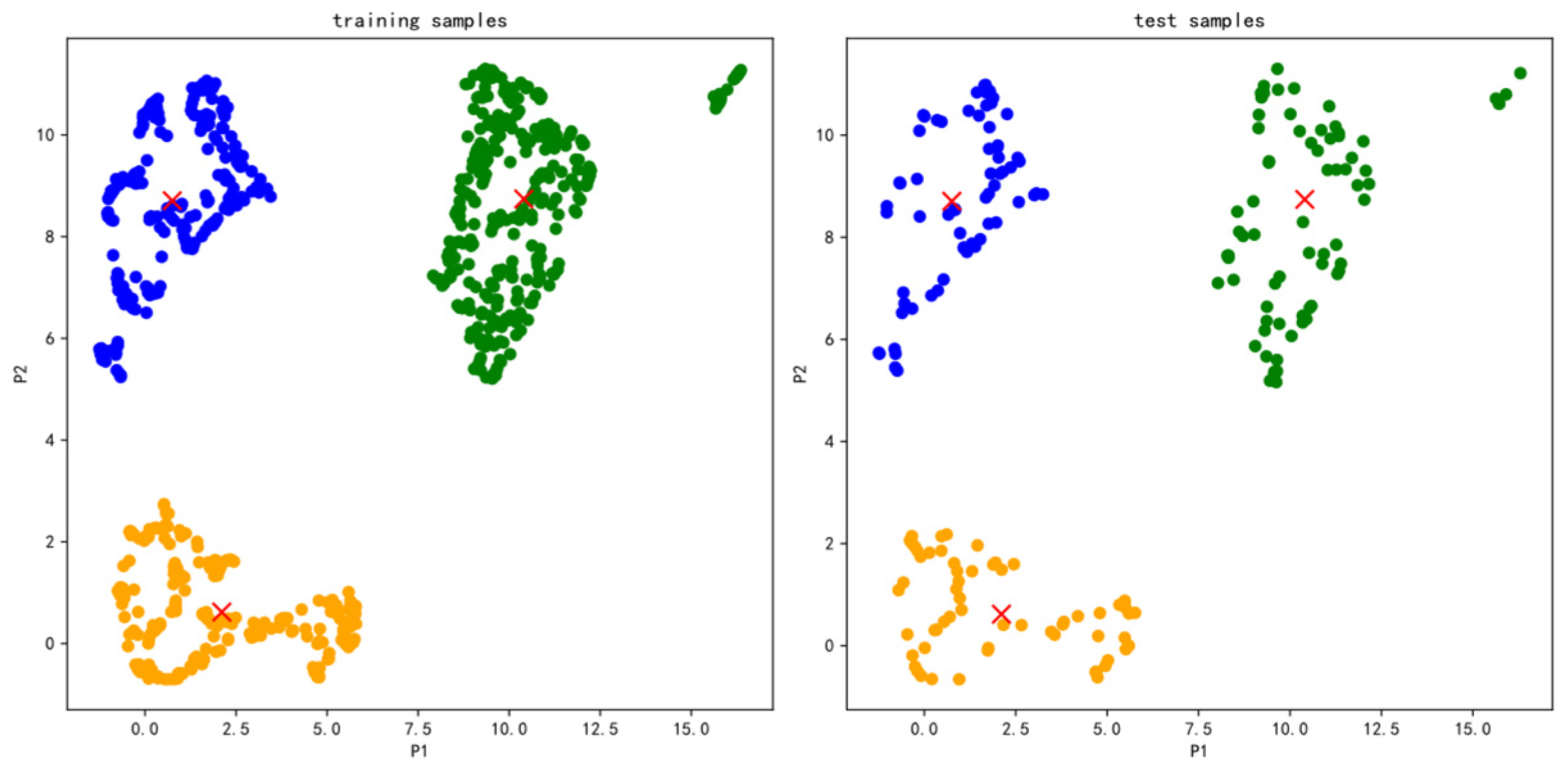
As illustrated in Figure 10, the confusion matrix of the K-means++-based identification results exhibits a clear diagonal dominance, indicating good separability among different degradation states. Figure 11 further visualizes the distribution of training and test samples in the low-dimensional feature space, showing that test samples are consistently mapped to the corresponding degradation state regions defined by the training data.
On the selected test dataset, the proposed method achieves completely correct degradation state identification results, demonstrating the effectiveness of the feature fusion and clustering-based identification framework for equipment health assessment. Accurate identification of switch machine degradation states is a critical prerequisite for intelligent operation and maintenance. By formulating and implementing predictive maintenance and condition-based inspection strategies tailored to different degradation stages, potential failure risks can be effectively reduced, equipment reliability and availability can be improved, and maintenance resources can be allocated and utilized more efficiently.


5. Conclusions

This study proposes an unsupervised degradation state identification method for S700K railway switch machines by integrating UMAP-based feature dimensionality reduction with the K-means++ clustering algorithm. A multi-domain feature set combining time-domain statistical features, frequency-domain characteristics, and VMD-based sample entropy time–frequency features is constructed to characterize the degradation process, and UMAP is employed to obtain a low-dimensional representation that preserves key structural information of degradation evolution. Based on the UMAP embedding, K-means++ clustering partitions the degradation process into three distinct stages: healthy, moderate degradation, and severe degradation. Experimental results demonstrate that the proposed framework achieves clear inter-cluster separability and more stable clustering performance compared with conventional clustering approaches applied directly to high-dimensional feature sets. In contrast to traditional threshold-based or single-feature methods that are sensitive to noise and operating variability, the proposed unsupervised feature-fusion framework provides more robust and interpretable degradation state partitioning. Although validated on S700K switch machines, the method is data-driven and can be extended to other types of railway switch machines or similar electromechanical systems with available operational signals, providing effective support for data-driven condition assessment and predictive maintenance of railway infrastructure.

Author Contributions

Conceptualization, X.H. and D.D.; methodology, X.H.; software, X.H.; validation, X.H. and N.G.; formal analysis, X.H.; investigation, X.H.; resources, D.D.; data curation, X.H.; writing—original draft preparation, X.H.; writing—review and editing, X.H. and N.G.; visualization, X.H.; supervision, D.D.; project administration, D.D.; funding acquisition, D.D. All authors have read and agreed to the published version of the manuscript.

Funding

This research received no external funding.

Data Availability Statement

The data presented in this study are available on request from the corresponding author.

Conflicts of Interest

The authors declare no conflicts of interest.

Abbreviations

The following abbreviations are used in this manuscript:
UMAPUniform Manifold Approximation and Projection
EMDEmpirical Mode Decomposition
VMDVariational Mode Decomposition
FCMFuzzy Clustering Mean
CHCalinski–Harabaz
DBDavies–Bouldin

References

  1. Cao, Y.; Ji, Y.; Sun, Y.; Su, S. The fault diagnosis of a switch machine based on deep random forest fusion. IEEE Intell. Transp. Syst. Mag. 2022, 15, 437–452. [Google Scholar] [CrossRef]
  2. He, Y.; He, D.; Lao, Z.; Jin, Z.; Miao, J.; Lai, Z.; Chen, Y. Few-shot fault diagnosis of turnout switch machine based on flexible semi-supervised meta-learning network. Knowl.-Based Syst. 2024, 294, 111746. [Google Scholar] [CrossRef]
  3. He, Y.; He, D.; Lao, Z.; Yao, Z.; Sun, H.; He, C.; Yuan, Z. A class-center fine-tuning prototypical network for few-shot fault diagnosis of turnout switch machine driven by multi-source signals. Measurement 2025, 242, 115920. [Google Scholar] [CrossRef]
  4. Fu, Y.; Liu, B.; Song, S. Research on health assessment methods for switch machine based on fuzzy comprehensive evaluation. Railw. Sci. Eng. 2017, 5, 192–198. [Google Scholar]
  5. Atamuradov, V.; Medjaher, K.; Camci, F.; Dersin, P.; Zerhouni, N. Railway point machine prognostics based on feature fusion and health state assessment. IEEE Trans. Instrum. Meas. 2018, 68, 2691–2704. [Google Scholar] [CrossRef]
  6. Gao, L.M.; Xu, Q.Y.; Li, F.; Yang, J.; Meng, J.; Yang, S. Research on degradation state of turnout equipment based on SOM–BP hybrid neural network. China Railw. Sci. 2020, 41, 50–58. [Google Scholar]
  7. Wu, X.C.; Chu, X. Research on division of degradation stage of turnout equipment based on wavelet packet decomposition and GG fuzzy clustering. J. China Railw. Soc. 2022, 44, 79–85. [Google Scholar]
  8. Zhang, Y.P.; Zhang, D.; Yang, N.; Wei, Z. Degradation state recognition method of switch machine based on CEEMDAN and KFCM clustering. China Railw. Sci. 2023, 44, 194–201. (In Chinese) [Google Scholar]
  9. Zhang, X.H.; Liang, Z.G.; Zhang, H.Y.; Wang, H.F. An intelligent analysis method for health status of point machine based on interlocking operation data. J. Beijing Jiaotong Univ. 2023, 47, 137–146. (In Chinese) [Google Scholar]
  10. Wang, Y.K.; Mi, G.S.; Zhang, Y.; Wang, Y.; Wang, P. Health status evaluation method for high-speed railway turnout equipment based on CHMM and SSA–SVM models. J. China Railw. Soc. 2023, 45, 107–116. (In Chinese) [Google Scholar]
  11. Zhang, Y.P.; Li, Y.W.; Yang, N.; Zhao, B.; Wei, Z. Identifying turnout switch machine degradation states via multi-feature fusion and cluster analysis. J. Saf. Environ. 2024, 24, 3476–3487. (In Chinese) [Google Scholar]
  12. Ur Rehman, N.; Aftab, H. Multivariate variational mode decomposition. IEEE Trans. Signal Process. 2019, 67, 6039–6052. [Google Scholar] [CrossRef]
  13. Ou, D.; Ji, Y.; Zhang, L.; Liu, H. An online classification method for fault diagnosis of railway turnouts. Sensors 2020, 20, 4627. [Google Scholar] [CrossRef]
  14. Healy, J.; McInnes, L. Uniform manifold approximation and projection. Nat. Rev. Methods Primers 2024, 4, 82. [Google Scholar] [CrossRef]
  15. Ikotun, A.M.; Ezugwu, A.E.; Abualigah, L.; Abuhaija, B.; Heming, J. K-means clustering algorithms: A comprehensive review, variants analysis, and advances in the era of big data. Inf. Sci. 2023, 622, 178–210. [Google Scholar] [CrossRef]
  16. Sun, L.; Liu, M.H.; Xu, J.C. K-means clustering algorithm using optimal initial clustering center and contour coefficient. Fuzzy Syst. Math. 2022, 36, 47–65. [Google Scholar]
  17. Ashari, I.F.; Nugroho, E.D.; Baraku, R.; Yanda, I.N.; Liwardana, R. Analysis of elbow, silhouette, Davies–Bouldin, Calinski–Harabasz, and Rand index evaluation on K-means algorithm for classifying flood-affected areas in Jakarta. J. Appl. Inform. Comput. 2023, 7, 95–103. [Google Scholar] [CrossRef]
  18. Neupane, D.; Bouadjenek, M.R.; Dazeley, R.; Aryal, S. Data-Driven Machinery Fault Diagnosis: A Comprehensive Review. Neurocomputing 2025, 627, 129588. [Google Scholar] [CrossRef]
  19. Ayman, A.; Onsy, A.; Attallah, O.; Brooks, H.; Morsi, I. Feature Learning for Bearing Prognostics: A Comprehensive Review of Machine/Deep Learning Methods, Challenges, and Opportunities. Measurement 2025, 245, 116589. [Google Scholar] [CrossRef]
  20. Liu, J.C.; Quan, H.; Yu, X.; He, K.; Li, Z. Rolling bearing fault diagnosis based on parameter-optimized VMD and sample entropy. Acta Autom. Sin. 2022, 48, 808–819. (In Chinese) [Google Scholar]
  21. Feng, L.; Wang, C.; Wu, T.; Zhang, J. Dimensionality reduction method for manifold learning based on variational autoencoder. J. Comput.-Aided Des. Comput. Graph. 2025, 37, 439–445. [Google Scholar] [CrossRef]
Figure 1. Simplified diagram of an ordinary single-opening turnout structure.
Applsci 16 02261 g001
Figure 2. Degradation stage identification methodology structure.
Applsci 16 02261 g002
Figure 3. Feature data structure diagram.
Applsci 16 02261 g003
Figure 4. Visualization results of K-means++ clustering under different numbers of clusters.
Applsci 16 02261 g004aApplsci 16 02261 g004b
Figure 5. Silhouette coefficient results under different numbers of clusters.
Applsci 16 02261 g005
Figure 6. FCM clustering effect diagram.
Applsci 16 02261 g006
Figure 7. K-means clustering effect diagram.
Applsci 16 02261 g007
Figure 8. Clustering effect diagrams of different dimensionality reduction methods.
Applsci 16 02261 g008
Figure 9. Clustering result plots for different feature sets.
Applsci 16 02261 g009
Figure 10. K-means++ confusion matrix.
Applsci 16 02261 g010
Figure 11. Visualization of training and test sample classification using K-means++s.
Applsci 16 02261 g011
Table 1. Time-domain feature calculation formulae.
FeatureDefinitionFeatureDefinition
Maximum value t 1 = max ( x i ) Standard deviation t 8 = 1 N i = 1 N ( x i t 4 ) 2
Minimum value t 2 = min ( x i ) Waveform factor t 9 = t 3 1 N i = 1 N | x i |
Root mean square (RMS) t 3 = 1 N i = 1 N x i 2 Skewness factor t 10 = 1 N i = 1 N x i t 4 t 8 3
Mean value t 4 = 1 N i = 1 N x i Crest factor t 11 = t 5 t 3
Peak value t 5 = max ( | x i | ) Impulse factor t 12 = t 5 1 N i = 1 N | x i |
Peak-to-peak value t 6 = t 1 t 2 Clearance factor t 13 = t 5 t 7
Root amplitude t 7 = 1 N i = 1 N | x i | 2 Kurtosis factor t 14 = 1 N i = 1 N x i t 4 t 8 4
Table 2. Frequency-domain feature calculation formulas.
FeatureDefinition
Spectral mean q 1 = 1 N j = 1 N X j
Center frequency q 2 = j = 1 N f j X j j = 1 N X j
Frequency RMS q 3 = j = 1 N f j 2 X j j = 1 N X j
Frequency standard deviation q 4 = j = 1 N ( f j q 2 ) 2 X j j = 1 N X j
Table 3. Central frequencies of different modal components.
k
12345678
214.579.7
314.579.7181.2
47.314.594.2181.2
57.314.579.7101.5181.2
67.314.579.787.0108.7202.9
77.314.579.794.2108.7181.2311.6
87.314.572.579.7101.5115.9181.2311.6
Table 4. Sample entropy of IMF component samples.
Sample E n 1 E n 2 E n 3 E n 4 E n 5 E n 6 E n 7
10.05990.07710.06940.02860.07020.14770.1789
20.05330.09720.08410.01290.02510.00330.0406
30.05660.08710.07510.02790.04640.07730.1222
9980.04720.05910.06630.01900.01460.04710.0296
9990.05650.09720.06920.03610.04200.04170.0364
10000.07590.04590.11510.04690.05290.05530.2466
Table 5. Comparative quantitative results of clustering algorithms.
Clustering AlgorithmEvaluation Metrick = 3k = 4k = 5
K-means++Silhouette coefficient0.7260.7030.647
Calinski–Harabasz (CH) index3552.133153333
Davies–Bouldin (DB) index0.3780.3540.447
FCMSilhouette coefficient0.6820.5620.484
Calinski–Harabasz (CH) index2950.42591.72349.3
Davies–Bouldin (DB) index0.4670.6810.702
K-meansSilhouette coefficient0.6790.6080.568
Calinski–Harabasz (CH) index2728.12665.42662.1
Davies–Bouldin (DB) index0.4530.5720.615
Table 6. Interpretation of clustering results and corresponding degradation stages.
Degradation StagePower-Curve DescriptionMaintenance Recommendation
NormalNormal curve pattern.Stable performance; no maintenance required.
Moderate degradationNormal starting power; fluctuating locking power.Operating condition remains acceptable; schedule an inspection.
Severe degradationElevated starting power; fluctuating switching power.Efficiency shows a declining trend; implement targeted preventive maintenance.
Table 7. Comparative quantitative evaluation of clustering results under different dimensionality reduction methods.
Dimensionality Reduction MethodSilhouette Coefficient
PCA0.47
t-SNE0.552
UMAP0.726
Table 8. Quantitative evaluation and analysis of clustering results under different feature combinations.
Feature TypeSilhouette Coefficient
Time-domain features—UMAP-K-means++0.477
Frequency-domain features—UMAP-K-means++0.543
Time–frequency domain features—UMAP-K-means++0.609
Fused features—UMAP-K-means++0.726
Table 9. Degradation state identification results.
GroupDegradation State 1Degradation State 2Degradation State 3Identification Result
10.13120.75910.1097II
20.03970.02900.9313III
30.20030.59010.2095II
40.22970.56610.2043II
50.73030.13380.1359I
Notes: I, II, and III denote the identified degradation stages, corresponding to healthy, moderate degradation, and severe degradation, respectively.
Disclaimer/Publisher’s Note: The statements, opinions and data contained in all publications are solely those of the individual author(s) and contributor(s) and not of MDPI and/or the editor(s). MDPI and/or the editor(s) disclaim responsibility for any injury to people or property resulting from any ideas, methods, instructions or products referred to in the content.