Article

Speed Control of Sliding Mode Variable Structure for Permanent Magnet Synchronous Motors Based on Iterative Learning and Torque Compensation


College of Electrical and Information Engineering, Beihua University, Jilin 132013, China
*
Author to whom correspondence should be addressed.
Appl. Sci. 2026, 16(4), 1958; https://doi.org/10.3390/app16041958
Submission received: 6 January 2026 / Revised: 11 February 2026 / Accepted: 13 February 2026 / Published: 16 February 2026
(This article belongs to the Special Issue Power Electronics and Motor Control)

Abstract

To reduce the impact of periodic pulsating torque and non-periodic disturbances on the speed control performance of permanent magnet synchronous motors (PMSMs), a sliding mode variable structure control method incorporating iterative learning compensation and load torque observation compensation is proposed. First, iterative learning control (ILC) is designed to address periodic disturbances and suppress periodic torque ripple. A load torque observation compensator is developed to counteract non-periodic disturbances, thereby enhancing the system’s robustness against uncertain disturbances. Second, numerical simulations compare the proposed method with sliding mode control (SMC), sliding mode control with load torque observation compensation (SMC + LO), and linear active disturbance rejection control (LADRC). The simulation results demonstrate that the proposed control strategy achieves reduced torque ripple, improved system tracking, and strong robustness. Finally, physical experiments are conducted, and the results closely align with the simulations. Both simulation and experimental outcomes confirm the effectiveness of the proposed control strategy in enhancing the speed performance of permanent magnet synchronous motors.

1. Introduction

Permanent magnet synchronous motors have been widely used in high-performance servo systems [1,2], such as CNC machine tools, electric vehicles [3], aerospace applications, and more, due to their high power density [4], high efficiency [5], extended speed range [6], and excellent dynamic response. However, in practical applications, significant torque ripple can be induced by factors such as flux harmonics and current sampling errors [7,8]. This torque ripple leads to speed fluctuations, seriously affecting system stability and control accuracy. In addition, permanent magnet synchronous motors (PMSMs) exhibit nonlinear characteristics and strong coupling and may display chaotic behavior under certain specific conditions [9,10]. These factors have become key bottlenecks limiting the application of PMSMs in advanced fields.
The authors of [11] propose a H control method to address aperiodic torque ripple and model uncertainty. However, the system’s high computational complexity makes real-time implementation challenging. For model uncertainty and torque mutation, one study [12] proposes a robust control strategy based on state feedback and the Luenberger observer. However, this system is sensitive to noise. Another study [13] suppressed the torque ripple of high-speed permanent magnet synchronous motors by extracting and compensating for harmonic components, which is relatively easy to implement. However, it has obvious shortcomings in robustness, model dependence, and practical implementation difficulty. The authors of [14] combined a radial basis function neural network (RBFNN) with active disturbance rejection control (ADRC) to effectively improve the system’s robustness and flexibility. However, in practical applications, disturbances may exhibit non-periodicity, multiple peaks, or random fluctuations, making it difficult for an RBFNN with a fixed structure to guarantee good generalization ability. Another study [15] designes a direct torque control strategy combining linear active disturbance rejection and improved sliding mode control, which effectively improved motor speed tracking performance and compensation capability while reducing motor torque ripple. However, they did not thoroughly analyze whether speed loop disturbance estimation errors affect torque suppression performance of the flux loop. The authors of [16] propose full-order non-chattering sliding mode control to eliminate sliding mode chattering, but this increases system complexity. Another study [17] proposes an improved ADRC for PMSM position control and applied the Newton–Raphson optimization algorithm to adjust controller parameters, improving the system’s anti-interference capability and control accuracy; however, the computational complexity is high, and it may converge to a local optimum on non-convex functions. The authors of [18] propose fuzzy sliding mode control based on torque observation compensation, but its ability to suppress periodic pulsating torque is limited. Another study [19] proposes a fuzzy self-tuning fractional-order PD and torque compensation combined control strategy to improve the dynamic and static performance of speed control, but speed ripple remains. The authors of [20] propose a super-twisting sliding mode corrected differential linear active disturbance rejection control strategy, which reduces sliding mode chattering and improves system performance, but involves many tuning parameters. Another study [21] proposes an improved vector controller based on machine learning, which enhanced current response but requires a large amount of training data. The authors of [22] propose a new direct torque control based on the approaching law, which reduces torque ripple but is sensitive to controller parameters. For physical uncertainties and network disturbances in the speed control of PMSMs, Lite [23] proposes a novel robust control method. Regarding PMSMs that are susceptible to lumped disturbances, another study [24] presents a control approach combining a finite-time disturbance observer with a nonsingular terminal sliding mode. To address flux weakening and load disturbances, the authors of [25] introduce a method based on a Variable-Gain Proportional Disturbance Observer and an Actor-Critic Neural Network. However, none of these methods consider the influence of periodic ripple torque.
Suppression methods for periodic disturbances can be broadly categorized into two groups. The first category focuses on reducing torque ripple by optimizing motor design, such as employing skewed slot structures, inclined magnets, appropriately designing the pole–slot ratio, and optimizing winding distribution [26]. The second category involves active control techniques, which reduce torque ripples by modifying the input current or voltage. Since the controller is an essential component of the PMSM control system, active control techniques do not require additional hardware support [27]. The authors of [28] propose an adaptive sliding mode control based on iterative learning, which effectively suppresses periodic pulsating torque; however, its suppression capability for non-periodic disturbances is limited. Authors of [29] introduce a control strategy based on model prediction and iterative learning, which effectively reduces periodic pulsating torque, but its performance depends heavily on model parameters. Authors of [30] present a control strategy combining iterative learning control with super-twisting sliding mode, improving system tracking and anti-interference capabilities; however, it suffers from oscillations caused by the accumulation of non-periodic disturbances. Another study [31] proposes a three-phase four-bridge arm inverter strategy based on fuzzy active disturbance rejection control (ADRC) to suppress motor torque ripple under complex operating conditions, though it may introduce control delays. Another study [32,33] develops pulsating torque suppression methods based on harmonic compensation, which effectively reduce harmonic torque but require harmonic injection devices. The authors of [34] propose a model predictive control approach based on a Bayesian annealing optimizer to improve speed control accuracy, but it entails high computational complexity. Another study [35] adopts a two-degree-of-freedom robust control strategy based on an extended sliding mode parameter observer to suppress pulsating torque in permanent magnet synchronous motors; however, parameter tuning is complex.
In response to the periodic pulsating torque and non-periodic torque disturbances in the speed control system of permanent magnet synchronous motors (PMSMs), this paper proposes a sliding mode variable structure control strategy incorporating iterative learning compensation and torque compensation. This approach integrates iterative learning control (ILC), sliding mode variable structure technology, and compensation techniques. The iterative learning compensation effectively suppresses periodic disturbances, while the sliding mode variable structure control combined with a torque observer monitors and compensates for these disturbances, thereby enhancing the performance of the PMSM speed control system. Simulation results validate the effectiveness of the proposed method in reducing periodic torque ripple and improving speed control performance. The main innovations of this paper are as follows:
(1)
A forgetting factor-based iterative learning compensation control strategy is proposed to address periodic pulsating torque. This approach reduces oscillations caused by the accumulation of non-repetitive disturbances and effectively suppresses the periodic pulsating torque.
(2)
For non-periodic disturbances, a linear state observer is designed to rapidly and accurately detect these disturbances and perform feed-forward compensation on the torque current, thereby effectively suppressing the non-periodic disturbances.
(3)
A sliding mode variable structure control with iterative learning and torque compensation is designed, and a two-degree-of-freedom control scheme for the speed of the permanent magnet synchronous motor is developed. The system’s robustness is ensured through feedback control, while errors caused by disturbances, system uncertainties, and other factors are mitigated by the compensation controller.

2. Mathematical Model of PMSM

Since the relationship between the magnetic fields of the stator and rotor in a PMSM is complex, the mathematical model is simplified by assuming that the magnetic circuit is unsaturated, eddy currents and hysteresis losses are negligible, and the counter-electromotive force in the winding is a sine wave [18]. Under these assumptions, the voltage equation of the permanent magnet synchronous motor in the dq rotating coordinate system is derived as
u d = R i d + L d d i d d t ω r L q i q u q = R i q + L q d i q d t + ω r L d i d + ω r ψ f
where u d and u q are the stator voltages along the dq axes, respectively, i d and i q are the stator currents along the dq axes, L d and L q are the stator inductances of the dq axes, R is the stator phase resistance, ω r is the electrical angular speed, ψ f is the flux of the permanent magnet fundamental magnetic field through the stator winding.
According to the torque equilibrium relationship, the dynamic equation of the PMSM is
J d ω m d t = T e T L B ω m
where J is the rotational inertia of the rotor and load, T e is the electromagnetic torque, T L is the load torque, B is the frictional coefficient, ω m is the mechanical angular speed, that is ω m = p n ω r , p n is the number of pole pairs.
The electromagnetic torque equation T e of the PMSM can be expressed as
T e = 3 2 p n ( ψ d i q ψ q i d )
where ψ d and ψ q are the permanent magnet flux linkages along the d and q axes, respectively, where ψ d = L d i d + ψ f and ψ q = L q i q .
Since the magnetic field produced by the permanent magnet is not sinusoidally distributed, the magnetic flux generated by the permanent magnet and the stator current contains harmonics. The amplitude of these harmonics depends on the position of the rotor magnetic pole. The expression for the magnetic flux linkage in the dq-axis is given as
ψ d ( θ r ) = ψ d 0 + ψ d 6 cos ( 6 θ r ) + ψ d 12 cos ( 12 θ r ) + ψ q ( θ r ) = ψ q 0 + ψ q 6 cos ( 6 θ r ) + ψ q 12 cos ( 12 θ r ) +
where θ r is the electrical angle ( θ r = p n θ m , θ m is the mechanical angle), ψ d 0 and ψ q 0 are the direct current components of the magnetic link on the dq-axis, ψ d 6 and ψ q 6 are the 6th components of the magnetic link of the dq-axis, ψ d 12 and ψ q 12 are the 12th components of the magnetic link of the d and q axis, respectively.
From Equations (3) and (4), the electromagnetic torque expression of the PMSM can be obtained as follows:
T e = 3 2 p n [ i d ( ψ d 0 + ψ d 6 cos ( 6 θ r ) + ψ d 12 cos ( 12 θ r ) + ) i d ( ψ q 0 + ψ q 6 cos ( 6 θ r ) + ψ q 12 cos ( 12 θ r ) + ) ]
When i d = 0 and ψ d = ψ f , the electromagnetic torque equation T e of PMSM can be simplified as
T e = 3 2 p n ψ d i q = 3 2 p n ψ f i q   = 3 2 p n i d ( ψ d 0 + ψ d 6 cos ( 6 θ r ) + ψ d 12 cos ( 12 θ r ) + )
From Equation (6), it can be seen that the electromagnetic torque contains periodic pulsating torque.

3. Controller Design

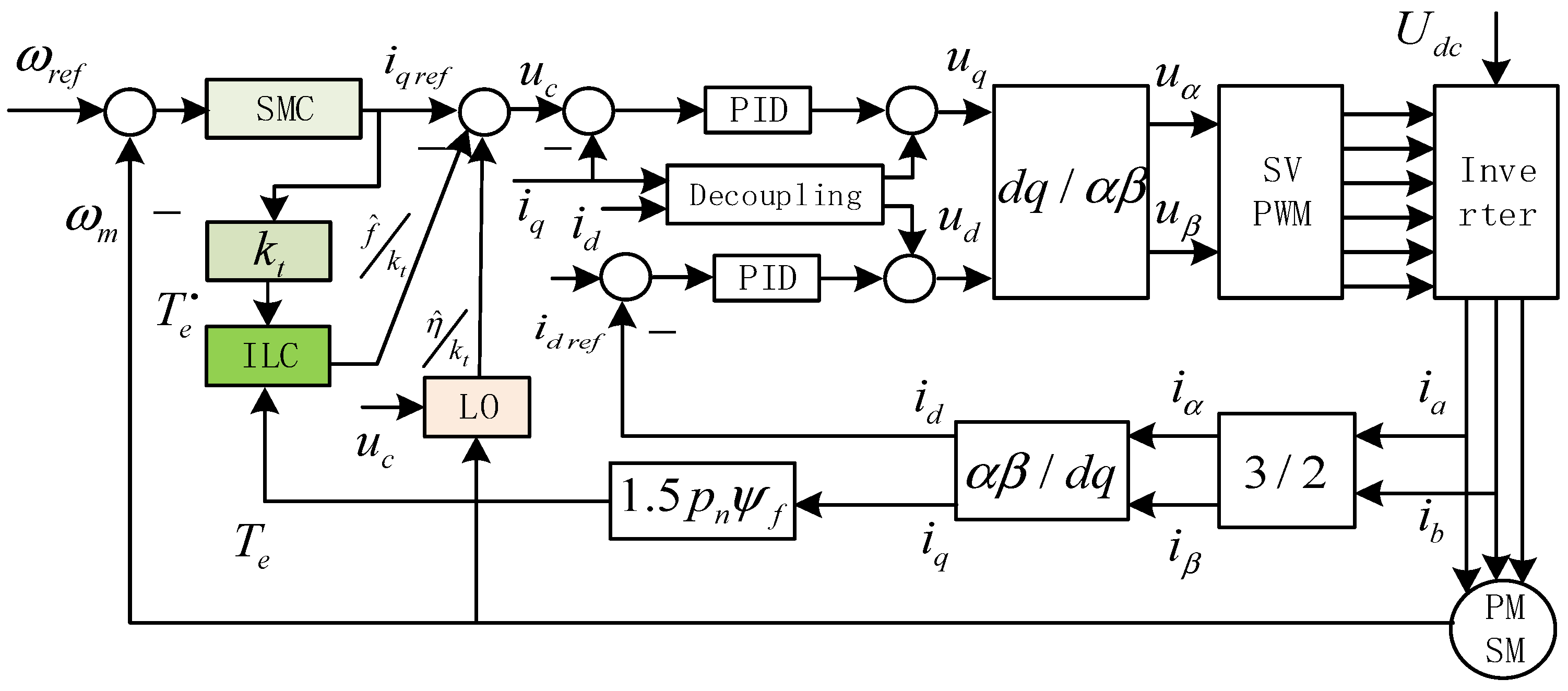
The speed control system for the permanent magnet synchronous motor proposed in this paper consists of a speed loop, a current loop, a periodic pulsation suppressor, and a non-periodic disturbance compensator. The system structure diagram is shown in Figure 1. The speed loop employs a sliding mode variable structure controller, while the current loop uses a PI controller. System uncertainties and external disturbances are mitigated by the sliding mode variable structure and the disturbance compensator, and periodic pulsating torque is suppressed through an iterative learning algorithm.
Decompose load disturbances, parameter variations and harmonic flux, and other factors into periodic disturbance f ( x , t ) and non-periodic disturbance η ( t ) , and Equation (2) can be rewritten as follows:
x · ( t ) = b u c ( t ) + 1 J f ( x , t ) 1 J B ω m ( t ) 1 J η ( t ) y ( t ) = ω m ( t )
where x ( t ) = ω m ( t ) is the system state variable, u c ( t ) = i q ( t ) is the system’s control input, b = 3 p n ψ d 0 2 J = k t J .
Define systematic error as
e ( t ) = ω r e f ω m ( t )
Differentiating both sides of Equation (8) with respect to time t yields
e · ( t ) = ω · r e f ω m · ( t )
An integral sliding mode switching surface is defined as follows:
S ( t ) = e ( t ) + c 0 t e ( τ ) d τ
Differentiating both sides of Equation (10) yields
S ˙ ( t ) = e ˙ ( t ) + c e ( t )
Substituting Equation (7) into Equation (9) yields
e · ( t ) = ω · r e f ω m · ( t ) = ω · r e f ( k t J u c ( t ) B J ω m ( t ) + 1 J f ( x , t ) 1 J η ( t ) )
Substituting Equation (12) into Equation (11) yields
S ˙ ( t ) = e ˙ ( t ) + c e ( t )   = c e ( t ) + ω · r e f [ k t J u c ( t ) B J ω m ( t ) + 1 J f ( x , t ) 1 J η ( t ) ]
Equation (13) is the dynamics of the system sliding surface, since S ˙ ( t ) = 0 means that the system state remains unchanged on the sliding plane, namely the system states enter the sliding mode, the equivalent control rate law u e q ( t ) is obtained by S ˙ ( t ) = 0 .
u e q ( t ) = J k t [ ω · r e f + c e ( t ) + B J ω m ( t ) 1 J f ( x , t ) + 1 J η ( t ) ]
The following exponential sliding mode reaching law is selected.
S ˙ = g 1 S ( t ) g 2 sgn S ( t ) , g 1 , g 2 > 0
The switching control can be obtained as follows:
v ( t ) = S ˙ = g 1 S ( t ) + g 2 sgn S ( t )
From Equation (14) and Equation (16), the sliding mode variable structure controller can be obtained as
u c ( t ) = u e q ( t ) + v ( t ) = J k t [ ω · r e f + c e ( t ) + B J ω m ( t ) 1 J f ( x , t ) + 1 J η ( t ) + v ( t ) ]
In Equation (17), the periodic disturbance f ( x , t ) is replaced by the output f ( x , t ) of iterative learning, and the non-periodic disturbance η ( t ) is replaced by the output η ^ ( t ) of the load observer, then the control law (17) is rewritten as
u c ( t ) = J k t [ ω · r e f + c e ( t ) + B J ω m ( t ) 1 J f ^ ( t ) + 1 J η ^ ( t ) + v ( t ) ]
Substituting Equation (18) into Equation (13) yields
S ˙ ( t ) = c e ( t ) + ω · r e f [ k t J u c ( t ) B J ω m ( t ) + 1 J f ( x , t ) 1 J η ( t ) ]   = c e ( t ) + ω · r e f + B J ω m ( t ) 1 J f ( x , t ) + 1 J η ( t )   [ ω · r e f + c e ( t ) + g 1 S + g 2 sgn ( S ) + B J ω m ( t ) 1 J f ^ ( x , t ) + 1 J η ^ ( t ) ]
Rearranging Equation (19) yields the following:
S ˙ ( t ) = 1 J [ f ^ ( x , t ) f ( x , t ) ] v ( t ) 1 J [ η ^ ( t ) η ( t ) ]

4. Stability Analysis

Theorem 1.
If iterative learning controller output  f ( t )  and load observer output  η ^ ( t )  can be quickly approximated to  f ( t )  and  η ( t ) , the system can be gradually stabilized by using (18) the control law.
Proof. 
Selecting Liapunov’s energy function as V = 1 2 S 2 > 0 , the difference between functions V ( k ) and V ( k 1 ) is
V ( t ) = 1 2 S k 2 ( t ) 1 2 S k 1 2 ( t )
The differential of Lyapunov energy function is expressed as
d d t ( 1 2 S k 2 ( t ) ) = S k ( t ) S ˙ k ( t )
From Equations (21) and (22), it can be obtained as
V ( t ) = 0 t S ( τ ) S ˙ ( τ ) d τ 1 2 S k 1 2 ( t )
Equation (20) can be brought into Equation (23) to be obtained as
V ( t ) = 0 t S ( τ ) 1 J f ˜ ( τ ) ( g 1 S ( τ ) + g 2 sgn S ( τ ) ) 1 J η ˜ ( τ ) d τ 1 2 S k 1 2 ( t )
where f ˜ ( τ ) = f ^ ( x , t ) f ( x , t ) , η ˜ ( τ ) = η ^ ( t ) η ( t ) .
Rearranging Equation (24) yields
V ( t ) 1 J 0 t [ S ( τ ) f ˜ ( τ ) J g 1 S 2 ( τ ) J g 2 S ( τ ) S ( τ ) η ˜ ( τ ) ] d τ
From Equation (25), it can be seen that if the output of the iterative learning controller is f ( t ) = f ( t ) f ˜ ( t ) = 0 and the output of the load observer is η ^ ( t ) = η ( t ) η ˜ ( t ) = 0 , then Equation (25) can be rewritten as
V ( t ) 0 t [ g 1 S 2 ( τ ) g 2 S ( τ ) ] d τ 0
The proof of Theorem 1 is completed. □

4.1. Convergence Analysis of Iterative Learning Controller

When the current loop is implemented with decoupling and a PID controller, the closed-loop equivalent transfer function of the current loop [18,19] is
i d ( s ) u c ( s ) = k c s + k c
where k c is the current loop gain. When the pulsating torque is not considered, the relationship between the electromagnetic torque T e and i q is T e = k t i q ( s ) , then
T e = k t k c s + k c u c ( s ) = ϕ ( s ) u c ( s )
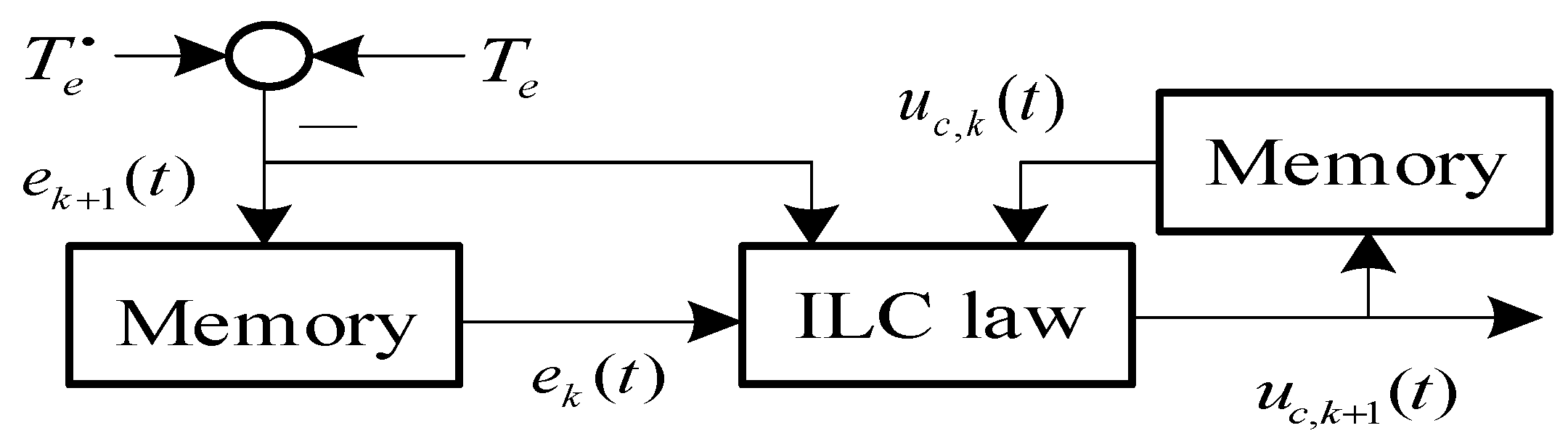
Due to current sampling errors, magnetic flux harmonics, and other factors, periodic pulsating torque is inevitable. To suppress this periodic pulsating torque, this paper proposes a composite-type iterative learning control (ILC) with a forgetting factor. The iterative learning control block diagram is shown in Figure 2, and the learning law is presented in Equation (29).
u c , k + 1 ( s ) = [ 1 α ( k ) ] u c ( s ) + Γ e k ( s ) + L e k + 1 ( s )
Theorem 2.
The composite iterative learning control law (29) is applied to the system (28), and the appropriate learning gains  Γ  and  L  are selected. If spectral radius  ρ = 1 ϕ ( s ) Γ 1 + ϕ ( s ) L < 1  is satisfied, there always exists an input sequence such that  lim k e ( k ) 0 .
Proof. 
By e k + 1 ( s ) = T e · T e , substituting Equation (29) into Equation (28), it can be obtained as
e k + 1 ( s ) = T e · T e = T e · ϕ ( s ) u c ( s )   = T e · ϕ ( s ) [ ( 1 α ( k ) ) u c ( s ) + Γ e k ( s ) + L e k + 1 ( s ) ]
Rearranging Equation (30) yields
e k + 1 ( s ) = T e · ϕ ( s ) [ ( 1 α ( k ) ) u c ( s ) + Γ e k ( s ) + L e k + 1 ( s ) ]   = T e · ϕ ( s ) u c ( s ) + ϕ ( s ) α ( k ) u c ( s ) ϕ ( s ) Γ e k ( s ) ϕ ( s ) L e k + 1 ( s )   = e k ( s ) ϕ ( s ) Γ e k ( s ) ϕ ( s ) L e k + 1 ( s ) + ϕ ( s ) α ( k ) u c ( s )
Arranging Equation (31) as
e k + 1 ( s ) = 1 ϕ ( s ) Γ 1 + ϕ ( s ) L e k ( s ) + ϕ ( s ) α ( k ) 1 + ϕ ( s ) L u c ( s )
Taking the absolute value of both sides of Equation (32) gives
e k + 1 ( s ) 1 ϕ ( s ) Γ 1 + ϕ ( s ) L e k ( s ) + ϕ ( s ) α ( k ) 1 + ϕ ( s ) L u c ( s )
When k is very large, the forgetting factor α ( k ) 0 , then Equation (33) can be written as
e k + 1 ( s ) 1 ϕ ( s ) Γ 1 + ϕ ( s ) L e k ( s ) = 1 ϕ ( s ) Γ 1 + ϕ ( s ) L k e 0 ( s ) = ρ k e 0 ( s )
If ρ = 1 ϕ ( s ) Γ 1 + ϕ ( s ) L < 1 , it is known from Equation (34) that e k ( s ) 0 when k , then there exists a control input sequence u c ( s ) that makes the system consensus convergent. □

4.2. Linear Extended State Observer Design

When the periodic pulsating torque in the system is compensated by the iterative learning controller, Equation (7) is rewritten as
y ˙ = F + b u
where F is the total disturbance, F contains B ω m and η ( t ) . Since ω m is measurable, if F can be observed, η ( t ) can be deduced.
Let x 1 = y , x 2 = F , F ˙ = h , then Equation (35) can be written in an expanded state system as follows
x ˙ 1 x ˙ 2 = 0 1 0 0 x 1 F + b 0 u + 0 1 h
The observer is constructed as follows
x ^ ˙ = A x ^ + B 0 u + L o ( y y ^ ) y ^ = C x ^
where A = 0 1 0 0 , B 0 = b 0 , C = 1 0 , L o = l 1 l 2 T .
Arranging Equation (37) gives
x ^ ˙ = ( A L o C ) x ^ + B 0 u + L o y
Substituting A , L o , C and B 0 into Equation (38) gives
x ^ ˙ = ( 0 1 0 0 l 1 l 2 1 0 ) x ^ 1 x ^ 2 + b 0 u + l 1 l 2 y x ^ ˙ = l 1 1 l 2 0 x ^ 1 x ^ 2 + b l 1 0 l 2 u y
l 1 and l 2 in Equation (39) can be obtained by the characteristic roots of the state observer A L o C = l 1 1 l 2 0 , that is
λ I ( A L o C ) = λ + l 1 1 l 2 λ = λ 2 + l 1 λ + l 2 = 0
The system poles are uniformly located at ω 0 , i.e., ( λ + ω 0 ) 2 = 0 , by the following Equation
λ 2 + l 1 λ + l 2 = 0 λ 2 + 2 ω 0 λ + ω 0 2 = 0
It can be obtained that l 1 = 2 ω 0 and l 2 = ω 0 2 , it is clear that if ω 0 > 0 , the observer characteristic root is on the negative real axis, the observer can estimate each state with a certain precision, i.e., x ^ 2 F , and then η ^ ( t ) is obtained.

5. Simulation and Experiments

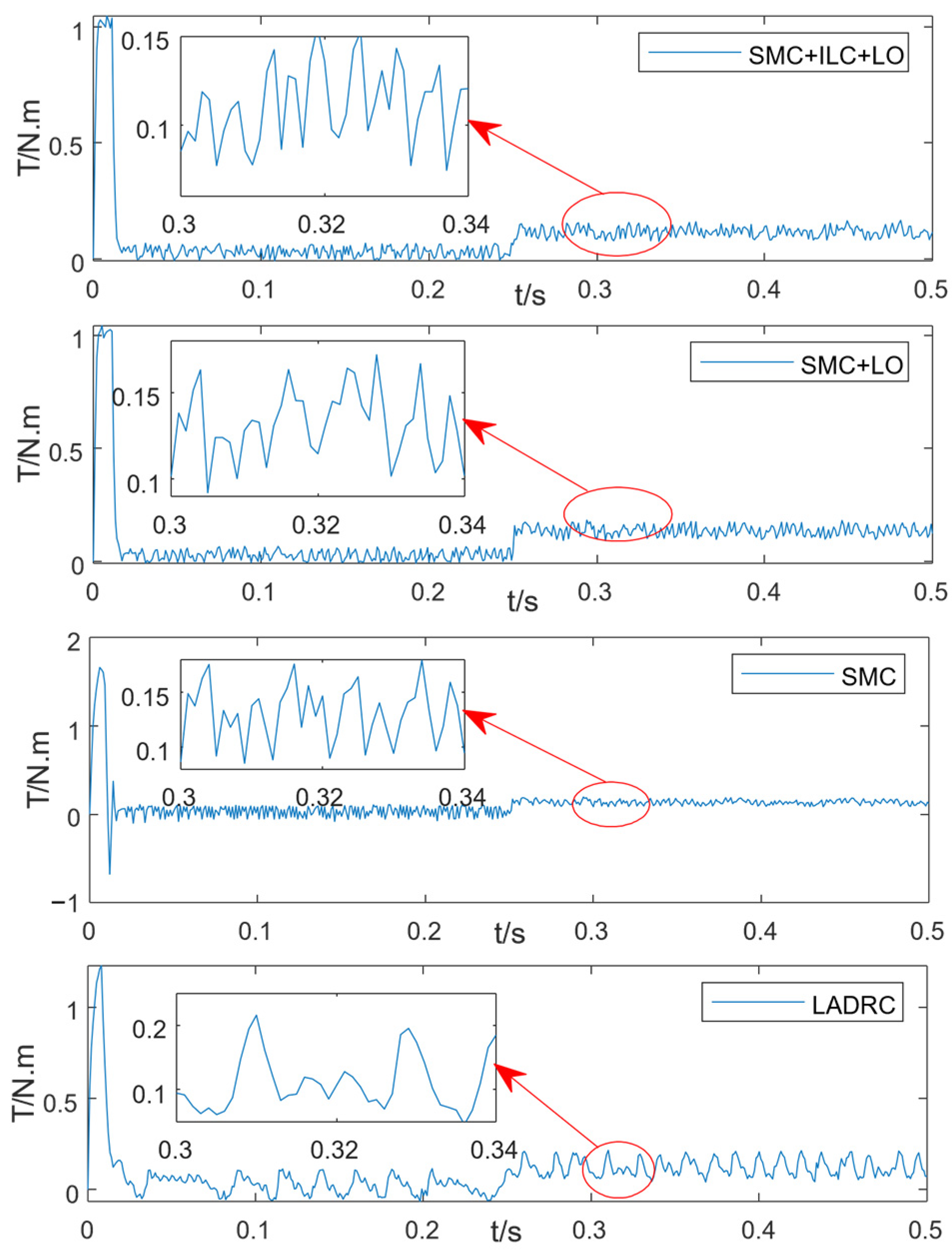
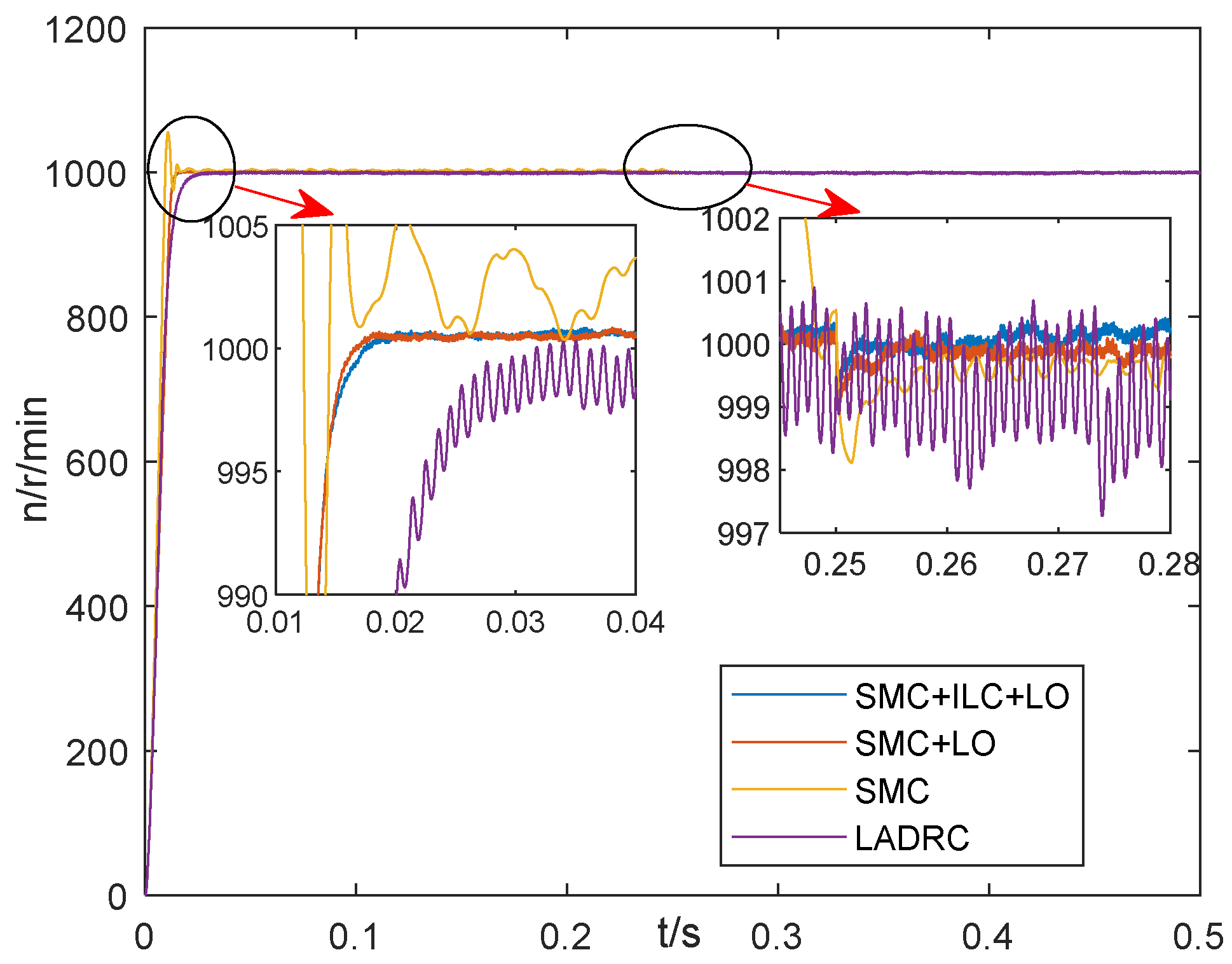
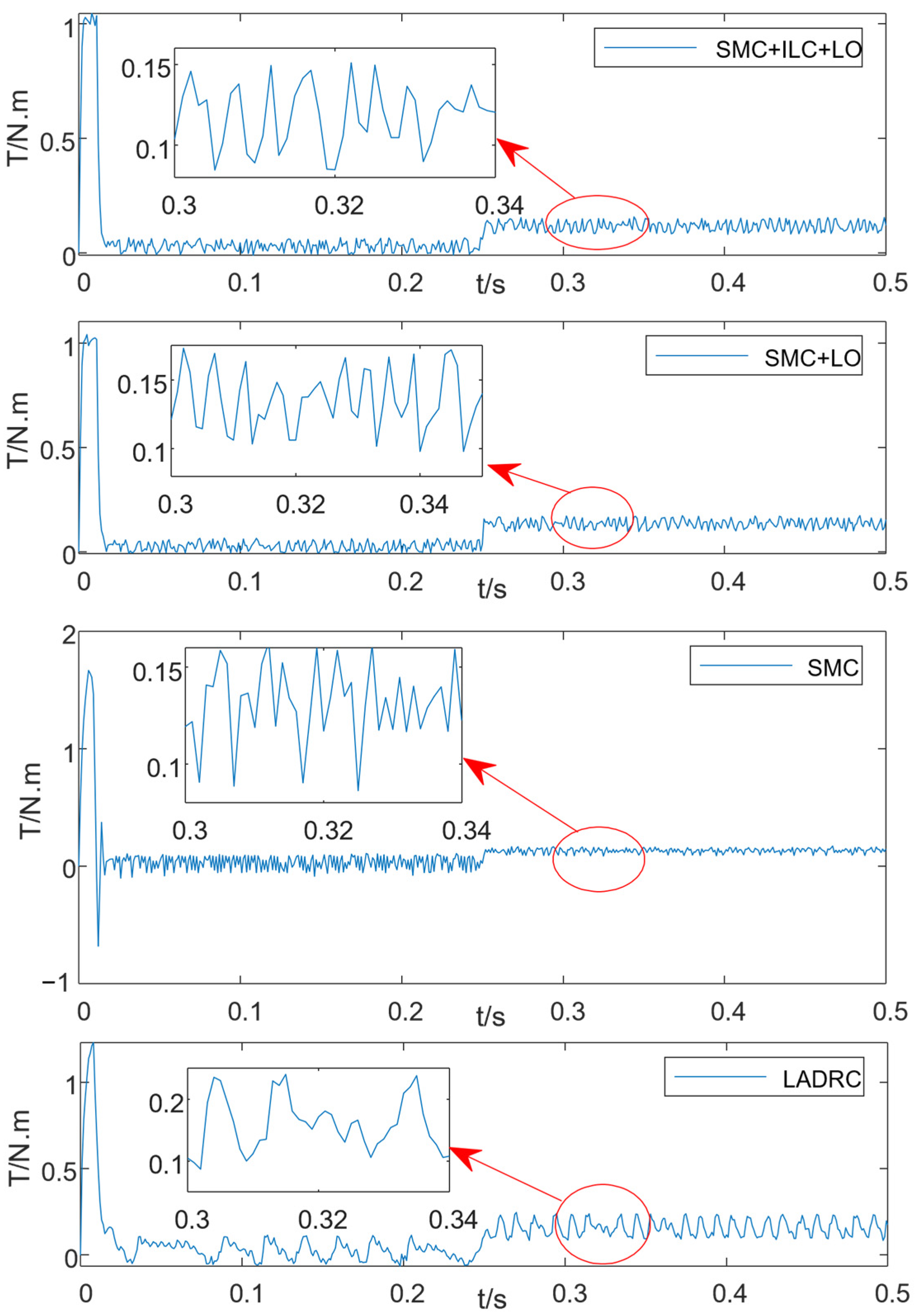
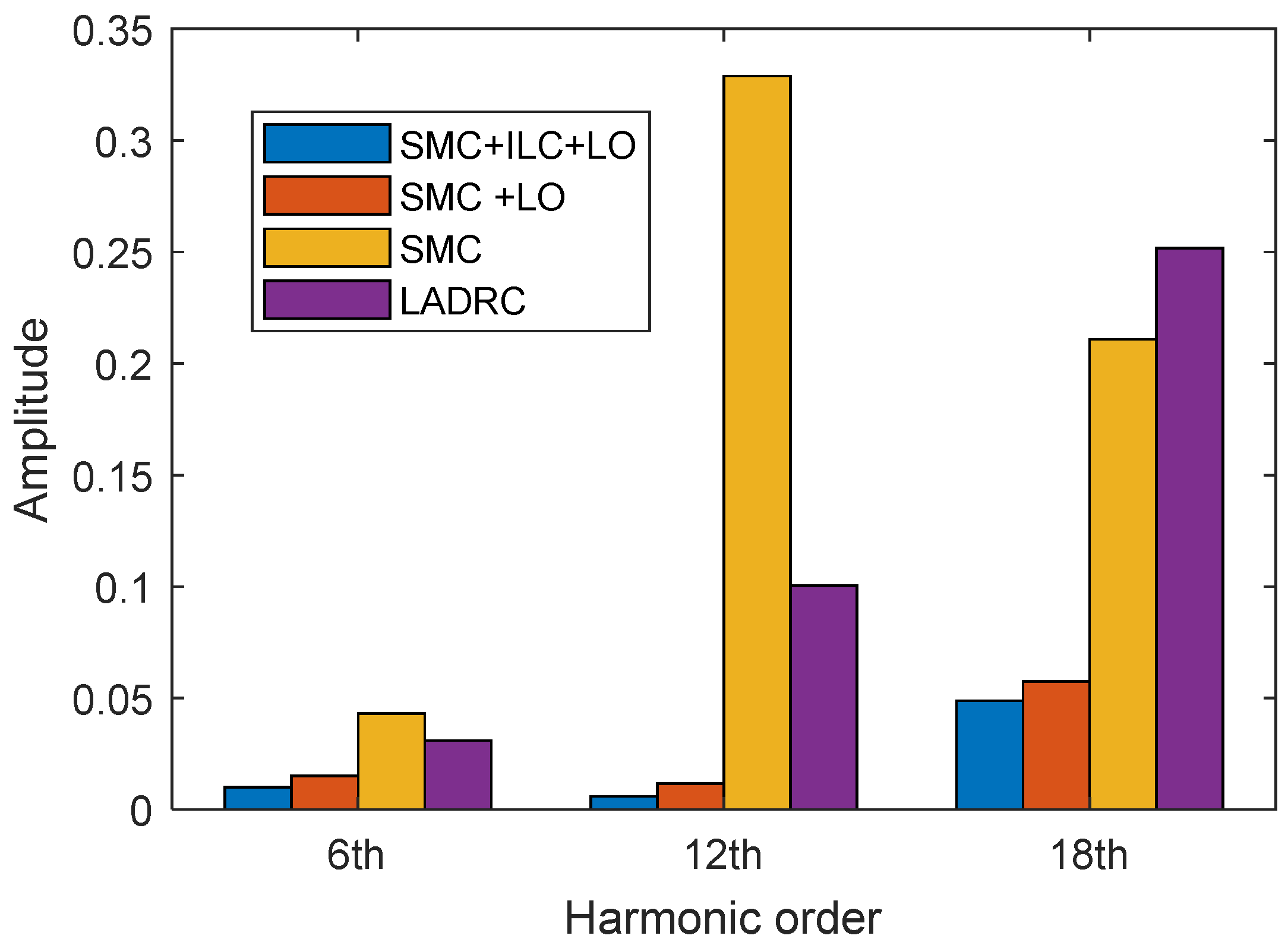
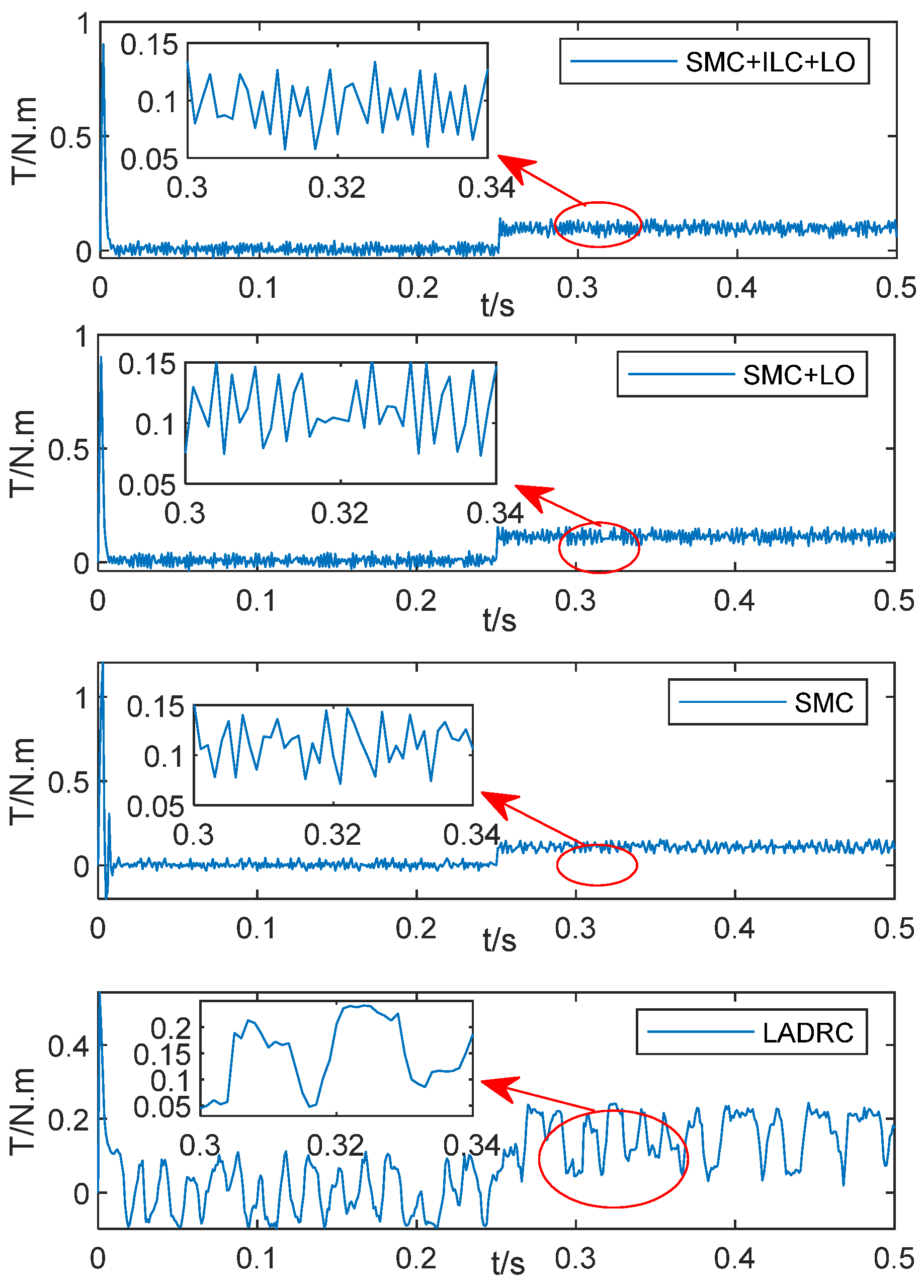
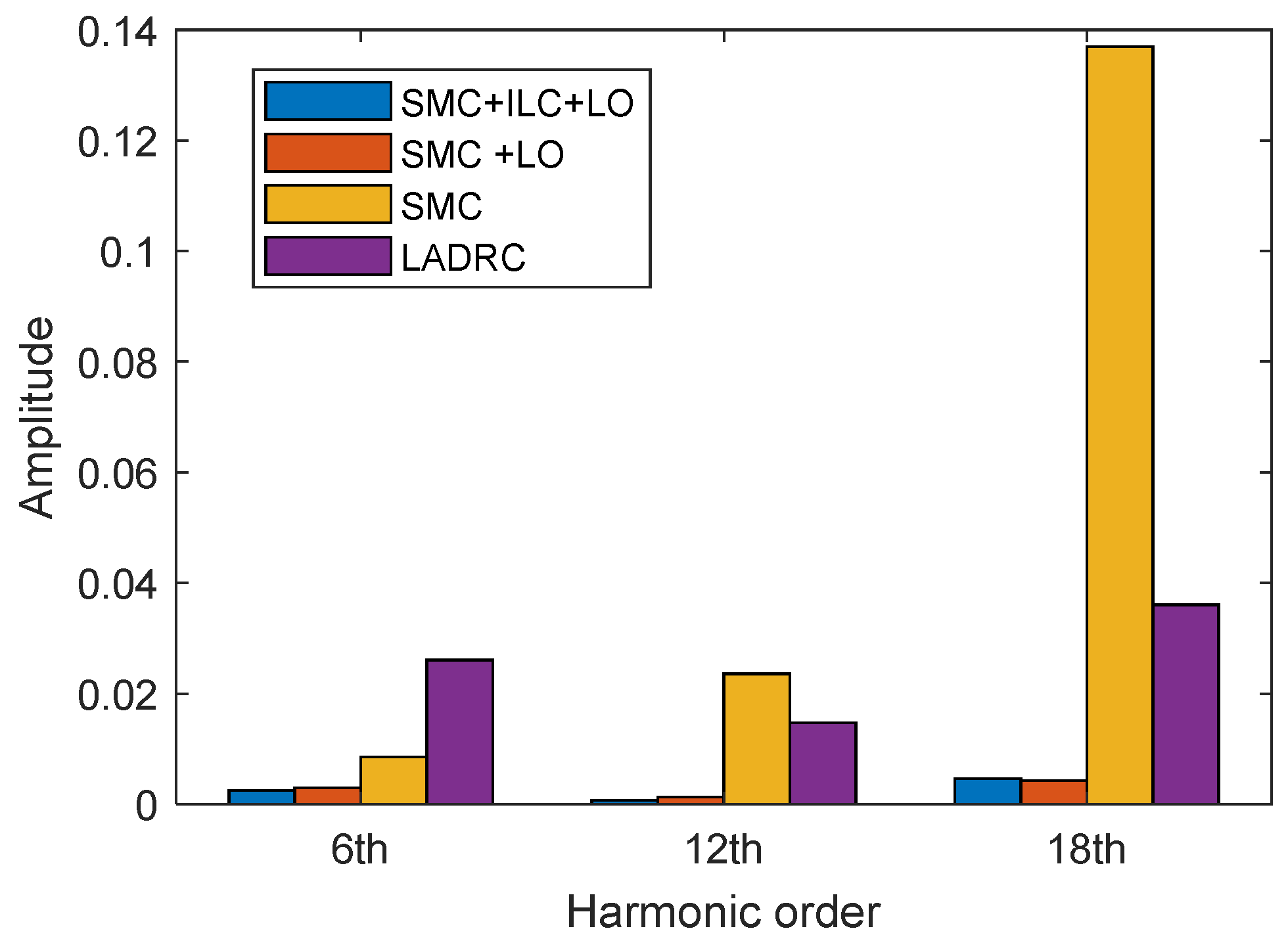
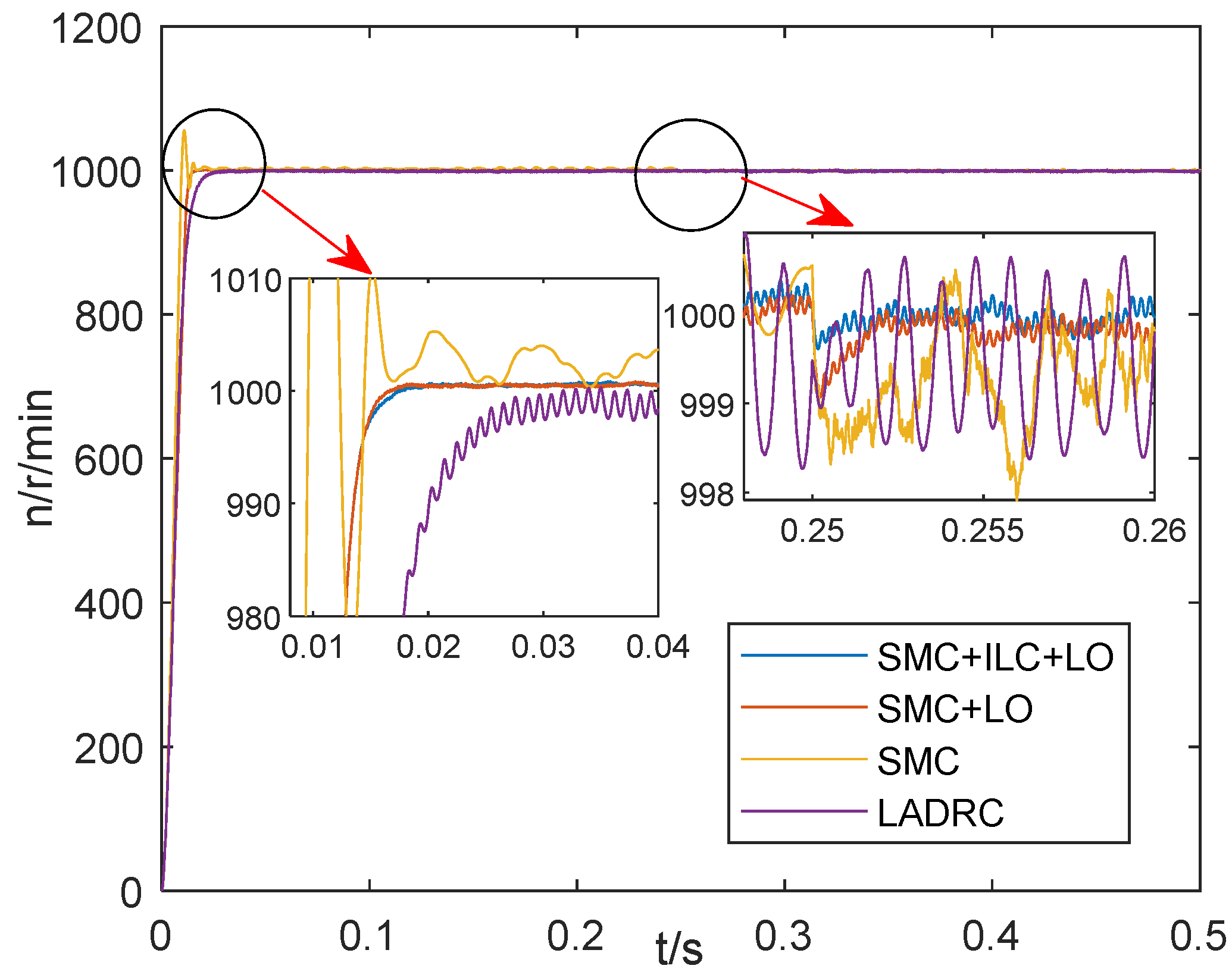
To verify the effectiveness of the proposed control strategy, this paper compares the simulation results of the proposed method with those of SMC, SMC + LO, and ADRC using MATLAB2023a/Simulink. The parameters of the PMSM are listed in Table 1. The desired speed is set at n · = 1000 r / min , and a step load torque disturbance with an amplitude of 0.1 N·m is applied at t = 0.25 s . The speed response curves are shown in Figure 3. It can be observed that, for the control strategy proposed in this paper, the dynamic speed drop is 0.7 r/min with a recovery time of 0.005 s; for the SMC + LO control strategy, the dynamic speed drop is 1 r/min with a recovery time of 0.005 s; for the LADRC strategy, the dynamic speed drop is 1.2 r/min with a recovery time of 0.005 s; and for the SMC strategy, the dynamic speed drop is 1.9 r/min with a recovery time of 0.01 s. As illustrated, the proposed control strategy exhibits a fast speed response and minimal dynamic speed decline. The torque response curves for the four control strategies are presented in Figure 4, while the comparison of torque harmonic amplitudes is in Figure 5. Figure 5 indicates that the 6th, 12th, and 18th harmonic amplitudes of the torque under the proposed control strategy are the smallest. According to the ripple factor calculation formula C t r = T H T 0 (where T 0 is the average torque T H = T 6 2 + T 12 2 + T 18 2 ), the ripple coefficients for the proposed strategy, SMC, SMC + LO, and LADRC are 0.050092, 0.06042, 0.39294, and 0.2728, respectively.
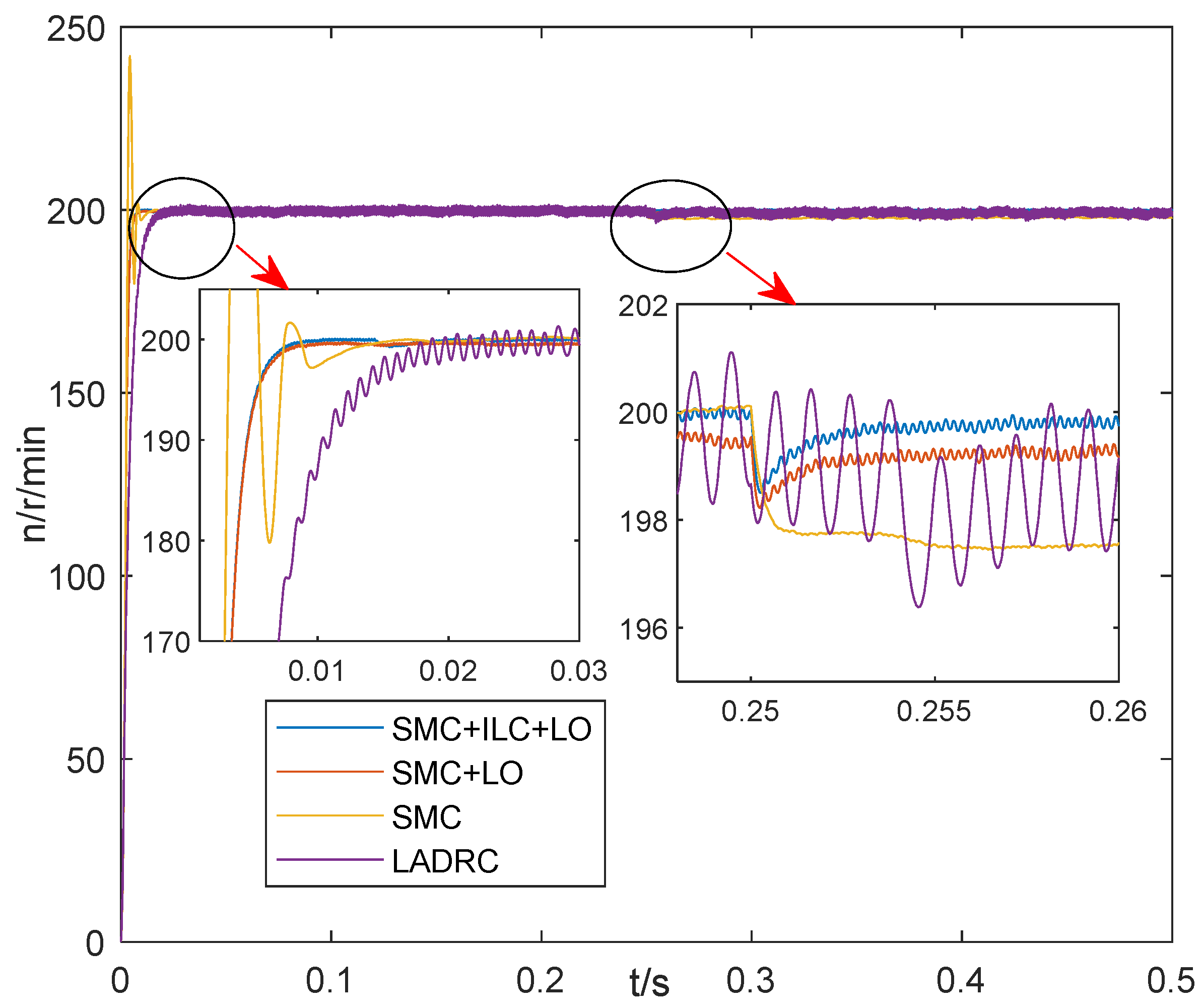
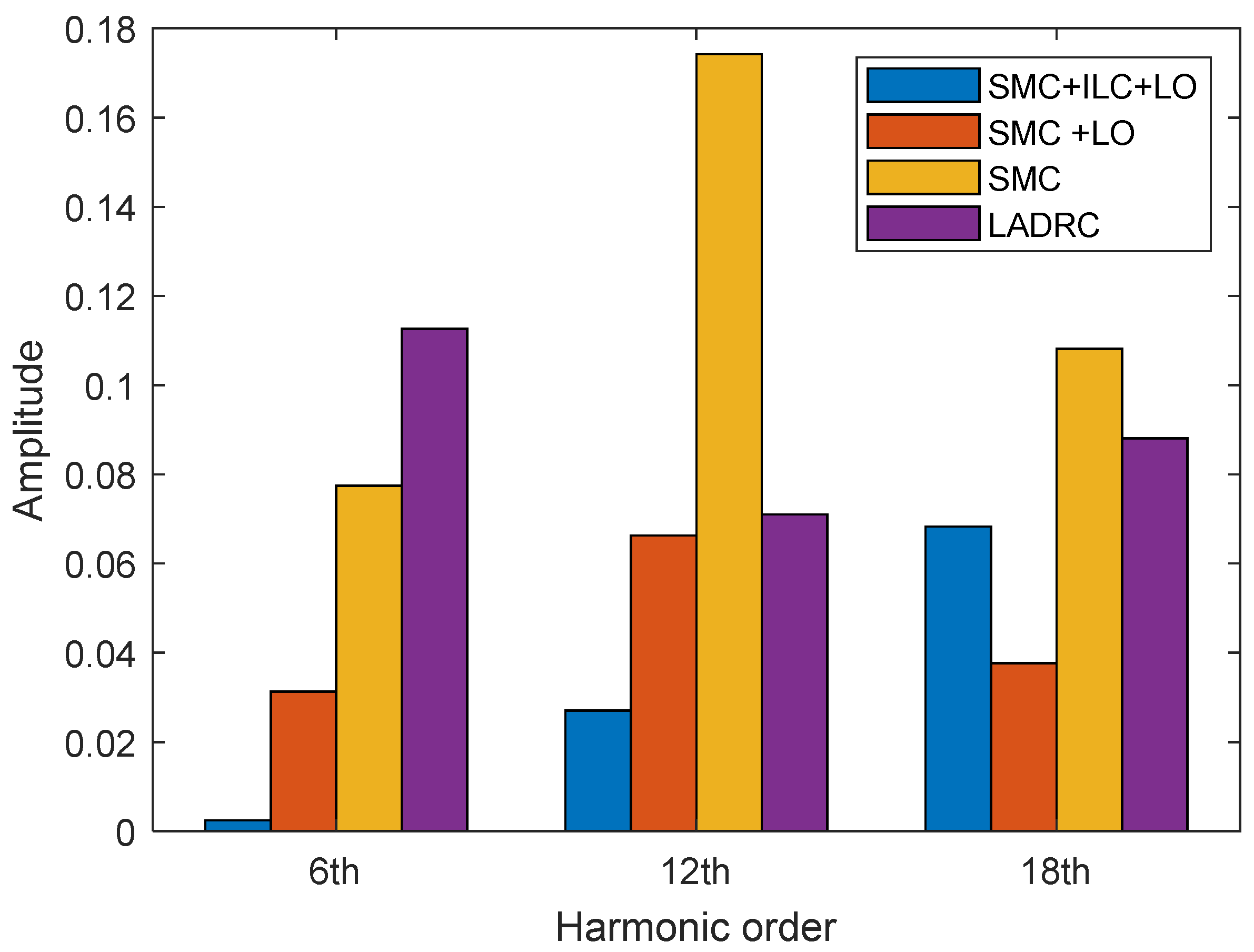
In Figure 6, where the speed expectation value is n · = 200 r / min , a step load torque disturbance with an amplitude of 0.1 N.m is added at t = 0.25 s , the speed response curves of the proposed strategy are compared with SMC, SMC + LO and LADRC. From Figure 6, it can be observed that, for the control strategy proposed in this paper, the dynamic speed drop is 1.5 r/min, with a recovery time of 0.004 s, which is the shortest among all strategies. For the SMC + LO control strategy, the dynamic speed drop is 1.7 r/min; for the LADRC strategy, it is 2 r/min; and for the SMC strategy, it is 2.2 r/min. it can be seen that the SMC has a large overshoot, a long regulation time, and a large dynamic speed drop, speed ripple of LADRC is large, and although the SMC + LO has a good response speed and dynamic speed, it is still not as good as control effect of the control strategy proposed in this paper. The torque response curves of the four control strategies are shown in Figure 7, and the comparison results of the torque harmonics amplitude are shown in Figure 8. As can be seen from Figure 8,the harmonics of the control strategy proposed in this paper are all less than SMC and LADRC, the amplitude of the 18th harmonic of the control strategy proposed in this is greater than that of the 18th harmonic of SMC + LO, but the 6th and 12th harmonics are both less than those of SMC + LO, According to the ripple factor calculation formula, the ripple factor C t r of the control strategy proposed in this paper and SMC + LO, SMC, LADRC are respectively 0.0052612, 0.0053725, 0.13927 and 0.04684.
Figure 9 shows the speed response curve of the proposed strategy and SMC and SMC + LO and LADRC for the speed expectation value of n · = 1000 r / min and adding a load torque disturbance of 0.05 sin 200 t + 0.1 N.m at t = 0.25 s , Figure 9 shows that the dynamic speed drop for the control strategy proposed in this paper is 0.4 r/min, compared to 1.01 r/min for the SMC + LO strategy, 1.05 r/min for the LADRC strategy, and 1.6 r/min for the SMC strategy. Additionally, the proposed control strategy achieves a minimum recovery time of only 0.002 s. These results clearly demonstrate that the proposed control strategy features a smaller dynamic speed drop and a shorter recovery time.The torque response curves of the four control strategies are shown in Figure 10, and the comparison results of the torque harmonics amplitude are shown in Figure 11, the ripple factors C t r of the control strategy proposed in this paper and SMC + LO, SMC, LADRC are respectively 0.07612, 0.08243, 0.21916 and 0.15964.
It can be seen from the above simulation results that when the load disturbance of 0.1 N.m is added, the torque ripple coefficient of the control strategy in this paper is 97.9% of SMC + LO, 3.8% of SMC, and 11.2% of LADRC. After the load disturbance of 0.05 sin 200 t + 0.1 N.m is added, the torque ripple coefficient of the control strategy in this paper is 92% of SMC+ LO, 34% of SMC, and 47% of LADRC; it can be seen from the numerical values that the proposed control strategy in this paper has fast speed response, no overshoot, good disturbance resistance, and a small torque ripple coefficient.
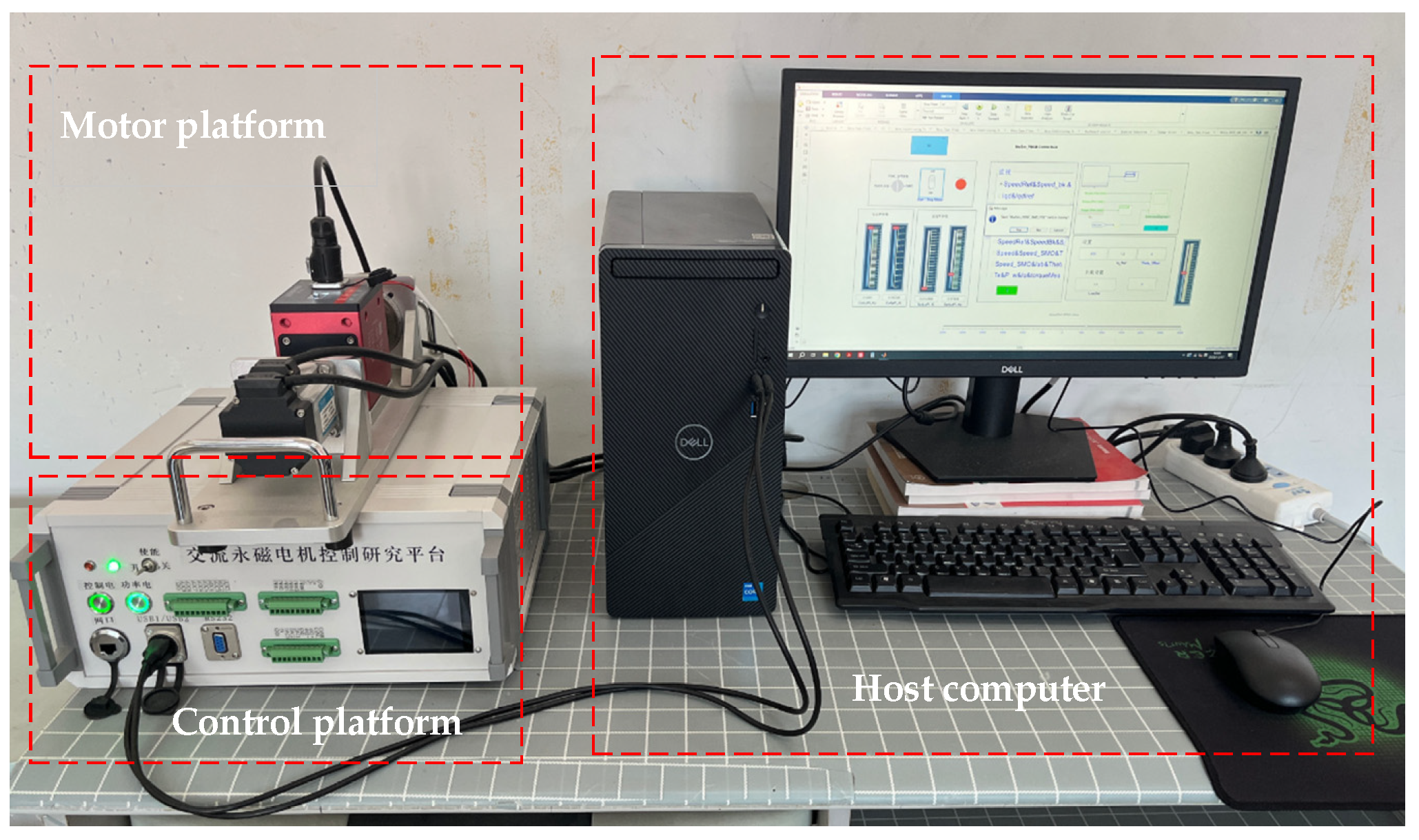
To verify the effectiveness of the control algorithm proposed in this paper, a permanent magnet synchronous motor speed control hardware platform, centered on the DSP2837D, was established. The experimental setup is shown in Figure 12. To verify the relationship between harmonics and rotational speed, experiments were conducted at rotational speeds of n · = 1200 r / min , n · = 800 r / min , and n · = 200 r / min , respectively. Since the system remains in the regulation phase during the dynamic process, analyzing harmonics in this phase holds little significance. Therefore, harmonic analysis was performed only during steady-state experiments at the rotational speed of i q .
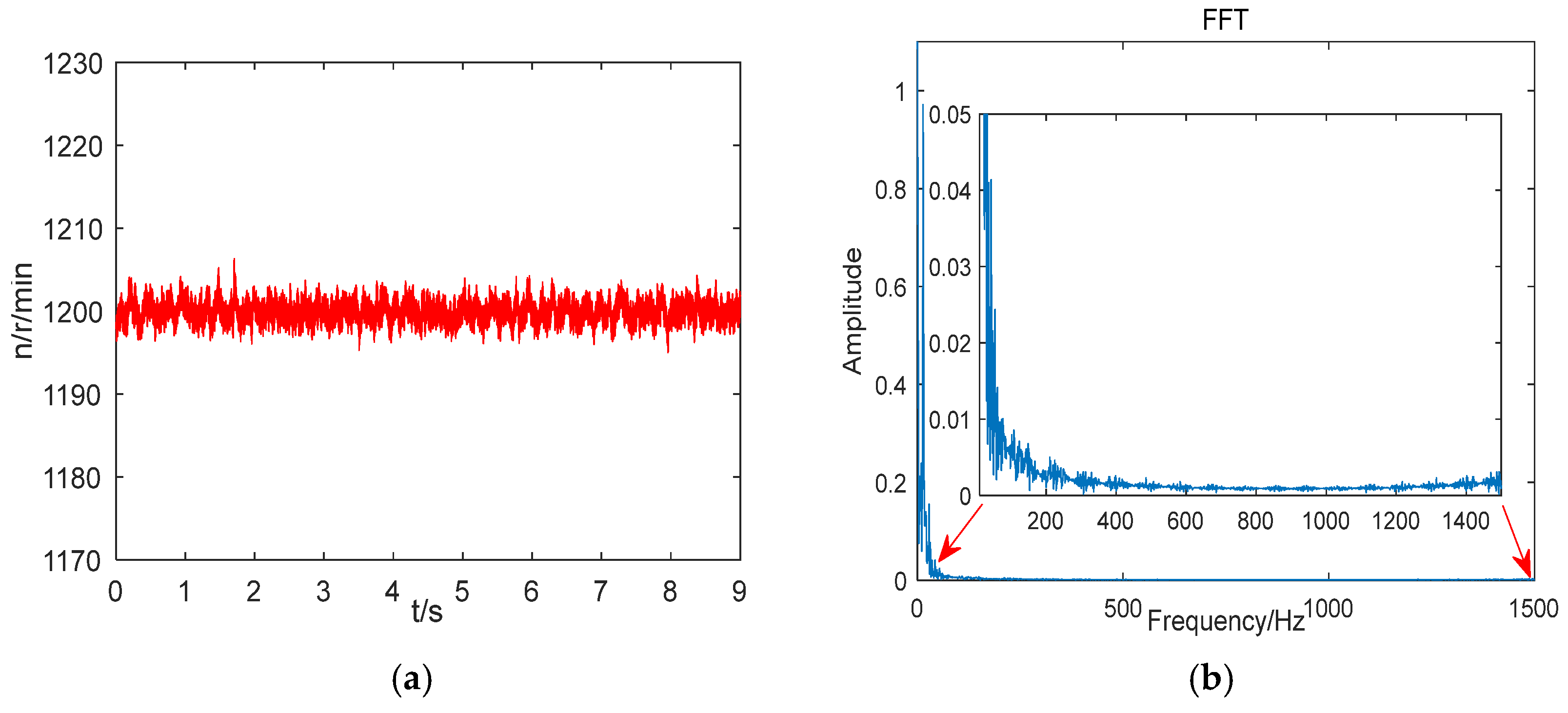
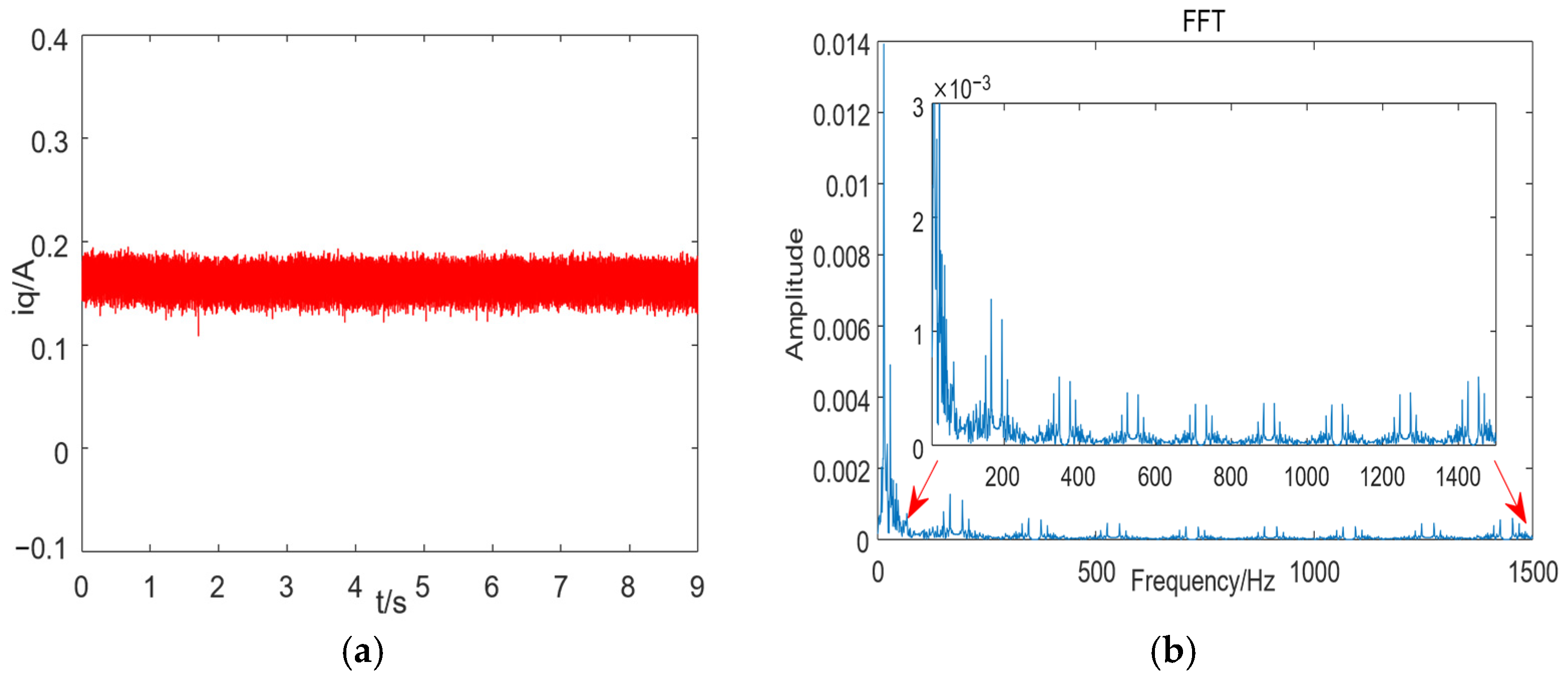
Figure 13 shows the speed response curves and the corresponding Fourier analysis of the speed when the control strategy proposed in this paper is applied, with a load torque of 0.1 N·m added and when the given speed is n · = 1200 r / min . Figure 14 presents the current response curves of the q-axis and its corresponding Fourier analysis.
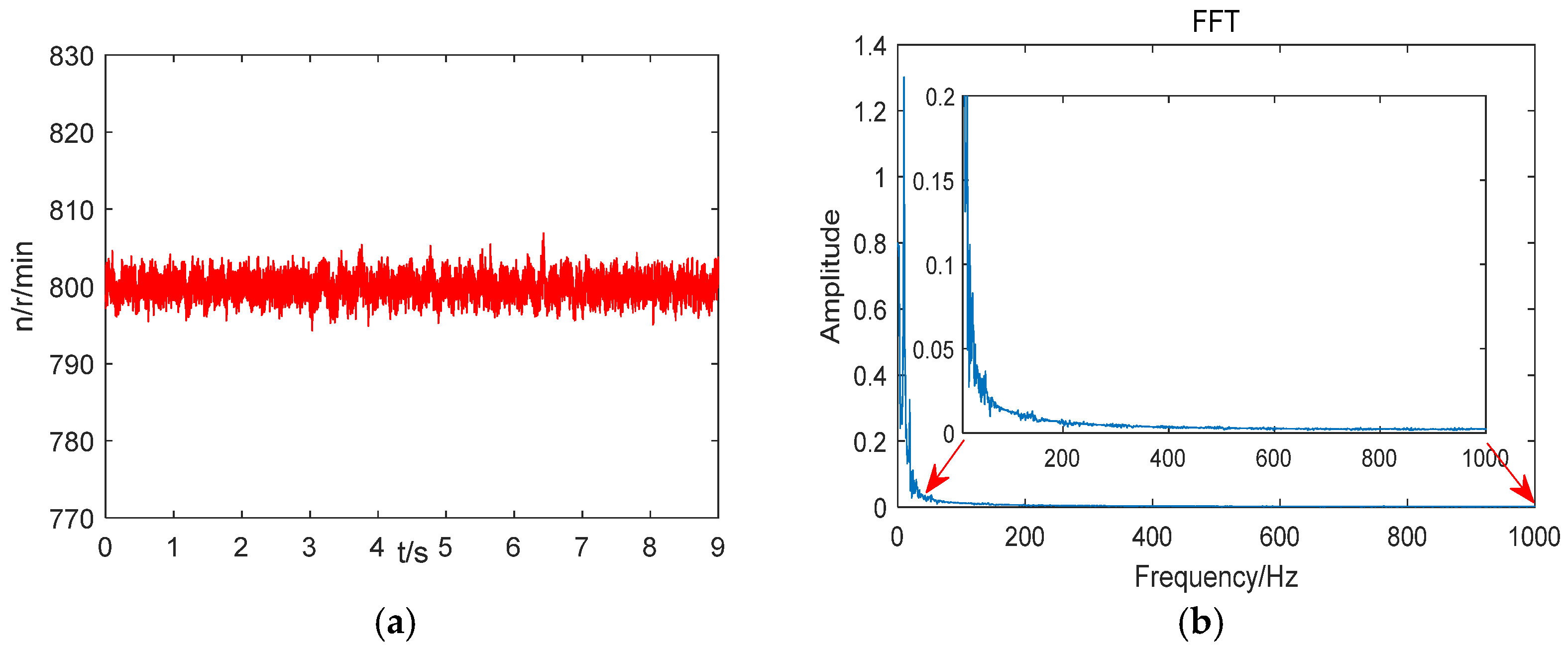
Figure 15 shows the speed response curves and the corresponding Fourier analysis of the speed when the control strategy proposed in this paper is applied, with a load torque of 0.1 N·m added and when the given speed is n · = 800 r / min . Figure 16 presents the current response curves of the q-axis and its corresponding Fourier analysis.
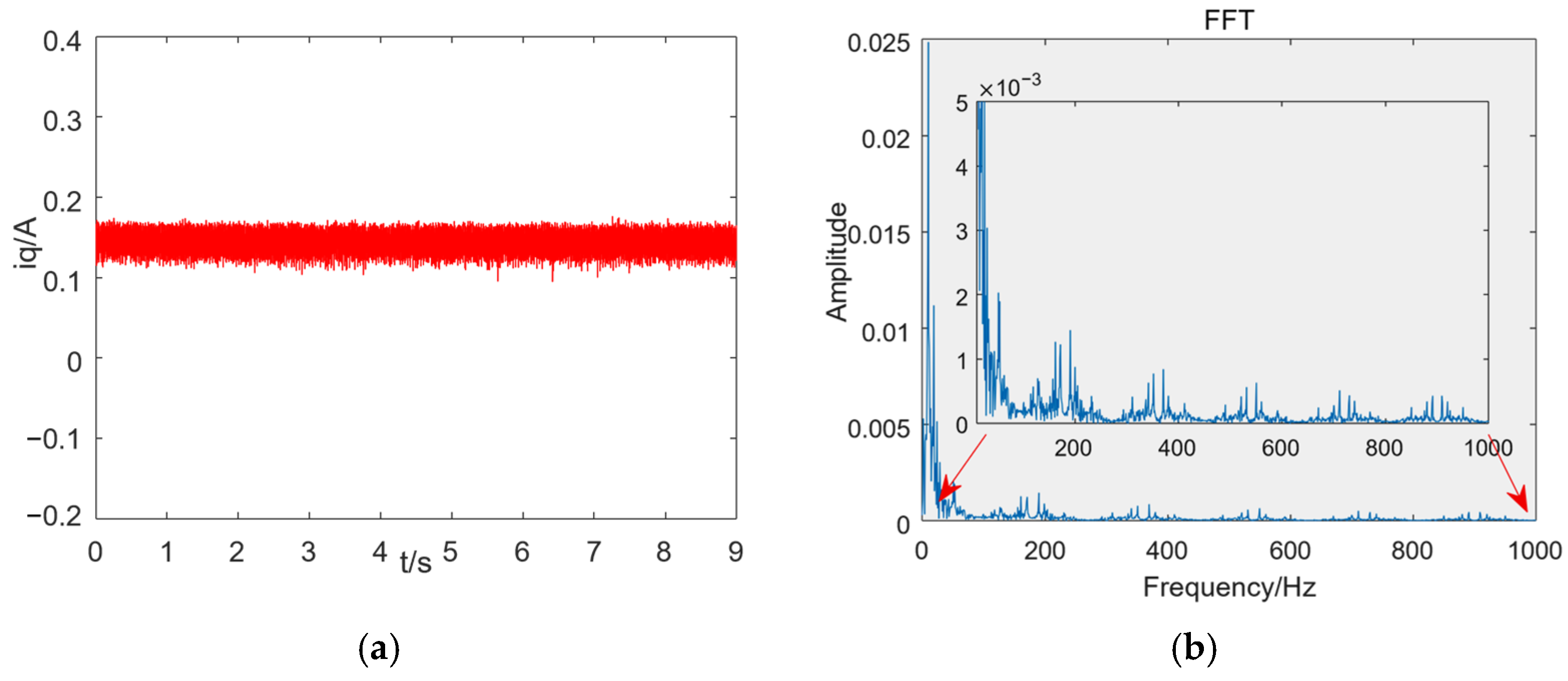
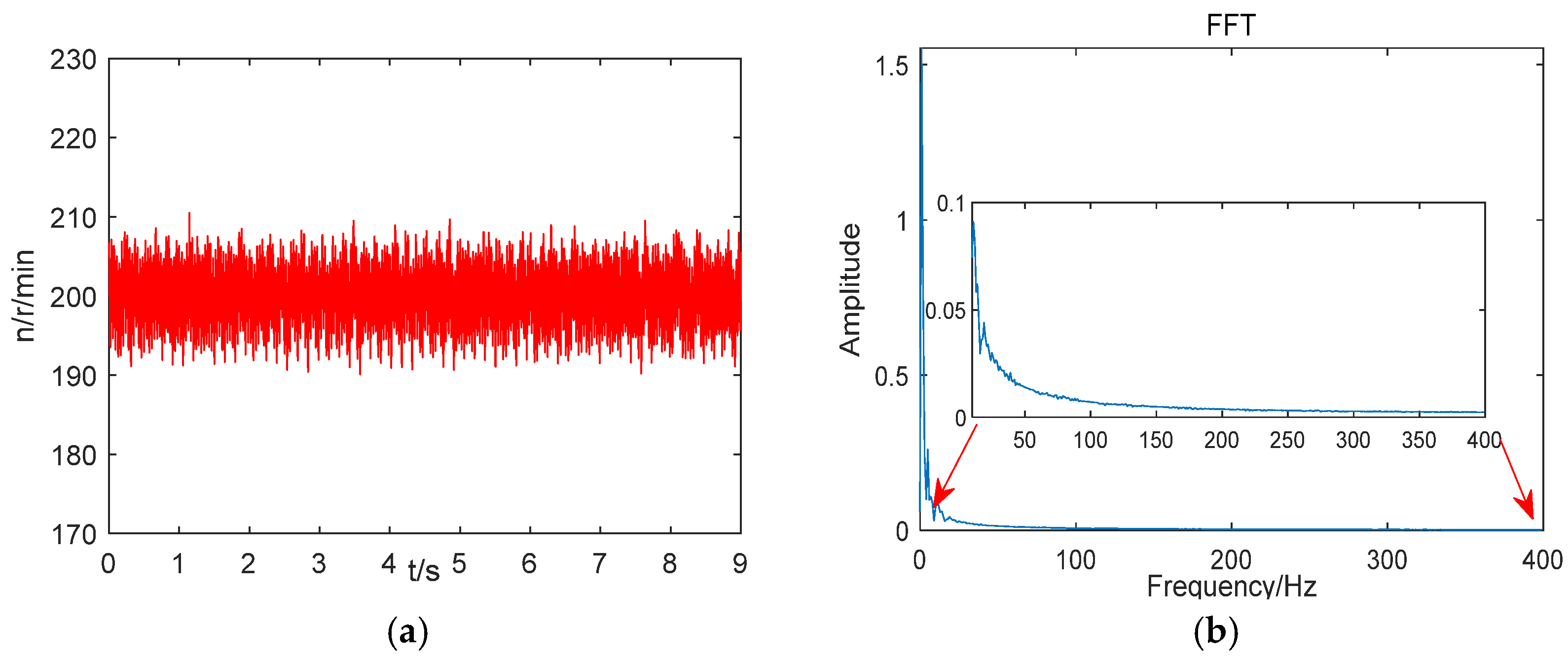
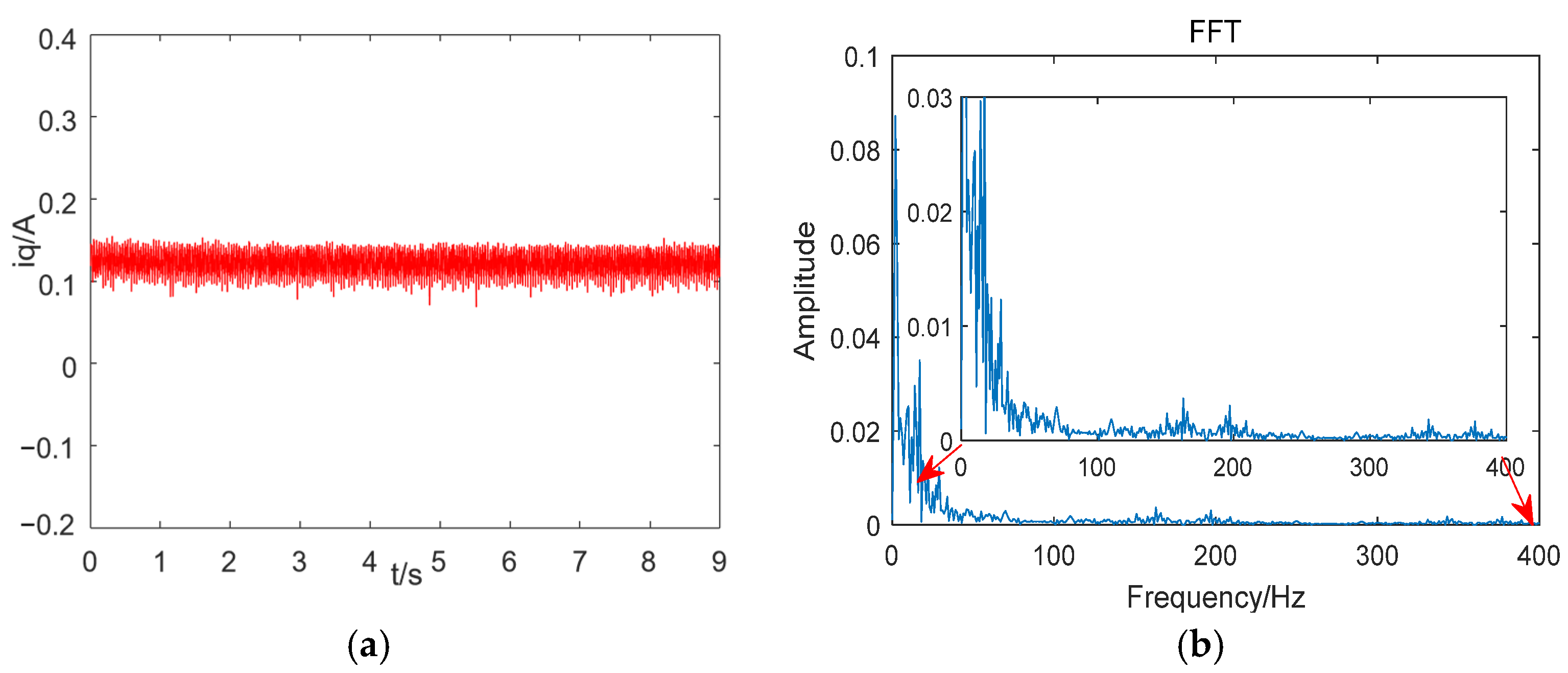
Figure 17 shows the speed response curves and the corresponding Fourier analysis curves when the control strategy proposed in this paper is applied. A load torque of 0.1 N·m is added, and the reference speed is n · = 200 r / min . Figure 18 presents the current response curves of the q-axis and its Fourier analysis curves.
From the speed and current i q response curve, it can be seen that when n · = 1200 r / min , the speed fluctuation range is less than ±5 r / min , the i q fluctuation range is less than ±0.03 A, when the speed fluctuation range is less than ±6 r / min , the i q fluctuation range is less than ±0.03 A, when n · = 200 r / min , the speed fluctuation range is less than ±9 r / min , the i q fluctuation range is less than ±0.034 A; it can be seen that the higher the speed, the smaller the range speed fluctuation, and the i q fluctuation range is also small. In addition, from the speed Fourier analysis curve and the current i q Fourier analysis curve, it can be seen that harmonic amplitudes also decrease with the increase in speed.
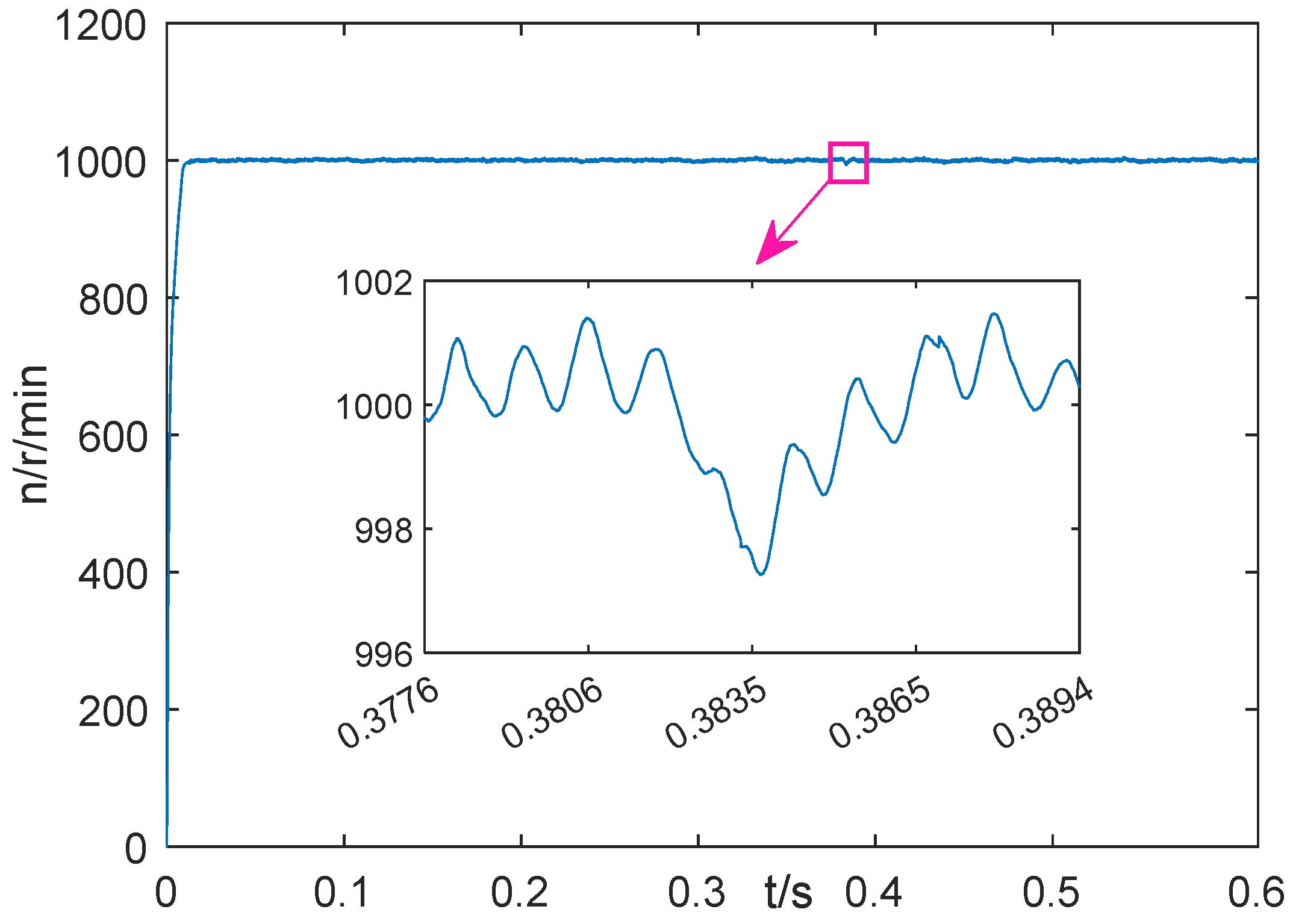
To verify the system’s tracking and disturbance rejection performance, dynamic experiments were conducted with the desired rotational speed set to n · = 1000 r / min . A sudden disturbance was applied after the system stabilized. The dynamic speed response curves are shown in Figure 19.
As can be seen from Figure 19, the system response is fast, has good robustness, without overshoot, with a small dynamic speed drop, and short recovery time. In summary, the control strategy proposed in this paper has better dynamic performance, static performance, and disturbance rejection performance.

6. Conclusions

Aiming to address the suppression of periodic and non-periodic disturbances in the operation of PMSMs, a sliding mode variable structure control method with iterative learning compensation and torque compensation is proposed. The periodic pulsating torque is suppressed through iterative learning control of the compensating torque current command, while non-periodic disturbances are detected using a linear extended state observer and converted into current to counteract these disturbances. This approach minimizes torque fluctuations and enhances the anti-interference capability of the PMSM speed control system. The effectiveness of the proposed scheme is demonstrated through numerical simulations and experimental validation.

Author Contributions

Conceptualization, D.L. and N.Z.; methodology, D.L. and G.Q.; software, G.Q.; validation, N.Z. and Y.C.; writing—original draft, N.Z. and G.Q.; writing—review and editing, Y.C. All authors have read and agreed to the published version of the manuscript.

Funding

This work was supported by the Science and Technology Research Project of the Education Department of Jilin Province (JJKH20240084KJ and JJKH20261143KJ).

Data Availability Statement

Data are contained within the article.

Conflicts of Interest

The authors declare no conflicts of interest.

References

  1. Li, X.; Xue, Z.; Zhang, L.; Hua, W. A low-complexity three-vector-based model predictive torque control for SPMSM. IEEE Trans. Power Electron. 2021, 36, 13002–13012. [Google Scholar] [CrossRef]
  2. Yang, S.; Chu, Z.; Fang, J.; Xie, Z. Suppression strategy of PMSM torque ripples directly based on harmonic EMF orientation. Electr. Mach. Control 2022, 26, 68–80. [Google Scholar]
  3. Tuyen, T.T.; Yang, J.; Liao, L.; Thao, N.G.M. Recent Advances in Sliding Mode Control Techniques for Permanent Magnet Synchronous Motor Drives. Electronics 2025, 14, 3933. [Google Scholar] [CrossRef]
  4. Nicola, M.; Nicola, C.I.; Selișteanu, D.; Șendrescu, D. Rapid control prototyping of sensorless control system for PMSM based on multi-agent reinforcement learning and fractional order sliding mode control. Eng. Sci. Technol. Int. J. 2025, 66, 102054. [Google Scholar] [CrossRef]
  5. Beato, A.; Brasili, E.; Fagnano, L.; Gulesin, R.N.; Ippoliti, G. Sliding mode sensorless control of a PMSM on a domestic dishwasher: An experimental comparison test with the on-board PI controller. Int. J. Dyn. Control 2025, 13, 246. [Google Scholar] [CrossRef]
  6. Khowja, M.R.; Singh, K.; La Rocca, A.; Vakil, G.; Ramnathan, R.; Gerada, C. Fault-tolerant dual channels three-phase PMSM for aerospace applications. IEEE Access 2024, 12, 126845–126857. [Google Scholar] [CrossRef]
  7. Li, H.; Guo, Y.; Xu, Q. PMSM Torque Ripple Suppression Method Based on SMA-Optimized ILC. Sensors 2023, 23, 9317. [Google Scholar] [CrossRef] [PubMed]
  8. Xu, X.; Zhang, B.; Wu, J. Research on Synergistic Reduction of Cogging Torque and Ripple Torque of Interior Permanent Magnet Synchronous Motor Based on Magnetic Field Harmonic Offset Method. Electronics 2023, 12, 3499. [Google Scholar] [CrossRef]
  9. Bucolo, M.; Buscarino, A.; Famoso, C.; Fortuna, L.; Gagliano, S. Imperfections in integrated devices allow the emergence of unexpected strange attractors in electronic circuits. IEEE Access 2021, 9, 29573–29583. [Google Scholar] [CrossRef]
  10. Abolfazl, K.; Hamidreza, A.; Somaye, M.; Zohre, B. Design of an adaptive terminal sliding mode to control the PMSM chaos phenomenon. Syst. Sci. Control. Eng. 2023, 11, 2207593. [Google Scholar] [CrossRef]
  11. Zhang, W. A Robust and Observer-Based Control Algorithm for Permanent Magnet Synchronous Motor Drive Systems Based on H-Infinity Performance. J. Electr. Eng. Technol. 2025, 1–12. [Google Scholar] [CrossRef]
  12. Li, H.; Xie, W. A robust state-feedback speed control of permanent magnet synchronous motors drawing on H infinity performance and Luenberger observation. Int. J. Dyn. Control 2025, 13, 308. [Google Scholar] [CrossRef]
  13. Liao, Y.; Zhen, S.; Liu, R.; Yao, J. Torque ripple suppression of high-speed permanent magnet synchronous motors with the harmonic injection. Zhongguo Dianji Gongcheng Xuebao/Proc. Chin. Soc. Electr. Eng. 2011, 31, 119–127. [Google Scholar]
  14. Zuo, Y.; Tan, J.; Zhao, C.; Wang, H.; Lee, C.H.T.; Yang, J. Frequency Adaptive Torque Ripple Suppression for Electrical Drives Using Radial Basis Function Neural Network. In Proceedings of the 2023 26th International Conference on Electrical Machines and Systems, Zhuhai, China, 5–8 November 2023; IEEE: New York, NY, USA, 2023; pp. 5209–5214. [Google Scholar]
  15. Li, K.; Yang, E.; Li, J.; Xin, Z. Direct Torque Control Optimization of Permanent MagnetSynchronous Motor Based on Heavy-Duty AGV. Manuf. Autom. 2025, 47, 27–33. [Google Scholar]
  16. Feng, Y.; Han, F.; Yu, X. Chattering free full-order sliding-mode control. Automatica 2014, 50, 1310–1314. [Google Scholar] [CrossRef]
  17. Xu, Y.; Huang, Z.; Liu, D. Research on Position Tracking Performance Optimization of Permanent Magnet Synchronous Motors Based on Improved Active Disturbance Rejection Control. Appl. Sci. 2025, 15, 10467. [Google Scholar] [CrossRef]
  18. Xin, P.; Liu, P.; Qu, P. High-Performance Speed Control of PMSM Using Fuzzy Sliding Mode with Load Torque Observer. Appl. Sci. 2025, 15, 7053. [Google Scholar] [CrossRef]
  19. Liu, D.; Han, J.; Chen, G.; Cheng, Y.; Liang, X. Fuzzy self-tuning fractional order PD permanent magnet synchronous motor speed control based on torque compensation. Sci. Rep. 2025, 15, 2141. [Google Scholar] [CrossRef]
  20. Tan, F.; Ma, Y.; Zhao, C. Research on Speed Control of PMSM Based on Super-Twisting Sliding Mode Corrected Differential Linear Active Disturbance Rejection. Energies 2025, 18, 4555. [Google Scholar] [CrossRef]
  21. Tom, A.M.; Daya, J.L.F. Design of machine learning-based controllers for speed control of PMSM drive. Sci. Rep. 2025, 15, 17826. [Google Scholar] [CrossRef] [PubMed]
  22. Liu, F.; Li, R.; Li, Y.; Xiao, G. Direct torque control of PMSM based on a new approach to the sliding mode speed regulation law. Flow Meas. Instrum. 2026, 107, 103095. [Google Scholar] [CrossRef]
  23. Yu, R.; Liu, M.; Wang, M.; Chen, H.; Li, C. Robust control design and experimental validation of permanent magnet synchronous motors with cyber interference and physical uncertainty. Mech. Syst. Signal Process. 2026, 244, 113792. [Google Scholar] [CrossRef]
  24. Gao, Z.; Yuan, H.; Lv, G.; Dai, R.; Wang, H. A composite finite-time control scheme with disturbance observer for robust speed tracking of permanent magnet synchronous motor. Electr. Power Syst. Res. 2026, 254, 112620. [Google Scholar] [CrossRef]
  25. Niu, Y.; Shi, H. A Robust Optimal Control Strategy for PMSM Based on VGPDO and Actor-Critic Neural Network Against Flux Weakening and Mismatched Load Torque. Mathematics 2025, 13, 3387. [Google Scholar] [CrossRef]
  26. Nakao, N.; Akatsu, K. Suppressing pulsating torques: Torque ripple control for synchronous motors. IEEE Ind. Appl. Mag. 2014, 20, 33–44. [Google Scholar] [CrossRef]
  27. Hua, Q.; Liu, A.; Xie, A.; Kong, L.; Zhang, D. An Enhanced Active Disturbance Rejection Control of PMSM Based on ILC and Parameter Self-tuning. In Proceedings of the 2020 5th International Conference on Automation, Control and Robotics Engineering (CACRE), Dalian, China, 19–20 September 2020; IEEE: New York, NY, USA, 2020; pp. 427–433. [Google Scholar]
  28. Liu, J.; Li, H.; Deng, Y. Torque ripple minimization of PMSM based on robust ILC via adaptive sliding mode control. IEEE Trans. Power Electron. 2018, 33, 3655–3671. [Google Scholar] [CrossRef]
  29. Fei, Q.; Deng, Y.; Li, H.; Liu, J.; Shao, M. Speed ripple minimization of permanent magnet synchronous motor based on model predictive and iterative learning controls. IEEE Access 2019, 7, 31791–31800. [Google Scholar] [CrossRef]
  30. Yang, Y.; Zhu, Q.; Zhang, Y.; Mu, L.; Zhu, Y. Disturbance Suppression of Permanent Magnet Servo System Based on ILC and Superspiral Sliding Mode Control. Mach. Tool Hydraul. 2024, 52, 155–159. [Google Scholar]
  31. Lv, C.; Wang, B.; Chen, J.; Zhang, R.; Dong, H. Research on a Torque Ripple Suppression Method of Fuzzy Active Disturbance Rejection Control for a Permanent Magnet Synchronous Motor. Electronics 2024, 13, 1280. [Google Scholar] [CrossRef]
  32. Mu, J.; Ge, X.; Lin, C.; Zuo, Y.; Woldegiorgis, A.T. Torque and current pulsation suppression method based on harmonic compensation for PMSM drive system under fluctuating DC-link voltage. ISA Trans. 2025, 167, 1027–1036. [Google Scholar] [CrossRef]
  33. Zhang, W.; Yu, Q.; Li, C.; Gao, J.; Liu, K. Torque ripple suppression method of high saturation permanent magnet synchronous motor based on current injection method. IET Power Electron. 2024, 17, 2026–2038. [Google Scholar] [CrossRef]
  34. Kayalvizhi, S.V.; Suresh, V.; Jawhar, S.J. Adaptive MPC Tuning for Torque Ripple Reduction in BLDC Motors using Bayesian Annealing Optimizer. J. Circuits Syst. Comput. 2025, 35, 2550438. [Google Scholar] [CrossRef]
  35. Huang, M.; Deng, Y.; Li, H.; Wang, J. Torque ripple attenuation of PMSM using improved robust two-degree-of-freedom controller via extended sliding mode parameter observer. ISA Trans. 2022, 129, 558–571. [Google Scholar] [CrossRef] [PubMed]
Figure 1. System control block diagram.
Applsci 16 01958 g001
Figure 2. Block diagram of iterative learning control.
Applsci 16 01958 g002
Figure 3. Speed response curve for a 0.1 N·m step load disturbance is added at t = 0.25 s with a desired speed n · = 1000 r / min .
Applsci 16 01958 g003
Figure 4. Torque response curve for a 0.1 N.m step load disturbance is added at t = 0.25 s with a desired speed n · = 1000 r / min .
Applsci 16 01958 g004
Figure 5. Comparison results of the harmonic amplitudes in torque at n · = 1000 r / min .
Applsci 16 01958 g005
Figure 6. Speed response cu n · = 200 r / min rve for a 0.1 N.m step load disturbance is added at t = 0.25 s with a desired speed.
Applsci 16 01958 g006
Figure 7. Torque response curve for a 0.1 N.m step load disturbance is added at t = 0.25 s with a desired speed n · = 200 r / min .
Applsci 16 01958 g007
Figure 8. Comparison results of the harmonic amplitudes in Torque at n · = 200 r / min .
Applsci 16 01958 g008
Figure 9. Speed response curve for a 0.05 sin 200 t + 0.1 N·m load disturbance is added at t = 0.25 s with a desired speed n · = 1000 r / min .
Applsci 16 01958 g009
Figure 10. Torque response curve for a 0.05 sin 200 t + 0.1 N.m load disturbance is added at t = 0.25 s with a desired speed n · = 1000 r / min .
Applsci 16 01958 g010
Figure 11. Torque harmonics comparison when the expected speed n · = 1000 r / min , and a sudden load disturbance 0.05 sin 200 t + 0.1 N.m.
Applsci 16 01958 g011
Figure 12. Experimental prototype of the PMSM control system.
Applsci 16 01958 g012
Figure 13. Experimental results of the SMC + ILC + LO control for reference signal n · = 1200 r / min : (a) speed response; (b) Fourier analysis of speed.
Applsci 16 01958 g013
Figure 14. Experimental results of the SMC + ILC + LO control for reference signal n · = 1200 r / min : (a) i q response; (b) Fourier analysis of i q .
Applsci 16 01958 g014
Figure 15. Experimental results of the SMC + ILC + LO control for reference signal n · = 800 r / min : (a) speed response; (b) Fourier analysis of speed.
Applsci 16 01958 g015
Figure 16. Experimental results of the SMC + ILC + LO control for reference signal n · = 800 r / min : (a) i q response; (b) Fourier analysis of i q .
Applsci 16 01958 g016
Figure 17. Experimental results of the SMC + ILC + LO control for reference signal n · = 200 r / min : (a) speed response; (b) Fourier analysis of speed.
Applsci 16 01958 g017
Figure 18. Experimental results of the SMC + ILC + LO control for reference signal n · = 200 r / min : (a) i q response; (b) Fourier analysis of i q .
Applsci 16 01958 g018
Figure 19. Speed response curve when adding sudden load.
Applsci 16 01958 g019
Table 1. Parameters of permanent magnet synchronous motor.
Stator Inductance L q ,   L q Rated PowerStator
Resistance
Maximum
Torque
Moment of InertiaPermanent Magnet
flux Linkage
Number of Pole
0.000835 H200 W2.875 Ω 0.63 N·m0.0003 kg.m20.3654 Wb4
Disclaimer/Publisher’s Note: The statements, opinions and data contained in all publications are solely those of the individual author(s) and contributor(s) and not of MDPI and/or the editor(s). MDPI and/or the editor(s) disclaim responsibility for any injury to people or property resulting from any ideas, methods, instructions or products referred to in the content.