1. Introduction
Owing to its high operational efficiency, low acoustic noise, and outstanding dynamic properties, modern speed regulation systems increasingly adopt the permanent magnet synchronous motor (PMSM) as a core component [
1]. Despite these significant advantages, its inherent nonlinear and strongly coupled dynamics—along with operational uncertainties like parameter variations and external disturbances—present considerable difficulties for achieving high-precision control [
2]. Consequently, exploring more advanced and robust control schemes remains a critical objective for improving the overall performance of PMSM drive systems.
Although Proportional-Integral (PI) regulators are widely used for PMSM speed control, they are sensitive to load and parameter variations, leading to overshoot and instability under dynamic conditions. As a result, PI-based approaches are often inadequate for the high-precision control required by modern PMSM systems [
3,
4]. In contrast, nonlinear control strategies, such as Sliding Mode Control (SMC), impose less stringent requirements on the accuracy of the system’s mathematical model, offering advantages including faster tracking response and enhanced robustness compared to traditional PI control [
5]. Traditional control approaches for PMSMs require mechanical sensors to acquire speed and rotor position data [
6,
7]. Yet, integrating these sensors elevates both the system’s cost and physical size, in turn reducing the motor’s power density [
8,
9]. To eliminate mechanical sensors, sensorless schemes estimate rotor information from stator current and back electromotive force (back-EMF); among them, the Sliding Mode Observer (SMO) stands out for its low dependency on model accuracy and robustness against disturbances and parameter drift.
Both the SMC and SMO are rooted in the theory of sliding mode variable structure control. This theoretical framework applies to a class of nonlinear control systems, which employ a discontinuous control signal to drive system states toward a pre-designed sliding surface [
10]. The effectiveness of this approach primarily depends on the appropriate design of sliding surfaces and switching functions. Notably, SMC is largely independent of plant parameters and disturbances, granting it intrinsic robustness—most notably, robustness against model uncertainties and external perturbations. This obviates the need for precise system identification and simplifies practical implementation [
11,
12]. However, a well-known drawback of conventional SMC lies in the chattering issue, which arises from the high-frequency switching behavior of its discontinuous control law.
To mitigate the chattering phenomenon present in traditional sliding mode control, Zahng et al. [
13] proposed the quasi-sliding mode control (QSMC) strategy. By adding a boundary layer, QSMC softens switching to curb chattering, yet the accuracy–robustness trade-off persists.
Dai et al. [
14] proposed the Fuzzy Sliding Mode Control (FSMC) method, which utilizes fuzzy reasoning to adaptively adjust the sliding mode control switching gain. This technique is intended to further suppress chattering as well as enhance the robustness of the system. A key strength of FSMC lies in its independence from a precise mathematical model, allowing controller parameters to be adjusted adaptively through fuzzy inference rules. However, under extreme operating conditions, fuzzy control may struggle to achieve global optimality, potentially resulting in system response delays (Zhang et al. [
15]).
Moreover, Zhou et al. [
16] introduced a neural network-based sliding mode control (NN-SMC) approach, where a neural network is used for the real-time dynamic tuning of sliding mode control coefficients. The self-learning capability of neural networks enables optimization of the switching gain, thereby maintaining high control accuracy and robustness under complex load variations and external disturbances [
17]. Nevertheless, the training process of neural networks introduces computational complexity, making real-time implementation on standard controllers challenging [
18].
Additionally, Guo et al. [
19] presented an improved approach based on High-Order Sliding Mode Control (HOSMC). By introducing higher-order sliding mode surfaces, this method further smooths the switching process and effectively reduces chattering. While HOSMC enhances system dynamic performance, it also imposes a higher computational burden on the controller [
20].
In sensorless PMSM control, the SMO accurately estimates rotor position and speed. However, conventional SMO algorithms typically utilize the signum function as the switching term, which can induce high-frequency chattering and consequently compromise the accuracy of rotor position and speed estimation [
21].
In consideration of the preceding issues, the present paper puts forward a novel approach to control that integrates the Improved Non-Singular Fast Terminal Sliding Mode Controller (IMNFTSMC) and the Improved Non-Singular Fast Terminal Sliding Mode Observer (IMNFTSMO). In order to address the fundamental trade-off between convergence speed and chattering (a key limitation of conventional SMC), this paper proposes the IMNFTSMC. The proposed design is intended to enhance the conventional framework in two key aspects: First, a composite reaching law is developed to achieve notably faster finite-time convergence of system states, thereby mitigating the slow response characteristic of traditional SMC. Second, the standard signum function is substituted with a continuous piecewise square root function to effectively reduce high-frequency chattering without significantly compromising the system’s dynamic performance.
The IMNFTSMO design further strengthens the system by integrating linear sliding mode and non-singular terminal sliding mode. This approach aims to improve both the accuracy and convergence rate of state estimation, thereby providing a more precise speed reference than the conventional SMO, which often suffers from estimation phase lag and low accuracy, particularly at low speeds.
Compared with conventional methods (including PI control and standard SMC), the proposed strategy demonstrates effective suppression of high-frequency chattering, improved control accuracy, and a low computational burden, allowing for successful deployment on a microcontroller unit for real-time operation. The effectiveness of the developed control strategy is validated through extensive simulations and experimental tests. The results demonstrate a significant enhancement in the PMSM system’s transient response, robustness against sudden speed changes and load disturbances, and estimation precision, all while maintaining structural simplicity.
2. Analysis of the PMSM Mathematical Model
The PMSM model is formulated in the synchronous rotating reference frame (
frame) under standard assumptions necessary for control design. The model neglects specific physical phenomena, including magnetic saturation, iron core losses (eddy currents), and magnetic hysteresis losses, and assumes sinusoidal air-gap flux and constant, symmetrical parameters. The voltage equations in the synchronous
frame are derived from the stationary
frame by defining the
d-axis (direct axis) to be aligned with the rotor’s permanent magnet flux axis, while the
q-axis (quadrature axis) is in quadrature with it [
22]. This framework allows the PMSM voltage equations to be formulated as:
where the subscripts
d and
q denote the components along the direct and quadrature axes, respectively;
,
and
,
denote the stator voltages and currents expressed in the
reference frame;
and
represent the stator inductances along the
d-axis and
q-axis, respectively;
R refers to the stator winding resistance;
is the electrical angular velocity; and
denotes the permanent magnet flux linkage.
The electromagnetic torque equation of the motor is formulated as follows:
For a surface-mounted PMSM, characterized by equal
d- and
q-axis inductances (
), the expression for the generated electromagnetic torque (
) is given by the simplified relation in Equation (
3).
where
represents the torque constant.
This torque subsequently drives the mechanical system, whose rotational dynamics are governed by the equation of motion in Equation (
4). The parameters within this equation include the rotor’s moment of inertia (
J), the viscous damping coefficient (
B), the external load torque (
), and the motor’s torque constant (
).
3. Improvement of Non-Singular Terminal Sliding Mode Controller Design
3.1. Traditional Design Principle of NFTSMC
The state-space representation of the PMSM’s mechanical dynamics is established by defining the state vector as
. The state variables, defined in Equation (
5), are the speed tracking error (
) and the derivative of the error with respect to time (
).
where
represents the reference mechanical angular velocity, and
denotes the actual mechanical angular velocity of the rotor.
To facilitate a focused design of the speed controller, the external load torque (
) is initially assumed to be zero, a common simplification justified in [
23]. Consequently, combining the equation of motion (
4) with the state variable definitions (
5) yields the state equation for the system in the form of Equation (
6):
The sliding mode surface adopted in this study follows the standard Non-Singular Fast Terminal Sliding Mode (NFTSM) structure [
23], defined as:
where the parameters
are positive odd integers, and
are specifically selected as positive odd integers satisfying the constraint
. This parameterization strategy is critical to ensure the non-singularity of the controller and guarantee the finite-time convergence of system states.
To derive the error dynamics, we differentiate the sliding surface in Equation (
7) with respect to time. By applying the chain rule and substituting the state relationship
(from Equation (
5)), we obtain:
To effectively drive the system states toward the sliding surface, the conventional exponential reaching law is incorporated [
23]:
Thus, the term represents the constant-rate reaching component, which drives the system state to the sliding surface at a constant speed. In contrast, the term is the proportional reaching component, which ensures that the reaching speed decreases as s approaches zero, leading to exponential convergence and effectively mitigating chattering.
Finally, by equating the derived
(Equation (
9)) with the reaching law (Equation (
8)) and substituting the PMSM state dynamics for
(from Equation (
6)), the control input
can be solved. Integrating the resulting expression yields the standard NFTSMC law:
3.2. Improving the Design of NFTSMC
Conventional NFTSMC faces an intrinsic trade-off: the discontinuous constant-rate reaching law guarantees fast convergence yet induces high-frequency chattering; increasing its gain further intensifies the oscillation. This conflict, evident from Equation (
10), arises because a high-gain coefficient, though effective far from the sliding surface, causes the system to significantly overshoot the target manifold upon approach. Consequently, the traditional NFTSMC structure is unable to reconcile the competing objectives of fast response and chattering-free operation.
To address the aforementioned challenges, this study proposes an Enhanced Exponential Reaching Law (EROEC) derived from the principles of variable structure control. The design methodology is mathematically formulated as follows:
where the design parameters satisfy the stability conditions:
, and
. Additionally, the condition
holds as the system stabilizes.
The mathematical rationale behind this reaching law is as follows: When the sliding surface deviation is large, the variable-speed reaching term works in conjunction with the exponential term to drive the system state toward the sliding surface rapidly. Conversely, as decreases, the exponential component diminishes. Simultaneously, since it is proportional to the error state (which tends to zero), the variable-speed term also progressively attenuates. This adaptive behavior ensures that the reaching law naturally weakens near the equilibrium, effectively suppressing chattering.
To explicitly derive the control law, we substitute the proposed EROEC (Equation (
11)) into the derivative of the sliding surface (Equation (
7)) and combine it with the PMSM state dynamics (Equation (
6)). Solving for the control input yields:
Although the EROEC mitigates chattering to some extent, the presence of the hard-switching sign function
in Equation (
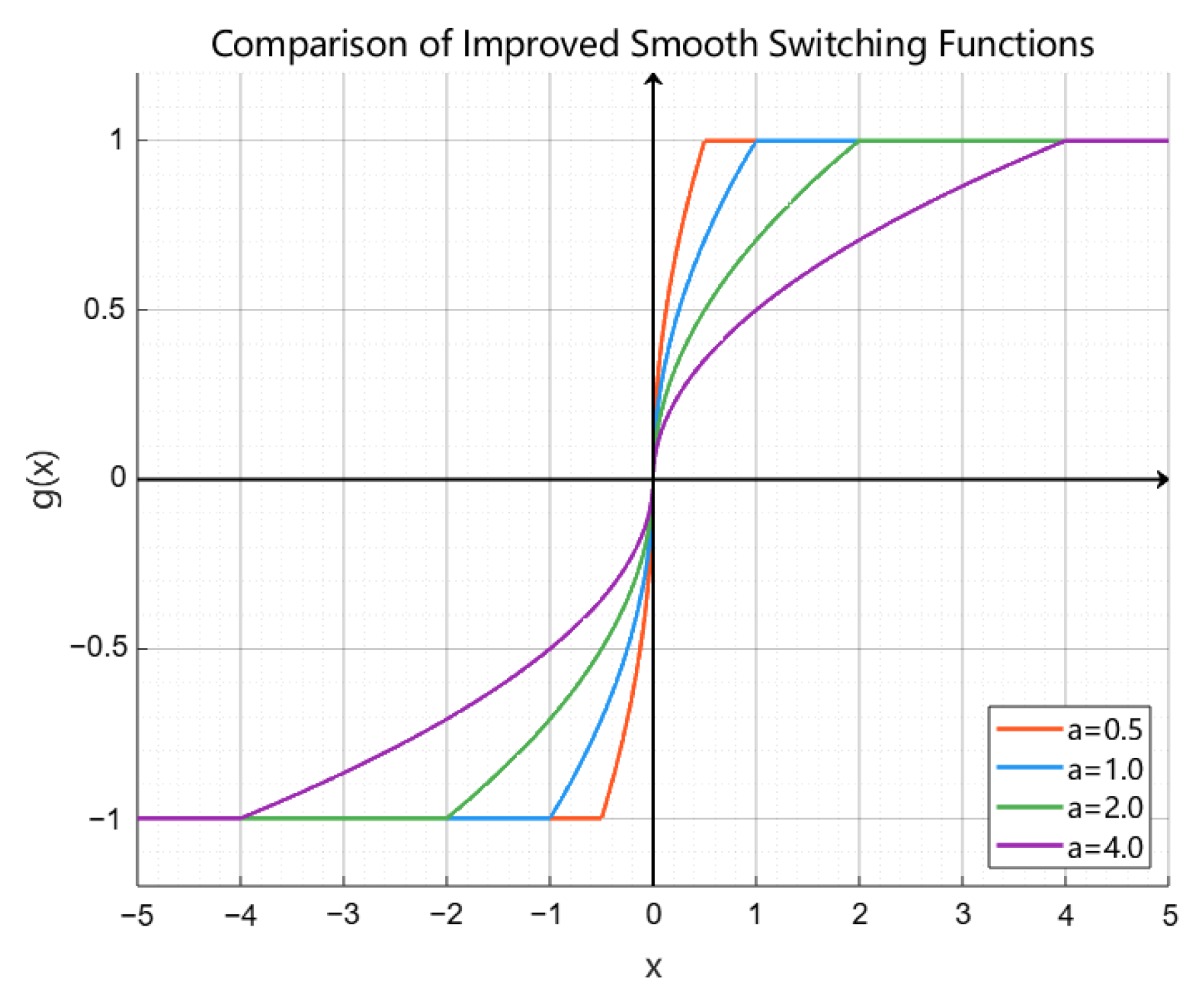
12) remains a potential source of high-frequency oscillation. To further resolve this issue, this paper introduces a novel continuous piecewise square root function
to replace the sign function. This function provides a smooth transition within the boundary layer while maintaining robust switching outside, defined as:
where
determines the width of the smoothing boundary layer.
In this formulation, x denotes the output of the sliding mode surface function, while a signifies the transition region thickness, defining the transition region governing the function’s behavior. The selection of a presents a critical trade-off: a larger value enhances chattering suppression at the expense of control accuracy.
The proposed switching function—shown in
Figure 1—saturates outside the boundary layer and varies smoothly within it, merging a transition mechanism with nonlinear gain to suppress chattering.
Unlike the hyperbolic tangent (tanh) function utilized by Bai et al. [
24], the proposed form requires only a square root calculation, reducing computational cost. This design avoids the noise amplification issues associated with the fixed slope at the zero-point of the tanh function. Furthermore, the parameter
a is directly correlated with the system’s dynamic range, giving it a clear physical meaning. Relative to the piecewise exponential function introduced by Zhang et al. [
18], the proposed scheme embeds an adaptive near-zero gain that eliminates the zero-gain drawback while retaining the saturated output that ensures robustness outside the boundary layer.
Consequently, the final output of the proposed IMNFTSMC is formulated as:
3.3. Stability Analysis
Robustness of IMNFTSMC is verified via Lyapunov’s direct method; adopting the candidate from [
25]:
Stability is evaluated through the first derivative of the Lyapunov function V defined in Equation (
16):
where
.
As indicated by the foregoing formulation, the condition holds whenever , thereby fulfilling the reaching condition requisite for sliding mode operation.
Let the initial value of the system’s sliding variable be , and let denote the time required for the system to transition from the initial state to the sliding surface . At the instant , the inequality gives rise to the following two cases:
- (1)
For , it follows that . Integrating both sides yields , which simplifies to . Hence, the reaching time satisfies .
- (2)
For , we have . Integration leads to , implying . Consequently, the reaching time is bounded by .
In summary, the upper bound of the finite duration needed for the system’s state to attain the sliding surface, starting from any original condition, can be expressed as:
Given that p and q are defined as positive odd integers satisfying , the term remains real and non-singular. The subsequent analysis is therefore divided into two distinct cases for comprehensive discussion:
- (1)
When
, rearranging Equation (
16) yields:
- (2)
When
, substituting Equation (
14) into Equation (
6), the subsequent formula can be derived:
Equation (
20) describes the system’s behavior when
. When
and
, the state is unstable and will be driven into the regio
. Similarly, when
and
, the state is also unstable and transitions to the region
within a finite time.
Collectively, Equations (
18) and (
20) demonstrate that the system state cannot remain at the origin (
). Instead, the state trajectories will continuously traverse the
-axis in the phase plane, because the Lyapunov derivative
does not persistently remain at zero. This analysis confirms that the system state is guaranteed to reach the terminal sliding surface
from any initial condition in finite time.
4. Design of a Non-Singular Terminal Sliding Mode Observer
The back-electromotive force (back-EMF) of a motor inherently contains information about its rotor position and rotational speed, which enables the estimation of these states through a SMO. Conventional SMO implementations typically employ low-pass filters (LPFs) to extract smooth back-EMF signals by attenuating the high-frequency chattering induced by the discontinuous signum function. However, these filters introduce phase delays in the position estimate, necessitating complex compensation. Furthermore, obtaining speed via direct differentiation of the rotor angle is highly susceptible to noise, which degrades estimation accuracy.
To address these challenges, this paper proposes an IMNFTSMO whose core innovation is chattering suppression without a low-pass filter, thereby eliminating phase lag and improving the accuracy and robustness of rotor-state estimation. From the voltage equation of a surface-mounted PMSM in the stationary coordinate system, the state equation can be derived as follows:
among them,
(stator current in the stationary coordinate system),
(stator voltage in the stationary coordinate system),
(back-EMF in the stationary coordinate system),
R denotes the stator resistance of the PMSM, and
L denotes the stator inductance (for surface-mounted PMSM
).
The structure of the proposed novel sliding mode observer is defined as:
where the term
is the observer control law.
The observation error dynamics are derived by subtracting Equation (
22) from Equation (
21). Defining the current estimation error as
, the error equation is:
In sliding mode theory, the design of the switching surface is pivotal, as it governs the system’s convergence characteristics. For an observer, specifically, the sliding surface determines the convergence rate and the trajectory by which the estimated values track the true values. Therefore, leveraging the concepts of both linear and non-singular terminal sliding modes, this paper proposes a hybrid switching surface, defined as:
Here, are sliding mode parameters, with the constraints that , , and , where both p and q are positive odd integers. The term represents the stator current observation error and is used as a first-order linear sliding mode switching surface. Consequently, s constitutes a second-order mixed non-singular terminal sliding mode switching surface.
The sliding mode observer control law is designed as:
where
are the control law parameters, satisfying the conditions
and
.
To verify the feasibility of the proposed integral sliding mode observer, its stability must be analyzed. Based on the Lyapunov stability criterion, the Lyapunov function is defined as:
To ensure stability, the time derivative of the Lyapunov function in Equation (
26) must satisfy the condition
. The derivation is as follows:
where
;
and
. Combining with the error Equation (
23), that can get:
Substituting the sliding mode control law from Equation (
25) yields:
When the control parameter
satisfies the condition
then have
Therefore, provided that the parameter is selected within the specified range, the designed sliding mode control law satisfies the reaching condition; thus, the stability of the observer is guaranteed throughout the sliding phase.
From the error Equation (
23), it follows that once the error dynamics converge to the equilibrium point, where
, the linear sliding mode variables
f and
also converge to zero. This signifies that the system has reached the mixed non-singular terminal sliding mode state. The observer error Equation (
23) can therefore be simplified to:
Equation (
32) reveals that the motor’s back-EMF can be directly estimated via the SMC law. In a conventional SMO, the back-EMF information is embedded within the discontinuous signum function, which is the primary source of chattering. By contrast, the proposed observer extracts the back-EMF information from the control law defined in Equation (
25). Though containing a signum term, the control law embeds a built-in filter that smooths discontinuity, suppressing chattering without an external LPF and enabling direct, lag-free rotor-position extraction from the observed back-EMF.
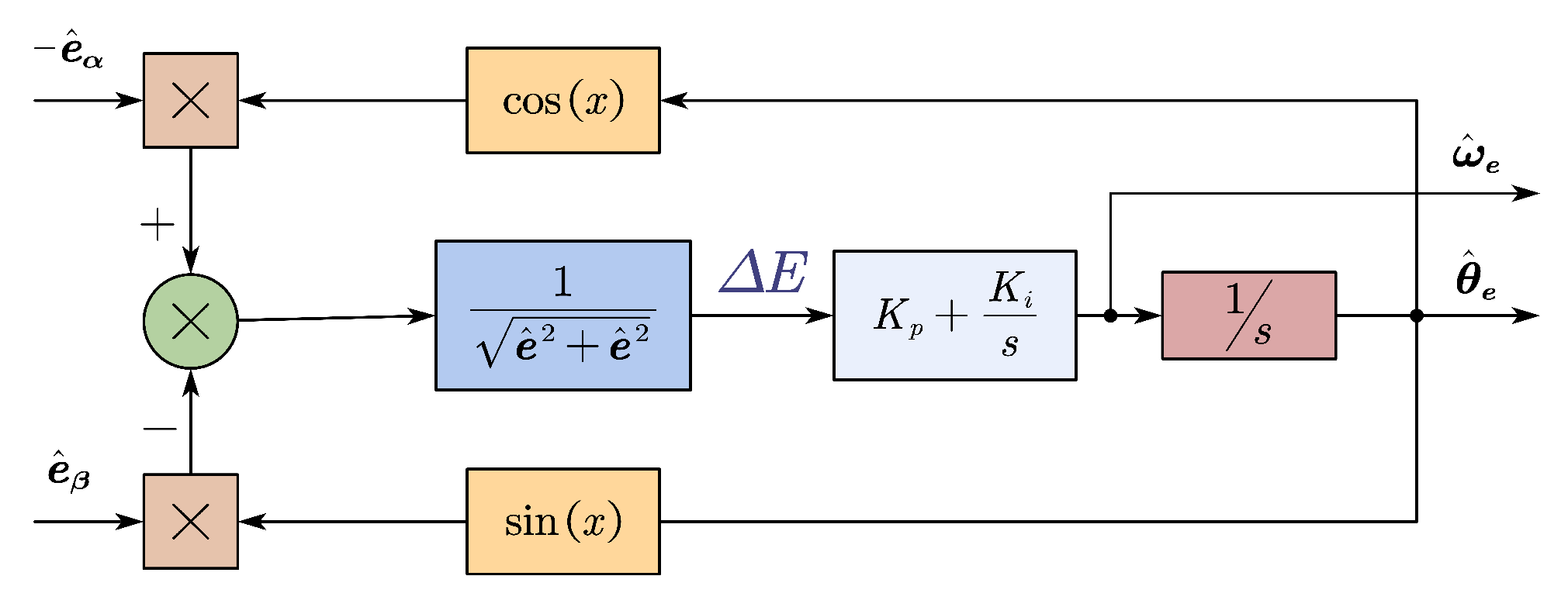
Conventionally, using arctangent of the back-EMF for position is noise-sensitive, and division near zero crossings amplifies errors, degrades accuracy. The estimation of rotor position and rotational speed in this research is accomplished through a Phase-Locked Loop (PLL)-based scheme. The corresponding block diagram depicting the system architecture is provided in
Figure 2.
Based on the figure provided, the following relationships can be derived:
When the rotor position error is small, i.e., , the small-angle approximation can be applied. The rotor speed is then obtained through a PI controller, and subsequently, the rotor position is determined by integration.
5. Simulation and Experimental Analysis
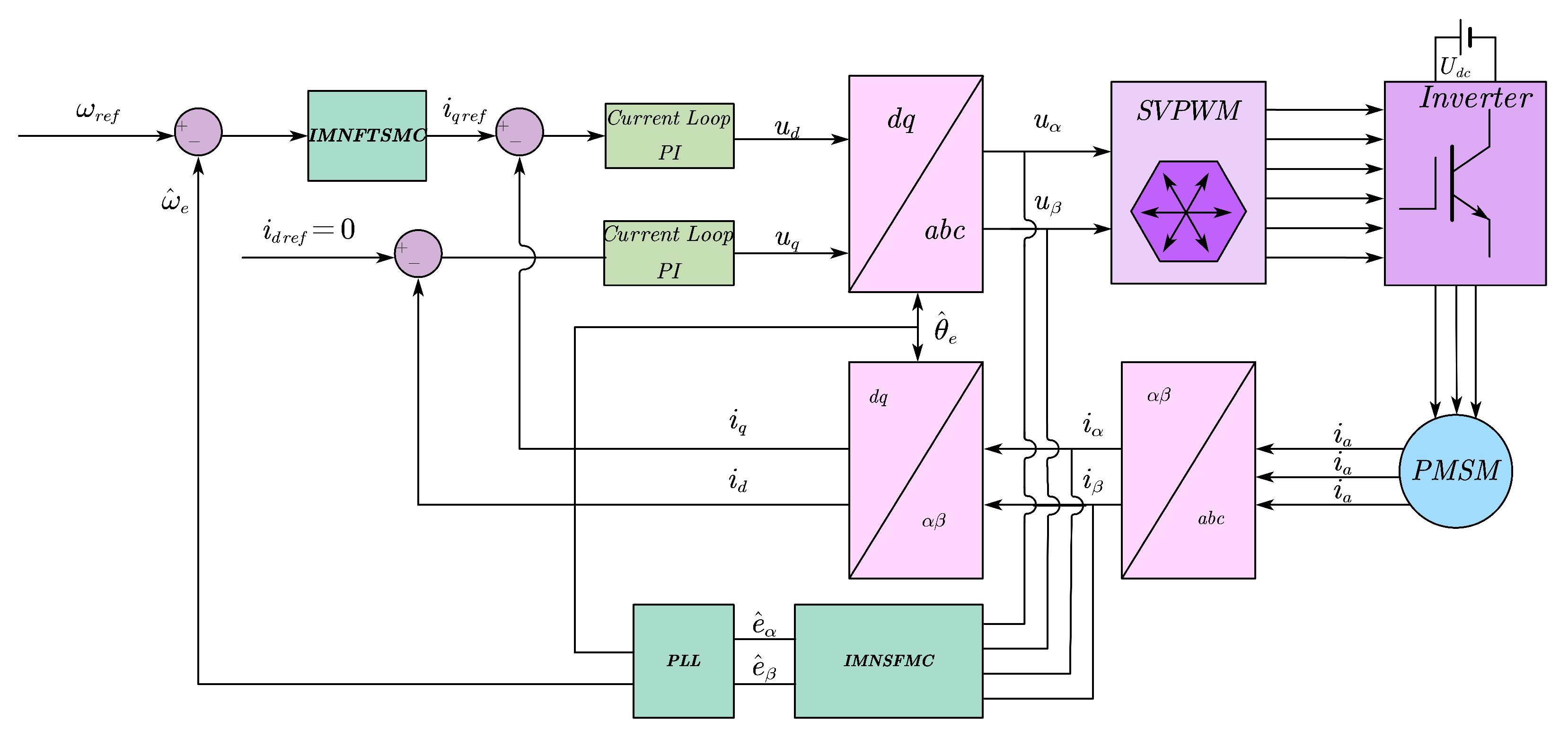
To assess the efficacy of the devised control strategy, a simulation model of a sensorless PMSM drive system was designed within the MATLAB/Simulink (version R2023b) environment. The system utilizes a field-oriented control (FOC) framework. The overall control architecture, which integrates the proposed approach, is illustrated in the block diagram provided in
Figure 3.
5.1. Simulation Analysis
The simulation study was performed using the PMSM parameters detailed in
Table 1. To ensure a fair and objective comparison, the current inner loop controllers for all compared speed control methods (PI, SMC, NFTSMC, and the proposed IMNFTSMC) were set to the identical PI gains:
and
. This standardization guarantees that differences in speed loop performance are attributable solely to the unique characteristics of the outer speed controller. Step-speed simulations compared the dynamic and steady-state performance of four controllers: PI, SMC, NFTSMC, and the proposed IMNFTSMC.
Step-speed simulations compared the dynamic and steady-state performance of four controllers: PI, SMC, NFTSMC, and the proposed IMNFTSMC.
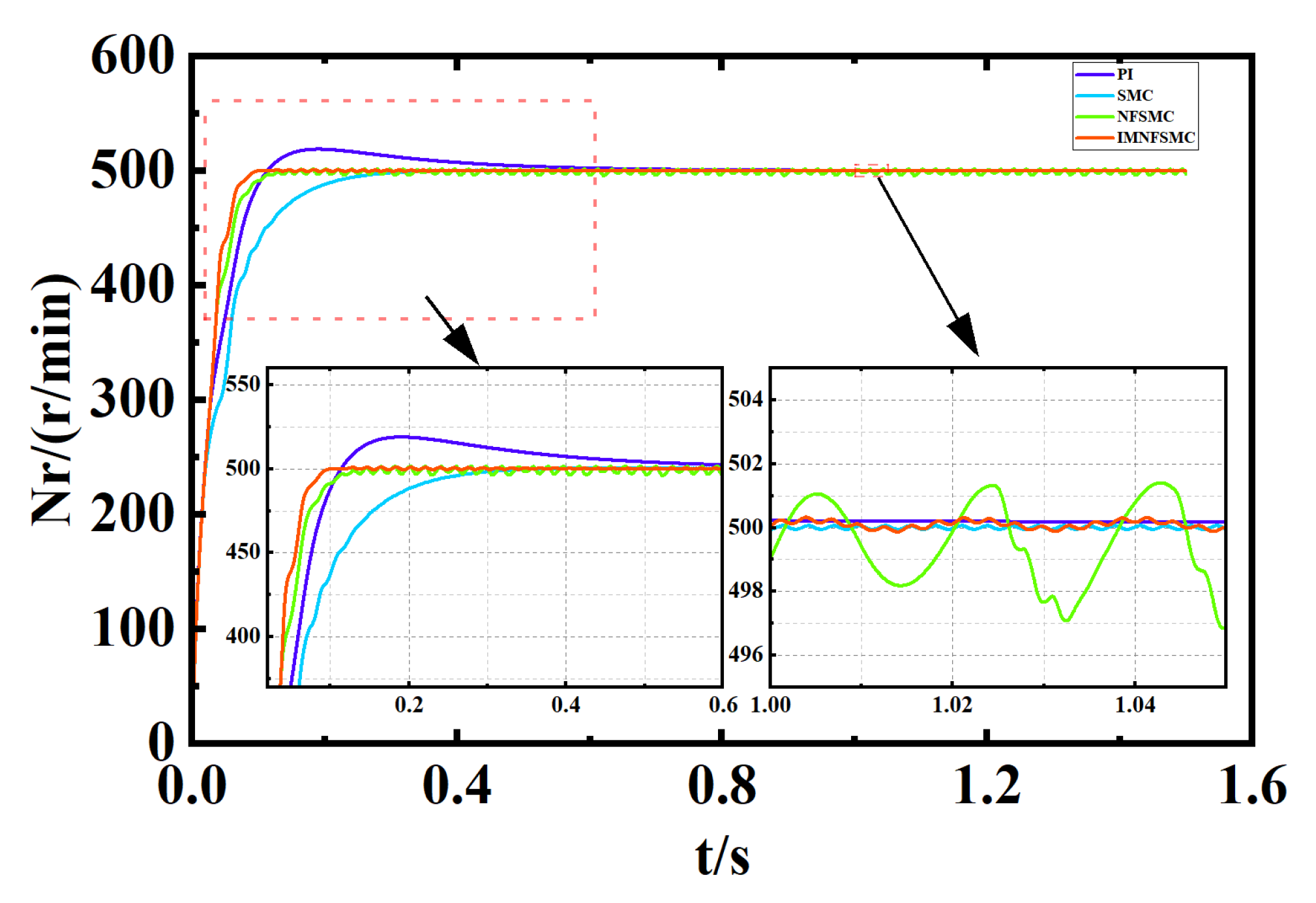
With the motor’s target speed set to 500 r/min, the speed response curves in
Figure 4 reveal distinct performance characteristics. The traditional PI controller shows a noticeable overshoot and a prolonged settling time, while the SMC exhibits a slower response without overshoot. The NFTSMC achieves a faster transient but incurs steady-state chattering.
In comparison, the proposed IMNFTSMC strategy allows the motor to rapidly converge to the setpoint in approximately 0.09 s. The steady-state speed fluctuation of less than 0.3 r/min confirms the effective suppression of chattering, highlighting a significant improvement in control performance over the conventional methods.
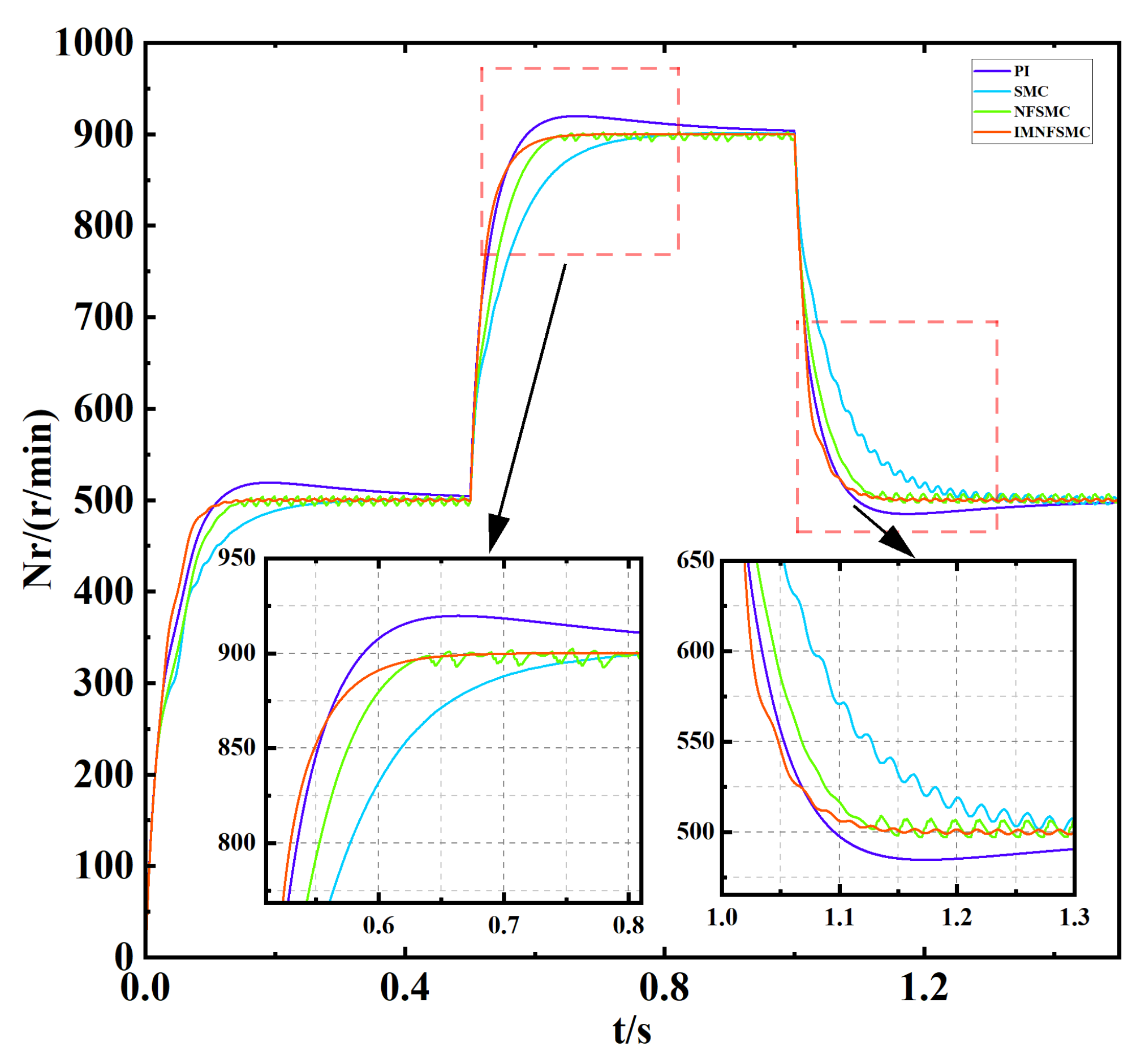
To further assess the robustness of the proposed IMNFTSMC strategy, a simulation was performed with a time-varying reference speed profile, as illustrated in
Figure 5. Starting from 500 r/min, the reference was stepped to 900 r/min at 0.5 s and back to 500 r/min at 1.0 s; the IMNFTSMC followed these changes with minimal overshoot and swift settling time. When the reference speed increases at 0.5 s, the system converges to the new target in approximately 0.15 s (at t = 0.65 s) with negligible fluctuation. Similarly, when the speed command drops at 1.0 s, the system stabilizes at the new setpoint within approximately 0.15 s (at t = 1.15 s).
Under the same dynamic test scenarios (including acceleration and deceleration), PI control typically exhibits significant overshoot, SMC demonstrates a slower transient response, and both SMC and NFTSMC exhibit detectable steady-state chattering—deficiencies that are effectively addressed by the proposed IMNFTSMC.
In summary, this comparative analysis indicates that the proposed IMNFTSMC strategy improves the system’s dynamic performance and stability. By optimizing the sliding mode surface and introducing a segmented switching function, the controller achieves faster convergence and more effective chattering reduction. It maintains reliable dynamic and steady-state performance across the tested range of operating conditions.
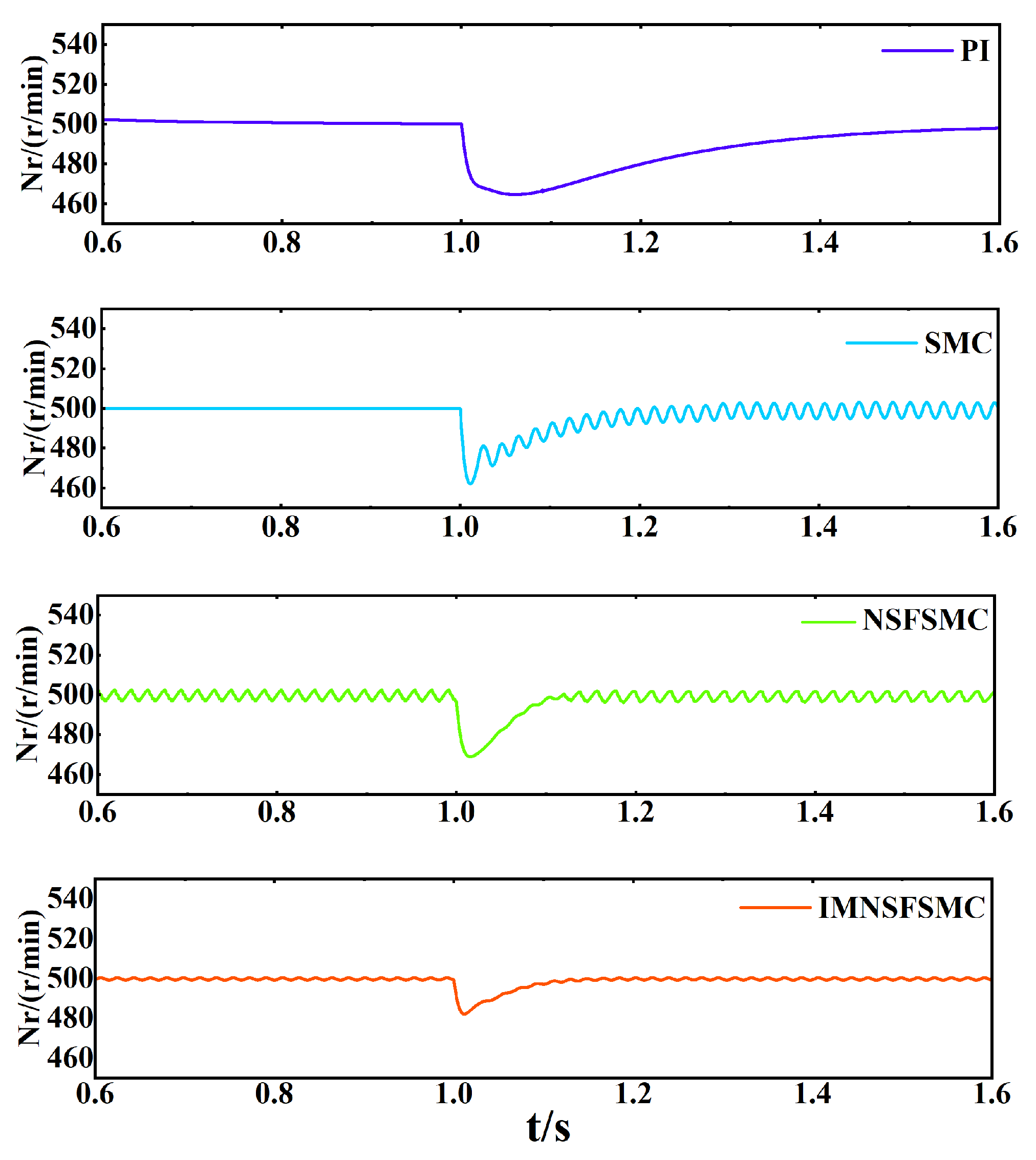
Simulations were carried out to test the dynamic disturbance rejection capabilities of different control methods. In this experiment, the motor was set to run at a target speed of 500 r/min. After the speed stabilized, a step load torque of 0.2 N·m was applied at 1.0 s. The resulting speed responses for each controller are presented in
Figure 6.
The results in
Figure 6 show that the proposed IMNFTSMC strategy provides a fast and robust response to load disturbances. The maximum speed deviation is approximately 20 r/min, which is less than the deviations observed with the other three control methods. Furthermore, the system under IMNFTSMC returns to the steady state with a shorter recovery time. This outcome confirms that the proposed method offers enhanced robustness and dynamic performance in rejecting external disturbances.
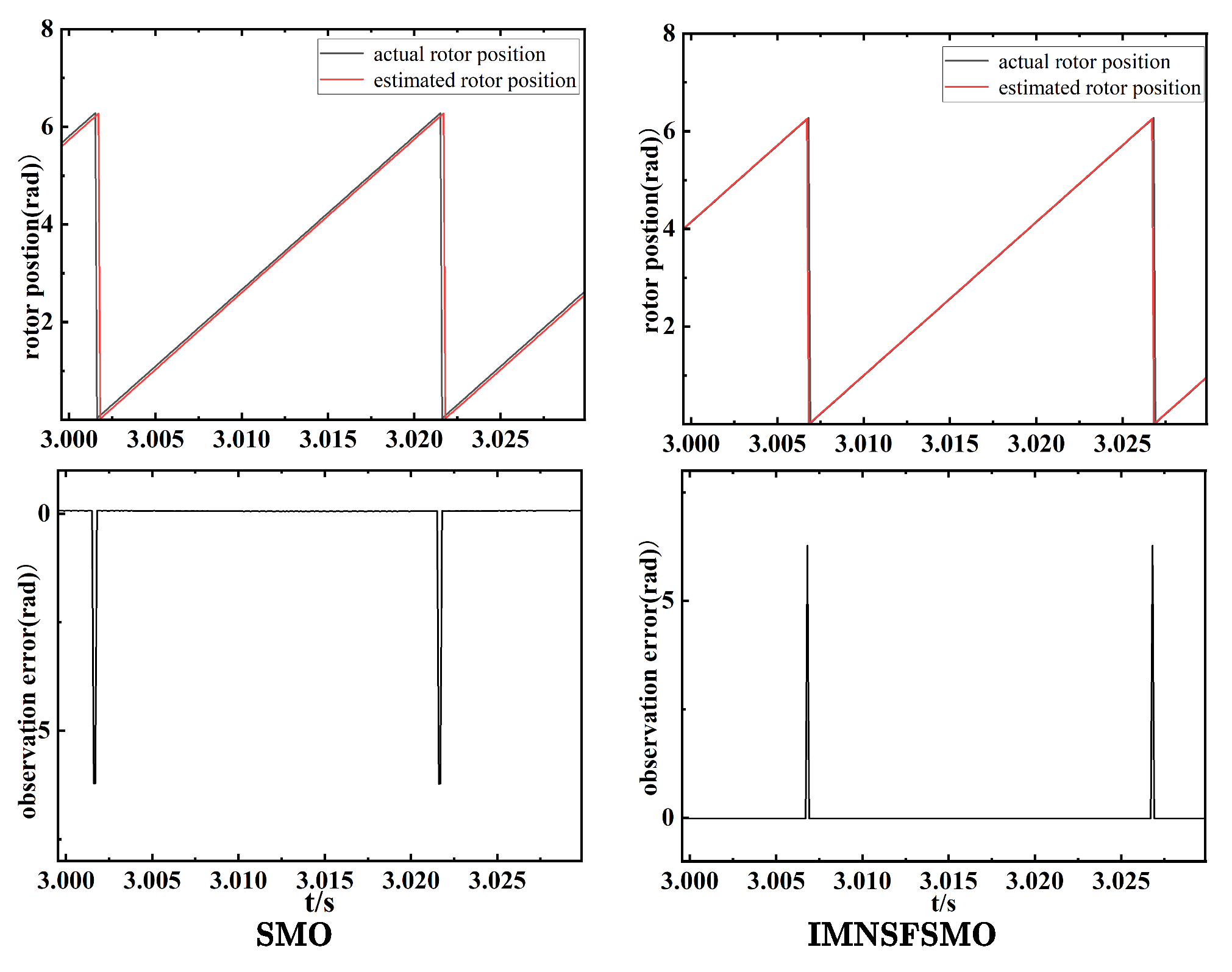
A comparative study was conducted between the proposed IMNFTSMO and a conventional SMO to evaluate rotor position estimation accuracy. The outcomes are depicted in
Figure 7.
The results show that the proposed IMNFTSMO achieves a reduced rotor position estimation error compared to the conventional SMO. The estimated position from the IMNFTSMO consistently tracks the actual rotor position, which validates the improvement in estimation accuracy and the effectiveness of the proposed method.
5.2. Hardware Validation
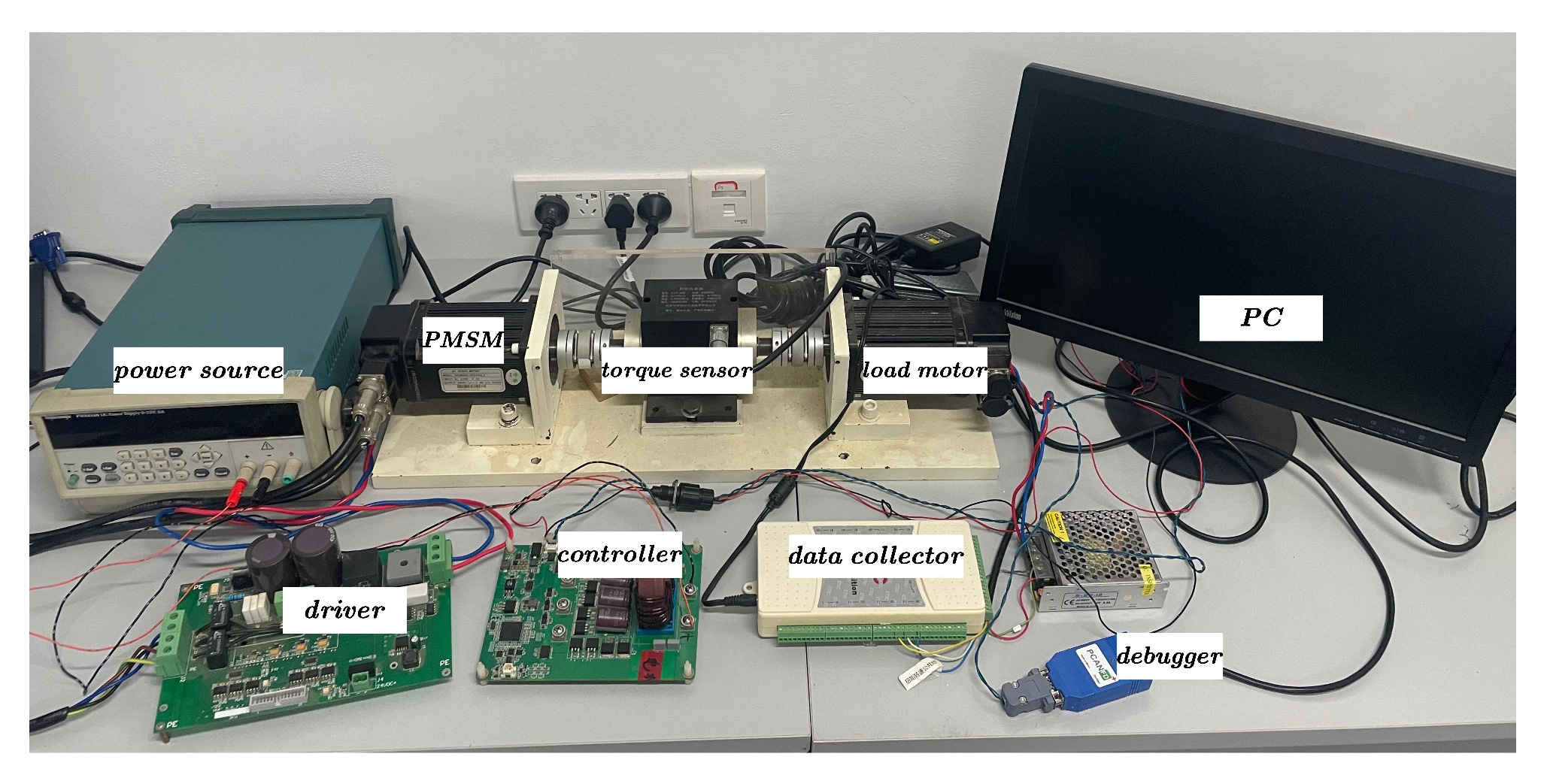
To validate the proposed control strategy, an experimental platform was set up (as shown in
Figure 8). The system is centered around an Infineon Aurix TC275 microcontroller (Infineon Technologies, Neubiberg, Germany) running at 200 MHz, with custom-built control and driver boards. A 1000-line Hall encoder is used to measure the motor speed, providing a reference for comparison with the sensorless control method’s estimated speed.
The control software was developed using the AURIX Development Studio. Low-level drivers and hardware configurations were managed via the iLLD library, and the application layer control logic was implemented using a Model-Based Design (MBD) approach (Simulink model generation). The generated code was compiled and downloaded to the microcontroller’s RAM for execution. The Pulse Width Modulation (PWM) frequency was set to 10 kHz.
Data is acquired via the 12-bit ADC and transmitted to the Vofa+ PC software (version 1.3.10) via serial port (921,600 bps) for real-time plotting. To ensure fair comparison, PI current loop controllers for all tested methods utilize identical parameters:
and
. A 200 W induction motor serves as the load. The system’s control block diagram is shown in
Figure 8. The key PMSM parameters for the experimental validation are identical to those listed in
Table 1 for the simulation study.
A comparative performance analysis was conducted between the proposed IMNFTSMC/IMNFTSMO scheme and three conventional methods: PI control, classical SMC, and standard NFTSMC. The evaluation focused on key performance indicators, including dynamic speed response, rotor position estimation accuracy, and disturbance rejection capability.
5.2.1. Performance Verification of the Starting Process
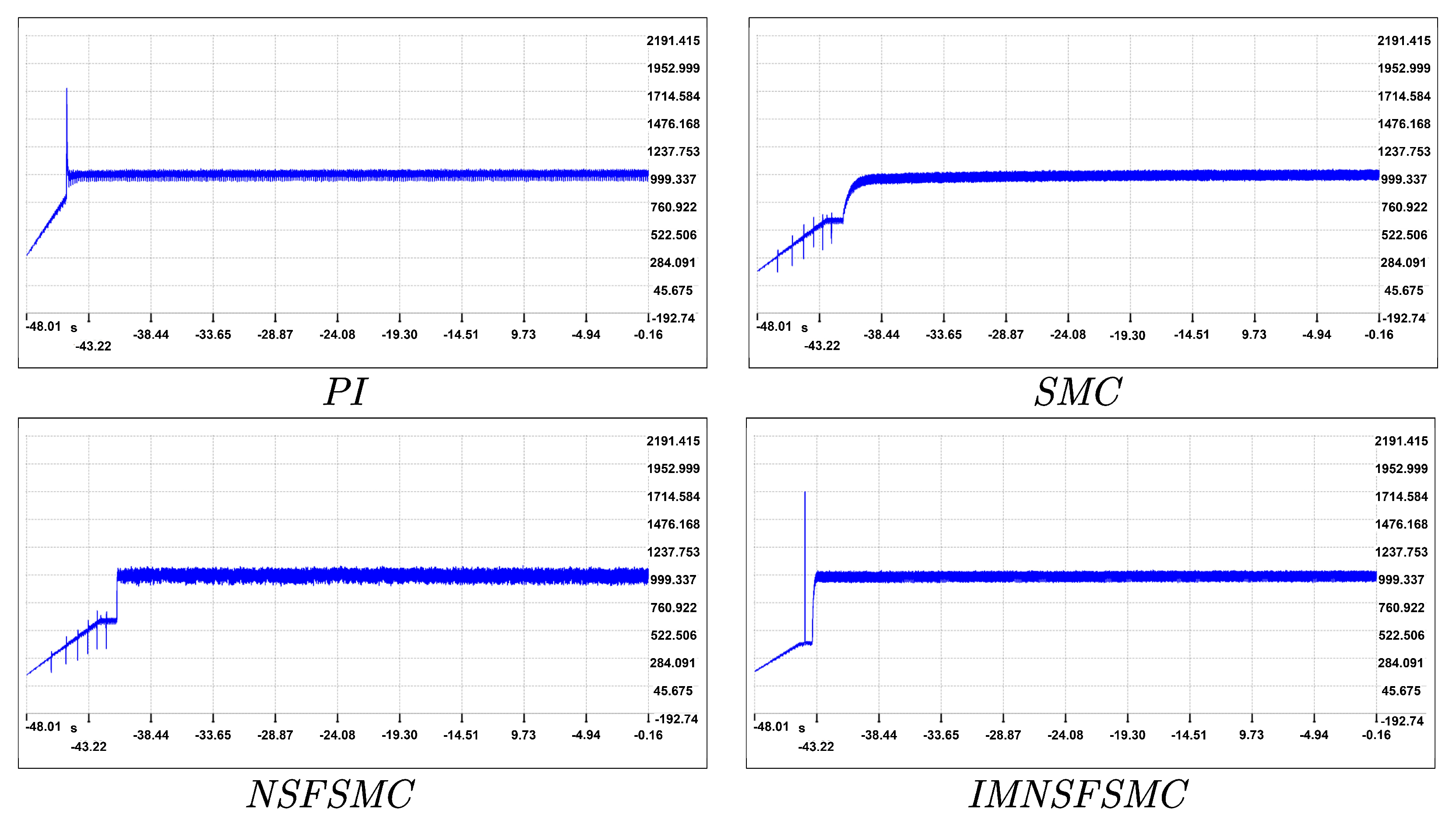
Figure 9 presents the comparative speed response of the controllers during a no-load start-up to a target speed of 1000 r/min.
Among the conventional methods, the PI controller exhibits significant overshoot, while the traditional SMO avoids overshoot but suffers from a slow settling time. The standard Non-Singular Fast Terminal Sliding Mode Controller (NFTSMC) provides a rapid transient response but is plagued by severe chattering and steady-state ripples. In contrast, the proposed method, which leverages an improved control law and a continuous piecewise square root switching function, effectively addresses these drawbacks. It achieves a rapid response comparable to the standard NFTSMC while significantly suppressing the chattering phenomenon.
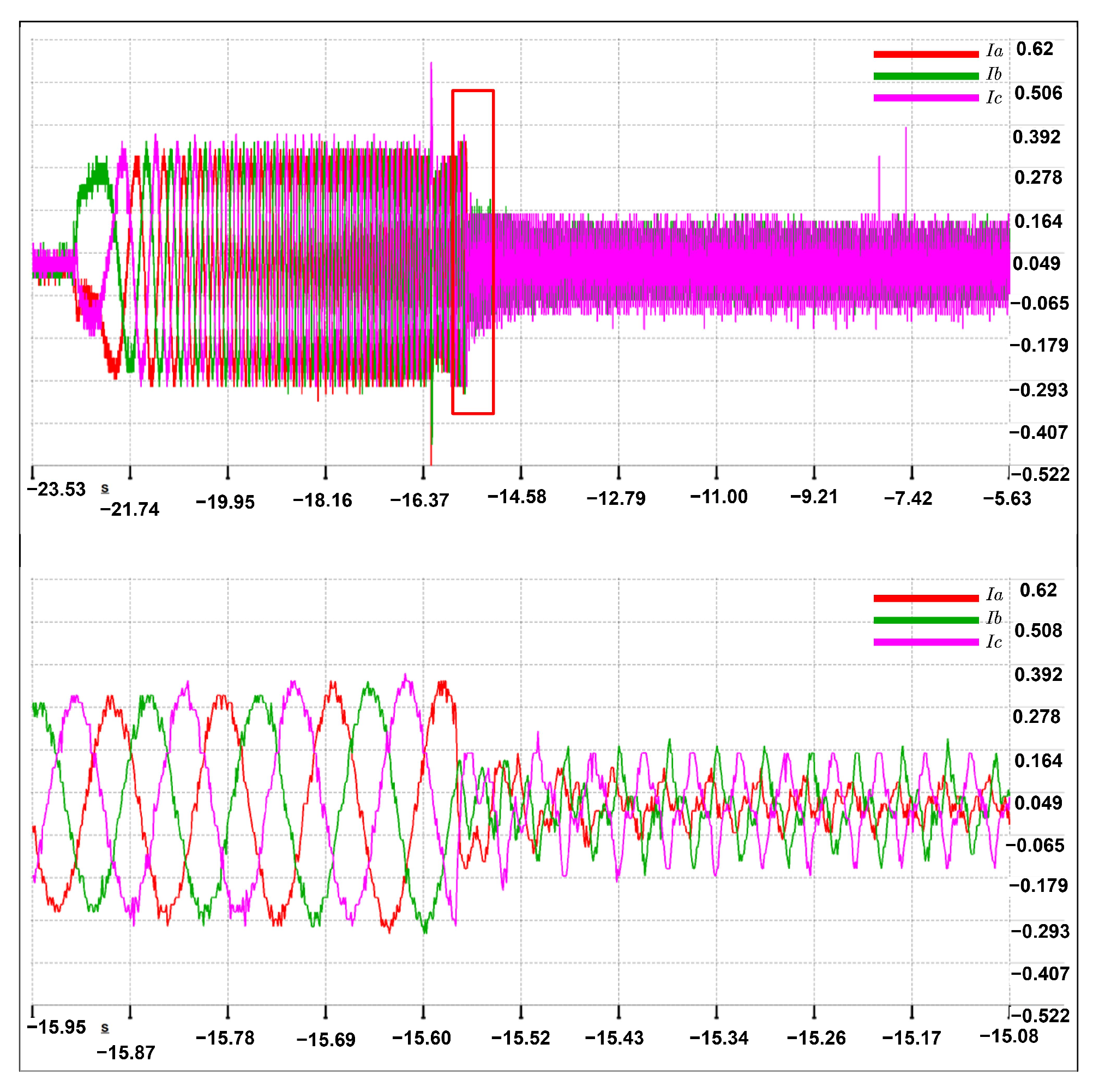
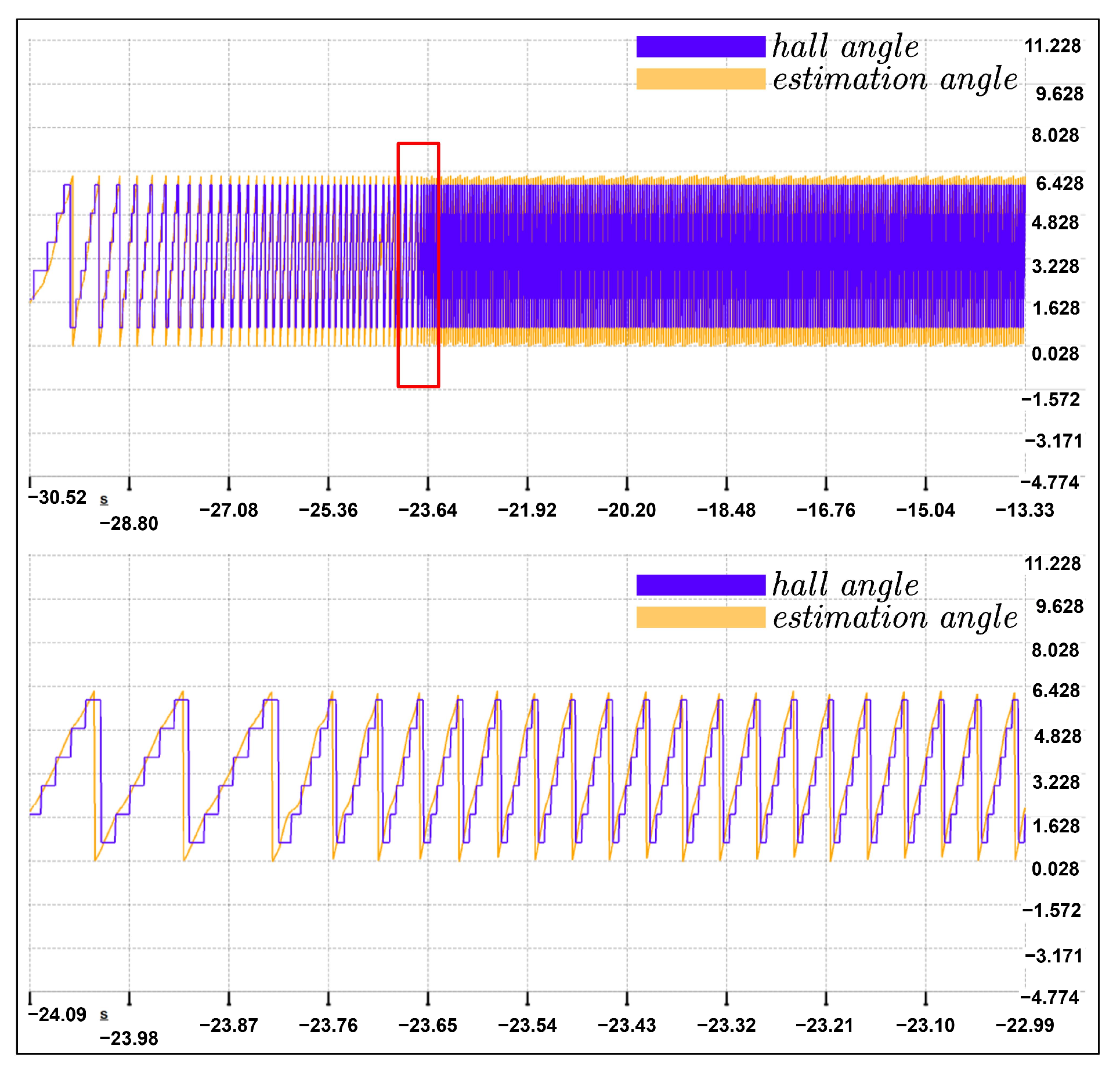
Figure 10 and
Figure 11 illustrate the system’s performance during the start-up phase. At near-zero speeds, the weak back-EMF signal prevents the sensorless observer from accurately estimating the rotor position.
To address this, an open-loop I/F (current-frequency) start-up strategy is initially employed to accelerate the motor. In this strategy, the q-axis current reference is set to a constant value to generate sufficient starting torque, while the d-axis current is maintained at zero. The rotational speed increases linearly from zero, and the rotor position is integrated as . This ensures a stable run-up before switching to the sensorless observer. Once a predetermined switching speed is reached, the control scheme transitions to the closed-loop state using the proposed observer algorithm. A distinct difference in the current is evident between these two phases. During the initial I/F start-up, the three-phase current amplitude is elevated. After switching to sensorless closed-loop control, the current amplitude is reduced, and the waveforms stabilize into ideal three-phase sinusoids.
5.2.2. Verification of Sudden Change Performance
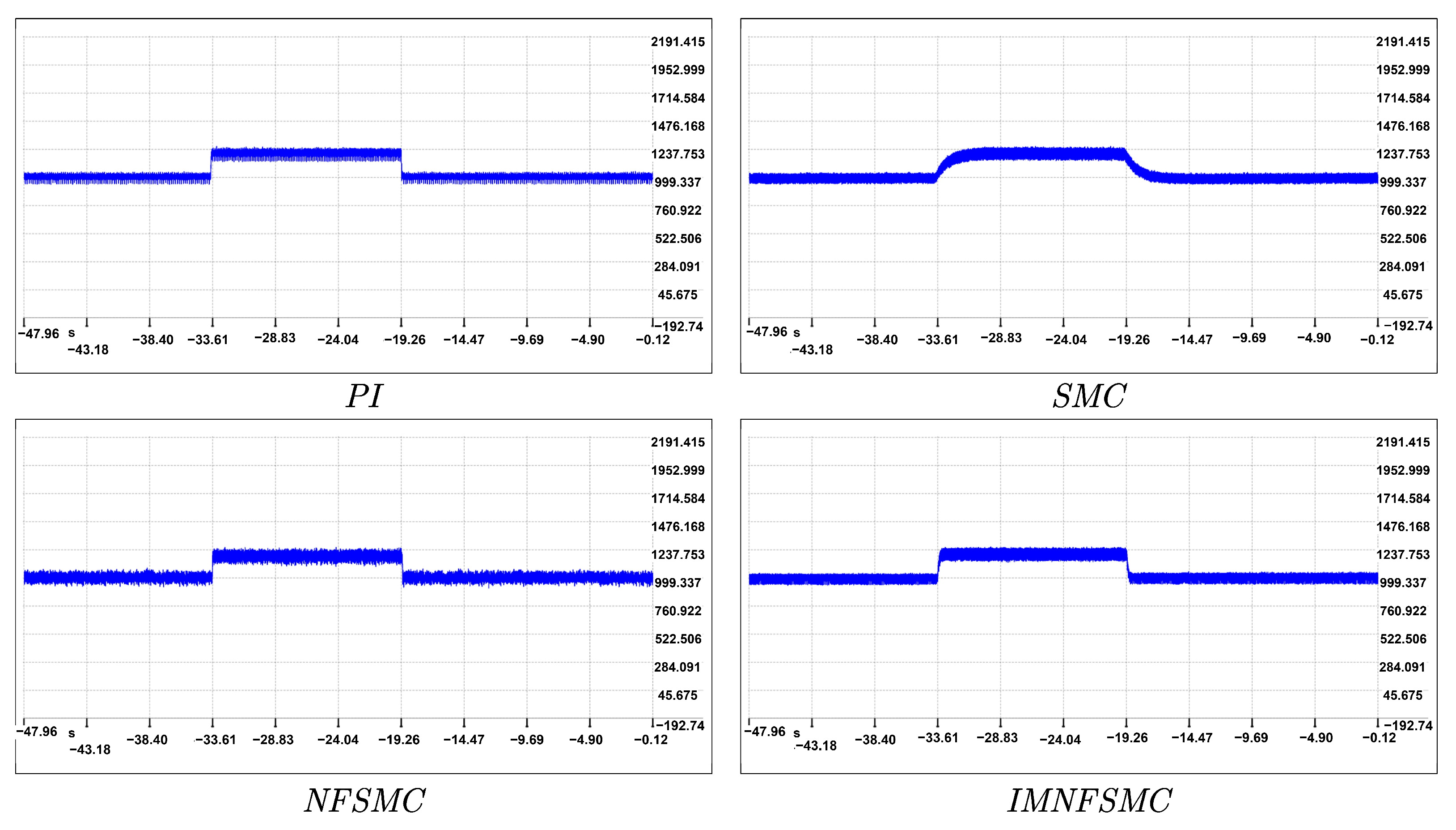
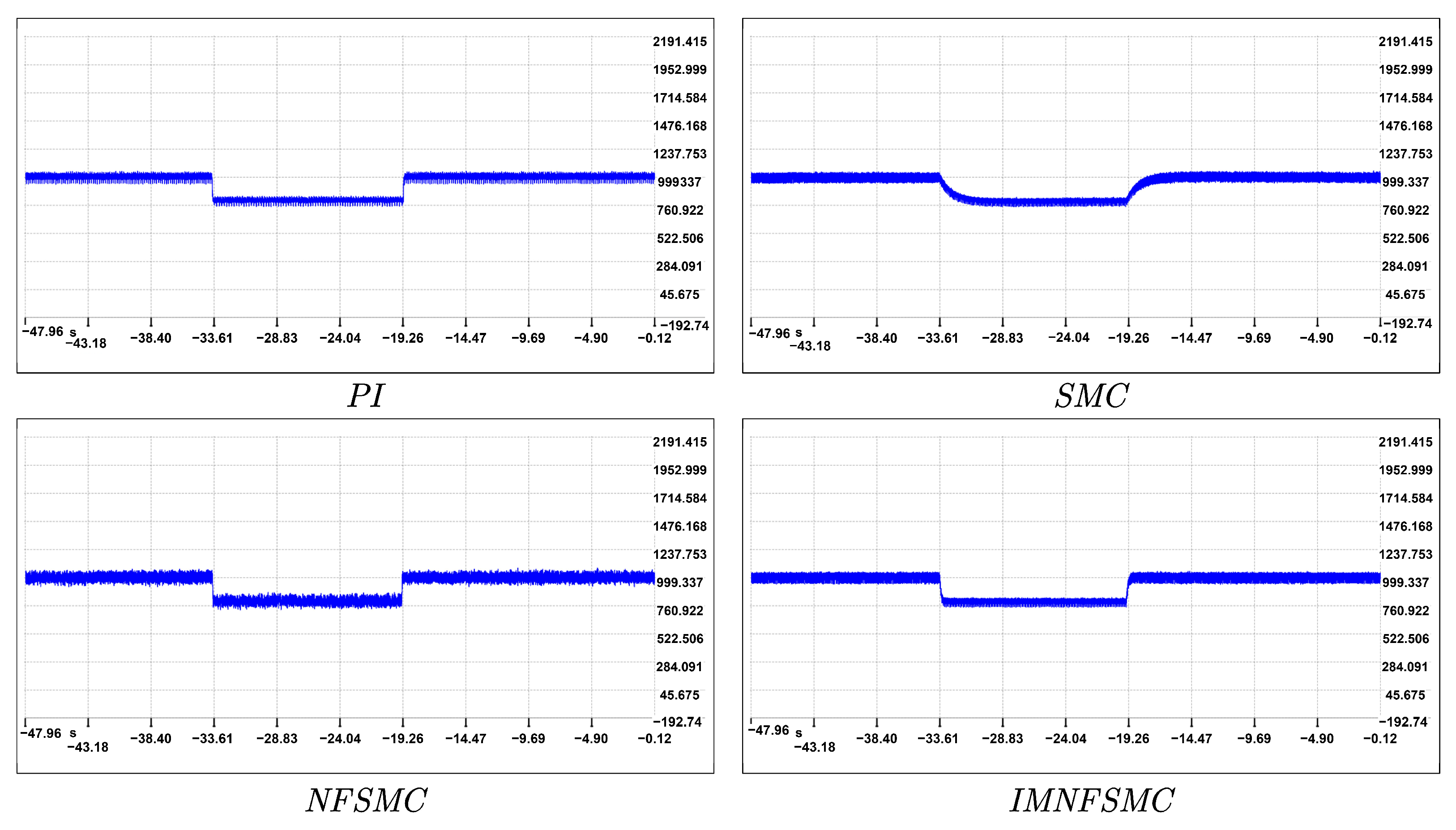
To evaluate the dynamic tracking performance, the controllers were subjected to step changes in the speed reference from an initial steady-state of 1000 r/min.
Figure 12 presents the comparative responses to a positive step change, where the reference is increased to 1200 r/min and subsequently restored.
Figure 13 depicts the system responses to a negative step command, with the reference speed first reduced to 800 r/min and then reset to its original value.
The experimental results in
Figure 12 and
Figure 13 reveal significant performance differences among the controllers. The PI controller exhibits noticeable overshoot, while the standard SMC demonstrates a significantly slower response. Both the NFTSMC and the proposed IMNFTSMC achieve a fast response with minimal overshoot. In the steady state, the IMNFTSMC exhibits smaller ripple amplitudes compared to the NFTSMC, indicating an observable improvement in suppressing steady-state chattering. While the proposed strategy offers superior performance, it requires careful parameter tuning to ensure optimal practical application.
5.2.3. Observation Performance Verification
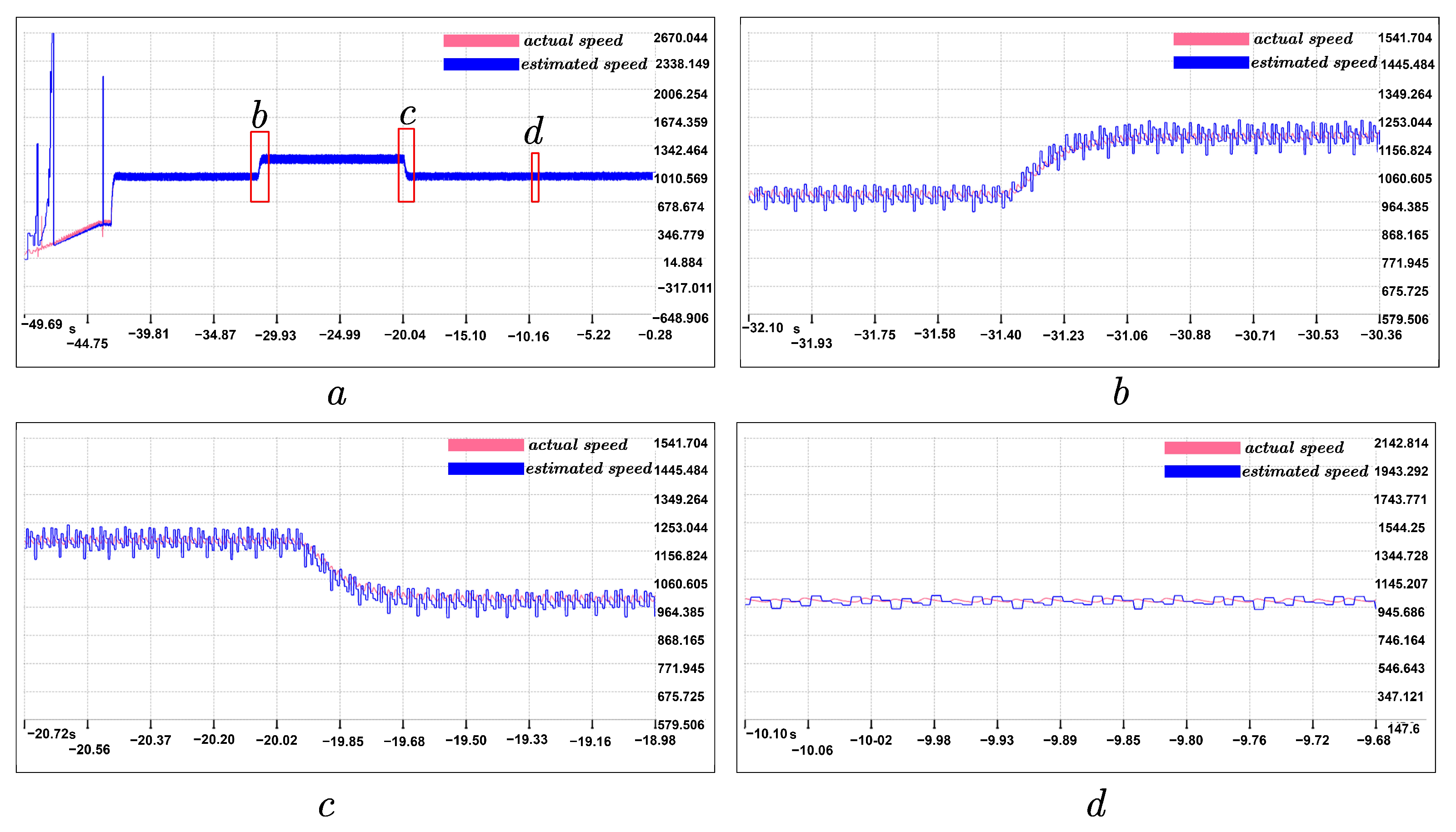
The performance of the sensorless observer is presented in
Figure 14 and
Figure 15.
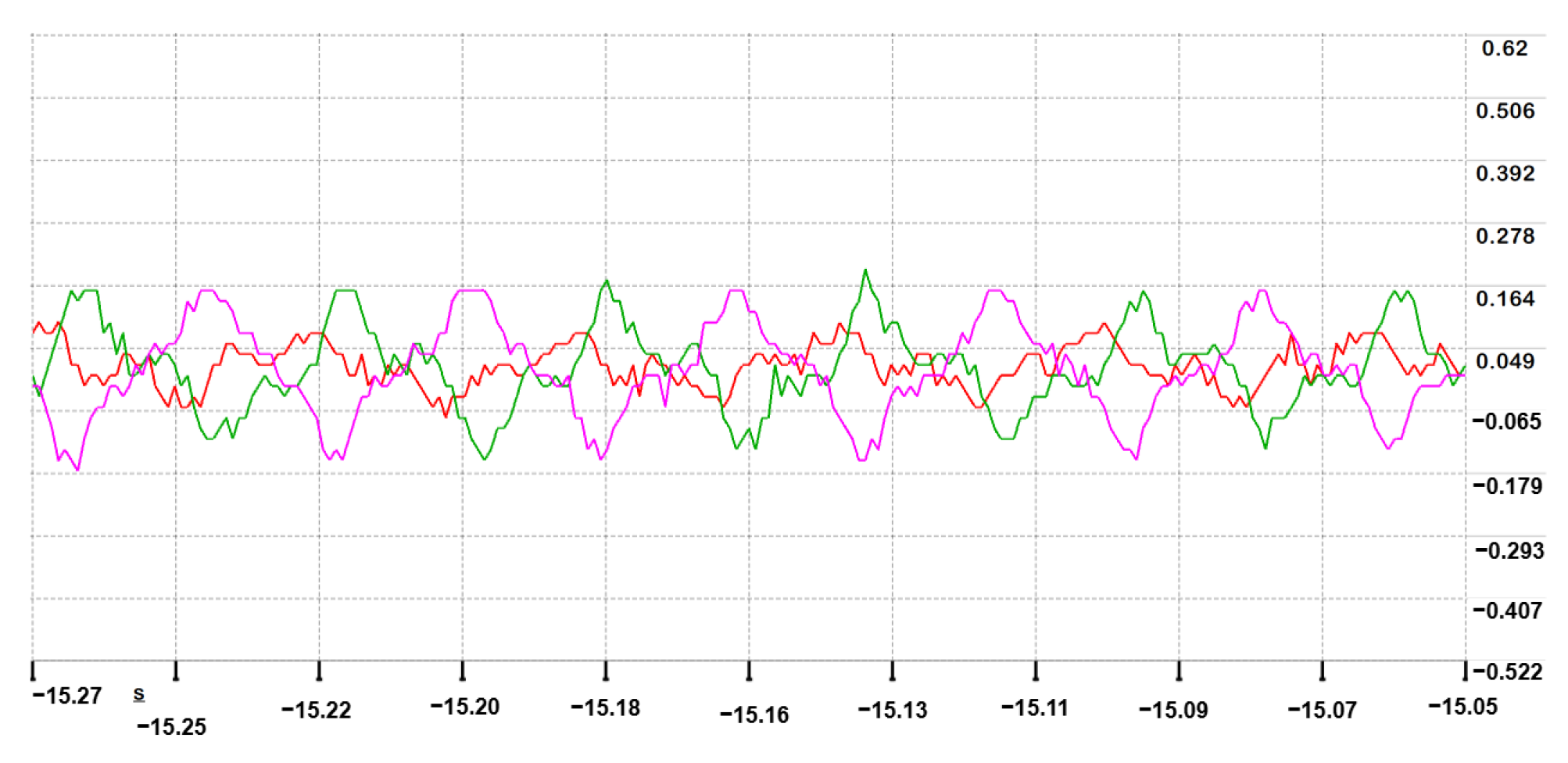
Figure 14 provides a magnified view of the system’s transition to sensorless control, illustrating the close alignment between the observed rotor position and the actual position obtained from Hall effect sensors at the switching instant.
Figure 15 demonstrates the dynamic speed tracking performance, comparing the estimated speed against the measured speed during step reference changes, with a magnified view of the transient response.
The results indicate that upon switching to sensorless operation, the estimated rotor position exhibits close convergence to the actual position (
Figure 14). The estimated speed also effectively tracks the actual speed through step changes, supporting the effectiveness of the proposed observer (
Figure 15). This validates the scheme’s ability to maintain reliable operation during dynamic speed transitions without a physical speed sensor.
Collectively, these experimental results validate the robust estimation capability of the proposed observation algorithm. The consistent estimation of both rotor position and rotational speed across dynamic scenarios highlights the reliable performance of the IMNFTSMO.
5.2.4. Disturbance Rejection Performance
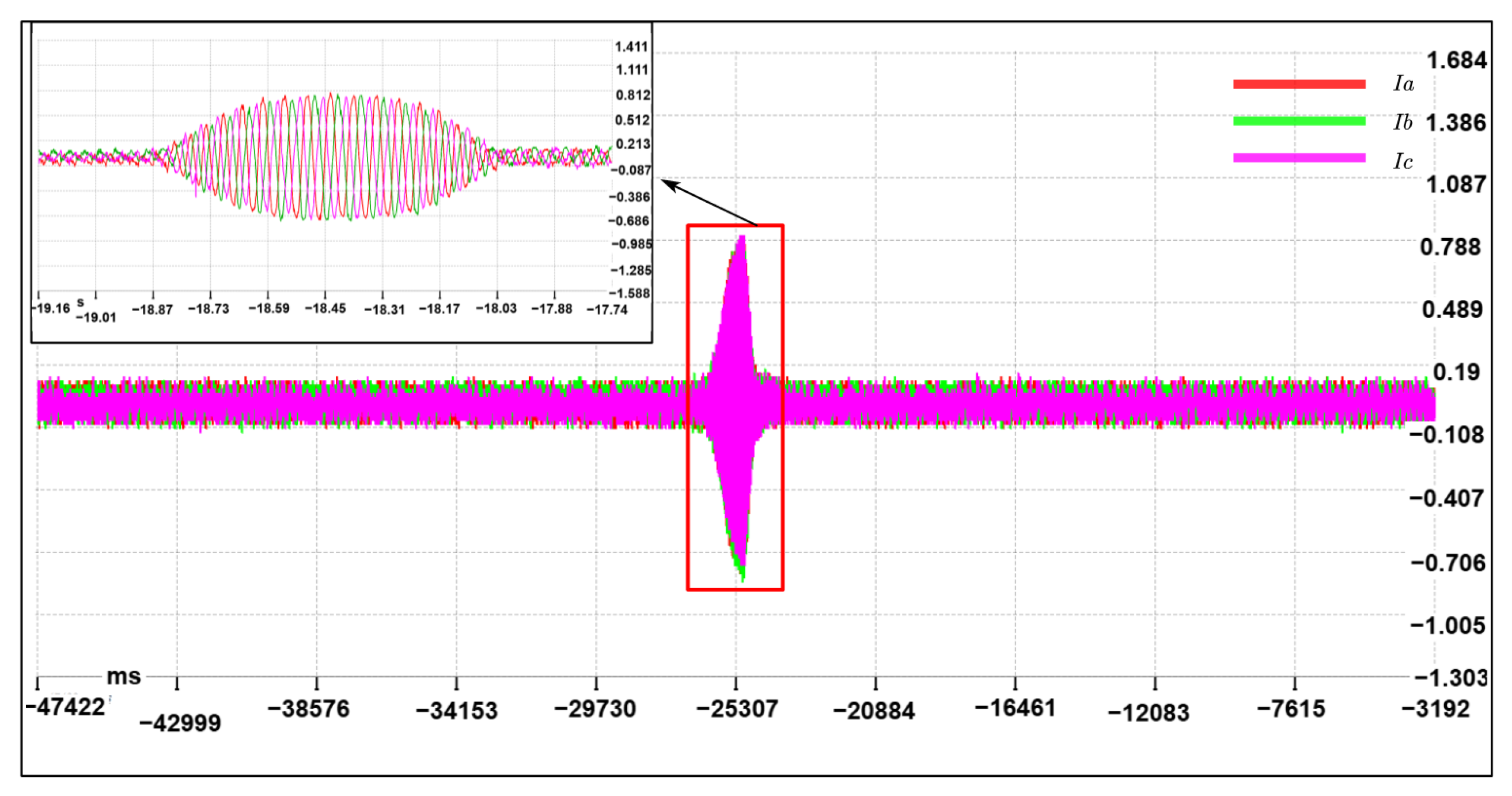
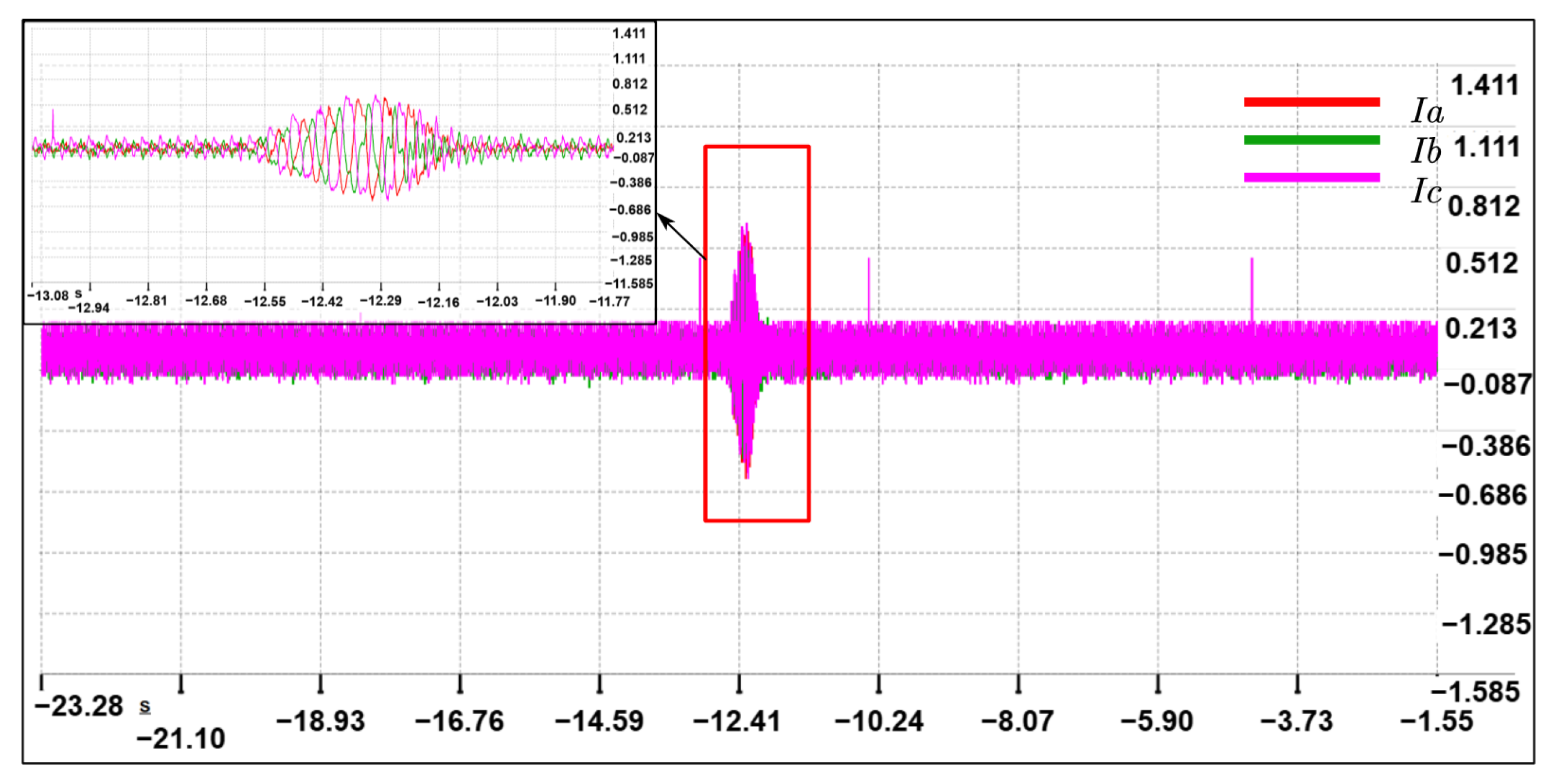
To evaluate the system’s robustness against load variations, a step load disturbance of 0.2 N·m was applied.
Figure 16 and
Figure 17 present the comparative transient current responses of the conventional NFTSMC and the proposed IMNFTSMC, including magnified views for detailed inspection.
A comparative analysis reveals the superior disturbance rejection capability of the proposed IMNFTSMC. As shown in
Figure 16, the traditional NFTSMC exhibits a significant three-phase current fluctuation, with a peak amplitude deviation of approximately 0.8 A. In contrast, as depicted in
Figure 17, the IMNFTSMC effectively suppresses this deviation to within 0.5 A and achieves a notably faster recovery time. Furthermore, the IMNFTSMC maintains nearly undistorted 120° symmetrical current waveforms, confirming its rapid regulation and stable operation in the presence of external disturbances.
It is worth noting that while the control design is based on a linear viscous damping model (), the experimental results demonstrating strong rejection of step load disturbances also imply robustness against unmodeled nonlinear dynamics. In practical applications where the load torque may exhibit nonlinear characteristics (e.g., quadratic damping ), the proposed IMNFTSMO treats the model discrepancy as a lumped disturbance. The observer estimates and compensates for this “unmodeled” portion in real time, ensuring that the system performance remains robust even under model mismatch conditions.
6. Conclusions
This paper presents a novel composite sensorless control strategy for PMSM drive systems, which is based on the integration of an IMNFTSMC and an IMNFTSMO.
The technical superiority of the proposed control strategy is attributed to two key factors:
First, the IMNFTSMC incorporates a novel EROEC and a continuous piecewise square root switching function. The EROEC dynamically adjusts the convergence rate based on the system state error, ensuring rapid finite-time convergence. Meanwhile, the continuous switching function effectively eliminates the high-frequency chattering inherent in traditional sign-function-based sliding mode control.
Second, the proposed hybrid observer (IMNFTSMO) integrates linear and non-singular terminal sliding modes. This structure inherently mitigates the phase lag and signal attenuation associated with the low-pass filters used in conventional SMO, thereby significantly improving the accuracy of rotor position and speed estimation.
The stability of the entire closed-loop system is theoretically guaranteed through Lyapunov analysis.
Comprehensive validation through simulations and hardware experiments confirms the effectiveness of the method within the mid-to-low-speed operating range. The results show that the proposed composite strategy delivers improved transient dynamics, high steady-state control precision, and robust anti-disturbance capability when compared to established conventional techniques.
Future work will focus on two key areas to enhance the practical application value of this strategy:
High-Speed/Full-Speed Range Validation: Further research is required to investigate and verify the algorithm’s performance under high-speed and full-speed operating conditions.
Scalability Verification: Subsequent studies will involve constructing a larger-power electrical machine platform to validate the scalability and robustness of the proposed strategy on industrial-scale equipment.