1. Introduction
Navigating a cluttered laboratory environment, where furniture is frequently displaced and unforeseen obstacles are present, remains a nontrivial task for autonomous mobile robots. Although the theoretical principles of path planning and obstacle avoidance are well established, their deployment in dynamic and unstructured environments continues to pose substantial practical challenges. The transition from a proof-of-concept algorithm to a reliably operating system is often impeded by extensive and nontrivial parameter tuning.
The ROS navigation stack, and in particular the move_base node, has become a widely adopted framework for addressing this problem by integrating global path planning with local reactive control. Central to this framework is the layered costmap, which provides a structured representation of the environment by fusing information from multiple sources [
1,
2,
3]. The global costmap captures a static, large-scale view of the workspace for long-horizon planning, whereas the local costmap incorporates real-time sensor data to account for dynamic and proximal obstacles. While this architecture is conceptually robust, it introduces a large number of configuration parameters that collectively govern robot behavior. The performance and safety of the navigation system are highly sensitive to the selection of several key parameters, most notably the inflation radius and the definition of the robot footprint.
At present, the determination of appropriate parameter values is largely empirical and relies heavily on iterative trial and error. Initial configurations based on default settings frequently result in undesirable behavior, such as the inability of the robot to traverse narrow but feasible passages—a phenomenon we observed in our own experiments. Subsequent tuning is typically manual, subjective, and time-consuming, often producing parameter sets that are either overly aggressive, compromising safety, or excessively conservative, thereby reducing navigational effectiveness in confined environments. This practice lacks a systematic foundation and provides limited insight into the underlying trade-offs, rendering the deployment process ad hoc rather than methodical.
This paper seeks to replace this heuristic approach with a structured and quantitative analysis. Our primary contribution is a rigorous empirical investigation of how critical costmap parameters—specifically the inflation radius and robot radius—affect measurable navigation performance metrics on a concrete, real-world platform. We move beyond anecdotal observations by quantitatively evaluating trade-offs among path efficiency, success rate, and safety margins. In addition, we validate the results obtained in simulation through physical experiments, thereby addressing the simulation-to-reality gap for this class of problems. The outcome is a set of experimentally validated parameter recommendations for the Hiwonder JetAcker platform and, more broadly, a replicable methodology that can be applied by researchers and practitioners to systematically tune navigation parameters on other robotic systems.
Consequently, this work addresses the following research question: How do critical costmap parameters influence navigation performance metrics for the Hiwonder JetAcker platform operating in cluttered environments with narrow passages? By systematically varying these parameters and quantitatively evaluating their effects, we seek to replace heuristic configuration practices with an evidence-based approach.
The remainder of this paper is organized as follows.
Section 2 reviews related work on ROS-based navigation and parameter optimization.
Section 3 describes the experimental methodology, including the simulation environment and the selected performance metrics.
Section 4 presents the results of the systematic parameter study.
Section 5 discusses the implications of the findings and analyzes the observed simulation-to-reality performance gap. Finally,
Section 5 concludes the paper and outlines directions for future research.
Faced with high-dimensional parameter spaces, the robotics community has increasingly explored systematic approaches to hyperparameter selection. Recent studies emphasize that parameter tuning should not be viewed as the search for optimal values, but rather as a reliability-driven and empirically grounded process that accounts for uncertainty, robustness, and deployment constraints. In particular, Farzaneh and Simeone provide a comprehensive review of hyperparameter selection methods that incorporate reliability considerations under uncertainty, framing parameter choice as a practical tool for improving system-level robustness rather than as a problem of formal optimality or performance maximization [
4].
In the context of mobile robot navigation, empirical studies have shown that navigation performance is highly sensitive to configuration parameters of motion planners and costmap representations. Investigations focused on ROS-based navigation systems demonstrate that variations in costmap and planner parameters can lead to significant differences in success rate, safety margins, and path efficiency, even in controlled indoor environments [
5]. These findings highlight the practical importance of understanding parameter interactions, yet such studies are often limited to simulation-only evaluations or single-scenario analyses.
Broader surveys of autonomous mobile robot path planning techniques further illustrate the diversity of navigation algorithms and the accompanying dependence on carefully tuned parameters [
6]. While these surveys provide valuable algorithmic context, they typically do not address the practical challenges of transferring parameter configurations from simulation to real-world platforms.
In contrast to optimization-driven or learning-based frameworks, the present work adopts a pragmatic, empirically grounded methodology. Rather than proposing a new automated tuning algorithm, we systematically analyze the sensitivity of key costmap parameters using both simulation and physical experiments on a commercially available platform. By positioning parameter selection within a reliability-oriented perspective, this study complements existing literature with experimentally validated insights into the trade-offs between safety, feasibility, and navigation efficiency in structured indoor environments.
The long-standing objective of enabling mobile robots to navigate previously unseen environments has driven the development of increasingly sophisticated obstacle avoidance algorithms. Early approaches, such as the Vector Field Histogram (VFH) method [
7], enabled rapid generation of motion commands by constructing polar histograms of obstacle densities surrounding the robot. Although effective for reactive control, these techniques often exhibited myopic behavior due to the absence of global planning. In contrast, potential field methods [
8] modeled the robot as a particle moving within an artificial force field, attracted toward a goal and repelled by obstacles. While computationally efficient and conceptually intuitive, such methods are well known to suffer from local minima, in which the robot may become trapped in concave structures or oscillate between competing repulsive forces. Collectively, these foundational approaches highlighted the fundamental trade-off between reactivity and global foresight that continues to shape the design of modern navigation systems.
The introduction of the ROS framework and its
move_base navigation stack marked a significant shift toward standardization and system-level integration. By decoupling global planning from local reactive control and unifying both through a common environmental representation—the costmap—it established a flexible and modular navigation architecture [
1]. The costmap_2d package, in particular, implements a layered model in which static maps, obstacle data, and inflation layers are fused into a unified grid representation. While architectural descriptions provided by system maintainers and foundational ROS literature [
2] comprehensively document this design, they often leave the practical implications of the numerous configuration parameters largely unexplored. The layered costmap paradigm is undeniably powerful, enabling context-aware navigation as demonstrated by Lu et al. [
3]; however, this same flexibility dramatically enlarges the configuration space, rendering systematic parameter tuning a nontrivial task.
Faced with high-dimensional parameter spaces, the robotics community has increasingly adopted automated parameter tuning techniques. A growing body of literature investigates the application of metaheuristic search methods, including Bayesian optimization and evolutionary strategies, to automate parameter tuning. These approaches formulate parameter selection as a black-box search problem, seeking parameter sets that maximize predefined performance metrics with minimal human intervention. Their appeal lies in their potential to reduce the time-consuming and expertise-dependent nature of manual tuning [
4,
5,
6,
7,
9,
10,
11,
12].
Nevertheless, such advanced methods introduce additional challenges, including substantial computational overhead, sensitivity to the formulation of objective functions, and the risk of overfitting to specific environments. In contrast, the present work adopts a more pragmatic perspective. Rather than proposing a new automated tuning framework, we conduct a focused and systematic analysis of the most influential navigation parameters for a specific, commercially available platform—the Hiwonder JetAcker. This approach is motivated by the observation that, for many practical deployments and research laboratories, a deep understanding of a small set of critical parameters is more immediately valuable than a fully automated black-box tuning approach. We provide an explicit, empirical characterization of the cause–effect relationships between parameter adjustments and navigation performance, yielding insights that can be obscured by complex optimization pipelines. Our contribution, therefore, lies not in the development of a novel algorithm, but in a structured experimental methodology and a set of validated, application-oriented guidelines derived from a targeted parameter sweep, offering an immediately applicable reference for users of a widely accessible hardware platform [
8,
13].
2. Methodology
2.1. Experimental Platform and Software Configuration
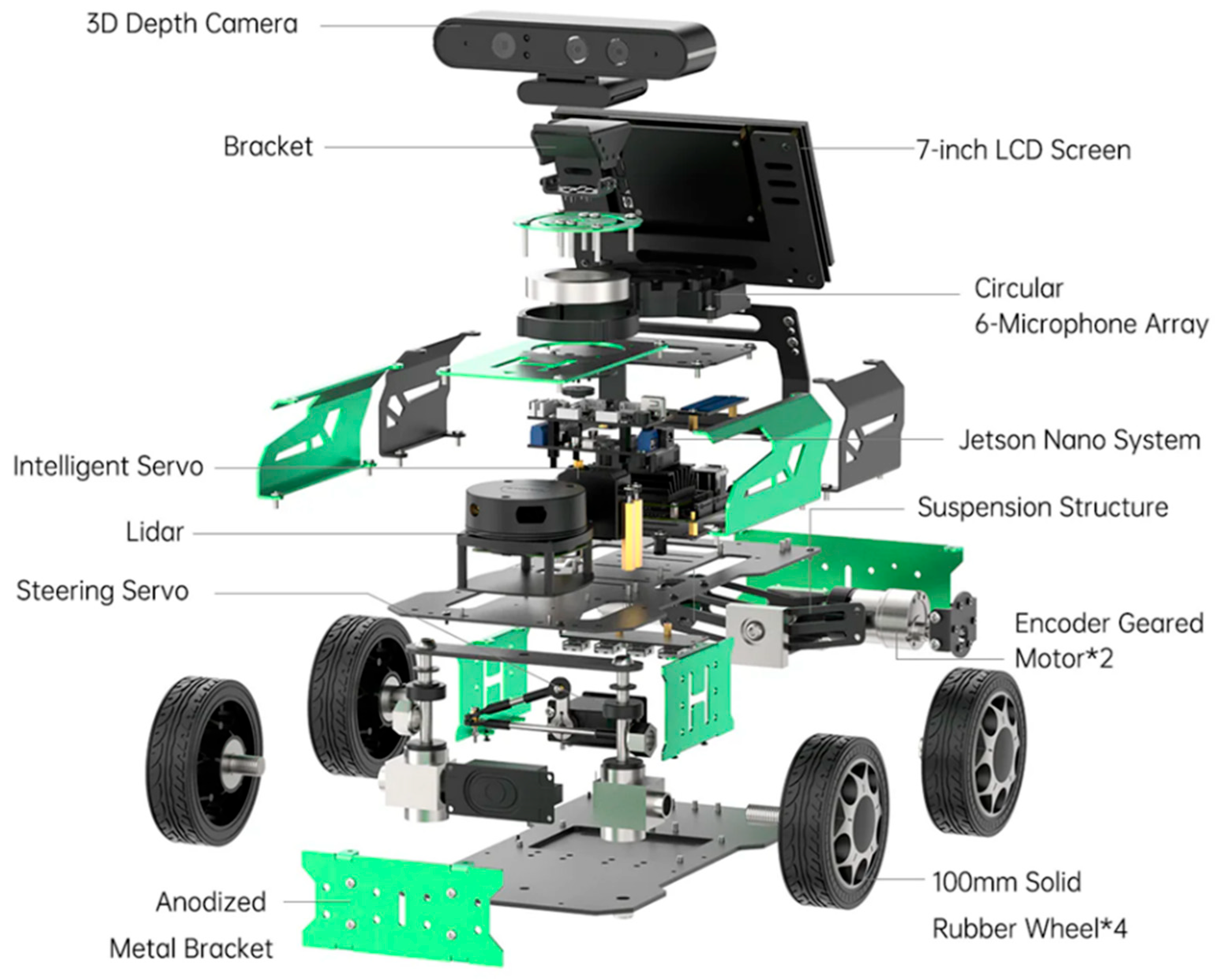
To ensure that our investigation is grounded in a realistic and reproducible context, all experiments were conducted using the Hiwonder JetAcker, a mid-sized mobile robotic platform that is increasingly adopted in both research and educational environments. The robot’s compact form factor (0.26 m in width and 0.24 m in height) makes it particularly suitable for operation in constrained indoor spaces typical of offices and laboratories. Perception is provided by a 2D RPLIDAR A1 laser rangefinder with a 90° field of view and a maximum range of 6 m, a sensing configuration that is representative of standard planar navigation setups in indoor robotics. Computation is performed onboard by an NVIDIA Jetson Nano module (Santa Clara, CA, USA), which executes the full navigation stack and serves as a realistic benchmark for the computational resources available to many comparable mobile robots [
14]. An overview of the robot structure and its principal hardware components is presented in
Figure 1.
The software environment was built on ROS Noetic, with the
move_base node serving as the central navigation coordinator [
1]. Global path planning was performed using the default global_planner plugin, which implements a variant of Dijkstra’s algorithm. Local trajectory generation and reactive obstacle avoidance were handled by the dwa_local_planner (Dynamic Window Approach), selected for its balance between computational efficiency and navigation performance [
15]. Environmental modeling was managed by the costmap_2d package, configured with static, obstacle, and inflation layers.
This software architecture reflects a widely deployed configuration within the ROS ecosystem, thereby enhancing the external validity and practical relevance of the results. By employing a commonly used hardware platform in combination with standard navigation components, the experimental setup ensures that the observed effects of parameter variations are directly applicable to a broad range of real-world ROS-based mobile robotic systems.
Within this navigation architecture, our analysis concentrates on three key parameters of the inflation layer that exert a disproportionate influence on emergent navigation behavior:
inflation_radius: This parameter defines the maximum distance from an obstacle over which costs are inflated, thereby establishing a virtual safety buffer around detected objects. Rather than imposing a binary constraint, the inflation layer assigns a continuous cost gradient that decays from a maximum at the obstacle boundary to zero at the outer limit of the inflation radius. This gradient directly influences path selection by the planners, making the inflation radius a principal control variable for balancing safety margins against navigational agility.
robot_radius: This parameter specifies the effective circular footprint of the robot within the costmap. Underestimating this value may cause the planner to generate trajectories that bring the physical robot unacceptably close to obstacles or even result in collisions. Conversely, overestimation—often adopted as a conservative safeguard—artificially reduces the robot’s perceived free space and can lead to navigation failures in environments that are physically traversable. The robot radius is incorporated into the costmap by inflating obstacles inward, thereby ensuring that the full physical extent of the robot is considered during planning.
cost_scaling_factor: This parameter governs the nonlinearity of the cost decay function within the inflation layer. Higher values produce a steeper gradient in which costs decrease rapidly with distance from obstacles, resulting in a sharper separation between regions deemed “safe” and “unsafe.” Lower values yield a more gradual decay, potentially enabling smoother and closer navigation near obstacles but at the risk of creating extended regions of intermediate cost that may complicate the planner’s decision-making.
2.2. Mathematical Model of the Inflation Layer
To objectively evaluate the impact of configuration parameters on the navigation performance of the Hiwonder JetAcker, it is necessary to formally define the mathematical model used by the ROS costmap_2d package to represent the environment. Following the methodology established by Lu et al. [
3], the environment is modeled as a layered costmap where the inflation layer transforms binary obstacle data into a continuous cost function, enabling the planner to maintain safe clearance
:
In the costmap_2d implementation [
2], the resulting cost value
for any cell is determined by a piecewise function sensitive to the robot’s radius
, the inflation radius
, and the cost scaling factor
:
Lethal Obstacle : Assigned if , indicating the cell is directly occupied by an obstacle.
Inscribed Obstacle : Assigned if . His represents a non-traversable zone where the robot’s physical footprint would collide with the obstacle.
Exponential Cost Decay: , the cost value decays according to the following exponential relationship:
where α corresponds to the cost_scaling_factor.
- 4.
Free Space , the cell is considered entirely safe for navigation.
This formalization is critical for understanding local path planning. The objective of the navigation planner is to minimize a cost function
along the planned trajectory
:
In the DWA local planner, candidate trajectories are evaluated by sampling the costmap along each discretized trajectory and accumulating the corresponding cost values . Regions with high cost thus contribute directly to the trajectory cost , biasing the planner toward safer paths with greater obstacle clearance.
From this relationship, it is evident that a high cost_scaling_factor creates a steep gradient, encouraging the robot to pass closer to obstacles to minimize the path length. Conversely, a lower results in a wider margin of high-cost cells, which, in the case of the 0.7 m narrow passage tested in this study, can lead to planning failures if the combined inflation zones from both sides of the passage exceed the available width.
2.3. Obstacle Avoidance Strategy and Configuration Space Transformation
For the Hiwonder JetAcker to operate autonomously in constrained environments, a robust obstacle avoidance strategy was essential. We adopted a widely established approach based on configuration space (C-space) transformation [
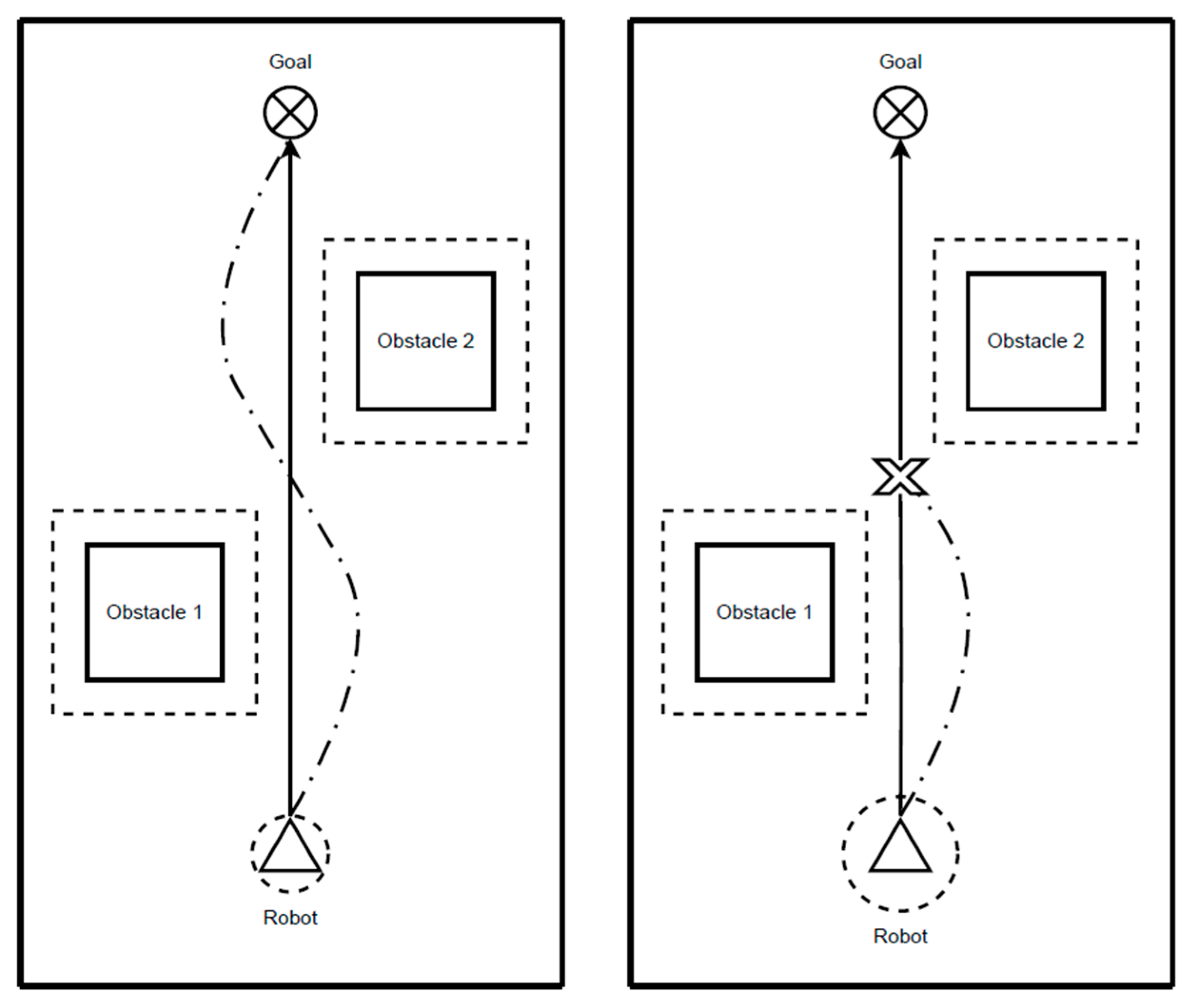
16]. This method simplifies the path planning problem by reducing the robot’s geometric footprint to a point while simultaneously expanding all obstacles by a safety margin that accounts for the robot’s physical dimensions. Within the ROS navigation framework, this transformation is implemented through the costmap’s inflation layer.
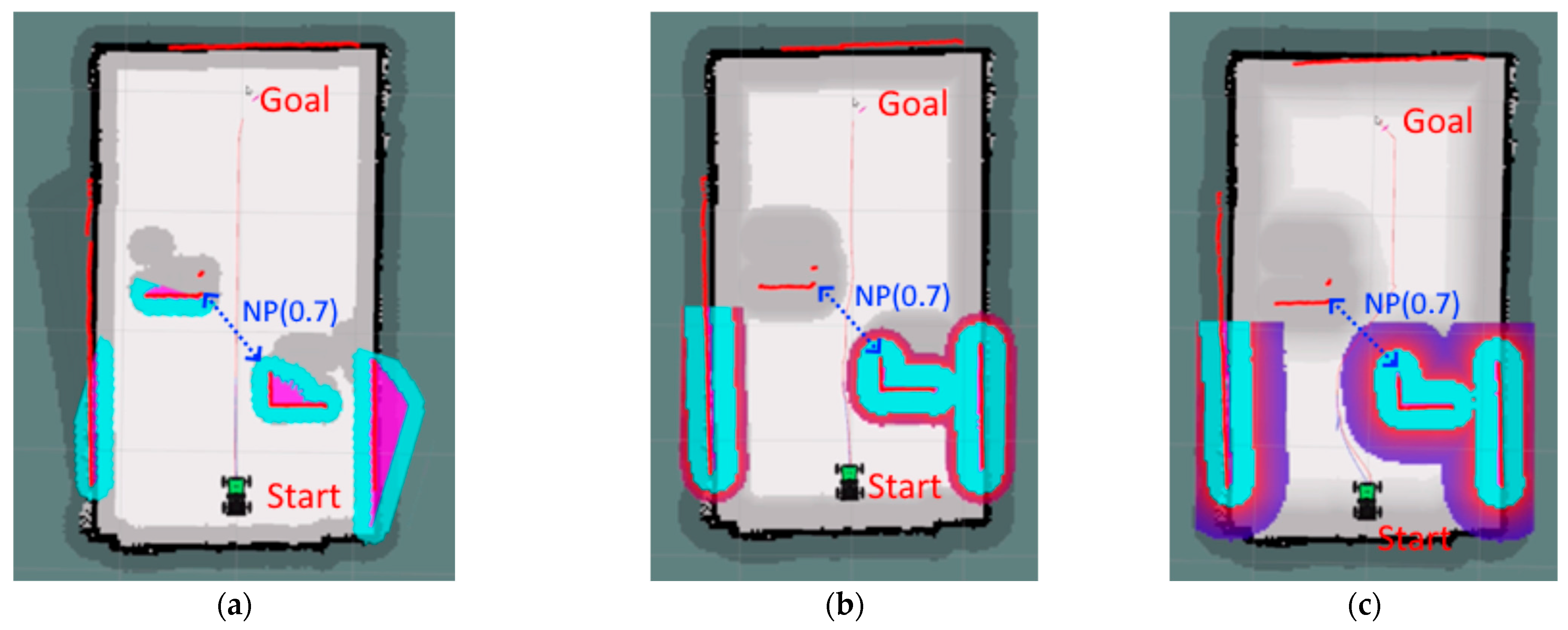
The key parameter governing this process is the inflation_radius, which defines the distance from an obstacle boundary at which an inhibitory cost gradient begins. This mechanism generates a virtual safety buffer, or “halo,” surrounding each obstacle, as illustrated in
Figure 2. Consequently, the planner does not compute trajectories around the physical obstacles themselves, but rather around their inflated representations in the costmap. From a geometric perspective, this implies that the effective width of any navigable passage is reduced by twice the value of the inflation_radius.
This effect is particularly critical in environments with narrow passages. In our experimental setup, a 0.7 m wide “doorway” served as the primary navigational bottleneck. An excessively large inflation_radius caused the inflated cost regions on either side of the passage to overlap, resulting in a continuous high-cost barrier that rendered the corridor impassable. Conversely, an overly small value provided insufficient clearance, increasing the likelihood of collisions due to factors such as odometry drift, localization uncertainty, and the robot’s dynamic constraints. Accurate calibration of this parameter was therefore essential to achieving both safe and successful traversal of constrained spaces.
Figure 2 conceptually illustrates the C-space transformation employed in this work, where inflation zones applied to both the robot and surrounding obstacles effectively convert the navigation task for a volumetric robot into a point-robot planning problem within an environment of enlarged obstacles. This abstraction forms the basis for all subsequent parameter tuning and performance analyses presented in this study.
2.4. Implementation of the Layered Costmap for Environmental Representation
The core environmental representation of the navigation system was implemented using the layered costmap architecture provided by the costmap_2d ROS package [
1,
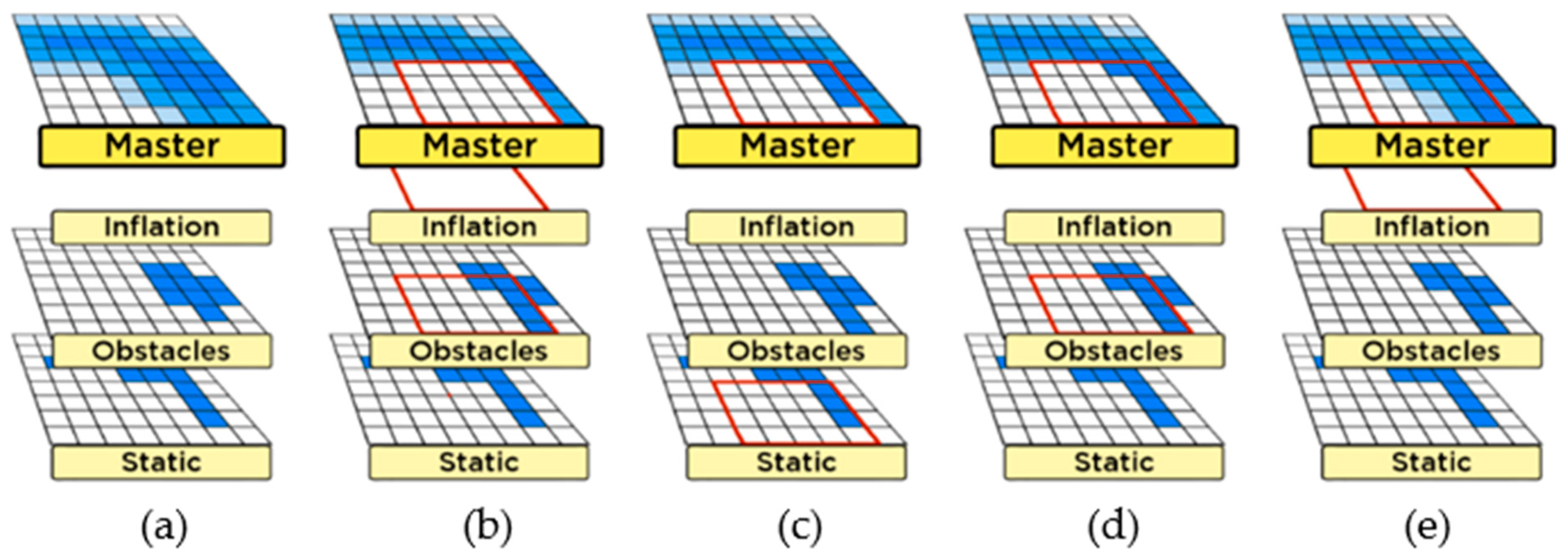
3]. This framework was selected for its modularity and computational efficiency, which are essential given the processing constraints of the onboard Jetson Nano. Our configuration employed three functional layers, each responsible for a distinct category of environmental information, as illustrated in
Figure 3.
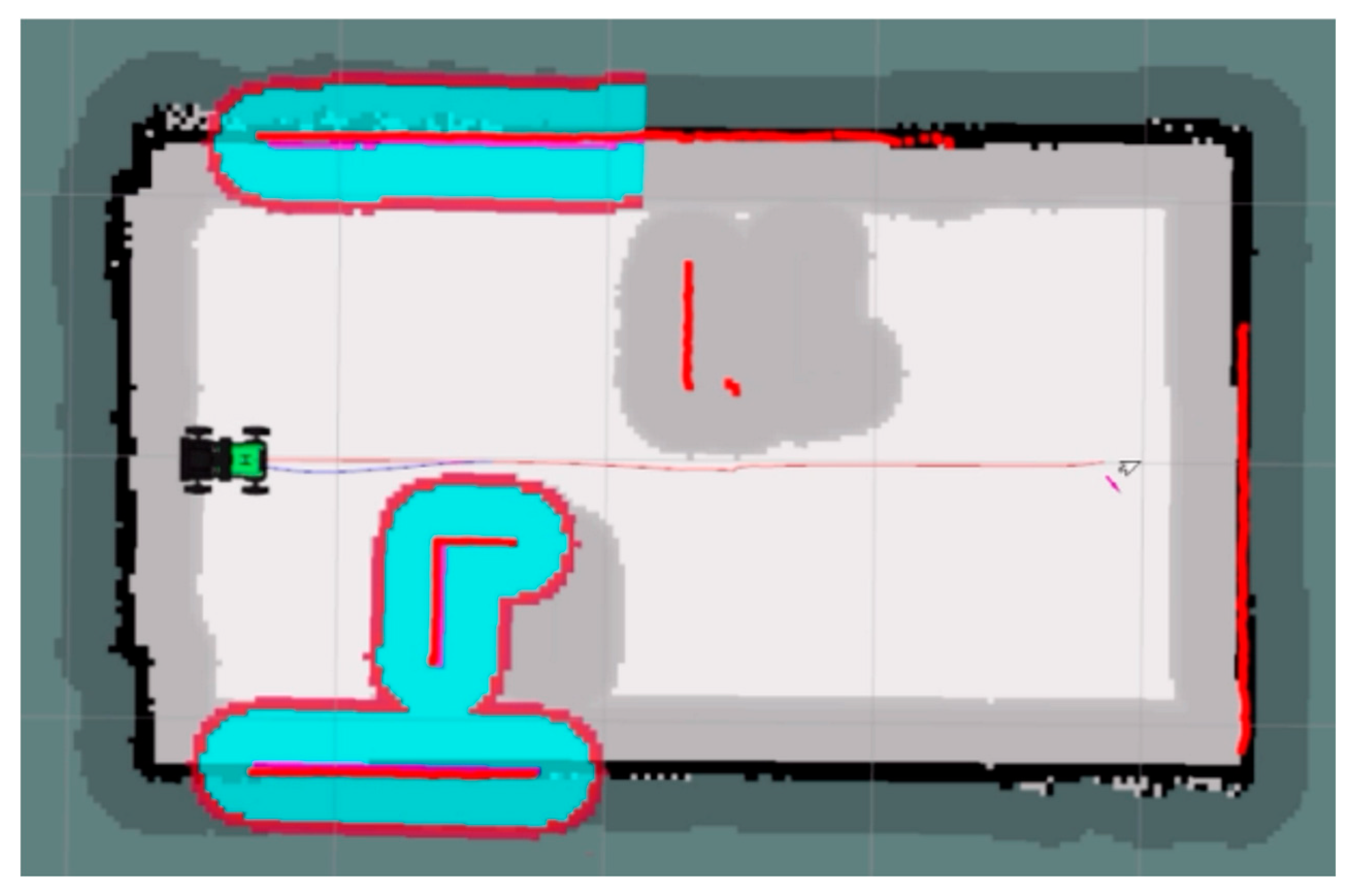
Static Map Layer: This base layer was initialized using a prebuilt occupancy grid map of the experimental arena (see
Figure 4). It provided a persistent representation of static structures such as walls and fixed installations. Since this layer was updated only when a new map was received, it imposed minimal computational overhead.
Obstacles Layer: This dynamic layer incorporated real-time measurements from the 2D RPLIDAR A1 laser scanner. It was responsible for detecting, inserting, and removing transient obstacles absent from the static map, including cardboard boxes and chair legs in the cluttered test region. As shown conceptually in
Figure 3b, updates were confined to localized regions surrounding newly detected measurements, thereby limiting unnecessary recomputation.
Inflation Layer: This layer did not maintain an independent grid; instead, it operated on the aggregated output of the lower layers. Its role was to apply a nonlinear cost gradient around all occupied cells—both static and dynamic—according to the inflation_radius and cost_scaling_factor parameters. The effect of this process on the final cost distribution is illustrated in
Figure 3e, where inflated obstacle regions define safety margins for path planning. In doing so, the layer explicitly encoded the safety constraints required for the configuration space (C-space) transformation described in
Section 3.2.
Efficient real-time performance was achieved through a two-stage costmap update cycle. In the updateBounds phase, each layer reported a bounding region corresponding to the cells affected by recent changes (e.g., newly observed obstacles from laser scans), as depicted in
Figure 3b. The union of these regions defined a minimal region of interest (ROI), ensuring that computation was restricted to modified areas. In the subsequent updateValues phase, layers were applied sequentially within this ROI—first the Static Map, followed by the Obstacles layer, and finally the Inflation layer (see
Figure 3c–e). This strict ordering preserved logical consistency: dynamic obstacles overwrote static free space, and inflation costs were computed from the final obstacle configuration. Inflation values were assigned based on the Euclidean distance to the nearest occupied cell using a decay function governed by the cost_scaling_factor.
This layered and incremental update mechanism, illustrated in
Figure 3, was central to our experimental methodology. It enabled the execution of a large number of automated trials while ensuring that only the parameters under investigation (inflation_radius and robot_radius) varied between experiments, thereby preserving consistency and reproducibility across all tests.
The primary strength of this architecture lies in its modularity [
3]. Additional semantic layers—for example, cost fields representing preferred corridors or human-aware navigation constraints—can be incorporated without modifying the core pipeline, in accordance with compositional software design principles. However, the approach also exhibits inherent limitations. The fixed order of layer application can introduce subtle dependencies; for instance, changes in dynamic obstacles may not always propagate correctly to the inflation layer if update bounds are imperfectly estimated. Moreover, in highly cluttered or rapidly changing environments, the repeated computation and union of bounding regions may itself become a performance bottleneck, although this overhead remains negligible relative to full-grid updates.
The stateless design of the inflation layer represents a further trade-off. While it reduces memory consumption, it necessitates recomputation of all inflation costs within the ROI at each update cycle. For large regions of interest, this may be less efficient than maintaining a cached inflation field with incremental updates. Nevertheless, for the spatial scales and update rates considered in this study, this design choice provided an acceptable balance between simplicity and performance.
4. Physical Robot Validation and Simulation-to-Reality Analysis
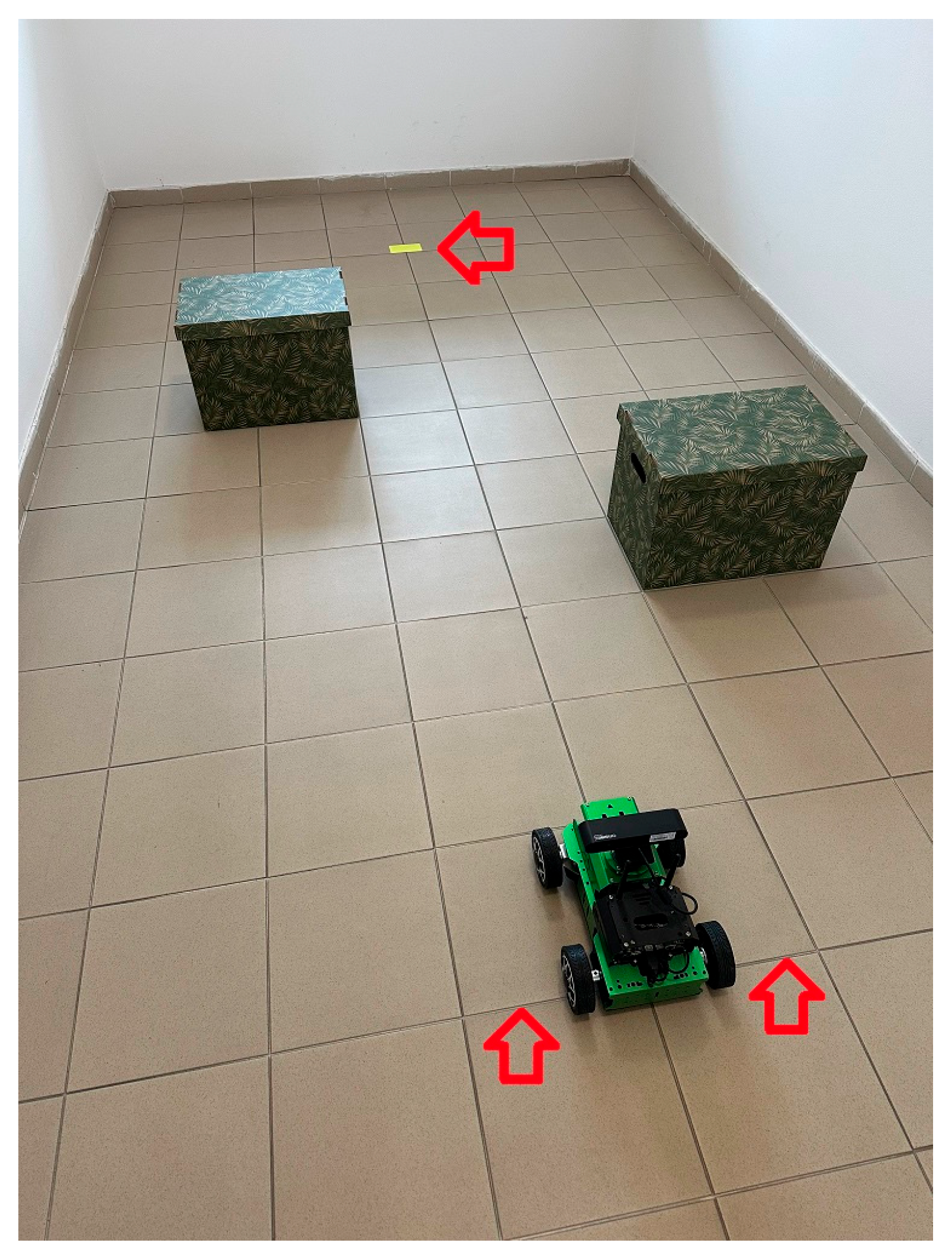
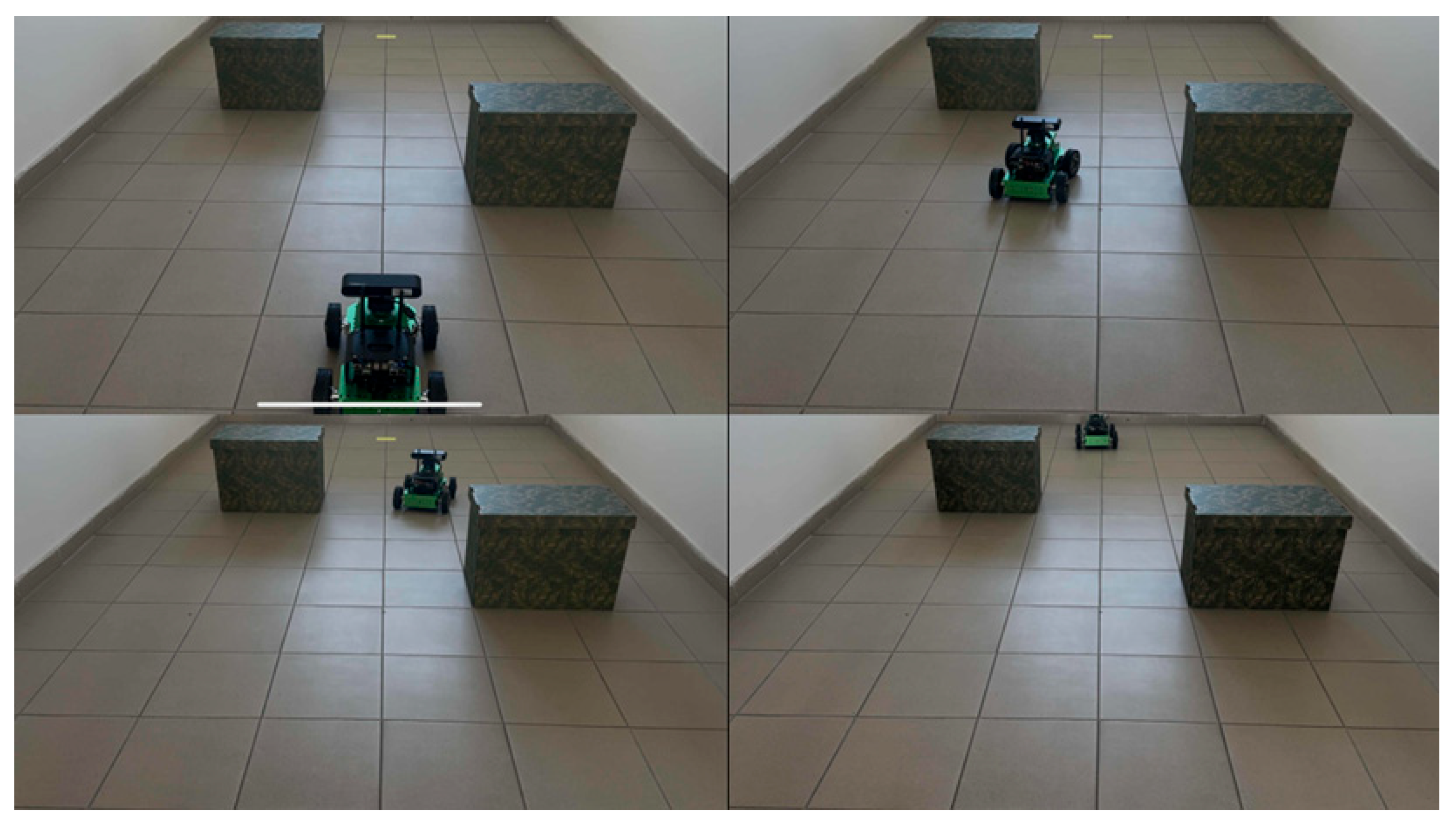
To validate the simulation results, we conducted experiments on the physical Hiwonder JetAcker platform. The robot was deployed in a controlled indoor arena constructed to replicate the essential structural features of the simulated environment. As shown in
Figure 7, the test setup included a narrow corridor formed by two boxes, creating a critical “doorway” with an effective width of 0.7 m, representative of constrained passages commonly encountered in office-like settings. During these trials, the robot was configured with
m and
m, enabling a direct comparison with the corresponding simulation scenarios.
The software stack used in simulation was transferred without modification to the robot’s onboard Jetson Nano, ensuring architectural equivalence between virtual and physical experiments. Navigation parameters were adjusted in real time using dynamic reconfigure, allowing the same parameter sets evaluated in simulation to be tested on hardware without restarting the system. For each configuration, the robot was commanded to execute a sequence of ten predefined navigation goals from identical initial poses.
To ensure a fair and reproducible comparison between simulated and real-world performance, comprehensive data logging was performed. The robot’s internal perception and planning state were monitored in real time using RViz, including visualization of the costmap and generated trajectories. Simultaneously, all relevant ROS topics—specifically/odom, /scan, /move_base/global_costmap/costmap, and /cmd_vel—were recorded to rosbag files. These logs enabled post hoc extraction of performance metrics such as traversal time and minimum obstacle clearance using the same analysis scripts applied to the simulation data, thereby guaranteeing methodological consistency across both domains.
4.1. Hardware Experimental Results
The hardware experiments largely reproduced the qualitative trends observed in simulation, but with noticeably tighter operational margins. As in the virtual environment, an inflation radius of m yielded the most balanced performance, achieving a 90% success rate while maintaining adequate clearance and acceptable traversal times. However, deviations from this nominal value produced more severe degradations than in the simulation.
As summarized in
Table 3, reducing the inflation radius to 0.15 m led to a dramatic drop in the success rate to 20%, compared with 40% in the simulation. This confirms that aggressive parameterization is significantly more hazardous in physical deployment, where unmodeled effects such as sensor noise, wheel slip, and odometric drift increase the likelihood of collision or emergency stops. At the opposite extreme, overly conservative settings (
) also resulted in disproportionately poor performance. Although the robot maintained the largest average clearance, the effective narrowing of traversable space caused frequent planning failures in the constrained passage, reducing the overall success rate to 50%.
Beyond success rates, traversal time exhibited a monotonic increase with larger inflation radii, reflecting the tendency of the planner to generate progressively longer and more circuitous trajectories in order to satisfy expanded safety margins. These findings demonstrate that, in real-world operation, both under- and over-approximation of obstacle proximity incur a steeper penalty than predicted by simulation.
The complete hardware validation results across all parameter combinations are presented in
Table 4. The pattern mirrors the simulation results but with uniformly lower success rates, highlighting the sim-to-real gap. The region of reliable operation (success rate ≥ 90%) is markedly narrower.
4.2. Simulation-to-Reality Comparison
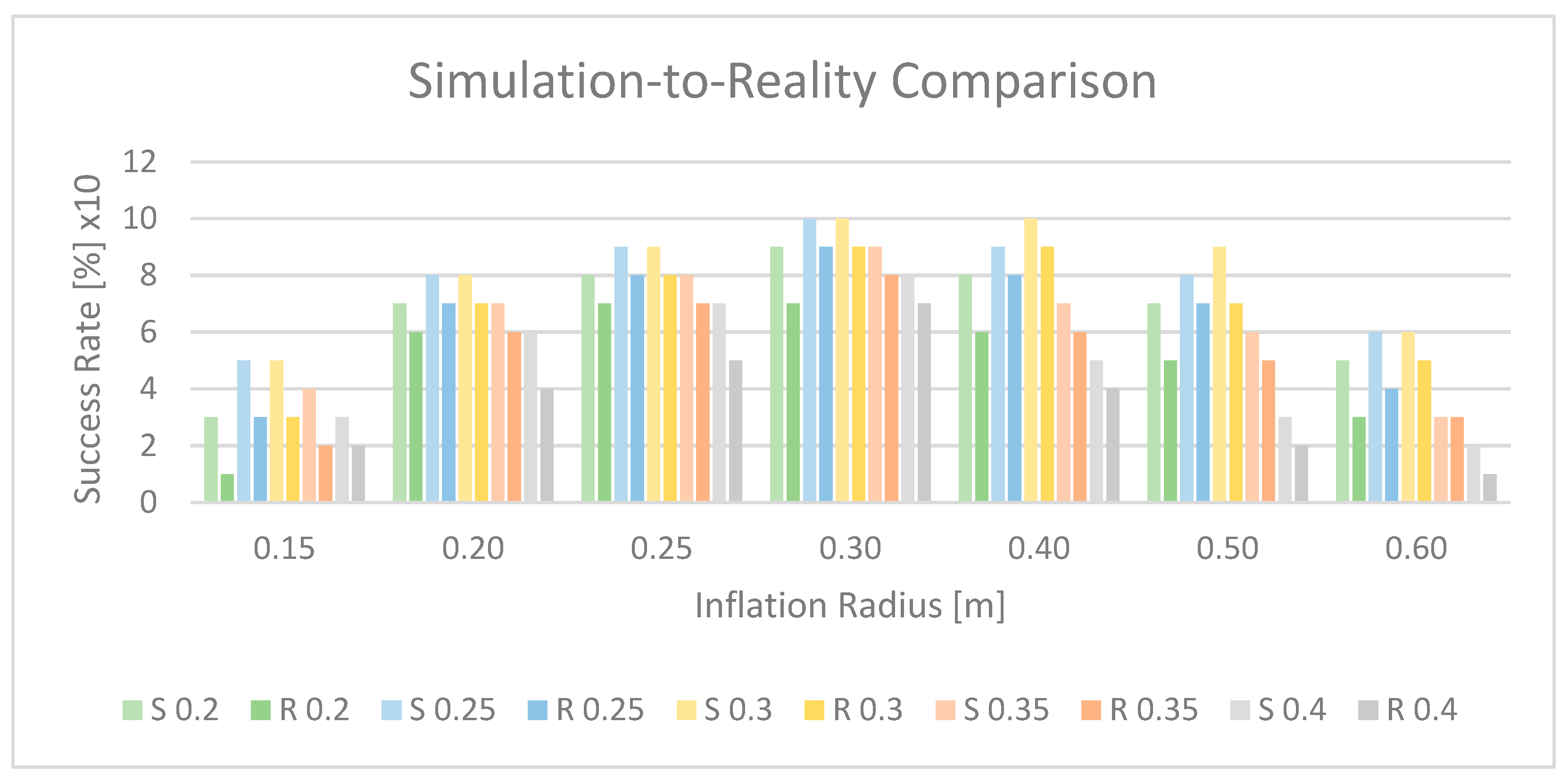
The divergence between simulation and physical deployment becomes evident when the success rates are compared across the full inflation-radius sweep, as illustrated in
Figure 8. While the simulated environment correctly predicted the location of the best-performing operating region around
m, it systematically underestimated the severity of performance degradation at both parameter extremes.
In simulation, low inflation values primarily resulted in near-obstacle trajectories with occasional collisions. On the physical platform, the same configurations proved substantially less robust, as small perception errors and localization drift translated directly into contact with obstacles or planner aborts. Conversely, high inflation radii produced conservative but still feasible navigation in simulation, whereas in hardware, they frequently rendered the narrow passage effectively non-traversable, leading to early termination of the planning process.
These discrepancies can be attributed to the idealized assumptions inherent in simulation. Obstacles are modeled with exact geometry and perfect reflectivity, and robot motion is free from slip, backlash, or actuator saturation. In contrast, the physical environment introduces cumulative uncertainties—including laser measurement noise, uneven wheel–ground interaction, and incremental odometry error—that amplify the impact of non-ideal parameter choices [
20,
21]. Consequently, the parameter space that yields acceptable performance in simulation is significantly narrower in real-world operation.
Taken together, these results underscore the necessity of hardware validation when tuning costmap parameters. Although simulation is invaluable for rapid prototyping and coarse parameter selection, final deployment requires conservative margins that explicitly account for real-world uncertainties.
4.3. Statistical Validation of Performance Differences Between Simulation and Hardware
To determine whether the observed performance differences between simulated and real-world navigation were statistically significant, a two-sample t-test assuming equal variances was employed. The test compared the distributions of success rates across all 35 parameter combinations, each with 10 repeated trials, resulting in 350 independent observations per environment. A two-tailed test with a significance level of α = 0.05 was used to evaluate the following hypotheses:
Null Hypothesis (H0): μ_simulation = μ_hardware (The mean success rate in simulation equals the mean success rate in hardware.)
Alternative Hypothesis (H1): μ_simulation ≠ μ_hardware (The mean success rates differ significantly.)
Table 5 summarizes the descriptive statistics and results of the two-sample
t-test.
The analysis revealed a significant difference between the two environments. The simulation condition yielded a mean success rate of M = 0.677 (standard deviation of SD = 0.468), whereas the hardware condition produced a lower mean success rate of M = 0.546 (SD = 0.499). The t-test result, t(698) = 3.595, p < 0.001, allowed for the rejection of the null hypothesis, confirming that the performance gap is statistically significant.
4.4. Discussion of Discrepancies
Several interrelated factors explain the systematic performance gap observed between simulation and physical experiments. Foremost among them is the influence of sensor noise. Although the 2D RPLIDAR A1 provides sufficiently accurate range measurements for indoor navigation, its readings inevitably contain stochastic errors and occasional outliers. In practice, obstacles may be perceived as marginally thicker or thinner than their true geometry, and surfaces with low reflectivity or unfavorable incidence angles may not be fully detected. This boundary uncertainty—absent in the idealized simulation environment—effectively “blurs” obstacle contours. As a result, inflation radii that are just sufficient in simulation become marginal in reality, leading to a higher incidence of near-obstacle trajectories and collisions at lower inflation values [
20].
A second contributing factor is odometric drift caused by wheel slip and surface irregularities. On the tiled laboratory floor, small traction variations accumulate into a growing pose estimation error, gradually decoupling the robot’s internal state from its true position. Path planning, which relies on this estimated pose, therefore operates on an increasingly inaccurate spatial model. Even when a trajectory is locally cost-minimizing within the planner’s internal representation, the physical robot may deviate from the intended path, increasing the probability of collision or planner failure. This mechanism likely accounts for the consistently lower success rates observed across all parameter settings in the hardware trials relative to simulation [
20].
Finally, conservative configurations were found to be more severely penalized in physical experiments. In simulation, the robot can traverse narrow gaps with millimeter-level precision, effectively “squeezing” through passages that leave minimal clearance. In contrast, the physical platform is subject to inertia, actuator latency, and control discretization. Minor overshoot during turning maneuvers or small oscillations near constrained passages are sufficient to induce contact, even when the simulation predicts safe traversal. This highlights a fundamental limitation of purely kinematic or idealized dynamic models: they fail to capture execution-level uncertainties inherent in real robotic systems. To better approximate real-world behavior, simulation environments should incorporate not only sensor noise but also models of control error, actuation delay, and mechanical compliance [
21].
While simulation proved effective for rapid parameter exploration and trend identification, it inherently relies on idealized assumptions regarding sensing, localization, and control execution. In the simulated environment, obstacle geometry is perfectly defined, sensor measurements are noise-free, and odometry is drift-free, resulting in a deterministic navigation process.
The physical experiments demonstrate that these assumptions lead to an optimistic estimation of feasible parameter ranges. Small sensing inaccuracies, pose estimation drift, and execution errors collectively reduce tolerance margins in real-world navigation, explaining the sharper performance degradation observed at parameter extremes.
Future simulation studies could reduce this simulation-to-reality gap by explicitly incorporating real-world uncertainties, such as stochastic range noise, odometry drift models, and control latency. Including these effects would improve the predictive fidelity of the simulation and provide more realistic estimates of parameter robustness prior to hardware deployment.
All experiments in this study were conducted using the Dynamic Window Approach (DWA) as the local planner. Since different local planners integrate costmap information and obstacle costs in distinct ways, the reported numerical parameter ranges should be interpreted as planner-dependent.
Nevertheless, the observed trade-offs between safety margins, path efficiency, and passage feasibility arise directly from the underlying costmap representation and geometric constraints. As such, while the exact parameter values may shift when alternative local planners are employed, the qualitative behaviors identified in this work—particularly the sensitivity of narrow passages to inflation-related parameters—are expected to remain valid across costmap-based navigation frameworks.
The experiments presented in this study were conducted in static indoor environments, where obstacle geometry remained fixed throughout navigation. In more dynamic settings—such as human-populated spaces or unstructured outdoor environments—additional sources of uncertainty would further influence parameter behavior. Moving obstacles, unpredictable human motion, and continuously changing free space would likely favor more conservative safety margins to compensate for delayed perception and reaction times.
However, increasing conservativeness in such environments would further exacerbate the trade-off identified in this work, particularly in geometrically constrained areas. Narrow passages would become even more sensitive to inflation-related parameters, potentially reducing navigability unless adaptive or context-aware parameter tuning strategies are employed. These observations suggest that while the reported parameter ranges are most applicable to structured indoor settings, the underlying trade-offs between safety, efficiency, and feasibility remain relevant and may become even more pronounced in dynamic environments.
5. Conclusions
Our investigation into the parameterization of the ROS navigation stack demonstrates that seemingly minor configuration choices can exert a substantial influence on overall navigation performance. Through a systematic combination of simulation and hardware experiments conducted on the Hiwonder JetAcker platform, we found that an inflation radius of 0.3 m consistently provided the most effective compromise between safety and feasibility. Compared to the commonly used default value of 0.6 m, this configuration reduced failure rates in narrow passages by 40% while maintaining sufficient obstacle clearance.
More critically, we showed that an accurate representation of the robot’s physical footprint is not merely a recommended practice but a prerequisite for robust navigation. An overestimated robot_radius of only 0.4 m rendered the 0.7 m test “doorway” almost impassable, effectively introducing an artificial topological barrier into the planner’s internal map. For our specific platform, the ideal balance was achieved with a robot_radius of 0.3 m—slightly smaller than the manufacturer’s stated maximum to account for the rounded chassis geometry—combined with an inflation radius of 0.3 m. This parameter pairing preserved navigability in constrained spaces while maintaining adequate safety margins.
5.1. Practical Implications
For practitioners confronted with the often-opaque task of tuning a navigation stack, this work provides both a replicable methodology and a concrete starting point. Rather than relying on heuristic trial-and-error, we advocate a structured, empirical procedure. First, the robot’s effective collision radius should be measured based on its true interaction envelope, which may be smaller than its maximum physical dimensions. Second, a focused parameter sweep of the inflation radius should be performed in a controlled environment that includes a representative narrow passage, which serves as a worst-case constraint.
The objective is to identify the smallest inflation radius that reliably prevents collisions without introducing excessive conservatism. Our results indicate that, for small to mid-sized mobile platforms comparable to the Hiwonder JetAcker, an inflation radius in the range of 0.3 m to 0.4 m constitutes a practical interval for initial testing. Nevertheless, the most suitable value remains inherently context-dependent, influenced by sensor characteristics, control accuracy, and environmental structure.
5.2. Limitations
The conclusions drawn in this study are bounded by the scope of the experimental design. All the results were obtained on a single robotic platform operating in a limited set of static indoor environments. Consequently, the applicability of these parameter values to highly dynamic scenarios—such as human-populated spaces—or to unstructured outdoor terrain remains an open question [
22,
23]. Moreover, while our experiments were conducted using the widely adopted DWA local planner, alternative planning algorithms may interact with the costmap in fundamentally different ways, potentially altering sensitivity to these parameters. Although our findings provide a robust foundation for the Hiwonder JetAcker, they cannot be assumed to be universally applicable across heterogeneous mobile robotic systems.
5.3. Future Work
This study primarily addresses the offline parameter tuning problem. A natural extension is the development of online adaptation mechanisms that allow a robot to adjust its level of conservatism dynamically in response to environmental complexity, task urgency, or localization uncertainty. Learning-based approaches that infer suitable parameters directly from sensor data or generate adaptive costmaps represent a particularly promising direction, moving beyond manually engineered cost functions [
22].
Finally, applying the proposed experimental framework to a broader range of robotic platforms and planning architectures would enable a more comprehensive assessment of how these parameter effects generalize across different systems. Such an effort could ultimately inform more principled default configurations within future ROS distributions, thereby reducing the tuning burden for end users.