Perspective

Quality in the Era of Industry 4.0—Quality Management Principles in the Context of the Fourth Industrial Revolution


Faculty of Mechanical Engineering, Poznan University of Technology, Piotrowo 3, 60-138 Poznan, Poland
*
Author to whom correspondence should be addressed.
Appl. Sci. 2026, 16(4), 1919; https://doi.org/10.3390/app16041919
Submission received: 14 October 2025 / Revised: 30 January 2026 / Accepted: 10 February 2026 / Published: 14 February 2026

Abstract

The dynamic development of Industry 4.0 technologies, referred to as smart manufacturing technologies (SMTs), is significantly changing both production systems and quality management practices. The aim of this article is to analyse the impact of smart manufacturing technologies on the seven principles of quality management (QMP). The research is based on a narrative, semi-systematic review of the literature from the Web of Science and Scopus databases from the last seven years, using thematic analysis. Traditional interpretations of QMP principles were compared with new conditions resulting from the implementation of technologies such as the Internet of Things, big data, artificial intelligence, cloud computing, vision systems, virtual and augmented reality, and additive manufacturing. The results indicate that SMTs do not eliminate quality management principles, but significantly change the way they are implemented. There is a shift towards product personalisation, shorter product life cycles, decentralised decision-making, flexible and autonomous processes, digital surveillance, and intensive use of real-time data. The article argues that SMT and QMP are complementary approaches—technologies increase the effectiveness and efficiency of quality management, but do not replace it. The considerations presented here are a starting point for further empirical research on the new ‘Quality 4.0’ model in the intelligent manufacturing environment.

1. Introduction

The history of quality management dates back to the early 20th century. However, it was not until the 1950s and 1960s that it became an important element of business management. The most well-known forms of quality management include [1,2] total quality management (TQM), the criteria of the European Foundation for Quality Management, and quality systems, especially those developed on the basis of the requirements contained in ISO 9001 [3,4]. In some organisations, these forms are used in combination, taking advantage of their complementarity [5]. All of them refer directly, to a greater or lesser extent, to the principles of quality management (QMP) that were developed in the 1970s and 1980s. The QMP principles are now known as the seven principles, which refer to the customer, leadership, involvement, processes, improvement, data, and relationships. These general quality management practices should be adapted to the production technologies and production management processes used in the enterprise [6]. Over the past few decades, these two fields, i.e., management and production, have developed in a relatively consistent and synchronised manner. However, the latest advanced technologies that underpin Industry 4.0, associated with rapid technological progress in the 21st century, seem to be disrupting this balance. Industry 4.0 means significant technological and organisational changes in companies, integration of the value chain, and the introduction of new business models in which information technologies play a key role. In relation to production systems, this is known as smart manufacturing (or smart factory), in which people and machines can work together. This enables the creation of supply chains in which customer requirements and expectations can be met more effectively and efficiently than in traditional production systems [7].
The most influential technologies in the context of smart manufacturing are as follows [8,9,10]:
  • Internet of Things (IoT)—a system in which objects (e.g., machines, devices, people) equipped with special sensors communicate and exchange data with computers and other devices [11].
  • Big data—the processing and analysis of large, variable, and diverse data sets, which enables the acquisition of knowledge that is not available using traditional data analysis methods [12,13].
  • Cloud computing—the provision of IT services, including servers, databases, networks, and software, via the Internet [14].
  • Artificial intelligence (AI)—self-learning systems, including machine learning and neural networks, based on acquired knowledge [15,16].
  • Virtual and augmented reality (VR/AR)—a computer-generated image, usually three-dimensional, that emulates the tangible world or offers a representation of a hypothetical reality, or a system that integrates the real world with a computer-generated environment [17].
  • Additive manufacturing (AM)—the process of creating three-dimensional products based on digital models by applying thin layers of material, resulting in a physical model [18].
  • Vision systems (VS)—facilitate data acquisition through the use of optical devices that enable the observation and measurement of the properties and location of objects [19].
All these technologies can be collectively referred to as smart manufacturing technologies (SMTs). They include both simple tools and methods as well as large systems. All of them are based on data from machines, machine operators, and many other sources. These data are collected using measuring devices such as sensors, vision systems, and test readers. All devices and systems are immersed in what is known as cyber–physical space (CPS), i.e., the space in which communication and digital integration processes take place [20,21].
It should be noted that advanced smart manufacturing technologies are not limited to processes. They also facilitate the development of innovative products that can be described as smart products. Such products are equipped with digital interfaces that facilitate the expansion of their functionality and applications. The emergence of digital interfaces, the Internet, digital platforms, and artificial intelligence algorithms has enabled the evolution of products from passive entities, in terms of their ability to interact with their environment, to active entities. These products are becoming hybrids, a kind of ‘product–service’ combining the characteristics typical of products and services [22,23,24,25,26].
SMTs also have an impact on the sphere of business management [27,28]. This observation is confirmed by a growing number of studies, including Gunasekaran and Subramaniam, Glogovac et al., Zairi, Silva et al., Broday, Chiarini, Carnerud and Bäckström, Weckenman et al., Baran et al., and Sader et al. [2,21,29,30,31,32,33,34,35,36,37,38,39,40,41,42,43]. On the one hand, the objectives of implementing both SMTs and QMP in a company are convergent, related to providing customers with products that meet their expectations and requirements while achieving this in an efficient and productive manner. On the other hand, the understanding of quality management primarily concerns the implementation of best practices in the field of process supervision and improvement, minimisation of variability and compliance with a set of rules and procedures, while smart manufacturing is based on modern technologies, in particular information technologies [44,45]. Information technologies alone seem sufficient to achieve quality objectives, as they increase the effectiveness of quality assurance, raising it to a new level unattainable with conventional quality management [36,46,47,48,49,50].
This apparent contradiction between SMT and QMP raises the question of whether conventional QMPs, which were developed mainly in the 1970s and 1980s, remain compatible with the new technologies mentioned above. It has been observed that over the last 20–30 years, there has been a lack of reports on innovative, original, or transformative forms of quality management, as well as original quality tools [21,51]. The literature is rich in numerous case studies analysing the implementation of traditional QMPs and tools or demonstrating their effectiveness in various contexts. It can be assumed that TQM, Six Sigma, SPC, and ISO 9000 have reached a point of maturity or ‘equilibrium’ that is incompatible with the dynamic evolution of I4.0 technologies.
The question of what quality management should look like in an Industry 4.0 environment, especially in intelligent manufacturing systems, is being asked more and more often. There are opinions supporting a comprehensive transformation of the quality management model or suggesting its gradual adaptation [6,44,52]. This article aims to present reflections and positions on the anticipated impact of Industry 4.0 technologies on the application of quality management principles in enterprises. At the same time, it serves as an announcement and introduction to the planning and implementation of comprehensive research in this field. This article presents the authors’ opinion on the impact of SMTs on quality management. The authors aim to demonstrate that achieving quality management objectives and implementing SMTs are not mutually exclusive, but rather complementary. It is assumed that SMTs alone will not replace quality management activities, but will increase their effectiveness and efficiency [53].

2. Materials and Methods

The overview presented in this article refers to seven principles of quality management. These include customer focus, leadership, commitment, process approach, continuous improvement, evidence-based decision-making, and relationship management [6]. The seven quality management principles listed above were selected as a reference point due to their universality, covering various quality management concepts, e.g., TQM, Six Sigma, Kaizen, and their various elements, e.g., products, processes, human resources, organisational structures, and the environment. These principles are characterised in their traditional sense, and aspects are indicated in which, according to the authors, changes will occur in the conditions of Industry 4.0 and smart manufacturing [11,12,13,14,15,16,17,18,19,20,21]. The elements of each quality management principle are compared with the SMT tools listed in points 1–7 in the Introduction. In order to achieve the objective of the article, namely to analyse the significance of quality management principles in the context of Industry 4.0 and smart manufacturing, a literature review was used as a methodological tool. To confirm the validity of the choice of tool, reference can be made to Tranfield (2003), who argues that literature reviews are useful when a researcher wants to examine the validity or relevance of a particular theory or competing theories, as well as when the goal is to provide a general overview of a particular issue or research problem, e.g., an assessment of the state of knowledge on a given topic [54]. According to this approach, a literature review can be used, for example, to develop a research programme, identify gaps in research, or simply discuss a specific issue, which is consistent with the objectives of this forward-looking article. Literature reviews can also be useful if the goal is to develop a theory [55,56]. In such cases, a literature review provides a basis for outlining the development of a particular field of research over time [57,58].
Both in theory and in practice, various types of literature review methodologies are used, including systematic, semi-systematic, and integrative approaches. Systematic reviews have strict requirements for the search strategy and selection of articles to be included in the review. However, systematic reviews are not always the best strategy. When the goal is to explore a broader topic that has been conceptually diverse and studied across different disciplines, a semi-systematic approach may be a good option. It allows, for example, to outline theoretical approaches or themes, as well as to identify gaps in the literature. In some cases, the research question requires a more critical selection of data for analysis. In such situations, an integrative approach may be useful when the aim of the review is to combine different perspectives to create new theoretical models [58].
In this case, the aim is not to analyse all available sources on quality management principles in the context of Industry 4.0, nor does the level of research advancement allow for the proposal of theoretical models. Therefore, an intermediate approach was chosen: a semi-systematic approach, called a narrative review, based on heuristics [59]. The semi-systematic approach is characterised by the fact that the typical goal is to review a research area and track its development over time; the research questions are broad and open-ended; the search strategy may be systematic or supported by critical analysis. The range of sources analysed using the semi-systematic method includes research articles, books, and other published texts, and the results of their analysis may be qualitative or quantitative. The results of research conducted using the semi-systematic method include topics in the literature, historical reviews, research programmes, and theoretical models [58]. This article aims to summarise the themes addressed in the literature on a specific topic and to propose a programme for further research.
Among the many methods used to analyse and synthesise the results of a semi-systematic review, thematic analysis was chosen, which can be broadly defined as a method of identifying, analysing, and reporting patterns in the form of themes in a text [60], followed by a qualitative analysis of the results. The analysis used the texts of peer-reviewed scientific articles indexed in the Web of Science and Scopus databases. The literature analysis was carried out in accordance with the order proposed in thematic sources [58]:
  • Phase 1: developing the review;
  • Phase 2: conducting the review;
  • Phase 3: analysis;
  • Phase 4: preparation of the review.
The following keywords were used in the thematic analysis in the Scopus and Web of Science databases: quality management principles, Quality 4.0, smart manufacturing, and Industry 4.0. The review was limited to the 7 years prior to 2025. The authors reviewed the scientific articles returned by the databases, removed those that did not meet the requirements, and grouped them according to the topics covered. The review based on the analysis is presented in the next section of the article.

3. Results and Discussion

3.1. The Evolution of Quality Management Principles in Smart Manufacturing

3.1.1. Customer Focus

The principle of customer focus emphasises the importance of identifying customer expectations and requirements and ensuring the conditions for meeting them. It points to the need to respond quickly to customer feedback, including comments and complaints [1,12].
In the context of smart manufacturing, the principle of customer focus will retain its central importance, but will be enriched by implications arising from innovative perspectives. These include establishing direct contact with individual consumers, designing personalised products with the active participation of customers, and reducing the time needed to introduce new products. In addition, sustainability issues will be taken into account.
-
Evolution of quality assessment criteria
With regard to smart products, it can be observed that in many cases, properties such as reliability, durability, aesthetics, or careful workmanship are no longer the main evaluation criteria for customers. This means that the evaluation of products will often be based primarily on their functionality, manifested in properties such as intuitive operation, ease of programming, the ability to purchase new applications, and miniaturisation, which are the result of the use of digital technologies. The value associated with product quality in the case of smart products will shift from what is durable and visible to what is fleeting and hidden. This change will create opportunities for new solutions, primarily through the combination of physical products with services [21,22]. Smart products will become a means of creating value in a way that depends solely on the customer’s decision.
-
Customer profiling
The increasingly frequent use of information technologies, including the Internet, big data, and artificial intelligence, will make it easier to persuade customers to purchase specific goods. This will be possible thanks to the tracking and analysis of consumer behaviour and the creation of consumer profiles, both individual and collective [61]. This will make it easier for manufacturers of specific goods to create new needs and expectations among consumers in a controlled manner [23].
-
Customisation
The emergence of SMT has opened up wide opportunities for personalisation, as it facilitates easy and effective communication between customers and designers [62]. This is all the more so as today’s customers are clearly willing and increasingly inclined to co-create product features. The use of configurators, including those using virtual reality, makes this much easier.
In light of advances in 3D printing, it is reasonable to predict that in the near future, customers will increasingly engage in the independent production of products (on a 3D printer) [21,29,31,34].
-
Shortening the product life cycle
SMTs, primarily additive manufacturing (3D printing) or reconfigurable manufacturing systems, eliminate many of the technological and organisational barriers that arise when launching the production of new products [24,25,31,41]. In turn, information technologies are easy to apply in new products and do not require large development investments on the part of the manufacturer (this work is performed by software suppliers). As a result, launching the production of new products requires less and less time and smaller investments in machinery (a reconfigurable system can be easily and quickly “converted” to new tasks). Combined with the ease of reaching individual customers and convincing them to buy new, innovative products, this will lead to a shorter product life cycle [36,49,63]. This will result in manufacturers being less willing to continuously improve the products they already manufacture (see the principle of continuous improvement). The so-called commoditisation [64] of quality will intensify, meaning that for the manufacturer, a product is only good if it sells well. As a result, the meaning of the “price–waiting time–quality” relationship will change in favour of the first two elements.
-
Attention to sustainable development
The principle of customer orientation must take into account its relationship with sustainable development [65]. This principle, which has been practised and emphasised for many years, is indirectly one of the reasons for the continuous growth in consumption and the associated shortening of the product life cycle, as already mentioned. This, in turn, generates a faster flow of materials and energy in the process of extracting and processing raw materials, processing and treating materials, assembly, storage, transport, and other processes aimed at the production and consumption of essential goods. At the same time, the premature withdrawal from the use of technically valuable products leads to waste. All of this has a negative impact on the environment and climate [65]. When applying a new approach to the principle of customer orientation, attention must be paid to this threat. Therefore, quality managers will need to pay attention to the product design phase in the future and inspire designers to introduce design principles that could alleviate the constant pressure to increase consumption and needs. The new design paradigm should prioritise the following:
  • Optimising product durability—a product reaches the end of its life cycle when the purchase of a new product becomes beneficial to the environment and society; avoiding the so-called deliberate ageing of products, which is currently used mainly to maximise the manufacturer’s profits [66].
  • Product personalisation—consumer attachment to a product in whose design, production, or delivery they were involved.
  • Enriching the product during its life cycle, e.g., through systematic improvement by replacing physically worn or technically obsolete components, and designing products with so-called open architecture, which consists of basic and personalised modules, thus increasing the product’s life cycle [67].

3.1.2. Leadership

In the context of quality management, leadership involves formulating a vision and setting strategic quality objectives, as well as convincing employees to align themselves with these objectives. It is essential that quality objectives are customer and consumer-oriented. Through their behaviour and actions, leaders must demonstrate a clear and unwavering commitment to the objectives set [68].
It seems reasonable to assume that the role of quality management leaders in relation to leaders in other areas of the company’s operations will be re-evaluated in the context of smart manufacturing. It is clear that over the last 60–70 years, their position has been very influential. To a large extent, it was they, as quality managers, who determined the direction of the company’s development. The coming change will depend on the accelerated pace of change and the need to set more direct goals and delegate strategic decision-making to lower levels [69,70].
-
Decentralisation of decisions
The integration of information technology into business operations and the new opportunities it creates in terms of data access and communication will result in many decision-making tasks being taken over by lower-level employees (i.e., operational staff). They will be supported by artificial intelligence tools that will make autonomous decisions in specific cases [36,49]. Employees will not only be responsible for implementing the leader’s vision but also play an active role in its development and implementation [69]. As a result, unlike traditional business models where leadership is concentrated in the hands of a few people with extensive access to information about the company’s operations and environment [6], leadership in I4.0 will be more democratic.
-
Care for resources
While leadership in planning and decision-making will become increasingly dispersed, managers will be expected to anticipate the competence and material resource requirements in the area of quality management. The future SMT-equipped factory will require employees with the necessary knowledge and skills to use digital tools and make data-based decisions (see the principle of people engagement). For example, employees involved in quality control or process improvement will need to be knowledgeable about the latest data analysis methods [44].

3.1.3. Engagement—Employee Engagement

The term ‘engagement’ is defined as participation in activities and taking responsibility for one’s actions. It is an emotional state that indicates that people want to pursue certain goals or are willing to achieve certain goals, regardless of any obstacles. Engagement is influenced by many motivational factors, including internal and external elements such as role attractiveness, autonomy, working conditions, and organisational culture. Adherence to established rules and teamwork are key aspects of engagement [38].
Employee engagement in companies using SMTs will be positively influenced by the possibility of applying new, innovative information technologies to production and process supervision. At the same time, the use of these technologies will require greater concentration and individual responsibility from employees.
-
Acquiring skills in the use of SMTs
The convergence of the physical, digital, and virtual worlds will lead to the elimination of some traditional jobs and will require employees to acquire innovative skills in the operation of collaborative robots, autonomous surveillance systems, or vision control stations [29,30]. Quality managers will need to acquire new skills in data collection and processing, including the use of machine learning algorithms. It will become increasingly essential for employees to have skills in managing large data sets, artificial intelligence, robotics, and the Internet of Things [15,33,35,41]. This can be described as a shift from a role focused on monitoring and responding to specific situations to one that involves anticipating and preventing them. This will make work more attractive to people while improving the quality of work outcomes and productivity [44].
-
Individualisation of approach
Communication within the enterprise will increasingly be carried out using individual devices such as human–machine interfaces (HMIs) or smartphones connected to the IoT system and the cyber–physical environment, and data will increasingly be transmitted along the “human–machine” or “human–IT system” line, bypassing “human–human” communication. As a result, employees will increasingly rely solely on themselves when making decisions, which will require them to be more aware of their responsibility for their actions, including meeting quality requirements, and to take independent corrective or preventive action.
Employees will be expected to avoid automatically performing their tasks without considering their sometimes far-reaching consequences. A so-called mindfulness-based approach will be expected, i.e., focusing on the present moment and trying to experience it consciously [70], which in traditional quality management is suppressed by the need to follow specific procedures or instructions [71]. In light of the increasing availability of data to employees and the growing scope of decision-making powers at the management level, it seems likely that forms of collective work, including traditional face-to-face meetings and quality circles, which have historically played a key role in quality management systems, will become less important in the future. It is anticipated that communication between employees will become increasingly digital, with online formats becoming more prevalent [36,38,44].

3.1.4. Process Approach

For several decades, the process approach has been a fundamental principle of management and quality applied throughout the product life cycle. It requires the establishment and adherence to channels of communication between the various stages of core processes, as well as support processes. The application of this approach facilitates the optimisation of value and management processes. It also requires compliance with regulations to ensure order and prevent deviations from established arrangements (e.g., sequence of actions, requirements specifications). The process approach requires a shift in focus from the internal structure of the organisation to the processes that are actually implemented. The boundaries between organisational units are replaced by boundaries between processes. The overriding goal is the outcome of the process, not the outcome of the unit [33,66].
The process approach remains an important principle in the smart manufacturing environment, although there has been a shift in emphasis. Increasing process fragmentation and the drive for process flexibility will require a change in the very nature of the process approach [72].
-
Focus on process flexibility
The focus on process flexibility, enabled by smart manufacturing, e.g., through the use of sensors, RFID systems, digital twins, the Internet of Things (IoT), and cloud computing, will facilitate unprecedented synchronisation of activities within core, support, and management processes [72]. As a result, processes can be divided into sub-processes, performed simultaneously, and distributed spatially to a greater extent than was previously possible. Such implementation of production processes will facilitate a faster response to environmental changes, as it will allow for the dynamic selection of contractors for a given task, for example, in the event of unforeseen changes in customer expectations or supply problems [30,47].
In the context of production processes for products with highly dynamic changes in customer expectations, especially those belonging to the category of smart products, there will be a shift away from setting detailed, long-term goals and subsequently monitoring their implementation. Instead, short-term planning will be preferred, and goals will be reviewed more frequently. The need to ensure process flexibility will encourage manufacturers and suppliers to move away from the traditional “push” product distribution model and adopt a “pull” approach, thus adapting to the principles promoted in the lean manufacturing concept.
-
Moving away from a procedural approach
The modern market is characterised by changing customer expectations and intense competition, which introduce disruptions in the production system to which the quality management system must respond in a timely manner. The inflexible procedural approach traditionally used in such circumstances, where the overriding objective is to comply with established and documented rules of conduct in a given situation, may prove ineffective. This requires, among other things, the creation and control of documented information, such as procedures, instructions, and records, within the framework of an intelligent production system. These must be strictly adhered to—this is often a prerequisite for a positive assessment by auditors.
With the growing popularity of SMTs, it may become more effective to rely on the flexibility of the system and focus on creating a system that quickly and independently adapts to changing conditions [66,73,74,75]. A digital twin, as a digital model of the process and the resources used in it [76], has online access to all relevant process data, enabling automatic real-time process adjustment. This eliminates the need for human involvement, which can be replaced by artificial intelligence. Furthermore, there is no need to create additional documentation, which is common practice in traditional process approaches, as all evidence of activity is automatically stored in digital form.

3.1.5. Continuous Improvement

The principle of continuous improvement is a characteristic feature of quality management. It means the need to continuously identify potential opportunities for improvement, both in terms of products and the processes involved in their manufacture and distribution, in order to optimise effectiveness and efficiency. The aim of improvement is to provide manufacturers and customers with the greatest possible benefits. Examples of the practical implementation of this principle include improvement methodologies, also known as improvement cycles, such as PDCA or DMAIC, which are part of the Kaizen or Six Sigma improvement strategies [33,38].
The principle of continuous improvement will continue to be a hallmark of quality management. However, in the SM environment, the principle of continuous improvement will evolve due to changes in the perception of product quality, shorter product life cycles, and new opportunities for data acquisition and processing.
-
Shorter product life cycles and no time to strive for perfection
If product and manufacturing process improvement is carried out gradually and systematically over a longer period of time, using appropriate quality tools, including statistical and experimental techniques, it is possible to achieve process quality above 5 sigma (ppm or DPMO < 1000) and to obtain high product reliability and uniformity. However, such a procedure requires a long product presence on the market and loyalty to the product.
In the context of today’s market, especially the smart product market, characterised by rapidly changing customer needs and expectations, decreasing emphasis on product durability and excellence, and increasing emphasis on product innovation, striving for continuous, systematic product improvement through gradual, minor improvements may no longer be an attractive strategy for companies. The pursuit of perfection will become less profitable. As a result, manufacturers will spend less time systematically improving existing products or processes and more time developing new, innovative, and potentially groundbreaking product variants [27,33,72].
-
Growing commoditisation and cheap products
As a result of the increasing commoditisation of products, as well as the pursuit of sustainability mentioned earlier when discussing the principle of customer orientation, there will be a trend towards providing products that are economical and environmentally friendly, with a minimal carbon footprint. However, from a qualitative standpoint, especially in terms of aesthetics, these products may be less valuable or less durable [23,65].
-
Shifting product improvement to the usage phase
While continuous improvement of already manufactured products will be less popular, the improvement of products already in use will evolve. This will be achieved by offering users new software versions that increase functionality or provide greater monitoring capabilities [15,16,34].
-
Bypassing traditional improvement methods
Traditional improvement projects are dominated by teamwork, brainstorming sessions, quality circles, idea sharing, collective discussions and presentations of ideas to management, and the use of proven methodologies (PDCA, DMAIC, 8D). In an SM environment, improvement tools and methods will change. More data will be available, mostly online. The data will be able to be processed using artificial intelligence technologies, which have been underdeveloped and difficult to access until now. Many related tasks will be able to be performed by a single person. The work of a team of people will be replaced by work with a set of artificial intelligence tools.
The availability of data and the ability to analyse it comprehensively in real time (online) will mean that a flexible approach to improvement will be used more and more often, with only the general principles imposed by traditional improvement methods being retained [33,38].

3.1.6. Evidence-Based Decision-Making

In order to make the right decision, access to reliable data and information is essential. Data can come from a variety of sources, including research, observation, measurement, audits, inspections, etc. Numerical data are preferred. Therefore, the use of quantitative quality tools and statistical techniques is crucial in the decision-making process [73].
In the smart manufacturing environment, the principle of evidence-based decision-making will remain relevant and will have a significant impact on quality management practices [32]. The growing importance of evidence-based decision-making will result from the increasing ability to collect data from manufacturing processes and product use, process it, and transfer it to places where it can be used effectively. The concept of digital quality management is even discussed in the literature [6,39,76].
-
Ease of data acquisition
The ease of data acquisition, including customer data, will increase. More and more data will be acquired online and continuously [77,78,79]. Where possible, data will be collected using vision systems that can capture everything and even more than the human eye [80]. A properly configured system will be able to process data collected by vision systems with accuracy, speed, and comprehensiveness unattainable by human senses.
Data acquisition will be carried out by automated robotic measurement systems. As a result, horizontal and vertical digital integration will enable the aggregation and analysis of data from different segments of the production system and the market. IoT, IoS, and physical cyberspace technologies are expected to play a significant role in this regard [11,80].
Significant developments are expected in the ability to collect data from customers in order to inform manufacturers about their level of satisfaction with the products they have purchased and used or the services they have received. The use of data collected from websites, including social media, for monitoring and data collection purposes is expected to become widespread [13,45].
-
Improving data quality
Given the ease and volume of data collection, it is necessary to prioritise data quality and, consequently, the quality of the information derived from it [44,81,82]. This is because simply collecting large amounts of data does not in itself create value; value is only created when the collected data enables appropriate and effective decisions to be made and ultimately benefits the organisation.
-
Comprehensive and in-depth data analysis
The way data are analysed will undergo a significant transformation. The dominant approach will be the use of artificial intelligence methodologies, such as machine learning, combined with the capabilities of processing so-called big data, i.e., data from various sources. The analysis of large amounts of heterogeneous data will be made possible by the use of artificial intelligence algorithms, including machine learning and deep learning. This will facilitate the identification of the causes of problems that are difficult to diagnose using traditional methods because their causes are deeply hidden in the process. It is extremely important to be able to identify hidden patterns and predict future events on that basis [45,61].
The widespread use of artificial intelligence methods will result not only from their availability but also from the growing complexity of modern devices and processes. The complex interdependencies characteristic of these systems make classical methods of reasoning, based on clear cause-and-effect relationships or consistent mathematical models, inadequate for their description [50]. It can therefore be concluded that the use of artificial intelligence methods will eventually become the only realistic way to analyse such data.
It should be noted that the results obtained from machine analysis are difficult to interpret and therefore can only be assigned limited reliability. This is because machine learning techniques are similar to black boxes, in which patterns are used to categorise states that are inaccessible or opaque to humans [83]. The inability to link the results to the physical system makes it difficult to determine the cause of the loss of the required quality capability and to take appropriate action. Therefore, it is recommended that diagnostic reasoning based on simple methods such as regression, classification, clustering, or time series be given priority in practice. Only when these methods prove ineffective, i.e., when they too often lead to wrong decisions, should additional data be included in the reasoning and more advanced data processing methods be used [79,80,81,82,83,84].

3.1.7. Stakeholder Relations

Establishing partnerships with customers and business partners depends on adhering to values such as cooperation (sharing information about plans and problems and providing mutual support in solving them), reciprocity (respecting the interests of each party, especially in terms of financial benefits), trust (belief in the good intentions of each party) and loyalty (commitment to a partnership that is beneficial to both parties, regardless of the circumstances) [84].
With the development of SMTs and the growth in the number of companies operating at the level of smart manufacturing, the above-mentioned values in relationships with customers and colleagues will retain their importance. However, the practice of implementing them will evolve. Factors influencing this evolution include the growing importance of the individual customer, the creation of supplier networks, and the entry of small businesses into the market [32,33,72].
-
Direct relationships with individual customers
In the traditional approach to quality management, the term “relationship” is largely used in reference to the customer population and the statistical customer. The relationship between an individual customer and the manufacturer of a product, such as a car, household appliance, or furniture, is typically characterised by a lack of closeness or intimacy. Such relationships are often limited to brief encounters at trade fairs or exhibitions, with most interaction taking place during the purchasing process. In the context of Industry 4.0 and intelligent manufacturing systems, there will be a shift in the position of the customer, who will move from being an anonymous recipient to an active participant. The Internet will make it easier to track consumer behaviour and preferences, enabling the identification of specific customers. Personalisation will facilitate the direct involvement of customers in the product design process, in line with the principle of customer orientation [18,25,62].
-
Opportunities for small suppliers
In the classic value chain, end-product manufacturers and original equipment manufacturers (OEMs) gain a competitive advantage through their ability to operate on a large scale. In this way, they are able to control the competitive environment and impose conditions on their suppliers, who are usually small and medium-sized enterprises.
In the context of small and medium-sized enterprises, digital technologies reduce the physical distance between manufacturers and consumers. The ability to respond quickly and flexibly is becoming a key factor in determining competitive advantage. Make-to-order production is becoming increasingly important compared to make-to-stock. In this context, the role of intermediaries in extracting value from a product is becoming less and less necessary. This creates greater opportunities for smaller companies to compete with industry leaders.
This will be particularly important for manufacturers of non-mass-market products [78]. Manufacturers of these products are often small start-ups that use crowdfunding platforms not only to raise initial capital but also to build a community of supporters and followers for their products. This strategy effectively generates demand while creating a direct link between demand and supply. Consumer engagement does not end when the campaign ends; companies continue to communicate with their followers throughout the production process, providing detailed information on both successes and challenges [21].
The combination of these factors with growing user expectations for product personalisation and added value, as well as the development of the smart product market, will weaken the importance of the brand. In this context, satisfaction will be measured more by the uniqueness of the product and less by the identity of the manufacturer or supplier [34,79,85].
-
The development of virtual enterprises
The emergence of IT solutions will mean that organisations will increasingly form networks, thus creating a business ecosystem in which each organisation is closely linked to and dependent on others [79]. Virtual enterprises will be created within the network to undertake a range of activities, including product development, raw material procurement, production planning, quality assurance, and shipping. However, these entities will not have their own production facilities, but will enter into outsourcing agreements with a network of suppliers who may be located in different geographical regions, including abroad. An extranet platform will facilitate ordering, disseminate order information, and enable customers to monitor the entire production process [85].
Virtual enterprises will not use the conventional linear model of product development and supply chain management, which typically includes procurement, production, marketing, services, distribution, and customer relationship management. In the future, transactions may take place directly between parties, bypassing intermediaries and traditional methods of supply chain and inventory management [34].
The development of virtual enterprises will challenge the assumptions underlying traditional quality management models, which typically assume a relatively static environment and a stable set of collaborators and suppliers. Each of them is treated as a separate and permanent entity with a clearly defined scope, processes, and boundaries [41].

3.2. Analysis of the Impact of SMT on the Application of Quality Management Principles (QMP)

A summary of the considerations presented in Section 3 regarding the expected impact of SMTs on the application of QMP principles in enterprises and on the market is presented in Table 1.
Table 1. Summary of the analysis of the impact of SMTs on the application of quality management principles (QMP).
QMP
Principle
QMP
Aspects
Processes
and Challenges and Opportunities Related to SMT
Related SMT Literature Sources
Customer focus
Meeting expectations
Expectation survey
Meeting expectations
Sustainable development
Changing customer needs and expectations
Customer profiling by tracking their activity
Product personalisation with customer involvement
Reducing waiting times for new products
IoT, big data/artificial intelligence
2D/3D configurators, VR/AR
3D printing
[1,12,21,22,23,24,25,29,31,34,36,41,49,61,62,63,64,65,66,67,75,84]
Leadership
Appropriate quality objectives
Planning quality objectives
Decision-making
Resource allocation
Shortening the time horizon for planning quality objectives.
Transferring responsibility for setting quality objectives to lower levels of management.
Implementation of a new SMT and recruitment of employees competent in its operation.
CPS
IoT, artificial intelligence, cloud computing,
[6,36,44,49,68,69,70]
Commitment
Motivation to achieve quality objectives
Acquisition of SMT skills in order to perform QMP tasks
Individualised approach
Need to train employees in SMT
Ability to use SMT for quality objective planning, quality control, data processing, and analysis.
Increased importance of engagement, mindfulness, and awareness.
CPS
Big data, IoT, artificial intelligence
Vision systems,
[15,29,30,33,35,36,38,41,44,70,71]
Process approach
Rapid problem solving
Ensuring communication
Improving planning
Agile processes
Moving away from a procedural approach in favour of a proactive approach.
CPS
RFID, sensors
Digital twins
IoT, artificial intelligence
Cloud computing
[30,33,47,66,72,73,74,75,76,81]
Continuous improvement
Leveraging opportunities
Using the right improvement toolsShort time to product improvement.
Improvement through breakthrough innovations.
Commercialisation and products.
Data availability during the usage phase.
CPS
RFID, sensors
IoT, artificial intelligence, cloud computing
[15,16,23,27,33,34,38,65,72,79,82]
Evidence-based decision-making
Accuracy of decisions
Identifying sources of data acquisition tools
Ensuring data reliability
Increasing the availability of data and information at every stage of the product life cycle (value chain).
Ability to perform comprehensive and in-depth data analysis.
CPS
RFID, sensors
IoT, artificial intelligence, cloud computing
[6,11,13,32,39,44,45,50,61,73,76,77,78,79,80,81,82,83]
Relationships
Benefits of cooperation
Maintaining relationships with customers and suppliersIndividualised approach to customers.
Low technological threshold; growing role of small manufacturers.
Virtual companies; multiple suppliers.
CPS n
Internet, IoT, artificial intelligence
Additive manufacturing
[18,21,25,32,33,34,41,62,72,78,79,84,85]
Source: own study.
The impact of SMTs on quality management practices varies. Some technologies are more useful in performing quality management tasks, while others are less so. An attempt to classify them in this context is presented in Table 2. The importance of selected SMTs for QMP implementation.
As Table 2 shows, according to the authors of this article, the Internet of Things, cloud computing, and artificial intelligence (AI) are particularly important for the practical application of QMP principles. The importance of the first two technologies is obvious and indisputable, as they can be used in all enterprises and throughout the business environment (by both suppliers and customers). This is because they do not require specialised IT equipment—all that is needed is access to the Internet. In the case of AI, the potential impact is significant, but its use requires specialised software and personnel who can properly operate the software (prepare data) and then interpret the results obtained. Similar comments apply to big data and virtual reality technologies.
Additive manufacturing technology has a significant impact on the implementation of the ‘customer orientation’ principle. It enables product personalisation, shortens the time to market for new products, and creates opportunities for small manufacturers.
The overview of the relationship between advanced SMTs and QMP presented here shows that the implementation of SMT brings a number of challenges, opportunities, and phenomena in the seven QMPs, changing the way they are applied. However, it should be noted that these changes will primarily result from the increasing availability of data and the ability to process and then transfer it.
The above conclusions were formulated on the basis of an expert analysis carried out by researchers from the Department of Production Engineering at the Poznań University of Technology.
The team was familiarised with the assumptions of this article and the results of the literature analysis. The appointed team is interdisciplinary because the Department of Production Engineering employs experts in the fields of quality management, production engineering, virtual reality, and additive manufacturing.

4. Conclusions

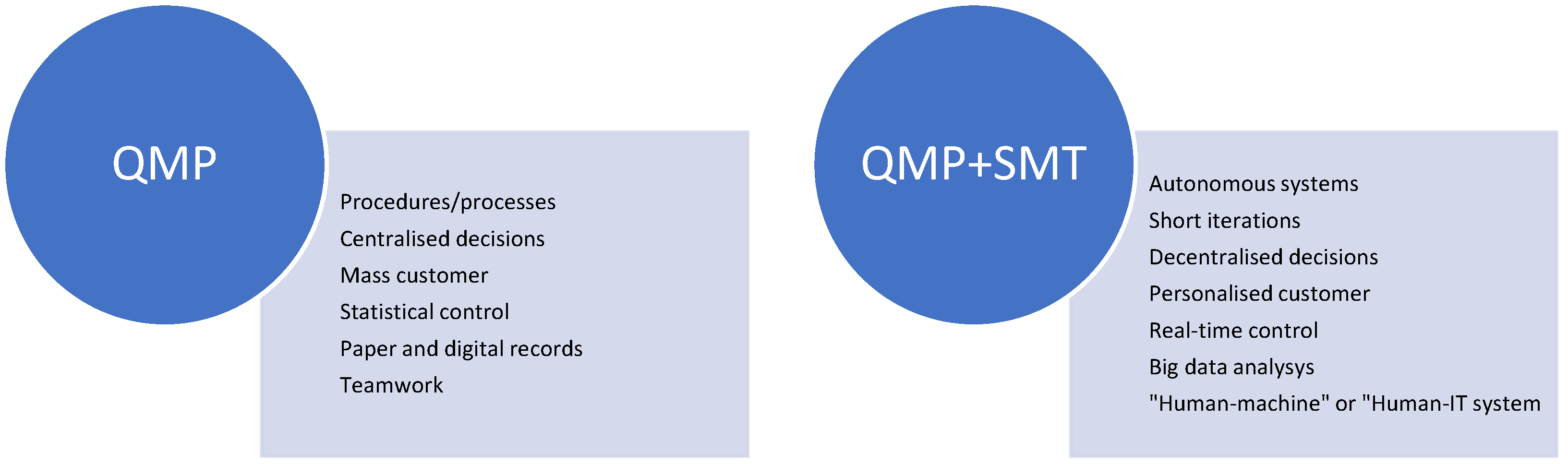
Smart manufacturing technologies (SMTs) are changing the business environment and manufacturing processes, and the resulting changes must also be considered in the context of their impact on the quality management environment (Figure 1). The approach to quality management should be refreshed and supplemented with new elements [8,21,71] so that it can contribute to the effective use of company resources to meet customer expectations. Quality managers must move beyond the comfort zone of the last few decades, during which quality management was seen as the main driver of business and social development [21]. They need to acquire new skills in quality management methods and tools (QMP), as well as in communication with employees and customers. Otherwise, the quality management environment will gradually lose its relevance.
These changes are unlikely to require any particular driving force, but will rather emerge naturally. It will be a process of gradual adaptation, taking place without the need for external control. Traditional principles will be reinforced by SMTs while also merging with new ones. The introduction of these new technologies will not invalidate traditional principles. It will be a virtually imperceptible process. The conservatism of those traditionally considered “quality people” will not be an obstacle.
However, it should be noted that although the introduction of new technologies into a company may be relatively simple, given the novelty of modernity, changing people’s attitudes, which are influenced by QMP, always meets with resistance and is a long-term process. In the context of quality management, an additional factor that may hinder the adoption of new approaches is the attachment, sometimes even cult-like, to the principles and theories developed by Juran, Deming, Ishikawa, and other authorities in the field of quality management in the 1970s and 1980s.
The reflections presented in this article are subjective predictions. The reliability of these predictions depends on many variables that are currently difficult to predict. It is unclear whether the development of artificial intelligence will be halted in the future due to growing awareness of its limitations and the social risks it poses. Or, on the contrary, will it become an essential business tool? It should also be noted that the validity and accuracy of the predicted changes depend on the specific circumstances of a given company, especially with regard to its development and commitment to implementing SMTs.
This article is an introduction to research that will involve collecting data based on structured interviews using questionnaires in manufacturing companies. The conclusions of the research, based on case studies, will confirm or refute the theses put forward in this study. The authors will seek to identify potential barriers, threats, or practical challenges associated with the application of SMTs to QMP, as well as to propose indicators for diagnosing the impact of SMTs on QMP.

Author Contributions

Conceptualization, A.H.; methodology, M.G.; formal analysis, M.G.; investigation; resources, A.H.; writing—original draft preparation, A.H.; writing—review and editing, M.G.; funding acquisition, A.H. All authors have read and agreed to the published version of the manuscript.

Funding

This research was funded by [Poznan University of Technology] grant number [0613/SBAD/4940].

Data Availability Statement

No new data were created or analyzed in this study. Data sharing is not applicable to this article.

Conflicts of Interest

The authors declare no conflict of interest.

Abbreviations

The following abbreviations are used in this manuscript:
CPSCyber–Physical Space
QMPQuality Management Principles
RMSReconfigurable Manufacturing System
SMTSmart Manufacturing Technology

References

  1. Parasuraman, J.; Ball, J.; Aksoy, L.; Keiningham, T.L.; Mohamed, Z. More than a feeling? Toward a theory of customer delight. J. Serv. Manag. 2020, 32, 1–26. [Google Scholar] [CrossRef]
  2. Carnerud, D.; Bäckström, I. Four decades of research on quality: Summarising, Trendspotting and looking ahead. Total Qual. Manag. Bus. Excell. 2019, 32, 1023–1045. [Google Scholar] [CrossRef]
  3. Dahlgaard, J.J.; Kanji, G.K.; Kristensen, K. Fundamentals of Total Quality Management; Routledge: London, UK, 1997. [Google Scholar]
  4. Nenadal, J. The New EFQM Model: What Is Really New and Could Be Considered as a Suitable Tool with Respect to Quality 4.0 Concept. Qual. Innov. Prosper. 2020, 24, 17–28. [Google Scholar] [CrossRef]
  5. Kumar, V.; Choisne, F.; de Grosbois, D.; Kumar, U. Impact of TQM on company’s performance. Int. J. Qual. Reliab. Manag. 2009, 26, 23–37. [Google Scholar] [CrossRef]
  6. Canbay, K.; Gulsen, A. Investigating changes of total quality management principles in the context of Industry 4.0: Viewpoint from an emerging economy. Technol. Forecast. Soc. Chang. 2023, 189, 122358. [Google Scholar] [CrossRef]
  7. Jose, S.A.; Tonner, A.; Feliciano, M.; Roy, T.; Shackleford, A.; Menezes, P.L. Smart Manufacturing for High-Performance Materials. Advances, Challenges, and Future Directions. Materials 2025, 18, 2255. [Google Scholar] [CrossRef]
  8. Hamrol, A.; Gawlik, J.; Sładek, J. Mechanical Engineering in Industry 4.0. Manag. Prod. Eng. Rev. 2019, 10, 14–28. [Google Scholar] [CrossRef]
  9. Alcacer, V.; Cruz-Machado, V. Scanning the Industry 4.0, A literature Review on Technologies for Manufacturing Systems. Eng. Sci. Technol. Int. J. 2019, 22, 899–919. [Google Scholar] [CrossRef]
  10. Alaref, E.A.; Khan, S.A. Industry 4.0 and its Technologies: A Systematic Literature Review. In Proceedings of the 2021 IEEE International Conference on Industrial Engineering and Engineering Management (IEEM), Singapore, 13–16 December 2021; IEEE: New York, NY, USA, 2022; pp. 1004–1009. [Google Scholar]
  11. Madakam, S.; Ramaswamy, R.; Tripathi, S. Internet of Things (IoT): A Literature Review. J. Comput. Commun. 2015, 3, 164–173. [Google Scholar] [CrossRef]
  12. Arai, K.; Ming, Z.; Fujikawa, I.; Nakagawa, Y.; Momozaki, T.; Ogawa, S. Customer Profiling Method with Big Data based on BDT and Clustering for Sales Prediction. Int. J. Adv. Comput. Sci. Appl. 2022, 13, 22–28. [Google Scholar] [CrossRef]
  13. Li, X.; Tu, Z.; Quanchao, J.; Man, X.; Wang, H.; Zang, X. Deep-level Quality Management Based on Big Data Analytics with Case Study. In Proceedings of the Conference: Chinese Automation Congress (CAC), Jinan, China, 20–22 October 2017. [Google Scholar]
  14. Cheng, B.; Zhang, J.; Hancke, G.P.; Karnouskos, S.; Colombo, A.W. Industrial Cyberphysical Systems: Realizing Cloud-Based Big Data Infrastructures. IEEE Ind. Electron. Mag. 2018, 12, 25–35. [Google Scholar] [CrossRef]
  15. Kah, J.; Seng, P.; Li-minn, K.; Peter, E.; Mmonyi, A. Artificial Intelligence (AI) and Machine Learning for Multimedia and Edge Information Processing. Electronics 2022, 11, 2239. [Google Scholar] [CrossRef]
  16. Li, B.; Hou, B.; Yu, W.; Lu, X.; Yang, C. Applications of artificial intelligence in intelligent manufacturing: A review. Front. Inf. Technol. Electron. Eng. 2017, 18, 86–96. [Google Scholar] [CrossRef]
  17. Trivedi, N.; Anand, A.; Sagar, P.; Rachna, M.; Batra, N.; Kumar, A. A Systematic Review of Tools Available in the Field of Augmented Reality. J. Cases Inf. Technol. 2022, 24, 1–9. [Google Scholar] [CrossRef]
  18. Górski, F.; Wichniarek, R.; Kuczko, W.; Zukowska, M.; Lulkiewicz, M.; Zawadzki, P. Experimental Studies on 3D Printing of Automatically Designed Customized Wrist-Hand Orthoses. Materials 2018, 13, 4091. [Google Scholar] [CrossRef]
  19. Rosário, A.T.; Dias, J.C. How Industry 4.0 and Sensors Can Leverage Product Design: Opportunities and Challenges. Sensors 2023, 23, 1165. [Google Scholar] [CrossRef]
  20. Al-Alia, A.R.; Gupta, R.; Nabulsic, A.A. Cyber Physical Systems Role in Manufacturing Technologies. AIP Conf. Proc. 2018, 1957, 050007. [Google Scholar] [CrossRef]
  21. Zairi, M. Deep in Crisis. The Uncertain Future of the Quality Profession; European Centre for Best Practice Management: Bradford, UK, 2017. [Google Scholar]
  22. Chung, J.; Lee, J.; Yoon, J. Understanding music streaming services via text mining of online customer reviews. Electron. Commer. Res. Appl. 2022, 53, 101145. [Google Scholar] [CrossRef]
  23. Mourtzis, D.; Fotia, S.; Boli, N. Metrics definition for the Product-Service System Complexity within Mass Customization and Industry 4.0 Environment. In Proceedings of the International Conference on Engineering, Technology and Innovation (ICE/ITMC), Madeira Island, Portugal, 27–29 June 2017. [Google Scholar]
  24. Tomohiko, S.; Abhijna, M. A Product/Service System Design Schema: Application to Big Data Analytics. Sustainability 2020, 12, 3484. [Google Scholar] [CrossRef]
  25. Yi, M.; Huang, Z.; Yu, Y. Creating a Sustainable E-Commerce Environment: The Impact of Product Configurator Interaction Design on Consumer Personalized Customization Experience. Sustainability 2022, 14, 15903. [Google Scholar] [CrossRef]
  26. Ferraguti, F.; Pinib, F.; Galec, T.; Messmerd, F.; Storchia, C.; Lealib, F.; Fantuzzi, C. Augmented reality based approach for on-line quality assessment of polished surfaces. Robot. Comput. Integr. Manuf. 2019, 59, 158–167. [Google Scholar] [CrossRef]
  27. Dovleac, R.; Ionica, A.; Leba, M. Knowledge Management Embedded in Agile Methodology for Quality 4.0. In Proceedings of the 2021 IEEE International Conference on Industrial Engineering and Engineering Management (IEEM), Singapore, 13–16 December 2021; IEEE: New York, NY, USA, 2022; pp. 1260–1264. [Google Scholar]
  28. Verhagen, W.J.C.; Bermell-Garcia, P.; van Dijk, R.E.C.; Curran, R. A critical review of Knowledge-Based Engineering: An identification of research challenges. Adv. Eng. Inform. 2012, 26, 5–15. [Google Scholar] [CrossRef]
  29. Ngo, T.D.; Kashani, A.; Imbalzano, G.; Nguyen, K.; Huib, D. Additive manufacturing (3D printing): A review of materials, methods, applications and challenges. Compos. Part B Eng. 2018, 143, 172–196. [Google Scholar] [CrossRef]
  30. Tortorella, G.L.; Fettermann, D. Implementation of Industry 4.0 and lean production in Brazilian manufacturing companies. Int. J. Prod. Res. 2018, 56, 2975–2987. [Google Scholar] [CrossRef]
  31. Hannibal, M.; Knight, G. Additive manufacturing and the global factory: Disruptive technologies and the location of the international business. Int. Bus. Rev. 2018, 27, 1116–1127. [Google Scholar] [CrossRef]
  32. Müller, J.M. Contributions of Industry 4.0 to quality management—A SCORE perspective. IFAC Papers OnLine 2019, 51–52, 1236–1241. [Google Scholar] [CrossRef]
  33. Schmitt, A.; Hoerner, S. Systematic improving business processes by implementing agile. Bus. Process Manag. J. 2021, 27, 868–888. [Google Scholar] [CrossRef]
  34. Corsinia, L.; Aranda-Jan, C.B.; Moultrie, J. The impact of 3D printing on the humanitarian supply chain. Prod. Plan. Control 2022, 33, 692–704. [Google Scholar] [CrossRef]
  35. Morgan, J.; Halton, M.; Qiao, Y.; Breslin, J.G. Industry 4.0 smart reconfigurable manufacturing machines. J. Manuf. Syst. 2021, 59, 481−506. [Google Scholar] [CrossRef]
  36. Gunasekaran, A.; Subramanian, N. Quality management in the 21st century enterprises: Research pathway towards Industry 4.0. Int. J. Prod. Econ. 2019, 207, 125–129. [Google Scholar] [CrossRef]
  37. Glogovac, M.; Ruso, J.; Maricic, M. ISO 9004 maturity model for quality in industry 4.0. Total Qual. Manag. Bus. Excell. 2020, 33, 5–6. [Google Scholar] [CrossRef]
  38. Silva, C.S.; Borges, A.F.; Magano, J. Quality Control 4.0:Away to improve the quality performance and engage shop floor operators. Int. J. Qual. Reliab. Manag. 2022, 39, 1471–1487. [Google Scholar] [CrossRef]
  39. Broday, E.E. The evolution of quality: From inspection to Quality 4.0. Int. J. Qual. Serv. Sci. 2022, 14, 368–382. [Google Scholar] [CrossRef]
  40. Chiarini, A. Industry 4.0, quality management and TQM world: A systematic literature review and a proposed agenda for further research. TQM J. 2020, 32, 603–616. [Google Scholar] [CrossRef]
  41. Weckenmann, A.; Bodi, S.; Popescu, S.; Dragomir, M.; Hurgoiu, D.; Comes, R. Hit or Miss? Evaluating the Potential of a Research Niche: A Case Study in the Field of Virtual Quality Management. Sustainability 2019, 11, 1450. [Google Scholar] [CrossRef]
  42. Baran, E.; Korkusuz Polat, T. Classification of Industry 4.0 for Total Quality Management. A Review. Sustainability 2022, 14, 3329. [Google Scholar] [CrossRef]
  43. Sader, S.; Husti, I.; Daroczi, M. Quality management practices in the era of industry 4.0. Sci. J. Częstochowa Univ. Technol. Manag. 2019, 35, 117–126. [Google Scholar] [CrossRef]
  44. Almeida, S.; Abreu, L.P.M. The Quality Manager in the Industry 4.0 Era. Lecture Notes in Mechanical Engineering. In Flexible Automation and Intelligent Manufacturing: Establishing Bridges for More Sustainable Manufacturing Systems; Springer: Berlin/Heidelberg, Germany, 2024; Volume 2, pp. 468–474. [Google Scholar]
  45. Tao, F.; Qi, Q.; Liu, A.; Kusiak, A. Data-driven smart manufacturing. J. Manuf. Syst. 2018, 48, 157–169. [Google Scholar] [CrossRef]
  46. Foidl, H.; Felderer, M. Research Challenges of Industry 4.0 for Quality Management; University of Innsbruck, Institute for Computer Science: Innsbruck, Austria, 2020; pp. 1–17. [Google Scholar]
  47. Bittencourt, V.L.; Alves, A.C.; Leão, C.P. Industry 4.0 triggered by Lean Thinking: Insights from a systematic literature review. Int. J. Prod. Res. 2021, 59, 1496–1508. [Google Scholar] [CrossRef]
  48. Sorqvist, L. Future development of the quality profession. In Proceedings of the ICQ’14, Tokyo, Japan, 9–22 October 2014. [Google Scholar]
  49. Zonnenshain, A.; Kenett, R.S. Quality 4.0—The challenging future of quality engineering. Qual. Eng. 2020, 32, 614–626. [Google Scholar] [CrossRef]
  50. Eleftheriadis, R.J.; Myklebust, O. A Quality Pathway to Digitalization in Manufacturing thru Zero Defect Manufacturing Practices. In Proceedings of the International Workshop of Advanced Manufacturing and Automation (IWAMA), Manchester, UK, 10–11 November 2016; pp. 187–191. [Google Scholar]
  51. Hamid, S.R.; Isa, S.; Chew, B.C.; Altun, B. Quality Management Evolution from the Past to Present: Challenges for Tomorrow. Organizacija 2019, 52, 157–186. [Google Scholar] [CrossRef]
  52. Zaidin, N.H.M.; Diah, M.N.M.; Po, H.Y.; Sorooshian, S. Quality Management in Industry 4.0 Era. J. Manag. Sci. 2018, 8, 82–91. [Google Scholar] [CrossRef]
  53. Johansson, E.; Witell, L.; Elg, M. Changing quality initiative–does the quality profile really change? Total Qual. Manag. Bus. Excell. 2013, 24, 79–90. [Google Scholar] [CrossRef][Green Version]
  54. Tranfield, D.; Denyer, D.; Smart, P. Towards a methodology for developing evidence-informed management knowledge by means of systematic review. Br. J. Manag. 2003, 14, 207–222. [Google Scholar] [CrossRef]
  55. Baumeister, R.F.; Leary, M.R. Writing narrative literature reviews. Rev. Gen. Psychol. 1997, 1, 311–320. [Google Scholar] [CrossRef]
  56. Toraco, R.J. Writing integrative literature reviews: Guidelines and examples. Hum. Resour. Dev. Rev. 2005, 4, 356–367. [Google Scholar] [CrossRef]
  57. Luty, D. Literature review method: Characteristics, typologies, directions of development. In Qualitative and Quantitative Research Methods. Examples of Applications in Economics and Management; Olejnik, I., Antoniak, M.A., Eds.; Poznań University of Economics: Poznań, Poland, 2024. (In Polish) [Google Scholar]
  58. Snyder, H. Literature review as a research methodology: An overview and guidelines. J. Bus. Res. 2019, 104, 333–339. [Google Scholar] [CrossRef]
  59. Mulder, P. Heuristic Method. 2018. Available online: https://www.toolshero.com/problem-solving/heuristic-method (accessed on 3 March 2025).
  60. Braun, V.; Clarke, V. Using thematic analysis in psychology. Qual. Res. Psychol. 2006, 3, 77–101. [Google Scholar] [CrossRef]
  61. Yang, T.; Dang, Y.; Wu, J. How to prioritize perceived quality attributes from consumers’ perspective? Analysis through social media data. Electron. Commer. Res. 2023, 25, 39–67. [Google Scholar] [CrossRef]
  62. Wang, Z.; Dai, M.; Sun, X.; Zhou, M. A higher satisfaction product customization method for different customer groups. Multimed. Tools Appl. 2023, 83, 36571–36601. [Google Scholar] [CrossRef]
  63. Park, S.H.; Shin, W.S.; Park, Y.H.; Lee, Y. Building a New Culture for Qality Management in the Era of the Fourth Industrial Revolution. Total Qual. Manag. Bus. Excell. 2017, 28, 934–945. [Google Scholar] [CrossRef]
  64. Reimann, M.; Schilke, O.; Thomas, J. Toward an understanding of industry commoditization: Its nature and role in evolving marketing competition. Int. J. Res. Mark. 2010, 27, 188–197. [Google Scholar] [CrossRef]
  65. Hamrol, A.; Grabowska, M.; Starzyńska, B. Consumers’ Willingness to Adopt Pro-Environmental Attitudes. Sustainability 2025, 17, 5948. [Google Scholar] [CrossRef]
  66. Dostatni, E.; Rojek, I.; Hamrol, A. The Use of Machine Learning Method in Concurrent Ecodesign of Products and Technological Processes. In Advances in Manufacturing; Springer International Publishing: Berlin/Heidelberg, Germany, 2017; pp. 321–330. [Google Scholar]
  67. Bell, C.; McWilliam, R.; Purvis, A. Concepts of Self-Repairing Systems. Meas. Control 2013, 46, 176–179. [Google Scholar] [CrossRef]
  68. Benbow, D.; Berger, R.; Elshennawy, A.; Walker, H. The Certified Quality Engineer Handbook; ASQ Quality Press: Milkwaukee, WI, USA, 2003. [Google Scholar]
  69. Bass, B.M. Transformational Leadership; Lawrence Erlbaum Associates: Mahwah, NJ, USA, 2006. [Google Scholar]
  70. Kroon, B.; Woerkom, M.; Menting, C. Mindfulness as substitute for transformational leadership. J. Manag. Psychol. 2017, 32, 284–297. [Google Scholar] [CrossRef]
  71. Asif, M. Are QM models aligned with Industry 4.0?A perspective on current practices. J. Clean. Prod. 2020, 258, 120820. [Google Scholar] [CrossRef]
  72. Kirchmer, M. Agile Innovation Through Business Process Management: Realizing the Potential of Digital Transformation. In Business Modelling and Software Design; Lecture Notes in Business Information Processing; Springer: Berlin/Heidelberg, Germany, 2022; Volume 453, pp. 21–34. [Google Scholar]
  73. Roh, H.Y.; Ali, S.; Song, H.; Shin, W.S. Designing a quality scorecard (QSC) for system integration in the era of Industry 4.0. Int. J. Qual. Serv. Sci. 2022, 14, 157–179. [Google Scholar] [CrossRef]
  74. Essamlali, I.; Nhaila, H.; El Khaili, M. Advances in machine learning and IoT for water quality monitoring: A comprehensive review. Heliyon 2024, 10, e27920. [Google Scholar] [CrossRef]
  75. Costa, F.; Alemsan, N.; Bilancia, A.; Tortorella, G.L.; Staudacher, A.P. Integrating industry 4.0 and lean manufacturing for a sustainable green transition: A comprehensive model. J. Clean. Prod. 2024, 465, 142728. [Google Scholar] [CrossRef]
  76. He, B.; Mao, H. Digital Twin-Driven Product Sustainable Design for Low Carbon Footprint. ASME. J. Comput. Inf. Sci. Eng. 2023, 23, 060805. [Google Scholar] [CrossRef]
  77. Duroc, Y. From Identification to Sensing: RFID Is One of the Key Technologies in the IoT Field. Sensors 2022, 22, 7523. [Google Scholar] [CrossRef]
  78. Chen, Y.; Ding, Y.; Zhao, F.; Zhang, E.; Wu, Z.; Shao, L. Surface Defect Detection Methods for Industrial Products: A Review. Appl. Sci. 2021, 11, 7657. [Google Scholar] [CrossRef]
  79. Teucke, M.; Broda, E.; Börold, A.; Freitag, M. Using Sensor-Based Quality Data in Automotive Supply Chains. Machines 2018, 6, 53. [Google Scholar] [CrossRef]
  80. Hashmi, W.; Mali, H.S.; Meena, A.; Hashmi, M.F.; Bokde, N.D. Surface Characteristics Measurement Using Computer Vision: A Review. CMES-Comput. Model. Eng. Sci. 2023, 135, 917–1005. [Google Scholar]
  81. Kirchen, K.; Schuetz, D.; Folmer, J.; Vogel-Heuser, B. Metrics for the Evaluation of Data Quality of Signal Data in Industrial Processes. In Proceedings of the 2017 IEEE 15th International Conference on Industrial Informatics (INDIN), Emden, Germany, 24–26 July 2017; IEEE: New York, NY, USA, 2017; pp. 819–826. [Google Scholar]
  82. Castillo, R.P.; Carretero, A.G.; Rodriguez, M.; Caballero, I.; Piattini, M. Data Quality Best Practices in IoT Environment. In Proceedings of the International Conference on the Quality of Information and Communications Technology, Coimbra, Portugal, 4–7 September 2018. [Google Scholar]
  83. Escobar, C.A.; McGovern, M.E.; Menendez, R.M. Quality 4.0: A review of big data challenges in manufacturing. J. Intell. Manuf. 2021, 32, 2320–2334. [Google Scholar] [CrossRef]
  84. Grabowska, M.; Adamski, B.; Goliński, M. Supplier Relationships in the Context of the Sustainable Development Requirements for Production Companies. Eur. Res. Stud. 2024, 27, 564–577. [Google Scholar] [CrossRef]
  85. Hagel, J.; Seely Brown, J.; Kulasooriya, D.; Giffi, C. The Future of Manufacturing. Making Things in a Changing World; Deloitte University Press: Westlake, TX, USA, 2015. [Google Scholar]
Figure 1. Evolution QMP in the SMT context; source: own study.
Applsci 16 01919 g001
Table 2. The importance of selected SMTs for QMP implementation—author’s approach.
QMPKey ObjectiveSelected SMT
Big DataIoTCloudArtificial IntelligenceVSAM
Customer focusMeeting expectations
LeadershipAppropriate quality objectives
Commitment Motivation to achieve quality objectives
Process approachRapid problem solving
Continuous improvementSeizing opportunities
Evidence-based decision-makingAccuracy of decisions
Relationships Benefits of cooperation
Source: own work. Legend: Applsci 16 01919 i001: high importance. The technology is fundamental. Applsci 16 01919 i002: medium importance. The technology is used frequently. Applsci 16 01919 i003: low importance. The technology is used sporadically.
Disclaimer/Publisher’s Note: The statements, opinions and data contained in all publications are solely those of the individual author(s) and contributor(s) and not of MDPI and/or the editor(s). MDPI and/or the editor(s) disclaim responsibility for any injury to people or property resulting from any ideas, methods, instructions or products referred to in the content.