Cybersecurity in Cryptocurrencies and NFTs: A Bibliometric Analysis

 ,
,  , and
, and 
Abstract
1. Introduction
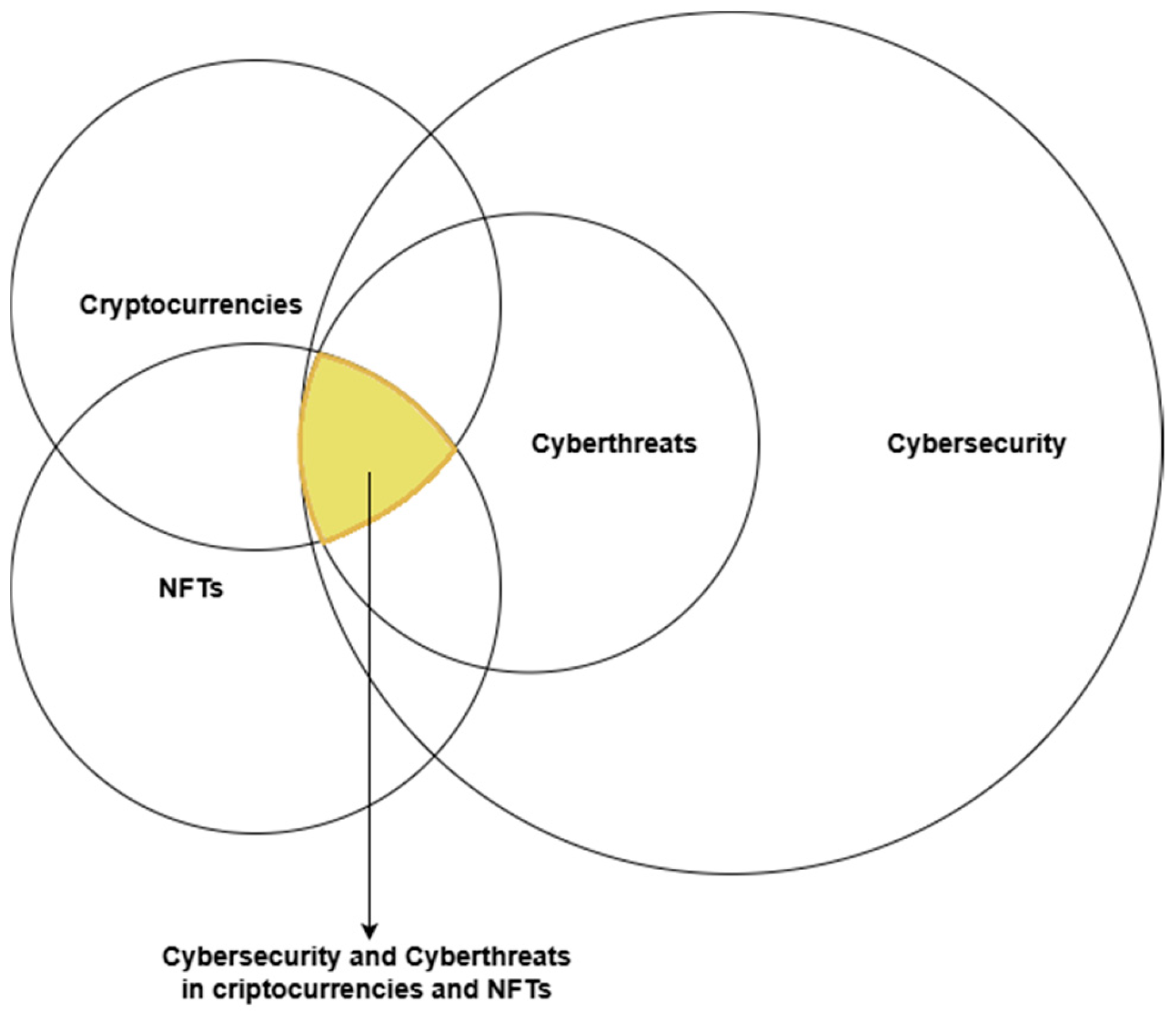
- RQ1: How has the number of publications evolved between 2014 and 2025 regarding cybersecurity and cyber threats in cryptocurrencies and NFTs?
- RQ2: Which authors, countries, journals, and publications have contributed most to the study of cybersecurity and cyber threats in cryptocurrencies and NFTs?
- RQ3: What are the main topics addressed, and how are they evolving?
- RQ4: What are the principal emerging topics?
- RQ5: What are the main clusters identified in the literature?
2. State of the Art
Positioning Relative to Prior Bibliometric Studies in FinTech, DeFi, and Blockchain Security
3. Methodology
3.1. Data Base Selection and Research Guide
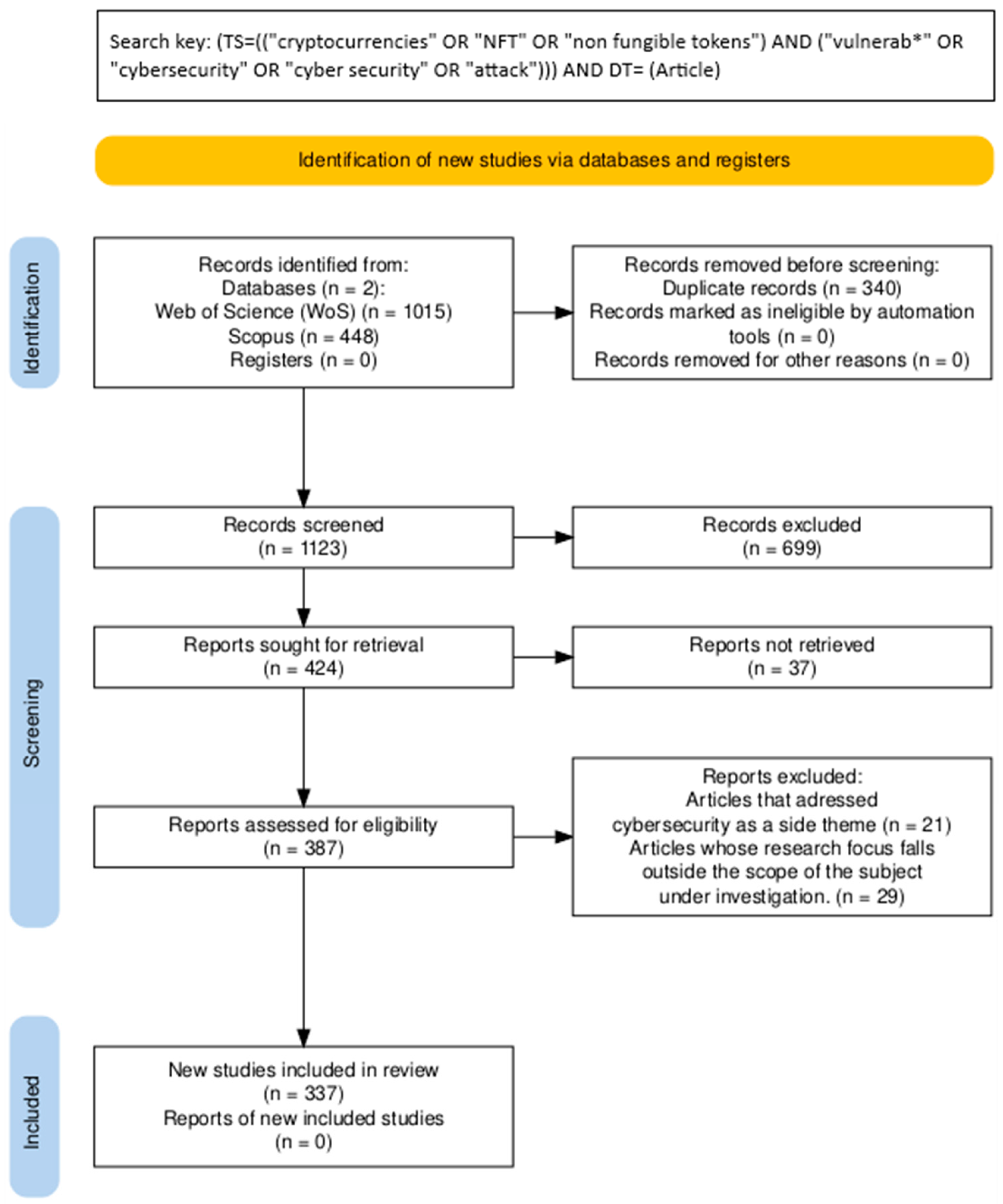
Eligibility Criteria (Inclusion/Exclusion)
- 109 addressed NFTs in the medical domain (neurofibrillary tangle).
- 94 focused on economic and financial aspects only.
- 42 treated cybersecurity as a secondary aspect.
- 18 had a structure that prevented evaluation.
- 436 were tangential to the object of study.
3.2. Network Visualisation and Clustering (VOSviewer)
3.3. Co-Word Analysis and Thematic Mapping (SciMAT)
- Unit of analysis: Words (authorRole = true, sourceRole = true, addedRole = true)
- Network type: Co-occurrence
- Standardisation measure: Equivalence Index
- Clustering algorithm: Simple Centres
- Maximum cluster size: 12
- Minimum cluster size: 3
- Measure of thematic continuity: Jaccard index
- Overlap measure: Equivalence Index
4. Results
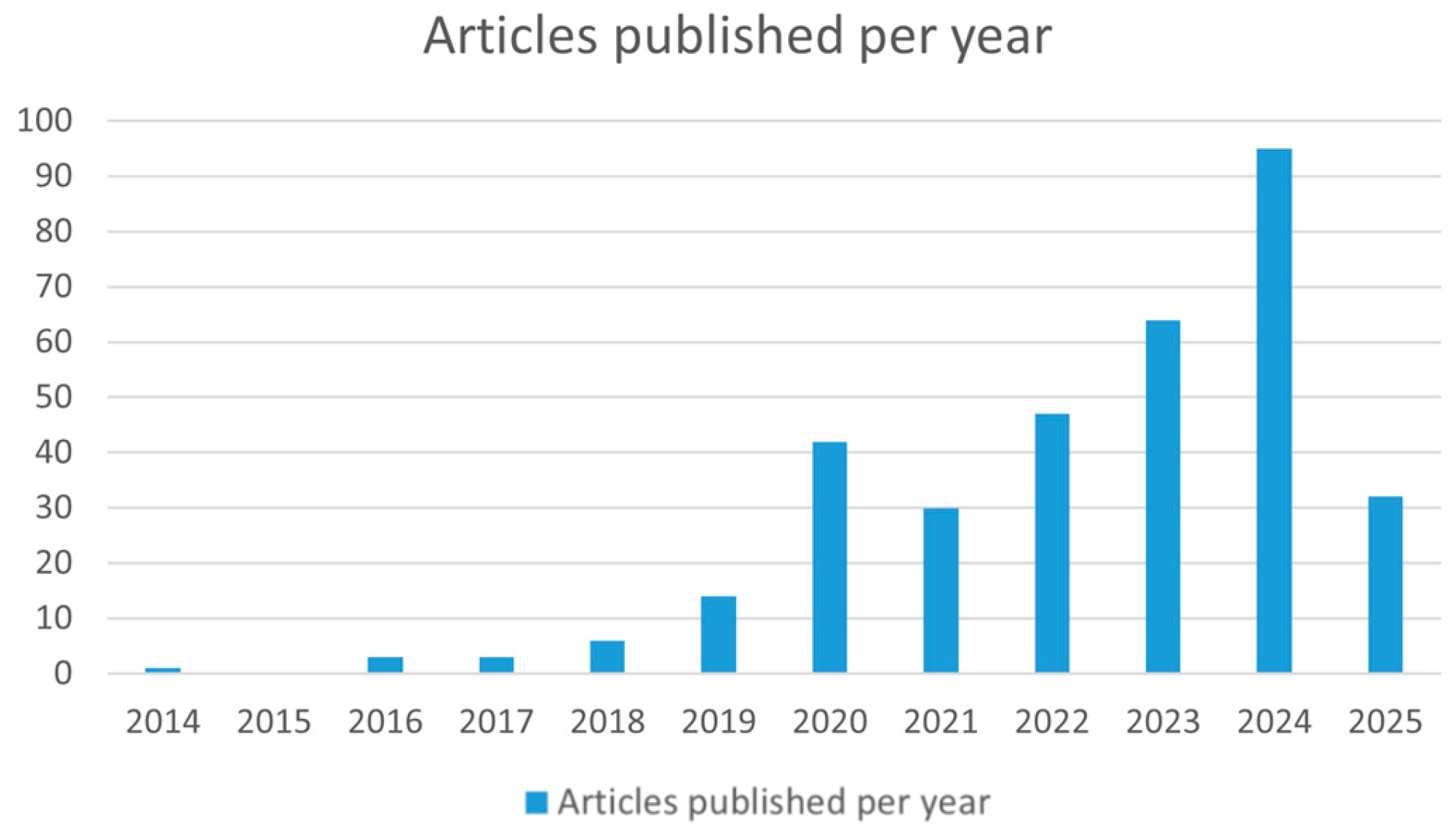
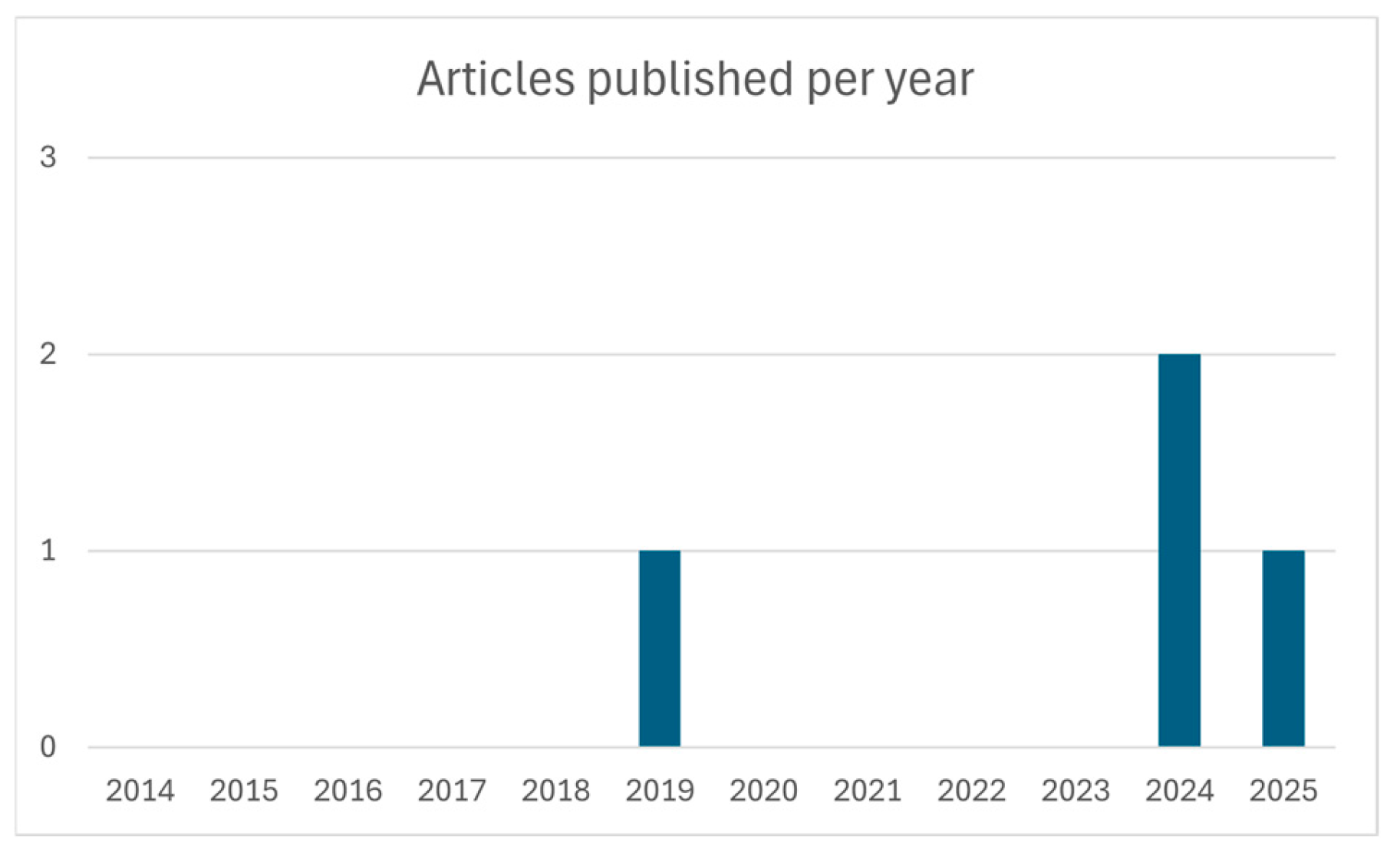
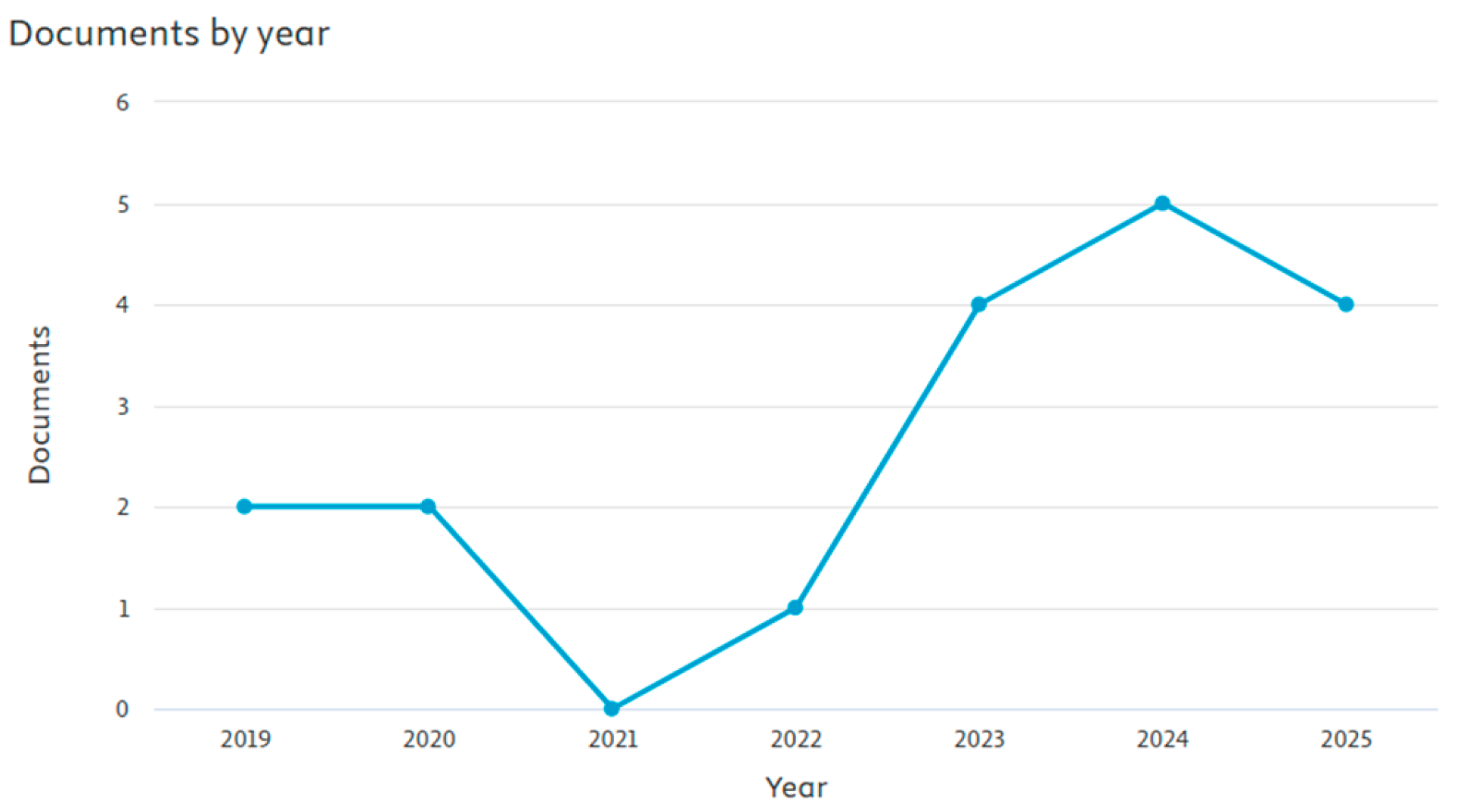
4.1. Publishing Activity (RQ1)
4.2. Authors, Countries and Journals (RQ2)
4.3. Connection and Evolution of Themes (RQ3)
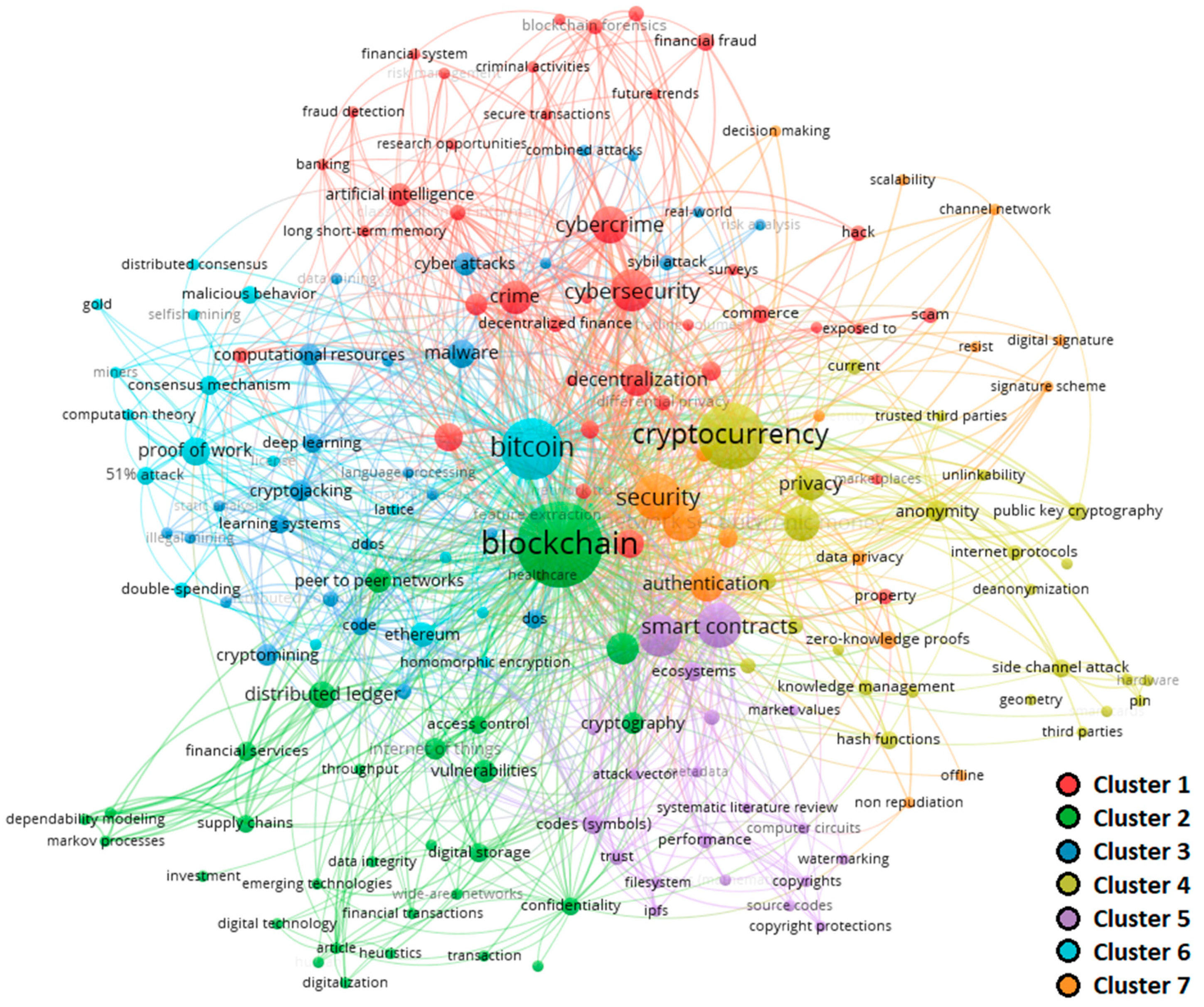
4.3.1. Clustering Analysis (VOSviewer)
- ‘cybersecurity’: Cybersecurity is one of the objects of study in this research and is a key aspect for consolidating cryptocurrencies and NFTs as a trustworthy ecosystem.
- ‘cybercrime’: This form of crime uses digital platforms to conduct illicit activities.
- ‘crime’: Conventional criminal activities have adapted to new technologies, employing new means and identifying new victims.
- ‘decentralization’: Decentralisation is a design feature of the blockchain technology underpinning cryptocurrencies and NFTs. This feature entails inherent security vulnerabilities.
- ‘machine learning’: ML and artificial intelligence (AI) have become essential technological tools for securing cryptocurrencies and NFTs.
- ‘blockchain’: Represents blockchain technology and is the largest node in the map, reflecting its foundational nature within the domain of study.
- ‘network architecture’: Blockchain operation is enabled by a specific network architecture designed for that purpose.
- ‘peer to peer networks’: P2P networks enable blockchain to operate without reliance on a centralised architecture.
- ‘distributed ledger’: These databases provide essential support for blockchain technology.
- ‘cryptography’: Cryptography is one of the cybersecurity tools most widely used by blockchain technology.
- ‘malware’: Refers to malicious software designed to infect systems, control them, and use them illicitly.
- ‘cyber attacks’: Cyberattacks constitute a critical threat to cryptocurrency and NFT ecosystems.
- ‘computational resources’: Computational resources are a target for attackers, as they can be exploited to mine additional cryptocurrency.
- ‘cryptomining’: Cryptomining is a highly significant economic activity through which new cryptocurrency units are obtained.
- ‘cryptojacking’: Cryptojacking is the most frequent cyberattack in cryptocurrency-mining environments, in which attackers hijack victims’ computing power for their own benefit by mining.
- ‘cryptocurrency’: Cryptocurrencies are one of the research objects of this study.
- ‘privacy’: privacy is one of the predominant features of cryptocurrencies.
- ‘electronic money’: Electronic money enables financial transactions to be carried out over the internet.
- ‘anonymity’: Anonymity is another key property of cryptocurrencies and is subject to considerable debate.
- ‘public key cryptography’: Asymmetric (public key) cryptography is used in cryptocurrency wallets.
- ‘nft’: NFTs are one of the objects of study in this research.
- ‘smart contracts’: Smart contracts are the blockchain technology enabling the creation of NFTs and the assignment of ownership.
- ‘ecosystems’: Refers to the NFT ecosystem, i.e., the environment in which NFTs exist, including marketplaces, ownership systems, and their issuance.
- ‘codes (symbols)’: Refers to symbol encoding, whereby intelligible information characters are translated into sets of bits or symbols for transmission via communication channels.
- ‘personal computing’: Refers to personal computers, typically used as a victim or as an attack vector against a third-party system.
- ‘bitcoin’: The most important and best-known cryptocurrency, and the one for which the most security studies have been conducted.
- ‘ethereum’: The second most important and best-known cryptocurrency, and a platform for decentralised applications enabled through smart contracts.
- ‘proof of work’: A consensus protocol widely used in Bitcoin and previously in Ethereum.
- ‘consensus mechanism’: Consensus protocols enable a distributed network to reach agreement to execute transactions or other actions.
- ‘51% attack’: One of the best-known attacks and vulnerabilities in blockchain networks. It occurs when an attacker controls 51% of the computational power, enabling the blockchain to be rewritten and misused.
- ‘security’: Represents security as a broad concept encompassing all security aspects associated with cryptocurrency and NFT ecosystems.
- ‘network security’: Refers to the security of the networks that constitute the infrastructure of cryptocurrencies and NFTs.
- ‘authentication’: Authentication is a fundamental security feature, particularly in electronic money systems and digital ownership contexts.
- ‘electronic document identification’: Electronic identity document systems have relevant links to both authentication and anonymisation challenges.
- ‘zero knowledge proofs’: A cryptographic approach that allows a statement to be validated without revealing additional information beyond the statement itself.
4.3.2. Evolution of the Research Themes (SciMAT)
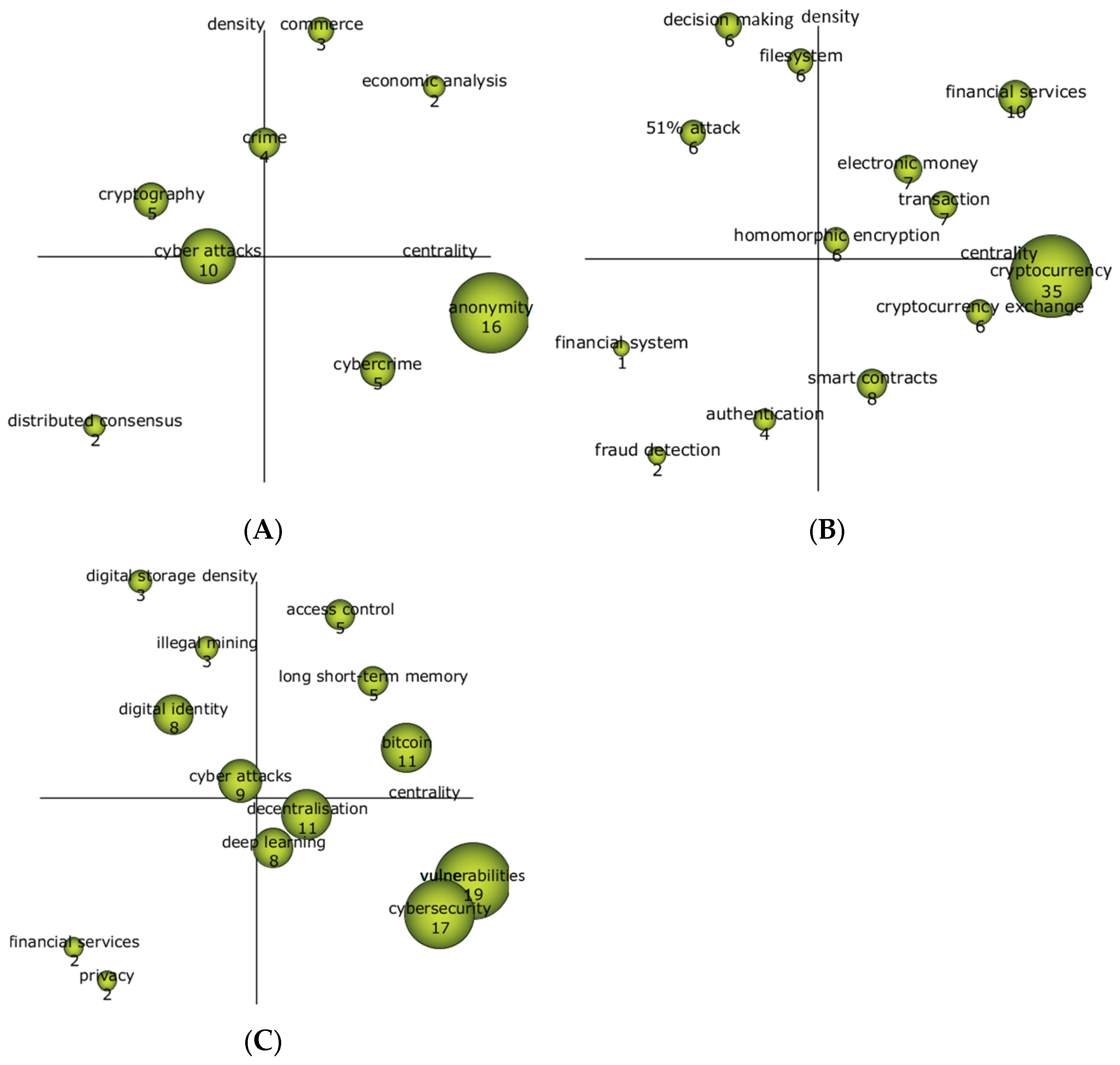
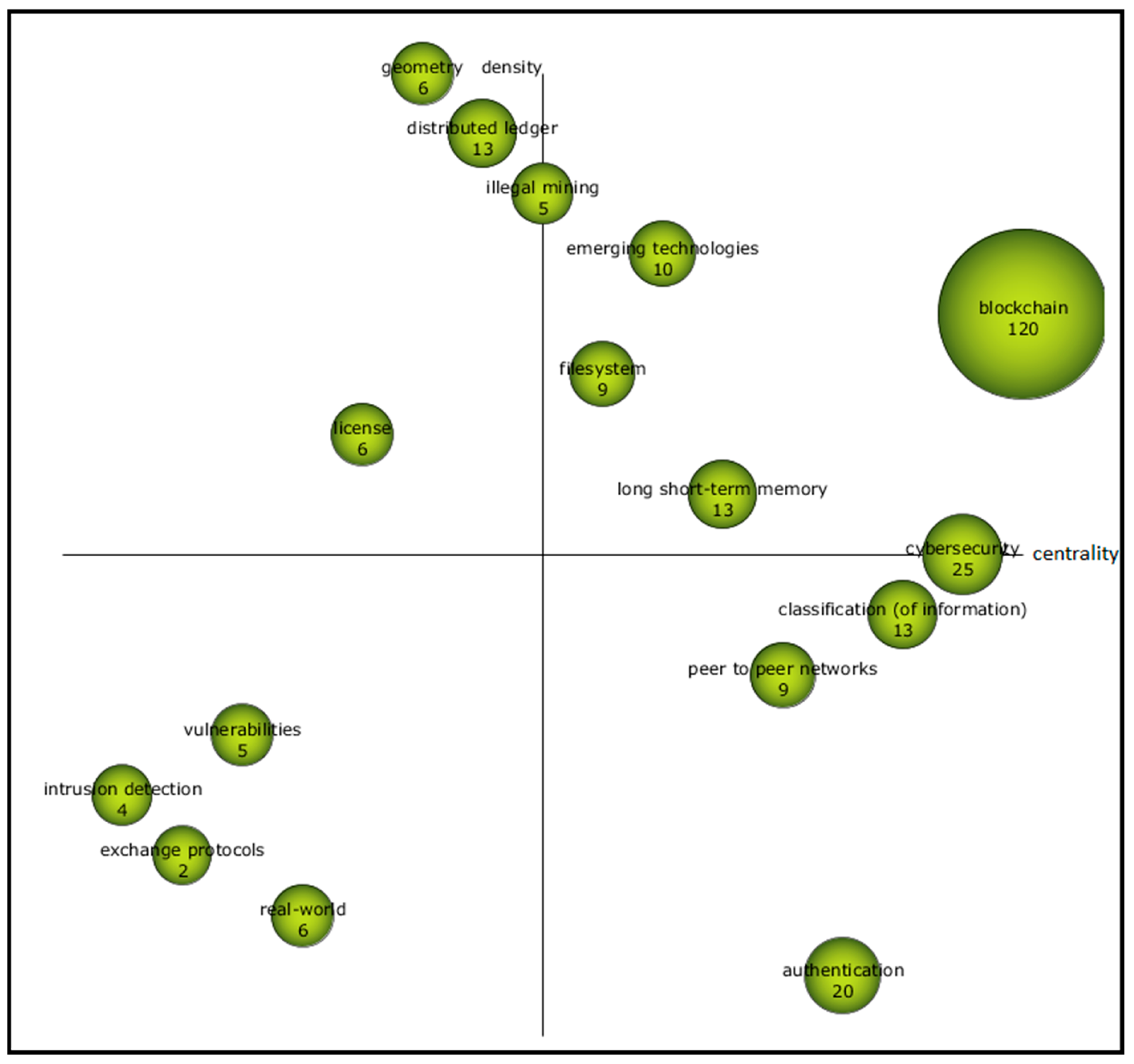
4.3.3. Strategic Diagram (SciMAT)
- Upper-right quadrant: Motor themes, with high centrality and high density.
- Upper-left quadrant: Highly developed themes (high density) but with low centrality. Although relevant, they are less connected to the specific research area considered.
- Lower-right quadrant: Transversal and basic themes, with low density and high centrality. They are priority topics that require further development.
- Lower-left quadrant: Emerging or declining themes, characterised by low density and low centrality. This quadrant foreshadows the future—or the abandonment—of research lines in the field.
- Upper-right quadrant: motor themes (high density and centrality)
- ○
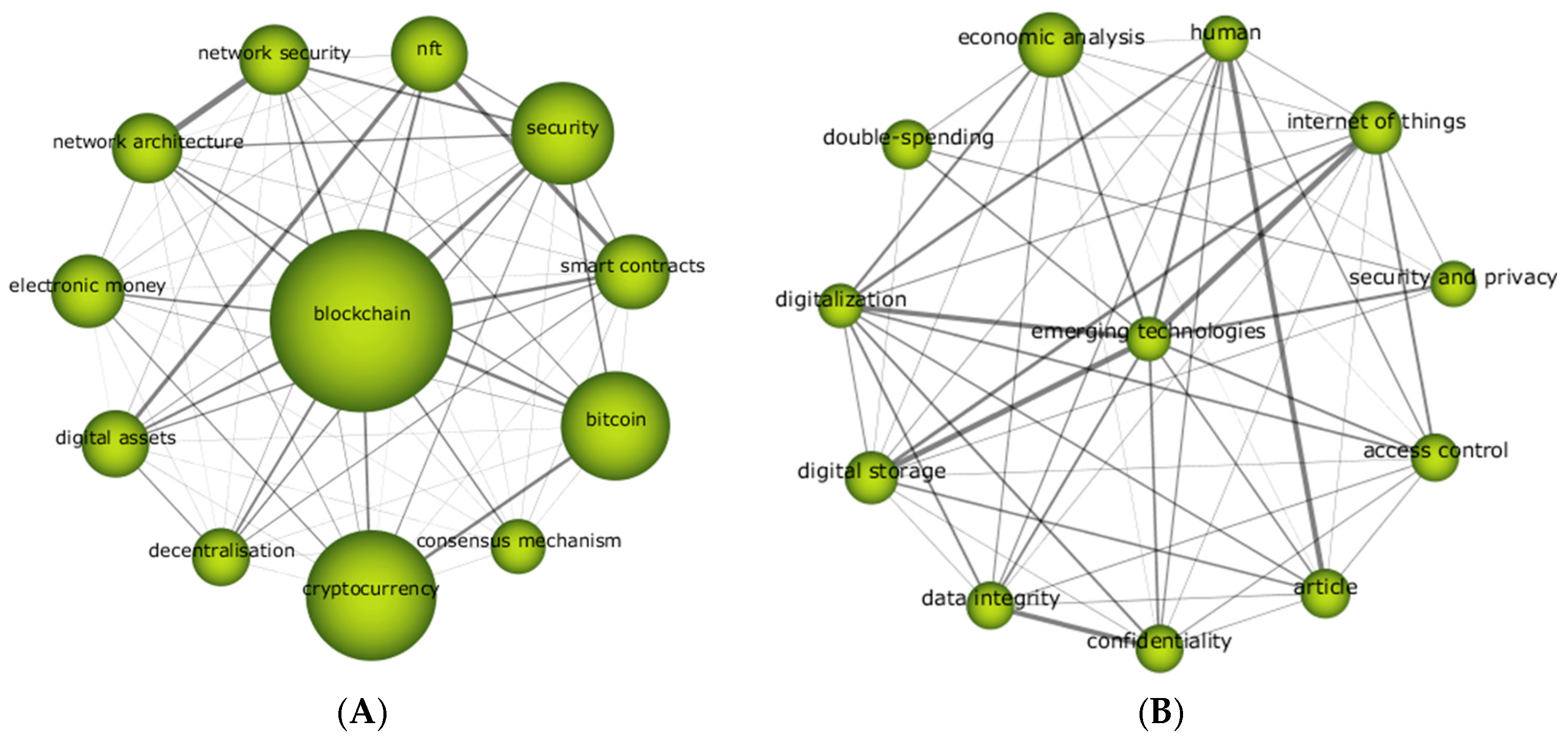
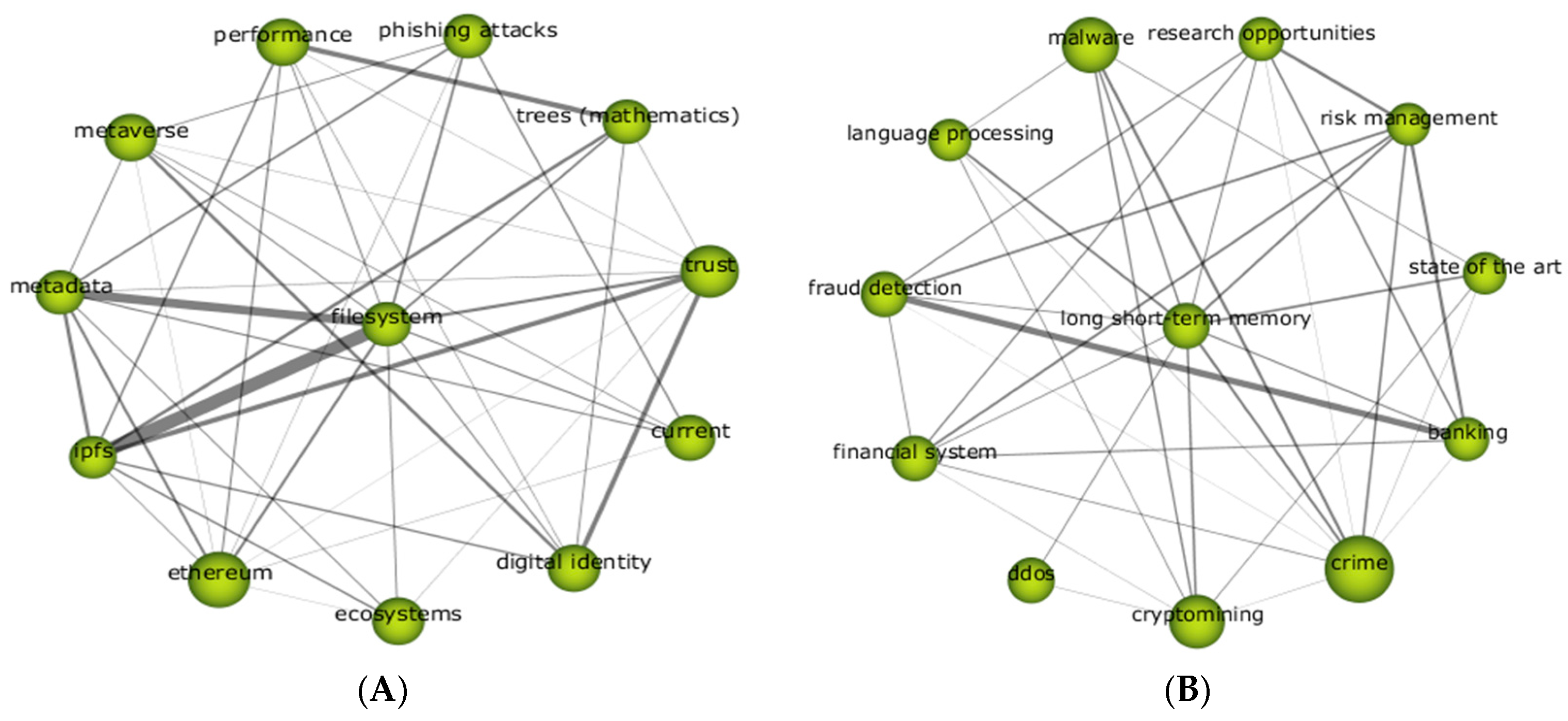
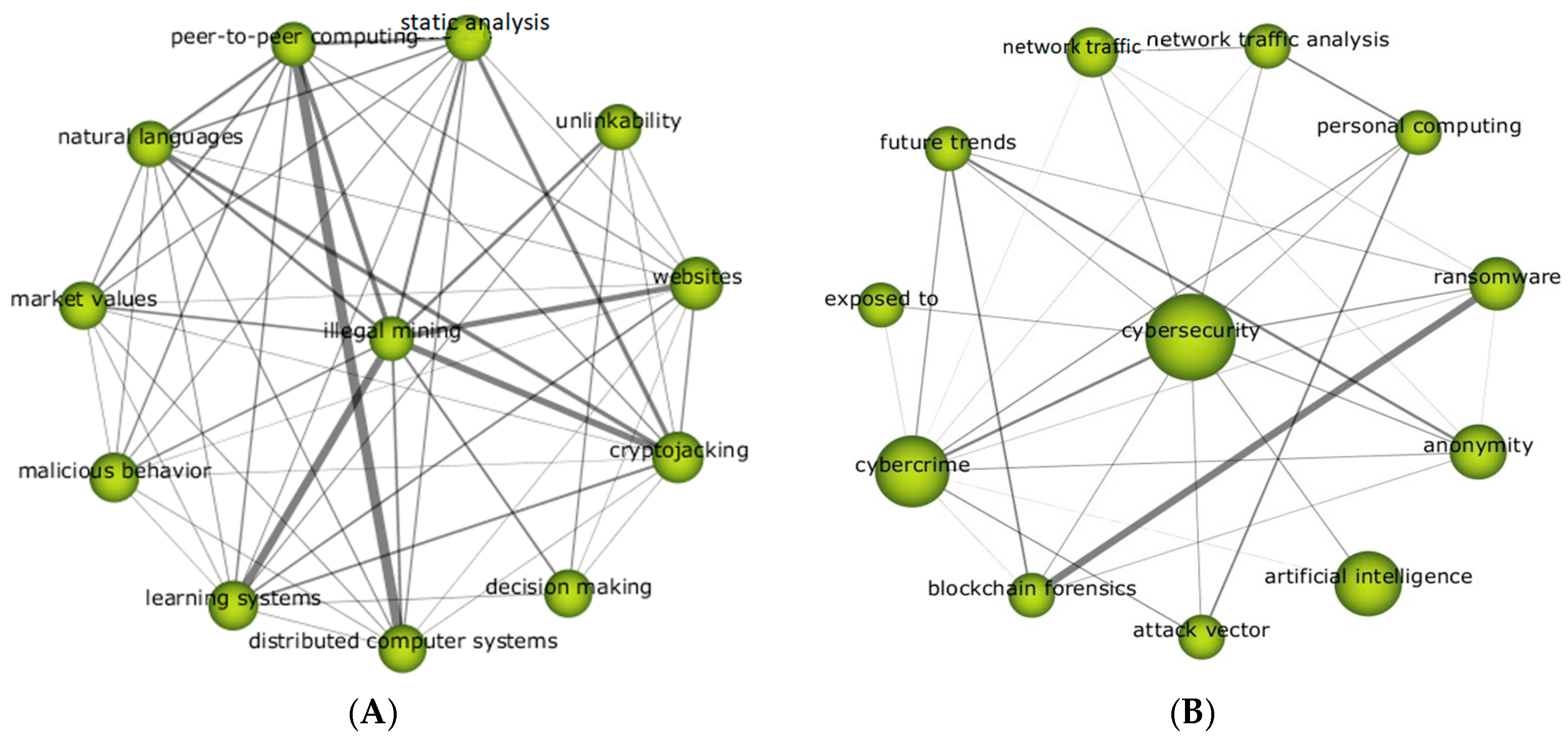
- Key terms: ‘blockchain’, ‘emerging technologies’, ‘long short-term memory’, ‘cybersecurity’, and ‘illegal mining’.
- ○
- Interpretation: These themes occupy the upper-right quadrant because they combine high centrality (i.e., they articulate strong links with multiple other themes) with high density (i.e., they form internally cohesive and well-developed research sub-networks). In substantive terms, this positioning is consistent with their role as the main “organising axes” of the field: “blockchain” provides the enabling infrastructure underpinning both cryptocurrencies and NFTs and therefore co-occurs with a broad range of security, architectural, and threat-related topics. “cybersecurity” functions as the umbrella concern that connects disparate lines of work (attacks, vulnerabilities, protection mechanisms, identity, and trust). “emerging technologies” captures the expansion of the threat surface and the need to assess novel architectures and applications that continuously reshape the ecosystem. At the same time, the presence of “long short-term memory” as a motor theme reflects the consolidation of AI-driven approaches—particularly neural models—within detection and prevention tasks, forming a coherent methodological stream that also bridges to fraud, anomaly detection, and behavioural analysis. Finally, illegal mining appears as a mature and highly developed topic because it represents a concrete, recurrent threat vector that has generated a substantial body of specialised work while remaining sufficiently connected to the broader security discourse to act as a driver of research priorities.
- Upper-left quadrant: highly developed themes (high density, low centrality)
- ○
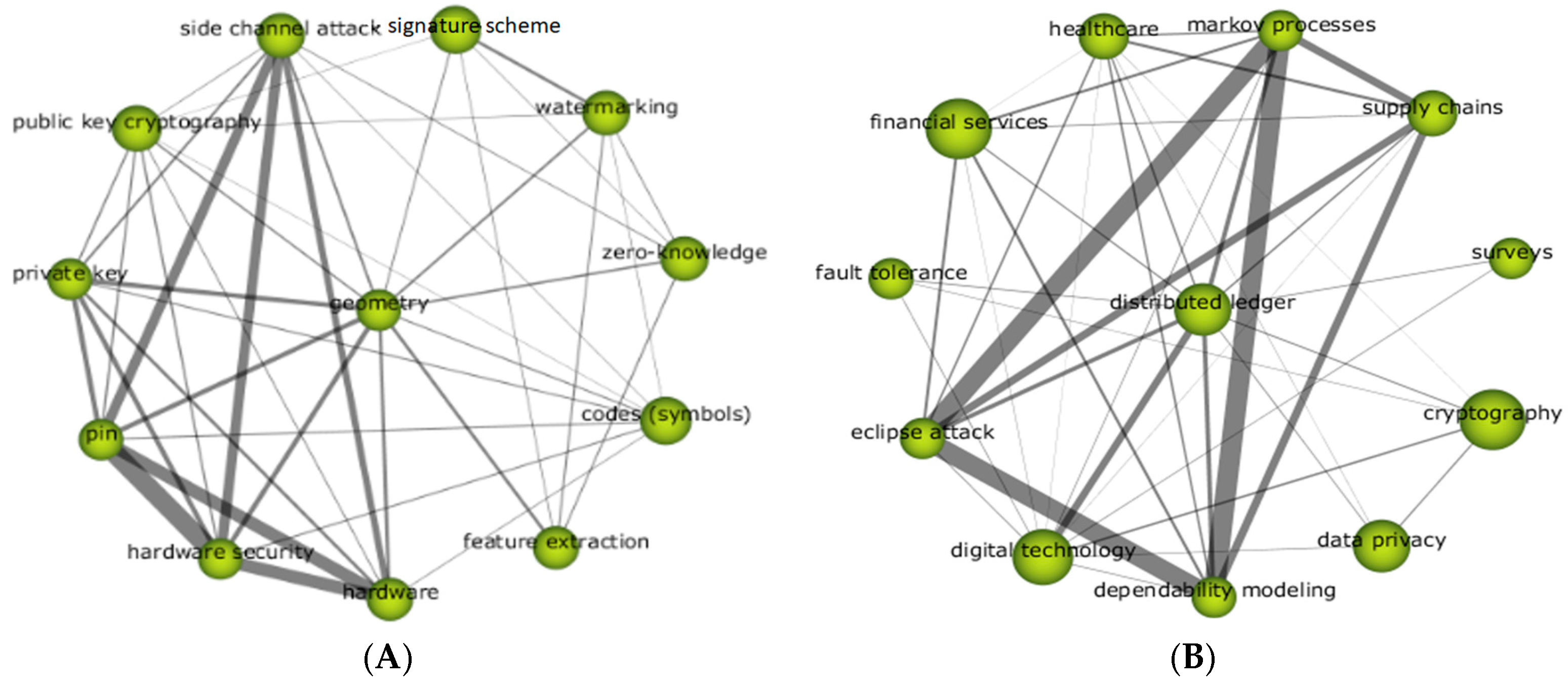
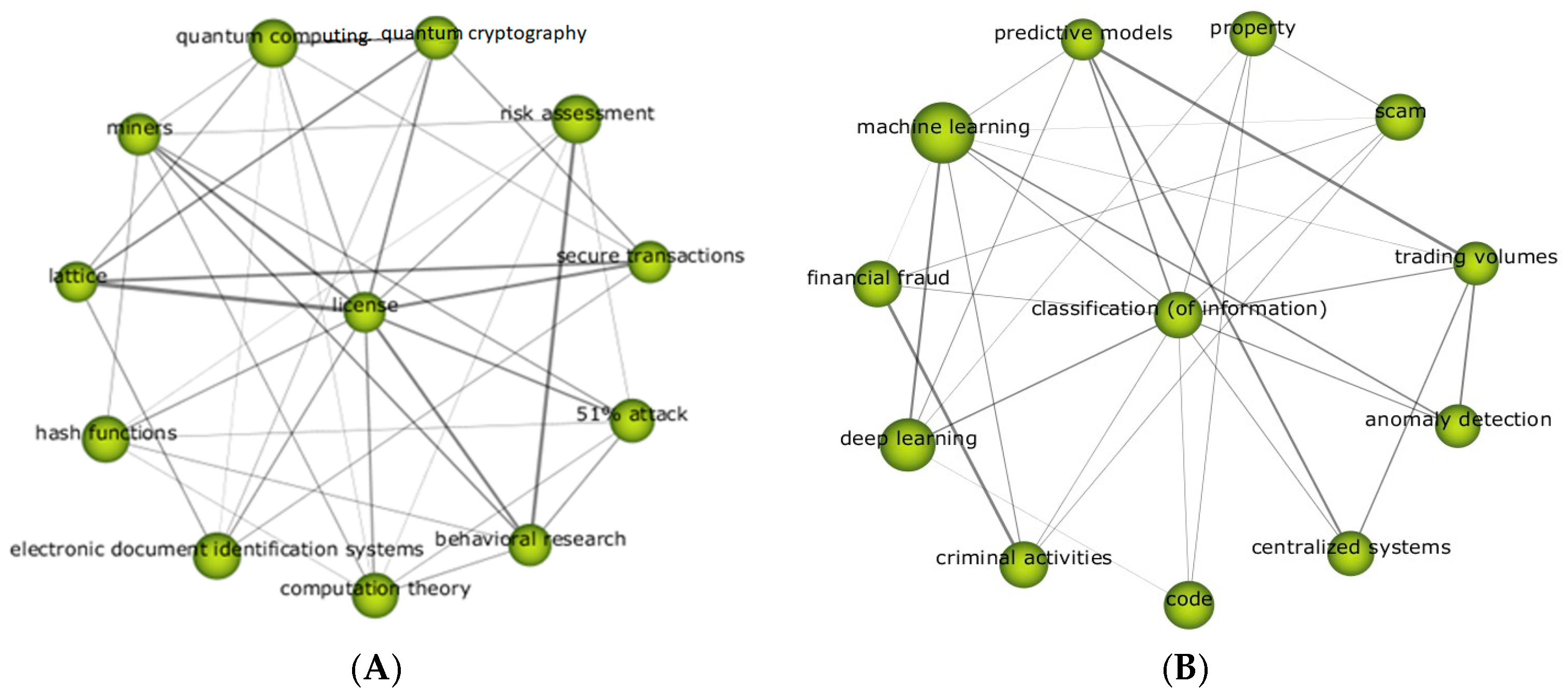
- Key terms: ‘geometry’, ‘distributed ledger’, and ‘licence’.
- ○
- Interpretation: These themes in the upper-left quadrant are considered highly developed because, within the SciMAT framework, they combine high density (strong internal cohesion and well-defined sub-networks of co-occurring keywords) with low centrality (limited connectivity and a reduced structuring influence on the dominant thematic network). This configuration represents the classical signature of mature yet comparatively isolated research streams in strategic co-word mapping. “geometry” exhibits strong intra-cluster links around hardware security and side-channel attacks, as well as around intellectual property protection mechanisms, such as signature and watermarking schemes. “distributed ledger” likewise shows high interconnectivity, with a dense sub-cluster and additional links to applied contexts such as NFT-enabled healthcare traceability and privacy-preserving consensus designs, indicating a technically consolidated line that remained peripheral to the motor themes. “licence” displays a coherent internal core that suggests a specialised and well-articulated discourse on authorisation and secure trading, yet one that was less integrated with the broader cybersecurity keyword backbone.
- Lower-right quadrant: transversal and fundamental themes (low density, high centrality)
- ○
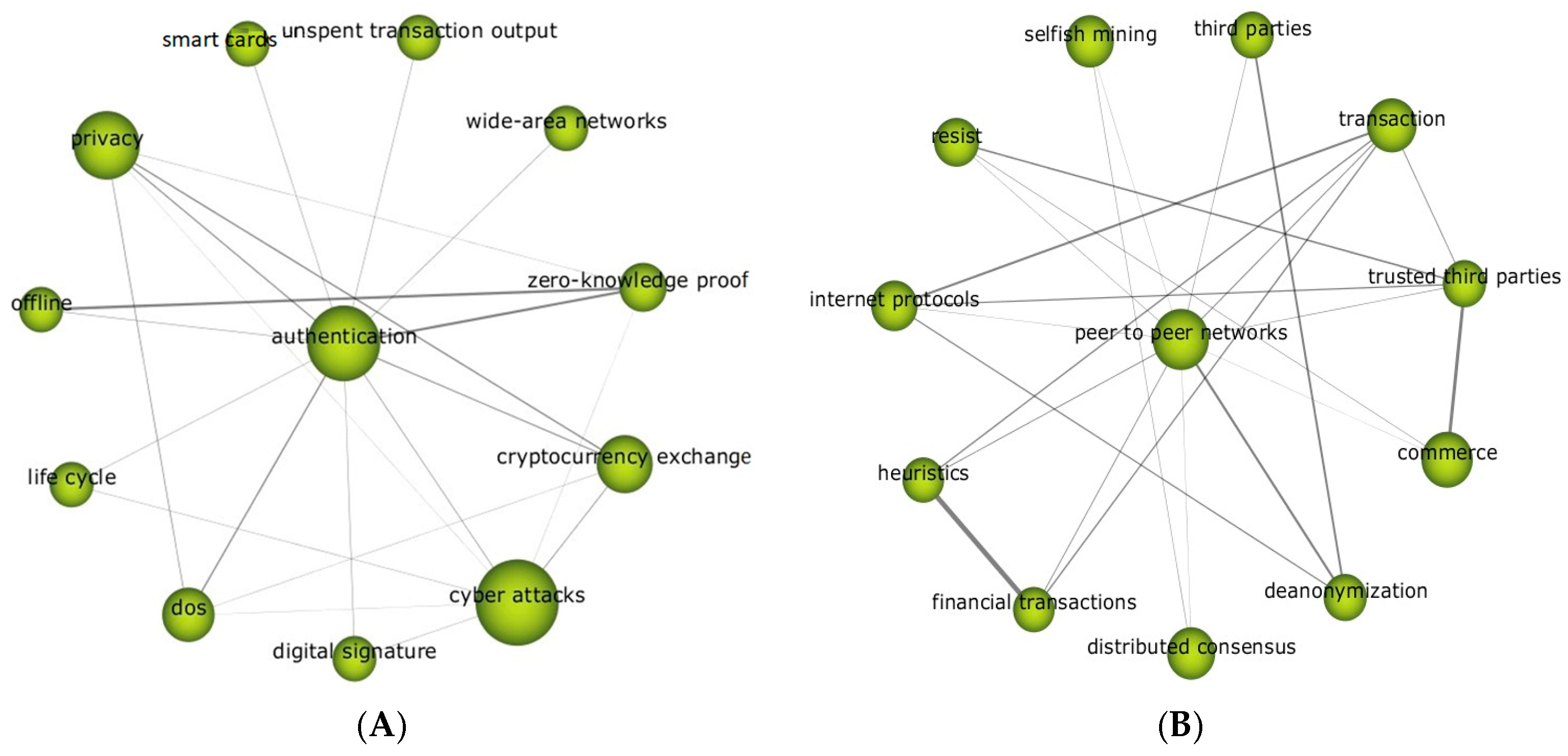
- Key terms: ‘classification (of information)’, ‘authentication’ and ‘peer-to-peer networks’.
- ○
- Interpretation: These themes in the lower-right quadrant are interpreted as transversal or basic because they combine high centrality (strong connections to multiple themes) with low density (a comparatively less cohesive internal structure). The latter suggests that the literature addresses them primarily as enabling functions rather than as fully consolidated specialised subfields. Substantively, these themes operate as cross-cutting prerequisites for securing cryptocurrency and NFT ecosystems. “classification (of information)” is closely linked to data processing and analytical pipelines that support multiple security tasks. “authentication” is described as a fundamental security feature in electronic money systems and in digital ownership contexts, which naturally connects it to identity, access control, privacy, and trust. “peer-to-peer networks” reflect the underlying distributed communication substrate on which blockchain and related mechanisms relies, rendering it highly connected to the broader research agenda, even if the associated sub-network remains less mature and more diffuse within this corpus.
- Lower-left quadrant: emerging or declining themes (low density and centrality)
- ○
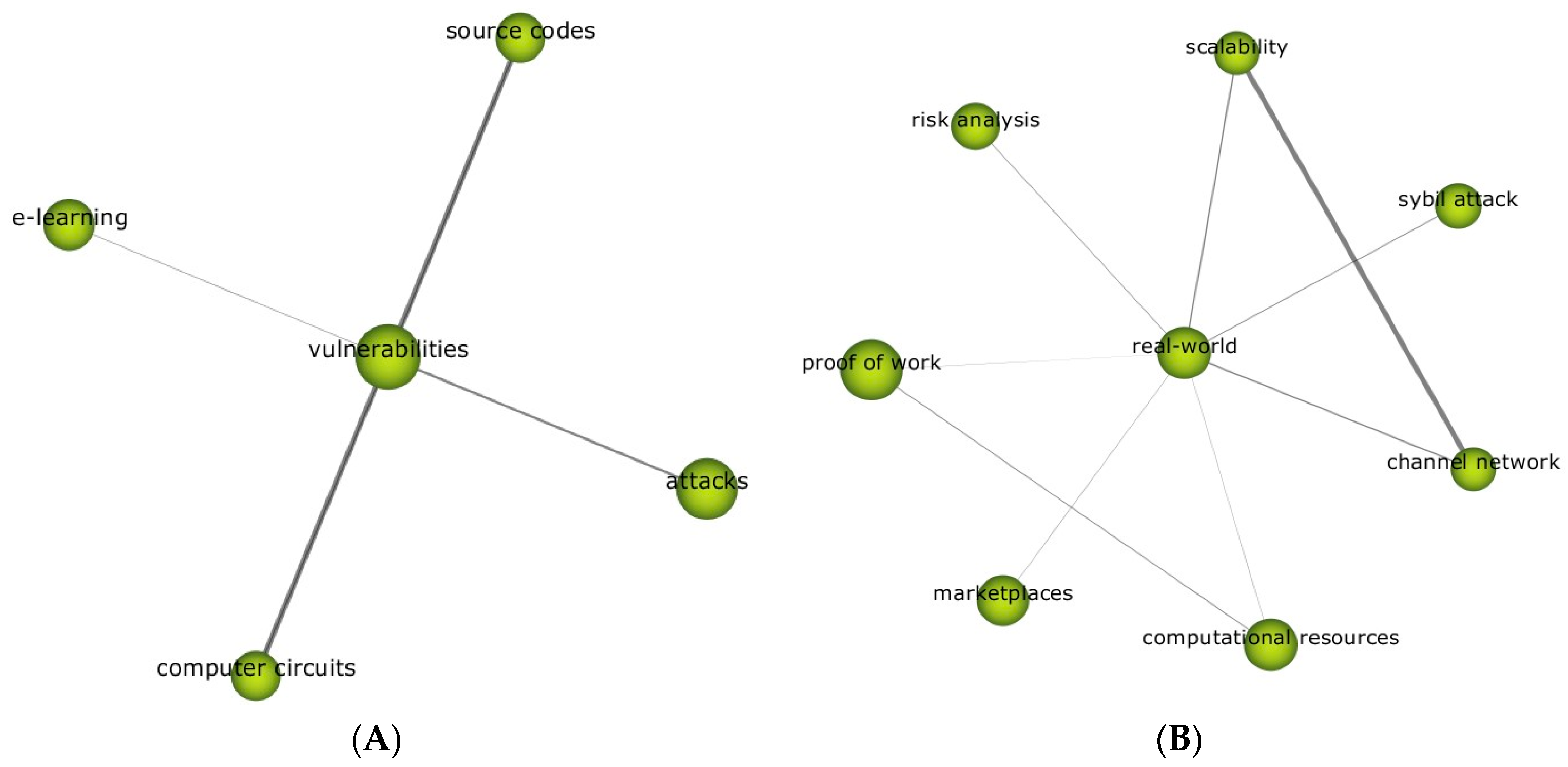
- Key terms: ‘exchange protocols’, ‘real-world’, ‘intrusion detection’ and ‘vulnerabilities’.
- ○
- Interpretation: These themes are positioned in the lower-left quadrant and are characterised as emerging or declining because they exhibited both low centrality (limited connectivity with the dominant thematic network) and low density (weak internal cohesion and comparatively underdeveloped sub-networks of co-occurring keywords). This interpretation was consistent with the strategic mapping logic underpinning co-word analysis and SciMAT. Such a pattern was aligned with themes that represented a relatively specialised or fragmented research line that had not yet consolidated around a stable set of shared concepts. “exchange protocols” reflected a narrow protocol-level concern within exchange ecosystems. “vulnerabilities” functioned as a broad label that, in this corpus, aggregated heterogeneous issues without forming a cohesive cluster. “real-world” captured application- or deployment-oriented challenges that remained weakly integrated into the main organising axes of the field. “intrusion detection” encompassed techniques for identifying anomalous behaviours that extended beyond purely technical aspects, thereby remaining peripheral to central themes such as the use of AI in “long short-term memory”.
4.3.4. Comparative Synthesis of VOSviewer and SciMAT Outputs
4.4. Emerging Themes (RQ4)
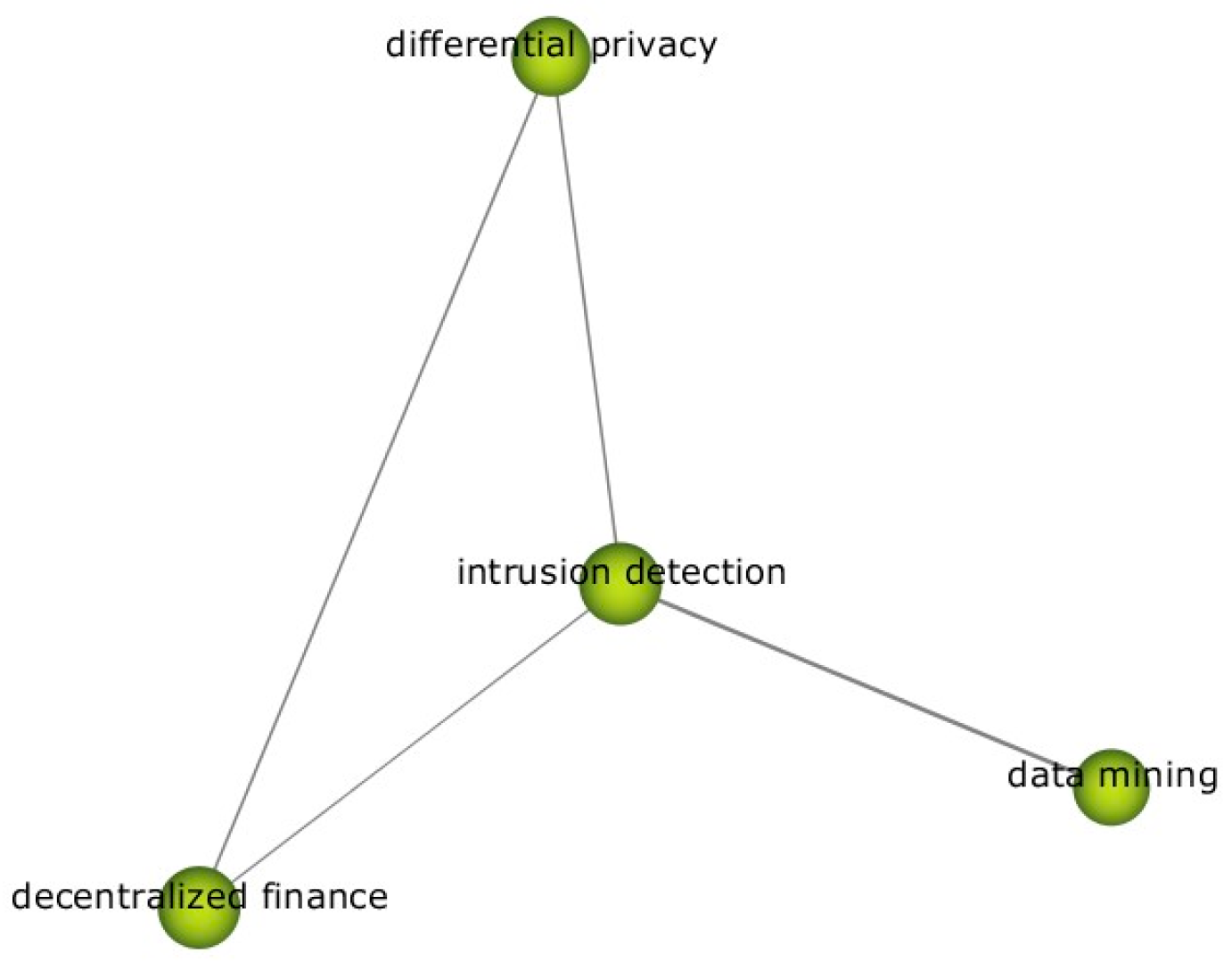
- ‘intrusion detection’: This term refers to the detection of intrusions, that is, the identification of anomalous elements within a given context, whether involving the detection of malicious actors or illicit activities.
- ‘differential privacy’: Differential privacy enables the analysis of a dataset without compromising the privacy of the individuals within it.
- ‘data mining’: Data mining enables the analysis and processing of large volumes of data through specialised tools in order to uncover patterns and other relevant information.
- ‘decentralized finance’: DeFi uses blockchain networks to enable an economic system that does not depend on central authorities such as banks.
4.5. Cluster Identification (RQ5)
4.5.1. Blockchain
4.5.2. Emerging Technologies
4.5.3. Filesystem
4.5.4. Long Short-Term Memory
4.5.5. Illegal Mining
4.5.6. Cybersecurity
4.5.7. Geometry
4.5.8. Distributed Ledger
4.5.9. Licence
4.5.10. Classification (of Information)
4.5.11. Authentication
4.5.12. Peer to Peer Networks
4.5.13. Vulnerabilities
4.5.14. Real-World
4.5.15. Intrusion Detection
5. Discussion
6. Conclusions
6.1. Theoretical Implications
6.2. Practical Implications
Stakeholder-Oriented Recommendations Derived from the Bibliometric Evidence
6.3. Limitations and Future Lines of Research
Funding
Data Availability Statement
Conflicts of Interest
Appendix A. Keyword Normalisation Mapping Table
| Label | Replace by |
| 'current | current |
| block-chain | blockchain |
| blockchain forensic | blockchain forensics |
| blockchain technology | blockchain |
| blockchains | blockchain |
| centralised | centralized systems |
| computer crime | cybercrime |
| computing power | computational resources |
| consensus algorithms | consensus mechanism |
| consensus protocols | consensus mechanism |
| cryptocurrencies | cryptocurrency |
| cryptocurrency exchanges | cryptocurrency exchange |
| cyber security | cybersecurity |
| cyber-attacks | cyber attacks |
| cyber-crimes | cybercrime |
| cybercriminals | cybercrime |
| decentralised | decentralization |
| denial-of-service attack | dos |
| electronic cash | electronic money |
| features extraction | feature extraction |
| financial service | financial services |
| fraud | financial fraud |
| identity authentication | authentication |
| machine learning techniques | machine learning |
| machine-learning | machine learning |
| malwares | malware |
| metaverses | metaverse |
| mining | cryptomining |
| natural language processing | natural languages |
| network layers | network architecture |
| network node | network architecture |
| network routing | network architecture |
| nfts | nft |
| non-fungible token | nft |
| non-fungible tokens | nft |
| non-fungible tokens (nfts) | nft |
| nonfungible token | nft |
| peer to peer | peer to peer networks |
| privacy preserving | privacy |
| privacy-preserving techniques | privacy |
| public keys | public key cryptography |
| quantum computers | quantum computing |
| security analysis | security |
| security issues | security |
| security of data | security |
| security requirements | security |
| smart contract | smart contracts |
| vulnerability | vulnerabilities |
| wide area networks | wide-area networks |
| zero-knowledge proof | zero-knowledge proofs |
References
- Amirzadeh, R.; Thiruvady, D.; Nazari, A.; Ee, M.S. Dynamic evolution of causal relationships among cryptocurrencies: An analysis via Bayesian networks. Knowl. Inf. Syst. 2025, 67, 355–370. [Google Scholar] [CrossRef] [Scilit]
- Lyubchenko, I. What is Art? NFTs, Beeple, and Art Connoisseurship in the 21st Century. Interact. Film Media J. 2022, 2, 174–190. [Google Scholar] [CrossRef] [Scilit]
- Hossaion, S.; Bairagi, M.; Aktar, J.; Honey, U.; Mithy, S.A. The Evolution of Bitcoin: A Historical Analysis and Future Prospects. iRASD J. Econ. 2023, 5, 241–252. [Google Scholar] [CrossRef] [Scilit]
- Khan, F.A.; Asif, M.; Ahmad, A.; Alharbi, M.; Aljuaid, H. Blockchain technology, improvement suggestions, security challenges on smart grid and its application in healthcare for sustainable development. Sustain. Cities Soc. 2020, 55, 102018. [Google Scholar] [CrossRef] [Scilit]
- Gebreab, S.A.; Salah, K.; Jayaraman, R.; Zemerly, J. Trusted Traceability and Certification of Refurbished Medical Devices Using Dynamic Composable NFTs. IEEE Access 2023, 11, 30373–30389. [Google Scholar] [CrossRef] [Scilit]
- Krishnasamy, S. My Holistic Data Share: A WEB3 Data Share Application: Extending Beyond Finance to Privacy-Protected Decentralised Share of Multi-Dimensional Data to Enhance Global Healthcare. Blockchain Healthc. Today 2024, 7, 10-30953. [Google Scholar] [CrossRef] [Scilit]
- Baldi, M.; Chiaraluce, F. A trusted cryptocurrency scheme for secure and verifiable digital transactions. First Monday 2017, 22. [Google Scholar] [CrossRef] [Scilit]
- Ciarko, M.; Poszwa, G.; Paluch-Dybek, A.; Timur, M.C. Cryptocurrencies as the future of money: Theoretical aspects, blockchain technology and origins of cryptocurrencies. Virtual Econ. 2023, 6, 70–93. [Google Scholar] [CrossRef] [Scilit]
- Auer, R.; Farag, M.; Lewrick, U.; Orazem, L.; Zoss, M. Banking in the Shadow of Bitcoin? The Institutional Adoption of Cryptocurrencies. SSRN J. 2023, 10355, 1–25. [Google Scholar] [CrossRef] [Scilit]
- Cheraghali, H.; Molnár, P.; Storsveen, M.; Veliqi, F. The impact of cryptocurrency-related cyberattacks on return, volatility, and trading volume of cryptocurrencies and traditional financial assets. Int. Rev. Financ. Anal. 2024, 95, 103439. [Google Scholar] [CrossRef] [Scilit]
- Oben, R.J.; Özdamlı, F. Decentralized Finance (DeFi): Benefits, Risks, and Risk Mitigation Strategies. Istanb. Bus. Res. 2024, 53, 455–475. [Google Scholar] [CrossRef] [Scilit]
- Chen, H.; Pendleton, M.; Njilla, L.; Xu, S. A Survey on Ethereum Systems Security: Vulnerabilities, Attacks, and Defenses. ACM Comput. Surv. 2020, 53, 1–43. [Google Scholar] [CrossRef] [Scilit]
- Wang, Q.; Li, R.; Wang, Q.; Chen, S. Non-Fungible Token (NFT): Overview, Evaluation, Opportunities and Challenges. arXiv 2021, arXiv:2105.07447. [Google Scholar] [CrossRef] [Scilit]
- Musamih, A.; Yaqoob, I.; Salah, K.; Jayaraman, R.; Omar, M.; Ellahham, S. Using NFTs for Product Management, Digital Certification, Trading, and Delivery in the Healthcare Supply Chain. IEEE Trans. Eng. Manag. 2024, 71, 4480–4501. [Google Scholar] [CrossRef] [Scilit]
- Khan, W.Z.; Siddiqa, A.; Alanazi, F.; Khan, M.K. NFT-Based Digital Identity Authentication Framework for the Metaverse Environments. IEEE Trans. Consum. Electron. 2025, 71, 5699–5707. [Google Scholar] [CrossRef] [Scilit]
- Ma, K.; Huang, J.; He, N.; Wang, Z.; Wang, H. SoK: On the security of non-fungible tokens. Blockchain Res. Appl. 2025, 6, 100268. [Google Scholar] [CrossRef] [Scilit]
- Fauzi, M.A.; Paiman, N.; Othman, Z. Bitcoin and cryptocurrency: Challenges, opportunities and future works. J. Asian Financ. Econ. Bus. 2020, 7, 695–704. [Google Scholar] [CrossRef] [Scilit]
- Byun, H.; Kim, J.; Jeong, Y.; Seok, B.; Gong, S.; Lee, C. A Security Analysis of Cryptocurrency Wallets against Password Brute-Force Attacks. Electronics 2024, 13, 2433. [Google Scholar] [CrossRef] [Scilit]
- Farber, S.; Yehezkel, S.A. Financial Extremism: The Dark Side of Crowdfunding and Terrorism. Terror. Political Violence 2024, 37, 651–670. [Google Scholar] [CrossRef] [Scilit]
- Pessin, V.Z.; Yamane, L.H.; Siman, R.R. Smart bibliometrics: An integrated method of science mapping and bibliometric analysis. Scientometrics 2022, 127, 3695–3718. [Google Scholar] [CrossRef] [Scilit]
- Jing, Y.; Wang, C.; Chen, Y.; Wang, H.; Yu, T.; Shadiev, R. Bibliometric mapping techniques in educational technology research: A systematic literature review. Educ. Inf. Technol. 2024, 29, 9283–9311. [Google Scholar] [CrossRef] [Scilit]
- Chen, Y.; Chen, H.; Zhang, Y.; Han, M.; Siddula, M.; Cai, Z. A survey on blockchain systems: Attacks, defenses, and privacy preservation. High-Confid. Comput. 2022, 2, 100048. [Google Scholar] [CrossRef] [Scilit]
- Sahoo, S.S.; Hosmane, M.M.; Chaurasiya, V.K. A secure payment channel rebalancing model for layer-2 blockchain. Internet Things 2023, 22, 100822. [Google Scholar] [CrossRef] [Scilit]
- Qiao, Y.; Wu, K.; Khabbazian, M. Non-intrusive Balance Tomography Using Reinforcement Learning in the Lightning Network. ACM Trans. Priv. Secur. 2024, 27, 1–32. [Google Scholar] [CrossRef] [Scilit]
- Kurt, A.; Akkaya, K.; Yilmaz, S.; Mercan, S.; Shlomovits, O.; Erdin, E. LNGate2: Secure Bidirectional IoT Micro-Payments Using Bitcoin’s Lightning Network and Threshold Cryptography. IEEE Trans. Mob. Comput. 2024, 23, 6027–6044. [Google Scholar] [CrossRef] [Scilit]
- Rak, M.; Niemiec, M. Securing Trading Card Game Assets Using Blockchain Technology. Appl. Sci. 2024, 14, 11139. [Google Scholar] [CrossRef] [Scilit]
- Hasan, H.R.; Salah, K.; Mayyas, A.; Musamih, A.; Yaqoob, I.; Omar, M.; Jayaraman, R. Using composable NFTs and blockchain for the creation of EV battery digital passports with sustainability and traceability features. Sustain. Futures 2025, 10, 100847. [Google Scholar] [CrossRef] [Scilit]
- Rishiwal, V.; Agarwal, U.; Yadav, M.; Alotaibi, A.; Yadav, P.; Tanwar, S. Blockchain-Secure Gaming Environments: A Comprehensive Survey. IEEE Access 2024, 12, 183466–183488. [Google Scholar] [CrossRef] [Scilit]
- Chen, Y.; Liu, J.-N.; Yang, A.; Weng, J.; Chen, M.-R.; Liu, Z.; Li, M. PACDAM: Privacy-Preserving and Adaptive Cross-Chain Digital Asset Marketplace. IEEE Internet Things J. 2024, 11, 13424–13436. [Google Scholar] [CrossRef] [Scilit]
- Gao, Y.; Saad, M.; Oest, A.; Zhang, J.; Han, B.; Chen, S. Can I Own Your NFTs? Understanding the New Attack Surface to NFTs. IEEE Commun. Mag. 2023, 61, 64–70. [Google Scholar] [CrossRef] [Scilit]
- Houy, S.; Schmid, P.; Bartel, A. Security Aspects of Cryptocurrency Wallets—A Systematic Literature Review. ACM Comput. Surv. 2024, 56, 1–31. [Google Scholar] [CrossRef] [Scilit]
- Alyami, M.; Alhotaylah, R.; Alshehri, S.; Alghamdi, A. Phishing Attacks on Cryptocurrency Investors in the Arab States of the Gulf. J. Risk Financ. Manag. 2023, 16, 271. [Google Scholar] [CrossRef] [Scilit]
- Xia, P.; Guo, Y.; Lin, Z.; Wu, J.; Duan, P.; He, N.; Wang, K.; Liu, T.; Yue, Y.; Xu, G.; et al. WALLETRADAR: Towards automating the detection of vulnerabilities in browser-based cryptocurrency wallets. Autom. Softw. Eng. 2024, 31, 1–33. [Google Scholar] [CrossRef] [Scilit]
- He, D.; Liu, Z.; Lv, X.; Chan, S.; Guizani, M. On Phishing URL Detection Using Feature Extension. IEEE Internet Things J. 2024, 11, 39527–39536. [Google Scholar] [CrossRef] [Scilit]
- Wen, H.; Fang, J.; Wu, J.; Zheng, Z. Hide and Seek: An Adversarial Hiding Approach Against Phishing Detection on Ethereum. IEEE Trans. Comput. Soc. Syst. 2023, 10, 3512–3523. [Google Scholar] [CrossRef] [Scilit]
- Lee, S.A.; Milunovich, G. Digital exchange attributes and the risk of closure. Blockchain Res. Appl. 2023, 4, 100131. [Google Scholar] [CrossRef] [Scilit]
- Guidi, B.; Michienzi, A. Delving NFT vulnerabilities, a sleepminting prevention system. Multimed. Tools Appl. 2023, 82, 46065–46084. [Google Scholar] [CrossRef] [Scilit]
- Azimi, S.; Golzari, A.; Ivaki, N.; Laranjeiro, N. A systematic review on smart contracts security design patterns. Empir. Softw. Eng. 2025, 30, 1–40. [Google Scholar] [CrossRef] [Scilit]
- Liao, P.; Liu, C.; Yin, J.; Wang, Z.; Cui, X. NFT Security Matrix: Towards Modeling NFT Ecosystem Threat. CMES-Comput. Model. Eng. Sci. 2024, 139, 3255–3285. [Google Scholar] [CrossRef] [Scilit]
- Ncube, P.T.; Kabwe, R. The regulation of cryptocurrencies to combat money laundering crimes in South African banking institutions. De Jure Law J. 2023, 56, 354–375. [Google Scholar] [CrossRef] [Scilit]
- Alekseenko, A.P. Model Framework for Consumer Protection and Crypto-Exchanges Regulation. J. Risk Financ. Manag. 2023, 16, 305. [Google Scholar] [CrossRef] [Scilit]
- Kirimhan, D. Importance of anti-money laundering regulations among prosumers for a cybersecure decentralized finance. J. Bus. Res. 2023, 157, 113558. [Google Scholar] [CrossRef] [Scilit]
- Lu, O. Cleaning up NFT Laundering Privately: A Proposal for NFT AML Regulation. J. Law Technol. Policy 2023, 2023, 399–422. [Google Scholar]
- Anatolii, A.; Shliakhovskyi, O.; Kozii, V.; Fedchak, I. Investigating cryptocurrency financing crimes terrorism and armed aggression. Soc. Leg. Studios 2023, 6, 123–131. [Google Scholar] [CrossRef] [Scilit]
- Patsakis, C.; Politou, E.; Alepis, E.; Hernandez Castro, J. Cashing out crypto: State of practice in ransom payments. Int. J. Inf. Secur. 2024, 23, 699–712. [Google Scholar] [CrossRef] [Scilit]
- Nicholls, J.; Kuppa, A.; Le-Khac, N.-A. The next phase of identifying illicit activity in Bitcoin. Int. J. Netw. Manag. 2024, 34, e2259. [Google Scholar] [CrossRef] [Scilit]
- Almurshid, H.A.; Almomani, I.; Khalifa, M.A.; El-Shafai, W. A Holistic Intelligent Cryptojacking Malware Detection System. IEEE Access 2024, 12, 161417–161439. [Google Scholar] [CrossRef] [Scilit]
- Saad, M.; Mohaisen, D. Analyzing In-Browser Cryptojacking. IEEE Trans. Dependable Secur. Comput. 2024, 21, 5448–5460. [Google Scholar] [CrossRef] [Scilit]
- Mohamad, A.; Dimitriou, D. From scam to heist: The impact of cybercrimes on cryptocurrencies. Appl. Econ. Lett. 2024, 1–9. [Google Scholar] [CrossRef] [Scilit]
- Sezgin, F.S.; Ozdurak, C. Are Crypto Assets Connected to Real World Shocks? The Nexus Between Terrorist Attacks, Bitcoin and NFTs. J. Econ. Policy Res. 2023, 10, 113–132. [Google Scholar] [CrossRef] [Scilit]
- Alfawareh, F.S.; Al-Kofahi, M. Analysis of global research trends on FinTech: A bibliometric study. J. Internet Digit. Econ. 2023, 4, 30–49. [Google Scholar] [CrossRef] [Scilit]
- Patel, R.; Migliavacca, M.; Oriani, M.E. Blockchain in banking and finance: A bibliometric review. Res. Int. Bus. Financ. 2022, 62, 101718. [Google Scholar] [CrossRef] [Scilit]
- Peng, X.; Zhao, Z.; Wang, X.; Li, H.; Xu, J.; Zhang, X. A review on blockchain smart contracts in the agri-food industry: Current state, application challenges and future trends. Comput. Electron. Agric. 2023, 208, 107776. [Google Scholar] [CrossRef] [Scilit]
- Chen, J.; Huang, M.; Lin, Z.; Zheng, P.; Zheng, Z. To healthier Ethereum: A comprehensive and iterative smart contract weakness enumeration. Blockchain Res. Appl. 2025, 6, 100258. [Google Scholar] [CrossRef] [Scilit]
- Ante, L. Smart contracts on the blockchain—A bibliometric analysis and review. Telemat. Inform. 2021, 57, 101519. [Google Scholar] [CrossRef] [Scilit]
- Mahmood, Z.; Asif, M.; Aljuaid, M.; Lodhi, R.N. Beneath the surface: A bibliometric analysis of the hidden risks and costs of blockchain technology. Int. J. Web Inf. Syst. 2023, 19, 280–303. [Google Scholar] [CrossRef] [Scilit]
- Romero-Castro, N.; López-Cabarcos, M.Á.; Vittori-Romero, V.; Piñeiro-Chousa, J. Decentralized Finance in Business and Economics Research: A Bibliometric Analysis. Int. J. Financ. Stud. 2025, 13, 211. [Google Scholar] [CrossRef] [Scilit]
- Callon, M.; Courtial, J.P.; Laville, F. Co-word analysis as a tool for describing the network of interactions between basic and technological research: The case of polymer chemsitry. Scientometrics 1991, 22, 155–205. [Google Scholar] [CrossRef] [Scilit]
- Cobo, M.J.; López-Herrera, A.G.; Herrera-Viedma, E.; Herrera, F. An approach for detecting, quantifying, and visualizing the evolution of a research field: A practical application to the Fuzzy Sets Theory field. J. Informetr. 2011, 5, 146–166. [Google Scholar] [CrossRef] [Scilit]
- Giraldo-Giraldo, C.; Rubio-Andrés, M.; Rave-Gómez, E.D.; Gutiérrez-Broncano, S. Evolution of the Concept and Scientific Mapping of Sustainable Human Resource Management S-(HRM). Adm. Sci. 2025, 15, 39. [Google Scholar] [CrossRef] [Scilit]
- Yawised, K.; Apasrawirote, D. The synergy of immersive experiences in tourism marketing: Unveiling insightful components in the ‘Metaverse’. J. Destin. Mark. Manag. 2025, 37, 101019. [Google Scholar] [CrossRef] [Scilit]
- Zahid, A.; Ferraro, A.; Petrillo, A.; De Felice, F. Exploring the Role of Digital Twin and Industrial Metaverse Technologies in Enhancing Occupational Health and Safety in Manufacturing. Appl. Sci. 2025, 15, 8268. [Google Scholar] [CrossRef] [Scilit]
- Carrasco-Garrido, C.; De-Pablos-Heredero, C.; Rodríguez-Sánchez, J.-L. Exploring hybrid telework: A bibliometric analysis. Heliyon 2023, 9, e22472. [Google Scholar] [CrossRef] [Scilit] [PubMed]
- Ramos, M.T.; Salgado, M.S.M. Exploring the nexus between sustainability and food events. ESIC Mark. 2024, 54, e321. [Google Scholar] [CrossRef] [Scilit]
- Kramar, R. Beyond strategic human resource management: Is sustainable human resource management the next approach? Int. J. Hum. Resour. Manag. 2014, 25, 1069–1089. [Google Scholar] [CrossRef] [Scilit]
- Kramar, R. Sustainable human resource management: Six defining characteristics. Asia Pac. J. Hum. Resour. 2022, 60, 146–170. [Google Scholar] [CrossRef] [Scilit]
- Cobo, M.J.; López-Herrera, A.G.; Herrera-Viedma, E.; Herrera, F. SciMAT: A new science mapping analysis software tool. J. Am. Soc. Inf. Sci. Technol. 2012, 63, 1609–1630. [Google Scholar] [CrossRef] [Scilit]
- van Eck, N.J.; Waltman, L. Software survey: VOSviewer, a computer program for bibliometric mapping. Scientometrics 2010, 84, 523–538. [Google Scholar] [CrossRef] [Scilit]
- Haba, H.F.; Bredillet, C.; Dastane, O. Green consumer research: Trends and way forward based on bibliometric analysis. Clean. Responsible Consum. 2023, 8, 100089. [Google Scholar] [CrossRef] [Scilit]
- Shen, Z.; Ji, W.; Yu, S.; Cheng, G.; Yuan, Q.; Han, Z.; Liu, H.; Yang, T. Mapping the knowledge of traffic collision Reconstruction: A scientometric analysis in CiteSpace, VOSviewer, and SciMAT. Sci. Justice 2023, 63, 19–37. [Google Scholar] [CrossRef] [Scilit]
- Lim, W.M.; Kumar, S.; Donthu, N. How to combine and clean bibliometric data and use bibliometric tools synergistically: Guidelines using metaverse research. J. Bus. Res. 2024, 182, 114760. [Google Scholar] [CrossRef] [Scilit]
- Donthu, N.; Kumar, S.; Mukherjee, D.; Pandey, N.; Lim, W.M. How to conduct a bibliometric analysis: An overview and guidelines. J. Bus. Res. 2021, 133, 285–296. [Google Scholar] [CrossRef] [Scilit]
- Gavel, Y.; Iselid, L. Web of Science and Scopus: A journal title overlap study. Online Inf. Rev. 2008, 32, 8–21. [Google Scholar] [CrossRef] [Scilit]
- Mongeon, P.; Paul-Hus, A. The journal coverage of Web of Science and Scopus: A comparative analysis. Scientometrics 2016, 106, 213–228. [Google Scholar] [CrossRef] [Scilit]
- Haddaway, N.R.; Grainger, M.J.; Gray, C.T. Citationchaser: A tool for transparent and efficient forward and backward citation chasing in systematic searching. Res. Synth. Methods 2022, 13, 533–545. [Google Scholar] [CrossRef] [Scilit]
- Ouzzani, M.; Hammady, H.; Fedorowicz, Z.; Elmagarmid, A. Rayyan—A web and mobile app for systematic reviews. Syst. Rev. 2016, 5, 210. [Google Scholar] [CrossRef] [Scilit]
- Page, M.J.; McKenzie, J.E.; Bossuyt, P.M.; Boutron, I.; Hoffmann, T.C.; Mulrow, C.D.; Shamseer, L.; Tetzlaff, J.M.; Akl, E.A.; Brennan, S.E.; et al. The PRISMA 2020 statement: An updated guideline for reporting systematic reviews. BMJ 2021, 372, n71. [Google Scholar] [CrossRef] [Scilit]
- McAllister, J.T.; Lennertz, L.; Atencio Mojica, Z. Mapping A Discipline: A Guide to Using VOSviewer for Bibliometric and Visual Analysis. Sci. Technol. Libr. 2022, 41, 319–348. [Google Scholar] [CrossRef] [Scilit]
- van Eck, N.J.; Waltman, L. VOSviewer Manual (Version 1.6.20). Available online: https://www.vosviewer.com/documentation/Manual_VOSviewer_1.6.20.pdf (accessed on 15 January 2026).
- Kıllı, M.; Kefe, İ. Bibliometric network mapping of farm accounting studies using a comprehensive dataset. Data Brief 2024, 54, 110288. [Google Scholar] [CrossRef] [Scilit]
- Nowakowska, M. A comprehensive approach to preprocessing data for bibliometric analysis. Scientometrics 2025, 130, 5191–5225. [Google Scholar] [CrossRef] [Scilit]
- Rivero-Gutierrez, L.; Blanco-González, A.; Cabanelas-Lorenzo, P.; Plaza-Casado, A. Digitalization and internationalization: A bibliometric approach and content analysi. Int. J. Mark. Commun. New Media 2025, 17, 51–79. [Google Scholar] [CrossRef] [Scilit]
- Dastane, O.; Haba, H.F. The Landscape of Digital Natives Research: A Bibliometric and Science Mapping Analysis. FIIB Bus. Rev. 2023, 23197145221137960. [Google Scholar] [CrossRef] [Scilit]
- Bagheri, B.; Azadi, H.; Soltani, A.; Witlox, F. Global city data analysis using SciMAT: A bibliometric review. Environ. Dev. Sustain. 2024, 26, 15403–15427. [Google Scholar] [CrossRef] [Scilit] [PubMed]
- Echchad, M. Ecolabels research: Trends and way forward based on bibliometric analysis. Expert J. Bus. Manag. 2024, 12, 22–32. [Google Scholar]
- Ghosh, A.; Gupta, S.; Dua, A.; Kumar, N. Security of Cryptocurrencies in blockchain technology: State-of-art, challenges and future prospects. J. Netw. Comput. Appl. 2020, 163, 102635. [Google Scholar] [CrossRef] [Scilit]
- Akbar, N.A.; Muneer, A.; Elhakim, N.; Fati, S.M. Distributed hybrid double-spending attack prevention mechanism for proof-of-work and proof-of-stake blockchain consensuses. Future Internet 2021, 13, 285. [Google Scholar] [CrossRef] [Scilit]
- Aponte-Novoa, F.A.; Sandoval-Orozco, A.L.S.; Villanueva-Polanco, R.; Wightman, P. The 51% Attack on Blockchains: A Mining Behavior Study. IEEE Access 2021, 9, 140549–140564. [Google Scholar] [CrossRef] [Scilit]
- Wang, Q.; Li, C.; Xia, T.; Ren, Y.; Wang, D.; Zhang, G.; Choo, K.-K.R. Optimal Selfish Mining-Based Denial-of-Service Attack. IEEE Trans. Inf. Forensics Secur. 2024, 19, 835–850. [Google Scholar] [CrossRef] [Scilit]
- Huang, T.; Huang, J.; Pang, Y.; Yan, H. Smart contract watermarking based on code obfuscation. Inf. Sci. 2023, 628, 439–448. [Google Scholar] [CrossRef] [Scilit]
- Haghighat, A.T.; Shajari, M. Computation integrity assurance for emerging distributed computation outsourcing environments, the case of block withholding attack on Bitcoin pools. IET Inf. Secur. 2020, 14, 553–561. [Google Scholar] [CrossRef] [Scilit]
- Castonguay, J.J.; Smith, S. Digital Assets and Blockchain: Hackable, Fraudulent, or Just Misunderstood?*. Account. Perspect. 2020, 19, 363–387. [Google Scholar] [CrossRef] [Scilit]
- Jang, J.; Lee, H.-N. Profitable Double-Spending Attacks. Appl. Sci. Basel 2020, 10, 8477. [Google Scholar] [CrossRef] [Scilit]
- Grunspan, C.; Perez-Marco, R. On profitability of nakamoto double spend. Probab. Eng. Informational Sci. 2022, 36, 732–746. [Google Scholar] [CrossRef] [Scilit]
- Hu, Q.; Dai, Y.; Li, S.; Jiang, T. Enhancing Account Privacy in Blockchain-Based IoT Access Control via Zero Knowledge Proof. IEEE Netw. 2023, 37, 117–123. [Google Scholar] [CrossRef] [Scilit]
- Jose Diaz Rivera, J.; Afaq, A.; Song, W.-C. Securing Digital Identity in the Zero Trust Architecture: A Blockchain Approach to Privacy-Focused Multi-Factor Authentication. IEEE Open J. Commun. Soc. 2024, 5, 2792–2814. [Google Scholar] [CrossRef] [Scilit]
- Li, Y.; Weng, J.; Li, M.; Wu, W.; Weng, J.; Liu, J.-N.; Hu, S. ZeroCross: A sidechain-based privacy-preserving Cross-chain solution for Monero. J. Parallel Distrib. Comput. 2022, 169, 301–316. [Google Scholar] [CrossRef] [Scilit]
- Wang, C.; Ren, Y.; Wu, Z. Multi-hop anonymous payment channel network based on onion routing. IET Blockchain 2024, 4, 197–208. [Google Scholar] [CrossRef] [Scilit]
- Kushwaha, S.S.; Joshi, S.; Gupta, A.K. An efficient approach to secure smart contract of Ethereum blockchain using hybrid security analysis approach. J. Discret. Math. Sci. Cryptogr. 2023, 26, 1499–1517. [Google Scholar] [CrossRef] [Scilit]
- Lohith, L.; Singh, K.; Chakravarthi, B. Digital forensic framework for smart contract vulnerabilities using ensemble models. Multimed. Tools Appl. 2024, 83, 51469–51512. [Google Scholar] [CrossRef] [Scilit]
- Gao, C.; Yang, W.; Ye, J.; Xue, Y.; Sun, J. SGuard+: Machine Learning Guided Rule-Based Automated Vulnerability Repair on Smart Contracts. ACM Trans. Softw. Eng. Methodol. 2024, 33, 1–55. [Google Scholar] [CrossRef] [Scilit]
- Huang, T.; Xie, R.; Ren, Y.; Yu, F.R.; Zou, Z.; Han, L.; Liu, Y.; Cheng, D.; Li, Y.; Liu, T. DTAIS: Distributed trusted active identity resolution systems for the Industrial Internet. Digit. Commun. Netw. 2024, 10, 853–862. [Google Scholar] [CrossRef] [Scilit]
- Broadhead, S. The contemporary cybercrime ecosystem: A multi-disciplinary overview of the state of affairs and developments. Comput. Law Secur. Rev. 2018, 34, 1180–1196. [Google Scholar] [CrossRef] [Scilit]
- Kethineni, S.; Cao, Y. The Rise in Popularity of Cryptocurrency and Associated Criminal Activity. Int. Crim. Justice Rev. 2020, 30, 325–344. [Google Scholar] [CrossRef] [Scilit]
- Kovalchuk, O.; Ruslan, R.; Banakh, S. Cryptocurrency Crime Risks Modeling: Environment, E-Commerce, and Cybersecurity Issue. IEEE Access 2024, 12, 50673–50688. [Google Scholar] [CrossRef] [Scilit]
- Agarwal, U.; Rishiwal, V.; Tanwar, S.; Yadav, M. Blockchain and crypto forensics: Investigating crypto frauds. Int. J. Netw. Manag. 2024, 34, e2255. [Google Scholar] [CrossRef] [Scilit]
- Caprolu, M.; Raponi, S.; Oligeri, G.; Di Pietro, R. Cryptomining makes noise: Detecting cryptojacking via Machine Learning. Comput. Commun. 2021, 171, 126–139. [Google Scholar] [CrossRef] [Scilit]
- Badawi, E.; Jourdan, G.-V.; Onut, I.-V. The “Bitcoin Generator” Scam. Blockchain Res. Appl. 2022, 3, 100084. [Google Scholar] [CrossRef] [Scilit]
- Neudecker, T.; Hartenstein, H. Network layer aspects of permissionless blockchains. IEEE Commun. Surv. Tutor. 2019, 21, 838–857. [Google Scholar] [CrossRef] [Scilit]
- Sasaki, T.; Hernandez-Gañan, C.; Yoshioka, K.; van Eeten, M.; Matsumoto, T. Pay the Piper: DDoS mitigation technique to deter financially-motivated attackers. IEICE Trans. Commun. 2020, 103, 389–404. [Google Scholar] [CrossRef] [Scilit]
- Saad, M.; Kim, J.; Nyang, D.; Mohaiseny, D. Contra-∗: Mechanisms for countering spam attacks on blockchain’s memory pools. J. Netw. Comput. Appl. 2021, 179, 102971. [Google Scholar] [CrossRef] [Scilit]
- Liu, X.; Huang, Z.; Wang, Q.; Jiang, X.; Chen, Y.; Wan, B. Analyzing Miners’ Dynamic Equilibrium in Blockchain Networks under DDoS Attacks. Electronics 2023, 12, 3903. [Google Scholar] [CrossRef] [Scilit]
- Zhu, H.; Chang, X.; Misic, J.; Misic, V.B.; Yang, R. Revisiting FAW attack in an imperfect PoW blockchain system. Peer-to-Peer Netw. Appl. 2022, 15, 2430–2443. [Google Scholar] [CrossRef] [Scilit]
- Chen, R.; Li, D.; Zhang, Y.; Liu, Y.; Liu, J.; Guan, Z.; Xie, M.; Wu, Q.; Zhou, J.; Susilo, W. Dissecting Blockchain Network Partitioning Attacks and Novel Defense for Bitcoin and Ethereum. IEEE Trans. Inf. Forensics Secur. 2025, 20, 8613–8627. [Google Scholar] [CrossRef] [Scilit]
- Dong, X.; Wu, F.; Faree, A.; Guo, D.; Shen, Y.; Ma, J. Selfholding: A combined attack model using selfish mining with block withholding attack. Comput. Secur. 2019, 87, 101584. [Google Scholar] [CrossRef] [Scilit]
- Chicarino, V.; de Albuquerque, C.; Jesus, E.; Rocha, A. On the detection of selfish mining and stalker attacks in blockchain networks. Ann. Telecommun. 2020, 75, 143–152. [Google Scholar] [CrossRef] [Scilit]
- Li, S.-N.; Campajola, C.; Tessone, C.J. Statistical detection of selfish mining in proof-of-work blockchain systems. Sci. Rep. 2024, 14, 1–13. [Google Scholar] [CrossRef] [Scilit]
- Kale, M.R.; Deepa; Kumar, A.N.; Anantha, N.L.; Rao, V.S.; Godla, S.R.; Thenmozhi, E. Enhancing Cryptojacking Detection Through Hybrid Black Widow Optimization and Generative Adversarial Networks. Int. J. Adv. Comput. Sci. Appl. 2024, 15, 871–884. [Google Scholar] [CrossRef] [Scilit]
- Mani, G.; Kim, M.; Bhargava, B.; Angin, P.; Deniz, A.; Pasumarti, V. Malware Speaks! Deep Learning Based Assembly Code Processing for Detecting Evasive Cryptojacking. IEEE Trans. Dependable Secur. Comput. 2024, 21, 2461–2477. [Google Scholar] [CrossRef] [Scilit]
- Samara, G.; Al-Mohtaseb, A.; Khafajeh, H.; Alazaidah, R.; Alidmat, O.; Nasayreh, A.; Alzyoud, M.; Al-Shanableh, N. Securing cryptocurrency transactions: Innovations in malware detection using machine learning. Int. J. Data Netw. Sci. 2024, 8, 2055–2066. [Google Scholar] [CrossRef] [Scilit]
- Cong, W.; Harvey, C.; Rabetti, D.; Wu, Z.-Y. An Anatomy of Crypto-Enabled Cybercrimes. Manag. Sci. 2025, 71, 3622–3633. [Google Scholar] [CrossRef] [Scilit]
- Breese, J.L.; Fox, M.; Vaidyanathan, G. Ransomware: A primer, suggested deterrence and a systems thinking approach. Issues Inf. Syst. 2022, 23, 230–242. [Google Scholar] [CrossRef] [Scilit]
- Alsaif, S.A. Machine Learning-Based Ransomware Classification of Bitcoin Transactions. Appl. Comput. Intell. Soft Comput. 2023, 2023, 6274260. [Google Scholar] [CrossRef] [Scilit]
- Awadallah, A.; Eledlebi, K.; Zemerly, M.J.; Puthal, D.; Damiani, E.; Taha, K.; Kim, T.-Y.; Yoo, P.D.; Raymond Choo, K.-K.; Yim, M.-S.; et al. Artificial Intelligence-Based Cybersecurity for the Metaverse: Research Challenges and Opportunities. IEEE Commun. Surv. Tutor. 2025, 27, 1008–1052. [Google Scholar] [CrossRef] [Scilit]
- Choithani, T.; Chowdhury, A.; Patel, S.; Patel, P.; Patel, D.; Shah, M. A Comprehensive Study of Artificial Intelligence and Cybersecurity on Bitcoin, Crypto Currency and Banking System. Ann. Data Sci. 2024, 11, 103–135. [Google Scholar] [CrossRef] [Scilit]
- Mittal, R.; Bhatia, M.P.S. Detection of Suspicious or UnTrusted Users in Crypto-Currency Financial Trading Applications. Int. J. Digit. Crime Forensics 2021, 13, 79–93. [Google Scholar] [CrossRef] [Scilit]
- Yin, H.H.S.; Langenheldt, K.; Harlev, M.; Mukkamala, R.R.; Vatrapu, R. Regulating Cryptocurrencies: A Supervised Machine Learning Approach to De-Anonymizing the Bitcoin Blockchain. J. Manag. Inf. Syst. 2019, 36, 37–73. [Google Scholar] [CrossRef] [Scilit]
- Mouris, D.; Tsoutsos, N.G. NFTs for 3D Models: Sustaining Ownership in Industry 4.0. IEEE Consum. Electron. Mag. 2024, 13, 13–22. [Google Scholar] [CrossRef] [Scilit]
- Peng, Y.; Deng, C.; Li, J.; KinTak, U. Personalized zero-watermark algorithm based on non-uniform weighted reconstruction and WGAN. IET Image Process. 2024, 18, 4862–4872. [Google Scholar] [CrossRef] [Scilit]
- Park, D.; Choi, M.; Kim, G.; Bae, D.; Kim, H.; Hong, S. Stealing Keys from Hardware Wallets: A Single Trace Side-Channel Attack on Elliptic Curve Scalar Multiplication Without Profiling. IEEE Access 2023, 11, 44578–44589. [Google Scholar] [CrossRef] [Scilit]
- Park, D.; Kim, J.; Kim, H.; Hong, S. Cloning Hardware Wallet Without Valid Credentials Through Side-Channel Analysis of Hash Function. IEEE Access 2024, 12, 132677–132688. [Google Scholar] [CrossRef] [Scilit]
- Fan, C.-I.; Tseng, Y.-F.; Su, H.-P.; Hsu, R.-H.; Kikuchi, H. Secure hierarchical Bitcoin wallet scheme against privilege escalation attacks. Int. J. Inf. Secur. 2020, 19, 245–255. [Google Scholar] [CrossRef] [Scilit]
- Liu, Z.; Yang, G.; Wong, D.S.; Nguyen, K.; Wang, H.; Ke, X.; Liu, Y. Secure Deterministic Wallet and Stealth Address: Key-Insulated and Privacy-Preserving Signature Scheme with Publicly Derived Public Key. IEEE Trans. Dependable Secur. Comput. 2022, 19, 2934–2951. [Google Scholar] [CrossRef] [Scilit]
- Zhou, C.; Xing, L.; Liu, Q. Dependability Analysis of Bitcoin subject to Eclipse Attacks. Int. J. Math. Eng. Manag. Sci. 2021, 6, 469–479. [Google Scholar] [CrossRef] [Scilit]
- Zhou, C.; Xing, L.; Liu, Q.; Wang, H. Semi-Markov Based Dependability Modeling of Bitcoin Nodes Under Eclipse Attacks and State-Dependent Mitigation. Int. J. Math. Eng. Manag. Sci. 2021, 6, 480–492. [Google Scholar] [CrossRef] [Scilit]
- Benassy, G.; Ooshita, F.; Inoue, M. Eventually consistent distributed ledger despite degraded atomic broadcast. Concurr. Comput. Pract. Exp. 2023, 35, e6199. [Google Scholar] [CrossRef] [Scilit]
- Geng, T.; Njilla, L.; Huang, C.-T. Delegated Proof of Secret Sharing: A Privacy-Preserving Consensus Protocol Based on Secure Multiparty Computation for IoT Environment. Network 2022, 2, 66–80. [Google Scholar] [CrossRef] [Scilit]
- Ramos, S.; Pianese, F.; Leach, T.; Oliveras, E. A great disturbance in the crypto: Understanding cryptocurrency returns under attacks. Blockchain Res. Appl. 2021, 2, 100021. [Google Scholar] [CrossRef] [Scilit]
- Quamara, S.; Singh, A.K. A systematic survey on security concerns in cryptocurrencies: State-of-the-art and perspectives. Comput. Secur. 2022, 113, 102548. [Google Scholar] [CrossRef] [Scilit]
- Hu, M.; Chen, J.; Gan, W.; Chen, C.-M. A jumping mining attack and solution. Appl. Intell. 2021, 51, 1367–1378. [Google Scholar] [CrossRef] [Scilit]
- Sayeed, S.; Marco-Gisbert, H. Assessing blockchain consensus and security mechanisms against the 51% attack. Appl. Sci. 2019, 9, 1788. [Google Scholar] [CrossRef] [Scilit]
- Sadeghi, S.; Chouhan, V.; Aldarwbi, M.; Ghorbani, A.; Chow, A.; Burko, R. Securing financial sector applications in the quantum era: A comprehensive evaluation of NIST’s recommended algorithms through use-case analysis. Expert Syst. Appl. 2025, 288, 128243. [Google Scholar] [CrossRef] [Scilit]
- Joshi, S.; Choudhury, A.; Minu, R.I. Quantum blockchain-enabled exchange protocol model for decentralized systems. Quantum Inf. Process. 2023, 22, 1–35. [Google Scholar] [CrossRef] [Scilit]
- Alupotha, J.; Boyen, X.; McKague, M. Aggregable Confidential Transactions for Efficient Quantum-Safe Cryptocurrencies. IEEE Access 2022, 10, 17722–17747. [Google Scholar] [CrossRef] [Scilit]
- Aponte-Novoa, F.A.; Povedano Álvarez, D.; Villanueva-Polanco, R.; Sandoval-Orozco, A.L.; García Villalba, L.J. On Detecting Cryptojacking on Websites: Revisiting the Use of Classifiers. Sensors 2022, 22, 9219. [Google Scholar] [CrossRef] [Scilit]
- Lachtar, N.; Elkhail, A.A.; Bacha, A.; Malik, H. A Cross-Stack Approach towards Defending against Cryptojacking. IEEE Comput. Archit. Lett. 2020, 19, 126–129. [Google Scholar] [CrossRef] [Scilit]
- Goldsmith, D.; Grauer, K.; Shmalo, Y. Analyzing hack subnetworks in the bitcoin transaction graph. Appl. Netw. Sci. 2020, 5, 1–20. [Google Scholar] [CrossRef] [Scilit]
- Lee, S.; Kim, J.; Seo, M.; Ho Na, S.; Shin, S.; Kim, J. CENSor: Detecting Illicit Bitcoin Operation via GCN-Based Hyperedge Classification. IEEE Access 2024, 12, 152330–152346. [Google Scholar] [CrossRef] [Scilit]
- Tripathy, N.; Balabantaray, S.K.; Parida, S.; Nayak, S.K. Cryptocurrency fraud detection through classification techniques. Int. J. Electr. Comput. Eng. 2024, 14, 2918–2926. [Google Scholar] [CrossRef] [Scilit]
- Nayyer, N.; Javaid, N.; Akbar, M.; Aldegheishem, A.; Alrajeh, N.; Jamil, M. A New Framework for Fraud Detection in Bitcoin Transactions Through Ensemble Stacking Model in Smart Cities. IEEE Access 2023, 11, 90916–90938. [Google Scholar] [CrossRef] [Scilit]
- Garcia-Grau, F.; Herrera-Joancomarti, J.; Josa, A.D. Anonymous Access System with Limited Number of Uses in a Trustless Environment. Appl. Sci. 2024, 14, 8581. [Google Scholar] [CrossRef] [Scilit]
- Feng, X.; Ma, J.; Wang, H.; Miao, Y.; Liu, X.; Jiang, Z. An Accessional Signature Scheme with Unmalleable Transaction Implementation to Securely Redeem Cryptocurrencies. IEEE Trans. Inf. Forensics Secur. 2023, 18, 4144–4156. [Google Scholar] [CrossRef] [Scilit]
- Sidorov, M.; Khor, J.; Chern Hao Wong, A.; Ying Lee, Y.; Li, J. A Lightweight Authentication Scheme for LoRaWAN Nodes Represented as On-Chain Nonfungible Tokens. IEEE Sens. J. 2024, 24, 28222–28232. [Google Scholar] [CrossRef] [Scilit]
- Khalil, U.; Uddin, M.; Malik, O.A.; Ong, O.W. A Novel NFT Solution for Assets Digitization and Authentication in Cyber-Physical Systems: Blueprint and Evaluation. IEEE Open J. Comput. Soc. 2024, 5, 131–143. [Google Scholar] [CrossRef] [Scilit]
- van Dam, G.; Kadir, R.A. Hiding payments in lightning network with approximate differentially private payment channels. Comput. Secur. 2022, 115, 102623. [Google Scholar] [CrossRef] [Scilit]
- Franzoni, F.; Salleras, X.; Daza, V. AToM: Active topology monitoring for the bitcoin peer-to-peer network. Peer-to-Peer Netw. Appl. 2022, 15, 408–425. [Google Scholar] [CrossRef] [Scilit]
- Franzoni, F.; Daza, V. SoK: Network-Level Attacks on the Bitcoin P2P Network. IEEE Access 2022, 10, 94924–94962. [Google Scholar] [CrossRef] [Scilit]
- Tian, H.; Xue, K.; Luo, X.; Li, S.; Xu, J.; Liu, J.; Zhao, J.; Wei, D.S.L. Enabling Cross-Chain Transactions: A Decentralized Cryptocurrency Exchange Protocol. IEEE Trans. Inf. Forensics Secur. 2021, 16, 3928–3941. [Google Scholar] [CrossRef] [Scilit]
- Venkatakrishnan, S.B.; Fanti, G.; Viswanath, P. Dandelion: Redesigning the Bitcoin Network for Anonymity. Proc. ACM Meas. Anal. Comput. Syst. 2017, 1, 1–34. [Google Scholar] [CrossRef] [Scilit]
- Fanti, G.; Bojja Venkatakrishnan, S.B.; Bakshi, S.; Denby, B.; Bhargava, S.; Miller, A.; Viswanath, P. Dandelion++: Lightweight Cryptocurrency Networking with Formal Anonymity Guarantees. Perform. Eval. Rev. 2018, 46, 5–7. [Google Scholar] [CrossRef] [Scilit]
- Rasslan, M.; Nasreldin, M.M.; Abdelrahman, D.; Elshobaky, A.; Aslan, H. Networking and cryptography library with a non-repudiation flavor for blockchain. J. Comput. Virol. Hacking Tech. 2024, 20, 1–14. [Google Scholar] [CrossRef] [Scilit]
- Zhang, Y.; Yang, D. RobustPay+: Robust Payment Routing with Approximation Guarantee in Blockchain-Based Payment Channel Networks. IEEE/ACM Trans. Netw. 2021, 29, 1676–1686. [Google Scholar] [CrossRef] [Scilit]
- Xie, H.; Yan, Z. SPCEX: Secure and Privacy-Preserving Cryptocurrency Exchange. IEEE Trans. Dependable Secur. Comput. 2024, 21, 4404–4417. [Google Scholar] [CrossRef] [Scilit]
- Zimba, A.; Wang, Z.; Chen, H.; Mulenga, M. Recent advances in cryptovirology: State-of-the-art crypto mining and crypto ransomware attacks. KSII Trans. Internet Inf. Syst. 2019, 13, 3258–3279. [Google Scholar] [CrossRef] [Scilit]
- Choi, N.; Kim, H. Decentralized Exchange Transaction Analysis and Maximal Extractable Value Attack Identification: Focusing on Uniswap USDC3. Electronics 2024, 13, 1098. [Google Scholar] [CrossRef] [Scilit]
- Kamisalic, A.; Kramberger, R.; Fister, I., Jr. Synergy of Blockchain Technology and Data Mining Techniques for Anomaly Detection. Appl. Sci. 2021, 11, 7987. [Google Scholar] [CrossRef] [Scilit]
- Muradyan, S.; Pcholovsky, N.; Sarbaev, G.; Vinogradova, K.; Vasyukov, V. Cryptocurrency as a priority means of terrorism financing in the digital economy. Rev. Gest. Tecnol.-J. Manag. Technol. 2022, 22, 161–175. [Google Scholar] [CrossRef] [Scilit]
- SJR—International Science Ranking. Available online: https://www.scimagojr.com/countryrank.php?area=1700 (accessed on 11 December 2025).




| Original Keyword Variants (as Retrieved) | Normalised Keyword (Used in Analysis) |
|---|---|
| “nfts”, “non-fungible token”, “non-fungible tokens”, “nonfungible token”, non-fungible tokens (nfts) | “nft” |
| “machine-learning”, “machine learning techniques” | “machine learning” |
| “block-chain”, “blockchains”, “blockchain technology” | “blockchain” |
| “computer crime”, “cyber-crimes”, “cybercriminals” | “cybercrime” |
| “privacy preserving”, “privacy-preserving techniques” | “privacy” |
| “network layers”, “network node”, “network routing” | “network architecture” |
| Author | H-Index (WoS) | Publications (WoS) | Article | Citations (WoS) | Year of Publication | DOI |
|---|---|---|---|---|---|---|
| Misic, J. | 31 | 377 | Revisiting FAW attack in an imperfect PoW blockchain system | 6 | 2022 | 10.1007/s12083-022-01360-1 |
| Misic, V. | 27 | 331 | Delay Impact on Stubborn Mining Attack Severity in Imperfect Bitcoin Network | 2 | 2024 | 10.1109/TNSE.2023.3344158 |
| Salah, K. | 52 | 220 | Using composable NFTs and blockchain for the creation of EV battery digital passports with sustainability and traceability features | 0 | 2025 | 10.1016/j.sftr.2025.100847 |
| Wang, H. | 38 | 214 | SoK: On the security of non-fungible tokens | 2 | 2025 | 10.1016/j.bcra.2024.100268 |
| Yang, W. | 2 | 3 | SGuard+: Machine Learning Guided Rule-Based Automated Vulnerability Repair on Smart Contracts | 12 | 2024 | 10.1145/3641846 |
| Zhang, Y. | 5 | 10 | RobustPay+: Robust Payment Routing with Approximation Guarantee in Blockchain-Based Payment Channel Networks | 29 | 2021 | 10.1109/TNET.2021.3069725 |
| Zheng, Z. | 83 | 596 | Adaptive Double-Spending Attacks on PoW-Based Blockchains | 7 | 2024 | 10.1109/TDSC.2023.3268668 |
| Chen, J. | 12 | 51 | A jumping mining attack and solution | 3 | 2020 | 10.1007/s10489-020-01866-2 |
| Liu, Y. | 39 | 309 | DTAIS: Distributed trusted active identity resolution systems for the Industrial Internet | 2 | 2024 | 10.1016/j.dcan.2023.06.006 |
| Liu, J. | 24 | 190 | Dissecting Blockchain Network Partitioning Attacks and Novel Defense for Bitcoin and Ethereum | 0 | 2025 | 10.1109/TIFS.2025.3585468 |
| Publisher | Number of Articles |
|---|---|
| IEEE Access | 28 |
| IEEE TRANSACTIONS ON DEPENDABLE AND SECURE COMPUTING | 15 |
| COMPUTERS & SECURITY | 6 |
| PEER-TO-PEER NETWORKING AND APPLICATIONS | 6 |
| IEEE Transactions on Information Forensics and Security | 6 |
| SENSORS | 6 |
| IEEE INTERNET OF THINGS JOURNAL | 6 |
| Blockchain: Research and Applications | 5 |
| APPLIED SCIENCES-BASEL | 5 |
| Applied Sciences (Switzerland) | 4 |
| ELECTRONICS | 4 |
| IEEE TRANSACTIONS ON NETWORK SCIENCE AND ENGINEERING | 4 |
| INTERNATIONAL JOURNAL OF INFORMATION SECURITY | 4 |
| INFORMATION SCIENCES | 4 |
| Multimedia Tools and Applications | 4 |
| CMES—Computer Modeling in Engineering and Sciences | 4 |
| Journal of Information Security and Applications | 4 |
Disclaimer/Publisher’s Note: The statements, opinions and data contained in all publications are solely those of the individual author(s) and contributor(s) and not of MDPI and/or the editor(s). MDPI and/or the editor(s) disclaim responsibility for any injury to people or property resulting from any ideas, methods, instructions or products referred to in the content. |
© 2026 by the authors. Licensee MDPI, Basel, Switzerland. This article is an open access article distributed under the terms and conditions of the Creative Commons Attribution (CC BY) license.
Share and Cite
Oliet-Villalba, J.-M.; Medina-Merodio, J.-A.; Ferrer-Oliva, M.; Martínez-Herraiz, J.-J. Cybersecurity in Cryptocurrencies and NFTs: A Bibliometric Analysis. Appl. Sci. 2026, 16, 1917. https://doi.org/10.3390/app16041917
Oliet-Villalba J-M, Medina-Merodio J-A, Ferrer-Oliva M, Martínez-Herraiz J-J. Cybersecurity in Cryptocurrencies and NFTs: A Bibliometric Analysis. Applied Sciences. 2026; 16(4):1917. https://doi.org/10.3390/app16041917
Chicago/Turabian StyleOliet-Villalba, José-María, José-Amelio Medina-Merodio, Mikel Ferrer-Oliva, and José-Javier Martínez-Herraiz. 2026. "Cybersecurity in Cryptocurrencies and NFTs: A Bibliometric Analysis" Applied Sciences 16, no. 4: 1917. https://doi.org/10.3390/app16041917
APA StyleOliet-Villalba, J.-M., Medina-Merodio, J.-A., Ferrer-Oliva, M., & Martínez-Herraiz, J.-J. (2026). Cybersecurity in Cryptocurrencies and NFTs: A Bibliometric Analysis. Applied Sciences, 16(4), 1917. https://doi.org/10.3390/app16041917