


Featured Application
This work supports the potential application of spent coffee grounds extract as a sustainable natural agent capable of limiting bacterial proliferation on the skin under humid conditions. The extract could be incorporated into foot care products, including topical creams, sprays, or antifungal powders. By helping to control bacterial overgrowth rather than eliminate commensal bacteria, these formulations may offer a preventive approach to maintaining foot health.
Abstract
Natural plant-derived extracts are increasingly recognized for their antimicrobial, antioxidant, and anti-inflammatory properties, making them promising candidates for the prevention and/or treatment of various diseases. Camellia sinensis Azorean Black Tea (ABT) and spent coffee grounds (SCG) were selected due to their high content of bioactive compounds, including catechins, theaflavins, chlorogenic acids, and caffeine, which have demonstrated potential against microbial infections. ABT and SCG extracts were applied to the hallux (big toe) skin of healthy volunteers for 8 h. Samples were collected before and after exposure and cultured on blood agar to determine colony-forming units (CFU), which were normalized to CFU/cm2 of skin. No macroscopic skin alterations, thermographic changes, or early signs of inflammation were observed following exposure to these extracts. While the humid control and ABT exposure groups exhibited increased bacterial proliferation, SCG exposure resulted in bacterial levels statistically comparable to those of the dry control, with significantly lower bacterial growth than the humid control and ABT exposure groups. Overall, these findings add to the growing evidence supporting the use of natural extracts as sustainable options for skin protection and the regulation of microbial proliferation.
1. Introduction
The skin is the largest organ of the human body and acts as a protective barrier against a wide range of external factors that can affect quality of life, including chemicals, allergens, and pathogens responsible for skin diseases and infections [1]. Skin characteristics such as thickness, anatomical distribution, pH, sweat composition, and temperature play key roles in shaping the microbial habitats of the human body, collectively known as the microbiota [2]. Alterations in the chemical composition of the skin’s outer layer, lifestyle factors, and exposure to specific environments can disrupt this balance, leading to dysbiosis and increasing susceptibility to bacterial and fungal infections [2]. Moreover, environmental factors such as prolonged occlusion, elevated humidity, and friction can further exacerbate microbial imbalance by promoting the overgrowth of opportunistic microorganisms. These conditions are particularly relevant in intertriginous areas and the feet, where moisture accumulation creates an ideal niche for microbial proliferation [3].
Conventional therapies used to manage chronic microbial skin conditions are often limited and may be associated with adverse effects when used long term [4]. In addition to adverse effects, prolonged use of conventional antimicrobials may contribute to microbial resistance and negatively impact the commensal skin microbiota [5]. Given these challenges, there is an urgent need to explore alternative therapeutic approaches, such as those based on natural compounds.
Plants are recognized as a rich source of bioactive compounds attracting growing interest across the pharmaceutical, cosmetic, and nutraceutical industries [6]. Numerous studies have demonstrated their potential in the prevention and treatment of various human diseases and infections [6]. Bioactive constituents are widely distributed in vegetables, fruits, seeds, and medicinal herbs, many of which are consumed as beverages, including tea [7] and coffee [8]. Beyond their direct antimicrobial effects, plant-derived bioactive compounds have been shown to modulate microbial communities by selectively inhibiting pathogenic species while preserving or supporting beneficial microorganisms [9].
Tea derived from Camellia sinensis has a long-standing cultural and therapeutic history, ranking as the second most consumed non-alcoholic beverage worldwide, surpassed only by water [10]. Depending on the level of oxidation during processing, tea is categorized into several types: green tea (non-oxidized), oolong tea (partially oxidized), black tea (fully oxidized), as well as white tea and yellow tea [10,11]. Black tea accounts for approximately 70% of global tea production [11]. Its production involves the maceration and enzymatic oxidation of fresh C. sinensis leaves, leading to the formation of pigments such as theaflavins (TFs) and thearubigins (TRs), which arise from the oxidation of catechins during enzymatic oxidation [10]. Factors such as the geographical origin, cultivation environment [12], and enzymatic oxidation method significantly influence the chemical profile and properties of the final tea product [10]. A distinctive example is the Azorean Black Tea (ABT), produced in Portugal on the volcanic island of São Miguel in the Azores Archipelago [13]. ABT is notable for its unique environmental origin and high content of therapeutic bioactive compounds. Its main chemical constituents include catechins, theaflavins, thearubigins, phenolic acids, methylxanthines (notably caffeine), and theanine [7,10]. These components contribute to the well-documented antimicrobial, antifungal, antioxidant, and anti-inflammatory activities of black tea [7,14].
Coffee, another widely consumed beverage, is integral to the daily routines of millions globally [15]. Although over 120 species of coffee have been identified, the global production is dominated by Coffea arabica (Arabica) and Coffea canephora (Robusta) [16]. Coffee processing generates significant quantities of biowaste, estimated at six million tons of spent coffee grounds (SCG) annually [8]. These SCG are increasingly valued for their bioactive composition, particularly chlorogenic acids and caffeine, which are known for their antimicrobial, antifungal, antiviral, antioxidant, anti-inflammatory, anticarcinogenic, and hypoglycemic effects [8,16,17]. The valorization of spent coffee grounds aligns with the principles of sustainability and the circular economy by transforming agro-industrial waste into value-added bioactive ingredients. This approach supports environmentally responsible innovation while expanding the functional applications of coffee by-products in skin health [18].
The choice to investigate ABT and SCG extracts in this study was driven by their regional availability and strong scientific support for their bioactive properties, particularly in skin health. Moreover, previously, the chemical characterization and the antidermatophytic activity of SCG and ABT extracts were described and these studies demonstrated the antifungal activity of these extracts against dermatophytes associated with human mycoses, such as onychomycosis and Tinea pedis [7,8]. Despite growing evidence supporting the antimicrobial properties of tea and coffee extracts, their effects on the overall skin microbiota under real-life conditions remain insufficiently explored. In particular, limited data are available regarding their capacity to modulate bacterial populations in humid environments.
The present study aimed to evaluate the effect of ABT and SCG extracts on the modulation of the skin microbiota under humid conditions, which are known to favor bacterial proliferation and predispose individuals to foot-related infections. To explore this, the extracts were applied under real-life conditions directly to the skin of healthy volunteers’ toes. This practical setup allowed for the evaluation of the extract capacity to inhibit bacterial growth and offered an innovative approach for the control of bacterial proliferation on the skin. By focusing on healthy volunteers and real-world application conditions, this study provides clinically relevant insights into the potential use of natural extracts as preventive or adjunct strategies for managing skin microbial imbalance.
2. Materials and Methods
2.1. Influence of ABT and Spent Ground Coffee Ethanolic Extracts on the Human Toe Skin Microbiota
2.1.1. Selection of Volunteers and Ethical Considerations
This study was approved by the Bioethics Committee of the University of Extremadura (Ref. 120/2021). The Declaration of Helsinki was followed throughout the study, and all participants signed an informed consent form.
Twenty-nine volunteers, students at the Faculty of Health Sciences at UCLM, participated in the study and were identified as ‘EXT’ followed by a unique number. All participants had healthy foot skin with no indications of fungal or yeast infections. Twenty-nine volunteers participated in the study. In each experimental session, both great toes were tested, with different experimental conditions randomly assigned to each foot. Some volunteers participated in more than one experimental session. Therefore, the total number of condition-specific assessments exceeded the number of unique volunteers. For each condition, between 28 and 32 valid condition-specific assessments were included in the statistical analyses, depending on sample availability.
2.1.2. Preparation of the Extracts, Application to Volunteers’ Toes, and Microbial Sampling Procedures
The ABT extract was prepared as previously described [7] at a stock solution of 4500 µg/mL and diluted with NaCl 0.85% to a final concentration of 2000 µg/mL, which is above the minimal inhibitory concentration (MIC). The SCG extract was prepared from spent coffee grounds of caffeinated Delta Qalidus® (Angonabeiro, Luanda, Angola), a Portuguese coffee brand, using ethanol/water 70:30 v/v as described previously [8] at a stock concentration of 1550 µg/mL and diluted with NaCl 0.85% to a final concentration of 1000 µg/mL. These concentrations are above the MIC determined previously for dermatophytes [7,8]. In order to reduce inter-individual variability, each volunteer carried two different conditions (one on the right foot and another on the left foot). The condition assigned to each foot varied among participants.
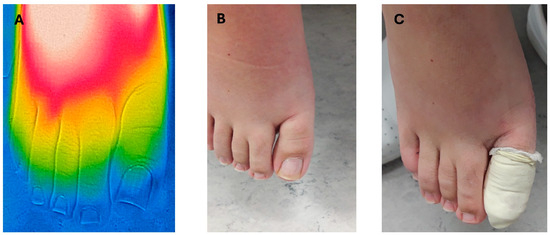
First, photographs and thermal images of the foot of each volunteer were taken. A smear from the big toe skin was taken at the corner of the nail after contact for 10 s with a swab and was immediately introduced into the Amies transport medium (samples PRE). After that, a sterile gauze was applied around the first toe of both feet, which was held with a cut gloved finger, as shown in Figure 1. Next, with a syringe, 1 mL of the respective condition was applied through the gauze. In each gauze, a different condition was tested. A total of four conditions were tested: empty dry gauze (dry control), gauze with NaCl 85% (humid control), gauze with ABT extract and gauze with SCG extract. Next, the volunteers put on their shoes and resumed their normal lives for 8 h.
Figure 1.
Procedure performed during the volunteer assays. (A) Thermographic photograph of right foot; (B) Normal photograph of right foot before applying the gauze; (C) Right big toe with gauze and glove applied.
Then, for each volunteer, the finger glove and the gauze were removed, and a second photograph and thermal image were taken for posterior comparison to the first ones. Next, a post-exposure sample of the microbiota of the toes (POST sample) was taken (from the same location) with a swab that was immediately transferred to Amies transport medium, as performed for the PRE samples. Aseptic conditions were always maintained to prevent the presence of external contaminants.
2.1.3. Culture and Colony-Forming Units (CFU) Determination
After sampling, swabs were transferred to glass tubes containing 2 mL of 0.85% NaCl solution. To ensure effective resuspension, each swab was rotated in the saline solution for 20 s and pressed against the walls of the tube, after which the samples were kept on ice. To determine total bacterial counts in the skin microbiota, 20 µL of the PRE and POST samples were spread onto commercially obtained blood agar plates (Condalab Laboratories, Madrid, Spain) and incubated at 35 °C for 24 h. Posteriorly, all the colonies were counted and presented in Supplemental Table S1, in which values represent the mean values obtained from multiple measurements of each sample, expressed as CFU per 20 µL of solution. These CFU were then converted into CFU per square centimeter (CFU/cm2), based on the assumption that the swab collected material from an area measuring 0.75 cm2, as previously [19]. The Post/Pre ratio was calculated to quantify treatment-induced changes, enabling the effect of the treatment to be expressed as a relative variation between post- and pre-exposure CFU values rather than as absolute counts, thereby serving as a normalization strategy to account for initial variability between volunteers.
2.2. Statistical Analysis
IBM SPSS Statistics version 29.0.2.0 (Chicago, IL, USA) was used for descriptive and inferential statistical analyses, as well as to design graphics. Data is presented as median and interquartile range, given that the distribution of the values in each condition was not found to be normal, according to the Shapiro–Wilk test. The Wilcoxon Signed-Rank test was used to compare the CFU/cm2 values pre- and post-exposure in each condition. The Friedman test with pairwise comparisons (adjusted by the Bonferroni correction) was used to evaluate differences in CFU/cm2 values at baseline between conditions and to compare the CFU/cm2 ratio (post- and pre-exposition) among conditions. The unit of analysis was the paired pre- and post-exposure CFU assessment obtained from the same foot under specific experimental conditions. A p-value lower than 0.05 was considered statistically significant. Missing values were addressed using median imputation. Given the non-normal distribution of the data and the paired study design, median imputation was applied to preserve complete paired observations for nonparametric analyses.
3. Results
3.1. Descriptive Statistics
The volunteers ranged in age from 19 to 33 years. Women comprised 72.4% of the sample and men 27.6%. Considering sex as a binary variable (1 = woman, 0 = man), the mean proportion of women was 0.724 (standard deviation [SD] = 0.447, indicating the variability of the sample) and the mean proportion of men was 0.276 (SD = 0.447). These descriptive statistics provide context for the analyzed toe microbiota across the different experimental conditions.
3.2. Cutaneous and Thermal Effects of Extract Exposure
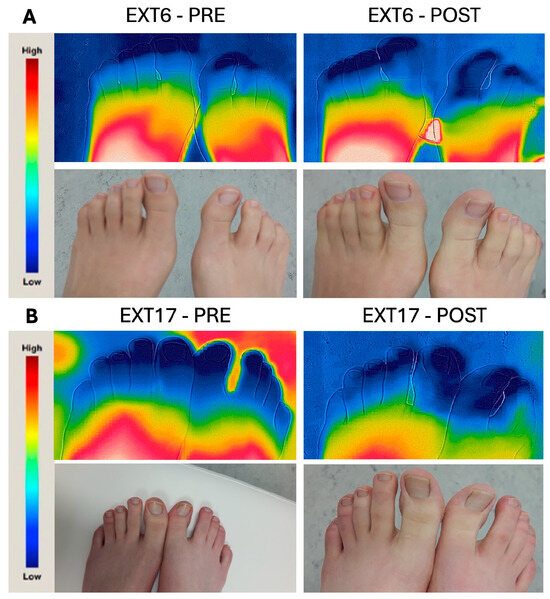
After 8 h of exposure to the controls, ABT or SCG extracts, no macroscopic skin alterations were observed. In addition, thermographic images showed no changes in skin temperature following exposure to either controls or extracts, ruling out the presence of an early inflammatory response (Figure 2). Moreover, no perceptible changes were reported by the participants after these assays. These observations were consistent across all volunteers.
Figure 2.
Clinical and thermographic assessment of volunteers’ feet before and after exposure to SCG extract. Representative normal and thermal images of volunteers’ feet before (PRE) and after (POST) the experimental assays for (A) EXT6 and (B) EXT17, following application of gauze impregnated with the extracts. The color scale indicating temperature differences was according to Takken et al. (2017) [20].
3.3. Influence of the ABT and SCG Extracts on the Human Toe Skin Microbiota
3.3.1. Statistical Analysis for Each Condition
CFU/cm2 of the 4 experimental conditions were measured at the beginning of the experiment (PRE) and after exposure (POS). Then, the ratios of CFU/cm2 (post/pre-exposure) were calculated for comparative analysis. Normality tests revealed a significant deviation from normal distribution (p < 0.001). In all conditions, a significant increase in the CFU/cm2 after exposure was observed (p < 0.005). Descriptive analysis is summarized in Table 1.
Table 1.
Summary of the analysis of the 4 different conditions in CFU/cm2.
3.3.2. Comparison of Different Conditions
Before the main analysis, pre-exposure CFU/cm2 were compared between conditions. Significant differences were observed (p < 0.001) by using the Friedman test with pairwise comparisons. The dry control group had a lower CFU/cm2 at baseline compared to both the humid control and ABT group. Also, the ABT group presented a higher CFU/cm2 than the SCG and the humid control groups.
Afterwards, the Friedman test was conducted and the analysis revealed significant differences in the ratios of the different conditions (X2 = 49.54, df = 3, p < 0.001).
Subsequently, the post hoc pairwise comparisons with Bonferroni correction revealed that the results for the dry control and for the SCG extract were significantly different from those of the humid control and the ABT extract groups (p < 0.05). No differences were found when comparing the dry control group with the SCG extract group, or between the ABT extract group and humid control group. Similarly, no differences were found between the ABT extract and the humid control, as summarized in Table 2.
Table 2.
Pairwise comparisons of the CFU/cm2 ratio between conditions.
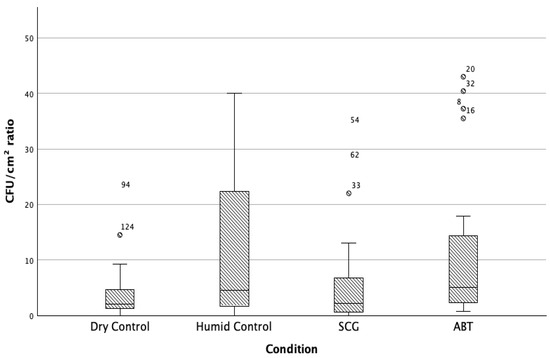
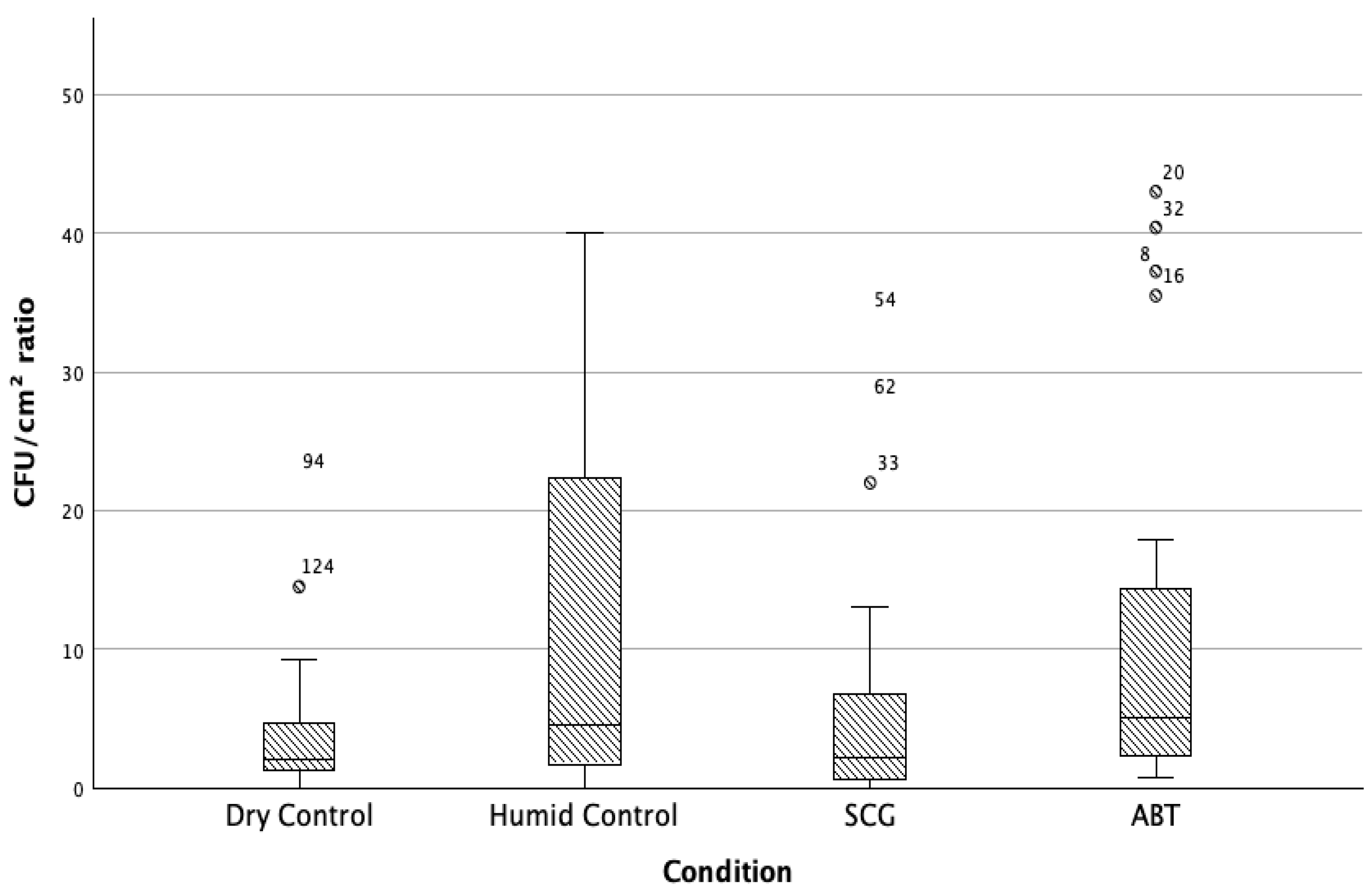
Thus, the median ratio (CFU/cm2 post-exposure/pre-exposure) was found to be higher in the humid control group and the ABT group, while it was lower in the dry control and the SCG groups. These results are illustrated in Figure 3.
Figure 3.
Median CFU/cm2 ratio after exposure to SCG, ABT extracts and controls.
4. Discussion
From a clinical and ecological perspective, the foot represents a particularly relevant skin niche for microbiome studies due to its high density of eccrine glands and frequent occlusion. These characteristics distinguish it from other cutaneous sites and make it especially susceptible to microbial imbalance. The antimicrobial potential of natural extracts represents a promising and expanding area of research, especially for the prevention and treatment of skin infections. Therefore, this study aimed to evaluate the potential of SCG and ABT extracts in preventing bacterial proliferation in the skin microbiota of healthy human toes under moist conditions.
In the present work, SCG and ABT extracts were tested on volunteer foot skin under real-life conditions, over an 8-h period, as this duration represents an estimate of the time during the day that individuals typically spend wearing occlusive footwear while being active, a condition that promotes heat and moisture generation. The volunteers applied the compresses in the morning, followed their normal daily routines, and the compresses were removed in the late afternoon. Although the absence of visible inflammatory or allergic reactions after 8 h supports the short-term tolerability of both extracts, this observation should be interpreted cautiously. Subclinical inflammatory responses or delayed hypersensitivity reactions may not manifest within this limited exposure period. Moreover, visual inspection alone may underestimate subtle skin barrier alterations or immune activation. Complementary assessments, such as transepidermal water loss measurements, inflammatory biomarker analysis or patch testing during extended contact time periods exceeding 8 h, such as 24 h or longer, would provide a more comprehensive evaluation of skin compatibility and strengthen these conclusions.
Across all conditions (dry control, humid control, SCG, and ABT exposure), a significant increase in CFU/cm2 was observed after 8 h; however, the magnitude of this increase depended on the condition tested. The dry control group showed the smallest relative increase, with a median CFU/cm2 ratio of 2.0. Both the humid control and ABT conditions exhibited higher increases in CFU/cm2, with no significant difference between them, compared to the dry control. These results indicate that moisture is a key factor promoting bacterial growth and further suggest that ABT did not exert inhibitory effects on the number of colonies recovered under the tested experimental conditions.
Interestingly, no significant differences were observed between the dry control and SCG conditions after exposure. The SCG extract exhibited a moderate increase in bacterial growth, with a median CFU/cm2 ratio of 2.18, comparable to that of the dry control group. In contrast, significant differences were observed between both the dry control and SCG conditions and the humid control, indicating that the effect of the SCG extract was similar to that of a dry environment. These findings are particularly noteworthy, as they suggest that the extract may counterbalance the pro-proliferative effects of humidity. Such an effect is desirable in dermatological applications, where preservation of commensal microorganisms is critical for skin health [21]. However, in the present study, the effect on the microbial composition remains unknown because antimicrobial activity was evaluated based on CFU enumeration, which provides an overall measure of microbial viability but does not allow for the specific characterization of the cutaneous microbiota. As a result, potential selective effects of the extracts on distinct bacterial groups, including commensal and potentially pathogenic microorganisms, could not be determined. Future investigations incorporating approaches that enable a more detailed analysis of the skin microbiota would help clarify the specificity and ecological impact of the tested extracts on the cutaneous microbial community. These integrating culture-independent techniques, such as high-throughput microbiome profiling, such as 16S rRNA gene sequencing, would allow a more comprehensive and unbiased assessment of microbial community changes and would aim to determine whether the extract selectively targets potential pathogenic microorganisms while preserving commensal skin microbiota.
Previous studies on the chemical composition of SCG extracts have reported the presence of several compounds with antibacterial properties, including polysaccharides, oligosaccharides, lipids, aliphatic acids, amino acids, proteins, alkaloids, phenolic compounds, minerals, lignin, melanoidins, and volatile compounds. Among these, chlorogenic acid is the most prevalent phenolic compound [8]. The presence of these bioactive compounds may help explain the ability of the SCG extract to limit bacterial overgrowth typically induced by humidity, maintaining bacterial levels comparable to those observed in a dry environment. However, despite the well-documented bioactivity of SCG constituents, the complexity of the extract poses challenges for attributing the observed effects to specific compounds. On the other hand, the synergistic interactions among the compounds may also play a central role in antimicrobial modulation [22]. To shed light on the bioactive constituents responsible for the observed effects, the determination of the chemical composition of the extract upon application over time, and the correlation of the component concentrations could be considered in future works. Finally, post-exposure sampling following shoe removal would be valuable to assess the persistence of the antimicrobial effects and to evaluate the potential for microbial rebound after treatment cessation. Another relevant aspect to be addressed in future studies is the evaluation of whether this extract exerts bactericidal or bacteriostatic effects, at least against selected pathogenic bacterial strains. It is also important to consider formulation-related aspects that may influence real-world applicability. Factors such as extract stability, skin penetration, sensory properties, and compatibility with footwear materials will ultimately determine user compliance and efficacy.
On the other hand, the future studies should also encompass larger and diverse populations, including individuals with distinct physiological characteristics, as the potential products may serve as preventive strategies for individuals prone to excessive sweating, prolonged footwear use, or compromised skin barriers, including athletes, military personnel, healthcare workers, and individuals with conditions such as hyperhidrosis, diabetes, or mild immunosuppression. Additionally, stricter randomization strategies or paired study designs to ensure improved baseline comparability across study groups should be adopted. Variability in baseline CFU level is a potential confounder. While normalization using post/pre CFU ratios reduces the impact of initial differences by allowing each sample to serve as its own control, residual effects linked to baseline variability may still affect the magnitude and interpretation of the observed treatment effects. Also, exploratory analyses stratified by sex were performed. Although similar trends were observed in male and female participants, statistical significance was not consistently achieved after stratification, likely due to the reduced and unequal sample sizes within each sex. Therefore, sex-related variability should be considered a potential source of heterogeneity.
This study highlights the promising antimicrobial potential of SCG in limiting bacterial proliferation within the skin microbiota of healthy human feet, particularly under humid conditions characteristic of enclosed footwear. These findings support further studies for the potential development of SCG-based skincare formulations [23], specifically for foot care, offering the dual benefits of sustainability and circular economy principles while promoting the valorization of an otherwise discarded by-product.
Supplementary Materials
The following supporting information can be downloaded at https://www.mdpi.com/article/10.3390/app16041886/s1: Table S1: Raw CFU/cm2 values obtained before and after exposure under the different experimental conditions.
Author Contributions
Conceptualization, T.G., C.F., A.F.L.-S. and F.M.-T.; methodology, A.F.L.-S., J.M.N.-M., D.C., J.S.-B., E.E.M.C. and R.D.; software, J.L.; validation, J.M.N.-M. and F.M.-T.; investigation, A.F.L.-S., D.C. and E.E.M.C.; resources, T.G. and F.M.-T.; data curation, A.F.L.-S. and J.L.; formal analysis: J.L.; writing—original draft preparation, A.F.L.-S.; writing—review and editing, C.F., T.G., J.S.-B. and F.M.-T.; supervision, J.M.N.-M. and F.M.-T.; project administration, T.G., C.F. and F.M.-T.; funding acquisition, T.G. and F.M.-T. All authors have read and agreed to the published version of the manuscript.
Funding
This study was supported by project grants awarded by the Faculty of Health Sciences at the University of Castilla-La Mancha, under the 2022 call (reference: 022022) and funded by the European Regional Development Fund (ERDF), through Programme–COMPETE 2020 and EU Recovery and Resilience Facility and Portuguese national funds via FCT—Fundação para a Ciência e a Tecnologia, under projects, LA/P/0058/2020 [DOI: 10.54499/LA/P/0058/2020], UID/PRR/4539/2025 [DOI: 10.54499/UID/PRR/04539/2025] and UID/04539/2025. Chantal Fernandes thanks the financial support from 10.54499/DL57/2016/CP1448/CT0025. Daniela Calheiros work was supported by FCT Fundação para a Ciência e Tecnologia, I.P. by project reference 2023.01320.B D and DOI identifier https://doi.org/10.54499/2023.01320.BD.
Institutional Review Board Statement
This study was approved by the Bioethics Committee of the University of Extremadura (Ref. 120/2021) approved on 29 September 2021. The Declaration of Helsinki was followed throughout the study.
Informed Consent Statement
Informed consent was obtained from all subjects involved in the study.
Data Availability Statement
The original contributions presented in the study are included in the article/Supplementary Materials, further inquiries can be directed to the corresponding authors.
Conflicts of Interest
The authors declare no conflicts of interest.
Abbreviations
The following abbreviations are used in this manuscript:
| ABT | Azorean Black Tea |
| SCG | Spent Coffee Ground |
| CFU | Colony-Forming Units |
References
- Eisenstein, M.; Segre, J.A. The Skin Microbiome. Nature 2020, 588, S209. [Google Scholar] [CrossRef] [Scilit]
- Adamczyk, K.; Garncarczyk, A.; Antończak, P.; Wcisło-Dziadecka, D. The Foot Microbiome. J. Cosmet. Dermatol. 2020, 19, 1039–1043. [Google Scholar] [CrossRef] [Scilit] [PubMed]
- Kortekaas Krohn, I.; Callewaert, C.; Belasri, H.; De Pessemier, B.; Diez Lopez, C.; Mortz, C.G.; O’Mahony, L.; Pérez-Gordo, M.; Sokolowska, M.; Unger, Z.; et al. The influence of lifestyle and environmental factors on host resilience through a homeostatic skin microbiota: An EAACI Task Force Report. Allergy 2024, 79, 3269–3284. [Google Scholar] [CrossRef] [Scilit]
- Dinu, M.; Tatu, A.L.; Cocoș, D.I.; Nwabudike, L.C.; Chirilov, A.M.; Stefan, C.S.; Earar, K.; Buzia, O.D. Natural Sources of Therapeutic Agents Used in Skin Conditions. Life 2024, 14, 492. [Google Scholar] [CrossRef] [Scilit]
- Jo, J.H.; Harkins, C.P.; Schwardt, N.H.; Portillo, J.A.; NISC Comparative Sequencing Program; Zimmerman, M.D.; Carter, C.L.; Hossen, M.A.; Peer, C.J.; Polley, E.C.; et al. Alterations of human skin microbiome and expansion of antimicrobial resistance after systemic antibiotics. Sci. Transl. Med. 2021, 13, eabd8077. [Google Scholar] [CrossRef] [Scilit]
- Čižmárová, B.; Hubková, B.; Tomečková, V.; Birková, A. Flavonoids as Promising Natural Compounds in the Prevention and Treatment of Selected Skin Diseases. Int. J. Mol. Sci. 2023, 24, 6324. [Google Scholar] [CrossRef] [Scilit]
- Fernandes, C.; Sousa-Baptista, J.; Lenha-Silva, A.F.; Calheiros, D.; Correia, E.; Figueirinha, A.; Salgueiro, L.; Gonçalves, T. Azorean Black Tea (Camellia Sinensis) Antidermatophytic and Fungicidal Properties. Molecules 2023, 28, 7775. [Google Scholar] [CrossRef] [Scilit]
- Calheiros, D.; Dias, M.I.; Calhelha, R.C.; Barros, L.; Ferreira, I.C.F.R.; Fernandes, C.; Gonçalves, T. Antifungal Activity of Spent Coffee Ground Extracts. Microorganisms 2023, 11, 242. [Google Scholar] [CrossRef] [Scilit]
- Wojciechowska, K.; Dos Santos Szewczyk, K. The Skin Microbiome and Bioactive Compounds: Mechanisms of Modulation, Dysbiosis, and Dermatological Implications. Molecules 2025, 30, 4363. [Google Scholar] [CrossRef] [Scilit]
- Naveed, M.; BiBi, J.; Kamboh, A.A.; Suheryani, I.; Kakar, I.; Fazlani, S.A.; FangFang, X.; Kalhoro, S.A.; Yunjuan, L.; Kakar, M.U.; et al. Pharmacological Values and Therapeutic Properties of Black Tea (Camellia Sinensis): A Comprehensive Overview Biomed. Pharmacother 2018, 100, 521–531. [Google Scholar] [CrossRef] [Scilit]
- Parveen, A.; Qin, C.-Y.; Zhou, F.; Lai, G.; Long, P.; Zhu, M.; Ke, J.; Zhang, L. The Chemistry, Sensory Properties and Health Benefits of Aroma Compounds of Black Tea Produced by Camellia Sinensis and Camellia Assamica. Horticulturae 2023, 9, 1253. [Google Scholar] [CrossRef] [Scilit]
- Paiva, L.S.; Dias, A.P.; Motta, M.H.; Bettencourt Baptista, J.A. Phytochemicals and Biological Properties of Azorean Camellia Sinensis Black Tea Samples from Different Zones of Tea Plantation. Plants 2025, 14, 103. [Google Scholar] [CrossRef] [Scilit]
- Paiva, L.; Lima, E.; Motta, M.; Marcone, M.; Baptista, J. Investigation of the Azorean Camellia Sinensis Processing Conditions to Maximize the Theaflavin 3,3′-Di-O-Gallate Content as a Potential Antiviral Compound. Antioxidants 2022, 11, 1066. [Google Scholar] [CrossRef] [Scilit]
- Liu, S.; Zhang, Q.; Li, H.; Qiu, Z.; Yu, Y. Comparative Assessment of the Antibacterial Efficacies and Mechanisms of Different Tea Extracts. Foods 2022, 11, 620. [Google Scholar] [CrossRef] [Scilit]
- Sousa, C.; Gabriel, C.; Cerqueira, F.; Manso, M.C.; Vinha, A.F. Coffee Industrial Waste as a Natural Source of Bioactive Compounds with Antibacterial and Antifungal Activities. In The Battle Against Microbial Pathogens: Basic Science, Technological Advances and Educational Programs, 1st ed.; Formatex Research Center: Badajoz, Spain, 2015; pp. 131–136. [Google Scholar]
- Makiso, M.U.; Tola, Y.B.; Ogah, O.; Endale, F.L. Bioactive Compounds in Coffee and Their Role in Lowering the Risk of Major Public Health Consequences: A Review. Food Sci. Nutr. 2023, 12, 734–764. [Google Scholar] [CrossRef] [Scilit]
- Castro-Díaz, R.; Silva-Beltrán, N.P.; Gámez-Meza, N.; Calderón, K. The Antimicrobial Effects of Coffee and By-Products and Their Potential Applications in Healthcare and Agricultural Sectors: A State-of-Art Review. Microorganisms 2025, 13, 215. [Google Scholar] [CrossRef] [Scilit]
- Melikoglu, M. Coffee waste valorization: A comprehensive review of recent advancements and future directions for a circular bioeconomy. Food Chem. 2025, 497, 147004. [Google Scholar] [CrossRef] [Scilit]
- Marcos-Tejedor, F.; Sánchez-Rodríguez, R.; Mayordomo, R.; Martínez-Nova, A. The Bacteriostatic Effect of Controlled-Flux Electrolyzed Acidic Solution on Healthy Hallucal Skin. J. Tissue Viability 2020, 29, 58–60. [Google Scholar] [CrossRef] [Scilit] [PubMed]
- Takken, W.; Verhulst, N.O. Chemical Signaling in Mosquito–Host Interactions: The Role of Human Skin Microbiota. Curr. Opin. Insect Sci. 2017, 20, 68–74. [Google Scholar] [CrossRef] [Scilit]
- Lima, R.D.; Hajiarbabi, K.; Den Ng, B.; Sood, A.; Ferreira, R.B.R. Skin-associated commensal microorganisms and their metabolites. J. Appl. Microbiol. 2025, 136, lxaf111. [Google Scholar] [CrossRef] [Scilit]
- Vaou, N.; Stavropoulou, E.; Voidarou, C.C.; Tsakris, Z.; Rozos, G.; Tsigalou, C.; Bezirtzoglou, E. Interactions between Medical Plant-Derived Bioactive Compounds: Focus on Antimicrobial Combination Effects. Antibiotics 2022, 11, 1014. [Google Scholar] [CrossRef] [Scilit] [PubMed]
- Ribeiro, H.; Marto, J.; Raposo, S.; Agapito, M.; Isaac, V.; Chiari, B.G.; Lisboa, P.F.; Paiva, A.; Barreiros, S.; Simões, P. From Coffee Industry Waste Materials to Skin-friendly Products with Improved Skin Fat Levels. Europ. J. Lipid Sci. Technol. 2013, 115, 330–336. [Google Scholar] [CrossRef] [Scilit]

Disclaimer/Publisher’s Note: The statements, opinions and data contained in all publications are solely those of the individual author(s) and contributor(s) and not of MDPI and/or the editor(s). MDPI and/or the editor(s) disclaim responsibility for any injury to people or property resulting from any ideas, methods, instructions or products referred to in the content. |
© 2026 by the authors. Licensee MDPI, Basel, Switzerland. This article is an open access article distributed under the terms and conditions of the Creative Commons Attribution (CC BY) license.