1. Introduction
Thermally coupled multiphysics problems are ubiquitous in both natural phenomena [
1,
2,
3] and engineering practice [
4,
5,
6], involving complex interactions among heat conduction, fluid flow, and solid deformation across diverse applications from aerospace propulsion systems and nuclear reactor cooling devices to thermal management of electronic equipment. A canonical example is the conjugate heat transfer problem, where heat conduction in the solid domain and convective heat transfer in the fluid domain are interconnected through interface coupling conditions, forming a complex bidirectional coupled system. Accurate simulation of such systems is critical for engineering design, safety assessment, and performance optimization.
Currently, numerical methods such as the Finite Difference Method (FDM) [
7] and the Finite Element Method (FEM) [
8] are predominant in the field of heat conduction. For instance, Ye et al. integrated FDM with Monte Carlo simulations to predict the effective thermal conductivity of fractal porous media characterized by rough surfaces [
9]. regarding mesh adaptability, a polygonal FEM based on Wachspress shape functions has been successfully applied to two-dimensional steady-state heat conduction problems, demonstrating significantly enhanced robustness in handling irregular boundaries and singularities [
10]. Furthermore, a novel polyhedral Scaled Boundary Finite Element Method (PSBFEM) incorporating octree meshes offers an efficient solution for transient heat conduction within complex three-dimensional geometries [
11]. Additionally, by introducing fractal calculus, an effective thermal conductivity (TC) model rooted in fractal theory has been established to address solid–liquid two-phase heat transport in rough fracture networks [
12].
However, traditional numerical methods still face significant challenges in handling high-dimensional parameter spaces, complex geometric boundaries, and inverse problems. These include the high computational cost of mesh generation for intricate geometries [
13] and limited interpolation accuracy [
14]. Furthermore, modern engineering systems often require reconstructing full-field physical quantities or identifying key model parameters from sparse experimental data, thereby transforming the problem from a conventional forward formulation into a more challenging inverse problem and further increasing computational complexity.
With the rapid advancement of artificial intelligence, deep learning has attracted growing interest for solving heat transfer problems. Although traditional deep neural networks have been applied to model heat transfer phenomena [
15,
16], they rely heavily on large amounts of high-quality labeled data. This dependence severely limits their performance in high-dimensional settings, multi-physics coupled systems, or scenarios where experimental data are scarce.
To address these limitations in physical modeling, Raissi et al. introduced Physics-Informed Neural Networks (PINNs) [
17]. Unlike conventional machine learning methods, PINNs embed the governing physical equations directly into the network architecture. As a result, they can produce physically consistent solutions even without training data, guided solely by the underlying physics.
In recent years, PINNs have seen rapid adoption across a wide range of physical problems and have been successfully applied to heat transfer applications. For example, temperature measurements from a limited number of sensors can be used as inputs to train a real-time surrogate model that accurately predicts the full temperature field and the corresponding heat flux [
18]. Similarly, Cai et al. combined sparse observational data with PINNs to reconstruct both temperature and velocity fields in forced and mixed convection cases across multiple regions [
19]. Shang et al. used PINN to identify boundary heat fluxes and thermal conductivity [
20]. Wei et al. [
21] propose a Conditioned Adaptive Physics Network framework for efficient reconstruction of three-dimensional transient temperature fields in thermal protection systems of hypersonic vehicles. Kalpana et al. proposed a novel hybrid model by combining convolutional neural networks to predict heat transfer coefficients, showing higher accuracy compared with traditional and purely machine-learning approaches [
22].
However, when applied to complex thermal systems, PINNs still face several challenges. These include difficulty in effectively balancing multiple loss terms, slow convergence in strongly nonlinear problems, and potential instability in long-term predictions [
23]. To address these issues, researchers have developed a range of improvement strategies.
One approach adaptively adjusts loss weights during training to balance the contributions of different physical terms. For example, McClenny et al. used inverse gradient optimization to dynamically balance loss minimization and weight assignment [
24]. Another strategy modifies the network architecture to enforce boundary conditions by construction, thereby reducing the number of loss terms that need to be balanced. Lu et al. proposed the hard-constrained PINN (hPINN) [
25], which builds trial functions or analytical particular solutions that satisfy boundary conditions exactly. This ensures strict compliance with boundaries through the network structure itself, eliminating the loss of conflicts typical of soft-constrained formulations. Building on this idea, Zhou et al. introduced the Hybrid Boundary PINN (HB-PINN) [
26], which adds smooth residual terms near boundaries to improve transition stability and adaptability.
In addition, domain decomposition techniques such as eXtended PINNs have been widely explored [
27]. These methods split the computational domain into multiple subdomains, each modeled by an independent neural network, enhancing both scalability and local solution accuracy. Collectively, these advances have greatly improved the capability of PINNs for thermal multiphysics problems.
For instance, Ma et al. applied hPINN to electro-thermal coupling problems and demonstrated high prediction accuracy [
28]. Wu et al. enhanced the Fourier neural operator with transfer learning to accelerate multi-objective stochastic optimization for heat exchanger systems, achieving better computational efficiency and predictive performance while maintaining a favorable trade-off between cost and accuracy [
29]. Abueidda et al. developed a Physics-Informed Temporal Convolutional Network (PI-TCN) for thermoelasticity and integrated it into a finite element framework to exploit the fast inference capability of neural networks. Their results showed that PI-TCN outperforms standard PINNs [
30]. More recently, Qiu et al. proposed an adaptive PINN for three-dimensional transient thermo-mechanical coupling. Their method uses automatic differentiation to embed the full set of governing equations and boundary conditions into a unified loss function and applies an adaptive balancing strategy to address scale mismatches among equations. While these advancements have shown promise in their respective domains, applying PINN-based frameworks to even more complex, multi-scale coupled systems remains a formidable challenge. In such scenarios, researchers frequently encounter persistent issues inherited from the standard PINN architecture, such as slow convergence [
31], training instability [
32], or limited accuracy [
32] due to the inherent complexity of the loss landscape [
23,
32,
33,
34].
Despite recent advances in improving the accuracy and convergence of PINNs, significant challenges remain in effectively and accurately solving complex thermal multiphysics problems, especially those involving special boundary conditions.
In numerical simulations of thermally coupled multiphysics systems, heat transfer is typically more sensitive to interfaces than other physical fields, and boundary heat flux often directly participates in the coupling mechanism. As a result, thermal boundary conditions require more careful treatment and have a greater impact on overall solution accuracy. Neumann boundary conditions, which are specified in terms of derivatives, rely on gradient information obtained through automatic differentiation. This makes them particularly sensitive to noise and harder to fit accurately during training, which can significantly degrade both model stability and boundary precision.
In response to these limitations, this paper proposes a soft-hard constraint collaborative training method to solve multiphysics systems with complex coupling behavior more efficiently and accurately. The core idea is to treat different physical variables separately based on the complexity and analytical tractability of their boundary conditions, and to apply differentiated boundary constraint strategies. This approach combines the high boundary accuracy of hard constraints with the training stability of soft constraints.
Focusing on representative multiphysics problems involving thermal coupling, this study selects two benchmark thermal models as test cases: a thermoelasticity model and a thermal convection model. To systematically evaluate the effectiveness of the proposed soft-hard constraint collaborative training methods (s-hPINN and s-HB-PINN), we compare them against three established PINN approaches: the standard PINN (sPINN), hPINN, and HB-PINN. Numerical experiments on both coupled models enable a comparative assessment of each method in terms of solution accuracy, training stability, and boundary treatment performance, thereby revealing their respective strengths and limitations under varying coupling conditions. The main contributions of this work are as follows:
- (1)
We propose a novel collaborative training strategy that combines soft and hard constraints. This method achieves higher accuracy than existing approaches for multiphysics problems.
- (2)
We conduct comprehensive validation on multiple multiphysics systems, including thermoelasticity and thermal convection models, and evaluate how different PINN formulations perform with respect to coupling strength and spatial complexity of the physical fields.
- (3)
We demonstrate the advantages of the collaborative constraint strategy for steady-state multiphysics problems. Experimental results show that the proposed approach maintains physical consistency while achieving a better balance between accuracy and training efficiency, offering improved generalization and strong potential for practical engineering applications.
2. Methods
2.1. Physics-Informed Neural Networks
PINNs embed the physical constraints of partial differential equations directly into neural network training by constructing a loss function that incorporates residuals from the governing equations, boundary conditions, and initial conditions. Unlike traditional numerical methods, PINNs do not require spatial discretization. Instead, they approximate PDE solutions through continuous function representation. This framework provides excellent scalability and geometric flexibility, making it especially well-suited for modeling high-dimensional systems, multiphysics coupled problems, and physical scenarios with complex boundary conditions.
A system of coupled partial differential equations can generally be expressed as follows [
35]:
Among them, represents the differential operator, represents the physical field variable that needs to be obtained, and is the set of given parameters. The governing equation is defined on the field, where represents the input vector . is an operator that can represent various types of boundaries, is a boundary condition that can be a constant value or function, and represents the boundary domain.
To solve the multiphysics coupling problems described by PDE, this paper uses the PINN as a unified framework to approximate the solutions. PINN employ a fully connected neural network architecture to approximate
, where the network takes coordinates
as input and yields
as output. Here,
represents the trainable parameters within the network. The neural network comprises multiple hidden layers, where the input of each hidden layer
and the outputs
are propagated through the network as
where
represents the activation function of a simple nonlinear trans- formation,
and
denote the trainable weights and biases, respectively. The parameters of the network can be trained by minimizing a composite loss function, which takes the following form:
here,
refers to the loss associated with the residuals of PDE, and
represents the set point of the equation.
represents mean squared error (MSE).
is the loss of boundary conditions, and
represents the number of boundary points. Since the initial conditions are specific forms of boundary conditions, their losses are the same as Equation (4). The total loss is now expressed as
The parameters and denote the weights assigned to the PDE loss and the boundary loss, respectively. These weights are introduced to balance gradient magnitudes across different loss components, accelerate convergence, and enhance the accuracy of the computed solution.
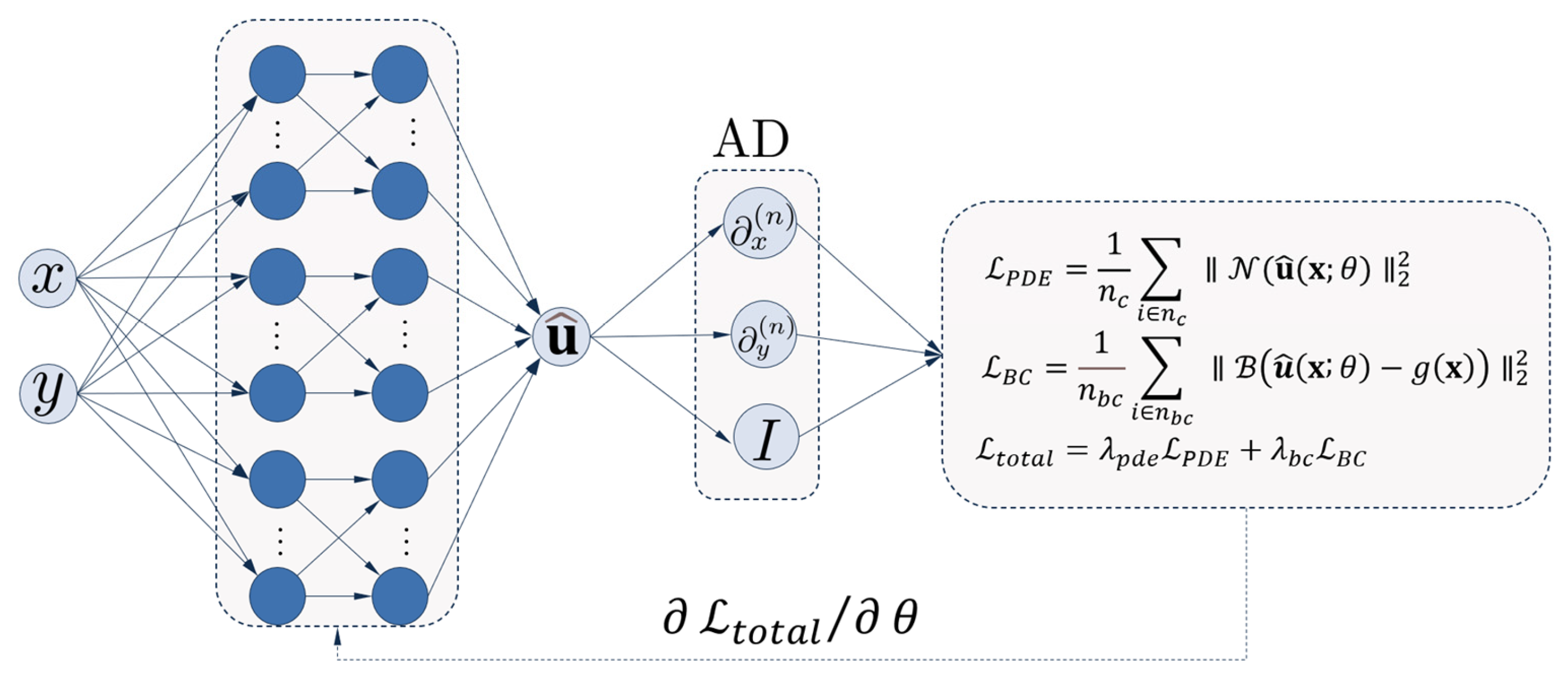
Figure 1 illustrates the standard PINN architecture. Input variables are passed through a neural network, which outputs dimensionless field variables via activation functions. To accurately evaluate the derivatives required by the governing equations, boundary conditions, and initial conditions, automatic differentiation is applied during forward propagation.
Residuals for the coupled system of partial differential equations, boundary conditions, and initial conditions are then computed using collocation points and boundary points . These residuals measure the mismatch between the neural network’s predictions and the underlying physical constraints. The training process proceeds iteratively: it terminates when either the total residual loss falls below a predefined tolerance or the maximum number of iterations is reached; otherwise, optimization continues until one of these criteria is satisfied.
In PINN, boundary condition treatment critically affects solution accuracy. Traditional soft constraints incorporate boundary conditions as penalty terms in a composite loss, often causing conflicts that reduce accuracy. To address this, a hard constraint approach that enforces boundary conditions exactly by designing the network output structure, avoiding penalty optimization. This method introduces auxiliary functions satisfying boundary properties to weight and combine the network output, ensuring the prediction inherently meets boundary values. Typically, it involves three networks:
[
36].
Let denote the target physical quantity, is known particular solution satisfying initial/boundary conditions, and is the distance function. To handle complex geometries, two low-capacity auxiliary networks, and , approximate and , yielding and . After pretraining and , they are combined with according to Equation (6) to form the final solution . In the final training stage, we optimize only the parameters of , ensuring that the remaining constraints are satisfied and the residuals of the governing partial differential equations are effectively controlled.
However, this PINN approach faces notable limitations. The hard constraint method relies on two key components: a boundary solution network and a distance function network. During training, the boundary solution network takes only boundary coordinates as input to guarantee exact satisfaction of boundary conditions. When the boundary geometry or conditions are complex, however, the deep neural network’s output in the interior domain may lose smoothness or exhibit spurious oscillations. This can severely slow convergence or even prevent the main network from converging, limiting the applicability of hard constraints to problems with intricate boundaries.
To address this challenge, Zhou et al. proposed the HB-PINN, which introduces structural and loss-function innovations that significantly improve both representational capacity and training stability under complex boundary conditions [
26]. Key differences include: (1)
incorporates residual loss of PDE and adjusts the weight of the loss of the boundary to improve training near the boundaries; (2)
uses a power distance function as a training label, imposing the output to approach zero near the boundaries and rapidly increase away from them, ensuring
dominates training in the interior.
2.2. Methods for Collaborative Soft-Hard Constraints
In numerical simulations of thermal engineering problems, accurate enforcement of boundary conditions is essential for ensuring the physical fidelity of the solution. The temperature field, as a canonical scalar field, is typically subject to two types of boundary conditions: Dirichlet boundaries, which prescribe temperature values directly, and Neumann boundaries, which specify the normal heat flux or, equivalently, the normal gradient of temperature.
When solving such problems with PINNs, imposing hard constraints on Dirichlet boundaries by structurally ensuring that the network output exactly matches the prescribed temperature at the boundary generally yields higher accuracy and improved training stability compared to soft constraint approaches. This strategy is especially effective for fixed-temperature boundary scenarios.
However, the performance of hard constraint methods deteriorates significantly when applied to Neumann boundaries involving prescribed heat flux or dissipative thermal conditions. The fundamental reason lies in Neumann conditions: they constrain the normal derivative of the temperature field, which governs the heat flux. Unlike pointwise temperature values, this derivative-based condition exerts a nonlocal influence, shaping the temperature distribution not only at the boundary but also across adjacent interior regions. Enforcing such a condition through a rigid structural modification of the network restricts its ability to adaptively resolve the spatial variation in temperature near the boundary. Consequently, conflicts arise between the optimization objectives of satisfying the governing equations in the domain and matching the prescribed heat flux at the boundary.
These challenges are exacerbated in coupled multiphysics settings, often leading to error accumulation near boundaries, loss of solution smoothness, poor convergence behavior, or even numerical divergence. As a result, it becomes difficult to achieve the dual accuracy required in engineering practice for both temperature and heat flux.
Therefore, for the broad class of thermal problems featuring complex boundary conditions, developing computational frameworks that can effectively coordinate Dirichlet boundary and Neumann boundary constraints is critical to improving the robustness and practical utility of PINNs.
In this study, for multi-physical problems related to thermal fields, we adopt a collaborative soft-hard constraint strategy. The allocation of soft and hard constraints follows a key principle: hard constraints are preferentially applied to physical quantities whose boundary conditions can be accurately and stably approximated by a low-capacity network or simple analytical functions, thereby reducing conflicts between boundary loss terms and PDE loss terms during model training. Conversely, for thermal quantities with boundary conditions involving complex derivative relationships (such as Neumann boundaries of the temperature field), soft constraints are applied to ensure training stability and overall prediction accuracy.
Assume that the physical field to be obtained comprises variables
and
. We employ hard constraints to approximate the variable
and utilize soft constraints networks for the variable
. The variables are subsequently linked through a system of coupled equation losses. In the final training of the composite PINN, the weights and biases of the network
approximating
and the soft constraints network
approximating
will be the trainable variables exposed to the optimizer.
In Equation (7), the hyperparameter
a is typically set to 5, 10, or 15 [
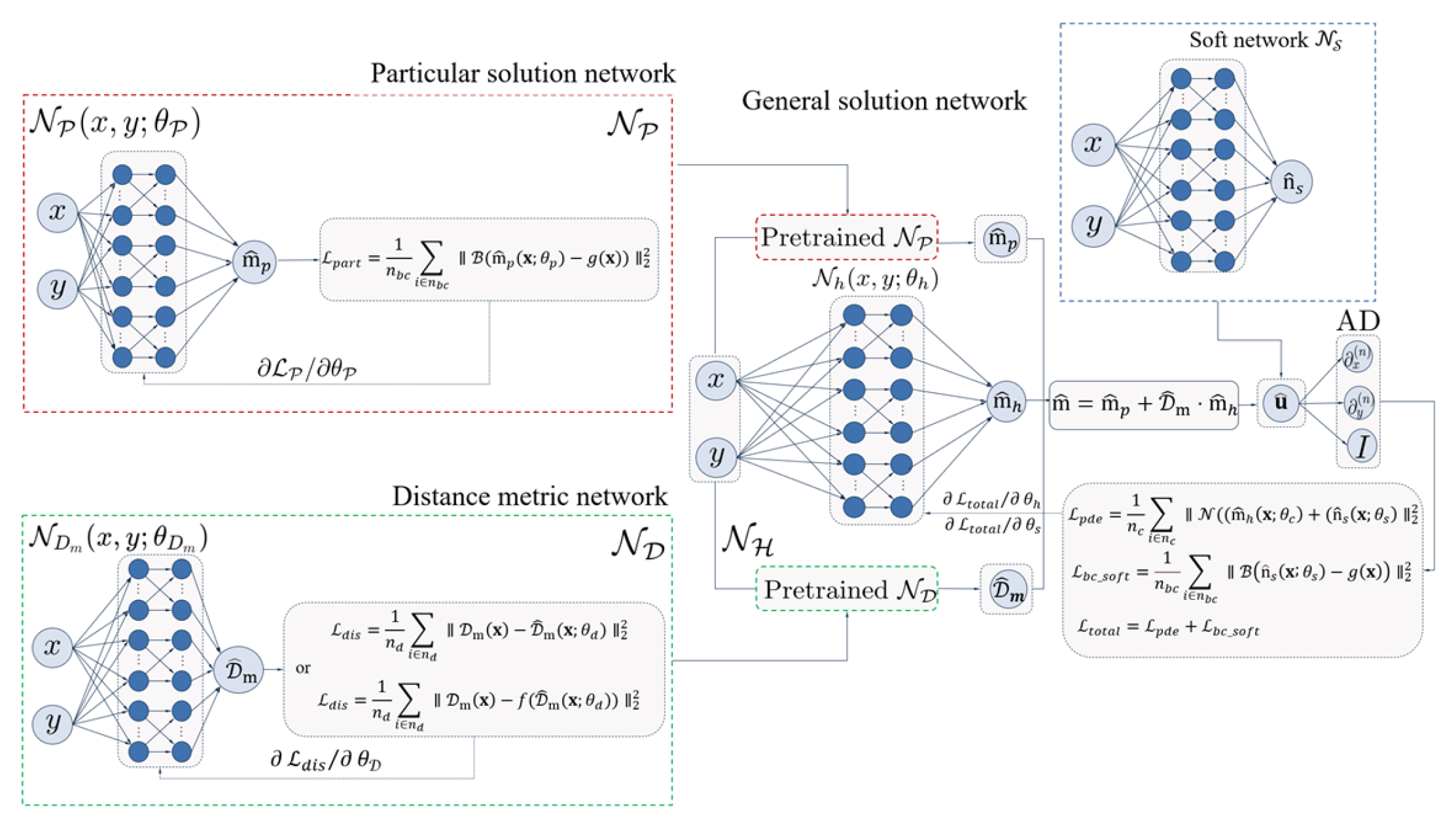
26]. To compare the impact of different distance networks, the distance networks of h-PINN and HB-PINN are, respectively, incorporated into Equation (7). When the hyperparameter a is set to 1, Equation (7) reduces to the traditional distance function. These networks are embedded into s-hPINN and s-HB-PINN, and their overall architectures are illustrated in
Figure 2.
In this work, the choice between hard and soft boundary constraints is guided by three practical criteria rather than solely by the mathematical type of boundary condition.
- (1)
Boundary Embeddability: Hard constraints are preferred when boundary conditions can be precisely and stably embedded into the neural network architecture via simple analytical functions or low-capacity networks, such as Dirichlet conditions. Conversely, Neumann or Robin conditions involving directional derivatives are difficult to implement stably due to the requirement for additional differentiation operations and are thus unsuitable for hard-coding.
- (2)
Gradient Stability: Enforcing hard constraints on derivative-based boundaries introduces high-order automatic differentiation, which significantly amplifies gradient noise. In gradient-sensitive problems such as heat conduction, this often leads to training instability.
- (3)
Multi-physics Coupling Sensitivity: In strongly coupled systems like thermal convection, hard constraints may propagate local setup errors to other field variables, thereby compromising global consistency. In contrast, soft constraints allow the network to adaptively coordinate the relationships between different physical quantities during training, enhancing the overall physical plausibility of the solution.
Given that the thermal-related multi-physics problems investigated in this study often involve Neumann-type temperature boundaries (e.g., prescribed heat flux), while variables such as velocity and displacement typically have clear Dirichlet boundaries or can avoid derivative constraints through variable reconstruction (e.g., directly predicting stress), we adopt a hybrid strategy. Specifically, we apply soft constraints to the temperature field and hard constraints to other field variables. It should be noted that this strategy is problem-dependent and may not be universally optimal. To assist researchers in making a priori judgments for new problems, we provide a reference framework in
Figure 3 and Algorithm 1.
| Algorithm 1 Soft-Hard Collaborative Physics-Informed Neural Network |
| Input: spatiotemporal coordinates |
| Output: multiphysics variables of the thermal coupled system, with Dirichlet boundaries variables denoted by m and the temperature field with Neumann boundaries denoted by n |
| Step 1: Pretrained networks
and
|
| Initialize the parameters for the networks and , respectively. |
|
|
| Freeze the parameters after training.
|
|
Step 2: Train networks and | |
Initialize parameters for networks and , respectively.
for epochs = 1, 2, … do |
- (a)
Compute the soft boundary loss for Neumann boundaries:
| |
|
- (b)
Compute the PDE residual loss:
| |
|
- (c)
Compute the total loss:
| |
|
- (d)
Backpropagation and update parameters and via gradient descent.
end |
3. Results and Discussion
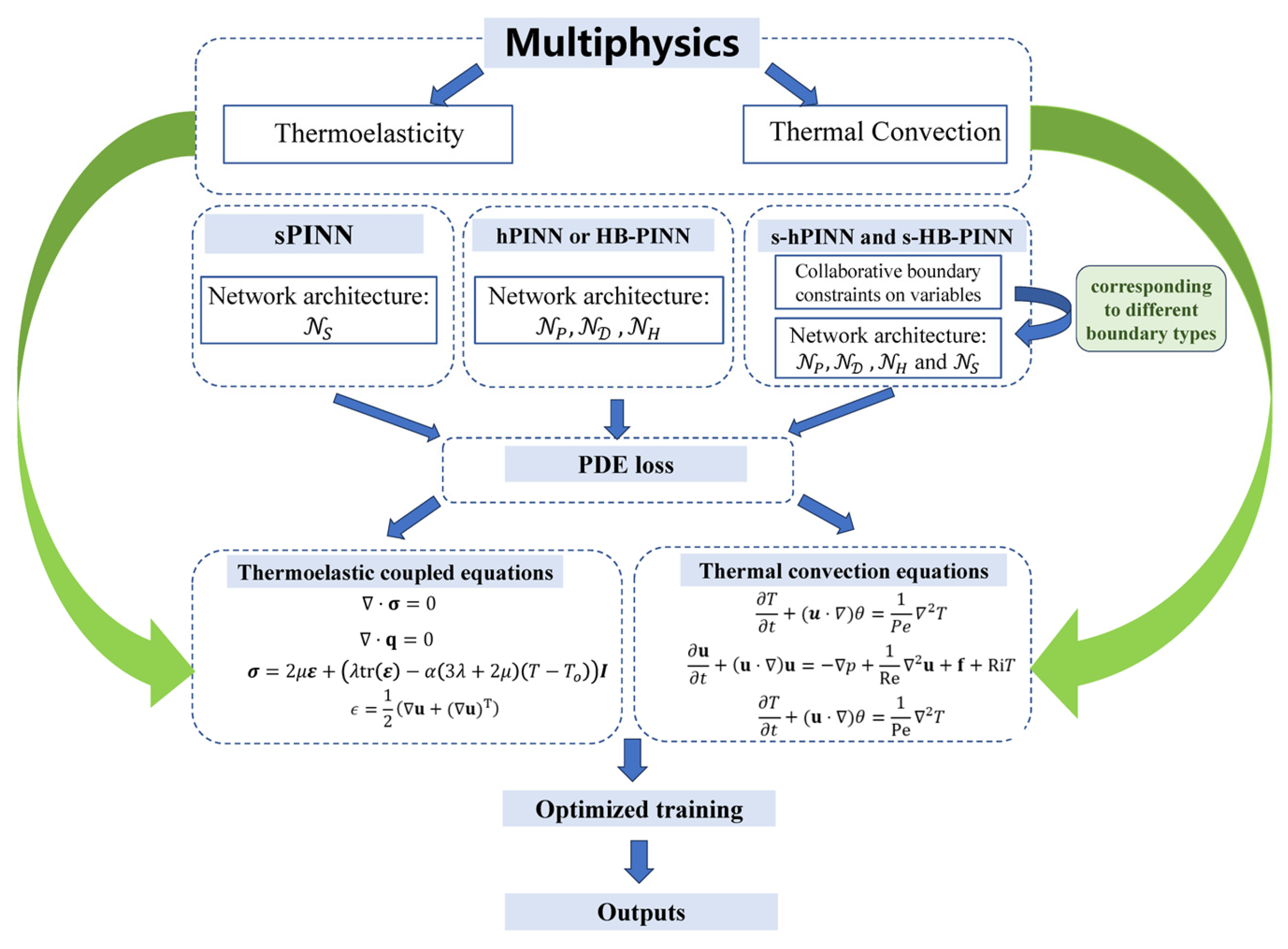
To validate and demonstrate the effectiveness of the proposed method, this study selects two representative scenarios for in-depth analysis and experimentation. A systematic comparison is conducted among the standard PINN, hPINN, HB-PINN, and the proposed soft-hard constraint collaborative approach. Through comprehensive comparative experiments, the feasibility and potential of the collaborative strategy are evaluated. Flowcharts of the different methods are illustrated in
Figure 4 below.
This study uses CFD simulation results as the reference benchmark to compare the performance of sPINN, hPINN, HB-PINN, and the proposed cooperative soft-hard PINN (s-hPINN and s-HB-PINN). To address the sensitivity of PINN to network initialization, a fixed random seed (77777) was used to initialize both PyTorch 2.10.0 and NumPy 2.3.5 in all experiments, ensuring the reproducibility of the results.
In terms of network architecture design in
Table 1, network
uses a DNN with four hidden layers, each containing 20 neurons; network
uses four hidden layers with 64 neurons each; networks
and
use six hidden layers with 128 neurons each. The tanh activation function was used throughout all experiments, and Xavier initialization [
37,
38,
39,
40] was applied to all trainable parameters. The Adam optimizer was selected for the optimization process [
41], combined with a cosine annealing learning rate schedule for training, with specific hyperparameters adjusted according to the model characteristics. The hyperparameter
for the distance metric function was set to 10, following the suggestion of Zhou et al. [
26]. All PINN models presented in this paper were trained on an NVIDIA RTX 4090 GPU.
3.1. Steady-State Thermoelastic Problem
In this study, we have investigated a linear quasistatic thermoelastic problem assuming that the materials are isotropic, homogeneous and neglecting inertia. The solution involves simultaneously solving the heat conduction equation, momentum conservation equation, and thermoelastic constitutive relations. The force equilibrium and heat conduction equations are given as follows [
42,
43,
44]:
where
represents the Cauchy stress tensor and
is the thermal flux vector. The constitutive elastic equation is expressed as [
37]:
here,
µ and
λ denote the Lamé constants, which characterize the mechanical behavior of isotropic elastic materials;
α represents the coefficient of thermal expansion;
ε signifies the infinitesimal strain tensor, expressed as:
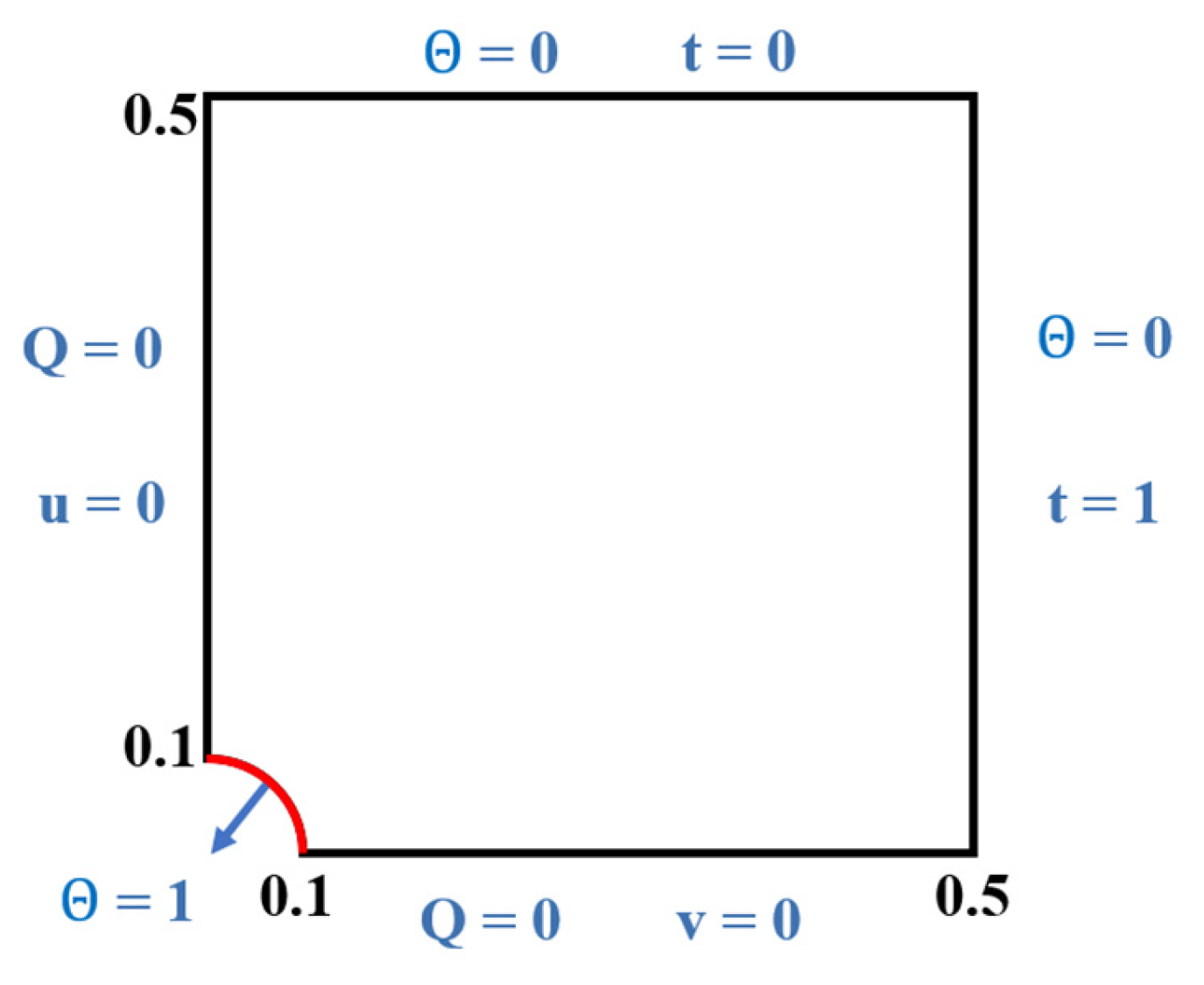
The first case studies a 2D quarter plate with a defect. A prescribed temperature is applied on the defect boundary, while traction and heat flux conditions are set on the outer boundaries in
Figure 5. Material parameters are listed in
Table 2. The network takes 2D spatial coordinates as input and predicts displacement, stress, and temperature fields. The soft-hard constraint scheme applies hard constraints for displacement and stress, and soft constraints for temperature. Sampling includes
interior points
outer boundary points, and
defect boundary points.
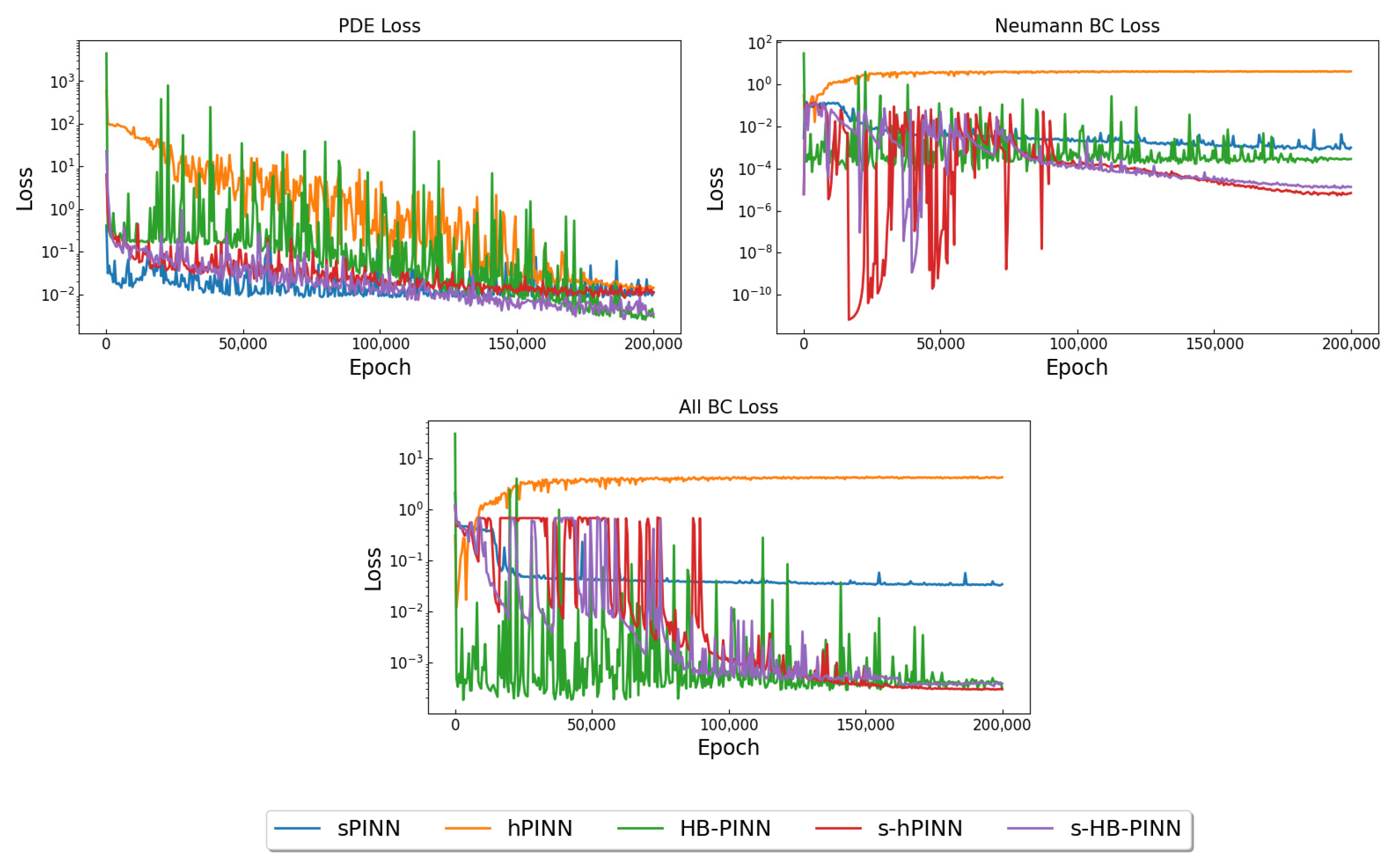
Figure 6 shows the evolution of different loss terms with respect to training iterations in the solution of the steady state thermoelasticity problem. The PDE loss for all methods decreases steadily and eventually converges. However, their boundary losses exhibit distinct behaviors.
As training progresses, HB-PINN and the proposed s-HB-PINN further reduce their PDE losses, indicating a stronger capacity to capture the coupled thermoelastic physics. In contrast, sPINN converges quickly but attains a relatively high final boundary loss, as shown in
Figure 6. This arises from competition between the boundary and PDE loss terms, which hinders their simultaneous minimization and may degrade prediction accuracy.
For hPINN,
Figure 6 reveals persistent difficulty in reducing boundary loss, particularly under Neumann boundary conditions, even as training proceeds. This behavior highlights a fundamental limitation of purely hard-constrained formulations when applied to multiphysics problems involving complex or mixed boundary conditions. In such cases, the strict enforcement of boundary constraints can restrict the network’s flexibility, leading to optimization imbalance and degraded boundary satisfaction.
Although HB-PINN achieves stable overall convergence, with both PDE residuals and boundary losses reduced to acceptable levels, its Neumann boundary loss remains noticeably higher than those of s-hPINN and s-HB-PINN. This residual discrepancy may adversely affect solution accuracy in regions adjacent to Neumann boundaries, where thermoelastic responses are particularly sensitive to boundary condition enforcement.
In contrast, s-hPINN and s-HB-PINN consistently drive boundary losses to lower values while maintaining stable and smooth convergence throughout the training process. This improved behavior indicates that the coordinated use of soft and hard constraints provides a more balanced optimization mechanism, allowing the network to satisfy both governing equations and complex boundary conditions more effectively. Consequently, the proposed collaborative constraint strategy offers a robust and reliable approach for addressing the challenges associated with thermoelastic coupling problems featuring complex boundary configurations.
In this work, we focus not only on the numerical discrepancy between predicted and reference solutions, such as the relative L2 error, but also on the intrinsic physical consistency of the predictions. To this end, we compute the residual field of the governing equations for all methods and perform pointwise verification of the predicted stress fields using automatic differentiation.
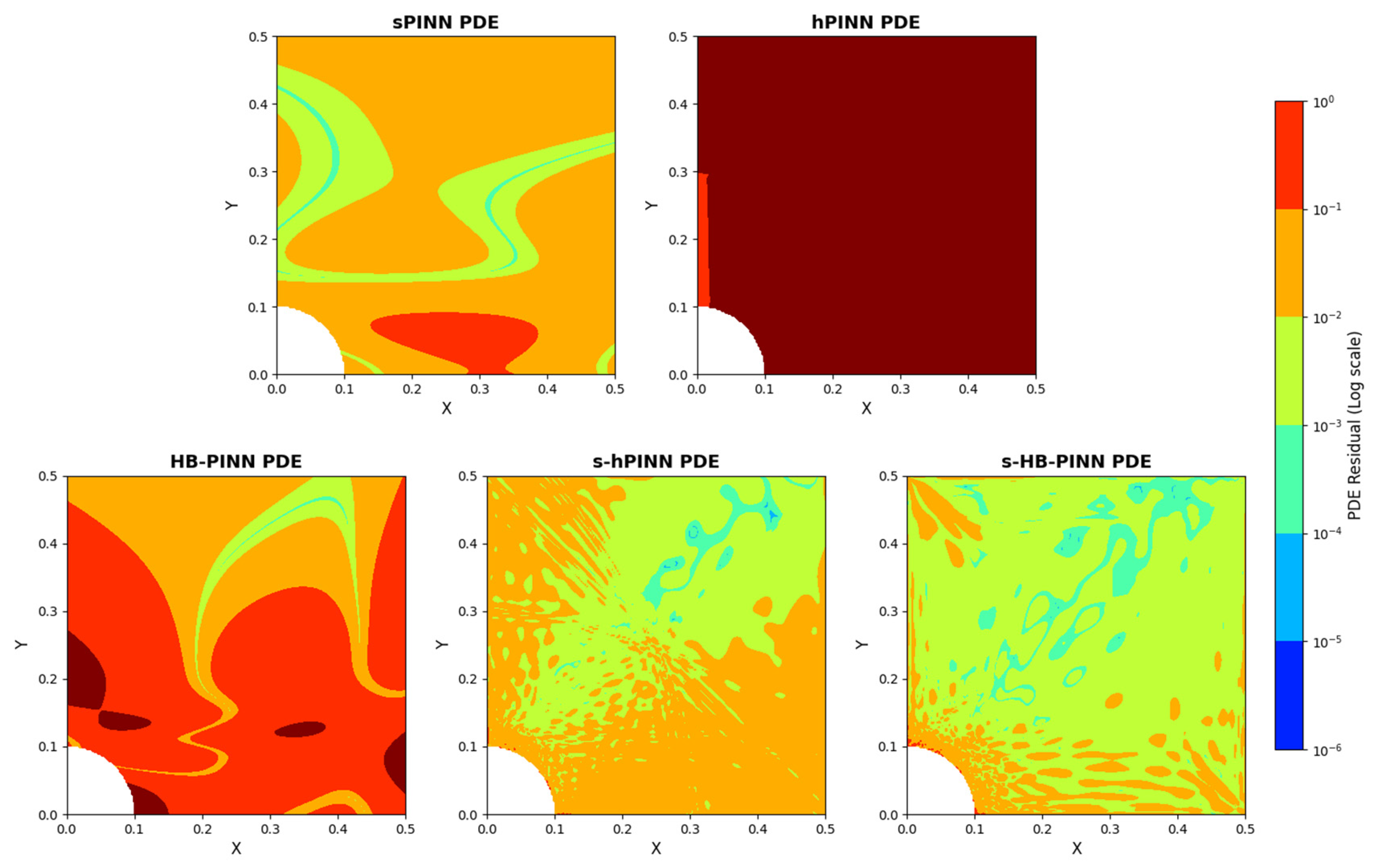
Figure 7 shows the two-dimensional distribution of PDE residuals for different methods in the thermoelastic problem, visualized with a logarithmic color scale to highlight small-magnitude regions. As can be seen, the residual map of the proposed s-HB-PINN method exhibits the lightest colors, with values predominantly in the range of
to
, whereas other baseline methods display prominent dark red regions indicating much larger residuals, up to
to
.
Such a low-magnitude residual distribution provides robust evidence that the displacement and stress fields predicted by s-HB-PINN are highly self-consistent and strictly satisfy the conservation laws within the computational domain. Consequently, these results validate the reliability of the proposed synergistic strategy in addressing complex multi-physics problems from the perspective of fundamental physical mechanisms.
From
Figure 8 and
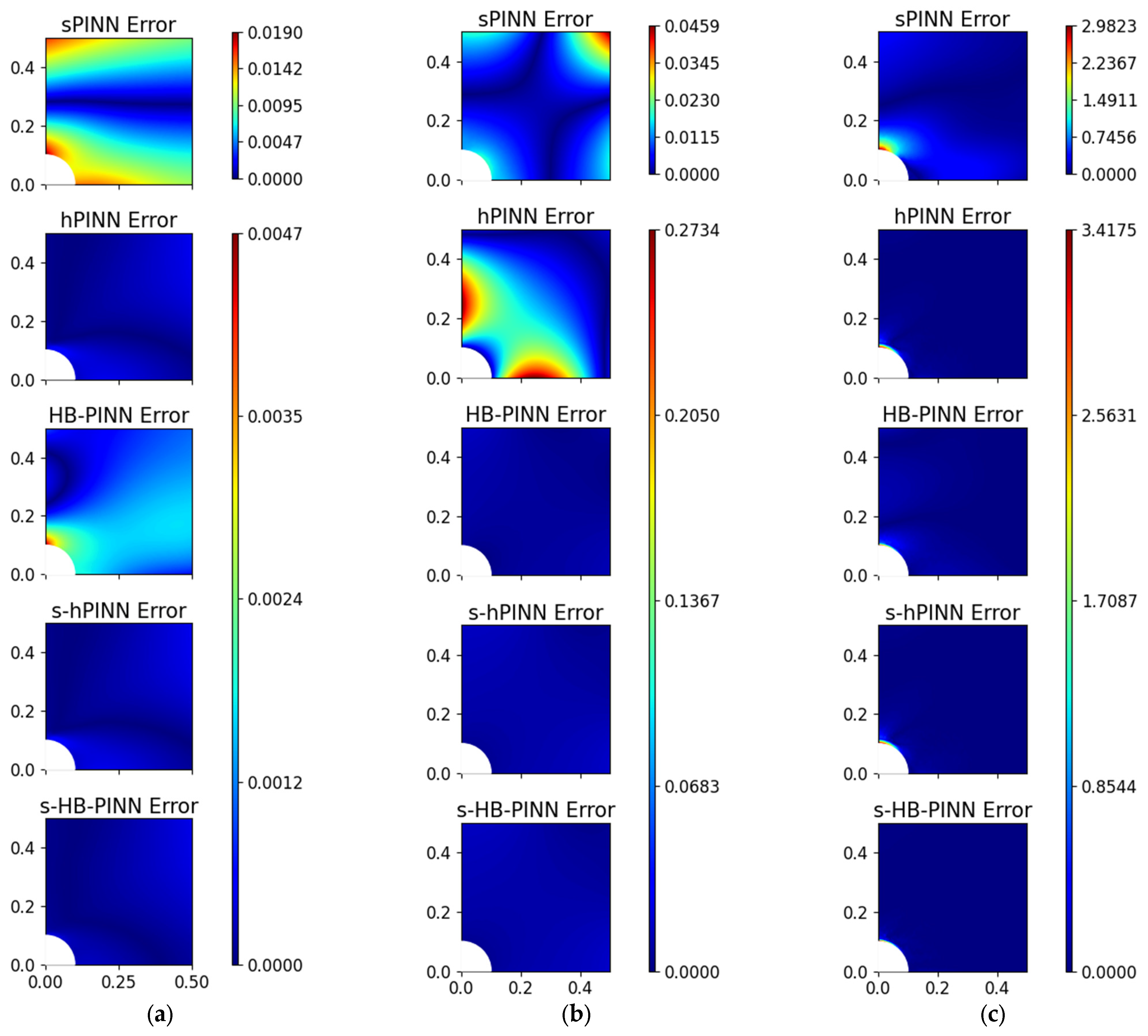
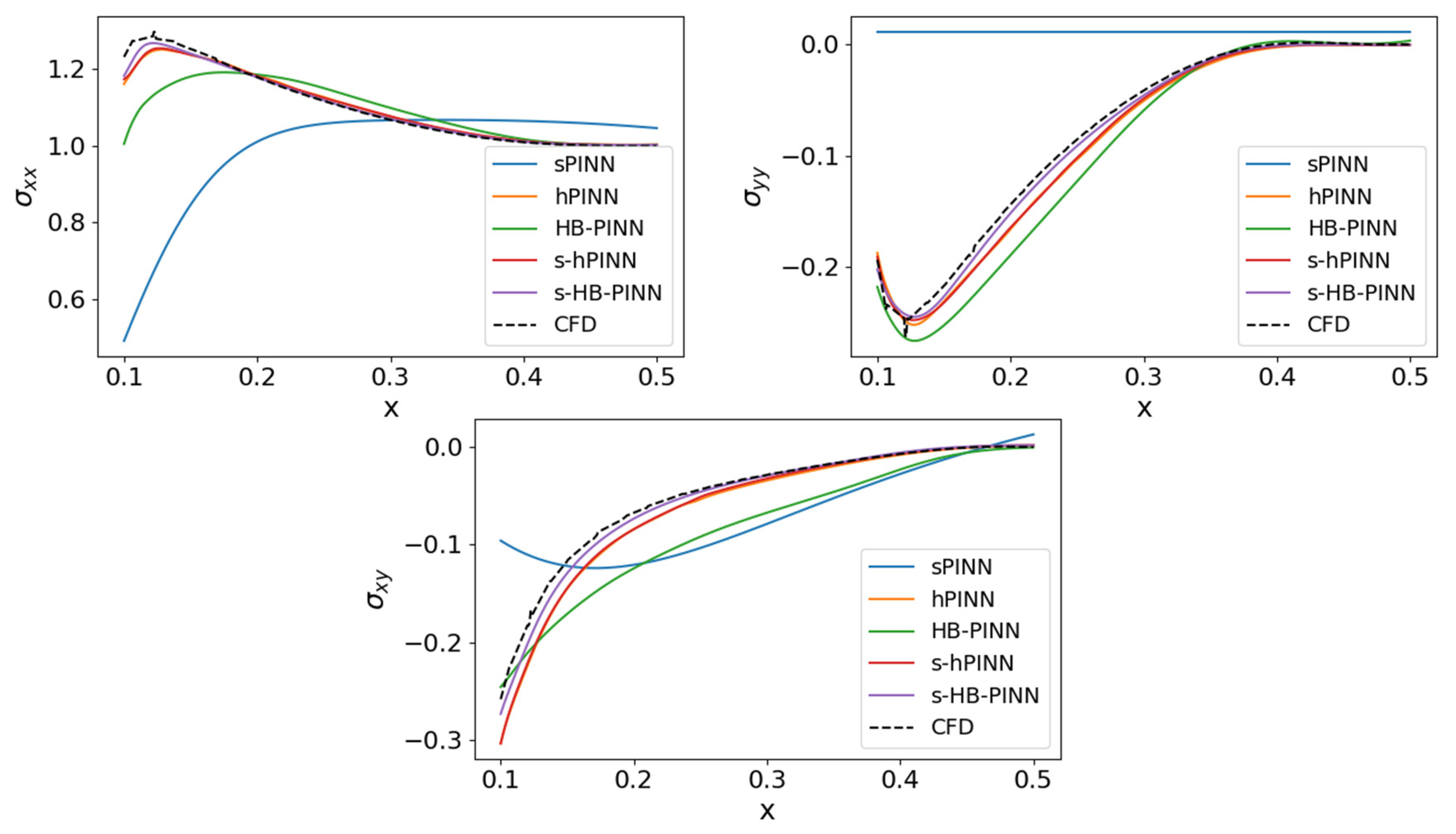
Figure 9, both sPINN and hPINN demonstrate notable limitations in their predictive results, struggling to accurately forecast multiple physical quantities simultaneously. Specifically, in the temperature contour plot of hPINN, the predictions are significantly influenced by the Neumann boundary condition. HB-PINN demonstrates good agreement with the finite element solution in temperature and displacement predictions, but stress predictions at the notch are significantly underestimated, as further confirmed in
Figure 10. In contrast, s-hPINN and s-HB-PINN significantly improve the prediction accuracy of all physical quantities, with s-HB-PINN showing the highest agreement; its heat maps closely match the finite element results and accurately capture the variation in physical quantities from the boundary to the interior.
In addition, the comparison of stress distribution along the centerline between the finite element solution and different PINN methods is shown in
Figure 10. The s-HB-PINN results show significant agreement with the finite element solution. In
Figure 8, the normal stress distributions predicted by s-HB-PINN and the finite element method are very similar, accurately capturing the stress gradient from the edge to the center of the region. This visual similarity is quantitatively confirmed along the centerline in
Figure 10. Among the methods, s-HB-PINN most closely reflects the curve variation of the finite element solution. s-hPINN and hPINN capture the general trend of the curve but show slightly larger numerical deviations. HB-PINN overestimates or underestimates stress changes at curve inflection points, leading to noticeable deviation from the finite element solution. sPINN performs poorly in the quantitative analysis, almost failing to capture the curve variation, which further indicates that sPINN is not suitable for complex multiphysics problems.
Table 3 and
Figure 11 summarize the training time and L2 errors of various physical quantities for each method in the thermoelasticity problem. The results indicate that s-HB-PINN achieves the lowest errors across all quantities, followed by s-hPINN. Both methods consistently outperform the others, with the most substantial improvement observed in temperature prediction. hPINN yields the largest temperature error due to its inability to adequately resolve boundary temperature variations. In contrast, HB-PINN strikes a more effective balance between enforcing complex boundary conditions and learning the coupled field equations, resulting in more stable predictions overall.
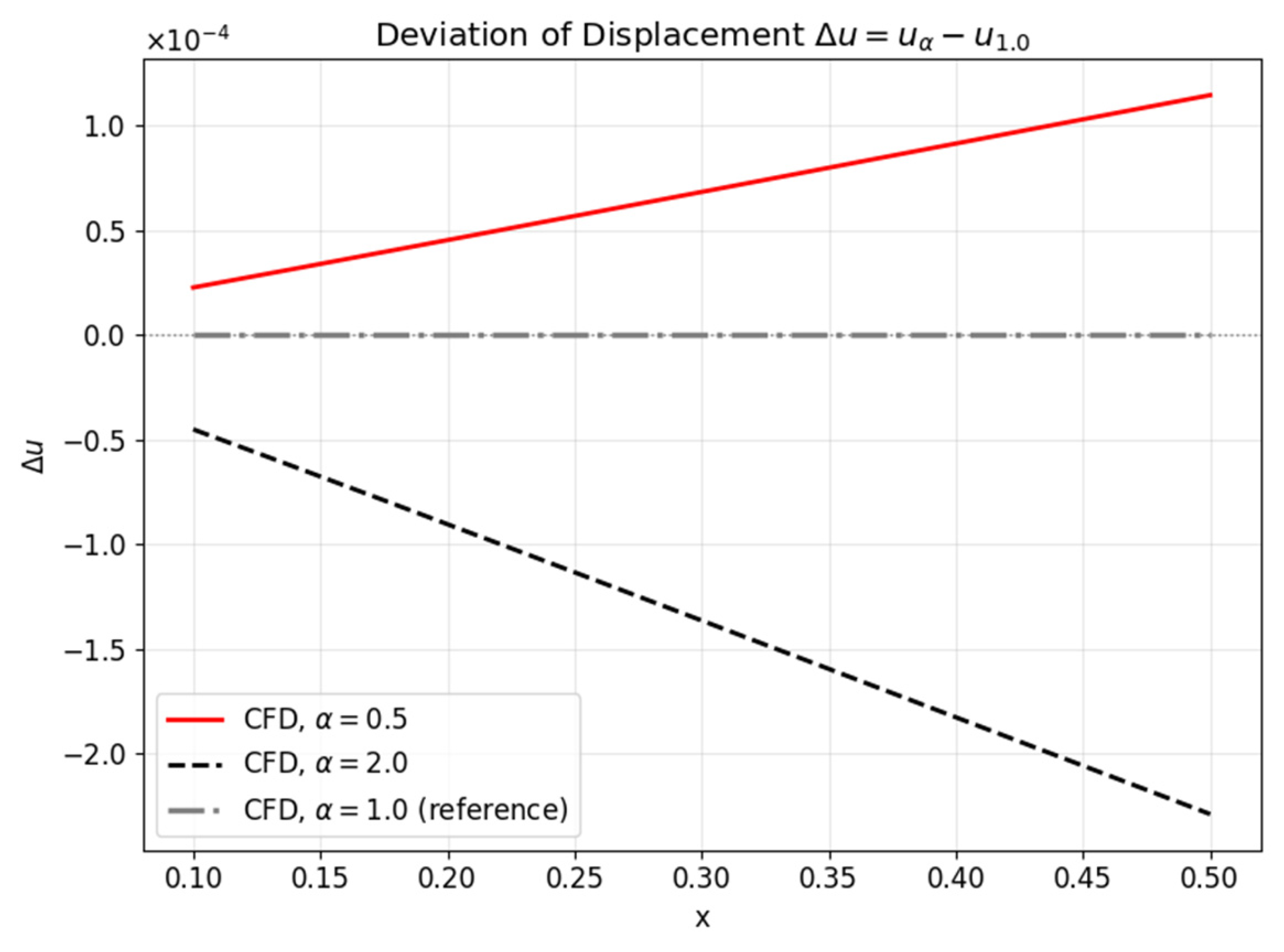
The standard PINN generally exhibits higher errors, and its displacement field shows signs of overfitting as training proceeds. Under an identical and modest number of training iterations, the stress L2 error of s-HB-PINN is approximately 60% lower than that of the standard PINN, demonstrating its enhanced capability in modeling complex multiphysics coupling. The systematic sensitivity analysis of coupling strength is detailed in
Appendix A.
3.2. Transient Thermoelastic Coupling
Building upon the steady state analysis, we further evaluated the proposed methods on a transient thermoelastic problem. The framework illustrated in
Figure 5 was extended by incorporating a temporal dimension. The plate was assumed stationary at the initial time, with a total simulation duration of 1 s. Given that the sPINN already exhibited unsatisfactory performance in the steady state case, the transient study focuses exclusively on improved methods that incorporate hard constraints.
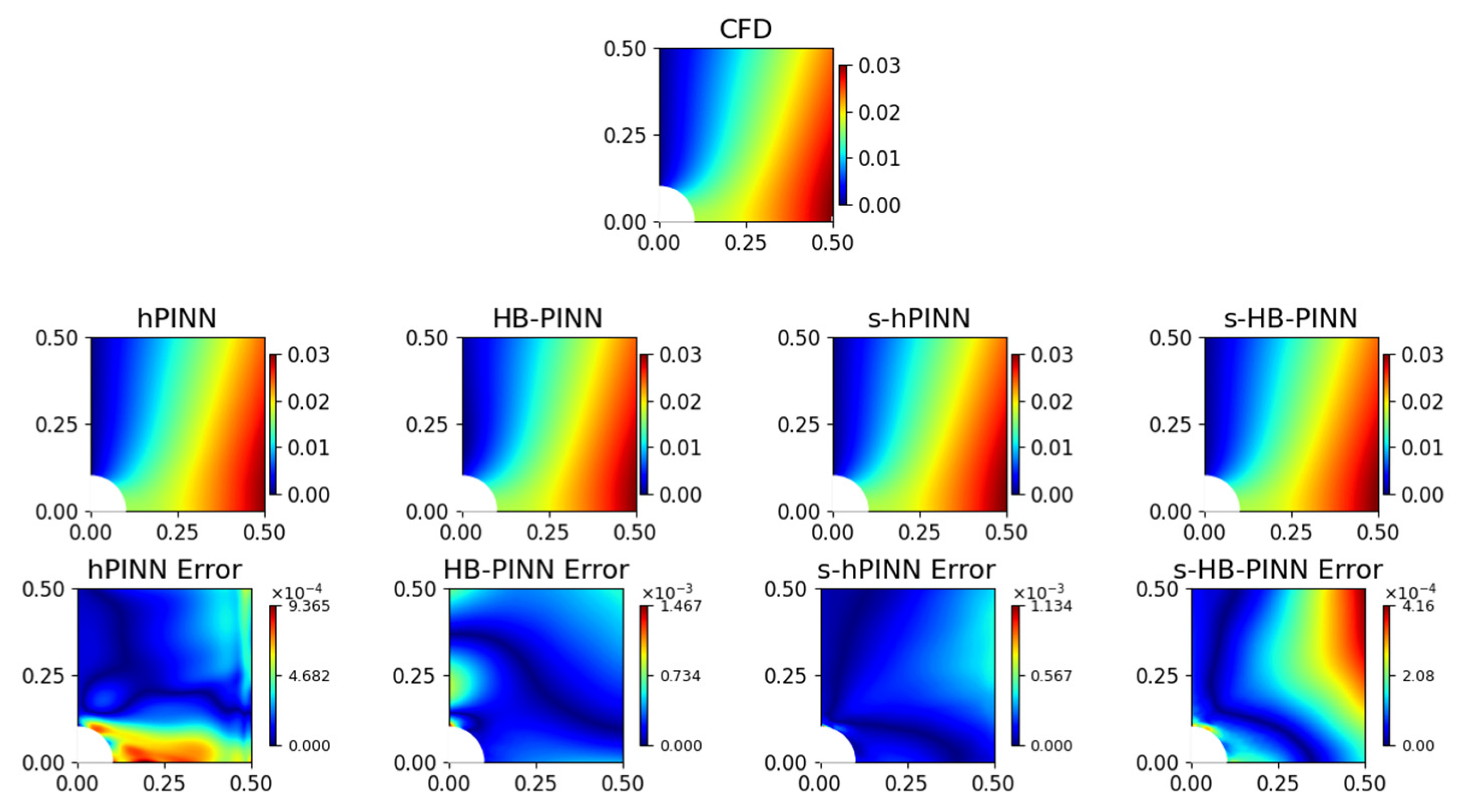
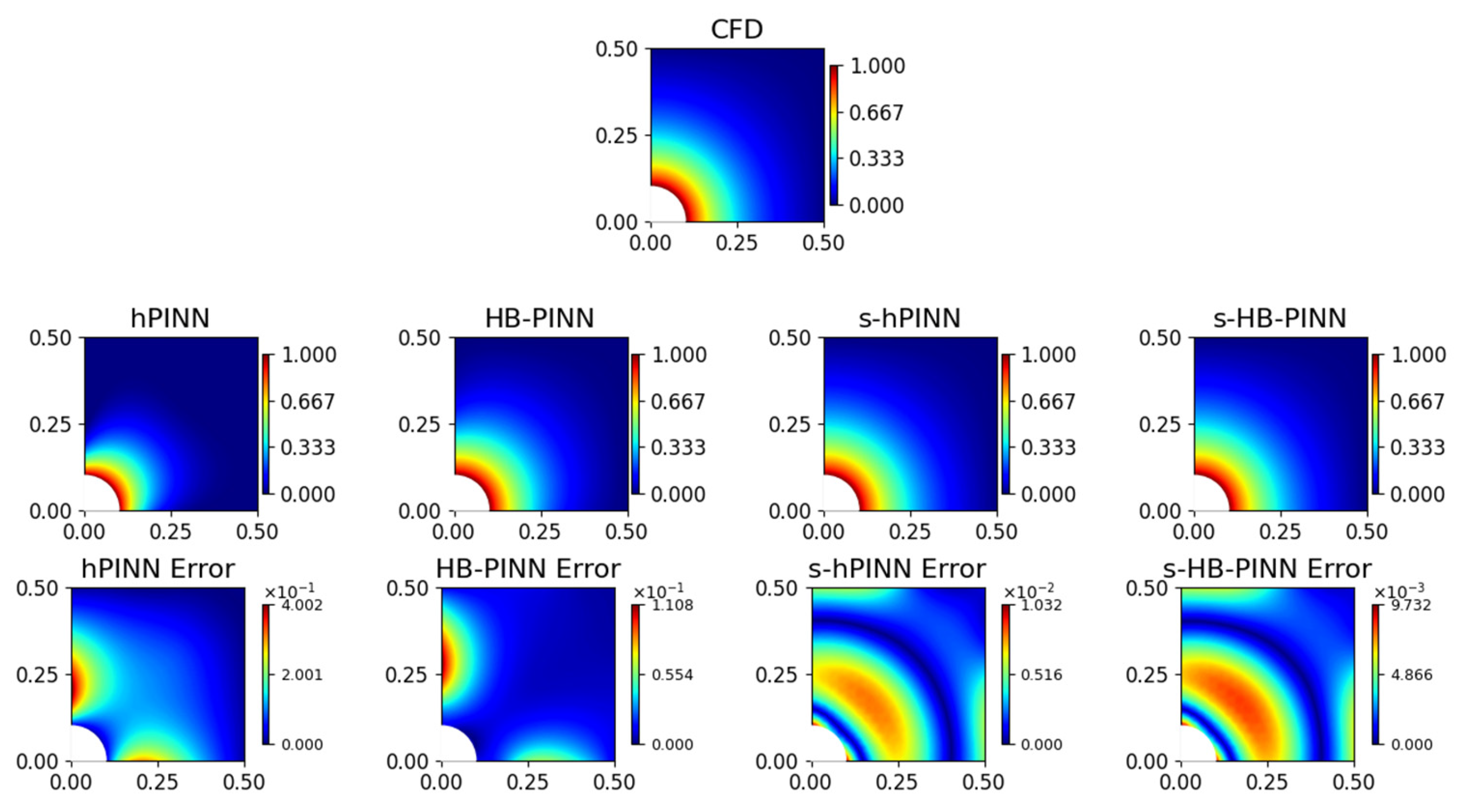
Figure 12 and
Figure 13 show the displacement and temperature fields, along with their corresponding error maps, after 200,000 training iterations for the different PINN methods. All methods produce displacement fields in general agreement with the CFD reference solution. In contrast, larger discrepancies are observed in the temperature predictions. The proposed soft-hard constraint collaborative methods yield substantially lower temperature errors than the other approaches. Furthermore, the error maps reveal that the temperature errors of hPINN and HB-PINN are primarily localized near Neumann boundaries. This observation highlights a critical challenge in thermoelastic simulations: inaccurate or overly rigid enforcement of Neumann conditions can introduce significant local biases that propagate into the coupled solution.
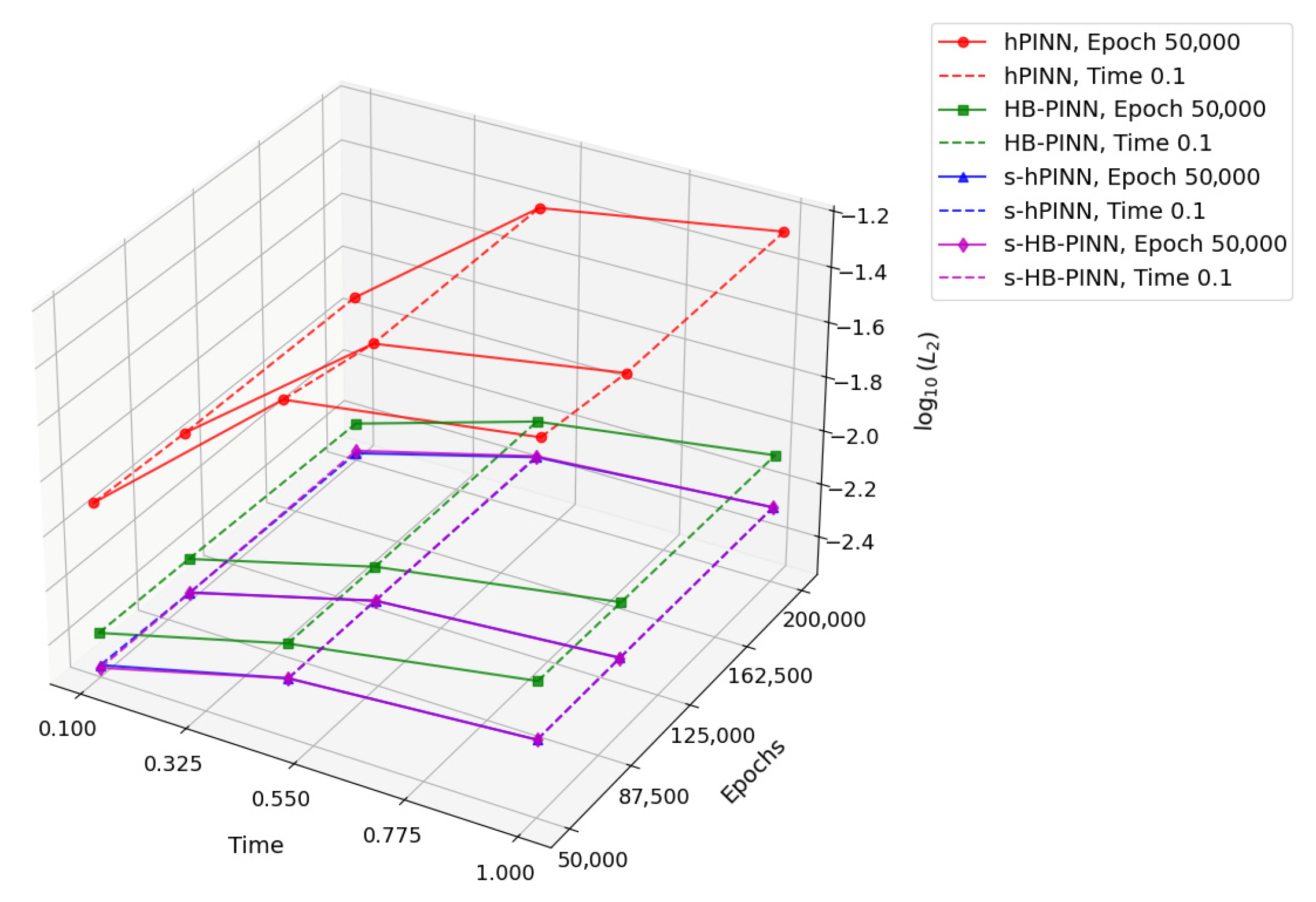
Figure 14 shows the evolution of the relative L2 error in temperature prediction with respect to both physical time and training iterations for each method. As training progresses, the error for all methods generally decreases, indicating gradual convergence of the neural networks. However, a slight but consistent increase in error is observed over physical time across all approaches. This temporal error growth primarily stems from the accumulation of approximation errors in transient simulations. During long-term evolution, small inaccuracies at early time steps are continuously propagated and amplified through the dynamics governed by the PDEs.
Among all compared methods, hPINN consistently exhibits the highest temperature error throughout the entire simulation period, suggesting that enforcing hard constraints alone without adaptive data guidance or geometric prior regularization is insufficient to maintain high accuracy in time-dependent multiphysics problems. In contrast, the error curves of s-hPINN and s-HB-PINN nearly overlap and remain stably at the lowest level throughout training. This close agreement not only demonstrates their superior accuracy in temperature prediction but also reflects exceptional stability in capturing the spatiotemporal evolution of the thermal field.
3.3. Steady-State Thermal Convection
The problem of forced convection is extensively encountered in practical applications such as engineering heat transfer and fluid mechanics, where the solution typically involves the coupling between velocity, pressure, and temperature fields. The governing equations for this problem are the incompressible Navier–Stokes equations, and the corresponding equations are [
45,
46]:
here,
,
, and
represent the dimensionless temperature field, velocity field, and pressure field, respectively. The symbol
denotes the gradient operator. Pe, Re, and Ri stand for the Péclet number, Reynolds number, and Richardson number, respectively. In the context of the problem discussed herein, Ri is set to zero, and the external force
is not considered.
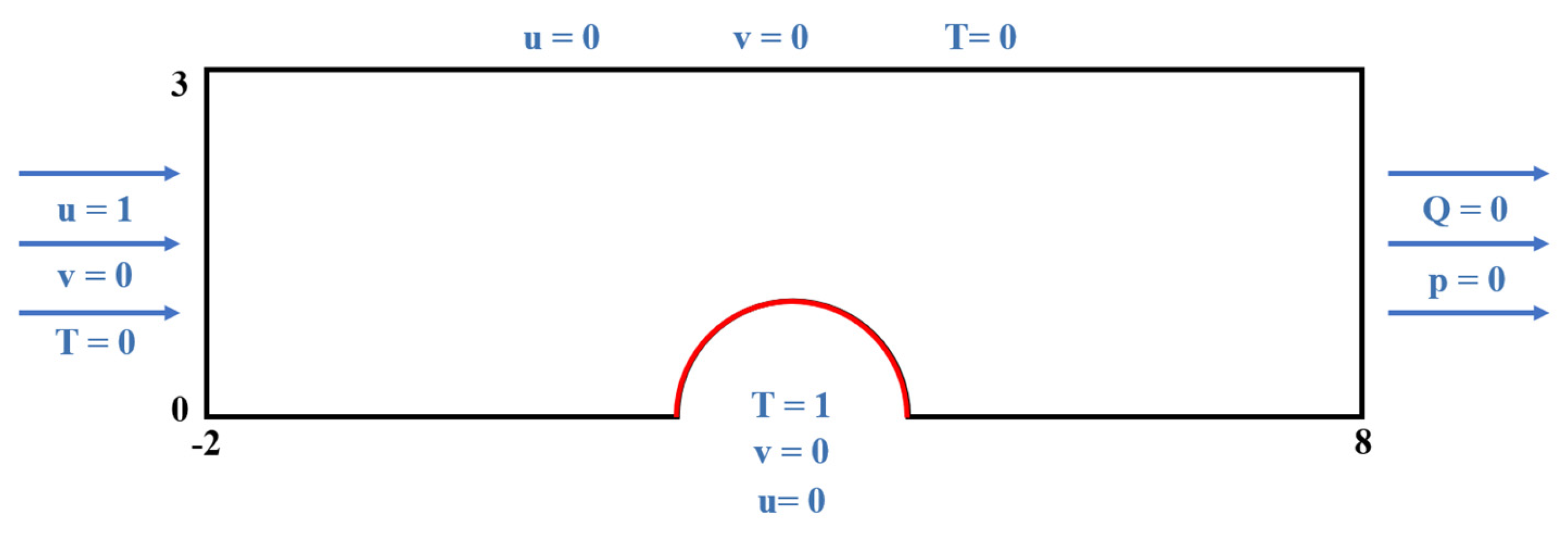
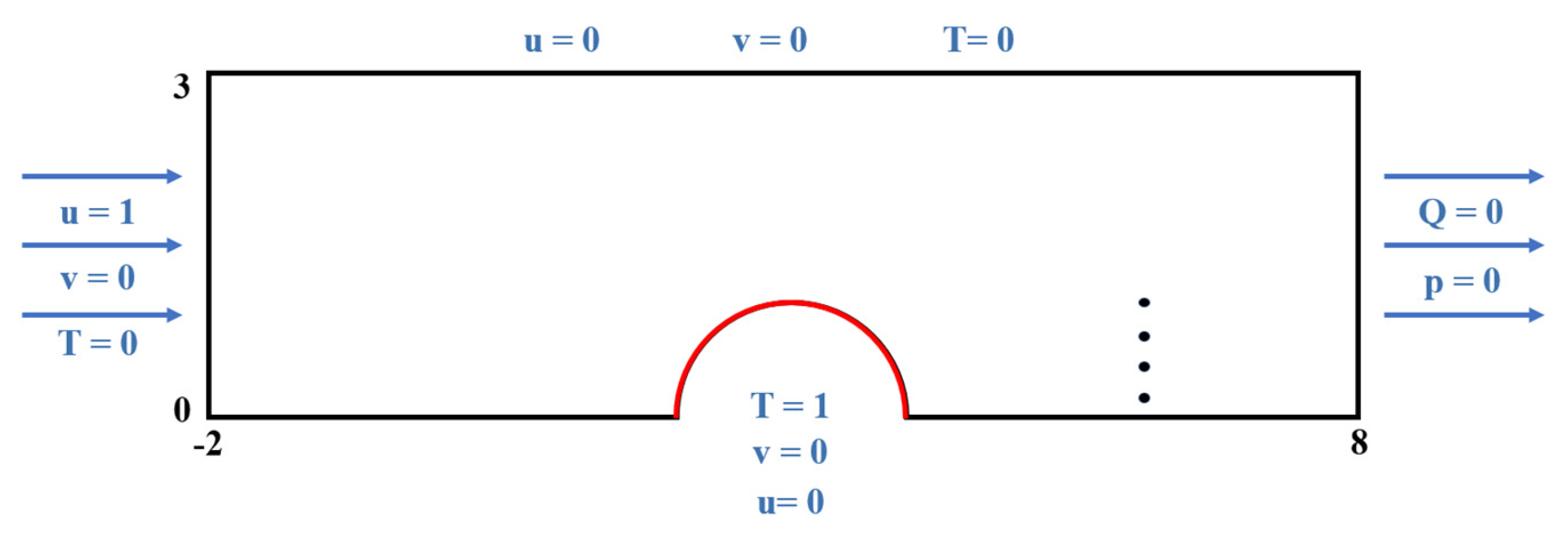
We consider 2D steady forced convection in a closed domain (in
Figure 15). The network takes spatial coordinates as input and outputs velocity, temperature, and pressure. A semi-circular heat source at the bottom is set to
, while cold fluid enters from the left (
,
) and exits through the right. All other boundaries are subject to no-slip conditions with
. and the right boundary is thermally insulated with
. In this study, we adopt
and
, a widely used parameter set in classical thermally driven cavity benchmarks [
19]. This combination represents a standard laminar regime with moderate nonlinearity (
) and convection-dominated heat transfer (
), corresponding to
, close to that of air). The choice aims not at quantitative replication of specific results, but at evaluating the proposed constraint strategy under a physically representative benchmark setting. In the cooperative soft-hard PINN Framework, velocity and pressure are enforced via hard constraints, and temperature via soft constraints.
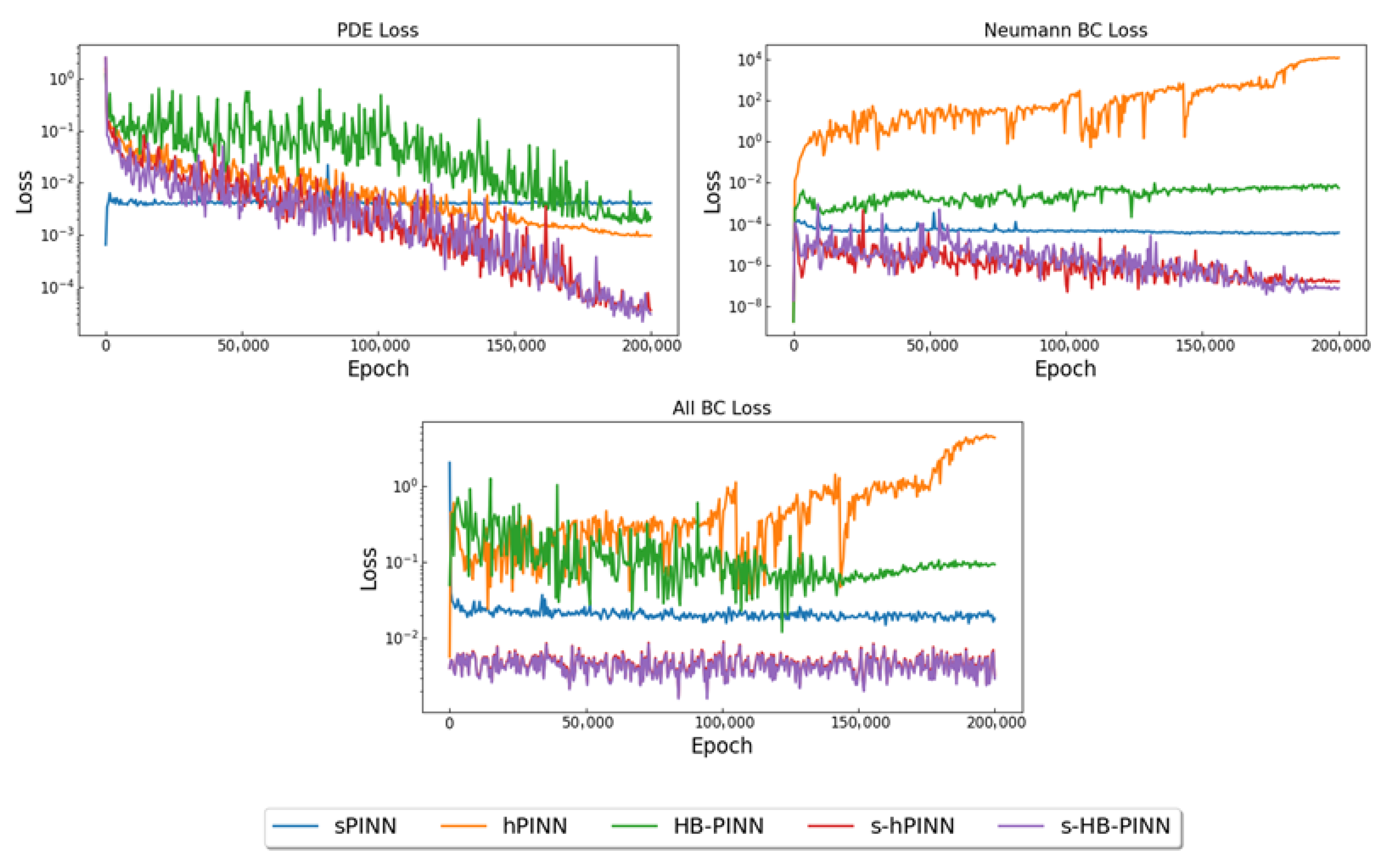
Figure 16 shows the evolution of the different loss terms during training for each method. As the number of iterations increases, the PDE and boundary losses of s-hPINN and s-HB-PINN decrease steadily, indicating stable training and consistent convergence. Although sPINN converges early and attains a low boundary loss, its PDE loss remains large, leading to a higher total loss than the other methods and implying limited predictive accuracy. For hPINN, the Neumann boundary loss increases with training iterations, which drives the overall rise in boundary loss and reflects degraded accuracy near Neumann boundaries. In contrast, HB-PINN incorporates PDE residuals into the training of boundary conditions, effectively suppressing the fluctuations typically caused by hard constraints. This yields smoother loss decay and improved boundary prediction accuracy over successive iterations.
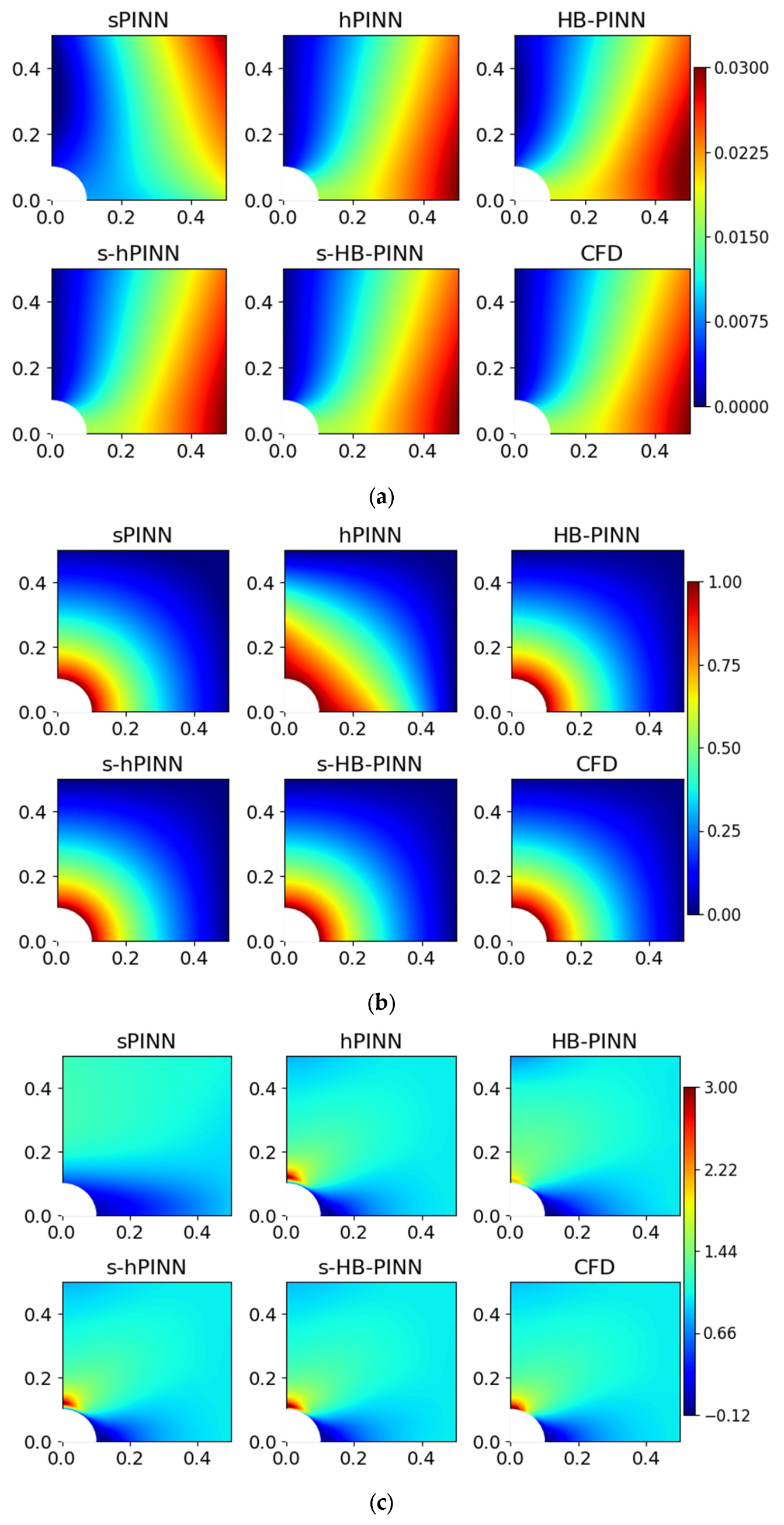
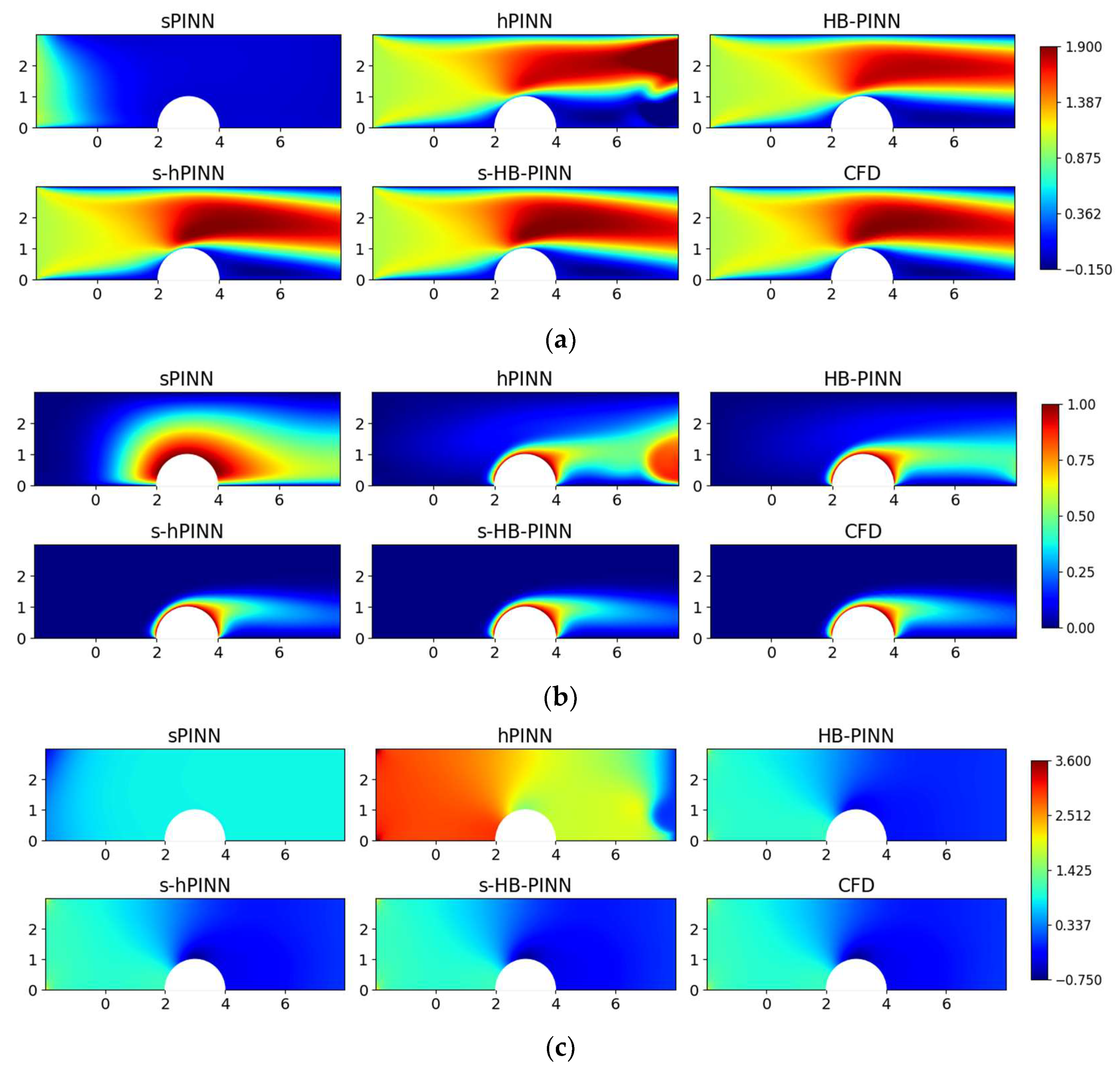
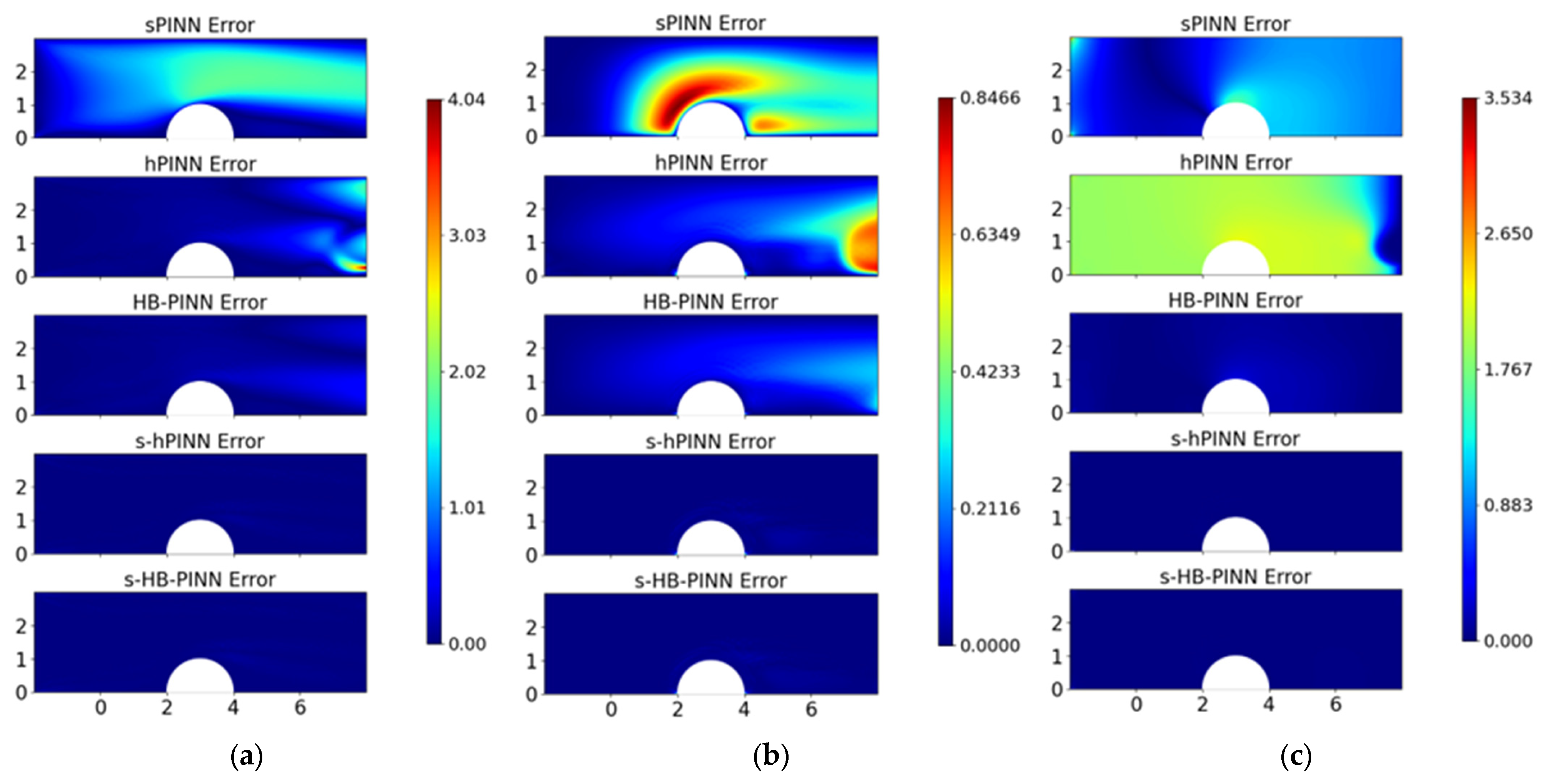
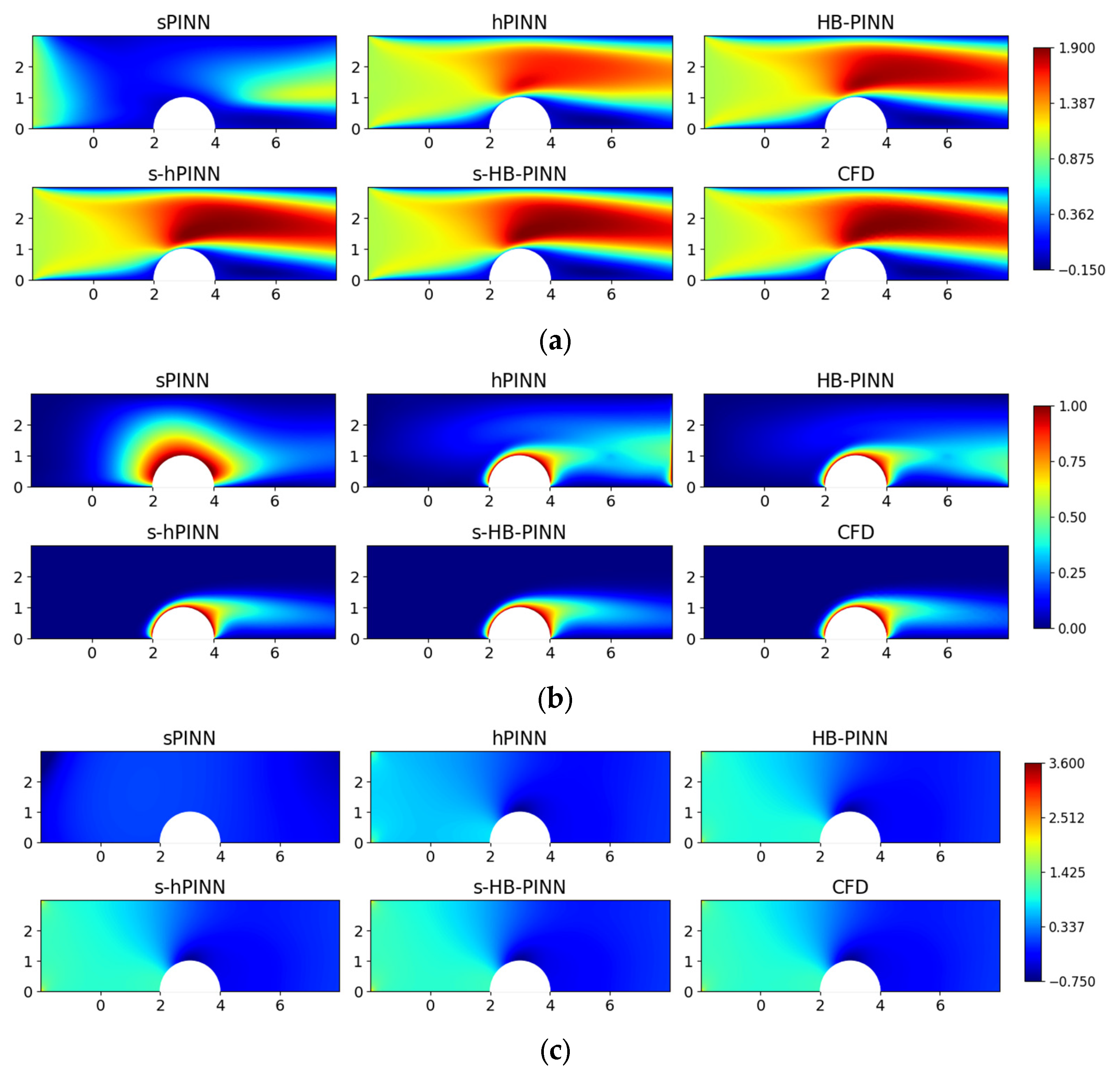
As shown in
Figure 17 and further quantified in
Figure 18, the high complexity of the thermal convection model limits the ability of sPINN to accurately predict the spatial distribution of physical quantities. Although hPINN captures the general trends, its accuracy near complex boundaries remains low. HB-PINN improves the hard constraint formulation by incorporating PDE residuals at boundaries, which reduces Neumann boundary errors and enhances overall prediction accuracy. Among all methods, s-hPINN and s-HB-PINN achieve the highest fidelity: their predicted fields show close agreement with the CFD reference solution and reproduce fine-scale features of the complex flow structures.
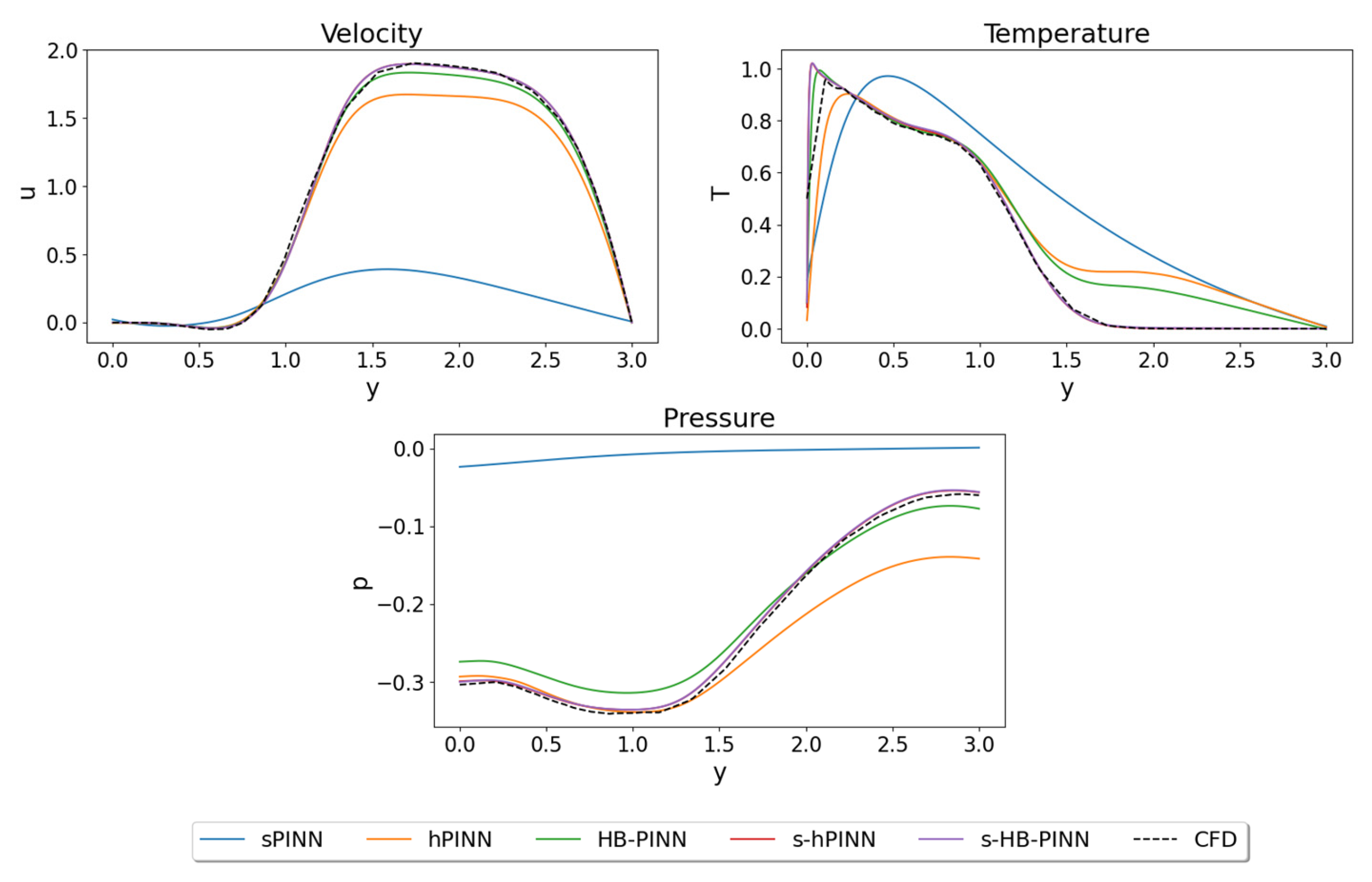
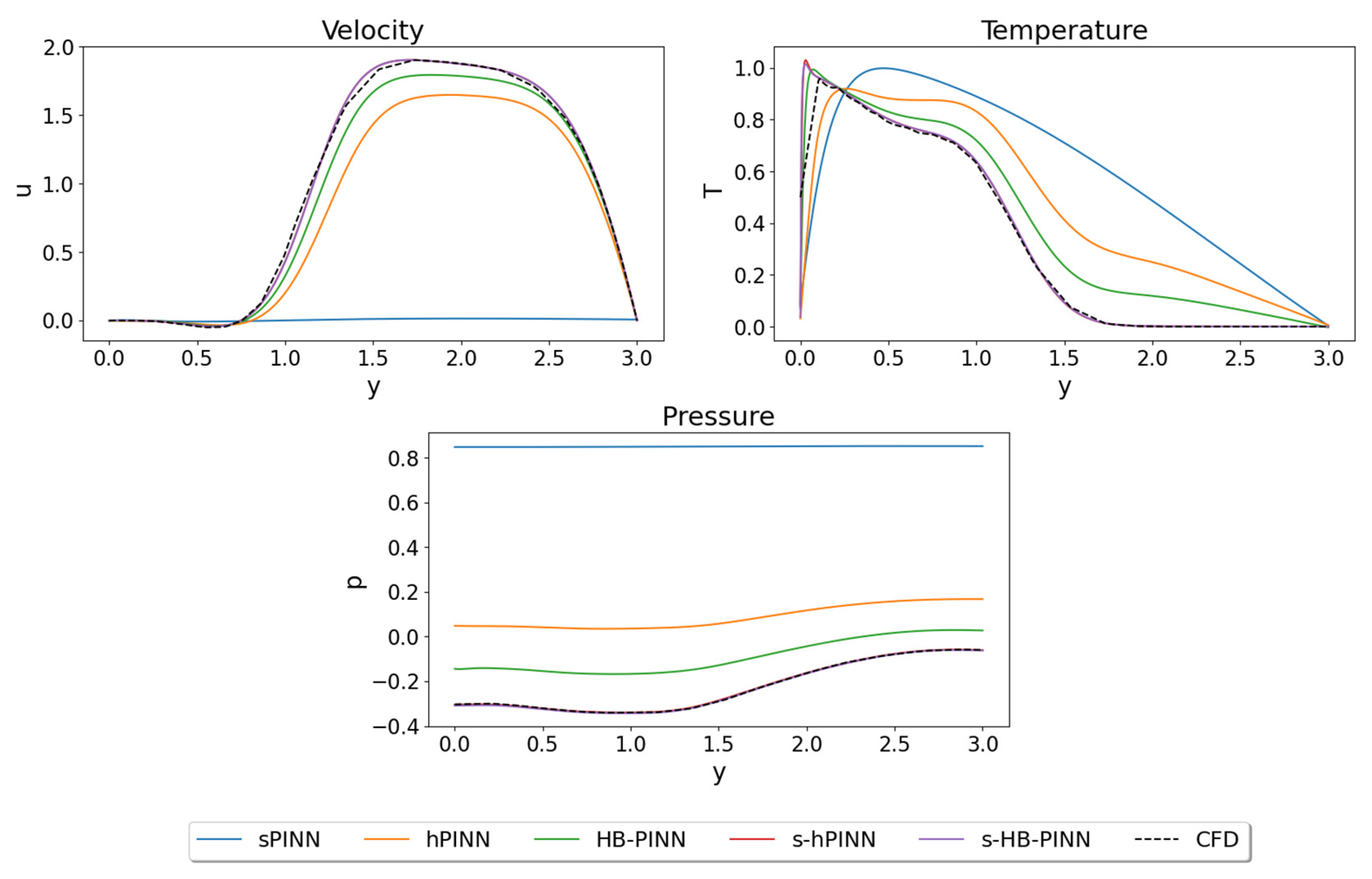
Figure 19 presents a quantitative comparison of the velocity, temperature, and pressure distributions along the horizontal centerline obtained using different PINN-based methods. The reference solution is provided by a high-fidelity CFD simulation, against which all predictions are evaluated.
Except for the standard PINN, all methods capture the general trends of these quantities. The standard PINN fails to reproduce the velocity profile and yields only coarse approximations for temperature and pressure, with large deviations from the reference. Both hPINN and HB-PINN represent the overall spatial variations along the centerline but exhibit limited resolution of fine-scale features. These limitations suggest that while hard enforcement improves boundary fidelity, the treatment of Neumann-type conditions via purely hard or unbalanced soft constraints may still introduce inaccuracies in strongly coupled regions. In contrast, s-hPINN and s-HB-PINN accurately resolve both the global trends and local details. The cooperative soft–hard constraint strategy effectively balances boundary enforcement and interior PDE satisfaction. Their predictions show close agreement with the CFD reference solution, as evidenced by the small discrepancies in the figure.
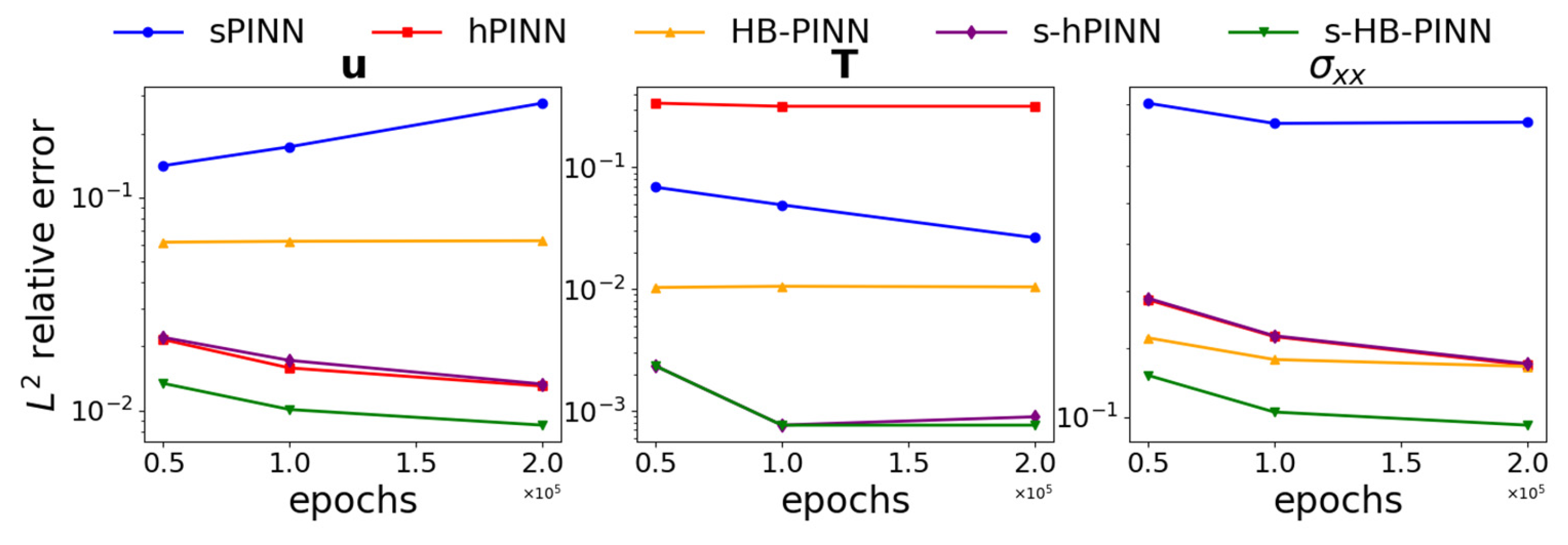
To further assess the accuracy of each method, L2 errors between the predicted solutions and the finite element reference were computed for the steady state thermal convection model.
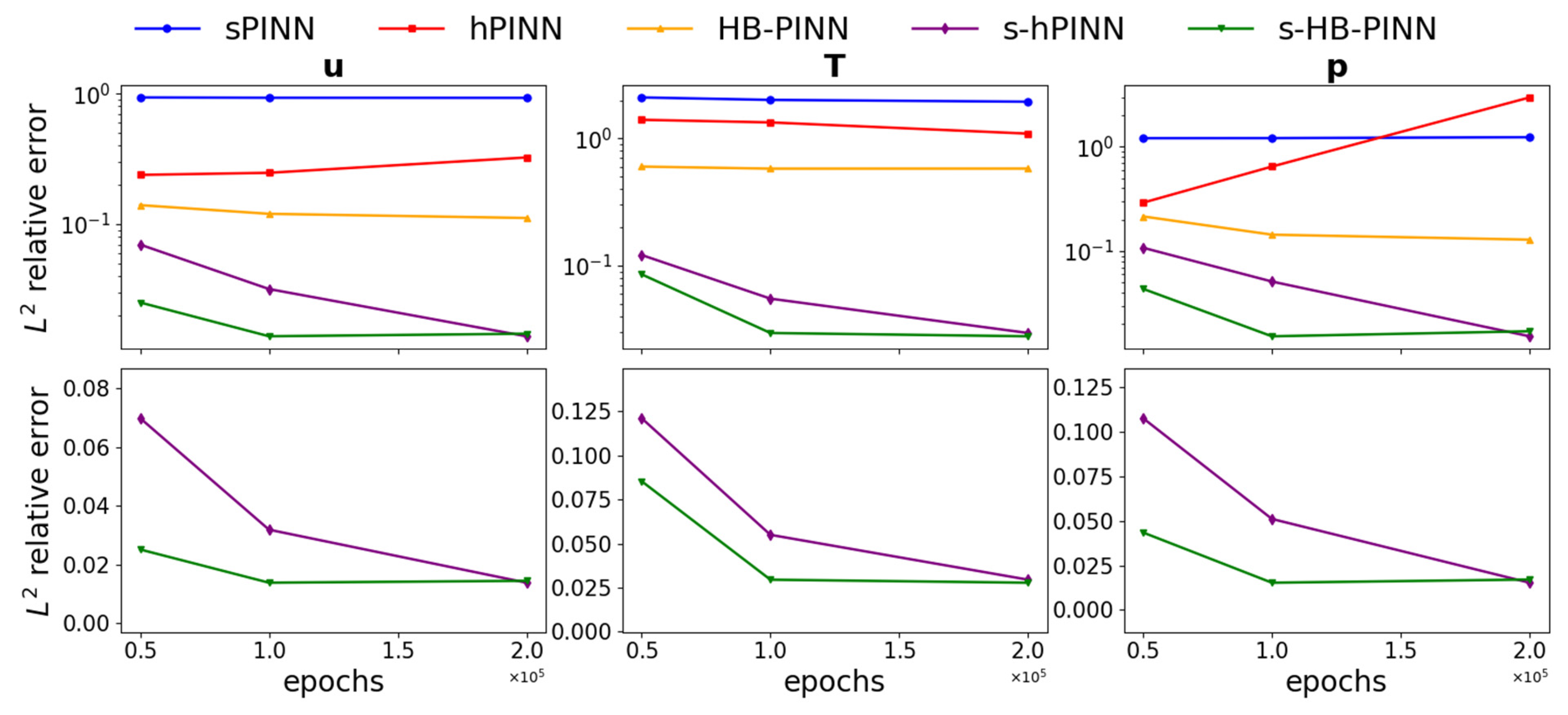
Table 4 and
Figure 20 summarize the training time and L2 errors for all physical quantities across the different methods. The results show that s-hPINN and s-HB-PINN achieve, with a low number of training iterations, an accuracy level that the standard PINN does not reach, even at its maximum iteration count. At comparable accuracy, the proposed methods reduce total training time by approximately 56%. Moreover, they exhibit lower wall clock time per iteration, indicating improved computational efficiency. As training progresses, the L2 errors of all methods decrease; however, s-hPINN and s-HB-PINN consistently yield the lowest errors. This reflects their enhanced capability to resolve the coupled dynamics among velocity, temperature, and pressure. The sustained reduction in L2 error demonstrates the effectiveness of these methods in modeling complex multiphysics systems.
3.4. Steady-State Thermal Convection with Data
To improve the network’s ability to fit real physical behavior and enhance prediction accuracy in complex regions, this section adds several measurement points based on
Figure 15. As shown in
Figure 21, four points are added at x = 6 with y = 0.25, 0.5, 0.75, and 1, recording the data (
u,
T and
p) at each location. By introducing sparse observational data during training, the differences in performance of each method under data-assisted guidance are further compared.
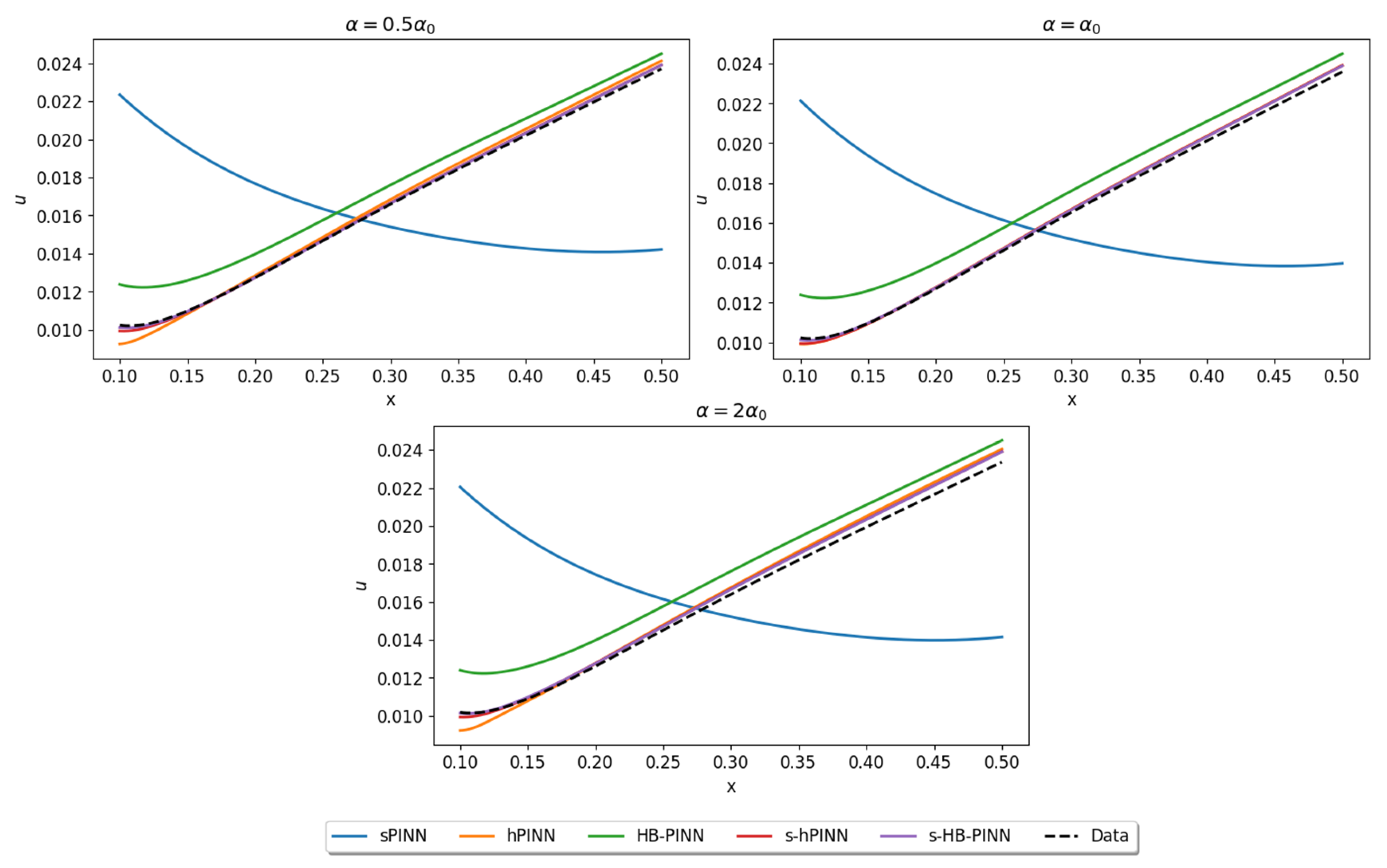
Figure 22 shows the predicted distributions of velocity, temperature, and pressure obtained by different PINN methods after incorporating sparse observational points. The inclusion of these data improves prediction accuracy across all methods. In particular, hPINN and HB-PINN show noticeable gains in boundary accuracy, consistent with the quantitative centerline results in
Figure 23. These observations suggest that even a limited number of measurements can help stabilize PINN training in regions with complex or rapidly varying boundaries, leading to more accurate and consistent predictions overall.
Although the inclusion of observational data improves sPINN to some extent, its predictions still deviate considerably from the finite element reference solution. In contrast, s-hPINN and s-HB-PINN exhibit more stable training behavior when augmented with sparse observational data. Both methods achieve further reductions in L2 error, and their centerline predictions for velocity, temperature, and pressure show close agreement with the finite element results. Specifically, the L2 error in velocity decreases by approximately 78% for s-hPINN and 56% for s-HB-PINN shown in
Table 5. These results suggest that the collaborative soft-hard constraint strategy, which combines soft penalty terms with hard enforcement, improves the imposition of physical boundary conditions and effectively integrates limited observational information. Consequently, the approach maintains a consistent trade-off between accuracy and numerical stability, demonstrating its suitability for complex multiphysics problems.
In this study, we further investigate the impact of the spatial layout of sparse observation points on model predictive performance. Comparative experiments were conducted by placing observation points in regions with distinct flow characteristics, including areas near the inlet (), in close proximity to the heat source (), and within the downstream sections of the computational domain (), while keeping the vertical coordinates fixed at y = 0.25, 0.5, 0.75, and 1.0 across all configurations.
The results in
Table 6 demonstrate that the proposed s-HB-PINN method exhibits exceptional robustness across all tested regions. Whether the sensors are deployed in the near-obstacle zones, where the flow field undergoes drastic changes, or in the downstream regions where the flow is fully developed, the model maintains consistent and stable predictive accuracy. This low sensitivity to observation locations indicates that the method can effectively leverage local sparse data to achieve accurate reconstruction of the global field through PDEs.
Specifically, for heat convection problems where sensor quantity or installation conditions are restricted, we recommend prioritizing the placement of observation points at downstream cross-sections where the flow field tends to be steady and far from heat sources or obstacles. These locations are not only easier to deploy in practical engineering scenarios but also provide observational values that encapsulate the integrated information of upstream physical evolution. Consequently, such a strategy can more efficiently drive high-fidelity reconstruction across the entire computational domain, achieving optimal global inference with minimal measurements.
Following the validation of the model’s spatial robustness across different cross-sections where the far-field developed region at
demonstrated the most stable predictive performance, we further examined the framework’s resilience against observational uncertainties. In practical engineering applications, sensor data are inevitably contaminated by measurement noise, which can significantly challenge the convergence and accuracy of standard PINN architectures. To systematically evaluate this, we introduced 1% and 5% relative Gaussian white noise specifically to the sparse data at the
location. As summarized in the corresponding error
Table 7, while the predictive discrepancies of baseline methods such as sPINN and hPINN escalate sharply, with temperature errors even exceeding 1.0 under 5% noise, the proposed s-HB-PINN maintains remarkable stability. Even at the higher 5% noise level, s-HB-PINN keeps the relative L2 errors for velocity, temperature, and pressure fields within the
magnitude, showing only marginal degradation compared to the noise-free baseline.
4. Conclusions
This study presents a novel PINN approach for solving thermal multiphysics problems, evaluated on representative thermoelastic and thermal convection systems. The proposed collaborative soft-hard constraint strategies, specifically s-hPINN and s-HB-PINN, demonstrate an enhanced capability in predicting the evolution of coupled physical fields, particularly in regions governed by Neumann boundary conditions where prediction accuracy is markedly improved. Compared with the standard PINN, these methods attain higher accuracy with reduced training time, and they more effectively suppress errors arising from challenging temperature boundary conditions relative to hPINN and HB-PINN. Two additional experiments further validate the method’s effectiveness through transient simulations and sparse observational data, showing that the framework maintains stable and accurate solutions even in time-dependent scenarios or with limited measurements.
While the collaborative strategy effectively captures interdependent physical processes, its current implementation is primarily tailored for thermal multiphysics problems where only the temperature field involves Neumann boundaries while other variables typically possess Dirichlet conditions. In more generalized multiphysics systems where multiple variables must simultaneously handle Neumann boundaries, introducing independent soft constraints and auxiliary networks for each variable may significantly increase the number of model parameters and computational overhead. Furthermore, it should be noted that the current framework has not been tested on Robin boundary conditions, and the existing collaborative logic may not be directly applicable to systems governed by inequality constraints, such as contact mechanics or phase-change problems. Nevertheless, given that Robin boundary conditions inherently combine Dirichlet and Neumann components, they could in principle be accommodated within the proposed cooperative constraint framework by treating the Neumann part with a soft penalty and embedding the Dirichlet part via hard enforcement, suggesting a viable path for future extension. Although the proposed strategies demonstrate superior convergence behavior in the numerical examples presented, a formal theoretical analysis of the method’s stability or convergence in a generalized setting is still lacking. Additionally, the current study has not yet provided a systematic quantification of computational resource consumption, such as memory footprint and per-step execution time, which are critical for large-scale industrial applications. In high-dimensional or transient scenarios, the added complexity of the hybrid architecture might weaken network performance or hinder training convergence.
Given that many real-world applications involve unsteady, multiscale multiphysics phenomena with strong temporal dynamics, future work will focus on addressing these constraints. This includes exploring the robustness of the framework under Robin boundaries, developing more compact parameter-sharing architectures, and incorporating penalty methods for inequality constraints. We also aim to conduct a rigorous analysis of computational efficiency and provide a more robust mathematical foundation for the stability of collaborative constraint strategies, thereby advancing the role of PINNs in intelligent multiphysics simulation.