1. Introduction
1.1. Motivation and Significance of the Study
The rapid decarbonization of energy systems has become a central pillar of global and regional climate strategies. In particular, the Paris Agreement establishes a legally binding global commitment to limit the increase in the global average temperature to well below 2 °C above pre-industrial levels, while pursuing efforts to constrain warming to 1.5 °C, a target that requires global greenhouse gas emissions to decline rapidly by 2030 [
1]. Meeting these ambitious targets requires not only large-scale renewable energy deployment but also localized, flexible, and resilient energy solutions capable of integrating high shares of intermittent resources while maintaining supply reliability. In this context, microgrids, especially those based on hybrid renewable energy systems, have emerged as a key enabler of the energy transition.
Microgrids offer a modular and scalable framework for combining multiple renewable energy sources, energy storage systems, and controllable generation within a coordinated electrical architecture. By enabling islanded and grid-connected operation, microgrids support the development of energy prosumers, enhance local energy autonomy, and improve resilience against disturbances and supply interruptions. These features make microgrids particularly attractive for critical facilities, remote communities, islands, and developing regions, where grid reinforcement may be impractical or economically prohibitive. At the same time, microgrids provide a practical testbed for advanced energy concepts such as high renewable penetration, distributed storage, demand flexibility, and community-based energy systems.
Despite their promise, the design and operation of renewable-based microgrids remain challenging. The inherent variability of solar and wind resources introduces significant uncertainty in power balance, particularly in standalone configurations where external grid support is unavailable. Achieving reliable operation under such conditions often necessitates a careful combination of complementary renewable sources, appropriately sized energy storage, and dispatchable generation. However, excessive reliance on storage or renewable oversizing can lead to prohibitively high capital costs, while overuse of dispatchable generators undermines emissions reduction goals. As a result, microgrid planning is fundamentally characterized by trade-offs among reliability, economic feasibility, and environmental performance.
Motivated by these challenges, there is a growing need for systematic studies that examine how standalone hybrid microgrids can be designed to balance reliability, economic feasibility, and emissions reduction under realistic operating conditions. In particular, understanding the interactions among renewable resource variability, energy storage utilization, and the role of dispatchable generation is essential for informing practical microgrid planning decisions. Such insight is especially important for critical-load applications, where uninterrupted power supply is non-negotiable, yet aggressive decarbonization targets increasingly constrain traditional design approaches. Addressing these considerations is central to advancing the effective deployment of hybrid renewable microgrids and fully realizing their potential within the broader energy transition.
1.2. Related Work on Hybrid Renewable Microgrids
Hybrid renewable energy systems (HRES) have been widely investigated as practical solutions for supplying reliable electricity in off-grid and islanded contexts, where grid extension is infeasible or cost-prohibitive. A common conclusion is that combining complementary renewable sources (typically photovoltaic (PV) and wind) with storage and limited dispatchable generation can reduce fuel dependence and emissions while maintaining acceptable reliability. The Hybrid Optimization Model for Electric Renewables (HOMER) [
2] software has emerged as one of the most widely adopted tools for conducting such techno-economic assessments in evaluation of Net Present Cost (NPC), Renewable Fraction (RF), Least Cost of Energy (LCOE), etc. For example, Nallolla and Perumal [
3] optimized a multi-component off-grid system in rural India (PV–wind–diesel–battery–electrolyzer–hydrogen tank) in HOMER, reporting an optimal PV–battery–hydrogen-centered configuration (NPC ≈ USD 7.01 M; RF ≈ 84.1%) and showing via sensitivity analysis that derating and load assumptions materially shift the economic optimum. Similarly, feasibility studies using HOMER Pro emphasize that near-complete renewable supply is achievable when storage and auxiliary subsystems are included: Shaswati et al. [
4] reported an “almost fully renewable” solution (RF ≈ 99.7%; NPC ≈ USD 3.42 M) that relies on wind, batteries, and a hydrogen pathway (electrolyzer and tank) to maintain supply continuity. At the microgrid community scale, Yadav et al. [
5] considered PV–wind–biogas–battery architectures for isolated electrification and highlighted how tightening reliability constraints (e.g., capacity shortage approaching 0%) raises NPC while increasing excess-energy spillage, illustrating the well-known cost–reliability tension in standalone planning.
Another cluster of studies targets locations where the grid may be unreliable, and HOMER is used to compare multiple candidate architectures under economic and emissions metrics. Niringiyimana et al. [
6] used HOMER Pro to evaluate hybrid wind–PV options in Rwanda with an emphasis on reducing grid dependence and emissions, illustrating how tool-based screening is often used to shortlist economically viable mixes before detailed engineering design. Lin et al. [
7] studied an islanded/community setting in the Philippines with PV–wind–diesel–battery and emphasized that storage and hybrid AC/DC interfacing can improve operational reliability; their results underscore that even when diesel remains present, the system-level role of storage and converter sizing can materially influence cost and robustness.
Beyond fully islanded systems, several studies examine grid-connected or weak-grid hybrid microgrids where the design objective shifts from “full autonomy” to reducing imports, improving power quality, and using the grid as a flexibility backstop. Said et al. [
8], for instance, framed hybrid planning around grid-side performance (e.g., voltage profile improvement) and identified an economically preferred configuration using HOMER Pro while also reporting sensitivity of cost to resource variability. Motevakel et al. [
9] considered a rural Spanish municipality with frequent outages despite grid connectivity and compared scenarios that retain the grid as primary supply versus introducing a biomass generator to reduce grid dependence, highlighting that reliability benefits can require substantial additional total cost depending on the chosen dispatchable option and its operating regime. These grid-connected studies demonstrate strong value from HRES even without strict islanding, but their priorities and constraints differ from standalone critical-load microgrids where near-zero unmet load is typically non-negotiable.
HOMER-based techno-economic assessment appears repeatedly across these studies because it supports chronological, year-long simulation and ranks feasible system configurations under cost, emissions, and reliability criteria. The tool and its workflow are widely referenced for hybrid microgrid planning and sensitivity screening in both academic and practitioner contexts [
10,
11]. For example, Halabi et al. [
10] used scenario-based evaluation and sensitivity (e.g., load growth) to show how PV penetration affects economics and emissions, while the broader microgrid energy-management literature emphasizes that sizing decisions and dispatch strategy are interdependent and should be evaluated under realistic operating constraints rather than purely static cost metrics.
Recent standalone microgrid studies also reinforce the value of reporting transparent, decision-relevant performance indices (NPC/LCOE/emissions) under realistic constraints. Sambhi et al. [
12] evaluated an off-grid PV–battery supply for an academic-building load using HOMER-based techno-economic optimization, and complemented cost metrics (NPC and LCOE) with PV performance diagnostics (e.g., capacity factor and performance ratio) that clarify how resource variability and conversion losses translate into system economics; they further benchmarked their proposed renewable configuration against a diesel-only alternative through a quantified CO
2-emissions comparison, highlighting the decarbonization benefit of the optimized design. Complementary recent studies expand the “hybrid” concept toward control and operational layers: Cheraraj et al. [
13] investigated a PV–wind–battery system with a fuzzy logic maximum power point tracking algorithm and synchronization/control elements, while Hlophe et al. [
14] evaluated hybrid alternatives for a remote island via HOMER to quantify NPC/LCOE and carbon reduction outcomes. Other studies emphasize optimization method choices and objective structures: Lounissi and Jebabli [
15] applied multi-objective evolutionary optimization to hybrid resource portfolios, and Çakan and Pehlivan [
16] addressed power/energy management for ship hotel loads with renewable integration and low-carbon fuel-cell pathways, illustrating the growing interest in dispatchable low-emission complements and operational strategy design. Finally, Rathod and Subramanian [
17] applied a suite of newly developed metaheuristic algorithms to off-grid hybrid energy system sizing across multiple geographic case studies, demonstrating that solution quality and reported NPC/LCOE/emissions outcomes depend strongly on constraint handling and statistical validation across runs.
Collectively, prior work establishes that hybrid architectures can deliver major cost and emissions benefits, but it also shows that reported “optimal” outcomes can vary widely with reliability requirements, dispatch assumptions, and how explicitly the optimization problem is defined and interpreted. This motivates a constraint-grounded formulation and a decision-oriented reporting of cost–reliability–emissions trade-offs for standalone critical-load applications.
1.3. Research Gap and Study Purpose
While prior research has clearly demonstrated the technical feasibility of hybrid renewable microgrids and their potential for reducing fuel consumption and emissions, several important gaps persist in the existing literature. First, many studies prioritize maximizing renewable fraction or eliminating fossil-fuel-based generation, often without explicitly examining the resulting economic penalties under strict reliability constraints typical of standalone and critical-load applications. Conversely, investigations that focus primarily on economic optimality frequently report optimal configurations without providing detailed interpretation of how renewable availability, storage utilization, and dispatchable generation collectively shape system behavior.
Second, although techno-economic optimization tools such as HOMER are adopted in the literature, the optimization process is commonly treated as an implicit numerical procedure. As a result, the linkage between the formal optimization objective, operational constraints, and the observed performance metrics (e.g., such as excess energy, storage cycling behavior, generator dispatch frequency, and emissions) is often not made explicit. This limits the extent to which reported results can be generalized or used to inform practical design decisions beyond the specific case study.
Finally, comparatively fewer studies focus on standalone microgrids supplying critical loads under near-zero unmet-load and capacity-shortage requirements. In such systems, even small deviations in reliability can be unacceptable, and design decisions have direct implications for system resilience, safety, and long-term operating cost. Understanding how cost-optimal solutions emerge under these stringent constraints, and how alternative near-optimal or emissions-minimizing configurations compare, remains insufficiently explored in a transparent and systematic manner.
In response to these gaps, this study examines the techno-economic performance of a standalone hybrid renewable microgrid supplying a critical facility through an explicitly formulated and constrained optimization framework. This work focuses on interpreting how cost-optimal and near-optimal configurations arise from the interaction of renewable resource variability, storage dynamics, and dispatchable generation within the imposed reliability constraints. The primary contribution of this work lies in moving beyond purely numerical optimization outcomes by explicitly linking the optimization formulation, operational constraints, and observed system behavior in a standalone hybrid microgrid supplying a critical load. By directly relating observed system behavior and performance metrics to the underlying optimization formulation and sensitivity assumptions, the study provides case-grounded practical insight into the trade-offs that govern real-world standalone microgrid design. This perspective supports informed decision-making in the planning of economically viable and reliable hybrid microgrids and contributes to ongoing efforts to address the technical, economic, and operational challenges associated with high renewable energy integration.
The remainder of this paper is organized as follows.
Section 2 presents the system description, data sources, and the constrained techno-economic optimization formulation used in this study, including component models and performance metrics.
Section 3 reports and analyzes the simulation and optimization results, with particular focus on capacity sizing, energy production, storage behavior, generator operation, economic performance, and emissions.
Section 4 discusses the key findings in the context of existing literature and highlights their broader implications for standalone hybrid microgrid design. Finally,
Section 5 summarizes the main conclusions and outlines potential directions for future research.
2. Materials and Methods
2.1. Study Location, Resource Data, and Load Profile
The case study is located in Carbondale, Illinois, USA. Site-specific solar irradiance, wind speed, and ambient temperature data were obtained from the National Aeronautics and Space Administration (NASA) database [
18] and imported into the HOMER
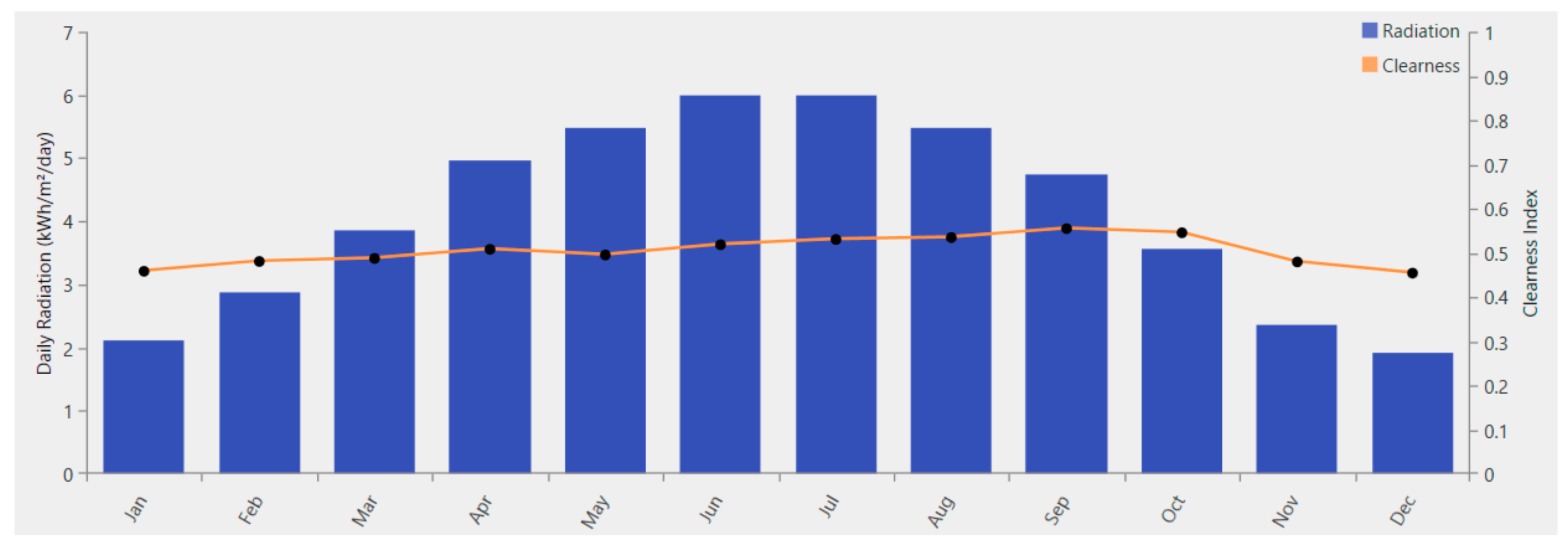
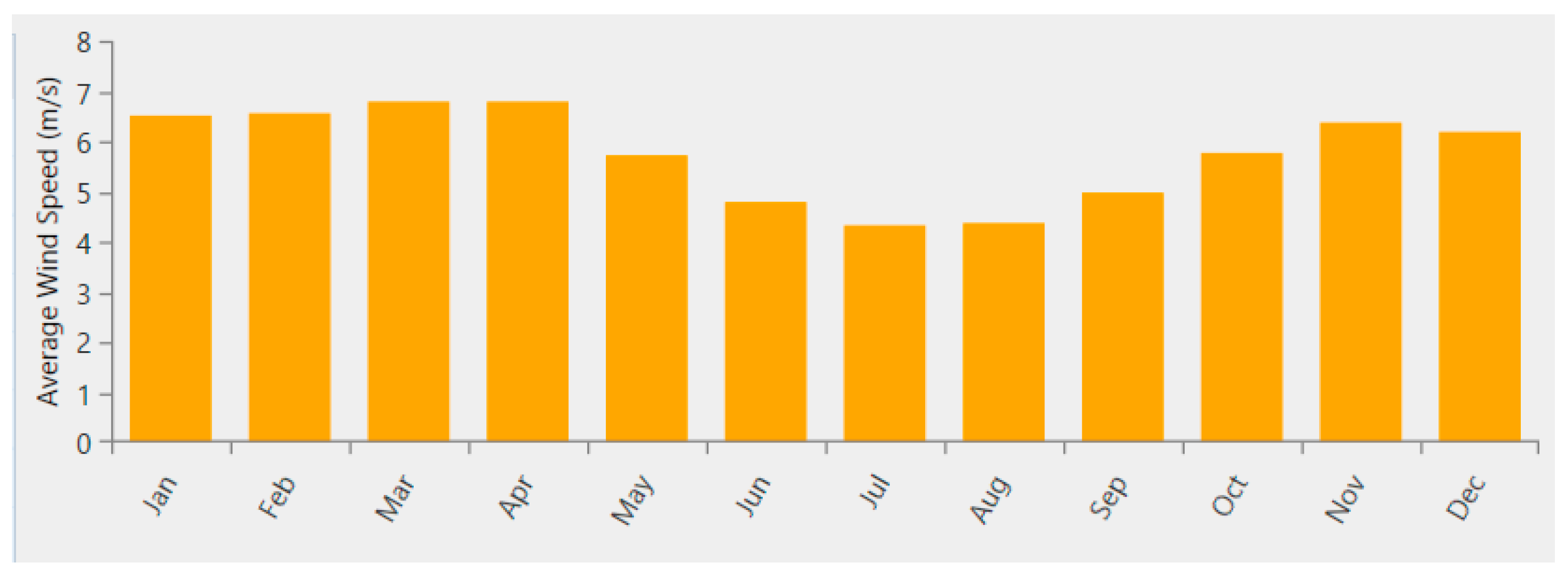
® Pro 3.18.3 software environment. These datasets provide long-term, validated representations of renewable resource availability and are commonly used in microgrid planning studies. The geographical location of the site as well as the corresponding solar and wind resource data are illustrated in
Figure 1,
Figure 2 and
Figure 3.
As shown in
Figure 2, average daily solar irradiance exhibits a clear seasonal trend, increasing from winter minima of approximately 1.8–2.8 kWh/m
2/day in November–February to peak values of about 6 kWh/m
2/day during June and July, before declining toward colder months. The clearness index follows a similar pattern, indicating improved solar availability and reduced atmospheric attenuation during summer.
Figure 3 indicates that average wind speeds remain relatively stable throughout the year, ranging approximately between 4 and 7 m/s, with higher values observed during late winter and early spring months and slightly reduced wind availability during midsummer. This seasonal complementarity between solar and wind resources supports the feasibility of hybrid PV–wind configurations for mitigating renewable intermittency in standalone operation.
Therefore, the selected location exhibits moderate solar potential with noticeable seasonal variation, while wind resources remain available throughout the year with modest seasonal fluctuations [
19]. This complementary behavior highlights both a challenge and an opportunity for standalone microgrid design. Variability in individual renewable sources complicates supply adequacy, whereas their combined utilization can enhance overall system reliability and reduce dependence on dispatchable generation.
The electrical demand corresponds to a multi-story critical facility, representative of a five-floor hospital building located at the selected site. The load profile was obtained from the HOMER electric load data library [
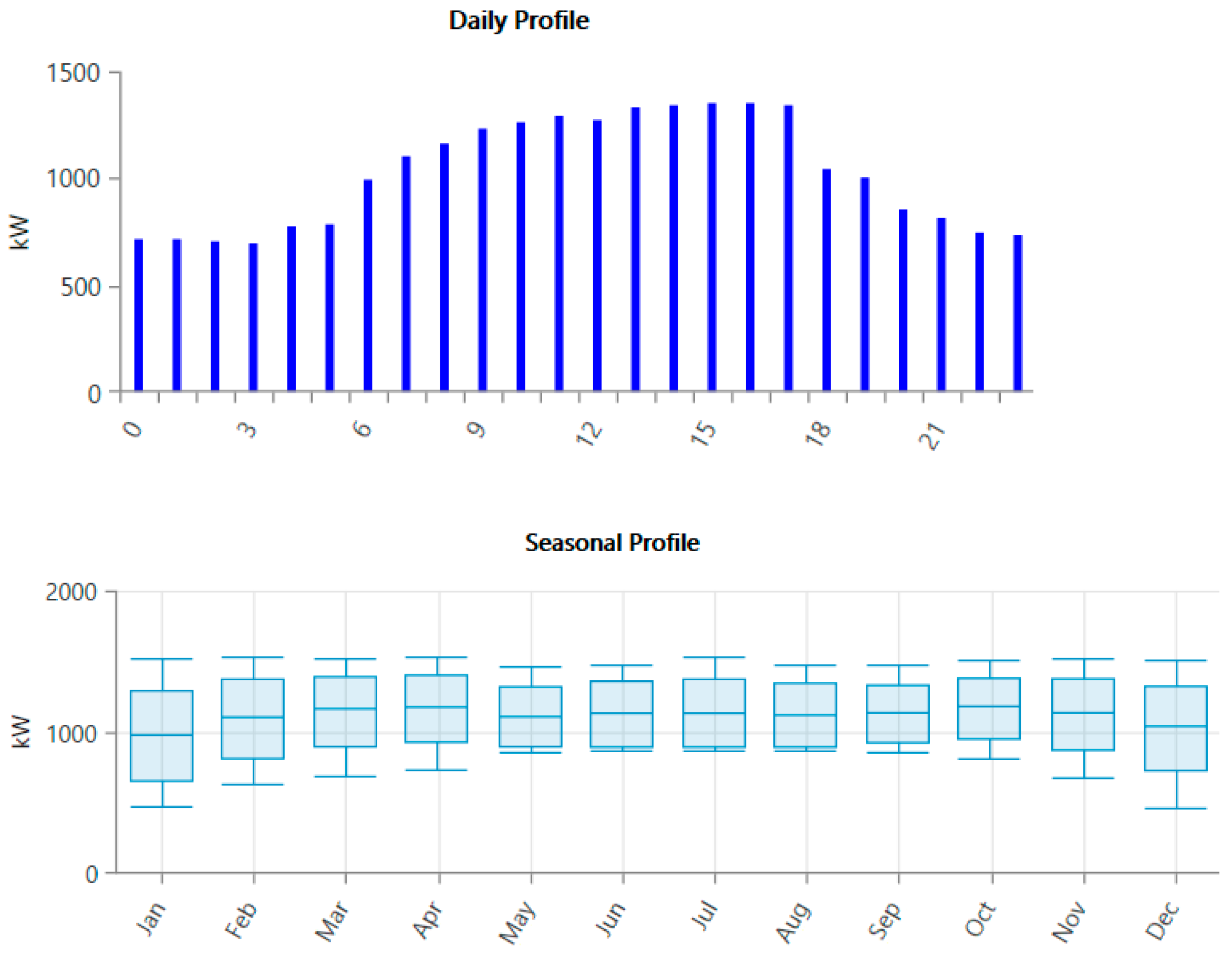
20].
Figure 4 illustrates that the hospital load exhibits pronounced diurnal and seasonal variations. The daily load profile shows peak demand occurring during daytime and early evening hours, with maximum values exceeding 1.25 MW, reflecting intensive clinical, HVAC, and auxiliary equipment usage. The seasonal load profile in this figure indicates that the hospital’s median electrical demand remains relatively uniform throughout the year, reflecting the continuous and non-deferrable nature of critical facility operations. However, increased variability is observed during the winter months starting from November, as evidenced by wider interquartile ranges and extended upper whiskers. This suggests more frequent high-demand episodes during colder periods, likely driven by heating, ventilation, lighting, and weather-related operational requirements. In contrast, summer demand exhibits comparatively tighter distributions despite elevated solar irradiance availability. These characteristics impose stringent reliability requirements on the standalone microgrid across all seasons, particularly during winter periods when higher load variability coincides with reduced solar generation, reinforcing the need for sufficient storage capacity and dispatchable generation.
The described solar irradiance and wind speed datasets are obtained from the NASA POWER database and represent long-term climatological conditions derived from multi-year satellite and reanalysis observations. These data are commonly used in HOMER-based studies to approximate typical annual resource availability rather than short-term weather anomalies. As such, the results reflect representative long-term system performance under average climatic conditions for the selected location. While the present analysis is conducted for Carbondale, Illinois, the underlying optimization framework and the qualitative insights derived from the results are not location-specific. In regions with higher solar potential, the optimal balance would be expected to shift toward increased photovoltaic contribution with reduced reliance on dispatchable generation, whereas wind-dominant or low-irradiance regions may exhibit greater dependence on wind generation or supplemental storage. Similarly, in climates with higher seasonal load variability or more extreme weather patterns, stricter reliability constraints may further amplify the economic trade-offs identified in this study. Therefore, although sizing and cost values are site-dependent, the central conclusions regarding hybrid diversification, limited dispatchable support, and cost–reliability trade-offs remain broadly applicable across different climate zones supplying critical loads.
2.2. Hybrid Microgrid Components and Selection Rationale
The designed standalone microgrid integrates PV generation, wind turbines, battery energy storage, a diesel generator, and a bidirectional power converter. Component selection was guided by operational realism, data reliability, and relevance to long-term techno-economic assessment.
Dispatchable generation was modeled using a generic 725 kW prime power diesel generator(Caterpillar Inc. (Irving, TX, USA)) compliant with EPA Tier 4 emission standards [
21]. Prime power generators are designed for continuous operation under variable loading conditions and therefore provide a realistic representation of dispatchable generation in standalone microgrids supplying critical loads. The selected generator rating is sufficient to meet the peak demand of the considered load during periods of low renewable availability while avoiding excessive oversizing that would increase capital investment and fuel consumption. From a standalone microgrid design perspective, the inclusion of a modern, low-emission prime power generator addresses a key operational challenge associated with high renewable penetration by ensuring reliability and power quality while enabling higher utilization of intermittent renewable energy sources and facilitating a gradual transition toward lower-carbon microgrid operation.
Photovoltaic generation was represented using commercially available polycrystalline modules selected from the California Energy Commission (CEC) database [
22], specifically the 310 W module manufactured by American Solar Wholesale (Las Vegas, NV, USA) [
23]. The use of CEC-listed modules ensures standardized, independently verified performance parameters, which is critical for reproducible microgrid design and techno-economic assessment. The temperature coefficient of the selected module was explicitly considered to capture output degradation under elevated operating temperatures, a factor that directly affects energy yield during summer peak-demand periods. Capital, replacement, and operation and maintenance costs were specified based on representative market values, and PV capacity was treated as an optimization variable. From a microgrid design perspective, selecting a mature, widely deployed PV technology enables reliable integration of solar generation while addressing the challenge of performance uncertainty under real-world operating conditions, thereby supporting higher renewable penetration and improved system resilience in standalone microgrids.
Wind energy conversion was modeled using a commercially deployed wind turbine with AC output, specifically the Gaia-Wind 11 kW turbine (Gaia-Wind Ltd. (Glasgow, Scotland)) featuring a rotor diameter of 13 m [
24]. This turbine model has been in commercial production for over two decades and has been successfully deployed in islanded and standalone grid applications, supporting realistic assumptions regarding long-term reliability, maintenance requirements, and lifecycle cost. The relatively large rotor diameter compared to the rated power enables effective energy capture at moderate wind speeds, making the turbine well suited for sites with variable wind resources and complementary energy storage. Wind turbine capacity was treated as an optimization variable within the system design. From a microgrid perspective, the selection of a mature wind technology with proven islanded operation capability addresses the challenge of renewable intermittency while enhancing system robustness and enabling higher renewable energy utilization in standalone microgrids.
Battery energy storage was modeled using lithium iron phosphate-based storage units with a nominal voltage of 12.8 V and a unit energy capacity of 1.28 kWh, representative of commercially available modular systems manufactured by PowerPlus Energy (Scoresby, VIC, Australia) [
25]. This model was selected due to its enhanced thermal stability, safety characteristics, and long cycle life compared to alternative lithium chemistries, making it well suited for standalone microgrid applications. The modular 12.8 V architecture allows flexible scaling of storage capacity and compatibility with DC-coupled renewable sources. Storage capacity was treated as an optimization variable to balance mitigation of short-term renewable variability against capital investment. Key storage performance metrics, including system autonomy, were subsequently evaluated to assess operational adequacy and resilience. From a standalone microgrid design perspective, the inclusion of safe, modular storage directly addresses the challenge of renewable intermittency while enabling higher renewable penetration and improved system reliability.
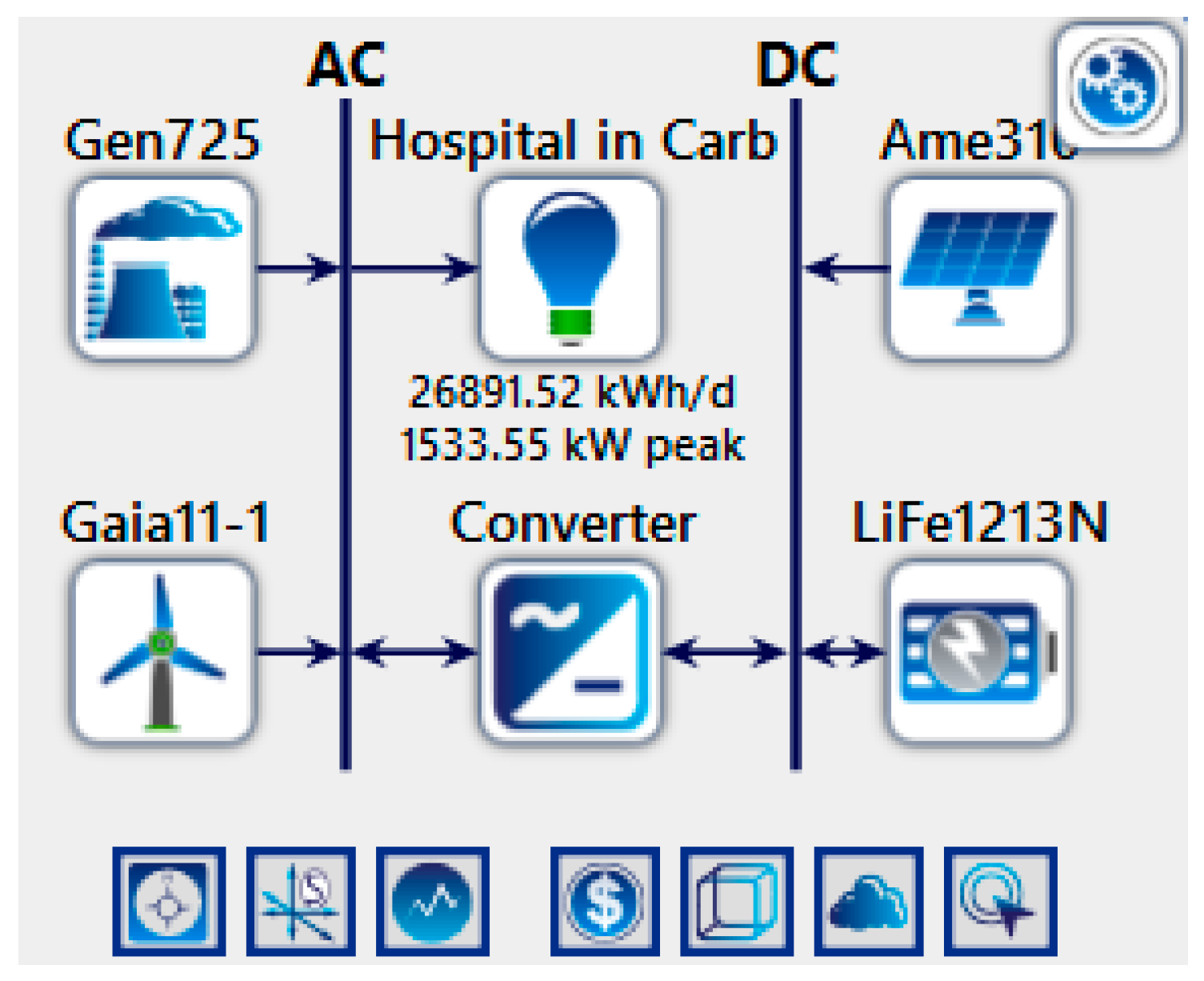
A bidirectional power converter was included to facilitate power exchange between DC and AC subsystems. A generic converter with a design lifetime of 15 years and an efficiency of 95%, as provided in the HOMER software library, was adopted to represent commercially available power electronic interfaces. In the proposed configuration, PV generation and battery storage are connected to the DC bus, while the wind turbine, diesel generator, and electrical load are connected to the AC bus. This architecture enables efficient DC-coupled renewable integration while maintaining compatibility with AC-based generation and demand. From a microgrid integration standpoint, the converter is essential for coordinated operation of heterogeneous resources, supporting stable power flow, reducing conversion losses, and addressing the challenge of integrating diverse generation technologies within a unified standalone microgrid framework.
2.3. Optimization Framework and Sensitivity Definition
System design was performed using the HOMER software platform, which evaluates feasible microgrid configurations through chronological simulation and economic optimization. The primary objective was to minimize the NPC of the microgrid over the project lifetime while satisfying electrical load demand, component operational constraints, and system reliability requirements.
Although various optimization techniques such as mixed-integer linear programming, genetic algorithms, and other metaheuristic approaches have been employed in microgrid design studies, the HOMER platform was selected in this work as a computational environment to implement and solve a researcher-defined techno-economic optimization problem. The choice of HOMER does not replace analytical modeling or design decisions; rather, it supports their systematic evaluation under realistic operational conditions. In particular, HOMER enables chronological, hour-by-hour simulation over a full annual horizon while enforcing user-specified constraints on power balance, generator dispatch, and battery state-of-charge, which is essential for accurately assessing reliability in standalone critical-load microgrids. From an economic perspective, HOMER evaluates lifecycle performance using a net present cost formulation consistent with long-term investment analysis, providing a platform to directly compare cost-optimal, near-optimal, and emissions-minimizing configurations defined within the study. Unlike single-run or purely heuristic optimization approaches, HOMER systematically evaluates a broad range of feasible system configurations defined within the researcher-specified design space and operational constraints, and identifies cost-optimal and near-optimal solutions based on the explicit net present cost objective. This approach mitigates sensitivity to initial guesses or algorithm-specific convergence behavior while maintaining transparency in the optimization process. As was covered in
Section 1.2, HOMER has been widely validated and adopted in both academic research and practical microgrid planning, supporting result reproducibility.
The overall configuration of the designed standalone hybrid microgrid is illustrated in
Figure 5, which shows the interconnection of PV generation, wind turbines, battery energy storage, a diesel generator, and a bidirectional power converter across DC and AC buses. As was indicated, in this configuration, PV generation and battery storage are connected to the DC bus, while the wind turbine, diesel generator, and electrical load are connected to the AC bus. This structure reflects common practical microgrid architectures and enables efficient integration of DC-coupled renewables while maintaining compatibility with AC-based generation and demand.
Decision variables included the installed capacities of PV generation, wind turbines, battery energy storage, and the bidirectional converter. The diesel generator operated as a dispatchable resource to supplement renewable generation during periods of insufficient renewable availability. HOMER’s dispatch logic prioritizes renewable energy utilization, followed by battery discharge and dispatchable generation, allowing realistic assessment of operational interactions among system components under varying resource and load conditions.
To address uncertainties associated with real-world PV performance, a sensitivity analysis was conducted on the PV derating factor. Two derating values, 85% and 90%, were considered to represent variations in effective PV output due to environmental effects such as temperature, soiling, wiring losses, and inverter inefficiencies. These values reflect realistic operating conditions encountered in practical microgrid deployments. Evaluating different derating scenarios enables assessment of the robustness of optimal system configurations and highlights how conservative or optimistic performance assumptions influence component sizing, lifecycle cost, and renewable energy penetration. From a planning perspective, this sensitivity analysis addresses a key microgrid design challenge by quantifying the impact of performance uncertainty on investment decisions and long-term system economics. The underlying optimization problem and solution procedure associated with this framework are formally described in the following subsection.
2.4. Optimization Problem Formulation and Solution Procedure
The standalone microgrid design problem addressed in this study is formulated as a constrained techno-economic optimization problem, where the objective is to identify a system configuration that minimizes total lifecycle cost while ensuring reliable supply of the electrical load. Although the design is implemented using the HOMER software platform, the underlying optimization problem is explicitly formulated here to clarify the methodological framework, decision variables, and operational constraints that govern the system modelling and to distinguish the analytical formulation from the numerical solution tool. The primary optimization objective is to minimize the net present cost of the microgrid over the project lifetime, expressed as
where
denotes the vector of decision variables, including the installed capacities of PV generation, wind turbines, battery energy storage, and the bidirectional power converter. This objective function reflects a lifecycle cost minimization perspective, in which capital-intensive renewable and storage investments are balanced against recurring operational costs associated with dispatchable generation. By minimizing NPC, the optimization implicitly determines the economically optimal trade-off between higher upfront capital expenditures (e.g., PV, wind, and battery capacity) and long-term fuel, operation, and replacement costs. As a result, the solution favors configurations in which renewable resources and storage are utilized to the extent that they reduce total lifecycle cost without violating reliability constraints, rather than maximizing renewable penetration as an independent objective. The decision variables contained in
directly influence both the fixed and variable cost components of NPC. Increased renewable or storage capacity reduces fuel consumption and emissions but increases capital and replacement costs, while greater reliance on dispatchable generation lowers initial investment but increases fuel and operating costs over the project lifetime. The resulting cost-optimal solution therefore reflects a compromise among investment cost, operational flexibility, and reliability, which is later manifested in the observed patterns of renewable fraction, excess electricity, generator dispatch frequency, and emissions reported in
Section 3.
The NPC aggregates all relevant cost components over the project lifetime and is defined as
where
represents the initial capital cost,
denotes operation and maintenance costs in year
y,
corresponds to fuel costs associated with dispatchable generation,
accounts for component replacement costs,
is the salvage value at the end of the project lifetime
N, and
i is the real discount rate.
System feasibility is enforced through an hourly power balance constraint evaluated over the full annual horizon:
where
,
,
, and
denote the power contributions from PV generation, wind turbines, the diesel generator, and battery storage at hour
t, respectively, and
represents conversion and system losses.
Battery operation is governed by state-of-charge (SOC) dynamics described by
subject to operational limits
where
and
are the battery charging and discharging efficiencies, respectively, and
is the total installed battery energy capacity.
Accordingly, the effectiveness of renewable energy integration is interpreted using a Renewable Utilization Index (RUI), defined as
where
represents renewable power utilized to supply the load or charge energy storage, and
denotes the total available renewable generation at hour
t. Unlike NPC, which reflects economic optimality, the RUI explicitly characterizes how effectively available renewable resources are exploited within the system. Although this index is not directly optimized within HOMER, variations in battery capacity, converter sizing, and dispatchable generation observed in the results reflect the implicit trade-offs between lifecycle cost minimization and renewable energy utilization.
The optimization problem defined above is solved in HOMER platform using a structured and constraint-aware search procedure that systematically explores the design space of feasible component combinations while eliminating configurations that violate operational or economic constraints. For each admissible system configuration, chronological simulation is performed at an hourly resolution over a full annual cycle in order to ensure electric load satisfaction, component feasibility, and consistent system operation. Feasible solutions are subsequently evaluated and ranked based on their NPC, enabling identification of the economically optimal configuration under the imposed constraints. Sensitivity analyses are conducted by repeating this optimization process under different PV derating factors to assess solution robustness under performance uncertainty. Together, the presented formulation and solution procedure ensure that the reported results capture fundamental techno-economic trade-offs inherent to standalone hybrid microgrid design.
3. Results
This section presents the optimization results of the proposed standalone hybrid microgrid, focusing on system configuration, economic performance, energy contribution characteristics, storage behavior, and environmental impacts. The results highlight key trade-offs associated with renewable integration and provide insight into design robustness under realistic operating assumptions. These results should be interpreted in direct relation to the constrained techno-economic optimization formulation presented in
Section 2.4, where component sizing, dispatch behavior, and system feasibility emerge from minimizing lifecycle cost under hourly operational constraints.
3.1. Optimal System Configuration and Sensitivity Impact
Table 1 compares the optimal system configurations obtained for PV derating factors of 85% and 90%. Although the two cases differ only in the assumed effective PV performance, noticeable variations in component sizing are observed, reflecting the coupled nature of techno-economic optimization in standalone microgrids. These configuration changes directly reflect the sensitivity of the optimization objective in (1)–(2) to PV performance assumptions, as the solution adapts component capacities to preserve feasibility of the power balance constraint (3) while minimizing NPC.
As can be observed from the table, when the PV derating factor increases from 85% to 90%, the required installed PV capacity decreases slightly from 1847 kW to 1844 kW. This reduction is expected, as a higher derating factor implies improved effective PV output. Consequently, fewer PV modules are required to achieve the same annual energy contribution and reliability targets. The relatively small magnitude of this reduction indicates that PV sizing is constrained not only by energy production requirements but also by load characteristics and system reliability considerations.
A more pronounced change is observed in wind capacity, which decreases from 202 to 190 turbines (each 11 kW) as the PV derating factor increases. With more effective PV generation available in the 90% derating case, the optimization process compensates by reducing reliance on wind generation, particularly during periods when PV output is dominant. This highlights the complementary relationship between renewable sources in hybrid microgrids and demonstrates how improved performance in one resource can reduce the required contribution from another.
In contrast, the diesel generator capacity remains unchanged at 725 kW for both sensitivity cases. This outcome reflects the role of the generator as a reliability-driven component rather than an energy-optimized one. The generator capacity is primarily dictated by peak load requirements and worst-case renewable shortfall scenarios. Since changes in PV derating do not affect peak demand, the generator rating remains fixed to ensure supply adequacy under all operating conditions.
Battery storage capacity, expressed in terms of the number of storage units, increases from 7627 units to 7765 units when the PV derating factor increases to 90%. While improved PV performance reduces the need for installed PV capacity, it also increases the availability of surplus renewable energy during high-generation periods. Additional storage capacity is therefore economically justified to capture and shift this excess energy, reduce curtailment, and further minimize generator runtime. Finally, the required converter capacity increases from 962 kW to 973 kW in the higher derating scenario. This increase is consistent with the higher instantaneous power flows associated with more effective PV generation and increased battery charging activity. Hence, the converter must be re-sized to accommodate peak bidirectional power transfer between the DC and AC buses, and improved PV performance intensifies these transfer requirements even if total installed PV capacity is slightly reduced.
3.2. Economic Trade-Offs Among Optimal and Near-Optimal Configurations (85% PV Derating)
Table 2 summarizes a set of optimal and near-optimal system configurations identified under the 85% PV derating scenario, which represents a more conservative assumption for the design. This scenario is used as a baseline to examine economic and architectural trade-offs among different standalone microgrid designs. The configurations reported in
Table 2 represent feasible solutions of the same optimization problem defined in
Section 2.4, where different combinations of renewable generation, storage, and dispatchable capacity satisfy identical operational constraints but yield distinct lifecycle cost outcomes.
The first row corresponds to the globally optimal configuration with the NPC of approximately $38.2 million. This design integrates 1847 kW of PV capacity, 202 wind turbines (each rated at 11 kW), a 725 kW diesel generator, 7627 battery units, and a 962 kW converter. The combination of PV, wind, storage, and dispatchable generation enables reliable operation while minimizing lifecycle cost.
The second configuration eliminates PV generation entirely and relies primarily on wind generation, diesel generation (725 kW), and a significantly larger battery bank exceeding 20,000 units, resulting in an NPC of approximately $50.0 million. The absence of PV necessitates substantially higher storage capacity to buffer wind variability and maintain supply adequacy, which leads to a marked increase in capital cost despite reduced system complexity on the generation side.
In the third configuration, wind generation is eliminated while PV capacity increases substantially to over 6800 kW, with the diesel generator capacity remaining unchanged at 725 kW. This design also requires a larger battery bank and higher converter capacity (compared to the first row) to accommodate increased PV output and associated power flows, leading to an NPC of approximately $56.0 million. The result highlights the economic impact of relying on a single dominant renewable source, which demands additional storage and power electronics to ensure reliable standalone operation.
Across the first three configurations, the diesel generator capacity remains fixed at 725 kW, indicating that generator sizing is driven primarily by peak load and reliability constraints rather than renewable availability. Overall,
Table 2 illustrates a fundamental microgrid planning trade-off: balanced hybrid designs that combine multiple renewable sources with moderate storage achieve lower lifecycle cost, whereas configurations relying on a single renewable source or eliminating one generation pathway impose significantly higher storage and conversion requirements. These results reinforce the role of hybrid microgrid architectures as a practical and economically efficient pathway toward increased renewable integration in standalone systems.
3.3. Cost Structure and Lifecycle Economic Performance
To further interpret the economic drivers behind the optimal configuration identified in
Section 3.2, the cost breakdown of the lowest-NPC design under the 85% PV derating scenario is examined. This cost structure arises directly from the NPC formulation in (2), which aggregates capital investment, fuel consumption, operation and maintenance, replacement, and salvage terms over the project lifetime.
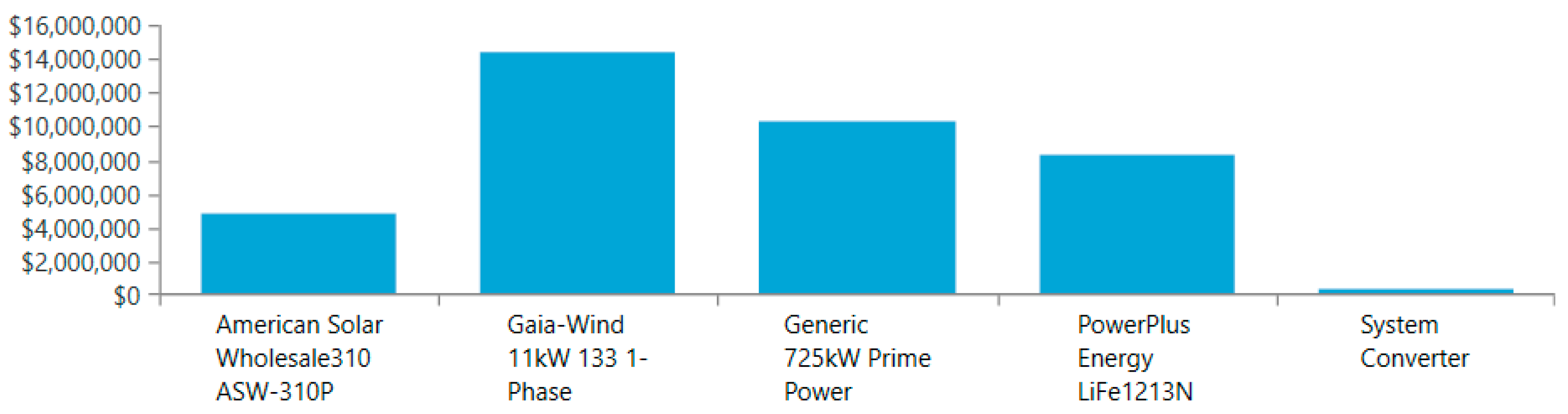
Figure 6 presents the NPC distribution categorized by component. As shown in this figure, the wind subsystem represents the largest lifecycle cost contributor, with a total NPC of approximately
$14.34 M (including capital and O&M). The diesel generator subsystem is the second-largest contributor at approximately
$10.34 M, and this value is driven primarily by fuel cost, which alone accounts for approximately
$9.01 M of the generator’s lifecycle cost. Battery storage is also a major contributor, with an NPC of approximately
$8.28 M, reflecting the capital-intensive nature of achieving reliability and renewable firming in standalone microgrids.
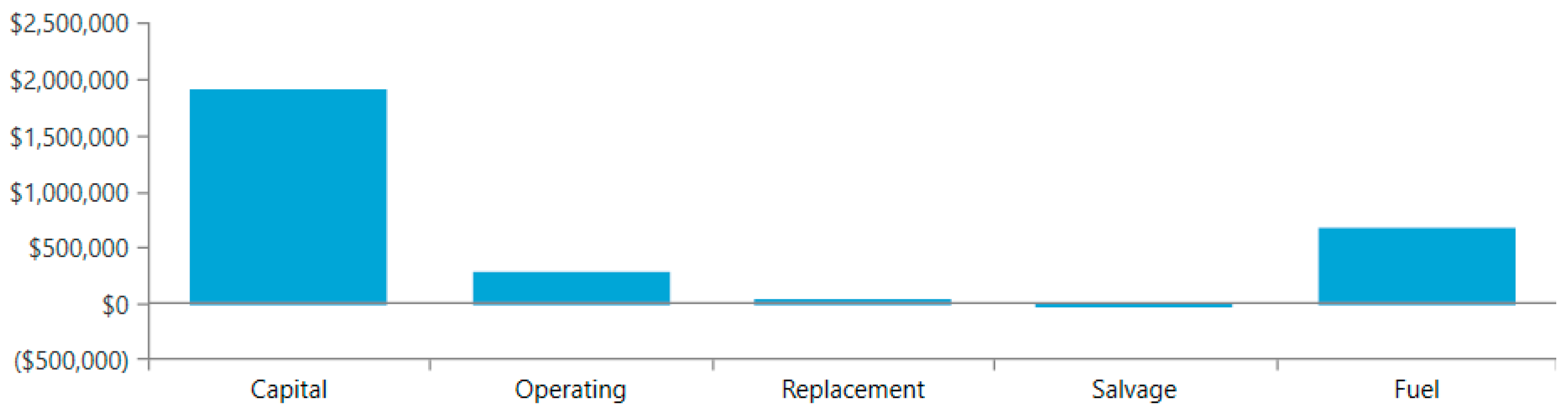
Figure 7 illustrates the corresponding annualized cost breakdown by cost type, which provides a different but consistent interpretation. The annualized capital cost is the largest cost category (approximately
$1.93 M/year), exceeding the annualized fuel cost (approximately
$0.70 M/year) and annualized O&M cost (approximately
$0.29 M/year). Replacement costs are comparatively small (approximately
$0.066 M/year), while salvage value appears as a small negative contribution (approximately −
$0.027 M/year). This breakdown indicates that, for the optimal hybrid system, the overall economic burden is driven primarily by upfront investment, while fuel remains a secondary recurring cost under the optimal dispatch strategy.
Overall,
Figure 6 and
Figure 7 illustrate a central standalone microgrid planning challenge: achieving reliable, high-renewable operation requires substantial investment in wind capacity and storage; however, dispatchable generation, though not the main energy source, still imposes some lifecycle fuel costs. At the same time, the results highlight an opportunity: improving renewable utilization and storage coordination can reduce fuel dependence without requiring the system to shift toward prohibitively expensive “fully renewable” sizing. The optimal configuration therefore reflects a balanced techno-economic compromise between capital-intensive renewable-and-storage deployment and fuel-driven operating costs.
3.4. Energy Production and Renewable Contribution Analysis
Having examined component capacities and dispatch behavior in the preceding subsections, the analysis now shifts from power-based considerations to an energy-based assessment of system performance, focusing on how electricity demand is supplied over time and how renewable generation contributes on a monthly and annual basis.
Figure 8 illustrates the monthly electricity production of the optimal hybrid microgrid configuration under the 85% PV derating scenario, highlighting the relative contributions of PV generation, wind energy, and dispatchable diesel generation in meeting the facility load. The monthly production profile shown in
Figure 8 reveals a clear seasonal interaction between energy sources. During winter months, wind generation plays a more prominent role due to reduced solar availability, while PV contribution increases during late spring and summer, partially displacing wind generation. The diesel generator operates primarily as a balancing and reliability resource, supplying energy during periods of prolonged low renewable output rather than serving as a base-load source. This operational behavior is consistent with the system’s cost-optimal dispatch strategy and explains the fuel costs despite high renewable penetration.
On an annual basis, the system produces approximately 12.84 GWh, exceeding the annual electrical demand of 9.81 GWh. This surplus generation results in 2.87 GWh of excess electricity, corresponding to 22.4% of total production, which primarily occurs during periods of high renewable availability and limited storage charging capacity. Importantly, this excess electricity does not indicate poor sizing or suboptimal design; rather, it emerges endogenously from the constrained cost-minimization problem, where additional storage or further renewable curtailment would increase net present cost more than the economic penalty associated with limited surplus generation. Under stringent reliability constraints and hourly power balance requirements, a moderate level of excess energy represents a cost-optimal compromise between renewable utilization, capital investment, and reliability constraints. Despite operating in a standalone mode, the system maintains excellent reliability, with unmet electrical load limited to 0.051% and capacity shortage below 0.1%, confirming that the selected architecture effectively satisfies critical-load requirements.
Renewable sources contribute a substantial share of total energy supply, yielding a renewable fraction of 74.6%, while the maximum instantaneous renewable penetration reaches 497%, indicating that renewable generation frequently exceeds load demand and is either used to charge energy storage or curtailed. Wind energy represents the dominant renewable contributor, reflecting both the large installed wind capacity and the relatively consistent wind resource throughout the year. PV generation provides a complementary contribution, with higher output during spring and summer months when solar irradiance peaks.
The production patterns observed in
Figure 8 directly reflect the constrained techno-economic optimization framework formulated in
Section 2.4. In particular, the calculated Renewable Utilization Index (RUI), defined in (5), attains a value of approximately 0.78 for the optimal configuration, indicating that nearly 78% of the available renewable energy is effectively utilized to meet load demand or charge storage prior to curtailment. This level of utilization is consistent with the observed renewable fraction and high instantaneous renewable penetration, demonstrating that the optimized system implicitly maximizes renewable exploitation subject to economic optimality. The persistence of excess electricity therefore reflects the interaction among hourly power balance constraints, finite storage capacity, and lifecycle cost minimization, rather than oversizing driven by heuristic assumptions or solver artifacts.
Overall,
Figure 8 demonstrates that the optimized hybrid configuration achieves a favorable balance between renewable utilization and operational reliability. While the presence of excess electricity suggests opportunities for future enhancement (e.g., demand-side management, flexible loads, additional storage, or conditional export capability if interconnection becomes available), the current design effectively addresses the core challenge of supplying a critical standalone load with high renewable penetration while maintaining economic feasibility.
3.5. Energy Storage Utilization, Autonomy, and Dispatch Behavior
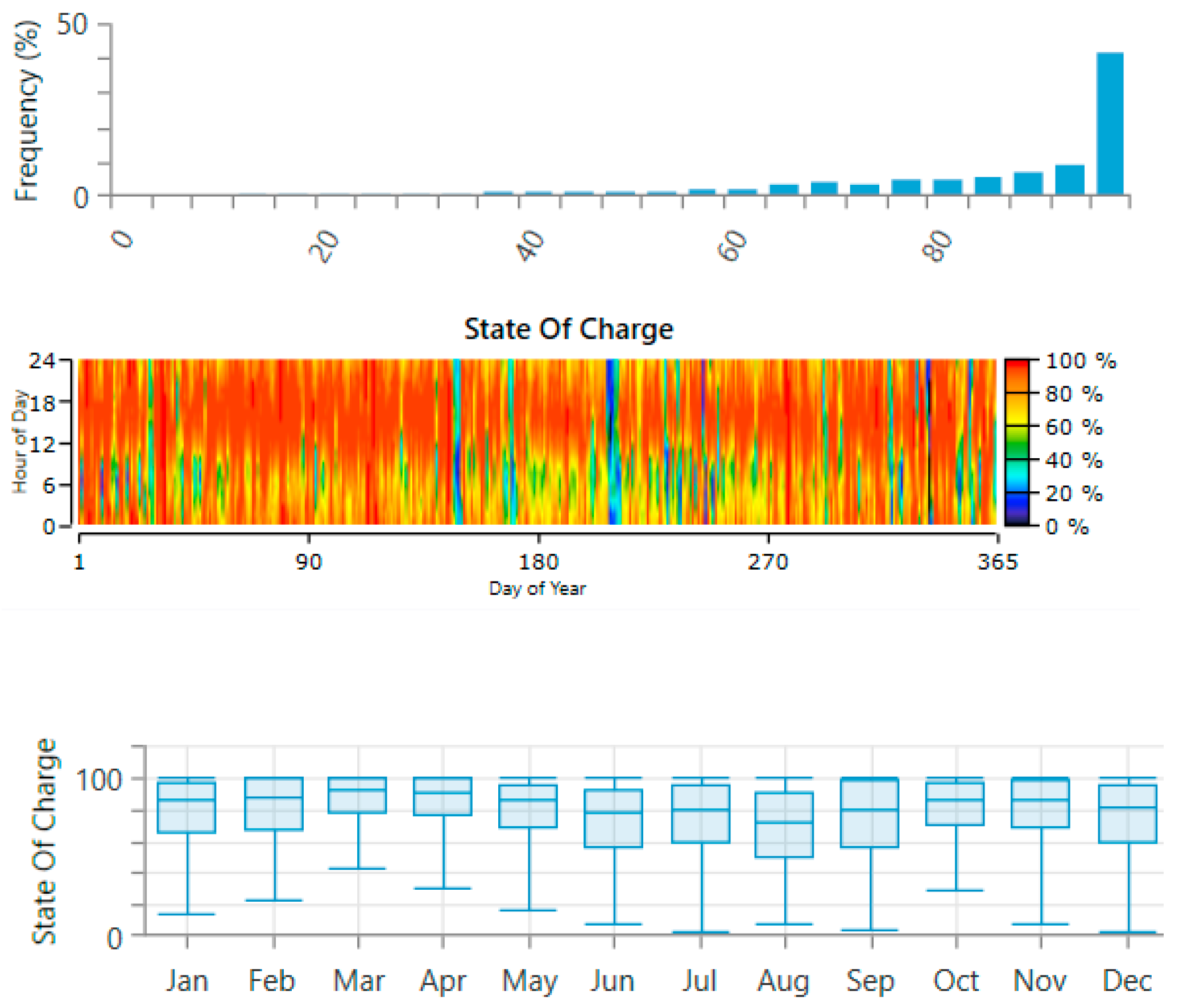
Figure 9 illustrates the operational behavior of the battery energy storage system in the optimal hybrid microgrid configuration under the 85% PV derating scenario. The first subplot depicts the frequency distribution of the battery state of charge (SOC) over the annual horizon, indicating how often the storage system operates at different charge levels throughout the year. The second subplot presents the hourly SOC evolution across all days of the year, and the third subplot shows the monthly distribution of SOC highlighting seasonal variations in storage utilization.
Figure 9 reveals that the battery operates predominantly within a mid-to-high SOC range throughout the year, with frequent cycling driven by renewable variability. Monthly SOC statistics indicate higher average SOC values during spring and early summer, coinciding with increased PV production, while deeper discharges occur more frequently during winter months when solar availability is limited and wind variability increases. These seasonal patterns confirm that storage dispatch responds directly to the temporal structure of renewable resources rather than following a fixed operational schedule.
The optimized design includes 7627 lithium iron phosphate battery units, corresponding to a total nominal storage capacity of approximately 9.76 MWh. This capacity yields an autonomy of 8.71 h, indicating that the system can sustain the full critical load for nearly nine hours in the absence of renewable generation and without relying on the diesel generator. This autonomy level reflects a deliberate balance between reliability and cost, where excessive storage investment would increase capital cost without proportionate reliability benefits. The annual energy charged into the battery system is approximately 1.18 GWh, while annual discharge amounts to 1.13 GWh, with associated storage losses of about 47 MWh. The resulting round-trip behavior indicates that the battery is used primarily for short-to-medium-term energy shifting rather than long-duration energy storage. This operational pattern aligns with the power balance constraint in (3) and the state-of-charge dynamics in (4), where storage is dispatched to absorb excess renewable generation and mitigate short-term mismatches between supply and demand.
Overall,
Figure 9 demonstrates that battery energy storage plays a critical but carefully bounded role in the optimized hybrid microgrid. Storage enhances system reliability, supports renewable integration, and mitigates short-term variability, while remaining economically constrained by lifecycle cost considerations. This behavior confirms that storage sizing and dispatch are emergent properties of the constrained optimization framework rather than ad hoc design choices, thereby reinforcing the methodological coherence between the formulation in
Section 2.4 and the resulting system operation.
3.6. Dispatchable Generator Performance and Emissions Assessment
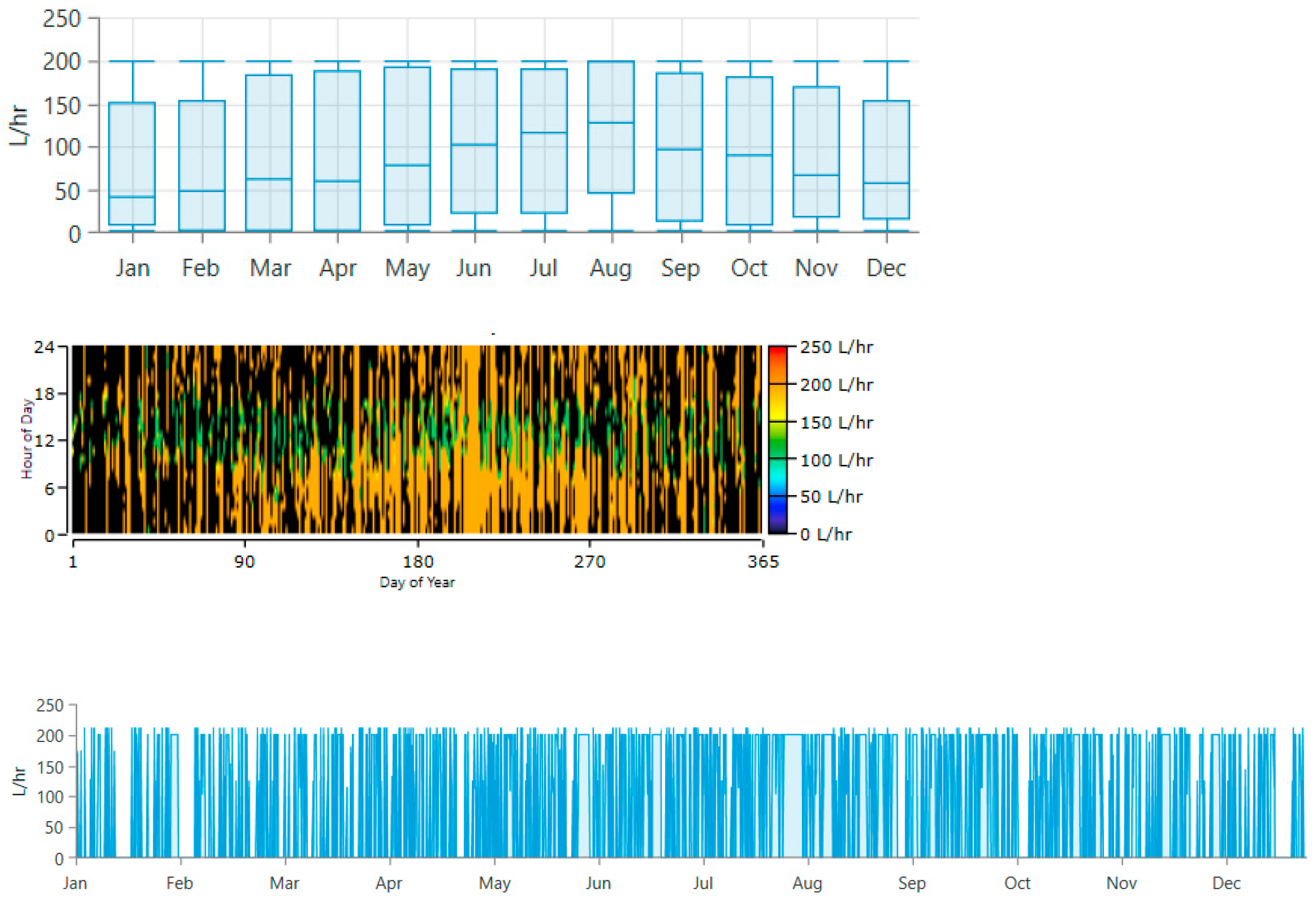
Figure 10 illustrates the operational behavior of the 725 kW prime power diesel generator in the optimal hybrid microgrid configuration under the 85% PV derating scenario. The three subplots, respectively, present the monthly distribution of hourly fuel consumption, the hourly fuel consumption intensity over the annual horizon, and the chronological dispatch pattern throughout the year. The generator consumes a total of 697,266 L of diesel annually, corresponding to an average fuel usage of 1910 L/day or 79.6 L/h.
In the first subplot, across all months, fuel consumption spans from near-idle levels to peak values, indicating intermittent but occasionally intensive generator usage rather than continuous operation. Median fuel consumption gradually increases from winter toward summer months, reflecting longer or more frequent generator duty cycles when sustained facility load coincides with periods of reduced instantaneous renewable contribution or limited battery discharge capability. While PV generation is strongest during summer, diesel operation is not fully displaced, as short-term load peaks, nighttime demand, and storage constraints necessitate generator support to maintain power balance and reliability. Conversely, during winter months, lower solar availability is partially offset by relatively consistent wind generation, resulting in lower median fuel usage but continued reliance on diesel during prolonged low-renewable intervals. Overall, the boxplots indicate that seasonal differences in fuel consumption arise primarily from variations in generator duty cycle driven by load–renewable–storage interactions, rather than from complete seasonal dominance or absence of any single energy source.
The hourly heatmap in the second subplot reveals that generator operation is highly intermittent rather than continuous. High fuel consumption events cluster during periods of prolonged low renewable availability, while large portions of the year show near-zero generator output. This confirms that the diesel unit does not operate as a base-load source, but instead serves as a flexibility and reliability resource, activated only when required to maintain feasibility of the hourly power balance constraint in (3). Such behavior is consistent with a cost-optimal dispatch strategy that minimizes fuel expenditure while preserving supply adequacy. The annual dispatch profile in the third subplot further demonstrates that generator operation is fragmented into short-duration events distributed across the year. This operational pattern directly reflects the optimization objective defined in (1)–(2): continuous diesel operation would significantly increase fuel costs and therefore NPC, whereas limited, targeted dispatch enables compliance with reliability constraints at minimal economic penalty.
The emissions results quantify the environmental implications of this dispatch behavior. Annual emissions amount to 1,829,984 kg of CO2, 7670 kg of CO, 7670 kg of NOₓ, 4567 kg of SO2, 879 kg of unburned hydrocarbons, and 220 kg of particulate matter. While these values confirm that dispatchable generation remains a non-negligible emissions source, their magnitude must be interpreted in the context of system reliability and renewable penetration. Given that renewable sources supply 74.6% of annual energy, these emissions represent the residual environmental cost of maintaining firm capacity under stringent reliability constraints, rather than inefficient system operation.
3.7. Trade-Off Between Zero-Emission Design and Cost-Optimal Hybrid Configuration
As was mentioned in
Section 3.2,
Table 2 provides valuable insight into the fundamental trade-offs that govern standalone microgrid design by listing optimal and near-optimal configurations sorted in ascending order of NPC. Of particular interest is the comparison between the cost-optimal hybrid configuration (first row) and the diesel-free renewable-only configuration appearing (fourth row), which achieves zero operational emissions. The diesel-free configuration eliminates the dispatchable generator entirely and relies exclusively on oversized renewable generation, storage capacity, and power conversion infrastructure to satisfy the load under all operating conditions. While this design achieves zero annual emissions, it incurs an NPC of approximately
$71 M, nearly 1.86× higher than the
$38.2 M NPC of the cost-optimal hybrid system. This sharp increase in cost is primarily driven by the need for significantly larger battery capacity and converter sizing to ensure feasibility during prolonged periods of low renewable availability, as dictated by the power balance and state-of-charge constraints in (3)–(4).
By contrast, the optimal hybrid configuration strategically incorporates a dispatchable diesel generator that operates intermittently and primarily during rare low-renewable events. As was shown in
Section 3.6, this limited generator usage results in nonzero emissions, while enabling substantial reductions in overall system cost. The diesel generator thus serves not as a dominant energy source, but as a reliability enabler that relaxes extreme storage and renewable oversizing requirements, allowing the optimization to achieve a lower NPC while preserving stringent reliability constraints.
This comparison highlights a key insight of the proposed techno-economic framework: minimizing emissions and minimizing lifecycle cost are not inherently aligned objectives in standalone systems. The optimization problem formulated in
Section 2.4 prioritizes NPC minimization subject to feasibility constraints, and the resulting solution reflects a carefully balanced compromise between economic efficiency, renewable utilization, and operational reliability. The diesel-free solution represents an emissions-optimal extreme, whereas the cost-optimal hybrid design achieves a more pragmatic balance by accepting limited emissions in exchange for significant cost savings. Ultimately, the results demonstrate that robust and economically viable standalone microgrid design requires a diversified energy portfolio rather than strict exclusion of dispatchable resources. The proposed framework enables designers and decision-makers to transparently quantify these trade-offs and select configurations that align with project-specific priorities, whether emphasizing cost minimization, emissions reduction, or an informed compromise between the two.
3.8. Comparison with Metaheuristic Algorithm-Based Optimization Approaches
To further contextualize the contribution of the proposed framework, a direct comparison was conducted with representative metaheuristic optimization approaches reported in recent literature. Specifically, the Shuffled Frog Leaping Algorithm (SFLA) as applied in [
26], the Golden Jackal Optimization (GJO) algorithm presented in [
27], and the Spider Wasp Optimizer (SWO) framework described in [
28] were implemented for the same Carbondale hospital case study using identical resource data, load profiles, component cost assumptions, and reliability constraints. Under the imposed near-zero unmet-load and capacity-shortage requirements, the best solutions obtained using SWO, GJO, and SFLA resulted in net present costs of approximately
$42 M,
$46 M, and
$51 M, respectively, compared to
$38.2 M achieved by the presented constrained techno-economic optimization framework implemented using the HOMER simulation environment. While all methods successfully identified feasible hybrid configurations, the metaheuristic approaches consistently favored more aggressive renewable or storage oversizing to satisfy reliability constraints, leading to higher lifecycle costs. This outcome highlights a key distinction between algorithm-driven optimization and formulation-driven design. In the present work, the explicit coupling of hourly power balance, storage state-of-charge dynamics, and dispatchable generation within the net present cost objective allows the optimization to more effectively exploit limited, intermittent diesel operation as a cost-stabilizing mechanism under strict reliability constraints. As a result, economically efficient hybrid configurations emerge without resorting to excessive capital investment. Importantly, this comparison does not diminish the value of metaheuristic methods, which remain powerful tools for large and highly nonlinear search spaces. Rather, it demonstrates that for standalone critical-load microgrids, transparent constraint formulation and operationally grounded dispatch modeling can yield lower-cost solutions than purely heuristic search strategies when identical reliability requirements are enforced.
4. Discussion
The results presented in
Section 3 provide clear insight into how cost-optimal standalone hybrid microgrids emerge from the interaction of renewable variability, storage dynamics, and dispatchable generation under stringent reliability constraints. Unlike studies that focus solely on maximizing renewable fraction or minimizing emissions, this work demonstrates that economic optimality in standalone systems is governed by a balance among competing design objectives rather than a single performance metric.
Consistent with prior HOMER-based studies on rural and islanded microgrids [
3,
4,
5,
6,
7], the results confirm that combining PV and wind generation with energy storage significantly reduces fuel consumption and improves resilience compared to diesel-dominated designs. However, this study further shows that eliminating dispatchable generation entirely imposes disproportionately high costs when near-zero unmet-load requirements are enforced. The diesel-free configuration examined in
Section 3.7 achieves zero operational emissions but requires extensive oversizing of renewable generation, storage, and power electronics, leading to nearly double the NPC of the cost-optimal hybrid system. This finding aligns with earlier observations that fully renewable standalone systems remain economically challenging without flexible backup resources, particularly for critical loads.
The cost breakdown analysis highlights that capital investment, rather than fuel cost alone, dominates lifecycle economics in high-renewable standalone microgrids. Storage and wind capacity represent major cost drivers, emphasizing that renewable integration is constrained not only by resource availability but also by economic scalability. These trends reinforce the importance of interpreting optimization results in terms of underlying constraints and trade-offs, rather than treating optimal configurations as isolated numerical outcomes.
The diesel generator was selected as the dispatchable power source in this study to represent a conservative and widely adopted reliability benchmark for standalone critical-load microgrids. For islanded operation supplying essential facilities such as hospitals, diesel generators remain the most mature and operationally proven technology capable of delivering rapid start-up, high ramping capability, and firm capacity independent of external fuel networks. In the Carbondale, Illinois context, the use of natural gas generators would introduce dependence on gas pipeline availability, which cannot be assumed under extended grid outages or extreme events. Biomass-based generators, while renewable, typically require continuous fuel supply chains, on-site storage infrastructure, and consistent feedstock quality, which pose logistical and operational challenges for emergency-critical applications. Micro gas turbines, although lower-emission, generally exhibit reduced efficiency at partial load and higher capital cost, making them less suitable for the intermittent, low-duty-cycle operation observed in cost-optimal standalone systems. Importantly, in the optimized configuration identified in this study, the diesel generator operates intermittently and primarily as a reliability-support resource rather than a baseload unit, contributing a fraction of annual energy and ensuring compliance with stringent unmet-load and capacity-shortage constraints. The intent of this work is therefore not to promote diesel generation as a long-term decarbonization solution, but to demonstrate how limited dispatchable support can economically complement high renewable penetration under strict reliability requirements.
From an operational perspective, the observed storage and generator dispatch behaviors validate the constrained optimization formulation. Battery storage primarily performs short-term energy shifting, while the dispatchable generator operates intermittently to preserve feasibility during rare low-renewable events. This operational structure reflects a pragmatic approach to decarbonization, where limited emissions are accepted to achieve substantial cost savings and high reliability.
Overall, the findings support the view that hybrid microgrids represent a transitional and resilient pathway toward low-carbon energy systems. Rather than pursuing strict exclusion of conventional generation, economically viable decarbonization is achieved through informed diversification of resources, consistent with broader trends reported in the microgrid literature.
5. Conclusions
This study presented a comprehensive techno-economic analysis of a standalone hybrid photovoltaic–wind–battery microgrid supplying a critical load under stringent reliability requirements. By explicitly formulating the optimization problem and interpreting results through cost, operational, and environmental lenses, this work provides transparent insight into the trade-offs governing real-world microgrid design.
The results demonstrate that cost-optimal hybrid configurations can achieve high renewable penetration while maintaining near-zero unmet load, without requiring excessive oversizing of generation or storage. Limited and intermittent use of dispatchable generation plays a critical role in reducing lifecycle cost by relaxing extreme storage and renewable capacity requirements. In contrast, diesel-free configurations, while achieving zero operational emissions, incur substantially higher NPC due to the need for large storage and conversion infrastructure. Sensitivity analysis confirmed that optimal designs are robust to reasonable variations in photovoltaic performance, though component sizing adapts to preserve system feasibility and economic efficiency. Storage behavior and generator dispatch patterns emerged directly from the constrained optimization framework, reinforcing the importance of linking numerical results to underlying formulation and assumptions.
In contrast to many prior studies that emphasize maximizing renewable fraction or fully eliminating fossil-fuel-based generation, often without explicitly quantifying the resulting economic penalties under strict reliability requirements, this study demonstrates how cost-optimal and near-optimal solutions emerge from transparent, constraint-driven trade-offs when near-zero unmet-load and capacity-shortage conditions are enforced. By focusing on a critical-load standalone configuration, this study clarifies why limited and intermittent dispatchable generation can play a stabilizing economic role without undermining decarbonization objectives. The results show that excessive renewable or storage oversizing primarily shifts cost rather than improve reliability, whereas balanced hybrid architectures achieve a more favorable compromise among lifecycle cost, renewable utilization, and operational feasibility. Collectively, these findings provide practical, decision-oriented insight into economically viable decarbonization pathways for standalone microgrids, reinforcing the value of diversified hybrid designs over extreme single-objective configurations. However, the limitation of this work is that it adopts a long-term planning perspective and does not explicitly model short-term operational dynamics, protection coordination, or fault behavior. Future work will therefore extend the optimized design into time-domain operational studies using dedicated power system analysis platforms, enabling evaluation of protection schemes, fault response, and arc-flash considerations to ensure that cost-optimal and low-emission designs are also robust and secure under real-world operating conditions.