Preclinical Validation of the iBNCT001 Accelerator System for Boron Neutron Capture Therapy: In Vitro Efficacy, Beam Quality, and Radiation Safety Evaluation
 , , , , ,
Abstract
1. Introduction
2. Materials and Methods
2.1. Overview of Preclinical Studies
2.2. Cell-Based Preclinical Efficacy Study of BNCT
2.2.1. Study Design and Objective (In Vitro BNCT Efficacy)
2.2.2. Cell Lines
2.2.3. Cell Culture Conditions
2.2.4. SPM-011 Treatment Conditions
2.2.5. Neutron Irradiation Procedure
2.2.6. Dosimetry and Absorbed Dose Calculation
2.2.7. Quality Assurance and Commissioning of Neutron Irradiation
2.2.8. Clonogenic Survival Assay and Determination of Biological Equivalent Dose
2.3. Evaluation of Biological Effects Under Free Beam Conditions
2.3.1. Study Design and Objective (Free-Beam RBE Evaluation)
2.3.2. Cell Lines and Culture Conditions
2.3.3. Preparation of Irradiation Samples
2.3.4. Neutron Irradiation Under Free-Beam Conditions
2.3.5. Quality Assurance and Commissioning of Neutron Irradiation
2.3.6. Reference X-Ray Irradiation
2.3.7. RBE Determination
2.4. Radiation Leakage Dose Assessment Using a Human Phantom
2.4.1. Study Design and Objective (Radiation Leakage Dose Assessment)
2.4.2. Irradiation System and Boron Compound
2.4.3. Cell Line and Culture Conditions
2.4.4. Preparation of Cell Samples and Boron Treatment
2.4.5. Neutron Irradiation Using a Human Phantom Model
2.4.6. Quality Assurance and Commissioning of Neutron Irradiation
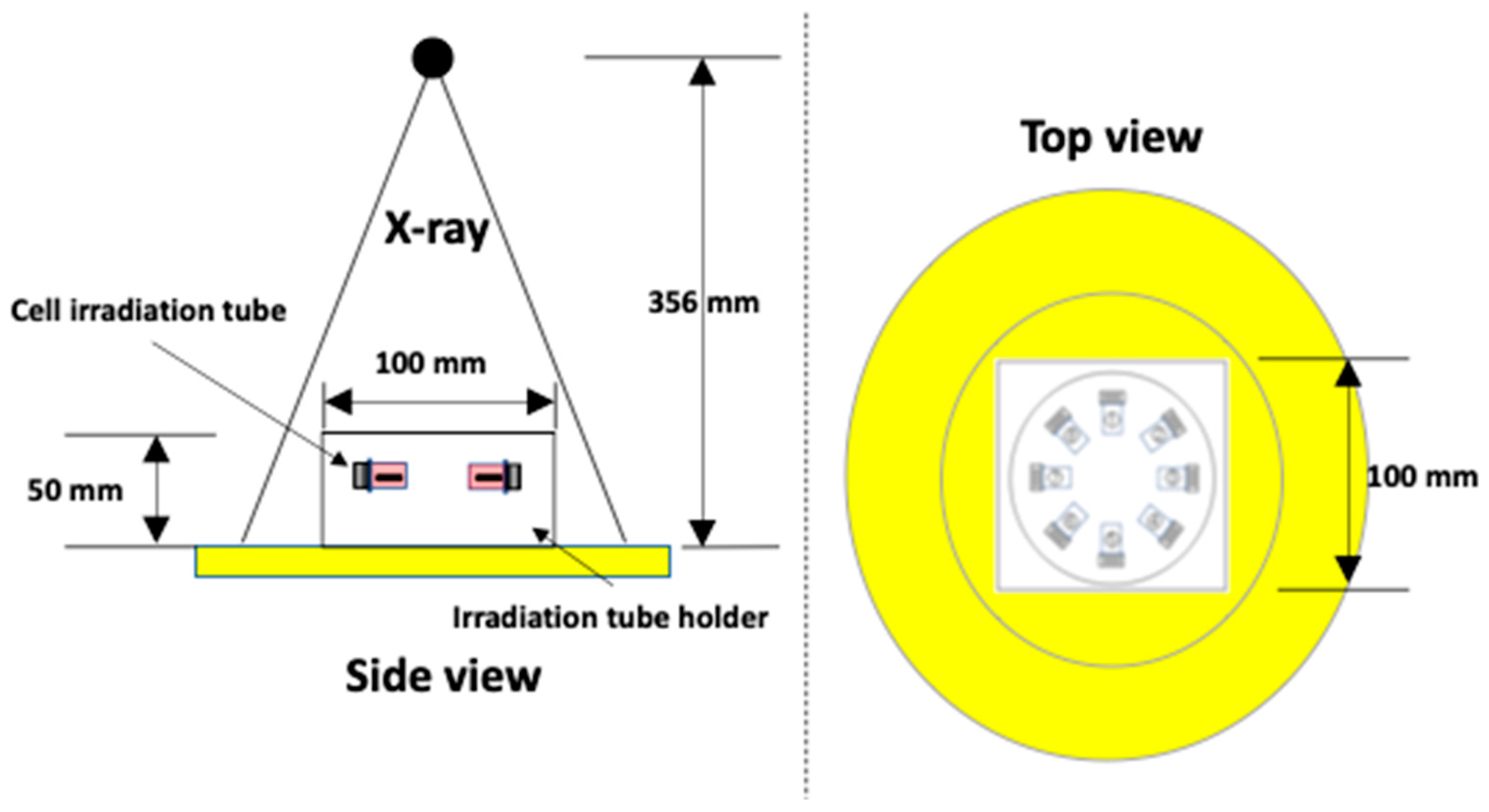
2.4.7. Reference X-Ray Irradiation
2.4.8. Micronucleus Formation Assay and Estimation of Leakage Dose
2.5. Data Analysis and Reproducibility
3. Results
3.1. Cell-Based Preclinical Efficacy of BNCT Using iBNCT001
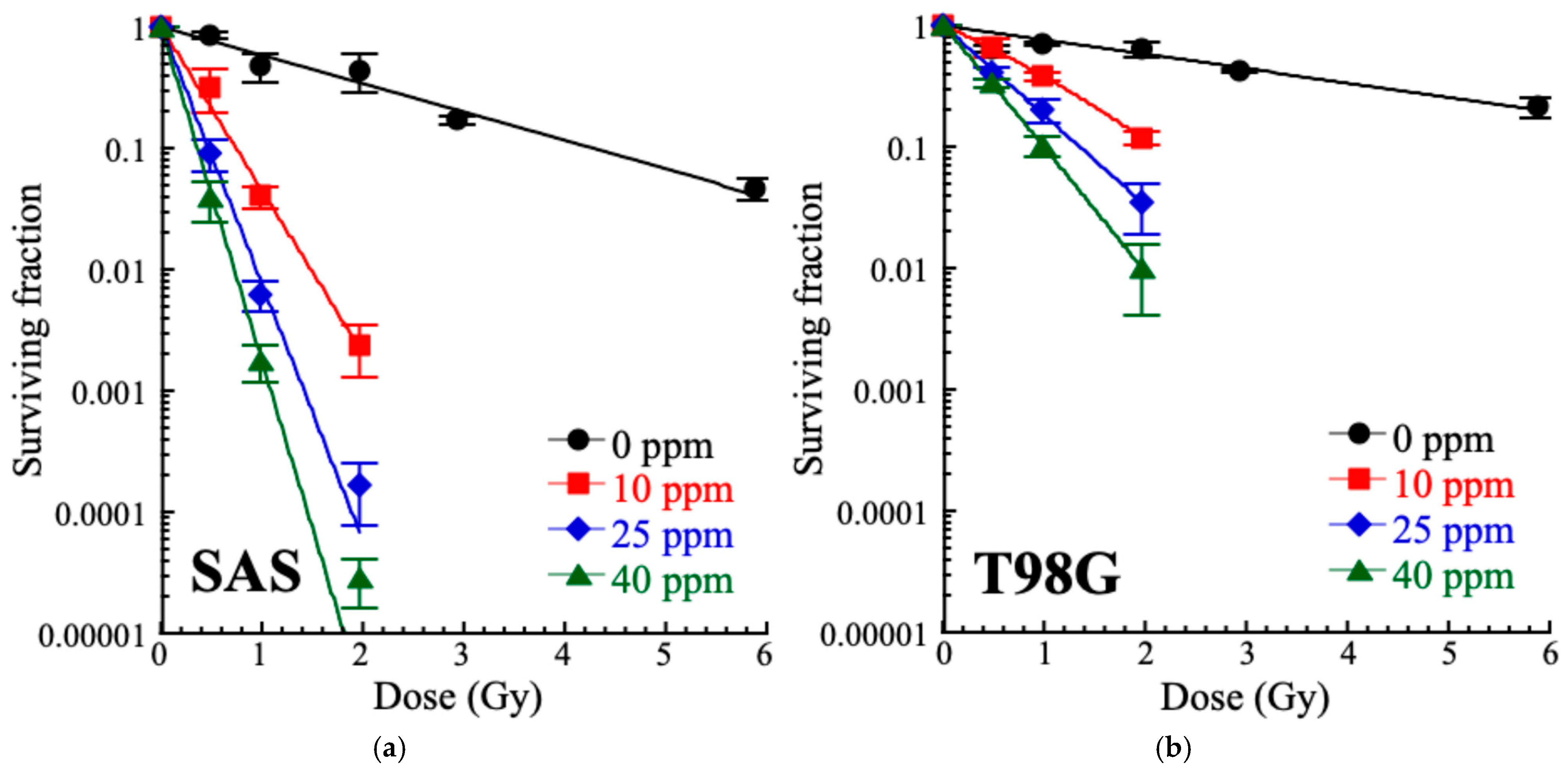
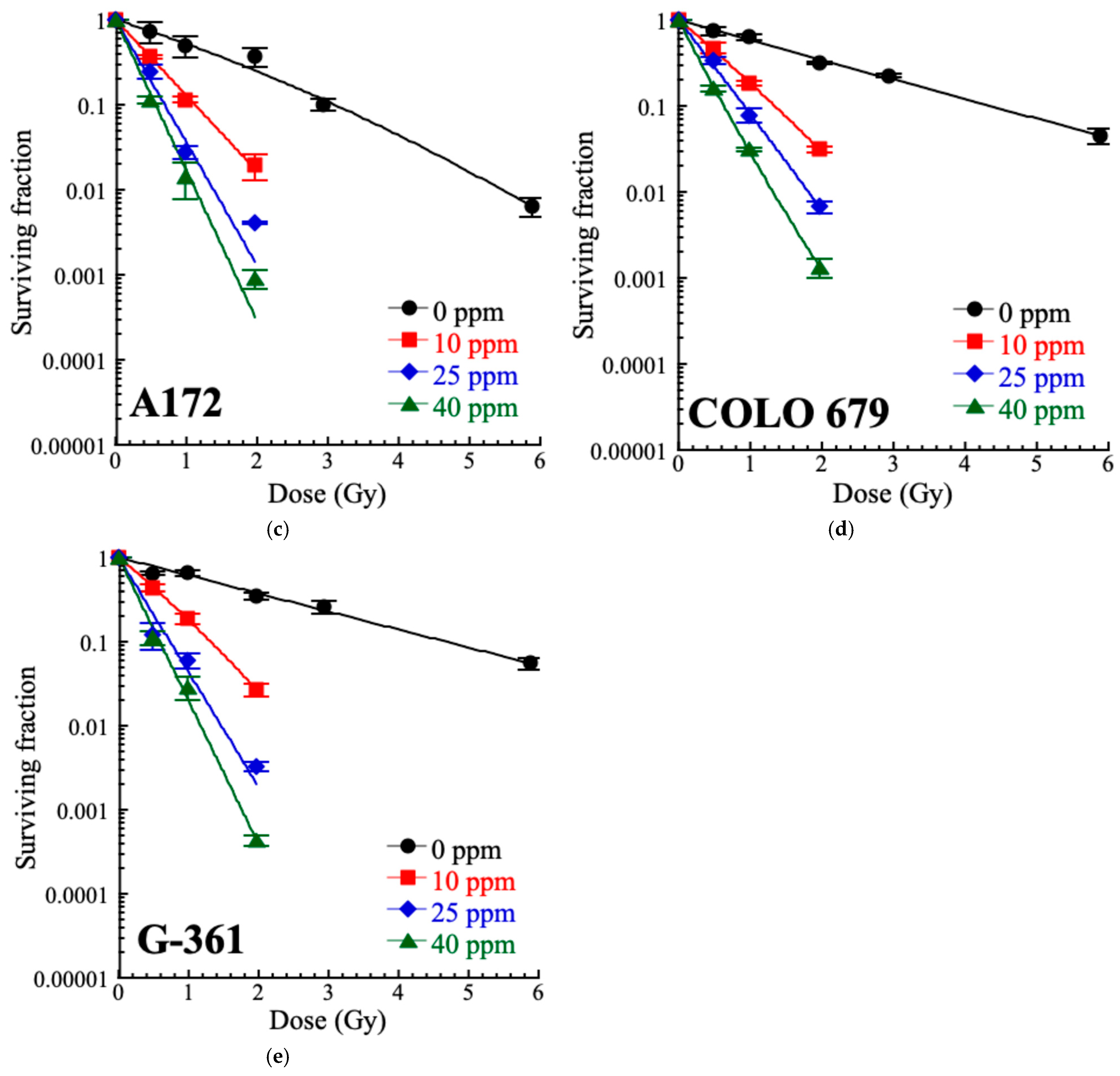
3.1.1. Clonogenic Survival Following BNCT with SPM-011
3.1.2. Determination of Biological Equivalent Dose, D50 and D10 Values
3.2. Biological Evaluation of Neutron Beam Quality Under Free-Beam Conditions
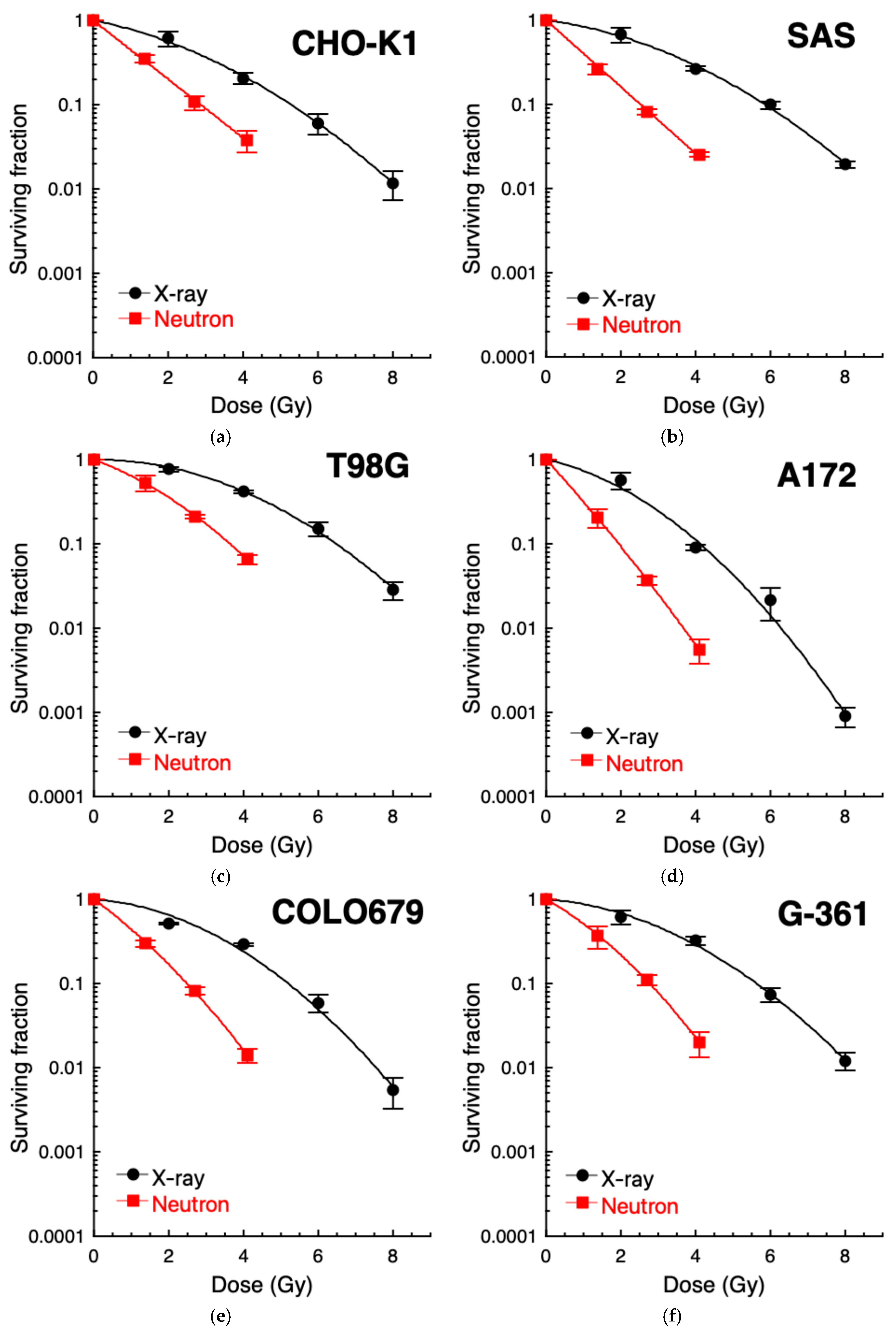
3.2.1. Clonogenic Survival Curves Following Neutron and X-Ray Irradiation
3.2.2. Determination of Biological Equivalent Dose (D10) and Relative Biological Effectiveness (RBE) of Fast Neutrons
3.3. Evaluation of Out-of-Field Leakage Radiation Dose Using a Human Phantom Model
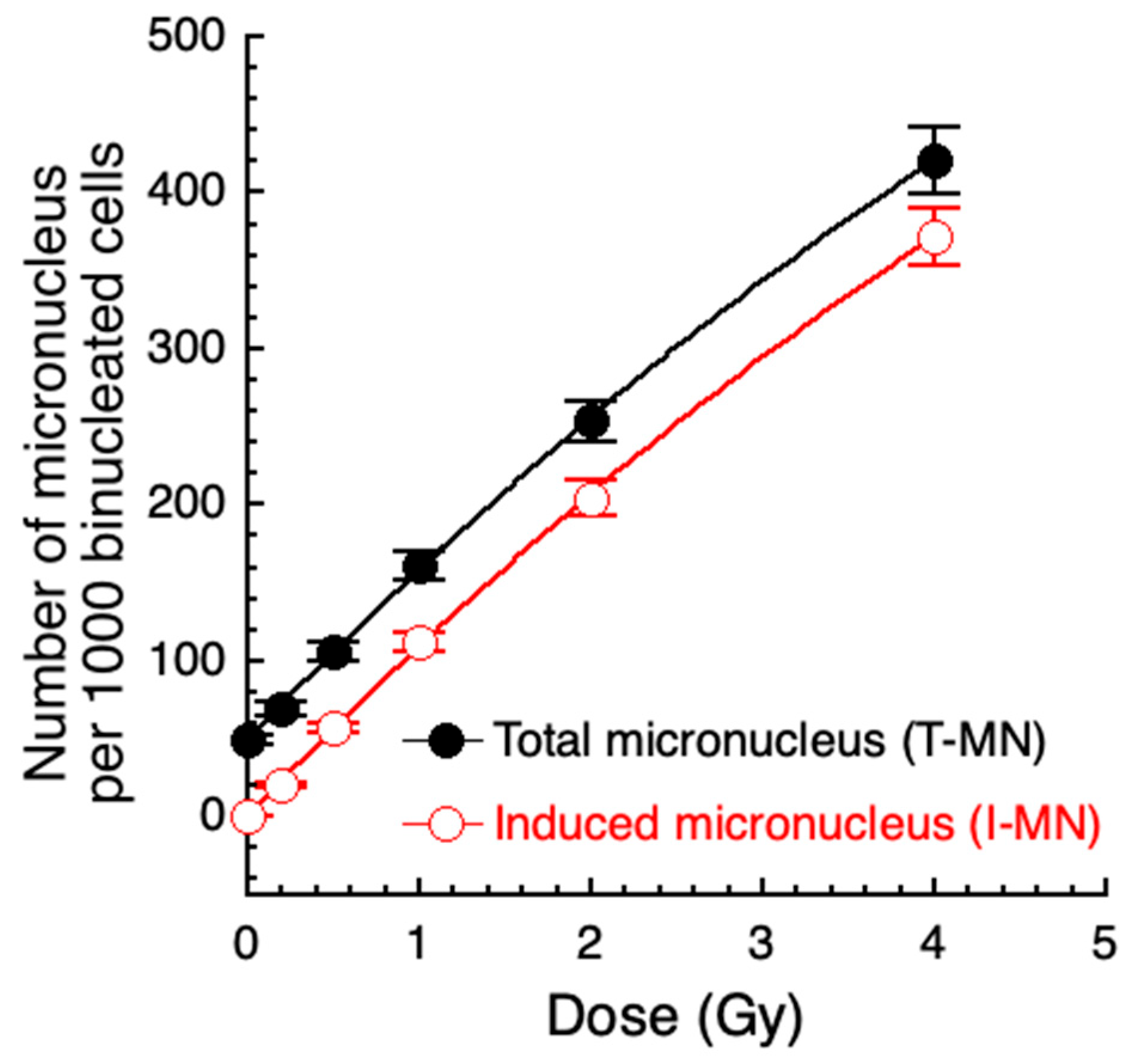
3.3.1. Dose–Response Relationship Between X-Ray Dose and Micronucleus Formation
3.3.2. Micronucleus Formation in CHO-K1 Cells Exposed to Neutron Irradiation at Different Phantom Locations
4. Discussion
5. Conclusions
Author Contributions
Funding
Institutional Review Board Statement
Informed Consent Statement
Data Availability Statement
Acknowledgments
Conflicts of Interest
Abbreviations
| BNCT | Boron Neutron Capture Therapy |
| AB-BNCT | Accelerator-Based Boron Neutron Capture Therapy |
| RBE | Relative Biological Effectiveness |
| Gy | Gray |
| GyEq | Gray Equivalent |
| 10B | Boron-10 |
| E-MEM | Eagle’s Minimum Essential Medium |
| FBS | Fetal Bovine Serum |
| PBS | Phosphate-Buffered Saline |
| LQ model | Linear–Quadratic model |
| T-MN | Total Micronucleus |
| I-MN | Induced Micronucleus |
| C-BENS | Cyclotron-Based Epithermal Neutron Source |
| CICS-1 | Cancer Intelligence Care Systems-1 |
References
- Barth, R.F.; Mi, P.; Yang, W. Boron Delivery Agents for Neutron Capture Therapy of Cancer. Cancer Commun. 2018, 38, 35. [Google Scholar] [CrossRef] [Scilit] [PubMed]
- Barth, R.F.; Vicente, M.G.H.; Harling, O.K.; Kiger, W.S.; Riley, K.J.; Binns, P.J.; Wagner, F.M.; Suzuki, M.; Aihara, T.; Kato, I.; et al. Current Status of Boron Neutron Capture Therapy of High Grade Gliomas and Recurrent Head and Neck Cancer. Radiat. Oncol. 2012, 7, 146. [Google Scholar] [CrossRef] [Scilit]
- Miyatake, S.-I.; Kawabata, S.; Hiramatsu, R.; Kuroiwa, T.; Suzuki, M.; Kondo, N.; Ono, K. Boron Neutron Capture Therapy for Malignant Brain Tumors. Neurol. Med. Chir. 2016, 56, 361–371. [Google Scholar] [CrossRef] [Scilit]
- Coderre, J.A.; Morris, G.M. The Radiation Biology of Boron Neutron Capture Therapy. Radiat. Res. 1999, 151, 1–18. [Google Scholar] [CrossRef] [Scilit]
- Blue, T.E.; Yanch, J.C. Accelerator-Based Epithermal Neutron Sources for Boron Neutron Capture Therapy of Brain Tumors. J. Neurooncol. 2003, 62, 19–31. [Google Scholar] [CrossRef] [Scilit]
- Current Status of Neutron Capture Therapy. Available online: http://www.iaea.org/publications/6168/current-status-of-neutron-capture-therapy (accessed on 6 January 2026).
- Tanaka, H.; Sakurai, Y.; Suzuki, M.; Takata, T.; Masunaga, S.; Kinashi, Y.; Kashino, G.; Liu, Y.; Mitsumoto, T.; Yajima, S.; et al. Improvement of Dose Distribution in Phantom by Using Epithermal Neutron Source Based on the Be(p,n) Reaction Using a 30 MeV Proton Cyclotron Accelerator. Appl. Radiat. Isot. 2009, 67, S258–S261. [Google Scholar] [CrossRef] [Scilit]
- Green, S.; Phoenix, B.; Nakamura, S.; Liu, Y.H.; Shu, D.; Hu, N.; Suzuki, S.; Koivunoro, H.; Kumada, H.; Tanaka, H. Accelerator Neutron Sources for BNCT: Current Status and Some Pointers for Future Development. Appl. Radiat. Isot. 2025, 217, 111656. [Google Scholar] [CrossRef] [Scilit]
- Kumada, H.; Kurihara, T.; Yoshioka, M.; Kobayashi, H.; Matsumoto, H.; Sugano, T.; Sakurai, H.; Sakae, T.; Matsumura, A. Development of Beryllium-Based Neutron Target System with Three-Layer Structure for Accelerator-Based Neutron Source for Boron Neutron Capture Therapy. Appl. Radiat. Isot. 2015, 106, 78–83. [Google Scholar] [CrossRef] [Scilit]
- Kumada, H.; Takada, K.; Tanaka, S.; Matsumoto, Y.; Naito, F.; Kurihara, T.; Sugimura, T.; Sato, M.; Matsumura, A.; Sakurai, H.; et al. Evaluation of the Characteristics of the Neutron Beam of a Linac-Based Neutron Source for Boron Neutron Capture Therapy. Appl. Radiat. Isot. 2020, 165, 109246. [Google Scholar] [CrossRef] [Scilit] [PubMed]
- Tanaka, H.; Sakurai, Y.; Suzuki, M.; Masunaga, S.; Mitsumoto, T.; Fujita, K.; Kashino, G.; Kinashi, Y.; Liu, Y.; Takada, M.; et al. Experimental Verification of Beam Characteristics for Cyclotron-Based Epithermal Neutron Source (C-BENS). Appl. Radiat. Isot. 2011, 69, 1642–1645. [Google Scholar] [CrossRef] [Scilit] [PubMed]
- Nakamura, S.; Igaki, H.; Ito, M.; Okamoto, H.; Nishioka, S.; Iijima, K.; Nakayama, H.; Takemori, M.; Imamichi, S.; Kashihara, T.; et al. Characterization of the Relationship between Neutron Production and Thermal Load on a Target Material in an Accelerator-Based Boron Neutron Capture Therapy System Employing a Solid-State Li Target. PLoS ONE 2019, 14, e0225587. [Google Scholar] [CrossRef] [Scilit]
- Kawabata, S.; Suzuki, M.; Hirose, K.; Tanaka, H.; Kato, T.; Goto, H.; Narita, Y.; Miyatake, S.-I. Accelerator-Based BNCT for Patients with Recurrent Glioblastoma: A Multicenter Phase II Study. Neuro-Oncol. Adv. 2021, 3, vdab067. [Google Scholar] [CrossRef] [Scilit]
- Hirose, K.; Konno, A.; Hiratsuka, J.; Yoshimoto, S.; Kato, T.; Ono, K.; Otsuki, N.; Hatazawa, J.; Tanaka, H.; Takayama, K.; et al. Boron Neutron Capture Therapy Using Cyclotron-Based Epithermal Neutron Source and Borofalan (10B) for Recurrent or Locally Advanced Head and Neck Cancer (JHN002): An Open-Label Phase II Trial. Radiother. Oncol. 2021, 155, 182–187. [Google Scholar] [CrossRef] [Scilit]
- Kawabata, S.; Goto, H.; Narita, Y.; Furuse, M.; Nonoguchi, N.; Shidoh-Kazuki, R.; Eza, K.; Hirose, K.; Ohno, M.; Kondo, N.; et al. Extended Follow-up of Recurrent Glioblastoma Patients Treated with Boron Neutron Capture Therapy (BNCT): Long-Term Survival from a Phase II Trial (JG002) Using Cyclotron Neutron Source and Boronophenylalanine. Appl. Radiat. Isot. 2025, 226, 112118. [Google Scholar] [CrossRef] [Scilit] [PubMed]
- Nakamura, S.; Takemori, M.; Nakaichi, T.; Shuto, Y.; Kashihara, T.; Iijima, K.; Chiba, T.; Nakayama, H.; Urago, Y.; Nishina, S.; et al. A Method for Delivering the Required Neutron Fluence in an Accelerator-Based Boron Neutron Capture Therapy System Employing a Lithium Target. Sci. Rep. 2024, 14, 11253. [Google Scholar] [CrossRef] [Scilit]
- Nakamura, S.; Igaki, H.; Ito, M.; Imamichi, S.; Kashihara, T.; Okamoto, H.; Nishioka, S.; Iijima, K.; Chiba, T.; Nakayama, H.; et al. Neutron Flux Evaluation Model Provided in the Accelerator-Based Boron Neutron Capture Therapy System Employing a Solid-State Lithium Target. Sci. Rep. 2021, 11, 8090. [Google Scholar] [CrossRef] [Scilit] [PubMed]
- Kashihara, T.; Nakamura, S.; Yamazaki, N.; Takahashi, A.; Namikawa, K.; Ogata, D.; Nakano, E.; Okuma, K.; Kaneda, T.; Mori, T.; et al. Boron Neutron Capture Therapy for Cutaneous Angiosarcoma and Malignant Melanoma: First in-Human Phase I Clinical Trial. Radiother. Oncol. 2025, 202, 110607. [Google Scholar] [CrossRef] [Scilit] [PubMed]
- Sato, T.; Masunaga, S.; Kumada, H.; Hamada, N. Microdosimetric Modeling of Biological Effectiveness for Boron Neutron Capture Therapy Considering Intra- and Intercellular Heterogeneity in 10B Distribution. Sci. Rep. 2018, 8, 988. [Google Scholar] [CrossRef] [Scilit]
- Matsumura, A.; Asano, T.; Hirose, K.; Igaki, H.; Kawabata, S.; Kumada, H. Initiatives Toward Clinical Boron Neutron Capture Therapy in Japan. Cancer Biother. Radiopharm. 2023, 38, 201–207. [Google Scholar] [CrossRef] [Scilit]
- Wittig, A.; Michel, J.; Moss, R.L.; Stecher-Rasmussen, F.; Arlinghaus, H.F.; Bendel, P.; Mauri, P.L.; Altieri, S.; Hilger, R.; Salvadori, P.A.; et al. Boron Analysis and Boron Imaging in Biological Materials for Boron Neutron Capture Therapy (BNCT). Crit. Rev. Oncol. Hematol. 2008, 68, 66–90. [Google Scholar] [CrossRef] [Scilit]
- Watanabe, T.; Sanada, Y.; Hattori, Y.; Suzuki, M. Correlation between the Expression of LAT1 in Cancer Cells and the Potential Efficacy of Boron Neutron Capture Therapy. J. Radiat. Res. 2023, 64, 91–98. [Google Scholar] [CrossRef] [Scilit]
- Kayama, R.; Tsujino, K.; Kawabata, S.; Fujikawa, Y.; Kashiwagi, H.; Fukuo, Y.; Hiramatsu, R.; Takata, T.; Tanaka, H.; Suzuki, M.; et al. Translational Research of Boron Neutron Capture Therapy for Spinal Cord Gliomas Using Rat Model. Sci. Rep. 2024, 14, 8265. [Google Scholar] [CrossRef] [Scilit]
- Sato, M.; Hirose, K.; Takeno, S.; Aihara, T.; Nihei, K.; Takai, Y.; Hayashi, T.; Bando, K.; Kimura, H.; Tsurumi, K.; et al. Safety of Boron Neutron Capture Therapy with Borofalan (10B) and Its Efficacy on Recurrent Head and Neck Cancer: Real-World Outcomes from Nationwide Post-Marketing Surveillance. Cancers 2024, 16, 869. [Google Scholar] [CrossRef] [Scilit]
- Kumada, H.; Li, Y.; Yasuoka, K.; Naito, F.; Kurihara, T.; Sugimura, T.; Sato, M.; Matsumoto, Y.; Matsumura, A.; Sakurai, H.; et al. Current Development Status of iBNCT001, Demonstrator of a LINAC-Based Neutron Source for BNCT. J. Neutron Res. 2022, 24, 347–358. [Google Scholar] [CrossRef] [Scilit]
- Kiyanagi, Y. Accelerator-Based Neutron Source for Boron Neutron Capture Therapy. Ther. Radiol. Oncol. 2018, 2, 1–13. [Google Scholar] [CrossRef] [Scilit]
- Nakai, K.; Kumada, H.; Matsumoto, Y.; Baba, K.; Murakami, M.; Ishida, T.; Saito, T.; Nakamura, M.; Numajiri, H.; Mizumoto, M.; et al. Boron Neutron Capture Therapy (BNCT) Phase I Clinical Trial for Newly Diagnosed Glioblastoma by Newly Developed Accelerator at University of Tsukuba. Appl. Radiat. Isot. 2025, 226, 112152. [Google Scholar] [CrossRef] [Scilit] [PubMed]
- Nakamura, S.; Imamichi, S.; Shimada, K.; Takemori, M.; Kanai, Y.; Iijima, K.; Chiba, T.; Nakayama, H.; Nakaichi, T.; Mikasa, S.; et al. Relative Biological Effectiveness for Epithermal Neutron Beam Contaminated with Fast Neutrons in the Linear Accelerator-Based Boron Neutron Capture Therapy System Coupled to a Solid-State Lithium Target. J. Radiat. Res. 2023, 64, 661–667. [Google Scholar] [CrossRef] [Scilit]
- Hu, N.; Suzuki, M.; Masunaga, S.-I.; Kashino, G.; Kinashi, Y.; Chen, Y.-W.; Liu, Y.; Uehara, K.; Mitsumoto, T.; Tanaka, H.; et al. Experimentally Determined Relative Biological Effectiveness of Cyclotron-Based Epithermal Neutrons Designed for Clinical BNCT: In Vitro Study. J. Radiat. Res. 2023, 64, 811–815. [Google Scholar] [CrossRef] [Scilit] [PubMed]
- Chadha, M.; Capala, J.; Coderre, J.A.; Elowitz, E.H.; Iwai, J.; Joel, D.D.; Liu, H.B.; Wielopolski, L.; Chanana, A.D. Boron Neutron-Capture Therapy (BNCT) for Glioblastoma Multiforme (GBM) Using the Epithermal Neutron Beam at the Brookhaven National Laboratory. Int. J. Radiat. Oncol. Biol. Phys. 1998, 40, 829–834. [Google Scholar] [CrossRef] [Scilit]
- Kinase, S. Study on Advanement of In Vivo Counting Using Mathematical Simulation; JAERI-Research 2003-011; Japan Atomic Energy Research Inst.: Kashiwa, Japan, 2003. [Google Scholar] [CrossRef]
- Sato, T.; Masunaga, S.-I.; Kumada, H.; Hamada, N. Depth Distributions of RBE-Weighted Dose and Photon-Isoeffective Dose for Boron Neutron Capture Therapy. Radiat. Prot. Dosimetry 2019, 183, 247–250. [Google Scholar] [CrossRef] [Scilit] [PubMed]
- Imamichi, S.; Matsumoto, Y.; Matsuda, T.; Nakamura, S.; Shimada, M.; Yamanishi, H.; Masutani, M.; Suzuki, M. Radiobiological Characterization of Neutron Irradiation Field of UTR-KINKI for the Research Utility toward Boron Neutron Capture Therapy: Cell Killing Effect and Its Enhancement by 4-Borono-L-Phenylalanine. Prog. Nucl. Sci. Technol. 2025, 7, 377–380. [Google Scholar] [CrossRef] [Scilit]
- Shuto, Y.; Nakamura, S.; Imamichi, S.; Shimada, K.; Takemori, M.; Kasai, Y.; Nakaichi, T.; Nakayama, H.; Kobayashi, Y.; Yonemura, M.; et al. Relative Biological Effectiveness of an Accelerator-Based BNCT System Coupled to a Solid-State Lithium Target: Two Different Approaches for Neutron Beams. Appl. Radiat. Isot. 2025, 222, 111834. [Google Scholar] [CrossRef] [Scilit]
- Takada, K.; Kumada, H.; Isobe, T.; Terunuma, T.; Kamizawa, S.; Sakurai, H.; Sakae, T.; Matsumura, A. Whole-Body Dose Evaluation with an Adaptive Treatment Planning System for Boron Neutron Capture Therapy. Radiat. Prot. Dosim. 2015, 167, 584–590. [Google Scholar] [CrossRef] [Scilit]
- Kakino, R.; Hu, N.; Tanaka, H.; Takeno, S.; Aihara, T.; Nihei, K.; Ono, K. Out-of-Field Dosimetry Using a Validated PHITS Model and Computational Phantom in Clinical BNCT. Med. Phys. 2024, 51, 1351–1363. [Google Scholar] [CrossRef] [Scilit]
- Verdera, A.; Torres-Sánchez, P.; Praena, J.; Porras, I. Study of the Out-of-Field Dose from an Accelerator-Based Neutron Source for Boron Neutron Capture Therapy. Appl. Radiat. Isot. 2024, 212, 111458. [Google Scholar] [CrossRef] [Scilit]
- Tsukamoto, T.; Tanaka, H.; Yoshinaga, H.; Mitsumoto, T.; Maruhashi, A.; Ono, K.; Sakurai, Y. A Phantom Experiment for the Evaluation of Whole Body Exposure during BNCT Using Cyclotron-Based Epithermal Neutron Source (C-BENS). Appl. Radiat. Isot. 2011, 69, 1830–1833. [Google Scholar] [CrossRef] [Scilit] [PubMed]
- Masunaga, S.-I.; Sanada, Y.; Takata, T.; Tanaka, H.; Sakurai, Y.; Suzuki, M.; Kirihata, M.; Ono, K. The Impact of TP53 Status of Tumor Cells Including the Type and the Concentration of Administered 10B Delivery Agents on Compound Biological Effectiveness in Boron Neutron Capture Therapy. J. Radiat. Res. 2023, 64, 399–411. [Google Scholar] [CrossRef] [Scilit] [PubMed]
- Ono, K.; Masunaga, S.I.; Kinashi, Y.; Takagaki, M.; Akaboshi, M.; Kobayashi, T.; Akuta, K. Radiobiological Evidence Suggesting Heterogeneous Microdistribution of Boron Compounds in Tumors: Its Relation to Quiescent Cell Population and Tumor Cure in Neutron Capture Therapy. Int. J. Radiat. Oncol. Biol. Phys. 1996, 34, 1081–1086. [Google Scholar] [CrossRef] [Scilit]
- Dagrosa, M.A.; Crivello, M.; Perona, M.; Thorp, S.; Santa Cruz, G.A.; Pozzi, E.; Casal, M.; Thomasz, L.; Cabrini, R.; Kahl, S.; et al. First Evaluation of the Biologic Effectiveness Factors of Boron Neutron Capture Therapy (BNCT) in a Human Colon Carcinoma Cell Line. Int. J. Radiat. Oncol. Biol. Phys. 2011, 79, 262–268. [Google Scholar] [CrossRef] [Scilit] [PubMed]
- Kartini, D.A.; Malad, Y.; Karoon, P.; Kondo, N.; Sakurai, Y.; Talabnin, K.; Talabnin, C.; Kobdaj, C. Boron Neutron Capture Therapy (BNCT) Induces DNA Damage on Human Cholangiocarcinoma Cell Line. Phys. Medica 2026, 142, 105728. [Google Scholar] [CrossRef] [Scilit]







| 10B Concentration | Biological Equivalent Dose, D50 Values (Gy) | ||||
|---|---|---|---|---|---|
| SAS | T98G | A172 | COLO679 | G-361 | |
| 0 | 1.03 ± 0.14 | 2.38 ± 0.09 | 1.39 ± 0.57 | 1.63 ± 0.44 | 1.67 ± 0.42 |
| 10 | 0.21 ± 0.01 | 0.72 ± 0.05 | 0.44 ± 0.12 | 0.50 ± 0.10 | 0.51 ± 0.09 |
| 25 | 0.12 ± 0.01 | 0.37 ± 0.02 | 0.17 ± 0.01 | 0.31 ± 0.04 | 0.24 ± 0.08 |
| 40 | 0.09 ± 0.01 | 0.32 ± 0.04 | 0.13 ± 0.01 | 0.20 ± 0.02 | 0.20 ± 0.03 |
| 10B Concentration | Biological Equivalent Dose, D10 Values (Gy) | ||||
|---|---|---|---|---|---|
| SAS | T98G | A172 | COLO679 | G-361 | |
| 0 | 3.84 ± 0.15 | 8.11 ± 0.38 | 4.58 ± 1.89 | 5.66 ± 1.35 | 5.81 ± 1.29 |
| 10 | 0.71 ± 0.05 | 2.08 ± 0.08 | 1.48 ± 0.38 | 1.62 ± 0.32 | 1.62 ± 0.32 |
| 25 | 0.41 ± 0.04 | 1.30 ± 0.15 | 0.60 ± 0.04 | 1.03 ± 0.14 | 0.79 ± 0.26 |
| 40 | 0.32 ± 0.03 | 0.99 ± 0.08 | 0.46 ± 0.05 | 0.69 ± 0.07 | 066 ± 0.10 |
| Cells | Biological Equivalent Dose, D10 (Gy) | RBE | |
|---|---|---|---|
| X-Ray | Fast Neutron (γ-Corrected) | ||
| CHO-K1 | 4.60 ± 0.19 | 2.28 ± 0.17 | 2.02 |
| SAS | 5.31 ± 0.12 | 1.95 ± 0.09 | 2.72 |
| T98G | 5.75 ± 0.20 | 2.93 ± 0.05 | 1.96 |
| A172 | 3.69 ± 0.15 | 1.52 ± 0.15 | 2.43 |
| COLO679 | 4.59 ± 0.05 | 2.00 ± 0.08 | 2.30 |
| G-361 | 5.01 ± 0.24 | 2.15 ± 0.20 | 2.33 |
| X-Rays Dose (Gy) | Total Micronucleus (T-MN) | Induced Micronucleus (I-MN) |
|---|---|---|
| 0 | 49.0 ± 2.9 | 0.0 ± 0.0 |
| 0.2 | 69.3 ± 4.4 | 20.3 ± 1.7 |
| 0.5 | 106.0 ± 6.1 | 57.0 ± 3.5 |
| 1.0 | 160.7 ± 9.3 | 111.7 ± 6.5 |
| 2.0 | 253.3 ± 12.6 | 204.3 ± 11.0 |
| 4.0 | 420.3 ± 21.1 | 371.3 ± 18.4 |
| Condition or Anatomical Location | Total Micronuclei (T-MN) | Induced Micronuclei (I-MN) | Estimated Leakage- Equivalent Dose (GyEq) |
|---|---|---|---|
| non-irradiation | 44.7 ± 3.5 | 0.3 ± 2.8 | NA |
| non-irradiation (with SPM-011) | 44.3 ± 3.8 | 0.0 ± 0.0 | 0.00 |
| neck | 184.3 ± 6.5 | 140.0 ± 10.3 | 1.31 |
| chest | 104.3 ± 7.2 | 60.0 ± 4.0 | 0.54 |
| abdomen | 88.0 ± 5.5 | 43.7 ± 7.2 | 0.39 |
| inguinal region | 81.7 ± 5.0 | 37.3 ± 3.2 | 0.33 |
| thigh | 86.0 ± 4.4 | 41.0 ± 2.9 | 0.37 |
| shin | 73.3 ± 5.0 | 31.0 ± 1.5 | 0.28 |
| ankle | 65.0 ± 3.8 | 20.0 ± 1.2 | 0.18 |
Disclaimer/Publisher’s Note: The statements, opinions and data contained in all publications are solely those of the individual author(s) and contributor(s) and not of MDPI and/or the editor(s). MDPI and/or the editor(s) disclaim responsibility for any injury to people or property resulting from any ideas, methods, instructions or products referred to in the content. |
© 2026 by the authors. Licensee MDPI, Basel, Switzerland. This article is an open access article distributed under the terms and conditions of the Creative Commons Attribution (CC BY) license.
Share and Cite
Matsumoto, Y.; Sugawara, Y.; Nakai, K.; Kumada, H.; Takeuchi, H.; Takada, K.; Sugimura, T.; Sato, M.; Hashimoto, K.; Fang, Z.; et al. Preclinical Validation of the iBNCT001 Accelerator System for Boron Neutron Capture Therapy: In Vitro Efficacy, Beam Quality, and Radiation Safety Evaluation. Appl. Sci. 2026, 16, 1752. https://doi.org/10.3390/app16041752
Matsumoto Y, Sugawara Y, Nakai K, Kumada H, Takeuchi H, Takada K, Sugimura T, Sato M, Hashimoto K, Fang Z, et al. Preclinical Validation of the iBNCT001 Accelerator System for Boron Neutron Capture Therapy: In Vitro Efficacy, Beam Quality, and Radiation Safety Evaluation. Applied Sciences. 2026; 16(4):1752. https://doi.org/10.3390/app16041752
Chicago/Turabian StyleMatsumoto, Yoshitaka, Yu Sugawara, Kei Nakai, Hiroaki Kumada, Haru Takeuchi, Kenta Takada, Takashi Sugimura, Masaharu Sato, Koichi Hashimoto, Zhigao Fang, and et al. 2026. "Preclinical Validation of the iBNCT001 Accelerator System for Boron Neutron Capture Therapy: In Vitro Efficacy, Beam Quality, and Radiation Safety Evaluation" Applied Sciences 16, no. 4: 1752. https://doi.org/10.3390/app16041752
APA StyleMatsumoto, Y., Sugawara, Y., Nakai, K., Kumada, H., Takeuchi, H., Takada, K., Sugimura, T., Sato, M., Hashimoto, K., Fang, Z., Naito, F., & Sakurai, H. (2026). Preclinical Validation of the iBNCT001 Accelerator System for Boron Neutron Capture Therapy: In Vitro Efficacy, Beam Quality, and Radiation Safety Evaluation. Applied Sciences, 16(4), 1752. https://doi.org/10.3390/app16041752