SPH Simulation of Molten-Fluid Flows with a Plastic Surface Skin: A Lava-Flow-Oriented Model Study
 , ,
, ,  , and
, and
Abstract
1. Introduction
2. Computational Method
2.1. Governing Equations
2.2. Discretization of Governing Equations in SPH Method
2.2.1. Treatment of Physical Quantities and Differential Operators in SPH
2.2.2. Discretization of Navier–Stokes Equation
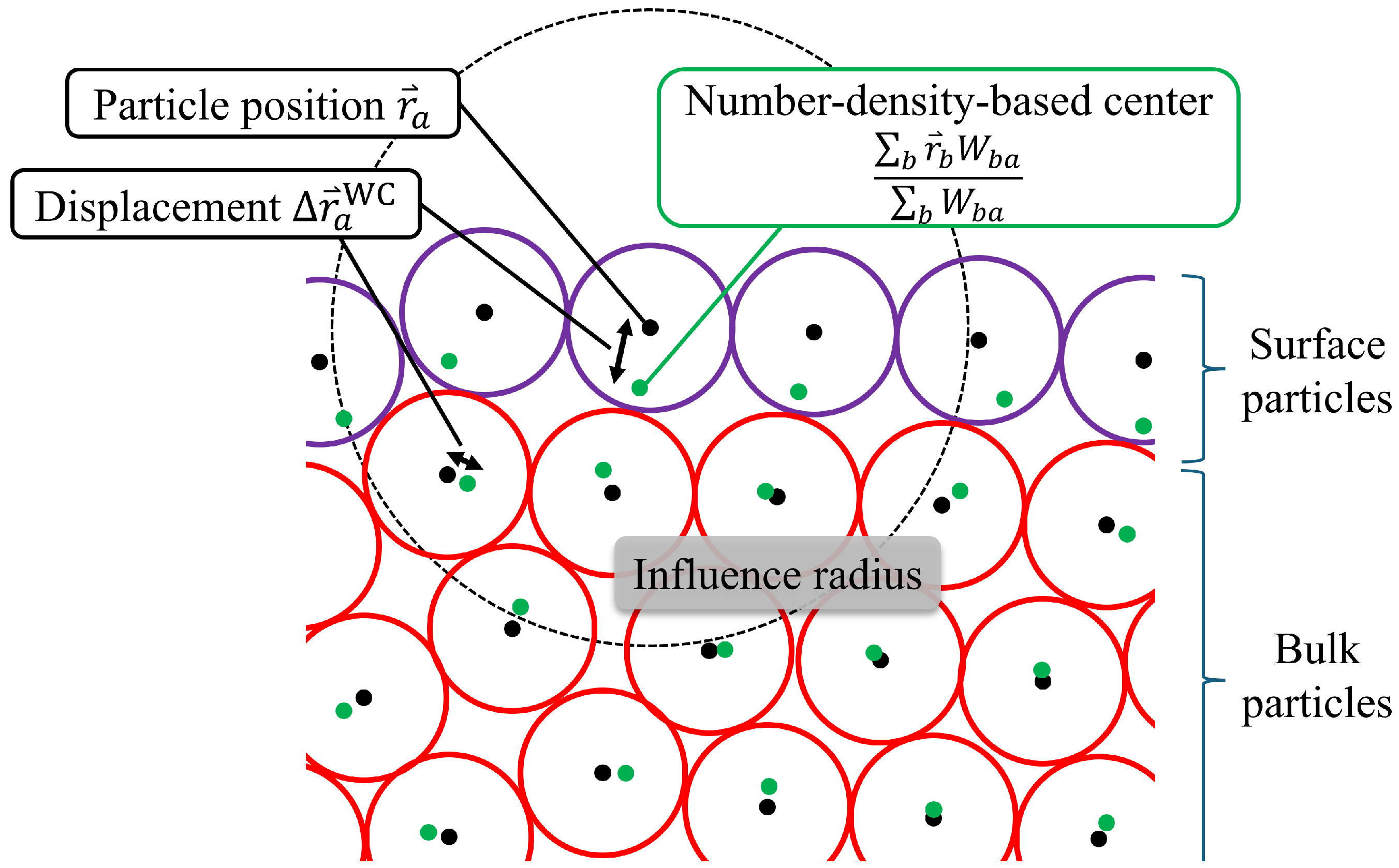
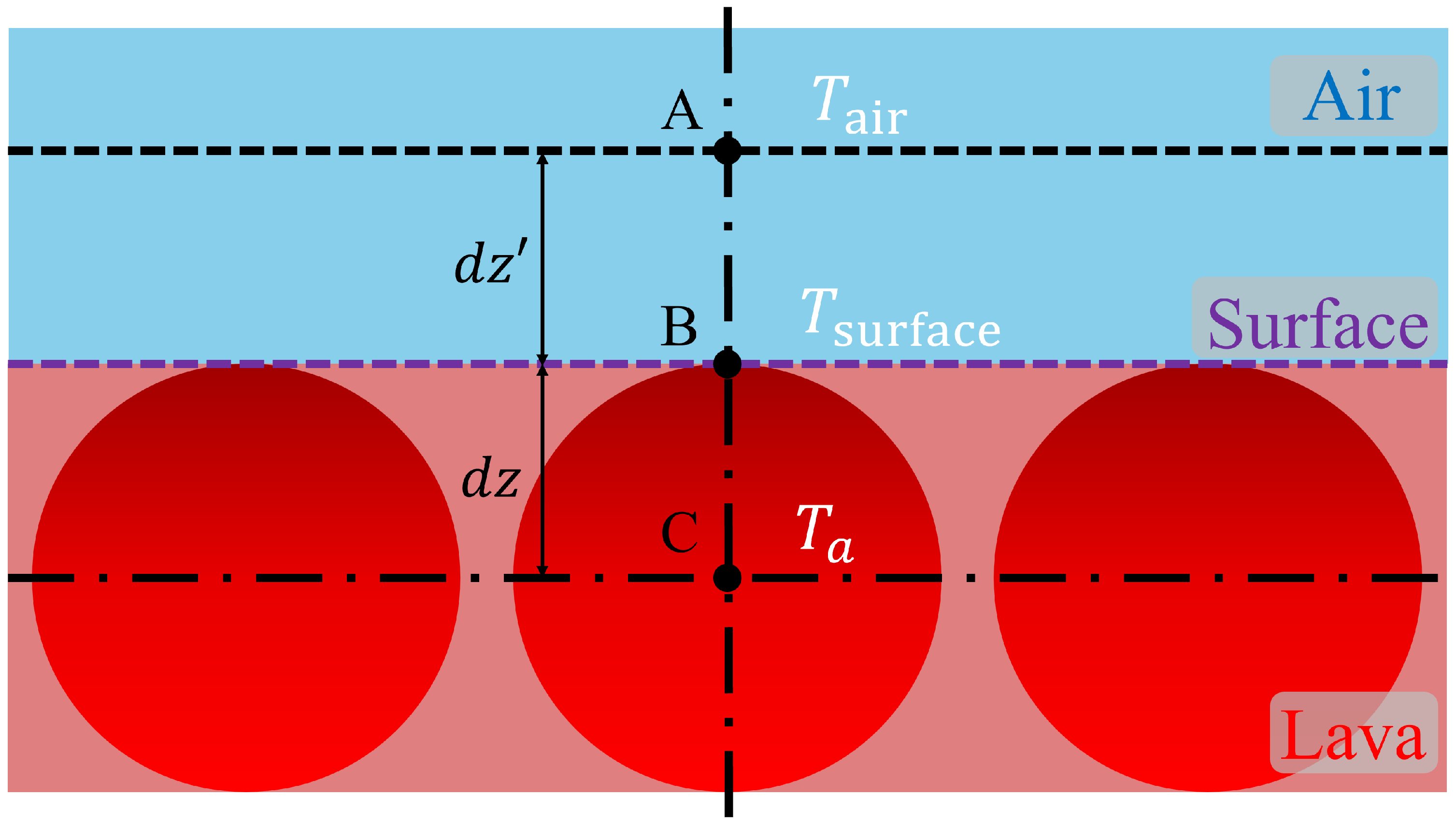
2.2.3. Discretization of Enthalpy Transport Equation

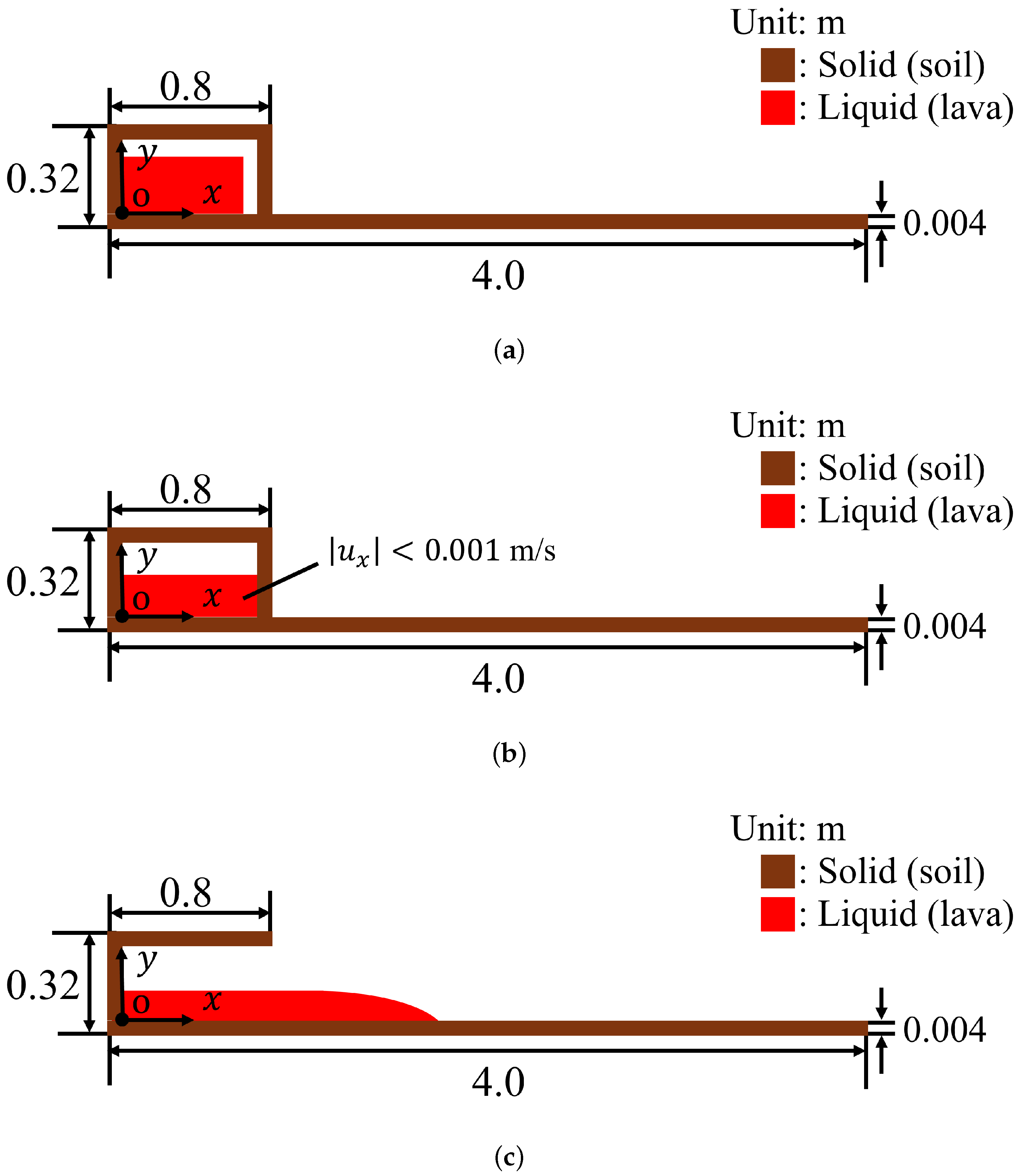
2.3. Computational Conditions
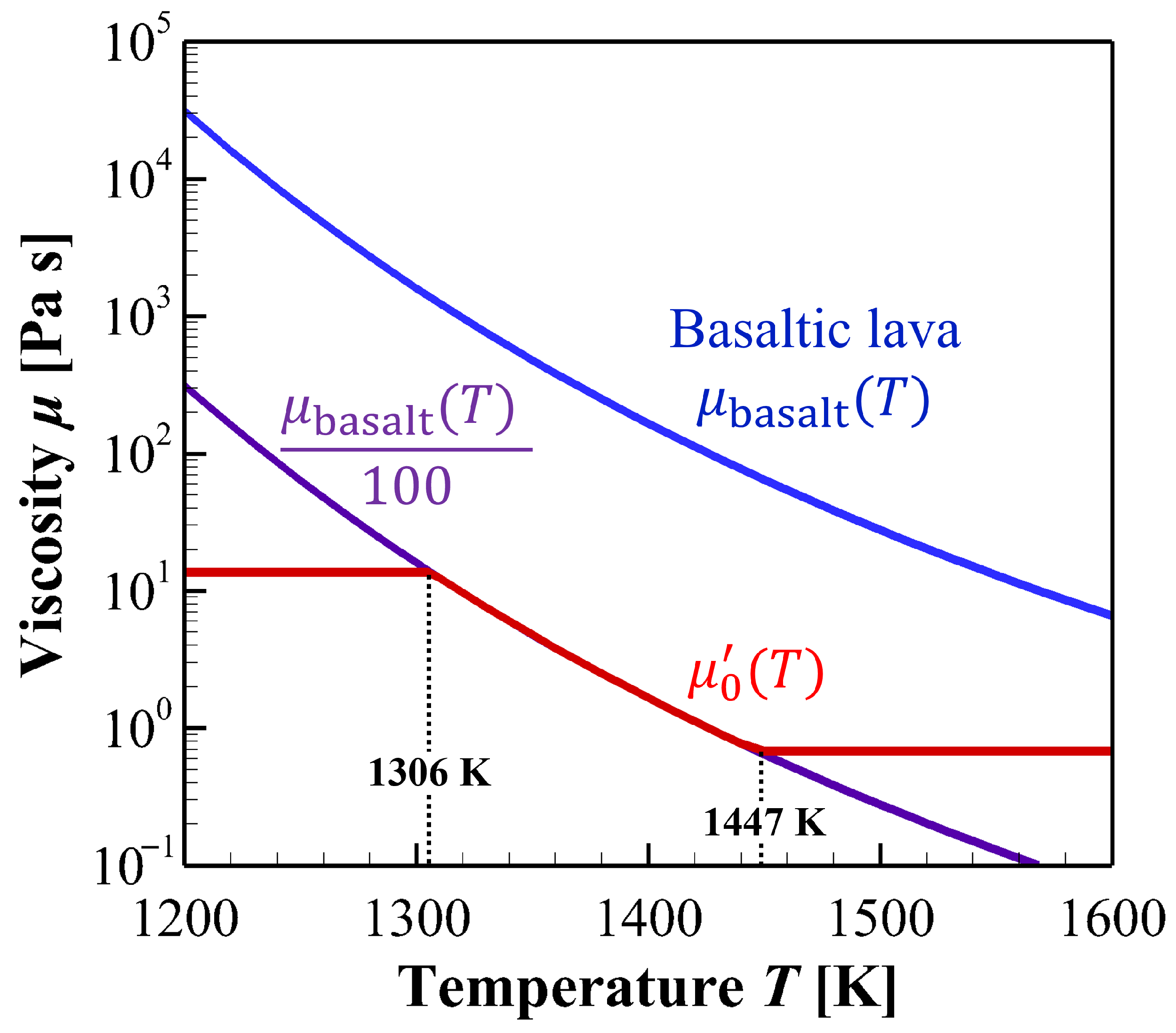
Modeling of Lava Properties
- N: Newtonian fluid with a constant viscosity of
- TN: Newtonian fluid with temperature-dependent viscosity ()
- B: Bingham fluid with a constant reference viscosity of
- TB: Bingham fluid with temperature-dependent viscosity
3. Results and Discussion
3.1. Validation and Physical Interpretation of Numerical Simulations
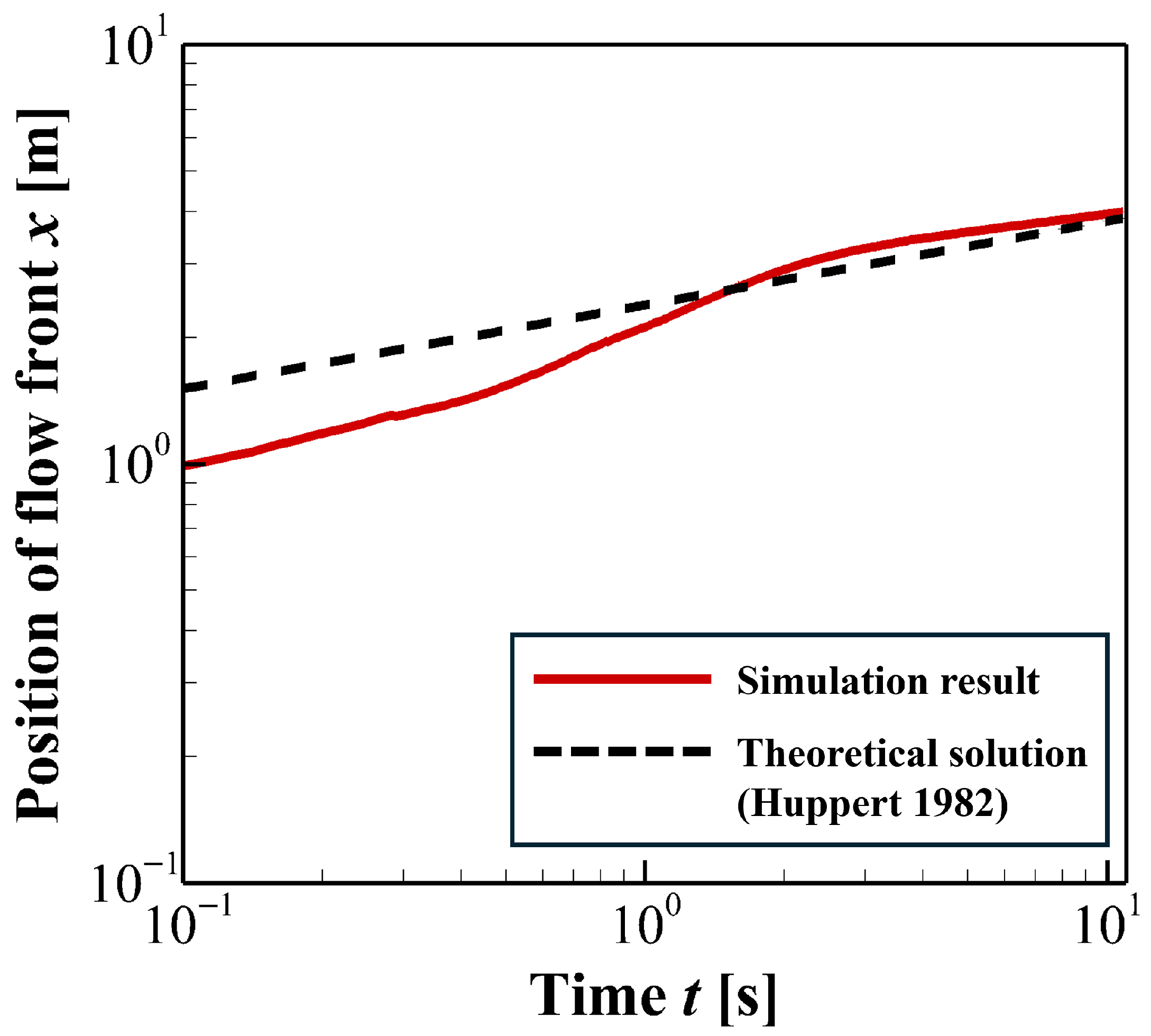
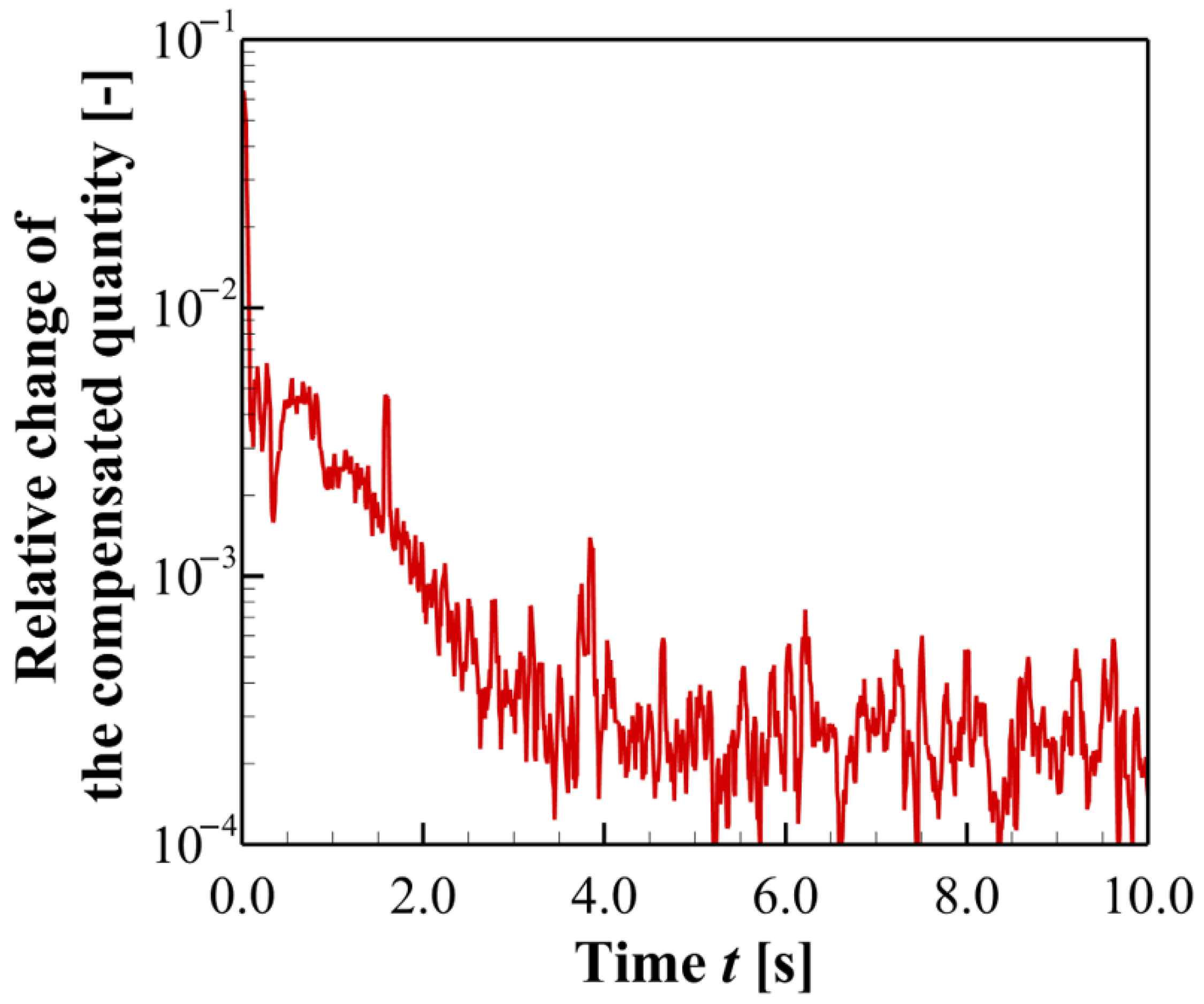
3.1.1. Validation for Newtonian Fluid via Similarity Solution
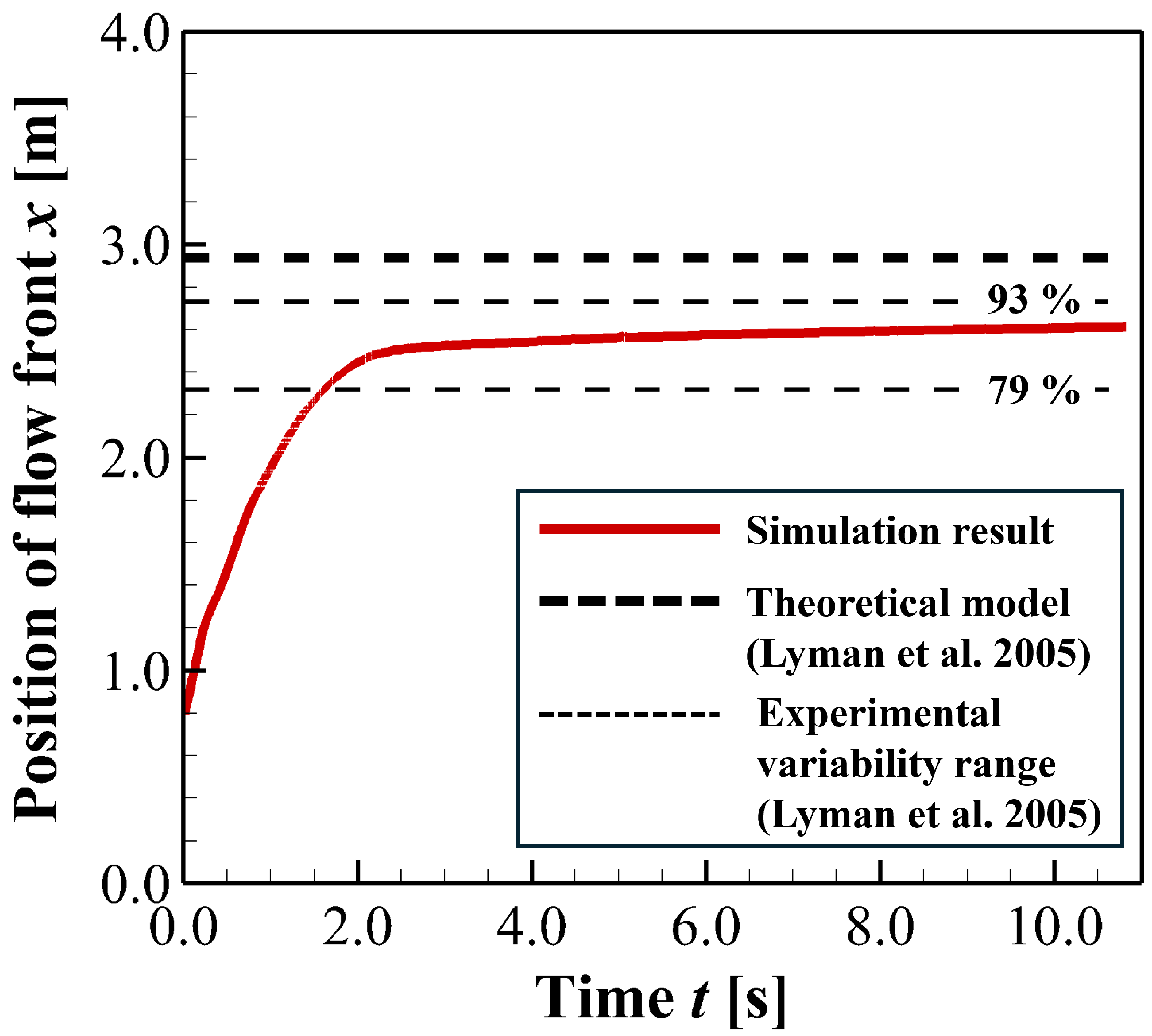
3.1.2. Validation for Bingham Fluid via Theoretical Stopping Length
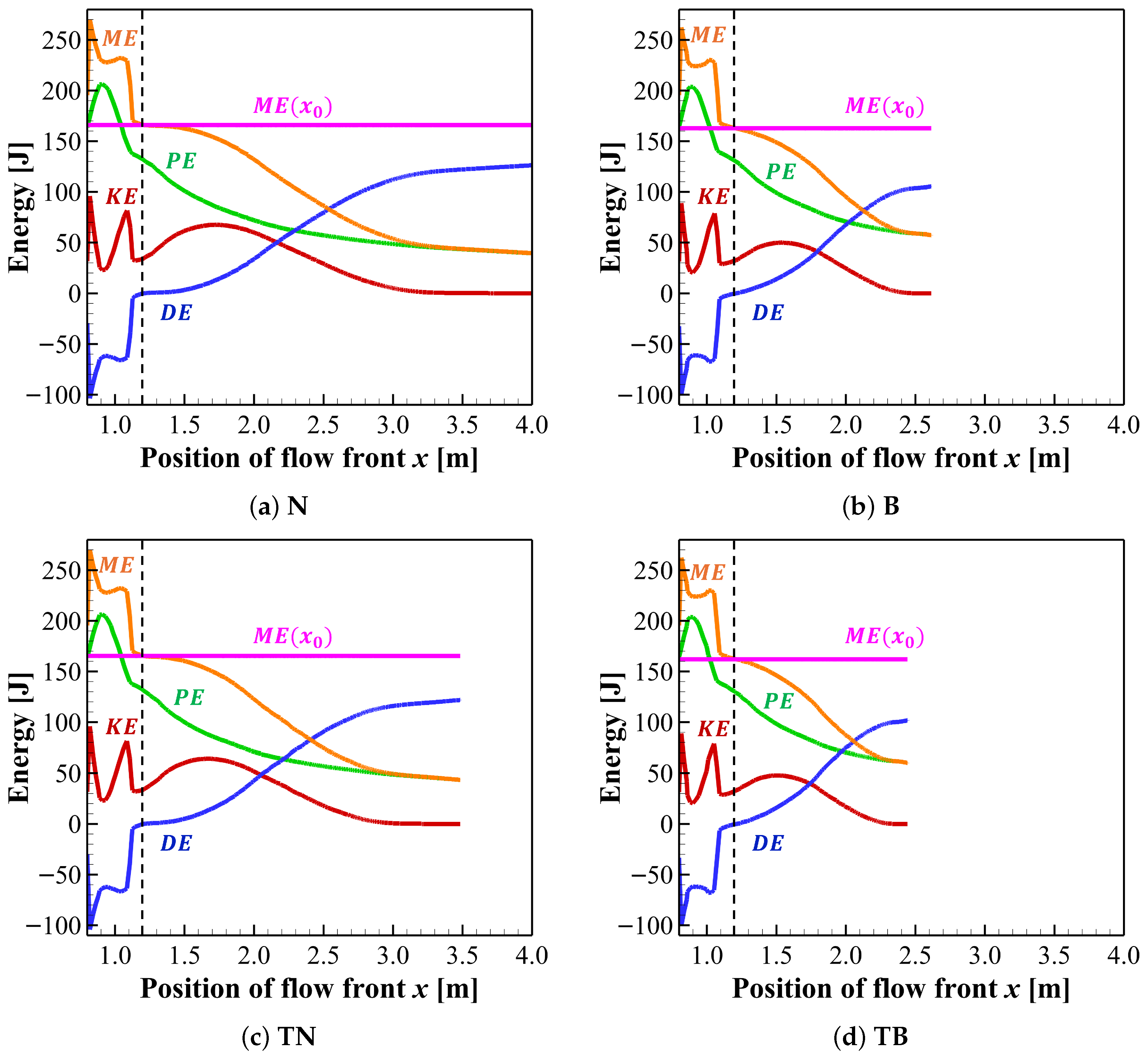
3.1.3. Evaluation Based on Mechanical Energy Framework
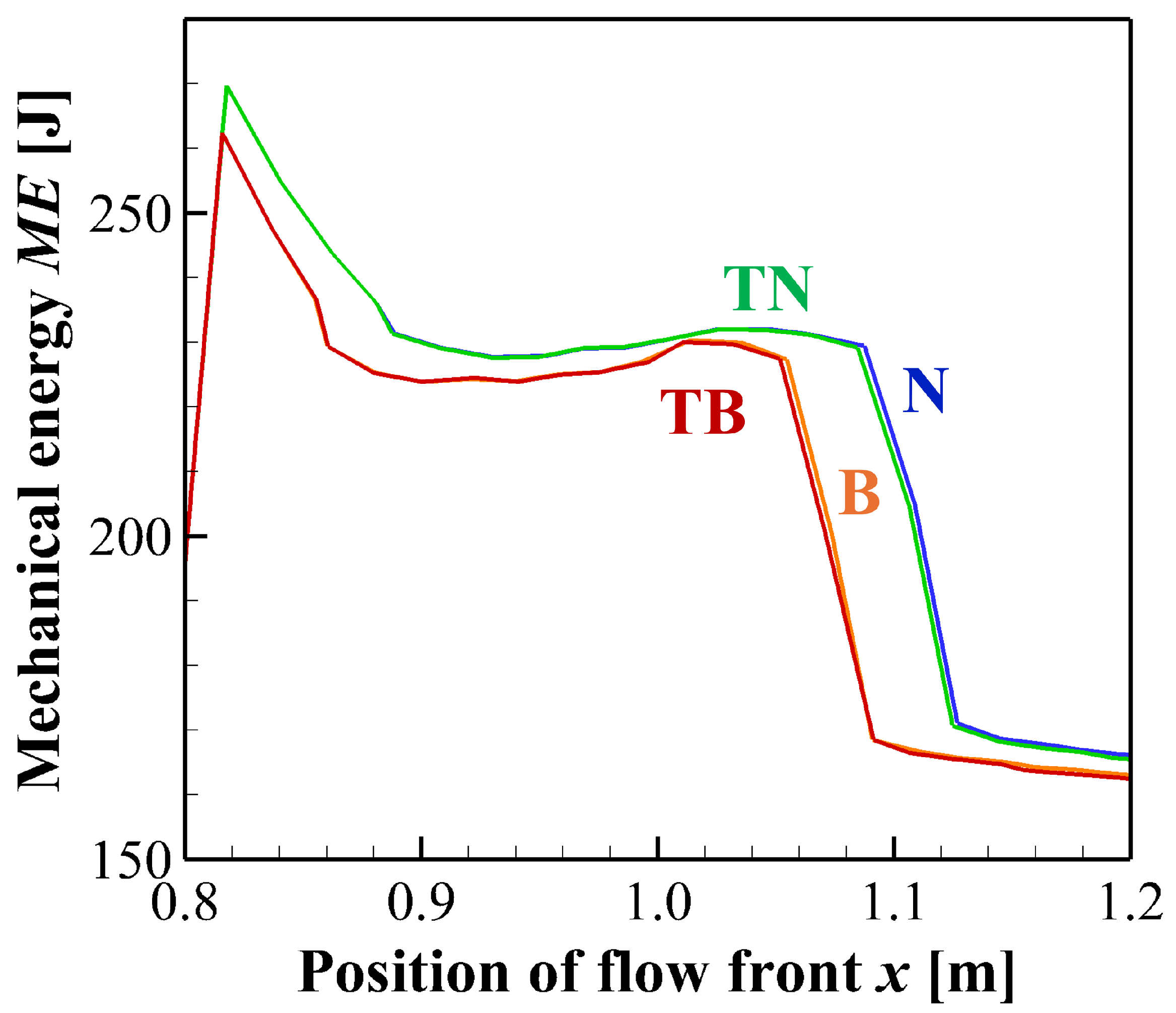
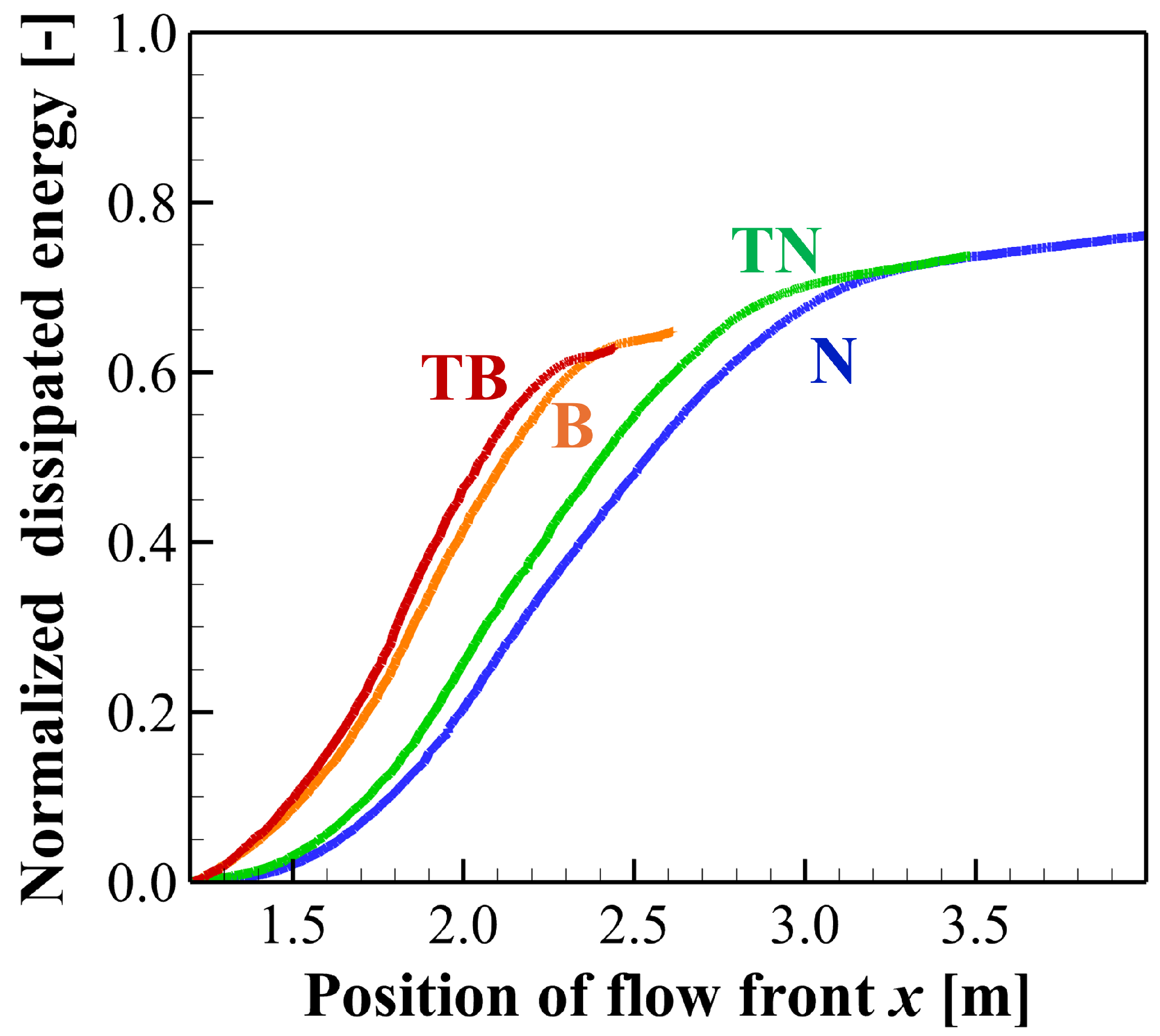
- Here, x denotes the position of the flow front, and is the reference mechanical energy. The energies are evaluated by summing the contributions of all lava particles at the time when the flow front reaches the position x. It should be noted that is defined here as the loss of mechanical energy from the reference state. It includes not only physical dissipation but also other energy losses associated with numerical diffusion. In this study, is used as an effective measure of energy loss to analyze the relative contribution of dissipation among different conditions.
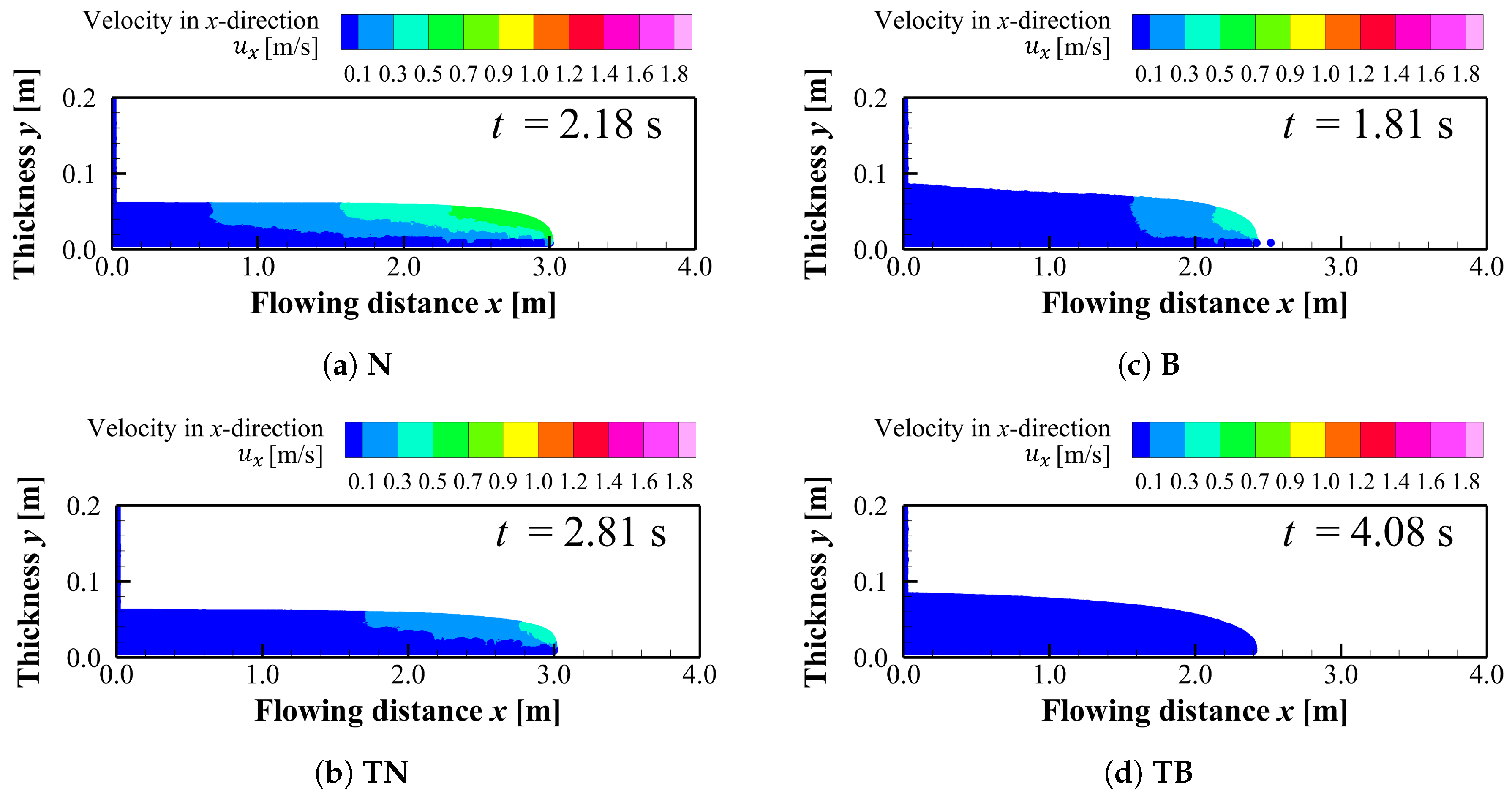
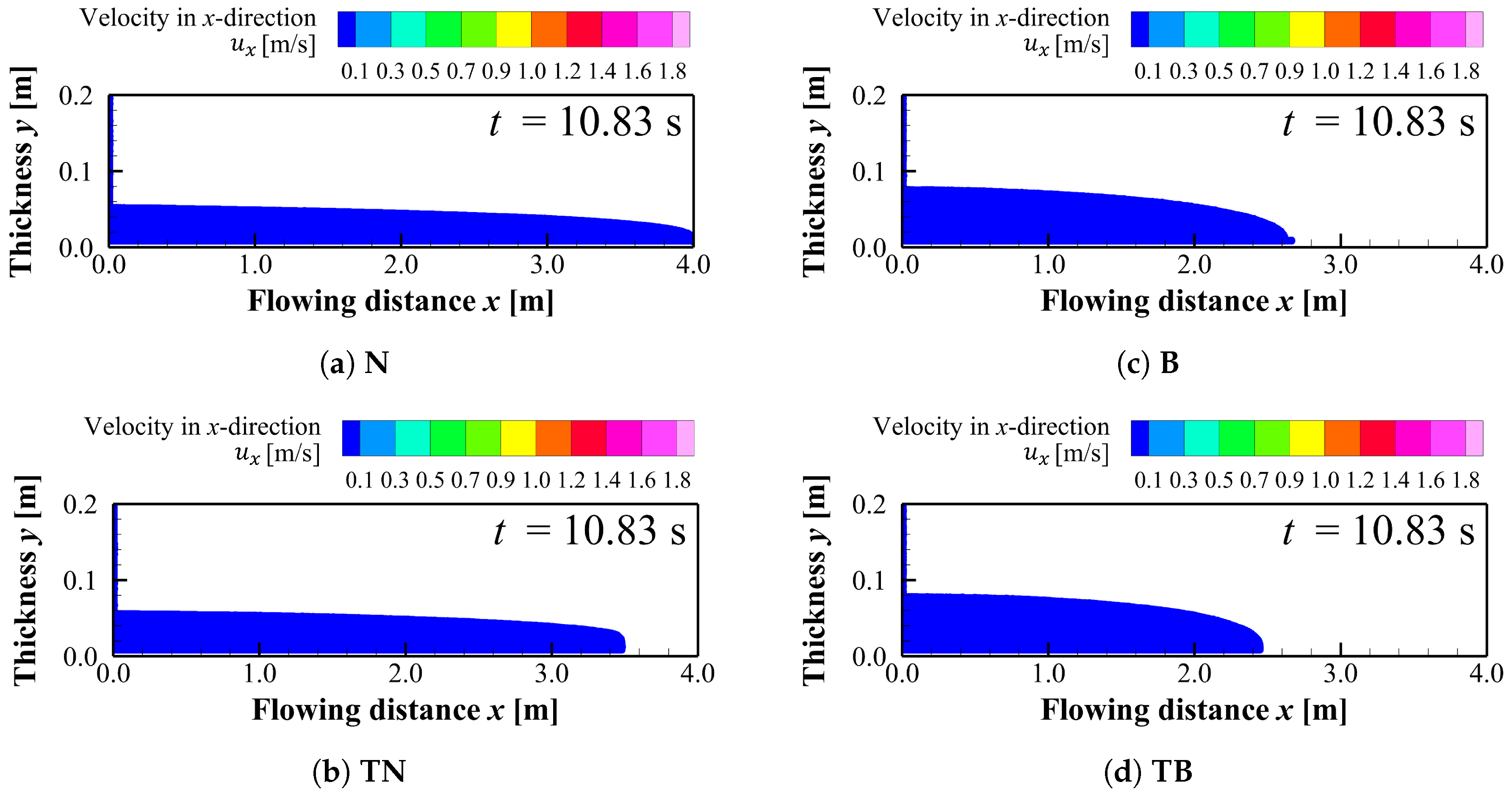
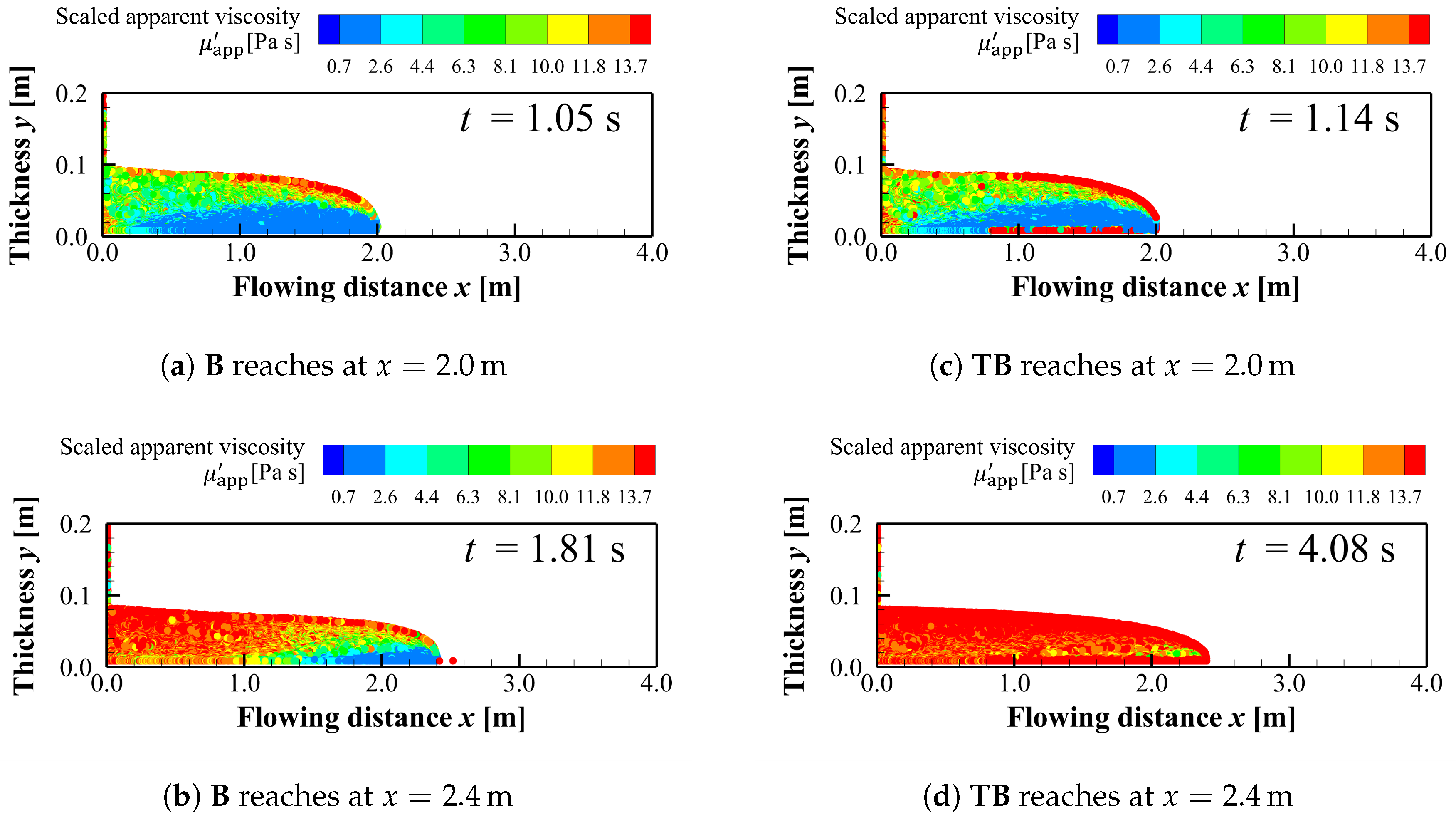
3.2. Effects of Bingham Behavior on Flow Deceleration and Distance
3.3. Effects of Skin Formation on Flow Deceleration and Distance
4. Conclusions
- 1.
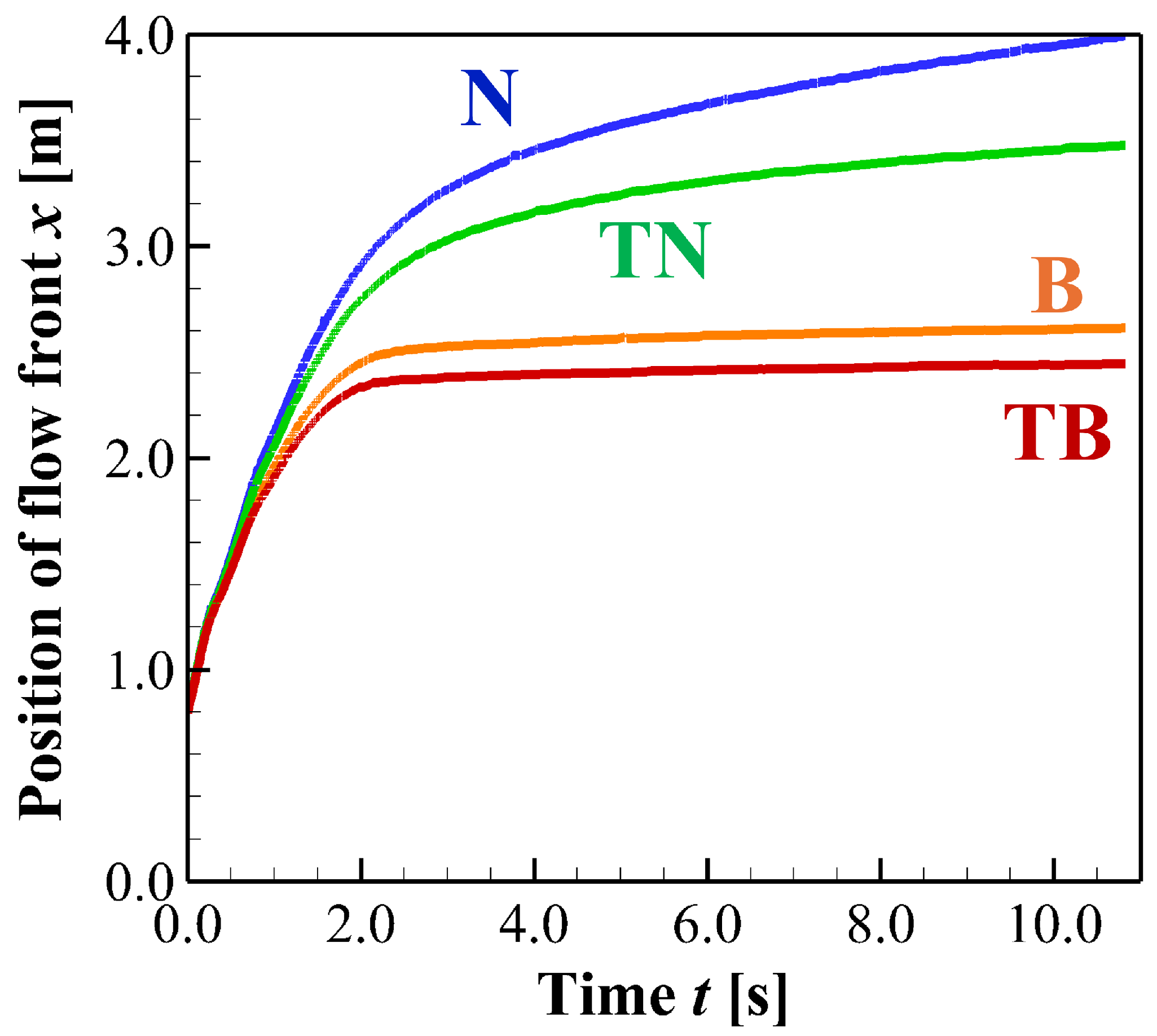
- The numerical results obtained for the isothermal Newtonian condition showed reasonable agreement with established theoretical solution [26] in terms of the time evolution of the flow. In addition, the results for the isothermal Bingham condition were consistent with theoretical prediction [13] regarding the final stopping position of the flow. These agreements support the validity of the present simulation framework for describing viscous-dominated and yield-stress-controlled flow behavior.
- 2.
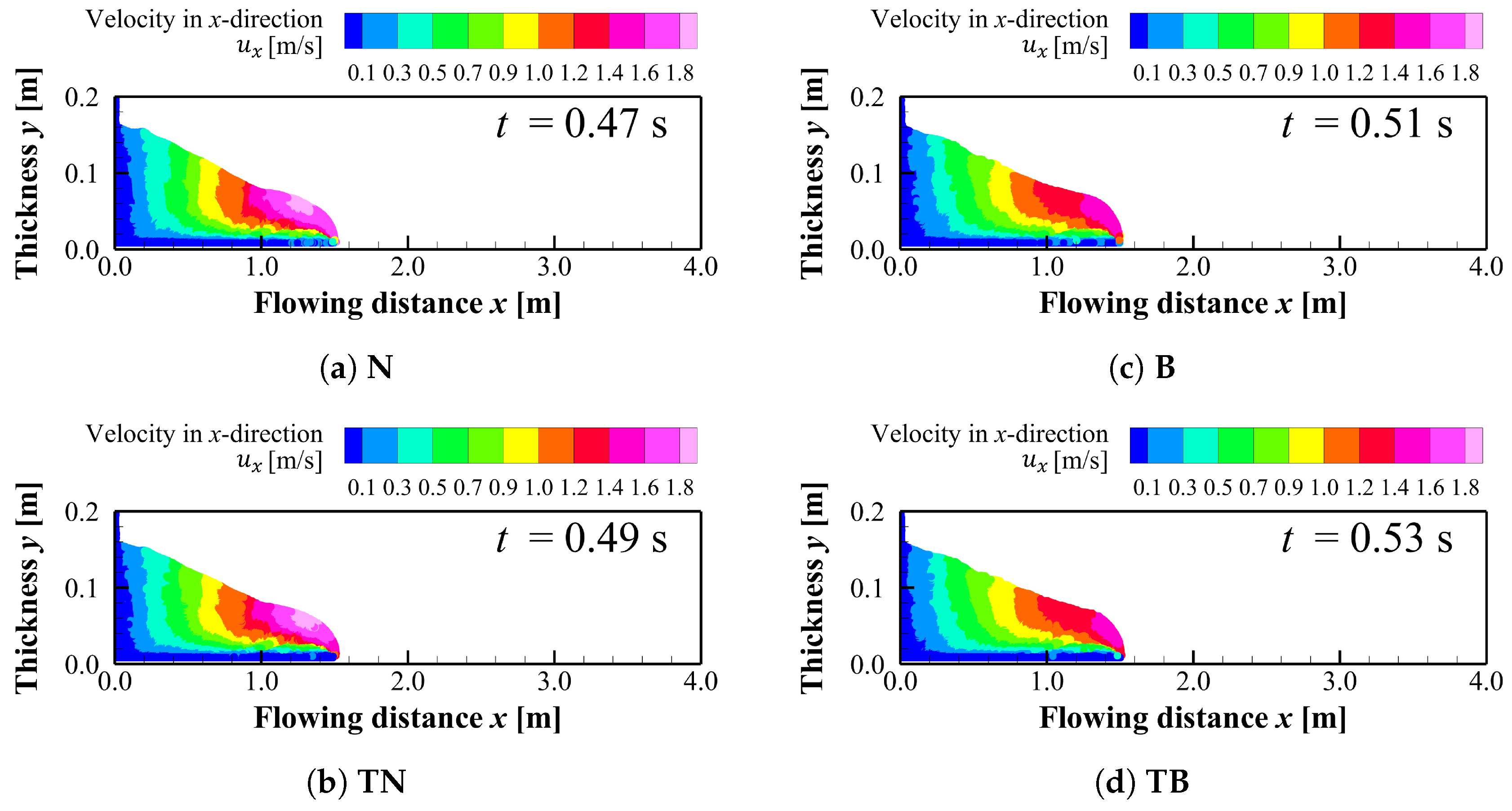
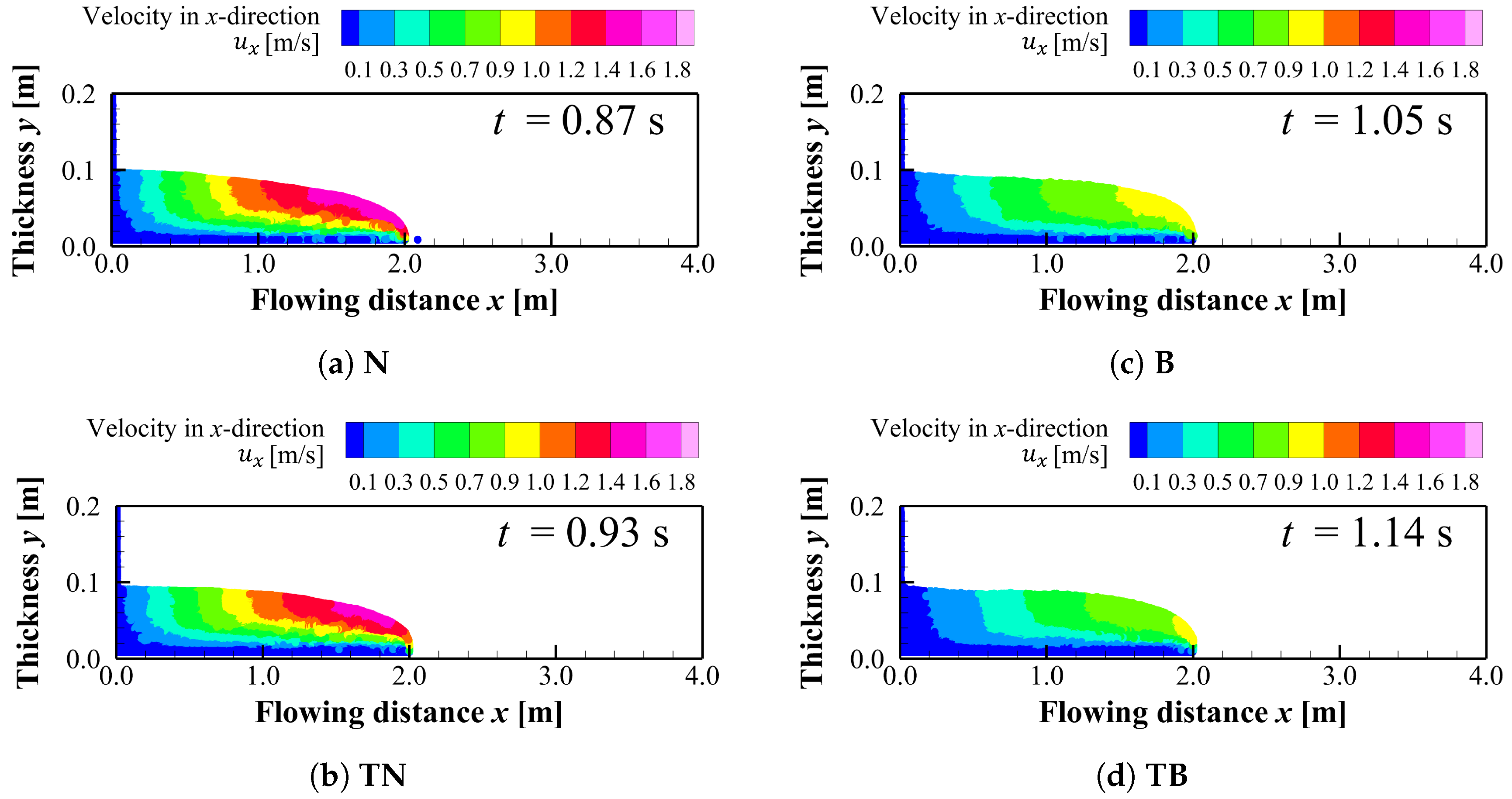
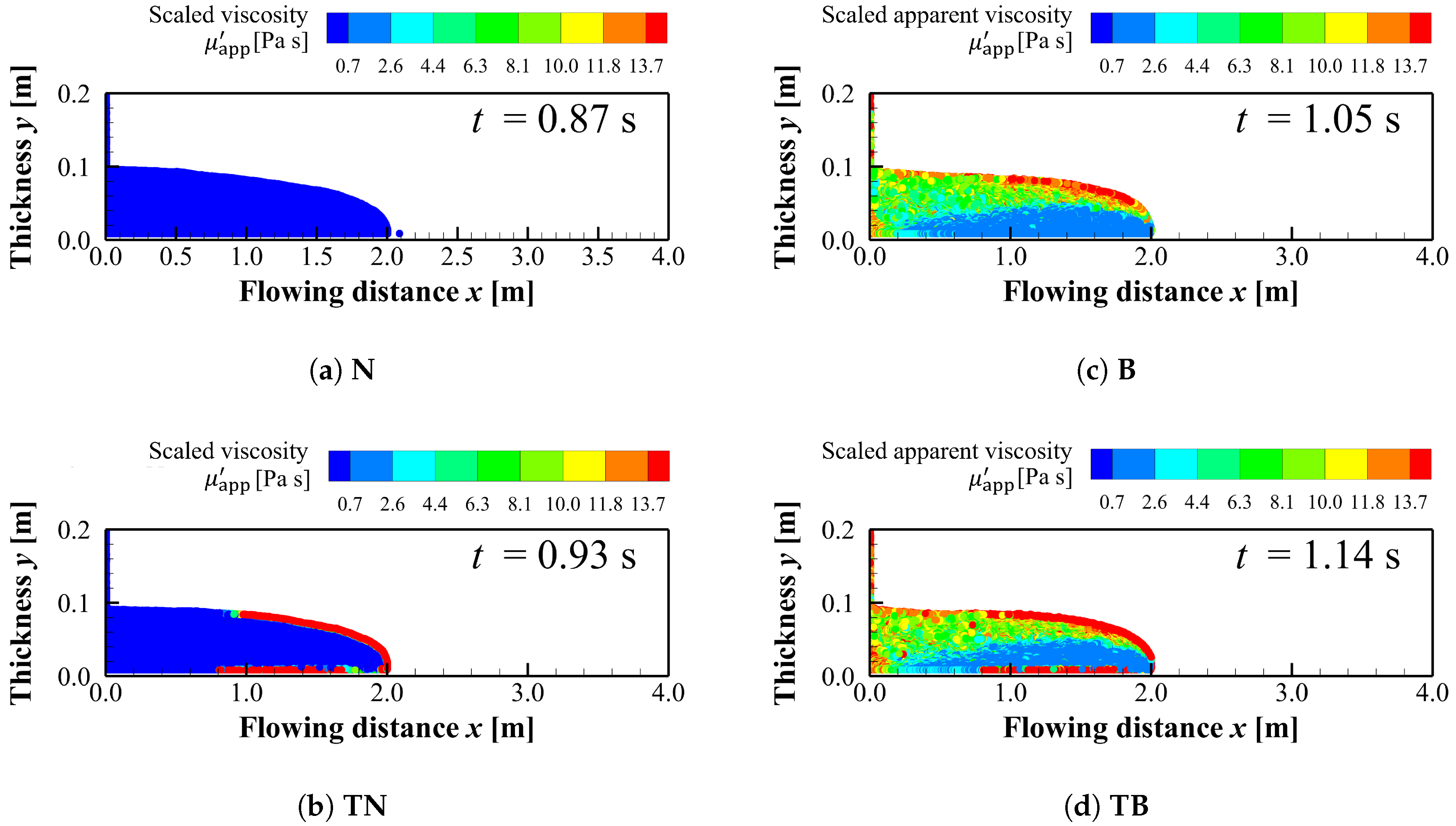
- By introducing the apparent viscosity model, it was confirmed that the apparent viscosity increases as the flow velocity decreases. This increase in apparent viscosity further reduces the flow velocity and eventually leads to the stopping of the lava flow. This behavior qualitatively reproduces the characteristics of a Bingham fluid. These results are consistent with the prevailing understanding that non-Newtonian fluid models are required for accurate prediction of lava flowing distances.
- 3.
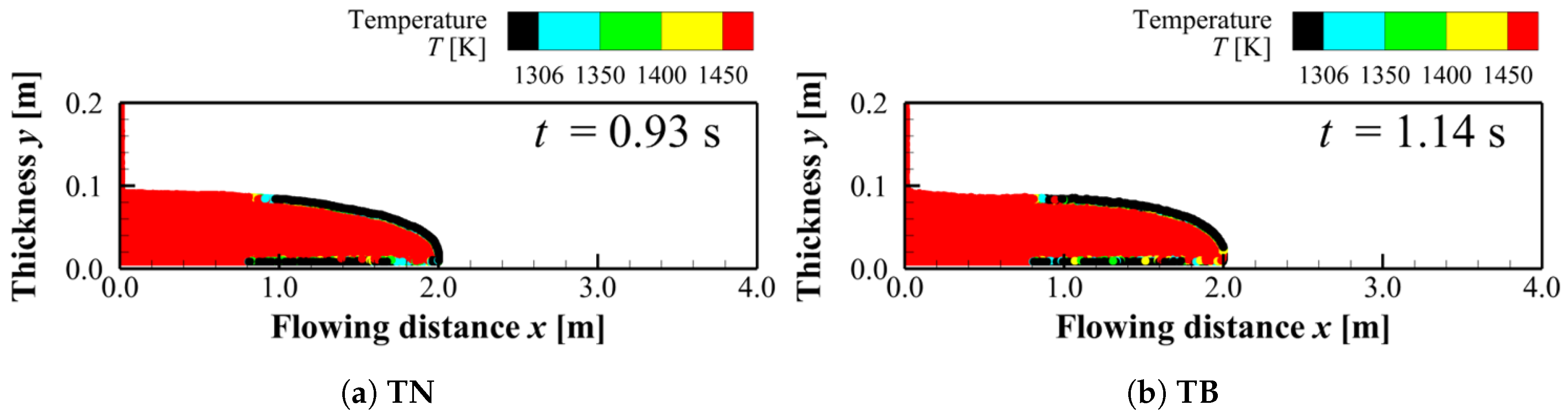
- By considering the temperature dependence of viscosity, a plastic surface skin was successfully reproduced in the numerical simulations. Comparison with simulations without surface skin formation revealed that the surface skin reduces the flow velocity. This behavior is consistent with qualitative observations [3]. In particular, when Bingham behavior is taken into account, the suppressive effect of the surface skin causes the successive deceleration characteristic in Bingham fluids, as described above, to emerge at a shorter flowing distance.
Author Contributions
Funding
Institutional Review Board Statement
Informed Consent Statement
Data Availability Statement
Conflicts of Interest
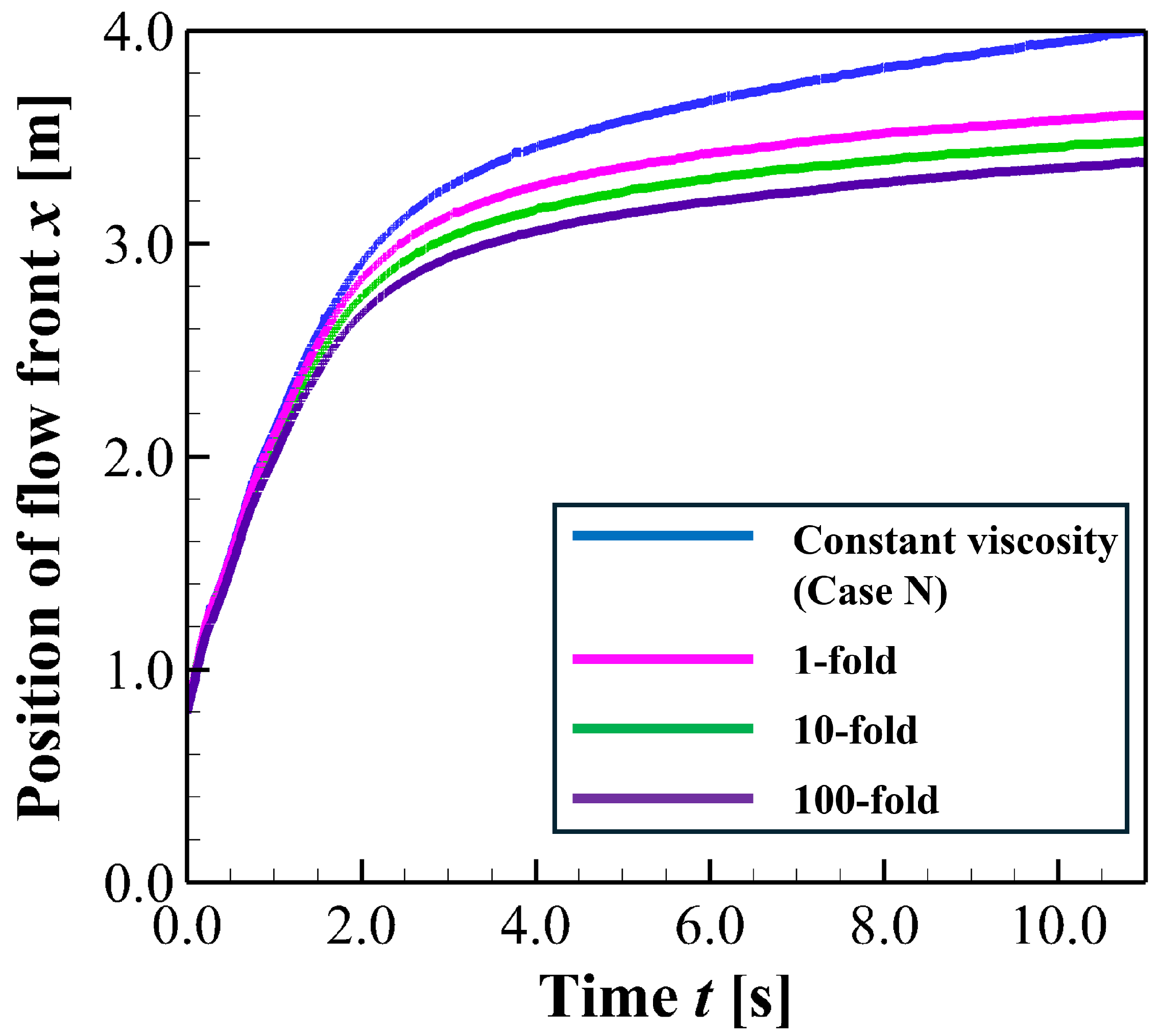
Appendix A. Sensitivity Analysis of Surface Heat Loss Rate

References
- Yin, X.; Zhang, Y.; Li, B.; Chen, C. Study of the solidified thin layer on molten pool surface in laser deep penetration welding. Opt. Laser Technol. 2022, 149, 107842. [Google Scholar] [CrossRef]
- Griffiths, R.W. The Dynamics of Lava Flows. Annu. Rev. Fluid Mech. 2000, 32, 477–518. [Google Scholar] [CrossRef]
- Hon, K.; Kauahikaua, J.; Denlinger, R.; Mackay, K. Emplacement and inflation of pahoehoe sheet flows: Observations and measurements of active lava flows on Kilauea Volcano, Hawaii. Geol. Soc. Am. Bull. 1994, 106, 351–370. [Google Scholar] [CrossRef]
- Bokharaeian, M. Rheological study of lava flow analog mixtures. Acta Geodyn. Geomater. 2023, 20, 11–18. [Google Scholar] [CrossRef]
- Dingwell, D.; Webb, S. Structural relaxation in silicate melts and non-Newtonian melt rheology in geologic processes. Phys. Chem. Miner. 1989, 16, 508–516. [Google Scholar] [CrossRef]
- Lejeune, A.M.; Richet, P. Rheology of crystal-bearing silicate melts: An experimental study at high viscosities. J. Geophys. Res. Solid Earth 1995, 100, 4215–4229. [Google Scholar] [CrossRef]
- Sehlke, A.; Whittington, A.; Robert, B.; Harris, A.; Gurioli, L.; Médard, E. Pahoehoe to àà transition of Hawaiian lavas: An experimental study. Bull. Volcanol. 2014, 76, 876. [Google Scholar] [CrossRef]
- Ishibashi, H.; Sato, H. Bingham fluid behavior of plagioclase-bearing basaltic magma: Reanalyses of laboratory viscosity measurements for Fuji 1707 basalt. J. Mineral. Petrol. Sci. 2010, 105, 334–339. [Google Scholar] [CrossRef]
- Harris, A.; Mannini, S.; Thivet, S.; Chevrel, M.; Gurioli, L.; Villeneuve, N.; Muro, A.D.; Peltier, A. How shear helps lava to flow. Geology 2020, 48, 154–158. [Google Scholar] [CrossRef]
- Keszthelyi, L.; Denlinger, R. The initial cooling of pahoehoe flow lobes. Bull. Volcanol. 1996, 58, 5–18. [Google Scholar] [CrossRef]
- Touloukian, Y.; Judd, W.; Roy, R. Physical Properties of Rocks and Minerals; Hemisphere Pub. Corp.: Washington, DC, USA, 1989. [Google Scholar]
- Miyamoto, H.; Crown, D.A. A simplified two-component model for the lateral growth of pahoehoe lobes. J. Volcanol. Geotherm. Res. 2006, 157, 331–342. [Google Scholar] [CrossRef]
- Lyman, A.W.; Kerr, R.C.; Griffiths, R.W. Effects of internal rheology and surface cooling on the emplacement of lava flows. J. Geophys. Res. Solid Earth 2005, 110, 1–16. [Google Scholar] [CrossRef]
- Lyman, A.W.; Kerr, R.C. Effect of surface solidification on the emplacement of lava flows on a slope. J. Geophys. Res. Solid Earth 2006, 111, B05206. [Google Scholar] [CrossRef]
- Mount Fuji Research Institute (Yamanashi Prefectural Government). Kazan Bousai Map no Shinraisei Koujou ni Shisuru Suuchi Simulation Gijutsu no Koudoka (Improvement of Numerical Simulation Techniques for Enhancing the Reliability of Volcano Hazard Maps); MFRI Research Report No. 57; Mount Fuji Research Institute: Yamanashi, Japan, 2024; Available online: https://mfri.repo.nii.ac.jp/record/2000110/files/MFRIReserchReportNo57.pdf (accessed on 4 February 2026).
- Tsepelev, I.; Ismail-Zadeh, A.; Melnik, O.; Korotkii, A. Numerical modeling of fluid flow with rafts: An application to lava flows. J. Geodyn. 2016, 97, 31–41. [Google Scholar] [CrossRef]
- Tsepelev, I.; Ismail-Zadeh, A.; Starodubtseva, Y.; Korotkii, A.; Melnik, O. Crust Development Inferred from Numerical Models of Lava Flow and Its Surface Thermal Measurements. Ann. Geophys. 2019, 61, 1–17. [Google Scholar] [CrossRef]
- Starodubtsev, I.; Vasev, P.; Starodubtseva, Y.; Tsepelev, I. Numerical Simulation and Visualization of Lava Flows. Sci. Vis. 2022, 14, 66–76. [Google Scholar] [CrossRef]
- Starodubtsev, I.S.; Starodubtseva, Y.V.; Tsepelev, I.A.; Ismail-Zadeh, A.T. Three-Dimensional Numerical Modeling of Lava Dynamics Using the Smoothed Particle Hydrodynamics Method. J. Volcanol. Seismol. 2023, 17, 175–186. [Google Scholar] [CrossRef]
- Zago, V.; Bilotta, G.; Cappello, A.; Dalrymple, R.A.; Fortuna, L.; Ganci, G.; Hérault, A.; Negro, C.D. Simulating Complex Fluids with Smoothed Particle Hydrodynamics. Ann. Geophys. 2017, 60, PH669. [Google Scholar] [CrossRef]
- Zago, V.; Bilotta, G.; Hérault, A.; Dalrymple, R.A.; Fortuna, L.; Cappello, A.; Ganci, G.; Negro, C.D. Semi-implicit 3D SPH on GPU for lava flows. J. Comput. Phys. 2018, 375, 854–870. [Google Scholar] [CrossRef]
- Zago, V.; Bilotta, G.; Cappello, A.; Dalrymple, R.A.; Fortuna, L.; Ganci, G.; Hérault, A.; Negro, C.D. Preliminary validation of lava benchmark tests on the GPUSPH particle engine. Ann. Geophys. 2019, 61, VO224. [Google Scholar] [CrossRef]
- Bilotta, G.; Zago, V.; Centorrino, V.; Dalrymple, R.A.; Hérault, A.; Negro, C.D.; Saikali, E. A numerically robust, parallel-friendly variant of BiCGSTAB for the semi-implicit integration of the viscous term in Smoothed Particle Hydrodynamics. J. Comput. Phys. 2022, 466, 111413. [Google Scholar] [CrossRef]
- Hérault, A.; Bilotta, G.; Vicari, A.; Rustico, E.; Negro, C.D. Numerical simulation of lava flow using a GPU SPH model. Ann. Geophys. 2011, 54, 600–620. [Google Scholar] [CrossRef]
- Tomita, S.; Yoshikawa, J.; Sugimoto, M.; Komen, H.; Shigeta, M. SPH Simulation of Molten Metal Flow Modeling Lava Flow Phenomena with Solidification. Dynamics 2024, 4, 287–302. [Google Scholar] [CrossRef]
- Huppert, H.E. The propagation of two-dimensional and axisymmetric viscous gravity currents over a rigid horizontal surface. J. Fluid Mech. 1982, 121, 43–58. [Google Scholar] [CrossRef]
- Pastor, M.; Blanc, T.; Haddad, B.; Petrone, S.; Morles, M.S.; Drempetic, V.; Issler, D.; Crosta, G.B.; Cascini, L.; Sorbino, G.; et al. Application of a SPH depth-integrated model to landslide run-out analysis. Landslides 2014, 11, 793–812. [Google Scholar] [CrossRef]
- Cheng, H.; Huang, Y.; Zhang, W.; Xu, Q. Physical process-based runout modeling and hazard assessment of catastrophic debris flow using SPH incorporated with ArcGIS: A case study of the Hongchun gully. CATENA 2022, 212, 106052. [Google Scholar] [CrossRef]
- Zago, V. Modeling two-ways fluid-solid phase transitions in lava using Smoothed Particle Hydrodynamics. Ann. Geophys. 2025, 68, V226. [Google Scholar] [CrossRef]
- Monaghan, J.J. Smoothed Particle Hydrodynamics. Annu. Rev. Astron. Astrophys. 1992, 30, 543–574. [Google Scholar] [CrossRef]
- Morris, J.P.; Fox, P.J.; Zhu, Y. Modeling Low Reynolds Number Incompressible Flows Using SPH. J. Comput. Phys. 1997, 136, 214–226. [Google Scholar] [CrossRef]
- Asai, M. Meikai Ryushi-ho (Clear Explanation of Particle Methods); Maruzen Publishing: Tokyo, Japan, 2022. (In Japanese) [Google Scholar]
- Shigeta, M.; Watanabe, T.; Izawa, S.; Fukunishi, Y. Incompressible SPH Simulation of Double-Diffusive Convection Phenomena. Int. J. Emerg. Multidiscip. Fluid Sci. 2009, 1, 1–18. [Google Scholar] [CrossRef]
- Koshizuka, S.; Oka, Y. Moving-Particle Semi-Implicit Method for Fragmentation of Incompressible Fluid. Nucl. Sci. Eng. 1996, 123, 421–434. [Google Scholar] [CrossRef]
- Ito, M.; Nishio, Y.; Izawa, S.; Fukunishi, Y.; Shigeta, M. Numerical Simulation of Joining Process in a TIG Welding System Using Incompressible SPH Method. Q. J. Jpn. Weld. Soc. 2015, 33, 34s–38s. [Google Scholar] [CrossRef]
- The Japan Society of Thermophysical Properties. Shinpen Netsu Bussei Handbook (Thermophysical Properties Handbook); Yokendo: Tokyo, Japan, 2008. (In Japanese) [Google Scholar]
- The Japan Society of Mechanical Engineers. JSME Data Book: Heat Transfer, 4th ed.; The Japan Society of Mechanical Engineers: Tokyo, Japan, 1966. (In Japanese) [Google Scholar]
- Papanastasiou, T.C. Flows of Materials with Yield. J. Rheol. 1987, 31, 385–404. [Google Scholar] [CrossRef]
- Hulme, G. The Interpretation of Lava Flow Morphology. Geophys. J. Int. 1974, 39, 361–383. [Google Scholar] [CrossRef]
- Ge, Y.; Tang, H.; Li, C. Mechanical energy evolution in the propagation of rock avalanches using field survey and numerical simulation. Landslides 2021, 18, 3559–3576. [Google Scholar] [CrossRef]
- Monaghan, J. On the integration of the SPH equations for a highly viscous fluid. J. Comput. Phys. 2019, 394, 166–176. [Google Scholar] [CrossRef]





| Parameter | Value | Unit |
|---|---|---|
| Dimension number | 2 | - |
| Diameter of computational particle H | ||
| Time step | ||
| Gravitational acceleration g | ||
| Thermal conductivity of soil | ||
| Specific heat of soil | ||
| Density of soil | 2000 | |
| Temperature of air | 300 | |
| Thermal conductivity of air | ||
| Distance from surface particles to air |
| Property | Value | Unit |
|---|---|---|
| Density | 1370 | |
| Scaled apparent viscosity | – | |
| Fitting parameter for viscosity model | - | |
| Yield stress | 1000 | |
| Thermal conductivity | – | |
| Specific heat at constant pressure | –1100 | |
| Emissivity | - |
Disclaimer/Publisher’s Note: The statements, opinions and data contained in all publications are solely those of the individual author(s) and contributor(s) and not of MDPI and/or the editor(s). MDPI and/or the editor(s) disclaim responsibility for any injury to people or property resulting from any ideas, methods, instructions or products referred to in the content. |
© 2026 by the authors. Licensee MDPI, Basel, Switzerland. This article is an open access article distributed under the terms and conditions of the Creative Commons Attribution (CC BY) license.
Share and Cite
Tomita, S.; Sato, T.; Murakami, S.; Yoshikawa, J.; Sugimoto, M.; Komen, H.; Shigeta, M. SPH Simulation of Molten-Fluid Flows with a Plastic Surface Skin: A Lava-Flow-Oriented Model Study. Appl. Sci. 2026, 16, 1716. https://doi.org/10.3390/app16041716
Tomita S, Sato T, Murakami S, Yoshikawa J, Sugimoto M, Komen H, Shigeta M. SPH Simulation of Molten-Fluid Flows with a Plastic Surface Skin: A Lava-Flow-Oriented Model Study. Applied Sciences. 2026; 16(4):1716. https://doi.org/10.3390/app16041716
Chicago/Turabian StyleTomita, Shingo, Takuma Sato, Satoshi Murakami, Joe Yoshikawa, Makoto Sugimoto, Hisaya Komen, and Masaya Shigeta. 2026. "SPH Simulation of Molten-Fluid Flows with a Plastic Surface Skin: A Lava-Flow-Oriented Model Study" Applied Sciences 16, no. 4: 1716. https://doi.org/10.3390/app16041716
APA StyleTomita, S., Sato, T., Murakami, S., Yoshikawa, J., Sugimoto, M., Komen, H., & Shigeta, M. (2026). SPH Simulation of Molten-Fluid Flows with a Plastic Surface Skin: A Lava-Flow-Oriented Model Study. Applied Sciences, 16(4), 1716. https://doi.org/10.3390/app16041716