Article

Optimal Operation Strategy for Regional CCHP Systems Considering Thermal Transmission Delay and Adaptive Temporal Discretization


1
School of Electric Power Engineering, South China University of Technology, Guangzhou 510641, China
2
The Guangdong Province Key Laboratory of Efficient and Clean Energy Utilization, Guangzhou 510641, China
3
State Grid Shandong Electric Power Company Marketing Service Center (Metrology Center), Jinan 250013, China
*
Author to whom correspondence should be addressed.
Appl. Sci. 2026, 16(4), 1711; https://doi.org/10.3390/app16041711
Submission received: 5 January 2026 / Revised: 31 January 2026 / Accepted: 4 February 2026 / Published: 9 February 2026

Abstract

With the increasing integration of regional energy systems, the dynamic coupling characteristics of cooling, heating, and power flows have become significantly pronounced. However, traditional scheduling models often utilize steady-state assumptions that neglect the thermal transmission delay of the pipeline network, leading to spatiotemporal mismatches between energy supply and load demand. To address this issue, this paper proposes an optimal operation strategy for regional Combined Cooling, Heating, and Power (CCHP) systems that explicitly integrates thermal inertia. First, a Pipeline Fluid Micro-element Discretization Method (PFMDM) is developed based on the Lagrangian specification to accurately characterize the dynamic flow and thermal decay processes without the heavy computational burden of partial differential equations. In addition, the accuracy of PFMDM is directly benchmarked against a high-fidelity transient PDE solver (finite-volume TVD–MUSCL scheme) over a wide range of pipe lengths, flow velocities, and thermal loss coefficients, where the outlet-temperature RMSE remains below 0.2 °C. This model quantitatively reveals the “Virtual Energy Storage” (VES) mechanism of the pipeline network. Second, to overcome the “curse of dimensionality” in dynamic scheduling, a Load-Gradient-Based Adaptive Temporal Discretization (LG-ATD) method is proposed. This method maintains a fine-grained baseline for electrical settlement while dynamically aggregating thermal/cooling steps based on load fluctuations. Simulation results demonstrate that the proposed strategy corrects the significant physical deviations of the traditional steady-state model. The analysis reveals that the steady-state model underestimates the required heating and cooling supply capacities by up to 26.66% and 39.15%, respectively, due to the neglect of transmission losses and delays. By leveraging the VES mechanism, the proposed method enables a fuel-shift in the energy-supply structure, substantially decreasing the electricity purchasing cost (by 75.2% in the tested case). This reduction reflects a reallocation from grid purchases to on-site gas-fired cogeneration to maintain physical feasibility under delay and loss effects, and therefore, it is accompanied by an increase in natural gas consumption and a higher total operating cost. Furthermore, the LG-ATD method significantly alleviates the computational burden by substantially compressing the presolved model size and reducing the overall solving time by more than 80%, thereby effectively mitigating the curse of dimensionality for practical engineering applications.

1. Introduction

Under the global consensus of “carbon peaking and carbon neutrality,” the transformation of energy systems towards higher efficiency and lower emissions has become a critical priority [1]. The Integrated Energy System (IES), particularly the Regional Combined Cooling, Heating, and Power (CCHP) system, is widely recognized as a pivotal technology for maximizing energy cascading utilization and integrating renewable energy sources [2,3]. Compared with traditional separate generation systems, CCHP systems can significantly improve primary energy efficiency and reduce transmission losses by coupling electric, thermal, and cooling energy flows [4]. However, the operational flexibility and optimization of regional CCHP systems face significant challenges due to the complex dynamic coupling between energy supply and demand.
A primary challenge in the optimal scheduling of these systems lies in the accurate representation of the pipeline network’s dynamic characteristics. Most existing optimization strategies employ steady-state models, assuming that energy production and consumption occur simultaneously [5]. While computationally efficient, these models overlook the substantial thermal transmission delay caused by the long-distance transportation of heating/cooling media (water) in pipeline networks. In practical engineering, this delay can range from minutes to hours, leading to a spatiotemporal mismatch between the energy station’s output and the end-users’ actual load. This mismatch implies that steady-state models often provide over-optimistic estimations of energy efficiency, as they ignore the extra energy required to compensate for thermal losses and transmission lags [6].
To address the delay issue, dynamic models based on fluid dynamics have been investigated. For instance, Benonysson et al. [7] pioneered the dynamic modeling of district heating systems, and Stevanovic et al. [8] further developed thermodynamic models to predict temperature wave propagation. Although these approaches can physically describe the transmission process by solving partial differential equations (PDEs) of mass, momentum, and energy conservation, their high computational complexity makes them unsuitable for online optimal scheduling or scenarios requiring iterative solving over long time horizons. Consequently, there is an urgent need for a quasi-dynamic model that can balance physical fidelity with computational efficiency.
Despite the growing adoption of quasi-dynamic pipeline models, a critical gap remains: many reduced-order formulations are rarely validated against a transient PDE reference under systematically varied hydraulic–thermal conditions. This limitation directly affects the credibility of the claimed “key dynamics preservation” when the model is used for scheduling. To close this gap, this study provides a direct verification of PFMDM against a transient one-dimensional convection–loss PDE model solved by a high-resolution finite-volume TVD–MUSCL scheme. The benchmark spans multiple pipe lengths, flow velocities, and thermal loss coefficients, and quantitatively reports the outlet-temperature RMSE and representative time-series comparisons (see Appendix A).
Furthermore, the thermal inertia inherent in the large volume of water within the pipeline network acts as a buffer, a concept increasingly referred to as “Virtual Energy Storage (VES)” [9,10]. If accurately quantified and utilized, this VES can effectively smooth load fluctuations and decouple thermal production from consumption, providing additional flexibility without physical storage investments. However, integrating a low-complexity dynamic model that quantifies this VES effect into a unified optimization framework remains a technical bottleneck. In addition, conventional scheduling frameworks typically adopt fixed time intervals (e.g., 15 min) for all energy carriers. This rigid temporal discretization faces a dilemma: a coarse granularity misses transient load peaks caused by delays, while a fine granularity leads to a “curse of dimensionality,” resulting in an intractable number of decision variables for Mixed-Integer Linear Programming (MILP) solvers [11].
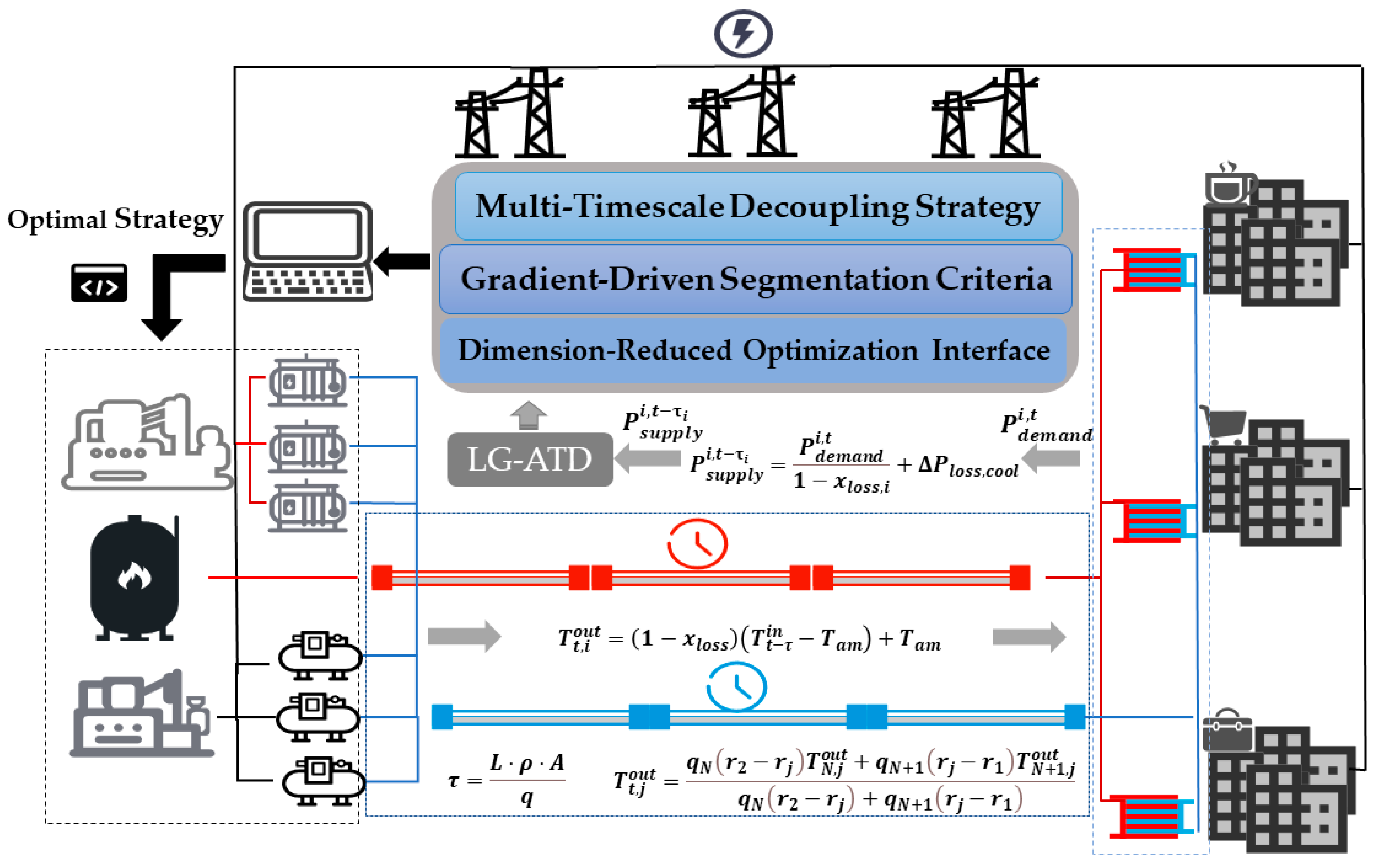
To bridge these gaps, this paper proposes a novel optimal operation strategy for regional CCHP systems. A Pipeline Fluid Micro-element Discretization Method (PFMDM) is introduced to accurately but efficiently characterize transmission delays and heat losses via algebraic state mappings. Moreover, to balance accuracy and efficiency, a Load-Gradient-Based Adaptive Temporal Discretization (LG-ATD) strategy is developed to dynamically adjust scheduling granularity.
The framework of the whole process is shown in Figure 1.
The research questions, main contributions, and expected results of this paper are summarized as follows:
  • A quasi-dynamic pipeline model (PFMDM) is established based on the Lagrangian perspective of fluid micro-elements. This method establishes a quantitative mapping between inlet/outlet temperatures and transmission delays. Simulation results confirm that this model corrects the physical deviations of steady-state models, improving the prediction accuracy of heating and cooling supply limits by 26.66% and 39.15%, respectively.
  • The “Virtual Energy Storage” mechanism of the pipeline network is quantitatively integrated into the scheduling optimization. The proposed model explicitly utilizes the thermal inertia of the network to buffer load fluctuations. It reveals a strategic “Fuel Substitution” mechanism where the system shifts from grid electricity to internal gas-fired cogeneration during peak hours, leading to a structural shift from grid electricity purchases to on-site gas-fired cogeneration during high-price periods; consequently, the electricity purchasing cost is substantially reduced in the tested case (75.2%), while the total operating cost increases due to higher natural gas consumption required for physically feasible heat/cold delivery.
  • An adaptive temporal discretization strategy (LG-ATD) is proposed to address the curse of dimensionality in dynamic scheduling. By maintaining a fixed electrical settlement interval while adaptively aggregating thermal and cooling processes, this strategy significantly compresses the presolved model size and reduces the overall solving time, making large-scale dynamic optimization computationally tractable for practical engineering applications.

2. Dynamic Modeling of Pipeline Network

The regional CCHP system relies on an extensive pipeline network to deliver heating and cooling energy [12]. Unlike electrical power flow, which is instantaneous, the transport of thermal fluids (water) involves significant transmission delays and thermal inertia [13]. These hydraulic-thermal characteristics decouple the energy production at the source from the consumption at the load, necessitating a rigorous dynamic model [14]. This section first presents the fundamental governing equations and then derives a computation-efficient quasi-dynamic model suitable for optimization.

2.1. Governing Physics of Fluid Flow and Heat Transfer

From the perspective of fluid mechanics, the dynamic behavior of the heat transfer medium within a pipe segment is governed by the conservation laws of mass, momentum, and energy [15]. Assuming that the pipeline has a constant cross-sectional area and the fluid behaves as a one-dimensional incompressible flow, the rigorous physicochemical dynamics are described by the following set of partial differential equations (PDEs):
ρ t + ρ u x = 0
ρ u t + ρ u u x = p x + μ 2 u x 2 f D ρ u 2 2 D
ρ c p T t + u T x = λ 2 T x 2 4 U D T T a m  
where
  • ρ denotes the fluid density ( kg / m 3 );
  • u represents the flow velocity ( m / s );
  • t is the time variable ( s ), and x is the spatial coordinate along the pipeline ( m );
  • p indicates the pressure ( Pa );
  • μ is the dynamic viscosity ( Pa s );
  • f D is the Darcy friction factor;
  • D is the pipeline diameter ( m );
  • c p is the specific heat capacity of the fluid ( J / kg K );
  • T x , t is the fluid temperature distribution ( ° C );
  • T a m represents the ambient temperature of the soil or environment ( ° C );
  • λ is the thermal conductivity ( W / m K );
  • U is the overall heat transfer coefficient of the pipe wall ( W / m 2 K ).
Equation (1) ensures mass conservation, while Equation (2) describes momentum conservation accounting for viscous forces and friction losses. Equation (3) characterizes the energy balance, incorporating convective heat transfer and radial heat loss to the environment [14]. While these equations provide high physical fidelity, solving them requires numerical techniques such as the Finite Difference Method (FDM) or Finite Volume Method (FVM) with fine spatiotemporal grids. In the context of day-ahead optimization for large-scale networks, the computational burden of iteratively solving these coupled non-linear PDEs is prohibitive. Therefore, a model reduction strategy that retains the essential dynamic features—specifically transmission delay and thermal decay—is required.

2.2. Lagrangian-Based Discrete Dynamic Modeling (PFMDM)

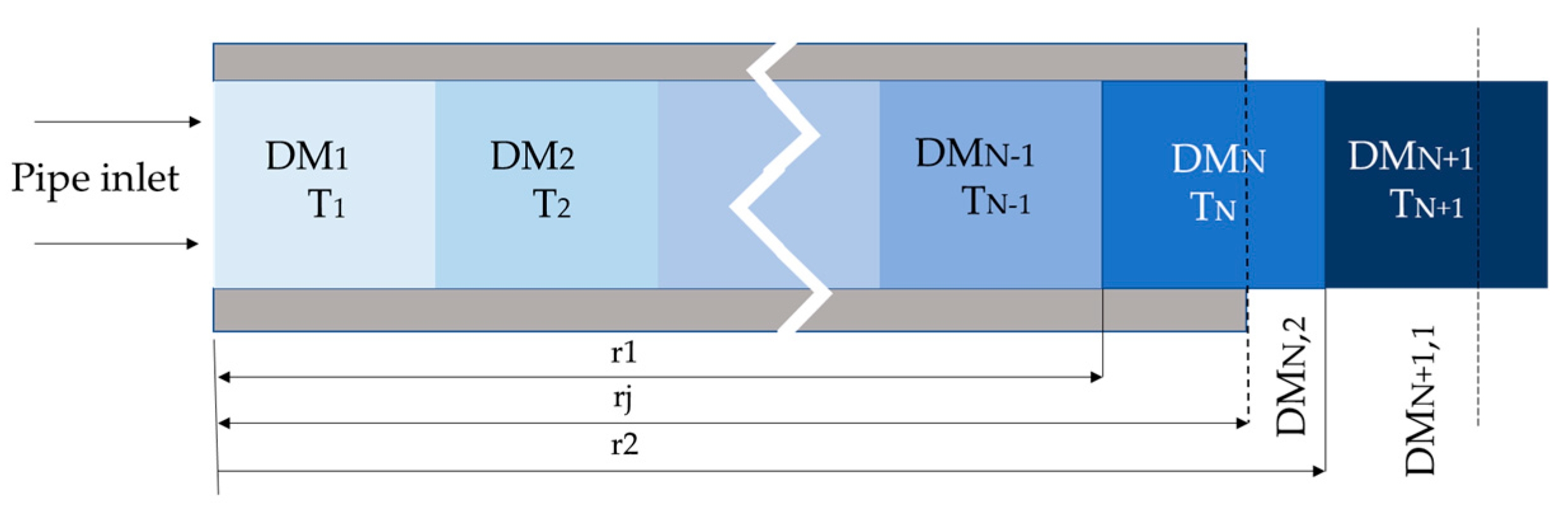
To resolve the conflict between model fidelity and computational efficiency, this paper adopts a Lagrangian specification approach [16]. We propose a Pipeline Fluid Micro-element Discretization Method (PFMDM), which discretizes the continuous fluid column into a sequence of traveling “fluid packets” or “micro-elements” [17]. In this study, the pipeline network is assumed to operate under the quality regulation mode (i.e., nearly constant mass flow rate with variable supply temperature), which is a common operating practice in regional district heating/cooling systems, the circulating-pump power is treated as an auxiliary electricity consumption; it is included in the electrical load term of the system power balance, and therefore already accounted for in the electricity procurement and dispatch cost. Under this assumption, the transport delay and temperature evolution can be expressed in closed form and embedded into the scheduling problem as algebraic mappings. Unlike Eulerian methods that observe fixed points in space, this method tracks the historical state evolution of fluid elements as they traverse the network [18]. This approach transforms the complex PDE solving process into a series of algebraic state mappings, significantly reducing the dimensionality of the problem [19]. The schematic of the micro-element discretization is illustrated in Figure 2 [20].

2.2.1. Lagrangian Transmission Delay Quantification

Based on the principle of mass conservation, the transmission delay τ , defined as the time interval required for a specific fluid micro-element to travel from the inlet to the outlet of a pipe segment with length L , can be explicitly derived. Under the quality regulation mode (variable supply temperature with an approximately constant mass flow rate), the mass flow rate q can be treated as constant within each scheduling interval, which enables an explicit expression of the transport delay. The relationship between delay and hydraulic parameters is expressed as
τ t = 0 L 1 v x d x = L A ρ q t
where
L is the pipe length ( m );
A is the cross-sectional area ( m 2 );
q t is the mass flow rate ( kg / s ).
Equation (4) serves as a time-shift operator in the optimization model. When the mass flow rate varies across intervals, τ becomes time-dependent and can be updated accordingly; however, the present work focuses on the quality regulation setting to retain a tractable algebraic embedding for day-ahead scheduling. It physically implies that the thermal energy arriving at the load node at time t corresponds to the energy produced at the source station at time t τ . This explicit mapping avoids the numerical diffusion errors often associated with coarse-grid Eulerian methods.

2.2.2. Analytical Derivation of Temperature Evolution

As a fluid micro-element travels through the pipeline, its thermal state evolves primarily due to heat exchange with the environment. By applying the material derivative ( D / D t ) to the energy conservation Equation (3) and neglecting the axial heat conduction (which is negligible compared to convective transport), the heat transfer problem is reformulated into an ordinary differential equation (ODE) following the moving particle:
D T D t = T t + u T x = 4 U ρ c p D T T a m  
Let k = 4 U ρ c p D be defined as the comprehensive thermal decay coefficient. Integrating Equation (5) along the characteristic line of the fluid flow over the transmission interval t τ , t yields
T i n t τ T o u t t d T T T a m = 0 τ k d t
Solving this integral analytically provides the explicit solution for the temperature decay:
ln T o u t t T a m T i n t τ T a m = k τ
For the convenience of linear optimization, we introduce a heat loss factor x l o s s = 1 e k τ . The non-linear differential heat transfer process is thus transformed into a linear algebraic input-output state transition equation:
T o u t t = 1 x l o s s T i n t τ + x l o s s T a m
Equation (8) demonstrates that the outlet temperature is a convex combination of the delayed inlet temperature and the ambient temperature. This formulation rigorously preserves the physics of Newton’s law of cooling while being highly compatible with Mixed-Integer Linear Programming (MILP) solvers.

2.2.3. Spatiotemporal Re-Projection Mechanism

A critical challenge in discretizing continuous fluid dynamics for scheduling is the timescale mismatch. The scheduling optimization typically employs a fixed time grid (e.g., Δ t = 10   min ), whereas the physical transmission delay τ is continuous and rarely aligns with integer multiples of Δ t . Direct truncation or rounding of τ would lead to significant energy conservation violations. To address this, the PFMDM introduces a mass-conservation-based mixing mechanism. As the fluid flows continuously, the volume of water flowing out of a pipe during a discrete simulation time step t may originate from the boundary between two adjacent micro-elements, denoted as N and N + 1 , which entered the pipe at previous time steps.
We define a weighted mixing function to “project” the continuous fluid states back onto the discrete time grid. The effective outlet temperature T o u t , t j for pipe j at time step t is calculated by weighing the contributions of the two adjacent elements:
T o u t , t j = Y 1 T N , o u t j + Y 2 T N + 1 , o u t j
The weighting coefficients Y 1 and Y 2 represent the mass contribution ratio of each micro-element within the current time window r 1 , r 2 . They are derived as
Y 1 = q N r 2 r j q N r 2 r j + q N + 1 r j r 1
Y 2 = q N + 1 r j r 1 q N r 2 r j + q N + 1 r j r 1
where
  • T N , o u t j and T N + 1 , o u t j are the temperatures of the N -th and N + 1 -th micro-elements after transmission;
  • q N and q N + 1 are the mass flow rates of the respective micro-elements;
  • r 1 and r 2 represent the start and end timestamps of the current simulation time step;
  • r j is the precise arrival timestamp of the interface between elements N and N + 1 .
Equations (9)–(11) ensure that the enthalpy conservation is strictly maintained even when the delay is a non-integer multiple of the time step. This mechanism effectively bridges the gap between the continuous hydraulic dynamics and the discrete scheduling framework.
PFMDM targets convection-dominated district heating/cooling operation, where transport delay and distributed heat loss constitute the primary dynamics for scheduling. In this regime, axial heat conduction mainly introduces additional front smoothing and is typically of higher order than advection, so omitting it does not change the dominant delay–attenuation structure captured by PFMDM. Cold-start transients primarily affect the initial thermal state; therefore, the framework is applied to normal quality-regulation periods with established circulation, with feasibility safeguarded by minimum-flow constraints and conservative temperature margins when operating near low-flow regimes.

3. Source-Load Spatiotemporal Coupling Mechanism

3.1. Coupling Characteristics in Heating Network

In the regional CCHP system, the heating network typically operates in a closed-loop configuration. Let the mass flow rate of the heating network be denoted as q h e a t . For a specific end-use node i , the heat load demand P h e a t , d e m a n d i , t at time t determines the required inlet supply temperature. Assuming the return water temperature from the user side is regulated to a relatively fixed value T h e a t , o u t via secondary heat exchange units, the heat load balance is expressed as
P h e a t , d e m a n d i , t = c h e a t q h e a t T i n , d e m a n d i , t T h e a t , o u t
where
  • P h e a t , d e m a n d i , t is the thermal load of node i at time t ( kW );
  • c h e a t is the specific heat capacity of water ( kJ / kg ° C );
  • q h e a t is the mass flow rate ( kg / s );
  • T i n , d e m a n d i , t is the required supply water temperature at the inlet of node i ( ° C );
  • T h e a t , o u t is the fixed return water temperature after heat exchange ( ° C ).
By rearranging Equation (12), the required inlet temperature at the node is determined by
T i n , d e m a n d i , t = P h e a t , d e m a n d i , t c h e a t q h e a t + T h e a t , o u t
However, due to the transmission characteristics modeled in Section 2, the hot water arriving at node i at time t was actually produced and dispatched from the ES at an earlier time t τ i , where τ i is the specific transmission delay from the ES to node i . According to the PFMDM temperature evolution model (Equation (8)), the relationship between the required node temperature T i n , d e m a n d i , t and the ES outlet supply temperature T o u t , s u p p l y E S , t τ i is
T i n , d e m a n d i , t = 1 x l o s s , i T o u t , s u p p l y E S , t τ i + x l o s s , i T a m
where
  • T o u t , s u p p l y E S , t τ i is the supply temperature at the energy station at time t τ i ;
  • x l o s s , i is the heat loss factor for the pipeline path to node i (defined as 1 e k τ i );
  • T a m is the ambient temperature.
By substituting Equation (13) into Equation (14) and solving for the source temperature, the required supply temperature at the ES can be inversely derived:
T o u t , s u p p l y E S , t τ i = P h e a t , d e m a n d i , t c h e a t q h e a t + T h e a t , o u t x l o s s , i T a m 1 x l o s s , i
Consequently, the actual heating power P h e a t , s u p p l y i , t τ i that the ES must provide at time t τ i to satisfy the future demand of node i is calculated by the enthalpy difference between the supply water and the return water. It is important to note that the return water arriving at the ES at time t τ i corresponds to the water that left node i at time t τ i τ i (where τ i is the return delay). For simplicity, assuming the return water temperature remains stable during transmission due to lower temperature differences with the environment, the required source output power is derived as
P h e a t , s u p p l y i , t τ i = c h e a t q h e a t T o u t , s u p p l y E S , t τ i T h e a t , b a c k
Substituting Equation (15) into Equation (16) yields the analytical coupling function:
P h e a t , s u p p l y i , t τ i = P h e a t , d e m a n d i , t 1 x l o s s , i + c h e a t q h e a t 1 x l o s s , i T h e a t , o u t T h e a t , b a c k 1 x l o s s , i x l o s s , i T a m
Equation (17) mathematically quantifies the “Power Amplification” and “Time Shift” effects [21]. The term 1 / 1 x l o s s , i is always greater than 1, indicating that the source must generate extra power to compensate for thermal losses. More importantly, it proves that the production curve must be shifted forward by τ i relative to the load curve.

3.2. Coupling Characteristics in Cooling Network

The coupling mechanism in the cooling network follows a similar physical principle but with a reverse heat transfer direction, as the fluid temperature is lower than the ambient temperature [22]. The cooling load P c o o l , d e m a n d i , t at node i is met by the temperature difference between the return water T c o o l , o u t and the supply water T i n , d e m a n d i , t :
P c o o l , d e m a n d i , t = c c o o l q c o o l T c o o l , o u t T i n , d e m a n d i , t
Applying the PFMDM temperature evolution derived in Section 2, the mapping between the node demand and the source output, considering cooling losses, is
T i n , d e m a n d i , t = 1 x l o s s , i T o u t , s u p p l y E S , t τ i + x l o s s , i T a m
By combining Equations (18) and (19), the required cooling power output P c o o l , s u p p l y i , t τ i at the ES is derived as
P c o o l , s u p p l y i , t τ i = P c o o l , d e m a n d i , t 1 x l o s s , i + Δ P l o s s , c o o l
where Δ P l o s s , c o o l represents the additional cooling power required to counteract the heat gain from the environment during transmission. Due to the lower flow velocity often designed for cooling networks (to reduce pumping power), the delay τ i in the cooling network is typically larger than that in the heating network, making the decoupling effect more pronounced [23].

3.3. Virtual Energy Storage (VES) Mechanism

Equations (17) and (20) essentially demonstrate that the pipeline network acts as a buffer between supply and demand [24]. This buffering effect is quantified in this paper as the “Virtual Energy Storage” (VES) [25].
The total thermal energy stored within the pipeline network at any time instance t , denoted as E V E S , t , is calculated by integrating the enthalpy of all fluid micro-elements currently in transit:
E V E S , t = j Ω p i p e m = 1 M j c p ρ V j , m T j , m , t T r e f
where
  • Ω p i p e is the set of all pipe segments in the network;
  • M j is the number of active micro-elements in pipe j ;
  • V j , m is the volume of the m -th micro-element ( m 3 );
  • T j , m , t is the temperature of the m -th element at time t ( ° C );
  • T r e f is the reference temperature state ( ° C ).
To enable a consistent comparison across different network configurations, the effective VES capacity is defined as the temporal swing of the stored energy:
C VES = max t E VES t min t E VES t
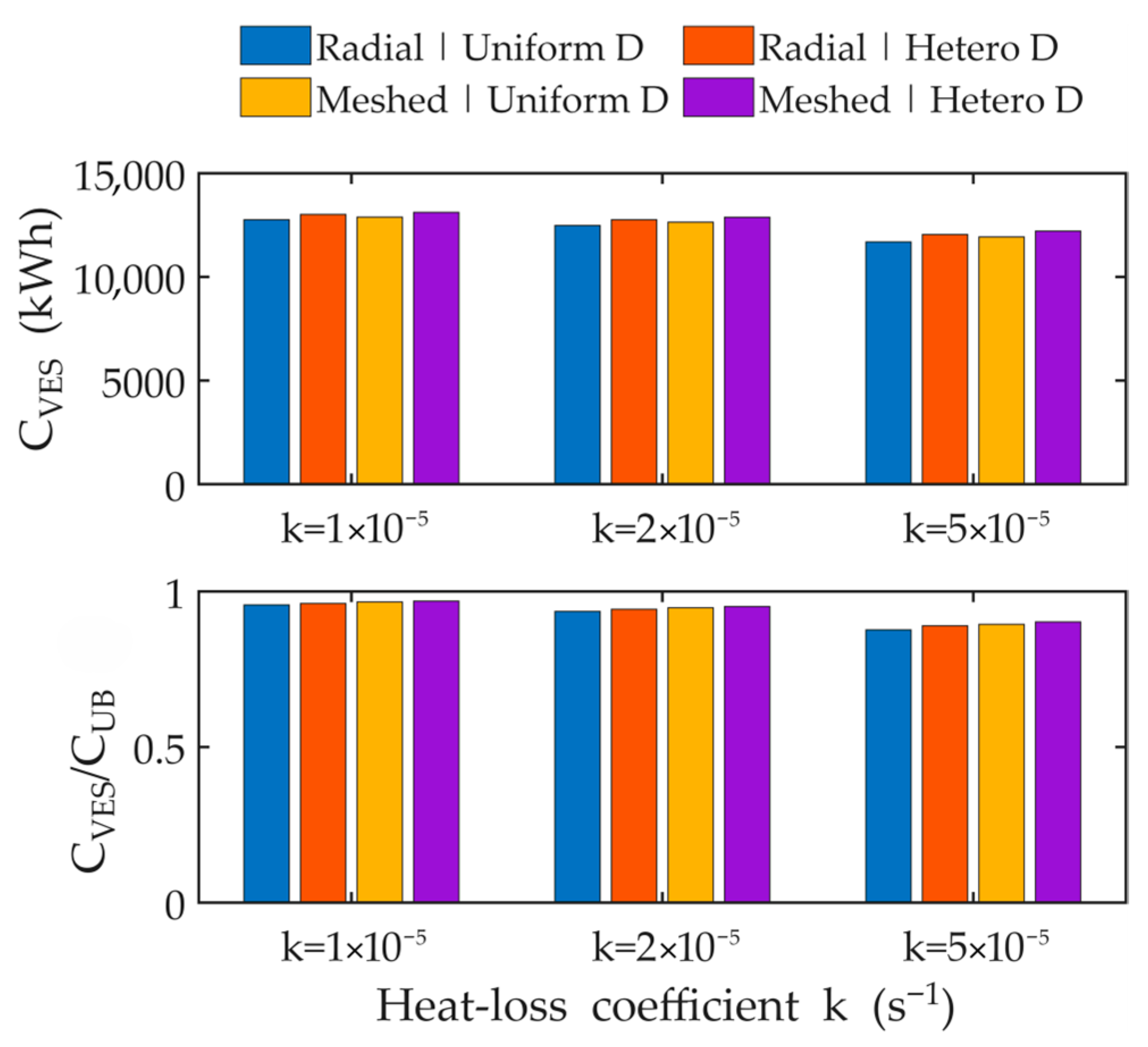
This definition is topology-agnostic and remains applicable to networks with different connectivity patterns (e.g., radial vs. meshed) and heterogeneous pipe diameters. A supplementary scaling assessment of C VES with respect to network topology and diameter heterogeneity is provided in Appendix B.
In the proposed optimization framework, this VES capacity allows the system to perform “Peak Shaving and Valley Filling” without physical storage devices [26].
Charging Phase: During periods of low electricity prices or low load demand, the Energy Station can increase the supply temperature (for heating) or decrease it (for cooling) in advance [27]. This effectively “charges” the water mass in the long-distance pipelines with excess thermal energy.
Discharging Phase: When the load peaks or electricity prices rise, the Energy Station can reduce its output power. The load demand is then satisfied by the thermal inertia (the high-enthalpy water packets) previously pumped into the network, effectively “discharging” the stored energy.
By explicitly incorporating τ and x l o s s into the scheduling constraints, the optimizer can automatically exploit this VES potential to minimize the total operational cost [28].

4. Optimization Model of Regional CCHP System

To implement the “Source-Grid-Load-Storage” collaborative optimization, a comprehensive mathematical model of the CCHP energy station is established. Based on the spatiotemporal coupling characteristics derived in Section 3, the optimization problem is formulated to minimize the total operating cost [29]. This section details the mathematical models of the energy conversion and storage components, the adaptive temporal discretization strategy, and the global optimization formulation [30].

4.1. Mathematical Modeling of CCHP Components

The energy station integrates various power generation, heat production, and cooling units. To balance computational efficiency with engineering accuracy, the energy conversion efficiencies of these devices are modeled as nominal constant values.

4.1.1. Power Generation and Waste Heat Recovery Units

The Gas Turbine (GT) and Internal Combustion Engine (ICE) serve as the primary movers. Their operation is characterized by fuel consumption, power generation, and waste heat recovery. Taking the GT as an example, the mathematical model is expressed as follows:
P G T , t e = F G T , t η G T e H H V g a s
P G T , t h = α G T P G T , t e
where
  • P G T , t e is the electrical power output of the GT at time t ( kW );
  • F G T , t is the natural gas consumption rate ( m 3 / h );
  • η G T e is the electrical efficiency of the GT;
  • H H V g a s is the Higher Heating Value of natural gas ( kJ / m 3 );
  • P G T , t h is the recovered thermal power from the exhaust gas ( kW );
  • α G T is the heat-to-power ratio.
The operation of the GT is subject to the following constraints, including output power limits and ramping rate limits:
u G T , t P G T , m i n e P G T , t e u G T , t P G T , m a x e
R G T d o w n Δ t P G T , t e P G T , t 1 e R G T u p Δ t
where
  • u G T , t is the binary commitment variable ( 1 for ON, 0 for OFF);
  • P G T , m i n e and P G T , m a x e are the minimum and maximum power outputs ( kW );
  • R G T d o w n and R G T u p are the maximum ramp-down and ramp-up rates ( kW / min );
  • Δ t is the duration of the time interval ( min ).
The mathematical model for the Internal Combustion Engine (ICE) follows a similar structure:
P I C E , t e = F I C E , t η I C E e H H V g a s , P I C E , t h = F I C E , t η I C E h H H V g a s
subject to its respective capacity and ramping constraints.

4.1.2. Supplementary Heat and Cooling Equipment

The Gas Boiler (GB) acts as a peak-shaving heat source when the recovered waste heat is insufficient. Its thermal output is linearly proportional to the fuel input:
P G B , t h = F G B , t η G B H H V g a s
u G B , t P G B , m i n h P G B , t h u G B , t P G B , m a x h
where η G B is the thermal efficiency of the boiler.
The cooling load is satisfied by the coordination of Electric Chillers (EC) and Absorption Chillers (AC). The AC utilizes thermal energy to drive the refrigeration cycle, while the EC consumes electricity. Their models are defined as
Q E C , t c = P E C , t e C O P E C
Q A C , t c = P A C , t h C O P A C
where
  • Q E C , t c and Q A C , t c are the cooling capacities ( kW );
  • P E C , t e is the electrical power input to the EC ( kW );
  • P A C , t h is the thermal power input to the AC ( kW );
  • C O P E C and C O P A C are the coefficients of performance.
Both chillers are constrained by their maximum cooling capacities:
0 Q E C , t c Q E C , m a x c , 0 Q A C , t c Q A C , m a x c

4.1.3. Energy Storage Systems

The system is equipped with thermal and electrical energy storage devices to enhance operational flexibility. The dynamics of the stored energy E S , t are governed by the following state-of-charge (SOC) balance equation:
E S , t + 1 = E S , t 1 σ + η c h P c h , t P d i s , t / η d i s Δ t
where
  • σ is the self-discharge rate;
  • P c h , t and P d i s , t are the charging and discharging powers ( kW );
  • η c h and η d i s are the charging and discharging efficiencies.
The operation is constrained by the SOC limits and the physical impossibility of simultaneous charging and discharging:
E S , m i n E S , t E S , m a x
0 P c h , t u c h , t P c h , m a x
0 P d i s , t u d i s , t P d i s , m a x
u c h , t + u d i s , t 1
where u c h , t and u d i s , t are binary variables indicating the charging and discharging states.

4.2. Load-Gradient-Based Adaptive Temporal Discretization (LG-ATD)

Traditional scheduling models typically utilize a fixed time interval Δ t f i x (e.g., 10 or 15 min). While a high temporal resolution is necessary to capture the transient peaks caused by transmission delays, applying it to the entire scheduling horizon results in a high-dimensional optimization problem. To balance solution precision with computational efficiency, we propose the Load-Gradient-Based Adaptive Temporal Discretization (LG-ATD) strategy.
This algorithm partitions the original high-resolution time grid T into a reduced set of K blocks, B = { B 1 , B 2 , , B K } . A sequence of consecutive time steps t s t a r t , t e n d is aggregated into a single block B k if the load fluctuation satisfies the following stability criteria:
  • First-Order Fluctuation Constraint: To ensure the load magnitude remains stable within the block, the maximum deviation from the starting point must be within a tolerance ε v a r :
    max t t start , t end | L t L t s t a r t | ε v a r
  • where L t = P l o a d , t e , P l o a d , t h , P l o a d , t c T is the normalized multi-energy load vector at time t .
2.
Second-Order Curvature Constraint: To preserve the critical peaks and valleys (inflection points), the non-linearity of the load profile is restricted by ε c u r v :
max t t start , t end | L t + 1 2 L t + L t 1 | ε c u r v
3.
External Event Synchronization: To ensure accurate cost calculation, the block boundaries must strictly align with the transition points of Time-of-Use (TOU) electricity prices. If the electricity price changes at time t, a new block must start:
C e l e , t C e l e , t + 1
t   is   a   boundary   of   B k
In LG-ATD, two user-specified tolerance parameters control the aggregation level of the thermal/cooling timeline. The first-order variation tolerance limits within-block deviations of the thermal/cooling load level, while the second-order curvature tolerance prevents over-smoothing of local peaks/valleys by restricting within-block nonlinearity.
4.
Within each adaptive block B k , the decision variables (e.g., equipment output) are constrained to be constant. This strategy significantly reduces the number of decision variables from N f i x to K (where K N f i x ), thereby accelerating the solving process for the MILP solver.

4.3. Global Optimization Formulation

The objective of the optimization is to minimize the total operational cost C t o t a l over the scheduling horizon. Based on the adaptive blocks derived from the LG-ATD strategy, the objective function is formulated as follows:
min C t o t a l = k = 1 K C g a s F t o t a l , k + C e l e , k P g r i d , k C s e l l , k P s o l d , k Δ t k
where
  • Δ t k is the duration of block k ( h );
  • C g a s is the unit price of natural gas ( CNY / m 3 );
  • F t o t a l , k = F G T , k + F I C E , k + F G B , k   i s   t h e   t o t a l   g a s   c o n s u m p t i o n   r a t e   i n   b l o c k   k ;
  • C e l e , k and C s e l l , k are the purchasing and selling electricity prices;
  • P g r i d , k and P s o l d , k are the power purchased from and sold to the grid.
Carbon-aware Extensions
The baseline objective in (41) is intentionally defined as the operating cost to isolate the impact of delay-aware physical feasibility. The same MILP structure can be readily extended by (i) adding a carbon price term E C O 2 E ¯ C O 2 to the objective, (ii) enforcing an emission cap E C O 2 E ¯ C O 2 , and/or (iii) incorporating a primary-energy metric. The corresponding sensitivity and multi-objective results are reported in Appendix C.
System Constraints
(1)
Electrical Power Balance:
The total power generation plus grid interaction must strictly meet the electrical load demand P l o a d and the consumption of the electric chiller at each block k :
P G T , k e + P I C E , k e + P g r i d , k P s o l d , k = P l o a d , k e + P E C , k e + P E S , c h , k P E S , d i s , k
(2)
Thermal Energy Balance with Transmission Delay:
Incorporating the spatiotemporal coupling derived in Section 3, the thermal balance equation explicitly accounts for the transmission delay τ i and heat loss factor x l o s s , i for each node i . The supply from the energy station must satisfy the future demand of the nodes:
P G T , k h + P I C E , k h + P G B , k h P A C , k h + P H S , d i s , k P H S , c h , k = i = 1 N n o d e P h e a t , d e m a n d i , t k + τ i 1 x l o s s , i
where P h e a t , d e m a n d i , t k + τ i represents the heat load of node i at the time shifted by τ i . This term enforces the “production-in-advance” mechanism to compensate for the network delay.
(3)
Cooling Energy Balance with Transmission Delay:
Similarly, the cooling balance ensures that the production from chillers meets the delayed cooling load:
Q E C , k c + Q A C , k c + P C S , d i s , k P C S , c h , k = i = 1 N n o d e P c o o l , d e m a n d i , t k + τ i 1 x l o s s , i
(4)
System-Grid Interaction Limits:
The power exchange with the main grid is constrained by the transmission capacity and logic limits to prevent simultaneous buying and selling:
0 P g r i d , k P g r i d , m a x u b u y , k
0 P s o l d , k P s o l d , m a x u s e l l , k
u b u y , k + u s e l l , k 1
Equations (42)–(47), combined with the equipment capacity constraints in Section 4.1, constitute the complete MILP model. This model is implemented in the MATLAB R2025a environment and solved using the Gurobi commercial solver.
PFMDM reformulates transient pipeline transport into an explicit algebraic mapping that retains the dominant delay and distributed thermal loss effects while remaining compatible with mixed-integer linear programming (MILP), i.e., without iterative PDE time marching or spatial state discretization. In addition, the load-gradient-based adaptive temporal discretization (LG-ATD) assigns finer resolution only to periods with pronounced load variations, thereby reducing the effective time grid and the resulting MILP size with limited impact on scheduling fidelity; Table 1 positions PFMDM + LG-ATD relative to transient PDE/CFD solvers, PDE-derived reduced-order models (ROMs), and data-driven surrogates, while Appendix A provides a direct accuracy benchmark against a transient PDE reference.

5. Simulation Results and Analysis

The proposed optimization framework was validated on a typical regional CCHP system. The simulation platform was developed in Matlab R2025a, and the Mixed-Integer Linear Programming (MILP) model was solved using Gurobi Optimizer 10.0.1. All computations were performed on a workstation equipped with an Intel Core i5-9400 CPU @ 2.90 GHz (6 physical cores) and 16 GB RAM.

5.1. System Configuration and Scenarios

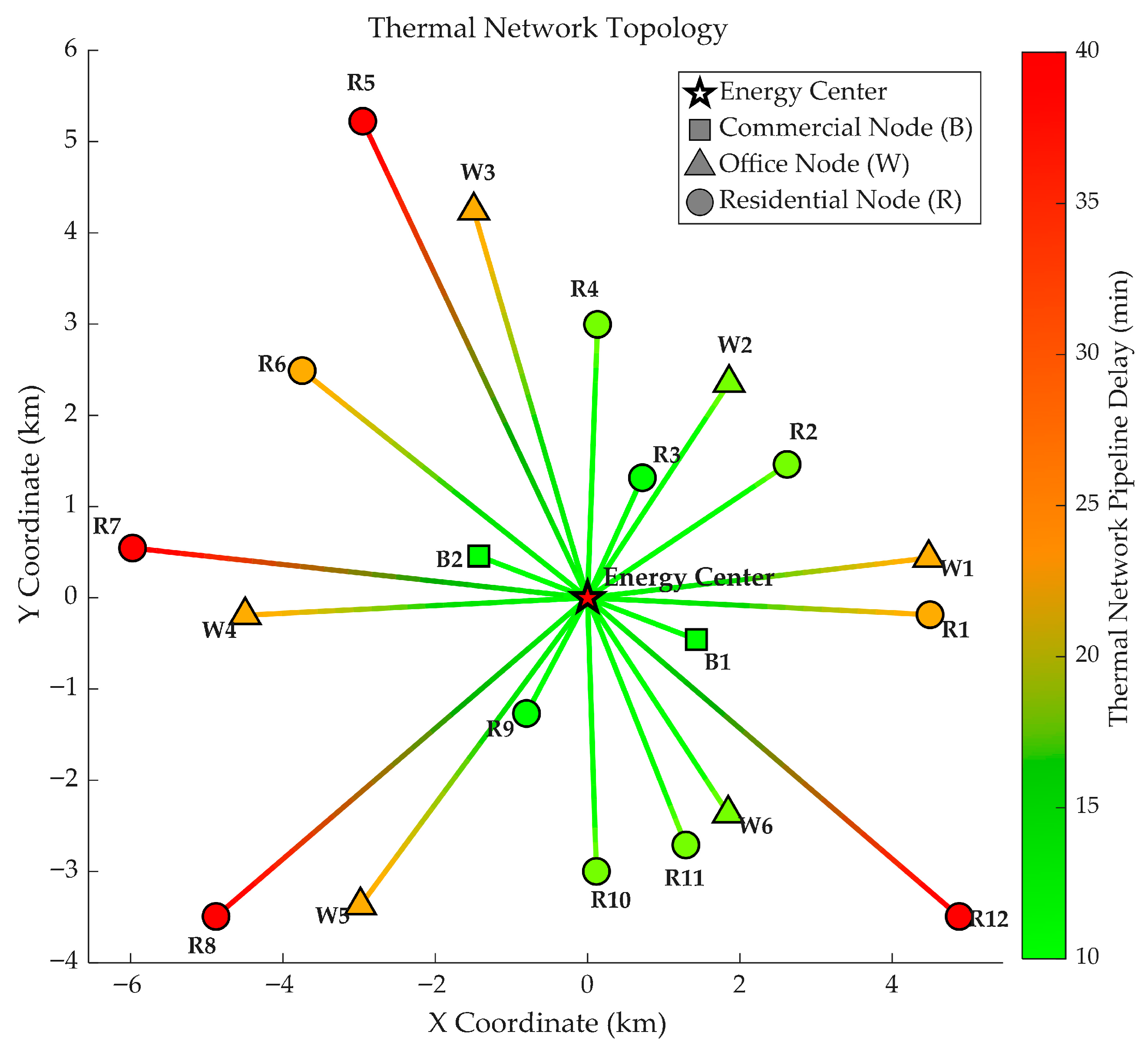
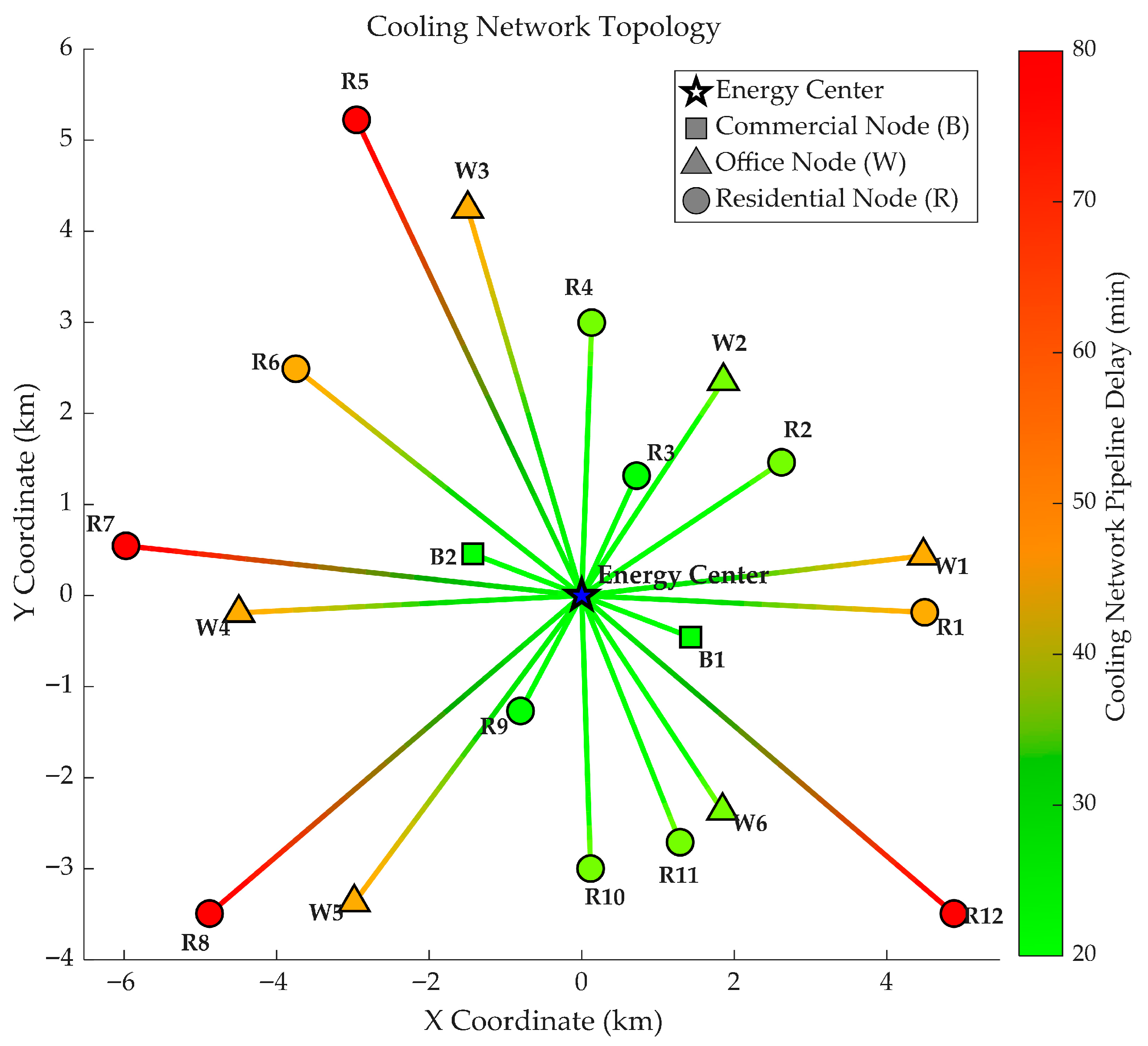
The case study is based on a radial regional energy network comprising one central Energy Station (ES) and 20 distributed load nodes. To strictly evaluate the impact of the proposed methods, three comparative scenarios are established:
  • Scenario 1 (Ideal Baseline): A steady-state model that neglects transmission delays and heat losses, solved with a fixed 10 min time step.
  • Scenario 2 (Proposed Method): A dynamic model incorporating the PFMDM and the LG-ATD strategy. Crucially, the electrical dispatch maintains a 10 min baseline interval to align with grid settlement, while the heating and cooling dispatch follows the adaptive blocks derived from the LG-ATD.
  • Scenario 3 (Dynamic Fixed-Step): A dynamic model considering delays but solved with a fixed 10 min time step (without LG-ATD) to serve as a benchmark for algorithmic performance.
The topological structures of the heating and cooling networks are illustrated in Figure 3 and Figure 4, respectively.

5.2. Analysis of Spatiotemporal Coupling Characteristics

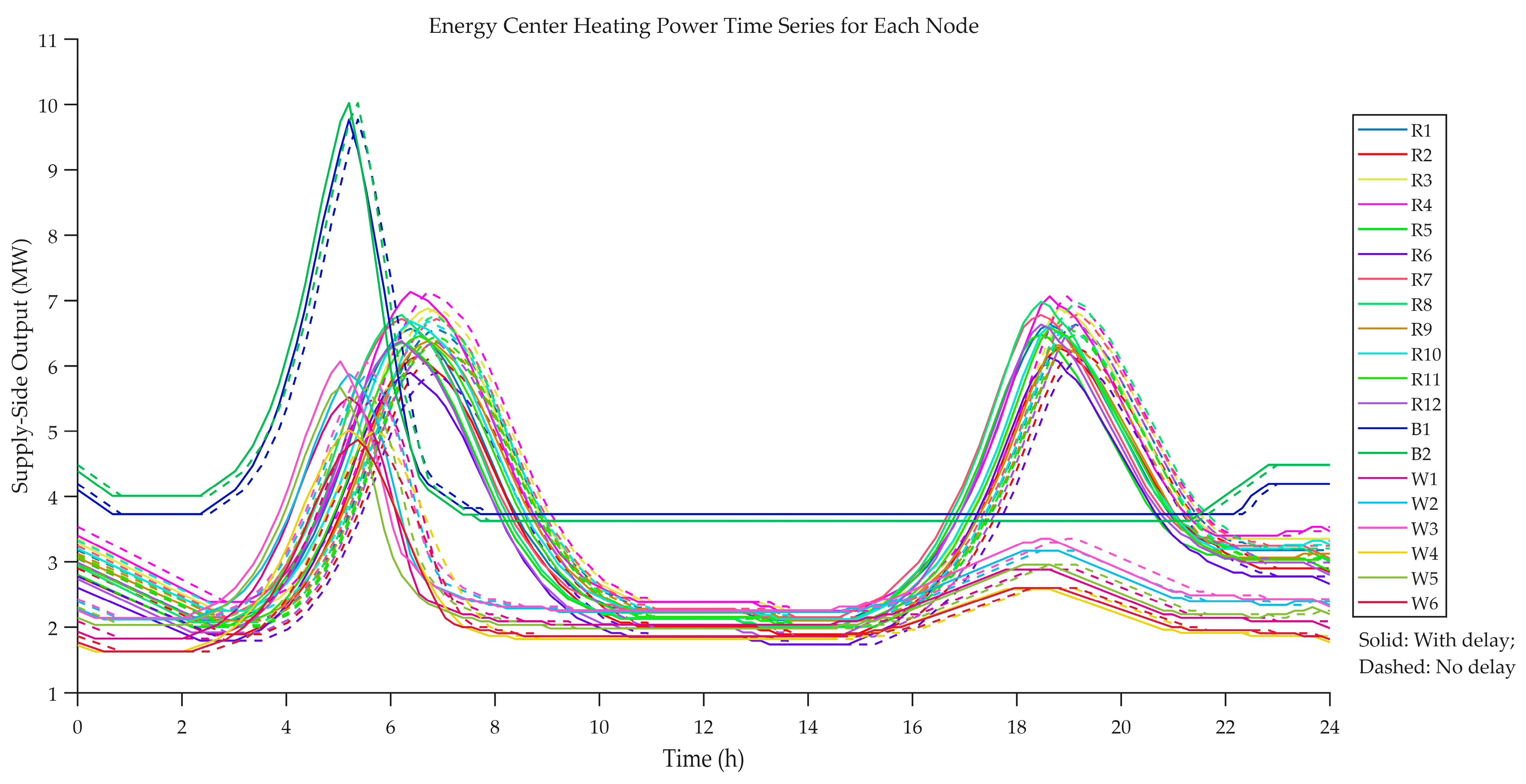
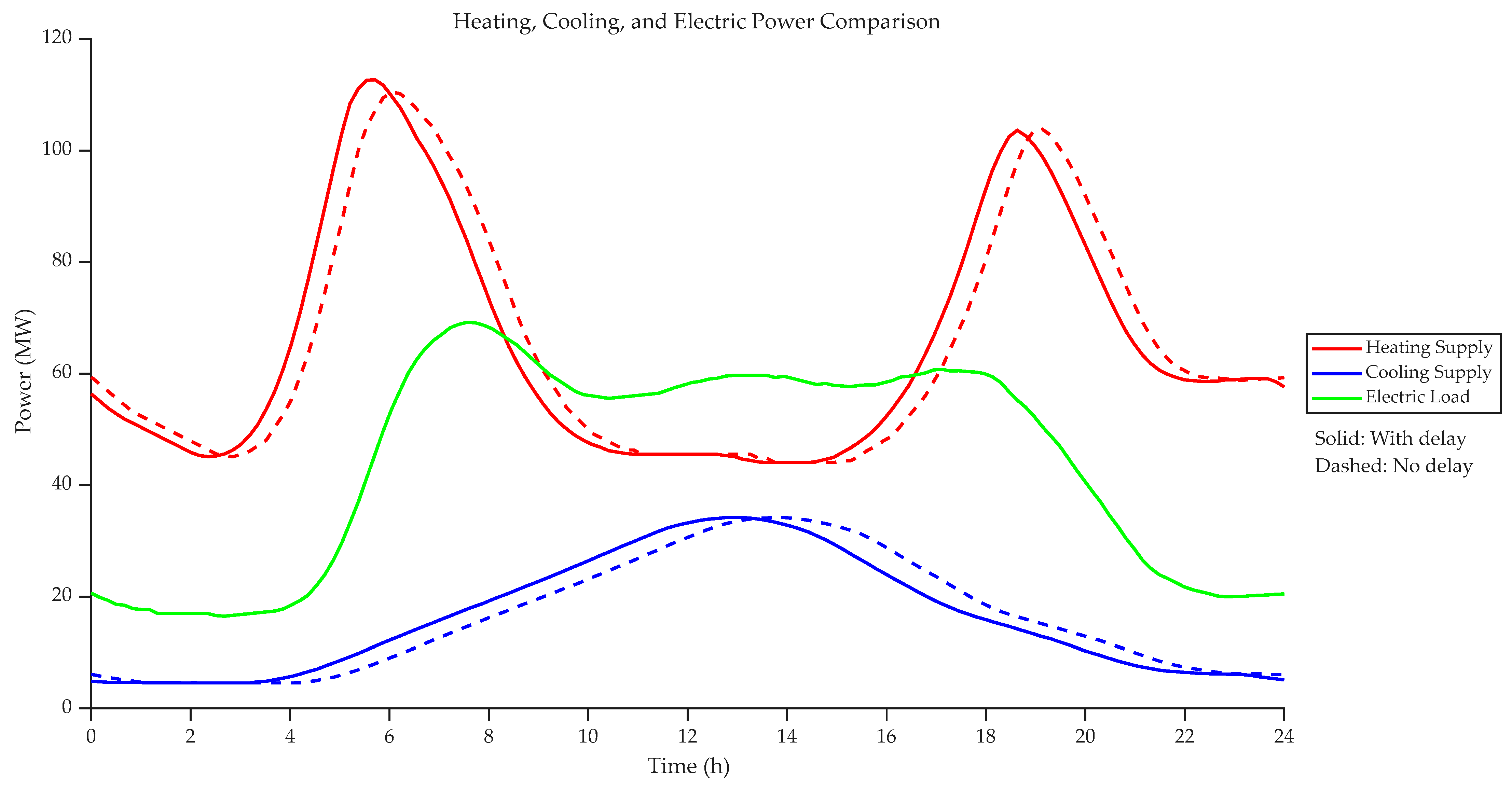
The primary contribution of the proposed PFMDM is the identification and correction of the spatiotemporal mismatch inherent in traditional models. Figure 5 illustrates the comparison of the total heating power output between the Ideal Baseline (Scenario 1) and the Proposed Method (Scenario 2).
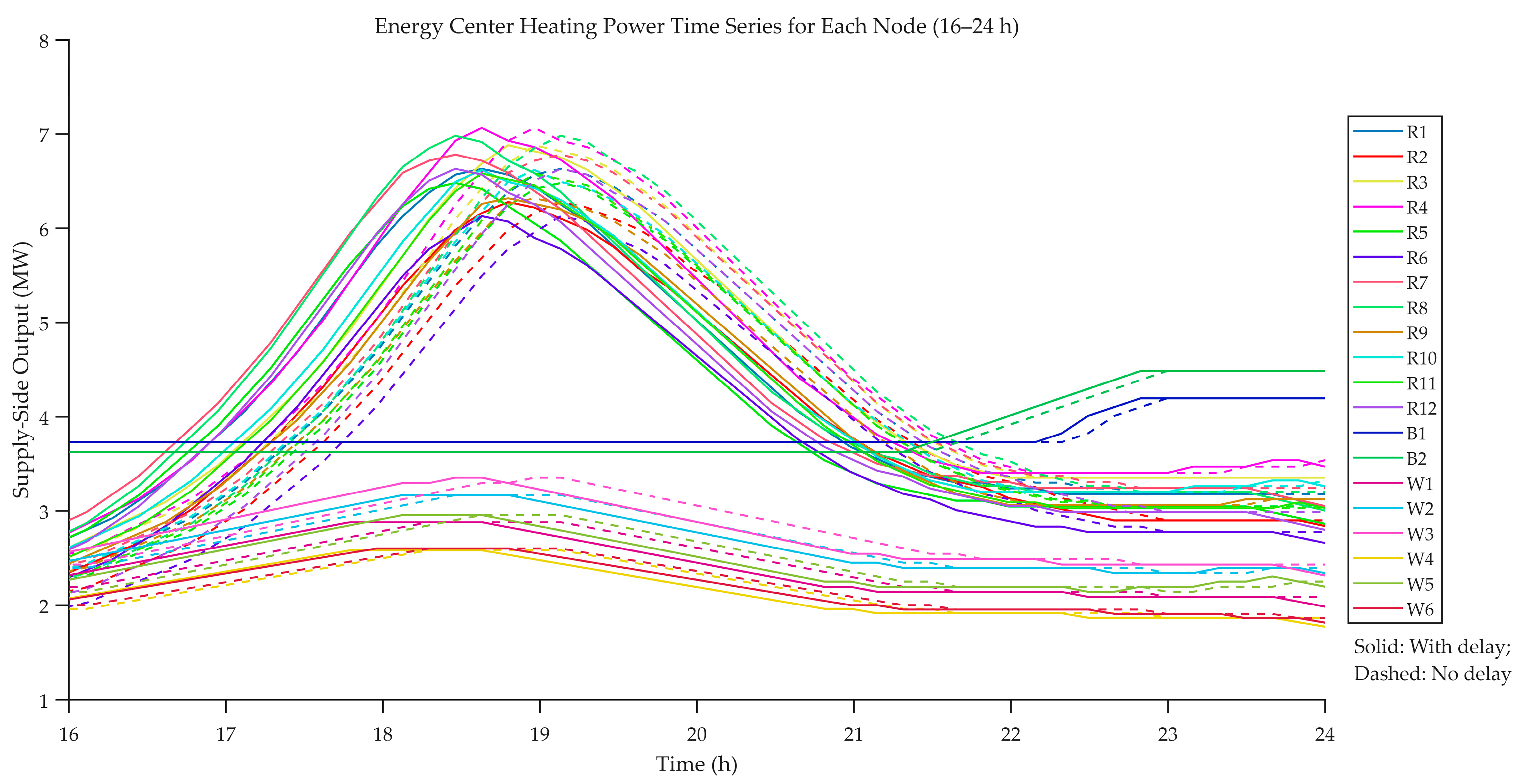
It is observed that the output curve of the proposed model is phase-shifted forward compared to the ideal model. As shown in the zoomed-in view in Figure 6, this “Time Advance” is critical for ensuring the thermal medium reaches remote nodes exactly when needed.
Table 2 lists the specific power deviations for each node caused by the ideal model’s neglect of delays. The maximum nodal power deviation reaches 1.66 MW.
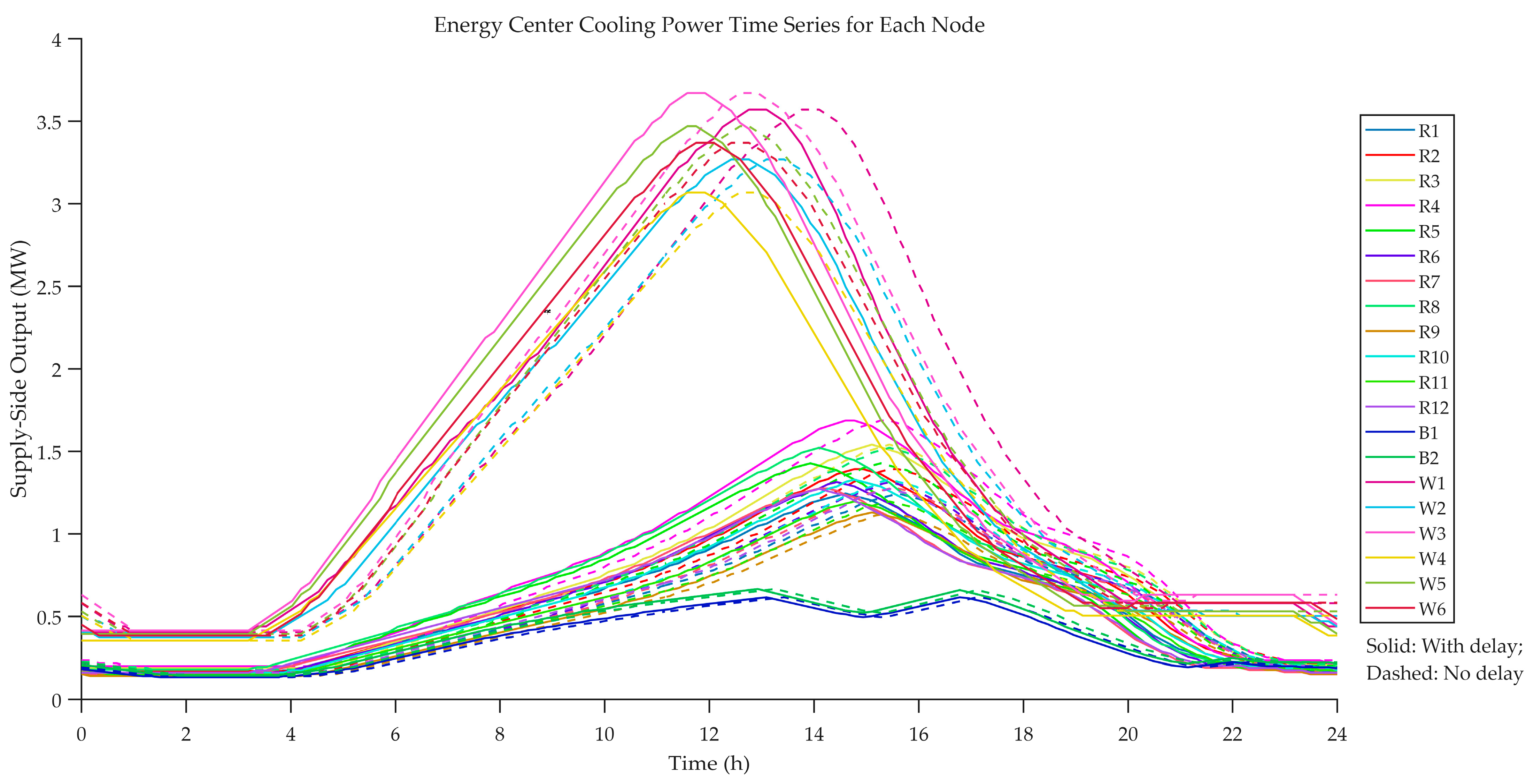
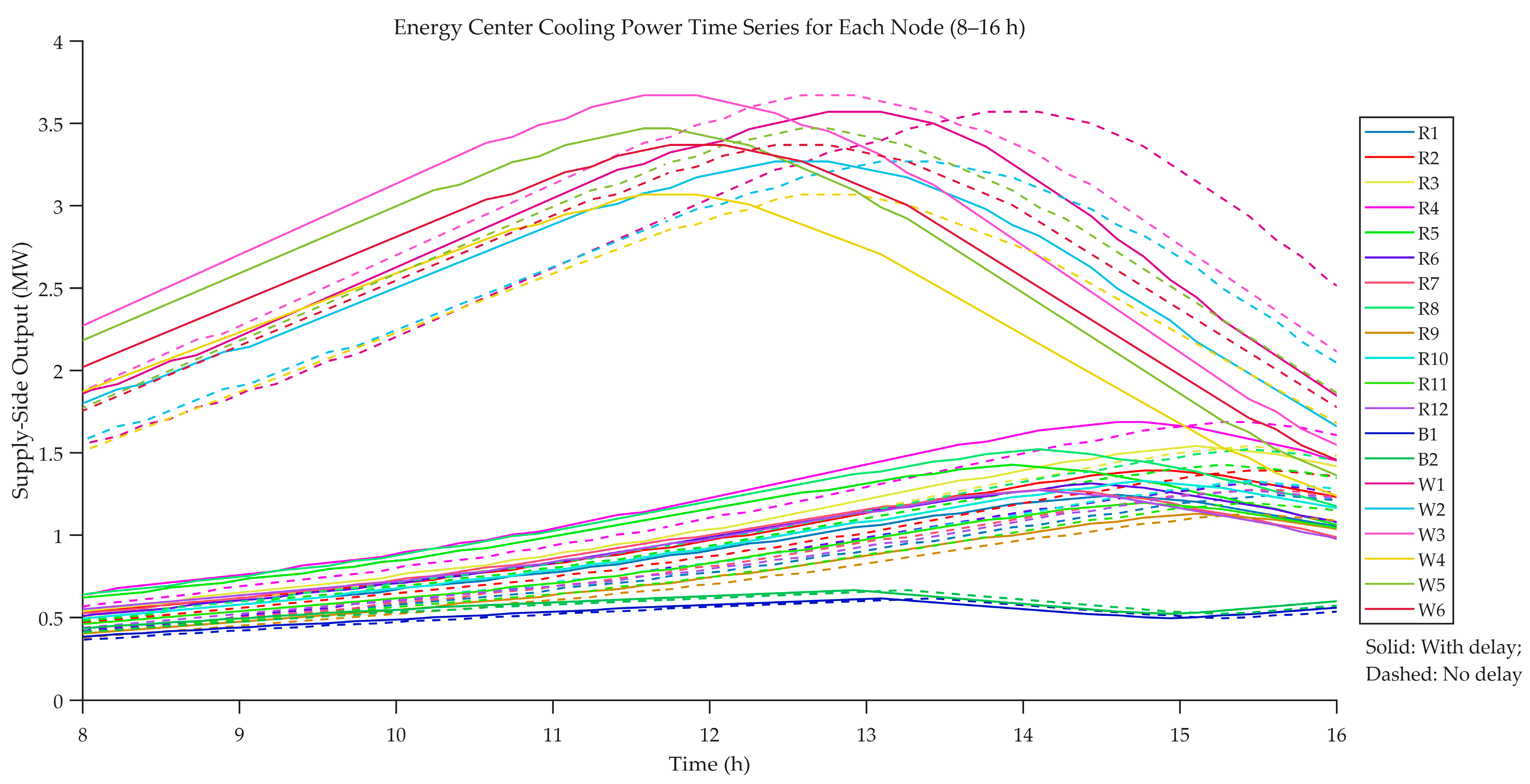
For the cooling network, the delay effect is even more pronounced due to lower flow velocities. Figure 7 shows the cooling power comparison, and Figure 8 provides a detailed view of the peak period. The cooling power deviation is shown in Table 3.
At the system aggregation level, the comparison reveals a significant capacity gap in the ideal model. As shown in Figure 9 and Table 4, the steady-state model underestimates the required peak heating supply by 26.66% and the cooling supply by 39.15%.
This finding indicates that if the system were planned or operated based on the ideal model, it would face a severe capacity shortage during peak hours, failing to meet end-user demand. The proposed model corrects this physical deviation, ensuring the system operates within a physically feasible safety margin.

5.3. Economic Analysis and Energy Structure Shift

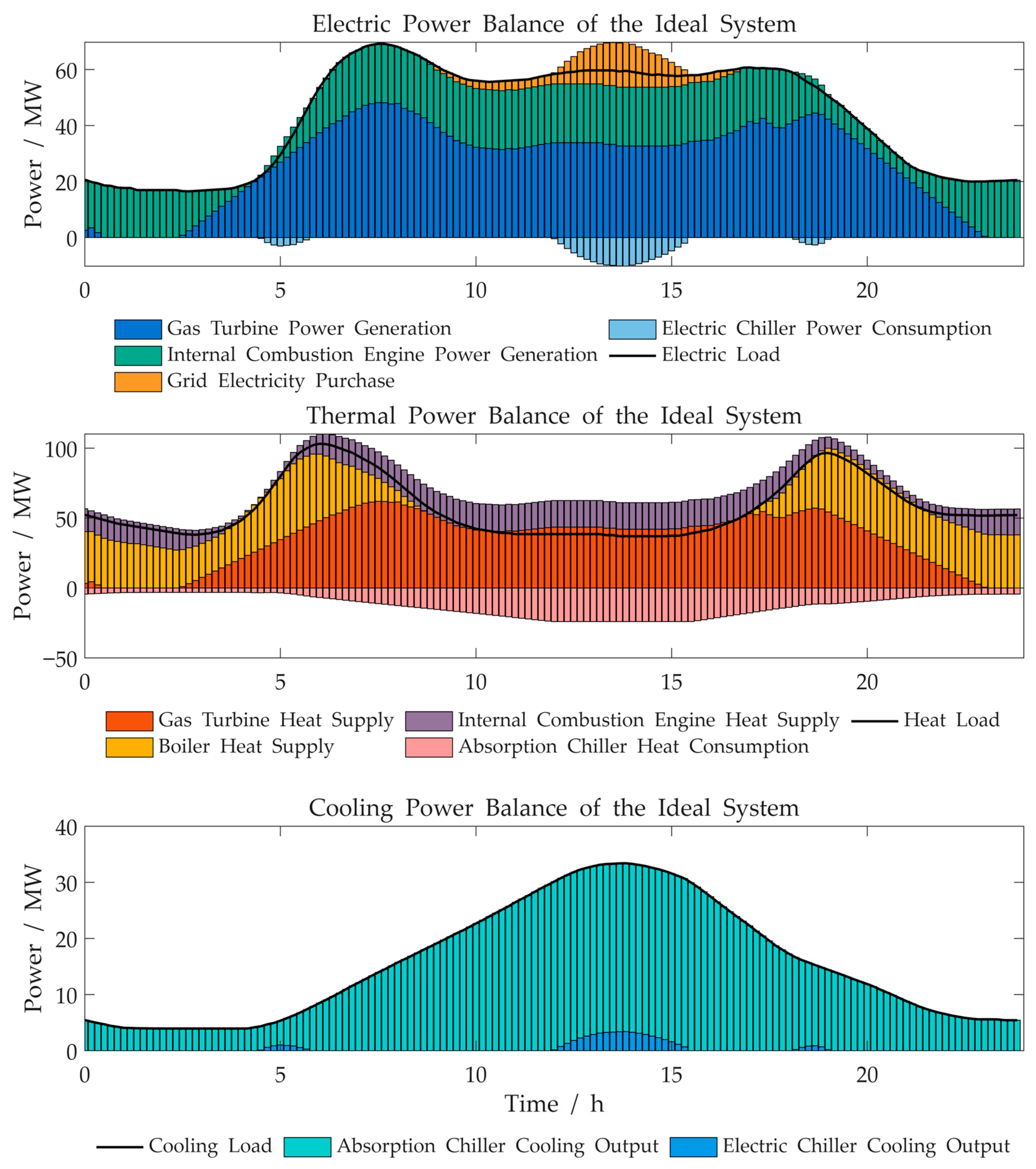
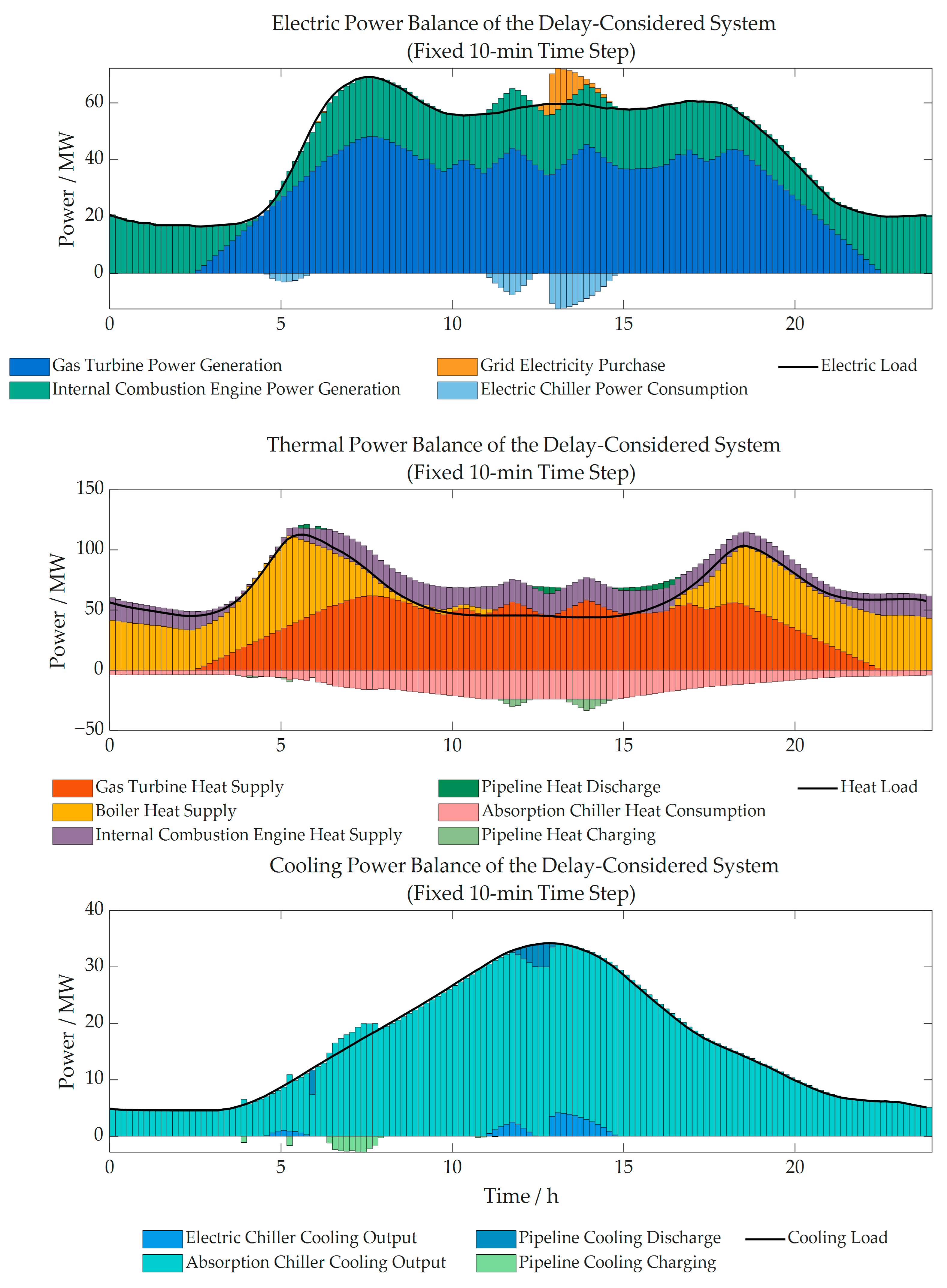
Figure 10 and Figure 11 illustrate the dispatch strategies for the Ideal Baseline and the fixed-step Delay Model, respectively. The delay-considering model exhibits a clear pre-dispatch behavior to compensate for transmission time.
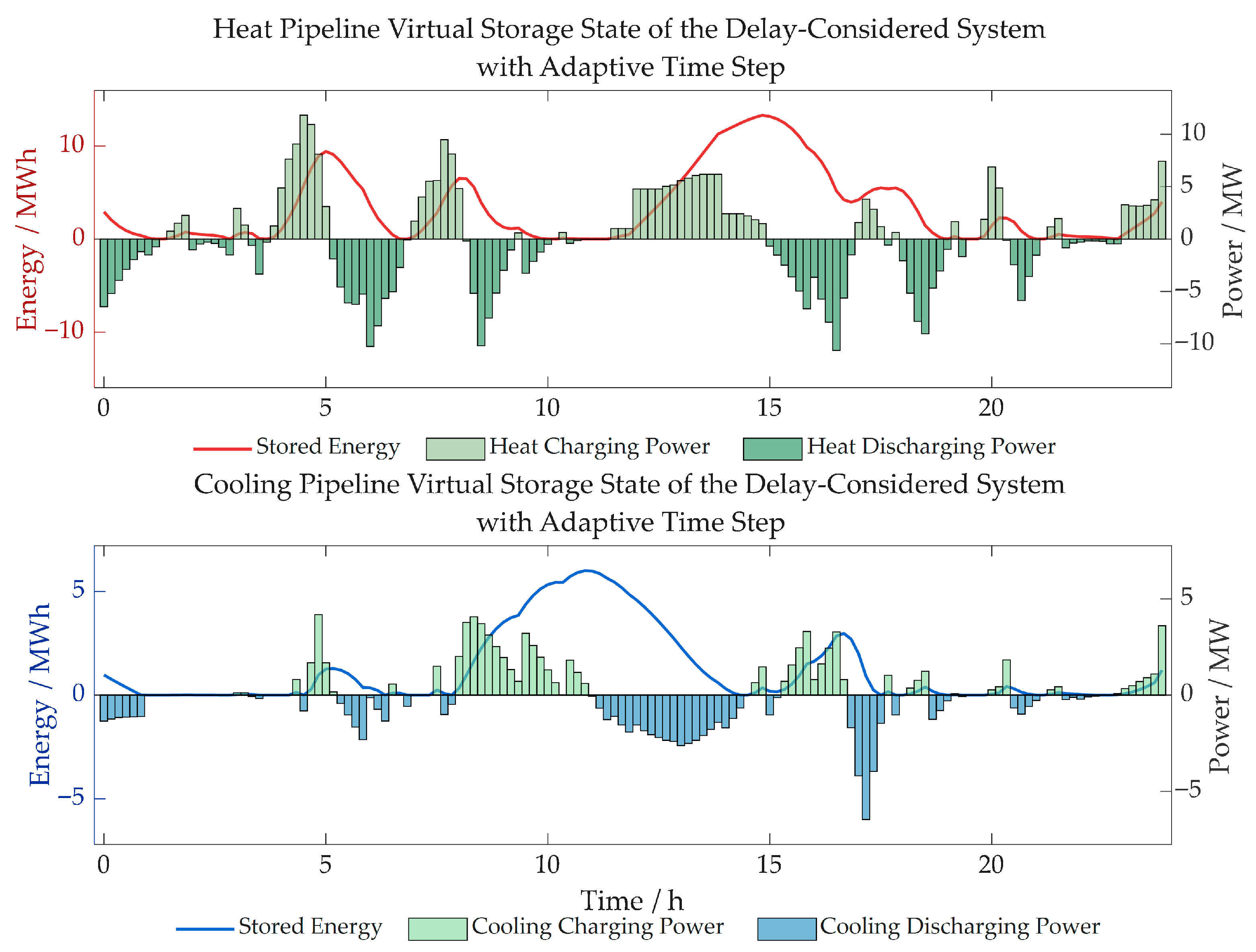
This pre-dispatch is enabled by the Virtual Energy Storage (VES) mechanism. Figure 12 quantifies the energy stored in the pipeline network, demonstrating how the system pre-charges during off-peak hours and discharges during peak hours. The scalability of the effective VES capacity with respect to alternative network topology (meshed networks) and heterogeneous pipe diameters is further examined in Appendix B (Figure A4).
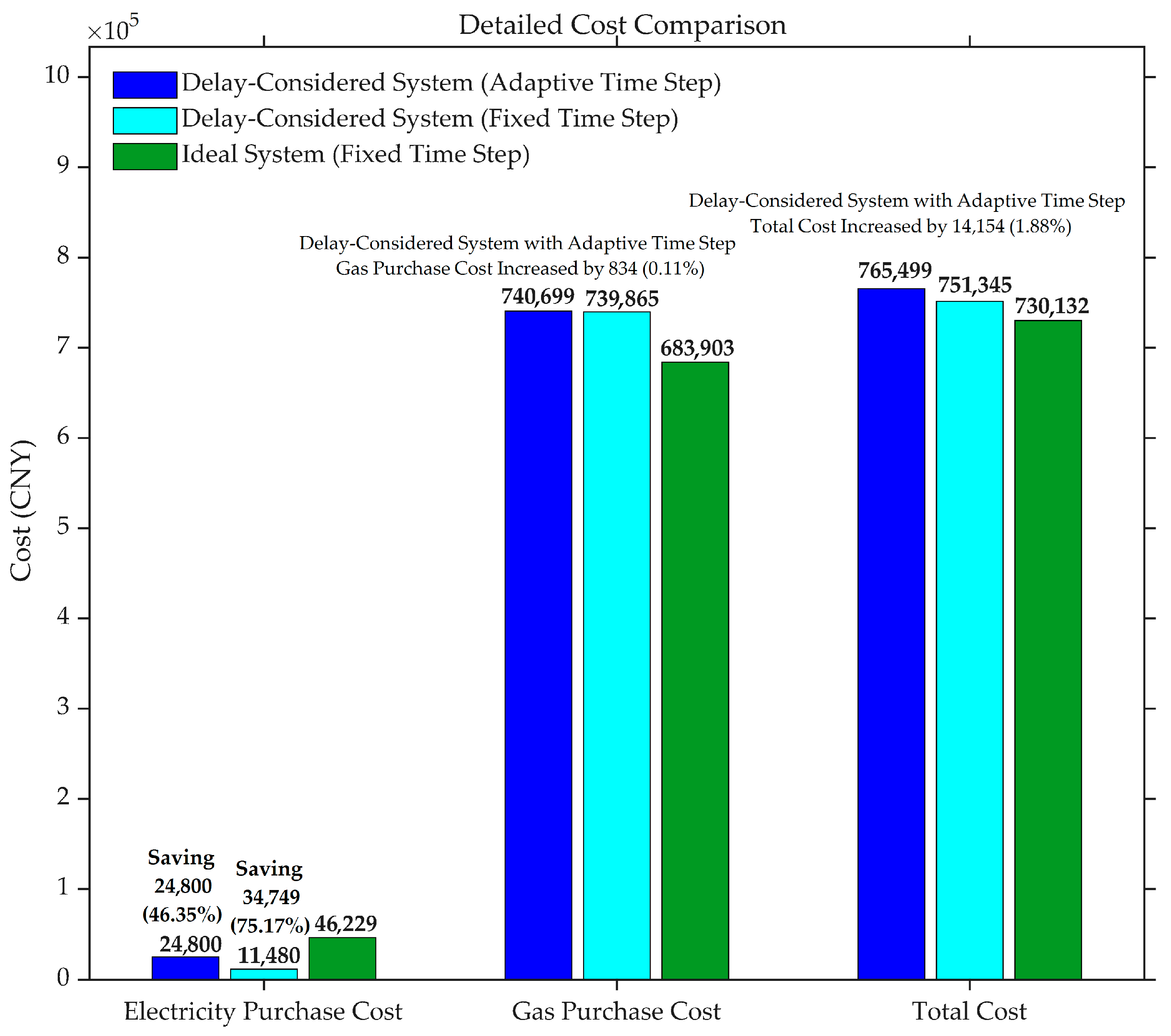
The economic impact is summarized in Figure 13. While the total cost of the proposed model is slightly higher than the ideal baseline, this increase represents the correction of the ideal model’s cost underestimation. The ideal model ignores the energy dissipated during transmission, leading to an artificially low cost that is unattainable in practice. The proposed model reflects the true cost of physical feasibility.
Table 5 provides a cost breakdown across three representative cases: the Ideal System, a Delay-Considered System with fixed time steps, and the proposed PFMDM + LG-ATD model with adaptive temporal discretization. Relative to the ideal baseline, both delay-aware cases reduce electricity purchasing costs by shifting self-generation toward high-price periods through the virtual energy storage (VES) effect, while increasing natural gas consumption to guarantee physically feasible heat/cooling delivery under transmission delays. Specifically, the fixed-step delay model reduces electricity purchasing cost from CNY 46,229 to CNY 11,480, whereas the proposed adaptive model reduces it to CNY 24,800; the accompanying increase in gas consumption represents a feasibility premium that corrects the ideal model’s underestimation.

Robustness to Energy Price Uncertainty and Carbon Policies

To quantify the economic robustness of the proposed delay-aware schedule, we perform a supplementary sensitivity analysis with uniform ±20% scaling of electricity and natural gas prices k e , k g 0.8, 1.2 , 25   s c e n a r i o s . Across all scenarios, the proposed PFMDM + LG-ATD model consistently reduces grid purchasing cost while increasing fuel use, indicating that the operating-cost increase should be interpreted as a feasibility premium for physical realizability rather than a deterioration of dispatch quality. The full scenario table is provided in Appendix C.1. (Table A1).
We further examine carbon-policy impacts by varying the carbon price p c = 30 60   R M B / t C O 2 and the grid emission factor α g r i d = 0.4 0.6   k g C O 2 / k w h . Within this moderate policy range, the carbon-inclusive cost difference between the proposed and ideal models remains stable, implying that the lower cost and lower emissions predicted by the ideal model primarily arise from its underestimated delay-induced heating/cooling requirements rather than from an inherently superior carrier allocation. Detailed results are given in Appendix C.2. (Table A2).
To directly address environmental objectives, we implement a normalized multi-objective scalarization over (i) energy procurement cost, (ii) CO2 emissions, and (iii) primary energy consumption. The resulting trade-offs confirm that the proposed framework can incorporate carbon and primary-energy criteria without altering the core constraint structure; however, under the current device portfolio, the achievable reductions in emissions/primary energy are limited, indicating restricted decarbonization flexibility. Results are summarized in Appendix C.3. (Table A3).
Finally, an emission-cap variant is tested to interpret the trade-off from a planning perspective. Tightening the cap to 0.98 and 0.95 of the delay-aware baseline emission leads to infeasibility for the delay-aware model, whereas the ideal model remains feasible (Appendix C.4., Table A4). This indicates that overly strict caps may be unattainable without additional low-carbon flexibility (e.g., electrification, renewable supply, or external heat sources) and that steady-state idealizations can produce misleadingly optimistic feasibility assessments under carbon constraints.

5.4. Performance of Adaptive Temporal Discretization (LG-ATD)

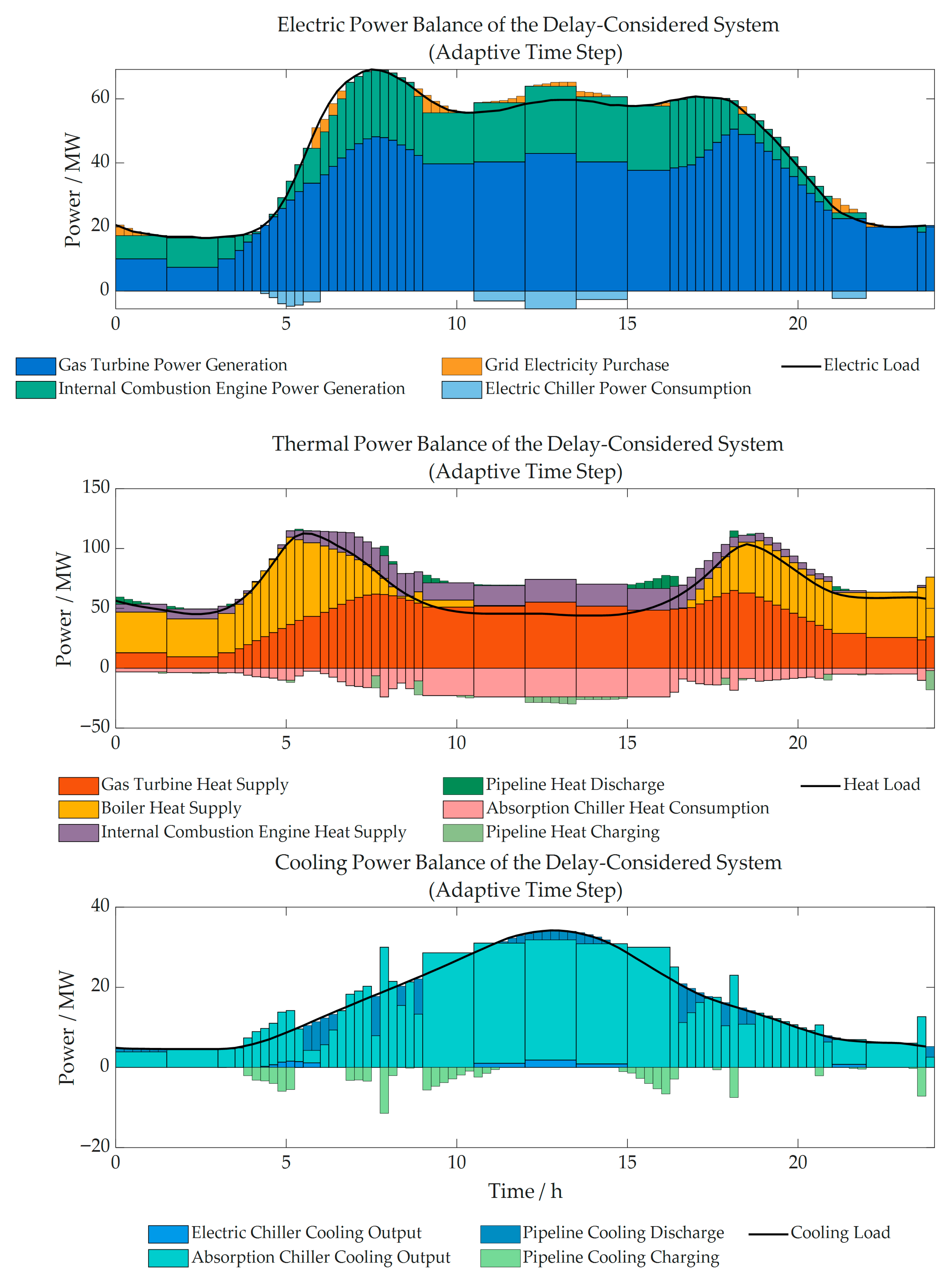
To address the computational challenges in dynamic scheduling, the LG-ATD strategy was implemented. The performance comparison between the traditional fixed-step approach (Scenario 3) and the proposed adaptive approach (Scenario 2) highlights significant improvements in solving efficiency. The unit output and energy balance of the adaptive method are shown in Figure 14.
Dimensionality and Search Space Reduction:
In the 24 h horizon, LG-ATD aggregates the thermal/cooling timeline into 58 adaptive blocks under the default tolerance setting (first-order variation tolerance and second-order curvature tolerance), calibrated against the dynamic fixed-step benchmark (Scenario 3) to limit objective deviation while reducing model size. A brief tolerance sensitivity test (Table 6) shows that relaxing tolerances reduces the number of adaptive blocks (77 → 58 → 53) and the solver-reported runtime (0.062 s → 0.053 s → 0.044 s), confirming the expected aggregation–efficiency trend.
As summarized in Table 6, this aggregation significantly reduces the complexity of the optimization model.
A brief sensitivity analysis is conducted for the two LG-ATD tolerance parameters, namely the first-order variation tolerance and the second-order curvature tolerance. Table 6 reports three representative settings (Strict/Default/Loose). As the tolerances are relaxed, the number of adaptive blocks decreases (77 to 58 to 53), and the solver-reported runtime is reduced accordingly (0.062 s to 0.053 s to 0.044 s). These results indicate that the tolerance parameters mainly control aggregation granularity and computational efficiency in a consistent manner for the studied case.
For completeness, the subsequent robustness and carbon-policy analyses focus on the proposed PFMDM + LG-ATD implementation (adaptive time steps), as it represents the final computationally efficient and delay-aware framework (Appendix C).
The LG-ATD strategy delivers a substantial computational advantage:
  • The number of scheduling intervals on the thermal side is reduced from 144 to 58, leading to a significantly more compact temporal discretization. As a result, the presolved model size is substantially decreased, with the number of rows and columns reduced by 52.4% and 63.5%, respectively.
  • The computational burden of solving the continuous relaxation is greatly alleviated. The number of simplex iterations decreases from 9183 to 718, indicating a much tighter and better-conditioned formulation after presolve. This improvement translates directly into faster solution times, with the overall solving time reduced from 0.53 s to 0.07 s, corresponding to an 86.8% reduction.
It is worth noting that this computational gain is achieved at the expense of a modest increase in operating cost (1.88%, CNY 14,154), which can be attributed to the reduced fine-grained control flexibility introduced by the coarser adaptive temporal aggregation. Nevertheless, the LG-ATD approach effectively mitigates the curse of dimensionality. For large-scale energy system optimization problems with delay effects and complex coupling structures, this reduction in algorithmic complexity is crucial for ensuring robust solver performance and scalability.

6. Conclusions

This paper proposes a comprehensive optimal operation strategy for regional CCHP systems, addressing the twin challenges of spatiotemporal decoupling caused by transmission delays and the computational complexity of dynamic scheduling. The main conclusions are as follows:
  • Quantification of Steady-State Model Deviations: The proposed PFMDM effectively characterizes the transmission delay and thermal loss without solving complex PDEs. Comparative analysis verifies that the traditional steady-state model provides an over-optimistic estimation of system capabilities. The proposed model identifies and corrects a significant underestimation in supply capacity—specifically up to 26.66% for heating and 39.15% for cooling—thereby eliminating the blind spots in capacity planning and ensuring that the scheduling plan is physically feasible. Moreover, PFMDM is directly verified against a transient PDE solver over a wide (L,v,k) range (Appendix A), where the outlet-temperature RMSE remains below 0.2 °C, confirming that the proposed algebraic mapping preserves the essential transport delay and thermal decay dynamics.
  • Optimization of Energy Structure: The study reveals that the pipeline network functions as a significant Virtual Energy Storage (VES) resource. By optimizing the thermal inertia, the system strategically shifts its energy sourcing from the grid to internal gas-fired cogeneration. This “fuel substitution” effect reallocates part of the energy supply from grid electricity purchases to on-site gas-fired cogeneration during high-price periods, which substantially decreases the electricity purchasing cost in the tested case (75.2%). Importantly, this change is driven by the requirement of physical feasibility under transmission delay and losses, and it is accompanied by a higher natural gas cost and a higher total operating cost.
  • The LG-ATD strategy effectively alleviates the computational bottleneck caused by high-resolution temporal discretization. By maintaining a fixed 10 min scheduling resolution for the electrical system while adaptively aggregating thermal and cooling dynamics into variable-length time blocks, the proposed method reduces the number of scheduling intervals from 144 to 58 and substantially compresses the presolved model size, with the numbers of rows and columns reduced by 52.4% and 63.5%, respectively. Consequently, the computational effort is significantly decreased, as reflected by a reduction of over 92% in simplex iterations and an 86.8% decrease in overall solving time. These computational gains are achieved at the expense of a moderate increase in operating cost (1.88%), representing a controlled trade-off between solution optimality and computational tractability. Overall, the LG-ATD strategy provides a robust and scalable solution for large-scale energy system optimization problems with delay effects, particularly in real-time engineering applications.
Future work will focus on extending this framework to meshed network topologies, incorporating the stochastic nature of renewable energy into the adaptive discretization algorithm, and explicitly accounting for start-up state initialization and axial-conduction effects under extreme low-flow or cold-start scenarios.

Author Contributions

Conceptualization, S.Y., S.Z. and J.Z.; Methodology, S.Y., S.Z., J.Z., Y.L., Q.W. and P.W.; Software, S.Z.; Validation, S.Y., S.Z., J.Z., Y.L., Q.W. and P.W.; Formal analysis, S.Y., S.Z. and J.Z.; Investigation, S.Y., S.Z. and J.Z.; Resources, S.Y., S.Z., J.Z., Q.W. and P.W.; Data curation, S.Y., S.Z. and J.Z.; Writing—original draft preparation, S.Y., S.Z. and J.Z.; Writing—review and editing, S.Y., S.Z., J.Z., Y.L., Q.W. and P.W.; Visualization, S.Y., S.Z. and J.Z.; Supervision, S.Y., J.Z., Q.W. and P.W.; Project administration, S.Y., Y.L., Q.W. and P.W.; Funding acquisition, S.Y., Y.L., Q.W. and P.W. All authors have read and agreed to the published version of the manuscript.

Funding

This research was supported by the State Grid Corporation of China Science and Technology Project (Grant No. 5700-202316623A-3-2-ZN).

Institutional Review Board Statement

Not applicable.

Informed Consent Statement

Not applicable.

Data Availability Statement

The original contributions presented in the study are included in the article; further inquiries can be directed to the corresponding author.

Acknowledgments

We wish to thank the anonymous editor and the referees for their constructive comments and recommendations, which significantly improved this paper.

Conflicts of Interest

Authors Wang Qing and Wang Pingxin were employed by the State Grid Shandong Electric Power Company Marketing Service Center (Metering Center). The remaining authors declare that the research was conducted in the absence of any commercial or financial relationships that could be construed as a potential conflict of interest.

Appendix A

To directly verify the fidelity of PFMDM without explicitly solving PDEs, we benchmark PFMDM against a transient one-dimensional convection–loss PDE model consistent with the assumptions in Section 2.1:
T x , t t + v T x , t x = k T x , t T am , T 0 , t = T in t , T x , 0
The PDE is solved using a high-resolution finite-volume scheme (TVD–MUSCL reconstruction with a CFL-constrained time step) to provide a reference outlet temperature T out PDE t = T L , t . PFMDM is evaluated under identical boundary/initial conditions to generate T out PFMDM t .
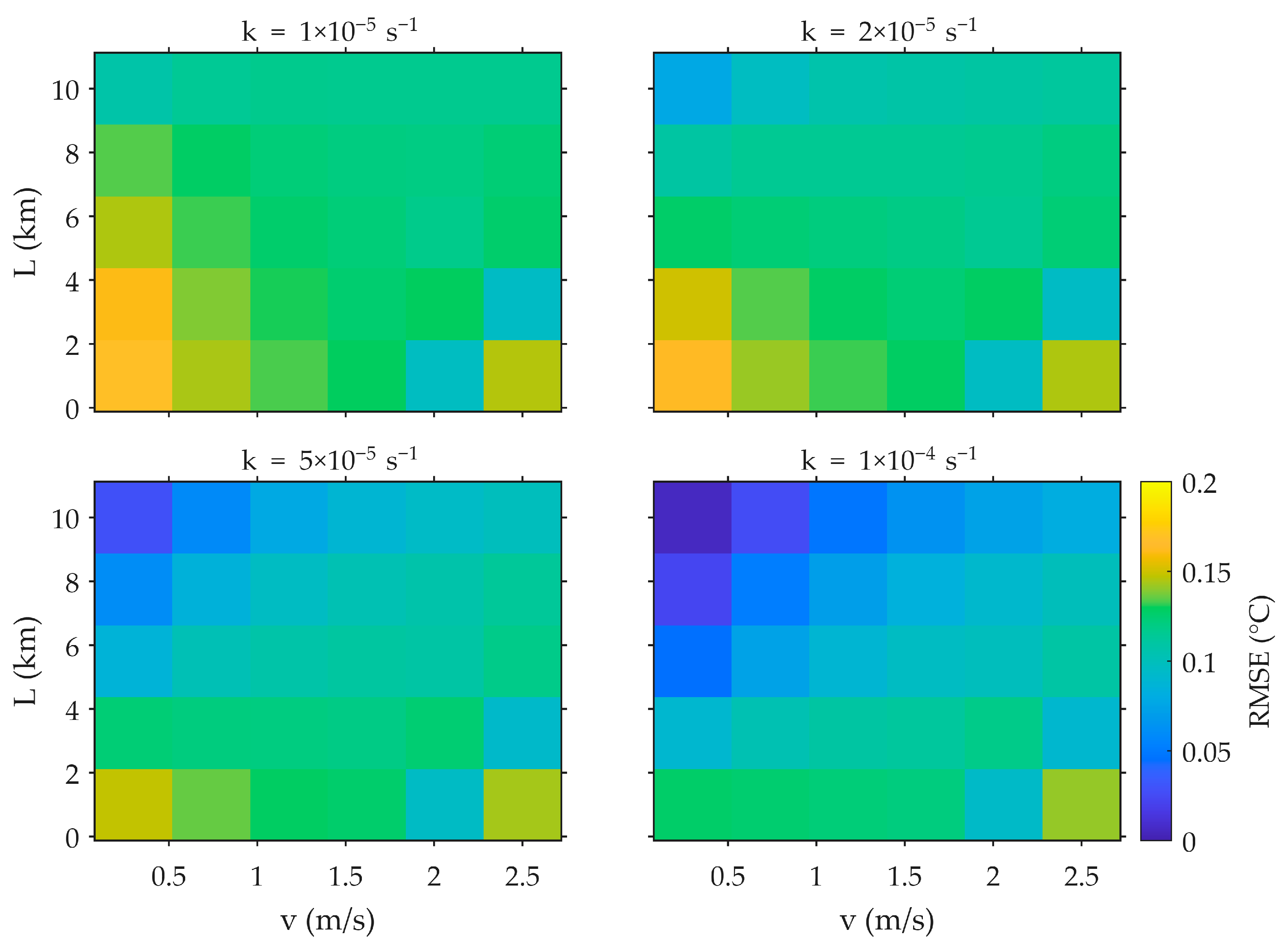
A parametric sweep is performed over pipe length L = 1–10 km, flow velocity v = 0.3–2.5 m/s, and thermal loss coefficient k ∈ {1 × 10⁻⁵, 2 × 10⁻⁵, 5 × 10⁻⁵, 1 × 10⁻⁴}.
The agreement is quantified using the outlet-temperature RMSE:
RMSE = 1 N i = 1 N T out PFMDM t i T out PDE t i 2
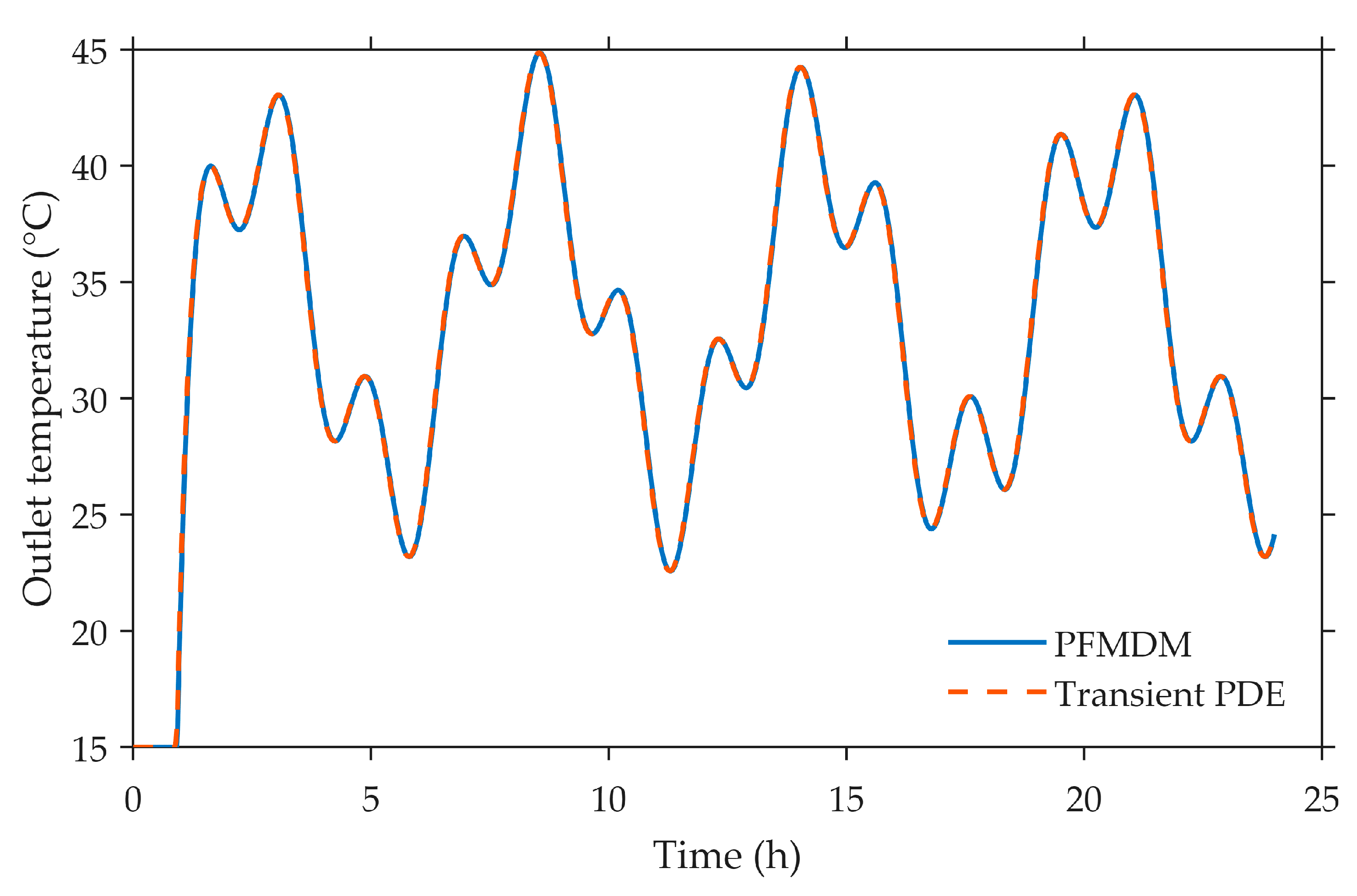
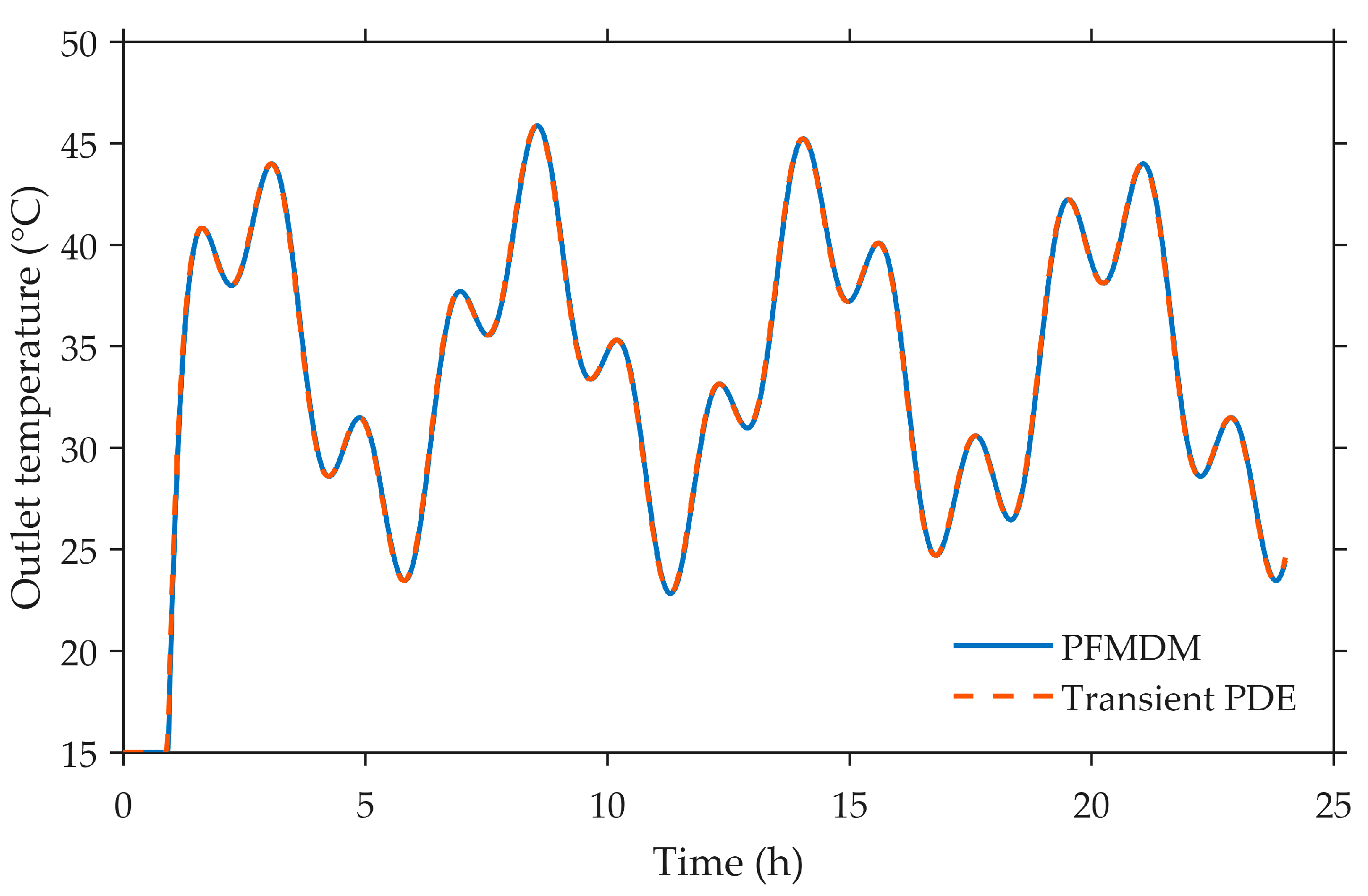
Figure A1 shows RMSE heatmaps across (L, v) for different k, and Figure A2 and Figure A3 present representative and worst-case time-series comparisons. Across the tested parameter space, PFMDM closely tracks the transient PDE reference, with RMSE bounded within 0.2 °C, confirming that PFMDM preserves the key transport-delay and thermal-decay dynamics under varied L, v, and k.
Figure A1. RMSE heatmaps at different k.
Applsci 16 01711 g0a1
Figure A2. Representative time-series comparison between PFMDM and the transient PDE benchmark for outlet temperature. Case parameters: L = 6.0 km, v = 1.50 m/s, k = 2.0 × 10⁻⁵ /s. Error metrics: RMSE = 0.116 °C; max absolute error = 0.805 °C.
Applsci 16 01711 g0a2
The worst-case condition is identified over the tested parameter grid (pipe length, flow velocity/regime, and heat-loss coefficient) as the case yielding the maximum RMSE between PFMDM and the transient PDE benchmark. The representative and worst-case curves may appear visually overlapped because the mismatch remains at a sub-degree level relative to the temperature scale; therefore, the corresponding parameter values and error metrics are stated explicitly in the figure captions.
Figure A3. Worst-case time-series comparison between PFMDM and the transient PDE benchmark for outlet temperature, identified by the maximum RMSE over the tested parameter grid. Case parameters: L = 1.0 km, v = 0.30 m/s, k = 1.0 × 10⁻⁵ /s. Error metrics: RMSE = 0.168 °C; max absolute error = 1.040 °C.
Applsci 16 01711 g0a3

Appendix B

We conduct a supplementary sensitivity analysis to evaluate how effective virtual energy storage (VES) capacity scales with network topology and heterogeneous pipe diameters. The effective capacity is computed as C V E S = max t E V E S t min t E V E S t over the same 24 h operating horizon, and is normalized by an energy upper bound C U B = ρ c p V n e t T s max T s min , where V n e t is the total water volume of the network and T s denotes the supply temperature trajectory. Figure A4 compares four representative cases (radial-series vs. meshed topology; uniform vs. heterogeneous diameters) under different heat-loss coefficients k. Under identical aggregate volume and operating conditions, topology and diameter heterogeneity introduce only a modest variation in C V E S (within a few percent in the tested cases), whereas increasing k leads to a noticeably lower exploitable capacity due to stronger thermal attenuation along the pipelines. These results support that the VES mechanism is not restricted to a single radial network and remains quantitatively consistent when extending to meshed connectivity and heterogeneous diameters.
Figure A4. Sensitivity of the effective VES capacity to network topology (radial-series vs. meshed) and pipe-diameter distribution (uniform vs. heterogeneous) under different heat-loss coefficients k.
Applsci 16 01711 g0a4

Appendix C

Appendix C.1

Supplementary economic analyses are provided to quantify the impacts of price uncertainty and carbon policies and to interpret the operating-cost increase as a feasibility premium. Unless otherwise stated, the baseline case uses k e = k g = 1.0, carbon price p c = 50 RMB/tCO2, and grid emission factor α g r i d = 0.5 CO2/kWh. Primary energy is evaluated using the same coefficients adopted in the simulation scripts.
Table A1. Sensitivity to uniform ±20% scaling of electricity and natural gas prices (25 scenarios). Values report Δ = Scenario 2 (PFMDM + LG-ATD) − Scenario 1 (ideal baseline).
kekgDelta Grid Cost (RMB)Delta Gas Cost (RMB)Delta Energy Procurement Cost (RMB)Delta CO2 Emissions (t)Delta Total Cost Incl. Carbon (RMB)
0.80.8−17,143+45,436+28,293+46.55+30,621
0.80.9−15,312+49,219+33,907+46.34+36,224
0.81.0−13,797+53,116+39,319+46.31+41,635
0.81.1−10,870+55,385+44,515+46.60+46,845
0.81.2−11,271+60,829+49,558+46.57+51,887
0.90.8−20,536+45,427+24,891+46.55+27,218
0.90.9−19,173+49,211+30,038+46.34+32,355
0.91.0−17,832+53,109+35,276+46.31+37,592
0.91.1−14,826+55,378+40,552+46.60+42,882
0.91.2−15,310+60,824+45,514+46.57+47,843
1.00.8−23,580+45,420+21,840+46.55+24,159
1.00.9−22,540+49,205+26,665+46.34+28,982
1.01.0−21,429+56,795+35,367+46.55+37,694
1.01.1−18,362+55,372+37,010+46.60+39,349
1.01.2−19,176+60,819+41,643+46.57+43,970
1.10.8−25,837+45,413+19,576+46.55+21,882
1.10.9−25,066+49,200+24,134+46.34+26,455
1.11.0−24,161+53,099+28,939+46.31+31,255
1.11.1−21,054+55,367+34,313+46.60+36,630
1.11.2−22,202+60,814+38,612+46.57+40,940
1.20.8−26,102+45,764+19,662+46.85+22,005
1.20.9−25,628+49,194+23,566+46.34+25,887
1.21.0−24,748+53,093+28,345+46.31+30,661
1.21.1−21,613+55,362+33,749+46.60+36,066
1.21.2−22,977+60,809+37,832+46.57+40,156

Appendix C.2

Table A2. Sensitivity to carbon price (30–60 RMB/tCO2) and grid emission factor (0.4–0.6 kgCO2/kWh). Values report Δ = Scenario 2 (PFMDM + LG-ATD) − Scenario 1 (ideal baseline).
Carbon Price (RMB/tCO2)Grid Emission Factor (kgCO2/kWh)Delta Energy Procurement Cost (RMB)Delta CO2 Emissions (t)Delta Carbon Cost (RMB)Delta Total Cost Incl. Carbon (RMB)
300.4+35,367+48.57+1457+36,824
300.5+35,367+46.55+1396+36,763
300.6+35,367+44.52+1336+36,702
400.4+35,367+48.57+1943+37,309
400.5+35,367+46.55+1862+37,228
400.6+35,367+44.52+1781+37,147
500.4+35,367+48.57+2429+37,796
500.5+35,367+46.55+2327+37,694
500.6+35,367+44.52+2226+37,592
600.4+35,368+48.57+2914+38,280
600.5+35,367+46.55+2792+38,159
600.6+35,367+44.52+2671+38,038

Appendix C.3

Table A3. Multi-objective extension considering energy cost, CO2 emissions, and primary energy consumption. Results are reported for Scenario 2 (PFMDM + LG-ATD) and Scenario 1 (ideal baseline).
SystemWenergyWcarbonWprimaryEnergy Procurement Cost (RMB)CO2 Emissions (t)Primary Energy (kWhPE)
Delay-aware system (adaptive LG-ATD)1.00.00.0765,500754.7183,736,999
Delay-aware system (adaptive LG-ATD)0.70.30.0765,520754.6463,736,653
Delay-aware system (adaptive LG-ATD)0.50.30.2765,627754.5283,736,123
Delay-aware system (adaptive LG-ATD)0.40.40.2765,707754.4603,735,824
Delay-aware system (adaptive LG-ATD)0.30.50.2766,036754.2793,734,948
Ideal system (fixed step)1.00.00.0730,134708.1693,507,064
Ideal system (fixed step)0.70.30.0730,136708.1623,507,052
Ideal system (fixed step)0.50.30.2730,143708.1513,507,013
Ideal system (fixed step)0.40.40.2730,147708.1453,506,996
Ideal system (fixed step)0.30.50.2730,188708.1303,506,881

Appendix C.4

Table A4. Emission-cap variant (hard constraint) under CapRatio ∈ {1.00, 0.98, 0.95}. Feasibility status is reported for Scenario 2 (PFMDM + LG-ATD) and Scenario 1 (ideal baseline).
SystemCap RatioCap (tCO2)Energy Procurement Cost (RMB)CO2 Emissions (t)Primary Energy (kWhPE)Status
Delay-aware system (adaptive LG-ATD)1.00754.7169765,499754.71693,736,994OK
Ideal system (fixed step)1.00754.7169730,132708.16853,507,058OK
Delay-aware system (adaptive LG-ATD)0.98739.6226Infeasible (Gurobi)
Ideal system (fixed step)0.98739.6226730,132708.16853,507,058OK
Delay-aware system (adaptive LG-ATD)0.95716.9811Infeasible (Gurobi)
Ideal system (fixed step)0.95716.9811730,132708.16853,507,058OK

References

  1. Pan, E.; Li, H.; Wang, Z.; Peng, D.; Zhao, L.; Fan, L.; Wang, Y.; Huang, F.; Ma, Y.; Liu, L. Operation Optimization of Integrated Energy Systems Based on Heat Storage Characteristics of Heating Network. Energy Sci. Eng. 2021, 9, 223–238. [Google Scholar] [CrossRef]
  2. Wang, J.; Zeng, A.; Wan, Y. Multi-Time-Scale Optimal Scheduling of Integrated Energy System Considering Transmission Delay and Heat Storage of Heating Network. Sustainability 2023, 15, 14260. [Google Scholar] [CrossRef]
  3. Zhu, X.; Yang, J.; Liu, Y.; Liu, C.; Miao, B.; Chen, L. Optimal Scheduling Method for a Regional Integrated Energy System Considering Joint Virtual Energy Storage. IEEE Access 2019, 7, 138260–138272. [Google Scholar] [CrossRef]
  4. Chen, X.; Le, B.; Cheng, C.; Gan, L.; Yu, K. An Operational Optimization Method of Regional Multi-Energy System Considering Thermal Quasi-Dynamic Characteristics. CSEE J. Power Energy Syst. 2021, 10, 2551–2563. [Google Scholar] [CrossRef]
  5. Tang, Z.; Lin, S.; Liang, W.; Xie, Y.; Song, Y.; Wang, J.; Liu, M. Optimal Dispatch of Integrated Energy Campus Microgrids Considering the Time-Delay of Pipelines. IEEE Access 2020, 8, 178782–178795. [Google Scholar] [CrossRef]
  6. Hassan, M.A.; Serra, S.; Sochard, S.; Viot, H.; Marias, F.; Reneaume, J.-M. Optimal Scheduling of Energy Storage in District Heating Networks Using Nonlinear Programming. Energy Convers. Manag. 2023, 295, 117652. [Google Scholar] [CrossRef]
  7. Kuang, J.; Zhang, C.; Li, F.; Sun, B. Dynamic Optimization of Combined Cooling, Heating, and Power Systems with Energy Storage Units. Energies 2018, 11, 2288. [Google Scholar] [CrossRef]
  8. Yang, L.; Guo, H.; Huang, K. Optimal Dispatch for a Combined Cooling, Heating and Power Microgrid Considering Building Virtual Energy Storage. J. Electr. Eng. Technol. 2019, 14, 581–594. [Google Scholar] [CrossRef]
  9. Leśko, M.; Bujalski, W. Modeling of District Heating Networks for the Purpose of Operational Optimization with Thermal Energy Storage. Arch. Thermodyn. 2017, 38, 139–163. [Google Scholar] [CrossRef]
  10. Deng, X.; Huang, Y.; Chen, Y.; Chen, C.; Yang, L.; Gao, Q.; Chen, X.; Hou, W.; Lin, Z. Multi-Scenario Physical Energy Storage Planning of Integrated Energy Systems Considering Dynamic Characteristics of Heating Network and Demand Response. Front. Energy Res. 2021, 9, 783588. [Google Scholar] [CrossRef]
  11. Luo, Z.; Wang, J.; Xiao, N.; Yang, L.; Zhao, W.; Geng, J.; Lu, T.; Luo, M.; Dong, C. Low Carbon Economic Dispatch Optimization of Regional Integrated Energy Systems Considering Heating Network and P2G. Energies 2022, 15, 5494. [Google Scholar] [CrossRef]
  12. Tan, J.; Wu, Q.; Hu, Q.; Wei, W.; Liu, F. Adaptive Robust Energy and Reserve Co-Optimization of Integrated Electricity and Heating System Considering Wind Uncertainty. Appl. Energy 2020, 260, 114230. [Google Scholar] [CrossRef]
  13. Merkert, L.; Haime, A.A.; Hohmann, S. Optimal Scheduling of Combined Heat and Power Generation Units Using the Thermal Inertia of the Connected District Heating Grid as Energy Storage. Energies 2019, 12, 266. [Google Scholar] [CrossRef]
  14. Ni, S.; Lin, Y.; Yao, D.; Wu, G.; Wang, Z.; Huang, Y. Optimal Dispatch of Regional Integrated Heating and Power System Based on Differential Thermal Inertia Model. E3S Web Conf. 2021, 256, 02018. [Google Scholar] [CrossRef]
  15. Liu, X.; Wang, W.; Zhou, H.; Wu, G.; Tao, Y. Research on Optimization of Regional Integrated Energy System Based on Thermal Inertia of Building Clusters. J. Phys. Conf. Ser. 2022, 2195, 012019. [Google Scholar] [CrossRef]
  16. Cai, R.; Li, Y.; Qian, K. Optimal Energy Flow in Integrated Heat and Electricity System Considering Multiple Dynamics. Front. Energy Res. 2023, 10, 1039544. [Google Scholar] [CrossRef]
  17. Maurer, J.; Ratzel, O.M.; Malan, A.J.; Hohmann, S. Comparison of Discrete Dynamic Pipeline Models for Operational Optimization of District Heating Networks. Energy Rep. 2021, 7, 244–253. [Google Scholar] [CrossRef]
  18. Fang, S.; Wang, C.; Lin, Y.; Zhao, C. Optimal Energy Scheduling and Sensitivity Analysis for Integrated Power–Water–Heat Systems. IEEE Syst. J. 2022, 16, 5176–5187. [Google Scholar] [CrossRef]
  19. Joggerst, C.C.; Nelson, A.; Woodward, P.; Lovekin, C.; Masser, T.; Fryer, C.L.; Ramaprabhu, P.; Francois, M.; Rockefeller, G. Cross-Code Comparisons of Mixing during the Implosion of Dense Cylindrical and Spherical Shells. J. Comput. Phys. 2014, 275, 154–173. [Google Scholar] [CrossRef]
  20. Zhang, N.; Wang, Q.; Ni, M.; Li, M.; Zhang, Z. Day-Ahead Optimal Scheduling of Integrated Energy System with Electric Heat Pump. In Proceedings of the IOP Conference Series: Earth and Environmental Science; IOP Publishing: Bristol, UK, 2020; Volume 431, p. 012055. [Google Scholar] [CrossRef]
  21. Fu, Q.; Xing, Z.; Zhang, C.; Xu, J. A Review and Prospective Study on Modeling Approaches and Applications of Virtual Energy Storage in Integrated Electric–Thermal Energy Systems. Energies 2024, 17, 4099. [Google Scholar] [CrossRef]
  22. Liu, H.; Liu, X.; Cai, C.; Jin, Q. A New Power Flow Model for Combined Heat and Electricity Analysis in an Integrated Energy System. Appl. Therm. Eng. 2023, 219, 119597. [Google Scholar] [CrossRef]
  23. Jin, B.; Liu, Z.; Liao, Y. Exploring the Impact of Regional Integrated Energy Systems Performance by Energy Storage Devices Based on a Bi-Level Dynamic Optimization Model. Energies 2023, 16, 2629. [Google Scholar] [CrossRef]
  24. Zheng, J.; Zhou, Z.; Zhao, J.; Wang, J. Integrated Heat and Power Dispatch Truly Utilizing Thermal Inertia of District Heating Network for Wind Power Integration. Appl. Energy 2018, 211, 865–874. [Google Scholar] [CrossRef]
  25. Dancker, J.; Klabunde, C.; Wolter, M. Sensitivity Factors in Electricity-Heating Integrated Energy Systems. Energy 2021, 229, 120600. [Google Scholar] [CrossRef]
  26. Lu, S.; Gu, W.; Yao, S.; Pan, G.; Meng, K.; Dong, Z.Y. Dispatch of Integrated Energy Systems Considering Thermal Dynamics of Thermal Energy Storage. In Proceedings of the 2020 IEEE Power & Energy Society General Meeting (PESGM), Montreal, QC, Canada, 2 August 2020; IEEE: New York, NY, USA, 2020; pp. 1–5. [Google Scholar]
  27. Zhang, B.; Shao, C.; Li, C.; Guo, T.; Lei, A.; Guan, X.; Zu, L. Optimal Scheduling of an Electric–Hydrogen-Integrated Energy System Considering Virtual Energy Storage. Front. Energy Res. 2024, 12, 1359123. [Google Scholar] [CrossRef]
  28. Huang, Y.; Sun, Q.; Li, Y.; Zhang, H.; Chen, Z. Adaptive-Discretization Based Dynamic Optimal Energy Flow for the Heat-Electricity Integrated Energy Systems With Hybrid AC/DC Power Sources. IEEE Trans. Autom. Sci. Eng. 2023, 20, 1864–1875. [Google Scholar] [CrossRef]
  29. Yao, S.; Gu, W.; Wu, J.; Lu, H.; Zhang, S.; Zhou, Y.; Lu, S. Dynamic Energy Flow Analysis of the Heat-Electricity Integrated Energy Systems with a Novel Decomposition-Iteration Algorithm. Appl. Energy 2022, 322, 119492. [Google Scholar] [CrossRef]
  30. Deng, B.; Teng, Y.; Hui, Q.; Zhang, T.; Qian, X. Real-Coded Quantum Optimization-Based Bi-Level Dispatching Strategy of Integrated Power and Heat Systems. IEEE Access 2020, 8, 47888–47899. [Google Scholar] [CrossRef]
Figure 1. Research framework of the paper.
Applsci 16 01711 g001
Figure 2. Water pipe cross-section.
Applsci 16 01711 g002
Figure 3. Thermal network topology.
Applsci 16 01711 g003
Figure 4. Cooling network topology.
Applsci 16 01711 g004
Figure 5. Comparison between the heating power of the system after considering the delay and the heating power of the ideal system.
Applsci 16 01711 g005
Figure 6. Comparison between the heating power of the system after considering the delay and the heating power of the ideal system (16:00–0:00).
Applsci 16 01711 g006
Figure 7. Comparison between the cooling power of the system after considering the delay and the cooling power of the ideal system.
Applsci 16 01711 g007
Figure 8. Comparison between the system cooling power after considering the delay and the ideal system cooling power (8:00–16:00).
Applsci 16 01711 g008
Figure 9. Comparison of total energy power supplied by the system considering delay and the ideal system energy station.
Applsci 16 01711 g009
Figure 10. Ideal system energy center scheduling strategy.
Applsci 16 01711 g010
Figure 11. Fixed-Step Delay-Based System Energy Center Scheduling Strategy.
Applsci 16 01711 g011
Figure 12. Energy Change Diagram for Virtual Thermal Storage and Virtual Cold Storage in a System Pipeline Considering Delays Based on Adaptive Step Size.
Applsci 16 01711 g012
Figure 13. Comparison of total purchased energy costs.
Applsci 16 01711 g013
Figure 14. System Energy Center Scheduling Strategy Considering Delays Based on Adaptive Step Size.
Applsci 16 01711 g014
Table 1. Positioning of PFMDM + LG-ATD relative to representative dynamic pipeline modeling approaches for scheduling.
ApproachPhysical Basis/Dynamics RepresentedAccuracy SupportOnline Computational Characteristic (Scheduling-Oriented)
Transient PDE/CFD solverHighest-fidelity physics (delay, loss, additional effects)Direct (physics-resolved)High (iterative time marching; fine Δt/Δx)
PDE-derived ROM
(e.g., POD–Galerkin)
Reduced dynamics within snapshot spanDepends on snapshot representativenessLow–medium (low-order state propagation)
Data-driven surrogate
(NN/GP/regression)
Data-implied input–output dynamicsDepends on training data and validationVery low (fast inference)
PFMDM + LG-ATD Physics-anchored delay + distributed loss via algebraic mappingVerified vs. transient PDE (Appendix A)Low (algebraic updates); LG-ATD reduces effective time steps and MILP size
Table 2. Dispatch time interval of each node unit (10 min) considering the delayed system heating power and ideal system heating power error.
NodeMaximum Error (MW)Mean Error (MW)
R11.19350.3708
R20.77090.2388
R30.45730.1288
R40.88190.2666
R51.53270.4811
R61.09800.3483
R71.60800.5021
R81.65830.5260
R90.42210.1189
R100.82310.2489
R110.81010.2484
R121.57040.5016
B10.83670.0904
B20.95480.0955
W11.58290.1861
W21.10550.1305
W31.61810.2031
W40.95480.1704
W51.62810.1922
W60.64720.1092
Single-node overall maximum error: 1.6583 MW
Single-node overall mean error: 0.2579 MW
Table 3. System cooling power and ideal system cooling power error for each node unit scheduling interval (10 min) considering delay time.
NodeMaximum Error (MW)Mean Error (MW)
R10.22510.0885
R20.16580.0674
R30.09650.0373
R40.20500.0821
R50.32360.1372
R60.22210.0949
R70.28740.1223
R80.33170.1451
R90.07240.0273
R100.15480.0641
R110.14370.0573
R120.28140.1202
B10.04220.0172
B20.04570.0187
W10.73870.2619
W20.45030.1604
W30.65130.2719
W40.54270.2245
W50.61510.2534
W60.39800.1672
Single-node overall maximum error: 0.7387 MW
Single-node overall mean error: 0.1209 MW
Table 4. Comparison of the total supplied power of the system considering the delay and the total supplied power of the ideal system.
Power Maximum ErrorRelative Maximum ErrorMean ErrorRelative Mean Error
Heating power15.9070 MW26.66%4.5605 MW12.18%
Cooling Power4.8462 MW39.15%2.1573 MW15.21%
Table 5. Detailed cost comparison among different scenarios.
A:Detailed Cost Comparison Among Different Scenarios
MetricIdeal SystemDelay-Considered System (Fixed Time Step)Proposed PFMDM + LG-ATD (Adaptive Time Step)
Total cost (CNY)730,132751,345765,499
Electricity purchase cost (CNY)46,22911,48024,800
Natural gas cost (CNY)683,903739,865740,699
B:Summary of Economic Robustness and Carbon-Policy Implications
ScenarioΔ Electricity Cost (RMB)Δ Gas Cost (RMB)Δ Energy Procurement Cost (RMB)
Baseline   ( k _ e   =   1.0 ,   k g = 1.0 ,   p c   =   50   RMB / t ,   α g r i d = 0.5   k g / k W h )−21,429+56,795+35,367
Low   elec / high   gas   ( k e = 0.8 ,   k g   =   1.2 ,   p c   =   50 ,   α g r i d = 0.5)−11,271+60,829+49,558
High   elec / low   gas   ( k e   =   1.2 ,   k _ g   =   0.8 ,   p c   =   50 ,   α g r i d = 0.5)−26,102+45,764+19,662
Low   carbon   signal   ( p c   =   30   RMB / t ,   α g r i d   =   0.4 ,   k e   =   k g = 1)−21,429+56,795+35,367
High   carbon   signal   ( p c   =   60   RMB / t , α g r i d   =   0.6 ,   k e   =   k g = 1)−21,429+56,795+35,367
Table 6. Comparison of computational performance.
A:Comparison of Computational Performance
MetricDelay-Considered System
(Fixed Time Step)
Delay-Considered System (LG-ATD)Improvement
Number of Scheduling Intervals14458−59.7%
Rows (After Presolve)21391018−52.4%
Columns (After Presolve)1857678−63.5%
Simplex Iterations9183718−92.18%
Solving Time (s)0.530.07−86.8%
Objective Function Value (CNY)751,345765,499+1.88% (Cost)
B:Sensitivity of LG-ATD Tolerance Parameters
SettingFirst-Order Variation
Tolerance
Second-Order Curvature ToleranceNumber of Adaptive BlocksSolver Time (s)
Strict0.0150.01770.062
Default 0.020.015580.053
Loose0.0250.019530.044
Disclaimer/Publisher’s Note: The statements, opinions and data contained in all publications are solely those of the individual author(s) and contributor(s) and not of MDPI and/or the editor(s). MDPI and/or the editor(s) disclaim responsibility for any injury to people or property resulting from any ideas, methods, instructions or products referred to in the content.