1. Introduction
Computational fluid dynamics (CFD) constitutes a core component of contemporary mechanical engineering, providing a quantitative framework for the analysis and optimization of complex flow-driven systems. Its applications span a wide range of engineering domains, including turbomachinery, energy systems, coastal and offshore engineering, and environmental flows. In many mechanically forced free-surface problems, the governing dynamics emerge from the interaction between externally imposed forcing mechanisms and internally generated momentum transport, often characterized by strong anisotropy, nonlinearity, and multi-scale coupling [
1,
2,
3].
Wave-driven flows in shallow and intermediate-depth domains represent a common class of such systems. From a mechanical perspective, they involve the transfer of oscillatory wave momentum into mean circulation through radiation stress, turbulent diffusion, and boundary-layer interactions [
4,
5,
6]. Although these processes are frequently discussed in a coastal-oceanographic context, their mathematical structure—tensorial forcing terms, anisotropic viscosity, and free-surface boundary conditions—is shared by a broad class of mechanically forced flows encountered in engineering applications involving oscillatory excitation and mean flow generation [
7,
8,
9].
From a numerical standpoint, the accurate simulation of wave-driven circulation poses substantial challenges. Reduced-order two-dimensional (2D) and quasi-three-dimensional (Q3D) formulations are commonly adopted to limit computational cost; however, such simplifications inherently suppress vertical momentum redistribution and weaken lateral coupling mechanisms. As a consequence, these models may fail to capture essential flow features in situations characterized by strong spatial heterogeneity, tensorial stresses, or steep parameter gradients [
10]. These limitations are not purely physical in nature but are closely linked to the numerical behavior of the underlying discretization and closure assumptions.
Recent developments in computational mechanics increasingly emphasize the role of vertically resolved formulations for multi-physics flow problems, particularly in regimes where dimensional reduction introduces systematic bias or compromises numerical stability. Despite this progress, comparatively little attention has been devoted to the numerical behavior of wave-driven flow solvers utilizing diagnostic 3D reconstructions. In particular, the combined influence of grid structure, turbulence closure coefficients, bottom friction parameterization, and stability constraints remains insufficiently documented in the existing literature.
The present study addresses this gap by analyzing a finite-difference solution of a three-dimensional wave-driven flow model incorporating tensorial radiation stress, anisotropic diffusion, and bottom friction effects. Rather than focusing on site-specific hydrodynamic validation, the emphasis is placed on numerical aspects of direct relevance to computational mechanics, including discretization strategy, staggered grid arrangement, stability envelope characterization, grid resolution effects, and sensitivity to key model parameters. By systematically comparing depth-integrated (2D) and vertically resolved (3D) formulations under idealized benchmark conditions, the study provides quantitative insight into the conditions under which reduced-order models remain adequate and identifies regimes in which explicit resolution of vertical structure becomes necessary.
The remainder of the paper is organized as follows.
Section 2.1 presents the governing equations and emphasizes their structural properties relevant to numerical stability, including tensorial radiation stress forcing and anisotropic diffusion.
Section 2.2 presents the numerical method overview.
Section 2.3 describes the finite-difference discretization, the staggered Arakawa C-grid arrangement, and the terrain-following vertical coordinate.
Section 2.4 outlines the coupled 2D + 3D solution workflow and discusses the numerical stability limits of the explicit time-stepping procedure.
Section 3 reports the reference numerical experiment and provides a systematic sensitivity analysis with respect to bottom friction and eddy viscosity parameters, followed by grid resolution considerations.
Section 3.4 compares the depth-integrated and three-dimensional formulations using consistent diagnostic metrics. Finally,
Section 4 summarizes the main findings and discusses practical implications for selecting model dimensionality and parameter ranges in mechanically forced free-surface CFD problems.
2. Materials and Methods
2.1. Governing Equations
The numerical model considered in this study is based on a linearized set of Navier–Stokes equations governing wave-driven mean flow in a three-dimensional domain. The linearization is adopted under a parameter regime in which the nonlinear mean flow advection is small compared to the dominant wave-driven forcing and the friction–mixing response. Using characteristic scales
U (mean current magnitude) and
L (local horizontal scale of bathymetric/forcing variability, e.g., bar spacing), the advective acceleration scales as
. In the present configuration, we assume that this contribution remains small relative to the free-surface gradient term, i.e.,
where
Z is the mean free-surface displacement. This approximation is expected to hold for moderate wave-driven currents and smoothly varying bathymetry; in cases with strong bathymetric gradients, advective contributions may become more important, potentially affecting localized jets and recirculation. The present study focuses on numerical stability and sensitivity of the coupled 2D + 3D scheme under a controlled forcing setup, and therefore retains the linearized momentum balance.
From the perspective of computational mechanics, the governing system represents a coupled, anisotropic momentum transport problem with externally imposed tensorial forcing and mixed boundary conditions. The formulation is particularly suitable for analyzing numerical stability, discretization strategy, and sensitivity to model parameters.
The mean flow is assumed incompressible, leading to the standard continuity constraint
where
denotes the horizontal velocity vector and
W is the vertical velocity component. Equation (
2) imposes a strong coupling between horizontal and vertical momentum transport, which has direct implications for grid staggering and mass conservation in the numerical scheme.
The horizontally averaged linearized momentum equations are expressed as
where
is fluid density,
g denotes gravitational acceleration, and
represents the depth-dependent radiation stress tensor.
From a numerical standpoint, the presence of introduces a spatially varying, anisotropic forcing term whose vertical structure must be resolved explicitly. Unlike classical body forces, this term acts as a distributed internal stress, making the system particularly sensitive to discretization choices and grid alignment.
The operator
models turbulent momentum diffusion under the Boussinesq hypothesis and is defined as
where
and
denote horizontal and vertical eddy viscosity coefficients, respectively. The anisotropic structure of
plays a central role in the numerical behavior of the system, particularly with respect to stability and sensitivity to parameter selection.
To facilitate comparison between reduced-order and vertically resolved formulations, the depth-integrated volumetric transport is introduced as a sum of wave-generated volumetric transport
, and depth-integrated internal current-generated volumetric transport
(for details, see [
10]). The transport satisfies a two-dimensional momentum balance of the form
where
D is water depth,
is the depth-integrated radiation stress tensor,
denotes bottom stress, and the horizontal diffusion operator
is defined as:
where
E is wave energy,
c is the phase velocity, and
denotes the unit vector in the direction of wave propagation. The operator
represents the horizontal component of turbulent momentum diffusion in the depth-integrated formulation.
Equations (
3), (
5), and (
7) are solved in a coupled manner, forming a hierarchical 2D + 3D system. From a numerical perspective, this coupling enables efficient propagation of large-scale pressure and transport adjustments while preserving local three-dimensional momentum redistribution.
The governing equations are closed by kinematic and dynamic boundary conditions imposed at the free-surface and the seabed. At the free-surface, vertical velocity continuity and stress balance are enforced as
These conditions represent the transfer of momentum from the wave phase to the mean flow via wave breaking and surface roller dissipation (see, e.g., [
11,
12]).
At the bottom boundary, momentum exchange is represented through a tensorial bottom stress formulation
where
is the near-bottom velocity and
denotes a friction operator dependent on wave–current interaction geometry. Although linearized in the present formulation, the tensorial nature of
introduces directional coupling that directly affects numerical stability and convergence.
2.2. Numerical Method Overview
The governing equations are solved using a finite-difference formulation on a structured grid, designed to ensure discrete conservation, numerical robustness, and efficient coupling between depth-integrated and vertically resolved flow representations. The numerical method combines staggered grid spatial discretization with explicit time integration, providing a transparent framework for analyzing stability and parameter sensitivity in wave-driven free-surface flows.
Spatial derivatives are approximated using second-order accurate central finite differences, which preserve the symmetry of the discrete operators and limit artificial numerical diffusion. Time advancement is performed using an explicit first-order scheme, deliberately chosen to expose the raw stability constraints of the system and clearly attribute numerical behavior to individual physical and numerical parameters.
This formulation emphasizes numerical transparency and consistency rather than unconditional stability, making it particularly suitable for systematic sensitivity analysis and comparative assessment of reduced-order and vertically structured models. Detailed descriptions of grid structure, coordinate transformation, operator discretization, and stability constraints are provided below.
2.3. Numerical Grid and Discretization
The numerical grid employs a staggered finite-difference arrangement in the horizontal directions combined with a terrain-following vertical coordinate. This configuration provides a stable and consistent framework for resolving wave-driven flows over variable bathymetry while preserving discrete conservation properties.
2.3.1. Staggered Grid Arrangement (Arakawa C-Grid)
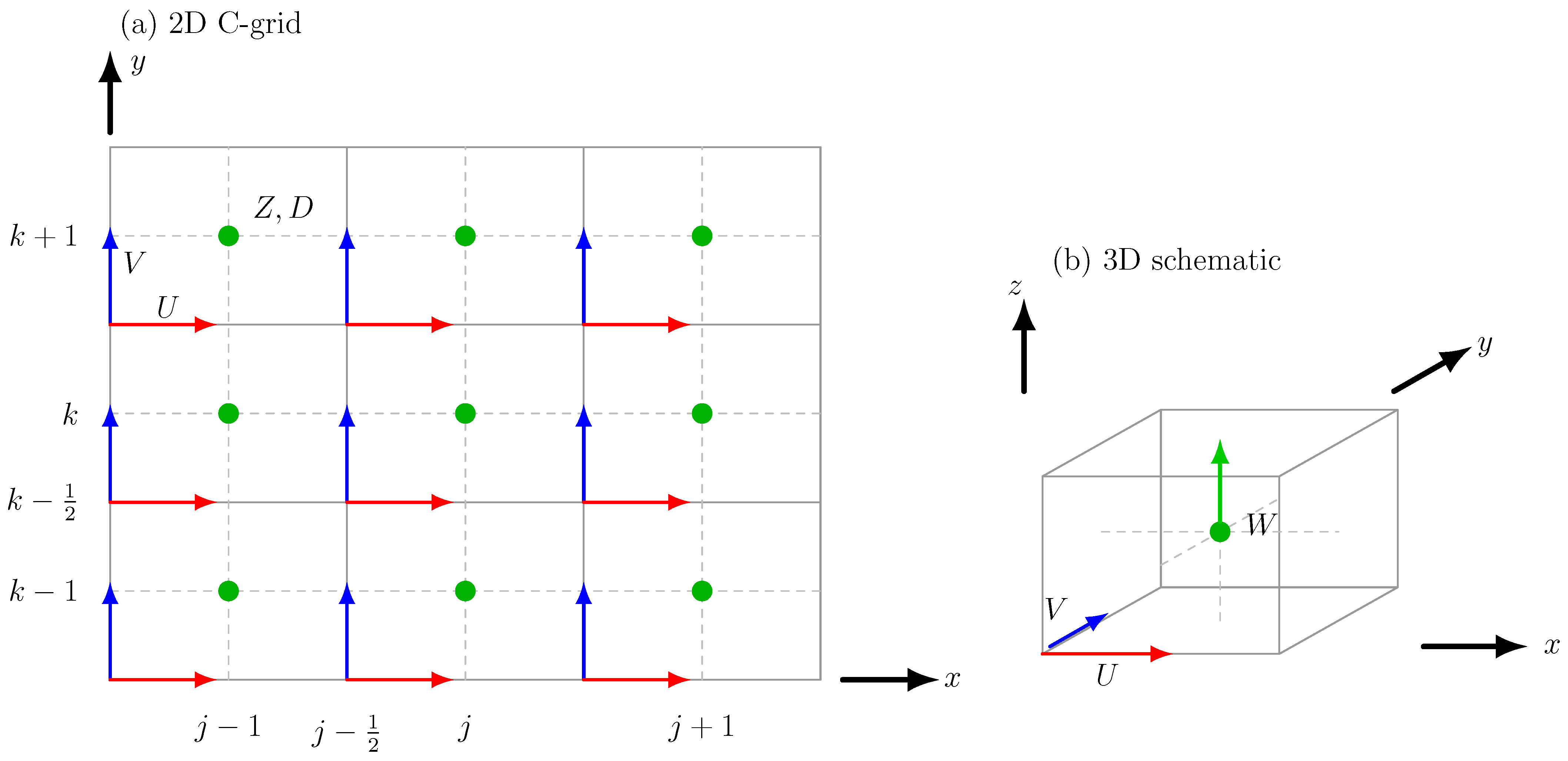
A staggered Arakawa C-grid is adopted (
Figure 1), following standard practice in geophysical and engineering fluid dynamics [
13,
14,
15,
16]. Scalar quantities such as free-surface displacement
Z and water depth
D are defined at cell centers, whereas horizontal velocity components are evaluated at cell faces normal to their respective directions. The vertical velocity component is staggered in the vertical direction and defined on horizontal cell faces.
This arrangement ensures discrete compatibility between gradient and divergence operators, suppressing pressure–velocity decoupling and eliminating nonphysical checkerboard modes commonly observed on collocated grids [
14]. Although staggered grids substantially reduce spurious computational modes, numerical robustness additionally requires consistent discretization of transport, diffusion, and boundary condition operators [
16,
17]. In the present model, the C-grid provides a stable foundation for hierarchical coupling between the depth-integrated and vertically distributed momentum equations.
2.3.2. Terrain-Following Vertical Coordinate
To accommodate variable bathymetry while maintaining a structured grid, a terrain-following vertical coordinate is employed. The transformed vertical coordinate is defined as
with
at the free-surface and
at the seabed.
Terrain-following (sigma) coordinates are widely used in coastal and shelf-sea models, as they ensure an exact alignment of computational layers with both the free-surface and the seabed, regardless of local water depth. A comprehensive overview of vertical coordinate formulations and their numerical implications, including
z, isopycnic, sigma, and hybrid systems, is provided by Bu et al. [
18], highlighting the advantages of sigma coordinates for resolving shallow-water dynamics and bottom boundary processes.
The present formulation enables a uniform vertical discretization independent of local depth, mitigates near-bottom grid distortion, and facilitates consistent resolution of vertical gradients [
19,
20]. Metric terms associated with horizontal gradients of the terrain-following coordinate
are neglected under the assumption of gentle bottom slopes and small free-surface displacements. While this mild-slope approximation is commonly adopted in terrain-following formulations, its validity may become more restrictive in the presence of pronounced bar-type bathymetric features (as in Variant C). Within the scope of the present numerical stability and sensitivity analysis, a breakdown of this approximation at resolved scales could be expected to increase local stiffness and/or promote grid-scale oscillations in the coupled solution. This simplification is adopted deliberately to keep the discrete operators separable in the horizontal and vertical directions and to preserve a transparent stability interpretation of the coupled 2D + 3D finite-difference scheme. Accordingly, the 3D reconstruction step resolves the vertical structure induced by radiation stress forcing and anisotropic mixing, while avoiding additional mixed-derivative couplings introduced by the full metric tensor. The approximation is consistent with a mild-slope regime, in which bathymetric variations occur over horizontal scales that are large compared to the local depth, such that the omitted metric contributions remain secondary relative to the leading forcing–diffusion–friction balance analyzed here.
2.3.3. Discrete Representation of Anisotropic Diffusion
Momentum diffusion is represented using an anisotropic turbulent diffusion operator that distinguishes between horizontal and vertical mixing processes [
21]. To remain consistent with the staggered grid arrangement, diffusion terms are discretized using directionally split finite-difference operators applied independently in each coordinate direction.
Second-order central differences are employed. For example, the horizontal diffusion of the
U-velocity component in the
x-direction is approximated as
with analogous expressions applied in the
y- and
z-directions. The anisotropic structure of the diffusion operator introduces direction-dependent numerical behavior; in particular, the ratio
exerts a strong control on stability limits and vertical momentum redistribution [
22].
2.3.4. Time Integration and Stability Constraints
Temporal integration is performed using an explicit time-marching scheme. The time variable should be interpreted as a pseudo-time introduced to iteratively reach a steady-state solution rather than to represent physical transient evolution. Explicit schemes are attractive due to their algorithmic simplicity and ease of parallelization, though they are primarily chosen here to facilitate a transparent stability analysis [
23,
24].
Numerical stability is governed by combined Courant–Friedrichs–Lewy (CFL) constraints associated with advective transport and anisotropic diffusion processes:
where
,
, and
denote the spatial grid spacings,
is the horizontal velocity vector, and
and
are the horizontal and vertical eddy viscosity coefficients, respectively. In the terrain-following coordinate,
should be interpreted as the local physical layer thickness, i.e.,
.
Equation (
13) provides the explicit stability restriction associated with the diffusive terms in the present finite-difference formulation. It applies to both the depth-integrated (2D) part and the quasi-3D reconstruction, with the understanding that the limiting time step is controlled by the most restrictive term resolved on the grid. In the 2D subsystem, the relevant diffusive restriction is governed by horizontal diffusion and the horizontal grid spacing (with
in the present setup). In the quasi-3D setting, an additional restriction arises from vertical diffusion and the local physical layer thickness; in practice, this vertical diffusion scale is typically the dominant limitation at higher vertical resolution. Accordingly, Equation (
13) should be interpreted as a general explicit stability condition for the coupled solver, where the time step is dictated by the smallest resolved scale and the corresponding transport or eddy viscosity coefficient.
For the parameter ranges considered in this study, the most restrictive constraint typically originates from vertical diffusion. This reflects the relatively large values of required to parameterize turbulent vertical mixing and imposes a stringent limitation on the admissible time step in explicit formulations, particularly when fine near-bed layer thicknesses are used. It is acknowledged that semi-implicit treatment of vertical diffusion would alleviate this constraint; however, the fully explicit approach is retained to rigorously map the stability boundaries of the baseline algorithm.
More generally, the effective stability limit of an explicit integrator can become tighter than the standard CFL estimate when combined with certain conservative or high-order spatial discretizations, due to high-frequency numerical modes that control the spectral radius of the semi-discrete operator [
25]. A broad class of approaches has been proposed to alleviate CFL-induced stiffness in explicit time marching, including eigenvalue-based stabilization and spatial filtering strategies that selectively damp non-physical high-wavenumber components [
26]. In the present work, such CFL-extension techniques are not employed; instead, stability is ensured by selecting
according to (
13), with emphasis on satisfying the vertical diffusion constraint to maintain robust convergence toward a steady state.
2.3.5. Numerical Accuracy and Efficiency Considerations
The numerical formulation adopted in this study represents a deliberate compromise between accuracy, stability, and computational efficiency. Second-order accurate spatial discretization combined with a staggered grid arrangement ensures discrete compatibility between gradient and divergence operators, thereby preserving mass conservation and suppressing spurious pressure–velocity decoupling.
The explicit time integration scheme, while imposing restrictive time step limitations, provides a transparent and physically interpretable stability framework. This transparency enables the controlled exploration of parameter space and unambiguous attribution of observed numerical behavior to specific physical or numerical parameters, which is essential for sensitivity and robustness analysis.
From a computational standpoint, the finite-difference framework on structured grids offers low memory overhead and predictable scaling with grid resolution. The separation between depth-integrated transport dynamics and diagnostically reconstructed momentum redistribution further reduces computational complexity while retaining the essential mechanisms governing wave–current interaction.
Crucially, the consistent use of identical spatial operators and grid arrangements in both the depth-integrated and quasi-3D formulations enables direct and meaningful comparison between reduced-order and vertically structured models. This consistency is fundamental for isolating the effects of dimensional reduction, parameter selection, and forcing representation examined in subsequent sections.
2.4. Computation Algorithm
The numerical solution strategy follows a structured, two-stage computational workflow designed to consistently couple depth-integrated and vertically resolved flow representations (see Algorithm 1). The computational framework is implemented using standard scientific computing libraries, ensuring vectorized execution of grid operations and efficient memory management.
The algorithm is organized into two main blocks. The first block is dedicated to initialization and grid mapping, where the prescribed wave and bathymetric fields are discretized onto the computational domain. These fields include wave height, wavelength, wave period, wave approach angle relative to the shoreline, and local water depth. Data structures are organized in grid-consistent arrays to facilitate direct stencil operations. For coastal configurations characterized by shore-parallel isobaths, a reduced single-column representation is admissible without loss of generality. Following data import, all quantities directly dependent on the input fields are evaluated, including wave energy, wave-induced volumetric transport, radiation stresses, quasi-turbulent stresses, and spatially varying eddy viscosity coefficients.
The second block constitutes the core numerical solver and addresses the coupled 2D + 3D system of governing equations. The solution procedure is initialized by setting the bottom stress components and the free-surface displacement to zero, corresponding to the initial time level. Subsequently, the depth-integrated momentum and continuity equations are solved iteratively, while accounting for wave-induced forcing, anisotropic turbulent diffusion, and tensorial bottom stress effects. At each iteration, bottom friction is updated using transport-dependent parameterizations, ensuring consistent feedback between the evolving flow field and boundary stress representation.
To assess the internal consistency of the reduced-order formulation, a vertically resolved transport field is reconstructed from the quasi-turbulent stress components and their associated vertical integrals. This three-dimensional transport, denoted as
, is not used to update the 2D solution; instead, it is recomputed after each 2D iteration and used as a consistency check for the depth-integrated solution. Accordingly, the coupled 2D + 3D procedure iterates the following quantities implicitly: the depth-integrated transport
and the free-surface displacement
Z (updated in the 2D step), as well as the associated bottom stress estimate
obtained from the nonlinear friction closure. At each iteration, the verification step produces an independent stress estimate
, which provides a direct measure of coupling consistency between the reduced (2D) and vertically reconstructed (3D) representations.
| Algorithm 1 Iterative solution procedure for the quasi-3D wave–current system |
- Require:
Spatially discretized input fields : H, L, T, , D; model parameters ; index 2 denotes the second grid row parallel to the y-axis (the first corresponds to the shoreline) - Ensure:
Converged depth-integrated transport , free-surface displacement Z, and verification transport
- 1:
Block I: Data assimilation and dependent quantities - 2:
Initialize bathymetric and wave fields , , , , ▹ Assumes alongshore uniformity for 1D profiles - 3:
Compute wave-derived quantities: , , , , and radiation stresses , , - 4:
Compute quasi-turbulent stresses , , and required integrals - 5:
Evaluate turbulent viscosities (modified parameterizations): - 6:
Block II: Coupled 2D + 3D solution - 7:
Initialize , , and at - 8:
Set ▹ Initialization to enter the iterative loop - 9:
whiledo - 10:
2D step: Solve the depth-integrated momentum and continuity equations (Equations ( 5)–( 7)) for , , and Z using the current estimate of bottom stresses - 11:
Update bottom friction stresses (nonlinear closure): - 12:
Set - 13:
3D verification step: Compute vertically resolved transport ▹ Used exclusively for verification of the iterative 2D solution using and the associated vertical integrals - 14:
Compute verification bottom stresses from using the same nonlinear closure as in the 2D step - 15:
Apply boundary conditions: 2D problem: shoreline , ; open boundaries: zero normal gradients 3D reconstruction: near-shore velocity prescription for U, ; other boundaries: zero normal gradients - 16:
Set ▹ Numerical regularization - 17:
Update convergence measure: ▹ Convergence achieved when . - 18:
end while - 19:
Output: , Z, and
|
Convergence is monitored using a dimensionless, grid-wide maximum norm of the relative mismatch between the two bottom stress estimates, and (Algorithm 1). A relative criterion is employed to ensure scale-invariant termination across regions with strongly varying stress magnitudes (e.g., nearshore zones versus deeper areas) and across different parameter regimes. A small regularization constant is included to avoid division by zero in low-stress cells. The iterative loop is terminated when the maximum relative mismatch falls below a prescribed threshold, ensuring that the exchanged coupling fields have stabilized to within a controlled tolerance.
The baseline threshold was selected as a practical compromise between coupling consistency and computational cost. In this solver, the stopping rule controls the internal consistency of the exchanged coupling field (bottom stress) rather than the residual of a single PDE solve; once and agree to within the prescribed tolerance, the subsequent updates of and Z become negligible compared to the discretization and time integration errors inherent to the explicit finite-difference scheme. Therefore, tightening the threshold primarily increases the number of coupling iterations and improves the numerical consistency of the verification check, but is not expected to materially change the reported diagnostics at the level of accuracy and resolution considered here, because once the coupling mismatch is below the threshold, the remaining variability is dominated by discretization and explicit time integration errors. Conversely, substantially larger thresholds increase the mismatch between and and degrade internal consistency. The adopted value ensures robust and repeatable coupling across all bathymetric configurations and parameter ranges considered.
3. Results
3.1. Test Data Configuration and Wave Forcing Setup
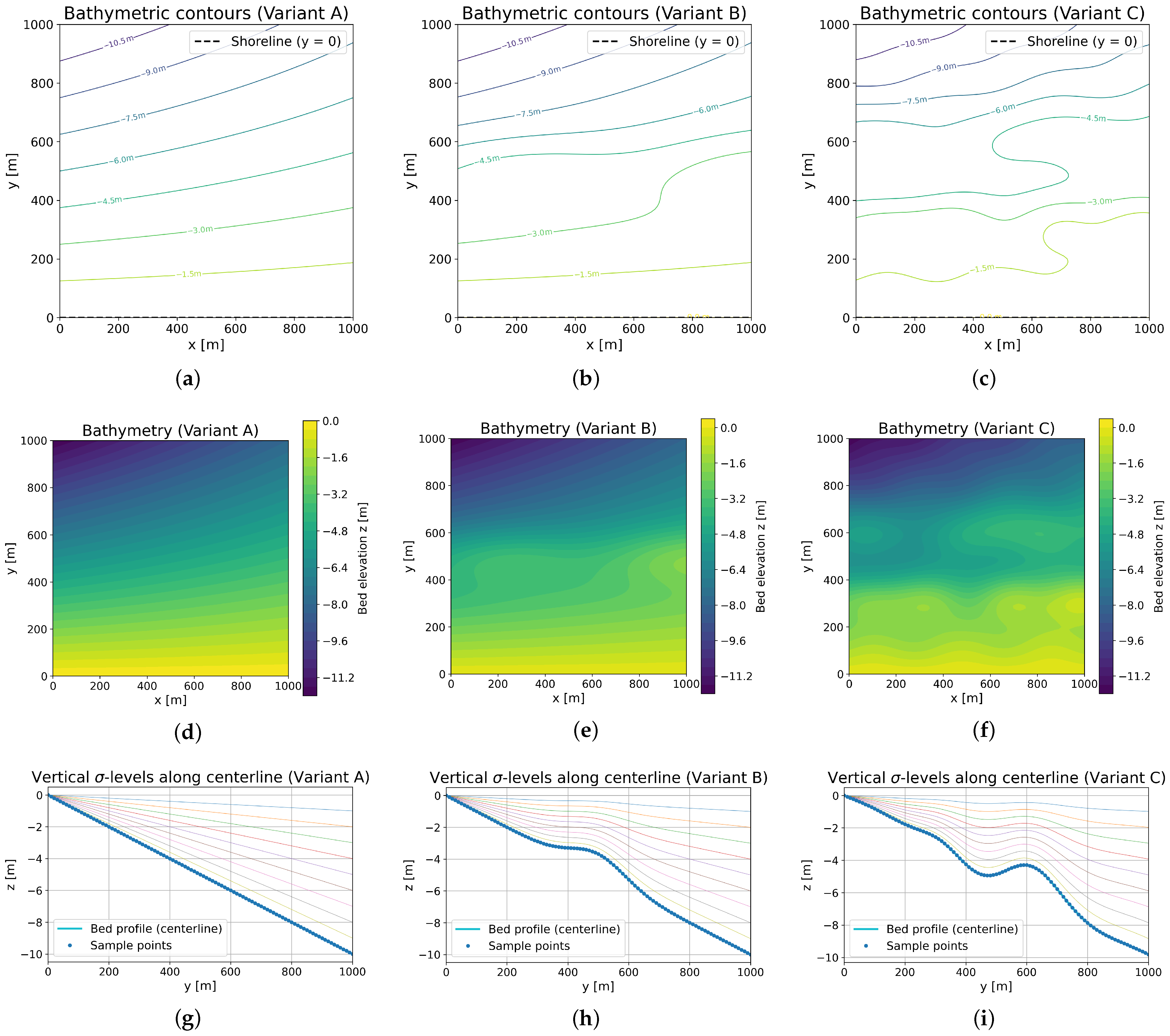
To isolate numerical effects related to bathymetric complexity and parameter selection, all simulations were performed for a controlled set of idealized input configurations. Three synthetic bathymetries (Variants A–C) were designed to provide progressively increasing geometric complexity while remaining fully comparable in terms of domain size, boundary placement, and offshore forcing. Variant A represents a gently sloping bed with weak alongshore variability, Variant B introduces a single shore-parallel bar, and Variant C includes a two-bar system with pronounced cross-shore and alongshore depth gradients (
Figure 2). Variant C exhibits the strongest bathymetric gradients among the test cases; therefore, the omission of
-metric terms may have the largest local impact in this configuration, potentially affecting near-feature momentum redistribution and the associated bottom stress intensification. Nevertheless, Variant C is retained here as a controlled stress-test of the numerical coupling and the stability envelope, rather than as a fully metric-consistent terrain-following formulation. These test cases are specifically designed as numerical benchmarks to evaluate the algorithm’s robustness under steep gradient conditions, rather than as site-specific coastal reconstructions.
For all bathymetric variants, identical stationary wave forcing conditions are prescribed at the offshore boundary. The incident wave height , wave period , wave length , and wave approach angle are kept constant across all simulations. This ensures that any differences in the computed wave transformation and subsequent wave-driven currents arise solely from bathymetric effects and numerical model behavior, rather than from variations in external forcing.
To maintain a complete momentum balance, a spatially uniform and stationary wind field is additionally imposed. The wind direction and wind speed are identical for Variants A–C and remain constant throughout the simulations. This configuration allows the influence of wind forcing to be included as a secondary forcing component while preserving direct comparability between the bathymetric scenarios.
Wave transformation is modeled using a simplified bulk wave formulation inspired by the spectral wave model SWAN [
27]. Local wave properties are derived from the linear dispersion relation, and depth-induced refraction is represented through a two-dimensional ray-based approach that accounts for spatial gradients in phase speed. Wave shoaling is incorporated via conservation of wave energy flux along propagation directions, while depth-limited breaking is parameterized through a standard proportionality between wave height and local water depth. This approach ensures that the hydrodynamic solver is driven by a smooth and physically consistent forcing field, which is essential for the subsequent sensitivity analysis of the 2D + 3D coupling.
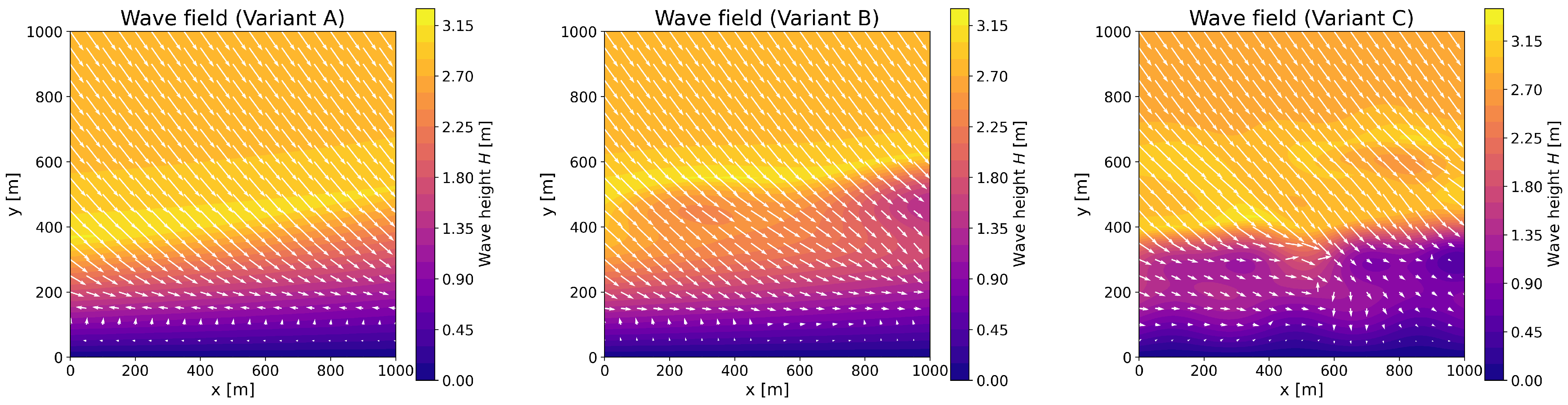
The resulting stationary wave fields, expressed in terms of spatial distributions of wave height
and wave approach angle
(
Figure 3), form the basis for the subsequent computation of wave-driven currents. By combining identical offshore wave and wind forcing with progressively more complex bathymetry, the adopted test configuration (see
Table 1) establishes a controlled framework for assessing the numerical sensitivity of the quasi-3D algorithm to geometric complexity and wide-range parameter sweeps.
3.2. Reference Numerical Experiment
To assess the numerical behavior of the proposed coupled 2D + 3D scheme, a single reference numerical experiment is defined to serve as a baseline for all subsequent stability and sensitivity analyses. The input bathymetry and the stationary wave field (wave height, period, wavelength, and incidence angle) are treated as prescribed. The wave field (H, T, L, ) is used solely to define radiation stress forcing and is therefore reported in the input configuration section rather than considered an output of the reference hydrodynamic solver. In the present study, the physical validity of the wave-generation workflow is not evaluated; instead, the focus is placed on the numerical properties of the hydrodynamic solver in response to fixed external forcing.
The reference configuration is defined on a structured horizontal grid aligned with the shoreline, employing the staggered Arakawa C-grid arrangement introduced in
Section 2.3. A terrain-following vertical coordinate is used for the diagnostic vertical profiling, with
. All model coefficients are fixed to a single baseline parameter set
. Horizontal and vertical eddy viscosities are evaluated using the modified parameterizations described in
Section 2.3. Boundary conditions are imposed such that, at the shoreline, the normal transport satisfies
and
, while at the open boundaries, zero normal gradients are enforced for all prognostic variables.
The coupled solution is obtained using the iterative workflow summarized in Algorithm 1. At each iteration, the depth-integrated system is advanced using the current estimate of the tensorial bottom stress. Subsequently, the bottom stress is updated through the transport-dependent closure, and a three-dimensional verification transport
is reconstructed from the quasi-turbulent stress representation. Convergence is quantified by the relative mismatch between the depth-integrated and three-dimensional bottom stress estimates
where
is a numerical regularization parameter. The iterative procedure is terminated when
. This threshold ensures that the residual differences between the 2D transport and its 3D reconstruction are minimized, yielding a consistent vertical momentum balance.
The converged depth-integrated transport , free-surface displacement Z, and bottom stress components are retained as the reference solution. These three fields constitute the sole diagnostic quantities reported in the reference experiment and form a consistent baseline for evaluating numerical stability, parameter sensitivity, and the influence of bathymetric complexity in the subsequent numerical experiments.
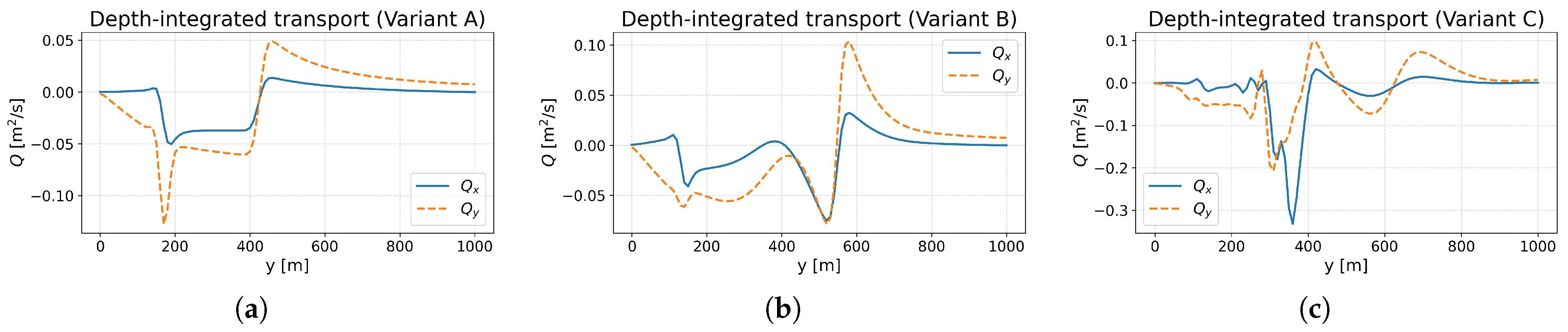
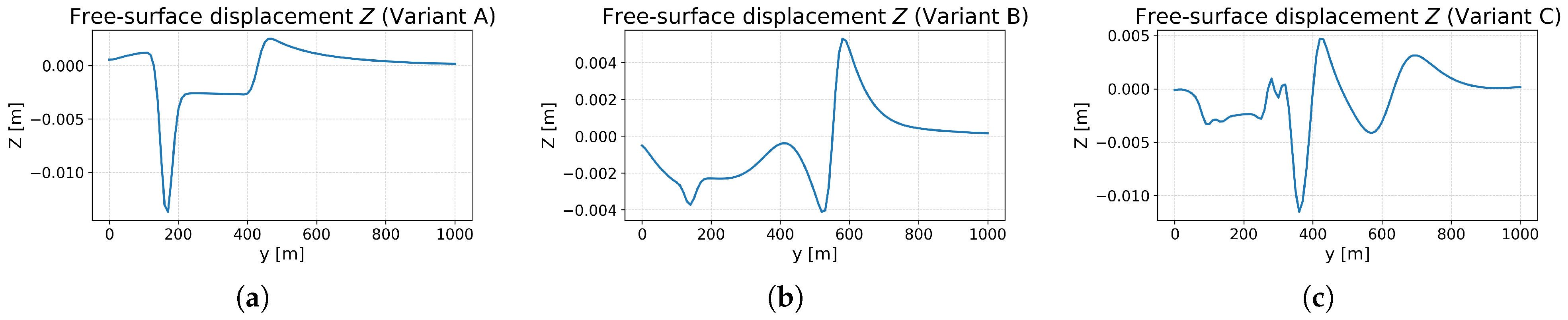
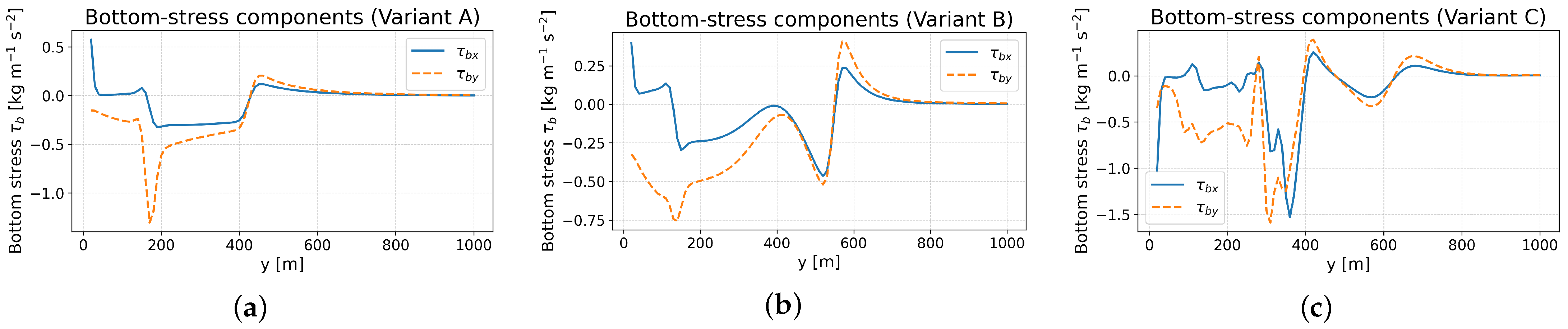
The reference results are illustrated in
Figure 4, which shows the depth-integrated transport components
,
Figure 5, presenting the free-surface displacement
Z, and
Figure 6, which displays the bottom stress components
for the three bathymetric configurations. In Variant A, the profiles exhibit a smooth, monotonic adjustment to the mild-slope. In contrast, Variants B and C reveal significant spatial structuring of the flow, with current maxima aligned with the crests of the submerged bars. This demonstrates the model’s ability to resolve the complex interplay between depth-limited wave breaking and momentum redistribution over steep gradients.
3.3. Sensitivity to Bottom Friction and Eddy Viscosity
3.3.1. Sensitivity to Bottom Friction f
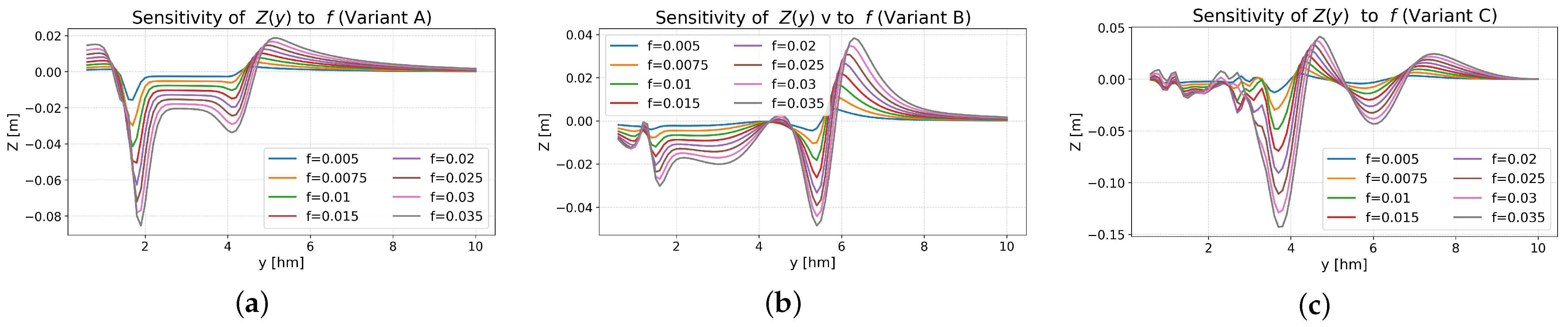
The sensitivity analysis presented in this section focuses on the free-surface displacement Z, which is used as the primary diagnostic variable to assess the impact of variations in the bottom friction coefficient f. Among the analyzed hydrodynamic quantities, Z exhibits the most pronounced and systematic response to changes in bottom friction, making it a robust indicator of friction-induced modulation of the wave-driven circulation.
The range of bottom friction coefficients considered in this study (
–
) was selected based on earlier investigations [
10,
28], where the numerical framework was validated against field measurements, providing a physically grounded range for
f in sandy-bed coastal environments.
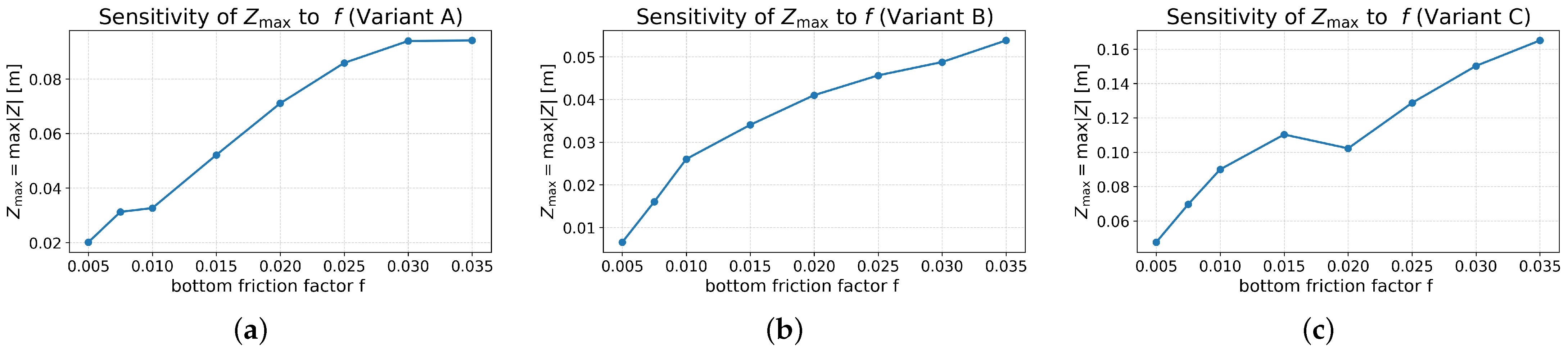
The results demonstrate that increasing bottom friction leads to a systematic amplification of the maximum free-surface displacement
across all bathymetric configurations (
Figure 7 and
Figure 8). The monotonic response of
Z to
f suggests that while friction governs the energy dissipation rate, it does not fundamentally alter the spectral properties of the discrete operator within this range.
For low to moderate friction values (), the model response remains smooth and numerically stable. However, for , the simulations exhibit increased sensitivity characterized by the localized steepening of the free-surface gradient. This regime marks the onset of numerical stiffness, where the explicit coupling between the 2D transport and the diagnostic 3D stress field approaches its consistency limit.
While formal divergence is not observed, the reduced robustness indicates proximity to a stability limit, governed by the interaction of friction-induced damping and the explicit time-marching scheme.
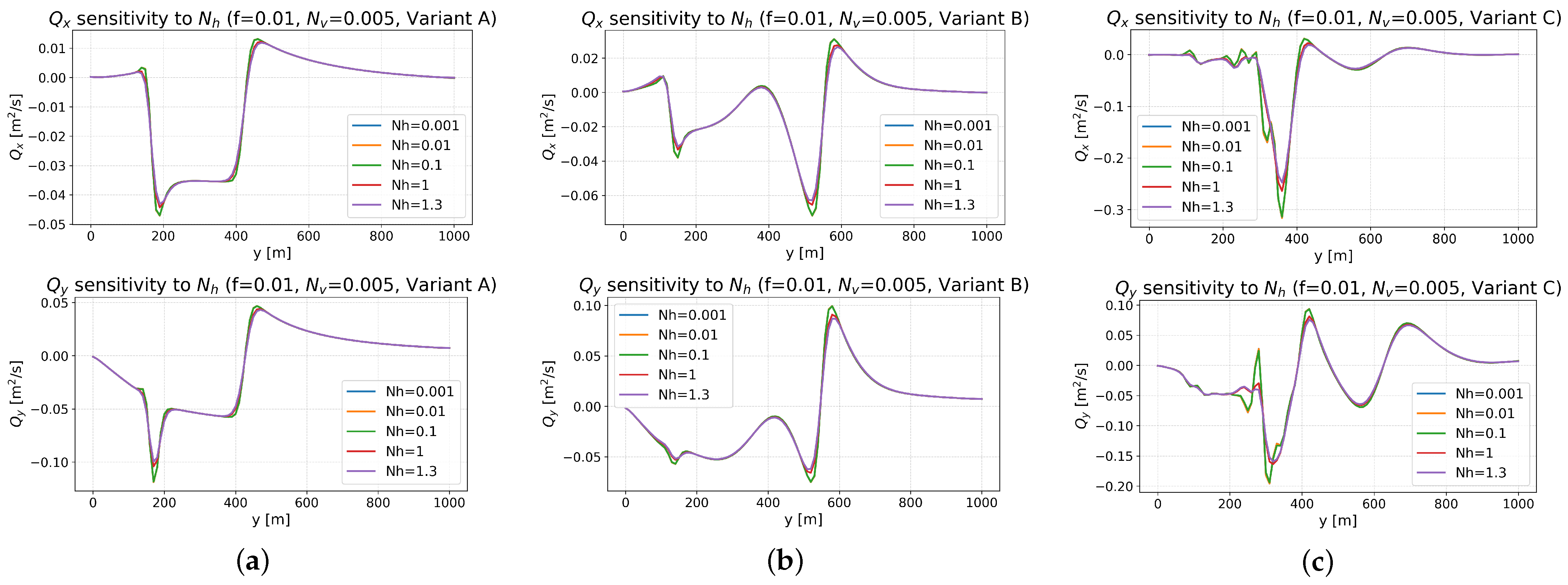
3.3.2. Sensitivity to Horizontal and Vertical Eddy Viscosity
This section examines the sensitivity of the depth-integrated volumetric transport components to variations in the horizontal () and vertical () eddy viscosity coefficients. The analysis is conducted to assess how anisotropic turbulent diffusion influences both the magnitude and spatial structure of the wave-driven circulation, as well as the numerical robustness of the coupled model.
Variations in
exert a secondary influence on the transport components compared to wave-induced forcing. As shown in
Figure 9, the dependence of both
and
on
remains weak for low to moderate values (
), with only minor changes in the magnitude and shape of the transport profiles. A noticeable influence of
emerges primarily for larger values, where increased lateral diffusion acts as a numerical filter, leading to a gradual attenuation of transport extrema and a enforced spatial coherence across the cross-shore section.
The effect of horizontal eddy viscosity becomes more pronounced with increasing bathymetric complexity. In the simplest configuration, changes in result in only marginal modifications of the transport field, whereas in the more complex bathymetric variants, the same increase in produces a stronger reduction of localized gradients. This trend indicates that the influence of on the transport magnitudes is amplified in the presence of strong spatial heterogeneity, even though its overall effect remains secondary compared to that of vertical eddy viscosity.
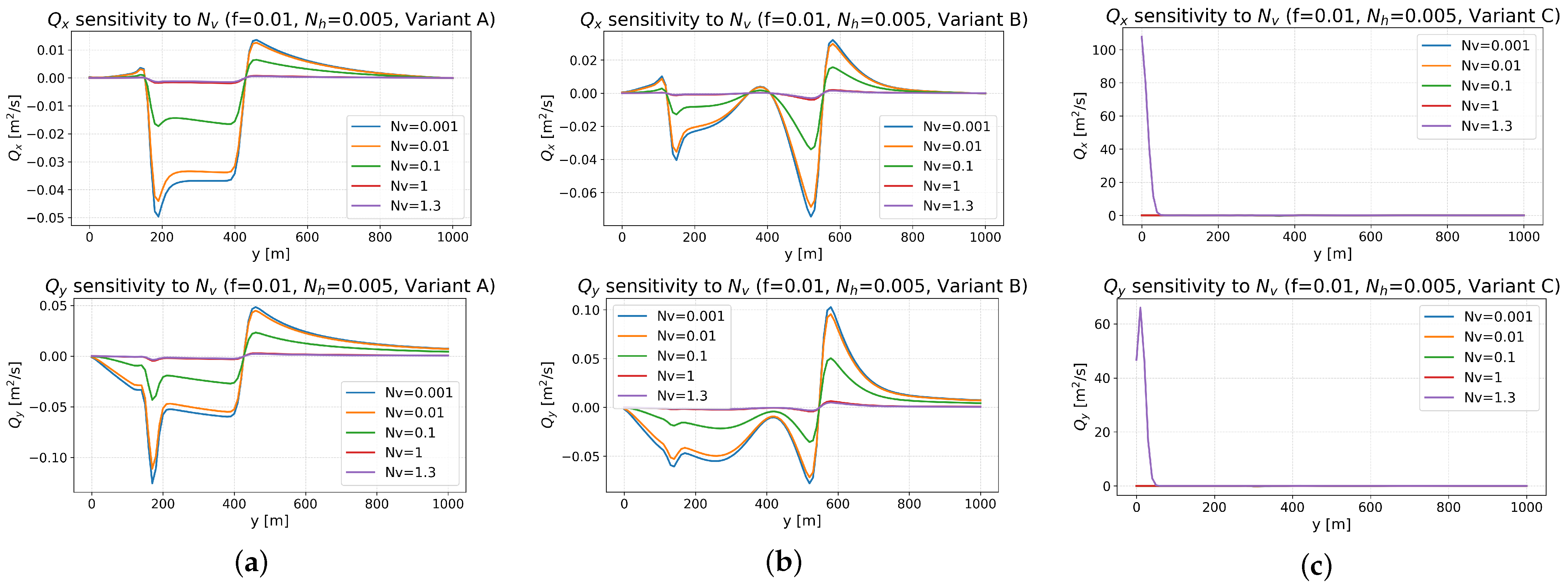
In contrast, the sensitivity to the vertical eddy viscosity
exhibits a markedly different character (
Figure 10). The vertical diffusion term exerts first-order control on the stability of the explicit scheme. For small values of
, the transport profiles closely resemble those obtained from the reference configuration, indicating limited vertical diffusion and a dominant influence of wave-induced forcing. As
increases, the vertical redistribution of momentum dominates the discrete momentum balance, leading to a strong damping of transport magnitudes.
For sufficiently large values of
, the simulations exhibit numerical artifacts (abrupt amplification or collapse), particularly in Variant C, where steep depth gradients lead to a violation of the stability criterion (
13) in the shallowest grid layers.
The analysis identifies the anisotropy ratio as a key control parameter for numerical stability in the present quasi-3D formulation. While increases in primarily act as a stabilizing mechanism through lateral smoothing, excessive values of introduce numerical stiffness, destabilizing the solution by amplifying vertical coupling effects that are not fully resolved by the adopted discretization.
These findings underscore the importance of satisfying the vertical diffusion stability constraint (
13) and suggest that future developments should consider semi-implicit vertical treatment to explore high-viscosity regimes without compromising robustness.
3.3.3. Stability Map in Space
To explicitly document the numerical stability limits of the explicit coupled 2D + 3D scheme, a stability map was constructed by scanning the vertical eddy viscosity coefficient jointly with the pseudo-time step and the number of vertical -levels . For each triplet , the solver was initialized from the same reference state and advanced until either convergence was reached () or a failure criterion was triggered.
The classification of numerical states was performed as follows: A run was classified as stable if decreased monotonically and converged within iterations, with bounded diagnostic fields (, , ). Runs were marked as marginal when convergence was achieved but accompanied by high-frequency grid-scale oscillations in the free-surface displacement Z and non-monotonic behavior of the convergence residual . This regime indicates that the solution is susceptible to numerical dispersion as it approaches the theoretical stability limit. A run was classified as unstable when (i) stagnated above the tolerance, (ii) diagnostics exhibited unbounded exponential growth (numerical blow-up), or (iii) non-finite values (NaN/Inf) occurred.
Table 2 summarizes the resulting stability regime boundaries for representative
settings. The reported thresholds correspond to Variant A, serving as a baseline; for the more complex Variants B and C, the stability boundaries shift toward lower
(approx. 20–30% reduction), reflecting the increased stiffness introduced by steep bathymetric gradients and enhanced vertical-to-depth-integrated momentum coupling.
The observed sensitivity to vertical discretization confirms that the stability is primarily governed by the vertical diffusion time-scale. Consequently, these results provide a practical operational envelope for the explicit 2D + 3D coupling, highlighting the trade-off between vertical resolution and the maximum permissible eddy viscosity.
3.4. Comparison Between 2D and 3D Formulations
The comparison between the depth-integrated (2D) and vertically resolved (3D) formulations is conducted to assess the numerical and physical implications of dimensional reduction within the proposed coupled modeling framework. The 2D formulation provides a solution for the depth-averaged transport, whereas the diagnostic 3D reconstruction enables an evaluation of the vertical momentum distribution and its consistency with the prescribed stress closures.
From a numerical perspective, the 2D formulation provides a robust and computationally efficient representation of the large-scale, wave-driven circulation. For low to moderate bottom friction and eddy viscosity values, the depth-integrated transport components and free-surface displacement obtained from the 2D solver closely match the vertically integrated quantities derived from the 3D vertical projection. In this regime, the dominant balance is governed by radiation stress forcing and horizontal pressure gradients, and vertical shear effects play a secondary role. As a result, the 2D formulation is sufficient for capturing bulk transport patterns and first-order variability across all bathymetric configurations considered.
However, systematic differences between the two formulations emerge as numerical stiffness increases due to high friction or complex bathymetry. The 3D reconstruction exhibits enhanced sensitivity to parameter variations, reflected in sharper vertical gradients, localized intensification of bottom stress, and nonlinear amplification of free-surface response in regions of strong depth gradients. These effects are either smoothed or partially suppressed in the depth-integrated formulation due to vertical averaging, which acts as a structural stabilizer at the expense of resolving near-bed shear layers and vertical momentum redistribution.
From a physical standpoint, the discrepancies between the 2D and 3D solutions highlight the role of vertical structure in modulating dissipation and energy transfer. Specifically, the failure of the 2D model to capture the exact bottom stress location and magnitude under steep slopes leads to a mismatch in the cross-shore pressure gradient balance.
The quantitative metrics summarized in
Table 3 provide a rigorous framework for benchmarking the consistency of the 2D + 3D coupling. For low to moderate values of bottom friction and eddy viscosity, the relative differences remain small (typically
), indicating that vertical averaging does not significantly distort the bulk momentum balance in this regime.
As parameter values increase near the marginal stability thresholds (identified in
Section 3.3.3), the discrepancy grows nonlinearly. In particular, the sensitivity of
exceeds that of
, indicating that dimensional reduction errors accumulate primarily in the pressure field, which can subsequently trigger numerical instabilities in the transport solver.
The quantity denoted as is introduced as a diagnostic three-dimensional reconstruction used to verify the internal consistency of the converged 2D transport with the assumed vertical stress representation. Importantly, the 3D verification step does not constitute a separate prognostic 3D time-marching solution but serves as a vertical closure check. Instead, is obtained by vertically distributing momentum using the quasi-turbulent stress components and the associated integrals. The resulting mismatch quantifies the kinematic incompatibility between the depth-averaged state and its implied 3D profile.
This confirms that dimensional reduction errors are variable-specific; while bulk transport is robustly approximated, free-surface and bottom stress fields are highly sensitive to the vertical resolution of the momentum balance. Accordingly, the presented metrics offer a transparent and reproducible framework for identifying the validity envelope of the quasi-3D approach.
3.5. Grid Resolution Effects
Grid resolution sensitivity was quantified by repeating the reference experiment for a set of horizontal spacings
and vertical resolutions
. The horizontal refinement sequence considered
(with the domain extent kept fixed), while the vertical discretization was varied as
uniformly distributed in
. For each resolution, we report relative changes with respect to the baseline grid (
,
) using
Horizontal refinement primarily affected the representation of localized gradients associated with bathymetric transitions. For Variant A, coarsening the grid to
produced moderate deviations (
–
and
–
), while refining to
reduced both diagnostics to within 1–
of the baseline (
Table 4), indicating practical convergence once the dominant bathymetric scales were resolved.
In Variant B, the sensitivity intensified near the bar-induced gradients, where the coarse 20 m grid failed to adequately resolve the wave-breaking zone, leading to deviations of up to 12% in . Refinement to 5 m effectively captured these gradients, yielding convergence within 3% of the baseline.
The strongest dependence occurred for Variant C, where
suffered from significant bathymetric aliasing of the double-bar system, resulting in substantial deviations (
up to 20% and
up to 15%); refinement to
reduced these differences to 3–
for
and 3–
for
(
Table 4).
Vertical resolution exerted a comparatively stronger influence on numerical robustness and near-bed stress consistency, acting as a direct control on the stiffness of the diagnostic reconstruction. Increasing
decreases the physical layer thickness (
), which tightens the explicit stability limit for vertical diffusion; therefore, improved vertical resolution demands a more restrictive time step for large
values (as per Equation (
13)) but significantly suppresses discretization artifacts in the vertical momentum redistribution.
For Variant C at the baseline horizontal grid (
), changing the vertical resolution from
to
produced deviations of 4–
in both
and
, while further refinement to
reduced the deviations to 2–
(
Table 4), indicating diminishing returns in depth-integrated accuracy beyond
for the investigated parameter space.
Overall, horizontal refinement primarily controls the geometric fidelity of bathymetric forcing, whereas vertical refinement governs the numerical stability and the precision of the bottom stress consistency check.
4. Discussion
The results presented in this study allow for a clear distinction between physical responses inherent to wave–current interaction and numerical effects arising from discretization choices, grid structure, and parameter selection. Spatial patterns of depth-integrated transport
, free-surface displacement
Z, and bottom stress
reflect the imposed radiation stress forcing and bathymetric geometry; however, their magnitude, directional structure, and stability characteristics are strongly modulated by numerical parameters. Crucially, we demonstrate that beyond certain thresholds—such as
or
for
(
Table 2)—the solution is dominated by numerical stiffness rather than physical forcing, which necessitates a careful decoupling of parametric sensitivity from numerical instability.
The comparison between reduced-order two-dimensional and vertically resolved three-dimensional formulations demonstrates that dimensional reduction is not uniformly valid across all parameter regimes. For gently varying bathymetry and moderate turbulence levels, the 2D formulation reproduces the large-scale transport patterns and free-surface response with acceptable accuracy. In contrast, when vertical momentum redistribution becomes significant (as seen in the double-bar Variant C), the 2D approximation fails to capture the localized intensification of bottom stress due to the absence of vertical shear resolution. Variant C also exhibits the strongest bathymetric gradients among the test cases, corresponding to smaller local horizontal length scales and therefore potentially larger relative contributions of mean flow advection. In such conditions, a fully nonlinear extension may modify local jets and recirculation; however, the present study targets numerical stability and parameter sensitivity of the coupled 2D + 3D scheme under a controlled forcing setup, and the linearized momentum balance is retained for consistency across variants.
Metric terms associated with horizontal gradients of the terrain-following coordinate are neglected; this choice reduces mixed-derivative coupling and isolates the stability response of the baseline 2D + 3D finite-difference operators analyzed in this work. For strongly varying bathymetry (Variant C), retaining the full metric terms could introduce additional numerical stiffness through mixed-derivative contributions and would require a separate stability assessment. A fully metric-consistent extension is therefore identified as future work for applications characterized by steep or rapidly varying bathymetry, where geometric fidelity may be prioritized over operator separability.
From a stability perspective, the explicit finite-difference formulation highlights the dominant role of anisotropic diffusion in constraining the admissible time step. Our results confirm that the vertical diffusion time-scale, governed by
(Equation (
13)), is the primary bottleneck for computational efficiency. This behavior is intrinsic to the numerical scheme and should be interpreted as a computational trade-off: high vertical resolution (
) provides superior shear representation but strongly increases the risk of numerical blow-up unless the time step is drastically reduced.
The reported stability bounds for , , and should be interpreted in the context of the fully explicit time integration adopted in this work. The explicit scheme was intentionally selected to keep the stability mechanisms transparent and to enable the direct attribution of failure modes to individual parameters and grid choices. Consequently, the most restrictive constraint is dominated by the parabolic time-scale associated with vertical diffusion, which strongly couples admissible to and and explains the pronounced sensitivity to vertical resolution. If alternative strategies were employed, such as a semi-implicit treatment of the vertical diffusion operator or an implicit–explicit formulation, this particular stiffness mechanism would be substantially reduced: the admissible time step could be selected primarily based on the remaining explicit components (e.g., horizontal operators, coupling iterations, and forcing terms), at the expense of solving an additional linear system each step and introducing solver- and tolerance-related considerations. Importantly, several conclusions of this study are not tied to the explicitness of the integrator, including (i) the role of anisotropic mixing and the ratio in shaping the effective dimensionality of the response, (ii) the coupling sensitivity associated with the bottom stress feedback, and (iii) the regime-dependent breakdown of the 2D reduction in bathymetries that induce pronounced vertical redistribution. Thus, the absolute stability limits reported here should be viewed as explicit scheme envelopes, while the identified parameter sensitivities and 2D versus quasi-3D validity trends remain broadly relevant across common coastal and ocean modeling practices.
From a practical modeling standpoint, the key step in quasi-3D applications is the joint selection of the time step and the mesh resolution, because the admissible
is not controlled by a single factor but by the most restrictive explicit mechanism acting on the finest resolved scale. In the present solver, this restriction is dominated by the vertically resolved part of the scheme: refining the vertical grid (increasing
and decreasing
) improves shear representation and near-bed stress estimates, but rapidly tightens the stable time step range through the vertical diffusion constraint (Equation (
13)). Consequently, stable configurations must be identified by treating
as a coupled design choice rather than independent “tuning knobs”, with the stability map (
Table 2) serving as a practical envelope for admissible combinations. In more complex domains and bathymetries with locally intensified gradients, the effective smallest length scales can become localized, which may further reduce the stability margin and amplify grid-scale artifacts if
is not adjusted consistently. A pragmatic strategy is therefore to start from a conservative vertical setup (moderate
and
) and increase the resolution only where it materially improves the diagnostics of interest, while verifying that the solution remains within the stable envelope and that the reported metrics are insensitive to additional coupling iterations or minor time step reductions.
The results suggest practical guidelines for parameter selection in wave-driven free-surface models. Bottom friction coefficients should be chosen conservatively () to avoid amplifying iterative coupling errors between transport and stress. Horizontal eddy viscosity primarily controls lateral smoothing and numerical dispersion, while vertical eddy viscosity governs stability and convergence. The ratio therefore emerges as a key control parameter, influencing both numerical stability and the effective dimensionality of the solution. Furthermore, the identification of as a ’sweet spot’ for depth-integrated accuracy suggests that for many coastal applications, excessive vertical refinement may yield diminishing returns while complicating numerical robustness.
These findings emphasize that turbulence parameterization in coupled wave–current models should be regarded not only as a physical closure, but also as an integral component of the numerical design. By quantifying the validity envelope of the 2D + 3D coupling, this work provides a framework for selecting stable parameter sets in complex bathymetric environments, such as multi-bar coastal systems.