Johnson–Cook vs. Ductile Damage Material Models: A Comparative Study of Metal Fracture Prediction


Abstract
1. Introduction
2. Computational Simulations
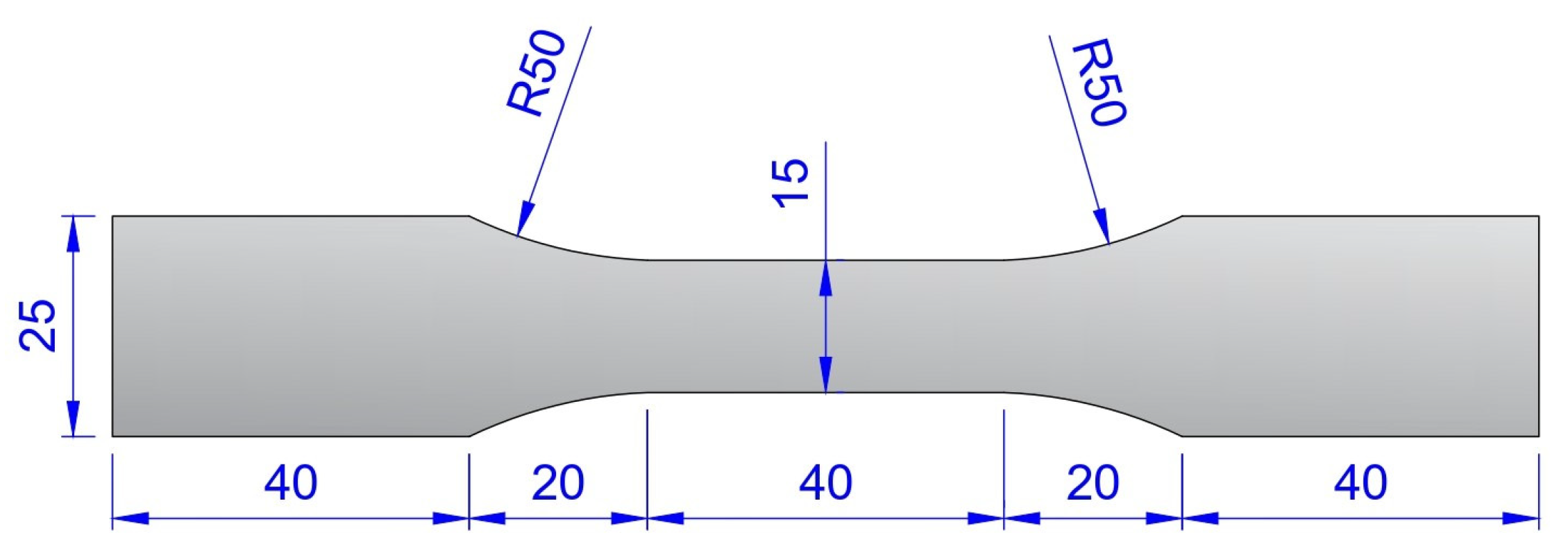
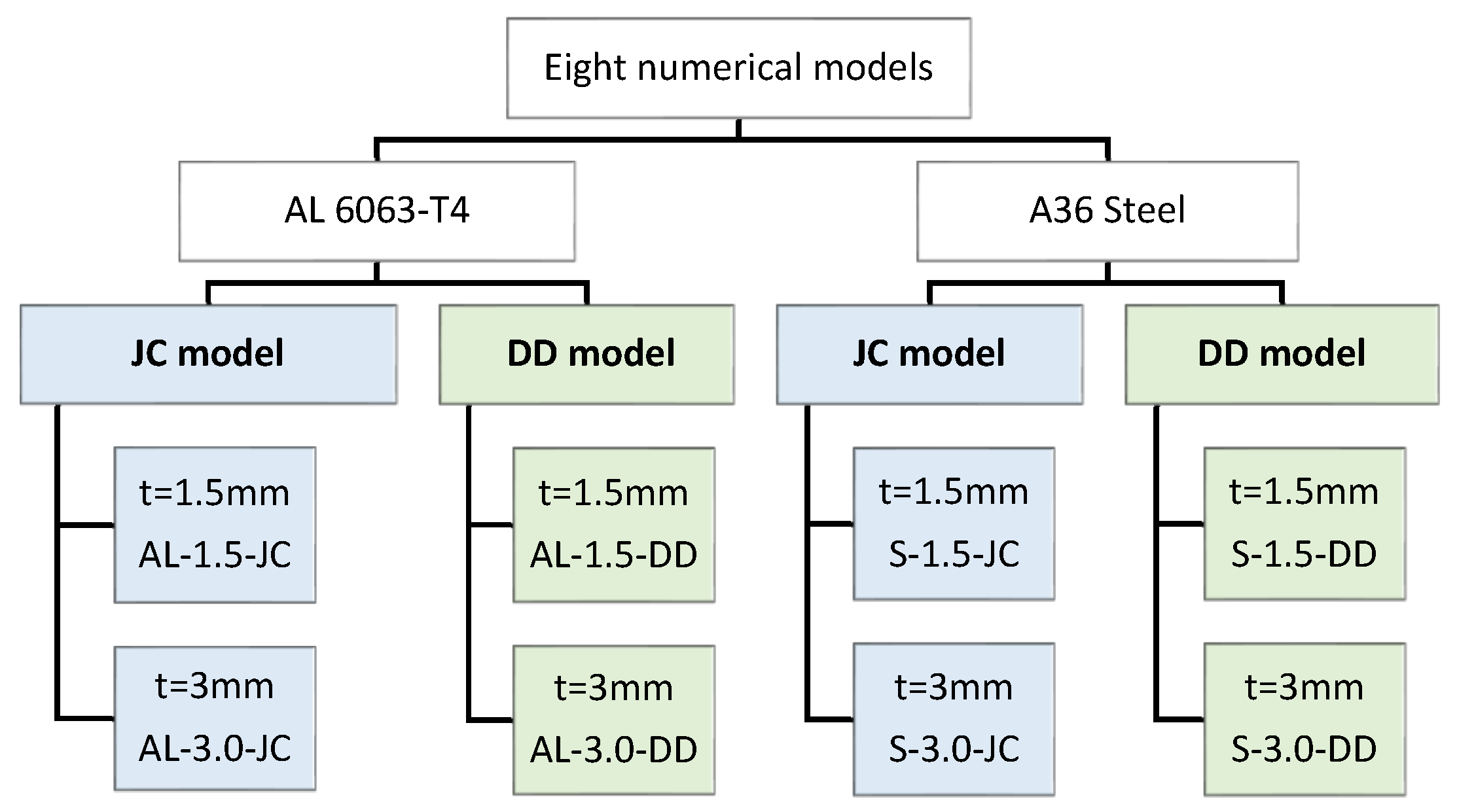
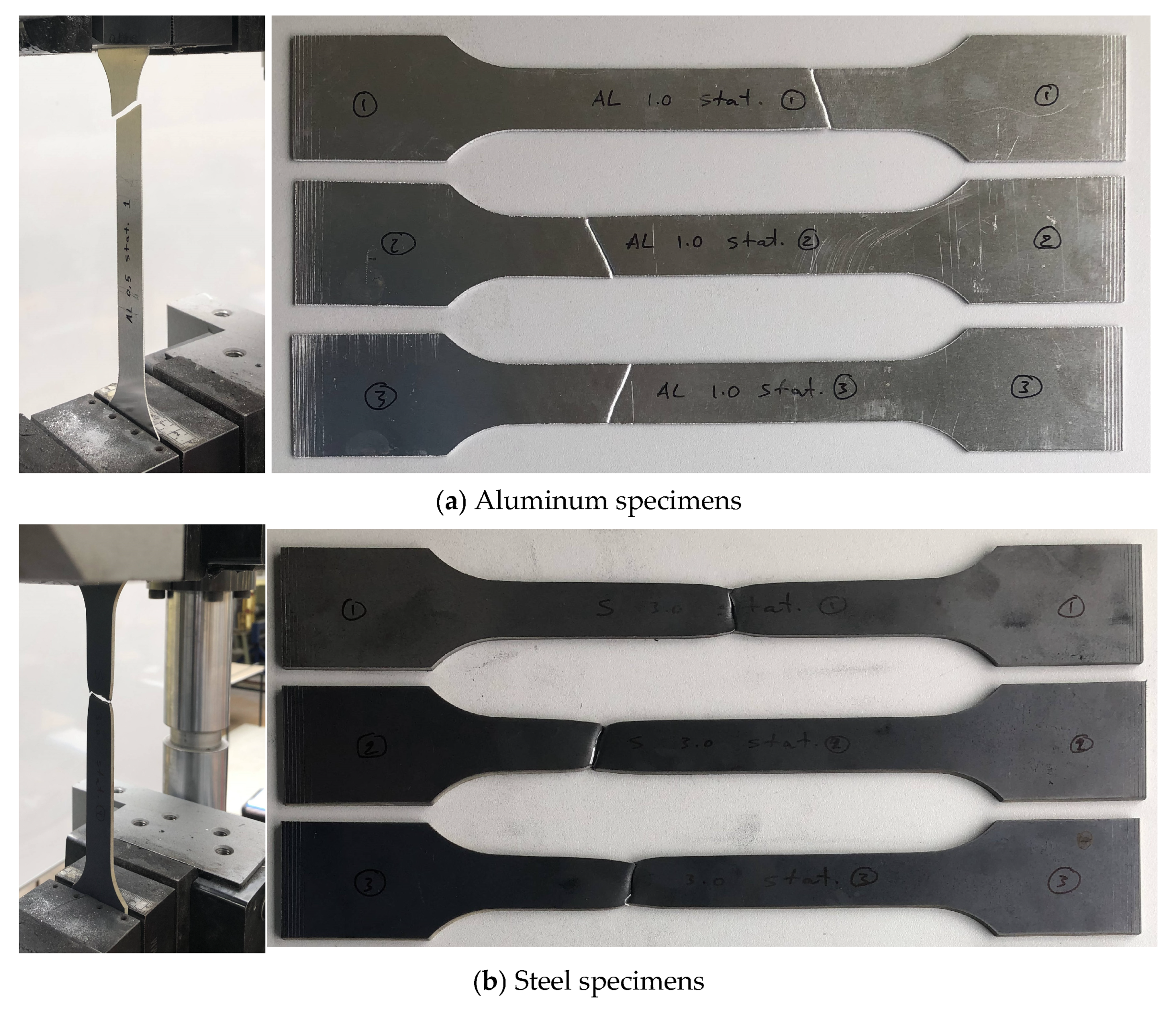
2.1. Geometry and Testing Scheme
2.2. Numerical Model
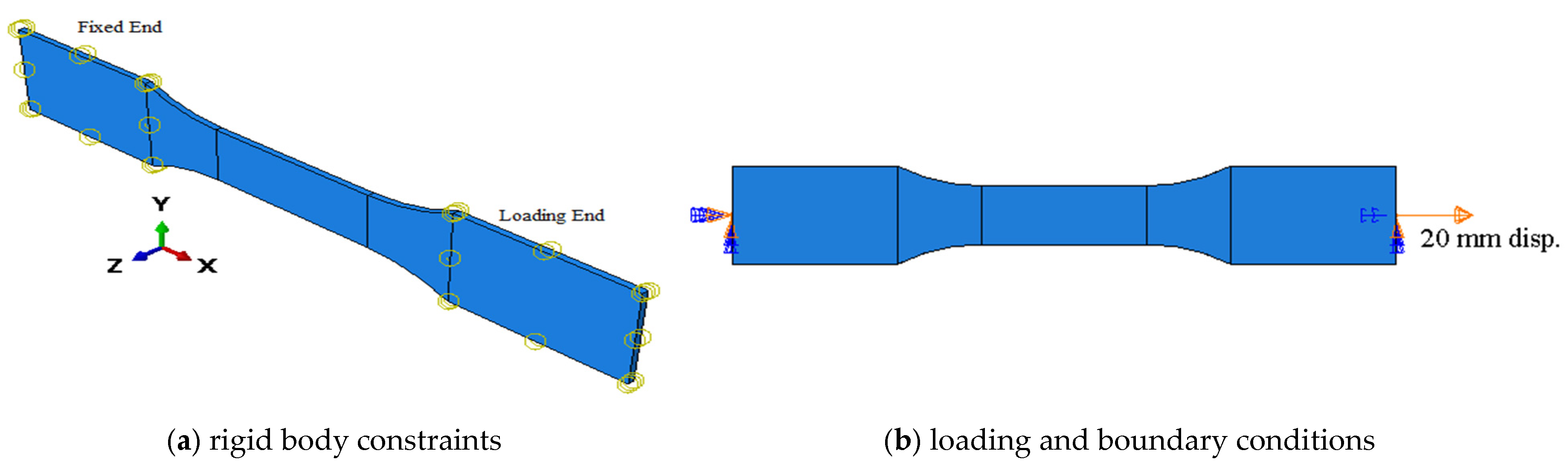
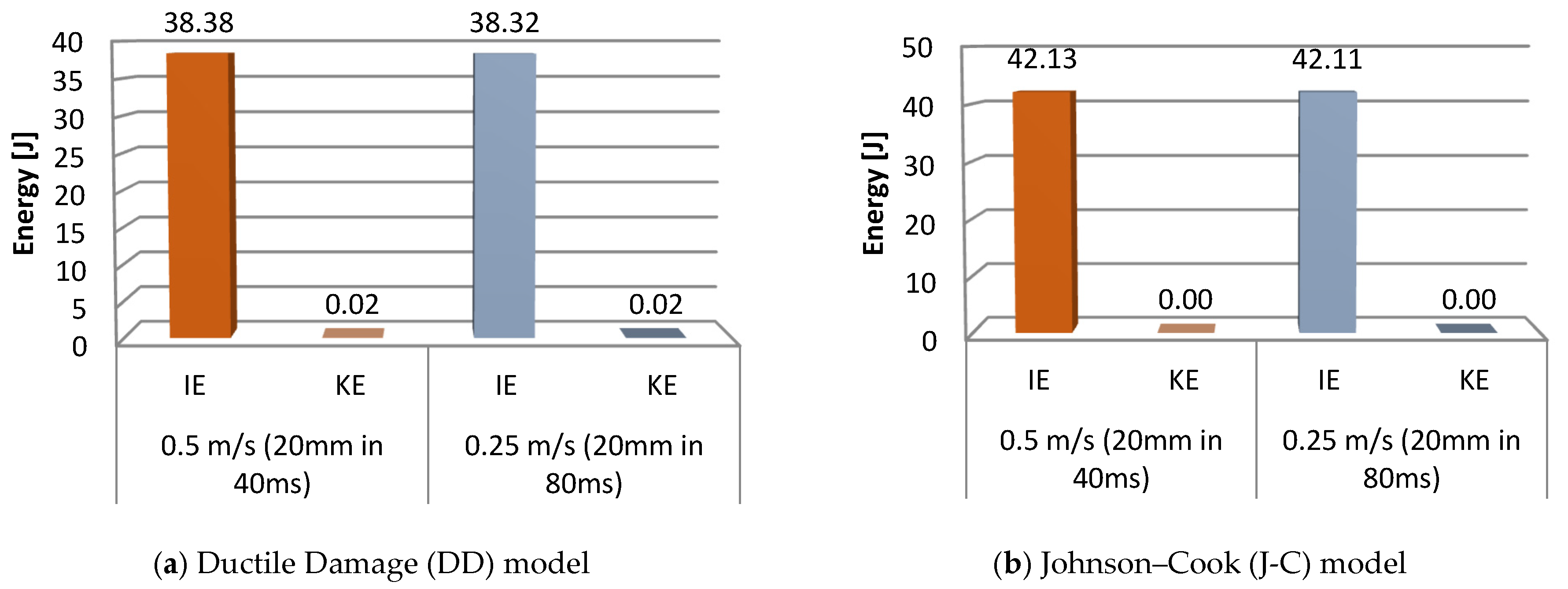
2.3. Loading
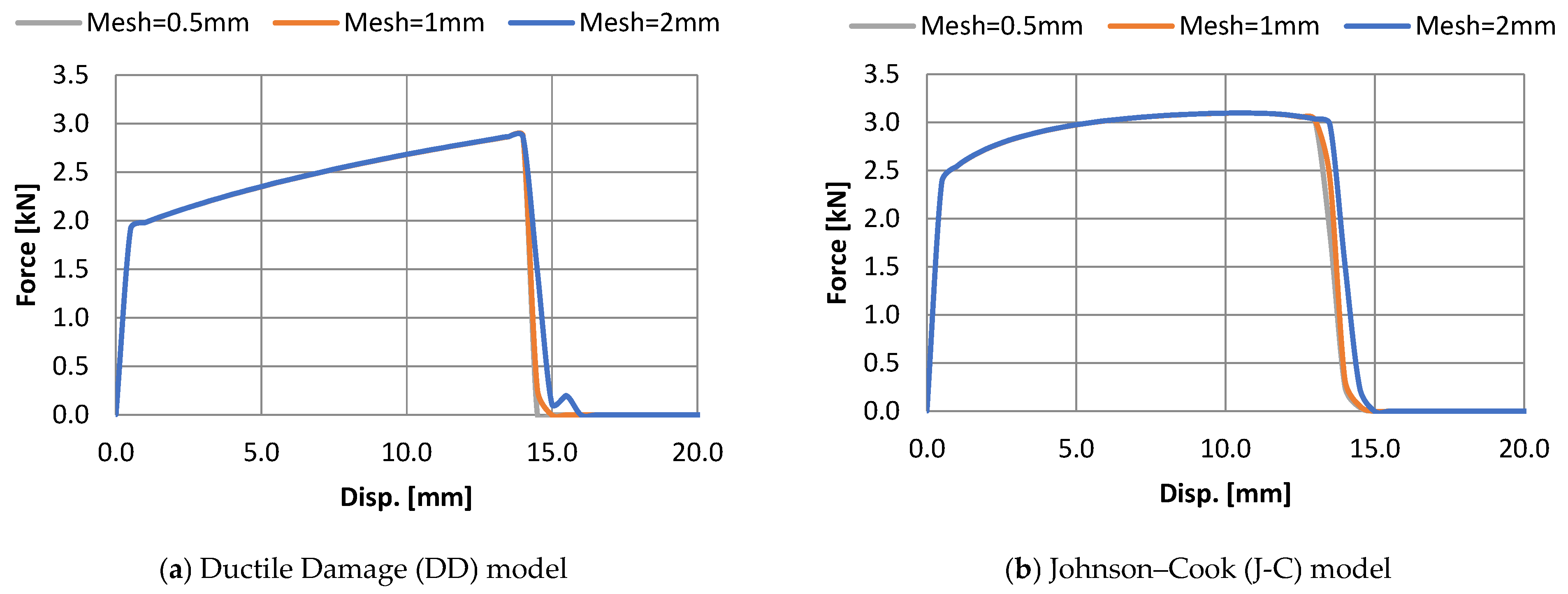
2.4. Mesh Analysis
2.5. Johnson–Cook (J-C) Material Parameters
- The cube root of the element’s volume (3D solid elements);
- The square root of the element’s area (2D shell elements);
- The element’s length (beams and trusses).
2.6. Ductile Damage (DD) Material Parameters

| Category | Description | Units | Steel A36 | AL6063-T4 |
|---|---|---|---|---|
| Elastic constants | Young’s modulus | MPa | 200,000 | 68,900 |
| Poisson’s ratio | - | 0.26 | 0.33 | |
| Density | Mass density | kg/m3 | 7850 | 2700 |
| Plasticity | Yield strength | MPa | 250 | 89.6 |
| Strain at yield | - | 0.00125 | 0.0013 | |
| Plastic strain at yield | - | 0 | 0 | |
| Ultimate strength | MPa | 525 | 172 | |
| Strain at ultimate strength | - | 0.22 | 0.21 | |
| Plastic strain at ultimate strength | - | 0.219 | 0.209 | |
| Damage evolution | Fracture strain | - | 0.25 | 0.24 |
| Stress triaxiality | - | 0.33 | 0.33 | |
| Disp. at failure (t = 1.5 mm) | mm | 0.198 | 0.19 | |
| Disp. at failure (t = 3 mm) | mm | 0.25 | 0.24 | |
| Quasi-static | Strain rate | s−1 | 0 | 0 |
| Adiabatic heating | Specific heat | J/kg-K | 486 | 900 |
| Inelastic heat fraction | - | 0.9 | 0.9 |
3. Results and Discussion
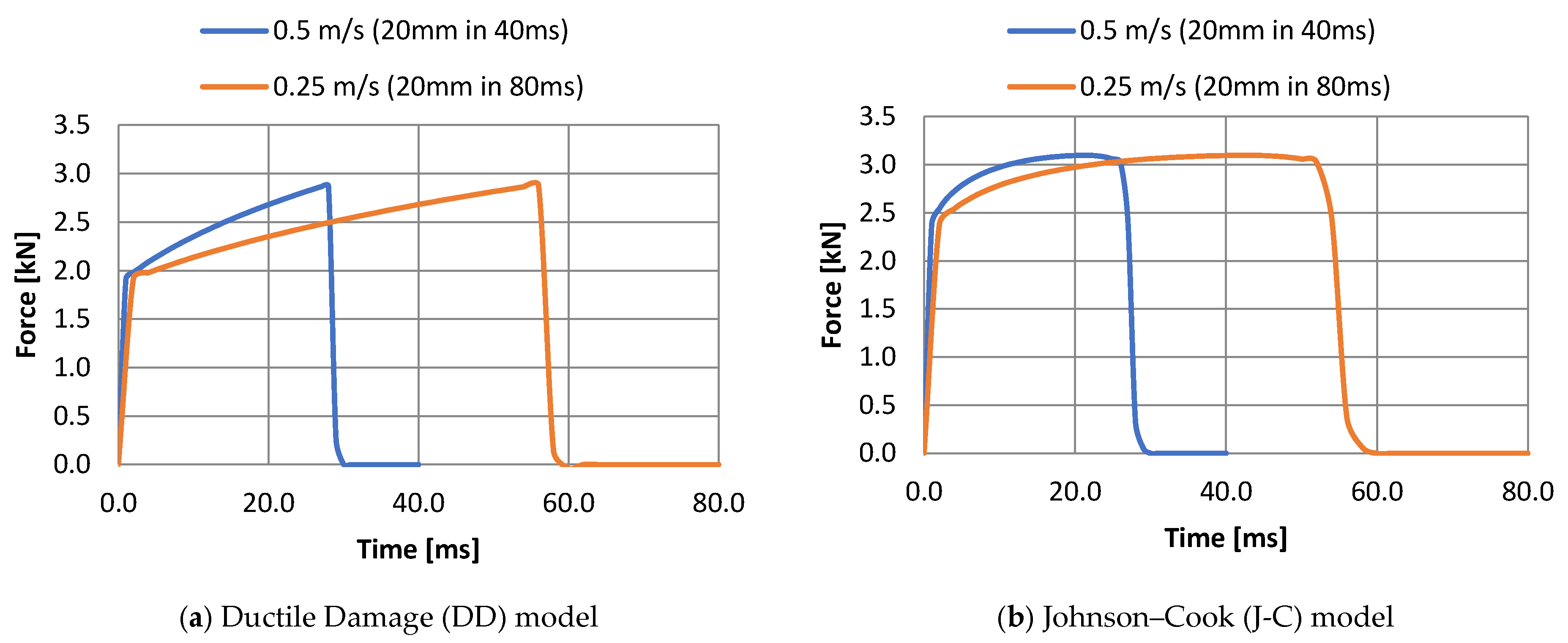
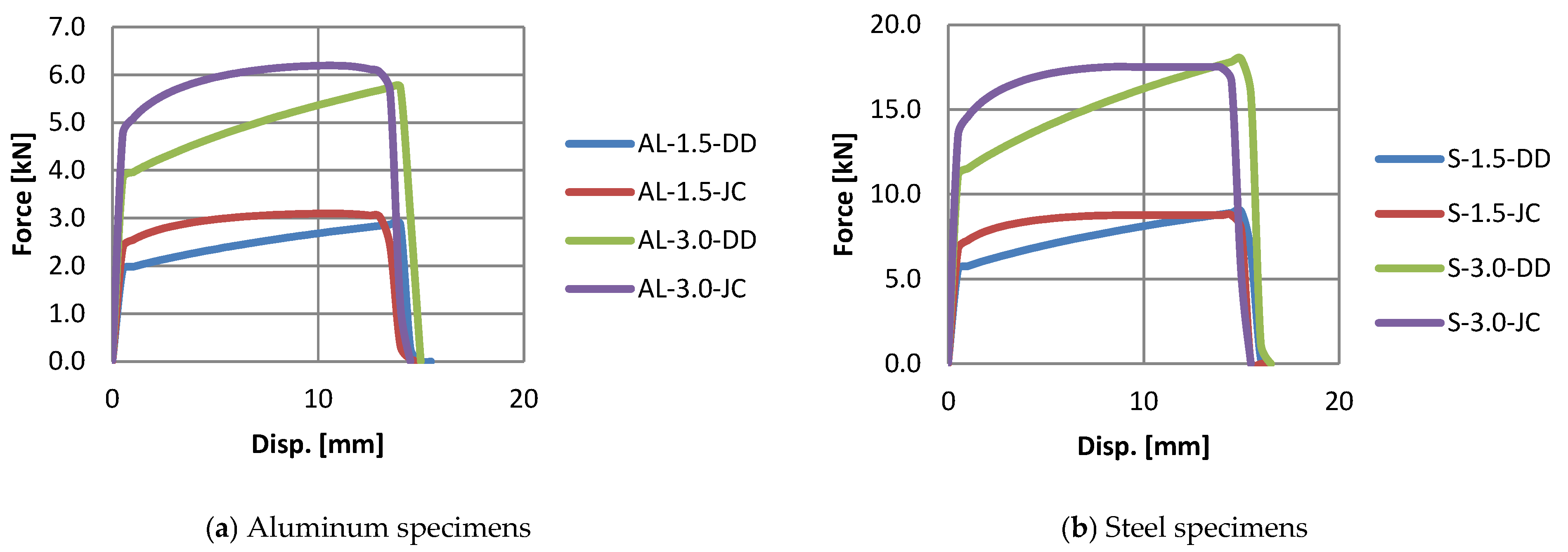
3.1. Force—Displacement Analysis
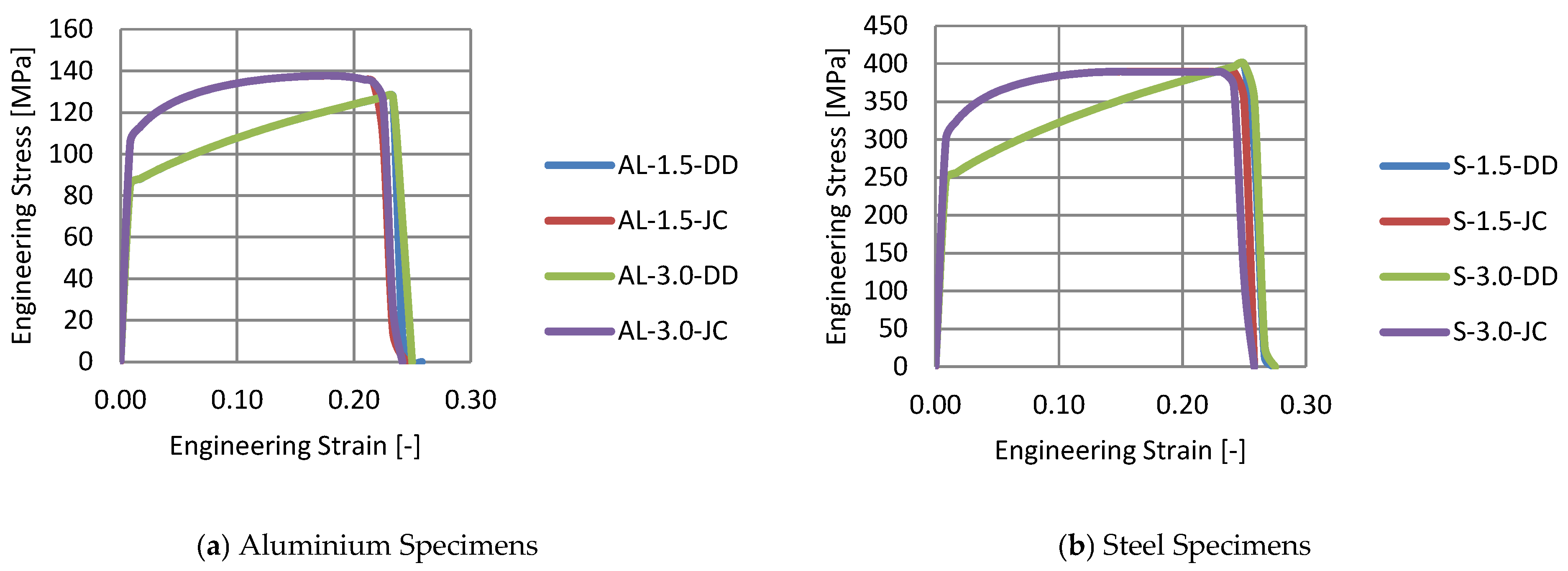
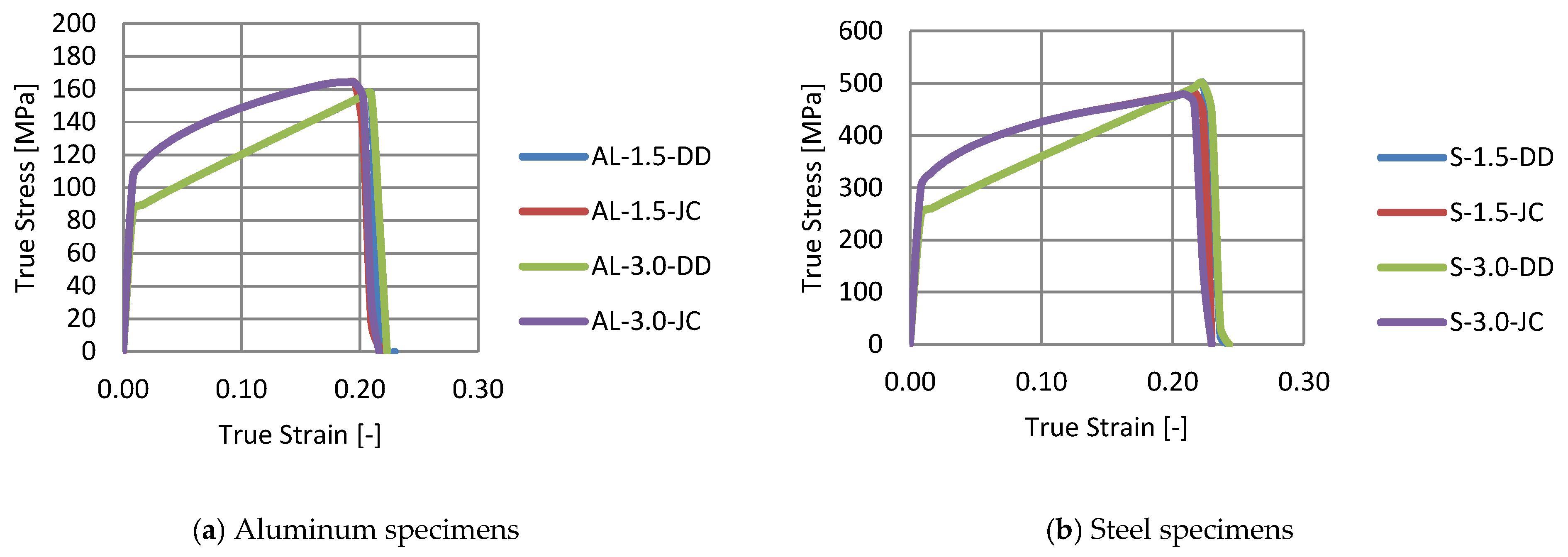
3.2. Stress–Strain Curves
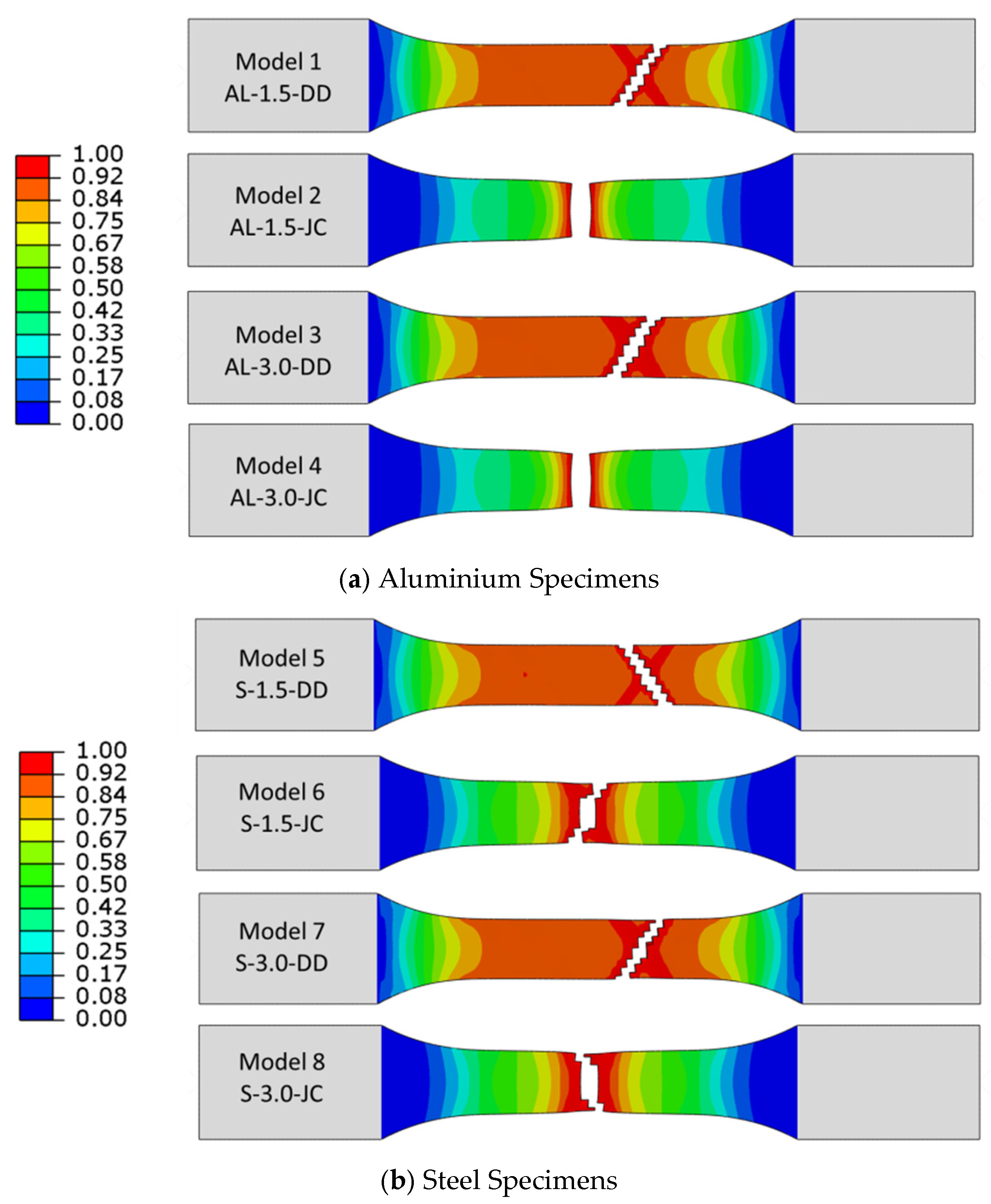
3.3. Damage Evolution
4. Conclusions
Author Contributions
Funding
Institutional Review Board Statement
Informed Consent Statement
Data Availability Statement
Conflicts of Interest
References
- Daghfas, O.; Znaidi, A.; Mohamed, A.B.; Nasri, R. Experimental and numerical study on mechanical properties of aluminum alloy under uniaxial tensile test. Fract. Struct. Integr. 2017, 11, 263–273. [Google Scholar] [CrossRef]
- Cabezas, E.E.; Celentano, D.J. Experimental and numerical analysis of the tensile test using sheet specimens. Finite Elem. Anal. Des. 2004, 40, 555–575. [Google Scholar] [CrossRef]
- Sumelka, W. Application of fractional continuum mechanics to rate independent plasticity. Acta Mech. 2014, 225, 3247–3264. [Google Scholar] [CrossRef]
- Johnson, G.R.; Cook, W.H. Fracture characteristics of three metals subjected to various strains, strain rates, temperatures and pressures. Eng. Fract. Mech. 1985, 21, 31–48. [Google Scholar] [CrossRef]
- Li, H.; Fu, M.; Lu, J.; Yang, H. Ductile fracture: Experiments and computations. Int. J. Plast. 2011, 27, 147–180. [Google Scholar] [CrossRef]
- Hooputra, H.; Gese, H.; Dell, H.; Werner, H. A comprehensive failure model for crashworthiness simulation of aluminium extrusions. Int. J. Crashworthiness 2004, 9, 449–464. [Google Scholar] [CrossRef]
- Neumann, P. Ductile fracture. Mater. Sci. Eng. 1976, 25, 217–223. [Google Scholar] [CrossRef]
- Jacques, N.; Czarnota, C.; Mercier, S.; Molinari, A. A micromechanical constitutive model for dynamic damage and fracture of ductile materials. Int. J. Fract. 2010, 162, 159–175. [Google Scholar] [CrossRef]
- Senac, C. Micromechanical Study of Transgranular and Intergranular Ductile Fractures of Metals. Ph.D. Thesis, Université Paris-Saclay, Paris, France, 2023. [Google Scholar]
- Bhujangrao, T.; Froustey, C.; Iriondo, E.; Veiga, F.; Darnis, P.; Mata, F.G. Review of intermediate strain rate testing devices. Metals 2020, 10, 894. [Google Scholar] [CrossRef]
- Field, J.E.; Walley, T.M.; Proud, W.; Goldrein, H.; Siviour, C. Review of experimental techniques for high rate deformation and shock studies. Int. J. Impact Eng. 2004, 30, 725–775. [Google Scholar] [CrossRef]
- Molinari, A.; Mercier, S.; Jacques, N. Dynamic failure of ductile materials. Procedia Iutam 2014, 10, 201–220. [Google Scholar] [CrossRef]
- Murugesan, M.; Lee, S.; Kim, D.; Kang, Y.-H.; Kim, N. A comparative study of ductile damage models approaches for joint strength prediction in hot shear joining process. Procedia Eng. 2017, 207, 1689–1694. [Google Scholar] [CrossRef]
- Li, W.; Jing, Y. A Simple Calibrated Ductile Fracture Model and Its Application in Failure Analysis of Steel Connections. Buildings 2022, 12, 1358. [Google Scholar] [CrossRef]
- Fincato, R.; Tsutsumi, S. Ductile fracture modeling of metallic materials: A short review. Fract. Struct. Integr. 2022, 16, 1–17. [Google Scholar] [CrossRef]
- Sumelka, W.; Nowak, M.; Nassr, A.A.; Al-Rifaie, H.; Malendowski, M.; Gajewski, T.; Peksa, P.; Studziński, R.; Sielicki, P.W. Dynamic failure of the aluminium plate under air-blast loading in the framework of the fractional viscoplasticity model-theory and validation. Int. J. Impact Eng. 2021, 158, 104024. [Google Scholar] [CrossRef]
- Klósak, M. Experimental and numerical analysis of the aluminum alloy AW5005 behavior subjected to tension and perforation under dynamic loading. J. Theor. Appl. Mech. 2017, 55, 1219–1233. [Google Scholar] [CrossRef]
- Xue, L. Ductile Fracture Modeling: Theory, Experimental Investigation and Numerical Verification. Ph.D. Thesis, Massachusetts Institute of Technology, Cambridge, MA, USA, 2007. [Google Scholar]
- Bendarma, A.; Jankowiak, T.; Rusinek, A.; Lodygowski, T.; Czarnota, C.; Bernier, R.; Khalfaoui, M. Experimental and numerical analysis of Aluminum-Polyethylene composite structure subjected to tension and perforation under dynamic loading for a wide range of temperatures. J. Dyn. Behav. Mater. 2024, 10, 51–74. [Google Scholar] [CrossRef]
- Pantousa, D.; Karavasilis, T. Experimental and numerical investigation of the ductile fracture of structural steel at elevated temperatures. J. Constr. Steel Res. 2021, 177, 106444. [Google Scholar] [CrossRef]
- Zhong, W.; Mbarek, I.; Rusinek, A.; Bernier, R.; Jankowiak, T.; Sutter, G. Development of an experimental set-up for dynamic force measurements during impact and perforation, coupling to numerical simulations. Int. J. Impact Eng. 2016, 91, 102–115. [Google Scholar] [CrossRef]
- Butt, J.; Ghorabian, M.; Ahmed, A.; Shirvani, H. Finite element modelling and validation of thermomechanical behaviour for layered aluminium parts made by composite metal foil manufacturing. J. Compos. Sci. 2018, 2, 68. [Google Scholar] [CrossRef]
- Wang, X.; Shi, J. Validation of Johnson-Cook plasticity and damage model using impact experiment. Int. J. Impact Eng. 2013, 60, 67–75. [Google Scholar] [CrossRef]
- Liu, J.; Bai, Y.; Xu, C. Evaluation of ductile fracture models in finite element simulation of metal cutting processes. J. Manuf. Sci. Eng. 2014, 136, 011010. [Google Scholar] [CrossRef]
- Amaral, R.; Teixeira, P.; Santos, A.D.; de Sá, J.C. Assessment of different ductile damage models and experimental validation. Int. J. Mater. Form. 2018, 11, 435–444. [Google Scholar] [CrossRef]
- Löschner, P.; Gupta, M.K.; Niesłony, P.; Korkmaz, M.E.; Jamil, M. Determination and Verification of the Johnson–Cook Constitutive Model Parameters in the Precision Machining of Ti6Al4V Alloy. Machines 2024, 12, 709. [Google Scholar] [CrossRef]
- Amer, M.; Shazly, M.; Mohamed, M.; Hegazy, A.A. Ductile damage prediction of AA 5754 sheet during cold forming condition. J. Mech. Sci. Technol. 2020, 34, 4219–4228. [Google Scholar] [CrossRef]
- Dassault Systémes. Abaqus Analysis User Manual; Dassault Systémes: Vélizy-Villacoublay, France, 2007. [Google Scholar]
- Dassault Systémes. Abaqus Verification Manual; Dassault Systémes: Vélizy-Villacoublay, France, 2004. [Google Scholar]
- Al-Rifaie, H.; Movahedi, N.; Lim, T.-C. Development of novel auxetic-nonauxetic hybrid metamaterial. Eng. Fail. Anal. 2025, 175, 109559. [Google Scholar] [CrossRef]
- Studziński, R.; Sumelka, W.; Malendowski, M.; Gajewski, T.; Al-Rifaie, H.; Sielicki, P. Sandwich panel subjected to blast wave impact and accelerated fragments. Eksploat. I Niezawodn. 2024, 26, 183698. [Google Scholar] [CrossRef]
- Sirigiri, V.K.R.; Gudiga, V.Y.; Gattu, U.S.; Suneesh, G.; Buddaraju, K.M. A review on Johnson Cook material model. Mater. Today Proc. 2022, 62, 3450–3456. [Google Scholar] [CrossRef]
- Al-Rifaie, H.; Sumelka, W. Auxetic Damping Systems for Blast Vulnerable Structures. In Handbook of Damage Mechanics; Voyiadjis, G.Z., Ed.; Springer: New York, NY, USA, 2020; p. 71. [Google Scholar]
- Murugesan, M.; Jung, D.W. Johnson Cook material and failure model parameters estimation of AISI-1045 medium carbon steel for metal forming applications. Materials 2019, 12, 609. [Google Scholar] [CrossRef]
- Banerjee, A.; Dhar, S.; Acharyya, S.; Datta, D.; Nayak, N. Determination of Johnson cook material and failure model constants and numerical modelling of Charpy impact test of armour steel. Mater. Sci. Eng. A 2015, 640, 200–209. [Google Scholar] [CrossRef]
- Dassault Systémes. Abaqus 6.12 Online Documentation Notes; Dassault Systémes: Vélizy-Villacoublay, France, 2012; Volume 92. [Google Scholar]
- ASM Specification Aerospace Metals. Aluminum 6063-T4. Available online: http://asm.matweb.com (accessed on 17 March 2025).
- Al-Rifaie, H. Novel energy-absorbing auxetic sandwich panel with detached corrugated aluminium layers. Vib. Phys. Syst. 2023, 34, 2023215. [Google Scholar] [CrossRef]
- ASM Specification Aerospace Metals. A36 Steel. Available online: http://asm.matweb.com (accessed on 17 March 2025).
- Davis, J.R. ASM Specialty Handbook: Cast Irons; ASM International: Phoenix, AZ, USA, 1996. [Google Scholar]


| Element Size | Numerical Model of the Tensile Specimen | Damage Evolution for AL6063-T4 Specimens | ||
|---|---|---|---|---|
| DD | J-C | |||
| 0.5 mm |  |  |  |  |
| 1 mm |  |  |  | |
| 2 mm |  |  |  | |
| Category | Constant | Description | Units | Steel A36 | AL6063-T4 |
|---|---|---|---|---|---|
| Elastic constants | E | Young’s modulus | MPa | 200,000 | 68,900 |
| ν | Poisson’s ratio | - | 0.26 | 0.33 | |
| Density | ρ | Mass density | kg/m3 | 7850 | 2700 |
| Yield stress and strain hardening | A | Yield strength | MPa | 250 | 89.6 |
| B | Ultimate strength | MPa | 525 | 172 | |
| n | Work-hardening exponent | - | 0.328 | 0.42 | |
| Reference strain rate | Typically for quasi-static loading | s−1 | 1.9 × 10⁻⁴ | 1 × 10⁻⁴ | |
| Strain rate sensitivity factor | C | For rate-independent material model | - | ~zero, e.g., C = 1 × 10⁻¹⁰ | ~zero, e.g., C = 1 × 10⁻¹⁰ |
| For rate-dependent material model | - | 0.0162 | 0.002 | ||
| Adiabatic heating and temperature softening | Specific heat | J/kg-K | 486 | 900 | |
| χ | Inelastic heat fraction | - | 0.9 | 0.9 | |
| Melting temperature | K | 1773 | 889.15 | ||
| Room temperature | K | 293 | 293.2 | ||
| m | Thermal-softening exponent | - | 0.917 | 1.34 | |
| Fracture strain constants | - | - | 0.03 | −0.77 | |
| - | - | 0.13 | 1.45 | ||
| - | - | −0.95 | 0.47 | ||
| - | - | 0.036 | 0.00314 | ||
| - | - | 0 | 1.6 | ||
| Damage evolution | Displacement at failure (t = 1.5 mm) | mm | 0.198 | 0.19 | |
| Displacement at failure (t = 3 mm) | mm | 0.25 | 0.24 |
| Specimen Thickness | A36 Steel | AL6063-T4 |
|---|---|---|
| t = 1.5 mm | ||
| t = 3 mm |
| Model | Ultimate Strength (from Figure 9) | Ultimate Strength (Table 2 and Table 4) | Error (%) | |
|---|---|---|---|---|
| Aluminium (AL6063-T4) | DD | 157 | 172 | −8.7% |
| J-C | 164 | 172 | −4.7% | |
| Steel (A36) | DD | 500 | 525 | −4.8% |
| J-C | 484 | 525 | −7.8% |
Disclaimer/Publisher’s Note: The statements, opinions and data contained in all publications are solely those of the individual author(s) and contributor(s) and not of MDPI and/or the editor(s). MDPI and/or the editor(s) disclaim responsibility for any injury to people or property resulting from any ideas, methods, instructions or products referred to in the content. |
© 2026 by the authors. Licensee MDPI, Basel, Switzerland. This article is an open access article distributed under the terms and conditions of the Creative Commons Attribution (CC BY) license.
Share and Cite
Al-Rifaie, H.; Ngughu, N. Johnson–Cook vs. Ductile Damage Material Models: A Comparative Study of Metal Fracture Prediction. Appl. Sci. 2026, 16, 1363. https://doi.org/10.3390/app16031363
Al-Rifaie H, Ngughu N. Johnson–Cook vs. Ductile Damage Material Models: A Comparative Study of Metal Fracture Prediction. Applied Sciences. 2026; 16(3):1363. https://doi.org/10.3390/app16031363
Chicago/Turabian StyleAl-Rifaie, Hasan, and Naftal Ngughu. 2026. "Johnson–Cook vs. Ductile Damage Material Models: A Comparative Study of Metal Fracture Prediction" Applied Sciences 16, no. 3: 1363. https://doi.org/10.3390/app16031363
APA StyleAl-Rifaie, H., & Ngughu, N. (2026). Johnson–Cook vs. Ductile Damage Material Models: A Comparative Study of Metal Fracture Prediction. Applied Sciences, 16(3), 1363. https://doi.org/10.3390/app16031363