Article

Simulation and Experimental Research on the Longitudinal–Torsional Ultrasonic Cutting Process Characteristics of Aramid Honeycomb Materials

1
Engineering Training Center, Changchun University of Technology, Changchun 130012, China
2
School of Mechanical and Electrical Engineering, Changchun University of Technology, Changchun 130012, China
3
School of Mechanical and Automotive Engineering, College of Humanities, & Information Changchun University of Technology, Changchun 130122, China
*
Author to whom correspondence should be addressed.
Appl. Sci. 2026, 16(3), 1362; https://doi.org/10.3390/app16031362
Submission received: 24 December 2025 / Revised: 15 January 2026 / Accepted: 27 January 2026 / Published: 29 January 2026

Abstract

Aiming at the problems of large cutting force, easy honeycomb tearing, and deformation during the traditional cutting process of aramid honeycomb materials and an increase in cutting temperature during continuous processing, which may lead to vibration stoppage, the ultrasonic cutting process characteristics of aramid honeycomb materials were studied. Firstly, torsional vibration was added on the basis of one-dimensional longitudinal ultrasonic vibration cutting (LUC), and the motion characteristics of longitudinal–torsional ultrasonic vibration cutting (LTUC) were analyzed. Secondly, a cutting simulation model was established using finite element simulation software. Under the same cutting parameters, the simulation results for the cutting force and cutting temperature of longitudinal ultrasonic vibration cutting and longitudinal–torsional compound ultrasonic vibration cutting were compared. Then, cutting experiments were conducted to verify the simulation results for cutting force, and single-factor experiments were used to analyze the cutting quality of aramid honeycomb under different processing methods. The results show that the three-directional cutting forces in longitudinal–torsional ultrasonic vibration processing are significantly lower than those in longitudinal ultrasonic vibration processing. The feed force decreased by an average of 28.2%, the tangential force decreased by an average of 45.8%, the axial force decreased by an average of 31.2%, and the tool temperature decreased by 21%. The processing quality of aramid honeycomb using longitudinal–torsional ultrasonic vibration cutting is better than when using longitudinal ultrasonic vibration cutting, which can more effectively reduce cutting stress, cutting force, and tool cutting temperature and show better process characteristics.

1. Introduction

Honeycomb materials are a type of structural material invented by humans based on bionic principles, imitating the hexagonal sheet-like structure of natural honeycomb. The earliest history of human application of honeycomb materials can be traced back to the 1930s [1]. With the advancement of science and technology and the diversity of application purposes, numerous honeycomb structure materials of different types have now been developed [2,3,4]. Aramid honeycomb materials are widely used in aerospace, rail transit, shipping and other fields due to their advantages, such as high specific strength, large specific stiffness, low density, low thermal conductivity and good heat resistance [5,6]. However, when cured aramid honeycomb material impregnated with phenolic resin is cut, the honeycomb core cell walls basically do not undergo plastic deformation. The main failure forms during the processing include cell wall tearing, phenolic resin cracking and peeling, and other processing defects, which seriously affect the surface quality, service performance, and service life of the structural components of the aramid honeycomb material. Therefore, aramid honeycomb material is a typical difficult-to-machine material [7].
In response to the problems that occur in the processing of aramid honeycomb materials, experts and scholars have proposed a processing method of ultrasonic vibration-assisted cutting and conducted research. Niu Jinglu [8] conducted an ultrasonic cutting test on honeycomb cores without tool rotation. The direction of ultrasonic vibration was along the axial direction of the tool. The three-directional cutting forces obtained from the test were fitted. The research results showed that increasing the ultrasonic amplitude was helpful in reducing the cutting force. By comparing the surfaces of honeycomb cores with and without ultrasonic vibration cutting, it was concluded that ultrasonic vibration could improve the surface quality of honeycomb cores. Tang Chensheng [9] designed a fish-scale drill for aramid honeycomb hole-making processing in response to the difficulty of processing aramid honeycomb. This fish-scale drill has the functions of drilling and milling. Experiments have proven that the structural design is reasonable and meets the processing requirements. Xiang et al. [10] compared the cutting angles of longitudinal torsion ultrasonic cutting and pure longitudinal vibration cutting of Nomex honeycomb cores through theoretical analysis and studied the influence of the tangential vibration of the tool on cutting force and surface quality through experiments. Zhang Shengfang et al. [11] analyzed the influence of tool structure parameters on the cutting force and cutting temperature of Nomex honeycomb cores, providing a reference for the structural optimization of tools. Ahmad et al. [12] designed a stepped amplitude transformer for longitudinal ultrasonic vibration cutting of aramid honeycomb. Through finite element modal analysis and experiments, it was demonstrated that the theoretical parameters could generate the target resonant frequency. Based on this amplitude transformer, ultrasonic vibration cutting of aramid honeycomb was conducted. The test results indicated that the surface quality of ultrasonic vibration cutting of aramid honeycomb was superior to that of traditional cutting. Xu et al. [13] studied the generation mechanism of mesoscale cracks during the longitudinal ultrasonic vibration cutting of aramid honeycomb by rotary cutters. Through finite element analysis and experimental verification, they revealed the causes and influencing factors of transverse and longitudinal cracks. Li et al. [14] mainly studied the wear and damage characteristics of circular cutting tools during longitudinal ultrasonic vibration cutting of aramid honeycomb. Through experimental observation and analysis, they proposed the characterization parameters of tool wear and damage and discussed their variation laws and the influence on the surface quality of the processed parts.
Many scholars have also conducted research on the ultrasonic vibration cutting force. Kang et al. [15] established an ultrasonic cutting mechanics model for aramid honeycomb, obtained the influence degree of each cutting parameter on the cutting force through orthogonal experiments, and obtained the optimal combined cutting parameters. Hassan et al. [16] determined the optimal parameter settings for high-speed milling of aramid honeycomb through multi-objective parameter optimization research, which improved the milling efficiency and reduced the milling force, filling the gap of cutting depth parameters in multi-objective parameter optimization research. Shen Xiangyu et al. [17] used a five-axis high-speed milling CNC machine tool and conducted processing experiments using the single-factor experimental method to explore the effects of milling speed, feed rate and tool forward angle on the surface quality of aramid honeycomb. Through the experimental results, a reasonable parameter selection range was given, and the surface quality of the honeycomb was the best within the given parameter range. In a finite element simulation study, Jaafar et al. [18] applied the Hashin failure criterion and Tsai–Wu failure criterion of composite materials to a high-speed milling simulation study of aramid honeycomb. By comparing with the experimental results, it was found that the model using the Tsai–Wu failure criterion had a better prediction effect on the milling force of aramid honeycomb and was closer to the actual process. Jiang et al. [19] studied tear defects in the high-speed milling process of aramid honeycomb, conducted a theoretical analysis to explore the cutting forces at different cutting angles, and explained the formation principle of the tear defects in aramid honeycomb through finite element simulation. Zarrouk et al. [20] established a finite element model for high-speed milling of aramid honeycomb based on the thermodynamic behavior of aramid honeycomb and explored the influence of cutting parameters on cutting force and surface quality through the combination of experiments and simulations. Xiao Xiao et al. [21] used a crushing tooth tool to mill honeycomb materials at high speed. Through experiments, they found that the cutting force and cutting temperature decreased with an increase in the spindle speed and increased with an increase in the feed rate. The selection of experimental parameters has reference significance for the selection of actual processing parameters. Cao et al. [22] established a finite element model of longitudinal ultrasonic vibration cutting of aramid honeycomb using rotary cutters using the shear failure criterion. They studied the changes in cutting force during the cutting process through simulation and constructed a cutting force prediction model based on the response surface method. Sun et al. [23] established a theoretical model of the dimensional error of ultrasonic interpolation based on the kinematic characteristics of ultrasonic interpolation. Meanwhile, they analyzed the influence of ultrasonic vibration on the interpolation process. The experimental results show that ultrasonic vibration significantly improves the surface quality of the machined surface. Furthermore, in the field of high-speed milling technology for honeycomb cores, a large number of scholars have conducted research on the milling damage characteristics and inhibition of honeycomb materials [24,25], milling force models [26], tool wear and tool selection [27], etc.
Although previous studies have confirmed that unidirectional ultrasonic vibration can effectively improve = cutting performance on aramid honeycomb, most of the existing work is limited to a single-dimensional vibration form, and there is relatively little research on multi-dimensional composite vibration in terms of reducing cutting force, suppressing cutting heat, and improving surface integrity. Specifically, for the longitudinal–torsional composite ultrasonic cutting method that simultaneously applies axial and torsional vibrations, its material removal mechanism, process rules, and advantages over traditional unidirectional vibration in the processing of aramid honeycomb have not been systematically and deeply studied. To fill this gap, this paper innovatively applies a longitudinal–torsional composite ultrasonic vibration system to aramid honeycomb cutting, adopting a research framework combining “mechanism modeling–simulation prediction–experimental verification” and, for the first time, systematically compares the differences in cutting force, cutting temperature, and surface quality between longitudinal–torsional composite vibration and unidirectional longitudinal vibration. The results of this study provide an innovative process scheme with clear mechanism support for the high-quality and efficient processing of aramid honeycomb.

2. Analysis of Ultrasonic Cutting Motion Characteristics

Longitudinally polarized piezoelectric ceramics generate longitudinal vibration under the excitation of the high-frequency electrical signal output through an ultrasonic generator and act on the cutting tool for milling. The ultrasonic longitudinal and torsional combined vibration cutting is achieved by amplifying the longitudinal vibration by the longitudinal and torsional amplitude transformer with a special groove and converting the vibration mode at the groove of the amplitude transformer to realize the longitudinal and torsional ultrasonic combined vibration of the cutting tool. The ultrasonic longitudinal and torsional combined vibration cutting is shown in Figure 1. The movement of the cutting edge of the tool is composed of the main rotational motion of the tool, ultrasonic torsional vibration, ultrasonic longitudinal vibration and the feed motion of the tool.
The equation of the tool tip movement trajectory during LUC is as follows:
x t = v f t + r sin 2 π n t 60 y t = r cos 2 π n t 60 z t = A 1 sin 2 π f t
In the formula, n represents the tool speed; v f is the feed rate of the tool; r is the tool radius; f represents the ultrasonic vibration frequency; and A1 represents the longitudinal amplitude.
Based on LUC, when torsional vibration is applied to the tool, the motion trajectory of LTUC can be obtained as follows:
x t = v f t + r sin ω n , t y t = r cos ω n , t z t = A 1 sin 2 π f t
In the formula, v f represents the feed rate of the tool, r is the tool radius, f is the ultrasonic vibration frequency, and A 1 is the longitudinal amplitude. ω n , t represents the actual angular displacement of the tool, and its expression is as follows.
ω n , t = 2 π n t 60 + ω 1 , t
In the formula, n represents the tool speed, ω1, and t is the ultrasonic torsional vibration angle. Its expression is as follows.
ω 1 , t = A 2 cos 2 π f t + θ
In the formula, A2 represents the torsional vibration amplitude, and θ is the phase difference between the longitudinal vibration and the torsional vibration.
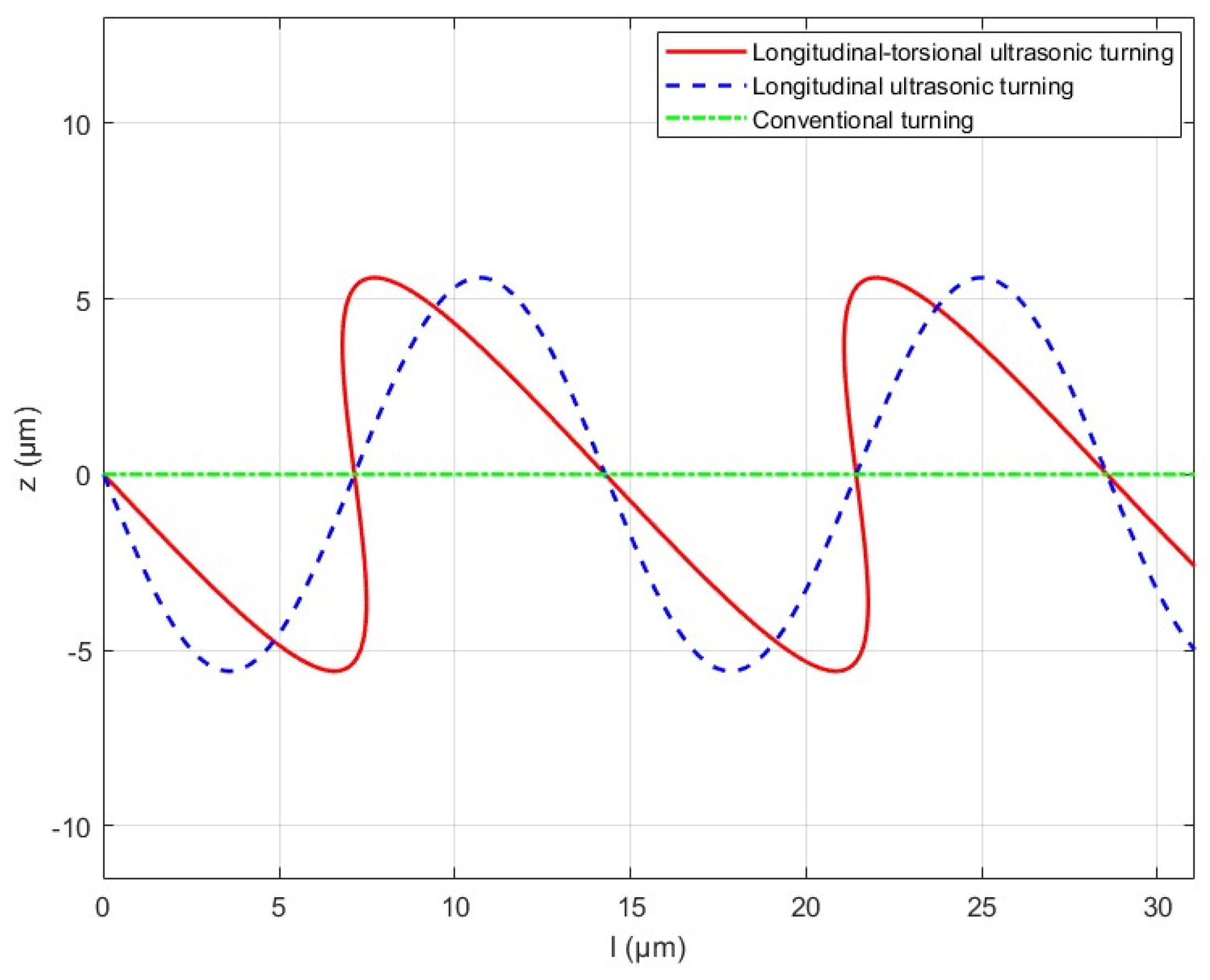
The ordinary cutting trajectory and LUC and LTUC trajectories were compared; take r as 4.0 mm, A 1 as 5.6 μm, A 2 as 3.0 μm, f as 17.60 kHz, and n as 600 rpm, and the trajectory diagrams along the circumference of the tool (the l direction) are shown in Figure 2. Compared with the ordinary cutting trajectory, in the LTUC trajectory, the trajectory of the cutting edge not only vibrates at high frequency in the Z direction but also shows a rotational phenomenon. This phenomenon is due to the torsional vibration of the cutting tool at the same frequency as the longitudinal vibration during the cutting process. Due to the addition of torsional vibration, the cutting tool can not only make periodic contact and separation with the workpiece along the tool axis but can also achieve periodic contact and separation with the workpiece in the feed direction.

3. Cutting Simulation of Aramid Honeycomb

3.1. Simulation Preprocessing

3.1.1. Finite Element Modeling

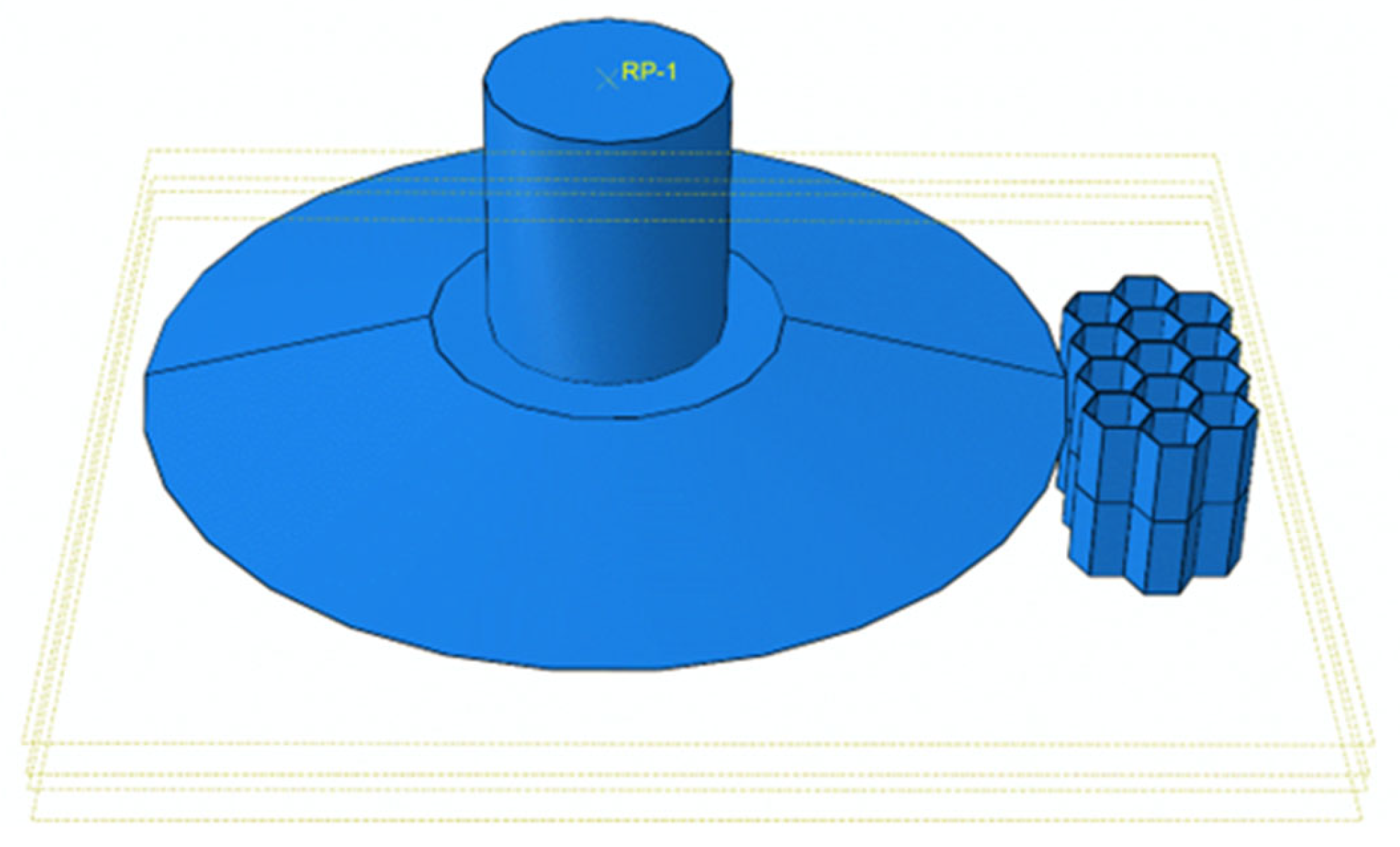
The cutting tools used in the fine processing of aramid honeycomb materials are circular cutters, which are quite different from traditional cutting tools. In order to make the simulation environment close to the real processing environment, modeling is carried out in 3D drawing software based on the geometric parameters of the actual cutting processing tools and the structural dimensions of the aramid honeycomb, and assembly is completed. The assembled model was imported through the preprocessing page of the finite element simulation software, as shown in Figure 3. The parameters of the aramid honeycomb and the geometric parameters of the cutting tool are presented in Table 1 and Table 2.
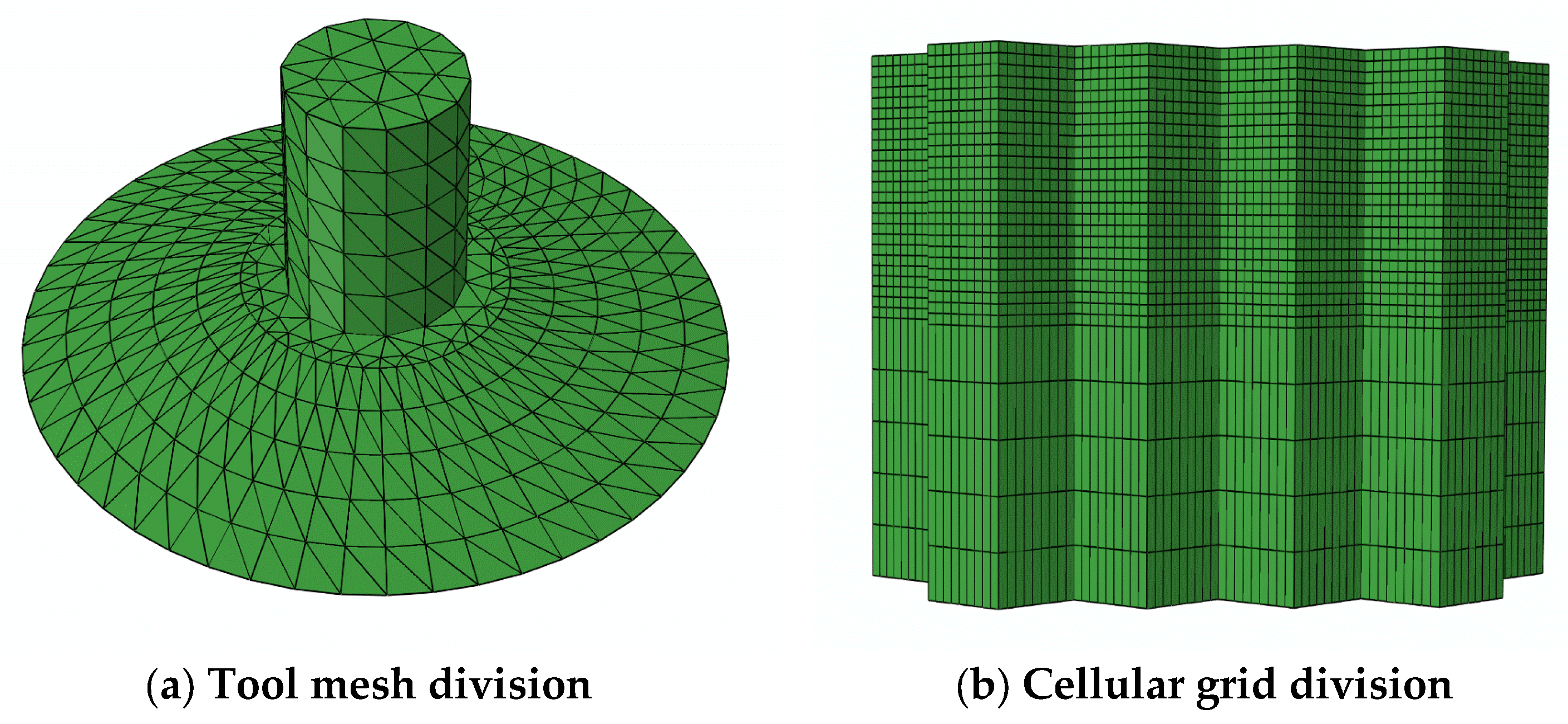
When conducting finite element simulations, the meshing step is of vital importance, as it directly affects the accuracy of the simulation results. In the finite element simulation software, the methods for dividing solid elements include the structured mesh partitioning method, the swept mesh partitioning method and the free mesh partitioning method. The structured mesh division of the finite element simulation software has the characteristics of regularity and high precision. The aramid honeycomb material has a regular shape, so the hexahedral element structured mesh division method is adopted. The honeycomb mesh is a C3D8T eight-node hexahedral mesh. The geometric shape of the cutting tool is rather complex, and its hardness is much greater than that of honeycomb materials. The cutting tool can be regarded as a rigid body. When configuring the grid properties, the free grid division method is selected, and the cutting tool grid is a C3D10MT ten-node tetrahedral element grid.
This grid partitioning method has undergone grid convergence analysis. For typical operating conditions, by changing the grid size of the model, grids of different densities can be constructed. The steady-state cutting force and the peak temperature at the tool–work interface were used as monitoring variables. The calculation results show that when the grid is refined to the aforementioned degree, further densifying the grid results in a change in the above key result variables of less than 2%. Therefore, it can be confirmed that the simulation results are basically not affected by the grid size, and subsequent analyses will adopt this grid density.
Although increasing the density of the mesh can improve the accuracy of the simulation results, when the calculation accuracy reaches a certain level, further increasing the number of meshes has a negligible impact on the simulation results. Meanwhile, the increased number of meshes will increase the calculation time and memory consumption. In order to improve the computational efficiency and ensure the accuracy of the analysis results, a differentiated meshing strategy is implemented for the honeycomb model; that is, a relatively sparse mesh is adopted in the non-processing area, while a denser mesh is used in the cutting area. The divided model is shown in Figure 4.

3.1.2. Boundary Conditions and Contact Settings

In actual cutting processes, the bottom of the honeycomb is fixed, so in the simulation model, the bottom of the honeycomb part is also completely fixed without any degrees of translation or rotation. The movement of the rotary cutter can be divided into two main parts: the first part is the rotational movement of the rotary cutter, which is the main cutting action; the second part is the linear feed along the cutting path. Therefore, when imposing constraints on the circular cutter, only these two degrees of freedom should be retained, and the other degrees of freedom should be restricted.
When setting the mutual contact conditions, the surface-to-surface contact method is adopted. The contact surface of the tool is defined as the main surface, and the contact surface of the honeycomb is defined as the secondary surface. When the tool comes into contact with the honeycomb, the friction characteristics between them are defined through tangential and normal behaviors. For the tangential behavior, the penalty function method is adopted, with the friction coefficient set at 0.1; this choice aims to prioritize ensuring that the mechanical response of the cutting process is dominated by the material constitutive model while working in conjunction with the penalty function contact algorithm to achieve a stable numerical solution. Normal behavior selects hard contact. In addition, to prevent the honeycomb from self-penetrating during the cutting process, the honeycomb model is set to universal contact.
During the process of cutting aramid honeycomb with a disc cutter, a large amount of cutting heat is generated. The cutting heat will cause the temperature of the tool and the workpiece to rise. The accumulation of cutting heat on the tool will accelerate tool wear, affecting the processing accuracy and quality. The two factors that have the greatest impact on cutting temperature are the generation and conduction of heat. The main sources of cutting heat are the friction between the rake face of the circular tool and the honeycomb chips and between the flank face and the machined surface. Due to the long-term cutting process, most of the cutting heat accumulates on the tool, while a small part is carried away by the chips or accumulated on the machined surface. The heat transfer conditions are mainly reflected in specific heat capacity, thermal conductivity and coefficient of thermal expansion. Table 3 shows the specific heat capacity, thermal conductivity and coefficient of thermal expansion of cutting tools and aramid honeycomb workpieces.

3.1.3. Material Failure Criteria

Since aramid honeycomb is a porous honeycomb core material, its shear failure is a macroscopic structural instability process of plastic buckling and progressive folding of the entire honeycomb wall under complex stress. There is no independent “fiber” or “matrix” mode to distinguish it, so the Hashin criterion is not applicable. The Tsai–Wu criterion is a phenomenological empirical criterion based on stress tensor polynomials. It does not distinguish specific failure modes and is usually embedded within an online elastic constitutive framework for use. It cannot describe the significant plastic flow, damage accumulation, and final plastic failure process of aramid honeycomb after yielding. Conversely, the shear failure criterion is directly based on the elastoplastic constitutive framework. It first precisely describes the in-plane shear anisotropic yielding of honeycomb materials due to manufacturing orientation through the Hill criterion, then describes the load-bearing evolution after yielding through the plastic hardening law, and finally takes the cumulative plastic strain as the failure criterion, which physically directly corresponds to the entire process from the accumulation of plastic deformation of the honeycomb wall to tearing. This criterion is in perfect agreement with the macroscopic structure plastic failure mechanism of aramid honeycomb. The shear failure criterion establishes a shear failure model by determining whether the plastic stress at the element node has reached the plastic limit value. The plasticity limit value is also known as the failure coefficient, ω. When the failure coefficient reaches 1, the material fails, and chips are formed. The failure coefficient ω can be defined as
ω = ε 0 p l + Δ ε p l ε f p l
In the formula, ε 0 p l is the initial plastic stress, Δ ε p l is the equivalent plastic strain increment, and ε f p l is the plastic failure stress. The elastoplastic changes in the material are obtained through tensile experiments.

3.2. Experimental Scheme Design

Ahmad et al. [5] conducted an LUC experiment on aramid honeycomb. The test results indicated that the processing effect of ultrasonic vibration cutting on aramid honeycomb was superior to that of traditional cutting. Therefore, in this section, only two different forms of ultrasonic vibration processing experiments are conducted, and two simulation experimental schemes are designed. One is to design a comparative experiment between LTUC and LUC. Under the same processing parameters, the changes in cutting force, tool cutting temperature and cutting stress in LTUC compared with LUC are explored. The LTUC of aramid honeycomb is superior to LUC based on the indicators of cutting force, tool cutting temperature and cutting stress. The second is to design a single-factor experiment, taking the spindle speed, feed rate and ultrasonic amplitude as variables to analyze the influence law of the variable parameters on the cutting force and tool cutting temperature under the conditions of longitudinal–torsional ultrasonic vibration and longitudinal ultrasonic vibration when only one of the processing parameters is changed, while the other parameters remain unchanged.

3.2.1. Ultrasonic Cutting Comparative Experiment

Under the conditions that the ultrasonic vibration frequency is 30 kHz, and the spindle speed, feed rate and ultrasonic amplitude are all the same, the designed experimental parameters are shown in Table 4 to compare the changes in cutting force, tool cutting temperature and cutting stress under the two processing methods.
  • Comparison of Cutting Stress
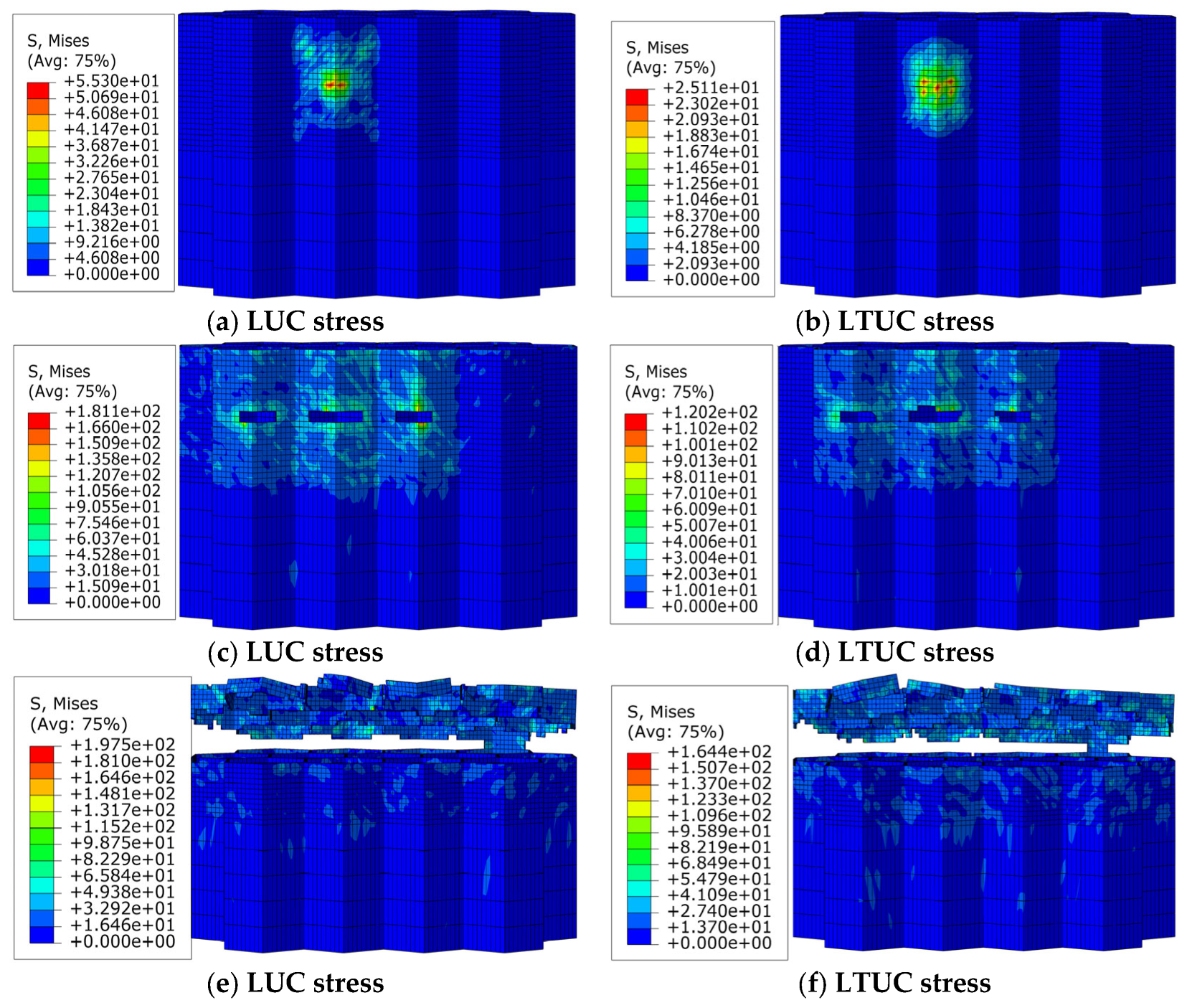
As shown in Figure 5, by comparing the changes in stress during longitudinal and torsional ultrasonic vibration cutting and LUC, it is found that the cutting stress of aramid honeycomb workpieces during longitudinal and torsional ultrasonic vibration cutting is significantly less than that during LUC. This can improve the phenomenon of excessive stress during the cutting process and help increase the service life of honeycomb parts.
2.
Changes in cutting force
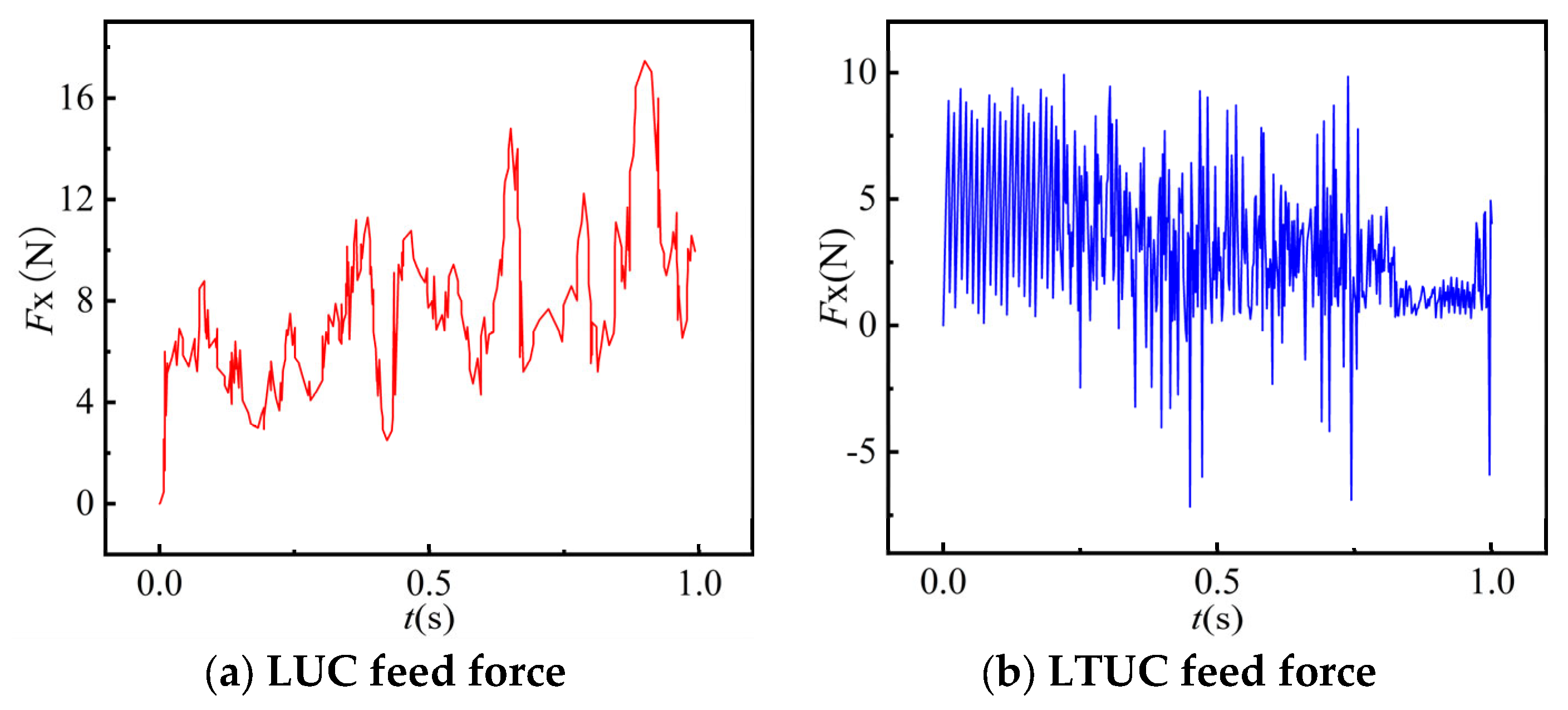
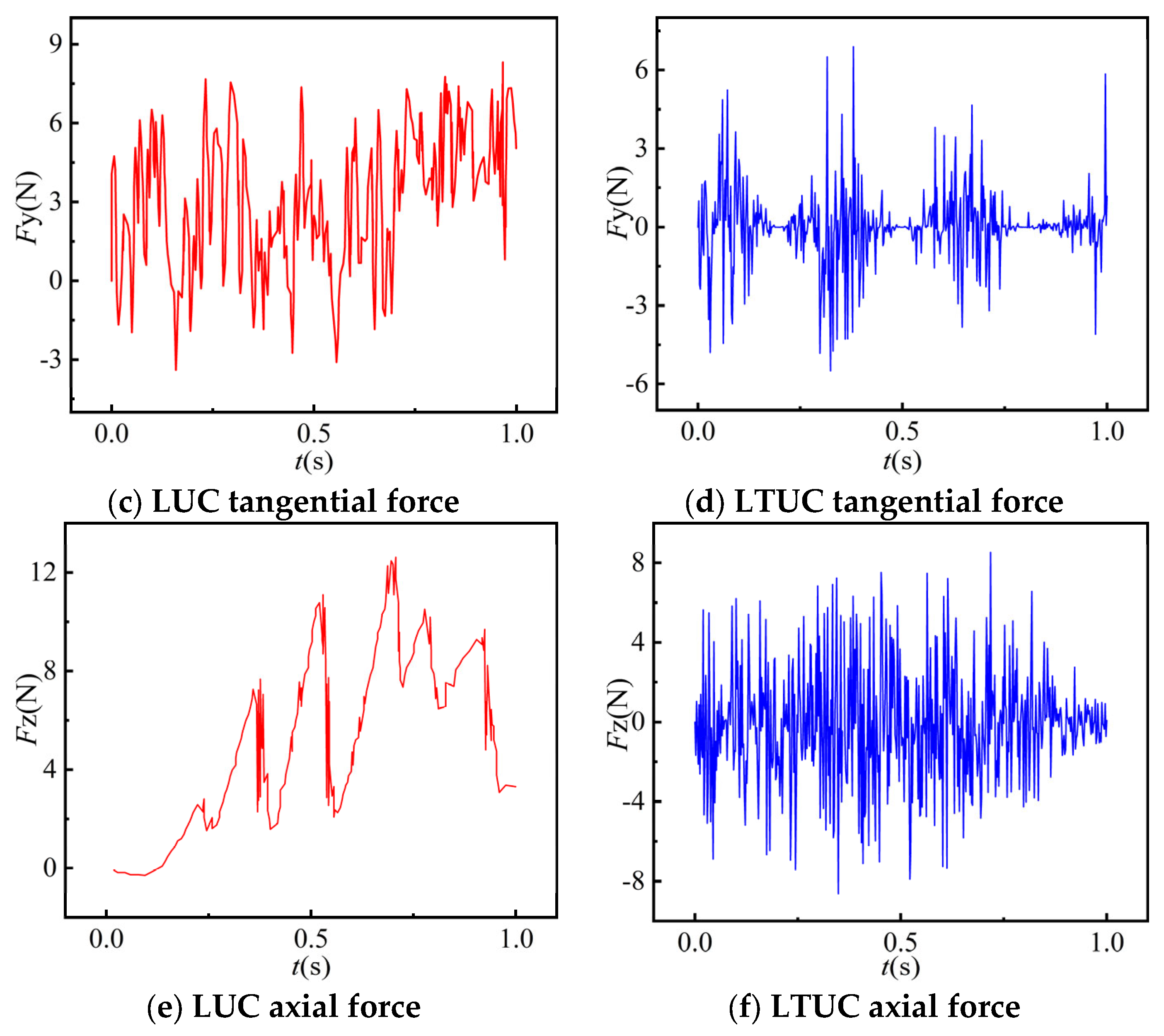
According to the cutting parameters in Table 4, it can be seen from Figure 6 that the average feed force for the LUC of aramid honeycomb is 8.32 N, the average tangential force is 2.64 N, and the average axial force is 5.61 N. The average feed force of aramid honeycomb during LTUC is 5.97 N, the average tangential force is 1.43 N, and the average axial force is 3.86 N. Compared with LUC, the three-directional cutting forces in LTUC have decreased significantly. The feed force has decreased by an average of 28.2%, the tangential force has decreased by an average of 45.8%, and the axial force has decreased by an average of 31.2%. LTUC has a more obvious effect on improving the cutting force compared with LUC.
3.
Comparison of tool cutting temperatures
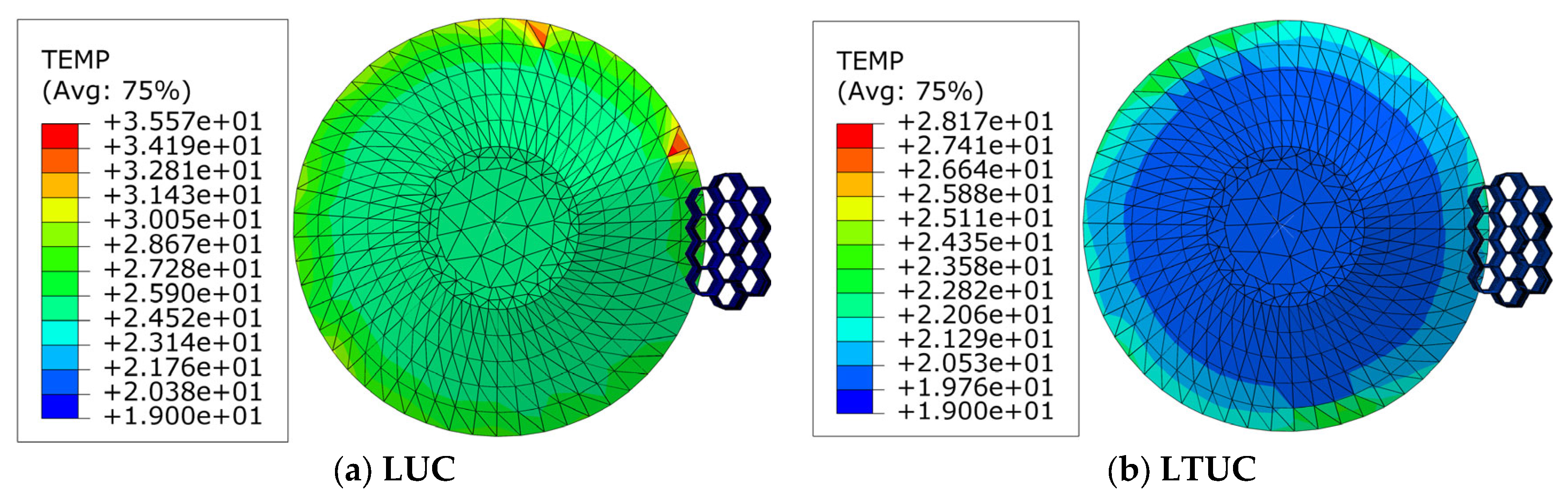
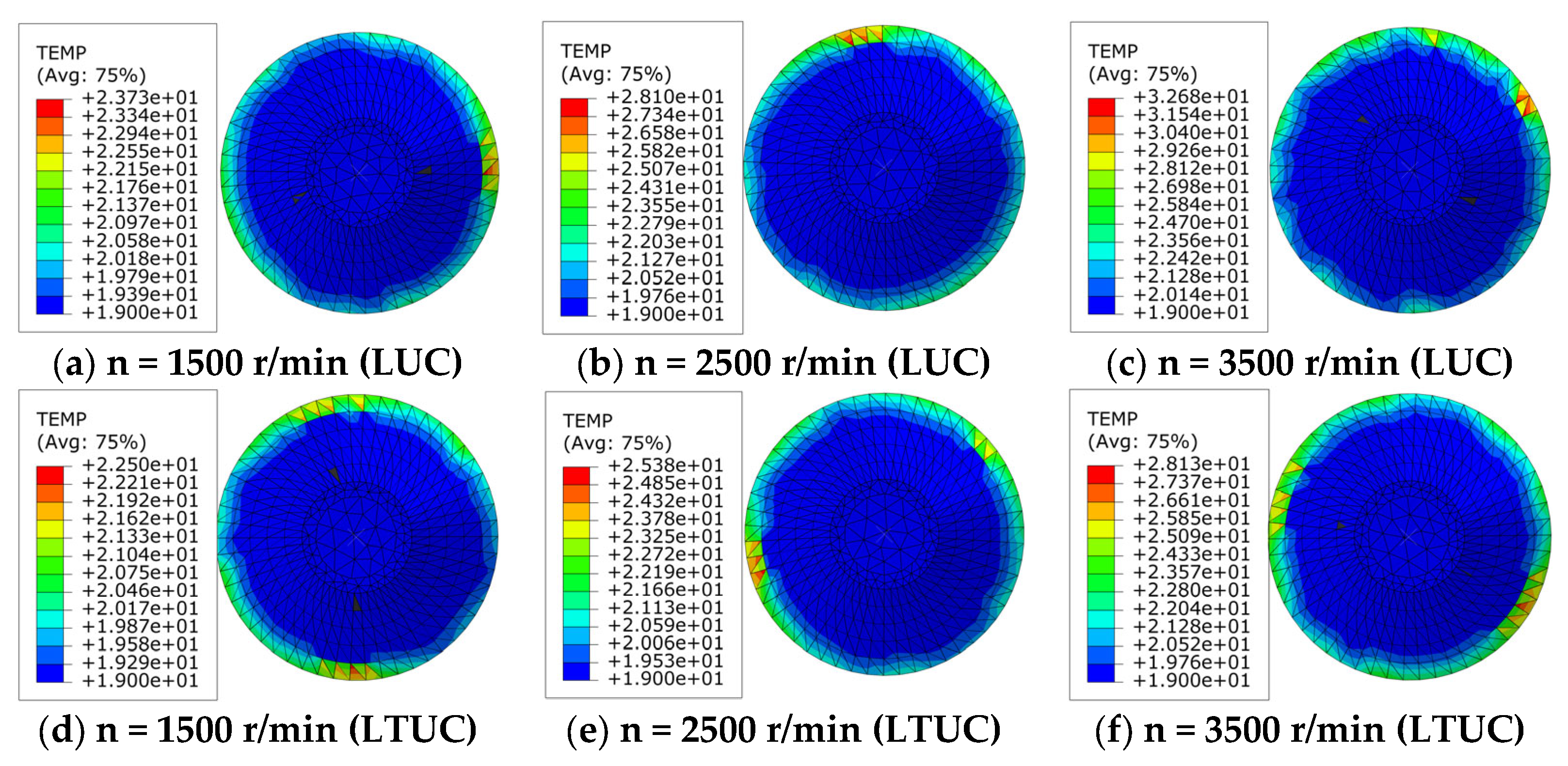
Figure 7 shows a temperature cloud graph at the moment when the highest temperature occurs in the longitudinal and LTUC simulation of the tool. The highest temperature of the tool under LUC is 35.5 °C (local peak temperature), while that under LTUC is 28.17 °C (local peak temperature). Compared with LUC, the tool temperature under LTUC decreases by 21%. The main reason is that during the LTUC process, due to the existence of torsional vibration, the tool will also have periodic contact and separation with the aramid honeycomb in the feed direction. The contact time between the tool and the workpiece is reduced compared to the LUC time, which is equivalent to an additional heat dissipation process, and the frictional heat is naturally reduced.

3.2.2. Single-Factor Simulation Test

  • Changes in Cutting Force
Under the condition that the feed rate and ultrasonic amplitude remain the same, only the spindle speed is set at 1500 r/min, 2500 r/min, and 3500 r/min to study the influence of the spindle speed on the cutting force and tool cutting temperature under the two processing methods of LTUC and LUC. The experimental parameters are shown in Table 5.
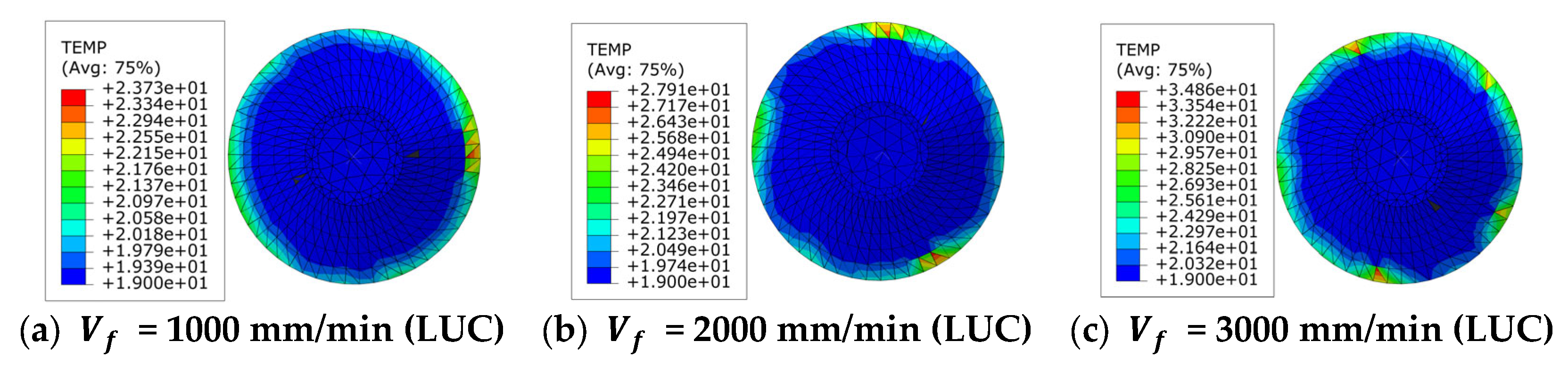
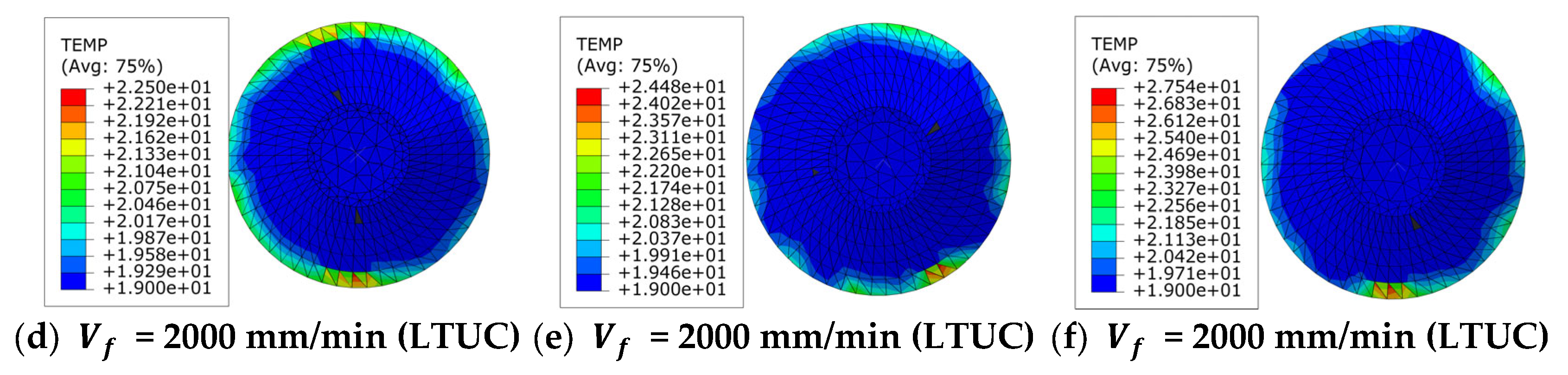
Under the condition that the spindle speed and ultrasonic amplitude remain the same, the feed rates are set at 1000 mm/min, 2000 mm/min, and 3000 mm/min. The influence of the feed rate on the cutting force and tool cutting temperature under the two processing methods of LTUC and LUC is studied. The experimental parameters are shown in Table 6.
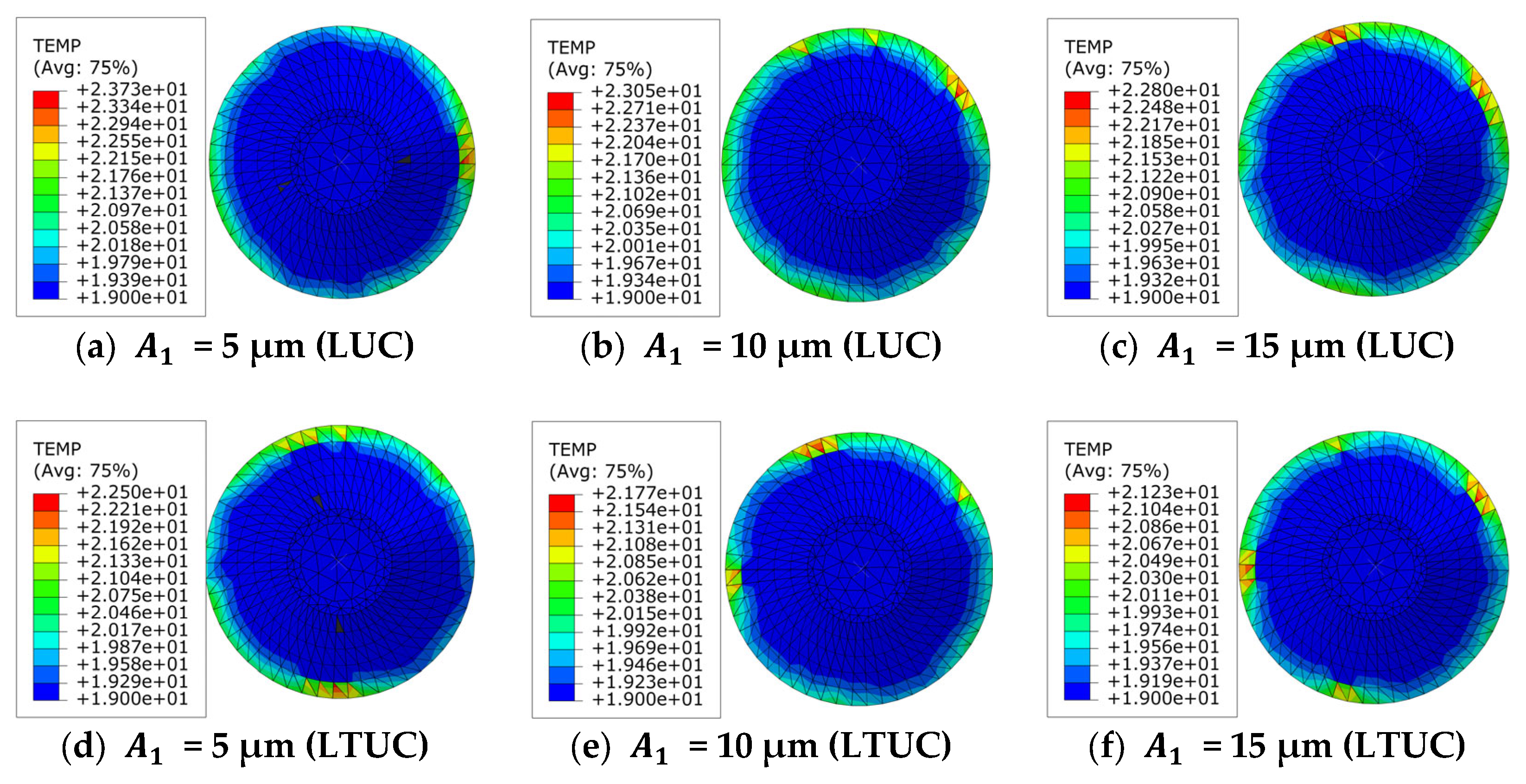
Under the condition that the spindle speed and feed rate remain the same, the ultrasonic amplitudes are set at 5 μm, 10 μm, and 15 μm to study the influence of the ultrasonic amplitude on the cutting force and tool cutting temperature under the two processing methods of LTUC and LUC. The experimental parameters are shown in Table 7.
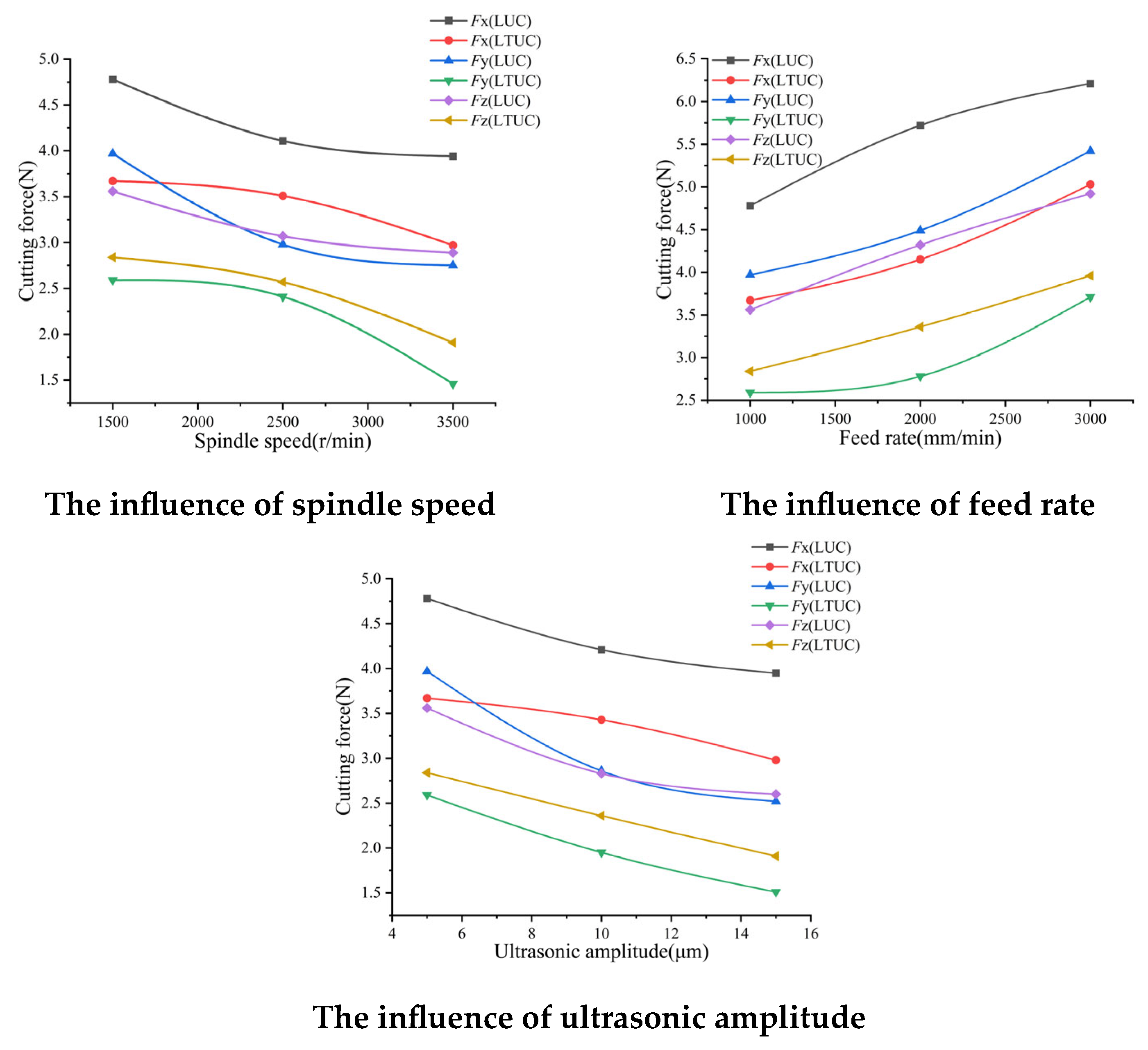
The test results are shown in Figure 8, Figure 9, Figure 10 and Figure 11. Through simulation and comparative experiments, the cutting stress, cutting force and tool cutting temperature under LUC and LTUC were compared and analyzed. It was found that due to the existence of torsional vibration, LTUC can more effectively reduce cutting stress, cutting force and tool cutting temperature compared with LUC. LTUC has better machinability in the three experimental indicators.
2.
Changes in the cutting temperature of the tool.
The single-factor experiment studied the influence of cutting parameters on the cutting force and tool cutting temperature under the two processing methods. According to the simulation results, it is known that the cutting force of the two processing methods decreases with an increase in the spindle speed and ultrasonic amplitude. The reduction in the cutting force under LTUC is greater than that under LUC. The cutting forces of the two processing methods increase with an increase in feed rate. The increase in cutting force under LTUC is less than that under longitudinal ultrasonic cutting. The cutting temperature of the tools in the two processing methods increases with an increase in the spindle speed and feed rate. The increase in the temperature of longitudinal–torsional ultrasonic cutting is smaller than that of longitudinal ultrasonic cutting. The cutting temperature of the tool decreases with an increase in the ultrasonic amplitude. The temperature drop under LTUC is greater than that under LUC.

4. Ultrasonic Vibration Cutting Test of Aramid Honeycomb

4.1. Test Conditions

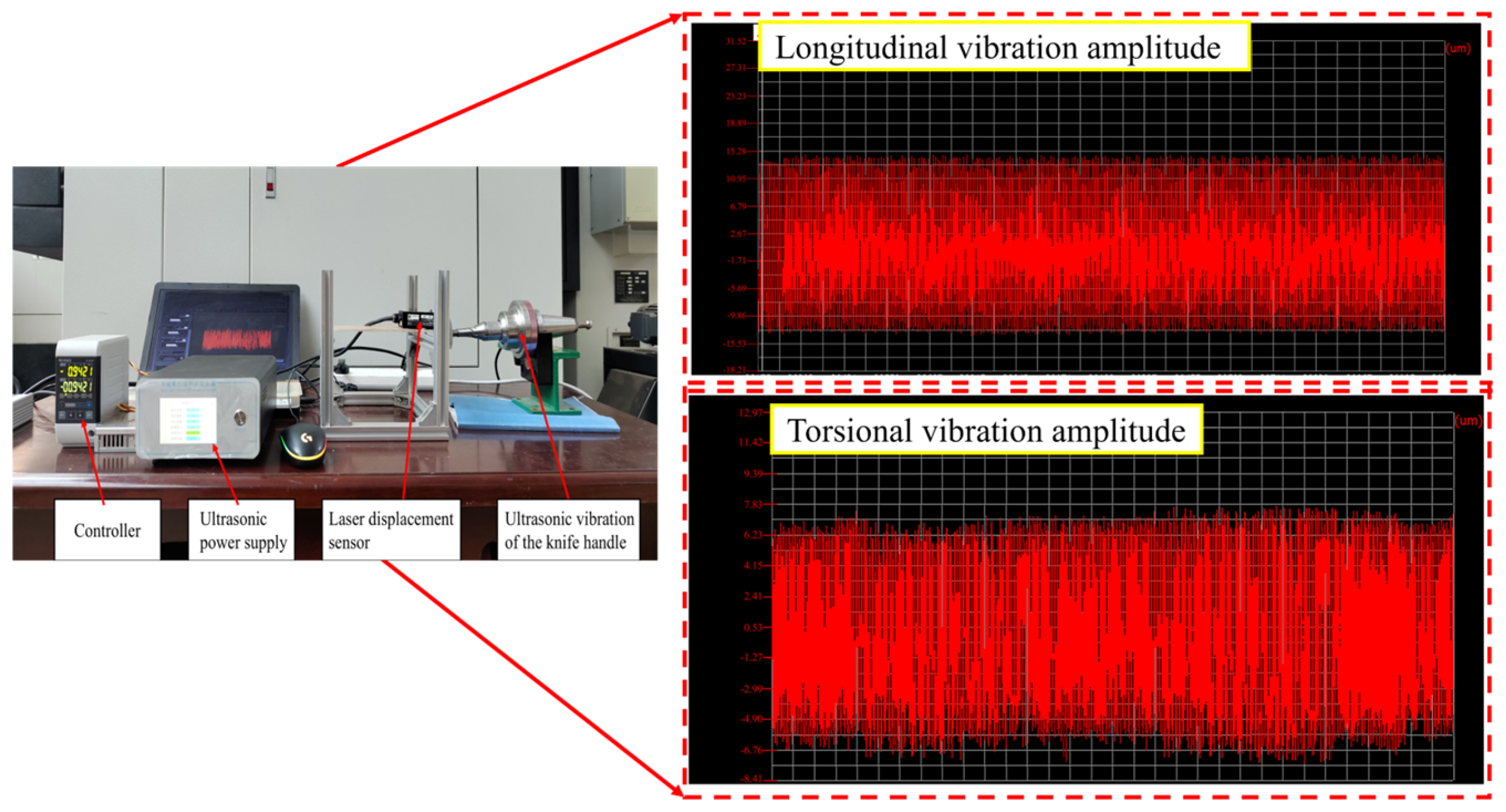
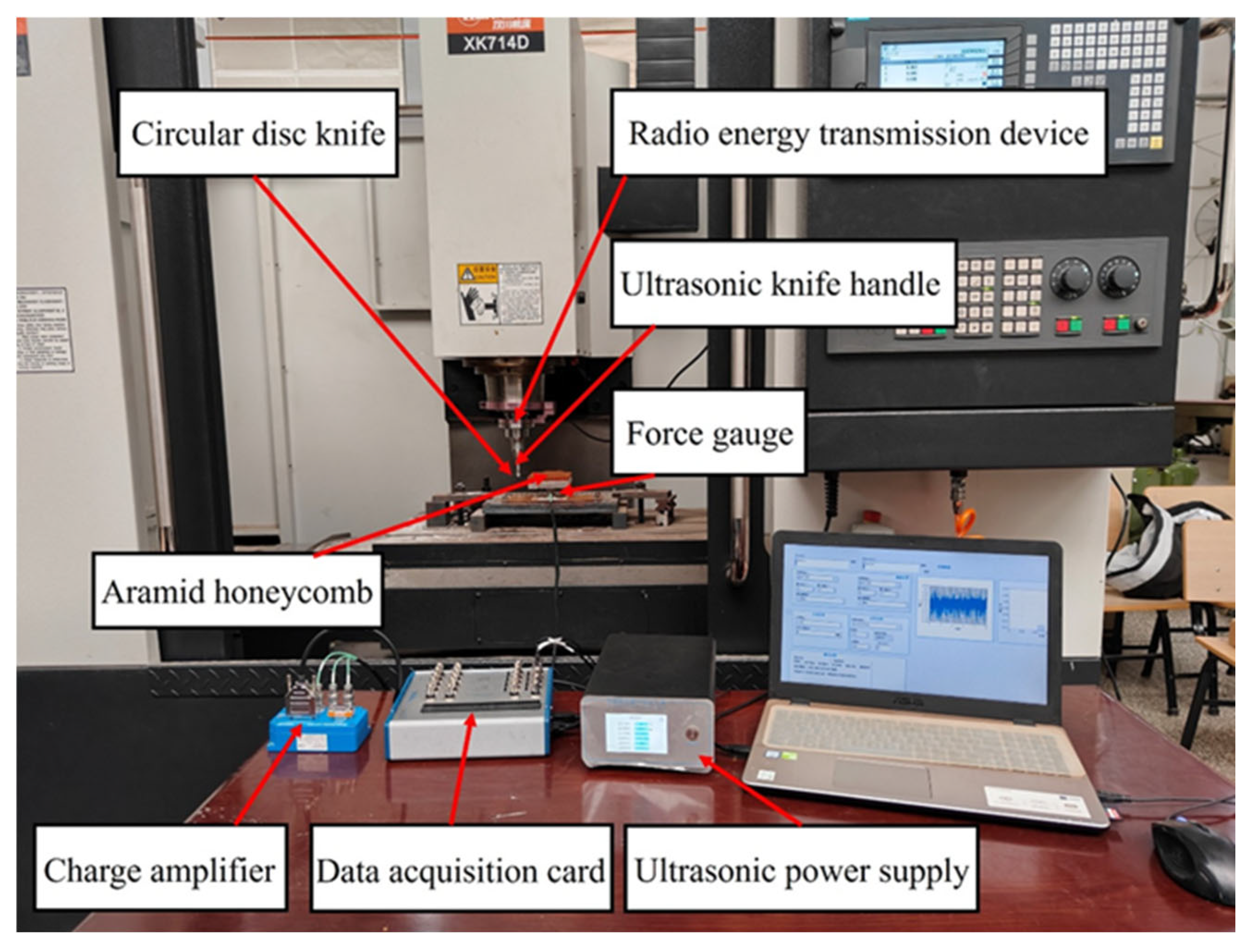
The test was conducted based on the ultrasonic processing test platform built in the laboratory, and the test setup is shown in Figure 12 and Figure 13. It is mainly composed of ultrasonic transducers, amplitude transformers, machine tool spindles and rotary cutters. The materials of the disc cutter and the workpiece are the same as those in the simulation. Before the test, the amplitude of the circular cutter was measured using the Keyence LK-G10 laser displacement sensor. Since the vibration sources of longitudinal waves and transverse waves are the same, they have the same vibration frequency. The ultrasonic vibration parameters of the circular disc cutter can be obtained through the laser displacement sensor and simulation calculation, as shown in Table 8. The cutting parameters were the same as the simulation parameters. By means of comparative tests, LUC and LTUC tests were conducted successively with two identical tools. The cutting force was measured by the Kistler (Switzerland) 9317C three-component force sensor, which simultaneously recorded the three perpendicular components: the thrust force (Fx), the tangential force (Fy), and the axial force (Fz). The data was amplified by the Kistler 5073A411 charge amplifier and collected through the NI-USB-6346 data acquisition card. The cutting morphology of the aramid honeycomb and the tool wear were observed using the DVM-4K-3000 series microscope produced by Mega Instruments (Suzhou, China).

4.2. Analysis of Single-Factor Test Results

4.2.1. Test Results of Cutting Force

  • The influence of spindle speed on cutting force
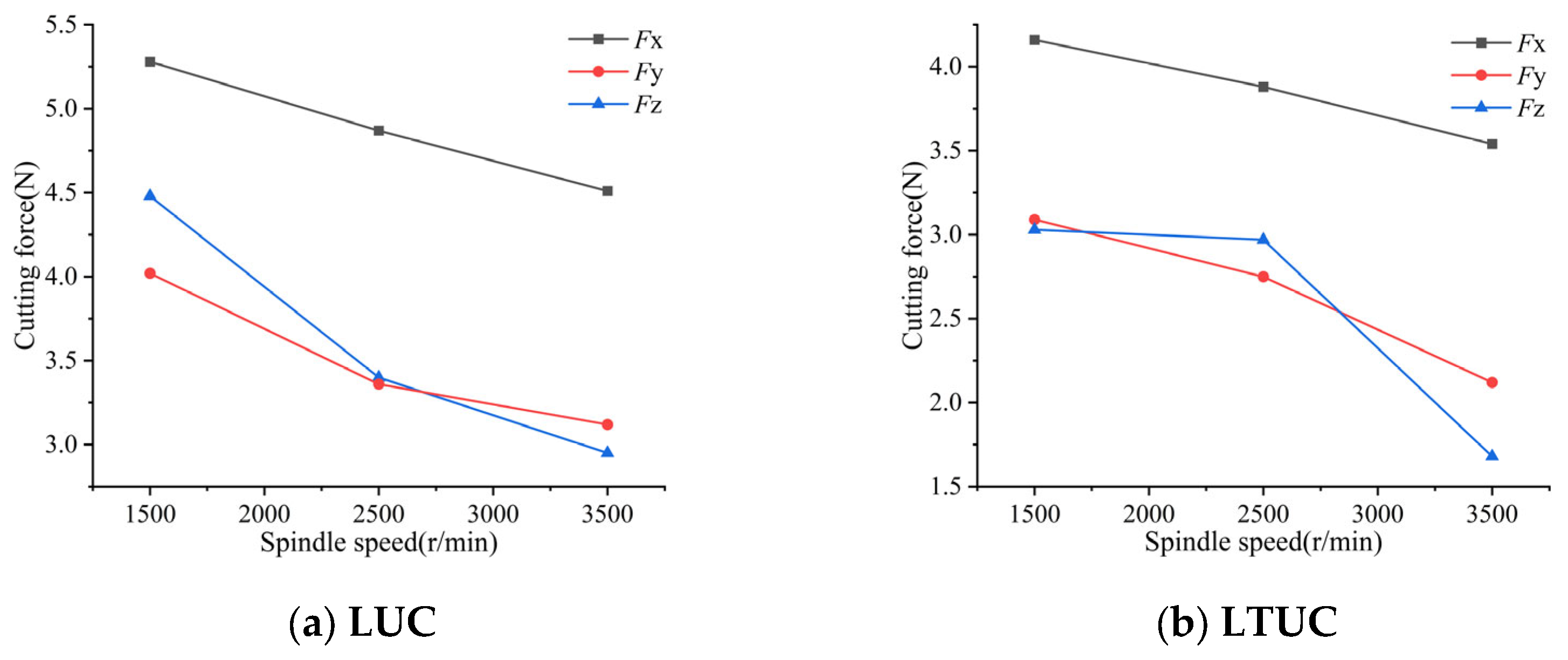
It can be seen from Figure 14 that during the process, when the spindle speed increases from 1500 r/min to 3500 r/min, under the same conditions of other parameters, the three-directional cutting force of the LTUC of aramid honeycomb is always less than that of the LUC of aramid honeycomb. Meanwhile, with the increase in the spindle speed, the three-directional cutting forces under both processing methods show a downward trend. From 1500 r/min to 3500 r/min, the feed force of LUC decreased from 5.28 N to 4.51 N, a decrease of 15%. The tangential force of LUC decreased from 4.48 N to 2.95 N, a decrease of 34%. The axial force of LUC decreased from 4.02 N to 3.12 N. The decline rate reached 22%. The feed force of LTUC decreased from 4.16 N to 3.54 N, with a decrease of 15%. The tangential force of LTUC decreased from 3.09 N to 2.12 N, with a decrease of 31%. The axial force of LTUC decreased from 3.03 N to 1.68 N, with a decrease of 45%. Therefore, under the condition that other parameters remain the same, in order to improve the processing efficiency, a higher spindle speed can be reasonably selected for cutting processing.
2.
The influence of feed rate on cutting force
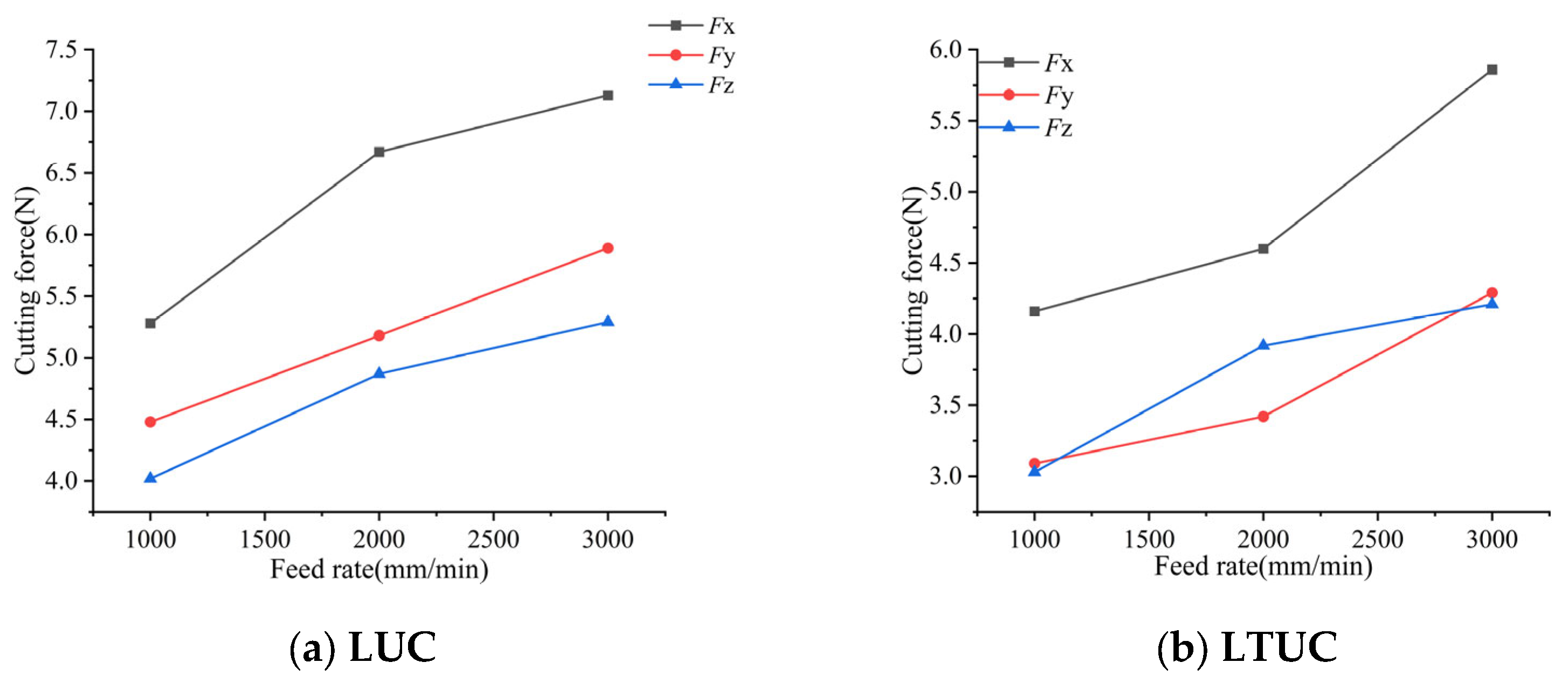
It can be intuitively seen from Figure 15 that during the process, when the feed rate increases from 1000 mm/min to 3000 mm/min, under the condition that other parameters are the same, the three-directional cutting force of the LTUC of aramid honeycomb is always less than that of LUC, and with an increase in the feed rate, the cutting forces of both processing methods show an upward trend. From 1000 mm/min to 3000 mm/min, the feed force of LUC increased from 5.28 N to 7.13 N, with an increase of 35%. The tangential force of LUC increased from 4.48 N to 5.89 N, with an increase of 34%. The axial force of LUC increased from 4.02 N to 5.29 N. The increase reached 32%. The feed force of LTUC increased from 4.16 N to 5.86 N, with an increase of 41%. The tangential force of LTUC increased from 3.09 N to 4.29 N, with an increase of 39%. The axial force of LTUC increased from 3.03 N to 4.21 N, with an increase of 39%. The trend of the experimental results is consistent with the simulation. An increase in the feed rate will lead to an increase in the three-directional cutting force, but the variation amplitude of the cutting force is not as obvious as that of the spindle speed. Moreover, during the machining process, using a smaller feed rate can effectively control the magnitude of the cutting force.
3.
The influence of ultrasonic amplitude on cutting force
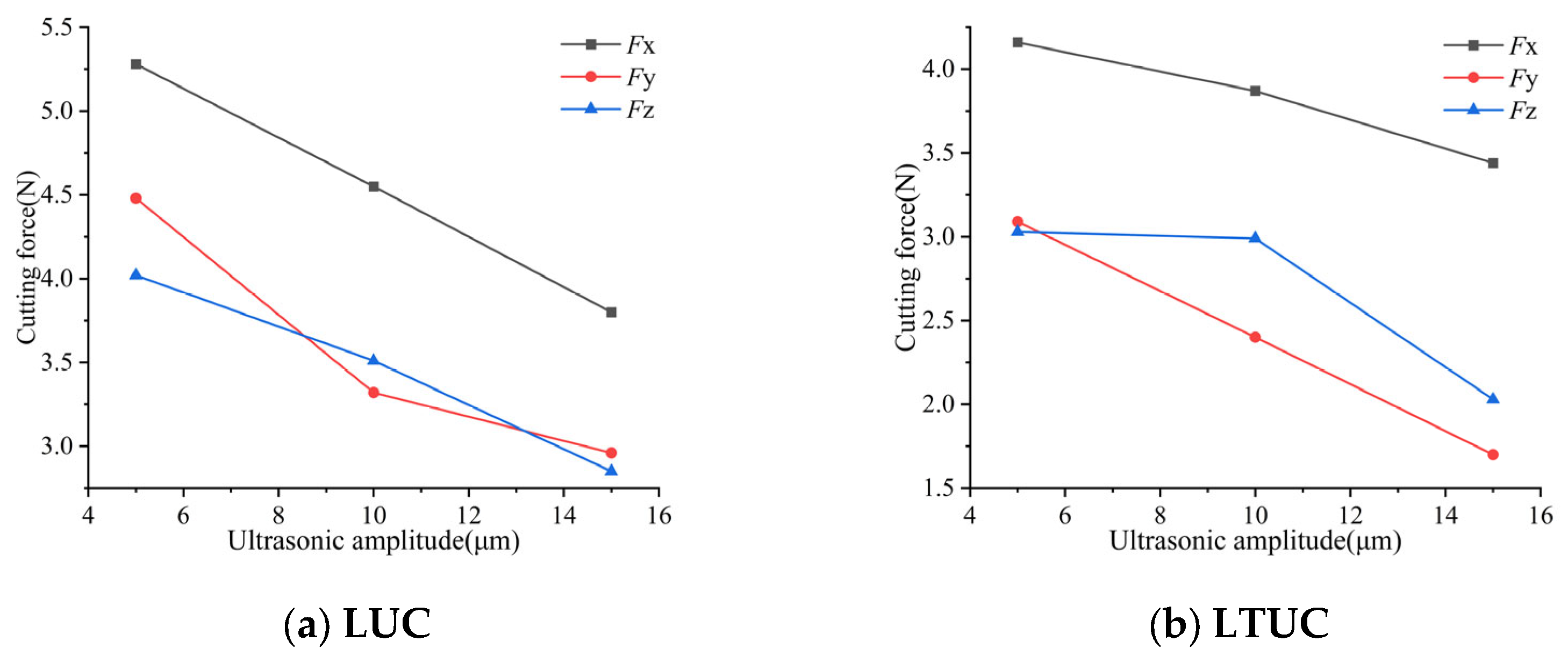
It can be seen from Figure 16 that the ultrasonic amplitude increased from 5 μm to 15 μm. The feed force of LUC decreased from 5.28 N to 3.80 N, with a decrease of 28%; the tangential force of LUC decreased from 4.48 N to 2.96 N, with a decrease of 34%; and the axial force of LUC decreased from 4.02 N to 2.85 N. The reduction rate reached 29%. The feed force of LTUC decreased from 4.16 N to 3.44 N, with a reduction of 17%. The tangential force of LTUC decreased from 3.09 N to 1.70 N, with a reduction of 45%. The axial force of LTUC decreased from 3.03 N to 2.03 N, with a reduction of 33%. With an increase in ultrasonic amplitude, the three-directional cutting force shows a downward trend, which is consistent with the trend of simulated cutting. The variation amplitude of the three-directional cutting force is more obvious compared with the spindle speed and feed rate.

4.2.2. Verification of the Simulation Model

In order to verify the accuracy of the simulation model, the results of the three-directional cutting force in the single-factor simulation experiment were compared with those in the actual experiment, and the relative error between the two was calculated, as shown in Table 9.
From the above analysis, it can be seen that the average error of the simulation and experimental results under the two processing methods is between 10% and 20%. The local differences exceeding 30% are mainly due to the mesoscopic defects, boundary uncertainties and differences in measurement definitions between the ideal model and the experiment. The above results confirm the accuracy of the simulation model.
The reasons for the errors in the experimental and simulation results are as follows. First, during the experiment, the aramid honeycomb was unstable in holding, and the cutting edge of the tool was damaged. Second, in the pretreatment parameter settings of the simulated cutting process, these parameter settings are made based on the simulation experience of metal cutting, and the set parameters cannot fully conform to the actual processing environment. These factors are the main reasons why the experimental cutting force is greater than the simulated cutting force.

4.2.3. Process Parameter Optimization

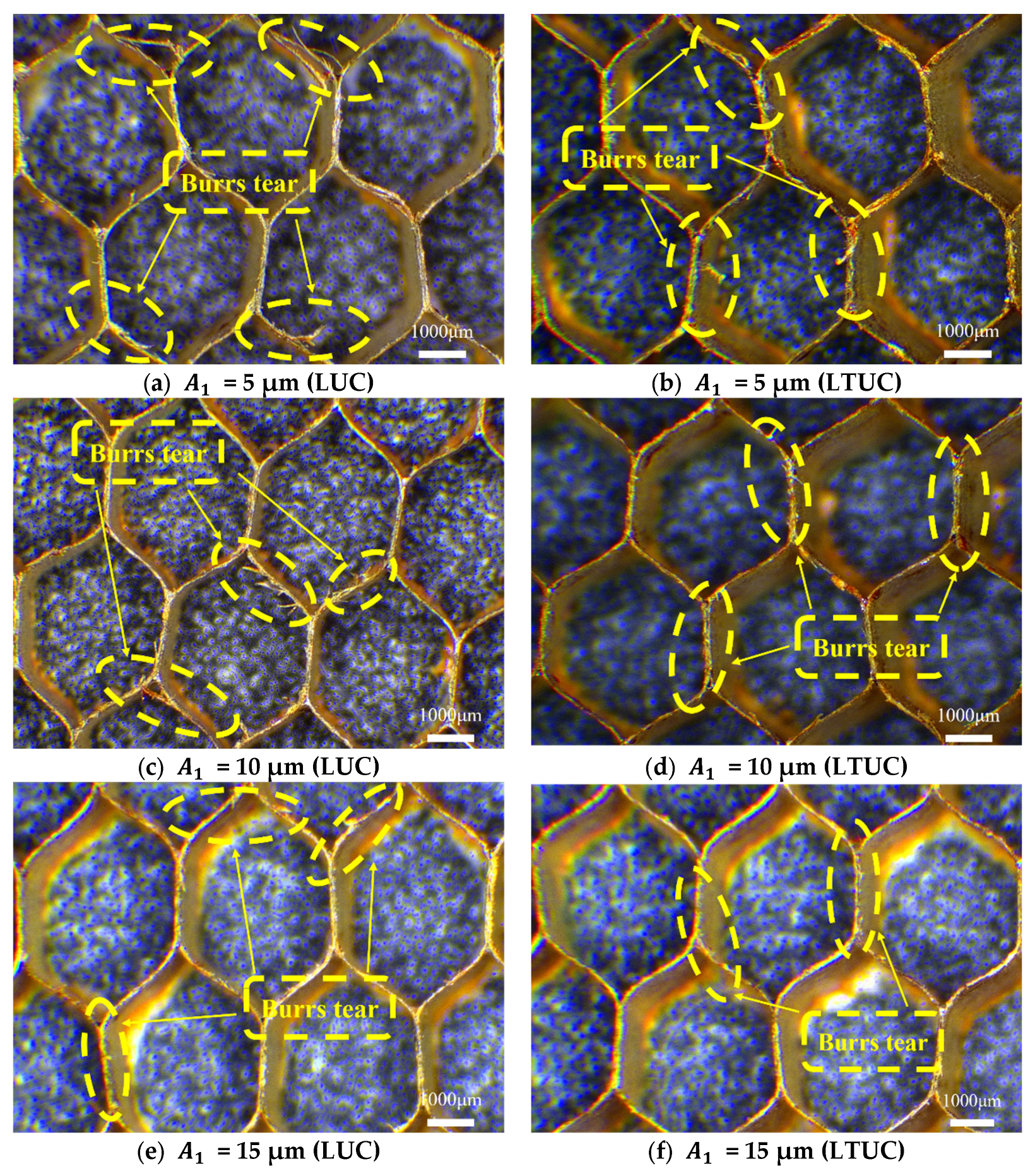
The surface morphology can directly reflect the quality of aramid honeycomb processing. The morphology of aramid honeycomb after cutting and processing is quite different from that of metal materials. Indicators such as residual stress, surface roughness, and subsurface damage, which are used to evaluate the quality of traditional metal processing, are not applicable to the surface quality evaluation of aramid honeycomb. At present, there is no mature and standardized evaluation standard for the surface quality of aramid honeycomb materials after cutting. Generally, burr tearing after cutting is adopted as the evaluation standard for the surface quality of aramid honeycomb materials after cutting. The experimental parameters in this section are the same as the single-factor experimental parameters of cutting force.
1.
Spindle speed
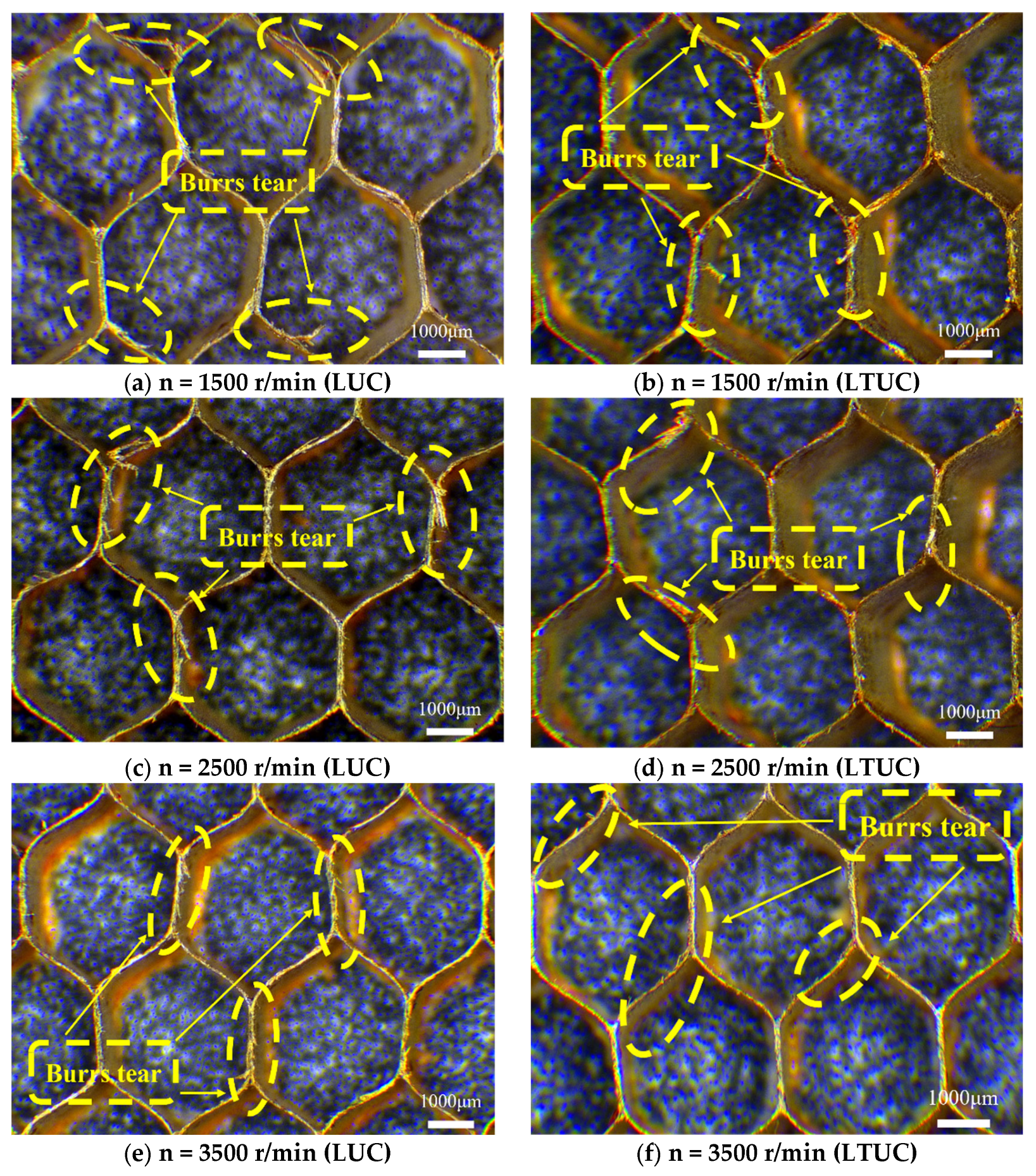
Figure 17 shows the surface morphology of aramid honeycomb processed by longitudinal cutting and LTUC at different spindle speeds. When the spindle speed is lower, the surface morphology of both processing methods shows relatively obvious burr tearing phenomena. However, as the spindle speed increases, the burr tearing deformation decreases, and the surface morphology of aramid honeycomb after cutting becomes flatter, and the surface processing quality is better. By comparing the surface morphology of aramid honeycomb under longitudinal cutting and LTUC, it is found that the surface morphology of aramid honeycomb under longitudinal torsion ultrasonic cutting has smaller burrs and tears, a smoother surface morphology, and better surface quality.
This happens because, as the spindle speed increases, the shearing energy of the tool also increases, the cutting force used to cut aramid honeycomb decreases, and the squeezing force on the honeycomb wall also decreases. Therefore, the surface quality of the honeycomb is improved. In addition, longitudinal ultrasonic cutting vibrates along the axial direction of the tool, which will tear the honeycomb during the cutting process. However, in the longitudinal–torsional ultrasonic cutting of aramid honeycomb, due to the introduction of torsional vibration, the tool will lead to reciprocating cutting caused by torsional vibration in the feed direction, which makes the burr tearing on the surface morphology of longitudinal–torsional cutting smaller.
2.
Feed rate
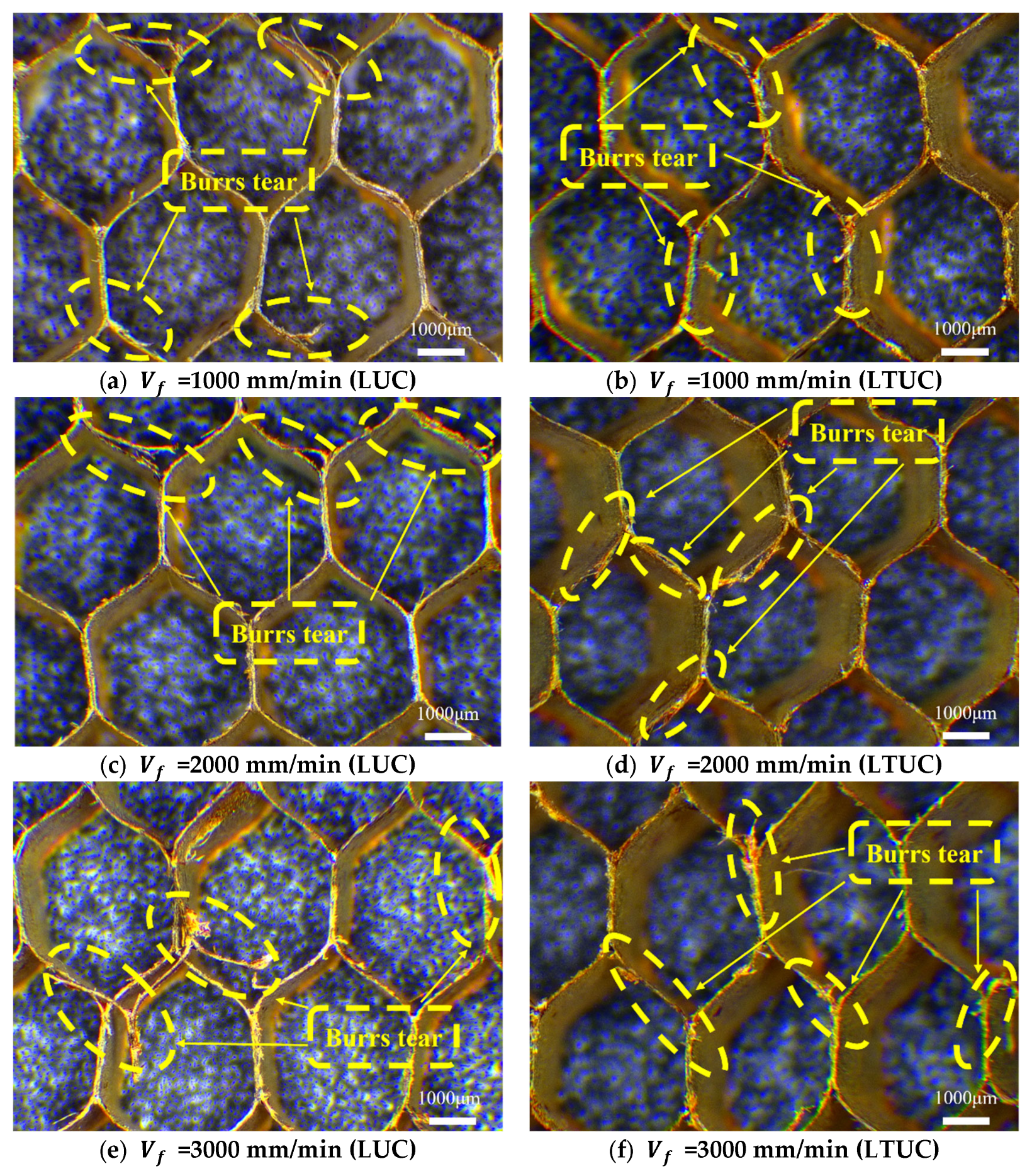
Figure 18 shows the surface morphology of aramid honeycomb processed by LUC and LTUC at different feed rates. The experimental parameters are consistent with those of the cutting force at the feed rate. It can be seen from the figure that as the feed rate increases, the burrs and tears on the aramid honeycomb cutting surface become larger, and the surface processing quality deteriorates. By comparing the surface morphology of aramid honeycomb in longitudinal cutting and LTUC at the same feed rate, it can be seen that the surface morphology of aramid honeycomb after LTUC has smaller burrs and tears and better surface quality.
This happens because, as the feed rate increases, the cutting force also increases. A larger cutting force is prone to causing defects such as tearing and deformation in aramid honeycomb. The cutting force of LTUC is less than that of LUC. Therefore, the surface quality of longitudinal–torsional cutting is better. From the perspective of feed rate, the greater the cutting force, the worse the surface quality.
3.
Ultrasonic amplitude
Figure 19 shows the surface morphology of aramid honeycomb processed by longitudinal and LTUC under different ultrasonic amplitudes. With an increase in ultrasonic amplitude, the burrs and tears on the surface morphology of aramid honeycomb after cutting decrease, and the surface quality improves. It is found through comparison that the surface quality of aramid honeycomb cut by LTUC is superior to that cut by LUC.
This happens because, as the ultrasonic amplitude increases, the cutting force of the LUC and LTUC of aramid honeycomb decreases, and the damage to the aramid honeycomb also decreases. Therefore, the burrs and tears on the surface morphology of the aramid honeycomb cutting become smaller. Additionally, since the cutting speed of LTUC is greater than that of LUC, the cutting speed of LTUC increases with an increase in amplitude, which means that the tool is sharper, and the chip breaking effect is better.

5. Conclusions

This paper takes aramid honeycomb materials as the research object and conducts research work around the processing technology characteristics. The research finds that the intermittent machinability of LTUC can effectively improve the cutting conditions, thereby enhancing the cutting efficiency with better cutting technology characteristics, providing theoretical guidance for the actual processing of aramid honeycomb. The conclusions are as follows:
  • The periodic separation contact characteristics of LTUC reduce the contact time between the workpiece and the tool, increase the cutting speed of the cutting edge, improve the heat dissipation conditions during cutting, and thereby enhance the cutting efficiency.
  • Compared with longitudinal vibration ultrasonic cutting, the ultrasonic longitudinal cutting of aramid honeycomb materials can further reduce cutting stress, cutting force and tool cutting temperature. The feed force decreased by an average of 28.2%, the tangential force decreased by an average of 45.8%, the axial force decreased by an average of 31.2%, and the tool temperature decreased by 21%.
  • Simulation and experiments show that the cutting forces of the two processing methods decrease with an increase in the spindle speed and ultrasonic amplitude and increase with an increase in the feed rate. The cutting temperature of the tools in both processing methods increases with an increase in the spindle speed and feed rate and decreases with an increase in the ultrasonic amplitude. Under LTUC, cutting performance is superior to LUC. Meanwhile, the surface burrs and tears of aramid honeycomb after LTUC are smaller than those after LUC, which can improve the processing quality and have better cutting process characteristics.
This paper investigates the processing characteristics of the ultrasonic vibration cutting of aramid honeycomb materials. However, due to the limitations of the experimental conditions, this paper only studies the processing characteristics of the circular blade ultrasonic vibration cutting of aramid honeycomb, without analyzing the processing effect of straight-edge blade ultrasonic vibration cutting. Further research can be conducted on the processing performance and processing effect of the straight-edge blade ultrasonic vibration cutting of aramid honeycomb. In addition, this paper only studies the influence of ultrasonic amplitude on the vibration parameters on the processing effect but does not study the influence of ultrasonic vibration frequency. Further in-depth research should be carried out by using a variable-frequency device to analyze the processing effect under different frequencies, especially the comparative experiments of low frequency and high frequency.

Author Contributions

Conceptualization, X.W. and Y.Z.; methodology, Y.Z.; software, M.Z.; validation, L.F., M.Z. and T.M.; formal analysis, L.L.; investigation, X.Z.; data curation, Y.Z.; writing—original draft preparation, M.Z.; writing—review and editing, X.Z.; supervision, T.M. and L.L.; project administration, X.W.; funding acquisition, X.W. All authors have read and agreed to the published version of the manuscript.

Funding

This work was supported by the Education Department of Jilin Province (JJKH20230754KJ), the Education Department of Jilin Province (JJKH20240849KJ) and the Department of Science and Technology of Jilin Province (20210509041RQ).

Institutional Review Board Statement

Not applicable.

Informed Consent Statement

Not applicable.

Data Availability Statement

The original contributions presented in this study are included in the article. Further inquiries can be directed to the corresponding author.

Acknowledgments

The authors gratefully acknowledge the financial support from the Education Department of Jilin Province, and the Department of Science and Technology of Jilin Province.

Conflicts of Interest

The authors declare no conflicts of interest.

References

  1. Sun, J.; Kang, R.; Zhou, P.; Dong, Z.; Wang, Y. Review on Ultrasonic Cutting of Honeycomb Core. J. Mech. Eng. 2023, 59, 298–319. [Google Scholar]
  2. Kuo, C.; Chen, C.; Jiang, S.; Chen, Y. Effects of the tool geometry, cutting and ultrasonic vibration parameters on the cutting forces, tool wear, machined surface integrity and subsurface damages in routing of glass-fibre-reinforced honeycomb cores. J. Manuf. Process. 2023, 104, 59–75. [Google Scholar] [CrossRef]
  3. Lin, Y.; Yang, Z.; Wang, X.; Zuo, X.; Li, Z.; Guan, Z.; Li, J.; Jiang, Y. The design of continuous carbon fiber composite honeycombs and study on its properties. J. Compos. Mater. 2022, 56, 3729–3747. [Google Scholar] [CrossRef]
  4. Cheng, Y.; Ren, K.; Fu, J.; Yin, L.; Yang, R.; Yuan, H.; Zhao, T.; Chen, Z. Simulation study on the anti-penetration performance and energy absorption characteristics of honeycomb aluminum sandwich structure. Compos. Struct. 2023, 310, 116776. [Google Scholar] [CrossRef]
  5. Sun, J.; Wang, Y.; Zhou, P.; Wang, M.; Kang, R.; Dong, Z. Equivalent mechanical model of resin-coated aramid paper of Nomex honeycomb. Int. J. Mech. Sci. 2023, 240, 107935. [Google Scholar] [CrossRef]
  6. Zhang, J.; Dang, X. Research Progress on the Preparation technology and Application of Aramid Paper Honeycomb Core Materials. New Mater. Ind. 2019, 12, 52–56. [Google Scholar]
  7. An, Q.; Dang, J.; Ming, W.; Qiu, K.; Chen, M. Experimental and numerical studies on defect characteristics during milling of aluminum honeycomb core. J. Manuf. Sci. Eng. 2019, 141, 031006. [Google Scholar] [CrossRef]
  8. Niu, J.; Zhu, X.; Kang, R.; Wang, Y.; Dong, Z. Experimental Study on Ultrasonic Cutting of Honeycomb Core Materials by Circular Disc Cutters. Diam. Abras. Tools Eng. 2017, 37, 62–68. [Google Scholar]
  9. Tang, C. High-Efficiency Processing Tool Technology for Composite Materials. Aviat. Manuf. Technol. 2013, 6, 47–51. [Google Scholar]
  10. Xiang, D.; Su, B.; Wang, D.; Peng, P.; Yuan, Z.; Song, C.; Li, B.; Cui, X.; Gao, G.; Zhao, B. Ultrasonic longitudinal-torsional vibration helical milling internal thread of SiCp/Al composites: Finite element simulation and machining quality research. J. Manuf. Process. 2024, 131, 1833–1845. [Google Scholar] [CrossRef]
  11. Zhang, S.; Wang, J.; Ma, F.; Liu, Y.; Sha, Z. Simulation Analysis on the Influence of Tool Parameters on Cutting Force and Temperature in Ultrasonic Cutting of Honeycomb Cores. J. Dalian Jiaotong Univ. 2017, 38, 57–61. [Google Scholar]
  12. Ahmad, S. Implementation of new stepped horn in rotary ultrasonic machining of NOMEX honeycomb composites. J. Mech. Sci. Technol. 2024, 38, 4983–4988. [Google Scholar] [CrossRef]
  13. Xu, J.; Wang, C.; Feng, P.; Jiang, E.; Feng, F. Meso-scale cracks initiation of Nomex honeycomb composites in orthogonal cutting with a straight blade cutter. Compos. Sci. Technol. 2023, 233, 109914. [Google Scholar] [CrossRef]
  14. Li, L.; Qin, Y.; Kang, R.; Dong, Z.; Song, H.; Wang, Y. Study on characteristics of tool wear and breakage of ultrasonic cutting Nomex honeycomb core with the disc cutter. Appl. Sci. 2023, 13, 8168. [Google Scholar] [CrossRef]
  15. Kang, D.; Zou, P.; Wu, H.; Duan, J.; Wang, W. Study on ultrasonic vibration–assisted cutting of Nomex honeycomb cores. Int. J. Adv. Manuf. Technol. 2019, 104, 979–992. [Google Scholar] [CrossRef]
  16. Habib, H.; Khan, M.S.; Munir, A.; Zahid, D.; McDermott, O. Enhancing Cutting Efficiency and Minimizing Forces for Nomex Honeycomb Core Using Grey Relational Analysis and Desirability Function Analysis. Small Methods 2024, 8, 2300958. [Google Scholar] [CrossRef]
  17. Shen, X. Experimental Research on Honeycomb Processing Technology of Aramid Paper for Aviation Based on 5—Axis High Speed Machining Cente. Fiber Compos. 2024, 41, 10–16. [Google Scholar]
  18. Jaafar, M.; Nouari, M.; Makich, H.; Moufki, A. 3D numerical modeling and experimental validation of machining Nomex® honeycomb materials. Int. J. Adv. Manuf. Technol. 2021, 115, 2853–2872. [Google Scholar] [CrossRef]
  19. Jiang, J.; Liu, Z. Formation mechanism of tearing defects in machining Nomex honeycomb core. Int. J. Adv. Manuf. Technol. 2021, 112, 3167–3176. [Google Scholar] [CrossRef]
  20. Zarrouk, T.; Nouari, M.; Makich, H. Simulated study of the machinability of the Nomex honeycomb structure. J. Manuf. Mater. Process. 2023, 7, 28. [Google Scholar] [CrossRef]
  21. Xiao, X.; Pu, Y.; Wang, X.; Xie, Z.; Zhang, R.; Wang, B. Experimental Study on High-Speed Milling of Wave-absorbing Honeycomb Based on Crushing Tooth Tools. Aeronaut. Manuf. Technol. 2024, 67, 82–90. [Google Scholar]
  22. Cao, W.; Zha, J.; Chen, Y. Cutting force prediction and experiment verification of paper honeycomb materials by ultrasonic vibration-assisted machining. Appl. Sci. 2020, 10, 4676. [Google Scholar] [CrossRef]
  23. Sun, D.; Kang, R.; Wang, Y.; Guo, J.; Dong, Z. A novel ultrasonic trepanning method for Nomex honeycomb core. Appl. Sci. 2020, 11, 354. [Google Scholar] [CrossRef]
  24. Xu, Q. Experimental Study on Damage Inhibition in Edge Cutting Processing of NOMEX Honeycomb Materials. Master’s Thesis, Dalian University of Technology, Dalian, China, 2019. [Google Scholar]
  25. Shi, L.; Wang, C.; Chen, J.; Guo, F.; Huang, W.; An, Q.; Ming, W.; Chen, M. Material Removal Mechanism and Damage Behavior in High-speed Milling of High-temperature Alloy Honeycomb Core. J. Mech. Eng. 2022, 58, 284–295. [Google Scholar]
  26. Li, C.; Duan, C.; Tian, X.; Wang, C. Mechanistic modeling considering bottom edge cutting effect and material anisotropy during end milling of aluminum honeycomb core. Compos. Struct. 2024, 327, 117686. [Google Scholar] [CrossRef]
  27. Zha, H.; Shang, W.; Xu, J.; Feng, F.; Kong, H.; Jiang, E.; Ma, Y.; Xu, C.; Feng, P. Tool wear characteristics and strengthening method of the disc cutter for nomex honeycomb composites machining with ultrasonic assistance. Technologies 2022, 10, 132. [Google Scholar] [CrossRef]
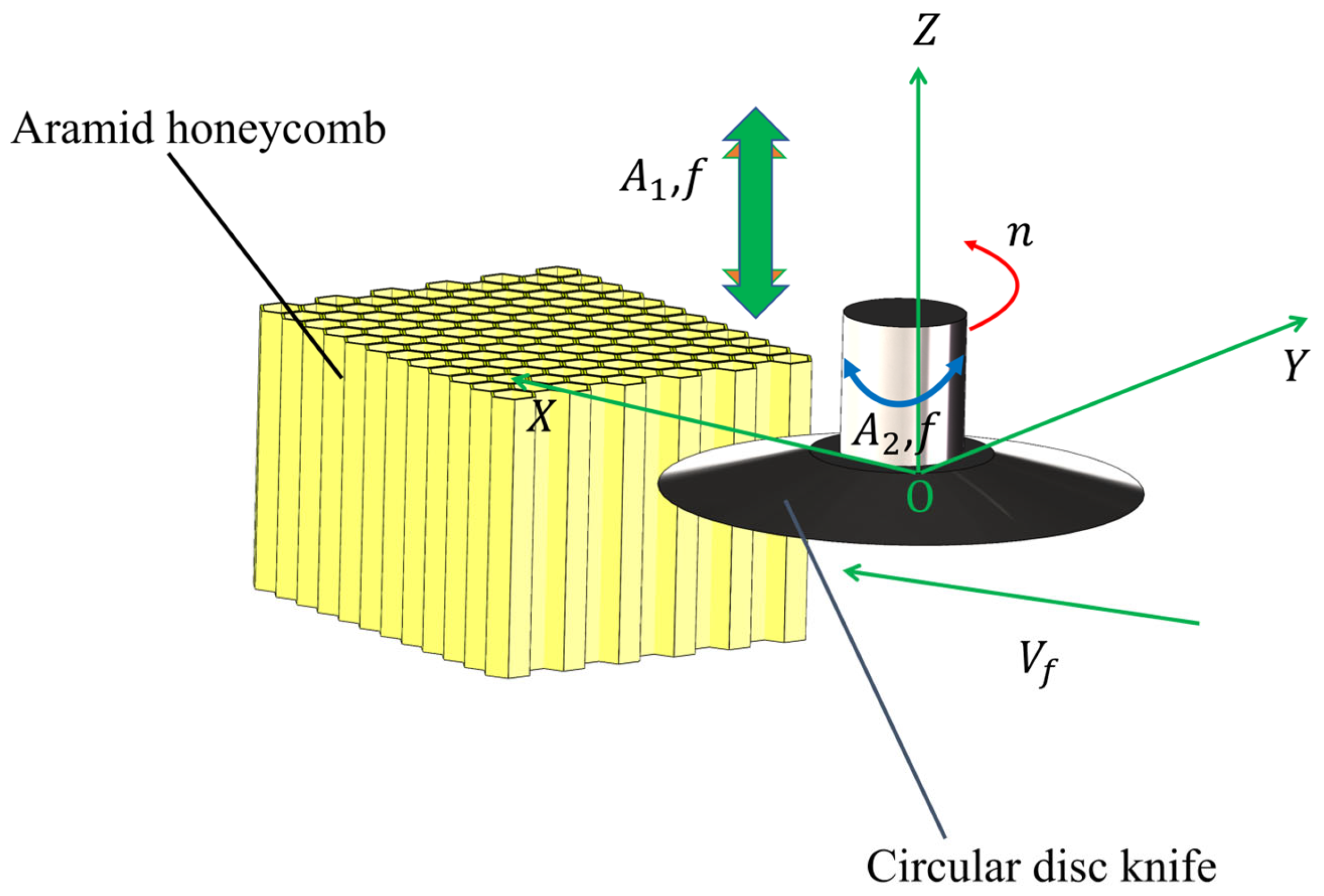
Figure 1. Schematic diagram of LTUC of aramid honeycomb material.
Applsci 16 01362 g001
Figure 2. Comparison of ordinary cutting, LUC, and LTUC trajectories.
Applsci 16 01362 g002
Figure 3. Assembly drawing of the cutting model.
Applsci 16 01362 g003
Figure 4. Grid division.
Applsci 16 01362 g004
Figure 5. Comparison of cutting stress between LTUC and LUC.
Applsci 16 01362 g005
Figure 6. Comparison of cutting forces between longitudinal–torsional ultrasonic vibration cutting and longitudinal ultrasonic vibration cutting.
Applsci 16 01362 g006aApplsci 16 01362 g006b
Figure 7. Cloud map of the highest cutting temperature of the tool.
Applsci 16 01362 g007
Figure 8. Trend of cutting force variation in different processing methods.
Applsci 16 01362 g008
Figure 9. Cloud maps of the highest tool cutting temperatures at different rotational speeds for different processing methods.
Applsci 16 01362 g009
Figure 10. Cloud map of the highest tool cutting temperature under different feed rates for different processing methods.
Applsci 16 01362 g010aApplsci 16 01362 g010b
Figure 11. Cloud maps of the highest tool cutting temperatures under different ultrasonic amplitudes for different processing methods.
Applsci 16 01362 g011
Figure 12. Ultrasonic vibration cutting experimental system.
Applsci 16 01362 g012
Figure 13. Ultrasonic amplitude test.
Applsci 16 01362 g013
Figure 14. The variation trend of cutting force at different spindle speeds under different processing methods.
Applsci 16 01362 g014
Figure 15. The variation trend of cutting force at different feed rates under different processing methods.
Applsci 16 01362 g015
Figure 16. The variation trend of cutting force under different ultrasonic amplitudes for different processing methods.
Applsci 16 01362 g016
Figure 17. Surface morphology of aramid honeycomb at different rotational speeds.
Applsci 16 01362 g017
Figure 18. Surface morphology of aramid honeycomb at different feed rates.
Applsci 16 01362 g018
Figure 19. Surface morphology of aramid honeycomb under different ultrasonic amplitudes.
Applsci 16 01362 g019
Table 1. Main parameters of aramid honeycomb.
Structural ParametersValue
Longitudinal Young’s modulus (MPa)3000
Lateral Young’s modulus (MPa)1700
Young’s modulus in the thickness direction of aramid paper (MPa)1700
Poisson’s ratio0.2
Shear modulus (MPa)1200
Longitudinal tensile strength (MPa)90
Longitudinal compressive strength (MPa)45
Transverse tensile strength (MPa)60
Lateral compressive strength (MPa)30
Tensile strength of aramid paper in the thickness direction (MPa)60
Compressive strength of aramid paper in the thickness direction (MPa)30
In-plane shear strength (MPa)55
Density ( k g / m 3 )72
The side length of the honeycomb cell grid (mm)2.75
Single-layer wall thickness (mm)0.05
Length of honeycomb material (mm)24.6
Height of honeycomb material (mm)10
Width of honeycomb material (mm)14
Table 2. Geometric parameters of the cutting tools.
Tool Diameter (mm)Tool Thickness (mm)Tool Wedge Angle (°)Tool Chamfering (°)
514142
Table 3. Heat transfer coefficients between the tool and the workpiece.
MaterialsSpecific Heat Capacity (J/(kg·°C))Thermal Conductivity (W/(m·°C))Coefficient of Thermal Expansion (10–6/°C)
Circular disc knife420244.5
Aramid honeycomb13000.1234
Table 4. Design of comparative experimental parameters for LUC and LTUC.
Processing MethodSpindle SpeedFeed RateLongitudinal AmplitudeTorsional Amplitude
(r/min)(mm/min)(μm)(μm)
LUC1000500100
LTUC1000500105
Table 5. Design of experimental parameters for different spindle speeds.
Experiment NumberSpindle Speed, n
(r/min)
Feed   Rate ,   V f
(mm/min)
Ultrasonic   Amplitude ,   A 1
(μm)
1150010005
2250010005
3350010005
Table 6. Design of experimental parameters at different feed rates.
Experiment NumberSpindle Speed, n
(r/min)
Feed   Rate ,   V f
(mm/min)
Ultrasonic   Amplitude ,   A 1
(μm)
1150010005
2150020005
3150030005
Table 7. Design of experimental parameters for different ultrasonic amplitudes.
Experiment NumberSpindle Speed, n
(r/min)
Feed   Rate ,   V f
(mm/min)
Ultrasonic   Amplitude ,   A 1
(μm)
1150010005
21500100010
31500100015
Table 8. Amplitude record Table.
Longitudinal–Torsional Ultrasonic VibrationLongitudinal Ultrasonic Vibration
Vibration Frequency (kHz)Electric Current (A)Longitudinal Vibration Amplitude (μm)Torsional Vibration Amplitude (μm)Vibration Frequency (kHz)Electric Current (A)Longitudinal Vibration Amplitude (μm)
300.2152.5300.185
300.45105300.3710
300.63157.5300.5615
Table 9. Comparison of simulation and experiment.
Processing MethodVariable FactorChange
Quantity
Value
Feed Force, F x Tangential Force, F y Axial Force, F z
Simulation Cutting ForceExperimental Cutting ForceRelative ErrorSimulation Cutting ForceExperimental Cutting ForceRelative ErrorSimulation Cutting ForceExperimental Cutting ForceRelative Error
Longitudinal ultrasonic cuttingSpindle speed
(r/min)
15004.785.289.53.974.4811.393.564.0211.45
25004.114.8715.612.983.412.363.073.368.64
35003.944.5112.642.752.956.782.893.127.38
Feed rate (mm/min)10004.785.289.53.974.4811.393.564.0211.45
20005.726.6714.254.495.1813.334.324.8711.30
30006.217.1312.915.425.897.984.925.297
Ultrasonic amplitude (μm)54.785.289.53.974.4811.393.564.0211.45
104.214.557.482.863.3213.862.833.5119.38
153.953.803.82.522.9614.872.602.858.78
Longitudinal torsion ultrasonic cuttingSpindle speed (r/min)15003.674.1611.782.593.0916.192.843.036.28
25003.513.889.542.412.7512.372.572.9713.47
35002.973.5416.111.462.1231.141.911.6812.05
Feed rate (mm/min)10003.674.1611.782.593.0916.192.843.036.28
20004.154.609.792.783.4218.723.363.9214.29
30005.035.8614.173.714.2913.523.964.215.94
Ultrasonic amplitude (μm)53.674.1611.782.593.0916.192.843.036.28
103.433.8711.371.952.4018.752.362.9921.08
152.983.4413.381.511.7011.181.912.035.92
Disclaimer/Publisher’s Note: The statements, opinions and data contained in all publications are solely those of the individual author(s) and contributor(s) and not of MDPI and/or the editor(s). MDPI and/or the editor(s) disclaim responsibility for any injury to people or property resulting from any ideas, methods, instructions or products referred to in the content.