Article

EEG Microstate Comparative Model for Improving the Assessment of Prolonged Disorders of Consciousness: A Pilot Study

1
IRCCS SYNLAB SDN, 80143 Naples, Italy
2
IRCCS Fondazione Don Gnocchi ONLUS, 83054 Sant’Angelo dei Lombardi, Italy
3
Ospedale del Mare, ASL Napoli 1 Centro, 80147 Naples, Italy
*
Author to whom correspondence should be addressed.
These authors contributed equally to this work.
Appl. Sci. 2026, 16(2), 892; https://doi.org/10.3390/app16020892
Submission received: 21 November 2025 / Revised: 7 January 2026 / Accepted: 9 January 2026 / Published: 15 January 2026
(This article belongs to the Special Issue Recent Advances in Biomedical Data Analysis)

Abstract

Background: Accurate assessment of prolonged disorders of consciousness (pDOC) is a critical clinical challenge. Misdiagnosis in pDOC can occur in up to 40% of cases, highlighting the need for more objective and reproducible biomarkers to support neurophysiological scales, thereby improving diagnosis and guiding therapeutic and prognostic decisions. Electroencephalography (EEG) microstate analysis is a promising, non-invasive method for tracking large-scale brain dynamics, but research in pDOC has predominantly relied on a canonical 4-class model. This methodological constraint may limit the ability to capture the full complexity of neural alterations present in these patients. Objective: This pilot study aimed to offer an objective method for assessing consciousness, complementing and enhancing the existing approaches established in the literature. The classical 4-class and an extended 7-class microstate model were compared to determine which more accurately characterizes the complexity of resting-state brain dynamics across different levels of consciousness in pDOC patients and healthy controls (HCs). Methods: Retrospective resting-state EEG (rsEEG) data from a cohort of pDOC patients and HC subjects were analyzed. Microstate analysis was performed using both 4-class and 7-class templates. The models were evaluated and compared based on three criteria: spatial correspondence with canonical maps (shared variance), the number of significant intra-group correlations between temporal features (Spearman test), and their ability to discriminate between the pDOC and HC groups (Wilcoxon test). Results: The 7-class microstate model provided a more accurate description of brain activity for most participants, with a greater number of microstate classes exceeding the 50% shared variance threshold compared to the 4-class model. In the pDOC group, both the 4-class and 7-class models showed a mean shared variance <50% in class D, which is associated with executive functioning across both templates. For the HC group, a prevalence of classes B and D emerged in both models, indicating higher engagement of executive functions. Furthermore, the 7-class model allowed for a group-specific analysis, which demonstrated that microstates A and F were consistently shared among 86% of pDOC patients. This suggests the potential preservation of specific intrinsic brain networks, particularly the sensory and default networks, even in the presence of severely impaired consciousness. Moreover, the 7-class model yielded a higher number of significant correlations within both groups and identified a broader set of temporal features that were significantly different between pDOC patients and HCs. These results highlight the enhanced sensitivity of the 7-class model in distinguishing subtle brain dynamics and improving the diagnostic capability for pDOC. Conclusions: The 7-class microstate model provides a more fine-grained and sensitive characterization of brain activity in both pDOC patients and healthy individuals. It demonstrated better performance in capturing individual brain dynamics, identifying shared network patterns, and discriminating between clinical populations. These findings suggest that the extended 7-class model holds greater potential for clinical utility and could lead to the development of more robust biomarkers for assessing consciousness.

1. Introduction

According to [1], comatose patients from a severe acquired brain injury may persist in prolonged (i.e., lasting more then 28 days from injury) disorder of consciousness (pDOC). This severe clinical condition include unresponsive wakefulness syndrome (also known as vegetative state), and minimally conscious state [2] (for a detailed discussion, see Section 2.1).
Accurate and timely assessment of consciousness levels is critical to guide clinical decision-making and tailor therapeutic interventions, positioning the monitoring of recovery as a pivotal element in patient management [3]. Misdiagnosis in disorders of consciousness can occur in up to 40% of cases, highlighting the need to identify more objective tools to support neurophysiological scales, thereby improving diagnosis and guiding therapeutic and prognostic decisions [4,5,6]. A multimodal approach has been developed to evaluate consciousness levels in patients with disorders of consciousness. These include clinical evaluation supported by standardized tools as the Coma Recovery Scale-Revised (CRS-R) [7,8], functional Magnetic Resonance Imaging (fMRI) [9,10,11,12], Positron Emission Tomography (PET) [13], neurophysiology such as EEG [3,14,15,16,17,18,19]. Moreover, current clinical guidelines suggest an integration of instrumental techniques with standardized clinical evaluations to enhance diagnostic accuracy [20,21,22,23]. However, advanced neuroimaging techniques (i.e., fMRI, PET) face key limitations, including high rates of diagnostic error, elevated costs, limited portability, and challenges in conducting bedside assessments [3].
EEG, instead, remains a easier-to-use tool for monitoring brain activity in patients with disorder of consciousness [24,25]. It provides real-time information on brain activity, is portable and cost-effective, and is suitable for bedside use. Despite its widespread clinical use, visual inspection of standard EEG provides limited information onto the complex neural dynamics of patient with prolonged disorder of consciousness. Considerable efforts has focused on developing EEG-based active paradigms to identify biomarkers of consciousness [16,19,20,26]. Nevertheless, these paradigms rely predominantly on higher-order cognitive processes, limiting their applicability in individuals with severe neurological impairment [27].
Although various EEG-based methods (e.g., spectral power, entropy, and fractal dimension analysis) have been proposed in response to these limitations, these techniques capture only certain aspects of brain dynamics, missing out on a more comprehensive understanding of neural networks and their interactions [28,29,30]. In this framework, EEG microstate analysis has emerged as a promising approach to characterize alteration in large-scale brain activity, providing real-time tracking of cerebral dynamics. This approach is based on the hypothesis that spontaneous brain activity can be effectively characterized by a limited set of recurring topographical maps [31,32,33,34]. Each topographical map represents the spatial distribution of electrical voltage across the scalp. This pattern remains dominant for about 40 to 120 milliseconds [33] before rapidly transitioning to a new, quasi-stable configuration. These short periods of stable patterns are called microstates and reflect the transient activation of specific brain networks involved in different cognitive functions [31,35] (for a detailed discussion, see Section 2.2).
Therefore, the EEG microstate analysis offers the potential to investigate resting-state brain activity across several levels of consciousness that remain undetected by conventional behavioral assessments [36].
In recent years, the application of resting-state EEG (rsEEG) microstate analysis has rapidly advanced to investigate cognition impairment in several neurologic disorders [37,38,39,40,41,42,43,44,45]; nonetheless, its implementation in the study of patients with prolonged disorders of consciousness remains relatively underexplored [3,20,46,47,48,49,50,51,52,53,54,55,56,57]. These studies reported consistent associations between specific microstates and levels of consciousness. In particular, microstates A and D were particularly informative in predicting coma outcome [20,46,49,54,58]. Microstate A has been consistently associated with lower CRS-R scores [20,54]. Moreover, its duration and occurrence were positively associated with lower levels of consciousness [20,49]. In contrast, microstate D has been associated with higher levels of consciousness. Its occurrence and coverage were positively correlated with CRS-R [3,46,47,51,52]. Although microstate C and E are less explored, correlations are emerging between these microstates’ features and CRS-R scores [20,49,55,57]. In particular, as far as the microstate C is concerned, it coverage, duration and occurrence was found to be related to higher levels of consciousness [20,49]. Regarding the microstate E, it duration, coverage and global explanatory variance showed negative correlation with CRS-R scores [55,57].
Despite these promising findings, the majority of these studies have employed the canonical 4-class microstate model. This methodological constraint may limit the ability to detect microstate patterns specific to neurodegenerative conditions, thereby reducing the clinical utility of microstate analysis in this population. By contrast, the 7-class model could offer a more fine-grained characterization of scalp dynamics, potentially enabling the identification of inter-individual differences not detectable with the 4-class model.
In this context, the present pilot study aimed to compare the classical 4-class and the extended 7-class microstate templates in a convenience sample of healthy individuals and patients with pDOC. In particular, the study aims to determine which model more accurately captures the complexity of brain dynamics across different levels of consciousness. This is achieved through statistical analysis of spatial correspondence with canonical microstate maps, temporal parameters and group-level discriminability.
In light of the retrospective design, limited sample size, and clinical heterogeneity of pDOC populations, the present study adopts an exploratory framework, with results intended to provide preliminary evidence and to support future prospective validation rather than definitive clinical inferences.
For ease of reading, a complete list of acronyms used throughout the manuscript is provided in Abbreviations section.

2. Background

2.1. Definition of Prolonged Disorder of Consciousness

Consciousness comprises two fundamental components: arousal (i.e., the level of brain activation) and awareness of the self and the environment [59,60]. In coma, both components are severely impaired [2,61,62]. Although this condition is typically transient, it may evolve toward either fully recovery or brain death [62]. Several altered states of consciousness (namely, prolonged disorder of consciousness) exist between these two extremes [59].
Unresponsive Wakefulness Syndrome (UWS) is characterized by wakefulness without awareness. The UWS patients exhibit reflex movements and start opening their eyes even if they failed to response to verbal commands [59]. This state can resolve, persist for an extended period, or become irreversible [63].
Patients in the Minimally Conscious State (MCS) display severely impaired but discernible behavioral evidence of conscious awareness, either of the self or the environment [1]. MCS is further subdivided into two categories based on the complexity of language and motor functions: MCS minus (e.g., visual pursuit or withdrawal from noxious stimuli) and MCS plus (e.g., understand commands and/or communicate intentionally) [64]. Similar to UWS, the MCS can be either transient or permanent.
Patients are considered to have emerged from the minimally conscious state (EMCS) when they demonstrate the ability to communicate functionally or use two distinct objects in a focused manner. Even after achieving this milestone, most of them still experience significant cognitive deficits and motor impairments [1].

2.2. Overview of Microstate Analysis

As briefly introduced in Section 1, microstate analysis is a method to describe the spatio-temporal dynamics of electrical potential variations across the scalp [58]. The method aims to model the EEG signal through a sequence of discrete, recurrent, and quasi-stable brain states, each reflecting a distinct topographical configuration associated with underlying neural activity [33,65].
Global brain activity can be described by the Global Field Power (GFP) representing the strength of the electric field over the scalp. GFP is calculated according to equation below:
G F P ( t ) = i = 1 K ( ( V i ( t ) V m ( t ) ) 2 K
where
  • K represents the total number of electrodes;
  • V i  is the potential at electrode i at time t;
  • V m  is the mean potential across all electrodes at time t.
Local peaks of GFP curve correspond to moments of strongest field strength and highest signal-to-noise ratio. The topography of these peaks represent discrete brain states (namely, microstates). Despite the high dimensionality of EEG data, the majority of the signal (70% of the total variance) can be described by a few microstates.
After the identification of dominant maps for individual EEG recordings, microstate analysis involves cross-subject clustering to obtain a set of group-level microstate maps. Then, these maps are functionally interpreted by comparing them to canonical microstate maps [31,35].
Two primary sets of microstate prototype maps [31,35], derived from large healthy cohorts, are established in the literature and widely employed as reference templates for comparing data across new studies [65,66].
Koenig et al. [35] originally proposed spontaneous brain activity could be effectively characterized using a limited set of four canonical microstate maps (A–D), each reflecting a distinct scalp topography. Specifically, microstate A spans from left occipital to right frontal regions; B from right occipital to left frontal; C displays a symmetric occipital–prefrontal configuration; and D follows a frontocentral–occipital axis [35,42]. These spatial patterns have been linked to major brain functions: auditory (A); visual (B); cognitive control and default mode (C); and dorsal attention (D) [67,68,69].
In contrast, Custo et al. [31] proposed a finer-grained classification by identifying seven distinct microstate classes (A–G). While microstates A, B, D, and F in this extended model correspond closely to those in Koenig’s 4-class solution, microstates C and F are partially overlapping, and microstate E and G represent two novel spatial patterns [31]. In detail, microstate A involves temporal and insular regions and is linked to auditory, visual, and arousal-related processing; B reflects occipital activity tied to visual imagery and autobiographical memory; C is centered on the precuneus and posterior cingulate cortex, supporting self-referential cognition; D extends to the inferior parietal and right frontal regions and it is related to executive functions; E activates medial frontal and cingulate regions, corresponding to interoceptive and emotional processing; F engages the anterior cingulate and insula, consistent with internally oriented thought and theory of mind; G reflects parietal and cerebellar activity associated with somatosensory integration [31,41,68].
Each microstate is characterized by temporal parameters describing the brain network activity (i.e., duration, occurrence, coverage, GFP, transition probability and explained variance). The identification of specific combinations of microstate classes enables the characterization of neurophysiological patterns typical of cognitive disorders. Such features can be used as reliable biomarkers to differentiate healthy individuals from patients with neurodegenerative conditions.

3. Material and Methods

3.1. Experimental Sample and EEG Data Acquisition

A retrospective analysis was conducted on the rsEEG data acquired in the paper [70], comprising healthy controls (HCs) and pDOC, classified by clinical diagnosis (UWS, MCS) according to the CRS-R [1]. All healthy volunteers received detailed information about the study and provided written informed consent prior to participation. For pDOC patients, informed consent was obtained from their legal guardians. All procedures were conducted in compliance with the Helsinki declaration [71]. The Ethics Committee of IRCCS Pascale (Protocol number: 3/15 date: 20 May 2015) approved the research.

3.2. EEG Data Acquisition

A 30-min eye-closed resting-state EEG (rsEEG) was recorded with a sampling rate of 512 Hz. The duration was chosen to ensure the availability of sufficient artifact-free data after the pre-processing steps. The rsEEG was recorded using a portable EEG device (Galileo system from EB Neuro S.p.A., Via P. Fanfani, 97/A, 50127 Florence, Italy) with 19 scalp electrodes placed according to the international 10–20 system. The electrodes were positioned at the following locations: Fp1, Fp2, F3, F4, Fz, F7, F8, C3, C4, Cz, T3, T4, T5, T6, P3, P4, Pz, O1, and O2. A cephalic midline electrode was used as the reference, and a frontal electrode was used as the ground. Electrode impedance was kept below 10 k Ω  to ensure optimal signal quality.
According to [19], for the analysis of predominant activity, forced eye closure using cotton wool with a paper patch was applied in awake patients (i.e., patients with spontaneous eye opening). To minimize potential confounding effects on resting-state EEG quality, EEG background activity was continuously monitored during the recording. In the event of drowsiness or clear sleep activity on EEG (e.g., K complexes, sleep spindles), recording was stopped and the CRS-R vigilance protocol [72] was administered to restore alertness. EEG recordings were performed at the patients’ bedside or in a supported sitting position on their wheelchair, which helped minimize any discomfort or distress. Recordings were scheduled in the morning, after routine nursing procedures, and at least 10 h after administration of drugs affecting the central nervous system (e.g., myorelaxants, sedatives such as benzodiazepines) to optimize vigilance. At the end of recording, EEG segments showing clear signs of arousal fluctuations, muscle activity, or movement artifacts likely due to discomfort were excluded during preprocessing. Only artifact-free epochs consistent with a relaxed resting-state condition were retained for analysis.

3.3. EEG Pre-Processing

EEG signals were imported in EEGLAB [73]. EEG recordings from subjects showing excessively contaminated signals were excluded prior to preprocessing (e.g., persistent motion-related artifacts, prolonged muscle activity, electrode detachment, or severe environmental noise). For the remaining datasets, EEG signals were processed following the pipeline described below.
Each recording was downsampled to 128 Hz to reduce computational load. Firstly, data were visually inspected to exclude segments exhibiting excessive motion-related artifacts. Then, a band-pass filter between 1 and 40 Hz was applied to attenuate slow drifts and high-frequency noise unrelated to neural activity. The band-pass filter range was chosen in line with the methodological variability reported in EEG microstate studies on pDOC [3,20,46,47,48,49,50,51,52,53,54,55,56,57] and with MicrostateLab (EEGLAB) recommendations [32].
Channels exhibiting a variance greater than three times the median channel variance were flagged as artifact and subsequently interpolated using spherical spline interpolation [74]. Subsequently, data were re-referenced to the common average [75]. Then, Independent Component Analysis (ICA) was performed and components reflecting ocular, muscular, or cardiac artifacts, were identified and removed prior to signal reconstruction [76]. Finally, the continuous EEG data were segmented into non-overlapping epochs of 2 s to prepare for time-resolved analyses [77].

3.4. Microstate Analysis

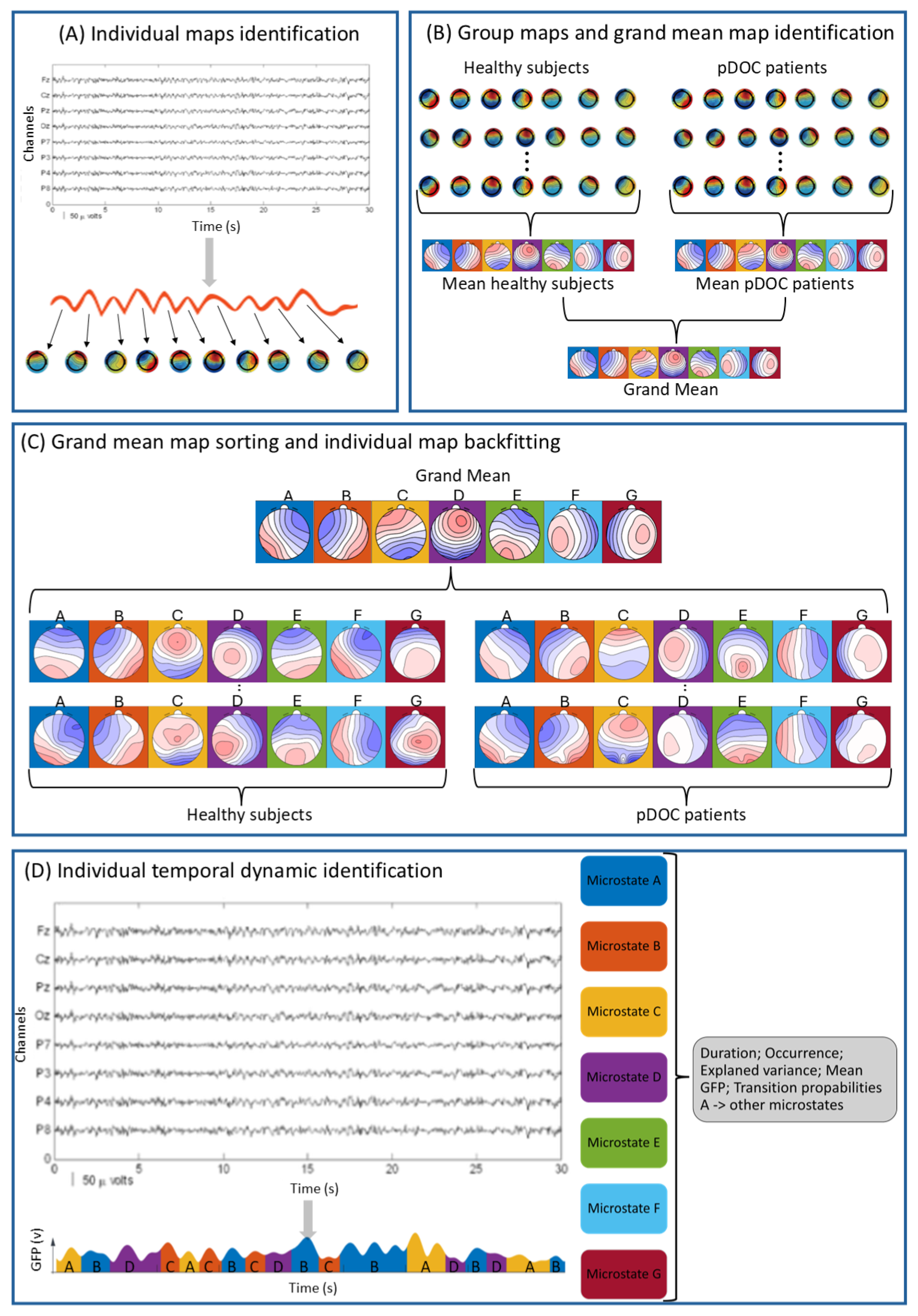
Microstate analysis was performed using MICROSTATELAB [65] for the EEGLAB toolbox through MATLAB (R2024b). The first step of the microstate analysis was the individual microstate maps identification, with the number of classes ranging from 4 to 7. For each subject, the topographies of the GFP peaks were calculated and clustered based on their topographic similarity with a modified k-means algorithm. For each patient, the algorithm was executed 50 times.
The modified k-means algorithm was repeated 50 times per subject to ensure stable clustering and minimize convergence to local minima.
The next step of the analysis was to rearrange the individual microstate maps to maximize the inter-subject shared variance. This reordering should initially be performed separately for each subject group. Once the group-specific averages were obtained, an overall mean map (grand mean) was calculated.
The grand mean map was compared with the literature template [31,35] and used to sort the individual microstate maps. In particular, these maps were matched to the most fitting grand mean map (backfitting). Once the individual microstate map were obtained, the temporal dynamic (i.e., duration of class X occurrence of the class X, coverage of class X, meanGFP of the class X, explained variance of class X, and transition probabilities X→ Y) of individual recording were extracted and the individual microstate map were compared to the literature template (for a detailed discussion, see Table 1). A graphical overview of the microstate analysis is shown in Figure 1.

3.5. Statistical Analysis

For the statistical analyses, R studio version 4.2.3 [78] was used along with the following libraries for statistical tests: tidyverse 2.0.0, readxl 1.4.3, ggplot2 3.5.1, dplyr 1.1.4, ggpubr 0.6.0, corrplot 0.96, caret 6.0-94, plotly 4.10.4, ggsci 3.2.0, patchwork 1.3.0, ggpubr 0.6.0 and psych 2.4.12.
The Shapiro test was conducted to verify the normality of the distributions. Since normality assumptions were not met for all parameters, non-parametric tests were applied.
Spearman test was conducted to determine microstate features’ correlation within the populations under investigation. In particular all the microstate features, age, sex, and CSR−R score were considered in the analysis. The Wilcoxon test was conducted to assess differences in microstate features between the populations under investigation. In particular all the microstate features, age, and sex were considered in the analysis. For both the tests, the significance level was set to 0.05 and the holm correction was applied for multiple comparison.
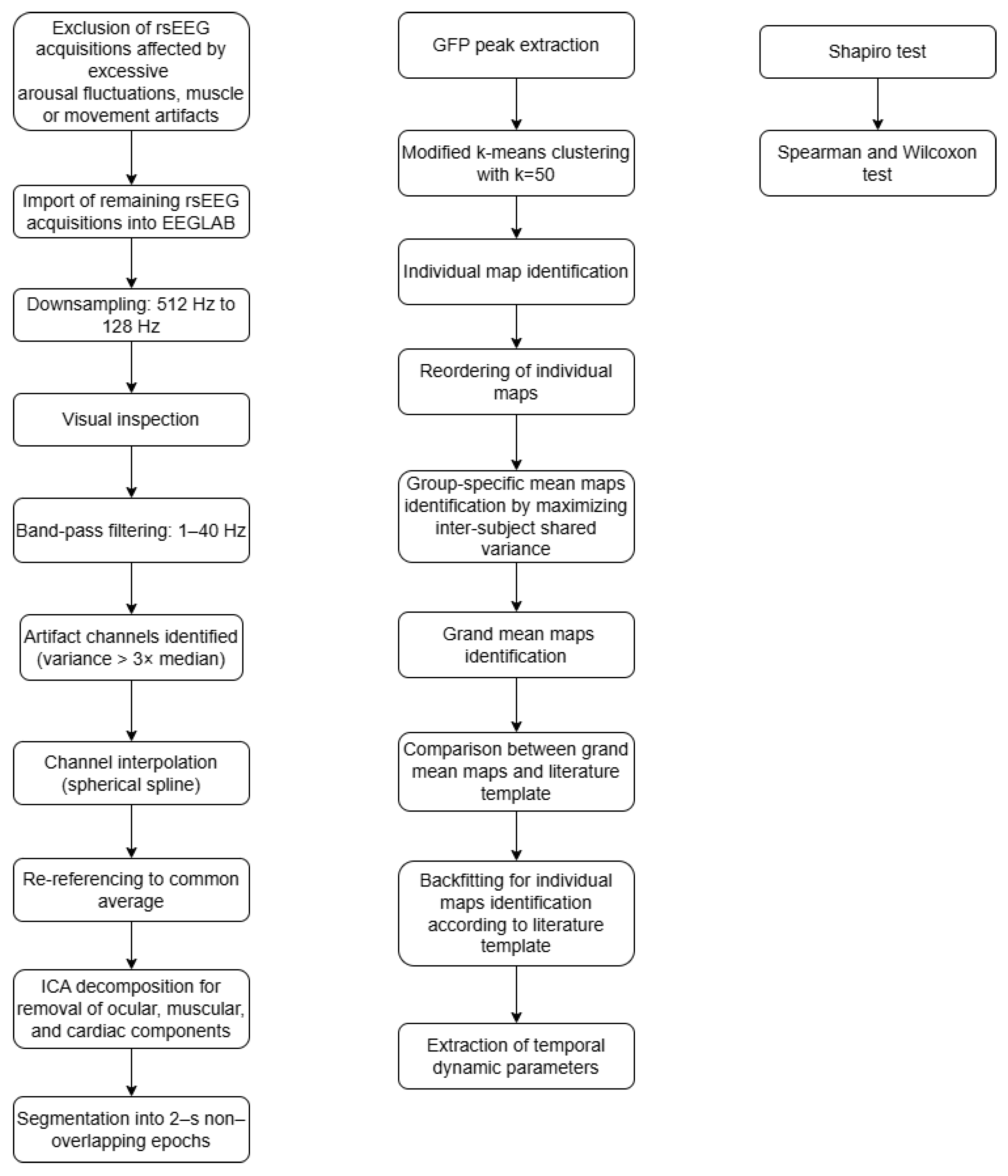
To improve transparency and reproducibility, Figure 2 illustrates the complete EEG processing and analysis pipeline adopted in this study, including data acquisition, preprocessing, microstate analysis, and statistical procedures.

4. Results

Some subjects were excluded from the analysis due to poor EEG signal quality, while others were removed because their resting-state data had been acquired after the task, which could potentially compromise the reliability of the results. The microstate analysis pipeline was executed using both the 4-class and 7-class microstate templates. Both models represent canonical frameworks in EEG microstate research; however, at the time of the present study, the 7-class template had not yet been systematically applied to patients with pDOC. Therefore, these templates were compared and their ability to characterize resting-state brain dynamics in this population were evaluated. For each included subject, the individual sequence of microstate maps and their corresponding temporal dynamics were extracted (the temporal parameters were reported in Table 2, Table 3, Table 4 and Table 5).
A preliminary analysis was conducted on the microstate shared variance. For each subject, the microstate classes with shared variance > 50% respect to each template were identified. This threshold was selected to balance sensitivity and specificity, ensuring the inclusion of relevant microstates while avoiding excessive exclusion of less prominent but potentially meaningful patterns, particularly in subjects with severe brain lesions. An agreement-based evaluation across multiple shared variance cutoffs was therefore adopted to identify a stable and data-supported operating point. This index was evaluated across shared variance cutoffs of 40%, 50%, 60%, and 70% for both the 4-class and 7-class microstate models. The results showed a consistent trend of agreement across both templates up to the 50% threshold, followed by a systematic decrease at higher cutoffs. On this basis, a shared variance threshold of 50% was selected.
As shown in Table 6, the 7-class template resulted the most closely describing template for both pDOC and healthy subjects. Except for one subject, the rsEEG of all participants was characterized by an equal or greater number of microstate classes exceeding the 50% shared variance threshold when using the 7-class template compared to the 4-class template. Moreover, with the exception of five subjects, all microstate classes from the 4-class template describing each subject’s rsEEG were encompassed within the set of classes identified using the 7-class template.
Regarding the pDOC group, for both the 4-class and 7-class template, a mean shared variance < 50% in class D was obtained, which is associated with executive functioning across both templates. Additionally, in the 4-class template, there is a greater prevalence of classes A and B, which are associated with auditory and visual processing, respectively. In contrast, in the 7-class template, classes C, F, and G also emerged, which are linked to internal processing and somatosensory functions. This configuration might suggest a minimal presence of processing capabilities in the group, potentially supporting residual responsiveness that does not extend to complex executive functioning.
As far as the HC group is concerned, for both the 4-class and 7-class templates there is a prevalence of classes B and D. Additionally, in the 7-class template, classes A, C, and F also emerged, reflecting more engagement of executive function.
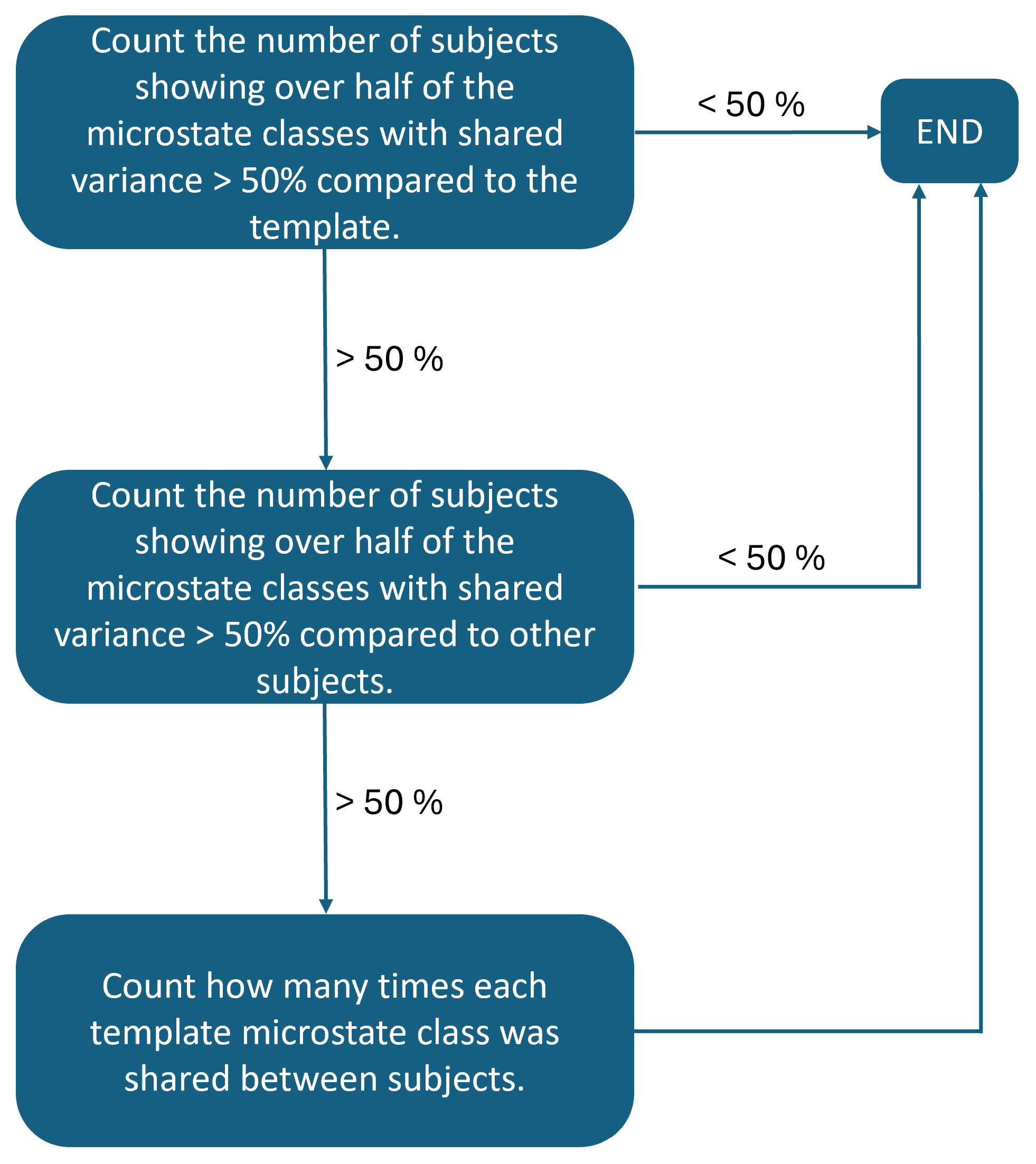
Finally, a more group-specific analysis was conducted, following the procedure illustrated in the graph diagram shown in Figure 3.
For both the template, the proportion of subjects exhibiting more than half of the microstate classes with a shared variance exceeding 50% relative to the reference template was quantified. When a majority of subjects satisfied this threshold, an inter-subject analysis was performed to determine whether subjects within the same group (namely, HC or pDOC) shared common microstate classes.
As far as the pDOC group is concerned, 14% of subjects exhibiting more than half of the microstate classes with a shared variance exceeding 50% respect to the 4-class template. Since the group failed to reach the threshold, the inter-subject analysis was not conducted. In contrast, in the case of the 7-class template, 86% of subjects met this criterion. Therefore, the inter-subject analysis was performed. For each subject, it was assessed whether more than half of his microstate classes exhibited a shared variance > 50% with other subjects within the same group. For subjects meeting this criterion, the number of instances in which a given microstate class was shared with another subject was computed. When such inter-subject relationships were determined, the following mean proportions were assessed: class A was shared by 100% of cases, class B by 51%, class C by 62%, class D by 67%, class E by 88%, class F by 100%, and class G by 62%. Remarkably, microstate A and F were shared by 100% of cases, suggesting the potential preservation of specific intrinsic brain networks—namely, those associated with auditory and visual processing, arousal regulation, and the default mode network—despite severely impaired levels of consciousness.
Regarding the HC group, 37% of subjects exhibiting more than half of the microstate classes with a shared variance exceeding 50 % respect to the 4-class template. Therefore, the inter-subject analysis was not conducted. In contrast, in the case of the 7-class template, 62% of subjects met the criterion and the inter-subject analysis was performed. When the inter-subject relationships were determined, the following mean proportions were assessed: class A was shared by 53% of cases, class B by 87%, class C by 70%, class D by 70%, class E by 41%, class F by 88%, and class G by 62%.
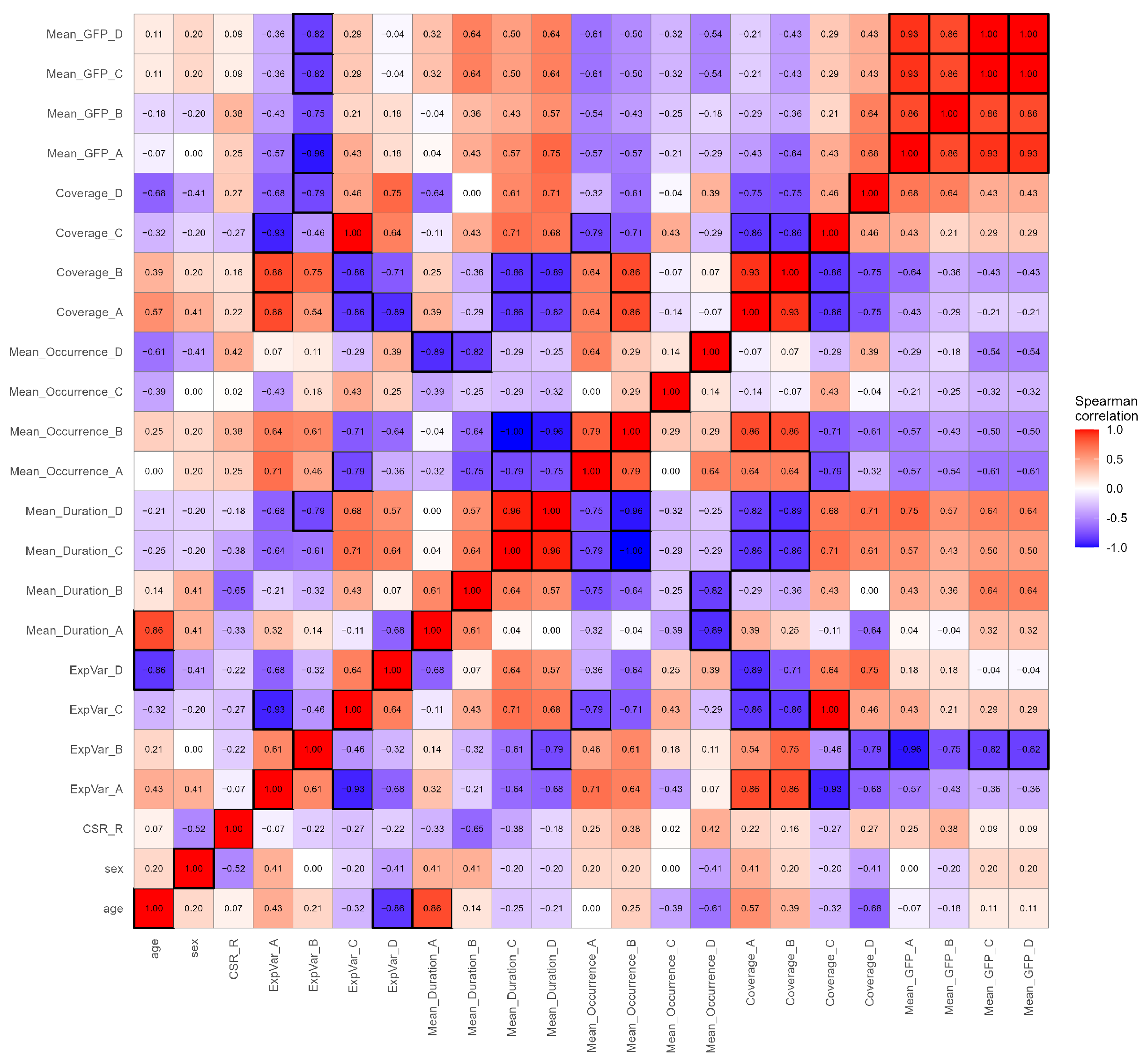
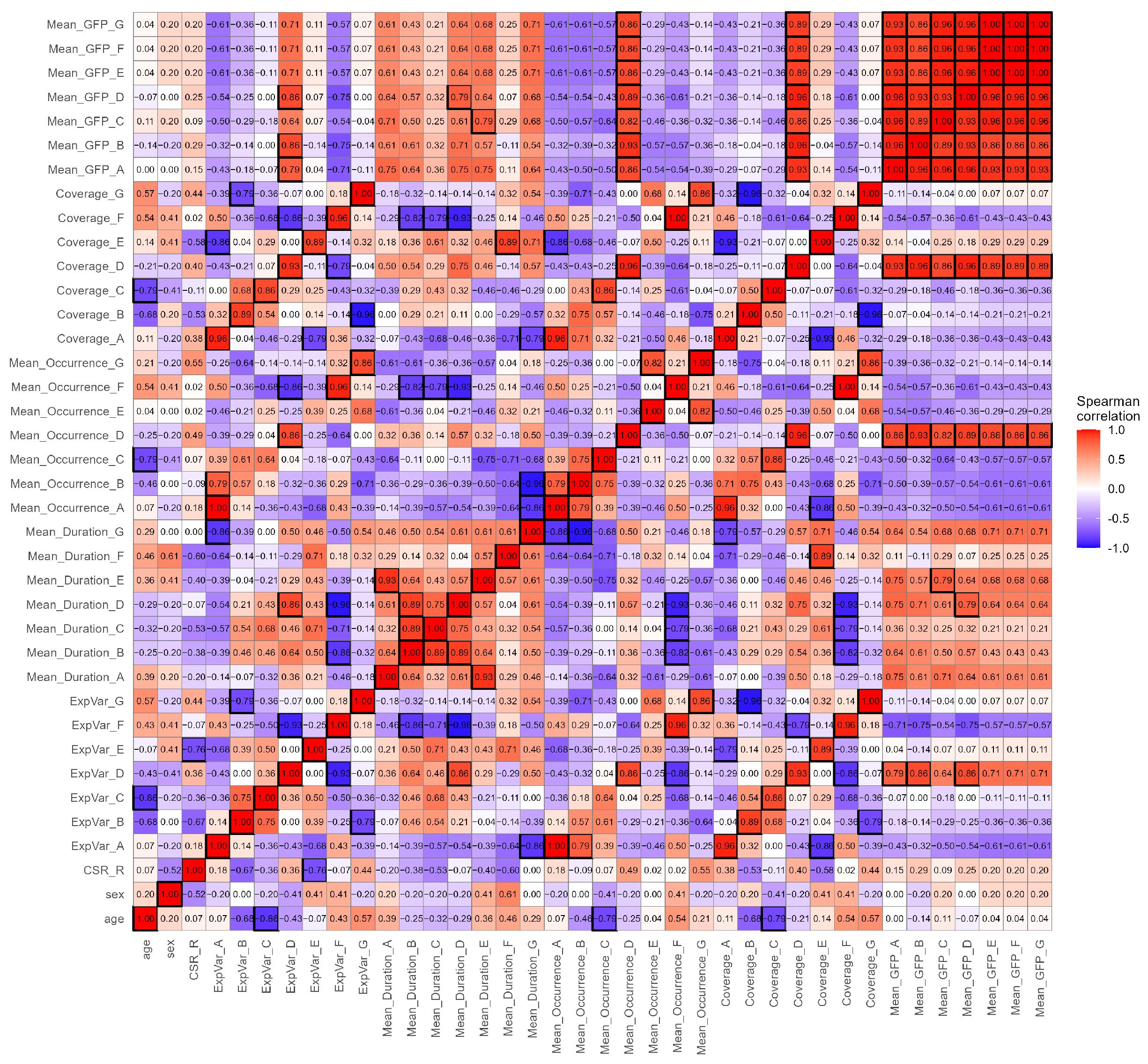
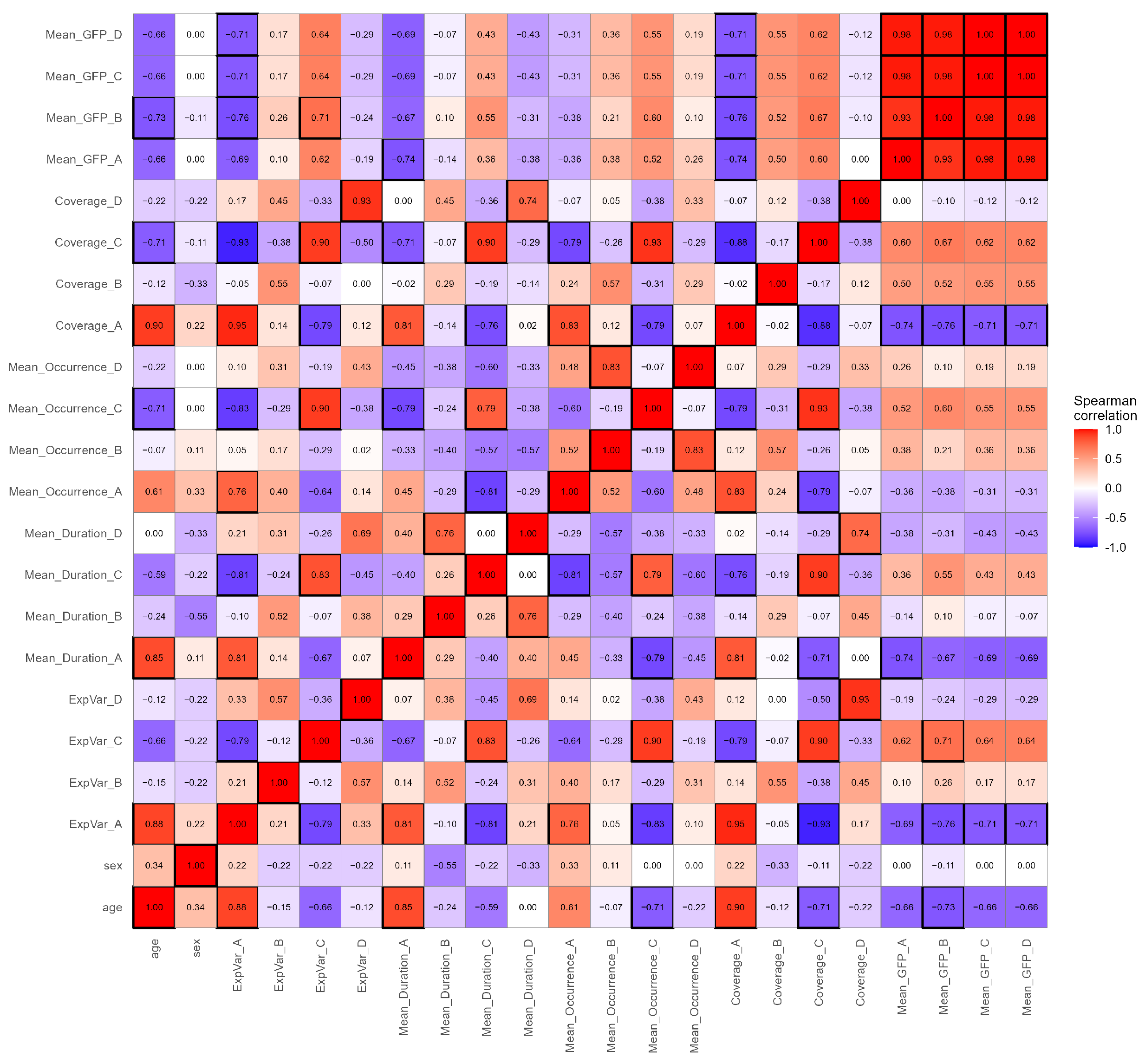
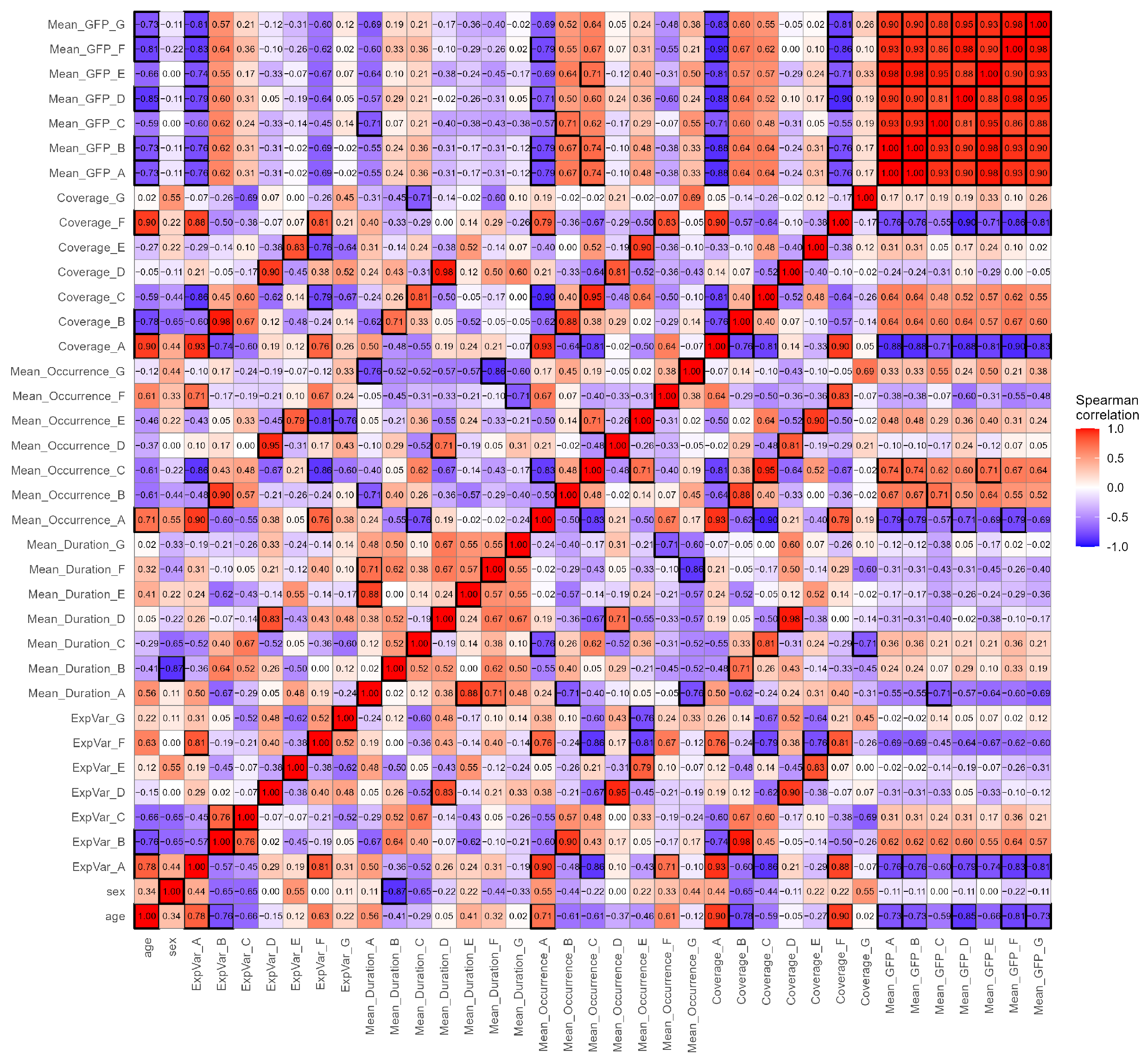
As far as the Spearman test is concerned, the result are reported in Figure 4 and Figure 5 and in Figure 6 and Figure 7 for pDOC and HC group, respectively. Both templates demonstrate good performance in describing the signal. Specifically, GFPs of each class are correlated with the GFPs of other classes in both templates and across groups.
Limiting the analysis to features shared by both templates, the 7-class template yielded a higher number of correlations compared to the 4-class template. Specifically, in the HC group, 78% of the features showed a greater number of significant correlations under the 7-class template. In the pDOC group, this was observed for 55% of the features. Moreover, 78% of the features exhibited a greater number of correlations in the HC group compared to the pDOC group. This difference may be attributed to the various lesions resulting from the pDOC injury, which may impair the ability to establish appropriate correlations.
Concerning the 7-class template, a deeper group-level investigation revealed distinct correlations between the different microstate classes’ features, which highlight the variability and structure of brain activity across the two groups. For the HC group: class A features showed over 80% correlation with class B, C, D, and F features; class C features were found to correlate with more than 80% of class A features; class F features exhibited over 80% correlation with both class A and G features.
For the pDOC group: class A features showed over 80% of correlation with class G features; class C features were correlated with more than 80% of class A, B, and F features; class E features also demonstrated over 80% of correlation with class A features; class F features correlated with more than 80% of class B and D features; and class G features showed more than 80% correlation with class A features.
Furthermore, several features demonstrated correlations exceeding 50% of the investigate features in the HC group, specifically: age, class A coverage, class A explained variance, class A Mean GFP, class B Mean GFP and class C mean occurrence. Inversely, non of the parameters in the pDOC group exceeded the 50% correlation threshold, although several approached this value, including: class D explained variance, class D mean occurrence, class D coverage, GFP of class A, C, D, E, F, and G.
Regarding the CRS−R score, the Spearman test revealed no significant correlations between this score and the EEG microstate parameters of the 4-class template. In addition, class B Mean Duration showed high correlation coefficients (r-value) without reaching the statistical significance threshold.
Instead, in the 7-class template, a significant correlation was found between the CRS-R total score and class E Explained Variance. Moreover, class B Explained Variance, class C Mean Duration, class F Mean Duration, class C Mean Occurrence, class B Coverage, and class E Coverage showed high correlation coefficients (r-values) even though statistical significance was not reached.
The statistical power of the analysis may have been limited by the small sample size, which could hinder the identification of significant correlations. Furthermore, the use of the CRS-R total score, which aggregates various aspects of recovery, may have obscured more specific relationships that could be revealed by examining the individual CRS-R subscales.
Regarding age, significant correlations with class D (executive functions) and class A (sensory processing), were observed within the pDOC group. Concerning sex, no significant findings emerged.
Finally, analysis of explained variance revealed consistent group-specific patterns across microstate models. In the 4-class model, explained variance was predominantly associated with class D in healthy controls, whereas class A showed a higher contribution in the pDOC group. In the 7-class model, class D remained dominant in healthy controls, while variance in pDOC patients was mainly distributed across classes A and F. These patterns align with previous shared-variance results.
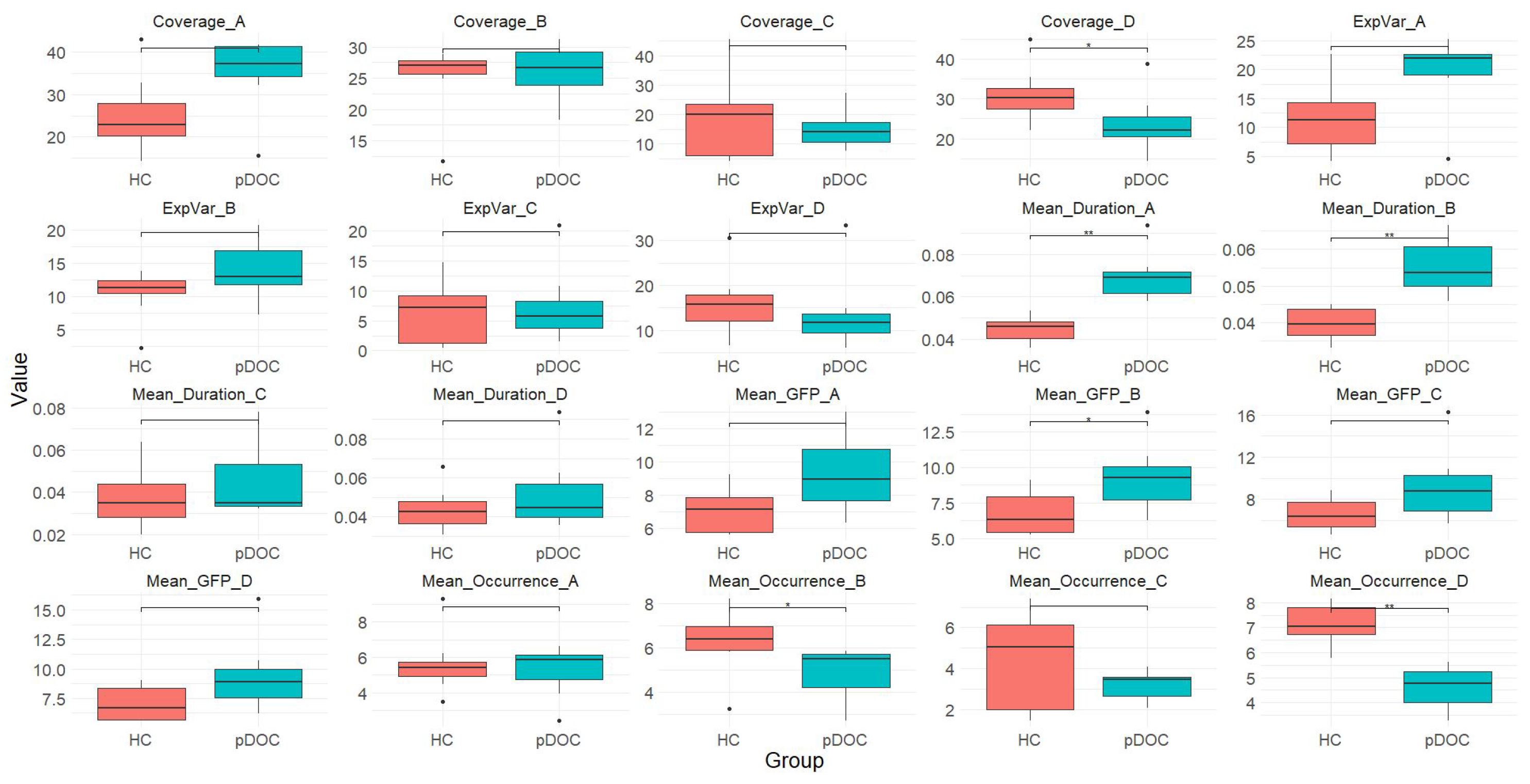
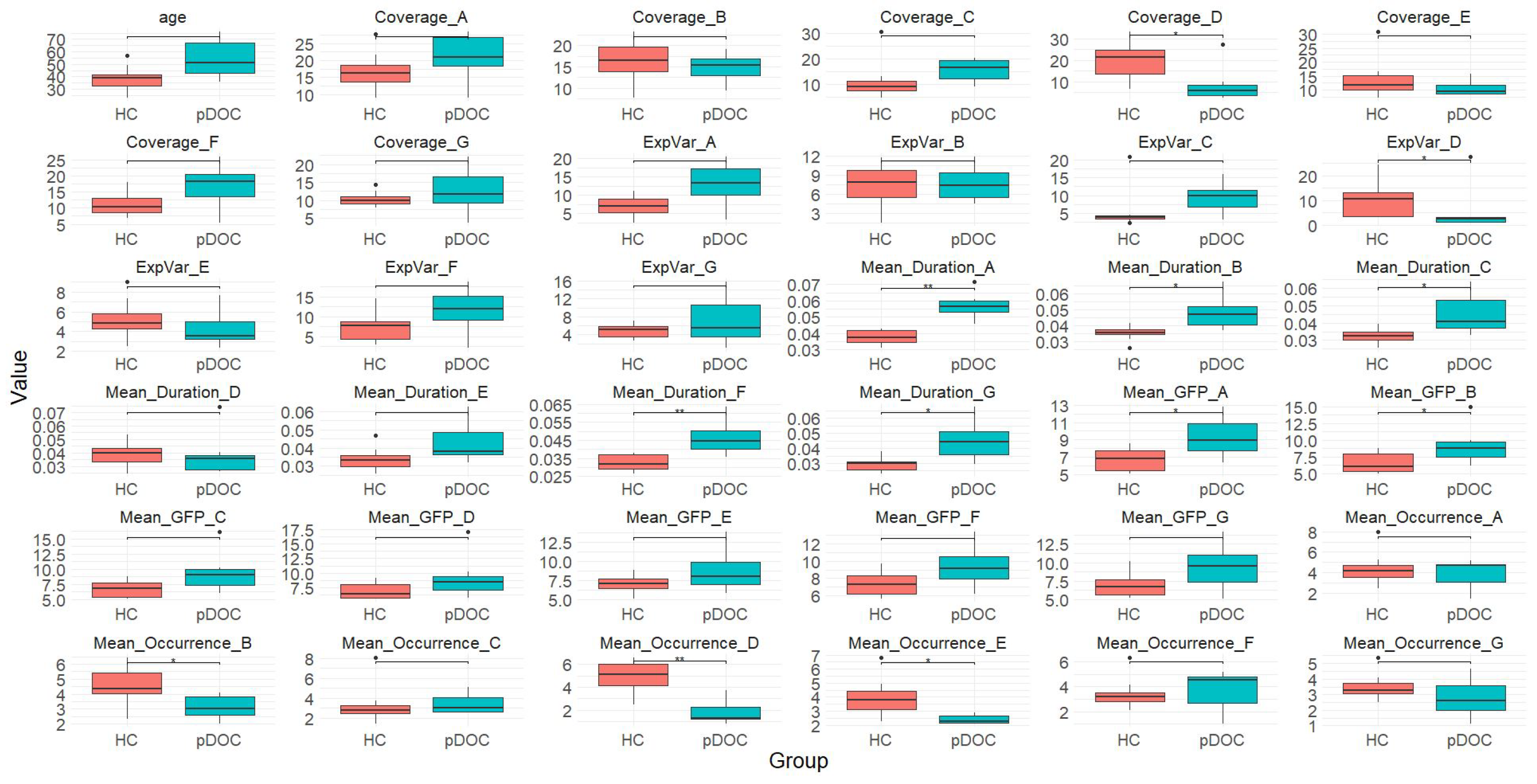
As far as the Wilcoxon test is concerned, results are reported in Figure 8 and Figure 9. In the 4-class template, the following features were correlated: class B GFP, class A Mean Duration, class B Mean Duration, class D Coverage, and class D Mean Occurrence. In contrast, the 7-class template revealed a broader set of correlated features which included all those from the 4-class template, as well as additional features: class A GFP, class C Mean Duration, class F Mean Duration, class G Mean Duration, class B Mean Occurrence, class D Mean Occurrence, and class E Mean Occurrence. Finally, regarding age and sex no significant finding emerged.
Finally, the holm correction for multiple comparisons to both the Wilcoxon and the Spearman test. Several correlations remained statistically significant for the Spearman test, as reported in Table 7. In contrast, for the Wilcoxon test, no differences were found to be statistically significant after the adjusted p-value was applied.

5. Conclusions

The assessment of pDOC patients remains a significant clinical challenge, as behavioral evaluations like the CRS-R can be confounded by motor impairments, leading to diagnostic inaccuracies. Techniques such as EEG provide a direct measure of brain activity and can serve as a complementary tool to behavioral assessments, potentially improving diagnostic accuracy. Although conventional EEG analysis provides useful insights, the understanding of consciousness increasingly emphasizes the importance of dynamic fluctuations over time within large-scale brain networks. Static measures are often insufficient to capture the complex and transient nature of neural activity that underpins conscious processes.
In this context, EEG microstate analysis has emerged as a powerful tool. This method models the rich, high-dimensional EEG signal as a sequence of a few, quasi-stable topographic maps, each lasting for approximately 40–120 ms. These microstates are considered the electrophysiological correlates of transiently active, large-scale brain networks involved in distinct cognitive and sensory functions. Their analysis provides a real-time characterization of cerebral dynamics, offering the potential to uncover residual cognitive processing and brain activity patterns not evident through behavioral assessment. A limitation of this study concerns the application of functional labels derived from normative microstate templates to patients with pDOC. These templates have been validated in healthy populations and may not fully capture the altered large-scale brain networks observed in patients with severe brain injury.
However, previous studies have demonstrated that specific microstates are associated with levels of consciousness and clinical outcomes in pDOC patients, supporting the relevance of this framework for the development of objective neurophysiological biomarkers [3,20,46,47,48,49,50,51,52,53,54,55,56,57].
This pilot study aimed to compare the descriptive and discriminative power of the classical 4-class microstate model against an extended 7-class model in a cohort of pDOC patients and healthy controls. In line with the pilot and exploratory nature of the study, the following findings are intended to provide a preliminary and descriptive comparison of the two approaches. The results strongly suggest that the 7-class model provides a more refined and accurate characterization of brain dynamics in both populations. Specifically, except for one subject, the rsEEG of all participants was characterized by an equal or greater number of microstate classes exceeding the 50% shared variance threshold when using the 7-class template compared to the 4-class template. Moreover, with the exception of five subjects, all microstate classes from the 4-class template describing each subject’s rsEEG were encompassed within the set of classes identified using the 7-class template.
In the pDOC group, both the 4-class and 7-class templates revealed a mean shared variance of less than 50% in class D, which is associated with executive functioning. The 4-class template showed a higher prevalence of classes A and B, corresponding to auditory and visual processing, respectively. In contrast, the 7-class template also identified classes C, F, and G, which are linked to internal processing and somatosensory functions. This pattern may indicate a limited presence of processing capabilities within the group, potentially reflecting residual responsiveness that does not extend to complex executive functions. This observation in pDOC patients across both models is consistent with the severe cognitive deficits characteristic of this condition. For the HC group, both templates predominantly displayed classes B and D. Additionally, the 7-class template highlighted the emergence of classes A, C, and F, suggesting a greater involvement of executive functions.
Additionally, this enhanced descriptive power of the 7-class template enabled a more robust inter-subject analysis. Within the pDOC group, microstates A (associated with auditory/arousal processing) and F (linked to the default mode network) were shared among all patients. The preservation of microstate A and F could reflect the maintenance of fundamental sensory and self-referential processing networks, which may be a prerequisite for or a sign of residual consciousness, even when complex executive functions are lost. However, these functional interpretations are currently based on indirect evidence and would benefit from future spatial/functional validation, for instance through multimodal or task-based approaches.
Finally, the distribution of explained variance across individual microstates further supports the presence of preserved sensory-related dynamics and reduced executive-related activity in pDOC patients, consistent with the severe cognitive impairment characteristic of this condition.
Statistical analyses also revealed the superiority of the 7-class model. As far as the Spearman test is concerned, the 7-class template yielded a higher number of correlations compared to the 4-class template. Specifically, in the HC group, 78% of the features showed a greater number of significant correlations under the 7-class template. In the pDOC group, this was observed for 55% of the features. The greater number of correlations among microstate features in the HC group compared to the pDOC group likely reflects the organized, stable nature of brain network interactions in a healthy brain. Conversely, the reduced and altered correlation patterns in pDOC patients may be a signature of the widespread and heterogeneous disruption of functional connectivity caused by severe brain injury. Regarding the Wilcoxon test, the 7-class template revealed a broader set of correlated features which included all those from the 4-class template, as well as additional ones.
This pilot study provides a valuable comparison between the 4-class and 7-class EEG microstate models in assessing prolonged disorders of consciousness. The results demonstrate that the 7-class model offers a more refined and accurate characterization of brain dynamics, revealing subtle differences in microstate patterns that are not detectable with the conventional 4-class model. The identification of microstates A and F shared by all pDoC patients, which are linked to auditory/arousal and self-referential processing, respectively, suggests the preservation of fundamental sensory and self-awareness networks, even in severe cognitive impairment.
Overall, the present work focuses on a comparative methodological evaluation and may contribute to the design of future confirmatory studies addressing clinical relevance.
While this pilot study offers valuable insights into the potential utility of the 7-class model, the small sample size may limit the generalizability of the findings. First, the small sample size may have limited the statistical power of the analyses and could affect the generalizability of the conclusions. Second, the pDOC group is inherently heterogeneous, with patients displaying a range of CRS-R scores and likely varying underlying etiologies and brain lesion locations. This variability might have obscured more subtle and consistent patterns of microstate alterations. Additionally, the retrospective nature of the analysis, relying on data from a previous study, may also represent a limitation, as some subjects were excluded due to poor signal quality, potentially introducing selection bias.
Another limitation of the study was the potential influence of age on the observed results. While significant correlations with microstate parameters, particularly with class D (executive functions) and class A (sensory processing), were observed within the pDOC group, age was not found to be a primary factor driving the differences between pDOC and HC.
As far as sex is concerned, no significant findings emerged.
Finally, the lack of significant correlations between the CRS-R total score and EEG microstate parameters in both the 4-class and 7-class templates may be due to the limited sample size and the use of the CRS-R total score, which aggregates various recovery aspects, may have masked more specific relationships. Future research should aim to address these gaps. Larger, prospective, and longitudinal studies are needed to validate these findings and to track how microstate dynamics evolve in relation to a patient’s clinical recovery or decline. Such studies could establish whether specific microstate transitions or syntax patterns are predictive of long-term outcomes. Additionally, combining EEG microstate analysis with other imaging modalities, such as fMRI and PET, could provide a clearer understanding of the precise neuroanatomical substrates underlying the microstate classes. This integration would offer valuable insights into the brain regions associated with these microstates, enhancing our understanding of the neural foundations of consciousness.
Furthermore, analyzing the subscales of the CRS-R, rather than relying solely on the total score, could offer a more detailed understanding of how specific aspects of recovery are related to microstate dynamics. This approach would allow for a deeper exploration of the correlations between distinct recovery domains and the temporal patterns of brain activity captured by EEG microstates. Future research will also consider age as a relevant parameter to explore its role in the variability within the pDOC group and its impact on microstate dynamics. Ultimately, the goal should be to refine and validate the 7-class microstate analysis as a robust, non-invasive biomarker for improving diagnosis, guiding therapeutic interventions, and predicting prognosis in patients with prolonged disorders of consciousness. Prospective, adequately powered, and preferably longitudinal studies are needed to assess reproducibility and clinical utility.

Author Contributions

Conceptualization, F.M., M.F. and C.C.; methodology, M.F.; software, F.M.; validation, F.M., M.F. and C.C.; formal analysis, F.M. and M.F.; investigation, F.M.; resources, F.M., A.E. and C.C.; data curation, A.M. and S.F.; writing—original draft preparation, F.M.; writing—review and editing, M.F., A.E. and C.C.; supervision, M.F., A.E. and C.C.; project administration, A.E. and C.C.; funding acquisition, M.S., A.E. and C.C. All authors have read and agreed to the published version of the manuscript.

Funding

This study was supported in part by Current Research Annual Funding of the Italian Ministry of Health (Ricerca Corrente).

Data Availability Statement

Data are unavailable due to privacy and ethical restrictions.

Conflicts of Interest

Authors Francesca Mancino, Monica Franzese, Marco Salvatore, and Carlo Cavaliere are employed by IRCCS Synlab SDN. The remaining authors declare that the research was conducted in the absence of any commercial or financial relationships that could be construed as a potential conflict of interest.

Abbreviations

The following abbreviations are used in this manuscript:
pDOCprolonged Disorders Of Consciousness
EEGElectroencephalography
HCHealthy Control
rsEEGresting-state Electroencephalography
CRS-RComa Recovery Scale-Revised
fMRIfunctional Magnetic Resonance Imaging
PETPositron Emission Tomography
UWSUnresponsive Wakefulness Syndrome
MCSMinimally Conscious State
EMCSEmerged from the Minimally Conscious State
GFPGlobal Field Power
ICAIndependent Component Analysis
Exp VarExplained Variance

References

  1. Giacino, J.T.; Katz, D.I.; Schiff, N.D.; Whyte, J.; Ashman, E.J.; Ashwal, S.; Barbano, R.; Hammond, F.M.; Laureys, S.; Ling, G.S.; et al. Practice guideline update recommendations summary: Disorders of consciousness: Report of the Guideline Development, Dissemination, and Implementation Subcommittee of the American Academy of Neurology; the American Congress of Rehabilitation Medicine; and the National Institute on Disability, Independent Living, and Rehabilitation Research. Neurology 2018, 91, 450–460. [Google Scholar] [PubMed]
  2. Thibaut, A.; Schiff, N.; Giacino, J.; Laureys, S.; Gosseries, O. Therapeutic interventions in patients with prolonged disorders of consciousness. Lancet Neurol. 2019, 18, 600–614. [Google Scholar] [CrossRef] [PubMed]
  3. Guo, Y.; Li, R.; Zhang, R.; Liu, C.; Zhang, L.; Zhao, D.; Shan, Q.; Wang, X.; Hu, Y. Dynamic changes of brain activity in patients with disorders of consciousness during recovery of consciousness. Front. Neurosci. 2022, 16, 878203. [Google Scholar] [CrossRef] [PubMed]
  4. Wang, J.; Hu, X.; Hu, Z.; Sun, Z.; Laureys, S.; Di, H. The misdiagnosis of prolonged disorders of consciousness by a clinical consensus compared with repeated coma-recovery scale-revised assessment. BMC Neurol. 2020, 20, 343. [Google Scholar] [CrossRef]
  5. Peterson, A.; Cruse, D.; Naci, L.; Weijer, C.; Owen, A.M. Risk, diagnostic error, and the clinical science of consciousness. Neuroimage Clin. 2015, 7, 588–597. [Google Scholar] [CrossRef]
  6. Schnakers, C.; Vanhaudenhuyse, A.; Giacino, J.; Ventura, M.; Boly, M.; Majerus, S.; Moonen, G.; Laureys, S. Diagnostic accuracy of the vegetative and minimally conscious state: Clinical consensus versus standardized neurobehavioral assessment. BMC Neurol. 2009, 9, 35. [Google Scholar] [CrossRef]
  7. Hao, X.; Yang, W.; Li, J.; Liu, X.; Li, Y.; Zhao, W.; Yang, Y. Correlation analysis of nonlinear characteristics in EEG with CRS-R score and visual characterization of rehabilitation process in DOC patients. Chin. J. Biomed. Eng. 2015, 34, 153–159. [Google Scholar]
  8. Annen, J.; Filippini, M.M.; Bonin, E.; Cassol, H.; Aubinet, C.; Carrière, M.; Gosseries, O.; Thibaut, A.; Barra, A.; Wolff, A.; et al. Diagnostic accuracy of the CRS-R index in patients with disorders of consciousness. Brain Inj. 2019, 33, 1409–1412. [Google Scholar] [CrossRef]
  9. Owen, A.M.; Coleman, M.R.; Boly, M.; Davis, M.H.; Laureys, S.; Pickard, J.D. Detecting awareness in the vegetative state. Science 2006, 313, 1402. [Google Scholar] [CrossRef]
  10. Monti, M.M.; Vanhaudenhuyse, A.; Coleman, M.R.; Boly, M.; Pickard, J.D.; Tshibanda, L.; Owen, A.M.; Laureys, S. Willful modulation of brain activity in disorders of consciousness. N. Engl. J. Med. 2010, 362, 579–589. [Google Scholar] [CrossRef]
  11. Demertzi, A.; Tagliazucchi, E.; Dehaene, S.; Deco, G.; Barttfeld, P.; Raimondo, F.; Martial, C.; Fernández-Espejo, D.; Rohaut, B.; Voss, H.; et al. Human consciousness is supported by dynamic complex patterns of brain signal coordination. Sci. Adv. 2019, 5, eaat7603. [Google Scholar] [CrossRef]
  12. Cavaliere, C.; Kandeepan, S.; Aiello, M.; Ribeiro de Paula, D.; Marchitelli, R.; Fiorenza, S.; Orsini, M.; Trojano, L.; Masotta, O.; St. Lawrence, K.; et al. Multimodal neuroimaging approach to variability of functional connectivity in disorders of consciousness: A PET/MRI pilot study. Front. Neurol. 2018, 9, 861. [Google Scholar] [CrossRef] [PubMed]
  13. Stender, J.; Gosseries, O.; Bruno, M.A.; Charland-Verville, V.; Vanhaudenhuyse, A.; Demertzi, A.; Chatelle, C.; Thonnard, M.; Thibaut, A.; Heine, L.; et al. Diagnostic precision of PET imaging and functional MRI in disorders of consciousness: A clinical validation study. Lancet 2014, 384, 514–522. [Google Scholar] [CrossRef] [PubMed]
  14. Faugeras, F.; Rohaut, B.; Weiss, N.; Bekinschtein, T.; Galanaud, D.; Puybasset, L.; Bolgert, F.; Sergent, C.; Cohen, L.; Dehaene, S.; et al. Event related potentials elicited by violations of auditory regularities in patients with impaired consciousness. Neuropsychologia 2012, 50, 403–418. [Google Scholar] [CrossRef] [PubMed]
  15. Strauss, M.; Sitt, J.D.; King, J.R.; Elbaz, M.; Azizi, L.; Buiatti, M.; Naccache, L.; Van Wassenhove, V.; Dehaene, S. Disruption of hierarchical predictive coding during sleep. Proc. Natl. Acad. Sci. USA 2015, 112, E1353–E1362. [Google Scholar] [CrossRef]
  16. Sitt, J.D.; King, J.R.; El Karoui, I.; Rohaut, B.; Faugeras, F.; Gramfort, A.; Cohen, L.; Sigman, M.; Dehaene, S.; Naccache, L. Large scale screening of neural signatures of consciousness in patients in a vegetative or minimally conscious state. Brain 2014, 137, 2258–2270. [Google Scholar] [CrossRef]
  17. Gui, P.; Jiang, Y.; Zang, D.; Qi, Z.; Tan, J.; Tanigawa, H.; Jiang, J.; Wen, Y.; Xu, L.; Zhao, J.; et al. Assessing the depth of language processing in patients with disorders of consciousness. Nat. Neurosci. 2020, 23, 761–770. [Google Scholar] [CrossRef]
  18. Wu, M.; Li, F.; Wu, Y.; Zhang, T.; Gao, J.; Xu, P.; Luo, B. Impaired frontoparietal connectivity in traumatic individuals with disorders of consciousness: A dynamic brain network analysis. Aging Dis. 2020, 11, 301. [Google Scholar] [CrossRef]
  19. Estraneo, A.; Loreto, V.; Guarino, I.; Boemia, V.; Paone, G.; Moretta, P.; Trojano, L. Standard EEG in diagnostic process of prolonged disorders of consciousness. Clin. Neurophysiol. 2016, 127, 2379–2385. [Google Scholar] [CrossRef]
  20. Liuzzi, P.; Mannini, A.; Hakiki, B.; Campagnini, S.; Romoli, A.M.; Draghi, F.; Burali, R.; Scarpino, M.; Cecchi, F.; Grippo, A. Brain microstate spatio-temporal dynamics as a candidate endotype of consciousness. Neuroimage Clin. 2024, 41, 103540. [Google Scholar] [CrossRef]
  21. Giacino, J.T.; Fins, J.J.; Laureys, S.; Schiff, N.D. Disorders of consciousness after acquired brain injury: The state of the science. Nat. Rev. Neurol. 2014, 10, 99–114. [Google Scholar] [CrossRef] [PubMed]
  22. Kondziella, D.; Menon, D.K.; Helbok, R.; Naccache, L.; Othman, M.H.; Rass, V.; Rohaut, B.; Diringer, M.N.; Stevens, R.D. A precision medicine framework for classifying patients with disorders of consciousness: Advanced Classification of Consciousness Endotypes (ACCESS). Neurocritical Care 2021, 35, 27–36. [Google Scholar] [CrossRef] [PubMed]
  23. Gosseries, O.; Zasler, N.D.; Laureys, S. Recent advances in disorders of consciousness: Focus on the diagnosis. Brain Inj. 2014, 28, 1141–1150. [Google Scholar] [CrossRef] [PubMed]
  24. Bai, Y.; Xia, X.; Li, X. A review of resting-state electroencephalography analysis in disorders of consciousness. Front. Neurol. 2017, 8, 471. [Google Scholar] [CrossRef]
  25. Harrison, A.H.; Connolly, J.F. Finding a way in: A review and practical evaluation of fMRI and EEG for detection and assessment in disorders of consciousness. Neurosci. Biobehav. Rev. 2013, 37, 1403–1419. [Google Scholar] [CrossRef]
  26. Leon-Carrion, J.; Martin-Rodriguez, J.F.; Damas-Lopez, J.; y Martin, J.M.B.; Dominguez-Morales, M.R. Delta–alpha ratio correlates with level of recovery after neurorehabilitation in patients with acquired brain injury. Clin. Neurophysiol. 2009, 120, 1039–1045. [Google Scholar] [CrossRef]
  27. Fischer, C.; Luaute, J.; Morlet, D. Event-related potentials (MMN and novelty P3) in permanent vegetative or minimally conscious states. Clin. Neurophysiol. 2010, 121, 1032–1042. [Google Scholar] [CrossRef]
  28. Lehembre, R.; Bruno, M.A.; Vanhaudenhuyse, A.; Chatelle, C.; Cologan, V.; Leclercq, Y.; Soddu, A.; Macq, B.; Laureys, S.; Noirhomme, Q. Resting-state EEG study of comatose patients: A connectivity and frequency analysis to find differences between vegetative and minimally conscious states. Funct. Neurol. 2012, 27, 41. [Google Scholar]
  29. Schiff, N.D. Recovery of consciousness after brain injury: A mesocircuit hypothesis. Trends Neurosci. 2010, 33, 1–9. [Google Scholar] [CrossRef]
  30. Porcaro, C.; Marino, M.; Carozzo, S.; Russo, M.; Ursino, M.; Ruggiero, V.; Ragno, C.; Proto, S.; Tonin, P. Fractal dimension feature as a signature of severity in disorders of consciousness: An EEG study. Int. J. Neural Syst. 2022, 32, 2250031. [Google Scholar] [CrossRef]
  31. Custo, A.; Van De Ville, D.; Wells, W.M.; Tomescu, M.I.; Brunet, D.; Michel, C.M. Electroencephalographic resting-state networks: Source localization of microstates. Brain Connect. 2017, 7, 671–682. [Google Scholar] [CrossRef] [PubMed]
  32. Michel, C.M.; Koenig, T. EEG microstates as a tool for studying the temporal dynamics of whole-brain neuronal networks: A review. Neuroimage 2018, 180, 577–593. [Google Scholar] [CrossRef] [PubMed]
  33. Lehmann, D.; Ozaki, H.; Pál, I. EEG alpha map series: Brain micro-states by space-oriented adaptive segmentation. Electroencephalogr. Clin. Neurophysiol. 1987, 67, 271–288. [Google Scholar] [CrossRef] [PubMed]
  34. Lehmann, D.; Faber, P.L.; Galderisi, S.; Herrmann, W.M.; Kinoshita, T.; Koukkou, M.; Mucci, A.; Pascual-Marqui, R.D.; Saito, N.; Wackermann, J.; et al. EEG microstate duration and syntax in acute, medication-naive, first-episode schizophrenia: A multi-center study. Psychiatry Res. Neuroimaging 2005, 138, 141–156. [Google Scholar] [CrossRef]
  35. Koenig, T.; Prichep, L.; Lehmann, D.; Sosa, P.V.; Braeker, E.; Kleinlogel, H.; Isenhart, R.; John, E.R. Millisecond by millisecond, year by year: Normative EEG microstates and developmental stages. Neuroimage 2002, 16, 41–48. [Google Scholar] [CrossRef]
  36. Toplutaş, E.; Aydın, F.; Hanoğlu, L. Eeg Microstate Analysis in Patients with Disorders of Consciousness and Its Clinical Relevance. 2022. Available online: https://www.researchsquare.com/article/rs-2121913/v1 (accessed on 15 May 2025).
  37. da Cruz, J.R.; Favrod, O.; Roinishvili, M.; Chkonia, E.; Brand, A.; Mohr, C.; Figueiredo, P.; Herzog, M.H. EEG microstates are a candidate endophenotype for schizophrenia. Nat. Commun. 2020, 11, 3089. [Google Scholar] [CrossRef]
  38. Nishida, K.; Morishima, Y.; Yoshimura, M.; Isotani, T.; Irisawa, S.; Jann, K.; Dierks, T.; Strik, W.; Kinoshita, T.; Koenig, T. EEG microstates associated with salience and frontoparietal networks in frontotemporal dementia, schizophrenia and Alzheimer’s disease. Clin. Neurophysiol. 2013, 124, 1106–1114. [Google Scholar] [CrossRef]
  39. Liu, J.; Xu, J.; Zou, G.; He, Y.; Zou, Q.; Gao, J.H. Reliability and individual specificity of EEG microstate characteristics. Brain Topogr. 2020, 33, 438–449. [Google Scholar] [CrossRef]
  40. Gschwind, M.; Hardmeier, M.; Van De Ville, D.; Tomescu, M.I.; Penner, I.K.; Naegelin, Y.; Fuhr, P.; Michel, C.M.; Seeck, M. Fluctuations of spontaneous EEG topographies predict disease state in relapsing-remitting multiple sclerosis. Neuroimage Clin. 2016, 12, 466–477. [Google Scholar] [CrossRef]
  41. Tarailis, P.; Koenig, T.; Michel, C.M.; Griškova-Bulanova, I. The functional aspects of resting EEG microstates: A systematic review. Brain Topogr. 2024, 37, 181–217. [Google Scholar] [CrossRef]
  42. Koenig, T.; Lehmann, D.; Merlo, M.C.; Kochi, K.; Hell, D.; Koukkou, M. A deviant EEG brain microstate in acute, neuroleptic-naive schizophrenics at rest. Eur. Arch. Psychiatry Clin. Neurosci. 1999, 249, 205–211. [Google Scholar] [CrossRef] [PubMed]
  43. Smailovic, U.; Koenig, T.; Laukka, E.J.; Kalpouzos, G.; Andersson, T.; Winblad, B.; Jelic, V. EEG time signature in Alzheimer s disease: Functional brain networks falling apart. Neuroimage Clin. 2019, 24, 102046. [Google Scholar] [CrossRef] [PubMed]
  44. Chu, C.; Wang, X.; Cai, L.; Zhang, L.; Wang, J.; Liu, C.; Zhu, X. Spatiotemporal EEG microstate analysis in drug-free patients with Parkinson’s disease. Neuroimage Clin. 2020, 25, 102132. [Google Scholar] [CrossRef]
  45. Serrano, J.I.; Del Castillo, M.D.; Cortés, V.; Mendes, N.; Arroyo, A.; Andreo, J.; Rocon, E.; Del Valle, M.; Herreros, J.; Romero, J.P. EEG microstates change in response to increase in dopaminergic stimulation in typical Parkinson’s disease patients. Front. Neurosci. 2018, 12, 714. [Google Scholar] [CrossRef] [PubMed]
  46. Toplutaş, E.; Aydın, F.; Hanoğlu, L. EEG microstate analysis in patients with disorders of consciousness and its clinical significance. Brain Topogr. 2024, 37, 377–387. [Google Scholar] [CrossRef]
  47. Xu, L.; Wang, J.; Wang, C.; Ge, Q.; Ren, Z.; He, C.; Liu, Y.; Wang, B.; Liu, Y.; Xue, L.; et al. Evaluating Brain Activity in Patients with Chronic Disorders of Consciousness After Traumatic Brain Injury Using EEG Microstate Analysis During Hyperbaric Oxygen Therapy. CNS Neurosci. Ther. 2025, 31, e70220. [Google Scholar] [CrossRef]
  48. Chen, C.; Han, J.; Zheng, S.; Zhang, X.; Sun, H.; Zhou, T.; Hu, S.; Yan, X.; Wang, C.; Wang, K.; et al. Dynamic changes of brain activity in different responsive groups of patients with prolonged disorders of consciousness. Brain Sci. 2022, 13, 5. [Google Scholar] [CrossRef]
  49. Li, H.; Dong, L.; Su, W.; Liu, Y.; Tang, Z.; Liao, X.; Long, J.; Zhang, X.; Sun, X.; Zhang, H. Multiple patterns of EEG parameters and their role in the prediction of patients with prolonged disorders of consciousness. Front. Neurosci. 2025, 19, 1492225. [Google Scholar] [CrossRef]
  50. Ling, Y.; Wen, X.; Tang, J.; Tao, Z.; Sun, L.; Xin, H.; Luo, B. Effect of topographic comparison of electroencephalographic microstates on the diagnosis and prognosis prediction of patients with prolonged disorders of consciousness. CNS Neurosci. Ther. 2024, 30, e14421. [Google Scholar] [CrossRef]
  51. Liu, C.; Liu, S.; Chu, C.; Wang, J.; Cai, L. Spatiotemporal electroencephalography microstate analysis in disorders of consciousness. In Proceedings of the 2022 41st Chinese Control Conference (CCC), Hefei, China, 25–27 July 2022; IEEE: Piscataway, NJ, USA, 2022; pp. 3008–3013. [Google Scholar]
  52. Li, Y.; Gao, J.; Yang, Y.; Zhuang, Y.; Kang, Q.; Li, X.; Tian, M.; Lv, H.; He, J. Temporal and spatial variability of dynamic microstate brain network in disorders of consciousness. CNS Neurosci. Ther. 2024, 30, e14641. [Google Scholar] [CrossRef]
  53. Manasova, D.; Sanz Perl, Y.; Bruno, N.M.; Valente, M.; Rohaut, B.; Tagliazucchi, E.; Naccache, L.; Raimondo, F.; Sitt, J.D. Dynamics of EEG Microstates Change Across the Spectrum of Disorders of Consciousness. Brain Topogr. 2024, 38, 65. [Google Scholar] [CrossRef]
  54. Liu, W.; Guo, Y.; Xie, J.; Wu, Y.; Zhao, D.; Xing, Z.; Fu, X.; Zhou, S.; Zhang, H.; Wang, X. Establishment and validation of a bad outcomes prediction model based on EEG and clinical parameters in prolonged disorder of consciousness. Front. Hum. Neurosci. 2024, 18, 1387471. [Google Scholar] [CrossRef]
  55. Li, Y.; Wan, X.; Zhang, Y.; Song, W. Modulation of electroencephalogram brain activity dynamics by 10 Hz parietal repetitive transcranial magnetic stimulation: Implications for recovery of the minimally conscious state. Neurosci. Lett. 2024, 842, 137986. [Google Scholar] [CrossRef] [PubMed]
  56. Zhang, K.; Li, K.; Zhang, C.; Li, X.; Han, S.; Lv, C.; Xie, J.; Xia, X.; Bie, L.; Guo, Y. The accuracy of different mismatch negativity amplitude representations in predicting the levels of consciousness in patients with disorders of consciousness. Front. Neurosci. 2023, 17, 1293798. [Google Scholar] [CrossRef] [PubMed]
  57. Liu, Z.; Wu, S.; Wang, S.; Wu, H.; Gao, H.; Lu, X. Can repetitive transcranial magnetic stimulation promote recovery of consciousness in patients with disorders of consciousness? A randomized controlled trial. Neuroimage Clin. 2025, 46, 103802. [Google Scholar] [CrossRef] [PubMed]
  58. Stefan, S.; Schorr, B.; Lopez-Rolon, A.; Kolassa, I.T.; Shock, J.P.; Rosenfelder, M.; Heck, S.; Bender, A. Consciousness indexing and outcome prediction with resting-state EEG in severe disorders of consciousness. Brain Topogr. 2018, 31, 848–862. [Google Scholar] [CrossRef]
  59. Posner, J.B. Plum and Posner’s Diagnosis of Stupor and Coma; OUP: Cary, NC, USA, 2007; Volume 71. [Google Scholar]
  60. Young, G.B.; Pigott, S.E. Neurobiological basis of consciousness. Arch. Neurol. 1999, 56, 153–157. [Google Scholar] [CrossRef]
  61. Plum, F.; Posner, J.B. The Diagnosis of Stupor and Coma; Oxford University Press: Cary, NC, USA, 1982; Volume 19. [Google Scholar]
  62. Stevens, R.D.; Bhardwaj, A. Approach to the comatose patient. Crit. Care Med. 2006, 34, 31–41. [Google Scholar] [CrossRef]
  63. Laureys, S.; Celesia, G.G.; Cohadon, F.; Lavrijsen, J.; León-Carrión, J.; Sannita, W.G.; Sazbon, L.; Schmutzhard, E.; von Wild, K.R.; Zeman, A.; et al. Unresponsive wakefulness syndrome: A new name for the vegetative state or apallic syndrome. BMC Med. 2010, 8, 68. [Google Scholar] [CrossRef]
  64. Bruno, M.A.; Vanhaudenhuyse, A.; Thibaut, A.; Moonen, G.; Laureys, S. From unresponsive wakefulness to minimally conscious PLUS and functional locked-in syndromes: Recent advances in our understanding of disorders of consciousness. J. Neurol. 2011, 258, 1373–1384. [Google Scholar] [CrossRef]
  65. Nagabhushan Kalburgi, S.; Kleinert, T.; Aryan, D.; Nash, K.; Schiller, B.; Koenig, T. MICROSTATELAB: The EEGLAB toolbox for resting-state microstate analysis. Brain Topogr. 2024, 37, 621–645. [Google Scholar] [CrossRef]
  66. Koenig, T.; Diezig, S.; Kalburgi, S.N.; Antonova, E.; Artoni, F.; Brechet, L.; Britz, J.; Croce, P.; Custo, A.; Damborská, A.; et al. EEG-meta-microstates: Towards a more objective use of resting-state EEG microstate findings across studies. Brain Topogr. 2024, 37, 218–231. [Google Scholar] [CrossRef]
  67. Seitzman, B.A.; Abell, M.; Bartley, S.C.; Erickson, M.A.; Bolbecker, A.R.; Hetrick, W.P. Cognitive manipulation of brain electric microstates. Neuroimage 2017, 146, 533–543. [Google Scholar] [CrossRef] [PubMed]
  68. Britz, J.; Van De Ville, D.; Michel, C.M. BOLD correlates of EEG topography reveal rapid resting-state network dynamics. Neuroimage 2010, 52, 1162–1170. [Google Scholar] [CrossRef] [PubMed]
  69. Power, J.D.; Cohen, A.L.; Nelson, S.M.; Wig, G.S.; Barnes, K.A.; Church, J.A.; Vogel, A.C.; Laumann, T.O.; Miezin, F.M.; Schlaggar, B.L.; et al. Functional network organization of the human brain. Neuron 2011, 72, 665–678. [Google Scholar] [CrossRef] [PubMed]
  70. Coppola, L.; Smaldone, G.; Grimaldi, A.; Estraneo, A.; Magliacano, A.; Soddu, A.; Ciccarelli, G.; Salvatore, M.; Cavaliere, C. Peripheral blood BDNF and soluble CAM proteins as possible markers of prolonged disorders of consciousness: A pilot study. Sci. Rep. 2024, 14, 341. [Google Scholar] [CrossRef]
  71. World Medical Association. World Medical Association Declaration of Helsinki: Ethical principles for medical research involving human subjects. JAMA 2013, 310, 2191–2194. [Google Scholar] [CrossRef]
  72. Giacino, J.T.; Ashwal, S.; Childs, N.; Cranford, R.; Jennett, B.; Katz, D.I.; Kelly, J.P.; Rosenberg, J.H.; Whyte, J.; Zafonte, R.D.; et al. The minimally conscious state: Definition and diagnostic criteria. Neurology 2002, 58, 349–353. [Google Scholar] [CrossRef]
  73. Brunner, C.; Delorme, A.; Makeig, S. Eeglab—An open source matlab toolbox for electrophysiological research. Biomed. Tech. 2013, 58, 000010151520134182. [Google Scholar] [CrossRef]
  74. Ferree, T.C. Spherical splines and average referencing in scalp electroencephalography. Brain Topogr. 2006, 19, 43–52. [Google Scholar] [CrossRef]
  75. Acharya, J.N.; Acharya, V.J. Overview of EEG montages and principles of localization. J. Clin. Neurophysiol. 2019, 36, 325–329. [Google Scholar] [CrossRef]
  76. Iriarte, J.; Urrestarazu, E.; Valencia, M.; Alegre, M.; Malanda, A.; Viteri, C.; Artieda, J. Independent component analysis as a tool to eliminate artifacts in EEG: A quantitative study. J. Clin. Neurophysiol. 2003, 20, 249–257. [Google Scholar] [CrossRef]
  77. Fraschini, M.; Demuru, M.; Crobe, A.; Marrosu, F.; Stam, C.J.; Hillebrand, A. The effect of epoch length on estimated EEG functional connectivity and brain network organisation. J. Neural Eng. 2016, 13, 036015. [Google Scholar] [CrossRef]
  78. R Core Team. R: A Language and Environment for Statistical Computing. R Foundation for Statistical Computing. 2022. Available online: https://www.r-project.org/about.html (accessed on 15 December 2025).
Figure 1. Graphical overview of the microstate analysis process applied to rsEEG. (A): identification of individual microstate maps from rsEEG recordings. (B): identification of group-specific and grand mean maps for healthy subjects and pDOC patients. (C): sorting of grand mean maps and the backfitting of individual maps to the mean templates, for both the healthy subjects and pDOC patients. (D): extraction of individual temporal dynamics.
Applsci 16 00892 g001
Figure 2. Flowchart of the rsEEG preprocessing, microstate analysis, and statistical pipeline.
Applsci 16 00892 g002
Figure 3. Flowchart illustrating the computation steps for assessing microstate class sharing across subjects, with respect to a predefined template.
Applsci 16 00892 g003
Figure 4. Results of the Spearman test comparing the features of the 4-class template, age, sex, and CRS-R score between pDOC patients. Statistically significant correlations are highlighted by bold black borders around the cells if p < 0.05.
Applsci 16 00892 g004
Figure 5. Results of the Spearman test comparing the features of the 7-class template, age, sex, and CRS-R score between pDOC patients. Statistically significant correlations are highlighted by bold black borders around the cells if p < 0.05.
Applsci 16 00892 g005
Figure 6. Results of the Spearman test comparing the features of the 4-class template, age, and sex between healthy subjects. Statistically significant correlations are highlighted by bold black borders around the cells if p < 0.05.
Applsci 16 00892 g006
Figure 7. Results of the Spearman test comparing the features of the 7-class template, age, and sex between healthy subjects. Statistically significant correlations are highlighted by bold black borders around the cells if p < 0.05.
Applsci 16 00892 g007
Figure 8. Results of the Wilcoxon test comparing the features of the 4-class template between pDOC patients and healthy subjects. Statistically significant differences are indicated by “**” if p < 0.01, and “*” if p < 0.05.
Applsci 16 00892 g008
Figure 9. Results of the Wilcoxon test comparing the features of the 7-class template and age between pDOC patients and healthy subjects. Statistically significant differences are indicated by “**” if p < 0.01, and “*” if p < 0.05.
Applsci 16 00892 g009
Table 1. Overview of microstate temporal dynamics parameters and their definition.
Microstate Temporal Dynamics ParametersDefinitionMeasurement Unit
Mean duration of class XAverage duration of all microstates of class X among the EEG acquisitionms
Mean occurrence of class XAverage observation frequency of class X among the EEG acquisition appearance s
Coverage of class XPercentage of the total time the class X is in the EEG acquisition%
Explained variance of class XPercentage of the total variance explained by the class X%
Mean GFP of class XAverage global field strength of all time periods related to class XµV
Transition probabilities of class X to another classPercentage of the number of times a transition from class X to another class occurs
Table 2. Microstate parameters based on the 4-class template, CSR-R score, age, and sex reported for pDOC patients. Values are reported for each microstate class (A–D), across the following metrics: explained variance (%), mean duration (ms), mean occurrence rate (appearances/s), coverage (%), and mean global field power (µV).
pDOC-1pDOC-2pDOC-3pDOC-4pDOC-7pDOC-13pDOC-14
age 36637649377151
sex MMMFMMM
CSR-R 5135137114
Exp Var
[%]
A4.5823.4419.6218.5021.9421.9525.29
B7.2111.4312.1013.0114.2719.6420.72
C20.931.4610.725.895.724.882.67
D33.347.9111.0614.8212.556.0811.71
Mean Duration
[ms]
A0.0630.0690.0940.0600.0580.0740.069
B0.0670.0500.0660.0500.0460.0540.055
C0.0780.0340.0650.0420.0330.0320.035
D0.0940.0450.0620.0510.0380.0360.041
Mean Occurrence
[appearances/s]
A2.4086.1973.9365.5166.6375.8586.110
B2.7005.6053.4754.9135.8355.8455.479
C3.5082.0633.0293.4694.0753.6412.238
D4.1934.9633.2685.5135.6293.8014.763
Coverage
[%]
A15.5841.5036.1032.2637.1641.7341.12
B18.2528.3223.3024.5626.6531.2730.11
C27.407.5019.8614.9114.0612.678.36
D38.7722.6820.7428.2722.1414.3420.41
Mean GFP
[µV]
A13.00112.1439.3558.9516.4808.8376.315
B13.90710.7579.1789.2986.2799.2506.279
C16.30410.8679.7298.1485.6358.7555.647
D15.96810.6949.2128.4806.2218.9046.586
Table 3. Microstate parameters based on the 4-class template, age, and sex reported for healthy subjects. Values are reported for each microstate class (A–D), across the following metrics: explained variance (%), mean duration (ms), mean occurrence rate (appearances/s), coverage (%), and mean global field power (µV).
HC-5HC-6HC-8HC-9HC-10HC-11HC-12HC-15
age 3935394957263923
sex FFFMMFMM
Exp Var
[%]
A12.1310.4713.3422.6616.994.147.326.84
B12.2412.9411.0713.828.5911.072.2511.66
C6.3911.051.420.920.488.5114.767.90
D14.9016.5130.5919.028.6613.156.6217.52
Mean Duration
[ms]
A0.0480.0400.0460.0530.0480.0400.0450.036
B0.0450.0370.0410.0430.0330.0450.0340.039
C0.0430.0340.0290.0250.0200.0450.0640.036
D0.0470.0350.0660.0510.0310.0450.0370.040
Mean Occurrence
[appearances/s]
A5.4565.5635.0566.2349.3323.5044.4875.407
B5.8127.5495.9386.3248.2276.4363.2616.760
C4.4036.0451.9931.4321.9525.7037.4256.375
D6.0468.1657.0846.9927.7336.9565.7698.053
Coverage
[%]
A26.2021.9023.7132.7143.0714.2820.4319.54
B26.2128.0724.8827.7427.7328.8211.7025.97
C19.3020.936.384.084.4825.5445.6922.86
D28.2929.0945.0335.4724.7231.3622.1931.62
Mean GFP
[µV]
A5.6248.6415.6606.7645.7919.2317.4787.573
B5.4728.1625.2835.9325.3859.1316.6547.878
C5.1378.5024.6435.5785.4868.8197.0747.424
D5.6688.4945.5926.0995.7009.0187.2318.330
Table 4. Microstate parameters based on the 7-class template, CSR-R, age, and sex reported for pDOC patients. Values are reported for each microstate class (A–G), across the following metrics: explained variance (%), mean duration (ms), mean occurrence rate (appearances/s), coverage (%), and mean global field power (µV).
pDOC-1pDOC-2pDOC-3pDOC-4pDOC-7pDOC-13pDOC-14
age 36637649377151
sex MMMFMMM
CSR-R 5135137114
Exp Var
[%]
A3.3418.169.8116.4713.2510.4520.50
B10.425.325.757.398.184.5011.81
C15.853.159.4510.6812.104.249.92
D27.643.092.453.361.621.200.86
E5.492.317.623.004.523.443.53
F2.0311.8711.496.5613.8618.6816.21
G3.413.7311.459.795.3915.770.95
Mean Duration
[ms]
A0.0590.0610.0710.0550.0460.0520.056
B0.0680.0410.0560.0490.0410.0370.047
C0.0640.0330.0590.0470.0400.0340.041
D0.0740.0360.0410.0360.0280.0260.027
E0.0580.0390.0630.0360.0320.0370.038
F0.0500.0400.0630.0360.0400.0510.045
G0.0540.0400.0670.0440.0310.0480.029
Mean Occurrence
[appearances/s]
A1.5174.8852.5114.7354.7233.7345.186
B2.6683.7262.0133.0413.8902.4694.076
C3.0052.6932.5044.1215.0962.5533.957
D3.7332.6721.3171.9041.1731.3180.822
E2.1602.1012.5142.2792.8852.8242.153
F1.0434.7562.7232.6494.5465.1684.819
G1.5842.3762.6223.4923.6224.6571.134
Coverage
[%]
A9.0328.4217.6725.2221.0018.9128.37
B17.9115.3311.3814.6115.659.4019.10
C19.149.2914.8419.2720.379.1216.42
D27.189.875.697.133.493.812.45
E12.678.2815.698.439.5610.828.47
F5.3219.2117.229.8518.1725.8521.59
G8.739.6017.5215.4811.7622.103.60
Mean GFP
[µV]
A12.76512.4489.3468.9776.4108.9276.545
B14.92210.0078.8149.3966.2138.6266.315
C16.06510.2269.6088.3516.0769.0146.455
D17.04610.2048.4698.4235.8978.3675.681
E13.77110.7469.0537.8706.0618.0255.802
F13.31711.5019.5959.0316.8069.1446.217
G14.13212.3659.8098.9805.6989.4805.105
Table 5. Microstate parameters based on the 7-class template, age, and sex reported for healthy subjects. Values are reported for each microstate class (A–G), across the following metrics: explained variance (%), mean duration (ms), mean occurrence rate (appearances/s), coverage (%), and mean global field power (µV).
HC-5HC-6HC-8HC-9HC-10HC-11HC-12HC-15
age 3935394957263923
sex FFFMMFMM
Exp Var
[%]
A8.264.828.2111.2410.832.415.335.72
B8.7211.716.956.303.1110.091.479.59
C4.5820.853.832.792.213.733.654.05
D9.623.1324.6012.833.6511.683.6314.04
E7.344.442.544.84.903.679.005.24
F8.227.429.4914.578.393.192.984.62
G3.173.635.557.155.576.282.624.76
Mean Duration
[ms]
A0.0430.0310.0380.0420.0370.0350.0430.034
B0.0410.0360.0360.0360.0260.0420.0320.035
C0.0360.0390.0320.0310.0250.0340.0340.030
D0.0420.0250.0530.0450.0260.0430.0360.038
E0.0390.0260.0300.0350.0330.0330.0470.029
F0.0380.0290.0370.0370.0280.0320.0310.027
G0.0310.0230.0310.0290.0260.0380.0310.025
Mean Occurrence
[appearances/s]
A4.1063.4954.5215.2607.9292.5223.6374.321
B4.3996.4534.0404.0574.3265.6432.3235.362
C2.5998.0912.3441.4312.5063.1343.7102.905
D4.4322.4516.4985.7284.2065.8633.9156.594
E4.2623.8442.2432.4803.2973.7836.8354.918
F3.2463.2832.8414.1676.3362.1102.6923.094
G2.4813.5912.7533.2035.3913.3383.1794.067
Coverage
[%]
A17.2910.9017.4921.7027.828.9115.2214.53
B18.0322.7614.8414.6411.5623.237.6518.63
C9.4930.607.744.576.5710.7812.968.72
D18.226.4533.2424.9311.1224.6614.3324.25
E16.6910.467.098.7810.6412.8530.9714.73
F12.359.8410.6015.6117.936.958.698.55
G7.938.988.999.7714.3512.6110.1710.60
Mean GFP
[µV]
A5.4688.1495.1336.1225.4558.5887.6097.635
B5.4118.2505.0425.6225.2378.8256.4667.903
C5.2728.7815.1527.0375.4778.1886.6807.594
D5.6307.9405.6595.7885.5949.1137.0488.297
E5.4808.0885.1456.9316.7548.8077.2537.550
F5.8819.5316.2947.2755.6809.6877.4007.958
G5.1347.7555.6946.2535.49310.1717.1267.650
Table 6. Number and label of microstate classes per subject with shared variance > 50% identified using the 4-class template ([35]) and the 7-class template ([31]).
Subject NumberStatus4−Class Template (Koening)7−Class Template (Custo)
1pDOC4 (A B C D)6 (A B C D E F)
2pDOC2 (A D)2 (A F)
3pDOC2 (A C)4 (B C F G)
4pDOC1 (A)5 (A C E F G)
5HC1 (B)4 (A B C F)
6HC3 (B C D)6 (A B C D E F)
7pDOC2 (A B)6 (A B C D F G)
8HC1 (B)5 (A B C D F)
9HC1 (D)4 (A B C F)
10HC2 (A B)2 (B F)
11HC2 (B D)3 (B C D)
12HC3 (A C D)1 (C)
13pDOC1 (B)5 (A B C F G)
14pDOC2 (A B)5 (A B C D F)
15HC3 (A B D)6 (A B C D F G)
Table 7. Significant correlations found for the Spearman correlation after applying the Holm adjustment.
GroupMicrostate TemplateFirst VariableSecond Variable
pDOC7Coverage_FMean_Occurrence_F
Coverage_GExpVar_G
ExpVar_AMean_Occurrence_A
ExpVar_GCoverage_G
Mean_Occurrence_AExpVar_A
Mean_Occurrence_FCoverage_F
Mean_Occurrence_GMean_Occurrence_G
4Coverage_CExpVar_C
ExpVar_CCoverage_C
Mean_Duration_CMean_Occurrence_B
Mean_GFP_CMean_GFP_D
Mean_GFP_DMean_GFP_C
Mean_Occurrence_BMean_Duration_C
HC7Coverage_BExpVar_B
Coverage_DMean_Duration_D
Mean_GFP_AMean_GFP_B
Mean_GFP_BMean_GFP_A
Mean_GFP_EMean_GFP_A
Mean_GFP_EMean_GFP_B
Mean_GFP_FMean_GFP_D
Mean_GFP_GMean_GFP_F
4Mean_GFP_CMean_GFP_A
Mean_GFP_CMean_GFP_B
Mean_GFP_CMean_GFP_D
Mean_GFP_DMean_GFP_A
Mean_GFP_DMean_GFP_B
Mean_GFP_DMean_GFP_C
Disclaimer/Publisher’s Note: The statements, opinions and data contained in all publications are solely those of the individual author(s) and contributor(s) and not of MDPI and/or the editor(s). MDPI and/or the editor(s) disclaim responsibility for any injury to people or property resulting from any ideas, methods, instructions or products referred to in the content.