Article

Solar Origins of Short-Term Periodicities in Near-Earth Solar Wind and Interplanetary Magnetic Field

1
State Key Laboratory of Solar Activity and Space Weather, School of Aerospace, Harbin Institute of Technology, Shenzhen 518055, China
2
Shenzhen Key Laboratory of Numerical Prediction for Space Storm, School of Aerospace, Harbin Institute of Technology, Shenzhen 518055, China
*
Author to whom correspondence should be addressed.
Appl. Sci. 2026, 16(2), 891; https://doi.org/10.3390/app16020891
Submission received: 24 November 2025 / Revised: 1 January 2026 / Accepted: 8 January 2026 / Published: 15 January 2026
(This article belongs to the Special Issue Advances in Solar Physics)

Abstract

This study investigates the solar origins of short-term periodicities in the near-Earth solar wind and interplanetary magnetic field (IMF) using long-term observations (1995–2024) and Potential Field Source Surface modeling. We establish that the 27-day periodicity in solar wind speed and its harmonics (13.5-day and 9-day) are governed by the combined influence of polar and low-latitude coronal holes. Polar coronal holes serve as the fundamental stabilizers of the global coronal structure, while the rotation of the Sun in the presence of low-latitude coronal holes acts as the primary mechanism generating periodic fluctuations. The absence of low-latitude coronal holes diminishes or erases these periodicities. For IMF components forming the Parker spiral, the periodicity is controlled by the structure of the heliospheric current sheet (HCS). A stable 27-day period emerges under a two-sector IMF configuration (HCS average slope SL > 0.4 , latitudinal extent beyond ±30°), while a stable four-sector structure ( SL > 0.6 , latitudinal extent beyond ±60°) superimposes a clear 13.5-day periodicity. However, periodicity weakens or disappears when the HCS is flat and equatorial, or when global structural changes and transient disturbances disrupt recurrence patterns. In contrast, B z GSE exhibits weak periodicity due to its transient nature, while B z GSM shows intermittent 27-day periodicity modulated by the Russell-McPherron effect. Consequently, geomagnetic indices (Kp, Dst, AE) display periodic behavior similar to B z GSM , consistent with its crucial role in solar wind-magnetosphere coupling. These results quantitatively link solar surface morphology to heliospheric recurrence, clarifying the conditions under which periodicities emerge or are suppressed throughout the Sun-Earth system.

1. Introduction

Variations in solar wind conditions near Earth are controlled by changes in plasma and magnetic field structures on the solar surface and in the corona. For instance, coronal holes are recognized source regions for fast solar wind with speeds exceeding 450 km/s. When polar coronal holes extend to low latitudes or isolated coronal holes appear in low latitudes, Earth is impacted by fast solar wind streams [1]. The heliospheric current sheet (HCS), which separates the IMF of different polarities, represents the extension of coronal streamer structures into interplanetary space [2,3]. The large-scale structure of the heliospheric magnetic field, particularly the latitudinal extent and bending of the HCS, plays a crucial role in modulating the plasma and magnetic conditions encountered by Earth [4,5].
Time series data of solar wind and IMF parameters observed near Earth exhibit prominent periodic variations. These variations span a wide range of timescales, including long-period changes from several years to centuries [6,7,8], as well as short-period variations with periods equal to or shorter than the solar rotation period. The most prominent short periods are typically the solar rotation period (27-days), and its harmonics, such as 13.5 days (1/2 solar rotation) and 9 days (1/3 solar rotation) [9,10]. Previous studies have consistently identified these periodic characteristics in variations of solar wind velocity, density, IMF total strength, and IMF components near Earth [11,12,13]. Simultaneously, because geomagnetic activity and ionospheric variations are significantly modulated by near-Earth solar wind conditions, similar periodicities have been found in variations in geomagnetic activity indices like Dst and Ap [12,13].
Efforts have been made to identify the solar origins of the periodic variations in near-Earth solar wind and IMF parameters. By analyzing the solar EUV images and the OMNI solar wind data, Gibson et al. [14] suggest that the 9, 13.5 and 27 day periodicities, which are distinct during the Whole Heliosphere Interval (WHI, 20 March to 16 April 2008, during minimum between solar cycle 23 and 24) but absent during the Whole Sun Month (WSM, 10 August to 8 September 1996, during minimum between solar cycle 22 and 23), are generated by the repeated two-three peaks in solar wind velocity during WHI. Although a low-latitude extension of the coronal hole stretches below the equator during WSM, the low-latitude coronal holes cover a much larger fraction of longitudes during WHI, leading to the much more pronounced fast streams. The recurrent fast stream is considered a characteristic feature of the “unusual” solar wind minimum between solar cycles 23 and 24 [15]. While these periodicities are still seen during solar minimum 24/25, our previous study finds that they are much weaker [16]. Comparing the periodicities of near-Earth IMF and the coronal source surface field structure, Choi and Lee [17] connect the 27-day and 13.5-day IMF periodicity to the two-sector and four-sector source surface field, respectively.
While the aforementioned studies have established a basic link between periodic changes in the near-Earth in situ measurements and their solar sources, a more comprehensive understanding requires a long-term and systematic approach, which forms the core objective of this study. In this work, we investigate the solar origins of short-term periodicities in the near-Earth solar wind and interplanetary magnetic field (IMF) using both in situ observations and Potential Field Source Surface (PFSS) modeling results. The study period spans a long period from 1995 to 2024, covering multiple solar cycles. This paper is organized as follows: The data and method used in this study are introduced in Section 2. The periodicities in near-Earth in situ data and their linkage to the coronal structures are analyzed in Section 3. The summary and discussion are presented in the Section 4.

2. Data and Method

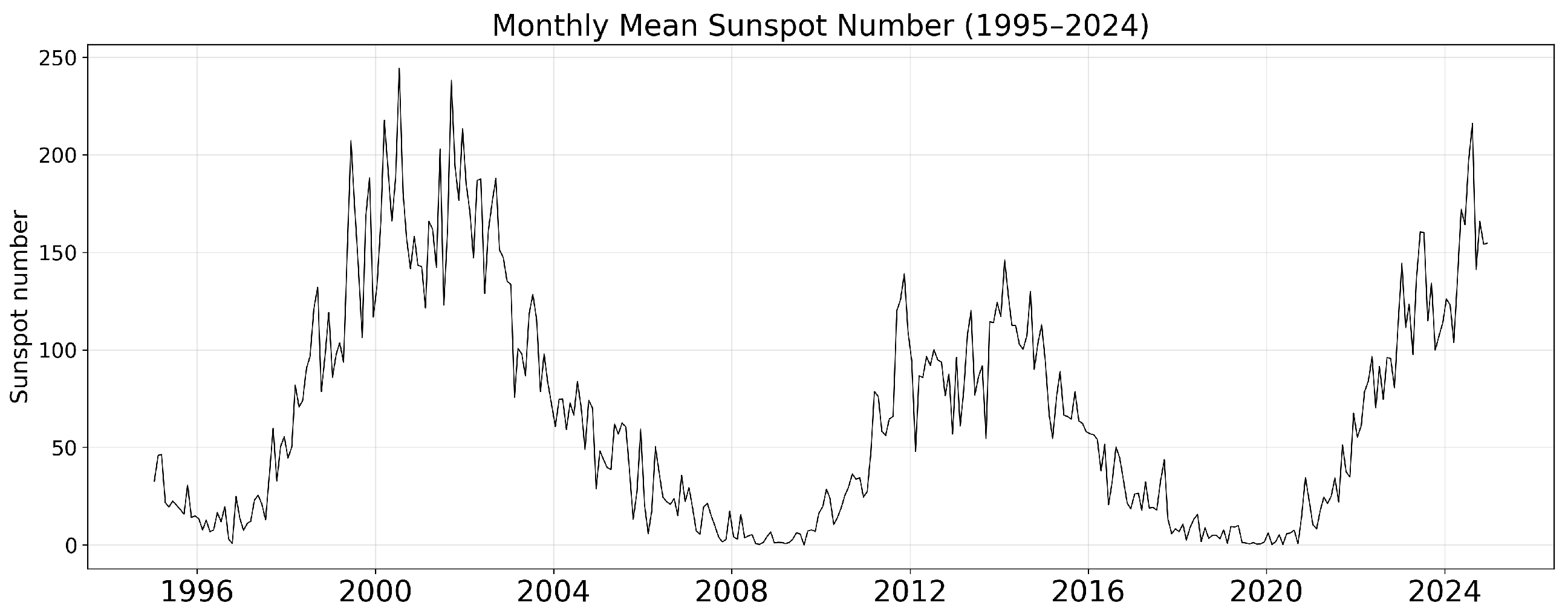
The solar wind and geomagnetic index data, with a temporal resolution of 1 h, are obtained from the OMNI database. Thanks to the launch of Wind, SOHO and ACE spacecraft, the OMNI database provides nearly full temporal coverage since 1995 (see https://omniweb.gsfc.nasa.gov/html/ow_data.html (accessed on 24 November 2025) for details). Therefore, we choose to analyze solar wind data from 1995 to 2024, covering the end of solar cycle (SC) 22, the whole SC 23 and SC 24, as well as the first half of SC 25. As an indicator of the solar active level, the monthly mean sunspot number data were obtained from Sunspot Index and Long-term Solar Observations (SILSO) and are presented in Figure 1.
Wavelet analysis is a powerful technique for detecting periodic variations within time series data. By decomposing a series into time-frequency space, it allows for the identification of dominant modes of variability and their temporal evolution [18]. In this study, we applied the continuous wavelet transform with a Morlet wavelet function. The analysis was implemented using the PyCWT module [19].
The PFSS model has been extensively validated and demonstrates the capability to reproduce realistic large-scale coronal fields with reasonable accuracy, e.g., [20,21,22,23,24,25]. In this work, we employed the PFSS code described and validated in Li et al. [26], with the source surface set at the commonly adopted value of 2.5 R s (solar radius). The PFSS model was driven by Wilcox Solar Observatory (WSO) synoptic maps due to its unique coverage of the full temporal range investigated in this study. The boundaries of coronal holes are identified by tracing magnetic field lines from the solar surface to the source surface. The HCS at the source surface is located where the radial magnetic field component ( B r ) changes sign. The warping of the HCS is quantified by the average slope [3]:
SL = 1 N θ i ϕ i
where θ i and ϕ i represent the latitude and longitude of grid points along the HCS, N represents the number of HCS sample points, and the derivative is approximated by finite differences between adjacent points. A larger value of SL corresponds to a more warped HCS.

3. Results

3.1. Periodic Variations in Solar Wind Speed

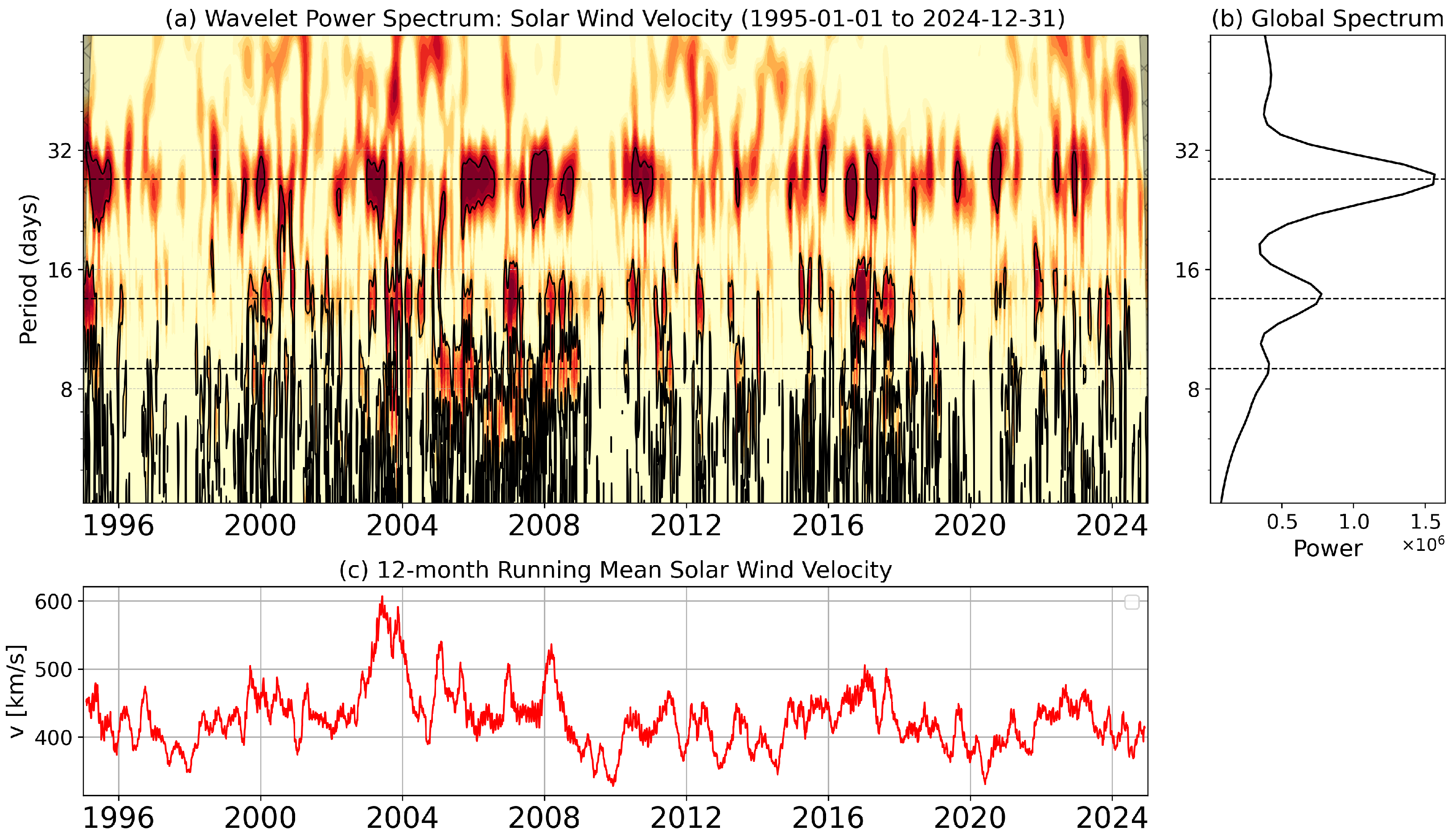
Figure 2 presents the results of the wavelet analysis performed on the near-Earth solar wind velocity data. The wavelet power spectrum and the global wavelet spectrum are displayed in Figure 2a,b, respectively. Additionally, the 12-month running-averaged solar wind velocity is plotted in Figure 2c to illustrate its long-term variation.
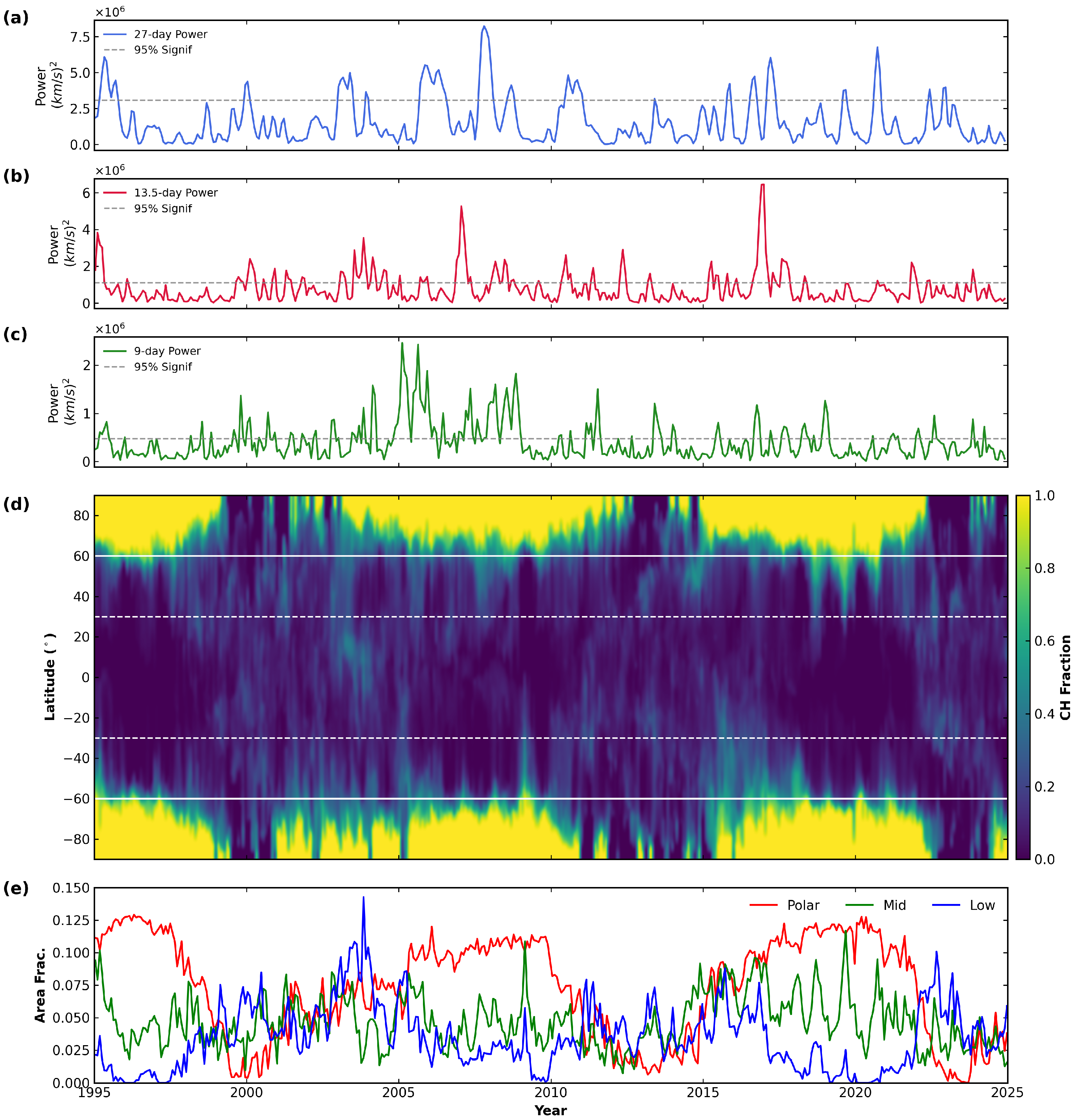
To more clearly follow the power of periodicities associated with the solar rotation, and their connection to the evolution of coronal hole (CH), we plotted the time series of solar wind velocity wavelet power and latitudinal distribution of CH areas derived from PFSS modeling in Figure 3. The 27-day, 13.5-day and 9-day power are presented in Figure 3a–c. Longitudinal-integrated CH area as a function of latitude and time is shown in Figure 3d. The solar surface is divided into a polar region (above ± 60 ), a low-latitude region (within the range of ± 30 ), and a mid-latitude region (between these two). Global statistics of the fractional CH area integrated within these latitudinal zones are shown in Figure 3e. Note that the fractional areas of coronal holes in Figure 3d,e are defined using different bases. In Figure 3d, the fraction represents the proportion of CH area within each specific latitude bin, illustrating its latitudinal distribution over time. In contrast, Figure 3e shows the CH area of different regions as a percentage of the total spherical surface area, resulting in a one-dimensional time series.
A dominant 27-day periodicity is clearly identified in the wavelet power spectrum, appearing intermittently and producing a distinct peak in the global wavelet spectrum. This periodicity is most prominent during the declining phase of the solar cycle, as seen in the periods 1995–1996, 2004–2009, and 2015–2019. The 13.5-day periodicity is globally weaker than the 27-day period, as indicated by the global wavelet spectrum. The wavelet power spectrum reveals that the 13.5-day period, often coexisting with the 27-day period, tends to be more transient. The 9-day periodicity is even weaker globally than the 13.5-day period; however, it becomes relatively significant during certain intervals. For instance, in 2008, the power of the 9-day periodicity was comparable to that of the 13.5-day period and only slightly weaker than the 27-day period. Remote and in situ observations, along with 3D magnetohydrodynamic (MHD) modeling results, indicate that during this period, a long-lived, isolated low-latitude CH and low-latitude extensions of the polar CH generated two primary and one minor fast stream [27]. Although the position and shape of these low-latitude CHs evolved during this interval, they did not disappear, allowing the fast streams to recur persistently.
A comparative analysis of Figure 2 and Figure 3 reveals the dependence of the near-Earth solar wind periodicity on the distribution and evolution of CHs. During intervals when low-latitude CHs vanish, the solar rotation periodicity and its harmonics become relatively weak or even undetectable. This situation occurred in 1997, 2009, and 2020, when solar activity was near its minimum. As shown in Figure 3a, during these years, CHs had completely retreated to the polar regions, and the corona exhibited a dipole configuration. Consequently, the solar wind speed remained low (as seen in Figure 2c), and the absence of high-speed streams resulted in a lack of periodic fluctuations in the velocity time series.
The most significant periodicities are observed during the declining phase of the solar cycle (e.g., 2006–2008 and 2017–2019), when polar CHs are stable and low-latitude CHs are present and substantial, although their area has not yet reached its peak. In each solar cycle, the peak area of low-latitude CHs occurs during the solar maximum (e.g., 2000–2004 and 2012–2016). However, during these periods, the periodicities are relatively weak. This can be explained by the fact that during solar maximum, polar CHs disappear, the solar magnetic field becomes complex, and the coronal structure evolves rapidly. As a result, fast streams can hardly maintain a stable structure over multiple solar rotations. Moreover, frequent coronal mass ejections during solar maximum further disrupt the formation of stable periodicities. During the ascending phase, as polar CHs begin to form and low-latitude CHs emerge, the periodicities become discernible.
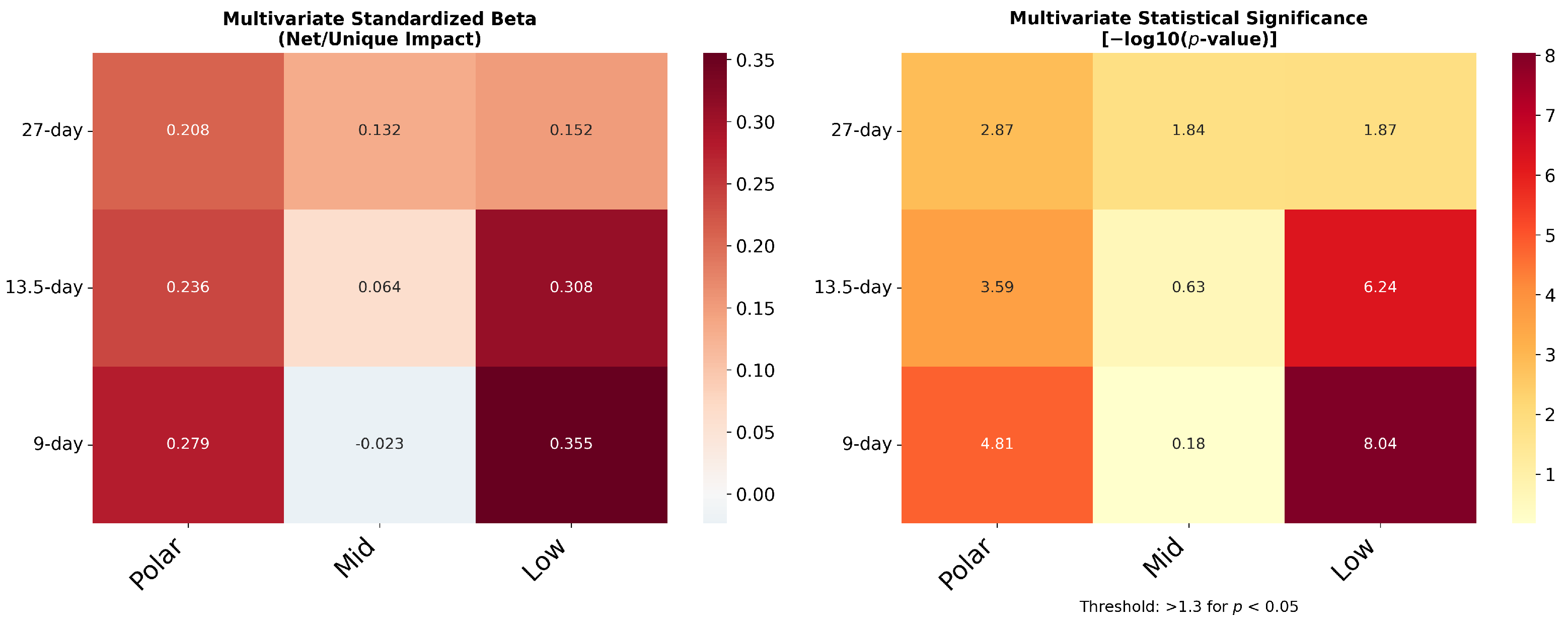
To further quantify the relationship between CH distributions and solar wind periodicities, a multivariate linear regression analysis was performed, as shown in Figure 4. This approach allows for the decoupling of inter-regional collinearity to isolate the independent “net impact” of each latitudinal band. The polar CHs maintain a robust and significant influence across all three periodicities. This underscores that the presence of stable polar CHs is a fundamental condition for the generation and maintenance of recurrent solar wind structures near Earth. For the 27-day periodicity, while the impact of low-latitude fluctuations is evident, Figure 4 demonstrates that mid-latitude CHs also provide a non-negligible contribution, despite their area being less volatile than that of the other two regions. Regarding the driving mechanism for shorter harmonics, i.e., the 13.5-day and 9-day periods, the role of mid-latitude CHs diminishes significantly, and the low-latitude region emerges as the dominant driver.
In summary, polar CHs serve as the fundamental stabilizers of the global coronal structure, while the rotation of the Sun in the presence of low-latitude CHs acts as the primary mechanism generating periodic fluctuations. The combined effect of these two factors governs the emergence of short-term periodicities in the near-Earth solar wind time series. A larger area of low-latitude CHs is typically sustained by two or three distinct CH regions, leading to multiple fast streams within a single solar rotation and thereby generating the 13.5-day and 9-day periodicities.

3.2. Periodic Variations in IMF Components

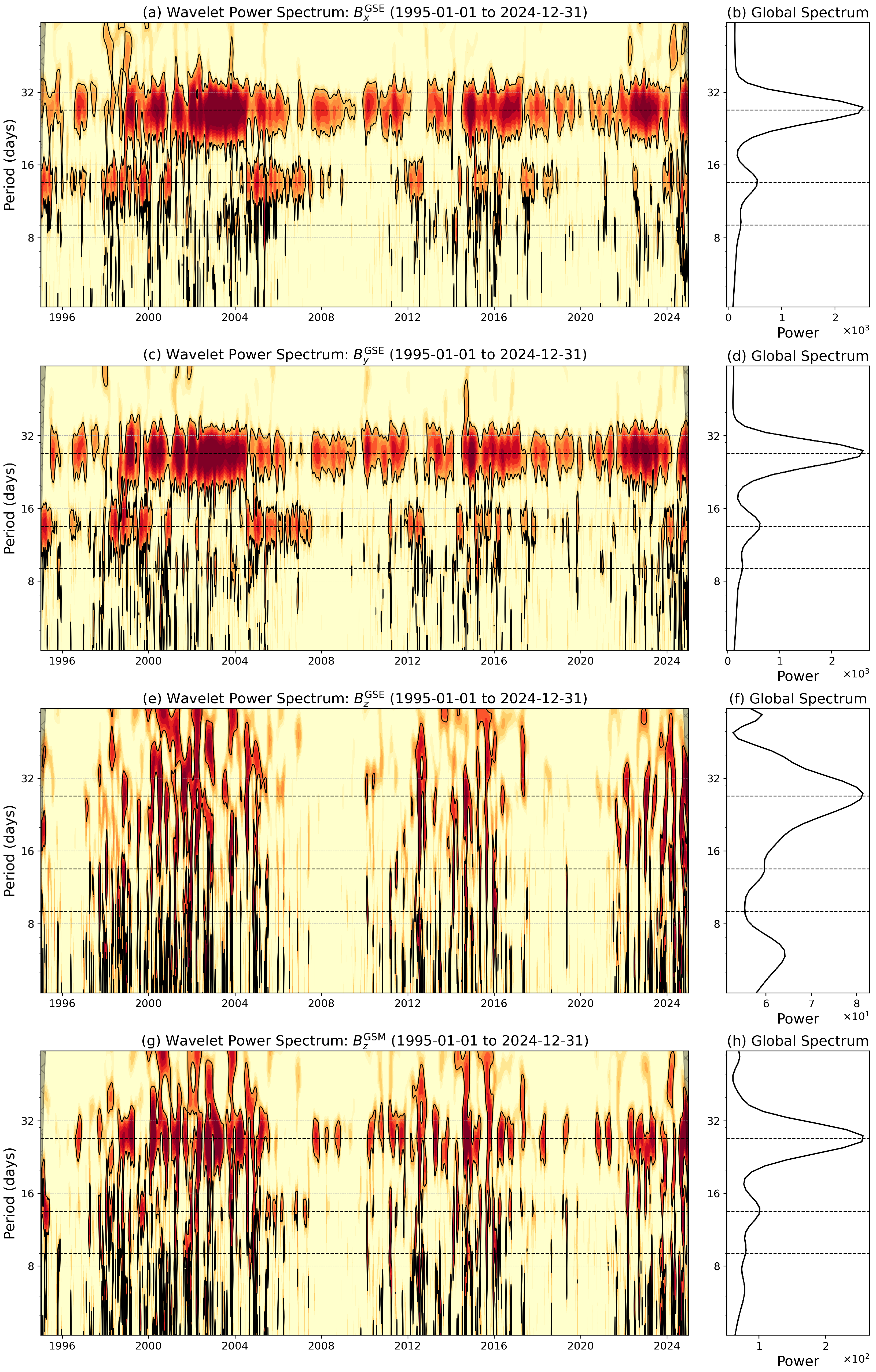
The IMF serves as a primary link between solar magnetic structures and the terrestrial space environment [28]. The periodic variations in the IMF are intimately associated with recurrent geomagnetic storms, which are often triggered by the periodic passage of corotating interaction regions and sector boundary crossings [29]. Periodicity analysis of the near-Earth IMF components is shown in Figure 5. We utilize the Geocentric Solar Ecliptic (GSE) system for the B x , B y , and B z components, defining the X-axis along the Earth-Sun line and the Z-axis toward the North Ecliptic Pole. To capture the coupling between the IMF and the magnetosphere, the B z component is also analyzed in Geocentric Solar Magnetospheric (GSM) coordinates, where the Z-axis is defined by the projection of the Earth’s magnetic dipole axis onto the Y-Z plane. Both the B x GSE and B y GSE components display pronounced 27-day rotational periodicity, indicative of the co-rotational character of the IMF. In contrast to the solar wind speed profile, the 27-day periodicity appears to be positively correlated with solar activity, as indicated by the sunspot number (SSN) in Figure 1. This periodicity is most prominent during periods of high solar activity, such as 1998–2005, 2013–2016, and 2022–2024. Meanwhile, a 13.5-day periodicity is evident during 1998–2002, 2005–2007, 2012, and around 2016. No persistent 9-day periodicity is observed in B x GSE or B y GSE . The close similarity in the periodic characteristics of B x GSE and B y GSE underscores their interconnection near Earth via the Parker spiral structure.
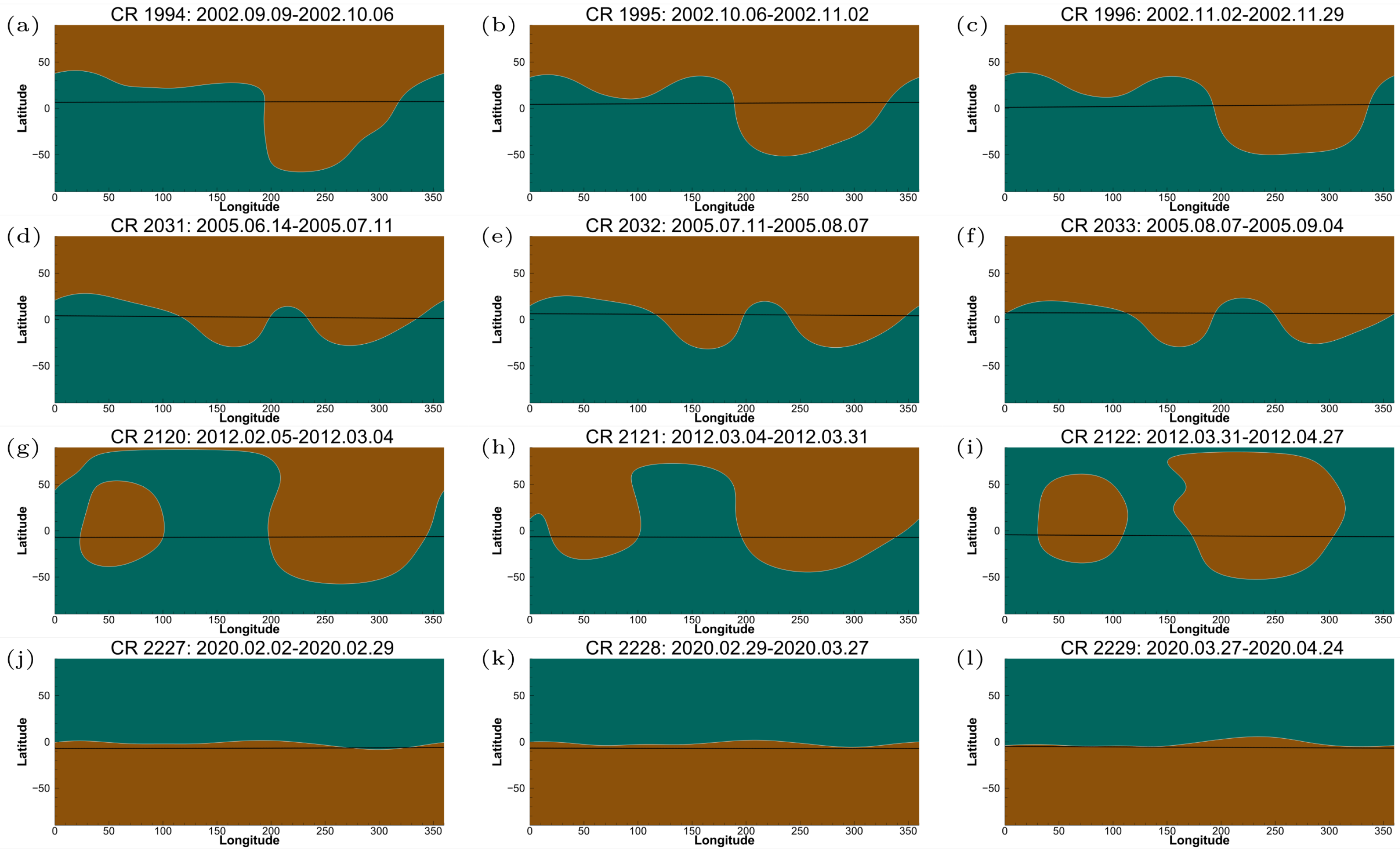
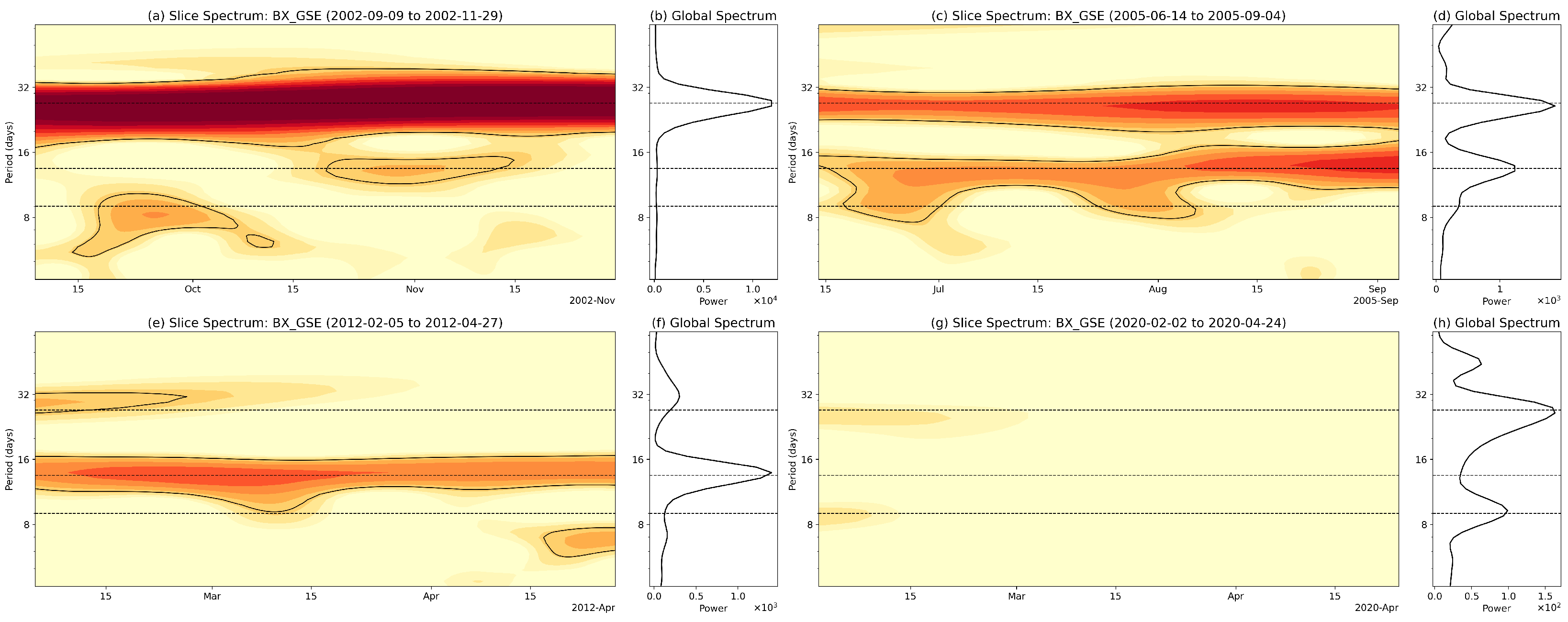
The most notable variation in B x GSE arises from crossings of the HCS. As the HCS is a thin layer separating regions of opposite IMF polarity, the value of B x GSE abruptly switches from one nearly constant level to its opposite when crossing the HCS [2,30]. Consequently, the structure of the HCS profoundly influences the periodicity of B x GSE (and similarly B y GSE ). To examine this, Figure 6 presents the source surface synoptic maps derived from the PFSS extrapolation using the WSO photospheric synoptic map as input. Note that the HCS maintains its large-scale structure during propagation from the coronal source surface to 1 AU, despite the evolution of small-scale features and longitudinal shifts due to the formation of the Parker spiral [27,31]. In these synoptic plots, the inward and outward polarities of the coronal magnetic field are represented by brown and green colors, respectively, and the HCS is marked by the white line. The trajectory of Earth during each CR is indicated by red dots. To more clearly demonstrate the periodic characteristics during these specific Carrington Rotations (CRs), we extracted the wavelet analysis results of these intervals, as shown in Figure 7.
The selected CRs correspond to intervals with distinct periodic characteristics in near-Earth B x GSE :
(1)
CRs 1994–1996 (9 September 2002–29 November 2002): only the 27-day periodicity is apparent, Figure 6a–c and Figure 7a,b;
(2)
CRs 2031–2033 (14 June 2005–4 September 2005): both 13.5-day and 27-day periodicities are apparent, Figure 6d–f and Figure 7c,d;
(3)
CRs 2120–2122 (5 February 2012–27 April 2012): only the 13.5-day periodicity is apparent, Figure 6g–i and Figure 7e,f;
(4)
CRs 2227–2229 (2 February 2020–24 April 2020): no apparent periodicity is found, Figure 6j–l and Figure 7g,h.
During CRs 1994–1996, the deep southern extension of the HCS caused Earth to cross the HCS twice per rotation, resulting in a two-sector IMF structure. The shape and position of the HCS did not change dramatically across these three rotations, with crossing longitudes consistently around 200 and 320 . As a result, a clear 27-day periodicity appears in the near-Earth data. In contrast, a more warped HCS during CRs 2031–2033 led to a four-sector IMF structure. Nevertheless, the overall configuration of the HCS and the crossing positions remained relatively stable, allowing the 13.5-day periodicity to be superimposed on the 27-day periodicity.
Between CRs 2120 and 2122, solar activity reached its maximum in SC24, and the HCS structure evolved significantly between adjacent rotations. Two separate HCSs were identified during CR 2120 and CR 2122, attributed to the dominance of the Sun’s non-axisymmetric quadrupole component [32]. Meanwhile, according to the near-Earth interplanetary coronal mass ejections list [33], a total of 10 ICMEs impacted Earth during this period. The substantial changes in global structure, combined with ICME-related disturbances, led to significant differences in the temporal profile of the B x GSE component near Earth across different CRs, thereby diminishing the 27-day recurrence. However, within each rotation, the longitudinal extent of each polarity sector remained similar, allowing the 13.5-day periodicity to persist.
During CRs 2227–2229, the HCS remained extremely flat and tightly confined to the heliospheric equatorial plane. A northward shift of the HCS was identified from both modeling and in situ data [31]. Except for a brief interval in CR 2227, Earth remained south of the HCS throughout the three rotations. As a result, a one-sector (or nearly one-sector) profile was observed in the near-Earth IMF data, with no recurrent HCS crossings and no significant periodicity detected.
To further quantitatively analyze the connection between HSC structure and periodicity in near-Earth data, Figure 8 shows the B x GSE wavelet power and HCS structure parameters derived from PFSS modeling. The latitudinal extent of the HCS (Figure 8c), and the average slope (SL) defined by Equation (1) (Figure 8d) characterize the extension and warping of the HCS, respectively. From this figure and Figure 5, we observe a significant correlation between the periodicity of B x GSE and both the SL and the latitudinal extent of the HCS, with relatively well-defined thresholds. When SL exceeds 0.4, and the HCS extends beyond ± 30 latitude, the 27-day co-rotational periodicity becomes prominent. When SL consistently surpasses 0.6, and the HCS reaches beyond ± 60 latitude, a stable four-sector structure can develop, leading to a distinct half-rotation periodicity. Figure 8 also indicates that around solar minimum (1996, 2009 and 2020), the HCS is relatively flat (low SL) and confined near the solar equator. Under such conditions, any apparent periodic signature would be absent over short intervals, which is consistent with the analysis of Figure 6.
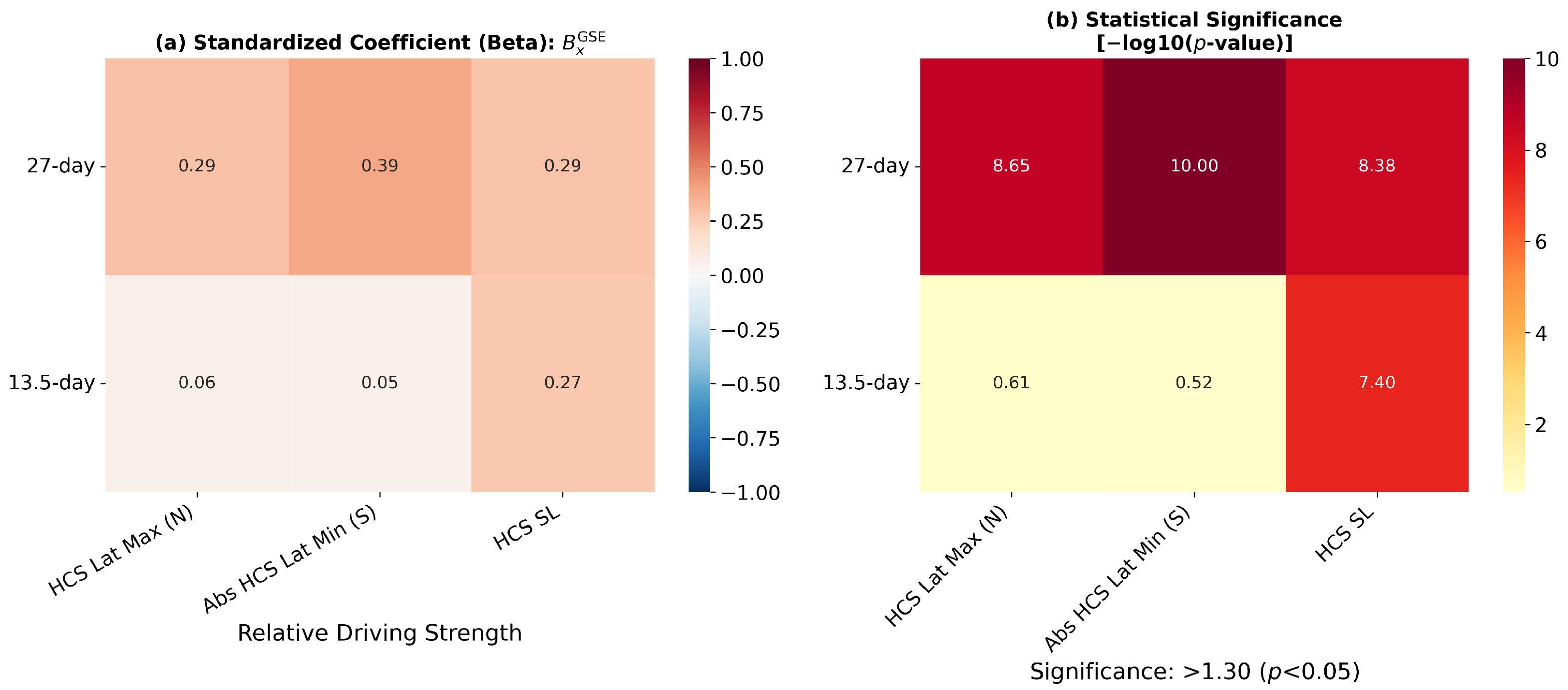
To quantitatively assess the drivers of B x GSE periodicity, a standardized regression analysis was performed between HCS morphological parameters and the IMF wavelet power of the 27-day and 13.5-day periodicities (Figure 9). Although multiple linear regression was employed in Figure 4, it is less suitable here because the HCS structural parameters, latitudinal extension of the HCS and SL, exhibit high mutual correlation (coefficients 0.7 ). Such strong multicollinearity would render a standard multiple regression unreliable, as it becomes difficult to isolate the individual contribution of each variable. Consequently, the standardized univariate linear regression is used here. Note that we use absolute value to convert the southward extent (minimum latitude) of the HCS into a positive magnitude for consistent statistical correlation with IMF wavelet power. The results reveal that the 27-day periodicity is strongly driven by all three parameters, with the southern extension of HCS showing higher β and statistical significance. Conversely, the 13.5-day periodicity is uniquely sensitive to the HCS slope, while the latitudinal variables fail to reach the significance threshold. This implies that the strength of the 13.5-day periodicity is more sensitive to the HCS’s degree of warping, and the formation of the four-sector structure depends more on the warping rather than the extension of the HCS.
In Figure 5c, the wavelet power spectrum of B z GSE shows relatively weak periodicity. Unlike the other components, the 27-day period is not dominant. Around solar minimum, the periodicity nearly vanishes, while around solar maximum, no persistent and coherent periodicity emerges. In the Parker spiral model of the IMF, there is no magnetic field component perpendicular to the ecliptic plane under steady-state conditions. Thus, the ambient IMF contributes little to B z GSE . Strong and persistent B z GSE near Earth is mainly associated with coronal mass ejections (CMEs). As transient events, the occurrence of geoeffective CMEs is not tied to the solar rotation rate, which explains the lack of a dominant 27-day periodicity. Furthermore, during solar minimum, geoeffective CMEs are infrequent, resulting in limited B z GSE fluctuations and thus minimal periodicity.
The wavelet spectrum of B z GSM in Figure 5d exhibits some similarity to those of B x GSE and B y GSE , likely due to modulation by the Russell–McPherron (R-M) effect. This effect projects the GSE B y component of the spiral IMF onto the GSM Z-axis [34,35]. The R-M effect is strongest near the equinoxes (spring and autumn) and weakest near the solstices (summer and winter), which may explain why the 27-day periodicity in B z GSM appears intermittently.

3.3. Periodic Variations in Geomagnetic Indices

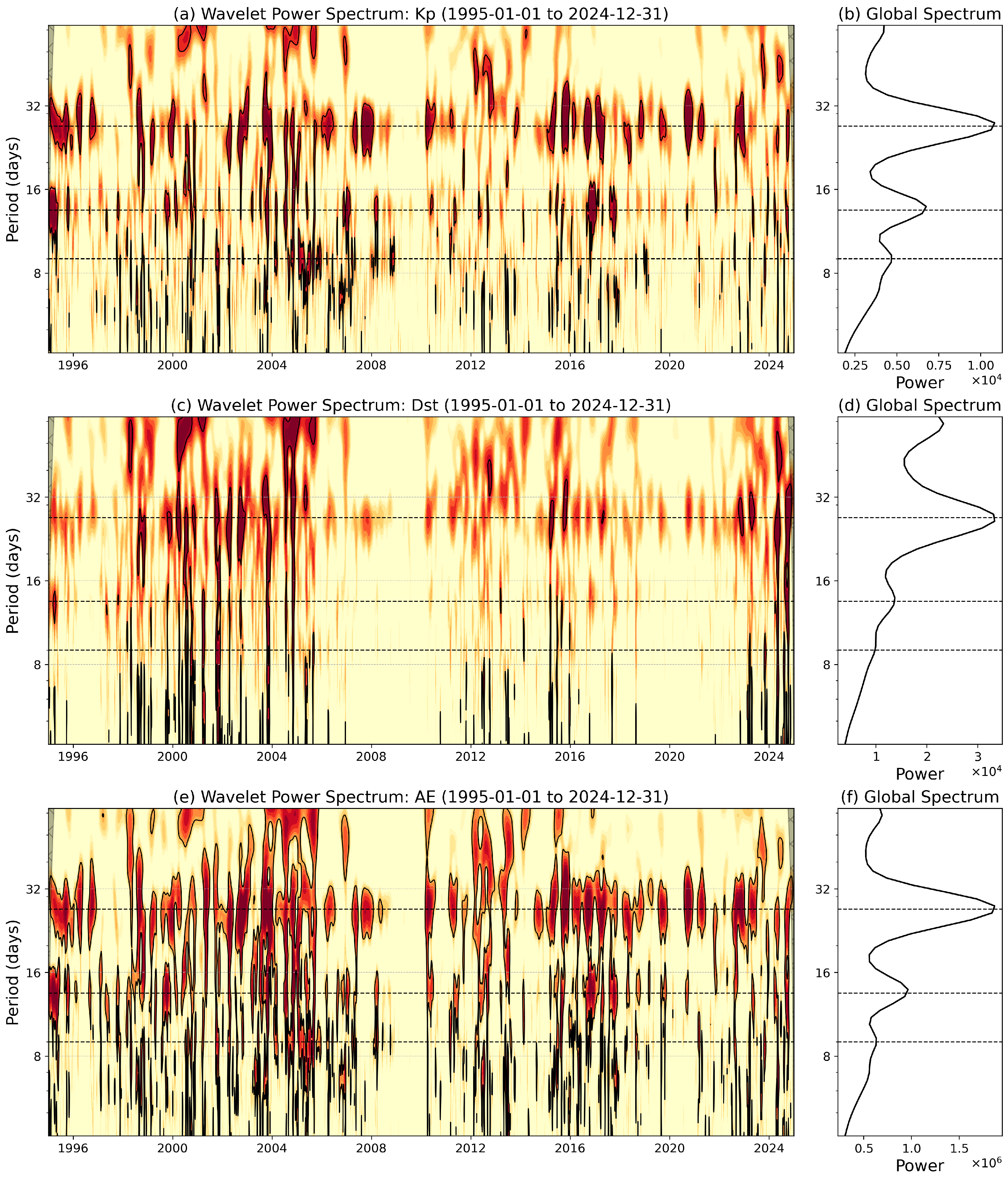
The characterization of geomagnetic activity is commonly achieved through several standardized indices. The Kp index, a planet-wide 3-hourly index, quantifies the general level of global geomagnetic disturbance in the mid-latitude region. The Dst index is commonly used to measure the intensity of a geomagnetic storm. The AE (Auroral Electrojet) index provides a high-resolution measure of auroral zone magnetic activity produced and is highly sensitive to the direct energy input from magnetospheric substorms. In Figure 10, we plot the wavelet spectrum of these three geomagnetic indexes. This periodicity profile appears to exhibit significant similarities to the characteristics of B z GSM . As the B z GSM is the primary regulator of solar wind-magnetosphere coupling and subsequent geomagnetic activity [28,36], such similarity is expected.

4. Summary and Discussion

This study links the periodic variations in the near-Earth solar wind and IMF parameters to their underlying solar sources, using a long-term dataset (1995–2024) covering multiple solar cycles.
Solar wind speed exhibits a dominant 27-day periodicity, which is most pronounced during the declining phase of solar cycles. Its harmonics-13.5 days and 9 days-are weaker and more transient, with the 9-day periodicity becoming notable only during specific intervals, such as 2008. These short-term periodicities are governed by the combined influence of polar and low-latitude CHs: polar CHs serve as the fundamental stabilizers of the global coronal structure, while the rotation of the Sun in the presence of low-latitude CHs acts as the primary mechanism generating periodic fluctuations. The absence of low-latitude CHs diminishes or erases these periodicities. Additionally, complex coronal structures and frequent CMEs during solar maxima suppress periodicity, even when low-latitude CH area reaches its peak.
For IMF components that form the Parker Spiral, B x GSE and B y GSE , the periodicity variations are closely tied to the structure of the HCS: a 27-day period emerges under a stable two-sector IMF configuration (HCS average slope SL > 0.4 , latitudinal extent ±   30 ), whereas a 13.5-day period is imposed on the 27-day period when a stable four-sector IMF ( SL > 0.6 , latitudinal extent ±   60 ) appears. However, when the HCS is extremely flat and confined near the heliospheric equator, and a north–south asymmetry exists, no clear periodicity is observed, despite a stable coronal structure. A different scenario emerged in 2012, around the maximum of SC 24, when two separate HCSs are generated. In this case, significant evolution of the global solar magnetic field and disturbances from ICMEs suppressed the 27-day recurrence, while the stability of localized magnetic sectors allowed the 13.5-day periodicity to persist. In contrast, B z GSE exhibits weak periodicity, while B z GSM shows intermittent 27-day periodicity modulated by the Russell–McPherron effect. Geomagnetic indices (Kp, Dst, and AE) display periodic behavior similar to that of B z GSM , consistent with the central role of B z GSM in regulating solar wind–magnetosphere coupling. While 27-day and 13.5-day cycles correspond to stable two-sector (dipole) and four-sector (quadrupole) configurations, a 9-day periodicity would require a highly symmetric six-sector structure driven by the Sun’s higher-order octupole moments. Such configurations are rare at 1 AU because high-order magnetic components decay more rapidly with distance.
In light of the concerns regarding the novelty of this work, we wish to emphasize three key points. First, by analyzing continuous data spanning over two solar cycles (1995–2024), this work encompasses the entire ‘causal chain’ of space weather from the coronal structure, to solar wind and IMF parameters, and finally to geomagnetic activity indices. This long-term perspective allows us to present a complete picture of how periodicities are generated and transmitted along this chain under varying solar activity levels. Second, regarding solar drivers, we identified the distinct roles of CHs at different latitudes. Our analysis reveals how their combination governs the emergence of the 27-day period and its harmonics across these levels. Third, our investigation into IMF periodicities establishes specific quantitative thresholds and reveals a nuanced sensitivity to coronal magnetic structures. We found that while the 27-day periodicity depends on both the latitudinal extent of the HCS and SL, the 13.5-day harmonic is significantly more sensitive to the SL.
The short-term periodicity of 27-day and its sub-harmonics have been widely identified in the evolution of the geospace environment, including variations in plasma parameters within the magnetosphere, e.g., [37], ionosphere, e.g., [38], and thermosphere, e.g., [39]. While it is generally accepted that these variations are driven by periodic changes in solar wind and IMF conditions, our study further clarifies their solar origin, thereby establishing a more complete causal chain. Additionally, the periodic recurrence of solar wind parameters is utilized for forecasting near-Earth solar wind conditions. The 27-day persistence model serves as a benchmark for more complex numerical models, e.g., [40], and machine learning approaches also incorporate solar wind conditions from 27 days prior as input, e.g., [41]. Our study offers insights into the conditions under which such periodic methods are most effective.

Author Contributions

Conceptualization, H.L. and Y.Z.; methodology, H.L. and Y.Z.; software, H.L., J.B., B.T., J.X. and K.W.; formal analysis, H.L. and Y.Z.; writing—original draft preparation, H.L. All authors have read and agreed to the published version of the manuscript.

Funding

The work is jointly supported by the National Natural Science Foundation of China (42204174, 42030204), National Key R & D Program of China (grant No. 2022YFF0503900) and Shenzhen Science and Technology Program: KJZD20240903102732042. This work is also partially supported by the National Key Scientific and Technological Infrastructure project ‘Earth System Science Numerical Simulator Facility’ (EarthLab).

Institutional Review Board Statement

Not applicable.

Informed Consent Statement

Not applicable.

Data Availability Statement

The data underlying this article will be shared upon reasonable request to Huichao Li (lihuichao@hit.edu.cn).

Acknowledgments

Wilcox Solar Observatory data used in this study were obtained via the web site http://wso.stanford.edu (accessed on 24 November 2025). We acknowledge the use of NASA/GSFC’s Space Physics Data Facility’s OMNIWeb and CDAWeb service for providing the observed in situ data used in this paper. Sunspot number data is obtained from WDC-SILSO, Royal Observatory of Belgium.

Conflicts of Interest

The authors declare no conflicts of interest.

References

  1. Cranmer, S.R.; Gibson, S.E.; Riley, P. Origins of the Ambient Solar Wind: Implications for Space Weather. Space Sci. Rev. 2017, 212, 1345–1384. [Google Scholar] [CrossRef]
  2. Smith, E.J. The heliospheric current sheet. J. Geophys. Res. 2001, 106, 15819–15832. [Google Scholar] [CrossRef]
  3. Zhao, L.; Landi, E.; Gibson, S.E. Two Novel Parameters to Evaluate the Global Complexity of the Sun’s Magnetic Field and Track the Solar Cycle. Astrophys. J. 2013, 773, 157. [Google Scholar] [CrossRef]
  4. Fletcher, L.; Cargill, P.J.; Antiochos, S.K.; Gudiksen, B.V.; Klimchuk, J.A. Structures in the Outer Solar Atmosphere. Space Sci. Rev. 2015, 188, 211–249. [Google Scholar] [CrossRef]
  5. Tokumaru, M.; Fujiki, K.; Iju, T. North-south asymmetry in global distribution of the solar wind speed during 1985–2013. J. Geophys. Res. (Space Phys.) 2015, 120, 3283–3296. [Google Scholar] [CrossRef]
  6. El-Borie, M.A.; El-Taher, A.M.; Thabet, A.A.; Bishara, A.A.; Abdel-halim, A.A. The Dependence of Solar, Plasma, and Geomagnetic Parameters’ Oscillations on the Heliospheric Magnetic Field Polarities: Wavelet Analysis. Astrophys. J. 2019, 880, 86. [Google Scholar] [CrossRef]
  7. El-Borie, M.A.; El-Taher, A.M.; Thabet, A.A.; Bishara, A.A.; Abdel-halim, A.A. The Interconnection between the Periodicities of Solar Wind Parameters Based on the Interplanetary Magnetic Field Polarity (1967–2018): A Cross Wavelet Analysis. Sol. Phys. 2020, 295, 122. [Google Scholar] [CrossRef]
  8. Xiang, N.B.; Ning, Z.J.; Li, F.Y. Temporal Evolution of the Rotation of the Interplanetary Magnetic Field Bx, By, and Bz Components. Astrophys. J. 2020, 896, 12. [Google Scholar] [CrossRef]
  9. Mursula, K.; Zieger, B. The 13.5-day periodicity in the Sun, solar wind and geomagnetic activity: The last three solar cycles. J. Geophys. Res. Space Phys. 1996, 101, 27077–27090. [Google Scholar] [CrossRef]
  10. Neugebauer, M.; Smith, E.J.; Ruzmaikin, A.; Feynman, J.; Vaughan, A.H. The solar magnetic field and the solar wind: Existence of preferred longitudes. J. Geophys. Res. Space Phys. 2000, 105, 2315–2324. [Google Scholar] [CrossRef]
  11. Prabhakaran Nayer, S.R.; Radhika, V.N.; Revathy, K.; Ramadas, V. Wavelet analysis of solar, solar wind and geomagnetic parameters. Sol. Phys. 2002, 208, 359–373. [Google Scholar] [CrossRef]
  12. Katsavrias, C.; Preka-Papadema, P.; Moussas, X. Wavelet Analysis on Solar Wind Parameters and Geomagnetic Indices. Sol. Phys. 2012, 280, 623–640. [Google Scholar] [CrossRef]
  13. Singh, Y.P.; Badruddin. Solar-rotational oscillation and its harmonics in the solar-wind, geomagnetic and cosmic ray particles during the last two solar minima. Astrophys. Space Sci. 2015, 359, 20. [Google Scholar] [CrossRef]
  14. Gibson, S.E.; Kozyra, J.U.; de Toma, G.; Emery, B.A.; Onsager, T.; Thompson, B.J. If the Sun is so quiet, why is the Earth ringing? A comparison of two solar minimum intervals. J. Geophys. Res. Space Phys. 2009, 114, A09105. [Google Scholar] [CrossRef]
  15. Gibson, S.E.; de Toma, G.; Emery, B.; Riley, P.; Zhao, L.; Elsworth, Y.; Leamon, R.J.; Lei, J.; McIntosh, S.; Mewaldt, R.A.; et al. The Whole Heliosphere Interval in the Context of a Long and Structured Solar Minimum: An Overview from Sun to Earth. Sol. Phys. 2011, 274, 5–27. [Google Scholar] [CrossRef]
  16. Li, H.; Feng, X.; Wei, F. Is Solar Minimum 24/25 Another Unusual One? Astrophys. J. Lett. 2021, 917, L26. [Google Scholar] [CrossRef]
  17. Choi, K.E.; Lee, D.Y. Origin of Solar Rotational Periodicity and Harmonics Identified in the Interplanetary Magnetic Field Bz Component Near the Earth During Solar Cycles 23 and 24. Sol. Phys. 2019, 294, 44. [Google Scholar] [CrossRef]
  18. Torrence, C.; Compo, G.P. A Practical Guide to Wavelet Analysis. Bull. Am. Meteorol. Soc. 1998, 79, 61–78. [Google Scholar] [CrossRef]
  19. Krieger, S.; Freij, N. PyCWT: Wavelet Spectral Analysis in Python. Available online: https://github.com/regeirk/pycwt (accessed on 24 November 2025).
  20. Neugebauer, M.; Forsyth, R.J.; Galvin, A.B.; Harvey, K.L.; Hoeksema, J.T.; Lazarus, A.J.; Lepping, R.P.; Linker, J.A.; Mikic, Z.; Steinberg, J.T.; et al. Spatial structure of the solar wind and comparisons with solar data and models. J. Geophys. Res. 1998, 103, 14587–14600. [Google Scholar] [CrossRef]
  21. Schrijver, C.J.; De Rosa, M.L. Photospheric and heliospheric magnetic fields. Sol. Phys. 2003, 212, 165–200. [Google Scholar] [CrossRef]
  22. Riley, P.; Linker, J.A.; Mikić, Z.; Lionello, R.; Ledvina, S.A.; Luhmann, J.G. A Comparison between Global Solar Magnetohydrodynamic and Potential Field Source Surface Model Results. Astrophys. J. 2006, 653, 1510–1516. [Google Scholar] [CrossRef]
  23. Wang, Y.M.; Robbrecht, E.; Sheeley, N.R., Jr. On the Weakening of the Polar Magnetic Fields during Solar Cycle 23. Astrophys. J. 2009, 707, 1372–1386. [Google Scholar] [CrossRef]
  24. Mackay, D.H.; Yeates, A.R. The Sun’s Global Photospheric and Coronal Magnetic Fields: Observations and Models. Living Rev. Sol. Phys. 2012, 9, 6. [Google Scholar] [CrossRef]
  25. Badman, S.T.; Bale, S.D.; Martínez Oliveros, J.C.; Panasenco, O.; Velli, M.; Stansby, D.; Buitrago-Casas, J.C.; Réville, V.; Bonnell, J.W.; Case, A.W.; et al. Magnetic Connectivity of the Ecliptic Plane within 0.5 au: Potential Field Source Surface Modeling of the First Parker Solar Probe Encounter. Astrophys. J. Suppl. Ser. 2020, 246, 23. [Google Scholar] [CrossRef]
  26. Li, H.; Feng, X.; Wei, F. Comparison of Synoptic Maps and PFSS Solutions for The Declining Phase of Solar Cycle 24. J. Geophys. Res. (Space Phys.) 2021, 126, e28870. [Google Scholar] [CrossRef]
  27. Li, H.C.; Feng, X.S. CESE-HLL Magnetic Field-Driven Modeling of the Background Solar Wind During Year 2008. J. Geophys. Res. (Space Phys.) 2018, 123, 4488–4509. [Google Scholar] [CrossRef]
  28. Russell, C.T. Solar wind and interplanetary magnetic field: A tutorial. Geophys. Monogr. Ser. 2001, 125, 73–89. [Google Scholar] [CrossRef]
  29. Vršnak, B.; Dumbović, M.; Čalogović, J.; Verbanac, G.; Poljančić Beljan, I. Geomagnetic Effects of Corotating Interaction Regions. Sol. Phys. 2017, 292, 140. [Google Scholar] [CrossRef]
  30. Svalgaard, L.; Cliver, E.W. A Floor in the Solar Wind Magnetic Field. Astrophys. J. Lett. 2007, 661, L203–L206. [Google Scholar] [CrossRef]
  31. Li, H.; Feng, X. On the northward shift of the heliospheric current sheet at the end of solar cycle 24. Mon. Not. R. Astron. Soc. 2024, 532, 3180–3186. [Google Scholar] [CrossRef]
  32. Wang, Y.M.; Young, P.R.; Muglach, K. Evidence for Two Separate Heliospheric Current Sheets of Cylindrical Shape During Mid-2012. Astrophys. J. 2014, 780, 103. [Google Scholar] [CrossRef]
  33. Richardson, I.; Cane, H. Near-Earth Interplanetary Coronal Mass Ejections Since January 1996. Available online: https://dataverse.harvard.edu/dataset.xhtml?persistentId=doi:10.7910/DVN/C2MHTH (accessed on 24 November 2025).
  34. Russell, C.T.; McPherron, R.L. Semiannual variation of geomagnetic activity. J. Geophys. Res. 1973, 78, 92. [Google Scholar] [CrossRef]
  35. McPherron, R.L.; Baker, D.N.; Crooker, N.U. Role of the Russell-McPherron effect in the acceleration of relativistic electrons. J. Atmos. Sol.-Terr. Phys. 2009, 71, 1032–1044. [Google Scholar] [CrossRef]
  36. Choi, K.E.; Lee, D.Y.; Choi, K.C.; Kim, J. Statistical properties and geoeffectiveness of southward interplanetary magnetic field with emphasis on weakly southward Bz events. J. Geophys. Res. (Space Phys.) 2017, 122, 4921–4934. [Google Scholar] [CrossRef]
  37. Li, Q.H.; He, M.; Hao, Y.Q.; He, F.; Zhang, X.X. Periodic Response of Plasmasphere to Solar Wind High-Speed Streams. Mon. Not. R. Astron. Soc. 2025, 52, e2025GL118450. [Google Scholar] [CrossRef]
  38. Negrea, C.; Munteanu, C.; Echim, M.M. Global Ionospheric Response to a Periodic Sequence of HSS/CIR Events During the 2007–2008 Solar Minimum. J. Geophys. Res. (Space Phys.) 2021, 126, e29071. [Google Scholar] [CrossRef]
  39. Lei, J.; Thayer, J.P.; Forbes, J.M.; Sutton, E.K.; Nerem, R.S.; Temmer, M.; Veronig, A.M. Global thermospheric density variations caused by high-speed solar wind streams during the declining phase of solar cycle 23. J. Geophys. Res. (Space Phys.) 2008, 113, A11303. [Google Scholar] [CrossRef]
  40. Owens, M.J.; Challen, R.; Methven, J.; Henley, E.; Jackson, D.R. A 27 day persistence model of near-Earth solar wind conditions: A long lead-time forecast and a benchmark for dynamical models. Space Weather 2013, 11, 225–236. [Google Scholar] [CrossRef]
  41. Dhuri, D.B.; Hanasoge, S.M.; Joon, H.; SM, G.; Das, D.; Kaul, B. A Multimodal Encoder–Decoder Neural Network for Forecasting Solar Wind Speed at L1. Astrophys. J. Suppl. Ser. 2025, 280, 40. [Google Scholar] [CrossRef]
Figure 1. Monthly mean sunspot number from 1995 to 2024, showing solar activity levels across solar cycles 23, 24, and the beginning of cycle 25.
Applsci 16 00891 g001
Figure 2. Wavelet analysis period-power diagram for solar wind velocity from 1995 to 2024. The wavelet power spectrum and the global wavelet spectrum of the hourly solar wind velocity are presented in sub-figures (a,b), respectively. The color scale in the power spectrum represents the wavelet power spectral density on a logarithmic scale, where warmer colors indicate higher power. The dashed lines mark the periodicities at 27, 13.5 and 9 days. The 95% significant level is marked by the solid black contour lines. The evolution of the 12-month running mean solar wind velocity is presented in sub-figure (c).
Applsci 16 00891 g002
Figure 3. Time series evolution of solar wind velocity the wavelet power and latitudinal distribution of coronal hole areas derived from PFSS modeling. (a) The 27-day power; (b) The 13.5-day power; (c) The 9-day power; (d) Longitudinal-integrated coronal hole area as a function of latitude and time. The solar surface is divided into a polar region (above ± 60 ), a low-latitude region (within the range of ± 30 ), and a mid-latitude region (between these two). The solid and dashed lines separate high/mid and mid/low latitudes, respectively. (e) Global statistics of the fractional CH area integrated within specific latitudinal zones: low-latitude (blue), mid-latitude (green), and high-latitude (red).
Applsci 16 00891 g003
Figure 4. Multivariate regression analysis of regional CH areas vs. solar wind wavelet power. (Left): Heatmap of standardized partial beta coefficients ( β ), indicating the net contribution of each CH region. (Right): Statistical significance represented as −log10(p-value), where values > 1.3 correspond to p < 0.05 .
Applsci 16 00891 g004
Figure 5. Wavelet analysis of IMF components B x GSE , B y GSE , B z GSE , and B z GSM from 1995 to 2024. The local wavelet power spectrum (left column) and the global wavelet spectrum (right column) are shown for each variable. The color scale in the power spectrum represents the wavelet power spectral density on a logarithmic scale, where warmer colors indicate higher power. Dashed horizontal lines indicate periodicities of 27, 13.5, and 9 days. The 95% confidence level is delineated by solid black contours, and the cone of influence (COI) where edge effects become significant is indicated by the shaded region.
Applsci 16 00891 g005
Figure 6. Source surface synoptic maps showing HCS structure for selected Carrington Rotations with distinct periodic characteristics. Inward (brown) and outward (green) magnetic polarities are separated by the HCS (white line), with Earth’s trajectory indicated by black lines.
Applsci 16 00891 g006
Figure 7. Wavelet spectrum of the IMF B x GSE component for four selected periods. The specific time interval for each sub-panel is indicated at the top. The plotting format and conventions follow those described in Figure 5.
Applsci 16 00891 g007
Figure 8. Time series evolution of B x GSE wavelet power and quantitative parameters of HCS structure derived from PFSS modeling. The panels illustrate (a) the 27-day power, (b) 13.5-day power, (c) northern (N) and southern (S) extent of HCS, and (d) average slope (SL) characterizing HCS warping, calculated by Equation (1).
Applsci 16 00891 g008
Figure 9. Standardized univariate linear regression analysis of HCS morphological parameters vs. IMF wavelet power. (a): Heatmap of standardized coefficients ( β ), representing the individual contribution of HCS latitudinal extensions and SL to the periodicity power. (b): Statistical significance represented as −log10(p-value), where values > 1.3 correspond to p < 0.05 .
Applsci 16 00891 g009
Figure 10. Same as Figure 5, but for geomagnetic Indices of Kp, Dst and AE.
Applsci 16 00891 g010
Disclaimer/Publisher’s Note: The statements, opinions and data contained in all publications are solely those of the individual author(s) and contributor(s) and not of MDPI and/or the editor(s). MDPI and/or the editor(s) disclaim responsibility for any injury to people or property resulting from any ideas, methods, instructions or products referred to in the content.