1. Introduction
The global bakery sector is gradually incorporating a wider range of plant-derived ingredients in an ongoing effort to develop products that better address consumers’ health and sustainability expectations. In recent years, the market for plant protein-enriched baked goods has grown, driven by rising demand for high-protein and vegan products. Current market reports show that consumers pay particular attention to sustainability, naturalness, clean-label formulations and ethical considerations when choosing bakery products [
1]. A range of plant protein isolates, including soy, faba bean, chickpea, hemp, and sunflower, have been examined for potential use in bakery products due to their diverse amino acid compositions and functional properties [
2,
3,
4]. These proteins differ in solubility, emulsification, water-binding behavior, and flavor intensity, which determines their applicability in specific product matrices. Among the available options, pea and rice proteins have recently gained interest as practical alternatives to more traditional sources. Their relatively mild sensory profiles, high digestibility, and compatibility with cereal-based systems have led to their frequent use in studies involving protein enrichment [
5,
6]. Pea protein isolate (PPI), produced from Pisum sativum seeds, consists mainly of the globulin fractions legumin and vicilin and is characterized by a balanced amino acid profile. While it provides a high level of lysine, it contains relatively low amounts of sulfur-containing amino acids, such as methionine [
7]. Its essential amino acid content (~23.6%) meets WHO recommendations and exceeds that of wheat and soy proteins. Commercial PPI typically contains 80–85% protein and is obtained through dry or wet fractionation processes. As a globular protein, it exhibits pH-dependent solubility, with limited solubility near at neutral pH and higher solubility at more acidic or alkaline pH levels [
5,
6]. Dispersibility can be improved through enzymatic hydrolysis, which is relevant for its incorporation into complex food matrices. From a technological perspective, PPI demonstrates water- and oil-binding capacity, emulsifying ability, gelling, and foaming properties, which stem from the amphiphilic nature of its proteins. PPI is also recognized as a hypoallergenic, plant-derived protein sourced from a crop with a relatively low environmental impact, which contributes to its increasing use in product reformulation [
5,
6].
Rice protein isolate (RPI) is typically produced from brown Oryza sativa and consists mainly of glutelin. It provides all the essential amino acids, although it is relatively low in lysine and comparatively rich in sulphur-containing amino acids, such as methionine and cysteine [
8]. Commercial RPI contains around 80% protein, is highly digestible and hypoallergenic, and is therefore suitable for individuals with dietary sensitivities. However, native rice glutelin tends to form hydrophobic, disulfide-linked aggregates, resulting in very low water solubility (<5%). Processing approaches such as alkaline extraction or enzymatic hydrolysis can increase solubility to levels that are more compatible with food formulation (approximately 15–20%). From a functional perspective, the limited solubility and distinctive aggregation behavior of rice proteins influence their performance in food systems. While RPI generally exhibits weaker emulsifying or foaming properties than other plant proteins, its mild flavor, digestibility and clean-label characteristics make it an attractive ingredient in formulations requiring a neutral sensory impact [
7,
8].
The incorporation of plant-derived protein isolates into bakery formulations has been shown to influence a wide range of physicochemical and sensory attributes. Replacing some of the wheat flour with plant proteins usually increases the dough’s water-binding capacity and viscosity, which affects the spread ratio, texture development and moisture dynamics during baking [
9]. These modifications can improve softness and reduce staling by lowering moisture loss; however, higher levels of substitution can alter structural properties and surface characteristics by changing protein–starch and protein–lipid interactions [
3]. Differences in amino acid composition also contribute to variation in colour formation: proteins with a higher lysine content, such as those found in peas or soybeans, promote more intense Maillard browning, whereas proteins with a lower lysine content, such as those found in rice, produce lighter-coloured baked products [
4].
From a nutritional standpoint, enriching cereal-based products with plant protein isolates increases their overall protein content and improves their amino acid balance relative to wheat flour. This results in higher protein quality indices, such as the PDCAAS value [
10]. Furthermore, enzymatic hydrolysates derived from various plant proteins, including pea and rice, have been found to contain peptides with antioxidant or antihypertensive properties [
11]. Replacing refined flour partially with protein-rich ingredients may also influence carbohydrate digestibility and increase mineral content, thus supporting the development of bakery products with enhanced nutritional profiles [
10,
12]. A key challenge in developing protein-enriched vegan cookies is therefore balancing improved nutritional value with preserving desirable sensory qualities such as colour, texture and flavour. Taking these technological and nutritional factors into account, pea and rice protein isolates are promising candidates for further evaluation in bakery products. Their distinct functional properties, complementary amino acid profiles and comparatively mild sensory characteristics provide a basis for examining their effects in simple model systems, such as cookies. These products provide a suitable matrix for evaluating formulation-driven changes, as variations in protein type and inclusion level can be easily reflected in measurable parameters related to structure, colour, and sensory perception.
Despite the growing body of research on plant protein enrichment in bakery products, there is a lack of comparative studies that systematically evaluate the effects of different plant protein isolates at multiple inclusion levels in vegan cookie formulations. The objective of this study was therefore to compare the effects of incorporating pea and rice protein isolates at two levels (5% and 15%) on the colour, texture, protein content, total phenolic content, antioxidant activity and sensory characteristics of vegan cookies, with a particular focus on achieving a balance between nutritional enhancement and sensory quality. Based on previous literature and the known functional properties of the examined plant protein isolates, two hypotheses were formulated: (1) varying the type and level of plant protein incorporation influences the structural and technological characteristics of vegan cookies; and (2) increasing protein enrichment affects sensory acceptability due to changes in colour and texture.
2. Materials and Methods
2.1. Ingredients and Chemicals
The following food-grade ingredients were used for cookie preparation: wheat flour type 450, pea protein isolate (protein content 83.4 g/100 g), rice protein isolate (protein content 83.5 g/100 g), xylitol, coconut oil, almond beverage, aquafaba, baking powder and salt. All ingredients were obtained from retail distribution in Poland and were intended for human consumption in accordance with European Union food regulations. Analytical-grade reagents including water, methanol, acetonitrile, Folin–Ciocalteu’s phenol reagent, 2,2′-azinobis(3-ethylbenzothiazoline-6-sulfonic acid) diammonium salt (ABTS), 2,2-di(4-tert-octylphenyl)-1-picrylhydrazyl (DPPH), 6-hydroxy-2,5,7,8-tetramethylchroman-2-carboxylic acid (Trolox), were obtained from Sigma Chemical Co. (St. Louis, MO, USA); selenium mixture, concentrated sulfuric acid and boric acid from Chempur (Tarnowskie Góry, Poland); sodium hydroxide and hydrochloric acid from Eurochem (Tarnów, Poland).
2.2. Preparation of Cookies
Vegan shortbread cookies were prepared with partial replacement of wheat flour by pea or rice protein isolates at levels of 5% and 15%. The protein inclusion levels of 5% and 15% were selected based on technological relevance and considerations of the experimental design. A 5% substitution level represents a low degree of protein enrichment and typically does not require a modification to the process. This allows the nutritional enhancement to be assessed with minimal impact on product quality. In contrast, a 15% substitution level constitutes a significant change to the formulation, which is expected to result in noticeable changes to protein–starch interactions and sensory properties. Using these two contrasting levels enabled us to compare mild and intensified protein incorporation within a single cookie matrix. A control formulation without plant-derived protein enrichment was prepared for comparison. The proportions of all ingredients used are presented in
Table 1.
All dry ingredients including wheat flour type 450, plant-based protein isolates (protein content was 83.4 g/100 g for pea protein and 83.5 g/100 g for rice protein), xylitol, baking powder, and salt were accurately weighed and combined. Subsequently, almond beverage, liquefied coconut oil, and aquafaba were added. The aquafaba was prepared according to the manufacturer’s instructions: approximately 42 mL of boiled water was added to 3 g of the product, yielding an amount equivalent to one large egg. The dough was kneaded vigorously for several minutes until a smooth and homogeneous consistency was obtained and then allowed to rest under cooling conditions for approximately 10–15 min. Cookie shaping was performed using a specialized forming machine (TESCOMA Delicia, Zlin, Czech Republic), which ensured uniform shape and thickness. Small portions of dough were placed into the device, and the cookies were extruded onto a baking tray lined with parchment paper. Baking was carried out at 180 °C for 20 min in electronic oven (Unox type XVC 105, Padova, Italy). After baking, the cookies were cooled to room temperature (RT). A portion of the cookies was immediately subjected to further analyses, while the remaining samples were frozen for subsequent testing.
2.3. Instrumental Texture Analysis
The texture analysis of the samples was carried out using a fracture test with a TA.TXplus texture analyzer (Stable Micro Systems Ltd., Godalming, UK) equipped with a 50 kg load cell. The breaking force was measured using a Warner-Bratzler shear blade (Blade Set HDP/BS; Stable Micro Systems Ltd., Godalming, UK). Hardness measurements were performed with the following settings: pre-test speed of 3.0 mm/s, test speed of 0.5 mm/s, post-test speed of 10 mm/s, and a target distance of 30 mm. Each sample underwent twenty measurements, and the average values were calculated.
2.4. Colour Parameters
The colour of the cookies was evaluated using the CIE Lab colour space (L*, a*, b*) with a Konica Minolta CR-400 chromameter (Osaka, Japan) equipped with an 8 mm measurement aperture. Prior to analysis, the instrument was calibrated against a white standard plate (Y = 89.3, x = 0.3159, y = 0.3225). Measurements were conducted under illuminant D65 with a 2° standard observer. Colour parameters were recorded at three randomly selected points on the surface of each of six cookies, and the mean values were subsequently calculated. The parameters determined included L* (0 = black, 100 = white), a* (positive values indicating redness and negative values greenness), and b* (positive values indicating yellowness and negative values blueness). In addition, hue and chroma were calculated. Hue is a qualitative colour attribute representing the angular position around the axis in a colour space, while chroma (saturation) is a quantitative measure describing the intensity or strength of the hue.
Colour saturation (
C*), colour shade (
h°), browning index (BI) and total colour difference (∆E) were calculated according to the following formulas:
where x = (
a* + 1.75
L*)/(5.645
L* +
a* − 3.012
b*)
2.5. Protein Content
Protein content was determined by the Kjeldahl method [
13]. The process of samples mineralization was carried out using a Kjeldahl digestion system SpeedDigester K-436 (BÜCHI Labortechnik AG, Flawil, Switzerland), and the distillation process was conducted using the Distillation Unit K-355 (BÜCHI Labortechnik AG, Flawil, Switzerland).
2.6. Extraction Procedure
The cookies were ground and 200 mg of the resulting powder was extracted with 1 mL of 80% (v/v) methanol. The mixture was vortexed for 30 s using a laboratory vortex mixer (VWR, Radnor, PA, USA), sonicated for 30 s using a probe sonicator (VC 750, Sonics & Materials, Newtown, CT, USA) and centrifuged using a Micro Star 30R centrifuge (VWR, Radnor, PA, USA) at 14,000 rpm for 10 min at 4 °C. The obtained supernatant was collected in a 5 mL flask. This procedure was repeated five times with fresh solvent. All extractions were performed in triplicate.
The above-described procedure was performed to obtain material for the determination of antioxidant activity (AA) and total phenolic content (TPC).
2.7. Determination of Total Phenolic Content
Total phenolic content was determined using Folin’s phenol reagent according to the procedure described by Horszwald and Andlauer [
14]. A mixture consisting of 15 µL of appropriately diluted extract and 240 µL of Folin’s phenol reagent was transferred into microplate wells and incubated for 10 min at RT. Subsequently, 15 µL of 20% sodium carbonate solution was added, and the samples were shaken. Absorbance was measured at 765 nm using a microplate reader (FLUOstar Omega, BMG LABTECH, Ortenberg, Germany). The results were expressed as mg gallic acid equivalents (GAE) per gram of sample. The calibration curve was linear within the range of 0.062–0.50 mg/mL (R
2 = 0.999). All analyses were performed in triplicate.
2.8. Antioxidant Activity
2.8.1. ABTS Assay
The measurement was performed according to the method described by Horszwald and Andlauer [
14]. Briefly, the ABTS
+ solution was diluted with a water:methanol mixture (20:80,
v/
v) to an absorbance of 0.70 ± 0.02 at 734 nm. The reaction mixture consisted of 290 µL of the ABTS
+ solution and 10 µL of the respective extract, Trolox standard or blank. Absorbance was measured at 734 nm after 6 min of incubation at 30 °C using a microplate reader (FLUOstar Omega, BMG LABTECH, Ortenberg, Germany). The results were expressed as µmol Trolox equivalents (TE) per gram of sample, based on a calibration curve that was linear within the range of 0.01–2.0 mM (R
2 = 0.999). All analyses were performed in triplicate.
2.8.2. DPPH Assay
The DPPH assay was performed in accordance with the methods described by Horszwald and Andlauer [
14]. The DPPH radical solution was prepared by dissolving 10 mg of DPPH in 250 mL of 80% methanol. For analysis, 300 µL of the DPPH solution was mixed with either an appropriately diluted sample extract or a Trolox standard (20 µL) and the mixture was than incubated for 30 min at RT in the dark. Absorbance was measured at 517 nm using a FLUOstar Omega microplate reader (BMG LABTECH, Ortenberg, Germany). The standard curve was constructed based on the lag phase length as a function of Trolox concentration within the range of 0.01–2.0 mM (R
2 = 0.998). Results were expressed as µmol TE equivalents per gram of sample. All analyses were performed in triplicate.
2.9. Sensory Evaluation
A trained ten-person panel conducted the sensory evaluation of the cookies in accordance with standard sensory analysis guidelines which state that panels of eight to twelve assessors are sufficient for obtaining reliable and reproducible Quantitative Descriptive Analysis (QDA) profiles. The evaluation was conducted in a sensory analysis laboratory (Department of Human Nutrition, Olsztyn, Poland). Samples were served on white plates under neutral lighting conditions. Each variant was labelled with an alphanumeric code to minimise the expectation effect: C—control sample, P5—cookies with a 5% addition of pea protein, P15—with a 15% addition of pea protein, R5—with a 5% addition of rice protein, and R15—with a 15% addition of rice protein. The analysis was performed using QDA. The evaluated sensory attributes included: colour uniformity, aroma (typical for cookies, sweet and atypical), taste (typical for cookies, sweet, floury and atypical), and texture (crispness and graininess). Each parameter was assessed using individual intensity scales, and mean values were then calculated for each attribute within each formulation variant. Additionally, all cookie variants were subjected to an overall quality assessment.
2.10. Statistical Analysis
The data are presented as mean values ± standard deviations, derived from repeated instrumental and analytical measurements performed at the sample and method level. The number of replicates was selected in accordance with commonly accepted practices in food quality studies to ensure data reliability while maintaining experimental feasibility. Differences between samples were analysed using a one-way ANOVA with Tukey’s test at a significance level of p < 0.05. To evaluate overall similarity patterns among the cookie formulations, cluster analysis was performed using Ward’s linkage method with Manhattan distances. The applied statistical approach was intended for the comparative evaluation of differences between formulations rather than for modelling factor interactions; therefore, interaction effects between protein type and substitution level were not formally assessed. All statistical analyses were performed using TIBCO Statistica™ ver. 13.3 (TIBCO Software Inc., Tulsa, OK, USA).
3. Results and Discussion
3.1. The Effects of Protein Enrichment on Texture of Vegan Cookies
The control cookies (C), formulated without the addition of plant-based protein, demonstrated a breaking force of 142.49 N. The incorporation of rice and pea protein isolates resulted in distinct, protein-type-dependent modifications to the cookies’ mechanical strength, as reflected in the measured breaking force values (
Table 2). Cookies enriched with 5% rice protein isolate (R5%) had a breaking force approximately 6.0% lower than the control cookies, though this difference was not statistically significant (
p > 0.05). By contrast, increasing the rice protein content to 15% (R15%) was associated with a significant increase in breaking force, reaching 211.94 N—a 48.7% increase on the control value and the highest among all the formulations tested (
p ≤ 0.05). This indicates a marked increase in cookie hardness. In contrast, cookies enriched with pea protein isolate exhibited an inverse trend. The sample with 5% pea protein (P5%) had a breaking force that was 18.6% lower than the control. A further reduction in breaking force was observed in cookies with 15% pea protein (P15%), where it dropped drastically to 26.79 N, representing an 81.2% decrease relative to the control and denoting the softest texture among all tested variants (
p ≤ 0.05).
The hardening observed at 15% rice protein incorporation may be interpreted in light of previously reported mechanisms of interaction between proteins and starch. At higher protein levels, rice proteins may hinder starch gelatinization by limiting granule swelling, which could lead to the formation of a denser matrix [
3,
15]. In parallel, increased protein content can favour the development of a more continuous protein phase during baking due to thermal denaturation and aggregation processes. Rice proteins, particularly the glutelin and prolamin fractions, exhibit hydrophobic character, which has been shown to promote intermolecular interactions upon heating. This leads to the formation of dense aggregates stabilised by hydrophobic interactions and disulfide bonding [
16]. Additionally, partially replacing of flour with rice protein shifts the formulation balance towards a protein-dominated matrix that may exhibit greater mechanical resistance. While these mechanisms were not directly measured in the present study, they provide a plausible framework for interpteting the increased breaking force observed in R15% cookies.
In contrast, Mancebo et al. [
17] reported reduced cookie hardness at higher protein levels. Their experimental design involved a progressively replacing rice flour and starch with pea protein, which diluted the starch-based structural framework. This demonstrates that textural outcomes depend strongly on formulation strategy and matrix composition rather than on the addition of protein alone. The differences in textural responses reported for rice protein-enriched cookies by Juhász et al. [
4] further emphasise the significant impact of formulation strategy and matrix composition on protein effects.
The pronounced reduction in breaking force observed with increasing pea protein incorporation indicates substantial weakening of the cookies structure. This effect may be associated with the high water-binding capacity of pea protein, which increases dough hydration and promotes matrix plasticization. This limits the formation of a cohesive structural network during baking [
18,
19]. In gluten-free systems, pea protein has been shown to compete with starch for available water, hindering starch gelatinization and reducing structural continuity [
19]. In addition, the globulin-rich composition of pea protein favours the formation of weak protein aggregates or porous structures over a continuous load-bearing network. This effect may be further influenced by interactions with unsaturated fatty acids, which disrupt protein aggregation [
20,
21,
22]. Together, these literature-based mechanisms offer an indirect explanation for the markedly reduced breaking force observed in cookies enriched with 15% pea protein.
The obtained results demonstrated that rice and pea protein isolates exert fundamentally different structural roles in cookie matrices, resulting in contrasting mechanical responses despite similar inclusion levels. In the present study, texture evaluation was limited to breaking force measurements, which reflect the fracture behaviour typical of brittle products such as cookies. Parameters derived from the full Texture Profile Analysis, such as cohesiveness and chewiness, were not determined, so the proposed mechanistic interpretations should be regarded as exploratory and indicative rather than experimentally validated. Further research is needed to comprehensively characterise the mechanical and structural properties of these products.
3.2. The Effects of Protein Enrichment on Colour Parameters of Vegan Cookies
The enrichment of vegan cookies with rice and pea protein isolates resulted in significant changes to all colour parameters (
Table 3). The control cookies had a moderately bright crumb (
L* = 62.20) with low redness and a typical yellowish hue. The introduction of plant proteins shifted this colour balance in different ways, depending on the protein source and the level of substitution. Rice protein caused a pronounced darkening effect, particularly at a 5% inclusion level, where
L* decreased by around 8%. In contrast, pea protein markedly increased lightness at both 5% and 15% inclusion levels, producing products that were significantly brighter than the control.
The most notable changes were observed in the a* coordinate. The incorporation of 15% rice protein resulted in redness increasing by more than threefold, accompanied by a significant rises in yellowness (b*) and chroma (C*). This indicates the formation of a warmer, more saturated colour. In contrast, pea protein reduced redness and produced b* values similar to those of the control sample. The decrease in hue angle and the highest browning index observed for R15% are consistent with an intensified non-enzymatic browning process during baking. Total colour difference (ΔE) values further demonstrated that rice protein caused the greatest deviation from the control sample, whereas pea protein induced more moderate colour changes. Overall, these results suggest that rice and pea protein isolates have substantially different effects on colour development, possibly due to differences in the availability of browning reaction precursors and protein–sugar interactions during thermal processing.
The underlying mechanisms of these protein-dependent colour transformations align with the documented patterns of protein enrichment in cereal and bakery systems. The results of previous studies have shown that the colour development of legume-derived proteins may be influenced by their amino acid composition, water-binding properties and thermal reactivity [
23,
24,
25]. Other studies have shown that proteins containing reactive amino acids can significantly intensify Maillard browning. Whey and egg white proteins, for instance, which contain high levels of lysine, result in intense Maillard-driven darkening of gluten-free biscuits [
3]. In this context, the pronounced darkening observed in the current study in rice protein-enriched cookies may reflect similar colour-forming tendencies, although direct measurements of pH and reducing sugars were not performed in the present study.
The development of colour in protein-enriched systems is also closely linked to water distribution and protein–starch interactions during thermal processing [
24]. Similar colour responses have been reported in protein–starch systems subjected to intense thermal processing. In these systems, an increase in protein has been shown to reduce lightness and increase redness [
25]. These observations align with the elevated browning index and chromatic responses observed in rice protein-enriched cookies, suggesting increased browning under the dry-heat conditions typical of cookie baking. Interestingly, the significantly lighter appearance of cookies enriched with pea protein contrasts with much of the existing literature on pulse proteins. While pea flour is typically used in darker baked goods [
23], the use of pea protein isolate in this study produced significantly higher
L* values compared to the control. This effect may be attributed to the lower pigment content, reduced fibre fraction and different microstructural properties of protein isolates compared to whole legume flours. Similar findings have been reported for gluten-free biscuits enriched with pea protein isolate, in which the brightness of the product was largely preserved [
3].
The results of present study confirm that the type of protein has a stronger influence on colour development than the quantity of alone. Despite identical substitution levels, pea and rice proteins produced opposite chromatic trends. Rice protein enrichment was associated with darker redder and more saturated colours, whereas pea protein produced lighter and less chromatic surfaces. These effects should be interpreted as colour outcomes rather as direct evidence of specific reaction pathways, given the absence of complementary physicochemical measurements. Nevertheless, the observed differences provide practical guidance for tailoring the visual properties of vegan biscuits to specific product concepts and consumer expectations. Further studies employing complementary instrumental techniques, such as thermal, spectroscopic or microstructural analyses, would be required to directly verify the molecular mechanisms underlying the observed colour changes directly.
3.3. The Effects of Protein Enrichment on Total Phenolic Content of Vegan Cookies
The total phenolic content of the cookies was clearly dependent on the botanical origin of the added plant proteins. The addition of pea protein was associated with significantly higher TPC values, whereas the effect of rice protein was marginal (
Table 4). This behaviour is consistent with the findings of numerous studies which have demonstrated that legumes possess higher levels of extractable and bound phenolic compounds than cereals. Legume-based ingredients such as lentil, chickpea and lupin flours have been shown to markedly increase TPC in bakery products, reflecting the high phenolic content of legume seeds [
26,
27,
28]. Recent analyses of commercial plant-based protein supplements demonstrated that protein isolates may retain measurable amounts of phenolic compounds despite extensive processing [
29]. Pea-derived protein ingredients, in particular, have been shown to contain both free and bound phenolic compounds which provides a plausible explanation for the significantly higher TPC values observed in cookies enriched with 15% pea protein isolate. In contrast, rice-based protein preparations are generally characterised by considerably lower phenolic content than other plant protein supplements [
29]. As rice protein isolates are primarily obtained from the endosperm, which is inherently poor in phenolic compounds, their incorporation did not markedly affect cookie TPC, yielding values comparable to those of the control cookies.
Taken together, these results suggest that plant proteins vary significantly in their ability to enhance the phenolic content of baked products, with legume-based proteins tending to outperform cereal-derived ones. From an application-oriented perspective, pea protein isolate may therefore represent a promising ingredient for increasing the phytochemical content of vegan cookies.
3.4. The Effects of Protein Enrichment on Antioxidant Activity of Vegan Cookies
The antioxidant activity of vegan cookies enriched with RPI or PPI was evaluated using ABTS and DPPH assays (
Table 4). As these methods rely on different radical scavenging mechanisms, they provide complementary assessments of the impact of plant protein supplementation on the antioxidant potential of baked products. The control samples displayed ABTS activity of 3.68 μmol TE/g and DPPH activity of 4.54 μmol TE/g. The addition of RPI at 5% and 15% did not result in marked changes in ABTS results, which remained similar to the control values. However, DPPH values showed only minor, statistically insignificant variation. In contrast, PPI supplementation was associated with a slight but significant reduction in ABTS activity at 5% (3.57 μmol TE/g) and a more pronounced decrease in DPPH values (
Table 4). Interestingly, the highest TPC level (0.22 mg GAE/g in P15%) was not accompanied by enhanced radical-scavenging potential, indicating that phenolic concentration alone is not a reliable predictor of antioxidant behaviour. RPI largely behaved as a neutral ingredient with respect to radical-scavenging activity, whereas PPI increased total phenolic content while reducing measurable antioxidant activity.
These patterns are consistent with the intrinsic antioxidant properties of pea and rice proteins as reported in the literature. Sawicki et al. [
29] demonstrated that commercial pea protein isolates exhibit moderate ABTS activity and negligible DPPH activity, whereas rice protein isolates exhibit very low activity in both assays. The minimal effect of RPI on ABTS and DPPH in these cookies aligns with its low inherent antioxidant potential. The reduction in DPPH observed in PPI-enriched cookies is also in line with the modest DPPH reactivity of pea protein reported by Sawicki et al. [
29], which suggests that pea protein may not introduce sufficient additional radical-scavenging compounds to counteract the effects of the matrix. Similar trends have been reported in other protein-fortified bakery products. Juhász et al. [
4] observed that fortifying green lentil cookies with protein often reduced antioxidant capacity as measured by electron transfer–based assays. This was attributed to changes in extractable polyphenols and matrix structure. This behavior is similar to the current findings for PPI-enriched biscuits, where increased TPC did not result in higher ABTS or DPPH activity.
Findings from other bakery systems provide additional mechanistic context. Wang et al. [
30] reported that protein-enriched biscuits exhibited increased ABTS and DPPH activity, despite there being no direct correlation with TPC. This indicates the involvement of multiple antioxidant components. Similarly, legume proteins contain both phenolic compounds and protein-derived peptides with variable antioxidant potential [
31]. Villanueva et al. [
24] demonstrated that the enzymatic hydrolysis of plant proteins can enhance ABTS activity by releasing low-molecular-weight peptides. Meanwhile, Mafu et al. [
32] and De Angelis et al. [
33] reported that processing operations such as extrusion or fermentation can modulate ABTS and DPPH responses by forming peptides and Maillard reaction products. In baked products such as cookies, these processes may simultaneously enhance certain antioxidant mechanisms while limiting others, depending on changes in compound polarity and extractability.
Taken together, rice protein isolate appears to exert a largely natural effect on ABTS and DPPH, whereas pea protein isolate increases phenolic content, but does not enhance measurable radical-scavenging activity; in fact, it may even reduce it. Therefore, the antioxidant profile of vegan cookies therefore reflects not only total phenolic content, but also protein-specific properties and the effects induced by the baking process.
3.5. The Effects of Protein Enrichment on Protein Content of Vegan Cookies
Protein content analysis of the vegan cookies (
Table 2) revealed statistically significant differences between samples, depending on the type and concentration of the added protein isolate. The control sample, prepared without any additional plant-based protein, contained 4.85 g/100 g of protein, reflecting the natural protein content derived from the base flour ingredients. The addition of 5% rice protein isolate resulted in a 19.2% increase in protein content. Increasing the rice protein concentration to 15% led to a further significant rise, reaching 8.16 g/100 g, which corresponds to a 68.2% increase compared to the control (
p ≤ 0.05). A similar trend was observed in cookies enriched with pea protein. In the P5 sample, the addition of pea protein isolate raised the protein content by 19.8% relative to the control, a value statistically comparable to the R5% sample. Notably, increasing the pea protein concentration to 15% resulted in the most substantial protein increase among all tested samples, reaching nearly double the protein content of the control (
Table 2).
The obtained results are consistent with the literature data on the enrichment of cookies with plant-based proteins. Juhász et al. [
4] demonstrated that replacing 25% of lentil flour with various plant protein isolates (hemp, brown rice, yellow pea and pumpkin seed) increased the protein content from 12.4% to between 15.1% and 20.4%. Mancebo et al. [
17], in their study on rice flour-based cookies, demonstrated that the incorporation of rice protein led to a proportional increase in protein content, which aligns with the trend observed in the present study. On the other hand, Sahagún and Gómez [
3] demonstrated that enriching gluten-free cookies with various plant protein sources modifies their nutritional and sensory properties, although the relationship between protein addition and final protein content was not quantified in detail.
The results of this study indicate that both protein isolates effectively enhanced the protein content of vegan cookies, but with different levels of efficiencies. While both isolates performed comparably at the 5% supplementation level, a significant divergence was observed at 15%, where pea protein exhibited superior enrichment efficacy. It is also worth noting that the protein isolates used in the formulations was almost identical (83.4 g/100 g for pea protein and 83.5 g/100 g for rice protein), ruling out protein concentration as a confounding variable. The observed differences at higher enrichment levels may be related to the functional and thermal behaviours of proteins reported in the literature, including differences in solubility, hydration capacity, and heat-induced aggregation. Previous studies have shown that rice protein isolates generally have lower solubility and stronger aggregation tendencies when heated, whereas pea protein isolates have a higher water-binding capacity and are more dispersible across a broader pH range [
34]. These characteristics may affect the extent to which proteins are retained and integrated into the cookie matrix during baking, thereby influencing the measured protein content of the final product. However, as no direct thermal or physicochemical analyses were performed in the present study, these explanations should be regarded as interpretative rather than experimentally confirmed.
3.6. The Effects of Protein Enrichment on Sensory Analysis of Vegan Cookies
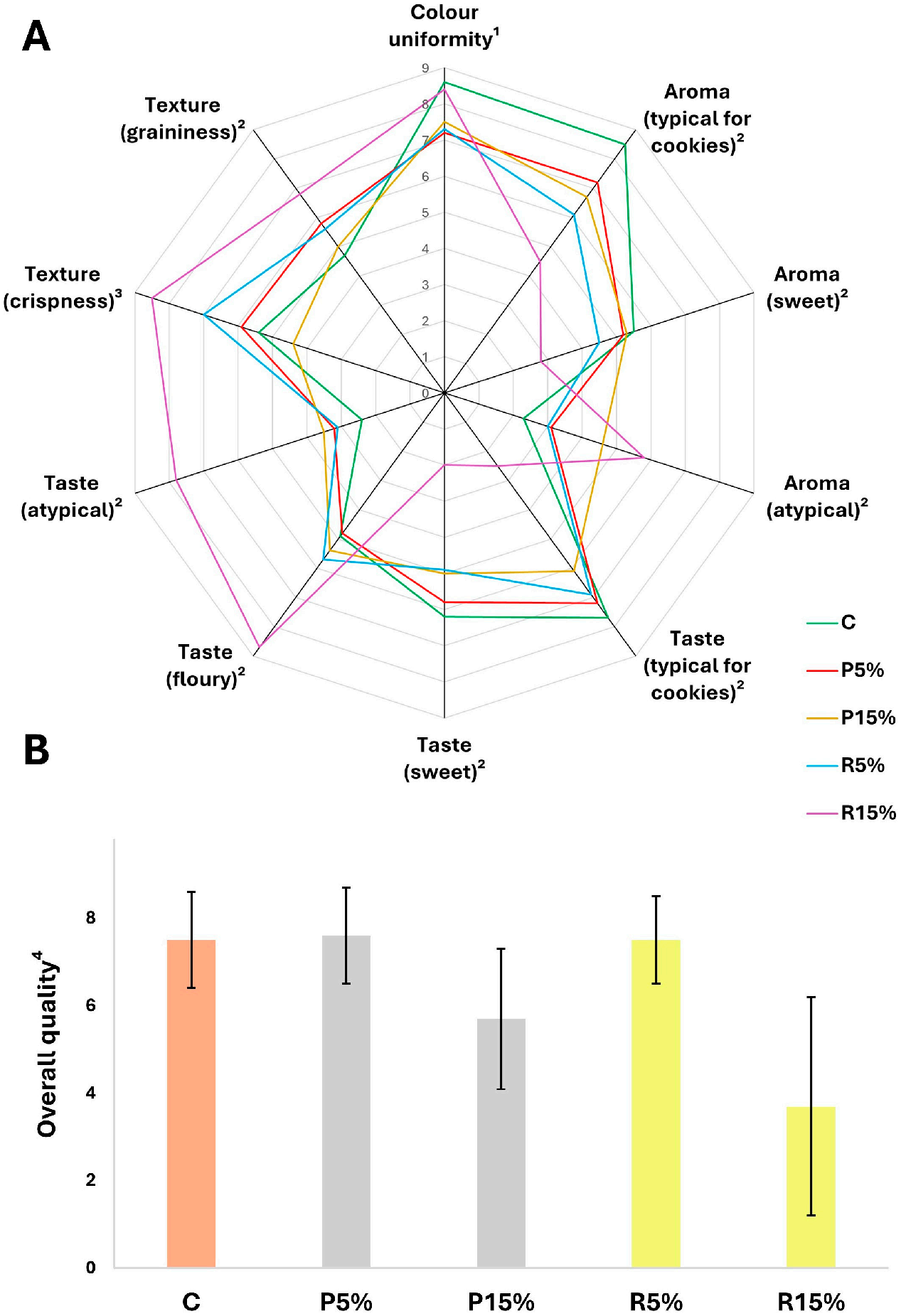
The conducted study demonstrated that the incorporation of plant-based protein preparations significantly affected the sensory attributes of vegan cookies. Statistically significant differences (
p ≤ 0.05) were observed between the control sample and protein-enriched variants for most of the evaluated sensory descriptors. The magnitude and direction of the changes depended on both the type and concentration of the added protein (
Figure 1). In terms of colour uniformity, only the formulation containing 5% pea protein differed significantly from the control sample (
p < 0.05), which is consistent with the instrumental colour results indicating increased lightness for pea protein-enriched cookies. All other protein-enriched samples exhibited no statistically significant differences compared to the control cookies. These findings contrast with those reported by Juhász et al. [
4], who observed that surface uniformity was significantly compromised in green lentil biscuits enriched with various plant proteins.
The addition of protein preparations also led to a statistically significant reduction in the typical cookie aroma across all enriched samples. The R15% variant exhibited the most pronounced decline in aroma as well as significantly diminished sweet note and an intensified atypical aroma compared to the remaining formulations. This sensory response corresponds with the pronounced colour development and high browning index observed for R15% using instrumentally analysis, suggesting that intensified thermal reactions may influence aroma perception. In terms of taste, the control sample received the highest scores for typical cookie flavour. Notably, samples P5% and R5% did not differ significantly from the control sample, indicating that a moderate level of protein enrichment (5%) did not adversely affect flavour perception. In contrast, samples P15% and R15% showed statistically significant differences, with the R15% formulation receiving the lowest scores due to a more pronounced floury and atypical taste (
p < 0.05). These results align with previous findings by Sahagún and Gómez [
3], who reported significant flavour deviations in cookies enriched with 30% plant proteins, including pea protein.
Textural assessment revealed that sample R15% was rated the highest in terms of crispness and graininess (
p < 0.05). While contrasting trends have been reported in the literature [
4,
17], such discrepancies are likely to arise from differences in protein source, formulation, and processing conditions.
The sensory quality was rated highest for the control, P5%, and R5% samples, suggesting that the addition of 5% plant protein, particularly from pea, may enhance consumer acceptability. Conversely, the P15% and R15% variants received significantly lower overall scores, implying that excessive levels of pea or rice protein may negatively impact product appeal. These findings corroborate the observations of Nemś et al. [
9], who reported a decline in overall cookie evaluation with increasing concentrations of plant-based protein preparations. Overall, sensory acceptance was primarily influenced by protein concentration rather than protein source, a trend that qualitatively mirrors the instrumental texture and colour results obtained in this study.
3.7. Cluster Analysis
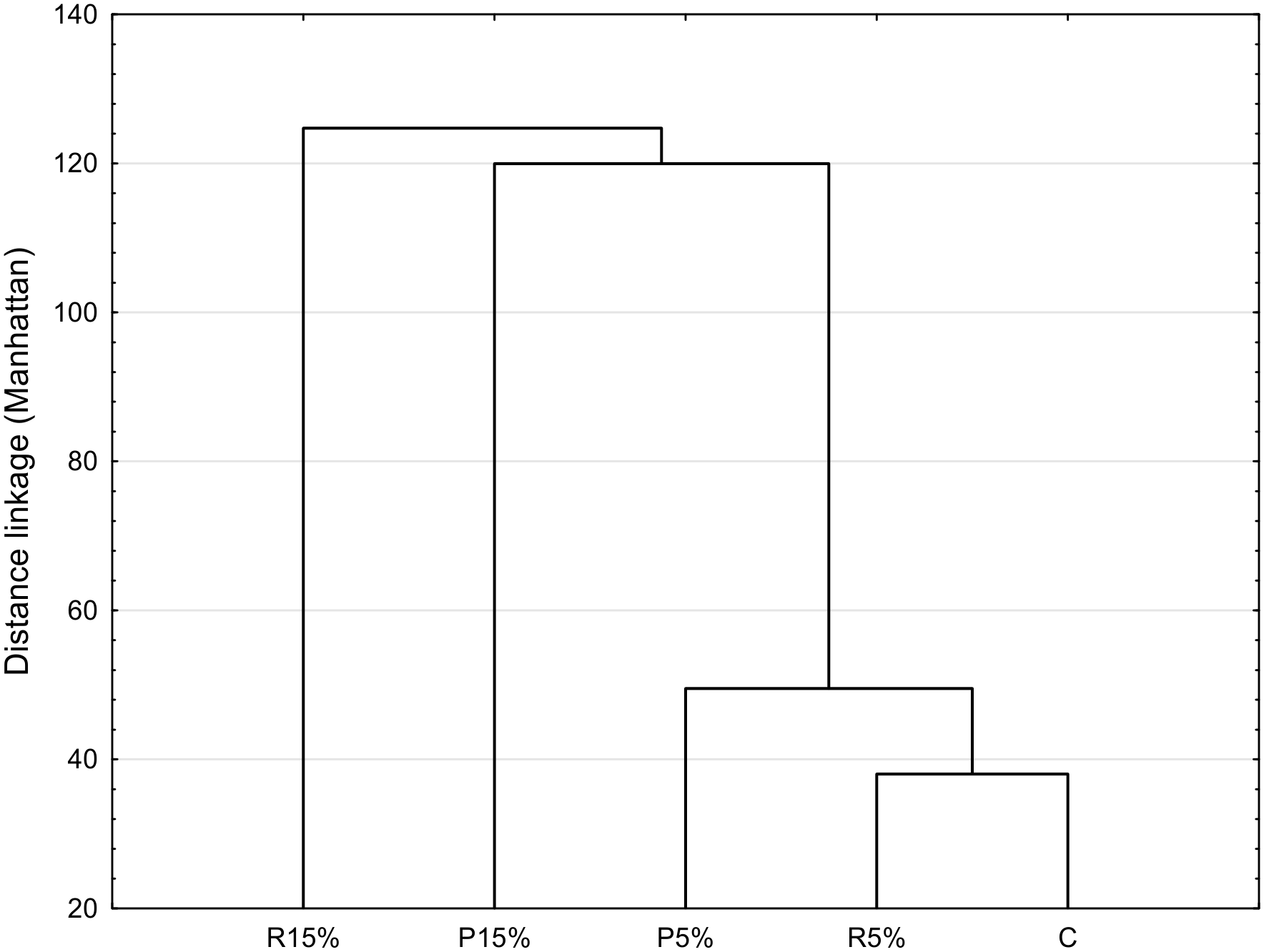
Cluster analysis revealed a clear trend in the grouping of cookie formulations according to protein type and inclusion level (
Figure 2). Control cookies clustered closely with samples enriched with 5% rice or pea protein, suggesting a high degree of similarity in terms of both instrumental and sensory attributes. In contrast, cookies containing 15% protein formed distinct clusters, reflecting more pronounced compositional and structural modifications. The P15% sample showed moderate separation from the control cluster, whereas the R15% formulation exhibited the greatest dissimilarity, consistent with its pronounced changes in colour, texture and sensory perception. These results suggest that protein concentration exerts a stronger influence on overall product differentiation than protein type, while protein type determines the direction and magnitude of these changes.
4. Conclusions
This study aimed to address the lack of comparative data on plant protein enrichment in vegan cookie formulations. It evaluated pea and rice protein isolates at two technologically relevant inclusion levels using a comparative, application-oriented approach. The results suggest that moderate protein enrichment (5%) is an effective way of improving protein content while maintaining desirable technological and sensory properties, regardless of the type of protein used. In contrast, a higher inclusion level (15%) induced pronounced structural, colour and sensory modifications, which were nutritionally advantageous in the case of pea protein but generally detrimental to overall product acceptability.
From a practical perspective, both pea and rice protein isolates are produced on an industrial scale and are widely available for use in baking. Their incorporation did not require modifications to standard cookie processing operations, suggesting that formulation costs would primarily relate to ingredient substitution rather than changes in processing infrastructure. While no formal cost or scale-up analysis was performed, the use of commercially available protein isolates suggests the technological and economic feasibility of the proposed formulations.
The findings of this study should be interpreted as comparative and exploratory rather than optimisation-driven. The experimental design aimed to evaluate the impact of protein type and inclusion level within a consistent formulation matrix; therefore, mixture design and response surface methodology were not employed. Additionally, the mechanistic interpretations proposed are based on comparative trends and literature data. Future studies incorporating multivariate experimental designs, advanced instrumental techniques, and storage and shelf-life evaluation would further strengthen mechanistic understanding and support broader technological and industrial extrapolation of protein-enriched vegan cookie formulations.