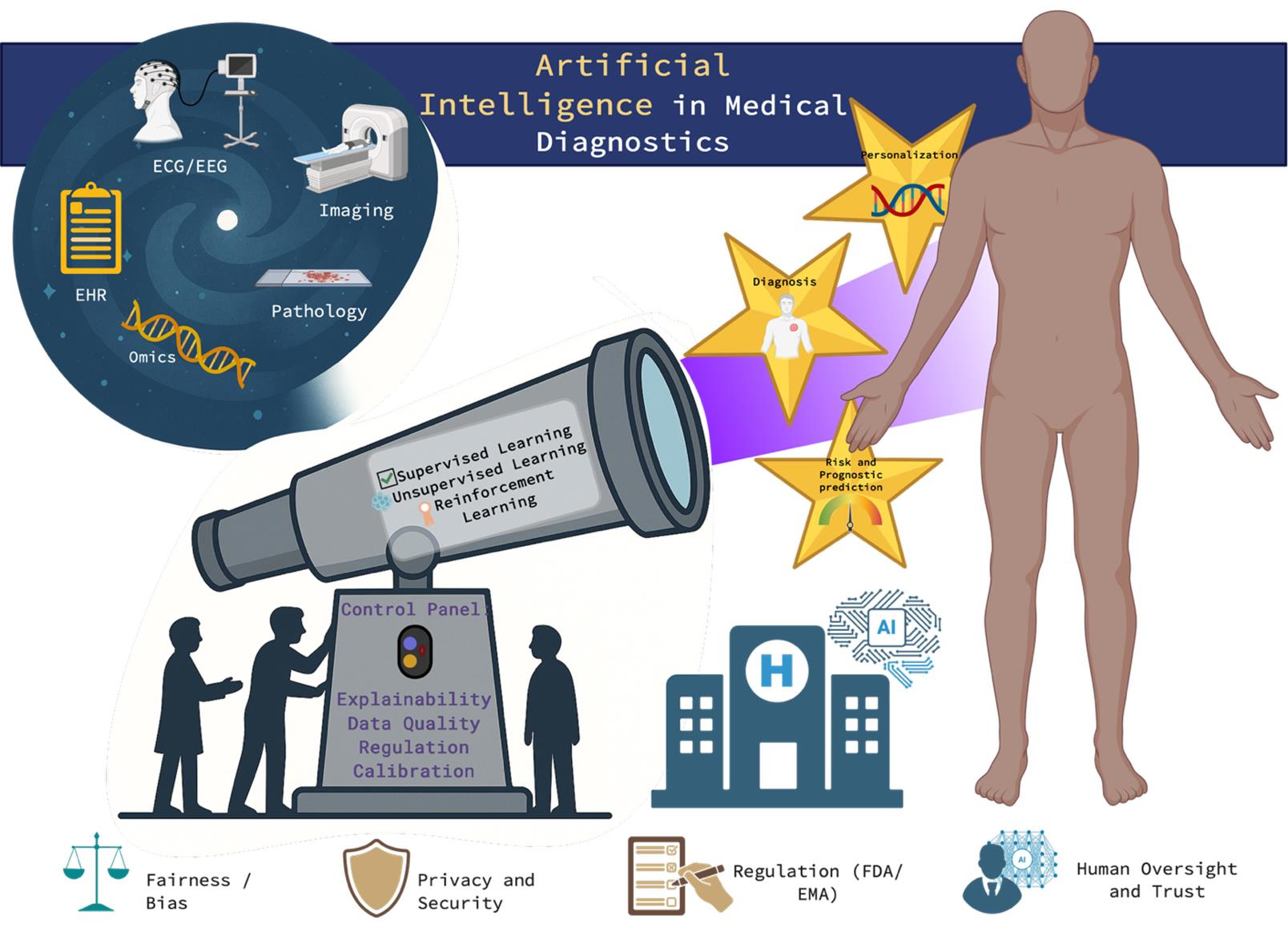
Artificial Intelligence in Medical Diagnostics: Foundations, Clinical Applications, and Future Directions




Abstract
1. Introduction
2. Theoretical and Computational Foundations
2.1. Overview of Main Learning Paradigms
2.2. Model Reliability, Interpretability, and Data Foundations in AI Diagnostics
3. AI Application Across Diagnostic Procedures
3.1. Imaging Diagnostics
3.2. Molecular and Omics Diagnostics
3.3. Physiological and Clinical Data
3.4. AI-Driven Predictive and Prognostic Modeling
4. Predictive Analytics and Clinical Decision-Support Systems
4.1. Predictive Analysis
4.2. Personalized Medicine
4.3. Decision-Support Systems in EHR Procedures
4.4. Validation, Regulation, and Real-World Performance
4.5. Case Studies
5. Innovation and Implementation Challenges
5.1. Data Integrity, Fairness, and Oversight in Medical AI Systems
5.2. Challenges in System Integration, Model Reliability, and Clinician Trust

| Type of Failure | Source of Issue | Observable Manifestation | Clinical Severity | Detectability | Example Scenario | Mitigation Strategy |
|---|---|---|---|---|---|---|
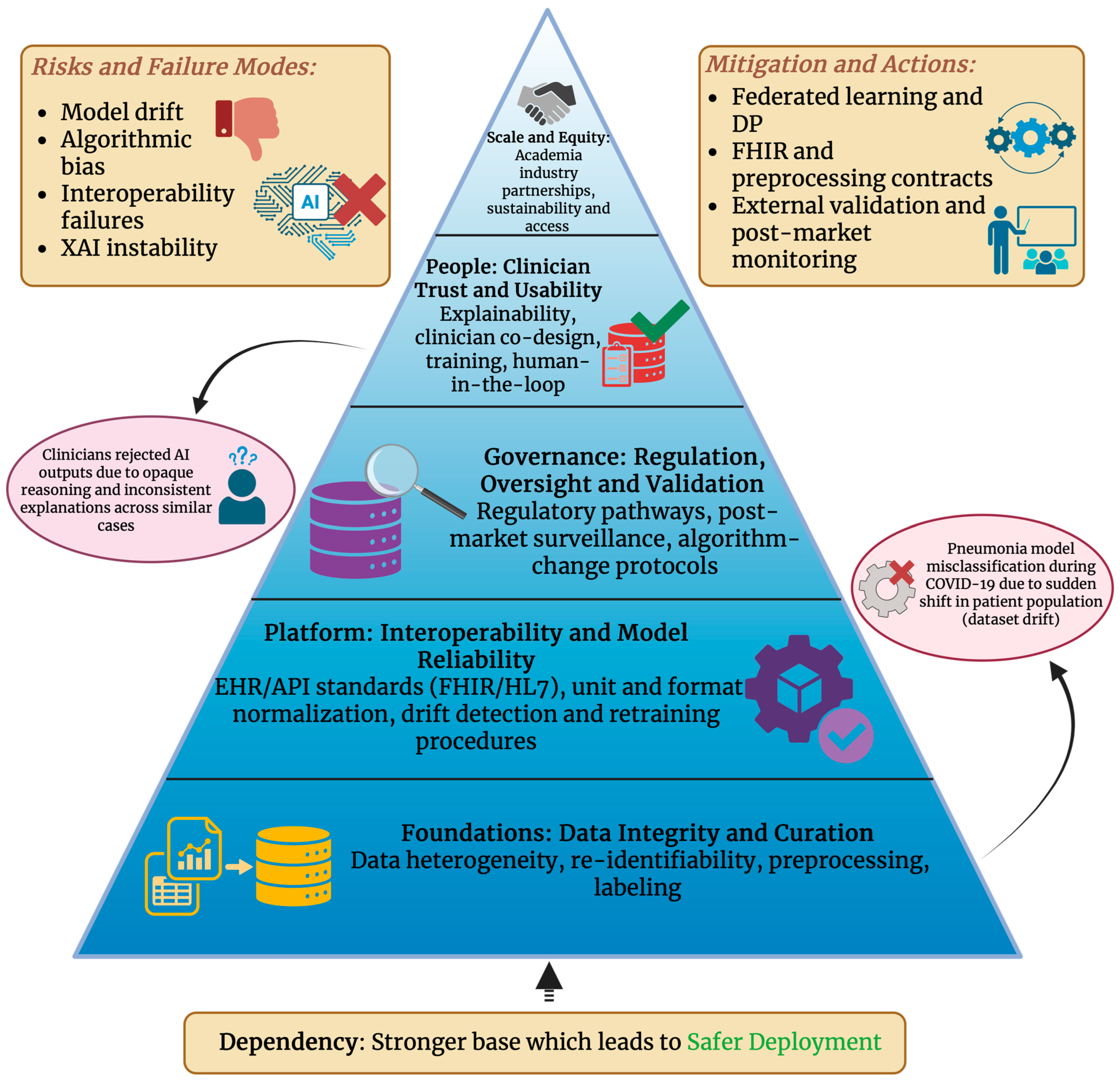
| Model drift [138,139] | Shift in population, new devices, new diseases | Decreased level of accuracy, uncalibrated outputs | High | Moderate | COVID-19 disrupting pneumonia models | Continuous monitoring, periodic retraining |
| Data source errors [140] | Incorrect preprocessing, missing values, HER mapping errors | Silent model failure, unintelligible predictions | Critical | Difficult | Lab units mismatching (mg/dL vs. mmol/L) | Standardized preprocessing, unit normalization |
| Algorithmic bias [141] | Imbalanced datasets, biased annotation | Worse outcomes for subgroups | High | Moderate | Lower melanoma detection in darker skin types | Subgroup performance auditing, re-sampling |
| Adversarial vulnerability [142] | Input perturbations, image compression | Misclassification under subtle changes | Medium | Difficult | Slight noise altering CT diagnosis | Rigorous training, adversarial defenses |
| Explanation failures (XAI) [143] | Unstable saliency maps | Inconsistent heatmaps result in the loss of clinician trust | Medium | Easy | Two nearly identical images that produce different saliency | Ensemble explanation, smoothening techniques |
| Interoperability Failures [144] | Non-FHIR EHR formats, missing API support | Clinically unable to deploy | Critical | Easy | CDSS not compatible with existing hospital information systems (HIS) | FHIR adoption, Health Level Seven (HL7) compliance |
| Human-AI misalignment [145] | Over-trust or Under-trust | Automation bias or alert fatigue | High | Moderate | Clinicians overriding or deferring without evaluating | Adequate clinician training, UI co-design, uncertainty estimates |
5.3. Academia, Industry, and Healthcare Involvement
6. Perspectives, Limitations, and Future Outlook
6.1. Trends in Secure and Multimodal Medical AI
6.2. Generative AI, Low-Resource Diagnostics and Robotic Integration
6.3. Perspectives and Drawbacks of Current Study
7. Conclusions
Author Contributions
Funding
Institutional Review Board Statement
Informed Consent Statement
Data Availability Statement
Conflicts of Interest
References
- Bajwa, J.; Munir, U.; Nori, A.; Williams, B. Artificial intelligence in healthcare: Transforming the practice of medicine. Future Healthc. J. 2021, 8, e188–e194. [Google Scholar] [CrossRef] [PubMed] [PubMed Central]
- Habehh, H.; Gohel, S. Machine Learning in Healthcare. Curr. Genom. 2021, 22, 291–300. [Google Scholar] [CrossRef] [PubMed] [PubMed Central]
- Shortliffe, E.H. Mycin: A Knowledge-Based Computer Program Applied to Infectious Diseases. In Proceedings of the Annual Symposium on Computer Application in Medical Care, Las Vegas, NV, USA, 5 October 1977; pp. 66–69. [Google Scholar] [PubMed Central]
- Perry, C.A. Knowledge bases in medicine: A review. Bull. Med. Libr. Assoc. 1990, 78, 271–282. [Google Scholar] [PubMed] [PubMed Central]
- Castellino, R.A. Computer aided detection (CAD): An overview. Cancer Imaging 2005, 5, 17–19. [Google Scholar] [CrossRef] [PubMed] [PubMed Central]
- Orrù, G.; Pettersson-Yeo, W.; Marquand, A.F.; Sartori, G.; Mechelli, A. Using Support Vector Machine to identify imaging biomarkers of neurological and psychiatric disease: A critical review. Neurosci. Biobehav. Rev. 2012, 36, 1140–1152. [Google Scholar] [CrossRef] [PubMed]
- Esteva, A.; Kuprel, B.; Novoa, R.A.; Ko, J.; Swetter, S.M.; Blau, H.M.; Thrun, S. Dermatologist-level classification of skin cancer with deep neural networks. Nature 2017, 542, 115–118, Erratum in Nature 2017, 546, 686. https://doi.org/10.1038/nature22985. [Google Scholar] [CrossRef] [PubMed] [PubMed Central]
- Zhou, S.K.; Greenspan, H.; Davatzikos, C.; Duncan, J.S.; van Ginneken, B.; Madabhushi, A.; Prince, J.L.; Rueckert, D.; Summers, R.M. A review of deep learning in medical imaging: Imaging traits, technology trends, case studies with progress highlights, and future promises. Proc. IEEE Inst. Electr. Electron. Eng. 2021, 109, 820–838. [Google Scholar] [CrossRef] [PubMed] [PubMed Central]
- Cross, J.L.; Choma, M.A.; Onofrey, J.A. Bias in medical AI: Implications for clinical decision-making. PLoS Digit. Health 2024, 3, e0000651. [Google Scholar] [CrossRef] [PubMed] [PubMed Central]
- Han, R.; Acosta, J.N.; Shakeri, Z.; Ioannidis, J.P.A.; Topol, E.J.; Rajpurkar, P. Randomised controlled trials evaluating artificial intelligence in clinical practice: A scoping review. Lancet Digit. Health 2024, 6, e367–e373. [Google Scholar] [CrossRef] [PubMed] [PubMed Central]
- Ahmed, M.I.; Spooner, B.; Isherwood, J.; Lane, M.; Orrock, E.; Dennison, A. A Systematic Review of the Barriers to the Implementation of Artificial Intelligence in Healthcare. Cureus 2023, 15, e46454. [Google Scholar] [CrossRef] [PubMed] [PubMed Central]
- Park, S.H.; Choi, J.I.; Fournier, L.; Vasey, B. Randomized Clinical Trials of Artificial Intelligence in Medicine: Why, When, and How? Korean J. Radiol. 2022, 23, 1119–1125. [Google Scholar] [CrossRef] [PubMed] [PubMed Central]
- Aggarwal, R.; Sounderajah, V.; Martin, G.; Ting, D.S.W.; Karthikesalingam, A.; King, D.; Ashrafian, H.; Darzi, A. Diagnostic accuracy of deep learning in medical imaging: A systematic review and meta-analysis. NPJ Digit. Med. 2021, 4, 65. [Google Scholar] [CrossRef] [PubMed] [PubMed Central]
- Beam, A.L.; Kohane, I.S. Big Data and Machine Learning in Health Care. JAMA 2018, 319, 1317–1318. [Google Scholar] [CrossRef] [PubMed]
- Roy, S.; Meena, T.; Lim, S.J. Demystifying Supervised Learning in Healthcare 4.0: A New Reality of Transforming Diagnostic Medicine. Diagnostics 2022, 12, 2549. [Google Scholar] [CrossRef] [PubMed] [PubMed Central]
- Rajpurkar, P.; Irvin, J.; Ball, R.L.; Zhu, K.; Yang, B.; Mehta, H.; Duan, T.; Ding, D.; Bagul, A.; Langlotz, C.P.; et al. Deep learning for chest radiograph diagnosis: A retrospective comparison of the CheXNeXt algorithm to practicing radiologists. PLoS Med. 2018, 15, e1002686. [Google Scholar] [CrossRef] [PubMed] [PubMed Central]
- Litjens, G.; Kooi, T.; Bejnordi, B.E.; Setio, A.A.A.; Ciompi, F.; Ghafoorian, M.; van der Laak, J.A.W.M.; van Ginneken, B.; Sánchez, C.I. A survey on deep learning in medical image analysis. Med. Image Anal. 2017, 42, 60–88. [Google Scholar] [CrossRef] [PubMed]
- Lundervold, A.S.; Lundervold, A. An overview of deep learning in medical imaging focusing on MRI. Z. Med. Phys. 2019, 29, 102–127. [Google Scholar] [CrossRef] [PubMed]
- Kelly, C.J.; Karthikesalingam, A.; Suleyman, M.; Corrado, G.; King, D. Key challenges for delivering clinical impact with artificial intelligence. BMC Med. 2019, 17, 195. [Google Scholar] [CrossRef] [PubMed] [PubMed Central]
- Bian, Y.; Li, J.; Ye, C.; Jia, X.; Yang, Q. Artificial intelligence in medical imaging: From task-specific models to large-scale foundation models. Chin. Med. J. 2025, 138, 651–663. [Google Scholar] [CrossRef] [PubMed] [PubMed Central]
- Najjar, R. Redefining Radiology: A Review of Artificial Intelligence Integration in Medical Imaging. Diagnostics 2023, 13, 2760. [Google Scholar] [CrossRef] [PubMed] [PubMed Central]
- Campanella, G.; Hanna, M.G.; Geneslaw, L.; Miraflor, A.; Werneck Krauss Silva, V.; Busam, K.J.; Brogi, E.; Reuter, V.E.; Klimstra, D.S.; Fuchs, T.J. Clinical-grade computational pathology using weakly supervised deep learning on whole slide images. Nat. Med. 2019, 25, 1301–1309. [Google Scholar] [CrossRef] [PubMed] [PubMed Central]
- Shafi, S.; Parwani, A.V. Artificial intelligence in diagnostic pathology. Diagn. Pathol. 2023, 18, 109. [Google Scholar] [CrossRef] [PubMed] [PubMed Central]
- McGenity, C.; Clarke, E.L.; Jennings, C.; Matthews, G.; Cartlidge, C.; Freduah-Agyemang, H.; Stocken, D.D.; Treanor, D. Artificial intelligence in digital pathology: A systematic review and meta-analysis of diagnostic test accuracy. NPJ Digit. Med. 2024, 7, 114. [Google Scholar] [CrossRef] [PubMed] [PubMed Central]
- Dolezal, J.M.; Kochanny, S.; Dyer, E.; Ramesh, S.; Srisuwananukorn, A.; Sacco, M.; Howard, F.M.; Li, A.; Mohan, P.; Pearson, A.T. Slideflow: Deep learning for digital histopathology with real-time whole-slide visualization. BMC Bioinform. 2024, 25, 134. [Google Scholar] [CrossRef] [PubMed] [PubMed Central]
- Shen, Y.T.; Chen, L.; Yue, W.W.; Xu, H.X. Artificial intelligence in ultrasound. Eur. J. Radiol. 2021, 139, 109717. [Google Scholar] [CrossRef] [PubMed]
- Meng, Q.; Sinclair, M.; Zimmer, V.; Hou, B.; Rajchl, M.; Toussaint, N.; Oktay, O.; Schlemper, J.; Gomez, A.; Housden, J.; et al. Weakly Supervised Estimation of Shadow Confidence Maps in Fetal Ultrasound Imaging. IEEE Trans. Med. Imaging 2019, 38, 2755–2767. [Google Scholar] [CrossRef] [PubMed] [PubMed Central]
- Parmar, U.P.S.; Surico, P.L.; Singh, R.B.; Romano, F.; Salati, C.; Spadea, L.; Musa, M.; Gagliano, C.; Mori, T.; Zeppieri, M. Artificial Intelligence (AI) for Early Diagnosis of Retinal Diseases. Medicina 2024, 60, 527. [Google Scholar] [CrossRef] [PubMed] [PubMed Central]
- Driban, M.; Yan, A.; Selvam, A.; Ong, J.; Vupparaboina, K.K.; Chhablani, J. Artificial intelligence in chorioretinal pathology through fundoscopy: A comprehensive review. Int. J. Retin. Vitr. 2024, 10, 36. [Google Scholar] [CrossRef] [PubMed] [PubMed Central]
- De Fauw, J.; Ledsam, J.R.; Romera-Paredes, B.; Nikolov, S.; Tomasev, N.; Blackwell, S.; Askham, H.; Glorot, X.; O’Donoghue, B.; Visentin, D.; et al. Clinically applicable deep learning for diagnosis and referral in retinal disease. Nat. Med. 2018, 24, 1342–1350. [Google Scholar] [CrossRef] [PubMed]
- Hannun, A.Y.; Rajpurkar, P.; Haghpanahi, M.; Tison, G.H.; Bourn, C.; Turakhia, M.P.; Ng, A.Y. Cardiologist-level arrhythmia detection and classification in ambulatory electrocardiograms using a deep neural network. Nat. Med. 2019, 25, 65–69, Erratum in Nat. Med. 2019, 25, 530. https://doi.org/10.1038/s41591-019-0359-9. [Google Scholar] [CrossRef] [PubMed] [PubMed Central]
- Meng, L.; Tan, W.; Ma, J.; Wang, R.; Yin, X.; Zhang, Y. Enhancing dynamic ECG heartbeat classification with lightweight transformer model. Artif. Intell. Med. 2022, 124, 102236. [Google Scholar] [CrossRef] [PubMed]
- Jaya Prakash, A.; Nasreddine Belkacem, A.; Elfadel, I.M.; Jelinek, H.F.; Atef, M. Advances in machine and deep learning for ECG beat classification: A systematic review. Front. Digit. Health 2025, 7, 1649923. [Google Scholar] [CrossRef] [PubMed] [PubMed Central]
- Ribeiro, A.H.; Ribeiro, M.H.; Paixão, G.M.M.; Oliveira, D.M.; Gomes, P.R.; Canazart, J.A.; Ferreira, M.P.S.; Andersson, C.R.; Macfarlane, P.W.; Meira, W., Jr.; et al. Automatic diagnosis of the 12-lead ECG using a deep neural network. Nat. Commun. 2020, 11, 1760, Erratum in Nat. Commun. 2020, 11, 2227. https://doi.org/10.1038/s41467-020-16172-1. [Google Scholar] [CrossRef] [PubMed] [PubMed Central]
- Acharya, U.R.; Hagiwara, Y.; Adeli, H. Automated seizure prediction. Epilepsy Behav. 2018, 88, 251–261. [Google Scholar] [CrossRef] [PubMed]
- Roy, Y.; Banville, H.; Albuquerque, I.; Gramfort, A.; Falk, T.H.; Faubert, J. Deep learning-based electroencephalography analysis: A systematic review. J. Neural Eng. 2019, 16, 051001. [Google Scholar] [CrossRef] [PubMed]
- Hussein, S.; Cao, K.; Song, Q.; Bagci, U. Risk stratification of lung nodules using 3D CNN-based multi-task learning. In Information Processing in Medical Imaging. IPMI 2017, Boone, NC, USA, 25–30 June 2017; Springer: New York, NY, USA, 2017. [Google Scholar]
- Choi, E.; Bahadori, M.T.; Schuetz, A.; Stewart, W.F.; Sun, J. Doctor AI: Predicting Clinical Events via Recurrent Neural Networks. JMLR Workshop Conf. Proc. 2016, 56, 301–318. [Google Scholar] [PubMed] [PubMed Central]
- Devlin, J.; Chang, M.-W.; Lee, K.; Toutanova, K. BERT: Pre-training of Deep Bidirectional Transformers for Language Understanding. In Proceedings of the 2019 Conference of the North American Chapter of the Association for Computational Linguistics (NAACL-HLT), Minneapolis, MN, USA, 2–7 June 2019. [Google Scholar] [CrossRef]
- Alsentzer, E.; Murphy, J.R.; Boag, W.; Weng, W.-H.; Jin, D.; Naumann, T.; McDermott, M. Publicly Available Clinical BERT Embeddings. In Proceedings of the 2nd Clinical Natural Language Processing Workshop (ClinicalNLP), NAACL-HLT, Minneapolis, MN, USA, 7 June 2019. [Google Scholar] [CrossRef]
- Acharya, A.; Shrestha, S.; Chen, A.; Conte, J.; Avramovic, S.; Sikdar, S.; Anastasopoulos, A.; Das, S. Clinical risk prediction using language models: Benefits and considerations. J. Am. Med. Inform. Assoc. 2024, 31, 1856–1864. [Google Scholar] [CrossRef] [PubMed] [PubMed Central]
- Johnson, A.E.; Pollard, T.J.; Shen, L.; Lehman, L.W.; Feng, M.; Ghassemi, M.; Moody, B.; Szolovits, P.; Celi, L.A.; Mark, R.G. MIMIC-III, a freely accessible critical care database. Sci. Data 2016, 3, 160035. [Google Scholar] [CrossRef] [PubMed] [PubMed Central]
- Moody, G.B.; Mark, R.G.; Goldberger, A.L. PhysioNet: Physiologic signals, time series and related open source software for basic, clinical, and applied research. Annu. Int. Conf. IEEE Eng. Med. Biol. Soc. 2011, 2011, 8327–8330. [Google Scholar] [CrossRef] [PubMed]
- Mao, Q.; Jay, M.; Hoffman, J.L.; Calvert, J.; Barton, C.; Shimabukuro, D.; Shieh, L.; Chettipally, U.; Fletcher, G.; Kerem, Y.; et al. Multicentre validation of a sepsis prediction algorithm using only vital sign data in the emergency department, general ward and ICU. BMJ Open 2018, 8, e017833. [Google Scholar] [CrossRef] [PubMed] [PubMed Central]
- Kwon, J.M.; Lee, Y.; Lee, Y.; Lee, S.; Park, J. An Algorithm Based on Deep Learning for Predicting In-Hospital Cardiac Arrest. J. Am. Heart Assoc. 2018, 7, e008678. [Google Scholar] [CrossRef] [PubMed] [PubMed Central]
- Athanasopoulou, K.; Michalopoulou, V.I.; Scorilas, A.; Adamopoulos, P.G. Integrating Artificial Intelligence in Next-Generation Sequencing: Advances, Challenges, and Future Directions. Curr. Issues Mol. Biol. 2025, 47, 470. [Google Scholar] [CrossRef] [PubMed] [PubMed Central]
- Baião, A.R.; Cai, Z.; Poulos, R.C.; Robinson, P.J.; Reddel, R.R.; Zhong, Q.; Vinga, S.; Gonçalves, E. A technical review of multi-omics data integration methods: From classical statistical to deep generative approaches. Brief. Bioinform. 2025, 26, bbaf355. [Google Scholar] [CrossRef] [PubMed] [PubMed Central]
- Mann, M.; Kumar, C.; Zeng, W.F.; Strauss, M.T. Artificial intelligence for proteomics and biomarker discovery. Cell Syst. 2021, 12, 759–770. [Google Scholar] [CrossRef] [PubMed]
- Kitaoka, Y.; Uchihashi, T.; Kawata, S.; Nishiura, A.; Yamamoto, T.; Hiraoka, S.-i.; Yokota, Y.; Isomura, E.T.; Kogo, M.; Tanaka, S.; et al. Role and Potential of Artificial Intelligence in Biomarker Discovery and Development of Treatment Strategies for Amyotrophic Lateral Sclerosis. Int. J. Mol. Sci. 2025, 26, 4346. [Google Scholar] [CrossRef] [PubMed]
- Chi, J.; Shu, J.; Li, M.; Mudappathi, R.; Jin, Y.; Lewis, F.; Boon, A.; Qin, X.; Liu, L.; Gu, H. Artificial Intelligence in Metabolomics: A Current Review. Trends Anal. Chem. 2024, 178, 117852. [Google Scholar] [CrossRef] [PubMed] [PubMed Central]
- Gloaguen, Y.; Kirwan, J.A.; Beule, D. Deep Learning-Assisted Peak Curation for Large-Scale LC-MS Metabolomics. Anal. Chem. 2022, 94, 4930–4937. [Google Scholar] [CrossRef] [PubMed] [PubMed Central]
- Acharya, D.; Mukhopadhyay, A. A comprehensive review of machine learning techniques for multi-omics data integration: Challenges and applications in precision oncology. Brief. Funct. Genom. 2024, 23, 549–560. [Google Scholar] [CrossRef] [PubMed]
- Lin, M.; Guo, J.; Gu, Z.; Tang, W.; Tao, H.; You, S.; Jia, D.; Sun, Y.; Jia, P. Machine learning and multi-omics integration: Advancing cardiovascular translational research and clinical practice. J. Transl. Med. 2025, 23, 388. [Google Scholar] [CrossRef] [PubMed] [PubMed Central]
- Parmar, C.; Grossmann, P.; Rietveld, D.; Rietbergen, M.M.; Lambin, P.; Aerts, H.J. Radiomic Machine-Learning Classifiers for Prognostic Biomarkers of Head and Neck Cancer. Front. Oncol. 2015, 5, 272. [Google Scholar] [CrossRef] [PubMed] [PubMed Central]
- Wu, W.; Parmar, C.; Grossmann, P.; Quackenbush, J.; Lambin, P.; Bussink, J.; Mak, R.; Aerts, H.J. Exploratory Study to Identify Radiomics Classifiers for Lung Cancer Histology. Front. Oncol. 2016, 6, 71. [Google Scholar] [CrossRef] [PubMed] [PubMed Central]
- Alkhanbouli, R.; Matar Abdulla Almadhaani, H.; Alhosani, F.; Simsekler, M.C.E. The role of explainable artificial intelligence in disease prediction: A systematic literature review and future research directions. BMC Med. Inform. Decis. Mak. 2025, 25, 110. [Google Scholar] [CrossRef] [PubMed] [PubMed Central]
- Fuhrman, J.D.; Gorre, N.; Hu, Q.; Li, H.; El Naqa, I.; Giger, M.L. A review of explainable and interpretable AI with applications in COVID-19 imaging. Med. Phys. 2022, 49, 1–14. [Google Scholar] [CrossRef] [PubMed] [PubMed Central]
- Saarela, M.; Podgorelec, V. Recent Applications of Explainable AI (XAI): A Systematic Literature Review. Appl. Sci. 2024, 14, 8884. [Google Scholar] [CrossRef]
- Salimparsa, M.; Sedig, K.; Lizotte, D.J.; Abdullah, S.S.; Chalabianloo, N.; Muanda, F.T. Explainable AI for Clinical Decision Support Systems: Literature Review, Key Gaps, and Research Synthesis. Informatics 2025, 12, 119. [Google Scholar] [CrossRef]
- Solomon, J.; Dauber-Decker, K.; Richardson, S.; Levy, S.; Khan, S.; Coleman, B.; Persaud, R.; Chelico, J.; King, D.; Spyropoulos, A.; et al. Integrating Clinical Decision Support Into Electronic Health Record Systems Using a Novel Platform (EvidencePoint): Developmental Study. JMIR Form. Res. 2023, 7, e44065. [Google Scholar] [CrossRef] [PubMed] [PubMed Central]
- Patterson, B.W.; Pulia, M.S.; Ravi, S.; Hoonakker, P.L.T.; Schoofs Hundt, A.; Wiegmann, D.; Wirkus, E.J.; Johnson, S.; Carayon, P. Scope and Influence of Electronic Health Record-Integrated Clinical Decision Support in the Emergency Department: A Systematic Review. Ann. Emerg. Med. 2019, 74, 285–296. [Google Scholar] [CrossRef] [PubMed] [PubMed Central]
- Weissman, G.E. FDA Regulation of Predictive Clinical Decision-Support Tools: What Does It Mean for Hospitals? J. Hosp. Med. 2021, 16, 244–246. [Google Scholar] [CrossRef] [PubMed] [PubMed Central]
- Karnik, K. FDA regulation of clinical decision support software. J. Law Biosci. 2014, 1, 202–208. [Google Scholar] [CrossRef] [PubMed] [PubMed Central]
- Ueda, D.; Kakinuma, T.; Fujita, S.; Kamagata, K.; Fushimi, Y.; Ito, R.; Matsui, Y.; Nozaki, T.; Nakaura, T.; Fujima, N.; et al. Fairness of artificial intelligence in healthcare: Review and recommendations. Jpn. J. Radiol. 2024, 42, 3–15. [Google Scholar] [CrossRef] [PubMed] [PubMed Central]
- Nasir, M.; Siddiqui, K.; Ahmed, S. Ethical-legal implications of AI-powered healthcare in critical perspective. Front. Artif. Intell. 2025, 8, 1619463. [Google Scholar] [CrossRef] [PubMed] [PubMed Central]
- Park, M.K.; Ashwood, N.; Capes, N. Ethics of Artificial Intelligence in Medicine. Cureus 2025, 17, e83567. [Google Scholar] [CrossRef] [PubMed] [PubMed Central]
- McKinney, S.M.; Sieniek, M.; Godbole, V.; Godwin, J.; Antropova, N.; Ashrafian, H.; Back, T.; Chesus, M.; Corrado, G.S.; Darzi, A.; et al. International evaluation of an AI system for breast cancer screening. Nature 2020, 577, 89–94, Erratum in Nature 2020, 586, E19. https://doi.org/10.1038/s41586-020-2679-9. [Google Scholar] [CrossRef] [PubMed]
- Attia, Z.I.; Noseworthy, P.A.; Lopez-Jimenez, F.; Asirvatham, S.J.; Deshmukh, A.J.; Gersh, B.J.; Carter, R.E.; Yao, X.; Rabinstein, A.A.; Erickson, B.J.; et al. An artificial intelligence-enabled ECG algorithm for the identification of patients with atrial fibrillation during sinus rhythm: A retrospective analysis of outcome prediction. Lancet 2019, 394, 861–867. [Google Scholar] [CrossRef] [PubMed]
- Neijzen, D.; Lunter, G. Unsupervised learning for medical data: A review of probabilistic factorization methods. Stat. Med. 2023, 42, 5541–5554. [Google Scholar] [CrossRef] [PubMed]
- Raza, K.; Singh, N.K. A Tour of Unsupervised Deep Learning for Medical Image Analysis. Curr. Med. Imaging Rev. 2021, 17, 1059–1077. [Google Scholar] [CrossRef] [PubMed]
- Hu, M.; Zhang, J.; Matkovic, L.; Liu, T.; Yang, X. Reinforcement learning in medical image analysis: Concepts, applications, challenges, and future directions. J. Appl. Clin. Med. Phys. 2023, 24, e13898. [Google Scholar] [CrossRef] [PubMed] [PubMed Central]
- Ching, T.; Himmelstein, D.S.; Beaulieu-Jones, B.K.; Kalinin, A.A.; Do, B.T.; Way, G.P.; Ferrero, E.; Agapow, P.M.; Zietz, M.; Hoffman, M.M.; et al. Opportunities and obstacles for deep learning in biology and medicine. J. R. Soc. Interface 2018, 15, 20170387. [Google Scholar] [CrossRef] [PubMed] [PubMed Central]
- Topol, E.J. High-performance medicine: The convergence of human and artificial intelligence. Nat. Med. 2019, 25, 44–56. [Google Scholar] [CrossRef] [PubMed]
- Delord, M.; Sun, X.; Learoyd, A.; Curcin, V.; Wolfe, C.; Ashworth, M.; Douiri, A. Patient-oriented unsupervised learning to uncover the patterns of multimorbidity associated with stroke using primary care electronic health records. BMC Prim. Care 2024, 25, 419. [Google Scholar] [CrossRef] [PubMed] [PubMed Central]
- Mehari, T.; Strodthoff, N. Self-supervised representation learning from 12-lead ECG data. Comput. Biol. Med. 2022, 141, 105114. [Google Scholar] [CrossRef] [PubMed]
- Fenwick, D.; NaderiAlizadeh, N.; Tarokh, V.; Clark, D.; Rajagopal, J.; Kapadia, A.; Felice, N.; Samei, E.; Abadi, E. Black-box Optimization of CT Acquisition and Reconstruction Parameters: A Reinforcement Learning Approach. Proc. SPIE Int. Soc. Opt. Eng. 2025, 13405, 1340528. [Google Scholar] [CrossRef] [PubMed] [PubMed Central]
- Hirte, A.U.; Platscher, M.; Joyce, T.; Heit, J.J.; Tranvinh, E.; Federau, C. Realistic generation of diffusion-weighted magnetic resonance brain images with deep generative models. Magn. Reson. Imaging 2021, 81, 60–66. [Google Scholar] [CrossRef] [PubMed]
- Ronneberger, O.; Fischer, P.; Brox, T. U-Net: Convolutional Networks for Biomedical Image Segmentation. In Medical Image Computing and Computer-Assisted Intervention—MICCAI 2015; Navab, N., Hornegger, J., Wells, W., Frangi, A., Eds.; Lecture Notes in Computer Science; Springer: Cham, Switzerland, 2015; Volume 9351. [Google Scholar] [CrossRef]
- Isensee, F.; Jaeger, P.F.; Kohl, S.A.A.; Petersen, J.; Maier-Hein, K.H. nnU-Net: A self-configuring method for deep learning-based biomedical image segmentation. Nat. Methods 2021, 18, 203–211. [Google Scholar] [CrossRef] [PubMed]
- Chen, J.; Lu, Y.; Yu, Q.; Luo, X.; Adeli, E.; Wang, Y.; Lu, L.; Yuille, A.L.; Zhou, Y. TransUNet: Transformers Make Strong Encoders for Medical Image Segmentation. arXiv 2021, arXiv:2102.04306. [Google Scholar] [CrossRef]
- Li, Y.; Song, S.; Zhu, L.; Zhang, X.; Mou, Y.; Lei, M.; Wang, W.; Tao, Z. Machine learning-based prediction model for patients with recurrent Staphylococcus aureus bacteremia. BMC Med. Inform. Decis. Mak. 2025, 25, 99. [Google Scholar] [CrossRef] [PubMed] [PubMed Central]
- Urundai Meeran, S.B. Walrus Optimization-Enhanced ResNet-50 for AI-Driven Renal Malignancy Prediction with Occlusion Sensitivity-Based Interpretation. Asian Pac. J. Cancer Prev. 2025, 26, 2995–3004. [Google Scholar] [CrossRef] [PubMed]
- Neuwieser, H.; Jami, N.V.S.J.; Meier, R.J.; Liebsch, G.; Felthaus, O.; Klein, S.; Schreml, S.; Berneburg, M.; Prantl, L.; Leutheuser, H.; et al. Interpreting Venous and Arterial Ulcer Images Through the Grad-CAM Lens: Insights and Implications in CNN-Based Wound Image Classification. Diagnostics 2025, 15, 2184. [Google Scholar] [CrossRef] [PubMed] [PubMed Central]
- Ennab, M.; Mcheick, H. Enhancing interpretability and accuracy of AI models in healthcare: A comprehensive review on challenges and future directions. Front. Robot. AI 2024, 11, 1444763. [Google Scholar] [CrossRef] [PubMed] [PubMed Central]
- Chen, M.; Wang, Y.; Wang, Q.; Shi, J.; Wang, H.; Ye, Z.; Xue, P.; Qiao, Y. Impact of human and artificial intelligence collaboration on workload reduction in medical image interpretation. NPJ Digit. Med. 2024, 7, 349. [Google Scholar] [CrossRef]
- Sahiner, B.; Chen, W.; Samala, R.K.; Petrick, N. Data drift in medical machine learning: Implications and potential remedies. Br. J. Radiol. 2023, 96, 20220878. [Google Scholar] [CrossRef] [PubMed] [PubMed Central]
- Cunningham, J.W.; Singh, P.; Reeder, C.; Claggett, B.; Marti-Castellote, P.M.; Lau, E.S.; Khurshid, S.; Batra, P.; Lubitz, S.A.; Maddah, M.; et al. Natural Language Processing for Adjudication of Heart Failure Hospitalizations in a Multi-Center Clinical Trial. medRxiv 2023, 23, 23294234. [Google Scholar] [CrossRef] [PubMed] [PubMed Central]
- Teshale, A.B.; Htun, H.L.; Vered, M.; Owen, A.J.; Freak-Poli, R. A Systematic Review of Artificial Intelligence Models for Time-to-Event Outcome Applied in Cardiovascular Disease Risk Prediction. J. Med. Syst. 2024, 48, 68. [Google Scholar] [CrossRef] [PubMed] [PubMed Central]
- Tran, K.A.; Kondrashova, O.; Bradley, A.; Williams, E.D.; Pearson, J.V.; Waddell, N. Deep learning in cancer diagnosis, prognosis and treatment selection. Genome Med. 2021, 13, 152. [Google Scholar] [CrossRef] [PubMed]
- Saxena, S.; Jena, B.; Gupta, N.; Das, S.; Sarmah, D.; Bhattacharya, P.; Nath, T.; Paul, S.; Fouda, M.M.; Kalra, M.; et al. Role of Artificial Intelligence in Radiogenomics for Cancers in the Era of Precision Medicine. Cancers 2022, 14, 2860. [Google Scholar] [CrossRef] [PubMed] [PubMed Central]
- Lareyre, F.; Chaudhuri, A.; Behrendt, C.A.; Pouhin, A.; Teraa, M.; Boyle, J.R.; Tulamo, R.; Raffort, J. Artificial intelligence-based predictive models in vascular diseases. Semin. Vasc. Surg. 2023, 36, 440–447. [Google Scholar] [CrossRef] [PubMed]
- Goffart, S.; Delingette, H.; Chierici, A.; Guzzi, L.; Nasr, B.; Lareyre, F.; Raffort, J. Artificial Intelligence Techniques for Prognostic and Diagnostic Assessments in Peripheral Artery Disease: A Scoping Review. Angiology 2025. Epub ahead of printing. [Google Scholar] [CrossRef] [PubMed]
- Mehri-Kakavand, G.; Mdletshe, S.; Wang, A. A Comprehensive Review on the Application of Artificial Intelligence for Predicting Postsurgical Recurrence Risk in Early-Stage Non-Small Cell Lung Cancer Using Computed Tomography, Positron Emission Tomography, and Clinical Data. J. Med. Radiat. Sci. 2025, 72, 280–296. [Google Scholar] [CrossRef] [PubMed] [PubMed Central]
- Azadi Moghadam, P.; Bashashati, A.; Goldenberg, S.L. Artificial Intelligence and Pathomics: Prostate Cancer. Urol. Clin. N. Am. 2024, 51, 15–26. [Google Scholar] [CrossRef] [PubMed]
- Nemati, S.; Holder, A.; Razmi, F.; Stanley, M.D.; Clifford, G.D.; Buchman, T.G. An Interpretable Machine Learning Model for Accurate Prediction of Sepsis in the ICU. Crit. Care Med. 2018, 46, 547–553. [Google Scholar] [CrossRef] [PubMed] [PubMed Central]
- Desautels, T.; Calvert, J.; Hoffman, J.; Jay, M.; Kerem, Y.; Shieh, L.; Shimabukuro, D.; Chettipally, U.; Feldman, M.D.; Barton, C.; et al. Prediction of Sepsis in the Intensive Care Unit With Minimal Electronic Health Record Data: A Machine Learning Approach. JMIR Med. Inform. 2016, 4, e28. [Google Scholar] [CrossRef] [PubMed] [PubMed Central]
- Fleuren, L.M.; Klausch, T.L.T.; Zwager, C.L.; Schoonmade, L.J.; Guo, T.; Roggeveen, L.F.; Swart, E.L.; Girbes, A.R.J.; Thoral, P.; Ercole, A.; et al. Machine learning for the prediction of sepsis: A systematic review and meta-analysis of diagnostic test accuracy. Intensive Care Med. 2020, 46, 383–400. [Google Scholar] [CrossRef] [PubMed] [PubMed Central]
- Lee, Y.; Kwon, J.M.; Lee, Y.; Park, H.; Cho, H.; Park, J. Deep Learning in the Medical Domain: Predicting Cardiac Arrest Using Deep Learning. Acute Crit. Care 2018, 33, 117–120. [Google Scholar] [CrossRef] [PubMed] [PubMed Central]
- Lee, H.; Yang, H.L.; Ryu, H.G.; Jung, C.W.; Cho, Y.J.; Yoon, S.B.; Yoon, H.K.; Lee, H.C. Real-time machine learning model to predict in-hospital cardiac arrest using heart rate variability in ICU. NPJ Digit. Med. 2023, 6, 215. [Google Scholar] [CrossRef] [PubMed] [PubMed Central]
- Aerts, H.J.; Velazquez, E.R.; Leijenaar, R.T.; Parmar, C.; Grossmann, P.; Carvalho, S.; Bussink, J.; Monshouwer, R.; Haibe-Kains, B.; Rietveld, D.; et al. Decoding tumour phenotype by noninvasive imaging using a quantitative radiomics approach. Nat. Commun. 2014, 5, 4006, Erratum in Nat. Commun. 2014, 5, 4644. [Google Scholar] [CrossRef] [PubMed] [PubMed Central]
- Lambin, P.; Leijenaar, R.T.H.; Deist, T.M.; Peerlings, J.; de Jong, E.E.C.; van Timmeren, J.; Sanduleanu, S.; Larue, R.T.H.M.; Even, A.J.G.; Jochems, A.; et al. Radiomics: The bridge between medical imaging and personalized medicine. Nat. Rev. Clin. Oncol. 2017, 14, 749–762. [Google Scholar] [CrossRef] [PubMed]
- van Timmeren, J.E.; Cester, D.; Tanadini-Lang, S.; Alkadhi, H.; Baessler, B. Radiomics in medical imaging-“how-to” guide and critical reflection. Insights Imaging 2020, 11, 91. [Google Scholar] [CrossRef] [PubMed] [PubMed Central]
- Amrollahi, F.; Shashikumar, S.P.; Razmi, F.; Nemati, S. Contextual Embeddings from Clinical Notes Improves Prediction of Sepsis. AMIA Annu. Symp. Proc. 2021, 2020, 197–202. [Google Scholar] [PubMed] [PubMed Central]
- Rosnati, M.; Fortuin, V. MGP-AttTCN: An interpretable machine learning model for the prediction of sepsis. PLoS ONE 2021, 16, e0251248. [Google Scholar] [CrossRef] [PubMed] [PubMed Central]
- Ueno, R.; Xu, L.; Uegami, W.; Matsui, H.; Okui, J.; Hayashi, H.; Miyajima, T.; Hayashi, Y.; Pilcher, D.; Jones, D. Value of laboratory results in addition to vital signs in a machine learning algorithm to predict in-hospital cardiac arrest: A single-center retrospective cohort study. PLoS ONE 2020, 15, e0235835. [Google Scholar] [CrossRef] [PubMed] [PubMed Central]
- Ai, Y.; Liu, J.; Li, Y.; Wang, F.; Du, X.; Jain, R.K.; Lin, L.; Chen, Y.W. SAMA: A Self-and-Mutual Attention Network for Accurate Recurrence Prediction of Non-Small Cell Lung Cancer Using Genetic and CT Data. IEEE J. Biomed. Health Inform. 2025, 29, 3220–3233. [Google Scholar] [CrossRef] [PubMed]
- Liu, Y.; Yu, Y.; Ouyang, J.; Jiang, B.; Yang, G.; Ostmeier, S.; Wintermark, M.; Michel, P.; Liebeskind, D.S.; Lansberg, M.G.; et al. Functional Outcome Prediction in Acute Ischemic Stroke Using a Fused Imaging and Clinical Deep Learning Model. Stroke 2023, 54, 2316–2327. [Google Scholar] [CrossRef] [PubMed] [PubMed Central]
- Deng, Y.; Liu, S.; Wang, Z.; Wang, Y.; Jiang, Y.; Liu, B. Explainable time-series deep learning models for the prediction of mortality, prolonged length of stay and 30-day readmission in intensive care patients. Front. Med. 2022, 9, 933037. [Google Scholar] [CrossRef] [PubMed] [PubMed Central]
- Johnson, K.B.; Wei, W.Q.; Weeraratne, D.; Frisse, M.E.; Misulis, K.; Rhee, K.; Zhao, J.; Snowdon, J.L. Precision Medicine, AI, and the Future of Personalized Health Care. Clin. Transl. Sci. 2021, 14, 86–93. [Google Scholar] [CrossRef] [PubMed] [PubMed Central]
- Trivizakis, E.; Papadakis, G.Z.; Souglakos, I.; Papanikolaou, N.; Koumakis, L.; Spandidos, D.A.; Tsatsakis, A.; Karantanas, A.H.; Marias, K. Artificial intelligence radiogenomics for advancing precision and effectiveness in oncologic care (Review). Int. J. Oncol. 2020, 57, 43–53. [Google Scholar] [CrossRef] [PubMed] [PubMed Central]
- Sotudian, S.; Paschalidis, I.C. Machine Learning for Pharmacogenomics and Personalized Medicine: A Ranking Model for Drug Sensitivity Prediction. EEE/ACM Trans. Comput. Biol. Bioinform. 2022, 19, 2324–2333. [Google Scholar] [CrossRef] [PubMed] [PubMed Central]
- Kirienko, M.; Sollini, M.; Corbetta, M.; Voulaz, E.; Gozzi, N.; Interlenghi, M.; Gallivanone, F.; Castiglioni, I.; Asselta, R.; Duga, S.; et al. Radiomics and gene expression profile to characterise the disease and predict outcome in patients with lung cancer. Eur. J. Nucl. Med. Mol. Imaging 2021, 48, 3643–3655. [Google Scholar] [CrossRef] [PubMed] [PubMed Central]
- Binczyk, F.; Prazuch, W.; Bozek, P.; Polanska, J. Radiomics and artificial intelligence in lung cancer screening. Transl. Lung Cancer Res. 2021, 10, 1186–1199. [Google Scholar] [CrossRef] [PubMed] [PubMed Central]
- He, W.; Huang, W.; Zhang, L.; Wu, X.; Zhang, S.; Zhang, B. Radiogenomics: Bridging the gap between imaging and genomics for precision oncology. MedComm 2024, 5, e722. [Google Scholar] [CrossRef] [PubMed] [PubMed Central]
- Chen, Z.; Liang, N.; Zhang, H.; Li, H.; Yang, Y.; Zong, X.; Chen, Y.; Wang, Y.; Shi, N. Harnessing the power of clinical decision support systems: Challenges and opportunities. Open Heart 2023, 10, e002432. [Google Scholar] [CrossRef] [PubMed] [PubMed Central]
- Susanto, A.P.; Lyell, D.; Widyantoro, B.; Berkovsky, S.; Magrabi, F. Effects of machine learning-based clinical decision support systems on decision-making, care delivery, and patient outcomes: A scoping review. J. Am. Med. Inform. Assoc. 2023, 30, 2050–2063. [Google Scholar] [CrossRef] [PubMed] [PubMed Central]
- Chaparro, J.D.; Beus, J.M.; Dziorny, A.C.; Hagedorn, P.A.; Hernandez, S.; Kandaswamy, S.; Kirkendall, E.S.; McCoy, A.B.; Muthu, N.; Orenstein, E.W. Clinical Decision Support Stewardship: Best Practices and Techniques to Monitor and Improve Interruptive Alerts. Appl. Clin. Inform. 2022, 13, 560–568. [Google Scholar] [CrossRef] [PubMed] [PubMed Central]
- Elhaddad, M.; Hamam, S. AI-Driven Clinical Decision Support Systems: An Ongoing Pursuit of Potential. Cureus 2024, 16, e57728. [Google Scholar] [CrossRef] [PubMed] [PubMed Central]
- Benjamens, S.; Dhunnoo, P.; Meskó, B. The state of artificial intelligence-based FDA-approved medical devices and algorithms: An online database. npj Digit. Med. 2020, 3, 118. [Google Scholar] [CrossRef] [PubMed] [PubMed Central]
- Muralidharan, V.; Adewale, B.A.; Huang, C.J.; Nta, M.T.; Ademiju, P.O.; Pathmarajah, P.; Hang, M.K.; Adesanya, O.; Abdullateef, R.O.; Babatunde, A.O.; et al. A scoping review of reporting gaps in FDA-approved AI medical devices. npj Digit. Med. 2024, 7, 273. [Google Scholar] [CrossRef]
- Lee, J.T.; Moffett, A.T.; Maliha, G.; Faraji, Z.; Kanter, G.P.; Weissman, G.E. Analysis of Devices Authorized by the FDA for Clinical Decision Support in Critical Care. JAMA Intern. Med. 2023, 183, 1399–1401. [Google Scholar] [CrossRef] [PubMed] [PubMed Central]
- Gilbert, S.; Fenech, M.; Hirsch, M.; Upadhyay, S.; Biasiucci, A.; Starlinger, J. Algorithm Change Protocols in the Regulation of Adaptive Machine Learning-Based Medical Devices. J. Med. Internet Res. 2021, 23, e30545. [Google Scholar] [CrossRef] [PubMed] [PubMed Central]
- Rosenthal, J.T.; Beecy, A.; Sabuncu, M.R. Rethinking clinical trials for medical AI with dynamic deployments of adaptive systems. npj Digit. Med. 2025, 8, 252. [Google Scholar] [CrossRef] [PubMed] [PubMed Central]
- Subasri, V.; Krishnan, A.; Kore, A.; Dhalla, A.; Pandya, D.; Wang, B.; Malkin, D.; Razak, F.; Verma, A.A.; Goldenberg, A.; et al. Detecting and Remediating Harmful Data Shifts for the Responsible Deployment of Clinical AI Models. JAMA Netw. Open 2025, 8, e2513685. [Google Scholar] [CrossRef] [PubMed] [PubMed Central]
- Lam, J.Y.; Lu, X.; Shashikumar, S.P.; Lee, Y.S.; Miller, M.; Pour, H.; Boussina, A.E.; Pearce, A.K.; Malhotra, A.; Nemati, S. Development, deployment, and continuous monitoring of a machine learning model to predict respiratory failure in critically ill patients. JAMIA Open 2024, 7, ooae141. [Google Scholar] [CrossRef] [PubMed] [PubMed Central]
- Gulshan, V.; Peng, L.; Coram, M.; Stumpe, M.C.; Wu, D.; Narayanaswamy, A.; Venugopalan, S.; Widner, K.; Madams, T.; Cuadros, J.; et al. Development and Validation of a Deep Learning Algorithm for Detection of Diabetic Retinopathy in Retinal Fundus Photographs. JAMA 2016, 316, 2402–2410. [Google Scholar] [CrossRef] [PubMed]
- Zhou, N.; Zhang, C.T.; Lv, H.Y.; Hao, C.X.; Li, T.J.; Zhu, J.J.; Zhu, H.; Jiang, M.; Liu, K.W.; Hou, H.L.; et al. Concordance Study Between IBM Watson for Oncology and Clinical Practice for Patients with Cancer in China. Oncologist 2019, 24, 812–819. [Google Scholar] [CrossRef] [PubMed] [PubMed Central]
- Somashekhar, S.P.; Sepúlveda, M.J.; Puglielli, S.; Norden, A.D.; Shortliffe, E.H.; Rohit Kumar, C.; Rauthan, A.; Arun Kumar, N.; Patil, P.; Rhee, K.; et al. Watson for Oncology and breast cancer treatment recommendations: Agreement with an expert multidisciplinary tumor board. Ann. Oncol. 2018, 29, 418–423. [Google Scholar] [CrossRef] [PubMed]
- Montalbano, P. Ethical and Legal Considerations of Medical Artificial Intelligence. Prim. Care 2025, 52, 769–779. [Google Scholar] [CrossRef] [PubMed]
- Pham, T. Ethical and legal considerations in healthcare AI: Innovation and policy for safe and fair use. R. Soc. Open Sci. 2025, 12, 241873. [Google Scholar] [CrossRef] [PubMed] [PubMed Central]
- Vardas, E.P.; Marketou, M.; Vardas, P.E. Medicine, healthcare and the AI act: Gaps, challenges and future implications. Eur. Heart J. Digit. Health 2025, 6, 833–839. [Google Scholar] [CrossRef] [PubMed] [PubMed Central]
- Ardic, N.; Dinc, R. Artificial Intelligence in Healthcare: Current Regulatory Landscape and Future Directions. Br. J. Hosp. Med. 2025, 86, 1–21. [Google Scholar] [CrossRef] [PubMed]
- Bignami, E.; Darhour, L.J.; Franco, G.; Guarnieri, M.; Bellini, V. AI policy in healthcare: A checklist-based methodology for structured implementation. J. Anesth. Analg. Crit. Care 2025, 5, 56. [Google Scholar] [CrossRef] [PubMed] [PubMed Central]
- Andersen, E.S.; Birk-Korch, J.B.; Hansen, R.S.; Fly, L.H.; Röttger, R.; Arcani, D.M.C.; Brasen, C.L.; Brandslund, I.; Madsen, J.S. Monitoring performance of clinical artificial intelligence in health care: A scoping review. JBI Evid. Synth. 2024, 22, 2423–2446. [Google Scholar] [CrossRef] [PubMed] [PubMed Central]
- Eche, T.; Schwartz, L.H.; Mokrane, F.Z.; Dercle, L. Toward Generalizability in the Deployment of Artificial Intelligence in Radiology: Role of Computation Stress Testing to Overcome Underspecification. Radiol. Artif. Intell. 2021, 3, e210097. [Google Scholar] [CrossRef] [PubMed] [PubMed Central]
- Asan, O.; Bayrak, A.E.; Choudhury, A. Artificial Intelligence and Human Trust in Healthcare: Focus on Clinicians. J. Med. Internet Res. 2020, 22, e15154. [Google Scholar] [CrossRef] [PubMed] [PubMed Central]
- Davis, S.E.; Greevy, R.A., Jr.; Lasko, T.A.; Walsh, C.G.; Matheny, M.E. Detection of calibration drift in clinical prediction models to inform model updating. J. Biomed. Inform. 2020, 112, 103611. [Google Scholar] [CrossRef] [PubMed] [PubMed Central]
- Parikh, R.B.; Zhang, Y.; Kolla, L.; Chivers, C.; Courtright, K.R.; Zhu, J.; Navathe, A.S.; Chen, J. Performance drift in a mortality prediction algorithm among patients with cancer during the SARS-CoV-2 pandemic. J. Am. Med. Inform. Assoc. 2023, 30, 348–354. [Google Scholar] [CrossRef] [PubMed] [PubMed Central]
- Rahmani, K.; Thapa, R.; Tsou, P.; Casie Chetty, S.; Barnes, G.; Lam, C.; Foon Tso, C. Assessing the effects of data drift on the performance of machine learning models used in clinical sepsis prediction. Int. J. Med. Inform. 2023, 173, 104930. [Google Scholar] [CrossRef] [PubMed]
- Bradwell, K.R.; Wooldridge, J.T.; Amor, B.; Bennett, T.D.; Anand, A.; Bremer, C.; Yoo, Y.J.; Qian, Z.; Johnson, S.G.; Pfaff, E.R.; et al. Harmonizing units and values of quantitative data elements in a very large nationally pooled electronic health record (EHR) dataset. J. Am. Med. Inform. Assoc. 2022, 29, 1172–1182. [Google Scholar] [CrossRef] [PubMed] [PubMed Central]
- Daneshjou, R.; Vodrahalli, K.; Novoa, R.A.; Jenkins, M.; Liang, W.; Rotemberg, V.; Ko, J.; Swetter, S.M.; Bailey, E.E.; Gevaert, O.; et al. Disparities in dermatology AI performance on a diverse, curated clinical image set. Sci. Adv. 2022, 8, eabq6147. [Google Scholar] [CrossRef] [PubMed] [PubMed Central]
- Wang, W.; Wildgruber, M.; Wang, Y. Attacking medical images with minimal noise: Exploiting vulnerabilities in medical deep-learning systems. Quant. Imaging Med. Surg. 2024, 14, 9374–9384. [Google Scholar] [CrossRef] [PubMed] [PubMed Central]
- Venkatesh, K.; Mutasa, S.; Moore, F.; Sulam, J.; Yi, P.H. Gradient-Based Saliency Maps Are Not Trustworthy Visual Explanations of Automated AI Musculoskeletal Diagnoses. J. Imaging Inform. Med. 2024, 37, 2490–2499. [Google Scholar] [CrossRef] [PubMed] [PubMed Central]
- Taber, P.; Radloff, C.; Del Fiol, G.; Staes, C.; Kawamoto, K. New Standards for Clinical Decision Support: A Survey of The State of Implementation. Yearb. Med. Inform. 2021, 30, 159–171. [Google Scholar] [CrossRef] [PubMed] [PubMed Central]
- Goddard, K.; Roudsari, A.; Wyatt, J.C. Automation bias: A systematic review of frequency, effect mediators, and mitigators. J. Am. Med.Inform. Assoc. 2012, 19, 121–127. [Google Scholar] [CrossRef] [PubMed] [PubMed Central]
- Alhejaily, A.G. Artificial intelligence in healthcare (Review). Biomed. Rep. 2024, 22, 11. [Google Scholar] [CrossRef] [PubMed] [PubMed Central]
- Pantanowitz, L.; Bui, M.M.; Chauhan, C.; ElGabry, E.; Hassell, L.; Li, Z.; Parwani, A.V.; Salama, M.E.; Sebastian, M.M.; Tulman, D.; et al. Rules of engagement: Promoting academic-industry partnership in the era of digital pathology and artificial intelligence. Acad. Pathol. 2022, 9, 100026. [Google Scholar] [CrossRef] [PubMed] [PubMed Central]
- Samah, T.; Samar, M. Investigating the Key Trends in Applying Artificial Intelligence to Health Technologies: A Scoping Review. PLoS ONE 2025, 20, e0322197. [Google Scholar] [CrossRef] [PubMed] [PubMed Central]
- Stanfill, M.H.; Marc, D.T. Health Information Management: Implications of Artificial Intelligence on Healthcare Data and Information Management. Yearb. Med. Inform. 2019, 28, 56–64. [Google Scholar] [CrossRef] [PubMed] [PubMed Central]
- Ambalavanan, R.; Snead, R.S.; Marczika, J.; Towett, G.; Malioukis, A.; Mbogori-Kairichi, M. Challenges and strategies in building a foundational digital health data integration ecosystem: A systematic review and thematic synthesis. Front. Health Serv. 2025, 5, 1600689. [Google Scholar] [CrossRef] [PubMed] [PubMed Central]
- Khalid, N.; Qayyum, A.; Bilal, M.; Al-Fuqaha, A.; Qadir, J. Privacy-preserving artificial intelligence in healthcare: Techniques and applications. Comput. Biol. Med. 2023, 158, 106848. [Google Scholar] [CrossRef] [PubMed]
- Teo, Z.L.; Jin, L.; Li, S.; Miao, D.; Zhang, X.; Ng, W.Y.; Tan, T.F.; Lee, D.M.; Chua, K.J.; Heng, J.; et al. Federated machine learning in healthcare: A systematic review on clinical applications and technical architecture. Cell Rep. Med. 2024, 5, 101419, Erratum in Cell Rep. Med. 2024, 5, 101481. https://doi.org/10.1016/j.xcrm.2024.101481. [Google Scholar] [CrossRef] [PubMed] [PubMed Central]
- Singhal, K.; Tu, T.; Gottweis, J.; Sayres, R.; Wulczyn, E.; Amin, M.; Hou, L.; Clark, K.; Pfohl, S.R.; Cole-Lewis, H.; et al. Toward expert-level medical question answering with large language models. Nat. Med. 2025, 31, 943–950. [Google Scholar] [CrossRef] [PubMed] [PubMed Central]
- Moor, M.; Banerjee, O.; Abad, Z.S.H.; Krumholz, H.M.; Leskovec, J.; Topol, E.J.; Rajpurkar, P. Foundation models for generalist medical artificial intelligence. Nature 2023, 616, 259–265. [Google Scholar] [CrossRef] [PubMed]
- Eden, R.; Chukwudi, I.; Bain, C.; Barbieri, S.; Callaway, L.; de Jersey, S.; George, Y.; Gorse, A.D.; Lawley, M.; Marendy, P.; et al. A scoping review of the governance of federated learning in healthcare. npj Digit. Med. 2025, 8, 427. [Google Scholar] [CrossRef] [PubMed] [PubMed Central]
- Guan, H.; Yap, P.T.; Bozoki, A.; Liu, M. Federated learning for medical image analysis: A survey. Pattern Recognit. 2024, 151, 110424. [Google Scholar] [CrossRef] [PubMed] [PubMed Central]
- Singhal, K.; Azizi, S.; Tu, T.; Mahdavi, S.S.; Wei, J.; Chung, H.W.; Scales, N.; Tanwani, A.; Cole-Lewis, H.; Pfohl, S.; et al. Large language models encode clinical knowledge. Nature 2023, 620, 172–180, Erratum in Nature 2023, 620, E19. https://doi.org/10.1038/s41586-023-06455-0. [Google Scholar] [CrossRef] [PubMed] [PubMed Central]
- Wang, S.; Zhou, X.; Li, C.; Wang, S.; Li, Y.; Tan, T.; Zheng, H. Generative Artificial Intelligence in Medical Imaging: Foundations, Progress, and Clinical Translation. Research 2025, 8, 1029. [Google Scholar] [CrossRef] [PubMed] [PubMed Central]
- Sabry, F.; Eltaras, T.; Labda, W.; Alzoubi, K.; Malluhi, Q. Machine Learning for Healthcare Wearable Devices: The Big Picture. J. Healthc. Eng. 2022, 2022, 4653923. [Google Scholar] [CrossRef] [PubMed] [PubMed Central]
- Ning, G.; Zhang, X.; Liao, H. Autonomic Robotic Ultrasound Imaging System Based on Reinforcement Learning. IEEE Trans. Biomed. Eng. 2021, 68, 2787–2797. [Google Scholar] [CrossRef] [PubMed]
- Mulder, S.T.; Omidvari, A.H.; Rueten-Budde, A.J.; Huang, P.H.; Kim, K.H.; Bais, B.; Rousian, M.; Hai, R.; Akgun, C.; van Lennep, J.R.; et al. Dynamic Digital Twin: Diagnosis, Treatment, Prediction, and Prevention of Disease During the Life Course. J. Med. Internet Res. 2022, 24, e35675. [Google Scholar] [CrossRef] [PubMed] [PubMed Central]
- Akpinar, M.H.; Sengur, A.; Salvi, M.; Seoni, S.; Faust, O.; Mir, H.; Molinari, F.; Acharya, U.R. Synthetic Data Generation via Generative Adversarial Networks in Healthcare: A Systematic Review of Image- and Signal-Based Studies. IEEE Open J. Eng. Med. Biol. 2024, 6, 183–192. [Google Scholar] [CrossRef] [PubMed] [PubMed Central]
- Loni, M.; Poursalim, F.; Asadi, M.; Gharehbaghi, A. A review on generative AI models for synthetic medical text, time series, and longitudinal data. npj Digit. Med. 2025, 8, 281. [Google Scholar] [CrossRef] [PubMed] [PubMed Central]
- Arora, A.; Arora, A. Generative adversarial networks and synthetic patient data: Current challenges and future perspectives. Future Healthc. J. 2022, 9, 190–193. [Google Scholar] [CrossRef] [PubMed] [PubMed Central]
- Goncalves, A.; Ray, P.; Soper, B.; Stevens, J.; Coyle, L.; Sales, A.P. Generation and evaluation of synthetic patient data. BMC Med. Res. Methodol. 2020, 20, 108. [Google Scholar] [CrossRef] [PubMed] [PubMed Central]
- Ciecierski-Holmes, T.; Singh, R.; Axt, M.; Brenner, S.; Barteit, S. Artificial intelligence for strengthening healthcare systems in low- and middle-income countries: A systematic scoping review. npj Digit. Med. 2022, 5, 162. [Google Scholar] [CrossRef] [PubMed] [PubMed Central]
- Wahl, B.; Cossy-Gantner, A.; Germann, S.; Schwalbe, N.R. Artificial intelligence (AI) and global health: How can AI contribute to health in resource-poor settings? BMJ Glob. Health 2018, 3, e000798. [Google Scholar] [CrossRef] [PubMed] [PubMed Central]
- Hadley, T.D.; Pettit, R.W.; Malik, T.; Khoei, A.A.; Salihu, H.M. Artificial Intelligence in Global Health -A Framework and Strategy for Adoption and Sustainability. Int. J. MCH AIDS 2020, 9, 121–127. [Google Scholar] [CrossRef] [PubMed] [PubMed Central]
- Alami, H.; Rivard, L.; Lehoux, P.; Hoffman, S.J.; Cadeddu, S.B.M.; Savoldelli, M.; Samri, M.A.; Ag Ahmed, M.A.; Fleet, R.; Fortin, J.P. Artificial intelligence in health care: Laying the Foundation for Responsible, sustainable, and inclusive innovation in low- and middle-income countries. Glob. Health 2020, 16, 52. [Google Scholar] [CrossRef] [PubMed] [PubMed Central]
- Vaccari, I.; Orani, V.; Paglialonga, A.; Cambiaso, E.; Mongelli, M. A Generative Adversarial Network (GAN) Technique for Internet of Medical Things Data. Sensors 2021, 21, 3726. [Google Scholar] [CrossRef] [PubMed] [PubMed Central]


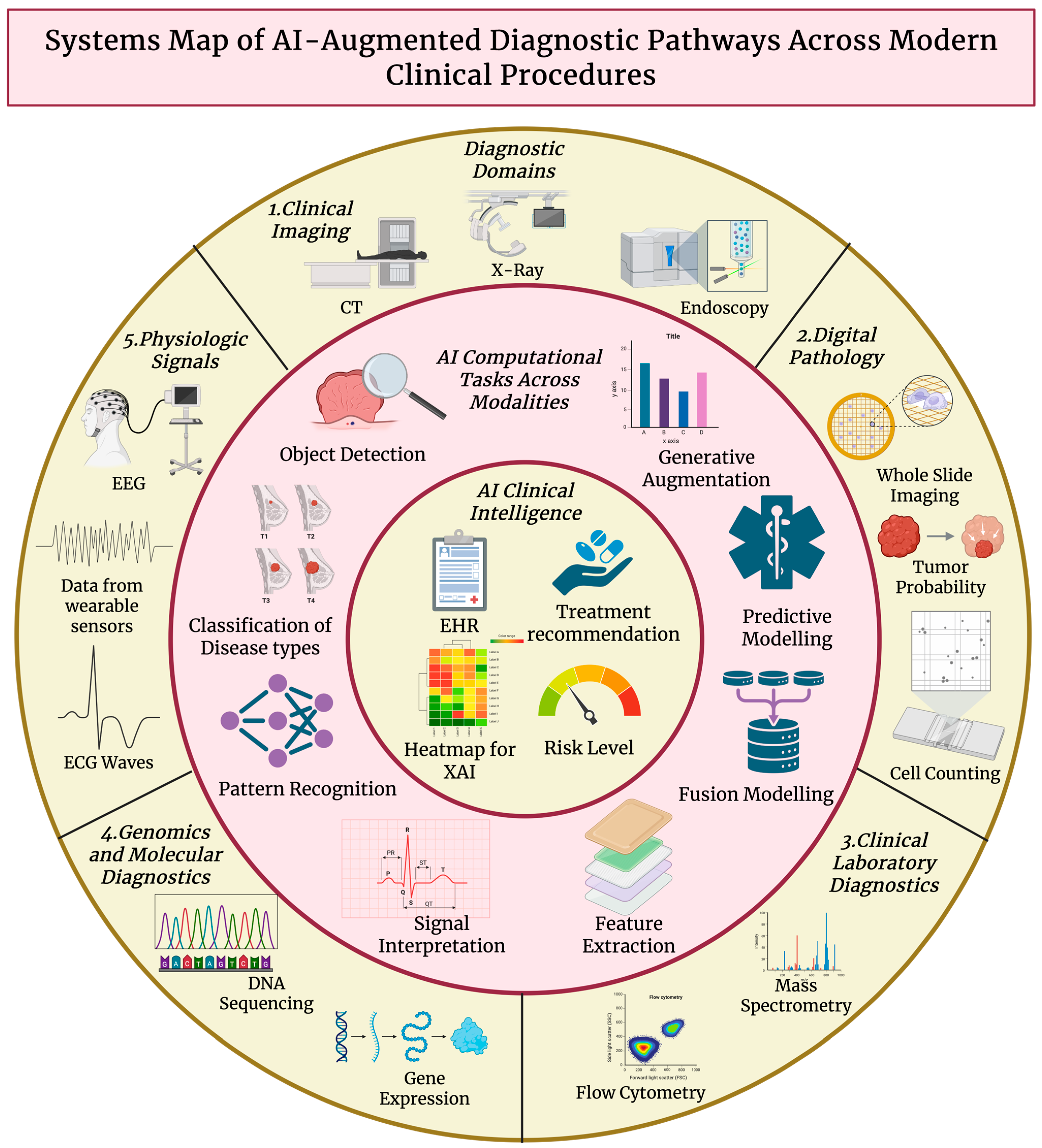


| Diagnostic Domain | Data Modality | AI Methods Used | Representative Included Key Studies | Main Clinical Contribution |
|---|---|---|---|---|
| Foundations and Early AI | Rule-based clinical logic | Expert systems | Bajwa et al. (2021) [1], Shortliffe (MYCIN, 1977) [3], Perry (1990) [4], Beam and Kohane (2018) [14] | Showed the feasibility and limits of computer-assisted diagnosis |
| Classical ML in Diagnostics | Imaging, tabular clinical data | SVM, RF, Logistic Regression | Habehh and Gohel (2021) [2], Castellino (2005) [5], Orrù et al. (2012) [6], Roy et al. (2022) [15] | Feature-engineered diagnostic prediction and early CAD |
| Deep Learning in Medical Imaging | X-ray, CT, MRI | CNNs | Esteva et al. (2017) [7], Rajpurkar et al. (2018) [16], Aggarwal et al. (2021) [13], Litjens et al. (2017) [17], Lundervold and Lundervold (2019) [18] | Demonstrated image classification performance comparable to specialists in controlled retrospective evaluations |
| Radiology and Its Foundation Models | Multimodal imaging | CNNs, Transformers | Zhou et al. (2021) [8], Kelly et al. (2019) [19], Bian et al. (2025) [20], Najjar (2023) [21], | Shift from task-specific to usable multimodal models |
| Digital Pathology | Whole-slide images (WSI) | MIL, Vision Transformers | Campanella et al. (2019) [22], Shafi and Parwani (2023) [23], McGenity et al. (2024) [24], Dolezal et al. (2024) [25] | Automated cancer detection, grading, and prognostication |
| Ultrasound Diagnostics | Real-time imaging | CNN–RNN hybrids | Shen et al. (2021) [26], Meng et al. (2019) [27] | Reduced operator dependence in clinical settings |
| Ophthalmology | Fundus photography, OCT | CNNs | Parmar et al. (2024) [28], Driban et al. (2024) [29], De Fauw et al. (2018) [30] | Adaptable retinal disease screening |
| ECG Physiological Signals | Time-series waveforms | CNNs, LSTM, Transformers | Hannun et al. (2019) [31], Meng et al. (2022) [32], Jaya Prakash et al. (2025) [33], Ribeiro et al. (2020) [34] | These systems can produce performance that is comparable to cardiologists in arrhythmia detection |
| EEG Physiological Signals | Time-series signals | CNNs, DL classifiers | Acharya et al. (2018) [35], Roy et al. (2019) [36], Hussein et al. (2017) [37] | Seizure and neurodegenerative disease detection |
| EHR and Clinical Text | Structured and unstructured data | RNNs, NLP Transformers | Choi et al. (Doctor AI, 2016) [38], Devlin et al. (BERT, 2019) [39], Altsentzer et al. (ClinicalBERT, 2019) [40], Acharya et al. (2024) [41] | Risk prediction and phenotyping |
| Predictive Analytics (ICU) | Vitals, labs, waveforms | RNNs, GRU, Ensemble ML | Johnson et al. (MIMIC-III, 2016) [42], Moody et al. (PhysioNet, 2011) [43], Mao et al. (2018) [44], Kwon et al. (2018) [45] | Early detection of deterioration |
| Genomics | NGS data | DL, Transformers | Athanasopoulou et al. (2025) [46], Baião et al. (2025) [47] | Variant interpretation and pathogenicity prediction |
| Proteomics | Mass spectrometry | ML, DL | Mann et al. (2021) [48], Kitaoka et al. (2025) [49] | Biomarker discovery |
| Metabolomics | LC–MS profiles | ML, VAEs | Chi et al. (2024) [50], Gloaguen et al. (2022) [51] | Disease signature detection |
| Multi-Omics Integration | Genomics, proteomics, imaging | Hybrid ML, generative models | Acharya and Mukhopadhyay (2024) [52], Lin et al. (2025) [53] | Precision medicine stratification |
| Radiogenomics | Imaging and genomics | CNN + ML fusion | Parmar et al. (2015) [54], Wu et al. (2016) [55] | Outcome and recurrence prediction |
| Explainable AI (XAI) | All modalities | SHAP, Grad-CAM, LIME | Alkhanbouli et al. (2025) [56], Fuhrman et al. (2022) [57], Saarela and Podgorelec (2024) [58] | Model transparency and trust |
| Clinical Decision Support (CDS) | EHR-integrated systems | ML + rules | Salimparsa et al. (2025) [59], Solomon et al. (2023) [60], Patterson et al. (2019) [61] | Workflow-integrated diagnostics |
| Validation and Regulation | Multisite clinical data | SaMD frameworks | Han et al. (2024) [10], Park et al. (2022) [12], Weissman (FDA, 2021) [62] Karnik (2014) [63] | Clinical safety and approval pathways |
| Bias, Ethics and Fairness | Demographically stratified data | Audit frameworks | Cross et al. (2024) [9], Ueda et al. (2023) [64], Nasir et al. (2025) [65], Park et al. (2025) [66] | Responsible deployment of clinical AI systems |
| Real-World Case Studies | Imaging, ECG, pathology | Deployed DL systems | De Fauw et al. (2018) [30], Mckinney et al. (2020) [67], Attia et al. (2019) [68] | Transition from lab to clinic |
| ML Paradigms | Label Dependency | Data Requirements | Computational Complexity | Uncertainty Handling | Example Diagnostic Tasks | Limitation in Diagnostics | Clinical Suitability (Score out of 5) |
|---|---|---|---|---|---|---|---|
| Supervised Learning [16] | High | Large, labeled datasets | Moderate to high | Softmax probability, calibration | Pneumonia detection, ECG arrhythmia classification | Requires high-quality labels, annotation costs | 5/5 |
| Weakly Supervised Learning [22] | Partial labels or noisy labels | Medium to large datasets | Moderate | MIL, label noise correction | Whole-slide pathology classification for slide-level labels only | Label noise causes instability | 4/5 |
| Unsupervised Learning [74] | None | Medium to large unlabeled datasets | Low to moderate | Clustering uncertainty metrics | Patient stratification, anomaly detection | Poor clinical interpretability | 3/5 |
| Self-Supervised Learning [75] | None (pretext tasks) | Very large unlabelled datasets | High | Contrastive uncertainty modeling | Imaging pretraining, ECG representation learning | Requires massive compute and data | 5/5 |
| Reinforcement Learning [76] | Reward labels only | Sequence data | Very high | Q-value uncertainty | Imaging acquisition optimization | Hard to validate clinically | 2/3 |
| Generative ML [77] | Low but depends on the model | Very large datasets | Very high | Latent space variance estimates | Synthetic MRI, data augmentation | Risk of hallucinated features | 3/3 |
| Diagnostic Modalities | Data Characteristics | Required Preprocessing | Best Model Classes | Common AI Failure Modes | Example Clinical Applications | Integration Difficulty |
|---|---|---|---|---|---|---|
| Radiology (CT/MRI/X-ray) [21,86] | High-resolution, continuous, spatially structured | DICOM parsing, normalization, segmentation | CNNs, Transformers | Scanner variability drift, overfitting | Tumor detection, triage | Moderate |
| Digital Pathology (WSI) [25] | Ultra-high-resolution gigapixel images, multi-scale | Tile extraction, stain normalization | Vision Transformers, MIL networks | Tile selection bias, stain variability | Cancer subtype prediction | High |
| Ultrasound [27] | Noisy, operator-dependent, temporal–spatial | Speckle noise reduction, temporal smoothing | CNN-RNN hybrids | Operator variability, shadow artifacts | Fetal assessment, cardiac imaging | High |
| ECG/EEG/Physiological signals [33] | Time-series, waveform-based | Filtering, beat segmentation, artifact removal | 1D CNNs, LSTMs | Baseline wander errors, electrode misplacement | Arrhythmia and seizure detection | Low |
| Genomics (NGS) [46] | Categorical sequence data, high dimensionality | QC filtering, alignment, variant calling | Transformers, ensembles | Pipeline variability, batch effects | Variant interpretation | High |
| Metabolomics and Proteomics [51] | Mass spectra, high dimensionality | Peak picking, normalization, noise removal | SVMs, VAEs, DL models | Batch effects, ion suppression artifacts | Biomarker discovery | Moderate |
| EHR and Clinical Notes [41] | Mixed structured and unstructured | Tokenization, feature extraction, imputation | NLP transformers, multimodal models | Missingness, coding differences | Risk prediction, CDSS | Moderate |
| Clinical Prediction Task | Multimodal Input Used | Fusion Strategy (Early, Late, or Hybrid) | Benchmark Datasets Used | Performance Range | Real-World Performance Gaps | Main Clinical Barrier |
|---|---|---|---|---|---|---|
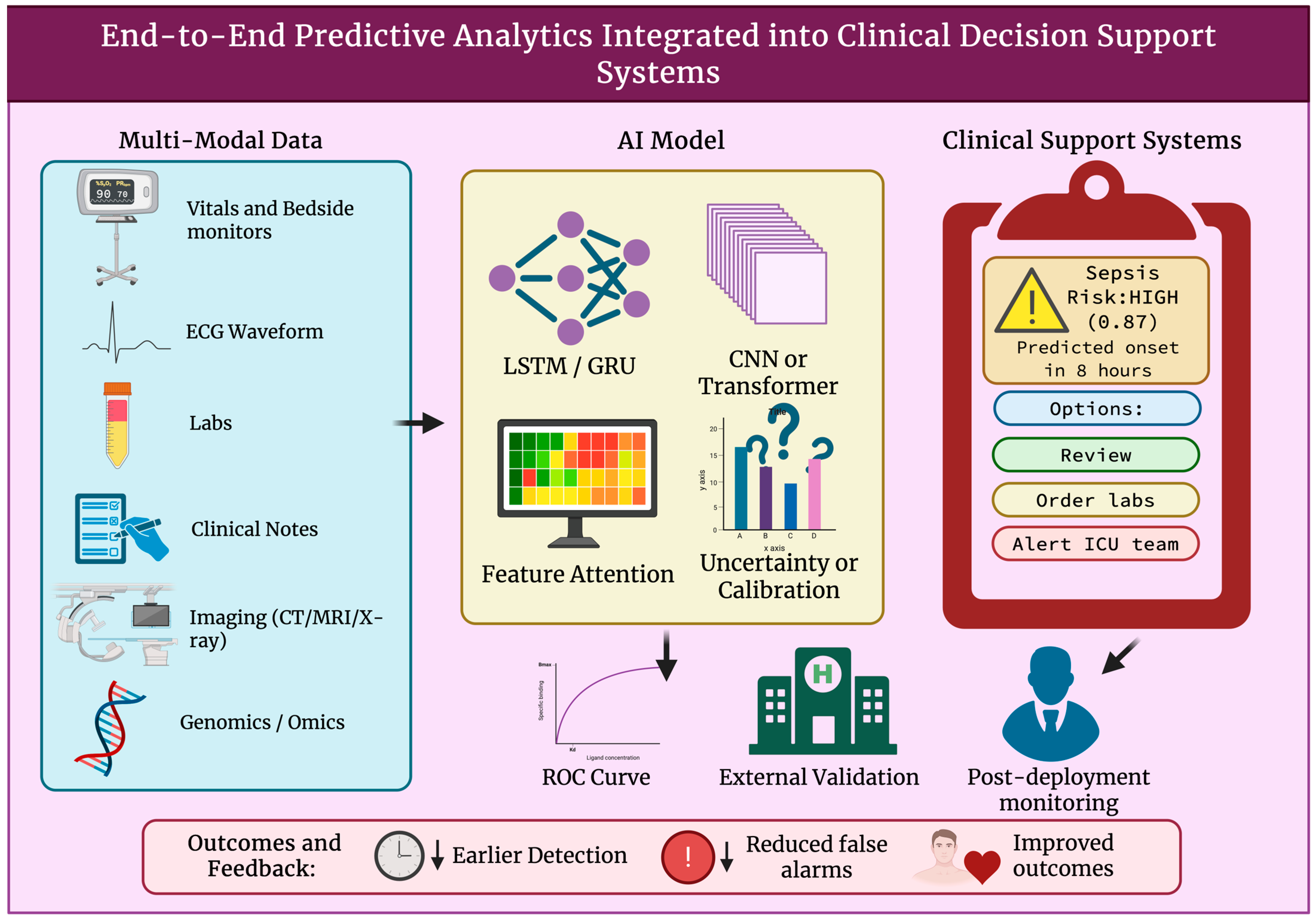
| Sepsis onset prediction [104,105] | Vitals, labs, nursing, notes, medications | Early, attention-based fusion | MIMIC-III/IV, eICU | Area under the receiver operating characteristic curve (AUROC) 0.80–0.92 | Drops to around 0.65–0.75 in external hospitals | Shift due to different documentation patterns |
| Cardiac arrest [105] | ECG, waveform morphology, blood gases | Hybrid, CNN, and RNN fusion | PhysioNet ECGDB, Telemetric datasets | AUROC 0.85–0.95 | Wearable vs. in-hospital data mismatch | Sampling frequency inconsistency |
| Cancer recurrence [106] | MRI/CT, genomics, clinical history | Late fusion | The Cancer Genome Atlas (TCGA) and institutional datasets | C-index 0.70–0.82 | Limited genomic completeness | Integration of omics into EHR |
| Stroke outcome [107] | CT perfusion, National Institutes of Health Stroke Scale (NIHSS), and comorbidities | Hybrid fusion | ISLES, local stroke centers | AUROC 0.78–0.89 | Scanner heterogeneity | Radiology protocol variations |
| Mortality or deterioration in ICU [108] | Vitals, ventilator data, and labs | Early fusion and gated recurrent unit (GRU)/LSTM | MIMIC-IV | AUROC 0.85–0.92 | Operational drift | Variability in monitoring frequency |
| Technology | Main Architecture Used | Key Dependencies | Diagnostic Use Cases | Current Risks | Clinical Readiness (Points out of 5) | 10-Year Outlook |
|---|---|---|---|---|---|---|
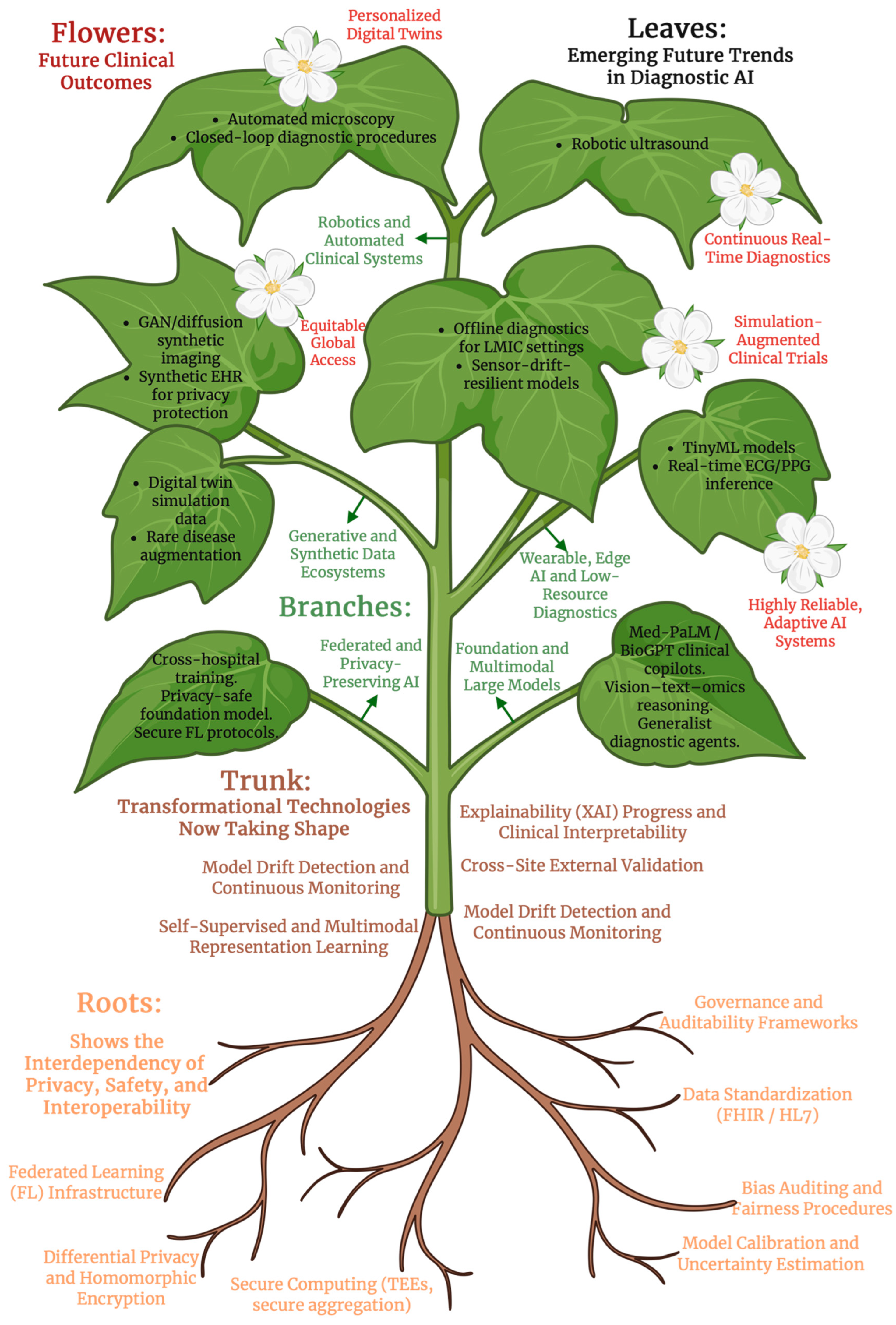
| Federated learning [156] | FedAvg, FedProx, secure aggregation | Multi-hospital networks, stable connectivity, DP protocols | Global training of imaging omics models | Non-IID data, privacy attacks | 3/5 | The standard for multicenter research |
| Foundation models like Med-PaLM, LLaVA-Med [153,157] | Transformer and multimodal encoders | Trillion-scale tokens, aligned medical corpora | Generalist clinical reasoning, radiology QA | Hallucination, lack of calibration | 2/5 | Highly trusted diagnostic copilots |
| Generative AI (Diffusion, GANs) [158] | Latent diffusion models | High-quality annotated datasets | Synthetic medical imaging, rare disease augmentation | Fabricated features, legal/IP issues | 2/5 | Partially could replace real datasets for low-prevalence diseases |
| Wearable and edge AI [159] | TinyML, optimized CNNs, on-chip inference | Low-power chips, continuous data capture | Real-time arrhythmia, seizure, hypoxia alerts | Battery limits, sensor drifts | 4/5 | Ubiquitous real-time diagnostic |
| Robotics-AI integration [160] | Vision transformers and reinforcement learning | High-precision actuators, real-time sensing | Robotic ultrasound, automated microscopy | Safety, real-time latency | 2/5 | Routine semi-autonomous diagnostic procedures |
| Digital twins [161] | Physics-informed and ML hybrid | Longitudinal patient-specific data | Virtual patient simulations, treatment predictions | Data sparsity, validation difficulty | 1/5 | Widely used for RCT simulation and personalized monitoring |
Disclaimer/Publisher’s Note: The statements, opinions and data contained in all publications are solely those of the individual author(s) and contributor(s) and not of MDPI and/or the editor(s). MDPI and/or the editor(s) disclaim responsibility for any injury to people or property resulting from any ideas, methods, instructions or products referred to in the content. |
© 2026 by the authors. Licensee MDPI, Basel, Switzerland. This article is an open access article distributed under the terms and conditions of the Creative Commons Attribution (CC BY) license.
Share and Cite
Bartusik-Aebisher, D.; Justin Raj, D.R.; Aebisher, D. Artificial Intelligence in Medical Diagnostics: Foundations, Clinical Applications, and Future Directions. Appl. Sci. 2026, 16, 728. https://doi.org/10.3390/app16020728
Bartusik-Aebisher D, Justin Raj DR, Aebisher D. Artificial Intelligence in Medical Diagnostics: Foundations, Clinical Applications, and Future Directions. Applied Sciences. 2026; 16(2):728. https://doi.org/10.3390/app16020728
Chicago/Turabian StyleBartusik-Aebisher, Dorota, Daniel Roshan Justin Raj, and David Aebisher. 2026. "Artificial Intelligence in Medical Diagnostics: Foundations, Clinical Applications, and Future Directions" Applied Sciences 16, no. 2: 728. https://doi.org/10.3390/app16020728
APA StyleBartusik-Aebisher, D., Justin Raj, D. R., & Aebisher, D. (2026). Artificial Intelligence in Medical Diagnostics: Foundations, Clinical Applications, and Future Directions. Applied Sciences, 16(2), 728. https://doi.org/10.3390/app16020728