Article

Study on Non-Contact Defect Detection Using the Laser Ultrasonic Method for Friction Stir-Welded Cu–Al Dissimilar Material Joints


by
Kazufumi Nomura
1,*,
Shogo Ishifuro
1 and
Satoru Asai
2
1
Division of Materials and Manufacturing Science, Graduate School of Engineering, The University of Osaka, Osaka 565-0871, Japan
2
DAIHEN Welding and Joining Research Alliance Laboratories, Joining and Welding Research Institute, The University of Osaka, Osaka 567-0047, Japan
*
Author to whom correspondence should be addressed.
Appl. Sci. 2026, 16(2), 688; https://doi.org/10.3390/app16020688
Submission received: 30 November 2025 / Revised: 31 December 2025 / Accepted: 3 January 2026 / Published: 9 January 2026
(This article belongs to the Special Issue Industrial Applications of Laser Ultrasonics)

Abstract

Ensuring friction stir welding (FSW) joint quality typically relies on ultrasonic testing (UT) and radiographic testing (RT), but achieving complete coverage is challenging, and echo-based defect discrimination becomes difficult in dissimilar joints. Laser ultrasonics is a promising non-contact technique that remotely assesses weld quality and provides high spatial resolution at the generation and detection points. This study establishes a laser-ultrasonic method for defect detection in dissimilar Cu–Al FSW joints. Slit-like artificial defects (0.1–2.5 mm deep in 5 mm thick plates) were introduced at the Al-side interface of specimens fabricated with an Al-offset tool. Experiments and numerical simulations were used to evaluate wave modes and irradiation configurations, focusing on intensity-attenuation ratios of specific wave types, including longitudinal and Rayleigh waves. On the non-slit surface, attenuation of reflected longitudinal waves enabled detection of defects ≥0.5 mm deep. On the slit surface, Rayleigh-wave attenuation allowed identification of defects as shallow as 0.1 mm, although slit-side irradiation may be less practical during joining. These results demonstrate that defect identification in dissimilar materials can be achieved by evaluating wave-intensity attenuation rather than relying solely on the presence of reflected echoes, suggesting potential for implementing laser ultrasonics in in-process monitoring of FSW joints.

1. Introduction

The joining of dissimilar materials is widely employed in industrial applications to achieve lightweight and high-strength multi-material structures. In particular, copper and aluminum are extensively used in the electric power industry, and the demand for joints between these metals has been increasing. However, the Cu–Al combination exhibits markedly different physical, chemical, and mechanical properties and readily forms brittle intermetallic compounds (IMCs), making fusion welding difficult. Therefore, friction stir welding (FSW) [1], a solid-state joining process, is often adopted. It has been reported that sound Cu–Al joints can be produced by applying low heat-input conditions and offsetting the tool toward the aluminum side [2]. Nevertheless, in FSW, when the welding parameters such as tool load, rotational speed, and travel speed deviate from appropriate ranges—or when the tool insertion depth changes due to wear or deformation—tunnel-type internal defects or incomplete bonding at the root region (root flaw) may occur [3].
Such defects reduce the load-bearing area of the joint, degrade its static strength, and can become fracture-initiation sites, thereby hindering the manufacture of safe products. In particular, crack-like defects are widely recognized as critical factors governing fatigue performance and service life of welded structures. In this context, recent studies have investigated fatigue life evaluation of welded joints using data-driven and machine learning approaches, including orthotropic steel deck welds [4,5].
To ensure soundness and reliability, non-destructive testing (NDT) is essential. Radiographic testing (RT) and ultrasonic testing (UT) are commonly used to detect internal defects [6], although UT is often preferred due to safety and inspection-efficiency considerations. Reported applications of NDT to FSW joints include phased-array UT by Takei et al. [3], RT by Uematsu et al. [7], and laser ultrasonics by Levesque et al. [8]. These studies, however, focus on butt joints of single-material systems such as aluminum or steel. Because UT detects defects primarily through echoes reflected at defect interfaces, in dissimilar-metal joints—such as the Cu–Al joints examined in this study—the inherent echoes from the material interface can interfere with defect-related echoes, complicating defect identification. Although various studies have examined defect detection in homogeneous-metal joints, there are no reports, to the authors’ knowledge, that investigate defect detection in dissimilar-metal welded joints.
In this study, laser ultrasonics was therefore employed for detecting defects at dissimilar interfaces, as it is a remote and non-contact technique capable of achieving high spatial resolution through pointwise generation and detection. Laser ultrasonics generate ultrasonic waves by irradiating a specimen surface with a pulsed laser, and internal information is obtained by detecting the propagating and reflecting waves using a laser interferometer. Because laser probing requires no couplant, measurements can be performed without physical contact with the specimen. In addition, the technique is compatible with scanning and high-temperature environments, suggesting the potential for in-process monitoring on production lines. Although several studies have utilized various characteristics of laser ultrasonics, reports demonstrating defect detection specifically in dissimilar-metal welded joints using a fully non-contact method remain limited.
Motivated by these considerations, this study aimed to establish a non-contact laser-ultrasonic method for defect detection in Cu–Al dissimilar FSW joints, with potential applicability to in-process monitoring. Specifically, defect-simulated specimens with slit-like defects representing typical root flaws were fabricated by mechanical machining, considering defect morphologies that may occur at dissimilar interfaces in Cu–Al FSW joints. For these specimens, the arrangement of laser generation and detection points, as well as the ultrasonic wave types enabling defect detection, were investigated experimentally and numerically.

2. Experimental Method

2.1. Outline

Specimens of Cu–Al joints fabricated by FSW with artificially introduced defects were prepared, and measurements were performed using laser ultrasonics. The laser spots for ultrasonic generation and detection were arranged on the same surface of the specimen, and the feasibility of utilizing various ultrasonic phenomena—such as transmission, reflection, diffraction, and attenuation at the joint region and defect locations—was examined. B-scopes composed of multi-point generation and single-point detection, as described later, were acquired. By evaluating the waveforms at each position and analyzing the wave propagation behavior, a fundamental investigation of laser ultrasonic measurement near the Cu–Al dissimilar-metal interface was conducted.

2.2. Specimen

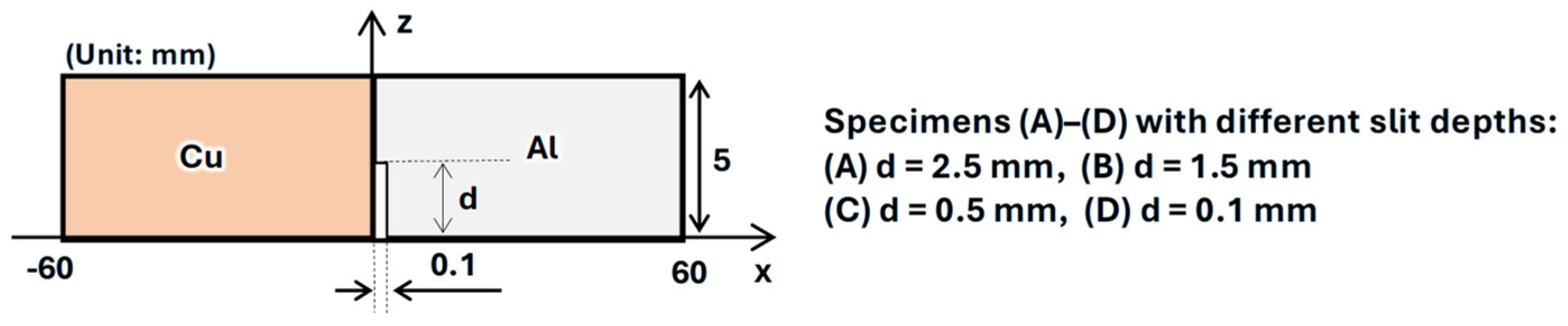
The specimens were prepared by butt-joining Cu and Al plates of 20 × 60 × 5 mm3 by FSW with the tool offset toward the Al side, followed by surface polishing to obtain flat plates of 20 × 120 × 5 mm3. As shown in Figure 1, slit-type defects simulating root flaws were introduced by machining a 0.1 mm wide notch from the interface toward the Al side, and four defect depths were prepared: 0.1, 0.5, 1.5, and 2.5 mm. The slit width and minimum slit depth were set to 0.1 mm, which corresponds to the smallest class reproducible by mechanical machining. The maximum slit depth was chosen as 2.5 mm, corresponding to half of the plate thickness, to allow observation of changes in the ultrasonic response that were expected to be distinguishable. In addition, as shown in Section 3.1, a 20 × 120 × 5 mm3 Al-only plate was also used for comparison with the dissimilar-metal joint. For each slit depth and for the defect-free condition, one specimen was prepared.

2.3. System Configuration and Laser Irradiation Conditions

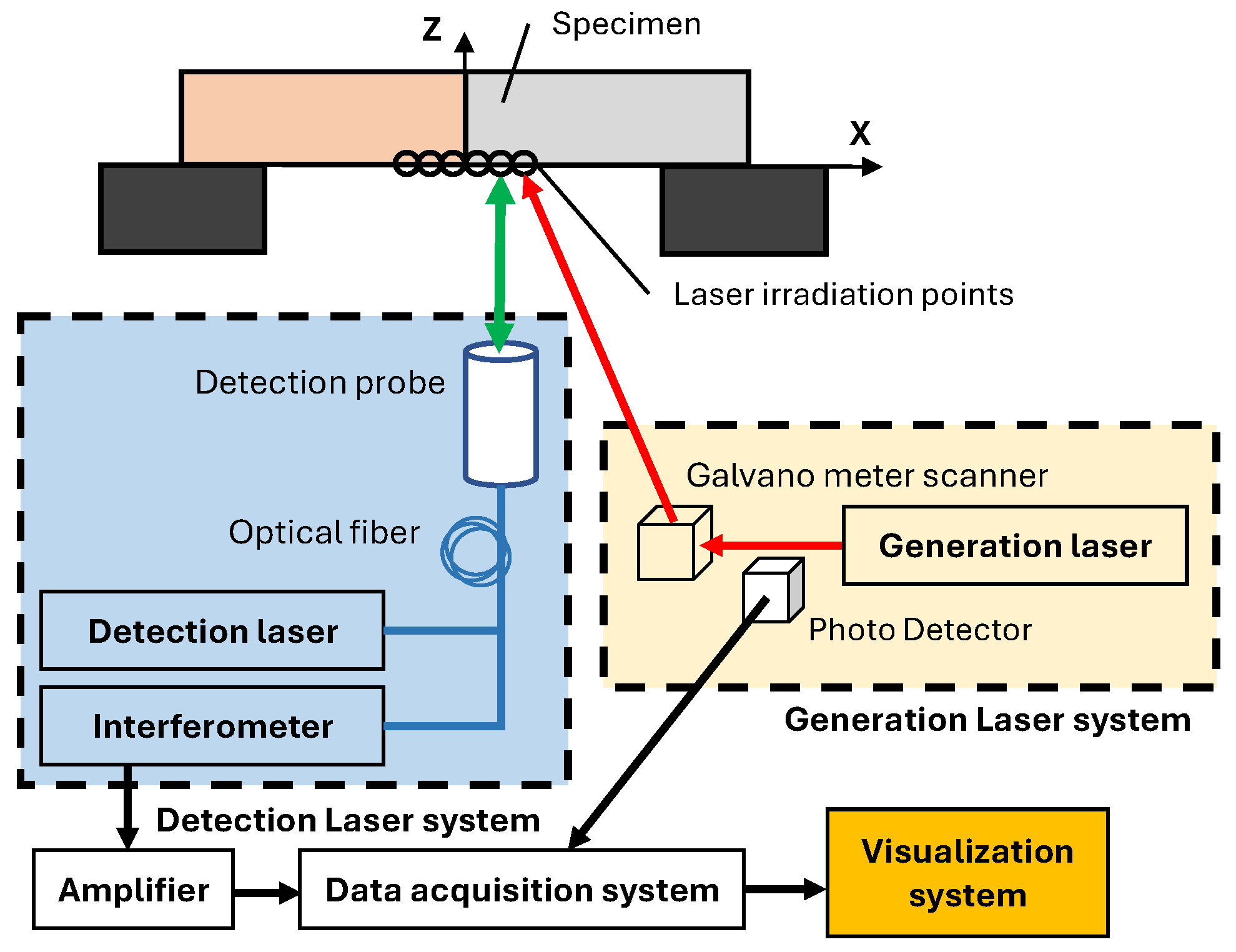
In this study, a nanosecond pulsed laser (Nano L 90-100, Litron Lasers Ltd., Rugby, UK) was used for ultrasonic generation, and a laser interferometer based on a Michelson interferometer employing multi-channel random quadrature interferometry (Quartet-1500, Bossa Nova Technologies, Culver City, CA, USA) [9] and the differential amplifier (5307, NF Corporation, Kanagawa, Japan) were used for ultrasonic detection. The parameters of each laser are listed in Table 1 and Table 2. A schematic diagram of the system configuration is shown in Figure 2. Multi-point ultrasonic generation was performed using a Galvanometer scanner (EC1000, Cambridge Technology Inc., Cambridge, MA, USA) according to the irradiation conditions. The timing of the generation-laser irradiation was detected using a photodetector, which served as the trigger for initiating measurement with the detection laser.
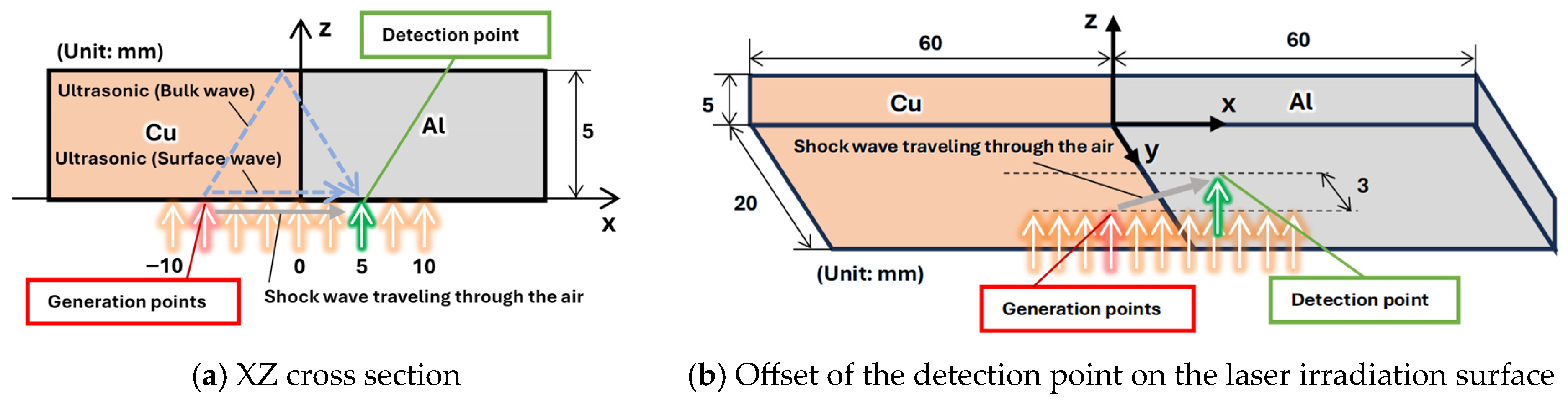
To ensure accessibility to the specimen, both the generation and detection lasers were irradiated onto the same surface. Figure 3 shows a schematic illustrating laser irradiation from below the specimen using the system shown in Figure 2. As shown in the XZ cross section in Figure 3a, the joint interface position was defined as X = 0 mm, and the generation laser was scanned over X = −10 to 10 mm at intervals of 0.2 mm, resulting in 101 generation points. The detection laser was irradiated at a single point located at X = 5 mm on the Al side. Using multi-point generation and single-point detection with the Galvanometer scanner, a single B-scope was constructed with the horizontal axis representing the irradiation position X, enabling investigation of the behavior of bulk and surface waves in the XZ cross section. Because the blast wave propagating through air from the generation point to the detection point can obscure subsequent signals, a 3 mm offset in the Y direction was introduced between the generation and detection laser spots, as shown in Figure 3b. This offset delayed the arrival of the blast wave, and the usable signal acquisition window was enlarged.
Additionally, to improve visibility, frequency filtering was applied to the acquired B-scope, removing components below 0.3 MHz and above 10 MHz. This frequency range was selected because, when using the same system, a 0.3 MHz high-pass filter effectively reduced low-frequency noise without significantly changing the signal amplitude of the waveform of interest, and the effective bandwidth of the signal amplifier used in the measurement system was 10 MHz. However, frequency-dependent effects were not quantitatively evaluated in this study. The applied band-pass filtering was intended solely for background-noise suppression under the present experimental conditions.
Because the simulated specimens with slit-type defects have two distinguishable surfaces—one containing the slit and the other without it—two laser arrangements were examined depending on which surface the generation and detection lasers were placed. For consistency in the figures presented in the following sections, the slit is always illustrated on the bottom side of the specimen. It should be noted, however, that in the experiments the lasers were irradiated from either the top or bottom surface depending on the measurement configuration.

2.4. Simulation of Ultrasonic Propagation

In this study, the propagation of ultrasonic waves generated in the ablation regime by laser irradiation was examined using FEM simulations with ComWAVE v11 (ITOCHU Techno-Solutions Corporation, Tokyo, Japan) [10], an ultrasonic analysis software. The constructed model was a three-dimensional representation of a Cu–Al specimen containing a slit-type defect on the Al side of the interface. The material properties used in the analysis were: for Cu, a longitudinal wave velocity of 4650 m/s, a transverse wave velocity of 2260 m/s, and a density of 8960 kg/m3; and for Al, a longitudinal wave velocity of 6380 m/s, a transverse wave velocity of 3130 m/s, and a density of 2700 kg/m3.
It is known that the pressure wave generated by laser irradiation exhibits a single-cycle waveform [11]. Although the ultrasonic waves generated by laser ultrasonics are broadband, the purpose of the present simulation was limited to confirming the wave propagation times and origins. Therefore, a simplified 5 MHz stress wave in the Z-direction was applied at the laser-generation point. The element size in the finite element model was set to 0.04 mm, which is sufficiently smaller than the wavelength corresponding to the applied frequency. For example, using the transverse wave velocity in copper, the wavelength at 5 MHz is approximately 0.45 mm, ensuring more than ten elements per wavelength. This resolution is considered adequate for stable ultrasonic wave propagation analysis. In principle, obtaining a B-scope corresponding to a cross section composed of multi-point generation and single-point detection would require performing multiple single-point generation/single-point detection simulations on the model, which generally results in extremely long computation times. Therefore, by applying the reciprocity theorem [12,13], the generation and detection points were interchanged, allowing the model to be reinterpreted as single-point generation and multi-point detection. This enabled efficient acquisition of simulated results for an entire cross-sectional B-scope with only a single ultrasonic propagation analysis [14].

3. Experimental Results

3.1. B-Scope Obtained in Experiments on Dissimilar-Metal Joints

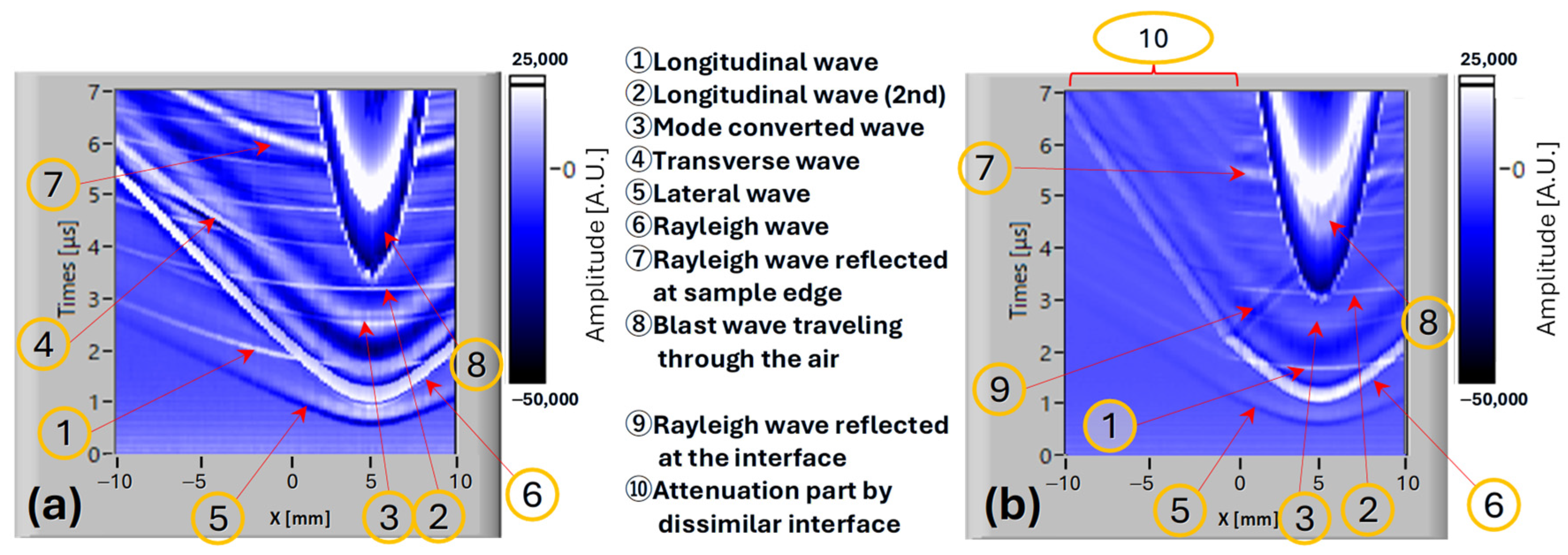
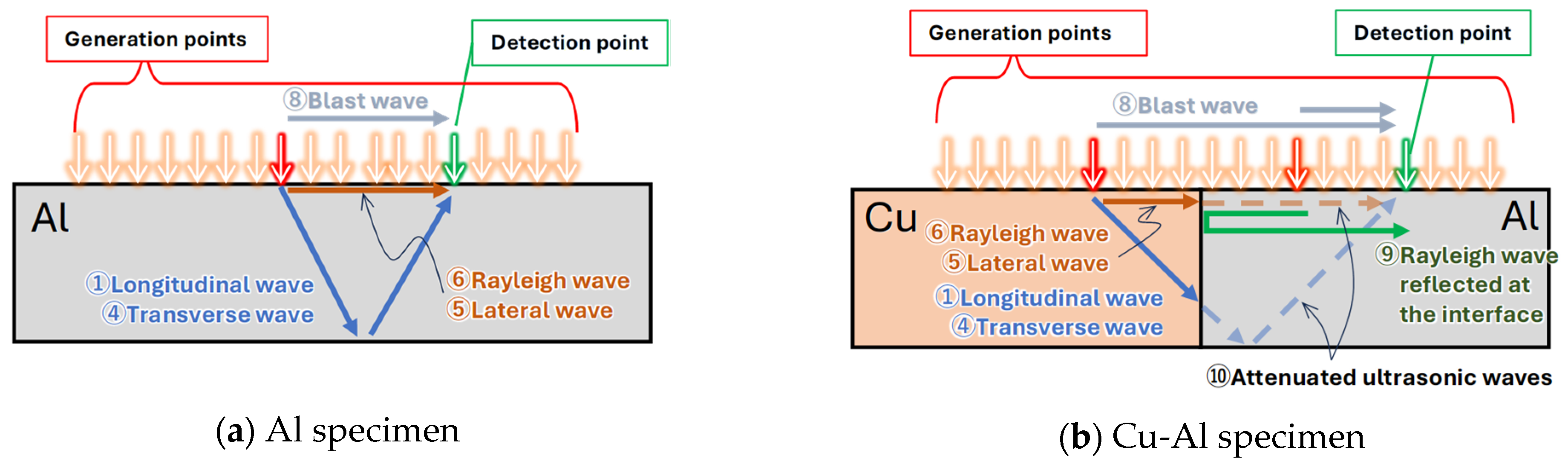
First, the characteristics of the B-scope in dissimilar-metal joints were investigated. Experiments were performed on both the Al-only plate and the defect-free Cu–Al specimen using the irradiation conditions shown in Figure 3, and the resulting B-scopes are presented in Figure 4. Figure 4a shows the B-scope for the Al-only plate. Although this represents the simplest case without a slit or a dissimilar interface, various ultrasonic waves are simultaneously detected in laser ultrasonics. The bulk waves reflected from the back surface include (1) the longitudinal wave, (4) the transverse wave, (3) the mode-converted wave from longitudinal to transverse, and (2) the second reflection of the longitudinal wave. Because ablation-mode laser ultrasonics strongly excites transverse waves at approximately 45°, the reflected transverse-wave components are not observed in the 0° direction directly beneath the detection point. Surface waves include (5) the lateral wave and (6) the Rayleigh wave. The wave labeled (7) corresponds to a Rayleigh wave reflected from the specimen edge in the y-direction, and its arrival time depends on the y-direction distance shown in Figure 3. In addition, (8) corresponds to the blast wave propagating through air from the ablation point to the detection point; once this blast wave arrives, subsequent ultrasonic signals are largely obscured.
Figure 4b shows the B-scope for the dissimilar-metal joint, where the overall appearance differs markedly. Figure 5 illustrates schematic propagation paths of the ultrasonic waves, using the same numbering as in Figure 4. The downward orange arrows indicate the generation-laser irradiation region, while the red arrows indicate the origins of example propagation paths. In region (10) of the dissimilar joint, ultrasonic waves excited on the Cu side attenuate before reaching the detection point on the Al side due to reflection at the interface. Furthermore, before reaching the interface, these waves propagate according to the acoustic properties of Cu, which has a lower sound velocity than Al; as a result, the B-scope appears kinked at the dissimilar interface. The wave labeled (9) corresponds to the Rayleigh wave generated on the Al side, which reflects at the dissimilar interface and subsequently reaches the detection point. Although the lateral wave (5), another type of surface wave, also has a reflected component at the interface, it is extremely weak and difficult to visually identify in the figure. These results demonstrate that a variety of phenomena arise in dissimilar-metal joints due to the presence of the interface and the differences in wave-propagation properties of the two materials.
From the above experimental comparison of the B-scopes for the single-material and dissimilar-material specimens, it can be inferred that the presence of the interface makes it difficult to discriminate between waves reflected from the interface and those reflected from slit-type defects. Consequently, defect-reflected waves cannot be directly exploited for defect detection.

3.2. B-Scope Obtained from Simulations of Dissimilar-Metal Joints

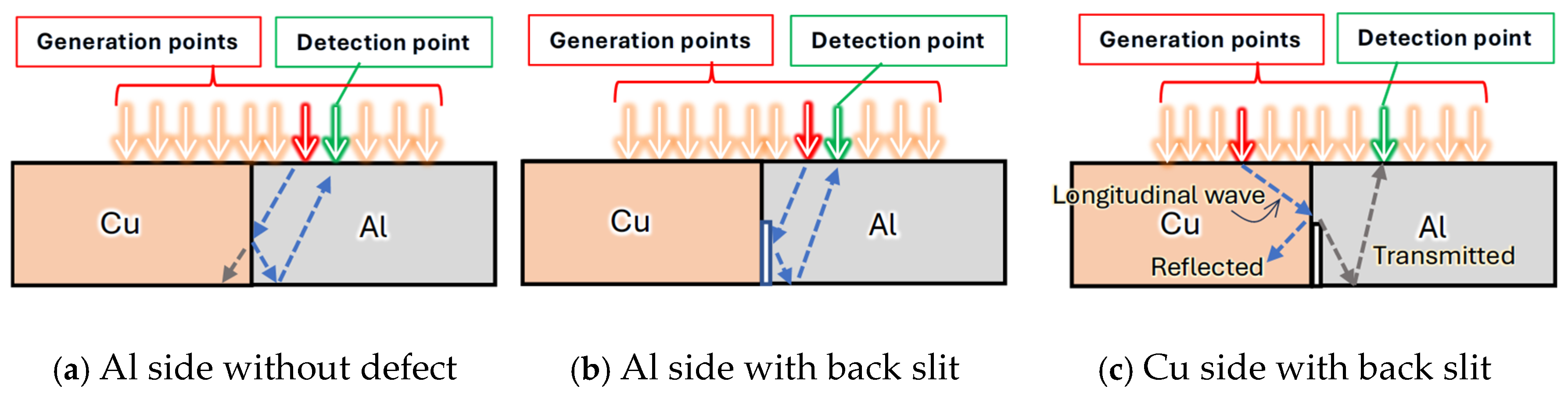
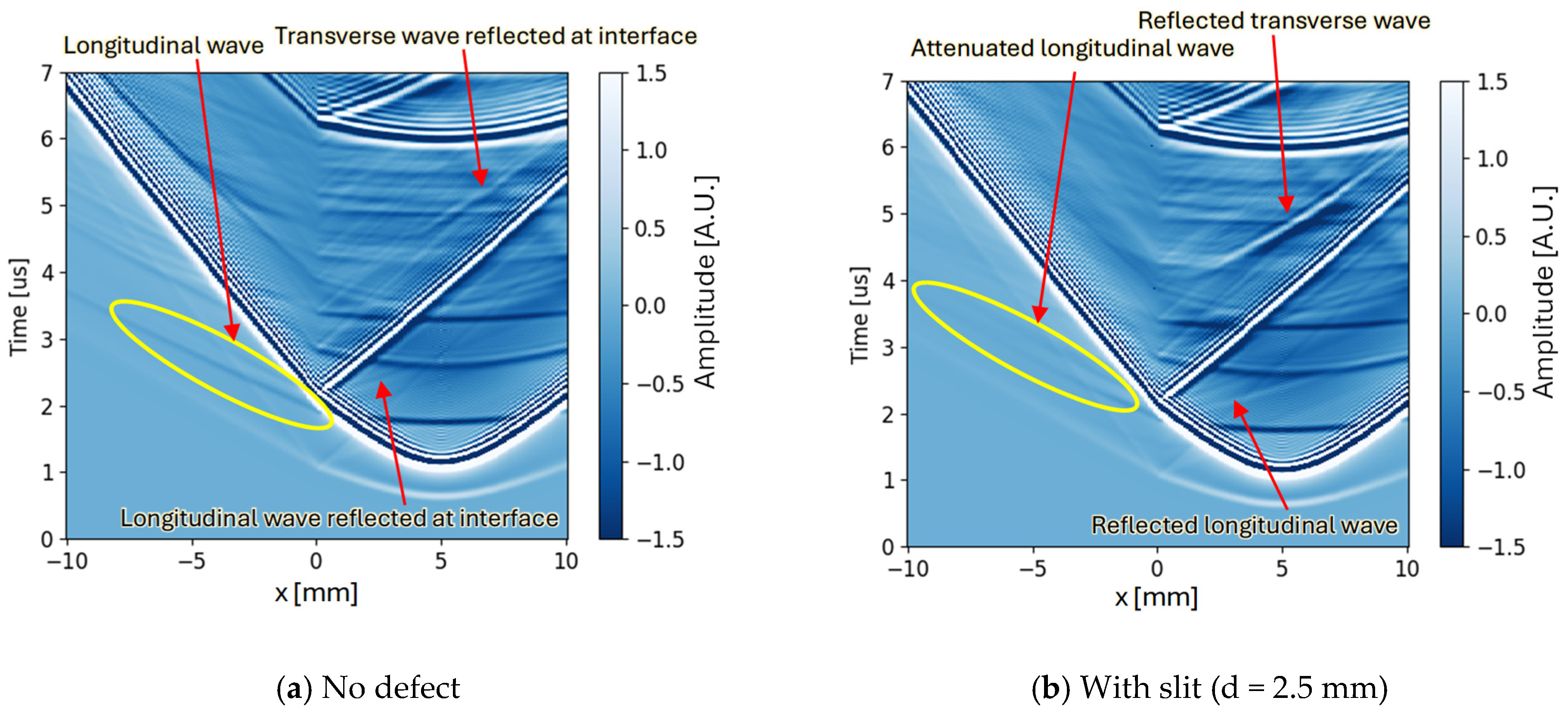
Next, whether the dissimilar-metal interface and a slit located near the interface in the Cu–Al specimen can be distinguished was examined using simulations with ComWAVE. Figure 6 shows schematic illustrations of a defect-free Cu–Al specimen and one containing a slit-type defect of 2.5 mm depth, and the corresponding simulation results are shown in Figure 7.
When a slit is present at the dissimilar interface, a longitudinal-wave reflection originating from the slit appears around X = 3 mm and t = 2 μs, as indicated in Figure 6b. Although such a signal can be utilized in the single-material case, it becomes difficult to distinguish from the longitudinal-wave reflection originating from the dissimilar interface itself, as shown in Figure 6a. Therefore, the presence or absence of the longitudinal-wave reflection from the slit cannot be directly exploited as a simple defect-detection indicator. In contrast, the transverse-wave reflection appears as a relatively clear, diagonally oriented signal centered approximately around X = 5 mm and t = 5 μs. The transverse-wave reflection from the dissimilar interface tends to be weaker than that from the slit, suggesting its potential usefulness for defect discrimination. However, under the experimental conditions of this study, this transverse-wave component lies within an unusable region due to the air-borne blast wave (8) observed in the experimental B-scope of Figure 4.
Therefore, this study focused on the attenuation of the back-surface-reflected longitudinal wave, indicated by the yellow circles in Figure 7. Even in the defect-free case shown in Figure 7a, the presence of the dissimilar interface inherently weakens this signal; however, when a slit is present, the signal becomes further weakened, as shown in Figure 7b. This attenuation occurs because the longitudinal wave diffracts at the slit tip and then follows the path shown in Figure 6c, reflecting from the back surface after diffraction. As the slit becomes deeper, a larger number of generation points are affected, resulting in an increased number of weakened-signal points. Accordingly, quantifying this attenuation and comparing it with that of defect-free specimens suggests the possibility of discriminating the presence of defects, as indicated by the ultrasonic propagation simulations.

3.3. Measurements on Defect Specimens: Irradiation from the Non-Slit Side

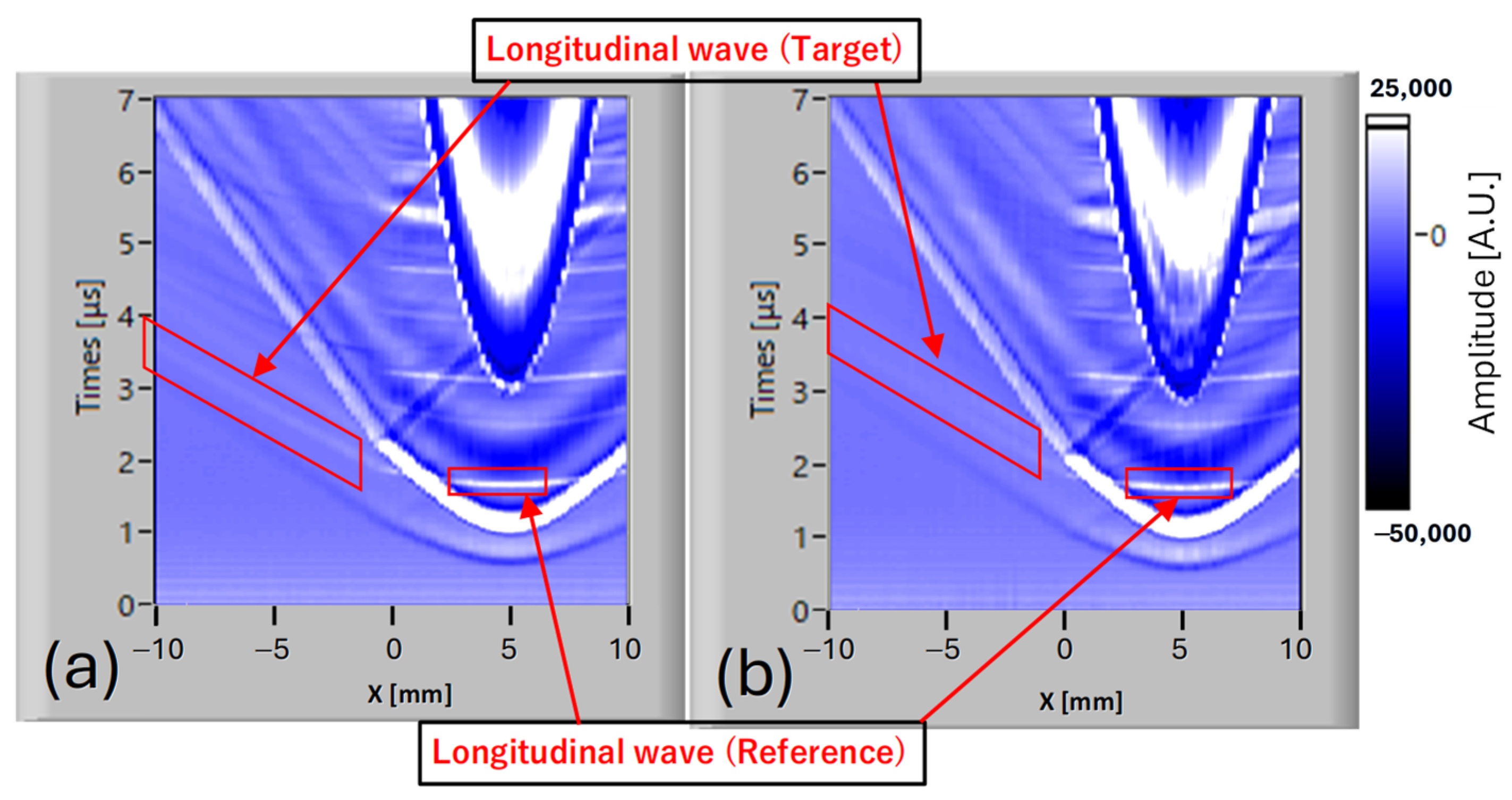
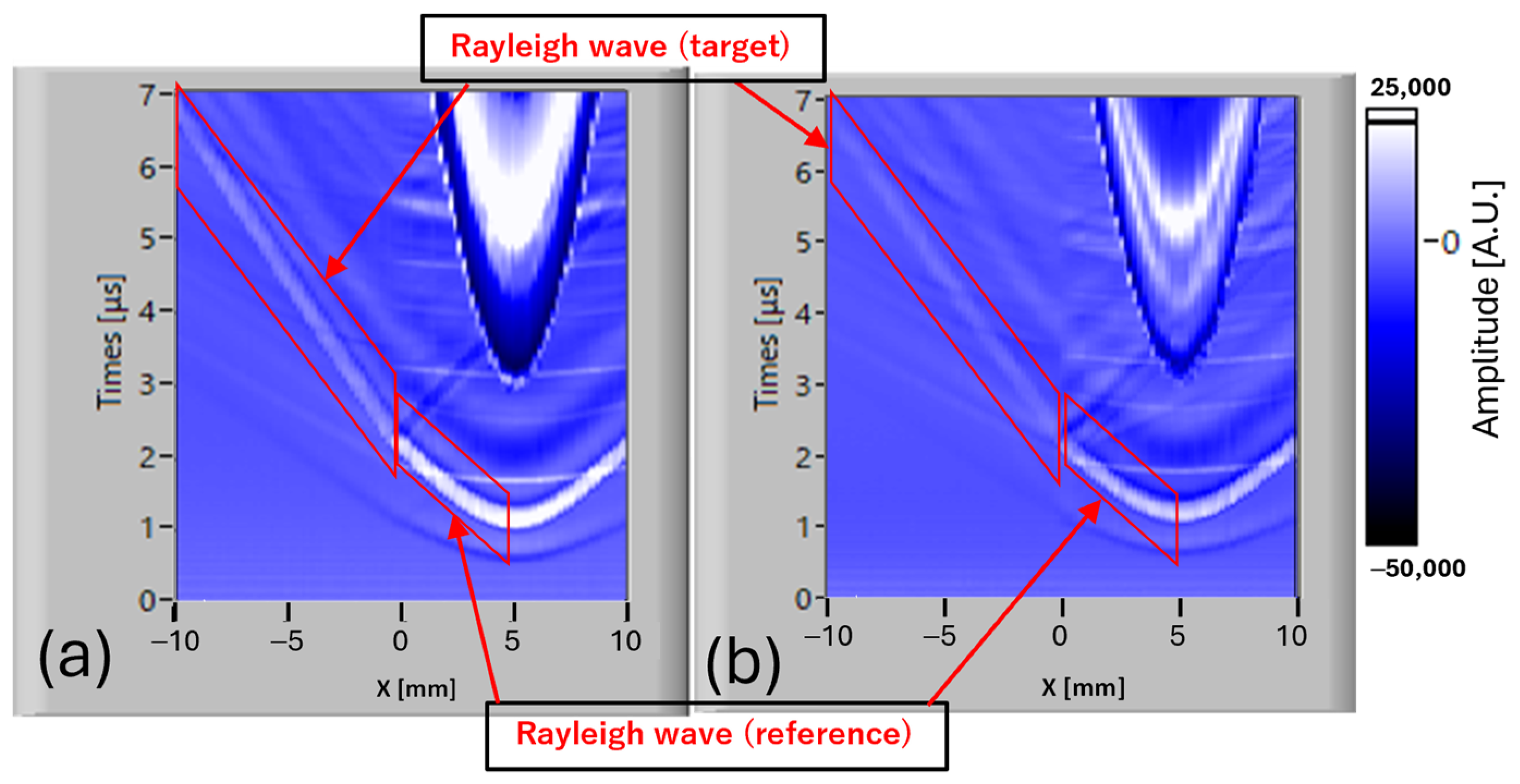
To experimentally verify the simulation results presented in the previous section, ultrasonic measurements were conducted on Cu–Al dissimilar joints containing slit-type defects, with the lasers irradiated from the non-slit side. As an example of the measurement results, Figure 8 shows the B-scopes obtained for a defect-free joint and for a joint with a 2.5 mm deep slit-type defect (Specimen A). The experimental results also confirmed that the back-surface-reflected longitudinal wave (the wave indicated as “Target” in Figure 8) is attenuated by the presence of the slit.
To further evaluate the presence and depth of the defect, the degree of attenuation of the longitudinally reflected wave was investigated. Here, the amplitude of the attenuated longitudinal wave was normalized using an ultrasonic amplitude that is not affected by the presence or absence of the interface or slit. For normalization, the longitudinal-wave reflection on the Al side after the surface wave—indicated as “Reference” in Figure 8—was used.
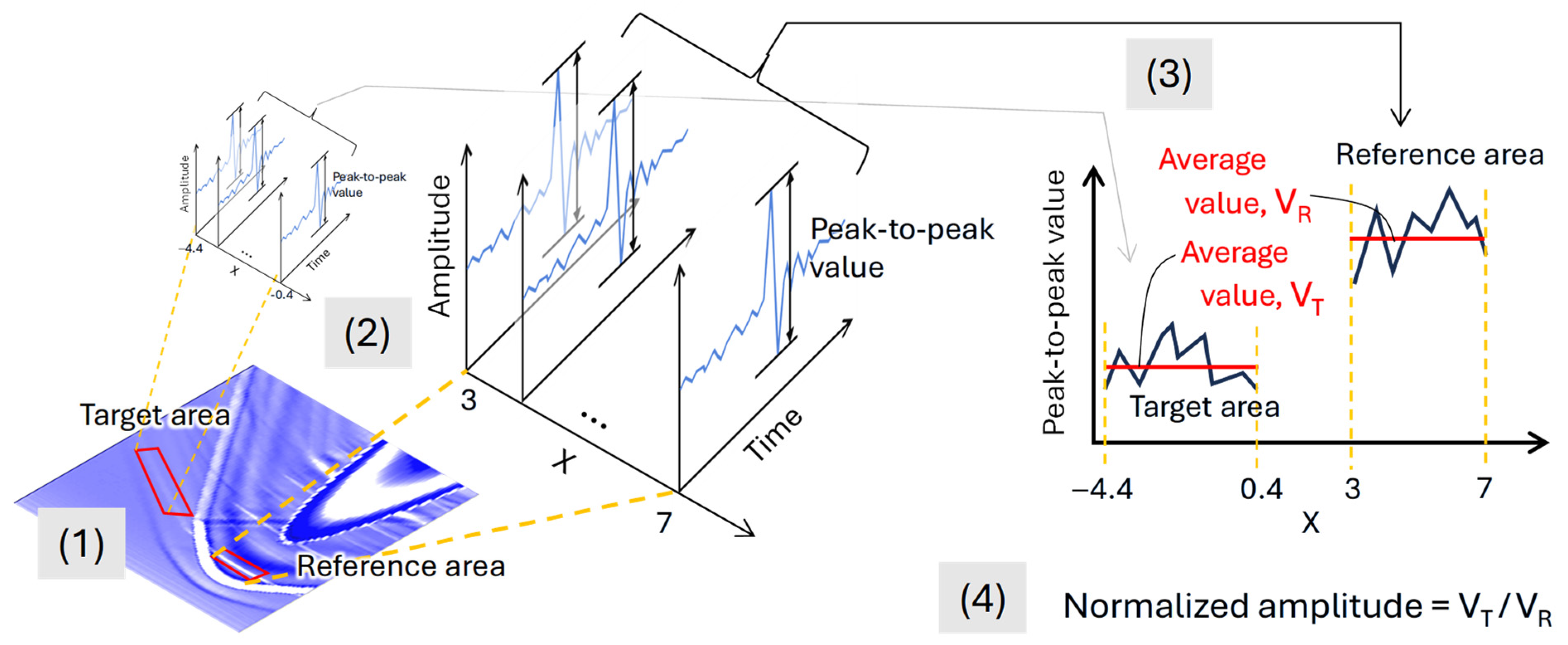
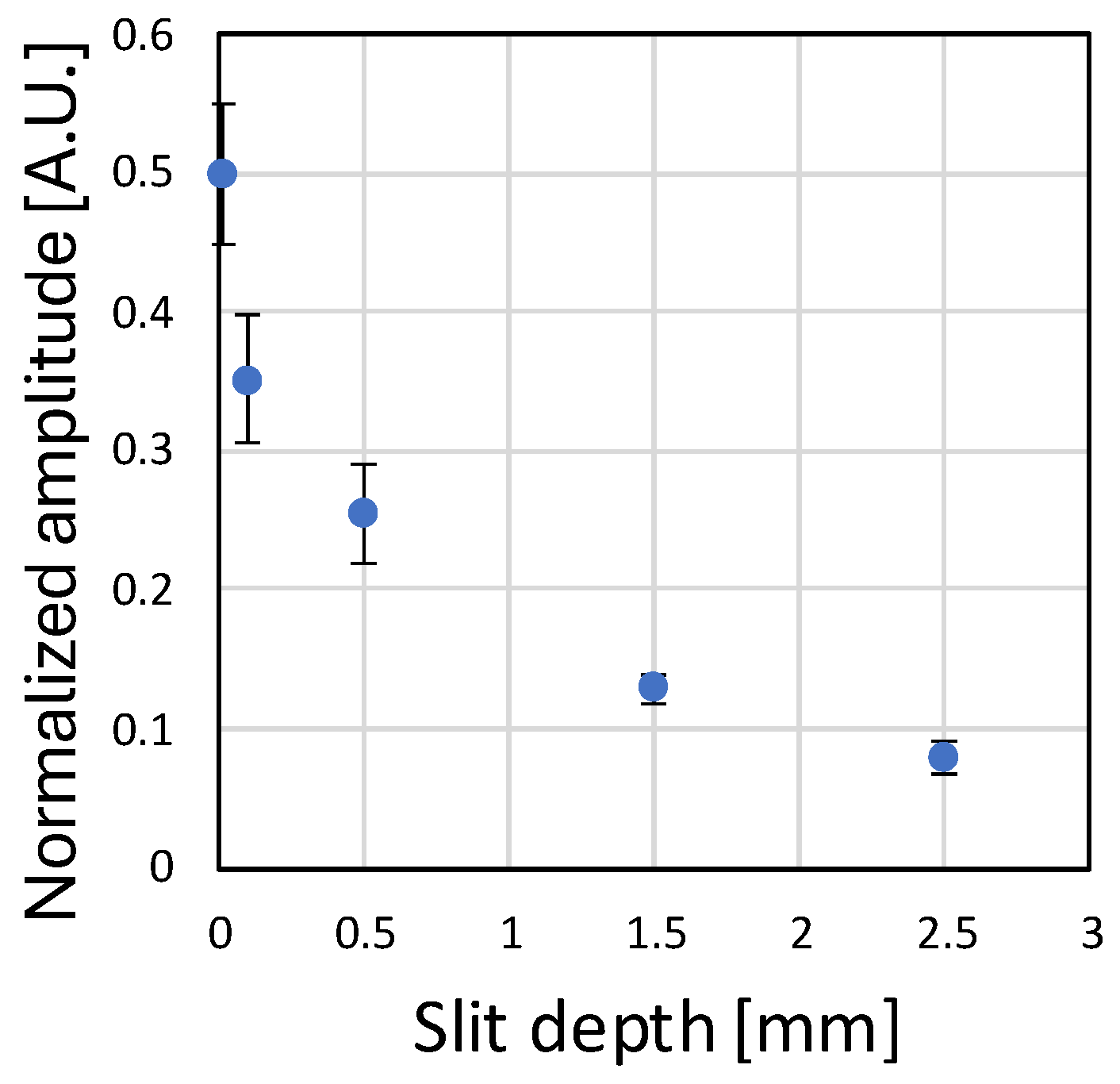
Figure 9 schematically illustrates the quantification flow used in this study. The specific procedure was as follows. First, (1) a target area was defined as a rectangular region containing the waveform of interest in the range of X = −4.4 to −0.4 mm, and a reference area was defined as a rectangular region containing the corresponding waveform in the range of X = 3 to 7 mm. Next, (2) the peak-to-peak value at each X position was extracted within each rectangular region. Then, (3) the average value of the peak-to-peak distribution was calculated for each region. These average values were used as the representative amplitudes, denoted as VT for the target area and VR for the reference area. Finally, (4) the normalized amplitude was calculated as VT/VR, which represents the attenuation of the ultrasonic signal. This procedure was repeated for ten sets of B-scopes, and the mean value and sample standard deviation were obtained for each slit depth.
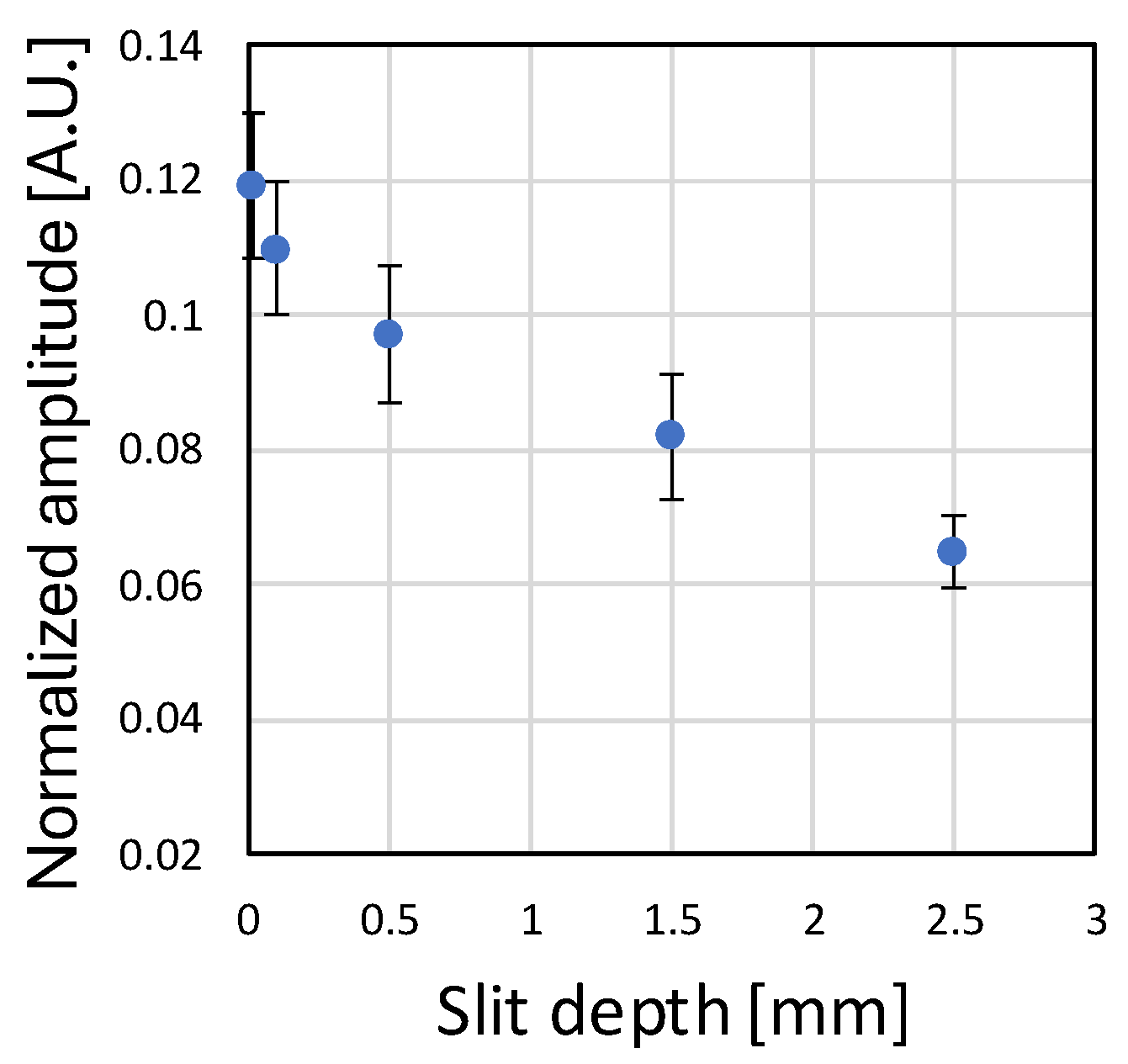
Figure 10 shows the normalized amplitude (vertical axis) as a function of slit depth (horizontal axis). The specimens on the horizontal axis, from left to right, correspond to the defect-free specimen and Specimens D, C, B, and A (slit depths of 0, 0.1, 0.5, 1.5, and 2.5 mm, respectively). It is evident that the normalized amplitude decreases as the slit becomes deeper. Considering the magnitude of the variation, detection of a 0.1 mm slit is difficult; however, slits of 0.5 mm or deeper are considered detectable.

3.4. Measurements on Defect Specimens: Irradiation from the Slit Side

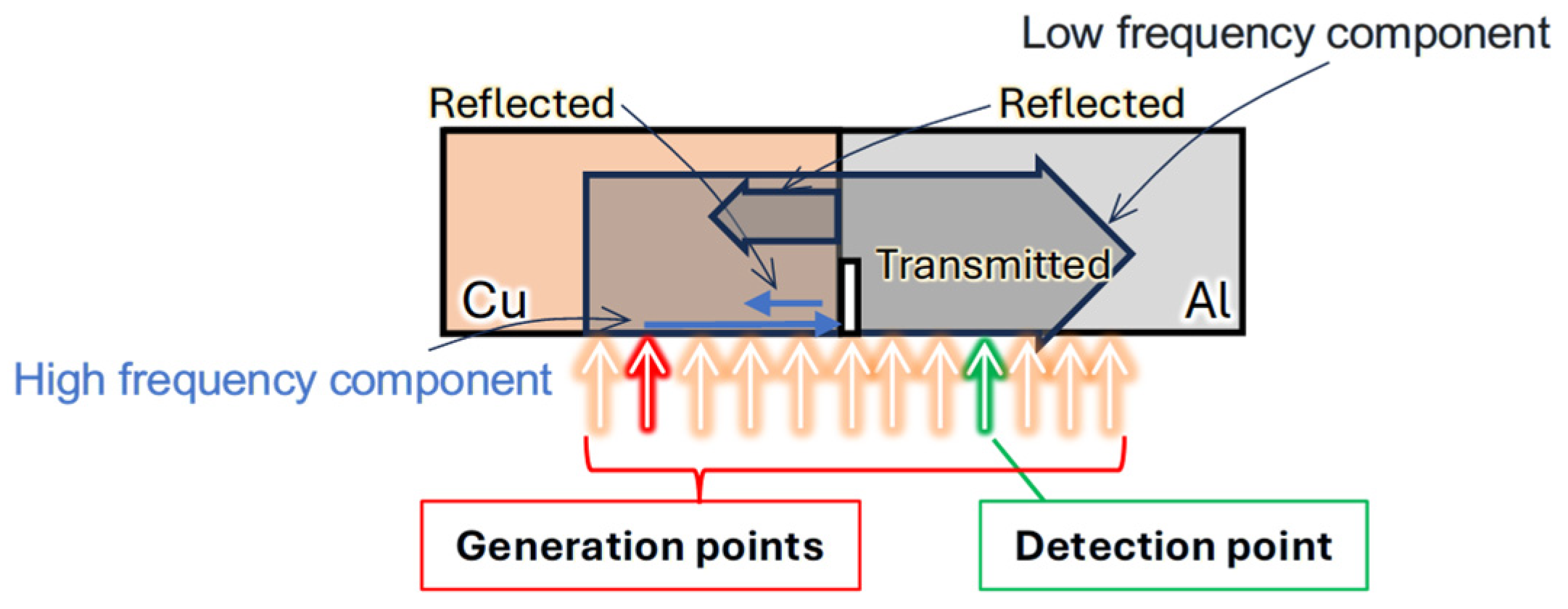
Next, defect detection was attempted by irradiating the laser onto the surface containing the slit-type defect. When a crack exists on the laser-irradiated surface of a single-material specimen, a method utilizing surface waves has been reported by Ochiai et al. [15,16]. In their method, when the laser generation and detection points are placed across the crack, lower-frequency components of the surface wave transmit more readily, whereas the higher-frequency components undergo greater attenuation, enabling measurement of crack depth. In the present study, it was considered that when measuring surface-wave amplitude over a broadband frequency range, the transmitted intensity would decrease as the slit becomes deeper. Furthermore, as shown in Figure 11, in the dissimilar-material case, the surface wave is partially reflected and partially transmitted at the dissimilar interface. The transmitted component is expected to undergo additional attenuation depending on the slit depth, and therefore this attenuation was examined as a potential indicator for detecting the presence and depth of the defect.
As an example of the measurement results, Figure 12 shows the B-scopes obtained for a defect-free joint and for a joint containing a slit-type defect of 0.5 mm depth (Specimen C). Compared with the defect-free B-scope, it can be observed that the surface waves—that is, the Rayleigh wave and the lateral wave—exhibit significant attenuation due to the presence of the slit.
Next, quantification of slit depth was conducted. The overall weaker signal level seen in Figure 12b is due to differences in measurement sensitivity. As in the previous section, this effect can be canceled by normalizing with respect to a non-attenuated region. Specifically, the Rayleigh wave before reaching the dissimilar interface was used as the reference amplitude (non-attenuated region), and the Rayleigh wave after the interface was used as the evaluation amplitude (attenuated region). The peak-to-peak amplitude at each X position within the regions shown in Figure 12 was extracted. The normalized amplitude was calculated by dividing the average amplitude in the attenuated region (X = −5 to −2.2 mm) by the average amplitude in the non-attenuated region (X = 1 to 3.8 mm). This procedure was repeated for ten datasets, and the mean values and sample standard deviations for each slit depth were obtained, as presented in Figure 13. These results confirm that the normalized amplitude decreases—that is, the transmitted surface-wave amplitude across the slit-containing dissimilar interface becomes smaller—as the slit becomes deeper. The results also indicate that even a 0.1 mm slit is detectable when considering the variation. Although the principle is similar to that reported in Refs. [15,16]—in that attenuation of surface waves transmitted across a slit is utilized—it has been clarified that this attenuation-based approach remains valid even when the surface wave crosses a dissimilar interface and is evaluated over a broadband frequency range.

4. Discussion

In this study, defect-identification methods based on the attenuation of longitudinal-wave reflections and surface waves were proposed for detecting slit-type defects. Here, we discuss the influence of the number of generation points, i.e., the data window size, used to compute the attenuation.
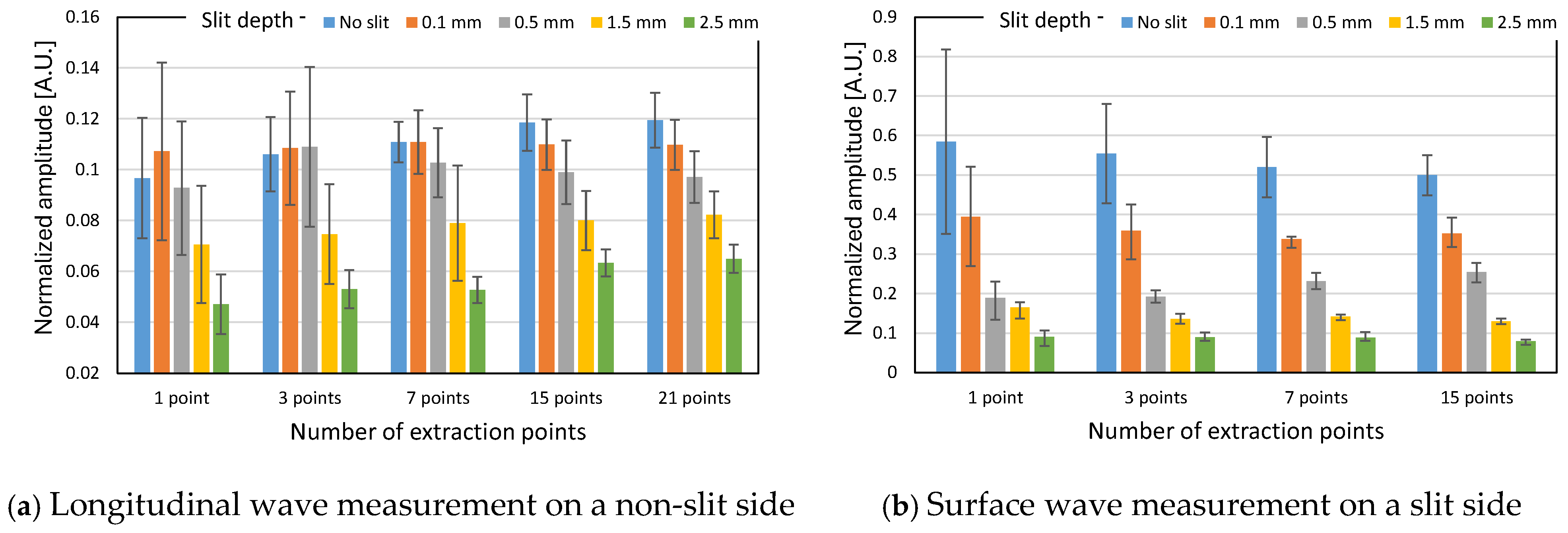
In the measurements presented earlier, the attenuation was quantified using representative evaluation and reference amplitudes extracted from specific spatial windows. For the non-slit-side measurements, a spatial window of 4 mm was sampled at 0.2 mm intervals, resulting in a data window size of 21 points for the longitudinal-wave reflection. For the slit-side measurements, a 2.8 mm window sampled at the same interval yielded a data window size of 15 points for the surface wave. The appropriateness and reliability of these data window sizes were investigated by varying the window size while keeping the center of the window fixed. Attenuation calculations were performed using window sizes of 1, 3, 7, and 15 points (with 15 points used only in the non-slit-side configuration). The results for the non-slit-side irradiation are shown in Figure 14a, and those for the slit-side irradiation are shown in Figure 14b. The vertical axis follows the definitions used in Figure 10 and Figure 13, and the horizontal axis represents the data window size, with the specimens arranged from left to right in order of increasing slit depth starting from the defect-free specimen.
For the non-slit-side irradiation using the longitudinal-wave reflections (Figure 14a), smaller data window sizes lead to less stable trends and increased variation, making discrimination of the presence or absence of a slit difficult. However, although averaging is required, slit depths of 0.5 mm become distinguishable at window sizes of 7 points or more, and slit depths of 0.1 mm become distinguishable at window sizes of 15 points or more. In contrast, for the slit-side irradiation using the surface waves (Figure 14b), clear distinctions are observed: even with a data window size of one point, slit detection is possible when the averaged amplitude is used, and the variation decreases as the window size is increased. These results indicate that the use of 21-point windows in Figure 10 and 15-point windows in Figure 13 was sufficient for determining the attenuation of ultrasonic amplitude in both measurement configurations.
Furthermore, when comparing the non-slit-side irradiation that relies on longitudinal-wave reflections with the slit-side irradiation that utilizes surface waves, the latter yields larger normalized-amplitude values on the vertical axis and, except for the case in which only a single extraction point is used, exhibits a smaller variability range. In addition, the contrast between defective and sound specimens is sufficiently large. These findings indicate that the presence and depth of the slit-like defect can be evaluated with higher accuracy when using surface-wave measurements. This is attributable not only to the fact that surface waves inherently provide stronger signals than longitudinal-wave reflections but also to differences in how the evaluated wave paths interact with the dissimilar interface and the slit. In the case of longitudinal-wave reflections, as illustrated by the propagation path in Figure 6c, the longitudinal waves generated at transmission points located on the Cu side near the dissimilar interface may be only weakly affected by shallow slits. When such points are included in the averaging of signal amplitudes, the resulting attenuation ratio becomes smaller. In contrast, for the surface-wave paths depicted in Figure 11, the information originating from any transmission point on the Cu side is expected to be influenced by both the dissimilar interface and the slit. Combined with the inherently higher signal amplitude of surface waves, this explains why the evaluation using surface waves exhibited clearer trends.
Although slit-side measurements are unlikely to be applicable to strict in-process monitoring in practical FSW production environments because the slit side is typically constrained by contact with a rigid backing plate during welding, surface-wave-based evaluation remains effective if backside access is available, such as in in-line or post-process inspections.
Also, in laser ultrasonic measurements, securing sufficient detection-laser sensitivity is essential, and measurement feasibility strongly depends on the surface condition at the detection point. In particular, the tool-side surface in friction stir welding may be affected by burr formation, tool marks, and surface oxidation, all of which can degrade the stability of interferometric detection. Consequently, especially in the non-slit-side irradiation configuration, measurements are more susceptible to tool-side surface conditions, imposing limitations on strict in-process application. However, in the present study, specimens subjected to surface polishing after joining were used. In practical manufacturing processes, if burr removal or mild surface treatment is permitted either during or immediately after joining, application on the tool side may still be feasible for in-line measurements or post-process inspections. The applicability of such scenarios should be further investigated in future work, together with optical system design and systematic evaluation of surface-condition effects.
In the present experiments, the normalized amplitude was found to decrease with increasing slit depth; however, when the slit becomes sufficiently deep, there is expected to be a limit to the depth that can be quantitatively evaluated using the proposed method. Nevertheless, in practical FSW production, such deep defects would themselves indicate improper process conditions, and quantitative sizing beyond that range is unlikely to be required in real applications. It is known that surface waves are influenced by defects only to depths on the order of one to two wavelengths [17,18]. Related to this, as mentioned earlier, Ochiai et al. reported that the transmission characteristics of surface waves in laser ultrasonics vary depending on their frequency when crossing a crack, and that crack depth can be estimated by identifying these frequency-dependent characteristics [15,16]. Based on these findings, it is reasonable to assume that a frequency-dependent threshold also exists for the surface waves employed in this study. Therefore, future work should investigate the maximum crack depth that can be sized using the present method, as well as the correlation between measurable depth and the frequency components of the surface waves.
Actual defects may exhibit irregular crack shapes involving variations not only in depth but also in width and orientation; therefore, the artificial slits used in this study represent an idealized and simplified model. Statistical evaluation incorporating other defect geometries and real defect morphologies remains a subject for future investigation.

5. Conclusions

This study aimed to detect defects located near the Cu–Al dissimilar FSW interface using laser ultrasonics. Slit-like artificial defects with a fixed width of 0.1 mm and depths of 0.1, 0.5, 1.5, and 2.5 mm were introduced, and flaw-detection measurements were conducted by irradiating both the generation and detection lasers on the same surface. The generation laser was widely scanned across the Cu–Al interface using a galvanometer scanner, while the detection laser was applied at a single point on the Al side, enabling acquisition of a characteristic B-scope that included the dissimilar interface region. Two measurement configurations were considered: irradiation from the slit side to detect defects on the laser-irradiated surface, and irradiation from the non-slit side to detect defects located on the opposite surface. In both configurations, simple identification of reflected waves was insufficient because reflections from the dissimilar interface and those from the slit could not be distinguished solely by their presence, and portions of the B-scope were unusable due to the blast waves generated by laser ablation. Nevertheless, by focusing on the signal attenuation of specific wave modes, a defect-identification approach applicable to dissimilar joints was established. For non-slit-side irradiation, attenuation of longitudinal-wave reflections enabled detection of slits ≥0.5 mm deep, whereas for slit-side irradiation, attenuation of surface waves enabled detection of slits as shallow as 0.1 mm. Furthermore, evaluation of the number of data extraction points demonstrated that slit-side irradiation using surface-wave attenuation provides higher defect-estimation accuracy.
This article is an extended and revised version of the conference paper entitled “Research on non-contact defect detection using the laser ultrasonic method for friction stir welded Cu–Al dissimilar-material joints [19],” presented at the 31st Symposium on Ultrasonic Testing, Tokyo, Japan, 23 January 2024.

Author Contributions

Conceptualization, K.N.; methodology, investigation, data curation, writing—original draft preparation, K.N. and S.I.; writing—review and editing, funding acquisition, K.N. and S.A. All authors have read and agreed to the published version of the manuscript.

Funding

This research was supported by the 2023 Research Grant from the Japanese Society for Non-Destructive Inspection (JSNDI).

Institutional Review Board Statement

Not applicable.

Informed Consent Statement

Not applicable.

Data Availability Statement

The data presented in this study are available on request from the corresponding author. The data are not publicly available due to the samples being sensitive and the need for specialist processing of the data.

Conflicts of Interest

The authors declare no conflicts of interest.

References

  1. Morisada, Y.; Imaizumi, T.; Fujii, H. Clarification of defect formation mechanism in friction stir welding by X-ray radiography. J. Jpn. Weld. Soc. 2014, 32, 31–37. (In Japanese) [Google Scholar] [CrossRef]
  2. Xue, P.; Ni, D.R.; Wang, D.; Xiao, B.L.; Ma, Z.Y. Effect of friction stir welding parameters on the microstructure and mechanical properties of the dissimilar Al–Cu joints. Mater. Sci. Eng. A 2011, 528, 4683–4689. [Google Scholar] [CrossRef]
  3. Takei, T.; Yoshizawa, M.; Fukumoto, S.; Okada, H.; Ishikawa, T. Ultrasonic testing technology applied to friction stir welding joint. Sogo Sharyo Seisakusho Gihou 2014, 3, 32–37. (In Japanese) [Google Scholar]
  4. Zhang, H.; Deng, Y.; Chen, F.; Luo, Y.; Xiao, X.; Lu, N.; Liu, Y.; Deng, Y. Fatigue life prediction for orthotropic steel bridge decks welds using a Gaussian variational bayes network and small sample experimental data. Reliab. Eng. Syst. Saf. 2025, 264, 111406. [Google Scholar] [CrossRef]
  5. Zhang, H.; Zhao, L.; Yang, S.; Deng, Y.; Ouyang, Z. Fatigue evaluation of Orthotropic steel deck welds based on WIM data and UD-BP neural network. Structures 2025, 78, 109198. [Google Scholar] [CrossRef]
  6. Yokono, Y. Nondestructive testing methods and their characteristics. J. Jpn. Weld. Soc. 1990, 59, 410–413. (In Japanese) [Google Scholar] [CrossRef]
  7. Uematsu, Y.; Shigematsu, K.; Yamamoto, Y.; Imai, N.; Nomura, T.; Fukuda, T.; Kakiuchi, T.; Kondo, E. Non-destructive inspection of welding defects in friction stir welds and prediction of their fatigue life. Q. J. Jpn. Weld. Soc. 2012, 30, 220–227. (In Japanese) [Google Scholar] [CrossRef][Green Version]
  8. Levesque, D.; Dubourg, L.; Blouin, A. Laser ultrasonics for defect detection and residual stress measurement of friction stir welds. Nondestruct. Test. Eval. 2011, 26, 319–333. [Google Scholar] [CrossRef]
  9. Pouet, B.; Wartelle, A.; Breugnot, S. Multi-detector receiver for laser ultrasonic measurement on the run. Nondestruct. Test. Eval. 2011, 26, 253–266. [Google Scholar] [CrossRef]
  10. Ikegami, Y.; Sakai, Y.; Nakamura, H. A highly accurate ultrasonic simulator capable of over one billion elements for non-destructive evaluations. In Proceedings of the 7th International Conference on NDE in Relation to Structural Integrity for Nuclear and Pressurized Components, Yokohama, Japan, 12–15 May 2009; pp. 177–190. [Google Scholar]
  11. Murray, T.W.; Wagner, J.W. Laser generation of acoustic waves in the ablative regime. J. Appl. Phys. 1999, 85, 2031–2040. [Google Scholar] [CrossRef]
  12. Auld, B.A. General electromechanical reciprocity relations applied to the calculation of elastic wave scattering coefficients. Wave Motion 1979, 1, 3–10. [Google Scholar] [CrossRef]
  13. Osumi, A.; Ito, Y. Non-contact fire damage diagnosis using wave source scanning method. J. Acoust. Soc. Jpn. 2023, 79, 303–310. (In Japanese) [Google Scholar]
  14. Okuyama, N.; Nomura, K.; Sano, T.; Kadota, K.; Nitta, S.; Era, T.; Asai, S. Study on detecting method of internal defects by laser ultrasonics in lap joint welding of galvanized steel sheet and finite element analysis of its detectability. Appl. Sci. 2023, 13, 11515. [Google Scholar] [CrossRef]
  15. Ochiai, M.; Butsuen, T.; Miura, T.; Kuroda, H.; Soramoto, S.; Kanemoto, S. Sizing of micro cracks using laser-induced broadband surface waves. J. At. Energy Soc. Jpn. 2001, 43, 275–281. (In Japanese) [Google Scholar] [CrossRef]
  16. Ochiai, M.; Miura, T.; Yamamoto, S.; Onodera, T. Laser-ultrasonic study of micro crack sizing and its application to nuclear reactor internals. Hozengaku 2006, 4, 41–46. [Google Scholar]
  17. Wang, C.; Sun, A.; Yang, X.; Ju, B.; Pan, Y. Laser-generated Rayleigh wave for width gauging of subsurface lateral rectangular defects. J. Appl. Phys. 2018, 124, 065104. [Google Scholar] [CrossRef]
  18. Lv, G.; Yao, Z.; Chen, D.; Li, Y.; Cao, H.; Yin, A.; Liu, Y.; Guo, S. Fast and high-resolution laser-ultrasonic imaging for visualizing subsurface defects in additive manufacturing components. Mater. Des. 2023, 225, 11145. [Google Scholar] [CrossRef]
  19. Ishifuro, S.; Nomura, K.; Sano, T.; Asai, S. Research on non-contact defect detection using laser ultrasonic method for friction stir welded Cu-Al dissimilar material joints. In Proceedings of the 31st Symposium on Ultrasonic Testing, Tokyo, Japan, 23–24 January 2024; pp. 51–56. (In Japanese) [Google Scholar]
Figure 1. Cross-sectional schematic of the specimen with slit defects.
Applsci 16 00688 g001
Figure 2. Schematic of experimental setup.
Applsci 16 00688 g002
Figure 3. Schematic of laser irradiation position.
Applsci 16 00688 g003
Figure 4. Influence of dissimilar interface on experimental B-scope result of defect-free specimen: (a) Al, (b) Cu-Al.
Applsci 16 00688 g004
Figure 5. Explanation of each wave for the numbers in Figure 4.
Applsci 16 00688 g005
Figure 6. Schematic of longitudinal wave propagation path in the laser irradiation on a non-slit side.
Applsci 16 00688 g006
Figure 7. Simulated B-scope of Cu-Al.
Applsci 16 00688 g007
Figure 8. B-scope results and extraction range in the laser irradiation on a non-slit side: (a) No defect, (b) Specimen (A) (d = 2.5 mm).
Applsci 16 00688 g008
Figure 9. Schematic workflow for calculating the normalized amplitude based on the B-scope shown in Figure 8.
Applsci 16 00688 g009
Figure 10. Slit depth dependence of normalized longitudinal wave intensity attenuation in the laser irradiation on a non-slit side.
Applsci 16 00688 g010
Figure 11. Schematic diagram of surface wave attenuation in the laser irradiation on a slit side.
Applsci 16 00688 g011
Figure 12. B-scope results and extraction range in the laser irradiation on a slit side: (a) No defect, (b) Specimen, (C) (d = 0.5 mm).
Applsci 16 00688 g012
Figure 13. Slit depth dependence of normalized surface wave intensity attenuation in the laser irradiation on a slit side.
Applsci 16 00688 g013
Figure 14. Effect of the number of extraction points on estimating slit depth by intensity attenuation.
Applsci 16 00688 g014
Table 1. Generation laser parameters.
LaserNd:YAG, Pulsed
Wavelength1064 nm
Repetition rate100 Hz
Pulse energy50 mJ
Pulse width8 ns
Table 2. Detection laser parameters.
LaserNd:YAG, CW
Wavelength532 nm
Laser power1.5 W
Detection range100 kHz~50 MHz
Disclaimer/Publisher’s Note: The statements, opinions and data contained in all publications are solely those of the individual author(s) and contributor(s) and not of MDPI and/or the editor(s). MDPI and/or the editor(s) disclaim responsibility for any injury to people or property resulting from any ideas, methods, instructions or products referred to in the content.