The Future of Green Chemistry: Evolution and Recent Trends in Deep Eutectic Solvents Research



Abstract
1. The Rise of Green Chemistry and the Critical Need for New Solvents
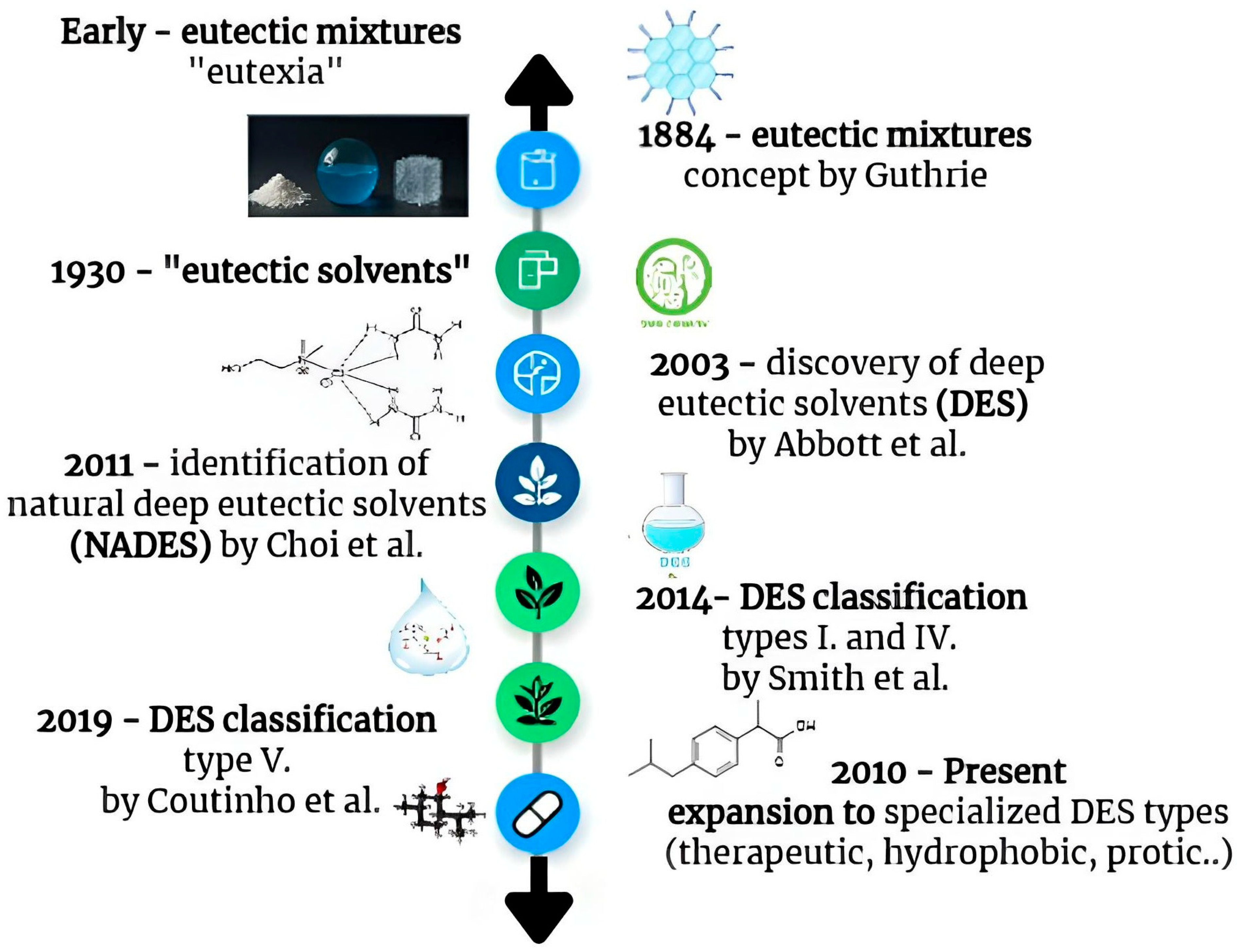
2. The Historical Development of Deep Eutectic Solvents
- DES functionalized: Engineered with specific functional groups for applications in catalysis, sensing, or advanced materials.
2.1. The Relationship of DES with IL and Their Comparison
2.2. Mechanism of Formation and Thermodynamic Stabilization of DES
- (a)
- Destruction of the crystal lattice: In DES, the dominant mechanism is the disruption of the strong lattice energy of HBA. A typical HBA (e.g., choline chloride) has a high Tm due to strong interionic coulombic interactions. Therefore, the key role is assigned to the HBA anion.
- (b)
- Formation of a supramolecular complex: The HBA anion acts as an acceptor for protons originating from the hydroxyl, amide, or carboxyl groups of the HBD. This hydrogen-bond coordination creates a new, large supramolecular ionic cluster. These new complex interactions are energetically favorable but structurally less ordered than the original bonds in the pure crystalline phases.
- (c)
- Critical stabilization of the anion: The presence of an extensive HBD solvation envelope around the anion (especially chloride) effectively separates and stabilizes the HBA ion pair, dramatically reducing the interaction energy and weakening the original lattice force. As a result, the liquid phase can exist at a significantly lower temperature [63,64,65].
- (a)
- Vibrational spectroscopy (FTIR/Raman): The emergence of strong HBD-anion interactions is confirmed by measurement. Typically, a shift of the O-H and N-H frequencies of HBD to lower wavenumbers is observed, which is direct evidence of the weakening of the original intramolecular HBD bond and its strong participation in intermolecular hydrogen bonding with the HBA anion.
- (b)
- Diffraction and scattering (WAXS/SAXS): They confirm the loss of long-range order in DES compared to pure solids, which corresponds to a significant increase in configurational entropy (ΔSmix).
- (c)
- Molecular dynamics and DFT: Computational simulations accurately model the H-bond distances and charge distribution. They confirm the high coordination preference of the HBA anion over that of the HBD protons, demonstrating the existence of dynamically changing supramolecular clusters instead of free, independent ions. These clusters are the essence of the liquid state and determine the low ionic mobility and high viscosity of DES [64,65,66,67,68].
2.3. Deepening the Supramolecular Levels of Formation of DES
- Specific role of the anion: The HBA anion (e.g., Cl-, Br-) usually has a high charge density and acts as a strong H-bond acceptor. This anion becomes the central accepting entity to which a typical number of 1 to 4 HBD molecules (urea, glycerol, etc.) are coordinated via their protic groups (OH, NH), thus forming a stabilized anion complex [66,67].
- Supramolecular network: These anion complexes are then dynamically associated with HBA cations via Coulombic forces. The result is not a homogeneous solution of free ions, but a dynamic supramolecular network. This network is characterized by short-range ordering, which prevents the formation of a rigid, long-range crystal lattice, typical of the original solids [63,64,65,66].
- Nonideal thermodynamics: The HBA-HBD interactions are stronger than HBA-HBA and HBD-HBD interactions in their pure solid phases (often exothermic mixing, ΔHmix < 0). According to the thermodynamic theory of solution, this strong interaction leads to a significant negative deviation from Raoult’s law, thereby reducing the chemical activity of each component (ai < xi) in the liquid mixture. This reduced activity is a thermodynamic force that destabilizes the solid phase and shifts the eutectic point towards lower temperatures [61,62,63,64].
- Domain formation: Molecular simulations and X-ray scattering experiments (SAXS/WAXS) confirm the presence of two coexisting microdomains:
- ○
- Ionic domains: Ion-rich regions (cations and anion complexes) are primarily responsible for the solvation of polar and charged solutes and ion transport.
- ○
- Viscosity and supramolecular motion: The high viscosity of DES is a direct consequence of the existence of this H-bonded supramolecular network. Ion transport does not occur solely through simple diffusional motion (as assumed by the Stokes-Einstein model), but often through cooperative motion of entire clusters or by hopping transport mechanisms within the network. This dynamic but dense cluster architecture provides the mechanistic basis for the sub-ideal Walden behavior observed in most DES [61,62,63,64,65,66,67,68,69,70].
3. The Most Relevant and Highly Cited Research Areas for Deep Eutectic Solvents
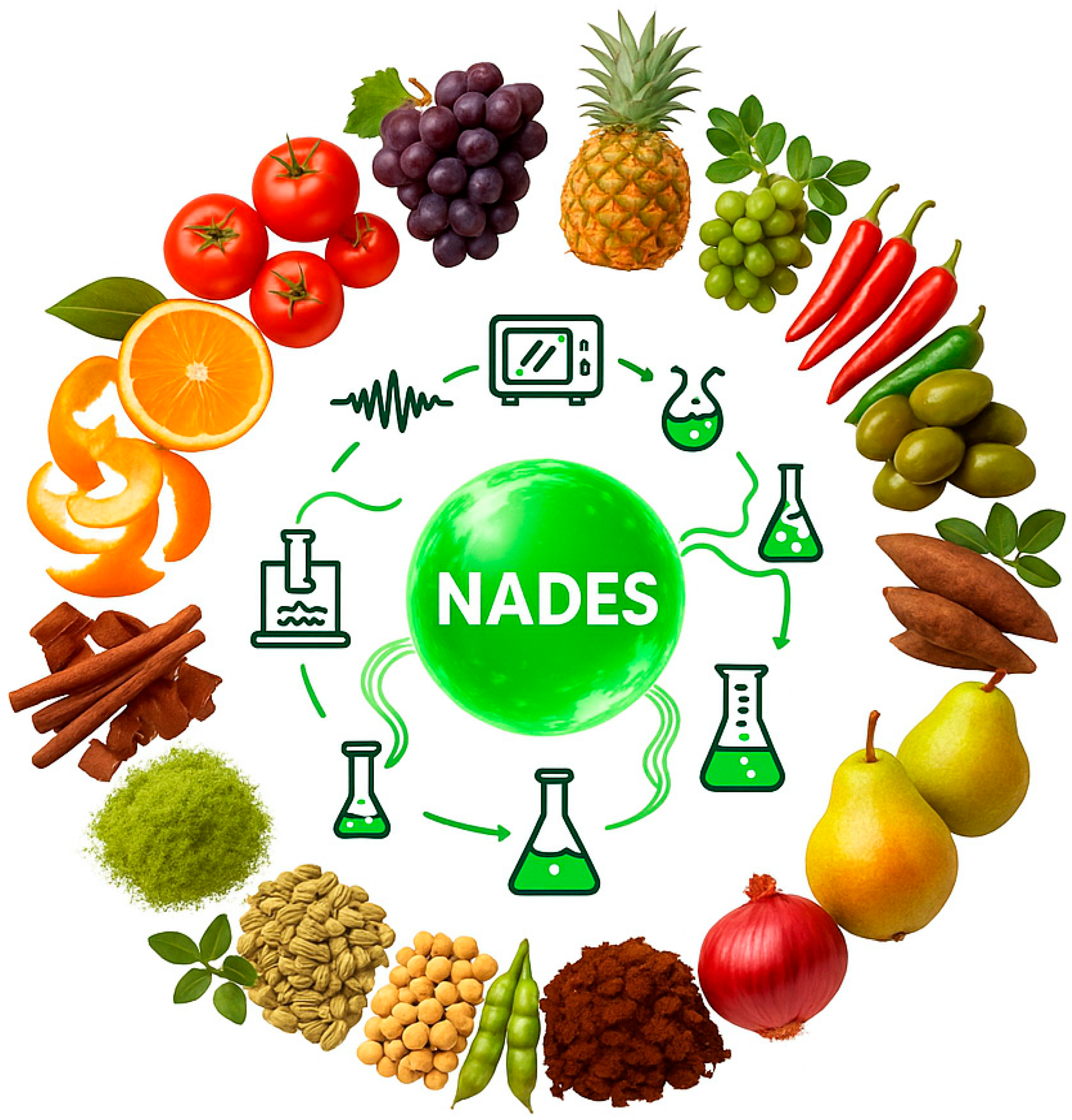
3.1. Extraction of Bioactive Compounds: Natural Deep Eutectic Solvents
- NADES composition optimization: study of the influence of various molar ratios of HBD and HBA on extraction selectivity and yield.
- Green extraction: application of NADES for the extraction of polyphenols, flavonoids, alkaloids, and other phytochemicals from plant materials and agro-food waste.
- Food and pharmaceutical utilization: assess the stability and preservation of extracted bioactive substances within the NADES matrix.
3.2. Application in Electrochemistry and Energy Systems
- Electrolytes for batteries: use of DES in zinc ion batteries as a nontoxic and non-flammable alternative to organic electrolytes.
- Metal electrodeposition: utilizing DES for the electroplating of metals, a process traditionally challenging because of environmentally harmful reagents (chromium, zinc, nickel).
- Nanocatalyst production: preparation and stabilization of nanomaterials (metal nanoparticles and composites) directly in DES to enhance catalytic activity.
3.3. Catalysis and Organic Synthesis: Green Synthesis
- Reaction medium replacement: substitution of volatile organic compounds with DES in organic synthesis.
- Heterogeneous and homogeneous catalysis: using DES as precursors for the synthesis of DES-functionalized catalysts or as solvents for enzymatic synthesis.
- Catalyst regeneration: investigate the recycling and reuse of the DES/catalytic system to lower operating costs.
3.4. Gas Separation and Purification
- CO2 absorption: designing DES with high capacity and selectivity to capture CO2 from power plant gases (flue gas) and biogas:
- Interaction mechanisms: physical and chemical studies of gas-DES interactions to understand the absorption mechanism (spectroscopy, simulations).
- DES regeneration: development of energy-efficient methods to release the captured gas and recycle the solvent (via temperature/pressure swing).
Gas Capture and Separation Using DES
- ○
- Zero vapor pressure minimizes environmental solvent losses and eliminates the risk of toxic vapor formation.
- ○
- Tunability: by choosing specific HBA and HBD, the CO2 activity quotient in the liquid phase can be modified, thus optimizing capacity and selectivity.
3.5. Biocatalysis and Enzyme Applications
- Enzyme stability: study of the effect of DES on the tertiary structure and long-term stability of various enzymes (lipases, proteases) under reaction conditions.
- Enhanced activity: optimizing the DES composition and water content to maximize the rate of biocatalytic reactions (esterification and transesterification).
- Biomass and biorefining: utilizing DES for the dissolution and processing of lignocellulosic biomass for the production of biofuels and biochemicals.
3.6. Pharmaceutical Applications and Drug Delivery
- API solubility enhancement: investigation of DES formulations that increase the solubility of poorly soluble drugs (anticancer agents) for improved bioavailability.
- Vehicle/excipient use: formulation of DES as non-toxic, biocompatible components in pharmaceutical preparations (creams, patches, oral forms).
- DES in nanomedicine: the use of DES in the preparation of nanoparticles, liposomes, and other drug carriers for targeted delivery.
3.7. Responsive DES and Smart Applications
- the free volume fraction and viscosity;
- the solvation spheres around the solutes;
- Switching mechanisms: studying the molecular interactions and mechanisms that govern the “switching” behavior of DES (CO2-responsive DES).
- Separation and purification: application of R-DES for the highly efficient separation of biomolecules, trace metals, or pollutants via simple phase transition.
- Smart materials: incorporation of R-DES in membranes, hydrogels, or sensors with adaptive functionality.
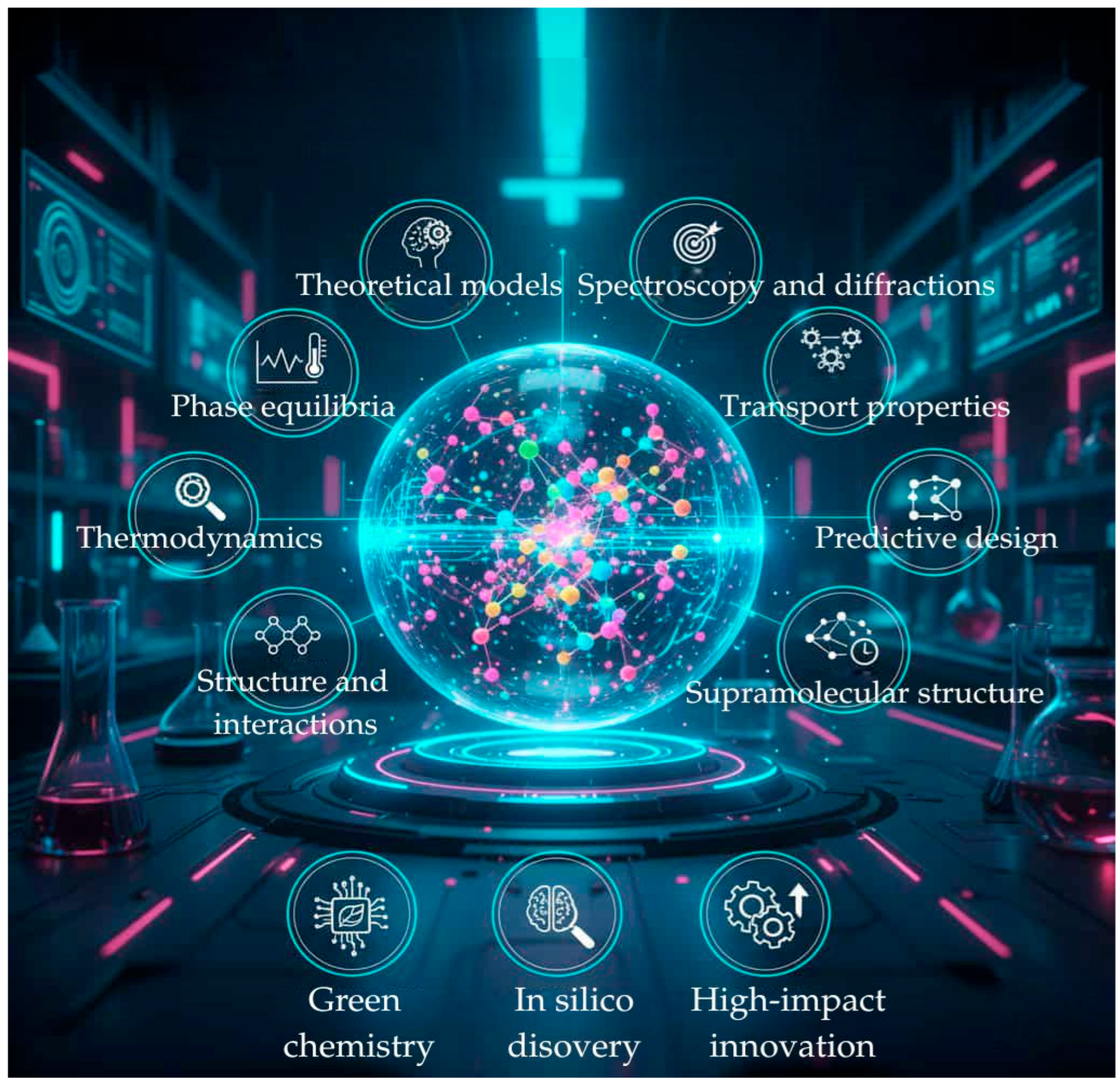
3.8. Physicochemical Fundamentals and Molecular Simulations
- Structural characterization and interactions: NMR, Raman, and X-ray diffraction studies used to analyze hydrogen bonding and the supramolecular structure of DES.
- Thermodynamics and phase equilibria: measurement and modeling of phase equilibria, eutectic point topology, and the activity of solutes in DES.
- Theoretical modeling: using quantum chemistry and computational chemistry methods (COSMO-RS and molecular dynamics simulations) applied to predict properties and select optimal DES compositions.
3.9. Biomass and Polymer Processing
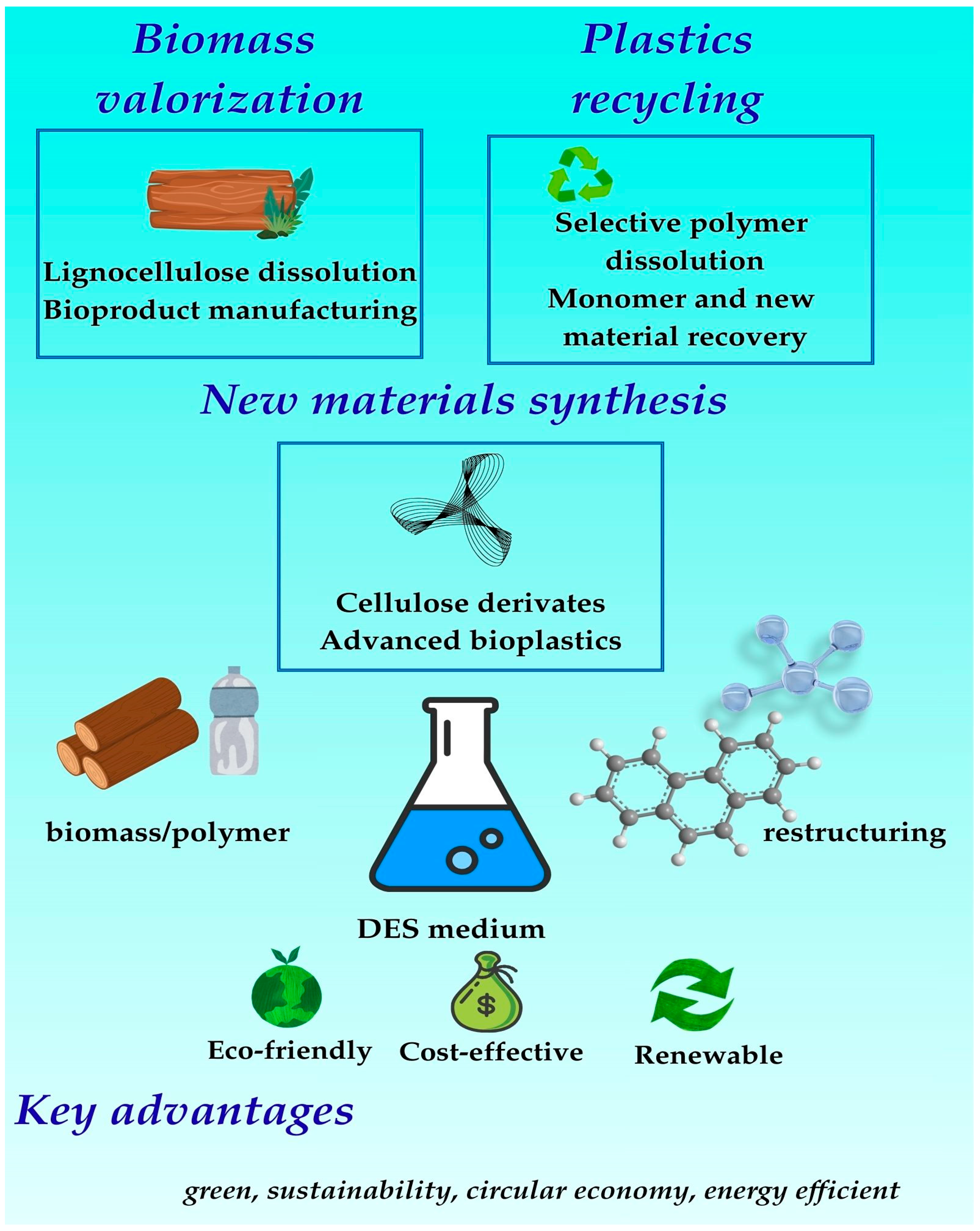
- Lignocellulose dissolution: development of DES for the selective dissolution of lignin and cellulose for subsequent biomass fractionation and bioproduct manufacturing.
- Plastic recycling: DES for the selective dissolution and depolymerization of complex polymers (PET, polyurethane) and the recovery of monomers.
- New material preparation: synthesis of cellulose derivatives and other polymeric materials directly in DES medium.
3.10. Trace Element Determination and Aalytical Chemistry
- Microextraction techniques: using hydrophobic DES (HDES) in techniques such as liquid–liquid microextraction for the preconcentration of analytes from aqueous matrices.
- Metal separation: selective extraction and determination of trace toxic metals (mercury, cadmium) and rare earths from environmental and biological samples.
- Nanomaterial modification: use of DES as dispersion media and stabilizers for nanomaterials (graphene, carbon nanotubes) employed in analytical sensors.
4. Innovation and New Trend in DES Research
4.1. Cascade Synthesis and Dynamic Covalent Chemistry in Reactive DES
- DES as directing scaffolds/templates: exploiting specific DES/NADES interactions for template synthesis or controlling DCC equilibria to increase selectivity and yield.
- Multistep cascade catalysis: development of a unified eutectic system containing multiple active sites (metallic and organocatalytic) to enable sequential reactions without intermediate purification steps (zero-waste).
- Self-healing material formation: synthesis of polymers and supramolecular hydrogels with dynamic bonds (imine, boron-ester linkages) directly in DES, where the DES regulates the speed and reversibility of the self-repair process.
- In situ spectroscopic monitoring: application of advanced methods (in situ NMR and Raman) to study the dynamics of covalent bond formation and cleavage within the nontraditional DES environment.
- Reactive HBD/HBA components: designing DES in which one component (HBD or HBA) is the reactant itself or a catalytically active group, eliminating the need for an external catalyst.
4.2. DES Inspired Artificial Organelles for Controlled Bioremediation
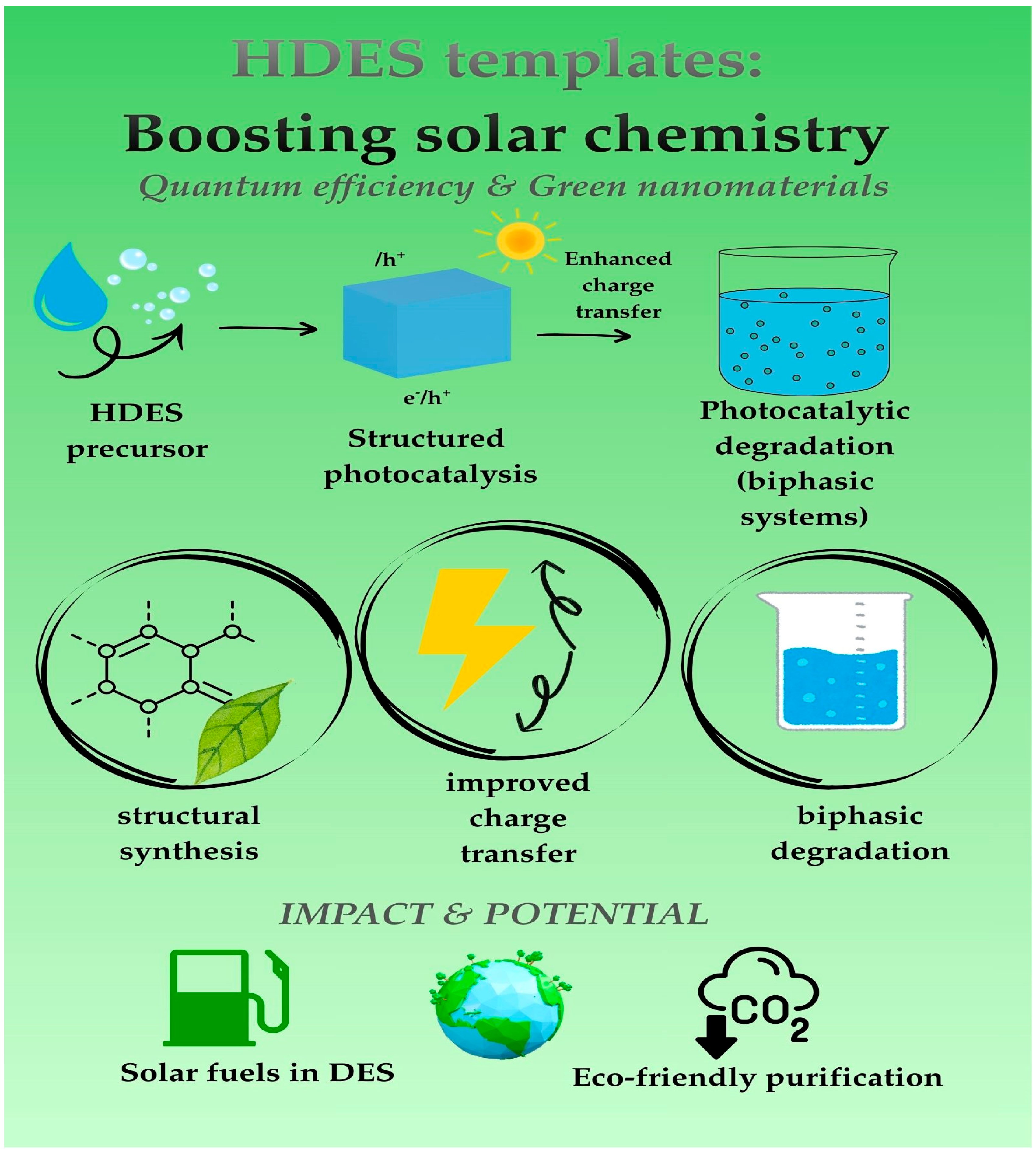
4.3. Photocatalysis and Up-Conversion Nanomaterials Templated by HDES
4.4. DES with Tunable Thermo-Acoustic Response for Smart Therapy
- Ultrasound-triggered phase transition: designing DES with a eutectic point near body temperature that can undergo a controlled phase transition (liquid–liquid demixing or solid–liquid melting) under the influence of therapeutic ultrasound.
- Thermodynamics of ultrasonication: a precise measurement of viscosity and acoustic impedance changes in DES after ultrasound application to identify optimal trigger DES formulations.
- Targeted drug release: incorporating drugs into such DES for non-invasive, spatially targeted release in deep tissues, triggered by ultrasound-induced cavitation or a change in phase stability.
- DES for hypo/hyperthermia: utilize DES as a thermally conductive medium to enhance the efficiency of localized hyperthermia treatment for tumors.
- Application in in vivo imaging: synthesis of DES enriched with contrast agents that change their acoustic response, making them suitable for monitoring drug release using ultrasound.
4.5. DES as a Multifunctional Interface for 2D Materials
- Exfoliation and functionalization: Use of DES (especially those with amphiphilic properties) for the efficient, defect-free, and ecological delamination of 2D materials.
- Nanodispersion stabilization: designing specific DES compositions that act as structural stabilizers for 2D material nanoparticles, preventing their aggregation in composite matrices.
- DES-directed doping: use of DES with active HBD/HBA components (containing N and S) for the chemical doping of 2D materials during synthesis, thus modifying their electronic conductivity.
5. Summary of DES Research Potential
- Green extraction and separation technologies
- Energy storage and electrochemistry
- Green synthesis and catalysis
- Carbon dioxide and gas capture
- Biocatalysis and biotechnology
- Pharmaceuticals and drug delivery
- Smart materials and responsive systems
- Biomass processing and polymer applications
- Analytical chemistry and sensing
- Molecular design, simulation, and physicochemical studies
- Cascade synthesis and dynamic covalent chemistry
- Artificial organelles and bioremediation capsules
- Photocatalysis and nanomaterial synthesis
- Thermo-ccoustic-responsive DES for therapy
- 2D Material interfaces: graphene and MXene functionalization
- DES-driven circular economy platforms
6. Critical Analysis of DES Limitations and Industrial Challenges
- Composition of the DES: different combinations (e.g., choline chloride with urea, or various amines) lead to very different absorption capacities.
- Water addition: the addition of water often significantly reduces the high viscosity of pure DES, improving the absorption rate and mass transfer. Conversely, in some systems water acts as an antisolvent, decreasing CO2 solubility (e.g., certain choline chloride-based systems). In other systems, particularly those with reactive amines, water addition can increase or optimize absorption capacity, or only slightly reduce it.
7. Conclusions
Author Contributions
Funding
Institutional Review Board Statement
Data Availability Statement
Conflicts of Interest
References
- Paiva, A.; Craveiro, R.; Martins, M.; Reis, R.L.; Duarte, A.R.C. Natural Deep Eutectic Solvents–Solvents for the 21st Century. ACS Sustain. Chem. Eng. 2014, 2, 1063–1071. [Google Scholar] [CrossRef]
- Uría, Á.L.; González, F.P.; Villoslada, F.N.; Peña, E.B. Natural Deep Eutectic Solvents as a Green Alternative for Extracting Contaminants from Food Samples: A Review. J. Anal. Test. 2025, 9, 548–574. [Google Scholar] [CrossRef]
- Anastas, P.T.; Eghbali, N. Green chemistry: Principles and practice. Chem. Soc. Rev. 2010, 39, 301–312. [Google Scholar] [CrossRef]
- Kurul, F.; Doruk, B.; Topkaya, S.N. Principles of green chemistry: Building a sustainable future. Discov. Chem. 2025, 2, 68. [Google Scholar] [CrossRef]
- Dal Bosco, C.; De Cesaris, M.G.; Antonelli, L.; Felli, N.; Gentilli, A. The complex world of eutectic solvents: Guidelines for a correct characterization and use in sample preparation. Adv. Sample Prep. 2025, 14, 100189. [Google Scholar] [CrossRef]
- Martins, M.A.R.; Pinho, S.P.; Coutinho, J.A.P. Insights into the Nature of Eutectic and Deep Eutectic Mixtures. J. Solut. Chem. 2018, 48, 962–982. [Google Scholar] [CrossRef]
- Abbott, A.P.; Capper, G.; Davies, D.L.; Rasheed, R.K.; Tambyrajah, V. Novel solvent properties of choline chloride/urea mixtures. Chem. Commun. 2003, 1, 70–71. [Google Scholar] [CrossRef]
- Smith, E.L.; Abbott, A.P.; Ryder, K.S. Deep Eutectic Solvents (DESs) and Their Applications. Chem. Rev. 2014, 114, 11060–11082. [Google Scholar] [CrossRef]
- Lomba, L.; Ribate, M.P.; Sangüesa, E.; Concha, J.; Garralaga, M.P.; Errazquin, D.; García, C.B.; Giner, B. Deep Eutectic Solvents: Are They Safe? Appl. Sci. 2021, 11, 10061. [Google Scholar] [CrossRef]
- Juneidi, I.; Hayyan, M.; Hashim, M.A. Evaluation of toxicity and biodegradability for cholinium-based deep eutectic solvents. RSC Adv. 2015, 5, 83636–83647. [Google Scholar] [CrossRef]
- Choi, Y.H.; van Spronsen, J.; Dai, Y.; Verberne, M.; Hollmann, F.; Arends, I.W.C.E.A.; Witkamp, G.J.; Verpoorte, R. Are natural deep eutectic solvents the missing link in understanding cellular metabolism and physiology? Plant Physiol. 2011, 156, 1701–1705. [Google Scholar] [CrossRef]
- Ramón, D.J.; Guillena, G. Deep Eutectic Solvents: Synthesis, Properties, and Applications; Wiley: Hoboken, NJ, USA, 2019; ISBN 9783527818471. [Google Scholar]
- Alhadid, A.; Mokrushina, L.; Minceva, M. Formation of glassy phases and polymorphism in deep eutectic solvents. J. Mol. Liq. 2020, 314, 113667. [Google Scholar] [CrossRef]
- Olawuyi, O.; Stewart, J.; Sakib, M.H.; Bryant, W.; Wewers, M.K.; Lewit, N.; Ali, A.; Rahman, S.; Halim, M.A. Elucidating gas phase microstructures of therapeutic deep eutectic systems. Analyst 2025, 150, 1846–1855. [Google Scholar] [CrossRef]
- Díaz, S.; Gutiérrez, S.; Pérez, E.; Olmos-Greco, R.J.; Cabañas, A. Thermodynamic and spectroscopic study of solutions of therapeutic deep eutectic solvents (THEDES) in supercritical CO2. J. Mol. Liq. 2025, 423, 127027. [Google Scholar] [CrossRef]
- Javed, S.; Mangla, B.; Sultan, M.H.; Alqahtani, S.S.; Madkhali, O.A.; Ahsan, W. Pharmaceutical applications of therapeutic deep eutectic systems (THEDES) in maximising drug delivery. Heliyon 2024, 10, 29783. [Google Scholar] [CrossRef]
- Aroso, I.M.; Silva, J.C.; Mano, F.; Ferreira, A.S.D.; Dionísio, M.; Sá-Nogueira, I.; Barreiros, S.; Reis, R.L.; Paiva, A.; Duarte, A.R.C. Dissolution enhancement of active pharmaceutical ingredients by therapeutic deep eutectic systems. Eur. J. Pharm. Biopharm. 2016, 98, 57–66. [Google Scholar] [CrossRef]
- Abdelquader, M.M.; Li, S.; Andrews, G.P.; Jones, D.S. Therapeutic deep eutectic solvents: A comprehensive review of their thermodynamics, microstructure and drug delivery applications. Eur. J. Pharm. Biopharm. 2023, 186, 85–104. [Google Scholar] [CrossRef]
- Illoussamen, B.; Brech, Y.L.; Khay, I.; Backhouya, M.; Paris, C.; Rochelle, L.C.; Mutelet, F. Hydrophobic deep eutectic solvents as green solvents for phenolic compounds extraction from olive mill wastewater. J. Environ. Chem. Eng. 2025, 13, 116336. [Google Scholar] [CrossRef]
- Ahmad, T.; Jaoude, M.A.; Nancarrow, P. Hydrophobic deep eutectic solvents based on fatty acids for enhanced phenol extraction in supported liquid membrane systems. Sep. Purif. Technol. 2025, 375, 133624. [Google Scholar] [CrossRef]
- Zhang, N.; Lahmann, V.; Bittner, J.P.; De Mariá, P.D.; Jakobtorweihen, S.; Smirnova, I.; Kara, S. Redox Biocatalysis in Lidocaine-Based Hydrophobic Deep Eutectic Solvents: Non-Conventional Media Outperform Aqueous Conditions. Chem. Sustain. Chem. 2024, 18, 202402075. [Google Scholar] [CrossRef]
- Baby, E.K.; Rangasamy, S.; Kinsella, G.; Nolan, K.; Ryan, B.J.; Henehan, G. Influence of deep eutectic solvents on redox biocatalysis involving alcohol dehydrogenases. Heliyon 2024, 10, 32550. [Google Scholar] [CrossRef]
- MK, S.B.; Yuvrajsinh, G.M.; Manickasundaram, M.; Kumar, A.; Kancharla, S. Synergistic π-π interactions boosted removal of tetracycline from water by dual-aromatic hydrophobic deep eutectic solvents. Chem. Eng. J. 2025, 520, 166128. [Google Scholar]
- Sportiello, L.; Marchesi, E.; Tolve, R.; Favati, F. Green Extraction of Carotenoids from Pumpkin By-Products Using Natural Hydrophobic Deep Eutectic Solvents: Preliminary Insights. Molecules 2025, 30, 548. [Google Scholar] [CrossRef]
- Huynh, T.N.; Nguyen, T.T.; Tran, C.D.; Nguyen, Q.T.; Nguyen, H.T.; Trinh, A.D.; Tran, Q.H. An eco-friendly method for the efficient and straightforward removal of hexavalent chromium from aqueous media using hydrophobic deep eutectic solvents. J. Mol. Liq. 2025, 422, 126954. [Google Scholar] [CrossRef]
- Tjalsma, T.G.; Didion, Y.P.; Su, Z.; Ruitinga, M.; Janssen, D.B. Hydrophobic Deep Eutectic Solvents as Novel, Sustainable Aids for Intracellular Protein Release from Saccharomyces cerevisiae. Results Eng. 2025, 25, 104232. [Google Scholar] [CrossRef]
- Deng, D.; Gao, B.; Zhang, C.; Duan, X.; Cui, Y.; Ning, J. Investigation of protic NH4SCN-based deep eutectic solvents as highly efficient and reversible NH3 absorbents. Chem. Eng. J. 2019, 358, 936–943. [Google Scholar] [CrossRef]
- Cao, Y.; Zhang, X.; Zeng, S.; Liu, Y.; Dong, H.; Deng, C. Protic ionic liquid-based deep eutectic solvents with multiple hydrogen bonding sites for efficient absorption of NH3. AIChE J. 2020, 66, 16253. [Google Scholar] [CrossRef]
- Luo, Q.; Hao, J.; Wei, L.; Zhai, S.; Xiao, Z.; An, Q. Protic ethanolamine hydrochloride-based deep eutectic solvents for highly efficient and reversible absorption of NH3. Sep. Purif. Technol. 2021, 260, 118240. [Google Scholar] [CrossRef]
- Wen, S.; Zhang, X.; Wu, Y. Efficient Absorption of CO2 by Protic-Ionic-Liquid Based Deep Eutectic Solvents. Chem. Asian J. 2024, 19, 202400234. [Google Scholar] [CrossRef]
- Zhang, P.; Tu, Z.; Zhang, X.; Hu, X.; Wu, Y. Acidic protic ionic liquid-based deep eutectic solvents capturing SO2 with low enthalpy changes. AIChE J. 2023, 69, 18145. [Google Scholar] [CrossRef]
- Zheng, M.; Shi, M.; Hu, X.; Tu, Z.; Wu, Y. Task-specific design of protic metal-based deep eutectic solvents for efficient separation of HCl/SO2. Chem. Eng. J. 2024, 496, 153766. [Google Scholar] [CrossRef]
- Makoś-Chełstowska, P.; Słupek, E.; Fourmentin, S.; Gębicki, J. Supramolecular deep eutectic solvents in extraction processes: A review. Environ. Chem. Lett. 2025, 23, 41–65. [Google Scholar] [CrossRef]
- Janicka, P.; Kaykhaii, M.; Płotka-Wasylka, J.; Gębicki, J. Supramolecular deep eutectic solvents and their applications. Green Chem. 2022, 24, 5035–5045. [Google Scholar] [CrossRef]
- Zhou, P.; Liu, G.; Fang, H.; Zhao, Z.; Zhang, Y.; Tang, X.; Zhang, M. Supramolecular deep eutectic solvents: Current advances and critical evaluation of cyclodextrins from solute to solvent in emerging functional food. Compr. Rev. Food Sci. Food Saf. 2024, 23, 70026. [Google Scholar] [CrossRef] [PubMed]
- Gui, C.; Xiang, D.; Feng, M.; Guo, C.; Fourmentin, S. Effective VOCs abatement using supramolecular deep eutectic solvents. Sep. Purif. Technol. 2025, 360, 131121. [Google Scholar] [CrossRef]
- Jablonský, M.; Šima, J. Is it correct to name DESs deep eutectic solvents. BioResources 2022, 17, 3880–3882. [Google Scholar] [CrossRef]
- Jančíková, V.; Jablonský, M.; Voleková, K.; Šurina, I. Summarizing the effect of acidity and water content of deep eutectic solvent-like mixtures—A Review. Energies 2023, 15, 9333. [Google Scholar] [CrossRef]
- Jančíková, V.; Jablonský, M.; Voleková, K. Delignification of wheat straw using DES-like mixtures. Sustainability 2023, 15, 15343. [Google Scholar] [CrossRef]
- Jančíková, V.; Jablonský, M.; Šutý, Š. Study of the effects of DES-like mixtures on the properties of unbleached softwood kraft pulp. Results Chem. 2024, 9, 101670. [Google Scholar] [CrossRef]
- Jančíková, V.; Jablonský, M. The acidity values of ternary DES-like mixtures based on choline chloride, lactic acid, and dihydric alcohols. J. Mol. Liq. 2023, 389, 122846. [Google Scholar] [CrossRef]
- Jančíková, V.; Jablonský, M. Cellulose nanoproducts isolated from lignocellulosic materials using DES-like mixtures—A minireview: State-of-the-art 2023. J. Mol. Liq. 2024, 394, 123645. [Google Scholar] [CrossRef]
- Jančíková, V.; Jablonský, M.; Szadkowska, D.; Szadkowski, J.; Gemeiner, P. DES-like mixtures based on choline chloride and lactic acid for fractionation of hemp fibers. J. Ion. Liq. 2024, 4, 100091. [Google Scholar] [CrossRef]
- Jančíková, V.; Majová, V.; Jablonský, M. Acidity and pH of DES-like mixtures and the possibilities of their determination. J. Mol. Liq. 2023, 394, 123728. [Google Scholar] [CrossRef]
- Ghigo, G.; Bonomo, M.; Antenucci, A.; Reviglio, C.; Dughera, S. Copper-Free Halodediazoniation of Arenediazonium Tetrafluoroborates in Deep Eutectic Solvents-like Mixtures. Molecules 2022, 27, 1909. [Google Scholar] [CrossRef]
- Khovrenko, E.V.; Baula, V.Y.; Shtrykova, V.V.; Kuksenok, V.Y.; Filimonov, V.D. A novel facile approach to obtain phenytoin and thiophenytoin using new deep eutectic solvent-like mixtures of urea, thiourea, and KOH. Chem. Heterocycl. Compd. 2024, 60, 103–106. [Google Scholar] [CrossRef]
- Motta, D.; Damin, A.; Darjazi, H.; Nejrotti, S.; Piccirilli, F.; Birarda, G.; Bonomo, M. Eco-friendly NaCl glycerol-based deep eutectic electrolyte for high-voltage electrochemical double layer capacitor. Green Chem. 2025, 27, 6002–6015. [Google Scholar] [CrossRef]
- Martí, T.; Marset, X.; Guillem, C.; Ramón, D.J.; Guillena, G. Electrophilic aromatic substitution in eutectic-type mixtures: From an old concept to new sustainable horizons. RSC Sustain. 2025, 2, 1215–1223. [Google Scholar] [CrossRef]
- Boldrini, C.L.; Quivelli, A.F.; Perna, F.M.; Biagini, P.; Capriati, V.; Abbotto, A.; Manfredi, N. Top-ranked efficiency under indoor light of DSSCs enabled by iodide-based DES-like solvent electrolyte. Sustain. Energy Fuels 2024, 8, 504–515. [Google Scholar] [CrossRef]
- Alizadeh, V.; Malberg, F.; Pádua, A.A.; Kirchner, B. Are there magic compositions in deep eutectic solvents? Effects of composition and water content in choline chloride/ethylene glycol from ab initio molecular dynamics. J. Phys. Chem. B 2020, 124, 7433–7443. [Google Scholar] [CrossRef]
- Nejrotti, S.; Antenucci, A.; Pontremoli, C.; Gontrani, L.; Barbero, N.; Carbone, M.; Bonomo, M. Critical assessment of the sustainability of deep eutectic solvents: A case study on six choline chloride-based mixtures. ACS Omega 2020, 7, 47449–47461. [Google Scholar] [CrossRef] [PubMed]
- Durand, E.; Lecomte, J.; Villeneuve, P. From green chemistry to nature: The versatile role of low transition temperature mixtures. Biochimie 2016, 120, 119–123. [Google Scholar] [CrossRef] [PubMed]
- Zdanowicz, M.; Staciwa, P.; Spychaj, T. Low transition temperature mixtures (LTTM) containing sugars as potato starch plasticizers. Starch-Stärke 2019, 71, 1900004. [Google Scholar] [CrossRef]
- Francisco, M.; van den Bruinhorst, A.; Kroon, M.C. Low-transition-temperature mixtures (LTTMs): A new generation of designer solvents. Angew. Chem. Int. Ed. 2013, 52, 3074–3085. [Google Scholar] [CrossRef] [PubMed]
- Płotka-Wasylka, J.; De la Guardia, M.; Andruch, V.; Vilková, M. Deep eutectic solvents vs ionic liquids: Similarities and differences. Microchem. J. 2020, 159, 105539. [Google Scholar] [CrossRef]
- Zobeid, A.; Abbasi, F.; Azadi, S. Deep Eutectic Solvents: A Review Of Syntheses, Properties, and their Applications in Different Fields. Adv. Appl. Nano-Bio Technol. 2025, 6, 1–45. [Google Scholar] [CrossRef]
- Bajpai, P. Comparison of deep eutectic solvents and ionic liquids. In Deep Eutectic Solvents for Pretreatment of Lignocellulosic Biomass; Springer: Singapore, 2021; pp. 81–87. [Google Scholar]
- Atashnezhad, A.; Scott, J.; Al Dushaishi, M.F. Environmental implications of ionic liquid and deep eutectic solvent in geothermal application: Comparing traditional and new approach methods. ACS Sustain. Chem. Eng. 2024, 12, 14684–14693. [Google Scholar] [CrossRef]
- Abranches, D.O.; Coutinho, J.A. Everything you wanted to know about deep eutectic solvents but were afraid to be told. Annu. Rev. Chem. Biomol. Eng. 2023, 14, 141–163. [Google Scholar] [CrossRef] [PubMed]
- Singh, S.K.; Savoy, A.W. Ionic liquids synthesis and applications: An overview. J. Mol. Liq. 2020, 297, 112038. [Google Scholar] [CrossRef]
- Janfaza, S.; Haghtalab, A. Investigating the dissolution of ibuprofen and empagliflozin in aqueous deep eutectic solvent systems: Experimental and thermodynamic modeling insights. Pharm. Res. 2025, 42, 1647–1660. [Google Scholar] [CrossRef] [PubMed]
- Bi, X.; Cao, D.; Wang, X.; Hu, D.; Wang, Q. Correlation between σ-Profile Characteristics and Infinite Dilution Activity Coefficients of Choline Chloride-Urea DES: Experimental Determination and Machine Learning Interpretation. J. Phys. Chem. B 2025, 129, 10846–10863. [Google Scholar] [CrossRef] [PubMed]
- Shokri, S.; Ebrahimi, N.; Sadeghi, R. Theoretical and experimental study of molecular interactions between constituents of deep eutectic solvents. Fluid Phase Equilibria 2024, 583, 114121. [Google Scholar] [CrossRef]
- Mukherjee, R.N.; Ghorai, P.K.; Biswas, R. Entropy of Mixing: Contributions from Interparticle Interactions and Its Relevance to Deep Eutectic Solvents. J. Phys. Chem. B 2025, 129, 4410–4419. [Google Scholar] [CrossRef]
- Pietropaoli, E.; Mannucci, G.; Cirillo, L.; Palluzzi, M.; Busato, M.; D’Angelo, P. Exploring the Synergy between π–π Interactions and Hydrogen-Bonding in the Formation of Type V Deep Eutectic Solvents. ACS Sustain. Chem. Eng. 2025, 13, 14980–14989. [Google Scholar] [CrossRef]
- Su, M.; Huang, M.; Wei, Y.; Gao, Y.; Zhang, J.; Qian, S.; Heng, W. Structural self-destruction of deep eutectic solvents induced the formation of unusual diamond-shaped crystals of honokiol and its mechanistic study. Cryst. Growth Des. 2023, 23, 6651–6667. [Google Scholar] [CrossRef]
- Altamash, T.; Amhamed, A.; Aparicio, S.; Atilhan, M. Effect of hydrogen bond donors and acceptors on CO2 absorption by deep eutectic solvents. Processes 2020, 8, 1533. [Google Scholar] [CrossRef]
- Benito, C.; Escobedo-Monge, M.A.; Atilhan, M.; Trenzado, J.L.; Aparicio, S. Binary deep eutectic solvent mixtures: Tunable properties through competitive hydrogen bonding in ChCl-urea/ChCl-ethylene glycol systems. J. Mol. Liq. 2025, 442, 128952. [Google Scholar] [CrossRef]
- Stephens, N.M.; Dmith, E.A. Structure of deep eutectic solvents (DESs): What we know, what we want to know, and why we need to know it. Langmuir 2022, 38, 14017–14024. [Google Scholar] [CrossRef] [PubMed]
- Li, Q.; Dong, Y.; Hammond, K.D.; Wan, C. Revealing the role of hydrogen bonding interactions and supramolecular complexes in lignin dissolution by deep eutectic solvents. J. Mol. Liq. 2021, 344, 117779. [Google Scholar] [CrossRef]
- Mani, K.A.; Kumar, L.; Barrios, N.; Agate, S.; Mittal, A.; Yarbrough, J.; Pal, L. Emergence of deep eutectic solvents (DES): Chemistry, preparation, properties, and applications in biorefineries and critical materials. Prog. Mater. Sci. 2025, 157, 101586. [Google Scholar] [CrossRef]
- Hussain, M.; Ashraf, H.T.; Vasudev, V.; Yasin, S.; Jamil, M.I.; Saleem, M.; Bin, Y. Deep eutectic solvents in biomass pretreatment for green approach: A comprehensive review. Polym. Bull. 2025, 82, 10513–10552. [Google Scholar] [CrossRef]
- Bairaktari, M. Deep Eutectic Solvents (DESs) in Waste Reduction, By-Product Valorization, and Advancing the Circular Economy. SCE 2025, 6, 218–228. [Google Scholar] [CrossRef]
- Chenthamara, B.; Shaibuna, M.; Gardas, R.L. Green deep eutectic solvents: Fundamental, properties, and applications. In Green Deep Eutectic Solvents: Fundamentals and Applications in Green Chemistry; Elyor, B., Verma, C., Hussain, C.M., Eds.; Wiley Online Library: Hoboken, NJ, USA, 2025; pp. 1–36. [Google Scholar]
- Pereira, T.C.; Souza, V.P.; Padilha, A.P.F.; Duarte, F.A.; Flores, E.M. Trends and perspectives on the ultrasound-assisted extraction of bioactive compounds using natural deep eutectic solvents. Curr. Opin. Chem. Eng. 2025, 47, 101088. [Google Scholar] [CrossRef]
- Acosta-Vega, L.; Cifuentes, A.; Ibáñez, E.; Galeano Garcia, P. Exploring natural deep eutectic solvents (NADES) for enhanced essential oil extraction: Current insights and applications. Molecules 2025, 30, 284. [Google Scholar] [CrossRef] [PubMed]
- Khalid, W.; Koraqi, H.; Benmebarek, I.E.; Moreno, A.; Alsulami, T.; Mugabi, R.; Nayik, G.A. Optimization of UAE-NADES green extraction of bioactive compounds from chickpea (Cicer arietinum L.) sprouts using simplex lattice mixture design methodology. Ultrason. Sonochem. 2025, 112, 107186. [Google Scholar] [CrossRef]
- Li, Z.; Shu, X.; Chen, Y.; Guo, Y.; Yu, W.; Qu, L.; Luo, L. Ultrasound-assisted extraction with natural deep eutectic solvents coupled with metabolomic and KEGG pathway analyses for bioactive compounds from thinned young citrus fruits. Food Chem. 2025, 495, 146187. [Google Scholar] [CrossRef]
- Vidić, M.; Grujić-Letić, N.; Teofilović, B.; Gligorić, E. Towards a green and sustainable valorization of Salix amplexicaulis: Integrating natural deep eutectic solvents and microwave-assisted extraction for enhanced recovery of phenolic compounds. Sustainability 2025, 17, 6347. [Google Scholar] [CrossRef]
- Shi, L.; Wu, Y.Y.; Zhu, Y.T.; Yu, T.S.; Zhou, Y.; Xie, M.D.; Pang, H.Q. The rise of green solvents: Application and efficiency of deep eutectic solvents in the extraction of flavonoids. J. Food Sci. 2025, 90, 70381. [Google Scholar] [CrossRef] [PubMed]
- Krgović, N.; Jovanović, M.S.; Nedeljković, S.K.; Šavikin, K.; Lješković, N.J.; Ilić, M.; Živković, J.; Menković, N. Natural deep eutectic solvents extraction of anthocyanins—Effective method for valorisation of black raspberry (Rubus occidentalis L.) pomace. Ind. Crops Prod. 2025, 223, 120237. [Google Scholar] [CrossRef]
- Lai, J.; Zhou, P.; Li, X.; Lu, Y.; Wang, Y.; Yuan, H.; Yang, Y. Ultrasound-assisted deep eutectic solvent extraction of flavonol glycosides from Ginkgo biloba: Optimization of efficiency and mechanism. Ultrason. Sonochem. 2025, 114, 107254. [Google Scholar] [CrossRef]
- Zhang, Q.; Zhang, X.; Jiang, Q.; Li, X.; Xu, J.; Jiang, M. Exploring the role of diarylheptanoids derived from turmeric in trapping methylglyoxal with natural deep eutectic solvents. Food Chem. 2025, 479, 143851. [Google Scholar] [CrossRef]
- Ma, W.; Tang, M.; Li, S.; Ma, Y.; Ling, M.; Sheng, W. The effect of hydrogen bonding strength in natural deep eutectic solvents on the extraction efficiency of polyphenols. Microchem. J. 2025, 208, 112379. [Google Scholar] [CrossRef]
- Bleus, D.; Jolivet, R.B.; Marchal, W.; Vandamme, D.; Dziubinska-Kuehn, K. The role of hydrogen bond formation in the extracting efficiency of NADES formulations. J. Mol. Liq. 2025, 435, 128147. [Google Scholar] [CrossRef]
- Fu, M.; Zhang, H.; Bai, J.; Cui, M.; Liu, Z.; Kong, X.; Kong, L. Application of deep eutectic solvents with modern extraction techniques for the recovery of natural products: A review. ACS Food Sci. Technol. 2025, 5, 444–461. [Google Scholar] [CrossRef]
- Bezerra, F.D.S.; Koblitz, M.G.B. Extraction of phenolic compounds from agro-industrial by-products using natural deep eutectic solvents: A review of green and advanced techniques. Separations 2025, 12, 150. [Google Scholar] [CrossRef]
- Siddiqui, S.A.; Ali Redha, A.; Salauddin, M.; Harahap, I.A.; Rupasinghe, H.V. Factors affecting the extraction of (poly)phenols from natural resources using deep eutectic solvents combined with ultrasound-assisted extraction. Crit. Rev. Anal. Chem. 2025, 55, 139–160. [Google Scholar] [CrossRef] [PubMed]
- Zuo, J.; Geng, S.; Kong, Y.; Ma, P.; Fan, Z.; Zhang, Y.; Dong, A. Current progress in natural deep eutectic solvents for the extraction of active components from plants. Crit. Rev. Anal. Chem. 2023, 53, 177–198. [Google Scholar] [CrossRef] [PubMed]
- Ferreira, C.; Sarraguça, M. A comprehensive review on deep eutectic solvents and its use to extract bioactive compounds of pharmaceutical interest. Pharmaceuticals 2024, 17, 124. [Google Scholar] [CrossRef] [PubMed]
- Ramesh, M.R. The roles of deep eutectic solvents in batteries for sustainable energy storage. Sustain. Chem. Eng. 2025, 6, 1–10. [Google Scholar] [CrossRef]
- Xu, B.; Díez, N.; Sevilla, M.; Ferrer, M.L.; Gutiérrez, M.C.; Del Monte, F. Recycling and reutilization of metals aided by deep eutectic solvents: From NMC cathodes of spent Li-ion batteries to electrolytes for supercapacitors. Chem. Sustain. Chem 2025, 18, 202401128. [Google Scholar] [CrossRef]
- Chen, Y.; Shi, Z.; Zhang, X.; Wang, C.; Wang, Y.; Niu, Z.; Zhang, Y.; Feng, M. Recycling solid electrolytes from all-solid-state lithium-ion batteries by using deep eutectic solvents as green extractants. Chem. Sustain. Chem 2025, 18, 202402126. [Google Scholar] [CrossRef]
- Wu, S.C.; Lin, S.M.; Lo, H.A.; Tang, S.Y.; Hsu, Y.C.; Peng, Y.R.; Gu, B.N.; Chen, Y.T.; Shen, Y.C.; Wu, T.S.; et al. Design of electrolyte using deep eutectic solvents for high-performance rechargeable nickel-iodine batteries. Small 2025, 21, 2412549. [Google Scholar] [CrossRef] [PubMed]
- Chang, C.M.; Kuan, W.F. Selective metal recovery from ternary lithium-ion battery cathodes via potential-controlled electrodeposition in deep eutectic solvents. Sep. Purif. Technol. 2025, 377, 134284. [Google Scholar] [CrossRef]
- Chiorcea-Paquim, A.M.; Brett, C.M. Electrodeposition in deep eutectic solvents: Perspectives towards advanced corrosion protection. Appl. Mater. Today 2025, 44, 102746. [Google Scholar] [CrossRef]
- Abdisattorov, J.; Rasulov, A.; Yaxshinorov, H.; Baomin, F.; Berdimurodov, E. Green deep eutectic solvents in metallurgy and electrodeposition. In Green Deep Eutectic Solvents: Fundamentals and Applications in Green Chemistry; Elyor, B., Verma, C., Hussain, C.M., Eds.; Wiley Online Library: Hoboken, NJ, USA, 2025; pp. 391–406. [Google Scholar]
- Puttaswamy, R.; Mondal, C.; Mondal, D.; Ghosh, D. An account on the deep eutectic solvents-based electrolytes for rechargeable batteries and supercapacitors. Sustain. Mat. Technol. 2022, 33, e00477. [Google Scholar] [CrossRef]
- Norouzi, M.; Moradi, P. A new copper complex on functionalized magnetic biochar nano-sized materials as sustainable heterogeneous catalysts for C–O bond formation in the natural deep eutectic solvent. Biomass Convers. Bioref. 2025, 15, 2465–2477. [Google Scholar] [CrossRef]
- Sheok, B.; Vats, M.; Kumar, A.; Saroha, B. Exploration of deep eutectic solvents in the synthesis and stabilization of nanomaterials. In Deep Eutectic Solvents; Bahadur, I., Singh, P., Jawaid, M., Eds.; Elsevier: Amsterdam, The Netherlands, 2025; pp. 123–134. [Google Scholar]
- Reuter, D.; Binder, C.; Lunkenheimer, P.; Loidl, A. Ionic conductivity of deep eutectic solvents: The role of orientational dynamics and glassy freezing. Phys. Chem. Chem. Phys. 2019, 21, 6801–6809. [Google Scholar] [CrossRef] [PubMed]
- Olles, J.R.; Slavik, P.; Whitelaw, N.K.; Smith, D.K. Self-assembled gels formed in deep eutectic solvents: Supramolecular eutectogels with high ionic conductivities. Angew. Chem. Int. Ed. 2019, 58, 4173–4178. [Google Scholar] [CrossRef]
- Kul, İ.B.; Taslimi, P.; Sadeghian, N.; Tüzün, G.; Tüzün, B. Green deep eutectic solvents in biocatalysis and bioprocessing. In Green Deep Eutectic Solvents: Fundamentals and Applications in Green Chemistry; Elyor, B., Verma, C., Hussain, C.M., Eds.; Wiley Online Library: Hoboken, NJ, USA, 2025; pp. 157–182. [Google Scholar]
- Kundu, A.K.; Biswas, S.S.; Mandal, P.; Mondal, A. Advancing sustainable chemical processes through the use of green solvents and reaction media. In Harmonising Chemical and Biological Sciences for Sustainable Development; Lincoln University College: Kota Bharu, Malaysia, 2025; pp. 156–178. [Google Scholar] [CrossRef]
- Khan, L.; Hasan, A.; Alvi, S.; Abbasi, M.; Ali, R. Organic named reactions in green deep eutectic solvents (DESs). Top. Curr. Chem. 2025, 383, 36. [Google Scholar] [CrossRef]
- Chaudhary, M.; Shaik, S.; Magan, M.; Hudda, S.; Gupta, M.; Singh, G.; Wadhwa, P. A brief review on recent developments in Diels–Alder reactions. Curr. Org. Synth. 2025, 22, 2–23. [Google Scholar] [CrossRef]
- Bjelić, A.; Hočevar, B.; Grilc, M.; Novak, U.; Likozar, B. A review of sustainable lignocellulose biorefining applying (natural) deep eutectic solvents (DESs) for separations, catalysis and enzymatic biotransformation processes. Rev. Chem. Eng. 2022, 38, 243–272. [Google Scholar] [CrossRef]
- Buzatu, A.R.; Todea, A.; Pop, R.; Dreavă, D.M.; Paul, C.; Bîtcan, I.; Boeriu, C.G. Designed reactive natural deep eutectic solvents for lipase-catalyzed esterification. Molecules 2025, 30, 778. [Google Scholar] [CrossRef]
- Jabeen, H.; Shaukat, S.; Rahman, H.M.A.U. Deep eutectic solvent mediated synthesis of ZnO nanoparticles and their catalytic activity for the removal of hazardous organic dyes. J. Mol. Liq. 2024, 395, 123783. [Google Scholar] [CrossRef]
- Xu, L.; Yin, J.; He, J.; Li, H.; Zhu, L.; Ning, H.; Jiang, W. Completely inorganic deep eutectic solvents for efficient and recyclable liquid–liquid interface catalysis. Adv. Mater. 2024, 36, 2313853. [Google Scholar] [CrossRef] [PubMed]
- Di Carmine, G.; Abbott, A.P.; D’agostino, C. Deep eutectic solvents: Alternative reaction media for organic oxidation reactions. React. Chem. Eng. 2021, 6, 582–598. [Google Scholar] [CrossRef]
- Papadopoulou, A.A.; Efstathiadou, E.; Patila, M.; Polydera, A.C.; Stamatis, H. Deep eutectic solvents as media for peroxidation reactions catalyzed by heme-dependent biocatalysts. Ind. Eng. Chem. Res. 2016, 55, 5145–5151. [Google Scholar] [CrossRef]
- Zhang, P.; Tu, Z.; Hu, X.; Wu, Y. Efficient membrane separation of SO2 by choline chloride-based natural deep eutectic solvents: The role of hydrogen bonding sites. Sep. Purif. Technol. 2025, 359, 130500. [Google Scholar] [CrossRef]
- Sarmad, S.; Nikjoo, D.; Mikkola, J.P. Innovative CO2 capture technologies: Exploring the potential of porous liquids containing deep eutectic solvents and hypercrosslinked polymers. Sep. Purif. Technol. 2025, 352, 128189. [Google Scholar] [CrossRef]
- Alencar, L.V.T.D.; González-Barramuño, B.; Rodriguez-Reartes, S.B.; Quinteros-Lama, H.; Garrido, J.M.; Codera, V.; Pou, J.O.; Tavares, F.W.; Gonzalez-Olmos, R.; Llovell, F. Thermophysical characterization of sustainable pathways for hydrofluorocarbons separation utilizing deep eutectic solvents. J. Ind. Eng. Chem. 2025, 146, 788–799. [Google Scholar] [CrossRef]
- Yu, G.; Li, Y.; Jovein, I.B.; Figiel, P.; Chen, B.; Sadowski, G.; Held, C. Olefin separation from FCC naphtha by deep eutectic solvents: PC-SAFT modeling and molecular insights. AIChE J. 2025, 70114. [Google Scholar] [CrossRef]
- Wang, D.; Wang, Y.; Ma, R.; Ma, J.; Xu, M.; Ai, L.; Leng, C.; Ma, Q.; Jia, D.; Wang, L.; et al. Efficient and green separation of phenolics by halogen-free deep eutectic solvents. J. Mol. Liq. 2025, 417, 126602. [Google Scholar] [CrossRef]
- Candia-Lomeli, M.; Delgado-Cano, B.; Heitz, M.; Avalos-Ramirez, A.; Arriaga, S. Greenhouse gases capture applying impregnated silica with ionic liquids, deep eutectic solvents, and natural deep eutectic solvents. Environ. Sci. Pollut. Res. 2025, 32, 3212–3226. [Google Scholar] [CrossRef]
- Zheng, Q.; Liang, Z.; Li, D.; Yang, F.; Tan, H.; Wang, X. Absorption characteristics of amine-based deep eutectic solvents for CO2 capture. Sep. Purif. Technol. 2025, 378, 134654. [Google Scholar] [CrossRef]
- Gong, H.; Yalikun, N.; Wang, Q.; Liu, C.; Huo, T.; Musa, B. Amino acid-based deep eutectic solvents for CO2 capture: Performance evaluation and mechanistic insights. Chem. Eng. J. 2025, 522, 167372. [Google Scholar] [CrossRef]
- Alnajjar, A.; Onaizi, S.A. CO2 capture and conversion using Deep eutectic Solvents: Recent progress and outlooks. J. Mol. Liq. 2025, 421, 126832. [Google Scholar] [CrossRef]
- Al-Bodour, A.; Alomari, N.; Liew, S.K.; Aparicio, S.; Springstead, J.; Atilhan, M. Experimental and Theoretical Insights into CO2 and N2 Capture Using Natural Hydrophobic Deep Eutectic Solvents at High Pressures. ACS Omega 2025, 10, 24675–24696. [Google Scholar] [CrossRef] [PubMed]
- Chi, H.Y.; Tsao, H.K.; Sheng, Y.J. Mechanisms of CO2 Absorption in Amino Acid-Based Deep Eutectic Solvents: Insights from Molecular Dynamics and DFT Calculations. J. Phys. Chem. B 2025, 129, 5779–5787. [Google Scholar] [CrossRef] [PubMed]
- Yan, M.; Wang, D.; Ding, H.; Hu, X.; Song, Y.; Xu, A.; Wibowo, H. Green CH4 production in MSW Incineration Plant: Simultaneous absorption of CO2 and H2S from biogas by deep eutectic solvent. Sep. Purif. Technol. 2025, 369, 133188. [Google Scholar] [CrossRef]
- Zhou, X.; Jing, Y.; Li, C.; Zhang, Q.; Li, Y.; Zhang, T.; Zhang, K. Dissolution and separation of carbon dioxide in biohydrogen by monoethanolamine-based deep eutectic solvents. J. Chem. Technol. Biotechnol. 2025, 100, 2465–2474. [Google Scholar] [CrossRef]
- Zhou, D.; Chen, X.; Li, G.; Zhao, M.; Li, D. Effect of deep eutectic solvents on activity, stability, and selectivity of enzymes: Novel insights and further prospects. Int. J. Biol. Macromol. 2024, 284, 138148. [Google Scholar] [CrossRef]
- Pätzdol, M.; Siebenhaller, S.; Kara, S.; Liese, A.; Syldatk, C.; Holtmann, D. Deep Eutectic Solvents as Efficient Solvents in Biocatalysis. Trends Biotechnol. 2019, 37, 943–959. [Google Scholar] [CrossRef] [PubMed]
- Kumar, A.; Rani, S.; Vats, M.; Saroha, B. DES solvents: Biocatalytic applications and perspectives. Deep Eutectic Solvents 2025, 12, 185–198. [Google Scholar]
- Liao, X.L.; Li, Q.; Yang, D.; Ma, C.L.; Jiang, Z.B.; He, Y.C. An effective hybrid strategy for conversion of biomass into furfurylamine by tandem pretreatment and biotransamination. App. Biochem. Biotechnol. 2020, 192, 794–811. [Google Scholar] [CrossRef]
- Hatimuria, M.; Vishwakarma, J.; Sharma, S.; Gavvala, K.; Pabbathi, A. Natural deep eutectic solvent acts as an activator of laccase enzyme. J. Mol. Liq. 2025, 434, 128022. [Google Scholar] [CrossRef]
- Guzman, E. Catalysis With Deep Eutectic Solvents: Challenges and Opportunities. Chem. Cat. Chem. 2025, 17, 202500522. [Google Scholar] [CrossRef]
- Liu, C.; Shi, J. Understanding Lipase-Deep Eutectic Solvent Interactions Towards Biocatalytic Esterification. Catalysts 2025, 15, 358. [Google Scholar] [CrossRef]
- Rajapakse, H.; Raviadaran, R.; Chandran, D. Deep eutectic solvents for pretreatment of lignocellulosic biomass: Towards circular bioeconomy. Results Eng. 2025, 26, 105188. [Google Scholar] [CrossRef]
- Yang, L.; Chen, J.; Xie, K.; He, K.; Sheng, W.; Zhou, M.; Tian, Y. Effects of deep eutectic solvent on laccase activity and thermal stability. Bioresour. Technol. 2025, 436, 132992. [Google Scholar] [CrossRef]
- Bautista-Rangel, K.; Losoya-Uribe, L.F.; Rodríguez-Gonzalez, M.; Saab-Rincón, G.; López-Munguía, A.; Castillo, E. Improved activity and thermostability of glycosylating biocatalysts acting in neat natural deep eutectic solvents: Pushing boundaries of enzymes. Int. J. Biol. Macromol. 2025, 318, 145012. [Google Scholar] [CrossRef]
- Lagergren, J. Solubility Enhancement of Poorly Soluble Drugs Through Application of Deep Eutectic Solvents: A Multi-Method Analysis Accounting for Water Addition Effects. Master Thesis, KTH Royal Institute of Technology, Stockholm, Sweden, 17 January 2025. [Google Scholar]
- Pandey, V.; Kaundal, R.S.; Pandey, T. Exploring Green Chemistry in Pharmaceutical Crystallization: The Role of Deep Eutectic Solvents in Enhancing Drug Performance and Sustainability. Chem. Afr. 2025, 8, 4111–4126. [Google Scholar] [CrossRef]
- Sangiorgi, S.; Albertini, B.; Bertoni, S.; Passerini, N. An Overview on the Role of Ionic Liquids and Deep Eutectic Solvents in Oral Pharmaceuticals. Pharmaceutics 2025, 17, 300. [Google Scholar] [CrossRef]
- Wardhana, Y.W.; Kurniawansyah, I.S.; Rusdiana, T. Solubility improvement of atorvastatin using deep eutectic solvents. J. Adv. Pharm. Technol. Res. 2025, 16, 144–150. [Google Scholar] [CrossRef]
- El-Nassan, H.B. Therapeutic deep eutectic solvents as drug delivery systems. Deep. Eutectic Solvents 2025, 17, 253–272. [Google Scholar]
- Mahesha, B.S.; Sheeba, F.R.; Deepak, H.K. A comprehensive review of green approaches to drug solubility enhancement. Drug Dev. Ind. Pharm. 2025, 51, 659–669. [Google Scholar] [CrossRef] [PubMed]
- Chevé-Kools, E.; Choi, Y.H.; Roullier, C.; Ruprich-Robert, G.; Grougnet, R.; Chapeland-Leclerc, F.; Hollmann, F. Natural deep eutectic solvents (NaDES): Green solvents for pharmaceutical applications and beyond. Green Chem. 2025, 27, 8360–8385. [Google Scholar] [CrossRef] [PubMed]
- Zhao, Z.; Li, M.; Zheng, L.; Yang, Y.; Cui, X.; Xu, T.; Wang, C. Noninvasive transdermal delivery of mesoporous silica nanoparticles using deep eutectic solvent. J. Control. Release 2022, 343, 43–56. [Google Scholar] [CrossRef]
- Nakaweh, A.; Al-Akayleh, F.; Al-Remawi, M.; Abdallah, Q.; Agha, A.S.A. Deep eutectic system-based liquisolid nanoparticles as drug delivery system of curcumin for in-vitro colon cancer cells. J. Pharm. Innov. 2024, 19, 18. [Google Scholar] [CrossRef]
- Chakraborty, S.; Sathe, R.Y.; Chormale, J.H.; Dangi, A.; Bharatam, P.V.; Bansal, A.K. Effect of deep eutectic system (DES) on oral bioavailability of celecoxib: In silico, in vitro, and in vivo study. Pharmaceutics 2023, 15, 2351. [Google Scholar] [CrossRef] [PubMed]
- Vicente, F.A.; Tkalec, N.; Likozar, B. Responsive deep eutectic solvents: Mechanisms, applications and their role in sustainable chemistry. Chem. Commun. 2025, 61, 1002–1013. [Google Scholar] [CrossRef]
- Zhang, J.; Li, S.; Yao, L.; Yi, Y.; Shen, L.; Li, Z.; Qiu, H. Responsive switchable deep eutectic solvents: A review. Chin. Chem. Lett. 2023, 34, 107750. [Google Scholar] [CrossRef]
- Zhang, M.; Zhang, Z.; Gul, Z.; Tian, M.; Wang, J.; Zheng, K.; Li, C. Advances of responsive deep eutectic solvents and application in extraction and separation of bioactive compounds. J. Sep. Sci. 2023, 46, 2300098. [Google Scholar] [CrossRef]
- Cai, C.; Wang, Y.; Yu, W.; Wang, C.; Li, F.; Tan, Z. Temperature-responsive deep eutectic solvents as green and recyclable media for the efficient extraction of polysaccharides from Ganoderma lucidum. J. Clean. Prod. 2020, 274, 123047. [Google Scholar] [CrossRef]
- Xiong, H.; Wan, Y.; Fan, Y.; Xu, M.; Yan, A.; Zhang, Y.; Wan, H. Reshaping the imprinting strategy through the thermo-responsive moiety-derived “deep eutectic solvents” effect. Chin. Chem. Lett. 2024, 35, 108382. [Google Scholar] [CrossRef]
- Umapathi, R.; Ghoreishian, S.M.; Kumar, K.; Dhiman, D.; Rani, G.M.; Huh, Y.S.; Venkatesu, P. Deep eutectic solvents induced changes in the phase transition behavior of smart polymers: A sustainable future approach. Phys. Chem. Chem. Phys. 2023, 25, 21131–21148. [Google Scholar] [CrossRef]
- Xiong, D.; Wang, Y.; Ma, H.; Lu, L.; Zhang, Q.; Shi, Y.; Wang, J. Temperature-responsive deep eutectic solvents for highly selective separation of 5-hydroxymethylfurfural from reaction mixture. ACS Sustain. Chem. Eng. 2022, 11, 399–406. [Google Scholar] [CrossRef]
- Ma, R.; Wu, W.; Shu, Y.; Gao, R.; Wang, Z.; Tang, D.; Du, Y.; Ji, S. Simultaneous extraction and in situ separation of flavonoids and alkaloids from mulberry leaves using a pH-responsive deep eutectic solvent/water system. Food Chem. 2025, 473, 143008. [Google Scholar] [CrossRef] [PubMed]
- Salamat, Q.; Soylak, M. Novel reusable and switchable deep eutectic solvent for extraction and determination of curcumin in water and food samples. Talanta 2024, 269, 125401. [Google Scholar] [CrossRef]
- Wang, H.; Chen, J.; Pei, Z.; Huang, J.; Wang, J.; Yang, S.; Li, H. Enhancing lignocellulosic biorefinery sustainability: Mechanisms and optimization of microwave-responsive deep eutectic solvents for rapid delignification. Biofuel Res. J. 2025, 12, 2306–2318. [Google Scholar] [CrossRef]
- Zhang, J.; Zhang, Z.; Yao, L.; Qian, M.; Li, Z.; Han, Y.; Lee, M. pH-responsive switchable deep eutectic solvents to mediate pretreatment method for trace analysis of triazole fungicides in peel wastes. Food Chem. 2023, 411, 135486. [Google Scholar] [CrossRef] [PubMed]
- Lane, J.N.; Klimkowski, V.J.; Hopkins, T.A. Molecular dynamics investigation of deep eutectic solvent structure and properties based on hydrogen bond acceptor variation. J. Mol. Liq. 2025, 423, 127009. [Google Scholar] [CrossRef]
- Sharma, A.; Sharma, R.; Thakur, A.; Thakur, R.C. Physicochemical properties of deep eutectic solvents. In Deep Eutectic Solvents; Bahadur, I., Singh, P., Jawaid, M., Eds.; Elsevier: Amsterdam, The Netherlands, 2025; pp. 111–133. [Google Scholar]
- Wannur, V.I.; Patil, A.S. Eutectic mixtures: Bridging physicochemical fundamentals and technological applications. Int. J. Sci. Technol. 2025, 16, 2. [Google Scholar] [CrossRef]
- Carbonell-Rozas, L.; Canales, R.; Romero-González, R.; Silva, M.F.; Frenich, A.G. Structural characterization and physicochemical properties of different hydrophilic natural deep eutectic solvents. Anal. Bioanal. Chem. 2025, 417, 183–197. [Google Scholar] [CrossRef]
- Vorobyova, V.; Skiba, M.; Anastasiya, K.; Vasyliev, G. The type III deep eutectic solvents: Physicochemical properties and applications for the extraction of value-added compounds from spent coffee grounds. Waste Biomass Valorization 2025, 16, 1821–1837. [Google Scholar] [CrossRef]
- Pan, S.H.; Yeh, H.T.; Lin, E.C.; Jiang, J.C.; Yang, T.S. Deciphering hydrogen bonds and liquid structures in the N-methylurea/choline chloride deep eutectic solvent through ab initio molecular dynamics simulations and Raman spectroscopy. J. Mol. Liq. 2025, 436, 128229. [Google Scholar] [CrossRef]
- Araújo, C.F.; Abranches, D.O.; Coutinho, J.A.; Vaz, P.D.; Ribeiro-Claro, P.; Nolasco, M.M. Good vibrations: Understanding deep eutectic solvents through the lens of vibrational spectroscopy. Appl. Spectrosc. Rev. 2025, 60, 137–192. [Google Scholar] [CrossRef]
- Sulaimon, A.A.; Qasim, A.; Athif, M.; Masri, A.N.; Murungi, P.I.; Singh, A.J.A.T. Phase equilibrium and kinetic studies of choline chloride-based deep eutectic solvents in water system for the inhibition of methane gas hydrate formation. J. Ion. Liq. 2025, 5, 100127. [Google Scholar] [CrossRef]
- Ghanadzadeh Gilani, A.; Rahmdel, S.; Gilani, N.; Pourvahabi, A.; Hasseine, A.; Verpoort, F. Liquid–Liquid Equilibria of the (Hexane + Alcohol + Deep Eutectic Solvents) Systems: Measurement and Correlation. J. Chem. Eng. Data 2025, 70, 1392–1405. [Google Scholar] [CrossRef]
- Aman, Z.; Khan, H.W.; Kee, L.M.; Goto, M.; Moniruzzaman, M. Solubility enhancement of valine using deep eutectic solvents: COSMO-RS and experimental validation. J. Mol. Liq. 2025, 423, 126949. [Google Scholar] [CrossRef]
- Sosa, F.H.; Pontes, P.V.; Takahashi, K.; Ferreira, A.M.; da Costa Lopes, A.M.; Coutinho, J.A.P. Prediction of laccase activity in deep eutectic solvents by combining COSMO-RS and machine learning techniques. Chem. Eng. Sci. 2025, 320, 122628. [Google Scholar] [CrossRef]
- Pour, S.B.; Sardroodi, J.J.; Avestan, M.S. Molecular insights into drug–deep eutectic solvent systems for flavone extraction using MD and COSMO-RS. Results Eng. 2025, 28, 107996. [Google Scholar] [CrossRef]
- Zhang, M.; Ren, C.; Song, X.; Zhang, R.; Shi, X.; Zhang, H.; Ji, D.; Zang, L. Efficient dissolution of lignin during lignocellulosic biomass fractionation using deep eutectic solvents. Biomass Bioenergy 2025, 197, 107836. [Google Scholar] [CrossRef]
- Zhang, X.; Liu, A.; Li, X.; Xu, W.; Duan, X.; Shi, J.; Li, X. Research progress of deep eutectic solvents in lignocellulosic biomass pretreatment. Cellulose 2025, 32, 4637–4650. [Google Scholar] [CrossRef]
- Miao, G.; Ge, F.; Hu, Y.; Li, H.; Yu, S.; He, Y.; Chen, S.; Xu, F.; Chen, Z.; Xu, J. Mechanisms and mass-transfer kinetics of hemicellulose and lignin dissolution during deep eutectic solvent pretreatment. AIChE J. 2025, e70116. [Google Scholar] [CrossRef]
- Wang, Y.; Wang, H.; Yan, C.; Wang, W.; Jia, B.; Yao, Y.; Xue, Z. Thermodynamics insights of lignin dissolution in deep eutectic solvents. Int. J. Biol. Macromol. 2025, 300, 140224. [Google Scholar] [CrossRef] [PubMed]
- Miao, G.; Li, H.; Zhu, Y.; Chen, S.; Lu, F.; Ralph, J.; Xu, F. Deep eutectic solvents for efficient fractionation of lignocellulose to produce uncondensed lignin and high-quality cellulose. ACS Sustain. Chem. Eng. 2025, 13, 5479–5480. [Google Scholar] [CrossRef]
- Zhou, S.; Xu, J.; Zhang, Z.; Li, A.; Li, J.; Zhang, W.; Chen, K. Efficient and sustainable fractionation of eucalyptus biomass into high-quality cellulose and lignin using a novel ternary deep eutectic solvent. Chem. Eng. J. 2025, 518, 164829. [Google Scholar] [CrossRef]
- Razib, A.N.M.; Sarip, M.S.M.; Daud, N.M.A.N.; Jainoo, I. Review on polyurethane solubilization in deep eutectic solvents (DES) for plastic recycling. Techno-Socio Ekon. 2025, 18, 60–72. [Google Scholar] [CrossRef]
- Fan, C.; Zhang, R.; Jin, M. Materials synthesized in deep eutectic solvents for the detection of food contaminants. Food Qual. Saf. 2025, 9, fyaf006. [Google Scholar] [CrossRef]
- Galvez-Vergara, A.; Sillero, L.; Morales, A.; Labidi, J. Chemomechanical biomass fractionation: A potential green valorization alternative. Ind. Crop. Prod. 2025, 236, 122032. [Google Scholar] [CrossRef]
- Wang, X.; Wei, X.; Qiu, J.; Zheng, W.; Sun, W.; Zhao, L. Highly-efficient recycling of poly(ethylene terephthalate)/polyethylene film through low-temperature methanolysis catalyzed by nonmetallic deep eutectic solvent. Chem. Sustain. Chem. 2025, 18, e202501863. [Google Scholar] [CrossRef]
- Rachiero, G.P.; Berton, P.; Shamshina, J. Deep eutectic solvents: Alternative solvents for biomass-based waste valorization. Molecules 2022, 27, 6606. [Google Scholar] [CrossRef]
- Nie, Y.; Zhou, Y.; Zhang, Y.; Sun, D.; Wu, D.; Ban, L.; Nanda, S.; Xu, C.; Zhang, H. Sustainable synthesis of functional materials assisted by deep eutectic solvents for biomedical, environmental, and energy applications. Adv. Funct. Mater. 2025, 35, 2418957. [Google Scholar] [CrossRef]
- Khan, W.A.; El-Rayyes, A.; Arain, M.B.; Soylak, M. Green, sustainable, and eco-friendly deep eutectic solvent-based microextraction approaches coupled with instrumental techniques: Advantages, limitations, and challenges. Int. J. Environ. Anal. Chem. 2025, 1–31. [Google Scholar] [CrossRef]
- Uddin, M.; Yunus, F.M.; Muhammad, Z.; Raoov, M.; King, A.W.; Alahmad, W.; Ozkan, S.A. Advances in microextraction techniques utilizing deep eutectic solvents for the extraction of antibiotics. Adv. Sample Prep. 2025, 14, 100172. [Google Scholar] [CrossRef]
- Olvera-Ureña, E.; Aguilar-Perez, B.; Escamilla-Lara, K.A.; Lopez-Tellez, J.; Ramirez-Montes, S.; Rodriguez, J.A. Application of ternary deep eutectic solvent in liquid-phase microextraction techniques. Crit. Rev. Anal. Chem. 2025, 10, 1–25. [Google Scholar] [CrossRef] [PubMed]
- Hristozova, A.; Vidal, L.; Aguirre, M.Á.; Simitchiev, K.; Canals, A. Natural deep eutectic solvent-based dispersive liquid–liquid microextraction of pesticides in drinking waters combined with GC–MS/MS detection. Talanta 2025, 282, 126967. [Google Scholar] [CrossRef] [PubMed]
- Gholami, S.; Perez-Page, M.; D’Agostino, C.; Esteban, J. (Deep) eutectic solvents for the separation of platinum group metals and rare earth elements: Characteristics, extraction mechanisms and state of the art. Chem. Eng. J. 2025, 505, 159497. [Google Scholar] [CrossRef]
- Wang, C.; Lu, X.; Deng, R.; Guo, M.; Gao, M.; Ru, J.; Xu, C.; Hua, Y.; Zhang, Q. Metal separation and recovery employing choline chloride-based deep eutectic solvents: Diverse functions of water. Sep. Purif. Technol. 2025, 364, 132341. [Google Scholar] [CrossRef]
- Levshakova, A.; Kaneva, M.; Ninayan, R.; Borisov, E.; Satymov, E.; Shmalko, A.; Logunov, L.; Kuchmizhak, A.; Kulchin, Y.N.; Manshina, A.; et al. Deep eutectic solvent-assisted synthesis of Ni–graphene composite supported on screen-printed electrodes for biogenic amine detection. Materials 2025, 18, 425. [Google Scholar] [CrossRef] [PubMed]
- Marchel, M.; Przyjazny, A.; Boczkaj, G. First truly deep eutectic solvent (DES)-based stationary phase for high-performance liquid chromatography (HPLC). Talanta 2025, 292, 127963. [Google Scholar] [CrossRef]
- Demir, D.; Antos, J.; Švec, F.; Sklenářová, H. Recent developments in deep eutectic solvents applications in liquid chromatography: 2019–2025. J. Sep. Sci. 2025, 48, e70160. [Google Scholar] [CrossRef]
- Chen, E.; Zhang, Y.; Wang, Y.; Song, R.; Liu, Y. Research status and future trends of deep eutectic solvents in the field of natural medicinal chemistry. J. Therm. Anal. Calorim. 2025, 150, 17973–17987. [Google Scholar] [CrossRef]
- Mah, J.J.Q.; Surat’man, N.E.B.; Li, B.; Wang, S.; Li, Z. Recent advances of dynamic covalent chemistry polymers aligning with principles of green chemistry. Chem. Sustain. Chem. 2025, 18, e202500480. [Google Scholar] [CrossRef]
- Buzatu, A.R.; Todea, A.; Peter, F.; Boeriu, C.G. The role of reactive natural deep eutectic solvents in sustainable biocatalysis. Chem. Cat. Chem. 2024, 16, e202301597. [Google Scholar] [CrossRef]
- Guajardo, N.; Müller, C.R.; Schrebler, R.; Carlesi, C.; Domínguez de María, P. Deep eutectic solvents for organocatalysis, biotransformations, and multistep organocatalyst/enzyme combinations. Chem. Cat. Chem. 2016, 8, 1020–1027. [Google Scholar] [CrossRef]
- Zhu, G.; Zhang, J.; Huang, J.; Yu, X.; Cheng, J.; Shang, Q.; Hu, Y.; Liu, C.; Zhang, M.; Hu, L.; et al. Self-healing, antibacterial, and 3D-printable polymerizable deep eutectic solvents derived from tannic acid. ACS Sustain. Chem. Eng. 2022, 10, 7954–7964. [Google Scholar] [CrossRef]
- Li, X.; Liu, J.; Guo, Q.; Zhang, X.; Tian, M. Polymerizable deep eutectic solvent-based skin-like elastomers with dynamic schemochrome and self-healing ability. Small 2022, 18, 2201012. [Google Scholar] [CrossRef] [PubMed]
- Elderderi, S.; Wils, L.; Leman-Loubière, C.; Byrne, H.J.; Chourpa, I.; Enguehard-Gueiffier, C.; Munnier, E.; Elbashir, A.A.; Boudesocque-Delaye, L. In situ water quantification in natural deep eutectic solvents using portable Raman spectroscopy. Molecules 2021, 26, 5488. [Google Scholar] [CrossRef]
- Hladnik, L.; Vicente, F.A.; Novak, U.; Grilc, M.; Likozar, B. Solubility assessment of lignin monomeric compounds and organosolv lignin in deep eutectic solvents using in situ Fourier-transform infrared spectroscopy. Ind. Crops Prod. 2021, 164, 113359. [Google Scholar] [CrossRef]
- Brito, T.A.; Costa, F.S.; Oliveira, R.C.; Amaral, C.D.; Labuto, G.; Gonzalez, M.H. Green extraction using natural deep eutectic solvents for determination of As, Cd, and Pb in plant and food matrices by ICP-MS. Food Chem. 2025, 464, 141922. [Google Scholar] [CrossRef] [PubMed]
- Rasoolzadeh, N.; Nikzad, M.; Mohammadi, M.; Bakhshi, H.; Amini, G.; Koupaie, E.H. Optimization of cellulose nanocrystal isolation from Sorghum bicolor stem using deep eutectic solvents: A response surface methodology approach. Biomass Convers. Biorefin. 2025, 15, 16189–16212. [Google Scholar] [CrossRef]
- Rodríguez, L.; Picchio, M.; Macchione, M.; Locatelli, S.; Horcajo, A.; Alegret, N.; Prato, M.; Luque, G.C. Dual-conductive polymeric deep eutectic solvent scaffolds containing carbon nanotubes for spinal cord reconnection. J. Mater. Chem. C 2025, 13, 22799–22810. [Google Scholar] [CrossRef]
- Martinéz, G.; Guillena, G.; Martínez-Espinosa, R.M. Toxicity Assessment and Bioremediation of Deep Eutectic Solvents by Haloferax mediterranei: A Step toward Sustainable Circular Chemistry. Chem. Sustain. Chem. 2025, 18, 202500825. [Google Scholar] [CrossRef]
- Freitas, D.S.; Ribeiro, A.; Cavaco-Paulo, A.; Silva, C. The Versatility of NADES Across Applications. Molecules 2025, 30, 3862. [Google Scholar] [CrossRef]
- Zengin, G.; Cádiz-Gurrea, M.D.L.L.; Fernández-Ochoa, Á.; Leyva-Jiménez, F.J.; Carretero, A.S.; Momotko, M.; Boczkaj, G. Selectivity tuning by natural deep eutectic solvents (NADESs) for extraction of bioactive compounds from cytinus hypocistis—Studies of antioxidative, enzyme-inhibitive properties and LC-MS profiles. Molecules 2020, 27, 5788. [Google Scholar] [CrossRef]
- Kovacs, A.; Yusupov, M.; Cornet, I.; Billen, P.; Neyts, E.C. Effect of natural deep eutectic solvents of non-eutectic compositions on enzyme stability. J. Mol. Liq. 2025, 366, 120180. [Google Scholar] [CrossRef]
- Wazeer, I.; Hizaddin, H.F.; Wen, N.X.; El Blidi, L.; Hashim, M.A.; Hadj-Kali, M.K. Extraction of phenol as pollutant from aqueous effluents using hydrophobic deep eutectic solvents. Water 2023, 15, 4289. [Google Scholar] [CrossRef]
- Xu, S.; Feng, Z.; Bao, L.; Zhu, Z.; Wu, S.; Yang, Y.; Lu, X. Biocatalytic nanomotor-assisted ultrafiltration membrane system for selective removal and transformation of phenolic contaminants. Matter 2025, 8, 102216. [Google Scholar] [CrossRef]
- Hatimuria, M.; Vishwakarma, J.; Mohan, A.; Krishnan, R.R.; Chandran, N.; Gavvala, K.; Pabbathi, A. Influence of Diol-Based Deep Eutectic Solvents on Laccase Enzyme Activity and Stability. Catalysis 2025, in press. [Google Scholar] [CrossRef]
- Chittella, H.; Yoon, L.W.; Ramarad, S.; Lai, Z.W. Biodegradation of deep eutectic solvent pre-treated natural rubber gloves by Klebsiella aerogenes: A sustainable approach to rubber waste management. Biochem. Eng. J. 2025, 213, 109569. [Google Scholar] [CrossRef]
- Negi, A.; Chauhan, A.; Thakur, A.; Chaudhary, G.R. pH controlled self-assembly of g-C3N4 using natural deep eutectic solvents for enhanced photocatalytic performance. Appl. Surf. Sci. 2025, 709, 163722. [Google Scholar] [CrossRef]
- Han, B.; Ju, D.; Chen, Z.; Bao, Y.; Li, Y.; Yan, Q.; Chen, C. Controllable preparation of TiO2 nanoparticles using deep eutectic solvents and their photocatalytic degradation of dyeing wastewater. J. Cryst. Growth 2025, 656, 128104. [Google Scholar] [CrossRef]
- Gabriele, F.; Colaiezzi, R.; Lazzarini, A.; D’Orazio, F.; Daniele, V.; Taglieri, G.; Crucianelli, M. The Use of Deep Eutectic Solvents for the Synthesis of Iron Oxides Nanoparticles: A Driving Force for Materials Properties. Chem.–Eur. J. 2025, 31, 202500089. [Google Scholar] [CrossRef] [PubMed]
- Vorobyova, V.; Skiba, M.; Vinnichuk, K.; Vasyliev, G. Synthesis of gold nanoparticles using deep eutectic solvents and their incorporation into polyvinyl alcohol–based eutectogels: Structural, chemical, and functional analysis. Colloid Polym. Sci. 2025, 303, 1213–1234. [Google Scholar] [CrossRef]
- Aslanlı, İ.; Sert, M. One pot conversion of fructose to alkyl levulinates catalyzed by deep eutectic solvents in microwave reactor. Renew. Energy 2025, 244, 122698. [Google Scholar] [CrossRef]
- Lopes, A.G.R.; Silva, R.M.; Fatibello-Filho, O.; Silva, T.A. Electrochemical Sensing of Dopamine Neurotransmitter by Deep Eutectic Solvent–Carbon Black–Crosslinked Chitosan Films: Charge Transfer Kinetic Studies and Biological Sample Analysis. Chemosensors 2025, 13, 254. [Google Scholar] [CrossRef]
- Ren, X.; Dou, R.; Wang, Q.; Hu, K.; Su, K.; Liu, C.; Lu, L. A Biocompatible Deep Eutectic Electrolyte Enables Ultra-Fast Charging in Lithium-Ion Batteries. Adv. Funct. Mater. 2025, 35, 2500464. [Google Scholar] [CrossRef]
- Jiang, W.; Chen, Y.; Ding, X.; Bi, W. Green preparation of metal–organic frameworks in deep eutectic systems with boosted photocatalytic activity. J. Chem. Technol. Biotechnol. 2025, 100, 804–817. [Google Scholar] [CrossRef]
- Montenegro, R.; González, Z.; Pascual, A.R. Lignocellulosic Biomass to Produce Functional Materials via DES: Environmental Remediation Applications. In Cellulose-Biobased Solutions for Society; IntechOpen: London, UK, 2025. [Google Scholar]
- Sui, Y.; Ding, Z.; Sui, Z.; Lin, H.; Li, F.; Wu, W. Seasonal Thermochemical Energy Storage with Affordable and High-Energy-Density Deep Eutectic Solvents. Appl. Energy 2025, 386, 125577. [Google Scholar] [CrossRef]
- Çetintaş, H.İ.; Tüzün, B. Green Deep Eutectic Solvents in Power Systems and Battery Technologies. In Green Deep Eutectic Solvents: Fundamentals and Applications in Green Chemistry; Elyor, B., Verma, C., Hussain, C.M., Eds.; Wiley Online Library: Hoboken, NJ, USA, 2025; pp. 183–208. [Google Scholar]
- Umeshwari; Singh, H.; Richu; Kumar, A. Deep Eutectic Solvents: Emerging Source of Renewable Energy Storage and Conversion System. In Deep Eutectic Solvents; American Chemical Society: Washington, DC, USA, 2025; pp. 155–179. [Google Scholar]
- Karimi, A.; Choi, J.; Samaranayaka, A.; Bhowmik, P.; Chen, L. Effects of natural deep eutectic solvents’ hydration level, choice of hydrogen bond donor and application of ultrasound on the extraction, anti-nutritional components, structural properties and functionality of canola protein isolates. Ultrason. Sonochem. 2025, 122, 107618. [Google Scholar] [CrossRef]
- Dai, W.; Zheng, Y.; Lai, N.; Yang, J.; Ji, R.; Wang, S.; He, X. Ultrasound-Assisted green extraction and resin purification of Hypaphorine from Nanhaia speciosa using deep eutectic solvents. Ultrason. Sonochem. 2025, 122, 107644. [Google Scholar] [CrossRef] [PubMed]
- Guo, Y.; Hamid, I.A.A.; Kee, C.M.; Quan, J. Kinetics and Thermodynamics of Ultrasound-Assisted Extraction of Taxanes from Taxus chinensis by Natural Deep Eutectic Solvents. Processes 2025, 13, 4074. [Google Scholar] [CrossRef]
- Fakayode, O.A.; Wang, Z.; Wahia, H.; Mustapha, A.T.; Zhou, C.; Ma, H. Higher heating value, exergy, pyrolysis kinetics and thermodynamic analysis of ultrasound-assisted deep eutectic solvent pretreated watermelon rind biomass. Bioresour. Technol. 2021, 332, 125040. [Google Scholar] [CrossRef] [PubMed]
- Shekaari, H.; Zafarani-Moattar, M.T.; Mokhtarpour, M.; Faraji, S. Effect of some choline based deep eutectic solvents on volumetric and ultrasonic properties of gabapentin drug in water at T = (288.15 to 318.15) K. J. Mol. Liq. 2022, 346, 117073. [Google Scholar] [CrossRef]
- Li, H.; Yang, K.; Yang, Y.; Ding, L.; Li, X. Natural deep eutectic solvents (NADES) in drug delivery systems: Characteristics, applications, and future perspectives. Int. J. Pharm. 2025, 675, 125509. [Google Scholar] [CrossRef] [PubMed]
- Ganorkar, S.B.; Hadole, P.M.; Patil, M.R.; Pardeshi, C.V.; Bobade, P.S.; Shirkhedkar, A.A.; Vander Heyden, Y. Deep eutectic solvents in analysis, delivery and chemistry of pharmaceuticals. Int. J. Pharm. 2025, 672, 125278. [Google Scholar] [CrossRef] [PubMed]
- Khan, M.J.; Sawatdee, S.; Suksaard, M.; Nantarattikul, Y.; Botalo, A.; Juntree, N.; Sakdaronnarong, C. Ultrafast magneto-inductive synthesis of carbon dots from plant-based precursors using deep eutectic solvents: A comparative study with traditional hydrothermal methods. Process Saf. Environ. Prot. 2025, 195, 106752. [Google Scholar] [CrossRef]
- He, W.; Zhan, T.; Han, H.; Xu, Y. Optimization of deep eutectic solvents enables green and efficient cryopreservation. Langmuir 2023, 40, 624–637. [Google Scholar] [CrossRef]
- Luo, W.C.; Zhang, J.T.; Bao, L.N.; Yang, L.J.; Yang, Z.K.; Jiang, M.; Xu, L. A ratiometric fluorescence probe based on curcumin and supramolecular deep eutectic solvent for in vivo imaging cerebral pH. Chem. Eng. J. 2025, 522, 167986. [Google Scholar] [CrossRef]
- Li, T.; Chen, Y.; Han, Z.; Wang, J.; Li, X.; Zhang, L.; Yu, Y. Deep Eutectic Solvent-Modified MXene as Nonpolar Lubricant Additives. ACS Appl. Nano Mater. 2025, 8, 4470–4483. [Google Scholar] [CrossRef]
- Yavuz, D.K.; Yavuz, A. Multilayered MXene electrodes in deep eutectic solvent ionic liquid electrolyte for supercapacitor applications. J. Alloys Compd. 2025, 1020, 179442. [Google Scholar] [CrossRef]
- Chou, H.Y.; Li, C.Y.; Huang, Y.C.; Chung, C.H.; Lin, Y.C. Revealing the potential functionality of deep eutectic solvents as A doping electrolyte in organic electrochemical transistors. Electrochim. Acta 2025, 521, 145912. [Google Scholar] [CrossRef]
- Wang, Z.; Zhao, X.; Chen, Y.; Wei, C.; Jiang, J. A review of designable deep eutectic solvents for green fabrication of advanced functional materials. RSC Sustain. 2025, 3, 738–756. [Google Scholar] [CrossRef]
- Cichowska-Kopczyńska, I.; Nowosielski, B.; Warmińska, D. Deep eutectic solvents: Properties and applications in CO2 separation. Molecules 2023, 28, 5293. [Google Scholar] [CrossRef]
- Mjalli, F.S.; Naser, J. Viscosity Model for Choline Chloride-Based Deep Eutectic Solvents. Asia-Pac. J. Chem. Eng. 2015, 10, 273–281. [Google Scholar] [CrossRef]
- Maugeri, Z.; Domínguez De María, P. Novel Choline-Chloride-Based Deep-Eutectic-Solvents with Renewable Hydrogen Bond Donors: Levulinic Acid and Sugar-Based Polyols. RSC Adv. 2012, 2, 421–425. [Google Scholar] [CrossRef]
- Abbott, A.P.; Harris, R.C.; Ryder, K.S.; D’Agostino, C.; Gladden, L.F.; Mantle, M.D. Glycerol Eutectics as Sustainable Solvent Systems. Green Chem. 2011, 13, 82–90. [Google Scholar] [CrossRef]
- D’Agostino, C.; Harris, R.C.; Abbott, A.P.; Gladden, L.F.; Mantle, M.D. Molecular Motion and Ion Diffusion in Choline Chloride Based Deep Eutectic Solvents Studied by 1H Pulsed Field Gradient NMR Spectroscopy. Phys. Chem. Chem. Phys. 2011, 13, 21383–21391. [Google Scholar] [CrossRef]
- Bagh, F.G.; Shahbaz, K.; Mjalli, F.S.; AlNashef, I.M.; Hashim, M.A. Electrical conductivity of ammonium and phosphonium based deep eutectic solvents: Measurements and artificial intelligence-based prediction. Fluid Phase Equilib. 2013, 356, 30–37. [Google Scholar] [CrossRef]
- Ibrahim, R.K.; Hayyan, M.; AlSaadi, M.A.; Ibrahim, S.; Hayyan, A.; Hashim, M.A. Physical properties of ethylene glycol-based deep eutectic solvents. J. Mol. Liq. 2019, 276, 794–800. [Google Scholar] [CrossRef]
- Wang, H.; Li, J.; Zeng, X.; Tang, X.; Sun, Y.; Lei, T.; Lin, L. Extraction of cellulose nanocrystals using a recyclable deep eutectic solvent. Cellulose 2020, 27, 1301–1314. [Google Scholar] [CrossRef]
- Isci, A.; Kaltschmitt, M. Recovery and recycling of deep eutectic solvents in biomass conversions: A review. Biomass Convers. Biorefin. 2020, 12, 197–226. [Google Scholar] [CrossRef]



| Attributes | IL | DES | Conventional Organic Solvents |
|---|---|---|---|
| Synthesis | more complex multi-step | simple and easy | simple and standard |
| Cost | high | low competitive price | low |
| Volatility | low | negligible and low | high |
| Biodegradability | often poor | typically good | variable |
| Raw materials | non-renewable synthetic | often renewable and available | petroleum base |
| Toxicity | variable often acute | low | high |
| Composition of DES and Molar Ratios | Specific Application | Ref. |
|---|---|---|
| Choline chloride/Levulinic acid (1:2) Choline chloride/Glycerol (1:2) Choline chloride/Lactic acid (1:2) | Membrane separation of SO2 Creation of blended membranes to remove SO2 from CO2 and N2 | [113] |
| TPAB1, BHDE2, TEAC3 and choline chloride as HBA/Ethylene glycol, lactic acid, glycerol and propylene glycol as the HBD (1:2; 1:3) | DES perfomance in the production of porous fluids CO2 absorption using DES and hypercrosslinked polymers | [114] |
| TMAC4 as the HBA/Glycerol and ethylene glycol as the HBD (1:3) | Separation of hydrofluorocarbons | [115] |
| Triethyl benzyl ammonium chloride/Ethylene glycol (1:2) | Olefin extractive separation from fluid catalytic cracking naphtha | [116] |
| L-carnitine as the HBA/Triethanolamine, ethylene glycol and formic acid as the HBD (1:2) | Mechanism of separation of phenols from coal tar Separation of phenolic compounds from model oils | [117] |
| Choline chloride/1,2-propanediol/water (1:1:1) Tetrabutylammonium bromide/Decanoic acid (1:2) | Greenhouse gases capture (CO2, N2O) | [118] |
| Solvent | The Type of Mechanism | CO2 Capacity (molCO2/kgsolvent) | ΔHabs (kJ/molCO2) |
|---|---|---|---|
| MEA (30%; aq.) | chemical | 4.5–5.0 | 75–90 |
| IL | physical | 1.2–2.5 | ~20 |
| DES | physical | 0.6–1.2 | ~15–25 |
| Functionalized DES | chemical/hybrid | 2.0–4.0 | 45–65 |
| Composition of DES | Dynamic Viscosity (mPa·s−1) | Ref. | Composition of DES | Conductivity (mS·cm−1) | Ref. |
|---|---|---|---|---|---|
| Choline chloride/Ethylene glycol | 40 | [236] | Choline chloride/Ethylene glycol | 8.317 | [240] |
| Choline chloride/Sorbitol | 19.47 | [237] | Choline chloride/Glycerol | 1.463 | [240] |
| Choline chloride/Glycerol | 350 | [238] | N,N-diethyl ethanol ammonium chloride/Glycerol | 0.487 | [240] |
| Choline chloride/Urea | 750 | [239] | Methyl triphenyl phosphonium bromide/Ethylene glycol | 1.942 | [240] |
| Choline chloride/Glucose | 7992 | [239] | Tetra-n-butylammonium bromide/Ethylene glycol | 0.635 | [241] |
Disclaimer/Publisher’s Note: The statements, opinions and data contained in all publications are solely those of the individual author(s) and contributor(s) and not of MDPI and/or the editor(s). MDPI and/or the editor(s) disclaim responsibility for any injury to people or property resulting from any ideas, methods, instructions or products referred to in the content. |
© 2026 by the authors. Licensee MDPI, Basel, Switzerland. This article is an open access article distributed under the terms and conditions of the Creative Commons Attribution (CC BY) license.
Share and Cite
Jančíková, V.; Jablonský, M. The Future of Green Chemistry: Evolution and Recent Trends in Deep Eutectic Solvents Research. Appl. Sci. 2026, 16, 654. https://doi.org/10.3390/app16020654
Jančíková V, Jablonský M. The Future of Green Chemistry: Evolution and Recent Trends in Deep Eutectic Solvents Research. Applied Sciences. 2026; 16(2):654. https://doi.org/10.3390/app16020654
Chicago/Turabian StyleJančíková, Veronika, and Michal Jablonský. 2026. "The Future of Green Chemistry: Evolution and Recent Trends in Deep Eutectic Solvents Research" Applied Sciences 16, no. 2: 654. https://doi.org/10.3390/app16020654
APA StyleJančíková, V., & Jablonský, M. (2026). The Future of Green Chemistry: Evolution and Recent Trends in Deep Eutectic Solvents Research. Applied Sciences, 16(2), 654. https://doi.org/10.3390/app16020654