Next Article in Journal
Semantic Latent Geometry Reveals Imagination–Perception Structure in EEG
Previous Article in Journal
The Future of Green Chemistry: Evolution and Recent Trends in Deep Eutectic Solvents Research
error_outline You can access the new MDPI.com website here. Explore and share your feedback with us.
 
 
Article

Plant-Based Production and Immunogenicity Evaluation of a GCN4pII-Fused PCV2d Cap Protein in Mice

1
Institute of Biology, Vietnam Academy of Science and Technology, 18-Hoang Quoc Viet, Ha Noi 100000, Vietnam
2
Graduate University of Science and Technology, Vietnam Academy of Science and Technology, 18-Hoang Quoc Viet, Ha Noi 100000, Vietnam
*
Authors to whom correspondence should be addressed.
Appl. Sci. 2026, 16(2), 662; https://doi.org/10.3390/app16020662
Submission received: 4 December 2025 / Revised: 3 January 2026 / Accepted: 5 January 2026 / Published: 8 January 2026
(This article belongs to the Section Applied Biosciences and Bioengineering)

Featured Application

The plant-produced Cap2d-pII protein is a promising vaccine candidate for the development of effective and affordable PCV2d subunit vaccines. This plant-based platform offers a practical and scalable alternative to conventional vaccine production methods, particularly advantageous for regions with limited access to industrial manufacturing facilities.

Abstract

Porcine circovirus 2 (PCV2) is a DNA virus that is classified in the genus Circovirus of the Circoviridae family, which is a causative agent of Porcine Circovirus-Associated disease (PCVAD). PCVAD continues to cause substantial losses in global pig farming, with PCV2d being the prevalent genotype worldwide, including in Vietnam. In this study, we focused on generating a recombinant PCV2d Cap protein fused to the GCN4pII motif (Cap2d-pII) in a plant-based system and evaluating its immunogenicity. The Cap2d-pII gene was cloned into a plant expression vector and introduced into Agrobacterium tumefaciens for transient expression in Nicotiana benthamiana leaves. Western blot analysis confirmed the high accumulation of the Cap2d-pII protein, which was purified by Immobilized affinity chromatography and used for immunizing mice. ELISA and immunoperoxidase monolayer assay results demonstrated that immunization with the recombinant protein elicited robust humoral and cellular immune responses. At 56 days after immunization, mice vaccinated with the Cap2d-pII protein generated PCV2d-specific IgG titers and IFN-γ responses that were consistent with those in mice receiving the commercial inactivated vaccine. These observations confirm that the plant-expressed Cap2d-pII antigen effectively activates both antibody- and T cell-mediated immune pathways. Collectively, this study identifies the Cap2d-pII protein as a promising plant-derived vaccine candidate for the development of effective and affordable PCV2d subunit vaccines.

1. Introduction

Porcine circovirus 2 (PCV2) is one of the smallest DNA viruses, measuring roughly 16–18 nm, and is classified under the genus Circovirus of the Circoviridae family [1]. The earliest evidence of disease caused by this virus, now known as PCV2-associated disease (PCVAD), was reported in 1991 from pig herds suffering postweaning multisystemic wasting syndrome (PMWS) [2]. It is the major contributor to financial losses in pig production globally and was the first illness connected to PCV2 infection. PCVAD has been identified as a key disease in pig-rearing areas and has led to substantial financial losses in global swine production [3,4]. PCV is predominantly spread through the oro-nasal pathway; however, viral dissemination may also occur via various bodily excretions and secretions [5]. Pigs are vulnerable to PCV2 infection at any age, with clinical signs of PMWS most frequently appearing between 6 and 10 weeks of age [6].
The PCV2 genome is a single-stranded, covalently closed–circular molecule of about 1.7 kb in length [7]. Among the viral ORFs, ORF2 encodes a 27.8 kDa capsid (Cap) protein, which harbors several neutralizing epitopes. Therefore, the Cap protein acts as a major immunogenic component that stimulates protective immune responses [8,9,10]. PCV2 genotypes are classified based on the ORF2 gene into eight variants, including PCV2a to PCV2h [11,12]. While several PCV2 genotypes have been described, PCV2a, PCV2b, and PCV2d dominate in circulation, whereas PCV2c, PCV2e, PCV2f, PCV2g, and PCV2h are encountered far less frequently. The ORF2 region of PCV2a differs considerably from that of PCV2d, a genotype whose prevalence has been rising [13]. At present, PCV2d is the major genotype responsible for clinical disease in swine both globally and in Vietnam [14,15,16,17].
The rollout of extensive vaccination programs has been critical in limiting PCV2 transmission and reducing the impact of PCV2-associated disease in swine populations worldwide [18]. In practice, most of the vaccines currently on the market were developed using the capsid protein from the PCV2a genotype, which was adopted early on as the core antigen for stimulating protective immunity [19]. Although PCV2a-based vaccines remain effective against PCV2b, their protection against PCV2d is limited [20]. As a result, vaccines based solely on PCV2a may eventually need to be redesigned to keep pace with the genetic shifts occurring in PCV2d populations [19,21].
Plant-based transient expression systems enable protein production from lab scale to industry, providing key advantages, including cost efficiency, higher biosafety from the low risk of animal pathogen contamination, and the capability to generate N-glycosylated recombinant proteins [22,23,24]. Plant-derived approaches have shown success in veterinary medicine, where they have been used to create vaccines for several animal diseases [25,26]. Similarly, molecular farming is gaining recognition in human medicine as a flexible vaccine platform with strong potential for broad, large-scale production. Covifenz, developed by Medicago using a plant-derived platform, became the first human vaccine of this type to receive regulatory approval when it was authorized in Canada [27,28].
Plant-based platforms represent a promising and innovative strategy for the development of Cap subunit vaccines with strong potential for effective PCV2 control. In N. benthamiana, PCV2 Cap was successfully expressed in the form of virus-like particles (VLPs), which induced specific antibody responses to PCV2 CP and virus-neutralizing antibodies in animals [29,30]. Recently, Bioapp Inc. launched a plant-based PCV2a vaccine (HERBA-VAC Circo Green Vaccine) [31]. This plant-based vaccine showed the protective efficacy against PCV2 genotypes supported by clinical, virological, immunological, and pathological assessments [31]. This field trial showed that the plant-based PCV2a vaccine provided cross-protection against PCV2d and positively influenced pig growth performance [32]. In Vietnam, the majority of PCV2 vaccines are imported, and no recombinant PCV2 vaccine has yet been developed locally. Therefore, the development of plant-based subunit vaccines targeting PCV2d represents a critical and urgent need in Vietnam.
The GCN4pII (pII) motif was derived from the yeast GCN4 leucine zipper. This motif was designed to induce trimerization of fusion proteins. By introducing mutations at key hydrophobic positions, this modified motif forms a highly stable parallel trimeric coiled-coil structure [33]. In this study, our goal was to determine whether the truncated Cap2d-pII protein, derived from the Vietnamese PCV2d strain, could be efficiently expressed in plants and to evaluate its immunogenic potential in mice. Therefore, we generated a plant expression vector containing the Cap2d-pII gene and transformed it into A. tumefaciens. The bacterial suspension was infiltrated into N. benthamiana leaves. A high expression level of Cap2d-pII was observed and confirmed using a Western blot. The Cap2d-pII protein was subsequently purified, and its immunogenicity was evaluated in mice in comparison with a commercial inactivated vaccine. The successful production of Cap2d-pII, which has the capacity to elicit immune responses in a mammalian model, represents an important step toward the development of a plant-based PCV2d subunit vaccine candidate.

2. Materials and Methods

2.1. Construction and Transient Expression of the Cap2d-pII Protein in Plants

To generate a plant expression vector containing the gene encoding the Cap2d-pII protein, the DNA fragment encoding the Cap2d protein (amino acids 42–213) of the PCV-2d strain isolated in Vietnam by the CNC Veterinary Medicine Trading and Production Joint Stock Company was selected and optimized for expression in N. benthamiana by Genewiz company (Waltham, MA, USA). Following gene synthesis by the provider, the optimized DNA fragment was cloned into the recombinant pRTRA vector, which contains the His tag and GCN4pII motif according to the previous procedure described [34]. The expression cassette was excised using HindIII (New England Biolabs, Ipswich, MA, USA) in a 50 µL reaction mixture containing two µg of plasmid DNA, 2 U of HindIII, and 1× NEBuffer 2.1, according to the manufacturer’s instructions at 37 °C for 2 h. At the same time, the pCB301 vector was digested with HindIII under the same reaction conditions to obtain the linearized vector backbone. The expression cassette (~1.6 kb) and the pCB301 backbone (~5.5 kb) were purified from agarose gels and ligated using T4 DNA ligase (New England Biolabs), according to the manufacturer’s instructions. After that, the ligation mixture was subsequently transformed into Escherichia coli XL1-Blue competent cells by heat shock at 42 °C for 1 min and 30 s. Recombinant colonies were screened by PCR using the 35S F/R primer pair (35SF: CACTGACGTAAGGGATGACGC; 35SR: CTGGGAACTACTCACACA). Then, positive clones were cultured overnight at 37 °C, and plasmids were extracted to confirm by NcoI digestion, in which one µg of recombinant plasmid DNA was digested with NcoI (New England Biolabs, Ipswich, MA, USA) in a 50 µL reaction volume containing 1× NEBuffer™ r3.1 at 37 °C for 1 h, according to the manufacturer’s instructions. The resulting pCB301-Cap2d-pII vector (approximately 100 ng) was put into 50 µL of electrocompetent A. tumefaciens cells, which were subjected to electroporation in a pre-chilled 0.2 cm cuvette at 2.2 kV, 25 µF, and 200 Ω. Then LB medium was added to the cuvette to allow cell recovery, followed by incubation at 28 °C for 2 h with shaking. After that, the cells were then plated onto LB agar containing rifampicin, kanamycin, and carbenicillin (50 µg/mL each) and incubated at 28 °C for 2 days. Colonies carrying the recombinant construct were confirmed by colony PCR using the 35SF/R primer pair and subsequently used for plant infiltration assays.
To express the Cap2d-pII protein in plants, we followed the protocol as previously described [35]. Briefly, A. tumefaciens strains carrying the plant-based Cap2d-pII and HcPro expression vectors or the empty pCB301 vector with HcPro expression vectors were cultured separately and collected, then resuspended in MES buffer (10 mM MgCl2, 10 mM MES, pH 5.6). After that, the two bacterial suspensions were adjusted to an OD600 of 0.15, then combined to the same volume. This suspension was used to infiltrate the leaves of N. benthamiana plants aged 8–10 weeks. After four days of infiltration, leaves were collected and stored at −80 °C.

2.2. Detection of Protein Expression by SDS-PAGE and Western Blot

The leaves were ground in liquid nitrogen. Leaf powder was mixed and homogenized with SDS-sample buffer containing 50 mM Tris-HCl, pH 6.8, 2% SDS, 0.1% bromophenol blue, and 10% glycerol. The mixture was then denatured at 95 °C for 10 min. The supernatant was separated from the solution after centrifugation at 13,000 rpm for 30 min. The supernatant containing 40 µg of total soluble protein (TSP) was applied onto a 10% SDS–PAGE gel. Proteins were shifted from the gel to a PVDF membrane by application of transfer at 30 V overnight. The expression level of the Cap2d-pII protein was semi-quantified by Western blot according to the previous protocol [34]. In brief, the membrane was blocked using 5% skim milk dissolved in PBS buffer (pH 7.4). Then, the membrane was incubated with monoclonal anti-His tag antibody and goat anti-mouse IgG-HRP antibodies as primary and secondary antibodies, respectively, after three washes with 5% skim milk in PBS, pH 7.4. The signal was visualized using a DAB substrate solution dissolved in 0.05 M Tris-HCl (pH 7.2) and 0.04% H2O2. The result was obtained using the Amersham™ Imager 680 system. The accumulation of Cap2d-pII protein was measured using ImageQuant TL v8.2.0.0 software (Cytiva, Marlborough, MA, USA) based on the calibration curve of S1-SARS-CoV-2 protein (Sino Biological, Beijing, China).

2.3. Purification of the Cap 2d-pII Protein

Protein purification from leaves was carried out following the protocol as previously described [36], with specific modifications to the buffer compositions: a modified binding buffer was used, the imidazole concentration in the washing buffer was reduced to 5 mM instead of 30 mM, and the imidazole concentration in the elution buffer was increased to 500 mM instead of 250 mM. In detail, 160 g frozen leaves were ground in liquid nitrogen and then mixed with 480 mL of binding buffer (50 mM NaH2PO4, 300 mM NaCl, 100 mM Na2SO3, and 1% Triton X-100, pH 8.0). The extract was collected after centrifugation three times at 13,000 × rpm for 45 min at 4 °C, and then filtered through a Miracloth membrane. The resulting extract was mixed with 40 mL of Ni-IDA (Cube Biotech, Monheim am Rhein, North Rhine-Westphalia, Germany), which had been pre-washed twice with 40 mL of distilled water and once with binding buffer. The mixture was incubated overnight at 4 °C before being applied to the chromatography column. The column was then washed with 1 L of washing buffer (50 mM NaH2PO4, 300 mM NaCl, 5 mM imidazole, pH 8.0), and the bound Cap2d-pII protein was eluted using 40 mL of elution buffer (50 mM NaH2PO4, 300 mM NaCl, 500 mM imidazole, pH 8.0). The purified protein was subsequently dialyzed against 2 L of PBS buffer, pH 7.4, overnight at 4 °C, concentrated using Pierce™ Protein Concentrators PES, 10K MWCO (Thermo Fisher Scientific, Waltham, MA, USA), and stored at −20 °C in 50% glycerol.

2.4. Mouse Immunization

Before immunization, the purified Cap2d-pII protein or PBS buffer pH 7.4 was formulated with Motanide gel 02 PR (Seppic, La Garenne-Colombes, Île-de-France, France). Five micrograms of purified Cap 2d-pII protein in 100 μL (group 1) or 100 μL commercial PCV-2 inactivated vaccine (strain DBN-sx07, Sinder, 107 TCID50/mL, group 2) or 100 μL of PBS (group 3) was subcutaneously administered to 8-week-old male BALB/C mice (five per group) on a schedule of 1 and 14 days. Based on body surface area-based interspecies dose conversion using standard Km factors (pig = 25; mouse = 3) [37], the equivalent dose of the commercial PCV-2 inactivated vaccine for a BALB/c mouse (8-week-old) was estimated to be approximately 100 µL, assuming a piglet at 2–3 weeks of age with a body weight of 4–5 kg. The blood was collected via the retro-orbital sinus at days 21, 42, and 56 after immunization. Mouse sera were obtained after centrifugation at 2000 rpm for 10 min, then stored at −20 °C for further experiments.

2.5. Evaluation of Cap2d-Specific IgG Antibody Responses via ELISAs

Cap2-specific IgG antibody responses were measured by ELISA as previously described [34] with minor modifications, using pre-coated Cap2d plates (Elabscience, Wuhan, China). Mouse sera were diluted at a ratio of 1:100 in 5% skim milk dissolved in 1X PBS (pH 7.4) for IgG antibody response measurement. After that, 100 μL of diluted mouse sera was introduced to the plate and incubated for 2 h at room temperature. The washing step was carried out with 1X PBS (pH 7.4) and 0.05% Tween 20 three times before adding 100 μL of the goat anti-mouse IgG-HRP (Invitrogen, Waltham, MA, USA) at a dilution of 1:2000 in 5% milk dissolved in 1X PBS (pH 7.4). The plates were kept for 2 h after washing thrice with 300 μL of 1X PBS (pH 7.4) at room temperature. The color was detected when 100 μL of the TMB substrate was applied, and the plate was kept for 15 min at 37 °C. To stop the reaction, the plates were treated with 100 μL of 1 M H2SO4 at room temperature. The signal absorbance was detected at 450 nm. In each assay, blank, negative, and positive controls were included. Serum samples were tested twice in three independent analyses. The ELISA cut-off was calculated as the mean OD405 of 100 μL of pre-immunized sera (at a dilution of 1:100) plus three standard deviations.

2.6. Detection of PCV2d-Specific IgG Antibody Titer via Immunoperoxidase Monolayer Assay (IPMA)

The PCV 2d strain was propagated in PK15 cells (ATCC) seeded at a density of 2 × 10⁵ cells/mL in 96-well plates. After four days of incubation at 37 °C and 5% CO2, the IPMA was performed as described previously with slight modifications. In detail, virus-infected cells were fixed with 200 µL of PBS containing 10% formalin and NP-40 (Sigma, St. Louis, MO, USA) for 30 min at 37 °C. Serum samples were twofold serially diluted (starting from 1:10 to 1:1280) in PBS containing Tween-20 (PBS-T) and 5% skim milk. After washing, 50 µL of each diluted serum was introduced to the wells and incubated at 37 °C for 30 min. The cells were then washed with 200 μL of PBS-T, then incubated with 50 μL of HRP-conjugated anti-mouse IgG (Sigma, St. Louis, MO, USA), diluted 1:2000 in PBS-T and 5% skim milk, at 37 °C for 30 min. Color development was detected using 50 μL of 3-amino-9-ethylcarbazole substrate for 30 min at 37 °C. Positive reactions were identified by reddish-brown staining within the nuclei of infected cells. The image was captured at 4× magnification using the CELENA® X High Content Imaging System. The PCV2d-specific antibody titers were expressed as the reciprocal of the highest serum dilution showing a positive reaction.

2.7. Cytokine Responses

To measure the level of IFN-γ in mouse sera, we followed the protocol as described by the manufacturer (Mouse IFN-γ (HRP), Mabtech, Stockholm, Sweden). To prepare for the assay, mouse sera were diluted 1:20 in 1X PBS (pH 7.4) containing 0.1% BSA and 0.05% Tween 20. A range of 4–400 pg/mL recombinant mouse IFN-γ was used to build a standard curve. The concentration of IFN-γ in diluted sera was quantified based on the standard curve. The original concentration of IFN-γ in mouse sera was measured by a 20-fold increase in IFN-γ concentration in diluted sera.

2.8. Statistical Analysis

All statistical data comparisons in this study were analyzed and generated using the Mann–Whitney test in GraphPad Prism version 8.0. The data were represented in the figure as mean ± standard deviation (SD). A comparison between the two groups was considered statistically significant when the analysis yielded a p-value < 0.05.

3. Results

3.1. Expression and Purification of Cap2d-pII Protein in Plants

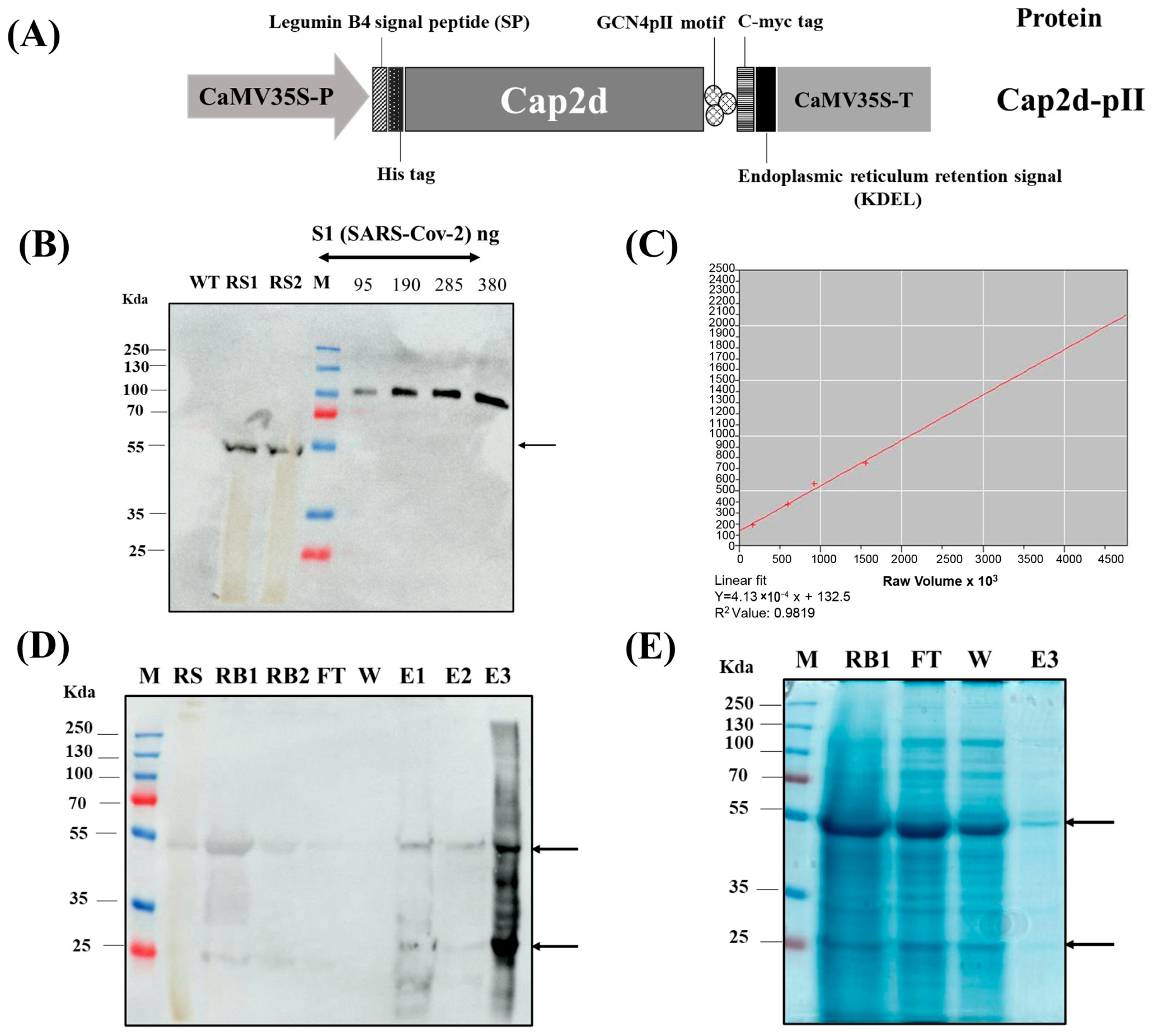
To produce the plant-derived Cap2d-pII antigen, a plant expression construct was designed to encode the Cap2d protein fused with the pII motif (Figure 1A). The recombinant vector also contained the LeB4 signal peptide, 6×His and c-myc tags, and an ER-retention signal (KDEL) to enhance expression and stability. Following Agrobacterium-mediated infiltration, total soluble proteins were extracted from infiltrated N. benthamiana leaves by SDS buffer and analyzed by Western blot using an anti-His monoclonal antibody. As shown in Figure 1B, a band approximately 55 kDa was observed in the samples expressing Cap2d-pII. The monomeric Cap2d-pII protein was predicted to have a molecular mass of 29.3 kDa. However, a band with a higher apparent size of 55 kDa on SDS-PAGE suggests that factors beyond the monomeric form may influence its electrophoretic migration… At the same time, no signal was observed in the leaf plants transformed with the A. tumefaciens harboring the empty pCB301 vector. Therefore, the presence of this immunoreactive band confirmed the successful transient expression of the Cap2d-pII fusion protein in N. benthamiana leaves. The accumulation of Cap2d-pII in N. benthamiana leaves was evaluated semi-quantitatively by Western blotting. A calibration curve was prepared using serial concentrations of the recombinant S1 protein (Sino Biological, Beijing, China) and quantified with ImageQuant TL v8.2.0.0 software (Cytiva, Marlborough, MA, USA) following visualization by an Amersham™ Imager 680. The analysis estimated that Cap2d-pII accumulated to nearly 150 ± 8 mg/kg of fresh N. benthamiana leaves (Figure 1C).
After confirming protein expression in the infiltrated leaves, we proceeded to purify the recombinant Cap2d-pII protein using IMAC. Western blotting showed a clear band at roughly 55 kDa in both the total soluble proteins extracted with the binding buffer (RB1, RB2) and in the elution fractions (E1, E2, E3), matching the band observed earlier (Figure 1D). In addition to this major band, extraction with the binding buffer revealed another band of slightly above 25 kDa in both crude extracts (RB1 and RB2) and elution fractions (E1, E2, and E3). This band corresponds to the theoretically predicted molecular weight of the monomeric form of Cap2d-pII under denaturing SDS–PAGE conditions. SDS–PAGE analysis revealed bands in the elution fraction (E3), which are the same size as the band detected in the Western blot assay (Figure 1E). Quantitative analysis indicated that the yield of purified Cap2d-pII protein reached up to 30 mg ± 1 mg per kg of fresh leaf tissue, with a purity of approximately 90%.

3.2. Cap2d-pII Protein Induced Strong Cap2d-Specific IgG and PCV2d-Specific Antibody Responses in Mice

The immunogenic potential of the plant-produced Cap2d-pII protein was first assessed in mice following the schedule illustrated in Figure 2A. The animals received either PBS as a negative control, the purified Capd2-pII protein, or a commercial inactivated PCV2 vaccine. Booster immunizations were administered on day 21, and serum samples were collected on days 21, 42, and 56 for subsequent antibody evaluation. As shown in Figure 2B, the Cap2d-pII group elicited a significant increase in Cap2d-specific IgG levels compared with the PBS control at all post-immunization time points (p < 0.05). In addition, the mouse group vaccinated with the Cap2d-pII protein developed a stronger antibody response, showing significantly higher IgG levels than the commercial vaccine group at day 21 (p = 0.0286), with a mean OD450 of 1.175 for the Cap2d-pII group compared with 0.6875 for the commercial vaccine group. By days 42 and 56, the antibody titers between the two groups were not significantly different (p = 0.1143 and p = 0.2286, both > 0.05). At day 42, the mean OD450 values were 1.145 for the Cap2d-pII group and 1.300 for the vaccine group, while at day 56, they were 1.112 and 1.325, respectively, indicating that the recombinant Cap2d-pII protein can trigger an intense and lasting Cap2-specific IgG antibody immune response.
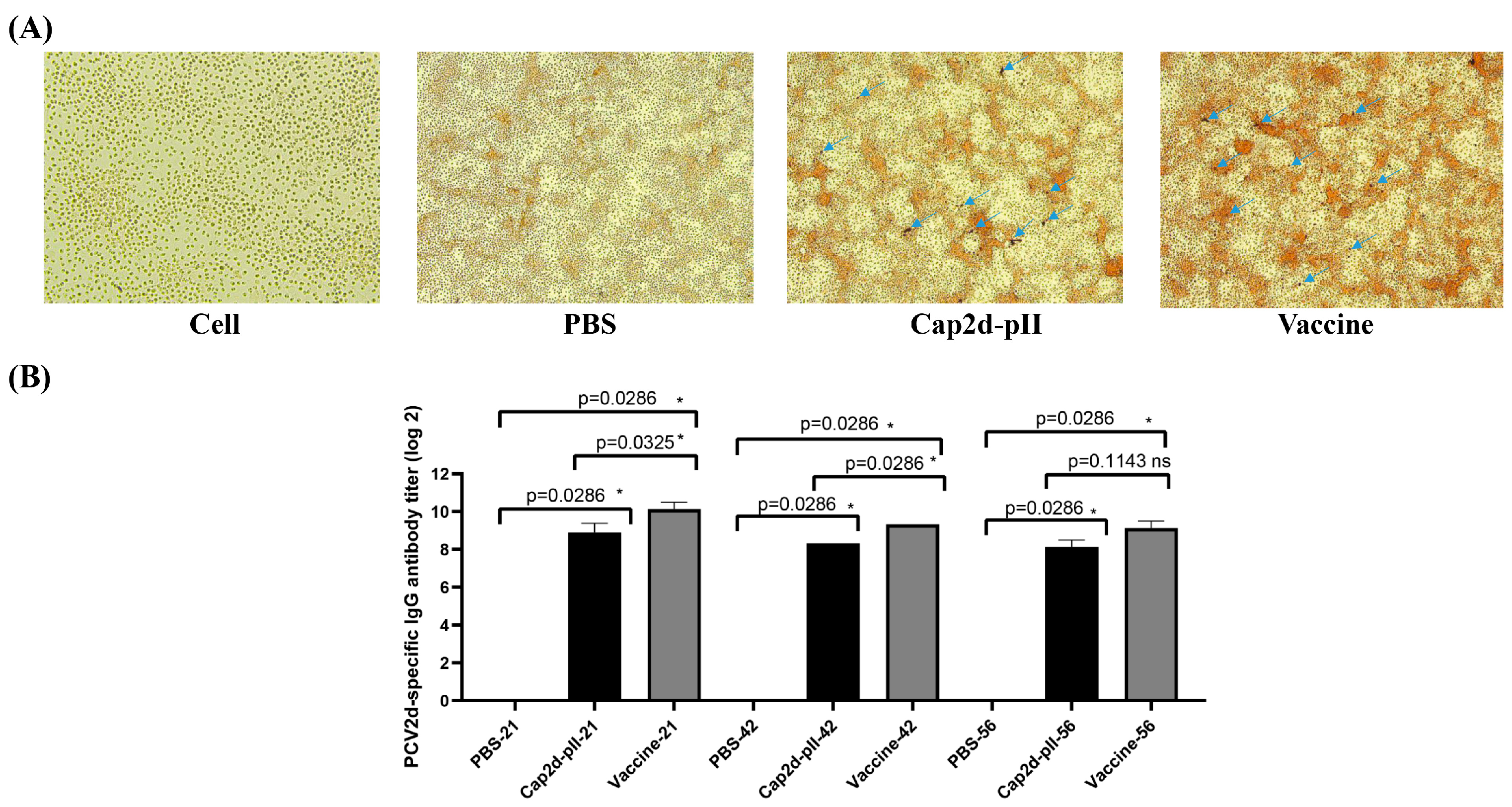
In addition, the PCV2d-specific IgG antibodies in mouse sera were detected using an IPMA. Representative images are shown in Figure 3A. PCV2d-infected PK15 cells incubated with sera from mice vaccinated with the Cap2d-pII or commercial vaccine groups exhibited intense reddish-brown staining within the nuclei, indicating positive reactions for PCV2d-specific IgG antibodies. In contrast, no reddish-brown staining was observed in cells treated with sera from the PBS control group or the cell control.
Quantitative analysis of PCV2d-specific antibody titers (Figure 3B) revealed that mice immunized with Cap2d-pII protein developed significantly higher PCV2d-specific IgG antibody titers compared with the PBS control group at all tested time points (p < 0.05). At day 21 post-immunization, the mean PCV2d-specific IgG antibody titer in the Cap2d-pII group was 8.91 log2, whereas the commercial PCV2 vaccine group showed a higher mean titer of 10.13 log2. By day 42, the mean antibody titer in the Cap2d-pII group decreased to 8.32 log2, compared with 9.32 log2 in the commercial vaccine group. At day 56 post-immunization, the mean antibody titers were 8.13 log2 in the Cap2d-pII group and 9.13 log2 in the commercial PCV2 vaccine group. Although the antibody levels induced by the Cap2d-pII protein in mice at days 21 and 42 post-immunization were lower than those induced by the commercial PCV2 vaccine, the antibody levels elicited by the Cap2d-pII protein were comparable to those elicited by the commercial PCV2 vaccine at day 56 post-immunization (p = 0.1143 > 0.05).

3.3. Cap2d-pII Protein Induced Strong Cytokine Responses in Mice

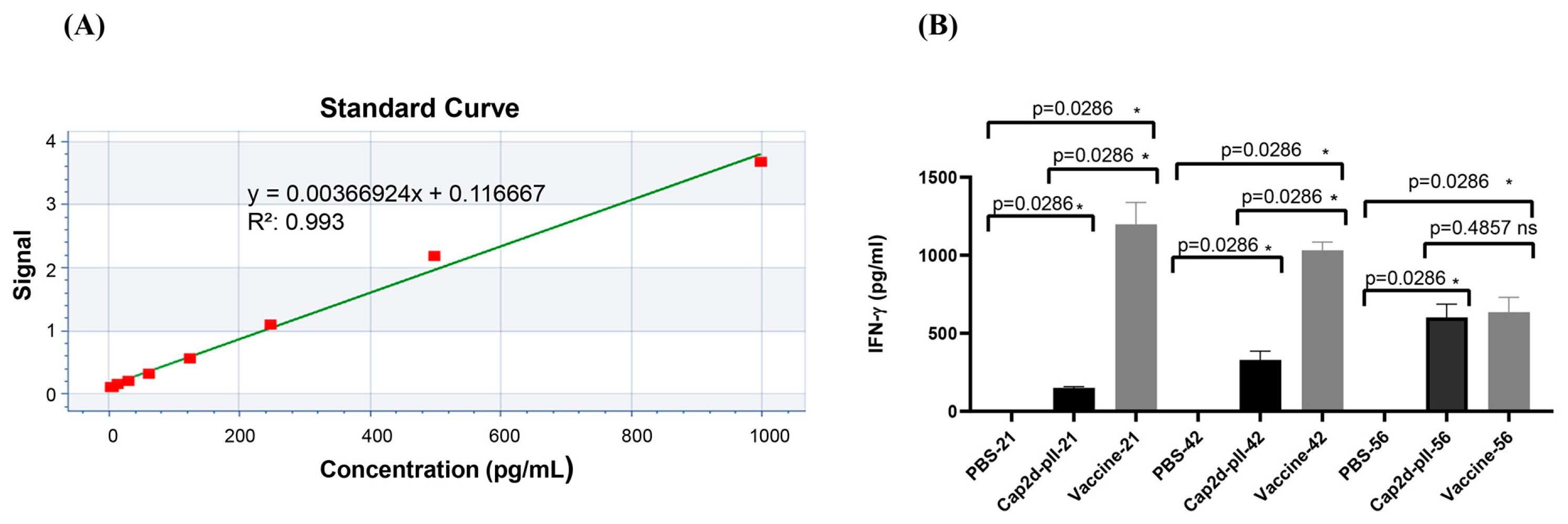
The cell-mediated immune response induced by the Cap2d-pII protein was evaluated by measuring the amount of IFN-γ in mouse sera using an ELISA kit at 21, 42, and 56 days post-immunization. A standard curve (y = 0.00366924x + 0.116667, R2 = 0.993) was generated using recombinant mouse IFN-γ at concentrations ranging from 4 to 400 pg/mL to measure IFN-γ concentration in diluted mouse sera (Figure 4A). As shown in Figure 4B, mice immunized with Cap 2d-pII displayed significantly higher IFN-γ levels than the PBS control group at all tested time points (p < 0.05). At day 21 and 42 post-immunization, a lower amount of IFN-γ was detected in the mice group vaccinated with the Cap2d-pII protein compared to those immunized with the commercial vaccine. At day 56, the mean IFN-γ concentration was 601.25 ± 12.0 pg/mL in the undiluted sera of the Cap2d-pII mouse group and 635.0 ± 15.3 pg/mL in the undiluted sera of the commercial vaccine mouse group. However, this difference was not statistically significant (p = 0.4857). These findings demonstrated that immunization with the plant-derived Cap2d-pII protein effectively promotes a cellular immune response comparable to that induced by the licensed PCV2 vaccine at day 56 post-immunization.

4. Discussion

To the best of our knowledge, this is the first report describing the successful expression in plants of a Cap protein, originating from a Vietnamese PCV2d isolate, fused with the pII multimerization motif. Although the Cap2 protein can self-assemble into VLPs and be expressed in plants, our attempts to produce these VLPs resulted in very low recombinant yields The native Cap protein of PCV2 forms a T = 1 icosahedral capsid composed of 60 identical subunits arranged around five-fold, three-fold, and two-fold symmetry axes [38,39]. Each subunit adopts a jelly-roll β-sandwich fold but does not possess an intrinsic trimeric interface [40]. Therefore, fusion to the multimer motif was rationally designed to promote a stable multimeric state that partially mimics the native quaternary organization of the viral capsid. In addition, incorporating this motif is expected to stabilize oligomeric structures. Higher-order molecular assemblies generally induce stronger immunity than individual monomeric proteins [41], supporting multivalent antigen presentation and thereby improving B-cell receptor activation and the subsequent immune response [42]. To improve the expression efficiency and enhance immunogenicity, we designed a fusion construct combining the truncated Cap protein with the pII motif. This pII motif has been widely employed in plant-based expression systems to induce oligomerization of recombinant proteins [34,35,43,44,45].
The truncated Cap2d-pII fusion protein was efficiently expressed in N. benthamiana, purified via IMAC, and assembled into stable oligomeric structures mediated by the pII motif. The Cap2d protein used in this study corresponds to amino acids 42–213 of the PCV-2 capsid protein. This truncation was designed based on previous studies demonstrating that the N-terminal region of the PCV-2 capsid protein harbors a nuclear localization signal (NLS) that directs strict nuclear targeting and regulates intracellular trafficking of the capsid protein [46,47]. The removal of this N-terminal region has been reported to facilitate recombinant expression in heterologous systems and to alleviate potential constraints associated with nuclear targeting. Notably, earlier epitope-mapping and immunological studies have shown that the first ~47 amino acids at the N-terminus of the PCV-2 capsid protein exhibit weak reactivity with PCV-2-positive swine sera and are not involved in the formation of major conformational neutralizing epitopes [48,49]. In contrast, the central and C-terminal regions of the capsid protein of PCV-2 have been identified as containing the dominant immunogenic and neutralizing epitopes [48]. Therefore, truncation of the N-terminal NLS-containing region is unlikely to compromise the antigenic integrity required for vaccine or immunogenicity studies. In this study, the Cap2d-pII protein was produced using a plant expression system and directed to accumulate in the endoplasmic reticulum. This intracellular compartment supports proper protein folding and post-translational modification. Notably, we also analyzed the expression of the full-length Cap2d-pII protein using the same plant-based expression system; however, under the experimental conditions applied, the protein could not be detected. These findings suggest that deleting the N-terminal region may enhance protein accumulation in plants, although the precise mechanism remains unclear. This rationale supports the strategy of truncating the PCV-2 capsid protein to create the Cap2d construct. In addition, similar observations have been found in Hansenula polymorpha, where the truncated Cap2 protein lacking the first 41 N-terminal amino acids exhibited higher expression levels than the full-length Cap protein [50].
We detected a protein band of approximately 55 kDa in plants expressing Cap2d-pII, whereas the predicted molecular weight of the monomeric Cap2d-pII protein is 29.3 kDa. According to in silico analysis, performed using NetNGlyc 1.0, three putative N-linked glycosylation sites were identified within the Cap2d region. A previous study indicated that a putative glycosylation motif is present at positions 143–145 within the PCV2 Cap protein [51]. The addition of these N-glycans may increase the apparent molecular weight and slow electrophoretic mobility on SDS-PAGE. Several previous studies have shown that N-linked glycosylation is a significant co- and post-translational modification of secretory proteins [52], essential for correct folding, ER quality control, structural stability, and protein–protein interactions [53,54]. However, this higher-molecular-weight band may not be solely attributable to glycosylation. Alternative explanations, including stable dimer formation, altered electrophoretic behavior under SDS-PAGE conditions, cannot be excluded. Indeed, dimeric forms of the PCV-2 capsid protein with apparent molecular weights of approximately 54 kDa have been reported following recombinant expression in N. benthamiana [29] and Escherichia coli [55], with dimerization further supported by mass spectrometry analyses [29]. Such dimerization has been suggested to arise from specific interactions within the amino acid region spanning residues 51–103 during protein folding [56]. Collectively, these observations indicate that the ~55 kDa Cap2d-pII band may result from one or a combination of these factors, and further biochemical analyses will be performed in future studies to clarify the underlying mechanism. The recombinant protein accumulated to approximately 150 ± 8 mg per kg of fresh leaf tissue, and IMAC purification yielded up to 30 ± 1 mg of purified protein per kg of fresh leaf tissue. Compared to the previously reported yield of 6.5 mg/kg for purified Cap-VLPs [29], this yield is considerably higher, indicating that Cap truncation together with pII-mediated oligomerization improves protein expression and recovery in plants. These features highlight the potential advantages of the Cap2d-pII platform for the development of cost-effective subunit vaccines against PCV2.
The immunogenicity of the Cap2d-pII protein in mice was evaluated in comparison with a commercial PCV2 vaccine and PBS. The purified Cap2d-pII protein, with a purity of approximately 90%, was obtained by IMAC, which substantially reduced host plant proteins and other plant-derived components, thereby minimizing their potential influence on the observed immune responses. In several previous studies, purified proteins were administered with PBS as the negative control, without using blank vector-transformed plant extracts [35,36,57], which supports the suitability of PBS as the control in our study. However, inclusion of a control group immunized with extracts from empty vector-transformed plants would further strengthen the study. The BALB/c mouse strain, characterized by a defined genetic background and minimal environmental variability, is a well-established model for studying inactivated and subunit PCV2 vaccines [40,58]. In our study, mice immunized with the plant-derived Cap2d-pII protein developed strong humoral and measurable cell-mediated immune responses, comparable to those found in mice vaccinated with the licensed inactivated PCV2 vaccine at day 56 post-immunization.
In this study, we attempted to evaluate virus-neutralizing antibody activity in cell culture; however, since the PCV2 strain used did not induce an apparent cytopathic effect, the IPMA was employed to determine PCV2d-specific antibody titers instead. Several publications reported that some PCV2 strains do not induce visible cytopathic effects in infected cells [59,60,61]. The IPMA is considered a reliable and flexible approach for detecting PCV2d-specific antibodies and evaluating immune responses after infection or vaccination. In addition, the IPMA assay was found to have several advantages, including its suitability for both laboratory and field applications due to its simple setup, durable plate stability, and convenient observation under an inverted microscope [62,63]. Due to these advantages, IPMA has been widely employed for the rapid detection of total antibodies against PCV [64,65,66]. There was a strong correlation between IPMA and commercial ELISA results [66]. Moreover, previous studies have shown that IPMA antibody titers are positively correlated with neutralizing antibodies [65]. However, we acknowledge that direct virus neutralization assays remain the gold standard for assessing protective antibody activity.
Most commercial vaccines primarily stimulate humoral immunity—inducing antigen-specific or neutralizing antibodies—but often fail to provoke robust cellular responses [67]. In contrast, our data demonstrated that the Cap2d-pII protein elicited a significant increase in IFN-γ levels, comparable to those induced by the commercial PCV2 vaccine. IFN-γ is a key cytokine in cellular immunity that can activate CD8+ T cells and macrophages. These cells play an important role in eliminating pathogens or infected cells [68]. In this study, the IFN-γ level in mice vaccinated with the Cap2d-pII protein was quite consistent with previous findings from mice immunized with recombinant pseudorabies virus (rPRV-2Cap/3Cap) [69], further supporting the induction of a Th1-biased response. Our results are in agreement with other plant-based vaccine studies showing that incorporation of the pII multimerization motif enhances immunogenicity. For instance, plant-derived H5 hemagglutinin trimers and CD2v trimers induced potent neutralizing antibody responses [43,44,45]. Similarly, the CO-26K-equivalent epitope (COE) of Porcine Epidemic Diarrhea Virus (PEDV), expressed as COE-pII in N. benthamiana, elicited potent neutralizing antibodies in pigs [34,35]. Collectively, these results indicated that higher-order assembly mediated by the pII motif not only enhanced the protein yield but also the immunogenicity of the plant-expressed Cap2d-pII protein, underscoring its potential as a promising platform for developing effective subunit vaccines against PCV2.
In addition to higher-order assembly mediated by the pII motif, post-translational modifications such as glycosylation may also contribute to the immunogenic properties of plant-expressed vaccine antigens by influencing protein folding and the exposure of immunologically relevant epitopes, thereby shaping both humoral and cellular immune responses [70,71,72,73]. Moreover, variations in glycosylation patterns often accompany immune activation and contribute to the maintenance of immune homeostasis. In the context of viral antigens, including influenza hemagglutinin and coronavirus spike proteins, site-specific glycosylation has been reported to modulate antigenicity by influencing the accessibility of surface epitopes to the immune system [74]. Although the apparent molecular weight shift observed for Cap2d-pII suggests possible glycosylation or dimer structural features, the direct impact of glycosylation on the immunogenicity of the plant-expressed Cap2d-pII protein was not examined in this study. This represents a limitation of the current work and warrants further investigation using deglycosylation analyses and comparative immunogenicity assessments.
While our immunogenicity data in mice are encouraging, several steps are required to advance the Cap2d-pII candidate toward a swine vaccine. First, challenge experiments in mice against PCV2d were not performed due to biosafety and facility limitations, and neutralizing antibody responses in mice against PCV2d were not evaluated, which represent limitations of the current study. Second, neutralization assays and viral-challenge studies in target animals (piglets) are essential to demonstrate protective efficacy and cross-protection across circulating PCV2 genotypes, as neutralizing antibody responses were not evaluated in this study. Third, characterization of the stability under different formulation/adjuvant conditions will inform dose and adjuvant selection. Fourth, process development to increase upstream yield and implement cost-effective downstream purification (including alternatives to gradient ultracentrifugation) will be necessary for commercial viability. Furthermore, the long-term persistence of the immune response was not examined; future studies monitoring antibody and cellular responses over several months after immunization will be important to clarify the duration of protection. Notably, recent field evaluations of plant-derived PCV2 vaccines have shown translational promise; however, larger trials and head-to-head efficacy comparisons with commercial products are still needed.

5. Conclusions

The present study adds to a growing body of evidence that plant expression systems are a viable platform for producing PCV2d Cap-based vaccine antigens. By combining ER-targeting, affinity tags for streamlined purification, and a pII motif to favor higher-order assembly, we successfully produced a Cap2d-pII antigen from plants. Notably, ELISAs and IPMA results demonstrated that the Cap2d-pII antigen elicited both humoral and cellular responses, including PCV2d-specific IgG antibody titers and IFN-γ production, comparable to a commercial vaccine in mice. Thus, these data support its potential as a safe and affordable PCV2d subunit vaccine. Follow-up studies addressing neutralization, protection in swine, optimization of yield and formulation, and cost–benefit analyses will determine whether this approach can be developed into a field-usable PCV2d vaccine.

Author Contributions

Conceptualization, N.B.P. and V.T.P.; methodology, T.T.H., H.T.T. and M.T.L.; validation, T.T.H. and H.T.T.; formal analysis, T.T.H.; investigation, H.T.T.; resources, N.B.P. and V.T.P.; data curation, T.T.H.; writing—T.T.H.; writing—review and editing, T.T.H., N.B.P. and V.T.P.; visualization, H.T.T.; supervision, N.B.P., H.H.C. and V.T.P.; project administration, H.T.T.N.; funding acquisition, H.H.C., N.B.P. and V.T.P. All authors have read and agreed to the published version of the manuscript.

Funding

This research was funded by the Vietnam Academy of Science and Technology under the project “Study on the expression and immunogenicity evaluation of the capsid protein antigen of porcine circovirus (PCV) from tobacco for vaccine development” (code: VAST02.03/23-24).

Institutional Review Board Statement

The animal study protocol was approved by the Ethics Committee of Institute of Biology (Approval No: IB-AREC-2025-01) for studies involving animals.

Informed Consent Statement

Not applicable.

Data Availability Statement

The sequence data used in this study are given in the Section 2. All other datasets generated and/or analyzed during the current study are available from the corresponding author on reasonable request.

Acknowledgments

We sincerely thank the project “Enhancing research capacity in next-generation vaccine technology” for supporting this study through the provision of essential laboratory equipment. We also extend our appreciation to Nguyen Chi Hieu from the National Institute for Control of Vaccines and Biologicals (NICVB) for his assistance with the mouse experiments.

Conflicts of Interest

The authors declare no conflicts of interest.

Abbreviations

The following abbreviations are used in this manuscript:
Cap2Cap protein of Porcine circovirus 2
GCN4pIIpII motif (GCN4 parallel dimerization motif)
IFN-γInterferon gamma
IMACImmobilized metal affinity chromatography
PCV2Porcine circovirus 2
PCVADPorcine circovirus-associated disease
PMWSPostweaning multisystemic wasting syndrome
PEDVPorcine epidemic diarrhea virus
VLPVirus-like particle

References

  1. Tischer, I.; Gelderblom, H.; Vettermann, W.; Koch, M.A. A very small porcine virus with circular single-stranded DNA. Nature 1982, 295, 64–66. [Google Scholar] [CrossRef] [PubMed]
  2. Correa-Fiz, F.; Franzo, G.; Llorens, A.; Huerta, E.; Sibila, M.; Kekarainen, T.; Segalés, J. Porcine circovirus 2 (PCV2) population study in experimentally infected pigs developing PCV2-systemic disease or a subclinical infection. Sci. Rep. 2020, 10, 17747. [Google Scholar] [CrossRef] [PubMed]
  3. Kekarainen, T.; McCullough, K.; Fort, M.; Fossum, C.; Segalés, J.; Allan, G.M. Immune responses and vaccine-induced immunity against porcine circovirus type 2. Vet. Immunol. Immunopathol. 2010, 136, 185–191. [Google Scholar] [CrossRef] [PubMed]
  4. Segalés, J.; Kekarainen, T.; Cortey, M. The natural history of porcine circovirus type 2: From an inoffensive virus to a devastating swine disease? Vet. Microbiol. 2013, 165, 13–20. [Google Scholar] [CrossRef]
  5. Gillespie, J.; Opriessnig, T.; Meng, X.J.; Pelzer, K.; Buechner-Maxwell, V. Porcine circovirus type 2 and porcine circovirus-associated disease. J. Vet. Intern. Med. 2009, 23, 1151–1163. [Google Scholar] [CrossRef]
  6. Drolet, R.; D’Allaire, S.; Thomson, J.R.; Done, S.H. Porcine dermatitis and nephropathy syndrome (PDNS): An overview of the disease. J. Swine Health Prod. 1999, 7, 283–285. [Google Scholar]
  7. Ellis, J. Porcine circovirus: A historical perspective. Vet. Pathol. 2014, 51, 315–327. [Google Scholar] [CrossRef]
  8. Cheung, A.K. Transcriptional analysis of porcine circovirus type 2. Virology 2003, 305, 168–180. [Google Scholar] [CrossRef]
  9. Nawagitgul, P.; Morozov, I.; Bolin, S.R.; Harms, P.A.; Sorden, S.D.; Paul, P.S. Open reading frame 2 of porcine circovirus type 2 encodes a major capsid protein. J. Gen. Virol. 2000, 81, 2281–2287. [Google Scholar] [CrossRef]
  10. Blanchard, P.; Mahé, D.; Cariolet, R.; Keranflec’h, A.; Baudouard, M.A.; Cordioli, P.; Albina, E.; Jestin, A. Protection of swine against post-weaning multisystemic wasting syndrome (PMWS) by porcine circovirus type 2 (PCV2) proteins. Vaccine 2003, 21, 4565–4575. [Google Scholar] [CrossRef]
  11. Xiao, C.-T.; Halbur, P.G.; Opriessnig, T. Global molecular genetic analysis of porcine circovirus type 2 (PCV2) sequences confirms the presence of four main PCV2 genotypes and reveals a rapid increase of PCV2d. J. Gen. Virol. 2015, 96, 1830–1841. [Google Scholar] [CrossRef] [PubMed]
  12. Franzo, G.; Cortey, M.; Segalés, J.; Hughes, J.; Drigo, M. Phylodynamic analysis of porcine circovirus type 2 reveals global waves of emerging genotypes and the circulation of recombinant forms. Mol. Phylogenet. Evol. 2016, 100, 269–280. [Google Scholar] [CrossRef] [PubMed]
  13. Mao, Q.; Zhang, W.; Ma, S.; Qiu, Z.; Li, B.; Xu, C.; He, H.; Fan, S.; Wu, K.; Chen, J.; et al. Fusion expression and immune effect of PCV2 cap protein tandem multiantigen epitopes with CD154/GM-CSF. Vet. Sci. 2021, 8, 211. [Google Scholar] [CrossRef] [PubMed]
  14. Kwon, T.; Lee, D.U.; Yoo, S.J.; Je, S.H.; Shin, J.Y.; Lyoo, Y.S. Genotypic diversity of porcine circovirus type 2 (PCV2) and genotype shift to PCV2d in Korean pig population. Virus Res. 2017, 228, 24–29. [Google Scholar] [CrossRef]
  15. Franzo, G.; Segalés, J. Porcine circovirus 2 (PCV-2) genotype update and proposal of a new genotyping methodology. PLoS ONE 2018, 13, e0208585. [Google Scholar] [CrossRef]
  16. Weissenbacher-Lang, C.; Kristen, T.; Mendel, V.; Brunthaler, R.; Schwarz, L.; Weissenböck, H. Porcine circovirus type 2 (PCV2) genotyping in Austrian pigs in the years 2002 to 2017. BMC Vet. Res. 2020, 16, 198. [Google Scholar] [CrossRef]
  17. Dinh, P.X.; Nguyen, M.N.; Nguyen, H.T.; Tran, V.H.; Tran, Q.D.; Dang, K.H.; Vo, D.T.; Le, H.T.; Nguyen, N.T.T.; Nguyen, T.T.; et al. Porcine circovirus genotypes and their copathogens in pigs with respiratory disease in southern provinces of Vietnam. Arch. Virol. 2021, 166, 403–411. [Google Scholar] [CrossRef]
  18. Afghah, Z.; Webb, B.; Meng, X.J.; Ramamoorthy, S. Ten years of PCV2 vaccines and vaccination: Is eradication a possibility? Vet. Microbiol. 2017, 206, 21–28. [Google Scholar] [CrossRef]
  19. Kang, S.-J.; Bae, S.-M.; Lee, H.-J.; Jeong, Y.-J.; Lee, M.-A.; You, S.-H.; Lee, H.-S.; Hyun, B.-H.; Lee, N.; Cha, S.-H. Porcine circovirus (PCV) genotype 2d-based virus-like particles (VLPs) induced broad cross-neutralizing antibodies against diverse genotypes and provided protection in dual-challenge infection of a PCV2d virus and a type 1 porcine reproductive and respiratory syndrome virus (PRRSV). Pathogens 2021, 10, 1145. [Google Scholar] [CrossRef]
  20. Tseng, Y.H.; Hsieh, C.C.; Kuo, T.Y.; Liu, J.R.; Hsu, T.Y.; Hsieh, S.C. Construction of a Lactobacillus plantarum strain expressing the capsid protein of porcine circovirus type 2d (PCV2d) as an oral vaccine. Indian J. Microbiol. 2019, 59, 490–499. [Google Scholar] [CrossRef]
  21. Shin, M.; Jung, S.H.; Kim, K.; Hahn, T.W. Evaluation of formulation and immunogenicity of porcine circovirus type 2d (PCV2d) vaccine for needle-free intradermal route injection. J. Vet. Sci. 2025, 26, e24. [Google Scholar] [CrossRef] [PubMed]
  22. Fahad, S.; Khan, F.A.; Pandupuspitasari, N.S.; Ahmed, M.M.; Liao, Y.C.; Waheed, M.T.; Sameeullah, M.; Darkhshan; Hussain, S.; Saud, S.; et al. Recent developments in therapeutic protein expression technologies in plants. Biotechnol. Lett. 2015, 37, 265–279. [Google Scholar] [CrossRef] [PubMed]
  23. Pogue, G.P.; Holzberg, S. Transient virus expression systems for recombinant protein expression in dicot- and monocotyledonous plants. In Plant Science; InTech: Rijeka, Croatia, 2012. [Google Scholar] [CrossRef]
  24. Rybicki, E.P. Plant-produced vaccines: Promise and reality. Drug Discov. Today 2009, 14, 16–24. [Google Scholar] [CrossRef] [PubMed]
  25. Jacob, S.S.; Cherian, S.; Sumithra, T.G.; Raina, O.K.; Sankar, M. Edible vaccines against veterinary parasitic diseases—Current status and future prospects. Vaccine 2013, 31, 1879–1885. [Google Scholar] [CrossRef]
  26. Gerdts, V.; Zakhartchouk, A. Vaccines for porcine epidemic diarrhea virus and other swine coronaviruses. Vet. Microbiol. 2017, 206, 45–51. [Google Scholar] [CrossRef] [PubMed]
  27. Hager, K.J.; Pérez Marc, G.; Gobeil, P.; Diaz, R.S.; Heizer, G.; Llapur, C.; Makarkov, A.I.; Vasconcellos, E.; Pillet, S.; Riera, F. Efficacy and safety of a recombinant plant-based adjuvanted COVID-19 vaccine. N. Engl. J. Med. 2022, 386, 2084–2096. [Google Scholar] [CrossRef]
  28. Benvenuto, E.; Broer, I.; D’Aoust, M.-A.; Hitzeroth, I.; Hundleby, P.; Menassa, R.; Oksman-Caldentey, K.-M.; Peyret, H.; Salgueiro, S.; Saxena, P.; et al. Plant molecular farming in the wake of the closure of Medicago Inc. Nat. Biotechnol. 2023, 41, 893–894. [Google Scholar] [CrossRef]
  29. Gunter, C.J.; Regnard, G.L.; Rybicki, E.P.; Hitzeroth, I.I. Immunogenicity of plant-produced porcine circovirus-like particles in mice. Plant Biotechnol. J. 2019, 17, 1751–1759. [Google Scholar] [CrossRef]
  30. Park, Y.; Min, K.; Kim, N.H.; Kim, J.H.; Park, M.; Kang, H.; Sohn, E.J.; Lee, S. Porcine circovirus 2 capsid protein produced in N. benthamiana forms virus-like particles that elicit production of virus-neutralizing antibodies in guinea pigs. New Biotechnol. 2021, 63, 29–36. [Google Scholar] [CrossRef]
  31. Oh, T.; Suh, J.; Cho, H.; Min, K.; Choi, B.-H.; Chae, C. Efficacy test of a plant-based porcine circovirus type 2 (PCV2) virus-like particle vaccine against four PCV2 genotypes (2a, 2b, 2d, and 2e) in pigs. Vet. Microbiol. 2022, 272, 109512. [Google Scholar] [CrossRef]
  32. Park, K.H.; Cho, H.; Suh, J.; Oh, T.; Park, Y.; Park, S.; Sohn, E.J.; Chae, C. Field evaluation of novel plant-derived porcine circovirus type 2 vaccine related to subclinical infection. Vet. Med. Sci. 2023, 9, 2703–2710. [Google Scholar] [CrossRef]
  33. Harbury, P.B.; Zhang, T.; Kim, P.S.; Alber, T. A switch between two-, three-, and four-stranded coiled coils in GCN4 leucine zipper mutants. Science 1993, 262, 1401–1407. [Google Scholar] [CrossRef]
  34. Ho, T.T.; Nguyen, G.T.; Pham, N.B.; Le, V.P.; Trinh, T.B.N.; Vu, T.H.; Phan, H.T.; Conrad, U.; Chu, H.H. Plant-derived trimeric CO-26K-equivalent epitope induced neutralizing antibodies against porcine epidemic diarrhea virus. Front. Immunol. 2020, 11, 2152. [Google Scholar] [CrossRef] [PubMed]
  35. Ho, T.T.; Trinh, V.T.; Tran, H.X.; Le, P.T.T.; Nguyen, T.T.; Hoang, H.T.T.; Pham, M.D.; Conrad, U.; Pham, N.B.; Chu, H.H. The immunogenicity of plant-based COE-GCN4pII protein in pigs against the highly virulent porcine epidemic diarrhea virus strain from genotype 2. Front. Vet. Sci. 2022, 9, 940395. [Google Scholar] [CrossRef] [PubMed]
  36. Pham, N.B.; Ho, T.T.; Nguyen, G.T.; Le, T.T.; Le, N.T.; Chang, H.C.; Pham, M.D.; Conrad, U.; Chu, H.H. Nanodiamond enhances immune responses in mice against recombinant HA/H7N9 protein. J. Nanobiotechnol. 2017, 15, 69. [Google Scholar] [CrossRef] [PubMed]
  37. Reagan-Shaw, S.; Nihal, M.; Ahmad, N. Dose translation from animal to human studies revisited. FASEB J. 2008, 22, 659–661. [Google Scholar] [CrossRef]
  38. Khayat, R.; Brilot, A.F.; Coloma, J.; Vago, F.; Luque, D.; Castón, J.R.; Johnson, J.E. Structural studies of porcine circovirus type 2 capsid reveal T=1 icosahedral assembly. J. Virol. 2019, 93, e01879-18. [Google Scholar]
  39. Zhan, Y.; Wang, N.; Zhu, Z.; Wang, A.; Wang, J.; Zhu, H.; Li, S.; Pang, D. Cryo-EM structure of porcine circovirus 2 virus-like particle at 2.3 Å resolution. Nat. Commun. 2020, 11, 1819. [Google Scholar]
  40. Liu, C.; Liu, Y.; Chen, H.; Feng, H.; Chen, Y.; Wang, Y.; Wang, J.; Liu, D.; Deng, R.; Zhang, G. Genetic and immunogenicity analysis of porcine circovirus type 2 strains isolated in Central China. Arch. Virol. 2018, 163, 937–946. [Google Scholar] [CrossRef]
  41. Xi, X.; Mo, X.; Xiao, Y.; Yin, B.; Lv, C.; Wang, Y.; Sun, Z.; Yang, Q.; Yao, Y.; Xuan, Y.; et al. Production of Escherichia coli-based virus-like particle vaccine against porcine circovirus type 2 challenge in piglets: Structure characterization and protective efficacy validation. J. Biotechnol. 2016, 223, 8–12. [Google Scholar] [CrossRef]
  42. Sobczak, J.M.; Barkovska, I.; Balke, I.; Rothen, D.A.; Mohsen, M.O.; Skrastina, D.; Ogrina, A.; Martina, B.; Jansons, J.; Bogans, J.; et al. Identifying key drivers of efficient B cell responses: On the role of T help, antigen-organization, and Toll-like receptor stimulation for generating a neutralizing anti-dengue virus response. Vaccines 2024, 12, 661. [Google Scholar] [CrossRef] [PubMed]
  43. Phan, H.T.; Ho, T.T.; Chu, H.H.; Vu, T.H.; Gresch, U.; Conrad, U. Neutralizing immune responses induced by oligomeric H5N1-hemagglutinins from plants. Vet. Res. 2017, 48, 53. [Google Scholar] [CrossRef] [PubMed]
  44. Pham, V.T.; Ho, T.T.; Phan, H.T.; Le, T.H.; Pham, N.B.; Conrad, U.; Vu, T.H.; Chu, H.H. A plant-based artificial haemagglutinin (A/H5N1) strongly induced neutralizing immune responses in mice. Appl. Sci. 2019, 9, 4605. [Google Scholar] [CrossRef]
  45. Nguyen, G.T.; Le, T.T.; Vu, S.D.T.; Nguyen, T.T.; Le, M.T.T.; Pham, V.T.; Nguyen, H.T.T.; Ho, T.T.; Hoang, H.T.T.; Tran, H.X.; et al. A plant-based oligomeric CD2v extracellular domain antigen exhibits equivalent immunogenicity to the live attenuated vaccine ASFV-G-∆I177L. Med. Microbiol. Immunol. 2024, 213, 22. [Google Scholar] [CrossRef]
  46. Liu, Q.; Tikoo, S.K.; Babiuk, L.A. Nuclear localization of the porcine circovirus type 2 capsid protein. J. Virol. 2001, 75, 11876–11884. [Google Scholar] [CrossRef]
  47. Hou, Q.; Hou, S.; Chen, Q.; Jia, H.; Xin, T.; Jiang, Y.; Guo, X.; Zhu, H. Nuclear localization signal regulates porcine circovirus type 2 capsid protein nuclear export through phosphorylation. Virus Res. 2018, 246, 12–22. [Google Scholar] [CrossRef]
  48. Lekcharoensuk, P.; Morozov, I.; Paul, P.S.; Thangthumniyom, N.; Wajjawalku, W.; Meng, X.J. Epitope mapping of the major capsid protein of porcine circovirus type 2. J. Gen. Virol. 2004, 85, 3219–3228. [Google Scholar] [CrossRef]
  49. Trible, B.R.; Kerrigan, M.A.; Crossland, N.A.; Potter, M.; Faaberg, K.S.; Rowland, R.R.R. Antigenic differences among porcine circovirus type 2 strains. J. Virol. 2008, 89, 177–187. [Google Scholar] [CrossRef]
  50. Xiao, Y.; Zhao, P.; Du, J.; Li, X.; Lu, W.; Hao, X.; Dong, B.; Yu, Y.; Wang, L. High-level expression and immunogenicity of porcine circovirus type 2b capsid protein without nuclear localization signal expressed in Hansenula polymorpha. Biologicals 2018, 51, 18–24. [Google Scholar] [CrossRef]
  51. Gu, J.; Cao, R.; Zhang, Y.; Lian, X.; Ishag, H.; Chen, P. Deletion of the single putative N-glycosylation site of the porcine circovirus type 2 Cap protein enhances specific immune responses by DNA immunisation in mice. Vet. J. 2012, 192, 385–389. [Google Scholar] [CrossRef]
  52. Strasser, R. Plant protein glycosylation. Glycobiology 2016, 26, 926–939. [Google Scholar] [CrossRef]
  53. Moremen, K.W.; Tiemeyer, M.; Nairn, A.V. Vertebrate protein glycosylation: Diversity, synthesis and function. Nat. Rev. Mol. Cell Biol. 2012, 13, 448–462. [Google Scholar] [CrossRef] [PubMed]
  54. Hebert, D.N.; Lamriben, L.; Powers, E.T.; Kelly, J.W. The intrinsic and extrinsic effects of N-linked glycans on glycoproteostasis. Nat. Chem. Biol. 2014, 10, 902–910. [Google Scholar] [CrossRef] [PubMed]
  55. Wu, P.-C.; Chen, T.-Y.; Chi, J.-N.; Chien, M.-S.; Huang, C. Efficient expression and purification of porcine circovirus type 2 virus-like particles in Escherichia coli. J. Biotechnol. 2016, 220, 78–85. [Google Scholar] [CrossRef] [PubMed]
  56. Wu, P.-C.; Lin, W.-L.; Wu, C.-M.; Chi, J.-N.; Chien, M.-S.; Huang, C. Characterization of porcine circovirus type 2 (PCV2) capsid particle assembly and its application to virus-like particle vaccine development. Appl. Microbiol. Biotechnol. 2012, 95, 1501–1507. [Google Scholar] [CrossRef]
  57. Phan, H.T.; Pohl, J.; Floss, D.M.; Rabenstein, F.; Veits, J.; Le, B.T.; Chu, H.H.; Hause, G.; Mettenleiter, T.; Conrad, U. ELPylated haemagglutinins produced in tobacco plants induce potentially neutralizing antibodies against H5N1 viruses in mice. Plant Biotechnol. J. 2013, 11, 582–593. [Google Scholar] [CrossRef]
  58. Wang, Y.P.; Liu, D.; Guo, L.J.; Tang, Q.H.; Wei, Y.W.; Wu, H.L.; Liu, J.B.; Li, S.B.; Huang, L.P.; Liu, C.M. Enhanced protective immune response to PCV2 subunit vaccine by co-administration of recombinant porcine IFN-γ in mice. Vaccine 2013, 31, 833–838. [Google Scholar] [CrossRef]
  59. Anoopraj, R.; John, J.K.; Sethi, M.; Somvanshi, R.; Saikumar, G. Isolation and Identification of Porcine Circovirus 2 from Cases of Respiratory Disease and Postweaning Multisystemic Wasting Syndrome in Pigs. Adv. Anim. Vet. Sci. 2014, 2, 365–368. [Google Scholar] [CrossRef]
  60. Wellenberg, G.J.; Pesch, S.; Berndsen, F.W.; Steverink, P.J.G.M.; Hunneman, W.; van der Vorst, T.J.K.; Peperkamp, N.H.M.T.; Ohlinger, V.F.; Schippers, R.; van Oirschot, J.T.; et al. Isolation and Characterization of Porcine Circovirus Type 2 from Pigs Showing Signs of Post-Weaning Multisystemic Wasting Syndrome in the Netherlands. Vet. Q. 2000, 22, 167–172. [Google Scholar] [CrossRef]
  61. Rajkhowa, T.K. Studies on Pathology and Diagnosis of PCV2 Associated Diseases. Ph.D. Thesis, Deemed University, Indian Veterinary Research Institute (IVRI), Izatnagar, India, 2008. [Google Scholar]
  62. Soliman, A.K.; Watts, D.M.; Salib, A.W.; Shehata, A.E.; Arthur, R.R.; Botros, B.A. Application of an immunoperoxidase monolayer assay for the detection of arboviral antibodies. J. Virol. Methods 1997, 65, 147–151. [Google Scholar] [CrossRef]
  63. Guedes, R.M.; Gebhart, C.J.; Winkelman, N.L.; Mackie-Nuss, R.A. A comparative study of an indirect fluorescent antibody test and an immunoperoxidase monolayer assay for the diagnosis of porcine proliferative enteropathy. J. Vet. Diagn. Investig. 2002, 14, 420–423. [Google Scholar] [CrossRef] [PubMed]
  64. Meerts, P.; Misinzo, G.; Lefebvre, D.; Nielsen, J.; Bøtner, A.; Kristensen, C.S.; Nauwynck, H.J. Correlation between the presence of neutralizing antibodies against porcine circovirus 2 (PCV2) and protection against replication of the virus and development of PCV2-associated disease. BMC Vet. Res. 2006, 2, 6. [Google Scholar] [CrossRef] [PubMed]
  65. Fort, M.; Olvera, A.; Sibila, M.; Segalés, J.; Mateu, E. Detection of neutralizing antibodies in postweaning multisystemic wasting syndrome (PMWS)-affected and non-PMWS-affected pigs. Vet. Microbiol. 2007, 125, 244–255. [Google Scholar] [CrossRef] [PubMed]
  66. Pileri, E.; Cortey, M.; Rodríguez, F.; Sibila, M.; Fraile, L.; Segalés, J. Comparison of the immunoperoxidase monolayer assay and three commercial ELISAs for detection of antibodies against porcine circovirus type 2. Vet. J. 2014, 201, 429–432. [Google Scholar] [CrossRef]
  67. Li, W.; Li, J.; Dai, X.; Liu, M.; Khalique, A.; Wang, Z.; Zeng, Y.; Zhang, D.; Ni, X.; Zeng, D.; et al. Surface display of porcine circovirus type 2 antigen protein Cap on the spores of Bacillus subtilis 168: An effective mucosal vaccine candidate. Front. Immunol. 2022, 13, 1007202. [Google Scholar] [CrossRef]
  68. Chen, Y.Y.; Yang, W.C.; Chang, Y.K.; Wang, C.Y.; Huang, W.R.; Li, J.Y.; Chen, T.H.; Lin, S.Y.; Chen, H.Y.; Lin, C.M.; et al. Construction of polycistronic baculovirus surface display vectors to express the PCV2 Cap(D41) protein and analysis of its immunogenicity in mice and swine. Vet. Res. 2020, 51, 112. [Google Scholar] [CrossRef]
  69. Yang, Y.; Xu, Z.; Tao, Q.; Xu, L.; Gu, S.; Huang, Y.; Liu, Z.; Zhang, Y.; Wen, J.; Lai, S.; et al. Construction of recombinant pseudorabies virus expressing PCV2 Cap, PCV3 Cap, and IL-4: Investigation of their biological characteristics and immunogenicity. Front. Immunol. 2024, 15, 1339387. [Google Scholar] [CrossRef]
  70. Rudd, P.M.; Elliott, T.; Cresswell, P.; Wilson, I.A.; Dwek, R.A. Glycosylation and the immune system. Science 2001, 291, 2370–2376. [Google Scholar] [CrossRef]
  71. Baum, L.G.; Crocker, P.R. Glycoimmunology: Ignore at your peril! Immunol. Rev. 2009, 230, 5–8. [Google Scholar] [CrossRef]
  72. Petersen, J.; Purcell, A.W.; Rossjohn, J. Post-translationally modified T cell epitopes: Immune recognition and immunotherapy. J. Mol. Med. 2009, 87, 1045–1051. [Google Scholar] [CrossRef]
  73. Avci, F.Y.; Li, X.; Tsuji, M.; Kasper, D.L. Carbohydrates and T cells: A sweet twosome. Semin. Immunol. 2013, 25, 146–151. [Google Scholar] [CrossRef]
  74. Watanabe, Y.; Berndsen, Z.T.; Raghwani, J.; Seabright, G.E.; Allen, J.D.; Pybus, O.G.; McLellan, J.S.; Wilson, I.A.; Bowden, T.A.; Ward, A.B.; et al. Vulnerabilities in coronavirus glycan shields despite extensive glycosylation. Nat. Commun. 2020, 11, 2688. [Google Scholar] [CrossRef]
Figure 1. Construction, transient expression, and purification of Cap2d-pII protein in N. benthamiana. (A) The plant expression cassette contains a DNA fragment encoding the PCV2d Cap protein fused to the pII motif. The cassette is composed of the Cauliflower mosaic virus 35S promoter (CaMV35S-P), the LeB4 signal peptide (SP), a 6×His epitope tag (6×His), the pII motif, a c-myc tag (c-myc), an endoplasmic reticulum retention signal (KDEL), and the CaMV35S terminator (CaMV35S-T). (B) The transiently expressed Cap2d-pII protein in N. benthamiana leaves was verified by Western blot analysis using an anti-His monoclonal antibody followed by an HRP-conjugated goat anti-mouse IgG secondary antibody. The S1 recombinant protein (SARS-CoV-2, Sino Biological) was used as a reference for generating the standard curve. Total soluble proteins were extracted using SDS sample buffer from tobacco leaves infiltrated with bacteria harboring the pCB301-Cap2d-pII construct (RS1 and RS2) or the empty pCB301 vector (WT). Protein accumulation levels in the leaf tissues were quantified with ImageQuant TL v8.2.0.0 software (Cytiva) following image capture using the Amersham™ Imager 680 system (Cytiva). (C) The graph was constructed based on the standard curve of the SARS-CoV-2 S1 protein (Sino Biological) with concentrations of 95 ng, 190 ng, 285 ng, and 380 ng, and was generated using ImageQuant TL 8.0 software (Cytiva). (D) The Cap2d-pII protein was purified using IMAC. For immunodetection, fractions including total soluble protein extracted in SDS buffer (RS) and total soluble protein extracted two times in binding buffer (RB1, RB2), flow-through (FT), wash fraction (W), and elution fractions (E1, E2, E3) were transferred onto a membrane and probed with a monoclonal anti-c-myc antibody. (E) Samples, including RB1, FT, W, and E3, were analyzed by SDS–PAGE. After gel running, the gel was stained with Coomassie Brilliant Blue and subsequently destained.
Applsci 16 00662 g001
Figure 2. Cap2d-specific IgG antibody responses in mice vaccinated with PBS, Cap2d-pII, or commercial PCV2 vaccine. (A) Schematic representation of the mouse immunization protocol (n = 5 per group). Black arrows denote the time points of vaccine administration, whereas red arrows indicate the moments of blood collection. (B) Serum levels of Cap2d-specific IgG were determined in mice receiving PBS, Cap2d-pII protein, or a commercial inactivated PCV2 vaccine (strain DBN-sx07, Sinder) at days 21, 42, and 56 after immunization using a commercial Cap protein (Elabscience). Samples showing OD450 nm exceeding 0.30 were regarded as positive for Cap2d-specific IgG antibodies. Statistical differences between groups are represented as follows: * p < 0.05; ns, not significant.
Applsci 16 00662 g002
Figure 3. Detection of PCV2d-specific IgG antibody titers by IPMA and quantitative analysis in mice vaccinated with PBS, Cap2d-pII, or commercial PCV2 vaccine. (A) Representative IPMA images showing PCV2d-infected PK15 cells incubated with serum from different experimental groups and cell control. Reddish-brown staining within the nuclei, which are marked by blue arrows in the images, indicates positive reactions for PCV2d-specific IgG antibodies. (B) The titers of PCV2d-specific IgG antibodies were determined from the highest dilution of serum that still produced a positive signal, expressed as a reciprocal value. Experimental groups included PBS (control), Cap2d-pII, and the commercial vaccine. Cells with no PCV2d infection were used as the negative control. Significant difference was defined if * p < 0.05, and ns indicates no significant difference.
Applsci 16 00662 g003
Figure 4. Induction of IFN-γ production in mice immunized with PBS, Cap2d-pII, or commercial PCV2 vaccine. (A). Standard curve (y = 0.00366924x + 0.116667, R2 = 0.993) was generated using recombinant mouse IFN-γ. (B). Serum IFN-γ levels in mice vaccinated with PBS, Cap2d-pII, or commercial PCV2 vaccine at 21, 42, and 56 days post-immunization were measured by a commercial ELISA kit. Significant difference was defined if * p < 0.05, and ns indicates no significant difference.
Applsci 16 00662 g004
Disclaimer/Publisher’s Note: The statements, opinions and data contained in all publications are solely those of the individual author(s) and contributor(s) and not of MDPI and/or the editor(s). MDPI and/or the editor(s) disclaim responsibility for any injury to people or property resulting from any ideas, methods, instructions or products referred to in the content.