Thermochemical Valorisation of Apple Pomace-Derived Biochar: Temperature-Driven Structural Evolution, Soil Chemical Modulation, and Agronomic Performance in Wheat Germination


 , , ,
, , , 
Abstract
1. Introduction
2. Materials and Methods
2.1. Raw Material Preparation and Moisture Content Assessment
2.2. Pyrolysis Procedure
2.3. Calcination of Apple Pomace
2.4. Characterization of Raw Material and Resulting Solid Products
2.5. Germination Experiment
2.5.1. Experimental Design
2.5.2. Germination Indices
2.5.3. Determination of Inorganic Macro- and Microelements and Electrochemical Parameters
2.6. Statistical Analysis
3. Results and Discussion
3.1. Biochar Preparation and Elemental Analysis
3.2. ICP-OES Analysis
3.3. Thermogravimetric Analysis
3.4. Morphological and Elemental Characterization of Apple Pomace-Derived Biochar (SEM–EDS)
3.5. Fourier Transform Infrared Spectroscopy (FTIR)
3.6. Raman Spectroscopic Analysis
- -
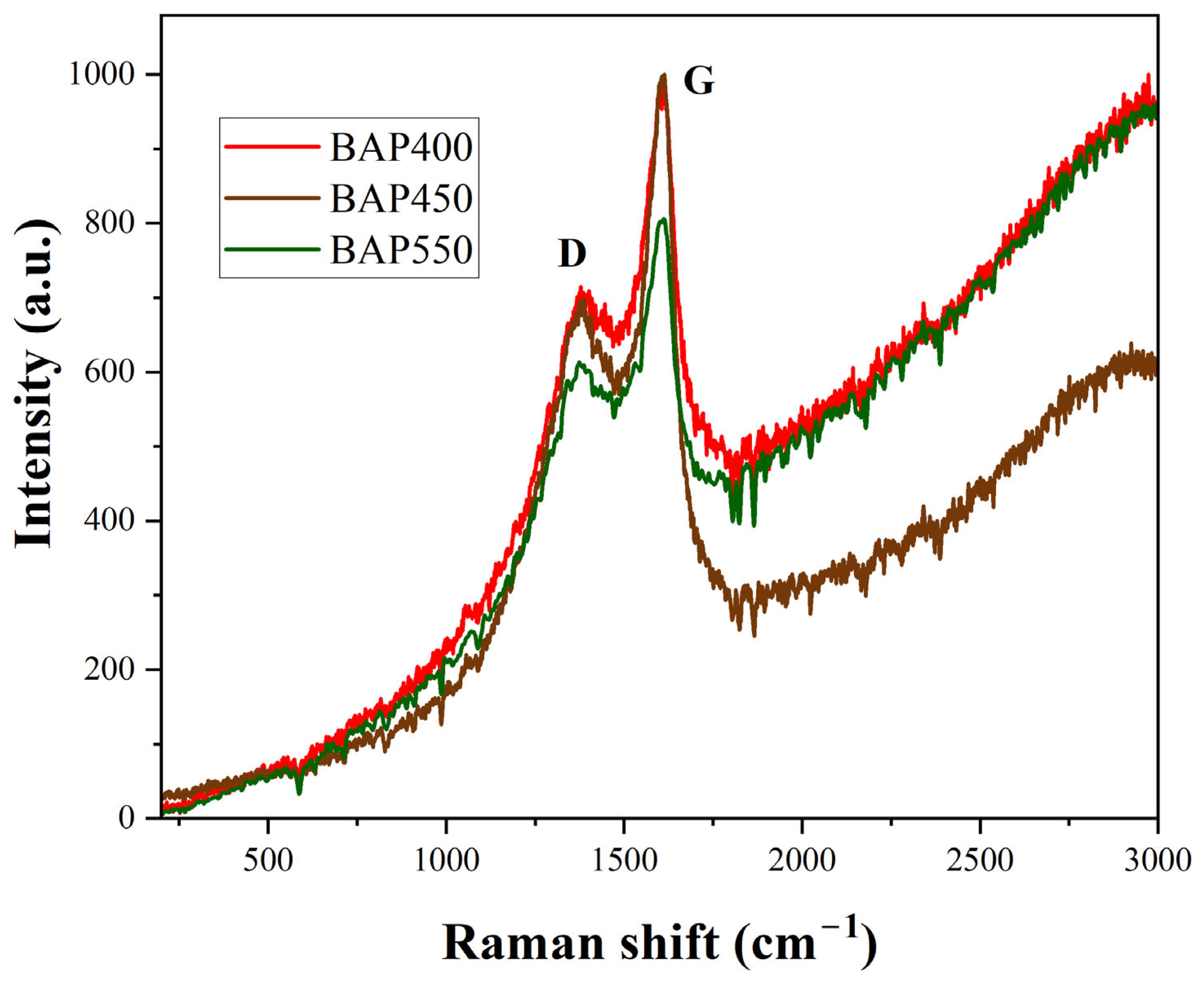
- the G band (~1580 cm−1) corresponded to the E2g vibrational mode of sp2-hybridized carbon atoms in graphitic hexagonal lattices and reflects structural ordering of the carbon matrix [60];
- -
- the D band (~1350 cm−1) was associated with A1g vibrational modes activated by structural defects, edge sites, sp3 hybridization, or lattice distortions [60].
3.7. Germination and Early Growth Performance
3.7.1. Final Germination and Seedling Height
3.7.2. Root Development and Biomass Accumulation
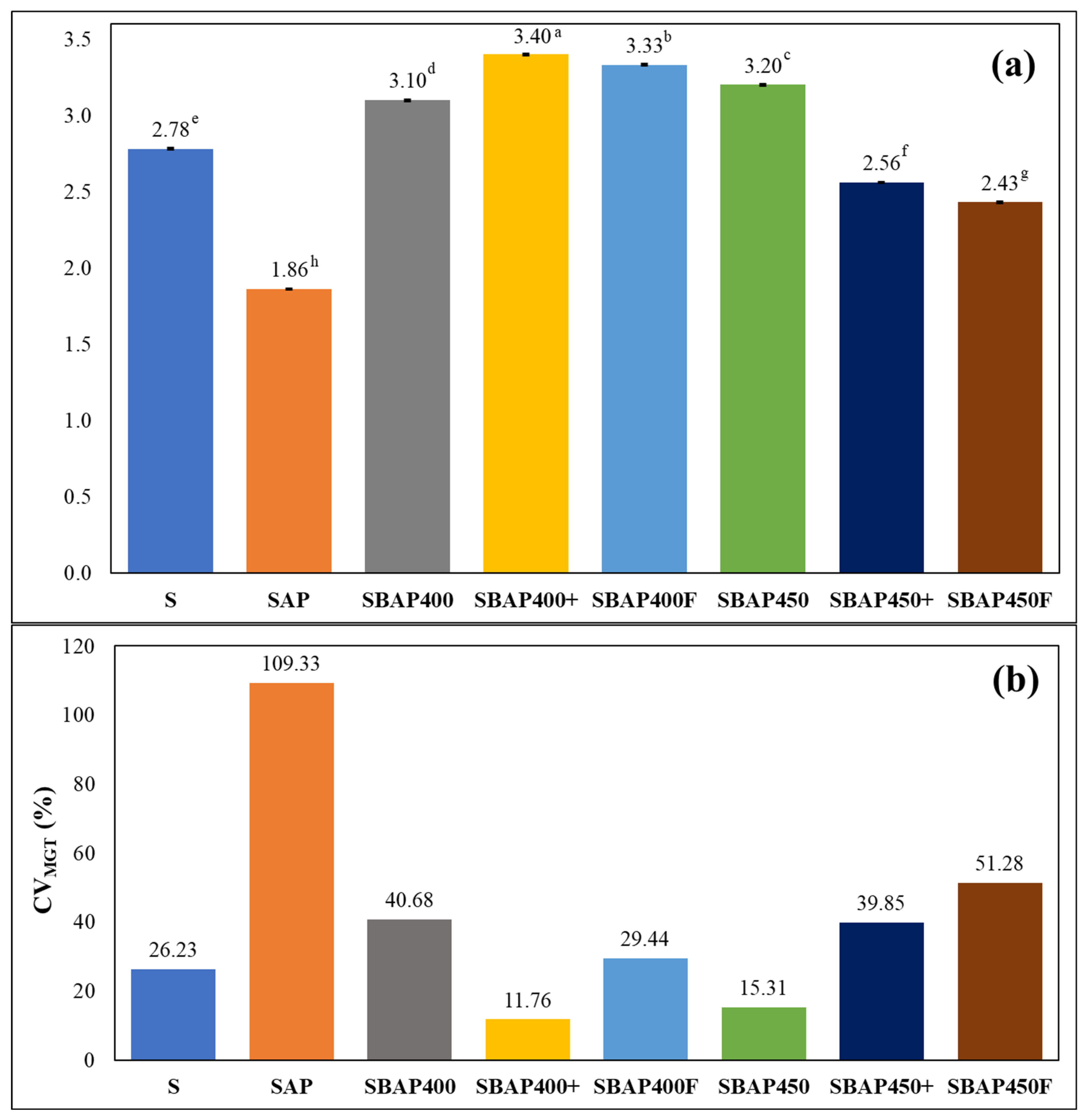
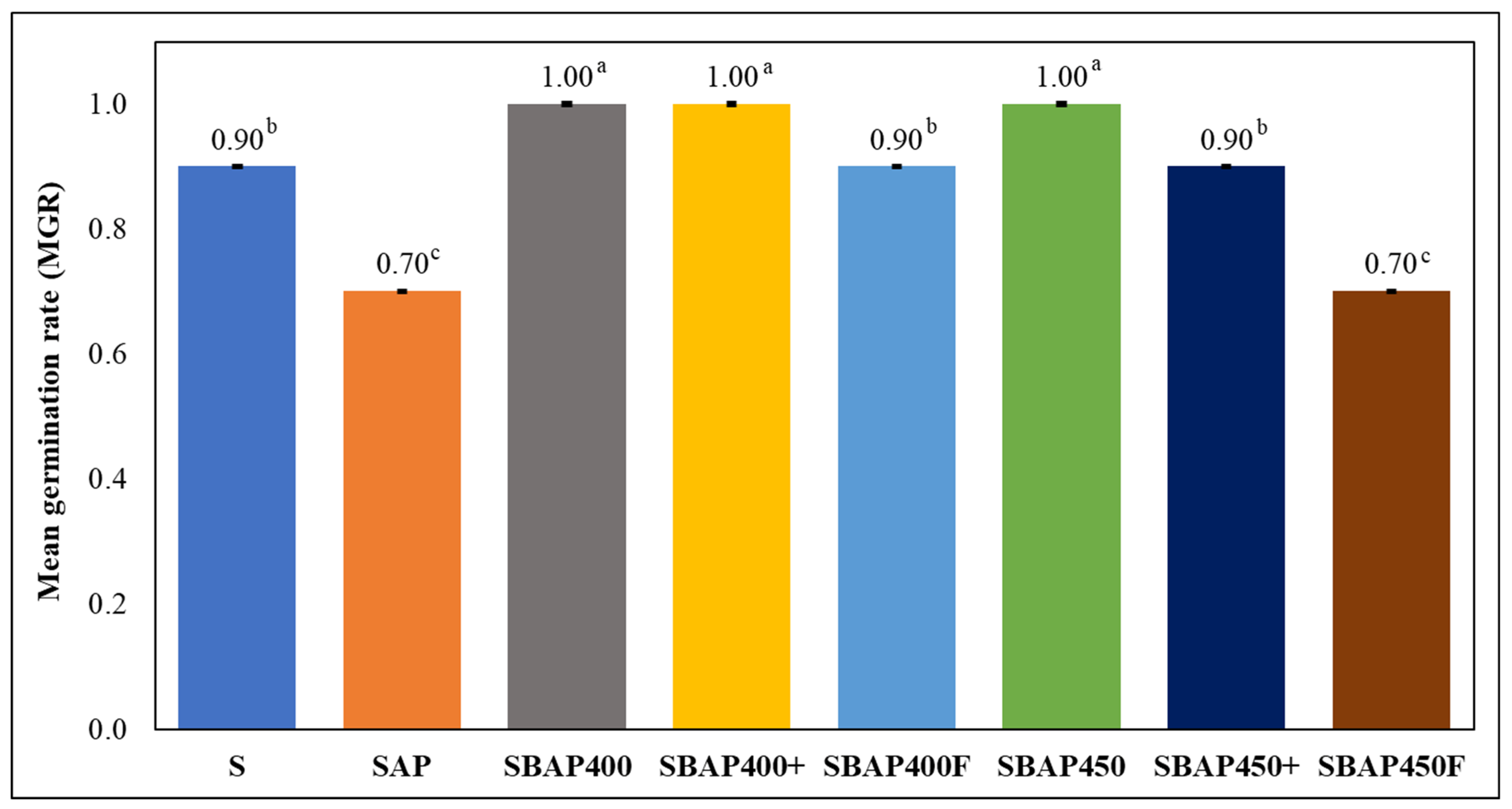
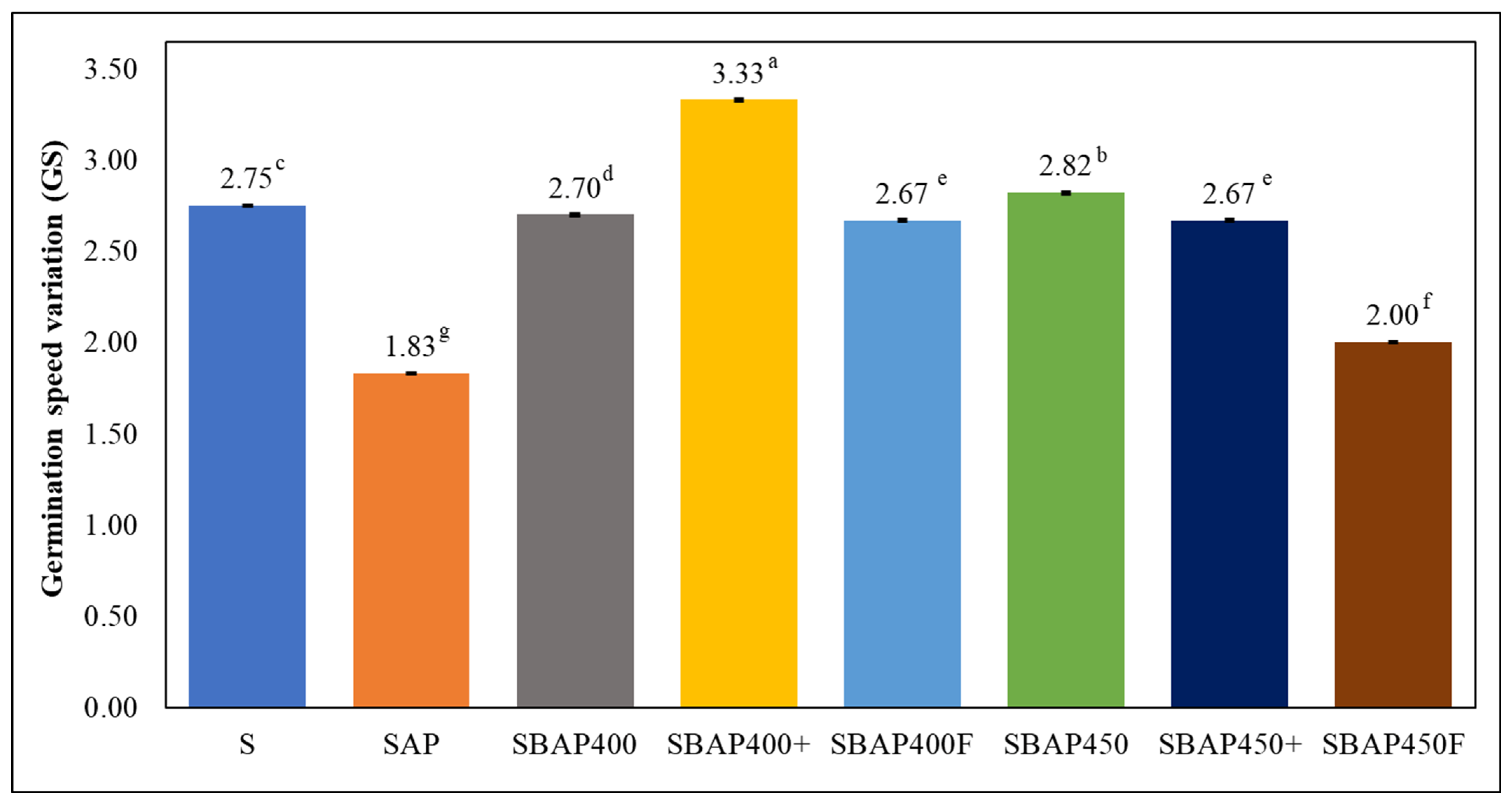
3.7.3. Germination Parameters and Seedling Performance Under Apple Pomace Treatments
3.7.4. Soil Chemical Properties After Application of Apple Pomace and Derived Biochars
4. Conclusions
Author Contributions
Funding
Institutional Review Board Statement
Informed Consent Statement
Data Availability Statement
Acknowledgments
Conflicts of Interest
References
- Kaza, S.; Yao, L.; Bhada-Tata, P.; Woerden, F.V. What a Waste 2.0: A Global Snapshot of Solid Waste Management to 2050; World Bank Publications: Washington, DC, USA, 2018; ISBN 978-1-4648-1347-4. [Google Scholar]
- United Nations Environment Programme. Food Waste Index Report 2024|UNEP—UN Environment Programme. Available online: https://www.unep.org/resources/publication/food-waste-index-report-2024 (accessed on 10 February 2026).
- Harvey, F. Millions Go Hungry as a Billion Meals Binned Every Day, Says UN Report. The Guardian 2024. Available online: https://www.theguardian.com/environment/2024/mar/27/fifth-of-food-wasted-globally-at-cost-of-1tn-a-year-says-un-report (accessed on 10 February 2026).
- Fruit: World Production by Type 2023. Available online: https://www.statista.com/statistics/264001/worldwide-production-of-fruit-by-variety/ (accessed on 23 April 2025).
- Shalini, R.; Gupta, D.K. Utilization of Pomace from Apple Processing Industries: A Review. J. Food. Sci. Technol. 2010, 47, 365–371. [Google Scholar] [CrossRef]
- Lyu, F.; Luiz, S.F.; Azeredo, D.R.P.; Cruz, A.G.; Ajlouni, S.; Ranadheera, C.S. Apple Pomace as a Functional and Healthy Ingredient in Food Products: A Review. Processes 2020, 8, 319. [Google Scholar] [CrossRef]
- Koryś, K.A.; Latawiec, A.E.; Grotkiewicz, K.; Kuboń, M. The Review of Biomass Potential for Agricultural Biogas Production in Poland. Sustainability 2019, 11, 6515. [Google Scholar] [CrossRef]
- Molinuevo-Salces, B.; Riaño, B.; Hijosa-Valsero, M.; González-García, I.; Paniagua-García, A.I.; Hernández, D.; Garita-Cambronero, J.; Díez-Antolínez, R.; García-González, M.C. Valorization of Apple Pomaces for Biofuel Production: A Biorefinery Approach. Biomass Bioenergy 2020, 142, 105785. [Google Scholar] [CrossRef]
- Westerhof, R.J.M.; Kuipers, N.J.M.; Kersten, S.R.A.; van Swaaij, W.P.M. Controlling the Water Content of Biomass Fast Pyrolysis Oil. Ind. Eng. Chem. Res. 2007, 46, 9238–9247. [Google Scholar] [CrossRef]
- Guerrero, M.R.B.; Salinas Gutiérrez, J.M.; Meléndez Zaragoza, M.J.; López Ortiz, A.; Collins-Martínez, V. Optimal Slow Pyrolysis of Apple Pomace Reaction Conditions for the Generation of a Feedstock Gas for Hydrogen Production. Int. J. Hydrogen Energy 2016, 41, 23232–23237. [Google Scholar] [CrossRef]
- Lucian, M.; Volpe, M.; Gao, L.; Piro, G.; Goldfarb, J.L.; Fiori, L. Impact of Hydrothermal Carbonization Conditions on the Formation of Hydrochars and Secondary Chars from the Organic Fraction of Municipal Solid Waste. Fuel 2018, 233, 257–268. [Google Scholar] [CrossRef]
- Streubel, J.D.; Collins, H.P.; Garcia-Perez, M.; Tarara, J.; Granatstein, D.; Kruger, C.E. Influence of Contrasting Biochar Types on Five Soils at Increasing Rates of Application. Soil Sci. Soc. Am. J. 2011, 75, 1402–1413. [Google Scholar] [CrossRef]
- Zhang, S.; Ji, Y.; Dang, J.; Zhao, J.; Chen, S. Magnetic Apple Pomace Biochar: Simple Preparation, Characterization, and Application for Enriching Ag(I) in Effluents. Sci. Total Environ. 2019, 668, 115–123. [Google Scholar] [CrossRef] [PubMed]
- Palansooriya, K.N.; Ok, Y.S.; Awad, Y.M.; Lee, S.S.; Sung, J.-K.; Koutsospyros, A.; Moon, D.H. Impacts of Biochar Application on Upland Agriculture: A Review. J. Environ. Manag. 2019, 234, 52–64. [Google Scholar] [CrossRef] [PubMed]
- Lu, H.; Zhang, W.; Wang, S.; Zhuang, L.; Yang, Y.; Qiu, R. Characterization of Sewage Sludge-Derived Biochars from Different Feedstocks and Pyrolysis Temperatures. J. Anal. Appl. Pyrolysis 2013, 102, 137–143. [Google Scholar] [CrossRef]
- Zaharioiu, A.M.; Şandru, C.; Ionete, E.I.; Marin, F.; Ionete, R.E.; Soare, A.; Constantinescu, M.; Bucura, F.; Niculescu, V.-C. Eco-Friendly Alternative Disposal through the Pyrolysis Process of Meat and Bone Meal. Materials 2022, 15, 6593. [Google Scholar] [CrossRef]
- Tomczyk, A.; Sokołowska, Z.; Boguta, P. Biochar physicochemical properties: Pyrolysis temperature and feedstock kind effects. Rev. Environ. Sci. Biotechnol. 2020, 19, 191–215. [Google Scholar] [CrossRef]
- Tuinstra, F.; Koenig, J.L. Raman Spectrum of Graphite. J. Chem. Phys. 1970, 53, 1126–1130. [Google Scholar] [CrossRef]
- Cançado, L.G.; Jorio, A.; Pimenta, M.A. Measuring the Absolute Raman Cross Section of Nanographites as a Function of Laser Energy and Crystallite Size. Phys. Rev. B 2007, 76, 064304. [Google Scholar] [CrossRef]
- Raman Spectroscopy Crystallite Size Calculator (Tuinstra Koenig Relation)—InstaNANO 2021. Available online: https://instanano.com/all/characterization/raman/crystallite-size-2/ (accessed on 15 December 2025).
- de Cockborne, A.-M.; Bruckler, L.; Sevenier, G.; Gasc, M. Nutrient Leaching from Soil Amended with Apple Waste. Agronomie 2001, 21, 215–226. [Google Scholar] [CrossRef]
- El-Kassaby, Y.A.; Moss, I.; Kolotelo, D.; Stoehr, M. Seed Germination: Mathematical Representation and Parameters Extraction. For. Sci. 2008, 54, 220–227. [Google Scholar] [CrossRef]
- Zlatanović, S.; Ostojić, S.; Micić, D.; Rankov, S.; Dodevska, M.; Vukosavljević, P.; Gorjanović, S. Thermal Behaviour and Degradation Kinetics of Apple Pomace Flours. Thermochim. Acta 2019, 673, 17–25. [Google Scholar] [CrossRef]
- Ahmad, M.; Lee, S.S.; Dou, X.; Mohan, D.; Sung, J.-K.; Yang, J.E.; Ok, Y.S. Effects of Pyrolysis Temperature on Soybean Stover- and Peanut Shell-Derived Biochar Properties and TCE Adsorption in Water. Bioresour. Technol. 2012, 118, 536–544. [Google Scholar] [CrossRef] [PubMed]
- Lehmann, J.; Joseph, S. (Eds.) Biochar for Environmental Management: Science, Technology and Implementation, 2nd ed.; Routledge: London, UK, 2015; ISBN 978-0-203-76226-4. [Google Scholar]
- Kujawska, J. Content of Heavy Metals in Various Biochar and Assessment Environmental Risk. J. Ecol. Eng. 2023, 24, 287–295. [Google Scholar] [CrossRef]
- Wuana, R.A.; Okieimen, F.E. Heavy Metals in Contaminated Soils: A Review of Sources, Chemistry, Risks and Best Available Strategies for Remediation. Int. Sch. Res. Not. 2011, 2011, 402647. [Google Scholar] [CrossRef]
- Zhang, X.; Zhao, B.; Liu, H.; Zhao, Y.; Li, L. Effects of pyrolysis temperature on biochar’s characteristics and speciation and environmental risks of heavy metals in sewage sludge biochars. Environ. Technol. Innov. 2022, 26, 102288. [Google Scholar] [CrossRef]
- Beesley, L.; Moreno-Jiménez, E.; Gómez-Eyles, J.L. Effects of biochar and greenwaste compost amendments on mobility, bioavailability and toxicity of inorganic and organic contaminants in a multi-element polluted soil. Environ. Pollut. 2010, 158, 2282–2287. [Google Scholar] [CrossRef] [PubMed]
- Geleto, M.A.; Forján, R.; Arco-Lázaro, E.; Rodríguez-Rodríguez, J.; Alcalá, M.; Sánchez-Sánchez, A.; García-Morales, I. Influence of pyrolysis temperature and feedstock biomass on Cu2+, Pb2+, and Zn2+ sorption capacity of biochar. Int. J. Environ. Sci. Technol. 2022, 19, 11857–11866. [Google Scholar] [CrossRef]
- Cui, X.; Yang, Y.; Wang, J.; Cheng, Z.; Wang, X.; Khan, K.Y.; Xu, S.; Yan, B.; Chen, G. Pyrolysis of Exhausted Biochar Sorbent: Fates of Cadmium and Generation of Products. Sci. Total Environ. 2024, 920, 170712. [Google Scholar] [CrossRef] [PubMed]
- Wang, S.; Gao, B.; Li, Y.; Mosa, A.; Zimmerman, A.R.; Ma, L.Q.; Harris, W.G.; Migliaccio, K.W. Manganese Oxide-Modified Biochars: Preparation, Characterization, and Sorption of Arsenate and Lead. Bioresour. Technol. 2015, 181, 13–17. [Google Scholar] [CrossRef]
- Wilamas, A.; Vinitnantharat, S.; Pinisakul, A. Manganese Adsorption onto Permanganate-Modified Bamboo Biochars from Groundwater. Sustainability 2023, 15, 6831. [Google Scholar] [CrossRef]
- Demirbaş, A. Biomass Resource Facilities and Biomass Conversion Processing for Fuels and Chemicals. Energy Convers. Manag. 2001, 42, 1357–1378. [Google Scholar] [CrossRef]
- Mohan, D.; Pittman, C.U., Jr.; Steele, P.H. Pyrolysis of Wood/Biomass for Bio-Oil: A Critical Review. Energy Fuels 2006, 20, 848–889. [Google Scholar] [CrossRef]
- Xu, D.; Cao, J.; Li, Y.; Howard, A.; Yu, K. Effect of Pyrolysis Temperature on Characteristics of Biochars Derived from Different Feedstocks: A Case Study on Ammonium Adsorption Capacity. Waste Manag. 2019, 87, 652–660. [Google Scholar] [CrossRef]
- Qambrani, N.A.; Rahman, M.M.; Won, S.; Shim, S.; Ra, C. Biochar Properties and Eco-Friendly Applications for Climate Change Mitigation, Waste Management, and Wastewater Treatment: A Review. Renew. Sustain. Energy Rev. 2017, 79, 255–273. [Google Scholar] [CrossRef]
- Yuan, J.-H.; Xu, R.-K.; Zhang, H. The Forms of Alkalis in the Biochar Produced from Crop Residues at Different Temperatures. Bioresour. Technol. 2011, 102, 3488–3497. [Google Scholar] [CrossRef]
- Li, Y.; Chen, W.; Fang, S.; Xu, Z.; Weng, H.; Zhang, X. The Influence of Pyrolysis Temperature and Feedstocks on the Characteristics of Biochar-Derived Dissolved Organic Matter: A Systematic Assessment. Clean Technol. 2024, 6, 1314–1325. [Google Scholar] [CrossRef]
- Gholami, L.; Rahimi, G. The Efficiency of Potato Peel Biochar for the Adsorption and Immobilization of Heavy Metals in Contaminated Soil. Int. J. Phytoremediat. 2023, 25, 263–273. [Google Scholar] [CrossRef]
- Zhao, L.; Cao, X.; Mašek, O.; Zimmerman, A. Heterogeneity of Biochar Properties as a Function of Feedstock Sources and Production Temperatures. J. Hazard. Mater. 2013, 256–257, 1–9. [Google Scholar] [CrossRef]
- Cantrell, K.B.; Hunt, P.G.; Uchimiya, M.; Novak, J.M.; Ro, K.S. Impact of Pyrolysis Temperature and Manure Source on Physicochemical Characteristics of Biochar. Bioresour. Technol. 2012, 107, 419–428. [Google Scholar] [CrossRef]
- Choumane, F.Z.; Zaoui, F.; Kandouci, F.; Maachou, B.; Benguella, B. Valorization of Potato Peel Residues to Produce a Bioflocculant to Be Used in the Treatment of Liquid Effluents. IOP Conf. Ser. Mater. Sci. Eng. 2021, 1204, 012002. [Google Scholar] [CrossRef]
- Rehman, R.; Mahmud, T.; Irum, M. Comparative Sorption Studies for Amaranth Dye Removal from Water in Cost-Effective Way Using Guava Leaves and Potato Peels. Asian J. Chem. 2015, 27, 2008–2014. [Google Scholar] [CrossRef]
- Coates, J. Interpretation of Infrared Spectra, A Practical Approach. In Encyclopedia of Analytical Chemistry; Meyers, R.A., McKelvy, M.L., Eds.; Wiley: Hoboken, NJ, USA, 2006. [Google Scholar] [CrossRef]
- Pandey, K.K. A Study of Chemical Structure of Soft and Hardwood and Wood Polymers by FTIR Spectroscopy. J. Appl. Polym. Sci. 1999, 71, 1969–1975. [Google Scholar] [CrossRef]
- Schwanninger, M.; Rodrigues, J.C.; Pereira, H.; Hinterstoisser, B. Effects of Short-Time Vibratory Ball Milling on the Shape of FT-IR Spectra of Wood and Cellulose. Vib. Spectrosc. 2004, 36, 23–40. [Google Scholar] [CrossRef]
- Sun, R.C.; Tomkinson, J.; Ma, P.L.; Liang, S.F. Comparative Study of Hemicelluloses from Rice Straw by Alkali and Hydrogen Peroxide Treatments. Carbohydr. Polym. 2000, 42, 111–122. [Google Scholar] [CrossRef]
- Özçimen, D.; Ersoy-Meriçboyu, A. Characterization of Biochar and Bio-Oil Samples Obtained from Carbonization of Various Biomass Materials. Renew. Energy 2010, 35, 1319–1324. [Google Scholar] [CrossRef]
- Antonangelo, J.A.; Zhang, H.; Sun, X.; Kumar, A. Physicochemical Properties and Morphology of Biochars as Affected by Feedstock Sources and Pyrolysis Temperatures. Biochar 2019, 1, 325–336. [Google Scholar] [CrossRef]
- Reza, M.S.; Islam, S.N.; Afroze, S.; Abu Bakar, M.S.; Sukri, R.S.; Rahman, S.; Azad, A.K. Evaluation of the Bioenergy Potential of Invasive Pennisetum Purpureum through Pyrolysis and Thermogravimetric Analysis. Energy Ecol. Environ. 2020, 5, 118–133. [Google Scholar] [CrossRef]
- El-Hendawy, A.-N.A. Variation in the FTIR Spectra of a Biomass under Impregnation, Carbonization and Oxidation Conditions. J. Anal. Appl. Pyrolysis 2006, 75, 159–166. [Google Scholar] [CrossRef]
- Tayibi, S.; Monlau, F.; Fayoud, N.; Oukarroum, A.; Zeroual, Y.; Hannache, H.; Barakat, A. One-Pot Activation and Pyrolysis of Moroccan Gelidium Sesquipedale Red Macroalgae Residue: Production of an Efficient Adsorbent Biochar. Biochar 2019, 1, 401–412. [Google Scholar] [CrossRef]
- Traoré, M.; Kaal, J.; Martínez Cortizas, A. Application of FTIR Spectroscopy to the Characterization of Archeological Wood. Spectrochim. Acta Part A Mol. Biomol. Spectrosc. 2016, 153, 63–70. [Google Scholar] [CrossRef] [PubMed]
- Akhtar, N.; Goyal, D.; Goyal, A. Physico-Chemical Characteristics of Leaf Litter Biomass to Delineate the Chemistries Involved in Biofuel Production. J. Taiwan Inst. Chem. Eng. 2016, 62, 239–246. [Google Scholar] [CrossRef]
- Popescu, C.-M.; Popescu, M.-C.; Singurel, G.; Vasile, C.; Argyropoulos, D.S.; Willfor, S. Spectral Characterization of Eucalyptus Wood. Appl Spectrosc 2007, 61, 1168–1177. [Google Scholar] [CrossRef]
- Chen, Y.; Yang, H.; Wang, X.; Zhang, S.; Chen, H. Biomass-Based Pyrolytic Polygeneration System on Cotton Stalk Pyrolysis: Influence of Temperature. Bioresour. Technol. 2012, 107, 411–418. [Google Scholar] [CrossRef]
- Colom, X.; Carrillo, F. Comparative Study of Wood Samples of the Northern Area of Catalonia by FTIR. J. Wood Chem. Technol. 2005, 25, 1–11. [Google Scholar] [CrossRef]
- Chen, B.; Chen, Z. Sorption of Naphthalene and 1-Naphthol by Biochars of Orange Peels with Different Pyrolytic Temperatures. Chemosphere 2009, 76, 127–133. [Google Scholar] [CrossRef]
- Ferrari, A.C.; Robertson, J. Interpretation of Raman Spectra of Disordered and Amorphous Carbon. Phys. Rev. B 2000, 61, 14095–14107. [Google Scholar] [CrossRef]
- Zickler, G.A.; Smarsly, B.; Gierlinger, N.; Peterlik, H.; Paris, O. A Reconsideration of the Relationship between the Crystallite Size La of Carbons Determined by X-Ray Diffraction and Raman Spectroscopy. Carbon 2006, 44, 3239–3246. [Google Scholar] [CrossRef]
- Sarkar, D.; Panicker, T.F.; Kumar Mishra, R.; Srinivas Kini, M. A Comprehensive Review of Production and Characterization of Biochar for Removal of Organic Pollutants from Water and Wastewater. Water-Energy Nexus 2024, 7, 243–265. [Google Scholar] [CrossRef]
- Ahmad, M.; Rajapaksha, A.U.; Lim, J.E.; Zhang, M.; Bolan, N.; Mohan, D.; Vithanage, M.; Lee, S.S.; Ok, Y.S. Biochar as a Sorbent for Contaminant Management in Soil and Water: A Review. Chemosphere 2014, 99, 19–33. [Google Scholar] [CrossRef] [PubMed]
- Lehmann, J.; Joseph, S. (Eds.) Biochar for Environmental Management: Science, Technology and Implementation, 3rd ed.; Routledge: London, UK, 2024; ISBN 978-1-003-29767-3. [Google Scholar]
- Munns, R.; Tester, M. Mechanisms of Salinity Tolerance. Annu. Rev. Plant Biol. 2008, 59, 651–681. [Google Scholar] [CrossRef]
- Novak, J.M.; Cantrell, K.B.; Watts, D.W.; Busscher, W.J.; Johnson, M.G. Designing relevant biochars as soil amendments using lignocellulosic-based and manure-based feedstocks. J. Soils Sediments 2014, 14, 330–343. [Google Scholar] [CrossRef]
- Enders, A.; Hanley, K.; Whitman, T.; Joseph, S.; Lehmann, J. Characterization of Biochars to Evaluate Recalcitrance and Agronomic Performance. Bioresour. Technol. 2012, 114, 644–653. [Google Scholar] [CrossRef]
- Xiu, L.; Gu, W.; Sun, Y.; Wu, D.; Wang, Y.; Zhang, H.; Zhang, W.; Chen, W. The Fate and Supply Capacity of Potassium in Biochar Used in Agriculture. Sci. Total Environ. 2023, 902, 165969. [Google Scholar] [CrossRef]
- Kabata-Pendias, A. Trace Elements in Soils and Plants, 4th ed.; CRC Press: Boca Raton, FL, USA, 2011. [Google Scholar] [CrossRef]
- Salminen, R.; Batista, M.J.; Bidovec, M.; Demetriades, A.; De Vivo, B.; De Vos, W.; Duris, M.; Gilucis, A.; Gregorauskiene, V.; Halamic, J.; et al. Geochemical Atlas of Europe. Part 1: Background Information, Methodology and Maps; Geological Survey of Finland: Espoo, Finland, 2005. [Google Scholar]
- European Environment Agency (EEA). Heavy Metals in Soil Ecosystems (Signal). European Zero Pollution Dashboards. Available online: https://www.eea.europa.eu/en/european-zero-pollution-dashboards/indicators/heavy-metals-in-soil-ecosystems-signal (accessed on 3 March 2026).
- Council of the European Communities. Council Directive 86/278/EEC of 12 June 1986 on the protection of the environment, and in particular of the soil, when sewage sludge is used in agriculture. Off. J. Eur. Communities 1986, L181, 6–12. [Google Scholar]
- Yunta, F.; Schillaci, C.; Panagos, P.; Van Eynde, E.; Wojda, P.; Jones, A. Quantitative analysis of the compliance of EU Sewage Sludge Directive by using the heavy metal concentrations from LUCAS topsoil database. Environ. Sci. Pollut. Res. 2025, 32, 16554–16569. [Google Scholar] [CrossRef]
- European Union. Regulation (EU) 2019/1009 of the European Parliament and of the Council of 5 June 2019 laying down rules on the making available on the market of EU fertilising products. Off. J. Eur. Union 2019, L170, 1–114. [Google Scholar]
- Zhang, P.; Zhang, X.; Li, Y.; Han, L. Influence of pyrolysis temperature on chemical speciation, leaching ability, and environmental risk of heavy metals in biochar derived from cow manure. Bioresour. Technol. 2020, 302, 122850. [Google Scholar] [CrossRef]
- Hu, X.; Zhang, R.; Xia, B.; Ying, R.; Hu, Z.; Tao, X.; Yu, H.; Xiao, F.; Chu, Q.; Chen, H.; et al. Effect of Pyrolysis Temperature on Removal Efficiency and Mechanisms of Hg(II), Cd(II), and Pb (II) by Maize Straw Biochar. Sustainability 2022, 14, 9022. [Google Scholar] [CrossRef]
- Kubier, A.; Wilkin, R.T.; Pichler, T. Cadmium in Soils and Groundwater: A Review. Appl. Geochem. 2019, 108, 104388. [Google Scholar] [CrossRef]
- Millaleo, R.; Reyes-Diaz, M.; Ivanov, A.G.; Mora, M.L.; Alberdi, M. Manganese as essential and toxic element for plants: Transport, accumulation and resistance mechanisms. J. Soil Sci. Plant Nutr. 2010, 10, 470–481. [Google Scholar] [CrossRef]
- Li, C.; Cai, H.; Liu, Y. Sustainable Approaches to Tailings Remediation: Role of Organic Fertilizers. Environ. Res. 2025, 276, 121454. [Google Scholar] [CrossRef] [PubMed]
- Liu, H.; Ma, Y.; Wei, Y.; Wu, C.; Zhang, Y. Biochar and Nitrogen Fertilizer Synergies: Enhancing Soil Properties and Jujube Fruit Quality in Saline–Alkali Orchards of Southern Xinjiang. Agronomy 2025, 15, 2205. [Google Scholar] [CrossRef]
- Joseph, S.; Graber, E.R.; Chia, C.; Munroe, P.; Donne, S.; Thomas, T.; Nielsen, S.; Pan, G.; Li, L.; Taylor, P.; et al. Shifting paradigms: Development of high-efficiency biochar fertilizers based on nano-structures and soluble components. Carbon Manag. 2013, 4, 323–343. [Google Scholar] [CrossRef]



| Treatment Code | Description | Seeds per Container | Soil (g) | Biochar/AP (g) | Fertilizer Solution |
|---|---|---|---|---|---|
| S | Soil (control) | 10 | 217.2 | – | – |
| SAP | Soil + raw apple pomace | 10 | 217.2 | 2.17 | – |
| SBAP400 | Soil + BAP400 | 10 | 217.2 | 2.17 | – |
| SBAP400+ | Soil + BAP400 (2%) | 10 | 217.2 | 4.34 | – |
| SBAP400F | Soil + BAP400 + fertilizer | 10 | 217.2 | 2.17 | 50 mL |
| SBAP450 | Soil + BAP450 | 10 | 217.2 | 2.17 | – |
| SBAP450+ | Soil + BAP450 (2%) | 10 | 217.2 | 4.34 | – |
| SBAP450F | Soil + BAP450 + fertilizer | 10 | 217.2 | 2.17 | 50 mL |
| Element (%) | AP | BAP400 | BAP450 | BAP550 |
|---|---|---|---|---|
| C | 47.89 | 77.44 | 78.10 | 75.35 |
| H | 6.69 | 2.74 | 2.34 | 3.40 |
| S | nd | nd | nd | nd |
| N | 1.25 | 1.98 | 1.90 | 2.39 |
| Sample | Zn (mg/kg) | Al (mg/kg) | Fe (mg/kg) | Cu (mg/kg) | Cr (mg/kg) | Pb (mg/kg) | Co (mg/kg) | Ni (mg/kg) | Cd (mg/kg) | Mn (mg/kg) |
|---|---|---|---|---|---|---|---|---|---|---|
| AP | 309.7 ± 0.95 a | 366.4 ± 0.54 c | 472.6 ± 1.30 c | 30.92 ± 0.10 c | 43.40 ± 0.12 c | 0.392 ± 0.003 b | 3.034 ± 0.014 b | 11.30 ± 0.03 b | 0.0567 ± 0.0003 a | 18.86 ± 0.04 c |
| BAP400 | 47.54 ± 0.57 c | 411.5 ± 0.25 b | 543.7 ± 1.48 b | 146.2 ± 0.72 a | 45.22 ± 0.20 c | 3.649 ± 0.008 a | 0.0656 ± 0.0002 c | 11.70 ± 0.03 b | 0.109 ± 0.0004 a | 38.04 ± 0.17 b |
| BAP450 | 74.74 ± 0.41 b | 670.6 ± 0.24 a | 946.6 ± 3.37 a | 56.53 ± 0.30 b | 28.50 ± 0.17 d | 2.589 ± 0.011 b | 0.369 ± 0.003 a | 7.113 ± 0.024 c | <LOD | 57.97 ± 0.24 a |
| BAP550 | 75.38 ± 0.71 | 315.5 ± 0.36 | 373.7 ± 0.77 | 54.86 ± 0.13 | <LOD | 2.776 ± 0.013 | 0.317 ± 0.0001 | 13.94 ± 0.06 | <LOD | 44.15 ± 0.19 |
| Element | AP | BAP400 | BAP450 | BAP550 |
|---|---|---|---|---|
| C | 66.49 | 88.43 | 87.59 | 60.31 |
| O | 21.02 | 8.62 | 9.15 | 29.43 |
| K | 10.21 | 1.65 | 2.10 | 8.81 |
| Mg | 0.45 | 0.30 | 0.30 | 0.44 |
| P | 1.08 | 0.31 | 0.48 | 0.67 |
| Al | – | – | – | 0.13 |
| Si | – | 0.12 | – | 0.22 |
| Ca | 0.19 | 0.57 | 0.38 | – |
| Cl | 0.33 | – | – | – |
| S | 0.23 | – | – | – |
| Sample | D Position (cm−1) | D Intensity | G Position (cm−1) | G Intensity | ID/IG | La (nm) | FWHM(D) (cm−1) | FWHM(G) (cm−1) |
|---|---|---|---|---|---|---|---|---|
| BAP400 | 1377.63 | 714.44 | 1594.84 | 968.58 | 0.738 | 16.28 | 301.33 | 81.65 |
| BAP450 | 1376.09 | 695.49 | 1597.56 | 985.24 | 0.706 | 17.02 | 255.93 | 67.94 |
| BAP550 | 1374.54 | 612.96 | 1599.06 | 801.06 | 0.765 | 15.70 | 312.64 | 69.76 |
| Treatment | Code | Final Germination (Seeds/10) | hmax (mm) | hmin (mm) |
|---|---|---|---|---|
| Soil (Control) | S | 9 * | 12.9 ± 0.10 c | 6.2 ± 0.17 d |
| Soil + AP | SAP | 7 * | 13.4 ± 0.10 b | 4.5 ± 0.20 e |
| Soil + BAP400 | SBAP400 | 10 * | 14.1 ± 0.10 a | 7.0 ± 0.10 c |
| Soil + BAP400 (2%) | SBAP400+ | 10 * | 14.1 ± 0.20 a | 5.3 ± 0.10 e |
| Soil + BAP400 + F | SBAP400F | 9 * | 13.5 ± 0.10 ab | 7.3 ± 0.10 b |
| Soil + BAP450 | SBAP450 | 10 * | 12.7 ± 0.10 c | 7.1 ± 0.20 c |
| Soil + BAP450 (2%) | SBAP450+ | 9 * | 13.5 ± 0.20 ab | 7.6 ± 0.17 b |
| Soil + BAP450 + F | SBAP450F | 9 * | 13.5 ± 0.26 ab | 10.1 ± 0.30 a |
| Treatment | Code | Root Max (cm) | Root Min (cm) | Fresh Leaf (g) | Dry Leaf (g) | Fresh Root (g) | Dry Root (g) |
|---|---|---|---|---|---|---|---|
| Soil (Control) | S | 23.5 ± 0.30 a | 11.0 ± 0.10 c | 0.531 ± 0.00 c | 0.371 ± 0.00 c | 0.608 ± 0.01 a | 0.589 ± 0.01 a |
| Soil + AP | SAP | 23.5 ± 0.36 a | 14.0 ± 0.17 a | 0.353 ± 0.00 d | 0.259 ± 0.00 d | 0.347 ± 0.00 c | 0.337 ± 0.00 c |
| Soil + BAP400 | SBAP400 | 22.5 ± 0.10 b | 11.0 ± 0.17 c | 0.408 ± 0.00 c | 0.291 ± 0.00 c | 0.506 ± 0.00 b | 0.485 ± 0.00 b |
| Soil + BAP400 (2%) | SBAP400+ | 23.0 ± 0.10 a | 13.0 ± 0.10 b | 0.483 ± 0.00 b | 0.368 ± 0.00 b | 0.560 ± 0.00 a | 0.535 ± 0.01 a |
| Soil + BAP400 + F | SBAP400F | 14.0 ± 0.10 c | 8.0 ± 0.10 d | 0.711 ± 0.00 a | 0.420 ± 0.00 a | 0.598 ± 0.01 a | 0.571 ± 0.01 a |
| Soil + BAP450 | SBAP450 | 22.0 ± 0.10 b | 12.0 ± 0.10 c | 0.495 ± 0.00 b | 0.369 ± 0.00 b | 0.402 ± 0.00 c | 0.389 ± 0.00 c |
| Soil + BAP450 (2%) | SBAP450+ | 22.6 ± 0.10 b | 10.0 ± 0.10 c | 0.442 ± 0.00 c | 0.340 ± 0.00 c | 0.333 ± 0.00 d | 0.323 ± 0.00 d |
| Soil + BAP450 + F | SBAP450F | 19.5 ± 0.20 d | 13.5 ± 0.10 a | 0.568 ± 0.01 b | 0.431 ± 0.00 a | 0.486 ± 0.00 b | 0.472 ± 0.00 b |
| Treatment | Ca (mg/kg) | Mg (mg/kg) | Na (mg/kg) | K (mg/kg) | pH | EC (µS/cm) |
|---|---|---|---|---|---|---|
| Initial soil | 30.46 ± 1.51 c | 5.70 ± 0.10 c | 8.04 ± 1.92 e | 185.34 ± 3.12 d | 7.4 c | 165.5 c |
| S | 39.38 ± 0.59 b | 4.34 ± 0.11 d | 23.07 ± 1.87 d | 141.29 ± 3.13 e | 7.5 c | 110.2 d |
| SAP | 32.66 ± 0.82 c | 3.87 ± 0.25 d | 31.26 ± 2.22 c | 118.68 ± 3.28 f | 7.7 b | 125.0 d |
| SBAP400 | 23.94 ± 1.28 d | 7.72 ± 0.17 c | 27.29 ± 2.06 cd | 133.35 ± 3.15 e | 7.6 b | 110.0 d |
| SBAP400+ | 28.88 ± 0.05 c | 3.80 ± 0.19 d | 28.82 ± 2.19 c | 173.18 ± 3.20 d | 7.8 a | 214.0 c |
| SBAP400F | 53.95 ± 0.01 b | 12.89 ± 0.23 b | 133.50 ± 2.17 b | 346.90 ± 3.12 b | 7.9 a | 440.0 b |
| SBAP450 | 18.19 ± 0.18 e | 14.92 ± 0.15 b | 44.92 ± 2.13 c | 101.04 ± 3.16 f | 7.7 b | 178.0 c |
| SBAP450+ | 25.50 ± 0.88 cd | 6.33 ± 0.07 c | 48.45 ± 2.19 c | 143.04 ± 3.14 e | 7.9 a | 127.8 d |
| SBAP450F | 80.65 ± 0.53 a | 18.16 ± 0.11 a | 193.55 ± 2.03 a | 447.89 ± 3.15 a | 7.7 b | 643.0 a |
| Treatment | Ca (mg/kg) | Mg (mg/kg) | Na (mg/kg) | K (mg/kg) | Fe (mg/kg) |
|---|---|---|---|---|---|
| Initial soil | 9626.9 ± 0.5 f | 4809.0 ± 0.1 f | 78.5 ± 0.2 f | 3890.8 ± 0.3 f | 17,363.5 ± 0.8 c |
| S | 9704.5 ± 0.1 f | 4888.2 ± 0.1 f | 79.1 ± 0.5 f | 3913.7 ± 0.2 f | 17,372.2 ± 0.2 c |
| SAP | 9135.0 ± 0.3 g | 4601.5 ± 0.1 g | 102.9 ± 0.1 e | 3756.5 ± 0.1 g | 15,022.0 ± 0.3 d |
| SBAP400 | 11,047.8 ± 0.2 d | 5829.8 ± 0.1 c | 214.6 ± 0.2 c | 5997.8 ± 0.7 a | 19,046.2 ± 0.1 a |
| SBAP400+ | 10,745.7 ± 0.6 e | 5298.9 ± 0.01 d | 313.2 ± 0.1 b | 4759.1 ± 0.1 c | 16,993.2 ± 1.6 c |
| SBAP400F | 11,884.8 ± 0.1 c | 5751.3 ± 0.02 c | 423.8 ± 0.2 a | 5419.2 ± 0.02 b | 19,007.6 ± 0.4 a |
| SBAP450 | 12,945.2 ± 1.2 b | 5676.3 ± 0.1 c | 362.7 ± 1.0 b | 4039.6 ± 0.3 e | 17,697.1 ± 0.7 c |
| SBAP450+ | 13,024.0 ± 0.3 a | 5690.6 ± 0.03 c | 401.4 ± 0.2 a | 4514.0 ± 0.8 d | 17,734.5 ± 1.3 c |
| SBAP450F | 10,738.6 ± 1.8 e | 5540.4 ± 0.02 d | 533.8 ± 1.4 a | 5024.0 ± 0.1 c | 17,534.0 ± 1.5 c |
| Treatment | Zn (mg/kg) | Al (mg/kg) | Fe (mg/kg) | Cu (mg/kg) | Cr (mg/kg) | Pb (mg/kg) | Co (mg/kg) | Ni (mg/kg) | Cd (mg/kg) | Mn (mg/kg) |
|---|---|---|---|---|---|---|---|---|---|---|
| Initial soil | 112.3 ± 0.25 b | 7544 ± 0.37 c | 22,230 ± 4.95 b | 24.83 ± 0.06 c | 43.02 ± 0.10 b | 15.81 ± 0.04 c | 11.82 ± 0.03 b | 21.98 ± 0.05 c | 0.613 ± 0.001 b | 425.6 ± 0.10 c |
| SAP | 108.7 ± 0.42 b | 10,460 ± 4.04 b | 24,150 ± 9.33 a | 26.71 ± 0.10 b | 54.98 ± 0.21 b | 18.92 ± 0.07 b | 18.42 ± 0.07 a | 26.29 ± 0.10 b | 0.555 ± 0.002 c | 574.3 ± 0.22 b |
| SBAP400 | 119.6 ± 0.35 a | 16,170 ± 4.67 a | 24,580 ± 7.09 a | 28.40 ± 0.08 b | 73.79 ± 0.21 b | 18.79 ± 0.05 b | 13.19 ± 0.04 b | 38.22 ± 0.11 b | 0.736 ± 0.002 a | 437.9 ± 0.13 c |
| SBAP400F | 117.2 ± 0.20 a | 13,140 ± 2.25 a | 24,840 ± 3.98 a | 27.25 ± 0.05 b | 47.82 ± 0.08 b | 17.72 ± 0.03 b | 12.87 ± 0.02 b | 35.21 ± 0.06 b | 0.624 ± 0.001 b | 432.7 ± 0.07 c |
| SBAP400+ | 114.5 ± 0.28 a | 17,100 ± 4.11 a | 24,280 ± 5.84 a | 33.59 ± 0.08 a | 71.41 ± 0.17 b | 19.33 ± 0.05 b | 12.98 ± 0.03 b | 28.49 ± 0.07 b | 0.701 ± 0.002 a | 430.8 ± 0.10 c |
| SBAP450 | 117.9 ± 0.20 a | 13,520 ± 2.24 a | 24,360 ± 4.20 a | 32.73 ± 0.06 a | 367.5 ± 0.61 a | 18.73 ± 0.03 b | 15.78 ± 0.03 a | 199.1 ± 0.33 a | 0.709 ± 0.001 a | 614.6 ± 0.10 b |
| SBAP450+ | 73.54 ± 0.08 c | 6322 ± 0.65 c | 7348 ± 0.76 c | 26.76 ± 0.03 b | 18.60 ± 0.02 c | 4.94 ± 0.01 c | 9.24 ± 0.01 c | 18.46 ± 0.02 c | 0.433 ± 0.0004 c | 354.2 ± 0.04 c |
| SBAP450F | 112.4 ± 0.37 b | 10,910 ± 3.54 b | 23,270 ± 8.18 b | 27.68 ± 0.09 b | 45.36 ± 0.15 b | 19.69 ± 0.06 b | 22.06 ± 0.07 a | 26.89 ± 0.09 b | 0.646 ± 0.002 b | 662.3 ± 0.22 a |
Disclaimer/Publisher’s Note: The statements, opinions and data contained in all publications are solely those of the individual author(s) and contributor(s) and not of MDPI and/or the editor(s). MDPI and/or the editor(s) disclaim responsibility for any injury to people or property resulting from any ideas, methods, instructions or products referred to in the content. |
© 2026 by the authors. Licensee MDPI, Basel, Switzerland. This article is an open access article distributed under the terms and conditions of the Creative Commons Attribution (CC BY) license.
Share and Cite
Handolescu, R.-R.; Niculescu, V.-C.; Paun, N.; Sandru, C.; Roman, A.; Ion-Ebrasu, D.; Cosmulescu, S.N. Thermochemical Valorisation of Apple Pomace-Derived Biochar: Temperature-Driven Structural Evolution, Soil Chemical Modulation, and Agronomic Performance in Wheat Germination. Appl. Sci. 2026, 16, 3273. https://doi.org/10.3390/app16073273
Handolescu R-R, Niculescu V-C, Paun N, Sandru C, Roman A, Ion-Ebrasu D, Cosmulescu SN. Thermochemical Valorisation of Apple Pomace-Derived Biochar: Temperature-Driven Structural Evolution, Soil Chemical Modulation, and Agronomic Performance in Wheat Germination. Applied Sciences. 2026; 16(7):3273. https://doi.org/10.3390/app16073273
Chicago/Turabian StyleHandolescu, Ramona-Raluca, Violeta-Carolina Niculescu, Nadia Paun, Claudia Sandru, Antoaneta Roman, Daniela Ion-Ebrasu, and Sina Niculina Cosmulescu. 2026. "Thermochemical Valorisation of Apple Pomace-Derived Biochar: Temperature-Driven Structural Evolution, Soil Chemical Modulation, and Agronomic Performance in Wheat Germination" Applied Sciences 16, no. 7: 3273. https://doi.org/10.3390/app16073273
APA StyleHandolescu, R.-R., Niculescu, V.-C., Paun, N., Sandru, C., Roman, A., Ion-Ebrasu, D., & Cosmulescu, S. N. (2026). Thermochemical Valorisation of Apple Pomace-Derived Biochar: Temperature-Driven Structural Evolution, Soil Chemical Modulation, and Agronomic Performance in Wheat Germination. Applied Sciences, 16(7), 3273. https://doi.org/10.3390/app16073273