1. Introduction
In the fields of modern environmental and sustainable agriculture and the seed industry, there is a shift away from the techniques of seed soaking treatment and the use of chemicals for overall seed treatment. This development is driven partly by the increase in ecological concerns, social pressures, as well as consumer health awareness [
1,
2,
3,
4]. In some cases, the shift is also driven by the gradual reduction in the number of permitted chemically active substances, leaving limiting adequate alternatives for seed treatment [
5]. European legislation currently restricts the number of active substances for plant treatment in general, which also applies to active substances used as components of chemical seed disinfection. For instance, EU regulation EC No. 1107/2009, which is in force at the time of writing, limits the substances that can be used in both foliar and seed applications [
6].
While chemical seed treatment, especially seed soaking, is favoured for its simplicity and effectiveness, it carries risks of chemical residues and resistance development [
4,
7]. Consequently, exploring alternative seed treatment methods is crucial for maintaining long-term storage stability and protecting against pathogens, particularly in organic farming and greening initiatives. Additionally, alternative seed treatment methods are also applicable in conventional agriculture. These include physical encapsulation techniques such as pelleting and polymer coatings, which serve as protective barriers [
8,
9]. Other advanced approaches utilise energetic rays such as UV, microwave, gamma radiation, and low-energy electron bombardment, as well as ozonation methods using strong oxidising agents [
5,
10]. Moreover, the potential of high kinetic energy sources, such as cold plasma, has also been investigated for seed treatment. The methods demonstrate varying effectiveness against microbial, viral, and fungal threats [
5].
Thermal methods also offer tremendous potential for seed sanitation. These involve the application of controlled heat through various heated media such as hot dry air, hot humid air, steam, hot water, or other media to reduce pathogens [
2,
7,
8,
11]. Sanitation (meaning not necessarily complete microbial eradication as in sterilisation), in general, is an essential preventive measure to manage transmissible diseases that can be spread via seeds [
2]. A key advantage of thermal (physical) sanitation methods using gaseous media is their relative simplicity. When gaseous heated media are used for the treatment instead of hot water, the seeds remain dry throughout the process, thus eliminating the need for energy-intensive seed drying [
12]. Consequently, the energy intensity of the process can be considered more acceptable. The investment (CAPEX) and operating (OPEX) costs of the resulting technological solutions can thus be reduced to a lower level. Furthermore, their technological simplicity can also enable the development of compact and possibly mobile technological solutions, which are ideal for implementation in agriculture, farming environments and long-term storage of seeds and grains.
Most studies on the effects of seed thermal sanitation consider combinations of long residence times with relatively low-temperature environments. For example, thermal treatment tests using hot water typically apply temperatures between 45 and 55 °C with residence times in the range of 10 to 180 min, with various levels of sanitation successes reported [
5]. The same study also reports on the use of low-temperature dry air (e.g., 65 °C) mainly with long treatment durations of tens of minutes. For the case of rice varieties, somewhat similar treatment conditions effects (60–62 °C and 10–15 min) were used with subsequent cooling [
8]. Heavily prolonged residence times in the order of days and weeks were also tested to demonstrate a viable way of eradicating
Fusarium sp. from wheat and barley seeds [
13,
14]. In addition, Bänziger et al. evaluated various alternative thermal treatments, including steam (wet air), hot air, and warm water against
Microdochium spp. for winter wheat seeds [
3]. According to field observations, the best results were achieved for warm water and chemical treatment and all used media showed better results than the control.
Studies indicate that the effectiveness of thermal sanitation against seed-borne pathogens is closely dependent on a fine balance between several factors, including treatment media temperature, exposure time, the physiological tolerance of individual seed species, seed moisture, and the pathogen’s tolerance to heat and its capacity to adhere to or colonise the seed surface. A review [
15] noted dry heat is effective against bacterial pathogens (
Xanthomonas,
Pseudomonas) at 50–75 °C for hours to days, with species-specific seed tolerance. For vegetable seeds, similar ranges reduce pathogens when seed moisture and air circulation are controlled [
16]. Braga et al. reported in [
17] that tomato seeds lose viability above 55–60 °C, while 52–55 °C for 30–60 min preserved quality and reduced mycoflora. A few studies have employed shorter exposure times. For example, immersion into hot water was tested to reduce
Aspergillus sp.,
Penicillium sp., and
Fusarium sp. in purple corn (
Zea mays) in a study [
18]. Treatments were applied at 50–70 °C for 1–3 min and effectively reduced the fungal infestation without degrading the seeds’ physiological properties. A fundamentally different mechanistic effect was described in [
19]. A five-minute exposure to 80–120 °C can stimulate germination in species with physically dormant seed coats, without negatively affecting viability.
Seed-borne fungal pathogens differ substantially in their tolerance to heat, their requirements for moisture, and their capacity to adhere to or colonise the seed surface. While
Aspergillus terreus can withstand elevated temperatures during thermal processing due to production of enzymes with comparatively high thermal stability [
20],
Fusarium graminearum is significantly reduced by thermal treatment at 70–80 °C, yet seed viability is still preserved [
14].
Fusarium poae exhibits different ecological behaviour, with growth, infection of wheat heads, and nivalenol production strongly modulated by temperature and moisture. Warmer and drier conditions favour its competitiveness and toxin biosynthesis, underscoring the importance of moisture in pathogen survival on seed surfaces [
21]. Species of
Alternaria, such as
A. radicina, are also strongly influenced by the moisture content of the seed before treatment. The hot-water sanitation efficiency increases when seed moisture is controlled, demonstrating the interplay of hydration status and heat susceptibility [
22].
In summary, previous research on seed thermal sanitation mainly explores low-temperature treatments applied over extended durations, using media such as hot water, dry air, or steam to reduce contamination in various seeds. These studies demonstrate some success in fungal control without harming seed quality; however, they often require prolonged exposures. The present research provides a meaningful extension of the state-of-the-art by exploring alternative thermal treatment conditions that surpass conventional approaches. The rationale for using dry air media for seed sanitation can be also seen in faster heat transfer with possibility to avoid energy inefficient post-drying. Considering the findings discussed and the identified research gap, it is worth investigating whether flash thermal seed sanitation methods with short residence times are practically applicable and hold potential as an alternative to conventional seed soaking treatments and long exposure thermal treatments. It is envisioned that flash thermal seed sanitisation with exposures in the order of seconds and media temperatures in the order of hundreds of °C could be a cheap, reliable, and user-friendly alternative and provide compact treating devices with practically low process times desirable for agriculture and farming environments. The hypothesis for the high-temperature tolerance over very short time exposures is based on the slow conductive heat transfer into dense cereal grains, which have a relatively high heat capacity and therefore require substantially longer than 2–4 s to reach thermal equilibrium with the hot air. This can be supported by experimental observations in studies on seed heating, where even at very high ambient temperatures, the seed core remains markedly cooler during short exposures, and viability is only affected once the internal temperature rises sufficiently [
23]. Moreover, previous work on rapid high-temperature inactivation of fungal bioaerosols demonstrates that high gas temperatures can achieve microbial inactivation within parts of seconds without necessarily heating the substrate to the same temperature [
24]. Based on this thermal-transfer rationale and published evidence that short, high-temperature exposures do not immediately overheat the seed core, the temperature range of 150–350 °C, combined with 2–4 s exposure, was selected as a plausible window to test surface sanitation while maintaining seed viability.
This study aimed to evaluate the potential of flash dry air heating (150–350 °C, 2–4 s) in the sanitation process, quantifying its effects on seed surface temperature, sanitation efficiency, and germination using experimental and statistical approaches. A design of experiments (DOE) methodology is employed, which is more valuable and practical for screening and optimisation studies than “One factor at a time” (OFAT) modelling (one factor change, whilst others remain constrained) [
25]. One of the research objectives is to explore the method and regimes to eliminate undesirable surface microflora while avoiding unacceptable degradation of seed functionality and qualities (e.g., germination, moisture, growth disturbances, colour change, degradation of field yields, or seed shelf life). The results of this and future studies intend to possibly enable the design and a gradual scale-up of the processing technological equipment into an industrially applicable and secure solution for stored seed treatment in organic farming, greening applications, or even conventional agriculture, thus allowing continuation of the sustainable seed and food sources.
2. Materials and Methods
The following sections depict the methods and materials framework for the presented experimental work and subsequent data statistical evaluation as the baseline for development of statistical models using the design of experiments (DOE) methodology. Experiments were laboratory-scale, used single-cultivar seeds and only dry air was used as heat medium. The seeds were thermally treated, and subsequent observations were made to determine post-treatment seed temperature, cooling behaviour, seed germination, surface microbial loading, and overall sanitation treatment efficiency.
2.1. Seed Material and Preliminary Contamination Screening
The selected seed was wheat (Triticum aestivum L. ‘Artist’) with naturally occurring infestation of fungal and other pathogens. Initial microscopical observation (eyepiece lens 10x; objective lens 40×; total magnification 400×) confirmed excessive natural contamination with fungal pathogens; in particular Aspergillus terreus, Fusarium graminearum, Fusarium poae, Alternaria spp., and Botritys cinerea were detected. The colonies of the examined pathogens exhibited characteristic morphological features: Aspergillus terreus formed compact, finely powdery colonies of orange-brown colouration; Fusarium graminearum and F. poae produced cottony to felt-like colonies in shades of white, pink, or salmon; Alternaria spp. were characterised by dark olive, velvety colonies with conidiophores bearing chains of pigmented conidia; Botrytis cinerea developed grey, densely covered colonies with a typical dusty surface resulting from abundant conidia formation.
Seed moisture was monitored to remain within the normal storage range, and no appreciable changes were expected given the very short exposure times used in our protocol. No deviations from baseline moisture were observed during sample handling.
2.2. Thermal Sanitation Setup
The heat source (heat gun Einhell Bavaria BHP 1500 by Einhell Germany AG, Germany, or Makita HG 5030 by Makita Corporation, Japan, with outputs of 1.5 kW or 1.6 kW and producing 280 L/min or 500 L/min (label values) of heated air, respectively) was mounted in the stand in a horizontal position, and the seed to be treated was selected. For the Makita heat gun, the label value of output volumetric flow rate was verified in a straight 1.5 m long isolated pipe, and the volumetric flow rate of the heated air was 557 L/min.
The residence time and temperature of the heating medium are selected according to the prepared orthogonal DOE plan (see also
Section 2.6). A specific position to place the seeds in the heated airflow was carefully determined a priori. First, the heated airflow was allowed to reach a quasi-steady state with low fluctuations in temperature, as measured by thermocouples at various axial and radial positions. Second, all the thermocouples but one were removed. The only thermocouple was used to identify the point and determine its axial distance from the nozzle with the desired experimental temperature, where the samples were carefully inserted during the thermal treatment. The procedure was repeated for each design point of the experiment prior to the measurement.
The seed was mechanically inserted with tweezers into the warm air stream for a selected residence time. The residence time was divided into two equal parts. After half residence time had passed, the sample was rotated by 180° so that the other part of the seed, which was originally leeward, was also exposed to the heat. A metronome was used to measure the time of the thermal treatment accurately.
After the treatment, the seeds were allowed to cool down (for about 2 min) to laboratory temperature and were either sampled in required weighted amounts for further determinations in plastic bags (for subsequent germination determination) or in a sterile plastic bag (for subsequent determination of microbiological contamination) or used for measurement of the post-treatment seed temperature by thermo-camera.
2.3. Germination Test Protocol
The determination of seed germination aims to obtain information about the maximum germination capacity of the seed under optimum conditions in a specified time. The germinating plants are expected to be able to develop into normal plants under favourable soil conditions.
Sterile Petri dishes and filter paper made of porous material and distilled water were used for the experiment. From each variant, 300 seeds were counted and placed on moistened filter paper in the Petri dish in replicates of 25 seeds. The spacing was maintained, to prevent the seeds from touching each other and interfering during germination. The sealed Petri dishes were then placed in a thermostat at 22 °C without access to light. The evaluation of germinated plants was carried out 7 days after the establishment of the experiment. The germination rate was calculated and expressed as a percentage of germinated plants among the initial number of replicates in the Petri dish. The protocol conditions are consistent with common ISTA guidelines [
26].
2.4. Microbiological Analysis and Sanitation Effectivity
Approximately 2.3 g of treated seeds were weighed (with 10−4 g precision) and rinsed in 3 mL of sterile distilled water while constantly shaken for 10 min (Orbital shaker—170 RPM). In this way, a liquid sample containing microbial contamination was produced by contact with a known seed weight of treated seeds or untreated control samples. This was performed in three replicates (independent treatment runs) for each point of the experimental plan and control/blank measurement. Subsequently, the decimal dilutions of the obtained water were prepared, and a suitable decimal dilution series was chosen to ensure optimal dilution of the microorganisms (MOs) for cultivations of colonies on Petrifilm plates. A total of 3 different dilutions were performed, and, if possible, such dilutions were used for the calculation, so that the number of CFUs (colony-forming units) on Petrifilm was in the range of 10–300 per plate, which is consistent with common practice for plate methods. Each variant was tested on three plates (three technical replicates); this means 9 plates in total were prepared for each point of the experimental plan. Each plate was placed on a smooth horizontal surface, the top film was lifted, and 1 mL of the sample suspension was inoculated with a sterile pipette on the Petrifilm. After the first minute required for gel formation, the plate was placed in a thermostat at a constant temperature of 20 °C. After 3 days, the CFUs were counted and the sanitation effectiveness (%) was calculated.
The rinsing method provides a reproducible and non-destructive way to detach surface-associated microorganisms from the seed coat while maintaining the integrity of the treated seeds. Gentle agitation in a defined volume of sterile water ensures that only loosely adherent microbial structures are released, which is appropriate for evaluating surface sanitation efficiency. This approach is widely used in seed pathology and is consistent with plate-based quantification methods requiring liquid suspensions. Control samples yielded approximately 80–150 CFU, while post-treatment samples showed strongly reduced values of 1–50 CFU, with some plates naturally falling below 10 CFU due to the low residual contamination after effective sanitation.
2.5. Surface Temperature Measurements
This measurement was used to determine the surface temperature of the seeds after exposure to the heat treatment. Immediately after the heat treatment, the seed was instantly placed on the measuring point without any time delay. The measuring point was located on a laboratory bench with a Petri dish (emissivity 0.94) supported by white paper (emissivity 0.97). The measurement site was screened by a FLIR Ex thermal imaging camera at approximately 20 cm from the sample. In general, the emissivity of the grains ranges from 0.90 to 0.98 [
27]. The emissivity of 0.97 and the reflected apparent temperature were used to set the thermal camera according to the measured laboratory temperature. Immediately after placing the sample on the measurement site, the 1st image was taken (t = 0 s). Every 15 s, another image was taken by the thermal camera, while the sample was cooling. For each sample variant, 3 repetitions were made, and the resulting seed temperature values were averaged. The obtained data were further statistically processed, leaning on DOE methodology.
2.6. Statistical Design and Analysis
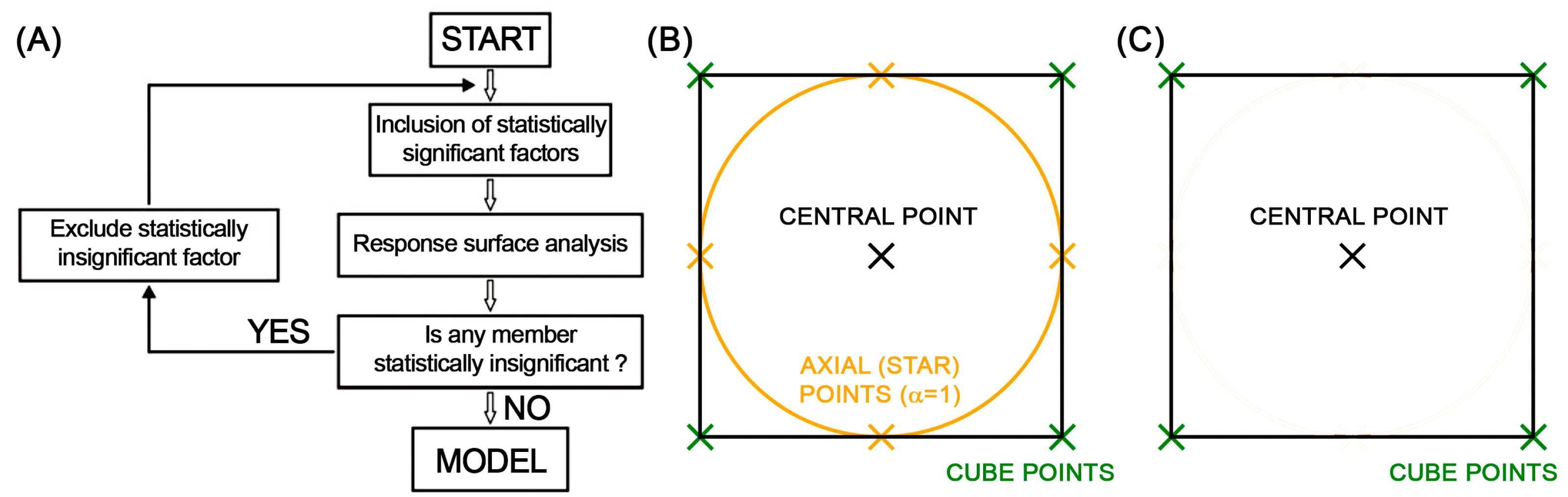
The presented study used the DOE methodology. This methodology allows the creation of such conditions, to keep the required scale of the experiment as small as possible, but at the same time to obtain as much usable information as possible about the observed process. Replication principles (repeating measurements for the same combination of factor levels and at the central point of the design) and balanced design (the same number of measurements for each combination of factor levels) were used. The symmetrical orthogonal experimental design was selected. A central-composite design (CCD), (face-centred response surface methodology (RSM) experimental model using α = 1) was created with repeated measurements at each point in the plan and the central point—see
Figure 1B. CCD RSM was used for the determination of seed temperature after thermal treatment experiments. For germination evaluation and determination of sanitation effectivity, the full factorial designs (FFDs) with 12 repetitions and 3 repetitions, respectively, in each corner point and central point were selected—see
Figure 1C.
Minitab 15 (and 19) software was used for statistical data processing.
Figure 1A illustrates the iterative process applied to identify a model that accurately represents the measured data. Using statistical analysis and the backward elimination technique (BET), statistically insignificant parameters (model factors and interactions) were identified. These parameters were excluded from the model one by one at each modelling step, and this procedure was repeated until only statistically significant factors, quadrates, or interactions remained in the model. If a main factor has been judged statistically insignificant, it often cannot be excluded from the model because there are significant interactions of that factor in the model. Only final models after application of BET are provided within the study.
The response factors and residuals (RESs—residuals are the deviations of the measured values from the values predicted by the model) were tested for a normal distribution assumption. The effects of each factor and their interactions were examined. Contour plots of the observed response parameter versus the combined level of the observed factors were also outlined, together with a Pareto chart with visualised standardised effects of the factors.
3. Results
3.1. Determination of Seed Surface Temperature After Thermal Treatment and Seed Cooling Observation
Two experiments for the determination of seed surface temperature after thermal treatment and seed cooling observation were performed. The first was with a lower volumetric flow rate of heated air using the Einhell Bavaria BHP 1500 heat gun, while the second experiment used a Makita HG 5030 heat gun. DOE methodology was used to plan the experiment and statistically evaluate the measured response. The selected factors and their coded and uncoded levels can be seen
Table 1. The selected levels in this table were used for all experiments within this study. The temperature of the heated air and retention period of the seed during treatment were selected as factors. The response measured was the temperature of the seeds instantly after the thermal sanitation (in
t = 0 s)—
Tseeds at 0s and 15 s after the thermal sanitation—
Tseeds at 15s. The observed responses of seeds’ temperature after thermal treatment on selected temperature and retention period levels can be seen in
Appendix A (see
Appendix A—
Table A1).
The variable
Tseeds at 0s was chosen as the response for the CCD RSM analysis. In addition, the natural cooling of the seeds (without forced airflow) was monitored using a FLIR Ex thermal imaging camera at 15 s intervals (for details, see
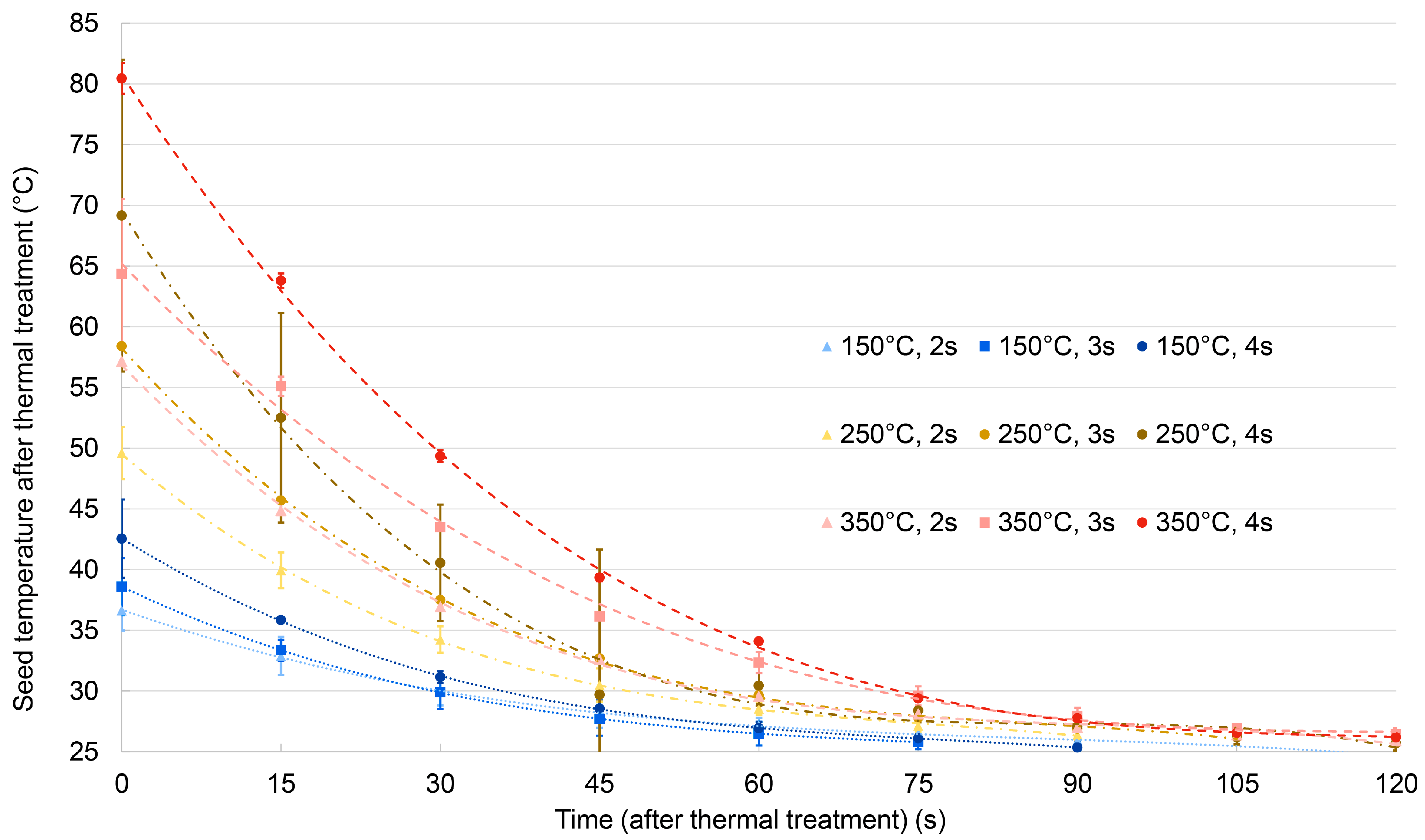
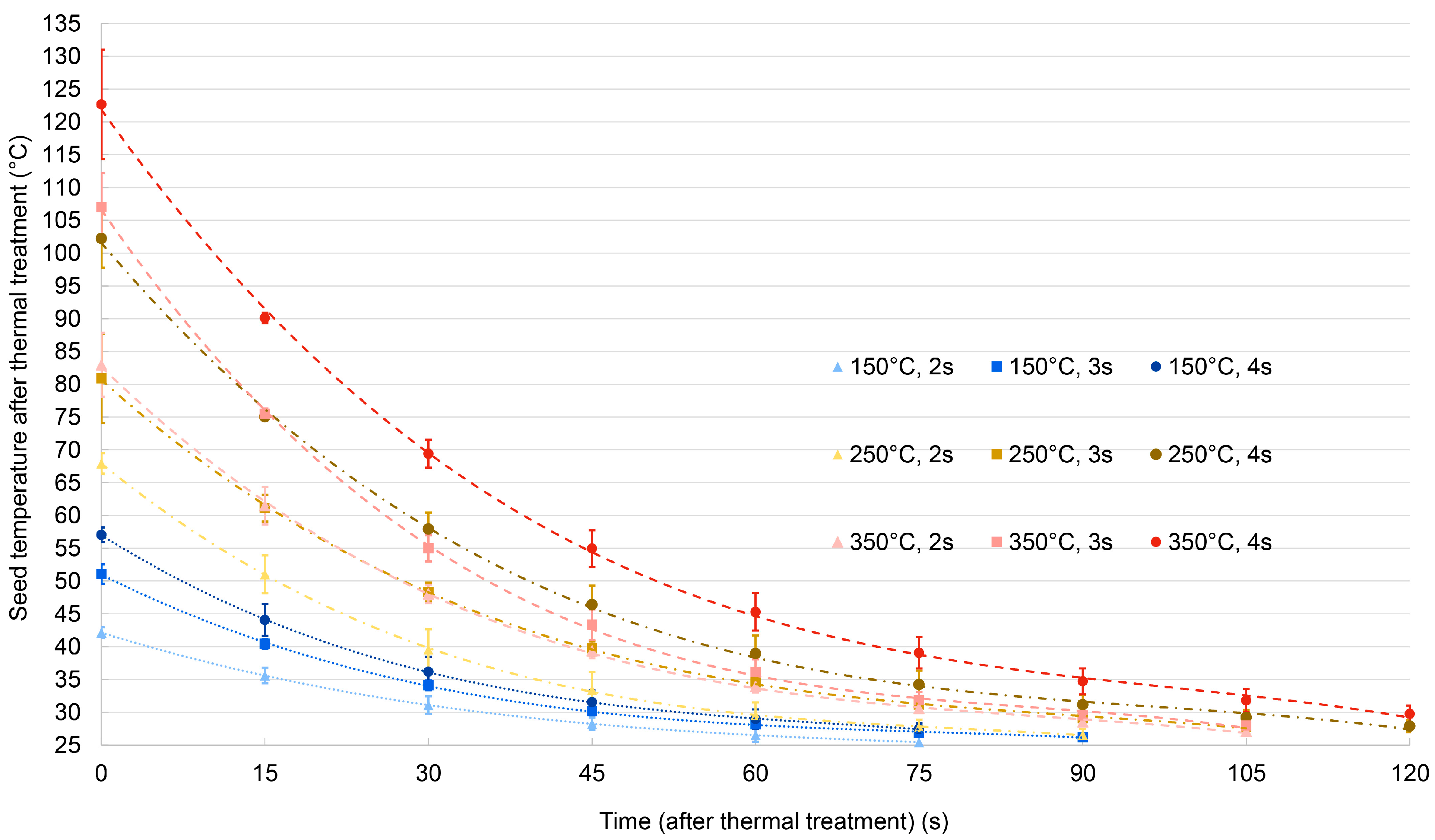
Section 2.4). The cooling period lasted about 1.5–2 min, depending on the temperature regime used. Two or three repetitions were performed for each measured point. Resulting seed surface temperature after thermal treatment and overall seed cooling progress for the Einhell Bavaria BHP 1500 heat gun with 280 L/min and for Makita HG 5030 heat gun with 557 L/min heated air output are shown in
Figure 2 and
Figure 3, respectively. A comparison of the data in these figures shows that increasing the volumetric flow rate of heated air results in noticeably higher post-treatment seed temperature.
The results of the response surface regression for both tested flow rates are shown in
Table 2 and
Table 3. For both cases, all model factors, interactions, and quadrates are significant at 95% confidence level (
p < 0.05) except for the time and its quadrate. All obtained
R2 values are high, at 90% levels or higher, which confirms a very good fitting of the response by the model with selected factors and indicates well-explained variance. The model for higher flow rate (557 L/min) produced a better fit (
R-Sq 97.68% vs. 93.02%) and slightly lower error (Residual MS 19.31 vs. 19.85). This could be explained by performing experimental points in duplicate and triplicate for 280 L/min and 557 L/min, respectively, and by lower temperature fluctuations in the measurement space during 557 L/min measurements. The resulting response surface regression equations in uncoded units for the dependence of
Tseeds at 0s on factors for (280 L/min) and (557 L/min) heated air flow rates are (1) and (2), respectively.
Table 4 and
Table 5 show the results of ANOVA for tested flow rates. For both tested flow rates, the low
p-values (
p < 0.05) indicated that linear, interaction, and quadratic terms are significant. This means that the combination of factors (
T,
t), their interactions, and quadrates explain a substantial part of the variability in the response. The lack of fit is not significant (
p > 0.05), which suggests the model adequately describes the data and there is no evidence of missing higher-order terms or other problems with the model describing obtained data.
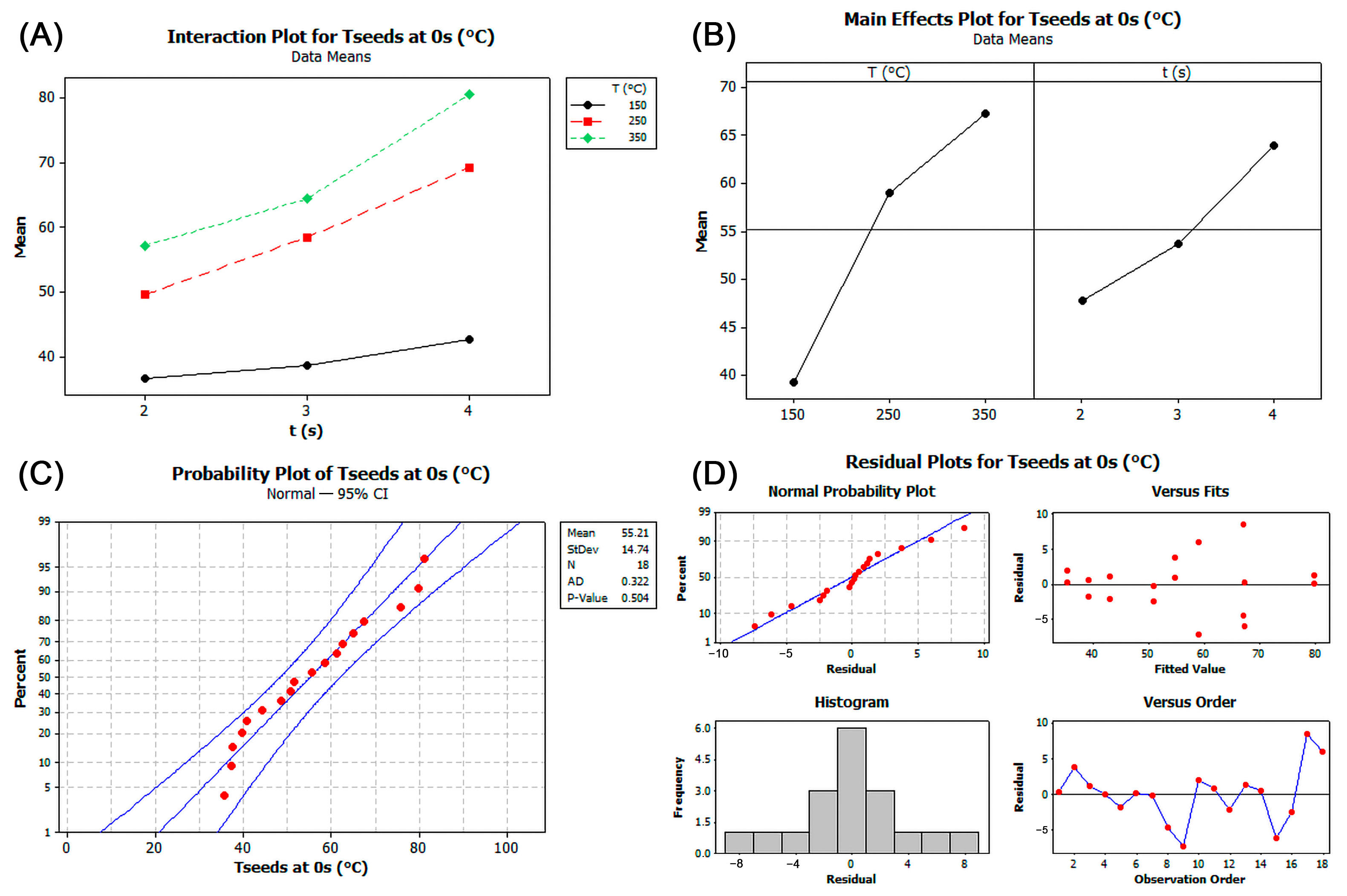
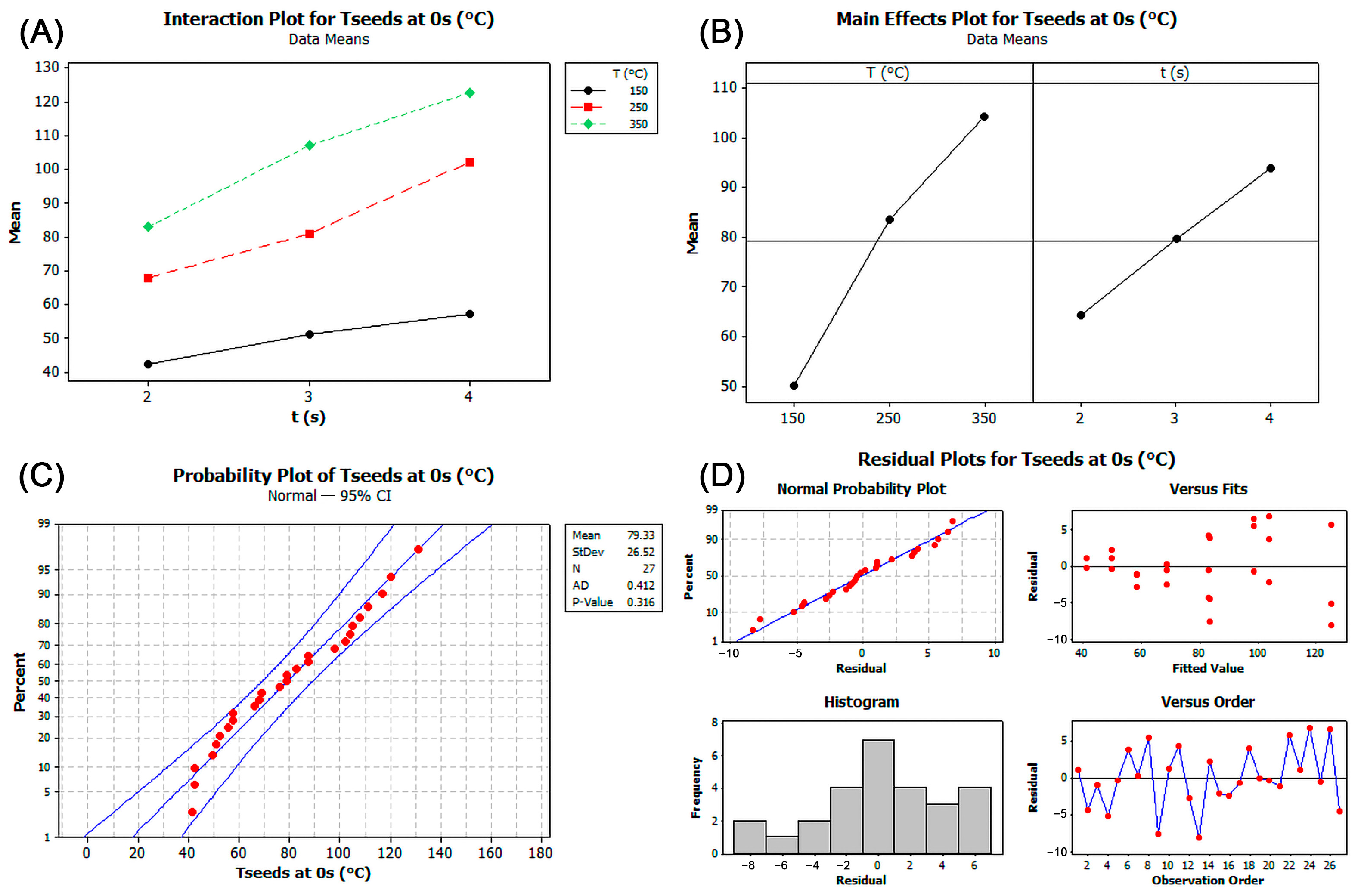
Figure 4 and
Figure 5 show the main effects and interaction plots, response probability plots, and residual plots for the response of seeds’ temperature after thermal treatment using factors—temperature and response time for both tested flow rates. The results obtained are quite similar for both tested flow rates. The main factor effects have an almost linear trend. The effect at 150 °C at both observed flow rates is quite low and improved at a higher temperature, and the effect of
T is generally stronger than the effect of
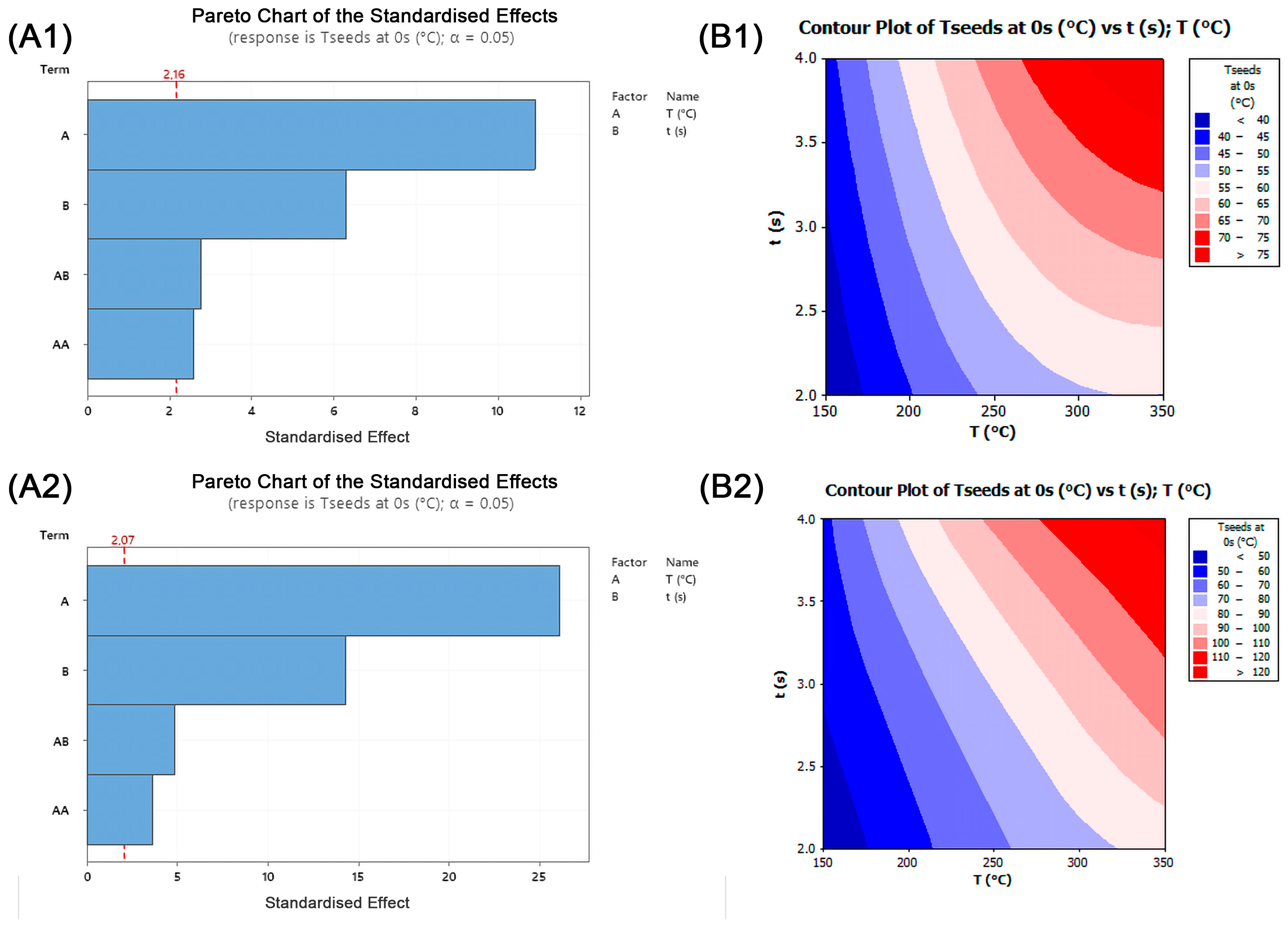
t, which is also confirmed on the Pareto chart of the factors standardised effects (see
Figure 6A1,A2).
As for the interactions plot, mainly slightly progressive curves can be seen, indicating the supportive effect of the interaction of factors. On the other hand, the lines are almost parallel, and this signals a quite low level of interaction, which is also confirmed in Pareto chart
Figure 6A1,A2. The interactions standardised effects are generally lower than residence time effects, and the effect of time is lower than the effect of temperature, which has largest observed effect. Responses in both cases indicate probable statistical evidence that they follow a normal distribution (
p > 0.05). The same is true for residuals’ distribution. Histograms of residuals have an optimal (280 L/min) or almost optimal (557 L/min) symmetric and unimodal shape. Residuals vs. order shows no time or order-dependent issues. Most interesting and practically useful information can be seen in
Figure 6B1,B2 showing a contour plot of the response on factors for both observed flow rates and the whole experimental plan.
The resulting post-treatment seed surface temperatures ranged from 36.7 to 80.5 °C at 280 L/min flow rate and 42.1 to 122.7 °C at 557 L/min, depending on the heat treatment regime (temperature and residence time).
The achieved difference in seed surface temperatures after treatment was from 5.5 up to 42.2 °C higher with the flow rate 557 L/min compared to the lower tested flow rate of 280 L/min, indicating enhanced heat transfer with higher flow rate.
Comparing model results across different flow rates (280 L/min vs. 557 L/min) reveals important practical implications for the process.
At higher airflows, the process becomes more sensitive to the factors such as temperature (
T) and residence time (
t) and their interactions, which have a greater impact on the seed surface temperature, sanitation efficiency, as well as seed germination capabilities after treatment. Higher airflows combined with variability in process temperature and residence time can lead to inconsistent sanitation results or excessive germination loss. Also, as a remark for similar future DOE works and practical applications, the media flow rate can be considered and included as another factor affecting responses (see quite different results for contour plots for different flow rates—
Figure 6B1,B2). This is also logical in the sense that a higher flow rate provides higher heat transfer, resulting in higher surface temperature and affecting sanitation efficiency and germination reduction.
3.2. Germination Determination
The germination determination results are summarised in
Appendix A (see
Appendix A—
Table A2). This table contains complete data for the experimental plan including repetitions. For all points, average germination (%) and average sprouts’ length (mm) were determined. The FFD was considered instead of the RSM (for flow rate 280 L/min) on the first take on germination response modelling, due to less experimental point requirements, thus saving resources. If intriguing results were obtained, or screening proved suboptimal, the plan could be further extended. The germination in % was the selected response for FFD.
The response surface regression results are shown in
Table 6 and ANOVA results are summarised in
Table 7. Negative factors and interaction coefficients confirm their negative influence on germination. Significant centre point (Ct Pt) term and curvature (
p < 0.05) indicate that non-linearity is present in the system. This validates the suitability of the model extension to a fully quadratic model.
p-values of all terms are extremely small (
p < 0.0005), meaning that the model terms explain a very large portion of variability in the data, compared to the residual error and that terms are significant with a very high confidence, and both factors and interaction effects are very strong in the response.
The resulting response surface regression equation in uncoded units for the dependence of germination (%) on factors considering (280 L/min) heated air flow rate is
The statistical evaluation of the germination determination experiment is visualised in
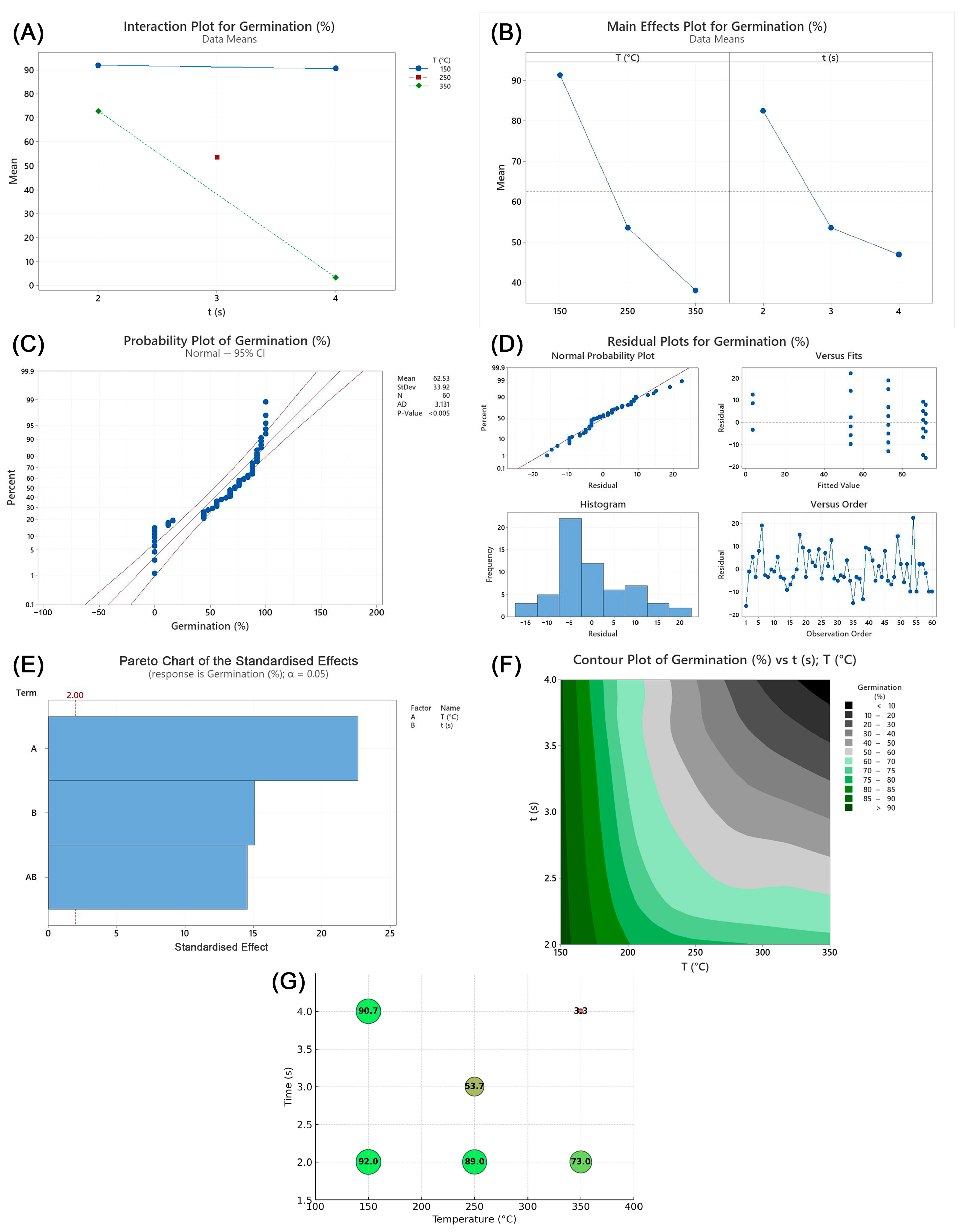
Figure 7. This figure contains interaction plot (A) and main effects plot (B), response probability plot (C), and residual plots (D) for the response of germination (%) post-thermal treatment for tested flow rate 280 L/min. To show the standardised effects of the factors, the Pareto chart (E) is also visualised. The response levels for the whole experimental plan are shown in the contour plot (F) and (G) represents a bubble chart of the average achieved germination for measured points. The strongest standardised germination decline is caused by an increasing factor
T, followed by
t and the interaction of factors, see (A), (B), and (E).
The responses indicate there is statistically significant evidence that the data do not follow a normal distribution (p < 0.05). The same is true for the distribution of residuals (p < 0.05). This is an entirely expected outcome, because germination in % is a bounded variable in the range of 0% and 100%. As response datapoints approach these limits, the distribution tends to pile up at the edges, creating non-normal shapes, which results in a normality violation. The residuals from the model also reflect this limitation, often leading to a failure of normality tests. Histograms of residuals have an almost optimal shape, which is unimodal, but somewhat skewed to the side. The residuals vs. order plot does not show larger notable time/order dependent issues. The bubble chart (G) confirms a very good selection of the experimental plan boundaries covering factor levels producing nearly 100% and nearly 0% responses in different areas of the plan.
Germination and sanitation efficiency determination results are crucial for identifying suitable thermal regimes. The most notable standardised effect on germination reduction had the factor T, followed by t and their interaction. In comparison to standardised effects on surface temperature, there is an additional significant term—T2.
At the lower tested flow rate of 280 L/min, the contour plots for surface seed temperature (see
Figure 6B1), and germination after treatment (see
Figure 7F) show very similar responses to the factor levels. Hence, an online thermo-camera measurement of the output seed temperature after the treatment might be advantageous for the control process. If corresponding data of germination are available, the hard limits of seed surface temperature can be set so the sanitation procedure does not negatively affect the germination to unwanted levels.
At 280 L/min, the germination began to decline to unacceptable levels at surface temperatures around 175 °C and above. Even minor reductions in germination are economically undesirable and intolerable due to the possible breach of legal thresholds for acceptable germination. For example, Annex II of the EU Directive 66/402/EEC mandates a minimum germination rate of 85% for basic and certified wheat (Triticum aestivum) seed (COUNCIL DIRECTIVE (66/402/EEC) 1966). Therefore, for the tested flow rate and medium, treatment temperatures higher than 175 °C cannot be recommended for flash sanitation process regimes. Too high temperatures fields used lead to protein denaturation and compromising of the membrane integrity, which manifest in germination losses.
In addition, the sprout size of control and treated samples were subjected to the T-Test to assess statistical difference of the means of these groups. The estimated difference of these groups was 5.25 mm; however, on a conventional level of statistical significance (α = 0.05), there is no statistically significant difference between the two means (p = 0.093, thus p > 0.05). More data in the control group (now—ncontrol = 4) would be beneficial to draw a firmer conclusion on the difference of the control and treated samples sprout lengths.
3.3. Determination of Surface Microbiological Contamination and Sanitation Efficiency
The results of the surface microbiological contamination are summarised in
Appendix A (see
Appendix A—
Table A3). The decimal dissolutions of the water, in which the seeds were rinsed, showed systematic positive variance (higher than expected CFU for subsequent decimal dilutions). This is the reason why only averaged results of 10
1 and 10
2 decimal dilutions were considered for surface microbiological contamination and sanitation efficiency calculation (see
Appendix A—
Table A4). The response—sanitation efficiency in %—was calculated by subtracting average the CFU per seed weight of control from CFU per seed weight of the treated variants divided by the average microbiological contamination of control.
The response surface regression results are shown in
Table 8 and ANOVA results are summarised in
Table 9.
High values of R-Sq, R-Sq (pred.) and R-Sq (adj.)—(R2 ~ 96%) indicate well-explained variability and suggest that model fits the experimental data very well. Term t (p-value = 0.07, slightly above threshold of 0.05) and interaction of factors (T × t) (removed by BET—p-value = 0.334) did not show significance at α = 0.05. Term T is the dominant significant effect improving sanitation efficiency. The presence of significant curvature and significant term—Ct Pt—suggests that a simple linear model may not fully capture the system’s behaviour. A second order (RSM model) may be more appropriate if further refine optimisation is needed. The lack of fit is not significant, i.e., the model describes the data adequately (p-value = 0.334 (>0.05)).
The resulting regression equation in uncoded units for the dependence of sanitation efficiency (%) on factors considering (557 L/min) heated air flow rate is
The statistical analysis of sanitation efficiency is visually presented in
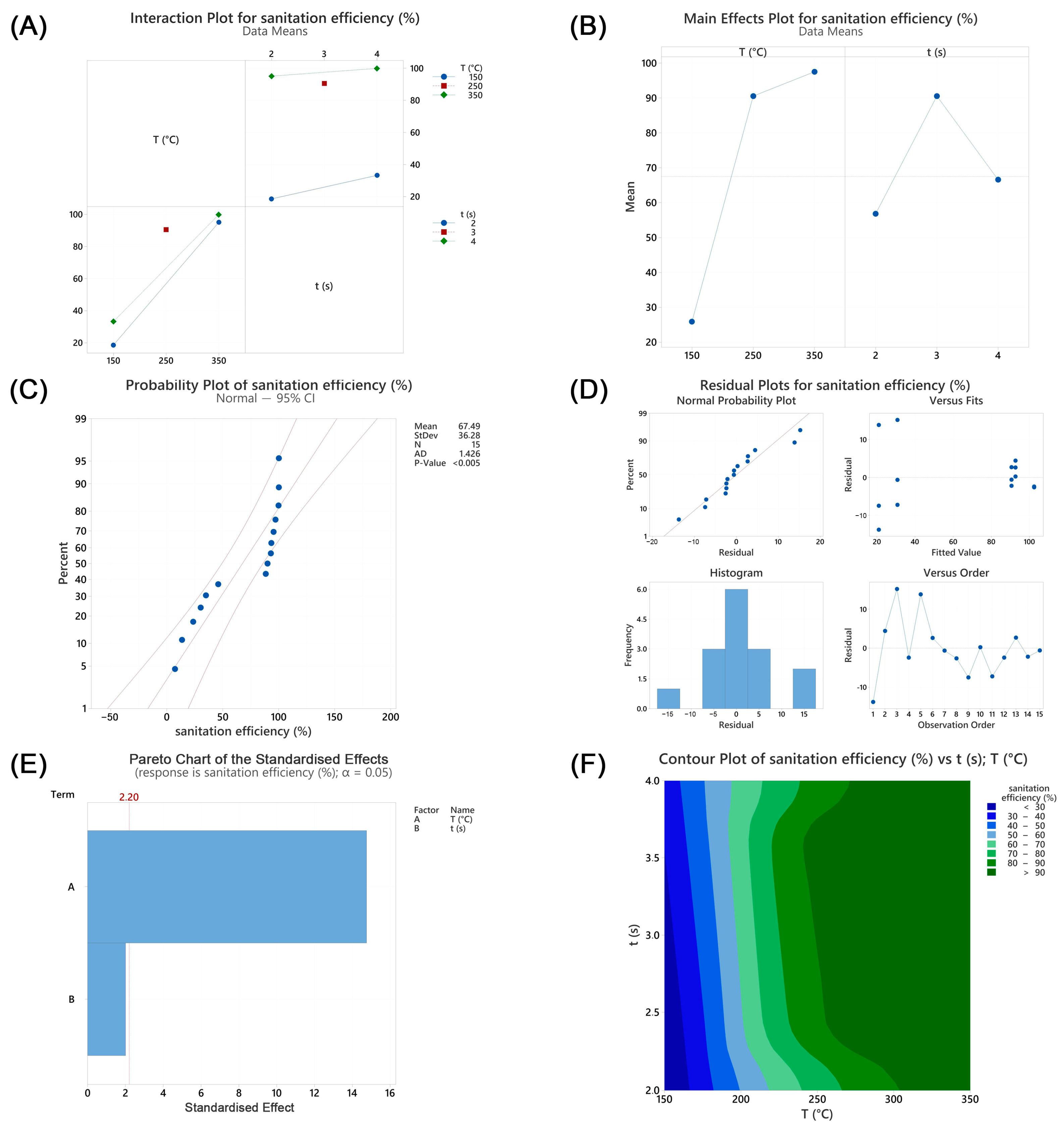
Figure 8. This figure includes interaction (A) and main effects (B) plots, a response probability plot (C), and residual plots (D) illustrating the sanitation efficiency (%) in relation to thermal treatment parameters—temperature and treatment time—at a tested flow rate of 557 L/min. Additionally, the Pareto chart (E) displays the standardised effects of factors. The response distribution across the modelled experimental plan is shown in the contour plot (F).
The interaction plot shows almost parallel lines, which suggests low level of interaction. This complies with the non-significant interaction term. The effect of T on sanitation efficiency forms steep lines (B), which is supported by the outcome of Pareto chart (E), where the effect of T on sanitation efficiency at the given flow rate is also predominant. Sanitation improves sharply with increasing T. On the other hand, t has only a weak or marginal effect.
Response data (p < 0.005) do not probably follow a normal distribution (p < 0.05); however, conversely, normal distribution is probable for residuals (p = 0.125, thus p > 0.05). This could be expected, as the sanitation efficiency is, by analogy to germination, a bounded response variable (between 0% and 100%).
Histograms of residuals have an almost ideal symmetrical shape. The residuals vs. order plot does not show larger notable time/order-dependent issues.
The primary objective of the sanitation procedures is to reduce microbiological contamination of surfaces on grains. Optimally, sanitation efficiency approaching 100% should be achieved, and output values above 90% can be generally considered a success. On the other hand, such effectiveness should not come at the expense of seed viability. In this study, fungal pathogens were mainly targeted for the investigation, with viral or bacterial infections excluded from the scope. Accordingly, the reported sanitation efficiencies reflect a diminishing of the fungal pathogens exclusively. The original idea was to set the same experimental plan and flow rates for germination and sanitation efficiency testing. However, due to unexpected technical difficulties, different flow rates, i.e., 280 L/min for germination and 557 L/min for sanitation, were provided for the process efficiency testing. Despite this, the obtained results support several important insights.
The applied model fits the experimental data well, with no significant lack-of-fit or residual issues detected. The executed FFD model indicated that a second-order model may better capture system behaviour due to observed curvature.
The statistical analysis done for the flow rate of 557 L/min confirmed that temperature is the dominant factor improving seed sanitation efficiency considerably, while treatment time showed a weak impact. The interaction between temperature and time (T × t) was found to be non-significant, in contrast to the model results for germination at a flow rate of 280 L/min. Such knowledge about factors and interactions effects can be employed for a generalised assumption for wheat thermal treatment by dry air and tested flow rates. The idea here is to select rather short retention period timeframes in combination with higher temperatures for the treatment, leading to better combined outcomes of resulting germination and sanitation efficiency.
The main conclusion drawn from germination determination results is that there is no substantial window of flash thermal regimes that can be used to achieve satisfying levels of both sanitation efficiencies and germination. At low temperatures up to 175 °C, where the germination is still not seriously compromised, the resulting sanitation efficiencies are about 30–40% (even with higher flow rate), which is considered insufficient. The extension of the residence times beyond the experimental plan boundaries would probably not be very beneficial, due to the rather weak observed time factor effect. On the other hand, the areas of the plan that indicate >90% sanitation efficiencies that start at about 250 °C are causing drops in germination, which are no longer in line with economic principles and legislative thresholds.
4. Discussion
The conducted experimental work effectively addresses the identified research gap at the forefront of a new field or activity. To the authors’ knowledge, there are no comparable studies on the use of such extreme thermal sanitation regimes for seed treatment. However, the obtained results can still be compared to the results from tests under long residence time exposures to low-temperature dry air as the heat medium. For example, Bänziger et al. [
3] tested thermal seed treatment on the same seed type, (Winter wheat
Triticum aestivum L.) and field conditions. Used seed were naturally infected with Microdochium spp. Hot air treatments were applied at 70 °C for interval of 2 days. The 70 °C hot air treatment demonstrated notable efficacy in reducing
Microdochium spp. contamination (26% seeds infected comparing it to 52% for untreated control) without severely affecting germination levels. In another study, Couture and Sutton showed that in barley infected with
Bipolaris sorokiniana, dry heat gradually reduces pathogens, but complete eradication above 90 °C also reduces germination [
28]. The same conclusion was drawn that the balance between achieving pathogen control and maintaining seed quality is crucial for successful implementation in practice.
Our results suggest sanitation efficiency increased sharply above 250 °C, germination dropped below 80%, revealing a narrow thermal tolerance window. The DOE response surfaces (
Figure 6,
Figure 7 and
Figure 8) show this trade-off explicitly, indicating that no parameter combination achieved both >90% sanitation and ≥85% germination.
The provided experimental RSM and FFD models fit the data well (average R2 ~ 95%) with no significant lack of fit. However, the presence of curvature in FFD models for germination and sanitation efficiency suggests that a second-order model may better describe the system for future optimisation. Additionally, the heating media flow rate should be considered an essential factor in thermal treatment studies, as it strongly influences heat transfer and outcome variability.
In conclusion, the findings indicate that dry heat is not a perspective medium for the practical applications of flash sanitation of seeds; however, this may not be the case for other potential heating media. This outlines the possible directions for efforts in further scientific studies in flash seed sanitation techniques.
5. Conclusions
This study assessed flash dry air thermal treatment (150–350 °C, 2–4 s) for wheat seed sanitation using DOE-based statistical models (CCD RSM and FFD), examining post-treatment seed surface temperature, germination capability, and fungal sanitation efficiency responses across different dry air flow rates (280 L/min and 557 L/min). For each of these responses, either the CCD RSM or FFD model was created. The temperature of the heat media and residence time were selected as the key evaluation factors for the seed treatment.
Higher airflow (557 L/min) significantly increased seed surface temperatures (42.1–122.7 °C) compared to the lower flow rate of 280 L/min (36.7–80.5 °C), thereby improving heat transfer. However, strict process control would be required to prevent variability if the method were applied on an industrial scale.
Temperature was identified as the driving factor influencing both germination and sanitation efficiency. Germination declined sharply at air temperatures above 175 °C, whereas satisfactory sanitation efficiencies of more than 90% were achieved only at temperatures exceeding 250 °C, resulting in unacceptable germination losses. No operating window achieved both high sanitation and legal germination thresholds (e.g., 85% as per EU seed certification standards). Extending the residence time beyond the edges of the experimental plan is unlikely to yield significant benefits, as time was identified as a weak and insignificant factor compared to temperature. Additionally, the heating media flow rate should be considered an essential factor in thermal treatment studies.
Overall, this study advances the understanding of flash dry thermal sanitation for seeds, highlighting the complex trade-off between microbial reduction and seed viability, and emphasising the critical need for carefully balanced process conditions. Future work could explore alternative media or their combinations to identify low-cost industrial flash thermal sanitation solutions that support sustainable seed treatment practices in storage and agriculture to achieve optimal and inexpensive seed and grain bio-processing technology.




 ,
,