1. Introduction
In today’s world, the security of information systems has become a crucial aspect of everyday life. According to DataReportal [
1], as of October 2025 approximately 6 billion people—representing 73.2% of the global population—use the Internet. Every day, individuals engage in online shopping, use mobile banking services, and digitally sign documents. However, this widespread digitalization also exposes users to a variety of well-known cyber threats. These include phishing, in which attackers impersonate trusted institutions or individuals by sending deceptive messages or links designed to steal sensitive information, such as login credentials or financial data. Malware refers to malicious software, including viruses, trojans, worms, and spyware that infects devices through attachments, links, or software vulnerabilities. Spam and unsolicited messages involve the large-scale distribution of unwanted content, often containing advertisements, scams, or links to harmful websites. Clickjacking is a technique that tricks users into clicking hidden elements on a website, causing them to unintentionally perform unwanted actions, such as revealing data or activating functions. Finally, identity theft, impersonation, or profile cloning occur when attackers steal personal information, take over accounts, or create fake profiles to deceive others [
2].
As users, we are becoming increasingly aware of common cyber threats and better prepared to defend against them; however, we often remain unaware of new and lesser-known attack vectors that may pose significant cybersecurity risks in the coming years. One such category of threats involves side-channel attacks, which are closely associated with observable physical phenomena [
3]. These attacks exploit unintended information leakage through various physical channels, including electromagnetic emissions [
4], power consumption patterns [
5], mobile device sensors [
6,
7], inter-processor communication links [
8], and even sound or acoustic signals [
9,
10].
A wide range of potential side-channel attacks has been identified [
11].
Table 1 illustrates the main threats, grouped into three families. Physical-emission attacks observe unintentional leakages, such as power consumption, electromagnetic radiation, or acoustic signals. Timing and microarchitectural attacks exploit execution-time differences and hardware behaviors (e.g., caches or speculative execution) to infer secret-dependent operations, even without direct access to the data. Software, implementation, and data-flow attacks leverage bugs, memory footprints, and shared communication channels to recover sensitive information from residuals or access patterns. Together, these families highlight that seemingly benign by-products of computation can be systematically measured and correlated to reconstruct confidential data.
In our research, we focused exclusively on acoustic side-channel attacks targeting keyboard-like redinput devices. Acoustic attacks remain a relatively underexplored area, although the first documented attempts date back to the 1950s, when British intelligence reportedly exploited the acoustic emanations of Hagelin cipher machines (mechanically similar to the Enigma) located in the Egyptian embassy [
12]. In the 21st century, the rapid increase in the number of microphones embedded in desktop computers, laptops, tablets, and smartphones has substantially raised the risk posed by acoustic side-channel attacks. Such attacks are possible for a straightforward reason: pressing and releasing keys generates sound and vibration, and the acoustic signatures of different keys can be distinct. For example, the difference between the spacebar and the Enter key is often audible even without advanced analysis. Specialized signal-processing and classification methods make it feasible to analyse and distinguish sounds produced by individual keys. Typing style (which fingers are used, strike angle, force) influences the amplitude and spectral characteristics of keystroke sounds, while the choice of keyboard model further affects signal properties. Although desktop keyboards vary widely, successful attacks on a given laptop model can generalize to many units of the same model, thereby increasing the practical impact of an attack [
13]. Acoustic eavesdropping can be mounted in multiple scenarios. Some microphones can capture keystroke sounds from distances on the order of one metre [
14]. Recordings may be obtained in public places such as cafés, libraries, or open-plan offices. An attacker with physical access can directly record key sounds from a victim’s keyboard, and malware on the victim’s device can exfiltrate audio to a remote server. Moreover, keystroke audio may be incidentally captured during remote meetings on platforms such as Zoom or Microsoft Teams [
13]. Although such attacks were once considered impractical, recent advances in artificial intelligence—particularly convolutional neural networks—have enabled effective analysis and classification of acoustic leakage, with applications across cybersecurity [
15,
16], medicine [
17,
18], and general sound recognition [
19,
20]. Only a limited number of studies have investigated the use of machine-learning techniques, including convolutional neural networks, to recognize pressed keys based on keyboard acoustics as part of acoustic side-channel attacks. In one study [
21], traditional machine-learning algorithms were applied to classify keystrokes using acoustic features, while another work [
9] employed convolutional neural networks (CNNs) to achieve higher recognition accuracy and better generalization across different devices.
One of the first studies demonstrating the feasibility of using machine-learning techniques to predict pressed keys on a keyboard was conducted by Compagno et al. [
22]. The authors obtained recordings of keystrokes transmitted through a Skype connectaion and extracted Mel-Frequency Cepstral Coefficients (MFCCs) as the primary acoustic features. Several classifiers were evaluated, including logistic regression, support vector machines (SVMs), linear discriminant analysis (LDA), Random Forest, and k-nearest neighbors (k-NN). The dataset consisted of recordings from five users on six laptops (2× MacBook Pro 13” 2014, 2× Lenovo ThinkPad E540, and 2× Toshiba Tecra M2). Each participant typed the alphabet (A–Z) ten times using both hunt-and-peck and touch-typing styles, resulting in 260 samples per session (ten per letter). The experiments showed that the models achieved high accuracy (around 90%) when trained on data from a known device and user; however, performance dropped significantly—to below 20%—when the amount of prior knowledge was limited or when background noise was present. In the study by Bai et al. [
21], the authors employed microphones embedded in smartphones to eavesdrop on keystrokes with the goal of designing a system that performs reliably regardless of keyboard type, position, or user. The system operates as follows: a smartphone records keystroke sounds, followed by signal normalization and segmentation. Next, the system estimates the keyboard type (achieving nearly 100% accuracy using MFCC-based SVM classification) and the distance between the microphones and the keyboard based on Time Difference of Arrival (TDoA) and tonal features. A small training dataset was collected using a Huawei Mate 20 Pro smartphone with nine participants and nine different keyboards. Feature engineering produced descriptors such as TDoA and Power Spectral Density (PSD), reflecting sound attenuation properties. The final predictive model-an SVM-identified pressed keys and subsequently refined predictions by selecting the most probable word from a dictionary containing the 1500 most frequent English words. The resulting model achieved 91% accuracy under 10-fold cross-validation. For unseen users, top-5 accuracy reached 91.52%, while for unseen users and keyboards, 72.25%. In Harrison et al. [
9], experiments were conducted to recognize pressed keys using the microphone of a smartphone. When the phone was placed near the keyboard, the best-performing model achieved an accuracy of approximately 95%, while in the case of a remote attack via a Zoom video conference, the accuracy reached 93%. These results are remarkably given the compression and information loss inherent to VoIP audio transmission, demonstrating that users remain vulnerable to this form of acoustic side-channel attack even during online meetings. In this study, the authors recorded sounds from 36 keys (0–9, a–z) on a MacBook Pro 16” (2021), each pressed 25 times using varying force and finger placement. Two attack scenarios were considered: the phone attack (on-site) — using an iPhone 13 mini placed 17 cm from the keyboard—and the Zoom attack (remote)—using the laptop’s built-in microphone during a video call. Recordings were segmented into individual keystrokes through energy analysis in the frequency-domain (FFT). For the Zoom recordings, adaptive thresholding was necessary to compensate for built-in noise suppression. Each sound sample was then transformed into a mel-spectrogram, a time–frequency representation perceptually aligned with human hearing. This representation enabled the use of convolutional neural networks designed for image recognition. To improve robustness, data augmentation techniques were applied. The final predictive model was a CoAtNet convolution-attention network, which had previously shown strong performance on ImageNet classification tasks. The relevance of this research direction is further confirmed by Ayati et al. [
10], who in 2025 proposed a method combining vision transformers for acoustic feature classification with large language models (LLMs) for post-prediction error correction. Their study reused the publicly available dataset from [
9], again employing mel-spectrograms and data augmentation. Several architectures were evaluated, including CoAtNet, ViT, Swin, DeiT, BEiT, and CLIP. The Swin Transformer achieved the best classification accuracy. In the subsequent stage, large language models such as GPT-4o and the LLaMA family were introduced to correct typographical errors in the predicted text. The fine-tuned LLaMA-3.2-3B model, adapted using LoRA/QLoRA (Low-Rank Adaptation), achieved performance comparable to GPT-4o despite having approximately 67 times fewer parameters. Despite these impressive accuracy scores, existing research on acoustic side-channel attacks against keyboards still faces notable limitations. Most experiments have been conducted in controlled laboratory environments, using a limited number of participants and keyboard models, which restricts generalization to diverse real-world acoustic settings. Current models remain sensitive to background noise, microphone placement, variations in keyboard construction, and individual typing styles. Furthermore, existing approaches primarily focus on character-level reconstruction, often overlooking higher-level linguistic context and real-time feasibility.
Based on the existing body of literature on acoustic side-channel attacks, future research should prioritize the development of more noise-resilient machine learning architectures, the creation of larger and more diverse datasets encompassing multiple keyboard types and operating environments, and the integration of multimodal approaches that combine audio, video, and vibration signals. Another important research direction involves the design of defensive mechanisms—both hardware and software—that can reduce acoustic emissions or obfuscate exploitable signal features. In the longer term, studies should focus on enabling real-time attack evaluation and assessing the broader implications of such methods for authentication security and user privacy.
Considering that the topic under investigation is relatively new, that the number of studies addressing it remains limited, and that the associated threat is steadily increasing, we decided to undertake research in this area. Our main contributions can be summarized as follows:
Dataset preparation and publication: We collected and publicly released a dataset on the Zenodo platform, obtained using two mechanical keyboards—a Fnatic Gear Rush with Cherry MX Brown switches and an Anne Pro 2 keyboard.
Data processing pipeline: We designed a complete preprocessing pipeline that includes Fourier transform, mel-spectrogram construction, data augmentation, and feature extraction.
Model Design and evaluation: We developed a custom convolutional neural network (CNN) architecture, trained, validated, and tested for keystroke sound recognition.
Experimental analysis: We conducted multiple experiments under varying conditions— in controlled environments, with background noise interference, using a different keyboard model, and with a quantized version of the trained model.
Security mitigation: We proposed a potential countermeasure against such acoustic side-channel attacks.
Future research directions: We identified several avenues for further investigation in this emerging field.
2. Materials and Methods
2.1. Dataset
In order to carry out the experiments, it was necessary to acquire an audio dataset comprising recordings of individual keystrokes on a computer keyboard. A dataset of isolated keystroke audio was obtained using a fully automated acquisition workflow. A dedicated software module was developed to record the acoustic signal of each keypress and to automatically label each instance with its corresponding key class.
The recording setup comprised a Fnatic Gear Rush mechanical keyboard equipped with Cherry MX Brown switches and a Novox NC1 microphone. The microphone was positioned 30 cm posterior to the keyboard on an external stand that was mechanically decoupled from the desk to minimize vibrations transmitted through the desk. Each recording includes a 0.2 s pre-keypress window and a 0.5 s post-release window to capture the full temporal profile of each keystroke event. The signals were sampled at 48 kHz and stored in WAV format. While this sampling frequency provides sufficient temporal and spectral resolution for capturing short, transient keystroke sounds, the proposed approach is not inherently dependent on this specific value and could be applied to recordings obtained at lower sampling rates with appropriate preprocessing adjustments. For the training dataset, 60 samples were collected for each letter, including only basic Latin alphabet characters (a–z). The data were obtained through text transcription on typing.com, approximating naturalistic text entry. All recordings were produced by a single participant at a typing rate of 15 to 20 words per minute (wpm).
All test recordings were acquired with a Novox NC1 condenser microphone (manufactured by Novox, Gdańsk, Poland) positioned at a fixed distance of approximately 30 cm from the keyboard. In Experiment 1 and Experiment 2, keystroke audio was recorded in a quiet room free from substantial acoustic interference using a Fnatic Gear Rush mechanical keyboard, and at least 30 samples were collected for each of the 26 letter keys, with only minor variability across trials. In Experiment 3, the same keyboard was recorded while a publicly available “Crowd Noise 1 Hour White Noise” track was played from a source positioned approximately 50 cm from the microphone to simulate realistic ambient conditions. As before, at least 30 samples were collected for each of the 26 letter keys. In Experiment 4, recordings were conducted in the same quiet room using an Anne Pro 2 mechanical keyboard equipped with Kailh Brown switches. The microphone position remained fixed at approximately 30 cm throughout the session, and at least 30 samples were acquired for each letter of the alphabet.
In the context of this pilot study, we assume an attacker who has access to a microphone placed in the physical vicinity of the victim’s keyboard (typically 20–60 cm away), such as a smartphone on a desk, a laptop microphone, or another ambient recording device present in the environment. The attacker is not assumed to have access to the victim’s screen or typed content, and relies solely on passively captured acoustic signals. For the “clean” and “new-sample” scenarios, we consider a targeted attacker who has the opportunity to collect a small number of reference samples under conditions similar to those of the victim, enabling model fine-tuning. The “crowd noise” and “different keyboard” scenarios correspond to more constrained adversaries, where no victim-specific recordings are available and the model must generalize to more challenging or mismatched conditions. This threat model reflects practical constraints under which acoustic side-channel attacks may occur (e.g., office environments, shared workspaces, public areas), and clarifies which of the evaluated experiments correspond to realistic attacker capabilities.
2.2. Data Augmentation
Data augmentation involves expanding the training set by deliberately modifying existing samples [
23]. This technique is particularly important when data availability is limited, as it allows the creation of additional recording variants and increases data diversity without the need to acquire new samples. Its primary purpose is to improve the effectiveness of deep learning models, especially in scenarios where the actual number of examples is insufficient for effective training. In the case of keystroke recordings, the original samples may be sensitive to minor variations such as microphone position, keystroke force, acoustic background, or hardware interference. Data augmentation allows these factors to be systematically simulated and incorporated without the need for additional data collection. In this study, five basic audio signal augmentation techniques were applied to increase data diversity and improve the overall robustness of the model to interference:
The total number of training samples before augmentation was 1560 and after augmentation 9360 (1560 original recordings and 7800 generated samples). The collection was divided into parts: test 20% of the total (1872 samples), validation 12% of the total (1124 samples), and training—the remaining 68% (6364 samples).
Table 2 summarizes how the collected data were divided into the training, validation, and test sets.
2.3. Data Preprocessing and Feature Extraction
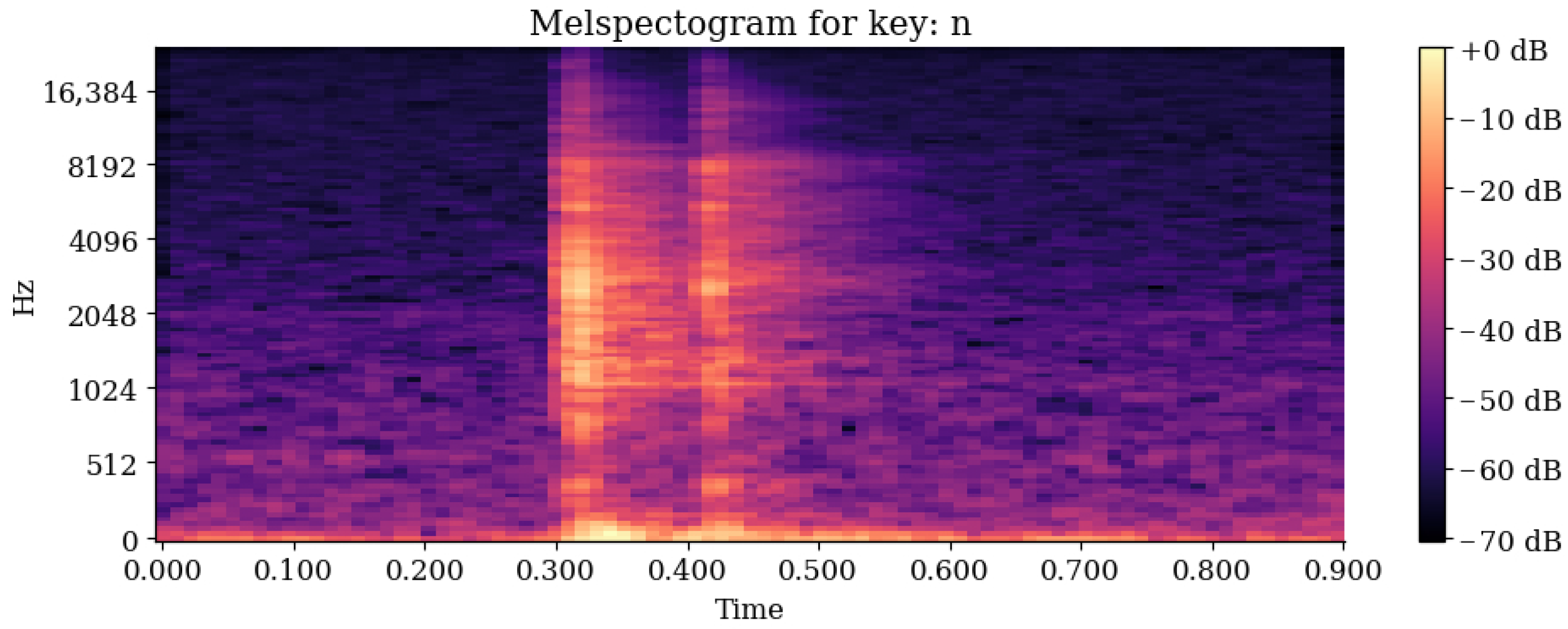
The analysis of sounds produced by a keyboard for the purpose of recognition and classification involves numerous technical and acoustic challenges. A single keystroke sound is very short, impulsive, and often similar to others, which necessitates the use of advanced signal processing methods and appropriately chosen data representations. After collecting and pre-processing the recordings, a key step in building a classification system is feature extraction, i.e., converting the audio signal into a form that can be effectively analyzed by machine learning algorithms. In this project, mel-spectrograms were used to represent keystroke sounds. A mel-spectrogram (
Figure 1) is a visual representation of sound that more closely corresponds to what humans hear. It is created by dividing a recording into short time segments, determining the frequency spectrum for each segment, and then converting that spectrum to the Mel scale a non-linear frequency scale that describes low tones more densely and high tones less densely. On a mel-spectrogram, the horizontal axis represents time, the vertical axis represents frequency bands on the Mel scale, and the colour or brightness shows the energy level of these bands, usually in decibels. This form makes it easier to notice perceptually important patterns and allows sound to be analyzed more effectively using algorithms, including convolutional neural networks. As a result, mel-spectrograms are often the starting point for sound recognition and classification tasks. Our choice of mel-spectrograms over MFCCs reflects the fact that “MFCC involves performing the discrete cosine transform on a mel-spectrogram, producing a compressed representation that prioritises the frequencies used in human speech”. Since human speech is not the target in this study, and because this compression may discard information that is relevant for keystroke recognition, MFCCs were considered less suitable than mel-spectrograms [
9].
The generated mel-spectrograms were prepared as input data for convolutional neural networks. By representing the acoustic signals in a two-dimensional time–frequency domain, this representation enables the model to interpret sound patterns as images. This approach allows convolutional layers can effectively capture spatial correlations within the spectrograms, improving the network’s ability to distinguish between different keystroke sounds.
2.4. Convolutional Neural Networks
A convolutional neural network (CNN) is a deep-learning architecture designed to efficiently process grid-structured data, such as images or audio spectrograms [
24]. Rather than analyzing the entire signal at once, CNNs employ local convolutional filters that slide across the input data and learn characteristic patterns. The network gradually moves from simple features to increasingly abstract representations, which enhances robustness its resistance to noise and allows it to effectively solve classification tasks, including the recognition of short and subtle acoustic signals. The proposed CNN architecture (
Figure 2) was designed to classify keystroke sounds represented as mel-spectrograms. The input onsists of normalized images with a shape of, corresponding to 85 time frames and 128 Mel-scale frequency bands. The model comprises three convolutional blocks. Each block includes a Conv2D layer, batch normalisation, an ReLU activation function, a max-pooling layer, and dropout to mitigate overfitting. After the third convolutional block, a GlobalAveragePooling2D is applied, which allows for effective aggregation of information in channels and reduction of the number of trainable parameters. This is followed by a fully connected dense layer with 128 neurons with ReLU activation and a final softmax layer returning the probability distribution over 26 classes. The detailed architecture of the proposed convolutional neural network is presented in
Figure 2.
The first convolutional block uses 64 filters with a kernel size of 3 × 3 to extract local time–frequency patterns from the mel-spectrogram input. The second and third blocks increase the number of filters to 128 and 256, enabling the model to capture increasingly abstract spectral–temporal structures characteristic of individual keystrokes. Batch Normalization after each convolution stabilizes learning, while MaxPooling reduces spatial resolution and helps the network focus on the most salient regions of the spectrogram. Dropout provides additional regularization. After the final block, a GlobalAveragePooling2D layer converts the feature maps into a compact representation that significantly reduces the number of trainable parameters compared with dense flattening layers. The resulting feature vector is passed to a dense layer with 128 units, and the concluding softmax layer outputs class probabilities for all 26 letter classes.
Training was performed using the Adam optimiser with a learning rate of 0.001 and a batch size of 32 samples, for a maximum of 900 epochs. Although the training schedule allowed for up to 900 epochs, model selection was performed using early stopping based on validation loss, ensuring that the final model corresponds to the epoch with the best generalization rather than the final training iteration. Accuracy and loss function were monitored on an ongoing basis, and after training was completed, the model was evaluated on a test set to verify generalisation to previously unknown examples.
After training was completed, the keystroke sound recognition model underwent post-training optimization. Dynamic Range Quantisation was applied primarily to significantly reduce the model size, limit memory consumption, and speed up predictions with minimal impact on accuracy. This technique itself involves replacing the 32-bit floating-point representation of weights with their 8-bit integer values. The resulting reduction in numerical precision substantially decreases storage requirements and computational cost, while typically preserving performance comparable to that of the original model.
2.5. Evaluation Metrics
The main evaluation metrics, commonly used in machine learning studies, were derived from the confusion matrix.
Recall measures the coverage of actual positives. The proportion of truly positive instances that the model correctly identifies.
Precision measures the correctness of positive predictions. The proportion of predicted positive instances that are truly positive.
Accuracy is the model’s overall effectiveness. The fraction of all predictions that are correct.
In addition to the calculated metrics, complete confusion matrices were also presented, enabling a detailed analysis of model performance and misclassifications for individual letters.
2.6. Experiment Schema
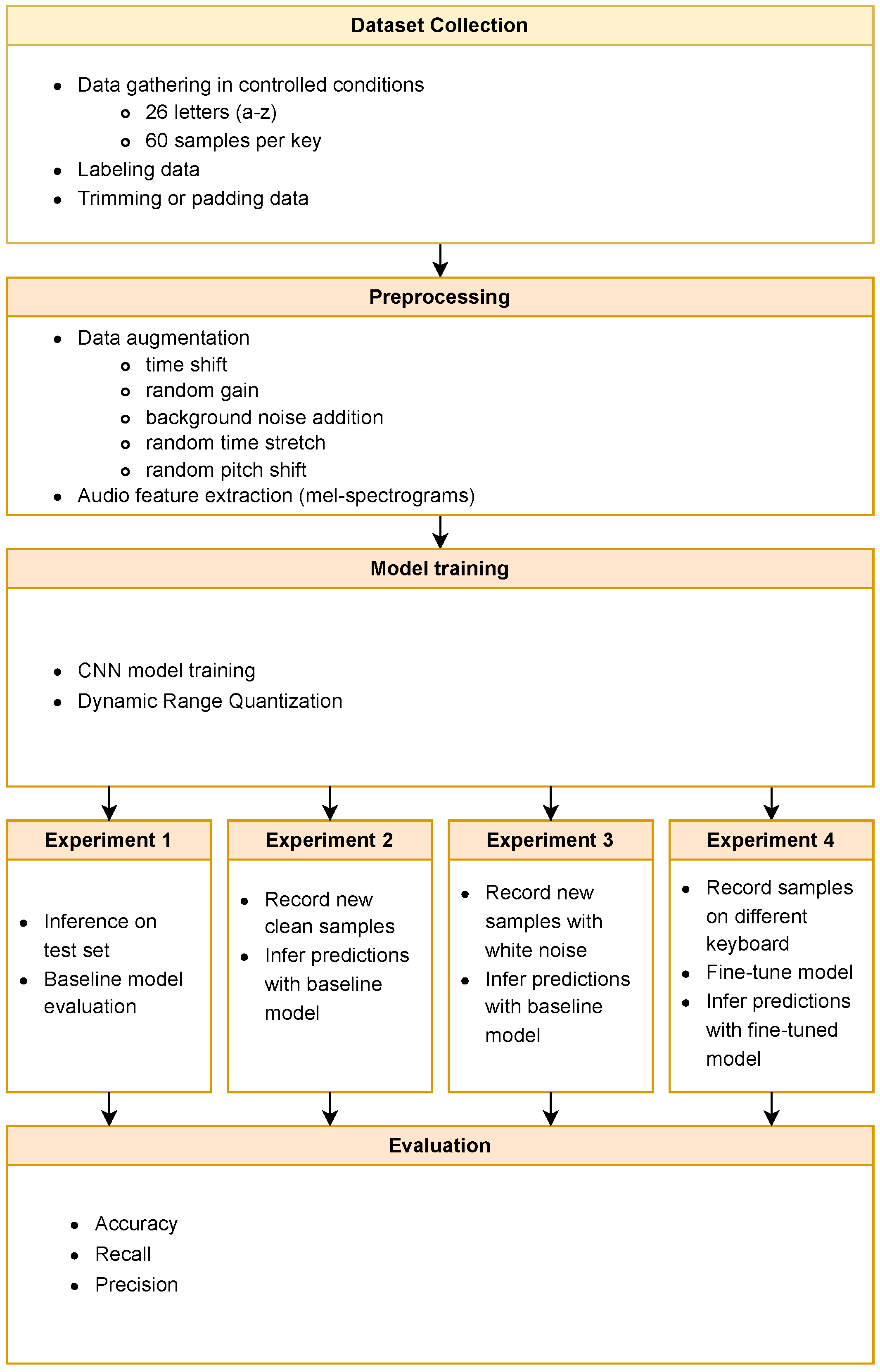
The experimental design (
Figure 3) comprised four complementary variants of keystroke sound acquisition, arranged to progressively increase environmental complexity and to assess model generalization. In all cases, the same microphone (Novox NC1) was positioned at a fixed distance of approximately 30 cm from the keyboard. In Experiment 1 and Experiment 2, recordings were conducted in a quiet room using a Fnatic Gear Rush keyboard, providing a laboratory-style reference condition. In Experiment 3, controlled background noise was introduced to emulate a more realistic environment with acoustic interference. In Experiment 4, the setup returned to a quiet room but changed the sound source with a different mechanical keyboard (Anne Pro 2 with Kailh Brown switches) to assess hardware effects under identical capture conditions. For each variant, a comparable number of samples was collected for all 26 letters. The recorded data were then preprocessed into mel-spectrograms, augmented, and partitioned into training, validation, and test sets. Each experiment was evaluated with the same metrics (accuracy, precision, and recall), enabling direct comparison of recognition performance across the three conditions: quiet, background noise, and different keyboard.
In the following sections, the results of the designed experiments are presented in detail.
3. Results
The model was trained in the Google Colab environment using an NVIDIA A100 GPU. This setup provides convenient access to high-performance computing without maintaining costly in-house infrastructure, while GPU acceleration substantially reduces training time. Google Colab is fully compatible with the TensorFlow and Keras libraries, enabling straightforward model development without additional configuration. Training was conducted in Python 3.12.12 using TensorFlow 2.19.0 and Keras 3.10.0.
3.1. Experiment 1: Baseline Test Evaluation
This experiment provides a post training estimate of model performance on an independent test set drawn from the same recording series as the training data. Although the data distribution matches the training setup, all test samples were strictly unseen during training and validation.
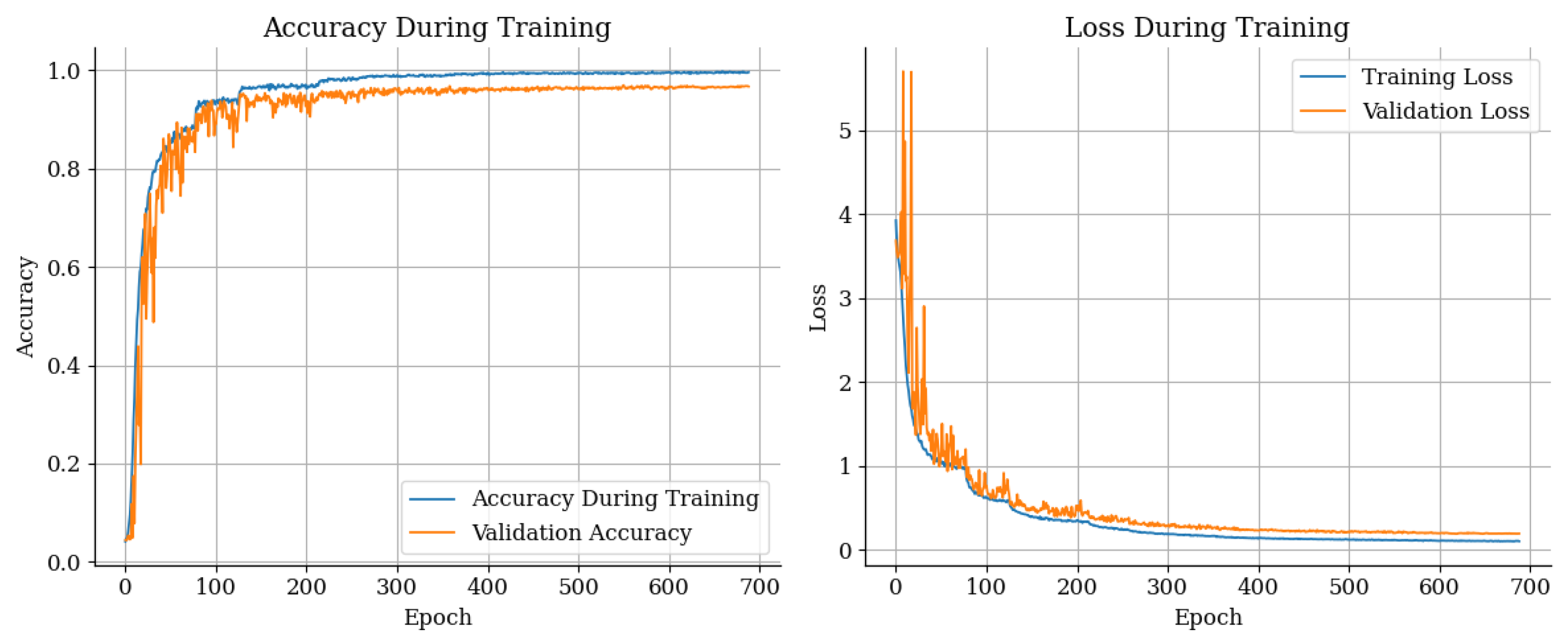
As evidenced by the learning-curve plots (
Figure 4) the model finished learning after 690 epochs thanks to an early stopping mechanism that detected no further improvement in the validation score. The best model weights from epoch 620 were subsequently restored, ensuring optimal network parameters. On the test set, the model achieved an accuracy of 96.9% and with a low loss value of 0.1685. The training progress curves indicate rapid acquisition of relevant patterns after just a few dozen epochs, the accuracy exceeded 90%. Both metrics, accuracy and loss, stabilise with a small difference between the training and validation sets, suggesting that overfitting did not occur.
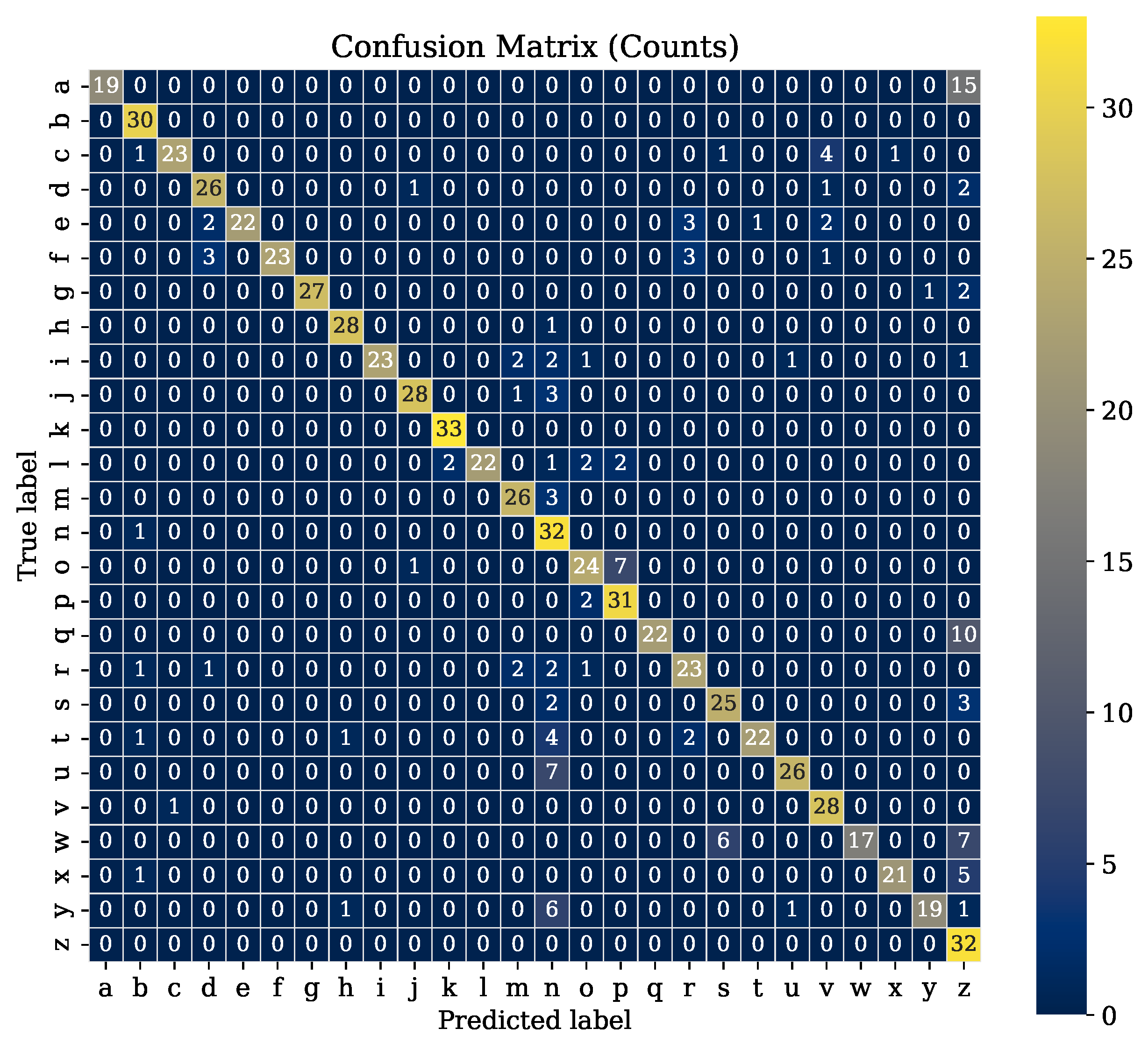
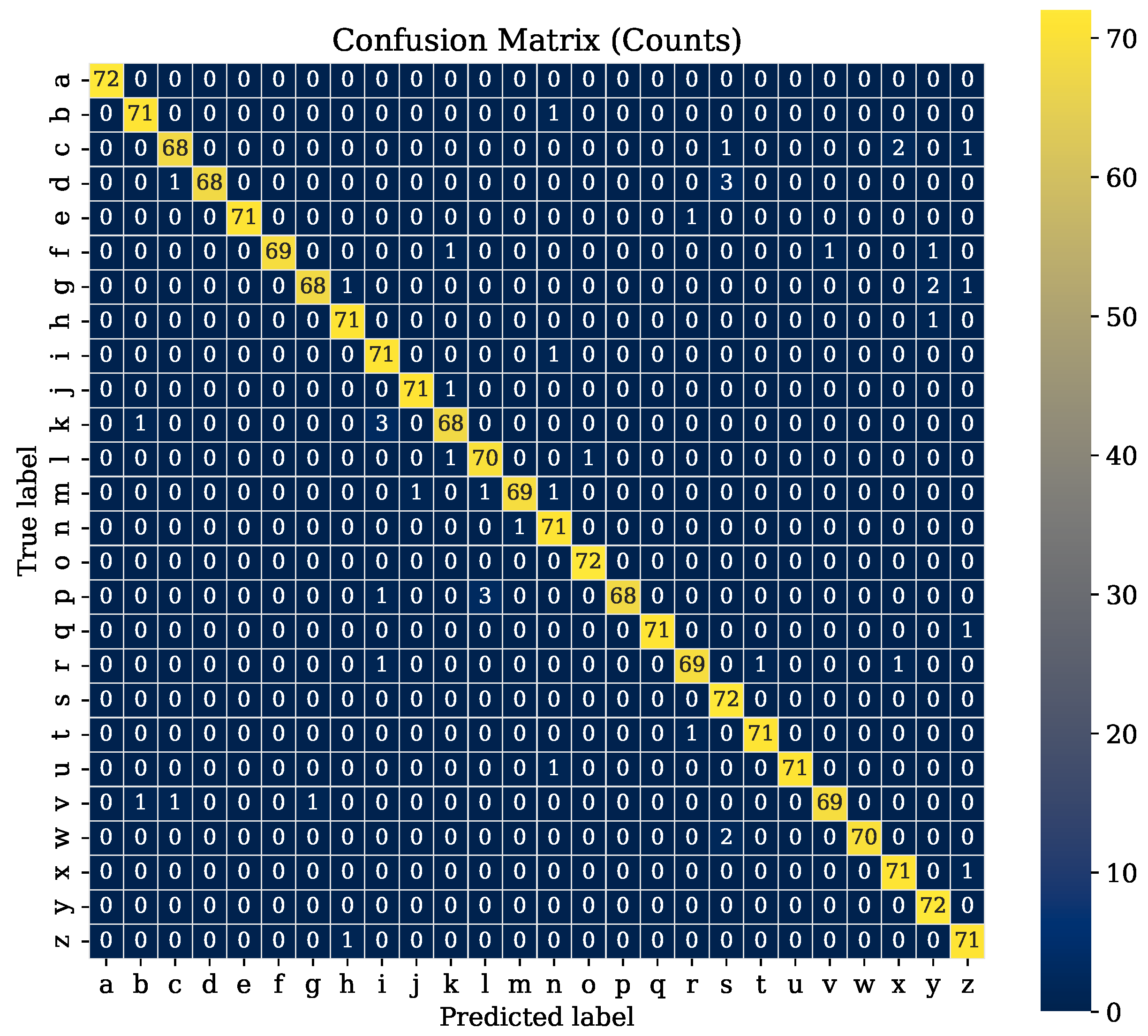
The confusion matrix (
Figure 5) supports these findings. Correct predictions are concentrated along the main diagonal, indicating strong discrimination across all letters. True positives are fairly uniform about 68 to 72 samples per class. Misclassification errors are extremely sparse, totaling only 32 instances across the entire matrix. The most frequent error involved the true label “m” being predicted as “j” three occasions. Two additional misclassifications occurred twice each: true “w” predicted as “r” and true “d” predicted as “y”. All remaining errors occurred only once, further supporting the model’s robustness and low overall error rate.
3.2. Experiment 2: Keystroke Recognition in Controlled Conditions
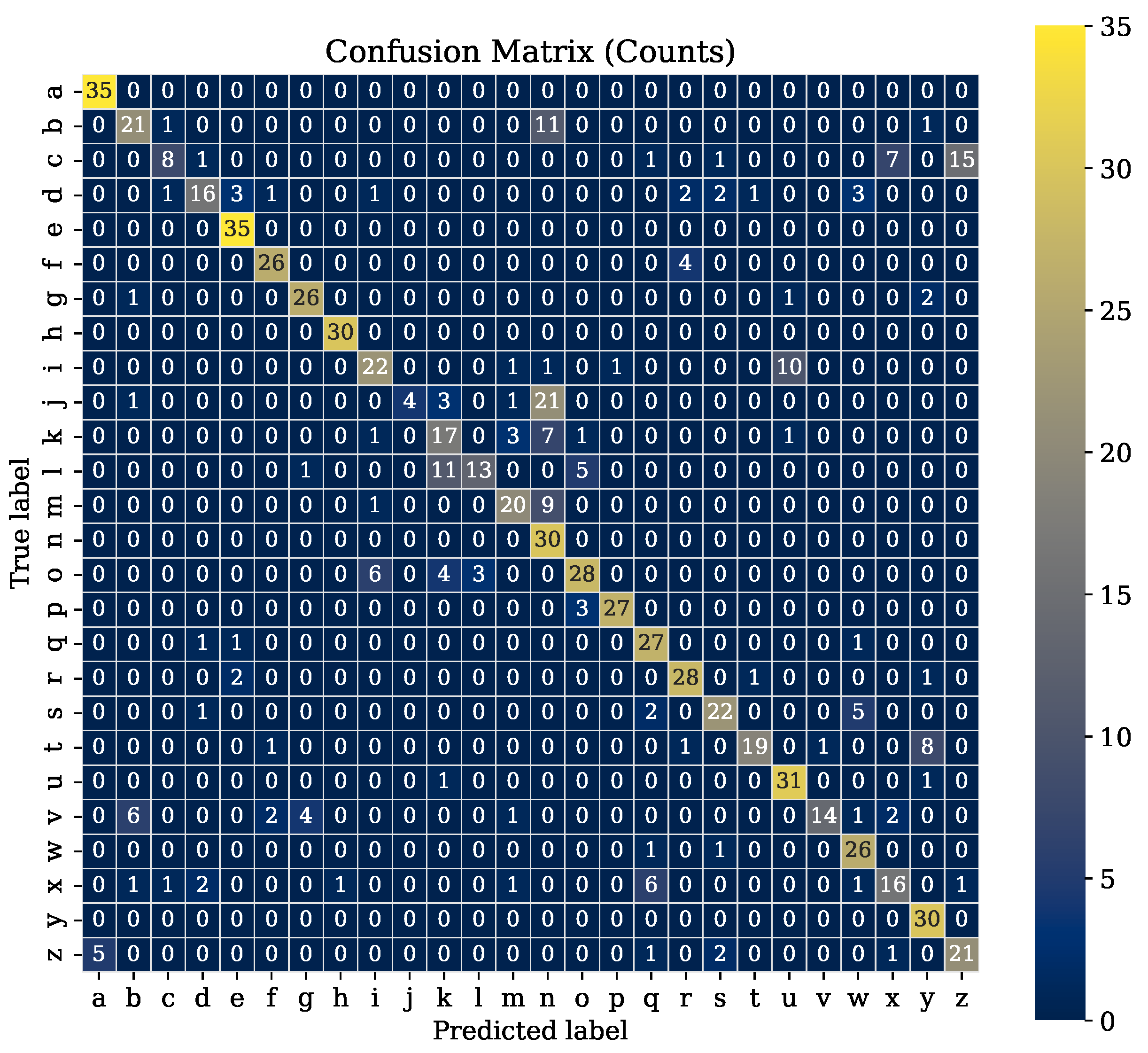
The data used in this experiment were collected under conditions similar to those of the training data, using the same equipment (Fnatic Gear Rush keyboard and Novox NC1 microphone). This dataset had not been previously used during model training, validation or testing. At least 30 samples were prepared for each of the 26 letters of the alphabet, however, the recording conditions may have differed slightly from the original ones, e.g., in terms of microphone positioning or keypress force. Out of a total of 816 samples, the model correctly classified 592, corresponding to an overall accuracy of 72.55%. Considering that the data comes from new, previously unseen recordings, this result is encouraging and confirms the model’s ability to generalise. The confusion matrix (
Figure 6) further indicates that several letters are recognised almost flawlessly.
The vast majority of correct predictions are located along the diagonal of the matrix, indicating the dominance of correct assignments. For example, the classes “a”, “e”, “h”, “n” and “y” were recognised correctly in all instances, while the letters “p”, “q”, “r”, “u” and “w” had single errors, suggesting that their acoustic signals are particularly distinctive. However, despite 100% accuracy in predicting this letter, class “n” has a very low precision value of 38%, which means that this class is often selected as a safe choice when the model does not see clear features of other classes. In contrast, letters such as “j”, “n”, “v” and “c” present much greater difficulties. One of the most difficult classes turned out to be the letter “j”, for which the model achieved a precision of 1.00, but a very low recall of only 13%. This suggest that the model was only confident in a few cases, and when it did identify “j”, it was usually correct. The confusion matrix also reveals patterns of frequent confusion between specific letter pairs. For example, the letters “c” and “x” and “c” and “z” where such errors may result from the acoustic similarity of the sounds, which is the position of these keys on the left side of the keyboard, close to the microphone, where adjacent keys can cause similar clicks. A similar situation occurred with the pair “k”–“l”, which were confused with each other due to similar acoustic characteristics. Overall, these results confirm the model’s overall ability to generalise but suggest that the greatest challenges for the model arise from the acoustic similarity between certain keys, especially those located in close physical proximity on the keyboard.
3.3. Experiment 3: Impact of Background Interference on Keystroke Recognition
To evaluate the trained model’s robustness to interference and its ability to recognize keystroke sounds under noisy conditions, a second experiment was conducted with added artificial background noise. The recordings for this experiment were prepared analogously to the earlier ones, using a microphone placed approximately 30 cm from the sound source. The key difference here was the presence of additional external noise. To simulate realistic environmental conditions, we used a publicly available crowd-noise recording (“Crowd Noise 1 Hour White Noise”), was used to approximate typical background disturbances. The noise source was positioned approximately 50 cm from the microphone, reflecting common real-world scenarios in which the recorded sounds co-occur with ambient noise, such as background conversations. This experiment complements the previous tests, which were carried out in silence or with minimal acoustic interference.
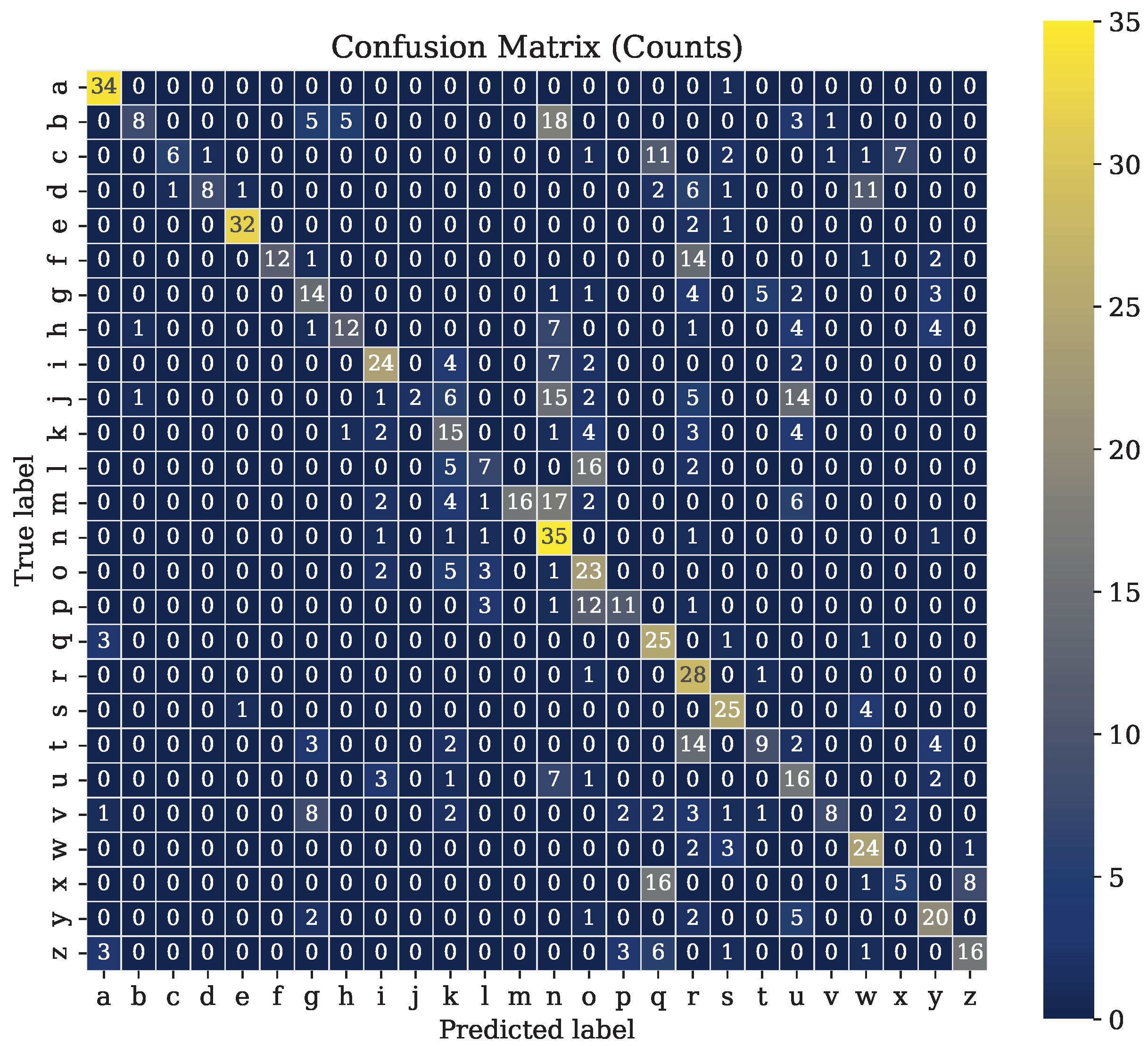
A total of 861 samples were evaluated, of which 435 were classified correctly. The final classification accuracy under these conditions was 50.52%, which is a significant decrease compared to tests conducted on clean recordings, where the result was over 72%. The reduced effectiveness demonstrates the model’s vulnerability to noise, even though many classes still achieved noticeable quality metrics. A detailed analysis shows that some letters, such as “a”, “e”, “s” and “w”, were classified relatively well despite the presence of interference. For example, the letter “e” was correctly classified 32 times out of 35 recordings, suggesting that the sounds of this key have particularly distinctive acoustic characteristics. On the other hand, some classes, especially “j”, “b”, “c”, “d” and “m”, showed a drastic deterioration. For the letter “j”, the recall dropped to only 4%, meaning that nearly all occurrences of this class were misclassified. The results presented in the confusion matrix (
Figure 7) indicate an increase in the number of misclassifications, suggesting that the model more often chooses “safe” classes that are similar to many others. For instance, the letter “r” was incorrectly predicted for as many as seven other classes, but at the same time it was correctly recognised in 93% of cases, which may mean that the model tends to favor this class when uncertainty is high.
It is worth noting that although Gaussian noise was used for data augmentation during model training, this approach may have been insufficient to capture the complexity of the realistic disturbances present in this experiment. Synthetic noise does not fully reflect the complexity and variability of noises recorded in a real environment. The lack of real-world examples of disturbances in the training set may have limited the model’s ability to generalise effectively under such conditions.
At the same time, it should be noted that despite the observed performance degradation, the accuracy achieved under noisy conditions exceeds 50%. This indicates that the model has learned the essential acoustic features for many classes and can reproduce them even in under less favorable. This demonstrates its partial resilience and may provide a good basis for further improvement, e.g., by applying more advanced augmentation techniques or including samples with realistic noise in the training. This experiment shows that although a model trained in clean conditions can recognise some classes even in the presence of interference, its effectiveness drops in a more realistic, noisy environment. This finding highlights important limitations of the current approach and points to clear directions for enhancing the model’s robustness to signal degradation in future work.
3.4. Experiment 4: Keystroke Recognition on a Different Keyboard Type
To assess the model’s ability to generalize to data from a different source, an additional experiment was performed using sound recordings from a second keyboard (Anne Pro 2). The recording environment for this experiment was maintained in conditions similar to those used in the first stage of the study. The recordings were made in the same quiet room, which allowed for low background noise levels and ensured consistency between the data sets. The microphone was again placed approximately 30 cm from the keyboard, and its position remained unchanged throughout the recording session. The primary difference relative to the first experiment was the use of a different mechanical keyboard model, the Anne Pro 2. It important to note that the base model was trained exclusively on data from the first keyboard (Fnatic Gear Rush) and therefore had no prior exposure to the acoustic characteristics of the second device.
An initial attempt to apply the previously trained model to Anne Pro 2 keyboard ended in complete failure. The model achieved an accuracy of approximately 5% accuracy, which is similar to random guessing across 26 classes. The predictions were chaotic and inconsistent, and the system showed no ability to correctly recognise sounds in the new environment. This result clearly shows that even relatively small acoustic differences between devices resulting, for example, from different designs, materials or component placement can significantly affect signal characteristics and prevent effective recognition when the model has not been exposed to such variability.
To address this issue, we performed fine-tuned of the pre-trained CNN from Experiment 1. The entire network remained trainable (no layers were frozen) and no new top layers were introduced. The input consisted of mel-spectrogram features, with the original input shape and label mapping preserved to ensure compatibility with the base model. Training was performed using the Adam optimizer with a learning rate of
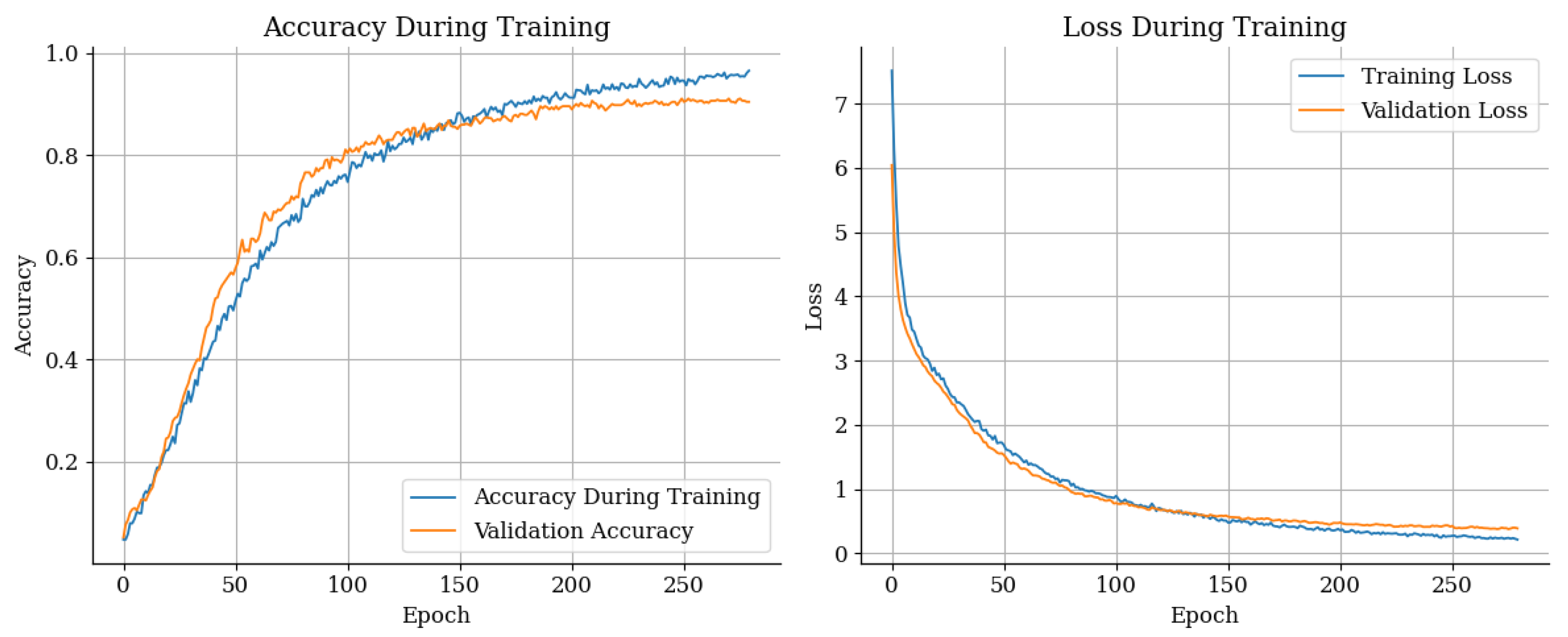
, a batch size of 32, and the sparse categorical cross-entropy loss, employing an 80/20 train–validation split. For this purpose, 15 recordings were used per key on the Anne Pro 2 keyboard. Training was scheduled for 300 epochs with an EarlyStopping criterion that monitored validation accuracy. By epoch 280, the model achieved 97.12% accuracy with a loss of 0.20 on the training set and 90.43% accuracy with a loss of 0.38 on the validation set. This fine-tuning approach enabled the model to adapt to the new acoustic conditions without the need to retrain it from scratch. A detailed analysis of accuracy and loss trends is presented in
Figure 8.
After retraining the model using a limited number of samples from the new keyboard, the model achieved a substantial improvement in classification performance was observed. The total number of samples tested was 795, of which 652 were correctly classified, resulting in an overall accuracy of 82.01%. Compared to the original results, the improvement achieved is very significant and shows that even a small number of new training samples is sufficient to effectively adapt the model to a new acoustic environment. The analysis of the confusion matrix (
Figure 9) indicates that the model is able to accurately distinguish most character classes, with correct predictions predominantly concentrated along the main diagonal, reflecting high classification accuracy for the majority of labels.
Misclassifications still occur sporadically for certain character pairs (e.g., “a” and “z”, “q” and “x”), but their number has been significantly reduced compared to the results before tuning. Additionally, for difficult sounds that it was unable to handle, the model often suggested the letter “z”. Overall, this process confirms the effectiveness of this technique in the context of adapting the sound model to a new input device. Despite the acoustic differences between the keyboards, the model was able to recover its predictive capability and achieve a high level of classification accuracy after retraining.
4. Discussion
This study demonstrates that identifying keystrokes from their acoustic signatures is a realistic and effective attack vector, particularly under conditions similar to those used during training. The experiments demonstrate that, even with limited data, the model can achieve strong performance, which can be further improved by adapting it to new conditions. At the same time, while background noise substantially degrades the attack’s effectiveness, but it does not completely prevent keystroke recognition.
The conducted research shows that recognizing keystrokes solely from their acoustic signatures is feasible using a lightweight CNN operating on mel-spectrograms representations, and that the method’s performance can be systematically improved through simple adaptation procedures. The principal contribution is a complete, experimentally validated pipeline from recording keystroke clicks, through mel-spectrogram representation, to classification and adaptation to new conditions, together with a clear demonstration of how environmental and hardware factors influence accuracy. The contribution of this work is to show that, even with a limited amount of data, it is possible to achieve respectable classification performance.
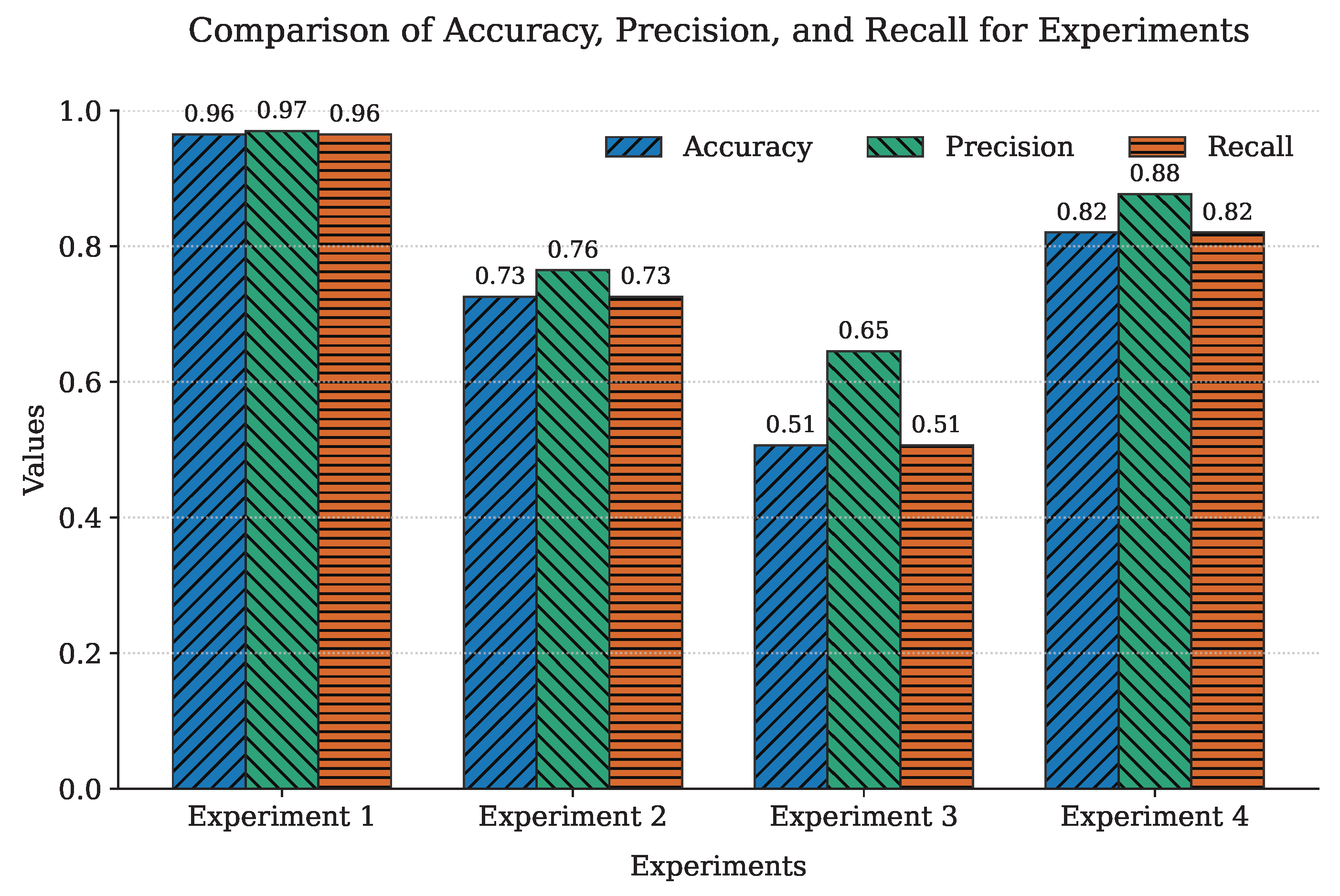
Figure 10 summarises the experimental results, showing that the baseline model achieved 96% accuracy on the test set. Under controlled conditions, the model reached 73% accuracy across 26 classes, which confirms the practical detectability of the signals. With background noise present, accuracy dropped to 50%, which still indicates partial attack effectiveness in less favorable conditions. Crucially, we also demonstrate adaptive potential where after brief fine-tuning on a small dataset from a different keyboard, accuracy reached 82% on data from the new device, showing that the model can be efficiently adapted to new acoustic characteristics without retraining from scratch. The experimental results also highlight that background noise has a substantial impact on classification accuracy, significantly limiting the applicability of the proposed model in highly interfered acoustic environments, such as crowded public spaces or compressed audio streams during video calls. This sensitivity is consistent with prior work on acoustic side-channel attacks and reflects the inherently low signal-to-noise ratio of keystroke sounds under realistic conditions. Importantly, this limitation does not invalidate the feasibility of the attack itself, but rather delineates its operational boundaries. As clarified in the threat model, the proposed approach is most applicable in scenarios involving a targeted attacker with proximity to the victim’s keyboard and partial control over recording conditions (e.g., office desks, shared workspaces, or personal devices). In contrast, the crowd-noise and cross-device experiments represent constrained adversarial settings and are intended to quantify performance degradation under less favorable conditions rather than to claim universal robustness.
Additionally, the dataset we collected has been made publicly available on Zenodo,
https://doi.org/10.5281/zenodo.17536616, accessed on 31 December 2025 together with short video materials demonstrating the data acquisition procedure. These resources can serve as a starting point for researchers interested in acoustic side-channel attacks.
The principal limitation of this study is the absence of explicit sequence modeling. The system classifies isolated keystrokes rather than decoding continuous key sequences, which is necessary for reconstructing readable text. In addition, the study is constrained by limited dataset diversity (one participant and a small set of devices) and shows sensitivity to environmental variation, including background noise, microphone placement, and keyboard model. Consequently, model performance depends strongly on the similarity between the training and test domains.
All recordings used in this study were collected from a single participant, which represents a clear limitation with respect to inter-user variability and generalization. Individual differences in typing style, finger usage, strike force, and hand posture can influence the acoustic characteristics of keystroke sounds and may affect classification performance when models are applied to unseen users. This design choice was intentional and aligned with the pilot-study character of the work. The objective was not to develop a universally generalizable attack model, but rather to investigate feasibility, identify dominant acoustic factors, and establish a robust and reproducible processing and modeling pipeline. Within this constrained setting, the model exhibited consistent and interpretable behavior across four experimental scenarios, including unseen samples, background noise, and cross-device evaluation, supporting the validity of the observed trends. To promote transparency and further research, the complete dataset has been publicly released. Future work will explicitly address this limitation by extending data collection to multiple users, additional keyboard types, varied microphone distances, and more realistic acoustic environments, as discussed in the Future Work section. Beyond data-related limitations, the current study focuses on isolated keystroke classification and does not explicitly model temporal dependencies between consecutive keystrokes. While this setting is sufficient for feasibility analysis and controlled evaluation, it does not support stable reconstruction of complete text strings, which would be required for realistic real-time acoustic attack scenarios. Future work should therefore extend the current framework toward sequence-based modeling by incorporating temporal context and linguistic constraints. Potential directions include the use of Hidden Markov Models, recurrent neural networks, temporal convolutional networks, or transformer-based sequence models, as well as post-processing stages that leverage language models or dictionary-based decoding. Such extensions would allow the transition from single-keystroke recognition to continuous text reconstruction and provide a more accurate assessment of practical attack feasibility.
The
Table 3 shows that it is not necessary to use very large models for the task of recognising keys from sound. In our work, we used a small convolutional neural network (CNN) on melspectrograms, and yet we achieved 96% accuracy on the test set and 72% in the experiment with independently recorded samples. These findings demonstrate that a lightweight architecture, with a well-chosen representation and learning procedure, gives decent and repeatable results in this field, without the need to immediately resort to complex architectures such as CoAtNet [
9]. Compared to the “Practical Deep Learning-Based Acoustic Side Channel Attack on Keyboards” [
9] publication, which also worked with melspectrograms, their system achieved higher results in experiments (95% telephone, 93% Zoom), but our experiment had a larger number of samples per class (30 vs. 5), which makes the task more demanding and better reflects the diversity of recordings. Moreover, Harrison et al. employ a substantially different methodological pipeline, based on the large-scale CoAtNet architecture featuring convolutional layers combined with self-attention mechanisms. Their training process requires extensive hyperparameter exploration (500–1100 epochs, variable learning-rate schedules), SpecAugment-based time–frequency masking, and two distinct acoustic channels—direct smartphone recordings and Zoom VoIP transmissions—each introducing characteristic distortions. These differences in data diversity, signal degradation, model scale and training complexity make direct comparison of raw accuracy values inherently limited. In turn, compared to the “I Know Your Keyboard Input: A Robust Keystroke Eavesdropper Based on Acoustic Signals.” [
21] publication, we achieved similar global accuracy (96% vs. 92%) and a similar experiment result, but it is important to note a significant difference, where result of 71.24% refers to “unknown users” with the same keyboard class, while in our experiment, 72% was conducted on a user known to the model. At the same time, Bai’s work offers a more extensive environmental pipeline (multiple keyboards, numerous microphone positions, geometry estimation, and TDoA/PSD features), which broadens the scope of generalisation. Specifically, Bai et al. integrate a multi-stage attack system involving microphone–keyboard position estimation (via CMA-ES), identification of large-size keys, extraction of TDoA and PSD as handcrafted features, and SVM-based classification across 9 users, 9 keyboards and 37 environmental configurations. Their experimental conditions therefore differ fundamentally from deep-learning-based pipelines: they operate on dual-microphone geometric cues rather than spectral representations, and tackle multi-user and multi-device generalisation, making raw accuracy values methodologically non-equivalent. In summary, our work is an introduction to the topic of acoustic key recognition. It shows that a small CNN model can provide a solid basis for results and be a starting point for further research, including expanding the number of users and devices, incorporating sequence modelling, and more advanced environmental adaptation procedures. Unlike prior studies that rely on large pretrained architectures such as CoAtNet, Vision Transformers, or hybrid models augmented with LLM-based post-processing, this work introduces a newly designed lightweight CNN tailored specifically for keystroke-sound recognition. The model contains only a small number of parameters, yet achieves competitive accuracy, demonstrating that effective acoustic side-channel attacks do not require computationally intensive architectures. This significantly lowers the practical barrier for real-world exploitation. To further illustrate the feasibility of low-resource attacks, we applied dynamic range quantization, reducing model size and computational requirements with minimal accuracy degradation-an approach not explored in previous research. Moreover, by evaluating the model under four increasingly challenging scenarios (clean environment, new clean recordings, background noise, and a different keyboard), we provide a broader and more realistic assessment of its robustness compared to existing studies.
Key directions for further development include expanding the dataset to encompass multiple users, a broader range of microphones and keyboards, and more diverse acoustic conditions. Another priority is to add sequence modeling to move from single-keystroke classification to stable reconstruction of character strings, and to apply stronger augmentation alongside other techniques to improve generalization. Pursuing this agenda should produce a more robust and scalable system and to support a more precise assessment of acoustic attack risk for practical deployments and security policy contexts.
Acoustic side-channel attacks pose a real and growing threat to data confidentiality, making effective countermeasures increasingly important. Mitigation strategies should therefore be considered across multiple layers, combining user practices, hardware design, and software-based controls. At the user level, it is advisable to avoid entering sensitive information while microphones are active (e.g., during video calls), to rely on strong randomly generated passwords combined with multi-factor authentication, and to use password managers to minimize the number of physical keystrokes required for authentication. Raising user awareness through targeted training and clearly defined security procedures remains a critical factor in reducing exposure to such attacks. From an environmental and hardware perspective, reducing acoustic leakage at the source can significantly limit attack feasibility. This includes the use of low-emission or dampened input devices, keyboards with vibration-absorbing materials, and internal acoustic insulation that reduces resonance and sound propagation. In high-risk situations, signal masking through controlled background audio may further reduce the signal-to-noise ratio of keystroke sounds. When feasible, microphones should be physically disconnected, muted at the hardware level, or isolated from the typing environment. At the software and system level, defensive measures include strict management of microphone permissions, continuous monitoring for anomalous or unauthorized recording activity, and the enforcement of a consistent privacy posture across all devices, including computers, smartphones, voice assistants, and cameras. Beyond conventional masking techniques, more advanced approaches may involve intentional acoustic obfuscation or controlled signal randomization at the source. Rather than merely adding noise, such mechanisms aim to deliberately alter the temporal or spectral characteristics of keystroke emissions in a structured manner, thereby reducing their interpretability by unauthorized listeners. From a longer-term technological perspective, emerging defensive concepts may be viewed as forms of acoustic encryption. Potential examples include keyboards that introduce pseudo-random yet reversible acoustic variations during key presses, firmware-level modulation of vibration patterns, or operating-system–assisted acoustic obfuscation synchronized with typing activity. While such approaches remain largely unexplored and may introduce trade-offs between usability, performance, and security, they represent a promising direction for mitigating acoustic side-channel leakage at a fundamental level. Taken together, these complementary measures do not eliminate acoustic side-channel risks entirely but can substantially hinder the capture, analysis, and exploitation of keyboard acoustics in practical attack scenarios.
Summarizing our findings, this pilot study introduces several contributions that complement and extend existing research on acoustic side-channel attacks:
Lightweight CNN architecture: We designed a custom convolutional neural network specifically tailored for keystroke-sound classification. Unlike prior works relying on large pretrained models (e.g., CoAtNet, Vision Transformers), our approach demonstrates that high accuracy can be achieved with a compact, resource-efficient architecture.
Dedicated dataset and public release: We collected and publicly released a keystroke-sound dataset recorded on two mechanical keyboards under multiple conditions (clean recordings, background noise, cross-device setup). The availability of this dataset supports reproducibility and future benchmarking.
Complete preprocessing pipeline: We developed an end-to-end audio processing pipeline including Fourier transform, mel-spectrogram generation, time-shift augmentation, spectrogram masking, and feature extraction optimised for CNN-based classification.
Evaluation across four realistic scenarios: We conducted a systematic evaluation covering (i) clean data, (ii) unseen samples from the same setup, (iii) added crowd noise, and (iv) a different keyboard model, providing insights into robustness and generalisation capabilities.
Post-training dynamic range quantization: We applied model quantization to reduce size and computational cost, showing minimal accuracy loss. To our knowledge, quantization has not been explored in prior acoustic keystroke-recognition studies, making it a novel contribution regarding deployability.
Security perspective and mitigation: We discuss attacker capabilities within a defined threat model and outline a potential mitigation strategy based on audio masking and controlled noise injection.
Directions for future work: We highlight several key avenues for further research, including the collection of multi-user datasets, the use of a wider range of keyboard types, the inclusion of varied microphone distances, the application of domain-adaptation techniques, sequence-based decoding approaches, and the evaluation of model robustness in more realistic adversarial environments. In particular, future work should systematically analyse the impact of different noise categories (e.g., speech, music, office ambience, concurrent typing) and varying signal-to-noise ratios, as these factors are expected to influence classification accuracy in real-world scenarios. Additionally, extending the current framework toward continuous, sequence-based text reconstruction would enable a more realistic assessment of practical attack scenarios, including near real-time acoustic eavesdropping. Integrating temporal modeling and linguistic constraints may significantly improve the stability and interpretability of reconstructed text streams.